Editor’s Note from August 12, 1977

Friend wife and I spent almost four weeks in Taiwan. I spoke twenty-four times in twenty-four days. We came home with jet lag to face a skillion unpacked boxes as a result of our move. In the next issue of CHRISTIANITY TODAY I’ll report on Taiwan, which has been the object of much attention. The recent speech of Secretary of State Cyrus Vance seemed to indicate that we might forsake the Republic of China for Red China. I hope it does not happen.

The interview with Jesse Jackson is important to our readers for two reasons: first, he is an important national black figure; second, his theology does not represent mainstream black leadership and at certain points departs from an evangelical perspective.
Whither Biblical Inerrancy?

Harold Lindsell’s Battle For the Bible has been widely castigated for troubling Zion. Writing in a recent special issue of the Fuller Seminary alumni magazine, Theology, News, and Notes, Clark Pinnock expostulates: “What a pity to see the admirable unity of the evangelical caucus now being threatened just as it is beginning to bear fruit, and what irony that the editor of Christianity Today, the organ which was founded to facilitate evangelical harmony and cooperation and which more than anything else has symbolized that unity, should be the person responsible for placing it in jeopardy.” But Pinnock gives the editor of CHRISTIANITY TODAY too much credit (or discredit). The conflict in evangelicalism over the extent of biblical reliability has been simmering for decades; all The Battle For the Bible did was to make journalistically explicit what has for long been recognized implicitly.

The most recent bend in the river of evangelical thinking on inerrancy is: rather than reject the word “inerrant,” why not simply redefine it so that it no longer poses any threat to biblical interpretation? The Spring, 1976, issue of the Evangelical Theological Society Journal, under the editorship of Ronald Youngblood of Bethel Seminary, offers many examples of this trend. I shall restrict my comments to the lead article by Grant R. Osborne: “Redaction Criticism and the Great Commission: A Case Study Toward a Biblical Understanding of Inerrancy.”

Osborne argues in reference to the trinitarian formula in Matthew 28:19 that Jesus apparently did not utter it (even though it is preceded by the words, “Jesus came and spoke to them, saying”): “it seems most likely that at some point the tradition or Matthew expanded an original monadic formula.” Such redaction criticism, he assures us, poses no threat to an evangelical understanding of biblical inerrancy; rather, it is “a tremendous, positive tool for understanding the early Church and its theology.” The redaction of Jesus’ words by the biblical writers and the early Church creates no problem, for the redaction was Spirit-led and inerrant! The mere fact that “it is difficult, if not impossible, to trace the exact words that Jesus spoke on the mountain in Galilee” ought not to worry us; after all, “the evangelists did not attempt to give us ipsissima verba but rather sought to interpret Jesus’ words for their audiences. In other words, they wished to make Jesus’ teachings meaningful to their own Sitz im Leben rather than to present them unedited. Relevancy triumphed over verbal exactness.” Thus can “verbal inexactitude” be harmonized hermeneutically with the E. T. S. doctrinal statement, “The Bible alone, and the Bible in its entirety, is the Word of God written, and is therefore inerrant in the autographs.”

Some years ago, in the throes of the Lutheran controversy over biblical authority, I wrote: “Whenever we reach the point of affirming on the one hand that the Bible is infallible or inerrant and admitting on the other hand to internal contradictions or factual inaccuracies within it, we not only make a farce of language, promoting ambiguity, confusion, and perhaps even deception in the church; more reprehensible than even these things, we in fact deny the plenary inspiration and authority of Scripture, regardless of the theological formulae we may insist on retaining.”

The doctrine of biblical inerrancy derives from the attitude of Scripture toward itself, and in particular the attitude of Christ toward Scripture. What we must recognize is that Scripture and its Christ do not give us an open concept of inspiration that we can fill in as the extrabiblical methodologies of our time appear to dictate. To the contrary, the total trust that Jesus and the apostles displayed toward Scripture entails a precise and controlled hermeneutic. They subordinated the opinions and traditions of their day to Scripture; so must we. They did not regard Scripture as erroneous or self-contradictory; neither can we. They took its miracles and prophecies as literal fact; so must we. They regarded Scripture not as the product of editors and redactors but as stemming from Moses, David, and other immediately inspired writers; we must follow their lead. They believed that the events recorded in the Bible happened as real history; we can do no less.

With characteristic theological perception, the Commission on Theology and Church Relations of the Lutheran Church-Missouri Synod has prepared A Statement of Scriptural and Confessional Principles (available in a study edition from Box 201, St. Louis, Mo. 63166) to deal with the inerrancy controversy in Lutheranism. In line with historic Lutheran practice, this document not only sets forth positive affirmations (“theses”) on biblical inerrancy but also declares what will not be tolerated hermeneutically (“antitheses”).

Recognizing that positive creedal affirmations of biblical reliability are no longer sufficient to preserve churches or institutions from the hermeneutic destruction of their bibliology, the Melodyland School of Theology in December became the first theological seminary in the world to adopt a doctrinal statement with built-in hermeneutic commitments, designed to prevent the biblical paragraph of its credo from being evacuated of meaning by unscriptural interpretative methodology. Melodyland’s doctrinal statement does not rest with its declaration that “the Scriptures in all that they affirm are without error, in the whole and in the part, and therefore are completely trustworthy”; it goes on to deal with the specific hermeneutic implications of belief in biblical inerrancy:

All genuine Christian Statements of Doctrine depend upon a proper interpretation of the Holy Scriptures. The Melodyland School of Theology, therefore, unreservedly commits itself to the following hermeneutic rules;

1. A passage of Holy Scripture is to be taken as true in its natural, literal sense unless the context of the passage itself indicates otherwise, or unless an article of faith established elsewhere in Scripture requires a broader understanding of the text.

2. The prime article of faith applicable to biblical interpretation is the attitude of Christ and His Apostles toward the Scriptures. Their utter trust in Scripture—in all it teaches—must govern the interpreter’s practice, thus eliminating in principle any interpretation which sees the biblical texts as erroneous or self-contradictory.

3. Extra-biblical linguistic and cultural considerations must never decide the interpretation of a text; and any use of extra-biblical material to arrive at an interpretation inconsistent with the truth of a scriptural passage is to be rejected. Extra-biblical data can and should put critical questions to a text, but only Scripture itself can legitimately answer questions about itself.…

4. Harmonization of apparent scriptural difficulties should be pursued within reasonable limits, and when harmonization would pass beyond such bounds, the interpreter must leave the problem open rather than, by assuming error, impugn the absolute truthfulness of God, who inspires all Holy Scripture for our salvation and learning. We hold with St. Augustine (De Potent., IV, 1, 8): “If you chance upon anything in Scripture that does not seem to be true, you must not conclude that the sacred writer made a mistake; rather your attitude should be; the manuscript is faulty, or the version is not accurate, or you yourself do not understand the matter.”

We are warned that to press a consistent view of biblical inerrancy may divide evangelicalism. This was precisely Melanchthon’s argument at the Diet of Augsburg in 1530 relative to the presentation of the Augsburg Confession to Charles V by the believing Protestant princes: “You may divide the Holy Roman Empire—you may even destroy it.” Replied the electors: “We shall nonetheless confess our Christ.”

The question, of course, is simply whether entire scriptural reliability is that important. I believe it is. I would not tolerate for a moment the argument that because the Trinity is nowhere set forth by name in the Bible, evangelicalism mustn’t be divided over that doctrine. Biblical inerrancy, though the expression does not appear in Scripture, is nevertheless Christ’s view; and he must be my Lord in this as in all other areas. If he is not Lord of all, he is not Lord at all.

The Lutheran Church-Missouri Synod agonized over the loss of some professors, students, and congregations on this very issue, but it has rightly concluded that if unity must be preserved at the cost of sola Scriptura—of the formal principle of all theology—then the price of unity is far too high. The great theologies of Christendom have never been via media theologies, for Scripture and its Christ spew the lukewarm out of the mouth.

I frequently recall the Scottish revival in which the neighboring dominie asked, “And how many souls were added to the kirk?” “None,” came the reply, “but we’ve gotten rid of a few we’ve been tryin’ to get rid o’ for years.” That can also be a revival. Make no mistake: God will not let falter those who are consistently faithful to his Word. Whatever else may occur in Christendom, the ministry of childlike Bible believers will increase geometrically, for faith comes by hearing and hearing by the Word of God, and only the Word of God remains forever.

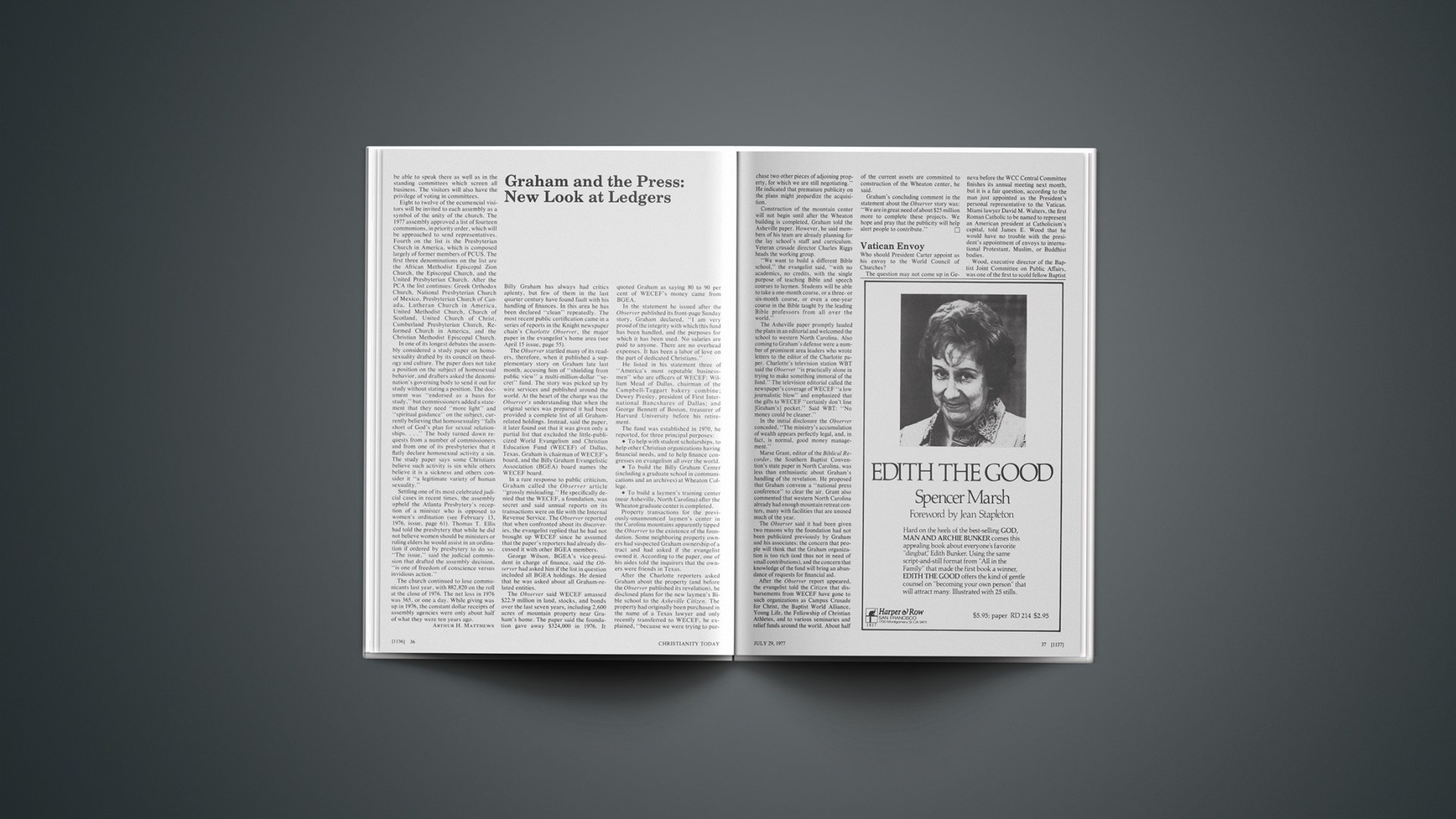
Graham and the Press: New Look at Ledgers

Billy Graham has always had critics aplenty, but few of them in the last quarter century have found fault with his handling of finances. In this area he has been declared “clean” repeatedly. The most recent public certification came in a series of reports in the Knight newspaper chain’s Charlotte Observer, the major paper in the evangelist’s home area (see April 15 issue, Page 55).

The Observer startled many of its readers, therefore, when it published a supplementary story on Graham late last month, accusing him of “shielding from public view” a multi-million-dollar “secret” fund. The story was picked up by wire services and published around the world. At the heart of the charge was the Observer’s understanding that when the original series was prepared it had been provided a complete list of all Graham-related holdings. Instead, said the paper, it later found out that it was given only a partial list that excluded the little-publicized World Evangelism and Christian Education Fund (WECEF) of Dallas, Texas. Graham is chairman of WECEF’s board, and the Billy Graham Evangelistic Association (BGEA) board names the WECEF board.

In a rare response to public criticism, Graham called the Observer article “grossly misleading.” He specifically denied that the WECEF, a foundation, was secret and said annual reports on its transactions were on file with the Internal Revenue Service. The Observer reported that when confronted about its discoveries, the evangelist replied that he had not brought up WECEF since he assumed that the paper’s reporters had already discussed it with other BGEA members.

George Wilson, BGEA’s vice-president in charge of finance, said the Observer had asked him if the list in question included all BGEA holdings. He denied that he was asked about all Graham-related entities.

The Observer said WECEF amassed $22.9 million in land, stocks, and bonds over the last seven years, including 2,600 acres of mountain property near Graham’s home. The paper said the foundation gave away $324,000 in 1976. It quoted Graham as saying 80 to 90 per cent of WECEF’s money came from BGEA.

In the statement he issued after the Observer published its front-Page Sunday story, Graham declared, “I am very proud of the integrity with which this fund has been handled, and the purposes for which it has been used. No salaries are paid to anyone. There are no overhead expenses. It has been a labor of love on the part of dedicated Christians.”

He listed in his statement three of “America’s most reputable businessmen” who are officers of WECEF: William Mead of Dallas, chairman of the Campbell-Taggart bakery combine; Dewey Presley, president of First International Bancshares of Dallas; and George Bennett of Boston, treasurer of Harvard University before his retirement.

The fund was established in 1970, he reported, for three principal purposes:

• To help with student scholarships, to help other Christian organizations having financial needs, and to help finance congresses on evangelism all over the world.

• To build the Billy Graham Center (including a graduate school in communications and an archives) at Wheaton College.

• To build a laymen’s training center (near Asheville, North Carolina) after the Wheaton graduate center is completed.

Property transactions for the previously-unannounced laymen’s center in the Carolina mountains apparently tipped the Observer to the existence of the foundation. Some neighboring property owners had suspected Graham ownership of a tract and had asked if the evangelist owned it. According to the paper, one of his aides told the inquirers that the owners were friends in Texas.

After the Charlotte reporters asked Graham about the property (and before the Observer published its revelation), he disclosed plans for the new laymen’s Bible school to the Asheville Citizen. The property had originally been purchased in the name of a Texas lawyer and only recently transferred to WECEF, he explained, “because we were trying to purchase two other pieces of adjoining property, for which we are still negotiating.” He indicated that premature publicity on the plans might jeopardize the acquisition.

Construction of the mountain center will not begin until after the Wheaton building is completed, Graham told the Asheville paper. However, he said members of his team are already planning for the lay school’s staff and curriculum. Veteran crusade director Charles Riggs heads the working group.

“We want to build a different Bible school,” the evangelist said, “with no academics, no credits, with the single purpose of teaching Bible and speech courses to laymen. Students will be able to take a one-month course, or a three- or six-month course, or even a one-year course in the Bible taught by the leading Bible professors from all over the world.”

The Asheville paper promptly lauded the plans in an editorial and welcomed the school to western North Carolina. Also coming to Graham’s defense were a number of prominent area leaders who wrote letters to the editor of the Charlotte paper. Charlotte’s television station WBT said the Observer “is practically alone in trying to make something immoral of the fund.” The television editorial called the newspaper’s coverage of WECEF “a low journalistic blow” and emphasized that the gifts to WECEF “certainly don’t line [Graham’s] pocket.” Said WBT: “No money could be cleaner.”

In the initial disclosure the Observer conceded, “The ministry’s accumulation of wealth appears perfectly legal, and, in fact, is normal, good money management.”

Marse Grant, editor of the Biblical Recorder, the Southern Baptist Convention’s state paper in North Carolina, was less than enthusiastic about Graham’s handling of the revelation. He proposed that Graham convene a “national press conference” to clear the air. Grant also commented that western North Carolina already had enough mountain retreat centers, many with facilities that are unused much of the year.

The Observer said it had been given two reasons why the foundation had not been publicized previously by Graham and his associates: the concern that people will think that the Graham organization is too rich (and thus not in need of small contributions), and the concern that knowledge of the fund will bring an abundance of requests for financial aid.

After the Observer report appeared, the evangelist told the Citizen that disbursements from WECEF have gone to such organizations as Campus Crusade for Christ, the Baptist World Alliance, Young Life, the Fellowship of Christian Athletes, and to various seminaries and relief funds around the world. About half of the current assets are committed to construction of the Wheaton center, he said.

Graham’s concluding comment in the statement about the Observer story was: “We are in great need of about $25 million more to complete these projects. We hope and pray that the publicity will help alert people to contribute.”

Vatican Envoy

Who should President Carter appoint as his envoy to the World Council of Churches?

The question may not come up in Geneva before the WCC Central Committee finishes its annual meeting next month, but it is a fair question, according to the man just appointed as the President’s personal representative to the Vatican. Miami lawyer David M. Walters, the first Roman Catholic to be named to represent an American president at Catholicism’s capital, told James E. Wood that he would have no trouble with the president’s appointment of envoys to international Protestant, Muslim, or Buddhist bodies.

Wood, executive director of the Baptist Joint Committee on Public Affairs, was one of the first to scold fellow Baptist Carter for sending a representative to the ecclesiastical headquarters. (Baptists also led the attack when Harry Truman, a Baptist, tried to name an ambassador in 1951, and he withdrew the nomination. Carter does not face the kind of senatorial opposition Truman got since he does not seek full ambassadorial status for his appointee. The appointment of a “personal representative” does not require Senate confirmation.)

“In a personal interview with Mr. Walters,” Wood reported, “the new envoy indicated to me that he saw his appointment as representing the concerns of our government for 771 million Roman Catholics throughout the world.” Walters sees his role as dealing primarily with the human rights of individual Catholics rather than with ecclesiastical structure, said Wood.

Although the Senate will not have the opportunity of voting on Walters’ appointment, it has already taken a position on U.S. diplomatic representation at the Vatican. In a quiet move last month it voted to repeal a 110-year-old law forbidding expenditure of funds “for the support of an American legation” at the Vatican. The amendment to the Foreign Relations Authorization Act for fiscal 1978 was introduced by a Jew, Senator Richard Stone, who like Walters is from Florida. The issue is yet to be decided in the House of Representatives.

Walters’ job will be an unsalaried one, but there are numerous expenses related to it. The State Department maintains a “Vatican desk” as well as a “a very small office” in Rome for Vatican relations, according to the Washington Post. That office, separate from the American Embassy in Italy, is staffed by one career foreign service officer and a secretary.

Carter’s appointee will replace Henry Cabot Lodge, who was the envoy of both Presidents Nixon and Ford. He continued in office until Carter could name his man. Lodge recently represented the President at canonization rites for the first American male saint, John Neumann.

Walters is well known as a fund raiser for both Roman Catholic and Democratic party causes. He was the Carter campaign’s Southern regional chairman for finance.

United Presbyterians: Slowing the Slide

Membership trends continued to be a cause for concern for commissioners (delegates) at last month’s 189th General Assembly of the United Presbyterian Church, which was held for the seventy-seventh time in Philadelphia. Although the loss of members in 1976 (50,311) was the best performance since 1968, the net loss since 1966 has been 682,921 members. Last year 36,395 infants (62,276 in 1966) and 13,179 adults (19,946 in 1966) were baptized. In response to a question relating to continual declines in the Presbyterian Church at a time of rising spiritual interest throughout the nation, newly elected moderator John T. Conner commented: “Perhaps our growth rates were more closely tied to growth rates of the population than to effective evangelism.” Conner, 49, has served as a campus pastor at Oregon State University since 1965. The post of moderator is the UPC’s highest elected, non-executive position.

Financial reports were more encouraging. In 1976, 2.6 million United Presbyterians gave an average of $130.11 for the mission of their local churches ($118.30 in 1975) and $10.86 ($10.31 in 1975, $11.74 in 1966) for the General Mission Program of the General Assembly. Last year per capita giving by United Presbyterians to “other mission” projects not directly related to church judicatories jumped to $9.69 ($3.93 in 1973). Before his election Conner stated, “The church nationally is suffering from leaping congregationalism.… If we’re going to call ourselves Presbyterian, we must make sure we are one family of God … we need to restore a strong sense of Presbyterian purpose.”

Two questions focused commissioners’ attention on ordination. Is it proper to ordain to the Gospel ministry an avowed practicing homosexual person, who otherwise meets the requirements for ordination? And is it proper to ordain to the ministry a person who in good conscience cannot ordain women as elders or ministers, but who otherwise meets ordination requirements?

The assembly voted continuation of a study of the overall subject of homosexuality that was begun last year. It also reaffirmed that ordination of an avowed, practicing homosexual “would at the present time be injudicious, if not improper.” The action struck down two overtures (petitions) that sought to discontinue or restrict the study and to have the ordination of homosexuals declared irrevocably improper.

The Task Force on Homosexuality met during the early days of the assembly to hear continuing testimony from “the church” relating to its charge. Some homosexuals testified to the meaningful relationships they had experienced with others of their own sex; others spoke of the “grace of Christ” that had liberated them from the power of homosexual drive. The Task Force heard ministers state that by today’s standards homosexuality is not a sin; others gave testimony based on their understanding that biblical precepts in this regard are presently and always binding. Those for whom the Scripture is either not clear or not definitively binding will have to wrestle during the next year with input from current theology, psychology, psychiatry, and, but not least, the impact on the church of whatever decision is made. Called the “most potentially divisive issue since slavery,” the ordination of homosexuals is being considered at the same time as the launching of the Major Mission Fund, a campaign to raise $60 million for various mission projects.

On the question related to the ordination of those who cannot “in good conscience” participate in ordaining women to the office of teaching or ruling elder, the issue centered on efforts to make small changes in the ordination vows. The assembly voted to keep the present vows and did so in a series of ballots by large majorities.

When the voting finally ended, a commissioner asked whether the results had, in effect, excluded from the church those who cannot in conscience ordain women. Stated Clerk William P. Thompson said it does not affect any such ministers in their present calls, but that should they move and thereby have to answer the ordination questions again, they would have to consider their positions anew. The assembly thus reaffirmed earlier actions stemming from the well publicized case of ministerial candidate Walter Wynn Kenyon, who was banned from ordination when he said he could not endorse for biblical reasons the UPC’s position on ordaining women ministers and elders (see June 6, 1975, issue, Page 42).

In other actions, the assembly:

• Called the UPC to a greater commitment to evangelism.

• Urged the U.S. government to help work for majority rule in Rhodesia, to pursue normal relations with Cuba, and to reaffirm its commitments to Israel as well as its support for Palestinian self-determination. (A proposal endorsing the Palestine Liberation Organization was rejected, prompting utterances of gratitude from Jewish religious leaders.)

• Expressed concern for human rights in Taiwan and South Korea (commissioners did affirm “deep concern for peace and security for Korean people”).

• Rejected conservative efforts to impose localized controls on the denomination’s sometimes controversial Legal Aid Fund for Racial and Intercultural Justice.

The assembly met ten years after formal adoption of the denomination’s Confession of 1967 was given final approval. Reflecting on that document, Edward A. Dowey, Jr., chairman of the committee that produced the confession, stated just before this year’s General Assembly: “It is doing its quiet work, as would be expected of such a document.” The two major contributions of the confession, as he sees them, are “the responsibility of the church in society, and an understanding of the Bible as focused on Christ, which moved us away from the fundamentalism of Westminster.”

GEORGE C. FULLER

Verdicts

Before taking off for its summer recess the U.S. Supreme Court handed down a batch of decisions dealing with moral and religious issues. At the top of the list were significant abortion and parochial school aid cases.

On the abortion question the high court did nothing to water down its 1973 ruling liberalizing abortion, but it did tell states that they are not required by law to finance abortions under the Medicaid program. The tribunal also decided that public hospitals are not obliged to offer abortions.

In a parochaid case from Ohio, described by court observers as one of the most complicated ever decided, the justices approved most of the kinds of aid to students in that state’s non-public schools. The Ohio law was passed after the court ruled in 1975 that the state could not “loan” certain materials to parochial schools. It allows the schools, however, to dispense the state-purchased materials and services to individual students. The federal tribunal disallowed provisions of the law which allow state financing of field trips and certain school equipment. The only justice among the nine to vote for striking down all provisions of the Ohio law was William Brennan, the court’s only Catholic. Over 90 percent of the children in Ohio’s non-public schools are Catholic.

In other cases the court:

• Struck down state laws that decree an automatic death penalty for rapists (after earlier in the term permitting the first state execution in ten years).

• Reversed an earlier decision and said companies do not have to spend money or upset seniority rights to accommodate Sabbatarians.

• Endorsed local community standards as the criteria against which federal obscenity cases could be judged.

Moon’s Church: Not Christian

Korean evangelist Sun Myung Moon’s Unification Church cannot be considered a Christian church. Its teachings about salvation, the Trinity, and the Bible are incompatible with Christian belief, and Moon’s revelations promote anti-Semitism.

Those are the main conclusions of a theological study of the Unification Church and its teachings by the Faith and Order Commission of the National Council of Churches. The conclusions are contained in an eleven-Page document released recently by the NCC. A number of Protestant and Catholic theologians took part in the study. The paper was written principally by Sister Agnes Cunningham, president of the Catholic Theological Society of America. It reaffirms the right of Moon’s church to exist, and it warns against use of the report for “arbitrary or punitive reasons.” But it outlines in detail the contradictions of Moon’s revelations to the Christian faith.

Spokesmen for the Moon group expressed distress that the NCC had ignored their requests to discuss the issues before publishing the paper. They challenged the NCC to defend the paper in a public debate.

Man of Tradition

It has been a year now since French archbishop Marcel Lefebvre was suspended by the Vatican from all priestly functions. In that year he has celebrated his seventy-first birthday and many unauthorized masses.

The leader of worldwide Roman Catholic traditionalism shows no sign of losing his zeal for taking the church back to pre-Vatican Council II practices. In the past year he has been under increasing pressure from the Vatican and a variety of Catholic leaders to stop his campaign, but his drive seems to have gained steam.

Last month he officiated at the ordination of fourteen priests at his seminary in Econe, Switzerland. Then he came to the United States this month to consecrate a chapel in Dickinson, Texas, which he says will become the capital of the traditionalist movement in North America.

The former archbishop of Dakar, Senegal, knows he is courting excommunication, but Pope Paul VI is reported to be trying to avoid that action lest he make a martyr of the rebel. Before the ordinations last month the Pope warned Lefebvre of the possibility of an “irreparable” break. The traditionalist hero, who is also a former superior general of the Holy Ghost Fathers, said he has reminded the Pope that he was once honored for the same things that have now brought him suspension. He has denounced the Vatican’s openness to ecumenicity with these words: “You cannot marry truth and error because that is like adultery and the child will be a bastard—a bastard rite for Mass, bastard sacraments, and bastard priests.” Lefebvre has also attacked Rome’s increasing contacts with Communist nations.

Religion in Transit

Members of the Massachusetts House sang “God Bless America” after voting overwhelmingly on Flag Day to require teachers to lead pupils in a daily Pledge of Allegiance. Both the House and Senate voted to override the veto of Governor Michael Dukakis, who said the bill would violate the rights of teachers. The bill was introduced at the urging of Rita Warren of Brockton, a crusader for school prayer.

A federal district court in Philadelphia ruled this month that the National Labor Relations Act cannot be applied to teachers in church-related schools. The ruling cited religious-freedom issues. It affects but does not resolve a major labor dispute involving Philadelphia’s Roman Catholic school system (see June 17 issue, page 38).

A Los Angeles judge has agreed to allow twenty Cambodian orphans to be adopted by families who originally received the children under a system he determined was unconstitutional. World Vision flew the children to California two years ago and gave them to Family Ministries for placement. Prospective adoptive parents were required to be “active members in good standing of an evangelical Protestant church,” a requirement that was challenged successfully on constitutional grounds by an Episcopalian couple after the children were already placed. The latest decision was deemed by all parties to be best for the welfare of the children.

Deaths: Cliff Gotaas, 57, well-known Christian travel agent in Chicago, of injuries apparently suffered in a fall; retired Episcopal bishop Hamilton Hyde Kellogg, 77, of Minnesota; Ladin Popov, 63, refugee Pentecostal pastor from Bulgaria and cofounder and director of the California-based Evangelism to Communist Lands mission.

Seven prominent British theologians have challenged the divinity of Christ, saying he never claimed to be the Son of God but was promoted to that status by pagan and other influences on early Christians. Their contention is spelled out in a jointly written book, The Myth of God Incarnate. The book has stirred up the worst theological fuss in Britain since 1963, when Anglican bishop John Robinson in Honest to God attempted to demythologize the Almighty.

The two-million-member Uniting Church of Australia (UCA) was launched last month at the Sydney town hall before an audience of 2,500 (U.S. Bible Presbyterian radio preacher Carl McIntire led a band of separatists and other merger opponents in protests outside). The UCA is a merger of Methodist, Presbyterian, and Congregational denominations.

An average of 600 persons a meeting professed Christ in a five-day campaign led by evangelist Luis Palau in Buenos Aires, Argentina. Some 17,000 persons, the majority of them under age 25, packed the enclosed Luna Park stadium for the closing Sunday rally, and thousands more stood outside, where Palau—who was born near Buenos Aires—preached to them after the main service was over. The crusade received wide press and TV coverage.

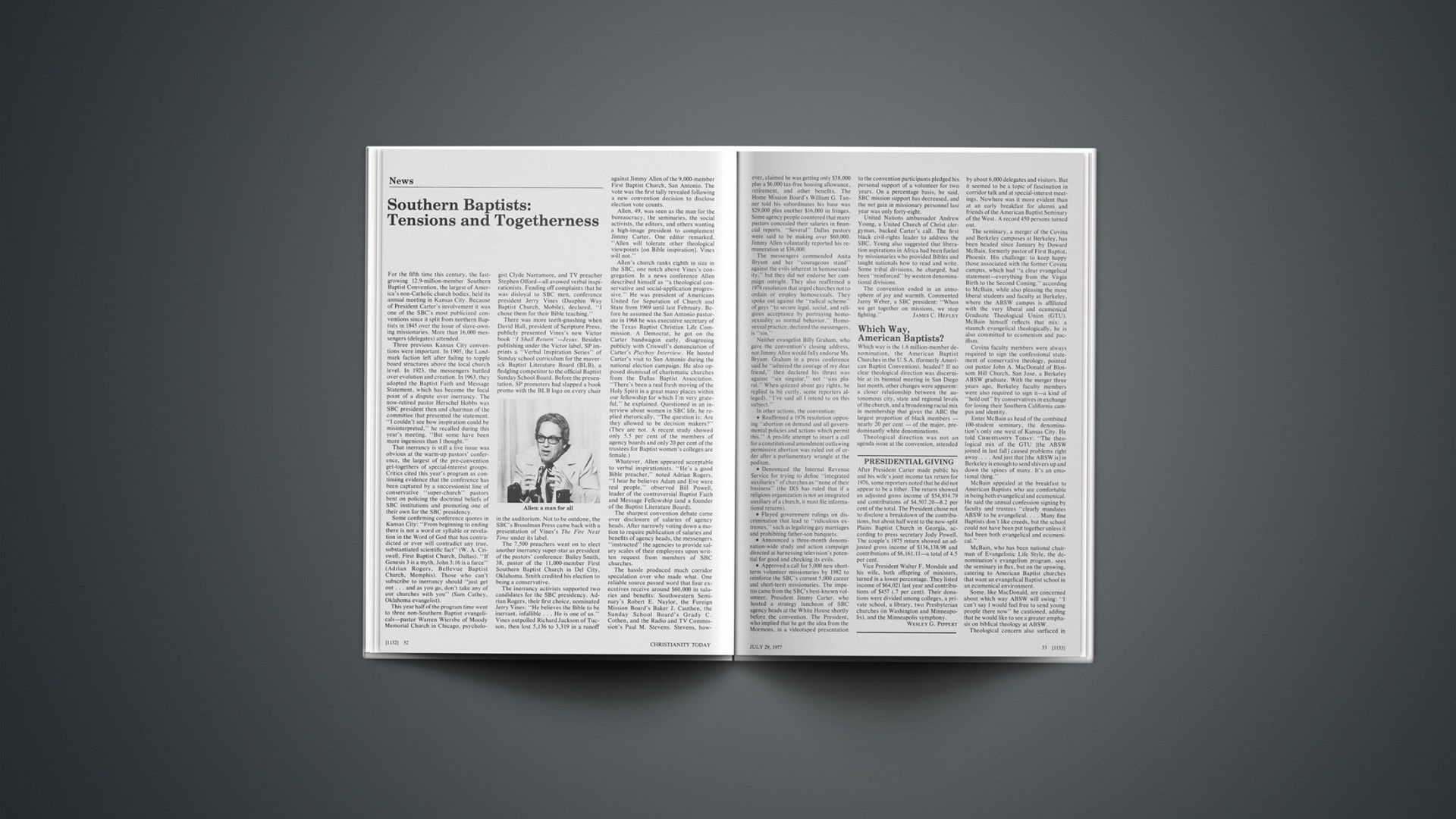
Southern Baptists: Tensions and Togetherness

For the fifth time this century, the fast-growing 12.9-million-member Southern Baptist Convention, the largest of America’s non-Catholic church bodies, held its annual meeting in Kansas City. Because of President Carter’s involvement it was one of the SBC’s most publicized conventions since it split from northern Baptists in 1845 over the issue of slave-owning missionaries. More than 16,000 messengers (delegates) attended.

Three previous Kansas City conventions were important. In 1905, the Landmark faction left after failing to topple board structures above the local church level. In 1923, the messengers battled over evolution and creation. In 1963, they adopted the Baptist Faith and Message Statement, which has become the focal point of a dispute over inerrancy. The now-retired pastor Herschel Hobbs was SBC president then and chairman of the committee that presented the statement. “I couldn’t see how inspiration could be misinterpreted,” he recalled during this year’s meeting. “But some have been more ingenious than I thought.”

That inerrancy is still a live issue was obvious at the warm-up pastors’ conference, the largest of the pre-convention get-togethers of special-interest groups. Critics cited this year’s program as continuing evidence that the conference has been captured by a successionist line of conservative “super-church” pastors bent on policing the doctrinal beliefs of SBC institutions and promoting one of their own for the SBC presidency.

Some confirming conference quotes in Kansas City: “From beginning to ending there is not a word or syllable or revelation in the Word of God that has contradicted or ever will contradict any true, substantiated scientific fact” (W. A. Criswell, First Baptist Church, Dallas). “If Genesis 3 is a myth, John 3:16 is a farce” (Adrian Rogers, Bellevue Baptist Church, Memphis). Those who can’t subscribe to inerrancy should “just get out … and as you go, don’t take any of our churches with you” (Sam Cathey, Oklahoma evangelist).

This year half of the program time went to three non-Southern Baptist evangelicals—pastor Warren Wiersbe of Moody Memorial Church in Chicago, psychologist Clyde Narramore, and TV preacher Stephen Olford—all avowed verbal inspirationists. Fending off complaints that he was disloyal to SBC men, conference president Jerry Vines (Dauphin Way Baptist Church, Mobile), declared, “I chose them for their Bible teaching.”

There was more teeth-gnashing when David Hall, president of Scripture Press, publicly presented Vines’s new Victor book “I Shall Return”Jesus. Besides publishing under the Victor label, SP imprints a “Verbal Inspiration Series” of Sunday school curriculum for the maverick Baptist Literature Board (BLB), a fledgling competitor to the official Baptist Sunday School Board. Before the presentation, SP promoters had slapped a book promo with the BLB logo on every chair in the auditorium. Not to be outdone, the SBC’s Broadman Press came back with a presentation of Vines’s The Fire Next Time under its label.

The 7,500 preachers went on to elect another inerrancy super-star as president of the pastors’ conference: Bailey Smith, 38, pastor of the 11,000-member First Southern Baptist Church in Del City, Oklahoma. Smith credited his election to being a conservative.

The inerrancy activists supported two candidates for the SBC presidency. Adrian Rogers, their first choice, nominated Jerry Vines: “He believes the Bible to be inerrant, infallible … He is one of us.” Vines outpolled Richard Jackson of Tucson, then lost 5,136 to 3,319 in a runoff against Jimmy Allen of the 9,000-member First Baptist Church, San Antonio. The vote was the first tally revealed following a new convention decision to disclose election vote counts.

Allen, 49, was seen as the man for the bureaucracy, the seminaries, the social activists, the editors, and others wanting a high-image president to complement Jimmy Carter. One editor remarked, “Allen will tolerate other theological viewpoints [on Bible inspiration]. Vines will not.”

Allen’s church ranks eighth in size in the SBC, one notch above Vines’s congregation. In a news conference Allen described himself as “a theological conservative and social-application progressive.” He was president of Americans United for Separation of Church and State from 1969 until last February. Before he assumed the San Antonio pastorate in 1968 he was executive secretary of the Texas Baptist Christian Life Commission. A Democrat, he got on the Carter bandwagon early, disagreeing publicly with Criswell’s denunciation of Carter’s Playboy Interview. He hosted Carter’s visit to San Antonio during the national election campaign. He also opposed dismissal of charismatic churches from the Dallas Baptist Association. “There’s been a real fresh moving of the Holy Spirit in a great many places within our fellowship for which I’m very grateful,” he explained. Questioned in an interview about women in SBC life, he replied rhetorically, “The question is: Are they allowed to be decision makers?” (They are not. A recent study showed only 5.5 per cent of the members of agency boards and only 20 per cent of the trustees for Baptist women’s colleges are female.)

Whatever, Allen appeared acceptable to verbal inspirationists. “He’s a good Bible preacher,” noted Adrian Rogers. “I hear he believes Adam and Eve were real people,” observed Bill Powell, leader of the controversial Baptist Faith and Message Fellowship (and a founder of the Baptist Literature Board).

The sharpest convention debate came over disclosure of salaries of agency heads. After narrowly voting down a motion to require publication of salaries and benefits of agency heads, the messengers “instructed” the agencies to provide salary scales of their employees upon written request from members of SBC churches.

The hassle produced much corridor speculation over who made what. One reliable source passed word that four executives receive around $60,000 in salaries and benefits: Southwestern Seminary’s Robert E. Naylor, the Foreign Mission Board’s Baker J. Cauthen, the Sunday School Board’s Grady C. Cothen, and the Radio and TV Commission’s Paul M. Stevens. Stevens, however, claimed he was getting only $38,000 plus a $6,000 tax-free housing allowance, retirement, and other benefits. The Home Mission Board’s William G. Tanner told his subordinates his base was $29,000 plus another $16,000 in fringes. Some agency people countered that many pastors concealed their salaries in financial reports. “Several” Dallas pastors were said to be making over $60,000. Jimmy Allen voluntarily reported his remuneration at $36,000.

The messengers commended Anita Bryant and her “courageous stand” against the evils inherent in homosexuality,” but they did not endorse her campaign outright. They also reaffirmed a 1976 resolution that urged churches not to ordain or employ homosexuals. They spoke out against the “radical scheme” of gays “to secure legal, social, and religious acceptance by portraying homosexuality as normal behavior.” Homosexual practice, declared the messengers, is “sin.”

Neither evangelist Billy Graham, who gave the convention’s closing address, nor Jimmy Allen would fully endorse Ms. Bryant. Graham in a press conference said he “admired the courage of my dear friend,” then declared his thrust was against “sin singular,” not “sins plural.” When quizzed about gay rights, he replied (a bit curtly, some reporters alleged), “I’ve said all I intend to on this subject.”

In other actions, the convention:

• Reaffirmed a 1976 resolution opposing “abortion on demand and all governmental policies and actions which permit this.” A pro-life attempt to insert a call for a constitutional amendment outlawing permissive abortion was ruled out of order after a parliamentary wrangle at the podium.

• Denounced the Internal Revenue Service for trying to define “integrated auxiliaries” of churches as “none of their business” (the IRS has ruled that if a religious organization is not an integrated auxiliary of a church, it must file informational returns).

• Flayed government rulings on discrimination that lead to “ridiculous extremes,” such as legalizing gay marriages and prohibiting father-son banquets.

• Announced a three-month denomination-wide study and action campaign directed at harnessing television’s potential for good and checking its evils.

• Approved a call for 5,000 new short-term volunteer missionaries by 1982 to reinforce the SBC’s current 5,000 career and short-term missionaries. The impetus came from the SBC’s best-known volunteer, President Jimmy Carter, who hosted a strategy luncheon of SBC agency heads at the White House shortly before the convention. The President, who implied that he got the idea from the Mormons, in a videotaped presentation to the convention participants pledged his personal support of a volunteer for two years. On a percentage basis, he said, SBC mission support has decreased, and the net gain in missionary personnel last year was only forty-eight.

United Nations ambassador Andrew Young, a United Church of Christ clergyman, backed Carter’s call. The first black civil-rights leader to address the SBC, Young also suggested that liberation aspirations in Africa had been fueled by missionaries who provided Bibles and taught nationals how to read and write. Some tribal divisions, he charged, had been “reinforced” by western denominational divisions.

The convention ended in an atmosphere of joy and warmth. Commented Jaroy Weber, a SBC president: “When we get together on missions, we stop fighting.”

Presidential Giving

After President Carter made public his and his wife’s joint income tax return for 1976, some reporters noted that he did not appear to be a tither. The return showed an adjusted gross income of $54,934.79 and contributions of $4,507.20—8.2 per cent of the total. The President chose not to disclose a breakdown of the contributions, but about half went to the now-split Plains Baptist Church in Georgia, according to press secretary Jody Powell. The couple’s 1975 return showed an adjusted gross income of $136,138.98 and contributions of $6,161.11—a total of 4.5 per cent.

Vice President Walter F. Mondale and his wife, both offspring of ministers, turned in a lower percentage. They listed income of $64,021 last year and contributions of $457 (.7 per cent). Their donations were divided among colleges, a private school, a library, two Presbyterian churches (in Washington and Minneapolis), and the Minneapolis symphony.

Which Way, American Baptists?

Which way is the 1.6 million-member denomination, the American Baptist Churches in the U.S. A. (formerly American Baptist Convention), headed? If no clear theological direction was discernible at its biennial meeting in San Diego last month, other changes were apparent: a closer relationship between the autonomous city, state and regional levels of the church, and a broadening racial mix in membership that gives the ABC the largest proportion of black members—nearly 20 per cent—of the major, predominantly white denominations.

Theological direction was not an agenda issue at the convention, attended by about 6,000 delegates and visitors. But it seemed to be a topic of fascination in corridor talk and at special-interest meetings. Nowhere was it more evident than at an early breakfast for alumni and friends of the American Baptist Seminary of the West. A record 450 persons turned out.

The seminary, a merger of the Covina and Berkeley campuses at Berkeley, has been headed since January by Doward McBain, formerly pastor of First Baptist, Phoenix. His challenge: to keep happy those associated with the former Covina campus, which had “a clear evangelical statement—everything from the Virgin Birth to the Second Coming,” according to McBain, while also pleasing the more liberal students and faculty at Berkeley, where the ABSW campus is affiliated with the very liberal and ecumenical Graduate Theological Union (GTU). McBain himself reflects that mix: a staunch evangelical theologically, he is also committed to ecumenism and pacifism.

Covina faculty members were always required to sign the confessional statement of conservative theology, pointed out pastor John A. MacDonald of Blossom Hill Church, San Jose, a Berkeley ABSW graduate. With the merger three years ago, Berkeley faculty members were also required to sign it—a kind of “hold out” by conservatives in exchange for losing their Southern California campus and identity.

Enter McBain as head of the combined 100-student seminary, the denomination’s only one west of Kansas City. He told CHRISTIANITY TODAY: “The theological mix of the GTU [the ABSW joined in last fall] caused problems right away.… And just that [the ABSW is] in Berkeley is enough to send shivers up and down the spines of many. It’s an emotional thing.”

McBain appealed at the breakfast to American Baptists who are comfortable in being both evangelical and ecumenical. He said the annual confession signing by faculty and trustees “clearly mandates ABSW to be evangelical.… Many fine Baptists don’t like creeds, but the school could not have been put together unless it had been both evangelical and ecumenical.”

McBain, who has been national chairman of Evangelistic Life Style, the denomination’s evangelism program, sees the seminary in flux, but on the upswing, catering to American Baptist churches that want an evangelical Baptist school in an ecumenical environment.

Some, like MacDonald, are concerned about which way ABSW will swing: “I can’t say I would feel free to send young people there now” he cautioned, adding that he would like to see a greater emphasis on biblical theology at ABSW.

Theological concern also surfaced in reaction to the well-applauded speeches of one of the denomination’s controversial theologians, Jitsuo Morikawa, interim senior minister of Riverside Church, New York City, and formerly the ABC’s evangelism director. ABC conservatives long have accused him of being a universalist on salvation (the belief that Christ has already saved everyone).

Speaking of his own conversion, the Japanese American said he “bowed before my Saviour as a broken penitent to acknowledge Him as my Saviour and Lord.” He also said American Baptists must “believe and pray and act for a revival to sweep through our nation, to provide moral force.…” But in the first of his two speeches, Morikawa declared that “no power on earth can resist the leavening power of the Kingdom [of God], until the whole cosmos is leavened.”

Morikawa’s “cosmic hope,” commented a critic, avoids the question of individual destiny, which to him [Morikawa] “characterizes early, immature consciousness. Morikawa doesn’t admit universalism but leaves us with a very broad implication thereto. In the face of the obvious question, he doesn’t bother to deny or clarify.”

If theological waters were muddy in San Diego, the structure and composition of the church was more clear. Of the some 6,500 ABC congregations, there are 567 black churches that have a membership of 310,000 out of the denominational total of 1.6 million, Dean Charles Z. Smith of Seattle, outgoing ABC president, observed in his keynote message. Most of the blacks, however, belong to 550 congregations that are dually aligned with black Baptist denominations, and the vast majority of ABC congregations are all white or nearly so. Still, Smith added during an interview, “the direction of the ABC since 1968 … has been affirmative inclusion and participation across all ethnic and racial lines … which reflects the general population of the United States.”

While overall membership has remained nearly constant over the past decade, giving has steadily risen, officials said.

Only one controversy erupted on the convention floor: debate over revision of bylaws that affect the organizational units of the church. Finally approved overwhelmingly were changes creating “covenant relationships” for the work of the autonomous city, state, and regional levels and the national organizations. Also, local churches and the regions, states, and cities will be represented by the same election-district representative to the denomination’s General Board. The new bylaws will take effect when voted by two-thirds of the city, state, and regional boards. Opposition centered on the contention that tighter restructuring was antithetical to Baptist tradition.

In other action, Cora Sparrowk, 60, of Ione, California, a housewife long active in Baptist and ecumenical affairs at the national level, was elected the sixth woman president of the seventy-year-old denomination.

RUSSELL CHANDLER

The View From Tanzania

The following news story is based largely on an account filed by special correspondent George H. Muedeking:

Some 300 delegates representing 53 million members in the ninety-five denominations affiliated with the Lutheran World Federation gathered last month in Dar es Salaam, Tanzania, for the LWF’s Sixth Assembly. They and about 500 other assembly participants and observers were joined by 2,000 Tanzanian Lutherans in the opening communion service. Ninety years earlier that very week the first Lutheran missionary to Tanzania began his work. Today the Evangelical Lutheran Church of Tanzania (ELCT) has more than 800,000 members, and it has increased in size 60 per cent in the last four years, according to church sources. This makes the ELCT the largest Lutheran church in Africa.

Against such a backdrop, therefore, issues related to missionary endeavors took on a sense of immediacy for the delegates, who came from fifty-three countries. The matter of “self-reliance” among mission-assisted churches was discussed. The ELCT, for example, accepts missionary and financial assistance but conducts its own affairs independently; missionaries serve at the invitation of the national church. Further independence was called for by a Tanzanian government official, Nicolaus Moro, who is a member of the ELCT. In a major plenary address he recommended a moratorium on mission support from “northern” (American and European) churches. This should begin, he said, with a disengagement in planned stages, starting with the local congregations, proceeding through administrative structures, and extending to the mission-supported institutions of the churches.

ELCT bishop Josiah M. Kibira, chairman of the LWF’s Commission on Church Cooperation (CCC), said that mission ought to become a two-way street, with evangelistic proclamation provided by Christians in the Third World countries to a “post-Christian” Atlantic community.

Kibira, 52, was elected the sixth president of the Geneva-based LWF, succeeding Mikko Juva, chancellor of the University of Helsinki. The vote was 130 for Kibira and 117 for Bishop August W. Habelgaarn of the Moravian Church of South Africa. Kibira is the first president to come from the Third World in the LWF’s thirty-year history.

The official actions of the two-week assembly were based on statements and recommendations thrashed out in three seminars. African issues kept cropping up in the seminars—and thus in the assembly’s final pronouncements. Among other things, the assembly:

• Adopted a human rights statement that especially protested the “continuing threat to human dignity and the manifold violations of human rights by the white minority in South Africa, Namibia, and Zimbabwe (Rhodesia).”

• Called on white South African churches to reject apartheid as a violation of the Christian faith.

• Asked member churches to intensify evangelization efforts, including the “re-evangelization” of “multitudes of nominal Christians.”

• Urged pursuit of deeper ecumenical relationships, including the mutual recognition of baptism and church ministries (the delegates endorsed “visible unity” as the ultimate goal of the ecumenical movement).

A budget report showed that the LWF spent $125 million ($50 million of it for 415 “world service” projects) since the last assembly at Evian, France, in 1970. Four new churches were added at the latest assembly, the largest being the Evangelical Lutheran Church of Papua New Guinea with more than 400,000 members. Carl Mau of the American Lutheran Church was elected to another seven-year term as LWF executive secretary.

Positive Thinking

The Carmel, New York, school board is no longer thinking negatively about clergyman-author Norman Vincent Peale and his Guideposts publishing operation. Not since Peale shared his thoughts about the board’s legal efforts to place his Guideposts publishing operation on the tax rolls. The board backed down after the minister threatened to pull his firm out of town, where it occupies a fifty-acre site and employs nearly 400.

“We weighed the total loss of their $5 million payroll a year vis-a-vis approximately $100,000 the school board would obtain [in taxes],” explained board president Philip Buxbaum.

An Urge to Merge

Should a Christian marriage counselor advise a couple to live together before their wedding in order for the partners to get to know each other better?

That question was asked on the floor of the Presbyterian Church in the U.S. (Southern) General Assembly in Nashville last month as the denomination’s governing body discussed its future relations with the United Presbyterian Church. The committee promoting union of the two churches had proposed, in effect, that all of the agencies of the churches live together before the union is formally consummated.

Despite the argument by opponents of union that such living arrangements are contrary to the church’s teachings on marriage, the assembly granted most of the merger committee’s requests. The major exception was the governing body’s decision to exempt from its action the publications issued by the denomination. The action also was amended on the floor so that the operative verb was changed from “instruct” to “urge,” thereby leaving the agencies with the authorization but without the requirement that they merge their work.

Another part of the “getting-to-know-you” program voted by the assembly was approval of a plan to meet every other year in the future at the same time and place as the United Presbyterian assembly. The first of the common sites to be approved was Kansas City in 1979.

All of the getting acquainted will not be at the top level if the recommendations adopted in Nashville are followed by the judicatories below national level. Regional synods were urged to hold joint meetings more often, and the judicial commission was asked to check into the possibility of constitutional amendments to permit organic merger of synods. The constitutions of the two churches already permit union of presbyteries, the governing bodies between synods and local churches. The assembly urged more presbytery mergers, as well as formation of new union congregations.

The current merger negotiations between the PCUS and the United Presbyterians have been under way since 1969, but no consummation is seen in the near future. A conservative bloc tried to push for a vote next year, but the assembly failed to set a date for a constitutional vote. Union advocates are fearful that the plan would not be favored by the necessary three-fourths of the presbyteries if it is submitted to them now. Last winter a doctrinal package that would have put the PCUS closer to the position of the United Presbyterians failed to get a three-fourths vote. J. Randolph Taylor, PCUS co-chairman of the merger panel, suggested to the assembly that much more time is needed before the church is ready to vote. His committee has been negotiating for only eight years, he said, and the predecessor group that submitted a plan defeated by the church in 1955 worked for seventeen years. The denomination was not ready to vote then, Taylor concluded. Commissioners got the impression that his committee will press for as much “living together” as possible until it sees that it has enough votes to pass organic union.

While unions and doctrinal changes require approval by three-fourths of the presbyteries, changes in polity require only a simple majority. The doctrinal package considered by presbyteries last winter included new ordination vows that were passed by a majority of the presbyteries. Since these were changes in the polity section of the constitution, the assembly enacted them despite pleas that they were a part of the rejected package. The “book of confessions,” including a contemporary declaration of faith, had lost in the presbyteries but was endorsed by the assembly for use throughout the church. Even though it failed to gain constitutional status the book will be printed and distributed, by order of the assembly. The chairman of the committee that produced the defeated theological package, Albert C. Winn, got a standing ovation. Formerly president of Louisville Presbyterian Seminary, Winn is a pastor in Richmond, Virginia.

In one ecumenical gesture the PCUS governing body broke ground that few of its sister denominations have even considered. After long debate it decided to invite representatives of other denominations to future assemblies. Commissioners were unwilling to give them a vote on the floor of plenary sessions, but they will be able to speak there as well as in the standing committees which screen all business. The visitors will also have the privilege of voting in committees.

Eight to twelve of the ecumencial visitors will be invited to each assembly as a symbol of the unity of the church. The 1977 assembly approved a list of fourteen communions, in priority order, which will be approached to send representatives. Fourth on the list is the Presbyterian Church in America, which is composed largely of former members of PCUS. The first three denominations on the list are the African Methodist Episcopal Zion Church, the Episcopal Church, and the United Presbyterian Church. After the PCA the list continues: Greek Orthodox Church, National Presbyterian Church of Mexico, Presbyterian Church of Canada, Lutheran Church in America, United Methodist Church, Church of Scotland, United Church of Christ, Cumberland Presbyterian Church, Reformed Church in America, and the Christian Methodist Episcopal Church.

In one of its longest debates the assembly considered a study paper on homosexuality drafted by its council on theology and culture. The paper does not take a position on the subject of homosexual behavior, and drafters asked the denomination’s governing body to send it out for study without stating a position. The document was “endorsed as a basis for study,” but commissioners added a statement that they need “more light” and “spiritual guidance” on the subject, currently believing that homosexuality “falls short of God’s plan for sexual relationships.…” The body turned down requests from a number of commissioners and from one of its presbyteries that it flatly declare homosexual activity a sin. The study paper says some Christians believe such activity is sin while others believe it is a sickness and others consider it “a legitimate variety of human sexuality.”

Settling one of its most celebrated judicial cases in recent times, the assembly upheld the Atlanta Presbytery’s reception of a minister who is opposed to women’s ordination (see February 13, 1976, issue, Page 61). Thomas T. Ellis had told the presbytery that while he did not believe women should be ministers or ruling elders he would assist in an ordination if ordered by presbytery to do so. “The issue,” said the judicial commission that drafted the assembly decision, “is one of freedom of conscience versus invidious action.”

The church continued to lose communicants last year, with 882,820 on the roll at the close of 1976. The net loss in 1976 was 365, or one a day. While giving was up in 1976, the constant dollar receipts of assembly agencies were only about half of what they were ten years ago.

ARTHUR H. MATTHEWS

Book Briefs: July 29, 1977

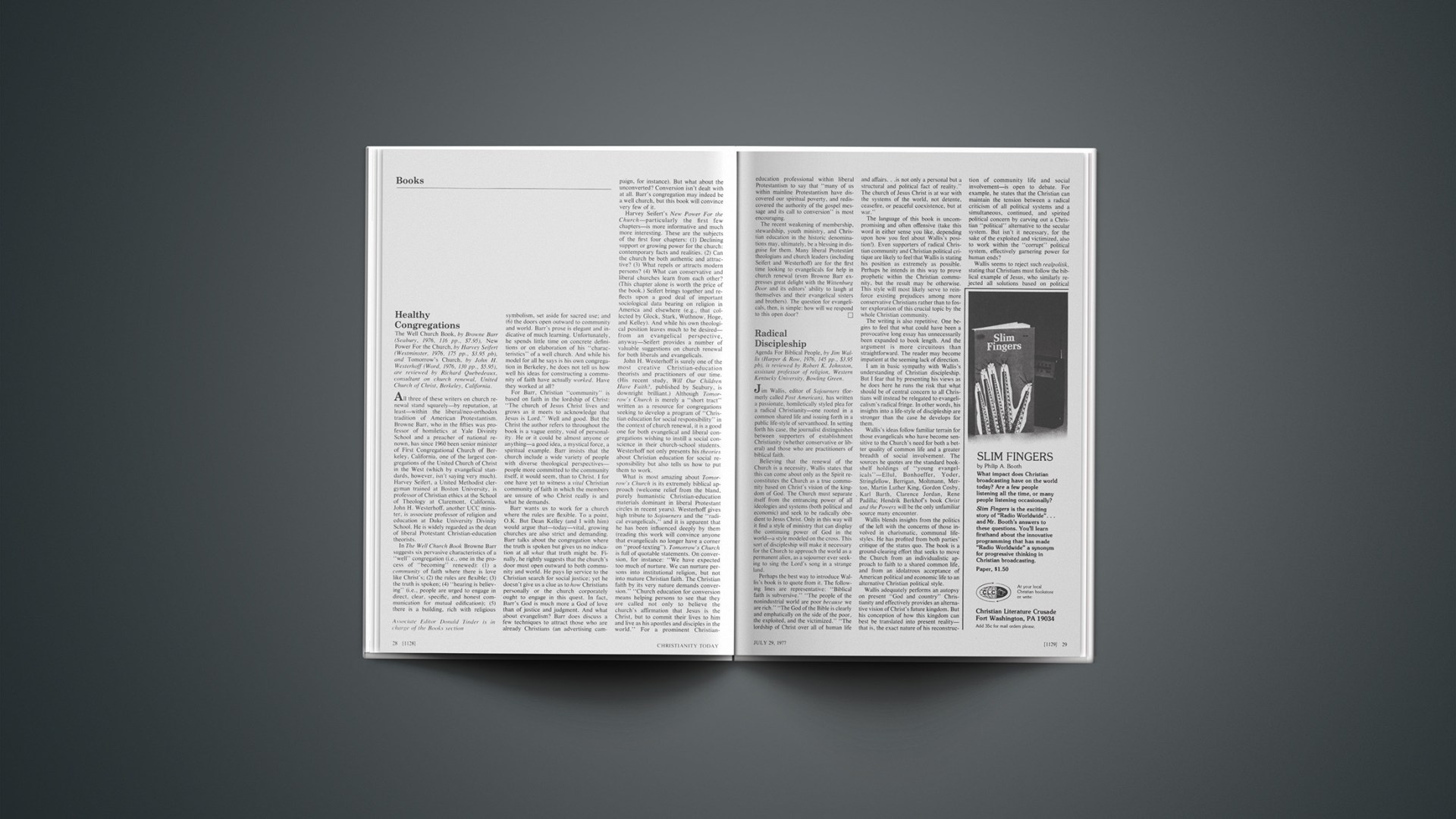
Healthy Congregations

The Well Church Book, by Browne Barr (Seabury, 1976, 116 pp., $7.95), New Power For the Church, by Harvey Seifert (Westminster, 1976, 175 pp., $3.95 pb), and Tomorrow’s Church, by John H. Westerhoff (Word, 1976, 130 pp., $5.95), are reviewed by Richard Quebedeaux, consultant on church renewal, United Church of Christ, Berkeley, California.

All three of these writers on church renewal stand squarely—by reputation, at least—within the liberal/neo-orthodox tradition of American Protestantism. Browne Barr, who in the fifties was professor of homiletics at Yale Divinity School and a preacher of national renown, has since 1960 been senior minister of First Congregational Church of Berkeley, California, one of the largest congregations of the United Church of Christ in the West (which by evangelical standards, however, isn’t saying very much). Harvey Seifert, a United Methodist clergyman trained at Boston University, is professor of Christian ethics at the School of Theology at Claremont, California. John H. Westerhoff, another UCC minister, is associate professor of religion and education at Duke University Divinity School. He is widely regarded as the dean of liberal Protestant Christian-education theorists.

In The Well Church Book Browne Barr suggests six pervasive characteristics of a “well” congregation (i.e., one in the process of “becoming” renewed): (1) a community of faith where there is love like Christ’s; (2) the rules are flexible; (3) the truth is spoken; (4) “hearing is believing” (i.e., people are urged to engage in direct, clear, specific, and honest communication for mutual edification); (5) there is a building, rich with religious symbolism, set aside for sacred use; and (6) the doors open outward to community and world. Barr’s prose is elegant and indicative of much learning. Unfortunately, he spends little time on concrete definitions or on elaboration of his “characteristics” of a well church. And while his model for all he says is his own congregation in Berkeley, he does not tell us how well his ideas for constructing a community of faith have actually worked. Have they worked at all?

For Barr, Christian “community” is based on faith in the lordship of Christ: “The church of Jesus Christ lives and grows as it meets to acknowledge that Jesus is Lord.” Well and good. But the Christ the author refers to throughout the book is a vague entity, void of personality. He or it could be almost anyone or anything—a good idea, a mystical force, a spiritual example. Barr insists that the church include a wide variety of people with diverse theological perspectives—people more committed to the community itself, it would seem, than to Christ. I for one have yet to witness a vital Christian community of faith in which the members are unsure of who Christ really is and what he demands.

Barr wants us to work for a church where the rules are flexible. To a point, O.K. But Dean Kelley (and I with him) would argue that—today—vital, growing churches are also strict and demanding. Barr talks about the congregation where the truth is spoken but gives us no indication at all what that truth might be. Finally, he rightly suggests that the church’s door must open outward to both community and world. He pays lip service to the Christian search for social justice; yet he doesn’t give us a clue as to how Christians personally or the church corporately ought to engage in this quest. In fact, Barr’s God is much more a God of love than of justice and judgment. And what about evangelism? Barr does discuss a few techniques to attract those who are already Christians (an advertising campaign, for instance). But what about the unconverted? Conversion isn’t dealt with at all. Barr’s congregation may indeed be a well church, but this book will convince very few of it.

Harvey Seifert’s New Power For the Church—particularly the first few chapters—is more informative and much more interesting. These are the subjects of the first four chapters: (1) Declining support or growing power for the church: contemporary facts and realities. (2) Can the church be both authentic and attractive? (3) What repels or attracts modern persons? (4) What can conservative and liberal churches learn from each other? (This chapter alone is worth the price of the book.) Seifert brings together and reflects upon a good deal of important sociological data bearing on religion in America and elsewhere (e.g., that collected by Glock, Stark, Wuthnow, Hoge, and Kelley). And while his own theological position leaves much to be desired—from an evangelical perspective, anyway—Seifert provides a number of valuable suggestions on church renewal for both liberals and evangelicals.

John H. Westerhoff is surely one of the most creative Christian-education theorists and practitioners of our time. (His recent study, Will Our Children Have Faith?, published by Seabury, is downright brilliant.) Although Tomorrow’s Church is merely a “short tract” written as a resource for congregations seeking to develop a program of “Christian education for social responsibility” in the context of church renewal, it is a good one for both evangelical and liberal congregations wishing to instill a social conscience in their church-school students. Westerhoff not only presents his theories about Christian education for social responsibility but also tells us how to put them to work.

What is most amazing about Tomorrow’s Church is its extremely biblical approach (welcome relief from the bland, purely humanistic Christian-education materials dominant in liberal Protestant circles in recent years). Westerhoff gives high tribute to Sojourners and the “radical evangelicals,” and it is apparent that he has been influenced deeply by them (reading this work will convince anyone that evangelicals no longer have a corner on “proof-texting”). Tomorrow’s Church is full of quotable statements. On conversion, for instance: “We have expected too much of nurture. We can nurture persons into institutional religion, but not into mature Christian faith. The Christian faith by its very nature demands conversion.” “Church education for conversion means helping persons to see that they are called not only to believe the church’s affirmation that Jesus is the Christ, but to commit their lives to him and live as his apostles and disciples in the world.” For a prominent Christian-education professional within liberal Protestantism to say that “many of us within mainline Protestantism have discovered our spiritual poverty, and rediscovered the authority of the gospel message and its call to conversion” is most encouraging.

The recent weakening of membership, stewardship, youth ministry, and Christian education in the historic denominations may, ultimately, be a blessing in disguise for them. Many liberal Protestant theologians and church leaders (including Seifert and Westerhoff) are for the first time looking to evangelicals for help in church renewal (even Browne Barr expresses great delight with the Wittenburg Door and its editors’ ability to laugh at themselves and their evangelical sisters and brothers). The question for evangelicals, then, is simple: how will we respond to this open door?

Radical Discipleship

Agenda For Biblical People, by Jim Wallis (Harper & Row, 1976, 145 pp., $3.95 pb), is reviewed by Robert K. Johnston, assistant professor of religion, Western Kentucky University, Bowling Green.

Jim Wallis, editor of Sojourners (formerly called Post American), has written a passionate, homiletically styled plea for a radical Christianity—one rooted in a common shared life and issuing forth in a public life-style of servanthood. In setting forth his case, the journalist distinguishes between supporters of establishment Christianity (whether conservative or liberal) and those who are practitioners of biblical faith.

Believing that the renewal of the Church is a necessity, Wallis states that this can come about only as the Spirit reconstitutes the Church as a true community based on Christ’s vision of the kingdom of God. The Church must separate itself from the entrancing power of all ideologies and systems (both political and economic) and seek to be radically obedient to Jesus Christ. Only in this way will it find a style of ministry that can display the continuing power of God in the world—a style modeled on the cross. This sort of discipleship will make it necessary for the Church to approach the world as a permanent alien, as a sojourner ever seeking to sing the Lord’s song in a strange land.

Perhaps the best way to introduce Wallis’s book is to quote from it. The following lines are representative: “Biblical faith is subversive.” “The people of the nonindustrial world are poor because we are rich.” “The God of the Bible is clearly and emphatically on the side of the poor, the exploited, and the victimized.” “The lordship of Christ over all of human life and affairs … is not only a personal but a structural and political fact of reality.” The church of Jesus Christ is at war with the systems of the world, not detente, ceasefire, or peaceful coexistence, but at war.”

The language of this book is uncompromising and often offensive (take this word in either sense you like, depending upon how you feel about Wallis’s position!). Even supporters of radical Christian community and Christian political critique are likely to feel that Wallis is stating his position as extremely as possible. Perhaps he intends in this way to prove prophetic within the Christian community, but the result may be otherwise. This style will most likely serve to reinforce existing prejudices among more conservative Christians rather than to foster exploration of this crucial topic by the whole Christian community.

The writing is also repetitive. One begins to feel that what could have been a provocative long essay has unnecessarily been expanded to book length. And the argument is more circuitous than straightforward. The reader may become impatient at the seeming lack of direction.

I am in basic sympathy with Wallis’s understanding of Christian discipleship. But I fear that by presenting his views as he does here he runs the risk that what should be of central concern to all Christians will instead be relegated to evangelicalism’s radical fringe. In other words, his insights into a life-style of discipleship are stronger than the case he develops for them.

Wallis’s ideas follow familiar terrain for those evangelicals who have become sensitive to the Church’s need for both a better quality of common life and a greater breadth of social involvement. The sources he quotes are the standard bookshelf holdings of “young evangelicals”—Ellul, Bonhoeffer, Yoder, Stringfellow, Berrigan, Moltmann, Merton, Martin Luther King, Gordon Cosby, Karl Barth, Clarence Jordan, Rene Padilla; Hendrik Berkhof’s book Christ and the Powers will be the only unfamiliar source many encounter.

Wallis blends insights from the politics of the left with the concerns of those involved in charismatic, communal lifestyles. He has profited from both parties’ critique of the status quo. The book is a ground-clearing effort that seeks to move the Church from an individualistic approach to faith to a shared common life, and from an idolatrous acceptance of American political and economic life to an alternative Christian political style.

Wallis adequately performs an autopsy on present “God and country” Christianity and effectively provides an alternative vision of Christ’s future kingdom. But his conception of how this kingdom can best be translated into present reality—that is, the exact nature of his reconstruction of community life and social involvement—is open to debate. For example, he states that the Christian can maintain the tension between a radical criticism of all political systems and a simultaneous, continued, and spirited political concern by carving out a Christian “political” alternative to the secular system. But isn’t it necessary, for the sake of the exploited and victimized, also to work within the “corrupt” political system, effectively garnering power for human ends?

Wallis seems to reject such realpolitik, stating that Christians must follow the biblical example of Jesus, who similarly rejected all solutions based on political power in his day. But will such a hermeneutical approach to Scripture hold up under close scrutiny? Does the fact that Jesus did not fight Rome mean that the confessing Christians in Germany in World War II should have remained non-political? The political and economic situation in Jesus’ day helped shape his approach to social involvement. That twentieth-century Christianity should follow Jesus’ program, in addition to his call to discipleship, needs a better defense than Wallis provides.

The Mystical Side Of Luther

Luther and the Mystics, by Bengt R. Hoffman (Augsburg, 1976, 285 pp., $8.95), is reviewed by Donald G. Bloesch, professor of theology, Dubuque Theological School, Dubuque, Iowa.

Bengt Hoffman challenges recent Luther scholarship in his contention that Luther can best be understood in the light of his indebtedness to the German mystics of the fifteenth century, especially Johann Tauler and the author of the Theologica Germanica. Against such scholars as Ebeling, Hoffman maintains that these mystics continued to exert a positive influence on Luther even after his formal break with the Catholic Church. However, not all mystics were appreciated by Luther; he repudiated the Neo-Platonic mystics like Dionysius and accepted Romantic mystics such as Gerson and Bernard of Clairvaux only with reservations. From the mystics he derived such notions as deus absconditus (the hidden God), the darkness of faith, and the temptation to despair (Anfechtung).

In Hoffman’s judgment, the anti-mystical and anti-supernaturalistic bent of modern thought has prevented scholars from discerning and appreciating the mystical side of Luther. He is rigorous in his criticism not only of liberalism and neo-orthodoxy but also of Lutheran scholastic orthodoxy, which interpreted faith as rational assent rather than an inward experience characterized by awe and rapture.

While Hoffman rightly discerns that Luther profited from a study of the mystics, he does not do justice to the discontinuity between Luther’s spirituality and Catholic mysticism. In assessing the relation of the Reformation churches to mysticism, he tends to see the polarity in terms of the conceptual vs. the experiential. In my opinion, the more fundamental distinction lies in an emphasis on the sovereignty of grace vs. human preparation. Hoffman makes a not very successful attempt to refute those who charge the mystics with synergism, the belief that the sinner can freely cooperate with God in procuring his salvation.

Hoffman is on firm ground when he claims that the new birth as well as the forensic declaration of righteousness was included in Luther’s understanding of justification. Yet he fails to recognize that it is precisely this latter point that separates Luther from the mystics. Was not this rediscovery of the Pauline concept of the justification of the ungodly the unique contribution of the mainline Protestant Reformers, and is not this one of the hallmarks of evangelical spirituality?

Hoffman would have strengthened his case had he taken into consideration the thesis of Anders Nygren that the love rediscovered by Luther, the agape of the New Testament, was quite different from the caritas of the mystics, which signified a synthesis of agape and eros, the self-regarding unitive love of Hellenistic religion and philosophy. Nygren in his Agape and Eros perhaps overstates the cleavage between the two types of love; he also does not deal adequately with the idea of love toward God, which is also in the New Testament. Yet it seems to me that Hoffman has to provide some kind of answer to Nygren if we are to believe that Luther is a product of German mysticism.

Another scholar whom Hoffman would have done well to acknowledge is Friedrich Heiler, who in his noted work Prayer draws a sharp distinction between Luther’s understanding of prayer and the mystical conception. Heiler appreciates the contribution of the mystics, but he nonetheless insists that Luther’s spirituality, based on a rediscovery of St. Paul, developed in a quite different direction.

Having voiced these reservations I must now go on to state that Hoffman’s work is a welcome antidote to the anti-mystical bias that has pervaded Protestant scholarship since Ritschl. Hoffman reminds us that there is a mystical dimension to faith, though faith as such must not be reduced to mystical experience. Faith is not simply a rational acknowledgment of the claims of God but a spiritual communion with the living presence of God, a communion that transcends the confines of reason. Hoffman points out that Luther himself distinguished between “historical faith” and “true faith,” which entails immediate, direct feeling. Moreover, many of the mystics who exerted a profound influence on Luther were devoted to a study of the Word of God and were staunch believers in the atoning sacrifice of Jesus Christ. Where Luther broke with the mystics was in their dependence on Neo-Platonic philosophy, which caused them to underplay the historical character of revelation and the personalistic character of God.

Hoffman is also to be congratulated on his call for a reappreciation of the Pietists, who were probably closer to the real Luther than their orthodox opponents. He convincingly maintains that men like Arndt, Spener, and Francke bore witness to an “experienced wisdom” that lay within, not outside, Luther’s perception of faith. The Pietists were quick to acknowledge their indebtedness to the mystics, but they were uncompromising in their adherence to sola gratia and sola fide. Their call to renewed dedication and to a deeper life of prayer was the key to their intense social involvement and to their missionary outreach, which enabled Protestantism to advance throughout the world.

Hoffman’s book merits careful reading. It is a significant contribution to Luther studies and has far-reaching ecumenical significance, since it indisputably shows that the Catholic mystics were a major formative influence on Luther’s thought. Yet we must keep in mind that Luther was discriminating in his use of the mystics and that his theology and spirituality had their primary basis in Scripture.

Victorian Evangelicals

The Call to Seriousness: The Evangelical Impact on the Victorians, by Ian C. Bradley (Macmillan, 1976, 224 pp., $12.95), is reviewed by Donald W. Dayton, director of the Mellander Library and assistant professor of theology, North Park Theological Seminary, Chicago, Illinois.

This is one of the most intriguing books I have read in recent months. Though solid and scholarly (more in content than in format), it was difficult to put down. Beyond the publisher’s somewhat slanderous dust-jacket copy (blaming the Evangelicals for nearly everything wrong with the Victorians) lies a balanced and illuminating study of British Evangelicalism during its heyday, 1800–1860.

By “Evangelicalism” the author means the party in the Anglican church led by William Wilberforce. He self-consciously excludes Methodism, Nonconformity, and other forms of dissent—and hence weights his study toward the middle and upper classes, the established Evangelicalism of the Clapham Sect, the halls of Parliaments, and so on. Among the topics covered are the campaign to convert the nation, the implicit “assault on the church,” the mission to the heathen, the war against vice, the proliferation of philanthropic societies, the evangelical concerns for “conduct,” and the vision for home and family. Each topic is elaborated with pertinent data and illustrations (often, interesting enough, drawn from Victorian literature written by children of Evangelicals—to which a minimum of interpretation is added with a light touch.

Bradley (who now works for the BBC) seems to have few axes to grind. He apparently became interested in the topic by chance in pre-university days, followed it up with an Oxford dissertation on the Evangelicals in Parliament, and has now produced this study. Though recognizing both strengths and weaknesses, he concludes that “in the period with which the book is concerned, Evangelicalism was essentially a dynamic movement and the influence which it exerted on society was, on the whole, a positive one.”

He also debunks the debunkers, claiming that “recent attempts to debunk the abolition movement and to call into question the motives of those engaged in it have failed to provide any substantial evidence to support their case” and concluding that “the traditional view is, for once, the right one—the abolition movement was a supremely altruistic crusade carried out almost entirely under Evangelical leadership and inspiration.” And he quotes approvingly the words of the Earl of Shaftesbury that “most of the great philanthropic movements of the century have sprung from them.”

But those of us who stand more directly in the wake of such Evangelical movements will find again and again our own mores, conflicts, and tensions illuminated and clarified. Here are the rise of the Sunday school movements and the development of the “tracts” that still appear on our street corners. Here is the puzzle of an apparently world-denying asceticism bent to very worldly goals and social “usefulness.” Here is a heart-felt mission to the “heathen” implicitly supporting British “imperialism.” Here are roots of the modern British welfare state—in the efforts of Evangelicals to push the state toward ever more complete regulation of life (Sabbatarianism, for example), the relief of poverty, or the suppression of vice. Here is a call to integrity and earnestness that could, especially after the initial dynamic waned, quickly degenerate into hypocrisy and cant in a later era. Here are the great evangelical philanthropic endeavors that only occasionally broke through to the insight that society itself needed restructuring.

Of particular interest is Bradley’s attempt to define “Evangelicalism”—an attempt that will sound somewhat strange to those of us accustomed to the modern nuances of the word since the American fundamentalist-modernist controversy. His title expresses the major synonym for “evangelical” in this era: “serious.” The movement was a call to “vital religion” or “earnest Christianity.” Its enemy was not so much “liberalism” as “worldliness or complacency”—whether “conservative” or “liberal.” To be sure, it emphasized human depravity, conversion, sanctification, Providence, and so on, but “Evangelicalism was never really a theological system so much as a way of life … a series of vivid and compelling personal experiences.” The Evangelicals “unreservedly devoted themselves to God,” to use the words of Wilberforce; for them religion involved “turning the whole mind to God,” as Hannah More put it.

These themes reverberate, of course, in Methodism and other aspects of the Evangelical Revival excluded from this study, and I wonder if on this level, at least, there is not more unity in these currents than Bradley implies. But on other levels there might be a greater diversity. While reading this book, one longs for fuller comparison with evangelical currents (like Methodism) at work in other classes—and occasionally more “radical” because less “established.”

The reader also longs for a sequel to this book that would describe the out-workings of Evangelicalism in successive eras. The author gives only a few hints of his understanding, but he clearly sees a decline after 1860 that did “irreparable harm not only to their cause but to the credibility of Christianity itself.” Bradley suggests that “the Second Evangelical Revival, which began around 1858, radically changed the character of the movement and inspired adherents who were more fanatical, more bigoted, and more introverted than those who followed Wilberforce and Shaftesbury.”

Bradley uses this fact to explain why so many of the children of these Evangelicals left the faith; they were reacting not only to the limitations of Evangelicalism itself but “also against a new obscurantism and fanaticism which had only recently crept into it.” What he has in mind here is apparently the shift in emphasis to biblical literalism and a narrowed focusing on eschatological questions and prophecy. Such suggestions would accord well with the emerging understandings of “fundamentalism” (such as in Ernest Sandeen’s Roots of Fundamentalism) and would raise some very interesting questions about the nature of the later movement, its origins, its trans-Atlantic character. They might also prod us to be more careful in distinguishing the varieties of the meaning of the world “evangelical,” especially as it is to be distinguished from “fundamentalist.”

Briefly Noted

It Will Be Worth It All: A Study in the Believer’s Reward, by Woodrow Michael Kroll (Loizeaux, 123 pp., $2.59 pb), and Order Your Crowns Now, by Bill McKees (John T. Benson, 189 pp., $4.95), are popular portrayals of all the Bible has to say about rewards for faithful service by those who have received the gift of salvation.

Although not specifically Christian, a book worth knowing about for those who wish a practical method for curing addiction is No More Butts: A Psychologist’s Approach to Quitting Cigarettes, by Richard Olshavsky (Indiana University, 181 pp., $10). In style and format this is more like a trade book than the kind that university presses customarily issue.

Minister’s Workshop: Counseling Is a Waste of Time

Most clergymen who are honest with themselves would confess that pastoral counseling is too often a waste of valuable time. How many hours are spent with people who do not follow through with one-tenth of the pastoral advice given? How many couples who come to the minister for marital counseling go home and continue to relate to each other exactly as they did before, with no attempt to heed the pastor’s counsel? How many persons caught up in one crippling habit or another soak up the minister’s evening hours with talk only to leave the study and return to precisely the same old pattern?

Many pastors develop guilt feelings over their counseling failures. They create dark pockets within their own psyches because of the few positive responses to their counseling. But to voice the opinion that in many cases counseling is a waste of time is to utter heresy.

Yet the truth sneaks out. Over thirteen years in the ministry has impressed upon me the undeniable reality that much of my pastoral time has been thrown to the winds through the “sacred duty” of talking, talking, talking ad infinitum with scores of persons who simply do not follow through. And in candid moments of conversation with ministerial colleagues—lo and behold! I have found the same conclusion running through their heads.

Why is it that pastoral counseling has such a low rate of success? The more the failures outweigh the successes, the more the question nags. More times than not my response has been, “Back to the drawing board. Try some other technique. Maybe this time it will work. Maybe I have been too severe, or too lax, or too unloving, or too something else. Maybe one more session would have done it. Perhaps another set of terms, a different kind of look or frame of mind or gesture or tone of voice. Maybe I have had the wrong textbooks, the wrong courses in seminary, the wrong professors in years past. Maybe if I attended the right conference, seminar, or group session on counseling I would learn the secret of success.”

But beyond this the same old conclusions keep presenting themselves.

1. Granted, it may be our fault. Maybe there are some of us who simply do not have what it takes to be effective counselors. But there is more to be said.

2. In counseling, the counselor is confronted with another person’s will—that power of free choice implanted in every human being. That is a formidable power to reckon with, particularly if it is braced in a direction other than the one the counselor knows is best for the situation. There are some people who will to live in marital misery. Hours of talking will not change the circumstances for one simple reason: deep inside, the person or persons involved do not will it to be so. Other problem situations could be similarly analyzed.

Wrestling with the human will is difficult. It takes work that often goes unrewarded. (Ask the Holy Spirit, who has wrestled with many a human will.) The Bible abounds with wrestling experiences; biographies of religious people tell of them, too. And our own experiences, with ourselves and others, testify that changing the will is hard work.

3. Ministerial counseling is given free of charge. People value that which costs them something. They pay the doctor, lawyer, and psychiatrist. Yet in the church we have created a welfare mentality about pastoral counseling. People get something for nothing. They may therefore consider the advice to be on a take-it-or-leave-it basis, since they have nothing invested in it. What if the parishioner had to pay something for the counseling? Would he or she take it more seriously?

4. Ministerial advice is often given without appointments, without a structured base. There is something to be said for the idea of being less formal and less set apart as a minister, of being a pal of the parishioners. Yet is there not something lost when the minister is called at any hour of day or night—as if he were just waiting at home with nothing to do but answer that telephone, and then to provide the miracle solution for complex personal problems.

The Johnny-on-the-spot conscience of many ministers—I always have to be available in black suit and tie or he might slit his wrists—has cut through the integrity of much counseling. (I said recently to my wife, “I’m losing faith in humanity: all those people down through the years who have threatened to slit their wrists, and not one has followed through!”)

5. Counseling as we know it was not at the core of the New Testament Church. Then why have we come to consider it so important a part of the minister’s role? In the New Testament, the emphasis is not on one-to-one communication in counseling but on preaching, teaching, group fellowship in prayer and “breaking bread,” one-to-one evangelistic witnessing, pastoral instruction in doctrine and theological understanding, pastoral discipline in the Spirit, and the like.

There is a place for doctrinal, theological, biblical discussion between a minister and a parishioner. There is a place for talking with those about to be married, discussing the marriage relationship before God and so on. There is a place for the pastoral call in times of sickness and death, crisis and uncertainty. But there is room to debate where there is a place for hours upon hours of the traditional pastoral counseling which yields such little fruit.—J. GRANT SWANK, JR., pastor, Church of the Nazarene, Fishkill, New York.

The Spider’s Web: Deceptive Beauty

Have you ever sat and watched a spider web growing slowly larger as the fine threads are spun? The web is like some gossamer lace that one could imagine being cut for fairy garments for formal occasions. And then comes a fly. The lace is not being made of fine, delicate silk after all. There is a camouflage taking place in the midst of beauty. The web is spun around and across leaves and twigs that the fly knows well in its buzzing journey, and there is no startling change to warn the fly of dangerous territory ahead. A trap? A bit more than a trap—an enticement spread in the midst of familiar surroundings, adding interest to that which has been experienced so often that it has become dull. And then the moment of exploring has become a decision. One foot caught, another caught. Now there can be no turning back. The spider has accomplished what it set out to do.

Solzhenitsyn, in a speech in August, 1975, recently printed in the National Review, began by asking, “Can one part of humanity learn from the bitter experience of another or can it not? Is it possible or impossible to warn someone of danger?… Coming from different countries and without consulting one another, they [people from Communist-controlled countries] warn you of what is already happening, what has happened in the past. But the proud skyscrapers stand on, point to the sky, and say: It will never happen here. This will never come to us. It is not possible here.”

He goes on to tell of the 125 years that Communism has been writing of itself openly in black and white to be read by all. He notes that few care to examine the content of the Communist Manifesto. He tells us that in pre-revolutionary Russia about seventeen people a year were executed, during the Spanish Inquisition about ten persons a month were executed, and at the height of Stalin’s terror in 1937–38 more than 40,000 persons a month were shot. He speaks of the Berlin Wall, a monument to the loss of freedom, the prison-like situation, in which so many millions live. He tells of the forced treatment in insane asylums in Communist countries where right now doctors are making their rounds and injecting into people’s arms substances that destroy their brains. He tells of “dialogues with Christianity” which are dialogues with guns, not words. There is this statement: “You cannot love freedom just for yourself and quietly agree to a situation where the majority of humanity over the greater part of the globe is being subjected to violence and oppression.” And there is this question: “These persons who sign treaties with you now … at the same time give orders for persons to be confined in mental hospitals and prisons. Why should they act differently to you?… Why should they act honorably and nobly toward you while they crush their own people?” Solzhenitsyn goes on, “In your wide open spaces even I get a little infected. The dangers seem a little imaginary. On this continent it is hard to believe all the things which are happening in the world.”

Satan weaves a web of false ideas, of lies that promise one thing and deliver the opposite. The first temptation was like a delicate web whose threads glistened in the sunlight of that gorgeous garden of Eden. Like a fly approaching the spider’s trap, Eve listened and then took the step that was to affect not only her whole life but the whole of history. The false glistening draws us into the web of lies. Freedom to hear the truth, or compare falsehood with truth, is threatened on every side. Yet we sit and watch others get caught; we watch until it is too late to do anything to save our generation of people scattered over the world, or our children and their children.

Violent takeovers of country after country by Communists or others, the killing of larger numbers of people as time goes on with no trial, no sense in the violence and torture—these are not the only visible demonstrations to us all of what happens to the human flies. We see people standing in line, waiting for they know not what, gullible as they listen to promises, walking a foot at a time, an inch at a time, into a trap. This is true politically and also morally. We go from being soft on abortion to being sold a new step: infanticide, so that the deformed or deficient won’t have to live an abnormal life. We put a foot into false promises of freedom from pain and difficulties and end up in the trap of killing old people through some form of euthanasia. We are constantly caught by promises of “liberation” in one form or another, and we watch the “liberated people,” whether blacks, or women, or old people, or homosexuals, finding their feet caught in the gossamer threads, the webs of false promises that become painful prisons.

Has God warned us? Can we stand before him someday and whine about how attractive the ideas were that cut across his Word? Can we tell God that he never expressed in an understandable way the fact that he had given sufficient truth to cause us to fly away from the shining web?

Come back a few centuries to Isaiah, seven centuries before Christ, and be warned: “Behold, the LORD’S hand is not shortened, that it cannot save; neither his ear heavy, that it cannot hear: but your iniquities have separated between you and your God, and your sins have hid his face from you, that he will not hear. For your hands are defiled with blood, and your fingers with iniquity; your lips have spoken lies, your tongue hath muttered perverseness. None calleth for justice [or, righteousness], nor any pleadeth for truth [or, in truth]: they trust in vanity, and speak lies; they conceive mischief, and bring forth iniquity. They hatch cockatrice’ eggs, and weave the spider’s web: he that eateth of their eggs dieth, and that which is crushed breaketh out into a viper. Their webs shall not become garments, neither shall they cover themselves with their works: their works are works of iniquity, and the act of violence is in their hands. Their feet run to evil, and they make haste to shed innocent blood: their thoughts are thoughts of iniquity; wasting and destruction are in their paths. The way of peace they know not; and there is not judgment in their goings: they have made them crooked paths: whoever goeth therein shall not know peace.… And the Redeemer shall come to Zion, and unto them that turn from transgression in Jacob, saith the LORD. As for me, this is my covenant with them, saith the LORD; my spirit that is upon thee, and my words which I have put in thy mouth, shall not depart out of thy mouth, nor out of the mouth of thy seed’s, said the LORD from henceforth and forever” (Isa. 59:1–8, 20, 21).

Strong warning, strong command, strong commission. We cannot simply shrug off the Word of God, which tells us of the great responsibility we have for others, and of the danger of the spider’s accomplishing what it has set out to do, in our own lives as well as in the world.

“My words which I have put in thy mouth shall not depart out of thy mouth.”

Ideas

When Piety Prevails

Every age brings problems that hinder genuine Christian faith and produce aberrations that lead to further difficulties. The Christian Church in our generation has been beset by the flight from reason and by subjectivity. The same sort of situation occurred in German Lutheranism after the Reformation.

In the age of orthodoxy following the Lutheran Reformation such able theologians as Calov, Chemnitz, Dannhauer, Gerhard, and Quenstadt wrote monumental works of scholarship. Their comprehension of the theology and their breadth of biblical knowledge probably has never been surpassed. But despite that the Lutheran Church suffered from a lack of piety and spiritual warmth. A Christianity of the intellect prevailed over a faith of the heart—“hair-splitting disputatiousness,” one writer put it.

A sterile Lutheranism needed reform and it came in pietism that moved, pendulum-like, in the opposite direction. Scholarly Lutheranism had stressed doctrine; pietism stressed life. And it stressed sanctification more than justification. Pietists emphasized experience rather than liturgy and the sacraments or ordinances. Personal feelings, private piety, and small Bible study and prayer groups (not wrong in themselves) produced an unhealthy subjectivism. Scholarly Lutheranism had been strong on the objective; pietism was strong on the subjective. With the Enlightenment pietistic Lutheranism could not answer or ward off the onslaughts of a new rationalism. Some churches still have not recovered.

In Christendom today we find similarities with that earlier age. Churches emphasize practical Christianity and relational theology. Heart dominates head; experiencing Christianity is more important than knowing doctrine. As in the age of pietism we find many home Bible study and small prayer groups replacing liturgy and the sacraments. Ministers preach “how to” sermons rather than exegetical ones. We can also mark the trend by the rising number of how-to books on marriage, raising children, sex, and the like. Once preachers were authentically prophetic; they told people what they should be, and what they should and should not do. The sanctity of marriage was assumed and divorce was disgraceful. Fornication and adultery were called sins. Homosexuality was not condoned by psychological whitewash. Because the church stopped preaching doctrine it lost its influence for good in people’s lives.

A group of evangelicals, who issued “The Chicago Call” (see June 17 issue, Page 27) want to return to a concern for liturgy and sacrament. They recognize the need for authority in the Church. And they want evangelicals to be conscious of the history of the Church. The signers of the Chicago Call long for spirituality and sacramental integrity.

Over-emphasis on precise doctrine leads to spiritual loss. Over-emphasis on personal experience leads to loss of theological moorings. The Church needs both true biblical doctrine and deep spiritual fervor. When these meld the Christian Church will recover the vitality that has marked each great age of its long history.

Welcome to Blandings Castle

“It’s too hot to do anything.” Sound familiar? That mournful cry was particularly apt as the staff members of Christianity Today put their first issue together in the new Carol Stream offices. The temperature shot up to the 100-degree mark the way a strong man and his mallet rings a circus gong. For those readers who think the only solution to such heat is an air conditioned house or a prolonged swim we suggest P. G. Wodehouse (pronounced Woodhouse). His frivolous tales of Blandings Castle and prize pigs or of London and the Drones Club can help you beat the heat and perhaps save some energy. A Wodehouse character is unforgettable. Jeeves the gentleman’s gentleman who rescues his employer Bertie Wooster from many a soup. Or Roberta Wickham who lands him there. For Wodehouse-fans-to-be we suggest biting into Plum Pie or deciphering The Code of the Woosters. He produced two humorous books a year for over sixty years, enough to keep even the fastest reader cool for many a heat wave to come. Everyone needs a little whimsy.

Others Say…

Yes, There Are Semi-Evangelicals

Joseph Bayly, Vice President, David C. Cook

Martin Marty, who is the Christian Century’s church historian, theologian, and conscience all rolled into one (and a most impressive one), recently objected to what he said was a description of an outstanding sociologist-theologian as a “semi-evangelical.” (Actually the statement appeared in a book review by John Warwick Montgomery in the April 1 issue of Christianity Today.)

What, asked Dr. Marty, is a semi-evangelical? Is it someone who goes halfway to evangelical events (“Key 36.5, Lausane 37”)? Is it a “born-again” person whose conversion turns him around 90 degrees instead of 180? Is it a “half-dipped” immersionist?

I’d like to try to answer Marty’s question, because I think Montgomery used a proper descriptive term when he spoke of a semi-evangelical. I do not speak to whether the term accurately fits the person thus described.

“Semi-evangelical” is rather akin to such words as semi-literate, semi-conscious, or semi-precious, all of which are given in Webster’s New Collegiate Dictionary, 1976. The prefix semi indicates “partial, incomplete, having some of the characteristics of” the modified word.

What is a semi-evangelical?

It’s a person (or institution or movement) who calls himself evangelical today because that’s where the action and growth are, although he looked down on the term—and the people—a few years ago.

A semi-evangelical is one who turned from traditional liberal Christianity with its near-total concern for social causes during the disillusionment of the late sixties and is giving uneasy and uncertain lip service to the concept of personal salvation in the seventies.

A semi-evangelical sees only the sacramental element in the Chicago Call, that it is “friendly to the Catholic tradition” and that it will strengthen “mainline” religion (Christian Century, June 1).

A semi-evangelical sees “mainline” religion as the major denominations themselves, rather than the stream of believers in Jesus Christ, Risen Saviour and Living Lord, that started with the Day of Pentecost, resurfaced in the Reformation, gained strength in the Wesleyan Revival, and has continued to be a strong force both in and out of the major denominations ever since.

A semi-evangelical may not understand, or may be puzzled at, the fact that “mainline” (denominational) evangelicals feel closer to non-mainline evangelicals than to mainline non-evangelicals. But it doesn’t surprise a full evangelical that an evangelical United Presbyterian relates spiritually to an evangelical Lutheran—or Plymouth Brethren—much more easily than to a non-evangelical United Presbyterian.

There is an ancient ecumenism, denied by the separatists and never recognized by the National Council of Churches, that unites evangelical Christians in what they perceive to be a movement rather than an organization. This ecumenical movement is represented by colleges, Bible institutes and seminaries, missionary and welfare agencies, rescue missions, campus ministries, camps and conferences, and publishing houses. And through the charismatic movement—which is first of all evangelical—it goes beyond Protestantism to embrace Roman Catholic believers.

Marty speaks of running into a convention of Christian truckers at a hotel where he was staying. “You won’t believe this,” he says, “but there’s a whole organization of people who want to keep on truckin’ for God. Their journal is Wheels Alive.”

But it’s not hard for an evangelical to believe that Christian truckers want to evangelize other truckers—or that Christian doctors, nurses, lawyers, and business people want to do the same thing, for that matter—just as Christian fishermen and tax collectors once wanted to evangelize their fellows.

A semi-evangelical tries to move evangelicalism away from a strong view of the Bible’s inspiration and authority, away from Jesus Christ as the only hope for reconciliation with God, toward humanism or universalism.

A semi-evangelical tries to move evangelicalism away from a strong view of the Bible’s inspiration and authority, away from Jesus Christ as the only hope for reconciliation with God, toward humanism or universalism.

A semi-evangelical claims to be able to preserve belief in the resurrection of Jesus Christ “even if the bones of Jesus could be produced today” (as a recent article put it).

As an evangelical, I hope that with our growth in numbers and influence in recent years, we’ll improve in manners and morals. Then the semis may want to become full members of the movement.

Refiner’s Fire: Nadezhda Mandelstam: Memoir as Prophecy

In 1933, Osip Mandelstam, one of the premier Russian poets of his generation, wrote a poem about Josef Stalin. It was a comic poem—savagely, libelously comic, the revenge of Mandelstam’s gift on everything he hated. He was unwise or outrageous enough to recite the poem in public. As a result he was arrested; he expected to be killed.

Instead he and his wife, Nadezhda, were reprieved by an unexplained “miracle”—this entailed being sent to the provinces, to live on nothing—and Mandelstam’s second, final arrest was postponed until May 1938. Shipped to Siberia, he apparently died of heart failure in a transit camp in December; neither his widow nor literary historians are certain.

Nadezhda Mandelstam survived, improbably, by hiding in the provinces, by running whenever she was noticed, by lying so low that the state machinery passed her by without stopping. In this way she preserved all of Mandelstam’s verse she could memorize—her memory is excellent—and all of his manuscripts she could place with friends for safekeeping. Now the verse has been collected and published in the United States. Mandelstam’s widow and executor has published two memoirs of him, which comprise as well a rare, prophetic memoir of the Stalinist time—Hope Against Hope (Atheneum, 1970) and Hope Abandoned (Atheneum, 1974).

Mandelstam’s story is far less unusual than his wife’s. The list of writers murdered by Stalin is very long. We have gotten used to mourning them, and being accustomed much of our grief is sentimental. It thrives on the careers of today’s Russian dissidents. It turns, very easily, into a sort of radical hypocrisy, a willed sympathy with the expatriates that no experience of American history actually warrants. When a famous American poet wired Nadezhda Mandelstam his compliments, on the grounds that “things are the same all over,” she dismissed his sympathy as a lie. On those grounds, it was.

There is very little sentimentality in Mrs. Mandelstam, or in her writing. Fear, poverty, anonymity, constant suspicion and persecution have burned that out of her; she has earned her bitterness. Yet she wears it sceptically, knowing that it is nothing to be desired, no facile pleasure, and never forgetting at what terrible cost her clearsightedness was bought.

Nadezhda Mandelstam should not be thought of as an original thinker, for the central virtue of her writing is not novelty, complexity, or subtlety, but clarity—her vision of the fact. For interpretation, she turns persistently to her dead husband, the protagonist of her story. His ideas appear and reappear; his agon gives the work structure, since he embodies the values he found and wrote.

These values are Christian, and Christian in somewhat more accessible ways than the Holy Russian faith of Solzhenitsyn. But there are common features: especially, a tendency to see Russia’s tormented modern history as the result of nineteenth-century humanism and rationalism taken to their logical conclusion. For the Mandelstams’, the breakdown of Europe’s Christian tradition prepared for the appearance of totalitarianism. Russia has therefore become the laboratory test, the experiment, in which Europe’s secular ideals have been put disastrously into practice. “Russia once saved the Christian culture of Europe from the Tatars, and in the past fifty years, by taking the brunt on herself, she has saved Europe again—this time from rationalism and all the will to evil that goes with it” (Hope Against Hope, p. 329).

Mrs. Mandelstam sees “rationalism” in conservative terms, as the hope of remaking the world to an abstract pattern, ignoring tradition and the organic life of culture. Rationalism makes creative living impossible. In particular, it replaces freedom with license—individual moral strength and initiative with a magical millennium in which all desires may be expressed, regardless of consequence. License, in turn, destroys all community.

Mrs. Mandelstam seldom discusses ideology in its own terms; that would be a form of surrender. But her vision of moral derangement and private suffering is, innately, a firm rejection of the practical Marxism of her day. Stalinism was possible, she argues, because its supporters/victims wanted it. In their fear and inertia they desired its stability, its “discipline,” its interest in emptying social life of moral restraints. It persuaded them that history had ceased, and thus allowed any act in its own service. “All the murderers, provocateurs and informers had one feature in common: it never occurred to them that their victims might one day rise up again and speak. They … imagined that time had stopped …” (p.48). In this way she comes to her most astounding statement. In Stalin’s camps and prisons “we got what we deserved.”

To take responsibility, and in this way to reaffirm history as memory and as judgment, is Mrs. Mandelstam’s chosen work. It is also, she suggests, the work of the poet. Mandelstam himself is her model. Into the vacuum, the poet speaks the rich language of tradition and continuity. Having found in himself the moral freedom that license denies, the poet freely accepts responsibility for the sins of his society; he speaks its guilt, and so proclaims repentance, purification, new freedom.

The religious terms are appropriate. Mandelstam’s own view of poetry was no less serious than his wife’s, but had in it a distinctly Christian ring of humility and joy. “In his view [Christian art] is neither sacrifice nor atonement—the Atonement has already taken place—but joyful communion with God, a game that the children play with their Father” (Hope Abandoned, p. 106). “… the strength which art derives from Christianity is certitude of personal salvation” (p. 490). Freed from guilt and falsehood, the poet is truly free, his verse a “ ‘free gesture of self-assertion within the all-embracing element of the Atonement’ ” (p. 302).

According to his wife, Mandelstam showed his joyous intensity. If any part of her work might be charged with sentimentality, it is her portrayal of the poet. She hides none of his vices; her domestic scenes are sometimes grueling studies of sensitive people driven to obstinacy and cruelty, her own as well as his. The fact is, I think, that having learned her values from Mandelstam, and watched them at work in their mutual ordeal, she sees them now ineradicably in him and proceeding from him. He has become the standard by which she judges their enemies and false friends.

It is also clear that Mrs. Mandelstam derives her literary vocation from her husband. Horatio surviving Hamlet, she has become the teller of truths, the shamer of the system. Against the obsession of Soviet life with lies, with deliberate and systematic mystification, she sets herself to state facts, as a moral work and sacrifice.

The power of her memoirs does not lie in their philosophy or sociology. It lies in her overwhelmingly clear and bitter voice. Pain, incredulity, outrage cut the haze of translation like steel: “Why are we supposed to be brave enough to stand up to all the horrors of twentieth-century prisons and camps?” (Hope Against Hope, p. 85).

The most characteristic and valuable thing about the question is that it makes two statements in one. It expresses the extremity to which victims of such a system are brought; and it rejects the conventional ideal of conduct under pressure—honor, heroism, endurance. Such ideals, it implies, only work when the situation is not really extreme; in the context of real extremity, they are merely pretentious. Or worse: to respond with traditional bravery would be to accept the unacceptable, to give moral substance to the utterly immoral.

Mrs. Mandelstam does little systematic moralizing, therefore, and in its place she tends to put her private outrage. There is a kind of toughness here that has no use for generalization, for explanation, for calming oneself with principle. It is as if she had decided ironically to accept the dissolution of normal society and then to speak from the only perspective granted her, the standing of an outcast.

This is why her final judgment on her material comes in her tone of voice. In form her memoirs are casual—unchronological, she calls them, energetic and random: anecdotes, character sketches, commentary, speculation and analysis, terse essays on writing, literary history, quarrels and revenge, bits of poems, all of it held together solely by the cutting line of her monologue.

Their startling, uncushioned intensity gives the memoirs a peculiar literary power. The voice is as immediate and convincing as Solzhenitsyn’s; but while Solzhenitsyn is an orator, using a style full of abrupt challenges and thick with allusion to literature and classical dialects, Mrs. Mandelstam is above all a direct talker, a brilliant, Spartan gossip animated by passion and anger. She is the isolated voice in the wilderness. Often amused and sometimes querulous, the voice is always existential, directing us not to analysis but to experience, not to contemplation but to existence.

For all their social and personal importance, then, the memoirs are also a literary triumph. Their style accomplishes just what it must: it awakens history by rescuing it from abstract figures, which lie, and restoring it to the individual witness.

As memoirs, too, they are unique. They are not meant primarily to chronicle events and personalities—so that “memoir” may itself be inaccurate. Nor are they autobiography; Mrs. Mandelstam is compellingly present, but not looking at herself. They form instead personal testimony, a kind of prophecy.

I have used this religious vocabulary before, and I think it appropriate in specific ways. A prophet may speak to the present about the future; Mrs. Mandelstam is not concerned with predictions, being thankful, as she says, that she will not live to see them confirmed. But a prophet also speaks to appearances about realities, to liars and hypocrites of the facts they deny. There is a sense in which Stalinism was based on a denial of facts (this is shared with Hitlerism), on a refusal to admit the obvious. Mrs. Mandelstam prophesies by exposing the fact. She is in the position of the child toward the Emperor’s clothes, though without naivete; she scandalizes with the truth.

“Prophetic” can also be understood to mean “visionary.” But vision of what is beyond the present world—escape, transcendence, apocalypse—has no place here, because of the special vocation of this writing. Opening the mythical vista inevitably denies the immediate fact, the local, limited, and temporal. It might be to invite us to some delusive consolation, where what Mrs. Mandelstam clearly means to do is to force us to see the fact itself, and to offer no comfort but the fact.

Once again her form is dictated by her situation. What seems to offend her even more than the arrests and executions is the silence in which they were accepted, the people involved being eager to ignore the arrests, to accept official lies, to lie themselves if necessary. The eagerness was, of course, part of the general fear.

In such a condition, a simple statement of fact, or a mere demurral at a lie, or even a refusal to give enthusiastic endorsement to a lie, would be an act of moral heroism. Mrs. Mandelstam records very little exceptional courage. She celebrates patience and occasional charity; she offers humble compliments to ordinary humanity, and to the few who kept it alive. But when she herself comes to tell the truth, she does it not discreetly and with qualifications, but in loud shouts of protest and defiance.

Unvisionary, anti-metaphysical, this is a Christian art. It stands in the tradition of the literature of memory, of oral history. Indeed Mrs. Mandelstam’s life after her husband’s arrest was nomadic—rootless, always in search of subsistence, animated only by the words she had memorized and determined to preserve. It is likely that her evidence will be attacked, ultimately, for bias and limited applicability. This does not matter. Statistics, even names and faces, are not finally as important as the act of bearing witness to history. That the voice of witness can never be wholly silenced means that history cannot be destroyed; and history, in the providence of God, remains the moral agent that totalitarian societies fear most.

Lionel Basney is associate professor of English, Houghton College, Houghton, New York.

Lessons from the Presidency

The following is the text of Gerald R. Ford’s commencement address on May 28, 1977 to his son and 180 other Gordon-Conwell Theological Seminary graduates, South Hamilton, Massachusetts.

Dr. Ockenga, distinguished graduates, faculty, trustees, spouses, parents, and guests: I am deeply honored by your invitation to participate in a commencement exercise that is very special to me and to my family. It’s truly a delight to be here. I haven’t been able to enjoy the friends and the campus lives of our children as much as I would have liked over the recent years, but I’m proud to be here to share with other parents the joy, the excitement, of seeing our sons and daughters entering into the Christian ministry.

I cannot help remembering that it was only five short years ago that I was giving another commencement address—this one at Wake Forest University in North Carolina. The occasion was much the same; then, as now, my oldest son, Mike, was graduating from that institution, but the circumstances in my own life were quite different. Five years ago I spoke to Mike’s graduating class then as a member of Congress of the United States. A year later I was to become Vice-President and then President under totally unexpected, unprecedented conditions.

Today I speak not as an office-holder but as a father and private citizen. From this perspective it’s easy enough to see how fleeting things of the world are which we consider important. A man can hold high office, command great powers, and be hailed as the leader of the world, but when his time in office is over he must be prepared mentally, emotionally, spiritually, to relinquish the power, the prestige, and the public acclaim that came with the office. He must retain the quiet confidence that he has been the same man all along and that whatever he contributed as President he can still contribute in other ways.

This is not an easy transition to make, but with the help of one’s family and one’s friends and with the conviction that God works his own purposes in each of our own lives, it is easier to see that leaving the White House is not the end of the world but simply the beginning of a new chapter in one’s life. With the help of Mike, among others, I have been fortunate enough to make that transition—to see things just that way.

More than a century ago, Abraham Lincoln told the story of an Eastern monarch who instructed his wise men to write a sentence to be always in view which would be true and appropriate in all circumstances and in all times. They presented him these words: “And this, too, shall pass away.” Lincoln marveled at this very simple wisdom, how much it expresses, how chastening in the hour of pride, how consoling in the depths of affliction.

Jesus took this thought an important step further. “The things of this earth shall pass away,” he said, “but my word shall not pass away.” This is the most comforting thought of all, especially, for those in this audience who have dedicated their lives to spreading the Word of God through preaching, teaching, and the ministry of service. You have learned by now that God’s commandments are not just sterile laws to be repeated in church. They constitute a strong code of morality and conduct by which you can lead successfully constructive lives of compassion and of service. They also represent an agenda for social action in dealing with the problems of this world. You have committed yourselves to do battle with the enemies of this globe—ignorance, disease, poverty, injustice, greed, and war itself—even while building your hopes on things eternal and setting your sights on the gates of heaven. In this commitment, we have much in common.

For almost thirty years I committed my life to public service, to advancing peace among nations, and to social and economic progress among our own people. President Kennedy once reported a survey which revealed that every mother wanted her son to grow up to become President but none of them wanted him to get into politics to do it. It’s a hard life. So many are the political compromises one is obliged to make that moral compromise becomes a constant danger, but I found during my time in the White House that in many important ways my Christian faith was strengthened rather than weakened.

When I became President on August 9, 1974, this country was faced with some of its most serious and dangerous problems in its entire history. America had been buffeted about for more than a decade with shocks to its system that would have paralyzed a lesser nation: political assassinations, a long and frustrating war, riots in our streets and on our campuses, economic distress, and scandals at the highest level of government. Underlying these problems was a crisis of confidence, a crisis of the spirit among our people. Above all, I knew in this time of crisis I was about to enter the most powerful office in the world, an office I had never sought, without having an election mandate from the American people. I did not fear the new responsibilities, but neither did I dare to believe that I could carry the load alone by myself.

In the few hours before the presidency was suddenly thrust upon me, one of my aides asked what verse I wanted the Bible opened to when I took the oath of office. I turned to the Bible which Mike had given me when I became Vice-President, and opened it to the Book of Proverbs. Ever since I was a little boy I have used a very special verse from Proverbs as a kind of personal prayer. On that August morning nearly three years ago that verse took on a new significance in my life. It says: “Trust in the LORD with all thine heart, and lean not unto thine own understanding: in all thy ways acknowledge him, and he shall direct thy paths.” That was the verse I placed my hand on when I took the oath of office as President. It was the same verse I would turn to more than two years later on a Wednesday morning in November, the day after the election.

If the experience of the presidency itself led me to a greater reliance upon God, a greater appreciation of my religion, so did some of the critical events of those two and a half years in the White House. I remember particularly well when in September of 1974, just a few weeks after I had taken office, Betty had her bout with cancer. It was during that time that we came to a much deeper understanding of our personal relationship with Jesus Christ. At a time when human weakness and human frailty was such a real part of our lives, we were able to see clearly for the first time what the Apostle Paul meant when he wrote that Christ’s strength is made perfect in our weakness. Having been through that experience, we found that we were better able to give comfort and hope to others in their time of pain.

The White House—those years—also taught us a dramatic lesson in the mortality of man. Twice I escaped an assassin’s bullet, and twice I came to understand in vivid terms another message of Paul, that we should trust not in ourselves but in God, who delivered us from death and preserves us still.

Finally, the presidency taught me how limited is the wisdom of man. The great issues of our time are so complex they sometimes seem to defy solution. I made my share of mistakes in trying to deal with these controversial and complex problems, but the achievements of the administration—from limiting the weapons of nuclear war to restoring harmony and confidence in our own country—all had their roots in a policy so simply and yet so wisely proclaimed two thousand years ago: “Thou shalt love thy neighbor as thyself.”

So the last few challenging years have been important to me, not only in a political or professional sense but in a spiritual sense as well. It is encouraging to see that millions of other Americans have experienced a similar renewal of religious faith in recent years. A Gallup Poll this spring showed that 94 per cent of the American people believe in God; 56 per cent consider religion very important in their lives. This survey indicates that there is still a surprising amount of truth in a foreign visitor’s observation about America early in this century: “This is a nation,” he said, “with the soul of a church.”

Those of you who graduate today have made a commitment to keep that kind of spiritual strength alive and growing as America enters its third century. There are millions of troubled people in this world who need your help; people who are hungry in body and in spirit, who live in pain and fear without hope; people whose lives can be immeasurably enriched by your ministry. This work is not easy, but the reward is so great! “Then shall the King say unto them on his right hand, Come, ye blessed of my Father, inherit the kingdom prepared for you from the foundation of the world.” As you go from this place to seek your inheritance, may God go with you and bless you all. Thank you.

Apple PodcastsDown ArrowDown ArrowDown Arrowarrow_left_altLeft ArrowLeft ArrowRight ArrowRight ArrowRight Arrowarrow_up_altUp ArrowUp ArrowAvailable at Amazoncaret-downCloseCloseEmailEmailExpandExpandExternalExternalFacebookfacebook-squareGiftGiftGooglegoogleGoogle KeephamburgerInstagraminstagram-squareLinkLinklinkedin-squareListenListenListenChristianity TodayCT Creative Studio Logologo_orgMegaphoneMenuMenupausePinterestPlayPlayPocketPodcastRSSRSSSaveSaveSaveSearchSearchsearchSpotifyStitcherTelegramTable of ContentsTable of Contentstwitter-squareWhatsAppXYouTubeYouTube