Asian Views of Dialogue

A widely discussed theological issue in many parts of Asia today is the role of inter-religious dialogue in Christian witness to people of other faiths. Christians in Asia live amid an overwhelming majority of members of other religions. In India, for example, a Christian is surrounded by forty-nine non-Christians, including forty-one Hindus and six Muslims. The question of his attitude toward other faiths is not just an academic one.

The two extremes among traditional attitudes toward dialogue are the syncretistic and the polemical. The syncretistic approach holds that Truth is manifold and inexhaustible, and that the various religions explore different dimensions of it. Dialogue is a common exploration of Truth in its manifold expressions by people of different faiths. The view of the syncretists is basically the same as that of Mahatma Gandhi, who said, “The soul of religion is one, but it is encased in a multitude of forms.… Truth is the exclusive property of no single scripture.” In this approach, no revelation of God is normative, and there never can be any certainty about our knowledge of God.

In the polemical approach to dialogue, the goal of the Christian is to defend Christianity as the one true religion. Dialogue takes place at the conceptual and intellectual level. Those who approach it with this attitude often fail to acknowledge that Christianity, as a religion, reflects certain shortcomings and failures just as any human system does, and should come under the judgment of God to the extent that it is not a faithful custodian of the Gospel of Christ. In polemics, one may win the argument but still lose the partner in the dialogue to whom one is attemping to witness for Christ.

Other views of dialogue in Asia, and particularly in India, include the following:

First, dialogue based on the view that the Christian faith fulfills the basic aspirations and longings for God expressed in other religions. This is what we might call Farquhar’s “Crown of Hinduism” approach. The scriptures of other religions are often equated with the Old Testament as representing unfulfilled hopes of man or “the promise,” to all of which the New Testament becomes the “fulfillment.” Therefore, in the Holy Communion service portions from non-Christian scriptures are occasionally read along with the Old Testament lesson before the New Testament reading.

Second, dialogue that seeks to help participants understand the values in other religions and to bring these values to fruition in contemporary life. Influential exponents of dialogue such as P. D. Devanandan and K. M. Panikkar emphasize the importance of viewing other living faiths from the standpoint of the people belonging to them, and of helping people see their faiths in the context of modern secularism. A Hindu must be helped to have an adequate world view and the right concepts of history and society. Dialogue should help him see the inner working of Hinduism in the light of the Christian concept of history and the world, and thereby realize the need and relevance of the incarnation of Christ. Dialogue should see all people as belonging to one new “community” in Christ. It should provide a common religious and theological basis for this “newness,” which is seen only in Christ’s incarnation.

Third, dialogue that finds the concerns of modern secularism and the process of humanization intimately related to what should be the central concern of all religions. The importance of this was developed by M. M. Thomas, one of the most influential theologians of Asia today. Christ alone provides the ultimate meaning and destiny of man and society. The process of humanization is central to the Gospel of salvation in Christ, and he is already at work in the forces that change traditional religious concepts and world views. In a dialogue, the contributions of each religion to the concept of man and society must be studied, in the attempt to gain a deeper understanding of our common humanity.

Fourth, dialogue at the intimately personal and spiritual level, instead of the traditional level of doctrines. This approach is represented particularly in works such as that of Swami Abhishiktananda, who spoke of the Hindu-Christian meeting point as being primarily in “the cave of the heart,” that is, in the interior spiritual experiences of man. Dialogue should be the meeting not of two religious systems but rather of two individuals who yearn for God as he deals with them and makes himself known in different ways.

Fifth, dialogue at the level of the common search of people of all faiths for a human community in a pluralistic society. Renewed importance has been given in recent dialogue to the corporate life of people of different faiths and their social relationships. This is evidenced, for example, in the high priority the World Council of Churches has given, in its debate on “Seeking Community,” to the study of the nature of the community Christians are to seek as they live among their neighbors of other faiths. An international consultation on “Dialogue in Community” was planned this past April in Thailand to clarify some of the issues involved.

For a Christian, dialogue is not enough. Partners of a dialogue come together as two human beings who share in the fall of man and the need for God’s grace. The revelation of God and the Gospel of Jesus Christ belong to both; they are not the exclusive property of either. But if one of them has not heard the Gospel directly and personally, he needs to hear it proclaimed in no uncertain terms.

The Gospel is not man-made. It cannot be accommodated to any system, nor can it be modified, nor is it to be debated. It demands a response with commitment. Every person has a right to hear it, and true dialogue should lead to one’s confrontation of its claims.

The All India Congress on Mission and Evangelization, held last January, repudiated an approach to dialogue as a common search for Truth or as a reciprocity of witness based on the idea that God’s revelations in all religions are complementary to one another. The congress statement, “The Devlali Letter,” asserted, “Inter-religious dialogue based on genuine respect for each other can remove misunderstandings, underline common values and concerns, and serve as a preparation of evangelism. Dialogue cannot be an end in itself as the Gospel is not a negotiable theory of salvation, but rather a message to be proclaimed with certainty and authority.”
Terror in El Salvador

The assassination of El Salvador’s foreign minister, Mauricio Borgonovo, by a leftist terrorist group has brought the already strained relations between the government and the Roman Catholic Church to a critical point. Borgonovo, 37, was found shot to death near the capital on May 10. He had been kidnaped April 19 by the “Popular Forces of Liberation,” which had demanded the release of thirty-seven political prisoners as ransom.

One Jesuit priest was killed, three were expelled, and at least one disappeared after Borgonovo’s death. The nation’s hierarchy claimed there is a “large, planned campaign against the church which has been manifested in many ways.”

Priest Alfonso Navarro was shot to death in San Salvador May 11, the day of Borgonovo’s funeral. A rightist group, the “White Warrior Union,” claimed responsibility and said it was only the beginning of vengeance for the slain official. A child accompanying the priest was badly wounded in the shooting. The terrorists had issued a statement holding “the Jesuits and other Communist priests” responsible for Borgonovo’s safety and threatening that if he were killed or the government gave in to the kidnapers’ demands, “we will execute members of the above-mentioned group, eye for eye and tooth for tooth.”

Spanish Jesuits Andres Salvador Carranza and Jose Luis Ortega and a Panamanian, Marcelino Perez, were detained by authorities May 19 and expelled to Guatemala, where they were held incommunicado by police for six days before being sent to their home countries under strict security. The government refused to acknowledge their presence in Guatemala, though one official finally told reporters they were being held “for lack of proper documentation.”

The conflict between the Catholic Church and the government of Colonel Artutro Molina has been building up for some time, primarily over the thorny issue of land reform. The church has called for a more equitable distribution of wealth, and a number of priests, especially Jesuits, have reportedly encouraged peasants to take over unused lands belonging to large landowners. Priests were accused of having helped organize a May Day demonstration that had been banned by the government. It was broken up by police, and at least eight demonstrators were killed.

Jesuit Rutilo Grande García and two companions were murdered March 12. At least fifteen priests, mainly Jesuits, have been expelled from El Salvador since January.

In a mass for Borgonovo, Archbishop Oscar Romero called for national concord and peace and urged the government not to let loose “a wave of vengeance.” He said, “The church does not condone violence.… Vengeance must be replaced by kindness.” Pope Paul, who had called for Borgonovo’s release, expressed in a telegram to Jesuit leader Pedro Arrupe his “solidarity” with the Jesuits in the “painful trials to which members of the Company of Jesus have been submitted recently.”

President Molina announced an ambitious land-reform program several months ago—before the national elections—but it appears to have been derailed by the large landowners (some critics claim it was never intended to go anywhere). The Association of Cattlemen of El Salvador, representing the established wealthy families, attributed the recent troubles, including kidnapings, occupation of land, and the May Day massacre, to “Marxist penetration in elements of the Catholic Church,” including the priesthood, and called for rapid and energetic action by the government.

Archbishop Romero said that the church is facing a wave of defamation and calumny. “We have never advocated violence or subversion,” he said, but he added that tragedies such as Borgonovo’s death will continue “as long as there is not greater social justice and the political problems which separate men in this country are not resolved.” He said the church has always supported the defense of human rights and absolute respect for human life.

Evangelicals in El Salvador (whose four million population is overwhelmingly Catholic) tend to support the government and to see new opportunities for preaching the Gospel in the current situation. President Molina called in a number of leading evangelical pastors to explain the government’s position after a recent incident in which several students were killed, and the pastors prayed with him.

In an unrelated incident, Baptist missionary Bruce Bell was declared persona non grata in El Salvador. Bell, pastor of a large church in the capital, was accused of having links with the CIA and with the military in Honduras. He had made frequent trips to Honduras to preach in evangelistic campaigns. The real reason for his expulsion, however, appears to be related to a dispute involving a high government official whose son he had tried to help.

Meanwhile, in neighboring Guatemala, another feud is simmering between the Catholic Church and the officialist political party, once the staunchest of allies. Vice-president Mario Sandoval Alarcón, general director of the Movement of National Liberation, a rightist party, claimed that the church is becoming a vehicle for Communism by its actions in the name of renewal. Sandoval’s statement, made at a world anti-Communist congress in Taiwan, stemmed from a document released by the Guatemalan Bishops’ Conference several months ago that called for greater social justice.

In reply, the bishops issued another document defending the right of the church to “promote the dignity of the human person and the fundamental rights of man.” “The church has the obligation to proclaim justice in the social field and has the right to denounce injustices, the fruit of sin.” the bishops said. “Christian love and the promotion of justice cannot be separated, if we want to be faithful to the message of Christ.”

A New Church In Poland

Some 50,000 Roman Catholics stood in the rain in Nowa Huta, Poland, last month during the dedication of the first Catholic church in that postwar industrial town near Cracow. Its design is based on Noah’s Ark, and its capacity is 5,000. Funding came from both inside and outside Poland.

The event was symbolically important. Nowa Huta was originally conceived as a new socialist town, one that needed no church. Permission to build a church was first sought by Catholic leaders in 1956, but it was not granted until 1967. In 1960, hundreds of believers, including old women, moved to protect from police removal a wooden cross that had served as a center for open-air worship. The church people threw rocks at the police, who responded with tear gas. In the end, the cross remained.

In a sermon during the consecration service, Cardinal Karol Wojtyla said that Nowa Huta (New Foundry) was built originally with the idea “that it will be a city without God, without a church.” But, said he, “Christ came here and with the people who are working here said that man’s history cannot be judged by economic criteria of production and consumption.” Man, he asserted, is greater than that.

The week preceding the consecration was a troubled one. On May 7 the battered body of a 23-year-old student leader of Poland’s dissident movement was found in an apartment stairwell in Cracow. His colleagues claimed he was murdered by government toughs in retribution, a charge authorities denied. Thousands in Cracow and Warsaw attended memorial masses for the student. Authorities arrested dissident leaders in an apparent attempt to head off demonstrations.

In a separate development during the week, the Central Council of the Polish Catholic Bishops Conference released a study of “some urgent social and moral questions of great importance for the life of the church in Poland.” The council expressed concern over apparent government moves to curtail or eliminate certain church administrative, educational, and communications centers. It also called attention to an “intensification of atheistic propaganda” directed at Polish youth.

Cardinal Stefan Wyszynski, Poland’s Catholic primate, injected his advice into the week’s clamor, too. He called on the government to “revise [its] whole system of governing.”

Giving

Americans gave a record $29.42 billion to charitable causes last year, an increase of 9.4 per cent over 1975, according to a report of the American Association of Fund-Raising Counsel. Of this amount, 43.6 per cent ($12.84 billion) went to churches and other religious organizations, an increase of 9.9 per cent over 1975. The next largest share, $4.37 billion, went to charities involved in health operations.

Ethiopia: Pulling Out

“Communications are so erratic” within Ethiopia and between that African nation and the outside world, said a veteran missions executive, “that it’s hard to find out what’s going on there.”

Reports from a variety of agencies indicate that “what’s going on there” is that the missionary presence is being reduced drastically and by the end of this month may be down to less than half its 1974 size. It was three years ago that a coup toppled Emperor Haile Selassie, but differences between the revolutionaries have now led to what one observer calls “anarchy all over the place.” What had been described earlier this year as the largest struggle within a black African country (except for the Nigerian civil war of the last decade) last month took on international dimensions with the introduction of Cuban military “advisors.”

Generally deteriorating conditions, rather than any direct government policy, are forcing the departure of many missionaries. The central government has taken over the Lutheran “Radio Voice of the Gospel” (see April 15 issue, page 57), but other seizures of mission property have been at the order of local “peasant associations.” These associations have been given considerable autonomy by the military rulers in Addis Ababa. Sudan Interior Mission, the largest missionary force in the country, has had its largest medical institutions “nationalized,” for instance. Four United Presbyterian mission station properties have been “nationalized.” But the local governing authorities in a number of communities are reported to have asked overseas workers to stay and have decided against taking over their properties.

Even where expatriate Christian personnel are welcome to stay in certain territories, they face nearly impossible working conditions. In addition to the breakdown in communications, civil strife has disrupted transportation. Many commodities, including fuel, are frequently unavailable at any price.

Because of the unsettled conditions throughout the nation, embassies are telling missionaries from their countries that their safety cannot be guaranteed. The Ethiopian government itself has advised foreigners in some parts of the nation to go to safer areas.

One of the keys to continuing work in remote areas for many missions is the availability of Missionary Aviation Fellowship aircraft. Regular runs of those planes ended last month, and MAF asked government permission to remove the aircraft from Ethiopia. An MAF spokesman said there was a possibility that his organization could still provide some emergency flights, but routine work was getting “more and more complicated and difficult.”

Another important factor in operating remote stations is two-way radio, which gives isolated missionaries a method of keeping in touch with colleagues. SIM’s permit to operate such a communications system in Ethiopia expires at the end of this month. Most of the stations left without aircraft service and radio are being closed, though some will continue to be operated by national Christians.

Four Southern Baptist missionaries have spent some time in Ethiopian jails during the turmoil. One spent sixteen days in detention on what Baptist officials called a “firearms technicality.” No charges were ever filed against the others, and they were freed after two days of arrest. Their arrest was not seen as part of any general campaign against missionaries, however. Less than half of the Southern Baptist group is remaining in the country, and the advisability of their staying will be decided in July.

The Lutheran World Federation announced that all expatriate personnel who were assigned to Radio Voice of the Gospel have now left Ethiopia.

The SIM force in Ethiopia was down to 163 (from a high of over 300) last month, but an early-June departure of missionaries being sent home was expected to drop the strength to well under 100. There are some 2,300 SIM-related congregations in Ethiopia.

Only a “skeleton crew” of United Presbyterian workers—mostly single people—is staying through summer. After June departures, only about a dozen of the fifty usually assigned will remain.

One missions executive said every board he has heard from has “put a hold” on sending personnel into Ethiopia. In most cases that includes missionaries scheduled to return to the field from furlough. Several of the agencies have already started reassigning their personnel to nearby African nations or to other work.

Death in Zaire

One United Methodist missionary was killed and two others were reported missing late last month as a result of the invasion of Zaire’s southern province of Shaba. Word of the death of Glen J. R. Eschtruth, 49, came as his wife and eight other missionaries were evacuated from Kapanga. They had been detained since early March, and Eschtruth, supervisor of the Methodist mission’s medical work in the Kapanga area, was reportedly kidnapped in mid-April. The State Department confirmed his death.

As Zaire’s President Mobutu returned from the Shaba skirmishes to a triumphant welcome in Kinshasa, two Methodist missionaries were still unaccounted for. Frank Anderson and Stanley Maughlin had stayed on to look after the station at Sandoa when other workers were evacuated March 13. When Zairean forces retook Sandoa last month, the men were not there, and local reports indicated that retreating invaders had taken them into Angola.

Eschtruth, a graduate of Asbury College, had been in Zaire since 1961. He supervised eighteen rural clinics as well as the hospital in Kapanga.

German Get-togethers

Thousands of West German evangelicals took part in last month’s three-day Gemeindetag (Fellowship Day) conference in Dortmund, a city of 650,000 in the Ruhr valley. The event, organized by leaders of the evangelical wing in West Germany’s state (Lutheran) church, featured German evangelist Gerhard Bergmann (whose books have sold three million copies) and Latin American evangelist Luis Palau, president of the California-based Overseas Crusades mission agency. Some 35,000 people attended the final rally, held in a stadium and televised over a major network. It was the first time an evangelical program was broadcast live in West Germany, according to Gemeindetag officials.

Earlier, Palau was guest evangelist at Weg 77 in nearby Essen, where crowds during the week of meetings fluctuated between 2,500 and 4,500. The evangelist also spoke at the university and other schools in Essen. Weg (Way) was organized by the Evangelical Alliance of Essen and coordinated by Ulrich Parzany, a youth evangelist and the pastor of Essen’s largest church. Parzany said he was pleasantly surprised by the major attention given to the crusade by the media. Although 95 per cent of Essen’s people are listed as belonging to the church, only 7 per cent attend, he pointed out. (The statistics are comparable for much of heavily populated Ruhr region, which is in the western part of the country.)

After the meetings in Dortmund, Palau traveled to politically troubled Argentina, the land where he was born, for a week-long youth crusade in Luna Park in Buenos Aires.

Church of Compassion: Going For Broke

When James Eugene Ewing—known as “the Reverend” by the estimated half a million “members” of his “mail order” Church of Compassion—moved his operation from Texas to a lavishly redecorated old movie theater in downtown Los Angeles three years ago, he had every reason to appear confident. After all, his advice on fund-raising techniques had helped save evangelist Oral Roberts from financial disaster six years earlier. Other evangelists too had profited by his counsel.

The 44-year-old onetime dirt-floor revival-tent preacher rented a mansion in Beverly Hills opposite the home of Pat Boone and worked at developing his church. He held only occasional services in the theater, yet took in $3 to $4 million a year. He leased a dozen expensive cars, including three Cadillacs, a Rolls Royce, and a Stutz Black Hawk.

Now all that is gone, for Ewing and his church filed for bankruptcy last month in Los Angeles federal court. No spokesman for Ewing or the church could be located, but it was learned that he was plagued by about fifty lawsuits, dwindling contributions, and rising costs for publication of World Compassion magazine. The bankruptcy petition listed more than $2.7 million in secured and unsecured claims and only $486,000 in assets, most of the latter in antique furniture and works of art that adorn the theater-church. There was also a piece of property valued at $120,000 in Fort Worth, where the church was originally chartered in 1958 as Camp Meetings Revivals.

Ewing, who is divorced, in recent years drew a salary of between $63,000 and $76,000. He personally guaranteed some of the loans made to the church, in one instance pledging as collateral his $40,000, forty-seven-foot boat. Two other church officials, M. R. McElroth and O. Duane Snyder, also filed for bankruptcy.

Portents of the church’s financial fall were evident last year when nearly half of the thirty-two persons on the staff were laid off and others found that their pay checks bounced. In April, services at the theater were halted.

According to an “unauthorized” biography of Oral Roberts by former associate Wayne Robinson, Ewing was a master at eliciting contributions through mail appeals. In the past he had helped Roberts, Rex Humbard, Billy James Hargis, T. L. Osborn, Don Stewart (A. A. Allen’s successor), and others. Stripped of embellishments, the pitch was that if you give a dollar to God (through the evangelist), God will bless you with two. Ewing created the slogan that was to become a Roberts hallmark: “Something good is going to happen to you!”

The turning point for Roberts, said Robinson, came in 1968 when Ewing told him to write supporters that he would take all their letters into his prayer tower and pray for their requests for three days and then write replies. The appeal was so successful, Robinson recalls, that sacks of mail overflowed the prayer tower and donations in 1969 doubled to $12.3 million. Another admirer of Ewing fiscal genius was Humbard, for whom Ewing once composed a letter that Robinson said brought in an average return of $64 per copy.

Ewing sometimes hosted lavish banquets, to which he invited leaders of religious organizations. Here he would advertise his fund-raising services. One source said Ewing offered his help on a commission basis.

Although Ewing had only an eighth-grade education, his folksy form letters—with words purposely misspelled—were personalized by computer typed-in names and mailed to as many as 1.5 million homes a month, a worker said. Promotion campaigns often involved mailing inexpensive items like prayer cloths and glow-in-the-dark light-switch plates “free” in return for donations. Particularly controversial was the church’s Giant Family Bible plan. Bibles that cost the church $10, including mailing charges, were “given” to members who signed a pledge card committing themselves to paying $108 in monthly installments of $6.

By filing the voluntary bankruptcy petition, Ewing and the church may now start anew in Los Angeles or elsewhere, free of the $2.7 million in church debts. A former employee said Ewing had held a crusade in Florida recently and perhaps would try to relocate the church there.

RUSSELL CHANDLER

Religion in Transit

An elderly woman tourist from Missouri was stricken with a heart attack on the Capitol steps in Washington last month. Democratic congressman Robert J. Cornell of Wisconsin was summoned. Cornell, one of two Catholic priests in Congress (the other is Robert F. Drinan of Massachusetts), administered last rites. The woman died later at a hospital.

Six Canadian church bodies have called on President Carter to back their plea for an “open-ended moratorium” on the proposed construction of an oil and gas pipeline from Alaska across western Canada. Among other things, the churches want land claims to be settled, rights of Indians to be guaranteed, and environmental safeguards to be instituted before construction begins. The church coalition includes Catholics, Presbyterians, Lutherans, Mennonites, and the United Church of Canada.

Separatist preacher Carl McIntire has taken up yet another cause: he wants to stop the switch from Fahrenheit to Celsius (or Centigrade) temperature readings. He says it’s all part of a Soviet plan to take over the world—by degrees.

Signed into Rhode Island law last month was a measure prescribing a period of silent meditation not to exceed one minute at the start of the day in all the state’s public schools.

The United Methodist Board of Global Ministries adopted a resolution urging the U.S. government to break diplomatic relations with Taiwan and seek to establish them with Peking.

On the second anniversary of the fall of Cambodia, Klong Yai Baptist Church was chartered, the first Cambodian church organized in Thailand. Located in a refugee camp, the church has 251 charter members, most of them Cambodians but some Vietnamese and Chinese. Nearly 600 persons have been baptized in the Klong Yai camp since Southern Baptist missionary Daniel R. Cobb and nalional worker Has Savile (the church’s pastor) began work there. The pair and another missionary have also baptized nearly 1,250 in three other camps, according to press sources.

Deprogramming: The Cults Fight Back

For months, an intense struggle has been going on between modern religious groups known popularly as “cults” and their enemies: parents of members, professional deprogrammers, and even—in some places—the political, judicial, and law-enforcement establishment.

It is hard to tell which side is winning. Ever since parents discovered last year that through conservatorship (guardianship) proceedings they can gain temporary legal custody of their adult young, they have been picking off members of the cults by the scores and possibly by the hundreds (see February 4 issue, page 57). During the period of custody, deprogrammers work at dislodging the member from his or her cult psychologically, and in more instances than not it seems to work. With the young person no longer interested in returning to the cult, the custody case is dropped, and there is not much else the cult can do about it in court.

But now the cults are fighting back, and they are getting strong support from legal experts and rights leaders, including some in the mainline church community. One important weapon is the lawsuit that can be filed by a member who survives—or escapes—deprogramming attempts and returns to the fold. There have been several such suits recently:

• Donna Seidenberg Bavis, 24, a Hare (pronounced hah-ree) Krishna devotee, last month filed a $500,000 federal lawsuit in Baltimore against eleven persons, including a judge in Montgomery County, Maryland, a lawyer, and several deprogrammers. It may be the first time a judge has been sued for issuing a secret order finding a person mentally incompetent without psychiatric testimony and due process. The case is the first major federal lawsuit on the East Coast designed to prevent the practice of deprogramming adult members of religious groups through court-issued guardianship orders. Judge Richard B. Latham’s order specifically authorized “lay persons” to counsel, examine, and treat Mrs. Bavis. She is represented by a coalition of lawyers from the Mental Health Law Project, the American Civil Liberties Union, and Americans United for Separation of Church and State.

• Wendy Helander, 20, a member of Sun Myung Moon’s Unification Church, filed a $9 million suit in New York last month against seven persons. She became a “Moonie” two years ago, and twice her parents seized her for unsuccessful deprogramming episodes. The second time, her suit alleges, she was taken from the church’s Barrytown, New York, campus by her parents and deprogrammers and held for eighty-six days in twelve places, where her civil rights were violated. She says she has been in hiding in church centers since February, 1976. Those sued include Ted Patrick, the pioneer deprogrammer from San Diego now serving time in a Colorado jail for such activities, Joseph Alexander, his wife Esther and son Joseph, Jr. (they help staff a deprogramming center and rehabilitation facility run by the Freedom of Thought Foundation in Tucson, Arizona), George Swope, an American Baptist minister who teaches at Westchester Community College in New York (he deprogrammed his daughter from the Moon group), and Citizens Engaged in Reuniting Families, an anti-cult organization Swope helps to direct. Attorney Jeremiah Gutman says his client’s suit seeks to prevent imposition of the thoughts and desires of one person on another by unlawful and forceful means. (A Connecticut court earlier awarded Miss Helander $5,000 from Patrick.)

• Father Philaret Taylor, 22, a member of an Old Catholic monastery in Oklahoma City, filed a $3.3 million suit against twelve persons, including his parents, the Alexanders, and the three top Freedom of Thought Foundation figures: Kevin M. Gilmartin, Michael Trauscht, and Wayne N. Howard.

• Susan Jungclaus, a member of Victor Weirwille’s The Way sect, filed a $20,000 suit in Minnesota against her parents, a Lutheran pastor, and five others for attempting to deprogram her. (Her parents countered with a $1 million suit against The Way for alienation of affection, but the judge threw it out of court.)

• Nancy Lofgren, 22. of Rochester, Minnesota, filed an $800,000 suit against twelve persons, including a county sheriff and two deputies, for attempting to deprogram her from a small sect led by Brother Rama Behera of Shewano, Wisconsin. Behera is described as a Hindu convert to Christianity who claims that Jesus appeared to him.

• Julie Appelbaum, a Jewish woman with no religious training who joined the Moon movement, filed a $1 million suit against the Freedom of Thought Foundation. Under a guardianship order, she was whisked away from a Moon center in Oakland, California, to Tucson, where she smuggled out a letter to her lawyer, Ralph Baker. He succeeded in getting her a court-ordered psychological test, and as a result she was released. Baker, of Armenian Apostolic and Seventh-day Adventist extraction, is a leading West Coast foe of deprogramming. He says a common criminal has more rights than a person in conservatorship proceedings.

Some parents still resort to pre-conservatorship tactics like Patrick’s early body-snatch routine—but at considerable risk. A Montgomery County, Maryland, grand jury recently handed down an indictment against nine persons for abducting 23-year-old Karen Marie Mischke, a worker in a Moon office in the Washington, D.C., suburbs. The nine, including Miss Mischke’s mother, are charged with kidnapping, false imprisonment, assault, and other crimes, and if they are found guilty they can face prison sentences of up to sixty years.

Deprogramming received some bad press with the disclosure last month by Houston Chronicle reporter Louis Moore that Patrick had attempted to deprogram a member of the Episcopal Church of the Redeemer in Houston. Although the church is charismatic oriented it can hardly be classified as a cult (Patrick maintains it is on his list of 5,000). Huffed Bishop J. Milton Richardson of Houston: “It is a bona fide Episcopal church in good standing in the Diocese of Texas.”

Patrick was retained for the Houston assignment by the American Baptist mother of Patrick Willis, 28, who grew up in American Baptist and Evangelical Free churches. The deprogramming attempt took place last November—when everyone assumed Patrick was in an Orange County, California, jail, doing time in a deprogramming case. Actually, he was serving under a work-release program with the understanding that he would refrain from questionable activities.

Reporter Moore also came across Joyce Daly, 20, who was deprogrammed out of The Church at Houston, a branch of the Local Church movement of evangelist Witness Lee. The deprogramming team included a psychiatrist and an Assemblies of God campus minster. Miss Daly, who was a member of The Church for about eighteen months, now believes it is a cult. She describes her attendance at three ten-day Witness Lee conferences in Anaheim, California, as “brainwashing” experiences. Elders of the church deny it is a cult, and they say the Anaheim conferences are no more intensive than those sponsored by the Southern Baptist Convention.

Like Miss Daly, many of those who undergo deprogramming emerge with strong negative views toward the group they were once willing to die for, and they become active in trying to lead others out.

The batting average of the deprogrammers may be reflected by the case of “the Faithful Five” in San Francisco. In March, California superior court judge S. Lee Vavuris ruled that five adult members (four women and one man, ranging in age from 21 to 26) of the Unification Church should be placed in custody of their parents for thirty days. He did not bar deprogramming during the custody but specified that the parents should be present at all times.

Lawyer Ralph Baker appealed the ruling on behalf of the Unification Church, and four days later the California Court of Appeals decreed that no attempts should be made to change the five’s religious faith while the constitutionality of the conservatorship law was being argued (deprogrammers, however, had already done some work). On April 12 the appeals court released the five from their parents’ custody and allowed those who wished to to return to the Moon church. Only the man, John Hovard, Jr., 24, returned. The women instead went to Tucson for a month of rehabilitation. They said that “hearing both sides” in court and talking with ex-Moonies between sessions led them to make the break. One woman, Barbara Underwood, said she now believes she was “definitely under mind control” as a Moonie and that the issue must be exposed to the American public. Retorted Hovard: “Deprogramming is brainwashing!”

Some powerful voices are speaking out on the topic. Deprogramming, says executive director James Wood of the Baptist Joint Committee on Public Affairs, “is a serious violation of religious liberty and poses a threat to groups other than cults.” And rights specialist Dean Kelley of the National Council of Churches calls deprogramming “the most outrageous infringement of religious liberty in a generation.”

In Significant

Publication of the new California state government telephone book was held up for more than a month over a religious issue. On the cover is a two-color satellite photograph of Earth, accompanied by a quotation from the first chapter of Genesis: “And the Spirit of God moved upon the face of the waters. And God said, ‘Let there be light’; and there was light.” The quote raised questions of whether the directory is constitutionally permissible because of its cover design, which was selected by Governor Gerald Brown. Attorney General Yvelle J. Younger was asked to study the issue and render a legal opinion.

Weeks later, Younger ruled that the book is okay constitutionally. He compared the quotation to the phrase “In God We Trust” on U.S. coins. Both, he said, are devoid of religious significance.

Open Tenure

How much is academic respectability worth? For Davidson College, sometimes described by admirers as “the Princeton of Southern Presbyterians,” it may cost the last link in the faith commitment it once had.

Trustees of the North Carolina college approved on first reading last month a proposal that would allow non-Christians to hold tenured faculty and staff positions. Final approval is expected at an October board meeting. Hundreds of faculty members and students had pressured the board to change the rules after the college withdrew a job offer to Ronald Linden, a political science teacher who is Jewish. Linden was offered a teaching post after being told of the school’s policy that generally restricts tenure to “committed Christians.” He accepted the offer but said he found the policy “repugnant” and would work to abolish it. At this point officials withdrew the offer.

At the height of the controversy the American Association of University Professors and the American Political Science Association announced they would investigate the case. (Linden has since accepted a job with the University of Pittsburgh.)

Andrew Leigh Gunn, executive director of Americans United for Separation of Church and State, defended the church college’s right to “use religious criteria in selecting” teachers except when the college uses tax funds. Davidson, he said, received $170,000 under the North Carolina direct-tuition grant program that was recently upheld by a federal court. “We believe the court erred grievously in its decision, and the Davidson College case highlights it,” asserted Gunn.

Endangered Species

Twenty-two of the United Methodist Church’s 107 colleges and universities will have to close, merge, or find major new sources of financial support.

That is the upshot of findings by a special fifteen-member UMC commission. The commission declined to announce the names of the schools, choosing to notify the presidents first.

“This is not a death list nor a decision to withdraw church support but a ‘most endangered’ list,” commented T. Michael Elliott, the commission’s executive director. He and others, however, indicated that closure is a likely possibility for most of the schools. The findings, said Elliott, are based on public records and data from institutional audits.

The UMC sinks $20 million annually, plus additional money for capital improvements, into its educational institutions. It supports more colleges and universities than any other Protestant body. The schools are related to the UMC in a variety of ways, from loose historical connections to outright ownership by a regional unit of the denomination. Most support is channeled through regional units, but the twelve predominantly black colleges receive direct national support.

Seventeen other schools have questionable health, said the commission in its report. It advised the UMC’s staff to complete a major study of denominational higher education by 1980 that would lead to the recommended disaffiliation or merger of as many as thirty schools, leaving “roughly seventy-five institutions of maximum academic and fiscal strength” in which the UMC’s resources “would be concentrated.”

The commission also recommended:

• That scholarship and loans be limited to UMC members attending denominational institutions.

• That as a condition of continued affiliation with the church, a college or university must be accredited, must submit a written statement of agreement regarding its church relationship, and must be financially viable.

Catholic Labor Pains

William Ball can turn a neat phrase. A lawyer from Harrisburg, Pennsylvania, he has a national reputation based on some of the phrases he has turned to win church-state cases. One of his toughest cases is now before the courts, and he has been doing some overtime semantic work.

He is representing pastors in the Philadelphia Catholic archdiocese who do not want the National Labor Relations Board to conduct a union-representation election among lay teachers in their parochial elementary schools. The federal agency has no business in the church schools, Ball declared. He likened the NLRB’s competence in religious matters to that of “an orangutan playing a violin.”

Supreme Court justice William J. Brennan, Jr., was not very impressed by the argument, however. In May he cleared the way for the election to be held this month, but he ordered that the ballots must be impounded until federal courts dispose of certain appeals. Ball has promised an appeal to the full Supreme Court on behalf of the pastors. They have vowed to refuse to cooperate in any way with the election. They say that they will deny the use of church property and will refuse to provide lists of teachers to the NLRB or the union.

A similar case from Gary, Indiana, was turned back by the Supreme Court early last month. The tribunal refused to hear any arguments of the constitutional issues until all “administrative remedies” are exhausted by the bishop who wants to prevent NLRB involvement in a disputed election there. In a “friend of the court” brief in that case, the house counsel for the American Baptist Churches argued that the NLRB should not be allowed to become excessively entangled in church affairs.

An appeal is also coming to the nation’s top court over the lay-teacher unionization issue from the archdiocese of Los Angeles.

Lawyers for all the bishops fighting the NLRB are having to weigh their words lest they seem to contradict the church’s social teachings regarding the rights of workers to organize.

Expensive Help

A 1971 firebombing of a grocery store in the North Carolina coastal city of Wilmington has become an international issue. One reason the world knows about it is that the United Church of Christ has put over $500,000 into the case, in addition to $400,000 in bond money for the defendants—better known as “The Wilmington Ten.”

A North Carolina judge, after a two-week hearing, last month denied a new trial for the ten. Soviet journalists and East German television crews came to Burgaw, North Carolina, to report on the hearing. As a result, when the representatives of the signatory nations of the Helsinki accords meet in Belgrade this summer to review human rights in Europe and North America, the Wilmington case is likely to be Exhibit Number One to show that the United States is not without problems.

The principal defendant and the leader of the ten is Ben Chavis, field representative of the United Church of Christ Commission for Racial Justice. The UCC claims he was dispatched to Wilmington in 1971 to calm a tense racial situation, but the state accused him of leading a group that set the store afire. The ten were convicted in 1972. During last month’s hearing, witnesses at the original trial recanted some of the testimony that led to the convictions. One of the key witnesses, however, recanted his earlier recantation. The judge ruled that there had been no “substantial denial” of the group’s constitutional rights.

The UCC plans to appeal the latest North Carolina decision. Chavis was reportedly ordained by an independent congregation, but he does not hold UCC ministerial credentials. He was hired by the UCC agency in 1970 as a community organizer. His eventual cost to the 1.8-million-member denomination may eventually run to more than $1 million. UCC president Joseph H. Evans acknowledged that it took a lot of work to keep up the support for the case. He said, “You’ve got to tell the story all the time, up and down, across the church through campaigns, literature, meetings.”

Among those in Burgaw to rally the pro-Chavis forces was Angela Davis, who drew wide church attention several years ago when United Presbyterian funds were used in her defense. The Marxist teacher was also the star of a Wilmington Ten rally in Paris.

Ford: The End Is Not Yet

In a fifteen-minute commencement address at Gordon-Conwell Seminary, former President Gerald R. Ford said that his faith in Christ had deepened during his stay in the White House. “My presidency led to a great reliance on God,” he said, mentioning how he had sought God’s help and wisdom on various occasions. Leaving the White House was “not the end of the world,” he affirmed, because he possessed “the conviction that God works his own way on our lives.”

Ford’s voice cracked with emotion as he spoke about his wife’s struggle with cancer in 1974: “Those were the days we came to a deeper understanding about our relationship with ourselves and Jesus. We could see for the first time that Christ’s strength is made perfect through our own weaknesses.”

The 181 graduating students and 2,000 visitors gave the former President a warm ovation. Ford remained on the platform to congratulate his son Michael, 26, the recipient of a Master of Divinity degree. The younger Ford plans to engage in a youth ministry.

Camp Safety

If youth camps across the country—including church camps—have a safe season this summer, it will be with no thanks to the federal government. Capitol Hill advocates of federal regulation of camp health and safety are not optimistic about getting any of their bills through Congress even though the full Committee on Education and Labor of the House voted for such legislation last month. In 1975 the House passed a Youth Camp Safety Act but the Senate did not.

For the simple reason that the Carter Administration is not yet ready to join the crusade, the Committee-approved bill, H.R. 6761, is not expected to pass this year. C. Grant Spaeth, a legislative specialist in the Department of Health, Education and Welfare, asked a congressional subcommittee to defer action until 1978, when the Administration will decide on the appropriate federal role. He said surveys conducted in three states indicate that “youngsters are far safer in camps than in their own communities.”

The Administration position was praised on the House floor by Republican John B. Anderson, an evangelical leader from Illinois who has listened sympathetically to many Christian camp operators opposed to federal regulation. Anderson offered an alternative bill that would provide a one-time, three-year grant program to encourage states to establish campsafety programs. The majority of states have no camp-safety legislation or policies on the books, according to a research source. (Many states leave such matters in the hands of local jurisdictions, whose standards may vary widely.)

Although H.R. 6761 does not spell out specific standards for camps, it provides for an office of camp safety that would formulate guidelines and work with state agencies to ensure safe facilities, a healthful environment, and qualified, adequate supervision.

The House committee claimed support for its bill “from groups most experienced in youth camps,” such as the American Camping Association, the Boy Scouts, and the Girl Scouts. Opponents at hearings included operators of independent religious camps, the Southern Baptist conference center in Glorietta, New Mexico, and Christian Camping International. Many fear privately that regulation will result eventually in unrealistic standards and prohibitive costs.

The Baptist Joint Committee on Public Affairs has kept a close eye on the proposed legislation without taking a position. “No church-state issue exists,” commented a spokesperson. The group’s executive director, James E. Wood, Jr., did draft language that strengthens the “non-interference” section of the bill. The Wood wording specifies that no government agencies enforcing the law can dictate the religious affiliation, admission policy, or program of any camp “operated by a church, association, or a convention of churches, or their agencies.”

In California, meanwhile, two Christian organizations that operate camp facilities and programs failed in their attempts to avoid paying state unemployment insurance taxes. The Mount Hermon Association and Young Life had been considered “churches” and were not paying the taxes until their cases were taken to the Unemployment Insurance Appeals Board. The groups have appealed the board decision, which reversed an earlier ruling by an administrative law judge. The outcome of the case is being watched closely, since it could affect state policy toward all ministries not controlled by a church or denomination.

Book Briefs: June 17, 1977

What Kind Of Life?

The Dignity of Life, by Charles J. McFadden (Our Sunday Visitor, 1976, 296 pp., $8.50), Medicine and Christian Morality, by Thomas J. O’Donnell (Alba, 1976, 329 pp., $7.95), Science, Ethics, and Medicine, edited by H. Tristram Engelhardt, Jr., and Daniel Callahan (Hastings Center [360 Broadway, Hastings-on-Hudson, N.Y. 10706], 1976, 278 pp., $4.95 pb), and Genetics and the Law, edited by Aubrey Milunsky and George J. Annas (Plenum, 1976, 532 pp., $22.50), are reviewed by Robert A. Case II, associate in ministry, McLean Presbyterian Church, McLean, Virginia.

Do medical science and metaphysics come together as adversaries or companions? As research pushes the frontiers of medical knowledge and ability farther and farther beyond the traditional limits, the question of ethics looms larger and larger. There is a direct correlation between scientific advances and ethical confusion. And no group is more confused when it comes to bioethics than evangelicals. The Bible simply does not talk about cloning or test-tube fertilization or eugenics or psychosurgery. There are principles in Scripture to show us the way in areas like these, but it is a lot easier to discuss the options in dealing with the economically deprived than with the biologically deprived.

Four recent books are attempts to show us the way to final solutions in these difficult areas, but none really succeeds. Two are by Roman Catholic moral theologians and two are collections of essays by non-theologians.

Both Charles McFadden and Thomas O’Donnell write from the traditional Roman Catholic position. Both look to the Holy See and Canon Law to steer them through the tricky shoals of bioethics. As Roman Catholic moralists, they are convinced that reasoning according to Thomistic natural law will see them through. While we evangelicals are more persuaded by divine law (teachings of Jesus) than natural law, we must admit, in the absence of evangelical biblical scholarship in these areas, that this reliance on the reasoning of rational creatures committed to the Christian tradition is better than nothing. O’Donnell and McFadden give us chapter after chapter of case-by-case applications of general ethical principles in the area of medical ethics. While these chapters tend to become tedious, they nevertheless provide something of a reference tool for the neophyte and a guide to some of the best conservative Catholic opinion about the life sciences.

Both authors attempt to deal with a paradox of Christianity that has been brought to the fore by the acceleration of medical progress: We Christians affirm life with great vigor because it is sacred, and we oppose whatever endangers life (i.e., disease, hunger, war); at the same time we are not afraid to affirm death because of the resurrection of our Lord Jesus. From within this paradoxical faith these Thomists attempt to deal with the frightening irony that medical science can now fight so effectively for life that society is beginning to use that same technology to encourage people to cease their resistance to death. Regrettably, these warrior theologians are not armed with the “Word of life,” and so their answers fall short of being totally convincing to an evangelical mind.

Turning to the two collections of essays, one quickly finds that they are not for the beginner; both presuppose a knowledge of vocabulary and background and an understanding of the basic issues. The Hastings volume is the first in a series of four on ethics and science. It reflects the fact that there is no moral consensus among those engaged in bioethics. As the editors point out, “That moral philosophy has been in disarray for some decades is a proposition with which few will argue.” Clearly, the ethical system holding the field at present is contextual in foundation, but it breaks under the burden of trying to come up with answers when every situation is (by definition) “borderline.”

The nine essays in this collection range in subject from “Are Science and Ethics Compatible?” to “Toward a Theory of Medical Fallibility.” In the course of them, opposing propositions are argued (e.g., science is value-free, science is value-laden; medical ethics is derivative of other ethical systems, medical ethics is orginative). As one reads the essays, it becomes apparent that the confusion in bioethics stems in part from a defective epistemology and a failure to distinguish universal principles from particular applications. Once again we see that ethics without God is not satisfactory ethics.

The genetics volume is more esoteric than the Hastings collection. It is clearly aimed at the person who is seriously involved in genetics or the life sciences. This group of writings is more unified in its thrust, since it deals primarily not with ethics but with the present state of genetic research and how that research is transferred into public policy. Obviously this involves ethics, but for the most part the discussion deals with the practical decision-making process (mechanics) rather than with the origins, nature, and validity of ethical systems (universal presuppositions). Therefore, there is very little here about which one can constructively argue. The authors (forty-four scientists, physicians, and lawyers—no theologians) deal with such topics as the rights of the fetus, human experimentation, eugenics, cloning, and artificial insemination. After some of the essays there are round-robin discussions that make it apparent that a consensus among secularists cannot be found.

My recommendation concerning these books is this: If you are beginning your study of bioethics, forget them all. If you have done some reading in the field, you might profit from the Hastings volume. If you are deeply into medical ethics, then the genetics volume might be worth the time and money. The two Roman Catholic casuistic works are of limited worth unless you are willing to follow the finicky case-by-case application of certain rationalistic principles.

It is a tragedy of the first order that the two collections of essays do not contain any evangelical scholarship. This speaks more of our ethical forfeiture than of editorial prejudice. Because the secular ethicists have such a difficult time finding a normative ethical system from which to view the life sciences, we evangelicals are led to believe that bioethical problems and conflicts are inherent in bioethics and not (as I am convinced they are) in the secularists’ ethical systems.

Surely there are evangelical ethicists who are capable of providing pioneer leadership in these areas. Medical science and biblical scholarship are companion disciplines for the honoring of God and the service of mankind; Paul’s words in Second Corinthians 10:5 press us to this conclusion. As Nathan Hatch of the University of Notre Dame has said, “Evangelicals need to be so culturally self-conscious that we do not have our agenda for concern determined by the secular world.” There should be forums for biblically informed ethicists to interact on these various life-science questions. The Church is still waiting for gifted men and women who know the Scriptures to help our thinking in this most human of all scientific areas of study.

What Kind Of Death?

Death and Ministry, edited by J. Donald Bane, Austin H. Kutscher, Robert E. Neale, and Robert B. Reeves, Jr. (Seabury, 1975, 278 pp., $10.95), Care For the Dying, edited by Richard N. Soulen (John Knox, 1975, 141 pp., $4.95 pb), Pastoral Care and Counseling in Grief and Separation, by Wayne Oates (Fortress, 1976, 86 pp., $2.95 pb), The Minister and Grief, by Robert W. Bailey (Hawthorn, 1976, 114 pp., $4.95), Before I Wake, by Paul R. Carlson (Cook, 1975, 156 pp., $1.50 pb), Elsbeth, by Harold Myra (Revell, 1976, 159 pp., $5.95), Grief, by Haddon W. Robinson (Zondervan, 1976, 23 pp., $1.50 pb), and When a Loved One Dies, by Philip W. Williams (Augsburg, 1976, 95 pp., $2.50 pb), are reviewed by Dale Sanders, Myrtle Creek, Oregon.

Books on death and dying must be dated B.K.-R. and A.K.-R. The great divide is 1969, when psychologist Elizabeth Kübler-Ross in her book On Death and Dying described the five emotional stages of dying: denial, anger, bargaining, despair, and acceptance. The last three of the nine books here reviewed do not so much as doff their hats to Kübler-Ross, but the first six all bow, more or less deeply.

Death and Ministry is the best of the group for the pastor/counselor. Edited by four well-qualified persons, it is a collection of thirty-six essays by thirty-six authors under five headings: “Personal Perspectives,” “Ministry to the Dying,” “Ministry to the Bereaved,” “Clergy and Medical Professionals,” and “What Does Death Mean?” A high level of writing prevails, and a few essays are outstanding.

Death and Ministry begins where all better books on the subject do—with the pastor/counselor’s feelings about his own impending death. The reader is also brought as evocatively close to the death of another as possible. The essayists represent a wide variety of theological and psychological schools. In addition to Kübler-Ross, Paul Tillich is a pervasive influence. He is encountered first in the Foreword and repeatedly thereafter. For instance, the late Carl Nighswonger, who was a chaplain at the University of Chicago hospital, tells about his ministry to the dying as a “learning encounter.” He describes the patient’s ultimate resignation as “the sickness unto death”—shades of Kierkegaard—and the positive, reverse side of resignation as eventual affirmation, the “courage to be”—shades of Tillich. David H. C. Read, one of only two pastors listed as contributors, in his fine essay “Dying Patient’s Concept of God,” states: “I have never heard expressed any sort of confidence in being absorbed into a ‘stream of being,’ or being confronted with ‘one’s ultimate concern.’ ” Indeed, he identifies the chief weakness of the collection as a whole: “It is my experience that the impersonal and highly philosophical concepts of God that have been promulgated in many quarters have little relevance at this point of crisis.” The other clergyman listed as a contributor, Ralph Edward Peterson, cannot be found anywhere in the book. The rest are professors, psychologists, medical personnel, and chaplains.

Death and Ministry is largely a collection of theologies and theories; for the actual outworking of some of the positions taken, Care For the Dying is a good companion volume. Eight contributors react to five case studies, two of which are of suicidal persons. There are no pastors among the contributors.

In Death and Ministry the advisors almost uniformly oppose any attempt to speak encouragingly of the opening of the gate of heaven to those about to die. In Care For the Dying we can hear the chaplains dispensing palliatives. If those who died under such ministrations could now write essays (perhaps edited by a certain rich man of whom Jesus spoke), the spiritual poverty of most of the contributors to both volumes would be starkly revealed. Nevertheless, there is much valuable human insight to be gained from a careful reading of these two books, especially Death and Ministry.

Counseling in Grief and Separation, by Wayne Oates, long a professor of psychology at Southern Baptist Seminary and now at the University of Louisville School of Medicine, is a part of the Creative Pastoral Care and Counseling Series edited by Howard Clinebell. In addition to grief over death, Oates talks about grief over separation through divorce. Perhaps in a future book he will expand his treatment of grief counseling for divorce. A thorough discussion of that topic is greatly needed in our day.

Oates does not doff his hat to Kübler-Ross, but in his “I would like to take exception …” chapter he must swear negative fealty. His exception is to Kübler-Ross’s assertion that the suddenly, acutely bereaved pass through the same cycles as the dying. He includes shock, panic, and numbness as part of bereavement. His opinion on this is regularly borne out in Christian periodicals that give the testimonies of those who experience the suffering and death of loved ones.

Another Southern Baptist, Robert Bailey, covers much of the same territory as Oates but as a practicing pastor. Bailey begins The Minister and Grief with the pastor’s attitudes toward his own death. In an eminently readable style he offers valuable suggestions from the wealth of his pastoral experience. He wisely comments, “We believe in spiritual healing as long as it includes death.” I wish he had addressed himself to the pastor’s role to the dying lost. In my own pastoral experience, the deathbed conversions of two adults were dramatic turning points in the life of the congregation, to say nothing of the eternal benefits gained by the two converts at the very gate of death.

Bailey is appreciative of the role of funeral directors, but he also favors cremation and memorial services sometime after burial in lieu of the traditional funeral. While Bailey is diffident in these matters, the author of the next work is not. Before I Wake was written by an evangelical Presbyterian, Paul R. Carlson, and published by a major evangelical press, and it is an unabashed defense of the funeral industry. I do not doubt that the industry has been unfairly attacked from some quarters, and I would be quick to acknowledge that my own experience in working with funeral directors has been positive. But I was taken aback by the force, almost vehemence, of Carlson’s defense. He uses mostly industry sources for evidence. He disapproves of cremation, and opposes memorial services in lieu of funerals with the body present. He lumps memorial societies together with labor-union and cooperative funeral homes, which greatly reduce funeral costs. The memorial societies are then subjected to three pages of attack with ammunition supplied by the National Funeral Directors Association, while there is nary another word about the funeral cooperatives. Using the tactic of guilt by association is inexcusable. Besides, the co-ops are a real boon.

Death and Beyond by Andrew Greeley is a popularly written book by a noted Roman Catholic sociologist who directs the Center for the Study of American Pluralism at the University of Chicago. By “popular” I mean that informed laypeople can appreciate the author’s breezy way with big names and big ideas. Greeley is also an ecumenical alchemist fusing traditional Catholicism with modern notions in search of what I would call “resurrection nirvana.” Like the preceding five authors he bows to Kübler-Ross, who, by the way, recently abandoned her religious agnosticism regarding personal survival after death.

Elsbeth, Grief, and When a Loved One Dies are also popularly written books but are not intended for the highly literate layperson that Greeley has in mind.

Harold Myra’s Elsbeth is the true story of the “lovelife” and death of Elsbeth Christensen, a Swiss missionary to Africa, whose husband, David, was a doctor. A powerful story because of the intensity of the two subjects and their experience, Elsbeth is marred by certain weaknesses. The author appears uncertain whether his audience is adolescent or adult. Therefore he constantly wavers between the GP and R range of evangelical readership. Also, there are awkward and wooden scenes. Nevertheless this is a moving story, especially from midway through the book to the end.

Grief and When a Loved One Dies are designed for those who wish to give a simple gift of condolence to bereaved persons in need of the consolation of Christ. Grief is a collage-like production of the Christian Medical Society. It is visually attractive, but its text seems strangely cold because it is too clinical. I prefer, and highly recommend, Philip Williams’s When a Loved One Dies. Williams, a hospital chaplain, is acquainted with death and grief. Essentially the book is a month’s worth of four- and five-page devotions, rooted in harsh reality, Scripture, and prayer. This is a moving, lovely book, a helpful gift for anyone who has suffered loss through death.

New Periodicals

All Bible colleges and seminaries and many missionaries will want to subscribe to the Occasional Bulletin of Missionary Research. Despite its title it is a quarterly, and the first issue is dated January, 1977. Its publisher is the Overseas Ministries Study Center (Box 2057, Ventnor, New Jersey 08406). It is the successor to the Occasional Bulletin from the Missionary Research Library but will have much broader coverage. The term “bulletin” could be misleading, since it is not primarily news-oriented but contains articles and book reviews. A variety of theological positions will be represented. Subscriptions are on a calendar-year basis and cost $6.

Journal of Christian Counseling has been launched with a variety of editors from the conservative side of the theological spectrum, including Gary Collins of Trinity, authors James Dobson and Morton Kelsey, and Lee Travis of the Fuller School of Psychology. Anyone with an active counseling ministry should consider subscribing. Rates for the quarterly are $12 per year. Address: Box 548, Mt. Pleasant, Michigan 48858.

Traditionally religion has been the major social institution concerned with preparing people for death. However, like other areas, preparation for death is increasingly being handled in a secular context also. A major journal, Death Education, has just been launched with the Spring, 1977, issue. Most of the editors and editorial board are from university faculties, but there are a few clergymen among them. The first issue has nine papers, many of which were originally read at the Conference on Death and Dying held last December in Orlando. All major seminary libraries should subscribe, and teachers responsible for training ministers who can counsel the dying should be familiar with the journal. Rates: libraries, $40 per year; individuals, $19.95. Address: Hemisphere Publishing Corporation, 1025 Vermont Avenue N.W., Washington, D.C. 20005.

Not new but newly named is the Concordia Theological Quarterly. Volume 41 began with the January, 1977, issue. The journal was formerly entitled The Springfielder and was published by the Concordia Theological Seminary (Missouri Lutheran) in Springfield, Illinois. With the removal of that seminary to Fort Wayne, Indiana, a new name was necessary. Do not confuse this with the Concordia Journal, edited at Concordia Seminary, or with Currents in Theology and Mission, edited at Concordia Seminary-in-Exile, both in St. Louis. All three journals should be in theological libraries. CTQ averages 100 pages an issue and costs only $4 for a year’s subscription. Confessional Lutheranism is ably represented in its pages. Address: 6600 N. Clinton St., Fort Wayne, Indiana 46825.

The Christian Poetry Journal is published three times a year as “a vehicle of expression for Christian poets.” Its second issue (fall, 1976) has some quite good poems and some rather bad ones. Higher standards are needed and, given the number of Christian poets doing good work today, possible ($4/year; Ouachita Press, Arkadelphia, Ark. 71923).

When Pentecostalism is mentioned, people normally think first of the white Pentecostal denominations and charismatic movements, even though black Pentecostals have been around from the beginning. They have long been organized chiefly into their own denominations. Members of several of them have joined together to launch Spirit: a journal of issues incident to black pentecostalism to be published three times each year: April, August, and December. The first issue has five articles, including one on “doctrinal differences between black and white Pentecostals” by James Tinney, who is the journal’s editor and who has written and reviewed for CHRISTIANITY TODAY. The lamentable absence of periodicals by or about black Christians in most theological libraries calls for special effort to add this to collections. The rate is $3 per year; checks should be made payable to the editor and sent to Box 386, Howard University, Washington, D.C. 20059.

The Spiritual Counterfeits Project is a group of evangelicals who have gained a good reputation for in-depth and practical research on various alternatives to and opponents of historic Christianity. They have outgrown their newsletter format and have launched, with the April 1977 issue (Volume I, Number 1), a Journal of the Spiritual Counterfeits Project. The feature article is on death and dying with special reference to various claims of secular confirmation of life after death. For subscription information, write to the project at Box 4308, Berkeley, California 94704.

The Melodyland Christian Center and its related school of theology across from Disneyland in southern California are an increasingly well-known charismatic ministry. With the April–May issue, they have now launched their own magazine so that those further afield can keep informed of their views and activities. The title is Melodyland! Write Box 6000, Anaheim, California 92806 for subscription information.

Increasing publicity has been given in print and on television to so-called para-normal activities, such as clairvoyance, astrology, and ancient visitors from other planets. The Zetetic has been launched as a twice yearly forum for scientific investigation of such claims with an admittedly skeptical starting point. Religious libraries should subscribe, since many of the para-normal claims are rivals to traditional Christianity. However, it should be noted that the sponsors of the journal are primarily humanistic in their own orientation, and therefore in other contexts they are skeptical about traditional religious claims as well. The subscription rate for two issues per year is $10 for individuals, $15 for libraries. Address: Box 29, Kensington Station, Buffalo, New York 14215.

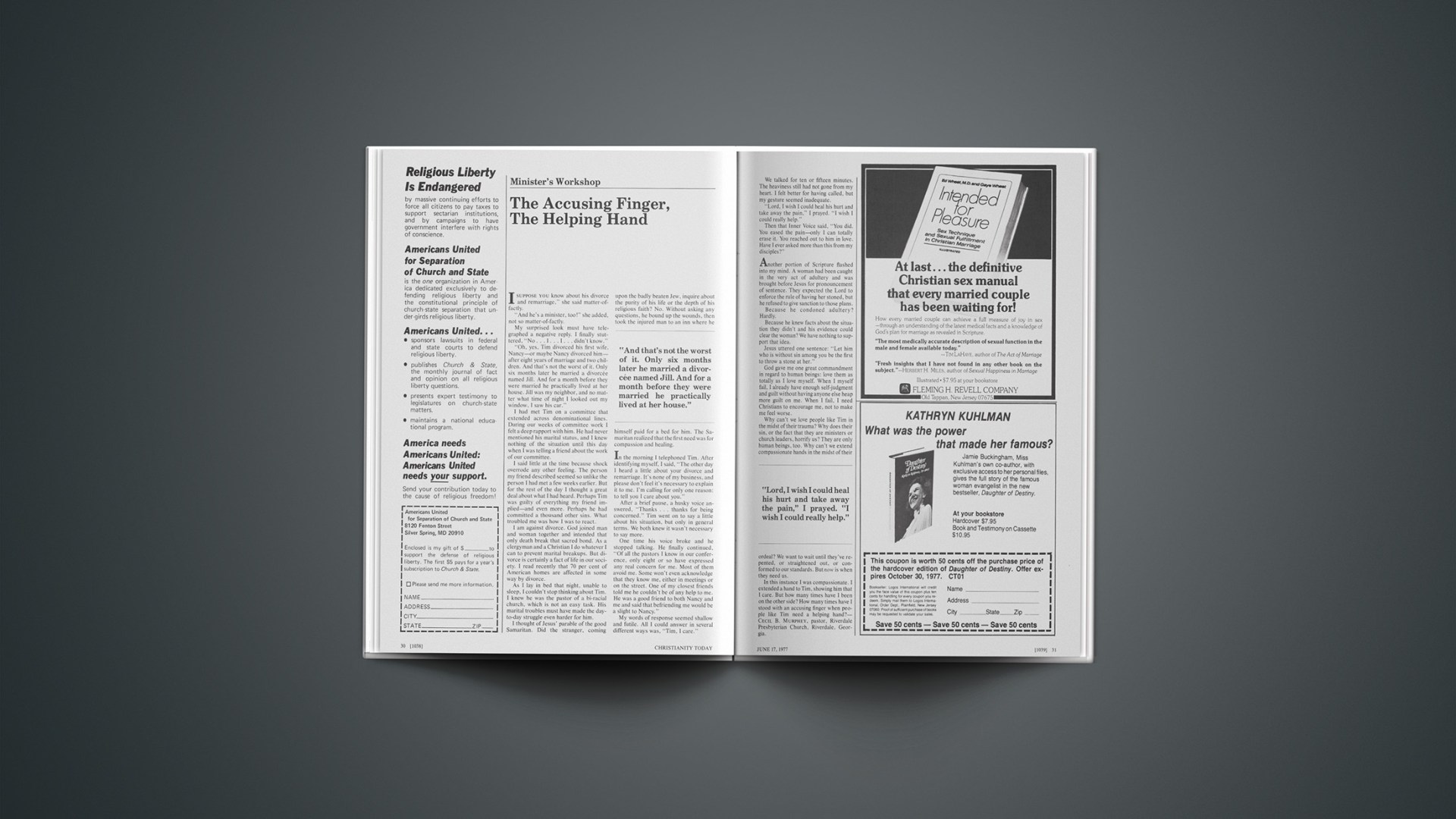
Minister’s Workshop: The Accusing Finger, the Helping Hand

I suppose you know about his divorce and remarriage,” she said matter-of-factly.

“And he’s a minister, too!” she added, not so matter-of-factly.

My surprised look must have telegraphed a negative reply. I finally stuttered, “No … I … I … didn’t know.”

“Oh, yes, Tim divorced his first wife, Nancy—or maybe Nancy divorced him—after eight years of marriage and two children. And that’s not the worst of it. Only six months later he married a divorcée named Jill. And for a month before they were married he practically lived at her house. Jill was my neighbor, and no matter what time of night I looked out my window, I saw his car.”

I had met Tim on a committee that extended across denominational lines. During our weeks of committee work I felt a deep rapport with him. He had never mentioned his marital status, and I knew nothing of the situation until this day when I was telling a friend about the work of our committee.

I said little at the time because shock overrode any other feeling. The person my friend described seemed so unlike the person I had met a few weeks earlier. But for the rest of the day I thought a great deal about what I had heard. Perhaps Tim was guilty of everything my friend implied—and even more. Perhaps he had committed a thousand other sins. What troubled me was how I was to react.

I am against divorce. God joined man and woman together and intended that only death break that sacred bond. As a clergyman and a Christian I do whatever I can to prevent marital breakups. But divorce is certainly a fact of life in our society. I read recently that 70 per cent of American homes are affected in some way by divorce.

As I lay in bed that night, unable to sleep, I couldn’t stop thinking about Tim. I knew he was the pastor of a bi-racial church, which is not an easy task. His marital troubles must have made the day-to-day struggle even harder for him.

I thought of Jesus’ parable of the good Samaritan. Did the stranger, coming upon the badly beaten Jew, inquire about the purity of his life or the depth of his religious faith? No. Without asking any questions, he bound up the wounds, then took the injured man to an inn where he himself paid for a bed for him. The Samaritan realized that the first need was for compassion and healing.

In the morning I telephoned Tim. After identifying myself, I said, “The other day I heard a little about your divorce and remarriage. It’s none of my business, and please don’t feel it’s necessary to explain it to me. I’m calling for only one reason: to tell you I care about you.”

After a brief pause, a husky voice answered, “Thanks … thanks for being concerned.” Tim went on to say a little about his situation, but only in general terms. We both knew it wasn’t necessary to say more.

One time his voice broke and he stopped talking. He finally continued, “Of all the pastors I know in our conference, only eight or so have expressed any real concern for me. Most of them avoid me. Some won’t even acknowledge that they know me, either in meetings or on the street. One of my closest friends told me he couldn’t be of any help to me. He was a good friend to both Nancy and me and said that befriending me would be a slight to Nancy.”

My words of response seemed shallow and futile. All I could answer in several different ways was, “Tim, I care.”

We talked for ten or fifteen minutes. The heaviness still had not gone from my heart. I felt better for having called, but my gesture seemed inadequate.

“Lord, I wish I could heal his hurt and take away the pain,” I prayed. “I wish I could really help.”

Then that Inner Voice said, “You did. You eased the pain—only I can totally erase it. You reached out to him in love. Have I ever asked more than this from my disciples?”

Another portion of Scripture flashed into my mind. A woman had been caught in the very act of adultery and was brought before Jesus for pronouncement of sentence. They expected the Lord to enforce the rule of having her stoned, but he refused to give sanction to those plans.

Because he condoned adultery? Hardly.

Because he knew facts about the situation they didn’t and his evidence could clear the woman? We have nothing to support that idea.

Jesus uttered one sentence: “Let him who is without sin among you be the first to throw a stone at her.”

God gave me one great commandment in regard to human beings: love them as totally as I love myself. When I myself fail, I already have enough self-judgment and guilt without having anyone else heap more guilt on me. When I fail, I need Christians to encourage me, not to make me feel worse.

Why can’t we love people like Tim in the midst of their trauma? Why does their sin, or the fact that they are ministers or church leaders, horrify us? They are only human beings, too. Why can’t we extend compassionate hands in the midst of their ordeal? We want to wait until they’ve repented, or straightened out, or conformed to our standards. But now is when they need us.

In this instance I was compassionate. I extended a hand to Tim, showing him that I care. But how many times have I been on the other side? How many times have I stood with an accusing finger when people like Tim need a helping hand?—CECIL B. MURPHEY, pastor, Riverdale Presbyterian Church, Riverdale, Georgia.

Ideas

Religious Roots: A Call to Dig

However self-satisfied other growing religious movements—such as Hare Krishna, Scientology, or the Unification Church—may be, it should be clear to everyone that evangelicalism is different. Self-examination and self-criticism are widespread in evangelical circles. The latest prominent example is “The Chicago Call,” issued by an ad hoc group of forty-three Christians with evangelical sympathies. It was actually prepared in Warrenville, a distant suburb of Chicago, May 1–3 (see News, June 3 issue, page 32). Such is the perception of evangelicalism by the media these days that the Call, printed in full on the following pages, was the subject of Newsweek’s entire May 23 religion section.

The Call was consciously prepared in the tradition of the Chicago Declaration (December 21, 1973, issue, page 38) and the Lausanne Covenant (August 16, 1974, issue, pages 22–24, 35–37). Unlike them, this new statement will almost certainly not lead to a continuing organization. Like them, it will not cause much to happen that would not have happened anyway. But it can serve as a useful stimulus for discussion and debate. The Chicago Declaration challenged evangelicals to greater concern about the ills of society; the Lausanne Covenant focused on world evangelization. The Chicago Call supplements, rather than differs from, the others with an appeal to greater concern for more traditional “churchmanship.”

Despite the Episcopal ties of six of the eight convenors (their roots, notably, were non-Episcopal), the Call is not a veiled appeal for more converts to Anglicanism. Indeed, the majority of the participants were from and intend to remain in distinctly non-Episcopal traditions. The preparers feel that all Christian traditions have broader heritages than are generally being tapped.

Basically, the Call is a warning against ignoring or scorning the past. In our culture, the needs of the present and of the future are stressed; ties with the past are played down. The response to Alex Haley’s search for his “roots” is a welcome counter-trend, but the damage symbolized by the replacing of “history” in school and college curricula with a more present-oriented “social studies” will take a long time to undo.

To ignore the past, we are often told, is to repeat the mistakes that were made. For the Christian, ignoring the past is also an implicit denial of a cardinal truth: there is one body of Christ; all believers, whether now alive on earth or not, are members of that body. Gifted teachers, writers, exegetes, and theologians are God’s gifts to the Body for subsequent ages as well as for their own.

To be sure, our existing denominationalism and independence of action contradict our profession of the unity of the Body, and the Chicago Call addresses itself to that divisiveness as well.

The modern Western emphasis on individualism played an indispensable role in settling this vast continent and in promoting Christian evangelism and nurture while older institutions were proving unable to adapt to changing needs. However, such individualism (whether personal or corporate) needs to be kept within biblical guidelines. For example, the idea that every Christian, no matter how lofty or lowly his role, should be submissive to a group of mutually submitting leaders in a local church will not sit well in a culture in which we are accustomed to making decisions and then informing parents, church leaders, or other ostensible counselors. But the question is not, What suits our culture or temperament?, but rather, What does God say, especially through his Word?

The Chicago Call will serve its purpose if it promotes reflection and discussion about the themes it addresses. One does not have to agree with each of its confessions and affirmations (or with whatever one cares to read between the lines) in order to endorse heartily, as we do, the giving of “careful theological consideration” to these matters. And where present practice is found to be out of keeping with biblical precept, let us “be doers of the word, and not hearers only.”

TO OUR READERS: As happens several times a year, there will be a three-week interval between this issue and the next (July 8). During this period Christianity Today will move to Carol Stream, Illinois. (As announced previously, the news department will remain in downtown Washington, D.C.)

Prologue:

In every age the Holy Spirit calls the church to examine its faithfulness to God’s revelation in Scripture. We recognize with gratitude God’s blessing through the evangelical resurgence in the church. Yet at such a time of growth we need to be especially sensitive to our weaknesses. We believe that today evangelicals are hindered from achieving full maturity by a reduction of the historic faith. There is, therefore, a pressing need to reflect upon the substance of the biblical and historic faith and to recover the fullness of this heritage. Without presuming to address all our needs, we have identified eight of the themes to which we as evangelical Christians must give careful theological consideration.

A Call to Historic Roots and Continuity:

We confess that we have often lost the fullness of our Christian heritage, too readily assuming that the Scriptures and the Spirit make us independent of the past. In so doing, we have become theologically shallow, spiritually weak, blind to the work of God in others and married to our cultures.

Therefore we call for a recovery of our full Christian heritage. Throughout the church’s history there has existed an evangelical impulse to proclaim the saving, unmerited grace of Christ, and to reform the church according to the Scriptures. This impulse appears in the doctrines of the ecumenical councils, the piety of the early fathers, the Augustinian theology of grace, the zeal of the monastic reformers, the devotion of the practical mystics and the scholarly integrity of the Christian humanists. It flowers in the biblical fidelity of the Protestant Reformers and the ethical earnestness of the Radical Reformation. It continues in the efforts of the Puritans and Pietists to complete and perfect the Reformation. It is reaffirmed in the awakening movements of the 18th and 19th centuries which joined Lutheran, Reformed. Wesleyan and other evangelicals in an ecumenical effort to renew the church and to extend its mission in the proclamation and social demonstration of the Gospel. It is present at every point in the history of Christianity where the Gospel has come to expression through the operation of the Holy Spirit: in some of the strivings toward renewal in Eastern Orthodoxy and Roman Catholicism and in biblical insights in forms of Protestantism differing from our own. We dare not move beyond the biblical limits of the Gospel; but we cannot be fully evangelical without recognizing our need to learn from other times and movements concerning the whole meaning of that Gospel.

A Call to Biblical Fidelity:

We deplore our tendency toward individualistic interpretation of Scripture. This undercuts the objective character of biblical truth, and denies the guidance of the Holy Spirit among his people through the ages.

Therefore we affirm that the Bible is to be interpreted in keeping with the best insights of historical and literary study, under the guidance of the Holy Spirit, with respect for the historic understanding of the church.

We affirm that the Scriptures, as the infallible Word of God, are the basis of authority in the church. We acknowledge that God uses the Scriptures to judge and to purify his Body. The church, illumined and guided by the Holy Spirit, must in every age interpret, proclaim and live out the Scriptures.

A Call to Creedal Identity:

We deplore two opposite excesses: a creedal church that merely recites a faith inherited from the past, and a creedless church that languishes in a doctrinal vacuum. We confess that as evangelicals we are not immune from these defects.

Therefore we affirm the need in our time for a confessing church that will boldly witness to its faith before the world, even under threat of persecution. In every age the church must state its faith over against heresy and paganism. What is needed is a vibrant confession that excludes as well as includes, and thereby aims to purify faith and practice. Confessional authority is limited by and derived from the authority of Scripture, which alone remains ultimately and permanently normative. Nevertheless, as the common insight of those who have been illumined by the Holy Spirit and seek to be the voice of the “holy catholic church,” a confession should serve as a guide for the interpretation of Scripture.

We affirm the abiding value of the great ecumenical creeds and the Reformation confessions. Since such statements are historically and culturally conditioned, however, the church today needs to express its faith afresh, without defecting from the truths apprehended in the past. We need to articulate our witness against the idolatries and false ideologies of our day.

A Call to Holistic Salvation:

We deplore the tendency of evangelicals to understand salvation solely as an individual, spiritual and otherworldly matter to the neglect of the corporate, physical and this-worldly implication of God’s saving activity.

Therefore we urge evangelicals to recapture a holistic view of salvation. The witness of Scripture is that because of sin our relationships with God, ourselves, others and creation are broken. Through the atoning work of Christ on the cross, healing is possible for these broken relationships.

Wherever the church has been faithful to its calling, it has proclaimed personal salvation; it has been a channel of God’s healing to those in physical and emotional need; it has sought justice for the oppressed and disinherited; and it has been a good steward of the natural world.

As evangelicals we acknowledge our frequent failure to reflect this holistic view of salvation. We therefore call the church to participate fully in God’s saving activity through work and prayer, and to strive for justice and liberation for the oppressed, looking forward to the culmination of salvation in the new heaven and new earth to come.

A Call to Sacramental Integrity:

We decry the poverty of sacramental understanding among evangelicals. This is largely due to the loss of our continuity with the teaching of many of the Fathers and Reformers and results in the deterioration of sacramental life in our churches. Also, the failure to appreciate the sacramental nature of God’s activity in the world often leads us to disregard the sacredness of daily living.

Therefore we call evangelicals to awaken to the sacramental implications of creation and incarnation. For in these doctrines the historic church has affirmed that God’s activity is manifested in a material way. We need to recognize that the grace of God is mediated through faith by the operation of the Holy Spirit in a notable way in the sacraments of baptism and the Lord’s Supper. Here the church proclaims, celebrates and participates in the death and resurrection of Christ in such a way as to nourish her members throughout their lives in anticipation of the consummation of the kingdom. Also, we should remember our biblical designation as “living epistles,” for here the sacramental character of the Christian’s daily life is expressed.

A Call to Spirituality:

We suffer from a neglect of authentic spirituality on the one hand, and an excess of undisciplined spirituality on the other hand. We have too often pursued a superhuman religiosity rather than the biblical model of a true humanity released from bondage to sin and renewed by the Holy Spirit.

Therefore we call for a spirituality which grasps by faith the full content of Christ’s redemptive work: freedom from the guilt and power of sin, and newness of life through the indwelling and outpouring of his Spirit. We affirm the centrality of the preaching of the Word of God as a primary means by which his Spirit works to renew the church in its corporate life as well as in the individual lives of believers. A true spirituality will call for identification with the suffering of the world as well as the cultivation of personal piety.

We need to rediscover the devotional resources of the whole church, including the evangelical traditions of Pietism and Puritanism. We call for an exploration of devotional practice in all traditions within the church in order to deepen our relationship both with Christ and with other Christians. Among these resources are such spiritual disciplines as prayer, meditation, silence, fasting, Bible study and spiritual diaries.

A Call to Church Authority:

We deplore our disobedience to the Lordship of Christ as expressed through authority in his church. This has promoted a spirit of autonomy in persons and groups resulting in isolationism and competitiveness, even anarchy, within the body of Christ. We regret that in the absence of godly authority, there have arisen legalistic, domineering leaders on the one hand and indifference to church discipline on the other.

Therefore we affirm that all Christians are to be in practical submission to one another and to designated leaders in a church under the Lordship of Christ. The church, as the people of God, is called to be the visible presence of Christ in the world. Every Christian is called to active priesthood in worship and service through exercising spiritual gifts and ministries. In the church we are in vital union both with Christ and with one another. This calls for community with deep involvement and mutual commitment of time, energy, and possessions. Further, church discipline, biblically based and under the direction of the Holy Spirit, is essential to the well-being and ministry of God’s people. Moreover, we encourage all Christian organizations to conduct their activities with genuine accountability to the whole church.

A Call to Church Unity:

We deplore the scandalous isolation and separation of Christians from one another. We believe such division is contrary to Christ’s explicit desire for unity among his people and impedes the witness of the church in the world. Evangelicalism is too frequently characterized by an ahistorical, sectarian mentality. We fail to appropriate the catholicity of historic Christianity, as well as the breadth of the biblical revelation.

Therefore we call evangelicals to return to the ecumenical concern of the Reformers and the later movements of evangelical renewal. We must humbly and critically scrutinize our respective traditions, renounce sacred shibboleths, and recognize that God works within diverse historical streams. We must resist efforts promoting church union-at-any-cost, but we must also avoid mere spiritualized concepts of church unity. We are convinced that unity in Christ requires visible and concrete expressions. In this belief, we welcome the development of encounter and cooperation within Christ’s church. While we seek to avoid doctrinal indifferentism and a false irenicism, we encourage evangelicals to cultivate increased discussion and cooperation, both within and without their respective traditions, earnestly seeking common areas of agreement and understanding.

Issuing the call: Marvin W. Anderson, Bethel Seminary; John S. Baird, Dubuque Seminary; Donald G. Bloesch,* Dubuque Seminary; Jon E. Braun, New Covenant Apostolic Order; Virgil Cruz, Dubuque Seminary; James Daane, Fuller Seminary; Donald W. Dayton, North Park Seminary; Jan P. Dennis,* Good News Publishers; Lane T. Dennis,* Good News Publishers; Gerald D. Erickson,* Trinity College (Deerfield); Isabel A. Erickson, Tyndale House; Donald C. Frisk, North Park Seminary; Pete Gillquist,* Thomas Nelson Publishers; Alfred A. Glenn, Bethel College (St. Paul); Nathan Goff, pastor, College Church (Wheaton); Jim Hedstrom, student, Vanderbilt; Richard Holt, dentist (Wheaton); Thomas Howard,* Gordon College; Morris A. Inch, Wheaton College; Herbert Jacobsen, Wheaton College; Kenneth Jensen, New Covenant Apostolic Order; Richard A. Jensen, Wartburg Seminary; Theodore Laesch, pastor, St. John Lutheran Church (Wheaton); Kathryn Lindskoog, author; Howard Loewen, Mennonite Brethren Bible College; Richard Lovelace, Gordon-Conwell Seminary; F. Burton Nelson, North Park Seminary; Ray Nethery, New Covenant Apostolic Order; Roger Nicole, Gordon-Conwell Seminary; Victor R. Oliver,* Tyndale House; M. Eugene Osterhaven, Western Seminary; Lois M. Ottaway, Wheaton College News Service; Gordon W. Saunders, Trinity College (Deerfield); Rudolf Schade, Elmhurst College; Luci N. Shaw, author; Kevin N. Springer, New Covenant Apostolic Order; Jeffrey N. Steenson, student, Harvard; Donald Tinder, Christianity Today; Benedict Viviano, Aquinas Institute; Gordon Walker, pastor, Grace Fellowship Church (Nashville); Robert E. Webber,* Wheaton College; Matthew Welde, Presbyterians United for Biblical Concerns; Lance Wonders, student, Dubuque Seminary. *Member of convening committee

Music: A Bridge through Time

We were gathered in the living room of Gentiana in the soft light of candles and lamps, some sitting on chairs, others on the floor, having been called together for a spontaneous hour of music. Ken was to leave the next day, and Debby and Udo felt that the household should experience an hour of his lute playing. The time began with Ellis playing a recorder accompanied by the lute, and we relaxed with inward sighs of relief at being carried into another moment of history through our ears. The lute went on, as Ken played one piece after another, pieces written and played by German and French musicians centuries ago. We felt we were crossing a bridge with sudden ease and reality, a bridge into the past, through our ears and eyes. “This,” we thought to ourselves, “is how people in the seventeenth century felt as they heard what we are hearing.”

Music bridges gaps in a vivid way that permeates our whole beings, and why shouldn’t it? God, who made us in his image, had already made music. “Where wast thou,” God asks, “when I laid the foundation of the earth … when the morning stars sang together, and all the sons of God shouted for joy?” (Job 38:4, 7). What is the music of the stars like? We cannot imagine, but as my door is open this foggy spring morning, I can hear what the songs of the birds were like as they sang before man ever sang a song. Bird songs: an element of continuity with the time before man and woman were there to hear them. Bird songs, heard by God and the angels. Our ears can hear bird songs that were heard by Adam and Eve, by Abraham and Isaac, by David and Daniel, by Paul and Silas, by Luther and Calvin, Spurgeon and Livingstone.

We had a long conversation about music after the last lute tones died away. We asked Ken how closely his instrument resembled the original lutes. We talked about the connection between the philosophical base people have and the music they produce. We considered from different angles the understanding that produces music with “resolution,” and the responses of listeners to such music. There can be a sigh of relief, a soothing of jangled nerves, a sense of satisfaction without thoughts of why, on what base, such music has come forth. But the very exposure to an evening of such music keeps alive something of history and of past understanding. Music should not be just a taken-for-granted happening, whether in worship, or in a concert, or in spontaneous times with family and friends. The possible tie with history, the possible replanting of roots, the possible philosophical effect on minds, the possible fulfillment of unexplained hungers through music, should not be ignored.

The blend of music with praise to the Lord is something we need to know about not only academically but in practice. Come to First Chronicles 16: “Give thanks unto the LORD, call upon his name, make known his deeds among the people. Sing unto him, sing psalms unto him, talk ye of all his wondrous works. Glory ye in his holy name: let the heart of them rejoice that seek the LORD. Seek the LORD and his strength, seek his face continually.… Sing unto the LORD, all the earth: show forth from day to day his salvation. Declare his glory among the heathen; his marvellous works among all nations” (vv. 8–11, 23, 24). Music is to be full of the content of truth about God in words, as well as praise directly brought to him. It seems to me that not only the words accompanying praiseful music should be appropriate but the music itself. The base beneath the music—that is, belief in the existence of the living God-should come forth in the very music itself and strike a chord of response in other human beings, as well as producing acceptable praise to God. Unbelieving hearers or players sometimes respond in a way that is a form of accepting what they may deny with their lips.

When later in the same chapter in First Chronicles the work of “ministering unto the Lord” is spelled out, music is a part of it. Look at verses 41 and 42: “And with them Jeman and Jeduthun and the rest that were chosen, who were expressed by name, to give thanks to the LORD, because his mercy endureth forever. And with them Heman and Jeduthun with trumpets and cymbals for those that should make a sound, and with musical instruments of God.” The music of the human voice and instruments had a place in expressing thanksgiving and praise.

When the wall of Jerusalem had been rebuilt after being destroyed, a service of dedication was held. How was the wall dedicated to the God of Abraham and Isaac and David? Listen to excerpts from Nehemiah 12: “And at the dedication of the wall of Jerusalem they sought the Levites out of all their places, to bring them to Jerusalem, to keep the dedication with gladness, both with thanksgivings, and with singing, with cymbals, psalteries, and with harps.… In the days of David and Asaph of old there were chief of the singers, and songs of praise and thanksgiving unto God” (vv. 27, 46). Music was to fulfill the God-given abilities to play instruments and blend them into a crescendo of thanksgiving and praise as an expression of dedication of a work completed for the Lord. And it can give us a sense of continuity with the people who lived back in Nehemiah’s time to hear some of the same instruments today.

However, although music can be used to “bridge the gap” and help people to understand their distance from the reality of truth, we are also warned in the Word of God that there can be a false use of music to mask error. The same notes and instruments are used not only on the wrong base but to pour out worship to false gods. God tells us he is a jealous God. He is jealous when the love and adoration of his “bride” is poured out to another god, using the very same notes and instruments for spiritual adultery.

Here the serenade of heathen gods is taking place by those who were of the house of Israel, and who should never have been singing to anyone but the true and living God: “I hate, I despise your feast days, and I will not smell in your solemn assemblies.… Take thou away from me the noise of thy songs; for I will not hear the melody of thy viols.… Woe unto them that are at ease in Zion … that chant to the sound of the viol, and invent to themselves instruments of music, like David; that drink wine in bowls, and anoint themselves with the chief ointments: but they are not grieved for the affliction of Joseph” (Amos 5:21, 23, and 6:1, 5, 6). This warning to the Israelites, who had put other gods in God’s place and were singing and playing music to them, is also a strong, clear warning to us. The need to bridge the gap to the past through music is accompanied by the need to examine ourselves to make sure whom we are worshipping when music fills us with adoration.

Refiner’s Fire: The Gimlet Eye of D. Keith Mano

In His book Man in Modern Fiction, Edmund Fuller speaks of those few writers, always a minority voice, whose function it is “to ask the anguished questions which life ever demands of the thinking man, believer or skeptic.… Not offering a view of man counter to, or in challenge of, the Judeo-Christian Western tradition, nevertheless they are compelled to probe and test unsparingly the validity of that tradition” (Random House, 1958, p. 16). Such a writer is D. Keith Mano. His perceptive probing is disquieting to skeptic and believer alike. At a time when complacency is widespread and seems to be leading to stagnation and even decadence, such disquieting is essential.

Mano is an accomplished writer and an orthodox Christian who was born thirty-five years ago in New York City. He graduated summa cum laude from Columbia University. He was a Kellett Fellow in English at Clare College, Cambridge (1964), and a Woodrow Wilson Fellow at Columbia (1964–65). A talented actor as well as a writer, he toured with the Marlowe Society of England while at Cambridge, appeared in several off-Broadway productions, and toured with the National Shakespearean Company. On the more mundane side, he has served as vice-president of his family’s X-Pando Corporation (model of Cleano Corp. in his fourth novel?), which manufactures home-repair cement and pipe-joint compound (see Mano’s “Portrait of the Artist as a Cement Manufacturer,” Esquire, March, 1972). Besides writing six published novels to date, Mano is a contributing editor of the National Review, writing perceptively and wittily on topics ranging from gay liberation to “the liberated man,” from T.M. to Hare Krishna, from pet cemeteries to service stations, from overeating to “the sacrament of Bingo,” from Rod McKuen to Marabel Morgan, from comic strips to The Exorcist.

Mano’s Christian belief dates from his undergraduate years at Columbia, where his investigation of Augustine led to a personal faith. “The initial thing, the opening, was my sophomore course in Contemporary Civilization,” he has said. “I wasn’t religious at all. But the teacher would come to someone like St. Augustine and say something like, ‘Of course we can’t bother about his religious views, but let us consider him as a thinker.’ This struck me as absurd. Augustine was simultaneously a thinker and religious” (interview in Jeffrey Hart’s syndicated column, November 27, 1970).

The world view of Mano’s novels is essentially Augustinian, orthodox Christian. Each novel asks anguished questions, the most pertinent of which is: “How does the Christian act and react in the modern world?” Mano has expressed his purpose as follows: “I feel that to write and speak out you have to say something valid, something finally valid. I don’t mean you have to be moralistic and preach sermons. It has to be there in the story. But it cannot be just a story. My problem is to show how the Christian deals with the modern world” (Hart interview).

His first novel, Bishop’s Progress (Houghton Mifflin, 1968), winner of the PMLA award for the best novel on a religious subject, deals with the Christian and “progress,” particularly medical progress—that “graven image,” “St. Augustine’s superb Christian logic, perverted by Descartes, evolving finally into its own antithesis” (p. 344). The bishop’s real progress, of course, is his awareness that “to live—with the whole of understanding, to live, no matter how, in the light that is the only true light—that alone is living” (p. 356). A short happy life of faith and meaning, Mano suggests, is preferable by far to a longer mechanical existence robbed of meaning by a diabolical scientism.

Mano’s second novel, Horn (Houghton Mifflin, 1969), deals with the Christian and black power. In some respects it resembles Ralph Ellison’s The Invisible Man, but from a white man’s perspective. The white protagonist, again an Episcopal bishop, learns from a Black Power leader that what is ordinarily called hatred, prejudice, and bigotry is really fear. The denouement of the novel, at least psychologically so, comes when the atheistic Black Power leader tells the bishop what is wrong with the church: “You preach only the words. And they are hollow words because you have forgotten his promises. Maybe these promises are all lies. I think they are. But they are powerful lies. If I knew there was a heaven, if you had taught me that, then I would not hate Mr. George Wallace or the man who killed Martin Luther King. But all I have is this life. This body. This task to do. These things. I am afraid to lose them. And my fear fills me full of hate.… Your Jesus was great because he taught his people … how to love.… They could love. Because they had no fear.… That is the difference. You have forgotten that” (p. 326). To be reminded of what we have forgotten is disquieting but necessary.

War Is Heaven! (Doubleday, 1970), Mano’s third novel, deals with the Christian and war, a Viet Nam (Camaguayan) type of war. Among the anguished questions this widely misunderstood novel raises is that recurrent one, How can a benevolent God permit war? The novel suggests that “there is a heightening in war, if nothing else” (p. 41); it is “a microcosm of life, speeded up like an old movie” (p. 39). War merely concentrates, intensifies, the human condition of “ordinary” life and as such is a test situation. Death, a recurring theme in Mano’s fiction, is everywhere present in “ordinary” life, but in warfare no one “passes away”! Sergeant Hook, an anomalous Christian at best, realizes, as Mano has noted, that “the ultimate selfishness is to refuse to defend a man who is being killed because, ‘I am too pure to do so.’ ” The novel focuses less on war between countries than on its real cause—the individual warfare raging within the men; it thus provides a powerful dramatization of the truth of James 4:1–3.

In his fourth novel, The Death and Life of Harry Goth (Knopf, 1971), Mano turns to black humor, a mode that according to Burton Feldman is the most significant development in American fiction since 1945. The novel deals with the Christian and death. Harry, thinking he is dying of leukemia, only then begins to live; he learns from each of the Brothers Goth but mostly from Philip, alias Brother Chrysostom, cloistered in an upstate monastery. What Harry learns is that “without life of some sort, death cannot be said to exist” (p. 87) and, conversely, without death, both Christ’s and our own, life cannot be said to have meaning. Death, Philip tells Harry, “is shock therapy. It leaves us free to live. Unimpeded by things. By desires. Free to seek ourselves in God. I mean, you can’t be greedy or proud or cruel or ambitious—not when you’ve only got a few days to live.… We cannot be with God until we cease being with ourselves. Death. I seek death. Death of the self” (pp. 181, 183). The imminence of physical death—and, by metaphoric extension, the death of self—enables one to be disinterested, free of telluric conditions as Saul Bellow’s Artur Sammler is. But to be disinterested is not to be uninterested, as Sammler, Philip, and ultimately Harry, with his concern for his niece Sin-Sin, illustrate.

Perhaps Mano’s most bizarre novel is his fifth. The Proselytizer (Knopf, 1972), dealing with the Christian and the family—both the individual family and the larger family of God. Its protagonist, the “proselytizer” of the title, is Kris Lane, choir director at the Church of the Resurrection (Episcopal) in the town of New Faith. Lane “wins” women “converts” by first seducing them and then praying with them. Easily misunderstood, the novel reduces to absurdity the idea of justifying anything done in the name of Christ. Lane carries the specious logic of felix culpa to its absurd extremity, arguing, against Paul (Romans 6:1, 2), that it is right to do wrong in order to do right. “It’s only through wrong that we can approach the right. Christ’s crucifixion was a wrong, yet we celebrate it on Good Friday. Good. It’s through a knowledge of sin that we know our own frailty, our need for grace” (p. 176). As Lionel Trilling, one of Mano’s teachers at Columbia, used to say, the presence in literature of violence, sordidness, and insult to the prevailing morality most often indicates the intention to destroy specious good. That seems to apply in Mano’s fiction.

Mano’s latest novel, The Bridge (Doubleday, 1973), represents yet another mode, the futuristic, apocalyptic Orwellian tale. The novel deals with the Christian and ecology, the Christian and apocalypse, the Christian and totalitarian decadence. Set in a nightmarish post-Christian era of the twenty-first century, the novel describes a ritualistic slaughter of human beings (reminiscent of Shirley Jackson’s “The Lottery”). The novel graphically and grotesquely illustrates what most of Mano’s fiction does: the hypothetical but potentially real reductio ad absurdum of godless reasoning, of godless existence. Ecological Decree has dehumanized man, making him a little lower than the ants, the insects, the very bacteria he is forbidden to kill. Dominick Priest rebelliously affirms human life and survives, but centuries later his struggle has been distorted into sacrosanctity and his person into an apotheosis of a barbaric system whose motto is “All things eat or are eaten.” Oscar, an incipient rebel, recognizes some of the sorry truth: “Cannibals or suicides.… There are only two ages of man. Childhood and senility. Savage youth or a self-hating, self-destructive civilization. In between, a few moments—no more, a few—when the balance is held” (p. 236).

The novel suggests that the real bridge between primitive savagery and civilization is the Christian and his witness. On his journey for survival, Dominick Priest meets Xavier Paul, an octogenarian Christian in hiding. Although this Christian from a pristine era speaks abstractly of the Son of God who was crucified “to take men’s sins away” (p. 165), he has lost his own belief in the reality of the Christian faith; he thus fails to “bridge” the gap between savagery and Christian civilization, just as Bishop Pratt in Horn fails to communicate a life-changing witness.

Conversely, the witness of Bishop Belknap in Bishop’s Progress leads to the conversion of a fellow patient: “There’s a heaven and there’s a hell. Just like they say. One is with God and it’s good. One is without God and it’s terrible. Heaven is for those who believe in Christ, and in His saving Grace—only those.… It’s not what you do. It’s what you believe.… Anyone who has faith in Christ and in his redemptive Grace can be saved” (pp. 215, 214, 229).

With his Christian world view, Mano resembles Flannery O’Connor, particularly in his underlying premise that “without sin, what is the need for salvation?” “I’m a Flannery O’Connor man,” he has said. “The devil is both a dramatic necessity for the writer and, for any Christian worth his salt, a spiritual necessity” (in a letter to the author). Though he shares some common ground with other writers, such as John Updike, Evelyn Waugh, Peter DeVries, and Graham Greene, Mano is distinctive. If, as Henry James warned, the critic must grant the writer his donnée, his given, or incur the guilt of tampering with his flute and then criticizing his music, one must not make the obverse error of praising the music simply because it is played on one’s own familiar and favorite flute. Mano’s fiction is significant not merely because of its Christian donnée but also because of its probing power and its high artistic quality.

D. G. Kehl is professor of English at Arizona State University, Tempe.

Where Did I Come from? A Question of Origins

Professor John Gerstner tells a story about Arthur Schopenhauer, the nineteenth-century German pessimistic philosopher, who was seated on a park bench in Berlin. A policeman, taking him to be a bum because of the way he was dressed, asked him who he thought he was. He answered him, “I would to God I knew.” This question had to do with his identity. But there is another question, “Where did I come from?,” which is no less important. This has to do with man’s origins. And the way this riddle is answered depends upon one’s presuppositions, which in turn lead to other conclusions of a momentous nature.

One school of thought about origins has the agnostic answer “I don’t know” for its underlying presupposition. Not infrequently the agnostic is really saying, “I can’t know.” If that be true, it is pointless to try to find an answer. But there are some agnostics who do not say this. Rather they affirm: “I don’t know now, but I’m still looking for an answer.” The Christian can provide this kind of agnostic with an answer, and he can frame it persuasively so that agnosticism can conceivably give way to conviction and certainty.

A second response to the question “Where did I come from?” is given by people who hold atheistic, naturalistic, evolutionary presuppositions. A cautionary word must be inserted immediately. There is another view which we will look at shortly that is evolutionary without being either atheistic or naturalistic. But it remains true that atheists and naturalists generally accept the evolutionary hypothesis, which they conceive to be dynamically related both to their denial of the existence of God and to the naturalistic premise that is a substitute for God. For them man is a part of nature.

The problem for the naturalist is not resolved until he can answer the question “Where did matter come from?” Phrased another way it is this: “If man comes from nature through the evolutionary process, does matter have a beginning or has it always existed?” If it had a beginning, then there must have been a first cause, and that first cause could only have been God, whose existence naturalists deny. Thus they must conclude that matter is eternal; there was no beginning.

This viewpoint leads relentlessly to current atheistic existentialism, which has for its philosophical center-piece the notion that life is really meaningless; it makes no sense. And who would disagree with this conclusion, given the underlying presupposition of atheism, naturalism, and evolution? Where man came from, given this starting point, makes no difference anyhow. But this much we do know: those who hold this view are not agnostic. They do have answers. Professor George Gaylord Simpson of Harvard University says, “In the post-Darwinian world another answer seems fairly clear: man is responsible to himself and for himself” (Science, April 1, 1960, p. 974). Harlow Shapley, director of the Harvard Observatory, said, “Our God is humanity; our creed is effective participation in universal evolution” (Beyond the Observatory, Scribner, 1967, p. 171). Professor Michael Ghiselin, University of California teacher, argued that the evolutionary hypothesis makes supernaturalism obsolete and God “a superfluous hypothesis” (Science, March 9, 1973, p. 964). For them man is part of nature, the beginning and end of everything. He is here for a time but disappears without leaving more than a trace and has no continuing existence. He is simply a temporary manifestation of a higher form of life that is derived from lower forms in an ascending scale.

The third, and only other, answer to the question about man’s origins is the theistic alternative. This category comprises two different schools of thought, special creationists and theistic evolutionists. They hold certain views in common if they are Christians. Both regard man as creature and God as creator. Both agree that man was made for God, is responsible to God, is fallen, and needs redemption. From the theological perspective, the Christian theistic evolutionist opens himself to criticism that the special creationist does not face.

The first question theistic evolutionists must answer is whether matter is eternal. I know of no biblical theistic evolutionists who would argue for the eternity of matter. All presumably would agree that creation is ex nihilo, that is, fiat creation in which God by the word of his power brought matter into existence. Thus, before matter there was only God, who is spirit. If this be true, then in principle it would be possible for God to make man ex nihilo. The question would be not whether God could do this but what God actually did do. It is here that theistic evolutionists tie man into the processes of nature. They accept the findings of modern science or at least the hypothesis of science about man’s origins, but they attribute the outworking to God, who authored the process through which man came into being.

Theistic evolutionists must cross another bridge that is narrow and perilous. They cannot for one moment postulate that lower forms of animal life had souls such as we find in homo sapiens today. Thus at whatever point in the evolutionary process some animal became man, God must have created and implanted in man the soul that distinguishes him from animals. To put it another way, when did the imago dei get into man which made man man? Something was added at some point to the evolutionary spiral. That something was not there before. It came about by direct divine intervention—God added a new component that did not spring from nature.

If this be true, why need we suppose that the body of man came through an evolutionary process when the soul did not? The Christian evolutionist replies by saying that this is the way God chose to do it. By doing so he projects science into the picture.

Once science is introduced, it raises these questions in connection with man’s origins: “What is the relationship between science and the Bible? What do we do if and when the so-called sure conclusions of science appear to contradict what we read in the Bible? Do we interpret the Bible so that it agrees with science? But if the Bible’s teaching cannot be reconciled with science, do we then let science sit in judgment on the Bible or do we let the Bible sit in judgment on science?”

The reason why this sort of question must be asked is that some Christian scientists today are deeply committed to the emergence of man in an evolutionary context, and they insist that the findings of science are so certain that the Bible is not normative at this point or it can be interpreted as Heilsgeschichte (salvation history) rather than Historie (real history). For them the purpose or the intent of the Bible is not to give us scientific information that is precise or necessarily correct. The purpose or intent of revelation has to do with salvatory (soteriological) matters, with faith and practice, and not with those things that have to do with science, the cosmos, chronology, or even numbers.

It seems to me that man’s entrance into history via the theistic evolutionary approach suffers from certain drawbacks that make it a most unlikely prospect, leaving us with special or immediate creationism as the best answer to the question of man’s origins. The first drawback is that the evolutionary answer must presuppose the emergence of a male and a female from higher animal forms of life of which we have no counterparts. The missing link is still missing. Secondly, who can rule out the possibility that other human beings might have emerged so that the human race today did not spring from a single first ancestor but from a number of ancestors? This latter possibility would gravely complicate the biblical account of the fall of man through the Adamic line and leave us with other human beings who did not inhabit Eden and of whom there is no biblical information that they ever fell. The evolutionary approach forces us into a hermeneutic which regards the creation accounts as saga or myth rather than history and fact. This in turn does gross violence to even didactic portions of the Bible in both the Old and New Testaments and creates other problems for which there are no answers. In the light of this, let’s take a hard look at the special-creation view.

By special creation we mean that man did not come from prior existing forms of life. The biblical account in Genesis does say that God fashioned man from the dust of the earth. It can be argued that dust had in it elements of life such as bacteria. This appears quite appropriate. But when we speak about creation from the dust of the earth and say man did not come from prior existing forms of life, the meaning is clear: man did not come from earlier forms of vertebrate life; he did not exist as a subhuman with a body similar to or comparable to Adam’s body; Adam did not come from pre-existent animal life. Adam was an immediate creation of God, who fashioned him from the dust of the ground.

Adam was the first man; from him all future human life was to spring. Some say that the Hebrew word for Adam is a generic term meaning only “man.” This is quite true, but it hardly proves anything significant. Virtually every human name springs from common words. David means “beloved”; Joshua means “Yahweh saves”; Henry means “ruler of the home”; Ralph means “wolf in counsel”; William means “desired helmet.” For the name Adam to mean “man” hardly supposes that the word did not refer to a specific person who was the first of the human species.

Adam was regarded as the first man by the biblical writers. In First Chronicles 1 the genealogical table begins with Adam. Since the other people named in the table are obviously historical, who could deny that at least in the understanding of the Chronicler, Adam was the beginner of the human race? In the New Testament genealogical table given by Luke (3:23 ff.) he traces the descendants of Jesus straight back to Adam, whom he designates as “the son of God.”

The Apostle Paul builds his theology of redemption in Romans around the first and the second Adams. Jesus for Paul is the second Adam. The first Adam was the inhabitant of the Garden of Eden, our first ancestor through whom original sin with all of its consequences came. And it was the first man’s sin that made necessary the second Adam’s sacrifice on the cross of Calvary. To argue that the first Adam was a mythical figure while holding that the second Adam was true man boggles the imagination and turns Scripture on its head. Moreover, if there was no first Adam, from whence did original sin come? The Bible allows for no other explanation for the intrusion of sin into the human race once Adam is regarded as non-historical. Clearly the Bible teaches that the entire human race springs from the first ancestor Adam and that he came from God as a special and immediate creation.

What adds significance to the creation story is the account of Eve’s beginnings. There are only two possible approaches to the Genesis account of Eve’s creation: either it must be regarded as mythical or it must be accepted as non-evolutionary in character. There is nothing in the biblical account that could make possible the evolution of Eve from previously existing animal forms. A deep sleep came upon Adam. God removed a rib from his rib cage. God fashioned Eve out of that rib that he took from Adam’s body. No evolutionary proposal could possibly digest this information and make sense out of it from that standpoint.

What is clear is this, however: to accept the story of Eve’s beginnings as given in Genesis in any historical sense is to knock the theory of evolution into a cocked hat. It brings to bear upon the creative process divine intervention that drives the uniformitarian hypothesis and the endless eons of evolutionary development into the ground. If, in the face of the biblical data, the theistic evolutionist chooses to accept the hypothesis of some scientists, he at least should be conscious of what he is doing to the Bible in the process. He no longer makes it the source book for his knowledge of origins. In place thereof he chooses the verdict of science and allows it to sit in judgment on the Bible rather than letting the Bible sit in judgment on science.

It is not difficult to understand why men steeped in science may be inclined to choose the findings of science over Scripture. They have been nurtured among many people who have presuppositions that are antithetical to the plainest teachings of the Bible. One of them is anti-supernaturalism. Another is that which puts God at the mercy of uniformitarianism. Opposition to miracles is another. Need we say in response that science is built on an empirical base? Scientists can only observe and report what happens. They cannot say what cannot happen. Once they say what cannot happen, they have moved out of the realm of science and into the realm of metaphysics. And metaphysics belong to those who start with Scripture. The best that scientists can say is that they do not think Adam came into being by special creation. For them to say that Adam could not have been created immediately by God (fiat creation) is to vacate science and enter the field of theology, which is based not on the empirical but on special divine revelation.

If a Christian scientist is a theistic evolutionist, this does not mean ipso facto he cannot be a Christian. But it does mean that he has placed his scientific opinions above the Bible, and this is unfortunate. This puts Scripture into a straightjacket; it must then conform to his scientific ideas.

But he is not alone in doing this. There are theologians who have fallen into the same snare. One of them is William Barclay, who says in his autobiography that “within the universe itself we see a process of evolution in which man has come to be what he is after millions of years of development. The long climb from amoeba to the man—may we not see design and purpose there?” (A Spiritual Autobiography, Eerdmans, 1975, p. 38).

Barclay provides an interesting illustration of that which is far more important, not to say devastating. He confesses that Jesus is not God, that man is essentially good, and that Jesus was not born of the Virgin Mary. He says that he is a universalist and that he is mystified by the Resurrection. Since he is out of harmony with biblical teaching on theological fundamentals, why should anyone expect him to regard God’s immediate creation of Adam seriously?

The long held view derived from the Bible that God created Adam immediately out of the dust of the ground, that Adam was made in the moral and spiritual image of God, and that he was placed in the Garden of Eden to order and tend it is by far the most acceptable explanation of the biblical data. It makes unnecessary the reduction of that data to myth or saga. It places the revelation of God above science without creating problems for Christian scientists who accept the supernatural and regard miracles as part of the data of Scripture. And it answers the question “Where did I come from?” in a way that makes sense and is in accord with the integrity of the Bible, whose inner harmony would be fractured by the acceptance of other viewpoints.

Darwin’s Mistake

How do we come to have horses and tigers and things? There are at least a million species in existence today, according to the paleontologist George Gaylord Simpson, and for every one extant, perhaps 100 are extinct. Such profusion! Such variety! How did it come about? The old answer was that they are created by God. But with the increasingly scientific temper of the eighteenth and nineteenth centuries, this explanation began to look insufficient. God was invisible, and so he could not possibly be part of any scientific explanation.

So an alternative explanation was proposed by a number of savants, among them Jean Baptiste Lamarck and Erasmus Darwin: the various forms of life did not just appear (as at the tip of a magician’s wand), but evolved by a process of gradual transformation. Horses came from something slightly less horselike, tigers from something slightly less tigerlike, and so on back, until finally, if you went back far enough in time, you would come to a primitive blob of life which itself got started (perhaps) by lightning striking the primeval soup.

“Either each species of crocodile has been specially created,” said Thomas Henry Huxley, “or it has arisen out of some pre-existing form by the operation of natural causes. Choose your hypothesis; I have chosen mine.”

That’s all very well, replied more conservative thinkers. If all of this life got here by evolution from more primitive life, then how did evolution occur? No answer was immediately forthcoming. Genesis prevailed. Then Charles Darwin (grandson of Erasmus) furnished what looked like the solution. He proposed the machinery of evolution, and claimed that it existed in nature. Natural selection, he called it.

His idea was accepted with great rapidity. Once stated it seemed only too obvious. The survival of the fittest—of course! Some types are fitter than others, and given the competition—the “struggle for existence”—the fitter ones will survive to propagate their kind. And so animals, plants, all life in fact, will tend to get better and better. They would have to, with the fitter ones inevitably replacing those that are less fit. Nature itself, then, had evolving machinery built into it. “How extremely stupid not to have thought of that!” Huxley commented, after reading the Origin of Species. Huxley had coined the term agnostic, and he remained one. Meanwhile, the Genesis version didn’t entirely fade away, but it inevitably took on a slightly superfluous air.

That was a little over 100 years ago. By the time of the Darwin Centennial Celebrations at the University of Chicago in 1959, Darwinism was triumphant. At a panel discussion Sir Julian Huxley (grandson of Thomas Henry) affirmed that “the evolution of life is no longer a theory; it is a fact.” He added sternly: “We do not intend to get bogged down in semantics and definitions.” At about the same time, Sir Gavin de Beer of the British Museum remarked that if a layman sought to “impugn” Darwin’s conclusions, it must be the result of “ignorance or effrontery.” Garrett Hardin of the California Institute of Technology asserted that anyone who did not honor Darwin “inevitably attracts the speculative psychiatric eye to himself.” Sir Julian Huxley saw the need for “true belief.”

So that was it, then. The whole matter was settled—as I assumed, and as I imagined most people must. Darwin had won. No doubt there were backward folk tucked away in the remoter valleys of Appalachia who still clung to their comforting beliefs, but they, of course, lacked education. Not everyone was enlightened—goodness knows the Scopes trial had proved that, if nothing else. And some of them still wouldn’t let up, apparently—they were trying to change the textbooks and get the Bible back into biology. Well, there are always diehards.

So it was only casually, about a year ago, that I picked up a copy of Darwin Retried, a slim volume by one Norman Macbeth, a Harvard-trained lawyer. An odd field for a lawyer, certainly. But an endorsement on the cover by Karl Popper caught my eye. “I regard the book as … a really important contribution to the debate,” Popper had written.

The debate? What debate? This interested me. I had studied philosophy, and in my undergraduate days Popper was regarded as one of the top philosophers—especially important for having set forth “rules” for discriminating between genuine and pseudo science. And Popper evidently thought there had been a “debate” worth mentioning. In his bibliography Macbeth listed a few articles that had appeared in academic philosophy journals in recent years and evidently were a part of this debate.

That was, as I say, a year ago, and by now I have read these articles and a good many others. In fact, I have spent a good portion of the last year familiarizing myself with this debate. It is surprising that so little word of it has leaked out, because it seems to have been one of the most important academic debates of the 1960s, and as I see it the conclusion is pretty staggering: Darwin’s theory, I believe, is on the verge of collapse. In his famous book, On the Origin of Species by Means of Natural Selection, or The Preservation of Favored Races in the Struggle for Life, Darwin made a mistake sufficiently serious to undermine his theory. And that mistake has only recently been recognized as such. The machinery of evolution that he supposedly discovered has been challenged, and it is beginning to look as though what he really discovered was nothing more than the Victorian propensity to believe in progress. At one point in his argument, Darwin was misled. I shall try to elucidate here precisely where Darwin went wrong.

What was it, then, that Darwin discovered? What was this mechanism of natural selection? Here it comes as a slight shock to learn that Darwin really didn’t “discover” anything at all, certainly not in the same way that Kepler, for example, discovered the laws of planetary motion. The Origin of Species was not a demonstration but an argument—“one long argument,” Darwin himself said at the end of the book—and natural selection was an idea, not a discovery. It was an idea that occurred to him in London in the late 1830s which he then pondered in the Home Counties over the next twenty years. As we now know, several other thinkers came up with the same or a very similar idea at about the same time. The most famous of these was Alfred Russel Wallace, but there were several others.

The British philosopher Herbert Spencer was one who came within a hair’s breadth of the idea of natural selection, in an essay called “The Theory of Population” published in the Westminster Review seven years before the Origin of Species came out. In this article Spencer used the phrase “the survival of the fittest” for the first time. Darwin then appropriated the phrase in the fifth edition of the Origin of Species, considering it an admirable summation of his argument. This argument was in fact an analogy, as follows:

While in his country retreat Darwin spent a good deal of time with pigeon fanciers and animal breeders. He even bred pigeons himself. Of particular relevance to him was that breeders bred for certain characteristics (length of feather, length of wool, coloring), and that the offspring of the selected mates often tended to have the desired characteristic more abundantly, or more noticeably, than its parents. Thus, it could perhaps be said, a small amount of “evolution” had occurred between one generation and the next.

By analogy, then, the same process occurred in nature, Darwin thought. As he wrote in the Origin of Species: “How fleeting are the wishes of man! how short his time! and consequently how poor will his productions be, compared with those accumulated by nature during whole geological periods. Can we wonder, then, that nature’s productions should be far ‘truer’ in character than man’s productions?”

Just as the breeders selected those individuals best suited to the breeders’ needs to be the parents of the next generation, so, Darwin argued, nature selected those organisms that were best fitted to survive the struggle for existence. In that way evolution would inevitably occur. And so there it was: a sort of improving machine inevitably at work in nature, “daily and hourly scrutinizing,” Darwin wrote, “silently and insensibly working … at the improvement of each organic being.” In this way, Darwin thought, one type of organism could be transformed into another—for instance, he suggested, bears into whales. So that was how we came to have horses and tigers and things—by natural selection.

For quite some time Darwin’s mechanism was not seriously examined, until the renowned geneticist T. H. Morgan, winner of the Nobel Prize for his work in mapping the chromosomes of fruit flies, suggested that the whole thing looked suspiciously like a tautology. “For, it may appear little more than a truism,” he wrote, “to state that the individuals that are the best adapted to survive have a better chance of surviving than those not so well adapted to survive.”

The philosophical debate of the past ten to fifteen years has focused on precisely this point. The survival of the fittest? Any way of identifying the fittest other than by looking at the survivors? The preservation of “favored” races? Any way of identifying them other than by looking at the preserved ones? If not, then Darwin’s theory is reduced from the status of scientific theory to that of tautology.

Philosophers have ranged on both sides of this critical question: are there criteria of fitness that are independent of survival? In one corner we have Darwin himself, who assumed that the answer was yes, and his supporters, prominent among them David Hull of the University of Wisconsin. In the other corner are those who say no, among whom may be listed A. G. N. Flew, A. R. Manser, and A. D. Barker. In a nutshell here is how the debate has gone:

Darwin, as I say, just assumed that there really were independent criteria of fitness. For instance, it seemed obvious to him that extra speed would be useful for a wolf in an environment where prey was scarce, and only those wolves first on the scene of a kill would get enough to eat and, therefore, survive. David Hull has supported this line of reasoning, giving the analogous example of a creature that was better able than its mates to withstand desiccation in an arid environment.

The riposte has been as follows: a mutation that enables a wolf to run faster than the pack only enables the wolf to survive better if it does, in fact, survive better. But such a mutation could also result in the wolf outrunning the pack a couple of times and getting first crack at the food, and then abruptly dropping dead of a heart attack, because the extra power in its legs placed an extra strain on its heart. Fitness must be identified with survival, because it is the overall animal that survives, or does not survive, not individual parts of it.

However, we don’t have to worry too much about umpiring this dispute, because a look at the biology books shows us that the evolutionary biologists themselves, perhaps in anticipation of this criticism, retreated to a fortified position some time ago, and conceded that “the survival of the fittest” was in truth a tautology. Here is C. H. Waddington, a prominent geneticist, speaking at the aforementioned Darwin Centennial in Chicago:

“Natural selection, which was at first considered as though it were a hypothesis that was in need of experimental or observational confirmation, turns out on closer inspection to be a tautology, a statement of an inevitable although previously unrecognized relation. It states that the fittest individuals in a population (defined as those which leave most offspring) will leave most offspring.”

The admission that Darwin’s theory of natural selection was tautological did not greatly bother the evolutionary theorists, however, because they had already taken the precaution of redefining natural selection to mean something quite different from what Darwin had in mind. Like the philosophical debate of the past decade, this remarkable development went largely unnoticed. In its new form, natural selection meant nothing more than that some organisms have more offspring than others; in the argot, differential reproduction. This indeed was an empirical fact about the world, not just something true by definition, as was the case with the claim that the fittest survive.

The bold act of redefining selection was made by the British statistician and geneticist R. A. Fisher in a widely heralded book called The Genetical Theory of Natural Selection. Moreover, by making certain assumptions about birth and death rates, and combining them with Mendelian genetics, Fisher was able to qualify the resulting rates at which population ratios changed. This was called population genetics, and it brought great happiness to the hearts of many biologists, because the mathematical formulae looked so deliciously scientific and seemed to enhance the status of biology, making it more like physics. But here is what Waddington recently said about this development:

“The theory of neo-Darwinism is a theory of the evolution of the population in respect to leaving offspring and not in respect to anything else.… Everybody has it in the back of his mind that the animals that leave the largest number of offspring are going to be those best adapted also for eating peculiar vegetation, or something of this sort, but this is not explicit in the theory.… There you do come to what is, in effect, a vacuous statement: Natural selection is that some things leave more offspring than others; and, you ask, which leave more offspring than others; and it is those that leave more offspring, and there is nothing more to it than that. The whole real guts of evolution—which is how do you come to have horses and tigers and things—is outside the mathematical theory [my italics].”

Here, then, was the problem. Darwin’s theory was supposed to have answered this question about horses and tigers. They had gradually developed, bit by bit, as it were, over the eons, through the good offices of an agency called natural selection. But now, in its new incarnation, natural selection was only able to explain how horses and tigers became more (or less) numerous—that is, by “differential reproduction.” This failed to solve the question of how they came into existence in the first place.

This was no good at all. As T. H. Morgan had remarked, with great clarity: “Selection, then, has not produced anything new, but only more of certain kinds of individuals. Evolution, however, means producing new things, not more of what already exists.”

One more quotation should be enough to convince most people that Darwin’s idea of natural selection was quietly abandoned, even by his most ardent supporters, some years ago. The following comment, by the geneticist H. J. Muller, another Nobel Prize winner, appeared in the Proceedings of the American Philosophical Society in 1949. It represents a direct admission by one of Darwin’s greatest admirers that, however we come to have horses and tigers and things, it is not by natural selection. “We have just seen,” Muller wrote, “that if selection could be somehow dispensed with, so that all variants survived and multiplied, the higher forms would nevertheless have arisen.”

I think it should now be abundantly clear that Darwin made a mistake in proposing his natural-selection theory, and it is fairly easy to detect the mistake. We have seen that what the theory so grievously lacks is a criterion of fitness that is independent of survival. If only there were some way of identifying the fittest beforehand, without always having to wait and see which ones survive, Darwin’s theory would be testable rather than tautological.

But as almost everyone now seems to agree, fittest inevitably means “those that survive best.” Why, then, did Darwin assume that there were independent criteria? And the answer is, because in the case of artificial selection, from which he worked by analogy, there really are independent criteria. Darwin went wrong in thinking that this aspect of his analogy was valid. In our sheep example, remember, long wool was the “desirable” feature—the independent criterion. The lambs of woolly parental sheep may possess this feature even more than their parents, and so be “more evolved”—more in the desired direction.

In nature, on the other hand, the offspring may differ from their parents in any direction whatsoever and be considered “more evolved” than their parents, provided only that they survive and leave offspring themselves. There is, then, no “selection” by nature at all. Nor does nature “act,” as it is so often said to do in biology books. One organism may indeed be “fitter” than another from an evolutionary point of view, but the only event that determines this fitness is death (or infertility). This, of course, is not something which helps create the organism, but is something that terminates it. It occurs at the end, not the beginning of life.

Darwin seems to have made the mistake of just assuming that there were independent criteria of fitness because he lived in a society in which change was nearly always perceived as being for the good. R. C. Lewontin, Agassiz Professor of Zoology at Harvard, has written on this point: “The bourgeois revolution not only established change as the characteristic element of the cosmos, but added direction and progress as well. A world in which a man could rise from humble origins must have seemed, to him at least, a good world. Change per se was a moral quality. In this light, Spencer’s assertion that change is progress is not surprising.” One may note also James D. Watson’s remark in The Double Helix that “cultural traditions play major roles” in the development of science.

Lewontin goes on to point out that “the bourgeois revolution gave way to a period of consolidation, a period in which we find ourselves now.” Perhaps that is why only relatively recently has the concept of natural selection come under strong attack.

There is, in a way, a remarkable conclusion to this brief history of natural selection. The idea started out as a way of explaining how one type of animal gradually changed into another, but then it was redefined to be an explanation of how a given type of animal became more numerous. But wasn’t natural selection supposed to have a creative role? the evolutionary theorists were asked. Darwin had thought so, after all. Now watch how they responded to this:

The geneticist Theodosius Dobzhansky compared natural selection to “a human activity such as performing or composing music.” Sir Gavin de Beer described it as a “master of ceremonies.” George Gaylord Simpson at one point likened selection to a poet, at another to a builder. Ernst Mayr, Lewontin’s predecessor at Harvard, compared selection to a sculptor. Sir Julian Huxley topped them all, however, by comparing natural selection to William Shakespeare.

Life on Earth, initially thought to constitute a sort of prima facie case for a creator, was, as a result of Darwin’s idea, envisioned merely as being the outcome of a process and a process that was, according to Dobzhansky, “blind, mechanical, automatic, impersonal,” and, according to de Beer, was “wasteful, blind, and blundering.” But as soon as these criticisms were leveled at natural selection, the “blind process” itself was compared to a poet, a composer, a sculptor, Shakespeare—to the very notion of creativity that the idea of natural selection had originally replaced. It is clear, I think, that there was something very, very wrong with such an idea.

I have not been surprised to read, therefore, in Lewontin’s recent book, The Genetic Basis of Evolutionary Change (1974), that in some of the latest evolutionary theories “natural selection plays no role at all.” Darwin, I suggest, is in the process of being discarded, but perhaps in deference to the venerable old gentleman, resting comfortably in Westminster Abbey next to Sir Isaac Newton, it is being done as discreetly and gently as possible, with a minimum of publicity.

For Further Reading

Since the Darwin Centennial celebrations of 1959, a fairly large literature has emerged dealing with the logical status of evolutionary theory. The following chronological list includes some of the most important books and articles.

Himmelfarb, Gertrude. Darwin and the Darwinian Revolution. Norton Library, 1959.

Scriven, Michael. “Explanation and Prediction in Evolutionary Theory.” Science, August 28, 1959.

Grene, Marjorie. “The Faith of Darwinism.” Encounter, November 1959.

Manser, A. R. “The Concept of Evolution.” Philosophy, January 1965 (perhaps the most important article).

Flew, A. G. N. “A Comment on Manser.” Philosophy, January 1966.

Connolly, Kevin. “A Comment on Manser and Flew.” Philosophy, October 1966.

Barker, A. D. “An Approach to the Theory of Natural Selection.” Philosophy, October 1969.

Ruse, Michael. “Confirmation and Falsification of Theories of Evolution.” Scientia, vol. 104, 1969.

Young, Robert. “Darwin’s Metaphor: Does Nature Select?” Monist, July 1971.

Popper, Karl. Objective Knowledge. Oxford University Press, 1972.

Ruse, Michael. The Philosophy of Biology. Hutchinson, 1973.

Williams, Mary B. “Falsifiable Predictions of Evolutionary Theory.” Philosophy of Science, vol. 40, 1973.

Hull, David. Philosophy of the Biological Sciences. Prentice-Hall, 1974.

Apple PodcastsDown ArrowDown ArrowDown Arrowarrow_left_altLeft ArrowLeft ArrowRight ArrowRight ArrowRight Arrowarrow_up_altUp ArrowUp ArrowAvailable at Amazoncaret-downCloseCloseEmailEmailExpandExpandExternalExternalFacebookfacebook-squareGiftGiftGooglegoogleGoogle KeephamburgerInstagraminstagram-squareLinkLinklinkedin-squareListenListenListenChristianity TodayCT Creative Studio Logologo_orgMegaphoneMenuMenupausePinterestPlayPlayPocketPodcastRSSRSSSaveSaveSaveSearchSearchsearchSpotifyStitcherTelegramTable of ContentsTable of Contentstwitter-squareWhatsAppXYouTubeYouTube