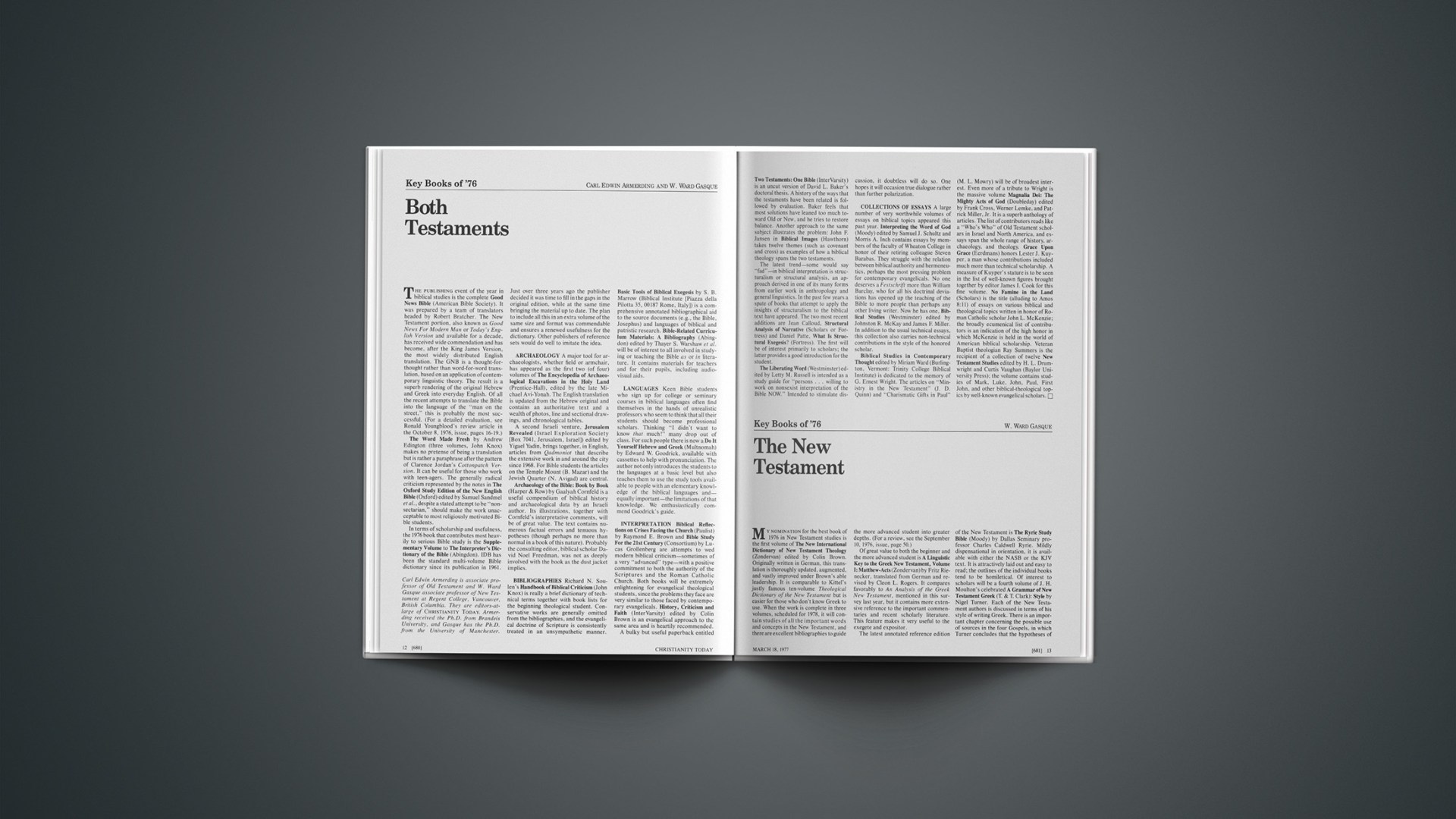
Both Testaments

The publishing event of the year in biblical studies is the complete Good News Bible (American Bible Society). It was prepared by a team of translators headed by Robert Bratcher. The New Testament portion, also known as Good News For Modern Man or Today’s English Version and available for a decade, has received wide commendation and has become, after the King James Version, the most widely distributed English translation. The GNB is a thought-for-thought rather than word-for-word translation, based on an application of contemporary linguistic theory. The result is a superb rendering of the original Hebrew and Greek into everyday English. Of all the recent attempts to translate the Bible into the language of the “man on the street,” this is probably the most successful. (For a detailed evaluation, see Ronald Youngblood’s review article in the October 8, 1976, issue, pages 16–19.)

The Word Made Fresh by Andrew Edington (three volumes, John Knox) makes no pretense of being a translation but is rather a paraphrase after the pattern of Clarence Jordan’s Cottonpatch Version. It can be useful for those who work with teen-agers. The generally radical criticism represented by the notes in The Oxford Study Edition of the New English Bible (Oxford) edited by Samuel Sandmel et al., despite a stated attempt to be “non-sectarian,” should make the work unacceptable to most religiously motivated Bible students.

In terms of scholarship and usefulness, the 1976 book that contributes most heavily to serious Bible study is the Supplementary Volume to The Interpreter’s Dictionary of the Bible (Abingdon). IDB has been the standard multi-volume Bible dictionary since its publication in 1961. Just over three years ago the publisher decided it was time to fill in the gaps in the original edition, while at the same time bringing the material up to date. The plan to include all this in an extra volume of the same size and format was commendable and ensures a renewed usefulness for the dictionary. Other publishers of reference sets would do well to imitate the idea.

ARCHAEOLOGY A major tool for archaeologists, whether field or armchair, has appeared as the first two (of four) volumes of The Encyclopedia of Archaeological Excavations in the Holy Land (Prentice-Hall), edited by the late Michael Avi-Yonah. The English translation is updated from the Hebrew original and contains an authoritative text and a wealth of photos, line and sectional drawings, and chronological tables.

A second Israeli venture, Jerusalem Revealed (Israel Exploration Society [Box 7041, Jerusalem, Israel]) edited by Yigael Yadin, brings together, in English, articles from Qadmoniot that describe the extensive work in and around the city since 1968. For Bible students the articles on the Temple Mount (B. Mazar) and the Jewish Quarter (N. Avigad) are central.

Archaeology of the Bible: Book by Book (Harper & Row) by Gaalyah Cornfeld is a useful compendium of biblical history and archaeological data by an Israeli author. Its illustrations, together with Cornfeld’s interpretative comments, will be of great value. The text contains numerous factual errors and tenuous hypotheses (though perhaps no more than normal in a book of this nature). Probably the consulting editor, biblical scholar David Noel Freedman, was not as deeply involved with the book as the dust jacket implies.

BIBLIOGRAPHIES Richard N. Soulen’s Handbook of Biblical Criticism (John Knox) is really a brief dictionary of technical terms together with book lists for the beginning theological student. Conservative works are generally omitted from the bibliographies, and the evangelical doctrine of Scripture is consistently treated in an unsympathetic manner. Basic Tools of Biblical Exegesis by S. B. Marrow (Biblical Institute [Piazza della Pilotta 35,00187 Rome, Italy]) is a comprehensive annotated bibliographical aid to the source documents (e.g., the Bible, Josephus) and languages of biblical and patristic research. Bible-Related Curriculum Materials: A Bibliography (Abingdon) edited by Thayer S. Wars haw et al. will be of interest to all involved in studying or teaching the Bible as or in literature. It contains materials for teachers and for their pupils, including audiovisual aids.

LANGUAGES Keen Bible students who sign up for college or seminary courses in biblical languages often find themselves in the hands of unrealistic professors who seem to think that all their students should become professional scholars. Thinking “I didn’t want to know that much!” many drop out of class. For such people there is now a Do It Yourself Hebrew and Greek (Multnomah) by Edward W. Goodrick, available with cassettes to help with pronunciation. The author not only introduces the students to the languages at a basic level but also teaches them to use the study tools available to people with an elementary knowledge of the biblical languages and—equally important—the limitations of that knowledge. We enthusiastically commend Goodrick’s guide.

INTERPRETATION Biblical Reflections on Crises Facing the Church (Paulist) by Raymond E. Brown and Bible Study For the 21st Century (Consortium) by Lucas Grollenberg are attempts to wed modern biblical criticism—sometimes of a very “advanced” type—with a positive commitment to both the authority of the Scriptures and the Roman Catholic Church. Both books will be extremely enlightening for evangelical theological students, since the problems they face are very similar to those faced by contemporary evangelicals. History, Criticism and Faith (InterVarsity) edited by Colin Brown is an evangelical approach to the same area and is heartily recommended.

A bulky but useful paperback entitled Two Testaments: One Bible (InterVarsity) is an uncut version of David L. Baker’s doctoral thesis. A history of the ways that the testaments have been related is followed by evaluation. Baker feels that most solutions have leaned too much toward Old or New, and he tries to restore balance. Another approach to the same subject illustrates the problem: John F. Jansen in Biblical Images (Hawthorn) takes twelve themes (such as covenant and cross) as examples of how a biblical theology spans the two testaments.

The latest trend—some would say “fad”—in biblical interpretation is structuralism or structural analysis, an approach derived in one of its many forms from earlier work in anthropology and general linguistics. In the past few years a spate of books that attempt to apply the insights of structuralism to the biblical text have appeared. The two most recent additions are Jean Calloud, Structural Analysis of Narrative (Scholars or Fortress) and Daniel Patte, What Is Structural Exegesis? (Fortress). The first will be of interest primarily to scholars; the latter provides a good introduction for the student.

The Liberating Word (Westminster) edited by Letty M. Russell is intended as a study guide for “persons … willing to work on nonsexist interpretation of the Bible NOW.” Intended to stimulate discussion, it doubtless will do so. One hopes it will occasion true dialogue rather than further polarization.

COLLECTIONS OF ESSAYS A large number of very worthwhile volumes of essays on biblical topics appeared this past year. Interpreting the Word of God (Moody) edited by Samuel J. Schultz and Morris A. Inch contains essays by members of the faculty of Wheaton College in honor of their retiring colleague Steven Barabas. They struggle with the relation between biblical authority and hermeneutics, perhaps the most pressing problem for contemporary evangelicals. No one deserves a Festschrift more than William Barclay, who for all his doctrinal deviations has opened up the teaching of the Bible to more people than perhaps any other living writer. Now he has one, Biblical Studies (Westminster) edited by Johnston R. McKay and James F. Miller. In addition to the usual technical essays, this collection also carries non-technical contributions in the style of the honored scholar.

Biblical Studies in Contemporary Thought edited by Miriam Ward (Burlington, Vermont: Trinity College Biblical Institute) is dedicated to the memory of G. Ernest Wright. The articles on “Ministry in the New Testament” (J. D. Quinn) and “Charismatic Gifts in Paul” (M. L. Mowry) will be of broadest interest. Even more of a tribute to Wright is the massive volume Magnalia Dei: The Mighty Acts of God (Doubleday) edited by Frank Cross, Werner Lemke, and Patrick Miller, Jr. It is a superb anthology of articles. The list of contributors reads like a “Who’s Who” of Old Testament scholars in Israel and North America, and essays span the whole range of history, archaeology, and theology. Grace Upon Grace (Eerdmans) honors Lester J. Kuyper, a man whose contributions included much more than technical scholarship. A measure of Kuyper’s stature is to be seen in the list of well-known figures brought together by editor James I. Cook for this fine volume. No Famine in the Land (Scholars) is the title (alluding to Amos 8:11) of essays on various biblical and theological topics written in honor of Roman Catholic scholar John L. McKenzie; the broadly ecumenical list of contributors is an indication of the high honor in which McKenzie is held in the world of American biblical scholarship. Veteran Baptist theologian Ray Summers is the recipient of a collection of twelve New Testament Studies edited by H. L. Drumwright and Curtis Vaughan (Baylor University Press); the volume contains studies of Mark, Luke, John, Paul, First John, and other biblical-theological topics by well-known evangelical scholars.

Paul D. Steeves is assistant professor of history and director of Russian studies at Stetson University in Deland, Florida. He has the Ph.D. from the University of Kansas and specializes in modern Russian history.
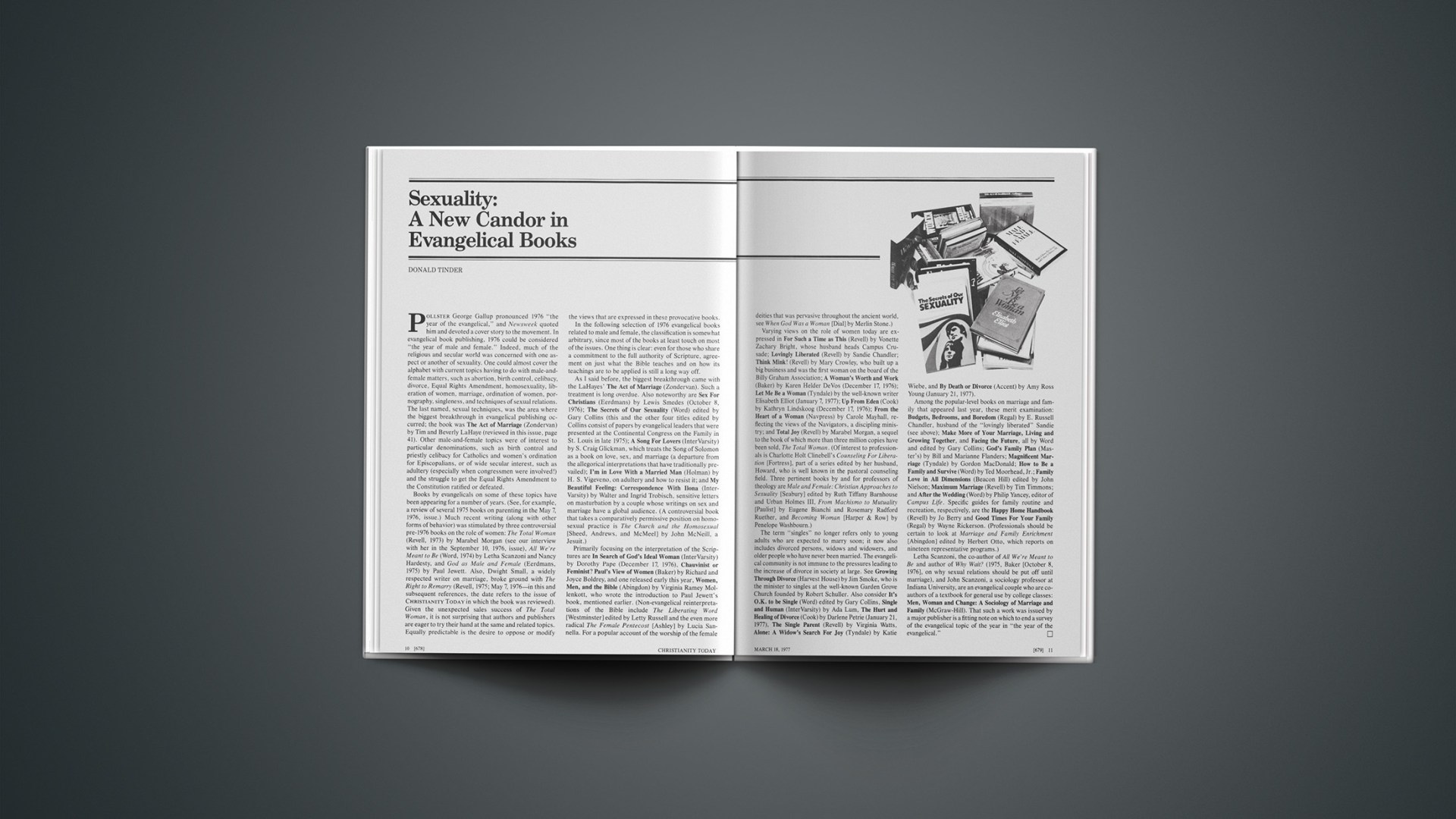
Sexuality: A New Candor in Evangelical Books

Pollster George Gallup pronounced 1976 “the year of the evangelical,” and Newsweek quoted him and devoted a cover story to the movement. In evangelical book publishing, 1976 could be considered “the year of male and female.” Indeed, much of the religious and secular world was concerned with one aspect or another of sexuality. One could almost cover the alphabet with current topics having to do with male-and-female matters, such as abortion, birth control, celibacy, divorce, Equal Rights Amendment, homosexuality, liberation of women, marriage, ordination of women, pornography, singleness, and techniques of sexual relations. The last named, sexual techniques, was the area where the biggest breakthrough in evangelical publishing occurred; the book was The Act of Marriage (Zondervan) by Tim and Beverly LaHaye (reviewed in this issue, page 41). Other male-and-female topics were of interest to particular denominations, such as birth control and priestly celibacy for Catholics and women’s ordination for Episcopalians, or of wide secular interest, such as adultery (especially when congressmen were involved!) and the struggle to get the Equal Rights Amendment to the Constitution ratified or defeated.

Books by evangelicals on some of these topics have been appearing for a number of years. (See, for example, a review of several 1975 books on parenting in the May 7, 1976, issue.) Much recent writing (along with other forms of behavior) was stimulated by three controversial pre-1976 books on the role of women: The Total Woman (Revell, 1973) by Marabel Morgan (see our interview with her in the September 10, 1976, issue), All We’re Meant to Be (Word, 1974) by Letha Scanzoni and Nancy Hardesty, and God as Male and Female (Eerdmans, 1975) by Paul Jewett. Also, Dwight Small, a widely respected writer on marriage, broke ground with The Right to Remarry (Revell, 1975; May 7, 1976—in this and subsequent references, the date refers to the issue of CHRISTIANITY TODAY in which the book was reviewed). Given the unexpected sales success of The Total Woman, it is not surprising that authors and publishers are eager to try their hand at the same and related topics. Equally predictable is the desire to oppose or modify the views that are expressed in these provocative books.

In the following selection of 1976 evangelical books related to male and female, the classification is somewhat arbitrary, since most of the books at least touch on most of the issues. One thing is clear: even for those who share a commitment to the full authority of Scripture, agreement on just what the Bible teaches and on how its teachings are to be applied is still a long way off.

As I said before, the biggest breakthrough came with the LaHayes’ The Act of Marriage (Zondervan). Such a treatment is long overdue. Also noteworthy are Sex For Christians (Eerdmans) by Lewis Smedes (October 8, 1976); The Secrets of Our Sexuality (Word) edited by Gary Collins (this and the other four titles edited by Collins consist of papers by evangelical leaders that were presented at the Continental Congress on the Family in St. Louis in late 1975); A Song For Lovers (InterVarsity) by S. Craig Glickman, which treats the Song of Solomon as a book on love, sex, and marriage (a departure from the allegorical interpretations that have traditionally prevailed); I’m in Love With a Married Man (Holman) by H. S. Vigeveno, on adultery and how to resist it; and My Beautiful Feeling: Correspondence With Ilona (InterVarsity) by Walter and Ingrid Trobisch, sensitive letters on masturbation by a couple whose writings on sex and marriage have a global audience. (A controversial book that takes a comparatively permissive position on homosexual practice is The Church and the Homosexual [Sheed, Andrews, and McMeel] by John McNeill, a Jesuit.)

Primarily focusing on the interpretation of the Scriptures are In Search of God’s Ideal Woman (InterVarsity) by Dorothy Pape (December 17, 1976), Chauvinist or Feminist? Paul’s View of Women (Baker) by Richard and Joyce Boldrey, and one released early this year, Women, Men, and the Bible (Abingdon) by Virginia Ramey Mollenkott, who wrote the introduction to Paul Jewett’s book, mentioned earlier. (Non-evangelical reinterpretations of the Bible include The Liberating Word [Westminster] edited by Letty Russell and the even more radical The Female Pentecost [Ashley] by Lucia Sannella. For a popular account of the worship of the female deities that was pervasive throughout the ancient world, see When God Was a Woman [Dial] by Merlin Stone.)

Varying views on the role of women today are expressed in For Such a Time as This (Revell) by Vonette Zachary Bright, whose husband heads Campus Crusade; Lovingly Liberated (Revell) by Sandie Chandler; Think Mink! (Revell) by Mary Crowley, who built up a big business and was the first woman on the board of the Billy Graham Association; A Woman’s Worth and Work (Baker) by Karen Helder DeVos (December 17, 1976); Let Me Be a Woman (Tyndale) by the well-known writer Elisabeth Elliot (January 7, 1977); Up From Eden (Cook) by Kathryn Lindskoog (December 17, 1976); From the Heart of a Woman (Navpress) by Carole Mayhall, reflecting the views of the Navigators, a discipling ministry; and Total Joy (Revell) by Marabel Morgan, a sequel to the book of which more than three million copies have been sold, The Total Woman. (Of interest to professionals is Charlotte Holt Clinebell’s Counseling For Liberation [Fortress], part of a series edited by her husband, Howard, who is well known in the pastoral counseling field. Three pertinent books by and for professors of theology are Male and Female: Christian Approaches to Sexuality [Seabury] edited by Ruth Tiffany Barnhouse and Urban Holmes III, From Machismo to Mutuality [Paulist] by Eugene Bianchi and Rosemary Radford Ruether, and Becoming Woman [Harper & Row] by Penelope Washbourn.)

The term “singles” no longer refers only to young adults who are expected to marry soon; it now also includes divorced persons, widows and widowers, and older people who have never been married. The evangelical community is not immune to the pressures leading to the increase of divorce in society at large. See Growing Through Divorce (Harvest House) by Jim Smoke, who is the minister to singles at the well-known Garden Grove Church founded by Robert Schuller. Also consider It’s O.K. to be Single (Word) edited by Gary Collins, Single and Human (InterVarsity) by Ada Lum, The Hurt and Healing of Divorce (Cook) by Darlene Petrie (January 21, 1977), The Single Parent (Revell) by Virginia Watts, Alone: A Widow’s Search For Joy (Tyndale) by Katie Wiebe, and By Death or Divorce (Accent) by Amy Ross Young (January 21, 1977).

Among the popular-level books on marriage and family that appeared last year, these merit examination: Budgets, Bedrooms, and Boredom (Regal) by E. Russell Chandler, husband of the “lovingly liberated” Sandie (see above); Make More of Your Marriage, Living and Growing Together, and Facing the Future, all by Word and edited by Gary Collins; God’s Family Plan (Master’s) by Bill and Marianne Flanders; Magnificent Marriage (Tyndale) by Gordon MacDonald; How to Be a Family and Survive (Word) by Ted Moorhead, Jr.; Family Love in All Dimensions (Beacon Hill) edited by John Nielson; Maximum Marriage (Revell) by Tim Timmons; and After the Wedding (Word) by Philip Yancey, editor of Campus Life. Specific guides for family routine and recreation, respectively, are the Happy Home Handbook (Revell) by Jo Berry and Good Times For Your Family (Regal) by Wayne Rickerson. (Professionals should be certain to look at Marriage and Family Enrichment [Abingdon] edited by Herbert Otto, which reports on nineteen representative programs.)

Letha Scanzoni, the co-author of All We’re Meant to Be and author of Why Wait? (1975, Baker [October 8, 1976], on why sexual relations should be put off until marriage), and John Scanzoni, a sociology professor at Indiana University, are an evangelical couple who are coauthors of a textbook for general use by college classes: Men, Woman and Change: A Sociology of Marriage and Family (McGraw-Hill). That such a work was issued by a major publisher is a fitting note on which to end a survey of the evangelical topic of the year in “the year of the evangelical.”

Eutychus and His Kin: March 18, 1977

Of Hats and Kissing (Kissing?) In Church

Most women don’t wear hats to church anymore. They pray with heads uncovered. And church leaders don’t require that their heads be shaved as a penalty.

This isn’t true just in churches with a low view of the Bible; it is also true in churches that hold to the strongest views of inspiration. In fact, traditional, non-charismatic Episcopal and Roman Catholic churches are much more likely to require obedience to St. Paul in this than Inerrant Bible churches.

Thus Scripture (1 Cor. 11:4 ff.) yields to fashion. By uncommon consent we dismiss a Pauline requirement, considering it a cultural distinctive rather than a binding requirement on Christian conduct two millennia after it was written.

We also now permit women to teach in our churches, notwithstanding St. Paul’s rigid stand on the matter. Where would Sunday school be without women? Where would the church in emerging nations be without our American women missionary teachers?

Again, culture has freed us.

At this point I do not intend to discuss principles of interpretation, how we determine that this requirement continues to be binding today while that one can be relaxed. This, it seems to me, is the present-day Big Assignment for our Bible scholars.

What I want to suggest is that cultural changes do not merely free us; they also bind us.

For example, St. Paul commanded first-century Christians to “greet one another with a holy kiss” (Rom. 16:16; 1 Thess. 5:26; 2 Cor. 13:12). The Corinthian church? Imagine telling them that!

When was the last time members of your church obeyed the Bible on this point? Recently someone of the other sex—a Christian friend—came up as I was talking with another Christian. Uncertain whether the newcomer and I knew each other, my companion started to introduce us—just as we exchanged a chaste, brother-sister kiss.

“Well,” he said, his tone fraught with meaning, “I see that you really do know each other.”

While Bill Stoddard was minister of Walnut Creek (California) United Presbyterian Church, he even got some flak over a time in the morning worship service when the people joined hands down pews, across aisles, through the church auditorium, as a gesture of Christian friendship. I shudder to think of the repercussions if he had suggested that they really obey St. Paul’s injunction.

J. B. Phillips has emended the Bible at this point, in his paraphrase, to read, “Greet one another with a hearty handshake.” So we are comfortable and reinforced in our uptightness.

One other area where contemporary culture has bound us is in same-sex friendship. David and Jonathan, Jesus and John: we’d hardly be comfortable with them in our church today. Our unease is an interesting, and damning, commentary on our times—and the church of these times.

And what shall I say of the pattern of Christian community in the first-century church, contrasted to the big, institutional, independent nature of life in most of our churches today?

Changing the Bible to conform to different cultures is a two-edged sword. It can cut our bonds, but it can also make us bleed.

EUTYCHUS VIII

Up to Date

I thoroughly enjoyed the February 4 issue. It was practical and very helpful to ministers who work in the local churches.… My prayer is that you continue to educate, encourage, and inform pastors and their staffs with up-to-date information on how to do their job more effectively. We all know what our job is, but how to accomplish it is another matter. Without a doubt Christianity Today is meeting a great need in evangelical circles, so keep up the good work.

JOHN E. GREEVER

Minister to Young Adults

First Baptist Church

Duncan, Okla.

Eutychus as Health Promoter

Eutychus VIII ended his first article by asking if we did not wish that we were Eutychus VIII. Well, now that we have just read his second article (Jan. 21) we do wish we were—well, almost! Yes, E. VIII, give us “more of the same”! We like your style, and we promise not to become the least bit envious of your newly found honor.

“Being cheerful keeps you healthy. It is slow death to be gloomy all the time.” That is the way the Good News Bible says it in Proverbs 17:22.

A. RALPH BOXELL

Church of the Nazarene

Deepwater, Mo.

A Dying Fire?

The “interpretations” by Bill Bristow of Andrew Wyeth’s art (Refiner’s Fire, Feb. 4) would have been disgusting had they not been so ludicrous. Surely this is not a Christian approach to the fine arts. The same thing would not have been tolerated if Tolkien’s trilogy had been the subject, though Tolkien was a professed Christian, while Wyeth is not. Let’s turn the fire up a bit.

THOM N. SMITH

Sand Springs, Okla.

Bill Bristow’s evaluation of Andrew Wyeth was a welcome event. CHRISTIANITY TODAY too often ignores visual art in favor of the various forms of literature. But Bristow’s strained effort to translate Wyeth into an “oracle pronouncing God’s love for us”—which he isn’t—seemed much too subjective and not a little contrived. Because Wyeth’s paintings are not pictorially bewildering, the temptation to imbue his work with our own reminiscences and anecdotes of country life is ever present. We feel secure in his artistic realism. But the artist’s message is too ambiguous to be so confidently labeled.

I fail to see “the promise of new life, of resurrection” in Wyeth’s portrait of the Kuerners (his Pennsylvania subjects) in which Karl points the barrel of his rifle—accidentally?—at his wife, Anna. Where is the charm in the hungry, black meat hooks that proliferate in his work? Rather than the “pursuit of humankind by God” that Bristow visualizes, I see in Wyeth, as John Russell of the New York Times so aptly described it, an “element of doom.”

MARK MARCHAK

New York, N.Y.

The first half of the article I thought lent something to my understanding of the character and the person of Andrew Wyeth, one of our more gifted contemporary painters. I felt that Bristow’s description of the almost mystical entrance of Wyeth’s personality into the subjects of his paintings was a fine treatment. However, his mystical interpretation of two of Wyeth’s paintings, “Winter 1946” and “Christina’s World,” is a distortion of Wyeth’s intent in both instances.

If one is writing an article for your magazine utilizing certain passages of Scripture, one is expected to deal with the text objectively and exegetically. There is no reason why a similarly objective treatment of this very significant painter should not be included in your magazine. Eisegesis is as inappropriate in this kind of art criticism as it is with Scripture. I appreciate your attempt to deal with a painter like Wyeth, but it is no good to load his work with a symbolism that is not there. What are Wyeth’s religious roots, his convictions, that encourage his reverence for the homely, the commonplace, the natural?

JUDSON GUEST

Aurora College

Aurora, Ill. Assistant Dean of Students

No Sizzle, No Sale

“The Perils of Persuasive Preaching” (Feb. 4) was a pulchritude of pernicious propaganda.… Dr. Litfin has reacted to persuasion for unethical goals by denouncing persuasion as an ethical tool. His lack of adequate research left his article replete with half-truths. Hypnotism, suggestion, and persuasion have no mystic ability to bypass the human will. It is impossible to motivate anyone without first convincing them intellectually.… Not even the Manchurian Candidate can sell a steak without the sizzle. Let’s just be sure it isn’t polluted meat that has been offered to idols.

DESSAIN TERRY

Lanark Church of Christ

San Antonio, Tex.

A. Duane Litfin’s article clarifies some long-foggy areas in my own mind and I suspect in the minds of many churchmen.

RON KLIMP

Grand Rapids, Mich.

A hearty “amen” to Dr. Litfin’s analysis. His balanced and fair critique of this trend mirrors the thrust of the New Testament. Paul, in writing to his spiritual son, instructed him to handle accurately the word of truth. Today, if a pastor does not entertain and wax eloquent even though he handles accurately and communicates clearly the Scripture, he is a leading candidate for the unemployment line. However, the burden of proof rests upon those of us who listen to God’s word rightly divided and communicated, not on the preacher who did not rouse us from our coffins through catchy phrases and sensational illustrations. For indeed, the listener of God’s Word has to open the coffin from the inside.

BARRY A. LAWRENCE

Associate Pastor

Tulsa Bible Church

Tulsa, Okla.

Editor’s Note from March 18, 1977

Our mailbag and our telephones have kept us busy discussing the pro’s and con’s of our move to Carol Stream, Illinois, this June. In a report on relocation in this issue we are publishing representative questions from the con side along with responses from the chairman of our board, Harold Ockenga. On issues like this there is always a division of the house—readers, editors, board members—but the board had to make the final decision and did. I’m writing this from Florida, which, at least in the wintertime, I prefer to both Chicago and Washington!

The Attraction of ‘Life on Mars’

For a long time scientists have speculated about the possibility that life exists on other planets. Some of them are pretty well convinced that life does exist elsewhere and that it is only a matter of time before we find conclusive evidence for it. Sometimes snide remarks are made about theologians who have made this earth the center of the universe and cannot admit there might be life anywhere else.

As a theologian I have nothing to say about the possibility. As I read it, the Bible confines itself to God’s concern for and demands on those who live on this planet. It says nothing about any who may live on other planets. I have no doubt that if there are such beings, the God who is love has made suitable provision for their needs. The important thing for us on this earth is not to speculate about what is on other planets but to get on with the business of living for God and serving our fellow men. It is enough for us that God loves us and sent his Son to die for us. That shows the depth of his love and concern for those he made.

William A. Rusher thinks some scientists are reluctant to accept the fact that they have no evidence for life on Mars. Although Viking I and Viking II carried out some very sophisticated tests, they came up with nothing that indicated life. It interested Rusher that those who reported the results of these space probes would say no more than that they had not proved either that there is or that there is not life on Mars. He points out that proving the absence of life would require an analysis of every part of the surface of that planet and, to be quite sure, of the interior as well. He ascribes the form of the report to the scientists’ unwillingness to admit that mankind seems to be alone in an otherwise lifeless universe.

Why should there be this unwillingness? Possibly, as Professor E. van den Haag says, because many “are at least unconsciously dissatisfied with the idea that ‘This is all there is.’ They need to feel that somewhere else in the universe, living beings are happier than we are—have solved the problems that beset our lives.” People have lost the idea of paradise. But they still have an unconscious desire for it, and this desire finds a form of fulfillment in the notion of happy beings on Mars or some more distant star.

It is an interesting suggestion and may well be right. The biblical position is that God loves us and has made provision for our needs. But if we turn away from God’s gracious provision, then those deep needs are not met. While they remain unmet they cause dissatisfaction. There can be little doubt that one reason for tension and unhappiness in our world is to be found just here.

There is, then, a continuing search for some way of meeting these needs, and van den Haag thinks that this lies behind the scientists’ hope for life on some other planet and their assumption that if there is such life it will be well disposed toward us. Somehow we all make this assumption. If there is life elsewhere we want to be in touch with it. But this may be a very great mistake. What reason have we to think that life elsewhere in the universe will not be hostile and seek to destroy or despoil us? Why should we assume it will be interested in helping us solve our problems? That is just wishful thinking, a manmade substitute for the God of love who sent his Son to be our Saviour.

We may observe similar results from the neglect of other Christian affirmations. Many who still profess the Christian faith have opted for a Christianity that dispenses with hell. The result has nowhere been better put than by W. MacNeile Dixon in his Gifford Lectures: “The kind-hearted humanitarians of the nineteenth century decided to improve upon Christianity. The thought of hell offended their susceptibilities. They closed it, and, to their surprise, the gates of heaven closed also with a melancholy clang. The malignant countenance of Satan distressed them. They dispensed with him, and at the same time God took his departure. A vexatious result, but you cannot play fast and loose with logic” (The Human Situation).

People do not realize that it is not easy to do away with hell without at the same time getting rid of heaven. I do not mean that we are forced into an acceptance of every detail of a hell that some of an earlier day knew far too much about. They spoke more confidently about the details of the place of punishment than Scripture allows, and in reaction some others abandoned the whole concept. But if there is nothing corresponding to hell, then we all pass into the afterlife. There is then no distinction between the good and the bad, between those who have trusted Christ and those who have not. All are in the afterlife together, with the evil apparently having as much right to it as the righteous. It is this world all over again! There is no place where righteousness dwells.

MacNeile Dixon also suggests that those who got rid of Satan found they had lost God. I think he means that if we take Satan as no more than the biblical personification of evil, we are logically compelled to take God as no more than the biblical personification of good. We should think through what we are doing when we tamper with the biblical picture.

The Christian faith is a coherent system that proceeds from the facts that God loves us. has made provision for our needs, and has revealed in Scripture what it is necessary for us to know about all this. We are made in a certain way and we have certain needs. On the physical level we need things like food and rest. And on another level we need forgiveness, the assurance that our evil deeds will not be held against us. We need a sense of purpose, the conviction that life is more than “a tale told by an idiot, full of sound and fury, signifying nothing.” To abandon the faith or part of it or to deny that these things are important does not alter the facts. We are human; we have human needs; and they are fully met in Christ. The world in which we live is proof that they are met nowhere else.

Homosexual Ordination: Bishops Feel the Flak

An “enormous amount of mail” has reached New York Episcopal bishop Paul Moore, Jr., since he ordained an avowed lesbian earlier this year. Most of the response, he concedes, has been negative.

But the bishop says he is amazed at all the reaction because he does not think his ordination of Ellen Marie Barrett was “some sort of gesture condoning homosexuality or licentiousness.” He still believes the new priest is highly qualified by training and temperament to be an Episcopal minister.

Why, then, is he hearing from protesters around the nation as well as from Anglicans in other countries? Episcopalians, says Moore, are “upset about lots of things,” and his unprecedented act could have been a “catalyst for the release of this upsetment.”

Much of the reaction came from within his own diocese, and Moore acknowledged that he had “never had so much flak” on any subject before. Some of that flak was in the form of pledges by parish vestries to withhold annual assessments to the diocese.

With a straight face, Moore told a reporter, “The money is not spent for ordinations. Much of it goes for the mission work of the church.”

The presiding bishop of the Episcopal Church, John M. Allin, has also been on the receiving end of many of the protests, but he too has tried to minimize the importance of the New York ordination. He went to Memphis to address the convention of the Episcopal Diocese of Tennessee and declared, “One ordination does not make and does not break a church at any place, point, or diocese. The church has not gone down the drain; it really hasn’t. Pass the word along.”

The presiding bishop then tried to cool the Tennesseans: “Think of what a great thing it would be if we didn’t speak the first time we got the urge.… And we need not to pass any asinine resolutions that won’t change anybody. Harsh reaction can condemn a lot of people who have no defense.”

The diocesan convention then went on to pass a resolution calling “active homosexuality” contrary to Scripture and Christian tradition and expressing the “hope that other professed, active homosexual persons will not be ordained.”

The Diocese of (North) Florida proposed amendments to the national Episcopal constitution and canons that would “explicitly insure that such persons shall not be admitted to Holy Orders.” Southeast Florida Episcopalians, in their diocesan convention, officially asked that Bishop Moore and Ms. Barrett be disciplined.

In the Diocese of Washington, where Moore served before he went to New York, the question of homosexual marriage has claimed some attention. Two men active in an avant-garde parish were planning to be married by its rector last year until the parish was threatened with the loss of the diocesan subsidy. One of the pair, holder of a master’s degree from Wesley Theological Seminary, went to the Episcopal General Convention in Minneapolis last September, and after that they decided to “celebrate” a “holy union” in the presence of friends in “our church community.”

After an Episcopal church ceremony was refused, they exchanged vows in a homosexual congregation. They told a Washington Post reporter that the next bishop of the Washington diocese, John Walker, had declined his blessing by saying he “felt that if he did anything to bless the union this early in his episcopacy, he’d be ineffective for the rest of it.” They still hope to have Episcopal recognition of their marriage, however.

One Episcopal priest who went to the convention last year did not go home alive. He died in his hotel room, stabbed to death by a seventeen-year-old who was described by authorities as a “male hustler.” The youth recently pleaded guilty to the stabbing and was sentenced to one to twenty-five years in a state reformatory. He did not say and was not asked in court how he met the priest or what caused a quarrel that led to their struggle.

The Metropolitan Community Church, in which the Washington couple exchanged vows, continues to claim that it is growing nationwide. Troy Perry, founder and moderator of the Universal Fellowship of Metropolitan Community Churches, told a reporter in Minneapolis at the end of last year that there are now 103 congregations in seven countries with a total membership of 20,731.

Introduction of a “national gay civil rights bill” by ten members of Congress was announced by the MCC’s Washington office soon after the new Congress convened. In effect, the bill (H.R. 451) is an amendment to the 1964 Civil Rights Act, adding “affectional or sexual preference” to the list of conditions for which it would be illegal to discriminate.

The MCC had a setback in Massachusetts when its Boston branch lost a bid to become a member of the Massachusetts Council of Churches. The council’s board unanimously voted to turn down the gay application without giving reasons. A similar application from the national body has been before the National Council of Churches, but an NCC official said it had been withdrawn.

The National Association of Evangelicals has meanwhile disavowed any connection with a homosexual group that describes itself as “Evangelicals Concerned,” headed by Ralph Blair of New York City. The group’s literature says it was formed at the time of the 1976 NAE convention in Washington.

The NAE’s executive director, Billy Melvin, declared, “An organization has no right to ride on the NAE’s reputation simply because it was formed in a hotel across the street from where the NAE meetings were taking place. NAE wants to disavow any connection with Evangelicals Concerned. The basic error in the teachings of such a group has been well documented.”

The gay activists have another group to contend with in the independent Presbyterians United for Biblical Concerns. The group’s denomination, the United Presbyterian Church, is currently studying the ordination question, and the PUBC board last month issued a statement calling the ordination of avowed homosexuals “a clear violation of biblical teaching and a grievous offense against God, who requires a holy and blameless life of those who seek ordination to the offices of pastor, ruling elder and deacon.”

In Canada, Anglicans have been choosing up sides in a debate over whether their church newspaper, The Churchman, went too far in an issue dealing with homosexuality. In the paper’s features on the subject were details of homosexual relationships between two men and two women and the account of a priest who admitted hanging around bus stations to pick up sex partners. After the issue was published, one priest wrote that he is “no longer ashamed of myself” and that he knows “that homosexuality is the normal and natural part of my personality.”

Christian leaders in England have expressed concern over the new emphasis on homosexuality in society. The Nationwide Festival of Light organization urged Prime Minister James Callaghan to halt the “growing exploitation” of children by militant homosexuals in schools and elsewhere. The church is a part of that “elsewhere,” according to one recently published commentary. The authoritative Crockford’s Clerical Directory in its latest edition warns homosexual clergymen not to give physical expression to their tendencies. The list of Anglican clergymen and parishes is always preceded by a long, outspoken preface written by a leading churchman who is never identified. The anonymous British writer says in the new preface, “Christians should never be so charitable to deviants as to cease to oppose the flaunting of homosexual behaviour.”

More For Missions

The number of Protestant North Americans serving as missionaries outside their own countries is continuing to rise despite a decrease in the number sent by the mainline denominations. The eleventh edition of the Mission Handbook, published last month by the MARC division of World Vision, shows a record total of 36,950 from the United States and Canada.

Worldwide, the number of Protestant overseas workers is estimated at 55,000. The North American contribution to the total rose by about 2,000 during the three-year period ending December 31, 1975. The totals in the previous edition were dated January 1, 1973.

Mission giving in the United States and Canada is reported to have outstripped inflation by 29 per cent in the three-year period, from $383 million in 1972 to $656 million in 1975. The funds went to 620 agencies with workers in 182 lands.

Brazil was listed again as having the largest number of North American missionaries: 2,068. Japan was in second place with 1,545. The agency with the most overseas workers was Wycliffe Bible Translators (2,693), with the Southern Baptists close behind (2,667).

Also recently released, but with a much bleaker outlook, was the Handbook of British Missions. Since the last edition was published four years ago, the number of British overseas personnel has dropped from 5,507 to 4,592. The totals omit some societies, but the reported decrease is thought to be representative of the overall situation. Giving in Britain for missions was up over the four-year period, however. The pound sterling total increased from 17 million in 1972 to 26 million in 1976.

Among the North American sending agencies that experienced declines during the MARC handbook’s latest reporting period was the United Church of Christ Board of World Ministries. It has just announced plans to “stabilize” its overseas force at 165, down from the 244 reported in the tenth MARC handbook (1973) and 70 per cent below its 1960 strength.

The High Cost Of Caring

Many church-related retirement and convalescent facilities across the country are in trouble. Part of the reason is that life-care contracts written in the 1960s and early 1970s often were not flexible enough to keep income ahead of costs during a period of soaring inflation. Some institutions have been forced into bankruptcy as a result. There have been closures, revisions of contracts, dispossessions, and much distress for those affected. Some elderly people have lost everything.

Last month Pacific Homes Corporation (PHC), a United Methodist-related retirement and convalescent complex, filed bankruptcy proceedings after California’s department of health refused to allow it to renegotiate contracts with its 2,100 residents.

PHC’s deficit toward the end of last year was $27.6 million, and it was reportedly losing $500,000 a month. Included in the deficit are loans totaling about $12 million from insurance companies and a lien by the state to safeguard the interests of residents. The loans have been guaranteed over the past eight years by the 435-congregation Pacific and Southwest Conference of the United Methodist Church, which may have to make good on the promises to repay if reorganization under Chapter 11 bankruptcy fails. The conference has already cut its own annual budget by $540,000 (this included the release of a number of staffers) in order to subsidize residents who cannot pay higher rates.

Some 85 per cent of PHC’s 1,200 residents were said to have agreed to go along with the plan to renegotiate. Five of the corporation’s seven retirement units are in California. The other two are in Hawaii and Arizona. Additionally, six of seven convalescent facilities are operated in conjunction with the retirement centers.

A conference spokesman described PHC’s centers as “the best in California.” He said that “everything is being done” to ensure that residents continue to receive “the finest in care” and to prevent their being turned out.

There are about 175 United Methodist-related homes for the aging in the United States, and they have about 31,000 residents. About 20 per cent of the homes may be having problems of “crisis proportions,” according to Lynn Bergman of the denomination’s health and welfare ministries.

The typical life-care contract written ten years ago, he says, promised that for an entrance fee of $3,000 and $180 per month, the agency guaranteed full care, even during physical and mental breakdowns. Some contracts had no clause protecting the home against inflation, he points out, and even those with 5 per cent increase clauses are in trouble because inflation has run as high as 20 per cent in recent years. It might cost a home $20,000 or more a year to service a contract that calls for the resident to pay much less, he explains. The improved medical and social care results in a mixed blessing: people in the homes live longer, adding to ledger woes.

Expansion has halted in most cases because of the crunch. The number of persons who can be given free or part-paid care is lower, in part because of reduced denominational subsidies. Where possible, homes are renegotiating contracts.

Profit organizations have an out that churches avoid, says Bergman: “Private corporations can simply sell the home to someone else, which immediately cancels all contracts. Then they can go back the next week and rewrite monthly cost-of-care contracts for persons who can afford them.”

The for-profit sector of the $8-billion-a-year nursing-home industry has been ridden with scandal in recent years, and there have been a variety of crackdowns.

Church-related homes generally get higher marks than their secular counterparts in matters of care and ethics. Increasingly, however, their survival may be in jeopardy.

Last Will And Testament

The late evangelist Kathryn Kuhlman left a personal estate of $732,543, including her $130,000 suburban Pittsburgh home and jewelry valued at $94,000, according to a final court inventory of her wealth. The largest amount, $187,350, consisted of savings certificates and interest on them at Pittsburgh banks. More than $70,000 was found in checking and savings accounts. Household goods were valued at $88,000, including furnishings in an apartment in California.

The inventory also listed vacation property in Alberta, Canada, two fur coats, a $4,500 interest in Texas gas wells, $60,000 worth of shares in a corporation Miss Kuhlman formed to market her books and records, and $200 in coins—all 50-cent pieces she had culled from offerings at her services.

An attorney said state and federal estate taxes consumed $167,500, debts and expenses (mostly medical) of the evangelist amounted to $150,000, and legal and other fees for closing the estate totaled about $100,000. This leaves approximately $314,500 to be shared by two of Miss Kuhlman’s sisters, a sister-in-law, twenty employees, and D. B. “Tink” Wilkerson, 44, a Tulsa auto dealer who befriended Miss Kuhlman in the last years of her life. The amount was to be distributed according to a formula prescribed by the evangelist, who died February 20, 1976.

Uproar Over ‘Folklore’

A row has flared up in England over the firing of a religious education teacher who believes in Adam and Eve. David Watson, 56, told his pupils so, was subsequently dismissed, and had his appeal rejected by Hertfordshire County Council. Watson, said the verdict, “had refused the reasonable request of the headmaster and governors to conform to the requirements of the agreed syllabus.”

The syllabus, which dates back to 1954, says: “The Genesis stories of creation, read as their writers intended them to be and not as literalist interpreters have read them, do not conflict with evolutionary theories. They are, of course, only part of the collection of the myths and legends—Hebrew religious folklore—which make up the first 11 chapters of Genesis and they should be seen in that setting.”

A former missionary in India, Watson rejected this as the only view permissible, and he refused to give written assurances of conformity with it because of what he regarded as its dogmatic assertions. He had been head of religious education at Rickmansworth Comprehensive School since September, 1975, and is the author of two anti-evolutionary books, Myths and Miracles and The Great Brain Robbery.

He plans to appeal to an industrial tribunal on the grounds of unfair dismissal. A thirty-year-old British Education Act says: “No teacher may be deprived of any advantage by reason of his religious opinions.”

J. D. DOUGLAS

Peril in Uganda

President Idi Amin of Uganda has survived approximately ten coup attempts since January, 1971, when he seized power in a bloodless takeover. Another apparent coup attempt came to light last month, and news sources indicate that many Ugandans were killed and hundreds arrested in connection with it. Among those arrested were Anglican archbishop Janani Luwum, spiritual leader of the 1.5-million-member Church of Uganda, Rwanda, Burundi, and Boga-Zaire. Luwum, a British-trained theological educator in his forties, was elevated to the archbishopric in May, 1974. Another Anglican, Bishop Yona Okot, was also accused of complicity in the alleged plot. Certain Catholic and Protestant leaders were reportedly targeted for arrest, too.

In a bizarre demonstration that Luwum and other church leaders were forced to attend, several alleged ringleaders of the attempted coup “confessed” their role, and 3,000 army troops chanted, “Kill them! Kill them!” Amin released Luwum with the admonition to “preach the Word of God … not bloodshed,” and announced that a military court would conduct a trial.

On February 17, Uganda Radio reported that Luwum and two cabinet ministers arrested with him had been killed in an automobile accident.

Religion in Transit

A sixteenth negative presbytery vote has now been cast against the proposed Book of Confessions in the Presbyterian Church U.S. (Southern), thus killing a doctrinal proposal that would have given the denomination a theological stance similar to that of the United Presbyterian Church (see issue of February 18, page 52, and related editorial this issue, page 31).

The Church of Scientology purchased the Cedars of Lebanon hospital complex in Hollywood, California, recently. Church officials, noting they had paid more than $5 million in cash to avoid interest payments, said the complex will become a major training facility for Scientology.

General secretary Philip Potter of the World Council of Churches apologized to the Church of Scientology for anti-Scientology remarks attributed to him last fall at an “informal meeting and luncheon.” He said he hadn’t known the press was there.

Rebecca Nash, 37, daughter of evangelist Oral Roberts, and her husband Marshall, 39, a Tulsa banker and real estate developer, were among the six persons killed in the crash of a private plane during bad weather at Anthony, Kansas. They were returning to Tulsa from a skiing holiday in Aspen, Colorado. The Nashes are survived by three children ages, 5, 8, and 13.

A federal judge ordered the Federal Bureau of Investigation to file with the National Archives all of its tapes and documents related to buggings and wiretaps of slain civil rights leader Martin Luther King, Jr. The materials cannot be made public for at least fifty years, except by court order. FBI officials in the sixties reportedly played tape excerpts for some church leaders in an attempt to discredit King and keep him off important platforms.

A pastoral letter issued by the majority of the eighty-two Catholic bishops in the Philippines was read from pulpits throughout the country last month. It attacked the government for allegedly interfering with the church’s work of evangelization (the bishops say this includes the teaching of salvation, liberation, and social development). The letter complained that priests and other religious workers had been arrested and foreign missionaries deported. A military list, was released in December charging 155 clergy and laypersons with “rebellion and inciting to sedition.”

Some 5,000 Roman Catholic and Protestant charismatics came together for prayer, sermons, and singing in Hordern Pavilion in Sydney recently. It was described as the largest indoor religious gathering ever held in Australia. “Your one desire,” noted Cardinal James Freeman of Sydney, “is to open your hearts to the power of the Holy Spirit, to awaken and bring to greater power his gifts within you, and by so doing come to a closer, more intimate union with our Savior.”

About 800 of Italy’s 4,000 Seventh-day Adventists rallied in Rome last month and urged Parliament to approve a proposed law recognizing Saturday as a day of rest.

Controversial Anglican theologian John A. T. Robinson (Honest to God) shook up his fellow liberals last month with the release of Redating the New Testament in which he says all of the New Testament books were written before A.D. 70 rather than between A.D. 50 and 150, as most liberal scholars contend.

Alan Geyer, former editor of Christian Century, was named executive director of a new interdenominational Center for Theology and Public Policy, to be located at Wesley Seminary in Washington, D.C. Research, not lobbying, will be the emphasis, he says.

Deaths

JAMES OLIVER BUSWELL, JR., 82, Presbyterian theologian, former president of Wheaton and Shelton colleges, and professor at Covenant Seminary; in Quarryville, Pennsylvania.

GILBERT L. (GIL) DODDS, 58, former world indoor record-holder in the one-mile run (1948), track coach at Wheaton College, and evangelist of the Brethren Church (Ashland, Ohio); in St. Charles, Illinois, of a brain tumor.

HERMAN DOOYEWEERD, 82, renowned Calvinist philosopher and professor at the Free University of Amsterdam in Holland; in Amsterdam.

JAMES G. KELLER, 76, Roman Catholic priest who founded the Christophers, an ecumenical movement dedicated to the spread of the Judeo-Christian ethic; in New York City, from complications arising from Parkinson’s Disease.

ALFRED A. KUNZ, 84, former executive secretary and international director of the Pocket Testament League; in Fort Myers, Florida.

Eastern Bloc Voices that Won’t Be Silenced

In a sense, Olafs Bruvers may be more representative of today’s Eastern European situation than those whose names are often in the headlines. Unlike Andrei Sakharov, Georgi Vins, or Alexander Solzhenitsyn, he is unknown to all but a few people outside his country.

Until he was expelled from his native Latvia late last year, Bruvers had never thought of leaving. He is thirty and has always lived under Communist domination.

He finds it hard to understand why some people might consider him a celebrity. He was in Washington last month to speak to a congressional committee studying the Eastern European scene. In an interview with Christianity Today, he made no claims to being anything other than an ordinary Christian, and his manner was somewhat shy and self-effacing.

Bruvers underscored his conviction that he is representative of many Latvians (and other Eastern Europeans) in his response to a question about the youth group he left behind. The Christian students in Riga will have no difficulty finding leadership, he told a reporter, since many have been willing to step forward as Christians in recent months. Before being deported in September, the slim, bearded young man led a group in Latvia’s capital city.

“I miss them,” he acknowledged, “but they don’t miss me.” Asked to explain the second part of that statement, Bruvers said his friends closed ranks when he left, added to their number, and developed new leaders. They have gotten along well without him. A general spiritual resurgence now sweeping the little Baltic state is “almost like a miracle,” he declared. More than at any previous time in his experience, young people are searching for spiritual freedom. Having long been surfeited with lies, he said, they are now looking for truth, he suggested.

Asked about life in the U.S.S.R. (of which Latvia is now one of the “socialist republics”), the exile said people are speaking out more than ever before. Students respond critically to professors, and anti-Soviet literature is distributed. Young people openly wear buttons (some handmade) that proclaim “I Love Jesus” or “Jesus Loves Me.”

Baptist churches are now crowded, according to Bruvers, and young people are well represented. Throughout Latvia the number of Baptist church members had dropped to about half the pre-war total, but that erosion has now been checked. Roman Catholicism too is attracting open identification among many Latvians, he reported. Other denominations are experiencing some new interest also but not as much as the Baptists and Catholics, he said.

While there is a steadily increasing amount of religious expression in the Soviet Union, it is not without its hazards. Bruvers cited the case of his friend Gunars Lagzdins as an example. Lagzdins is a Baptist minister who makes his living as a chemical engineer. Bruvers described him as a beloved pastor, a very attractive personality, and a man who has influenced many young people. He lives and works in Riga, but his parish is in the interior city of Jaunjelgava, southeast of Riga.

Despite harassment of various kinds from Soviet authorities, Lagzdins has continued his ministry, according to Bruvers. The state department of religious cults took away his official permission to preach late in 1973. He was accused of spreading anti-Soviet lies in his sermons. He has also had to face charges of black-marketeering and inciting to revolt. The one thing that has not been taken away from him is his engineering job. Bruvers explained his friend’s continued employment by saying that he is such an expert in his field at the Academy of Sciences that they could not afford to do without him. While studying architecture, Bruvers worked as a laboratory assistant in one of the institutes were Lagzdins is employed. The young exile believes that publicity for such spiritual leaders in the Soviet Union is helpful in the current state of affairs.

Communist authorities are now keenly sensitive to news in the Western media about dissidents within their borders. World attention is focused on their compliance with provisions of the Helsinki accords on European security and cooperation. A performance review is scheduled to be held in Belgrade in June.

“This may be the beginning of the end,” Bruvers declared. He doesn’t see how the Soviets can stop what appears to him to be a rolling tide of freedom. People all over Eastern Europe are pressing for Western recognition of their plight in light of the Helsinki guarantees.

Bruvers still is not sure why he, along with most of his immediate family, was expelled. The provocation used by the authorities was linked to the possibility that he was preparing to inform Western sources of internal problems. He was arrested for giving out a questionnaire to fellow students. He and his younger brother, a medical student, had drawn up the single-page form, asking mostly about leisure-time activities but also one question about “the situation in our country.” This question, the prosecutor at Bruvers’s ten day trial said, was framed in an “anti-Soviet way.”

The brothers had collected about 175 forms and had done nothing to announce the results when police confiscated the papers, he said. The fact that the prosecutor claimed Bruvers planned to send the poll out of the country was enough to convict him, he explained. But instead of carrying out his jail sentence, the authorities deported him.

While disclaiming that he had any important leadership role among Christian youth, Bruvers thinks his work among young people was the primary reason he was deported. The group that met at the University of Riga and around the city had frequent contact with groups in other parts of the country as well as in other Soviet states. There were virtually no contacts with Christian or student groups outside the Soviet Union, however, he maintained.

He did have one sister in the West, and this could have been a factor in the authorities’ decision to oust other members of the Bruvers family. His sister is the wife of a Latvian pastor, Janis Smits, who left the country last May. While Smits wanted to leave, his brother-in-law and other members of the Bruvers family were not seeking to emigrate. The decision to let Smits go was tied to a plan to get rid of the other members of the family, according to Bruvers. The parents are considered undesirables, it was brought out at the trial, since they “polluted” their children with religion. They are now looking for a place to settle. They were granted temporary asylum in West Germany and are living in Bonn.

Even though Bruvers is still puzzled about why he received so much attention from the authorities, he is not unaccustomed to being singled out. Because of his Christian family background, he was the target of verbal abuse in school before he was twelve years old. Teachers spoke of his “backwardness of belief” and of his failure to enroll in the Young Pioneers organization. In high school, because he was not a member of the Communist youth organization for that age group, his class was prevented from taking a long-anticipated trip to Leningrad. Teachers were under pressure to report 100 per cent enrollment, but he said fellow students defended his right not to join. Only classes with 100 per cent enrollments took the trip.

At seventeen he wanted to be baptized. Because the law did not permit public baptisms of believers under eighteen, he was baptized in secret. At eighteen he was drafted into the Soviet army and sent to a base on the Black Sea. Fellow soldiers there, impressed with his spirit and work attitudes, nominated him for secretary of the Communist party organization within their unit. Not being a member of the party, he declined the “honor.” He said his commander found out that he was a Christian because of the incident but did not send him to “re-education” camp because he wanted to keep him there as his chauffeur.

Official harassment, as much of a problem as it is, is not the chief obstacle to Christian work in Latvia, Bruvers said; what is worse is the shortage of Bibles and Christian literature. Most of the young people he knows do have smuggled Bibles, he acknowledged. He also noted that many people are hearing Western religious and cultural programs on radio.

Along with the well-known dissident leaders of Eastern Europe, the young Latvian exile believes that free-world attention to the human-rights situation there can do more for them than anything else now. While the American signing of the Helsinki accords was criticized by some exiles and anti-Communist groups, the dissidents are now using it as a tool for pointing out their plight. A report in the February 14 issue of U.S. News and World Report said: “The Helsinki accords have become a Pandora’s box of trouble for Russia and its Eastern European allies. In country after country, citizens are taking provisions of the agreement literally and pressing for more liberties.”

Campaign pledges on the human-rights issue made by candidate Jimmy Carter last year are being taken literally now that he is in office. Groups throughout Eastern Europe have been quick to pick up the statements and to inform him of their problems. Within a week of the inauguration, the Carter administration issued two statements aimed at the Eastern-bloc human-rights situation. The Kremlin promptly protested interference in internal affairs and retaliated against Western journalists and some dissidents.

A significant move in the Kremlin’s crackdown was the arrest of physicist Yuri Orlov, chairman of the unofficial committee to monitor Soviet compliance with the Helsinki accords. His panel had been the first to bring together concerns of many Soviet dissidents—political, artistic, intellectual, and religious.

There were also new attempts at repression of dissent in the satellite states. Party pressure has been felt particularly in Czechoslovakia, where a manifesto called “Charter 77” was issued by some 500 prominent persons from all walks of life. Several clergymen are among the signers. Czech religious freedom, says the document, “is continually curtailed by official action.”

Official church bodies found after the charter was published that they were expected to denounce it. The Communist daily Rude Pravo promptly reported that the Roman Catholic bishops dissociated themselves from the manifesto, identifying it as a disturbance in “the life in our homeland.” The bishops’ lay employees came on stronger, according to the report in the daily, condemning the document as the product of a “group of shipwrecked individuals.” Seventh-day Adventist leaders were quoted in the Prague ecumenical weekly Kostnicke Jiskry as saying they “do not agree with the signatories of Charter 77 because their objectives and methods are not acceptable to us believers.”

According to Kostnicke Jiskry, the Synod Council of the Evangelical Church of the Czech Brethren learned of the existence of Charter 77 by reading the daily papers. “None of its members or officials was asked to sign that proclamation, and none of them has signed it,” said the council. Blahoslav Hruby, a Czech exile who edits Religion in Communist Dominated Areas from New York, said it was significant that among the signers of Charter 77 were some former leaders of the Evangelical Church of the Czech Brethren who had been disciples of the late J. L. Hromadka. Hromadka had promoted Christian-Marxist dialogue and led the Christian Peace Conference until he spoke out against the 1968 Russian invasion of Czechoslovakia.

But whether for a prominent Czech, or a Russian, or for a relative unknown like Bruvers, dissent causes problems. The problems extend to the person’s family and friends as well.

In the February 21 issue of Time, the wife of exiled Soviet author Alexander Solzhenitsyn wrote, “A sentence for a political offense is always a sentence against the offender’s family. Persecution against them starts immediately. Not only has the family lost its main provider but often the wife also loses her job. She has to feed her children, but she cannot find another job because there is but one employer—the state.”

Whatever the risks, the dissenters are gambling on getting attention for their cause before the Belgrade conference in June.

Americans United: Advocacy Role

Tax-exemption privileges and abuses in the religious community, deprogramming from the cults and freedom of belief, the teaching of Transcendental Meditation in public schools or with government money, the Roman Catholic “lobby” pressing for constitutional change that would prohibit abortions, rights of Sabbatarians who are employed to worship on Saturdays, taxes or utility rates to support religious beliefs or institutions not of the choosing of the tax payer or utility user, foreign aid put in the hands of sectarian groups that sometimes use it to proselytize, the Internal Revenue Service declaring what is or is not an integral part of a church or what its mission is.

These topics were seen as the most crucial for the preservation of religious freedom and the separation of church and state by delegates attending the twenty-ninth National Conference on Church and State last month in San Diego. The two-day convention marked the thirtieth anniversary of Americans United for Separation of Church and State, the widely influential organization whose sole objective is to maintain the First Amendment guarantees of religious freedom.

Pronouncements and court cases initiated by Americans United (AU has won 90 per cent of its cases in court during the past decade) have sometimes endeared the organization to segments of the evangelical community; at other times conservatives have been infuriated or alienated by AU’s “liberal” position on such issues as abortion and prayer in the public schools.

But throughout, the organization, whose headquarters is in Silver Spring, Maryland, has attempted to keep its focus on church-state entanglements rather than on the theological aspects of the groups or practices under its scrutiny.

“Americans United is the advocate and not the adversary of the religious community,” Andrew Leigh Gunn, AU’s executive director, told about 100 persons attending the convention’s closing banquet. “Because of church-state separation, the church is stronger here than anywhere else in the world.”

Deprogramming was the hottest issue on the conference agenda—and one of the few on which opposing views were freely heard. A panel discussion generated such angry exchanges and accusations that moderator Edd Doerr, editor of AU’s magazine, Church & State, was at times barely able to keep order.

Deprogramming is generally acknowledged to have begun in San Diego in 1971, when Ted Patrick seized and held a member of a sect group in the same hotel where last month’s AU convention was held.

In an opening talk on the subject, Sharon Worthing, a law student at Fordham who was unsuccessfully “deprogrammed,” told of joining the New Testament Missionary Fellowship when she was a freshman at Yale. “To the extent that deprogramming requires the law to make value judgments as to the merit of particular religious beliefs and affiliations, it is treading on constitutionally impermissible ground,” the short, plainly dressed girl said. She added that the danger is that “when government acquires jurisdiction over the area of belief, it will use this … to suppress dissent and to deprive its citizens of true freedom. Ideas are to be tested by the mechanism of the marketplace, not by state officials who decide which beliefs and affiliations are healthy and right for citizens and which are not.”

In rebuttal, William Rambur, a retired U.S. Navy lieutenant commander who heads the Citizens Freedom Foundation in Chula Vista, declared: “We believe we are rescuing, not kidnapping” persons involved in the so-called new religions. Rambur said his group alone receives twenty-five to thirty phone calls and letters daily from distraught parents seeking to get sons or daughters out of cults (his daughter is in the Children of God).

In another presentation, speakers assailed the Roman Catholic hierarchy for allegedly waging an all-out campaign for pro-life, anti-abortion legislation that is contrary to the doctrine of church-state separation. But California congressman James Corman, a United Methodist who was a stalwart in the 1971 drive to defeat the reinstitution of prayer in the public schools, predicted that a threatened campaign to call a constitutional convention to revise the Constitution to outlaw abortion “will never come off.”

At the convention’s close, Calvin W. Didier, pastor of House of Hope Presbyterian Church, St. Paul, was named president of AU, succeeding Jimmy R. Allen, pastor of the First Baptist Church of San Antonio.

RUSSELL CHANDLER

Amy’s Immersion

“I think it is terrible,” said a woman at Washington’s First Baptist Church, “how Amy’s baptism has been played up by the press.”

Terrible or not, the baptism of President and Mrs. Carter’s nine-year-old daughter provided Baptists an unprecedented opportunity to explain to the world what the ordinance means to them. The ceremony last month was dutifully reported by the White House press corps just as any other public event of the First Family would be reported. Journalists had some trouble handling details, however, since some of them had never before seen a believer immersed.

W. Barry Garrett, Washington bureau chief for Baptist Press, the Southern Baptist Convention’s news service, observed the work of the press pool assigned to report to White House correspondents. “It is enough to make us Baptists cringe to know that we have failed so miserably to communicate some of our most precious beliefs,” he lamented. “When you combine the baptism of a President’s daughter with baptism by immersion, you have a scenario that sends the non-initiated into a quandary.”

The pool reporters apparently got their questions answered, however, since the articles carried by news services and major papers were generally straightforward accounts of the ceremony.

Baptized at the same service was a sixteen-year-old girl from Cameroon. A member of the congregation was moved to send a note to reporters. It said, “Surely, this is a beautiful and loving witness of the love of God which transcends class, color, culture.”

The baptism took place the third Sunday after the Carters moved to Washington. That afternoon, the President took his family to see an opera.

Religion in the Cabinet

The only Roman Catholic in the Carter cabinet says the administration plans to stress alternatives to abortion such as family-planning services, sex education, and better programs for unwed mothers. Joseph Califano, testifying before a Senate committee considering his qualifications to be Secretary of Health, Education, and Welfare, expressed his opposition to federal aid for abortion. He added, however, that he does not favor a constitutional amendment to outlaw abortion.

“I personally believe abortion is wrong,” said Califano, who was subsequently confirmed and sworn in as head of HEW. “I believe that federal funds should not be used for providing abortions.” Congress last year passed a law barring Medicaid payments for abortions, but it could be nullified by the U.S. Supreme Court.

Although Califano is the only Catholic actually in the Cabinet, two other top Carter appointees are Roman Catholics: Charles L. Schultze, chairman of the Council of Economic Advisors, and Zbigniew Brzezinski, national security advisor.

Four of President Carter’s ranking appointees are Episcopalians, and three are Lutherans. Three are of Jewish extraction, but two of these are converts to Christianity.

The Lutherans are Robert S. Bergland, secretary of agriculture, Cecil D. Andrus, secretary of interior, and James R. Schlesinger, energy chief.

Schlesinger was reared in a conservative Jewish home but embraced Christian beliefs at the age of twenty-one while on a trip to Europe. W. Michael Blumenthal, treasury secretary, also had Jewish parents but has been affiliated with a Presbyterian church. Labor Secretary Ray Marshall is also a Presbyterian, a ruling elder.

Defense Secretary Harold Brown is Jewish, but currently has no religious membership.

The Episcopalians are Secretary of State Cyrus Vance, Secretary of Commerce Juanita Kreps, Secretary of Transportation Brock Adams, and Secretary of Housing and Urban Development Patricia Roberts Harris.

Attorney General Griffin Bell is the only Baptist in the Cabinet. The closest United Methodist to the president is Thomas B. Lance, director of the Office of Management and Budget.

Andrew Young, U.S. ambassador to the United Nations, was the first clergyman to be given a high-level appointment by Carter. He is an ordained minister of the United Church of Christ.

Top White House staff personnel have been urged in a handwritten memorandum from the President to spend “an adequate amount of time” with their families to assure a stable family life. Written on White House stationery and signed “J. Carter,” the memorandum says:

“I am concerned about the family lives of all of you. I want you to spend an adequate amount of time with your husbands, wives, and children, and also to involve them as much as possible in our White House life. We are going to be here a long time, and all of you will be more valuable to me and the country with rest and a stable home life. In emergencies we’ll all work full time. Let me have your comments.”

Rethinking Abortion?

The U.S. Supreme Court is taking a harder look at the abortion question, according to a noted Washington newsman who is an astute analyst of the judicial review process.

Signs of movement, said Lyle Denniston of the Washington Star, were evident last summer when the court upheld a requirement that a woman give “written and informed consent” to an abortion.

Denniston told the annual conference of the National Abortion Rights Action League that he believes there is “a fairly strong degree of impermanence” in the court’s abortion decision of 1973 “because it is based, so fundamentally (for the majority, at least), on present medical knowledge and ethics.” “The constitutional source of the decision, a woman’s ‘right of privacy,’ seems to me, after repeated re-reading of Roe, to be quite secondary in the mind of the court majority,” he said.

Denniston emphasized that he did not mean to imply that the justices would probably make abortion law depend upon whether they themselves, or other judges, think abortion is right or wrong. “It is to suggest,” he said, “that some aspects of the abortion question will be allowed to be controlled by whether legislators and other policymakers think it is right or wrong.”

A change in the court’s thinking from the so-called Roe case of 1973, he added, could be caused by “compelling advances in the medicine of fetal life—let us say earlier viability.

“But even if there should be at some future point a re-examination of the fundamentals of Roe, we should recognize that, for the time being, at least, the Supreme Court has indeed moved on to questions of when and how regarding the abortion decision and procedure. We have already seen signs of that in the decisions last summer upholding a requirement of written and informed consent by the woman seeking an abortion.

… We now await other signs of the court’s attitude on the when and how of abortions: Must there be public financing; the scope of Congress’ power regarding that, and the constitutionality of denying it for the indigent woman; and, must there be an availability of abortions at public hospitals, publicly aided private hospitals and clinics and Public Health Service hospitals?”

Denniston said that when those decisions are reached, “we perhaps will see the first indication of judicial decision-making in this field according to a ‘moral equation.’

“Then the court will begin to answer the question: Will legislators and executive officials be allowed discretion regarding public financing and public availability of abortions, to follow the moral sense of a community majority, or at least of a vocal, politically active and potent minority?”

Lifeletter, published by a strong antiabortion lobby in Washington, took note of Denniston’s speech by suggesting that perhaps the court is wavering “and just waiting to see if Congress will fight back. Certainly there is no reason to suppose that Denniston has any sympathy for the anti-abortion position. He repeatedly fills Star columns with ‘scare’ stories on the many dangers to the ‘right’ of abortion.” Lifeletter cited page-one headlines to bolster the “scare” charge.

Big Bible Year

Publishers’ reports reveal that sales of Bible translations continued at a high level throughout 1976. The Good News Bible (American Bible Society) was published on the first day of December, and a million copies of it were sold in that month alone. (An additional 313,000 were sold in January.)

The 1976 sales figure for The Living Bible (Tyndale), in its various editions including The Way, was 2.25 million; for The Jerusalem Bible (Doubleday), about 380,000; and for the New American Standard Bible (several publishers), 130,000.

Figures for the King James, Revised Standard, New American, and New English (all with multiple publishers) were not readily available, but all and especially the first two had continuing large sales.

Prominent annotated editions also did well: The New Scofield Reference Edition (Oxford), based on the King James, 100,000; the Harper Study Bible (Zondervan), based on the Revised Standard, 55,000.

In the category of non-Bible nonfiction (excluding cookbooks, dictionaries, and books issued more than two years ago), the hard-cover best sellers for 1976 included four Watergate-related titles among the top ten. The Final Days (Simon and Schuster) by Bob Woodward and Carl Bernstein led the list with 630,000 copies sold. Fifth ranked was Charles Colson’s testimony, Born Again (Revell), at 340,000 copies. (A mass-market paperback edition has just been released.)

Seventh place was won by Billy Graham’s Angels (Doubleday), of which 275,000 copies were sold. It led the list with 810,000 in 1975.

DONALD TINDER

India: Strategy For the Jet Age

Christians in India boast that their church was planted by the apostle Thomas. What he planted in his first-century missionary effort has not grown much, however. Only about 2 per cent of the more than 600 million Indians profess to be Christians.

For the first time in the nearly two-thousand-year history of the Indian church, a representative group of evangelical leaders got together early this year for serious talks on reaching the non-Christian 98 per cent of their fellow countrymen. They met for a week as the All-India Congress on Mission and Evangelization under the auspices of the Evangelical Fellowship of India (EFI).

The 400 Christian leaders assembled at a rural boarding school near Devlali, about ninety-five miles from Bombay. Their gathering was an outgrowth of the 1974 Lausanne Congress on World Evangelization, and participants were invited on the same basis as those who went to Lausanne (a cross section of denominations, types of work, men, women, youth, and so on). The congress replaced the EFI’s annual prayer conference. A spokesman explained that for the twenty-five years of the EFI’s existence, the promotion of revival in the churches has had priority, but this year attention was turned outward in the emphasis on mission and evangelization.

The effect on the participants, said the spokesman, was “chastening.” He said they went home “rebuked … for their failure to be His faithful and consistent witnesses to the 98 per cent” but “renewed in faith, in vision for evangelization, and in love for one another.”

According to “the Devlali Letter,” the congress’s principal document, participants also went home with a conviction that all Christians, particularly the leaders of churches and para-church groups, must cooperate in evangelistic strategy. The letter was drafted by a committee that received reports from each of the small groups that met throughout the congress. While the letter was generally thought to represent a consensus of those attending, it was not presented for a formal vote. Instead, all the participants were asked to sign it. The number who did so was not announced immediately.

“We are convinced that we live in such a time of open doors and great opportunities that the evangelization of India in the power of God’s spirit is an achievable goal,” the document declared. “We praise and thank God for his church in India and for placing us in a country where religious freedom is guaranteed to all by law.”

While little was said from the platform about the current political situation, the congress met amid rising tension in the nation over the “emergency” proclaimed in June, 1975. A newsman at the meeting said Christian leaders generally saw the sweeping political and economic changes in the land lending urgency to their task. The general secretary of the Federation of Evangelical Churches in India, P. T. Chandapilla, told a reporter, “The emergency has taught Christians to mind their own business—which is evangelization.”

Prime Minister Indira Gandhi sent a short written greeting to the congress. It was dated two months earlier. While the congress was meeting, though, she startled the nation with her announcement that parliamentary elections would be held in March. Calling for the vote, she said, was a part of a major relaxation of her emergency rule.

The evangelical leaders met in a retreat setting, but they were not isolated from the pressure of events. At the same time, millions of members of the country’s majority religion, Hinduism, were at a major gathering on the Ganges River. Some of the Christians found it difficult to make travel arrangements because space was already booked by those going to the Hindu festival.

Many of the participants who finally did arrive on trains at the Devlali station found they still had several miles to go before they arrived at the meeting site, the Barnes School. For some, the only available rides were in ox-cart taxis. The centuries-old mode of transportation was a reminder of their heritage, even as jet planes flying overhead were a reminder of current challenges.

Autonomy Ahead

Ecclesiastical wheels sometimes turn very slowly, but there seems to be little doubt now that Methodists in India are heading toward autonomy. Their church, officially known as the Methodist Church in Southern Asia, has been involved in an extended controversy over merger questions. Until it gains autonomy, the Indian denomination is an overseas branch of the United Methodist Church (U.S.A.). A decision by the United Methodist Judicial Council last year finally paved the way for it to go its own way.

Following the judicial decision, the Central Conference of the church in India unanimously voted to become an “affiliated autonomous church” by 1980. A doctrinal statement and other constitutional documents will be prepared next and then submitted to regional annual conferences. If two-thirds of them approve, the matter will come back for Central Conference ratification in, it is hoped, 1979.

The central body voted in 1968 to become one of the bodies that would found the Church of North India, but as union plans developed, the vote was rescinded. The reversal was challenged in the church courts, and it was this question that was settled last year. The church, one of the United Methodists’ largest overseas sections, has some 168,000 members.

Keeping in Touch

While mainline Western denominations cut back on their missionary efforts, Third World churches are stepping up their outreach at home and abroad. The growing number of missionaries and the societies to support them have brought Indian Christian leaders to the conclusion that they need a vehicle to foster cooperation. A consultation on forming an association of missionary societies in India is scheduled this month as a direct outgrowth of the recent All India Congress on Mission and Evangelization.

If that association is formed, it will be one of at least seven national groups of evangelical missions. All the existing ones were represented at a consultation in Bombay in January, the first ever held by executive officers of these groups. The convenor was Wade Coggins of the Evangelical Foreign Missions Association (U.S.A.), who is the retiring steering committee chairman of the World Evangelical Fellowship’s missions commission. The steering committee met during the consultation and named Ernest Oliver as the new chairman. He is the secretary of the Evangelical Missionary Alliance of Great Britain. The full missions commission is scheduled to meet next in January, 1979, and until then the top priority will be given to establishing contacts with emerging missionary movements.

Book Briefs: March 4, 1977

Introducing A ‘Strange Lady’

Such a Strange Lady: A Biography of Dorothy L. Sayers, by Janet Hitchman (Harper & Row, 1975, 177 pp., $8.95), is reviewed by Cheryl Forbes, assistant editor, Christianity Today.

Never leave the middle initial out of Dorothy L. Sayers’s name. That oversight enraged the well-known creator of the rich fictional detective Lord Peter Wimsey. And now, thanks to Janet Hitchman, readers in Great Britain (where the book was first published) and this country know it.

Among the other interesting details one learns in this biography—the first—of Sayers are that her father was a minister, they were poor, and she hated the countryside where her family lived and chafed at the absence of privacy in her home. Also, that the son she supposedly adopted in her early thirties was really her own illegitimate child.

Despite the resistance of Sayers’s family, close friends, and executors, Hitchman managed to piece together the events of her life in a somewhat respectable manner. I wish, though, that she had resisted the urge to stray into psychological speculation, rumor, and biographical literary criticism.

For example, she claims that Sayers gave her son the bare necessities but denied him love. Where is the proof? Without corroboration by family or friends, we cannot accept Hitchman’s word for this. Nor can we accept a rumor that Sayers’s husband fathered an illegitimate child. Since Hitchman admits she could not verify it, why include it at all? She also tells us that “the only way Dorothy could get herself through a crisis was to write it out as fiction, to see it laid down as though it had happened to someone else.” There is little in Sayers’s fiction that compares to her life. This approach denigrates Sayers’s imaginative and creative powers.

Hitchman continues this autobiographical approach to Sayers’s fiction in her analysis of Lord Peter Wimsey, “who,” she says, “may have represented a long-lost lover or have stood for those moral and ethical values which she considered were vanishing from a civilized world.” Wimsey was pure fiction. And, as I point out in my article on Sayers in this issue (see page 16), the characters who surround him more nearly reflect the author’s own Christian world view than does her protagonist.

Once Hitchman gets past the Wimsey years she leaves herself behind. (That’s the real weakness of the first half of the book—too much Hitchman.) Her discussion of Sayers as religious playwright, theologian, broadcaster, and scholar is both informative and entertaining because we hear Sayers first. Hitchman finally allows the curious Sayers personality to dominate. If she had done that from the outset (as all good biographers do), Such a Strange Lady would not have been such a strained book.

Evangelical Roots

Discovering an Evangelical Heritage, by Donald W. Dayton (Harper & Row, 1976, 147 pp., $8.95, $3.95 pb), is reviewed by Erling Jorstad, professor of history and American studies, St. Olaf College, Northfield, Minnesota.

This volume makes available for a much larger audience a notable series of ten articles from the 1975 issues of the Post-American (now Sojourners) entitled “Recovering a Heritage.” Using both issue-oriented and biographical studies from the nineteenth century as his evidence, Dayton argues that evangelicals today should reclaim their proud heritage of being committed to transforming society, rather than settle for the current evangelicalism that “has become bourgeois and establishment oriented.”

Dayton’s study is a bold, partisan plea for evangelicals to recapture the vision and dedication of such giants as Wheaton College founder Jonathan Blanchard, evangelist Charles G. Finney, and the abolitionist Grimke sisters. They had no doubts that, as Finney worded it, “the great business of the church is to reform the world—to put away every kind of sin.… The great sin and utter shame of the church and of so many of the ministry [is] in neglecting or refusing to speak out and act promptly and efficiently on these great questions of reform.”

The great questions that thrust the nineteenth-century reformers into the most controversial areas of American life were total and immediate emancipation of slaves, full equality for women, temperance, and care for the poor. These evangelicals understood the new life in Christ to mean an uncompromising resistance to evils and the use of all Christian means of eliminating them. They understood the Gospel as rejecting partial measures, objectivity, or “gradual” reform because, to them, such attitudes would be compromising with evil. Said one, “The gospel is so radically reformatory, that to preach it fully and clearly is to attack and condemn all wrong, and to assert and defend all righteousness.”

Dayton also presents a well reasoned chapter—based largely on the research of Lucille Sider Dayton, his wife—on the evangelical roots of feminism, arguing that the revivalist understanding of the equality of all persons in Christ “gave birth to the women’s rights movement.” Using the leadership of the Grimke sisters and later feminists as his evidence, he shows how the abolitionist-feminist tradition established the foundations on which later egalitarian claims would be built. Dayton cites the words of Free Methodist bishop W. A. Sellow: “Women the world over have been patiently waiting … for the glorious gospel of love, as taught by Jesus Christ and its attendant civilization, to restore to her those rights which have been taken from her by force.” Regarding the biblical defense of keeping women in submission, the Grimkes, we learn, realized (beyond citing Galatians 3:28) that they must “protest against the false translations of some passages by the MEN who did that work.…”

Dayton suggests that, given certain personality differences, these leaders shared several principles and commitments: total emancipation of slaves, full equality for women, an anti-bourgeois life-style, trans-denominationalism, the power of the Gospel not only to save but to redeem and make righteous sinful persons and sinful institutions, and a willingness to give up their lives if necessary “For Christ and His Kingdom”—the motto of Wheaton College.

The final chapter is a brilliant though brief development of the theological, historical, and sociological forces that altered the reformist heritage of the evangelicals and produced in its place the contentious fundamentalism of the 1920s and 1930s. This chapter cries out for fuller development, especially of Dayton’s comparison of Finney’s redemptionism to Hodges’s resignation to the immutability of sin. Both men are in the evangelical tradition; Dayton obviously thinks that tradition would be better served if we reformulated Finney’s position for our day.

This book is deliberately a manifesto for our times more than a dispassionate analysis of a historical movement. That in itself gives it excitement and importance; it also brings some impatience over sweeping generalizations and unbalanced descriptions of the adversaries of these leaders. Yet Dayton’s zest and commitment, and the implications of his conclusion—namely, that evangelicalism can renew itself best today by sympathizing with the contemporary communitarian movement—make this book compelling reading.

Science: Relevant To Religion?

The Relevance of Natural Science to Theology, by William H. Austin (Barnes & Noble, 1976, 132 pp., $22.50), is reviewed by Christopher B. Kaiser, visiting professor of theology, Western Theological Seminary, Holland, Michigan.

This volume is a welcome contribution to the vast and often repetitive literature on the subject of science and religion. It is not an exposition of what the author takes to be the relevance of science to theology but rather a critical examination of various arguments, put forth by philosophers and theologians, intended to rule out any such relevance. It is well organized, closely reasoned, and very concise. The examination proceeds on two fronts: (a) are the arguments against relevance sound?, and (b) if so, how much do they prove? For instance, do they rule out any relevance at all, or do they allow indirect relevance via metaphysics or methodology or general psychological impact?

Arguments for the irrelevance thesis are divided into two groups: instrumentalist arguments and “two-realm” arguments. Instrumentalist arguments include those based on an instrumentalist understanding of science (Duhem) and those based on an instrumentalist interpretation of religion (Braithwaite, W. T. Stace). “Two-realm” arguments include Karl Heim’s treatment of God and the world in terms of multiple spaces or dimensions, D. M. MacKay’s version of the “complementarity” between descriptions of a single referent as seen from different standpoints, the post-Wittgensteinian idea of autonomous language games (D. Z. Phillips, W. D. Hudson, Peter Winch), and finally the argument that religion is utterly different from, hence independent of, science, because it involves personal commitment whereas science requires strict objectivity (Donald Evans, Alasdair MacIntyre).

Austin’s conclusion is that all these arguments fail because they lack either cogency or generality. The great value of his work, however, is not the conclusion he reaches so much as the range of ideas he surveys and the example he sets for tackling complex philosophical issues with thoroughness and simplicity.

Light Look At Families

Parables For Parents and Other Original Sinners, by Tom Mullen (Word, 1976, 135 pp., $4.95), is reviewed by Elaine Mathiasen, Boise, Idaho.

Do you want a delightful change from serious articles on discipline? Had enough of books describing the perfect family, the one where even the dog knows its place? Tom Mullen tells us about families that harvest weeds and get blisters from their gardens; families whose children drop marbles in church during prayer; families who buy twice as much car as planned because the salesman spotted their weaknesses. He even gives us an inspiring account of “night people” when morning comes.

Mullen offers the reader thirty personal commentaries on family life in our society. Humorous and light, they nevertheless end with serious and provocative thoughts and a prayer that keeps us in touch with God’s practical nature. These prayers express briefly and simply a biblical truth that many of us never learn: that God cares about every small detail in our lives.

The scriptural theme of the book is that since we are all saved by grace, no family member should be expected to be perfect. In a lighthearted way Mullen promotes love, forgiveness, and acceptance within the family; these qualities can be seen by others and attributed to the grace of God. He also probes into such things as our value system, our fear of growing old, and our national love of bumper stickers. (On this last point, he wonders whether we may be passing up opportunities to express friendship and love.)

Mullen’s book is a fresh approach to living in a real family. He encourages humor and perspective in personal relations and practices them in his views of our world.

Religion And Philosophy

Wittgenstein and Religious Belief, by W. Donald Hudson (St. Martin’s, 1975, 206 pp., $6.95), is reviewed by James D. Spiceland, assistant professor of philosophy, Western Kentucky University, Bowling Green.

To all who are acquainted with his life and work, it is clear that Ludwig Wittgenstein (1889–1951) was not a religious believer. He was an interesting and eccentric Cambridge philosopher who spent his time pursuing problems that would appear, at least initially, to have little bearing on religious belief. But initial impressions are often mistaken, and Donald Hudson has written an articulate and thorough account of the bearing of Wittgenstein’s thought on the philosophical problems generated by religion.

Hudson states at the outset that Wittgenstein was not a believer. But in an interesting section on Wittgenstein’s life, he builds a solid case for the claim that Wittgenstein’s mature attitude toward religion was “anything but that of the hostile positivistic critic.” He points out that while an Austrian soldier in World War I, Wittgenstein read Tolstoy on the Gospels and was, according to his own word, profoundly influenced by it. Wittgenstein was an intense and sometimes abrasive man who was very selective about friends. It is interesting that some of his most meaningful friendships were with Christians. Unlike some intellectuals of his day, he did not deride Christianity, and when other philosophers did so, he occasionally rebuked them. Among his preferred authors were Augustine and Kierkegaard, thinkers who are not usually thought of as after-dinner reading for analytic philosophers.

His unwillingness to criticize religious belief is probably made more significant by the fact that he was not the least bit reticent to express his distaste for many of his academic peers. Hudson relates that when Wittgenstein was told about an important meeting of philosophers to be held in Cambridge in July of 1920, he replied, “To me it is just as if you had told me that there will be a bubonic plague in Cambridge next summer. I am very glad to know and I shall make sure to be in London!”

It should be clear, then, that while he saw himself quite unambiguously as an unbeliever, Wittgenstein was more open to the possibility of religion than many of his colleagues. So much for Wittgenstein the man.

In a clear, brief chapter, Hudson presents a very readable overview of Wittgenstein’s philosophical stance. He was a philosopher of language whose work was characterized by an effort to develop a theory of meaning. In his early book called Tractatus Logico-Philosophicus (1921), Wittgenstein’s theory of meaning was scientifically oriented and appeared to be agreeable to the positivists of his day. That theory has been called “the picture theory.” In its most elementary form it states that propositions picture reality, that the meaning of every word is the object it refers to. If a word or proposition does not picture an actual state of affairs in this direct way, it is meaningless. When Wittgenstein finished the Tractatus, he felt he had provided philosophy with a method of distinguishing at one stroke everything that it makes sense to say from everything that it does not. Having accomplished this he returned to his native Austria, where he worked at various jobs, including schoolteaching, from 1920 to 1926.

Philosophy had gotten hold of him, however, and it appears that he never ceased to wrestle with its problems. Observing the language habits of peasants and rural schoolchildren caused him to rethink his earlier theory of meaning. He slowly moved toward a more pragmatic position. In spite of his professed distaste for academics, he was back in Cambridge in 1929, beginning what is generally called his later period.

His later thought is seen most clearly in his Philosophical Investigations, published posthumously in 1958. The theory put forward in this book has been called “meaning as use.” It holds that meaning in language is related to the various contexts in which men speak. Meaning does not come about in, say, empirical science in exactly the same way as it does in morality or in religion. This is not to say that each one of these is completely divorced from the others. There is much interplay and overlap of meaning. However, if the philosopher is to understand how meaning occurs in a particular context, he must familiarize himself with that context. To do otherwise is to confuse universes of discourse, to misunderstand the great variety of uses to which language is put. This is the “language game” notion of meaning. Wittgenstein said that “the term ‘language game’ is meant to bring into prominence the fact that the speaking of language is part of an activity, or a form of life.”

Now all this has a bearing on the language of religion. The picture theory left religious language pretty much a no-man’s-land. Since the referent of talk about God cannot be found, it appears to be meaningless. His later position, however, is more open. It implies that if a philosopher is to unpack the logic of religious language, he must do his homework, so to speak. He must familiarize himself with its native habitat, i.e., the religious life. Of course this does not mean that he must be a believer. It simply means that he must make an effort to gain some understanding of the religious life, its purposes, goals, and the like. Nor does it mean that religion is a kind of linguistic ghetto. It is one of the many interrelated contexts in which people express themselves. Its boundaries are sometimes vague, and part of the philosopher’s task is to chart where they are vague and where they are sharp. He must uncover the relation that religious language has to all language.

In 1938 Wittgenstein gave a series of lectures on religious belief, and here we find his most direct comments on religious language. Hudson’s excellent discussion of these lectures concludes the book.

One of the important issues dealt with in the lectures is the logical distinctiveness of religious belief. Take, for instance, belief in God. To the believer, the word “God” is used something like a word representing an object or a person. Yet, if a question arises concerning the existence of God, it will not be handled in the same way that a question about, say, Jimmy Carter’s existence would be. God is not found in Washington. D.C., in Vatican City, or at Harvard Divinity School (at least not in the way Jimmy Carter might be found in one of those places). It is true that some believers seek empirical evidence to support their beliefs, but it is generally conceded that lack of such evidence does not bring about abandonment of belief. The role of belief in God is regulative, i.e., it determines how we interpret evidence, indeed, how we view all of life. Questioning the believer about God’s existence, then, is something like questioning the foundations of his worldview. It is not the same as asking if Jimmy Carter or John Doe exists. In a similar vein Wittgenstein examines the religious belief in a coming Last Judgment. Is such a belief held to on the basis of historical and/or sociological evidence as belief in a coming war might be? Wittgenstein thinks it is not. This belief has a regulative function, and is logically distinct from other beliefs. If a man said that he believed in a Last Judgment but went on to say that it makes absolutely no difference to him, we would probably say that his belief is not a truly religious belief. A religious belief is more (logically) than simply the belief that a being exists or that an event will take place.

The logical status of the question of God’s existence is dealt with directly in the book. Hudson’s position is that it is logically impossible to handle this question within the context of religious belief, because that context presupposes God’s existence. On the other hand, if God is, by definition, not a physical object, or a moral obligation, or whatever, then it is logically impossible to deal adequately with the question of God’s existence in non-religious contexts (e.g., science). The presuppositions and methodology of these contexts will not lead to God, or at least not the believer’s God. In the end, Hudson says, our answer to the question of God’s existence will rest on an ontological choice. Religion confronts people with a decision.

This book is an excellent contribution to frontier studies in the philosophy of religion. It is clearly written and carefully documented by an author who has immersed himself deeply in both Wittgensteinian studies and the philosophy of religion.

Briefly Noted

PSYCHOLOGICAL DENOMINATIONS seem to be almost as numerous as Christian ones. Joel Kovel claims to offer A Complete Guide to Therapy (Pantheon, 284 pp., $10). He doesn’t, but nevertheless it is helpful to see a book that compares T-A, Rogerianism, Gestalt, and many other types, instead of propagandizing for one of them. One of Kovel’s options is the subject of a large survey. The Reality Therapy Reader edited by Alexander Bassin, Thomas Brattner, and Richard Rachin (Harper & Row, 691 pp.,$15). Reality therapy, promoted by William Glasser, has been adopted by many Christians because of its stress on personal responsibility. One of the best-known Christian counselors has no use for the therapies described by Kovel. Jay Adams in What About Nouthetic Counseling? (Baker or Presbyterian and Reformed, 91 pp., $2.50 pb) briefly answers questions raised by critics and others. He thinks that psychologists, even if Christian, should stop counseling and stick to behavioral research and that psychiatrists should stick to treating patients with brain injuries.

The Poetry of Civic Virtue by Nathan A. Scott, Jr. (Fortress, 164 pp., $8.50) discusses Eliot, Malraux, and Auden, who take “the world of men to be a world of coexistence, of Coinherence, or a world of … the City.” Those familiar with Charles Williams will see where Scott is going. Contrary to many novelists and poets, says Scott, these three consider the City to be a beneficent image. Thought-provoking, both critically and theologically.

NEW-STYLE SUNDAY SCHOOLS are proposed in Open Education Goes to Church by Mary Duckert (Westminster, 140 pp., $3.45 pb), Will Our Children Have Faith? by John Westerhoff III (Seabury, 126 pp., $6.95), and The Family Together: Inter-Generational Education in the Church School by Sharee and Jack Rogers (Acton House [1888 Century Park East, Los Angeles, Calif. 90067], 138 pp., $4.95 pb). The last book tells how several families actually started a class for all ages and outlines a year’s curriculum. The husband teaches at Fuller Seminary.

BLACK CHRISTIANS are the target audience of an increasing number of books, but whites associated with blacks as teachers, co-workers, and the like can benefit from them also. Church Administration in the Black Perspective by Floyd Massey, Jr., and Samuel Berry McKinney (Judson, 172 pp., $5.95 pb) is aimed at Baptists. Biblical Faith and the Black American by Latta Thomas (Judson, 160 pp., $4.95 pb) and The Identity Crisis in Black Theology by Cecil Wayne Cone (AMEC [414 8th Ave., S., Nashville, Tenn. 37203], 172 pp., $7.95) are by professors at Benedict College and Interdenominational Theological Center, respectively. In Negro Spirituals From Bible to Folksong, Christa Dixon (Fortress, 117 pp., $3.25 pb) comments on twenty-three well-known spirituals (such as “Let Us Break Bread Together” and “Joshua Fit de Battle”); the book has helpful Bible and subject indexes and should be of wide interest. Collections of black sermons (which lose even more than other types of sermons by confinement to the printed page) are Preaching the Gospel edited by Henry Young (Fortress, 89 pp., $2.95 pb) and Outstanding Black Sermons edited by J. Alfred Smith, Jr. (Judson, 96 pp., $2.95 pb).

ANCIENT ASTRONAUTS from other planets visited earth and according to many accounts are still visiting in unidentified flying objects (UFOs). Erich von Däniken in Chariots of the Gods? and its sequels (of which tens of millions of copies have been sold) is the best-known promoter of this view. Although some versions profess to accept the biblical data, considerably reinterpreted, UFOlogy is essentially a religious viewpoint that rivals Christianity and other religions. Ronald Story demolishes von Däniken’s “evidence” by taking a second (sometimes it’s the first) close look at it in The Space-Gods Revealed (Harper & Row. 139 pp., $7.95). Three other books add an evangelistic thrust in their refutations of von Däniken and the like: Crash Go the Chariots by Clifford Wilson (161 pp., Master Books [Box 15666, San Diego, Calif. 92115], $1.95 pb), revised and enlarged from a previous million-copy edition; The Gospel According to Science Fiction by John Allan (Quill/Mott Media, 111 pp., $3.75 pb), who criticizes several of the competing views including those of Presbyterian minister-author Barry Downing (The Bible and Flying Saucers); and The Great Flying Saucer Myth by Kelly Segraves (Beta Books [10857 Valiente Ct., San Diego, Calif. 92124], 93 pp., $1.25 pb), who believes in UFOs but thinks they are piloted by fallen angels.

CHURCH-CENTERED EVANGELISM is not the most talked about kind, though over the long run it is probably the most productive. Leading Your Church in Evangelism by Lewis Drummond (Broadman, 165 pp., $2.95 pb), Every Member Evangelism For Today by Roy Fish and J. E. Conant (Harper & Row, 111 pp., $2.95 pb), and Conserve the Converts by Charles Shaver (Beacon Hill, 104 pp., $1.50 pb) are very practical guides for local congregations. How to Take the Worry Out of Witnessing by George Worrell (Broadman, 92 pp., $1.75 pb) is aimed at teens to help them lead their peers to Christ.

RELIGIOUS EDUCATORS who are in the field full-time, and libraries serving them, should know the following books. Foundations For Christian Education in an Era of Change edited by Marvin Taylor (Abingdon, 288 pp., $5.95) updates the same editor’s An Introduction to Christian Education.The D.R.E. Book by Maria Harris (Paulist, 190 pp., $4.95 pb) is about the role of the director of religious education in today’s congregation. Catholic or Protestant. Catechesis and Religious Education in a Pluralist Society by R. M. Rummery (Our Sunday Visitor, 225 pp., $8.95) is a scholarly study of the past and possible future of Catholic educators. Emerging Issues in Religious Education edited by Gloria Durka and Joanmarie Smith (Paulist, 211 pp., $7.95) is also Catholic-oriented but is of value to Protestants as well.

PSYCHICS, the best known of whom is currently Jeane Dixon, are found wanting by a biblically informed journalist, René Noorbergen, in The Soul Hustlers (Zondervan, 190 pp., $5.95). The book would be helpful for the many Christians who do not properly distinguish spirituality from spiritism.

Missions Momentum in Asia

Unlike Africa, Asia seems to hold little prospect of a dramatic evangelistic breakthrough that by the end of this century might turn half the continent Christian. Having yielded only 3 per cent of its overall population to Christianity, Asia is the least Christian of all the continents. It need not remain that way, however. Once upon a time both Old and New Testament religion had deep roots in the Middle East. Today a remarkable acceleration of evangelical witness and work is under way, and signs of advance are increasingly evident.

Evangelistic and missionary engagement has notably increased since the 1966 World Congress on Evangelism (Berlin) and the 1968 Asian Congress on Evangelism (Singapore). Dr. Marlin Nelson’s Hows and Whys of Third World Missions—An Asian Case Study (William Carey Library, 1976) cites evidences of this. In 1973 the Asian missions meeting (Seoul) was followed by the Asian students’ conference (Baguio). Somewhat along Inter-Varsity Urbana lines, the latter saw scores of Asian students volunteer for missionary service.

The 1974 Congress on World Evangelization (Lausanne) regathered Asian leadership for a cooperative vision of the global evangelistic task. The previous year in Korea, a vast Billy Graham crusade had been held. And there was an unprecedented outreach to university students and other young people during Campus Crusade’s Explo ’74. Christian campus witness in Korea is still in its first phases, however, and some staff retrenchment has recently occurred.

Those congregations that had prepared themselves to mine the evangelistic opportunities of city-wide gospel crusades benefited most from the endeavors. Young Nak Presbyterian Church, for example, added a fourth service and provided new-member training. In compact Hong Kong, the Graham crusade contributed even more notably to deeper intra-evangelical cooperation in evangelism and education by the isolated mission schools and seminaries. Yet one church unprepared to cope with more than a hundred crusade referrals voted to ignore them after deciding that such an influx might unpredictably alter the character of its congregation.

In 1975 came the establishment of the Asia Mission Association, adoption of the Seoul Declaration of Mission, sponsorship of the “Love China” effort, and the conference on Third World missions. Heartened by reports of the faithfulness of Christians surviving in underground house groups in mainland China and despite adverse government pressures, the first Chinese Congress on World Evangelization was held in Hong Kong in August, 1976.

The Asian Association for Theological Accreditation has for several years prompted the academic strengthening of evangelical institutions. Operating in Seoul since 1974, the Asian Center for Theological Studies and Mission now attracts students from as far as India. In Hong Kong, China Graduate School of Theology began classes in 1976 with a gratifying enrollment. Reinforcing the efforts of longer established seminaries, such Asian enterprises will help curtail the erosion of ministerial strength caused by students and pastors who study abroad and then do not return.

Already 3,000 Asian missionaries labor in other than their native cultural situations, though most of them do minister to their own nationalities. Burgeoning new churches are appearing in Indonesia, Korea, Taiwan, and elsewhere. In Bangladesh (where in the 150 years since William Carey, Christians have had very little evangelistic success), Hindus, long treated as second-class citizens in a Muslim land, remember with new religious openness the recent nondiscriminatory Christian relief ministrations. In Japan, many students now religiously adrift have indicated that Christianity would be their preferred religion if they had one. Thailand’s deputy education minister has called for a halt to temple construction because almost a fourth of the 20,000 Buddhist temples are virtually deserted except for a few priests.

While still growing, Korea’s 16,000-member Young Nak Presbyterian Church is no longer that country’s largest congregation. With 26,000 members who throng the 8,000-seat auditorium in four Sunday services, the somewhat atypical Assembly of God (First) Church just outside Seoul is thriving. Its charismatic emphasis—including exorcism, which connects with the animistic background of many Koreans—has won a wide hearing. The large number of converts to Christianity in the Korean army continues; last year almost 20,000 servicemen were baptized. After nine years’ work by scholars, the Korean Bible Society is issuing its first new translation in forty years.

Korea’s 2.7 million Christians are adding to their ranks at four times the population growth. Mostly evangelical Protestant, they now make up 16 per cent of the total population. While divided into four major and four minor camps, Presbyterians alone number more than 1.6 million; Methodists more than 350,000; the Korean Evangelical Church (O.M.S.) 240,000; Assemblies of God 100,000; and Baptists 70,000. Over three years the Korean Evangelical Church has established 200 new congregations (a new church every week); its special days of witness and active crusade teams have added 40,000 more church members to a constituency of 200,000. Awaiting availability of their own seminary trainees, some Korean churches have begun interim support of non-Korean missionaries even in lands as distant as Brazil.

The concentration of churches in big urban centers like Seoul and Pusan is being supplemented by extension churches in unevangelized suburban and rural areas. In five years Presbyterians established, for example, a satellite area church of 500 members, and Baptists in four years established one of 400 members and a Sunday school of 600. (Some of this is transfer growth, however.) Korean Christians gather in neighborhood house meetings on Friday, in addition to midweek and Sunday services.

Despite its growth, Korean Christianity is not without problems. Long-established evangelical colleges and universities tend under secular pressures to become Christian in heritage and mood more than in perspective and intellectual commitment. Theologically the seminaries remain predominantly conservative; pockets of neo-orthodoxy and liberalism are the exception. But evangelicals there as everywhere often exploit their differences for promotional and financial advantage, thus sacrificing large areas of potential cooperation and economy at a time when a unified impact would count for much on both intellectual and evangelistic frontiers.

Ideas

Miraculous Truth Can Stand a Test

Exuberant Christians sometimes tell exaggerated tales to convince non-believers of God’s greatness. Inflating the truth isn’t necessary, and it often backfires. “Augustine says that lies when exposed always injure the truth,” said J. A. Froude in his Life and Letters of Erasmus. “One might fancy they were invented by knaves or unbelievers to destroy the credibility of Christianity itself.”

Today’s evangelical church has a credibility problem, and it isn’t getting smaller. Billy Graham recently warned that with increased visibility comes increased vulnerability. Many claims are being made today in the name of evangelical Christianity, and some of them are not true. Most likely to damage credibility are the unproved reports of miraculous physical healings.

Some zealous Christians seem to believe that the best way to get the world’s attention for the Gospel is to publicize stories of marvelous cures. More and more of these have been appearing in the media in recent months. Radio preachers talk about cures; telecasters introduce people who testify that they experienced healing at the hand of God; and periodicals regularly report physical “miracles.” Sometimes only the skimpiest of verification is offered.

In a commendable show of integrity, the weekly National Courier recently informed readers that one of the stories in its “Miracles” series had turned out to be false. The story had been discredited in the locality where the healing supposedly occurred long before it was circulated nationally. We hope that readers who were turned off by the first article will see the retraction.

There is no way to guarantee that shabby operators in this area will ever be silenced. The knaves and unbelievers will always be with us to try to make personal gain or to discredit the Christian faith, and the desperate and the gullible will always be willing to finance them. We can only pray that they will be restrained.

More concrete steps can be taken, however, by the many responsible Christian leaders who are seeking to glorify God (and not themselves) by circulating the testimonies of those who have no human explanation for their cures. They hold, as a matter of cherished doctrine, that supernatural healings occur in these days, and we will assume this for the sake of discussion. We challenge these persons (specifically the editors and broadcasters among them) to unite in an effort to lend credence to their reports.

They could consider, for instance, setting up an agency to evaluate the medical marvels. Roman Catholics have registered cures at Lourdes for over a century. More than two million pilgrims go to Lourdes every year, and many claim to be healed. The number admitted to the registry is only in the hundreds, however. A comparable agency under evangelical auspices would have the advantages of not being tied to the promoters of a certain shrine or geographical area and of not being under the control of one ecclesiastical authority.

A certification agency should not be dependent (for finances or any other kind of support) on any one group. No single denomination, missionary society, broadcaster, or publisher should control it. It should be absolutely free to make all necessary investigations and then to certify only those cures that are warranted by the evidence.

The time is ripe for such a move. So many stories of healing are being circulated that many people are inclined to disbelieve all of them. They are understandably skeptical if they see a new “miracle” on television every day. Responsible leaders of the groups that circulate these reports could now show their good faith to the rest of the evangelical community by establishing a certification agency.

Plenty of help should be available. The Christian Medical Society, for instance, might be willing to help to formulate criteria. Its members are all professionals in the medical field, but they are also professing Christians who believe that God is at work in today’s world. Advice might also come from such organizations as National Religious Broadcasters and the Evangelical Press Association.

Meanwhile, until there is a verification procedure, would it be too much to ask for a moratorium on the exploitation of alleged miracles? The genuine wonders would be appreciated more if they were publicized after a period of silence on the subject.

The News Is Good And Getting Better

Statistics tell a story but never the whole story. This is especially true in the Christian missionary enterprise, where the influence of dedicated lives cannot be measured by a mere body count. Some recent statistics are encouraging for the very reason that they do reveal only the tip of the missions iceberg. The new (eleventh) edition of the Mission Handbook from the MARC division of World Vision (see page 52) reports an all-time high North American Protestant missionary force at work abroad. The number is 36,950, about 2,000 more than were listed three years ago in the tenth edition. A healthy 28 per cent are considered to be primarily evangelists or church planters. The contribution made by agricultural and development personnel, literacy and linguistic specialists, and other such workers must not be minimized. But it is heartening to know that more than a quarter of the overseas force has evangelism as its primary assignment.

For all its value, though, the MARC publication can report only what has already happened. Future possibilities are suggested by statistics from the recent Inter-Varsity Missionary Convention (see January 21 issue, page 38). That meeting’s record attendance was encouraging, and there is further reason for hope in the information recorded on student registration forms. Far and away the first choice of type of service was “church evangelism” (ahead of education, medicine, and all other areas). Another bright spot was the enthusiastic participation by thousands of students from mainline denominations that have been lagging in missionary support. This could be the generation in which the world is finally evangelized!

Getting Philosophers Together

Evangelical scholar H. D. McDonald wisely observes that philosophy is a necessary activity of the human mind. Anyone who questions that probably does not understand the true nature of philosophy. “However much it may be emphasized with Bonaventura that the heart makes the theologians,” says McDonald, “sooner or later head and heart must seek accord” (The New International Dictionary of the Christian Church).

Given the pervasiveness of philosophy, we welcome a newly formed association of evangelicals in the field. The Evangelical Philosophical Society was organized in Philadelphia on December 28, 1976. As befits the public image of philosophers as plodders, a month passed before any of the twenty original members got around to telling CHRISTIANITY TODAY about it. Never mind; we rejoice no less. The aim of the EPS is to “encourage and advance scholarly production in any of the areas of philosophy of religion, philosophical theology, apologetics, ethics, and other related areas.” It is a healthful trend that evangelicals are working out their beliefs in the context of their vocations and disciplines.

The society has adopted for itself the very simple and broad statement of faith of the Evangelical Theological Society, with which it will hold joint annual conventions. (The next will take place in San Francisco, December 26–28.) Its first president is Norman L. Geisler, a professor at Trinity Evangelical Divinity School who is the author of a definitive work on ethics. Gordon Lewis of the Conservative Baptist Seminary in Denver is the vice-president and program chairman for the 1977 convention.

Membership in the EPS is open to teachers and other professional people who are involved in the areas to which the society is dedicated and who have at least an accredited master’s degree in one of the areas or the equivalent in scholarly production. Associate and student memberships are available for those not meeting the regular qualifications. Applications may be obtained from secretary-treasurer Jay Grimstead (2011 Fallen Leaf Lane, Los Altos, California 94022).

“Some of our hopes,” says President Geisler, “include a scholarly journal, monographs, and books, and an employment clearing house for teachers.” And we hope their hopes are realized—with all deliberate speed.

Eli Lilly

The world lost one of the greatest philanthropists of all time when Eli Lilly died last month. He was ninety-one.

By developing and producing medicines, the drug company founded by Mr. Lilly’s grandfather has done much to ease the suffering of humanity. A number of the most widely used of today’s therapeutic drugs originated with the company. Eli Lilly headed the firm for many years and was regarded by those closest to him as a devout Christian.

He did a great deal more, however, by helping to found in 1937 the Lilly Endowment, which over the years has given more than $250 million to a wide assortment of charitable causes. Few foundations distribute more money than this one.

Religious causes have been a specialty with Lilly. Indeed, no other foundation contributes as much to religious causes. Lilly seeks to support a great variety of such efforts, and hundreds of evangelical institutions of one kind or another have benefited. Recently, the Lilly board of directors has noted the need for a strong religious press and not only has given money to sustain it but has brought editors and publishers together to help them deal with economic problems.

Complications In Courtship

It’s official now: presbyteries of the Presbyterian Church U.S. (Southern) have defeated a proposed new doctrinal basis for the denomination. Approval requires affirmative votes from three-fourths of the district bodies, and more than a fourth have already said no. The final tally is not in, since some of the presbyteries will not vote until late spring, but the contest has been close.

Proponents are not giving up. Albert C. Winn, the former Louisville Seminary president who was chairman of the drafting committee, said the defeat “does not mean the end of the movement for confessional change in our church.” He is one of many in the denomination who are against the three-fourths rule that has effectively blocked major doctrinal and union proposals during the past fifty years. He has made it clear that efforts will be made to change this constitutional provision.

Not all who voted against the confessional package were opposed to change. J. McDowell Richards, retired president of Columbia Seminary and a former moderator of the denomination’s General Assembly, called for another draft. “There is in our church a tremendous sense of need for a contemporary statement of faith,” he said, “even among those who voted not to approve the new declaration of faith.” He suggested that the current proposal failed because it was not “clear and forceful in dealing with doctrinal and moral issues.”

The close vote, even in the presbyteries that counted a majority for the package, indicates that Southern Presbyterians are, at best, uneasy about adopting the same kind of confessional position embraced in 1967 by the United Presbyterian Church. The statistical decline of the United Presbyterians in the last decade has done nothing to suggest that its theological base is better.

Still ahead is the vote on a plan of union for the nation’s two largest Presbyterian denominations. If the Southern church keeps its three-fourths rule, and if United Presbyterians keep their doctrinal position, the chances for a legal marriage appear to be slim.

Without Benefit Of Clergy—Or Commitment

The figure is out: 1.3 million Americans are living together as couples without being married, according to a new Census Bureau report. That’s double the number reported in 1970 and triple the number reported in 1960. While the proportion of unmarried couples is small, just 1 per cent of all households, the rapid increase is distressing. Earlier non-Christian cultures faded rapidly and disappeared from the earth when they violated one of the basic laws of nature (not to mention the revealed law and will of God).

Couples who live together without the commitment of marriage are compromising their humanity and reducing themselves to a level of pleasure-seeking (or perhaps convenience-seeking) animals. In a book entitled Crisis and Faith (Sanhedrin Press), Eliezer Berkovits put it well:

“The highest form of the personalization of the relationship between a man and a woman finds its expression in their complete dedication to each other. It includes unquestioning trust in each other, the full acceptance of one’s partner in his or her comprehensive humanity. A love that does not have the courage to commit itself ‘forever’ is lacking in trust, in acceptance, in faith. Love fully personalized desires to be final, ultimate. But how can one commit oneself forever? Only by accepting the bondage of the responsibility of the commitment. In the ups and downs, in the struggle of daily existence, the truth and the faith are tested, often as if by fire.”

Rabbi Berkovits said this in a discussion of “Jewish sexual ethics,” but his comments express the Christian view on this subject as well. And they should be heeded by married as well as unmarried couples. The breakdown of marital commitment shown by the current statistics on divorce and unmarried couples bodes ill for the future of our society as well as for the personal well-being of its members.

Attention Please!

There comes a time in the lives of believers and unbelievers alike when God seems expendable. Noting that things are going along quite well, man, including Christian man, feels quite willing to go it alone.

A case in point is Israel at the time when Moses was receiving the Ten Commandments on the mountain top. God had led this people in a marvelous way. He had drowned their opposition in the Red Sea. He had provided food in the wilderness and had made sure they had water. He had given them shade against the sun and fire against the cold of night. But Moses had been away for only a few days when the Israelites turned away from Jehovah and had Aaron collect gold from which they fashioned themselves a visible god. It was a smashing success.

Their bacchanalian feast was interrupted by the return of Moses. In anger he smashed the tables that had been written by the finger of the Almighty. And God forcefully drew the Israelites’ attention to what they had forgotten—that when man tries to live without God, the result is always disastrous.

The prolonged cold spell in parts of North America can be looked upon as an accident of nature or as a divine reminder that God still calls the signals. Man, no matter how powerful, can be humbled by the weather—by the falling snow, as Napoleon discovered when he invaded Russia, or by the lack of rain or excess of it, or by an unusually bitter winter.

Whenever natural catastrophe struck, the spiritual leaders of our Pilgrim forebears used the pulpits of New England to remind the people that God was at work behind every catastrophe, and that he still spoke not only by the still, small voice but also by the thunder, the snow, the hail, the absence of rain, and if necessary even by death.

The Pharoah was given sign after sign by God, and one after the other the signs were ignored. It was not until the tenth sign came that the Pharoah let God’s people go. Have we too hardened our hearts against God’s message?

Apple PodcastsDown ArrowDown ArrowDown Arrowarrow_left_altLeft ArrowLeft ArrowRight ArrowRight ArrowRight Arrowarrow_up_altUp ArrowUp ArrowAvailable at Amazoncaret-downCloseCloseEmailEmailExpandExpandExternalExternalFacebookfacebook-squareGiftGiftGooglegoogleGoogle KeephamburgerInstagraminstagram-squareLinkLinklinkedin-squareListenListenListenChristianity TodayCT Creative Studio Logologo_orgMegaphoneMenuMenupausePinterestPlayPlayPocketPodcastRSSRSSSaveSaveSaveSearchSearchsearchSpotifyStitcherTelegramTable of ContentsTable of Contentstwitter-squareWhatsAppXYouTubeYouTube