A Visit in Viet Nam

Only a few non-socialist visitors get a glimpse into Viet Nam these days. Among those who have are three Mennonites who visited the country last month on behalf of the Mennonite Central Committee, which has continued to fund projects there since the end of the war in April, 1975. They were Don Sensenig, a ten-year veteran of Mennonite missions in Viet Nam, Max Ediger, a Mennonite relief worker who stayed on in Viet Nam for more than a year after the war ended, and correspondent Harold Jantz, editor of the Canadian “Mennonite Brethren Herald.” Jantz filed the following report for Christianity Today.

During a two-week visit, spent mostly in Hanoi and Danang and in communities adjacent to these north and central Viet Nam cities, interviews were conducted with evangelical Tin Lanh (Protestant) and Catholic leaders, as well as with spokesmen for Buddhists. The Tin Lanh (“Good News”) church is a product of Christian and Missionary Alliance (CMA) work.

The talks strengthened the impression that while the Christian Church is clearly in a new situation under the present government in Viet Nam, many things that had been feared have not materialized. Ma Phuc Minh, who was the pastor of the largest evangelical church in Danang and is now the regional supervisor for about one hundred Tin Lanh churches in central Viet Nam, told the Mennonites their earlier fears had not been fulfilled. “We can function,” he said. Indeed, he reported, four or five churches destroyed by American bombs during the war have been partially rebuilt with money and supplies given by the government. Similar reports of help in rebuilding were given by others, both in the north and in the south.

A number of churches that grew up around refugee camps during the war have closed, Minh said, but the village churches still function. Around Danang, the scene of great confusion and panic during the final days of the war, it was easy for visitors to pick out the Tin Lanh churches; they were in good repair, and their signs showed they were in use. In the old days there were nearly 500 Tin Lanh churches in South Viet Nam, Minh said, and most of these continue, although some of the smaller groups appear to be breaking up. An attempt by a Ho Chi Minh City (Saigon) doctor to bring about a unified church among the smaller groups apparently ran out of steam after the death of its originator, Nguyen Thanh Long.

Unification of the Tin Lanh churches in north and south Viet Nam is apparently on the government’s agenda. A government congress in December pressed for greater speed in bringing all mass organizations, including the religious bodies, into unified structures. Bui Hoanh Thu, general secretary of the northern Tin Lanh churches, was in Saigon last month working on unification with southern leaders. Vu dan Chinh, a pastor in Hai Hung province who preached in the Hanoi Tin Lanh church during a visit by several North American Mennonites, conveyed what was described as a very warm evangelical spirit, and he expressed to them his strong hope that the churches could reunite. (Thu has been a controversial figure. Colleagues alleged he was a member of the Communist party as early as 1954, say CMA sources, and he has served as a government functionary.—ed.)

In the south, Pastor Minh seemed to suggest that the road back together, after more than twenty years apart, is fraught with difficulties. The government apparently is using some strong inducements to help it happen. Last year it closed the largest Bible school in the country, the Nha Trang school with around two hundred students. Reopening of the school, which southern church leaders hoped would come this year, has been tied to reunification of the churches, Minh observed. Ong Van Huyen, former head of the school, was elected chairman of the southern association of Tin Lanh churches last June, and the school currently has no appointed head. Both southern and northern church leaders described church programs that seemed very similar to what they had before the new regime. In the north, the Hanoi Tin Lanh church has a Sunday-morning worship service followed by classes for children beginning at 7:30 A.M.; a Wednesday-evening prayer meeting; a Thursday-evening preaching service; and a Saturday-night prayer service for the following day. The main Danang Tin Lanh church begins with Sunday school at 7:00 A.M., holds an hour of worship from 8:00 to 9:00 A.M., and concludes the day with an evening evangelistic service. In the afternoon the church has activities for its children and youth. On Tuesday and Wednesday evenings different groups of the church have prayer meetings, and on Saturday night the young people have their prayer meeting.

In both the north and the south, the church leaders said they had enough pastors. With four or five preaching points for each of the twenty-two Tin Lanh pastors in the north, however, it would appear that the churches would clearly benefit from more Bible-school graduates. In the south, it was reported that some of the eighteen Tin Lanh men who had served as military chaplains were still not back from “re-education camps” to which they had been sent to “reform” their thinking.

The Tin Lanh leaders reported that they still hold church conferences. The northern church has two in a year, one for pastors and one as a general congress for all members. In the south, Pastor Minh spoke of a conference for central Viet Nam to which ninety delegates had come. A conference of Tin Lanh churches of all south Viet Nam was held last June, he said. Both areas also reported continued outreach. The central Tin Lanh church in Danang recorded that thirty persons were baptized last year, for instance, and the church in Hai Hung in the north had baptized fifteen. The Tin Lanh church in Haiphong reportedly baptized a dozen persons just before Christmas.

While Protestants make up only a small segment of Vietnamese society, Roman Catholics, who number about three million in the 50 million population, form a much more significant part. They also appear to have come to terms with Vietnamese-style Communism in a way that the evangelical Protestants still have not. Vu Thanh Trinh, a priest from Can Tho, south of Saigon, for instance, is also a member of the Standing Committee of the National Assembly. Trinh reported to the Mennonite delegation that there are at least a dozen Catholic Christians in the National Assembly, including three priests. Christians are also found in many other areas of public life, he said, and have been honored for their achievements.

Members of the National Catholic Committee of Viet Nam cited a series of specific guarantees for religious belief going back to a 1955 decree signed by Ho Chi Minh. Respect for religion and belief as well as the intention that religious groups should unify were reiterated by party chief Le Duan at the recent government congress, the Catholics said. They also reported that a national bishops’ conference to unify the Catholics of the north and the south is expected within the next year or so.

The Catholics, like the Protestants, reported government help in rebuilding churches. They said that a number of the 500 churches in the north partially or totally destroyed by bombs had been rebuilt with funds and materials provided by the government. Chinh Toa Cathedral, for example, received 300,000 piasters plus wood, cement, and other building materials, they claimed.

A vivid demonstration of the vitality of faith in the new Viet Nam was given the Mennonites at a Catholic mass they attended in the Hanoi Cathedral at the end of their visit in Viet Nam. The large cathedral was filled with worshipers, ranging from little children to old people. In the midst of the drab poverty of post-war, socialist Viet Nam, the Catholic believers entered into “a hauntingly beautiful experience of worship,” as one Mennonite described it. A choir of young and old voices “sang of glories not yet seen,” he said, and the faithful repeated confessions of the church many centuries old. A sermon preached without notes by the cathedral priest conveyed a message that would have warmed the heart of nearly any evangelical. “It is not enough to live ordinary lives,” said the priest. “Just as Jesus changed the water into wine, so he changes men into new men, into a strange, glorious, and shining newness. Through us, we become a sign for everybody, so they too can believe in Jesus.”

The light has not gone out in Viet Nam. Some believe it may be shining brighter than ever.

Graham: Warm-up in Sweden

In some ways it was colder than expected at the Billy Graham crusade last month in Sweden’s second-largest city, Gothenburg (445,000 population). In other ways it was warmer, much warmer.

The weather turned out to be colder than expected in the coastal city, whose temperature is usually moderated by effects of North Atlantic currents. The spiritual temperature of the people, however, turned out to be far above the predicted low. The response he saw there prompted Graham to say the Gothenburg meetings were the “nearest touch to revival I’ve seen in nearly twenty years.”

Campaign chairman Sven Ahdrian, a pastor and medical doctor, commented, “We always think the Swede is a cool and calm one, never one to express his feelings in a public way. But we’ve seen people coming forward weeping as they have come to Jesus Christ.”

Graham said the response to the invitation to receive Christ was so unexpected and so overwhelming that people coming forward initially were unable to get help from the weeping counselors. A total of 867 decisions for Christ were recorded.

Attendance at the Scandinavium set a new record on Saturday, the fourth of five nights of the crusade. The crowd of 14,000 overflowed the auditorium, and hundreds who couldn’t get in stood outside in the snow. The event that drew the largest crowd to the arena previously was a Johnny Cash performance.

State church (Lutheran) leaders who had been cool to the crusade in the early stages warmed up, too. Graham got invitations to hold crusades in other major Scandinavian centers. Among them was Stockholm, where Archbishop Olof Sundby, the nation’s top Lutheran, said he would join the evangelist on the platform if he would preach there. Sundby is one of the six presidents of the World Council of Churches.

Graham also noticed a different kind of reception from the Swedish press. It has been generally hostile to him in the past, but this time he got generous and often sympathetic coverage.

Back in the United States late last month the evangelist told reporters he would put a high priority on an early return to Scandinavia. At the National Religious Broadcasters meeting in Washington he said response to his recent crusades had taught him a lesson. His 1976 crusades had been held in some of America’s largest facilities (the Kingdome in Seattle and the new Pontiac, Michigan, stadium) even though he thought the day had gone when such arenas could be filled for gospel meetings. After the results there and in Gothenburg, he told the broadcasters, he decided “to continue [with the large crusades] as long as I have strength and breath.”

Big Day in Dallas

The 19,000-member First Baptist Church of Dallas set aside one Sunday last month for a fund-raising drive to raise $750,000 in offerings and pledges to match a similar amount offered by member Mary Carter Crowley to dedicate debt-free a nine-story church building. At the close of the evening service on January 16, Pastor W. A. Criswell, using a telephone hook-up to the church’s business office, announced to the 3,000 present that $2.8 million had come in (including Mrs. Crowley’s gift), enough to pay off the $1.5 million balance on the $3 million building and to pay a few other bills besides.

A short time later, the congregation gathered in below-freezing weather to dedicate the Mary C Building, named in Mrs. Crowley’s honor.

The special offering was in addition to First Baptist’s normal Sunday contributions, which average $85,000 from three services and Sunday school.

Out of the Blue, A Vote

Evangelicals in the Presbyterian Church in the U.S. (Southern) who decided they would rather fight than switch (to the new Presbyterian Church in America) are now confident they made the right choice.

Those who stayed launched a major campaign to defeat a proposed doctrinal change in the denomination, and they now expect to have their victory before the end of this month. Under the church’s constitution, any merger or doctrinal amendment requires the approval of three-fourths of the sixty presbyteries. Only sixteen are needed to kill the proposed confessional package, and thirteen were recorded by February 1.

Opponents of the package (including a new declaration of faith, a book of confessions, and new ordination vows) were counting on votes still to be cast by presbyteries that have conservative voting records. They do not expect a majority of the regional bodies to cast ballots against the proposal, but they do expect to get more than the sixteen needed for defeat. In many of the twenty-one presbyteries favoring the changes as of February 1, the tally was close (such as Atlanta, 124–117, and Southeast Missouri, 35–28).

The opposition forces were mobilized largely by the Covenant Fellowship of Presbyterians, an independent organization that continued to try to work within the denomination after other such groups turned their efforts toward founding the Presbyterian Church in America in 1971. One example of their strategy that got newspaper attention was in the Middle Tennessee presbytery, where a pastor had to conduct a funeral an hour before his presbytery’s vote. A helicopter was hired to whisk him from the funeral in Nashville to the meeting in Shelbyville. His vote was one of the 68 against the proposal, and the number of favorable votes was only 62. In the same presbytery ten sets of tire chains were purchased for drivers in ten counties to assure that no one would miss the meeting if a forecast snowfall caused highway problems.

The fight is not over, however, since the denomination is also moving toward union with the United Presbyterian Church (which has a doctrinal position similar to the one being rejected in the PCUS). Presentation of a plan of union has already been delayed until after the confessional vote, but some observers expect a merger proposal to be sent to the presbyteries by 1979. Union would also require the affirmative vote of three-fourths of the regional units.

Winter, 1977

Weather patterns in January and February prodded people coast to coast to look heavenward. In the West there has been a devastating drought. “Humbly let all ask creator for his gift of rain,” implored a big lighted sign outside St. Boniface Catholic Church in San Francisco. Mountain resort operators were praying for snow. If the snow doesn’t come more than skiers will suffer. Water and power shortages that have plagued the populous coastal region will be worse this summer, warn the experts.

Meanwhile, the brutal winter east of the Rockies plus the resulting energy crisis forced the temporary closing of many churches, church schools, and other buildings. In compliance with state conservation measures, the big Southern Baptist headquarters complex in Nashville, Tennessee, shut down for nearly a week in January, the first such closing in its history. Self-sufficient Amish in Ohio couldn’t get their buggies through the snowstorms and drifts to church, the first time many recalled this had happened.

Ohio governor John Rhodes, a Presbyterian, called for two days of prayer for his stricken state on the last weekend of January. He asked church people to pray “for strength to endure the coldest days of our time.” He and a sparse crowd gathered in the chilly capitol rotunda for a two-minute prayer meeting on Saturday. Among the four who led in prayer was Democratic legislator Phale Hale, a Baptist pastor in Columbus. He asked God to “turn up the thermostats of the world and give us heat.”

Rich Little Church

Hebron Baptist Church near Pheba, Mississippi, is a 125-year-old rural church with 130 members and an annual budget of $8,000. Its pastor is Willard Crawley, 26, a senior majoring in Bible and history at Blue Mountain College. The church recently inherited $2 million from the estate of a former member who is buried in the church cemetery. The will specifies that the money is to be used for the “preservation” of the church, parsonage, and cemetery, with a monthly supplement of $300 to be added to the pastor’s salary. Crawley estimated interest on the money will bring in up to $200,000 a year.

There could be difficulty in figuring out what can be done with all that money. One person may think “preservation” means upkeep only, says Crawley. “Another might think it could include spending for additions and support of missions.”

First in Portugal

Presbyterian clergyman Jose Manuel Leite, a member of the World Council of Churches Central Committee, was elected mayor of Figueria da Foz, a coastal town about ninety miles north of Lisbon, Portugal. It is believed to be the first time a Protestant minister has been elected to public office in predominantly Roman Catholic Portugal.

Retraction

Last fall the National Courier, a biweekly tabloid published by Logos International, launched a testimonial series on miracles. One of the first stories was about faith healer Alice Pattico, who claimed she had been healed in a 1974 Kathryn Kuhlman meeting from breast and brain cancer and addiction to pain-killing drugs. She said her breasts, which had been removed in surgery, were restored, and that God had filled thirteen holes that had been drilled in her head in 1973 to administer laser beam surgery. She and her husband provided the Courier with doctors’ letters to document her claims.

In its first issue this month the Courier forthrightly took it all back.

Unknown to the Courier at the time, a 1975 article in a Bakersfield, California, newspaper quoted doctors cited by Mrs. Pattico as denying they wrote letters presented by her. She left town and took her healing campaigns to Tulsa, Oklahoma.

When several doctors objected to the Courier article, the paper’s editors launched a two-month investigation of its own. The letters turned out to be fraudulent, the editors found, and the purported operations never took place. At last word, noted the paper, the Patticos were rumored to be back in California.

New Church Member In Town

Jimmy Carter’s first visit to the annual National Prayer Breakfast in Washington, D.C., was in 1967. He was still smarting from defeat in his first gubernatorial campaign. This year he sat at the head table, a winner.

It was the twenty-fifth annual edition of the breakfast, sponsored on January 27 by the Senate and House prayer groups that meet weekly on Capitol Hill (see February 14, 1975, issue, page 61). More than 4,000 people attended, a record, and 1,000 of them had to be content to listen in from two large rooms adjoining the main ballroom of the Washington Hilton hotel. Among them, as in the past, were many representatives of America’s power structure: most members of Congress, the Supreme Court, the Administration, other top government officials, and many in the private sector of national leadership.

The keynote speaker was House majority leader James Wright of Texas, a Presbyterian. He distinguished between religion and “religiosity,” emphasized God’s forgiveness through Christ, and called for a new beginning in national life.

The crowd gave him an ovation. Carter was the first to stand. He hugged Wright, said he was “proud to be a brother with him” and “a child of God,” and launched into a seventeen-minute sermon without notes on Second Chronicles 7:14 and its call for national humility.

Carter explained that he had wanted to use the verse in his inaugural address but settled on Micah 6:8 instead when his staff members convinced him that he might be misunderstood. The masses, they argued, would think he proudly looked upon himself as Solomon if he used the Chronicles verse, and they would think he was self-righteously calling them wicked.

He appealed to the leaders of the government to heed the exhortation of Jesus: “Whosoever will be chief among you, let him be your servant.” “As those of us who are Christians know,” said the President, “the most constantly repeated admonition from Christ was against pride.”

In closing, he recalled some differences in attitude he had noticed during several White House receptions. Military officers, he said, were usually the ones to say things like “God be with you” and “We are praying for you” despite their being symbols of the nation’s strength.

At the outset of the breakfast a Navy ensemble sang “Amazing Grace,” Carter’s favorite hymn. Republican congresswoman Majorie S. Holt of Maryland, a Presbyterian, presided. Prayers and Scripture readings were led by Kentucky governor Julian M. Carroll, also a Presbyterian; Republican Senator Charles H. Percy of Illinois, a Christian Scientist; Democratic congressman Gunn McKay of Utah, a Mormon; Republican senator Peter V. Domenici of New Mexico, a Roman Catholic; Democratic senator Jennings Randolph of West Virginia, a Seventh Day Baptist; General David C. Jones, Air Force Chief of Staff; Burt O. Lance of the Office of Management and Budget; and former Senator Harold E. Hughes, a worker in “the Fellowship” (formerly International Christian Leadership), the behind-the-scenes group that directs much of the spiritual activity among Washington’s leaders.

Hughes had everyone join hands at their tables and pray informally “as led,” then closed the meeting with an eloquent prayer of his own.

At a Christian leadership luncheon sponsored by the Fellowship that day, evangelist Billy Graham remarked that it was the first national prayer breakfast since 1953 where a President of the United States spoke of Jesus Christ in a personal way.

Earlier in the week, Carter and his wife surprised a lot of people when on their first Sunday at First Baptist Church in Washington they presented themselves for church membership. Many had thought they would visit other churches before settling down. Joining with them by promise of a letter of transfer from the Plains (Georgia) Baptist Church were their son Chip and his wife Caron, and Annette, wife of son Jeff, who did not walk forward with the others. Nine-year-old Amy Carter expressed her desire to join on the basis of profession of faith in Christ, and she will be baptized later.

The President took part in the Sunday-school class that preceded the service and indicated his willingness to teach the class sometimes.

At the same time the Carters joined, a black from North Carolina was also voted into membership. About fifty of the church’s 946 members are black. It is dually aligned with the Southern Baptist Convention and the American Baptist Convention. Harry Truman was the last President to worship there regularly.

Pastor Charles A. Trentham, a former seminary professor and university dean, spoke on the theme of “new beginnings” as the Carters themselves experienced a new beginning.

EDWARD E. PLOWMAN
Book Briefs: February 18, 1977

Learning From Other Congregations

Getting a Church Started, by Elmer Towns (Benson, 1975, 185 pp., $4.95), The Exciting Church, by Charles Shedd (three volumes, Word, 1975, 105, 122, and 88 pp., $3.95 each), and All Originality Makes a Dull Church, by Dan Baumann (Vision, 1976, 141 pp., $2.50 pb), are reviewed by William Brindley, pastor, Reston Presbyterian Church, Reston, Virginia.

Those interested in vital growing congregations have an increasing array of “case studies” to ponder. The authors of these three books have attempted to present model American churches from which others can—it is hoped—learn transferable concepts and principles.

Towns’s book is geared to the planter or organizing pastor of a new church. He features ten new, small, and prospering congregations, providing some helpful “how-to’s” on starting a church “in the face of insurmountable odds with limited resources in unlikely circumstances,” as the subtitle puts it.

Towns selected his ten churches from varying socio-economic and geographical areas with the hope of increasing the impact of his main point: different formulas may be used in church planting, but the fundamental principles remain the same. Without question the most useful portion of the book is the last four chapters, in which he draws together these principles and adds some practical tips on such matters as finding the right location, advertising, and establishing credibility.

Getting a Church Started is a helpful handbook for church planting and might be used in a college or seminary course. It certainly is a book for pastors of new churches in America to consult. However, there are a number of drawbacks. Minor ones include a penchant for the superfluous, less than the best organization, and abundant photographs of church buildings, as if the building were the church.

A more serious drawback is the American pragmatism that underlies Towns’s view of church expansion. He says, “As the population explodes and another community comes into existence, new churches are needed.” One does not find in Towns’s book the foundational biblical principles for church expansion that so need to be articulated today. Where is the biblical emphasis on the work of God in gathering to himself “a people for his name” (Acts 15:12–14), “a great multitude” (Rev. 7:9, 10)? Similarly, Towns puts too much emphasis on the pastor of the new church. While starting a congregation often does require a person with a vision, stress should be placed on God’s work in giving a vision to whole groups of people (Acts 13:1–3).

A final liability of Getting a Church Started is its limited scope. While many, if not most, new churches in America are started in “fundamentalistic-evangelistic” frameworks, Towns has neglected numerous other evangelical congregations whose style of ministry is radically different from what he described.

Shedd’s trilogy, The Exciting Church, flows from his ministry with the Jekyll Island Presbyterian Community Church in Georgia. As a creative pastor and writer he offers some fresh ideas and modes of expression in the areas of prayer, tithing, and using the Bible. His main thesis is that these are the three keys to opening up an exciting church. In supporting this theme he uses a number of interesting anecdotes and illustrations. Among the most helpful parts of each book are the appendixes, which contain a wealth of practical how-to’s. The three volumes should have been bound into one. Maybe they will be for a paperback edition.

A critical defect in this trilogy is the main thesis itself. Shedd says that “Today’s mod man won’t settle for the dull, the drab. He wants a church which can turn him on.” While his perception is valid, the pastor and his congregation should never be motivated by a simple desire to have a “turned on” church. Love for God and a desire to be obedient to his Word must always come first. That may or may not produce a church that is exciting to the modern man. Shedd would have a difficult time selling his thesis to Christians in Uganda or Czechoslovakia. The building of Christ’s church often means abuse from the unrighteous, not applause; they may be, like Saul of Tarsus, “excitingly turned on” to the demolition of the church.

The third book, All Originality Makes a Dull Church, makes for anything but dull reading. Baumann’s book is far superior in clarity and cogency to the other two.

The first chapter contains some of Baumann’s guiding principles for the pastor or layman who wants to stand on other people’s shoulders, learning from their experiences. The next five chapters give an overview of five types of church: the soul-winning church, the classroom church, the life-situation church, the social-action church, and the general-practitioner church. Each model is illustrated by two relatively well-known churches (for example, Coral Ridge Presbyterian and Peninsula Bible), except for the last model, which is illustrated only by Baumann’s own Whittier Area Baptist Fellowship.

In keeping with Baumann’s awareness of the sociological differences among church situations, he provides a helpful description of each church’s community before he describes its essential programs and draws out some “transferable concepts.” In addition, helpful appendixes greatly enhance the value of the book.

However, the whole classification of a “success” story is extremely subjective. What God may think is successful we may not. Although Baumann gives a balanced presentation of the various models, we must remind ourselves not to oversimplify. We must realize that Coral Ridge, for example, cannot be reduced simply to a “soul-winning” church without some stereotyping. Furthermore, Baumann’s book must be seen as limited to contemporary Western expressions of God’s church. One only hopes that highlighting certain present-day American “successes” does not keep us from learning from other models either from history (for example, the Clapham Sect near London) or from the non-Western world (for example, the mission in Kalimantan Kenyah in Indonesia).

The practical value of this book is great. It provides a handbook of “successful” modern American churches in a format and with a thrust that will be helpful to the pastor as well as the congregation. It is the kind of book that elders, deacons, and church boards should be asked to read. It also should be constantly available on the church book table.

All three of these attempts to expose the modern Western evangelical to case studies in God’s renewing work today have some value. I only hope that our global myopia as well as our penchant to “get the job done no matter what” is not reinforced by reading them.

EDITOR’S NOTE: Too many books on flourishing congregations are appearing for us to review them all. Other recent titles that interested readers should inspect at bookstores and that Bible college and seminary libraries should certainly acquire include: Outreach: God’s Miracle Business by Elvis Marcum (Broadman, 151 pp., n.p., pb), on Graceland Baptist, New Albany, Indiana: God Loves the Dandelions by Roger Fredrikson (Word, 168 pp., $5.95), on First Baptist, Sioux Falls, South Dakota; Handbook For Mission Groups by Gordon Cosby (Word, 179 pp., $5.95) and The New Community by Elizabeth O’Connor (Harper & Row, 121 pp., $3.95 pb), both on the Church of the Saviour, Washington, D.C.; The Church That Takes on Trouble by James and Marti Hefley (Cook, 242 pp., $5.95), on LaSalle Street Church, Chicago; How Churches Grow by Bernard and Marjorie Palmer (Bethany Fellowship, 171 pp., $3.50 pb), on eleven congregations ranging from Dallas’s giant First Baptist to average-size Evangelical Free and Christian and Missionary Alliance congregations; and two by Mr. Palmer, Pattern For a Total Church, on Redwood Chapel, Castro Valley, California, and Peoples: Church on the Go, on Peoples Church, Toronto (both Victor, 135 and 111 pp., $2.50 each pb).

The Emergence Of Pentecostalism

Aspects of Pentecostal-Charismatic Origins, edited by Vinson Synan (Logos, 1975, 252 pp., $3.50 pb), is reviewed by James S. Tinney, Ph.D. candidate in political science, Howard University, Washington, D.C.

Long overdue is a work of Pentecostal history that comes from within the movement, gives adequate attention to its several distinct branches of thought and practice, but does not bear the official stamp of any one of them. This compendium edited by the author of The Holiness-Pentecostal Movement (Eerdmans) is a step in the right direction. It devotes at least one article to each of five branches of Pentecostals, which Synan calls “variations of one Holy Spirit movement”: “holiness,” “finished work,” “oneness,” “neo-pentecostals,” and Catholics. (There are problems with this classification; more precision could result from a classification based on differing concepts of salvation, for instance.)

Eleven writers contributed an article each; these are preceded by Synan’s own much too short introduction. The articles are about equally divided between older and newer branches, with articles by two non-Pentecostals thrown in for good measure. (The most comprehensive article is Martin Marty’s “Pentecostalism in the Context of American Piety and Practice.” On the other hand, the chapter on “The Anti-Pentecostal Argument” is not written by an outsider, and consequently is far from adequate.) A page of background information on each contributor is especially helpful.

In several respects this book attempts to fill gaps in past studies. Wesleyan origins of the tongues movement are re-emphasized, not unexpectedly, since Synan is largely responsible for stressing those still Wesleyan Pentecostals who are generally neglected in the movement’s literature. Charismatics, often criticized by older Pentecostalists, are also given full recognition. Blacks and Jesus-only groups are each given a chapter, although neither segment has members in the Pentecostal Fellowship of North America.

Gaps do remain. The term “aspects” in the book’s title indicates that it does not claim comprehensiveness. “Aspects” calling for more treatment include pre-twentieth-century charismatic movements, cultic groups that countenance tongues, the origins of the many multi-denominational fellowships, and non-Western counterparts. The editor’s introduction also fails to define the term “Pentecostal” for the readers, apparently making the false assumption that everyone means the same thing by the term.

The book neglects the important role of blacks in the movement’s origins despite an article by a black minister, Leonard Lovett. (Its title, “Black Origins of the Pentecostal Movement,” is identical to the title of my own article in Christianity Today, October 8, 1971, which was, as far as I know, the first article on the topic to be published anywhere. Lovett does not refer to it.) David Reed’s piece on “Aspects of the Origins of Oneness Pentecostalism” refers only casually to G. T. Haywood, the black seminal figure in that branch, as if he were a late-comer to the Unitarian doctrine. It is left to Marty, a non-Pentecostal, to raise the issue of African components of Pentecostalism.

Like many Pentecostal histories, this one overemphasizes the role of the white Topeka minister Charles Parham. One suspects that white Pentecostals are more comfortable with a white founder than a black one, but a more conscious reason is apparent here. Parham has become an essential part of the eschatological doctrine that Pentecostalism represents the “latter rain” restoration of biblical faith. The symbolism of January 1, 1901, the day when people at Parham’s Bible school first experienced tongue-speaking, is especially fitting for this interpretation. However, one wishes that scholars doing historical work might be non-doctrinal enough not to approach the subject from this perspective, as several included here do, including Lovett and Thomas F. Zimmerman (“The Reason For the Rise of the Pentecostal Movement”). It is curious to hold up unnecessarily, as a founder, a man such as Parham, who was a member of the Ku Klux Klan, was shadowed by rumors of sexual libertinism (and precursor of an often-hushed “free love” Pentecostalism that took root in the midwest for a time), and was so doctrinally unsure of himself as to vacillate repeatedly on questions of the Trinity, the formula for water baptism, and the possibility of “third” and “fourth” works of grace.

In spite of its useful reemphasis on Wesleyan roots, the book (through no fault of its own) inevitably brings awareness of continuing confusion about the origins of the Pentecostal movement. What is seldom realized is that Parham is implicitly a direct rival to the holiness movement as the wellspring of Pentecostalism (even though he also espoused holiness tenets at the beginning). Either Donald Dayton is correct (in his article “From Christian Perfection to the Baptism of the Holy Ghost”) when he says, “One can find in late nineteenth-century holiness thought and life every significant feature of Pentecostalism,” or he is not. If he is, the primacy of Parham, which other contributors assert, is simply not so. Confusion is enhanced by Larry Christenson’s article, which pictures the nineteenth-century Irvingite movement as Pentecostal though it fits neither holiness nor Parhamite categories.

Someday Pentecostal historians must face the inherent contradictions and mutual exclusiveness of some of their claims. The movement has until now attempted to perform intellectual somersaults over these competing events. It has tried to use questionable “proof texts” from history that allege that prominent Christian patriarchs through the centuries have spoken in tongues; it has arbitrarily refused to recognize other more easily validated instances of tongues in non-Christian settings; it has made biblical allowances for “sporadic outpourings” between the “early and latter rains” in order to accommodate “exceptions”; and it has alternated among the holiness movement, Parham, and W. J. Seymour of Azusa Street as points of origin.

This collection of essays is a worthwhile addition to Pentecostal historiography, but it also illustrates the continuing predicament.

Wilderness Insights

A Reason For Hope, by Lane T. Dennis (Revell, 1976, 189 pp., $5.95), is reviewed by Michael H. Macdonald, associate professor of German and philosophy, Seattle Pacific University, Seattle, Washington.

Lane Dennis is the son of the late founder (his father) and of the current president (his mother) of Good News Publishers, which is best known for producing gospel tracts. A Reason For Hope might be considered both a modern sequel to Thoreau’s Walden and an answer to Heilbroner’s recent question “Is there a hope for man?” (An Inquiry Into the Human Prospect). Looking for the lost simple pleasures of peace, joy, and inner harmony with God, Dennis and his family left Chicago in 1972 to carve out a new life in a remote area of northern Michigan for two years. (An interesting description of these experiences is given in chapter one.) Away from diversions like television, radio, sports events, and movies, they were able to recapture, to a degree, the deep-rooted family unity often lost in our numerous family-fragmenting activities. Ebeth and Lane learned quickly how narrow their so-called liberal education had been. By building their own home and growing their own food, the family members gained a new perspective on needs.

In chapters two through five Dennis turns to the world of ideas. He traces our modern consciousness back to the Middle Ages and notes the fundamental differences between our modern age and that one. His initial premise is that our present way of life is no longer workable, and his point of reference is “a radical orthodoxy,” an affirmation of historic, biblical Christianity. Dennis points to community, significance, meaning, and wholeness in medieval society and to alienation, meaninglessness, and fragmentation in society today. But although he finds much of value in medieval life, he is careful not to romanticize and certainly does not advocate a return to a thirteenth-century Golden Age.

Dennis subsequently probes the spirit of our age. Noting that “nothing in culture is value neutral,” he attempts to determine our value system and sort out that in it which runs counter to the Christian faith. Among the key “standard measures of well-being” in our society are the number of cars and television sets we own and the level of the GNP. Yet however high we rate according to these criteria, crime and oppression persist and modern technology has not brought us the happiness we expected. Furthermore, a person’s worth is now considered to be chiefly his monetary value; his human qualities and contribution to the community are considered only secondarily. Some may think that a reconstruction of the nature of man through genetic engineering is an answer, but the criteria for human well-being must still be agreed upon.

Of three possible futures. Dennis envisions for us, he rejects “Eco-Apocalypse” and “Techno-Totalitarianism” and chooses “The Birth of a New Spirit.” It is up to the Christian to change the direction society is going. “The Word must once again become flesh, in our lives, in our communities of faith, and in turn carry its transforming power into the whole of human affairs.” Dennis labels it “tragic” that there is no difference between the Christian’s life-style and that of anyone else. “We buy the same things, make the same things, sell the same things.” We have not sought first the Kingdom of God. The material sphere has become the object of our devotion.

Even though the Bible yields no unambiguous solutions at either the private or the institutional level, I would have liked (in chapter six) a more extensive discussion of specific things that the Dennises do differently because of their experiences in the North Woods and subsequent reading. We all will have to learn to get along without many of the things that our society deems essential. (Thoreau said “a man is rich in proportion to the number of things which he can afford to let alone.”) Specific life-styles that combat waste and excessive consumption need to be discussed. Otherwise the danger is that when all is said and done, much more will have been said than done.

Dennis is not a particularly articulate or sophisticated writer, but he is solid. The book is well documented and brings into proper perspective the current plight of Western civilization. The things he says are important, and we are going to have to deal with them.

Briefly Noted

SPIRITUAL GIFTS What is intended by God “for the common good” of the body of Christ is in our time (as was the Eucharist in an earlier time) one of the major occasions for division. The Dynamics of Spiritual Gifts by William McRae (Zondervan, 141 pp., $1.75 pb) treats the various aspects of the gifts in general (distribution, discovery, development) and comments on and classifies each of them. His distinction between temporary and permanent gifts will not be accepted by many, but he does seek to be biblically based, not just traditional. A similar position is more briefly expressed by W. T. Purkiser in The Gifts of the Spirit (Beacon Hill, 77 pp., $1.50 pb). Kenneth Gangel examines eighteen gifts one by one in You and Your Spiritual Gifts (Moody, 96 pp., $.95 pb) and, with significant qualifications, sees them all available today. Kenneth Kinghorn in Gifts of the Spirit (Abingdon, 126 pp., $3.25) is somewhat more open to the continued operation of all the biblical gifts. Perhaps the most interesting of this batch is Let the Tide Come In! by C. Ernest Tatham (Creation House, 150 pp., $2.95 pb). Tatham is a prominent older Bible teacher who for most of his life expressed the kind of position ably represented by McRae. He even wrote a very widely circulated correspondence course on the subject. But over the past few years he has changed his mind and now embraces much, but not all, that is characteristic of charismatic theology. Even more involved with the movement, yet stopping short of complete identification, is Kurt Koch. The latest of his numerous books, Charismatic Gifts (Kregel, 174 pp., $1.95 pb), treats all of them, not just the “sign” gifts. From within the charismatic movement: Jim McNair gives verse-by-verse comments on First Corinthians 12–14 and numerous related portions in Love and Gifts (Bethany Fellowship, 173 pp., $2.45 pb); R. Douglas Wead focuses on the gift of the “word of knowledge” in Hear His Voice (Creation House, 172 pp., $1.95 pb); and Bruce Yocum discusses Prophecy as a continuing gift (Word of Life, 148 pp., $2.50 pb).

Honor Thy Father and Mother by Gerald Blidstein (KTAV, 234 pp., $15) is a thorough study of the understanding of the fifth commandment in Judaism over the centuries. For seminary libraries.

MISSIONS Crucial Dimensions in World Evangelization by Arthur Glasser and others (William Carey, 466 pp., $6.95 pb) and Christian Missions in Biblical Perspective by J. Herbert Kane (Baker, 328 pp., $9.95) are comprehensive treatments that complement each other. Kane, of Trinity seminary, stresses the biblical and theological underpinnings. Glasser and nine others, many of them his colleagues at Fuller Seminary, combine original and reprinted materials to survey contemporary and potential aspects of missions. Aimed at a broader audience are Everything You Want to Know About the Mission Field But Are Afraid You Won’t Learn Until You Get There by Charles Troutman (InterVarsity, 114 pp., $2.95 pb), which takes the form of letters to a prospective missionary, and A World to Win edited by Roger Greenway (Baker, 135 pp., $3.95 pb), consisting of eleven sermons by six men seeking to promote missions-mindedness among all Christians.

PREACHING Recent offerings on the practice of preaching include A Guide to Biblical Preaching by James Cox (Abingdon. 142 pp., $6.50) of Southern Baptist Seminary; The Sermon in Perspective (Baker, 116 pp., $4.95) by James Earl Massey of Anderson School of Theology; The Ministry of the Word by R. E. C. Brown (Fortress, 128 pp., $3.50 pb), a reprint of a widely commended 1958 work by a recently deceased Anglican rector; and Capers of the Clergy (Baker, 140 pp., $4.95) by DeWitt Matthews of Midwestern Baptist Seminary, which uses a light touch to help preachers in their overail congregational relationships.

HINDUISM is most conspicuous in America through the Transcendental Meditation movement, which disguises its origins, and through the undisguised Hare Krishna devotees one encounters at airports and other public places (Hare Krishna claims 10,000 full-time and five to ten times that many part-time members). An anthropologist reports on them in The American Children of Krsna by Francine Jeanne Daner (Holt, Rinehart and Winston, 118 pp., n.p., pb). For those who want to study the sources a handy compendium is available: Hindu Theology: A Reader edited by Jose Pereira (Doubleday, 558 pp., $3.50 pb).

Minister’s Workshop: The Return of the Filmstrip

First of Two Parts

Filmstrips are a halfway medium between books, with which one can argue, and movies, with which one cannot. This accounts for their innovative vitality, which they are regaining after a period of eclipse. Filmstrips, thoughtfully used, can be informative, entertaining, and conducive to discussion of the subject before, during, and after the presentation.

In this survey of innovative religious filmstrips, I will use the following code letters: c—cassette, r—record, r/c—both record and cassette available, t—text only, and tgx—text, study guide, and extra suggestions. Generally those designated tgx are among the better productions. Filmstrips aimed at the lowest grades are often good up through eighth grade. Very often, animated filmstrips are useful for primary through adult levels.

BIBLE BACKGROUND

ADULTS. How We Got the Bible (c, tgx) was written by Neil R. Lightfoot, professor of Bible at Abilene Christian University. The producer, Gospel Services, is Church of Christ-related. However, except for the a cappella music and one brief reference to Alexander Campbell, Church of Christ distinctives do not enter into this excellent four-part series: “The Bible Comes Into Being,” “The Manuscripts of the Bible,” “The Translations of the Bible,” and “The Bible and Recent Discoveries.” The series is appreciative of conservative evangelical scholarship and the Revised Standard Version.

CHILDREN. How Our Bible Came to Us (r, tgx) comes from the American Bible Society and traces the progress of the Bible from its first writing to the present. Designed for junior high, the four-part series is quite general. Abingdon Audio-Graphics offers a fine, nicely animated Bible Lands and Times (r/c, tgx) for grades three to eight. The filmstrip is divided into four periods: Abraham, Moses, David/Solomon, and Jesus. The only drawback is the accent of the narrator, an Englishman or perhaps an Oxford-educated German. Between the accent and the gutturals, children are bound to miss parts. A sequel with a different narrator is Jesus of Nazareth. A problem with all Abingdon Audio-Graphics records is their paper thinness. If packed wrong, as they sometimes are, they are irretrievably bent.

Concordia Audiovisual Media has two series, The Old Testament Scriptures (fourteen filmstrips, r, t) and The Living Bible (twenty-two filmstrips, r, t), that are biblically solid character studies of Old Testament personalities and the life of Christ. The format is period sets and costumes much in the style of the older and more ambitious Cathedral productions. Unfortunately the record grooves occasionally skip the phonograph arm.

BIBLE BOOKS AND STORIES

ADULTS. Crowning Touch offers a wide selection of Bible filmstrips. Very few of this company’s productions have audio accompaniments. The creative teacher can use the provided aids (sometimes notes are substituted for texts, and sometimes the text appears on the filmstrip) on his own cassette. The Tabernacle in the Wilderness comes with detailed notes on the New Testament fulfillment of the Old Testament symbolism of the Jewish tabernacle: its buildings, furniture, priesthood, and sacrifices. Daniel’s Prophetic Symbols has pictorial representations of Daniel chapters 2, 7, 8. The only text is Scripture, so these pictures lend themselves to every contested prophetic position. By Faith records the eleventh chapter of Hebrews pictorially and verbatim in print. Crowning Touch’s script, virtually always heavily stylized, has the unfortunate effect of making every filmstrip seem as though it were produced in 1929. This company has access to British filmstrips, which is something of a novelty.

CHILDREN (but not strictly). Twenty-Third Productions is to be highly commended for its beautiful series, The Parables (r, tgx). There are fifteen New Testament parables on five filmstrips. About half are for grades one to three and half for grades four to six, but adults will be delighted by them as well. Each parable is a modern setting of the Scripture. Five of them are animated and the rest use contemporary photos. The narration is expert. These beautiful filmstrips belong in every church media library and will be used again and again.

Alba House Communications is also a very creative company. Walter Fish (c, tgx) is the most clever, humorous, and pathetic retelling of the story of the Good Samaritan one is every likely to come across. The Book of Jonah (tgx) is a read-along filmstrip program that is fun. Both Twenty-Third and Alba House are Roman Catholic producers, but their filmstrips are universal in appeal. The author and artist for The Book of Jonah are both members of the Lutheran Church-Missouri Synod.

BIBLE RELATED

CHILDREN. Twenty-Third Productions has also produced the four-filmstrip series Holydays and Holidays (r, tgx): Halloween, Thanksgiving, Christmas, and Easter. These are animated stories that children and teachers will love. They are entertaining, yet the smallest child might reflect on the metaphors. I cannot praise Twenty-Third’s quality work enough. The American Bible Society’s Bicentennial contribution is The Bible and the Presidents (r, tgx). On four filmstrips are Washington, Jefferson, Lincoln, and Theodore Roosevelt. The filmstrip on Jefferson is misleading where it has him saying about his editing of the Gospels, “When it’s finished, I’ll have the complete words of Christ as recorded in the Gospels.” In fact, Jefferson eliminated the miracles, including the Resurrection!

CHRISTIAN HISTORY

ADULTS. Two filmstrips, one Roman Catholic and one Protestant, purport to be historical records told straight. Catholics/Americans, released by Paulist Press, is a Bicentennial production. “Never before have so many photos relating to American-Catholic history been assembled in one place” says one blurb. The assembling is a six-unit program on eighteen filmstrips, each approximately ten minutes long. Designed for high schoolers and adults, it will be especially absorbing for persons without a Roman Catholic background.

The pictures that illustrate it are well chosen. They illuminate the American Catholic story from the pre-colonial missionary period of the French and Spanish to the present. Before the viewers’ eyes pass the ups and downs of an ancient church on a new continent.

It is enlightening to learn that American Catholicism, like Protestantism, has had clearly delineated epochs. This is apparent in unit four, the watershed unit, with filmstrips titled “The Americanizers” and “Conservative Reaction.”

There are some errors, strange interpretations, and obvious biases. Lyman Beecher was not a Unitarian minister. It is a misinterpretation to equate early twentieth-century evangelicalism with present-day fortress-like, mind-gate-closed fundamentalism this way: “By 1910, the major denominations had begun to rid themselves of a narrow-minded fundamentalism.…” The date and the designation are incorrect. The filmstrip falls into revisionist history with this rewrite of Revolutionary events: “The Americans were furious at the various taxes imposed on their commerce.… But the crowning blow was the passage of the Quebec Act by Parliament, giving freedom of worship to Canadian Catholics” (italics added). I always knew the Boston Tea Party was a simplification, but this alternative boggles the mind!

These criticisms aside, Catholics/Americans is a grand salute to America by Christians, and Protestant pastors ought to borrow this masterly series for use in their own church education programs.

Roman Catholics, however, may not be so willing to borrow The History of the Church (t), produced by Tabernacle Pictures but distributed by Crowning Touch. The reason is the printed text of this seven filmstrip series. What Roman Catholic is going to accept the designation of his church as “The Whore of Babylon” umpteen times? However, the text is on paper, and the judicious user can edit the text and even record it on his own cassette.

This is an odd redeeming feature, because in general, the history is accurate (though wooden) and the artwork factually satisfying (literalistic). The text has the additional disadvantage of being tediously long, and not even the most zealous anti-papist can stay alert through its reading. With severe editing, shortening, and enlivening through the use of one’s own cassette (or tape recorder), this can be a useful series. Left as it is, it is accuracy pickled in vitriol. It was first introduced in 1956 and tells the story of Christianity up to Plymouth Rock.

CHILDREN. You Shall Be My Witnesses (r/c, tgx), by Abingdon Audio-Graphics, covers church history from the gospel accounts to early North America. The art is Sunday-school “pix.”—DALE SANDERS, Myrtle Creek, Oregon.

ADDRESSES

Abingdon Audio-Graphics, 201 8th Avenue S., Nashville, Tennessee 37202.

Alba House Communications, Canfield, Ohio 44406.

American Bible Society, 1865 Broadway, New York, New York 10023.

Concordia Audiovisual Media, 3558 S. Jefferson Avenue, St. Louis, Missouri 63118.

Crowning Touch, 116 N. Main Street, Perry, Michigan 48872.

Gospel Services, P.O. Box 12302, Houston, Texas 77017.

Paulist Press, 545 Island Road, Ramsey, New Jersey 07446.

Ideas

Another Century of Intercession

This year marks the 250th anniversary of the “Hourly Intercession” of the Moravian Brethren. On August 27, 1727, twenty-four men and twenty-four women agreed to spend one in every twenty-four hours in prayer, asking God’s blessing on their congregation and its witness. “Encouraged by Zinzendorf,” writes his biographer, A. J. Lewis, “this covenant spread wider, and for over a hundred years the members of the Moravian Church all shared in the ‘Hourly Intercession.’ At home and abroad, on land and sea, this prayer watch ascended unceasingly to the Lord” (Zinzendorf, the Ecumenical Pioneer, 1962, p. 60).

Did anything happen as a consequence of this century-long prayer effort? Is it possible to conclude that some definite happenings were related to the unceasing prayers of the Moravians?

We do know that John Wesley was directly influenced by the Moravians. His biographers recount his Aldersgate experience in London at a Moravian meeting on May 24, 1738. This is what Wesley wrote in his journal:

“In the evening I went very unwillingly to a society in Aldersgate Street where one was reading Luther’s preface to the Epistle to the Romans. About a quarter before nine, while he was describing the change which God works in the heart through faith in Christ, I felt my heart strangely warmed. I felt I did trust in Christ, Christ alone for my salvation; and an assurance was given me that he had taken away my sins, even mine, and saved me from the law of sin and death.”

The life and ministry of John Wesley were changed from the moment his heart was “strangely warmed” at Aldersgate. He became a flaming evangel who saw multitudes to whom he preached come into the Kingdom of God. He founded the Methodist Church, and that church later sent many missionaries to the ends of the earth with the same Gospel Wesley preached.

In 1734, a revival began in colonial New England that was forever linked with the name of Jonathan Edwards. It was the opening gun of the Great Awakening that stirred all the colonies, and its repercussions were felt around the globe. Edwards was a Calvinist, Wesley an Arminian, but God worked through both in an amazing way to save England from ruin and to start America on the road to nationhood and worldwide missionary outreach.

The nineteenth century became what Kenneth Scott Latourette called “The Great Century” for missions. This was the period of the greatest geographical and numerical expansion of the Christian Church since the days of the apostles, and Britain and America became the two most important sources of men and money.

In 1887 the China Inland Mission prayed out a hundred new missionaries. The Haystack Prayer Meeting in America generated the founding of the American Board of Commissioners for Foreign Missions. Pastor Gossner of Germany, through prayer, was able to send out 144 missionaries during his lifetime; at his funeral service it was said that “he prayed up the walls of a hospital …; he prayed mission stations into being and missionaries into faith; he prayed open the hearts of the rich, and gold from the most distant lands.” Adoniram Judson, America’s first Baptist missionary to Burma, wrote: “I never was deeply interested in any project, I never prayed sincerely and earnestly for anything, but it came at some time—no matter how distant the day—somehow in some shape, probably the last I should have devised—it came!”

It would be imprudent to assert positively that the great missionary advance and the widespread revivals that came after the Moravians began to pray were the direct result of their prayers. But it is fair to say that their prayers along with those of others played an important part in making the nineteenth century the greatest of all centuries since Pentecost for the Christian faith.

Whoever believes the biblical record must agree that weak and ineffective Christians and a faltering Church are characterized by prayerlessness. Nothing like the magnitude of the Christian advance between 1727 and 1900 is happening today. And nothing like that will happen unless God’s people get back on their knees. We can be very grateful for what God has done in our day in response to the little prayer that has gone forth—for such efforts as the Lausanne Congress on World Evangelization, for example. But at the same time we must consider the long range: such a project will have little lasting effect unless it is suffused with persevering prayer.

Perhaps the time has come to pick up the challenge of the Moravian Brethren and begin another hundred-year prayer effort. We challenge the Lausanne Committee for World Evangelization to find twenty-four men and twenty-four women around the world who will pray around the clock every day, each for an hour, for world evangelization. We challenge the National Association of Evangelicals to do the same. We challenge every stumbling denomination to start such a prayer effort for renewal and for dynamic power. We challenge the World Council of Churches to make Geneva a center for prayer with the conviction that prayer alone will do more to right the world’s wrongs than any amount of social and political action that is not bathed in persevering prayer.

God called special servants of his among the Moravians to give themselves to this prayer ministry. Surely there are forty-eight believers around the world whom the Spirit of God will lead to devote themselves to this prayer effort. And they will be able to pray others into the same ministry until there is an unbreakable chain of hundreds of thousands of believers who will not stop shaking the gates of heaven until the churches are revived and the Gospel of Jesus Christ is preached to every creature.

Convincing Case For a Pardon

Eldridge Cleaver, convicted criminal and revolutionary, is much in the news these days. By the time he was thirty he had spent half of his lifetime in jail. Later he spent seven years in exile, part of the time in Communist countries, after fleeing prosecution for serious charges leveled against him in California. This former key figure in the Black Panther party returned voluntarily to face trial. He now bears witness to a radical transformation of heart and life rising from his religious experience.

Cleaver’s most immediate legal challenge is a trial set to begin May 9 on three counts of assault with intent to kill and three counts of assault on Oakland, California, policemen. He has pled not guilty. Meanwhile newfound friends are seeking the large sum of money needed for his legal defense.

Perhaps the changed circumstances are such that the prosecution should drop the charges or the governor of California should issue a pardon. Other pardons have been granted recently that seem to have been based on less convincing circumstances. We see in Eldridge Cleaver a repentant man who now intends to devote his life to serving the best interests of the nation. We see a man who has encountered Communism firsthand and found it wanting. And we see a member of a minority group that long felt the keen edge of the law against it for reasons of color.

We hope that Christians will write the governor of California intervening on behalf of Eldridge Cleaver. The appeal is for mercy for a man who is willing to go to jail if convicted but for whom a jail sentence would serve no useful purpose. A withdrawal of the charges or a pardon would better serve the spirit if not the letter of the law.

Knowing About A Powerful Name

Kunta Kinte—a now familiar name to millions of Americans who watched the ABC network’s eight-part adaptation of Alex Haley’s best-selling book, Roots. (On one evening the network captured 70 per cent of the television audience.) Although some of the episodes were quite moving, the film could not adequately convey the rich culture of Kunta’s African tribe or the strength of his belief in Allah and the corresponding strength of belief his wife and fellow slaves held in Jesus. Haley, recognizing that our society no longer reads books as it once did, wanted the films to take his story to a broader audience than print could do. The plot was there, but not the theme in all its complexities.

The producers relied on stereotype to convey tribal life in the initial episode. Missing was the intellectual education Kunta received. He read the Koran in Arabic and knew how to write. The film showed him only hunting and tracking. Although some of the importance of his and his child’s names was included, the ritual was changed. The name of a person symbolizes who he is and where he belongs. That is why Kunta refused to answer to his slave name, Toby. It helped him survive slavery. His insistence that his child know her roots, a tradition she maintains with her child and grandchildren, helped keep the family together.

That is the physical heritage of Kunta Kinte’s family. Kunta remained a Muslim, his spiritual heritage. But he married a Christian, who raised their daughter, Kizzy, to be a Christian. In a sense the African ritual of naming Kizzy corresponded to her Christian baptism, where she voluntarily took on the name of Jesus. Her faith in Jesus and that of her offspring united the family spiritually, just as the tale of Kunta united them physically.

Roots is the story of one black family. But it speaks to blacks and whites alike. Know who you are, where you came from, and why you exist. Western culture does not emphasize the importance of names in answering those questions. Christianity does. “At the name of Jesus,” that phrase of Paul’s, eloquently tells us to whom we are bound and what name we bear. Just as Kunta tried to live out the meaning of his name, we should live out the meaning of Jesus’ name.

For the full impact of this theme one should read the book; the films are only a good second best. There’s much more in Jesus’ name than we often show to others. Roots is a powerful reminder both of the evil that was done by those who bore his name (slaveholders who called themselves Christians) and of the power that name has to heal those wounds.

The Whole Counsel And Crisis Counsel

The Bible is always good in a time of crisis. Notice, for instance, how churches turn to the Word of God when they are having trouble paying their bills. Pastors and lay leaders who pay little attention to the whole counsel of God in easier times suddenly find the Bible to be their “only infallible rule” when they want to urge more generous financial support of the church. Somebody at the deacons’ meeting asks, “Where’s that passage about tithing?” With great seriousness the next Sunday, one of the officers challenges the parishioners to test God’s promises (the ones about money).

Sometimes the crisis appeal from Scripture works, and the offerings increase for a while. Seldom does the giving continue at an acceptable level, however, if the Church does not have a consistent teaching and preaching ministry based on the Scriptures. When God’s Word is not presented throughout the year as truth, members will have difficulty accepting and practicing the biblical teaching on stewardship.

Christians who love the Bible and who want to see it applied to all of life should rejoice whenever it is presented as the Church’s rule of faith and practice—even when it is cited only as a stimulus to giving during a financial crisis. God honors his Word, and blessings will accompany its use.

A new crisis in major American denominations has now sent some prominent church leaders back to the Bible. We are glad, not that they are confronted by this new situation, the demand for ordination of practicing homosexuals, but that it gives an opportunity to quote Scripture. The people of God are being reminded again that God has spoken for their guidance. His Church is expected to follow the teachings in his Book. If nothing else, the Bible’s clear prohibition against homosexual activity acts as a brake on those who would sanction open immorality among the ordained leadership.

New York Episcopal bishop Paul Moore’s ordination of an acknowledged lesbian has set off a storm of protest throughout his denomination.

The United Presbyterian Church is still studying the possibility of ordaining homosexuals. But when the denomination’s top executive, Stated Clerk William P. Thompson, addressed the independent Presbyterians United for Biblical Concerns last month, he made his position clear: “I would not ordain a homosexual.” He explained, “As I read the Bible, homosexuality is a sin.”

Thompson is a lawyer, but one does not need legal or pastoral training to be able to understand the clear teaching of Scripture on this matter. But the Church will continue to be in crises until the whole counsel is taught as a matter of course, not just of crisis.

Blind and Loud, Then Grateful

Mark’s account of the healing of blind Bartimaeus (10:46–52) shows that the beggar not only wanted Christ’s help but also took initiative to get it. Jesus was passing through Jericho on the way to his triumphal entry into Jerusalem and subsequently to his crucifixion. The disciples were not ready to accept the fact that he was about to die. Bartimaeus, however, seemed to sense the urgency of the hour. Perhaps with the keen perception that God often gives to blind people, he realized that Jesus would not pass his way again.

The beggar was a determined kind of man, and he began to shout (v. 47). He wanted to be sure he got the attention of the man he recognized as the messiah (v. 48). His efforts met with rebukes from those around him (v. 48), but he would not be silenced. Bartimaeus was probably a demonstrative, perhaps even somewhat offensive person who would not “fit” in today’s conventional church services.

Christ, who hears silent prayers as well as shouted appeals, did take notice (v. 49). He called for the blind man to come forward, and Bartimaeus “sprang up” (v. 50) and went to him. Even then, his sight was not restored. Bartimaeus was required by the Lord to state his request, which he gladly did (v. 51).

It took only a word from Jesus to remove the blindness and make Bartimaeus a seeing man. “Your faith has made you well,” Bartimaeus was told (v. 52), and this recipient of God’s grace went forth a grateful follower of the Lord Jesus Christ.

On The Move

After more than twenty years of operation in rented quarters, Christianity Today is purchasing its own property. The magazine’s board of directors voted last month to buy an attractive, seven-year-old building in a suburb of Chicago. Editorial offices, now located in downtown Washington, will probably be moved to the new location this summer.

The announcement of the impending move made by CT board chairman Dr. Harold John Ockenga cited several reasons underlying the decision. Among these is the fact that the Chicago area has the largest number of theological seminaries and other academic institutions of any geographical region in the United States, and has academic and personnel resources far beyond those that are available in the Washington area.

Ockenga also noted that the Chicago area is geographically central for travel and outreach and that its publishing resources in terms of graphics, typesetters, second-level labor pool, and overhead are advantageous. He declared, moreover, that it is more representative of the broad U.S. outlook theologically and ecclesiastically.

The board received with appreciation a report that the magazine ended 1976 in the black and is in the best financial shape in its history. The acquisition of a building will make for more efficient operations, allow for expansion, provide additional income from rental property, and help to keep the magazine financially viable.

On Showing Steadfast Trust

Betty and Jane’s 747 took off and gained enough altitude to circle Zurich above the trees but not above the mountains. For an hour they read Psalm 91 and First Corinthians 15 and prayed for safety. After 18,000 gallons of gas had been emptied, the plane with its 350 occupants came down safely amid cheers, on a field where fire engines, police cars, and ambulances had lined up in preparation. Couldn’t God have kept that bird out of the motor? What about the long delay, the missed connections, the day-late arrival?

Two weeks later Libby said farewells after last-minute prayer and went off on another 747, Zurich bound, on the first lap of a journey to San Francisco. Heavy snow and fog prevented landing in Zurich, and the plane made its way back to Geneva, to take off twenty-four hours later. What about that missed day which was to be used for an important discussion on the other end, with workers whose place Libby was to take? What about the guidance so clearly given to travel on that particular plane? The same stormy night two people who had come in the other direction, from California to L’Abri, arrived to find that twenty-two others had arrived that same day and there might not be any available bed.

The reaction to the unexpected was the most important reality in each of these situations. The only time for demonstrating steadfast trust is in the moment-by-moment “now.”

Consider seriously just how and when we can do the Lord’s will rather than our own, in the light of these emphatic directions from the Word of God: “Go to now, ye that say, Today or tomorrow we will go into such a city, and continue there a year, and buy and sell, and get gain: whereas ye know not what shall be on the morrow. For what is your life? It is even a vapor, that appeareth for a little time, and then vanisheth away. For that ye ought to say, If the Lord will, we shall live, and do this, or that. But now ye rejoice in your boastings: all such rejoicing is evil. Therefore to him that knoweth to do good, and doeth it not, to him it is sin” (Jas. 4:13–17). God is able to unfold his will to us as we ask for guidance, but in our finiteness and weakness we need to remember that we are in danger of jumping to conclusions and mapping put the future days and weeks when what the Lord has given us is only one step. Just where that stepping stone in the midst of swirling waters is leading may be quite different from what we think.

Is it wrong to have a schedule, to put down engagements in a notebook, to buy airplane tickets, to put a down payment on a house, to reserve rooms for a vacation months ahead of time, to enroll in a university? No, not at all. We are not told that we cannot plan ahead, or that God does not lead us in taking specific steps of preparation. However, we are strongly warned that we are not to be dogmatic in stating what we are going to do, and that we should preface our statements of plans with, “Lord willing I shall.…” We are told that there is even a danger of sin in our attitudes toward the Lord if we don’t acknowledge that we cannot demand a particular sequence of events in our future. God alone knows what this step he has led us to take is leading to. We must acknowledge that God alone is God practically, in everyday life.

“I delight to do thy will, O my God” (Ps. 40:8). When? When his will fits in with our flight schedule and the arrival is on time, with everything going smoothly? When a delay means conversation with someone who otherwise would not have had an important discussion about truth? When the reality fulfills the dream, or when the disappointment gives an opportunity to say, “What time I am afraid, I will trust in thee” (Ps. 56:3)? Trust is demonstrated only against the background of possible misunderstanding, or some kind of confusion, or dismay, or fear. “Trust in the LORD with all thine heart; and lean not unto thine own understanding” (Prov. 3:5); this speaks of the contrast between a “blueprint” type of expectation for the future and a human understanding of where each step is leading.

The following verse makes this more explicit: “In all thy ways acknowledge him, and he shall direct thy paths.” The acknowledgment of the existence of the loving God takes place in our moment-by-moment life as we say and think “Lord willing” in connection with our plans for today, for the month and the year ahead. It is meant to be a vivid recognition of being a creature, of being finite, of being the child of the Infinite God. When the plane is in danger of crashing, when delays are not only annoying but exhausting, when there is no place prepared for us, then we have the practical opportunity to live out the “Lord willing” we say so glibly at times.

It may come as a shock to us to realize that our being “sure of God’s will” can suddenly crash headlong with being honestly willing for God’s will. We need to realize that maybe the reason we were taken on that particular plane was to live through the experience of trusting the Lord during that particular combination of difficulties. We need to remember that the Lord may choose to take us around the world in order to be delayed in the airport of his choice, for the benefit of just one person. Our time is his, as well as our money and our bodies. His plan is to be ours, even when it interrupts our ideas of his plan.

The “how” of living this way is the glorious gift of his strength in our weakness, expressed in First Corinthians 15:57 this way: “But thanks be to God, which giveth us the victory through our Lord Jesus Christ.” God points to a victory we are meant to experience over the natural reaction of insisting we must have what we expected. When we experience this victory, then we can go on to verse 58 and include ourselves among the “brethren” being spoken to: “Therefore, my beloved brethren, be ye steadfast, unmovable, always abounding in the work of the Lord, forasmuch as ye know that your labor is not in vain in the Lord.” May we be steadfast in doing the work that is his will for us even when it clashes with our expectations.

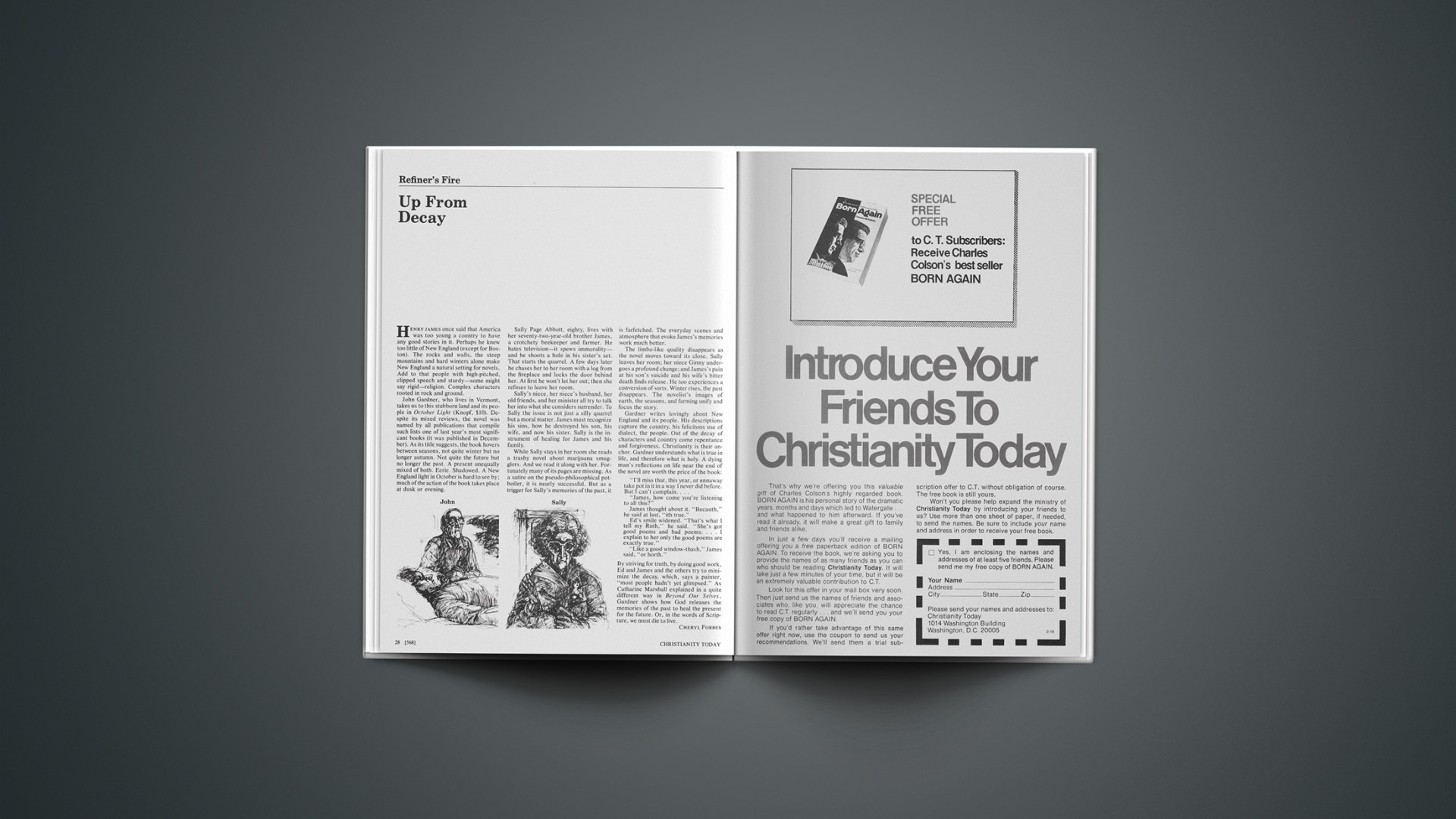
Refiner’s Fire: Up from Decay

Henry james once said that America was too young a country to have any good stories in it. Perhaps he knew too little of New England (except for Boston). The rocks and walls, the steep mountains and hard winters alone make New England a natural setting for novels. Add to that people with high-pitched, clipped speech and sturdy—some might say rigid—religion. Complex characters rooted in rock and ground.

John Gardner, who lives in Vermont, takes us to this stubborn land and its people in October Light (Knopf, $10). Despite its mixed reviews, the novel was named by all publications that compile such lists one of last year’s most significant books (it was published in December). As its title suggests, the book hovers between seasons, not quite winter but no longer autumn. Not quite the future but no longer the past. A present unequally mixed of both. Eerie. Shadowed. A New England light in October is hard to see by; much of the action of the book takes place at dusk or evening.

Sally Page Abbott, eighty, lives with her seventy-two-year-old brother James, a crotchety beekeeper and farmer. He hates television—it spews immorality—and he shoots a hole in his sister’s set. That starts the quarrel. A few days later he chases her to her room with a log from the fireplace and locks the door behind her. At first he won’t let her out; then she refuses to leave her room.

Sally’s niece, her niece’s husband, her old friends, and her minister all try to talk her into what she considers surrender. To Sally the issue is not just a silly quarrel but a moral matter. James must recognize his sins, how he destroyed his son, his wife, and now his sister. Sally is the instrument of healing for James and his family.

While Sally stays in her room she reads a trashy novel about marijuana smugglers. And we read it along with her. Fortunately many of its pages are missing. As a satire on the pseudo-philosophical potboiler, it is nearly successful. But as a trigger for Sally’s memories of the past, it is farfetched. The everyday scenes and atmosphere that evoke James’s memories work much better.

The limbo-like quality disappears as the novel moves toward its close. Sally leaves her room; her niece Ginny undergoes a profound change; and James’s pain at his son’s suicide and his wife’s bitter death finds release. He too experiences a conversion of sorts. Winter rises, the past disappears. The novelist’s images of earth, the seasons, and farming unify and focus the story.

Gardner writes lovingly about New England and its people. His descriptions capture the country, his felicitous use of dialect, the people. Out of the decay of characters and country come repentance and forgiveness. Christianity is their anchor. Gardner understands what is true in life, and therefore what is holy. A dying man’s reflections on life near the end of the novel are worth the price of the book:

“I’ll miss that, this year, or ennaway take pot in it in a way I never did before. But I can’t complain.…

“James, how come you’re listening to all this?”

James thought about it. “Becauth,” he said at last, “ith true.”

Ed’s smile widened. “That’s what I tell my Ruth,” he said. “She’s got good poems and bad poems.… I explain to her only the good poems are exactly true.”

“Like a good window-thash,” James said, “or horth.”

By striving for truth, by doing good work, Ed and James and the others try to minimize the decay, which, says a painter, “most people hadn’t yet glimpsed.” As Catharine Marshall explained in a quite different way in Beyond Our Selves, Gardner shows how God releases the memories of the past to heal the present for the future. Or, in the words of Scripture, we must die to live.

The ‘Key’ Of Stevie Wonder

It took nearly two years of studio work to produce Songs in the Key of Life (Tamla, T13-340C2 $13.98), Stevie Wonder’s ambitious two-record set with an additional seven-inch extended-play disc. Many contemporary records suffer when producers spend excessive studio time working and reworking arrangements, but Stevie Wonder instills all twenty-one songs with color, variety, and a sense of spontaneity. The album is Wonder’s masterpiece, the apex of the maturation that began with Music of My Mind, Talking Book, Inversion, and Fulfillingness First Finale.

Songs is a “concept album” loosely based on Wonder’s life history. “I Wish” finds the superstar longing for the carefree days of childhood. In “Sir Duke” he pays tribute to his musical roots and proclaims music the universal language. “Knocks Me Off My Feet” tells of the joys of first love, “Summer Soft” bemoans love lost, and “Ordinary Pain” recalls the hurt of love gone bad. The ecstasy of fatherhood is celebrated in “Isn’t She Lovely,” in which he rejoices in what God has made through love.

We hear Wonder’s philosophy of life from the first cut, “Love’s in Need of Love Today,” in which he warns that hate is destroying everything: “The force of evil plans/To make you its possession/And it will if you let it/Destroy everybody.” He calls on everyone to combat hate with love.

“Pastime Paradise” divides humanity into those who live for the past by “conformation to the evils of the world” and those who live for the future by “conformation to the peace of the world,” always looking to “when the Saviour of love will come to stay.” Although life is filled with troubles, he proposes in “As” that “God knew exactly where he wanted you to be placed.”

Synthesized strings provide the background for “Village Ghetto Land,” a picture of grim ghetto life. The singer asks, “Tell me, would you be happy in Village Ghetto Land?” God is the world’s “only free psychiatrist,” according to “Have a Talk With God.” Aided by a classroom of children he chronicles the contribution made by non-white people in building America in “Black Man.”

The upbeat Songs in the Key of Life shows that purpose and meaning in life are found in living for the future. Although a few of the songs have excessive refrains or some awkward phrases and rhymes, Wonder’s performance overcomes these flaws. This album is a tour de force.

DANIEL J. EVEARITT

Daniel J. Evearitt is the assistant pastor of Tappan Alliance Church, Tappan, New York.

Marriage: Minefields on the Way to Paradise

Once Clyde Kilby of Wheaton College was asked one of those inevitable questions about literature: “Dr. Kilby, I just can’t understand why you spend so much time and attention on these fantasies by Tolkien and Lewis and Williams. What good do they do? They’re about an imaginary world; they don’t tell us how to cope better with this one. Why read them?”

With the longsuffering smile of a teacher speaking to one who had not seen the light, Dr. Kilby replied, “If I went down the street to a magazine rack, I could probably find two hundred articles on how to live better. How to improve my marriage, how to lose weight, how to attract a lover, how to succeed in business, how to banish guilt, how to get rich, how to love myself. People gobble up those articles. But does anyone really change? Another magazine will print the same advice next month, and people will still writhe with the same problems. These books by Tolkien and Lewis and Williams bypass all that good advice. They don’t tell me how to do something; they tell me what to be.

I have almost (but not quite) come to the same conclusion about advice on marriage. I spent a year studying the first five years of marriage, the period when the divorce rate is highest. I began by interviewing nine couples who revealed to me the struggles of their first five years. Then I read every marriage book I could find, Christian and secular. The advice contained in most of them was compact and well-blended, a convenient pill I could offer to each couple. But the best advice cannot solve a problem without the cooperation of the people whose problem it is.

I remember well the long interviews my wife and I had with the nine couples. Most started at a restaurant with polite chatter about how they met and what attracted them and where their inlaws live. By midnight, however, back in our living room, the conversation had changed. Unresolved conflicts oozed open. Often a session intended to gather helpful information for others turned into a plea for help.

Listening to them, I sometimes questioned the whole notion of marriage. We have placed greater demands on marriage now than in previous generations. Besides satisfying the need for asexual relationship, marriage is now being asked to supply needs for comradeship and partnership as well. Added to this is the weight of ideals our romanticizing culture excites in us. It’s no wonder many marriages cannot bear the strain.

Some marriages seem cursed with a time bomb of impossible expectations that must soon explode. As I encountered these time bombs, both in the couples I interviewed and in written accounts, my first reaction was to lower the ideals. There must be, I thought, some way to disassemble marriage and put back only certain pieces of it—say, sexual release and companionship—without insisting that marriage bear all the pressure of two souls becoming one.

But a strange thing is happening. G. K. Chesterton, in Orthodoxy, described his spiritual journey as a long, romantic, tempestuous sea voyage. When he finally sighted land, however, he discovered he had ended up exactly where he started—in cozy England. Something similar is occurring among observers of the marriage scene. Counselors who were once offering new visions of open marriage and sexual license are starting to use words like “fidelity” and “commitment.”

As I talked to the nine couples with their varying degrees of conflict, I discovered that the ones whose marriages were in severe trouble were not those who expected the most from marriage but those who expected the least. Those with the highest ideals seemed to have the closest relationships, and after a year’s study I have come to the conclusion that our marriage ideals have been set not too high but too low.

The Bible at first reading seems to say little about marriage, but I found that God does show us what marriage requires and how we are to exercise the principles that build sound marriages. God himself embodies the ideal in three areas that encompass most of the marital conflicts of the nine couples I interviewed.

1. Ego sacrifice. The fundamental human need, says John Powell, is “a true and deep love of self, a genuine and joyful self-acceptance.” But marriage calls us to transcend that fundamental human need. The beloved’s needs and pleasures must take equal if not superior status to our own.

From our toddler years we learn to protect ourselves. A child grabs a toy and clutches it to his chest, yelling “Mine!” As we grow older, if someone criticizes us we want to lash out in revenge, or perhaps we begin to doubt ourselves. Our egos must be protected.

We go through life like so many clenched fists, striving to prove ourselves to one another, striking out when thwarted. As children we learned not to expose our deepest secrets even to a best friend, for they might be broadcast all over school the next day. Marriage, however, calls us to unclench the fist and allow someone to see what lies inside. We must expose our nakedness, physical and emotional, to another person. The secrets are out. Marriage calls for utter transparency and trust in a world where we have learned that these are a sure path to pain.

The ego sacrifice required by marriage does not, of course, entail a forfeiting of ego. I do not lower my self-esteem and think less of myself for the sake of my wife. Rather, I should raise my esteem of her so that in a thousand areas—squeezing toothpaste, picking up socks, buying records, tolerating dripping pantyhose, eating out, selecting TV shows—I sometimes consciously opt for her convenience or pleasure above my own. My will bends as I sublimate my own needs and desires for her sake, or the sake of the relationship.

The absence of this ego sacrifice manifests itself in great power struggles between husband and wife. Each fights for his own territory. Each insists on being “right,” with the result of devaluing the other. One couple I talked with, Brad and Maria Steffan (these names and the names given to the other couples I interviewed are fictitious) periodically fought emotional wars that could last a week. Says Maria, “It’s as if I’ve built a protective shell around myself I can’t let Brad enter. I have always been competitive. I can’t stand the image of the submissive, boot-licking wife. I despise the seductive, baby-doll wife taught in books like The Total Woman. I want my independence, yet I want to lean on Brad. Marriage is so confusing.”

She continues, “We read books on marriage which say the key is the self-sacrificing giving of each partner. But in our relationship, that’s dangerous. It’s like there’s a giant power struggle going on and we’ve both only got so much ammunition. If I take the peace initiative and let Brad through my defenses, he might hurt me. I might lose.”

In contrast, the biblical ideal shows God, the All-powerful, creating human beings almost as parasites who would require attention and a constant giving of himself with little in return. You can see the awesome figure of a sacrificial God in the Old Testament prophets’ description of him as the Wounded Lover. “How can I give you up, O Ephraim? How can I hand you over, O Israel?… Mine heart recoils within me …” (Hosea 11:8).

The best example of God’s self-sacrifice on behalf of his beloved creation is found in a New Testament passage that gives a profound insight into the Incarnation: “Have this mind among yourselves, which you have in Christ Jesus, who, though he was in the form of God, did not count equality with God a thing to be grasped, but emptied himself, taking the form of a servant, being born in the likeness of men. And being found in human form he humbled himself and became obedient unto death, even death on a cross” (Phil. 2:5–8). God took a risk, exposing himself, becoming vulnerable, to the point of joining the human race to show us how it’s to be done!

One couple I talked to described a horrible two-year period of angry quarrels, temper tantrums, and walkouts. The wife, Beth Pestano, had come from a troubled family. Her father had left and her mother had died. Beth used the first few years of marriage to unleash her pentup anxieties. She would fly into irrational rages over insignificant details. Somehow Peter rode out the violence of those first few years and continued to show her love. Today they have one of the happiest marriages I know of.

I asked him, “Peter, how did you do it? What kept you from cracking in those long months of giving a lot and getting very little in return?” He then told me the story of his conversion, when God had tracked him down after months of angry rebellion.

“The most powerful motivating force in my life,” he concluded, “was the grace of God in loving me and giving himself for me. When I hated coming home to face Beth, I would stop for a moment, think of God’s sacrifice on my behalf, and ask him for strength to duplicate it.”

Marriage, as taught by God’s good example, challenges our lust for power and ego gratification. It requires sacrifice. The well-known prayer of St. Francis could be directed toward this aspect of marriage: “Grant that I may not so much seek to be consoled, as to console; not so much to be loved, as to love. For it is in giving that we receive, it is in pardoning that we are pardoned, it is in dying that we are born again to eternal life.”

2. Acceptance. The world teaches us that worth is a quality to be earned. In school you earn a grade, or perhaps a starting position on the varsity team. In business you work your way up to a plush office and a good salary. In the army you earn stripes on the sleeve; those with few stripes take orders and those with many stripes give orders. Everyone understands the system and his own ranking within it.

Against this background, God carves out a unit, the family, where worth is not earned but given, determined by the mere fact of birth. A moronic son has as much worth as a genius—he deserves love simply because he was born into the family. At least that’s the theory of the family. The prodigal son who squanders his father’s riches is welcomed as eagerly as his older brother who followed all the rules. (And the lesson of the older brother is the lesson of one who tries to inject the world’s value system into the family, demanding that behavior determine worth.)

What does this have to do with a couple groping their way through their first few years together? Everything. The principle of assumed worth begins with marriage. If it is not present there, it cannot be passed down to the children. The sense of worth in marriage is set squarely within God’s value system, not the world’s. I should accept my wife totally. I should love her because she is my wife. Nothing is unforgivable. Nothing can sever the love—she can count on that. This is the bedrock ideal on which God built the structure of marriage.

A devout young Christian husband, Mark Parsons, told me how he almost pushed his wife away by jabbing at traits in her that he disliked. “You chit-chat too much; you’re not serious about things that are important to me; you don’t always make sense when you talk.”

Cynthia felt trapped. “When a problem came up,” she recalls, “Mark would want to talk about the causes immediately, just like an instant replay on TV. I couldn’t talk about it—I would lash out, attacking him personally, anything to avoid the issue. He would bring up the comment I made in anger and ask for an explanation. How could I explain my anger without showing more anger? So I would clamp shut and be silent. Then he’d want to talk about why I was so silent. I felt smothered, hounded, attacked, as if I was in a wind tunnel with hurricane-force winds coming from every direction.”

Just in time Mark realized that his pressure on Cynthia would never help her change. She needed to feel accepted and loved before she could make adjustments. He saw this by considering how Christ brings about changes in us. “Naturally Christ wants the church sinless and perfect. But how does he accomplish that? Not by pressuring us and berating us and sternly rebuking us. He is loving and forgiving toward us. He wants our growth, but he refuses to reach in with a magic wand and drive out all imperfections. He allows us the freedom we need to turn to him voluntarily.”

The Christian Gospel offers unearned acceptance, but many Christians seem to demonstrate that quality very poorly in their marriages. Husband and wife become self-righteous judges of each other’s behavior and attitudes. I know of a man who is completely turned off by the church because his Christian wife complains so relentlessly about his smoking habits. Another husband inspires unimaginable guilt in his wife. After the wedding he discovered she had had sexual relations with other men. Refusing to forgive her, he uses the fact as a dagger in arguments.

We forget that though Christianity sets our ideals high, it sets our forgiveness quotient even higher. There is no limit to God’s grace in accepting our failures.

I think of a married couple in their mid-fifties who have endured twenty-five years of difficulty in marriage. They are of opposite temperaments; they moved overseas unprepared for a new culture and suffered tearing family tragedies. Yet their marriage today exudes open, accepting love. Once the wife told me, “I used to think I loved Jack because of certain things about him—his good looks, his winsome personality, his dedication. But it didn’t take long to see through all that. I found out over the years there can be only one reason to make me love him. That reason is because I want to. We’re together, I believe, because God put us together, and I’m going to make it work. I will to love him and accept him regardless.”

Somehow a husband and wife have to learn to communicate love, a love that stretches around any bulges of failure and disappointment. Love and acceptance are not like rubber bands that weaken as they are stretched; they become stronger as they are tested and the partner perceives trust and faithful love.

In the book of Hosea, God showed that his fidelity was so great it could forgive gross adultery. Does God’s love seem weaker for forgiving such behavior? No, it is unfathomably greater. Similarly, active, accepting love within marriage can build unbreakable bonds of trust.

In my interviews, I encountered one beautiful example of this kind of acceptance. John and Claudia Claxton, a couple in their early twenties, were faced with the specter of cancer after just one year of marriage.

Claudia’s body quickly began to deteriorate. Surgeons removed her spleen and some lymph nodes. Even more draining than surgery were the radiation treatments that followed. Claudia was exhausted by the daily regimen. She would go to bed at 10 P.M. and sleep till noon the next day. The radiation damaged good cells as well as killing the diseased cells, so her energy was sapped. Her throat was raw and so swollen she could barely swallow. Areas of her skin turned dark, and the hair at the back of her head began falling out.

I talked with John and Claudia about the inevitable pressures. Claudia experienced waves of self-pity, questioning her worth because she was a constant concern to everyone around her. Yet somehow John managed to communicate an overpowering love. He would come and sit for hours on her hospital bed, holding her hand, touching her face, telling her he loved her. (She ultimately responded to treatment and now seems cured.)

John said the love was not an effort, merely a natural outgrowth of patterns that had been set even before their marriage. “When a couple meet a crisis,” he told me, “it’s a caricature of their relationship and what’s already there. We love each other deeply. We had always insisted on open communication; when something bothered us, we would talk it out. We trusted each other. Therefore when the Hodgkin’s disease came, there were no lingering fears and grudges to undermine our relationship. My love for Claudia would continue regardless of what happened to her body.”

3. Freedom. This third battlefield was the most common one among the couples I interviewed. A newlywed daily discovers something about his spouse he doesn’t like. Our natural human tendency is to want to control the other person, to squeeze him into our mold. We want to seize his freedom.

Here are some areas of skirmish that the nine couples brought up:

• frequency of sex (in most cases the husbands wanted their wives to change by wanting sex more often);

• moodiness;

• sloppy habits of dress and housekeeping;

• a desire to have “old” friends without involving the spouse in the activities;

• physical appearance, especially weight;

• verbal attack of the spouse in public;

• styles of settling conflicts;

• irritating hobbies or avocations;

• a complaining attitude;

• failure to talk things over.

I was amused to read of the adjustments Paul and Nellie Tournier worked through in their first years of marriage. “I’m an optimist and she a pessimist,” Paul Tournier reported in Faith at Work magazine (April, 1972). “She thinks of every difficulty, misfortune, and catastrophe that might happen, and I cannot promise her that such things will not happen. But God is neither optimist nor pessimist. The search for him leads one beyond his own personality and temperament to a path that is neither optimism nor pessimism.

“Little by little I have learned that God speaks to everybody—men and women, adults and children, blacks and whites, the rich and the poor. To discover the will of God, you must listen to him in all men. Of course, I prefer to have God speak directly to me, rather than through my wife, and yet in truly seeking his will I must be persuaded that he speaks as much through her as through me; to her as much as to me.”

Most of the problems about Christianity that puzzle so many people pertain to this issue of human freedom. How can God allow sin? How can he allow unjust rulers? What about pain and suffering? How can God allow people to go to hell? We want God to reach down with a wrench and forcibly fix things.

There is no adequate way to describe the premium God places on human freedom. But the Bible does contain some glimpses of the freedom ideal. One is in the analogy I already spoke about: the faithful, persistent wooing of an adulterous lover in Hosea. God respects freedom so much that through all of human history he has allowed human beings to play the harlot against him.

Another glimmer of God’s respect for freedom is captured in the scene of Jesus weeping as he contemplates the people of Jerusalem who have rejected him. “O Jerusalem, Jerusalem …,” he explained. “How often would I have gathered your children together, as a hen gathers her brood under her wings, and you would not” (Matt. 23:37). Reading that, we may forget that the speaker is the all-powerful God. He could have charged into Jerusalem on a stallion of fire, streaking the skies with lightning, causing earthquakes with the resonance of his voice. He could have demanded their allegiance. But Jesus chose not to. He respected human freedom so much that he allowed himself to be rejected.

The final, most compelling glimpse of all comes in the image of the cross. God, eternal and omniscient, could see from the beginning the ultimate sacrifice our redemption would require. The lamb was slain before the foundation of the world. He could feel the sharp slap on his cheek and the crusted blood on his back and brow. He could hear the hooting and jeering as the world voted to murder him. And yet, knowing all that, he sacrificed all, spilling his own blood, to allow man the choice of responding freely to the love he offers.

Does it do any good to spiritualize about how marriage is like the Christian life and how true love is God’s love? Does it do any good to enlarge the ideals of love to divine proportions? Only if you believe marriage can be a crucial settlement in God’s Kingdom. It is exalted, not because it is so different from the rest of life, but because it allows us a frontier to practice God’s value system of ego sacrifice, acceptance, and freedom, so that we derive strength to present that system to the rest of the world.

The exalted nature of marriage assures us that it will involve strife and conflict. In marriage we are tiptoeing through a field of land mines on the way to paradise.

The Children of God: Disciples of Deception

Moses David Berg claims to be the “original founder” of the Jesus revolution. He is a former Christian and Missionary Alliance minister who in 1968 began a ministry to hippies in Huntington Beach, California. It has grown into a globe-encircling network of 800 “colonies” (communes) in seventy countries. There are reportedly 5,000 full-time disciples, two-thirds of them male; fewer than 15 per cent are in the United States. Since his “retirement” in 1970, Berg, now fifty-seven, has maintained a low profile in Europe, but he carries on his role of latter-day prophet (Moses) and King of Israel (David) by writing a profusion of “MO” letters—more than 500 in five years. These he mails to his colonies to be printed and distributed on street corners in exchange for donations.

Throughout their tempestuous history, the Children of God have become notorious for using profane and vulgar language excessively, for demonstrating their hatred against “the system” (disrupting church services used to be standard procedure), and for requiring converts to “forsake all” (parents, education, jobs, churches) and to turn over all their possessions to the organization. Hundreds of young people have disappeared into the COG, and the controversial Ted Patrick, charging that the COG used brainwashing methods, proceeded to kidnap (he prefers “rescue”) and “deprogram” disciples at the behest of distraught and desperate parents.

In recent years the COG has undergone radical changes in both theology and methodology. The MO letters have become increasingly sex-oriented. Berg, who is said to have several concubines, insists that his letters are “God’s Word for today” and have supplanted the biblical Scriptures (God’s Word for yesterday). Yet the letters endorse some totally unbiblical practices.

Much of the truth about the COG is shrouded in secrecy. But in July, 1973, Jack and Connie Wasson (whose “Bible” names were Timotheus and Gracie) broke with the COG. Connie had been one of the original four dozen members in Huntington Beach; Jack had been involved for just a year. Two years later, in July, 1975, David Jacks (Jonathan Archer in the COG) repudiated Berg as a false prophet and left the organization. Jacks, a member for over five years, had helped to pioneer South America for the COG. He was a COG archbishop and had access to top-level information denied to ordinary disciples and to leaders of lower rank. In the following interview these two young men—Jack Wasson, 28, and David Jacks, 24—hope to alert the public to the evils being perpetrated by David Berg on his followers (many of whom, they believe, are sincerely motivated Christian young people). Their charges can be fully documented from Berg’s own writings.

Contact was made with Eugene “Happy” Wotila shortly before this article went to press. Wotila’s seven-plus years in the COG date back to the sect’s beginnings in Huntington Beach. Known as Joab, he was a leading Bible teacher in the sect. In October, 1975, he was excommunicated by Berg for raising questions about COG teachings, among other things. His statements confirm the basic information provided in the interview with Wasson and Jacks.

Joseph M. Hopkins, the interviewer, is the author of a book on the Children of God scheduled to be published this summer by Acton House. He is a professor in the Department of Religion and Philosophy at Westminster College, New Wilmington, Pennsylvania.

Hopkins. Very few people have seen a picture of David Berg. What is he like?

Jacks. He’s in his mid-fifties. A frail man. He has a bad heart. He’s got gray hair and sometimes wears a goatee. He has a large nose. And he has a strong face, strong features. He has piercing eyes, and when you meet him he seems like he’s really checking you out—not in a friendly way but in a very probing way that puts you on the defensive. Sometimes he rants and raves like a madman. Everybody is afraid of him. One time, while we were in Texas, he came in with a large chain and started throwing it down on the table, screaming that he had come to set the captives free from the system.

Hopkins. David, you were in the COG throughout most of its history. Would you describe a few of the changes?

Jacks. The COG started out small and grew rapidly. When I joined there was just one traveling colony of a hundred members, with David Berg teaching the classes. Berg’s immediate family were the key leaders. However, as the organization grew, people with business experience were recruited, and they soon rose to prominence in the group. The strategy is still evangelism, but the messages are 100 per cent different. It’s not so much Jesus Christ any more; it is Moses David. And the methods are different. Before, it was street evangelism. Now it’s peddling literature for money.

Hopkins. What about discipline?

Jacks. When I first joined the COG, it was very regimented. But as David Berg’s goals changed, more liberties were granted to the lowly disciples. Now, with permission, they can date—even date people outside the organization. They can also go to movies. By relaxing the rules, I think Berg is trying to buy acceptance, to gain popularity and more followers. Drugs and tobacco are still taboo, but alcohol is permitted in moderation—usually only at parties.

Hopkins. You say when you first joined there was just one traveling colony. What is the set-up now?

Jacks. Now colonies range from six to twelve full-time followers. The colony leader is called a shepherd. When it gets more than twelve members, a colony has to divide and create a new one. Three (sometimes two) colonies form a district, presided over by a district shepherd. Three districts form a region, headed by a regional shepherd. Three regions constitute a bishopric, presided over by a bishop, and three bishoprics constitute an archbishopric, headed by an archbishop. Three archbishoprics constitute a ministry, governed by a minister; and three ministries constitute a prime ministry, ruled over by a prime minister. At the time I left there were four prime ministers in the COG. They are members of the board of directors called “the King’s Counselors.” It’s a pyramid type of government, rule from the top down.

Hopkins. How important are the MO letters?

Wasson. The COG disciples believe the MO letters are the inspired word of God for today—and the Bible was the inspired word of God for yesterday. For this reason the MO letters are called the “New Wine” and the Bible the “Old Wine.” There are at this time more than 500 MO letters; and besides this, there are a number of tapes that have been sent out by MO to the colonies. The first MO letter was called The Old Church and the New Church. Berg had a wife but had been living with his secretary, Maria, and the word was beginning to get out. He was either going to have to repent or to sidestep the situation, which is what he chose to do. There was a meeting in Montreal, Canada, in 1969. David Berg had this prophecy about “the old church and the new church.” In it he said that Maria was the new church and Jane Berg, his wife, was the old church, and that God was putting away the old church, Jane, because she had been a hindrance to the work. In her place God was giving him a new wife, Maria. David Berg was doing what was explicitly forbidden by Scripture, and he knew it. To justify himself, he had to come up with something that was at least as authoritative as Scripture, if not more so. That was the very first MO letter.

Hopkins. Aren’t there various categories of MO letters?

Jacks. Here they are. First there are the “G. P.” (General Public) letters—the ones they sell on the street. After that come the “D. F. O.” (Disciples and Friends Only) letters. Next “D. O.” (Disciples Only). Then “L. T. O.” (Leadership Training Only). And after that, “L. O.” (Leaders Only). He even has “R. F. O.” (Royal Family Only) letters.

Hopkins. With David Berg out of the country, how are these letters processed?

Wasson. Copies are sent to area leaders, who print them up for the colonies. COG headquarters formerly got $.25 royalty per disciple on each letter as it was issued. But now at least 40 per cent of all the money the kids make on the street “witnessing” is sent to higher administrative levels. The remaining 60 per cent or less is used to finance the colonies. According to a recent issue of the New Nation News (the official COG news publication), 218,108,922 MO letters were distributed in a 4¼-year period beginning October 1, 1971, which breaks down to approximately 4.3 million per month.

Jacks. In Peru and Bolivia, over a period of a year and a half, we passed out 1.5 million letters, which was one letter for every twelve people in those two countries.

Hopkins. What is the average donation?

Jacks. Down there it was maybe $.08 a letter. Here in the States, they get anywhere from $.05 to $1.00 per letter. Berg gets 10 per cent of that. And of course he derives income from other sources, too—the kids who “forsake all,” contributions from sympathetic parents and friends, and so on. Benefactors are called “kings” and “queens.” Berg teaches that you should use them but don’t let them use you. But witnessing is the basic means of income. Kids go out on the streets for six to ten hours a day. In the States they bring in from $25 to $100 a day each. On the basis of ten people, that would mean $500 to $1,000 a day per colony, or $2,500 to $5,000 per week. This income is almost pure profit. Some letters cost less than a penny to print. At some of their discotheques (Poor Boy clubs) they now charge entrance fees. They put their slogans on coffee cups and sell little gold yokes and MO tee shirts with COG slogans such as “I am a Toilet” on them. They’re marketing tapes and albums.

Hopkins. Is the term “spoiling Egypt” still in vogue?

Jacks. Not in the old way; it’s bad public relations. But Berg still espouses this philosophy—of using the system but not letting it use you. They still practice “provisioning”—getting all the food and lodging they can free, along with paper, clothes, glasses, dinnerware, haircuts, anything they can.

Hopkins. What do they say when they go up to someone to “provision” something?

Jacks. They will say, “We’re a Christian group. We’re trying to help get kids off drugs. If you can help us out, we’ll really appreciate it and God will bless you.”

Wasson. And what kind of drug program do they have?

Jacks. They have no drug program whatsoever.

Hopkins. Isn’t it hypocrisy for them to rip off the system when they flatly condemn it in all its aspects—churches, government, education, jobs?

Jacks. David Berg takes the attitude, “I’ll take anything the devil has and use it for God’s glory.”

Hopkins. A year ago I wrote the IRS to ask for their most recent financial report on the COG. They wrote back, “We have no record of the COG as being listed as an exempt organization.” This suggests that an investigation of the financial operation of the COG in this country would be in order.

Jacks. It’s long overdue.

Hopkins. To get back to the MO letters, is it true that Berg claims to have received messages from occult sources?

Wasson. He has a number of what he calls “spiritual counselors” (the Bible calls them “familiar spirits”) that give him revelations, supposedly from God. His main counselor is Abrahim, a supposed Gypsy king who has been dead for a thousand years, who enters into Moses David’s body and speaks through his mouth in a broken-English dialect. The messages that come, as you will see, are blasphemies and heresies, filled with arrogance, pride, and lust. There are dozens of these counselors. Besides Abrahim, there are Rasputin, the Pied Piper, Joan of Arc, Oliver Cromwell, Merlin the Magician, William Jennings Bryan, Martin Luther, and many more.

Hopkins. You mean he actually claims that he is in communication with these people?

Wasson. Oh, yes. That they enter into his body and speak to him. Many of these revelations come in the middle of the night after he’s primed the pump with a little wine.

Hopkins. Do you have a MO letter in which he describes this method?

Wasson. Yes. In Jesus and Sex (March, 1974), Berg states, “When I get drunk, I yield to God’s spirit.… If you get intoxicated, why, it just makes you even more free in the spirit—at least it does with me.”

Hopkins. Did I read somewhere in a MO letter that he claims to have sexual relations with spirits?

Wasson. Definitely. He has mentioned in a number of letters his sexual involvement with spirits whom he calls “goddesses.” But these spirits have become so aggressive lately he admits to being afraid of them. In MO Li’l Jewels (September, 1976), he says regarding the goddesses: “I BUMPED INTO ONE OF those women the other night when the light was out in the hall. They were waiting for me and whispering to each other.… ‘Everybody keep quiet. Be still so nothing will disturb the sleep of David.’ (Maria explains: ‘He was talking about the whispering and giggling of the goddesses outside the door where they wait their turn to make love to him.’)”

Jacks. He seeks the help of a palm reader in one letter. In The Green Door he visits hell.

Wasson. The letter Madame M, subtitled “from one psychic to another,” was written at the time his son Paul (known as Aaron in the cult) either jumped or fell to his death in the Alps in 1973. He tells of visiting a Gypsy fortune-teller called Madame M. She told him some really wild things. Here’s a sample: “ ‘I THINK YOU BELIEVE IN REINCARNATION, DON’T YOU?’ (David: ‘In a sense,’ I answered. ‘It is as though Abrahim my angelic helper comes in and blends with my body.’) Madame M continues, ‘YOU HAVE SUCH POWER!—LIKE MERLIN THE MAGICIAN!’ (In other words, I could have the power of the greatest of the magicians of the world to help me if I wanted it, even like Merlin the Magician, King Arthur’s court magician!)”

Jacks. MO has a long history of astrology, palm reading, and that sort of thing. He’s followed Jeane Dixon for years.

Hopkins. What status do the MO letters have in the colonies? Are they placed on the same level as Scripture?

Jacks. Let me answer in David Berg’s own words. In August, 1973, he wrote in a letter called Old Bottles: “I want to frankly tell you, if there is a choice between reading your Bible, I want to tell you that you better read what God said today, in preference to what he said 2,000 or 4,000 years ago. Then when you’ve gotten done reading the latest MO letters, you can go back to reading the Bible.”

Hopkins. I’ve been told that when a new MO letter hits the colony, the kids go wild.

Wasson. Oh, definitely! They believe David Berg gets the big “heavies” from God. Really, their veneration of MO approaches idolatry. When I was in the colony at Houston, it was expected that after new MO letters were read there would be received confirming prophecies from the disciples, like, “Yea, this is my servant, David. Hear him and obey him. Thus saith the Lord.” He definitely believes he is God’s endtime prophet. He believes he is the fulfillment of those Old Testament messages which refer to King David, who was to come in the future: Ezekiel 34 and 37; Hosea 3, and the like. Of course, most theologians believe these passages refer to Jesus Christ. And he teaches that many of the Children of God will be among the 144,000 spoken about in Revelation 7 and 14. He believes they are Israel restored.

Obviously, comparing himself to King David and Moses serves very nicely for his pyramid type of leadership structure, with penalties for disobedience to God’s endtime leader. If your leader is wrong, God will judge him; but you must obey your leader. There was a case in Los Angeles in the early days when Abraham (an early COG leader) was giving a class on obeying leadership, and this illustration was used: “If your leader had told you to stand on a corner and witness, and a truck came bearing down on you, in that case you might be able to move. Otherwise, it is your duty to obey, period.” The result of this sort of indoctrination is a reign of terror. If you even question in your mind Moses’ leadership, God will know it and you will be judged.

Hopkins. What about sex in the COG? There have been rumors of immorality and hanky-panky in the higher echelons. Are they true?

Jacks. extra-marital relationships, definitely. Berg cites Abraham, Solomon, David, and so on, as examples for his having concubines. The top leaders have sexual affairs with girls in the group. But the disciples themselves are practically eunuchs for a year or so until they get married in the COG.

Wasson. This fooling around with sex goes way back. Married couples were encouraged as a group to participate in “skinny-dipping”—swimming in the nude. It was considered unrevolutionary not to participate. And COG members will do almost anything to avoid being called unrevolutionary. It was also policy for all married couples to attend evening “leadership training” sessions at the TSC (Texas Soul Clinic) Ranch in west Texas in the early days of the COG. These sessions would be led by David Berg, and no matter what subject they started out about, they always ended up on the subject of sex, with David Berg quite frequently leading the couples into a mass love-making session while he looked on. Then this doctrine came up that was taught only among the top leadership: “all things common,” based on Acts 2:44. They applied the “all things” even to wives and husbands. The wife- and husband-swapping was not explicitly condoned in a MO letter, but it was allowed and participated in by the top leadership. But after the NBC “Chronologue” program, which exposed some of the inner workings of the COG, they panicked and forbade any more of this to go on for a brief period. Then it resumed.

Jacks. Listen to this quote from Beauty and the Beast (July, 1974): “There were a lot of times … when I would pick up a girl, not necessarily because I needed to make love to her sexually, although I often did in the long run, but just for companionship. Sometimes I did it as much, if not more, for her sake than even for mine. Because after talking with her for some time, she felt so much love that she wanted to make love, and I wanted to make her happy. And those girls usually think that they haven’t done their job or earned their salt till they’ve gone all the way.” Berg actually encourages fornication for the purpose of winning disciples. He says, “To go as far as kissing them on the mouth or deep-kissing them so that they get their germs and everything on you, that’s a pretty big sacrifice.… We have shown the world every other kind of love.… Now we’re going to go as far as giving them other forms of physical love, even sexual love, to minister to one of their finest and greatest needs.” In Flirty Little Fishy (March, 1974) there is a picture of a mermaid making love to a naked man with the caption, “Hooker for Jesus.” The COG now considers the “Flirty Fish Ministry” one of its most important, and there are a number of recent MO letters on the subject. Basically it means religious prostitution, and they are really into it now. As a result, recent reports from inside the group state that venereal disease is not uncommon and that there are numbers of mothers without husbands (the COG calls them “widows”!).

Hopkins. It’s reported that many of the COG marriages are really common-law liaisons, without benefit of clergy. Is this true?

Wasson. In the beginning, the COG taught that a marriage license was just a piece of paper and wasn’t really necessary. The actual marriage was when you went to bed. They had what they called betrothals—a kind of unofficial ceremony in the colony. Then when the COG started dealing with Fred Jordan (a Los Angeles evangelist and early benefactor of the COG who later repudiated the movement), he wanted the kids to get legal marriages, so that many of them did get legally married after that time. I would say about half of the COG are legally married to someone, although only a small per cent are living with their own legal husband or wife. All marriages, incidentally, have to be approved by the leadership. To go on with the effect of the COG upon married life, I’m going to quote from a MO letter called One Wife: “God breaks up marriages in order that he might join each of the parties together to himself. He rips off wives, husbands, or children to make up his bride if the rest of the family refuses to follow. He is the worst ‘ripper-offer’ of all. God is the greatest destroyer of home and family of anybody!… If you have not forsaken your husband or wife for the Lord at some time or another, you have not forsaken all.”

Hopkins:God is in the business of breaking up families? I thought that was the devil’s business!

Wasson: In the letter Mountain Maid David Berg promoted topless bathing and encouraged the girls not to wear undergarments, and since that day only a handful of girls in the COG have been wearing a bra.

Jacks. MO’s greatest pride now is his new sex book. He says it is hotter than anything in the latest sex shops. It’s called Free Sex. On the cover are a nude fellow and girl, and the whole thing is full of MO letters on sex. But the freakiest thing is his letter called Revolutionary Love Making. It is absolutely the grossest thing you’ve ever seen in your life. I don’t know how to describe it.

Hopkins. There are pictures of people actually engaged in various forms of intercourse. Before we leave this sex thing, how can the colonies remain clean with this lascivious material being fed into the members’ minds?

Jacks. The COG is degenerating. David Berg is getting more and more into pornography, spiritism, astrology, and other far-out things—substituting this garbage for the fundamental Christian faith.

Hopkins. The MO letters abound with four-letter words. Is this sort of language common in the colonies?

Jacks. Most of the Children of God, all the way down to the lowest disciple, swear like pirates. Even when they witness, they use four-letter words. They believe it helps them relate to people on the street.

Hopkins. The MO letters aside, how does COG theology compare with the doctrinal teachings of most mainline denominations?

Wasson. In the beginning the COG taught pretty much straight Bible. The main Bible teachers were Joab and Joel Wordsworth. Just recently, however, these two men were denounced by Moses David and excommunicated. He wrote to the colonies, “Any disciple in possession of Joel’s letters had better destroy them immediately or be in danger of excommunication if found with them in his possession.” This is like kicking the Bible out of the COG. Because practically all of the Bible lessons in the COG were written by Joel Wordsworth. Now his writings are contraband. The point is that COG theology is now based entirely on the MO letters. Those letters are totally heresy and blasphemy. They encourage witchcraft, religious prostitution, immorality, cursing, rebellion, bitterness, hatred. Another thing David Berg teaches is lesbianism. In Women in Love (December, 1973) he writes, speaking of sexual relationships between two women: “When He’s speaking of love, He [God] says if you do it in love, against such there is no law, right? If it’s real love. So why not? IT IS NOT EXPLICITLY FORBIDDEN SUCH AS IT IS WITH MEN WITH MEN. Male homosexuality is expressly, definitely and specifically forbidden and cursed and called sodomy. In that case it is absolutely forbidden and a sin. But I don’t see and I’ve never been able to find any place in the Bible where it is forbidden to women.

David Berg also believes in universalism. Here’s what he says in this letter Old Bottles (April, 1973): “I’ll never be satisfied until everybody on earth is saved, which will never happen of course. But I’m looking forward to the day when … everybody or at least almost everybody will be saved—at least there won’t be many left in Hell if any.” Also, on the subject of Jesus, David Berg says in Revolutionary Sex, “From personal revelations and Bible study, I am convinced that Jesus Himself could have enjoyed His Father’s own creation of sexual activity with some of the women He lived with, particularly Mary and Martha, and yet without sin. Why should it have been a sin for Christ to have enjoyed sex that He Himself had created?”

Hopkins. In view of all these nonbiblical teachings that have been imposed on Berg’s disciples, what would you say about the spiritual state of the young people involved in the COG?

Jacks. I am convinced that in the early days most members were born again and really received Jesus as their personal Saviour when they entered the group. Salvation verses were really stressed—John 3:16; Romans 10:9, 10; Romans 3:23 and 6:23; John 1:12; Revelation 3:20, and so on. However, with emphasis on the Bible decreasing …

Wasson. Having a confrontation with Christ isn’t the big thing anymore. The key to success in the COG is how effectively a person fits into the Moses David witnessing machine, producing more income and more disciples for King David.

Hopkins. Let’s move on to COG eschatology.

Jacks. David Berg is a very apocalyptic person, and he believes the whole world—America, first of all—is under impending doom. He believes that we are living in the last generation, and that the United States is the “great prostitute that sits on many waters” and the “Babylon” of Revelation. Another interesting thing is David Berg’s courtship of Mu’ammar Gadaffi, the radical strong man of Libya. Berg believes the Children of God are actually going to rule the planet Earth before Jesus Christ returns. He says that they will evangelize the world and that Gadaffi will help them by making a peace pact with Israel.

Wasson. David Berg is into astrology, and he saw Kohoutek (the “Christmas comet” of 1973, which was to have been the brightest of the century but fizzled) as a sign of America’s coming destruction on or before January 31, 1974. A lot of the COG wrote their parents and friends in the United States saying, “Get out, get out, while there’s still a chance. America is going to fall.” The COG wore placards and paraded up and down the streets of almost every major city in the free world saying, “Yet forty days and Nineveh shall be destroyed.” And of course the comet just fizzled out.

Hopkins. If America is to be destroyed by God, then who is going to fight in the Battle of Armageddon?

Jacks. Israel is going to be invaded by Russia (Gog and Magog), according to Ezekiel 38 and 39. The United States will get involved, and Israel and America will go down the drain. A world Communist government will be set up. Armageddon will take place at Christ’s return, at the end of the seven years. The seventh trumpet will be blown, and Jesus will come in the clouds with all of God’s people rising to meet him. This, Berg believes, will take place in 1993.

Hopkins. Wouldn’t you say that one of the appeals of the COG is to be part of an elite group through whom God’s promises and purposes are to be fulfilled?

Jacks. Yes, indeed. It’s a very secure feeling. You feel that you are super-important, that you alone know what’s going on.

Wasson. David’s oldest son, Aaron (the one who died), wrote a song, “We are the 144,000. Who else could it be but us?”

Hopkins. What about sacraments in the Children of God?

Jacks. They started out baptizing in water in the early days. They did it by immersion. But it became a cumbersome thing to do and they just stopped doing it.

Wasson. Once in a long while—maybe on Christmas or some special occasion—they’ll get a bottle of wine and a loaf of bread and have Communion. But they don’t do it regularly.

Hopkins. Are the charismatic gifts practiced in the COG?

Wasson. All claim they are Spirit-baptized and pray in tongues. On healing, the Children of God believe that suffering often is the judgment of God. So when they pray for someone who is sick, they ask the Lord to show the person where he has sinned so he will confess and so be healed.

Hopkins. Do they believe in natural childbirth?

Jacks. Yes. For a long time the women gave birth to their babies in the colonies. But they have lost some children in the past two or three years, so more of them have been going to hospitals.

Hopkins. What is their policy on medicine and doctors?

Jacks. They’re opposed to people who try to make money out of people’s afflictions. If you have faith and get better, then you get brownie points; but if you don’t, then there’s no condemnation about going to a doctor.

Hopkins. What happens on Sunday in the COG? Is it a special day?

Jacks. No, not at all. If they have a rest day at all, it’s usually on Sunday. But there’s no set day of the Lord.

Hopkins. It’s reported that the Bergs and their retinue live like kings while most of the lowly disciples languish in poverty. Is this an exaggeration?

Jacks. No, I think it’s well founded. David Berg doesn’t live lavishly, but he does live comfortably—very comfortably. I know for a fact that John Treadwell (Jethro) has always lived very nicely in the COG. He’s always had a nice apartment, has taken fencing lessons, and jets around the world like an aristocrat—all on his expense account.

Hopkins. An ex-member told me that in the colony where he was in Texas they ate moldy bread and whatever cheap food they could scrounge.

Wasson. Although the diet of the regular disciples was very poor in earlier days, since the practice of selling the MO letters became big, more money is available and diets are much improved. In poorer parts of the world, however, they can still be very bad.

Hopkins. Is it fair to say that Berg tolerates parents only if they support the COG?

Jacks. That’s right. This is what he says about parents in Who Are the Rebels? (March, 1970): “You, our parents, are the most God-defying, commandment-breaking, insanely rebellious rebels of all time, who are on the brink of destroying and polluting all of us and our world if we do not rise up against you in the name of God and try to stop you from your suicidal madness of total genocide. To Hell with your devilish system. May God damn your unbelieving hearts.”

Hopkins. What about the charge of brainwashing?

Jacks. The Children of God do not brainwash. They do not withhold food or sleep or anything like that. Leaders are not trained in the art of mind control.

Hopkins. Yet there are kids who come out of the COG and insist they were brainwashed. And their parents say that when they were in they had the glassy stare and the programmed grin. Ted Patrick now claims to have deprogrammed more than 1,200 young people from the COG and similar cults.

Wasson. We have had correspondence with 250 to 300 ex-members who were in anywhere from two to seven years, including long-term members who were in leadership all the way up to the top. One thing they are all adamant about is that they were not brainwashed. None of them feel that their mind or their free will was ever taken from them.

Hopkins. Then you don’t believe in the concept of mind-control—that people can be programmed into a cult and then need to be deprogrammed out?

Wasson. Not at all. I do believe in the Bible. The Bible teaches that we are free moral agents. If people believe a lie, they choose to believe a lie. As a matter of fact, God will send them a lie if they refuse to accept the truth. He will send a “strong delusion” because they have rejected the truth (2 Thess. 2:11).

Hopkins. Then what is your alternative to deprogramming?

Wasson. There are very few in the COG today who wouldn’t think seriously about leaving if they had what they considered an acceptable alternative. Those of us who are working in “Recovery” believe that those who have been through the COG and similar groups and have made it out O.K. are the most capable of understanding the particular problems of guilt and bondage that former members complain of. Just knowing there are others who have “made it out” is a major help to those who would like to leave but doubt they could make it on the outside. We are planning for the near future a course for former cult members and other interested persons dealing with the special ministry and problems of the “New Age Cults.” Also, we are preparing tapes and literature for former members and their families in an effort to help them through the difficult transitional time. We further expect to open at least one recovery center where former members can come and “get their heads together,” where we will offer counsel and encouragement. All of these efforts will be conducted with the help of former cult members.

Hopkins. What in your judgment is the future of the COG?

Wasson. My opinion is that the organization cannot survive much longer. The thing that holds it together is David Berg. If he goes, there’s no one person who has the charisma to inspire the loyalty of the thousands of disciples. And the leadership is torn asunder by bitter rivalries and jockeying for power. There is a good chance the group would split into various factions led by rival leaders—Jane Berg (“Mother Eve”), John Treadwell (“Jethro”), Maria, Joshua, Rachel, and so forth. Maria is right up there next to MO. But she has no charisma at all.

Jacks. But if anyone wanted to grab the reigns of the COG, he would have to go with her. She will have a strong bargaining position. Even though she lacks the charisma or the know-how to run the organization, whoever wants to take over will have to go with her. One reason for this is that MO has prophesied that Maria will be the oracle of God. There have been similar prophecies about Rachel (who married a wealthy Italian member of the COG).

Hopkins. Tell me, as you look back on your experience, do you feel that you learned something? Have there been any positive results?

Jacks. It’s hard to look back on 5½ years of your life and not find something there that was good. I still feel very close to those whom I knew in the group. We have been through a lot together. Actually, David Berg is and always has been the corrupting factor in the COG. If it hadn’t been for him, the COG could have been a force for good instead of for evil. I really believe that. One thing no one can deny is these are some of the most committed young people in the world. And as individuals in the COG are set free from the Berg influence, they turn out to be some of the most committed Christians in the world. “He that is forgiven much loveth much.”

Wasson. For me I guess it was like Marine boot camp. I wouldn’t do it again for anything, but I wouldn’t trade the experience for anything. The fact is after graduating from a Bible college and being a denominational minister I was looking for something more. The original goals and vision of the COG were good. With this broad experience in the area of the “New Age Cults” I believe God has projected me into a ministry which has unlimited potential. I could never have understood it had I not been through it. Perhaps someone else could have, but I couldn’t. I thank God I can offer reassurance to the victims and families of these cults, not as an outsider but as one who has been there. Not as one condemning but as one forgiven.

Marriage as a Subversive Activity

During the past few years I have noticed that whenever my fellow pastors and I get talking about our frustrations in the ministry, the discussion inevitably turns to the apparent death of marriage. In my last parish I “presided over” more divorces than marriages. Keeping track of the divorces, near divorces, trysts, breakups, and swaps sometimes seemed almost like a full-time job. I increasingly found myself ministering to people in all sorts of open or clandestine “arrangements” outside marriage. And it seemed as if a time of cohabitation had replaced (or supplemented) the traditional engagement period. My fellow pastors report the same kinds of experiences.

At a recent conference on worship in my denomination, a number of participants called upon the church to develop new rituals through which it could solemnize amicable divorce, “homosexual marriages,” and the public union of two heterosexuals who are “committed to each other but not for a lifetime arrangement.” There seems to be a war against the traditional institution of Christian marriage, and many in the church are ready to enlist.

Other Christians plead for a return to the “sanctity of marriage” stand. As it was in Israel’s culture, marriage is the cornerstone of Western civilization, they say, a foundation without which our culture cannot survive. In their eyes, the taboo against sex outside marriage is as valid as ever. The Church must hold the line against this subversion of marriage.

I wish to argue that, instead of being merely a vestige of the past, or a dreary relic from a sinking bourgeois culture that we must labor to keep afloat, Christian marriage has a future, one that cuts to the core of our shallow, selfish, hedonistic culture. In a world gone crazy with its own self-delusions and falsehood, Christian marriage has become a subversive activity.

It was predictable that marriage would become a focal point of the revolt of the sixties. To subvert the institution of marriage, to call its values and mores into question, to uncover marriage as a tool of an oppressive society, was rightly seen as an attack on the very core of decadent “bourgeois morality.” There was a focus on the hypocrisy of many marriages, the drabness of many marriages, the tragic enslavement of women in many marriages. Many of the criticisms were valid, and for the Church to ignore or defend these weaknesses is unpardonable. (Of course, all this had been said before. Marriage has always been a prevalent but not a particularly popular institution in Western society. The Roman antinomians, the European Romantics, the Jazz Age flappers of the twenties—these and others had questioned the value of marriage.)

The first thing one notices about the current revolt against marriage is its failure to be truly revolutionary. To be revolutionary is to be radical, to cut to the root (Latin: radix = “root”) of a society. But the “revolt” against marriage seems only to accentuate and perpetuate the very worst elements of twentieth-century Western culture.

This revolt seems to have gone the way of many other so-called revolutionary expressions of the sixties. A true revolution is difficult to maintain in our society: the communications media quickly cheapen it before there is time for its meaning to come fully into focus. We become sick of it by satiating ourselves with it. Today’s revolution becomes tomorrow’s Pepsi commercial. The youthful exuberance of the defiant teen-age couple living in extra-marital bliss in Love Story becomes grist for tomorrow’s soap-opera sequel. What begins as a genuine symbol of revolt becomes the commercialized property of the herd. “Open marriage,” “living together,” “trial marriage,” “the amicable divorce”—these have become jaded symbols of a merely ersatz revolution.

The so-called revolution against marriage is no revolution at all. It is merely one more example of our modern Western craving for instant gratification. We want everything right away, without risk or investment—from instant oatmeal to instant sex. We are a society of instant hedonists. The pursuit of pleasure, companionship, and sexual joys for their own sake is in fact an unconscious collaboration with “the system” at its worst rather than a rejection of it. Immediate gratification is the fundamental value that sustains the dream world of advertising. Advertisers are constantly telling us that we can have what we dream of and have it now if we just smoke this, or swallow this, or smear this on our faces. Sex is predominant in advertising because it is so successful in selling the magic potions that promise to give us what we desperately want (popularity, immortality, happiness, perpetual youth, and the like).

The “revolt” against marriage serves only to reinforce the inhumane values that lie at the heart of the worst excesses of consumption-oriented systems. We live in a throw-away economy in which waste is a virtual necessity. Things must be thrown away to make room for the new and improved model. In such a system, carried to its logical extreme, not only every thing but also every person seems expendable. The need for labor (people) is controlled merely by supply and demand. People are of value only as long as they are useful in helping us to get what we want. Sex becomes recreation, quick gratification with no messy leftovers.

Spokesmen for the new hedonism as institutionalized in the so-called revolt against marriage would like us to think they are offering something new and important. They aren’t. What they offer is the inhumane values—disposability, expendability, instant gratification—that make up the darkest side of the “system” itself.

A truly revolutionary concept for our age is the Christian idea of marriage, of a sex relationship based on lifelong total commitment. According to Christian theology, marriage entails risk as well as commitment. It asks a person to venture out, to expose himself to the complex reality of another human being. It is risky to dare to link your future with another person’s, to accept all that person’s strengths and weaknesses. This element of risk will always be unpopular. “Liberation” in our world too often means liberation from responsibility for anyone else but oneself. We are, classical Christian theology maintains, basically self-seeking, self-gratifying individuals. The ritual of marriage itself is realistic about human weaknesses and limitations. It says that what we would do “naturally” is not always the best that we could do.

I am fond of a phrase (long since deleted) from the original marriage rite in the Book of Common Prayer in which the minister warns the couple not to enter into marriage “wantonly, to satisfy men’s carnal lusts and appetites, like brute beasts.…” I sense a naïveté about human nature in many current “alternatives” to marriage. Advocates of the “open marriage” and the extra-marital “arrangement” assume that a feeling of “love” (abstractly and vaguely defined) is enough to ensure mutual trust and consideration.

The Christian marriage ceremony illustrates the belief that a deep sexual and emotional encounter between two people requires a revolution in which both turn away from self-centeredness. To be united to another person means to risk oneself in a rite of initiation and passage (as anthropologists call it) that entails a death of the old self and a resurrection of the new. Within the ceremony there are numerous images of this death and resurrection, such as “for this reason a man leaves his father and mother” and “the two become one flesh.” To remain your same old self after you are married is not enough. Many marriages fail because the partners fail to comprehend what a transformation is demanded of them.

Related to our fear of risk is our fear of permanence. To say that sex is best when experienced within a lifelong, unconditional commitment is to challenge some basic assumptions of modern society. We are obsessive “neophiles,” lovers of the new. We have a low tolerance for repetition, pattern, sameness. “Love” becomes an ecstatic experience of release occurring in a moment of bliss that cannot be duplicated. In fact, repetition or duplication somehow seems to rob this so-called love of its significance for us. Anthropologist Margaret Mead says she has seen this fear of repetition and permanence in no other society on earth. In other cultures, what is permanent and trustworthy is what is valuable. Perhaps our fear of permanence is due to our technology and its rapid-fire change, or our uprootedness, or the shallowness and youthfulness of our culture. Whatever the causes, it is a striking characteristic of our nation.

Karl Barth has said that the love of Christian marriage is love in its most mature and Christ-like manifestation. God has covenanted with us to be for us in a permanent relationship that transcends changes of time and circumstance, and marriage is meant to be a human equivalent of this divine covenant. Love is best in marriage because in the context of promised permanence and fidelity, love is truly free. Many couples report that the worst time in their relationship is the engagement. In each person’s mind are questions about the rightness of the marriage. There is always the possibility that each argument will be the last, that when the other person walks out and slams the door in a huff, he or she will not come back.

Marriage should change all this because, once permanence is promised, each person is free to be his or her real self. There is no longer a need for the games, the masks, the little falsehoods.

As Barth once said in another context, no one can truly repent or be truly honest about his shortcomings and sins unless he is first absolutely convinced of the security and permanence of God’s love. Any repentance and confession before this is just play-acting. What is true of the divine-human relationship is true of the human relationship of marriage. The covenanting of two people brings a sense of security and openness that is found almost nowhere else in human encounters. Only in this long-term relationship can the honesty, forgiveness, acceptance, and healing take place that make life together possible.

Marriage has suffered partly because the word “love” has been emptied of significance. “Love” has been commercialized, sentimentalized, and cheapened. Christian marriage affirms that love is more than a feeling; it is a conscious decision to yoke onself with another person through thick and thin (“sickness and health, richer and poorer, till death us do part”). In the marriage ritual the minister asks not “Do you love this person?” but “Will you love this person?” The faith assumes that loving is something one can decide to do. It can be an act of the will. I have often reminded couples who come to me to discuss divorce because “we don’t love each other anymore” that they once stood before God and the church and promised to love.

The shallow, gushy “love” of our contemporary world is pagan love that loves only the lovely and the lovable. It is a feeling and nothing more. It is the love of the white person who loves black people only when they conform to white expectations. It is the love of rich people who love poor people only when they are the “deserving” poor. Such selfish, on-again off-again affection falls far short of Christian love.

In the old Book of Common Prayer, one of the three reasons given for the divine ordination of marriage (the other two were “procreation of children” and “to avoid fornication”) was “for the mutual society, help, and comfort, that one ought to have the other, both in prosperity and adversity.” The uniting of two people in marriage is thus a paradigm of the manner of life that God intends, not only for these two people but for the world as a whole. The Puritans used to speak of the family as an ecclesiola or “little church.” They were right. In the Family of God (church) or in the Family of Man (humanity in general) there is a continuing need for permanence, mutual concern in times of joy and sorrow, openness, and risk. Marriage is God’s doing with one man and one woman that which he is always trying to do within the world as a whole.

Marriage will probably continue to be unpopular, and people will probably continue to search for “alternatives.” Many people’s dissatisfaction with marriage may be related to the fact that it is difficult and demanding, calling forth from us the best that we have. Its values challenge many of the values we have accepted over the past few years. In a world of flux where everything and everyone seems to have a price, where few dare to link themselves with other people for a moment much less a lifetime, where TV tells us we can have anything we want with no risk and have it right now, where people are used and disposed of almost as easily as soft-drink cans, marriage is a revolutionary, downright subversive activity! As revolutionary as the love of Christ himself.

Of Tidy Doctrine and Truncated Experience

Within Protestantism there are two classic approaches to theology. The one initially emphasizes God’s action in regard to man. The other begins with man’s experience of God. The former tends toward creedal definition and might be labeled a “theology of the Word”; its trinitarian focus is on Christology (on the revelation of God to man), and perhaps its most representative expression is the theology of Martin Luther. The latter tends toward the intuitive and interpersonal and might be labeled a “theology of experience”; its trinitarian focus is on the Holy Spirit (on man’s experience of God in his creation and redemption), and its classic theological statement is that of Friedrich Schleiermacher.

Although the evangelical believes that Schleiermacher, the nineteenth-century romanticist and liberal theologian, made several crucial mistakes in working out his theology, his starting point was not necessarily in error. Even Karl Barth, a strong proponent of a theology of the Word, recognized the validity in principle of formulating an experiential theology. Barth’s term for such a theology was a “theology of awareness.” He said, “What Schleiermacher constructed by means of his theology of awareness by planting himself in the center which for the Reformers had been a subsidiary center, could be the pure theology of the Holy Spirit; the teaching of man brought face to face with God by God, of man granted grace by grace” (Protestant Thought: From Rousseau to Ritschl, Simon and Schuster, 1969, p. 341).

Evangelicals are beginning to recognize the truth of Barth’s statement as they explore the possibility of an experientially based theology. Influenced by those who stress either a charismatic approach to faith (e.g., Michael Harper, Robert Mumford, Dennis Bennett, David Wilkerson, Larry Christenson) or a relational approach (e.g., Bruce Larson, Keith Miller, Charlie Shedd, Wes Seeliger, Ralph Osborne), evangelicals are beginning to build their theologies around what it means for man to be in the presence of God.

To stress one’s experience, which is an experience of the Spirit, is not, according to evangelicals, to ignore the Word as manifest both in Scripture and in Christ himself. Indeed, to do so would be foolish, for it would result in a formless mysticism. Word and Spirit must be joined together in any adequate Christian theology. What is being increasingly attempted today is a reversal of the Reformer’s approach to the Christian faith. Evangelicals are suggesting that theology must travel from Spirit to Word, not from Word to Spirit, the pattern of their heritage.

In this article I will look at the basis for this change in theological orientation in the evangelical world. I will then consider a criterion for judging the adequacy of any evangelical experiential theology. In conclusion, I will offer a suggestion as to the bipolar nature of theology based on the experience of the Holy Spirit.

Recognizing that theology is at best a stammering, an inadequate attempt to set forth an understanding of God, theologians such as Paul Holmer of Yale have criticized mainline evangelical theology for its desire to be “logically tighter” and “conceptually better defined” than the Bible itself. Evangelicals have been guilty, says Holmer, of a “tidying up complex,” which unfortunately works at cross purposes with the intended goal of their preaching, the development of the Christian’s life. Evangelical intellectualism based on a rationalistic and idealistic philosophy has so abstracted the Christian faith that it risks missing the heart of the Gospel. In their desire for precision, evangelicals have become so analytical, so mired in contrived conceptual schemas, that correct doctrine has superseded faith and life as the focal point of Christianity. The faith and life are there in the evangelical’s hymnody, preaching, and devotional life, but certain extrinsic factors have clouded them over in the theological arena. (Holmer’s comments appear in The Evangelicals, edited by David Wells and John Woodbridge, Abingdon, 1975.)

This charge against the evangelical’s formulations of his faith (not against this faith per se) is also being leveled from within evangelicalism itself. Influenced by the wider Christian world, evangelicals who have adopted either a relational (“incarnational”) approach or a charismatic (“neo-pentecostal”) approach to their theology are more and more challenging their fellow believers to rethink the Gospel from the standpoint of their own experience with it. Their claim is that traditional evangelical theology is largely irrelevant or inadequate.

For example, I spoke recently to a minister who is sympathetic to the charismatic movement and who had just finished a series of sermons on the role of the Holy Spirit in the Church today. He read traditional evangelical statements on the Holy Spirit in his preparation and granted their doctrinal orthodoxy, but he complained that he found them sterile and therefore incomplete. The Spirit, he felt, had suffered reduction. Formal statement did not match the exhibited power of the Holy Spirit within the Christian community.

The prescription for health that is increasingly being sounded from within evangelicalism is this: if the Church is ever again to set forth a relevant and adequate theology, it must begin not with reflection on the person of Christ but with reflection on our experience with him through the Holy Spirit.

In other words, to talk more adequately about the Word, one should begin with the Spirit. It is, after all, the Spirit who is the expression of the Father and Son to man. It is the Spirit who is at work in the world and in the lives of believers. As Jesus himself stated, “When the spirit of truth comes, he will guide you into all the truth; for he will not speak on his own authority, but whatever he hears he will speak, and he will declare to you the things that are to come. He will glorify me, for he will take what is mine and declare it to you. All that the Father has is mine; therefore I said that he will take what is mine and declare it to you” (John 16:13–15). An adequate theology of the Spirit therefore will be at one and the same time a theology of the Son and of the Father. Its concern is to take seriously how we experience God in Christ within our faith and life, and this begins through the work of the Spirit.

While this critique of mainline evangelical theology has enough truth in it to cause the establishment to bristle in rebuttal, experiential theologians are not without their own potential pitfalls and excesses, as the example of Schleiermacher would suggest. Barth once remarked that even those who are judged to be heretics, with all their “recognized folly and wickedness, should and must have a voice in theology.” Evangelicals must be sufficiently confident of their theology to hear openly and attentively the voices not only of their favorites but of the Christian community in its entirety. For one never knows who among his theological forebears might provide a particularly needed and wholly unexpected word of correction or addition. Thus it may be that Schleiermacher has something to say to us today.

Schleiermacher’s theology was perhaps the most thoroughgoing modern attempt to carve out a theology of experience. It is not that Schleiermacher succeeded where contemporary evangelicals are failing. Rather, it is by the clearcut failure of his attempt at experiential Christian theology that he can be of service.

In particular, evangelicals can cull from Schleiermacher’s writing a criterion for judging any theology of experience. Put most simply, it is this: the success of an experiential theology must be judged by the ease (or lack of ease) with which it moves from Spirit to Word. As evangelicals work out their formulations of the faith in and for the life of the Church, they must keep in mind this built-in test. If Word and Spirit can be held in dynamic union, then experiential theology has the possibility of becoming definitive for the life and witness of the evangelical church today. If not, such theology must be called to task and dismissed as sub-biblical, as Schleiermacher’s was. The Word cannot take the place of the Spirit, as has often happened in conservative circles. But neither can the Word be ignored.

In Barth’s important study of nineteenth-century theology quoted earlier, he noted that Schleiermacher, like the Reformers before him, acknowledged two basic theological motifs: first, the question of man’s action in regard to God; and second, the question of God’s action in regard to man. The former was answered by “the Spirit of the Father and of the Word which enables man to hear the Word.” The latter was answered by “the Word of the Father which is spoken to man.” For Barth, the importance of Schleiermacher in the history of the Christian Church was that where the Reformers said “the Word of God” first and then added the human correlate of faith (justification by grace through faith), Schleiermacher reversed this order (justification through faith by grace). To begin with man, as Schleiermacher did, was not necessarily to dismiss God. Rather, it was to take man in the presence of God as the proper epistemological starting point for theology. Rather than exclude the Word, such a theology of the Spirit sought to bring the Word to bear on it as the other side of an experiential approach to Christianity. Rather than moving from Word to Spirit, Schleiermacher’s theology progressed from Spirit to Word.

A comparison with Luther is instructive at this point. Luther’s theology was above all a theology of the Word. But it was at the same time a theology of the Spirit. “Justification by grace (a theology of the Word) through faith (a theology of the Spirit)” might summarize his position. There was a trinitarian unity to his understanding. He moved with ease from a theological focus in the Word to one in the Spirit. Word opened out into Spirit.

Making use of this insight, Barth asked whether there is to be found in Schleiermacher’s reversal of traditional Reformation theology a similar trinitarian unity. If so, he suggested, it is a genuine, proper theology.

Unfortunately, though Schleiermacher was Christian in his intent and legitimate in his initial approach, the difficulty of convincing his readers that Christology was indispensable to his religious understanding suggests that the spirit that formed the center of his theology was not the Holy Spirit. That is, this theology failed the trinitarian test and thus proved sub-Christian. Even in his failure, however, he succeeded in permanently opening the question of the significance of experience, imagination, and affection in theology.

Until recently, it has been “liberal” theology that has continued systematically to explore Christian theology from the vantage point of the Spirit (e.g., Tillich, Gilkey, Keen). In “conservative” circles formal theology has been dominated by a propositional starting point centered in the Word (e.g., Henry, Schaeffer, Montgomery). But while an experiential starting point has been largely neglected by evangelical scholarship, such an approach has entered strongly into the life and witness of the conservative church through its informal and lay theology.

Such church-renewal movements as Faith at Work, pioneering in developing an “incarnational” approach to life and ministry, have been widely influential among evangelicals. Understood in “incarnational” or relational terms, Christ becomes known preeminently in and through the lives of others. It is for this reason perhaps that most of the literature in relational theology centers on a recounting of personal experiences. “If every man is a priest,” suggests Larson, “every man is a discoverer and a participant with God, and he has something valid to report about God from his own experience” (Living on the Growing Edge, Zondervan, 1968, p. 79). In the books of writers like Larson, Keith Miller, and Charlie Shedd, we learn by observing the Spirit at work in the lives of others. Often the correlate to relational theology is a bias against traditional systematic theology. For those whose lives have been influenced by relational theology with its focus on man’s experience of new life, formal doctrine seems sterile and often irrelevant.

Alongside the church-renewal movement centering in relational theology, the charismatic movement too has made wide inroads into evangelicalism, affecting both life and worship. The charismatics have discovered their focal point theologically in the demonstrated gifts of the Spirit. It is the charismata, not agreement in doctrine, that draws together this widely assorted group. Catholics, Episcopalians, Assemblies of God believers, Methodists, and Presbyterians all come together freely, experiencing the fullness of the Spirit and letting traditional denominational theological distinctives—all formulated with primary reference to a theology of the Word—fade into oblivion.

One of the leading spokesmen of the charismatic movement, Michael Harper, editor of the English neo-pentecostal magazine Renewal, states in writing about the demonstrated success of the Church of the Redeemer in Houston: “The world awaits a fresh manifestation of Christ within His body, the Church. It is tired of … the airy-fairy doctrines of theologians. ‘Show us,’ the world yells at the Church. ‘Let us see you do it. Then we’ll listen to your words.’ ” Harper than proceeds to tell about the experience of this charismatic, community-styled church, stating that he has “discovered a new way of living, not a new way of thinking about life.” We must begin, he says, with the experience of the Spirit, not with what has been written about the Holy Spirit and his gifts (A New Way of Living, Logos, 1973, p. 12).

Both in relational theology and in charismatic theology, an experiential approach to Christianity is being voiced. For Larson, to “live on the growing edge” is to feel “the breeze of God’s Spirit … blowing through the Church today.” For Harper, the new life in Christ is intimately tied to a fresh experience of the life of the Holy Spirit through charismatic manifestation. For both, the experience of the Spirit is crucial as their theological point of entry. It is for this reason that the similarly experientially oriented theology of Schleiermacher can be instructive.

The emphasis on an experience of the Spirit must be ultimately judged by its faithfulness to the Word. In this regard, it is not enough to note that the Word as Scripture is used both in relational theology and in charismatic theology (as it was by Schleiermacher); one must also raise the question whether it is misused. In both charismatic and relational theology, the danger is that of stressing what the Word says (or doesn’t say) to me, at the expense of what it says on its own terms. Evangelicals should reject such an approach. While direct illumination, dialogue, and application are necessary to any adequate reading of Scripture, they cannot lord it over the intended meaning and authority of the text. One’s experience with the Spirit must flow into and out of his experience with the Word, carefully studied.

The misuse of this hermeneutical principle can be illustrated from the literature of both the charismatics and the relational theologians. For example, in A New Way of Living Michael Harper reports being influenced by a woman who said within a worship service at the Church of the Redeemer, “The Lord [= Spirit] has given me a scripture … ‘Thou shalt not uncover thy sister’s nakedness’ [Leviticus].” The spiritual leader present at this occasion interpreted the text to mean, “God is saying that we are not to seek for or allow any publicity for the moment. This is a work of God which should not be uncovered” (p. 20). Given this “word” from Scripture, Harper felt compelled not to write on this particular charismatic group for five years until he was given a new direction.

No explanation of this allegorical interpretation was offered. It was accepted as a valid message from God. Spirit and Word have here been joined, but clearly at the expense of the intended meaning of the Word. Serious exegetical study has given way to a blatant manipulation of the text. Scriptural authority has been marshalled for a direction that has no scriptural basis.

Within relational literature the “Serendipity” books of Lyman Coleman illustrate this same danger of scriptural misuse through an overstress on the experiential. In one of his group Bible studies, for example, Coleman uses the account in John of Jesus’ washing the disciples’ feet (13:1–5). He asks you to close your eyes and “allow your imagination to create the scene for you.” He then goes on: “Ask yourself, if Jesus should come to me for the same reason that He went to His disciples—to serve them—how would He minister to me? What is my deepest need at the moment?… In other words, how would he ‘wash my feet’ today?” After meditating on this question the group participant is then asked to share with the others how Christ would minister to him and why (Discovery, Word, 1972, p. 50).

Although it is certainly true that Christ wants to minister to our present needs, is this the intended meaning of the text? Was the problem of dirty feet the focus of the passage? When we look at these five verses in their context, we find that what the author intended here was a statement of the meaning and value of Jesus’ death. Coleman avoids the author’s intention (an interpretation of the atonement) by reducing the twenty-verse pericope to only the first five verses. The foot-washing incident is shorn of its interpretative context and used allegorically. Unfortunately, under the rubric of Bible study, what is actually taking place is “Christian” sharing. The experience might support Christian community, but the Word has been manipulated in the process.

In fairness to both authors, let it be said that faithfulness to the Word seems to be their intention. But this makes matters all the more serious, for Scripture is therefore central, and not peripheral, to their theological formulations.

Let Schleiermacher be a constant reminder and goad to both relationalists and charismatics. An experiential theology must ultimately be judged by the ease with which it flows into a theology of the Word. Any friction created as one moves from Spirit to Word in his theology must be eliminated. Any attempt to hasten an experience of the Spirit by pressing on it a veneer of the Word must be resisted. Teaching and preaching can take place when someone presents the experience of his own heart as stirred by the Spirit. But how is this best done? Surely not by bolstering Christian experience with faulty exegesis. The Bible must not be used as a sanction for one’s independent Christian feelings and experiences.

As Schleiermacher worked out the implications of his theology of experience in his book The Christian Faith, he sought to distinguish two ways in which we become conscious of God’s Spirit, two modes of apprehending our dependence on him. The first was in our experience of the totality of the natural world. The second was related to our awareness of sin and redemption. To put it in simplified terms, we might say that Schleiermacher’s theology attempted to do justice to both general and specific revelation. Or to put it another way, his theology consciously had two points of focus, creation and recreation theology.

While generalizations are hazardous, it seems to me that experiential theology today is having problems similar to those Schleiermacher encountered in emphasizing concurrently these complementary aspects of the Spirit’s work. Relational theology, for example, in reasserting the role of the Spirit in creation, has tended to emphasize the insights of psychology and the human-potential movement. The cure of the soul has been discussed in terms of Maslow’s “Peak Experience,” Mowrer’s New Psychology, Transcendental Meditation, “I’m O.K., You’re O.K.,” the need to show your anger, a sanctified sensuality (and sexuality), and so forth. The uniqueness of the Spirit’s re-creative role as an agent of Christ effecting supernatural change in the life of the believer has tended to become blurred by this redefinition in natural terms.

It was such a danger that the theologians who met at Hartford, Connecticut, in 1975 warned against. In their appeal to the Church, they pinpointed the following themes (among others) as “superficially attractive, but upon closer examination … false and debilitating to the Church’s life and work”: “Theme 6: To realize one’s potential and to be true to oneself is the whole meaning of salvation. Theme 7: Since what is human is good, evil can adequately be understood as failure to realize human potential. Theme 8: The sole purpose of worship is to promote individual self-realization and human community.” What these theologians saw was a movement in current theology toward trivializing the gospel promise, underestimating the pervasiveness of sin, and downplaying the independent reality of God.

Although relational theology has by no means jettisoned the Gospel, sin’s reality, or God’s independence, its stress on self-realization and human community makes this an ongoing peril. Because rebirth in Christ through a personal experience with his Spirit has been central to all definitions of evangelicalism, this danger of overemphasizing the Spirit’s work in and through the natural remains only this—a danger. Evangelicals must take note, however, of the need to maintain the uniqueness of the Spirit’s work in the Church, apart from his creative and preservative role in creation at large.

Charismatic theology has tended to overstress the other focus of the Spirit’s work, his re-creative role within the faithful community. In the process, the Spirit’s creative witness in the world at large has been glossed over or denied. Within the charismatic movement, separation from the world has been a central tenet. Biblical passages such as “[escape] the defilements of the world,” “do not love the world or the things in the world,” “whoever wishes to be a friend of the world makes himself an enemy of God,” and “keep oneself unstained from the world” are used as divine support for underinvolvement or noninvolvement in cultural activity, politics, and secular education. When this suspicion of the world is combined with a life of piety—of study, prayer, singing in the Spirit, group sharing and praise, faith healing, speaking in tongues, evangelism, mutual edification and support—the result is an intense concentration of energy within the believing community. Little time and interest remain for outside pursuits.

An aspect of the charismatic movement contributing to the neglect of the Spirit’s work in creation at large has been the tendency toward “charismania,” a preoccupation or fixation with the gifts of the Spirit so that this experience becomes an end in itself and the only adequate experience of the Spirit. The Spirit’s creative contribution in society and nature is neglected.

If the evangelical community is to be enriched by reflection on the Spirit in our midst, the Spirit’s role must neither be limited to the Church nor reduced to God’s creative presence in the world. Biblical theology can serve as our paradigm in this regard. For example, the insights of Old Testament wisdom literature (with its focus on creation theology) can be productively brought to bear on Pauline theology (with its focus on redemptive theology), and vice versa. In the wisdom literature, the Spirit’s role in creation is appreciated and highlighted in and of itself, even while on the horizon we are pushed outward to look for a further, necessary re-creative act by God (Job, Ecclesiastes). With Paul, on the other hand, the Spirit’s role in re-creation (both in redemption and sanctification) is emphasized, while we still look outward to that work of the Spirit which is preliminary and generally available to all men (Romans, Acts 14:15–18). If one centers on Pauline thought, one might tend to undervalue the richness of created life, of common grace. But to center, as wisdom literature does, only on the Spirit as observed in created life is to bar oneself from the glorious further revelation he provides in Christ. The Spirit’s work both in the Church and in creation at large must be valued within any adequate evangelical theology.

The exact nature of an experientially based theology has not yet been delineated within the evangelical community. Richard Quebedeaux’s The Young Evangelicals has perhaps provided a preliminary and hastily drawn map of the direction it might take. Whether this proves to be so or not, evangelicals will need to ask two questions continually as they develop their formulations of the faith based in their experience of the Spirit. First, does a stress on the Spirit open naturally and authentically into an emphasis on the Word? Second, have the work of the Spirit in creation (natural revelation) and the work of the Spirit in re-creation (redemption and sanctification) been kept in dynamic union? An evangelical theology of experience must be bipolar—Spirit and Word, creation and re-creation. If it is, it could be definitive for the life and witness of the Church in the years ahead.

Apple PodcastsDown ArrowDown ArrowDown Arrowarrow_left_altLeft ArrowLeft ArrowRight ArrowRight ArrowRight Arrowarrow_up_altUp ArrowUp ArrowAvailable at Amazoncaret-downCloseCloseEmailEmailExpandExpandExternalExternalFacebookfacebook-squareGiftGiftGooglegoogleGoogle KeephamburgerInstagraminstagram-squareLinkLinklinkedin-squareListenListenListenChristianity TodayCT Creative Studio Logologo_orgMegaphoneMenuMenupausePinterestPlayPlayPocketPodcastRSSRSSSaveSaveSaveSearchSearchsearchSpotifyStitcherTelegramTable of ContentsTable of Contentstwitter-squareWhatsAppXYouTubeYouTube