Eutychus and His Kin: February 18, 1977

From the Church’s Valentine Box

Do you remember those sheets of cheap paper, purchased for a nickel and given to assorted people on Valentine’s Day? They didn’t represent True Love—the loving kind had cupids and hearts on lacy paper, not caricatures in lurid color on newsprint. But they still expressed a kind of crude affection, like unrefined oil that sometimes spills and mucks up our beaches, yet is necessary to make the world go round.

Here is a recent offering of newsprint valentines addressed to familiar people in the church.

TO THE PRESIDENT OF THE WOMEN’S FELLOWSHIP:

Hail to thee, Queen of Potluck Meals,

Of circles, rummage and bazaar deals;

Shall our chicken be creamed, with peas from a can,

Or baked in the oven with rice in a pan?

I’ll call the whole committee together so we can come to a united decision.

TO THE YOUTH WORKER:

Your years, dear friend, show more and more,

And have you seen the Wittenburg Door?

Exit relational theology,

And enter gerontology.

Wow! Far out! Could you talk a little louder, please?

TO THE PASTOR:

You complain that people at twelve o’clock sharp

Stop paying attention and begin to carp;

Yet knowing they’ve already listened plenty,

You “Finally brethren” until twelve-twenty.

Since TV came in, I’ve found more sin and less and less hunger for the Word.

TO THE TRUSTEES:

The Singing Christmas Tree was good,

But where’ll we ever store the wood

That’s cluttering up the parking lot

Until December’s fresh “Fear not”?

Is there room in the hangar with the Gospel Blimp?

TO THE CUSTODIAN:

We give you our pews, our toilets and kitchen

Expecting them to be made shiny and glisten,

And when after thirty-six meetings they’re not,

We want you to know that your smile helps a lot.

I’m glad. Now how about raising my pay or giving me help?

TO THE BUS DRIVER:

We admire your courage and nerves of steel,

Ignoring the shouts and a missing wheel,

As you stop to pick up those unsaved twins,

Total Depravity and Original Sin.

My trouble comes more from the Saving Graces.

EUTYCHUS VIII

In the Key Of the Classics

I sincerely appreciate your recent editorial on Benjamin Britten (Jan. 7). As an evangelical and a church musician who is also working on a graduate degree, I find that there is far too little material dealing with the area of serious music and composers as it relates to us in the evangelical music ministry. As far as I know there is not one interdenominational music magazine which is keyed toward the trained evangelical musician. I hope you will provide more space and reporting on such in future issues.

WESLEY SMITH

The First Assembly of God

Cleveland, Ohio

No More On the Negative

From its inception I have subscribed to and enjoyed CHRISTIANITY TODAY. You are to be commended on a job well done. But I am getting tired of articles … by disgruntled ministers who couldn’t make a go of it in the ministry. I tried to wade through Andre Bustanoby’s “Why Pastors Drop Out” (Jan. 7). I couldn’t even force myself to concentrate on it. Please, a more affirmative tone on the ministry, which is the greatest job and challenge in the world.

RAYMOND GAYLORD

Cascade Christian Church

Grand Rapids, Mich.

I am constantly amazed at God’s good timing. When we need a word of understanding, he always seems to supply it. Last Tuesday, after a rather difficult weekend, I returned to my study to find the January 7 issue of CHRISTIANITY TODAY waiting for me. “Why Pastors Drop Out” provided much needed encouragement. It is sometimes comforting to know that others have gone through similar feelings and that there is hope.

DANIEL S. MILLER

Monmouth First Baptist Church

Monmouth, Ore.

Puissant Poem

Thank you for courageously publishing “For Christ the Lord” by George E. McDonough (Jan. 7). The poem was puissant and deeply Christian. (I suppose mine may be a minority view.)

(The Rev.) HENRY HUBERT HUTTO

Austin, Texas

Attention to Family Planning

The editorial “Matching Actions With Confessions” (Nov. 19) has come to my attention. I would like to call attention to some inaccuracies in the paragraph purporting to describe the family-planning program to be conducted through Buddhist monks in Thailand which the Planned Parenthood Program/Church World Service plans to partially support.

1. It would be incorrect to say that in certain parts of Thailand the best way to help with population planning is to work through Buddhist monks who are community leaders. It is more factual to say that it is one way which might prove effective. Since it has not been tried as yet, its success or failure has yet to be determined.

2. The agency responsible for the training is the Asian Cultural Forum on Development, a non-governmental and ecumenical organization. It is associated and actively collaborates with the Freedom from Hunger and Action for Development Campaign of the Food and Agriculture Organization of the United Nations. Its membership comes from the principal religious cultural groups of Asia—Buddhist, Hindus, Muslims, and Christians.

3. I suspect that far from being insulated from any gospel witness, the religious beliefs of all members will be thoroughly in witness because of the very nature of family-planning education.

4. And finally, Christians, both Thailand nationals and American missionaries, were sought for their opinions. The response has been full support of the project.

ILUMINADA RODRIQUEZ

Director, Planned Parenthood Program

Church World Service

National Council of Churches

New York, N.Y.
Editor’s Note from February 18, 1977

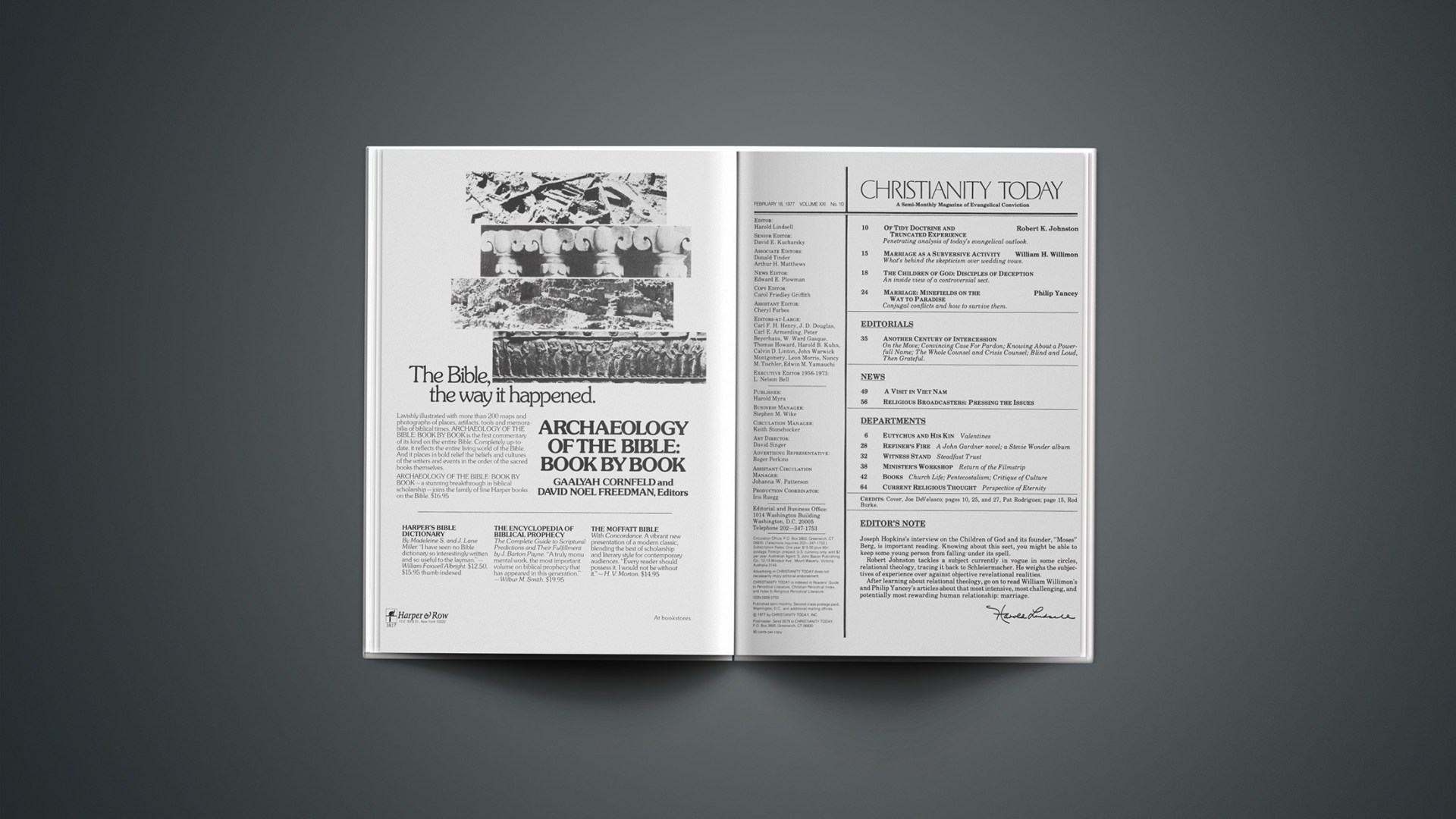
Joseph Hopkins’s interview on the Children of God and its founder, “Moses” Berg, is important reading. Knowing about this sect, you might be able to keep some young person from falling under its spell.

Robert Johnston tackles a subject currently in vogue in some circles, relational theology, tracing it back to Schleiermacher. He weighs the subjectives of experience over against objective revelational realities.

After learning about relational theology, go on to read William Willimon’s and Philip Yancey’s articles about that most intensive, most challenging, and potentially most rewarding human relationship: marriage.

The Evangelical’s Duty to the Latin American Poor

The voices of those locked in hopeless poverty in Latin America should ring in the ears of Christians north of the border. The miseries there are, whether we recognize it or not, burdens upon our consciences.

Before the presidential election last November the National Council of Churches publicized “An Open Letter to North American Christians.” Taken at face value, the letter is something that no sensitive evangelical can read without conviction and sadness. While ignoring the denials of civil rights and distortions of justice by the present government of Cuba and the fact that Cuba is locked into an exploitative system, the document is moderate in tone and speaks eloquently for the voiceless.

Regrettably, voices like these tend to be drowned out by the strident tones of the advocates of liberation theology. This theology has been patterned after such models as black and feminist liberation. It represents one possible response of concerned Latins to oppressive economic and political situations that seem totally unresponsive to peaceable attempts at change.

Advocates of such a theology face serious perils—or at least serious temptations—that we need to take into account as we hear them.

One peril that shows through the literature of liberation theology is an uncritical use of biblical models. The major model currently in use is that of the Exodus. Rather too easily, in my opinion, Latin American theologians assume that today’s oppressed people are the heirs of God’s Exodus—that they are the present-day counterparts of the Israelitish people in Egypt.

Seldom are all facets of the Exodus account considered. For instance, Moses’ abortive use of violence as a means of deliverance, with its forty-year cooling-off period, is seldom mentioned. Nor is it observed that the Exodus was Jehovah’s deliverance, not a seizure of power by an underground movement.

Attempts to domesticate God have not been particularly successful in the past, and there is little reason to suppose that this current form will be any more effective. It is precisely this form of idolatry that emerges as any group assumes for itself a “people of God” role.

It is disturbing that liberation theologians do not give more attention to building a set of common values and adequate symbols among their peoples. Without these, any liberation by violence will probably lead only to a change of oppressors. Mere oppression neither makes any people to be “the people of God” nor guarantees that a victory by force will produce lasting liberation.

A second peril grows out of the first. Some liberation theologians suggest that the Exodus is a model by which all oppressed peoples, regardless of their circumstances, can understand their plight and find deliverance from their miseries. It may be questioned whether the Bible can be used indiscriminately to justify all political and economic struggles.

A third peril lies hidden in the rationale advanced for this position. Hugo Assmann, who with Gustavo Gutiérrez and Juan Luis Segundo may be regarded as a spokesman for Latin liberation theology, highlights this aspect of the problem. In his Theology For a Nomad Church, Assmann makes clear the movement’s assumption that the purely “salvationist” understanding of the Christian mission has been rendered obsolete by what Gutiérrez calls “the unvarnished affirmation of the possibility of universal salvation.”

By this historicizing (or relativizing) of the Scriptures, the liberation theologians think they have effectively disposed of the historic understanding of the Great Commission. They suggest that the “liberating” work of the Church is now a purely horizontal thrust into the world. The dualism of nature-grace is set aside in favor of what Segundo calls the “salvation of history” rather than salvation history.

This points to a further peril, that of supposing that a “pilgrim church” must necessarily be outside society, a “nomad church.” In practical terms, this means that liberation theology may fairly be called a “guerrilla theology.” Among the features of guerrillas’ mind set are these: they desire direct confrontation with all opponents; they consider themselves alienated outsiders; they give priority to “psychological and motivational superiority”; and they seek to prove themselves by slaying the oppressor.

Latin liberation theology appeals largely to Marxist models. This accounts for its simplistic assumption that all human ills grow out of the misdoings of one class, which is regarded as the bearer of all evil. In the radical form of this theology, North American capitalism is seen as the sole cause of injustice and misery in Latin America.

Its advocates can thus easily adopt the myopic stances of the United Nations World Population Conference in Bucharest and the World Food Conference in Rome, both held in 1974, and close their eyes to the problems raised by burgeoning populations and tradition-hindered ways of agriculture. This is a source of great confusion.

A guerrilla movement may derive motivation from simplistic assumptions like these. It will at the same time serve to turn off responsible persons. And while many Latins may think in broad Marxist categories, they are not fools. They understand that in Marxist lands, one set of injustices has been exchanged for another.

The letter mentioned earlier reflects a reasoned outlook at this point. Its writers recognize that at least some of the miseries and frustrations in Latin lands stem from “our own weaknesses and sins.”

How shall evangelicals respond to liberation theologies? They must first distinguish between voices and decide which are responsible. On the basis of this decision, they have at least a two-fold duty. First, they must serve as a voice for the poor and the disadvantaged in keeping their case before other believers. Second—and this is more difficult—they must bring pressure to bear upon government(s) to do two things: first, to stop supporting oppressive regimes, whether of the right or the left, for political and economic advantage; and second, to restrain by regulation business interests and institutions that exploit men and women below the border. The followers of the Friend of the Poor can do no less.

Fighting Cults: The Tucson Tactic

Even though Pam Werner, daughter of Dr. and Mrs. Sidney C. Werner of Scarsdale, New York, had been in the Unification Church for a number of months, she maintained periodic contact with her parents—an act discouraged by leaders of the controversial Korean-offshoot sect founded by Sun Myung Moon. When Moonie leaders in New York learned, however, that Pam, 28, had told her parents of her whereabouts, they changed her name and forbade further contact.

But Pam agreed last September 18 to meet her parents briefly at the Washington Monument while they were visiting the capital. At that meeting Pam’s mother persuaded her to meet for “shopping” in a nearby Maryland suburb the next day. What Pam didn’t know was that the parents were armed with a court order, a team of deprogrammers, and a body guard, ready to take her off for intensive “deprogramming” from the cult. The two young attorneys who head the Freedom of Thought Foundation, based in Tucson, Arizona, had been unable to get the usual “temporary conservatorship” (guardianship) order from a Washington judge, but they had secured one from a judge in nearby Maryland.

The next day, after six weeks of tailing the girl, the deprogrammers, plus local police, served the papers and whisked her off to a motel, then on to Ohio, where it took three days to “break” her from the rip of Moon doctrine.

After that, she spent thirty days in “rehabilitation” at the Freedom of Thought Foundation ranch, perched on a bluff on the outskirts of Tucson. Then she went home happily with her parents, who are of Unitarian background. They had spent at least $10,000 for the deprogramming.

Deprogrammings aren’t new; they’ve been going on at least since the San Diego-based patriarch of the art, Ted Patrick, started breaking the rigid “mind control” some sects are alleged to have over young converts who renounce past life-styles, parents, and friends for the austere discipline and often heretical theology of the so-called new religions. Patrick is now doing time in a California jail for falsely imprisoning and detaining cultists against their will (see August 27, 1976, issue, page 4). He has been granted work-release privileges, a ruling that evokes expressions of outrage from his foes.

But the Freedom of Thought Foundation (FTF) is unique—and inside the law, apparently—because the two attorneys, Michael Edward Trauscht, 28 and Wayne Howard, 29, have found the only legal means so far for parents to gain custody of their children for a thirty-day period. The temporary conservatorship or guardianship document is issued by a judge on the basis of testimony from psychologists, physicians, former cult members, and often the parents themselves.

Trauscht, a restless, energetic former county prosecutor, says his deprogramming team has already extricated more than seventy young persons from the cults since the foundation “went legal” just over a year ago. Trauscht, Howard, and Joe Alexander, 58, the chief deprogrammer, would like to make Tucson the anti-cult capital of the world—and they just may succeed if court challenges fail to squelch their method of getting young people to “think for themselves” again.

But the cults, supported by vast resources and (in the case of Moon’s Unification Church and the Hare Krishna movement, for example) far-flung empires, are fighting back with their own lawyers. And some religious groups, like the National Council of Churches, civil-rights leaders, and organizations like Americans United for Separation of Church and State, are raising questions about the legality, propriety, and permanency of deprogramming tactics.

An outspoken opponent, during a Los Angeles press conference called by the headquarters of the International Society of Krishna Consciousness, called the FTF and the growing network of related deprogramming groups (nearly every major city now has one) “an outrageous nationwide conspiracy to deprive people of their civil and religious rights.”

Trauscht, in a hurried interview in Tucson between deprogramming forays, insisted that he agrees persons should be guaranteed freedom of religion, speech, and association. But, he added, “somewhere inherent in these rights is freedom of thought. We argue that the courts have a duty to see that those rights are not taken away.”

Senior deprogrammer Joe Alexander, a former auto dealer who claims to have deprogrammed about 600 persons in the past five years, his wife Esther, their son Joe, Jr., 25, and Trauscht and Howard opened the FTF rehabilitation center in Tucson with a $105,000 donation from the parents of a southern California young person deprogrammed from an Eastern religion.

Typically, a deprogram “rescue team” from the FTF operates like this: Trauscht acts as a legal consultant, Howard as a lawyer for the parents, the Alexanders and young ex-cult members as deprogrammers and as restrainers in case the subject tries to escape.

Tucson psychologist Kevin Gilmartin, 27, has frequently gone along to study the group or assist in counseling, though he says he never begins a counseling relationship unless hired by the parents with the subject’s approval.

“Prior to Trauscht’s legal precedent,” said Alexander, “we would snatch the kid on a street corner and hustle him to a motel room.” That kind of strong-arm approach is what landed Patrick in jail and precipitated criminal charges against an Arcadia, California, family several months ago for falsely imprisoning Madonna Slavin, a Krishna devotee. The Krishnas and the young woman also slapped a $2.5 million damage suit against her relatives and the deprogrammers (none was connected with the FTF).

Although the FTF approach, with the court order, is more sophisticated, the deprogramming target, after being watched during a stakeout for the appropriate moment for seizure, is still rushed to a motel room, usually within a short drive of where he is apprehended. There he is subjected to intense questioning, often for many hours spread over several days. The critical point is reached, deprogrammers say, when the subject suddenly “sees the light” and renounces his cultic faith.

“Look, I’m not here to take God out of your life,” Alexander told a young person under deprogramming recently. “I want you to realize that what you’re involved in is not of God.”

Not everyone on the receiving end of the deprogramming agrees, and some have returned to the religious group from which the FTF was trying to remove them.

One, Walter Robert Taylor, 22, a young monk taken from the Monastery of the Holy Protection of the Blessed Virgin Mary of Oklahoma City last July 15, returned to the monastery a few weeks later after being left unguarded in an Episcopal monastery in Phoenix. He recently told his story at press conferences, including one held at National Council of Churches headquarters in New York.

The son of a gynecologist in Richland, Washington, Taylor was raised an Episcopalian. He left college in 1972 to join the monastery, which is described as part of the Old Catholic church. Taylor’s parents claim the monastery was made up of Hindu followers at the time he joined. A Hindu group did occupy the Oklahoma City property at one time but left before the monks moved in.

(The Old Catholic movement grew out of protests against the Vatican in Europe many years ago. The only North American body officially recognized by the mainstream Old Catholic group is the Polish National Catholic Church of America, which claims 282,000 members in 162 congregations. The liberal ordination practices of several dissident Old Catholic bishops over the years has resulted in the formation of a number of small groups identifying themselves as Old Catholics. Many of their beliefs parallel traditional Catholic doctrine.)

In depositions in a case now pending before the Oklahoma Supreme Court, Taylor alleges that the guardianship proceeding was held without notice and in the absence of his attorney, that psychologist Gilmartin submitted a letter of professional opinion to the court “without ever having seen or examined me,” and that FTF deprogrammers abused him, kept him without sufficient food and sleep in a motel room presided over by a “goon squad,” and ripped off his monastic clothes while he was held down bodily by four persons. He was taken from Oklahoma City to a motel in Akron, Ohio, then to Howard’s home in Mesa, Arizona, where, alleges Taylor, Howard “discussed his sexual exploits and fornications and encouraged me to have sexual intercourse, which is contrary to my monastic practices and beliefs.” He says he was forced by Howard to sign legal papers to the effect that he didn’t want an attorney and that he would remain peacefully with the deprogrammers.

Next, he was taken to an Episcopal monastery in Phoenix “in an attempt to get me to change my monastic allegiance.” Left alone overnight, he telephoned his attorney, Charles Lane, also a member of Taylor’s Oklahoma City monastery, who sent him a plane ticket.

Meanwhile, the original guardianship order was voided by another judge a week after it was issued, and the case bogged down in legal hassles. At issue in the Oklahoma Supreme Court is whether Taylor’s parents can ever again institute guardianship proceedings.

The battle lines are forming. Lane says he wants to see the deprogrammers jailed as kidnappers. “This has gone completely beyond the borders of deprogramming members of cults,” declared United Methodist clergyman Dean Kelley, a church-state specialist with the NCC and the American Civil Liberties Union. Kelley believes the ACLU and church groups may mount a campaign to stop deprogramming. Andrew Gunn, executive director, of Americans United for Separation of Church and State, told reporters his group is studying the situation. He expressed concern “about the attitudes courts are taking” toward deprogramming. “The religious rights of everyone are imperiled if deprogramming is allowed to continue the way it has been,” he warned. Howard, however, says the claims are exaggerated and will not stand up in court.

Appearing in the New York press conferences with Taylor (known to his fellow monks as “Father Philaret”) was Deborah Dudgeon, 23, of Toronto. In 1974, she recounted, Ted Patrick and a team of Canadians attempted unsuccessfully to deprogram her after she converted to Roman Catholicism (she was raised a Protestant), dropped out of college in favor of pursuing social work, and joined a community of ten other young Catholics. Patrick was ordered to stay out of Canada by officials as a result of that case.

One of the most debatable aspects of deprogramming is whether or not physical force and abuse are inflicted by deprogrammers. Several former Moonies, interviewed at the sprawling ranch house used as the rehabilitation center, insisted that there was no physical harrassment during their deprogramming, though they were aware it would be futile to attempt escape during the first few days. They said Trauscht always tells a subject he will be free to go back to his cult after thirty days if he wants to.

According to Esther Alexander, who acts as a kind of “substitute mother” during the rehab period in the Tucson house, no one who has stayed the full month has returned to a sect. “We make friends with the kids first,” she said. “They are allowed to eat and sleep as much as they wish, play games, or work on crafts. Sometimes I take the girls into town for shopping.”

No effort is made to indoctrinate the deprogrammees with any specific religion during their stay at the ranch, say spokesmen, though nonsectarian prayers are said before meals. During the final week they are usually allowed to have Bibles in their possession; before that Bible reading is discouraged “because of the way it has been twisted and programmed in the convert’s mind,” according to Alexander, who was raised a Roman Catholic.

Gilmartin, the psychologist, says he wholeheartedly supports the FTF but is not a member of the team. The worst aspect of the “new religion” cults, he says, is “a lot of waste in potentially very creative people.” He believes “some kids have been helped by the cults—others devastated.” Those particularly susceptible, he believes, are young people “just entering adulthood, bright people who are abstractly related, often into things like painting and philosophy.”

Many former cultists, however, testify they were “psychologically kidnapped” by cult leaders who turned them into glassy-eyed “robots for God.”

An Oakland, California, attorney is going all out to break the chain of legal victories won by the FTF. Ralph Baker, representing a young man who rejoined the Moonies after an abortive deprogramming, says he is seeking a “test case” to challenge the constitutionality of the temporary conservatorship approach. He is convinced that it is a misuse of the law, which was originally designed to protect the elderly and senile from irrational acts such as giving away all their money.

The battle has begun to determine just what kind of coercion or “mind control” is involved, both in cult proselytism and in deprogramming, and the courts may well be the arena for the fray.

For frantic parents, the attempt to “rescue” a son or daughter from a cult is costly. Legal fees alone can run $3,000 to $5,000. With transportation expenses of the professional deprogrammers, motel rooms, meals, and other costs, the tab can easily reach $25,000.

Whatever the cost, business is brisk. “I’m getting twenty to fifty calls a day from worried families,” Trauscht said recently. “People are begging for help.”

Alexander, who said he gets ten requests to deprogram Moonies for every one to deprogram a follower of some other religious group, told of a man who pleaded for help for his 16-year-old daughter, who apparently was taken from a laundromat and was last seen on the West Coast with Moonies.

“You ask me how can I do this?” Alexander shrugged. “How can they do something like that?”

Scientology: Filing On

An “amicable settlement” was reportedly reached in a $1.5 million libel suit filed in Los Angeles in 1971 by the Church of Scientology against the publishers and author of the book, The Scandal of Scientology. Financial details were not disclosed. The church said it has agreed to withdraw the charges, and the author, Paulette Cooper of New York, has agreed to sign a statement of apology and admission of error.

Claims against Tower Publications, the publisher, were dropped in 1974 following a settlement in which Tower withdrew the paperback book from the market and paid a nominal cash settlement of $500, according to a Los Angeles Times report. Tower also issued an apology to the church. Officials of Tower said pursuing the matter was not worth the legal costs. Court records show that Tower won a ruling in 1973 that it had been improperly served with documents in the suit.

Last month Gregory Taylor, 26, a Church of Scientology member who was wrongly arrested in September in an apparent case of mistaken identity, filed a $750,000 suit against officials involved in the case, including agents of the Federal Bureau of Investigation and the Internal Revenue Service. The agents were allegedly seeking to serve an arrest warrant on a former member of the Church of Scientology on charges of using forged government identification in order to gain access to confidential records. The IRS acknowledged the error and apologized in a letter.

On another front, the Scientologists have been filing a number of requests under the Freedom of Information Act (FOIA) to determine what the federal government has in its files on them. After a three-year legal struggle with the Federal Bureau of Investigation, the Scientologists recently obtained documents that “indicate the FBI employed illegal search and seizure against the church,” according to a Scientology release. The records allegedly show that the FBI in 1958 investigated a film the church was producing and “seized” the film from the manufacturer for private viewing.

In early 1975 the church appealed to President Ford to direct federal agencies to make available “to any religion or church, upon their request, any records or information collected on that religion and its activities, and to expunge from those files and records … any false, malicious, or defamatory information that can be proven to exist.” Months of hassling with White House personnel ensued, and not long ago Administration officials ended the discussion by expressing belief the federal agencies were abiding by the FOIA. They suggested that if abuses were suspected the Scientologists should go to court.

A number of other church groups are also seeking access to files under the FOIA, but they have had little success so far, according to news releases. The groups include the U.S. Jesuit Conference, the American Friends Service Committee, the United Church of Christ, the Mennonites, and the Mosque of Islam.

The Church of Scientology has also responded to attacks on it by General Secretary Philip Potter of the World Council of Churches. In a speech in North Carolina last fall, Potter likened Scientology to totalitarianism, saying it produced a “kind of religiosity, a certain kind of schizophrenia … a judgmental mind.” Criticizing it and the Unification Church, he said both movements can produce a “criminal personality,” are “quite frightening,” and prey on “sensitive spirits.”

In reply, Joyce Gaines, a Scientology public-affairs officer, called for the promotion and strengthening of dialogue between churches, not its destruction. Religions ought to join together “to bring about peace of mind and trust in one’s fellow man,” she commented.

Scientology’s founder, L. Ron Hubbard, and his family recently experienced personal tragedy. A young man who died under mysterious circumstances in Las Vegas in mid-November was identified weeks later as Hubbard’s eldest son, Geoffery Quentin McCaully Hubbard, 22, of Clearwater, Florida. He was found in a semi-comatose condition in his car near the Las Vegas airport, and he died a short time later in a hospital, where he was listed as a “John Doe.” Police and private investigators were looking into the death last month.

Brazil: Indian Fight

Interior Minister M. R. Reis of Brazil says his government will ban all Protestant and Catholic missionaries from work among the country’s indigenous Indian tribes next year unless they cooperate with official policy. The government has called for the rapid integration of Indians into modern society. Bilingual education will be ended; the Indians will be taught to read and write only Portuguese. They will be responsible for preserving their own culture, asserted Reis in published reports. He claimed he had never seen a religious mission help Indians make progress. One tribe, said he, lives in misery within six miles of settlers with modern conveniences.

Mission leaders, anthropologists, and even government Indian officials, however, contend that the policy will condemn the primitive tribes to cultural extinction and social disintegration. The missionaries insist that the social welfare of the Indians is a high-priority item in their work. They also criticize the rapid expansion of settlers into Amazonian lands, saying it has resulted in exploitation, social disintegration, and deadly disease among the Indians, along with the loss of traditional hunting grounds.

The Indians are believed to number between 100,000 and 200,000.

Graham on Drink: ‘Don’t’

Billy Graham said it again last month, but there are probably still people who believe he has failed to speak clearly enough on the beverage alcohol issue.

“It is my judgment that because of the devastating problem that alcohol has become in America,” the evangelist explained, “it is better for Christians to be teetotalers except for medicinal purposes.” He made the statement in a message prepared for delivery on his weekly “Hour of Decision” radio program. The date for airing the sermon, “The Abuse of Alcohol,” had not been announced by mid-January, however.

Meanwhile, Graham’s Minneapolis office printed the message in pamphlet form and used it to answer the inquiries about remarks attributed to him in news media around the nation. The subject came up initially in a Miami Herald interview. In the course of remarks about President Carter’s announced decision not to serve anything stronger than wine in the White House, Graham said that the wine of New Testament times was fermented and not simply grape juice, as some evangelicals contend. The evangelist said the paper’s article was accurate in its quotation “as far as it went.” However, when a news agency rewrote the Herald piece and circulated it widely it was distorted, he reported. People around the country wrote to him and to their local news media to object to his “new position,” and he then wrote the longer treatment of the issue. Among other things, Graham quoted biblical authorities as saying that wine of Bible times was a weaker variety than today’s.

“The creeping paralysis of alcoholism is sapping our morals, wrecking our homes, and luring people away from the church,” Graham declared in the message. While finding no foundation in the Bible for an absolute prohibition on drink, he appeals to the fourteenth chapter of Romans (the warning against causing a brother to stumble) as reason enough for Christians to abstain.

Deaths

Two well-known Christian figures died last month, both of heart attacks: Harry Willis Miller, 97, an American, and Bishop Hanns Lilje, 77, a German.

Miller spent twenty-five years in China as a medical missionary of the Seventh-day Adventist Church. A thyroid surgeon, he developed a process to make soybean milk to feed malnourished Chinese children. The product is now widely used among the 10 per cent of the world’s population allergic to regular milk. He founded several hospitals. Among his patients were Chou En-lai, Madame Chiang Kai-shek, Sun Yat-sen, Alexander Graham Bell, and William Jennings Bryan. He also served in Trinidad, Taiwan, Japan, and Libya. He died on his way to a church service in Riverside, California.

Bishop Lilje, an international Lutheran and ecumenical leader, died in Hannover, West Germany. He helped guide the reforming of German Lutheranism after the fall of the Third Reich. In 1944 the Nazis jailed him for preaching “inner resistance.” Because of ties to a group that attempted to assassinate Adolph Hitler, he was sentenced to death. He was saved by the advancing Allies “and the grace of God,” Lilje told interviewers later. He said he refused to be an active member of the resistance movement but gave pastoral advice to its members, conceding that with the realities of Hitler “there may be a situation in which violence is the only way out.” At the same time, he ruled out church support for “sheer bloody revolution.”

A noted linguist and author, Lilje took a tolerant attitude toward committed Christian leaders in eastern Europe who must make difficult decisions regarding witness and church activity. “From my own experience under the Nazis, I know that the lines are not always clearly drawn,” he said. This approach led to a controversy with the late Bishop Otto Dibelius over the extent to which a believer owes allegiance to an anti-Christian state. Even a totalitarian state has its authority from God, maintained Lilje, although he allowed for Christian resistance when a state turns against “the divine order and forces citizens to do the same.…”

He was presiding bishop of the United Evangelical Lutheran Church in Germany (a federation of eight territorial Lutheran bodies) for fourteen years, president of the Lutheran World Federation for five years, and a member of the Central Committee of the World Council of Churches since its formation in 1948 (he was a WCC president 1968–75). He retired from his administrative duties as bishop of Hannover in 1971.

Religion in Transit

Concern over excessive violence and sex on television is widespread. Chicago civil-rights figure Jesse Jackson, who now considers himself part of the evangelical camp, says he may attempt to mount a movement against it. A number of pastors across the nation are calling on their members to protest to sponsors; some churches plan boycotts. The Church of God (Cleveland, Tennessee) has announced a nationwide boycott of TV April 11 through 18 “as a symbol of our discontent” with “unwholesome” TV trends.

Nearly 100 persons identified with the anti-war movement last month made public an appeal they signed that was critical of Viet Nam’s human-rights record (see January 21 issue, page 47). It was made public after Dinh Ba Thi, the Vietnamese observer at the United Nations, rejected it. Two of the signers, Philip and Daniel Berrigan, now have second thoughts: they joined three non-signers (including Don Luce, president of Clergy and Laity Concerned) in complaining that the appeal was made public “in an irresponsible manner.” They say “new materials” from the Vietnamese show the human-rights problem is being worked on.

Bible Presbyterian minister Carl McIntire mortgaged his Faith Seminary property in Philadelphia for $425,000 to finance the purchase of radio station WXUR years ago. Then he spent $600,000, according to his calculations, in a losing battle to save the station when the Federal Communications Commission declined to renew its license. Now the mortgage company is demanding payment of the $202,000 balance on the seminary mortgage, and the beleaguered McIntire—fresh out of prospective lenders—warns that the school faces foreclosure. He placed some of his New Jersey shore properties on the market recently to help raise cash.

Campus Crusade for Christ recently hosted a “Campus Cults Summit Conference” attended by representatives of nine other Christian groups that work among college-age young people. The result, say spokesmen, will be a coordinated effort to reach cult members and “those who are subtly influenced by cult teachings.” A “campus cults resource kit” will be produced as part of the plan. Organizations discussed included Transcendental Meditation, the Unification Church, the Children of God, The Way, and the Local Church.

Editor Roger Dewey has announced the “temporary” termination of Inside, an evangelical social-issues magazine published by the Massachusetts-based Christians for Social Justice, in favor of a projected political newsletter.

In its first month of distribution, the American Bible Society’s “Good News Bible” sold one million copies—exceeding records set by other best-sellers. For example, evangelist Billy Graham’s book, Angels, God’s Secret Agents, the best-selling non-fiction book of 1975, sold 810,000 copies in its first three months, say ABS officials. They expect sales of ten million copies of the Bible during 1977.

The Washington National Cathedral (Episcopal) in the nation’s capital is in trouble. It has an operating deficit in excess of $2 million, according to news sources, and a total debt of more than $11 million. There have been reductions in staff, the cathedral will be open ninety minutes less each day to visitors and those wishing to pray, and other cutbacks have been initiated to reduce expenses by at least 25 per cent.

The two men Gary Mark Gilmore said he murdered last July had some things in common: both were descendents of Mormon pioneers, both were students at Brigham Young University, both had served as Mormon missionaries, and each left a wife and small child. Gilmore last month became the first person executed for a capital offense in the United States since 1967. A vigil of seventeen persons outside the prison was led by United Presbyterian executive William P. Thompson, president of the National Council of Churches. Other prominent clergy also participate.

President Paul Jacobs of the northern California, Nevada, and Hawaii district of the Luthern Church-Missouri Synod, has become the sixth LCMS district president to resign as a result of the doctrinal controversy in the Missouri Synod. He cited disagreement with LCMS leadership and policies. In a Dallas meeting, some middle-of-the-road district presidents laid down a five-point platform for the future direction of the LCMS. It speaks out strongly for maintaining inter-Lutheran unity, rights of local congregations, the validity of certain activities operating “independent of the official organization,” and a political process that is not “manipulated.”

There are perils to ministry in the inner city, as any urban worker knows. Last month Garnell Stuart Copeland, 35, the gifted organist and choirmaster at the Episcopal Church of the Epiphany in downtown Washington, D.C., came home late one evening after a churce service. Three youths jumped him outside his home and stabbed him to death in an apparent robbery attempt. Months earlier the church’s rector, Edgar Romig, was attacked and seriously wounded (he lost an eye) in the neighborhood after driving Copeland home.

Personalia

Arthur McKay, 58, pastor of Knox Presbyterian Church in Cincinnati, was named senior minister of the 1, 232-member New York Avenue Presbyterian Church in Washington, D.C., where Abraham Lincoln and other former Presidents worshiped. McKay is a former president of McCormick Seminary in Chicago and of the Rochester (New York) Center for Theological Studies. He was one of 254 candidates (including ten women) considered for the $31,835-a-year position, according to a WashingtonPost story. Among his predecessors was the late Peter Marshall.

Last year actress Ann B. Davis gave up her 25-year theater and acting career (“Schultzy” on the Robert Cummings TV show and “Alice” on “The Brady Bunch”) and sold her Los Angeles home to join a charismatic Christian community of twelve adults and six children at the Denver home of Episcopal bishop William C. Frey and his wife. The year since then has been “one of the best” of her life, she told a reporter. It all started three years ago with a quest for a deeper Christian experience and attendance at Bible-study and evangelism-training sessions in Hollywood (see October 10, 1975, issue, page 52). The Frey community is an attempt to live in the church and go to the world instead of the other way around, she said.

Stephen W. Nease was installed as fifth president of the thirty-two-year-old Nazarene Seminary in Kansas City. The school has 455 students, a 54 per cent increase in three years.

Pastor L. Doward McBain of First Baptist Church, Phoenix, Arizona, was named president of the American Baptist Seminary of the West in Berkeley, California.

Clayton L. (Mike) Berg, Jr., of the Latin America Mission has assumed the executive leadership of the mission, succeeding former general director Horace L. Fenton, Jr., who will represent LAM in an at-large ministry. LAM plans to move its headquarters from New Jersey to Miami.

World Scene

A new Protestant seminary in Yugoslavia has been accredited by the government and will be in a position to grant degrees at a university level upon completion of five years of work, according to a report published by the Lausanne Continuation Committee. The school, housed in a Lutheran church in Zagreb, has about thirty students. Leaders Vlado Deutsch of the Evangelical (Lutheran) Church and Josip Horak of the Baptist Union spearheaded the founding of the school as a result of their attending the 1974 Lausanne congress on evangelization. Of Yugoslavia’s 22 million population, 125,000 are Protestants. Large numbers are Orthodox (six million), Roman Catholic (five million), and Muslim (1.5 million).

All Southern Baptist Convention missionaries will be out of East Malaysia (on the north coast of Borneo) by mid-1977 because of unrenewed visas, according to SBC sources. It’s all part of the plan of the government of Sarawak state to “reduce drastically” the number of missionaries (others as well as Southern Baptists).

Inauguration Day, 1977: Heralding a New Spirit

Jimmy Carter’s phenomenal climb reached its climax last month when the devout Baptist layman from the peanut farmlands of southwest Georgia was sworn into office as America’s thirty-ninth president.

Carter, whose outspokenness about his spiritual rebirth led the way in making the nation’s Bicentennial year also the year of the evangelical, said his inaugural marked “a new beginning, a new dedication within our government, and a new spirit upon us all.”

He reached the top rung of his ladder out of obscurity by taking the oath of allegiance on a Bible given to him by his mother several years ago. It was opened to the sixth chapter of Micah, a well-known portion of which Carter used as the basis for his inaugural address: “He hath shewed thee, O man, what is good; and what doth the Lord require of thee, but to do justly, and to love mercy, and to walk humbly with thy God?”

Carter read the passage in the King James Version. He said that he also had before him the bulky Bible used by George Washington in the inauguration of the first President in 1789.

The new President did not otherwise invoke the name of God in his address, but his remarks nonetheless reflected a strong moral tone. He sought to communicate a sense of personal humility when he said, “Your strength can compensate for my weakness, and your wisdom can help to minimize my mistakes.”

Carter urged people to learn, laugh, work, and pray together. “In a spirit of common good,” he said, “we must simply do our best.”

He is only the third Baptist to reach the nation’s highest office despite the fact that Baptists outnumber all other American Protestant denominations. Presidents Warren Harding and Harry Truman also were Baptists.

Reflecting an often stated belief in leadership by personal example, he called on the nation to demonstrate that its system is worthy of emulation.

“We are a strong nation,” he declared, “and we will maintain strength so sufficient that it need not be proven in combat, a quiet strength based not merely on the size of an arsenal but on a mobility of ideas. We will be ever vigilant and never vulnerable, and we will fight our wars against poverty, ignorance, and injustice.” The ultimate goal to which he pledged to work was “the elimination of all nuclear weapons from this earth.”

Carter ended his speech by saying:

“I join in the hope that when my time as your President is ended, people might say this about our nation: that we had remembered the words of Micah and renewed our search for humility, mercy, and justice; that we had torn down the barriers that separated those of different race and region and religion, and where there had been mistrust, built unity, with a respect for diversity; that we had found productive work for those able to perform it; that we had strengthened the American family, which is the basis of our society; that we had insured respect for the law and equal treatment under the law for the weak and the powerful, for the rich and the poor; and that we had enabled our people to be proud of their own government once again.”

One of the most moving moments of the ceremony came when Carter at the outset of his speech acknowledged Ford, thanking him for what he had done to help heal the land. New Presidents have rarely mentioned their predecessors in inaugural speeches. Carter’s gesture evoked an ovation from the thousands of spectators packed onto the east grounds of the Capitol.

The invocation at the inaugural ceremony was pronounced by United Methodist bishop William R. Cannon of Atlanta. Cannon prayed that God would grant a “new and vital realization of thy sovereignty and our dependence,” and that he would save us from “the arrogant futility of trying to play God.” He asked for forgiveness of those sins that “marred our national character and impaired the effectiveness of our government in recent times.” Cannon’s prayer noted the “inestimable service” of Gerald Ford and the “brilliant mind” of Carter and his “exemplary Christian life and devotion to thee and to thy people.” (Reporters noted that Rosalyn Carter seemed to be reading her Bible while Cannon prayed.)

The benediction was delivered by Roman Catholic archbishop John Roach of Minnesota, who in praying for Carter and Vice President Walter Mondale, observed that “there is loneliness on the mountain. Grace that loneliness with your presence.”

A Jewish cantor from Atlanta, Isaac Goodfriend, sang the national anthem at the close of the inaugural ceremony. Protests had been voiced that there were no clergy from the Jewish and Greek Orthodox faiths on the program. According to Religious News Service, Rabbi Marc Tanenbaum, national director of interreligious affairs of the American Jewish Committee, called Goodfriend’s appearance “a sop to the Jews.” Tanenbaum and Father John Tavlarides, pastor of a Greek Orthodox cathedral in Washington, also expressed concern that having a cantor sing the national anthem mixes religion and patriotism.

One of the notable firsts of the 1977 inaugural was an early-morning outdoor “People’s Prayer Service” on the steps of the Lincoln Memorial. A crowd estimated at more than 5,000 braved twenty-degree cold to participate in the half-hour event. Carter’s pastor in Plains, Georgia, the Rev. Bruce E. Edwards, took part along with the President’s sister, Ruth Carther Stapleton, and Martin Luther King, Sr., a retired Baptist minister. Among the musicians was the well-known Metropolitan Opera soprano, Leontyne Price, who sang “He’s Got the Whole World in His Hands.”

King delivered a short sermon from the same spot where his late son gave his famous “I Have a Dream” speech during the march on Washington in the summer of 1963. The elder King took his message from Christ’s words to Peter, “Lovest thou me more than the least of these? Feed my sheep.”

Parts of the service, including a closing illustration cited by King, were drowned out by commercial jets taking off from the nearby Washington National Airport.

After breakfast on Inauguration Day, Carter watched the Lincoln Memorial service on TV, then attended a private “Pre-Inaugural Service of Prayer” himself at First Baptist Church. With him was his family, Mondale, Cabinet designees, aides, and members of their families. The service, planned about three weeks earlier, began at 9 A.M. and lasted almost an hour. It was closed to the public, press, and even members of the church, except for ushers and four dozen choir members.

There was one congregational hymn (“O God, Our Help in Ages Past”), with two solos by Myrtle Hall of King’s College (known best for her appearances at Billy Graham crusades), prayers by several clergymen (including pastor Charles A. Trentham of First Baptist), and a short sermon by pastor Nelson L. Price, 45, of the 5,000-member Roswell Street Baptist Church in Marietta, Georgia. Price has been a “prayer partner” of Carter since eight years ago when they were both speakers at a Junior Chamber of Commerce meeting.

Price, using Colossians 3:23 as a text (“Whatsoever ye do, do it heartily as to the Lord”), summed up his message afterward in an interview: “Let the Spirit of heaven permeate the new spirit of Washington with a new commitment to personal purity, prolific prayer, and proper principles.”

Trentham prayed that Carter’s family life would survive “the pressures of public responsibility.” “Let nothing sully the clear image they bear of honor, integrity, and loving concern,” he implored. (A church spokesperson said the Carters planned to visit both First Baptist, where Harry Truman worshipped, and Calvary Baptist Church during their first Sundays in Washington. Both churches are about seven blocks from the White House.)

Another clergyman who led in prayer was Mrs. Mondale’s father, John Maxwell Adams, emeritus chaplain and religion professor at Macalester College.

On the last Sunday of 1976, Carter and his wife and daughter attended the United Methodist church in Plains. There they heard a sermon by Bishop Cannon in which he predicted a new era of compassion and justice in American life. Thirty years ago the Carters were married in the church, where Mrs. Carter had been a member.

The following Sunday the Carter family was back at the Plains Baptist Church, as were two bishops and two laypersons from the predominantly black African Methodist Episcopal Church. The group said they had come to show their support for Judge Griffin B. Bell, Carter’s choice for attorney general. Bell had come under attack from some civil-rights groups because of some of his decisions as a judge and because he belonged to three private clubs that exclude blacks and Jews. One of the bishops, I. I. Bearden, is board chairman of Morris Brown College, which named Bell its “man of the year” in 1976.

The Plains Baptist Church is now on record as having its membership rolls open to otherwise qualified blacks, but no out-of-towners need apply. The congregation unanimously rejected clergyman Clennon King, another black man, and a white woman after it became clear that they lived too far from Plains to be able to carry out the spirit of the church covenant. A Baptist Press release observed, “Southern Baptists encourage new members to join churches in the immediate community so they may be active.”

King, whose home is in Albany, Georgia, had appeared at the church the Sunday before Carter’s election, triggering a congregational crisis (see December 3, 1976, issue, page 50). The members subsequently voted in principle to admit blacks to membership and in so doing gave a vote of confidence to pastor Bruce Edwards, who strongly advocated the open-door policy. Only one family has left the church reportedly as a result of the controversy. Some younger members of a nearly black church are said to be planning to try to transfer their membership to Edwards’s church.

King had failed to meet with an examining committee prior to the vote on his application. Edwards said that he had been unable to reach King to advise him verbally of the meeting but that he had been sent a notice of it.

The same Sunday that the vote on King was taken Carter taught the men’s Bible class for the last time before his inauguration. The subject was, “Jesus Facing His Call.” Carter was to be in Plains for one more Sunday but said he preferred not to teach on the topic scheduled for then: “A prophet is without honor in his own country.”

Edwards himself planned to be away from the church on Sunday, January 30, and the sermon that day was scheduled to be delivered by James Hefley, a well-known evangelical author who is compiling a book on the Carter roots in Plains.

Carter is expected to be watched closely by religious leaders and by many others who are curious about what kind of personal style will emerge from his born-again faith. The first indication came in an interview in People magazine where Carter said he intended to revert to a “wine only” policy during White House social functions. “That is my present intention,” Carter said. “Most of the Presidents have not served hard liquor at receptions.” People said “wine only” was the drinking policy at the White House until John F. Kennedy became president.

There is also interest in some details of Carter’s theological beliefs. The Atlanta Constitution said last year that Carter did not “believe in such biblical accounts as Eve’s being created from Adam’s rib and other such miracles.” Carter is reported to have written the Constitution denying the article and saying, “I have never made any such statement and have no reason to disbelieve Genesis 2:21–22 or other biblical miracles.”

Graceful Exit

President Gerald Ford closed his State of the Union address with a prayer:

“May God guide this wonderful country, its people, and those they have chosen to lead them. May our third century be illuminated by liberty and blessed with brotherhood, so that we and all who come after us may be the humble servants of thy peace. Amen.”

Ford’s address before a joint session of Congress constituted a formal farewell after twenty-eight years in the federal government, including twenty-nine months as the chief executive.

He prefaced the prayer with the statement, “My fellow Americans, I once asked for your prayers, and now I give you mine.” He was referring to an appeal he had made upon being sworn in: “I am acutely aware that you have not elected me as your President by your ballots. So I ask you to confirm me as your President with your prayers.”

Ford’s dignified and spiritual goodbye included references to the separation of powers, which “places supreme authority under God, beyond any one person, any one branch, any majority great or small, or any one party.” When Ford was a congressman he met regularly with others in Wednesday prayer meetings. W. Barry Garrett, Baptist Press representative in Washington, wrote that “although during the first part of his presidency Ford dropped the regular prayer meetings to avoid a show of religiousness, he quietly and without publicity resumed private prayer sessions with his colleagues during the past year.”

Ford, an Episcopalian, was among those who attended a communion service at National Presbyterian Church on the morning that the new congress convened. The service has become a Washington tradition.

Here’s Life

Here’s Life, Dallas! Here’s Life, Philadelphia! Here’s Life, Portland!

All across the United States in 1976 that theme showed up, differing from place to place only in the name of the city. The evangelistic saturation effort spearheaded by Campus Crusade for Christ hit 165 metropolitan areas last year, and this year it aims for fifty more.

While the name of the overall effort is Here’s Life, America, the non-involved resident of target areas is more likely to remember another slogan, “I found it!” First it shows up on billboards and television, then on bumper stickers and in newspapers. Finally, if all goes according to the plan of Crusade’s founder, Bill Bright, everybody in the area will hear “I found it!” in person or on the telephone from a trained Christian.

Bright’s plan is probably the most comprehensive evangelistic scheme ever carried out in the United States. He had originally intended to present the Gospel to every person in the country by the end of 1976. Beyond that, he wanted to saturate the world’s population by 1980.

Even though the 1976 target was missed, the number of evangelistic presentations recorded during the year by Campus Crusade may still set a record. At year-end, officials reported that volunteers had made some 6.5 million personal contacts and that 536,824 persons had expressed a desire to receive Christ as Saviour. They note that these figures are incomplete since they believe many who made decisions because of the program never recorded them. They point out, for instance, that one television special was seen by an audience estimated at 50 million in its 240 showings, and that those deciding for Christ as a result of the telecast would not necessarily report to Here’s Life.

While there is a heavy use of the media in each area, success depends to a great extent upon the volunteer workers from local churches. The primary thrust of the plan is for a trained Christian to share Bright’s “four spiritual laws” with people who are willing to listen. At the conclusion of the presentation the listener is asked if he wants to commit his life to Christ, and a model prayer is recited for his guidance.

About two million people last year were curious enough to respond to the “teaser” advertisements, calling a central telephone bank to ask about “I found it!” Their names were assigned to volunteers in their own neighborhoods, who then tried to arrange appointments for face-to-face sharing of the Gospel. If they could not work out personal meetings, the workers either recited the four laws on the telephone or mailed a booklet to the inquirers.

Additional millions of Americans who did not ask for an explanation of “I found it!” heard one anyway when a Here’s Life telephone surveyor called them. Workers attempted to reach every home in their assigned areas to offer an opportunity to hear the Gospel.

The workers, trained in a fourteen-hour course, were encouraged to use a step-by-step presentation in their telephone survey to lead the listener to a point of expressing an interest in getting “closer to God.” Those with such an interest were then asked if they would like to hear the four laws.

Persons praying the prayer of commitment on the telephone were then visited by the workers and given a special Living Bible edition of the Gospel of John and aids to Christian living. They were also encouraged to join five-week Bible-study groups. At the end of the year, the total number enrolled in such groups was reported to be more than 60,000.

The workers at the heart of the campaign in 1976 came from 11,826 congregations of all major denominations, according to Crusade’s statistics. Over a quarter of a million Christians were trained, and most of them took a shift one night a week for three weeks at a neighborhood telephone survey center.

As many as half of the adult members of some churches had active roles in the campaign, but in others only a handful actually completed the training and accepted telephone assignments. For a variety of reasons many churches across the theological spectrum did not participate. From both fundamentalist and liberal camps there were a few who opposed it publicly.

On the national level, there was also opposition, but little of it appeared as theological opposition. Most of the opponents saw in Here’s Life a scheme by Bright to harness evangelicals for conservative political action. He denied, however, that the campaign had any political motivation. He also denied, in a letter to Time managing editor Henry A. Grunwald, that he had ever been involved in partisan politics.

Time, in its January 3 edition, said Bright appeared to have “undergone a political conversion of sorts” since he recently indicated that he was more optimistic about the nation’s future than he was early last year. In his letter responding to the article, Bright said the “conversion” was “actually renewed hope and optimism—a result of a spiritual movement that is sweeping across America as millions of Americans are turning to God. Historically, whenever individuals or nations turn to God the blessing of God is assured.”

Most of the objections have been to the techniques employed by Here’s Life, with writers in such publications as the Christian Century and the Banner of the Christian Reformed Church calling it a canned approach from which no deviation is permitted. Crusade officials have insisted, however, that cooperating churches are free to use any method as long as there is a clear and concise presentation of the Gospel. When the Banner published a pastor’s article opposing Here’s Life, it was run alongside an article favoring the campaign. The latter was written by an evangelism official in the denomination’s Board of Home Missions.

Some expected opposition from members of the Christian Reformed and other Calvinistic groups failed to materialize after the four-laws booklet was revised. For years Bright had been under attack in some Reformed communities, especially for the first law, “God loves you and has a wonderful plan for your life.” The 1976 Here’s Life version, “God loves you and offers a wonderful plan for your life,” found a much wider acceptance.

There were also significant changes in the fourth law. The early version read, “We must receive Jesus Christ as Saviour and Lord by personal invitation.” The beefed-up 1976 version is: “We must individually receive Jesus Christ as Saviour and Lord; then we can know and experience God’s love and plan for our lives.”

As is often the case in community-wide evangelistic efforts, there were some objections from church hierarchies because planners went directly to pastors and laymen without the permission of denominational officials. In Peoria, Illinois, for instance, the Roman Catholic bishop, Edward W. O’Rourke, wrote in his diocesan paper that Here’s Life was being conducted “without my knowledge or consent.” He went on to describe it as “incomplete … misleading, and mischievous” and “not acceptable in a pluralistic society.” The impetus of the campaign moved him to urge his own people to be more zealous in studying the Scriptures and evangelizing.

Campaign officials have stressed, especially since the pilot program in Atlanta, that follow-up by local churches is essential if Here’s Life is to have lasting effects. Since many of the people who respond to the telephone calls are not churchgoers, it was suggested that follow-up Bible studies be offered initially in home or other “neutral” neighborhood locations. Some churches that followed this suggestion nevertheless reported immediate jumps in attendance at their worship services.

Others, while unable to note any direct attendance increase, are still pleased with the results of their participation. Members of their churches who had never had any training or experience in presenting Christ gained that during the campaign.

A pastor in the Washington, D.C., area expressed his appreciation to the area Here’s Life executive committee chairman, John Broger, by explaining that he now has twelve “assistants” able and willing to help in the work of evangelism. Before the twelve lay members participated in the campaign’s training and calling, he had none. Broger, the veteran director of information for the Armed Forces at the Pentagon, said another pastor told him that Here’s Life gave him his first actual experience of leading a person to Christ.

The national capital area campaign, held after the national elections in November, contacted about one-fourth of the homes in Washington and its suburbs. There are approximately 800,000 households in the Washington television viewing area, and Here’s Life volunteers recorded contacts with 203,000 of them during the three-week calling period. Some of the 230 cooperating churches kept their special telephone banks after November, and workers are still calling neighborhoods that were not reached during the three-week period. Volunteers reported that 10,800 persons prayed to receive Christ during the capital area campaign.

Broger said 7,000 volunteers were trained in the Washington area. They worked in 150 telephone centers, some with as many as twenty telephones and some with as few as four. Training and administration were handled by twenty-two full-time Campus Crusade staffers, all of whom raised their support outside the Here’s Life local budget.

Here’s Life has had a high price tag. In the Washington, D.C., metropolitan area, the budget was reported at just over $200,000. In the five-county southern California area it was $600,000. The largest budget items are purchase of media space and telephone rentals. The volunteer workers usually pay for their own materials. Most of the funding comes from local businessmen, the rest from cooperating churches.

Crusade officials express hope that the churches involved in four-week campaigns in 1976 will now move into Phase II, emphasizing discipleship of both new and older Christians. A Phase III projected for 1978 is to involve more use of the media.

Meanwhile, for some cities, 1977 is the year of Phase I. The nation will probably get a better view of “I found it” than it has previously had this spring when the spotlight turns on for Here’s Life, New York.

A Veteran Out, A Lesbian In

There was talk of schism last fall after the Episcopal Church opened the priesthood to women. Now there’s more than talk. Clergyman Albert J. duBois, 70, coordinator of Anglicans United, announced the formation of a new body to be known as the U.S. Episcopal Church. Initially, said duBois, the new denomination will have about fifty parishes with “between 10,000 and 12,000 members.” It will use the 1928 edition of the Episcopal Prayer Book and observe traditional canon law.

A long-time leader in the Anglo-Catholic wing of Episcopalianism, duBois maintained he wasn’t leaving the Episcopal Church “as constitutionally established.” He added: “We represent the loyal remnant—the others have left us.”

Meanwhile, the Episcopal diocese of Colorado has decided for now not to contest in court the secession from the diocese by St. Mary’s Church in Denver. The parish voted in November to leave the denomination in opposition to the women’s ordination issue.

Conservatives in the Episcopal Church have differed on whether to stay in the denomination. Many already upset by liberal trends in church life expressed outrage last month when Bishop Paul Moore, Jr., of New York ordained an avowed lesbian at the Church of the Holy Apostles in Manhattan: Ellen Marie Barrett, 30, a doctoral student at the Graduate Theological Union of Berkeley, California.

Moore explained that “many persons with homosexual tendencies” are already in the ministry, and that Ms. Barrett is “highly qualified intellectually, morally, and spiritually to be a priest.”

Bishop William Frey of Colorado warned Moore in a telegram before the ceremony that his action seemed “totally irresponsible” and would harm the church. “Ordination of practicing homosexuals,” said Frey, “does not represent the mind of the church and is plainly contrary to the teachings of Scripture which we have all sworn to uphold.” And during the service, a priest of Moore’s diocese, James Wately, declared that Ms. Barrett had not rejected homosexuality as “a sinful life-style.” The ordination, he said, was “a travesty and a scandal.”

Ms. Barrett two years ago was a founder of Integrity, the “gay caucus” in the Episcopal Church, and she has been involved in homosexual counseling projects in New York and Berkeley.

Time quoted her as saying that her lesbian lover “is what feeds the strength and compassion I bring to the ministry.” Homosexuality, she has said, “is an alternative life-style that can be a good and creative thing.”

Ms. Barrett was the second admitted homosexual to be ordained in a major denomination. The first one was William Johnson of the United Church of Christ in San Francisco in 1973.

A Jesuit seminarian, Thomas Sweetin, told reporters last month in New York that he had been refused ordination to the priesthood because of his homosexual orientation. He said he has been “inactive” sexually in recent years but still believes homosexuality can be “viable.”

Book Briefs: February 4, 1977

Dooyeweerd Made Digestible

Contours of a Christian Philosophy: An Introduction to Herman Dooyeweerd’s Thought, by L. Kalsbeek (Wedge Publishing [229 College St., Toronto, Ont. M5T 1R4], 1975, 360 pp., $12.50, is reviewed by Robert Countess, first battalion chaplain, Army Engineer Center Brigade, Fort Belvoir, Virginia.

For those who have wanted a clear and concise introduction to the philosophy of Dooyeweerd, the long wait is over. Who is there whose initial response was not dismay when he was introduced to the four ponderous volumes that make up Dooyeweerd’s magnum opus, A New Critique of Theoretical Thought? Those who ventured to open a volume and read a sentence or paragraph (is there a difference in Dooyeweerd?) were likely to sink back in despair over their inability to comprehend what appeared to be the English language. The English translation from the Dutch has been criticized by numerous bilinguals as being inadequate and at times misleading.

Perhaps one is acquainted with this Amsterdamer not through his own but through Rousas J. Rushdoony’s works. But it could be that one’s acquaintance stems from the virulent critique of Robert Morey’s The Dooyeweerdian Concept of the Word of God, in which Dooyeweerd and company are pictured as heretic, apostate, humanist, or worse. If so, then one would probably not care that a clear introduction to Dooyeweerd is now available.

But those who believe with Dooyeweerd and Calvin that “the true knowledge of ourselves is dependent on the true knowledge of God” should care. Those who hold that “What is man?” is the central question at the beginning and conclusion of philosophical reflection should care. Those who believe that man can regain true self-knowledge “only by surrendering to Jesus Christ, the word made flesh, the Redeemer who, by his word and Spirit, converts our inner being so that our heart again is directed to God” should care. Those who believe that “sin is the opposite of service; it is the false illusion that the human selfhood can be independent and self-sufficient, like God himself” should care.

Kalsbeek’s book is intended not for philosophers but for “persons with an interest in philosophy who discover that existing introductions and the extensive publications of Herman Dooyeweerd … are initially too difficult.” After a most helpful opening biographical sketch by Bernard Zylstra, Kalsbeek begins his first of thirty-eight chapters with the question “What is philosophy?” An answer is that “to philosophize is to discern the structure of creation and to describe systematically, i.e., in logical order, what is subject to that structure.”

Then he launches into one of his many excellent illustrations from everyday life—this one, the report of an event in the newspaper, which demonstrates the many facets of the event. With this he is off running and philosophizing Christianly.

It is, to be sure, Christian philosophizing. Dooyeweerd has emblazoned over the door of his classroom “Know thyself,” and he believes with Calvin that only the believer in Jesus Christ can have true self-knowledge. For Dooyeweerd, the antithesis between those who worship and serve the Creator and those who worship and serve creation (or one of its aspects) is fundamental to philosophical activity. Even so, “the presence of a regenerate heart is no guarantee that a person will not err in his thinking and acting; neither can we conclude from a man’s error of thought or action that his heart is unregenerate.”

Kalsbeek’s chapters are short, averaging about seven pages, and he uses only a minimum of technical terms and foreign words. Some of the chapter topics may whet one’s interest: “Out of the heart are the issues of life,” immanence and transcendence, Archimedean point and arche, ground motives of Western thought, sphere sovereignty, isms, what is time?, the problem of knowledge, structures of human society (the family, marriage, state, church, voluntary associations), and philosophical anthropology.

Footnotes are relegated to an appendix. The bibliography contains more than 500 entries, which are divided into of, about, friends, and foes. Most readers will appreciate the nine-page glossary of terms, followed by indexes of persons and subjects. (I suggest that every philosophy and theology book be required by law to have a glossary of terms used in it!)

Serious Christians would do well to work their way through this book—and it will take work. Kalsbeek will be found to be an invaluable guide. He styles himself as spiritually akin to, rather than adhering to, Dooyeweerd’s philosophy. Occasionally he is the sympathetic critic. Always he is a gentleman.

Help For Males

Being a Man in a Woman’s World, by James Kilgore (Harvest House, 1976, 146 pp., $2.95 pb), is reviewed by Elaine Mathiasen, Boise, Idaho.

Kilgore wants to help men feel secure in their masculinity and experience satisfying relationships with women. His philosophy emphasizes that a man must examine his thoughts, feelings, and behavior and then totally accept himself. This frees him to accept other people and to give himself to others; he will no longer fear exposure in close relationships. This philosophy comes from Jesus’ admonition to “love your neighbor as yourself” and applies to men and women.

Kilgore discusses several characteristics that would help any man make his home or office a happier and more efficient place. These include assertiveness, awareness, leadership, enthusiasm, and positiveness.

In a chapter on sexual relationships, the emphasis is placed on the need for a man first to share his mind with a woman before giving himself physically. Men may be astonished that Kilgore advises them to reveal their inner selves to a woman for a closer physical relationship; women will simply applaud him. Kilgore also discusses the importance of thinking highly of a woman, rather than being critical. This principle applies to all relationships: what we expect from someone is usually what we receive. This chapter also suggests how to make changes if the sexual relationship needs improvement.

Kilgore gives other practical suggestions, too, such as a list of questions to consider before marriage. He tells of a way to find strengths in weaknesses, in oneself and in others. On divorce, he discusses the reactions and options of the suddenly single.

Kilgore deals with the physical and emotional makeup of men and only touches their spiritual side. It would be more helpful if the psychology of man was related to Scripture.

This is a simply written book on a complex subject and is timely help for the man experiencing “Women’s Lib.” Both men and women would profit from taking in this view of man’s world.

An Asian View Of World Religions

Parallel Developments: A Comparative History of Ideas, by Hajime Nakamura (Harper & Row, 1975, 567 pp., $28), is reviewed by Robert Brow, associate rector, Little Trinity Anglican Church, Toronto, Ontario.

So far comparative religion has been the preserve of Western scholars looking with Western prejudices at exotic Eastern religions. Radhakrishnan of India is only an apparent exception, since he was an Oxford professor rediscovering an elitist form of Hinduism via a Western education. But Nakamura, who taught philosophy at Tokyo University, is Japanese through and through. Now the eyes look with Eastern prejudice, and we feel uneasy, defensive, slightly angry, but the experience is salutary.

I was quickly indignant at the author’s ignorance of evangelical faith. It is hard to stomach “In Christianity, the emphasis is on the follower’s emotional reaction to or disposition toward such teachings as the miraculous birth of Jesus, his proclaiming himself the Son of God.” And to suggest that faith in Jesus arose in a similar way to faith in Buddha seems to me to be just plain historically wrong. To compare the vicarious suffering of our Lord to the aspiration of Buddhist saints that their merits might count for others is enough cause to pan the book outright. But then think of the hundreds of mindless assertions about Eastern religion that disfigure our books of comparative religion. At least this kind of look through Eastern eyes should discourage us from shoddy descriptions. Most missionaries would benefit from a few hours of work with Nakamura. And seminary courses in apologetics could be similarly improved.

I was constantly frustrated by the lack of an index. Passing references to Pythagoras and Heraclitus, Shankara and Madhava, Augustine, and dozens of other writers from East and West are dotted around in unexpected places. Without a name index there is no way to get at the author’s understanding of even one personality or religious movement without reading the book meticulously. But perhaps Japanese manners require the reading of a whole book as a courtesy.

The method is card-index scholarship. For example, section three of chapter two has strings of notes from the whole field of religions and philosophies under Materialism, Hedonism, Determinism, Skepticism, Asceticism. The author admits that one friend called it “mere clerical work,” but he modestly hopes he may have provided “much of the material for those more adventurous theories.” What he has given us is a scholar’s lifetime of notebooks and card-index trays. The book belongs in any serious library.

I find a book worth reading if I get two or three fresh insights. Nakamura is good for hundreds of seed thoughts, cheap at $28 for the lot. Here are some of my pickings. Wang Yang-ming (1472–1529) anticipated Bishop Berkeley’s view that all we can know is our ideas. The period of enlightenment that began in Britain with Bacon and Hobbes only appeared in India with British colonial rule. There is a fascinating connection between Zen monasticism and the Benedictines. Before Tao-hsin (586–651) Buddhist monks had been mendicants, but from that time Zen monks valued manual labor. A great unknown body of Japanese philosophical works written in classical Chinese and archaic Japanese awaits the study of Western scholars. No Eastern philosophers ever stressed the Western view of evolution in the sense “that something coming is superior to the former thing it replaced.” We assumed that evolution means progress: perhaps we are being forced back to the Hindu view that evolution is a terrifying round of misery to be escaped. The koans of Zen Buddhism and the Tantric sexual rites of Hinduism had no parallel in any other religion. Three hundred years before Luther the Buddhist Shinran turned from asceticism to grace, used the vernacular of the people, and stressed the sermon based on “the redemption which follows grace.”

Professor Nakamura rightly insists that there is no dividing line between religion and the great philosophies. I would add that you cannot even divide off the ideologies if they demand a total commitment from us. How could you divide Anarchism from Taoism, Plotinus from Hindu Vedanta, Zen from Existentialism? That being the case, Nakamura shows us the huge task facing serious evangelical scholarship. We can no longer be patronizing investigators of distant religions. We live in a pluralistic world, in many places on the defensive, and the battle of religions and ideologies rages all around us.

It is easy for us to see that Nakamura fails to be truly objective. His viewpoint seems to be rooted in a kind of Japanese logical positivism. But how can we be objective in the study of comparative religions and ideologies and yet committed to an evangelical faith? At least we could reject the temptation to talk about another religion until we have really grasped and felt its inner logic. And that applies as well to Moon religion, or Krishna Consciousness, Zen, or the queerest of Christian sects. There has to be an honest description, which I take to mean a description totally acceptable to a well taught devotee of the religion in question. If we do our job well, we will produce a natural history of the religions and ideologies that men live by, what makes them tick, their supreme pursuit. We then have to believe that if we set the Bible’s own description of Jesus Christ next to all other faiths, the Holy Spirit will do his own work of conversion. Why should the Spirit of truth wish to bless a dishonest comparison? When showing off the pearl of great price, we need never feel that other pearls might benefit by being seen exactly as they are.

The World Of The First Christians

The New Testament Environment, by Eduard Lohse (Abingdon, 1976, 296 pp., $12.95, and $6.95 pb), is reviewed by David E. Aune, professor of religion, Saint Xavier College, Chicago, Illinois.

One of the fundamental assumptions of modern biblical scholarship is that one cannot adequately understand and interpret the Bible without knowing about the various contexts (historical, social, cultural, and religious) within which its component documents were written. While the author (bishop of the Evangelical Church of Hannover, Germany, since 1971 and former professor of New Testament at Göttingen) affirms that the New Testament itself is the single most important source of information regarding its environment, the information presented in this superb introductory text has been gleaned from primary sources roughly contemporary with the rise of Christianity: literature, inscriptions, nonliterary documents (papyri), archaeological data.

The book is a remarkably successful attempt to summarize those environmental features that are of direct relevance for interpreting the New Testament. Lohse frequently correlates this background information with scriptural passages whose meaning is clarified by this additional knowledge. Although he never refers to secondary literature in the text (a five-page bibliography is appended to the book), he clearly has a commanding grasp of the general tendencies and results of modern research in the areas of Judaism and the Graeco-Roman world. The value of this book for classroom use could be enhanced if it were paired with a discriminating collection of source material such as C. K. Barrett’s The New Testament Background: Selected Documents or H. C. Kee’s The Origins of Christianity: Sources and Documents.

Lohse adheres to the traditional format for such introductions to the New Testament world by dividing his book into two parts, “Judaism in the Time of the New Testament” (181 pp.), and “The Hellenistic Roman Environment of the New Testament” (80 pp.). Giving more consideration to Judaism reflects a general tendency in New Testament research during the last twenty years more than the author’s own predilections. Similarly, the much shorter treatment of the Graeco-Roman environment is a sign of the relatively slight use that New Testament scholars have made of the potentially great contribution of classical studies. On this subject the views of two prominent evangelical scholars should be considered: F. F. Bruce, “The New Testament and Classical Studies,” New Testament Studies, 22 (1976), 229–42, and E. A. Judge, “St. Paul and Classical Society,” Jahrbuch für Antike und Christentum, 15 (1972), 19–36.

A number of weaknesses are in evidence: (1) The bibliography, an important feature in such an introductory text, suffers from a number of glaring omissions (e.g., the recent revision of Schürer, Safrai, and Stern’s first volume of Compendia Rerum Iudaicarum ad Novum Testamentum, and Yamauchi’s Pre-Christian Gnosticism). (2) While Lohse’s thirty-nine-page summary of Palestinian political history is superb, the volume lacks an adequate political history of various regions that served as theaters for the expansion of early Christianity (Greek peninsula, Asia Minor, Egypt, Syria). (3) In the author’s forty-nine-page summary of Jewish life and belief, the sometimes distinctive emphases of diaspora Judaism are largely passed over. (4) The section on the Hellenistic Roman environment lacks a treatment of the life and belief of Graeco-Roman peoples. (5) The burgeoning emphases on magic, sorcery, astrology, and demonology in popular belief and life are insufficiently treated. Nevertheless, Lohse has produced the best one-volume survey of the New Testament world.

Briefly Noted

CATHOLIC CHARISMATICS By now everyone knows that large numbers of Catholics are speaking in tongues and engaging in other practices formerly restricted to one wing of Protestantism. However, not everyone knows that the movement of which Ann Arbor is a major center is not united. J. Massyngberde Ford, who teaches theology at Notre Dame, opposes Ann Arbor, which she considers too Anabaptistic, and comes out in favor of a more Catholic expression of pentecostalism in Which Way for Catholic Pentecostals? (Doubleday, 143 pp., $6.95). Recent non-polemical presentations by pro-charismatic priests include: John Healey, The Charismatic Renewal (Paulist, 109 pp., $1.95 pb), which is introductory; Kilian McDonnell, editor, The Holy Spirit and Power (Doubleday, 186 pp., $2.95 pb), an intermediate-level overview; and Donald Gelpi, Charism and Sacrament (Paulist, 258 pp., $5.95 pb), an advanced theological essay.

Two recent and valuable classified bibliographies on bioethical and demographic topics (abortion, drug therapy, euthanasia, fertility, overpopulation, and the like) that are of increasing interest to Christian thinkers and activists are Bibliography of Society, Ethics and the Life Sciences: 1976–77 (Institute of Society, Ethics and the Life Sciences [360 Broadway, Hastings-on-Hudson, N. Y. 10706], 82 pp., $4 pb) and Sourcebook on Population: 1970–1976 (Population Reference Bureau [Box 35012, Washington, D. C. 20013], 72 pp., $3.95 pb).

The Tolkien Companion by J. E. A. Tyler (St. Martin’s, 531 pp., $12.95) is a dictionary with definitions and descriptions of words, names, and places in the writings of the late J. R. R. Tolkien. Tyler, intent on verisimilitude, treats Tolkien’s stories and fantasies as if they were historical or philological texts translated into English. Valuable for the Tolkien student and a good gift for the buff.

LOCAL CHURCHES and how to make them better are the subjects of a number of new books by evangelical churchmen. The Growing Local Church by Donald MacNair (Baker, 200 pp., $7.95) and Life in His Body by Gary Inrig (Harold Shaw, 182 pp., $3.95 pb) are overall presentations of the biblical data, with special emphasis on leadership and organization. Informal, sometimes quite helpful insights can be found in The Church Is People by Bob Brown (Broadman, 128 pp., $1.95 pb), Community and Commitment by John Driver (Herald Press, 94 pp., $2.95 pb), Beyond Renewal by Noah Martin (Herald Press, 211 pp., $1.95 pb), and A Church Without Walls by Odin Stenberg (Bethany Fellowship, 158 pp., $2.45 pb). Specific help for problem areas is provided in Working With Volunteer Leaders in the Church by Reginald McDonough (Broadman, 146 pp., $2.95 pb) and Great Church Fights by Leslie Flynn (Victor, 118 pp., $1.95 pb), on handling controversy. An appropriate emphasis to minimize fighting is presented by Gene Getz in Building Up One Another (Victor, 120 pp., $2.25 pb).

MONEY Giving is a matter of perennial concern both for those who lead organizations that are dependent on gifts and for Christians who are supposed to be cheerful givers. God’s Miraculous Plan of Economy by Jack Taylor (Broadman, 168 pp., n.p.) is a vibrant. Southern-Baptist-style challenge to give in all dimensions (not just financial) and to give according to God’s limitless resources (not just a percentage of one’s own). An Episcopal perspective, presenting various methods of fund-raising, is Jesus, Dollars and Sense edited by Oscar Carr, Jr. (Seabury, 117 pp., $3.95 pb). Scores of very short messages from verses throughout the Bible for use Before the Offering are shared by Raymond Bayne (Baker, 130 pp., $1.95 pb). A survey of teachings throughout the Scriptures is provided by Allen Hollis in The Bible and Money (Hawthorn, 129 pp., $3.95 pb). Conflicts over money trouble countless families. James Kilgore and Don Highlander, Christian marriage counselors, give practical advice on Getting More Family Out of Your Dollar (Harvest House, 192 pp., $2.95 pb).

Bible students are roughly familiar with what ancient Near Eastern people were up to, but what was happening in Africa, northern Europe, east Asia, and the Americas during the time of Israel and the early Church? Jacquetta Hawkes provides a well-illustrated comparative survey in The Atlas of Early Man (St. Martin’s, 255 pp., $15). She covers developments from 35,000 B.C. to A.D. 500. The dating before 5,000 is, of course, somewhat disputable.

TESTIMONIES to the power of God to transform lives are abundant. Recently there has been a tendency toward more honesty about the downs as well as the ups. Recent ones that may be of interest: What I Have Lived By by Charles L. Allen (Revell, 159 pp., $5.95), well-known preacher and author; Joni by Joni Eareckson (Zondervan, 228 pp., $6.95), quadriplegic artist (her mouth guides her pen); God of the Untouchables by Dave Hunt (Revell, 156 pp., $5.95), about Paul Gupta, an Indian Christian leader who is a convert from Hinduism; Surgeon on Safari by Paul Jorden and James Adair (Hawthorn, 173 pp., $6.95), about a surgeon and his large family on short-term mission in Kenya; Success Without Succeeding by Richard LeTourneau (Zondervan, 159 pp., $2.95 pb), son of the widely known construction-machinery tycoon; Out of the Sea by James Leynse (Good News Publishers, 190 pp., $3.50 pb), in which the author intersperses his own childhood recollections with the history of his native Netherlands; A Gift of Love by Gail Magruder (Holman, 160 pp., $6.95), whose husband, Jeb, was imprisoned because of Watergate and now is a leader with Young Life; No More For the Road by Duane Mehl (Augsburg, 159 pp., $3.50 pb), a pastor who overcame alcoholism; The Miracle Goes On by John Peterson (Zondervan, 220 pp., $6.95), autobiography of a widely known composer; Tomorrow You Die by Reona Peterson (Bible Voice, 142 pp., $2.95 pb), about a missionary visit to the most isolated European country, Albania; Scott Free by Scott Ross (Revell, 156 pp., $5.95), an entertainer who found that conversion to Christ seemed to make things worse.

The Prospect of Suffering

With communist Russia on the west and China in the east officially atheistic, with Viet Nam, Cambodia, and Laos now in unfriendly totalitarian hands, with self-perpetuating regimes in India, South Korea, and other lands repressing criticism of restrictive government policies, Christians in Asia are bracing for suffering, persecution, imprisonment, and even martyrdom in the decades ahead.

The fourth theological consultation of the Asian Theological Association, held recently in Hong Kong, put the subject of suffering centrally on its agenda. It considered the special ways in which Christians may maintain a witness in a hostile environment where churches are officially closed and worship services are forbidden.

Modern Western churches tend to approach religious suffering as an intolerable prospect in a civilization enlightened to the right of religious freedom. But the early Christians knew they were called to suffer for Christ (John 15:18–20). They knew that Jesus “learned obedience through what he suffered” (Heb. 5:8). And they knew that the Old Testament ideal of the Kingdom of God and of messianic hope centers in the expectation of the Suffering Servant, who by suffering for the many secures for them the removal of divine wrath. Jesus included suffering and persecution among the signs of his return (Matt. 24:9). Living in a world openly at odds with the purposes of God, first-century Christians expected persecution or suffering in some form: “Indeed, all who desire to live a godly life in Christ Jesus will be persecuted” (2 Tim. 2:13; cf. 1 Pet. 4:12; 5:9). Jesus’ disciples are to be fortified by his example of suffering (1 Pet. 4:1, 13). Herod’s determination to kill the Christ child was a harbinger of political hostility, and the stoning of Stephen a harbinger of religious hostility, to followers of the Christ. As pre-Christian leaders suffered for their messianic faith (Heb. 11:36–38), so Christians even in the Middle Ages and later had to contend with persecution carried out by professing Christians.

Even some modern nations that signed the United Nations’ Declaration of Human Rights are guilty of flagrant violations of the religious-liberty clause. Three Muslim nations—Mauritania, Afghanistan, and Saudi Arabia—have never admitted missionaries, and Libya, Iraq, and Syria now prohibit them, as does Buddhist Burma. In other Muslim lands, legal restrictions hinder conversion to Christianity; religious liberty is essentially viewed as the right of the non-Muslim to become a Muslim. Muslims view those of their number who become Christians as infidels worthy of death, and deprive them of property. Family relationships are terminated with the inflammatory cry that “Islam is in danger.” In Afghanistan, Muslims drove a convert to Christianity out of the country and leveled a new evangelical church in Kabul. Examples of imprisonment of Christians can be found where Islam dominates the socio-political scene, as in Indonesia.

The fate of Christians in some Communist countries recalls Jesus’ warnings of political hostility. Jesus prophesied that his followers would be hated by nations for his name’s sake. Solzhenitzyn’s writings have lifted a curtain on the extent of Russian religious repression and intolerance. Some Christians have languished for fifteen years in Chinese prisons and labor camps, with no prospect of release until they will deny their Lord. In Eastern Europe, Communists deny Christians the opportunities of university education, and atheistic party members ban them from professional and managerial positions because they resist the ruling philosophy.

Not only Communist lands but anti-Communist ones like South Korea regard any and all criticism of the ruling regime as politically subversive. Government agents entrench themselves within religious communities and institutions. Paul spoke of divisive and false teachers who would appear within the Church even as Jesus warned of those who would penetrate the circle of faith and betray the brethren.

Some Third World nations are reacting against Christianity as they recoil against colonialism, which treated national cultural values with contempt, and against technology, which uproots the established culture. In some African countries, tribal movements like the fanatical Mau Mau have ruthlessly persecuted Christians; in others, missionaries and national workers have become victims of politically hungry tribal leaders.

Saphir Athyal, president of Union Biblical Seminary in Yeotmal, India, stresses that Christians have no call to suffer on false charges. The early Christians defended their honor against Roman readiness to execute them for cannibalism through misrepresentations of their “eating the body and drinking the blood” at the Lord’s supper. Today revolutionaries, particularly Marxists, perpetuate the slander that Christians are other-worldly and disinterested in the human social predicament because they do not share the Communist ideology.

The attention of the worldwide body of believers should be fixed on those who bear pain and suffering for Christ’s cause. We who do not suffer for our faith may well ask ourselves why not. A church with no thought for suffering is easily lulled into a false sense of security, and it is prone to think it is innately armed to cope with all hostile forces apart from the power of the Spirit of God.

We are called, moreover, to pray for those who suffer, that their faith may remain strong, and to pray that rulers will be just. We are called to prick the conscience of a wicked world that readily acquiesces in the oppression of Christians. Christians living in the so-called Free World should fully publicize the wrongs done to believers by intolerant regimes. At the same time they should maintain a discreet public silence about the ways in which an underground church carries forward its witness, lest they needlessly impair its cause.

Faith to withstand suffering and persecution will spring from a knowledge of Scripture, which guards us from misreading hardship as a sign that God has abandoned his own. Since fidelity to Christ amid suffering is a test of true discipleship, fair-weather Christians have yet to demonstrate their “faithfulness to the end” (cf. Mark 4:17; 1 Pet. 4:12; Rev. 3:10). The New Testament term for “witness” is also the term for “martyr.”

But a firm knowledge of Scripture will also keep us from viewing Christian experience within a framework of the sovereignty of Satan and his hosts. The New Testament makes it very clear that Christ’s Kingdom is invincible, that even wicked oppression by hostile rulers whose doom is sure will be turned to the providential good of believers, and that history’s only inevitability is that the Word of God must be fulfilled.

Ideas

Who Is Shaping America’s Values?

Just when most of us were folding up the bunting, thinking the Bicentennial birthday party was over, along came a suggestion that it had just begun.

“Perhaps now that religious leaders are no longer spooked by fears of a berserk Bicentennial Americanism, they can point toward the Bicentennial Era in which we have twelve years to celebrate the Constitution,” proposed Richard R. Gilbert. (The Constitution went into effect in 1789.) The challenge in the dozen years ahead, said Gilbert in a summary article in Religion and the Bicentennial, is to do something about the whole system of values in America.

Gilbert, a former United Presbyterian executive who served on the staff of the New York Interchurch Center’s Project Forward ’76, believes “the most significant development for Bicentennial religion” is the emergence of the term “value” rather than “religion” to describe the country’s religious orientation. He visited seventy-five cities in forty-three states to drum up interest in a series of meetings on “American issues,” and he found that few church leaders wanted to have any part in “one more discussion group on civics.” He learned, however, that these churchmen reflected a keen concern among their constituents about “basic moral values.” What is right and what is wrong? What is fair and what is unfair? These are the questions that people were asking.

In Gilbert’s article, “The Nation With the Soul of a Church” (also printed as a separate booklet by the Interchurch Center), “valuing” is seen as “a way out of moral relativism without bringing back the evils of religious inculcation [in the public schools].” He adds, “In brief, thousands of public schools have opted for the values process without violating constitutional protections against value prescriptions. That’s the theory, although in practice teaching values is just as tricky as teaching religion.”

Whether Gilbert is right or wrong in concluding that “organized religion is no longer the leading generator of moral, spiritual, intellectual, or theological insights in America” remains to be seen. We are not ready to concede just yet that the educational system has taken over this role. We will agree, however, that organized religion can do more in this area. Evangelical Christianity, in particular, is in a position to exert much greater leadership in the choice of values.

Just as evangelicals had a vital role in America’s colonial and revolutionary era, leading up to the Declaration of Independence, so evangelicals should help to shape values in this era. Commentators who criticize Bible-believing Christians for trying to “foist their beliefs” off on unsuspecting fellow citizens should recall that some of the credit for America’s separation of church and state belongs to eighteenth-century Bible believers. Although the primary drafters of the Declaration, the Constitution, and the Bill of Rights might best be classified as deists, they were keenly aware of the convictions—and the plight—of their evangelical neighbors. Those non-establishment Christian neighbors were politically active, and they lobbied for religious freedom. And while they wanted no part of a state church, they made enormous contributions to early America’s system of values.

America is again at a critical point. Decisions must be made about priorities. What comes first, freedom, or justice, or mercy, or security and prosperity? Gilbert suggests that the interdisciplinary scholars will be making the decisions. “They realize that to go where the action is ethically and philosophically they must read sociology, psychology, literature, history, economics, and art criticism,” he writes. Granting, for the sake of discussion, that these are the people who will shape the nation’s values, let us ask who shapes their values. Secular humanists will be doing their best to exert their influence. Christians should do no less.

This is no time for retreat. When moral issues come up, whether in the local school board or in the trade associations, in state legislatures or federal courts, qualified Christians should be there. They should not default simply because someone will charge that their testimony represents “the church” or a “sectarian” viewpoint. They have as much right to express their views as the humanists do.

It may be a bit ambitious to think that the United States can get its values sorted out and in order in the next twelve years. There is no better time to start, however. Perhaps a better target date is the year 2000, the bimillenial of the birth of the one whose values are above all values.

Telling the Truth, Doing the Truth

Joseph was a shrewd operator, but he was first of all a person who told and did the truth. Unlike his brothers, who practiced deception to try to cover up his disappearance, he was a straight arrow.

One of the high points in his life is recorded in Genesis 45, when he reveals his identity to his brothers. They probably thought the government official who dealt with them was an Egyptian; they certainly had no idea he was their brother. When Joseph made his announcement, they were stunned and unable to respond (v. 3).

Although Joseph could not hide his emotions at this climactic meeting (v. 2), he came right to the point: “I am your brother, Joseph, whom you sold into Egypt” (v. 4). He immediately followed that bombshell with an assurance that he did not intend to pay back the harm they had done to him. He used the occasion to tell them the great truth that the whole affair was God’s scheme “to preserve life” and not their own plan (vv. 5, 8).

When the brothers regained their composure, Joseph was able to tell them about his successes and to provide them with the good things they had earlier tried to deny to him. He showed them the beauty of his own life when he promised (v. 20) and later produced the best that Egypt had to offer.

Joseph’s example in telling the truth throughout his life no doubt affected his brothers (albeit belatedly). They went back to their father and told him “all the words of Joseph” (v. 27). This time they did not try to alter the facts to keep Jacob from knowing the whole story. The truth was like a refreshing breeze to him; it gave him a new zest for living. Joseph’s father joined him in Egypt, and it was a place of blessing for his descendants for many years. That blessing was due in no small part to the quality of Joseph’s life, a life characterized by his commitment to telling and doing the truth. Ultimately, that commitment meant doing God’s will.

Others Say…

A Barrier to Christian Belief

David E. Kurcharsky, senior editor of Christianity Today:

Next time you say grace or kneel in private devotions, say a word of thanks to God for Francis A. Schaeffer, who has induced many people to think about the presuppositions—conscious or unconscious—that undergird their thought patterns and their actions. Schaeffer’s newest work, and his most comprehensive, How Should We Then Live? (Revell), promises to carry the self-examination goad even further.

Schaeffer is indebted to the more scholarly, substantive work of other evangelicals in philosophy, such as Gordon Haddon Clark and Cornelius Van Til. But no one can deny that he has gotten through to people who would not have been reached through the more conventional academic presentation.

Schaeffer has persuaded thousands that no one can avoid philosophies; one can only choose among them. He diligently lays bare the principles that, for good or ill, underlie much of the modern outlook on life.

The challenge he lays down is for Christians in a variety of disciplines and vocations to undertake parallel probes in their own areas of expertise.

Yet Schaeffer in this new book lets us down in his brief comments on the mass media. He laments, appropriately enough, the naturalistic presupposition evident in today’s newspapers, magazines, and radio and TV programs. But in doing so he seems to opt for the old “objectivity,” the journalistic outworking of positivism and other philosophies that elsewhere in the book he rightly condemns.

Mortimer Adler sheds light on our modern predicament. In his lectures and writings he traces “little errors in the beginning” in the spirit of Aristotle, who said, “The least initial deviation from the truth is multiplied later a thousandfold.” Thus evangelical concern for upholding the doctrine of biblical inerrancy pivots on the thought of what the consequences of not doing so would be. Similarly, Christian media will diminish their evangelistic effectiveness if they concede even small errors in crucial epistemological tenets. As a writer for Quill, the official journal of the professional journalistic society Sigma Delta Chi, said several years ago, “The problems of journalism, are, at base, philosophical problems.… Journalism is guided by philosophy—but it is whatever philosophy that the culture serves up in any given period.”

True, to some extent we must work within the prevailing system; this holds true for preachers and lay witnesses as well as for editors and writers. But Schaeffer eloquently reminds us that we must also call attention to philosophical falsehoods. Of particular importance are those aspects of the modern outlook that impair the communication of God’s provision of saving grace!

“Of all the little errors in the beginning that have plagued modern philosophy since its start,” says Adler, “the most serious is the one that was made in the psychology of cognition.” The error he cites seems small and somewhat technical: its most compact expression is found in John Locke (1632–1704) and has to do with failing to distinguish between sense and intellect. Actually, says Adler, the error originated with Descartes, known for his espousal of “clear and distinct ideas.” It led later philosophers to propound very complicated theories of knowledge, among the most notable of which was that of Immanuel Kant (1724–1804), who distinguished between “analytic and synthetic” judgments.

When all this filtered down to the popular level, the effect was to set up in the average Western mind a special category of knowledge commonly referred to as facts (and more recently in the vernacular as hard facts). This is the realm of the “objective,” a realm supposedly certain because of its confirmation by sense experience. It stands in opposition to the subjective, the realm to which value judgments and other “opinions” that cannot be verified by the senses are assigned. (If you don’t think that “fact” and “opinion” are relatively recent concepts, try to find them in the King James Version of the Bible.)

The domination of science in our age has further reinforced the human preference for “objective” data, so that he who questions “facts” is looked upon as mushy-headed. And, unfortunately, moral and religious propositions that deal with immaterial realities not directly confirmable in sense experience do not then qualify for such epistemological status. The result is that in the eyes of the world the proclaimer of the Word peddles a lot of second-class merchandise. His data cannot be “proved.” Schaeffer should be helping more Christians to see this problem, which is old hat to both secular and religious philosophers.

Christians use various rhetorical devices to breach this barrier, and a number of great minds in the secular world have begun to acknowledge that the great subjective-objective division is inadequate. But for most thinking people, this major impediment to Christian faith remains. To borrow from Shakespeare and another context, it is “the seeming truth which cunning times put on to entrap the wisest.”

I think that Christian journalism should get into this philosophical fray. It should expose the inherent weakness of the empiricist bias and encourage development of a sounder theory of knowledge. The cause of evangelism stands to gain, because to the extent that we reduce unwarranted intellectual encumbrances we will be confronting the non-Christian with the possibility of a “purer” act of the will, a decision more closely oriented to the basic question, “What do you think of this Jesus, who is called the Christ?”

Walking the Tightrope

The swiss Knie Circus was in full swing. Clowns were charging around soaking wet in an act where buckets of water kept spilling over their heads. Elephants were daintily balancing themselves on impossibly small spots. Acrobats were swinging and leaping through the air with breathtaking precision. Horses were marching, trotting, dancing, galloping, their black or white or satin-smooth beige coats gleaming.

Suddenly there was a hush. The tentful of people looked up at a wire that was being made taut. Children of all ages, teen-agers in blue jeans, dressed-up families, old people from a nearby home for the elderly, wheelchair patients from a rehabilitation home, rich people, poor people, the educated and the uneducated—everyone gazed intently at the wire; everyone had a sudden interest in the tightening of the bolts, in the testing steps of the tightrope walker.

A gasp escaped many lips as he started out. Step, step, step, waver, step, step—would he make it across? Then out of his pocket came a round plaque. He carefully bent to fasten it on the wire, put his weight a bit more on one foot, then shifted to the other, as viewers held their breath. Yes, he made it—up on his hands, feet perfectly straight above his head. Then back down again and on with his walk.

Balance—an essential ingredient in every area of life. When God created human beings in his own image, he created them to have perfect balance—and then they fell. In the fallen world there are no perfectly balanced people, but the Word of God provides the tightening of the bolts, so to speak, and gives us the kind of “tension” we need as we start out, stepping into life as Christians. I believe a net has been carefully provided for us: we bounce when we fall, and then get back up on the wire to try again.

And Adam said. This is now bone of my bones, and flesh of my flesh: she shall be called Woman, because she was taken out of Man. Therefore shall a man leave his father and mother, and shall cleave unto his wife: and they shall be one flesh” (Gen. 2:23, 24). How astonishing this is if you come to it with fresh interest, with ears to hear what is being said. It is the man who is to leave his father and mother and to cleave to the woman, his wife.

What does “cleave” mean? I stopped to make sure, telephoning my son-in-law to ask him to look the word up in Hebrew and also to look up its counterpart in the New Testament. He called back to tell me that the definition of “to cleave” includes a number of things: to be glued to, to be baked (like ceramics), to be stuck to (as one’s tongue to the roof of one’s mouth when it is dry), to cling to (as Ruth to her mother-in-law in the book of Ruth), and to stay with constantly, as a husband with his wife.

“Cleaving” has to take place when there is a danger of being separated. If everything is going smoothly and the little boat is not pitching or tossing, there is no need to “cleave” or “cling.” The practical moment for the husband to cleave to his wife comes when there is danger, a storm on the horizon or breaking over the prow of the ship. There must be some times in the marriage about which the man can say, “Look, dear, remember when I wanted to go to a football game and you wanted to go to the symphony concert and I ‘cleaved’ to you and took you to the concert?” “Remember when you wanted to swim in the ocean and I wanted to hike across the hills and I ‘cleaved’ to you and swam with you for days?” “Don’t forget the time when you felt the children needed us to take them to the zoo and on to a museum, and I wanted to get a baby-sitter for our day off, but I ‘cleaved’ to you and we all spent that unforgettable day together.”

To “cleave” to one’s wife is the command to the man, and it usually has to take place in the ordinary stuff of daily life. We can’t carry out God’s commands in the abstract. It does no good to repeat Scripture verses without living them out. To be a “doer of the Word” and not only a “hearer of the Word,” one must grasp the opportunity to live out a command.

“Wives, submit yourselves unto your own husbands, as unto the Lord. For the husband is the head of the wife, even as Christ is the head of the church: and he is the saviour of the body” (Eph. 5:23). This is clearly a framework that is meant to be observed. But if submission is stressed so loudly that the noise drowns out all the other music as a loud drum would drown out an orchestra if played without regard to the score, then the balance has gone.

Hebrews 12:1 tells us we are surrounded by a great cloud of witnesses, and likens our life to a race that is being observed. I feel it is possible to see this as the crowd watching the tightrope walker. We set forth on the wire, which has been tightened to just the right degree of tension by the One who alone knows our weaknesses, who also has put a net—his own arms—under us. The cloud of witnesses includes some who want us to balance and some who want us to fall.

In Ephesians 5 the balance is marvelously given, as we go on to how the husbands are to love their wives as their own bodies, even as the Lord loves the church. Then we come to this in Ephesians 5:30–32: “For we are members of his body, of his flesh, and of his bones. For this cause shall a man leave his father and mother, and shall be joined unto his wife, and they two shall be one flesh. This is a great mystery: but I speak concerning Christ and the church.” Here the admonition is also a reminder, a reference to Genesis and to Matthew 19:4 and 5: “Have ye not read, that he which made them at the beginning made them male and female, and said, For this cause shall a man leave father and mother, and shall cleave to his wife: and they twain shall be one flesh?” So Jesus himself clearly underlines what has been given in Genesis as God’s Word to the man out of whom he made Eve, and also as God’s Word to all husbands. A wonderful continuity is apparent in Ephesians as the fact is declared that believers, the bride of Christ, are “members of his body, of his flesh, of his bones.” Our perfectionist God, our detail-perfect God, gives us the spiritual counterpart of the physical making of the first bride. The first man Adam had a bride made out of his own body. The last Adam, Jesus, has a bride who became his bride because he suffered and died for her.

Thank God that Jesus, our Bridegroom, “cleaves unto” his bride. When we go out of his path, he does not let us go. Our heavenly Bridegroom is able to do for us things that no earthly husband can do, but still he is the example.

The “tightrope walker” walks on the wire of Christian life, dangerously leaning to one overemphasis or another, balancing with the help of the only One who can give balance. He has been given a balanced Scripture and will be given direct help in answer to prayer.

Refiner’s Fire: Andrew Wyeth: Oracle of the Ordinary

“I think one’s art goes as far and as deep as one’s love goes. I see no reason for painting but that. If I have anything to offer, it is my emotional contact with the place where I live and the people I do.”

American artist Andrew Wyeth loves the immediate fabric of life surrounding his private world. The fleeting glimpse of light hitting a weathered pail or fogged window pane or the subtle change in a familiar face can trigger the artist’s intuition to probe deeper and reveal the extraordinary in ordinary things.

The fifty-nine-year-old painter’s world can be divided between the seasons in two places: winter in the hills surrounding Chadds Ford, Pennsylvania, and summers since his boyhood on the seacoast around Cushing, Maine. Wyeth knows this limited domain as he does the palm of his own hand, and more creative images than can be harvested in a lifetime await his eye there. To see beneath the surface, to enlarge those personal observations of the familiar becomes a meditative process of self-discovery. As E. P. Richardson described it years ago in the Atlantic Monthly, “It was becoming clear to me as he talked that the aura of memory which is so strong in Wyeth’s pictures is not an element observed in the subject and painted by him; it is a feeling in the artist himself, intensely felt and powerfully expressed in a mysterious but cogent way through the subject.”

Wyeth found in his own back yard images profoundly stirring and beautiful because of the deep personal meaning they hold for him. Through painting these images, Wyeth often becomes his subject while achieving a detachment, an objectivity that lets us feel his subject for ourselves. In his article for Life, Richard Merryman quotes Wyeth: “I wish I could paint without me existing—that just my hands were there.” In discussing his portrait of Ralph Cline, Wyeth said: “It’s as though, when I painted ‘The Patriot,’ I’d disappeared, was disembodied—floating above it.” And we are transported, in seeing his work, out of ourselves by what Richardson has called “his power to translate simple objects to another plane of feeling.”

To a great extent, Andrew Wyeth’s achievement of selflessness is the result of the medium he has chosen for his major works: the exacting and time-consuming medium of egg tempera must be built stroke by stroke. In this Quattrocentro medium, yolk of egg is mixed with powdered pigments and applied in thin layers to the absorbent bone-white of a gessoed panel. “I really like tempera because it has a cocoon-like feeling of dry lostness—almost a lonely feeling. There’s something incredibly lasting about the material, like an Egyptian mummy, a marvelous beehive or hornet’s nest.”

The time delay between initial lay-in of color washes and the final articulation of specific textures and minute calligraphy of light gives the artist time to dream, time to become lost in the process, and time to drift away and view the work almost as a stranger to it. Building the intricate web of brushstrokes that finally crystallizes his image is an act of possession, a love in his labor.

Because the subject is often the kind of thing most of us leave unnoticed—something too ordinary or even too ugly to love—looking at a Wyeth can be a lesson in seeing the beautiful in all things. But egg tempera has a characteristic no other medium can match, a quiet luster. Its medium is light. And symbolically light plays a central role in Wyeth’s work. The source is unseen but all-pervasive.

Since his boyhood, when he was apprentice-trained by his father, the robust and expansive N. C. Wyeth, Andrew learned to look at things in a way that transcended the ordinary.

“My father taught me remarkable things, not only in the studio but just living with him. He didn’t put fences around me. He gave me the appetite for looking deeper, made me see the depth of an object. He made me paint still life, and would say to me. ‘When you’re doing that form and shadow, remember it is not just a shadow. It is something that will never happen again just like that. Try to get that quality, that fleeting character of the thing’ ” (Richardson, The Atlantic Monthly, June, 1964).

Before his father died in 1945, Andrew had achieved considerable success with brilliantly facile celebrations in paint that, in his mind, lacked depth or seriousness of intent. As he experienced a death-like gloom his work began to portray his deepest feelings:

“The first tempera I did after that is called ‘Winter, 1946.’ It’s of a boy running, almost tumbling down a hill across a strong winter light, with his hand flung wide and a black shadow racing behind him, and bits of snow, and my feeling of being disconnected from everything. It was me, at a loss—that hand drifting in the air was my free soul, groping. Over on the other side of that hill was where my father was killed, and I was sick I’d never painted him. The hill finally became a portrait of him. I spent the whole winter on the painting—it was just the one way I could free this horrible feeling that was in me—and yet there was a great excitement. For the first time in my life, I was painting with a real reason to do it” (Merryman, Life, May 14, 1965).

From this point on, Andrew Wyeth’s work becomes thoughtful and severely restrained, and, beneath the surface, his paintings begin to deal with life and death, and with personal freedom. Wyeth is not specifically religious, but Christians can read his work in deeply meaningful ways. Here is how I read two of his most significant works.

In his “Winter, 1946,” the hill looms up like a symbolic Calvary; the fence posts lead back like sentinels, pointing the way along a vague and rutted roadway, but fragments of melted snow hesitate, and the figure of the boy runs away. The strangely unrelated shadow of the boy is more the image of an adult; it points the way back in its arrow-like distortion. The hill is vast in its emptiness, and thousands of sharply focused blades of grass visually protract the journey back. Here we can see the pursuit of humankind by God. And we can see how frequently unable we are to comprehend that.

Wyeth gained as well as lost something by his father’s death: he became free. That hill became a portrait of the father, a sacrificial hill of loving and giving of the deepest kind. It reminds me of God’s sacrifice that we might live eternally.

By 1948, the struggle reached a resolution. In a striking tempera in warm golden tones, a girl, still low in the format, turns toward rising ground and directs our attention across a precise border of cut grass to a horizon no longer empty. Human dwellings are silhouetted against a cloudless sky: a barn, several outbuildings, and a large house, abandoned-looking yet permeated by a strange presence, are caught in a stark light. In “Christina’s World” Wyeth portrays acceptance and hope. Christina Olson, his neighbor in Maine, though partially crippled by infantile paralysis, kept house for her brother Alvaro after her parents’ death, and proudly refused help, preferring to drag herself instead of using a wheelchair. “This picture grew out of a very slight incident—simply the sight of her out picking berries near the family burying ground, looking back across the field toward her house where Wyeth was working in an upper room,” says Richardson.

The figure pauses, tense between a sense of repose and a struggle to move forward. The area of mown grass, above the ageless figure, divides the dwellings and the open horizon, a line between the here and the hereafter. Christina gazes across this gulf, wedded to the ground, but longing for release from her captivity. The laced belt around her waist is strangely chain-like. We look down on her prostrate body, subtly distorted (the arms echo the gesture of the crucified Christ painted by Grünewald). Christina for me becomes the Christ: we see the world through her eyes, and we can only reach the horizon from her position in the foreground by going through her. As in “Winter, 1946,” an incomplete rutted road shows the way, accented by sentinel fence posts. But here a ladder leans against the house, a reminder of the ladder Jesus’ friends used to lift his lifeless body off the cross. It is also a ladder to the sky. Like a subtle tremor beneath the reality of the painting, the reassuring words from John 14 seem almost audible: “Let not your heart be troubled: ye believe in God, believe also in me.”

The landscape looms like a wall. The dissociation between the figure and the texture of dry grass portrays the temporality of material life, the inevitability of death, and yet the hope of life after death. The vast field of dry grass and the old weathered house show that all things change and pass.

“Christina’s World” set the stage for many of the Wyeth works that have followed: the duality of human life is portrayed in the precise attention to the finite that is only a vehicle for the subtle sense of the infinite. The bleak isolation depicts our fears and doubts, our utter sense of alienation; but the all-embracing light reminds us of the source of all life and touches us with a sense of belonging. The people he paints are uneasy in this world (his black people and the collage-like silhouettes of figures superimposed over the landscape). There is often a stark confrontation with the earth (“The Trodden Weed”) and with symbols of death (turkey vultures in “Soaring,” sacrificial deer and dead crows). Confining chains, hooks, and traps remind us of our pains, but Wyeth glories in the patina of weathering and the rich brocade of textures painted with reverence and conserving love. In fragmented patches of snow, spring breaks through winter and, deep in dark woods, decay and rot fertilize the promise of new life, of resurrection, in innocent white flowers.

Andrew Wyeth paints our earthly existence while reminding us that it is only the beginning. The painting becomes a mirror, reflecting our longing for beauty, our longing for love, the artist an oracle pronouncing God’s love for us.

Bill Bristow is a painter and associate professor of art at Trinity University in San Antonio, Texas.

Modern Magic

Where do parents find new fairy tales when their children are tired of the old ones? Keep an eye out for writers who find the fairy-tale form a good fit, such as Richard Kennedy and John Gardner, both of whom have recently published new stories. As C. S. Lewis showed, Christianity can be taken seriously in fairy tales. (Just don’t expect lessons on doctrine; they aren’t the place to look for systematic theology.) Kennedy’s charming new tale The Blue Stone (Holiday House) is a case in point. The story turns on a guest from heaven.

Jack finds a strange blue stone through which he can hear heaven’s harps and angels’ songs. Bertie his wife—more earthly-minded than her husband—thinks that if it’s magical it might bring them food or money. The stone has some strange properties, particularly when swallowed. Figuring out the blue stone helps Jack and Bertie learn what things are important in life.

A similar theme, again in a medieval fairy-tale style, comes from a well-known Swedish writer, Maria Gripe. In the Time of the Bells (Delacorte), a much longer and more involved tale than The Blue Stone, has a fragile vocabulary and delicate images, if one can judge by this felicitous translation. Jack and Bertie are peasants; Arvid and Helge, royalty. The atmospheres differ also. Stone jogs along while Bells whispers its way. Some people may prefer a heartier style, but Gripe knows how to use this light one. It matches the quiet, introspective nature of her protagonist, Arvid. Both books include lovely illustrations.

But John Gardner’s new book is the best of the latest in fairy tales. Gudgekin the Thistle Girl and Other Tales (Knopf) is clever and entertaining while it shows children how to think logically and behave compassionately. The publisher claims that Gardner is carving a story-telling tradition all his own. Judging from this book, that claim may not be exaggerated.

CHERYL FORBES

Apple PodcastsDown ArrowDown ArrowDown Arrowarrow_left_altLeft ArrowLeft ArrowRight ArrowRight ArrowRight Arrowarrow_up_altUp ArrowUp ArrowAvailable at Amazoncaret-downCloseCloseEmailEmailExpandExpandExternalExternalFacebookfacebook-squareGiftGiftGooglegoogleGoogle KeephamburgerInstagraminstagram-squareLinkLinklinkedin-squareListenListenListenChristianity TodayCT Creative Studio Logologo_orgMegaphoneMenuMenupausePinterestPlayPlayPocketPodcastRSSRSSSaveSaveSaveSearchSearchsearchSpotifyStitcherTelegramTable of ContentsTable of Contentstwitter-squareWhatsAppXYouTubeYouTube