Is God as Good as His Word?

Controversy over the Bible once again seems to be approaching the boiling point, but with a difference. In most previous contests over Scripture, those who accepted it as the Word of God written were pitted against those who did not. This time the contest rages among evangelicals, those who outwardly agree on both its divine origin and its divine content.

The central issue appears to be the same—inerrancy. On one side dedicated evangelicals are lining up to defend the historic position of biblical conservatives: the Bible is without error and therefore utterly trustworthy. On the other side, a surprising array of equally dedicated evangelicals is forming to insist that acceptance of historic Christian doctrines does not require belief in an inerrant book. This latter group maintains that where “inerrancy” refers to what the Holy Spirit is saying through biblical writers, the word is rightly used; but to go beyond this in defining inerrancy is to suggest “a precision alien to the minds of the Bible writers and their own use of Scriptures,” as one statement put it.

There are scholars who pay cordial homage to the full authority of Scripture and declare their full confidence in the “inspiration of both Testaments as the written Word of God.” Then they go further to say that they do not deny “the infallibility of the Bible.” Thus they imply a distinction between inerrancy and infallibility, terms that in evangelical circles have often been considered interchangeable.

The issue may be divided into three parts: (1) Can the question of scriptural authority be distinguished from the question of scriptural inerrancy? (2) Can scriptural authority for “getting out the Gospel” with full force and effect be maintained without a belief in biblical inerrancy? (3) Is one’s position on authority derived from one’s position on inerrancy, or is it the other way around? Historically, evangelical scholars have said no to the first question. Scriptural inerrancy and scriptural authority have been considered to be one and the same, inseparable. Inerrant (without mistakes) and infallible (fully authoritative) have been considered interchangeable terms. The person having trouble with fundamental Christian doctrines was known by his refusal to accept the Bible as being without error.

The person who rejected the Gospel was assumed to be unable to accept the Bible as the Word of God written (and therefore inerrant). To impress upon him the Bible’s claim (its authority), one trotted out all the evidence available to establish its accuracy. If one could prove that Ezekiel’s prophecies were correct, or that a whale could really swallow a man, one might persuade an infidel to consider the Gospel.

When neo-orthodoxy came along, it frankly identified its rejection of doctrinal fundamentalism with a rejection of textual fundamentalism. Neo-orthodoxy had problems with a literal fall because it had problems with inerrancy. Classical fundamentalism assumed, on the other hand, that one who truly believed the Bible was without error could be counted on to accept everything it taught in the literal sense.

What has made it a new ball game today is the emergence of a new type of evangelical. These persons accept the cardinal doctrines of Christianity in their full and literal meaning but agree that the higher critics have a point: there are errors in Scripture, and some of its precepts must be recognized as being culturally and historically conditioned.

The new type of evangelical does not identify inerrant with infallible. Persons who warmly endorse the phrase “an infallible rule of faith and practice” may cringe at the phrase “the inerrant Scriptures.”

In reaction, others have redoubled their efforts to make a case for textual impeccability. They imply that those who shy away from such “precision” are therefore holding the truth in unrighteousness.

The first point I want to make is that those who profess to accept scriptural authority while rejecting scriptural inerrancy are not playing fast and loose with the truth.

They do mean to retain “infallible” in their vocabulary. They embrace what they conceive to be God’s Word with all the warmth of the strictest biblical literalist.

Whether their commitment “gets out the Gospel” in all its power, or whether it can long be maintained without the belief in inerrancy, is another question. But their arguments suggest that something should be done that has not been done before: authority (and applicability) should be distinguished from inerrancy.

For example, were Paul’s instructions to the Corinthians culturally conditioned? Are they still strictly binding? This subject should be debatable apart from questions of inerrancy. The fact that Paul wrote by inspiration and that we have a totally accurate record of what he wrote does not really solve the problem of what to do with his instructions to women to cover their heads when they worship.

On the other side of the coin, the claim of feminists that women today should not necessarily keep quiet in church is not answered by arguments designed to prove there are no mistakes in Old Testament chronology.

To put it another way: a person may insist that he accepts the inerrancy of Scripture but may say he does not believe that a bystander in the Garden of Eden would have been able to hear actual words spoken by the serpent to Eve. Even so, he is not necessarily trying to deceive.

The second question comes closer to the heart of the issue: can scriptural authority have its full way short of an acceptance of scriptural inerrancy? Can one really embrace as “an infallible rule of faith and practice” a book one believes to contain errors, discrepancies, and contradictions?

Here is where the controversy rages. Increasingly, recognized evangelical scholars have been bold to say that they heartily believe and teach the doctrines given to the Church by the Holy Spirit through the biblical writers, but that they do not believe the Scriptures must be viewed as inerrant.

Sometimes the issue becomes more subtle because much of the evidence is subjective. Some take this position with utter, transparent candor. Others betray a mistrust of both authority and inerrancy.

A leading evangelical scholar recently wrote: “A viable view of inspiration does not demand inerrancy. I can accept the Bible as my trustworthy guide without closing my eyes to the fact that Paul’s views of marriage were peculiarly and uniquely his own.”

In a similar vein, a leading evangelical feminist wrote: “I do not disagree with any of the teachings of Scripture. I do disagree with distorted interpretations of Scripture based on patriarchal social patterns and neo-platonic philosophical systems.”

Both these persons profess to accept the Bible’s views—they reject only inerrancy, they imply. But both are clearly having problems with what the Bible teaches. The real issue resolves itself into whether Paul’s views were “peculiarly and uniquely his own” and whether First Corinthians merely reflects “patriarchal social patterns.” The issue is authority, not error!

At this point the leading Reformers such as John Calvin seem to come to the aid of the “infallible but not inerrant” school of thought. One can make a case for Calvin’s acceptance of inerrancy, but the Reformer did not ground his acceptance of scriptural authority upon his persuasion that the book in his hands contained no mistakes. He argued that one’s persuasion of the divine authority of Holy Writ comes from the inward testimony of the Holy Spirit and not from any outward proofs. “We believe neither by our own nor by anyone else’s judgment that the Scripture is from God,” Calvin wrote. “The certainty it deserves with us it attains by the testimony of the Spirit.”

Specifically: “They who strive to build up firm faith in Scripture through disputation are doing things backwards. The testimony of the Spirit is more excellent than reason.… Those whom the Holy Spirit has inwardly taught truly rest upon Scripture, and that Scripture is self-authenticated; hence, it is not right to subject it to proof and reasoning.”

The point would seem to be that one’s persuasion of the authority of Scripture is by faith; one accepts it as the binding Word of God apart from considerations of error or accuracy.

Isn’t that what the evangelicals quoted earlier are saying? Not quite. It must be acknowledged that one may with perfect validity accept Scripture as the binding Word of God apart from considerations of error or accuracy. This has not always been acknowledged by defenders of strict inerrancy, and it is the very heart of the current controversy.

But to say that one accepts the authority of Scripture apart from considerations of error or accuracy is one thing; to say that one accepts Scripture as authoritative even though it contains errors and contradictions is quite another.

It is one thing to say that one accepts Paul’s instructions to the Corinthians as God’s infallible and inerrant Word as given—subject to any necessary understanding of social conditions that may have been peculiar to the Corinthian situation. It is quite another thing to say that Paul’s views were “peculiarly and uniquely his own,” or that they reflected “neoplatonic philosophical systems.”

Too much of the debate between spokesmen for inerrancy and spokesmen for non-inerrancy has been over issues that are really beside the point. When the subject of Scripture comes up, both sides bring up the mathematics of the Old Testament, or textual problems such as the quotation in Matthew 27:9 attributed to Jeremiah, which actually comes from Zechariah. One side sets out to resolve the problem in order to support infallibility, while the other side uses it to “prove” that inerrancy is impossible, while infallibility remains.

In the debate, both sides tend to overlook what is at issue—not the accuracy of the Bible so much as one’s attitude toward the Bible. Inerrancy, in the final analysis, refers not so much to demonstrable precision as to an attitude, a hermeneutical presupposition.

To illustrate: one may try to interpret and apply the Constitution of the United States with never a question as to its authenticity or accuracy; or one may try to interpret and apply the Constitution while openly wondering whether the language actually reflects what its authors had in mind (in the part about freedom of speech and of the press, for example). Both approaches view the Constitution as authoritative. But they will come out at vastly different places. And the difference derives not from the precision or imprecision of the text but from differences in approach to the text.

In the biblical debate, no one is making the so-called misquotation from Zechariah the key issue. But serious questions have been raised over the attitude with which some teachings of Scripture (about which no questions of accuracy or precision can be raised) are being used—with the excuse that the Bible must not be blindly taken to be inerrant. Supporters of inerrancy are saying that one who accepts the full authority of Scripture has no excuse for treating it that way! Again, inevitably the issue boils down to authority and not error.

Another consideration: to claim that infallible spiritual truth can be derived from sources that are human and fallible is to pave the way for accepting other human and fallible sources of spiritual truth.

Unlikely? It happens all the time. In the Christian-education programs of most of the major denominations, the daily newspapers, films, novels, and drama are all explored for the “truths” they convey. And why not? If the Bible conveys spiritual truth despite human errors and contradictions, why not use Ben Hur or the New York Times?

One cannot long support “infallible” without “inerrant.” Both imply not so much verifiability as impeccability—don’t touch! If I feel free to take issue with the text because it is fallible, it won’t be long before I feel free to take issue with the doctrine the text conveys.

The person who allows doubts about the reliability of Scripture to linger or to be nourished will soon discover that his confidence in the authority of Scripture is shaken. Finally, his effectiveness in the use of Scripture will diminish.

Belief in infallibility and belief in inerrancy ultimately derive from the same source—the inner persuasion of the Holy Spirit. Just as I, by faith, accept the teachings of Scripture as the Word of God, I, by faith, boldly affirm Scripture to be the inerrant Word of God written.

This brings me to the final point: the acceptance of inerrancy derives from an acceptance of authority and not vice versa. One does not first settle in his mind that the Bible is without errors and contradictions, and then hold that therefore one may have confidence in the authority of its precepts. One rather attains complete confidence in its precepts after which he discovers he can embrace inerrancy without a quibble.

This may not be an infallible order, but it is the general order. Part of the controversy today derives from the effort that contestants (especially supporters of inerrancy) have made to put the cart before the horse. Confronted with denials of scriptural authority, they have argued for scriptural accuracy. They seem to imply that if one is persuaded that Paul’s injunctions have been faithfully transmitted to the present day, one will be persuaded that what the apostle said must be obeyed. That doesn’t necessarily follow.

But when someone has trouble accepting the precepts of Scripture, is it the authority of it or the inerrancy of it that is giving him trouble? He may say he trusts the Bible although he cannot believe it is without error. But is that really his problem? I think not.

His inner disposition may issue in doubts about inerrancy, but what’s bothering him is probably not whether a man could really survive three days in the belly of a whale, or whether the ark could really hold that many animals. More likely, he is trying to cope with an unbelief of a more basic sort. The answer to his problem would probably not be a demonstration that a man can, indeed, survive in the belly of a whale and an ark could hold that many animals. It more likely would be a word addressed to that unbelief.

One could never change a Christian’s opinion that the Bible exhibits “patriarchal social patterns” by demonstrating that the Bible is without error. One might, on the other hand, be used by the Holy Spirit to quicken faith in the authority of Scripture.

Billy Graham says that at one point in his ministry he was discouraged with what he considered to be a lack of fruitfulness. Tracing the problem to nagging doubts about the inerrancy and authority of God’s Word, he fell on his knees in a fresh surrender to God. “Give me the grace to take your Word wholly and absolutely,” he prayed. From that moment on, he testifies, he was able to preach with conviction and with power. “The Bible says …” became not only a theme but a profound commitment.

Today Dr. Graham speaks with conviction about both inerrancy and normativeness. But the prayer that brought him to his present position was not “Show me the Bible is without error,” or “Show me what parts of it are normative,” but “Let me wholly accept its authority.”

Carl F. H. Henry phrased the issue somewhat more technically when he said, “Inerrancy is logically deduced from the doctrine of inspiration.” In other words, it is the conviction that Scripture is God-breathed that leads one to accept the Bible as being without error, and not the other way around.

I think Dr. Henry meant that inerrancy follows from authority. If any priority is to be given, it must be given to authority and not to inerrancy. Any appeal made must be to faith and not to reason. In much the same way that an appeal is made to accept Jesus Christ as the Son of God and Saviour of sinners, so the challenge comes to accept the Bible as God’s Word. That, really, is where the Spirit first challenges the human heart. “Believe the Gospel” essentially can be reduced to “Believe God’s Word!”

It is doubtful that anyone ever came to a personal conviction of the utter reliability of God’s Book by examining apparent discrepancies and errors to see if they could be resolved. That conviction is the fruit of personal commitment in faith; it follows the step of faith, as one is guided by the Holy Spirit to accept Scripture’s authority.

A resolution of the “problem” of Scripture, then, takes place on one’s knees.
The Impossible Dream: Can Seminaries Deliver?

A teen-ager taken ill at school told a friend she wanted to go home early but had no transportation. The friend, active in a large evangelical church, suggested she call her pastor: “That’s what pastors are for. Mine would do it in a minute if I asked him to take me home.”

People have come to depend on clergymen for a great deal, and the demands are increasing. The Alban Institute recently quoted a United Methodist conference executive as saying, “I am concerned for the low morale of many clergy. The lack of institutional growth combined with new requirements of performance assessment makes clergy feel under judgment.” The average congregation is no longer satisfied simply with an effective pulpiteer. The pastor must also be an example of the caring servant, and that may entail anything from doing an elderly person’s grocery shopping to playing architect for a new church gymnasium. In between, he must be not only a preacher but also a teacher, counselor, leader, prophet, administrator, promoter, manager, financeer, scholar, and social worker. In some churches he is also expected to be a secretary, custodian, groundskeeper, and bus driver.

Although some clergymen find themselves being pulled apart and frustrated, others see the diversity as a challenge, an opportunity to identify with their people and minister to them more meaningfully.

How can seminaries cope with the changing role of the pastor? What should they be doing to help? Here are some suggestions from a select group of pastors and laypersons.

D. Stuart Briscoe, pastor

Neither I nor the majority of the men on our pastoral staff have attended seminary. This is to be in no way interpreted as a suggestion that seminary training is unnecessary; it just so happens that the men whose style of ministry appeared to be most suited to our church situation have come from a wide variety of backgrounds. However, we are encouraging our young men to go into seminary training when we feel this is the most suitable way for them.

I would say that if people are to go to seminary, assuming that they are going to get a thorough knowledge of English Bible and an extremely practical training in terms of dealing with people, then the major emphasis should be on what Ephesians chapter 4 calls “equipping the saints for the work of the ministry.” Young men coming out of the seminaries appear to feel that the weight of the responsibility of the fellowship is going to be squarely on their shoulders. I believe they should be shown that they have only a degree of responsibility, one that is going to be fulfilled as they are able to enthuse, inspire, instruct, motivate, and mobilize people.

Second, I strongly believe that there needs to be a major emphasis on the development of the devotional and spiritual life of the young minister. In my ministry to young pastors, particularly, I have been concerned to discover that many of them have been extremely busy learning how to look after other people’s vineyards but appear to have neglected their own.

Third, I believe that early in his training the seminarian should be encouraged to discover his own spiritual gifts and then begin to develop them, but not by totally neglecting other areas of ministry. One of my major concerns has been the development of specialists in the ministry so that we have some people who only preach and some who only counsel and some who do only music and some who work only with young people. In many instances, men in this kind of a situation have been severely limited in their own spiritual development. Therefore I believe they should be encouraged to discover their own particular areas of strength and then to work with other people in areas where they are less gifted so that they may have as broad an interest and involvement as possible.

Andre Bustanoby, family counselor, former pastor

The demands on pastors are changing. They are being asked to be more effective in counseling, and I think their training needs to be beefed up in that area. As part of the training in this area, I think that more attention needs to be given to the psychology of religion. Too often today a dichotomy is set up between psychology and religion, with no attention given to the psychology of religion.

Another area that needs to be strengthened in seminaries is ethics. I feel that the evangelical tends to push aside the psychology of religion and ethics as unnecessary to the truly spiritual person.

In our study of systematic theology I don’t believe we have given adequate attention to the area usually called the government of God. We have very little appreciation of the secondary channels of human endeavor through which God works, be they individuals or human government. Again, the naive notion is that if God is great and we are spiritual, everything will come out all right. Little or no thought is given to how we can expect it to come out right.

This naïve attitude also has a bearing on organization and the pastor’s effectiveness as an administrator. I remember well when I was in the pastorate using the same evangelical cop-out from my own sloppy administrative methods which other pastors use. Very effective administrative techniques I would pooh-pooh as human devices; those who used them were not relying on the Lord. I’m coming to wonder if we don’t appeal to the spiritual as an excuse for a lazy mind.

James Davey, pastor

No seminary can give everything that will be needed in the ministry. Therefore it seems to me that the emphasis should be on the basics, with information about where and how to get what else is needed. A pastor should know the English Bible, have a good grasp of both biblical and systematic theology, and know how to develop communication skills.

A seminary should introduce a student to his need to develop in other areas. But I question how valuable a course in counseling is until he has the chance to counsel, a course in administration until he has something to administer, and so on. Either we should lengthen the course of preparation to provide for a “ministry year” with controlled experience in the field, or denominations should be prepared to offer a greatly expanded opportunity for extension courses after a man is in the ministry.

There is more and more specialization in the ministry today. But even so, the ministry demands a broader range of skills than most other professional fields.

In the final analysis, success in the ministry seems more the result of God’s sovereign bestowal than the assured result of training. I know God has a sense of humor by the way he often blesses and uses such flawed, ill-formed vessels as us ministers.

Elisabeth Elliot, writer, former missionary

From a theological seminary I expect first sound and thorough teaching of the Bible.

Second, strong emphasis on Greek and Hebrew.

Third, theology.

Fourth, careful study of the form in which the content is to be presented. “You can’t deliver the milk without the carton.” There is far too little attention given to ordonnance in speech, writing, and behavior.

The pastor must resist the temptation to counsel instead of preach. The proclamation of the Word and the administration of the sacraments ought always to be his primary tasks.

I think it is wise to have a shorter course in theology for those who want theological education but do not intend to go into a pulpit ministry, but the institution ought to aim at the training of pulpit ministers above all.

Frank Gaebelein, author and educator

The core of the seminary program must continue to be biblical studies and theology. But we can no longer take it for granted that people come to seminaries with anything like a familiarity with the whole Bible. Therefore, early in seminary training instruction needs to be given in English Bible.

Preaching and being a pastor are very much a matter of communication, and we can no longer take for granted the ability even of college students to write the clear and correct English essential for communication. Seminaries should do something to help students express themselves more effectively.

Paul in Ephesians 5 talks of the pastor-teacher, which suggests that there must also be instruction in what motivates people.

Richard C. Halverson, pastor

The primary purpose of the theological seminary is to equip pastors and teachers. The seminary should provide a comprehensive orientation in Bible, theology, and church history. It should provide some tools for administration and give some direction for organization, delegation, and supervision. This would involve a careful understanding of what the Church really is from a biblical point of view rather than emphasis on the Church as an institution.

It should include enough instruction in counseling that a pastor will be aware of the limitations of pastoral counseling, unless he decides to devote his full time to it and equip himself accordingly.

The seminary should take Christian community seriously and be a model of it in the relationships of faculty with faculty, students with students, and the whole seminary family with the local community.

W. Maxey Jarman, businessman

I think one of the problems is that seminaries tend to teach the student to be too intellectual. They get him up on an intellectual plane that is so high it’s difficult for him to come down and talk to the people he’s going to be ministering to.

Next, I think there’s a question of the stimulation of intellectual pride. The man, after going through all this higher education, gets to the point of feeling that he knows more than most people and that it’s very important to keep up with intellectuals generally, whether they believe in God or not.

The next point I’d make is that many of the seminaries sooner or later go the wrong way. That is, they get away from the Bible, become very liberal, and begin to teach things that have no relation to the Bible.

I have the feeling also that the seminaries have gone too far on methods rather than on development of the spiritual nature of the student. They go into counseling a great deal, which I have a good deal of skepticism about. I think we need to learn how to teach people to counsel themselves; and while I know that every pastor has a lot of work in this direction, I have serious doubts that the seminary can really teach him enough to be very valuable here. I think he has to depend on prayer and the guidance of the Holy Spirit to be able to have much influence in this direction. Bible schools stick closer over a period of years to the Bible than do the seminaries. Furthermore, I think the Bible schools can train people in the study of the Bible with a lot less time and a lot less money than are required to go to a seminary. We have lots of small churches that are not going to have ministers who have had a great theological training but do need people who can talk about the Bible.

To sum up my expectations of a man who has been to any kind of a school to prepare for the ministry: (1) he loves God’s Word; (2) he is full of the Holy Spirit and understands that he can get the real message of the Scriptures only from the Holy Spirit; (3) he’s humble enough to realize that he doesn’t know it all and that he has to get close to the people to whom he ministers.

In the average medium-size church, the laymen are going to be able to provide enough administrative leadership in this direction to take care of the major problems. Sometimes our churches, particularly the larger ones, get far too large a staff and then run into more difficulties with the membership. I believe that big churches are very questionable things.

D. James Kennedy, pastor

In talking with thousands of ministers over the years I have discovered that many of them feel that one of the areas in which they felt least competent after graduating from seminary is personal evangelism. The reasons for this are not difficult to find. We have discovered that personal evangelism is more “caught than taught.” The missing link today in the teaching of personal evangelism is on-the-job training. The disciples learned from watching and listening to Christ. He called them that they should be “with him.” Evangelism, like flying, is extremely difficult to teach in a classroom. The basic problem that most people have is fear, and only the actual experience of doing it—of evangelizing, or flying—will overcome that fear.

I have recommended to a number of theological educators a method of teaching personal evangelism that has been adopted by a dozen or so seminaries and Christian colleges. It is a program whereby a theological seminary works in harmony with one or more local churches in evangelism. Students are required to participate first as trainees and later as trainers in the evangelistic program of the local church. This has benefits for both the church and the seminary.

I also believe that an effective course in the principles of management would be helpful for ministers, since proper management is essential to a growing church.

Ray C. Stedman, pastor

My problem with seminaries is not really their curricula. I do feel much more could be done in teaching expository preaching and especially in helping young pastors realize that it will be their responsibility, not to do themselves all the various demands of ministry (counseling, administration, visiting, and so on), but to equip the saints to do this work, according to the gifts they have. This will require, in many cases, reeducating the whole church as to the true function of a pastor, and refusing to go along with traditional expectations, yet doing all this with grace and patience.

My real problem with seminaries is how they teach what they are teaching. It seems to me that they have two strikes against them before they start, which no amount of clever administration or dedicated teaching can eliminate.

One, they remove both students and faculty from the normal stream of life and then wonder why both seem to grow dry and cold through the seminary experience. The Lord’s method (and the apostles’) was to take young men with them into all the various experiences of normal life and teach them in the midst of these experiences and by using the experiences as learning opportunities. Why do seminaries struggle endlessly to be like secular graduate schools with all the trappings of academia, when the apostolic method is far more efficient and effective? Put seminary training back where it belongs: into the churches, where skilled and able teachers and pastors would teach small, carefully selected bands of students in situations where both teachers and students would be deeply involved in life.

Two, this would also relieve seminaries of the necessity of maintaining increasingly expensive campuses and buildings, and would put back into usefulness the thousands of church buildings which sit empty throughout the week but which are already paid for, heated, and usually more than adequate. The same thing would happen with regard to seminary libraries. How much longer can the Christian community afford this fantastic drain of maintaining separate but equal facilities to do less than adequate work?

I hope no one will say of the above that it is “unworkable,” for here at Peninsula Bible Church we are attempting to do this very thing and are finding it eminently workable. We teach Hebrew and Greek, theology and church history, biblical studies, and so on, all at a high level of scholastic demand, and yet find that both faculty and students are sufficiently involved in realistic life demands that they remain highly motivated and spiritually excited. If all this seems too radical and even heretical in today’s world, let me remind you that heresy is not properly identified with radical, exciting, biblical Christianity. It is a bland, fetid, toothless Christianity found in thousands of churches and seminaries today that is heresy. Lukewarmness is what Jesus cannot stomach.

‘Eye of the Needle’

Mark 10:23–31

The venture caught my fancy years ago.

I signed up for the advertised

impossible possibility

(or was it possible impossibility?)

of the trip through the needle’s eye.

Today I got my confirmed reservation.

By no stretch of the imagination

could I be called rich, but I’ve saved

a long time: my wardrobe of righteousness

is complete, my moneybelt bulges with moral scrip.

I’m anxious still on only one point. What

if at the security check they make me strip?

‘Whose Image?’

Mark 12:13–17

While people calculate my price

from images plangent in my pocket,

My stock rises, unrecorded

by their Dow-Jones graphs on greed.

Minted in the imago dei,

I’m coin for the Kingdom.

Birth Trauma

Mark 14:51–52

Pushed

from the Hebrew-Hellenic womb running scared

into the Roman night

naked

as a newborn

afterbirth of old righteousness

on the pavement

were you, Mark, embarrassed

to lose your shirt?

pleased to save your life?

Eugene Peterson

The Perils of Persuasive Preaching

The study of human persuasion has a long and noble heritage, reaching back at least as far as the ancient Greeks and Romans. For most of its history the subject was pursued under the banner of “rhetoric,” but in more recent times it has been studied by social scientists under such rubrics as “persuasion theory,” “attitude change,” and “social influence.”

The relation between secular views of persuasion and preaching is also of long standing. Christianity was conceived in a Jewish womb, and its first preachers, audiences, and modes of discourse were all Jewish. Yet the new faith was born into a world dominated by Greco-Roman influence and immediately began to take on some of the characteristics of its environment. One of the most obvious of the Church’s adaptations was its appropriation of what was then the crown of a liberal education, rhetoric, for its own use in preaching.

The sermon as we know it now was not what took place in the New Testament. Today’s sermon resembles the oratorical activity of the ancient Greeks and Romans more than the practice of the apostles, as almost any standard work on homiletics demonstrates. For example, in the classic work of John A. Broadus, On the Preparation and Delivery of Sermons, the discussion of how to construct and deliver sermons is much more indebted to the rhetorical forms of Aristotle and Cicero than to the practice of Peter and Paul. For other homiletical writers the debt may be more implicit, or it may be to a more modern set of theorists, but the dependence upon secular writers is present just the same.

This dependence is not necessarily bad. The apostles never intended to provide a comprehensive theory of homiletics. Our situation is not that of the New Testament preachers either culturally or chronologically, and we would be foolish to try to copy them to the letter. Moreover, the work of rhetoricians and persuasion theorists, many of whom were themselves preachers, abounds with wonderfully valuable insights into human communication. To the extent that we can use their work to make our proclamation more effective, we not only should but must do so.

But can we do it unquestioningly? One who did not was the Danish philosopher Sören Kierkegaard, whom evangelicals are increasingly coming to realize as less an ogre than they had thought (see, for example, the review of books on Kierkegaard in the June 9, 1972, issue of Christianity Today). Kierkegaard believed that secular theories of persuasion form an inadequate approach to preaching because the goals of rhetoric and preaching are very different. Instead, he advocated his own theory of “edifying discourse,” which he believed was more consonant with Christian goals.

Kierkegaard’s analysis at least raises an important question. The genesis of any theory of discourse must lie in the philosophy or theology that underlies it. Is it possible that some modern preaching practices are based upon secular theories of persuasion whose underlying assumptions are contrary to those of Christianity?

I am convinced that this is a question we need to be answering, and I would like to suggest a particularly troublesome area where we might begin. It has to do with the role of persuasion in preaching in general, and the goal of preaching in particular.

Secular theories of persuasion have always been designed to enable men to influence their fellow men more effectively; that is, they are avowedly instrumental, utilitarian, or goal-oriented. Responsible rhetoricians have seldom condoned sophistry or casuistry, of course, but their efforts have been frankly directed toward drawing forth particular decisions, attitudes, or behavior.

Significantly, homileticians tend to hold that the goal of the preacher is similar to that of the secular persuader, to elicit a desired response from the listener, and that it is quite proper to use a broad range of rhetorical techniques to achieve this goal. This assumption lies beneath much of the contemporary writing on homiletics. For example, one well-known homiletician writes: “Before the preacher understands the approach to be made to disbelieving audiences, he must first understand the sources through which people accept belief, so that he can organize his material in such a way as to gain the desired response.” And: “If a good talk made a good sermon the preacher’s lot would be an easier one. It is the fact that a sermon has to achieve a certain change of will that puts upon the preacher the double compulsion of knowing both the response he desires and the countless techniques which will help him achieve his goal. Persuasion becomes an art” (Ronald E. Sleeth, Persuasive Preaching, Harper, 1956, pp. 17, 45).

While we may grant that the secular persuader can proceed in this way, using his techniques to gain a particular response, are there not additional considerations for the preacher? One may ask whether the preacher should use any technique in an effort to induce the desired response from his audience—whether, in fact, gaining “the response he desires” should be the preacher’s goal at all. For is it not possible that having this goal increases the possibility that the results will be of man and not of God?

For the sake of illustration, let us consider an extreme example. In his book Hypnotism: Fact and Fiction, Frederick L. Marcuse reports a research study conducted at a large eastern university. The researchers attempted, through hypnotic suggestion, to induce a convinced and vocal atheist to become “religious.” The attempt was so successful that it had to be halted and all suggestion removed from the subject’s mind. When his entire attitude toward religious faith changed after only three sessions and for the first time in his life he began to attend church, the investigators decided that the ethics of the situation prevented them from pursuing their research any further.

While the example is admittedly a dramatic one, it serves to raise a monstrous question: would it be possible through hypnotic suggestion to create a “believer,” quite apart from any work of the Holy Spirit? And would such a person truly be a child of God? Such questions are not simply academic. Psychologist James McConnell has said, “The time has come when if you give me any normal human being and a couple of weeks … I can change his behavior from what it is now to whatever you want it to be, if it’s physically possible. I can’t make him fly by flapping his wings, but I can turn him from a Christian into a Communist and vice versa” (quoted by Marvin Karlins and Herbert Abelson in Persuasion, Springer, 1970, p. 1).

Clearly, it is possible to employ means that go too far in seeking results, means that tend to bypass some essential element in the human thought process and therefore render any “results” less than satisfactory. Although researchers have shown that audiences are not nearly so malleable as was once thought, nevertheless skilled persuaders, including some who stand in the pulpit, are often able to exert a tremendous influence on other human beings. And they do not have to resort to such dramatic methods as hypnotism. Consider, for example, the words of the well-known social scientist Milton Rokeach:

“Suppose you could take a group of people, give them a 20-minute pencil-and-paper task, talk to them for 10 to 20 minutes afterward, and thereby produce long-range changes in core values and personal behavior in a significant portion of this group.… Suppose, further, that you could ascertain quickly and that you could predict accurately the nature and direction of these changes.…

“My colleagues and I have in the last five years achieved the kinds of results suggested [above]. As a result we must now face up to the ethical implications that follow from the fact that it now seems to be within man’s power to alter experimentally another person’s basic values, and to control the direction of the change” (Psychology Today, Sept., 1971, p. 68).

Rokeach probably gives too much credit to modern researchers, for persuaders have long been able to influence the values, attitudes, and behavior of their fellow men; but he is correct in asserting that techniques are now reaching a new level of sophistication and scientific accuracy. Moreover, it should be emphasized that the techniques he used were as simple as he says, and that they are only a sample of those available to any preacher.

All this suggests that through the use of certain techniques it is possible to get “results” even where the Holy Spirit is not active at all. But according to the Scriptures, God has said that his work is to be accomplished “not by might nor by power but by my Spirit” (Zech. 4:6). The psalmist wrote, “Unless the Lord build the house, they labor in vaín who build it” (Ps. 127:1). Paul later applied this principle to preaching when he avowed to the Corinthians that “my message and my preaching were not in persuasive words of wisdom, but in the demonstration of the Spirit and of power, that your faith should not rest on the wisdom of men, but on the power of God” (1 Cor. 2:4, 5). Paul obviously understood that “persuasive words of wisdom,” so highly prized in the rhetorically oriented Corinthian culture, could never bring men and women to Christ. Only the straightforward presentation of the Gospel could do that. The use of persuasive techniques might indeed win a response, but it would be a response based upon the “wisdom of men” and not the “power of God.” Paul had the insight to see that such results would inevitably “make void” the very Gospel he preached.

Many Christians are troubled today by the seeming impermanence of much of what is accomplished by modern evangelistic methods. Perhaps a certain amount of the attrition can be explained by Christ’s parable of the sower, but is it not also possible that the results we get are often the product, not of God’s Spirit, but of our own “might” and “power” as persuaders? And are not such false results worse than no results at all?

It is said that D. L. Moody was accosted on the streets of Chicago one day by a drunk who exclaimed, “Aren’t you Mr. Moody? Why, I’m one of your converts!” Said Moody in reply, “That must be true, for you surely aren’t one of the Lord’s.” We need more of Moody’s honesty in facing the fact that it is possible for people to respond to the messenger and his techniques instead of to the Gospel and the Saviour it sets forth.

How can this pitfall be avoided? It is a function of the fact that God has chosen to use fallible human beings as instruments to reach other human beings. I suggest, however, that the danger can be minimized by a careful rethinking of the goal of preaching.

Earlier I suggested that homileticians, borrowing from secular persuasion theorists, have often set up “eliciting a desired response” as the goal of preaching. The trouble with such thinking is that it places the responsibility for obtaining “results” too much upon the preacher. J. I. Packer has analyzed this error perceptively in his book Evangelism and the Sovereignty of God. He says:

“While we must always remember that it is our responsibility to proclaim salvation, we must never forget that it is God who saves.… Our evangelistic work is the instrument that He uses for this purpose, but the power that saves is not in the instrument: it is in the hand of the One who uses the instrument. We must not at any stage forget that. For if we forget that it is God’s prerogative to give results when the gospel is preached, we shall start to think that it is our responsibility to secure them. And if we forget that only God can give faith, we shall start to think that the making of converts depends, in the last analysis, not on God, but on us, and that the decisive factor is the way in which we evangelize. And this line of thought, consistently followed through, will lead us far astray.

“Let us work this out. If we regarded it as our job, not simply to present Christ, but actually to produce converts—to evangelize, not only faithfully, but also successfully—our approach to evangelism would become pragmatic and calculating. We should conclude that our basic equipment, both for personal dealing and for public preaching, must be twofold. We must have, not merely a clear grasp of the meaning and application of the gospel, but also an irresistible technique for inducing a response. We should, therefore, make it our business to try and develop such a technique.… We should regard evangelism as an activity involving a battle of wills between ourselves and those to whom we go, a battle in which victory depends on our firing off a heavy enough barrage of calculated effects” (Inter-Varsity, 1961, p. 27).

Much of the contemporary writing on preaching theory demonstrates the very tendencies Packer describes. But this need not happen. Let us examine the problem more closely.

In an excellent article on attitude change in the Handbook of Social Psychology (III, 173), psychologist William McGuire suggests that human attitude change may be broken down into at least five steps or levels: “attention, comprehension, yielding, retention, and action.” The hearer must “go through each of these steps if communication is to have ultimate persuasive impact,” he says, “and each depends on the occurrence of the preceding steps.” The traditional approach to homiletics seems to suggest that the goal of preaching is the third step, yielding; that is, the preacher’s goal is to induce the listener to yield to (and ultimately to act upon) a particular value, attitude, or belief. I suggest that the preacher’s goal should not be viewed as the yielding step at all but simply the previous step, comprehension.

Someone might protest that this makes preaching merely a sterile intellectual exercise; but to say that is to miss the point. Certainly the preacher must deal with the whole man, including his emotions. My point is that the goal of preaching should be so to present the Gospel that the listener comprehends, sees, is grasped by the issues involved. This may well include and even require the use of “emotional appeals,” but those appeals will be directed toward helping the listener to comprehend, not toward inducing him to yield. Technique has a valid role in inducing comprehension but should not be used by the preacher to induce yielding.

Preaching must always be a fork-in-the-road experience for the listener. He must be so clearly and powerfully confronted with the truth that he cannot evade or ignore it. Comprehension is pressed upon him, and he is forced to make a decision. But the decision is his to make, a matter between him and the Holy Spirit. The preacher has shown him the choice; now he is forced to decide, to accept or reject.

What the preacher must not do is use the many techniques available to him to shuttle the listener down one road instead of the other, even though he deeply wants the listener to choose that way. To do so is to violate the listener’s freedom by manipulating him; but worse, it is to shoulder an intolerable burden, one that belongs only to the Holy Spirit. It is to take upon oneself the responsibility of getting results.

The preacher is a herald or ambassador for Christ (2 Cor. 5:20), a function inherent in the words used in the New Testament for preaching: the preacher comes to bring or announce the good news of Jesus Christ (euaggelizo), to solemnly proclaim the Gospel (kataggello), to announce as a herald the Living Word of God (kerusso). As the appointed messenger he is responsible for seeing that all hear and that, to the best of his ability, all understand. But the response of the hearers is not the messenger’s affair. He is not called upon to persuade the hearers to respond.

Secular persuasion theory tries to help the speaker mold his efforts to the needs and values of the audience in order to produce the desired response. The preacher, on the other hand, should mold his efforts to his audience for a different reason: to ensure that they comprehend his message. He should use all the techniques at his disposal to put the message in terms that his audience can understand, to break through a hearer’s defenses so as to confront him with the truth. But having done this he dare go no further. Only the Holy Spirit can properly go beyond this point.

But, some may object, why can’t God use a speaker’s persuasive techniques to bring people to Christ? The answer is that he can and sometimes does. He does not need such “help,” but he may use it in spite of us.

But what about all those misguided persons who respond to the messenger instead of the message because of high-powered efforts to get results? Are we not at least partially responsible for leading them astray, for encouraging them to rest their faith on the “wisdom of men” rather than the “strength of God,” and will we not be judged for our well-intended efforts that went beyond legitimate boundaries?

This is not to say that the preacher must refrain from urging, entreating, exhorting, or beseeching his listeners to follow Christ. The very essence of the Gospel is invitation, and some of the terms used in Scripture—for example, parakaleo (Acts 2:40) and deomai (2 Cor. 5:20)—clearly portray this aspect of the preacher’s ministry. Nothing I have said is meant to deny the validity of straightforward encouragement or exhortation to receive the Gospel, and of an opportunity to respond during the service. After all, invitation itself can hardly be viewed as a persuasive technique designed to induce (i.e., to cause rather than simply be the agent of) yielding. But the preacher would do well to have serious reservations about methods like these:

1. Slick and flashy evangelism centered around a flamboyant, pseudo-celebrity type of evangelist. (Says Packer: “Those who have begun to understand the sovereignty of God … seek to efface themselves in all their work for God. They thus bear a practical witness to their belief that God is great, and reigns, by trying to make themselves small, and to act in a way which is itself an acknowledgment that the fruitfulness of their Christian service depends wholly on God …” [Evangelism and the Sovereignty of God, p. 271].)

2. The familiar machine-gun, pulpit-pounding style of evangelistic preaching that tends to rev up the emotions but bypass the rational facilities.

3. Sad-story-laden messages lacking any real biblical substance.

4. Interminable invitations designed to wear down resistance until someone, anyone, responds.

5. Such widespread techniques as asking people to raise their hands to be prayed for and then asking all who raised their hands to come forward. (Unwittingly—or perhaps not so unwittingly—those who do this are using a very sophisticated method based upon a cognitive consistency model: having publicly admitted his need by raising his hand, the person is placed under tremendous social and psychological pressure to comply when the second invitation is given.)

Such practices seem to be aimed at inducing yielding and should probably be avoided by those who do not want false results.

In a widely published IBM advertisement, an executive was portrayed in a pensive mood, and the copy read: “No one can take the ultimate weight of decision-making off your shoulders. But the more you know about how things really are, the lighter the burden will be. IBM. Not just data, reality.” In a sense, the goal of the preacher should be to function for his listeners the way IBM purports to function for executives. The preacher cannot, must not, take the weight of decision-making from the shoulders of his hearers by employing persuasive techniques in such a way that he induces the listener to yield; but he can and must do everything in his power to induce comprehension of the reality of God’s claims upon the listener.

Eutychus and His Kin: February 4, 1977

Happy Days Are There Again

Some nostalgia kick we’re on here in the United States.

I’ll say. Ah, the nineteen twenties. What an exciting time to be alive. Gatsby. And Lindbergh flying across the Atlantic, all alone. And flappers.

And the depression.

That must have been mellow. Then there were the thirties. The years of F.D.R. and social ferment.

My parents hated the New Deal.

They did? But the forties really turned things around, didn’t they? That was the last of the great wars, the ones worth fighting for.

My cousin lost his life at Normandy and my brother lost his faith on Okinawa.

The fifties. Have you seen “Happy Days” on TV? You’ll have to admit that those were the years, that being alive then was really terrific.

I read someone’s comment about that show. He said they’ve got it all wrong. He was a teen-ager during the fifties and it wasn’t at all like that. His face was all broken out in pimples and he couldn’t get a date, his old man was high on Joe McCarthy, and his mother spent all her time on Moral Re-Armament.

So you’re a pessimist. I still think those decades beginning with the twenties were terrific.

I do, too. And the tremendous perception people have of them shows the inevitability of human regress. By the way, wait until the year 2000 if you want to find out how good the seventies are.

EUTYCHUS VIII

Of Rare Magnitude

You have done the modern church a great service in publishing Tom Howard’s article, “God Before Birth: The Imagery Matters” (Dec. 17). Rare indeed is the coming to light of an article of such magnitude.

R. LEE WARE, JR.

Gadiz, Ohio

Thomas Howard is one of these rare writers one looks forward to reading. Rather than just stating the evangelical creeds or lamenting their demise, he reclothes them so that their splendor shines and almost re-enacts them so that we are assaulted with their daring, and we find ourselves involuntarily catching our breath in surprise. He has that imagination and verbal honesty and exactness that made Dorothy Sayers and C. S. Lewis such apt witnesses—an exactness absent from the jargon of most non-classical theologians and most cliché-bound conservatives.

Just because Howard is so good, I want to speak one word of complaint about his [latest] article. Here his honesty and exactness fled before innuendo and spleen. He calls them gnostics, heretics, those modern Christians he claims reject the distinctions between male and female, and wish that the Bible hadn’t spoken of God as King or Father, or had used the imagery of Son, when Daughter would have done as well. Well enough; those words stand in the Bible. My complaint is that he seems to be slaying other dragons as he swings his sword at the likes of Mary Daly. Are we to understand that the fact that Jesus was male means that God is male, the Second Person of the Trinity male? If so, then are women not made in the image of God? Or is he slyly indicting women who think if you call them subordinate, you also are calling them inferior? Is he secretly castigating those who think Paul should be ignored when he commands women to be silent in church? Does he want female missionaries to cease catechizing male converts because Paul does not suffer a women to teach men? What is he doing when he labels “gnostic” people who wince at some of the biblical imagery, or the uses Christians have made of that imagery?

The biblical imagery stands; Howard is correct there. But the inferior (yes) place of women in biblical times is clearly the result of sin (Gen. 3:1–16), a sinfulness nailed to the cross (along with slavery, murder, pride, and the rest) and overcome in Jesus Christ. We believe in the Incarnation. Do we believe in the Victory?

W. FRED GRAHAM

Professor of Religious Studies

Justin Morrill College

Michigan State University

E. Lansing, Mich.

Tarnishing The Sacred

May I register my disapproval of the drawing on your December 17 cover. There are some sacred mysteries which to some extent are tarnished by crude attempts at pictorialization. The whole thing seemed to me to be highly distasteful, and especially ill suited to your otherwise fine magazine.

RICHARD S. TAYLOR

Associate

Department of Education and the Ministry

Church of the Nazarene

Kansas City, Mo.

Bravo on your Christmas cover! It was the best possible gift you could have given your readers. Not only was it aesthetically pleasing but theologically it was more than satisfying—it was superb. Congratulations to Art Director David Singer. The commissioning of that cover was a stroke of theological relevance applicable to our society at this particular Christmas time. It is as fine a theological statement as one could find inside the cover. I plan to have a reproduction of that cover hung in my office.

ROBERT A. CASE II

Executive Director

Christian Action Council

Washington, D.C.

No Smoke For Sunday

As a native New Yorker and a train buff of four decades I must take issue with the first sentence of William Coleman’s “Billy Sunday: A Style Meant For His Time and Place” (Dec. 17). It would be very doubtful that Billy Sunday ever arrived in New York to be greeted by three thousand people close to “the smoke-belching train.”

John A. Droege in his book PassengerTerminals and Trains states that in 1903 New York City passed legislation that required substitution of electricity for steam as power for trains. On June 21, 1912, the last track of the old steam depot was out of service and the new Grand Central fully electrified was in service. Thus in 1917 all trains were coming into New York (Penn Station included) by electric power.

A small detail but fun to point out. Keep up the good work and sharpen journalistic accuracy—at least where trains are concerned!

R. H. FERRIS

Volunteer Park Seventh-day Adventist Church

Seattle, Wash.

The Influence Of the Orange

In his article “Ulster Christians: No Middle Ground” (Dec. 3), Ronald E. Wilson makes a significant point when he says, “The Queen’s University students who kicked off the present spate of troubles in 1968 were declared Marxists.” It is hardly an accident that the present Northern Irish turmoil commenced in a year which has been described as “the year of the urban guerrilla,” and the student-oriented “People’s Democracy” supplied much of the initial thrust. Two years before there was some evidence that radical elements planned to exploit grievances and organize marches and protests in order to promote confrontations with the police and violence on the streets.

Wilson has accepted all too easily certain illusions when he describes the July 12 demonstrations thus: “Thousands of orange-sashed marchers with bowler hats, beating large drums, parade through the streets.” If he or any visitor took the opportunity to watch any of the parades, they would see few orangemen with bowler hats and even fewer large drums (apart from the single large drum which forms part of every band). And if the records of the last half-century were examined, it would be found that few of the July 12 celebrations were occasions for violence. Regarding the influence of the Orange Order, it is easy to exaggerate this in the Ulster situation. A Committee of the Irish Presbyterian Church in a recently published “Report on Loyalism” says, “It is questionable whether the Order has such a dominating influence in politics as is sometimes ascribed to it by outsiders not least by Irish Roman Catholics. Comparison might be made with the ideas sometimes held by Protestants regarding the political activities and influence exercised by the Roman Catholic priesthood and hierarchy.”

S. W. MURRAY

Belfast, Northern Ireland

Editor’s Note from February 04, 1977

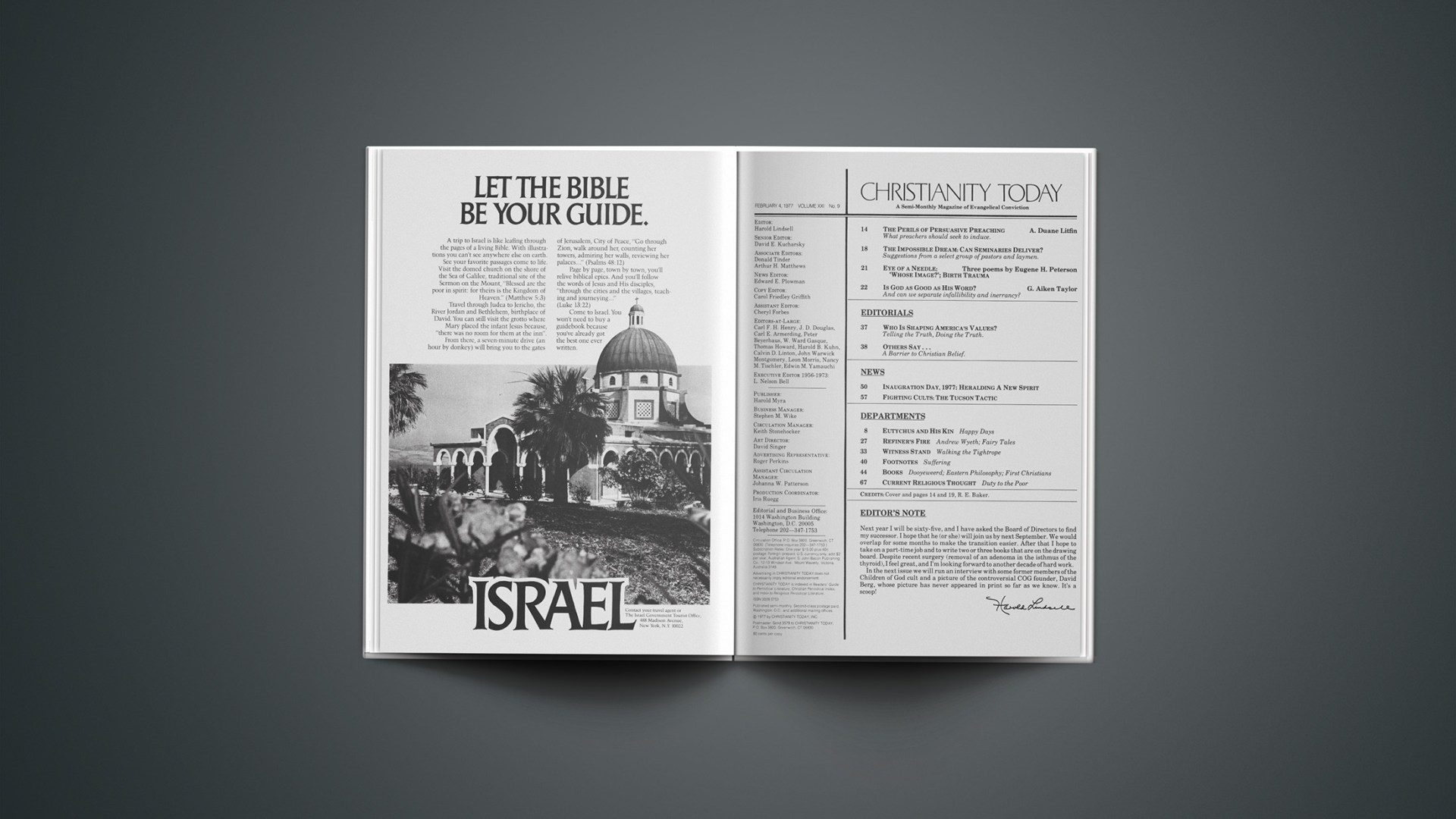
Next year I will be sixty-five, and I have asked the Board of Directors to find my successor. I hope that he (or she) will join us by next September. We would overlap for some months to make the transition easier. After that I hope to take on a part-time job and to write two or three books that are on the drawing board. Despite recent surgery (removal of an adenoma in the isthmus of the thyroid), I feel great, and I’m looking forward to another decade of hard work.

In the next issue we will run an interview with some former members of the Children of God cult and a picture of the controversial COG founder, David Berg, whose picture has never appeared in print so far as we know. It’s a scoop!

Do We Have the Right to Die?

California has long had a reputation for “advanced” social legislation, and the decisions of its supreme court often preview the future legal climate of the nation at large. There is such concern to zap manufacturers and suppliers of defective products that even an injured bystander (one who is neither buyer nor user of the product) can successfully sue without having to prove negligence. And in October, California became the first state to legalize the right of a terminally ill patient to end his life. This bill signed into law by Governor Jerry Brown—a religious syncretist who has moved well beyond his former role as Jesuit seminarian to create state days of prayer modeled on an Eastern ashram—allows the preparation of “living wills,” renewable every five years, which will direct physicians to “pull the plug” if the “testator” finds himself on a life-sustaining system that only postpones inevitable death. What is to be said of such a notion theologically?

At first glance, the idea doesn’t seem particularly bad—and may even appear morally neutral. Time magazine quoted the bill’s sponsor, Democrat Barry Keene, who declared that the “living will” offered a way out for those “who have no hope,” such as friends of his who died slowly of excruciating cancer. When compared with the Roe v. Wade abortion decision of the U.S. Supreme Court and the New Jersey supreme court’s ruling in the case of Karen Anne Quinlan, California’s right-to-die law seems downright innocuous: at least the patient himself makes the decision to pull the plug; it is not made for him by others (as in the removal of the mechanical respirator from Miss Quinlan—who, however, outfoxed the state by continuing to breathe without it—or as in the innumerable abortions now occurring in which the lives of the pre-born are unceremoniously snuffed out not by their own decision but generally because of the economic, social, or psychological inconvenience they cause to others). Whereas legalized abortion and pulling the plug without the patient’s consent must be classed as homicide (“the killing of one human being by another”), the California right-to-die law is, at worst, only suicide.

But surely “suicide” is too strong a word—even as “homicide” is too strong a word in the Quinlan situation—when the person would die naturally anyway without the benefit of an artificial life-support system? The utter fallacy of this argument, so often appealed to even by some evangelical ethicists, can be illustrated by the venerable California case of People v. Ah Fat (which the recent legislators evidently did not recall). In the days of the Chinatown tong wars, Ah Fat was a cowardly fellow who went out with his murderous friends but hid when the fighting between the gangs commenced. Finally his friends informed him that unless he got into the fray, they would divide his cranium with a meat cleaver. So on the occasion of the next fight, Ah Fat waited until he saw another brother deal a mortal blow to one of the opposition, and then with an appropriate whoop Ah Fat cut off the dying man’s head.

The whoop was apparently heard by the police, for Ah Fat was arraigned on a homicide charge. His lawyer argued that whatever else Ah Fat might be guilty of, it wasn’t homicide, for the victim would have died anyway: Ah Fat merely “accelerated the inevitable.” The judge rejected this contention as a matter of law, replying: “That’s what homicide always is.”

And the “artificiality” of the life-sustaining procedures doesn’t alter the situation in the slightest. Would it be any less murder if, instead of shooting a person, we deprived him of his iron lung or of his insulin on the ground that these are “artificial” means of keeping him alive? If doing such things to another would be homicide, then doing them to oneself would just as certainly be suicide.

A little reflection on the question of “dependence” will also reveal that no one—at any stage of his existence—is really independent of others or of his environment, “natural” or “artificial” (if the distinction really has any meaning). We depend upon others, including manufactured devices, for our very survival. (If you doubt this, try not using your furnace this winter.) Far more unites the fetus, the terminally ill patient, and the healthy, adult reader of this article than separates them. All three are dependent, and their dependency, instead of offering a potential ground for destruction or self-destruction, is a common bond. “Never send to know for whom the bell tolls,” John Donne reminded humanity: “it tolls for thee.”

Christian Scientists and other “mind science” crazies have persuaded many Christians that to rely on the Lord is to eschew “artificial” healing by grubby old unsanctified physicians. “Let the Lord work,” they say, convinced that he works only immediately, not mediately. But surely the “artificial,” done or made by man, is ultimately God’s own work. Had he not bestowed on us the skill to create modern medicine with its variegated life-support systems, we could never have made them. To be sure, the use or misuse of such devices might conceivably be a greater of evils in a given case (e.g., where only one machine is available and it is not used for a young person in need because already plugged to a terminally ill patient), but except in such morally ambiguous situations one must regard life support as God’s work, not the devil’s.

Scripture still stands directly opposed to suicide: every instance of it in Scripture is related to spiritual collapse, from Saul to Judas (1 Sam. 31:4; 2 Sam. 17:23; 1 Kings 16:18–20; Matt. 27:5; Acts 1:18). The classical theologians of orthodox Christianity, such as Augustine, have set themselves firmly against it, while modern support for “voluntary euthanasia” has come from situationists who refuse to recognize the existence of absolute biblical principles (e.g., Joseph Fletcher, Morals and Medicine).

As America takes the legal route to voluntary individual self-destruction, it displays the paradoxical combination of its self-made, do-it-yourself image gone wild (“do-it-yourself death”) together with the collapse of the individual courage and strength of character for which Americans have been famous. How unlike Socrates, who would not take the easy way out by escaping from even an unjust sentence because to do so would set a bad example and lower society’s moral tone. Today’s hero becomes not Socrates but Hemingway, who carried his hubris to the ultimate by not permitting even death to subject him to its timetable.

God’s way is the polar opposite: “the Lord gives, the Lord takes away: blessed be the name of the Lord.” Let us do all we can to counter the declining respect for life in our nation. The life we save may be our own.

Evangelicals Together in Africa

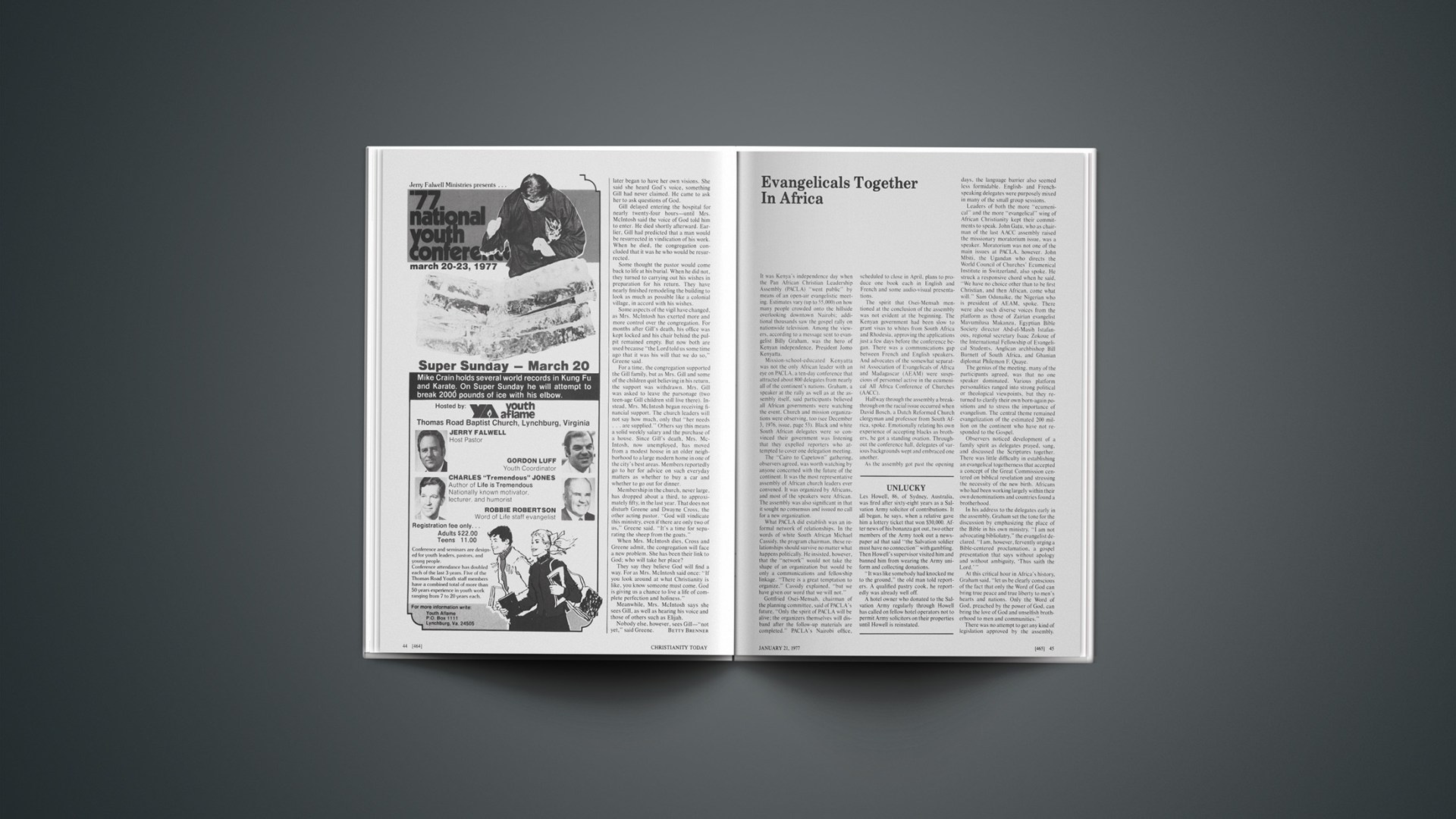
It was Kenya’s independence day when the Pan African Christian Leadership Assembly (PACLA) “went public” by means of an open-air evangelistic meeting. Estimates vary (up to 55,000) on how many people crowded onto the hillside overlooking downtown Nairobi; additional thousands saw the gospel rally on nationwide television. Among the viewers, according to a message sent to evangelist Billy Graham, was the hero of Kenyan independence, President Jomo Kenyatta.

Mission-school-educated Kenyatta was not the only African leader with an eye on PACLA, a ten-day conference that attracted about 800 delegates from nearly all of the continent’s nations. Graham, a speaker at the rally as well as at the assembly itself, said participants believed all African governments were watching the event. Church and mission organizations were observing, too (see December 3, 1976, issue, page 53). Black and white South African delegates were so convinced their government was listening that they expelled reporters who attempted to cover one delegation meeting.

The “Cairo to Capetown” gathering, observers agreed, was worth watching by anyone concerned with the future of the continent. It was the most representative assembly of African church leaders ever convened. It was organized by Africans, and most of the speakers were African. The assembly was also significant in that it sought no consensus and issued no call for a new organization.

What PACLA did establish was an informal network of relationships. In the words of white South African Michael Cassidy, the program chairman, these relationships should survive no matter what happens politically. He insisted, however, that the “network” would not take the shape of an organization but would be only a communications and fellowship linkage. “There is a great temptation to organize,” Cassidy explained, “but we have given our word that we will not.”

Gottfried Osei-Mensah, chairman of the planning committee, said of PACLA’s future, “Only the spirit of PACLA will be alive; the organizers themselves will disband after the follow-up materials are completed.” PACLA’s Nairobi office, scheduled to close in April, plans to produce one book each in English and French and some audio-visual presentations.

The spirit that Osei-Mensah mentioned at the conclusion of the assembly was not evident at the beginning. The Kenyan government had been slow to grant visas to whites from South Africa and Rhodesia, approving the applications just a few days before the conference began. There was a communications gap between French and English speakers. And advocates of the somewhat separatist Association of Evangelicals of Africa and Madagascar (AEAM) were suspicious of personnel active in the ecumenical All Africa Conference of Churches (A ACC).

Halfway through the assembly a breakthrough on the racial issue occurred when David Bosch, a Dutch Reformed Church clergyman and professor from South Africa, spoke. Emotionally relating his own experience of accepting blacks as brothers, he got a standing ovation. Throughout the conference hall, delegates of various backgrounds wept and embraced one another.

As the assembly got past the opening days, the language barrier also seemed less formidable. English- and French-speaking delegates were purposely mixed in many of the small group sessions.

Leaders of both the more “ecumenical” and the more “evangelical” wing of African Christianity kept their commitments to speak. John Gatu, who as chairman of the last AACC assembly raised the missionary moratorium issue, was a speaker. Moratorium was not one of the main issues at PACLA, however. John Mbiti, the Ugandan who directs the World Council of Churches’ Ecumenical Institute in Switzerland, also spoke. He struck a responsive chord when he said, “We have no choice other than to be first Christian, and then African, come what will.” Sam Odunaike, the Nigerian who is president of AEAM, spoke. There were also such diverse voices from the platform as those of Zairian evangelist Mavumilusa Makanzu, Egyptian Bible Society director Abd-el-Masih Istafanous, regional secretary Isaac Zokoue of the International Fellowship of Evangelical Students, Anglican archbishop Bill Burnett of South Africa, and Ghanian diplomat Philemon F. Quaye.

The genius of the meeting, many of the participants agreed, was that no one speaker dominated. Various platform personalities ranged into strong political or theological viewpoints, but they returned to clarify their own born-again positions and to stress the importance of evangelism. The central theme remained evangelization of the estimated 200 million on the continent who have not responded to the Gospel.

Observers noticed development of a family spirit as delegates prayed, sang, and discussed the Scriptures together. There was little difficulty in establishing an evangelical togetherness that accepted a concept of the Great Commission centered on biblical revelation and stressing the necessity of the new birth. Africans who had been working largely within their own denominations and countries found a brotherhood.

In his address to the delegates early in the assembly, Graham set the tone for the discussion by emphasizing the place of the Bible in his own ministry. “I am not advocating bibliolatry,” the evangelist declared. “I am, however, fervently urging a Bible-centered proclamation, a gospel presentation that says without apology and without ambiguity, ‘Thus saith the Lord.’ ”

At this critical hour in Africa’s history, Graham said, “let us be clearly conscious of the fact that only the Word of God can bring true peace and true liberty to men’s hearts and nations. Only the Word of God, preached by the power of God, can bring the love of God and unselfish brotherhood to men and communities.”

There was no attempt to get any kind of legislation approved by the assembly. Even though most of the delegates are prominent in their own denominations or para-church groups, none came as official representatives. Osei-Mensah stressed that all came as individuals, submissive only to the authority of Scripture. Because of this kind of planning, he explained at the beginning of the conference, “the program is not going to be limited by anything.”

At the end of the assembly the planning committee that Osei-Mensah headed did issue a document named “The PACLA Pledge.” It was distributed to all delegates, but they were not asked to affirm it before leaving for home. They were urged to study it and to recommend it, if possible, to the various groups in which they work.

The pledge affirms “that we are brothers and sisters in God’s alternative society, knit together in the indissoluble bonds of Jesus Christ, transcending denomination, colour, race, and tribe. We thus pledge ourselves in the Name of Jesus Christ to be active reconcilers across every divide, believing that it is Jesus Himself who has committed to us this ministry of reconciliation.”

Also included in the document is a pledge “to be true to the Scriptures as God’s authoritative and inspired Word … [and] to resist all error, all distortions of the truth, and all practices and behaviour incompatible with Christian holiness and biblical ethics.”

In a section on evangelization, there is a pledge to “resist all forms of syncretism and universalism which would deny the necessity for every person whether in Africa or elsewhere to be given the opportunity of hearing and receiving the message of Jesus Christ.” Resistance is also pledged to “any concept which separates the personal and social dimensions of the Gospel and which either refuses to relate the message to society or else relates it exclusively to society at the expense of the personal and eternal needs of the human soul.”

In the closing days of the assembly delegates began formulating plans for evangelistic thrusts. They were talking, not only about work within their own sections of Africa, but also of the possibilities of missionary activity on other continents, including those that have long sent missionaries to Africa.

The idea for PACLA was born in 1974 at the International Congress on World Evangelization in Lausanne, Switzerland, but the assembly was not sponsored by the follow-up Lausanne Committee for World Evangelization (LCWE). The initial ad hoc committee was composed of Cassidy, Anglican Bishop Festo Kivengere of Uganda, and Bible translator John Mpaayei of Kenya. They invited more than thirty other leaders to form the planning committee, which named Osei-Mensah as its chairman. He is a Ghanian living in Nairobi, where he works as executive secretary of LCWE.

Looking Up

Church and synagogue attendance in the United States rose in 1976—the first time that has happened since 1958, according to a Gallup Poll. The poll interviewed 13,398 persons over age 17 in more than 300 localities during nine selected weeks. Forty-two per cent said they had attended church or synagogue during the preceding seven days, an increase of 2 per cent over the past five years. A high of 49 per cent was recorded in 1955 and 1958, said Gallup.

The study shows that 55 per cent of Roman Catholics are in church in a typical week, 40 per cent of Protestants. Women still make up a majority of those in the pews; 46 per cent of the nation’s women attend, 37 per cent of the men.

Least likely attenders are people living in the West and people under age 30; those in the South and Middle West have the best attendance record.

On another topic, 45 per cent of the interviewees said they think religion’s influence on American life is decreasing, 44 per cent said it is increasing, and the rest offered no opinion.

Sadder But Wiser

Several activists who were prominent in the anti-war movement of the past decade held a press conference in New York to announce that the Communist government of Viet Nam had rebuffed their efforts to secure the release of political prisoners. The war protesters also said the Vietnamese government had refused to accept an impartial inquiry into charges of violations of human rights.

Among those speaking out at the conference, sponsored by the International League for Human Rights, were Lutheran clergyman-editor Richard John Neuhaus, a founder of Clergy and Laity Concerned, and James H. Forest, co-chairman of the Catholic Peace Fellowship and editor of its magazine. They were among 110 anti-war activists who had signed an appeal to the Vietnamese government, according to a Religious News Service report.

Neuhaus and Forest said that during the Indochina war they wanted “desperately” to believe promises by the Communists to be tolerant and to uphold human rights. “I feel sadder but wiser now,” said Forest.

Some prominent anti-war protesters declined to sign the appeal, among them theologian Robert McAfee Brown and leaders of the American Friends Service Committee, an independent Quaker group. The AFSC people, who have been engaged in relief efforts in Viet Nam, say they still have confidence in the assurances of the Vietnamese government that human rights are being protected there.

Unlucky

Les Howell, 86, of Sydney, Australia, was fired after sixty-eight years as a Salvation Army solicitor of contributions. It all began, he says, when a relative gave him a lottery ticket that won $30,000. After news of his bonanza got out, two other members of the Army took out a newspaper ad that said “the Salvation soldier must have no connection” with gambling. Then Howell’s supervisor visited him and banned him from wearing the Army uniform and collecting donations.

“It was like somebody had knocked me to the ground,” the old man told reporters. A qualified pastry cook, he reportedly was already well off.

A hotel owner who donated to the Salvation Army regularly through Howell has called on fellow hotel operators not to permit Army solicitors on their properties until Howell is reinstated.

Religion in Transit

In a Norman Lear television comedy series, “One Day at a Time,” a major character named Julie became born again during a two-part segment this month and tried to express to family and friends how good the experience is. Descriptions and terminology familiar to evangelicals were blended with situation comedy, a sensitive first-of-its-kind on TV. Lear aide Virginia Carter conceded earlier at a meeting of the World Association for Christian Communication that religious people are often stereotyped on television because of limited knowledge on the part of writers and producers. Whether Julie represents a new generation of stereotypes remains to be seen.

Lutheran Church-Missouri Synod leaders say they are disappointed after a day-long meeting with representatives of the American Lutheran Church failed to resolve some basic concerns. LCMS president J. A. O. Preus requested the meeting to discuss a controversial letter by ALC president David Preus. The letter, circulated last spring, criticized the LCMS for adopting a conservative statement on doctrine that is “disruptive for all Lutherans.” Preus of the LCMS asked for substantiation of the letter’s assertions. The ALC representatives have promised a “more substantive response” next month.

The brief prayer that preceded the daily sitting of Quebec’s legislature has been scrapped by the newly elected Parti Quebecois, which favors separation from Canada.

More than 1,300 tons of rice valued at nearly $350,000 was sent from Bangkok to northern Viet Nam as a gift from Americans to help relieve a food shortage in that land. The rice was bought by a United Nations unit on behalf of three American relief agencies: Friendshipment, Church World Service (National Council of Churches), and Lutheran World Relief.

Money-raising efforts by a California-based pro-life publication, The Voice of Theophilus, are being investigated by the U.S. Postal Service for mail fraud, according to a report in the National Catholic Reporter. The anti-abortion newsletter, associated with the National Pro-Life Foundation of Encino, California, is run by a shadowy figure with several aliases, including Thomas Donovan, M.D., James Anton, Steve Savage, and Mike Nameth. Catholic officials have warned against contributing to the paper.

The 400,000-member, 1,063-congregation Wisconsin Evangelical Lutheran Synod celebrated its 125th anniversary last year with a thankoffering. The goal was $2.8 million, to help with college and church-extension projects. By last month commitments totaled $3.55 million.

“What’s It All About?” was named the best syndicated religious series in radio for the fourth year in a row by Billboard magazine. The popular-music-oriented show, produced by the Presbyterian Church in the U.S. (Southern), is heard on 750 stations in fourteen countries.

Deaths

SAMUEL MCCREA CAVERT, 88, United Presbyterian clergyman and pioneer ecumenist who was general secretary of the Federal Council of Churches and its successor, the National Council of Churches, from 1930 to 1954, and a founder and leader of the World Council of Churches (he is credited with giving the WCC its name); in Bronxville, New York, after a long illness.

W. HERSCHEL FORD, 76, well-known Southern Baptist pastor, denominational leader, and author of numerous books of expository sermons; in Dallas, of a heart ailment.

By a vote of 8 to 1, the U.S. Supreme Court declined to review a Missouri Supreme Court ruling that upheld the state’s tuition-aid program covering both private and public colleges. Americans United for Separation of Church and State had argued that the state’s seventeen colleges with religious affiliations have an essentially religious purpose, and that their students therefore should be disqualified for the grants of up to $900 per year.

A “substantial majority” of the seventy-five voting members of the Unitarian Church of Richardson, Texas, approved a resolution calling for the legalization of prostitution. The change would help to control crime and venereal disease, said a spokesman. The church got national publicity in 1975 when an exotic dancer performed a strip-tease during the “sharing” portion of a service.

Sister Gabrielle Lacelle was appointed an associate secretary of the Canadian Council of Churches. She is the first Roman Catholic to serve on the executive staff of the national ecumenical agency. The Catholic Church is not a member of the body.

Funding problems have led the board of Inter-Met (Metropolitan Theological Education, Incorporated), a five-year-old interfaith seminary in Washington, D.C., to announce the school’s closing this June, when five students will graduate. Six students will finish the year in a joint program with other schools; twenty others must transfer elsewhere by next month. Inter-Met, with no formal campus, specialized in training ministers through an apprenticeship in individual congregations.

Commissioner Paul Kaiser is the new national commander of the Salvation Army in the United States. A youth specialist, he has headed the army’s central U.S. region and held executive posts in Europe. He succeeds the retiring William Chamberlain.

Personalia

England’s perennial pop star Cliff Richard, an evangelical, recently learned that the millionth copy of his record “Devil Woman” had been sold in the United States. Its lyrics are directed against the occult. He got the word while on a concert tour to Bangladesh sponsored by evangelicals.

Singing evangelist Barry McGuire, 40, who hit it big in 1965 with the million-seller record “Eve of Destruction” and also with the New Christy Minstrels and as a star in the Broadway production of Hair, tells of his spiritual journey from LSD to Christ in a new autobiography: From Hair to Eternity.

Another ex-Manson follower tells of switching to Christ and being changed: Onjya Sipe, in Devil’s Dropout (Mott Media). The former prostitute and topless dancer says it happened when the Manson family took her baby daughter from her and she turned to her brother Paul for help. Paul first told her about Christ. The baby was later recovered. Following Christ has meant overcoming a lot of hardships and problems, says Ms. Sipe, but the “glorious freedom” from Satan has been worth it.

World Scene

Puerto Rico’s Catholic bishops have approved the controversial Latin American Bible for use on the island, saying it is clear and sound theologically. Criticism of certain photos and accompanying notes (see December 17, 1976, issue, page 34) is not sufficient to ban its use, explained Cardinal Luis Aponte Martinez. He had earlier forbade its use until the bishops had a chance to study it.

Viet Nam’s governing Workers party has renamed itself the Communist party and ratified a new five-year development plan under which a large-scale redistribution of population from urban to rural areas will take place, according to reports from Hanoi and Saigon. Little news of church life in Viet Nam is getting through. Some missionaries who formerly served there say they have learned that workers are permitted one day off per week—but it can’t be Sunday.

After the Communists took over Cambodia in 1975 they renamed it Democratic Kampucha. But there has been little democracy, and many former citizens, including Christian leaders, have disappeared. There have been reports of mass murders of educated persons and former soldiers. An epidemic of malaria now plagues the remaining population (it reportedly affects 90 per cent of the people), and there is a shortage of medicine and insecticides. With U.S. government approval, a Texas firm has sold Kampucha $450,000 worth of insecticides, and the American Friends Service Committee, a Quaker agency, has sent $12,000 worth of anti-malarial drugs. The AFSC aid, the first by a private U.S. agency, was shipped by way of Communist China.

Delaying tactics continue to block new missionaries from entering Colombia. The government, though, did promise recently to issue visas upon satisfactory completion of detailed investigative questionnaires by each mission. So far, about two dozen of the fifty-three evangelical missions have submitted the information. The government has responded to five, in each case requesting replies to an additional page or more of questions.

Small lots of Portuguese Bibles have arrived in Mozambique in recent months, but the nation’s Marxist government is restricting the importation of larger shipments, according to Swiss mission sources. Requests by the Mozambique Bible Society to import or to print have been held up, they say. Church sources say church attendance is picking up again, especially on the part of young people. Meanwhile, a proposed three-year program of aid to Mozambique valued at $600,000 or more has been under discussion by officials of the World Council of Churches.

Nearly 500 clergymen, about 10 per cent of the pastors of the Church of Sweden (Lutheran), demanded that the mission board of the church discontinue relations with the World Council of Churches and other ecumenical organizations. The board, at its annual meeting, referred the question to the governing body of the church, which is studying the relation between the church and the WCC.

Pastor Douglas “Sir Doug” Nicholls, an aboriginal evangelical pastor and ex-soccer star who could not read or write until he was 21, was made governor of South Australia, the highest honor ever accorded a black Australian. For thirty years he has been campaigning for social justice and land rights for his people. He is a minister in the Church of Christ, an evangelical Protestant denomination with links to British Presbyterianism.

Catholics in Poland are complaining about how the state treats them. Church officials say that during 1976 twenty-seven dioceses applied to the state for permission to build 234 churches and chapels, but authorities okayed only 23 buildings. And only 23 of 129 applications to expand or restructure were approved. Meanwhile, Cardinal Stefan Wyszynski, the spiritual leader of about 95 per cent of Poland’s 34 million people, called on authorities in a sermon to stop mistreating workers arrested for demonstrating against the government over high food prices.

A number of Catholic theological faculty members in Holland over the years have left the priesthood to marry but have retained their teaching posts. In 1971 and 1972 the Vatican ruled that such persons must be dismissed. The Dutch bishops say they have observed this policy since it was spelled out, but they refused to apply it retroactively—and the Vatican reluctantly agreed.

Urbana ’76: Declaring God’s Glory and Word

Bible expositor John Stott was near the end of his third lecture at the Inter-Varsity Christian Fellowship’s missionary convention when he begged the congregation: “Please don’t clap any more; you’re wasting my time; I’ve only got two minutes more.”

Spontaneous applause for the Anglican evangelical’s teaching about an evangelistic church was just one indicator of the spiritual temperature of the 17,112 attending “Urbana ’76,” the eleventh edition of IVCF’s triennial North American student gathering. The record turnout for the event stretched the capacity of the Urbana campus of the University of Illinois.

The convention theme, “Declare His Glory Among the Nations,” and the way it was developed stretched the imaginations and consciences of those attending. They responded, not only with vigorous applause for speakers, but also with hearty singing and praying, with decisions to serve Christ abroad, and with generous financial contributions.

The spiritual warmth of participants contrasted with the bitter cold they had to encounter as they walked from one campus building to another during the week between Christmas and New Year’s Day. Temperatures often dipped below zero during what the Chicago Tribune described as “this frozen week” in Illinois. A light snow blanketed the university grounds midway through the week.

Despite the cold the youths took in a full range of activities designed to acquaint them with current Great Commission imperatives. Students faithfully attended two-hour morning and evening plenary sessions in the mushroom-shaped Assembly Hall, but they also packed out the hundreds of afternoon electives that gave them the opportunity to meet missionaries, to learn about various types of overseas work, to question platform speakers, and to discuss matters of evangelization. In addition, they started and ended each day with small groups in their residence halls, studying the Bible and praying.

In the convention’s first major address, John W. Alexander, IVCF’s U.S. president, laid the foundations for the program which followed. He emphasized his belief that the Bible “is the infallible revelation of the infallible God—which means that it is entirely trustworthy and reliable.” He told the students, “Our attitude toward Scripture is desperately important.” Alexander declared in his address that he believed in biblical inerrancy while admitting its problems, “but I refuse to set myself up as judge of Scripture and commence deciding which problems are biblical error.” He reaffirmed the position in a news conference the following day.

Stott, who now pursues a worldwide speaking and writing ministry with the title of rector emeritus of London’s All Souls Church, spoke four times on the biblical basis for missions. He urged concentration “on the objective, historical Jesus, as he is presented to us in the Bible.” He suggested that students “use our contemporary experience of him to corroborate and illustrate the primary witness of the apostles.”

The convention’s most prominent speaker, evangelist Billy Graham, faced the issue of Scripture on the second full day of the week. He made himself available to answer questions for an hour in the 17,000-seat Assembly Hall, and nearly half of the delegates showed up there despite dozens of competing meetings. Graham said he fully backed the Alexander statement. He was applauded when he held a Bible aloft and said, “This is the infallible Word of the Living God.” He also reviewed for his student audience the 1949 experience in which he decided to accept the Scriptures as God’s Word.

In a news conference later the same day the evangelist expressed a hope that evangelicals will be able to handle their new visibility. He warned of the danger of being more of a target when they are more visible. Without amplifying his comment, he told reporters it was important that evangelicals “accept diversity in unity” and that they not try to “put everyone in the same mold.”

Journalists asked the fifty-eight-year-old preacher about his health, and he responded that he had no real health problems. He quipped that he had quit golf and was taking up tennis. Two days later, on New Year’s Eve, a blood clot developed in his leg, and doctors ordered him onto his back. He left the campus in an ambulance and was flown to Rochester, Minnesota, where Mayo Clinic physicians diagnosed phlebitis. Students were informed of his departure after he left, and they stood to pray for him and his ministry. He was scheduled to begin a crusade in Sweden on January 12.

In his principal address, delivered the night before he was stricken, Graham called for an all-out response to the convention theme. He told the students, “Because God has declared his glory, and because we have beheld his glory, we must act.” The evangelist warned of the high cost of commitment to Christ, but when he issued an invitation for the students to stand to indicate their surrender to God’s will, most stood.

Students were also invited to sign decision cards, stating either that they were ready to serve abroad or that they “will actively seek His guidance concerning placement.” Thousands were turned in before the students left Urbana, and additional thousands were expected to be mailed to IVCF later. No precise count was available early this month.

The significance of the decision cards was explained by David Howard, director of Urbana ’76 and a veteran of many previous conventions. He pulled from his pocket his own decision card from the first IVCF missionary convention (1946, Toronto). As a student he had tacked the card above his desk as a prayer reminder until sunlight faded all of it except the part covered by the thumbtack. The decision, he said, eventually led him to go as a missionary to Colombia and Costa Rica for fifteen years.

The missionary commitment of the Howard family was also evident at the convention in the person of the director’s sister, Elisabeth Elliot Leitch. The twice-widowed writer and former missionary to South American Indians was one of the most popular speakers at Urbana (this time as well as three years ago). Like Graham, she attracted thousands to the Assembly Hall for a question-and-answer session. In an answer to one of the questions about her attitude toward the Bible, she replied that she had “staked her life” on its trustworthiness. In her message, she stressed obedience to God’s will. Students gave her a standing ovation when she concluded her message, and when her A Slow and Certain Light was “book of the day” the following day they bought up all 7,000 available copies.

Standing applause also greeted the other woman speaker, Helen Roseveare, a British medical missionary in Zaire. Speaking out of her own experience of suffering during the 1964 Simba rebellion, she stressed the cost of service abroad. The problem of suffering and hunger among the world’s peoples was the topic of Indian pastor Samuel Kamaleson.

Most of the convention-goers gave up one meal and others contributed money to help feed the hungry. A total of $23,000 was collected for hunger relief and divided among World Vision, Food for the Hungry, and the Voice of Calvary in Mississippi.

The largest offering of the week was designated for the work of the International Fellowship of Evangelical Students. The cash collection was $245,000, and IVCF officials expected that when pledges are fulfilled IFES will get about $300,000 from the convention. There was an offering of about $12,000 to help defray convention costs (especially those connected with scholarships for international students). Participants gave an average of over $16 in the three offerings.

About 3,000 of those registered are not currently students. Among the non-students were some 700 missionaries who staffed the booths of their agencies and spoke at afternoon elective sessions. Also present were many pastors, college professors, and other friends of IVCF. Of the registrants, 14,879 came from the United States and 1,951 from Canada. Hundreds of applicants were turned away in the weeks just prior to the meeting because the capacity had been reached. More came from California (2,022) than from the host state of Illinois (1,529). Registrants identified themselves as members of a wide range of churches, with the largest number (1,046) United Presbyterians. A total of 283 said they were Roman Catholics.

Where does the Urbana convention go from here, having reached its capacity and a level of programming that was more highly praised than ever? According to Alexander and Howard, planning will start soon for the twelfth edition. It, too, will be on the hospitable Urbana campus of the University of Illinois, they said, since they have been unable to find better facilities elsewhere. In answer to journalists’ questions, they said they had given considerable study to other possibilities of going beyond the Assembly Hall’s capacity. Among the recommendations turned down because they thought they would reduce the convention’s effectiveness were regional gatherings and use of closed-circuit television for plenary sessions at Urbana.

One of the elements that would be lost if all delegates could not sit under the same roof would be the vigorous singing that characterizes the Urbana gatherings. Led again this time by Canadian youth leader Bernie Smith, but using a new Inter-Varsity book, Hymns II, the congregational singing was a highlight for many delegates. By week’s end most had learned Margaret Clarkson’s theme hymn, “Declare His Glory,” based on Psalm 96:3, and they were humming the tune, composed by Hughes Huffman, as they returned to their campuses.

What They Read

An unofficial poll of the campus post offices at Christian colleges found Time and Newsweek were received by more students than any other magazines. Sports Illustrated placed third, and Psychology Today and Christianity Today were tied for fourth. These were followed by Glamour, Campus Life, Mademoiselle, and His.

On secular campuses nationally, a Chicago research firm found Playboy, Time, and Newsweek the most read magazines. The campus newspaper, television, and the city daily serving the area all have bigger audiences, however.

The Year That Was

In the news lull at year’s end, many reporters traditionally sift through the events of the preceding fifty-two weeks to determine which stories were the big ones. For those covering religion, the top two stories of 1976 were the religious issues surrounding the presidential election campaign and the approval of ordination of women to the priesthood in the Episcopal Church. The Religion Newswriters Association (RNA), an organization of reporters who cover religion for the secular press, rated the women’s ordination story first, the election second. Religious News Service (RNS), a press service in New York that publishes dozens of stories five days a week, listed the two stories in reverse order.

The RNA listed the Roman Catholic “Call to Action” social-issues meeting in Detroit and the split in the Lutheran Church-Missouri Synod as its third and fourth choices. So did the RNS, but again in reverse order.

Other top-ten choices of the RNA, in order of importance: the controversy over Korean evangelist Sun Myung Moon and his Unification Church; the Catholic Eucharistic Congress in Philadelphia; abortion as an election issue; the right-to-die decision of the New Jersey Supreme Court in the Karen Quinlan case; the Gallup Poll report that more than one-third of all Americans claim to have had a born-again experience; and the growing movement for divorce and remarriage reform in the Catholic Church. The last two stories tied for ninth place.

The RNS listed only one of these six stories in its top ten—the Eucharistic Congress, also in sixth place. Others: defiance of the Vatican by dissident French archbishop Marcel Lefebvre, a traditionalist who denounces Vatican II reforms; the women’s peace movement in Northern Ireland; church-state tensions in Third World, Latin American, and east European countries; and the ending of the Lebanese civil war (Christian-Muslim relations).

Even media with a more restricted field of interest selected the presidential election as their top story. These included Americans United for Separation of Church and State, concerned about the implications of religion as an issue in the campaign, and Southern Baptist editors and press-service staffers, who were delighted beyond words by the success of Jimmy Carter, a fellow Southern Baptist.

An important but mostly overlooked story was the continued groundswell of conservatism in major denominations. It was probably most visible in the United Methodist Church, but evidence cropped up in other groups as well. Media staffers of the United Presbyterian Church, for example, cited the denomination’s decision not to approve the ordination of practicing homosexuals as the top UPC story of the year (a close second: the UPC’s $3.5 million budget cut).

Theology And ‘Gutsy’ Exegesis

Biblical infallibility was the chief topic at the recent annual meeting of the Evangelical Theological Society. Slightly more than 100 of the ETS’s 1,170 members plus several dozen observers attended the sessions, held at Westminster Seminary in Philadelphia. In a paper, Dean Kenneth Kantzer of Trinity Evangelical Divinity School in suburban Chicago stressed that inerrancy of Scripture will remain a key doctrine for evangelicals “for as long as Christ is Lord.” He cautioned, however, that “inerrancy should not be made a test for Christian fellowship instead of Christ.”

Since its founding in 1948, the ETS has made belief in inerrancy a basis of membership. Members are required annually to sign a statement confessing belief in the Bible “as the Word of God written, and therefore inerrant in the original manuscripts.” Some members, though, apparently differ on how inerrancy is to be understood. Lay theologian Richard Bube, a science-department chairman at Stanford University, returned his latest renewal application unsigned. He accompanied it with a request that the ETS reword the inerrancy statement. He suggested that it be made similar to Fuller Seminary’s revised statement, in which scriptural infallibility is limited to matters of faith and practice and not applied, for example, to facts of science. After a two-hour closed meeting, the ETS officers decided against recommending any change. Therefore Bube is no longer a member. (He told Religious News Service later that he believes the Bible “is inerrant when properly interpreted according to biblical criteria.”)

Church-history professor Clair Davis of Westminster pointed to one of the current problems within evangelical circles: “You’ve got people who say, ‘I believe the Bible is the absolute, infallible Word of God, but it’s full of errors.’ ” It is an issue likely to be debated vigorously in coming months.

Other matters were also aired at the ETS meeting. One set of papers dealt with whether the meaning of the biblical text was limited to what the authors understood or whether deeper ramifications were intended (beyond the authors’ own understanding but within the scope of the dynamics of divine inspiration). There were advocates for both positions.

In a paper dealing with the best textual basis for translations of the New Testament, Gordon Fee of Gordon-Conwell Seminary argued against those who insist that the King James Version is based on the best texts (as some ETS members do). He suggested the New International Version (NIV) as the best English translation of the New Testament because it is based on “the best Greek texts” and it employs the most “gutsy” exegesis of the texts by selecting the most apt English words that go to the heart of the Greek ones. (Fee was one of the NIV translators.)

Two papers brought into question the traditional fundamentalist view that the earth is only 6,000 to 10,000 years old. This viewpoint usually applies to creation of the entire universe as well. Too many apparent-history miracles of creation must accompany this view, the papers argued (for example, it would have been necessary for the light from stars millions of light-years away to be created en route, according to traditional conservative views).

Professor Walter Kaiser of Trinity was elevated to the ETS presidency, and President Edmund Clowney of Westminster was chosen president-elect.

The First Women

At an afternoon service at All Saints Episcopal Church in Indianapolis on January 1, Episcopal bishop Donald J. Davis placed his hands upon the head of Jacqueline Means and prayed, asking God to “give your Holy Spirit to Jacqueline, fill her with grace and power, and make her a priest in your Church.”

Thus Mrs. Means, 40, a nurse, prison chaplain, and mother of four married to a truck driver, became the first woman to be ordained to the Episcopal priesthood since the denomination changed its rules last September to open the way for women to become priests.

Earlier in the service, Robert Strippy, a representative of the American Church Union, read a statement of protest to the congregation. About a dozen other protesters were with him. “We condemn this proceeding as opposed to the mind of the church and the will of God,” he declared. It is “an act of heresy,” he insisted. Davis expressed grief over “the separation between us” but said the service would go on. Strippy and the others walked out.

Davis, the bishop of Erie, Pennsylvania, substituted for Indianapolis bishop John P. Craine, who was hospitalized with a heart ailment,

On the next day, Sunday, Mrs. Means celebrated communion at All Saints, and about one-fourth of the usual 100 or so parishioners were absent. She acknowledged to reporters that there was division in the church over her. “The church is being tested through people like me,” she said.

Also on that day. a second woman was ordained—Patricia Park, 29, of Alexandria, Virginia. Bishop Robert Hall of Virginia officiated. The service was held at Immanuel Church-on-the-Hill in Alexandria, where former President Ford and his family attended for years and where she is assistant to the rector. After her ordination, Mrs. Park and her husband Stephen, also an Episcopal priest, celebrated communion jointly as a husband-wife clergy team, a first in the worldwide Anglican Communion. Mrs. Park co-chaired the National Coalition for Women’s Ordination.

About thirty women were expected to be ordained during January, and as many as fifty this year. Questions remained, though, about women in dioceses whose bishops are less than enthusiastic about women’s ordination.

In Kansas City, Missouri, Bishop Arthur Vogel ruled that Katrina Swanson must fulfill a diocesan requirement of three years of seminary training before he will approve her as a priest. She is one of fifteen who were irregularly ordained by retired bishops in 1974 and 1975. Others of the fifteen said they would delay their own ordination completion ceremonies in protest, and they asked other bishops to bring pressure against the West Missouri bishop. Vogel said his ruling would have been the same if the case had involved a man.

South Korea: Still Guilty

Eighteen prominent South Korean religious and political leaders, all Christians, who were arrested last March and sentenced to up to eight years for speaking out on politics had their cases heard in Seoul’s court of appeals last month. The charges against them concerned a declaration calling for restoration of democracy and the resignation of President Park Chung Hee. The declaration was read in an ecumenical service in Seoul’s Myongdong Catholic cathedral. The court of appeals upheld their convictions but reduced the sentences of sixteen of them and suspended those of two others: Presbyterian theologian Ahn Byung Mu of the Institute of Research in Theology and Presbyterian minister Lee Hae Dong. The case now goes to the nation’s supreme court.

Four defendants had their eight-year prison sentences reduced to five years: Yun Po Sun, a former president of the country and an active Presbyterian layman; Catholic Kim Dae Jung, who ran against President Park in the 1972 elections; Quaker writer Ham Suk Han; and theologian Moon Ik Whan, a Bible translator, who told the court the dissidents had felt “duty bound” to urge the government not to take the “wrong direction.”

Presbyterian Lee Oo Chung, president of the Korean Church Women United, had her five-year sentence reduced to three. So did Methodists Lee Tae Yong, South Korea’s first woman lawyer, and her husband Chung Il Hyung, a former foreign minister.

Nine of the defendants, who include Catholic priests, Presbyterian ministers, and former theology professors, had their two-to-five-year terms reduced to one-to-three years.

Eleven of the eighteen have been in jail since March; the others have remained free pending appeal.

Elsewhere, four Protestant ministers at Kwangju, south of Seoul, were charged with supporting the eighteen and handed sentences of from two to ten years in jail.

Park imposed martial law in 1972 and scrapped the former constitution limiting his term in office, issued a revised constitution that enables him to stay in power for life, and laid down emergency decrees banning dissent against him or the new constitution—all in the name of national security. Those who violate the decrees face stiff prison terms, even death.

Prominent poet Kim Chi Ha, 35, a Catholic, was sentenced to death in 1974 for publishing a poem, “Cry of the People.” The sentence was commuted to life imprisonment, thanks to an international outcry, and he was released under an amnesty program in 1975. A month later he was back in jail for again being critical with his pen. The prosecutors claimed he was a Communist infiltrating the Catholic Church, and they asked for a ten-year sentence. Last month he was found to be in violation of the country’s anti-Communist law and was given a seven-year sentence.

Meanwhile, the supreme court upheld a death sentence on theological student Kim Chol Hyon, a Korean resident of Japan who admitted spying for North Korea. Three other students who met and allegedly helped him at the Presbyterian Hankuk Seminary in Seoul received sentences of from two to ten years.

An international consultation of church leaders recently met in Seoul at the invitation of the National Council of Churches in Korea and appealed for amnesty for the Seoul Eighteen. In Japan, the United Church of Christ (Kyodan) also appealed for their release.

The Second Coming

Two years after the death of their pastor at age 49, members of the Colonial Village Church in Flint, Michigan, still await his return from the grave. They now believe that a second person will also be resurrected—Mrs. Mescal McIntosh, the woman they have seen as their human link to God. She is still alive but has been unwell for some time, leaders of the independent congregation say.

In the meantime, the congregation does little—as a group or individually—without first checking with Mrs. McIntosh, who inquires of God, she says, and passes along the answers. Mrs. McIntosh, a resident of Flint for about twenty years, has five children and three grandchildren. She is separated.

The church members maintain a twenty-four-hour-a-day vigil at the church; someone is always there to pray and wait for the return of clergyman Bernard Gill. Gill, who founded the church, died in a Flint hospital on July 17, 1974, of a perforated ulcer and is buried in a Flint cemetery.

The resurrections will be a sign that the end of the world is not far off, the congregation believes. Members predict that whenever the resurrections occur (they will make no public predictions about the date) they will be the first of a number of signs that the congregation sees as “the vindication of the ministry of the prophet of the latter rain.” Gill described himself as an Elijah-like prophet of the latter rain. By that, he meant that he was a messenger announcing the second coming of Jesus Christ, as John the Baptist was the messenger announcing the first coming. (In Israel there were two rainy seasons; the reference to the second one is taken by some Bible students to mean the events surrounding Christ’s return.)

Other signs after the resurrections will include healings, more resurrections, and “cloven tongues of fire,” said Roderick Greene, one of two General Motors employees who are acting pastors (Gill is still considered pastor).

The story of the church began in 1968 when Gill, believing that God did not intend to have denominations, quit the pastorate of one of Flint’s larger, more prosperous Nazarene churches and founded Colonial Village Church.

A year before his death, he told of a vision he had had in the middle of the night, when he came to an understanding from God that he was one of two messengers to the last days of the church mentioned in the eleventh chapter of Revelation. Mrs. McIntosh was the other, he said.

Mrs. McIntosh, then in her forties and a sales clerk in a department store, had begun attending the church about two years after it began. She expressed her belief in Christ soon after her arrival and later began to have her own visions. She said she heard God’s voice, something Gill had never claimed. He came to ask her to ask questions of God.

Gill delayed entering the hospital for nearly twenty-four hours—until Mrs. McIntosh said the voice of God told him to enter. He died shortly afterward. Earlier, Gill had predicted that a man would be resurrected in vindication of his work. When he died, the congregation concluded that it was he who would be resurrected.

Some thought the pastor would come back to life at his burial. When he did not, they turned to carrying out his wishes in preparation for his return. They have nearly finished remodeling the building to look as much as possible like a colonial village, in accord with his wishes.

Some aspects of the vigil have changed, as Mrs. McIntosh has exerted more and more control over the congregation. For months after Gill’s death, his office was kept locked and his chair behind the pulpit remained empty. But now both are used because “the Lord told us some time ago that it was his will that we do so,” Greene said.

For a time, the congregation supported the Gill family, but as Mrs. Gill and some of the children quit believing in his return, the support was withdrawn. Mrs. Gill was asked to leave the parsonage (two teen-age Gill children still live there). Instead, Mrs. McIntosh began receiving financial support. The church leaders will not say how much, only that “her needs … are supplied.” Others say this means a solid weekly salary and the purchase of a house. Since Gill’s death, Mrs. McIntosh, now unemployed, has moved from a modest house in an older neighborhood to a large modern home in one of the city’s best areas. Members reportedly go to her for advice on such everyday matters as whether to buy a car and whether to go out for dinner.

Membership in the church, never large, has dropped about a third, to approximately fifty, in the last year. That does not disturb Greene and Dwayne Cross, the other acting pastor. “God will vindicate this ministry, even if there are only two of us,” Greene said. “It’s a time for separating the sheep from the goats.”

When Mrs. McIntosh dies, Cross and Greene admit, the congregation will face a new problem. She has been their link to God; who will take her place?

They say they believe God will find a way. For as Mrs. McIntosh said once: “If you look around at what Christianity is like, you know someone must come. God is giving us a chance to live a life of complete perfection and holiness.”

Meanwhile, Mrs. McIntosh says she sees Gill, as well as hearing his voice and those of others such as Elijah.

Nobody else, however, sees Gill—“not yet,” said Greene.

BETTY BRENNER

Book Briefs: January 21, 1977

Christian Commitment In Scholarship

Reason Within the Bounds of Religion, by Nicholas Wollerstorff (Eerdmans, 1976, 115 pp., $2.45 pb), is reviewed by George I. Mavrodes, professor of philosophy, University of Michigan, Ann Arbor.

In my opinion this short book was one of the most significant works of Christian scholarship published in 1976. Wolterstorff’s theses are provocative, and many Christian readers will find some of them unsettling. But I believe they will repay careful consideration and reaction. Perhaps they will even provoke some emendation and improvement, and that too would be a valuable contribution.

The author is a Calvin College philosopher, but his book is addressed to Christian scholars in all the academic disciplines (which Wolterstorff loosely calls the “sciences”). His principal thesis is that Christian scholars in all fields—the hard sciences, theology, the social sciences, the humanities, and others—should make full and unabashed use of the belief content (propositional) of their Christian commitment in their scholarly work. According to Wolterstorff, Christian scholars have characteristically related their science to their commitment in three ways: (1) they have revised their commitment to harmonize with what they took to be scientific results; (2) they have tried to place scientific results and theories in a larger context supplied by Christian theology; and (3) they have tried to find Christian applications for scientific and scholarly results.

Without completely rejecting these avenues, Wolterstorff argues for seeking a more “internal” relation. Christian commitment, he argues, will include some beliefs that will function as data relative to some scientific theories, and these data will be inconsistent with some of these theories. In that case, a Christian scholar (if he is doing his scholarly work coherently with the basic commitments of his life) will reject those theories on the basis of the data. More importantly, however, Christian commitment will include beliefs that, while not themselves functioning as data, will determine what we take to be genuine data. And such commitment will also include what Wolterstorff calls “control” beliefs, beliefs that determine what sort of theories, explanations, and so on are to be counted as live candidates for acceptance, and which are to be ruled out from the very beginning as nonstarters. All academic work, according to Wolterstorff, is done under the influence of such beliefs; and the Christian, if he is to proceed coherently, should allow his own commitment to function in this way.

Wolterstorff, however, does not believe that a Christian can normally derive his scholarly position from his Christian commitment. Sometimes he will be in a position to rule out a theory at the start because it falls afoul of his control beliefs (Wolterstorff suggests, for example, that Christians can rule out some behavioristic and deterministic psychological theories because they have a control belief that human beings are free to accept or reject their responsibilities). Sometimes he may reject a theory on the basis of data supplied by his Christian commitment. Usually, however, there will still be room for different theories, and the Christian will have to choose among them on some other basis. He must, like the non-Christian, do his research—he, too, must observe the world, then reflect on his observations and reason about them.

While Christian commitment does not supply one with a “black book” of scientific theories, Wolterstorff believes that it may serve to suggest some plausible theories, theories worth following up. Wolterstorff strongly urges Christian scholars to address themselves to the formulation of theories that yield programs for research and investigation. In that way the Christian will be making a special contribution to the advancement of the sciences on the basis of his Christian commitment.

Much traditional philosophy of science and epistemology has held that the edifice of human knowledge should be erected by careful logical procedures beginning with a foundation of certainties. Many recent thinkers have attempted to find this stock of certainties in a set of propositions that describe or report sense experiences, or some such thing. Some of them, no doubt, would reject Wolterstorff’s argument, as I have outlined it so far, on the grounds that the Christian’s belief commitment is not based on certainties of that sort. Wolterstorff refers to this project of basing the sciences upon a foundation of certainties as “foundationalism.”

Wolterstorff agrees that the program he suggests for the Christian scholar does not conform to the ideal of foundationalism. But he rejects foundationalism itself, arguing basically that no scholar, either Christian or non-Christian, can proceed in the foundationalist way. He argues, for example, that inductive logic itself does not conform to the foundationalist ideal—it is not known indubitably to be correct. And even if it is accepted, he argues, one cannot proceed inductively from propositions about our own states of consciousness to propositions about independent entities. These arguments seem to me powerful, and many Christians may find them attractive.

They may find more unsettling, however, his claim that what might be called “biblical foundationalism” also fails, and for much the same sort of reason. In a chapter entitled “Will the Bible Save Foundationalism?” he argues that even if the Bible is infallible in the strongest sense it cannot provide us with a stock of indubitable certainties. For it to do this, we should also have to know somehow that the content of the presently available manuscripts had not been corrupted by transmissional errors, that the translations were accurate, that we were interpreting it correctly, and so on. And while we might know these things, we will not know them in the way required by biblical foundationalism; i.e., we will not find those propositions among the infallible propositions of the Bible. So here too foundationalism must fail.

Many Christians will find Wolterstorff’s position at this point unsettling. It is important that his claim be subjected to careful criticism and argument. If someone is inclined to engage in such a critical endeavor, I think it would be useful if he would do something like the following: First, select some proposition that it is thought we can know on a biblical basis, and state it clearly. Then formulate and state the full set of the things that must be true if the proposition is to be derivable from the Bible in the desired way. And finally, show how we are justified in believing, or taking for granted, that all those things are true. The second step of this program is likely to be surprisingly long, and some may despair of ever completing it. But if it cannot be completed, it is hard to see how biblical foundationalism can get off the ground. And if it is completed, there yet remains the third step. At any rate, it seems to me that any serious attempt to undertake this demonstration could hardly fail to advance our understanding of the strengths and weaknesses of the foundationalist position.

I have described Wolterstorff’s thesis so far as if there were a one-way relation between one’s Christian commitment and his academic work. But Wolterstorff recognizes a two-way traffic. In a chapter on “The Impact of Theorizing on Commitment” he recognizes that sometimes our academic work results in a change in our commitment, and that sometimes this change is for the better. While the position that Wolterstorff holds here seems to me to be correct, his treatment of this topic seems to me to be the weakest part of the book. If my acceptance of a critical theory necessitates a change in my Christian commitment, then presumably the theory is inconsistent with, or at least does not comport well with, the previous version of my commitment. If I am proceeding as a Christian scholar, however, how do I ever come to accept such a theory in the first place, and so to revise my commitment? I agree with Wolterstorff that we sometimes do so, and that we are sometimes right in doing so. The previous discussion, however, seems to leave us no alternative to saying that this must be due to some inconsistency or incoherence on the part of the Christian scholar. It would be useful, I think, to have some better account of the matter. But that, perhaps, must be left for some other time.

Making Christian Disciples

The Dynamics of Personal Follow-up, by Gary W. Kuhne (Zondervan, 1976, 211 pp., $2.95 pb), is reviewed by Robert A. Case II, executive director, Christian Action Council, Washington, D.C.

In 1871 A. B. Bruce published his masterly volume on discipleship entitled The Training of the Twelve. Since then some counterparts to this monumental work have appeared, but the century-old Bruce volume is still the bench mark for works on discipleship in the Body of Christ.

However, having the bench mark does not mean we need to stop sighting for new levels of discipling proficiency. Gary Kuhne’s The Dynamics of Personal Follow-up is an orderly and systematic approach that any Christian can adopt (or adapt) to further his or her own discipling ministry. Kuhne writes out of his Campus Crusade for Christ background, and his book is pure, vintage Crusade material in both content and arrangement. While one can find fault with the theology (or lack of theology), one cannot find fault with the author’s clarity and harmony as he proposes a step-by-step method of follow-up.

The Christian Church is not exactly bereft of follow-up programs. One can turn to Kennedy (Evangelism Explosion), Bright (“Here’s Life America”); the Southern Baptists (WIN), or Chuck Miller’s conferences to get some training for a discipling ministry. However, each of these programs takes a certain degree of a priori commitment to the program and some ready cash. Kuhne lets you in on his program for a few dollars and a couple of hours of easy reading.

The first half of his program runs about 150 pages and covers the principles and general guidelines for effective follow-up. He has chapters such as “Developing a Meaningful Relationship with a New Believer” and “Dealing with Common Problems Encountered in Personal Follow-up.” No theologian or exegete, Kuhne nevertheless brings practical experience to bear on his methodology. Anyone who has ever tried to follow up a recent convert and had his or her ears pinned back by “the wily one” will appreciate another warrior’s testimony and help in this difficult area.

The second half of his program is an extremely helpful step-by-step schedule of follow-up appointments. This section, running about 50 pages, is so clear that a relatively new believer will easily be able to become a “multiplier” (the goal of discipleship, in the author’s opinion). Each follow-up appointment (there are ten in all) is broken down into five sections: objectives, review of previous appointments, the lesson, and a way of presenting the lesson, and the assignment. All in all, this is a commendable effort to put a follow-up ministry down where the non-professional can deal with it.

Inevitably some will discount Kuhne’s approach as superficial, too programmatic, or too technological. While there may be an element of truth in these criticisms, the response must be: “This man has given us his way of doing it. If you don’t approve of his method, let’s hear yours.”

Briefly Noted

PARENTING is a demanding occupation that can be very rewarding or very frustrating, and is often both. Norma Steven, a former missionary, reflects on What Kids Katch From Parents (Harvest House, 127 pp., $1.60 pb). Jacky Hertz must have learned something about parenting: she has thirteen children! A lot of them are grown, or else she probably couldn’t have found time to write The Christian Mother: A Mary-Martha Balance (Hawthorn, 162 pp., $6.95). We’re constantly told that families should have fun together, but how? For specific ideas see Good Times For Your Family by Wayne Rickerson (Regal, 160 pp., $2.95 pb). Since many parenting books focus on young children, it is good to have books such as Parent and Teenager: Living and Loving by Evelyn Millis Duvall (Broadman, 191 pp., $5.95). And when parents grow up, they still need help. That wise counselor Charlie Shedd is at it again with Grandparents (Doubleday, 141 pp., $6.95). A lot of photographs; not many words, but they’re gems. Gives harried parents something to look forward to: grandparenting!

CREATION is making a comeback. The perception of the universe as having been created by God pretty much as it is rather than having evolved over eons is back in prominence, at least in publishing. The following eight books take differing stances, but the authors all attempt to be true to the facts of both science and Scripture: Evolution or Creation? by Arthur Custance (Zondervan, 329 pp., $8.95); The First Genesis: A New Case for Creation by William Dankenbring (Triumph Publishing Co. [Box 292, Altadena, Cal. 91001], 359 pp., $8.95); The Creation Explanation by Robert Kofahl and Kelly Segraves, both of San Diego’s Creation-Science Research Center (Harold Shaw [Box 567, Wheaton, Ill. 60187], 255 pp., $7.95); Creation: A Scientist’s Choice by Zola Levitt, based on an interview with Michigan State professor of natural science John Moore (Victor, 131 pp., $2.25 pb); Creation Versus Evolution? Not Really! by William Schmeling, who holds to theistic evolution (Clayton Publishing House [Box 9258, St. Louis, Mo. 63117], 119 pp., $3.75 pb); A Double Minded Man by Kelly Segraves (Beta, 176 pp., $5.95, $2.95 pb); The Two-Taled [sic] Dinosaur: Why Science and Religion Conflict Over the Origin of Life by Gerald Wheeler, a Seventh-Day Adventist with an especially helpful approach and tone (Southern Publishing Association [Box 59, Nashville, Tenn. 37202], 224 pp., $5.95 pb); and The Creation-Evolution Controversy by veterinarian R. L. Wysong (Inquiry Press [Box 1766, E. Lansing, Mich. 48823], 455 pp., $15, $7.95 pb). A different kind of book is The Comparative Reception of Darwinism edited by Thomas Glick (University of Texas, 505 pp., $15). Early pro- and anti-evolution forces in several major countries are competently studied.

LEADERSHIP Increasing demands on their time and energies are making Christian leaders a ready market for books that give practical help. The Art of Management For Christian Leaders by Ted Engstrom and Edward Dayton (Word, 290 pp., $6.95) is a revised collection from their monthly Christian Leadership Letter, and The Making of a Christian Leader is by Ted Engstrom only (Zondervan, 214 pp., $6.95). Both men had a variety of leadership experiences before becoming associated with World Vision. The former book focuses on specific tasks, while the latter is on general principles and procedures. Management in the Church by Peter Rudge (McGraw-Hill [Maidenhead, Berkshire, England], 172 pp., £ 5.25 gives an Australian-British perspective. Nehemiah and the Dynamics of Effective Leadership by Cyril Barber (Loizeaux, 191 pp., $2.75 pb) is primarily a study of the Old Testament book with applications for leaders generally.

Necessarily anonymous. Letters From South Korea by T. K. (IDOC [145 E. 49 St., New York, N.Y. 10017], 428 pp., $8.95 pb) gives English readers documented evidence on the nature of the persecution—much of it aimed at Christians—engaged in by one of the “free” nations whose governments are staunchly supported by the United States.

Twenty-eight previously published writings from Asia, Africa, and Latin America are conveniently offered as Mission Trends No. 3: Third World Theologies edited by Gerald Anderson and Thomas Stransky (Eerdmans or Paulist, 254 pp., $3.45 pb).

TRANSCENDENTAL MEDITATION (TM) is a Hindu-based technique propagated in secular guise by disciples of Maharishi Mahesh Yogi. If Christians expect freedom to evangelize in non-Christian lands, they certainly cannot object to religious propaganda, but unethical practices (such as concealing the Hindu underpinnings of TM) are fair game. Evangelical refutations of TM may be found in TM Wants You! by David Haddon and Vail Hamilton (Baker, 204 pp., $1.95 pb), The Transcendental Explosion by John Weldon and Zola Levitt (Harvest House, 218 pp., $2.95 pb), The Case Against TM in the Schools by John Patton (Baker, 100 pp., $1.45 pb), and Meditation That Transcends by Robert Lightner (Accent, 64 pp., $.95 pb). Well-known writers Charlie Shedd and Morton Kelsey give, respectively, lightweight and heavyweight Christian alternatives to TM in Getting Through to the Wonderful You (Revell, 128 pp., $4.95) and The Other Side of Silence (Paulist, 314 pp., $8.50, $5.95 pb). Group meditation for churches is a special emphasis in Christian Growth Through Meditation by Fay Conlee Oliver (Judson, 124 pp., $3.50 pb). A straightforward presentation of Meditation without explicit reference to TM is provided by Navigator leader Jim Downing (Navpress, 96 pp., $1.50 pb). If you want to consult a book by an unabashed proponent of TM, see Celebrating the Dawn by Robert Oates, Jr. (Putnam, 228 pp., $12.95) or TM and the Nature of Enlightenment by Anthony Campbell (Harper & Row, 223 pp., $1.95 pb).

University libraries and major seminaries should acquire Bibliographical Essays in Medieval Jewish Studies by Lawrence Berman et al. (KTAV [75 Varick St., New York, N.Y. 10013], 392 pp., $17.50). These are truly evaluative essays, not merely overwhelming lists.

A South African, Patrick Johnstone, has compiled a World Handbook For the World Christian (William Carey [533 Hermosa, South Pasadena, Cal. 91030], 233 pp., $4.95 pb). Country by country he briefly gives the kind of information found in almanacs but adds the distinctive of specific “points for prayer.” If used in connection with other aids it can be helpful to missions prayer-group leaders.

The Ministry Of Management

The Making of a Christian Leader, by Ted W. Engstrom (Zondervan, 1976, 208 pp., $6.95), is reviewed by Kenneth O. Gangel, president, Miami Christian College, Miami, Florida.

The books that successfully blend secular scholarship in managerial science with biblical sensitivity can be counted on one hand. With The Making of a Christian Leader Ted Engstrom forces us to open the other fist and release another finger. Eighteen easily readable but contentladen chapters followed by a helpful Scripture index reflect not only the wide experience of the author but the careful research of his editorial assistant, David Juroe.

One always finds it easy to review a book with which he agrees (and especially one that quotes segments of one’s own material). I stand clearly with the author in his commitment to a service mentality reflected in the leadership style of the New Testament, though we surely represent a minority in the face of the current evangelical enchantment with autocracy.

His treatment of the gift of administration is enhanced by a brief acknowledgment of huperetes, though I would have liked to have also some treatment of prohistemi as it relates to the difference or lack of difference between leadership and administration in Pauline theology. The chapter on leadership style is good, followed as it is by a chapter on “The Personality of the Leader.” The inseparability of these two components is obvious as one begins a serious study of Christian leadership.

There are some overlapping areas. For example, chapter eleven treats “Personal Traits and Leadership” while chapter eighteen deals with the “Marks of a Christian Leader.” These could have been blended into one chapter to avoid the effort at saying somewhat the same thing in a slightly different way.

Engstrom follows a classic Druckerian principle of emphasizing his own strength: the chapter on planning extends to almost thirty pages, more than three times the average chapter length. Its content is excellent and radiates the practicality of the administrator who has “been there.” My favorite chapter is the one dealing with the control of the operation. It contains in capsule form some common-sense management philosophy but is wrapped in the passion of New Testament patterns. Engstrom reminds us that “to be burdened for others means that a leader must have more than a superficial involvement with them. Probably the most important aspect of your leadership role is the manner in which you talk to, help, and relate to people. On principle, the leaders who should be most loving, caring, understanding, and redemptive are those who understand the Cross the best, for it was at Calvary that the supreme caring spirit and love was manifested by God to this hurting world.”

Condemnation Or Compassion?

The Other Side of Divorce, by Helen K. Hosier (Hawthorn, 1975, 198 pp., $1.95), The Hurt and Healing of Divorce, by Darlene Petri (Cook, 1976, 188 pp., $1.95), and By Death or Divorce, by Amy Ross Young (Accent, 1976, 151 pp., $2.95), are reviewed by Janice C. Walter, Livonia, Michigan.

One out of three marriages ends in divorce, and more and more Christians are a part of the divorce statistics. As Amy Young says, “divorce is a fact of life—of many lives—and our not liking it and the disapproval of all the theologians in the world, is not going to make it vanish.”

All three of these authors are divorced, and one has remarried. They talk at length about the stigma of divorce and the harsh treatment they have received from many evangelicals. It is time, they claim, for the evangelical community to meet divorce head on and change its legalistic and unloving attitude toward divorced persons.

Interestingly, all use the same incident, Jesus calming the storm as described in Mark 4:37–40, to describe their lives before and after divorce. None makes any excuses for herself, and all wholeheartedly agree that there is no such thing as an innocent party in divorce.

Hosier is especially vehement in her defense of divorce. Her writing reflects a deep-seated anger. She works hard to defend divorce on scriptural grounds, and many of her arguments are convincing. Many readers will agree with her that for two people to continue living together in a state of “undivorce” or “spiritual adultery” is foolish. However, she becomes so enthusiastic in her claims for what divorce can do for a person (“divorce, while it is painful and tragic, can lead to the ultimate rebirth of an individual, a new relationship with Christ, a closer walk, leaning on Him for direction …”) that some readers might be persuaded that divorce is just what they need! Her defense of remarriage, however, is very weak.

She does attempt to give suggestions on avoiding divorce. She interviewed many divorced Christians and found that in many cases they had married without consulting the Lord or heeding the warnings of parents or other elders.

There is a tremendous amount of “how to cope” guidance in these books, especially Young’s (which also deals with widowhood) and Petri’s. The authors stress how helpful it is to be busy and, if possible, to have rewarding and challenging employment so that there is indeed a reason for getting up in the morning.

I wish that at least one of these books were required reading for all single people, sixteen and up. Perhaps a look into the experience of divorce would counter any inclination they might have to marry without due thought, prayer, and counsel.

It was courageous of these women to share their heartaches and open old wounds in order to give the rest of us a better insight into divorce. Hosier’s haunting questions confronts us: “What do divorced people see when they look in your eyes—condemnation or God’s love?”

C. S. Lewis And Everyday Issues

C. S. Lewis: The Shape of His Faith and Thought, by Paul L. Holmer (Harper & Row, 116 pp., $6.95, $3.95 pb), is reviewed by Cheryl Forbes, assistant editor,CHRISTIANITY TODAY.

Simple, felicitous language is the window for ideas, whether in apologetics, criticism, history, or fiction. Such stylish writing often fools readers into thinking its ideas are easy, since the language is so clear and seems so effortless. But the more complex the thoughts, the more imperative that the writing be uncomplicated. C. S. Lewis called it writing in the vernacular—the real test of a writer. He passed it with honors.

Paul Holmer, a professor at Yale Divinity School, has a felicity of style also. He captures with it that nearly indefinable quality that made C. S. Lewis so unusual and innovative in several fields. Although Holmer’s style might make some readers think he has reduced Lewis to a few formulas, he has instead brought together some important and hitherto little-discussed ideas of Lewis in a compact, introductory package.

Holmer shows Lewis as an individual who eludes boxes and categories. He was neither fundamentalist nor liberal, new critic nor old. While Lewis recognized new trends and fads, he was not influenced or seduced by them. Holmer finds this wholesome individuality reflected most clearly in his understanding of human nature, which protected him from the temptations of trends. Unlike writers who ride causes, whip in hand, he maintained a universality: “A rare wisdom about people gives Lewis firsthand access both to morals and to Christian literature and thought. In turn, his writings have a way of fitting every reader too. I believe it is this comprehensive understanding that works so well for Lewis.” Unlike those who reduce ethics to sex or social action or war, he saw moral issues in every aspect of our lives.

Lewis presented situations that made his readers think about moral issues. Holmer calls this style “indirect communication,” and it kept Lewis from a moralizing or sermonizing tone. In his fiction, says Holmer, he “causes thoughts to exist in us.” In his apologetic work, “the argument does not begin to gather its force until the reader has realized something about himself.”

Holmer also touches on some of the important ideas Lewis emphasized—for example, metaphors are “logical necessities” not just “stylistic pirouettes” (writers ought to memorize that one); reason and emotion are not mutually exclusive; and morality involves both of those.

Lewis works on the daily issues of life, the basics, where we all are alike and yet paradoxically each is unique. He pleads—indirectly, remember—for an integrated personality. Theories did not interest him; how people lived, and why, did—a difference like that between savoir and connaître (see Lewis’s discussions in An Experiment in Criticism, Of Other Worlds, and The Personal Heresy; also important here, though not specifically about savoir and connaître, is A Study in Words). Holmer argues convincingly. He adds a great deal to the understanding of Lewis.

The Repressive Powers

The shadow of restrictive and oppressive government clouds more and more of our world. A century that opened with high hopes for global freedom and democracy is succumbing in its closing decades to ever increasing totalitarian controls. This trend has stark implications for both civilization and Christianity. In a time when benevolent powers are becoming notably scarce, fatigued societies turn eagerly to amorphous governments and willingly exchange freedom and self-reliance for comfort and security. For the Christian movement such a trend portends awesome political uncertainties, perhaps even the Endtime, when the powers of anti-Christ will answer to the Risen King.

Sino-Soviet Communism already dominates well over three-fifths of the world’s land mass and almost a third of the world’s population. In mainland China, Christianity survives underground. In Russia, after futile attempts to eradicate Christianity by persecution and discrimination, it is tolerated only if adherents qualifiedly accept an officially atheistic regime. America, the leading Free World power, is dedicated to political détente, while totalitarian atheism remains the most formidable barrier to freedom.

In Western democratic countries, government is less responsive to Christian influence than in earlier generations, and governmental encroachment on human freedoms deserves a watchful eye. In the United States, separation of church and state has become the framework for militating against reflection of the Christian world-life view in the public schoolrooms, for sanctioning abortion on demand, and for increasingly tolerating religion only as an inner private concern that is without public importance.

On the threshold of the Chinese Congress on World Evangelization in August, Hong Kong authorities, presumably encouraged by Britain’s socialist government, issued an ultimatum that threatened to cancel the affair if any public pronouncement were to be issued on the future evangelization of the Chinese mainland. Earlier, evangelist Billy Graham, at the opening of his Hong Kong crusade, was given only an abbreviated interview by the governor of Hong Kong; British politicians had reportedly cautioned the governor that Hong Kong, increasingly dependent on Red China’s favor, would have to choose between showing good will to Graham and not offending Chinese Communists.

Staggering American economic assistance and military reinforcement have gone both to Israel and to its overwhelmingly Muslim Arab neighbors on the premise that a stalemate in the Middle East would avoid what might otherwise erupt into a nuclear global confrontation. The Muslim nations have, in addition, accumulated vast petroleum dollar advantages. The one Christian nation caught amid Arab-Israeli tensions has been largely left to crumble between Palestinian liberationists, Lebanese Christians, and Syrian troops who for the moment are cast as peace preservers.

For all their significant evangelistic gains, Christians in Asia are increasingly dominated by restrictive totalitarian regimes—in India, Indonesia, South Korea, and the Philippines. A call for national security against the inroads of Communist totalitarian aggression is ironically made to justify a rival type of totalitarianism. The good will that Americans accumulated in Asia over much of the twentieth century is being eroded. Korea now represents the last American military presence on the Asian mainland, and American policy is becoming committed more and more publicly to a unified Korea and a unified China. The fate of Cambodia, Laos, and South Viet Nam has compromised the confidence of Asian countries in America as an ally except as national interest predominates.

In South Korea, where 15 per cent of the population is Christian (the largest Christian percentage on the Asian mainland), American interest can hardly be identified with democratic rule, for surely the Park regime has no such commitment. According to political realities, America’s interest lies rather in providing a buffer between the Asian mainland and Japan as an ally. The Korean people by and large do not know about Park Tong-Sun’s political bribery of American officials to curry support for the Park regime. If anything is reported publicly, political bribery will seem to involve American officials more culpably in an ethics of expedience than it does Korean benefactors who seemingly promote the security of a beleaguered country. If by way of righteous indignation American foreign policy curtails or puts an end to South Korean defense commitments, the end could only be worse than the beginning: North Korea’s aggression would be encouraged, and South Korea would turn to the oil-rich Arab nations for needed energy supplies. The fate of Christianity in Korea could be a hard one.

This observation in no way minimizes the repression and apparent corruption of the South Korean regime, although Americans, of course, are in no enviable position to speak piously about political morality. Extensive religious freedom functions in South Korea, although the Park regime has banned all criticism of itself under penalty of imprisonment and the Korean CIA has tightened military and ideological controls on faculties and student bodies of educational institutions. Both professors and pastors—including some born-again evangelicals—were imprisoned for protest activity. President Park’s rigid control of academic and religious leaders publicizes to the world that he lacks the full enthusiasm of those who ideologically ought to be most supportive.

One disconcerting government development has been a bloodthirsty hatred for Communists. (No plea for ideological softness toward Communism should be read into this comment.) Previous South Korean regimes have espoused both pahngong or everyday anti-Communism and seungong or victory over Communism. But emphasis today falls increasingly on mylgong, which means destroying or literally “beating the hell out of Communists.” As military influence permeates the academic arena, this vengeful spirit becomes even a school credo. Subway posters placard the killing of Communists. Korean Christians are understandably disturbed by this trend.

Not unlike many American politicians, President Park knows the Christian message and terminology; although he never made a personal commitment to Christ, he grew up in a Presbyterian church in Taegu. Park Tong-Sun has a devout Christian mother, but he too goes his own way. President Park’s children attended Catholic schools, although Mrs. Park—killed in an assassination attempt on her husband—was a Buddhist (the government has restored national Buddhist shrines in her memory). Park’s daughter is active in both religion and politics and ambivalently blends Christian commitment with political zeal.

Apple PodcastsDown ArrowDown ArrowDown Arrowarrow_left_altLeft ArrowLeft ArrowRight ArrowRight ArrowRight Arrowarrow_up_altUp ArrowUp ArrowAvailable at Amazoncaret-downCloseCloseEmailEmailExpandExpandExternalExternalFacebookfacebook-squareGiftGiftGooglegoogleGoogle KeephamburgerInstagraminstagram-squareLinkLinklinkedin-squareListenListenListenChristianity TodayCT Creative Studio Logologo_orgMegaphoneMenuMenupausePinterestPlayPlayPocketPodcastRSSRSSSaveSaveSaveSearchSearchsearchSpotifyStitcherTelegramTable of ContentsTable of Contentstwitter-squareWhatsAppXYouTubeYouTube