Ideas

Peace Possibilities in Southern Africa

The United Nations, whose charter says it is “determined to save succeeding generations from the scourge of war,” has broken precedent with a General Assembly resolution endorsing “armed struggle” for the independence of South-West Africa (Namibia). The World Council of Churches and the All Africa Conference of Churches, which in the past have taken credit for the settlement of hostilities, have now said in a consultation at Kitwe, Zambia, that the southern Africa “liberation struggle is a Christian struggle.” Just before Christmas, guerrillas slaughtered twenty-seven defenseless Rhodesian tea-plantation workers in a massacre that shocked even some of the “liberation” leaders.

As the Geneva talks on the future of Rhodesia (Zimbabwe) resume this month, is there any hope? Has everything in the southern part of that great continent gone amok?

News from southern Africa, appearing more and more frequently in the mass media, indicates that there is, indeed, little hope for a peaceful solution of the region’s problems. Tension is rising.

Item. Angola, granted “independence” by the fleeing Portuguese in November, 1975, is still locked in a civil war. According to columnists Rowland Evans and Robert Novak, the government of Agostinho Neto has been propped up only by the presence of 20,000 Cuban troops. The armed forces of Neto’s rival, Jonas Savimbi, are said to control an area the size of Pennsylvania. Church work has been disrupted, with many overseas workers unable to return to their ministries. Relief workers have estimated that one million “victims of war” there need help to re-establish normal lives.

Item. Mozambique, which also gained its “freedom” from Portugal in 1975, is an armed camp. Its Marxist leader, Samora Machel, is no friend of the churches. He has nationalized church properties and discouraged citizens from participating in various Christian activities. Yet he has accepted aid from the World Council of Churches. The ecclesiastical bureaucrats functioning in Mozambique seem to be as captive to that government as those in some state churches. They thanked the WCC “for the material help to our government. Helping our government is to help the people of this country.…” Other Christian leaders remain in prison. Efforts by the missionary department of the Swiss Reformed Church to send Bibles to Mozambique have been blocked.

Item. The Transkei, first of the “homelands” (black reservations with indigenous government) to get its “independence” from the Republic of South Africa, is being ignored by most of the world. There is serious question whether South Africa expects to grant real freedom—economic and political—to all the people involved. Meanwhile, border tensions are building with neighboring Lesotho.

Item. South-West Africa, a former German colony held by South Africa as a trusteeship, continues to seethe. Despite high-powered diplomatic efforts, the government of South Africa and the main “liberation” group refuse to meet each other.

Item. Rhodesia continues to be a battleground, with citizens fighting one another as talks grind on in Geneva. Non-combatants, including clergymen, have been killed in the crossfire; a Catholic bishop was arrested.

Item. The Republic of South Africa plays for time, but many of its people have reached the end of their patience. Security police spent a day going through a building housing eight church-related agencies. Prominent antigovernment people have been detained without charge. Black uprisings result in many deaths.

It is not a pretty picture. There is a struggle going on, and it is a struggle for a region of great potential. The situation is a very complex one and not simply black versus white, nor rich versus poor, nor one ideology versus another.

Where is the hope? Scattered throughout southern Africa are dedicated Christian people. Often working quietly (perhaps too quietly), the Church has played a major role. A recent Washington Post report on the Geneva talks on Rhodesia said there probably would have been no negotiations had it not been for the Church. Most black leaders were trained in mission schools.

These Christians in southern Africa are being heard from increasingly, inside and outside their own nations. They preach the whole counsel of God to both the powerful and the powerless. Fellow Christians outside the region should support them in this critical hour. Many of the leaders got new encouragement at last month’s Pan African Christian Leadership Assembly in Nairobi. Others have yet to experience much fellowship outside their own immediate neighborhoods. All of them need what one PACLA speaker called the ultimate protest against injustice: prayer. More rough times are ahead in southern Africa, but praying people informed by the Word of God can help save—literally save—this great region.

Feasts, Then Famine?

The ball is back in the home court for the evangelical church. Thousands of young people gave up part of their Christmas vacation to attend national or regional meetings sponsored by such evangelical groups as Inter-Varsity Christian Fellowship (see page 38), Campus Crusade For Christ, Youth For Christ, and denominational agencies. Who would have thought ten years ago that so many would assemble under evangelical banners?

In its heyday the old Student Volunteer Movement could get about 10,000 to missionary conventions, but its liberal successor, the University Christian Movement, died after its 1967 holiday convention attracted only about 3,000. Inter-Varsity’s Urbana meeting alone drew 17,000 at the end of 1976.

“Reality can’t be faked,” the late Paul Little said at an earlier Urbana. The young people returning home from these holiday spiritual feasts now need the encouragement of real (not fake) home churches as they try to keep the commitments they have made.

The January Blahs

“Waiting in Jerusalem” can be a wearing experience. In the Northern Hemisphere, this is the time of year when construction is often held up because of inclement weather, and builders must exercise patience. Retailers, after the holiday buying binges, are likewise left to their thoughts. There are similar times in the lives of Christians when they do not know where God is leading them and are obliged to wait.

One does well at such times to remember that the apostles were told to wait in Jerusalem after the ascension. Noah and his family also had to stand fast for a while, waiting for the waters to subside.

How does one cope with spiritual Januaries? It just does not seem enough to be assured that if there were no valleys to descend, there would be no hills to ascend either. It takes good discipline to keep from venturing out minus God’s blessing—especially for those who are activists by nature.

Sometimes even God’s Word seems more a challenge than a comfort. It is, after all, full of stories of spiritual failures (if we did not think it inspired of God we could easily dismiss it as being too negative).

This is a time when believers need to look in many directions to count their blessings. Supplement the Word by worshiping God in his various creative expressions: in nature, in art, in music. Realize anew what a great God he is!

Others Say …

The Oval Office: Three Models For a Christian

Stephen V. Monsma, formerly professor of political science at Calvin College, is now a member of the Michigan House of Representatives.

The incoming resident of the White House unashamedly confesses Jesus Christ as Lord and Saviour. Without attempting to judge the sincerity and faith of other recent presidents, we can agree that Jimmy Carter at least differs in the clarity of his identification with evangelical Christianity.

Who can recall a recent president who would have declared, as Carter recently did, a basic of the Christian faith with such forthrightness as this: “We are not saved because we are Americans, or Baptists, or because we come from a community that is stable, or because our parents are Christians. We are saved because God loves us. We are saved by grace through one required attitude—that is, faith in Christ.”

Yet as evangelicals observe Carter’s inauguration they are far from certain what difference it will make—and what difference it should make—to have one of their fellow evangelicals in the White House. There are three distinguishable models of how a president’s evangelical faith can interact with his presidency:

The civil-religion model. American civil religion recognizes the existence of God and believes in his special concern for and care of the United States. He is a God of virtue, morality, and sacrifice. This is the basic religious message found in inaugural addresses, in State of the Union messages, and in television talks on solemn occasions. An evangelical president who would attempt to live out his faith according to the civil-religion model would outdo other presidents by making even more frequent and prominent references to God in his formal statements. Such a president would serve as the prominent and forthright high priest of American civil religion.

It is to be hoped that Carter’s commitment to Christ will not work itself out in the civil-religion model! From his past actions it seems unlikely to do so. A born-again president may very well make fewer public, civil-religion-type references to God than other presidents. He has good reason to avoid such non-biblical, Unitarian, superficial utterances.

Civil religion does not stress personal salvation but is instead oriented toward the nation. It tends to be supportive rather than critical of the nation, and to stress order and obedience over justice. A committed Christian, who has put his faith for personal salvation in Jesus Christ, who relies on the guidance of the Holy Spirit, and who believes biblical truths should be used to judge nations as well as individuals, would find it unacceptable to exchange his vibrant, cutting faith for the soft blandishments of American civil religion.

The personal-morality model. According to this model, a president’s Christianity has its biggest impact in controlling his standard of personal morality and elevating it over that of other presidents. He uses clean, God-honoring language. He practices marital fidelity. This kind of president lives the clean, honest, faithful life that God expects of all his born-again children. Under this personal-morality model a president’s appointees would also reflect high standards of personal morality.

Surely Jimmy Carter as the nation’s chief executive should live the same life of Christian morality that all Christians should live. To argue that a lower set of moral principles may govern the personal behavior of holders of public office than that which should govern other persons is to introduce a bifurcation unknown to biblical Christianity. It is as wrong for a president to lie to advance a policy of his as it is for a businessman to lie to promote a product of his company.

Although Carter—along with all other persons—fails to live up to God’s perfect moral standards, all indications are that he recognizes Christianity as being relevant to his personal moral life and attempts to live a life of Christian morality. The evidence has been less reassuring with regard to some of his campaign associates. Nevertheless, there is reason to believe the next four years will see a presidency more fully permeated with high moral standards than has sometimes been the case. After the lies of Watergate, congressional sex scandals, and the gifts of foreign influence-peddlers, Washington could stand more Christian morality.

But this is not to say that the most basic, most important way that Christian beliefs should affect a president is by affecting his personal moral standards. A president could lead an impeccable life in terms of standards of personal morality, and yet lead the nation into all types of policies which in their injustices and violence run directly counter to God’s will revealed in his Word.

Although an evangelical president should certainly strive for high moral standards in his personal life, there is an even more fundamental way in which his Christianity should condition and control his presidency. This way is found in the third model.

The policy-transformation model. Under this model the policy alternatives pursued by the president are molded by basic Christian principles and insights such as justice, healing, man’s purpose as an image-bearer of God, and the sinfulness of human nature. Whether or not to pursue just public policies is not an option for the Christian. “Enough, princes of Israel! Put an end to lawlessness and robbery; maintain law and justice” (Ezekiel 45:9). God calls all his children to “seek justice, correct oppression, defend the fatherless, plead for the widow” (Isa. 1:17). Surely such admonitions apply to his servant Jimmy Carter as he struggles with questions of nuclear disarmament, criminal justice, welfare reform, environmental protection, and the entire phalanx of policy problems that marches across a president’s desk.

This is not to say that a biblical Christian will as president have a clear, neat answer for every policy issue. God’s Word gives him basic principles and sharpened insights; it does not give him pat answers. An evangelical president will go through the same struggles and agonies of decision-making as does any president. But he should do so with added insights and a sharpened moral imperative.

One other word of caution. By policy transformation I am not thinking of the simple imposition of Christian standards of personal morality upon all of society. Policies should be transformed in order to make them more just and more in keeping with the true nature and purposes of human beings, not in the sense of causing them simply to impose Christian standards of personal morality on all society.

Whether or not Carter as president will consistently and fully attempt to be guided in his policy decisions by his biblical Christianity is an open question. What evidence there is on it is mixed.

On the one hand there is the statement in Carter’s acceptance speech before the Democratic convention: “I have spoken many times about love, but love must be aggressively translated into simple justice.” Such a statement is fully biblical and, if consistently followed, one which would truly transform Carter’s policy decisions. Christian love is what provides the moral imperative, but in the political realm that love compels one to pursue basic justice.

Carter has also stated, “If there is a conflict between God’s law and civil law, we should honor God’s law. But we should be willing to accept civil punishment.” This statement reflects a belief in the relevance of Christian truths for civil affairs and is fully in keeping with much of Christian political thought.

On the other hand, in his book Why Not the Best? Carter misses many opportunities to relate his biblical faith to social and political issues. Carter’s frequent campaign references to the need for a government as good and as decent as the American people appear to be out of step with the biblical teachings on man’s fallen, sinful nature.

Even more disturbing is a statement by Carter’s close aide, Hamilton Jordan: “He [Carter] differentiates his personal and religious views from his actions as a political official.” If this statement is accurate and if Jordan is actually saying what he seems to be saying, then Carter limits the influence of his Christianity to his personal morality and has sealed it off from his policy decisions. Then his policy decisions would not be sharpened and guided by biblical truths, but would emerge out of a diffuse, ill-defined assortment of values and beliefs more reflective of American culture than Christianity.

Hence the extent to which Carter as president will seek, as he ought, to use his Christian faith and its insights to guide his thoughts and to sharpen his perspectives remains to be seen.

There are two dangers that the evangelical church should seek to avoid. One is that evangelicals—many of whom are of the opposite political party and are considerably more conservative in political outlook than Carter—will disown Carter and fail to provide him with the love, support, encouragement, and prayers he needs.

The opposite danger is that evangelicals will be tempted to identify overmuch with Carter, perhaps out of a largely worldly desire to have some of the glamour of the presidency rub off on them. The evangelical church should maintain enough independence from Carter that it does not lose its ability to criticize and correct.

It is important that the Church be able to uphold biblical ideals of justice and healing and the biblically based need for tough political stands in a tough, sinful world. To do so, it must strike a balance that avoids both a cold aloofness and a too close identification with the new president.

Redeeming the Time

Flipping through a lovely Swiss calendar to enjoy the new collection of views—snow-covered roofs, spring blossoms along tree-bordered lakes, cows grazing in high Alpine fields, yellow and orange autumn leaves among the dark evergreens—one is apt to skip the evidence of clearly marked weeks and days, to forget the harsh fact that there are only twelve months in a year. The first page of 1977 is already half over, and if you make notes on the days that are already promised or scheduled, the weeks ahead may already be well marked up. The calendar hanging in your kitchen, or by your desk, or beside your bed, or by the telephone, wherever you keep your reminder of filled up time, is a vivid demonstration to you of finiteness.

What are we talking about when we sing, or say, or pray, “I’ll go where you want me to go, dear Lord; I’ll do what you want me to do”? Knowing we can do only one thing at a time, and be in one place at a time, do we feel trapped by our finiteness? Do we look at the calendar with a feeling of despair? Or is there something different for those who have come into me family of the living God, with real access to the unlimited, infinite God who also is personal?

With a new year’s calendar still fresh in our possession, it is a good time to be practical rather than theoretical in checking up on ourselves. God, who is infinite, made us to be finite, limited. We who are made in God’s image to think and act and feel, to have ideas and choice, to produce creative works, to be able to communicate in words as well as in music and other expressive forms, to love our fellow human beings as well as to love God, were not made to be able to do everything. The fall of man has added hindrances that result in physical, psychological, intellectual, spiritual, and emotional weaknesses, but the fall did not make us finite. Sin brought about the changes that are outlined to us in Genesis, but sin did not bring about finiteness. One day when Jesus comes back, and we are changed to have bodies like his resurrected body, we will be released from the struggles that are our added hindrances today, but we will still be finite.

However, finite creatures, back in fellowship with the infinite God, are given access to ways of expanding their usefulness. It is as if a fence were removed, opening up fields and woods for exploration to one who had been stopped at the edge.

Recall what a seed of corn looks like, all dried up, and realize that this is what we look like to our loving Heavenly Father. Think of what will happen if that seed is placed in prepared soil, lovingly patted down, and watered. Follow along in your imagination the bursting of the shell, the coming forth of a green shoot, the fruitful appearance of the ears of corn. But if that seed is left on your desk, or in a bottle in the kitchen, then it is worth nothing. “A famine? Starving people? But there are seeds, there is dried corn ready to be planted.” “Yes but spring is over, and winter is here.”

“Verily I say unto you, except a corn of wheat fall into the ground and die, it abideth alone: but if it die, it bringeth forth much fruit” (John 12:24). One certain way of expanding the usefulness of a life is to bury that life, to lose it in order to find it. This cannot be merely theoretical, something that is sung about and prayed about for a lifetime without a practical outworking. There must be some points when we deliberately “die” to the thing that would be the logical pattern of success, or ease and quietness, or humbleness, or power. God has not given us an easy formula of this “death” to self, of what it means to “fall into the ground and die”; but he means us to have practical moments of bowing before him and letting the soil be patted over our heads. It must take place for each of us during the months of 1977.

What would happen in our own countries, or the countries where we have been sent by the Lord, if all Christians honestly “died” in this fashion, over and over again? What a bringing forth of fruit there would be! Someone would break a hairdresser’s appointment to say, “Why, yes, do come this morning and we’ll talk over your problem.” Another person would put aside the treasured private family day to include another family for that time. Some couple would recognize that their marriage was about to crack and would put aside everything else to go off alone and spend time in prayer, asking for the Lord’s will even if it meant a new start in new surroundings. Some family would move from a city situation, where the children were under terrible temptations, to the country, and another family would move from a quiet country spot into the heart of the city because the Lord had clearly led them there. For some it would mean putting aside the evening newspaper to spend time answering a three-year-old’s questions. For others it would mean being willing to endanger a job by inviting business associates to an evening of discussion of serious realities. For one it might mean a willingness to be a dentist instead of a missionary, for another the determination to live by prayer in a very difficult family situation.

Moment by moment there are opportunities to “fall into the ground and die” rather than to push ahead in our own strength. But hour after hour, these opportunities to be “doers of the Word” rather than simply “hearers of the Word” are pushed aside. So often it is more comfortable to go to a weekly Bible class and enjoy good teaching and fellowship rather than to “die” to that particular comfort and spend the time talking to a person in a nursing home or a prison, or a neighbor who is depressed and needs loving help.

There is a second way of multiplying the usefulness of these finite bodies of ours. God has given us access to his infiniteness—through prayer. We can communicate with the infinite God and call upon him to do that which we cannot do. What a crashing through of the fences of limitedness as we make our requests known to the unlimited God. “He that cometh unto God must believe that he is, and that he is the rewarder of those who diligently seek him.” Do we act as if we believe?

The Lord has given us a clear command: “[Pray] always with all prayer and supplication in the Spirit, and [watch] thereunto with all perseverance and supplication for all saints” (Eph. 6:18). We are to pray while we are buried. We are to pray when he is bringing forth the ears of corn. We are to pray when Satan is casting fiery darts. We are to pray “without ceasing,” on all of the days on the calendar. We Christians with a year’s calendar in our hands are looking at history that we can affect by acting upon the Word of God on the specific dates ahead of us.

Refiner’s Fire: The Human Understanding of Saul Bellow

When the American novelist Saul Bellow (b. 1915) was awarded the Nobel Prize for literature, it was only the latest in a series of awards he has received over the past two decades. The Adventures of Augie March (1953), Herzog (1964), and Mr. Sammler’s Planet (1970) each garnered the National Book Award, and Humboldt’s Gift (1975) won Bellow the Pulitzer Prize. He has received the commendation of governments, and various universities have awarded him honorary degrees. The Nobel Prize, however, is special. It means that Bellow is recognized to be a writer whose significance is truly international.

In awarding the prize the Swedish Academy cited Bellow “for the human understanding and subtle analysis of contemporary culture that are combined in his work.” Certainly these two qualities have marked Bellow’s writing from the beginning. But it is the former that interests me most—the “human understanding” that pervades his work from his first novel, Dangling Man (1944), to his most recent work, To Jerusalem and Back (1976), his only book-length piece of nonfiction.

“What is the true stature of a human being?” asks Mr. Sammler, the seventy-year-old hero of my favorite Bellow novel. Indeed, what is it? Bellow asked the same question in Dangling Man. There Joseph, the hero (or anti-hero, really), fears the answer might lie with Hobbes: “The world was crude and it was dangerous and, if no measures were taken, existence could indeed become—in Thomas Hobbes’ phrase, which had long lodged in Joseph’s mind—’nasty, brutish, short.’ ” Skip thirty-two years to 1976 and we find Bellow in To Jerusalem and Back still contemplating Hobbes: “We forget … that as a species we are generally close to ‘the state of nature,’ as Thomas Hobbes described it—a nasty, brutish, pitiless condition in which men are too fearful of death to give much thought to freedom.”

These brief passages only hint at the multitude of themes woven into Bellow’s work. He deals with the nature of man—his dignity and freedom; his alienation from God, from others, and from himself; his desire for a view from the top, for a way out of finitude, for a way to live meaningfully this side of death and then move through and beyond it.

Does Bellow understand the plight of people caught in finitude—a brief episode of consciousness between two oblivions? Consider Joseph, the draft-age man who in the middle of World War II dangles for months between a civilian job and the military. No one identifies with him, society has cut him off, he can’t even cash a check. And so, “alone ten hours a day in a single room,” he has time to think. And think he does. As Alfred Kazin says, “Bellow’s protagonists are intellectuals and have to think, think, think all the time.” Think and dream—dream of death, of facing his murderer, the one who comes in any and every guise to make the nasty and brutish also short.

Joseph writes in his diary, “I can safely think of such things [his recurring visions of death] on a bright afternoon.… When they come at night, the heart, like a toad, exudes its fear with a repulsive puff. But toward morning I have away also of holding court on myself, and that is even more intolerable. Half-conscious, I call in a variety of testimony on my case and am confronted by the wrongs, errors, lies, disgraces, and fears of a lifetime. I am forced to pass judgment on myself and to ask questions I would rather not ask: ‘What is this for?’ and ‘What am I for?’ and ‘Am I made for this?’ ”

But Joseph is a humanist. He cannot believe in a God who could provide what Joseph cannot provide for himself—“grace without meanness.” “There are no values outside life. There is nothing outside life,” Joseph says. “No, not God, not any divinity.” To attain an answer that would satisfy him Joseph realizes that he would have “to sacrifice the mind that sought to be satisfied.” So, he concludes, “My beliefs are inadequate, they do not guard me. I think invariably of the awning of the store on the corner. It gives us much protection against rain and wind as my beliefs give against the chaos I am forced to face.” His philosophy of life cannot stand when its implicit philosophy of death is laid bare.

Many—I think most—of Bellow’s major characters are humanists. And all of them who think (which is all of them) face Joseph’s dilemma: to satisfy the mind one must sacrifice the mind. Joseph refuses to do this. Charlie Citrine in Humboldt’s Gift, toying with such theosophical trivializers as Rudolph Steiner, sacrifices both his mind and his common sense.

But Mr. Sammler is different—unique among heroes of modern novels, really. Sammler intuits a reality beyond his present threescore and ten: “[A man] has something in him which he feels it important to continue. Something that deserves to go on.… The spirit feels cheated, outraged, defiled, corrupted, fragmented, injured. Still it knows what it knows, and the knowledge cannot be gotten rid of.” Sammler, alone among Bellow’s characters, sees through the chaos of contemporary existence and has at least a vision of what it would be like to see things sub specie aeternitatis, from a place beyond time which would provide a norm for existence in time.

This, of course, is what Christians have claimed the Bible and God’s acts in history have given—a place to stand, a plumbline to measure moral rectitude. Bellow never seriously considers a fully orthodox Christian viewpoint. But Mr. Sammler shows that the ideas have not been far from his purview.

This is why, after Mr. Sammler’s Planet, Humboldt’s Gift is so disappointing. In the 1970s Charlie Citrine, who calls “the death question” the “question of questions,” is attracted by the occult with its offer of psychic salvation. In the 1940s Joseph knew better than to hasten after false prophets, as his put-down of Christian Science shows. Joseph’s brother, for example, says, “Some fine afternoon I’ll stick a knife into him [a Christian Scientist] and say, ‘Pray yourself out of that, you bastard.’ That’s a vulgar refutation, like Johnson’s kicking the stone to triumph over Berkeley. But I can’t think of any other way to deal with him.” One could wish for more of this kind of realism in Humboldt’s Gift. But such is the logic of the human search for meaning: if the truth is missed, any error is as likely as another—naturalistic humanism, gnostic mysticism, you name it.

Bellow, I suspect, is continuing his literary quest for the human understanding the Swedish Academy so aptly cited. But I also suspect that his contribution to that understanding will come mainly through his novels. To Jerusalem and Back is a record, a “personal Israel syllabus,” he calls it, of several months’ stay in the country of his ethnic origin. But though its themes are universal, its details are transient, too tied to one time, one place, too free from imagination and mythic power. Non-fiction is not Bellow’s strongest medium.

But give him the artist’s prerogative of speaking sub specie aeternitatis as far as the worlds of his own novels are concerned, and Bellow becomes a creator of literary universes (Tolkien calls them Secondary Worlds) where chaos is brought under control.

“I am not a journalist. I am a dreamier sort of creature,” he says in To Jerusalem. “Being a writer is a rather dreamy thing,” he remarked in an interview after the Nobel Prize was announced. “One has to protect one’s dream space.”

If Bellow succeeds in keeping celebrity status from spoiling him, and I think he will, we will see from him more wondrous works of the imagination but perhaps be left with no more wondrous prizes to award.

James W. Sire is the editor of Inter-Varsity Press and the author of “The Universe Next Door.”

What Tall Tales Teach

When I was in the fourth grade my class delighted in hearing American folk tales—Paul Bunyan and his blue ox, Pecos Bill, or Johnny Appleseed, for example. Those tall tales taught us something about our country and about the American imagination.

When we studied other lands we learned history and geography. They’re important, and we had to learn straight facts about our nation, too. But the flavor of a people comes through in its folk tales.

Ethnic anecdotes are gaining in popularity, and last fall several such books were published. The people represented include Bantu and Hottentot, gypsy, Mexican, Arab, and Tadzhikistan. The wit, customs, myths, religion, and culture of each are well conveyed through words and illustrations. The publishers are to be commended.

Ranking these books is not simple; each has its appealing characteristics. I think my favorite is Forbes Stuart’s third collection of African folktales, The Magic Horns (Addison-Wesley). Two of the eight stories are familiar, though the versions might be strange to some children: “How the Leopard Got Its Spots” and “The Hare and the Tortoise.” Aesop added a moral that the Hottentot storyteller left out. Appreciation for the shrewd tortoise remains. In these tales the animals talk, as in the introduction to the well-known story:

“Four hundred and sixty years went by before the hares solved the mystery of how their speedy ancestor had been defeated in a race against the cumbersome tortoise. One hundred and twenty-five years after the event itself, an aging tortoise told the story—in confidence of course—to an elephant who kept it to himself for two hundred and seven years. Then he told a jackal who passed it on to a baboon who informed a parrot. Growing increasingly garrulous with age, the parrot—in his sixty-seventh year—told his tale to a Hottentot storyteller.…” The numbers and adjectives add believability to this tall tale. Charles Keeping’s fine illustrations convey an African atmosphere, and the animals seem about to reveal more long-held secrets.

One of the best writers for younger children, Dorothy O. Van Woerkom, has retold three Middle Eastern tales. The vocabulary in Abu Ali (Macmillan) is simple and the stories clever and amusing; the book is a good one to give young readers.

Mexican Folk Tales (distributed by Scribner’s) is the most religious of these new books. Juliet Piggott’s retelling shows both Catholic and Aztec influences on the religious thought of this people. John Spencer’s illustrations reflect the Aztec half. Mexico is not just a Spanish nation. Many Indian tribes still speak their own languages (the first major missionary effort of Wycliffe Bible Translators began there), and these tales show some of the myths still held by many of Mexico’s people. Quetzalcoatl, the god who first discovered corn, and Tlaloc, the rain god to whom the corn really belonged, are deities that reflect the major agricultural interest of the people. Piggott’s book would make a good resource for Sunday-school mission programs.

Abingdon’s little book entitled Sister of the Birds and Other Gypsy Tales should delight anyone interested in gypsies (and who isn’t fascinated by these peculiar people?). Polish author Jerzy Ficowski has traveled with the gypsy camps in Poland; translator Lucia Borski, who was born in Warsaw and lived there until she was sixteen, puts these stories in interesting English.

The Sandalwood Box (Scribner’s) is the longest and most unusual of the folktale books. Tadzhikistan is a Muslim country northwest of the Pamir highlands, bordering Afghanistan on the south and China on the east. The language is similar to Persian, though these tales are translated from German, but the people use the Cyrillic (Russian) alphabet. The glossary at the front of the book is essential to understanding the stories. Many of these clever tales turn on the relationship between ruler and the ruled, husband and wife, God or the spirits and human beings—in short, between the strong and the weak. Long-time missionaries to that part of the world have said that Westerners have a difficult time understanding the Eastern mentality. Here’s a book to help.

CHERYL FORBES

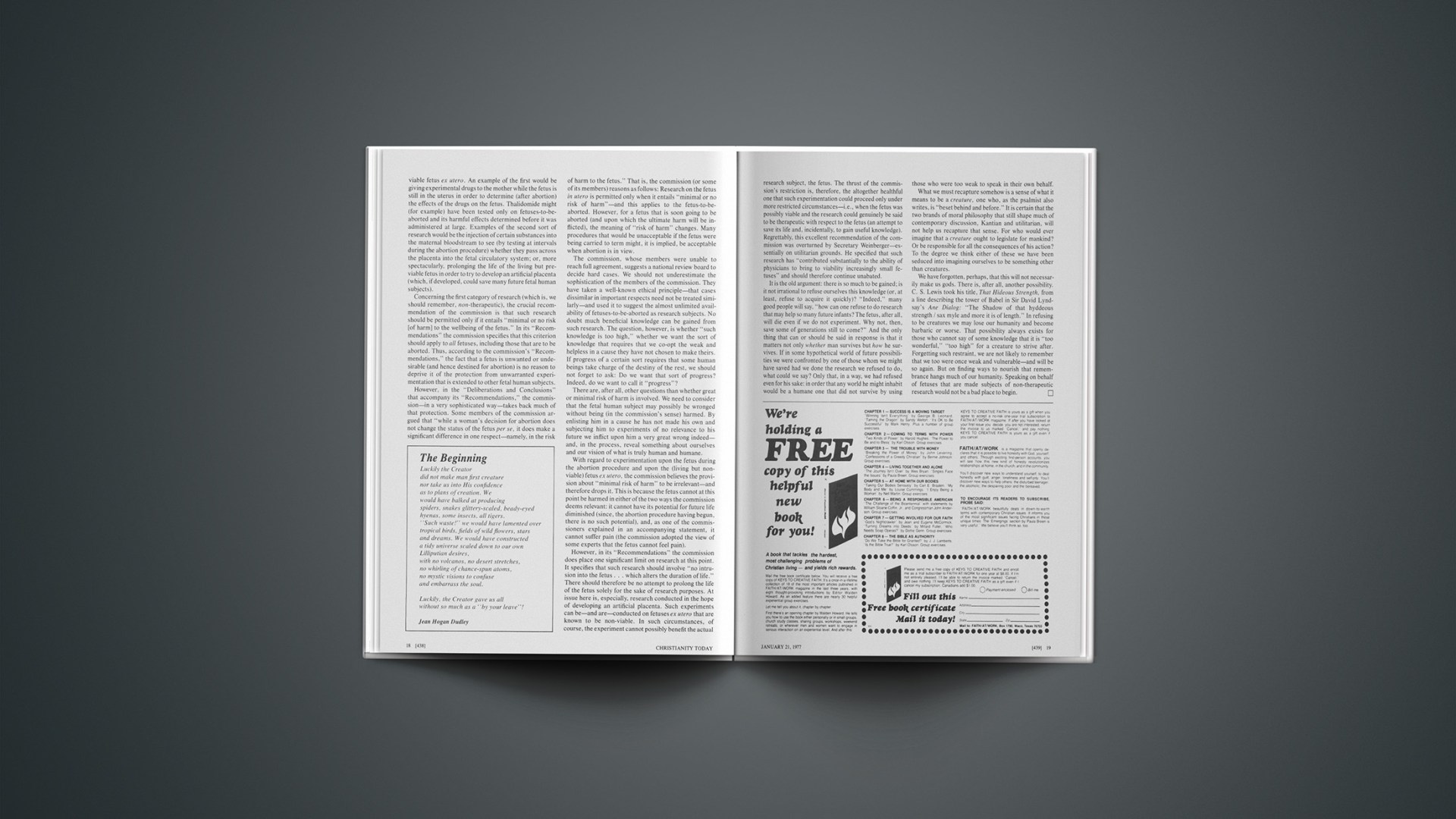
The Beginning

Luckily the Creator

did not make man first creature

nor take us into His confidence

as to plans of creation. We

would have balked at producing

spiders, snakes glittery-scaled, beady-eyed

hyenas, some insects, all tigers.

“Such waste!” we would have lamented over

tropical birds, fields of wild flowers, stars

and dreams. We would have constructed

a tidy universe scaled down to our own

Lilliputian desires,

with no volcanos, no desert stretches,

no whirling of chance-spun atoms,

no mystic visions to confuse

and embarrass the soul.

Luckily, the Creator gave us all

without so much as a “by your leave”!

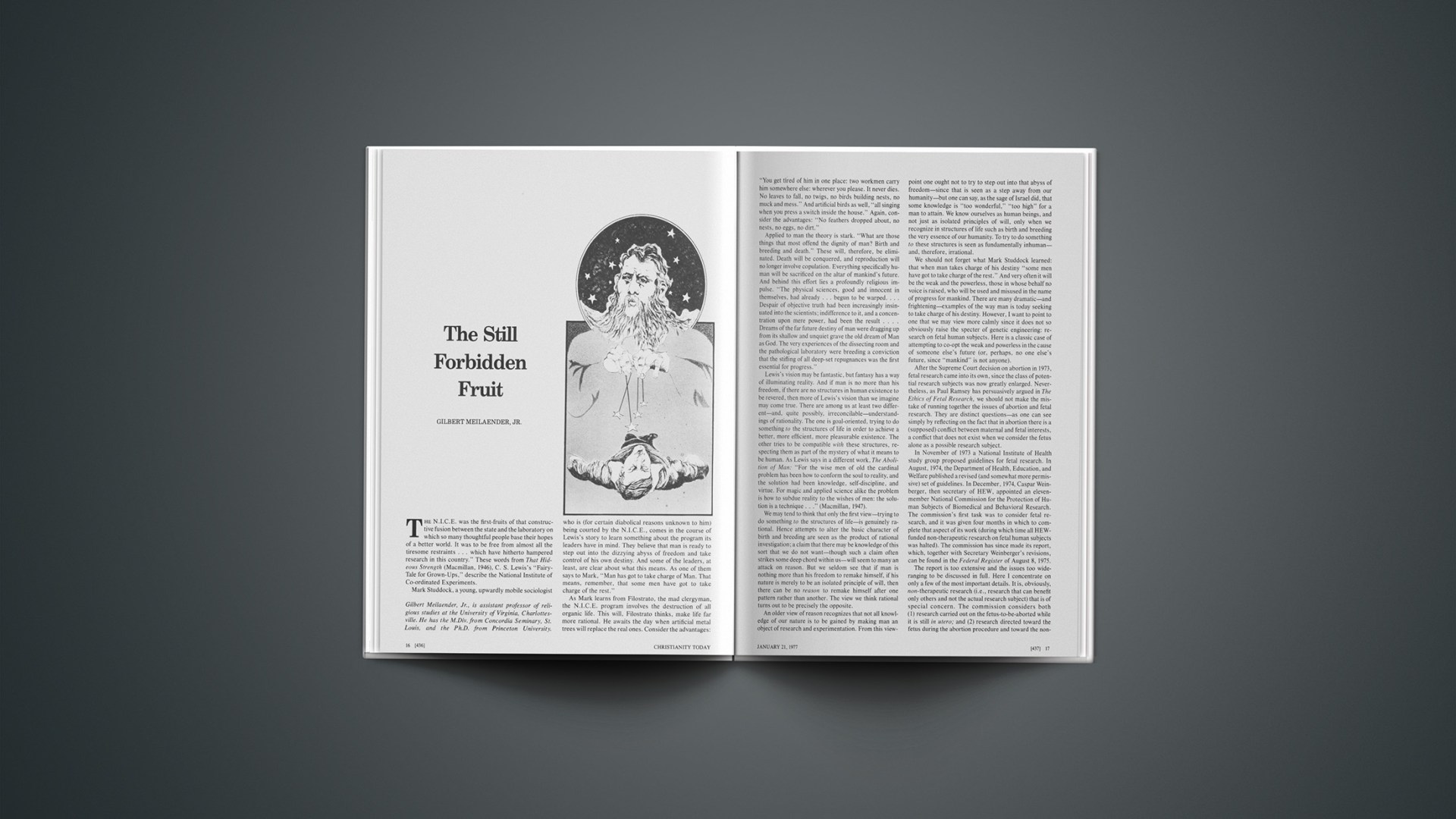
The Still Forbidden Fruit

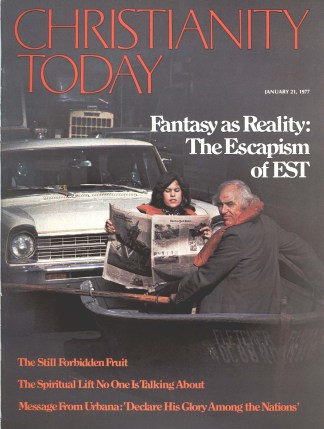
The N.I.C.E. was the first-fruits of that constructive fusion between the state and the laboratory on which so many thoughtful people base their hopes of a better world. It was to be free from almost all the tiresome restraints … which have hitherto hampered research in this country.” These words from That Hideous Strength (Macmillan, 1946), C. S. Lewis’s “Fairy-Tale for Grown-Ups,” describe the National Institute of Co-ordinated Experiments.

Mark Studdock, a young, upwardly mobile sociologist who is (for certain diabolical reasons unknown to him) being courted by the N.I.C.E., comes in the course of Lewis’s story to learn something about the program its leaders have in mind. They believe that man is ready to step out into the dizzying abyss of freedom and take control of his own destiny. And some of the leaders, at least, are clear about what this means. As one of them says to Mark, “Man has got to take charge of Man. That means, remember, that some men have got to take charge of the rest.”

As Mark learns from Filostrato, the mad clergyman, the N.I.C.E. program involves the destruction of all organic life. This will, Filostrato thinks, make life far more rational. He awaits the day when artificial metal trees will replace the real ones. Consider the advantages: “You get tired of him in one place: two workmen carry him somewhere else: wherever you please. It never dies. No leaves to fall, no twigs, no birds building nests, no muck and mess.” And artificial birds as well, “all singing when you press a switch inside the house.” Again, consider the advantages: “No feathers dropped about, no nests, no eggs, no dirt.”

Applied to man the theory is stark. “What are those things that most offend the dignity of man? Birth and breeding and death.” These will, therefore, be eliminated. Death will be conquered, and reproduction will no longer involve copulation. Everything specifically human will be sacrificed on the altar of mankind’s future. And behind this effort lies a profoundly religious impulse. “The physical sciences, good and innocent in themselves, had already … begun to be warped.… Despair of objective truth had been increasingly insinuated into the scientists; indifference to it, and a concentration upon mere power, had been the result.… Dreams of the far future destiny of man were dragging up from its shallow and unquiet grave the old dream of Man as God. The very experiences of the dissecting room and the pathological laboratory were breeding a conviction that the stifling of all deep-set repugnances was the first essential for progress.”

Lewis’s vision may be fantastic, but fantasy has a way of illuminating reality. And if man is no more than his freedom, if there are no structures in human existence to be revered, then more of Lewis’s vision than we imagine may come true. There are among us at least two different—and, quite possibly, irreconcilable—understandings of rationality. The one is goal-oriented, trying to do something to the structures of life in order to achieve a better, more efficient, more pleasurable existence. The other tries to be compatible with these structures, respecting them as part of the mystery of what it means to be human. As Lewis says in a different work, The Abolition of Man: “For the wise men of old the cardinal problem has been how to conform the soul to reality, and the solution had been knowledge, self-discipline, and virtue. For magic and applied science alike the problem is how to subdue reality to the wishes of men: the solution is a technique …” (Macmillan, 1947).

We may tend to think that only the first view—trying to do something to the structures of life—is genuinely rational. Hence attempts to alter the basic character of birth and breeding are seen as the product of rational investigation; a claim that there may be knowledge of this sort that we do not want—though such a claim often strikes some deep chord within us—will seem to many an attack on reason. But we seldom see that if man is nothing more than his freedom to remake himself, if his nature is merely to be an isolated principle of will, then there can be no reason to remake himself after one pattern rather than another. The view we think rational turns out to be precisely the opposite.

An older view of reason recognizes that not all knowledge of our nature is to be gained by making man an object of research and experimentation. From this viewpoint one ought not to try to step out into that abyss of freedom—since that is seen as a step away from our humanity—but one can say, as the sage of Israel did, that some knowledge is “too wonderful,” “too high” for a man to attain. We know ourselves as human beings, and not just as isolated principles of will, only when we recognize in structures of life such as birth and breeding the very essence of our humanity. To try to do something to these structures is seen as fundamentally inhuman—and, therefore, irrational.

We should not forget what Mark Studdock learned: that when man takes charge of his destiny “some men have got to take charge of the rest.” And very often it will be the weak and the powerless, those in whose behalf no voice is raised, who will be used and misused in the name of progress for mankind. There are many dramatic—and frightening—examples of the way man is today seeking to take charge of his destiny. However, I want to point to one that we may view more calmly since it does not so obviously raise the specter of genetic engineering: research on fetal human subjects. Here is a classic case of attempting to co-opt the weak and powerless in the cause of someone else’s future (or, perhaps, no one else’s future, since “mankind” is not anyone).

After the Supreme Court decision on abortion in 1973, fetal research came into its own, since the class of potential research subjects was now greatly enlarged. Nevertheless, as Paul Ramsey has persuasively argued in The Ethics of Fetal Research, we should not make the mistake of running together the issues of abortion and fetal research. They are distinct questions—as one can see simply by reflecting on the fact that in abortion there is a (supposed) conflict between maternal and fetal interests, a conflict that does not exist when we consider the fetus alone as a possible research subject.

In November of 1973 a National Institute of Health study group proposed guidelines for fetal research. In August, 1974, the Department of Health, Education, and Welfare published a revised (and somewhat more permissive) set of guidelines. In December, 1974, Caspar Weinberger, then secretary of HEW, appointed an eleven-member National Commission for the Protection of Human Subjects of Biomedical and Behavioral Research. The commission’s first task was to consider fetal research, and it was given four months in which to complete that aspect of its work (during which time all HEW-funded non-therapeutic research on fetal human subjects was halted). The commission has since made its report, which, together with Secretary Weinberger’s revisions, can be found in the Federal Register of August 8, 1975.

The report is too extensive and the issues too wide-ranging to be discussed in full. Here I concentrate on only a few of the most important details. It is, obviously, non-therapeutic research (i.e., research that can benefit only others and not the actual research subject) that is of special concern. The commission considers both (1) research carried out on the fetus-to-be-aborted while it is still in utero; and (2) research directed toward the fetus during the abortion procedure and toward the non-viable fetus ex utero. An example of the first would be giving experimental drugs to the mother while the fetus is still in the uterus in order to determine (after abortion) the effects of the drugs on the fetus. Thalidomide might (for example) have been tested only on fetuses-to-be-aborted and its harmful effects determined before it was administered at large. Examples of the second sort of research would be the injection of certain substances into the maternal bloodstream to see (by testing at intervals during the abortion procedure) whether they pass across the placenta into the fetal circulatory system; or, more spectacularly, prolonging the life of the living but pre-viable fetus in order to try to develop an artificial placenta (which, if developed, could save many future fetal human subjects).

Concerning the first category of research (which is, we should remember, non-therapeutic), the crucial recommendation of the commission is that such research should be permitted only if it entails “minimal or no risk [of harm] to the wellbeing of the fetus.” In its “Recommendations” the commission specifies that this criterion should apply to all fetuses, including those that are to be aborted. Thus, according to the commission’s “Recommendations,” the fact that a fetus is unwanted or undesirable (and hence destined for abortion) is no reason to deprive it of the protection from unwarranted experimentation that is extended to other fetal human subjects.

However, in the “Deliberations and Conclusions” that accompany its “Recommendations,” the commission—in a very sophisticated way—takes back much of that protection. Some members of the commission argued that “while a woman’s decision for abortion does not change the status of the fetus per se, it does make a significant difference in one respect—namely, in the risk of harm to the fetus.” That is, the commission (or some of its members) reasons as follows: Research on the fetus in utero is permitted only when it entails “minimal or no risk of harm”—and this applies to the fetus-to-be-aborted. However, for a fetus that is soon going to be aborted (and upon which the ultimate harm will be inflicted), the meaning of “risk of harm” changes. Many procedures that would be unacceptable if the fetus were being carried to term might, it is implied, be acceptable when abortion is in view.

The commission, whose members were unable to reach full agreement, suggests a national review board to decide hard cases. We should not underestimate the sophistication of the members of the commission. They have taken a well-known ethical principle—that cases dissimilar in important respects need not be treated similarly—and used it to suggest the almost unlimited availability of fetuses-to-be-aborted as research subjects. No doubt much beneficial knowledge can be gained from such research. The question, however, is whether “such knowledge is too high,” whether we want the sort of knowledge that requires that we co-opt the weak and helpless in a cause they have not chosen to make theirs. If progress of a certain sort requires that some human beings take charge of the destiny of the rest, we should not forget to ask: Do we want that sort of progress? Indeed, do we want to call it “progress”?

There are, after all, other questions than whether great or minimal risk of harm is involved. We need to consider that the fetal human subject may possibly be wronged without being (in the commission’s sense) harmed. By enlisting him in a cause he has not made his own and subjecting him to experiments of no relevance to his future we inflict upon him a very great wrong indeed—and, in the process, reveal something about ourselves and our vision of what is truly human and humane.

With regard to experimentation upon the fetus during the abortion procedure and upon the (living but non-viable) fetus ex utero, the commission believes the provision about “minimal risk of harm” to be irrelevant—and therefore drops it. This is because the fetus cannot at this point be harmed in either of the two ways the commission deems relevant: it cannot have its potential for future life diminished (since, the abortion procedure having begun, there is no such potential), and, as one of the commissioners explained in an accompanying statement, it cannot suffer pain (the commission adopted the view of some experts that the fetus cannot feel pain).

However, in its “Recommendations” the commission does place one significant limit on research at this point. It specifies that such research should involve “no intrusion into the fetus … which alters the duration of life.” There should therefore be no attempt to prolong the life of the fetus solely for the sake of research purposes. At issue here is, especially, research conducted in the hope of developing an artificial placenta. Such experiments can be—and are—conducted on fetuses ex utero that are known to be non-viable. In such circumstances, of course, the experiment cannot possibly benefit the actual research subject, the fetus. The thrust of the commission’s restriction is, therefore, the altogether healthful one that such experimentation could proceed only under more restricted circumstances—i.e., when the fetus was possibly viable and the research could genuinely be said to be therapeutic with respect to the fetus (an attempt to save its life and, incidentally, to gain useful knowledge). Regrettably, this excellent recommendation of the commission was overturned by Secretary Weinberger—essentially on utilitarian grounds. He specified that such research has “contributed substantially to the ability of physicians to bring to viability increasingly small fetuses” and should therefore continue unabated.

It is the old argument: there is so much to be gained; is it not irrational to refuse ourselves this knowledge (or, at least, refuse to acquire it quickly)? “Indeed,” many good people will say, “how can one refuse to do research that may help so many future infants? The fetus, after all, will die even if we do not experiment. Why not, then, save some of generations still to come?” And the only thing that can or should be said in response is that it matters not only whether man survives but how he survives. If in some hypothetical world of future possibilities we were confronted by one of those whom we might have saved had we done the research we refused to do, what could we say? Only that, in a way, we had refused even for his sake: in order that any world he might inhabit would be a humane one that did not survive by using those who were too weak to speak in their own behalf.

What we must recapture somehow is a sense of what it means to be a creature, one who, as the psalmist also writes, is “beset behind and before.” It is certain that the two brands of moral philosophy that still shape much of contemporary discussion, Kantian and utilitarian, will not help us recapture that sense. For who would ever imagine that a creature ought to legislate for mankind? Or be responsible for all the consequences of his action? To the degree we think either of these we have been seduced into imagining ourselves to be something other than creatures.

We have forgotten, perhaps, that this will not necessarily make us gods. There is, after all, another possibility. C. S. Lewis took his title, That Hideous Strength, from a line describing the tower of Babel in Sir David Lyndsay’s Ane Dialog: “The Shadow of that hyddeous strength / sax myle and more it is of length.” In refusing to be creatures we may lose our humanity and become barbaric or worse. That possibility always exists for those who cannot say of some knowledge that it is “too wonderful,” “too high” for a creature to strive after. Forgetting such restraint, we are not likely to remember that we too were once weak and vulnerable—and will be so again. But on finding ways to nourish that remembrance hangs much of our humanity. Speaking on behalf of fetuses that are made subjects of non-therapeutic research would not be a bad place to begin.

The Serpentine Serenity of EST

The wary, darting eyes of my friend Leslie had always betrayed the tension beneath her airy isn’t-it-grand approach to life. Serious, realistic conversations threatened her; Leslie refused to become involved. One evening, over coffee and a discussion of politics, it seemed that tension had disappeared. She made several pointed comments and, unusual for her, remained calm. Responding to a remark about her new serenity she excitedly told us she had learned how silly it was to become excited. She had discovered this at something called Erhard Seminars Training, a two-weekend therapy program that teaches people—for $250—how to become and stay serene. As of late last summer more than 80,000 people, some of them ministers, priests, and nuns, had already taken the training. And the organization expected to add 12,000 to its graduate list by the new year. Among its adherents is the singer John Denver, who calls Werner Erhard “a god.”

I became curious about Leslie’s change as more friends began talking of their great experience in the training sessions of what they called “est.” I saw one major change: my friends were not interested in anything that didn’t directly affect their comfort. Their bland smiles and uniform responses to controversial topics disturbed me. I called the est office to find out how Erhard training accomplishes these changes. After an impressively incoherent conversation I was invited to attend a guest seminar at a New York Hotel.

When I arrived at the hotel I immediately saw my first examples of the estian inner corps. They stood lined up from the entrance steps to the elevator, their stone faces occasionally lit by quick, mechanical smiles. They imposed an atmosphere of precision on the usually comfortable disorganization of a hotel lobby. Like sentinels on a precarious jungle trail, the people of est showed an uncanny ability to pick out their charges and impel them to the proper place.

When I arrived at the training room, I immediately received a highly legible name tag. Everyone was hailing everyone else with the air of people trying to overcome the differences that keep long-standing feuds alive. A voice called my name. But when I turned a stranger hurtled herself at me, arms spread wide. My reluctance to embrace her was only partly due to the fact she was a stranger; the deadness of her eyes belied her surface affection. No warmth, no life. The hallmark of est.

After the guest seminar I stayed for a meeting primarily for those who had already completed the training. The leader bounded onto the stage to welcome the guests to est. He mechanically announced that our friends in est loved us and welcomed the chance to assist us in creating our own experience of est.

His assistant then led the non-initiates to another room where she gave an enthusiastic sales pitch based on what est had done for her. But beneath her ready smile and wholesome appearance lurked an anger she betrayed when she faced a difficult, critical question. She could not conceal contempt for those who challenged Erhard.

She attributed superhuman qualities to Erhard. She stressed personal power over all events and laced her comments with derision for such things as guilt, unease, and ambivalence. These silly blocks to true experience would, of course, disappear once we had the training. The idea of salvation would become passé after we accepted the fact that we were already perfect.

Est has reluctantly made public the details of Erhard’s background. His mother was an Episcopalian, his father a Jewish convert to the Episcopal Church. Werner was baptized John Paul Rosenberg. New Times (March 19, 1976) points out that Erhard has always considered Nietzsche his intellectual mentor; the creation of a super-race is his highest ambition.

And thus—est. Werner received—not, he claims, conceived—the idea in a whooosh while driving his wife’s Mustang, somewhere in the vicinity of San Francisco’s Golden Gate Bridge. (The exact locale varies from telling to telling.) The force of the cosmos enlightened him by blinding his senses. This modern-day equivalent of Saint Paul’s Damascus-road experience is merely the beginning of contemptuous distortion of Scripture.

Erhard learned in his freeway conversion that “What is, is. What ain’t, ain’t.” He denies the past; its reminders encumber “the now.” And he thinks we should ignore the future consequences of our actions. Having removed moral and ethical considerations, Erhard decided he was “God in my universe.” According to est, each of us is God in his own universe.

In a radio interview printed in the New Age Journal (Sept. and Oct., 1975) Werner said, “I confronted myself as ultimately evil. What I saw in that car was that I was never going to make it; I had spent my whole life struggling to become spiritual, to become whatever that means. And I discovered in that car that I wasn’t going to make it; I was never going to be all right. You know, I was going to be no good forever.” He confronted original sin, but instead of seeking God’s redemptive grace, Werner determined to make himself his own redeemer. He justified his own sin. All men are liars, he admits, himself included: “I don’t mind being called a con man as long as when you’re calling me a con man you recognize you’re also a con man.”

Yet followers adore him, almost as a spirit. “When Werner wants to move from here to there, his body just moves him, like floating almost” says the devotee who gave the sales pitch at the seminar I attended. They emphasize the importance of love and claim Werner has what this follower called “this incredible sense of truth.” She buttressed her sales talk with references to est’s need to “give” the training to others in love. When I asked how she showed love to those who had had severe mental breakdowns after the training, she laughed contemptuously. Her reason—“Some people really want to freak out and make the training an excuse.” She and other esties deny that they have any responsibility for those in the training; est precludes compassion for others. But when Jesus saw the grief of Lazarus’s family he wept. When this woman was reminded that her master’s voice had contributed to other people’s anguish, she laughed with scorn. That kind of love has nothing to do with the love taught by Christ.

What is the training like? A trainee, confined to a hotel room with 249 other people for up to eighteen hours a day, undergoes four days of passivity exercises. He’s insulted—“You’re all a bunch of turkeys. Your lives don’t work and that’s why you’re here!” His beliefs are undermined—“Belief in God is the greatest single barrier to God in the universe.” Group pressure is a major psychological tool. Personal autonomy does not exist. The trainer attacks those who try to defend any beliefs. Verbal abuse and denial of physical comfort are punctuated by instruction in meditation technique. Of course, the trainer tells the students what to meditate about and for how long. Then he tells them how to use what they’ve been taught.

In his prophetic work, The Abolition of Man, C. S. Lewis underscores the vapidity of the argument that all one can ever express in language is personal feeling. He points out that when one is prompted by an event or circumstance to say, “This is sublime,” one cannot mean, “I have sublime feelings”; “the feelings which make a man call an object sublime are not sublime feelings but feelings of veneration.” “This is sublime” is properly translated “I have humble feelings.” The argument that all value judgments are merely subjective undermines any theological and philosophical discussion of ethics. It assumes that emotions are contrary to reason and in themselves contemptible. Calling something sublime, far from simply describing one’s feelings, also contains the implicit statement that what prompted the comment merited the emotion of humility. Those who deny this, which is in effect a denial of all objective reality, are forced to regard all sentiments as non-rational, as mist between us and reality. They must then decide to remove all emotions or to tolerate them regardless of whether they are “just” or not. Lewis points out that those who do this must create in others “by suggestion or incantation a mirage their own reason has successfully dissipated.”

Werner and est do just that. A former est assistant says she was encouraged to regard all emotions as “hindrances to real experience.” As Lewis makes clear, the truth is the exact opposite. Emotions are the result of one’s mind responding to one’s surroundings.

Est uses meditation to bypass emotion. For example, if you get angry about a situation, imagine yourself twenty feet away, twenty feet above the horizon, and looking angry. If you are displeased with that image, concentrate until the imaginary vision of yourself conforms to your desires. Est promises you will quickly match the image. Serenity is yours for the imagining.

The technique works because it removes you from direct sense stimulation. No emotional response will intrude on your fantasy, no logical argument will convince you that you are removed from reality. My friend Leslie used that to keep herself calm. She mentally moved into a fantasy world.

Est hammers away at previously held perceptions of reality, particularly a Christian world view. Eventually most trainees are convinced that they do indeed distort reality. Once they agree to that the trainer screams, “See, it was all illusion! There is no objective reality!” The group, tired and nervous, long to have their confused perceptions soothed, and est quickly supplies the longed for salvation. If everything is illusion, you are free to choose your illusion—you, therefore control your world. Freedom lies in choosing your illusion. Play it Erhard’s way and you, imitating him, are God in your universe.

In his classic explanation of the Christian faith, Orthodoxy, G. K. Chesterton reminds us that logic alone is not enough. “If you argue with a madman, it is extremely probable that you will get the worst of it; for in many ways his mind moves all the quicker for not being delayed by the things that go with good judgment. He is not hampered by a sense of humor or by charity, or by the dumb certainties of experience. He is the more logical for losing certain sane affections. Indeed, the common phrase for insanity is a misleading one. The madman is not the man who has lost his reason. The madman is the man who has lost everything except his reason.” Werner’s trainees do not lose the complements to reason; they willingly allow est to wrest them away. Knowing this, and knowing that the trainee will need a source of relief, est teaches them how to create the center of their lives.

Realizing that the world will infringe upon any carefully constructed fantasy, Erhard suggests that a person should drift into a meditative reverie called “your space.” Once there you construct a little mental room where you are safe to practice your perfection.

While mentally following the instructions of the trainer you physically act out the steps. You pretend you are hammering, sawing, moving things about, and putting up various pieces of paraphernalia. In your center, where Erhard assures you that you are free to experience your reality, you mentally place a chair, a desk, a telephone, a bookcase, a cassette file with tapes of all the things you know (according to one insider there should also be a few empty tapes), a television set, a large movie screen, a closet that contains the regalia for your favorite role (such as skier, spaceman, ballerina) and a few empty hangers (one should also have a shirt with epaulets—a pervading hint of est’s martial tendencies; the trainers wear such shirts), and a platform twenty feet away, twenty degrees above the horizon, where you can happily watch yourself practice your perfection.

All this is fantasy. Its purpose is to teach you to experience life. But the reality est proclaims is a retreat into illusion. As Lewis and Chesterton remind us, a Christian who tries to imitate Christ must face emotion and strive to make it one with reason—a move toward reality, not away from it.

Est’s theological pretensions have never been clearly stated, though Adelaide Bry’s authorized book, est, Sixty Hours That Transform Your Life, mentions them. She quotes Erhard: “The heart of est is spiritual people, really.… That’s all there is, there isn’t anything but spirituality, which is just another name for God, because God is everywhere.” The same book quotes a young man on his estian understanding of Jesus: “[Jesus] kept telling everyone over and over that everybody was like he was: perfect.” Werner’s “Bible” classes must leave out Judas Iscariot, the Pharisees, the people Jesus drove from the Temple, and Peter. Despite our imperfections, Christ forgives us when we repent, just as he forgave Peter for denying him. Jesus understands our weaknesses, our imperfections. He never claimed that we were, or could be, in this life, perfect.

On October 15, 1975, a letter mailed to est graduates quoted Erhard on religion: “One of the purposes of religion is to serve people by providing the space in which an experience can take place. And it is the responsibility of the clergy to communicate the experience—the aliveness—that is inherent in the world’s religions in a way that allows people to create that experience within themselves. It is est’s intention to support those people who have dedicated themselves to communicating the experience of religion.” But as we have seen, Erhard is adamantly opposed to Christianity—to the need for repentance, and forgiveness. Christians cannot serve Erhard and Christ.

Several weeks ago, on one of those turbulent days when Canadian air roars down the Hudson Valley driving out the pollution-laden smog of New York, Leslie met me for coffee again. Her air of calm was enthrallingly real, unlike that produced by est. She had been released from the inner qualms that had engulfed her; she was free from her former turmoil. Her eyes were now alive, and she laughed spontaneously. To help explain what had happened to her, she read from a book, The Four Loves by C. S. Lewis.

She told me she had always wanted to be loved but never felt worthy. Est, she explained, had for a while convinced her that the desire for other’s love was merely an illusion. She tried to imagine that other people did love her. That ended in disappointment. An alternative illusion, that she did not require love, proved equally painful. Her involvement with est caused a deep gap between her and her old friends. The people in est were no help. Whenever she tried to express her desires, they attacked her about why she couldn’t go along with the group.

A friend helped Leslie find what she was searching for. And C. S. Lewis helped her see the falseness of est: “We easily imagine conditions far higher than any we have really reached. If we describe what we have imagined we may make others, and make ourselves, believe that we have really been there. And if I have only imagined it, is it a further delusion that even the imagining has at some moments made all other objects of desire—yes, even peace, even to have no more fears—look like broken toys and faded flowers? Perhaps. Perhaps, for many of us, all experience merely defines, so to speak, the shape of that gap where our love of God ought to be. It is not enough. It is something.”

First and Second

Christ that in the flower blooms

is manifested mild

and with more subtle power looms

than thunderheads wild.

Given the choice between the two

quiet grace or power

he may have chosen one to woo.

We watch to see the second flower.

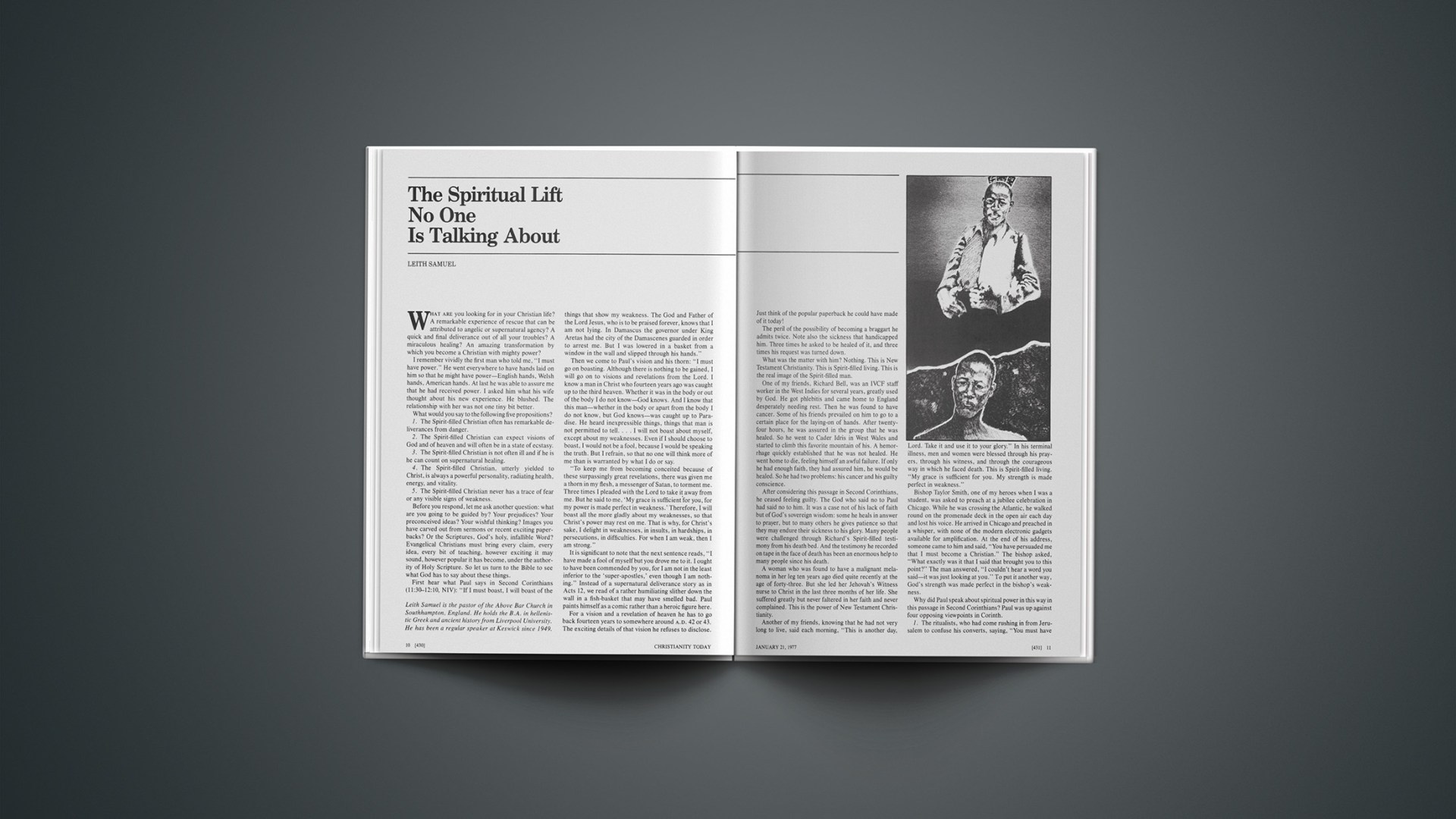
The Spiritual Lift No One Is Talking About

What are you looking for in your Christian life? A remarkable experience of rescue that can be attributed to angelic or supernatural agency? A quick and final deliverance out of all your troubles? A miraculous healing? An amazing transformation by which you become a Christian with mighty power?

I remember vividly the first man who told me, “I must have power.” He went everywhere to have hands laid on him so that he might have power—English hands, Welsh hands, American hands. At last he was able to assure me that he had received power. I asked him what his wife thought about his new experience. He blushed. The relationship with her was not one tiny bit better.

What would you say to the following five propositions?

1. The Spirit-filled Christian often has remarkable deliverances from danger.

2. The Spirit-filled Christian can expect visions of God and of heaven and will often be in a state of ecstasy.

3. The Spirit-filled Christian is not often ill and if he is he can count on supernatural healing.

4. The Spirit-filled Christian, utterly yielded to Christ, is always a powerful personality, radiating health, energy, and vitality.

5. The Spirit-filled Christian never has a trace of fear or any visible signs of weakness.

Before you respond, let me ask another question: what are you going to be guided by? Your prejudices? Your preconceived ideas? Your wishful thinking? Images you have carved out from sermons or recent exciting paperbacks? Or the Scriptures, God’s holy, infallible Word? Evangelical Christians must bring every claim, every idea, every bit of teaching, however exciting it may sound, however popular it has become, under the authority of Holy Scripture. So let us turn to the Bible to see what God has to say about these things.

First hear what Paul says in Second Corinthians (11:30–12:10, NIV): “If I must boast, I will boast of the things that show my weakness. The God and Father of the Lord Jesus, who is to be praised forever, knows that I am not lying. In Damascus the governor under King Aretas had the city of the Damascenes guarded in order to arrest me. But I was lowered in a basket from a window in the wall and slipped through his hands.”

Then we come to Paul’s vision and his thorn: “I must go on boasting. Although there is nothing to be gained, I will go on to visions and revelations from the Lord. I know a man in Christ who fourteen years ago was caught up to the third heaven. Whether it was in the body or out of the body I do not know—God knows. And I know that this man—whether in the body or apart from the body I do not know, but God knows—was caught up to Paradise. He heard inexpressible things, things that man is not permitted to tell.… I will not boast about myself, except about my weaknesses. Even if I should choose to boast, I would not be a fool, because I would be speaking the truth. But I refrain, so that no one will think more of me than is warranted by what I do or say.

“To keep me from becoming conceited because of these surpassingly great revelations, there was given me a thorn in my flesh, a messenger of Satan, to torment me. Three times I pleaded with the Lord to take it away from me. But he said to me, ‘My grace is sufficient for you, for my power is made perfect in weakness.’ Therefore, I will boast all the more gladly about my weaknesses, so that Christ’s power may rest on me. That is why, for Christ’s sake, I delight in weaknesses, in insults, in hardships, in persecutions, in difficulties. For when I am weak, then I am strong.”

It is significant to note that the next sentence reads, “I have made a fool of myself but you drove me to it. I ought to have been commended by you, for I am not in the least inferior to the ‘super-apostles,’ even though I am nothing.” Instead of a supernatural deliverance story as in Acts 12, we read of a rather humiliating slither down the wall in a fish-basket that may have smelled bad. Paul paints himself as a comic rather than a heroic figure here.

For a vision and a revelation of heaven he has to go back fourteen years to somewhere around A.D. 42 or 43. The exciting details of that vision he refuses to disclose. Just think of the popular paperback he could have made of it today!

The peril of the possibility of becoming a braggart he admits twice. Note also the sickness that handicapped him. Three times he asked to be healed of it, and three times his request was turned down.

What was the matter with him? Nothing. This is New Testament Christianity. This is Spirit-filled living. This is the real image of the Spirit-filled man.

One of my friends, Richard Bell, was an IVCF staff worker in the West Indies for several years, greatly used by God. He got phlebitis and came home to England desperately needing rest. Then he was found to have cancer. Some of his friends prevailed on him to go to a certain place for the laying-on of hands. After twenty-four hours, he was assured in the group that he was healed. So he went to Cader Idris in West Wales and started to climb this favorite mountain of his. A hemorrhage quickly established that he was not healed. He went home to die, feeling himself an awful failure. If only he had enough faith, they had assured him, he would be healed. So he had two problems: his cancer and his guilty conscience.

After considering this passage in Second Corinthians, he ceased feeling guilty. The God who said no to Paul had said no to him. It was a case not of his lack of faith but of God’s sovereign wisdom: some he heals in answer to prayer, but to many others he gives patience so that they may endure their sickness to his glory. Many people were challenged through Richard’s Spirit-filled testimony from his death bed. And the testimony he recorded on tape in the face of death has been an enormous help to many people since his death.

A woman who was found to have a malignant melanoma in her leg ten years ago died quite recently at the age of forty-three. But she led her Jehovah’s Witness nurse to Christ in the last three months of her life. She suffered greatly but never faltered in her faith and never complained. This is the power of New Testament Christianity.

Another of my friends, knowing that he had not very long to live, said each morning, “This is another day, Lord. Take it and use it to your glory.” In his terminal illness, men and women were blessed through his prayers, through his witness, and through the courageous way in which he faced death. This is Spirit-filled living. “My grace is sufficient for you. My strength is made perfect in weakness.”

Bishop Taylor Smith, one of my heroes when I was a student, was asked to preach at a jubilee celebration in Chicago. While he was crossing the Atlantic, he walked round on the promenade deck in the open air each day and lost his voice. He arrived in Chicago and preached in a whisper, with none of the modern electronic gadgets available for amplification. At the end of his address, someone came to him and said, “You have persuaded me that I must become a Christian.” The bishop asked, “What exactly was it that I said that brought you to this point?” The man answered, “I couldn’t hear a word you said—it was just looking at you.” To put it another way, God’s strength was made perfect in the bishop’s weakness.

Why did Paul speak about spiritual power in this way in this passage in Second Corinthians? Paul was up against four opposing viewpoints in Corinth.

1. The ritualists, who had come rushing in from Jerusalem to confuse his converts, saying, “You must have this extra experience (circumcision) or you are not proper Christians.”

2. The antinomians, who said, “It doesn’t matter how you behave as long as you believe the right things.”

3. The super-supernaturalists, who claimed a hotline from heaven that put them ahead in teaching all that Paul had ever taught.

4. The wishful thinkers, who naturally preferred the exciting and extraordinary to the steady, ordinary daily discipline of Christian living.

In First Corinthians 1 and 2, Paul deals with Group 1. In First Corinthians 5 through 8, he deals with Group 2. In Second Corinthians 10 through 13, and especially the verses we have been looking at, he deals with Groups 3 and 4, the super-supernaturalists and the wishful thinkers. In each of us, there is a great yen to have this hotline from heaven and to be constantly seeing the exciting and extraordinary. But see what Paul says in First Corinthians 2:1–5. We don’t read, “I came to you with great excitement, in great power and tremendous confidence, radiating health with every step I took in Corinth.”

Holy Spirit power is not divine power that replaces the natural weakness of the human personality. Holy Spirit power was promised by the Risen Lord in Luke 24:49 and in Acts 1:8 for the specific purpose of bearing witness to the Risen Lord, not in order to give some Christians a “deeper experience” than others. And the promise Luke records is of power to cover as “clothing” the men whom Christ had called to his service, not of a completely new personality under the old skin, a personality that knows no frailty in a body that knows no weakness.

The promise of spiritual power is circumscribed, i.e., limited to certain situations, occasions, and purposes. It is not power promised for power’s sake, or power for our sake. It is not influence promised for the sake of influence. It is not power to bolster up our image or our ego. It is not power so that we can dominate other people’s lives or manipulate and control their thinking, their emotions, or their wills. It is not our power in place of our weakness. It is God’s power manifest in our weakness. It is God’s power using our human weakness as a platform on which it can be seen to be God’s power; God’s power using our frail storm lamps as a holder from which to shine into the hearts of men; God’s power as a tent surrounding us, supporting the framework of the weakness of our human nature. The weakness remains—the power transcends it.

Why do we need the Holy Spirit’s power? We need it because God’s power flows along God’s pylons. The power flows in the direction of the fulfillment of his purposes. The power of Christ is spiritual power, enabling strength given for his moment to his servant for his task; strength to bear witness to him effectively, to draw attention to someone other than ourselves. “Witnesses to me” means exactly what it says. (See Second Corinthians 4:6, 7; First Corinthians 2:1–5.) We need the Spirit’s power—

• to overthrow false ideas and ideologies or systems of thought by which men live (2 Cor. 10:3, 4);

• to face difficulties courageously (Phil. 4:13);

• to endure physical pain bravely (1 Pet. 4:12–14);

• to believe Christ is with us steadfastly when we don’t feel his presence with us at all (Heb. 13:5, 6);

• to fit in with other Christians humbly and helpfully, and support them in their hours of weakness and distress as well as in their daily routine (2 Cor. 1:4–7);

• to recognize temptations speedily and to resist them firmly (1 Cor. 10:13);

• to absorb solid teaching gratefully (Col. 2:6–9);

• to stand up for the truth uncompromisingly and with courtesy (Rom. 1:14–16; 16:25–27);

• to recognize continually that our natural resources, i.e., what we are by nature and past experience and what we have achieved by grace, are utterly inadequate to face today’s task, but that Christ’s grace is sufficient for us this very day (2 Cor. 3:16; 4:7);

• to have the ability to find some real delight in our weaknesses, for whenever we are weak, then, and then only, are we strong (2 Cor. 10:9–12).

How do we get the power of Christ’s Spirit? True spiritual power, like joy and fellowship, is not an end in itself but a by-product graciously thrown in as we seek to fulfill the Christian obligations for which the power is needed. As we lay hold of the promise God has given us, the power is turned on. “Seek the Lord and his strength,” says the Word of God. The Lord first; then his strength is found in his presence for the fulfillment of his will in our lives.

If we seek the Lord for the Lord’s sake, then spiritual strength is surely given us so that we may go on seeking him singleheartedly and go out to serve him faithfully. We may not be conscious of the power at the time, only of our own weakness. It may be only when we hear later of blessing coming to others through our words or deeds that we can be sure the power of God was truly released. The power of God is imparted in the process of witnessing and worshiping, not just for the purpose of witnessing and worshiping. I can do all things through the empowering Christ, who continually imparts power, rather than giving it as a reservoir for us to draw on at will.

If we take the time to abide in his presence—i.e., to live in constant conscious dependence on him, browsing daily in his inspired Word—we can be sure that the power of Christ’s Spirit will be released in us.

Eutychus and His Kin: January 21, 1977

What Shall We Name This New Year?

Newsweek magazine labeled 1976 “the year of the evangelical.” Will 1977 be the year of the post-evangelical?

The Chinese have a nice way of describing their years: by beasts. Last year was the year of the dragon; 1975, the year of the leopard. This year goes to the serpent. Turtles, monkeys, pigs, and tigers have all had their time in the Chinese sun.

I wonder what we American Christians would call the years if we named them for animals instead of numbering them. What would this new year be?

Maybe the year of the rabbit, since the great emphasis among evangelicals seems to be on procreation and numerical growth.

Or the beaver. The year of the beaver: I like that. It creates visions of new—if not more stately—and larger church buildings. Enlarge the dammed-up pond and attract more beavers.

The anteater is another possibility. Let others take their aim at tigers and wolves; we’ll settle for ants.

How about the rhinoceros? Thick skin, horn upraised; nobody will get in his way. Relational theology? It’s for the birds, not us rhinos.

With one of us in the White House under Democratic party aegis, perhaps Christians should call this the year of the donkey. (A survey of many church boards might confirm the decision.)

I’ve racked my brain without being able to think of an animal that mauls and kills its own kind. So the current tendency toward internecine warfare among Christians is indescribable.

I wish this would turn out to be the year of the Lion. Don’t you?

EUTYCHUS VIII

Finding Evangelism

I have mixed reactions to the article by C. Peter Wagner, “How ‘Christian’ Is America?” (Dec. 3). While he has pointed out many glaring weaknesses of the Gallup report (the large proportion of the 71 per cent who are probably nominally Christian), I am somewhat disturbed by other comments.

He states, “Mainline denominations are beginning to recapture the evangelistic priority on high levels.” However, only two individuals were specifically named. Also, while these denominations may be rethinking their priorities in the area of evangelism, what do they offer as a definition of evangelism? I should think that this would have great bearing on whether or not they are truly involving themselves in biblical evangelism.

Dr. Wagner further finds great hope in “strong statements on biblical evangelism” which “are coming from Roman Catholic leaders.” I find this incredulous! While I would be the last to deny that there are Roman Catholics who are really born again, it is very difficult for me to imagine the basic tenets of the church having changed to include an “evangelism” apart from the sacraments which are the very foundation of Catholicism! Could Dr. Wagner do a follow-up on these changes in Roman Catholicism? Or could it be that he is now advocating a salvation different from Ephesians 2:8, 9?… While I agree with much of what Dr. Wagner has written, I cannot accept the sum total of the article. It would seem that he is so interested in finding a fountainhead of evangelistic orientation in America that whatever is called evangelism is accepted as biblical simply on that basis alone.

PHILIP A. JONES

First Baptist Church

Freeport, Ill.

C. Peter Wagner’s otherwise stimulating article seems misguided in one central premise. As a staff member of one of the organizations responsible for blocking any government religious census in this country, I would like to respond to his suggestion that it is only “undue nervousness over maintaining separation of church and state” that prevents the Census Bureau from collecting religious data.

It seems to us that there are a number of very sound reasons for opposing an official religious census conducted by the United States government. For one thing, such a census would imply an intensified role for government at a time in our history when many (most?) Americans are questioning the level of government involvement in their personal lives. Government has no legitimate concern with areas in which it cannot legislate, and it is forbidden to legislate in the area of religion. In a country which protects all religious expressions, it is illegitimate for government to even be concerned about the degree of religious belief, affiliation, or practice that such a census would inevitably involve.… Since churches and church research groups can do the job reasonably well, it is not appropriate for the government to gather data for the primary use of churches. Such an undertaking would surely violate the “principal or primary effect test,” upon which many church-state legal decisions are decided.

Finally, we question whether any census in any country could really uncover the number of individuals who “practice the Christian code in their daily lives.” This type of data would elude the most sophisticated government data-gathering agencies, or even public-opinion surveys. We believe the churches and synagogues of America are quite capable of gathering adequate statistical and quantitative information to help them in their work. Let’s not call upon the government for everything.

ALBERT J. MENENDEZ

Director of Research

Americans United for Separation of Church and State

Silver Spring, Md.

Who Pays For “No Need”?

I do not wish to detract from the very fine article by Leon Gerig, “Financing for the Future” (Nov. 5). On the other hand, I do feel that the article contains one inference which your readers should examine and consider very carefully. The list of possibilities offered to parents who wish to receive financial assistance for students planning to attend college is very inclusive and will be a great help to many people. Those people should consider, however, the moral implications of applying for or using “no need” scholarships. By asking for this sort of consideration, parents are indicating that they wish to be considered on a set of standards which differs from those used for the great majority of financial-aid applicants. They should bear in mind, also, that the cost of providing such scholarships must be borne by someone. The someone may be other students in the same college or, particularly in the case of Christian colleges, it may be an underpaid faculty. Within the financial-aid officer’s profession, there is probably not a clear consensus on the ethical nature of “no-need” scholarships. Many people will be inclined to accept such awards if they are extended. I would hope that your readers would be among the group who would consider saying no to such offers and pointing out to colleges why they cannot accept them.

JOHN H. LETARTE

Dean of Student Admissions and Records

The State University at Potsdam

Potsdam, N. Y.

Editor’s Note from January 21, 1977

Readers often ask, “What does ITG mean on my mailing label?” Or, “When does my subscription expire?” The answer is simple: ITG 15 means the subscription has fifteen Issues To Go before it expires. We publish twice a month, twenty-four times a year. To make it work out right we occasionally have a three-week, rather than a two-week, interval between issues. This usually happens in the summer and at the end of the year.

Apple PodcastsDown ArrowDown ArrowDown Arrowarrow_left_altLeft ArrowLeft ArrowRight ArrowRight ArrowRight Arrowarrow_up_altUp ArrowUp ArrowAvailable at Amazoncaret-downCloseCloseEmailEmailExpandExpandExternalExternalFacebookfacebook-squareGiftGiftGooglegoogleGoogle KeephamburgerInstagraminstagram-squareLinkLinklinkedin-squareListenListenListenChristianity TodayCT Creative Studio Logologo_orgMegaphoneMenuMenupausePinterestPlayPlayPocketPodcastRSSRSSSaveSaveSaveSearchSearchsearchSpotifyStitcherTelegramTable of ContentsTable of Contentstwitter-squareWhatsAppXYouTubeYouTube