Minister’s Workshop: Building Rapport by Mail

For the pastor busy with study, counseling, administrative duties, hospital calling, and program planning, the U.S. Postal Service can serve as an able assistant. I have found letters work well in building rapport with the people of the church I serve. The kind of letter I mean is one the pastor writes in his own words, personalizing it to the receiver, not a mimeographed letter. (We make some exceptions to this, which I will mention later.)

Occasionally handwritten notes are fine, but most handwriting is not as legible as it should be. It is best to stick with the typewriter. The letters should be brief and to the point. The paper should be good rag bond and the letterhead printing simple and distinct. Resist the temptation to load your letterhead with pictures, numerous Scripture quotations, symbols, and the like.

I keep a carbon copy of each letter in a permanent file. It serves as a reminder of what has been said, and is interesting to review in the years to come. I have found the following types of letters to be effective:

Visitors’ letters. Every visitor should receive a letter from the pastor letting him know his visit has been appreciated. We use two types. First, to those from out of town visiting only once we send a simple preprinted card that I sign:

We are most happy that you attended worship with us last Sunday. It is our wish that the service may have been such an inspiration that you will want to attend again when visiting our city.

All other visitors receive a typewritten letter that usually reads as follows:

We would like to take this opportunity to express our deep appreciation for your presence in the service Sunday morning. We trust you found the service inspiring and meaningful, and that you will want to attend again.

It is our prayer that God will richly bless you throughout this week.

If I may be of personal service do not hesitate to call me.

With this letter we enclose a sheet entitled “When to Call Your Pastor” and a brochure listing our schedule of services and other information.

Letters to the sick, shut-in, and hospitalized. If a person’s name has been mentioned publicly for prayer in the Sunday services, we send the following letter:

Just a word to let you know that your name was mentioned for prayer during the service Sunday morning. I am praying for your recovery. May God bless you throughout this week.

If someone is sick or shut-in for an extended time, I write a special letter mentioning the problem and reminding the person of God’s promises. I write out a couple of these scriptural promises in the body of the letter.

Thank-you letters. Churches usually have some people who are especially generous in donating time, labor, or money. A personal thank-you letter is likely to be much appreciated.

Letters of encouragement. Times of sadness and discouragement—the loss of a loved one, a financial crisis, a problem with children—should call forth a letter of encouragement from the pastor. It may provide just the lift needed to overcome a difficult hurdle. Such a letter should be directed to the problem and built around Scripture. Most of all, it should express the pastor’s concern.

Letters of appreciation. In our church you don’t necessarily have to do anything or have a particular need to get a letter. I often write and let someone know I have remembered him or her in prayer, or was just thinking about him and wanted to tell him so. It takes very little effort to write a couple of these letters a week. You will be gratified at the response.

Community letters. We write several letters each week to people in the community, primarily in two categories. To new babies we send a letter expressing joy at the news of their “safe arrival in our world” and the hope that they will grow up in the fellowship of the church. And we write to newcomers to welcome them to our community and to invite them to worship with us.

Pastoral letter-writing pays good dividends on the relatively little time it requires, both in building rapport and in encouraging persons in difficult times.—C. D. HANSEN, pastor, First Church of the Nazarene, Lowell, Indiana.

Refiner’s Fire: Biblical Metaphor—More than Decoration

God as a dragon, or a leopard, or lye, or a hunter, or a woman in labor. God’s people as stubborn oxen, dry rot, pottery, silver, soil, dew, a bride. God’s relationship with his people as that of a lover wooing his sweetheart, a ferocious bear ready to tear up his prey, a parent teaching a toddler how to walk, a mother breastfeeding her baby. Outlandish comparisons? The extravagance of some modern paraphraser? No. A translation as dignified as the King James has them.

This figurative strain is an important dimension of biblical language. Some readers of Scripture may look upon it as a decorative device or a nice poetic touch. Others may consider the figurative language something that we have to look through or around or over in order to get the real meaning. I doubt whether those evaluations do justice to the biblical Word. Metaphor, simile, and image are central to scriptural language.

Much of our daily language is shot through with metaphor. Thus I say “shot through,” and your son eats like a horse, we drown in a sea of paperwork, the soloist has a velvety voice, the dentist works under the roof of my mouth. We know that your son’s horsiness is limited to his appetite and that my mouth doesn’t really resemble a building. But still we look for or intuitively see these likenesses, these correspondences and analogies between “levels” of existence—animal to man, man to animal, man to nature, plant to divine, abstract to concrete, touch to sound, and so forth.

Such comparisons (fresh when a poet sees them, as when Eliot sees the evening sky as a patient etherized upon a table, a bit stale in expressions like “brave as a lion” or “hungry as a horse”) often capture a truth or a situation or an insight more succinctly than a propositional statement could do. Moreover, figurative language is delightfully playful and creative and open. Instead of abstracting or limiting reality, as is done in scientific or theological language, metaphor suggests and explores.

We can easily find figurative language in the Psalms. The Lord is my shepherd. The godly man is like a tree planted beside the river. The Old Testament saint’s wife is a fruitful vine and his children are like olive shoots around his table. (I’m not sure if we have here a hybrid plant or a mixed metaphor.) The gates of death. Mountains skipping like rams.

The historical sections of the Bible are usually straightforward, discursive prose. But even here we find incidents or reflections described metaphorically, as in Jacob’s farewell speech: “[Judah] washes his garments in wine and his vesture in the blood of grapes,” and several of the other sons are likened to lion, donkey, serpent, and hind (Gen. 49). In Deuteronomy 32 Moses uses an extended metaphor (teaching is like rain/dew/shower) and then praises the Lord with a series of anthropomorphisms and metaphors, including the beautiful one of the eagle flying under its young.

How about the teaching portions of Scripture? Certainly Proverbs is rich in moral teaching—and it is also an inexhaustible source of metaphoric language. In the opening chapters Wisdom is personified as a woman, and in chapter 8 Wisdom, again as a woman, is created before the world and is God’s co-worker and co-enjoyer of creation. A man consorting with massage-parlor girls is like an ox going to the slaughter (7:22), and a contentious woman reminds the proverb maker of a leaky faucet (27:15).

There is also a figurative strain in many of the prophetic writings. The sheep of Isaiah 53, the wine, milk, and bread and the seed-producing rain and singing mountains of Isaiah 55, the strange creatures of Ezekiel and Revelation, can be read in an other-than-common-sense meaning. In Hosea the Lord compares himself to a husband, moth, lion, showers, farmer, parent, dew, heated oven, garden, and a cake not turned. Ezekiel abounds in metaphoric and symbolic language; the wheels within wheels and the skeleton of dry bones are only a small part of the wealth of imagery.

The examples we have considered so far were from the Old Testament and dealt primarily with our creaturely, “natural” life. Let us now look at some New Testament metaphors of re-creation.

The craftsman metaphor in the New Testament used to disturb me because it seemed to make man passive and insignificant. Then I watched an Amazonian Indian woman making pottery. Starting with an inert lump of clay, she decided which vessel was needed, and then carefully, lovingly, she began shaping and molding the piece of clay. When the piece was finally finished, she fired it for durability and then meticulously painted it until it was a thing of beauty. Now I saw what Paul must have had in mind when he called us Christ’s workmanship (Eph. 2:10): we are not assembly-line products, formed in a mold, but carefully planned individuals crafted the way the potter shapes his vessel, Paul cut a tent, and Jesus, Ben-Joseph, the carpenter, made a piece of furniture.

Perhaps it isn’t too fanciful to conceive of Christ’s re-creative work in terms of his trade. When he first contemplates the rough material, he may well walk around it, give it a tentative kick to see if it’s really as unpromising as it might first appear. Then he starts cutting, planing, and hammering (all of which are a bit hard on the material), and finally puts it all together. The boards, the glue, the pegs cohere; they form a whole. Then he may carefully polish it, bringing out the grain to show the piece at its best.

In the body metaphor (e.g., 1 Cor 12; Eph. 4) the focus is on function and interdependence. First Corinthians 12 stresses that as a body we ought to function as a body—coordinated, mutually dependent, unified though varied. The Corinthians passage also tells us that we are Christ’s body in that we resemble his actual body (cf. v. 12)—a body that knew manual labor in the carpentry shop, denial in the wilderness, bone-tiring healing sessions, all-day teaching seminars, washing others’ dusty feet, making 150 gallons of celebration wine at a wedding, eating and drinking with shady ladies and IRS agents. And at the conclusion there was his first-fruits body of victory and glory. So we are Christ’s body: working, denying self, healing, serving, but also celebrating and glorying.

And thus we come to the Incarnation—the joint, the bridge between creation and re-creation, the event that keeps us from putting nature and grace asunder. One of us—ovum, fetus, kicking expectancy, birth cry, blood-flesh-bones, play, work, utter weariness, rest, hunger, wine refreshment, prayer, agony, death rattle, tomb. Us. Here we see oneness with creation and with us. Yes, and also the redemption of groaning women and men and of groaning creation.

The sheer mystery remains. The language of catechism and theology cannot unravel it, the Christmas tinsel and profits cannot choke it. The Word become flesh: the event strains the resources of language, and all of creation is called upon to help us comprehend the incomprehensible miracle. His brightness cannot be hid, because his light is like that of the sun and the stars, but he is also refreshing as a fountain and sound as a rock. His lineage is rooted in the rod-and-stem promise to Jesse, and his sustenance is like that of the vine, as well as manna and water, which become broken bread and poured-out wine. Christ is the slaughtered lamb of sacrifice, who doubles as a protecting mother hen and a victorious lion. In his life we see different roles and relationships that in some way are like that of the shepherd guarding his sheep, or the bridegroom loving his bride. Or at other times it reminds us of a king protecting the weak, a prophet teaching us the way, a priest sacrificing for his people. He is the advocate, or the physician (who stays uncharacteristically poor), or the brother who sticks closer than any friend.

Glorious truths indeed. This wide array of metaphors helps us see the richness of grace; the comparisons from all of life are used so we can grasp the awesome reality of God’s becoming like us. But perhaps the metaphor works the other way as well: it may suggest that the Word made flesh enters into all of our existence—society, family, heart, body, bread, stars, stones. All of life will be (is) redeemed by him, and we in turn take all to give to him.

We are more than rational animals. Our being created in the image of God means much more than the ability to add, or construct syllogisms, or write confessions and dogmas. God allowed the writers of Scripture to play seriously with language and make lively, at times even outlandish, comparisons. And part of our perception and learning comes from the indirection and suggestion of art. The songs, poetry, and metaphors of Scripture are a part of God’s communicating his beauty and truth to us. Even though a metaphor may not completely elucidate a concept, it may capture and compress an idea in such a way as to help us imagine it.

A metaphor or a poem is always more than the sum of its parts. The meaning of a poem can never be exhausted by paraphrase; often the best way to know what a poem “means” is to say it over and over again. So with many scriptural metaphors. They sometimes have to be puzzled over and explained, but perhaps we can capture the meaning best by saying again: “The Lord is my shepherd; I shall not want.” “They that wait upon the Lord … shall mount up with wings like eagles.” “The Lord make his face to shine upon you.”

Harry Boonstra is associate professor of English at Covenant College, Lookout Mountain, Tennessee.

The Holy Family as Indian

Outside the prairie was covered with snow. Toward eleven o’clock William ventured out of the warm farmhouse kitchen up the dark stairway to his cold bedroom. Swiftly he stripped down to his long johns, dived between the icy sheets and pulled the covers over his head.… In school that day his class had begun rehearsing for the annual Christmas concert.… And at Sunday school that week the teacher had retold the Christmas story.… As drowsiness came over William, the Nativity story got mixed up with his history and geography lessons.… Throughout that December when he was twelve years old he had these Christmas dreams.…

In school that day, they’d learned a carol written by an early missionary for the Huron Indians in their own language. William knew it only in English:

It was in the moon of wintertime when all the birds had fled,

That mighty Gitchie Manitou sent angel choirs instead.

Before their light the stars grew dim

And wondering hunters heard the hymn

Jesous, your king is born—Jesous Ahatonhia.

It was running through his head that night as a picture began to appear of an Indian trapper’s hut in a northern spruce forest. Outside a man is stretching and scraping a skin. A little girl on snowshoes stares curiously at the Holy Family as They approach the door of her home to ask for shelter.

William doubts these people will accept the Child. Many cruel things have been done to native peoples by men who had His name on their lips but not in their hearts. Will that be forgiven now?

Then William realizes there is nothing to forgive—for the Holy Family standing at the door are Indians just as the family inside.

Jesous Ahatonhia

Jesous Ahatonhia

Jesous Ahatonhia

The Child’s name fits beautifully into any language, for He comes as alight to all nations.—From A Northern Nativity: Christmas Dreams of a Prairie Boy, paintings and story by William Kurelek, Tundra Books, 1976; used by permission.

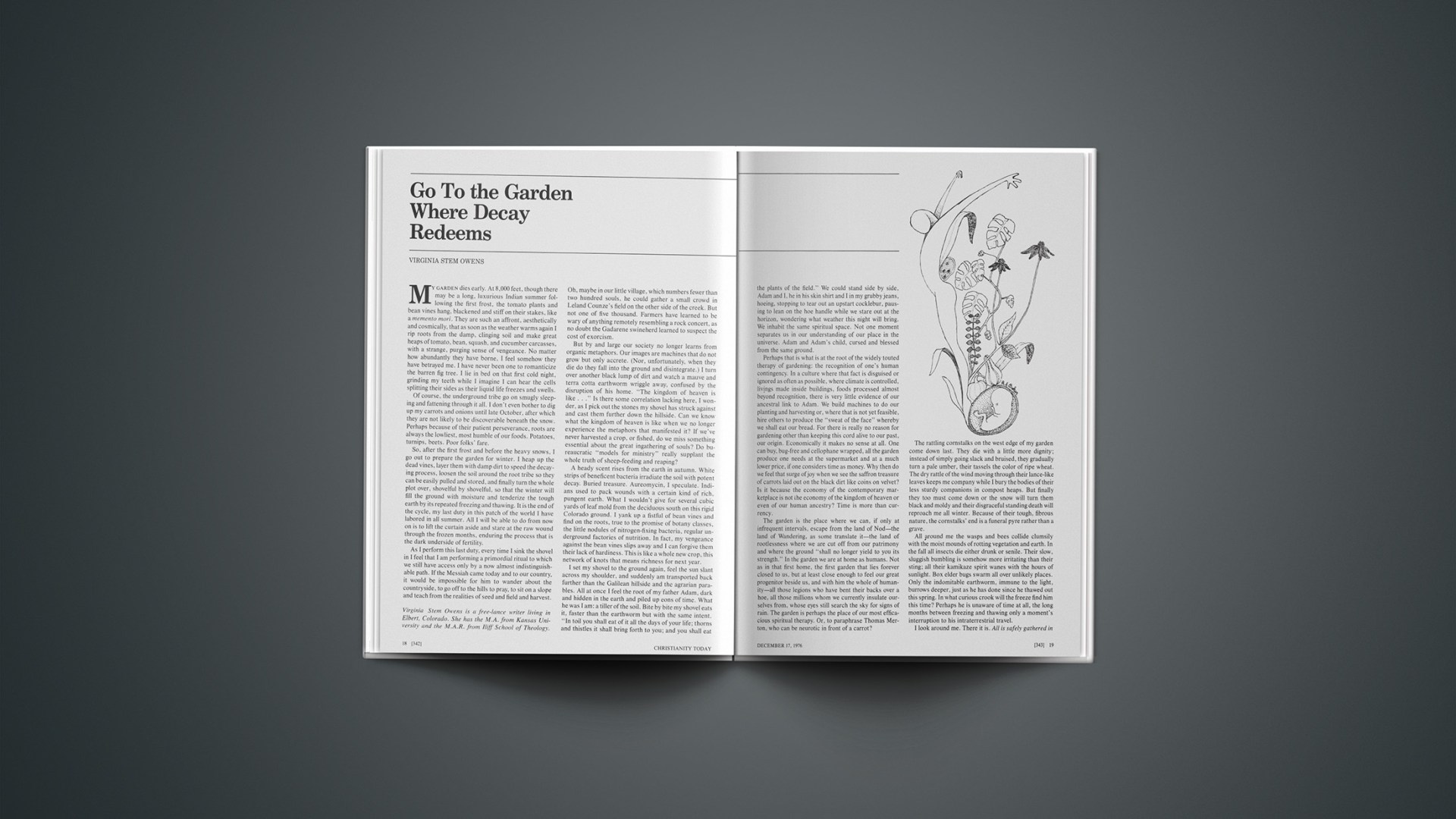
Go to the Garden Where Decay Redeems

My garden dies early. At 8,000 feet, though there may be a long, luxurious Indian summer following the first frost, the tomato plants and bean vines hang, blackened and stiff on their stakes, like a memento mori. They are such an affront, aesthetically and cosmically, that as soon as the weather warms again I rip roots from the damp, clinging soil and make great heaps of tomato, bean, squash, and cucumber carcasses, with a strange, purging sense of vengeance. No matter how abundantly they have borne, I feel somehow they have betrayed me. I have never been one to romanticize the barren fig tree. I lie in bed on that first cold night, grinding my teeth while I imagine I can hear the cells splitting their sides as their liquid life freezes and swells.

Of course, the underground tribe go on smugly sleeping and fattening through it all. I don’t even bother to dig up my carrots and onions until late October, after which they are not likely to be discoverable beneath the snow. Perhaps because of their patient perseverance, roots are always the lowliest, most humble of our foods. Potatoes, turnips, beets. Poor folks’ fare.

So, after the first frost and before the heavy snows, I go out to prepare the garden for winter. I heap up the dead vines, layer them with damp dirt to speed the decaying process, loosen the soil around the root tribe so they can be easily pulled and stored, and finally turn the whole plot over, shovelful by shovelful, so that the winter will fill the ground with moisture and tenderize the tough earth by its repeated freezing and thawing. It is the end of the cycle, my last duty in this patch of the world I have labored in all summer. All I will be able to do from now on is to lift the curtain aside and stare at the raw wound through the frozen months, enduring the process that is the dark underside of fertility.

As I perform this last duty, every time I sink the shovel in I feel that I am performing a primordial ritual to which we still have access only by a now almost indistinguishable path. If the Messiah came today and to our country, it would be impossible for him to wander about the countryside, to go off to the hills to pray, to sit on a slope and teach from the realities of seed and field and harvest. Oh, maybe in our little village, which numbers fewer than two hundred souls, he could gather a small crowd in Leland Counze’s field on the other side of the creek. But not one of five thousand. Farmers have learned to be wary of anything remotely resembling a rock concert, as no doubt the Gadarene swineherd learned to suspect the cost of exorcism.

But by and large our society no longer learns from organic metaphors. Our images are machines that do not grow but only accrete. (Nor, unfortunately, when they die do they fall into the ground and disintegrate.) I turn over another black lump of dirt and watch a mauve and terra cotta earthworm wriggle away, confused by the disruption of his home. “The kingdom of heaven is like …” Is there some correlation lacking here, I wonder, as I pick out the stones my shovel has struck against and cast them further down the hillside. Can we know what the kingdom of heaven is like when we no longer experience the metaphors that manifested it? If we’ve never harvested a crop, or fished, do we miss something essential about the great ingathering of souls? Do bureaucratic “models for ministry” really supplant the whole truth of sheep-feeding and reaping?

A heady scent rises from the earth in autumn. White strips of beneficent bacteria irradiate the soil with potent decay. Buried treasure. Aureomycin, I speculate. Indians used to pack wounds with a certain kind of rich, pungent earth. What I wouldn’t give for several cubic yards of leaf mold from the deciduous south on this rigid Colorado ground. I yank up a fistful of bean vines and find on the roots, true to the promise of botany classes, the little nodules of nitrogen-fixing bacteria, regular underground factories of nutrition. In fact, my vengeance against the bean vines slips away and I can forgive them their lack of hardiness. This is like a whole new crop, this network of knots that means richness for next year.

I set my shovel to the ground again, feel the sun slant across my shoulder, and suddenly am transported back further than the Galilean hillside and the agrarian parables. All at once I feel the root of my father Adam, dark and hidden in the earth and piled up eons of time. What he was I am: a tiller of the soil. Bite by bite my shovel eats it, faster than the earthworm but with the same intent. “In toil you shall eat of it all the days of your life; thorns and thistles it shall bring forth to you; and you shall eat the plants of the field.” We could stand side by side, Adam and I, he in his skin shirt and I in my grubby jeans, hoeing, stopping to tear out an upstart cocklebur, pausing to lean on the hoe handle while we stare out at the horizon, wondering what weather this night will bring. We inhabit the same spiritual space. Not one moment separates us in our understanding of our place in the universe. Adam and Adam’s child, cursed and blessed from the same ground.

Perhaps that is what is at the root of the widely touted therapy of gardening: the recognition of one’s human contingency. In a culture where that fact is disguised or ignored as often as possible, where climate is controlled, livings made inside buildings, foods processed almost beyond recognition, there is very little evidence of our ancestral link to Adam. We build machines to do our planting and harvesting or, where that is not yet feasible, hire others to produce the “sweat of the face” whereby we shall eat our bread. For there is really no reason for gardening other than keeping this cord alive to our past, our origin. Economically it makes no sense at all. One can buy, bug-free and cellophane wrapped, all the garden produce one needs at the supermarket and at a much lower price, if one considers time as money. Why then do we feel that surge of joy when we see the saffron treasure of carrots laid out on the black dirt like coins on velvet? Is it because the economy of the contemporary marketplace is not the economy of the kingdom of heaven or even of our human ancestry? Time is more than currency.

The garden is the place where we can, if only at infrequent intervals, escape from the land of Nod—the land of Wandering, as some translate it—the land of rootlessness where we are cut off from our patrimony and where the ground “shall no longer yield to you its strength.” In the garden we are at home as humans. Not as in that first home, the first garden that lies forever closed to us, but at least close enough to feel our great progenitor beside us, and with him the whole of humanity—all those legions who have bent their backs over a hoe, all those millions whom we currently insulate ourselves from, whose eyes still search the sky for signs of rain. The garden is perhaps the place of our most efficacious spiritual therapy. Or, to paraphrase Thomas Merton, who can be neurotic in front of a carrot?

The rattling cornstalks on the west edge of my garden come down last. They die with a little more dignity; instead of simply going slack and bruised, they gradually turn a pale umber, their tassels the color of ripe wheat. The dry rattle of the wind moving through their lance-like leaves keeps me company while I bury the bodies of their less sturdy companions in compost heaps. But finally they too must come down or the snow will turn them black and moldy and their disgraceful standing death will reproach me all winter. Because of their tough, fibrous nature, the cornstalks’ end is a funeral pyre rather than a grave.

All around me the wasps and bees collide clumsily with the moist mounds of rotting vegetation and earth. In the fall all insects die either drunk or senile. Their slow, sluggish bumbling is somehow more irritating than their sting; all their kamikaze spirit wanes with the hours of sunlight. Box elder bugs swarm all over unlikely places. Only the indomitable earthworm, immune to the light, burrows deeper, just as he has done since he thawed out this spring. In what curious crook will the freeze find him this time? Perhaps he is unaware of time at all, the long months between freezing and thawing only a moment’s interruption to his intraterrestrial travel.

I look around me. There it is. All is safely gathered inand the rest, from the blighted squash to the bolted lettuce, leveled. I stand in the middle of my digging, surrounded by death. The breathtakingly beautiful gold-leaved cottonwoods glittering against the autumnal blue sky headed toward the winter solstice—they are only the ornaments of the death ship we sail on every year, like the jeweled treasures of Sutton Hoo. They console but do not distract from the fact of death. All about me the earth is dying, and I smile on it benignly. A decent decay settles over the earth. It is congruous; it fits all I know to be true about the world. It is not the obscene incongruity of a machine-gun suddenly spitting through the midst of a flowering plum thicket, not Cain rising up against his brother Abel in sudden violence. That kind of death causes blood to cry out from the ground. This is rather the death of Abraham, ending his life an old man.

My garden gets me ready for death. For if I, with that shadowy Adam at my elbow, live under the same curse he did, I have leisure to contemplate the death that will come to me. I see that it can come after a span of productivity, that it can occur with dignity. I shall not be ashamed to sift my molecules of matter into the succulent soil with the beans and corn as companions. God’s curse always modulates into blessing.

But more than that. I shall become a voice in that great chorus of creation groaning in travail, in birth pangs, waiting through the long dark winter to be set free from decay, for “the redemption of our bodies” and the springing forth of the children of God. Then Adam shall be no longer a shadow.

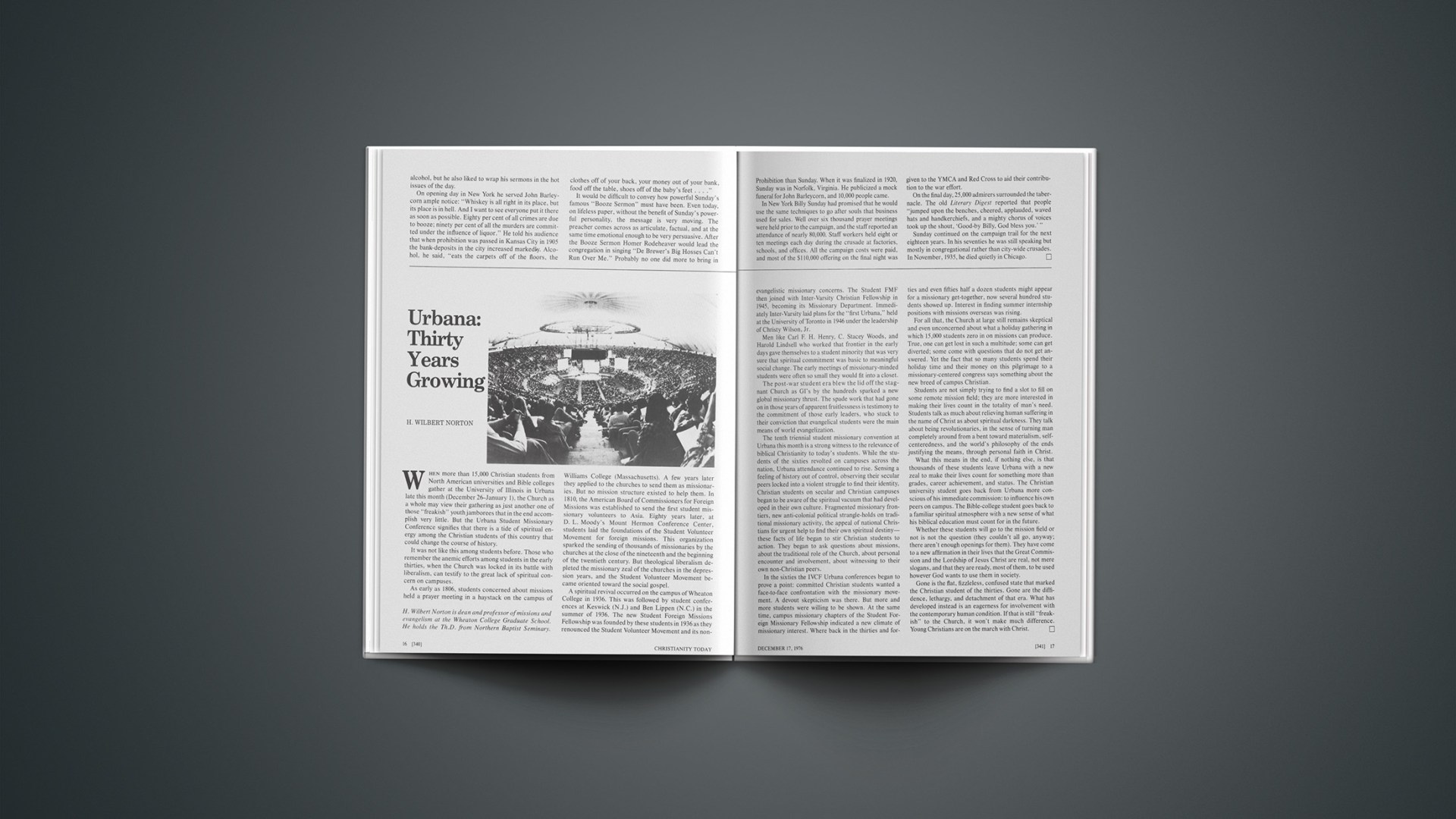
Urbana: Thirty Years Growing

When more than 15,000 Christian students from North American universities and Bible colleges gather at the University of Illinois in Urbana late this month (December 26–January 1), the Church as a whole may view their gathering as just another one of those “freakish” youth jamborees that in the end accomplish very little. But the Urbana Student Missionary Conference signifies that there is a tide of spiritual energy among the Christian students of this country that could change the course of history.

It was not like this among students before. Those who remember the anemic efforts among students in the early thirties, when the Church was locked in its battle with liberalism, can testify to the great lack of spiritual concern on campuses.

As early as 1806, students concerned about missions held a prayer meeting in a haystack on the campus of Williams College (Massachusetts). A few years later they applied to the churches to send them as missionaries. But no mission structure existed to help them. In 1810, the American Board of Commissioners for Foreign Missions was established to send the first student missionary volunteers to Asia. Eighty years later, at D. L. Moody’s Mount Hermon Conference Center, students laid the foundations of the Student Volunteer Movement for foreign missions. This organization sparked the sending of thousands of missionaries by the churches at the close of the nineteenth and the beginning of the twentieth century. But theological liberalism depleted the missionary zeal of the churches in the depression years, and the Student Volunteer Movement became oriented toward the social gospel.

A spiritual revival occurred on the campus of Wheaton College in 1936. This was followed by student conferences at Keswick (N.J.) and Ben Lippen (N.C.) in the summer of 1936. The new Student Foreign Missions Fellowship was founded by these students in 1936 as they renounced the Student Volunteer Movement and its non-evangelistic missionary concerns. The Student FMF then joined with Inter-Varsity Christian Fellowship in 1945, becoming its Missionary Department. Immediately Inter-Varsity laid plans for the “first Urbana,” held at the University of Toronto in 1946 under the leadership of Christy Wilson, Jr.

Men like Carl F. H. Henry, C. Stacey Woods, and Harold Lindsell who worked that frontier in the early days gave themselves to a student minority that was very sure that spiritual commitment was basic to meaningful social change. The early meetings of missionary-minded students were often so small they would fit into a closet.

The post-war student era blew the lid off the stagnant Church as GI’s by the hundreds sparked a new global missionary thrust. The spade work that had gone on in those years of apparent fruitlessness is testimony to the commitment of those early leaders, who stuck to their conviction that evangelical students were the main means of world evangelization.

The tenth triennial student missionary convention at Urbana this month is a strong witness to the relevance of biblical Christianity to today’s students. While the students of the sixties revolted on campuses across the nation, Urbana attendance continued to rise. Sensing a feeling of history out of control, observing their secular peers locked into a violent struggle to find their identity, Christian students on secular and Christian campuses began to be aware of the spiritual vacuum that had developed in their own culture. Fragmented missionary frontiers, new anti-colonial political strangle-holds on traditional missionary activity, the appeal of national Christians for urgent help to find their own spiritual destiny—these facts of life began to stir Christian students to action. They began to ask questions about missions, about the traditional role of the Church, about personal encounter and involvement, about witnessing to their own non-Christian peers.

In the sixties the IVCF Urbana conferences began to prove a point: committed Christian students wanted a face-to-face confrontation with the missionary movement. A devout skepticism was there. But more and more students were willing to be shown. At the same time, campus missionary chapters of the Student Foreign Missionary Fellowship indicated a new climate of missionary interest. Where back in the thirties and forties and even fifties half a dozen students might appear for a missionary get-together, now several hundred students showed up. Interest in finding summer internship positions with missions overseas was rising.

For all that, the Church at large still remains skeptical and even unconcerned about what a holiday gathering in which 15,000 students zero in on missions can produce. True, one can get lost in such a multitude; some can get diverted; some come with questions that do not get answered. Yet the fact that so many students spend their holiday time and their money on this pilgrimage to a missionary-centered congress says something about the new breed of campus Christian.

Students are not simply trying to find a slot to fill on some remote mission field; they are more interested in making their lives count in the totality of man’s need. Students talk as much about relieving human suffering in the name of Christ as about spiritual darkness. They talk about being revolutionaries, in the sense of turning man completely around from a bent toward materialism, self-centeredness, and the world’s philosophy of the ends justifying the means, through personal faith in Christ.

What this means in the end, if nothing else, is that thousands of these students leave Urbana with a new zeal to make their lives count for something more than grades, career achievement, and status. The Christian university student goes back from Urbana more conscious of his immediate commission: to influence his own peers on campus. The Bible-college student goes back to a familiar spiritual atmosphere with a new sense of what his biblical education must count for in the future.

Whether these students will go to the mission field or not is not the question (they couldn’t all go, anyway; there aren’t enough openings for them). They have come to a new affirmation in their lives that the Great Commission and the Lordship of Jesus Christ are real, not mere slogans, and that they are ready, most of them, to be used however God wants to use them in society.

Gone is the flat, fizzleless, confused state that marked the Christian student of the thirties. Gone are the diffidence, lethargy, and detachment of that era. What has developed instead is an eagerness for involvement with the contemporary human condition. If that is still “freakish” to the Church, it won’t make much difference. Young Christians are on the march with Christ.

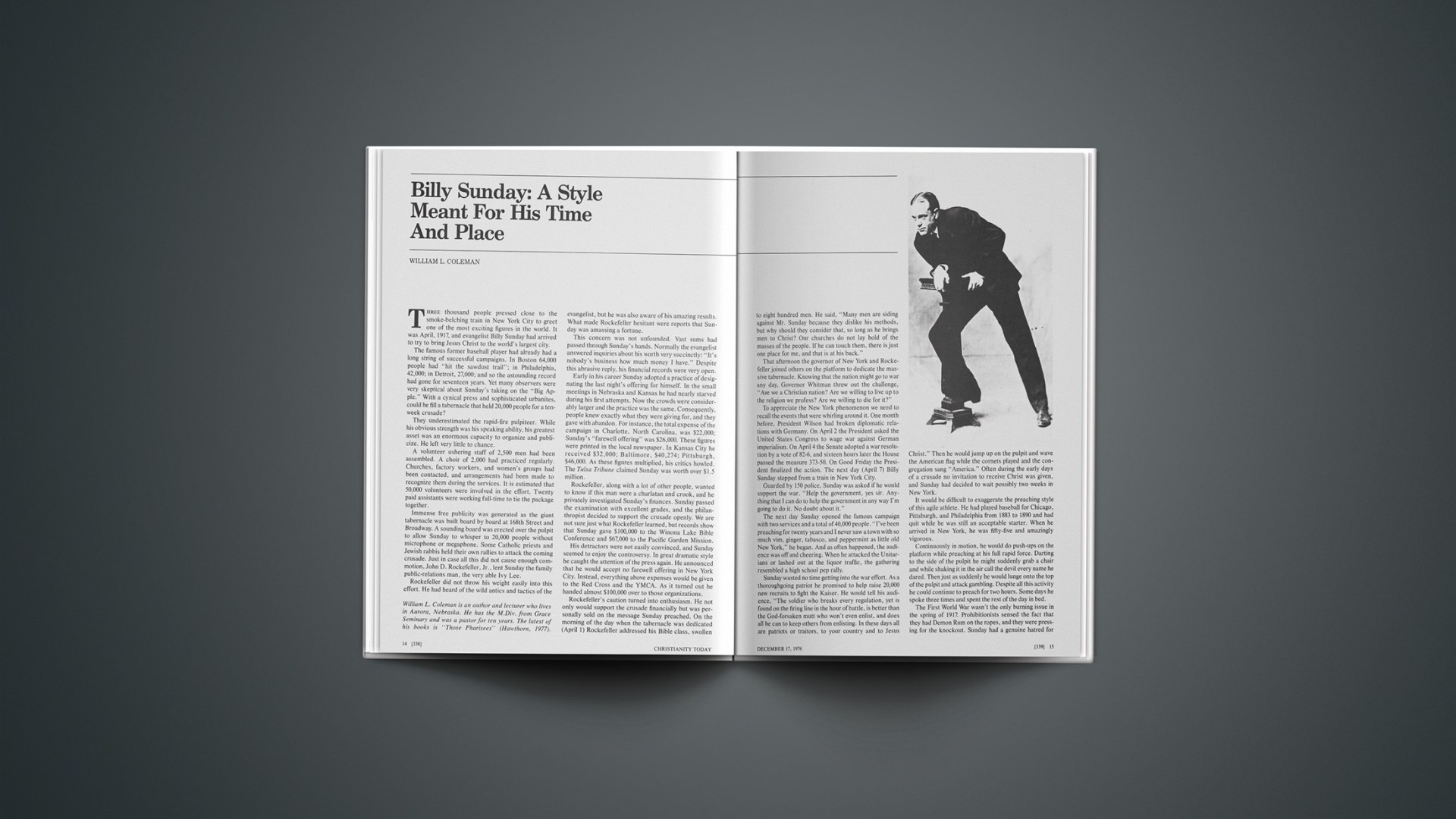
Billy Sunday: A Style Meant for His Time and Place

Three thousand people pressed close to the smoke-belching train in New York City to greet one of the most exciting figures in the world. It was April, 1917, and evangelist Billy Sunday had arrived to try to bring Jesus Christ to the world’s largest city.

The famous former baseball player had already had a long string of successful campaigns. In Boston 64,000 people had “hit the sawdust trail”; in Philadelphia, 42,000; in Detroit, 27,000; and so the astounding record had gone for seventeen years. Yet many observers were very skeptical about Sunday’s taking on the “Big Apple.” With a cynical press and sophisticated urbanites, could he fill a tabernacle that held 20,000 people for a ten-week crusade?

They underestimated the rapid-fire pulpiteer. While his obvious strength was his speaking ability, his greatest asset was an enormous capacity to organize and publicize. He left very little to chance.

A volunteer ushering staff of 2,500 men had been assembled. A choir of 2,000 had practiced regularly. Churches, factory workers, and women’s groups had been contacted, and arrangements had been made to recognize them during the services. It is estimated that 50,000 volunteers were involved in the effort. Twenty paid assistants were working full-time to tie the package together.

Immense free publicity was generated as the giant tabernacle was built board by board at 168th Street and Broadway. A sounding board was erected over the pulpit to allow Sunday to whisper to 20,000 people without microphone or megaphone. Some Catholic priests and Jewish rabbis held their own rallies to attack the coming crusade. Just in case all this did not cause enough commotion, John D. Rockefeller, Jr., lent Sunday the family public-relations man, the very able Ivy Lee.

Rockefeller did not throw his weight easily into this effort. He had heard of the wild antics and tactics of the evangelist, but he was also aware of his amazing results. What made Rockefeller hesitant were reports that Sunday was amassing a fortune.

This concern was not unfounded. Vast sums had passed through Sunday’s hands. Normally the evangelist answered inquiries about his worth very succinctly: “It’s nobody’s business how much money I have.” Despite this abrasive reply, his financial records were very open.

Early in his career Sunday adopted a practice of designating the last night’s offering for himself. In the small meetings in Nebraska and Kansas he had nearly starved during his first attempts. Now the crowds were considerably larger and the practice was the same. Consequently, people knew exactly what they were giving for, and they gave with abandon. For instance, the total expense of the campaign in Charlotte, North Carolina, was $22,000; Sunday’s “farewell offering” was $26,000. These figures were printed in the local newspaper. In Kansas City he received $32,000; Baltimore, $40,274; Pittsburgh, $46,000. As these figures multiplied, his critics howled. The Tulsa Tribune claimed Sunday was worth over $1.5 million.

Rockefeller, along with a lot of other people, wanted to know if this man were a charlatan and crook, and he privately investigated Sunday’s finances. Sunday passed the examination with excellent grades, and the philanthropist decided to support the crusade openly. We are not sure just what Rockefeller learned, but records show that Sunday gave $100,000 to the Winona Lake Bible Conference and $67,000 to the Pacific Garden Mission.

His detractors were not easily convinced, and Sunday seemed to enjoy the controversy. In great dramatic style he caught the attention of the press again. He announced that he would accept no farewell offering in New York City. Instead, everything above expenses would be given to the Red Cross and the YMCA. As it turned out he handed almost $100,000 over to those organizations.

Rockefeller’s caution turned into enthusiasm. He not only would support the crusade financially but was personally sold on the message Sunday preached. On the morning of the day when the tabernacle was dedicated (April 1) Rockefeller addressed his Bible class, swollen to eight hundred men. He said, “Many men are siding against Mr. Sunday because they dislike his methods, but why should they consider that, so long as he brings men to Christ? Our churches do not lay hold of the masses of the people. If he can touch them, there is just one place for me, and that is at his back.”

That afternoon the governor of New York and Rockefeller joined others on the platform to dedicate the massive tabernacle. Knowing that the nation might go to war any day, Governor Whitman threw out the challenge, “Are we a Christian nation? Are we willing to live up to the religion we profess? Are we willing to die for it?”

To appreciate the New York phenomenon we need to recall the events that were whirling around it. One month before, President Wilson had broken diplomatic relations with Germany. On April 2 the President asked the United States Congress to wage war against German imperialism. On April 4 the Senate adopted a war resolution by a vote of 82–6, and sixteen hours later the House passed the measure 373–50. On Good Friday the President finalized the action. The next day (April 7) Billy Sunday stepped from a train in New York City.

Guarded by 150 police, Sunday was asked if he would support the war. “Help the government, yes sir. Anything that I can do to help the government in any way I’m going to do it. No doubt about it.”

The next day Sunday opened the famous campaign with two services and a total of 40,000 people. “I’ve been preaching for twenty years and I never saw a town with so much vim, ginger, tabasco, and peppermint as little old New York,” he began. And as often happened, the audience was off and cheering. When he attacked the Unitarians or lashed out at the liquor traffic, the gathering resembled a high school pep rally.

Sunday wasted no time getting into the war effort. As a thoroughgoing patriot he promised to help raise 20,000 new recruits to fight the Kaiser. He would tell his audience, “The soldier who breaks every regulation, yet is found on the firing line in the hour of battle, is better than the God-forsaken mutt who won’t even enlist, and does all he can to keep others from enlisting. In these days all are patriots or traitors, to your country and to Jesus Christ.” Then he would jump up on the pulpit and wave the American flag while the comets played and the congregation sang “America.” Often during the early days of a crusade no invitation to receive Christ was given, and Sunday had decided to wait possibly two weeks in New York.

It would be difficult to exaggerate the preaching style of this agile athlete. He had played baseball for Chicago, Pittsburgh, and Philadelphia from 1883 to 1890 and had quit while he was still an acceptable starter. When he arrived in New York, he was fifty-five and amazingly vigorous.

Continuously in motion, he would do push-ups on the platform while preaching at his full rapid force. Darting to the side of the pulpit he might suddenly grab a chair and while shaking it in the air call the devil every name he dared. Then just as suddenly he would lunge onto the top of the pulpit and attack gambling. Despite all this activity he could continue to preach for two hours. Some days he spoke three times and spent the rest of the day in bed.

The First World War wasn’t the only burning issue in the spring of 1917. Prohibitionists sensed the fact that they had Demon Rum on the ropes, and they were pressing for the knockout. Sunday had a genuine hatred for alcohol, but he also liked to wrap his sermons in the hot issues of the day.

On opening day in New York he served John Barleycorn ample notice: “Whiskey is all right in its place, but its place is in hell. And I want to see everyone put it there as soon as possible. Eighty per cent of all crimes are due to booze; ninety per cent of all the murders are committed under the influence of liquor.” He told his audience that when prohibition was passed in Kansas City in 1905 the bank deposits in the city increased markedly. Alcohol, he said, “eats the carpets off of the floors, the clothes off of your back, your money out of your bank, food off the table, shoes off of the baby’s feet.…”

It would be difficult to convey how powerful Sunday’s famous “Booze Sermon” must have been. Even today, on lifeless paper, without the benefit of Sunday’s powerful personality, the message is very moving. The preacher comes across as articulate, factual, and at the same time emotional enough to be very persuasive. After the Booze Sermon Homer Rodeheaver would lead the congregation in singing “De Brewer’s Big Hosses Can’t Run Over Me.” Probably no one did more to bring in Prohibition than Sunday. When it was finalized in 1920, Sunday was in Norfolk, Virginia. He publicized a mock funeral for John Barleycorn, and 10,000 people came.

In New York Billy Sunday had promised that he would use the same techniques to go after souls that business used for sales. Well over six thousand prayer meetings were held prior to the campaign, and the staff reported an attendance of nearly 80,000. Staff workers held eight or ten meetings each day during the crusade at factories, schools, and offices. All the campaign costs were paid, and most of the $110,000 offering on the final night was given to the YMCA and Red Cross to aid their contribution to the war effort.

On the final day, 25,000 admirers surrounded the tabernacle. The old Literary Digest reported that people “jumped upon the benches, cheered, applauded, waved hats and handkerchiefs, and a mighty chorus of voices took up the shout, ‘Good-by Billy, God bless you.’ ”

Sunday continued on the campaign trail for the next eighteen years. In his seventies he was still speaking but mostly in congregational rather than city-wide crusades. In November, 1935, he died quietly in Chicago.

The Tract Distributor

Death makes her frantic.

With a faded pamphlet at her station on the corner

She pumps her repetitious syllables of doom Into the sooty air.

The drenching rain, the chill Pacific storms

Cannot deflect her unrelenting pathos.

I saw her this December afternoon again.

A black babushka framed her fleshy face;

Her lips were like the underside of worms;

Her coat was soiled, her shoes were cracked and turned.

She wore no ornaments. She had no ring.

The Christmas shoppers, stopping for the light,

Dashing for buses, with their own intents,

Tuned to the blaring phonographs from stores,

Chattering in the wake of starting cars,

Winced their annoyance as they skirted her,

And in the festive, loud cacophony

They buried both her prophecy and verse.

“Repent” they buried, and they buried “Fear,”

The text, the chorus of her litany.

Mutter and mumble, and with downcast eye

Stare at the pavement where the fleeing feet

Trample upon the truth your madness loves,

Champion of God Jehovah.

I remember.

God before Birth: The Imagery Matters

There is an ancient formula that goes like this: Et incarnatus est de Spiritu Sancto ex Maria Virgine: et homo factus est; which is, being interpreted, “and was incarnated by the Holy Ghost of the Virgin Mary; and was made man.”

These words, at least the English of them, are familiar to any Christian whose church still recites the Nicene Creed. But even a Christian who has not come across this exact wording will be familiar with the doctrine it expresses. It is plain orthodoxy. All Christians believe it. The formula passes the test brought to bear by another ancient formula, the Vincentian Canon: quod ubique, quod semper, quod ab omnibus creditum est:—“what has everywhere, always, and by everyone, been believed.” Here Mennonite and Byzantine, Salvationist and Latin, agree.

The difficulty with familiar formulas like this is, often, just that: they are familiar. We need to be jogged now and again so that what we are saying does not slip off into mere slogan. This is especially true of the affirmation in question here, for in this doctrine of the Incarnation we speak of the point at which the mightiest mysteries touch our ordinariness. The whole thing was brought down to a point at our feet, as it were. “Eternity shut in a span,” one seventeeth-century poet called it.

In these two short clauses we find an enormous amount of biblical teaching crisply summed up for us. And the point in the whole drama of redemption which is bespoken here is one which, despite our fierce orthodoxy, we may miss: “… and was incarnated … and was made man.”

In the early Church, people kept coming up with ideas as to how this teaching could be made more plausible. The notion of God becoming man—real man—was unmanageable. Of course, everyone was familiar enough with how gods had often masqueraded as men. And again, there were plenty of stories as to how mortals had been caught up and given a place in the heavens because the gods loved them very much, or because they needed to be punished, or rescued from some danger. But for Zeus or somebody to become a man was not one of the options. So one attempt after another was made to adjust the doctrine. One idea was that the Incarnation was one of those masquerades. Another was that the Holy Ghost had come on the man Jesus in a unique way and made him the “son of God” in some way not quite true of the rest of us sons of God. There were all kinds of variations on the theme, and most of them are still familar to us. I myself grew up in an era when, as far as we could tell, our own fundamentalist church and the local Roman church were the only churches, out of thirteen churches in town, that taught anything like this stark Nicene (and biblical) doctrine of the Incarnation. Everyone else seemed to be still trying, two thousand years later, to say something plausible. We called it modernism, but it was, surely, a tired rerun of some very old notions.

It is not customary in Protestantism to speak of the Virgin as the Mother of God. The hesitation here is that this will make it sound as though she existed before God the Father somehow, and bore him. But that ancient title for her, Theotokos, the God-bearer, arose long before there were any universal schisms in the Church, to protect this idea that that which had become one with our flesh by being conceived and nurtured in the body of the Virgin was nothing other than God himself. The title was upheld by the councils of Ephesus and Chalcedon. The Incarnate was not a masquerade of God, nor a creature of God, nor an apparition, nor a merely godlike hero. It was God.

There is a good difficulty about a doctrine like this that is true of all Christian doctrines. This good difficulty is that while what we say is clear enough for any ears to hear (God became a man; Christ died for us; he ascended into heaven), it is at the same time an impenetrable mystery. No one, not even the Angelic Doctor himself, can get to the bottom of it. We will be forever coming at it afresh. We will be forever working away at it, both here and in Paradise, although presumably the form that this latter “working away” will take will be adoration and not theology.

One aspect of this teaching is that, by virtue of this Incarnation, it may be said that we wear the flesh that has been hallowed and raised to glory by that event. The flesh that we bear was, and is, in a mystery, the flesh worn by the Deity. There is no other creature in the whole cosmos, so far as we know, that can claim this: no lion, be he ever so regal: no elf, be he ever so fair; no archangel, be he ever so mighty. It is our flesh alone that has been taken up. The Athanasian Creed, which goes back perhaps to the late fourth century, speaks of the Incarnation as “not … the conversion of the Godhead into flesh, but [the] taking [of] the manhood into God.”

This is what the Church celebrates in December every year. This is the mystery we try to come at with our feasting and caroling and giving. We come to the shrine where the great mystery lies, there in our flesh, and like the whispering shepherds and the adoring Magi we know that in this small and unlikely drama being played out here in this inauspicious place, this stable, the shutters of the universe have been blown open for us, and we are being invited to peer through onto vistas of splendor only dimly guessed at in the songs and tales and prophecies of ancient seers, sages, and sibyls.

One of the questions that comes to us, though, is this: how do we wear that flesh day by day? The celebration comes and goes. We, like the shepherds and the Magi, must “return” from the shrine to our daily ordinariness. What does it mean, to us who have been to that shrine?

The mystery that we beheld there is the mystery of our flesh raised to glory. We walk out now, clothed as it were, in the image that has been raised to the pinnacle. Our flesh is the jewel in the crown of Creation. This again is why you often see, in the painting of the Middle Ages, the figure of Mary exalted to the heavens and crowned with splendor. The idea there is a theological one: human flesh, represented by Mary, since she is the one who uttered for us all the authentic response to the approach of the Divine Will, her great “Be it unto me according to thy word” (the response that we all, in our first parents, refused to make), is seen as redeemed and crowned with glory. And, to raise the awesome stakes even higher, the doctrine of the Ascension, which is the end in one sense of the part of the gospel drama played out on earth by the Incarnate himself, implies that somehow, in a mystery beyond all our powers to imagine, our flesh is now represented in the Triune Godhead. But at this point theological language falters.

So the question comes to us: how do we wear this flesh? Has it ever struck us that we are garbed in the most splendid raiment of all? That no archangelic wings or seraphic flames exhibit quite this particular glory, this glory of redeemed flesh—what has been called (by Dante, I think) la carne gloriosa e sancta, the holy and glorious flesh?

How does this affect our outlook? One note that it ought to introduce is the note of awe. That is, creatures who find out that it is their flesh that God has taken, and taken not just arbitrarily in order to get some random job done but specifically to redeem and glorify it—these creatures can never thereafter take a cheap view of that flesh. The image that they bear is doubly noble. It is noble first because at the Creation it was said of them alone among all creatures that they would be formed in the imago Dei. But then at the Incarnation, in a glorious mystery of exchange beyond all attempts to compass it, they “gave” as it were their flesh to him. That is an odd, and perhaps non-theological, way of phrasing it; but it is a mystery that anyone who has ever loved knows something about, namely, the mystery of exchange, in which no one can ever figure out who is doing the giving and who the receiving. Lovers know something that calculators do not. They know that giving and receiving are a splendid and hilarious paradox in which, lo, the giving becomes receiving, the receiving giving, until any efforts to sort it out collapse in merriment or adoration. (This, by the way, is why the political and 50-50 talk that “liberationists” bring to the sacrament of marriage fails so dismally; that tallying has nothing to do with what real lovers experience. And the love that is experienced and enacted in the fleshly sacrament of marriage is perhaps the most vivid metaphor we human beings have of the Divine Love that also deigns to enter into blissful exchanges of love with us creatures.)

Awe is hard to keep alive in one’s imagination, since we live now under a mythology that rejects mystery. But it is not as though the Christian ought to float about in a state of perennial rapture, contemplating how splendid everything is. There are practical and specific points where, with his notion of the Incarnation, he will run headlong into conflict with ideas widely held by his contemporaries. If he does not reflect on his own creed (“et incarnatus est”), he will find himself vaguely espousing these ideas because they sound nice.

For example, over against his own view of human flesh which he derives from the doctrines of Creation and Incarnation (and indeed from half the other Christian doctrines: Passion, Resurrection, Ascension—they all entail the flesh), he will discover that the general view of human flesh held by his contemporaries is, in effect, gnostic. That is, on at least two fronts now, the Western imagination is zealously attempting to disavow the notion that the flesh is good (which is what Christianity insists, and gnosticism hates). The one front is that of Eastern mysticism, under which heading we find all sorts of Zen, TM, and other efforts to transcend the limits of bodily (read “hampered”) existence. This is, of course, an ancient and widespread religious effort, and it seems to make particular sense in our own time when we find ourselves, ironically, bored and destitute in the wake of doctrines that have told us the flesh is the only reality. The apparent glorification of the flesh that you find in Playboy, and in the more recent glossies that celebrate the idea that my body is my own to do what I like with, is a fraud, as Sodom and Babylon always find out. You can’t stay alive on new moralities that tell you to do whatever you want (eat, drink, cohabit, etc.) whenever you want since there are no considerations bigger than appetite. “If you itch, scratch,” is the catchy and convincing slogan. From this cloaca of mere carnality, mysticism offers an attractive escape, and it is not surprising that our era finds it appealing. A person, however, who believes that the way out of the mess has been pointed for us by the Incarnate One will have a quarrel with any disavowal of flesh-and-blood ordinariness.

But the other form of gnosticism abroad now is infinitely more oblique, it is the especially contemporary notion that the imagery does not matter. Put another way, the idea is that what things look like is not significant. Human anatomy, for instance, is held to be purely functional. It is arbitrary, except insofar as it represents a useful stage in our evolutionary adjustment to our surroundings. We have lungs that are adjusted to the kind of atmosphere we live in: a happy development. And we have prehensile thumbs that permit us to make things, and reproductive machinery distributed so as to get the job done. But none of it means anything. To try to see it all as an image of anything is pre-scientific (goes the argument).

This starkly secularist line of thought is easily enough recognized by Christians. The trouble comes when Christians, having breathed in this mere secularism with every breath (who can escape it? schools, universities, books, journals, and television, know no other view, and they pour it to us in season and out of season, line upon line, here a lot, there a lot), acquiesce unwittingly in this secularism.

Oh, we’re not secularists, we protest. We believe in the doctrine of Creation. We believe in the Incarnation.

Do we? Does our profession reach any further than the formula on our lips? What about our attitude, for example, toward the notion that all this physical differentiation that makes men and women look different from each other has nothing to do with anything? All this imagery (these appearances, say) of masculinity and femininity, under which we mortals bear the imago Dei, is insignificant. What about that? The idea is that there is an entity “person” that somehow is truer and closer to our real identity than this random cloak of sexuality that we happen to be dressed in. Don’t think of me as a man, for heaven’s sake: I’m a person. Pray don’t speak of me as a woman: I’m a person. Or, worse yet, don’t ask whether I happen to be involved in the sacrament of marriage: it’s not a sacrament in any case. It has nothing to do with anyone’s personhood. It’s a contract, and my spouse and I have worked things out in a very modern way that does not call either her individuality or mine into question.

The Incarnationist would understand the foregoing line of thought to be gnostic in that it introduces a disjuncture: it sets the thing itself (the personhood) over against the image of the thing (the body) and denies any real connection. The reality not only transcends the appearance (so far, a grain of truth), but, more than that, nothing at all is suggested about the reality by the appearance. The pattern of Creation, in other words, is more or less random. God had nothing significant in mind when he distributed his image among the two modalities man and woman. Nothing is to be inferred about what we are from what we look like.

Another variation on this gnostic theme would be the denial of the significance of the imagery in language. The pictures, for instance, by means of which God speaks to us of himself are connected with the reality in only a higgledy-piggledy sort of way—“culturally” is the usual word here. The images of Lord, King, or Father under which he spoke of himself have no connection with anything more far-reaching than monarchic and patriarchal Mediterranean antiquity. Heavens! He might just as well have chosen to speak of himself as an antenna if he had decided to wait a bit and come into an age oriented to high-speed communication, or as an androgyne to an age celebrating unisex. It’s a question of culture. And the Incarnation? That imagery (of the Son) has nothing to do with reality either. It is ad hoc, attached to a question of convenient communication. (It is worth noting that the gnosticism that urges the foregoing line of thought makes with equal fervor the point that in the Incarnation, God broke up all the other entrenched, established prejudices of antiquity. He missed his cues on this point alone. The Incarnate was a revolutionary, an icon-smasher, a rebel, a liberator. But he came, O rue the day, as a man. He missed his main chance.)

The question, really, is how far we are to carry our understanding of the Incarnation. All Christians agree on the doctrine, that’s pat. The point that is being pressed here is that, just as the Church had to examine and deepen its understanding of this doctrine in other ages when plausible alternatives were offered (Arianism, Sabellianism, Patripassianism, Monophysitism, and so forth), so now, when once more efforts are abroad to revise or update the ancient and radical understanding of the doctrine, the Church ought surely to put its mind to getting clear just what it does affirm in this doctrine. If the Incarnation was, in fact, just ad hoc, and Jesus the Son may rightly be thought of by contemporary persons as Jesus the Daughter or Jesus the Hermaphrodite or Jesus the Person, then the doctrine and the tradition need to be scoured. We have been bilked. We need to excise from our thinking any notion that the imagery matters—that is, that there is any connection between physical appearance and actuality. No real clues have ever been given to us after all as to how we ought to think about things. Tastee Freez and Kool Aid will serve as bread and wine at the Eucharist, since everybody knows that Jesus wasn’t made out of wheat. We may speak of God as Chairperson of the Committee of the Whole, since everyone knows that he’s not sitting on any throne up there. We’d be more accurate to speak of him as Our Leader rather than Our Lord, since “lord” reinforces ideas that are out of date, not to say pernicious.

The imagery doesn’t matter in the slightest, in the gnostic view. Or rather, yes it does, on second thought. It’s just that it’s all wrong. We’ll have to get rid of that imagery (King, Father, Son) and bring in this imagery (Chairperson, Parent, Child). Although even there we have a problem, since the latter two words smuggle in an idea of family, and if anything ought to be jettisoned now it’s that old idea of family with all the pestilential hierarchical notions that tag along in its wake. Maybe Senior Citizen and Emerging Personhood would serve better than Father and Son—except that again “Senior” suggests hierarchy and that’s the worst idea of all. And we can’t say “Elder” because that sounds as though God were aging. Oh dear—the imagery is crucial, isn’t it?

Yes. It is. Perhaps Protestant Christians, whose vision of things has for four hundred years now been a radically propositional and non-visual one, need to plough back in and see whether there might not have been something about the whole drama that wants looking at again. The whole thing was played out altogether in material, flesh-and-blood terms. Creation, Incarnation, Passion, Resurrection, Ascension, Eucharist: they all, oddly, entail our flesh. The language of God’s self-disclosure is shot through with unabashed images, inviting our imaginations, nay compelling them, to think of him thus, and thus, and thus.

Has the time come for an updating? Ought we to separate the doctrine from the imagery? Perhaps the imagery was just cultural. Perhaps there is a seed of truth that needs to be separated out from the husk of all that culturally determined language and imagery.

Rudolph Bultmann and others would say yes. The Fathers would have said no. But of course Bultmann is our contemporary. He knows more than the Fathers.

Evangelical imagination has an important question in its lap.

Eutychus and His Kin: December 17, 1976

Thump in The Night

The other night I was lying in bed with the lovely euphoria that comes over you when you’re tired and you’ve finally gotten settled in the perfect position with the pillow at just the right angle and you’re just beginning to slip into the arms of Morpheus.

“What’s that?” asked my wife, sitting up in bed.

“What’s what?” I said drowsily.

“That thumping.”

I was on the verge of giving the old comic-strip response. “Oh, it’s probably only a burglar.” But I decided future happiness lay down another road. So I replied, “It’s probably just the water pipes or something.”

“What would make water pipes thump?”

If there’s anything maddening it’s the female insistence on logic at midnight.

“I’ll go check,” I said with less than enthusiasm.

A complete round of the house turned up no satisfactory explanation. All the entrances were securely locked. As I climbed back into bed my wife asked, “Did you find anything?”

“Nothing.”

“Did you check everywhere?”

“Everywhere.”

“The laundry room?”

“Everywhere.”

“What do you think it was?”

“A playful poltergeist.”

“Be serious.”

“All right, but wouldn’t it be nice if we still believed in goblins? Then we could just ask the Lord to deliver us from goblins and ghosts and things that go bump in the night and go back to sleep.”

“I guess,” she said doubtfully.

Lying there trying to go back to sleep, I thought of all those nights when my sleep has been disturbed by something going bump in my soul.

Someone has commented that there are times in the middle of the night when he’d sell himself for a nickel and give three cents change. This 2 A.M.angst is perhaps primarily an affliction of the young adult, and most adult Christians have been through it at some time or times.

The Psalmist reminds us that those who dwell in the shelter of the Most High are not to fear the terror of the night. Jesus is Lord even at two in the morning.

EUTYCHUS V

From the November 10, 1972, issue of CHRISTIANITY TODAY.

Space For Children

Just a note of commendation on Cheryl Forbes’s comments on children’s books in the November 19th issue (Refiner’s Fire).… However. I feel that she misinterpreted the intent of Mr. Slef in identifying it as a children’s book. While the publishers recommend it for every reader, young and old, adults much more than children will be able to identify with the main character in this unusual and thought-provoking parable. Its creative typography tempts the casual reader to look some more and find out what this is all about. Its art is, to me, a refreshing change from the usual, common, religious attempts. An adult audience to which I introduced this book was very much moved by the book’s important message.

“A book that looks busy will overwhelm a small child” is a statement with which I basically disagree. The charming little book Thirteen by Remy Charlip, which is filled with busy pictures, is one which the children in my school library love to browse through.… Richard Scarry’s books, also, are filled with detailed figures and small clothed animals, and they continue to be on best-seller lists of favorite books for children.… Children’s books are important, and it is important that thinking Christians who have something to do with children should know about them. The fact that you are giving them space in your fine magazine pleases me very much. Keep it up!

MARY K. BECHTEL

Wheaton, Ill.

On Wednesday Worship

So you want the state to enforce Saturday laws instead of Sunday laws (lead editorial, Nov. 5)? Please, after seeing what’s happened to Sunday, we’d rather have the state keep its hands off the sabbath. As Dr. Edmond Cahn once pointed out, what the state touches, it secularizes. Just go right ahead and do your shopping on Saturday, though. We don’t mind. Seventh-day Adventists will find their way to church anyway. And if you want to shop, that’s part of the freedom we want to see in America. If you really want to push a day, try Wednesday. So far as I know, nobody worships on that day.

ROLAND R. HEGSTAD

Editor

Liberty Magazine

Washington, D.C.

• If you’ll join us, let’s push for Wednesday. Christians could worship on that day, too!—ED.

Not Exempt

Paul Hesselink’s article on Osborne’s treatment of Luther (Refiner’s Fire, Oct. 22) left me somewhat puzzled. No one, it seems to me, including Osborne, would dispute the impact of Luther’s life and leadership on the European movement we call the Reformation. I find Osborne’s psychological treatment of Luther an attempt to present him as a human being, constipation and all, and a serious effort to make him more believable and less of a historical “superman.” … To be a great leader and even a spiritual trailblazer does not imply exemption from the human situation. My knowledge of Luther leads me to believe he did, indeed, have problems with anger and other attributes common to Christians.… Paul’s thorn in the flesh was displeasing to him, but a weakness God could use to vault him into ever more glorious use for His kingdom. Luther’s alimentary spasms may have been a similar, useful tool. I think Osborne’s attempt in Luther was to underscore his believability as an historic figure, not to undermine orthodox Reformation theology.

BILL ARMSTRONG

First United Methodist Church

Canton, Tex.

Glorifying The Group

Thank you for “Discerning Truth: Is Man the Final Measure?” by David Lyle Jeffrey (Nov. 5). Humanism has not only affected our schools but also our Sunday schools and churches. An area which reflects this is the glorification of group discussion to the point that an objective presentation of material by a teacher is considered suspect, regardless of the level of scholarly research done in preparation.

The “final measure” in discerning truth is God’s Word. A true disciple not only learns from his teacher-master but also in personal commitment serves him. He does not discuss with his teacher-master, but once he understands he does obey.

ARLIE D. RAUCH

Bridgewater, S.D.

Editor’s Note from December 17, 1976

Jesus came in the flesh. That’s the Christmas story. Jesus rose again in the same body. That’s the Easter story. Jesus came into our hearts by faith. That’s salvation’s story. Jesus is coming again. That’s the story of our hope. And all of this makes it possible to say: a merry Christmas and a happy new year to you all.

Apple PodcastsDown ArrowDown ArrowDown Arrowarrow_left_altLeft ArrowLeft ArrowRight ArrowRight ArrowRight Arrowarrow_up_altUp ArrowUp ArrowAvailable at Amazoncaret-downCloseCloseEmailEmailExpandExpandExternalExternalFacebookfacebook-squareGiftGiftGooglegoogleGoogle KeephamburgerInstagraminstagram-squareLinkLinklinkedin-squareListenListenListenChristianity TodayCT Creative Studio Logologo_orgMegaphoneMenuMenupausePinterestPlayPlayPocketPodcastRSSRSSSaveSaveSaveSearchSearchsearchSpotifyStitcherTelegramTable of ContentsTable of Contentstwitter-squareWhatsAppXYouTubeYouTube