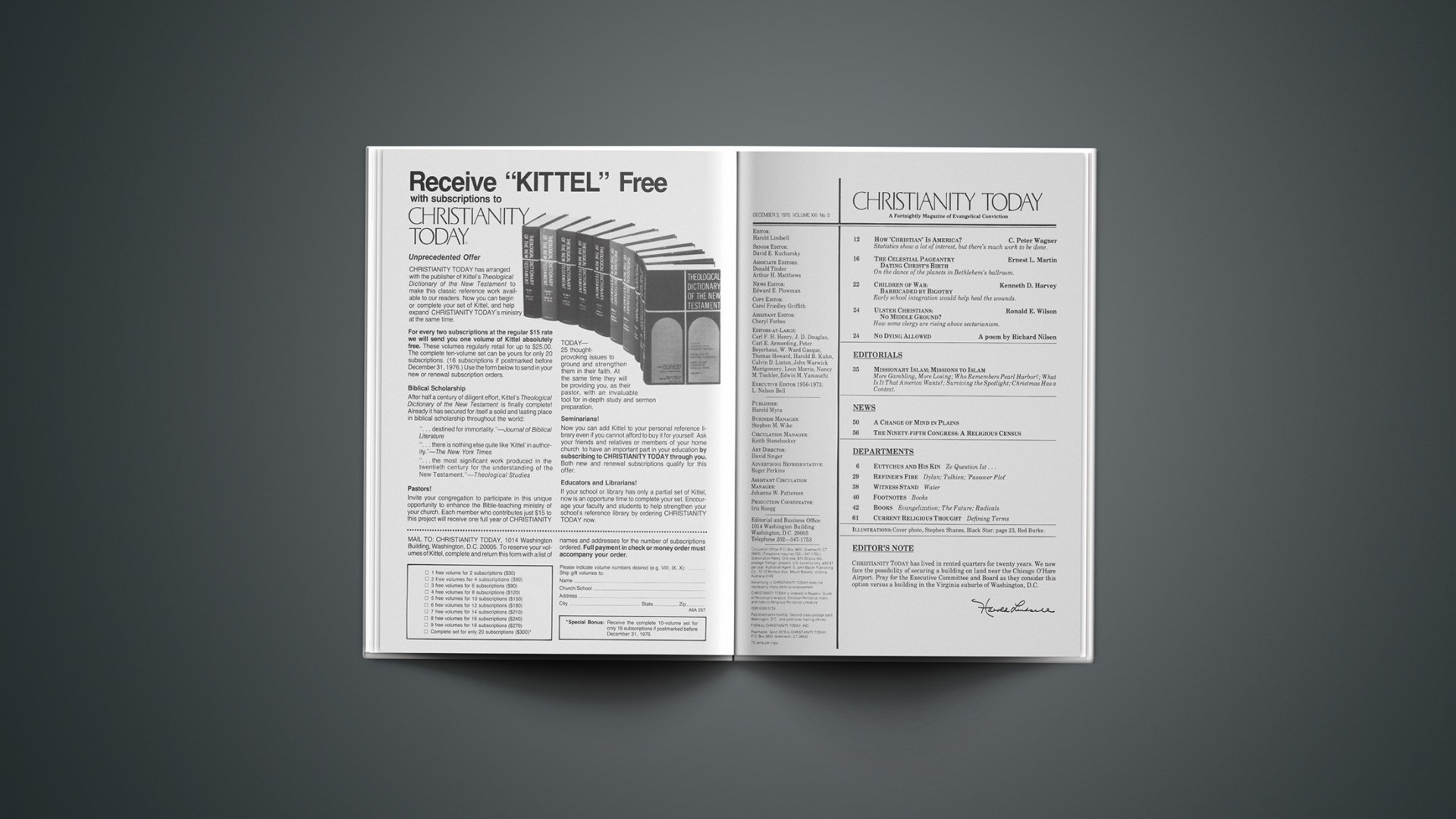
No Dying Allowed

I have stunned the sheep:

slit his jugular

hung him from a rafter

and caught his blood

in a bucket

to paint my doorposts.

But now in the future:

there will be no stunning

no pain-killing hammers

only my arms hung at my sides.

The painting goes on

but there will be

no dying allowed.
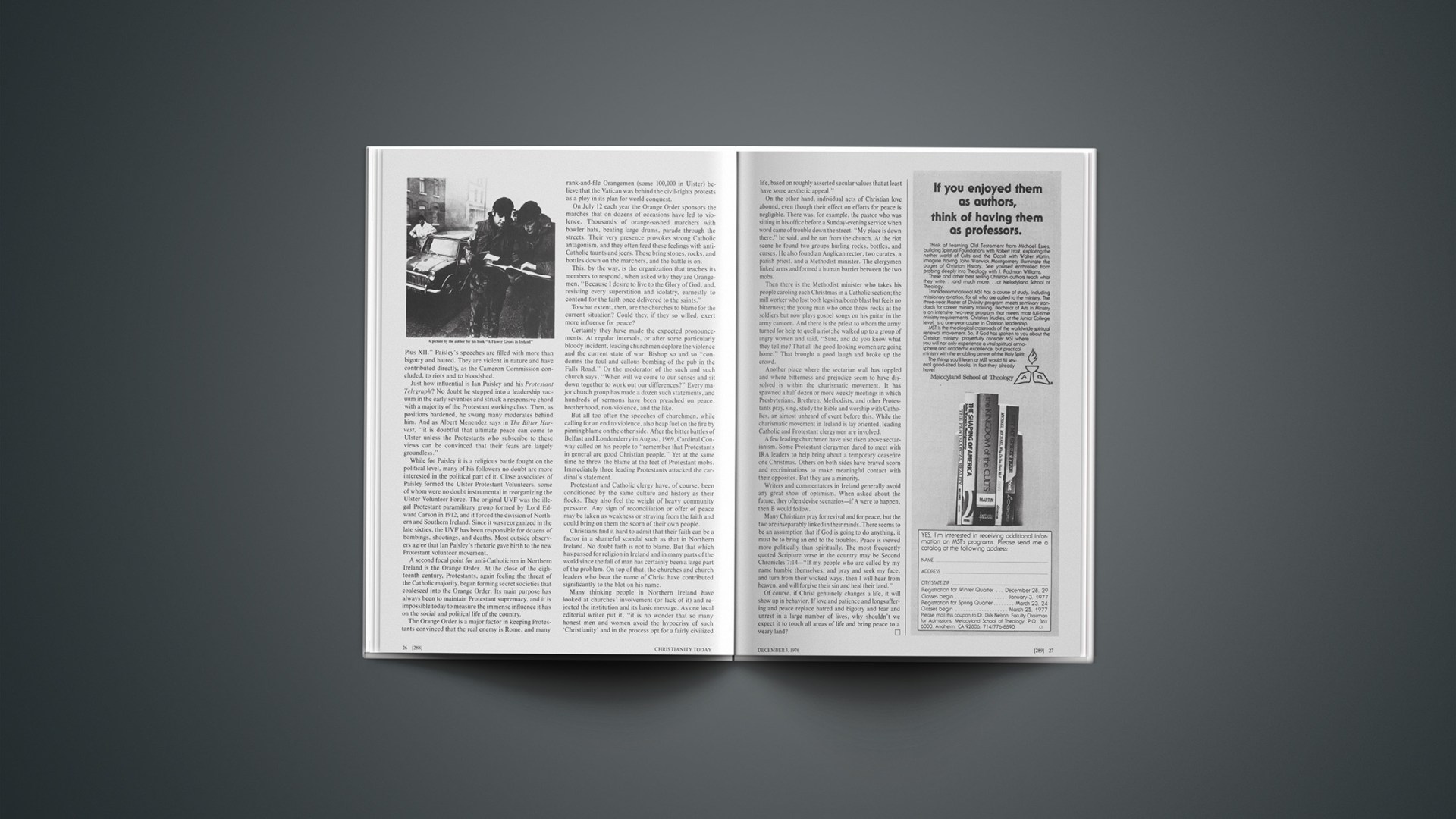
Children of War: Barricaded by Bigotry

One morning, near Bethlehem, after the Six Day I War, I watched tiny Arab children going to school. Like so many little black mice they scurried along the roadside. Israeli soldiers, without speaking a word, stopped them and pointed to their schoolbags. A week earlier a bomb had exploded in the Supersol (shopping center) in Jerusalem, and schoolchildren were suspected. So the soldiers were taking no chances. Silently the children opened their satchels. Inside each was a reading book in Arabic and a huge piece or two of bread for the midday meal. The soldiers looked, then waved the children on.

Little did I imagine that soon afterwards soldiers would be searching children’s schoolbags for bombs and bullets in my own city of Belfast. A death toll of more than 1,600 people in Northern Ireland may seem insignificant compared to those killed in Indonesia or Viet Nam. But the equivalent number in the population of the United States would be 220,000 people in six years of civil strife.

The world’s press speaks of “the children of hate.” This is no exaggeration. I have seen teen-age boys in militant Protestant areas of our city with tattoo marks on their arms and on their schoolbags the initials “K.A.I.”—“Kill All Irishmen” (meaning the republicans who wish for a united Ireland). I have seen children of different religions spit at each other on the street. They are let out of their schools at different times of day to prevent encounters, and they are taken home by buses. They are born apart, they live apart, they pray apart, they work apart.

Many children in our city are conditioned during their formative years to hate the other side. For the children of Ulster are gone into captivity—a terrible captivity that involves their hearts and minds.

This past summer a pregnant woman was wounded by a gunman’s bullet and rushed to a hospital. When the doctors delivered her child they found the baby girl had a bullet in her back. Even an unborn child cannot escape the violence of our society.

The Ulster community is a place in which two traditions meet—the Irish Catholic and the British Protestant. Labeling the two sides “Catholic” and “Protestant” is a convenience because the religious division parallels the political and ethnic division in the country. The religious traditions have also been synonymous with political views. In fact, there have been two nations, with two different cultures and two sets of values. Protestants and Catholics have been brought up to believe in different versions of a joint history, to admire different heroes, to sing different national songs, even to play different games.

So the one million Protestants have looked to Britain for their social and cultural links, while the half million Catholics have looked to Dublin and have had historic and cultural links with the Republic. Catholicism has remained identified with Irish nationalism, and Protestantism has remained the prisoner of unionism (union with Britain).

The history of Ireland has conspired to support a near identity of our political and religious communities. Indeed, many church leaders and members find it difficult to make a clean distinction between loyalty to their faith and loyalty to a particular political viewpoint. For all practical purposes the Roman Catholic Church is politically committed to a united Ireland, while the Protestant Church believes, in general, in the Protestant supremacy in Northern Ireland. In each case, divine approval is claimed for territorial and political aspirations.

A recent report shows that 1,500 Roman Catholics have been forced to leave one area alone, to the north of our city, because of intimidation. Homes in this district have been systematically raided; the windows of the local Roman Catholic school have been smashed and the school’s population reduced by a quarter.

This intimidation works both ways. Protestant families in predominantly Catholic areas have also had to pack their belongings and leave. A letter reached me from a family telling of the birth of their new baby. On the very day mother and baby arrived home, warning shots were fired as the father entered the house. The shots meant “get out.” That Wednesday the family with their week-old baby moved across the city to a safe area.

Today mixed neighborhoods, where both groups used to live together in reasonable harmony, have been split through intimidation—stones through windows, warnings through letterboxes. One by one, families have moved out. Both sides have retreated into defensive positions. This segregation in housing is building a barricade for the years ahead. It may prove to be a more formidable barricade than any barbed wire set up by British soldiers, and higher than any pile of hijacked trucks.

Another lamentable barrier is segregation in education. Many Protestant children have never come nearer than a stone’s throw to Roman Catholics. Protestant children are educated at the state schools. The Catholic Church chooses to keep its educational autonomy, and 98 per cent of Roman Catholic children attend their own schools. Protestant and Catholic young people get an opportunity to mix only at age eighteen, when some go to university. But this includes only a small proportion of them.

I am convinced that the integration of children from their early years would be the most important single factor in breaking down community barriers and in restoring peace. I feel that as long as school segregation continues, community strife will keep recurring. Ancient suspicions and prejudices persist unchecked among the children. A new generation is emerging to whom the abnormality of violence has become a normal way of life.

I believe that the first thing we have to do in Belfast is to treat each other on the basis of our common humanity, and never by reference to our inherited labels, whether religious or political.

Recently I was telling a Protestant group of a boy in our city, Paul McGeown, age two, who on summer days loved to go with his mother to the park to watch the birds. “Birdies! Birdies!” he would call out with glee. On his way to the park one day the blast of a terrorist bomb hurled Paul right across the road, inflicting severe head injuries. For sixteen days he lay unconscious in the Belfast Children’s Hospital. A brain surgeon operated, and when Paul recovered consciousness he could not see. Then a month later the miracle happened. The nurse was holding Paul at the window. Suddenly he pointed—“Birdies! Birdies!” Paul could see again.

What was the reaction from the people to whom I was telling this story? Nearly all felt happiness for the child whose sight had been restored, I’m sure. But one woman angrily asked: “But wasn’t he a Roman Catholic?”

Edwin Markham wrote,

He drew a circle that shut me out

Heretic, rebel, a thing to flout.

But Love and I had the wit to win:

We drew a circle that took him in.

Bricks can build a barricade or a bridge. The bridge between the segregated children of Belfast will have in its structure the bricks of compassion, understanding, and reconciliation. The bridge is love.

I believe that in moments of despair we must dare to hope. Violence in our city may have a long rope, but I know God holds the end of that rope. Christmas came to the world in the bleak midwinter. When the night was blackest, the light shone. So in our city of Belfast, with its many self-inflicted wounds, we will still dare to sing this Christmastide: “Love shall be our token/Love be yours and love be mine.” For if reconciliation is the very heart of the Christmas message, then this is a day of opportunity.

Paul D. Steeves is assistant professor of history and director of Russian studies at Stetson University in Deland, Florida. He has the Ph.D. from the University of Kansas and specializes in modern Russian history.

The Celestial Pageantry Dating Christ’s Birth

Until recently, there seemed to be incontrovertible proof that Christ was born before March, 4 B.C. Josephus, a Jewish historian who lived in the first century A.D., recorded that Herod died shortly after an eclipse of the moon and before a Passover. Calculations have shown that a lunar eclipse occurred the night of March 12/13, 4 B.C. This was just before a Passover. Since the Bible makes it clear that Christ was born while Herod was still alive, this has appeared to many scholars as undeniable evidence that Christ was born before that eclipse in March, 4 B.C. And so the “Star of Bethlehem” has always been looked for prior to that date.

Some historical studies, however, have thrown doubt on the association of Herod’s death with that eclipse. In an essay in the October, 1966, Journal of Theological Studies, W. E. Filmer reviewed the historical data available from the period and suggested that Herod continued to live for some time after 4 B.C. Filmer also showed reasons for thinking that the eclipse to which Josephus referred was not the one in 4 B.C. but a later one on January 9, 1 B.C. AS early as the sixteenth century an eminent scholar, Scaliger, was decisive in stating that Herod’s death was connected with the 1 B.C. eclipse.

Virtually all early Christian historians and chronologers who lived from the second to the sixth centuries (and even later) put the birth of Christ after the eclipse of 4 B.C. Irenaeus, Clement of Alexandria, Tertullian, Orosius, and Cassiodorus Senator said Christ’s birth was in a year we now recognize as 3 B.C. The early Christian chronologist Julius Africanus said it was in the year from 3 to 2 B.C. This same year was accepted by Hippolytus of Rome, Origen, the Chronicon Cyprianicum, Eusebius of Caesarea, John Chrysostom, Jerome, Hippolytus of Thebes, Photius Patriarch of Constantinople, the Greek historian Zonaras, and Bar Hebreaus, who quoted Syrian, Armenian, and Greek sources. Epiphanius and the early Syrian chronological work called the Chronicon Edessenum indicate it was 2 B.C. Almost all the early Christian Fathers of whom we have record said Christ’s birth was in either 3 or 2 B.C. These scholars were certainly acquainted with the writings of Josephus, and they must have been aware of his eclipse information. Yet they chose a date for Christ’s birth later than the one commonly used today.

No one should be dogmatically for or against the idea that the later eclipse is the one to which Josephus referred; there is still considerable doubt about the chronological information of the period. But the 3/2 B.C. date of the early Fathers is of real interest when astronomical data for that year are consulted. From August, 3 B.C. to December, 2 B.C., the apparent motions of the heavenly bodies caused a number of planetary and stellar relationships that could not fail to excite observers who saw significance in such things.

On August 1, 3 B.C. the planet Jupiter became visible above the eastern horizon as a morning star. It had just come out of the light of the Sun. Twelve days later, at about 5 A.M., a very close conjunction occurred between Jupiter and Venus (already a morning star for six months); the space between them at the morning observation was a mere .23 degree. Although the planets did not appear to touch each other (a rare phenomenon indeed), they showed an exceptional closeness.

Then some five days later the planet Mercury emerged from the Sun to become a morning star. While this was happening, Venus left its conjunction with Jupiter and headed toward Mercury. On the morning of September 1, Venus and Mercury came into conjunction, .36 degree apart. Their appearance would have been similar to that of Jupiter and Venus a few days before.

Such conjunctions of Jupiter/Venus and Venus/Mercury are not in themselves rare, but when connected with further astronomical occurrences in the year 3/2 B.C., they could be thought to have a great deal of significance.

After the September 1 meeting with Mercury, Venus journeyed back into the light of the Sun, emerging in the west as an evening star about December 20, 3 B.C. When Venus became an evening star, an observer just after sunset would find the planet moving progressively higher in the sky (going more easterly) each day. This movement placed Venus on a collision course with Jupiter, which was moving progressively westward each day. At the period when Venus reached the easternmost point from the Sun that it ever reaches, on June 17, 2 B.C. the two planets “collided.” This was a most uncommon occurrence. They were a mere .02 degree apart. To an observer on earth, the luminosity that each planet showed would have made the two planets together look almost like one gigantic star. What a dazzling sight—and it was in the light of the full summer moon! Immediately after this rendezvous, Jupiter advanced ahead of Venus as they both moved into the light of the Sun. (It must be understood that all these planetary motions and relationships are the apparent ones, as viewed by observers on Earth.)

This, however, is only half of the story. While Jupiter was on its westward journey to link up with Venus for this rare reunion on June 17, 2 B.C., Jupiter was engaging in some exhibitions of its own. Thirty-three days after the first Jupiter/Venus conjunction back in August of 3 B.C., an observer would have seen Jupiter come into conjunction with Regulus, a star of the first magnitude that is the chief star in the constellation Leo. The conjunction occurred on September 14. The stellar bodies, as viewed from earth, were only .63 degree apart. After that encounter, Jupiter then proceeded on its normal course through the heavens. Then on December 1, 3 B.C., the planet stopped its motion through the fixed stars and began its annual retrogression. But in doing so, it headed straight back toward the star Regulus. On February 17, 2 B.C., it was once again in conjunction with Regulus. This time they were 1.19 degree apart. Jupiter then continued its retrogression another forty days, finally returning to its normal motion through the fixed stars.

Then note what happened. On May 8, 2 B.C., Jupiter again was in conjunction with Regulus, 1.06 degree apart. (For Jupiter to unite with Regulus three times in one year is not common.) After this third conjunction with Regulus, Jupiter continued moving westward (in an apparent sense) for forty days more. (Jupiter actually moves eastward through the fixed stars, except in retrogression, but because the dome of the sky appears to move westward at a faster rate than Jupiter’s eastward motion, an observer on earth would see Jupiter more westerly on each succeeding day.) Jupiter, after its three conjunctions with Regulus, went on to reunite with Venus on June 17, 2 B.C., as mentioned earlier. This conjunction was the rarest for many decades, and it happened when Venus was at its easternmost point from the Sun.

But even this rare Jupiter/Venus conjunction was not all. On August 27, 2 B.C., Jupiter emerged once again as a morning star. Mars, which had played no active part in the past year’s conjunctions, overtook Jupiter and formed a very close conjunction with it; the two planets were only .14 degree apart. Such nearness is not an ordinary occurrence, and it must have been a wonderful sight. Since the planets were only eight degrees ahead of the Sun, the light for the predawn probably diminished the display for the observer on earth. Yet astronomers in that period could have calculated the time of the conjunction and may have been looking for it.

These astronomical indications show that seven major conjunctions took place in 3/2 B.C. That year must have been an unusual and interesting one to astronomers—and even more so to astrologers. And this is where the Wise Men of the New Testament come into the picture.

Since most people in the first century believed in astrology as a scientific indicator of important events, these displays of 3/2 B.C. must have produced a good deal of excitement. Even the writers of the New Testament may have shared in it. The New Testament says that wise men (Magi) came to Jerusalem looking for a newborn king. History shows that the Magi were astrologers, and the New Testament says that some of them journeyed to Jerusalem asking for the king of the Jews, whom they wished to worship (Matt. 2:2). Suetonius (Vespasian iv) and Tacitus (Histories v 13), two Roman historians who lived in the first century, said there had long been a belief throughout the East (Palestine, Syria, Babylon) that near the first century a king would be born of the Jews who was destined to rule the world. Virgil also told of the dawning of the golden age in that period (Eclogue iv). Since such a belief was widespread, there is little doubt that the astrologers looked for astronomical signs concerning the arrival of the prophesied king.

The Gospel of Matthew says the Magi saw a particular star that was the signal of the king’s coming. The Greek words used in relating the event were the ordinary ones used throughout Greek literature to describe the regular rising of the stars or planets (Kittel, Theological Dictionary, I, 352). In their normal predawn observations the Magi could very well have seen an ordinary star (or planet) ascending above the eastern horizon, which they interpreted as the sign that the prophesied Jewish king was to be born. They were certain enough of their interpretations to make a long, arduous journey with costly gifts to present to the new king. The Bible says that Herod and all Jerusalem also took the sign of the star seriously.

What star could this have been?

The ingenious German astronomer Kepler back in 1606 A.D. suggested that the star of the Magi was a conjunction of Jupiter and Saturn appearing near some other star. In the last century, Ideler found that such a conjunction did occur in 7 B.C. But this year is very early for the birth of Christ, and later it was found that the planets Jupiter and Saturn were then at least two diameters of the moon away from each other. This was too far away for anyone to view them as a “star.” Some have suggested that the Bible is talking about a comet, but this is unlikely because comets were almost always interpreted as harbingers of evil. Perhaps it was an exploding star, a nova. Yet this suggestion is unprovable, and most scholars reject the idea. Some even feel it was an angel. Others say it was an outright miracle.

But let us recall a simple fact that the Gospel says happened: the Magi saw “his star” rising in the east. The text reads as if it were an ordinary morning star. Perhaps the star was a normal heavenly body that was in some kind of unusual configuration. Because 3/2 B.C. was an extraordinary year for visible astronomical occurrences, and since most early Christian writers say Christ was born in this year, perhaps we should focus our attention there.

Let us notice some astrological and biblical factors connected with the astronomical signs of 3/2 B.C. Since the New Testament shows that the “star” rose in the East, it would naturally be called a morning star. Christ said of himself, “I am the root and offspring of David, and the bright and morning star” (Rev. 22:16). We should recall that in 3 B.C. on the morning of August 12, eighty minutes before sunrise, Jupiter rose as a morning star in conjunction with Venus. How would astrologers (or Magi) interpret such a phenomenon? Astrological interpretation can vary widely, but let us notice some generally accepted beliefs.

Jupiter, known astrologically as the Father of the Gods, left the vicinity of the Sun and conjoined with Venus. This could be associated with a coming birth. In fact, “Jupiter was often associated with the birth of kings and therefore called the King-planet” (Hendriksen, Matthew, p. 153). Jupiter and Venus were also known as the Greater and Lesser Good Fortunes of the astrologers, and here they were in union. And note this: while this conjunction was occurring, the Sun (the Supreme Father), the Moon (considered a Mother), and Mercury (the Messenger of the Gods) were located in the single constellation of Leo—the Lion. The fact that these primary bodies were clustering in Leo may have had some biblical significance. The lion was the symbol of the tribe of Judah. Christ was called “the Lion of the tribe of Judah, the Root of David” (Rev. 5:5).

Then twenty days later another interesting thing occurred. Mercury (the Messenger of the Gods) left its position with the Sun (the Supreme Father) and moved into close conjunction with Venus. To the Chaldeans, Venus was Ishtar, the Virgin Mother—the goddess of fertility. However, the planet normally was thought to take on masculine qualities as a morning star. It was feminine in the evening. But notice what happened to the Sun when the Mercury/Venus conjunction took place. The Sun (the Father) had entered the constellation Virgo (the Virgin). This occurred when Mercury (the Messenger) and Venus were now conjoined in the constellation of Leo (the Lion) and Jupiter itself was just then entering Leo. All these astral signs have biblical themes associated with them. The Supreme Father in the Bible is God the Father. His Son was to be born of a virgin, according to prophecy. He was to be a descendant of Judah (Leo, the Lion), and he was to be introduced by a messenger (“Behold, I send my messenger before thy face, which shall prepare thy way before thee”—Mark 1:2).

Following these planetary conjunctions, Jupiter then moved on (as we have shown earlier) to unite with the star Regulus on September 14, 3 B.C. This could have been a very significant event—especially in relation to the other conjunctions of the year. Regulus is the chief star in the constellation of Leo, and Leo was connected with Judah in the Hebrew zodiac.

The brightest star in the constellation of Leo is Regulus, known as “the Heart of the Lion.” The Babylonians referred to Regulus as “the King,” and the Romans called it Rex, “King.” In Arabia, Regulus was known as “the Kingly One.” The Greeks called it “Basiliscos Aster,” which means “King Star.” Of all the stars in the heavens, Regulus was the one universally connected by ancient astrologers with greatness and power. And it was clearly connected with the conception or birth of kings.

Here was the King planet Jupiter, which had recently united with Venus, now associating itself with the King star in the constellation of Leo (the tribe of Judah). At the time of this conjunction, the Sun (the Supreme Father) was positioned in the constellation of Virgo (the Virgin). All these features are very reminiscent of biblical themes associated with Christ.

But these are not all the signs of 3/2 B.C. After Jupiter’s three conjunctions with Regulus (the King star), Jupiter continued its westward journey, and on June 17, 2 B.C., it had its rare reunion with Venus. The planet Venus (now called the Mother, an evening star) was extending as far east as possible to meet her consort, Jupiter, the King planet. What occurrred was a splendid planetary conjunction visible to all on earth that, let us note again, occurred in the constellation Leo—the sign of Judah. The conjunction also happened at the exact time of the full moon. The two planets would have appeared almost as one gigantic star. Could it be that these same planets that had introduced the prophesied king when they were both morning stars some nine and two-thirds months ago were now finalizing that introduction of the newborn king with an impressive evening-star union?

This, however, was not the end. On August 27, 2 B.C. (seventy-two days later), observers would have seen the extremely close conjunction of Jupiter with Mars (the planet of War). This occurred just before sunrise, close to the Sun. If the planets had not been close together, they would ordinarily not have been seen from earth. But they were then in very close conjunction, and because of that their light could have shone through the predawn.

As a matter of fact, there were actually four planets near the same longitude in the heavens when Jupiter and Mars had their conjunction: Jupiter at 142.6 degrees; Mars, 142.56; Venus, 141.51; and Mercury, 144.28. For these four planets to be so close was an unusual occurrence. And remarkably, those planets clustering around one another were all located in the constellation of Leo the Lion while the Sun at that very time was entering the sign of Virgo the Virgin! These factors too could emphasize biblical events.

What could be the interpretation here? Since Jupiter and Mars had just become new morning stars, it could well signify that war would break out on the earth just before that prophesied messianic day could commence. At least the Bible predicts that this will happen—and astrologers may have interpreted the sign similarly.

One thing is certain: the year 3/2 B.C. was remarkable for its visible astronomical occurrences. And since Genesis 1:14 says that the heavenly bodies were given for signs, perhaps these unusual conjunctions were intended to signal the advent of the Christ Child into the world. The stellar body that played the most prominent role in this extraordinary year was Jupiter. It could well be that Jupiter was “his star” that the Magi followed to Jerusalem, and finally to Bethlehem.

Let us now look at some interesting biblical features that could be said to support this interpretation. It should be recognized that the Magi arrived in Jerusalem sometime after Christ was born (Matt. 2:2). He had been circumcised (Luke 2:21) and presented at the Temple (Luke 2:22–24). The parents of Christ were living in a house, not a manger (Matt. 2:11), and Christ was then called a paidon (child), not a brephos (infant). After the Magi presented their gifts, they returned home by a different route. In response to this subterfuge, Herod slew the infants around Bethlehem who were two years of age and younger (Matt. 2:16). Since it was often difficult to interpret whether heavenly signs were indicating conception or birth, Herod probably took both possibilities into account: he killed the children up to two years so as to include both the time of conception and the time of birth. All these indications show that the Magi must have arrived in Bethlehem several months after Christ’s birth.

This leads us to the final indication that the planet Jupiter may be the “Star of Bethlehem.” Recall that the Magi saw the star rise above the eastern horizon. And in August, 3 B.C., Jupiter did in fact rise as a morning star that soon came into conjunction with Venus. That started a series of six conjunctions with other planets and the star Regulus. The last planetary conjunction was the one with Mars in August, 2 B.C., but then something else happened with Jupiter: Jupiter left its conjunction with Mars and proceeded in its apparent motion westward. The Bible says the star “went ahead of them” (Matt. 2:9). Could it be that the Magi (who came from the East) simply followed the normal movements of Jupiter as it progressed westward each day? The text could be interpreted this way.

Then note what occurred. When they reached Jerusalem, the Magi were told to look toward Bethlehem for the newborn king. This happened at a time when the New Testament says the star came to a definite halt in the heavens—it “stood over where the young child was” (Matt. 2:9). And indeed, the planet Jupiter does become stationary in its motion through the fixed stars. This happens at its times of retrogression and progression. It could well be that Matthew was referring to such a thing.

Jupiter had come to the point of retrogression; it became stationary among the stars. It was now about to display its seventh and final sign of that extraordinary year. The precise time for the retrogression of Jupiter was December 25, 2 B.C.! On that day Jupiter became stationary in the heavens.

But how was it possible for Jupiter to be stationary over the village of Bethlehem at that time? Very simple. The Bible says the Magi saw the star while they were still in Jerusalem (Matt. 2:8, 9). Bethlehem is located five miles south of Jerusalem. And on December 25, 2 B.C., at the ordinary time of the Magi’s predawn observations, Jupiter would have been seen in meridian position (directly over Bethlehem) sixty-five degrees above the southern horizon. This position would have shown the planet shining right down on Bethlehem! Furthermore, it was the period of the winter solstice, and so not only Jupiter but also the Sun was “standing still” in the heavens. (The word solstice comes from Latin words meaning “Sun stands still.”) This occurrence could well have appeared significant to astrologers. “General observance required that on the 25th of December the birth of the ‘new Sun’ should be celebrated, when after the winter solstice the days began to lengthen and the ‘invincible star triumphed again over darkness’ ” (Cumont, Astrology and Religion Among the Greeks and Romans, p. 89). And now, both Jupiter and the Sun were “standing still,” and Jupiter was then situated in the constellation of Virgo the Virgin.

Would not astrologers have been impressed with these interesting heavenly relationships? The Magi could have interpreted them as the destined time for giving their gifts to the “newborn Sun”—this time the “Sun of righteousness” (Mal. 4:2), born of the Virgin Mary.

The astrological interpretations I have suggested in this article may or may not be correct, but the occurrence of these astronomical phenomena in 3/2 B.C. is certain. Those exhibitions no doubt caused a great deal of excitement and wonder. They may well indicate that the early Christian historians were correct when they said Christ was born sometime in the period 3/2 B.C.

How ‘Christian’ Is America?

Is the United States the most religious nation in the world?

Pollster George Gallup, who may know as much about religious trends in the United States as anyone, said earlier this year that perhaps it was. Contrary to the gloomy pronouncements of some, Gallup sees little erosion of religious beliefs in our society. “Americans have in fact held firmly to basic religious beliefs over the last quarter century,” he says, “while a dramatic change has come about in certain European nations during this time.”

On a deeper level, however, it is difficult to claim the title “most religious” for the United States, or for any other nation, for that matter. In the biblical sense of “the nations” (ta ethne), some entire nations are highly religious in their way. The Sawi of Peace Child fame, for example, believed in a multiplicity of evil spirits dwelling in stones, trees, wind, and lightning. There were no exceptions, so it could be said that the Sawi are a totally religious “nation.” And even if we restrict “religious” to Christian, we find peoples in the world more religious than the United States. No area of the world is more thoroughly Christian than northeast India, where large tribes of headhunters have become followers of Jesus Christ during the last seventy-five years. Approximately three-fourths of the people in those tribes are Christian now. The Mizo “nation” leads with some 98 per cent of its population Christian.

Nevertheless, the fact remains that the people of the United States are very religious. One recent Gallup survey found that 71 per cent of adults (eighteen or older) were members of a church or synagogue. This is quite remarkable, given the fact that the government officially neither requires nor encourages any particular religious belief. Religion is a matter of free choice in America, and most Americans choose to be religious at least to the point of associating themselves with a religious group.

At first glance the United States might also seem to be a highly sports-minded nation. Many people, and I am one of them, are keenly interested in sports. I live in the Los Angeles area and I cheer when the Dodgers, the Lakers, or the Rams win. In the Los Angeles Times I find multi-page sports sections seven days a week. And religion? Well, one has to wait until Saturday to find two pages buried in the interior of the paper, with half the space taken up by mediocre religious advertising.

But one day I became curious about what the situation really was. I went to the Statistical Abstract of the U. S. for sports data and to the Gallup poll for religious data, and found to my surprise that more American people attend church in an average week than attend all professional baseball, basketball, and football games combined in the average year! All athletic events of all kinds, professional and amateur, draw about 5.5 million spectators per week, while churches draw 85 million worshipers in the same week.

This ought to be encouraging to Christians. Shocking data can be compiled about drug addiction, prostitution, gambling, alcoholism, crime, pornography, and other prominent activities of the devil. But behind it all, Christians ought to remember that Jesus said, “I will build my church, and the gates of hell shall not prevail against it” (Matt. 16:18). By nature, Christians should come down on the side of the optimists. Read the list of the fruit of the Spirit in Galatians 5 to confirm this. The vocabulary there is anything but pessimistic.

America as a Mission Field

Was America always as religious as it is now? Of course not. Because we send a great many missionaries out from America and receive few from other countries today, we forget that America was once a mission field. As W. Richey Hogg of Perkins School of Theology observes, “During the past two centuries, the greatest missionary effort in history among a single people was concentrated within the United States” (“The Role of American Protestantism in World Mission: A Bicentennial Perspective,” page 3; I derived a good bit of the information in this section from Hogg’s excellent study, presented to the American Society of Missiology at its annual meeting in June, 1976). And this effort met with good success. The result is that America has the largest group of professing Christians to be found in any one country in the world.

American mythology makes us think that all our forefathers were deeply Christian people. Such things as the language of the Mayflower Compact, the tradition of Thanksgiving Day, the Scarlet Letter, and Washington’s prayer at Valley Forge nourish the impression that in the colonial period the person who didn’t attend the Sunday-morning worship service, who hoed corn on Sunday afternoon, or who coveted his neighbor’s ox or ass was the exception to the rule.

Not so. British colonists in America were no different from British colonists in any other part of the world. America was a land of new opportunity for a free-wheeling life-style and substantial material gain. Religious freedom was an added attraction, but in more cases than not it was used as freedom to reject Jesus Christ rather than to serve the living and true God.

Colonial America was definitely a mission field. Some British Christians tried to meet the challenge through the Society for the Propagation of Christian Knowledge and the Society for the Propagation of the Gospel. But for the first hundred years their missionaries made little impression. Most colonists could hardly have cared less about Jesus Christ and the Church. And the colonial churches themselves were at a fairly low ebb until the Great Awakening swept the colonies about a half century before independence.

The bitter struggle for independence, which was a twenty-year process, tore many of the churches apart. The Anglicans found themselves in disarray, since most of their leaders were loyal to the British. Strong religious leaders like John Wesley were developing biblical arguments why the American revolution was wrong. And as a result, in 1776 when the Declaration of Independence was signed, only about 7 per cent of the citizens of the new United States of America were church members.

At this point American Christians became those most directly responsible for the evangelization of their own people. The British could no longer do it. The task was enormous, and the story is thrilling. By 1850 American church membership was up to 20 per cent; by 1900 it had reached 36 per cent; and so far during our century it has risen to at least 60 per cent. Adding the synagogues and other religious organizations, we approach the 71 per cent registered by the Gallup poll.

One of the most exciting chapters in this story of the spread of the Gospel in America is the evangelization of the Africans who were forced to migrate to America as slaves. Although many of the facts about the evangelization of American blacks are just now emerging, it seems clear that blacks were largely evangelized by blacks. This is not to deny that some white churches made sincere efforts to evangelize the blacks. But black religion in America was mostly self-propagated. In fact, Kenneth Scott Latourette says that “all the extensive Protestant missionary effort of Europeans and Americans in Asia and Africa in the century between 1815 and 1914 had resulted in no greater numerical gains than had been achieved among the Negroes of the United States in the same period” (A History of the Expansion of Christianity, IV, 327).

Missionaries feel their work has been successful not just when a national church has been planted but when the church gets busy sending out its own missionaries. The first United States mission, the American Board of Commissioners for Foreign Missions, was organized in Bradford, Massachusetts, in 1810. Its first five missionaries set sail for India in 1812. By the end of the century, 4,891 American missionaries were serving overseas, constituting roughly a fourth of the total world Protestant missionary force. Today the number has risen to over 35,000, about 64 per cent of the world’s missionaries. Voluntary giving to the world missionary enterprise has kept pace. American Christians currently contribute over $400 million annually to world missions.

How Well Is America Evangelized?

With a 71 per cent membership in religious organizations, it might seem that America is now virtually evangelized.

No one I know of, however, believes that this is so. There remains a tremendous evangelistic concern not only for the 29 per cent who do not belong to a church but also for many of the 71 per cent who belong to a church in some vague sense but who are not personally committed to Jesus as Lord. They are Christians only nominally. There is a wide gap between what they profess to believe when a polltaker questions them at their front doors and what they practice when the doors are closed.

Finding out how many Americans still need to be evangelized is not easy. Regrettably, through what I consider undue nervousness over maintaining the separation of church and state, our Census Bureau has not collected religious data for quite some time. We know exactly how many Americans attend horse races, how many fly on airplanes, how much Americans spend on shoes, and how many toilets there are in the houses in a given census tract. But the Census Bureau does not find out how many belong to churches, attend worship, go to Sunday school, or practice the Christian code in their daily lives. I think that data on church attendance is at least as valuable for an understanding of our society as data on theater attendance or purchase of toasters, but until some courageous legislators agree and are willing to work to bring about changes, we will be without our potentially most accurate data.

What the Census Bureau does give us, however, is the important figure of how many people there are in the country as a whole. I think that in evaluating past evangelistic efforts or in planning future strategy, it is helpful to deal not with the total population but with the number of adults. It is not that children are unimportant as people. God loves them and wants them to be saved. But for a measurement of the effects of evangelism on a broad scale, children are not nearly so significant as their parents. The figure I like to work with, then, is 143.8 million, the number of adults the Census Bureau says we have in the United States. It is most helpful to define adults as those eighteen or over because the Gallup poll, a most important source of religious data, also works with Americans eighteen and over.

How many of these 143.8 million adults have been evangelized? How many attend church?

The Yearbook of American and Canadian Churches is only partially helpful in answering these questions. The Yearbook publishes official denominational membership reports for about 330,000 U.S. churches. But no attendance reports are given. Furthermore, even the method used to report membership is not as helpful as it could be; a disclaimer that “church statistics are not always comparable” is placed in a prominent place in each edition of the survey. It is true that the established categories for reporting statistics differ from group to group. On that basis the official figures of one denomination cannot always be compared with those of another. But it seems reasonable to suppose that a Yearbook editor could develop formulas for refining the statistics in such a way that apples could be compared to apples across the board.

A relatively simple questionnaire or some type of marketing survey could reduce the official statistics to adults eighteen and over. Then we would know how many Jewish adults are affiliated with synagogues and how many Catholic adults belong to churches, whereas now Jews simply estimate the number of Jewish people in the community as a whole and Catholics count all baptized persons. Some Protestants do the same thing. To mention another problem: of the some 12 million Southern Baptists, 4 million do not reside in the localities of the churches where their names are on the rolls. That membership figure needs to be refined to compare with that of, for example, the Christian and Missionary Alliance, which underplays formal membership but has many loyal non-members who tithe and are active in church life.

Some church-growth experts recently got together in Pasadena, California, to attempt to draw up guidelines for compiling religious data helpful for planning evangelistic strategy for the United States. One of the results of that meeting was what is called the “church involvement axis.” Nine categories of people were described, beginning with those closest to the church and ending with those furthest away. It loooks like this:

1. Active church members who are strong.

2. Active church members who are weak.

3. Active members who are not born again or personally committed to Jesus Christ.

4. Resident members who are inactive.

5. Non-resident members (their names are on the roll in another town or city from where they live).

6. Adherents who attend church but whose names are not on the roll. Some of these people might be faithful believers but for reasons of their own have not taken membership in the church they attend.

7. Non-members who have a church background but who have become indifferent.

8. Non-members who have a church background but who have turned against the church and become hostile.

9. Non-members who have no church background; they constitute the “pagan pool.”

Obviously, the 71 per cent discovered by the Gallup poll to be members would span categories 1 through 5. But many of those people need to be evangelized even though their names might be on the membership roll of some church. They are what I would call “functionally unchurched.” The best approximation I can make is that 106.4 million American adults fall into the “functionally unchurched” category. This is 74 per cent. In other words, three out of every four American adults are lost and need to be evangelized. Most of the 69.2 million children need to be evangelized also.

This, then, is a tremendous challenge. Bible-believing evangelicals have no time to be complacent about the religiosity of the American people when more than 100 million adults still need to be touched personally with the Gospel of Christ. God certainly is not willing that they should perish. And the Scripture reminds us that they will not be able to hear of God’s provision unless there is a preacher to tell them (Rom. 10:14).

Evangelism Is In

Fortunately, things never looked so hopeful for finding lost people in America and bringing them into the Christian fold. The icy cynicism about the church common in the 1960s has now melted. Priorities are being straightened out. Instead of advocating the death of the institutional church, people are praying and working for its renewal and growth. It seems to me that functionally unchurched Americans have never been more ready to hear and accept the Good News. I see eight signs that suggest to me that we have entered a time of ingathering into the Christian Church in America:

1. The steadily increasing strength of the evangelical movement is furnishing a solid base for biblical evangelism. Evangelicals have consistently preached a biblically rooted message of personal repentance, faith, and regeneration. Some fix the number of U.S. evangelicals at 40 million, although the figure is a soft one. People from all socioeconomic strata, and every area of the country, and virtually every denomination count themselves as evangelicals. Participants in the exciting Messianic Jewish movement might well be called evangelicals. The National Association of Evangelicals has never been stronger. Evangelicals do not need to be persuaded that evangelism is God’s will. They know what their task is, and more of them are devoting time, energy, and money to getting it done.

2. Mainline denominations are beginning to recapture the evangelistic priority on high levels. One indication of this was the grass-roots demand for evangelism at the Fifth Assembly of the World Council of Churches (Nairobi, 1975). Both Bishop Mortimer Arias of Bolivia and John Stott of England spoke strongly for evangelism in the plenary sessions. The “Spirit of Lausanne,” a reference to the Congress on World Evangelization held in Lausanne, Switzerland, in 1974, clearly made its influence felt in the World Council. An example of how it is also penetrating American churches was seen in the United Methodist Quadrennial Conference held earlier this year in Portland, Oregon. Overwhelmingly, the delegates there voted to place evangelism among the three highest-priority items for the next four years. Less official overtures are being heard from leaders in several other mainline denominations that have begun the process of reinstating evangelism as a matter of importance in their church life.

3. Strong statements on biblical evangelism are coming from Roman Catholic leaders. Reeling from the effects of a startling decline in attendance at mass from 71 per cent in 1963 to 50 per cent in 1974, many Roman Catholic leaders are searching for something that will reverse the trend. In October of 1974 the Synod of Bishops met in Rome under the theme “Evangelization of the Modern World.” One of the outcomes was an exhortation by Pope Paul VI, “On Evangelization in the Modern World,” in which he declared, “We wish to confirm once more that the task of evangelizing all people constitutes the essential mission of the church.” Paragraph after paragraph in the document sounds as if it could have been written at Moody Bible Institute. This, combined with the rapidly growing Catholic charismatic movement, may well signal a new day for Catholics.

4. The rapid growth of independent churches is almost hidden from the public in general. However, in many cities and towns one can find new churches called “Calvary Chapel” or “Bible Church” or “Evangelistic Center” or “Baptist Church.” These churches do not affiliate with any national denomination. They often are highly visible in their communities, but they lack combined national strength. I suspect that the fastest-growing religious movement in America is the Baptist Bible Fellowship movement. The superchurch First Baptist of Hammond, Indiana, is one of them. Although they do not figure in the statistics of the Yearbook of American and Canadian Churches, they are extremely important. One indication of strength is that Pastor Jack Hyles’s seminar at Hammond draws more than 5,000 per session, most of them Baptist Bible or other independent pastors. These independent churches are typically superaggressive in evangelism. As a result, a great many of them are growing well.

5. The church-growth movement, which traces its origins to Donald McGavran of the Fuller Seminary School of World Mission, is gaining wide acceptance. Just two or three years ago, those of us who are advocates of church growth had to devote much of our energy to defending the insights, methodologies, and research findings of the movement. No longer. Now the demand for church-growth teaching from those who are already strongly motivated far exceeds the supply of teaching time. Several Doctor of Ministry programs now have church-growth components for ministers who had no opportunity to study this area when they were in seminary. All this is building a strong theoretical base for highly effective evangelism in the near future.

6. During the last couple of years I have seen what I consider a significant breakthrough in the evangelization of two of our nation’s traditionally resistant peoples, the Jews and the Navajos. The Messianic Jewish movement, which encourages Jews to be born again, to follow Jesus (called “Yeshua”), and yet to remain Jews, is proving to be a powerful evangelistic force. A recent survey by the Jews for Jesus organization indicates that since 1976 somewhere between 14,000 and 35,000 Jews have become followers of Yeshua.

A week on the Navajo reservation recently has led me to believe that Navajo evangelism has turned an important corner. Navajos constitute about one-fourth of American Indians, and the tribe is increasing rapidly. The vigorous growth of some independent Pentecostal-type churches on the reservation is very encouraging. A change in missionary attitude and approach to culture also promises more effective evangelism. Missionaries are now recognizing that the old-school approach has not always been an effective evangelistic tool. They are beginning to use indigenous church-planting principles. A number of missionaries are now studying the Navajo language for the first time. To date, only a couple of missionaries are fluent enough to preach in Navajo, but this will change. Some of us may see the day when half of the Navajos are Christian.

7. Some parachurch organizations are beginning to relate to local churches much more creatively than they have in the past. The Evangelism Explosion program, one of the strongest new forces for evangelism training, originated in Coral Ridge Presbyterian Church, Fort Lauderdale, Florida. This evangelism is designed to produce church growth. The Fuller Evangelistic Association, founded by the late Charles E. Fuller, began a Department of Church Growth last year. It offers consultation services to churches and denominations that want professional help in developing evangelistic processes that will help their churches grow. Campus Crusade’s new “Here’s Life, America” program is working directly with local churches and is using a system specifically designed to incorporate converts into local churches. If other parachurch organizations take steps to gear their evangelistic efforts to church growth, tremendous spiritual power will be harnessed for God’s glory.

8. A new national mood of receptivity to spiritual truth is prevalent. The religion issue in the 1976 presidential campaign probably stirred as much interest in the claims of Christ as any hundred evangelistic crusades could have done; Jimmy Carter was not afraid to let the voting public know that he is “born again.” The dramatic conversion of former Nixon aide Charles Colson, told in his own words in the book Born Again, has made a strong impression on many readers. All this serves to create receptivity, especially among what I am calling America’s “functionally unchurched.”

There is much to be thankful for, and there is much to be done. New and growing forces for evangelism plus unprecedented openness to the message bid fair to make this last quarter of the century a very exciting time to be an evangelical and evangelistic Christian.

Eutychus and His Kin: December 3, 1976

Ze Question Ist …

Some years ago the late Paul Tillich was fond of saying, in his impressive Teutonic English, “Ze question dot efery chilt has asked itself zince reaching der age of zix years ist, How did I come to be part of ze zum totality of being?” This is the root, no doubt, of Tillich’s own life-long concern with ontology. I always thought it a bit farfetched until the other morning when my four-year-old daughter asked before breakfast, “Daddy, how did we get to be real?”

My first reaction was, “Already?” And I was preparing to launch into some kind of explanation of biological reproduction. But fortunately my wife was equal to the occasion. Her philosophy is: Never answer a difficult question—ask another. So she asked, “What would we be if we weren’t real?”

The answer was prompt: “Puppets.”

You see, the second question sorted out the first. My daughter’s concern was ontological, not biological. (It’s always good to know the question before you give the answer.) She wanted to know about the very nature of being, not about how she came to be biologically.

And her question has a good answer, ontological and theological at the same time: We are real and not puppets because God made us to be able to respond to his love, to love him and serve him.

We take curiosity about biology, especially sex, to be basic and primary, natural questions, so to speak. Ontological questions, those relating to being and the nature of reality, we think of as unnatural, sophisticated, and abstract—questions demanding a high order of intellectuality to pose or answer.

But, in fact, they too are fundamental—and even before the age of six.

The Bible presents us early on with the statement that God made man in his own image. Man is first of all a creature and God’s image bearer; biology, psychology, sexuality, and all other aspects of human reality make sense only in the light of that primary fact.

We have accused past generations of suppressing or diverting children’s questions about sex and reproduction. We recognize that such questions should be answered, not evaded. But we are likely to evade the ontological question. To “Why am I here?” we answer, “Well, God made mommies and daddies.…” That may be the modern ontological equivalent of the biological evasion, “The stork brought you.”

And when all is said and done, it is far more important to know from an early age why we are not puppets than to be perfectly enlightened about storks and their limited role in the production of babies.

EUTYCHUS VI

From the March 15, 1974, issue of CHRISTIANITY TODAY.

• The contributor of this year’s Eutychus column, Denny Rydberg, resigned after we were unable to use several columns he had submitted. We will reprint old Eutychus columns until the first issue of the new year, when Eutychus VIII takes over.—ED.

Don’t Stop Now

Thank you for your series on “Evangelicals in Search of Identity” (Footnotes, Jan.–Oct.). Carl Henry raised the right questions. Why can’t the series continue in an effort to address the penetrating questions raised? Why can’t CHRISTIANITY TODAY serve as a forum for the dialogue Carl Henry urged? Only frustration can follow if these questions fail to be addressed. Henry has suggested the direction. Let’s go.

LERON HEATH

Valley Community Church

Pleasanton, Calif.

Encouraging Inclusion

It is most encouraging to read articles like Ronald J. Sider’s “Evangelism or Social Justice: Eliminating the Options” (Oct. 8) … in CHRISTIANITY TODAY. Thank you.

EDWARD MCCLURG

Ravenna United Methodist Church

Seattle, Wash.

And Everything In Its Place

Those of us concerned with new books and the information they bring us appreciate the “Books” section of CHRISTIANITY TODAY. Let the editorials, however, remain on the editorial page. Richard Allen Bodey devoted 17 per cent of his lead review (Oct. 22) to editorial comments about the place of management in the life of the church. Interesting as these comments were, they would have been more appropriate on the editorial page. I’m not at all sure we have lost a “biblical perspective” as he implies. If St. Paul wasn’t a silver-tongued orator, what was he? He was a good manager, a powerful fundraiser, and a skillful developer (of individuals and organizations). Church administration was no sideline or small piece of the pie to Paul. Express, nevertheless, our appreciation to Mr. Bodey for sharing his insight into some new and interesting books.

R. HOWARD MCCUEN, JR.

Stone United Presbyterian Church

Wheeling, W.Va.

Well Covered

I just want to give you a word of appreciation for the excellent artwork on the September 24 cover. It’s the best I’ve seen on any periodical.

WOODY WILSON

Berkeley Christian Coalition

Berkeley, Calif.

Stubbed Lobes

In the October 22 issue of CHRISTIANITY TODAY (Current Religious Thought) John Warwick Montgomery, ordinarily a brilliant logician, has stubbed his cerebral lobes. He faults both Ford and Carter for their refusal to favor a constitutional amendment outlawing abortion. He goes on to condemn Ford’s proposal to have an amendment permitting each state to enact its own abortion legislation. According to Dr. Montgomery, this “leaves their [fetuses’] lives to the whims of state politics.”

But this is the constitutional way. Surely Dr. Montgomery is aware that there is no federal law against murder. Only state laws apply to any case of murder. In that sense the life of each of us is up to the whims of state politics. It seems to me that Ford’s answer was in keeping with the Constitution and with its recognition of the jurisdiction of the states over ordinary criminal activity.

JOHN V. LAWING, JR.

National Editor

National Courier

Plainfield, N.J.

John Montgomery’s abortion-related comments reflect a polar position that suggests a mush-headedness he attributes to others. As an economist seeking ethical reinforcement on controversial issues, I feel that the overriding biblical text for policy guidance seems to be First Timothy 5:8, the key question being, Can a family be maintained in a healthful enfironment? In many cases, “unwanted” children live in circumstances of great human misery. Because of insufficient family resources, they are often destined to become wards of the state—on welfare or in jail.

It would be fine if women who do not want children did not get pregnant, but they do by the thousands—and society pays! Although effective contraception (or abstinence?) is preferable, the abortion option should be legally available. If not, blatant discrimination is evident, as “the rich” do have this choice. Advocates of a constitutional amendment to override the 1973 Supreme Court decision simply have not thought through the long-term implications of their position. Did we not learn anything from the Volstead Act experience?

The matter turns on one’s definition of human life, which cannot be elaborated here. Is Dr. Montgomery really aware of the institutional chaos we would face when zygotes get legal rights? Actually, the fertilized egg is to a human being what an acorn is to an oak tree. The zygote reflects potential only and requires several months of growth to manifest true human characteristics.

Not only should the abortion option be available to all, it should be subsidized when necessary. If a prospective mother is unable to pay for a low-cost legal abortion, is it likely she would be able to provide adequate child care? A small upfront payment is preferable to a string of public outlays that often follow the birth of an “unwanted” baby—fiscal conservatives please note. As all geneticists know, nature is the great abortionist. To deny this option to biologically mature human beings is not in the public interest!

J. D. DEFOREST

Alexandria, Va.

Building Bridges

In her lead book review, Elizabeth Skoglund writes of “bridges joining psychotherapy … and the Church” (Nov. 5). Should evangelicals not become increasingly conscious of possibilities in bridge-building? I am referring especially to David Jeffrey’s basically excellent article in the same issue, “Discerning Truth: Is Man the Final Measure?” …

While “Christian humanism” as we know it may well be a fraud, the important question to ask is: “Is it possible, in the last analysis, to conceive of the freedom and dignity of man, as is supposed to be the thrust of humanism, except in a Christian context?”

It is historically true that Renaissance skepticism gave humanism and the humanities their start. But may not the underlying mundane situation have changed so much that today it would not be demeaning for religion (not just theology) to be regarded as one of the humanities? If it were, might this not help to make possible the type of further bridge-building that could result ultimately in the restoration of education?

STEPHEN B. MILES

Bellevue, Neb.

Editor’s Note from December 03, 1976

CHRISTIANITY TODAY has lived in rented quarters for twenty years. We now face the possibility of securing a building on land near the Chicago O’Hare Airport. Pray for the Executive Committee and Board as they consider this option versus a building in the Virginia suburbs of Washington, D.C.

European Evangelicals: Seeking a Reformation

Imagine the strange sight: a huge and formidable fortress, neo-gothic in style and set in a beautiful park, which was the Jesuit embassy of learning at Louvain, Belgium’s distinguished Catholic university, and is now the property of an evangelical theological seminary! The Belgian Bible Institute, faced with an exceptional growth in number of students, after an odyssey of searching for more room was given the chance to buy these large and lofty premises. The battle of prayer for funds to complete the contract and to re-equip the house is still going on.

In early September this extraordinary place formed the setting for the first European Conference of Evangelical Theologians. Although all other continents have had their associations of evangelical theologians for some time, because of language differences and other reasons such a thing seemed unlikely to come about in Europe.

The conference was another offspring of that quickening event for evangelicalism, the 1974 Lausanne Congress. It was planned for almost two years, under the inspiring leadership of John Stott. Ninety evangelical theologians from seventeen European countries, including a few from some Socialist countries, met for five days under the theme “The Kingdom of God and Modern Man.” Paper writers had been assigned to deal with several aspects of the doctrine of the Kingdom, including the Kingdom and ethics, the Kingdom and the Church, the Kingdom and society, and the Kingdom and the future.

The fascinating and surprising element in the papers read to the conference was not so much the particular treatments of the subjects but the very different conceptions of the Kingdom itself emanating from them. One speaker would understand God’s Kingdom as a matter of the future, while others brought it into the present time. Of the latter, some would take it quasi-psychologically as an interior quality of the Christian believer, almost synonymous with faith, and others as something of definitely external reality. Of the latter group, some would seek that reality in the personal life of sanctification of a follower of Christ, whereas others saw it take place in the social sphere, in the Church, or in society.

To the astonishment of these committed evangelicals, it was at this point that even confessional differences came to the fore, especially between Reformed believers from the Netherlands and Lutherans from Scandinavia, who disagreed about the applicability of Christ’s rule (in the strict sense) to the realm of the state. The overall impression remained, however, that these confessional peculiarities were only secondary and were amiably accepted within an evangelical unanimity rooted in a primary commitment to a biblical approach.

When in a panel discussion during the last evening the conference speakers were asked to summarize their concepts of the Kingdom of God, it became clear that all these concepts, as long as they represented biblical elements, were legitimate facets of one and the same doctrine. Only the extremes of a complete internalization or spiritualization of the Kingdom and a complete externalization and alienation of it—a view that sees the Kingdom realized in the “progress” of some secular culture and society—remained unacceptable.

Surely the Kingdom of God is “within us.” But it becomes visibly real in its fruits. These, however, like all renewing work of Christ and the Spirit, cannot be subjected to human strategy and planning. They are in the hands of God, who brings them into being here and there (see Luke 4:23ff.) as he chooses, in those people who are willing to be his tools. But then these fruits of the Kingdom radiate into their human surroundings, spilling over into the world and preserving it as salt preserves food or in the manner of the ten just men for whose sake a city may be saved.

The overall profit of this very first conference of European evangelical theologians was not limited to the expanding of some theological theme. It also created a wealth of personal relationships and made possible an abundant exchange of information about research projects, literature, and theological education. On top it brought the rare experience of a really proficient theological conference—proficient because it was based on the common acceptance of Holy Scripture as fully sufficient for all matters of faith and living. At this conference one did not—as so often happens in twentieth-century theology—have to spend a great deal of time and energy in proving each new theological step by interpreting it in anthropological terms.

The conference therefore agreed to form a permanent Fellowship of European Evangelical Theologians with the first three articles of the Lausanne Covenant as its doctrinal basis. An advisory council and a working group have been instituted to plan its future work, which will take place mainly in regional (language) associations and culminate in another plenary meeting in two years’ time.

It should be clear that these groups will never achieve collectively what conference participants are not prepared to tackle individually in the first place. Hard and solid theological work during the less exciting weeks of the year is what will count toward the production of a much needed comprehensive, evangelical—i.e. biblically committed—theology.

If the fellowship is to be true to its initial theme, “The Kingdom of God and Modern Man,” its future work cannot remain a pastime of the intellectual back-room boys of evangelicalism. The message of God’s Kingdom must go out as a challenge to our generation. It must go out as a challenge to much of today’s theology, which in its content and its form often testifies not to the sovereignty of God but to a fake sovereignty of man, who poses as if he were the one to determine what Christian theology may say or not say. It must also go out as a realistic challenge to the whole of our generation—its way of life, its order of values, its understanding of history, and its hopes and fears regarding the future.

Indeed, a Fellowship of Evangelical Theologians must, as John Stott put it at the press conference, under God look out for nothing less than a new reformation of the Church, and a theological reformation, with a deeper grasp of the revealed truths. This alone could make the Church—now starving in many places for lack of true scriptural nourishment—fit again for its God-given tasks in the world.

A Catholic Call: Will It Be Heard?

To Archbishop Jean Jadot, official delegate of Pope Paul VI to the U.S. Catholic Church, the International Eucharistic Congress held in Philadelphia in August and the U. S. bishops’ “Call to Action” conference held in Detroit last month were twin events that should be evaluated in light of each other. The congress, he explained, centered on the faith aspect of the Christian life, while the three-day Detroit meeting focused “more strongly on the social dimension of our religion.” Many Catholics who were interested in one of the meetings, however, cared little about what happened at the other.

The sponsoring National Conference of Catholic Bishops (NCCB) charged the 1,340 Detroit delegates (including 100 bishops) with developing recommendations for a five-year social-action plan for the U. S. church. The delegates, chosen by their bishops and representing 152 dioceses, adopted thirty resolutions, contained in eight documents totaling 110 pages. Many of the recommendations bluntly challenged traditional Catholic positions.

It was an awesome range of issues to be covered in a single national church gathering. But, an observer noted, since this was the first time the Catholic hierarchy had given lay people a major role in decision-making, delegates had to catch up in a hurry with resolutions adopted by most mainline Protestant denominations over the past fifteen years.

Probably the most controversial of the Detroit resolutions asked the bishops to prod Rome to permit ordination of women as priests and deacons in the Western Rite of the church. A related measure asked the bishops to make a way for women to preach at masses. The delegates also went on record favoring:

• the opening of the priesthood to married persons.

• repeal of the automatic penalty of excommunication for Catholics who remarry after divorce.

• a more “pastoral” approach to birth control, giving married people the right to choose for themselves which kind of family planning is “morally appropriate.”

• elimination of sexist language and imagery from church documents, liturgies, and hymnals.

• protection of the rights of homosexuals.

• repeal of right-to-work laws in states where they exist.

• nearly unilateral disarmament.

• unconditional amnesty to Viet Nam war resisters.

• legislation banning abortion.

• a national review board to implement due process in church disputes.

• full financial disclosure and accountability by church authorities at all levels.

The bishops had designed the Call to Action conference as the crowning point of their two-year Bicentennial program known as “Liberty and Justice for All.” The program, intended to discover the concerns of church members, featured hearings in six major cities and a “consultation” process that drew some 850,000 responses to questionnaires. Cardinal John Dearden of Detroit, who chaired the NCCB Bicentennial committee, heralded the entire process as an effort to put into practice the Vatican II emphasis that all Catholics, not just the priests, bishops, and religious (members of monastic orders, such as nuns), constitute the “people of God.”

As the Detroit conference progressed, the question of how well the “people of God” were represented was repeatedly raised. Conservatives with the Catholics United for the Faith organization said the conference would merely widen an already existing rift in the church. After delegates adopted the resolution pressing for the right of priests to marry, one woman rushed up to a priest-delegate and asked with deep emotion: “Where is the Catholic Church I know?” Another delegate was dragged from the hall by security guards after shouting “Judas traitors” against priests who renounce their vows in order to marry.

Prayer Of Champions

A grace proposed by Canada’s United Church Observer:

Oh Lord, make us not like the porridge, dull and stodgy.

Make us like the cornflakes, crisp and snappy, and ready to serve.

Dearden, in a conference address, said he felt the delegates were “fairly representative” of the 49 million American Catholics, an opinion shared by NCCB general secretary James S. Rausch. Delegations were chosen in accord with guidelines that took into account ethnic, age, sexual, and special-interest-group considerations. But, suggested one bishop, in the attempt to ensure adequate representation by blacks, women, Poles, Hispanic-Americans (who complained they were under-represented despite indications to the contrary), and the like, the church’s mainstream may have been for-gotten. The delegates, 39 per cent of them women, were nearly equally divided among clergy, laity, and religious.

“I feel a little uneasy that some aren’t going to feel this [conference] is representative,” cautioned Bishop George Higgins, director of research for the bishops. He said delegates displayed an insensitive “reluctance to accept any nuances that would represent Middle America.” For example, in one resolution the delegates stated that while “respecting” the rights of those who choose to serve in the military, they “support” those who on grounds of conscience refuse to serve in war. A delegate’s suggestion that “supporting” be substituted for “respecting” the rights of those who serve in the military was resoundingly defeated.

Shortly after the conference ended, Archbishop Joseph Bernardin, president of the NCCB, declared flatly that the meeting was not representative of the U. S. church. His criticisms: too much was attempted too hurriedly, there was inadequate consideration of different points of views, special-interest groups seemed to play a disproportionate role, and not enough attention was paid to other “legitimate interests and concerns.” He nevertheless pledged that the conference recommendations “will not be taken lightly.” The some 150 proposals are to be taken up at the NCCB meeting in Chicago in May.

Looking forward to the May meeting and beyond, one bishop said he feared the conference proceedings may raise the expectations of groups within the church to a level at which the bishops cannot deliver. Still, the process of grass-roots involvement begun in Detroit is not likely to be reversed. As laywoman Natalie Reese of Des Moines put it, if lay participation in church affairs does not increase, “the bishops will be in trouble.”

Overcoming Problems In Pontiac

Long before the ten-day Billy Graham Southeastern Michigan Crusade opened in mid-October, the campaign staff knew it was in for some rough going.

One problem was the sheer size of the 83,000-seat domed Pontiac Metropolitan Stadium, crusade site and home of the Detroit Lions football team. Another was its thirty-mile distance from downtown Detroit, where crowds might have been larger and the racial mix better. Other headaches included the disunity of Detroit-area churches, a strike by Ford Motor Company employees, political campaigns and debates, baseball’s World Series, and little coverage before or during the crusade by Detroit’s newspapers.

Also, the crusade generated a lot of hostility, the most crusade director John Corts said he had ever seen. Much of it came from separatist-fundamentalist churches, some from liberal ones. Printed materials opposing the crusade were distributed door to door and by mail, and a number of preachers criticized it from their pulpits. During the crusade, pickets appeared at the stadium, and some scuffles were reported.

In trying to account for the antagonism, Corts and others spoke of the sharp polarization that characterizes southeastern Michigan’s religious scene. The extremes—fundamentalists on the right and liberal Protestants on the left—appear to be more numerous proportionately than in most areas, they said. And denominational groups here appear less willing to work with other groups than has been the case in recent crusade cities.

Nevertheless, more than 1,500 churches did participate, and some pastors associated with groups largely opposed to the crusade (for example, the General Association of Regular Baptist Churches) took part.

To cope with some of the stadium-related problems, a large video screen over Graham’s head and a special sound system were used. Seventeen regional offices were established, a daily radio program was broadcast, and full-page ads were placed in newspapers. The crusade budget was increased from $496,000 to $640,000. As in other crusades, prayer groups (some 4,000) were organized, and Operation Andrew, a program in which church members invite neighbors to attend the crusade with them (often on chartered buses), was promoted.

The 24,500 who showed up for opening night seemed somewhat lost in the vast stadium, but by the time the crusade closed both attendance and the number of inquirers (14,000-plus) were greater than at any other American crusade since 1972 except the Seattle crusade last May (see June 4 issue, page 41). Overall attendance averaged 36,000 per rally, with large numbers of first-timers at each meeting. The final session brought out 70,000 persons on a cold, drizzly afternoon, some of them mainly to hear Johnny Cash and June Carter. At the conclusion of Graham’s sermon, nearly 3,000 walked onto the football field to profess their belief in Christ.

Throughout the crusade, said observers, an unusual number of inquirers were middle-aged men, heads of families. Equally impressive, they added, was the number of entire families accepting Graham’s invitation to follow Christ.

Also present on the closing day was Senator Robert Dole, Republican vice-presidential contender. Before he introduced Dole and his wife, the evangelist pointed out that he was not endorsing any candidate. Dole did not speak.

Others who took part during the week included former White House aide Charles Colson (Born Again), paralyzed artist Joni Eareckson, singer-composer Andrae Crouch, Norma Zimmer of the Lawrence Welk TV show, rival football players from the University of Michigan and Michigan State University, and Detroit Lions quarterback Joe Reed, who both sang and testified.

The “most meaningful and lasting thing” about the crusade was “the new life brought to the churches,” summarized Harold C. MacDonald, chairman of the crusade executive committee and a vice-president of the Ford company. Pastors of some of the area’s largest churches concurred. “A new thrust for Christianity” in the Detroit area may be the result, said pastor William K. Quick of Metropolitan United Methodist Church, Michigan’s largest Methodist congregation.

As for Graham, he expressed hope that he could return and hold another crusade. “I believe we are seeing more people respond [proportionately] than anywhere in the United States,” he asserted at the conclusion of the meetings. “It has been a history-making week.”

BETTY BRENNER

Pressuring A Prelate

Continuing pressure from inside and outside the National Council of Churches has forced its executive committee to issue an unprecedented request to a denomination. Three weeks after a Jewish youth group disrupted an NCC governing board session (see November 5 issue, page 58), an emergency meeting of the executive committee was convened to consider the sticky issue of Orthodox Church in America (OCA) archbishop Valerian D. Trifa. The prelate is accused of complicity in World War II Romanian atrocities and of lying to United States immigration authorities about his wartime activities. In an extraordinary Saturday meeting in Chicago last month the executive committee asked the OCA to consider requesting Trifa “to refrain from executing his duties” as a member of the NCC governing board until his case has been cleared up in court.

In taking the action the committee noted that it was without authority to remove a governing board member. Only the member denominations have this power under the NCC constitution. There was no official response from the OCA to the request, but NCC authorities were in daily contact with leaders of its several Eastern Orthodox communions. The day after the Chicago meeting a group of Orthodox representatives met at the NCC’s invitation with a group of Jewish organizatioon executives.

Trifa, meanwhile, reportedly told a broadcast interviewer that he would not voluntarily step aside.

Among the pressures from within the NCC was a statement by the Christian-unity committee of the Reformed Church in America. Issued before the Chicago gathering, the document from the RCA panel criticized the action of the governing board (declaring that it could not remove a member) as “spiritually and morally untenable.” The statement pointed out that the NCC does not “hesitate to address others with the moral claim of the Gospel” and therefore “should not remain silent when our fellow member churches are involved.” The RCA group called for development of a method by which appointments could be challenged. At the Chicago meeting the executive committee authorized appointment of a group to study possible amendments to the NCC constitution and bylaws to make this possible.

Isaac C. Rottenberg, a Reformed Church executive and also chairman of the NCC’s committee on Jewish relations, noted in a letter to the New York Times that the council on numerous occasions “has gathered and evaluated evidence dealing with violations of human rights and torture.” He asked, “Why is that suddenly such an impossible thing to do when a member of our own ecclesiastical community is involved?”

Avraham Weiss, the young New York rabbi who led the protestors into the governing board meeting and later into offices of the NCC, called the Chicago decision “totally” unsatisfactory.

From the NCC side, General Secretary Claire Randall termed relationships with Weiss something less than satisfactory. He had denounced the choice of a Saturday, the Jewish sabbath, as the time for the Chicago meeting. The NCC official wrote to him, “I consider your communication, which reached me yesterday afternoon (October 27), to be a total betrayal of the trust which we made with you during your visit with our staff cabinet on October 20.” She said pains had been taken to arrange for him to travel to the meeting site before the sabbath. The day was selected, she explained, since it was the earliest one for which a large number of executive-comitteee members could clear their calendars.

Weiss also took a group of protestors to the OCA’s Holy Synod meeting. The OCA appointed a committee of three to probe the charges against Trifa.

Religion in Transit

At the request of the Vatican Secretariat for Christian Unity and the Episcopal Church, the American Bible Society is translating the Apocrypha into modern English. Funds from Catholic and other sources have provided underwriting for the project, according to an ABS spokesman. It will follow the pattern of the popular Good News Bible (Today’s English Version). The Apocrypha is a group of books considered part of the Old Testament canon by Catholics and Eastern Orthodox. Anglicans and Lutherans have traditionally accorded them a high position but lower than Scripture.

Because of the objection of Americans United for Separation of Church and State and others, the U. S. Census Bureau will not include a religious-affiliation question in the 1977 Current Population Survey—or at any time “in the foreseeable future,” according to government sources.

President Waldemar Meyer of the four-state Colorado District of the Lutheran Church-Missouri Synod resigned on Reformation Day, becoming the fifth district president to resign since spring in the continuing Missouri Synod controversy over doctrine and policy (see November 5 issue, page 8). He says conservatives “have imputed that I have a liberal doctrine, which I never held or taught.”

A number of religious organizations have been pressuring President Ford and Congress to allow Viet Nam to become a member of the United Nations. The United States served notice it would veto admission, but the vote in the Security Council scheduled in September was postponed until after the U.S. presidential election. In addition to lobbying at home, the religious coalition has been sending food and other goods to Indochina.

Pointing to the observance of National Bible Week (November 21–28), Bishop James S. Rausch, general secretary of the U. S. Catholic bishops’ conference, urged parishes to use bulletins, sermons, and general intercessions at mass to encourage Catholics to read the Scriptures frequently and prayerfully. Ever since Vatican II, there has been heavy emphasis on personal Bible reading among Catholics, a trend that is still on the upswing.

In a survey of more than 100 Christian leaders, Born Again by former White House aide Charles W. Colson placed highest in Eternity magazine’s annual most-significant-evangelical-book poll (it got the largest number of votes of any book in the poll’s eighteen-year history). Republican Senator Mark Hatfield’s Between a Rock and a Hard Place placed second in the list of twenty-five titles, and The Battle for the Bible by CHRISTIANITY TODAY editor Harold Lindsell came in third.

Presbyterian pastor Jerry Kirk, a former University of Washington basketball player, addressed chapel meetings of both the Cincinnati Reds and the New York Yankees just prior to the Sunday-night World Series game in Cincinnati. Twenty-one Yankees and eighteen Reds attended, bringing cumulative chapel attendance in both leagues for the season to 7,678, an increase of 20 per cent over last year.

Joan LaRocca, 35, a tenured high-school art teacher in Rye, New York, vows she will “fight to the highest courts” her dismissal on charges of trying to convert students to her belief that a Connecticut preacher known as “Brother Julius” is “Jesus Christ, the Messiah, the Second Coming.” She said her classroom is a place where any topic can be discussed openly, but she denied that anyone had been proselytized. Some former Rye students, including several seniors from last year, have joined the Julius movement.

John Singleton Copley’s “Nativity” provided the design for this year’s “religious” Christmas postage stamp, which was issued by the U. S. Postal Service late last month.

Personalia

Veteran religion journalist Erik W. Modean, 65, has retired after serving as news director of the Lutheran Council in the U.S.A. for ten years (he had held a similar post for twenty-one years with the council’s predecessor agency). He helped to found the secular Religion News writers Association in 1948.

Remember David Nelson, the elder son on the old “Ozzie and Harriet” TV series? He’s embarked on a new career as a film director—with God at his side, according to a Hollywood news story. Nelson says he accepted Christ as Saviour four years ago, a decision that colors much of what he does.

World Scene

The entire community of 280 adults plus children on Getemay Island in Ethiopia’s Lake Margherita has professed Christ, according to a report in Africa Now, published by Sudan Interior Mission. SIM is resettling the community on the shore because the island is incapable of adequate agricultural development.

Protestant, Catholic, and Jewish leaders in Australia joined in issuing a Call to the Nation that exhorts people to apply spiritual values and high moral standards in all that they do. The call was released during an outdoor rally in Sydney attended by 35,000. Sponsored by the Australian Festival of Light movement, the rally featured a well-received keynote address by British philosopher-social critic Malcolm Muggeridge. Earlier, 30,000 attended a similar Festival of Light rally in Trafalgar Square in London. They pledged to work for a better society under God.

At its recent assembly the Presbyterian Church of Southern Africa voted to allow divorced men who evidence the “fruits of repentance” to be clergy. The church also elected to remain in the World Council of Churches but to withhold financial support.

More than 1,000 lay leaders of the 250,000-member Church of Christ in Nigeria are enrolled in theological education by extension (TEE) courses. They meet fortnightly at eighty-eight centers under the guidance of sixty-nine Nigerian teachers and supervision of five foreign workers with Sudan United Mission.

Crusade for the White House: Skirmishes in a ‘Holy War’

If 1976, America’s Bicentennial year, was “the year of the evangelical,” what will 1977 be? That was the question many Christians across the land began asking as they surveyed results of the national elections.

Jimmy Carter, the man who probably did more than anyone else to put “born again” back into popular usage, took the biggest prize of all, the lease on the White House for the next four years. Incumbent Gerald Ford, friend of many evangelicals but less vocal than Carter about his own faith, prepared to turn over the key to his successor.

Carter, the Southern Baptist deacon and Sunday-school teacher, put together a campaign that drew support from a wide spectrum of Americans inside and outside the evangelical community. Some of his strongest opposition near the end of the race came from Christian leaders. Despite their efforts in the last days of the campaign to cast doubts on his ability to put his faith into practice, Carter got the electoral votes of the Southern “Bible belt” states. He also carried Massachusetts, Maryland, Rhode Island, Louisiana, and other states with substantial Catholic populations.

The same voters who opted for a fresh face in the White House re-elected many members of Congress, even returning most of those who have recently been implicated in scandals. Independent-minded voters also turned a deaf ear to the counsel of churchmen on such referenda as the ones allowing casino gambling in Atlantic City, New Jersey, and voiding Sunday blue laws in the Maryland counties adjacent to Washington.

The presidential campaign was a heated one in its final days, with veteran pollsters calling it a toss-up until election eve. Keeping the pot boiling were late appeals by both candidates to various religious groups. In the week before the election Carter paid his second visit to New York’s Catholic archbishop, Cardinal Terrence Cooke. Cooke is the chairman of the American bishops’ anti-abortion effort, and he and his colleagues had found the Democratic platform plank on this subject (and Carter’s earlier interpretation of it) unsatisfactory.

Carter also spoke to some Protestant leaders during the final month of the campaign, answering the same questions submitted to Ford in September (see October 8 issue, page 66). The answers came too late for the deadlines of most evangelical publications reaching readers before the election, but they were sent to stations served by National Religious Broadcasters in time for pre-election airing.

One broadcaster not happy with the conduct of Carter’s race was Jerry Falwell of Lynchburg, Virginia. His “Old-Time Gospel Hour” television program, usually seen on 260 stations, was seen on only 155 on October 24. It included criticism of Carter’s interview with Playboy magazine, and the stations that did not use the program told Falwell that Democratic officials had warned them they might demand equal time under the fairness doctrine if it were aired. The Lynchburg preacher told reporters that he had offered equal time to the candidate early enough to include a response in the program sent to the stations. The offer was not accepted, however, so the program went out without any rebuttal from Carter or a spokesman.

Falwell said he thought he had met the equal-time requirements of the Federal Communications Commission but that stations would not all agree that he had until he produced in writing a Carter promise not to seek an opportunity for response. None was ever produced.

A spokesman for Falwell said that three stations planned to drop the weekly program as a result of the incident. Efforts were being made to convince them that they should not do so, and the Baptist preacher hoped to win them back to his network. He said he had 15 million viewers when all 260 stations aired the program.

Nomination Withdrawn

John Cashin, chairman of the National Democratic party of Alabama, was told by a judge he couldn’t have Jimmy Carter as his party’s presidential nominee on the November ballot. Carter was already on the ballot as a Democrat, explained the judge, according to a National Observer report. Cashin then submitted another name: Jesus Christ. Cashin said he had made “direct contact” with his nominee and was certain he would accept the nomination. Alabama’s secretary of state questioned whether Cashin had missed the filing deadline, and Cashin eventually withdrew the name, said N.O.

One of the broadcasters who met at the White House with Ford at the end of September was prominent Baptist W. A. Criswell, who telecasts Sunday services from First Baptist Church, Dallas, Texas. His 19,000-member congregation is the largest in the Southern Baptist Convention (SBC). Bible in hand, Ford attended one of the morning services while in Dallas to campaign at the state fair. Criswell at one point in the service voiced criticism of Carter for the Playboy interview. After the sermon he accompanied Ford to the church steps and there issued a ringing endorsement of his candidacy.

Criswell, a former president of the SBC, was roundly criticized for the endorsement by other Baptists around the country as well as by some fellow pastors in Dallas. Carter did some more campaigning in Texas after that, and the Sunday before the election he went to church—in nearby Fort Worth. The state’s electoral votes went to Carter.

That Playboy interview dogged Carter right up to election day. It appeared in the issue of the sex-oriented magazine dated November, but portions of the article became available in September. Reporters on the campaign plane quoted the candidate as saying on the final day that the interview was the one thing he regretted about his conduct of the race. Earlier, he told the NRB interviewers that he “might have been mistaken” in granting it, but “on balance” he thought it “proper.” He defended it as a way to verbalize his faith for an audience that might never hear the Gospel otherwise.

Appearing in the same issue of the magazine was an article by Robert Scheer, the writer handling the interview. He described his contacts in the Carter camp. His language about the candidate’s aides was earthier than Carter’s, and the top aides came out looking anything but evangelical. The Scheer article was reprinted in Ford headquarters and sent to churches across the country.

Sending this material and other similar pieces was part of what Albert Menendez, assistant editor of Church and State, described as “a massive smear campaign aimed at breaking down his [Carter’s] image of a deeply committed Christian.” The staff member of Americans United for Separation of Church and State found in his study that not all the anti-Carter propaganda dealt with the Playboy interview. In the Catholic press there were some attempts (both in articles and in advertisements) to capitalize on the fears of some Catholics on the school-aid and abortion issues.

Also attracting widespread attention during the last week of the campaign was an abortive attempt to integrate Carter’s home church membership. Rather than admit a black minister-politician who announced he would try to join the Sunday before the election, deacons cancelled the service. The congregation of Plains Baptist Church has long had black visitors, but its policy (which Carter opposes) forbids admission of blacks to membership. Bruce Edwards, 30, pastor of the church and an opponent of the policy, apparently incurred the wrath of the deacons by his handling of the incident with the national press. He quoted the church officers as using the word “niggers” but later said they actually used the word “Negroes” in their minutes.

After the Sunday morning confrontation, when Clennon King, a sometime political candidate and minister of the Divine Mission Church in Albany, Georgia, was turned away, the deacons met again. The pastor was not there, but he happened in on the gathering in time to learn that the deacons voted 11 to 1 to seek his ouster. The final say in such an event would have been up to the congregation. On the morning after the national election, Edwards was given a letter from the deacons unanimously requesting that he resign immediately because he had “lost” his “effectiveness” as pastor. That night in prayer meeting Edwards announced he would not resign, and he challenged deacon chairman Ernest Turner to make a motion that he be fired. Turner remained silent, and Edwards then himself called a congregational business meeting for November 14 to seek a vote of confidence. The pastor told correspondent James C. Hefley he expected to win the vote (“and that will counter the bad image of the church”) but that he planned to resign anyway for the good of the congregation. Meanwhile, Carter—listed during the campaign as an inactive deacon—served notice that he would oppose dismissal of Edwards.

Some black supporters of Carter were stunned by first news of the church incident involving Clennon King, but later most of them said it would not affect their votes. Martin Luther King, Sr., one of the leading black backers, blamed the whole thing on the Republican opposition. As if to confirm his accusation, Ford campaign headquarters sent telegrams to some black pastors in various parts of the country. The messages raised the question of whether the Democratic candidate could manage national affairs if he was unable to effect changes in his church.

The Man From Plains

President-elect Jimmy Carter has supplied historians and political analysts with a question they can debate for a long time: Was his narrow victory aided by his outspokenness about his Christian faith, or was he chosen in spite of it?

Not since President Kennedy became the first Roman Catholic to be elected chief executive (1960) has there been a comparable religious issue in an American political campaign. Many voters said they were put off by Carter’s references to his personal Christian beliefs and experiences. These complaints were countered by the argument that political office ought not to be denied to anyone on those grounds any more than it is denied to someone because of Catholic ties.

Some evangelicals cheered Carter on, while other evangelicals harbored suspicions that he regarded their terminology as a political asset. Actually, he seldom talked about religion on his own initiative during the campaign. However, he readily answered questions about his faith. In one such exchange, the now famous Playboy interview, Carter tried to deal with the charge of self-righteousness and wound up using a couple of vulgar terms that were generally believed to have cost him many votes.

Carter also lost both evangelical and Catholic votes because, although he says he personally opposes abortion and does not want government to support it, he opposes a constitutional amendment to ban abortions.

Carter will be the third Baptist to become president in American history (the others were Truman and Harding). He has been a member of the Southern Baptist church in his home town, Plains, Georgia, since he was eleven years old. His mother says he was baptized on a Sunday evening after he had responded to an invitation during revival services conducted at the church by a visiting evangelist the previous week. Christian Life magazine has quoted him as saying, “I recited the necessary steps of acknowledging my sinfulness, of repentance and asking Jesus to enter into my heart and life as Lord and Saviour.”

Carter grew up in a small community just outside Plains. He and his wife have lived in Plains since he got out of the Navy in the mid-fifties. The town is just south of a now abandoned settlement that appears on historical maps as the Plains of Dura. That name appears in the third chapter of Daniel as the place where Nebuchadnezzar set up his image of gold (which Shadrach, Meshach, and Abednego refused to worship and so were cast into a furnace). A Georgia historian who recently compiled a book on place names says his research failed to turn up any reason why that name was chosen.

Carter has always been a faithful church-goer and has served as a deacon. While attending the Naval Academy at Annapolis he taught a class of junior girls in a local Baptist church. Later he conducted services on a submarine at sea. He has also taught the men’s class in the Plains church many times.

Carter has said much about a spiritual experience he had a decade or so ago. At that time he confessed a number of personal shortcomings and began to read the Bible and pray much more regularly. The experience also left him with a desire to engage in Christian witnessing, and he made trips north to help establish new churches under the aegis of the Southern Baptist Home Missions Board. Carter has credited his sister, Ruth Stapleton, with helping him to come to grips with spiritual realities. Mrs. Stapleton travels widely in a spiritual counseling ministry.

The Plains church, probably more publicized than any other in America this year, will lose some of the Sunday attention in January. Carter has announced that he will attend a Baptist church close to the White House as much as possible. He has not said which church it will be, however, and at least two in the neighborhood have invited him to visit.

Among the unanswered questions about the new administration is the big one about the makeup of the new president’s official family. He has hundreds of appointments to make, and many are expected to come from his campaign organization. For months there has been speculation about whether he will have a White House job for Christian Century editor James Wall, his Illinois chairman (Illinois was won by Ford with 51 per cent of the vote). Wall, an early supporter who worked for the candidate in several states, took a leave of absence from his editorship the last two months of the campaign.

While the former Georgia governor has said little about the appointments he will make, he has made it clear he will not keep such Ford cabinet members as secretary of state Henry Kissinger. He assured Jewish voters, however, that he will continue support of Israel while seeking to maintain peace in the Middle East.

Voters settled the question of who Carter will have to work with on Capitol Hill. The party composition of the new Congress is little changed from that of the previous Congress, but there will be new faces.

Voters of Missouri decided to send a minister-lawyer to the Senate. John Danforth, a Republican who has served as attorney general, is also an Episcopal priest and an heir of the Ralston Purina food empire. He is one of the best state-wide vote-getters in recent Missouri history.

A Senate seat considered safe for Republicans was lost. Sam Steiger, who defeated John Conlan for the party nomination for an Arizona seat, lost in the general election to Democratic challenger Dennis DeConcini. Steiger and Conlan, an outspoken evangelical, are both members of the outgoing Congress.

Organized attempts to send evangelicals to Congress seemed to be less than a resounding success. For instance, only about one-third of the sixty “Christ-centered” candidates listed in literature of the conservative Third Century organization won. Most of those elected were incumbents. Among the losers: former professional baseball players Wilmer Mizell in North Carolina and Bobby Richardson in South Carolina, both Republicans.

Only a few of the congressmen who have been implicated in recent scandals were turned down by the voters. (Some were returned to office without opposition.) Among the losers was Utah Democrat Allen T. Howe, who was convicted of soliciting for prostitution and who was denied both his party’s endorsement and the blessing of the Mormon Church (he is a member). Among the winners were some who have collected expense payments for trips they did not make. Some whose extra-marital affairs have been revealed in recent weeks were also given new terms on Capitol Hill.

John J. Flynt, Jr., of Georgia, chairman of the House ethics committee, has been under fire for the relative inactivity of his committee and also for the way he handled real estate matters in his home district. He was reelected. Also returned to Congress was Robert Sikes of Florida, the first member of the House to be reprimanded since the ethics panel was established in 1967.

Not only did the calls for ethics and morality fall on many deaf ears, but the several calls for prayer for the nation before the election met with little demonstrated interest. Only about 1,000 people showed up in Dallas for the National Prayer Congress the weekend before the election. Founder-president Bill Bright of Campus Crusade for Christ, the chief planner of the event, had rented a hall which could accommodate 10,000. With the notable exception of Billy Graham (who announced in advance that he would send a taped message), most of the scheduled leaders showed up, and Bright was enthusiastic. The proceedings were video-taped, and the Campus Crusade leader said they would be seen and heard “by millions” before the effort is over. He indicated they will go to pastors who want to conduct local prayer congresses on the Dallas pattern.

Food for the Hungry president Larry Ward advertised a national day of prayer and fasting the week before the vote, and he reported hearing from about 2,500 people who said they participated.

Mark Weimer of New York, principal organizer of Christians for American Renewal and its political action arm, Citizens for Carter, got only a “couple of hundred” responses to his appeal to “bring decency and good government to America.” He said between 9,000 and 10,000 people were contacted by the group, however, before it learned that requirements of the new federal elections law severely limited the activities of such organizations after nomination of a candidate. Most of its advertising was cancelled when he learned about the provisions of the law, and only about $3,000 was collected, he said.

What happened to that much discussed “evangelical vote” on election day? Are there really 40 million Christians who vote their faith? Carter ended up with a popular vote of 40.2 million. Political analysts have their work cut out for them for the next few months trying to figure out how those “born-again” people cast their ballots and why they cast them as they did.

Unfermentable Passage

During revival meetings led by famed Southern Baptist preacher Robert G. Lee in North Carolina, a woman bought a copy of his autobiography, Payday Everyday. She was surprised to find a detailed explanation of “Winemaking at Home” about midway through the book.

Without giving the recipe a try, the startled woman returned the book for a regular copy. A Broadman Press spokesman told reporters the problem was due to an error by the bookbinder, and to his knowledge the woman’s copy was the only one containing the juicy insert.

The mistake, commented a Southern news hand, might have been more appropriate in Lee’s latest book for Broadman: Grapes From Gospel Vines.

A Visit to Church: Once Was Enough

Celia Moses says she will never go back to Douglas Avenue Baptist Church in Baton Rouge, Louisiana. A black, she was evicted from a Sunday service there last month and escorted out of the church by three men. A newspaper published an account of the incident, and this apparently led to a review of the church’s six-year-old segregation policy. The members unanimously adopted a recommendation of the deacons to rescind the policy and to state “further that we have no policy in regard to our worship services, which will show no discrimination to race, color, creed, or national origin.”

“Good,” said Miss Moses. “At least no one else will have to go through what I went through. But I have no intention of going back. Once taught me a lot, and I still can’t see it as a church of God.”

Planning For Action

The Evangelicals for Social Action group, best known for its 1973 “Chicago Declaration” on social action, is struggling for survival. At its fourth annual meeting last month in Newark, New Jersey, most of the nearly 200 participants were first-timers—as were most at last year’s meeting. “They don’t come back,” commented one of the architects of the 1973 event. The ESA is no longer “a viable vehicle for getting things done,” he said. “It lacks social vision and theological substance.”

One of the main problems is the absence of continuing, committed leadership. Many of the old-timers have simply gone off in other directions. Some who have been persuaded to stay at the helm acknowledge that their hearts are not in it; their philosophies have changed. Once again, volunteers were asked this year to help organize a new steering committee.

Planning for this year’s three-day meeting was done at the last minute and with little coordination, adding to the overall problems, says an insider.

The entire weekend was devoted to a consideration of racism in white institutions, including churches, colleges, and seminaries (some of the blacks who pushed hardest for the program concept failed to show up, however). Participants were divided into fourteen task forces and assigned to develop action plans for dealing with racism in specific circumstances. There was general agreement that some of the best work was done in the task force on Christian colleges. As its action plan, the group will send a document to schools in February exploring the need for a black student handbook on campus and discussing how a Christian college is seen by a black student. Included will be examples of programs already underway at some colleges to overcome racism and promote understanding between black and white students and faculty members.

Renewing The Church

The Catholic charismatic movement began in 1967 among a handful of mostly young people, some of them with back-grounds in Campus Crusade for Christ and the Navigators organization. Today the movement—known as the Catholic Charismatic Renewal—is burgeoning throughout the world. In a regional three-day meeting of the Renewal at Atlantic City last month, 28,000 enthusiastic participants heard priest John Randall, a leader in the movement, estimate that 5 per cent of the nation’s 49 million Catholics are involved in some way in the renewal in thousands of prayer communities across the country.

Six bishops and 400 priests were among those at the Atlantic City meeting. One of the themes stressed repeatedly was that the Renewal is being integrated rapidly into the life of the church. Another: there is a growing acceptance of the once-suspect movement by the bishops (twelve East Coast prelates endorsed the Atlantic City conference).

There was recognition that the Renewal is “making ecumenism a real thing on the grass-roots level,” as Bishop Paul F. Anderson of Duluth, Minnesota put it. Yet there was reflected also a deepening loyalty to the Pope, the bishops, the church. “We must be on guard not to end up with a ‘Church-less’ Christianity,” Anderson warned. True ecumenism, he said, does not “dismantle the church.”

The movement is “no longer at the point of talking about itself, trying to justify its existence,” declared president Michael Scanlan of Steubenville (Ohio) College. “We are now talking to the church, as part of the church.”

Much of the language in the Renewal is familiar to evangelicals; the emphasis on receiving Christ, on witnessing, on reading the Bible, on being filled with the Holy Spirit, on living and loving as Christ did.

In conversations, sermons, prayers, and songs, it all came through at Atlantic City.

The UCC: Executive Business

Clergyman Joseph H. Evans, secretary of the 1.8-million-member United Church of Christ since 1967, was named to the presidency of the UCC. The executive council of the church selected him to fill the unexpired term of Robert V. Moss, who died last month of cancer. Evans is the first black to be chief executive officer of a major U. S. denomination that is predominantly white.

Moss, 54, a New Testament scholar and theologian, had been ill for only a short time. He was the second president in the UCC’s nineteen-year history, having been elected in 1969. He was also an officer of the National Council of Churches and the World Council of Churches.

In another action, the executive committee voted to ask its 1977 General Synod to begin unification talks with the 1.3-million-member Christian Church (Disciples of Christ). The target date for a vote on union is 1983.

The council also voted to provide $600,000 in bail, legal fees, and educational funds for the “Wilmington Ten,” a controversial group the UCC identifies as civil-rights workers imprisoned in North Carolina.

Protection For Convictions

Employers must take “reasonable” steps in arranging their work schedules so that they do not interfere with workers’ religious practices, the Supreme Court decided last month in the first test case of a 1972 law. One justice disqualified himself from the case, and the court split 4 to 4. In such a vote the effect is to uphold the lower-court decision under review.

The Civil Rights Act of 1964 barred discrimination against an employee because of his or her religion. Congress in 1972 passed a law to strengthen the 1964 measure. It specified that employers must make “reasonable accommodations” in the way they run their businesses so that they do not interfere with their employees’ faith. These accommodations need not be made if the employer could show they would cause “undue hardship” to his business.

A lower court said the law “reflects a legislative judgment that, as a practical matter, certain persons will not compromise their religious convictions and that they should not be punished for the supremacy of conscience.”

The test case involved the dismissal of supervisor Paul Cummins by a rubber-seal manufacturer in Berea, Kentucky, after he joined the World Wide Church of God and refused to work on Saturdays. The WWCG forbids its members to work between sundown Friday and sundown Saturday. Cummins was later asked to reconsider his decision because other supervisors had to work extra hours to cover for him. When he declined, he was fired, and he took his case to court.

Krishna Complaint

Merylee Kreshawer, 24, a member of the Hare Krishna movement in New York City, last summer filed charges against private detective Galen Kelly and her mother for kidnapping her and attempting to “deprogram” her. Authorities in Kingston, New York, where she had been held, charged Kelly with second-degree kidnapping.

Back in New York City, two top leaders of the Krishna sect went to a precinct station to sign complaints against Ms. Kreshawer’s parents and the parents of Eddie Shapiro, 22, another member of the Krishna group. Police instead arrested the Krishna leaders, Angus Murphy, 24, and Harold Conley, 25, for unlawful imprisonment of Ms. Kreshawer and Shapiro. Murphy and the sect were also indicted on charges of grand larceny for an alleged attempt to extort $20,000 from Shapiro’s father, a prominent Boston physician.

Ms. Kreshawer and Murphy were held on $50,000 bail as material witnesses. District Attorney Michael Schwed said that a psychiatrist had examined the pair and judged that “they were both definitely brainwashed and under the mind control of the Hare Krishna sect.”

Civil-rights lawyer Jeremiah Gutman will defend the Krishna group. “After 18, you’re legally free,” he said. “You can think or believe whatever you want, no matter how crazy others may think you are.”

The two Krishna leaders had been arrested following a hearing before a grand jury in Queens where some two dozen witnesses were called, including former members of the movement. Instead of indicting Ms. Kreshawer’s mother or the detective, the panel handed down charges against the Krishna people.

Piracy In the Parishes

That music copyright-infringement suit brought by F. E. L. Publications in September against the Catholic archdiocese of Chicago sort of backfired last month, and F. E. L. had to go to court again to seek relief. The suit was aimed at ninety-seven parishes in the archdiocese that were allegedly using F. E. L. songs without permission in homemade hymnals and songbooks (see October 8 issue, page 54). In it, F. E. L. president Dennis Fitzpatrick, 39, asked for $2 million in damages. Subsequently, the archdiocese agreed to deliver to F. E. L. all homemade songbooks containing the allegedly pirated material from all 447 churches in the archdiocese. That resulted in a deluge: more than 330,000 books were shipped to F. E. L. However, complained Fitzpatrick, less than one-third of these contained illicit material. The bulk contained F.E.L. songs that were properly licensed, he said. Accusing the archdiocese of engaging in retaliation, he went back to court.

F. E. L. asked that the archdiocese be restrained from returning materials not related to the suit and from barring the legitimate use of F. E. L. songs in churches and schools. In an earlier statement, Fitzpatrick charged that the extra 220,000 copies “were sent to us to totally wipe out ten years of our sales in this archdiocese.” The ban on F. E. L.’s materials is so complete, he said, “that the archdiocese is not even allowing our songs to be sung, even from memory, in [its] churches.”

“We want all this material out of the Chicago churches … until this suit is resolved,” declared archdiocesan attorney Donald Reuben. “These hymns are not going to be sung in the churches of Chicago until we have resolved this so that nobody can misunderstand.” He said the ban was necessary to protect the archdiocese from further litigation.

Attorneys for both sides were to meet to try to resolve their differences over the ban.

Fitzpatrick meanwhile has expressed concern that the ban idea may spread. The Phoenix diocese, he said, has issued a letter recalling all F. E. L. books, hymnals, and music. He also said that he was concerned over the failure of sixty-five parishes in the Chicago archdiocese to return unauthorized material. “I suspect that their evidence might have been destroyed to avoid justice,” he told reporters.

Fitzpatrick estimates that at least 10,000 Catholic parishes throughout the nation have violated copyrights, and that his firm has lost $29 million in gross revenues because of such bootlegging.

Editorials in a number of Protestant and Catholic publications have called attention to the questions of ethics and law raised by unauthorized copying not only of music but also of Christian-education material. “Christians who get into an heroic sweat about those big soul-less corporations stealing from the little fellow, and all such-like things,” said an editorial in the Living Church, an unofficial Episcopal magazine, “might do well to see whether theft is practiced by their own parish, Sunday school, or choir, or parson.”

Aborting The Law

Judge John F. Dooling of a U. S. district court in New York ruled that a legislative ban against Medicaid reimbursements for voluntary abortions is unconstitutional. His twenty-nine page opinion overturned the Hyde Amendment to the $56 billion federal social-services bill that banned Medicaid reimbursement for all abortions except to save the life of the mother or in cases of rape and incest. The judge said the state and federal governments “are linked in a fiscal partnership to provide medical assistance to the needy” but that the legislation discriminates against the poor who exercise their constitutional right to have an abortion. All fifty states are affected by the ruling.

During debates in Congress earlier, reports indicated that 300,000 women in the United States had Medicaid-paid abortions last year.

Units of the American Baptist Churches, the Church of the Brethren, the United Church of Christ, and the Unitarian Universalist Association joined with Americans United for Separation of Church and State and several other religious groups in filing a friend-of-the-court brief against the Hyde Amendment. The brief contended that the amendment imposes on recipients what amounts to a biased religious viewpoint and is therefore unconstitutional.

When Love Fails

Evangelicals expressed an uncharacteristic attitude toward divorced persons at last month’s Consultation on Divorce and Remarriage, held in Oakbrook, Illinois. Some forty invited participants found themselves being open toward the remarriage of divorced people while at the same time confessing tension between their theological commitment to the permanence of marriage and pastoral concern for those with failed marriages. Part of this tension resulted from the admission that the churches have not established adequate marriage foundations through pre- and post-marital programs and have thereby contributed to the rate of marriage failure.

The consultation grew out of discussions between two ministers, Arthur DeKruyter of Christ Church of Oakbrook, Illinois, and Arthur Brown of Village Church in Western Springs, and a seminary dean, Robert Meye of Northern Baptist Seminary. They were concerned about the growing problem of divorce and felt that current evangelical thinking about divorce might be more traditional than biblical and hinders more than it helps pastoral ministry. Others, such as David Mains of Circle Church in Chicago and writer Letha Scanzoni, were invited to take part in the discussions, and this led to the consultation.

The time was ripe for a discussion of the evangelical view of divorce and remarriage. The Continental Congress on the Family held last year issued a call for a theology of marriage, part of which must be a theology of divorce and remarriage. A number of church bodies this year adopted resolutions on the topics. During the past year significant books on divorce have been published or reprinted. While the reprinting of Guy Duty’s Divorce and Remarriage (Bethany Fellowship) represents a restatement of traditional opinion, Dwight Small’s The Right to Remarry (Revell) is a rather new evangelical approach to divorce. Personal testimonies of the hardship of divorce are also appearing regularly from evangelical publishers, such as Zondervan’s Divorced—I Wouldn’t Have Given a Nickel For Your Chances, by Suzanne Stewart.

The range of opinions at the consultation was not broad, because of last-minute cancellations by important representatives of the traditional evangelical position that divorce is wrong and remarriage constitutes adultery. The group expressed widespread agreement on the right of genuinely penitent Christians to remarry following divorce. This was justified on the grounds that forgiveness for divorce means that the event is past, the slate has been wiped clean, and the divorced person has the opportunity to begin again. Although insisting that divorce is always wrong, Paul Jewett of Fuller Seminary offered a biblically based theological justification for remarriage. Careful exegesis of several crucial passages was provided by Berkeley Michelsen of Bethel Seminary.

Agreement on the value of divorce was not so widespread. Uneasiness was expressed about the view that divorce might be the lesser of two evils; this view would place a person in the position where he could not choose to do good. Nonetheless, there was considerable agreement that the covenant of marriage can be so violated by certain actions (for instance, adultery, desertion, extreme cruelty) that divorce is the answer. The customary biblical grounds for divorce are thus illustrative rather than definitive.

Pastoral participants expressed serious concern about the tension between the traditional “no divorce, no remarriage” approach and their deep personal concern for those who are experiencing the trauma of deeply unsatisfying marriages or who have gone through divorce and want to begin a new life that includes marriage. Many felt, however, that the open attitude prevalent at the consultation went far beyond what many people in their churches might accept.

“Isn’t the Gospel of Jesus Christ good news?” was a continual question. Particular application was made to the growing opportunities to minister to formerly married persons. Is the Gospel good news when it says “no” to one of their most basic needs, the need for intimate companionship in marriage? Singles minister Jim Smoke of Garden Grove Community Church emphasized particularly that the Gospel means rebuilding for the future, not concentrating on the failures of the past.

A major tension was expressed only late in the consultation, although it was an undercurrent throughout. Professor Warren Young of Northern Baptist Seminary, while giving his summary of the conference, stated that sociological rather than theological factors had dominated the approaches to divorce and remarriage, and that traditional biblical-theological approaches had been abandoned. Dean Lars Granberg of Hope College, without actually challenging him, asked, “To what extent should sociological data condition theology?” His question went unanswered as the conference turned to items of pastoral rather than theological concern.

The conference concluded with a proposal to hold a further consultation on the whole range of human sexuality at some future date.

C. E. CERLING, JR.

Book Briefs: November 19, 1976

Coping With An Unwanted Pregnancy

Should I Have an Abortion?, by Eldon Weisheit (Concordia, 1976, 101 pp., $1.75 pb), is reviewed by Jerry Albert, research biochemist, Mercy Hospital Research Laboratory, San Diego, California.

In this book a parish pastor and counselor takes an understanding approach to the woman who is pregnant and regrets it. Weisheit believes that the ultimate decision on abortion is the woman’s. In chapter 2 he pleads for consideration of all options, and all aspects of the problem. In chapter 3 he faces sin, guilt, and the role of sex.

Weisheit discusses the role of others in chapters 4–7: a man (4), family and friends, including counselors of various types (5), God (6), and the fetus or baby (7). In each of these he expresses concern for a higher principle of life than the requirement of civil law, and for the rights and responsibilities of all involved with the woman’s pregnancy. He stresses the importance of maintaining normal human relationships. As he opens up new ways of looking at the situation, Weisheit weaves in Christ’s Gospel of forgiveness and love.

The woman is responsible, he says, for getting the help she needs to make the decision about an abortion and to adjust to the decision later. He asks her to seek questions, not answers, from others, questions that can help her clarify her thinking about the problem. His own probing questions and keen analysis help to untangle guilt feelings from factors that should be involved in the decision. He leads the reader through pretend situations with questions to test her own feelings and help her face reality.

Weisheit discusses God’s Word and its application to abortion (pp. 68–70). He prefers a moderate position between the pro-abortion and pro-life extremes. He hopes neither side “wins” so that we have to live under either a no-abortion or an open-abortion policy. To the woman he says, “You are not standing at a crossroads, with all that is good in one direction and all that is evil in another. There will be both joy and sorrow, guilt and grace, either way you go. As sinful people we cannot always choose good and reject evil in our daily decisions. There will always be some wrong involved in our choices—either in what we choose or in our reason for making the choice. But because Christ is with us, there will also be good. Look at the love He gives you and give that love to all others affected by your decision.”

Weisheit recognizes the difficulty in calling conception the beginning of human life, for then many human beings would have been lost through natural or artificial (intrauterine devices) prevention of implantation. Weisheit weaves the concepts of “God’s continuing creation” and “human life cycle” into a view that is an alternative to pinpointing the moment of ensoulment or the beginning of human life, and he shows how this model can be used either to oppose or to support abortion in certain situations.

Weisheit includes good discussions of the alternatives of giving the child up for adoption and keeping the child. I would highly recommend this very practical book for use by any woman who has an unwanted pregnancy.

The value of the book is increased for pastoral use by its being simultaneously issued by the same publisher as part one of a hard-cover volume, Abortion? Resources For Pastoral Counseling. Part two adds sixty-eight pages of practical helps for “counseling those who are considering an abortion.” Price: $6.95.

What Does Transcendence Mean?

Historical Transcendence and the Reality of God, by Ray Sherman Anderson (Eerdmans, 1975, 354 pp., $9.95), is reviewed by Bruce Demarest, associate professor of systematic theology, Conservative Baptist Theological Seminary, Denver, Colorado.

The contemporary radical reduction of the concept of divine transcendence in Western religious thought has spawned what the author calls a “new paganism.” In this Ph.D. study prepared under T. F. Torrance at Edinburgh, Anderson undertakes a bold reassessment of the transcendence of God, particularly as it relates to the dynamic of the Incarnation.

A careful analysis of transcendence in existentialism, process theology, personalist philosophy and the “onto-theology” of Heidigger and Tillich reveals that transcendence has consistently collapsed into a radical immanence, and this has caused a lessening of the sense of the reality of God. But if modern radical reinterpretations of transcendence prove unacceptable, argues Anderson, equally invalid is the traditional Christian formulation of transcendence derived from Greek philosophy mediated through Descartes. Theology must abandon the Cartesian model whereby God is conceived of as an “existent,” i.e., an object about which man as subject rationally reflects.

Anderson’s general Barthian orientation is highlighted by such statements as, “Given these metaphysical presuppositions, talk of God as Wholly Other is condemned to failure by the very nature of the reality by which we seek to designate God.” Anderson concurs with H. Ott, Barth’s successor at Basel, who insists that “God, as … the ‘Wholly Other,’ can never be an object. No objective assertions may be made about him, such as are made about objects which we find in the world.” That is, along with Barth, Bultmann, Niebuhr, and many other moderns, Anderson considers God to be “Wholly Other” and therefore both unthinkable and unknowable by the creature as thinking subject. On the basis of this axiom, Anderson insists that transcendence must be redefined so that knowledge is posited in the realm of the practical and concrete rather than in a theoretical framework. That is, following Brunner, truth is embedded not in an abstract idea or doctrine (which is Greek and therefore unbiblical) but in the existential reality of personal encounter.

Having thus dismissed the traditional Christian concept of transcendence based on ontological knowledge of God, the author advances the alternative idea of “historical transcendence”—a concept rooted in the seminal thought of Bonhoeffer, who defined “transcendence as historical experience,” and indebted to Barth’s assertion that “the being of a person is being-in-act.” But Anderson’s development of historical transcendence is primarily based upon R. G. Smith’s theology of “this-worldly transcendence,” which the late Glasgow theologian summarized in this way: “The eternal spirit … is the life of the eternal person in act.” Postulating the primacy of action over being, Anderson explains transcendence “in terms of the act by which a personal agent moves beyond his own self-existence to confront and interact with an ‘Other.’ ” Moreover, this action whereby God concretizes himself as Spirit in human existence “has an ‘intelligible rationale’ intrinsically contained in the interaction, which is the problematic of historical transcendence.” The non-specialist reader will find it hard to understand the language in which the author expresses abstract philosophical and theological concepts. “Problematic,” in distinction from paradox, is defined as “a correspondence which has an intrinsic rationality which is given to the relation by a reality not inferred from the relation itself.”

Proceeding further, Anderson says that the concretization of the transcendence of God as Spirit-act constitutes the Incarnation. This conception of the Incarnation in terms of the eternal Spirit who acts by entering the existence-form of the creature in “I-thou” relation permits us to comprehend the transcendence of God in Christ “without coming to grief over the metaphysical problems of the relation of the divine nature to human nature,” says Anderson. It follows, he says, that traditional kenotic Christologies (and the non-kenotic commonly received Christology) that define the nature of the Logos in static, substantialistic categories radically distort the divine transcendence. Kenosis, the act whereby God transcends his own immanent existence and becomes man, is thus fundamentally a celebration of divine transcendence rather than a reduction of it.

Anderson’s rejection of the traditional formulation of transcendence and immanence fails to satisfy on several counts. First is the untenability of his assertion that God, the “Wholly Other,” is unknown and unknowable in himself, and that consequently transcendence is falsely regarded as an ontological perfection. The biblical perspective in no wise limits knowledge of God to his actions in the world. Indeed, one of God’s greatest acts is his act of self-disclosure through objective supernatural revelation so that He who is subject can also be known as object. The either-or bifurcation of God as subject-object is thus without warrant. God as he has revealed himself and as he enters into concrete relation with man through the Spirit is subject and object.

In this regard, biblical faith poses further questions. What is the Spirit, the Otherness which acts in history? If, as is argued, Spirit cannot be spoken of as the personal, self-existent, omniscient God who thinks and wills, then Spirit-act is a mere existential concept. Anderson’s reconstruction has dissolved the attributes of God in the flow of history. Everything is reduced to a vague problematic.

An unfortunate antithesis likewise is established between God as a personal being above and beyond the world and God defined as action. The traditional concept of God is dismissed on the grounds of its alleged captivity to classical Greek philosophy. But the God of the Bible (and of Augustine, Aquinas, and Calvin) is not the static, inactive Principle of the Greeks. The tri-personal God who through propositional revelation has disclosed himself is both living and active in relation to the world. Hence Anderson’s separation of being and action, with the latter identified as the primary element in the structure of reality, is fundamentally a false antithesis.

Historical Transcendence and the Reality of God clearly reflects a high degree of creativity and a mastery of the vast field of literature on the subject. The section dealing with the evangelical Christian’s living in solidarity with the world (on the basis of the Incarnation), yet displaying a difference from the world through the reality of the Spirit, is a needed emphasis today.

Yet fundamentally I doubt whether the affirmation can responsibly be made that God is what God does. Hence the reinterpretation of transcendence and the Incarnation based on the seminal concepts of Bonhoeffer and R. G. Smith fails to mark an advance on the traditional Christian explication of the theme. One suspects that operating within the post-Kantian tradition of skepticism in relation to objective knowledge of the absolute God, the author himself has appropriated a philosophical scheme essentially alien to the thought world of Scripture.

Because the knowledge of God and his relation to humankind are of first importance in the Christian faith, the discussion stimulated by this book will warrant careful attention.

Adams On Management

Pastoral Leadership, by Jay Adams (Baker, 1976, 199 pp., $3.75 pb), is reviewed by Donald Gerig, senior pastor, Calvary Memorial Church, Oak Park, Illinois.

Having once researched the field of textbooks in pastoral administration only to meet many copyright dates of ten years ago or earlier, I looked forward to Jay Adams’s most recent contribution of his Shepherding God’s Flock series. Unfortunately, Pastoral Leadership promises more than it produces.

I applaud Adams’s goal of speaking scripturally about the matter of “good leadership, planning, and management in the church of Christ.” However, I was troubled by his either/or approach of pitting scriptural teaching against what can be learned from the business world. The matter seems overstated when Adams says that “the greatest danger [italics mine] for preachers who are discouraged over the growth of their congregations is to walk wide-eyed into the conferences held by well-meaning Christian businessmen, and buy the tempting wares that they find displayed on every shelf.” I think the average pastor would do well to learn some basic management skills from those Christian businessmen. Of course management skills can be learned from the ministries of Nehemiah, Moses, and Paul, but we can have that teaching complemented even by the American Management Association without threatening our basic biblical objectives.

Even this emphasis could be forgiven if Adams would at least come up with the scriptural leadership lessons he promises. But in his attempt to milk Scripture for these lessons he tends toward generalizations too much of the time. Often those generalizations say, in effect, that pastors must do something about leading the church in developing its programs. The catch is how to do it! At that point one is often left with a blank page at the end of the chapter to “develop a truly significant program as soon as possible.”

Helpful chapters could have been enhanced by better arrangement. It seemed strange, for instance, that chapters on “Delegation and Sharing” and “Enlisting and Training” (which really are connected ideas) were separated by five unrelated chapters. And some topics that any pastor knows are key parts of management problems were covered in a most cursory way (e.g., finances in three paragraphs).

Several chapters of the book have real value. Adams’s ideas about delegating tasks to persons rather than committees has merit and could be a positive solution to leadership problems in many churches.

I was also intrigued by his suggestions for the adult Sunday school; using a “two period” teaching schedule with a course-type curriculum is a novel approach to what has become a problem hour.

I am at least glad that Adams has opened up the area of pastoral administration to further discussion. It is good that he has focused directly on the needs of the local church. It is also good that he worked from the basis of principles to be learned rather than success stories to be told (which so often do not really fit other situations). As a pastor, though, I hope others will improve on the idea.

On Guilt And Shame

Naked and Not Ashamed, by Lowell Noble (available from the author [141 W. Addison, Jackson, Mich. 49203], 1975, 142 pp., $2.50 pb), is reviewed by Kenneth Pike, professor of linguistics, University of Michigan, Ann Arbor.

Conscience, it seems to me, has been but little studied in anthropological literature; shame has been more widely treated. Guilt seems easily related to our need for redemption from specific acts of mess, but shame seems so vague that it less often gets theologized in witness or in a book on redemption. But in Naked and Not Ashamed Lowell Noble points out that in sheer number of scriptural references (KJV) the words shame, ashamed, and derivatives far outdo guilt and guilty: the former are mentioned 224 times in the Bible (39 times in the New Testament) and the latter only 23 times in the Bible (6 in the New Testament). This is indeed a startling fact, in view of the normal sermon focus. And Noble’s bibliography documents with extensive discussion the differential treatment in academic works.

Coupled with this (merely?) curious fact is a puzzler: how do we account for the claim by anthropologist and missionary that some cultures have so small a sense of guilt, as ordinarily defined, that it takes deep search to find it? And how is the Scripture to appeal directly and immediately to such a culture? Noble’s answer: “Shame, while obviously social in nature was, in addition, a deeper and more personal concept than was guilt.” In his treatment, “shame is the loss of honor,” related to failure to achieve, to measure up to a standard—with or without moral failure. And for this the shamed person needs a covering (shades of Eden!)—or a psychological “mask”: “In a state of shame you cover what you are.” When a person lies and is caught, he feels shame because it has been revealed that he has failed to live up to what is right. This threatens the person’s pride, and even his search for identity. But such problems, Noble affirms, are a universal—even where an acknowledged inner feeling of guilt for doing a forbidden but undiscovered act may be hard to prove.

And the Scripture? Lots of it, to show that in past ages God’s direct appeal was often to people to come to him for relief of shame—now, and forever: “They shall be turned back and utterly be put to shame who trust in graven images” (Isa. 42:17). “As a thief is ashamed when caught …” (Jer. 2:26). “O my God. I am ashamed and blush to lift my face to thee, my God: for our inquities have risen higher than our heads and our guilt has mounted up to the heavens …” (Ezra 9:6, 7). “No one who believes in him will be put to shame” (Rom. 10:11).

Today, then, when it is so hard to get people to realize that they are in fact sinners, what can we try in order to open their ears? We may discuss shame as the irrevocable ultimate exposure of what a person is. Or we may take the advice of C. S. Lewis: “My own experience suggests that if we can awaken the conscience of our hearers at all, we must do so in quite different directions. We must talk of conceit, spite, jealousy, cowardice, meanness, etc.” (God in the Dock, Eerdmans, 1973, p. 244). And we may choose to talk of these. Noble would imply, in terms of the shame we will feel when they are open for all to see.

The recent American scene should make it clear, I would add, that wide-spread perversion is little condemned—but that shame opens the way for dismissal even from high office. (Shades of the Watergate exit from our political Eden, with a flaming judicial sword preventing a return even to Washington!) This, in turn, allows for more open discussion about the moral will of God and his penalties—in the form of shame—for despising it.

The Roots Of Commitment

The Unconscious God, by Victor Frankl (Simon and Schuster, 1975, 161 pp., $6.95), is reviewed by Michael Macdonald, associate professor of German and philosophy, Seattle Pacific College, Seattle, Washington.

In Man’s Search For Meaning Victor Frankl related his own search for meaning amid the horrors of Nazi Germany. The book sold more than a million and a half copies and has had a profound influence on modern psychology and psychiatry. Frankl is the originator of the third Viennese school of psychotherapy, the school of logotherapy. His impact has perhaps been the greatest since Freud, Jung, and Adler.

Much of the material in The Unconscious God is taken from a lecture Frankl gave shortly after World War 11 and published in 1947 in German as a book. The original is short (seven chapters, seventy-six pages) but meaty. The postscript adds some of Frankl’s more recent ideas. The book concludes with an excellent bibliography and an index.

Frankl describes this as the “most organized and systematized” of his twenty books. In it he breaks down the barriers between religion and psychiatry. He distinguishes sharply between the spiritual and the instinctual; he has discovered with Jaspers and Heidegger that “being human is being responsible—existentially responsible, responsible for one’s own existence.” Man exists authentically when he is deciding, not when he is being driven. Man is the responsible creature, and his response must be through action in a concrete situation.

Frankl’s logotherapy is intended to bring man in general and the neurotic in particular to an awareness of responsibleness. Logotherapy does not answer any questions, for meaning must ultimately be found, not given. Each person must decide what is good and meaningful and what is not. Logotherapy can only heighten the innate awareness of responsibility. Thus Frankl preaches a kind of self-actualization obtained through a fulfillment of meaning. Moreover he defies the modern taboo by talking about life as if it had ultimate meaning.

According to Frankl, it is conscience that discloses to man the “unique possibility a concrete person has to actualize in a specific situation.” Therefore conscience reveals each person’s unique potential. But conscience is not the ultimate. If we stop there we have not reached the higher ontological level. However, we may have to respect the decision of our fellow man not to reach out and touch this higher peak. “After all,” writes Adler, “it is precisely the religious man who should respect the freedom of such a choice, because he is the one who believes man to be created free. And this freedom includes the possibility of saying no, for instance, by deliberately refusing to accept any religious Weltanschauung.”

Penetrating to the roots of commitment, Frankl reaches the transcendent quality of conscience. He concludes that it is impossible to explain man’s responsibilities without reaching this point. Conscience both refers to and originates in transcendence. Frankl contends that “man has always stood in an intentional relation to transcendence, even if only on an unconscious level.” Thus we arrive at The Unconscious God.

Frankl’s concern is more anthropological than theological. He only infrequently comes close to a characterization of The God Who Is There. Yet when he does, he comes intriguingly close to the Judeo-Christian tradition, as when he refers to God’s necessarily “personal nature,” and man as the “image of a ‘transpersonal agent.’ ”

Certainly a Christian would want to point to the significance of the power of prayer and the leading of the Holy Spirit for the decision-making process. Yet Frankl’s purpose is not the integration of psychology with the evangelical Christian tradition, even though much of what he writes is consistent with biblical revelation (that, for example, man stands unique among God’s creatures as a responsible being). On the other hand, to support Frankl’s thesis that “everyone has his own specific vocation or mission in life” does not mean that we must endorse his opinion that we “should not search for an abstract meaning of life.”

Followers of Frankl believe he has moved considerably beyond Freud’s “future of an illusion” and Jung’s religious archetypes. Jung should be credited with a discovery of distinctly religious elements within the unconscious; yet Jung pointed to God as an impersonal force operating in man. By contrast, Frankl’s emphasis is on the personal dimension.

Also refreshing is the view that psychiatrists do not have all the answers. “We psychiatrists are neither omniscient nor omnipotent—we are only omnipresent: we are present at all symposia, and mingling in all discussions.” If wisdom has anything to do with “knowledge plus: knowledge—and the knowledge of its own limits,” then Frankl passes with distinction.

What To Do With The Kids

Mom, Take Time, by Pat Baker (Baker, 1976, 114 pp., $2.95), is reviewed by Elaine Mathiasen, Boise, Idaho.

Pat Baker found a congenial publisher—Baker—for this small book brimming with ideas for both new and experienced mothers. Never have I seen a more concisely written variety of practical suggestions for parent-child activities.

The book is divided into sections following the biblical description of Jesus’ development (Luke 2:52): how to help children develop wisdom, stature, favor with God, and favor with man. Within each of these chapters there are ideas for use with children in four stages: infancy, pre-school, elementary, and high school. Besides activity suggestions, the sections contain information on the needs and characteristics of each age group.

Activities described range from simple ones that require little time and no equipment to more elaborate ones. A few possibilities mentioned are colored flash cards, a leaf house, daily prayer with each child, and parent-child “dates.”

Baker also recognizes that a mother must take time to be alone and suggests ways to find and use that time. In another chapter she stresses the importance of time for the parents to spend together in activities, communication, and prayer.

Apple PodcastsDown ArrowDown ArrowDown Arrowarrow_left_altLeft ArrowLeft ArrowRight ArrowRight ArrowRight Arrowarrow_up_altUp ArrowUp ArrowAvailable at Amazoncaret-downCloseCloseEmailEmailExpandExpandExternalExternalFacebookfacebook-squareGiftGiftGooglegoogleGoogle KeephamburgerInstagraminstagram-squareLinkLinklinkedin-squareListenListenListenChristianity TodayCT Creative Studio Logologo_orgMegaphoneMenuMenupausePinterestPlayPlayPocketPodcastRSSRSSSaveSaveSaveSearchSearchsearchSpotifyStitcherTelegramTable of ContentsTable of Contentstwitter-squareWhatsAppXYouTubeYouTube