Minister’s Workshop: Don’t Call Me on Friday Night!

God entrusts one hundred and sixty-eight hours to me every week. During most of them I make myself available to people in my congregation. I’m not working all those hours, but I’m around and available—except for three hours, hours that I spend exclusively with Shirley.

For those hours we need to get away from church people and church problems. Shirley is one of those church people, too. Her problem is that she sees very little of her husband. We need those three hours to ourselves.

Call me any other time. I’m the Lord’s servant. I love being a minister and a pastor. I complain a little now and then, especially about the jangling telephone. But no matter how tired I feel, or how pushed the day has been, there’s something about the ringing of the phone—it starts the adrenalin flowing, the muscles tensing up, and I’m ready for a new adventure. Nothing stimulates me mentally and physically like the telephone. Shirley has commented that even in the middle of the night my hand clasps the phone before the second ring and I’m wide awake. Call me anytime—except Friday evening.

It started when our children were small. I set up monthly dinner dates with each child. He or she chose the place, and for at least an hour the two of us talked. I learned a lot about my children on those once-a-month outings.

One day I suggested a weekly date with their mother. The kids loved the idea. They teased us but encouraged us.

One Friday we visited a member of our church who had come home from the hospital that day. She had asked us to come. We arrived at about six and left thirty minutes later. “I’m taking Shirley to a concert,” I explained.

Mary was disgruntled. “Why, what does he think we pay him for? I needed him that night. He could go out with his wife anytime.” (Of course, Mary didn’t say that to me—I heard it two weeks later from the fifth or sixth link in the chain!)

She was right—I could have taken Shirley out some other time; but those other evenings have a way of disappearing. Midweek services or choir practice for Shirley, a board meeting for me. Men of the Church. Women of the Church. Youth activities. Visitation.

So we decided: Friday night is our night. But there were still a few problems to work out.

“Hey, Shirley, let’s invite Roger and Sue to go with us.”

She shrugged. “Okay, if you want to.”

“It doesn’t have to be them. We’ve seen a lot of them lately. How about Ken and Mavis?”

“A whole evening with them? I like them, Cec, but Ken talks too much.”

“Yeah. Well … hmm, Steve and Linda. I’ve been meaning to get together with them.”

“If that’s what you want.”

“Well, if you don’t want me to ask them, we can call—”Then Shirley pulled a trick that works every time. Some women cry, but tears don’t bother me. Women often cry in my office, and so do a lot of men.

Some people try storming and screaming. I can sit and let it flow. They soon calm down and we can talk.

Or they try clamming up. Silence doesn’t intimidate me. I can sit with my thoughts for a long time in the presence of another person. I don’t feel a compulsion to keep words flowing.

But Shirley has her own way. She stands directly in front of me and looks into my eyes. And when those soft blue eyes focus on me, I’m hooked.

“You mean—you mean you don’t want anyone else?”

Then the clincher. Shirley reaches up and touches my face. A gentle stroking across my cheeks and jaw.

“Sure, honey, why didn’t you say so? Just the two of us.”

And that’s the way it is. Occasionally by joint agreement we invite another person or couple to go along. And occasionally there are unavoidable conflicts—such as a week-end retreat for church officers or Good Friday services. Then we change to another evening or cancel for the week. But those conflicts don’t intrude often because we don’t let them.

So, please call me anytime I can help—anytime except Friday night!—CECIL B. MURPHEY, pastor, Riverdale Presbyterian Church, Riverdale, Georgia
Ideas

The Political Peak is Also the Brink

For good or ill the people of America have spoken. They have retired Gerald Ford from the presidency. In doing so, they should not forget the service he has rendered to the nation. A good man filled the gap created by Watergate. He inherited all the adverse fallout of that disaster. He kept the country on balance, and his veto of more than sixty pieces of legislation indicates that he did not use the office to advance his own career. He acted out of concern for what he considered to be the best interests of the nation. We bid him adieu with great appreciation for his service.

Jimmy Carter came out of nowhere to confound the political pundits and scramble his way to America’s highest office. We congratulate him. The president-elect is the first Southerner in more than fifty years to gain the White House from outside. His frequent public affirmations of personal faith in Christ provide him with a singular opportunity and also expose him to many pitfalls. As an evangelical who has drawn attention to his experience of regeneration, he will be subjected to scrutiny of his every word and movement.

Mr. Carter has told America that it can trust him and that he will always tell the nation the truth. He has set for himself the highest possible standard. We applaud this intention. One of the best things he can do is to fulfill that promise rigorously. And we think his choice of cabinet members, ambassadors, judges, and White House staff members is the place to start. He has promised to choose persons for office on the basis of merit and integrity. This can only mean people who practice the ethical standards of this nation’s Judeo-Christian heritage.

He has promised to cut the fat out of the bureaucracy while increasing its efficiency. He has stated that the defense budget can be reduced markedly and yet be no less effective. He has declared his deep concern for religious liberty in this country as well as in such places as Eastern Europe. He has stated that he will discourage abortion on demand at public expense. We agree with these objectives, and especially with his desire to restructure the vast federal bureaucracy so as to lower costs and improve performance. High-salaried paper-pushers and pencil-sharpeners are a luxury we can no longer afford.

This election has in some measure brought into question the cliché that conservative Christianity and conservative politics go hand in hand. The Southern Bible-belt states gave their electoral votes to Mr. Carter, but the farm belt in the North gave theirs to Mr. Ford. Both areas tend to be representative of theological orthodoxy. Yet their voting patterns were quite different.

Mr. Carter knows or will discover quickly that there are many things he cannot change. National and international policies are givens that vary little from one administration to another. Change, if it comes, comes slowly. But Mr. Carter and the Congress have taken on a responsibility neither can escape. We will have a Democratic Congress and a Democratic president. Neither can point the finger at the other party if all does not go well. Neither can claim innocence or escape accountability.

One thing that a president sorely needs is a few persons close to him on whose integrity and candor he can depend. Their role would be like that of Nathan, a close friend but an unfawning critic of King David. So these confidants should be able to speak to the president with honesty, sincerity, and wisdom.

Mr. Carter’s long climb to the presidency is over. Now that he has ascended to the political peak, his next challenge—a much larger one—is to perform. Much is expected of him. He was helped on his way to victory by many, but when he assumes power some of these persons (particularly in the media) will become his adversaries. The very nature of his new role dictates a new relationship.

Now that the election is over Mr. Carter needs the prayers of God’s people, of those who voted for his opponent as well as those who voted for him. His new responsibilities are awesome, and so are the temptations. Perhaps these words from John Dryden merit his consideration: “Better shun the bait than struggle in the snare.”

The biennial religious census of Congress prepared by CHRISTIANITY TODAY’S news department will appear in the December 3 issue of the magazine. Along with the listing of religious affiliations of members of the Ninety-Fifth Congress will be those of the governors of the fifty states. The exclusive feature is a traditional one that attracts wide interest.

Matching Actions With Confessions

Many Christians within member communions of the World Council of Churches were encouraged when the WCC Fifth Assembly (Nairobi, 1975) emphasized “Confessing Christ Today.” And in the United States, many of those same church members took heart this year when the governing board of the National Council of Churches, meeting in Atlanta, passed a statement favorable to evangelism. People who had been supporting the WCC and NCC in many of their social programs wanted them to stress evangelism also. The Nairobi and Atlanta statements seemed to be a positive response to their desire that visibility be given to the name of Christ in the councils’ humanitarian work.

In the fifties and sixties, the “non-verbal witnessing” and “Christian presence” emphases were explained as a way of presenting Christ. Ecumenical leaders often claimed, “All that we do is evangelism.” They said that persons on their staffs, though not assigned primarily to evangelistic ministries, were interested in leading others to Christ and were members in good standing of evangelistic churches. These executives, council spokesmen noted, made themselves available to people who wanted to know why they were feeding the hungry and helping the helpless.

Many evangelicals were not convinced. They noted that more and more attention was paid to programs that seemed to have no evangelistic dimension. They saw a dwindling of staff and money for specifically evangelistic work. They saw people appointed to crucial positions who showed scant interest in leading people to Christ. They saw universalists being given equal billing on council platforms with those who espoused the historic Christian faith.

While their constituencies were losing confidence in the councils as instruments of Christian witness, many of the member communions of the WCC and NCC were experiencing an evangelical resurgence. During the past year the ecumenical organizations finally seemed to be responding to the evangelistic concern that had been mounting in the denominations.

What do the official statements mean? There are disturbing indications that they are just window dressing, and that neither council has actually given evangelism a high priority. Neither the WCC nor the NCC can say any more that only committed Christians administer its programs. Neither can say that someone is always present to explain “the hope that is in you” from a Christian perspective. Officials of both councils have confirmed recently that some of their programs are being administered by secular agencies or by non-Christian persons.

The latest example to come to light concerns the family-planning program carried on by the NCC’s Church World Service. Dedicated missionaries have worked in this area for years, helping many families. Many of them have used materials provided by Church World Service. But now CWS has announced a project that is bypassing the missionaries. Its spokesman say that the best way to help with population planning in certain parts of Thailand is to work through Buddhist monks who are community leaders. The NCC agency has earmarked $12,600 to train these monks in 1977 and a similar amount for continuing the project in 1978. The monks will be trained by a secular agency, not by CWS. This means that recipients of the service will be thoroughly insulated from any gospel witness.

A recent example from the WCC is its relief program in the drought-plagued Sahel region of Africa. A front-line administrator there was identified as a Muslim. When asked about using a non-Christian who obviously could not take advantage of what was a strategic opportunity for Christian witness, officials put forward an argument of expediency: the best way to feed hungry people was to recruit this very qualified person to handle distribution.

Whatever the reasons given by the NCC and WCC for their employment of non-Christians, they are inadequate. If these organizations expect the continuing support of evangelical Christians within the member communions, they must back up their evangelism pronouncements with programs that really make possible a gospel witness to those who are being “reached.”

Talking Turkey This Thanksgiving

Turkey Day. That’s about all that November 25 will mean to many Americans. On Thanksgiving they will gather around heavy-laden tables to stuff themselves with turkey, pumpkin pie, and other favorites.

Feasting is fine. The colonists who started the Thanksgiving observance considered it a harvest festival and a time for special feasts. But they also saw it as an occasion for Christians to witness to God’s goodness.

Year after year Americans are blessed to an unusual degree. This year one special reason to thank God is the completion of the nation’s second century of independence. Another is the fact that the United States enjoys relative tranquility at home and is not at war abroad.

How do we thank God for our blessings? The list of ways should be headed by public and private worship. Beyond that, believers should use the occasion to make special offerings for Christian work. Spiraling inflation and other economic uncertainties have certainly had their effects on Christians’ budgets, but American believers are still far better off financially than those in most other countries.

In many congregations there are traditional “Thanksgiving causes” to which offerings are sent, such as orphanages and other institutions, special denominational projects, and the poor of the community. But a year of special gratitude should bring forth more than that.

Churches would do well this Thanksgiving to emphasize the need for “over and above” giving to God’s work in nations less fortunate than our own. The possibilities are boundless. Consider, for instance, the overseas work supported faithfully for years by Christians in Great Britain. With the British pound reaching an all-time low in value recently, that work is suffering. Americans could help by making up the difference between what the pound bought in a mission station two or three years ago and what it buys now. Another worthy cause abroad is work among the millions of refugees unable to return to their homelands. Evangelical theological education and mass-media ministries are other excellent causes.

The freedom to evangelize in America has brought great blessings. This year is an especially good time to share with those in other countries who can count fewer blessings.

Village Devotions

William Tolbert, the president of Liberia, set a good example on his last birthday. Forsaking the opportunity of a lavish party, Tolbert instead went off into the jungle and spent the night in the village of Joundi. According to the Christian Nationals’ Evangelism Commission, he arranged to bring pastors and church leaders together for a meeting at Joundi that started at 6 A.M. He told the gathering that he wanted to begin his birthday in fellowship with Christians and in Bible study and prayer.

Although not every political leader needs to feel impelled to get up with the chickens to meet his constituency, much can be said for Tolbert’s gesture of keeping in touch with the common people, especially those who share his faith. Tolbert is an active Baptist preacher. It is to his eternal credit that he does not manifest his devotion to God simply at Sunday-morning worship services and at prayer breakfasts in posh hotels.

Imperfect People, Perfect Devotion

What is faithfulness, and how is it measured? From time to time church leaders make faithfulness their theme, but they often fail to define it.

In a discussion of stewardship (not salvation) Jesus used the word faithful. The parable recorded in Luke 16 emphasizes total devotion by the faithful servant. Jesus told the disciples, “No servant can serve two masters; for either he will hate the one and love the other, or he will be devoted to the one and despise the other” (v. 13).

His language here leaves little room for anything less than 100 per cent dedication. He did not count 75 per cent as “passing” or even 9944/100 per cent as “pure.” It is important to note, however, that he was talking about attitude more than performance. Above all others, Christ recognized that even the most dedicated Christian is not wholly sanctified while on this earth. Performance will never match even the best of attitudes. The main point of the parable was that the true disciple must not divide his loyalties between two competing masters. He must be completely dedicated to serving only one, even though his performance for that master is not perfect.

Christ pointed out that the person who is entrusted with little can be just as faithful as the person entrusted with much (v. 10). The “one talent” Christian who is totally devoted to Christ will be counted faithful. And the multi-talented person who gives a lot of money and time to the church may be a long way from faithfulness.

Passing the test of total commitment qualifies one to handle larger responsibilities. Jesus separated the sheep from the goats in this passage, identifying the unfaithful as “dishonest.” Unfaithfulness disqualifies a person for future (or greater) trusteeships, our Lord emphasized (vv. 11, 12). Why should a master make a servant responsible for something large when he has shown he cannot handle small matters well?

While Jesus addressed his remarks primarily to the disciples, he spoke within the hearing of the Pharisees. The lesson was for them, too, and it touched a sensitive nerve (v. 14). The emphasis was more on attitude than on acts. The Lord was careful to remind his hearers that he was not undercutting the law (v. 17) but was stressing its observance in both spirit and letter. Those who boast the most about keeping the law are often those who have the least devotion to the Lawgiver.

Stewardship of every gift from God is an awesome responsibility for the Christian. Christ made it clear in this parable that all would be judged on the same scale, regardless of the size of their trust.

Fresh Bread for All

If you were to peer in our kitchen on a Sunday morning, you would see me pouring a liter of milk into a pan and putting it on a burner to heat while I put a spoon of salt, about half a cup of honey, a heaping spoon of brown sugar, and about three-fourths of a cup of margarine in a large mixing bowl. Then I cut a piece of soft, moist yeast and put it into a small bowl of lukewarm water and lightly beat three eggs in another bowl. Just before the milk boils over I pull it off the stove and swoosh it over the butter, honey, salt, and sugar, stir it a bit, and leave it to cool. Now I can do other jobs until the time comes to put the eggs and yeast into the mixture and add flour, mixing until it is just right for kneading. During the two or more hours we are to be away at church the dough will be left to rise, and a while later fresh rolls will come steaming to the lunch table.

Homemade bread gives us a sense of continuity with the past, whether the bread has been baked in an electric oven, a gas oven, a wood stove’s oven, or an old plaster oven where the coals are raked out to make a place for the loaves. It helps us understand what Jesus meant when he declared that he was the Bread of Life (John 6:35). Those who stood there that day and heard him review Old Testament history for them should have already been taught that there was more than miracle connected with the manna that their ancestors had enjoyed in the wilderness. That manna had miraculously fallen morning by morning, to be gathered one day at a time, fresh every day except for a two-day supply once a week. Now the descendants of these manna-eaters were asking for a sign, a miracle as great as the manna. Jesus was telling them that he himself was greater than the manna. He, the Bread of life, had come, and those who came to him would never be hungry.

Back in Deuteronomy 8:2, 3 a clear explanation was given of the double purpose of the manna. The people of God were meant to know, and to pass down to their children and children’s children, this explanation: “Thou shalt remember all the way which the LORD thy God led thee these forty years in the wilderness, to humble thee, and to prove thee, and to know what was in thine heart, whether thou wouldest keep his commandments, or no. And he humbled thee, and suffered thee to hunger, and fed thee with manna, which thou knewest not, neither did thy fathers know; that he might make thee know that man doth not live by bread only, but by every word that proceedeth out of the mouth of the LORD doth man live.” People were meant to know that although the physical bread had been given by God to satisfy their physical hunger, God’s word to them was the more important bread.

Come back to Isaiah 55:2, 3—“Wherefore do ye spend money for that which is not bread? and your labour for that which satisfieth not? Hearken diligently unto me, and eat ye that which is good, and let your soul delight itself in fatness. Incline your ear, and come unto me: hear, and your soul shall live.…” Are we in danger of spending our time and money to buy things, material or intellectual, that will diminish our supply of the true bread, and the possibility of our sharing it with others? The warning is there, but also the urgent invitation: “Eat ye that which is good … and come unto me.”

After Jesus had fasted for forty days and forty nights, Satan commanded him to turn stones into bread to show that he was the Son of God. Jesus could easily have done this, not only to prove who he was but also to satisfy his hunger. However, it was then that Jesus quoted from Deuteronomy 8:3, “It is written, Man shall not live by bread alone, but by every word that proceedeth out of the mouth of God.” Jesus was not only emphasizing the truth of this Old Testament statement but also showing that one way the Word of God is to be used is as a weapon against Satan.

Satan, who tried to make the Bread of Life turn stones into bread so that he could no longer be the Bread of Life, now himself turns bread into stones for many millions of people. It is a sobering thought. His goal is to cause people to break their spiritual teeth and have no nourishment in their spiritual bodies. He tried to make the Bread of Life turn stones into bread so that there would be nothing but stones forever. Thank God that Jesus said a forceful “no.”

My husband and I had lunch with the late Bishop Pike some years ago in Santa Barbara, and after a long conversation we were standing in the hall ready to say goodbye. Suddenly a sad and serious look came over his face. “I remember that when I entered Union Seminary to study theology, it was with a search for truth and for the answers to life. You know, I was really searching for bread—but …” and he cupped his hand as if to hold something in it, “… when I finished my studies I realized all I had was a handful of pebbles.” It was a sad moment, and we often prayed for him. He expected to visit us later. When word came that he had died without water in the desert, our hope was that he had found the water of life and the Bread of Life before he died.

“Or what man is there of you, whom if his son ask bread, will he give him a stone?… If ye then being evil know how to give good gifts unto your children, how much more shall your Father which is in heaven give good things to them that ask him?” (Matt. 7:9, 11). The One speaking here is Jesus, who himself is The Bread—the true bread, not stone. He is the one who when teaching us to pray says, “After this manner therefore pray ye: Our Father which art in heaven, hallowed be thy name. Thy kingdom come. Thy will be done in earth as it is in heaven. Give us this day our daily bread” (Matt. 6:9–11). He is clearly telling us to pray for our food, our physical bread. Later in the same chapter Jesus tells us to put first, or seek first, the kingdom of God, and all the material needs will be provided for us. Prayer is to include the request for the daily physical needs, but clearly it is to ask also for the daily spiritual bread from God’s Word.

“And he took the bread, and gave thanks, and brake it, and gave unto them, saying, This is my body which is given for you: this do in remembrance of me” (Luke 22:19). “I am the living bread which cometh down from heaven, that a man may eat thereof, and not die. I am the living bread which came down from heaven: if any man eat of this bread, he shall live forever: and the bread that I will give is my flesh, which I will give for the life of the world” (John 6:50, 51).

Beware of the enemy who would put stones in place of bread and would try to hide them with a camouflage of crust! The Bread of Life has given us his Word to feed on day by day, and it is always fresh, always satisfying, always true.

Refiner’s Fire: Children’s Books to Buy—And Why

Last spring CHRISTIANITY TODAY published an article on children’s books by Bonnie M. Greene, “The Books No One Notices” (April 23). In it she urged Christians to take children’s literature more seriously and listed some qualities to look for in a book for children. Her advice was well taken. To help readers select good books for children I will regularly review some new books from major publishers. This time I will concentrate on books for younger children; some are Christmas books, and others would make excellent presents.

Since these books are meant to be read aloud to younger children, it is important how the words sound, how sentences are put together, what the rhythm feels like. Are the rhymes clever? How well has the author used alliteration (repetition of initial sounds), onomatopoeia (words that sound like the thing described or named), and assonance (repetition of vowel sounds)? Those are some of the tools of writing. Used skillfully they stimulate a child’s imagination and teach him to love the flavor and feel of words. The surest way to make a child dislike reading is to give him books filled with pedestrian language.

Wilma Shore tells her tale of Who in the Zoo (Lippincott, $4.95) using many of these techniques, particularly assonance. Although it gets a little heavy-handed, children should enjoy hearing this clever little story.

Most books for young children are now heavily illustrated, usually with a great deal of color. Bruno Bettelheim (The Uses of Enchantment) thinks that a picture book destroys or drugs a child’s imagination. If a story is already illustrated, a child’s imagination has nothing to do, he says.

For certain stories this may be true. But if the illustrations reinforce the words, if they are skillfully and symbolically executed, I think they aid a child’s imagination. Children need to appreciate form, composition, and color just as much as the logical patterns of the English language. Sight and touch shouldn’t be slighted.

The Bed Book (Harper & Row, $4.95) combines clever language with colorful, at times symbolic, illustrations. What, Sylvia Plath asks, is your bed like? What sorts of dreams does it bring? “Beds of amazing shapes and sizes—NOT just a white little tucked-in-tight little nighty-night little turn-out-the-light little bed.”

How a book is put together is also important. Is the layout imaginative and well paced? Do text and illustrations vie for importance on the page, or do they work together? How effectively has the designer used white space to set off text and illustrations? A book that looks busy will overwhelm a small child. Mr. Slef by Ralph Mattson (Revell, $6.95) is a good example of what not to do. The drawings are cowed by aggressive, avant-garde typography, and the poor story is unreadable because of it. The book looks like a catalogue of type.

Plot or theme should be clear, interesting, and unpredictable. A good story doesn’t necessarily need to be original. Mary Rayner does a fine job of updating “The Three Little Pigs” in Mr. and Mrs. Pig’s Evening Out (Atheneum, $7.95) Uri Shulovitz, one of the finest children’s book illustrators today, adds potency to Robert Louis Stevenson’s striking and little-known fable, The Touchstone (Greenwillow, a division of William Morrow, $6.95; see previous page).

Writers need to guard against the mighty moral. Too often it takes over a story, spoiling it. Never superimpose a moral on a story; allow it to grow from the tale itself. Kazuko Taniguchi’s colorful Monster Mary Mischief Maker—a great title—(McGraw-Hill, $6.95) has that problem. The exciting design and rich drawings cannot compensate for the weak story.

Adults should appreciate the book on some level, for either the text or the illustrations or the story idea. If an adult delights in reading a charming story to a child, his enthusiasm will show in his inflections and pacing and add to the child’s enjoyment of the book.

Westminster Press has published two Christmas books for children. The Christmas Cookie Tree ($6.95), written and illustrated by Ruth Hershey Irion, is better than its title would lead one to expect. The story takes place in Pennsylvania Dutch country and is illustrated with Pennsylvania Dutch designs. The story is somewhat nostalgic, without excessive sentimentality. Every page conveys aromas of Christmas baking, and the feeling of warm kitchens, cold, snowy days, and the comfortable and comforting country church. Irion makes a bygone era live, even for those who have no memory of such times. The book ends with “great granny’s gingerbread recipe” and designs for cookies and for baked Christmas tree ornaments. It is a delightful family book.

The other Christmas book from Westminster, Tomás Blanco’s tale for Epiphany entitled Los Aguinaldos del Infante or The Child’s Gifts ($8.95), is beautifully designed and written. All the book’s elements—text, etchings, and parts of a musical score composed for the original use of the story as a radio program in Puerto Rico—work together. The Spanish text is set side by side with a fine, cliché-free translation by Harriet de Onís. The story has four sections, each a good length for bedtime reading. Or perhaps the book could be used as part of a child’s devotions. This twelfth-night tale is better fare than the typical devotional material for children.

Two Christmas books from Harper & Row fail to come up to that publisher’s usual high standard. Christmas in the Woods by Frances Frost ($3.50) is a sentimental reprint. The other, Happy Birthday, Baby Jesus ($4.95), has fine black-and-white drawings by Ken Munowitz. But they overpower Charles L. Mee, Jr.’s text. The words seem to function only as illustration captions.

But Harper also has published two of this fall’s best children’s books. It’s Not Fair by Charlotte Zolotow with pictures by William Pène du Bois ($4.95) heads my list of gift books for children. The language is simple, the story humorous and clever. It teaches a moral lesson the way it should be taught. Adults as well as young children will enjoy it. And that’s good, because it’s the kind of book children will want to hear over and over again.

The other fine book from Harper is Come Again in the Spring by Richard Kennedy ($4.95), a more serious tale. Old Hark bargains with Death—and wins until spring. This sensitive story is a good balance to the morbid and macabre tales about death that have recently been published for children.

Ruth Craft’s book about Pieter Brueghel’s The Fair (Lippincott, $7.50) meets all the requirements for a first-rate children’s book, and is another one to put high on any gift list. The language is intriguing and invigorating, the layout intelligently designed. Text and art are both necessary. Craft shows children how to understand a painting and urges them to exercise their imaginations by the way she examines The Village Fair: “Like all painters,/Pieter Brueghel took his time./Take yours./See what you can find.” The painting is reproduced on a two-page spread at the start of the book. Then sections are blocked off, and Craft weaves tales around them. Each page tells its own story, and each is a gem. The book abounds with such sentences as, “There’s gossip and chatter,/chin-wag and natter”; “Pick up your toes in time to the tune./Swing round your partners;/give your elbows some room”; or my favorite, “This soft white hat,/it won’t do./A floppy hat, or a loose shoe,/can slow you down/when you’ve things to do./Now hat,/stay firm./Stay tight./I can’t stop every minute to put you right.” Grade-school teachers should use this book; parents ought to buy it.

In future issues I will survey more picture books; look at a new trend in children’s publishing, the ethnic folktale book; and talk about some new fantasies for older children and teen-agers, written on the order of J. R. R. Tolkien’s Lord of the Rings.

The Courage to Allow for Leaders

A point of concern among many evangelicals today is the need for more and better leaders in our ranks. Many congregations and denominations find their progress retarded not because they are unwilling to move ahead but because they do not have enough qualified people to fill leadership positions. And outside the churches the problem is more acute; in various disciplines the voice of committed evangelicals is not heard at all. While we seek to preach the Gospel to the masses, we discover that agnostics, secularists, and skeptics still dominate the places where the minds of the masses are being shaped; it is they who are editing the newspapers and magazines, writing the plays, producing the films, and teaching in the schools.

There are factors in evangelical homes, schools, and churches that contribute to this leadership lack. I want to discuss three of them.

The first is over-protection. Whether physical, psychological, or spiritual, this stifling ghost haunts many Christians. We tend to confuse legitimate love and concern with a “mother hen” approach to the developmental process. A father who argues with the Little League umpire to “protect my kid,” a pastor who seeks to solve all the new convert’s problems for him “so he won’t get discouraged”—both are hindrances to the goal of developing leaders.

We find it difficult to give others—especially our children—the freedom God has given them, the freedom to succeed or fail on their own. Jay Kesler has put it well in his book Let’s Succeed With Our Teenagers. Doing bad, he says, is an option for every human being, “even … our child. This is hard to accept. We would like to influence him to choose only right and good. If we do this, however, we find ourselves doing the very thing that God Himself refuses to do.”

It is interesting to look at the development of some of the leaders in the Bible. Repeatedly one finds people who had confronted difficulties but had come through them and become leaders. David fought his bears, lions, and giants and became king. Joseph faced his angry brothers and an Egyptian prison and became a leader. Daniel was taken into captivity when he was young but rose to leadership. And Peter was tested, was allowed to fail (under the eye of Jesus himself, by the way), and emerged as the leader of the new church. One suspects that each of these men was a better leader because someone allowed him to face difficulty on his own and learn from it that freedom to choose must be included as a part of development.

Closely related to the problem of over-protection is the matter of encouraging docility. To be a leader demands what we often call “spunk.” A leader must be creative, and willing to go beyond some accepted ideas. Great leaders often do not fit into our cultural molds, but that is precisely why they are leaders.

If, on the other hand, our habit is to honor docility, it is little wonder that we are not developing leaders. As a boy, Joe Evangelical may have been taught by both parents and church that good boys never got into trouble or questioned authority. If he went to a Christian grade school he might have been taught that the good child, the one parents and teachers liked and rewarded, was the obedient child who accepted all he was told. When he went on to a Christian college he may have faced again the understanding that good students were those who followed all the rules without question. In fact, it may well have been suggested that such behavior was a sign of spiritual maturity. And so if Joe Evangelical, having learned his lessons about “fitting in,” were to become a leader, he would do so despite his background more than because of it.

Paul’s teaching about the necessity of variety in the church (First Corinthians 12) should help us. Instead of honoring the person who always fits in, we should perhaps do more to encourage the one who shows the courage and initiative to be creatively different.

A third way in which we can thwart leadership development is by promoting negative self-concepts. In Help! I’m a Parent Bruce Narramore discusses the relation between a child’s sense of autonomy and his self-image (principles that could also be true of the “babe in Christ”). He says, “By encouraging independent thoughts and actions, we promote a sense of confidence and strength. By over-protecting or squelching a child, we undermine his confidence. This makes it harder for him to cope with adult life.”

The negative self-image all too often found among evangelicals may be one of the serious results of over-protection and docility. It may have been formed under the guise of spirituality: are we not to “crucify self” if we are to grow spiritually?

This self-denying concept is often misused. Jesus was never at war with our humanity. The glory of the incarnation is that God came in the flesh! Furthermore, in stating the two greatest commands, Jesus made it clear that self-love is right and proper: we are to love our neighbors as we love ourselves.

In our homes and pulpits we should be reminding others that being made in the image of God is good, not bad. Children and young people need to be encouraged by parents and other leaders to accept themselves for what they are—people made by God and worth the price of redemption. That can be an exciting climate for leadership development!

For a Fulbright Fellow

Arthur, I have been thinking all day long

Of you in Austria. Provincially

I conjure up absurd, distorted scenes.

I see you standing on an ancient bridge.

The night is cold, the river dark and flowing.

Traffic is light—a bicycle, a cart,

A taxi with a driver who has learned

Never to ask more than official questions.

You’re thinner now than when you left last year.

You pull your coat around you as you did

Many an evening here in Oregon

When, walking up the block for exercise,

We’d speak of Tillich, Rilke, Sartre and Paul,

And shivering like children in the rain,

We’d spend three hours in a dialogue,

Rhapsodic tongues above diluvian feet.

I know you must be occupied in studies

Learning the language, going here and there,

Charming your hostess and her family,

Making your trips to minor villages,

Sailing the Danube, climbing in the Alps,

Doing things off the track and on the track.

Like every scholar from America,

You probably are seldom by yourself.

Yet in this vision that I cannot blur

None of that comes into consideration.

I see you rather in your solitude.

I see you when the social whirl is done,

The lessons over and the chatter gone.

I see you weary of the great illusion,

The thin pretenses of one’s seeking truth

While really clutching means to make his way

Into the idiocy of pride and status.

I see your spirit worn and desolate

Finding, in spite of all the gay clichés,

That Austrians like Oregonians

Bear out Thoreau: most men are desperate.

Trips over oceans are no remedy;

They sometimes make the heart more laden-down.

Seeing you on that bridge alone at night,

I do not fear some suicidal try,

Or anything external as a threat.

Rather I pray that as you watch the river,

The liquid black reflecting back the light

From two preposterous concrete-sculptured nymphs,

You won’t surrender to the lie, the tyranny,

The tyranny that man is always false,

Playing his roles with clever desperation,

That lie that death has the last word on life.

I pray that you’ll avoid the mental twist

That jumps to false conclusions on good grounds.

I pray you keep a radical innocence,

An innocence informed by worldly wisdom.

I pray that weariness will never settle in

And atrophy the wellsprings of your soul.

From cynicism, Lord, deliver him.

Shelter his eyes from nothing. Let him know

The present age’s orderstark, unvarnished.

Let him confront the enemies of Love.

Let him behold the emptiness of sin;

Let him draw back in agony, in horror.

But in the murky water, in the chill,

In the inexpressible sadness, in the light,

In his extremity, O mantle him

With grace, with resolution, and with peace.

Exchange for his illusions, God, Thyself.

A ‘Fortress Mentality’: Shackling the Spirit’s Power

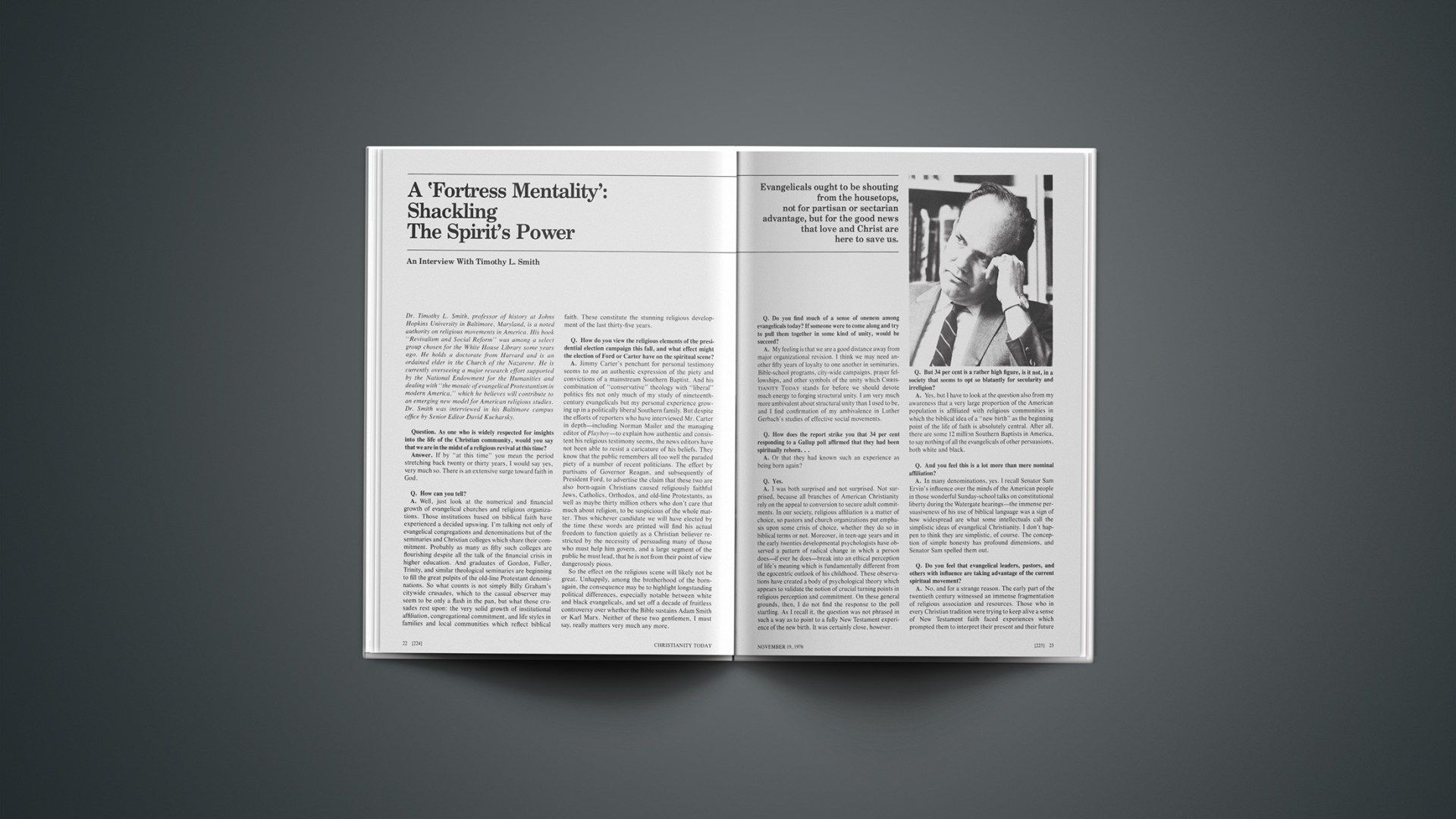
Dr. Timothy L. Smith, professor of history at Johns Hopkins University in Baltimore, Maryland, is a noted authority on religious movements in America. His book “Revivalism and Social Reform” was among a select group chosen for the White House Library some years ago. He holds a doctorate from Harvard and is an ordained elder in the Church of the Nazarene. He is currently overseeing a major research effort supported by the National Endowment for the Humanities and dealing with “the mosaic of evangelical Protestantism in modern America,” which he believes will contribute to an emerging new model for American religious studies. Dr. Smith was interviewed in his Baltimore campus office by Senior Editor David Kucharsky.

Question. As one who is widely respected for insights into the life of the Christian community, would you say that we are in the midst of a religious revival at this time?

Answer. If by “at this time” you mean the period stretching back twenty or thirty years, I would say yes, very much so. There is an extensive surge toward faith in God.

Q. How can you tell?

A. Well, just look at the numerical and financial growth of evangelical churches and religious organizations. Those institutions based on biblical faith have experienced a decided upswing. I’m talking not only of evangelical congregations and denominations but of the seminaries and Christian colleges which share their commitment. Probably as many as fifty such colleges are flourishing despite all the talk of the financial crisis in higher education. And graduates of Gordon, Fuller, Trinity, and similar theological seminaries are beginning to fill the great pulpits of the old-line Protestant denominations. So what counts is not simply Billy Graham’s citywide crusades, which to the casual observer may seem to be only a flash in the pan, but what those crusades rest upon: the very solid growth of institutional affiliation, congregational commitment, and life styles in families and local communities which reflect biblical faith. These constitute the stunning religious development of the last thirty-five years.

Q. How do you view the religious elements of the presidential election campaign this fall, and what effect might the election of Ford or Carter have on the spiritual scene?

A. Jimmy Carter’s penchant for personal testimony seems to me an authentic expression of the piety and convictions of a mainstream Southern Baptist. And his combination of “conservative” theology with “liberal” politics fits not only much of my study of nineteenth-century evangelicals but my personal experience growing up in a politically liberal Southern family. But despite the efforts of reporters who have interviewed Mr. Carter in depth—including Norman Mailer and the managing editor of Playboy—to explain how authentic and consistent his religious testimony seems, the news editors have not been able to resist a caricature of his beliefs. They know that the public remembers all too well the paraded piety of a number of recent politicians. The effort by partisans of Governor Reagan, and subsequently of President Ford, to advertise the claim that these two are also born-again Christians caused religiously faithful Jews, Catholics, Orthodox, and old-line Protestants, as well as maybe thirty million others who don’t care that much about religion, to be suspicious of the whole matter. Thus whichever candidate we will have elected by the time these words are printed will find his actual freedom to function quietly as a Christian believer restricted by the necessity of persuading many of those who must help him govern, and a large segment of the public he must lead, that he is not from their point of view dangerously pious.

So the effect on the religious scene will likely not be great. Unhappily, among the brotherhood of the born-again, the consequence may be to highlight longstanding political differences, especially notable between white and black evangelicals, and set off a decade of fruitless controversy over whether the Bible sustains Adam Smith or Karl Marx. Neither of these two gentlemen, I must say, really matters very much any more.

Q. Do you find much of a sense of oneness among evangelicals today? If someone were to come along and try to pull them together in some kind of unity, would he succeed?

A. My feeling is that we are a good distance away from major organizational revision. I think we may need another fifty years of loyalty to one another in seminaries, Bible-school programs, city-wide campaigns, prayer fellowships, and other symbols of the unity which CHRISTIANITY TODAY stands for before we should devote much energy to forging structural unity. I am very much more ambivalent about structural unity than I used to be, and I find confirmation of my ambivalence in Luther Gerbach’s studies of effective social movements.

Q. How does the report strike you that 34 per cent responding to a Gallup poll affirmed that they had been spiritually reborn …

A. Or that they had known such an experience as being born again?

Q. Yes.

A. I was both surprised and not surprised. Not surprised, because all branches of American Christianity rely on the appeal to conversion to secure adult commitments. In our society, religious affiliation is a matter of choice, so pastors and church organizations put emphasis upon some crisis of choice, whether they do so in biblical terms or not. Moreover, in teen-age years and in the early twenties developmental psychologists have observed a pattern of radical change in which a person does—if ever he does—break into an ethical perception of life’s meaning which is fundamentally different from the egocentric outlook of his childhood. These observations have created a body of psychological theory which appears to validate the notion of crucial turning points in religious perception and commitment. On these general grounds, then, I do not find the response to the poll startling. As I recall it, the question was not phrased in such a way as to point to a fully New Testament experience of the new birth. It was certainly close, however.

Q. But 34 per cent is a rather high figure, is it not, in a society that seems to opt so blatantly for secularity and irreligion?

A. Yes, but I have to look at the question also from my awareness that a very large proportion of the American population is affiliated with religious communities in which the biblical idea of a “new birth” as the beginning point of the life of faith is absolutely central. After all, there are some 12 million Southern Baptists in America, to say nothing of all the evangelicals of other persuasions, both white and black.

Q. And you feel this is a lot more than mere nominal affiliation?

A. In many denominations, yes. I recall Senator Sam Ervin’s influence over the minds of the American people in those wonderful Sunday-school talks on constitutional liberty during the Watergate hearings—the immense persuasiveness of his use of biblical language was a sign of how widespread are what some intellectuals call the simplistic ideas of evangelical Christianity. I don’t happen to think they are simplistic, of course. The conception of simple honesty has profound dimensions, and Senator Sam spelled them out.

Q. Do you feel that evangelical leaders, pastors, and others with influence are taking advantage of the current spiritual movement?

A. No, and for a strange reason. The early part of the twentieth century witnessed an immense fragmentation of religious association and resources. Those who in every Christian tradition were trying to keep alive a sense of New Testament faith faced experiences which prompted them to interpret their present and their future to be that of a beleaguered minority fighting with their backs to the wall, but holding out for a truth that was far more precious than either the wall or their backs! We kept that psychology. I have talked to people in many evangelical traditions over the past few months. They all lament how dark the day is and how hopeless the future. Yet, out of simple loyalty to the things they believe to be precious, they express a determination to hold out, faithful to what they suspect will be a bitter end. As a matter of fact, not only within their own communions but also in the others they believe to be truly biblical they witness this great growth, this flourishing of faith; but most are still under the illusion that the world outside is going in the opposite direction. Well, large chunks of “the world” are—certainly two parts of it that influence most the public image of our culture: the university community, and the media of mass entertainment and communication. These latter are not any longer the mainstream, however. The wave of the future is those young people deeply affected by religious need and evangelical commitment whom one finds thronging the campuses of earnestly Christian colleges. Yet the elders who have shared that commitment still cling to a fortress mentality, despite their testimony to faith in God’s promises to pour out his Spirit in the “last days” upon all flesh. I would not, however, substitute for the fortress mentality the old Christian triumphalism that assumes a steady march to the millennium. Biblical hope is not that simple, and the sources of despair in modern life are extensive.

Q. So what specifically do you think the local church should be doing to let the Spirit do his work through us in a time of religious prosperity?

A. It seems to me that we have applied production models to our view of church growth and church administration. Denominational leaders tend to think that the forward-looking pastor is the one who has a plan very much like a businessman’s plan for saturating a market. Accordingly, we have stressed image and public relations too much. But I think that the great need is to recover a sense of the complexity and profundity of biblical truth.

Q. What do you really mean by that? How does a pastor go about explaining that to lay people?

A. Laymen are not that naïve. They know that history is at least as complicated as their own lives, and that the Bible, both Hebrew and Christian, declares the situation of the people of God to be precarious. Social evil and personal sinfulness are omnipresent, the Book affirms; but those who keep the covenant of faith in righteousness are in step with eternity. Truth and justice may finally prevail on earth, but only if the believing remnant bear a cross for them. Biblical hope is rooted in faith and nurtured in love; love may go beyond, but it cannot go without, “simple justice.” Jesus made these teachings of the prophets the heart of his ethic. And he declared that living by that ethic, so long an impossible dream, was about to become the normal experience of persons reborn through the power of the Holy Spirit—persons who would know very well the manifold contradictions of a complex and often sinful social order. Those who believed him, and those who believe him now, soon learn, as the apostles did, that only through “much tribulation” can we enter into the Kingdom of God. But the apostles also learned that no test of their faith or fortitude can “separate us from the love of God which is in Christ Jesus.” Thus what William Law in seventeenth-century England announced as a “serious call to a devout and holy life” is the plain, and plainly understandable, message of the New Testament. As long as Christians read the Bible, no amount of theological posturing can obscure that message. They do, and it hasn’t.

Q. What ethical and moral impact are the flourishing evangelicals having upon secular society?

A. A lot less than I would like to see. A characteristic of revivalism in the twentieth century, as distinct from that in the nineteenth, is that evangelists today are not as clearly insistent upon the ethical outcomes of religious commitment, especially in relationship to social evils.

Q. But the preaching of the Gospel today quite generally affirms that regeneration of individuals produces personal and social behavioral changes for the good.

A. That expectation comes through, yes, but in a way which makes radical renunciation of personal and social sin secondary to orthodox belief or psychic peace. Nineteenth-century evangelicals were committed to the conviction that the evidence of salvation by grace was a life of uncompromising righteousness. Accordingly, they went on to teach personal responsibility to act against social evil.

Q. But you do not deny, do you, that there has been a special kind of piety characteristic of evangelicals in the twentieth century?

A. Unfortunately, the ethical emphasis has been upon a traditional set of taboos. If someone asks me seriously why I do not drink, I welcome the chance to explain what I regard as the moral obligation to alcoholics I know as well as to the society I share which makes me say, “I’ll take diet Coke, or if you have none, buttermilk.” But it is possible for a non-drinking Christian simply to exemplify a kind of cultural hangover from the nineteenth century. Our evangelical ethical emphasis in other matters as well sometimes reflects merely an atrophied tradition rather than a vital commitment to making our new life in Christ the central principle governing ethical choices and ideological commitments.

Q. Does American pluralism have anything to do with this? Do you see any holding back because we are obliged to be tolerant of one another’s moral behavior?

A. It does have an effect. But remember, pluralism has characterized American religion from the beginning. New England was not pluralistic in colonial times, but the rest of the colonies were. And people living south and west of the Hudson cared about righteousness, too. Mennonites and Methodists were not Puritans, but they followed the way of holiness.

Q. How about dispensationalism? Do you agree with the criticism that it encourages a fatalism that bodes ill for our being the salt of the earth and the light of the world?

A. Numerous studies, including a couple by my own students, are now making plain what I did not realize when I wrote Revivalism and Social Reform: dispensational millenarians, or what I once called pessimistic premillennialists—men such as Arthur P. Pierson or A. B. Simpson, founder of the Christian and Missionary Alliance—were as concerned to alleviate social evil as Wesleyan post-millennialists like the Salvation Army’s William and Catherine Booth. In a recent visit to the Philadelphia College of Bible, I found social work to be the most popular field of undergraduate specialization!

Biblical literalists, including dispensationalists, also feel bound to take literally the words of Jesus about compassion for the poor and the ill and justice to the imprisoned and the racially outcast. While rejecting the idealism which anticipates a brighter tomorrow, they often act in such ways as to help make a brighter day possible.

Q. Where is liberal theology in the seventies? What is its effect?

A. One of the things that’s happening is a return to the old modernism. Witness the new book by William R. Hutchison entitled The Modernist Impulse, which describes the author’s disenchantment with neo-orthodoxy and his new respect for the older liberalism. A good many examples of this return have cropped up in the liberal schools of theology. But I do not find it very significant. Modernism, of either the older or the newer variety, doesn’t have the morally transforming power or even the intellectual tools to cope with the despair about all order, all justice, all hope which dominates the modern intellectual community. The critical battle of the twentieth century is that between hope and despair. Human beings now experience staggering insecurity about all those structures of thought and value and community upon which we heretofore counted. Here and at every other major university there are scholars who are gearing their lives to what they see as a desperately honest explanation of the hopeless situation of mankind.

Despair is the pervasive reality, and any theology which does not have in it an immense amount of faith in the loving and empowering grace of God is not going to be able to cope with that reality.

So I tend not to take very seriously whatever fad may now be dominating liberal theology. The truth is that mankind has come to the brink. Our only hope is that view of God and of human destiny which it seems to me Jesus Christ made plain in his magnificent fulfillment of the insights and hopes of Israel’s prophets. He lights the way to justice, love, and liberty in human cultures. Evangelicals ought to be shouting from the housetops, not for partisan or sectarian advantage, but for the good news that love and grace in Christ are here to save us. Jesus and the apostles established the Church in a day equally dark, by a faith which seemed to broken Greek idealists equally ridiculous. We who today claim to be his followers, and who number not a handful but millions, ought therefore to be ashamed of any who profess that faith but live by cool accommodation to the despair of our age.

A Tale of Two Kittens

Mehitable was a small, plain, black-and-white-and-yellow calico cat who lived with me for fourteen years. She was born in a woodshed on the river, and she came from a long line of cats who had had to depend on their wits for their livelihood, being fed only in winter at a country house where they were kept as mousers, not pets. Although I provided plentifully for all Mehitable’s needs, her ancestry showed in the ways she adapted herself to life in the woods, and in her wisdom and independence.

Not a mouse was left alive on the whole of my promontory from the day she moved in, age six weeks. She was catching and eating chipmunks before she had lost her baby teeth. She hunted moles and bats, salamanders, skinks, small snakes, and voles, bringing them to me but not eating them. She loved to chew grasshoppers and moths. She tangled once, and once only, with a skunk. She sat patiently at the river’s edge, fishing, hooking her prey out of the water and tossing it well up onto dry land with one flash of an adroit paw. She slept curled up in the hollow of a rock or under a rhubarb leaf or a bit of bracken, perfectly camouflaged. And when she was thirsty she drank from the river, looking carefully up and down first to see that there were no power boats coming, and hence no waves in their wake. If a boat was in view, she would move back from the water’s edge until it had passed. And if its wake had filled some of the little hollows in the rock, which she diligently inspected after a boat had gone by, she would drink daintily from one of them rather than approach the water itself. Indeed, there is a cup-like hollow in a rock near the dock which is called Mehitable’s Hollow to this day.

Figaro, her handsome black successor, has spent all eleven of his summers at the same cottage, and he too loves life at the river. He will catch a bird on occasion, and each season he brings down one or two flying squirrels, which he seems to consider some sort of Batman game; but apart from this he does not hunt. And he does not drink from the river, no matter how thirsty he may be. Normally he gets enough liquid in his daily food. But sometimes, in very hot weather, he needs more. I tend to forget this, surrounded by water as we are, with all kinds of nice little cat-hollows filled with fresh water many times a day, just begging for a cat to drink of them. It is not until I notice that he seems off his food, has a warm nose, meows over-much, or swipes a drink from the bowl of water lilies on the table that I offer him some water. Then I am amazed at how thirstily and deeply he will drink.

To live on the edge of a great, flowing river, and to suffer thirst—how sad, even for a cat to whom water is not a natural element! What, then, of God’s children? We who know the Living Water, why do we not drink?—MARGARET CLARKSON, teacher and writer, Willowdale, Ontario.

Prayer—Into the Lion’s Jaws

American Christians seem to have rediscovered prayer. And even among the quasi-religions that so profitably proliferate today, prayer, as either meditation, recollection, chanting, or auto-suggestion, makes up a good deal of their appeal. The no-nonsense, square-jawed, steely-eyed social activist has turned into a mellower man, convinced, whether by the Bermuda triangle or by possibility thinking or by something else, of a spiritual realm wherein lie great and untapped reservoirs of power. And, as with the Alaskan pipeline or the North Sea discoveries, everyone wants to get in on it.

Many scoff at ignorant dupes who send their pension pittances to radio preachers for a special petition on their behalf; yet some of those same scoffers will part with a tidy sum themselves to receive a few secret syllables to repeat over and over in the search for peace. There are chain prayer letters warning of dire consequences if the magic spell is broken. Books of folksy monologues with God written in a somewhat choppy free-verse fashion twirl round on supermarket display racks. There are prayer breakfasts, prayer fellowships, prayer groups.

The problem, as it was in New Testament times, is not so much becoming willing to pray as learning how to pray, how to prevent the draining off of the true energy of communication with God into phony and ultimately dangerous short circuits.

Spiritual power exists. Even the feeblest and most misguided attempts at prayer yield some intimation of a lurking reality. And prayer is our link with that powerful reality. Unfortunately, we tend to transfer the ruling images of our culture uncritically into our life of faith. We hear ourselves spoken of as “consumers” so often that it is no wonder we slip into thinking of prayer in those terms (“I’ll trade you 317 mantras for twenty-four hours’ worth of serenity”). I have even heard from the pulpit the metaphor of prayer as a power source we “tap” as if it were a utility line. Notice, however, that the very image betrays our attitude toward this power: it is a great way off, as remote as the Arctic oilfields or ITT, and connected to us only tenuously. And of course the switch is always on our end. The great turbine of spiritual power sits there awaiting our summons.

If power is what we are seeking in prayer—power to change our lives in one way or another—then we must become aware of the nature of that power, which is fearsome to the last degree. It is not a power that can be harnessed. The images from the Bible shatter us with their uncontrollable force. A dove descends. Tongues of fire flame out. An angel appears. A bush burns. A mountain trembles. A whirlwind answers. God invades.

If we get so far as being ashamed of our overt consumerism in prayer (though who among us is really satisfied with asking only for his daily bread?), the next danger lying in wait for us is a sort of spiritual consumerism. As Jacques Ellul has put it in his book Prayer and Modern Man, “each one of us is so profoundly patterned in accordance with this necessity to consume that everything we lay hold of we value from that standpoint, even God.… We talk of having faith, of having the Holy Spirit, not of living in and by faith, of receiving and being sent forth by the Holy Spirit” (Seabury, 1973, pp. 144, 145).

Just how perverted this desire to consume God’s power can be—and how he can use even these misguided attempts of ours—can be illustrated with an example from my own life. Having read in perfectly reliable sources that prayer should not be simply a matter of speaking to God but that we should also listen to hear him speaking to us, I finally decided to put this theory to the test. I poured out every concern, every petition and intercession I could rake together and presented this knobby bundle to God. Then, exhausted by this mental and emotional effort, I felt it was time for a little feedback. So I waited, staring into the darkness, straining my ears—for what? I didn’t really expect to hear a voice, but I did want some response, an inner voice, an assurance, all those phenomena described by authors of true-life religious adventure books from Saint Augustine to Catherine Marshall. Nothing. My ears were ringing. Either God had nothing particular to say to me or I was not giving my imagination free enough rein. Worn out and dissatisfied, I drifted off to sleep.

Hours later but just before the winter sun climbed over the frozen ridge behind our house, I opened my eyes, instantly wide awake in the grey half-light. Already I was in tears. For suddenly, at the very moment of waking, there was in my mind the vivid memory of a situation in my adolescence. I had been promised a room of my own when we moved into a new house in my sophomore year in high school. As things turned out, however, it was my little brother who got the room while I had to share a room with a spinster aunt, a semi-invalid who had always made her home with us or other relatives.

For all the ensuing time in which I lived at home I had burned with the injustice of this reversal, convinced that my parents had decreed it just because I was a girl. I had made my feelings clear in devious and subtle ways, and I had carried this grudge with me for years.

But now in this early morning light, I was feeling for the first time the scalding shame this elderly crippled woman must have felt. Moving from house to house, never having one of her own. Totally dependent on the good graces of nieces and nephews for the very necessities of life. Never in all my years at home, or indeed till now, had I given a single thought to how she felt in the situation. But now I was getting a full dose of it—the pride that had to be swallowed daily in a galling gulp. It was more bitter than I could bear.

As far as I knew there was no apparent reason to have this experience. Although I think of my great aunt with affection often and although I continually spoke of the injustice of no room of my own when recounting the wrongs against myself as a female, this other perspective on the situation had never before entered my mind. And it was a whole, complete experience, simply there as soon as I opened my eyes on the morning, not something I had analytically thought out and become convinced of. The feeling simply engulfed me, and I concluded, as soon as I could get my head above water again, that this was the way God spoke to me, showing me a piece of reality to which I had been blind. Bitter and humiliating though it was, I was pleased.

When it happened again the next morning I was scared. The process was the same. As soon as I came awake, which was suddenly and out of a deep sleep, I was totally aware of another incident from my past life. This time it was my wedding, the day after Christmas during my first year in college. I had experienced the whole event totally from my own vantage point, indifferent to the heap of details that was smothering my mother. But this time I was seeing it all from her point of view. It had been a time of great anxiety for my mother, and indeed even her towering strength almost collapsed after the ordeal was over, but I had driven blithely away, proud of my new status of independence from my family and never once thinking of her pain.

I had often confessed in my prayers to being selfish. I knew I was at times. But this particular incident had never been revealed to me in those terms before. And it was revealed so totally, given all in one lump, so to speak, that the experience devastated me, and once more I began the day in penitential tears. The feeling of satisfaction at having evoked a response from God evaporated under the fear that I would have some horrid scene from my past to wake up to every morning for the rest of my life. He proved to be more merciful than that, however, although I was quite wary for a while about how I prayed.

And yet, chary as we may be of this awesome power we confront in prayer, what other choices are really open to us? Can we simply hide our eyes and try to stay out of its unpredictable path? That is essentially to leave ourselves powerless in a world that swirls with spiritual battles all around us; it is like standing in the middle of a battlefield protected by nothing more than an insipid smile.

Christians have always interpreted the splitting of the temple veil during the crucifixion as symbolic of their liberation from the mediated presence of God. Henceforth they were “free” to approach him directly—which is almost like telling someone he is “free” to stick his head in the lion’s jaws. For once you start praying there is no guarantee that you won’t find yourself before Pharaoh, shipwrecked on a desert island, or in a lion’s den.

This is no cosmic teddy bear we are cuddling up to. As one of the children describes him in C. S. Lewis’s Chronicles of Narnia, “he’s not a tame lion.” Ellul is convinced that prayer for persons living in the technological age must be combat, and not just combat with the Evil One, with one’s society, or even one’s divided self, though it is also all of these; it is combat with God. We too must struggle with him just as Jacob did at Peniel where he earned his name Israel—“he who strives with God.” We too must be prepared to say, “I will not let you go till you bless me.”

Consider Moses, again and again intervening between the Israelites and God’s wrath; Abraham praying for Sodom; the widow demanding justice of the unjust judge. But in this combat with God, Ellul cautions, we must be ready to bear the consequences: “Abraham had to submit to the sacrifice of his son as an answer to his prayer for Sodom. Jacob’s thigh was put out of joint, and he went away lame. However, the most usual experience will be God’s decision to put to work the person who cried out to him.… Whoever wrestles with God in prayer puts his whole life at stake” (pp. 161, 162).

Awful things happen to people who pray. Their plans are frequently disrupted. They end up in strange places. Abraham “went out, not knowing where he was to go”—hardly the picture of someone who has struck it rich on a brand new power source. After Mary’s magnificent prayer at the annunciation, she finds herself the pariah of Nazareth society. The well-worn phrase “Prayer changes things,” often meant to comfort, is as tricky as any Greek oracle.

In trying to compete in the religious marketplace today, we should, I think, be very careful about how we portray the power of prayer. All the other religious rivulets that trickle across this parched land seem to promise, through their diverse modes of prayer and meditation, inner peace, serenity, and security, all manner of well-being. How tempting to up the stakes, making prayer merely another consumer product. How embarrassing to have to admit not only that prayer may get you into a prison, as it did Jeremiah, but also that while you’re moldering away in a miry pit there, you may have a long list of lamentations and unanswered questions to present to your Lord. How are we going to tell them they may end up lame and vagrant if they grasp hold of this God? Anything else is false advertising.

No-Nonsense Theology: Pinnock Reviews Pannenberg

Second of Two Parts

Clark Pinnock’s aim in this article, he says, is “to highlight a few of the basic themes important both to Pannenberg and to us evangelicals.” In Part One (November 5 issue) he discussed a theology of reason, revelation as history, and revelation as Scripture.

Jesus and the Kingdom

In his theology Pannenberg places tremendous stress on the future, seeing in the concept of the coming kingdom of God the most important truth about reality, a truth that overshadows all others. According to Jesus’ message, the future is not an enemy to be feared but the blessed goal toward which history is moving under the hand of God. For some time New Testament scholars have been aware of the apocalyptic element in the teaching of Jesus, but they have been uncertain what to do with it. The idea of an end event in which all the dead are raised and the glory of God is finally revealed for all to see seemed strange to modern thinking and a point of embarrassment to the exegetes.

True to his calling as the reverser of theological trends, Pannenberg has intervened in the discussion, arguing boldly that this very motif in the teaching of Jesus must be recovered as the key of the whole Christian message even for today. Jesus was open to the future God had promised, and calls all men to faith and hope. In a final event at the end of history, God will be vindicated as God of all peoples, and the hopeful longing of all the ages will finally be realized.

Pannenberg has managed to hoist apocalyptic out of oblivion and give it an honored place in a systematic theology of universal history. One might hope that the centers of interest in prophecy and apocalypticism in North American evangelicalism will take note of Pannenberg’s contribution in defense of their concerns, and allow him to teach them how to relate their insights to a broader theological context and in a more obviously intelligible and relevant way.

As to the person of Jesus, Pannenberg insists that we develop a “Christology from below.” This means simply that, instead of starting with preconceived notions derived from authoritative sources such as creeds or even epistles, we should begin with the man Jesus himself and strive to understand what he proclaimed about his own significance. Fortunately Pannenberg, unlike Bultmann, is quite optimistic about what we can discover about the life and ministry of Jesus. The knowledge gained in such an investigation is clear and definite enough, he thinks, to permit confident conclusions that can serve as an anchor for reasoning faith. As a result of his study, Pannenberg presents Jesus asserting a claim to divine authority in the context of preaching the kingdom of God, a claim that had to be either blasphemy or else the true fulfillment of the promises of God. But this claim to an authority belonging only to God was linked to Jesus’ expectation that God would vindicate him in the near future by the coming of the kingdom and the resurrection of the dead; it was not a bare authoritarian claim devoid of all truth conditions.

Pannenberg’s handling of the death of Jesus is much less satisfactory. Although I am grateful for his emphasis on vicarious substitution, I am troubled by his insistence that Jesus had no clear preconception of the significance of the death that lay before him, and was not an active agent in that death. The theology of atonement and sacrifice in the Gospels was read back into the life of Jesus by the post-Easter community, Pannenberg claims. This view exposes not only Pannenberg’s slight regard for apostolic Scripture but also the depth of his radical criticism, which can excise from the text of the Gospels as fundamental an element as the suffering-servant-of-God motif in the life of Jesus. Jesus’ final visit to Jerusalem apparently was not to offer himself as a sacrifice for sins; it was only to precipitate a decision regarding his claim about the nearness of the kingdom and about his own centrality in anticipation of it. The interpretation of his death in terms of atonement was arrived at later. Therefore, Pannenberg strives to expound the meaning of that death on the basis of severely edited Gospels and apart from the rich teaching about the cross in canonical Gospel and epistle. Given that limitation, I suppose we should admire the results all the more!

But this view leaves Jesus’ execution basically unforeseen, and therefore unclarified in its essential relation to what Jesus did proclaim and, strictly speaking, unnecessary to his mission. It cannot satisfy those who glory in Christ’s cross and treasure the teaching of the apostles and, we trust, of Christ himself on it. It does not seem reasonable to me, if I may appeal to Pannenberg’s norm, to divest Jesus of the awareness he so obviously possessed as the soon-to-be-offered sacrificial lamb of God.

On the Third Day …

On the subject of the bodily resurrection, Pannenberg’s optimism about the results of “life of Jesus’ research extends to unheard-of lengths, at least in the circles of academic theology. He boldly contends, to evangelical applause, that the resurrection of Jesus can be validated by historical research. In this he contradicts a virtual dogma held by liberal critics, dialectical theologians, and every shade of fideist. Before Pannenberg, the most a prominent theologian could be expected to say was that the resurrection was an event of history; that alone would win him a chorus of abuse from the Bultmann school and other skeptics in the church and outside it. But to go on and say that the resurrection can be proved to have occurred is breathtakingly bold: it refutes all positivists who see history as a closed system of natural causes and effects and at the same time rebukes a multitude of timid Christian thinkers who retreated decades ago into the safe haven of unverifiable “salvation history.” For this single achievement, Pannenberg deserves our undying praise and gratitude. Of course, some evangelical scholars have said as much before, but critical scholarship was affected by our weak initiatives about as much as a lion is terrified by a BB gun. At last a major, respected theologian has said it.

And Pannenberg, being the scholar that he is, does not leave it at the level of a bare assertion. He pursues the point at great depth, offering an extensive historical argument in defense of the resurrection and detailing an entire alternative historical methodology that makes room for such a case (Jesus—God and Man, Westminster, 1968, chapter three). While not suggesting that the issue is beyond controversy, Pannenberg believes that the historical evidence sustains the credibility of the Christian message beyond reasonable doubt. Furthermore, he rejects the cynical objection—by Schubert Ogden, for example—that the resurrection, even if it did happen, would mean nothing to modern man. Pannenberg argues strongly for its significance: it validates Jesus’ claim, signifies the inbreaking of the kingdom, and shows that the covenant with Israel is now open to all the nations. Above all, it signifies fulfillment to man, whose being is structured in such a way that he hopes for salvation beyond death.

Obviously, according to Pannenberg, Jesus is a unique person if he claimed divine authority, was raised bodily from the tomb, and is expected to reign in judgment in the coming kingdom of God. What then is Pannenberg’s understanding of the person of Jesus?

The title of his weighty book on Christology, Jesus—God and Man, shows quite clearly that he wishes to affirm the two natures of Christ in one person. However, his method of working from Jesus outward, rather than starting with creeds or even epistles, means that Pannenberg attempts to formulate his own statement in terms arising from the historical situation of Jesus’ mission. We cannot blame him for that; we wish him well. Pannenberg therefore emphasizes Jesus’ communion with God, expressed in his utter obedience to him; this relationship exhibits an identity with the eternal Son or Logos, who eternally stands in this position with the Father. In this way Pannenberg hopes to conceive of the deity of Christ without violating his true humanity.

His efforts in Christology, I think we should recognize, spring not from any impulse to deny the orthodox confession but, quite the opposite, from a strong desire to ground belief in the deity of Christ in original biblical categories rather than veiling it in more dubious Greek terminology. But this effort, coupled with his reluctance to make use of the rich materials on Christology found in the apostolic writings (a reluctance that springs from his inadequate doctrine of Scripture noted above), inevitably results in some hesitancy and unanswered questions. Yet there is no doubt in my mind that Pannenberg views Jesus’ relation to the Father as unique, and that he believes we gain a relationship with God only through communion with him and in hope of the resurrection.

What then is his view of other world religions? In a context of increasing pluralism, this is a question that anyone who, like Pannenberg, holds to the finality of Jesus must answer. Can the unevangelized, for example, share in the benefits of Christ’s reign, or are they automatically excluded from his kingdom?

Pannenberg develops two ideas bearing on the issue. First, he argues, in a long essay entitled “Toward a Theology of the History of Religions,” that we should regard other religions not as mere fabrications of man’s striving after God but as occasions of the appearance of the same God who revealed himself through Jesus, though they may present him in a fragmentary way, even at times resisting the infinity of the divine mystery (Basic Questions in Theology, II, 115f.). Second, looking to First Peter 3:19 and 4:6, he argues that salvation is made available in the realm of the dead to those who during their lifetimes never encountered Jesus or the gospel message. The meaning of Jesus’ descent into hell in the Apostles’ Creed according to Pannenberg is that the salvation he achieved applies also to the vast multitudes who never came into contact with his story. This viewpoint, I suspect, does not divide evangelicals from Pannenberg so much as it divides evangelicals among themselves. I myself find it basically acceptable.

The Doctrine of God

With Pannenberg there is no “death of God” nonsense. Everything hinges on the reality of the sovereign God who has raised Jesus and promised to bring in his kingdom. In another sharp contrast to Barth, Pannenberg also develops a kind of natural theology without calling it that, based not upon the classical “proofs” of God’s existence but on the nature of man as one open to the future and filled with hope for ultimate salvation. In this Pannenberg is endeavoring to establish a universal point of contact, a preliminary knowledge of God that the Gospel can presuppose. Anthropology is the sphere in which he thinks the question of God arises, and Pannenberg is optimistic that a point of contact can be established with all men in this way. We may expect greater development in this area of his thought.

In understanding God’s being, Pannenberg is boldly innovative in conceiving God as the “power of the future,” and at the same time soundly traditional in defending an essential trinity in the eternal being of God. If Jesus was raised from the dead, and is a revelation of the essence of the true God to be finally manifest at the end of history, it follows that the distinction experienced between Father and Son in Jesus’ earthly life belongs also to the inner life of God. His serious effort at constructing a viable trinitarian dogma for our time is welcome, and it reveals the essential orthodoxy of his theology. Here is no liberal theologian setting aside the Trinity, or treating it as a mere appendix to the system. Pannenberg can fairly be compared with Athanasius and Augustine, Calvin and Barth, for like them he strives to exalt the triune God and to preserve the divine origin of our divine salvation through Father, Son, and Spirit.

But in the same breath, and without withdrawing my respect, I must register a strong protest at some of the unwise modes of expression Pannenberg has used to draw attention to the importance of the future. I have reference to his striking notion of “the futurity of God,” in which he is determined to connect God’s deity with his rule. “The being of God is his lordship.” Therefore, until the rule of God is universally established, in a certain sense “God does not yet exist” (Theology and the Kingdom of God, Westminster, 1969, p. 56). Fortunately, Pannenberg later explains his meaning. The end of history will reveal God’s deity, which until then will remain wrapped in considerable mystery. The future will make evident what has been true all along. If that is his meaning, he would be wise to avoid expressions that obscure it, especially when process theology delights in seeing God as still developing.

There are rich benefits in store for those prepared to enter into dialogue with Pannenberg. A theological genius of his caliber, particularly one who expresses so strong a commitment to the basic biblical message and expects it to be vindicated in the face of all criticism, is a rare occurrence. Perhaps we ought to note, too, that his theology is not the labor of a solitary scholar working alone but has developed out of a team effort: he and other scholars from various disciplines met together, especially in the early years, to hammer out their positions. Likewise the evangelical theology we need, if it is to prove adequate for our day, will not be written by a “prima donna” but will arise out of a communal effort.

In essence, Pannenberg’s theology is a creative synthesis of the classical biblical themes and a modern critical posture. That accounts for both the delight and discomfort we feel in our interaction with him. But evangelical theology, represented by CHRISTIANITY TODAY, is not a monolithic and normative confessional position that can easily serve as a measuring rod for evaluating a theology like Pannenberg’s. Our roots are legion: Calvinist, Lutheran, anabaptist, Wesleyan, dispensational, pentecostal, and others linked together by a shared respect for the givenness of divine revelation and the finality of canonical biblical teaching and by our experience of the grace and command of the scriptural God. Because our precious unity masks so much important disunity, we cannot with a single voice reply to Pannenberg’s thought. His development of a theology of reason, for example, exposes a considerable rift among ourselves, delighting the wing of evangelical opinion that advocates a strengthening of our rational apologetic, and infuriating a fideistic wing that feels something vital is being lost.

The point most certain to gain widespread approval among evangelicals is one that charges Pannenberg with neglecting the inspiration and authority of the Bible, using it only as a historical source, and not submitting to its full cognitive authority. But in most of the other areas, we should think of Pannenberg not as a theologian to refute so much as a respected teacher in the Church who has a great deal to teach us, not least in the singlemindedness and love of the truth he displays in his pursuit of the theological task.

Apple PodcastsDown ArrowDown ArrowDown Arrowarrow_left_altLeft ArrowLeft ArrowRight ArrowRight ArrowRight Arrowarrow_up_altUp ArrowUp ArrowAvailable at Amazoncaret-downCloseCloseEmailEmailExpandExpandExternalExternalFacebookfacebook-squareGiftGiftGooglegoogleGoogle KeephamburgerInstagraminstagram-squareLinkLinklinkedin-squareListenListenListenChristianity TodayCT Creative Studio Logologo_orgMegaphoneMenuMenupausePinterestPlayPlayPocketPodcastRSSRSSSaveSaveSaveSearchSearchsearchSpotifyStitcherTelegramTable of ContentsTable of Contentstwitter-squareWhatsAppXYouTubeYouTube