Eutychus and His Kin: November 19, 1976

The Case of The Clammy Hand

The other night my children were yukking it up about the night of Dad’s hand under the bed. Although none of them was yet alive when it happened, the story has become a part of our family folklore.

It all began when one of my seminary professors asked my wife and me to occupy his house during his vacation. Our duty was largely just to watch the house, which was located on a remote road used mostly as the local lovers’ lane.

We knew of the reputation of the road but not what it would mean practically. The house was situated so that the lights of every car coming down the road flashed into the master bedroom.

I usually find it hard to sleep in a strange place, and my difficulty was increased by the continual flashing of auto headlights.

Finally, I put my arm over my eyes to block out the lights and dropped into an uneasy sleep. Unknowingly, I also cut off the circulation in that arm.

Since there was no night stand on my side of the bed, I had put my glasses on the floor just under the bed. In the wee hours of the morning some sound woke me. I sat up, causing my now feelingless arm to dangle over the edge of the bed, and as I groggily reached for my glasses I encountered my own now cold and clammy hand.

With a shudder of horror I jumped to a standing position in the middle of the bed and shouted, “There’s a hand under the bed!”

At that my wife bolted out of bed and began groping along the wall for the light switch. I joined her in the frantic search. Neither of us could remember where it was located.

Suddenly a thought came to me: “Why am I using only one hand?” Even before I found the light switch, the awful truth had dawned on me, and I knew of the years of total recall my wife would have of that night.

The moral of this story—all my stories have morals—is that when a member of the body loses contact with the head from whom the whole body is joined and knit together, no end of mischief can result.

EUTYCHUS V

From the February 16, 1973, issue of CHRISTIANITY TODAY.

Pleasing Participation

Several months ago you published an article by Rod Jellema titled “Poems Should Stay Across the Street From the Church” (June 4). I was delighted by the article.… Now I am even more delighted to see that you have taken Jellema’s article to your own hearts. The appearance of “A Missionary Dying on the Molopo” by George E. McDonough and “Making Prayer” by Eugene Warren in the magazine (Sept. 24) is most uplifting.

The Church is filled with men and women who enjoy the poem as dearly as do the men and women of the world. It is indeed a pleasure to see your fuller participation in Christian literature at this, the outset of your twenty-first year of publishing.

FREDRICK ZYDEK

Omaha, Neb.

Shelfworn Treasure

I was distressed to read that Ronald V. Jones, in his letter published in the September 24 issue, thought that Eutychus’s column on “Franchising the Church” (July 2) was “poison-pen sarcasm.” If he would reread it carefully, keeping in mind the task of the satirist, I think that he would see that Eutychus is saying nothing bad at all about the Scott Memorial Baptist Church (E and W). Instead, he is using the favorite satirist’s tactic of finding a legitimate need or event and then practicing a sort of reductio ad absurdum on it to show how it can be warped by evil or foolish men. Swift’s famous “Modest Proposal” is a good example of this: a real problem, and then an obviously tongue-in-cheek horrifying solution, showing how not to deal with the need.

Since the issue with his letter marked your twentieth anniversary, do you have any plans for publishing an anthology such as you published after your tenth year in 1966? A year ago I found a shelfworn paperback of the 1966 anthology and found it a great treasure trove—truly age does not mar the best Christian writing. Here’s a vote that you consider the idea again.

MARK EDWARD SOPER

Durand, Mich.

For Less Fideism

I was encouraged and informed by Dr. LaSor’s comments about the new finds at Tell Mardikh and their bearing on the Old Testament (Sept. 24). However, I was shocked and apologetically embarrassed to read, “The only way to prove the Bible is to take it on faith and apply it in life.” The Mormons say the same thing about the Book of Mormon (Moroni 10:4). Jesus said, “If I have told you earthly things and you do not believe, how can you believe if I tell you heavenly things?” (John 3:13). Surely, archaeological studies do bear on the truth of the Old Testament. Reckless fideism is harmful to the cause of Christ.

NORMAN L. GEISLER

Chairman

Philosophy of Religion Department Trinity Evangelical Divinity School Deerfield, Ill.

Birthday Greetings

Congratulations to the entire staff on your twentieth anniversary. I believe it is generally agreed that CHRISTIANITY TODAY has been the most significant Christian publication of its kind in our lifetime.

JOHN ERICKSON

President

Fellowship of Christian Athletes Kansas City, Mo.

Excellent On Art

Thank you for the excellent essay by Frank Gaebelein, “What Is Truth in Art?” (Aug. 27).… Again and again I have been impressed with how little has been written in the last few decades on the criteria of Christian art.… I hope many Christian artists are among your readers.

BURT MARTIN

Burt Martin Associates, Inc.

Burbank, Calif.

Distortion Vs. Deprogramming

I was not pleased to see Dean Kelley’s review of Let Our Children Go! (Books, Sept. 24). Kelley’s attitude seemed to be that “religion” is inherently more important than the shed blood of Jesus Christ, and that those who have been deceived in their search for truth and who are being demonized by these false religions should not be deprogrammed. One of my close associates in Divine Light Mission went berserk from the practice of incessant Hindu “meditation,” and had to be committed to prevent him from doing injury to people around him. Others committed suicide during the schism between Maharaj Ji and his mother in 1974–75. I might have done so as well, had I not been deprogrammed when I was.…

There are worse things in the world than deprogramming people without their prior consent, and after reading the September 24 issue, I, for one, think that writing this type of distorted book review is one of them.

WILLIAM O. WEST

Los Angeles, Calif.

Born Out of A Void

I was distressed to read the editorial “Democracies Take Note” (Sept. 24) in a Christian paper. Those of us who have spent years upon years in overseas countries conclude that editorials of this nature are born out of a void of knowledge of people other than North Americans. We were in Brazil when that country made an attempt toward what we would call a more North American style of democracy which led to chaos and near disaster for that country. The strong-handed leadership that was then introduced was the only salvation for that country. It may be the same for India. After all, order, stability, and food under a benevolent dictatorship are better than chaos, instability, and starvation under a democracy. I wish we could realize that there are patriots also among the strong-handed leaders of other countries, even though they may not operate according to our ideals.

H. C. BORN

Clearbrook, British Columbia

Bible-Smuggling: Help Or Hindrance?

Dr. Paul D. Steeves in “A Centennial Celebration Nine Hundred Years Late” (Oct. 8) gives an appreciable historical sketch of the Russian Bible Society and the profound effects of the Scriptures on the lives of the Russian people since the first printing of the Russian Bible in 1882. Dr. Steeves rightly points out the present scarcity of Scripture in the Soviet Union, but he states that the work of the UBS is hampered by the illegal activities of Bible smugglers and that “attempts to introduce Bibles into the Soviet Union by illegal means do not serve God’s work well.” There are numerous missions and individuals presently working to provide spiritual food for Russian believers through radio broadcasts beamed into their country, and to provide Bibles for their use. Because Russian believers are fined or imprisoned for listening to Christian radio broadcasts, should the missions stop beaming the message to Russia? Illegal means are used to see that the Russian believers receive Bibles and other help. Why? Because the official Communist government of Russia confiscates Bibles and burns them on the order of the courts.… Georgi Vins tells the story of arrests, persecution, suffering, confiscation of Bibles, and even death, in the book Georgi Vins: Testament From Prison. Christian services are violently dispersed, dogs are used to round up believers, families are left without breadwinners, heavy fines are legalized on Christians. Why does the official church leadership permit this? Because they are compromised with the atheistic government.… There is an apparent discrepancy between the situation described by Dr. Steeves and that which various mission organizations relate.

LILA WISTRAND ROBINSON

Topeka, Kans.

Fact And Flavor

As a working journalist (for Episcopalians United) who was there, let me commend you for your excellent coverage of the sixty-fifth convention of the Episcopal Church (“The Episcopal Church: Women Are Winners,” by Edward E. Plowman, Oct. 8). Both fact and flavor were handled in a way that is basically accurate and interesting—no mean feat.

As an Anglo-Catholic I must emphatically dispute the statement of Mr. Elmore Hudgens, executive secretary of the Brotherhood of St. Andrew, that the matter of “ordaining” women to the priesthood is a “little issue.” Indeed, it is the greatest departure from the doctrine of the Church Catholic since the Arians and their Montanist cousins—both condemned by the Council of Nicea (which also condemned female ordination as then practiced by the Montanist heretics)!

G. D. WIEBE

Trinity Episcopal Church

San Francisco, Calif.

Errata

There were two errors in the poem “A Missionary Dying on the Molopo” by George E. McDonough (Sept. 24). There should not have been a space between lines 5 and 6, and line 33 should have read, “With those whose eyes one understood at once.”
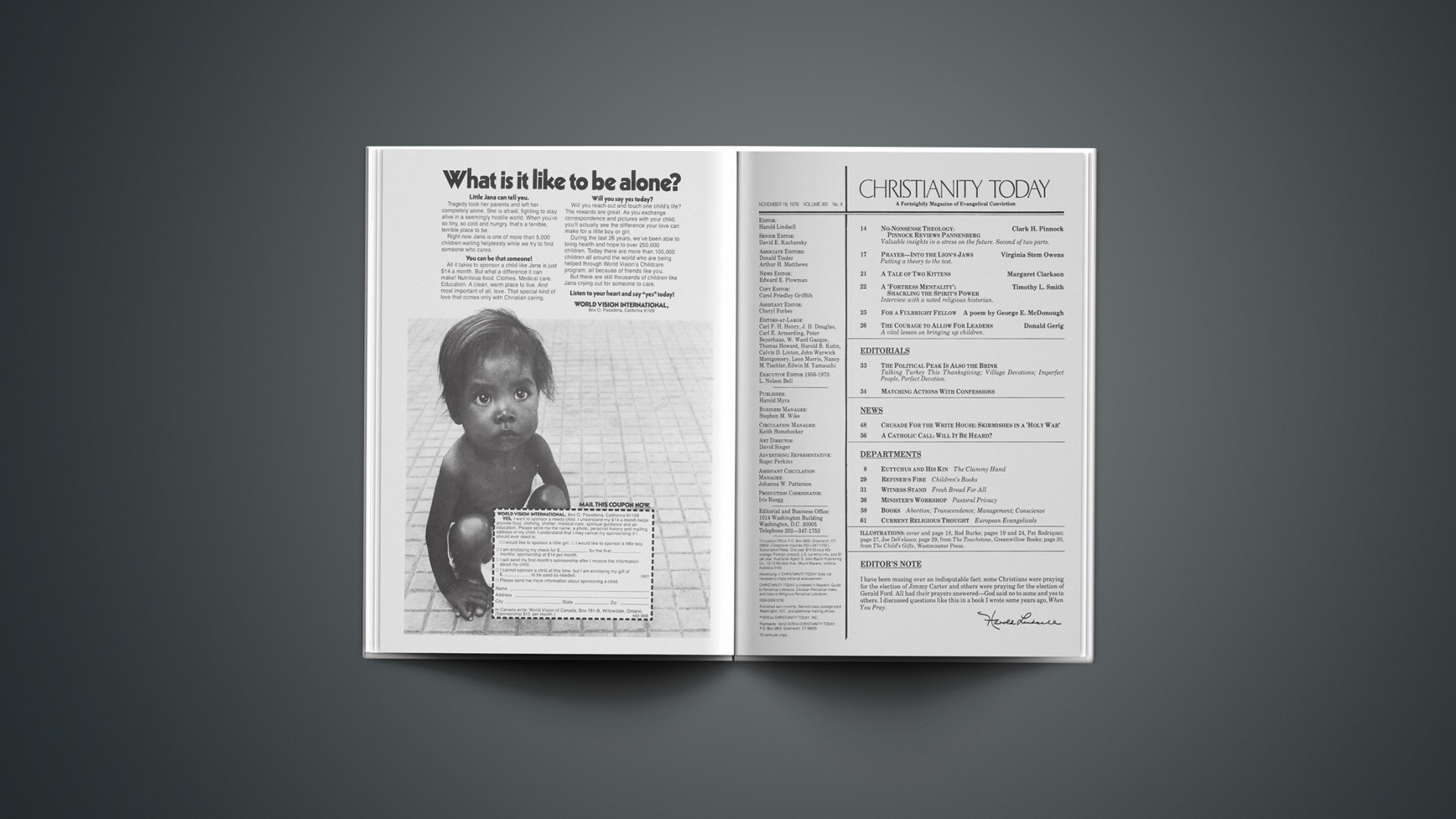

Editor’s Note from November 19, 1976

I have been musing over an indisputable fact: some Christians were praying for the election of Jimmy Carter and others were praying for the election of Gerald Ford. All had their prayers answered—God said no to some and yes to others. I discussed questions like this in a book I wrote some years ago, When You Pray.

The ‘Right to Leer’

The flood of pornographic materials that threatens to inundate our society is of great concern to those interested in the moral health of our civilization. It is a source of anguish to sensitive religious writers, particularly those concerned primarily with the freedom of the press. All religious journalism has a stake in the public reaction to an industry that apparently feels no social responsibility. The increase in the production and distribution of porno is compelling much soul-searching and much revision of attitudes.

Evangelical journalism has tended to take the middle ground in this respect. Its spokesmen have not been unaware of the problem of balancing freedom of the press against the possible impact upon our society of a flood of pornographic sludge. Most responsible evangelical journalists have refused to accept extreme positions, such as that which asserts an immediate cause-and-effect relation between pornographic literature and the growing rate of sexual crimes. The record here, in my opinion, has on the whole been creditable.

Liberal religious journalism has tended to pursue more closely the line dictated by general culture. Its guiding star has been the fear that any attempt to control the spread of pornography would lead to censorship. The tendency at this point has been to regard the First Amendment as absolute, permissive of no legal strictures at all. The fear has been that once any form of censorship is tolerated, very soon any unpopular point of view may be suppressed.

Liberal religious thinkers tend to believe that in the long run public taste and general good sense will prevail, and that only patience is required. Self-expression is regarded as a primary good, and therefore few if any forms of self-expression can be “without redeeming social value.” From a practical viewpoint, liberal religious journalists have been rather quick to hail reports of commissions that “discover” (shall we say, to the surprise of none?) that there is no relation between the spread of pornographic literature or literature depicting violence and the incidence of sexual or other violent forms of crime.

Illustrative of this was the eager acceptance of the findings of the Commission on Obscenity and Pornography appointed by President Lyndon Johnson. When President Johnson’s successor declared his intention to ignore the majority report of this commission, his decision was met by loud liberal protests, and by demands for a continuance of the permissiveness that this report favored.

Today there are serious second thoughts upon the subject, reflected especially in a changed editorial thrust in liberal theological journals. As late as April 30, 1975, the Christian Century editorialized strongly against any attempt to curb the spread of blatantly obscene literature. The arguments were the usual ones: control implies some form of absolute judgment upon what is “truth” in publication; censorship deprives the public of dimensions of social understanding essential to society; pornography survives only as a result of the opposition to it.

The editor of that journal urged all who favor restrictions upon pornographic literature to cease their efforts and “let such material die of its own shallowness.” Fifteen months later the same editor admitted that porno has not died but has extended itself to a point at which some form of limitation is probably desirable (issue of July 7–14, 1976).

Commenting upon the U. S. Supreme Court’s decision in the case of an ordinance passed by the city of Detroit regulating the location of outlets of pornographic materials, Editor James M. Wall spoke with reserved favor upon the ruling. He admits that “after a little more than a decade of this kind of permissiveness, even many civil libertarians have grown wary of the explicit depiction of sexual activity on the screen and in books.”

While most of the shift in perspective within liberal circles is based upon pragmatic and cultural concerns, evangelicals will point out that moral and spiritual considerations form the basis for some kind of restriction upon the dissemination of literature designed to exploit sexual curiosity and to add fuel to the fires of a human capacity that always requires discipline.

Recognized also will be the shallowness of the arguments of those who excuse pornography. The most common of these are: pornography has a “cathartic effect” in that it drains off excessive sexual energy that might otherwise be expressed overtly; porno is little more than a natural extension of every person’s fantasies; and since there is no universally accepted definition of what constitutes pornography, it cannot logically be controlled by law.

Such arguments fail to take into account certain rather clear capacities of the human learning process. Seldom does the intensification of an educative stimulus weaken the impact of that stimulus. If that were true, corporations would cease to vie for advertising spots at high moments of TV programs. Again, pornography may initiate and stimulate fantasy, rather than merely reflecting it. Furthermore, the inability of commissions, courts, or boards to define pornography does not indicate that the salacious is without an objective existence. More likely it suggests that the human psyche is seriously confused—and often embarrassed—and therefore unable to deliver a clear moral judgment upon the nature of verbal or graphic filth.

Pornography is but an exaggerated form of the general moral rot that has permeated stage and screen in recent decades, so that “adult” and “mature” when applied to entertainment are euphemisms for “smutty.”

To the evangelical, the most definitive objection to the spread and reading of pornography is derived from the words of our Lord. After all, it was he who transferred the locus of fornication from the secretive “love nest” to the leering look. Reared within a faith that saw clearly that one is “as he thinks in his heart,” he knew only too well how vulnerable is the inner life of men, women, and children. Certainly his followers are duty-bound to find ways to protect that inner citadel.

The Lutherans: Fractured Fellowship

For years, the 2.4-million-member American Lutheran Church (ALC) has been known as the quiet, mild-mannered partner in the Lutheran Big Three. It has served to some extent in a buffer and even mediative role between the 2.9-million-member Lutheran Church in America (LCA) on its left and the 2.7-million-member Lutheran Church—Missouri Synod (LCMS) on its right. The nearly 5,000-congregation ALC maintains “pulpit and altar fellowship” with both groups; the LCMS and the LCA do not have such fellowship, mostly because LCMS leaders feel the LCA is too liberal theologically.

In recent years, because of the doctrinal controversy going on in the LCMS, tensions have built up between the Missouri Synod and the ALC. ALC people dislike the much-publicized disruption being caused by what they consider is narrowness on the part of the LCMS; Missouri Synod leaders question the theological integrity and ecumenical openness of the ALC. The LCMS has in recent years withdrawn support from a number of cooperative programs it engaged in as a joint member with the ALC and the LCA in the Lutheran Council in the U.S.A., and this has upset ALC leaders. Even though ALC president David W. Preus and LCMS president J. A. O. “Jack” Preus are cousins, each thinks the other is going down the wrong path.

Relations may have become more strained at the ALC’s biennial convention last month in Washington, D.C. Normally, the time set aside at such events for special visitors to bring fraternal greetings is a yawn period for delegates. But when Jack Preus’s turn came, he woke up everybody. He challenged the ALC to uphold its constitutional position on biblical inerrancy, the issue at the center of the LCMS controversy. In quoting the ALC’s constitution, he noted that the ALC is on record as accepting “all the canonical books of the Old and the New Testament as a whole and in all their parts as the divinely inspired, revealed, and inerrant Word of God, and [it] submits to this as the only infallible authority in all matters of faith and life.”

In an almost light aside he said he was “sorry to say that Missouri’s constitution is not as concise or as clear a statement on this important subject.”

He said he would like to believe that the ALC’s rank and file “believes with Missouri that God’s Book is inerrant.” But, said he, “I must be frank to tell you that certain statements and positions taken in recent years cause us to wonder whether there are those in the ALC who have departed from the position of their church.”

The issue of inerrancy is the main reason for the “great conflict” in the Missouri Synod, he stressed. Therefore, said he, LCMS people were “very distressed” when the ALC’s David Preus a few months ago described the adoption of a doctrinal statement on inerrancy by the LCMS as having “the effect of narrowing down the confessions of the Lutheran Church,” and of being “divisive and destructive … tearing down instead of building up fellowship.”

“While we gladly forgive this allegation, we also categorically reject it,” declared the LCMS president. The statement, he explained, was adopted “in order to help the teaching and worship life of our church, and in order to help us remain faithful to our confessional heritage and faithful in confessing the Gospel before the world.” He said an LCMS commission has called for a meeting with ALC representatives to discuss the ALC president’s statements.

Preus suggested that a number of ALC pastors might feel more at home in Missouri, and he invited them to get in touch. “We have a very large number of vacant congregations,” he said. At the same time, he added, an invitation by the ALC to the “casualties” leaving the LCMS could be “a very practical and loving action.” He seemed to indicate that David Preus had already given such an invitation. He warned, however, that not all LCMS dissidents are casualties. “There are some who have been the very cause of our problems,” he said, and he expressed hope that “the small minority which disagrees with our mutual doctrinal position would not be permitted to drive a wedge between our two church bodies.”

Explained Preus: “We are anxious to strengthen the bond of fellowship and to remove misunderstandings and differences. We do not wish to have our fellowship weakened through damaging stereotypes and false impressions.”

He told the ALC delegates that the Missouri Synod controversy is in its final stages, with “a few” seeking to set up a new church, the Association of Evangelical Lutheran Churches (AELC).

He pledged continued LCMS membership in the Lutheran Council, and he closed with an appeal that all “refrain from making irresponsible statements about one another.… Let us emphasize the positive aspects of our faith and our fellowship.…”

David Preus thanked his cousin for being “open, frank, and forthright.”

In the closing minutes of the convention, ALC vice-president Fred Meuser, president of Evangelical Lutheran Seminary in Columbus, Ohio, publicly took exception to Jack Preus’s remarks. Contrary to the apparent allegation made by Preus, Meuser said the ALC president never invited LCMS dissidents to join the ALC. The ALC in no way has encouraged schism, he asserted. There have been inquiries from congregations anticipating departure from the LCMS, he acknowledged, but ALC officials have replied “that we might receive such congregations as a non-geographic district for a limited number of years, not permanently.”

In his presidential report to the ALC, David Preus said the ALC will offer “appropriate assistance” to the new body emerging from the LCMS while continuing as “good partners” with the LCMS. The LCMS controversy, he pointed out, has been a source of concern and grief to the ALC. It is not clear how many congregations will join the AELC, he said, but the ALC has indicated its intention to maintain fellowship with both those who leave Missouri and those who stay. As for what he meant by “appropriate assistance,” he told a reporter later, “I intended only to say that the ALC expects to act as a good partner with the new church body just as we are with the LCMS and the LCA.”

In other convention action, the nearly 1,000 ALC delegates:

• Endorsed an emphasis on evangelistic outreach during 1977, in conjunction with a similar LCA effort.

• Adopted without debate a social-action-oriented “Manifesto for Our Nation’s Third Century” that calls for loyalty to Christ, repentance for national failings, ALC involvement in social systems and structures with an eye to changing them, and a redirection of “the American Dream.” (Republican congressman Albert H. Quie, an ALC member active in the Washington prayer movement, argued in a major address that socio-political involvement should be on an individual, not church, basis.)

• Rejected attempts to make the denomination’s 1974 middle-of-the-road position on abortion more limiting.

• Asked the President and Congress to grant “pardon” (rather than “immediate and unconditional amnesty” as recommended in the resolution’s initial draft) to non-violent “resisters” of the Viet Nam war.

• Encouraged the development of programs and encounters aimed at a better understanding of the charismatic movement.

• Cited a “serious and persistent threat” to large numbers of people posed by marginal religious movements or cults, and called for study of the cults, as well as for ministry to persons who have been involved in them.

• Approved a record budget for 1977 of $30 million, up from $28.2 million this year.

• Approved some changes to eliminate “sexist language” in church documents (for example, “a member of the clergy” instead of “clergyman”).

Meanwhile, the schism in the Missouri Synod is still in its formative stages. About fifty churches have applied for membership in the breakaway AELC so far, and leaders predict they will have 200 by the time the AELC’s constitutional convention is held in Chicago next month.

Among those in the forefront of the AELC are four men who resigned as LCMS district presidents over the past few months amid tumultuous circumstances: Harold Hecht, English District; Herman Neunaber, 57, Southern Illinois District; Rudolph P. F. Ressmeyer, 52, Atlantic District; and Robert J. Riedel, 58, New England District. All have urged restless LCMS congregations to join the AELC, and some are already performing leadership chores. A majority of delegates at the English District convention last spring voted to become the English Synod of the AELC, and Hecht has become the president of that unit. Ressmeyer may emerge from the AELC’s December meeting as the chief helmsman of the new denomination.

The LCMS Commission on Constitutional Matters has decreed that congregations, pastors, and teachers cannot be affiliated with the AELC without forfeiting their membership in the LCMS, but the ruling will not become effective until next September in order to work out pension matters and other problems of transition.

Not all of the dissidents in the Missouri Synod are ready to join the AELC. Most have been part of a protest movement within the LCMS known as ELIM (for Evangelical Lutherans in Mission). ELIM’s main projects were to support Seminex (the school set up in 1974 in opposition to Concordia Seminary in St. Louis), a mission program, and a 150,000-circulation biweekly, Missouri in Perspective. At the recent annual meeting of ELIM, its leaders recommended phasing out the group in favor of joining the AELC, a move rejected by the majority of the 1,100 delegates (there were 3,000 last year). They simply were not yet ready to throw in the towel—even though there is no reason to believe that conservatives in the LCMS can be ousted from power in the foreseeable future.

Only a six-month budget ($732,000) was approved for ELIM, however. From now on, backers are to send their donations directly to Seminex, to ELIM’s mission program, and to the newspaper. The move is seen as a way to ease transition of the programs from protest status within the LCMS to official functions of the new denomination—while leaving the door open to outside contributions.

Seminex in the meantime is trying to raise $1 million for its current academic year. Enrollment is 345, down 50 from last year (Concordia is back up to 354—about four times the number who remained on campus when the majority left).

The anguish and bloodletting in the LCMS is far from being over, but the worst of the upheaval is apparently past, and there are signs that the respective parties now are interested more in attending to the work to be done than in picking a fight.

Lutheran Concerns

“Evangelical outreach … is currently a high-level concern” among the 6,100 congregations of the Lutheran Church in America, according to a study by the LCA’s parish-services unit. Apathy, poor morale, and diminishing membership ranked at the top of complaints by clergy and laity alike in recent surveys. Of the 3,400 congregations reporting goals last year, more than half specified evangelism goals—higher than any other area of interest listed.

A related trend, the study points out, is “growing concern on how to help inactive members become involved in congregational life.” Last year more than 101,000 LCA members were taken off the rolls because of inactivity.

There is also a “long-standing concern about involving young people in the life of the congregation.” Sunday-school enrollment has declined by more than one-third in the last decade.

This year the LCA is promoting an outreach program that emphasizes both evangelistic witness and congregational nurture.

Religion in Transit

A guide to “non-sexist interpretation of the Bible,” believed to be the first of its kind, has been published by Westminster Press for the National Council of Churches. The ninety-six page, $3.95 volume of essays and suggested guidelines was written by women scholars and theologians for use in planning worship services, church-school classes, group Bible studies, and seminary work. The idea is to study and explain the Bible without “sexist bias.”

A glossary substituting “non-sexist language” for masculine terms used in the prayerbooks and liturgy of Reform Jewish congregations has been proposed by a women’s-equality task force of the 102-member New York Federation of Reform Synagogues. Examples: “Lord” would become “God” or “Almighty” or something similar; “fathers” would become “ancestors”; “he” referring to God would be changed to second-person “you, God”; “Shield of Abraham” would become “Shield of our ancestors.” Rabbi Chaim Stern of Chappaqua, New York, a Reform prayerbook editor, says: “I am now persuaded that it is illegitimate to use masculine language about God.”

Congress passed a measure that removes the threat of a cut-off of federal revenue-sharing funds for certain day-care centers, hospitals, and other charitable organizations that are operated by religious groups. The legislation makes applicable not only the same prohibitions against discrimination on the basis of religion that are contained in the Civil Rights Acts of 1964 and 1968 but also the same exemptions.

At least four more states must ratify the Equal Rights Amendment before it becomes part of the U. S. Constitution, and a campaign to help get them to do so has been launched by the Religious Committee for the ERA. Target states: Missouri, Illinois, Indiana, North Carolina, and Florida. Committee members represent thirty-one religious agencies. They include General Secretary Claire Randall of the National Council of Churches and President Margaret Sonnenday of Church Women United.

The Good News Bible (the Bible in Today’s English Version) will be released December 1. Its New Testament segment was published in 1966; more than 50 million copies are in print.

Thirty-eight Christian liberal arts colleges from across the country have joined together to form the Christian College Coalition. The coalition’s purpose is to provide united positions on issues affecting Christian colleges and to conduct legal research into matters affecting educational freedom. It will cooperate closely with the Washington, D.C.-based Christian College Consortium, whose fourteen members are also coalition members.

Grace Wallace, director of the Nurses Christian Fellowship in the United States, was elected president of Nurses Christian Fellowship International, which has twenty national organizations of nurses and nursing students. More than 200 persons from twenty-five countries met in Ghana for the NCFI quadrennial conference. The U.S. fellowship, based in Madison, Wisconsin, is a division of Inter-Varsity Christian Fellowship. It has seventeen staffers and is represented at some 150 schools and hospitals.

A study by two Loyola University psychologists in Chicago concludes that Catholic bishops are “more satisfied” and happier being bishops than priests are being priests. The study is based on returns from 161 of the nation’s 300-plus bishops. The bishops are seen as goal-oriented workaholics though somewhat colorless. They like their independence and have difficulty in identifying with the problems of their priests. Mass is central in their religious life, but they have difficulty with private prayer. An earlier study found that priests tend to have strong personal faith but have problems of adjustment and achievement.

Leaders don’t go to church as much as the rest of the people, according to a survey by the Washington Post and a Harvard research unit. While 42 per cent of the 1,521-person survey reported attending religious services once a week or more, and 22 per cent reported attending never or almost never, only 29 per cent of leadership groups reported attending weekly or more, and 36 per cent reported never or almost never. Among leaders, farm groups and blacks ranked highest in attendance; university students and feminist leaders ranked lowest.

Minnesota governor Marvin Anderson estimates that $10 million in state aid will go to private and parochial educational institutions this year. At an outdoor mass recently he pledged to continue efforts to help parochial schools. He cited tax deductions, shared-time support, special-education programs, and other forms of “sharing.”

More than one million teen-agers—10 per cent of all girls 15 to 19 in the United States—become pregnant each year according to a study published by Family Planning Perspectives magazine. More than one-third of the births are to unmarried mothers, the report says, and nearly one-third of the pregnancies end in abortion. Meanwhile, Playboy notes in a survey of students at twenty colleges that virginity is claimed by only 26 per cent of the women students this year (compared to 49 per cent in 1970) and by 26 per cent of the males (up from 18 per cent).

Note to Sunday-school planners; the national school population kindergarten through twelfth grade will drop to 41.3 million by 1980 (it was 45 million in 1974), according to official estimates.

In an attempt to avoid schism in the 800-member Guess Road Baptist Church in Durham, North Carolina, church officers have asked members who speak in tongues not to accept any teaching assignments. Sterner measures may be taken if the request is unheeded or if charismatic members try to promote glossolalia in other ways, warned pastor Ernest Holt.

The Evangelical School of Theology, Myerstown, Pennsylvania, almost doubled its enrollment over last fall, jumping from 44 to 79. It has more than doubled its library with the acquisition of 30,000 volumes from the former Evangelical Seminary, Naperville, Illinois, which merged with another liberal United Methodist seminary to form Garrett-Evangelical seminary in Evanston, Illinois. The Myerstown school is sponsored by the 30,000-member Evangelical Congregational Church, a theologically conservative German-American body that was once part of the same group as the founders of the Naperville school.

Three-year-old Douglas Owens, whose infant sister died of pneumonia, was made a ward of the court in Oklahoma City because his parents’ religious beliefs would forbid medical aid if he became ill. The boy will remain with his parents, members of the Church of the First Born, but under welfare-department supervision.

An evangelical non-profit group has begun plans to launch a full-time Christian television station in the nation’s capital. So far, there are sixteen Christian TV stations on the air in twelve states.

The French Baptist Hour, sponsored by Southern Baptists in Louisiana, is now heard on thirteen radio stations by an estimated 200,000 of the 900,000 French-speaking citizens in eighteen Louisiana counties, according to a spokesman.

Last spring, the board of Allen University, an African Methodist Episcopal school in Columbia, South Carolina, voted 18 to 7 to oust president Benjamin J. Glover on charges he made unauthorized payments of $27,000 to himself and took other actions without board approval. Glover insisted the money was for job-related expenses. When board member James Holmes virtually accused Glover of embezzlement in an AME newspaper article, Glover sued for libel and won. He was awarded $1,600. Holmes said he will appeal, and he ordered an audit of university funds.

That 1972 ad in Playboy for recruits for the Trinitarian religious order didn’t pay off after all. Initially, there were many inquiries, and a couple of men came to the forty-member Catholic order but were later dismissed when they failed to measure up, according to Trinitarian officials. They say they regret the ad—and all the criticism it brought.

Pity the poor church secretaries trying to keep the membership directories up to date. A government study shows that between 1970 and 1974 (4.5 years) nearly one-half of the 71 million American households moved to a new address. More than one-fourth of these movers represented new households (newlyweds, young singles establishing their first independent residences, changes caused by divorce and death).

An appeal to raise $6.25 million in Britain to rescue the Canterbury Cathedral from 900 years of decay is still $2.5 million short. A fund-raising drive has begun in America, headed by George W. Ball, former undersecretary of state.

Personalia

Adolph Coors IV walked out of his family’s Colorado brewery nearly a year ago looking for a new life—and found it in Christ. Coors, 33, tells church audiences that he was beset by business problems, a failing marriage, and despair. His wife became a Christian after heavy discussions with friends at the brewery. Following an auto accident in which he was seriously injured, Coors too accepted Christ. He keeps busy with a weekly TV Bible-study program but is willing to return to the brewery “if the Lord leads” (he sees no conflict with his faith, and he describes his relatives running the business as “good Christians”).

World Scene

A group of ninety-seven Soviet Pentecostals appealed recently to the World Council of Churches to intercede with the Soviet government about their wish to emigrate, according to documents received by the Keston College research center in England. They speak of constant persecution of Pentecostals over the years. Earlier, the center received emigration appeals from several hundred other Pentecostals.

Thaw in the Soviet Union? About twenty Pentecostal congregations have been permitted to register as autonomous bodies over the past two or three years in the Soviet Union, mostly in Ukraine, according to researchers at Keston College in England. Prior to that time, Pentecostal congregations could register (and therefore function legally) only if they became part of the All-Union Council of Evangelical Christians-Baptists.

Weekly mass attendance in Ireland is 91 per cent of the population, the highest of any predominantly Catholic country, according to a church survey.

Jesuit priest Joao Bosco Penido Burhier and Spanish-born bishop Pedor Casaldaliga went to the police barracks in Ribeirao Bonito in western Brazil to protest the alleged torture of two women being held for questioning by the police. A military policeman shot and killed the priest, and the bishop was threatened, according to Vatican Radio.

The government of Laos has outlawed birth control. War and the flight of many into neighboring countries has decimated the population; hence the ban on contraceptives.

Jewish Challenge at the NCC

Would the National Council of Churches seat Governor George Wallace if the United Methodist Church sent him as one of its delegates to the governing board? Such a question preoccupied the board at its fall meeting in New York City while it was trying to pass a raft of pre-election political announcements.

The United Methodists have not chosen to name the controversial Alabama governor to the NCC board, but his name came up as an example while the policy-making body agonized over the problem of a member who has been accused of World War II crimes in Romania. Archbishop Valerian Trifa of the Orthodox Church in America, the accused, was not present at the meeting last month, but Jewish youths who charge him with “ritual slaughter” of Jews and Christians were there in force. They occupied the platform in the Roosevelt Hotel’s ballroom during a lunch break, and when members returned a shouting match ensued between NCC president William P. Thompson, various members of the board, visitors, and the young Jews. The afternoon business was delayed for more than an hour, but the protesters finally left after they were assured that the matter would be put on the board agenda.

The assignment of considering how inclusive—or exclusive—the NCC should be was given to the board’s credentials committee. Two days later, just before adjournment, it came back with a report that did not gain easy acceptance. The ensuing debate found Thompson taking the unusual step of leaving the chair and speaking from the floor. He defended the report, which stated that member communions alone can determine who represents them on the board. He added that, as a lawyer, he had to assume the Orthodox prelate was innocent until proven guilty. Further, he warned, any attempt to drop Trifa would be an “outright affront” to a member denomination.

“We challenge anything else,” replied board member Arie R. Brouwer of the Reformed Church in America. “Why not this?” The council’s moral authority is at stake, he declared, and he moved to send the whole report back to the committee.

Bringing the issue into sharp focus was clergyman William R. Johnson, Jr., of the Christian Methodist Episcopal Church. He said he “couldn’t sit here” if such arch-segregationists of the last decade as Lester Maddox and George Wallace were sent by member communions. Thompson replied that amendment of the constitution was the way to accomplish any further restriction of board membership (which already must meet quotas for laity as well as clergy, women, youth, and ethnic representation).

Most objectionable to some members of the board was a recommendation at the end of the credentials report. It stated that under the constitution the body had no “authority to judge the alleged activities of Archbishop Valerian nor to challenge the decision of our constituent communion to name him as a member of its delegation.” Instead of sending the whole report back to the committee, the board finally dropped the recommendation section and “received” the committee’s report of its findings. One attempt to suspend the Orthodox prelate pending an investigation was ruled out of order.

Thompson told reporters after the meeting that he had known of the charges against the archbishop for many years but that the allegations had not been discussed in any meeting of the NCC executive committee or board before this session. He suggested that the reason the NCC has not paid much attention to the charges is that Trifa’s denomination considers his record unblemished and that his Romanian archdiocese supports him.

The council president said that neither he nor anyone else in the NCC’s leadership knew of plans for the Jewish protest. He was informed of the platform takeover during the lunch break while he and General Secretary Claire Randall were discussing the afternoon agenda. A young rabbi who was the principal spokesman for the group conferred with Thompson during the recess and, according to the NCC president, agreed to withdraw the protesters if Thompson would permit him to speak to the board for five minutes. The agreement crumbled, however, when the demonstrators remained on the platform after Thompson’s return. He declared an extension of the noon recess, but most members stayed to hear the heated discussion.

Among the exchanges on the floor during the stormy session was one between the rabbi, Avraham Weiss, and black board members who had been in the forefront of demonstrations in the 1960s. The rabbi was asked if he had ever expressed his concern in writing to the NCC. He invoked the name of the late Martin Luther King, Jr., in response, noting that the famous black leader had had to “go beyond the agenda” sometimes to get timely action. Some of the blacks angrily rejected Weiss’s identification of his tactics with those of King. They urged the Jewish leader to work through the NCC channels.

A semblance of order was restored about forty-five minutes after the scheduled start of the afternoon session, and Thompson recognized Sterling Cary, his predecessor, to make a motion about the Trifa matter. During discussion of the Cary motion a former executive of the American Jewish Committee, writer Gerald Strober, sought permission to speak to the board. Thompson refused to recognize him and had his microphone disconnected when Strober continued to speak. Strober, as he was leaving the floor, said to Cary, “Let’s go back to the sixties.…”

The demonstrators finally left after the board voted to refer the matter to its credentials committee. Board members got back to their other business after they had stood for a prayer for the holocaust dead, led by the rabbi.

When the credentials report came back two days later, the current observer from the American Jewish Committee, Rabbi James Rudin, sought recognition. Thompson refused to give him the floor, but the board voted unanimously to allow him to speak. He called the report “morally flawed” and promised a campaign by his organization to “explain” the NCC action.

A formal statement issued later by the American Jewish Committee said Trifa’s continuing presence on the NCC roster “will seriously compromise the moral credibility of the National Council.” Rudin and Rabbi Marc Tannenbaum, the committee’s national interreligious-affairs director, said the least the board could have done would be to suspend the Orthodox prelate.

Many of the board members left New York with the conviction that the problem had not been solved. They were right. In the week following their meeting the Jewish youths appeared at the NCC general secretary’s office to demand more action. After an all-afternoon occupation of the Interchurch Center’s eighth floor, they left with a promise that more consideration would be given to the question at an upcoming meeting of the council’s senior staff.

Trifa, meanwhile, was at home in Michigan preparing his defense for a new set of hearings in federal court. The Justice Department has charged him with lying to immigration authorities about his relation to the anti-Semitic Iron Guard organization during the war. If it is proven that he was a commandant of the organization responsible for atrocities, as charged, he could lose his U. S. citizenship. Orthodox Church authorities contend that he has been cleared of the allegations by various responsible government agencies and that the current drive is a “trial by press” to discredit him.

The Romanian cleric, who became a bishop after coming to America, has attended only one meeting of the NCC board in the last three years. Some veteran board members remember his participation in earlier years, but many of the newer members have never met him.

The New York meeting, one of the liveliest in several years, was also the best attended in about three years. Some 190 (out of 250) board members attended or sent proxies.

With national elections less than a month away, the board concentrated on some of the campaign issues. It addressed a letter to the presidential candidates, calling for a commitment to a “just and sustainable global society.” The document reviews NCC positions on a variety of subjects, including unemployment, nuclear energy, and human rights abroad.

The board also received an “open letter to North American Christians” from a group of Latin Americans who wanted it publicized before the presidential elections. It covered a wide range of social and diplomatic issues. The NCC reply thanked the Latins for raising “the authentic and key issues impacting the relations between our nations and peoples.”

The NCC policy-makers passed one resolution supporting the “forces of liberation” in Southern Africa and warning against “diplomatic overtures of any non-African governments” to resolve the conflicts there. Another resolution asked the United States not to recognize the Transkei (first of the black “homelands” to be granted independence by South Africa) and to press for dismantling of all the Bantustans.

In other actions the board:

• Learned that the Interreligious Foundation for Community Organization (IFCO) had formally become a part of the NCC. IFCO was one of the groups founded in the late sixties to answer black demands for “reparations.”

• Asked for tighter government controls on nuclear materials at home and overseas.

• Addressed a letter of commendation to the “Peace People” of Northern Ireland and Ireland.

• Urged the United States to normalize diplomatic relations with Viet Nam.

• Called for a more active U. S. role in seeking a change in Korean government policies.

• Launched a new campaign against capital punishment.

• Warned against government efforts to define “church” and “religion” for tax purposes.

• Endorsed a California referendum proposition regarding farm labor.

Bingo, Scourge Of Texas Ecumenism

Close to $20 billion will be spent this year in legal gambling, according to researchers (up from the $17.3 billion a University of Michigan survey says was spent in 1974), with an estimated three out of five American adults—90 million people—plunking down money in pursuit of Lady Luck. (Another $5 billion or so will be spent in illegal gambling, the experts say.)

Of this amount, nearly $2 billion will be spent on bingo games. Although it is considered gambling and is therefore illegal in many states, bingo has flourished among Catholic churches, fraternal organizations, fire-house socials, and the like—and the authorities have chosen to look the other way.

Battle lines are being drawn in Texas, where a court recently ruled that bingo is illegal. Police in predominantly Catholic San Antonio say they will enforce the ruling, an announcement hailed by Baptist leaders. Inner-city Catholics, however, warned that the move will deprive their parishes of a chief source of support, and residents of senior citizens’ homes are protesting the elimination of what they call their “only source of recreation.” Several legislators say they may seek special legislation to exempt churches and charities from the law, a move certain to be opposed by the Baptists.

Baptists, who generally have an antigambling stance, and Catholics have clashed on the issue elsewhere in the state. Dallas police, urged on by the Baptists, began a crackdown in Feburary, prompting Catholic bishop Thomas Tschoepe to ask the faithful to comply with the law. (Bingo sponsorship is a felony under the lottery laws and carries a prison sentence of from two to ten years.)

Inducing Growth

The average-size Protestant congregation in America has fewer than 200 members, according to studies discussed at last month’s National Consultation on Evangelism and Church Growth in Kansas City, Missouri. These churches, the studies also show, are for the most part not growing.

More than 450 leaders and key clergy from a broad cross section of denominations and independent groups attended the by-invitation-only consultation to discuss how to get such churches moving—and growing. Many factors were considered in the three days of plenary and small-group sessions: the place of prayer, New Testament guidelines, the role of the Sunday school, statistical analysis, administrative leadership, the nature of ministering to people, family needs, and others.

“We’re interested in disciples, the ones that remain, not just decisions,” commented church-growth expert Vergil Gerber of Evangelical Missions Information Service. “Otherwise, the name of the game becomes numerology.”

“At the same time, we must not slide off on the other side,” cautioned Executive Director Paul Benjamin of the National Church Growth Research Center in Washington, D.C. “Every statistic stands for someone for whom Jesus died.”

Probably the most significant aspect of the consultation was the scheduling of regional workshop sessions in which church-growth conferences were planned for next year throughout the country. The idea is to get as many churches as possible represented at these meetings and to provide plenty of how-to and motivation for congregational involvement in evangelism and nurture that will result in growth. Existing regional resources will be noted in planning, say leaders.

The consultation was sponsored by the American committee of the Lausanne continuation movement (chaired by Southern Baptist pastor Kenneth Chafin), the Evangelization Forum (an informal group that had provided leadership in the Key ’73 nationwide evangelistic thrust, with Victor Nelson of the Billy Graham organization as convener), and other groups.

Invisible Tax

Public utilities in twenty-six states are permitted to make contributions to religious charitable and educational institutions and charge the donations to their ratepayers, according to Americans United for Separation of Church and State. AU brought suit in state courts earlier this year to challenge Pacific Northwest Bell Telephone Company for making substantial contributions to church colleges, with customers involuntarily paying the bill. AU spokesmen say they would have no problem if the donations were taken from stockholders’ profits, but they question whether it is constitutional for “government-regulated monopolies” to make their consumers pay.

“An invisible tax for religion is just as objectionable as a visible one,” says AU researcher Doug Lavine. States showing the highest amounts given to sectarian agencies, he adds, are Oregon, Ohio, New York, Texas, and Illinois.

Camp Crisis

The Texas Supreme Court ruled unanimously last month that an Episcopal Church camp in Hood County is not exempt from property taxes. Bishop A. Donald Davies had filed a suit to establish tax exemption for the camp. A district court ruled that only an open-air chapel and a minister’s residence at the camp were exempt. The remaining 153 acres were declared subject to taxation.

“Certainly, inspiration and a spirit of renewal may be captured by experiences with nature,” the Supreme Court commented, “but those experiences can also qualify as wholesome recreation which falls short of religious worship.”

The effect of the ruling on the tax status of the many other church-affiliated camps in Texas has not been determined.

A Methodist camp at Glen Rose is now in the courts. The Episcopalians sought exemption on grounds the camp was used for worship. The Methodists, however, are claiming their camp is exempt because it is an integral part of Christian education.

Train Up a Child …

Some people assume that academic and intellectual influences spoil the religious commitment of students. Such an assumption is wrong, according to a study of college teachers by researchers at the Catholic University of America in Washington, D.C., and Appalachian State University in North Carolina.

The main sources of religious commitment, or its absence, among college teachers are in early childhood experiences and family conditioning, and later academic training has little effect,” the study concludes.

The findings also show that scholars in the more developed natural sciences are more traditionally religious than are scholars in the humanities and social sciences.

Future in Focus

National conferences on key issues in the practice and theology of world evangelization, an enlarged program of communication to share news of evangelism, and a comprehensive survey of unreached peoples will be the focus of the Lausanne Committee on World Evangelization activities for the next two years. These directions were charted during the recent annual meeting of the LCWE executive committee in Berlin.

The committee took time out from deliberations to issue a statement of support for persecuted Christians in various lands.

General secretary Waldron Scott of the World Evangelical Fellowship was on hand to discuss views and plans of the WEF. The way was left open for joint WEF-LCWE sponsorship of some projects.

From the ten countries and five continents represented by the executive committee came reports of remarkable spiritual activity and growth despite political unrest.

Evangelist Leighton Ford is chairman of the Kenya-based LCWE, and African clergyman Gottfried Osei-Mensah is executive secretary.

Campus Outlook

Christian college campuses are full and overflowing this fall as record numbers of new and returning students boosted many schools past their projected enrollment figures, according to the news service of the twelve-member Christian College Consortium. They are also quiet.

In a survey of campus newspaper editors, the news service found that students at the theologically conservative colleges are expected to be more concerned this academic year with campus matters than with national issues. Getting “moderate interest” will be such issues as the presidential election, the feminist movement, charismatic renewal, world hunger, and recognition of black students’ rights. Most attention, however, will be on grading system revisions, academic calendar changes, and campus regulations, according to the survey.

There have been some changes on campus because of the “Title IX” federal regulations that prohibit sexual discrimination in education. For example, women athletes at George Fox College now enjoy pre-game steaks just like the men—instead of the brown bags they formerly got.

Help For the NAACP

Representatives of the U. S. Catholic Conference, the National Council of Churches, and the Synagogue Council of America have pledged their support of the NAACP in appealing a $1.2 million judgment that threatens its survival. White merchants in Port Gibson, Mississippi, won the judgment against the NAACP under a state law prohibiting conspiracies to injure a business. The case involved a boycott in the 1960s by the NAACP aimed at seeking employment for blacks.

An NAACP spokesman said the organization was already in financial trouble, with liabilities exceeding assets by $200,000.

Said Reform rabbi Alexander M. Schindler: “If blacks can be thrown into bankruptcy for refusing to patronize merchants they regard as hostile to their interests, then Jews can be similarly victimized for withdrawing their patronage from concerns which discriminate against them or who cooperate with the Arab boycott.…”

Food Bank

The Mennonite Central Committee of Canada has set up a government-assisted food bank for world emergency relief. The initial program will run for five years with a maximum reserve at any one time of two million bushels of wheat. Up to $1 million for the first year has been allocated by the Canadian International Development Agency.

The Word in Japan

In commemoration of 100 years of Bible-translation work in Japan, the Japan Bible Society published a new translation of the Gospel of Luke a year ago—the vanguard volume of the Japanese Common Bible Translation. Begun seven years ago, the Bible project involves a committee of forty Protestant, Catholic, and Greek Orthodox scholars. The projected date for finishing the New Testament was 1976, but the work hit a snag, according to charismatic Catholic priest Bernardin Schneider and retired professor Masashi Takahashi, co-chairmen of the editorial committee. The new target date is the end of 1977, with the Old Testament to follow four years later and the Apocrypha sometime after that. Meanwhile the Gospel of Luke is open game and is receiving both compliments and criticism.

The new Common Bible is intended to make the Bible understandable to a non-Christian with a non-church vocabulary, to adhere to the original languages, and to have a non-foreign-sounding, true Japanese style. But in a long review, Tokyo’s popular Asahi newspaper said that the new Bible was too radical in its differences from other Bibles available in Japanese.

The major issue involves the transliteration of names and places into Japanese. For example, it is impossible to spell “David” in Japanese, so the earlier Bibles render him “Dabide” (da-bee-day); the new one changes it to “Dabido.” The committee compromised after a long battle over the name Jesus: Protestant “Iesu” plus Catholic “Iezusu” comes out “lesusu” in the Common Bible. Whether for sake of compromise or for a sound that is closer to the original Hebrew or Geeree shiago (Greek), the task has been tough: more than 500 Greek proper names and 2,600 Hebrew names in the Old Testament were tagged for study.

A second issue concerns the alleged use of “discriminatory” words. The mass media in Japan are being bombarded by a Communist-backed faction accusing the Bible translators of discrimination against the blind and other socially handicapped. The organization has picked out eleven words that they say are taboo and should be avoided in the Bible. Because mekura for “blind” is also used in reference to a blind animal, for instance, the word should be changed to a more polite mojin or me ga mienai hito to specify “a person whose eyes cannot see.” The same principle applies to “lame,” “deaf,” or “dumb.” “Leper” should be changed to “one with Hansen’s disease.”

Highly conscious of social status, the Japanese adjust their language to three distinct levels of social rank, depending on the one being spoken to. Hence the verb forms used when Jesus is speaking to his disciples are questioned. As their teacher, wasn’t he above them? Yet he washed their feet.

The new translation claims to be “more polite than the language of the Living Bible” and “more readable than the Kogotai” (a 1955 version similar to the King James that still has sales of 1.5 million a year).

For the most part, pastors do not seem to be using the new gospel of Rukas (Luke), and when asked about the “new Bible” they often reply, “You mean the Shinkaiyaku Seisho?” Published in 1970, by Japan Bible Publishers, that six-year-old colloquial version is still new to some. It has sold over a million copies and presently sells about 190,000 a year, according to a spokesman.

President Kenneth McVety of Word of Life Press in Tokyo reports that the Living Bible New Testament paraphrase, released in Japanese in October, 1975, is averaging 8,000 sales a month, with 180,000 in print as of September. The Old Testament is expected to be completed next year.

Although many Christians voice doubts about the need for another Bible translation, the Bible Society says it is not only possible but necessary to make the common version. The latest Catholic edition is a 1965 publication, though in the last four years large numbers of Catholics in Japan have been using the two latest Protestant versions (Kogotai and Shinkaiyaku Seisho).

The oldest Bible in Japan, the 1888-vintage Bungotai, is revered by the Baptist Bible Fellowship and other fundamentalist groups (some are working on their own private translations). The Bungotai was Japan’s first Bible, but in schools today the language it uses is considered classical and obsolete.

Early disciples of the mukyokai no-church church movement in Japan also translated portions of the Scriptures, but the movement in general uses the two post-war Protestant versions.

Also, there are a Mormon “Bible” and a Jehovah’s Witness “Bible” in Japanese.

In a 1975 survey that included reading matter of all kinds, 56.3 per cent of a cross section of Tokyo residents indicated they had read the Bible or parts of it, with 6 per cent saying they read it regularly. Another 8.5 per cent said they want to read it, while 35.2 per cent indicated no interest in reading it.

Judging by continuity of sales, the Bible is a best-seller in Japan. However, although bookstores are almost as plentiful as cold drinks, the average man on the street would have a hard time buying any version of the Scriptures except in a few Christian bookstores and in three or four major bookstores in the large cities. Book dealers avoid it because they favor faster-moving material on their crowded shelves—and because it might subject them to criticism by Shintoists and Buddhists.

NELL L. KENNEDY

The Pentecostal Tide Is Coming In

As English Labor government leaders struggled over the crises of the falling pound, Pentecostal leaders from more than eighty nations gathered in London in September for the eleventh triennial meeting of the World Pentecostal Conference. The 12,000 delegates represented more than 350 national Pentecostal denominations from around the world. Morning sessions were held in the Westminster Central Hall, the “cathedral” church for English Methodism, and the evening rallies were conducted in the 8,000-seat Royal Albert Hall. On the final night of the conference, both halls overflowed for the closing communion service.

The purposes of the conference, according to Chairman Thomas F. Zimmerman, top leader of the U. S. Assemblies of God, was to “recognize what God is doing in what may be the broadest based outpouring of the Spirit the Church has ever experienced,” and to “assess the unfinished task as God gives us to see it.” In his address, Zimmerman proclaimed that there are from 35 million to 50 million Pentecostals in the world and that “the end is not near.” The “Pentecostal tide is coming in,” he declared. He left little doubt that classical Pentecostals consider themselves to be first of all evangelicals. He declared that the Holy Spirit gave the Church “the inspired and inerrant Word of God,” which is “superior to any tongue or prophetic utterance.” He noted in conclusion that the “triumph of the Holy Spirit is worldwide evangelism.”

Although all twelve conference speeches dealt with some facet of the person and work of the Holy Spirit, the challenge of evangelism was a prominent note throughout the meetings. Featured speakers included pastors of some of the largest Pentecostal congregations in the world. Yongii Cho reported that his Full Gospel Assembly of God congregation in Seoul, Korea, numbers 40,000 members, an increase of more than 8,000 in the past year. Javier Vasquez, pastor of the Jotabeche Pentecostal Methodist Congregation (affiliated with the Pentecostal Holiness Church) in Santiago, Chile, reported 80,000 members. Also featured was K. E. Heinerborg, pastor of Stockholm’s 7,000-member Filadelphia Pentecostal Assembly. Practically all the representatives reported significant growth in their lands since the last conference three years ago.

In contrast to the neo-Pentecostal practice in large meetings of allowing charismatic gifts to be exercised only by a trusted “word gifts unit,” tongues and prophecies came forth from all over the Royal Albert Hall. In one instance a “message” was given in glossolalia, interpreted in German, and then interpreted in English.

A striking feature of the conference was the appearance of twenty delegates from Eastern European Communist countries. These included six pastors from the Soviet Union, representing the nation’s 600,000 Pentecostal believers. Others came from Bulgaria, East Germany, Hungary, Poland, Yugoslavia, and Romania. In welcoming the Iron Curtain delegates, Zimmerman declared that “the World Pentecostal Conference is not political.… We can enjoy fellowship of the brethren from any part of the world.… Ideological differences do not divide us.” Despite these statements, some delegates who have traveled in these nations contended privately that these men represented not the “true Pentecostal believers” but rather government-recognized churches that had compromised their testimony for government approval. The overwhelming spirit of the conference, however, was to give a warm hand of fellowship to the official delegates as true brothers in Christ.

The existence of the rapidly growing charismatic movements in the traditional churches was hardly noted during the conference. Instead of a triumphalism concerning the incursion of Pentecostalism into other traditions, a non-recognition policy seemed to exist. (Generally, classical Pentecostals feel that Christians who speak in tongues ought to join a Pentecostal denomination.) Yet in small ways the conference opened some windows toward the charismatics. David du Plessis, known as “Mr. Pentecost” to the charismatics but as a maverick to the Pentecostal power structure, was publicly recognized and applauded. Michael Harper of the Anglican Fountain Trust and Dan Malachuk of Logos International were also publicly received. In addition, the somewhat controversial Society for Pentecostal Studies, which was formed at the 1970 World Pentecostal Conference in Dallas, Texas, was recognized as an official research agency for the world Pentecostal movement.

In conference business, an expanded advisory committee of twenty-four persons representing the various continents of the world was approved, and Canada was chosen as the site of the 1979 conference.

VINSON SYNAN

East Germany: Taking a Stand

Four weeks after a clergyman set himself on fire outside his church in Zeitz, East Germany, to protest the oppression of Christian young people by the Communist government (see September 10 issue, page 81), pastors in 4,300 Evangelical (Lutheran) churches throughout the land read a sensitive sermon from their pulpits calling for increased religious freedom. The sermon was a pastoral letter drafted by the leadership conference of the Evangelical Church. The five regional newspapers of the church, with a combined circulation of 150,000, were forbidden by the government to print the statement.

The text of the sermon was “One member suffers, all the members suffer.” It said that pastor Oskar Bruesewitz’s self-immolation aroused deep concern over “the tensions that exist in our society, as well as the severe problems that many of us face.” Affirming that the pastor “wanted to be a witness of our Lord Jesus Christ” in what he did (government authorities claimed he was mentally ill), the statement said his action gave rise to serious questions, including “whether there is really sufficient freedom of belief and freedom of conscience [in East Germany], particularly for young people.”

Suppression of problems serves neither society nor the church, the sermon declared. “We must therefore take a stand to see to it that in our society respect for the convictions of others truly determines the coexistence and cooperation of people of diverse views.”

The sermon said it is “particularly urgent” that “an atmosphere of confidence be created in our socialist educational system, so that children and young people may live as Christians without being subjected to humiliations.…”

Christian children are under great pressure in schools not to practice their faith, according to church sources, and many Christian young people who do are barred from higher education.

Book Briefs: November 5, 1976

The Christian And Self-Esteem

Positive Addiction, by William Glasser (Harper & Row, 1976, 152 pp., $6.95), Love Yourself, by Walter Trobisch (InterVarsity, 1976, 55 pp., $1.50 pb), The Sensation of Being Somebody, by Maurice E. Wagner (Zondervan, 251 pp., $6.95), If You Really Knew Me Would You Still Like Me?, by Eugene Kennedy (Argus, 1975, 118 pp., $1.95 pb), Hide and Seek, by James Dobson (Revell, 1974, 159 pp., $4.95), and Communication: Key to Your Marriage, by H. Norman Wright (Regal, 1974, 194 pp., $1.95 pb), are reviewed by Elizabeth Skoglund, counselor, Burbank, California.

In this post-Freudian era of psychotherapy, a large number of therapeutic approaches other than psychoanalysis have appeared on the scene. Psychotherapy is gradually becoming more acceptable within Christian thinking, partly since many of these more recent forms do not have the strong anti-God effect of the teachings of Freud. Also, some of these newer techniques work, while all too often psychoanalysis does not.

The importance of a good self-image is increasingly being stressed in psychological theory. This concept is becoming acceptable to Christians. Many formerly would have rejected the idea that one could or should love himself. But self-acceptance is clearly a Christian teaching: Christ himself commands us to love our neighbor as ourselves; and God is a God of truth, not wanting his followers to view themselves as either better or worse than they actually are.

One of the most effective bridges joining psychotherapy and the concept of self-worth to the Church has been the writing of psychiatrist William Glasser: Reality Therapy, Schools Without Failure, The Identity Society, and most recently Positive Addiction. In his practical approach to psychotherapy, Glasser connects self-acceptance with relationships and encourages responsible behavior as basic to a good self-image. This Christians can accept, and so he has made deep inroads among Christians.

In Positive Addiction Glasser again refuses the cop-out of some forms of psychotherapy that blame the past and emphasize insight. Instead Glasser uses words like “weak” and “strong” in describing people’s behavior, implying that they are not just victims of circumstances but human beings who can choose to change. He insists they are capable of becoming stronger, of developing a better self-image. The idea of becoming positively addicted to something is offered as one way to gain strength psychologically. A major portion of the book deals with various types of positive addiction and how this addiction can increase creative thinking and help us “develop the mental wherewithal to handle new, unexpected, and possibly overwhelming stresses and strains.” In general, Glasser’s books are very valuable reading for the Christian who wants to understand the concept of self-image.

From a totally Christian perspective, Walter Trobisch does a superb job of relating a good self-image to sound biblical theology in Love Yourself: Self Acceptance and Depression. Although I think he becomes a little simplistic in discussing abortion, Trobisch deals sensitively and directly with matters like acceptance of one’s physical body, self-acceptance versus self-centeredness, and Christianity as it relates to emotional problems. He encourages Christians to work toward feelings of self-worth and shows some practical steps to take.

His discussion of depression is particularly compassionate and uplifting. In contrast to a barrage of current writing that over-spiritualizes feelings of depression, Trobisch states: “We do not need to be ashamed of them. They are no flaws in our make-up or a discredit to the name ‘Christian.’ ”

Love Yourself is intellectually stimulating, psychologically sound, and spiritually uplifting. Reading it in conjunction with some of Glasser’s more lengthy discussions, most Christians could gain a good understanding of self-image and how to develop a good one.

Wagner’s The Sensation of Being Somebody is detailed and is written in a style that at times seems more cumbersome than profound. While the author draws upon his clinical experience as a counselor, his emphasis is on spiritual solutions for problems of self-esteem. His organized approach to the problem and his wealth of scriptural references have their value, and his book should be read by those wanting a more involved study of the Christian and self-esteem.

If You Really Knew Me Would You Still Like Me? by Eugene Kennedy is, in contrast to Wagner’s book, light and easy to read. However, if Wagner tends to over-spiritualize, Kennedy seems to ignore that dimension. His clear delineation of self-esteem problems and his encouragement of people to accept themselves are valuable. But he does not present solutions in much detail.

Hide and Seek by James Dobson deals with self-esteem in children. The book is well written and attractive in style. Dobson is specific in his advice on how to generate a good self-image in a child, and he balances the spiritual and psychological sides of the problem. Hide and Seek can probably do more to help parents prevent their children from developing problems of self-esteem than to help cure them once they occur.

Finally, H. Norman Wright in Communication: Key to Your Marriage devotes one long chapter (“Communicate to Build Self Esteem”) to building self-worth in a marriage. He writes appealingly and gives numerous practical suggestions. The potential for each marital partner to contribute to the self-esteem of the other is brought out here. The self-image of the partners is very important in the marital relationship and is wisely included in this book on communication in marriage.

One hopes writers of books of popular psychology will increasingly seek to take into account spiritual, psychological, and physical needs. There is a danger in over-spiritualization, but Christian writers are equally remiss if they over-psychologize at the expense of the spiritual.

Biblical Norms And Ethical Behavior

Bible and Ethics in the Christian Life, by Bruce C. Birch and Larry L. Rasmussen (Augsburg, 1976, 221 pp., $8.95, $4.95 pb), is reviewed by Allen Verhey, assistant professor of religion, Hope College, Holland, Michigan.

Most Christians—surely all evangelical Christians—acknowledge the authority of Scripture for the Christian life. But that confession does not settle the perplexing problems of how it is authoritative, what this source may and should provide for the Christian community’s moral discernment, and the connections between Scripture and ethics. It is surprising that so little literature describes the functional relation between the Bible and ethics. This volume does exactly that—very well.

Earlier books jointly written by a biblical scholar and an ethicist have usually followed this pattern: the biblical scholar describes some important biblical theme or principle that the ethicist subsequently applies to a range of moral questions. The primary concern of the Birch and Rasmussen book is neither to describe the ethics of the Scriptures nor to offer normative replies to the moral questions raised by the Christian community today. The intention is rather one of describing, of judging, and of recommending certain connections between the Bible and ethics in the Christian life. The exegesis and ethical reflection along the way are basically illustrative and subordinated to the main intention; nevertheless, they are excellent. For example, the exegetical treatment of “you always have the poor with you” and the ethical analysis of world hunger not only help to illustrate possible connections between Scripture and ethics but are important and suggestive in their own right.

The introductory chapter describes the current relation between the Bible and ethics and challenges both biblical scholars and ethicists to do their work within a recognition of the Scriptures as canon and within the context of the Church. The rest of their book may be seen as the authors’ own attempt to meet this challenge. The challenge enlists not just scholars, however, but the whole Church; therefore, the churches are urged to recover their identity in the Bible and to acknowledge their corporate responsibility for discernment and action.

A second chapter skillfully surveys the literature directly concerned with the relation between Scripture and Christian ethics. This brief description of the work of others is used to raise and clarify the questions that must be answered, thereby setting the agenda for the rest of the book.

The first item on that agenda, the nature and scope of Christian ethics, is taken up in the third chapter. The authors quite rightly claim that a methodology for relating Scripture to ethics can be comprehensive only if the whole range of concerns of Christian ethics is understood. And they insist that character formation is just as important as decision-making, that the good person is as important a concern of ethics as right action. They contend that the Bible ought to have a major role in both, but they acknowledge that the two roles will be different. In the formation of character, of the faith, perception, disposition, and intentions that give identity, the whole Bible can and should have a primary role. The use of Scripture to form character must be guarded against “genre reductionism,” the selection of only certain kinds of biblical materials as relevant to ethics. The place to start is not with a selection of texts but rather “with the Bible in the life of the Church as a gathered community.”

The Bible has an important role in decision-making as well, and Birch and Rasmussen suggest several kinds of connections. Scripture is relevant to all the components of decision-making: to our perspective when we analyze situations, to the standards we use, even to the process of decision-making (without prescribing a certain procedure) and to moral imagination. But here—in contrast to character formation—the starting point is the moral issue, and particular texts that address the issue or illuminate the situation must be selected. But the canon and the Church continue to function as criteria. The full range of canonical materials, not just that selection which fits our pre-judgment, must be allowed to inform our decision-making, and other authorities must be given due consideration.

Birch and Rasmussen have insisted that the Church is the community for making the connections between Bible and ethics. In the fourth chapter they focus on the Church. They do not limit that focus to the Church’s moral pronouncements, a matter that has truncated many other moralists’ discussions of the Church. They are more concerned with the Church as “a shaper of moral identity,” “a bearer of moral tradition,” and “a community of moral deliberation.” These three functions and the place or role of Scripture in each are helpfully explicated.

In the fifth chapter the authors clarify the nature and extent of the authority of Scripture, especially in relation to other “authorities.” They reject any rigid formulation of biblical authority that would pretend that the Church can do ethics or live its life on the basis of Scripture alone. And they equally reject any relativizing of biblical authority that would pretend that Christian ethics could be done or that the Christian life could be lived without a primary and constant relation to Scripture. They suggest “a dialogue relationship of biblical material with non-biblical material in moral judgment” in which the Bible is the primary, constant, and necessary source, without depreciating other sources and without relieving us of the responsibility for decision. In character formation the authority of the Bible functions substantively on its own and transformationally vis à vis other sources of moral development. In decision-making the authority of the Bible is sometimes substantive, being the source of moral imperatives, but sometimes not, when either there is no single biblical position or the issue is not directly addressed in Scripture. Then biblical authority rests at another level, either in the range of biblical positions or in a more general principle or in the character formed by the Bible.

In chapter six Birch and Rasmussen suggest how Scripture can be made available again as an ethical resource. And just as they resist the churches’ forfeiting their responsibility for moral decision to their ethicists, so they oppose the churches’ forfeiting their responsibility to interpret Scripture to their biblical scholars. They contend not only that a mastery of basic exegetical skills is possible for any serious inquirer but also that such competence is necessary to preserve the Church’s Christian identity in the midst of the moral challenges of our time. Only with such exegesis (and they helpfully lay out the process of exegesis) can the biblical materials in their integrity and variety confront our moral concerns. The intention is not a mechanistic application of Scripture but “dialogue.” But without careful exegesis, appeal to Scripture can be purely rationalizing, in which one picks and chooses the texts that confirm one’s prejudices.

Careful exegesis within the context of the whole canon and within the Church provides the “control,” the assurance that the Bible is not being merely “used” but heard. Without denying that subjective judgments play a part in the selection and interpretation of Scripture—in fact, they affirm it with their “dialogic” understanding of the connection between Scripture and contemporary ethical concerns—Birch and Rasmussen have by “the canon criterion” placed an important limit on arbitrarily subjective or rationalizing appeals to Scripture. And, while recognizing and affirming the authority of Scripture, they have by the same criterion challenged the absolutizing of isolated texts.

The matter is critically important. So is the book, for it makes an important contribution to the churches’ ability to connect contemporary moral life with the rich fund of biblical resources. That is no small contribution to the greater goal of strengthening the churches’ life and witness.

How Is The Bible Actually Used?

The Uses of Scripture in Recent Theology, by David Kelsey (Fortress, 1975, 216 pp., $11.95), is reviewed by Carl F. H. Henry, lecturer-at-large, World Vision, Monrovia, California.

Contemporary theologians appeal to the Bible in many ways to claim scriptural legitimacy for disparate views. For this reason Kelsey’s discussion of the authority and normativity of Scripture is both timely and significant. It has four-fold importance.

First, it reverses the approach of neo-Protestant theologians who repudiate scriptural authority while elaborating professedly Christian theology. Second, it exhibits the divergent uses made of Scripture by recent theologians who abandon the evangelical appeal to authoritative biblical texts and truths. Third, without immediately channeling the discussion concerning the relevance of the Bible into claims about inerrancy or even inspiration, it focuses on the issue of scriptural authority as a larger concern. Finally, it affirms scriptural authority only in a functional sense as an alternative to objective textual inspiration and in this way extends the revolt against the propositional trustworthiness of the Bible while professing to preserve biblical authority in the highest sense.

The first section of the book (half the volume) focuses on the views of seven twentieth-century theologians: B. B. Warfield, Hans-Werner Bartsch, G. E. Wright, Karl Barth, L. S. Thornton, Paul Tillich, and Rudolf Bultmann, Four questions are asked of each: (1) What aspect of Scripture is authoritative? (2) What makes it authoritative? (3) What logical force has it? (4) How does it bear on theological affirmations so as to authorize them?

Warfield and Bartsch emphasize what Scripture teaches—the former the doctrinal content, the latter its concepts or main ideas. Wright and Barth stress rather what Scripture reports, whether its recital of God’s mighty historical acts (Wright), or its rendering of God’s personal presence (Barth). Thornton, Tillich, and Bultmann invoke images, symbols of myths that provide the occasion for a revelatory redemptive event. These are considered representative but not necessarily exhaustive of the ways theologians appeal to the Bible. All appeal to scriptural authority, but they differ in what they mean.

Looked at more closely, Warfield champions the classic Christian view that the content of the Bible—what it teaches—is authoritative. Bartsch too comes down on the side of authoritative biblical content but in a more limited way, regarding distinctive concepts as revelatory rather than affirming, with Warfield, plenary inspiration. Wright disavows doctrinal or propositional disclosure: Scripture is rather a record of God’s redemptive acts, from which knowledge about God is to be inferred.

For Barth, Scripture is a fallible witness through which God in Christ personally encounters the trusting reader or hearer. Scripture is authoritative not because it communicates divinely given information about God and his ways but because “it provides our normative link with God’s self-disclosure.” The Bible authorizes theological proposals only indirectly, as a pointer to the central revelational reality, Jesus Christ, who encounters us in Scripture. Barth is therefore a watershed for modern theology, since he understands scriptural authority in functional terms.

This functional use of Scripture as authority is further exemplified by scholars who professedly discern in the Bible some particular feature—images, symbols, or myth—held to be expressive of a revelatory event. The semantic signal that links the believing reader with an inner revelatory event where he becomes a new creature is found in the Bible’s literary symbolism rather than in a collection of revealed doctrines or a report of external happenings accessible to historians. Kelsey considers Thornton, Tillich, and Bultmann as illustrative of this approach.

Kelsey does not, however, end with merely an instructive survey of the different ways and purposes that mark these seven modern theologians’ appeals to the biblical text. Although he offers no programmatic essay concerning the correct approach to the Scriptures, his comments are laden with implications concerning the essence of Christianity, and what he writes about revelation and Scripture has the structure of an argument.

In “the unprecedented theological pluralism marking the neo-orthodox era” Kelsey refuses to see a sign of “breakdown in consensus about the nature and task of theology.” Although he concedes that the divergent ways in which contemporary theologians claim scriptural legitimacy for their theological proposals blur the conception of authority, he disagrees with those who contend that negative criticism of the canon and its content makes it “impossible to use the texts as authority in theology.” Loss of the Bible as a theologically unified, canonical authority, Kelsey insists, does not jeopardize scriptural authority.

How then is biblical authority to be conserved? The answer lies in redefining the terms “canon” and “authority.” The divergent views of modern theologians can all be squared with the authority of Scripture if we rid ourselves of the conception of biblical authority held by B. B. Warfield and other evangelical Protestants. To rescue biblical authority Kelsey ventures specific proposals that, in effect, erode the standard evangelical view of Scripture and advance an alternative.

The author denies that there is any truly normative meaning of biblical authority. He appeals to the diverse usage that modern theologians make of Scripture and insists that “there is no one ‘standard’ concept ‘scripture.’ ” “The suggestion that scripture might serve as a final court of appeals for theological disputes is misleading.” The logical consequence of this, one would think, would be an open and unapologetic repudiation of scriptural authority. But this is not the case.

For the traditional view of the Bible as a divinely inspired source of revealed truths Kelsey would substitute a functional view oriented to the life of the Church, correlating Scripture and its authority with the concerns of the believing community and individual. He writes: “The ‘authority of scripture’ has the status of a postulate assumed in the doing of theology in the context of the practice of the common life of a Christian community in which ‘church’ is understood in a certain way.” In his opinion, “Scripture” is not to be identified with the whole Bible, nor is any of the Bible to be considered “Scripture” or authoritative except in a functional sense.

Kelsey dismisses as meaningless any effort to establish “standards by which to decide when a ‘theological position’ really accords with Scripture.” His stance is basically existential, and his emphasis is on “an imaginative act in which a theologian tries to catch up in a single metaphorical judgment the full complexity of God’s presence in, through and over against the church’s common life and which both … provides the discrimen” whereby theology criticizes the Church’s current witness and “determines” the distinctive shape of theological proposals. This excludes in advance the understanding of Scripture on its own terms. It prevents the author’s taking seriously the view that the inspired Scriptures provide a body of divinely guaranteed truths to which all creative theology is answerable and that Scripture is the objective norm to which all the Church’s truth claims are to be conformed.

Kelsey repudiates the view that there is a “conceptual continuity, if not identity, between what scripture says and what theological proposals say.” Since he approves discontinuity between Scripture and theological proposals and admits scriptural authorization only by indirect appeals, “scriptural normativity” for him involves the dispensability of any and all logical continuity between Scripture and theology. Scripture is normative authority not because it preserves an unchanging content but because it serves as the starting point and model for theological elaboration. It is “relevant” to theological proposals but not “decisive” for them. Thus Kelsey approves of the reinterpretation of what the Bible says, as by Tillich and Bultmann, “in different concepts.” In short, he spurns the view that “meaning has only one meaning” and that the biblical texts have but one meaning that theological proposals are to reproduce in order to be scripturally authorized.

The epistemological relativity underlying this notion dissolves not only any fixed meaning for Kelsey’s own proposals concerning normativity, authority, and Scripture but also whatever fixed meaning he would attach to meaning itself under any circumstances. It therefore reduces theology to an intricate exercise in futility and nonsense.

The historic alternative to the functionalist notion of normativity does not at all, contrary to Kelsey, “beg the root questions” of “what ‘scripture’ and ‘authority’ are to mean.” Rather, it is Kelsey’s view of multiplied meanings that precludes attaching any definite sense to them. For all its usefulness, Kelsey’s volume does not help us much with the overarching concern of the transcendent truth of the Christian religion. And one may question whether Christian truth is served better by a redefinition than by a repudiation of its classic concepts if one no longer finds these palatable.

Briefly Noted

Marriages face a barrage of advice from “experts” on all sides. The institution is being attacked as never before. The divorce rate is at an all-time high. Christians, even though they believe that only within marriage can an emotional, sexual, and spiritual relationship between a man and woman be properly developed, are not immune to the problems of the age. Topics such as submission, communication, and sex are discussed with different emphases in various recent books. Maximum Marriage by Tim Timmons (Revell, 126 pp., $4.95) discusses the overall biblical plan for an enriching marriage. If you have ever had a confrontation over a burnt roast, or a lively discussion on “What did you do all day?,” then Timmons’s down-to-earth anecdotes will speak to you where you are. Through these examples he discusses complex biblical concepts such as submission in a very practical way. Thoroughly Married by Dennis Guernsey (Word, 144 pp., $4.95) focuses on sexual intimacy in marriage. God’s plan for marriage provides for a healthy sex life within the bounds of a biblical union. Distortions in verbal communication are discussed in a technical rather than biblical sense in Do You Hear Me Honey? by John W. Drakeford (Harper & Row, 174 pp., $3.95 pb). Particularly helpful is the development of the “pendulum concept”: in the swing of conversation, one is forced to a more radical opinion in order to balance the criticism of a partner. The “Over to You” section at the end of each chapter allows the reader to integrate the material for personal effectiveness. Bernard Harnik is a Swiss physician and counselor who has worked closely with Paul Tournier in an intense commitment to minister to the whole person. Harnik’s book, Risk and Chance in Marriage (Word, 178 pp., $3.50 pb), is noteworthy for its clarity and for the depth of the author’s understanding of what motivates marital habits and patterns. Men and women are not simplified into characters who are easily molded into matrimonial bliss. Maturation in marriage comes through crisis. Harnik examines many complex problems in the form of stories or case studies from his counseling experience. He sees parenthood as increasing the chances of stability in the household. This is an important point in view of the growing number of couples choosing not to have children. Three to Get Ready by John Quesnell (Liturgical Press, 150 pp., $2.95 pb), is written for the engaged couple and takes a serious look at what a Christian marriage encompasses from the theological perspective of Catholicism. If you want some practical exercises rather than merely information about the ingredients of a successful marriage, try I Count, You Count by George Caldin (Argus, 200 pp., $3.95 pb). This is a self-help book in which the author intends to function as the reader’s counselor. The possible danger in all these books is that they provide insights into marriage that a person might use to judge his or her partner. The better way to use them is to begin by applying them to oneself rather than trying to force one’s spouse to change.

Francis Andersen’s commentary on Job (InterVarsity, 294 pp., $7.95) is the latest addition to the Tyndale Old Testament Commentary series. It is based on careful scholarship and certainly holds its own among the finest works on this powerful and enigmatic portion of Scripture.

The Christian Association for Psychological Studies is a growing group of evangelicals in psychology-related professions. A dozen of the papers presented at their Milwaukee convention are now available from them under the title Self Esteem edited by Craig Ellison (27000 Farmington Rd, Farmington Hills, Mich. 48024, 134 pp., $4.20 pb). Sample titles: “Self-Image and Self-Esteem,” “Some Social Aspects of the Self-Concept,” “Self-Esteem and the Classroom.” This volume is intended to launch a series, Christian Perspectives on Counseling and the Behavioral Sciences.

The field that scholars call “New Testament introduction” is misnamed. Rather than introduce the student to the New Testament, the subject offers an overview of what scholars have written about the New Testament. (Admittedly this is intended as an aid to serious study of the sources.) The subject is often deadly dull, and students who take such courses rarely find them of much value in later years. But “dull” is one adjective that could never be applied to the indefatigable Glasgow professor William Barclay. His two latest books, Introduction to the First Three Gospels and Introduction to John and the Acts (Westminster, 303 and 341 pp., $5.95 each pb), provide “introductions” to the first half of the New Testament in as interesting a fashion as possible. The first is an expanded revision of an earlier book, the second is entirely new. Barclay does not answer all the questions—not necessarily a fault—but he does present the most readable survey currently available. Both volumes are warmly commended to pastors who wish to review what they were taught in seminary while catching up on what scholars have been talking about lately, to laymen who want an introduction to scholarly research on the New Testament, and to college and seminary teachers who would like to liven up their lectures to their students.

Unbounded Love by Norman Pittenger (Seabury, 115 pp., $3.95 pb) dissolves historic Christian doctrines into vague sentimentalities under the guise of restating them in terms of “process philosophy.”

Various Kinds Of Congregations

The House Church, by Philip and Phoebe Anderson (Abingdon, 1975, 173 pp., $4.50 pb), The Small Church: Valid, Vital, Victorious, by Paul O. Madsen (Judson, 1975, 126 pp., $3.95 pb), and Hey, That’s Our Church!, by Lyle E. Schaller (Abingdon, 1975, 192 pp., $4.50 pb), are reviewed by Philip Siddons, pastor, Wright’s Corner United Presbyterian Church, Lockport, New York.

Not all successful churches are several-hundred-member suburban congregations. Three recent books focus on various other kinds.

The House Church deals exclusively with churches that meet informally in homes. The Andersons reflect that “only now and then does a person have an experience in the [conventional] church of unremitting, unconditional love.” And perhaps stronger: “The institutional form for the experience of love, which was authentic for previous generations, has become wooden and binding and inhibiting, even irrelevant to many Christians in the twentieth century.” The house church is proposed as the solution to the conventional church’s inability to provide loving and caring communities.

The particular house church described grew out of a weekend encounter group conducted by a trained Christian leader. The authors’ main premise is that “the experience of an individual is absolute.” Since “the ground of all theology is personal experience,” the emphasis is almost entirely on people “getting themselves together, both within themselves and in their relationships.” This apparent disdain for creeds and theology may run against the grain of those of Reformed orientation in theology. Central to orthodox Christianity is its emphasis on God as subject, addressing humanity as object. We as fallen creation find ourselves unable to find a way out of “the ugly ditch” through either our experience or our reason alone.

Undeniably, sharing to enable people to “let go” is greatly needed in churches today. The person in the pew needs honest dialogue and sharing. One’s faith is dead if it is not intimately coordinated with one’s experiences. But the balance of faith and work, of theology and experience, must be guarded.

The House Church could have been entitled “A Pocket Guide For Christian Encounter Groups.” It provides helpful suggestions and rules for running small groups. The hard question of what to do with the children might have been dealt with at greater length. Questions like “Whose turn is it to teach the children’s Sunday-school class?” and “Who is going to write the junior sermons for the children’s worship time?” must be answered eventually by all house churches.

The small church is usually considered to be something that is not yet (if it ever will be) a “success,” according to Paul Madsen. So in The Small Church he tries to establish an identifiable character for the typical small church (no more than two hundred members). Rightly he emphasizes that it is not numbers but spiritual growth that is important. Because at least 40 per cent of the churches fit into the “small” category, Madsen feels that they should be specially studied.

The Small Church has to do with advantages, problems, and solutions to the problems in a small church. The problems mentioned generally have to do with poor planning, poor programs, or poorly trained ministers. The author’s suggestions for improvements are salted with examples of specific churches that simply acquired better planning, better programs, and better ministers. If small churches were more open to new people and had a “try it” attitude, the author suggests, things would be better.

In short, The Small Church attempts to capture a seemingly universal character of the small church but ends only with scattered success stories of particular congregations. It offers little for church leaders to work with other than some general operating principles. Perhaps the best advice in the book is the suggestion that the small church set aside its feelings of autonomy and take advantage of its denomination’s resource people and facilities.

What is perhaps lacking in these two books is more than made up in Schaller’s Hey, That’s Our Church! Putting together a collection of articles he has written during the past few years, Schaller provides a perspective on most types of church structures functioning today. Schaller points out that those who analyze churches often make the mistake of characterizing a congregation merely by its size and geographical distribution. Instead, parish leaders should study their church in terms of the specific economic and sociological community in which its members exist.

The first six chapters describe six types of congregations. The last three chapters deal more with the vision and growth of churches in general, and suggest guidelines for planning goals.

The organized church at large has failed, says Schaller, because it has tried to be one thing to all people. A church in the seventies and eighties must concentrate on specialized ministries, tailored to the specific community it addresses.

A church must define its theological and sociological positions clearly. When it does that, it can move toward wholeness and greater relevance in its ministry. Hey, That’s Our Church! is a very useful tool for church leaders.

The Apostles’ Horoscopes

Yesterday, Today, and Forever, by Jeane Dixon (Morrow, 1976, 439 pp., $8.95), is reviewed by Nell L. Kennedy, missionary, Kanagawa Ken, Japan.

A new book by widely acclaimed “seer” Jeane Dixon has made its way to the shelves of various Christian bookstores. Subtitled “How Astrology Can Help You Find Your Place in God’s Plan,” the book attempts to explain away some of the godly characteristics of the twelve disciples of Jesus.

Although she does not claim to know the birthdate of each apostle, Dixon describes each of them in terms of a sign in the zodiac. “Each astrological sign has all the traits of a specific apostle,” she says. By learning the traits of your sign and knowing the strengths and weaknesses of your apostle, you supposedly can “gain revealing insights into your life, problems and plans for the future.”

For instance, those born under the sign Aries, between March 21 and April 19, have the same characteristics as the Apostle Peter, she says. “Peter was a diamond in the rough, headstrong, impulsive and aggressive,” a perfect reflection of his astrological sign of Aries the Ram. “Ariens learn quickly and are not too proud to admit their mistakes. Peter was once rebuked by Christ for his bluntness and Peter replied, ‘Depart from me, for I am a sinful man, O Lord.’ ” Dixon thus dares to assert that Peter’s sin was merely the Arien trait of being overly eager to get things moving.

Following Aries in the zodiac calendar, the sign of Taurus is given to the Apostle Simon the Zealot, said to be patriotic and loyal. And so on, through the other ten.

Yesterday, Today, and Forever is a destructive book that is in direct disobedience of Jeremiah 10:2—“Thus saith the LORD, learn not the way of the heathen; and be not dismayed at the signs of heaven; for the heathen are dismayed at them.”

New Periodical

Pastoral Renewal was launched in July by the Word of God Community in Ann Arbor, Michigan, a charismatically oriented fellowship of Catholics and Protestants. It is intended to provide help for pastoral leaders (whether clergy or laymen) in congregations and prayer groups. Monthly, no subscription price; donations welcome (Box 617, Ann Arbor, Mich. 48107).

Ideas

Consider the Case for Quiet Saturdays

Blue laws forbidding businesses to operate on Sunday have been on the books for over three hundred years in the United States, but in recent decades they have become increasingly controversial. Jews and Seventh-day Adventists have been among the severest critics, arguing that blue laws violate the First Amendment to the U. S. Constitution, in which Congress is forbidden to make laws “respecting an establishment of religion, or prohibiting the free exercise thereof.” They claim that the practice places an undue burden on those who observe Saturday, not Sunday, as their day of worship. Equally vocal in their opposition have been secularists who do not want any day set aside for religious purposes.

In an article entitled “The Lord’s Day and Natural Resources” (May 7, 1976, issue), the editor of this magazine argued that the developing natural-resources crisis requires prompt action. He proposed that all businesses in the nation be closed one day a week and cited Sunday as the logical day for this. The suggestion was based on natural law and the common good of humanity, not on the idea that a particular day should be governmentally ordained for religious activity.

The mail in response to the article dusted off the old arguments that this was an infringement of the First Amendment. Seventh-day Adventists were upset, especially since, in their eschatology, compulsory religious observance of Sunday will mark the closing days of the age before the second advent of our Lord. It may be small comfort to them that Sunday observance is rapidly losing, not gaining, ground.

Approximately thirty states still have some form of Sunday closing, according to Religious News Service. These laws are under attack, however. More and more businesses are open on Sunday, even though many operators of seven-day businesses say they would prefer not to do it. They explain that competition forces them to open every day. New York City’s major department stores (and at least one bank there) have begun Sunday operation in recent weeks. The Metro Council of Toronto, Canada, has approved Sunday opening for stores in one section of that city.

A number of workers who keep either Saturday or Sunday as holy days have been fired or otherwise disadvantaged because of their refusal to work on their holy day. Some of them have filed suit, alleging that their constitutional rights have been violated. Several of these cases (e.g., Parker Seal Co. v. Cummins) are due to be heard this term by the Supreme Court of the United States, and there is good reason to believe that the complainants will win.

In 1961 the Supreme Court ruled that “insuring the public welfare through a common day of rest is a legitimate interest of government.” This opens the door to legislation closing all businesses on one day of the week. Claims that such laws would violate church-state separation might therefore be hard to prove before the highest court of the land.

Conservation of dwindling resources is a valid reason for agreeing on a certain day for shutting down all business operations. Even though the world has vast underdeveloped sources of energy, there is a shortage of the kind of fuel that keeps buildings warm, provides electric power, and makes possible the operation of industry. To close down virtually all energy-consuming business operations one day a week would be a useful step. The sticky point is the question of which day; no decision would please everyone.

We propose that Saturday be set aside as the day of rest for all people. Those who choose to join in corporate worship of God that day could do so. Others could spend the time in their own way.

Jews and other Sabbatarians would be well served by this decision. For Protestants and Catholics it should prove no theological hardship: apart from the fact that our Lord rose from the dead on the first day of the week, there is nothing in Scripture that requires us to keep Sunday rather than Saturday as a holy day. In the interest of the nation, Protestant and Catholic churches could change their worship services from Sunday to Saturday. Or we could keep Sunday as our sabbath; whatever inconvenience we suffered would be a token of our good will toward a minority whose sensitivities we respect and whose legalistic attachment to Saturday as the sabbath binds them in a way we are not bound.

Saturday closing could not possibly be construed as a religious ploy. It would provide no church-state problem. It would serve the larger interests of humanity. Responsible leaders should discuss the possibility.

Colleges Can Be Redeemed!

Elton Trueblood, the Quaker author and lecturer, is now professor-at-large of Earlham College. The following call to action in Christian higher education is excerpted, with permission, from his article in the “Southern Baptist Educator,” July–August, 1976. It was originally delivered at a Southern Baptist colloquium on higher education at Williamsburg, Virginia.

The sad and uncontested fact is that the vision of the Christian college is now dimmed. Though a few institutions have maintained the integrity of the vision in both theory and practice, these now constitute a minority. In the majority, the major features are today conspicuously absent. The chapel, far from being central in fact as well as architecture, is often empty. The spring is dry! Sometimes there is a supposed continuity, with worship being conducted, but it is no longer for the entire academic community; frequently we find a dozen where once there were a thousand. Some reference to biblical studies is maintained, but without genuine emphasis, because without requirement. The combination of Christian commitment and scholarly achievement, once the standard, has been either neglected or consciously abandoned in hundreds of colleges. One consequence is a general lowering of standards. Now in a frantic effort to maintain a supposedly desirable level of enrollment, entrance standards are being lowered.

The moral level is often so lax that what emerges is almost total permissiveness. Many, including some teaching faculty, do not uphold the idea of chastity, but opt, instead, for something which they call the new morality. When this is examined with any intellectual rigor, it is very hard to see that it means anything at all, unless it means the complete absence of any objective moral order. It is said, in defense, that the college, in this regard, is not to blame, since this is the way the contemporary society operates. The notion that the college should challenge the world’s ways, rather than accept them with acquiescence, seems not to be seriously entertained. By condoning the loss of standards, the college has nothing left except tolerance, which turns out to be the weakest of all the virtues.

The most obvious phase of decline, so far as the impartial observer is concerned, is that of aesthetic standards, whether in dress, or dining, or manners. Thousands now go through the entire college course without a single experience of dignified dining, and many graduate without having learned the most elemental rules of mannerly behavior. It is widely affirmed that slovenly dress has nothing to do with character, but that this is true is far from self-evident. Indeed there is plenty of evidence to show that slovenly dress, or conscious ugliness, really affects the person at a deep level. How strange that the very institutions for which people have sacrificed, in the hope of raising the cultural level, should now themselves become the enemies of culture. What if the intended cure becomes one of the clearest indications of the disease? There are certainly colleges in which, by almost any standard which can be devised, life is made worse rather than better. Some students become addicted to drugs because of the pressures felt in college, which might not have been felt equally in the world outside. The pressures which lead to unchastity are really greater in some college communities than they are in the homes from which the students come. Is it any real wonder, therefore, that thousands of decent people now are beginning to question the wisdom of the enormous financial sacrifice which college entails? The saddest part of this picture is that the revulsion has come, not merely against secular education, but even more against that kind which was originated and long supported by the Church of Jesus Christ.…

I am among those who believe that the fair dream which we call the Christian college is still a live option for modern men and women. Some colleges may, indeed, be in such terrible decay that it is a waste of time to bother with them. In short, some of them may be the barren fig trees, of which Jesus spoke in a moving parable (Luke 3:6–9), and consequently, it is reasonable to let them die and be cut down. But these constitute only a small minority. For many … the point of no return has not yet been reached. But the situation is urgent and time will not wait. Our Christian task, therefore, is to use our minds to try to present and to follow a program of renewal.…

What we need now is a concrete plan of action. To this end I now outline a fourfold program, in the conviction that each of the four proposals is necessary. (1) We must accept our uniqueness.… (2) We must accept, unapologetically, the principle of requirement.… (3) We must be sincerely devoted to excellence.… (4) We must reinstate the vision of wholeness.…

The dream which possesses us is truly a noble one. “Methinks,” said Milton, “I see in my mind a noble and puissant nation rousing herself like a strong man after sleep, and shaking her invincible locks.” The task before us is not easy, but perhaps, like Milton, we were made for whatever is arduous. There is nothing wrong with the dream. The question is whether we have that devotion sufficient to give it embodiment.

Good News Is Factual

Throughout the ages people have had trouble handling the truth. They have tried to shape it to help themselves and to discredit adversaries. They have tried to redefine it to suit their purposes. They have even questioned whether there is such a thing as truth.

Christians sometimes seem to have as much trouble handling it as the unregenerate do. Of all people, those claiming to follow “the way, and the truth, and the life” ought to be able to stick to facts and avoid falsehoods. Ministers of the Gospel are often accused of handling facts, particularly statistical ones, loosely. While the charges may be baseless in an overwhelming majority of the cases, enough are well grounded to cast a shadow over all preachers.

Especially vulnerable to criticism on this count are evangelists who report attendance at their meetings. Enough of them pad their attendance figures that “evangelistically speaking” has found its way into the language of journalists as an uncomplimentary reference.

The Lausanne Covenant warned against becoming “unduly preoccupied with statistics or even dishonest in our use of them.” At no point does that document say that Christian organizations should not use statistics. To the contrary, it says “careful studies of church growth, both numerical and spiritual, are right and valuable.” There is certainly a place for the proper use of substantiated figures in reports to Christian constituencies and even to the general public. But there is no place for wild guesses that are often very wide of the mark. (Not surprisingly, reports on income are usually very low while those on attendance and conversions are high.)

Evangelicals have plenty of reasons to guard against stretching the truth. A good new one is to avoid identification with the tactics of Sun Myung Moon. After his spectacular Washington Monument rally (see October 8 issue, page 59), the self-appointed Korean prophet bought a two-page spread in the New York Times to “thank the 300,000 of you who came to ‘Meet us at the Monument.’ ” The ad appeared six days after the event, and there was time to insert an accurate figure. The seasoned estimators of the National Park Service reckoned only 50,000 there, and veteran Washington crowd-watchers agreed. Even so, Neil Salonen, Moon’s top American organizer, said at the beginning of the evening program that 200,000 were then present, and an ad in Washington papers the next week claimed that 500,000 watched the concluding fireworks display. In the Washington ads an asterisk after the huge numbers indicated that this was an estimate by the sponsoring committee, but the New York Times ad did not even carry that qualification.

That kind of tactic belongs to the charlatans, not to the representatives of Christ, who is truth. People should be given no reason to suspect that legitimate Christian workers are in league with “the father of lies.”

Agenda for Evangelical Advance

American evangelicals are in danger of forfeiting their remarkable opportunity for theological breakthrough bestowed by the collapse of theological liberalism and the disintegration of neo-orthodoxy.

Evangelism remains the mainstay of evangelicalism. That is to the good, since a community that leaves no posterity is destined to extinction. Because of universalism, explicit or implicit, neither liberalism nor neo-orthodoxy stimulated evangelistic concern. The evangelistic crusades of Billy Graham and others provided a transcontinental witness to the ongoing power of the Gospel to transform warped and wanting lives. But American evangelism relied too much on sporadic crusades, failed to register a comprehensive mass-media impact, and ineffectively challenged national conscience and social trends.

Theological renewal, which evangelical administrators and evangelists and even educators have made a subsidiary concern, has stopped short of an influential tide of literature and learning. The shorthand “evangelistic theology” serviceable to cooperative community effort is now separating once again into Reformed, Arminian, charismatic, and other alternatives.

More than many would care to admit, evangelical theological initiative has leaned on the work of C. S. Lewis and more traditional British evangelicals, as well as upon the writings of continental theologians like G. C. Berkouwer and Helmut Thielicke, not to mention modified versions of the work of Karl Barth and Emil Brunner. On the American scene J. Oliver Buswell Jr.’s A Systematic Theology of the Christian Religion (two volumes, 1962, 1963) was the only comprehensive conservative effort to appear in recent decades. Major denominational publishing houses have produced little of durable theological significance from American evangelicals. Symposiums, Bible commentary series, encyclopedias, and dictionaries attest the existence of an international and interdenominational body of evangelical scholarship, and many writers have made commendable contributions on a smaller scale. But even the so-called evangelical thought magazines have tilted increasingly away from frontier theological impact to a passive lay readership, and some writing energies have been deployed to hasty and often lucrative productions rather than to technically demanding works.

Beyond doubt American evangelicals have pushed beyond major dependence upon reprints from past generations, but the task of producing a theological literature that invites reading on both sides of the Atlantic and comprehensively grapples with influential contemporary trends awaits fulfillment.

Something about the present evangelical state of mind is evidenced by the fact that a listening or reading audience of clergy and lay leaders is much more easily gathered for polemically oriented discussions of matters like the inerrancy controversy than for mapping a constructive agenda for overall evangelical advance. The battle over the Bible has become more central than the effective statement of the Bible’s claims upon man and society. The high task of forging a constructive theological program that bears on all the basic Christian beliefs is neglected.

Let me offer some proposals in which all evangelical scholars might share irrespective of the divisions that now tend to tear them apart. These proposals are less comprehensive than the program ventured by a number of evangelical leaders in England who have been meeting privately to ask both what factors today parallel those that in earlier generations facilitated the decline and decay of evangelical movements and what precautions are needed to avoid a repetition. Here I address only the Bible controversy.

1. List all evangelical academic resources for engaging in a five-to-ten-year program on the authority of Scripture: seminary, college, and Bible college faculties; evangelical professors teaching on non-evangelical campuses; graduate students writing dissertations or theses for advanced degrees; seminar courses conducive to the study of special problems.

2. Classify these international resources according to theological-philosophical, linguistic, historical-archaeological, and other specializations, and subdivide them into Old Testament and New Testament spheres.

3. Prepare a comprehensive record of the reversals of the biblical critics—positions now disowned by informed scholars but at one time ardently championed by prestigious academicians. This project will attest how extensively higher criticism turns not upon textual data and scientific-historical factors but upon the philosophical biases of the interpreters. Critics minimize their highly fallible track record by conforming critical works on the Bible to the latest theories and seldom mention the long succession of earlier “latest theories” now abandoned.

4. Chart the appeal made to snippets of Scripture by contemporary non-evangelical theologians who, though they disown the Bible’s objective authority, nonetheless appeal to it for an authority-aura where it coincides with their individual views. Then chart the specific rejection of these very passages by other influential scholars, and thus lay bare the process of cross-cancellation of biblical authority that pervades modern theological scholarship. This procedure will show that, once the Bible’s plenary authority is set aside, Scripture becomes a “wax nose” that neo-Protestant scholars twist and turn to support their prejudices.

5. Learn what specific problems are already being addressed by serious evangelical scholars.

6. Shape a comprehensive investigation of the remaining biblical problem areas by asking evangelical scholars who do not subscribe to inerrancy to help formulate issues to be researched.

7. Ask non-inerrantist evangelicals to show their basic evangelical intention by indicating what specific problems they propose to address in the context of a biblically affirmative view.

8. Complete a comprehensive program of assignments that involves all these problems by enlisting all available evangelical energies, including national and regional meetings of the Evangelical Theological Society and other academic associations interested in biblical truth.

9. After one year probe the possibility of a summer task force to review and correlate these efforts, the cost of each scholar’s participation to be underwritten by his own institution or some cooperative agency.

10. After several years consider the possibility of publishing periodic paperbacks and/or a final volume.

Such a program, if it is to succeed, must represent the work of serious scholars and concentrate on issues rather than on personalities and institutional rivalries.

Who Is He to Whom We Pray?

We had a day of fasting and prayer today at L’Abri. For two hours we prepared together from the Word of God, and looked back with thanksgiving over things God has done in our midst. Then for five or six hours each of us went off into woods or fields, by streams or on rocks, in a sheltered place by a fire or wrapped in a blanket on a balcony, to be alone for communication with God.

As people returned from various parts of the hillside and village to gather in the chalet chapel, an overheard remark expressed what the world would think of such a procedure: “It blows my mind the way you people think that praying all day is going to cause something to happen that wouldn’t have happened otherwise.” “He that cometh to God must believe that he is, and that he is a rewarder of them that diligently seek him” (Heb. 11:6). Who is this God, the true and living God of the Bible? Who is he to whom we pray?

“For thus saith the LORD, that created the heavens; God himself that formed the earth and made it; he hath established it, he created it not in vain, he formed it to be inhabited: I am the LORD; and there is none else. I have not spoken in secret, in a dark place of the earth: I said not unto the seed of Jacob, Seek ye me in vain: I the LORD speak righteousness, I declare things that are right” (Isa. 45:18, 19). The living God to whom we come created the universe, created the earth to be inhabited, created the people to inhabit it. “I have made the earth, and created man upon it: I, even my hands, have stretched out the heavens, and all their host have I commanded” (Isa. 45:12). “Thus saith God the LORD, he that created the heavens, and stretched them out; he that spread forth the earth, and that which cometh out of it; he that giveth breath unto the people upon it, and spirit to them that walk therein …” (Isa. 42:5).

We come to the Creator of all things when we pray, and to the Saviour. How is the Saviour defined? “His name shall be called Wonderful, Counsellor, The mighty God, The everlasting Father, The Prince of Peace” (Isa. 9:6). “And Jesus said unto them, I am the bread of life: he that cometh to me shall never hunger: and he that believeth on me shall never thirst” (John 6:35). We come to the bread of life, the living water, the light of the world, the shepherd who died for his sheep, the door by which we can enter in. We come to the Lamb without blemish, told about in First Peter 1:19, and to the “chief cornerstone, elect, precious: and he that believeth on him shall not be confounded” (1 Pet. 2:6). We come to the “High Priest of our profession, Christ Jesus; who is faithful to him that appointed him” (Heb. 3:1, 2). We come to the Head of the church (Eph. 5:23) and to the advocate, our lawyer, who pleads our cause: “And if any man sin, we have an advocate with the Father, Jesus Christ the righteous. And he is the propitiation for our sins” (1 John 2:1, 2). He not only pleads for us but presents himself as our substitute.

Ye have seen what I did unto the Egyptians and how I bare you on eagles’ wings, and brought you unto myself” (Exod. 19:4) “He shall cover thee with his feathers, and under his wings shalt thou trust” (Ps. 91:4). We can know his gentle desire toward us as we picture wind whistling by our faces, blowing our hair, as we are borne softly along on a feathery back. And we can know the tenderness of his protection as we picture ourselves covered by the soft warmth of feathers in the midst of life’s freezing storms.

“I will say of the LORD, he is my refuge, and my fortress: my God; in him will I trust” (Ps. 91:2). “I will love thee, O LORD, my strength. The LORD is my rock, and my fortress, and my deliverer; my God, my strength, in whom I will trust; my buckler, and the horn of my salvation and my high tower” (Ps. 18:2). “In my distress I called upon the LORD, and cried unto my God: he heard my voice out of his temple, and my cry came before him, even into his ears” (Ps. 18:2, 6). This One is a protection in so many ways to his people, and he is a hearing God, with ears open to our cries. He is reachable. He can be communicated with, and he communicates.

He himself can be our dwelling place, our home in the midst of an alien world. “Because thou hast made the LORD, which is my refuge, even the most High, thy habitation.…” He promises, “He shall call upon me, and I will answer him: I will be with him in trouble; I will deliver him, and honour him” (Ps. 91:15). “Call upon me in the day of trouble: I will deliver thee, and thou shalt glorify me” (Ps. 50:15).

He is our guide, those of us who are his people. “For this God is our God forever and ever: he will be our guide even unto death” (Ps. 48:14). “Nevertheless I am continually with thee: thou hast holden me by my right hand. Thou shalt guide me with thy counsel, and afterward receive me to glory” (Ps. 73:23, 24). How can we but fall on our faces as we pray to this One, and call out in the words of the next portion of this same Psalm, “Whom have I in heaven but thee? and there is none upon earth that I desire beside thee. My flesh and my heart faileth: but God is the strength of my heart, and my portion forever” (Ps. 73:25).

John describes Jesus in his glory in Revelation 1:13–17: his eyes are as a flame of fire, and his voice as the sound of many waters. Power. This One to whom we come is a God of power, wisdom, might, holiness, and judgment, as well as love. John fell at his feet as dead. We too would faint were we to come face to face with him in all his power. But at that moment the Second Person of the Trinity, King of Kings and Lord of Lords, said to John: “Fear not: I am the first and the last: I am the living one who was dead; and behold I am alive for evermore.…” Although we come to the Alpha and Omega, the everlasting God who is perfect in his holiness, wisdom and might, he also is the One who says, “Fear not.” “For we have not an high priest which cannot be touched with the feeling of our infirmities: but was in all points tempted like as we are, yet without sin. Let us therefore come boldly unto the throne of grace, that we may obtain mercy, and find grace to help in time of need” (Heb. 4:15, 16). We pray to One who is on a throne, a king, a high priest, but who understands us. He is God, but Satan attempted to make him fall into temptation in all points. He understands our struggles. He understands our feelings. We pray to our Father, in the name of Jesus our Saviour, through the power of the indwelling Holy Spirit, on the basis of the fact that entrance has been opened to us through the blood of Christ.

Dwelling on this One to whom we pray makes trust grow in us, so that our requests are offered in the atmosphere of faith, with thanksgiving for his existence.

Refiner’s Fire: Imagine That

What do we know about the imagination? Why do we have it? And do we need it? Shelley and Chesterton considered imagination the moral organ of man. Lewis said imagination was the organ of meaning. Tolkien described it as the part of man that causes him to “sub-create” (only God can create, said Tolkien). For each of these men, imagination resulted in literature—poetry, fantasy, fairy tales. And for most of us a definition of imagination is dependent upon our observation of its products. The product most easily recognizable as imaginative is the fairy tale.

The essays on imagination by Lewis and Tolkien, which I have reread annually for much of my adult life, leave me both satiated and tantalized. Tolkien’s “On Fairy-Stories,” though thorough, stops short of telling me why he and other Christians are so interested in imagination. Explaining imagination is no easy task.

Help has come from an unexpected source: a child psychologist. In a compelling and brilliant book entitled The Uses of Enchantment: The Meaning and Importance of Fairy Tales (Knopf, 1976), Bruno Bettelheim proposes that for a child to develop an integrated personality he needs fairy tales, he needs imagination. “Like all great art, fairy tales both delight and instruct; their special genius is that they do so in terms which speak directly to children” (p. 53). This book should become the basis for future studies of fairy tales.

In his introduction Bettelheim tells us what he won’t do in his book: he won’t concentrate on how fairy tales reflect our cultural heritage, our moral values, or our religious nature, though throughout his study he cites several fairy tales that function in each of these ways. As he explains, those are book topics in themselves. Rather, he looks at fairy tale as an art form that helps children (and adults) answer such questions as: “What is the world really like? How am I to live my life in it? How can I truly be myself?” And these are metaphysical questions.

Fairy tales suggest—they do not dictate answers. Therefore, different fairy tales may answer those questions for different children at different stages of development. And the same fairy tale may provide answers to different problems for one child as he grows.

Bettelheim wrote this book to help adults, particularly those with children, recognize the importance of fairy tales. He urges parents to overcome their fear that fairy tales will frighten children—a twentieth-century phenomenon, as Lewis and others have pointed out. Fairy tales never pretend to describe external reality, and no child confuses dragons or unicorns with cattle. The once-upon-a-time setting gives a child all he needs to understand what the tale is about. “The ‘truth’ of fairy stories is the truth of our imagination.… Before a child can come to grips with reality, he must have some frame of reference to evaluate it. When he asks whether a story is true, he wants to know whether the story contributes something of importance to his understanding” (p. 117).

The Uses of Enchantment also explains how fairy stories help a child sort out his universe. The Bible explains that “God divided the light from darkness.” Bettelheim sees fairy tales helping children do the same: “As he listens to the fairy tale, the child gets ideas about how he may create order out of the chaos which is his inner life. The fairy tale suggests not only isolating and separating the disparate and confusing aspects of the child’s experience into opposites, but projecting these onto different figures” (p. 75), such as the wolf and the father in “Little Red Riding Hood.”

Now, all this might sound as if it destroys the appealing magical quality of a fairy tale. But Bettelheim avoids that by insisting that the art form is as important as the psychological meaning of fairy tales to children. If the story doesn’t entertain, it won’t educate either.

Bettelheim dislikes the modern fairy tale, which violates what is most enduring about the traditional tales. A good fairy story, he says quoting Tolkien, needs fantasy, recovery, escape, and consolation—the latter most of all. Each of us needs hope; modern tales often end with despair. How can a child feel that he can work out his problems if all he hears are sad endings?

“Hears” is a key word. Even if a child is old enough to read, the art form of the fairy tale demands to be spoken. “To attain to the full its consoling propensities, its symbolic meanings, and most of all its interpersonal meanings, a fairy tale should be told rather than read” (p. 150). A child needs the emotional and physical involvement of the teller. Also, the ancient tales—and just how ancient we learn in part two, “In Fairy Land”—were “shaped and reshaped by being told millions of times, by different adults to all kinds of other adults and children.” Bettelheim urges his readers to reread the fairy tales as they read his book.

Part two explores the meanings and history of some well-known fairy tales—“Little Red Riding Hood,” “Jack and the Beanstalk,” “Snow White and the Seven Dwarfs,” “Goldilocks and the Three Bears,” “Sleeping Beauty,” and, of course, “Cinderella,” the oldest and best-known fairy tale (when first written down in China in A. D. 9, it already had a history, says Bettelheim).

Some readers may reject Bettelheim’s interpretations as being too psychological, though I think he’s on the right track in most cases. But as he explains in his introduction, his interpretations are “illustrative and suggestive.” “Jack and the Beanstalk” may have phallic significance, Sleeping Beauty’s bleeding finger may symbolize the onset of puberty, and Goldilocks might deal with sibling rivalry. Whatever the interpretation—and as art fairy tales have many—parents should never explain them to children. Imagination works subconsciously for children. Bettelheim wants parents to understand this, and he hopes his book will help them be sensitive about which tales help a child and why.

Although Bettelheim does not write from a specifically Christian perspective, what he says about fairy tales touches Christianity. Fairy tales are about justice, mercy, original sin, love, and peace. Through imagination they help a child recognize love and sacrifice, first in his parents, and then in others. And unless a child understands that, he will find it difficult to understand what Christians claim is the ultimate source of sacrificial love.

Film: Fragments of Reality

The darkened room is hushed with expectancy. All eyes strain ahead as heavy curtains glide apart and a narrow cylinder of light pierces the gloom. Suddenly color and light fill the front of the room while discordant electronic notes shatter the stillness. The film begins.

Every year millions of people enter a theater, willing if not eager to surrender themselves to the film experience. Any intrusion of reality, such as light from an opening door or audience whispers, distracts and irritates. The enthusiastic viewer wants to lose himself in the film world.

The modern scientist defines reality as a construct of mathematical symbols based on the junction of time and space, mass and energy, matter and field. So it is not possible for the modern artist, working from this definition, to create art that is an imitation of reality; his reality is not apprehensible through his senses. Thus begins a subversion of conventional reality that results in the fragmentation, dissolution, and destruction of the most fundamental beliefs and precepts.

In his book Film as a Subversive Art (Random House, 1974) Amos Vogel clearly outlines the techniques used in avant-garde films to accomplish this subversion. Time and space are telescoped or dismissed altogether. Memory, reality, and illusion fuse until the viewer realizes with a sickening flash that the discontinuity only reflects the modern world view. Camera movements are frequent, editing is unpredictable. Narrative structures and clearly defined characters give way to uneasy improvisation and poetic complexity.

Vogel provides numerous examples of these techniques. Among them is an ominous scene from the movie Even Dwarfs Started Small by Werner Herzog, 1970. Two eerily stunted beings with caps, oversized goggles, and long white clubs appear to be examining a dead pig. The Kafkaesque image is infused with metaphysical dread.

How successful are avant-garde films in subverting viewers? Research indicates that the average person seeks out those films that support his point of view and avoids those that do not. If forced to view a film that assaults established opinions or convictions, the average person tends to react in anger by distorting the film’s content to reaffirm and justify his own convictions. Finally, the average person will remember only those things in a film that he values according to his age, sex, intelligence, level of formal education, socioeconomic values, needs, and desires.

Unfortunately, increasing numbers of viewers bring no well-thought-out world view to the film experience. Established convictions and beliefs, if any, are minimal, and these are ripe for subversion. The unwary are easily robbed of their sense of meaning and purpose.

Artistically sensitive Christians need to respond forcefully to the nihilistic anarchism filling theater screens. Verbal and written criticism would shield the vulnerable person who wanders out of a Fellini movie feeling dirty and depressed but not knowing why.

CAROL PRESTER MCFADDEN

Carol Prester McFadden is a free-lance writer and editor in Arlington, Virginia.

Apple PodcastsDown ArrowDown ArrowDown Arrowarrow_left_altLeft ArrowLeft ArrowRight ArrowRight ArrowRight Arrowarrow_up_altUp ArrowUp ArrowAvailable at Amazoncaret-downCloseCloseEmailEmailExpandExpandExternalExternalFacebookfacebook-squareGiftGiftGooglegoogleGoogle KeephamburgerInstagraminstagram-squareLinkLinklinkedin-squareListenListenListenChristianity TodayCT Creative Studio Logologo_orgMegaphoneMenuMenupausePinterestPlayPlayPocketPodcastRSSRSSSaveSaveSaveSearchSearchsearchSpotifyStitcherTelegramTable of ContentsTable of Contentstwitter-squareWhatsAppXYouTubeYouTube