Financing for the Future

Financing a college education is a problem I identify with this fall: my eighteen-year-old son is now a freshman in college, and his brother is two years behind him. Hundreds of parents who are facing college costs for the first time are in a state of near shock.

I used to be a high school counselor and am now a college dean of admissions, and I have discussed the opportunities of the college experience with many students and parents. When they hear that it will cost $4,568 per year (1976–77 mean for private four-year colleges) for a student to attend X college or $2,790 per year (1976–77 mean for public four-year colleges) for a student to attend Y university, many automatically turn off the possibility of X or Y right on the spot. But let’s explore the alternatives of financing a college education.

I believe that a student should be able to attend the college that will best serve and develop his or her abilities regardless of costs. The basic responsibility for paying the cost of education rests with the student and his family. Financial aid from various sources is supplementary to the family’s efforts. For the best chances of receiving aid, a student must plan ahead. Among the many possible sources of aid are colleges and universities, federally supported programs, state scholarships and loan programs, commercial banks, and insurance companies.

As I walk across our campus, I often see a student whose family simply cannot afford to send him to our college. But here he is with a pile of books under his arm. How do they do it? Tremendous sacrifice by the parents, to be sure. Plus the son’s willingness to work part-time as a janitor in a downtown Seattle office and hold a summer job as a deckhand in the salmon fleet. But there is more. He has a financial-aid package that includes a federal grant, a college scholarship, and a loan. This story of the janitor-fisherman-student is repeated thousands of times across our nation’s campuses.

Financial-aid packages are usually awarded to students who have a demonstrated financial need. To determine a student’s need, colleges use the services of either the College Scholarship Service (its forms are called “Financial Aid Form” and “Parents’ Confidential Statement”) or the American College Testing Student Need Analysis Service (“Family Financial Statement”). These organizations review the information supplied by the student and his parents and estimate a reasonable family contribution to one year’s education.

Many parents hesitate to supply the confidential information necessary for this evaluation. They should understand that the financial statement is considered strictly confidential. Many years of experience have gone into developing these need-analysis guidelines that are used nationwide by colleges and scholarship programs. The method that has evolved is, in my opinion, just. The same procedure is used for all students, but the expected contribution varies according to such factors as income, assets, size of family, and expenses. (For more information on the complex process of evaluating the family need, send for the very helpful brochure entitled “Meeting College Costs—A Guide For Parents and Students.” See the bibliographical list at the end of this article.)

After the amount of need—the difference between the educational costs and the amount that the student’s family can provide—is determined, a financial-aid package is awarded. The package may not, however, supply the total amount of the demonstrated need. The award extends over one year, and the student must reapply for subsequent years.

The estimated costs for a year of college are shown in the following tables, published by the College Entrance Examination Board in an excellent manual entitled Student Expenses at Post-Secondary Institutions 1976–77.

Costs can differ greatly from one institution to another, so a student should make an estimate for each college he is considering. The costs also can differ considerably from one family to another, depending upon the circumstances and life style of the student.

The following questions on financing a college education are those most often asked by parents and students:

Question. What level of family income will exclude the possibility of financial aid?

Answer. So many variables are involved that it is impossible to set an income ceiling, though a truly wealthy family should not apply. Generally, the higher the educational costs of the college, the higher the income level at which the student could still qualify for assistance.

Q. What if the parents will not pay the expected family contribution?

A. That is a matter that has to be resolved within the family. Under certain rigid conditions the student can be declared independent and can be considered for a financial-aid package on the basis of a Student Financial Statement.

Q. What if the parents will not complete the financial statement?

A. This document is essential. Without it, federal aid cannot be administered. The document is strictly confidential.

Q. Which form does the family fill out, the Financial Aid Form, the Parents’ Confidential Statement, or the Family Financial Statement?

A. Check to see which scholarship service the chosen college prefers. The forms can be secured in a high school counselor’s office.

Q. When does the student apply for aid?

A. Most colleges ask that the prospective student have all admissions and financial-aid credentials completed by some date between February and April. Check the deadline of the chosen college, and allow three to four weeks of lead time for the family’s financial statement to be analyzed by the evaluation service and returned to the college.

Q. When are financial-aid packages announced?

A. Normally, for the fall term, between March and May, although late packages may be awarded through the summer. Most colleges also offer aid packages to students starting at other times during the year.

Q. How does the student apply for the federally administered Basic Educational Opportunity Grant Program?

A. Apply at any time; applications are available from U.S. post offices, high schools, and colleges. Submit the form to the federal government, not the college.

Q. What financial aid is available to the adult student?

A. If he has a documented need, he is eligible for all federal programs and some additional programs if he has not previously earned a bachelor’s degree. A few colleges offer free tuition to senior citizens.

Q. How can a student finance a college education if his family does not have a documented need or simply cannot meet the expected family contribution?

A. There are a number of possibilities:

1. Attend a local community college for one or two years and then transfer to a four-year college.

2. Attend a community college or vocational school to develop a salable skill, then use that vocational skill to finance college.

3. Attend a local four-year public or private college as a commuter.

4. Choose a college in an urban area where part-time jobs and summer work are more readily available.

5. Choose a college that has “no-need” scholarships. These scholarships are based on past academic achievement, regardless of need. The “need” and “no-need” scholarship issue is hotly debated in the nation’s academic community at the present time.

6. Take the National Merit Scholarship Qualifying Test. It is a very competitive program, but many attractive “no-need” scholarships are available.

7. Many colleges have “no-need” athletic scholarships for both men and women.

8. Some colleges have “no-need” talent scholarships (e.g., music, drama, debate).

9. Try night school.

10. Use the “stop out” method. Work for a year or two before going to college. Take a year of college, work a year. Take two quarters of college, work a quarter. Attend summer school and then take advantage of the good jobs during the fall and winter. It will take five or six years to graduate, but the college degree is likely to be more valuable to the student who has obtained it this way.

11. Find a “live in” situation with an elderly couple or in a wealthy home or with a relative.

12. Join the military and continue getting an education there or use the GI Bill benefits after the term of enlistment is finished. This option is open to both men and women.

13. Apply for an ROTC, Air ROTC, or NROTC unit at the college. This option is open to both men and women.

14. Apply for a military academy appointment. This option is open to both men and women.

15. Take the College-Level Examination Program (CLEP) prepared by the College Entrance Examination Board (CEEB). This program is a national system of receiving college credit—up to one year—for what the student knows no matter where he learned it. It is available for persons of all ages and educational background.

16. Take the Advanced Placement Test, also prepared by the CEEB. This program tests what the student has learned in advanced high school courses. A student who scores well can accelerate his college program.

17. Do your homework. Research local, state, and national scholarships available from private and public sources. Use the high school counselor’s library to discover little-known scholarships. Use the public library also. Write the college Financial Aid Office for specific programs. Plan ahead!

Further information is available in these publications:

• Student Expenses at Post-Secondary Institutions 1976–77, College Scholarship Service of the College Entrance Examination Board (Box 2815, Princeton, New Jersey 08540), $2.50.

• Making It: A Guide to Student Finances, Harvard Student Agencies, Inc. (Cambridge, Massachusetts), 1973, $4.95.

• Need a Lift? Educational Opportunities, The American Legion (P.O. Box 1055, Indianapolis, Indiana 46206), $.50.

• College Placement and Credit by Examination, 1975, College Entrance Examination Board (Box 2815, Princeton, New Jersey 08540), $3.50.

• The Official College Entrance Examination Board Guide to Financial Aid for Students and Parents, Simon and Schuster, 1975, $4.95.

• Meeting College Costs—A Guide For Parents and Students, College Scholarship Service of the College Entrance Examination Board (Box 2815, Princeton, New Jersey 08540), free.

Discerning Truth: Is Man the Final Measure?

Humanistic education has been judged by a troubled world to be no better than the world. Riddled with chaos, inhumanity, moral impotence, and intellectual charlatanism, higher education has increasingly been subjected to adverse and even abusive criticism. And evasive as he might wish to be, or as loyal to flags, the Christian scholar and educator in the 1970s cannot escape as a context for his own enterprise the difficulties—and the apparent impotence—of secular humanism.

The first line of evidence marshalled against humanistic education has simply been the desperate persistence of a will to do evil, to destroy others and to destroy oneself. The anguished uncertainty of the Rhodes-scholar officer in Viet Nam (or of the whole American people) and the rationalized ambivalence of the beautifully educated Watergate convicts reflect a rationalization and loss of meaning that George Steiner, in the T. S. Eliot Memorial Lectures for 1970, finds most extravagantly exemplified in the holocaust of World War II. The terrible separation of idea from action, art from life, that allowed German soliders, fresh from their Brahms and Mahler, to force men, women, and children into the gas chambers signifies a moral disease that still grows like a choking vine around the frail bloom of educational endeavor.

As Steiner rightly pointed out, this humanistic disorder has roots that extend deep into our cultural memory. However, they go back not merely to the romantic formulations of such eighteenth-century idealists as Fichte and Schiller, as Steiner suggested, but much earlier.

In John Milton’s Paradise Lost, Satan couches his temptation of Eve in the most seductive intellectual terms. The preface to this tempting, however, is offered as a lecture to his fellow angels, while they float on their backs in the burning stink of the hellish lake. In his lecture, Satan discourses as the virtues of an autonomous mind. His thesis is this:

The mind is its own place, and in itself

Can make a Heav’n of Hell, a Hell of Heav’n [I, 254–5].

All the self-deception and interpersonal deception that characterize the world of human enquiry and of human society would seem to have matriculated at this floating academy. Yet the perpetual lesson, after what happens in Eden, is that the mind cannot be “its own place” and retain its character as mind. (Witness Samuel Beckett’s eloquent yet inadvertent commentary, for example, in Endgame.)

Satan’s is the characteristic egocentric view. But it has also been the dominant view of post-medieval liberal humanism. The simple basis of Satan’s attractiveness to Eve is the attractiveness of the subtle ego-personalism of any age that confuses thinking with the self, in that at first it appears to offer a legitimate self-fulfillment. “The mind is its own place”—identity, autonomy, “integrity,” proprietorship, originality, “personal authenticity,” fulfillment. What deceit. But the litany of deceptions begun in Eden has become, for much of modern education, a kind of vicious and all-encompassing solipsism (the view that the self is the only reality) in which too few dare to loose their hold on the serpent’s tail.

John Milton’s version of this human problem (1663) has a particular piquancy for the modern history of humanism and a particular insight for the Christian interested in education today. Acutely conscious that humanistic endeavor had come to a great crisis of understanding, Milton put before his contemporaries the problem of the self in learning. Renaissance humanism had evaded its relational content. It had shifted the perspective of enquiry from a system of reference to God to a system that reformulated the old Protagorean adage, “Man is the measure of all things.” Perhaps the most popular philosophical statement of this shift was that of Milton’s near contemporary, Descartes (1596–1650), in whose formula Cogito ergo sum (“I think, therefore I am”) contemporary humanism has (rightly or wrongly) often seen its parentage.

Descartes’s “Cogito” (or Kant’s, or Whitehead’s) represents what John MacMurray calls “a challenge to authority and a declaration of independence.” Intellectual historians and educators have found it a very healthful declaration. For Descartes, as for the subsequent history of humanism, the “I think, therefore I am” presupposition may be paraphrased as follows: “I am a thinking being; to think is my essential nature. I have therefore both the right and the duty to think for myself, and to refuse to accept any authority other than my own reason as a guarantor of truth.” This attitude is, in my opinion, basic to the present malaise in higher learning in this country and everywhere else in Western culture. And it is the basic challenge facing Christians in education.

The problem with taking “I think” as the starting point of one’s system of thought is, in the words of John MacMurray, that it “institutes a formal dualism of theory and practice; and that this dualism makes it formally impossible to … conceive the possibility of persons in relation, whether the relation be theoretical, as knowledge, or practical, as cooperation. For thought is essentially private” (The Self as Agent, Humanities Press, 1969, p. 73).

First among the facts of failure that challenge the Christian in education today is an evident contradiction both in theory and in practice: while humanism claims to stand for personal freedom, its rampant ego-centrism, its love of the private mythology, of the mind as its own authority, make it too easily a shield for either exploitation or indifference. Not only does this contradiction help to justify the Marxist’s clamor against what he sees as self-contradictions in the liberal ideal; it also lies behind the suspicion of many within the secular humanities that the humanist enterprise is irredeemable.

At every level we live in transgression of the very “human” values we claim to uphold. The sickness that affects North American graduate schools, for example, is a spiritual cancer born of sheer moral irresponsibility, an attitude in which one views the lives of others as subservient to one’s blindly rationalized self-interest. It persists, even though it has been overwhelmingly discovered by students and by their professors for what it is. One result of student disenchantment is that enrollments in the humanities are dropping, as students turn away from the pursuit of ideas seemingly unrelated to personal reality toward a self-interested professionalism of their own. Perhaps Life saw it all coming as early as 1967. Writing of a midwestern American university, Life headlined the turn away from the optimistic activism of the 1960s with this harbinger: “The New Student Sensibility—Looking Out for No. 1.”

Educators should be aware that what gets communicated in the classroom far more effectively than content is a personal style—an approach to learning. And it is in this respect that the evasion of moral and personal responsibility has come back to haunt us. As Frank Kermode has recently put it: “We have allowed knowledge to become unfashionable, yielded to the cult of the gut-reaction, created a situation in which professors who profess nothing teach students who study nothing” (Times Literary Supplement, June 13, 1975).

Life magazine in 1967 saw a return among students to the old self-centeredness, expressed in this headline: ‘The New Student Sensibility—Looking Out for No. 1.’ We need to confront this egocentrism.

The harvest is a series of student generations raised under a subliminal but very real curse. They come to the university in a state of anarchistic half-engagement, deprived not only of the grounds of personal motivation but increasingly of the very skills with which they might try to understand and express any alternative and sharable experience. One of the basic challenges confronting the Christian in education today is that of motivating the educational community—a community that is proving to be no community at all, indifferent to or even incapable of asking those basic questions to the pursuit of whose answers the Christian scholar may think he has devoted his life. Like it or not, the Christian student (or even senior scholar) may find himself, like the disciples of Isaiah, compromised, if not victimized, by a generation of Pharisaical and false prophets, “shepherds who know nothing; they all go their own way, each after his own interest” (Isa. 56:11).

This, then, is a brief catalogue of embarrassments for the secular humanist, and at least an index to the problems he helps to create. Now what about ourselves?

Despite all this “secular” malaise, can the Christian in education afford the luxury of his own despair, or of a kind of holier-than-thou withdrawal—which is to say, the false peace of his own impotence? Hardly. Like the disciples of Isaiah, we must now pass beyond the challenge presented by the failure of a poorly realized, misunderstood vocation; we must see our task in its historical and transpersonal perspective. The challenges that confront the Christian in education are no new thing, and they are far from untouched by the problems of the secular humanist. We might as well get out there and face the weather.

The oldest lament of the scholar, and one of the oldest surviving inscriptions in the world, is found on a piece of clay now in the museum of Constantinople that was excavated from the lowest layer of Babylon. It should strike us as a kind of consolation: “Things are not what they used to be. Everything is in decay, and everybody wants to write a book.” (Let me say in passing that I think one of the major challenges facing the Christian scholar today is to write better books. What we owe the tradition of Lewis, Williams, Barfield, and Tolkien—or Butterfield, Latourette, and F. F. Bruce—is not so much hero worship as a commitment that their enterprise shall not perish from the earth.)

We really need to ask ourselves, What can we do? Where can we go from here? I am not a prophet. But it seems to me that the answers are at least as old as the problems, and that genuine prophets have seen them truly. In the perspective of Paradise Lost, as of Isaiah and his followers, we too need to move first to a carefully studied, sharp critique of our contemporary culture. And this will involve us in an unmasking of ignoble fictions. One of the most notorious of these is the myth of the isolated and purely individual self; we should recognize it as a subtle but malicious perversion of the truth we seek. But its opposite, the notion that a collective community in conformity constitutes one selfhood, is no less perverse.

We must make an effective and practical critique of the cult of personality, of ego-centrism in leadership. We must challenge simplistic evocations of the idea of progress, just as we rigorously scrutinize the many subtle felonies of cogito ergo sum. And in all this we must oppose and avoid the sort of pseudo-intellectual enterprise that is little more than specious generalization or enervating gossip. Christians in education must insist on dealing with real problems in constructive ways—must act in secular as well as Christian educational arenas.

We must recognize that cultural criticism, for the Christian, begins—and concludes—in self-criticism. If the generalizations we reach are to be significant rather than specious, they must be founded on at least a tentative mastery of concrete particulars. What we want is books whose chief merit is not that they are easy but that they are the product of clear thinking and a mature digestion of careful research. Both as continuing students and as educators we must also recognize that effective cultural criticism begins in an apprenticeship, and rises ultimately toward some sort of true penetration of the culture.

We ourselves have lived in our own versions of “cogito” centeredness. As an evangelical raised to believe that history after St. Paul began with Calvin and the Pilgrim Fathers (if not with Descartes), I am often chastened by an illuminating sequence of three resolutions from a New England assembly in 1640:

1. The earth is the Lord’s and the fullness thereof. Voted.

2. The Lord may give the earth or any part of it to his chosen people. Voted.

3. We are his chosen people. Voted.

There was an administrator of some genuine worldly promise in that assembly, I can tell you. But in his illogical and perverse way of treating Scripture he showed that his education as a Christian was incomplete. And his error is often repeated in the Christian community today; calamity often arises from a confusion between divine will and self-will.

We should be candid with one another about what is probably the most persistent lesson in the Bible: the way one can tell who God’s chosen people are is that they are always the first ones called to do penance. And the repentance to which we are called is, certainly, a turning away from the self-centeredness and autonomous double-speak that are evident in the idolatry around us. But it is much more than that. Here is the instruction of Yahweh, as it came to the disciples of Isaiah:

Hanging your head like a reed,

lying down on sackcloth and ashes?

Is that what you call fasting,

a day acceptable to Yahweh?

Is not this the sort of fast that pleases me

—it is the Lord Yahweh who speaks

to break unjust fetters

and undo the thongs of the yoke,

to let the oppressed go free?…

If you do away with the yoke,

the clenched fist, the wicked word,

if you give your bread to the hungry,

and relief to the oppressed,

your light will rise in the darkness,

and your shadows become like noon.…

You will rebuild the ancient ruins,

build up on the old foundations

[Isaiah 58:5b–12, Jerusalem Bible].

The true repentance is active charity, rebuilding with that integrity on the “ancient ruins,” yes, but also upon the “old foundations.” Against the impotence that threatens, repentance is an act of discovering, as William of St. Thierry puts it, that “the will is set free when it becomes charity.” As through understanding we come to pursue a genuine learning, true repentance is coming to know in no simplistic way that amor ipse intellectus est, that love itself is understanding. Against the false opposites of ego-centrism and collective conformity, true repentance is active participation as many (wonderfully diverse) members of One Body, teaching to our time the perpetual Body of Christ. Christians in education still have far to go in discovering their wider community in Christ.

But what Satan proposes is loneliness. At his entry, into the Garden of Eden to seduce Eve and Adam to the curse of his own loneliness, Milton has Satan stop to survey the territory from a most arresting perspective:

… on the Tree of Life

The middle tree and highest then that grew,

Sat like a cormorant; yet not true life

Thereby regained … [IV, 195–7].

Like a cormorant Satan perched on the Tree of Life, surveying the yet unfallen Garden. Milton’s point is that even the Tree of Life, so perverted, cannot serve to counter Death. Seeing it from there is not enough. There is a lesson for us in that, too.

The business of the Christian in education is, like Milton’s, twofold. First, to recognize and describe the problem: to understand the meaning of Paradise Lost. Second, to learn, to act, to live, and to love toward a Paradise Regained far beyond any vision of our own, but made known to us in part already through God’s revelation. The challenge facing us is to do a thorough job of the first as we dedicate ourselves to the second, learning a lesson from Isaiah’s disciples. We find, therefore, our ultimate challenge in the words of our Lord: “If you dwell within the revelation I have brought, you are indeed my disciples; you shall know the truth, and the truth will set you free” (John 8:31, 32, NEB).

Christians who are concerned about education need to be clear about what sort of thinking is the enemy and what sort is consistent with Christian life. There are many contemporary versions of intellectual egocentrism and many characterizations of the mind as, in Satan’s words in Paradise Lost, “its own place.” However disguised, all these are antipathetic to a biblical understanding of genuine learning. True education for the Christian is preceded by a submission. It proceeds in an apprenticeship to Creation in which one acknowledges with Paul that “in him all the treasures of wisdom lie hidden” (Col. 1:17). It succeeds when it is characterized by the growth of personal discipleship.

Intellectual freedom is not to be found in the mythology of intellectual autonomy, the mind as its own place. But a genuine integrity, a release to enquiry, and an optimism about learning can spring from relationship to a truth the self could not provide. Christians need, now more than ever, to be willing to claim the commencement Christ promised when he said to his disciples, “You shall know the truth, and the truth will set you free.” Against so many tacit or explicit proclamations that “man is the measure of all things” we need to exercise our gifts toward a better prospect: “till we all come in the unity of the faith, and of the knowledge of the Son of God, unto a perfect man, unto the measure of the stature of the fulness of Christ” (Eph. 4:13, KJV).

Until then, Christians interested in education must unapologetically seek to express their interest—but must speak out of the humility and wisdom that characterize minds in which the spirit of Christ dwells richly. As this happens, we can speak effectively about the educational crises of our time and, at least in part, relieve them with a more healthful understanding of the mind’s most apt and noble place.

Pannenberg’s Theology: Reasonable Happenings in History

First of Two Parts

Evangelicals need to hone their theological skills by sparring with such brilliant men as Pannenberg.

To dismiss Wolfhart Pannenberg as just another German theologian seeking fame through ingenuity and novelty would be a grave mistake. Pannenberg is a Lutheran theologian of rare brilliance, remarkably capable in philosophy, biblical studies, and theology. He has come out in strong defense of several major themes of classical theology, including the deity, vicarious death, and bodily resurrection of Jesus Christ. He is projecting the most rigorous and ambitious program of academically oriented theology since Barth, and like Barth (of whom he is sharply critical) is likely to be remembered as a towering giant in twentieth-century Christian thought.

Whether we like it or not, German theologians have played a leading role in the creative theology of modern times and will go on doing so, at least until others of us challenge their leadership with work of equal quality and power. Meanwhile, the best thing evangelicals can do, if we hope to mature in thought and reflection, is to engage theologians of Pannenberg’s stature in dialogue so as to sharpen our own tools and commitments. Pannenberg welcomes this interaction. He maintains an admirably open spirit toward criticism of his thought and an evident willingness to change in the interests of the truth.

Although he writes with clarity and force, Pannenberg is a formidable thinker for the average person to grasp. He often expresses his thought in long essays devoted to a single aspect of a question, subtle in argument and richly documented. Therefore we are deeply indebted to E. Frank Tupper, a professor at Southern Baptist Seminary in Louisville, for giving us a serious, readable, systematic report on the full range of Pannenberg’s ideas in The Theology of Wolfhart Pannenberg (Westminster, 1973). The book enjoys Pannenberg’s own seal of approval. The simplest way for the initiate to get a direct introduction to the texture of Pannenberg’s thought would be to read his book entitled The Apostles’ Creed in the Light of Today’s Questions (Westminster, 1972), the title of which points to his central concern: to submit historic Christian commitments to the test of critical thought. All that I can hope to accomplish in this short article is to highlight a few of the basic themes important both to Pannenberg and to us evangelicals.

A Theology of Reason

Pannenberg’s advocacy of a theology solidly based on reason is an identifying feature of his position. (His major study entitled Theology and the Philosphy of Science is, regrettably, not yet available as I write.) This emphasis is attributable in part to the fact that he underwent a rigorously intellectual conversion from atheism in his university days. Like C. S. Lewis and Malcolm Muggeridge, he traveled a path to Christ that entailed more rational reflection than Christian nurture or emotional crisis. Certainly, his concern from the first has been to oppose all forms of authoritarian theology and to espouse what we might call a “university theology,” open to criticism and intellectually aggressive. To use his own words, he wishes to demonstrate the powers of Christian truth “to encompass all reality” and “gather together everything experienced as real” (Basic Questions in Theology, II, 1f.). He is deeply hostile to the revolt against reason that has for decades characterized theology and made it a matter of interest only to a ghetto of initiated believers. His basic concern was expressed in another generation and context by L. Harold DeWolf in The Religious Revolt Against Reason (Harper, 1949).

Although he studied with Barth, Pannenberg reacted against him sharply on this question. Theology, Pannenberg insists, must subject its truth claims to the canons of rationality operative in the larger human community. It must be able to point to evidences supporting faith instead of only a bare, subjective decision. He is convinced that authoritarian claims are not acceptable in either political or intellectual life. Such claims in theology, he says, clothe human ideas in the splendor of divine majesty and place them beyond the reach of critical examination. The result is that the content of theology becomes arbitrary and subjective. We must not, he insists, make the knowledge of God’s truth dependent on a private revelation, available only to the members of an esoteric society with its own in-group linguistic symbols. To do this does not exalt the sovereignty of the self-revealing God, as is supposed; it simply directs attention away from God’s objective truth to man’s own subjective understanding. Pannenberg’s critique crashes down on all versions of dialectical theology; however, it is equally hard on evangelical theology, insofar as it too is often presented in the guise of an authoritarian claim.

Debate has been swirling around this matter of the relation between faith and reason for centuries. Pannenberg has simply emerged on one side of the discussion with a forceful and subtle proposal, attempting to reverse the irrationalist trend from Schleiermacher to Barth that derives revelation from the experience of faith rather than from reason’s knowledge of history. If faith is placed in faith, and not in truth, how is faith to be distinguished from superstition or illusion? For Pannenberg, faith and reason are co-essential dimensions of the act of a total person. A split between them, or even a ranking of one over the other, is intolerable. He does not leave us under the tyranny of the expert, or with the arbitrary situation of faith projecting its own basis; he wants only to assert the legitimacy of reason’s role in the decision of faith.

Pannenberg insists that the Hebrew concept of truth not be suppressed by the Greek view. He does not contrast Hebrew thought with Greek in a simplistic manner but rather calls our attention to the fact that truth for the Hebrews is something that happens and is not merely thought out. God’s truth is proved to be true to the extent that his promises are realized. Truth thus shows itself in history, and is historic in a manner foreign to the Greek conception. Although the Israelite did not search for truth as a timeless reality behind appearances, he expected it to be proven reliable by the outcome of the future. In the light of this, it would be more accurate to say that Pannenberg has developed a theology of historical reason rather than reason per se, a point that becomes obvious in his view of revelation as history.

Before moving on to that point, we should note that, paradoxical though it may seem, even Pannenberg’s stalwart defense of the bodily resurrection of Jesus derives not from his orthodoxy but from his rationality! He is not motivated at all, as evangelicals often are, by a reverence for classical beliefs just because they are biblical and traditional. He defends Christ’s resurrection solely because it seems more reasonable to defend it than to deny it. The demands of the same reason that place him in opposition to a host of other critical scholars also lead him to reject the virgin birth of Christ, to consider many of the Christological titles in the Gospels as post-Easter intrusions, and to be skeptical about various and sundry details in the resurrection narratives.

Just because he insists so strongly that faith must rest on rationally tested foundations, Pannenberg must devote time to the doctrine of the Spirit, which many of his opponents in both dialectical and evangelical circles have used to support the notion of certainty that is inwardly experienced but not externally verified. He is convinced that the doctrine of the Spirit has been misused as “a fig leaf to protect the nakedness of the Christian tradition from the questionings of modern critical thinking” (Apostles’ Creed, p. 131). He thinks that scholars have appealed to the Spirit in order to immunize traditional positions against having to face up to critical objections, and to offer believers a cheap certainty indistinguishable from fanaticism.

It is clear that Pannenberg does not wish to deny that faith is the gift of God. What he is concerned to say is that faith cannot be indifferent about its basis, and should not be perverted into blind belief in some authority claim. By recognizing the objective truth content of faith, we rescue faith from the danger of perversion and acknowledge it to be a decision on the sound basis of reliable knowledge. The Spirit is not to be thought of as authenticating an otherwise unconvincing message, or adding to it the plus of personal inspiration. The Spirit of illumination does not create new truth but rather leads us to the truth that already exists in the proclamation of Jesus.

Revelation as History

A second major defining characteristic in Pannenberg’s theology is the important shift from the self-authenticating word in dialectical theology to verifiable history as the key to the nature of revelation. Besides being directed against Barth’s central emphasis on the word of God, this move is a rejection of both the liberal mysticism of religious experience and the orthodox idea that revelation consists chiefly of infallible doctrinal propositions.

In the seminal book that he edited entitled Revelation as History, originally published in 1961, Pannenberg expounded his concept of the indirect revelation of God through history, final and complete only at the end, but indicated in advance by Jesus and the vindication of his claim by the resurrection. He sets forth his highly original yet deeply convincing notion of revelation as history, open to all, located at the end, but realized in advance in what happened to Jesus. God does not unveil his essence to man directly but demonstrates his deity in historical events so that he may be recognized and trusted. In Pannenberg’s words, “In the destiny of Jesus the End of all history has happened in advance, as prolepsis.”

Lest we suppose that he fails to answer the inevitable criticisms raised against such a view, let us look deeper. What about the interpretations placed upon historical events? Do they not amount to a set of doctrines existentially derived?

Not according to Pannenberg, who rejects the sharp distinction between event and interpretation. For him the meaning of events inheres in them. Facts are always experienced in a context in which they have a made-to-order significance, which we discover by casting about in the context of the events themselves. For example, we discover the meaning of the resurrection of Jesus, not by producing an authoritarian interpretation, but by asking what resurrection signified in the Hebrew tradition and to Jesus. Of course, the same event may mean different things to different people, but the process is still not merely a subjective one, because there are objective methods by which to determine and settle the various interpretations offered.

Pannenberg’s aim in this is not to deny the importance of word alongside event but to dispute the commonly held idea that the word has a nonhistorical and basically experiential origin. In this, he is lining up with the theology of Gerhard Von Rad, who also advocates seeing the acts of God in the context of the history of Israelite traditions. Pannenberg wishes to refute the idea that the revelatory meaning of the activity of God in history is available only to faith and not inherent in the activity itself, which would make it autonomous and finally ahistorical. Rather than conceiving revelation as the union of event with a supplementary illumination by the Spirit, he sees it as Spirit-directed events, already defined in their original context and continually explicated in the history of the transmission of traditions. Pannenberg does not reject the category “word of God” except in its isolated use, outside the unity of event and word. To split up the detection of facts and the evaluation of them is intolerable to him: it makes the Christian message ultimately a human subjective interpretation, and it is the result of a poor historical method.

The startling result of Pannenberg’s argument is to make an ally rather than an enemy out of critical history, a tour de force by any standard. He intends to rest faith firmly upon historical knowledge rather than upon private revelations or authority claims that have no solid basis. He is well aware that the results achieved by the use of historical evidence are only probable at best, but he holds probable knowledge to be the basis of all human decisions and compatible with the trustful certainty of faith. In any case he cannot see how religious experience or authority can come up with anything more certain or more probable than this. As for the standard skeptical argument that miracles do not occur and that no amount of evidence could convince the person who is skeptical of the resurrection of Jesus, Pannenberg simply unfolds a carefully wrought historical methodology of his own in which he shows the a priori and therefore unacceptable character of such a historical dogma. Again, he defends the possibility of miracle, not in the name of orthodoxy, but with the tools of a properly conceived rationality.

Revelation as Scripture

Although the evangelical reader appreciates Pannenberg’s integrating of word and event into the unity of divine revelation, he is forced to ask further about the locus and authority of the word-component. He does this not just because it is the conservative’s reflex to do so, but because he sees a weak concept of Scripture leading into the very subjectivity that Pannenberg abhors.

Pannenberg repudiates biblical infallibility on two grounds. The first is that he interprets it in terms of an authoritarian commitment to the sacrosanct truth of the Bible, independent of rational checks. He opposes, not verbal revelation per se, but verbal revelation vouchsafed to a select community that alone recognizes it as such on the basis of an inward experience. Were he to confront Warfield’s position that, just as Jesus’ claim to authority was confirmed by his resurrection, so also was his claim for the divine authority of the Old Testament Scriptures—an extension of Pannenberg’s own historical apologetic—I cannot believe his position on infallibility would be so decisive.

Nevertheless, we cannot overlook his second reason for rejecting it: that critical difficulties in the text also preclude understanding the Bible as the infallible Word of God (Basic Questions in Theology, I, 1–14). The only way to dispel his fears on this point is to show by means of patient biblical scholarship that the difficulties that arise in connection with the text do not refute biblical infallibility, which is itself soundly based on the testimony of accredited biblical spokesmen, including Jesus himself (cf. J. W. Wenham, Christ and the Bible, Inter-Varsity, 1972).

A lingering doubt in the evangelical’s mind over the theology of Pannenberg relates to a certain depreciation of the category “word of God.” It is not that he eliminates it from his thought; in fact, he includes it together with event in an integral way that may improve our own understanding. The problem is that, because of his unnecessary equation of verbal revelation with authoritarianism, he has difficulty giving full weight to the concept of revelation as word, which is nonetheless as prominent in Scripture as revelation in history is. It is simply impossible to subsume under his category “revelation as history” substantial portions of the Bible such as the wisdom literature, or to incorporate in it so central an experience as God’s speaking to Moses before, during, and after the historic deliverance called the Exodus.

My reservations about the “revelation as history” formula are intended not to invalidate it but to call attention to event and word, which are both genuinely God’s acts, the twin focus of his redemptive dealings with mankind. Event and word are to be kept inseparably together and each given full weight and value. The fully biblical concept of revelation includes the mighty acts of God in history, transmitted through a uniquely inspired medium of interpretation by accredited prophets and apostles. Not to do justice to this full biblical pattern will lead, almost inevitably, to an undercutting of dogmatic theology through a dissolution of the Canon that gives it its norms.

Pannenberg is right to insist, as Warfield also allowed, that even without inspired Scripture a true knowledge of the divine purpose would still exist as a result of the impact of the divine actions that have irrevocably taken place already in world history. But he is wrong to imply that divine revelation in fact exists without such an inscripturation when the promise and reality of this divine gift, too, is abundantly plain. Because of his refusal thus far to acknowledge the normativity of the Scriptures over human thought, Pannenberg is forced to make his own reconstruction of the event and meaning of revelation canonical, with all the uncertainty and subjectivity that implies, at least for us.

We evangelicals do not ask that Pannenberg forsake his stance of critical honesty, which we ourselves strive for. We ask simply that due respect be granted to the gift God has so evidently given: inspired written Scriptures, the capstone of that anticipatory revelation which has come to light through Jesus.

Of Equal Opportunity and Other Bureaucratic Intrusions

A revolution has taken place in American life and thought. Few have taken note of it, and even those who have seem unaware how radical the change has been and how important the long-range implications are for us all. The revolution is in the relation of the government to higher education.

One great strength of the American way has been its careful separation of powers. We have just gone through a traumatic reaffirmation of the integrity of the legislative and judicial branches in the face of pressure from the executive branch. In another balance of power we have historically declared that the family, the church, the school, and the press are to be free from governmental control. Recent Supreme Court decisions have reaffirmed the separation of church and state and the freedom of the press, but a vast change has occurred in relation to the school.

As late as the 1930s the federal government had little or no control over higher education. Laws such as those providing for social security, workmen’s compensation, and unemployment insurance, binding upon almost every other sector of society, specifically exempted educational institutions.

Just a little over two decades ago the Commission on Financing Higher Education declared that the strength of higher education was in its freedom and that this freedom “must be protected at all costs.” It predicted that federal financing would bring federal controls that would be destructive to originality and diversity and would finally produce uniformity, mediocrity, and compliance. But in 1952 this was only a prediction.

Independence characterized American higher education from its start. When Harvard College was founded in 1636, the question was raised as to whether it could grant a degree. In England at that time, Oxford and Cambridge had royal charters to grant degrees and thus had a monopoly on higher education. With their religious tests for admission they gave to the Anglican church a favored position that guaranteed both a political and a religious elite. In 1642 when President Henry Dunster and his colleagues assumed for Harvard the right to grant degrees, they assumed a right reserved in England only for those institutions with special royal favor. Less than a century later Yale College followed suit. The result was that when the Revolutionary War broke out, nine institutions in the young republic were granting degrees that only Oxford and Cambridge could give in England. The groundwork was laid for equal educational opportunity for all, and that without governmental involvement. The result has been an educational system unique among the nations of the world.

Despite the urging of many, the U.S. government has never established a national university. It has entered the higher educational domain only with its service academies like West Point and Annapolis, though even here the accreditation of the academic programs has never been done by the government. The value and acceptability of the work in these national academies is determined by regional accrediting agencies in the private sector.

We have benefited from this “arm’s length” relationship. President Derek Bok of Harvard in his most recent presidential report was able to say without fear of contradiction:

“In an era of universal dissatisfaction, it is well to begin by pointing out that our system of higher education, for all its faults, has emerged as the best in the world in the eyes of almost every qualified observer. In terms of the quality of our research, the eminence of our leading universities, the degree of access afforded to all groups and income strata, and the responsiveness of the system to widely varying student needs, higher education in this country has no equal. Preeminence of this kind is a precious asset. It is a status that cannot be claimed for the quality of our government service, the achievements of primary and secondary education, the performance of our labor unions or the record of many of our older institutions” (The President’s Report, Harvard University, 1974–75, p. 5).

The values of this independent educational system to our country have been incalculable. Persons educated in institutions not controlled by the government were able to develop their minds and critical faculties freely and bring them to bear fearlessly upon our national problems. What a resource!

Unquestionably the freedom of Americans to organize religious colleges that grant accredited degrees (a privilege almost unknown outside the United States) has been a major factor in the strength of the religious element of American life. No religious group was by governmental decree kept on the margin of American life. The center was open to all.

But the careful respect by the government for the independence of the educational world is long gone. Non-involvement has changed to intrusion, respect to financial and regulatory control. The extent is frightening.

President Bok reports that compliance with federal regulations in 1974–75 at Harvard consumed over 60,000 hours of faculty time. President Willis Weatherford of Berea College says that one-fourth of his time this past year has been spent on governmental matters. Bok estimates that the cost to Harvard in the same year was between $4.6 million and $8.3 million. The American Council on Education reported in 1975 that the equivalent of 5 to 18 per cent of tuition revenues was spent on the implementation of federally required social programs. Change magazine estimates that the cost of such programs to higher educational institutions last year equaled the total of all voluntary giving to such institutions, just over $2 billion. So we run our development programs, not to sustain or strengthen our educational program, but to appease the government so that we can stay in business.

Nor is the cost in dollars and time alone. In most meetings of educational organizations today, any creative discussion of education is at a disadvantage in competing for a place on the agenda with the problems of governmental regulations. Energies that should go into education are spent elsewhere. The 1952 warning of the Commission on Financing Higher Education that heavy federal involvement would produce mediocrity and uniformity will soon be fulfilled simply by preemption. Time, energies, and resources necessary for first-rate education will have been spent on compliance.

The problem now is more than one of intrusion. It is rapidly becoming one of control. Federal regulations now determine decisions in areas once considered vital to academic integrity. Decisions on admission, selection of faculty, curriculum, and expenditure of institutional funds that could once be made with eyes wholly on the quality of the educational process must now be made with one eye on a multitude of federal regulations. Many decisions once made by school administrators are now being made by the decrees of bureaucrats in Washington.

Someone may say that the schools deserve their fate because they were foolish enough to accept federal funds. A number of administrators felt that with federal money would come controls, and so they courageously resisted the urge to enjoy the benefits of government aid. It is instructive to see how they have fared. One regulation from the Department of Health, Education, and Welfare on July 21, 1975, simply redefined the term “recipient” of federal financial assistance. Title IX of the Education Amendments of 1972 declared any institution to which “federal financial assistance was extended directly or through another recipient” (italics mine) to be officially and legally a recipient of federal aid and thus bound by all the governmental regulations that control such recipients. To have one veteran attending on the G.I. bill puts the institution in the “recipient” category. No institution is now exempt. President Kingman Brewster of Yale suggested that the government’s philosophy is, “Now that I have bought the button, I have a right to design the coat.”

How did this involvement become so deep so fast? It was not done without reasons, even good reasons. The Second World War, Sputnik, and the post-war social problems made all America aware that scientific discovery and new knowledge were essential to national security and well-being. The best place to get these things was in the colleges and universities. Their resources were not substantial, and so the government offered assistance. With assistance, though, goes accountability, and with accountability, controls. Then came the quickened social conscience of the fifties and sixties. The government assumed responsibility for guaranteeing social justice, equal opportunity, and consumer protection. When the passage of laws did not seem to be enough, other means were sought. “Reception” of federal monies became the key. Executive orders and bureaucratic regulations followed that produced the maze in which we are now trapped.

All this happened in a period of great difficulty for the colleges and universities. They were all struggling with inflation, recession, and declining enrollments. Private colleges were unsure they could survive, and many pled for help from Washington. When survival and integrity are the options, integrity finds itself upstaged.

In a society where great social programs like those adopted within the last forty years involve the great majority of our citizens, the federal dollar is almost omnipresent. The young share in educational-assistance programs and the old in social security. Every tax-exempt organization stands in a federally protected position. Reception of benefits from a federal program became the key to getting near universal compliance with the federal strategies for achieving social justice, equal opportunity, and consumer protection. Executive orders and bureaucratic regulations followed that now are covering us all.

But the cause is good. To object is to fight virtues more noble than motherhood and love of country. Should we not comply joyously?

Some observations are in order here. First, there is a difference between law and regulations. Congress passed a law against discrimination on the basis of sex. Thirty-seven words of law were turned by HEW into eighteen triple-column pages of fine print. When legislators who passed the law learned of the contents of the regulation, many of them insisted that they had not intended this when they passed the law. The regulation carries the same weight as law. Yet none of these rules and regulations has ever been voted upon directly by the people who represent the electorate. And some suggest that it would be an intrusion of the legislative into the executive domain for Congress to get very concerned about this. Anonymous writers of regulations beyond the reach of the people, what some call “the fourth branch of government,” are now determining the character of much of American life.

Second, our government is now becoming the judge of matters of deep religious import. Some areas intended by the writers of the Constitution to be kept inviolate from governmental intrusion are now under federal regulation. Consider four areas of concern under Title IX:

Marital status. In the Christian religion, marriage is held to be an enduring, God-ordained relationship. Every Christian institution wants to put examples of marital success and stability before its young. Yet today a Christian college “shall not make pre-employment inquiry as to the marital status of an application for employment.” Thus reads Section 86.60(a) of Title IX of the Education Amendments of 1972.

Pregnancy. In the Christian perspective, the conception of a child within a proper marriage is a reason for joy; outside marriage it is tragic and wrong. Yet according to current federal regulations, pregnancy outside marriage is to be considered a “temporary disability.” A Christian college is now precluded from dismissing or disciplining a teacher or administrator for an extramarital pregnancy, and from refusing to hire an applicant on these grounds. The regulation, Title IX, Section 86.57(b), holds that we “shall not discriminate against or exclude from employment any employee or applicant for employment on the basis of pregnancy, childbirth, false pregnancy, termination of pregnancy, or recovery therefrom.”

Abortion. To the Christian, the sacredness of human life has the binding effect of law. The termination by one person of another’s life is a religious question. Yet we are not to discriminate against an employee or applicant for “termination of pregnancy.” It is now wrong to treat a person, single or married, who has an abortion differently from one who develops the flu.

Human sexuality. The Scripture says that in the beginning God made human beings male and female. In other words, one’s sexuality or gender is not an accident of nature but an essential part of one’s personhood. It is not like race or national origin. There is a profound difference between a male and a female, a divinely wrought difference. One’s fulfillment individually should be sought in terms of one’s divinely wrought personhood. Therefore a truly Christian educational program must on occasion recognize the gender difference and treat people for what they are, male or female, in order not to discriminate against them. But that is now counter to federal regulations.

Academic freedom and religious liberty have been vital parts of the atmosphere that has enabled American democracy to flourish. Both are fragile and need some protection. It is an illusion to think that political liberty will long survive if these freedoms go. Today the balance that has made possible American academic freedom and American religious liberty, to the envy of much of the world, is threatened. How tragic if in the fight for social reform, very valid in its own right, we should destroy the integrity of the institutions essential for achieving social justice and equal opportunity.

Few people are aware of the unique role that evangelical colleges have played in the development of America and in producing Christian leadership for the world. A look at Christian leaders around the world will show that a handful of small schools have had a disproportionate influence. These are a priceless resource that we can ill afford to lose now. Some semblance of autonomy, both financial and philosophical, is essential if they are to survive. They never have flourished elsewhere. If the trend of the last decade cannot be reversed, they will not survive here.

If they go, it will not be the Christian world alone that suffers. The conditions under which they flourish are the same as those required for a truly free university. If a government can impose its secular moral philosophy upon all our institutions today, it can impose its political philosophy tomorrow. The pattern and the machinery will already be in place. More than academic or religious freedom is at stake.

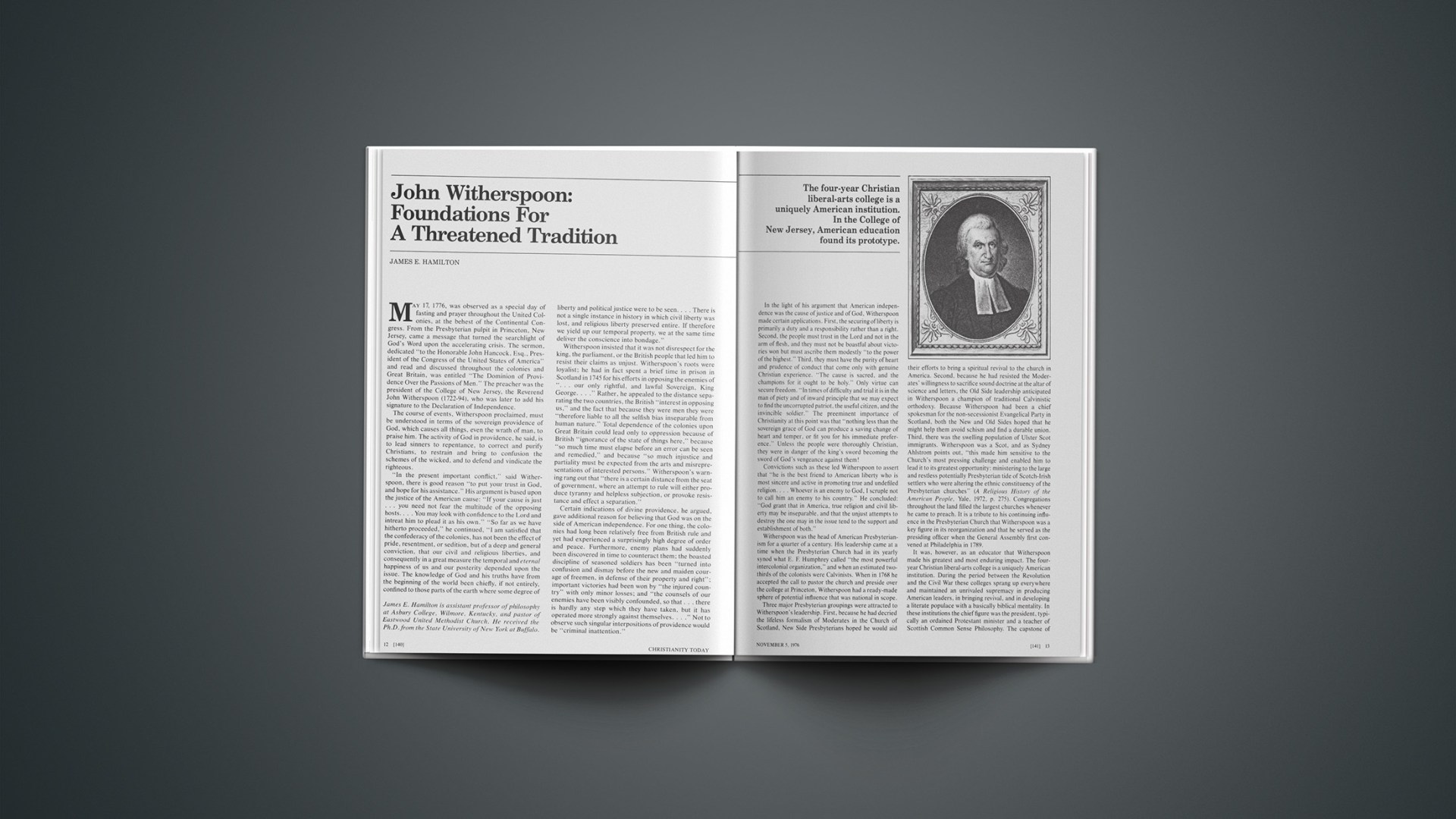
John Witherspoon: Foundations for a Threatened Tradition

May 17, 1776, was observed as a special day of fasting and prayer throughout the United Colonies, at the behest of the Continental Congress. From the Presbyterian pulpit in Princeton, New Jersey, came a message that turned the searchlight of God’s Word upon the accelerating crisis. The sermon, dedicated “to the Honorable John Hancock, Esq., President of the Congress of the United States of America” and read and discussed throughout the colonies and Great Britain, was entitled “The Dominion of Providence Over the Passions of Men.” The preacher was the president of the College of New Jersey, the Reverend John Witherspoon (1722–94), who was later to add his signature to the Declaration of Independence.

The course of events, Witherspoon proclaimed, must be understood in terms of the sovereign providence of God, which causes all things, even the wrath of man, to praise him. The activity of God in providence, he said, is to lead sinners to repentance, to correct and purify Christians, to restrain and bring to confusion the schemes of the wicked, and to defend and vindicate the righteous.

“In the present important conflict,” said Witherspoon, there is good reason “to put your trust in God, and hope for his assistance.” His argument is based upon the justice of the American cause: “If your cause is just … you need not fear the multitude of the opposing hosts.… You may look with confidence to the Lord and intreat him to plead it as his own.” “So far as we have hitherto proceeded,” he continued, “I am satisfied that the confederacy of the colonies, has not been the effect of pride, resentment, or sedition, but of a deep and general conviction, that our civil and religious liberties, and consequently in a great measure the temporal and eternal happiness of us and our posterity depended upon the issue. The knowledge of God and his truths have from the beginning of the world been chiefly, if not entirely, confined to those parts of the earth where some degree of liberty and political justice were to be seen.… There is not a single instance in history in which civil liberty was lost, and religious liberty preserved entire. If therefore we yield up our temporal property, we at the same time deliver the conscience into bondage.”

Witherspoon insisted that it was not disrespect for the king, the parliament, or the British people that led him to resist their claims as unjust. Witherspoon’s roots were loyalist; he had in fact spent a brief time in prison in Scotland in 1745 for his efforts in opposing the enemies of “… our only rightful, and lawful Sovereign, King George.…” Rather, he appealed to the distance separating the two countries, the British “interest in opposing us,” and the fact that because they were men they were “therefore liable to all the selfish bias inseparable from human nature.” Total dependence of the colonies upon Great Britain could lead only to oppression because of British “ignorance of the state of things here,” because “so much time must elapse before an error can be seen and remedied,” and because “so much injustice and partiality must be expected from the arts and misrepresentations of interested persons.” Witherspoon’s warning rang out that “there is a certain distance from the seat of government, where an attempt to rule will either produce tyranny and helpless subjection, or provoke resistance and effect a separation.”

Certain indications of divine providence, he argued, gave additional reason for believing that God was on the side of American independence. For one thing, the colonies had long been relatively free from British rule and yet had experienced a surprisingly high degree of order and peace. Furthermore, enemy plans had suddenly been discovered in time to counteract them; the boasted discipline of seasoned soldiers has been “turned into confusion and dismay before the new and maiden courage of freemen, in defense of their property and right”; important victories had been won by “the injured country” with only minor losses; and “the counsels of our enemies have been visibly confounded, so that … there is hardly any step which they have taken, but it has operated more strongly against themselves.…” Not to observe such singular interpositions of providence would be “criminal inattention.”

In the light of his argument that American independence was the cause of justice and of God, Witherspoon made certain applications. First, the securing of liberty is primarily a duty and a responsibility rather than a right. Second, the people must trust in the Lord and not in the arm of flesh, and they must not be boastful about victories won but must ascribe them modestly “to the power of the highest.” Third, they must have the purity of heart and prudence of conduct that come only with genuine Christian experience. “The cause is sacred, and the champions for it ought to be holy.” Only virtue can secure freedom. “In times of difficulty and trial it is in the man of piety and of inward principle that we may expect to find the uncorrupted patriot, the useful citizen, and the invincible soldier.” The preeminent importance of Christianity at this point was that “nothing less than the sovereign grace of God can produce a saving change of heart and temper, or fit you for his immediate preference.” Unless the people were thoroughly Christian, they were in danger of the king’s sword becoming the sword of God’s vengeance against them!

Convictions such as these led Witherspoon to assert that “he is the best friend to American liberty who is most sincere and active in promoting true and undefiled religion.… Whoever is an enemy to God, I scruple not to call him an enemy to his country.” He concluded: “God grant that in America, true religion and civil liberty may be inseparable, and that the unjust attempts to destroy the one may in the issue tend to the support and establishment of both.”

Witherspoon was the head of American Presbyterianism for a quarter of a century. His leadership came at a time when the Presbyterian Church had in its yearly synod what E. F. Humphrey called “the most powerful intercolonial organization,” and when an estimated two-thirds of the colonists were Calvinists. When in 1768 he accepted the call to pastor the church and preside over the college at Princeton, Witherspoon had a ready-made sphere of potential influence that was national in scope.

Three major Presbyterian groupings were attracted to Witherspoon’s leadership. First, because he had decried the lifeless formalism of Moderates in the Church of Scotland, New Side Presbyterians hoped he would aid their efforts to bring a spiritual revival to the church in America. Second, because he had resisted the Moderates’ willingness to sacrifice sound doctrine at the altar of science and letters, the Old Side leadership anticipated in Witherspoon a champion of traditional Calvinistic orthodoxy. Because Witherspoon had been a chief spokesman for the non-secessionist Evangelical Party in Scotland, both the New and Old Sides hoped that he might help them avoid schism and find a durable union. Third, there was the swelling population of Ulster Scot immigrants. Witherspoon was a Scot, and as Sydney Ahlstrom points out, “this made him sensitive to the Church’s most pressing challenge and enabled him to lead it to its greatest opportunity: ministering to the large and restless potentially Presbyterian tide of Scotch-Irish settlers who were altering the ethnic constituency of the Presbyterian churches” (A Religious History of the American People, Yale, 1972, p. 275). Congregations throughout the land filled the largest churches whenever he came to preach. It is a tribute to his continuing influence in the Presbyterian Church that Witherspoon was a key figure in its reorganization and that he served as the presiding officer when the General Assembly first convened at Philadelphia in 1789.

It was, however, as an educator that Witherspoon made his greatest and most enduring impact. The four-year Christian liberal-arts college is a uniquely American institution. During the period between the Revolution and the Civil War these colleges sprang up everywhere and maintained an unrivaled supremacy in producing American leaders, in bringing revival, and in developing a literate populace with a basically biblical mentality. In these institutions the chief figure was the president, typically an ordained Protestant minister and a teacher of Scottish Common Sense Philosophy. The capstone of the curriculum was often a course in moral philosophy taught by the president. In the College of New Jersey and in its president, John Witherspoon, this future pattern of American education found its prototype.

When Witherspoon came to the College of New Jersey (later to become Princeton University) he set out to strengthen and enrich the broad liberal-arts base on which it had been founded. To do this, he purchased for the library more than three hundred books on theological, philosophical, educational, and political subjects; he expanded the curriculum by adding French and broadening the courses in Hebrew, theology, and philosophy; he introduced the lecture method of teaching; and he purchased the famous Rittenhouse orrery, a mechanical model of the solar system, which led to a professorship in mathematics and natural philosophy in 1771 and which inspired a fair amount of significant political philosophizing.

The essence of Witherspoon’s contribution to American higher education was in the area of ideals, in the vision of an educational system that would produce consecrated Christian students who had an integrated and thoroughly biblical world view and also a burning desire to find a place of useful service. Spiritual matters received top priority in his philosophy of education. “Religion,” he said, “is the grand concern to us all, as we are men;—whatever be our calling and profession, the salvation of our souls is the one thing needful” (Works [1803 edition], IV, 11). Literature without piety, he maintained, “is pernicious to others, and ruinous to the possessor.” However, piety without literature “is but little profitable.” Therefore, Witherspoon told his students, “The great and leading view which you ought to have in your studies, and which I desire to have still before my eyes in teaching … may be expressed in one sentence—to unite together piety and literature—to show their relation to, and their influence upon one another—and to guard against anything that may tend to separate them, and set them in opposition” (Works, IV, 10).

Witherspoon regarded Scripture as divine revelation but held that the Bible was not intended to teach us everything. Academic studies are most fruitful when investigation of biblical truth proceeds in conjunction with research into the various areas of God’s creation. He himself was initially uncertain whether to teach in the area of divinity or elsewhere. He ended up doing both.

It has been said that Witherspoon was more interested in producing secular leaders than in producing ministers. This contention is falsified by his own words as well as by the large number of his students who entered the ministry. “Nothing would give me a higher pleasure,” he asserted, “than being instrumental in furnishing the minds, and improving the talents of those who may hereafter be the ministers of the everlasting gospel” (IV, 10).

Perhaps Witherspoon’s greatest gift to American thought and education was his introduction and fervent propagation of the method, epistemology, metaphysics, and ethics of Thomas Reid’s Common Sense Realism. Following Reid, Witherspoon argued that the human mind can and does know truth and that the ordinary experience of universal humanity carries its own self-evident authentication. The proper method of special investigation in any area is the inductive approach advocated by Francis Bacon, which should be applied to the study of man as well as the material world. The senses are the appropriate instruments for the knowledge of physical realities, while inward self-consciousness is the primary source of knowledge of the psyche. Even in the area of metaphysics Witherspoon thought it safer to trace facts upward than to make deductions downward.

The tenets of Scottish or Common Sense Realism included an ontological dualism between the world and God, a psychological dualism between soul and body, the rationality and objectivity of moral judgments, and a real though limited freedom of the human will. Witherspoon regarded the freedom of the will as vindicated by conscious experience and as necessary for understanding the biblical doctrines of human responsibility and guilt. He was never able to reconcile his thinking at this point with the theology of John Knox, but he took this to be a failure in his own understanding and continued to contend for both.

The significance of Witherspoon’s introduction of the philosophy of the Scottish Enlightenment to the American scene cannot be overestimated. Common Sense Realism became for a century the most universal force shaping the American mind and was the chief instrument for integrating knowledge in Christian liberal-arts colleges during the years of their growing importance in American life. Its widespread acceptance was a major reason why revivalistic Christianity was so widely embraced, particularly by thinking people. Its teaching on the freedom of the will had a moderating influence on Calvinistic theology and greatly strengthened the case for liberty in the political realm.

The extent of Witherspoon’s influence as president and professor at Princeton was furthered by the intercolonial character of the college and by the subsequent careers of his students. Among the American colleges of Witherspoon’s day, only Princeton was intercolonial. Part of the reason for this was its non-denominational status. Though established and largely directed by Presbyterians, it was free of official church control and open to students of all denominations without discrimination. The primary reason, however, was the widespread geographical distribution of Ulster Scot settlers, hence of Presbyterian churches and people, throughout the colonies. As William W. Sweet points out, “Harvard, Yale and the College of William and Mary were largely local institutions, drawing their students from the colonies in which they were located, which was likewise true to a large extent of King’s College in New York and the College of Philadelphia.… When James Madison entered the College of New Jersey, of the eighty-four students in attendance only nineteen were from New Jersey, and every colony was represented in the student body. Of the twelve students who were in the graduating class of 1771 only one was from New Jersey” (Religion on the American Frontier, Harper, 1936, II, 7). In 1776 roughly one-fourth of the alumni of the College of New Jersey were from New England, one half from the middle colonies, and one fourth from the South.

Great men in history, Witherspoon told his students, have generally appeared in clusters. He urged them, therefore, to maintain their friendships after graduation. Witherspoon purposed to produce leadership for strategic areas of national life. His students pervaded the pulpit ministry, education, and government. No fewer than 114 became clergymen. At least ten colleges and academies were founded by former students. Foremost educational institutions in Pennsylvania, Virginia, North and South Carolina, Kentucky, Tennessee, and Georgia had men who had studied with Witherspoon or one of his students in places of leadership. Thirteen of his pupils became college presidents.

Among the Princetonians in the national government with Witherspoon’s signature on their diplomas were President James Madison (“Father of the Constitution”), Vice-president Aaron Burr, ten cabinet officers, six members of the Continental Congress, twenty-one senators, thirty-nine representatives, three Supreme Court judges, one attorney general. There were also twelve state governors. Although these figures involve some overlapping, still they only begin to indicate the amount of public service rendered in the young republic by students of John Witherspoon. As a Christian gentleman, a pastor, an educator, and a statesman, he lived what he taught.

Witherspoon’s role as a statesman was hardly less significant than his roles as a churchman and an educator. Within two years of his arrival in America, he had met the Madisons, the Lees, the Washingtons, and other prominent families and had established himself as a national figure. A member of the Continental Congress, he also sat on more than a hundred committees between the Revolution and the Constitutional Convention. For several months in 1783 the Continental Congress actually took up residence in Princeton’s Nassau Hall. John Adams called him an “animated son of liberty.” Horace Walpole is said to have informed Parliament after the Declaration of Independence that the Americans had “run off with a Presbyterian parson.” Sweet writes that “no patriotic leader in the colonies had been more influential or useful to the cause of independence than John Witherspoon” (Religion on the American Frontier, II, 5). Jonathan Odell, the powerful Tory satirist, was less complimentary:

Unhappy New Jersey mourns her thrall,

Ordained by the vilest of the vile to fall;

To fall by Witherspoon!—O name, the curse

Of sound religion, and disgrace of verse.

Member of Congress, we must hail him next:

‘Come out of Babylon,’ was now his text.

… I’ve known him seek the dungeon dark as night,

Imprisoned Tories to convert, or fright;

Whilst to myself I’ve hummed, in dismal tune,

I’d rather be a dog than Witherspoon

[Moses C. Tyler, ed., The Literary History of the American Revolution, 1897, II, 122].

We must take note also of Witherspoon’s activities as a pamphleteer and as a man of prayer. His prodigious literary efforts began amid the storms of church controversy in Scotland and came to maturity in the American political crisis. Though he wrote on religious and educational topics also, the majority of his essays in this country were on matters of political concern. His most masterly piece was probably his “Essay on Money as a Medium of Commerce, with Remarks on the Advantages and Disadvantages of Paper admitted into General Circulation.” As a member of the congressional committee on finance, Witherspoon had jeopardized his popularity by opposing the use of paper currency in the years immediately after the war. His essay was later published at the insistence of some of the very congressmen who had originally resisted his views. His conception of a sound financial policy for the United States therefore precedes that of Alexander Hamilton.

Witherspoon gave daily priority to personal and family devotions. On the last day of each year he and his family customarily observed a day of fasting, humiliation, and prayer; he also set aside other days for personal fasting and prayer, as it seemed appropriate.

The American Revolution, according to Moses Coit Tyler, “was preeminently a revolution caused by ideas and pivoted on ideas.” It may be that when all the facts are in, Witherspoon’s greatest significance will be found in the fact that at the time of our nation’s founding he was the chief spokesman for the great tradition of biblical faith that has been the soul of Western civilization as well as of American culture, a tradition that bequeathed to the world such concepts as limited government and the separation of political and religious spheres of authority.

Eutychus and His Kin: November 5, 1976

The Marriage Conspiracy

I’m not usually a believer in conspiracy theories. I’m naïve enough to believe that John Kennedy, Martin Luther King, Bobby Kennedy, and George Wallace were not all shot by members of the same clandestine organization. I don’t believe that the Communists are behind the busing demonstrations, labor strikes, or the high cost of pantyhose.

And usually I don’t think that one thing always leads to another. I don’t think rock music, for example, leads to fornication and pregnancy out of wedlock as does the Reverend Charles Boykin of Tallahassee, Florida. (According to his statistics, “out of 1,000 girls who became pregnant out of wedlock, 986 committed fornication while rock music was being played.”)

But I am concerned about trends. And a trend I’m concerned about in the evangelical wing of the Church is our new attitude toward no-no’s.

I can remember in the good old days when dancing, drinking, smoking, and moviegoing were considered on a par with the unpardonable sin. But slowly we loosened up. Dancing didn’t necessarily lead to group sex, we discovered, so we let our kids go to school dances, and we even danced some with our spouses “in the privacy of our own homes.” We read again Paul’s admonition that a little wine was good for the stomach’s sake, and we had some. Smoking cigarettes may have been bad for all except Southern Baptists, but we learned that pipe smoking was almost a spiritual experience. And certainly many movies had intrinsic artistic worth. Gradually (and in many cases appropriately) some no-no’s faded into the sunset.

But there are other no-no’s in the process of fading that I think need to be re-examined. One is divorce. Years ago, marriage was thought of as a lifelong commitment. If you had tough times, somehow you hung in and worked it out. Maybe married life wasn’t always abundant, but it was solid.

Today we seem to be on the verge of toppling that “rule” along with the rest. The number of divorces occurring among church people is astounding. Talk to any campus pastor who has been on the scene for a while and he or she will tell you that marriage isn’t what it used to be. Look at the parish. Examine the ministry and you’ll see that divorces are up … and climbing.

I know there are many reasons for divorce and some of those reasons are valid. But I’m concerned. If someone doesn’t speak up soon and say marriage is still for life and demands some dedication in the midst of the blahs, then we’re in for trouble. Soon we’ll be saying that divorce is okay as long as it doesn’t cause anyone to stumble. Or that it has redeeming value … especially if you smoke a pipe.

That could be a bad day.

EUTYCHUS VII

A Therapeutic Sadness

I was deeply moved by George R. McDonough’s poem, “A Missionary Dying on the Molopo” (Sept. 24). Although I have not had extensive cross-cultural experience or intimate contact with serious illness or death, his lines evoked in me the pathos that lurks near the center of the life of every man. Only rarely does such a feeling find adequate expression. Some will question the poet’s faith; I simply praise his honesty. He does not describe a tragedy, although secular man might call it that; he simply and humbly discloses his deep disappointment.… The sadness it stirred was strangely warm and therapeutic. But I was helped most by the fact that it bolstered my faith in the power of words to really live and communicate.…

CHRISTIANITY TODAY’s recognition of sensitive poetry is encouraging. Christians have, above all others, the message and the experience to inspire poetic expression. Too often, though, it has been desecrated with doggerel.

LEONARD ALLEN

East Frayser Church of Christ

Memphis, Tenn.

The quality of your poetry has improved markedly in recent months, but no poem you have published has been finer than “A Missionary Dying on the Molopo.” I look forward to more from this poet.

DAVID D. SALMON

Oakland, Calif.

Encouraging and Exciting

I must commend you for the fine article in the September 24 issue: “Dietetic Deficiencies the Church Can Cure” by T. F. Torrance.… I am a young pastor … and have been wrestling with both concluding emphases, the Word and pastoral visitation. I wholly agree with the thesis of Torrance. This article gives me deep encouragement and excitement, and I hope it does for scores of other pastors and laymen, too.

THEODORE E. CUTRELL

First Free Methodist Church

Lafayette, Ind.

The Bible On Wealth

Your editorial “Election ’76—The Push Potential” (Sept. 10) is interesting in its explanation of the democratic and aristocratic impulses in society. But non-committal.

The Bible is not. The Old Testament economic arrangements, with the seven-year release and the fifty-year jubilee, are clearly democratic in direction. They are all in favor of the poor and unfortunate, the debtor and the slave. The New Testament, so far as I can see, has not one word in it favorable to riches. Why this direction? Because wealth is power, power to get more wealth and to control government in its favor. And because poverty is weakness and grows on itself. God is in favor of the poor.

L. A. KING

Norwich, Ohio

Not About To Be Objective

I was extremely disappointed in Dean Kelley’s review of Ted Patrick’s book (Books, Sept. 24).… Mr. Kelley, as a Patrick opponent, was not about to give anything approaching an objective evaluation of the book. He gave three paragraphs of summary and then five paragraphs of his opinion of Patrick’s operation. Finally he called for another book to refute it. He had just attempted to do that very thing for more than a full magazine page. His attack was interesting reading but not what I am looking for in a book review. No more—please.

RAYMOND HARRISON

Grace Methodist Church

Leesville, La.

Waiting For Brezhnev?

I was blessed by your cover story of October 8 on the spread of the influence of God’s word inside Russia. Especially exciting and challenging … was the deep commitment our Soviet brothers and sisters have to that Word, a commitment that grows in inverse proportion to the copies of the Bible available to them!…

Doesn’t it appear, though, that the article evidences the same safe, “conservatistic” attitude towards the self-edification of the Body of Christ that has so often characterized our support of persecuted churches? The Bible gives us clear substantiation to consider Christ’s Body as one Body; … nothing is said about the need of non-Christian authorization before the Body can minister to itself and upbuild itself in love. What a silly notion: Jesus, risen and exalted Lord, the holder of all power in heaven and earth, coming again in glory, sitting at the right hand of the Father waiting around for Leonid Brezhnev to open the Iron Curtain!

KERN R. TREMBATH

St. Louis, Mo.

From an Evangelical Viewpoint

I would like to tell you how much I’ve enjoyed your magazine. I’ve particularly enjoyed your section “Refiner’s Fire,” which deals with contemporary writers from a Christian perspective. I would like very much to see an article on John Berryman, one of the major American poets of our time. I really like the way you examine the work of contemporary writers from a conservative, evangelical viewpoint. Keep up the good work.

DONALD MCCANTS

Tuscaloosa, Ala.

How Many Baptists In Burma?

There is a factual error in the interview with Chandu Ray, “Asian Strategy For Evangelism” (Aug. 27). Mr. Ray was reported to have said in regard to the Baptists in Burma, “In the last decade the Baptist church has more than doubled, from 224,000 to 480,000.” I have received from the office of the general secretary of the Burma Baptist Convention their latest report (1975) on church membership. Membership stood at 305,252 at the end of 1975. This same figure was reported by the Baptist World Alliance Executive Committee meeting in August, 1976, in Australia. The alliance report indicates that there are an additional 8,500 Baptists who are not related to the Burma Baptist Convention or to the Baptist World Alliance.

In the interests of accuracy and interpretation of statistics, the correct size of the church membership of the Baptists in Burma indicates about 36 per cent growth in the last decade—still a commendable growth, but considerably less than double!

DEAN R. KIRKWOOD

International Ministries

Valley Forge, Pa.

• The figures cited in the letter are for baptized believers, and unbaptized children are not included. Bishop Ray’s total, confirmed by Burmese Christian leaders, is for the entire Baptist community.

—ED.

Editor’s Note from November 05, 1976

Available information has led serious observers to conclude there will be a very serious worldwide energy (oil) shortage in the days ahead. In our lead editorial, “Consider the Case For Quiet Saturdays,” we have proposed Saturday closing as a step in the right direction. At least such action would give us more time to work on alternatives.

Will an Evangelical President Usher in the Millennium?

A pronounced shift toward conservatism—both political and religious—is one of the most remarkable characteristics of today’s ideological climate both in Europe and in America. England, faced by near financial collapse as a result of irresponsible socialist policies for a generation, has recently made a revolutionary shift away from Keynesian economics. On July 14, the singer chosen in France to lead the country in the “Marseillaise” over nationwide television was twenty-nine-year-old Michel Sardou, who has been called a fascist for such songs as “Les Ricains,” honoring the American-led Normandy invasion of 1944, without which “we would all be in Germany today.” The growth of Communist party strength in Italy can be accounted for only by the extreme ineptitude of the Christian Democrats, demonstrating little more than the common-sense fact that if the good guys are sufficiently stupid or corrupt, the bad guys can win by default (even if the pope is against them).

Religiously, the climate of opinion is going evangelical. Time magazine, whose articles on the conservative victory in the Lutheran Church-Missouri Synod have shown how little pleased it is with this trend, referred quite frankly, in its July 26 article on the current successes of evangelical publishing, to “the shift toward Evangelicalism throughout U. S. religion.”

To be sure, the most dramatic illustration of the new wave of evangelical influence lies in the American presidential campaign arena. All three prime figures who were in the race for major-party presidential nominations must be classed religiously within the conservative aegis: Ford, an evangelical Episcopalian, one of whose sons attends Gordon-Conwell Theological Seminary; Reagan, whose conservative religious views have been duly noted by his critics; and Jimmy Carter, whose toothy smile alone would almost be enough to identify him as an “I’m-so-happy” evangelical, but who has (more importantly) spoken of his conversion experience in terms that have set some rabbinic teeth on edge.

If one’s own convictions are evangelical, one’s initial reaction is uncritical glee: finally the liberals are getting theirs, after years in which they have dominated the ideological and political climate with scarcely a nod to the existence of anyone else. But it is exactly at such a point that uncritical self-satisfaction must be avoided.

To put the question in the baldest and most irritating form: If, as seems inevitable, the occupant of the White House will be religiously conservative, should this be taken (along with the return of the Jews to the Promised Land) as a “sign” that millennial perfection is just around the corner? Answer: surely not.

In the first place, one of the defining marks of American constitutionalism is the limits it places on each major branch of government. Neither the executive, nor the legislative, nor the judicial rooster rules the federal roost. In the face of Nixon’s attempts to overwhelm legislative and judicial checks upon his activities, it seems likely that our new president will have to function within the clear restraints of constitutional separation of powers. In light, moreover, of the gross and disgusting immoralities of a number of our congressional leaders, evangelicals should realize that vigilance remains the price of freedom and that Congress and the courts, no less than the Chief Executive, need conversion from on high.

But even more significantly, the degree to which an evangelical president would influence the country toward biblical ideals would not be simply a function of his “conversion experience”: it would depend on whether his theological head was screwed on straight. A “converted” president who had never worked out the implications of his conversion theologically—who read the Bible “devotionally” but did not apply its specific teaching to his decision-making and policies—would be of little more consequence than an unbeliever in the same position. Indeed, he might be more dangerous, for anti-scriptural policies could thereby be cloaked with a veneer of piety “insomuch that, if it were possible, they shall deceive the very elect.”

A specific example of the relation between Christian principles and public issues is in order—and it should be pondered most carefully. The Bible stands absolutely against the killing of fetal life. Among Bible-believing theologians, Protestant and Catholic, this issue is no longer in dispute (if we discount, as we should, a semi-popular evangelical survey text on Christian ethics that relies on a misexegesis of Exodus 21:22, 23). For a genuine evangelical, there is no option but to regard the Supreme Court’s decision in Roe v. Wade as monstrous—and no alternative, in our government of checks and balances, but to counter that decision by a constitutional right-to-life amendment, protecting the unborn child by declaring (as did the Fourteenth Amendment of the former slave) that he is a legal person deserving of full constitutional safeguards.

Where do the “converted” aspirants for the presidency stand on this issue? Both Ford and Carter “personally oppose” abortion, but neither favors a constitutional amendment outlawing it. In Carter’s case, does this remarkably irrational position stem from his having had his head melted by the dialectic influence of his avowedly favorite (neo-orthodox and ontological) theologians—Niebuhr, Barth, Tillich, and Kierkegaard? On the constitutional question Ford apparently goes a bit farther than Carter, in that he would favor an amendment permitting each state to enact its own abortion legislation. Note, however, that this approach still refuses to give the unborn any federal constitutional protections and leaves their lives to the whims of state politics.

The mush-headedness (should we rather say, political expediency?) displayed on this issue leaves one in real doubt that even with an evangelical in the White House the millennium is around the corner. But it should remind us that biblical revelation is the fundament of Christianity, not “experience,” however thrilling; and it should encourage us to pray that God will put not only a believer in the White House but a believer “sound in the faith, not given to fables and commandments of men, that turn from the truth.”

Revival and Risks in Romania

The following update is based on reports filed by correspondents Alan Scarfe and Robert D. Linder. Both have traveled in Romania and maintain contacts with Christian workers there. Scarfe is on the staff of the Keston College Center for the Study of Religion and Communism, located in the London suburbs, and Linder is a history professor at Kansas State University.

Romanian evangelical churches are increasing their membership at a rapid rate. In some parts the descriptive word is “revival.” In the northern city of Oradea, pastor Liviu Olah has seen his Baptist congregation grow from 600 to 1,500 members within a year. (Young people, especially students, are reportedly seeking to meet at every opportunity to study the Bible together and to pray despite intensifying pressure against religion in the universities—or perhaps because of it.)

The interest in theological training is high. The Orthodox Church accommodates 1,200 students in its university-level theological institutes, plus many more at seminary level. The Baptist seminary in Bucharest this year had ten times more applications than it could accept.

Interest in the Gospel on the part of young people spans the country. Nicknamed “the Revival People,” young people in many locales are extremely aggressive in their witnessing, and this has cost some of them any opportunity they might have had to attend a university. But alongside the youth at mass baptisms one sees older couples, too. And many entire families of Gypsies are active in the spiritual movement.

All this evangelical activity has disturbed Communist authorities, and it has not been without cost. In the fall of 1973, both state and church were challenged by a paper written by Baptist pastor Josif Ton of Ploesti on “the present-day situation of the Baptist church in Romania.” Among other things, it listed religious freedoms surrendered to the state by the churches (see November 22, 1974, issue, page 52).

A year later, with some of the issues raised in Ton’s paper resolved, he issued an open attack against the official state ideology of atheism (see March 26 issue, page 6). The arrest and imprisonment of Pentecostal worker Vasile Rascol revealed the existence of a new press law that banned unauthorized distribution of literature, including Bibles and Christian books. Ten leading evangelicals had their houses searched and their possessions confiscated. Ton, together with two other Baptists, Aurel Popescu and theologian Pavel Nicolescu, was being summoned to police headquarters regularly for questioning about his activities. The investigation of Ton was suspended last year.

Concessions gained through all this effort include additional religious services, the lifting of restrictions on baptisms, increases in seminary enrollment, and a measure of freedom to challenge the policies dictated by the Department of Cults (the government department responsible for overseeing religious affairs).

Individual leaders of the protest and their families are still harrassed and intimidated. Ton, for example, is constantly followed by the police; they are eager to find some excuse to bring charges against him. Another believer is in continual danger because of his work in biblical translation, and yet another because of his compilation of a new Romanian hymnal. Others have lost their jobs or been denied access to higher education.

Another crunch began to develop a year ago. The president of the Baptist Union, Nicolae Covaci, resigned. He saw signs of possible interference by the state into election affairs of the church alliance, and government officials had been uncooperative in requests for permits to repair, expand, or reconstruct church buildings. On both counts he feared rebellion within the ranks that would split the churches (some are more assertive in resisting state-imposed inhibitions than others).

New officers of the Union were elected last December with little outside interference. There were government stalling tactics, however, over recognizing those elected. The Department of Cults declined to accept the validity of the election of two leading members of the Union, Pastor Olah of Oradea and Pavel Barbatei of Cluj. Both are graduates in law. A third law graduate, pastor Vasile Talos, was also elected to the fifteen-member Union council. He set the pre-election tone with the presentation in a regional association meeting of an eighty-page paper on the relation between Baptist churches and the law. With “the legal standing of the Romanian Baptist churches” as the keynote of the election platform, says an observer, three lawyers would be more than the state could put up with.

The authorities argued that Barbatei had been involved in car speculating, and they claimed Olah’s election was invalid because a state representative was not at the regional meeting where he was chosen. Now they have an additional argument. This past July he organized an open-air baptism service for about seventy candidates. When he informed the local authorities of his plans, however, they requested him not to baptize in the river. Olah nevertheless went ahead with plans to meet at the river, saying the wooden structure of his church building might collapse under the weight of the anticipated crowds. Military officials then organized a counter-demonstration in honor of the centenary anniversary of the Red Cross in Romania—at the same time and place as the proposed baptism. With one day’s notice, Olah switched the baptism indoors, permitting only newcomers to enter the building; regulars had to listen to the service on four loudspeakers outdoors. Approximately 5,000 jammed the church courtyard and streets.

Following the service the Department of Cults announced it had withdrawn Olah’s permit to preach and to baptize because of his “intention” to disobey the law. At last word he was continuing his ministry in Oradea as a layman. Whether the suspension is only temporary remains to be seen, but it casts doubt on whether his election can be ratified by an upcoming assembly. (Olah was dismissed in 1973 as pastor of a congregation in Timosoara where, as at Oradea, he had an effective ministry among young people, especially students.)

The space problem faced by Olah’s congregation is a common one throughout Romania. Also, dozens of congregations still risk fines because their churches have not been recognized by the state and so their meetings are illegal.

Equally acute is the need to educate the many young people who have recently joined the churches. Educational facilities for the evangelical churches lag far behind those of the Orthodox and traditional Protestant denominations. The Baptists have 1,035 congregations with only 150 trained ministers. Based on current enrollment and projections over the next ten years, eighty will graduate from their seminary, but eighty pastors will have retired. Therefore lay training is vital if the churches are to continue their present growth. To bridge that gap without pushing the state’s guardians of ideology into worse repression is apparently the main challenge in the immediate future.

Although the local production of Bibles is still severely restricted, there has been an increase in the number of Scriptures available in Romania in the last two years. The United Bible Societies (UBS) report that the first half of an edition of 100,000 copies of the Bible is now being printed in Bucharest. This project has been largely the work of the UBS, which supplied paper from Czechoslovakia and additional binding equipment from East Germany. Moreover, the UBS arranged to have the actual printing done in the patriarchate printing house in Bucharest in cooperation with Patriarch Justinian of the Romanian Orthodox Church. Still, nearly all Romanian Christian leaders agree that they need many more copies of the Bible right away.

Several groups have been at work publishing and disseminating Christian literature in the Romanian language. For example, in the last five years the America-based Romanian Missionary Society has published or readied for publication thirty Christian books. In addition, there is a small but steady flow of Bibles and Christian literature into Romania by various undesignated means. All this goes on despite the 1974 law that makes it illegal to receive or distribute Bibles or other religious literature that originates outside Romania.

Another major means of proclaiming the Gospel in Romania is by radio. Many Romanians now have their own radios, especially portable transistors, which makes it difficult for the government to control the listening habits of its people. Several evangelical organizations or individuals are now beaming the Christian message into the country. For instance, between June 1, 1968 and June 1, 1976, the “Voice of Truth” of the Romanian Missionary Society broadcast 2,874 programs through HCJB, Quito, Ecuador. It also has weekly programs on IBRA, Lisbon, Portugal, while other evangelicals use Trans World Radio of Chatham, New Jersey, to penetrate the increasingly perforated iron curtain surrounding Romania. The Ministry of Cults recently became alarmed at the large number of people who listen to these evangelical broadcasts. It has attempted to impede their effectiveness by inducing the government to pass a press law forbidding Romanian citizens to write to foreign broadcasters. Therefore what was formerly a substantial flow of letters from listeners in Romania has become only a trickle. But all evangelical broadcasters report that they still receive a few from some courageous listeners.

The radio broadcasts have been part of a spark of revival that continues throughout Romania. However, most of the impetus in the current evangelical awakening in the country has come from the Romanian Christians themselves, particularly the Baptists and Pentecostals.

In the midst of revival and harassment, one major problem facing Romanian believers is beyond the power of friends outside the nation to help resolve. This is the understandable impulse on the part of many Christians, especially pastors and other leaders, to want to leave the country. The government has even offered to facilitate exit for some; it would like to be rid of these “troublemakers.” A few, having suffered much for their faith, have accepted the opportunity to depart for an easier life for themselves and their families. When Christian leaders leave, it weakens the churches and impedes the work of Christ—just as the government wants, say some observers.

Yet despite the pressures to cease preaching the Gospel, despite the discrimination they face daily because of their open commitment to Christ, despite official efforts to silence them by arrest, threat of arrest, or encouragement to leave, the Christians of Romania continue to work and witness for God. Perhaps the words of a Romanian believer in a recent communication to the outside world express the view of many Romanian evangelicals as to what Christians in the West can do for their fellow believers in Romania:

“Pray for your persecuted brothers in Romania! Send messages of Christian solidarity with the persecuted! Organize actions of protest before Romanian embassies! Request the leaders of the Romanian party and state to guarantee the reality of religious freedom! Request all non-governmental organizations in your countries, organizations which fight for the defense of the rights of man, to intervene! In the spirit of Christian love, show in this manner that we feel and pray for one another as those who are called by God to His perfect salvation and glory in the Lord Jesus Christ.”

The WCC: No Toning Down

Philip Potter, the general secretary of the World Council of Churches, believes that the crisis in the ecumenical movement won’t go away even if his organization discontinues its social involvement. A proper response to the crisis, he told 120 representatives of U. S. member denominations of the WCC, is in “reaffirming what we stand for and not toning down what we are doing.”

At the annual meeting of the U. S. Conference for the World Council of Churches last month on Saint Simon Island, Georgia, delegates seemed to agree. They said controversial aspects of WCC work should not be sidestepped. One means of confrontation suggested was participation in future meetings by representatives of the groups that get grants from the WCC’s Program to Combat Racism.

Georgi Vins, Symbol Of Soviet Repression

This photograph of Soviet Baptist leader Georgi Vins was taken in a labor camp near Yakutsk in Siberia earlier this year. He reached the half-way point of his five-year sentence on October 1. It is to be followed by five years of exile away from his home in Kiev. Vins’s family, including his mother Lydia, 70, had their annual visit with him in June. The outspoken Lydia, imprisoned in the past for her faith, fears she could be arrested again any day.

Meanwhile, the U.S. Congress approved a resolution calling for a broader practice of religious liberty in the Soviet Union and for Vins’s release. The bill was introduced in the House by Republican John Buchanan, a Southern Baptist minister from Alabama, along with 148 co-sponsors. Senator Henry Jackson led its passage in the Senate. It pointed out that Vins was arrested in 1966 while leading a demonstration for religious liberty and again in 1974 “for continuing to do the work normally connected with pastoral duties … preaching, teaching, writing, evangelizing.”

The photo, released by the England-based Keston College research center on religion and Communism, is believed to be the first close-up of a prisoner in a Soviet labor camp ever to reach the West.

Potter, in his address, rejected the criticism that the WCC is too involved with social issues and not paying enough attention to spreading the Gospel. “All the things we do are expressions of the Gospel of Christ,” he declared. “I say to you there is no going back. We must take hold of where we are and continue to be involved in the many ways of confessing Christ in the world today.”

There was some turning back in the council’s financial affairs, however. Delegates were reminded that giving has not kept pace with inflation and that many of the Geneva-based council’s programs are being eliminated or cut back because U. S. gift dollars do not buy as many Swiss francs as formerly.

The New York office of the WCC, a liaison facility at the Interchurch Center, had its functions cut at the meeting. The conference’s board of directors agreed to trim the task to soliciting contributions from North American churches, transferring those funds to Geneva, and keeping Geneva informed of North American events. Formerly, a principal function of the office was to interpret and promote WCC work to Americans. Next year’s central budget includes only $20,000 for the New York office, in contrast to the $100,000 provided in recent years. The facility is jointly operated by the U. S. Conference (which provides some funds independent of the central budget) and by the WCC headquarters secretariat.

Robert J. Marshall, president of the U. S. Conference (and of the Lutheran Church in America), reported that “part of the cut is [based on] the conviction in Geneva that less is needed in the way of staff in New York.”

The office at the Interchurch Center is actually one of two “New York offices” of the WCC. There is also a liaison office for the council’s Commission of the Churches on International Affairs near the United Nations headquarters. It too has been hit by the financial crunch, and WCC officials have been seeking special funding to assure its continued operation.

Honored

William A. Reed, Jr., veteran religion editor of the Nashville Tennessean, became the first black and the first Southerner to be elected president of the Religion Newswriters Association since the organization was founded in 1948. He was elected at last month’s annual meeting of the RNA, which is composed of more than 100 men and women who report religion full-time for the secular press. Reed succeeds Richard N. Ostling, religion writer for Time (and former news editor of CHRISTIANITY TODAY).

Death

F. GERALD ENSLEY, 69, retired bishop of the United Methodist Church, internationally prominent preacher, chairman of the World Methodist Council (WMC) evangelism committee; in Dublin, Ireland, of liver failure, following a major address at the WMC assembly.

In the annual awards competition, James Robison of the Chicago Tribune, Gerald Hay of the Hutchinson (Kansas) News, and the Arizona Republic, represented by Gene Luptak, took top honors.

Religion in Transit

Interim pastor Cynthia Jarvis of Westminster Presbyterian Church in Wooster, Ohio, on September 30 became the first woman to open a session of the U. S. House of Representatives with prayer. Another United Presbyterian minister, Wilmina M. Rowland of Philadelphia, was the first woman to open the U. S. Senate with prayer (July 9, 1971).

American Baptist executive Jitsuo Morikawa will serve for one year as interim pastor of the well-known liberal Riverside Church in New York City, and Southern Baptist pastor Jess C. Moody of West Palm Beach, Florida, has accepted the pastorate of the independent 12,000-member First Baptist Church of Van Nuys, California.

Lizzie Dotson of Seattle, a Louisiana-born black, celebrated her one-hundredth birthday last month. She attributes her longevity to living “close to the Lord.” A similar reason was cited by Southern Baptist evangelist James Fell Aker of Radford, Virginia. At 105, he still preaches three weeks a month and is booked for the next three years. He says he expects to be around “when the Lord returns.”

“The biggest deception ever perpetrated on the American media from a standpoint of missionizing the Jews.” That’s what the Jewish Post and Opinion thinks of evangelist Morris Cerullo’s filmMasada. The film is scheduled to be shown on 250 television stations, accompanied by a vigorous advertising campaign. Some Jewish newspapers have published ads. The B’nai B’rith Messenger of Los Angeles later apologized editorially, but the Detroit Jewish News said the film adheres to the traditional story of the martyrdom of 960 Jews trapped on a wilderness outpost by Roman troops. One of the people in the film is the well-known Israeli archeologist Yigael Yadin. He warned of legal action if a missionary message is injected into the film. On the TV show, Cerullo appears at the end of the film and appeals for funds and acceptance of Christ.

A fire of undetermined origin caused an estimated $1 million damage to the administrative headquarters of the Radio Bible Class in Grand Rapids, Michigan. Five video tape duplicating machines, worth about $100,000, were among the losses.

Personalia

Patricia Hearst, 22, has become “deeply devout” with strong “religious commitment,” according to Episcopal priest Edward John Dumke of Sacramento. A longtime friend, he visited her often after her arrest, offering counsel and communion, and he has traveled almost weekly to the federal hospital center in San Diego where Miss Hearst was ordered in April for psychiatric studies. Dumke says her acceptance of him as her priest and of Protestant communion (she partakes often) in no way involves renunciation of the Catholic faith in which she was raised, according to a New York Times story by Everett R. Holles.

American evangelist Howard O. Jones, the senior black member of the Billy Graham team, was the first clergyman ever to preach at independence day ceremonies in the Kingdom of Swaziland in southern Africa. During the program first copies of the Gospel of St. Mark in siSwati were presented to King Sobhuza II and the Queen Mother. About 50,000—or some 10 per cent of the nation’s population—attended.

Hugh Schonfeld, the Jewish author of The Passover Plot, professed Christ as Saviour as a teen-ager, attended a Bible institute in Glasgow, Scotland, and preached in the streets, according to old friend and classmate Ernest Sittenhoff, who is quoted in an article in Eternity. Sittenhoff, a semi-retired missionary to Jews, alleges that Schonfeld “became a renegade” after “his family worked on him.”

World Scene

Rhodesia update: Methodist bishop Abel Muzorewa, 51, one of the three main leaders of rival factions in the African National Council, returned from a fourteen-month self-imposed exile to a tumultuous welcome in Salisbury. He wants to have his say in talks with white officials on setting up an interim bi-racial government that will write a new constitution and prepare for black-majority rule.

At its recent annual conference, the Evangelical Church (Tin Lanh) of what was formerly South Viet Nam elected Ong Van Huyen, long-time dean of the Bible school at Nha Trang, as chairman, succeeding Doan Van Mieng, now vice-chairman. An official of the People’s Revolutionary Committee of Ho Chi Minh City (Saigon) reportedly met with the more than 300 pastors and lay delegates and reaffirmed the government’s “unswerving policy” to respect freedom of belief. A recently expelled Chinese pastor, however, says that pressure is building. All Tin Lanh military chaplains have disappeared, and pastors have been restricted in their travel and evangelistic activity, he says.

German churchman Helmut Frenz, 43, bishop of the Evangelical Lutheran Church in Chile until the government withdrew his visa last year, was appointed to an executive position with the German section of Amnesty International. Most of Chile’s 25,000 Lutherans split from Frenz and the majority of ELCC pastors over their anti-government stance following the fall of the late president Salvador Allende. The dissidents have arranged to obtain new pastors from a conservative theological academy in Basel. The new clergymen are connected with free churches in Germany and Switzerland.

Nearly 200 of the 450 pastors in the diocese of Gothenburg, Sweden’s second-largest city, have launched a campaign to prevent Church of Sweden mission funds from going to strengthen the ecumenical-development bank of the World Council of Churches. A church mission official defends the bank, saying its purpose is to help in community economic development, not to lend support to terrorist organizations.

The Jehovah’s Witnesses in Argentina, who have had a shaky relationship with the government for years, have had all 604 of their congregations closed by edict. The Witnesses have grown from about 1,500 in 1950 to more than 31,000 last year. Last month, Patricia Ann Erb, the 19-year-old daughter of American Mennonite missionary parents, was abducted from her home in Buenos Aires. She turned up later in good health in a suburban prison. She reportedly had been active in leftist politics at a state university.

Catholic bishop Adriaho Hypolito of a poor diocese north of Rio De Janeiro was kidnapped, beaten, and left naked on a deserted road, and his car blown up, apparently by members of an anti-Communist group. They evidently were upset by the bishop’s outspoken emphasis on human rights of the poor and his condemnation of the “death squads” that have been murdering alleged criminals and leftists.

Campaign Countdown: ‘Bloc Busters’

Anyone who expects all of America’s evangelical Christians to vote the same way in the 1976 presidential election will probably be surprised when the votes are counted. As the campaign heated up during its last month it was increasingly evident that neither Gerald Ford nor Jimmy Carter could count on the highly touted “evangelical bloc.”

Issues connected with religion kept popping up as election day neared, and they were alternately helping and hurting first one candidate, then the other. Abortion, the hottest religion-related subject in the early days of the presidential race, had to share attention in the final weeks with other concerns. Taxes, foreign policy, and the use of earthy language were among the topics claiming the attention of the campaigners and those who will vote for them.

Shortly after Carter drew a barrage of criticism for his income-tax proposals, attention was directed to a statement he made on curtailing church property-tax exemptions. In an interview in the September–October issue of Liberty, a Seventh-day Adventist magazine on church-state issues, the Democratic candidate said he favored “the taxation of church properties other than the church building itself.” He was interviewed by a Liberty writer during the Ohio primary campaign last June.

After the Carter call for church property taxation appeared, he was attacked by Republican vice-presidential nominee Robert Dole. Declared Dole: “I find it incredible that Mr. Carter wants to impose taxes on church-owned hospitals, schools, senior-citizen homes, and orphanages. Is this really what he favors? Or is this just another case where Governor Carter has said something and may have to apologize later?”

Carter promptly issued a statement saying he never advocated taxing churches and as governor of Georgia tried to amend the state constitution so that sales taxes would not hit hospitals, nursing homes, and other church-affiliated organizations. He also pledged to try to protect the interests of charitable institutions in the tax-reform package he would propose as president.

At a White House meeting of his campaign committee on ethnic affairs, President Ford spoke to the issue: “Nothing could be worse for church-operated schools, hospitals, and orphanages, many of which face constant financial struggles to make ends meet. I can tell you unequivocally, emphatically, that this administration has neither plans nor supports any effort to tax churches beyond the present scope of federal taxation.”

Foreign affairs took up much of the time when a group of thirty-four evangelical broadcasters discussed issues with Ford just a week before his second televised debate with Carter. He said there was “only a 60–40 per cent chance of success” for Secretary of State Henry Kissinger’s peace mission in southern Africa. He indicated it was worth the risk, saying, “If nothing were done by the United States it was likely that civil and international war would have erupted, with widespread bloodshed.”

Endorsing the President’s diplomatic initiatives in southern Africa during the White House meeting was Howard O. Jones, the senior black on the Billy Graham team and speaker on the “Hour of Freedom” radio program. Jones had returned to the United States the day before from three weeks in southern Africa, where he preached in Swaziland, an independent territory bordering on South Africa. “I told the President,” the evangelist said after the meeting, “that thousands and thousands of Christians in Swaziland were praying his plan would work.”

Carter meanwhile released the text of a cable of support that he dispatched to Donal F. Lamont, the Irish missionary bishop of Umtali, Rhodesia. The Roman Catholic prelate was convicted of aiding terrorists after failing to report the whereabouts of guerrillas who had demanded medicine at a church mission, and he was sentenced to a ten-year jail term.

Both major candidates continued to assure Jewish leaders of their interest in helping the state of Israel, but they also spoke of their support for the Jewish nation before evangelical audiences. Ford told the broadcasters that Kissinger’s efforts in the Middle East “have borne fruit and the tensions have been substantially diffused.”

(In the Liberty interview Carter said “a basic cornerstone of our foreign policy should be preservation of the nation of Israel, its right to exist, and its right to exist in a state of peace.” He added that he thought its establishment as a modern state was a “fulfillment of Bible prophecy.”)

The visiting broadcasters also heard a Ford pledge to maintain American troops in Korea at present levels. The President added that his administration would stand by America’s treaty obligations with the Nationalist Chinese government.

Members of the executive committee of National Religious Broadcasters formed the core of the group that met Ford in the White House Cabinet Room. Other station operators and producers of religious programs were added to that group to provide geographical and denominational balance, according to Ben Armstrong, NRB’s executive secretary.

Among the prominent broadcasters who came to Washington for the meeting was W. A. Criswell, whose weekly services are telecast from First Baptist Church of Dallas, Texas. Criswell, former president of the Southern Baptist Convention, had earlier been quoted as a critic of Carter’s Playboy interview. The President was scheduled to attend a Sunday service at Criswell’s church ten days after his White House session with the pastor. Criswell and other clergy among the broadcasters recounted details of their visit with Ford to their congregations.

The Playboy issue came up at the meeting with the president. Ford told his visitors that he had turned down an invitation to be interviewed by the magazine, which features a Carter interview in its November issue. Ford also denied any wrongdoing in the use of campaign funds while he was a congressman.

The broadcasters met with the President only a few hours before he learned of the obscene racial slur credited to Secretary of Agriculture Earl Butz. While they were waiting to see Ford, Butz and other ranking administration officials talked with them. Ford later reprimanded Butz and subsequently accepted his resignation. He also sent an apology to the broadcasters for having Butz at their meeting.

When Butz entered the Cabinet Room he asked Armstrong to tell him who was sitting in the chair he usually occupied during Cabinet meetings. Armstrong told him it was Jones, who had just returned from Africa. The then-secretary of agriculture is reported to have said, “Dr. Jones, you’re sitting in my chair, and you grace it very well.” None of the visitors knew at the time of the remark that was to force his resignation four days later.

The White House staffer who escorted the broadcasters to the Cabinet Room and arranged other meetings with religious leaders for Ford was Richard Brannon, an ordained Southern Baptist minister who recently moved from the White House’s office of presidential personnel into the communications office. Brannon is also credited with preparations for the President’s appearances earlier this year at the Southern Baptist Convention and the joint convention of the National Association of Evangelicals and National Religious Broadcasters.

While paying some attention to the nation’s evangelicals, both candidates have continued to court the Catholic vote. On his way to the second debate Carter stopped in Denver for a speech at a Catholic Charities meeting. During Louisiana campaigning, Ford attended a service in the New Orleans cathedral.

Jeff Carter, the Democratic candidate’s youngest son, got his father in hot water when he brought up the name of evangelist Billy Graham during an Oklahoma campaign appearance. A Tulsa radio station recorded the remarks, in which the 24-year-old suggested that Graham had bought a mail-order doctorate for $5. In a later comment in Kansas City his wife, Annette, added fuel to the fire by criticizing Graham’s advice to voters to choose the best qualified candidate, whether he is a Christian or not. She said that was not “fair.”

Within a week another Carter son, Chip, dissociated himself from the Tulsa remarks of his brother. He told a South Carolina audience that his father had apologized to Graham. Actually, Mrs. Carter called; forgivingly, Graham said he was unoffended.

Meanwhile Christian voters across the country were getting advice from various sources on how to make up their minds. C. Welton Gaddy, a staff member of the Southern Baptist Christian Life Commission, wrote a series of articles for use in the Baptist press. One of his suggestions was expected to gain wide acceptance: “Southern Baptists must neither support nor oppose Jimmy Carter simply because he is a fellow Southern Baptist. Episcopalians should neither support nor oppose Gerald Ford because he is an Episcopalian.”

Hard Times In Hardenburgh

More and more religious, educational, community, and other non-profit organizations are buying up property in rural resort areas for camp sites, conference centers, and the like. Such property is removed from the tax rolls, and this increases the tax burden on private property-owners. The tax hikes can be stiff—and sometimes just too much to bear.

One example involves the 236 residents of Hardenburgh, New York. Their plight was detailed in widely published press accounts last month. The town is nestled on 54,000 acres of woodland, streams, and farmland in the Catskill mountains. The Boy Scouts, Zen Buddhists, Tibetan monks, and a conservation center own large chunks of the land. Of the $21 million assessed value of Hardenburgh, $5 million is tax exempt. Taxes paid to the school district where most of the tax-exempt property is located now equal more than $5,000 for each of the twenty-five students who live there.

One resident whose 192 acres of woods and fields have been in his family for three generations had school taxes of $450 in 1970 and town and county taxes of $350. This year his bill for school taxes is $2,000, and the other taxes are nearly that much. The stories are similar all over town. Breadwinners average between $6,000 and $7,000 income annually, and they are at the breaking point. Meetings with lawyers, local government officials, and legislators have brought no relief.

Hardenburgh has no business section, no stores, and no churches. A few residents attend church services in neighboring communities. More than half of the townspeople, however, are now ordained ministers. It all started when some people read about California entrepreneur Kirby J. Hensley and his Universal Life Church, which sells ordination certificates and honorary divinity degrees by mail. It looked like a way to get some tax breaks. For example, New York allows a reduction of $1,500 on the assessed valuation of homes owned by ordained clergy. (In practice, however, most local jurisdictions interpret the exemption narrowly, and property is totally exempt only if owned by a recognized religious group and used exclusively for religious purposes.)

There was discussion. “The question came up as to the ethics of doing it,” ranger Cal Crary told reporters. “But I question the ethics, for instance, of the conservation center that’s taken all that land.”

Plumber George McClain down the road in Liberty had become a “bishop” in Hensley’s “church” a year ago (by taking a mail-order course), so he conducted the mass ordination ceremony. About 300 persons, 150 of them from Hardenburgh, were ordained in the town’s community hall. Another batch was ordained later in a diner outside town. The only principle of the church, explained McClain, is that the rights of other persons are not to be violated.

“Hello, reverend,” the people in Hardenburgh greet one another lightly these days. “Have you seen the light?” they jest.

Thus religion has come to the Catskills at last. Relief from taxes may be another matter. If somebody organizes a “church,” he or she might try to exclude housing and utilities allowances from taxable income (as most bona fide active clergy do), but there are bound to be hassles with the tax people over it and perhaps expensive court battles (Hensley has won a key one in California). Commenting on the ordinations, New York tax official Thomas McGrath says, “Any person who thinks he can obtain a tax exemption through such a device is sadly mistaken.” The action, however, has served to call attention to the situation, say other tax authorities, and that may lead to the salvation of people like the Hardenburghers.

The Bell-Ringer Of Flat Rock

Norton Hawkins, 67, has been the bell-ringer at First Baptist Church of Flat Rock, Illinois, since 1939, and he rang the Methodist bell for fifteen years before that. In fact, he claims he’s been in church every Sunday since his birth in March, 1909, more than 3,500 Sundays ago. Once he landed in the hospital with a broken leg after being struck by a car, but with special transportation and crutches he was able to attend church two days later. Moreover, all his churchgoing has been in Flat Rock: he’s never been out of town on vacation.

The U.S. Supreme Court ruled in 1970 that tax exemptions for religious organizations are neither required nor prohibited by the First Amendment but are a matter of social policy to be determined by citizens and their elected lawmakers. An increasing number of voices are calling for the elimination of such exemptions in the face of tightened budgets and service cutbacks confronting local government bodies. Many church budgets, though, are in similar straits and cannot absorb big tax bills.

A better idea would be to expand taxing jurisdictions rather than eliminate all church exemptions, suggests Dean Kelley, religious-liberties expert on the National Council of Churches staff.

Abuses of tax privileges by religious organizations could bring on a full-scale tax revolt and the collapse of existing tax-exemption policies, warns executive director Andrew Gunn of Americans United for Separation of Church and State. The Catskill ordinations, he asserts, “could be a shot heard around the world.”

Broadcasting The Good News

In 1972, a Japanese newsman was arrested for obtaining secret diplomatic cables that revealed among other things a special plea by then U. S. ambassador Armin Meyer to Japanese officials to allow Far East Broadcasting Company (FEBC), a missionary enterprise, to remain on Okinawa after the island returned to Japanese control. Under Japanese law, foreign-owned broadcasting is not permitted.

Stories at the time mistakenly attributed Meyer’s plea to the fact that FEBC was “owned” by a “relative” of then President Nixon. As a non-profit organization, FEBC is not privately owned, but one of Richard Nixon’s uncles, Cliff Marshburn, was an FEBC board member.

The Japanese reporter, Takichi Nishiyama, was found guilty in July of this year of violating a law that prohibits disclosure of government secrets. The ruling overturned a lower-court decision. An appeal to the Japanese Supreme Court is planned in the case, which has become a major freedom-of-the-press issue in Japan. The reporter was given a four-month suspended sentence.

FEBC was permitted to continue to operate its radio station after Okinawa reverted to Japan, but the FEBC people “worked out their own arrangement with the Japanese government,” says Meyer, who is now a Georgetown University professor and is the son of a Lutheran minister. Meyer explains that his appeal was a private one based on his interest in Christian work rather than an official request of the American government.

FEBC operates some thirty radio stations worldwide, beaming evangelical programs into China and the Soviet Union as well as into a number of other Asian, African, and South American countries.

It is not the first time that FEBC’s Okinawa operation has made the newspapers in other-than-routine coverage. Much earlier, a local paper told how some of FEBC’s programming on station JOTF originated with the U. S. Army’s Seventh Psychological Operations Group, located next door to the station.

A former Specialist-5 clerk who with other enlisted personnel in his unit helped to prepare daily Japanese-language newscasts last month confirmed the story. In an interview, Robert C. Ashby, now an attorney with the Department of Transportation in Washington, said he and others culled out wire-service stories for use by translators. Newscasts were produced under the direction of Alex Yorichi for broadcast to Okinawans. Ashby and his friends also delivered copies of two ten-minute newscasts daily to the FEBC station. The program source was not identified on the air, he said.

Ashby characterized the broadcasts as “good news.” Although the news was taken from straight wire-service reports, said he, “selection was used in what news items were included.” Items that reflected unfavorably on the United States or on U. S. relations with Okinawa and Japan were eliminated.” The subject matter “dealt with both international and domestic [Japanese and Okinawan] matters.”

Ashby said the delivery of the daily newscasts was “an ongoing thing” when he arrived in Okinawa in November, 1968, and continued until he left in May, 1970. The army unit was headquartered on Okinawa from 1965 until June, 1974, when it was deactivated.

Eugene Bertermann, director of Asian operations for FEBC, could neither confirm nor deny the existence of a relationship with the psychological-warfare unit. “I don’t have any information on that,” he said. Possibly the only one with answers was FEBC’s former chief of Okinawa operations, stated Bertermann, and he is dead. Army officials likewise said they know nothing of the matter.

Although some Washington sleuths tend to see the hand of the Central Intelligence Agency in the relationship, Ashby and other observers surmise it all may have begun as a favor between friends.

Bertermann says it is against FEBC policy to be linked with government agencies. He and other mission broadcasters do see a place for government, though. At a meeting of evangelical broadcasters with President Ford last month, Bertermann discussed with Ford the need for a U. S. foreign policy to protect overseas religious broadcasting facilities.

FEBC, headquartered in Whittier, California, was founded in 1945 by ex-serviceman John C. Broger, religious broadcaster Robert H. Bowman, and Los Angeles pastor William J. Roberts. Broger, FEBC’s first president, is now the Pentagon-based civilian director of information for the Armed Forces, and Bowman is FEBC’s executive head.

ED MURRAY and JEFFREY STEIN

Unjustified

Bishop Lucius S. Cartwright, 35, of St. Philip’s Pentecostal Church in Washington, D.C., and Albert Rufus Hamrick, 40, the church’s pastor, were sentenced to six months in jail each and fined a total of $7,000 following their plea of guilty to charges of defrauding the government of $262,775 in federal food-stamp funds. Cartwright will serve his term first, then Hamrick, so that the church will not be without leadership. Their full sentences had been for four years and two years respectively, with all but six months suspended.

The clergymen went into the food-stamp dispensing business on behalf of the church in 1972. Prosecutors say they delayed for months depositing receipts in federal accounts. During the four years, more than $5.5 million in food-stamp money was handled; the pair could therefore have gleaned considerable interest by delaying transfer of the funds. Also, say prosecutors, the pair diverted funds to pay for a lavish home, an ice-cream parlor, trips, a van, and even a former bank building that now houses their church.

Defense attorneys argued that there should have been more restrictive regulations to govern the situation. Cartwright’s lawyer said his client was “untrained, unskilled in handling this amount of money.” But, said the bishop to the judge, “I cannot justify my wrongdoing.”

A Mediator For Good Shepherd

The Vatican has ordered members of the progressive Good Shepherd parish of Mt. Vernon, Virginia, and conservative bishop Thomas J. Welsh of Arlington to submit to arbitration their two-year-old dispute over who should control local church affairs. The decision, believed to be the first of its kind in the history of American Catholicism, was issued in response to a petition sent to the Pope by a faction of the congregation last March (see May 21 issue, page 38). Signed by 704 of the parish’s some 1,400 adult members, the petition asked the Pope to appoint as mediator Archbishop William Borders of Baltimore, but the Vatican instead selected Bishop Joseph Hodges of the Wheeling-Charleston, West Virginia, diocese. He is considered more conservative than Borders.

Still, Good Shepherd’s people can claim a victory of sorts. Hitherto, a bishop has been seen as sovereign in his diocese. The arbitration order can be interpreted as denying that kind of ultimate authority to Welsh. If so, then notice has been served on all bishops that times have changed.

Disunited Presbyterians

United Presbyterians are proud of their Confession of 1967 and its principal theme, reconciliation. In the presbytery of Albany, New York, however, they are having to go to court to reconcile some evangelical congregations that are less than enthusiastic about the denomination’s doctrinal directions.

Seven churches in the upstate New York presbytery have been trying to leave the denomination, but the regional unit so far has shown no inclination to let them join a more conservative fellowship.

There is action in both the civil and ecclesiastical courts, and the issue is far from settled. A judicial commission of the Synod of the Northeast was scheduled to meet at the end of this month to hear one complaint against the presbytery’s handling of a dismissal request. Whichever way the decision goes, it is likely to be appealed to the denomination’s highest court, the General Assembly, which meets next May.

Thus far in New York litigation the decisions of church courts have been all-important in civil-court property cases. The first of the cases in the current Albany Presbytery controversy to reach the appellate level takes a new tack, however. The Kingsborough congregation of Gloversville is contesting a 1954 revision of state law that allows a presbytery to take over property of an “extinct” church. The congregation considers itself alive and well even though the presbytery has dissolved it officially and declared it “extinct.” Kingsborough has joined a presbytery of the small Associate Reformed Presbyterian Church. It did not seek Albany Presbytery’s permission to leave after the regional unit had voted to remove its pastor. Two other ministers involved in the attempted transfers have also lost their United Presbyterian ministerial credentials.

Not in court yet is the largest and most influential of the seven churches that are trying to leave the United Presbyterian fold, the 428-member First Presbyterian Church of Schenectady. At a presbytery meeting late last month an administrative commission reported that it had found no interest in reconciliation at First Church. The body that had been appointed to “take oversight” of the congregation did not propose any immediate legal action, however.

The presbytery has also dissolved and claimed the property of another Schenectady congregation, the Carman Church.

In two of the churches, Christ’s Church of Catskill and the Valatie Church, the congregations have not been unanimous. A substantial minority at Catskill wanted to retain ties with the United Presbyterian denomination, so the board of elders decided not to pursue the dismissal matter with the presbytery. The pastor has left the denomination. At Valatie a majority withdrew with the pastor and formed a new congregation.

One of the aspects of the controversy, which has lasted over a year, is that the churches seeking connection with the Associate Reformed Presbyterian Church (ARPC) requested transfers. Presbyterian law generally does not recognize the right of a congregation to declare itself independent, but transfers are often granted from one Presbyterian denomination to another. The issue in Albany is particularly sensitive since the United Presbyterian General Assembly has fraternal relations with the ARPC’s top governing body. It does not have such relations with the four-year-old Presbyterian Church in America, to which some observers thought the seven congregations might go. If all the petitions for transfer to the ARPC are denied, the action could be interpreted as a United Presbyterian determination that the ARPC is not a proper body for the reception of United Presbyterians. More reconciliation might then be in order.

Apple PodcastsDown ArrowDown ArrowDown Arrowarrow_left_altLeft ArrowLeft ArrowRight ArrowRight ArrowRight Arrowarrow_up_altUp ArrowUp ArrowAvailable at Amazoncaret-downCloseCloseEmailEmailExpandExpandExternalExternalFacebookfacebook-squareGiftGiftGooglegoogleGoogle KeephamburgerInstagraminstagram-squareLinkLinklinkedin-squareListenListenListenChristianity TodayCT Creative Studio Logologo_orgMegaphoneMenuMenupausePinterestPlayPlayPocketPodcastRSSRSSSaveSaveSaveSearchSearchsearchSpotifyStitcherTelegramTable of ContentsTable of Contentstwitter-squareWhatsAppXYouTubeYouTube