Book Briefs: October 22, 1976

How To Lead A Congregation

Creative Church Administration, by Lyle E. Schaller and Charles A. Tidwell (Abingdon, 1975, 208 pp., $4.95 pb), Church Planning and Management: A Guide For Pastors and Laymen, by B. Otto Wheeley with Thomas H. Cable (Dorrance, 1975, 218pp., $8.95), Managing Church Groups, by Norman M. Lambert (Pflaum, 1975, 85 pp., n.p., pb), Be the Leader You Were Meant to Be, by LeRoy Eims (Victor, 1975, 132 pp., $1.95 pb), Ideas For Better Church Meetings, by Jerold W. Apps (Augsburg, 1975, 128 pp., $2.95 pb), Now That You’re a Deacon, by Howard B. Foshee (Broadman, 1975, 136 pp., n.p.), and The Elders of the Church, by Lawrence R. Eyres (Presbyterian and Reformed, 1975, 69 pp., $1.75 pb), are reviewed by Richard Allen Bodey, pastor, First Associate Reformed Presbyterian Church, Gastonia, North Carolina.

When is someone going to take pity on the parish minister? When will the modern church tailor his job to bearable—and biblical—proportions? No other professional in our society is required to wear so many different hats. Preacher, pastor, evangelist, trainer, youth worker, fund raiser, administrator, public-relations representative, promoter—he is all these and more. No doubt to some extent he always has been. But the difference today is that, except in large churches with multiple staffs, he is expected to perform each of these roles with the knowledge and skill of a specialist. No wonder men quit the parish ministry. The wonder is that the drop-out rate hasn’t soared much higher.

The latest demand of the secularized church is that the pastor be equipped with the management expertise of a corporation executive. Seminars, conferences, and books on management for the clergy sprout all around like dandelions in May.

One can hardly protest the introduction of sound principles of management into the church. The church is an institution with an intrinsic organizational character. And good management, like good preaching, is preferable to bad. No pastor can afford to be ignorant of administrative procedures. Most could profit from reading a few select books on the subject, or attending a management-training conference. Many seminaries need to upgrade their courses in parish administration.

But allowing all this, one still pleads for the recovery of biblical perspective. The church is essentially a spiritual fellowship, the living Body of Christ, not a corporation. And the parish minister is essentially a teacher-enabler, not a professional executive. Management is, after all, a very small piece of the ecclesiastical pie.

The first three titles listed above are designed to help both pastors and lay leaders adapt tested management principles to the operation of the local church. To their credit, Schaller and Tidwell, nationally known church planners and administrative consultants, recognize the limitations of good management in the church. It is, they caution, no cure-all, and overemphasizing it may prove counterproductive by blocking the Holy Spirit. Organization is meant to be servant, not master. Among sinful human beings, however, a role exchange tends to occur, as institutional maintenance and survival become the foremost concern. The authors appeal for a reversal of priorities, so that congregations focus their attention on the purpose and values for which their structures exist. Creative church administration, says Tidwell, enables “the children of God, who comprise the Body of Christ, the church, to become what, by God’s grace, they can become, and to do what, by God’s grace, they can do.” Viewed in this light, the pastor and other parish leaders serve an enabling function, in partnership with the Holy Spirit.

Wheeley and Cable, both industrial executives with extensive experience in church work, show the same sensitivity to the vital role of the Holy Spirit and stress the fundamental spiritual mission of the church. Lambert, a Roman Catholic layman of similar background, who is less influenced by the biblical norms in his understanding of the church’s mission, ignores the Holy Spirit altogether. The theology of church management is more marginal to his purpose than to that of the other authors.

Creative Church Administration is an apt title for Schaller and Tidwell’s work. While theory receives its due, they offer a wealth of practical counsel, based on the sifted experience of thousands of churches, that points the way to imaginative planning, laity motivation, leadership enlistment and training, innovative thinking, ministries development, membership recruitment, and program evaluation. The authors advocate participatory decision-making and program evaluation by the church members as an important means of promoting congregational vitality and involvement. Of special value is their analysis of factors in church growth, a subject about which Schaller has written several times before.

The major weakness of the book lies in its large-church orientation. Despite the publisher’s claim, it is difficult to see how many of the recommendations could be practiced in the average church with one pastor and 300 to 500 members. The level of lay involvement required would, in most small and medium-size churches, be found to be utterly unrealistic. Nevertheless, a serious attempt to follow the creative ideas of this book ought greatly to improve the church’s life and ministry.

Wheeley and Cable, adapting the “marketing concept” that began to evolve in business circles in the early thirties, develop an approach to church administration in which informed planning is the basic ingredient. In addition to the usual topics, this handbook includes a helpful chapter on constitution and bylaws. Also worthy of mention are the section on leadership development and the many charts, graphs, and exhibits. The entire treatment, however, is too closely tied to principles of Baptist polity, and the models used are almost all drawn from congregations in the American Baptist Churches. Such parochialism is unfortunate in a work intended for general use.

Much more limited in scope, Lambert’s Managing Church Groups describes the system of church administration known as “Church Management by Objectives and Results” (CMOR). Applying the principles and techniques of Organizational Development theory, CMOR places equal emphasis on task and process in church management, i.e., the needs of the organization and the needs of its individual members, as expressed in the way they feel, respond, and react to one another, their surroundings, and their task. Essential to CMOR, which operates on a developmental rather than autocratic style of leadership, is consensus decision-making. The system, Lambert admits, is not suitable to every church, and should be used only if it will help a congregation or parish organization achieve worthwhile results.

The concern of the CMOR approach for personal values in the operation of the church is commendable. But the underlying democratic concept of the church, with its circular model of authority and accountability—an anomaly in a Roman Catholic like Lambert—limits its usefulness in churches committed to other forms of government. Many of the techniques and procedures in areas such as developing objectives data, writing objectives, programming, allocating resources, and staffing can, of course, be applied universally.

Although the manual has a decidedly Roman Catholic flavor, Protestant church leaders with little knowledge of management will find it informative and stimulating. Learning sheets and exercises at the end of the chapters help the reader apply and practice basic management skills.

A different slant altogether is found in LeRoy Eims’s Be the Leader You Were Meant to Be. The author, director of evangelism worldwide for The Navigators, while recognizing the value of modern management, restricts his study to biblical principles of leadership. The result is a delightful gem of spiritual insight. “As practical and down-to-earth as everyday shoes,” this little book extracts basic principles from Scripture, then illustrates them profusely from the lives of biblical characters and shows how they are confirmed in personal experience today.

So, for example, from Hezekiah we learn what is required to make an impact for God: wholeheartedness, singlemindedness, and a fighting spirit. Nehemiah teaches us the importance of doing our homework; Moses, the need to focus on objectives, not obstacles, and how to resolve difficulties; Daniel, the place of purity and humility; David, the importance of attending to unpleasant duties; Elijah, the perils of discouragement. The ultimate secret of spiritual leadership, Eims maintains, is open-hearted fellowship with the living Christ. The wealth of biblical teaching about leadership is impressive.

Eims’s book is suitable for group study. A leader’s guide with visual aids is available.

For anyone having anything to do with church boards and committees, Ideas For Better Church Meetings is important reading. Every seminary student should be required to digest it. The book is not, as the title might suggest, another aid to improving programs; it is a compact guide to help decision-making bodies become dynamic, harmonious work forces that get results.

Apps takes the reader step-by-step the whole way from selecting committee members to evaluating meetings. He tells how to plan an agenda, analyzes the decision-making process, classifies group-member types, and gives tips on dealing with the various types, considers ways to involve members in discussion (he even diagrams seating arrangements), and describes the use of various visual aids. He discusses how to solve and prevent common problems. Nearly everyone would agree that church meetings often generate tension, strife, frustration, and boredom, and are a waste of time. This book shows how the wasteful can be eliminated and the necessary transformed into creative spiritual experiences.

With the rediscovery of the ministry of the laity has come an awakened concern for training church officers. The books by Foshee on the Baptist deacon and Eyres on the Presbyterian elder lend themselves to this purpose well. Both are comprehensive and practical, and both stress the spiritual qualifications required of these officers, who are viewed as partners with the pastor in the work of ministry. Eyres’s book is particularly valuable for its detailed examination of New Testament passages on elders. Contrary to the current trend, he insists that the Scriptures restrict the eldership to men. Every Presbyterian session ought to docket this study for serious discussion.

While these last two books are obviously directed to particular denominations, many of their emphases are equally applicable to the principal lay officers of any church. Pastors in all traditions will find material here readily adaptable to their own use.

True Spirituality

The Inward Pilgrimage, by Bernhard Christensen (Augsburg, 1976, 176 pp., $3.50 pb), is reviewed by Donald Bloesch, professor of theology, Dubuque Seminary, Dubuque, Iowa.

Bernhard Christensen offers a helpful commentary on a number of spiritual classics drawn from the Roman Catholic, Eastern Orthodox, and Protestant communions. Among these are Augustine’s Confessions, Thomas à Kempis’s Imitation of Christ, Luther’s Christian Liberty, Brother Lawrence’s Practice of the Presence of God, Teresa of Avila’s Interior Castle, John Bunyan’s Pilgrim’s Progress, John Woolman’s Journal, and Dietrich Bonhoeffer’s Life Together.

In Christensen’s opinion, a work of spirituality is primarily concerned not with ethics or doctrine but with the communion of the soul with God. Its chief aim is to lift the heart toward the Eternal, not to instruct the mind. Such works are especially profitable for those who seek to deepen their devotional life.

This book is a poignant reminder that the secret of Christian liberty is discipleship under the cross. Teresa of Avila perceptively observes that people really become spiritual “when they become slaves of God and are branded with his sign, which is the sign of the Cross, in token that they have given Him their freedom.”

In this commentary one is presented with the hallmarks of Christian holiness: upwelling joy, self-giving and outgoing love, boldness of faith, humbleness of spirit, and freedom to tread unknown paths. The saints unanimously agree that love is the highest of the virtues and that all other virtues are as nothing without love.

The author also reminds us that biblical holiness has a this-worldly as well as an other-worldly dimension. He quotes from Evelyn Underhill: “There is nothing high-minded about Christian holiness. It is most at home in the slum, the street, the hospital ward.” The Christian hope is not only the coming of the kingdom of God at the end of history but also the breaking in of this kingdom in the midst of history.

Although Christensen shows a definite openness to Catholic mysticism, there is no doubt that his primary loyalties are to the faith of the Reformation. He rightly points out that evangelical motifs persist in the tradition of Christian mysticism. Brother Lawrence, for example, maintained that all possible kinds of mortification cannot efface a single sin and that we ought to expect the pardon of our sins from the blood of Jesus Christ alone.

At the same time, it would have been helpful had Christensen delineated the areas of possible conflict between mystical and evangelical spirituality. For example, is the life of prayer an inner pilgrimage or a state of being grasped by a living Saviour who first stands outside us before he dwells within us? Do we meet Christ in the center of our being or in his Word as preached and read? Is prayer simply the recollection of God (as defined in the Eastern Orthodox Way of the Pilgrim) or heartfelt supplication and intercession (as with the Reformers)?

This book can be recommended to both clergy and laity as a valuable introduction to Christian spirituality and particularly to some of the great spiritual classics of the Church. Too often Protestants are prone to forget that Christianity concerns not only the descent of God to man but also the ascent of man to God, that personal holiness is not simply the evidence of justification but also its goal.

Pastors Are People, Too

They Cry, Too!, by Lucille Lavender (Hawthorn, 1975, 152 pp., $6.95), is reviewed by Cecil B. Murphey, pastor, Riverdale Presbyterian Church, Riverdale, Georgia.

This book ought to prompt a lot of people (especially clergymen) to say, “At last!” Lucille Lavender, the wife of a pastor, wrote it for laypeople in the church, telling her purpose in the subtitle: “What You Always Wanted to Know About Your Minister and Didn’t Know Whom to Ask.” She makes it plain: ministers are human beings. Their profession demands much from them—and many of those demands are the result of ignorance, insensitivity, or discourtesy.

I have a few minor criticisms. Some of the illustrative material seems extreme or at least overdrawn. A few stories tend toward superficiality and strain for credibility. She occasionally gets sidetracked. For instance, in the chapter on the pastor’s bank account she digresses to give a short lecture on stewardship. Not badly done, but out of place here. In a chapter on his preaching, she concludes with two pages about church attendance. And the last two chapters don’t really add much that hasn’t been said earlier in the book in slightly different ways.

Nonetheless, Lavender does a grand job. She has researched her material well, and she works on sound biblical and psychological principles. She reveals her theme as “a plea to put aside the artificial differences imposed upon a minister—and his wife.”

She asks questions like, How many hours a week does your minister “owe” the church? Must he be available twenty-four hours a day? Do you put him on a pedestal that makes him not quite human? How often do you think of his needs? Ever said, “Hey, pastor, I appreciate you”? She frequently quotes responses from questionnaires sent to clergymen. One of them answered, “My role seems to be an exercise in futility. I hate the loneliness.”

And thank you, Mrs. Lavender, for your chapter about the pastor’s wife and his children. They often undergo hardships worse than the pastor’s. How can a minister’s wife become Doris Jones, a person in her own right, and not just “Doris Jones, our minister’s wife”? Almost every P.K. has been reprimanded for being a normal child by a well-meaning soul who expected perfection. “After all, your father’s a minister!”

At the end of every chapter the author gives a “checklist” by which the reader can examine his or her attitude.

Here are a few samples of her suggestions: Do not confuse the man, who is imperfect, with the One who called him, who is perfect. And allow the pastor and his family to have close friends. Think of how you would feel if your career required that you not have any close friendships!

The book closes with a Pastor’s Responsibility Awareness Quiz, asking the reader to look at the various tasks assigned to the pastor and to assess the number of hours per week he ought to devote to each task.

She asks the reader to fill in the blanks: “As a regularly employed lay person I have —— days off per week. Total days per year apart from vacation: ——.” Then she asks the reader to answer this one: How many days off should my pastor have per week?

As a pastor, I hope my congregation will circulate this book widely in our church—and I intend to make it available. The reason is not that I want pity, but that it can help bridge the gap between the ordained minister and other people.

Briefly Noted

What do Augustine, Pascal, Blake, Kierkegaard, Tolstoy, and Bonhoeffer have in common? Answer: they have attracted the attention of one of England’s best-known journalists, who has become a Christian in recent years and who regards them as “God’s spies,” stay-behind agents in enemy-occupied territory, men of their time who seek to relate their time to eternity. A Third Testament by Malcolm Muggeridge (Little, Brown, 207 pp., $12.95) is a personal statement of faith originally prepared for television. Not everyone will agree that the author has given a fully adequate account of these “six characters in search of God,” but every Christian will rejoice to see the Good News being proclaimed so fearlessly and so beautifully in such an important sphere.

There Is a Better Way of Living by Sidney Gerhardt and Elizabeth McKay (Seabury, 128 pp., $5.95) is a reaction against interpersonal alienation and coldness. Though not studded with scriptural references, it is to be commended for its view of unconditional friendship as the cornerstone for close relationships. In our society we have stressed independence, but it is through interdependence that we enhance the quality of life together.

No one will ever mistake The Word Made Fresh for anything other than the freest of biblical paraphrases. Published in three paperback volumes by John Knox (Genesis-Kings, 249 pp., $3.95; Chronicles-Malachi, 294 pp., $3.95; Matthew-Revelation, 345 pp., $5.95), it is the work of Andrew Edington, a Presbyterian layman. It conveys the Bible’s message in a style reminiscent of Clarence Jordan’s Cotton Patch Version. Though certain to liven up family devotions and the local Sunday school, it is hardly likely to become a literary classic.

Whether married, single, parents, or children, we all live in a series of relationships. Family Life (Word, 245 pp., $6.95, $4.50 pb) concentrates on God’s view of these relationships. It is by Ray Stedman and five of his colleagues at Peninsula Bible Church. Their views on the biblical tenets of marriage correlate with those of another colleague. Bob Smith, who wrote Love Story, The Real Thing (Word, 97 pp., $2.95 pb). The longer book devotes interesting chapters to the relationships of single people and deals with such problems as masturbation, fornication, and homesexuality. An expanded view of the family within a larger community is presented at the end of the book to balance the roles in the nuclear family discussed earlier.

Child-rearing has never been an easy assignment. Very basic to building self-esteem are “significance, security, acceptance, love, praise, discipline, and God,” discussed in Seven Things Children Need by John Drescher (Herald Press, 152 pp., $1.95 pb). The words of this Mennonite pastor are a good start or review for any parent. Another need of children and adults is expressed in quite a different way in Caring, Feeling, Touching by Sidney Simons (Argus, 101 pp., $1.95 pb). We have a natural and wholesome need to touch and be touched that is often suppressed. Using excellent photographs, Simons clarifies this need and gives examples of how to help fulfill it, starting with one’s family.

The Episcopal Church’s recent decision to ordain women as priests makes particularly timely Women and Catholic Priesthood edited by Anne Marie Gardiner (Paulist, 259 pp., $5.95 pb). It is the proceedings of a Catholic Women’s Ordination Conference held in Detroit last November. Which requirement for its priests will the Latin church change first, celibacy or masculinity? For a high-low Anglican collaborative effort responsibly, though futilely, opposing women priests, see the expanded edition of Why Not? edited by Michael Bruce and G. E. Duffield (Marcham Books [Appleford, Abingdon, Berkshire, U.K.], 184 pp., $6.65 pb).

Most of what many Christians know about what Jews and Judaism believe comes from hearsay or from Christian sources. Rarely have non-Jews taken the trouble to read the Jewish sources for themselves. There is really no excuse for this approach today—if there ever was—since there are a host of non-technical books on Jewish faith and practice written by Jews. The Essential Talmud by Adin Steinsaltz (Basic Books, 296 pp., $10) offers a fascinating introduction to the codified oral tradition that provides orthodox Judaism its key to the Law of Moses and to daily life. A Modern Interpretation of Judaism by Charles and Bertie Schwartz (Schocken, 189 pp., $3.95 pb) bears the subtitle “Faith Through Reason” and is a lucid exposition of the Jewish religion from a layman’s viewpoint by a husband and wife (he is an attorney). Of a different nature is Judaism in America by Joseph L. Blau (University of Chicago, 156 pp., $8.95), a scholar’s account of the history of Judaism (as distinct from that of Jewish people) in its American expression. All of these will be found both interesting and useful by Christians who seek to understand and relate to Jewish neighbors.

Minister’s Workshop: Making House Calls on the Family

Church leaders engage in a variety of types of “visitation.” Evangelistic visitation focuses on persons outside the congregation and seeks to draw them in. Pastoral visitation focuses on those who have some personal need or problem with which the pastor can help. Family visitation takes in all the members of the congregation, is carried out by all the elders, and does not wait for some pressing need to arise.

The denomination in which I serve requires that “the minister of the Word and elders shall conduct annual home visitation.…” In this it stands in the tradition of historic Christianity. In the early Church there was a conviction that the preaching of the Word should be supplemented with a type of spiritual care in which the members were contacted personally in their homes. Gradually a new view made headway: the sacraments were considered the primary way in which the Church dispensed grace to the faithful. But at the time of the Protestant Reformation there was a determination to return to a more meaningful pastoral ministry. John Calvin, along with others, broke with the system of the confessional and returned to the previous practice of visiting church members in their homes in order to exhort and stimulate them to spiritual growth.

Here are five of the benefits our church has found in a program of family visitation:

1. An atmosphere of supportive Christian concern is created. Although the Scriptures speak very clearly and frequently about the personal caring that should be exercised within a Christian church, in our impersonal society much of that caring does not come through. “I’m a lonely nobody!” is a cry that comes from many even within the church. This loneliness is enhanced by the mobility that marks our society. It is the responsibility of the Church to step in with warm pastoral care. It should create an atmosphere of fellowship in which each family can feel the supportive Christian concern the Church needs to function as the Body of Christ.

2. Problems can be detected before they become serious. No person or marriage or family is immune to the pressures and stresses of life in our world. If people are not part of a supportive and caring fellowship, they may not feel free to seek the help and encouragement they need when the stresses come. So the problems are buried for a while, only to reappear later, probably in a more critical form.

People often feel that their problems are not serious enough to need special attention, or perhaps are shy about asking for help; but if caring officers of the church visit them in their homes they may find it much easier to reach out for the help they need.

3. People are visited in their own surroundings. Often pastoral visitation or counseling is carried on in a “neutral” place such as a hospital room or a counselor’s office. That has the disadvantage of leaving behind the feelings and spirit of the home. To visit a family at home is to communicate with them in the context of their needs and feelings. The visitor may be able to help a family develop communication. Especially in a Christian family, members should feel a freedom and comfort in communicating with one another about matters that concern, irritate, and inspire them. Church officers, when they announce their visit ahead of time and indicate their concern for the welfare of the family, can be a healthful influence in stimulating family discussion.

4. Sustained contact with families and individuals is provided. Most problems and disorders do not appear overnight. And they often cannot be easily spotted in their early stages. If the same officers visit a family for several years and keep adequate records, they can encourage and help the family on the basis of long-term knowledge.

5. A large number of church leaders can be involved in the pastoral task. When most churches were small and in rural communities, the pastor was expected to maintain a great deal of social contact with all the members of the congregation. It was assumed that part of his calling was to have coffee in nearly every home regularly. But as congregations increased in size and became geographically diffuse and as the program of the church became more complex and diversified, this pattern became an impossibility. Therefore, the practice of regular family visitation really calls for a team ministry of pastor and elders.

The Scripture portrays church officers as “undershepherds” when it speaks of them in Hebrews 13:17 as those who “watch for your souls” and tells them in First Peter 5:2 to “tend the flock of God.” Elders are to function as representatives of the Chief Shepherd.

But they need training. Persons are often chosen and installed in office in the church with no training or orientation. They need information on matters of church government, but they also need some training in leadership and in understanding and helping others. Such training should be an ongoing process in a church.

A family visit is likely to be unproductive if the family has had no advance notice of the visit and its purpose. The church might well send an instructive letter to the family shortly before the visit, expressing the church’s concern for the members of the family, reviewing the general purpose of family visitation, suggesting that all the members be present, if possible, and giving some indication of the kinds of matters they might like to discuss. Confidential matters could be reserved for a more private appointment.

The visit at one home may follow quite a different format than that at the next home. In some there will be no difficulty in turning the conversation to substantial matters; in others it might be advisable, after initial friendly conversation, for the visitor to direct the conversation by suggesting the reading of a few verses of Scripture and a prayer for guidance.

A spirit of loving and supportive personal concern should always be shown. Sometimes it will take the form of interest in the home, relatives, jobs, and the like. Other times it will take the form of comfort in distress, or advice about impending decisions, or perhaps warnings about potentially dangerous trends evident in the lives of family members. When specific needs are raised, the officers should always be ready to offer the services of the church and to emphasize that members of Christ’s body stand ready to rejoice together and weep together. Still another element of the visit might be an inquiry about the effectiveness of the church’s ministry to this family, which could well lead to an evaluation of the church’s ministry as a whole.

The benefits of family visitation are potentially so great that the program is worth all the time and effort it demands.

—HOWARD VANDERWELL, pastor,

Bethel Christian Reformed Church,

Lansing, Illinois.

Ideas

Finding the Fields in Gallup’s Polls

Is genuine commitment to Jesus Christ as Saviour and Lord increasing or decreasing in America? Preachers, pundits, and ordinary people all are likely to have an opinion. Some speak jubilantly of revival while others lament a great decline from the “faith of our fathers.” Is there any evidence that can point one way or the other? Yes and no. Data exist, but there is disagreement over how to interpret them.

Two pieces of evidence worth considering are: (1) Religion in America, 1976, issued as report 130 of The Gallup Opinion Index (the seventy-four-page document is available for $15 from 53 Bank Street, Princeton, New Jersey 08540), and (2) the results of a just released Gallup Poll on how many Americans say they are “born again” (see the October 8 issue, page 52).

The Gallup Poll normally queries 1,500 persons over eighteen to get results considered applicable to the entire United States adult population. This small number is scientifically selected so as to be accurate to within three percentage points (at least 95 per cent of the time). According to the pollsters, this means that if all 150 million adults were interviewed, the results would rarely be more than 3 per cent different from those in the sample.

Granting the reliability of the answers, one may suggest that their meaningfulness is another matter. The kinds of questions asked and the potential for less than candid answers dilute the value of such polls. For example, a report on how many say they attend church tells us nothing about why they go, what they are taught, or whether they believe it. Saying that 56 per cent consider their religious beliefs “very important” without saying much about what those beliefs are sheds little light. This becomes apparent when one learns that 16 per cent of those for whom religion is “very important” are not sure they believe in life after death. The difficulty of getting hard data from the poll is also illustrated by the fact that this one found four million Americans were Episcopal by “preference”; the Episcopal Church currently has only about half that number of communicants, many of whom are under eighteen.

But perhaps the vagueness and lack of candor are repeated from year to year, or from age group to age group, and we can still learn something about trends and comparisons. A dim light is far better than none at all.

The statistics show that church and synagogue membership has not changed much in forty years. In 1936, 77 per cent said they were members; now 71 per cent say they are. (About 2 per cent of the population are Jewish, but only one-third of them claim synagogue membership.) Church attendance has also varied little in the twenty years that Gallup has been asking about it. In the mid-fifties 49 per cent said they attended services during the past seven days; last year, as in each of the four previous years, the figure was an even 40 per cent.

The attendance of various subgroups varies. The most interesting trend is that since 1964 the attendance rate of those identifying themselves as Catholics has dropped from 71 to 54 per cent, while the attendance of those claiming to be Protestants has held firm at 38 per cent. Still more decline may be ahead for Catholicism, since the poll showed that their young adults (eighteen to thirty) attend at only 72 per cent of the rate of Catholics generally.

Some frequent assumptions are supported by the poll; others are not. Women are indeed slightly more churchgoing than men, but non-whites (half of whom are Baptists) attend no more than whites. People with college educations are no more likely to stay at home than those with only high school. The South is not the most churchy region; the Midwest slightly edges it, and the East is not far behind. Asian religions, Mormonism, and widely publicized evangelical activity notwithstanding, the West is the least-churched region. People over fifty are more likely to attend church than young adults. Divorced or separated persons are as likely to be in their pews as married people. Amount of family income has little correlation with whether people go to church. Those who live in urban areas with up to a million population are just about as likely to be at a weekly worship service as the residents of rural areas. (Residents of urban areas with more than a million population do attend slightly less.)

Those who think that young people, especially college-educated ones, are turning away from religion need to reckon with Gallup. Half of all eighteen-to thirty-year-olds claim to be Protestants; 31 per cent are Catholics; only 12 per cent claim no religion. Of the college-educated young Protestants, 36 per cent, only 2 per cent less than the overall Protestant average, attended church the week prior to their encounter with the pollsters. Moreover, the 36 per cent was significantly higher than the rate for young Protestants who had gone only to high school or grade school. (By contrast, the church-attendance levels for older Protestants did not vary much according to educational attainment.)

Gallup’s findings do little to support the notions that we are experiencing either a decline or an awakening. Generally speaking, the statistics have been on a steady course for a generation. Apparently no more people, proportionately, are going to church now than formerly. The polls do not say, however, whether the churches they attend are more or less faithful to Christ.

The more recent poll, undoubtedly sparked by candidate Jimmy Carter’s profession of being “born again,” found that 50 million adults make the same claim. “Born again” was defined by Gallup as having experienced “a turning point in one’s life when one committed himself or herself to Christ.” Some 48 per cent of the Protestants and 18 per cent of the Catholics say they are born again. Undoubtedly, as the New Testament indicates, some people claim to be members of the body of Christ who are not, while others are truly regenerate but do not remember a conscious conversion or else their backgrounds are such that the phrase “born again” is alien or suspect. It is interesting that the percentage of professing Protestants who attended church during a given week (38) is 10 per cent less than the percentage of those who say they are “born again.”

Whatever the situation in America, it is far worse in seventeen Western Europe countries. Gallup-related pollsters found that only 27 per cent of Europeans consider their religious beliefs to be very important to them (ranging from 36 per cent in Italy through 23 per cent in Britain to 17 per cent in Scandinavia and in heavily Catholic West Germany). Canada, which in many respects is like its huge southern neighbor, is decidedly more European in religion, turning up with the same percentage as Italy in the poll. Africa, non-Communist Asia, and Latin America all outranked the United States in percentage of those who said that their religion was very important to them. A conspicuous exception was Japan, where only 12 per cent held that view. In fact, only 38 per cent of the Japanese said they believe in God “or a universal spirit.” In Western Europe 78 per cent of the adults believe in God, but only 44 per cent of them believe that God “observes your actions and rewards or punishes you for them.” The comparable figures for the United States are 94 and 68 per cent.

A comparatively unambiguous question was asked internationally, “Do you believe in life after death?” The United States, along with Africa, had a 69 per cent affirmative response. Non-Communist Asia except for Japan was not far behind with 62 per cent. But Latin America, though nominally Roman Catholic, had only a 54 per cent yes answer, as did Canada. Italy mustered a 46 per cent yes, slightly behind Australia (48 per cent), but ahead of Britain (43 per cent), France (39 per cent), and West Germany (33 per cent). Clearly, evangelists in those lands have to face the reality that most members of their potential audience do not believe a tenet that is a central one in almost every religious faith! It certainly alters the meaning of the term when one realizes that most of the people who call themselves “Protestant” in Western Europe do not believe in life after death.

Non-evangelicals frequently rebuke evangelicals for seeking the conversion of those who are already indentified with some church. Figures like these can be cited to show that church-relatedness in many instances is meaningless.

Americans have no reason to take pride in how United States poll results stack up against those of other countries. After all, they showed that 60 per cent of adults are not in church every week. In politics a 60 per cent vote against a candidate is a landslide! Ultimate truth is not decided by a head count, of course, but these figures do point to important evangelistic opportunities. They show not only that “the field is the world” but also that “the field is the church.”

Election ’76: Indifference Is No Virtue

For the forty-eighth time in American history, citizens will go to the polls November 2 to elect a president. It will be the first presidential vote since public disclosure of the whole Watergate episode.

The conscientious voter will as usual find himself facing a tough question. Given two persons with the basic qualifications and a reasonable degree of mental acumen, there is no certain procedure to determine beforehand which one will make a better president.

Normally the incumbent has demonstrated what he can and will do, which gives him the edge or assigns him a liability. In the case of President Ford, however, incumbency is not nearly so significant, because he assumed office without benefit of a popular vote and has served only half a term. It remains to be seen how he would perform if elected to a full term by the people of the nation. More aggressive initiatives can be expected from one who holds a mandate from the electorate.

Coming in the November 19 issue: an interview with one of the most perceptive analysts of the American religious scene, Dr. Timothy L. Smith of Johns Hopkins University. The interview covers Dr. Smith’s insights into the current evangelical surge and his understanding of the directions of American religious thought in the future.

The choice is also harder to make this year because neither candidate’s potential for presidential leadership has been significantly tested. A number of prominent American statesmen have come up through state government, as Jimmy Carter has, and others have come up through the Congress, as Ford has. But neither Carter in the Georgia governor’s mansion nor Ford in the House of Representatives or the White House has ever been obliged to deal with the kind of turbulence that Nixon and Johnson faced.

We are often told that prospective voters should study the issues and vote accordingly. A well-informed citizenry is desirable, but even the issues approach is somewhat unsatisfactory. Positions that seem desirable now may not be expedient two years from now. Issues, moreover, tend to be very complicated and hard to reduce to simple statements. The spirit in which a problem is attacked may be more important than the specific route taken.

Issues must also be understood in light of the historical fact that not infrequently candidates do a significant ideological turnabout in office, liberals turning toward the conservative side and vice versa. Therefore, the surface issues are less important than the candidate’s long-term record and his underlying philosophy.

Whoever is elected will make mistakes. It might be wise to consider as a key qualification the ability to recover from errors in judgment and to press on. On the athletic field this quality can separate real winners from losers. The loser, the one with the serious character weakness, is the one who allows mistakes to depress him into passivity or whose pride pushes him into extensive rationalization.

In 1976 both presidential candidates count themselves as born-again Christians, although they differ significantly in their expression of their faith. One talks about it very readily when asked, sometimes so explicitly that he embarrasses fellow Christians. The other chooses not to wear it on his sleeve, and even though he candidly answers questions about it when asked, he gets criticized for hiding his light under a bushel. Neither man has been a model of applied theology, but that tells us more about the Church than about the candidates. One wonders whether evangelicals have adequately prepared themselves for such a time as this.

Numerous recent books, such as those espousing “liberation theology,” argue that morality is on the side of Marxism in any debate with capitalism. It is often suggested that much of academic leadership is likewise hostile to free-market economics. In this light, the following extract from a baccalaureate address is worth noting. It was delivered by Yale University president Kingman Brewster, Jr., to the Yale class of 1976. It is reprinted with permission from the June issue of “Yale Alumni Magazine” (copyright 1976, by Yale Alumni Publications, Inc.).

For all its distortions and imperfections, the free market is still a better monitor of what people appreciate in material terms than would be any projection of a paternalistic master-bureaucratic plan. At least people ought to have a chance to try out a new product, or a new way of producing an old product, without first having to convince some bureaucrat. In spite of all obstacles and restraints, access to the market for capital, taking the risks of the market for goods and services, is better than having to get advance permission from a monolithic political authority.

Economic popularity, as registered in the marketplace for goods and capital, should not be disparaged if you want to encourage people to spend their energy and seek their fortunes in ways which are useful to others. The incentive and the variety of opportunity for voluntary usefulness are more important to me than the promise of efficiency. Capitalism is not just an economic system; it is a system of rewards and incentives for usefulness, too.

What, then, are the implications for the role of government—the public sector—if you think that the urge for self-motivated usefulness is an important part of life, an important element in the definition of a good society? At least the encouragement of usefulness puts some conventional government responsibilities in perspective. It may also help to clarify one’s vision of some of the appropriate affirmative missions of government.

I suggest that the government of a good society must first deter conduct or arrangements which are designed to limit or to shrink people’s capacities and opportunities. Physical harm, deprivation of property, abuse, neglect—the catalogue of criminal coercion and wrongful taking—lead the list.

White-collar crimes are not far behind, whether they take the form of blatant fraud or willful exploitation. Although the focus of resentment tends to be an unjust enrichment, the social evil is to hold down or to hold back someone else below the level which their capacities might deserve.

By this test, curtailing production to achieve a monopoly or cartel price is unjust primarily because it deprives others, not just because it fattens the purse of the monopolist. Inside dealing in securities manipulation is not bad primarily because of ill-gotten gains, but because it cheats others of their chance to make a fair deal. Promoting shoddy or unsafe goods is evil not mainly because of unwarranted profits, but because it inflicts harm on others, limiting their opportunities and perhaps doing violent harm to them physically.

Moral outrage and the urge for legal redress is therefore rooted more in the harm which is inflicted than in the resentment of the unwarranted wealth of the wrongdoer. No society deserves to be called “good” which fails to vindicate this moral outrage by punishment in the name of society as well as in the case of particular victims’ redress.

Most heinous of all is the exercise of either public or private power to hold down or oppress people because of their race, their color, their national origin or other class attribute. Even if no gain to the bigot or to the oppressor is involved, the willful deprivation of both capacity and opportunity of whole groups of people is the evil most deserving of opprobrium. Prevention and punishment of such oppression is crucial if you accept the notion that the goodness of a society depends upon the extent to which it enhances the potential usefulness of all its members to each other.

What, then, of the positive role of government in a society which aspires to encourage people to enhance each others’ potentialities? If the satisfaction of usefulness requires broad freedom of choice about how best to make your impact, then government should not impose its decisions about what individual aspirations should be, which abilities an individual should try to develop, which alternatives they most want to pursue in their effort, in turn, to enlarge the capacities and opportunities of others.

This approach suggests a preference for the “opportunity state” rather than the “welfare state.” It connotes a preference for government by incentive rather than by regulation or public ownership.

However, those who do not have a minimal level of health, of housing, or of education—in short, those held below a level of human decency—will develop neither capacity nor opportunity. Since the market does not assure such minimal decency, the government must. However, housing, health, and education, too, should be provided, where possible, by working through markets, even artificially created markets, rather than through discretionary handouts by politicians and bureaucrats.

Where concentration of private power is inevitable, then accountability, rather than the substitution of public for private decisions, should be the first resort. The creative development of avenues of legal redress and legal reform are essential, especially in those areas where markets cannot take adequate account of the impact of private transactions on third parties and the public.

More “Naderism” is far preferable to the red tape of direct regulation or the intrusion of government into private decisions. Needling of the corporate conscience by proxy solicitation is far better, for example, than putting political nominees on boards of directors. Class suits on behalf of injured third parties seem to me to be better than the heavy hand of advance permission from the public agency.

In sum, if society’s highest aim is to maximize the ability of each citizen to contribute to the potentialities of others, there is plenty for government to do, but it should be done insofar as possible without using government to usurp the responsibility for individual actions, or to prejudice the freedom of individual choice.

Christians need to continue to try to translate their faith into deeds that have meaning in the workaday world. One way is to make sure to vote, even if one considers the race a toss-up or dislikes both candidates. Being indifferent is worse than voting for the wrong candidate. Not nearly enough good people are involved in the events that shape our culture.

Not all those shaping events take place in the White House. Christians should also show a great deal more interest in congressional races and local elections. Largely because of the repeated failures of Congress to act decisively, the powers of the federal government’s executive branch have increased and the “legislative” role of the Supreme Court has expanded. With an unusually large number of congressmen retiring this year, it is important to focus attention on electing lawmakers who will restore the system of checks and balances designed by the framers of the Constitution.

With its two hundredth birthday now behind it, the United States has one of the world’s oldest representative governments. That doesn’t mean it is heading toward death. Despite what the cynics, the fatalists, and the prophets of doom have to say, America’s greatest days may still lie ahead. Christian people can help to ensure this by taking their political stewardship—at all levels—seriously.

Facing Our Twenty-first!

CHRISTIANITY TODAY is now entering its twenty-first year. In these two decades of publication we have had our ups and downs, our successes and failures. We’ve been right and we’ve been wrong. But through it all we have not departed from our original goals: to tell the truth in love; to articulate evangelical concerns in the context of historic orthodoxy; to relate the Gospel to the pressure points of today’s world; to speed the evangelization of the world; to inform and convince those who hold views opposed to ours; and to strengthen evangelical believers by means of a scholarly apologetic that is forthright and positive without being defensive. Our watchword for the coming year comes from the pen of Martin Luther: “Peace if possible, but truth at any rate.”

Comforted and Comforting

Comfort ye, comfort ye my people, saith your God” (Isa. 40:1). “Comfort one another with these words” (1 Thess. 4:18). “For thus saith the Lord, … As one whom his mother comforteth, so will I comfort you; and ye shall be comforted in Jerusalem.”

We cannot taste, measure, weigh this thing called comfort, but the word is connected with reality, not fantasy. God has commanded us to do many things, and one of them is to be involved in comfort, as comforter or comforted.

Have you a window, in reality or in memory, through which you can see a small child who with eyes shining, hair gleaming in the sun, is running in a field of wild flowers, or playing in the grass, on sand, or among pebbles? Watch while the child laughs and delightedly reaches out to pull some grass or flower, or to pick up sand or a pebble. Suddenly the pure bubble of joy breaks, and the shining moment is shattered by a scream and a doubling up in pain. A bee has angrily stung the little hand that squeezed it along with the grass, flower, sand, or pebble.

A quickly swelling hand indicates physical pain, but the weeping is for more than that. Shock and disappointment have brought a swift change to the smooth freedom of enjoying the sunshine and beauty of the day. The dismay and hurt are deeper than physical, and someone who is trusted, and who understands what has happened, needs to gather that little person up in his or her arms and administer comfort along with first aid. The little one, however, can do one of two things: kick and fight the proffered comfort, or cuddle up in loving arms accepting the comfort.

God is not talking in riddles, or in theological terms that cannot be understood, when he continually speaks of comfort in his Word. The ingredients are clear: there must be a comforter, and one who needs comfort. However, the comforter cannot comfort someone who does not see the need, or who will not accept the comfort.

Recently in Texas a friend of ours was preparing her home for our visit, and as a last touch she stepped out into the garden to turn on a light that would lift the night darkness and reveal the beauty that was there. As she put her hand up to the switch, she hit a swarm of hornets, which attacked her in concentrated fury. Many stings made her arm swell to double its normal size. Her pain was coupled with deep disappointment in this hindrance to an evening long looked forward to. Her sons were nearby, and they provided not only a quick drive to the hospital for injections but comfort in a variety of ways.

The “hornet stings” of physical pain, sudden illness, threat of sudden death, loss by fire, flood, and hurricane, have come in succession through the generations of human history since the Fall, when Satan succeeded in separating Adam and Eve from God’s presence. The threats to all parts of the world today (war, violence in countries supposedly at peace. Communist takeover or “coups” by various groups, rule by some sort of an elite, economic breakdown, inflation, a forced sharing of goods that curtails the freedom to build and create in diverse areas by choice) are buzzing realities, a swarm of hornets coming closer and closer. What kind of comfort are we to give, and receive?

There is a negative to be looked at before we can understand the positive thoroughly. Job’s comforters were the wrong kind. They told Job to examine himself and see what terrible thing he had done. They had neither real empathy with his suffering nor an understanding of Satan’s place in the attack. Job’s word was, “Miserable comforters are ye all.” David in Psalm 69:20 speaks of his looking for comforters and finding none, and Jesus as he died on the cross had no one to comfort him, as the Father turned his face away from the sight of our sin, which Jesus bore for us in his own body.

Amazing grace! Jesus went without comfort so that he could send us the Comforter. The Holy Spirit, Jesus said, would come to replace the comfort he himself was giving to the disciples as he spent time with them. “And I will pray the Father, and he shall give you another Comforter, that he may abide with you forever, even the Spirit of truth; whom the world cannot receive, because it seeth him not, neither knoweth him: but ye know him; for he dwelleth with you, and shall be in you. I will not leave you comfortless: I will come to you” (John 14:16, 17).

Jesus cares about our being comforted in the land of the living, in this period of history before he comes back. But not only are we to be comforted by the Holy Spirit who dwells in us; we are to have his help so that we can comfort one another. We need horizontal comfort, the comfort of other human beings.

Come to Ephesians 6 and listen to Paul speaking to the people in that early church, and to us today. He has just given a strong teaching as to the believer’s battle against the rulers of darkness, and spiritual wickedness in high places. He has cautioned Christians to take the whole armor of God and to stand fast, to be sure they have the shield of faith to quench the fiery darts of the wicked one. He has cautioned them to pray always, for one another, and he has asked for prayer for himself, that he might speak boldly to make known the mystery of the Gospel. Yet he tenderly finishes his letter with a compassionate promise to send Tychicus, a beloved brother, another human being who was a faithful Christian but also an understanding person. He did not say simply, “You have the Holy Spirit with you.” He said, “I am sending Tychicus to you that he might comfort your hearts.” They needed comfort, and they were going to have a person who could look into their eyes and listen and speak with comforting words.

“The bees are buzzing, the hornets are stinging! I can’t stand the pain any longer! I can’t stand the pressures another day!” What is our immediate need? And what is the need of the person whom the Lord has put next to us right now?

“Comfort ye, comfort ye my people.” “Comfort one another with these words,” that because Jesus is coming again, future history is certain. We look forward to God’s comfort for eternity in his own beautiful words of promise: “And God shall wipe away all tears from their eyes.” The day is coming when we will be in the midst of the time described in Revelation 21, when Christ the Comforter, who is perfect, will give his perfect comfort to all his people.

Until then, we who have the Comforter living in us are to take an active part in comforting—and in accepting comfort.

Refiner’s Fire: John Osborne’s Martin Luther

Fifteen years ago in England John Osborne’s play Luther was first produced. Later it came to the New York stage. More recently the American Film Theatre included it in its series of filmed plays. The theater released this version last summer for rental to schools, colleges, and other interested groups. Osborne’s portrayal of Martin Luther is gaining a wider audience. But who is Osborne’s Luther? Osborne gives us the answers by the way in which he structures the scenes and handles the dialogue.

Act One opens with the ceremonies marking Luther’s formal acceptance into the Augustinian order. Osborne dramatizes the actual practices at such ceremonies; even the theatrical prostration of the candidate with arms extended in the form of the cross is historically authentic. Martin’s father, Hans, asks, “What made him do it?” As we know from Luther’s later writings and table talk, Hans was indeed puzzled and even resentful, but he stayed home on this occasion. Osborne includes him to introduce the audience to the strained relationship between father and son, a prominent situation throughout the play.

The next scene shows Martin’s life in the cloister and includes a period of communal confession. The other monks confess infractions against the rules of the order, as they were supposed to do at such times; Martin vividly confesses his dreams and his fears. How, he wonders, can he justify himself? Martin addresses no pleas to God. Rather, he grovels about his own identity and tells of dreams a modern audience recognizes as loaded with psychiatric material.

As the monks are in the choir, chanting one of the offices, Martin, moaning, comes out of his stall, “muscles rigid, breath suspended, then jerking uncontrollably as he is seized in a raging fit” (stage directions). The scene ends as he shouts, one word at a time, “Not!… Me!… I … am … not!” and is then dragged away, about to vomit. This powerful spectacle is based on legends about Luther, but Osborne again neglects the spiritual side. A version of the legend claims that the gospel passage telling of Christ’s exorcism of a devil from a deaf mute caused Luther’s extreme reaction. Osborne wants us to find his actions the result of a disordered personality.

In the following scene, Osborne reinforces this in Luther’s opening soliloquy:

“I lost the body of a child, a child’s body, the eyes of a child; and at the first sound of my own childish voice. I lost the body of a child; and I was afraid, and I went back to find it. But I’m still afraid.… I’m afraid of the darkness, and the hole in it; and I see it sometime of every day!… And there’s no bottom to it, no bottom to my breath, and I can’t reach it. Why?… There’s a bare fist clenched to my bowels, and they can’t move, and I have to sit sweating in my little monk’s house to open them. The lost body of a child, hanging on [its mother], and close to the warm body of a man, and I can’t find it” (this and all subsequent quotations are taken from the Signet-New American Library edition of the play).

Osborne’s anal emphasis undercuts Luther’s spiritual insight.

Martin, lost, is seeking some kind of security to replace the mother and father he cannot find. His constipation is one symptom; another as Brother Weinand says, is his over-scrupulous conscience that prevents him from trusting God’s mercy.

Luther’s father is present at his son’s first Mass, as he really was in 1507. And his speeches are historically accurate. He flings the commandment “Thou shalt honor thy father and thy mother” at his son—Luther refused a lawyer’s career—and he says of the vision that led to Martin’s entering the monastery, “I hope it wasn’t a delusion and some trick of the devil’s.”

Osborne adds his own touches to the scene. Hans tells Martin that having children is the only way to frustrate Old Nick when he comes for you; later he tells his son that “you can’t get away from the body of your father and your mother!” They also discuss why Martin hesitated during his first Mass. Luther says, “I dried up—as I always have” when he tried to talk with God. The dramatic context here implies that his difficulties with God are an extension of those with his father. Hans Luther says of the eucharist, “Bread thou art and wine thou art/And always shall remain so.” Osborne highlights here the tensions between the earthy father and the would-be ascetic son. The scene ends with Martin, alone, sipping a glass of wine, and saying, “But—what if it isn’t true?”

Luther in the play explains how spiritual illumination came to him. In a personal, introspective sermon he reveals what led him to the doctrine of justification:

“While I was in my tower, what they call the monk’s sweathouse, the jakes, the john, … I was struggling with the text I’ve given you: ‘For therein is the righteousness of God revealed, from faith to faith; as it is written, the just shall live by faith.’ And seated there, my head down, on that privy just as when I was a little boy, I couldn’t reach down to my breath for the sickness in my bowels, as I seemed to sense beneath me a large rat.… I sat in my heap of pain until the words emerged and opened out. ‘The just shall live by faith.’ My pain vanished, my bowels flushed and I could get up. I could see the life I’d lost. No man is just because he does just works. The works are just if the man is just. If a man doesn’t believe in Christ, not only are his sins mortal, but his good works.… I need no more than my sweet redeemer and mediator. Jesus Christ.”

Although the authentic Lutheran doctrine of justification by faith is here, Osborne undercuts it by its context. He plays up the story that Luther’s moment of illumination came to him in the privy, a story Luther’s biographers tend to omit or relegate to a footnote. He adds to it the suggestion of deep psychological fears—the rat beneath—and links the spiritual insight to relief of a condition earlier established as psychosomatic.

The remainder of the play deals with the further events of Luther’s break from Rome. There are scenes involving the interview with Cajetan, the decision of Pope Leo to issue the bull against Luther, Luther’s burning of the bull (here Osborne again plays up Luther’s overwrought personality and his doubts about God), the Diet at Worms, and the Peasants’ War.

The final scene takes place in Wittenberg in 1530. Osborne has Staupitz (who actually died in 1524) visiting Martin and Katherine in the former cloister. Martin, still afflicted with intestinal trouble, tells this sympathetic listener that his father, Hans, was finally pleased with him when he married and his wife became pregnant. Staupitz holds Luther responsible for the Peasants’ War, and in discussing it Luther admits to a continuing uncertainty about the rightness of his actions. The play ends with Martin rocking his sleeping son and reflecting on his life:

“What was the matter? Was it the devil bothering you?… Well, don’t worry.… So long as you can show him your little backside. That’s right, show him your backside and let him have it. So try not to be afraid. The dark isn’t quite as thick as all that. You know, my father had a son, and he’d to learn a hard lesson, which is a human being is a helpless little animal, but he’s not created by his father, but by God. It’s hard to accept you’re anyone’s son, and you’re not the father of yourself.… You should have seen me at Worms. I was almost like you that day, as if I’d learned to play again, to play, to play out in the world, like a naked child. ‘I have come to set a man against his father,’ I said, and they listened to me. Just like a child. Sh! We must go to bed, mustn’t we? A little while, and you shall see me. Christ said that, my son. I hope that’ll be the way of it again. I hope so. Let’s just hope so, eh? Eh? Let’s just hope so.” Osborne throughout the play emphasizes Luther’s concern with things anal, his struggle to clarify his own identity over against that of his father, and his failure to be sure of his relationship with God. The audience leaves with the echo of “Let’s just hope so.”

Osborne never satisfactorily answers Hans Luther’s question, “What made him do it?” We don’t have here a man of faith, a great reformer of the Christian Church. We instead find a tormented, insecure, searching Luther, with modern doubts and confusions, more a man in need of a psychoanalyst than one to whom others looked for great spiritual leadership. One of my students called Osborne’s Luther a classic example of an anal-retentive type; others might want to extend to this Luther the judgment Erik Erikson made of the historical Luther, that he suffered a prolonged identity crisis (see his Young Man Luther: A Study in Psychoanalysis and History). Osborne emphasizes those incidents in Luther’s life that support such a picture. By framing the play with scenes revealing this side of Luther, the author placed even the decisive declarations of faith in the context of psychological struggles and doubts. Even though there is some truth to this picture—it is supported in some respects by Luther’s own talk and writings—it is not a full picture of the Lord’s servant.

Martin Luther.

Paul K. Hesselink teaches English at Covenant College.

Ideas

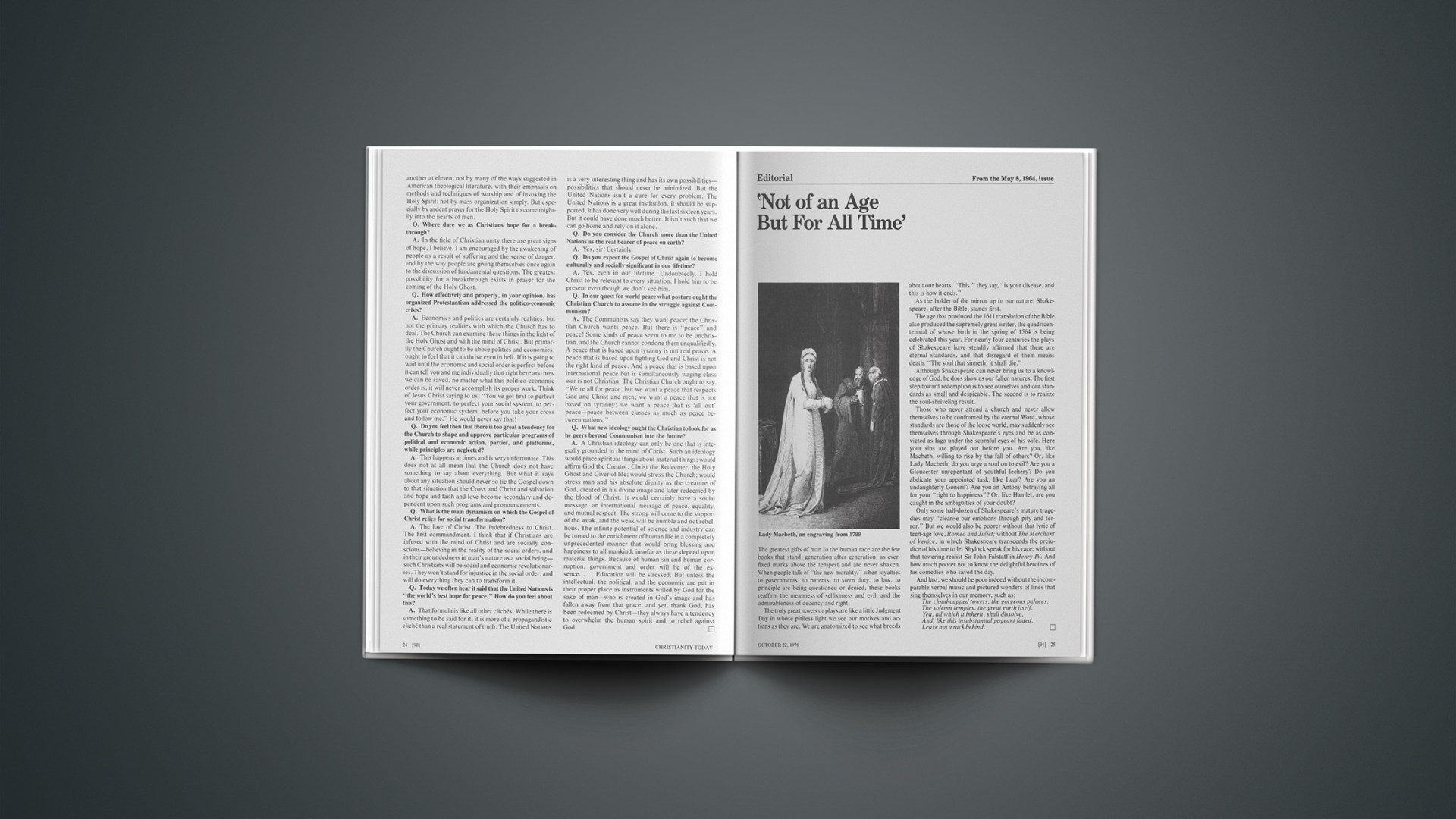
Not of an Age but for All Time

The greatest gifts of man to the human race are the few books that stand, generation after generation, as ever-fixed marks above the tempest and are never shaken. When people talk of “the new morality,” when loyalties to governments, to parents, to stern duty, to law, to principle are being questioned or denied, these books reaffirm the meanness of selfishness and evil, and the admirableness of decency and right.

The truly great novels or plays are like a little Judgment Day in whose pitiless light we see our motives and actions as they are. We are anatomized to see what breeds about our hearts. “This,” they say, “is your disease, and this is how it ends.”

As the holder of the mirror up to our nature, Shakespeare, after the Bible, stands first.

The age that produced the 1611 translation of the Bible also produced the supremely great writer, the quadricentennial of whose birth in the spring of 1564 is being celebrated this year. For nearly four centuries the plays of Shakespeare have steadily affirmed that there are eternal standards, and that disregard of them means death. “The soul that sinneth, it shall die.”

Although Shakespeare can never bring us to a knowledge of God, he does show us our fallen natures. The first step toward redemption is to see ourselves and our standards as small and despicable. The second is to realize the soul-shriveling result.

Those who never attend a church and never allow themselves to be confronted by the eternal Word, whose standards are those of the loose world, may suddenly see themselves through Shakespeare’s eyes and be as convicted as Iago under the scornful eyes of his wife. Here your sins are played out before you. Are you, like Macbeth, willing to rise by the fall of others? Or, like Lady Macbeth, do you urge a soul on to evil? Are you a Gloucester unrepentant of youthful lechery? Do you abdicate your appointed task, like Lear? Are you an undaughterly Goneril? Are you an Antony betraying all for your “right to happiness”? Or, like Hamlet, are you caught in the ambiguities of your doubt?

Only some half-dozen of Shakespeare’s mature tragedies may “cleanse our emotions through pity and terror.” But we would also be poorer without that lyric of teen-age love, Romeo and Juliet; without The Merchant of Venice, in which Shakespeare transcends the prejudice of his time to let Shylock speak for his race; without that towering realist Sir John Falstaff in Henry IV. And how much poorer not to know the delightful heroines of his comedies who saved the day.

And last, we should be poor indeed without the incomparable verbal music and pictured wonders of lines that sing themselves in our memory, such as:

The cloud-capped towers, the gorgeous palaces,

The solemn temples, the great earth itself,

Yea, all which it inherit, shall dissolve,

And, like this insubstantial pageant faded,

Leave not a rack behind.

Civilization at Bay

In its November 24, 1961, issue, CHRISTIANITY TODAYpublished an interview with Dr. Charles H. Malik, an Orthodox layman and former president of the United Nations General Assembly. Dr. Malik addressed himself to some of the great issues in the world today, and did so in a Christian context that recognized political realities. Here are excerpts of the interview, conducted by Dr. Carl F. H. Henry, then editor ofCHRISTIANITY TODAY:

Question. World history in our generation seems to be running on a Communist timetable. Do you see any outward signs, like those that once marked the decline of the Roman Empire, to suggest that the Communist thrust has passed its zenith?

Answer. I don’t think so. I think we can expect it to register further gains. The question obviously takes one into the realm of sheer conjecture and prophecy, and I disclaim any prophetic powers. But I can only say realistically that the Communists are still very vigorous, and the rest of the world is relatively rather weak.

Q. What are the symptoms of the free world’s deterioration? Do you think it is now too late to avert the final decline of the West?

A. Certainly it’s not too late. It’s never too late, given the freedom of man and given the grace of God. But symptoms of deterioration in the Western world are very evident. First and foremost is the lack of unity among the various components of the Western world. The statesmen congratulate themselves over that lack of unity, on the ground of their freedom and equal partnership. All this is fine—but what is the use if one keeps on losing?… One aspect of Western lack of unity is the nationalism which is eating and corroding the life of the Western world. They have NATO, true, but they squabble.… To this squabbling I would add, as a weakness, materialism—sheer, crass materialism. I am not sure your Western materialism is better than the Soviets’. Another sign of weakness: Christians aren’t speaking with conviction.… I could recite twenty or more signs of moral weakness in the Western world which are highly disturbing—weaknesses of people who ought to know better, people with a great tradition behind them, whose tradition alone can save them and the world ten times over if they understand it, and live it, and rise above their failures.

Unless the intellectual, the political, and the economic are put in their proper place as instruments willed by God for the sake of man, they always have a tendency to overwhelm the human spirit and to rebel against God.

Q. How then do you define the decisive issues underlying the crisis of the twentieth century?

A. The issue, as I see it, is this: a rebellion within the Western world in the form of Marxism and Leninism has for its ultimate objective the destruction of the accumulated values that we have inherited from the Greco-Roman-Christian civilization. Against this terrific rebellion our civilization is now engaged in a life-or-death battle. This rebellion gathers to itself all kinds of supporting forces in the world which have grievances against that civilization. Hence there is a mobilization of all forces in the world which hate freedom, man, God, objective truth, and the name of Jesus Christ.

Q. Granted that Christian values are compromised on all the secular frontiers today, how would you assess the free world and the Soviet sphere in terms of biblical ideals? How would you measure the extent of the revolt in the West and the East?

A. I don’t agree with Karl Barth at all that it is, as it were, “six of one and a half dozen of the other.” The governments of the Western nations have not become totalitarian. They have not turned against the Bible, against the Gospel. On the other hand, the totalitarian governments have taken a stand against the Gospel and Jesus Christ. The governments of the West are at least neutral with respect to the propagation of the Gospel. While we see very virulent movements of secularism and atheism in the West, yet organized society in the form of governments has taken no formal, official stand against religion, and against Christ, and many members of these governments are believers, at least outwardly. When it comes to real faith in Christ, of course, the West has become very worldly, very soft. Still the Church is there, and the Bible is there, and Christians are living a free life, and it is their fault if they don’t make good their claims.

Q. What bearing has the biblical view of God and man on the modern controversy over human rights and duties?

A. Every bearing in the world. Man is made in the image of God. Man has a dignity with which he is therefore endowed by his mere humanity; he has certain natural rights and duties which stem from his being the creature of God. It is interesting to note that this whole conception of rights and of the oneness of humanity and of the universal dignity of man has arisen only within the Christian tradition.

Q. Does Christianity bear also on property rights?

A. I believe that private property, including the ownership of the means of production, provided it be carefully and rationally regulated—and science and reason and moral responsibility are fully able to supply the necessary regulating norms—is of the essence of human nature, and is a Christian pattern. I believe therefore that the abolition of all private property, including the abolition of the private ownership of every means of production, is not just.

Q. What is the real hinge of history, Dr. Malik?

A. The real hinge of history to me is Jesus Christ.

Q. If that be so, how can the Christian remnant recover an apostolic initiative in witnessing to the world?

A. Not by magic; not by mechanical techniques which call for a special conference at six in the morning and another at eleven; not by many of the ways suggested in American theological literature, with their emphasis on methods and techniques of worship and of invoking the Holy Spirit; not by mass organization simply. But especially by ardent prayer for the Holy Spirit to come mightily into the hearts of men.

Q. Where dare we as Christians hope for a breakthrough?

A. In the field of Christian unity there are great signs of hope, I believe. I am encouraged by the awakening of people as a result of suffering and the sense of danger, and by the way people are giving themselves once again to the discussion of fundamental questions. The greatest possibility for a breakthrough exists in prayer for the coming of the Holy Ghost.

Q. How effectively and properly, in your opinion, has organized Protestantism addressed the politico-economic crisis?

A. Economics and politics are certainly realities, but not the primary realities with which the Church has to deal. The Church can examine these things in the light of the Holy Ghost and with the mind of Christ. But primarily the Church ought to be above politics and economics, ought to feel that it can thrive even in hell. If it is going to wait until the economic and social order is perfect before it can tell you and me individually that right here and now we can be saved, no matter what this politico-economic order is, it will never accomplish its proper work. Think of Jesus Christ saying to us: “You’ve got first to perfect your government, to perfect your social system, to perfect your economic system, before you take your cross and follow me.” He would never say that!

Q. Do you feel then that there is too great a tendency for the Church to shape and approve particular programs of political and economic action, parties, and platforms, while principles are neglected?

A. This happens at times and is very unfortunate. This does not at all mean that the Church does not have something to say about everything. But what it says about any situation should never so tie the Gospel down to that situation that the Cross and Christ and salvation and hope and faith and love become secondary and dependent upon such programs and pronouncements.

Q. What is the main dynamism on which the Gospel of Christ relies for social transformation?

A. The love of Christ. The indebtedness to Christ. The first commandment. I think that if Christians are infused with the mind of Christ and are socially conscious—believing in the reality of the social orders, and in their groundedness in man’s nature as a social being—such Christians will be social and economic revolutionaries. They won’t stand for injustice in the social order, and will do everything they can to transform it.

Q. Today we often hear it said that the United Nations is “the world’s best hope for peace.” How do you feel about this?

A. That formula is like all other clichés. While there is something to be said for it, it is more of a propagandistic cliché than a real statement of truth. The United Nations is a very interesting thing and has its own possibilities—possibilities that should never be minimized. But the United Nations isn’t a cure for every problem. The United Nations is a great institution, it should be supported, it has done very well during the last sixteen years. But it could have done much better. It isn’t such that we can go home and rely on it alone.

Q. Do you consider the Church more than the United Nations as the real bearer of peace on earth?

A. Yes, sir! Certainly.

Q. Do you expect the Gospel of Christ again to become culturally and socially significant in our lifetime?

A. Yes, even in our lifetime. Undoubtedly. I hold Christ to be relevant to every situation. I hold him to be present even though we don’t see him.

Q. In our quest for world peace what posture ought the Christian Church to assume in the struggle against Communism?

A. The Communists say they want peace; the Christian Church wants peace. But there is “peace” and peace! Some kinds of peace seem to me to be unchristian, and the Church cannot condone them unqualifiedly. A peace that is based upon tyranny is not real peace. A peace that is based upon fighting God and Christ is not the right kind of peace. And a peace that is based upon international peace but is simultaneously waging class war is not Christian. The Christian Church ought to say, “We’re all for peace, but we want a peace that respects God and Christ and men; we want a peace that is not based on tyranny; we want a peace that is ‘all out’ peace—peace between classes as much as peace between nations.”

Q. What new ideology ought the Christian to look for as he peers beyond Communism into the future?

A. A Christian ideology can only be one that is integrally grounded in the mind of Christ. Such an ideology would place spiritual things about material things; would affirm God the Creator, Christ the Redeemer, the Holy Ghost and Giver of life; would stress the Church; would stress man and his absolute dignity as the creature of God, created in his divine image and later redeemed by the blood of Christ. It would certainly have a social message, an international message of peace, equality, and mutual respect. The strong will come to the support of the weak, and the weak will be humble and not rebellious. The infinite potential of science and industry can be turned to the enrichment of human life in a completely unprecedented manner that would bring blessing and happiness to all mankind, insofar as these depend upon material things. Because of human sin and human corruption, government and order will be of the essence.… Education will be stressed. But unless the intellectual, the political, and the economic are put in their proper place as instruments willed by God for the sake of man—who is created in God’s image and has fallen away from that grace, and yet, thank God, has been redeemed by Christ—they always have a tendency to overwhelm the human spirit and to rebel against God.

Paul D. Steeves is assistant professor of history and director of Russian studies at Stetson University in Deland, Florida. He has the Ph.D. from the University of Kansas and specializes in modern Russian history.

Come before Winter

In the weeks before Clarence Edward Macartney’s death on February 20, 1957, the editors ofCHRISTIANITY TODAYinquired as to the internationally famous preacher’s favorite sermon. Dr. Macartney replied that many of his hearers have considered “Come Before Winter” as their favorite. Elected moderator of the General Assembly in 1924, after a nominating speech by William Jennings Bryan, Dr. Macartney led the evangelical witness in the Presbyterian Church U.S.A. He was the author of more than fifty books on religious and historical themes. This sermon was printed in the March 18, 1957, issue:

Napoleon Bonaparte and the Apostle Paul are the most renowned prisoners of history. One was in prison because the peace of the world demanded it, the other because he sought to give to men that peace which the world cannot give and which the world cannot take away. One had the recollection of cities and homes which he had wasted and devastated; the other had the recollection of homes and cities and nations which had been blessed by his presence and cheered by his message. One had shed rivers of blood upon which to float his ambitions. The only blood the other had shed was that which had flowed from his own wounds for Christ’s sake. One could trace his path to glory by ghastly trails of the dead which stretched from the Pyrenees to Moscow and from the Pyramids to Mount Tabor. The other could trace his path to prison, death, and immortal glory by the hearts that he had loved and the souls that he had gathered into the Kingdom.

Napoleon once said, “I love nobody, not even my own brothers.” It is not strange, therefore, that at the end of his life, on his rock prison in the South Atlantic, he said, “I wonder if there is anyone in the world who really loves me.” But Paul loved all men. His heart was the heart of the world, and from his lonely prison at Rome he sent out messages which glow with love unquenchable and throb with fadeless hope.

When a man enters the straits of life, he is fortunate if he has a few friends upon whom he can count to the uttermost. Paul had three such friends. The first of these three, whose name needs no mention, was that One who would be the friend of every man, the friend who laid down his life for us all. The second was that man whose face is almost the first, and almost the last, we see in life—the physician. This friend Paul handed down to immortality with that imperishable encomium, “Luke, the beloved physician,” and again, “Only Luke is with me.” The third of these friends was the Lycaonian youth Timothy, half Hebrew and half Greek, whom Paul affectionately called “My son in the faith.” When Paul had been stoned by the mob at Lystra in the highlands of Asia Minor and was dragged out of the city gates and left for dead, perhaps it was Timothy who, when the night had come down and the passions of the mob had subsided, went out of the city gates to search amid stones and rubbish until he found the wounded, bleeding body of Paul and, putting his arm about the Apostle’s neck, wiped the blood stains from his face, poured the cordial down his lips, and then took him home to the house of his godly grandmother Lois and his pious mother Eunice. If you form a friendship in a shipwreck, you never forget the friend. The hammer of adversity welds human hearts into an indissoluble amalgamation. Paul and Timothy each had in the other a friend who was born for adversity.

Paul’s last letter is to this dearest of his friends, Timothy, whom he has left in charge of the church at far-off Ephesus. He tells Timothy that he wants him to come and be with him at Rome. He is to stop at Troas on the way and pick up his books, for Paul is a scholar even to the end. Make friends with good books, they will never leave you nor forsake you. He is to bring the cloak, too, which Paul had left at the house of Carpus, in Troas. What a robe the Church would weave for Paul today if it had that opportunity! But this is the only robe that Paul possesses. It has been wet with the brine of the Mediterranean, white with the snows of Galatia, yellow with the dust of the Egnatian Way, and crimson with the blood of his wounds for the sake of Christ. It is getting cold at Rome, for the summer is waning, and Paul wants his robe to keep him warm. But most of all Paul wants Timothy to bring himself. “Do thy diligence to come shortly unto me,” he writes, and then, just before the close of the letter, he says, “Do thy diligence to come before winter” (2 Tim. 4:21).

Why “before winter”? Because when winter set in, the season for navigation closed in the Mediterranean, and it was dangerous for ships to venture out to sea. How dangerous it was, the story of Paul’s last shipwreck tells us. If Timothy waits until winter, he will have to wait until spring; and Paul has a premonition that he will not last out the winter, for he says, “The time of my departure is at hand.” We like to think that Timothy did not wait a single day after that letter from Paul reached him at Ephesus but started at once to Troas, where he picked up the books and the old cloak in the house of Carpus, then sailed past Samothrace to Neapolis, and thence traveled by the Egnatian Way across the plains of Philippi and through Macedonia to the Adriatic, where he took ship to Brundisium, and then went up the Appian Way to Rome, where he found Paul in his prison, read to him from the Old Testament, wrote his last letters, walked with him to the place of execution near the Pyramid of Cestius, and saw him receive the crown of glory.

Before winter or never! There are some things which will never be done unless they are done “before winter.” The winter will come and the winter will pass, and the flowers of the springtime will deck the breast of the earth, and the graves of some of our opportunities, perhaps the grave of our dearest friend. There are golden gates wide open on this autumn day, but next October they will be forever shut. There are tides of opportunity running now at the flood. Next October they will be at the ebb. There are voices speaking today which a year from today will be silent. Before winter or never!

I like all seasons. I like winter with its clear, cold nights and the stars like silver-headed nails driven into the vault of heaven. I like spring with its green growth, its flowing streams, its revirescent hope. I like summer with the litany of gentle winds in the tops of the trees, its long evenings and the songs of its birds. But best of all I like autumn. I like its mist and haze, its cool morning air, its field strewn with the blue aster and the goldenrod, the radiant livery of the forests—“yellow, and black, and pale, and hectic red.” But how quickly the autumn passes! It is the perfect parable of all that fades. Yesterday I saw the forests in all their splendor, and Solomon in all his glory was not arrayed like one of these.… But tomorrow the rain will fall, the winds will blow, and the trees will be stripped and barren.

Therefore, every returning autumn brings home to me the sense of the preciousness of life’s opportunities—their beauty, but also their brevity. It fills me with the desire to say not merely something about the way that leads to life eternal but, with the help of God, something which shall move men to take the way of life now, Today. Taking our suggestion, then, from this message of Paul in the prison at Rome to Timothy in far-off Ephesus—“Come before winter”—let us listen to some of those voices which now are speaking so earnestly to us, and which a year from today may be forever silent.

THE VOICE OF REFORMATION

Your character can be amended and improved, but not at just any time. There are favorable seasons. In the town of my boyhood I delighted to watch on a winter’s night the streams of molten metal writhing and twisting like lost spirits as they poured from the furnaces of the wire mill. Before the furnace doors stood men in leathern aprons, with iron tongs in their hands, ready to seize the fiery coils and direct them to the molds. But if the iron was permitted to cool below a certain temperature, it refused the mold. There are times when life’s metal is, as it were, molten, and can be worked into any design that is desired. But if it is permitted to cool, it tends toward a state of fixation, in which it is possible neither to do nor even to plan a good work. When the angel came down to trouble the pool at Jerusalem, then was the time for the sick to step in and be healed. There are moments when the pool of life is troubled by the angel of opportunity.

Then a man, if he will, can go down and be made whole; but if he waits until the waters are still, it is too late.

A man who had been under the bondage of an evil habit relates how one night, sitting in his room in a hotel, he was assailed by his old enemy, his besetting sin, and was about to yield to it. He was reaching out his hand to ring the bell for a waiter, when suddenly, as if an angel stood before him, a voice seemed to say, “This is your hour. If you yield to this temptation now, it will destroy you. If you conquer it now, you are its master forever.” He obeyed the angel’s voice, refused the tempter, and came off victorious over his enemy.

That man was not unique in his experience, for to many a man there comes the hour when destiny knocks at his door and the angel waits to see whether he will obey him or reject him. These are precious and critical moments in the history of the soul. In your life there may be that which you know to be wrong and sinful. In his mercy God has awakened conscience, or has flooded your heart with a sudden wave of contrition and sorrow. This is the hour of opportunity, for now chains of evil habit can be broken which, if not broken, will bind us forever. Now golden goals can be chosen and decisions made which shall affect our destiny forever.

We like to quote those fine lines from the pen of the late Senator John J. Ingalls:

Master of human destinies am I!

Fame, love, and fortune on my footsteps wait.

Cities and fields I walk; I penetrate

Deserts and fields remote, and, passing by

Hovel and mart and palace, soon or late.

I knock unbidden once at every gate!

If sleeping, wake; if feasting, rise before

I turn away. It is the hour of fate,

And they who follow me reach every state

Mortals desire, and conquer every foe

Save death; but those who doubt or hesitate,

Condemned to failure, penury or woe,

Seek me in vain and uselessly implore

I answer not, and I return no more.

We all recognize the truth of this in the things of this world, but in a far more solemn way it is true of the opportunities of our spiritual life. You can build a bonfire any time you please; but the fine fire of the Spirit, that is a different thing. God has his Moment!

We cannot kindle when we will

The fire that in the heart resides

The Spirit bloweth and is still;

In mystery the soul abides.

THE VOICE OF AFFECTION

Suppose that Timothy, when he received that letter from Paul asking him to come before winter, had said to himself: “Yes, I shall start for Rome; but first of all I must clear up some matters here at Ephesus, and then go down to Miletus to ordain elders there, and thence over to Colossae to celebrate the Communion there.” When he has attended to these matters, he starts for Troas, and there inquires when he can get a ship which will carry him across to Macedonia, and thence to Italy, or one that is sailing around Greece into the Mediterranean. He is told that the season for navigation is over: “No ships for Italy till April!”

All through that anxious winter we can imagine Timothy reproaching himself that he did not go at once when he received Paul’s letter, and wondering how it fares with the Apostle. When the first vessel sails in the springtime, Timothy is a passenger on it. I can see him landing at Neapolis, or Brundisium, and hurrying up to Rome. There he seeks out Paul’s prison, only to be cursed and repulsed by the guard. Then he goes to the house of Claudia, or Pudens, or Narcissus, or Mary, or Ampliatus, and asks where he can find Paul. I can hear them say: “And are you Timothy? Don’t you know that Paul was beheaded last December? Every time the jailer put the key in the door of his cell, Paul thought you were coming. His last message was for you, ‘Give my love to Timothy, my beloved son in the faith, when he comes.’ ” How Timothy then would have wished that he had come before winter!

Before winter or never! “The poor always ye have with you; but me ye have not always,” said Jesus when the disciples complained that Mary’s costly and beautiful gift of ointment might have been expended in behalf of the poor. “Me ye have not always.” That is true of all the friends we love. We cannot name them now, but next winter we shall know their names. With them, as far as our ministry is concerned, it is before winter or never.

In the Old Abbey Kirk at Haddington one can read over the grave of Jane Welsh the first of many pathetic and regretful tributes paid by Thomas Carlyle to his neglected wife: “For forty years she was a true and loving helpmate of her husband, and by act and word worthily forwarded him as none else could in all worthy he did or attempted. She died at London the 21st of April, 1866, suddenly snatched from him, and the light of his life as if gone out.” It has been said that the saddest sentence in English literature is that sentence written by Carlyle in his diary, “Oh, that I had you yet for five minutes by my side, that I might tell you all.” Hear, then, careless soul, who art dealing with loved ones as if thou wouldst have them always with thee, these solemn words of warning from Carlyle: “Cherish what is dearest while you have it near you, and wait not till it is far away. Blind and deaf that we are, O think, if thou yet love anybody living, wait not till death sweep down the paltry little dust clouds and dissonances of the moment, and all be made at last so mournfully clear and beautiful, when it is too late.”

On one of the early occasions when I preached on this text in Philadelphia, there was present at the service a student in the Jefferson Medical College (Dr. Arnot Walker, New Galilee, Pennsylvania). When the service was over he went back to his room on Arch Street, where the text kept repeating itself in his mind, “Come before winter.” “Perhaps,” he thought to himself, “I had better write a letter to my mother.” He sat down and wrote a letter such as a mother delights to receive from her son. He took the letter down the street, dropped it in a mailbox, and returned to his room. The next day in the midst of his studies a telegram was placed in his hand. Tearing it open, he read these words: “Come home at once. Your mother is dying.” He took the train that night for Pittsburgh, and then another train to the town near the farm where his home was. Arriving at the town, he was driven to the farm and, hurrying up the stairs, found his mother still living, with a smile of recognition and satisfaction on her face—the smile which, if a man has once seen, he can never forget. Under her pillow was the letter he had written her after the Sunday-night service, her viaticum and heartsease as she went down into the River.

Twice coming to the sleeping disciples whom he had asked to watch with him in the Garden of Gethsemane, Christ awakened them and said with sad surprise, “What, could ye not watch with me one hour?” When he came the third time and found them sleeping, he looked sadly down upon them and said, “Sleep on now, and take your rest.” One of those three, James, was the first of the twelve apostles to die for Christ and seal his faith with his heart’s blood. Another, John, was to suffer imprisonment for the sake of Christ on the isle that is called Patmos. And Peter was to be crucified for his sake. But never again could those three sleeping disciples ever watch with Jesus in his hour of agony. That opportunity was gone forever!

You say, when you hear that a friend has gone, “Why, it cannot be possible! I saw him only yesterday on the corner of Smithfield and Sixth Avenue!” Yes, you saw him there yesterday, but you will never see him there again. You say you intended to do this thing, to speak this word of appreciation or amendment, or show this act of kindness; but now the vacant chair, the unlifted book, the empty place will speak to you with a reproach which your heart can hardly endure, “Sleep on now, and take your rest! Sleep! Sleep! Sleep forever!”

THE VOICE OF CHRIST

More eager, more wistful, more tender than any other voice is the voice of Christ which now I hear calling men to come to him, and to come before winter. I wish I had been there when Christ called his disciples, Andrew and Peter, and James and John, by the Sea of Galilee, or Matthew as he was sitting at the receipt of custom. There must have been a note not only of love and authority but of immediacy and urgency in his voice, for we read that they “left all and followed him.”

The greatest subject which can engage the mind and attention of man is eternal life. Hence the Holy Spirit, when he invites men to come to Christ, never says “Tomorrow” but always “Today.” If you can find me one place in the Bible where the Holy Spirit says, “Believe in Christ tomorrow,” or, “Repent and be saved tomorrow,” I will come down out of the pulpit and stay out of it—for I would have no Gospel to preach. But the Spirit always says, “Today,” never “Tomorrow.” “Now is the accepted time.” “Now is the day of salvation.” “Today if ye will hear his voice, harden not your hearts.”

The reason for this urgency is twofold. First, the uncertainty of human life. A long time ago, David, in his last interview with Jonathan, said, “As thy soul liveth, there is but a step between me and death.” That is true of every one of us. But a step! What shadows we are, and what shadows we pursue!

An old rabbi used to say to his people, “Repent the day before you die.” “But rabbi,” they said to him, “we know not the day of our death.” “Then repent today,” he answered.

The second reason why Christ, when he calls a man, always says Today, and never Tomorrow, is that tomorrow the disposition of a man’s heart may have changed. There is a time to plant, and a time to reap. The heart, like the soil, has its favorable seasons. Today a man may hear this sermon and be interested, impressed, almost persuaded, ready to take his stand for Christ and enter into eternal life. But he postpones his decision and says, “Not tonight, but tomorrow.” A week hence, a month hence, a year hence, he may come back and hear the same call to repentance and to faith. But it has absolutely no effect upon him, for his heart is as cold as marble. The preacher might as well preach to a stone or scatter seed on the marble pavement below this pulpit. Oh, if the story of this one church could be told, if the stone should cry out of the wall and the beam out of the timber should answer, what a story they could tell of those who once were almost persuaded but who now are far from the Kingdom of God. Christ said, Today! They answered, Tomorrow!

Once again, then, I repeat these words of the Apostle, “Come before winter”; and as I pronounce them, common sense, experience, conscience, Scripture, the Holy Spirit, the souls of just men made perfect, and the Lord Jesus Christ all repeat with me, “Come before winter!” Come before the haze of Indian summer has faded from the fields! Come before the November wind strips the leaves from the trees and send them whirling over the fields! Come before the snow lies on the uplands and the meadow brook is turned to ice! Come before the heart is cold! Come before desire has failed! Come before life is over and your probation ended, and you stand before God to give an account of the use you have made of the opportunities which in his grace he has granted to you! Come before winter!

Paul D. Steeves is assistant professor of history and director of Russian studies at Stetson University in Deland, Florida. He has the Ph.D. from the University of Kansas and specializes in modern Russian history.

Biblical Authority in Evangelism

Among the articles in the very first issue ofCHRISTIANITY TODAY, October 15, 1956, was one by evangelist Billy Graham. Here is a condensation of it:

No one who once heard Jesus could ever again be the same. What was the secret of this Master Teacher? How did he hold those crowds spellbound?

“And it came to pass, when Jesus had ended these sayings, the people were astonished at his doctrine: for he taught them as one having authority” (Matt. 7:28, 29). Is not this authoritative note part of the secret of the earthly ministry of Christ?…

In 1949 I had been having a great many doubts concerning the Bible. I thought I saw apparent contradictions in Scripture. Some things I could not reconcile with my restricted concept of God. When I stood up to preach, the authoritative note so characteristic of all great preachers of the past was lacking. Like hundreds of other young seminary students, I was waging the intellectual battle of my life. The outcome could certainly affect my future ministry.

In August of that year I had been invited to Forest Home, a Presbyterian conference center high in the mountains outside Los Angeles. I remember walking down a trail, tramping into the woods, and almost wrestling with God. I dueled with my doubts, and my soul seemed to be caught in the crossfire. Finally, in desperation, I surrendered my will to the living God revealed in Scripture. I knelt before the open Bible and said: “Lord, many things in this Book I do not understand. But thou has said, ‘The just shall live by faith.’ All I have received from thee, I have taken by faith. Here and now, by faith, I accept the Bible as thy Word. I take it all. I take it without reservations. Where there are things I cannot understand, I will reserve judgment until I receive more light. If this pleases thee, give me authority as I proclaim thy Word, and through that authority convict me of sin and turn sinners to the Saviour.”

Within six weeks we started our Los Angeles crusade, which is now history. During that crusade I discovered the secret that changed my ministry. I stopped trying to prove that the Bible was true. I had settled in my own mind that it was, and this faith was conveyed to the audience. Over and over again I found myself saying, “The Bible says.…” I felt as though I were merely a voice through which the Holy Spirit was speaking.

Authority created faith. Faith generated response, and hundreds of people were impelled to come to Christ. A crusade scheduled for three weeks lengthened into eight weeks, with hundreds of thousands of people in attendance. The people were not coming to hear great oratory, nor were they interested merely in my ideas. I found they were desperately hungry to hear what God had to say through his Holy Word.

I felt as though I had a rapier in my hand and, through the power of the Bible, was slashing deeply into men’s consciences, leading them to surrender to God. Does not the Bible say of itself, “For the word of God is quick, and powerful, and sharper than any two edged sword, piercing even to the dividing asunder of soul and spirit, and of the joints and marrow, and is a discerner of the thoughts and intents of the heart” (Heb. 4:12)?

I found that the Bible became a flame in my hands. That flame melted away unbelief in the hearts of the people and moved them to decide for Christ. The Word became a hammer breaking up stony hearts and shaping them into the likeness of God. Did not God say, “I will make my words in thy mouth fire” (Jer. 5:14) and “Is not my word like as a fire?… And like a hammer that breaketh the rock in pieces?” (Jer. 23:29).

I found that I could take a simple outline and put a number of pertinent Scripture quotations under each point, and God would use this mightily to cause men to make full commitment to Christ. I found that I did not have to rely upon cleverness, oratory, psychological manipulation of crowds, or apt illustrations or striking quotations from famous men. I began to rely more and more upon Scripture itself, and God blessed.

I am convinced, through my travels and experiences, that people all over the world are hungry to hear the Word of God. As the people came to a desert place to hear John the Baptist proclaim, “Thus saith the Lord,” so modern man in his confusions, frustrations, and bewilderments will come to hear the minister who preaches to his people with authority.

I remember how in London many secular and religious journalists remarked on this very point as being perhaps the greatest secret of the meetings there in 1954. One of the thousands who came to commit their lives to Christ in that crusade was a brilliant young Communist. She was a student at the Royal Academy of Drama and Arts, and was already a successful young actress. She had joined the Young Communist League because the members were zealous and seemed to have the answers to the problems of life. Out of curiosity she and some of her fellow students came to our meetings at the Harringay Arena “to see the show.” She later testified how startled she was to hear, not a lecture on sociology, politics, psychology, or philosophy, but the simple Word of God quoted. This fascinated her and her companions. They came back several nights until the Word of God did its work of breaking open their hearts. They surrendered their lives to Christ.

I am not advocating bibliolatry. I am not suggesting that we should worship the Bible, any more than a soldier worships his sword or a surgeon worships his scalpel. I am, however, fervently urging a return to Bible-centered preaching, a gospel presentation that says without apology and without ambiguity, “Thus saith the Lord.”

The world longs for authority, finality, and conclusiveness. It is weary of theological floundering and uncertainty. Belief exhilarates the human spirit; doubt depresses. Nothing is gained psychologically or spiritually by casting aspersions on the Bible. A generation that occupied itself with criticism of the Scriptures all too soon found itself questioning divine revelation.

It is my conviction that if the preaching of the Gospel is to be authoritative, if it is to produce conviction of sin, if it is to challenge men and women to walk in newness of life, if it is to be attended by the Spirit’s power, then the Bible with its discerning, piercing, burning message must become the basis of our preaching.

From my experience in preaching across America, I am convinced that the average American is vulnerable to the Christian message, if it is seasoned with authority and proclaimed as verily from God through his Word.

Do we not have authority in other realms of life? Mathematics has its inviolable rules, formulas, and equations; if these are ignored, no provable answers can be found.

Music has its rules of harmony, progression, and time. The greatest music of the ages has been composed in accordance with these rules. To break the rules is to produce discord and “audio-bedlam.” The composer uses imagination and creative genius, to be sure, but his work must be done within the framework of the accepted forms of time, melody, and harmony. He must go by the book. To ignore the laws of music would be to make no music.

Every intelligent action takes place in a climate of authority.

I use the phrase “The Bible says” because the Word of God is the authoritative basis of our faith. I do not continually distinguish between the authority of God and the authority of the Bible because I am confident that he has made his will known authoritatively in the Scriptures.

The world is not a little weary of our doubts and our conflicting opinions and views. But I have discovered that there is much common ground in the Bible—broad acres of it—upon which most churches can agree. Could anything be more basic than the acknowledgment of sin, the Atonement, man’s need of repentance and forgiveness, the prospect of immortality, and the dangers of spiritual neglect?

There need be no adulteration of truth nor compromise on the great biblical doctrines. I think it was Goethe who said, after hearing a young minister, “When I go to hear a preacher preach, I may not agree with what he says, but I want him to believe it.” Even a vacillating unbeliever has no respect for the man who lacks the courage to preach what he believes.

Very little originality is permitted a Western Union messenger boy. His sole obligation is to carry the message he receives from the office to the person to whom it is addressed. He may not like to carry that message—it may contain bad news or distressing news for some person to whom he delivers it. But he dare not stop on the way, open the envelope, and change the wording of the telegram. His duty is to take the message.

We Christian ministers have the Word of God. Our Commander said, “Go, take this message to a dying world!” Some messengers today neglect it; some tear up the message and substitute one of their own. Some delete part of it. Some tell the people that the Lord does not mean what he says. Others say that he really did not give the message, but that it was written by ordinary men who were all too prone to make mistakes.

Let us remember that we are sowing God’s seed. Some indeed may fall on beaten paths and some among thorns, but it is our business to keep on sowing. We are not to stop sowing because some of the soil looks unpromising.

We are holding a light, and we are to let it shine. Though it may seem but a twinkling candle in a world of blackness, it is our business to let it shine.

We are blowing a trumpet. In the din and noise of battle the sound of our little trumpet may seem to be lost, but we must keep sounding the alarm to those in danger.

We are kindling a fire in this cold world full of hatred and selfishness. Our little blaze may seem to have no effect, but we must keep our fire burning.

We are striking with a hammer. The blows may seem only to jar our hands as we strike, but we are to keep on hammering.

We are using a sword. The first or second thrust of our sword may be parried, and all our efforts to strike deep into the enemy flank may seem hopeless. But we are to keep on wielding our sword.

We have bread for a hungry world. The people may seem to be feeding busily on other things, ignoring the Bread of Life, but we must keep on offering it to the souls of men.

We have water for parched souls. We must keep standing and crying out, “Ho, every one that thirsteth, come ye to the waters.”

Give a new centrality to the Bible in your own preaching. Jesus promised that much seed will find good soil and spring up and bear fruit. The fire in your heart and on your lips can kindle a scared flame in some cold hearts and win them to Christ. The hammer will break some hard hearts and make them yield to God in contrition. The sword will pierce the armor of sin and cut away self-satisfaction and pride, and open man’s heart to the Spirit of God. Some hungry men and women will take the Bread of Life, and some thirsting souls will find the Water of Life.

Preach the Scriptures with authority! You will witness a climactic change in your ministry!

Paul D. Steeves is assistant professor of history and director of Russian studies at Stetson University in Deland, Florida. He has the Ph.D. from the University of Kansas and specializes in modern Russian history.

The Year of the Evangelical ’76

Marking a Milestone

With this issueCHRISTIANITY TODAYmarks its twentieth anniversary. Since our first issue came out in October, 1956, we have offered our readers a total of 24,472 pages. In these pages we have sought to express principles of historic Christianity and to help evangelicals be the salt of the earth. Bound volumes of the two decades of publication take up more than five feet of shelf space.

In commemoration, we pause to reflect on how things were and how they are now. With a timely look at the current evangelical limelight we are also highlighting some articles fromCHRISTIANITY TODAY’Spast.

Evangelicals suddenly find themselves number one on the North American religious scene. Thanks to media visibility, they are seizing the public imagination. There is unprecedented interest in many aspects of the evangelical outlook.

Some pundits talk as if evangelicals were about to take over. Garry Wills, in a recent article in the New York Times Magazine, cited “the blossoming evangelical movement, now the major religious force in America, both in numbers and impact.” Michael Novak asserted earlier this year that “the most understated demographic reality in the United States is the huge number of evangelical Protestants.…”

Although these appraisals are extravagant, it is nonetheless true that evangelicals are showing a remarkable vitality. After being ignored by much of the rest of society for decades, they are now coming into prominence. Indeed, 1976 seems to be the year of the evangelical. No other sector of the Christian Church seems as vibrant, and certainly no other is getting as much attention.

How has this come about? What does it mean for the evangelical pastor and churchgoer? Will it last?

No one has any certain answers, but the questions merit discussion. This twentieth-anniversary issue of CHRISTIANITY TODAY is an appropriate place to start it. An informal poll of evangelical leaders conducted last month showed them to be well aware of the current limelight, and some commented that CHRISTIANITY TODAY has been helping to lay the groundwork for the evangelical rise.

One commentator suggested that evangelicals have become conspicuous primarily because of a growing recognition of their size. An editorial in this magazine in 1967 estimated the U.S. total at 40 million. Most experts contend that the figure is too high, but historian David F. Wells of Trinity Evangelical Divinity School notes that if the figure is even close, evangelicals make up a substantial minority of the American population.

Executive Director Billy Melvin of the National Association of Evangelicals feels that “the Spirit of God is working today in an unusual way. We are being given extraordinary opportunities. We must be obedient and follow through.” He cites the attention being given to evangelicals and their growing climate of cooperation. He does not think, however, that they make up a much higher percentage of the population now than they did in earlier decades.

The 1976 NAE convention, held jointly with the annual meeting of the National Religious Broadcasters in Washington, was undoubtedly the major initial impetus in bringing evangelicals to the fore this year. That midwinter event attracted participation by President Ford and a host of other political and non-political celebrities. It was widely reported and analyzed by both secular and religious media, probably more so than any previous NAE convention.

The Bicentennial celebration, recalling as it has the nation’s religious roots, has helped to call attention to the evangelical faith. Any student of American history can hardly escape the impression that the evangelical ethos was never far from the heart of the American experience. The Puritans, for all their shortcomings, left a great heritage. Today’s evangelicals are their spiritual offspring, and the two-hundredth anniversary of the nation has underscored their presence.

Another aspect of the new evangelical visibility is the numerous conversion stories being related by people in the public eye. The spiritual turn-around of former White House hatchet man Charles Colson is exhibit A; his account of it has been a best-seller for months. Several other figures such as Graham Kerr, television’s “Galloping Gourmet,” also are being presented in the media in the context of their newfound faith. The latest is former Black Panther leader Eldridge Cleaver. A large number of athletes speak regularly and openly to newsmen about their commitment to Christ. Malcolm Muggeridge, Jimmy Carter, and Marabel Morgan, among others, have in diverse ways been raising the spiritual consciousness of millions.

Evangelical recovery has taken fifty years. During the fundamentalist-modernist controversy, biblical orthodoxy retreated to the cultural periphery. But it has again come to the center as theological alternatives have fallen on very hard times. Neo-orthodoxy, which succeeded classic liberalism in the old-line denominations, has been steadily losing ground in recent years. All the efforts of theological architects to remodel the biblical message and adapt it to the supposedly special needs of modern man have counted for little. More and more a theological vacuum becomes evident in mainline Protestantism, and some of its leaders are reportedly concerned about soon becoming engulfed by an evangelical tide. To the rank and file, the Cross and the Resurrection seem more meaningful than ever. Evangelical seminaries are thriving, swelling the ranks of Bible-preaching clergymen.

Still another factor in the rise of the evangelical is the disillusionment about science and technology evident in recent years. As we find out more and more about how, through ignorance and negligence, we are polluting not only our environment but also our own bodies, many young people and some older ones are beginning to feel that humanity cannot be trusted after all, and that outside help is needed. We have not been good stewards of our resources; our knowledge of the world around us, while improving the human condition in some ways, has in other ways produced exploitation. Add to this the outrage about Watergate and other high-level improprieties and one can see why people are fed up with people, why humanism is on the verge of bankruptcy, and why the God of the Bible is being sought after with a fresh intensity. It is easier than ever to talk about what the Lord Jesus Christ has done for fallen human beings and about the principles he has set forth for order in the world. They may not be ready to buy, but many people are at least willing to look at what is offered.

Most of the nation’s great churches are now evangelical. Hundreds of Christian radio stations have been established in recent years. Sales of Bibles and evangelical books are booming.

These factors alone attest to evangelical strength and justify media attention. Moreover, evangelicals have been maturing and are communicating more effectively. There is not the cultural gap there was a few years ago. Evangelicals are present in all social and professional circles of our society, high as well as low, and there is more common ground for communication.

Most evangelicals are very church-oriented in that they attend regularly and are active in a particular congregation, but cooperative programs of outreach and ministry are often carried out through agencies that are structurally independent. These para-church groups, usually quite specialized in their purposes, are more flexible than denominations and able to respond much more readily to needs and opportunities. They also have a more personal touch in their programs. Many supporters of evangelical work feel more confident giving to individuals rather than to institutions. The result is that evangelical leaders are rising out of specialized ministries rather than, following the historical patterns, as general church overseers.

This development obviously has its drawbacks, too: accountability is harder to come by, and evangelicals are unable to set overall priorities. But the liabilities do not thwart growth. The evangelical surge has been building momentum despite these and other internal differences. One should expect that a movement on the rise will encounter problems. In addition to the para-church tensions, evangelicals have long been divided over such things as the doctrine of eternal security and dispensational theology. More recently, disputes have arisen over the charismatic movement, biblical inerrancy, and political involvement.

These are crucial matters that need to be dealt with forthrightly. Confronting them, however, need not lead to rancor and fragmentation, if by the Spirit of God we are open and loving and at the same time determined to push ahead with the tasks God has given us.

Professor Wells and his colleague at Trinity, John D. Woodbridge, state in the introduction to The Evangelicals that the evangelical movement “now can no longer be regarded as simply reactionary, but is vigorously and sometimes creatively speaking to the needs of the contemporary world.” Bible-believing churches can continue in this direction if they stay humble and thankful; if they respect key differences among themselves while minimizing pettiness; if they conscientiously apply their knowledge to divine demands and do not simply rest on an experiential kick; if they do some original thinking and do not merely reflect secular initiatives (both left and right); and if they vow to take the ethical demands of the Gospel more seriously and demonstrate to the world that their faith conquers evil.

Paul D. Steeves is assistant professor of history and director of Russian studies at Stetson University in Deland, Florida. He has the Ph.D. from the University of Kansas and specializes in modern Russian history.

Apple PodcastsDown ArrowDown ArrowDown Arrowarrow_left_altLeft ArrowLeft ArrowRight ArrowRight ArrowRight Arrowarrow_up_altUp ArrowUp ArrowAvailable at Amazoncaret-downCloseCloseEmailEmailExpandExpandExternalExternalFacebookfacebook-squareGiftGiftGooglegoogleGoogle KeephamburgerInstagraminstagram-squareLinkLinklinkedin-squareListenListenListenChristianity TodayCT Creative Studio Logologo_orgMegaphoneMenuMenupausePinterestPlayPlayPocketPodcastRSSRSSSaveSaveSaveSearchSearchsearchSpotifyStitcherTelegramTable of ContentsTable of Contentstwitter-squareWhatsAppXYouTubeYouTube