Evangelism or Social Justice: Eliminating the Options

What does evangelism have to do with social justice? For more than a decade, Christians have battled over this issue. Many evangelicals believe that proclaiming the Gospel to individuals is, as Billy Graham said in his Lausanne address, “the vital mission of the Church.” The World Council of Churches, on the other hand, has focused most of its activity on social justice and then redefined evangelism to include socioeconomic liberation.

I want to argue that the disagreement results from insufficient attention to Scripture. Evangelicals have often defined the Gospel in an unbiblically narrow way. And they have failed to see that evangelism is inseparable from—though by no means identical with—social concern. Conciliar Christians (i.e., those identified with the ecumenical movement) have often broadened the definition of evangelism and “Gospel” in a biblically irresponsible fashion. Only individuals—not nations or corporations—can repent and enter into a personal, saving relationship with the Risen Lord. Hence it is confusing nonsense to talk of evangelizing political or economic structures.

We stand at an important juncture in Christian history. The Minneapolis Congress on Evangelism (1969), the Chicago Declaration of Evangelical Social Concern (1973), and the Lausanne Covenant (1974) all point to a conviction by growing numbers of evangelicals that a full commitment to biblical revelation necessarily entails a concern for social justice. The World Council of Churches, on the other hand, issued an urgent call for evangelism at its Fifth Assembly in Nairobi (1975). Surprisingly, the Assembly document on “Confessing Christ Today,” unlike earlier WCC statements, even distinguished pointedly between evangelism and social action. It is to be hoped that these welcome affirmations on both sides will now be backed up by actions.

The time is ripe for a new look at the meaning of evangelism and its relation to social action. Evangelism is the communication of the Gospel. But there is disagreement over what constitutes the Gospel. In this article I want to examine the word “Gospel” with the aim of letting New Testament usage guide us toward a more helpful way of stating the relation between evangelism and social justice.

New Testament Terminology

According to the New Testament, the Gospel is the Good News about the kingdom of God (Mark 1:14, 15). It is the Good News about God’s Son, Jesus, the Messiah, who is our Saviour and Lord (Romans 1:3, 4; 2 Cor. 4:3–6). It is the Good News about the historical Jesus—his death for our sins and his resurrection on the third day (1 Cor. 15:1–5). And it is the Good News about a totally new kind of community, the people of God, who are already empowered to live according to the standards of the New Age (Eph. 3:7).

Stated more systematically, the content of the Gospel is (1) the forgiveness of sins through the cross, (2) regeneration through the Holy Spirit, (3) the Lordship of Christ, and (4) the fact of the kingdom.

One does not need to argue the first two points among evangelicals. We all agree that anyone who proclaims a gospel that omits or de-emphasizes the justification and regeneration of individuals is preaching his own message, not God’s good news of salvation through the Lord Jesus Christ.

We all recognize, too, that part of the Good News is the proclamation that this Jesus who justifies and regenerates is also Lord—Lord of all things in heaven and earth. The Gospel he preaches, Paul reminded the Corinthians, was of “Jesus Christ as Lord” (2 Cor. 4:4, 5; cf. also Rom. 10:8–16). But we seldom appropriate the full implications of this abstract dogma. If Jesus’ Lordship is a part of the Gospel, then the call to the costly, unconditional discipleship demanded by this Sovereign is inseparable from the summons to accept the Gospel: “If any man would come after me, let him deny himself and take up his cross and follow me. For whoever would save his life will lose it; and whoever loses his life for my sake and the gospel’s will save it” (Mark 8:34 and 35).

Although distinguishable, regeneration and discipleship are inseparable. The one who justifies and regenerates also demands that we forsake all other lords, shoulder the cross, and follow him. Accepting the evangelistic call necessarily entails accepting Jesus as Lord of our family life, our sexual life, our racial attitudes, our business practices, and our civic life. Jesus will not be our Saviour if we reject him as our Lord.

That does not mean, of course, that genuine Christians live perfectly surrendered, sinless lives. We continue to be justified by grace alone in spite of ongoing sin. But it does mean that conscious, persistent rejection of Jesus’ Lordship in any area of our lives is, as Calvin taught, a clear sign that saving faith is not present. Genuine Christians—and, thank God, he alone knows who they are—have an unconditional willingness to submit to Jesus’ Lordship as the implications of this submission unfold from day to day. Those who do not, Paul warns, whether they are idolaters, adulterers, homosexuals, thieves, or greedy persons, simply will not inherit the kingdom (1 Cor. 6:9, 10).

Too often Christians (especially evangelical Protestants in this century) have proclaimed a cheap grace that offers the forgiveness of the Gospel without the discipleship demands of the Gospel. But that is not Jesus’ Gospel. Right at the heart of the Gospel is the call to an unconditional discipleship in which Jesus is Lord of one’s entire life.

The fourth element of the Good News is less widely perceived to be part of the Gospel. According to the Gospels, the core of Jesus’ Good News was simply that the kingdom of God was at hand. Over and over again the Gospels define the content of the Good News as the announcement of the kingdom that was present in the person and work of Jesus (Mark 1:14, 15; Matt. 4:23; 24:14; Luke 4:43: 16:16).

But what was the nature of the kingdom Jesus proclaimed? Was it only an invisible kingdom in the hearts of individuals? Was it a new political regime of the same order as Rome? The kingdom became present wherever Jesus overcame the power of evil. But the way Jesus chose to destroy the kingdom of Satan and establish his own kingdom was not to forge a new political party. Rather, Jesus chose to call together a new, visible community of disciples joined together by their acceptance of the divine forgiveness he offered and by their unconditional submission to his total Lordship over their lives.

That this kingdom is not just an invisible spiritual abstraction peopled with ethereal, redeemed souls is very clear in the New Testament. Jesus not only forgave sins; he also healed the physical and mental diseases of those who believed. His disciples shared a common purse. The early Church engaged in voluntary economic sharing (Acts 4:32; 5:16; 2 Cor. 8). The new community of Jesus’ disciples was and is (at least it ought to be) a visible social reality sharply distinguished from the world by both its belief and its life-style. His kingdom will reach its fulfillment only at his return, but right now by grace people can enter this new society where all social and economic relationships are being transformed. That an entirely new kind of life together in Jesus’ new peoplehood is now available to all who will repent, believe, and obey is Good News. And when the early Church gave visible expression to that kind of common life, it had a powerful evangelistic impact (Acts 6:1–7). The kingdom of heaven, then, is not just a future but also a present reality. The kingdom is part of the Good News.

So far we have seen that the content of the Gospel is justification, regeneration, Jesus’ Lordship, and the fact of the Church. But is there not a “secular” or “political” dimension to the Gospel?

Luke 4:18 and 19 is a crucial text. Reading from the prophet Isaiah, Jesus defined his mission in this way: “The Spirit of the Lord is upon me, because he has anointed me to preach good news to [evangelisasthai] the poor. He has sent me to proclaim release to the captives and recovering of sight to the blind, to set at liberty those who are oppressed, to proclaim the acceptable year of the Lord.” In this text Jesus identifies several aspects of his mission. He says he has been sent to proclaim release to the captives, to proclaim recovering of sight to the blind, and to free the oppressed. (That Jesus did these things not only as a sign of his Messiahship but also because he had compassion on suffering human beings is evident everywhere in the Gospels; e.g., Matthew 14:14; 15:32; 20:34; Mark 1:41; Luke 7:13.) That healing the blind and freeing the oppressed is a fundamental part of his total mission is beyond question. But he does not equate these tasks with preaching the Gospel to the poor. Nor does he say one task is more important than another. The healing and freeing are important, and the preaching is important, and they are distinct.

The same point is clear in other passages. Matthew 11:1–6 contains the story of Jesus’ response to John the Baptist’s question, “Are you the Messiah?”: “Go and tell John what you hear and see: the blind receive their sight and the lame walk, lepers are cleansed and the deaf hear, and the dead are raised up, and the poor have good news preached to them [are evangelized].” Again Jesus does not equate preaching the Gospel to (or evangelizing) the poor with healing the sick. He does both these things, and they are both important. Jesus sent his disciples out “to preach the kingdom of God and to heal” (Luke 9:2).

One final example is important. In both Matthew 4:23 and 9:35, the evangelist summarizes Jesus’ ministry as follows: “And he went about all Galilee, teaching in their synagogues and preaching the gospel of the kingdom and healing every disease and every infirmity among the people” (cf. also Luke 9:1–6, 11). Here there are three distinct types of tasks: teaching, preaching the Gospel, and healing sick people. They are not identical tasks. They should not be confused. And none should be omitted. All are crucial parts of the mission of Jesus. But for our purposes the most important conclusion is that none of these texts equates healing the blind or liberating the oppressed with evangelism. There is no New Testament justification for talking about “evangelizing” political structures.

Now obviously, of course, the twentieth-century Christian does not imitate every detail of Jesus’ life. But the New Testament does specifically command Christians to imitate Christ: “For to this you have been called, because Christ also suffered for you, leaving you an example, that you should follow in his steps” (1 Pet. 2:21). Jesus of Nazareth, God incarnate, is our only perfect model. He devoted a great deal of time both to meeting physical needs and to proclaiming the Gospel, and we must, as Peter said, follow in his steps.

According to the New Testament, then, evangelism involves the announcement (via word and deed) of the Good News that there is forgiveness of sins through the cross; that the Holy Spirit will regenerate twisted personalities; that Jesus is Lord; and that people today can join Jesus’ new community, where all social and economic relationships are being made new.

Another Option: Distinct Yet Equal

In light of New Testament usage, it would seem that we need a new formulation of the relation between evangelism and social concern. The two are equally important but quite distinct aspects of the total mission of the Church. Evangelism involves the announcement (via words and deeds) of the Good News of (1) justification, (2) regeneration, (3) the Lordship of Jesus Christ, and (4) the fact of the new community, where all relationships are being redeemed. When individuals accept this Good News, they enter into a personal relationship with the living God through faith in Jesus Christ and into a transformed relationship with the community of believers, and experience salvation. It is precisely the transforming power of the Gospel that enables the true believer to respond to the biblical call for social concern.

Social concern involves both relief for those suffering from social injustice and the restructuring of all of society, saved and unsaved, for the sake of greater social justice. Unfortunately, not all societies provide as much opportunity for political action as does the United States. Living in the totalitarian Roman Empire, Paul did not have the political opportunities available in democracies. But he was not a-political. He insisted on due process at Philippi (Acts 16:35–39). He took advantage of his right to appeal to Caesar as a Roman citizen (Acts 26:32). Knowing that the Bible teaches that God deplores evil social structures (see below), Christians will use the opportunities available to promote more just societies.

To label this increased social justice “salvation,” however, is confusing. Until our Lord’s return, all attempts to restructure society will at best produce only significantly less imperfect, not perfect, societies; those societies will still be tragically pockmarked by the consequences of the fall.

But that does not mean that evangelism is more important than social action. Some will say: “Surely if unevangelized souls are going to eternal damnation, then evangelization must be our primary concern.” Now I find that a powerful concern, because I believe our Lord taught that when people reject his loving offer of grace, they suffer eternal separation from the presence of the living God. However, our Lord was quite aware of that when he chose to devote vast amounts of his time to healing sick bodies that he knew would rot in one, two, or thirty years. The Gospels provide no indication, either by explicit statement or by space allotments, that Jesus considered healing sick people any less important than preaching the Good News. He commanded us both to feed the hungry and to preach the Gospel; he did not say that the latter was required while the former was an option that could be considered if spare time and money were available.

Jesus is our only perfect model. If God incarnate thought he could—or rather, must—devote large amounts of his potential preaching time to the healing of sick bodies, then surely we are unfaithful disciples if we fail to follow in his steps in this area.

The reverse, of course, is equally true. Neither theoretically nor in the allocation of personnel and funds dare the Church make social concern more important than evangelism. The time has come for all biblical Christians to refuse to say, “The primary mission of the Church is.…” I do not care whether you complete the sentence with “evangelism” or “social concern.” Either way it is unbiblical and misleading. Evangelism, social concern, fellowship, teaching, worship—all these are fundamental parts of the mission of the Church. They must not be confused with one another, although they are inextricably interrelated. Scripture shows that the Church has many tasks, and it does not give us a choice of which to obey. Note carefully what we call the Great Commission: “Go therefore and make disciples … teaching them to observe all that I have commanded you …” (Matt. 28:19, 20).

I have argued both that evangelism and social concern are distinct and that they are inseparable. Let me conclude with a brief discussion of several aspects of their interrelationship.

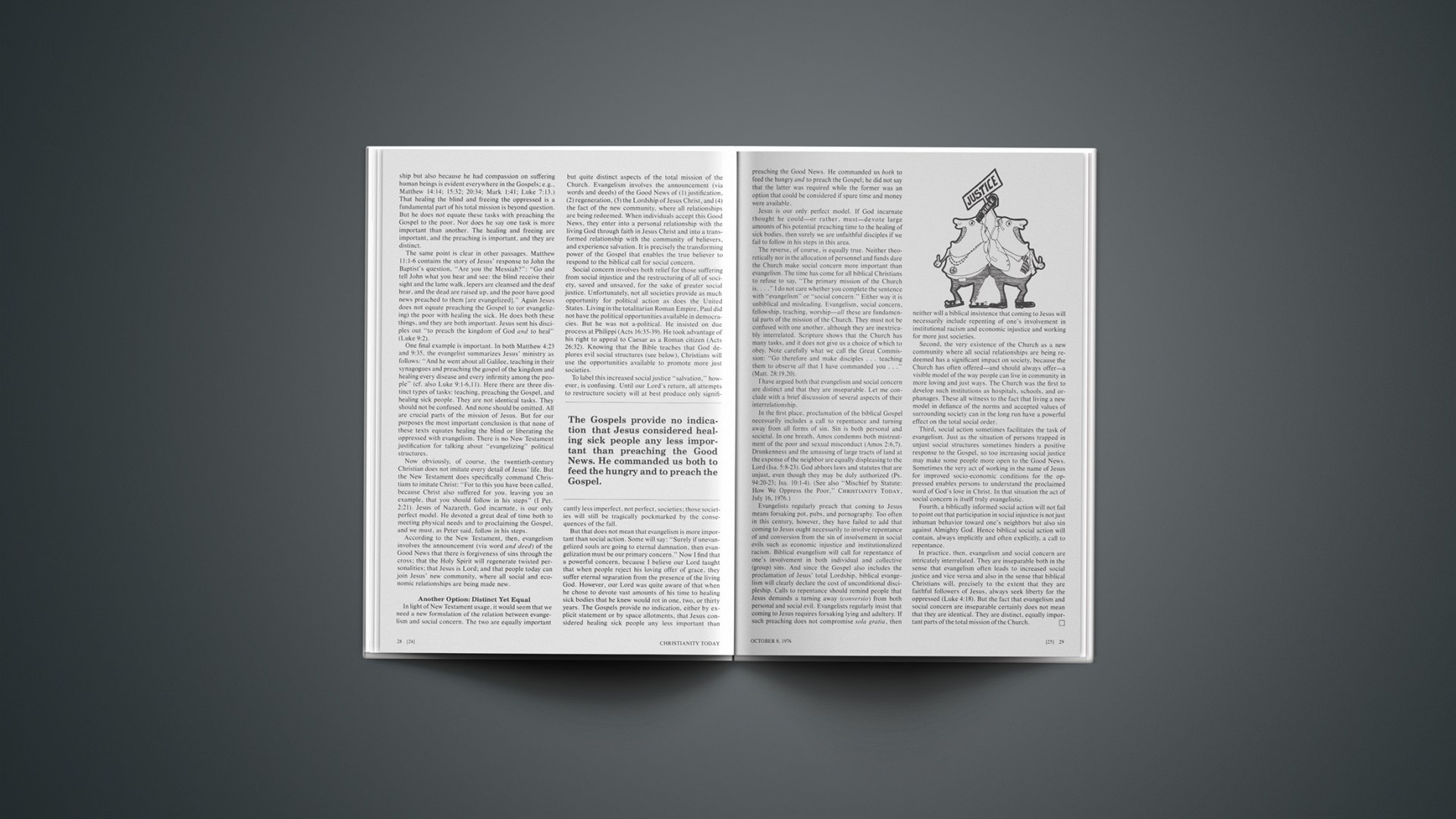
In the first place, proclamation of the biblical Gospel necessarily includes a call to repentance and turning away from all forms of sin. Sin is both personal and societal. In one breath, Amos condemns both mistreatment of the poor and sexual misconduct (Amos 2:6, 7). Drunkenness and the amassing of large tracts of land at the expense of the neighbor are equally displeasing to the Lord (Isa. 5:8–23). God abhors laws and statutes that are unjust, even though they may be duly authorized (Ps. 94:20–23; Isa. 10:1–4). (See also “Mischief by Statute: How We Oppress the Poor,” CHRISTIANITY TODAY, July 16, 1976.)

Evangelists regularly preach that coming to Jesus means forsaking pot, pubs, and pornography. Too often in this century, however, they have failed to add that coming to Jesus ought necessarily to involve repentance of and conversion from the sin of involvement in social evils such as economic injustice and institutionalized racism. Biblical evangelism will call for repentance of one’s involvement in both individual and collective (group) sins. And since the Gospel also includes the proclamation of Jesus’ total Lordship, biblical evangelism will clearly declare the cost of unconditional discipleship. Calls to repentance should remind people that Jesus demands a turning away (conversio) from both personal and social evil. Evangelists regularly insist that coming to Jesus requires forsaking lying and adultery. If such preaching does not compromise sola gratia, then neither will a biblical insistence that coming to Jesus will necessarily include repenting of one’s involvement in institutional racism and economic injustice and working for more just societies.

Second, the very existence of the Church as a new community where all social relationships are being redeemed has a significant impact on society, because the Church has often offered—and should always offer—a visible model of the way people can live in community in more loving and just ways. The Church was the first to develop such institutions as hospitals, schools, and orphanages. These all witness to the fact that living a new model in defiance of the norms and accepted values of surrounding society can in the long run have a powerful effect on the total social order.

Third, social action sometimes facilitates the task of evangelism. Just as the situation of persons trapped in unjust social structures sometimes hinders a positive response to the Gospel, so too increasing social justice may make some people more open to the Good News. Sometimes the very act of working in the name of Jesus for improved socio-economic conditions for the oppressed enables persons to understand the proclaimed word of God’s love in Christ. In that situation the act of social concern is itself truly evangelistic.

Fourth, a biblically informed social action will not fail to point out that participation in social injustice is not just inhuman behavior toward one’s neighbors but also sin against Almighty God. Hence biblical social action will contain, always implicitly and often explicitly, a call to repentance.

In practice, then, evangelism and social concern are intricately interrelated. They are inseparable both in the sense that evangelism often leads to increased social justice and vice versa and also in the sense that biblical Christians will, precisely to the extent that they are faithful followers of Jesus, always seek liberty for the oppressed (Luke 4:18). But the fact that evangelism and social concern are inseparable certainly does not mean that they are identical. They are distinct, equally important parts of the total mission of the Church.

Paul D. Steeves is assistant professor of history and director of Russian studies at Stetson University in Deland, Florida. He has the Ph.D. from the University of Kansas and specializes in modern Russian history.
Darkness

The darkness exists;

it does not have to be imagined.

If I forget it,

it remains, a stain of shadow

under my feet,

at the nape of my neck,

leaking through my heart.

When we would lock the darkness

away from us with facsimiles of light,

we only feed its falseness.

Striking a match

on the wall of my flesh, I see,

after the pop and flare have dwindled,

after-images of my face

receding into night.

The darkness exists

and is more than our ignorance of light

and is more than the shadows cast

by our pride and fear.

Yet the true star is kindled,

a straight blaze of sun

before which darkness flees

and gathers itself

into its own shadow.

How Should We Then Live?

Francis Schaeffer is founder of the L’Abri Fellowship in Huemoz, Switzerland, and a widely known lecturer and author. His latest project is a ten-episode film series, “How Should We Then Live?,” which will be released next year by Gospel Films. A companion book is being published by Revell. He was interviewed byCHRISTIANITY TODAYeditors. A review of a new book examining Schaeffer’s apologetics appears on page 42. InWitness Stand” (page 32) Edith Schaeffer gives some further background information about the film project.

Question. You have been described in many ways. How do you view yourself, as a theologian, a philosopher, or a cultural historian?

Answer. My interest is evangelism. To evangelize in the twentieth century, one has to operate across the whole spectrum of disciplines and have answers for the questions. I think we often sell Christianity short, not putting forth the richness we have in Christ for the total culture and the total intellectual life. Evangelism, then, is two things: first of all, giving honest answers to honest questions to get the blocks out of the way so that people will listen to the Gospel as a viable alternative, and then secondly, showing them what Christianity means across the whole spectrum of life.

Q. What is the first hypothesis for evangelism?

A. That God is there, and is the kind of a God that the Bible says he is, and that he has not been silent but has given us propositional truth.

Q. Do you ask people to assume that, or do you try to persuade them to accept it as a self-evident presupposition? In other words, where is your starting point?

A. I could not accept entirely the way you have put the question. I think Luther was right. You have to have the law and the Gospel, and the law has to come first. For the twentieth century, the preaching of the law is showing the natural results of where humanism goes. This should be the first move on the board. As far as I’m concerned, it’s only the preaching of the law for a different framework of thought. This film series and the companion book are committed to show where humanism has taken us. After people see that humanism—man’s starting from himself alone—does not have the answers, they should be. and often are, ready to listen to the alternative that does have the answer. In his speech on Mars Hill, Paul was doing exactly what we need to do today. This is where I begin.

Q. Many people see L’Abri as a family ministry. Is that what it is?

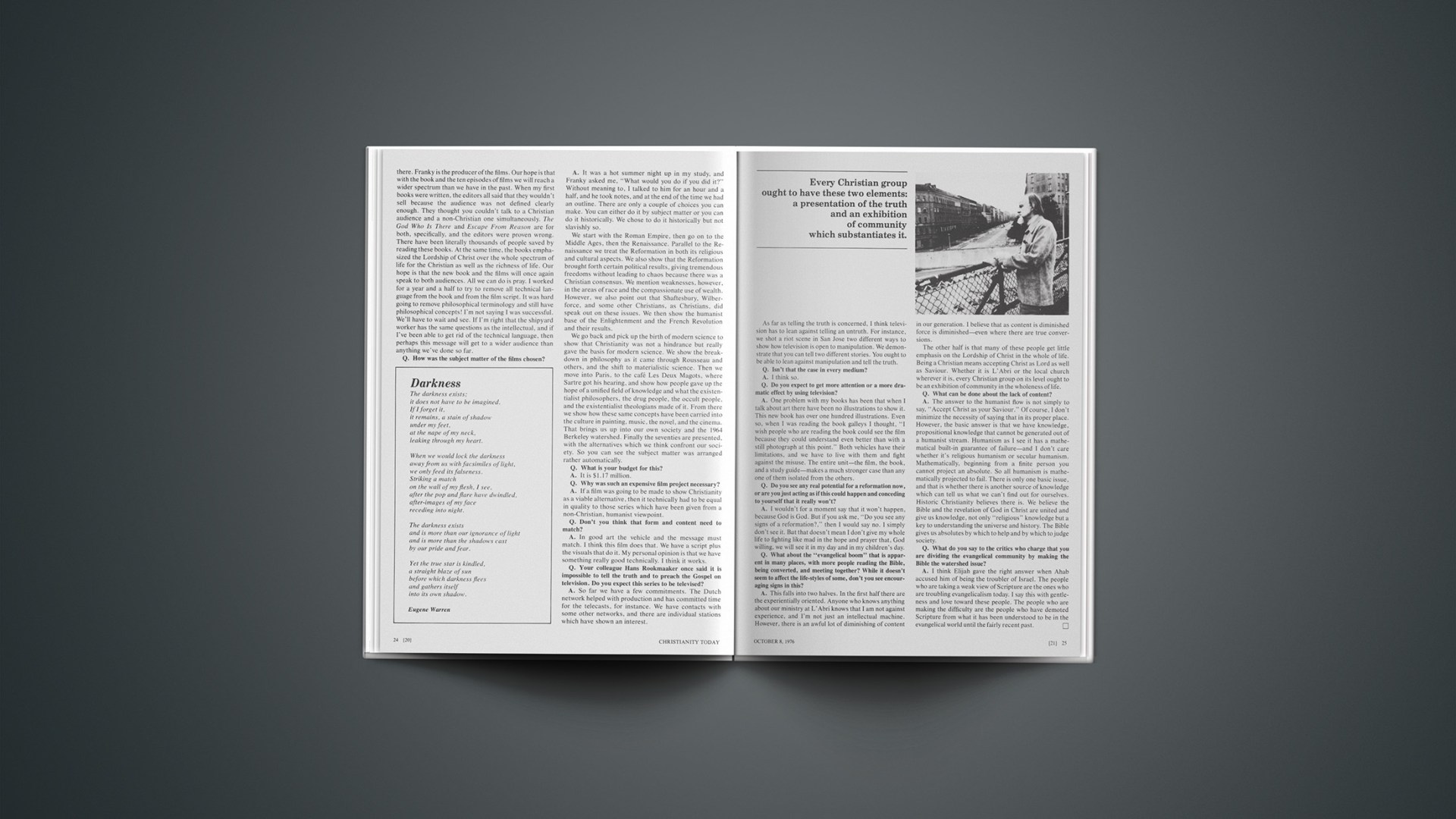
A. Yes, it began as a family, and there is still a strong emphasis on community. It’s based on a certainty that Edith, the children, the other L’Abri workers, and I hold that the New Testament church was more than merely a place where people went and heard preaching and sang songs on Sunday. It was a real community, up to the high level of caring for one another’s material needs. I think L’Abri has given many people a concept of community that would be practiced differently in other situations than we practice it at L’Abri. For example, seeing that the local urban church must also be a community as well as a preaching point, they are able to transfer that concept. Every Christian group ought to have the two elements: a presentation of the truth without compromise, and an exhibition of community which substantiates what is said. I visualize these as two sides of a Gothic arch, one supporting the other.

Q. How do you distinguish between this kind of family community and a commune?

A. A commune by definition today has more to do with the sharing of goods in an enforced sort of way. We wouldn’t hold to this. We believe that the New Testament church sets a standard, with people having their own things but sharing them in love and by choice. We don’t hold things in common in the sense of a community owning people’s personal property. I do believe the Church has been very, very weak in the matter of a compassionate use of accumulated wealth. This has opened the door to the rather left-wing swing among some of the younger evangelicals, some of whom are beginning to equate the Kingdom of God with an almost socialistic program.

Q. What is your emphasis in this area?

A. In the film series and the new book I stress that the Reformation didn’t bring forth a golden age and that as the centuries passed various weaknesses developed. Two outstanding ones would be a twisted view of race and lack of attention to a compassionate use of accumulated wealth. What we try to show in L’Abri is that in love we share what we have because we believe that’s what a Christian community ought to do. This has been a very, very large part of L’Abri’s ministry.

Q. How do you deal with people from Marxist lands or with a Marxist outlook?

A. I’ve dealt more with Marxism in this new book and the film series than I have in any of my other writings. These people go into two categories. You have to see that there are two Marxisms, and they must not be confused. Do you remember “Danny the Red” (Daniel Cohn-Bendit), who led the May, 1968, Paris riots of the New Left? An interview with him was published recently, and he’s still a Marxist. He has a Marxist bookstore in Frankfurt. He says there are two Marxisms today: the idealistic Marxism and then the hard-line, orthodox, bureaucratic type. Most of the young Marxists in the West today are attracted in the same way they were attracted to the drug trip. It’s an existential dichotomy in which their reason does not enter in. In other words, they’ve accepted Marxism-Leninism as a different kind of trip: I think these kids have deliberately shut their minds to the fact that wherever Marxism has come to power it has always been with oppression. I think the only way to understand this kind of idealistic Marxism-Engelism is to understand that it’s a Christian heresy. Christians have the basis of why man has dignity: he’s made in the image of God. Marxism is built on materialism and offers no reason for the dignity of man. But the Marxists have reached across and taken our terminology and attracted the idealistic Marxist on the basis of what belongs to us. The danger as I see it is that at a certain point of history, with or without pressure from the imperialist, expansionist Communist countries, these two lines of Marxism-Engelism will flow together in a certain geographical location and bring Communism to power. Then it will be irreversible. Those who would go against the wall first would be these idealistic Communists. And this makes me very sad. These kids don’t understand what they are into. On the other hand, hard-line Marxist-Leninists really know what they stand for. They’re the ones with the apparatus.

We have lots of people who come out of Marxism. The first thing one has to do is to try to figure out through a rather lengthy conversation which class they fall into. I would talk to them in entirely different ways depending on whether they are in class A or class B. If they are in class A (the idealistic Communist), I would try to show them that Marxism-Leninism has no basis for the dignity of man and that it carries with it, as an intrinsic part of the system, oppression. In the film series we have a section on the French Revolution. The French Revolution is often taught as being related to the American Revolution, but it is not really related. The American Revolution is related to the English bloodless revolution under William and Mary because it was inside of a Christian consensus. In the film I show pictures of Washington and Voltaire and say these two revolutions are not the same by any means. I pick up Washington’s picture and put it beside William and Mary’s. Then I ask: Where does Voltaire belong? I pick up his picture and put it beside Lenin’s. And then I say: The French revolution ended with the massacre of 40,000 or more people under the guillotine, a lot of them peasants; oppression was a natural part of the system. Then I point out that it brought in an elite, a Napoleon. I pick up a picture of Napoleon and put it down beside one of Lenin and say: The same system when tried in Russia brought forth an elite within a few months under Lenin.

Q. The film series is quite a different kind of project for you. Was this a conscious decision to go to a secular audience through television, or do you think you will reach mostly Christian people?

A. My son, Franky, is an artist. He came to me one day and said, “Dad, I have two little children, and if what you say is right, and I believe you’re right, then we have a responsibility to try and change the flow. You have spent years and years studying all of this, and I think you have to be willing to take on a new project—even if it kills you.” I backed off and thought about it, and I decided Franky was right. So I said yes. Then Billy Zeoli of Gospel Films caught a vision of it, and we just went from there. Franky is the producer of the films. Our hope is that with the book and the ten episodes of films we will reach a wider spectrum than we have in the past. When my first books were written, the editors all said that they wouldn’t sell because the audience was not defined clearly enough. They thought you couldn’t talk to a Christian audience and a non-Christian one simultaneously. The God Who Is There and Escape From Reason are for both, specifically, and the editors were proven wrong. There have been literally thousands of people saved by reading these books. At the same time, the books emphasized the Lordship of Christ over the whole spectrum of life for the Christian as well as the richness of life. Our hope is that the new book and the films will once again speak to both audiences. All we can do is pray. I worked for a year and a half to try to remove all technical language from the book and from the film script. It was hard going to remove philosophical terminology and still have philosophical concepts! I’m not saying I was successful. We’ll have to wait and see. If I’m right that the shipyard worker has the same questions as the intellectual, and if I’ve been able to get rid of the technical language, then perhaps this message will get to a wider audience than anything we’ve done so far.

Q. How was the subject matter of the films chosen?

A. It was a hot summer night up in my study, and Franky asked me, “What would you do if you did it?” Without meaning to, I talked to him for an hour and a half, and he took notes, and at the end of the time we had an outline. There are only a couple of choices you can make. You can either do it by subject matter or you can do it historically. We chose to do it historically but not slavishly so.

We start with the Roman Empire, then go on to the Middle Ages, then the Renaissance. Parallel to the Renaissance we treat the Reformation in both its religious and cultural aspects. We also show that the Reformation brought forth certain political results, giving tremendous freedoms without leading to chaos because there was a Christian consensus. We mention weaknesses, however, in the areas of race and the compassionate use of wealth. However, we also point out that Shaftesbury. Wilberforce, and some other Christians, as Christians, did speak out on these issues. We then show the humanist base of the Enlightenment and the French Revolution and their results.

We go back and pick up the birth of modern science to show that Christianity was not a hindrance but really gave the basis for modern science. We show the breakdown in philosophy as it came through Rousseau and others, and the shift to materialistic science. Then we move into Paris, to the café Les Deux Magots, where Sartre got his hearing, and show how people gave up the hope of a unified field of knowledge and what the existentialist philosophers, the drug people, the occult people, and the existentialist theologians made of it. From there we show how these same concepts have been carried into the culture in painting, music, the novel, and the cinema. That brings us up into our own society and the 1964 Berkeley watershed. Finally the seventies are presented, with the alternatives which we think confront our society. So you can see the subject matter was arranged rather automatically.

Q. What is your budget for this?

A. It is $1.17 million.

Q. Why was such an expensive film project necessary?

A. If a film was going to be made to show Christianity as a viable alternative, then it technically had to be equal in quality to those series which have been given from a non-Christian, humanist viewpoint.

Q. Don’t you think that form and content need to match?

A. In good art the vehicle and the message must match. I think this film does that. We have a script plus the visuals that do it. My personal opinion is that we have something really good technically. I think it works.

Q. Your colleague Hans Rookmaaker once said it is impossible to tell the truth and to preach the Gospel on television. Do you expect this series to be televised?

A. So far we have a few commitments. The Dutch network helped with production and has committed time for the telecasts, for instance. We have contacts with some other networks, and there are individual stations which have shown an interest.

As far as telling the truth is concerned, I think television has to lean against telling an untruth. For instance, we shot a riot scene in San Jose two different ways to show how television is open to manipulation. We demonstrate that you can tell two different stories. You ought to be able to lean against manipulation and tell the truth.

Q. Isn’t that the case in every medium?

A. I think so.

Q. Do you expect to get more attention or a more dramatic effect by using television?

A. One problem with my books has been that when I talk about art there have been no illustrations to show it. This new book has over one hundred illustrations. Even so, when I was reading the book galleys I thought, “I wish people who are reading the book could see the film because they could understand even better than with a still photograph at this point.” Both vehicles have their limitations, and we have to live with them and fight against the misuse. The entire unit—the film, the book, and a study guide—makes a much stronger case than any one of them isolated from the others.

Q. Do you see any real potential for a reformation now, or are you just acting as if this could happen and conceding to yourself that it really won’t?

A. I wouldn’t for a moment say that it won’t happen, because God is God. But if you ask me, “Do you see any signs of a reformation?,” then I would say no. I simply don’t see it. But that doesn’t mean I don’t give my whole life to fighting like mad in the hope and prayer that, God willing, we will see it in my day and in my children’s day.

Q. What about the “evangelical boom” that is apparent in many places, with more people reading the Bible, being converted, and meeting together? While it doesn’t seem to affect the life-styles of some, don’t you see encouraging signs in this?

A. This falls into two halves. In the first half there are the experientially oriented. Anyone who knows anything about our ministry at L’Abri knows that I am not against experience, and I’m not just an intellectual machine. However, there is an awful lot of diminishing of content in our generation. I believe that as content is diminished force is diminished—even where there are true conversions.

The other half is that many of these people get little emphasis on the Lordship of Christ in the whole of life. Being a Christian means accepting Christ as Lord as well as Saviour. Whether it is L’Abri or the local church wherever it is, every Christian group on its level ought to be an exhibition of community in the wholeness of life.

Q. What can be done about the lack of content?

A. The answer to the humanist flow is not simply to say, “Accept Christ as your Saviour.” Of course. I don’t minimize the necessity of saying that in its proper place. However, the basic answer is that we have knowledge, propositional knowledge that cannot be generated out of a humanist stream. Humanism as I see it has a mathematical built-in guarantee of failure—and I don’t care whether it’s religious humanism or secular humanism. Mathematically, beginning from a finite person you cannot project an absolute. So all humanism is mathematically projected to fail. There is only one basic issue, and that is whether there is another source of knowledge which can tell us what we can’t find out for ourselves. Historic Christianity believes there is. We believe the Bible and the revelation of God in Christ are united and give us knowledge, not only “religious” knowledge but a key to understanding the universe and history. The Bible gives us absolutes by which to help and by which to judge society.

Q. What do you say to the critics who charge that you are dividing the evangelical community by making the Bible the watershed issue?

A. I think Elijah gave the right answer when Ahab accused him of being the troubler of Israel. The people who are taking a weak view of Scripture are the ones who are troubling evangelicalism today. I say this with gentleness and love toward these people. The people who are making the difficulty are the people who have demoted Scripture from what it has been understood to be in the evangelical world until the fairly recent past.

Paul D. Steeves is assistant professor of history and director of Russian studies at Stetson University in Deland, Florida. He has the Ph.D. from the University of Kansas and specializes in modern Russian history.

Good News for Modern Man: Becoming a Bible

The Today’s English Version of the New Testament, popularly known as Good News For Modern Man, has carved out an important niche for itself in the history of Bible translation. It has been widely acclaimed by scholars and lay people alike since its appearance ten years ago. Tens of millions of copies have been sold or distributed here and abroad. Its popularity is due not only to the overall fidelity of its translation of the Greek text but also to the felicity of its style and the clarity of its language.

Now the American Bible Society is to be commended and congratulated for the recent publication of the corresponding Old Testament. The combination of the two testaments will be marketed as the Good News Bible; hence we will here refer to this Old Testament as the GNB. (For now, this Bible is available only through the American Bible Society.)

The manner in which the ABS translating team went about its work is interesting. A member of the team would do a first-draft translation of an Old Testament book and circulate copies to the other members. After they read it and made suggestions, he would do a second draft. Then in a series of full committee sessions the team would discuss and modify the second draft. The results of that work would become the third draft, which would be circulated to a review panel, which consisted of members of the translations committee of the ABS board, a broad range of churchmen, and United Bible Societies colleagues overseas. The translating team would then make whatever adjustments it considered appropriate and submit the manuscript to the ABS board. In the final stage of the process, Eugene Nida, head of the ABS translations department, and two members of the board’s translation subcommittee would review the team’s work and incorporate their own conclusions into the final manuscript. Although the GNB Old Testament was funded by the United Bible Societies, the UBS asked the ABS to serve as trustee on its behalf.

The GNB Old Testament presents a generally pleasing appearance. Each book is prefaced by an introduction and an outline of contents. Headings and subheadings give a bird’s-eye view of major sections. References to extended parallel passages are often included in the subheadings themselves, while single-verse cross references appear in footnotes. Footnotes contain comments that are usually quite helpful (as at Exodus 13:8 on “Red Sea” and 25:7 on “ephod”); they are supplemented by a Word List elsewhere in the volume. Some of the footnotes, however, would have been more useful had they appeared earlier. The one on “the LORD,” for example, is not given until Exodus 6:3 (compare its embryonic form at 3:14) and perhaps reflects the historico-critical viewpoint of one or more of the translators. It would have been more pertinent and helpful to the average reader, it seems to me, at Genesis 2:7.

By and large, poetic sections of the Old Testament are printed in poetic format, usually with good (and sometimes downright lyrical) effect (for examples, see Genesis 2:23; Numbers 6:24–26; Isaiah 55:1 f.). Prose passages in poetic sections, especially in the prophetic canon, also generally read well (for instance, Jeremiah 18:18; 31:31–34). But when allegory is interpreted in the text itself (as in Ecclesiastes 12:1–7), even in the admirable interest of clarity, the reader may feel cheated out of his right to come to his own conclusions. Sometimes the poetry has a strangely clipped style (as in Psalm 100) or descends to the level of doggerel (see Samson’s statement in Judges 14:18). And when lyrical prose bordering on poetry is rendered as ordinary prose, the results can be dull indeed (e.g., Genesis 1:27). In fact, the criteria used for distinguishing between poetry and prose are not immediately evident. The book of Proverbs, printed as poetry by most modern versions (RSV, for example), is given as poetry only in chapter 8 and in 30:1–4 in the GNB.

Other features of format that enhance the appearance and usefulness of this translation are the line drawings (already familiar to readers of the GNB New Testament) and maps included in some editions; lists of names set in tabular arrangement (see First Kings 4:1–19), though again, not consistently (1 Chron. 1–9); and the use of italics for certain purposes (for example, to indicate source materials used or referred to by authors of Old Testament books, as in Second Kings 8:23).

As might be expected, the translators everywhere show their awareness of the great advances made in Old Testament scholarship in recent years. By rendering the traditional “that” as “how” in Genesis 6:5, they have correctly highlighted the sinfulness of the people who lived before the flood. “Couldn’t” in Genesis 19:11 and “Make way!” in 41:43 are surely right, while “lovely” and “weak,” two viable options for a word in 29:17, are both preserved, one in the text and the other in a footnote. At Second Kings 17:4 the footnote reading is preferable to the text; the situation is more debatable at Ezekiel 14:14 (where, incidentally, the footnote will only confuse the average Bible student familiar with the Old Testament Daniel). “Palaces decorated with ivory” in Psalm 45:8 is right on target. And the relation (however near or remote, and in whatever direction) between Proverbs 22:17–24:22 and the thirty-proverb schema of the Egyptian Wisdom of Amenemope is accented by the GNB’s unfootnoted “thirty” in Proverbs 22:20 and the numbered subheadings throughout the rest of the section.

Is the GNB Old Testament a translation or a paraphrase? If by “paraphrase” we mean “à la Living Bible” and if by “translation” we mean “à la New American Standard Bible,” the answer is, “Neither.” It would seem that the GNB translation team followed rather closely the principles set forth by Eugene Nida in a number of works, primarily The Theory and Practice of Translation (1969), some of the main concepts of which were conveniently summarized in 1972 in the Journal of Biblical Literature (91/1, pp. 73–89).

To avoid the Scylla of literalism (“formal correspondence,” to use Nida’s term) and the Charybdis of paraphrase, Nida tacks carefully between the two in a ship named “Dynamic Equivalence.” According to Nida, formal correspondence and paraphrase are equally “bad,” while dynamic equivalence is “good” (Theory, p. 173). Dynamic equivalence occurs when a modern rendering produces the same (or an equivalent) effect in the mind and heart of a modern reader as the original text did in the mind and heart of an ancient reader. Writes Nida: “The ultimate test of a translation must be based upon three major factors: (1) the correctness with which the receptors understand the message of the original (that is to say, its ‘faithfulness to the original’ as determined by the extent to which people really comprehend the meaning), (2) the ease of comprehension, and (3) the involvement a person experiences as the result of the adequacy of the form of the translation. Perhaps no better compliment could come to a translator than to have someone say, ‘I never knew before that God spoke my language’ ” (Theory, p. 173).

When used by a translator with the skills and perception of Eugene Nida, dynamic equivalence as an overriding translational principle can be quite helpful. But when ordinary, workaday translators (however well trained in technique) like me, or (dare I say it?) like the GNB Old Testament translating team, attempt to use the principle of dynamic equivalence in a thoroughgoing way, the results can be decidedly mixed. The pitfalls are legion.

Here are a few examples from Genesis 1. “The heavens and the earth” (1:1) is rendered “the universe.” Not bad, you say. Perhaps—but maybe for some readers “universe” would (a) overstate what the text intends to say, (b) lead to the assumption that people in ancient times conceived of infinite space in the same way that most people do today, or (c) cause them to miss the literary beauty or catchword significance (1:2, after all, begins with “the earth”) of the more literal translation. In the light of such problems, is “the universe” really a better rendering than “the heavens and the earth”?

In 1:2, “darkness was upon the face of the deep” is translated as follows: “The raging ocean that covered everything was engulfed in total darkness.” Not bad. you say again. Perhaps—but are the extra flourishes (“raging,” “engulfed,” “total”) a genuine improvement over the more traditional rendering? I hold no brief for word-for-word translation, and I agree completely with Nida and other translators that we have far too long emphasized the grammar and syntax and idioms of source languages to the virtual neglect of the grammar and syntax and idioms of target languages. I suppose my main quarrel with an overstress on dynamic equivalence is that it leans far more toward paraphrase than toward formal correspondence.

It also tends to make explicit what may be intentionally implicit in the text. In Genesis 1:16, for example, the GNB renders “greater light” and “lesser light” as “sun” and “moon.” Nothing wrong with that, you say; it’s more clear than the traditional rendering. Quite so—and that’s the problem. The translator must always ask, “Why did the writer use this particular form of expression rather than another? Was he trying to be obscure, or quaint, or clever, or what?”

In this case, many commentators believe that the author of Genesis 1 deliberately avoided using “sun” and “moon” because those luminaries were universally worshiped by ancient pagans. “Sun” and “moon” could therefore be misunderstood as proper names for deities, and so Genesis 1 calls them “greater light” and “lesser light” to remind its readers that the sun and moon, far from being gods themselves, are inanimate objects created by the one true God. If it be objected that very few modern readers would catch subtleties of that kind, I would of course agree. On the other hand, the more perceptive reader may wonder why “greater light” and “lesser light” were used by the author, turn to a commentary or two, and increase his overall understanding of the purpose and meaning of the passage. Furthermore, “greater light” and “lesser light” are not uncommunicative terms (what else could they be but sun and moon in this context?), and I for one would rather restrain my natural impulse to be overly clear in translation than run the risk of blowing an author’s polemic cover.

Because there is no such thing as one-to-one lexical, grammatical, syntactical, or idiomatic correspondence between any two given languages, no translation is perfect; translators constantly find themselves resorting to agonizing compromise. The GNB has broken fresh ground for us in this regard in the crux interpretum of 1:2, “the Spirit of God,” which it has rendered “the power of God” and footnoted “or the spirit of God; or a wind from God; or an awesome wind.” “Power of God” is a thoughtful and commendable way of solving a difficult problem and preserving the ambiguity that many have seen in this verse. The GNB does not always translate “spirit” as “power,” of course (see, for example, Judges 3:10; Psalm 51:11).

A final word about dynamic equivalence. If one of its purposes is to reproduce in the modern reader the same kind of emotional response that the ancient reader is assumed to have had, I don’t see how a measure of vulgarity can be avoided in certain instances (contra Nida, Theory, page 29). The GNB has not been entirely successful in this regard (see First Samuel 20:30).

But perhaps we have already said enough about the difficulties of achieving the admirable goals of dynamic equivalence, especially when it veers off sharply in the direction of paraphrase. How has the GNB Old Testament fared in the area of interpretation?

Quite well, by and large. “Ritually clean” (Gen. 7:2), “sacred tree(s)” (12:6; 18:1), “unfaithful” (Hos. 1:2), and a host of other felicitous renderings are cases in point. At times, however, the GNB forecloses on interpretive options, often without footnoting the alternatives: “Spain” and “Rhodes” (Gen. 10:4), “innocent children” (Jon. 4:11), “commits adultery, takes a bath” (Prov. 30:20), “the first person” (Judg. 11:31), and so forth. On the other hand, another fine example of how the ambiguity of a text can be preserved in translation is in Psalm 23:6, “and your house will be my home as long as I live.”

Whether because of publication deadlines or for some other reason, the GNB Old Testament suffers from certain inexplicable (at least to me!) inconsistencies. Why should “tree that gives life” in Genesis 2:9 become “tree of life” in 3:22, 24, especially since “[tree that gives knowledge of] what is good and what is bad” is so rendered throughout the account (2:9, 17; 3:4, 22)? Why “a hundred and fifty days” in 7:24 but “150 days” three verses later? Why “that” in 12:1 and “which” in 18:21? Why “who made” in 14:19 but “Maker of” three verses later? Why “because” in Exodus 20:7 but “for” in the exact parallel in Deuteronomy 5:11? Similar examples abound, and I get the impression that such differences are due less to a desire for elegant variation than to pressures leading to editorial haste.

Although unable to break free from traditional renderings entirely (e.g., “outward appearance,” First Samuel 16:7; “give you peace,” Numbers 6:26), the GNB Old Testament has abandoned many terms and phrases it considered archaic or hard to understand. For example, Noah’s “ark” has become a “boat” (Gen. 6:14), while the “ark of the covenant” is now the “Covenant Box.” “Leprosy” is “dreaded skin disease” or “mildew” (Lev. 13–15) depending on whether human beings or inanimate objects are affected (at Leviticus 13:47 a helpful footnote indicates that the same Hebrew word means both “dreaded skin disease” and “mildew”). “Be strong and of good courage” (Josh. 1:6, 9) is now “Be determined and confident.” If a hallowed sermon title has been lost because of this last change, never fear: the “Preacher” of Ecclesiastes is now “the Philosopher” anyway!

The way in which the GNB Old Testament handles matters of introduction and theology (including Old Testament-New Testament interrelations), while basically conservative, will not please all evangelicals. Genesis 37:28 makes explicit the fact that it was “the brothers” of Joseph who pulled him out of the cistern and sold him to the Ishmaelites (in conformity with Acts 7:9). In Isaiah 7:14, however, “young woman” appears in the text, and a footnote explains why, in the translators’ opinion, Matthew 1:23 used “virgin” in quoting from the Isaiah passage (for an excellent and judicious treatment of this matter, see Herbert M. Wolf’s article in JBL 91/4 [1972], pages 449–56). Psalm 2:12 offers a conjectural reading and relegates “Kiss the Son” to a footnote, where we are told that the Hebrew text is unclear. Genesis 49:10 is capably handled in the text, although the reading “Shiloh” should have at least been mentioned in the footnote. The rendering of Job 19:25, while abandoning the traditional “Redeemer” rendering, gets the general sense across in the following paraphrase: “I know there is someone in heaven/who will come at last to my defense.” Footnotes at Job 24:18 and 27:13 tell us that although Zophar is not named in the text, the speeches that begin at those points are “usually” assigned to him (see a similar footnote at 26:5). What we are not told is who those assigners are or why “usually” was chosen over “sometimes” (a more circumspect word). Chapters 40–55 of Isaiah are pronounced exilic in the introduction to that book.

In sum, then, the GNB Old Testament is a mélange of good and bad qualities, of traditional and non-traditional characteristics, of brilliant and less-than-brilliant renderings, of conservative and not-so-conservative theology. It bears the stamp of seasoned experts (like Robert Bratcher and Eugene Nida) as well as of lesser-known translators and stylists. If my critique of it seems unduly harsh, perhaps it’s because I have chosen to point out what I consider to be its faults rather than to rehearse its obvious virtues. Above all, I fully recognize how much I as a translator (and reviewer!) need to strive for that gracious humility and generous openness so beautifully exemplified to me personally by Nida and his co-workers (see also Nida, Theory, page 186).

The real question, however, is whether the Good News Bible has that delicate balance of accuracy, clarity, dignity, and maturity required to make it a seminal or dominant version in our “golden age” of Bible translation. And only time can answer that one.

Paul D. Steeves is assistant professor of history and director of Russian studies at Stetson University in Deland, Florida. He has the Ph.D. from the University of Kansas and specializes in modern Russian history.
A Centennial Celebration Nine Hundred Years Late

This year Russian Christians are celebrating the 100th anniversary of the translation of the Bible into their common language. In a country like the United States, where there are a dozen Bibles for each church member, such an anniversary might occasion only passing notice. But Russian evangelicals publicly anticipated the celebration of this centennial for many months. Their enthusiasm arises from two causes. First, their history as evangelicals in Russia is inseparably joined with the history of the Bible in Russian. Second, the continued scarcity of Bibles in their language gives the Russians special appreciation for a precious possession. We will do well to share their joy this year.

The land of the Russians had been officially Christian for almost nine hundred years before the whole of the Scriptures appeared in words they could understand. From 988, when Grand Prince Vladimir of Kiev declared Byzantine Orthodoxy to be the religion of his realm, until 1917, when the last tsar fell, the Russian state and the Orthodox Church remained in close union. The religious history of Russia paralleled that of the most Catholic countries of the West. A highly liturgical religion incorporated all citizens; all were baptized by the priest as infants and were expected to present themselves at mass at least annually. The mass and the church books were in an archaic language, Church Slavonic, which the Russian people understood hardly better than Europeans comprehended Latin. No Protestant revolt, crying for a religion of the Book, spawned evangelical faith in Russian hearts. And no secularizing Enlightenment undermined the union of church and state. The autocratic tsar reigned as head of both.

The first steps in the preparation of the Russian Bible were instigated by Tsar Alexander I. This pietistic ruler sponsored the creation of the Russian Bible Society on the day in 1812 that Napoleon fled in defeat from Russian territory. The Russian society was the first offspring of the British and Foreign Bible Society, progenitor of those societies now affiliated in the United Bible Societies. The first product of the British and Russian cooperation, the Russian New Testament, appeared in 1823.

Two years later, Alexander died. His extremely reactionary brother, Nicholas I, dissolved the Russian Bible Society and halted work on translation of the Old Testament. Persecution of non-Orthodox religions intensified under his hand.

Nicholas’s attempt to keep modern ideas out of Russia ended in the disaster of the Crimean War. His son, Alexander II, accepted the inevitability of reform in Russia. In 1862, one year after he emancipated the serfs, Alexander II permitted the revival of the Russian Bible Society. That revival led directly to the appearance of evangelicalism in Russia.

Colporteurs of the Bible Society spread throughout the Russian Empire, distributing New Testaments. One such colporteur, Iakov Deliakov, appeared with his books in the city of Tiflis (now Tbilisi) in the Caucasus Mountains of south Russia. Nikita Voronin took a New Testament from Deliakov, began reading it, and soon experienced spiritual rebirth. On August 20, 1867, Voronin became the first Russian “Baptist” when he received believer’s baptism from a German Baptist.

Within a decade, several thousand Russians in the southern and western regions of the empire had become “Baptists” as God’s Word in Russian continued to bear fruit. One participant in the movement of evangelicalism later described the work the Word accomplished in Russian hearts: “Peasants, beginning to read the Bible, began to notice the incongruity between the teachings of Christ and life around them.… Serious study of [the Bible] worked a miracle: people gave up drinking vodka, smoking, profanity—they were born again and were made completely different people.”

Meanwhile, work on the translation of the Old Testament moved forward, under the inspiration of Orthodox Metropolitan Filaret of Moscow. In 1876, the glorious day of its completion arrived. For the first time the whole Russian Bible appeared in one volume, in what was called the “Synodal Version.”

Six years passed before a significant edition of this Bible left the press. In 1882, the Russian Bible Society printed 20,000 copies, with money donated by a nobleman who had been regenerated under the preaching of the Englishman Lord Radstock, a prominent adherent of the Plymouth Brethren. This nobleman, Colonel Pashkov, also financed the distribution of the Scriptures and evangelical tracts through his “Society for the Encouragement of Religious Reading.”

The rapid spread of a new, biblical faith soon alarmed the authorities, and in 1884 Pashkov was exiled to Paris. Inside Russia, twenty years of severe repression of evangelicals began. It was illegal for a Russian to be a “Baptist.” No more Russian Bibles were permitted until political revolution in 1905 forced the tsar to guarantee religious toleration for the evangelicals. In 1907 the censor approved the printing of the second, small edition of the Synodal Version, but with the restriction that it be in large, “pulpit” volumes, so that it would be difficult for evangelicals to carry the Scriptures with them in their incessant (albeit illegal) evangelistic journeyings. “But the Word of God grew and multiplied.” By the time of World War I, evangelicals numbered over 100,000.

The Communist Revolution of 1917 aided the evangelicals in their quest for the printed Word. Many more copies of Russian Scriptures were printed during the 1920s than had appeared under tsarism. With money raised in America, Russian evangelicals printed and distributed 45,000 Bibles and 30,000 New Testaments from plates made by photographic reduction of the old Synodal Version. By 1929, the fruits of God’s Word in Russian amounted to more than two million evangelical believers.

Under Stalin, the Communist government reversed the fortunes of believers. In 1929 an edition of 10,000 Bibles printed by the Baptist Union was confiscated just before it was to be distributed. During the years of terror, thousands languished in prison, but the Word sustained them and they kept the Word. Only after Stalin’s death did the government permit the Orthodox and Baptist churches further printings of Scripture: 60,000 Bibles and 25,000 New Testaments in 1956–57. Then for ten years Russian Christians sought in vain to publish more.

Since 1968, about 35,000 Bibles and more than 20,000 New Testaments in Russian have been legally published. Several thousand more were illegally produced on a printing press operated by Baptists until it was seized in October, 1974. In addition, portions of Russian Scriptures have been printed in the West and taken unofficially, sometimes illegally, into the Soviet Union.

The Bible in Russian is but the beginning of the story of proclaiming the Word of God within the Soviet Union. Russian is the mother tongue of only half the citizens of that country. More than a hundred other languages are spoken within its borders. In ninety of these, no part of the Bible is available. Translation of the Scriptures into most of the other languages was not begun until after the Russian Bible appeared, for various political reasons. Since the Revolution, small editions (10,000 copies) of New Testaments have been produced for Ukrainians, Latvians, Armenians, and Lithuanians inside the Soviet Union. Preparation of the Scriptures in the non-Russian languages deserves the attention of those who know the power of God.

In sum, while precise figures are unavailable, it can be estimated that fewer than one million whole Russian Bibles and New Testaments have appeared on Soviet territory since the Revolution. That means there is a scarcity of Scripture for the well over three million evangelicals currently active in the Soviet Union, not to mention the more than 30 million Orthodox Christians. On occasion, handwritten Bibles can be seen in a Russian church, lovingly transcribed from another’s copy or from foreign radio broadcasts.

But the Russians know how to be grateful for the copies they have. The work of the Word of the Lord does not depend on the number of Bibles available. Each year thousands continue to come to new life in Christ in the Soviet Union because the believers there faithfully proclaim the Gospel. Attempts to introduce Bibles into the Soviet Union by illegal means do not serve God’s work well.

Evangelicals in the West can join in the Russians’ celebration and support them in ways that do not violate Soviet laws and Christian morality. More than fifteen years ago, Baptist leader Alexander Karev complained to Professor Steve Durasoff: “Many Christians visit our country from the West. Why doesn’t each one bring a Russian Bible with him and leave it with us? You have failed us.” Tourists entering the Soviet Union are required to declare at customs all literature they are carrying with them, including, of course, Bibles. Generally, one copy of the Bible is permitted; on occasion (as happened to me once) customs guards confiscate a Bible, claiming that the book is forbidden in the country. But there is no published law to that effect, and the claim is manifestly untrue since Bibles are legally published. One suspects that confiscated Bibles bring a handsome profit on the “black market,” where the price of a Bible can rise to over a hundred dollars.

Single copies of Bibles can also be sent by post to the Soviet Union, usually more successfully from countries other than the United States. One Baptist minister in Moscow recently confirmed this to me personally and requested that Americans mail him some Bibles.

There are promising signs that the United Bible Societies of Europe will be able to provide Bibles for Russians in the future. The Evangelical Christian-Baptist Union maintains contacts with the UBS, which recently received permission to ship to the U.S.S.R. 3,000 Bibles in the German language, the mother tongue of many Soviet Baptists. The Russians are patiently praying that this will be a first step toward the eventual importation of Russian Bibles. But the work of the UBS is hampered by a shortage of money for Scriptures for Communist countries. It also appears to be bothered by the illegal activities of “Bible smugglers.”

Russian Christians, both evangelical and Orthodox, now anticipate the preparation of a new Russian translation of the Bible that will modernize the language of the Synodal Version. The UBS is cooperating in this work. In 1969 the Leningrad Orthodox Theological Academy appointed a group to begin work on the New Testament, using the Greek text prepared by the UBS in 1968. Recognizing the lexical shortcomings of the old version, the general secretary of the Evangelical Christian-Baptist Union, A. M. Bychkov, observed: “We support these helpful beginnings of the Russian Orthodox Church and we believe that God will bless the great work of scholars for his glory and the benefit of immortal souls.” At present, no Russian Baptists are sufficiently educated to participate in translation work.

During the last 100 years, “the Word of the Lord grew mightily and prevailed” on Russian soil. Bychkov declared in 1974: “Let the centennial jubilee of the Russian Bible be observed in all our churches with prayers of thanksgiving.” Let us, Western evangelicals, rejoice with them. God’s Word in Russian will continue to accomplish the purpose of him who gave it.

Paul D. Steeves is assistant professor of history and director of Russian studies at Stetson University in Deland, Florida. He has the Ph.D. from the University of Kansas and specializes in modern Russian history.
Eutychus and His Kin: October 8, 1976

The Bumbler And the Fair-haired Boy

Remember when President Ford first took office? The media people loved him. Photojournalists took pictures of the President fixing his own English muffin. (Imagine that!) They covered every detail of his daily swims. The way he removed his terrycloth robe. The height of his dive. (Did they score his diving or record his swimming times? I can’t remember.) They listed his favorite tobacco. They took shots of the way he held his pipe.

Then he pardoned Richard Nixon, and the English muffins were forgotten. Soon Ford became “Gerald the Bumbler.” If a week passed without pictures or reports of Ford bumping his head, or falling down steps, or losing his balance, it really wasn’t a good week.

Now, of course, Ford is pictured not only as a bumbler but as a bumbling plodder soon to be sacrificed on election eve, and Jimmy Carter is the bright young man of the moment. We have pictures of him playing softball. Hugging babies. Standing waist-deep in a pond catfishing. Jimmy Carter in shirtsleeves. He’s the man.

If he wins, give him a few weeks. Then Jimmy will be in the bad graces of the almighty cameramen and will have to yield to some other fair-haired boy or girl.

And when that happens I’ll be able to imagine Gerald Ford chuckling as he fixes his English muffin, puffs on his pipe, and swims his laps alone.

EUTYCHUS VII

Marrying and Burying At Church

J. Grant Swank’s article “Church Weddings Are Not For Everyone” (Minister’s Workshop, Aug. 27) touches on an issue of vital concern to many clergy. He is certainly correct in expressing joy over fully Christian weddings, and he rightly stresses the biblical injunction against the marriage of a Christian and a non-believer. But he slips in comparing weddings to Communion and baptism. Marriage is a creation ordinance for all humanity under God’s common grace while baptism and the Lord’s Supper have been specifically ordained for Christians. In attempting to strengthen his case for not marrying two non-Christians, I fear that Pastor Swank comes rather close to Roman Catholic theology, which has elevated marriage to sacramental status.

JAMES A. PATTERSON

Princeton, N.J.

Better late than never. Pastor Swank should have learned his current policy in the seminary and have followed it all his ministry; that would have saved him a lot of self-recriminations. While he is at it, he might extend the policy also to funerals. Just as not every couple who comes with a marriage license is deserving of a Christian wedding, so not every person who has been pronounced dead is deserving of a Christian burial.

KARL F. BREEHNE

Ottawa, Ill.

If feeling a sense of spiritual excitement is the criterion of a good marriage, it would follow by a similar sort of protective logic that a Swank funeral should have the same screening. For believers only following six months’ probation.

DAVID BROSTRUM

The Church in the Marketplace

Placentia, Calif.

A hearty “amen” to the Reverend Mr. Swank.… We are allowed to marry, but we are not given a vote on the divorce. So let us be wise stewards regarding our role and our responsibility in preparing people for Christian marriage.

ALLAN BLUME

Minister of Evangelism

Harvard Avenue Baptist Church

Tulsa, Okla.

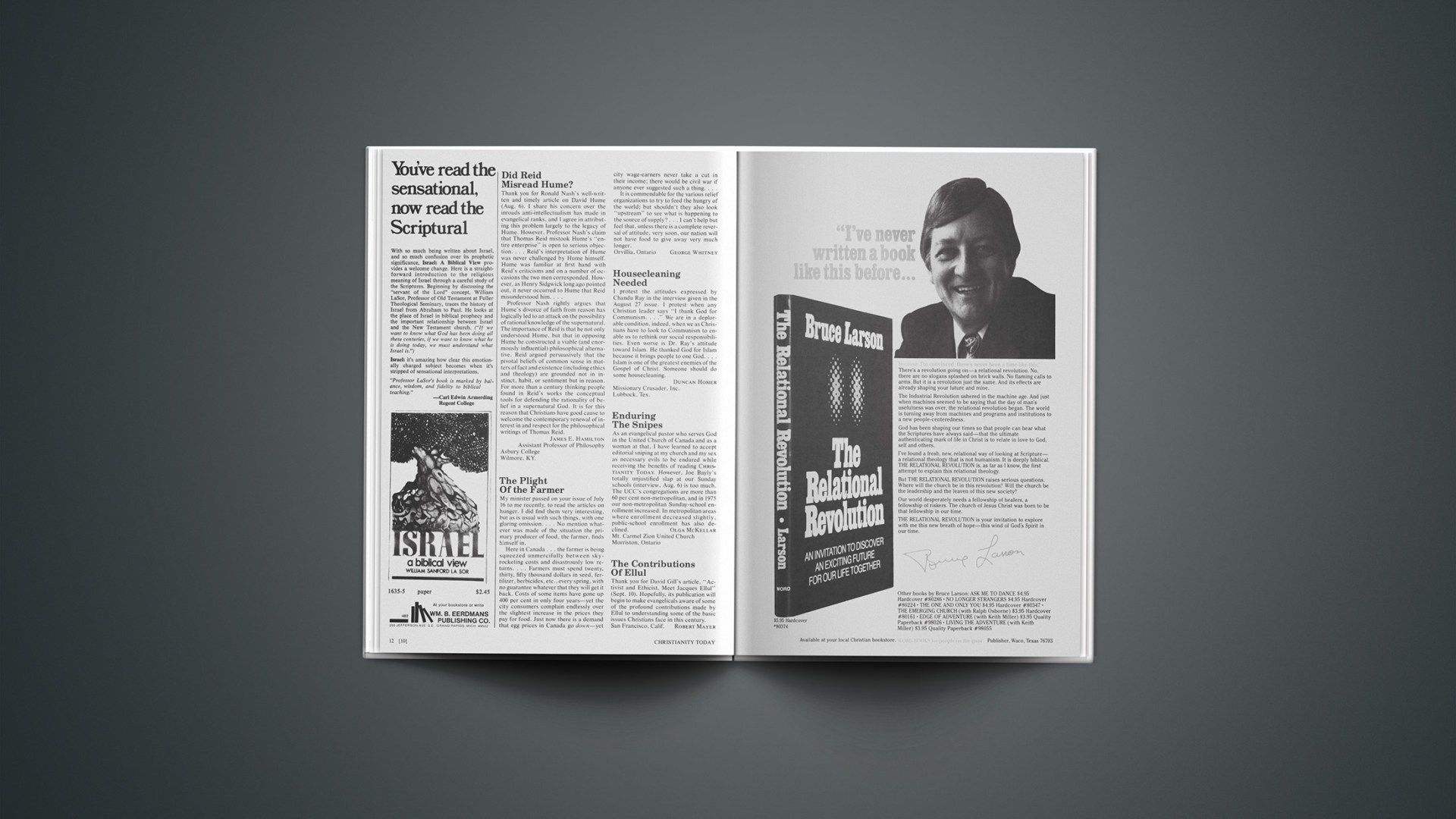
You’ve read the sensational, now read the Scriptural

With so much being written about Israel, and so much confusion over its prophetic significance, Israel: A Biblical View provides a welcome change. Here is a straightforward introduction to the religious meaning of Israel through a careful study of the Scriptures. Beginning by discussing the “servant of the Lord” concept, William LaSor, Professor of Old Testament at Fuller Theological Seminary, traces the history of Israel from Abraham to Paul. He looks at the place of Israel in biblical prophecy and the important relationship between Israel and the New Testament church. (“If we want to know what God has been doing all these centuries, if we want to know what he is doing today, we must understand what Israel is.”)

Israel: it’s amazing how clear this emotionally charged subject becomes when it’s stripped of sensational interpretations.

“Professor LaSor’s book is marked by balance, wisdom, and fidelity to biblical teaching.”

—Carl Edwin Armerding Regent College

Did Reid Misread Hume?

Thank you for Ronald Nash’s well-written and timely article on David Hume (Aug. 6). I share his concern over the inroads anti-intellectualism has made in evangelical ranks, and I agree in attributing this problem largely to the legacy of Hume. However, Professor Nash’s claim that Thomas Reid mistook Hume’s “entire enterprise” is open to serious objection.… Reid’s interpretation of Hume was never challenged by Hume himself. Hume was familiar at first hand with Reid’s criticisms and on a number of occasions the two men corresponded. However, as Henry Sidgwick long ago pointed out, it never occurred to Hume that Reid misunderstood him.…

Professor Nash rightly argues that Hume’s divorce of faith from reason has logically led to an attack on the possibility of rational knowledge of the supernatural. The importance of Reid is that he not only understood Hume, but that in opposing Hume he constructed a viable (and enormously influential) philosophical alternative. Reid argued persuasively that the pivotal beliefs of common sense in matters of fact and existence (including ethics and theology) are grounded not in instinct, habit, or sentiment but in reason. For more than a century thinking people found in Reid’s works the conceptual tools for defending the rationality of belief in a supernatural God. It is for this reason that Christians have good cause to welcome the contemporary renewal of interest in and respect for the philosophical writings of Thomas Reid.

JAMES E. HAMILTON

Assistant Professor of Philosophy

Asbury College

Wilmore, KY.

The Plight Of the Farmer

My minister passed on your issue of July 16 to me recently, to read the articles on hunger. I did find them very interesting, but as is usual with such things, with one glaring omission.… No mention whatever was made of the situation the primary producer of food, the farmer, finds himself in.

Here in Canada … the farmer is being squeezed unmercifully between sky-rocketing costs and disastrously low returns.… Farmers must spend twenty, thirty, fifty thousand dollars in seed, fertilizer, herbicides, etc., every spring, with no guarantee whatever that they will get it back. Costs of some items have gone up 400 per cent in only four years—yet the city consumers complain endlessly over the slightest increase in the prices they pay for food. Just now there is a demand that egg prices in Canada go down—yet city wage-earners never take a cut in their income; there would be civil war if anyone ever suggested such a thing.…

It is commendable for the various relief organizations to try to feed the hungry of the world; but shouldn’t they also look “upstream” to see what is happening to the source of supply?… I can’t help but feel that, unless there is a complete reversal of attitude, very soon, our nation will not have food to give away very much longer.

GEORGE WHITNEY

Orvillia, Ontario

Housecleaning Needed

I protest the attitudes expressed by Chandu Ray in the interview given in the August 27 issue. I protest when any Christian leader says “I thank God for Communism.…” We are in a deplorable condition, indeed, when we as Christians have to look to Communism to enable us to rethink our social responsibilities. Even worse is Dr. Ray’s attitude toward Islam. He thanked God for Islam because it brings people to one God.… Islam is one of the greatest enemies of the Gospel of Christ. Someone should do some housecleaning.

DUNCAN HOMER

Missionary Crusader, Inc.

Lubbock, Tex.

Enduring The Snipes

As an evangelical pastor who serves God in the United Church of Canada and as a woman at that, I have learned to accept editorial sniping at my church and my sex as necessary evils to be endured while receiving the benefits of reading CHRISTIANITY TODAY. However, Joe Bayly’s totally unjustified slap at our Sunday schools (interview, Aug. 6) is too much. The UCC’s congregations are more than 60 per cent non-metropolitan, and in 1975 our non-metropolitan Sunday-school enrollment increased. In metropolitan areas where enrollment decreased slightly, public-school enrollment has also declined.

OLGA MCKELLAR

Mt. Carmel Zion United Church

Morriston, Ontario

The Contributions Of Ellul

Thank you for David Gill’s article, “Activist and Ethicist, Meet Jacques Ellul” (Sept. 10). Hopefully, its publication will begin to make evangelicals aware of some of the profound contributions made by Ellul to understanding some of the basic issues Christians face in this century.

ROBERT MAYER

San Francisco, Calif.

Editor’s Note from October 08, 1976

This issue is crammed with good things, not the least of which is Ronald Youngblood’s appraisal of the TEV Old Testament, published by the American Bible Society. Our cover and the article by Paul Steeves on the Bible in the Russian tongue serve to remind us that there are hundreds of languages left into which no portion of the Bible has been translated.

We mourn with George Beverly Shea the loss of his wife, Erma, who died a few weeks ago after an extended bout with cancer. We also rejoice with him that Erma is in the presence of the Lord.

The Chinese and Evangelism: It’s Time to Give

Correspondent J. D. Douglas traveled recently to Hong Kong to cover the Chinese Congress on World Evangelization. The following account is based mostly on the report he filed just days before Mao Tse-Tung died.

Chinese churches throughout the world sent some 1,500 representatives last month to the crowded city of Hong Kong (population: 4.5 million) to discuss in plenary sessions and seminars unity of the international Chinese community, the Chinese role in world evangelism, and strategy for reaching mainland China with the Gospel. Spawned by the 1974 Lausanne Congress on evangelization, the Chinese Congress on World Evangelization had as its chairman pastor-educator Philip Teng of the Christian and Missionary Alliance. It was directed by Thomas Wang of the California-based Chinese Christian Missions, along with an international committee of Chinese.

The eight-day congress took place in the 1,600-seat Kowloon City Baptist Church, where 200 volunteers helped to keep things running smoothly—and to keep the congress budget down ($160,000). Participants were responsible for their own travel and hotel expenses.

In a welcome speech, Teng noted that past international evangelism congresses had been sponsored by Western church leaders. It was time now, he said, for the Chinese church not only to receive but also to give. (Teng is president of the thirty-six congregation, 3,500-member Christian and Missionary Alliance body in Hong Kong, president of the Alliance Bible Seminary, head of the China Graduate School of Theology, and pastor of a 1.000-member Alliance church.)

Despite the strong ethnic spirit that prevailed, there were grateful nods to Western missionaries who had brought the Gospel to the Chinese in the first place. Veteran independent missionary Gladys Ward, who teaches at the Alliance Bible Seminary, was honored with a commemorative Bible for her fifty years of service in the area. Also, non-Chinese observers were invited from more than thirty denominations, missions, and publishing houses.

Some delicate maneuvers had to be carried out before the congress could convene in the British crown colony on the underbelly of mainland China. It has been said that the colony’s capture by the People’s Republic could be effected by just one phone call. Understandably, the government of Hong Kong strives to avoid international incidents. Thus was ruled out any congress statement of intent regarding the future evangelization of the mainland, a topic of one of the seminars and a constant prayer subject.

The Taiwanese delegation was unhappy about this enforced reticence. Their own numbers limited to fewer than 200 by the authorities, the Taiwanese complained of “compromise” and of “disloyalty to Lausanne,” and they pressed in vain for some statement on the forbidden subject.

One congress leader pointed out privately that participants came from twenty-seven regions of the world, each with its own political situation. The injection of political overtones into the proceedings would have nullified the spiritual impact of the congress, he said. He stressed that this single divisive issue, however, did not mar Taiwanese participation in other aspects of the congress.

The wording of the congress covenant/declaration also proved difficult, and a draft statement on church and state was finally omitted altogether. The document was still being worked on some days after the congress, although essential content was settled. It identified four “bridges” to be built: between the generations, between old and new thinking (especially regarding strategy and methodology), between East and West (“the Oriental church tends to stress the deepening of the spiritual life, while the Western church emphasizes results”), and between denominations for the pooling of manpower and physical resources.

The latter part of the congress was held in torrential rainstorms that claimed the lives of thirty residents of the colony. The first of two evangelistic meetings at the end of the congress was forced indoors by the weather, but some 3,000 attended the final meeting and closing congress ceremony in the 13,000-seat South China Stadium. (About 12 per cent of Hong Kong’s people profess Christianity; they are divided almost evenly between Protestant and Catholic churches. The largest Protestant body is the 25,000-member Church of Christ in China. There are more than sixty denominations and church-establishing missions, and nearly 500 foreign missionaries are working there. The churches of Hong Kong meanwhile have sent missionaries to other parts of the Chinese-speaking world.)

Director Wang was appointed general secretary of the new Chinese World Evangelization Coordination Service, to be headquartered in Hong Kong. It will function as a liaison organization and publish a newsletter.

Pentecostal Action

Delegates to the thirtieth national convention of the 200,000-member Pentecostal Assemblies of Canada rejected, by a vote of 174 to 128, a move to change the bylaws to permit ordination of women. Since a two-thirds vote is needed to make a change, the motion fell far short of the required total.

Faced by the strong demand for change, some 500 delegates meeting at Ottawa did authorize study of the ordination of women, telling the PAOC Commission to consider biblical, theological, and socio-cultural insights. That document is to be ready by the 1978 meeting.

Delegates also called on the government to crack down on the “widespread practice of abortion virtually on demand.” Abortion should be permitted only when the mother’s life is jeopardized, they said.

The PAOC has 837 congregations and preaching points in nine provinces, the northern territories, and Bermuda. In addition, there are 150 congregations in an autonomous conference in Newfoundland, Canada’s tenth province.

LESLIE K. TARR

Rhodesia: Storm Warnings

Two bishops have stepped up the war of words on the Ian Smith government of Rhodesia while guerrilla groups have continued armed attacks on the white-ruled land.

United Methodist bishop Abel Muzorewa, a self-exiled Rhodesian, during a speaking tour in the United States sanctioned armed guerrilla activity as a “last resort” to gain rule by the black majority. From a base in Mozambique he heads the African National Council, whose attempts to negotiate a settlement with Smith have broken down.

Irish-born Catholic bishop Donal Lamont of Umtali, a longtime critic of the Smith regime, was arrested last month after he released another verbal salvo. The bishop, who has worked in Rhodesia for nearly thirty years, issued a scathing open letter in which he said Smith policies were the root cause of guerrilla insurgency.

Charles Waddington, Rhodesia’s acting attorney general, disavowed any connection between publication of the letter and Lamont’s arrest. The government official said the bishop’s activities had been under investigation long before the letter was sent to Smith and members of Parliament. He was charged with two counts of not reporting the presence of accused terrorists in his missions and two counts of instructing his missionaries not to report them.

In the correspondence, Lamont had suggested that church missions and hospitals might be justified in giving illegal assistance—in the form of medical and pastoral care—to anti-government guerrillas. The bishop also rejected the legitimacy of the Smith government, claiming that the prime minister ruled without consent of the nation. He described the minority electorate that keeps Smith in office as “small and selfish.”

The letter was published the day after Umtali was shelled by guerrillas from across the border in Mozambique. The bishop was not jailed after his arrest, but a September trial date was set.

A Rhodesian Methodist minister who has been an officer in the African National Council, Henry Kachidza, was arrested and ordered detained for a year without trial, according to reports reaching London. He is a former secretary of the Bible society in Rhodesia.

In another development, a Congregational mission at Chipinga near the Mozambique border was ordered closed.

Baptists In Japan

Taking a great stride forward in the eyes of both pastors and missionaries, the Japan Baptist Convention (JBC), voted self-support in its thirtieth annual session.

Dependent financially on the Foreign Missions Board of the Southern Baptist Convention (SBC), the JBC is receiving $159,000 this year from the United States. The SBC has sent funds for more than eighty years, according to Hoshikazu Nakajima, JBC executive secretary.

Beginning in January, the 175 churches (with 24,000 members) in the JBC are requesting $64,000 less, asking American support for only the Seinan Gakuin Seminary in Fukuoka. With a current enrollment of thirty, the seminary is costing the Southern Baptists $95,000 a year; in five years the JBC aims to pick up the total tab.

The JBC has 241 pastors and other full-time church workers, and it supports one missionary couple in Brazil. Southern Baptist missionaries from America wield no power in the JBC except as church members.

The annual meeting was described as the “most peaceful convention of recent years.” Most pastors could recall the late 1960s and early 1970s, when radical student groups disrupted religious conventions all over Japan, wearing helmets, waving red flags, and shouting slogans against “the establishment.” During those years certain pastors were taken bodily from the pulpit as radical students shouted, “We are going to preach today!” (The largest Protestant body in Japan, and perhaps the hardest hit—the 200,000-adherent, 1,600-congregation Nihon Kirisuto Kyodan [Church of Christ in Japan]—has not fully recovered yet. Bitterness and disagreements continue, and no pastors have been ordained since the student demonstrations began eight years ago.)

Nakajima, who is stepping down as JBC executive secretary after thirteen years, is credited by fellow Baptist leaders with “seeing us through” the riots. Formerly a Communist leader, he has been both iron-fisted and tender in overseeing the work, according to his colleagues.

Although Southern Baptist work in Japan is eighty-seven years old, the JBC itself is a post-war organization, as are most Protestant groups in Japan. The first SBC missionaries, two couples, arrived in Japan in 1889, just seventeen years after the first Protestant church (Dutch Reformed) was established, in Yokohama. In the early years the country was divided geographically between American (then Northern) Baptists and Southern Baptists; conferences were held jointly. In 1940 the two groups united to form the Japan Baptist Convention. In 1941, under a government edict, the JBC was one of thirty-four denominations forced to unite under the Kyodan church. It was also one of many that withdrew right after World War II.

One of the oldest pastors in the JBC, Shichiuemon Mugino, 72, remembers the pressure of the war years when the government required emperor worship. During the war, he recalls, Christians as well as all other “subjects” were required to bow toward the Ise shrine on designated holidays, to honor ancestors, to receive the talisman of the shrine of the sun goddess with respect, to have prayers and special meetings to pray for war victory, and to bow before the emperor’s photo or before his words whenever they were read to an audience. Some Holiness pastors who refused to comply were sent to prison, and others were sent to work in the coal mines.

Under the freedom now enjoyed in Japan, the JBC is concentrating on establishing new churches (sixty-five “mission points” are already being serviced). It is the largest of several Baptist bodies in Japan. In conjunction with other churches the JBC has also embarked on a study mission: it wants to know what the church can do about pollution, the imprisonment of Christians in Korea, and the Yasukuni Shrine situation. In the last ten years the government of Japan has given money to this Shinto shrine in connection with the worship of the war dead. In the post-war constitution that was drawn up under the late General Douglas MacArthur, church and state were declared separate. The JBC is intent on making that declaration stick.

NELL L. KENNEDY

Guatemala: Walls Of Love

More than six months after the devastating earthquake that killed 25,000 in Guatemala, evangelical relief efforts are still going strong—despite a dispute in the cooperative evangelical agency administering much of the aid.

Although it is impossible to calculate the total amount of aid channeled through missions, churches, and Christian relief agencies, it makes up a substantial portion of the estimated $60 million in materials and financial help received from nongovernment sources.

Temporary and permanent housing has been the biggest priority since the initial emergency situation passed. Over one million were left homeless by the February 4 quake, the worst disaster in Central American history. Tens of thousands are still living in flimsy shacks of cardboard or corn stalks and plastic—and this year’s rains have been the hardest in recent times.

At least 10,000 housing units have been constructed or are planned by various evangelical agencies. Most are being sold at subsidy with very low monthly payments. Tens of thousands of temporary shelters have also been provided. The Mennonite Central Committee, for example, is building 1,300 homes. CEMEC, the emergency committee of the Calvary Churches, a Pentecostal group, has built 1,500 temporary dwellings and is planning in cooperation with the government a permanent housing project of some 1,500 homes in an area “invaded” by landless squatters after the quake. Lutherans have built 400 houses in Zacapa and have plans for 600 more and a complete community development program. The Salvation Army is building 500 homes in Tecpán. The Central American Mission (CAM), while not directly involved in construction, donated materials for 2,600 homes. Thousands of volunteers from North America traveled to Guatemala to help rebuild homes and churches and to lend a hand in other projects.

Reconstruction of the estimated 500 evangelical churches destroyed is also under way. CAM and the Assemblies of God suffered the heaviest losses; each had about 130 churches affected. Thirty-four of the thirty-five Primitive Methodist church buildings were damaged.

A newspaper editorial by a well-known Catholic columnist recently commended the evangelicals for the speed with which they rebuilt their churches, while most of the Catholic churches still lie in ruins. A number of the massive, centuries-old Catholic churches were architectural treasures, and the government may help restore some of them.

Insurance on all the Presbyterian churches had lapsed just weeks before the quake. The United Presbyterian Church U.S.A. sent aid to Church World Service (CWS), the relief arm of the National Council of Churches (U.S.), which channeled it to CEPA, the Permanent Evangelical Committee for Aid of the Evangelical Alliance of Guatemala. The funds were not available for rebuilding churches. Members of the Eastminster Presbyterian Church of Wichita, Kansas, hearing of the plight, scaled down plans for their new educational complex and sent the $ 180,000 savings to Guatemala to reconstruct the thirty Presbyterian churches destroyed.

Much of the initial emergency aid was channeled through CEPA, which represents a majority of the denominations within the country (several of the larger groups, however, comprising perhaps over half of the evangelical population, are not members). But CEPA, which received help from agencies such as Food for the Hungry, King’s Garden World Concern, MAP, and the Billy Graham Evangelistic Association, came under fire early in the operation for receiving substantial backing from CWS. In general, Guatemalan evangelicals are strongly conservative and highly suspicious of anything that smacks of ecumenism.

Unhappiness over the relations with CWS and other groups, as well as with the administration of programs, led to a shakeup within CEPA in July. Executive director Virgilio Zapata was succeeded by Jose Francisco Solorzano, a pastor of the Pentecostal Church of God of America. It was uncertain how much the change of leadership and reported financial difficulties would affect CEPA’s programs, which include twenty-four nutritional centers for children, seven health centers, literacy programs, and community development. CEPA staff was cut 40 per cent and salaries reduced. Two housing projects totaling 500 units, with help from CWS and Good Will Caravans of Costa Rica, were nearing completion and were not affected. Another CEPA project, an evangelical hospital for which equipment has been donated, is awaiting finalization of a grant of land from the city.

A statement by the Evangelical Alliance of Guatemala, CEPA’s parent body, repeated a declaration made last year that it has no links, direct or indirect, with any group that fosters “Catholic-Protestant ecumenism” or with the World Council of Churches and similar groups.

A CWS spokesman, meanwhile, denied that it has any relationship with the WCC. “If we were the World Council’s agent here,” he said, “why would they have their own man here?” CWS has channeled about $2.5 million into relief and reconstruction through CEPA and other groups. At present it is not aiding CEPA.

The disaster and the evangelical response have had a profound spiritual effect on the Guatemalan people. Hundreds of conversions were reported in the first days following the quake, and the open climate for the Gospel has continued. Many churches have mounted special evangelistic efforts. CAM, for example, reports some 1,500 decisions and 400 baptisms so far as a result of a widespread but low-key program of literature distribution, visitation, and short local campaigns.

On the whole, evangelical efforts to help the victims of Guatemala’s earthquake have made a solid impression on Christians and non-Christians alike and on the government. A pastor in the village of Petapa summed up the feelings of many of his fellow countrymen as he tried to express his appreciation to a group of American young people who had been rebuilding his church. “With the difference in language, we haven’t been able to communicate very well,” he said, “but every time we look at these walls, we will know that you love us.”

In another development, Guatemala’s Catholic bishops last month released a statement calling for extensive land reform and a more just distribution of wealth. The paper pointed out that 70 per cent of the people make an average of $42 per year. It charged that large landholders deprived poor farmers of lands they cultivated for centuries, resulting in violent outbreaks, and the document hit hard at government policies that reinforce Guatemala’s “repressive” circumstances. It cited hunger, illiteracy, juvenile delinquency, corruption of government officials, and the like. The needs of the people are “grievous and basic,” said the bishops.

STEPHEN R. SYWULKA

Disaster Advice

Private agencies that assisted Guatemala in the aftermath of the recent earthquake (see story above) generally were given high marks for their efforts by the U. S. Comptroller General’s office, the fiscal watchdog for Congress. The forty-page report, however, was critical of a lack of coordination. It recommended that a “government-established system” be set up in the future to ensure “the most effective use of all resources.” Part of the aid supplied by the private agencies came from the U. S. government; hence congressional interest.

CARITAS (Catholic Relief Services) and CARE were cited as among the larger voluntary agencies having “well-developed infrastructures throughout the country, built up over their long-term development in Guatemala.” As a result, said the report, during the chaotic first days following the disaster, they were receiving information on what was needed from their workers and contacts throughout the country.

The report noted that the “smaller voluntary organizations and those without ongoing programs in Guatemala did not have the capabilities to determine what was needed, where it was needed, or how to get it there. They were, therefore, more dependent on the Guatemalan government for information, direction, and logistics support.” The larger agencies meanwhile carried out their own programs based on their own information. This resulted in “a considerable potential for duplication of effort and, even more, for failure to meet all needs as quickly as possible.”

What should have been established, said the report, was a central information-gathering and analysis point that would have given an hour-by-hour picture of what was needed and where, and that would have provided liaison among all the voluntary agencies as well as with the government.

Other “major voluntary agencies” listed in the report were: the Salvation Army, Seventh-day Adventist Welfare Service, Baptist World Alliance, Church World Service, OXFAM/World Neighbors, Mennonite Central Committee, Jehovah’s Witnesses, the Permanent Evangelical Committee, Save the Children Federation, and the Red Cross. The estimated monetary value of supplies provided by the voluntary agencies is more than $20 million, the report adds.

Easing Transplant Shock

Nineteen months ago a plan combining church-growth strategy and mass evangelism was put into motion in Rosario, the second largest city of predominantly Catholic Argentina (metropolitan population: 1.5 million). One goal was the establishment of sixty-eight new churches by this September. As of July, thirty-five new house churches had been founded.

Seventy pastors and leaders of the evangelical community in Rosario gathered last September for a church-growth workshop conducted by specialists from Argentina and the United States. Another workshop was conducted this month to evaluate progress and to provide more push. Leaders included Vergil Gerber of Evangelical Missions Information Service, Wilfred Bellamy, formerly general secretary of the New Life For All movement in Africa, and members of the Luis Palau evangelistic team, originators of the Rosario experiment.

Palau will open a three-week crusade in a Rosario stadium on October 25. Concurrently, his associates will hold crusades in neighboring cities. And there will be live television shows nightly using a question-answer format. Interested viewers will be directed to a counseling center near them (hundreds of counselors have already been trained to man some two dozen centers). Converts will then be directed into the newly formed house churches. In this way, Palau hopes to ease the transplant shock that has hindered effective follow-up of converts in past crusades.

Church-growth expert Donald McGavran of Fuller Seminary, for one, is keeping an eye on Rosario. He says it “may prove to be a breakthrough in evangelism and a model for future mass evangelistic efforts all over the world.”

Religion In Transit

A Massachusetts law prescribing a period of silence for meditation or prayer in public schools does not violate the constitutional provisions of the First Amendment, a three-judge federal court panel ruled in Boston. The 1966 law was adopted after the U. S. Supreme Court ruled against prayer in the schools. It provided for a minute of silent meditation but was amended in 1973 to allow for meditation “or prayer.” The case involved a battle mainly between a unit of the American Civil Liberties Union and the new pro-prayer Christian Civil Liberties Union, founded by Rita Warren of Brockton, Massachusetts.

First, some church people (including influential persons in government) raised their voices against the controversial song, “It Was on a Friday Morning,” in the new Armed Forces hymnal. They applauded when it was ordered to be excised or opaqued in Veterans Administration institutions by VA chief of chaplains James Rogers (see August 6 issue, page 40). Now some other church people are hollering. Leon A. Dickinson, Jr., chaplaincy liaison officer with the United Church of Christ, accused Rogers of caving in to “petty religious opinions of the powerful,” and he questioned whether the order constituted “unlawful defacement and destruction of government property.” And, says executive James A. Christison of the American Baptist Churches. “We can’t allow government officials to censor books like this.…”

“Those who argue that the cross is a mere secular symbol ignore 2,000 years of history,” said the Oregon Court of Appeals in ruling that a fifty-one-foot-high cross in a city park in Eugene is unconstitutional (it violates church-state separation). The court was not swayed by a 1970 city charter amendment designating the cross, built in the 1960s, a war memorial.

The Hartford Seminary Foundation’s library of 240,000 books, pamphlets, and periodicals has been shipped to the 500-student Candler School of Theology (United Methodist) at Emory University in suburban Atlanta. The $1.75 million transaction stemmed from Hartford’s 1972 decision to change from training future church workers to servicing those already in the clergy.

Teen Challenge has a 70 per cent cure rate from addiction and is the “best drug rehabilitation program around,” according to a government-financed report submitted to the National Institute of Drug Abuse in Washington. The emphasis on the spiritual is what makes the difference, according to physician Catherine B. Hess, who conducted the $150,000 research project. Expressing surprise at the findings, she said she had felt previously that the best answer lay in methadone, a substitute drug.

After eighteen years and more than 700 sermons, Southern Baptist Herschel H. Hobbs, 68, is bowing out as preacher on The Baptist Hour, a radio broadcast aired on 394 stations. His final message was scheduled for September 26.

The U.S. government has given its seventy-seven-acre, seventy-building former Valley Forge Army Hospital to the 475-student Northeast Bible College, related to the Assemblies of God denomination. The college will move to Valley Forge from Green Lane. Pennsylvania, in January and change its name to Valley Forge Christian College. Northeast got the property after Pennsylvania failed to come up with enough money to convert it into a state veterans’ home.

Bishop Myron F. Boyd, a well-known Free Methodist Church leader and broadcaster who suffered a crippling stroke a year ago, has retired.

Personalia

Argentine-born evangelist Luis Palau was named president of Overseas Crusades, the California-based mission agency with which he has been associated for some years. He succeeds OC’s founder, Dick Hillis, 63, who stays on as “Senior Counselor.”

Scottish-born George Docherty has retired as pastor of New York Avenue Presbyterian Church in Washington, D.C. He succeeded the renowned Peter Marshall there twenty-six years ago, and he was deeply involved in civil-rights activities during the 1960s.

World Scene

A Catholic priest working in Mozambique is quoted in an Italian weekly as saying that the leaders of the FRELIMO party are pushing church people aside in their efforts to create a Marxist society without God. The same ones, he observes, whom “many of us helped in the liberation … from colonialism just about manage to put up with us now, and nationalize all our educational and welfare institutions. They confiscate our car, which we need to keep in touch with our congregations.… In short, they do not actually expel us from Mozambique, but they take everything away from us so that we go ‘voluntarily.’ ”

More than 250 churchgoers in the Soviet city of Sverdlovsk have appealed to General Secretary Philip Potter of the World Council of Churches to help them get rid of their bishop, who, they allege, is not fulfilling his pastoral duties. They accuse Bishop Kliment of reducing the number of priests in the city, cutting back on services, and seldom officiating in the cathedral, according to a document given Western reporters by dissidents.

Discussions in the Soviet Union between clergy of the Church of England and the Russian Orthodox Church resulted in agreement on little. The Orthodox were especially apprehensive about the possible Anglican approval of ordination of women. If that happens, they warned, it “will create a very serious obstacle to the development of our relations in the future.” Elsewhere, the Vatican recently published an exchange of letters between Archbishop of Canterbury Donald Coggan and Pope Paul VI. The Pope expressed concern similar to that of the Orthodox about the effects of women’s ordination.

Death: Herman Otto Erich Sasse, 81, of Adelaide, Australia, a renowned Lutheran theologian and evangelical statesman.

Communist-dominated coalitions now run local governments covering more than one-third of Italy, and the Vatican newspaper Osservatore Romano claims the Communist “escalation against Catholic educational and welfare institutions is in full swing.” One example: Communists set up municipal nursery schools and end subsidies to those run by parish churches. As a result, hundreds of church-owned schools have been forced to close.

Cardinal Stefan Wyszynski of Poland has turned 75 but will stay on the job indefinitely. Although he has clashed with both the government and the Vatican in the past, both want him to stay because of the loyalty he commands among the country’s 30 million Catholics—90 per cent of the population. In Poland, unlike other former Catholic countries in eastern Europe, the Catholic Church has gotten stronger since the Communists came to power.

One million public school children ages 12 to 19 in the Brazilian state of Rio de Janeiro will receive a copy of the Portuguese edition of the Living New Testament over the next two years. A request for the volumes was made by the state director of education, and fulfillment arrangements were made by Living Bibles International, World Home Bible League, and Brazilian church leaders.

The Dutch have only two channels from which to select their after-dinner TV viewing. On Thursday evenings during prime time, the five-year-old Evangelical Broadcasting Company airs two and one-half hours of Christian programming on one of those channels, and the government pays the bills (as it does with other broadcasting companies). Air time is allotted in proportion to the number of private supporters. EBC has 155,000 and is shooting for 250,000, according to World Wide Challenge.

DEATH

LUTHER A. WEIGLE, 95, United Church of Christ clergyman, Yale educator, champion of prayer and Bible reading in public schools, and ecumenist who chaired the committee that produced the Revised Standard Version of the Bible; in New Haven, Connecticut.

Theological Labels and Libels

A basic characteristic distinguishing human beings from other animals is the fondness for naming things. As it was in the beginning (Gen. 2:19, 20), it has never ceased to be.

Like the rest of God’s good gifts, the right to name things can be abused. Naming things is indispensable to clear thinking, but it can also serve as an easy escape from serious reflection or personal interaction. Sometimes we attach disparaging labels to individuals or ideas in order to avoid the labor of showing why we oppose them.

Several months ago I was sitting in a biblical-studies seminar in a Swiss university. The members were considering possible topics for future meetings. One professor suggested that we read and discuss a new book that raised some important questions in our field of study. The response by one member of the group was, “Why, that’s published by a fundamentalist publishing house!” That was the end of the discussion; a serious book was dismissed by a sneer.

The same sort of thing happens in evangelical circles, of course. One of my students stopped by the bookstore of a well-known Bible college to buy a copy of a book I had recommended. It had the word “criticism” in the title. “Criticism!” replied the manager. “We wouldn’t have a book like that in this store!”

Everyone has his ways of dismissing people and ideas by labels. The favorite device of a former professor of mine was to call someone “anabaptist.” By this he seemed to mean anyone who thought it was less than ideal to have a queen as the head of his church! By his frequent use of this term he absolved himself—in his own mind—of the responsibility of considering the idea of a “gathered church” seriously. Others use “neo-evangelical,” “neo-fundamentalist,” “neo-orthodox,” “liberal,” separatist,” “chiliast,” “post-tribulationist,” “pietist,” “charismatic,” and the like to hide their inability or unwillingness to interact with those with whom they disagree.

Having for some time found this negative use of labels distasteful—though I confess that I am probably as guilty as anyone else in the matter—I turned hopefully to Vernard Eller’s latest book, Cleaning Up the Christian Vocabulary (Elgin, Illinois: Brethren Press). Perhaps he would break out of this dreadful syndrome! But no such luck.

Eller is, as always, entertaining (“There’s something here to offend everybody!” quipped the publisher at the Christian Booksellers Association convention as he thrust the book into my hand). But, regrettably, he does not come close to avoiding the usual prejudicial pit-falls, though he does make his personal biases clear at the beginning (he favors the orthodox, low-church, sectarian tradition of radical discipleship!).

Despite good intentions, Cleaning Up the Christian Vocabulary simply illustrates the problem instead of solving it. The movements the author likes (anabaptist, believers’ church, orthodox, pietist, radical, sectarian, and Zwinglian) he defines by the use of essentially positive terms. The names that represent what he thinks are other people’s views that he dislikes (charismatic, conservative, ecumenical, evangelical, fundamentalist, liberal, and liturgical) come out much more negatively.

Some of his definitions are, it seems to me, fairly accurate statements of what people within Eller’s tradition believe about themselves, while others provide information concerning the way they look at outsiders. To illustrate: a fundamentalist is “an ultraconservative believer who is completely self-confident that he is correct in his understanding of Christian doctrine” while a pietist (historically) is one who insists that “if a person’s ‘experience’ of Jesus is genuine, it necessarily will bear fruit in his outward conduct.” Needless to say, this is not the way fundamentalists view themselves, nor is it the way outsiders see the pietist tradition.

This is not to say that Eller’s critique of traditions other than his own is unhelpful. Those who call themselves evangelicals, for example, will find his essay on them (the longest in the book) stimulating, even if they feel that it contains a bit of hitting below the belt. But one would have hoped for greater objectivity.

What guidelines could we use to attempt to avoid libeling under the guise of labeling? I suggest four.

1. We should normally give people names that they themselves choose. There are limits to this, of course, since the name a person chooses for his position may be misleading or inaccurate; but we have no right to choose for him. (Note that people hardly ever refer to themselves as “ultra” or “hyper” anything!) If a person says he does not wish to be known by a particular label, we should respect his wishes. The next time we may be the ones on the receiving end!

2. We should attempt to define terms in a way that those who apply those terms to themselves can accept. Ideally, we should be able to describe another person’s position so that his response will be, “Yes, that’s me all right!” Only then are we free to say, “But this is why I think you are wrong.”

3. We should seek to avoid “lump” thinking, that is, simply lumping people or groups together with no respect for their individual distinctives. To view persons simply as samples of homogeneous groups is both an insult to their God-given uniqueness and a denial of our Lord’s “golden rule” for human relations (Matt. 7:12; Luke 6:31).

4. We should avoid exclusivism in the use of labels. We may think that such a word as “reformed,” “evangelical,” or “charismatic” is best applied to our theological stance, but this does not give us the right to deny others the use of these terms to describe their views. Each of these terms has roots that are broader than most users of them recognize; “reformed” indicates that one seeks to be true to the insights of the Protestant Reformation, “evangelical” means basically that one attempts to be faithful to the Gospel (the evangel), and “charismatic” means, surely, that one recognizes the importance of giving opportunity for the exercise of the gifts (charismata) of the Holy Spirit in the life of the Christian community. I may point out what I regard to be an inconsistency in the way someone uses a particular term in relation to his own views, and as a result one of us may abandon the use of the term or coin a new one that is more accurate. But I do not have the right to define terms in a manner that treats the other person or his views unfairly.

We cannot avoid labels. But we can certainly use them carefully, courteously, and with a healthy recognition that even at their best they are limited in their ability to promote understanding.

W. WARD GASQUE

Editor’s Note from September 24, 1976

With this issue we come to the end of twenty years of publication. The issue contains our annual index. CT is also indexed in Readers’ Guide to Periodical Literature, Christian Periodical Index, and Index to Religious Periodical Literature.

Kudos to senior editor David Kucharsky, whose first book, The Man From Plains, an account of Jimmy Carter and the evangelical scene, has just been published by Harper & Row.

Apple PodcastsDown ArrowDown ArrowDown Arrowarrow_left_altLeft ArrowLeft ArrowRight ArrowRight ArrowRight Arrowarrow_up_altUp ArrowUp ArrowAvailable at Amazoncaret-downCloseCloseEmailEmailExpandExpandExternalExternalFacebookfacebook-squareGiftGiftGooglegoogleGoogle KeephamburgerInstagraminstagram-squareLinkLinklinkedin-squareListenListenListenChristianity TodayCT Creative Studio Logologo_orgMegaphoneMenuMenupausePinterestPlayPlayPocketPodcastRSSRSSSaveSaveSaveSearchSearchsearchSpotifyStitcherTelegramTable of ContentsTable of Contentstwitter-squareWhatsAppXYouTubeYouTube