Revolutionary Response in Ethiopia

As troubled Ethiopia’s military junta moves closer to Marxist ideology, Christians are encountering adversity. Meanwhile, despite difficulties of a different nature, a remarkable people’s movement in the Christian faith is growing in the southern part of the nation.

The National Democratic Revolution Program announced by Major Mengistu Haile-Mariam, first vice-chairman of the Provincial Military Administrative Council (PMAC), is being implemented to establish the Peoples Democratic Republic of Ethiopia as a socialist state. In a speech to the nation last April, the leader listed missionaries as the number-one source of imperialist infiltration in the past. Teachers were listed second. Later, a popular radio program alleged that Ethiopian teachers in church schools were really “black missionaries” exploiting the people.

Newspapers and radio broadcasts have increasingly named missionaries and churches as agents working against the interests of the state. Missionaries, pastors, and priests have been harangued by local “workers’ revolutionary forums” that hold indoctrination and self-criticism meetings. All organizations, including missions, must give their Ethiopian staff two hours per week off to attend these forums.

While much of the PMAC’s effort is aimed at breaking the stranglehold that Amharic landlords and the Orthodox Church had on the nation, the result has been a vacuum of power. Local committees have taken power to enforce their policies, even if they are contrary to PMAC directives. Students and peasants have taken the law into their own hands to settle grievances, real or imaginary.

Christians have also been infected with the revolutionary spirit of the day. For example, some students—whipped into hostility by a revolutionary—accused their missionary benefactors of exploiting them, and forcibly confined them to their houses. Hospital staffers placed missionaries under house arrest when exorbitant demands could not be met. A group of revolution-minded young people marched a church leader barefoot at gunpoint more than eight miles and then forced him to ox-plow a field for an hour before releasing him.

In spite of such problems, some of the revolutionary changes have spurred evangelism in the south of the country, where 23,000 conversions over a four-month period have recently been reported among animistic people in one tribe.

One major factor in this new response has been the breaking down of fear of the all-powerful Ethiopian Orthodox Church, which used to persecute evangelicals and imprison evangelists virtually at will. Its power, steadily eroding since the revolution began, was dealt a final blow when the PMAC removed its patriarch allegedly for mismanaging $2 million of church funds. A southerner was elected to replace him (see following story).

The abolition of the feudal landlord system means that Christian peasants, once held in serfdom, are now able to use the proceeds of their harvests to support evangelists. (Farther north, where farmers’ cooperatives are dominated by Marxists, the contributions of Christian farmers are not available for Christian work.)

A third impetus has come from a course in personal evangelism given to pastors and evangelists. Stirred with a sense of urgency to spread the Gospel, evangelists have moved across the mountainous countryside with little other than their Bibles and a bag of millet and leaves for food.

This remarkable response after twenty years of fairly uneventful work has challenged church leaders to absorb thousands of new believers. Elders observe the lives of new converts to see if they are genuine before taking them in to baptismal classes.

Since Ethiopian policy before the revolution banned Scripture translation in tribal vernaculars, and since few can read the Amharic lingua franca, church leaders are planning a crash program of printing “key Scriptures” in the local language. Plans also call for a cassette player for each of the 2,300 churches, with cassettes containing New Life for All discipling material.

Although removed from the strong Marxism of other districts, southern believers still face their own difficulties. Most animist relatives strongly oppose their conversion. The anti-feudal laws, while commendable in many aspects, make it compulsory for a farmer to reside on his farm. Permission must be obtained to leave for even a few days. As a result, some evangelists have had to choose between retaining their ancestral lot of land or losing it in order to take the Gospel to others.

Changes In Ethiopia

For the first time in its 1,600-year history, the Ethiopian Orthodox Church chose a patriarch by election. Selection previously was by appointment of the emperor or the Egyptian Coptic Church. It was the first time any institution has elected its leaders since the military seized power two years ago and later deposed the late Emperor Haile Selassie, according to Washington Post reporter David Ottoway.

The winner from among five candidates was southerner Malaku Wolde-Michael, 58, credited with the conversion of 300,000 animists and the building of eighty-five churches and twenty-four schools in his home province. Electors from all over the country met in the Trinity Cathedral of Addis Ababa and chose the relatively unknown candidate over several establishment candidates in the hierarchy.

Relations between the church and the government have been strained. The military has assumed a socialist stance and established a policy of separation of church and state, taking away a lot of church property and power in the process. Leaders of the church, which claims the allegiance of between 12 and 14 million, are worried about finances. There are 18,000 churches, nineteen important monasteries, and 200,000 clergy to care for.

Early this year the government announced that Patriarch Theophilus had been arrested and replaced by Acting Patriarch Yohannes. A number of church organizations, including the National Council of Churches in the United States, have requested information about Theophilus’s welfare and whereabouts—but to no avail as of last month.

On another front, Ethiopia announced the nationalization of the 135-bed Empress Zauditu Memorial Hospital, a Seventh-day Adventist institution in Addis Ababa. There are thirty-nine Adventist churches with more than 25,000 members in Ethiopia.

Under Attack

A Dutch priest in Mexico has warned Mexican Catholics to reject a proposed Billy Graham crusade in Mexico City on grounds that it is a front for an ideological invasion of the country. The attack by Francisco Vanderhoff, director of an ecumenical study center, appeared in an interview article on page one of the Mexico City daily Novedades.

“They use the path of religion to reach the people with political ideas, glorifying and defending the North American system,” the priest charged. He also repeated many of the accusations that have been hurled by Graham critics over the years, and he added a new one: that Graham has ties with the U.S. Central Intelligence Agency.

Upon hearing of the press attack, Graham expressed surprise at the priest’s attack in light of the fact that members of the Catholic hierarchy have welcomed him to many nations. He denied the charge of CIA links as well as the other accusations.

Mexico City evangelicals who invited the evangelist wrote letters of protest to the paper. In pointing out inaccuracies, they noted that the December, 1976, date for the crusade listed in the article was wrong. Graham is considering 1977 or 1978 dates.

Tragedy Along The Thompson

Among the dead and missing after a freak downpour sent a ten-foot wall of water coursing through the Thompson River canyon in Colorado were seven Campus Crusade for Christ staff women. Nearly two dozen others, including Vonette Bright—wife of Crusade’s founder-president Bill Bright—escaped by only seconds.

The women—national staffers and wives of top staffers—were at a weekend retreat at Sylvandale Ranch along U. S. highway 34, east of Estes Park. Fifteen miles away, some 2,500 young people were gathering that Saturday, July 31, on the Colorado State University campus at Fort Collins for Crusade’s annual staff training conference. The thirty women were expected later.

That night a siren interrupted the women’s conference. A highway patrol car roared into the area. Using a loudspeaker, the patrolman instructed everyone to move to higher ground at once. The women rushed to their cars, and several drove up into a field behind the ranch. But two drivers, one of them Marilyn Henderson, drove out onto the highway and headed downstream, apparently to follow the patrolman.

Ms. Henderson was found the next morning lodged in the branches of a tree. Melanie Alquist, who had been with her in the front seat, was found further downstream. Both were taken to Loveland Hospital where early this month they were reported to be in good condition, with Ms. Henderson recovering from pneumonia. The three in the back seat of the car were found dead as was one from the other vehicle.

The dead: Rae Ann Johnston of Crystal, North Dakota; Cathie Loomis of Seattle; Carol Rhoad of Grantsville, Pennsylvania; and Pressy Manongdo of the Philippines. Missing and presumed dead were Barbara Leydon of Washington, D. C.; Terri Bissing of Kansas City; and June Fujiwara of Hawaii. Also dead was a patrolman, possibly the one who had warned of the danger.

On Sunday the survivors began arriving at Fort Collins. Bill Bright led in memorial services for the dead, and there were prayers for the missing.

At Last, A Schwenkfelder

It may never happen again: millions of Americans now know of the Schwenkfelders, thanks to Ronald Reagan’s announcement of Senator Richard Schweiker of Pennsylvania as his running mate weeks before the Republican convention.

Schweiker is one of only 2,690 members of the Schwenkfelder Church. His membership, like that of about half the others, is in the Central Schwenkfelder Church of Worcester in southeastern Pennsylvania. There are only four other congregations, all in Pennsylvania. Three have voted to affiliate with the United Church of Christ, from whom most of the Schwenkfelders’ ministers have come.

The group is named for Kaspar Schwenkfeld von Ossig, a sixteenth-century Silesian reformer who emphasized a somewhat mystical inner life rather than doctrine, ritual, or organization. The first immigrant Schwenkfelders arrived in Pennsylvania in the 1730s, but the group did not get around to organizing a church until 1910. Before that, members simply banded together family-style, and laymen were appointed to lead them.

In Washington, Schweiker attends St. Paul’s Lutheran Church, and his wife teaches a Bible class there.

A Year Off From Work

Cult “deprogrammer” Ted Patrick, 46, of San Diego was sentenced to jail for one year by a judge in Fullerton, California. The sentence was handed down for his conviction last year in a kidnap and attempted deprogramming case involving a 19-year-old member of the Hare Krishna (Krishna Consciousness) sect. That conviction, said the judge, also amounted to a violation of a one-year probation set by a Denver judge in an earlier case there. Therefore Patrick was given a sixty-day sentence for the Fullerton incident and a one-year term for probation violation, to be served concurrently.

“I am going to jail for an honorable cause.” Patrick announced after the sententing, and he vowed he would keep up the fight against cults that “psychologically kidnap” people. His lawyer said he will appeal.

Shortly before his sentencing in Fullerton. Patrick was arrested with several others in Long Beach. New Jersey, The case involved the seizure and attempted deprogramming of two brothers (ages 23 and 26) from Guru Maharaj Ji’s Divine Light Mission. One of the youths escaped through a bathroom window and called police. The brothers’ parents and four of Patrick’s assistants were all charged with false imprisonment. Bail was set at $25,000 each. All were released on personal recognizance bonds.

Although often in trouble with the law, Patrick had spent only two weeks in jail before the Fullerton sentence, and that was in Denver, where he was released on $25,000 bail and probation.

A Prescription

There are bound to be some eyebrows raised at a position paper released by the board of directors of the Massachusetts Council of Churches. In the paper, the board calls for the establishment of experimental heroin-maintenance programs. The board members say that a well-run program under which addicts are given heroin legally will result in fewer health risks and more rehabilitative possibilities for the addict, in lower crime rates, and in reduced pressures on the legal system. The paper acknowledges that the idea might prove unworkable. “If so,” it states, “we hope that critics of such an approach will not only show its flaws, but will propose better alternatives for confronting the crises of drug addiction and its attendant crime.”

Galluping Faith

The findings of a recent Gallup Poll offer a “positive outlook for religion in America as we enter the third century of our existence.” The poll found that 94 per cent of the American people believe in God and 69 per cent believe in life after death, percentages that have remained fairly constant since 1948. But the percentage who believe religion is “increasing its influence on American society,” a figure that dropped from 69 per cent in 1957 to 14 per cent in 1970, rose to 39 per cent last year. In other words, more and more people are finding reasons to believe that religious faith is having an impact on national life.

The declines that began in the sixties have bottomed out, the study concludes, and America may be in the first stages of spiritual renewal.

OUT OF THE MOUTHS OF

Family-life specialists Delmer W. Holbrook and his wife have been lecturing and conducting surveys for Seventh-day Adventists across America. In a survey of hundreds of children, the Holbrooks came up with the three things fathers say most in responding to their kids.

“I’m too tired,” takes first place. “We don’t have enough money,” is second. And “keep quiet” is third.

Freeze In Colombia

Colombia has put a freeze on all new missionary visas pending the introduction of new regulations, including some sort of quota system, according to mission sources. President Luciano Jaramillo of the Confederation of Evangelical Churches of Colombia (CEDEC) says the government wants to update information on which missionaries are presently in Colombia. CEDEC has been directed to collect the information and to serve as an intermediary between the government and the various missions, adds Jaramillo. Details of the quota system have not been spelled out yet.

Government officials have said they are tired of dealing with forty or fifty religious organizations with different representatives and systems of government that frequently change. There is speculation that all future missionary visa requests by Protestants will have to be cleared through CEDEC.

Church Affairs

The charismatic movement, the ecumenical movement, and the movement to endorse the ordination of homosexuals and women all received some harsh words at the annual meeting of the one-million-member American Baptist Association, headquartered in Texarkana, Texas.

At the annual conference of the 180,000-member Church of the Brethren, the 900 delegates approved a 10,000-word policy statement on alcohol use. It upholds abstinence as the church’s official position but does not call for the censure of those in the church who drink.

Delegates to the 221,500-member National Association of Free Will Baptists convention voted to make ineligible for church office elders (ministers) and deacons who have been divorced and remarried, regardless of their innocence or guilt in the divorce. Homosexuality, sexual promiscuity, and humanism in public schools were criticized. A dress-code proposal was voted down, apparently because it was not strong or specific enough.

Highlights of other meetings:

Evangelical Covenant Church of America. Some 640 delegates from 308 member churches, representing nearly 73,000 ECCA members in North America, approved “on principle” the ordination of women and an important statement on divorce and remarriage at the ECCA’s ninety-first annual meeting, held at Tacoma, Washington. The statement attempts to deal with the reality of divorce while upholding the sanctity of marriage and unity of the family. When there is repentance, forgiveness, and an attempt to understand why the marriage failed, a divorced person may consider the possibility of remarriage, according to the ECCA position. The door was left open for divorced pastors to continue their ministries.

Conservative Baptists. More than 1,200 pastors, missionaries, and laypersons assembled at Valley Forge for their thirty-third annual meeting and passed resolutions calling for stronger family life (especially through an emphasis on family worship) and opposing Transcendental Meditation as a religious cult. Thirty-six missionaries were added to the CB force of nearly 700 workers serving in twenty-two nations. There are 1,120 CB congregations in the United States with 300,000 members.

General Association of Regular Baptist Churches. Nearly 1,500 messengers (delegates) at the forty-fifth annual GARBC conference in Seattle heard that forty-nine new churches had been accepted into the fellowship the past year, bringing the total number of congregations to 1,528. The missions committee reported that the five GARBC-approved agencies now have 1,915 missionaries at work in more than fifty countries. The messengers pledged to champion “biblical separation while rejecting a bitter, caustic spirit” but disavowed “any fellowship with neoevangelicals,” mentioning the National Association of Evangelicals by name. They criticized the women’s liberation movement and condemned the Equal Rights Amendment. They also condemned immorality on the part of government leaders. Reaffirmed was the GARBC’s belief in the pre-tribulation rapture of the Church, a de facto test of fellowship.

The Wesleyan Church. Meeting in Wichita, Kansas, delegates from twenty nations, representing a worldwide membership of 137,000 (85,000 of them in the United States), heard glowing reports of growth and effective outreach spanning the past quadrennium. In an important action, the delegates by a vote of 280 to 99 adopted a recommendation of the denomination’s administrative board to end merger talks with the Free Methodist Church, which had been going on for six years (see May 10, 1974, issue, page 50). There had been uneasiness at the grass-roots level over the looser approach to Scripture by some Free Methodists, over a projected compromise that would leave Free Methodist schools free of tight denominational control in a merger, and over the Free Methodists’ failure to vote on a merger plan in 1974. Other issues also figured in the action. Delegates agreed, however, to maintain cooperative programs with the Free Methodists (printing, Christian education, youth work).

African Methodist Episcopal Church.

Meeting in Atlanta for the AMEC’s quadrennial convention, 1,400 delegates of the 2.5-million-member body came out against abortion on demand, homosexual marriages, and capital punishment. Support was voiced for black liberation movements in South Africa and Rhodesia and for women’s equality. Clergyman Richard Allen Chappelle of Jacksonville, Florida, was elected as the denomination’s general conference secretary (chief executive) to succeed Russell S. Brown, 78, who is retiring after thirty years in the post.

Religion In Transit

Missouri voters defeated a proposed amendment to the state constitution that would have authorized some $10 million annually in state aid to parochial and private schools.

Not only is there no “general religious revival” occurring today among high school youth, as widely believed, but the trend is in the opposite direction, according to Catholic sociologist Dean Hoge. Basing his remarks on studies by Purdue University and a research unit of the Catholic University of America, he concludes that religious faith among teen-agers has decreased by 15 to 20 per cent since the 1950s.

After Macmillan publishing company of Canada was tried and acquitted on obscenity charges in connection with its sex education book, Show Me, the book became a sellout in a number of Canadian stores. It shows nude children exploring one another’s bodies and illustrates sex acts between teen-agers. Marshall McLuhan testified against the book; rabbi W. Gunter Plaut and United Church of Canada clergyman Barry Brooks endorsed its use.

Christian radio executive David L. Hofer of Dinuba, California, a Mennonite Brethren member, was reelected president of Gideons International at the group’s 77th convention in San Francisco. World membership is 51,151 (33,741 in the United States), an all-time high, he says. The Gideons place Bibles (in forty-three languages) in hotel rooms, prisons, and hospitals in 109 countries.

Six people were arrested during a police raid of a bingo operation at the storefront Church of All Faiths of Pomona, California. Patrons were required to buy a Bible for $ 10.60 in return for game cards. Investigators say the church grossed $16,000 a month on the scheme.

DEATH

OLIVER BOYCE GREENE, 61, fundamentalist Baptist radio preacher; in Greenville, South Carolina, during heart surgery.

World Scene

Hundreds of Vietnamese Catholic priests have been arrested throughout what was formerly South Viet Nam, say church sources, and all foreign clergy have been asked to leave. Few remained as of last month.

Because of political tension, many missionaries have left Uganda. Some say they will stay in Kenya indefinitely. More than thirty Anglican missionaries, however, were still on the job this month.

Former U. S. Army chaplain James Hutchens, 41, a well-known evangelical, is seeking to have Israel’s Supreme Court reverse its decision denying him and his family immigrant status. The court’s action was in connection with a complaint that Hutchens still retained his belief in Jesus despite his ritual conversion to Judaism under an Orthodox rabbi in the United States.

After East Timor declared its independence from Portugal last December, Indonesian forces invaded the 7,400-square-mile island enclave, and the Indonesian government annexed it as its twenty-seventh province. East Timorese exiles claim 60,000 of their 670,000 countrymen were killed and 100,000 were imprisoned. A third of the population is Catholic; the rest is mostly animist. The World Council of Churches months ago called on Indonesia to withdraw. In the mid-sixties, revival swept the western side of the island, long a part of Indonesia.

Some 125 Nigerian missionary couples are serving under the Evangelical Missionary Society, the mission arm of the Evangelical Churches of West Africa (ECWA). The missionaries serve in neighboring Benin and Nigeria as well as in remote areas of Nigeria. ECWA is an outgrowth of Sudan Interior Mission work.

Israeli officials say 6,000 Jews have emigrated from the Soviet Union since January. Half have gone to Israel.

Alcoholism among Britain’s teen-agers has risen sharply, according to the National Council on Alcoholism.
Outreach at the Olympics

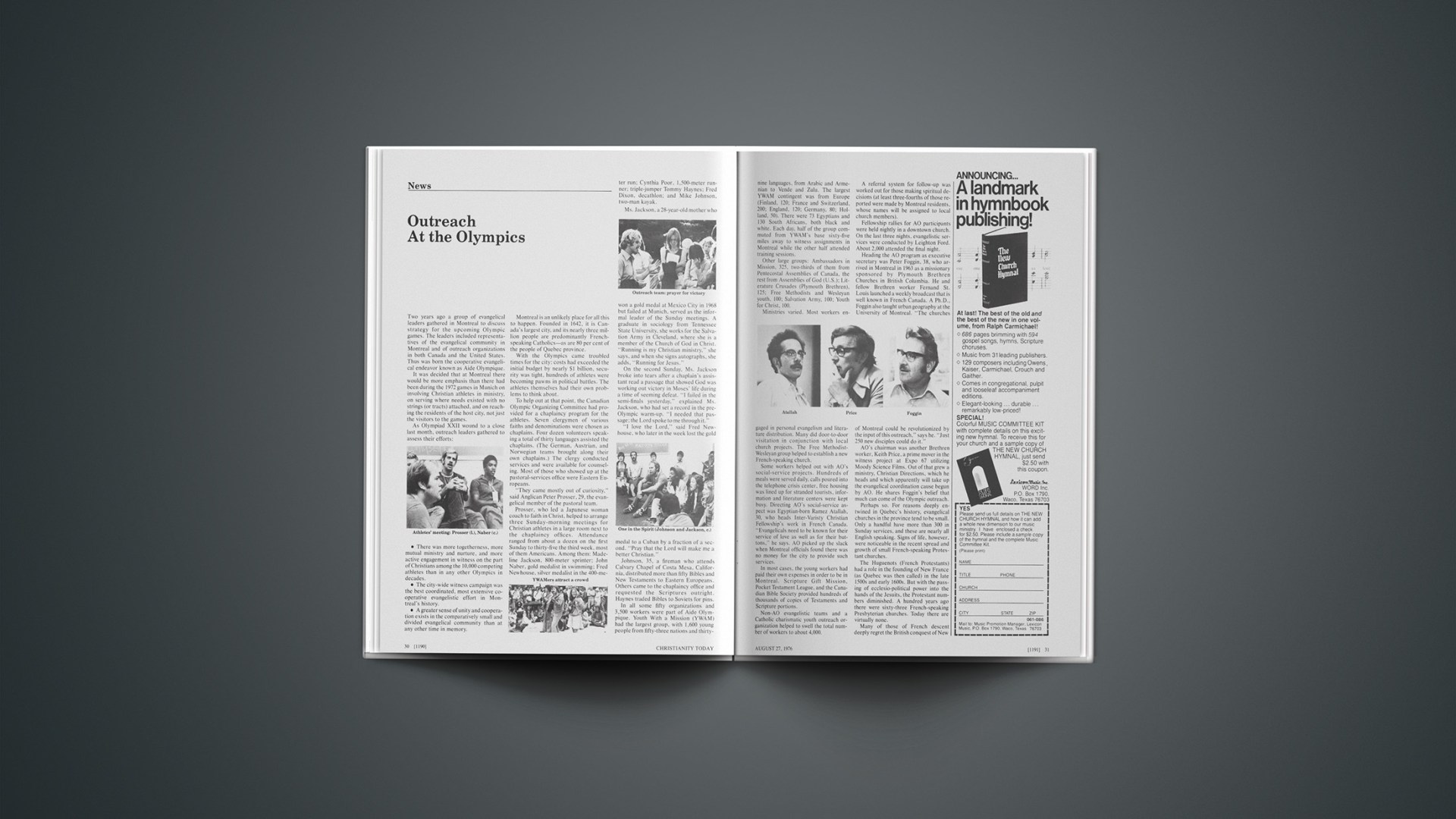
Two years ago a group of evangelical leaders gathered in Montreal to discuss strategy for the upcoming Olympic games. The leaders included representatives of the evangelical community in Montreal and of outreach organizations in both Canada and the United States. Thus was born the cooperative evangelical endeavor known as Aide Olympique.

It was decided that at Montreal there would be more emphasis than there had been during the 1972 games in Munich on involving Christian athletes in ministry, on serving where needs existed with no strings (or tracts) attached, and on reaching the residents of the host city, not just the visitors to the games.

As Olympiad XXII wound to a close last month, outreach leaders gathered to assess their efforts:

• There was more togetherness, more mutual ministry and nurture, and more active engagement in witness on the part of Christians among the 10,000 competing athletes than in any other Olympics in decades.

• The city-wide witness campaign was the best coordinated, most extensive cooperative evangelistic effort in Montreal’s history.

• A greater sense of unity and cooperation exists in the comparatively small and divided evangelical community than at any other time in memory.

Montreal is an unlikely place for all this to happen. Founded in 1642, it is Canada’s largest city, and its nearly three million people are predominantly French-speaking Catholics—as are 80 per cent of the people of Quebec province.

With the Olympics came troubled times for the city: costs had exceeded the initial budget by nearly $1 billion, security was tight, hundreds of athletes were becoming pawns in political battles. The athletes themselves had their own problems to think about.

To help out at that point, the Canadian Olympic Organizing Committee had provided for a chaplaincy program for the athletes. Seven clergymen of various faiths and denominations were chosen as chaplains. Four dozen volunteers speaking a total of thirty languages assisted the chaplains. (The German, Austrian, and Norwegian teams brought along their own chaplains.) The clergy conducted services and were available for counseling. Most of those who showed up at the pastoral-services office were Eastern Europeans.

“They came mostly out of curiosity,” said Anglican Peter Prosser, 29, the evangelical member of the pastoral team.

Prosser, who led a Japanese woman coach to faith in Christ, helped to arrange three Sunday-morning meetings for Christian athletes in a large room next to the chaplaincy offices. Attendance ranged from about a dozen on the first Sunday to thirty-five the third week, most of them Americans. Among them: Madeline Jackson, 800-meter sprinter; John Naber, gold medalist in swimming; Fred Newhouse, silver medalist in the 400-meter run; Cynthia Poor, 1,500-meter runner; triple-jumper Tommy Haynes; Fred Dixon, decathlon; and Mike Johnson, two-man kayak.

Ms. Jackson, a 28-year-old mother who won a gold medal at Mexico City in 1968 but failed at Munich, served as the informal leader of the Sunday meetings. A graduate in sociology from Tennessee State University, she works for the Salvation Army in Cleveland, where she is a member of the Church of God in Christ. “Running is my Christian ministry,” she says, and when she signs autographs, she adds, “Running for Jesus.”

On the second Sunday, Ms. Jackson broke into tears after a chaplain’s assistant read a passage that showed God was working out victory in Moses’ life during a time of seeming defeat. “I failed in the semi-finals yesterday,” explained Ms. Jackson, who had set a record in the pre-Olympic warm-up. “I needed that passage; the Lord spoke to me through it.”

“I love the Lord,” said Fred Newhouse, who later in the week lost the gold medal to a Cuban by a fraction of a second. “Pray that the Lord will make me a better Christian.”

Johnson, 35, a fireman who attends Calvary Chapel of Costa Mesa, California, distributed more than fifty Bibles and New Testaments to Eastern Europeans. Others came to the chaplaincy office and requested the Scriptures outright. Haynes traded Bibles to Soviets for pins.

In all some fifty organizations and 3,500 workers were part of Aide Olympique. Youth With a Mission (YWAM) had the largest group, with 1,600 young people from fifty-three nations and thirty-nine languages, from Arabic and Armenian to Vende and Zulu. The largest YWAM contingent was from Europe (Finland, 120; France and Switzerland, 200; England, 120; Germany, 80; Holland, 50). There were 73 Egyptians and 130 South Africans, both black and white. Each day, half of the group commuted from YWAM’s base sixty-five miles away to witness assignments in Montreal while the other half attended training sessions.

Other large groups: Ambassadors in Mission, 325, two-thirds of them from Pentecostal Assemblies of Canada, the rest from Assemblies of God (U.S.); Literature Crusades (Plymouth Brethren), 125; Free Methodists and Wesleyan youth, 100; Salvation Army, 100; Youth for Christ, 100.

Ministries varied. Most workers engaged in personal evangelism and literature distribution. Many did door-to-door visitation in conjunction with local church projects. The Free Methodist-Wesleyan group helped to establish a new French-speaking church.

Some workers helped out with AO’s social-service projects. Hundreds of meals were served daily, calls poured into the telephone crisis center, free housing was lined up for stranded tourists, information and literature centers were kept busy. Directing AO’s social-service aspect was Egyptian-born Ramez Atallah, 30, who heads Inter-Varisty Christian Fellowship’s work in French Canada. “Evangelicals need to be known for their service of love as well as for their buttons,” he says. AO picked up the slack when Montreal officials found there was no money for the city to provide such services.

In most cases, the young workers had paid their own expenses in order to be in Montreal. Scripture Gift Mission, Pocket Testament League, and the Canadian Bible Society provided hundreds of thousands of copies of Testaments and Scripture portions.

Non-AO evangelistic teams and a Catholic charismatic youth outreach organization helped to swell the total number of workers to about 4,000.

A referral system for follow-up was worked out for those making spiritual decisions (at least three-fourths of those reported were made by Montreal residents, whose names will be assigned to local church members).

Fellowship rallies for AO participants were held nightly in a downtown church. On the last three nights, evangelistic services were conducted by Leighton Ford. About 2,000 attended the final night.

Heading the AO program as executive secretary was Peter Foggin, 38, who arrived in Montreal in 1963 as a missionary sponsored by Plymouth Brethren Churches in British Columbia. He and fellow Brethren worker Fernand St. Louis launched a weekly broadcast that is well known in French Canada. A Ph.D., Foggin also taught urban geography at the University of Montreal. “The churches of Montreal could be revolutionized by the input of this outreach,” says he. “Just 250 new disciples could do it.”

AO’s chairman was another Brethren worker, Keith Price, a prime mover in the witness project at Expo 67 utilizing Moody Science Films. Out of that grew a ministry, Christian Directions, which he heads and which apparently will take up the evangelical coordination cause begun by AO. He shares Foggin’s belief that much can come of the Olympic outreach.

Perhaps so. For reasons deeply entwined in Quebec’s history, evangelical churches in the province tend to be small. Only a handful have more than 300 in Sunday services, and these are nearly all English speaking. Signs of life, however, were noticeable in the recent spread and growth of small French-speaking Protestant churches.

The Huguenots (French Protestants) had a role in the founding of New France (as Quebec was then called) in the late 1500s and early 1600s. But with the passing of ecclesio-political power into the hands of the Jesuits, the Protestant numbers diminished. A hundred years ago there were sixty-three French-speaking Presbyterian churches. Today there are virtually none.

Many of those of French descent deeply regret the British conquest of New France and its subsequent assimilation into Canada, and cling resolutely to their culture and language. Moving to head off the radical separatist call for independence, the government has made many concessions, including the maintenance of a separate French Catholic school system. French-speaking Protestants got squeezed in the crunch. The “Protestant” or public school system in Quebec is English speaking.

Because of the political tensions and uncertainties, many English-speaking people have moved from the province in the last decade, weakening many Protestant churches.

Meanwhile, there have been many changes among Catholics, too. The provincial government is essentially secular. Only a third of the Catholics are practicing ones. Since Vatican II, open hostility to Protestants has all but disappeared (religious discrimination and even persecution was a fact of life for some Protestants as late as the 1950s). Also, the charismatic movement has been growing rapidly among Catholics in the last three years (an estimated 30,000 to 40,000 are part of it). Evangelicals tend to be wary of it, although YWAM joined in a pre-Olympic march and rally with thousands of young Catholic charismatics.

A key figure in the movement’s spread is Trinitarian priest Jean-Paul Régimbal, a noted criminologist and prison chaplain. Through contact with Episcopal charismatics while he was in Arizona recuperating from a lung disorder, he received the charismatic experience. Back in Canada in 1970 he was put in charge of the retreat house in Granby, where he has guided thousands into the movement directly and indirectly. A youth wing of the movement, “Youth Testimony,” has approximately 10,000 members. One of its leaders is Marcel Paquin, a hardened ex-criminal whom Regimbal led to Christ in jail. The youth group, with thirty full-time workers, fielded its own witness teams from all over the province for the Olympics and set up a permanent coffeehouse in north Montreal.

“Our main message,” says Michelle Daneau, 20, “is that Christ died to save us and is risen. That is what has to be said, and that’s what we are saying.”

Book Briefs: August 27, 1976

Pointers On Preaching

God Has a Communication Problem, by Chester Pennington (Hawthorn, 1976. 136 pp., $6.95). The Word and the Words, by Colin Morris (Abingdon, 1975, 174 pp., $3.95 pb), Preaching God’s Burning Word, by James Reese (Liturgical Press, 1975, 135 pp., $3.85 pb), Put a Door on It, by Louis Paul Lehman (Kregel, 1975, 102 pp., $3.50), The Art and Craft of Preaching, by Herbert Loekyer (Baker, 1975. 118 pp., $3.95 pb). Preaching For the People, by Lowell Erdahl (Abingdon, 1976, 127 pp., $5.95), and Preaching the Good News, by George Sweazey (Prentice-Hall, 1976, 339 pp., $9.95), are reviewed by Cecil B. Murphey, pastor, Riverdale Presbyterian Church, Riverdale, Georgia.

“Preaching is God’s problem, too,” states Chester Pennington in God Has a Communication Problem. “If what we believe about the church is true, God is concerned about how effectively the gospel is preached and celebrated by ministers and congregations. Apparently. He has difficulty in getting this done well.” Not a how-to-do-it book. Pennington’s sprightly text stresses the primacy of preaching for the preacher and quickly adds that it needs the help of the laity, too. He thinks that after several decades of deemphasis, preaching is now regaining attention. He sees evidence of a renewed interest among the laity.

The title alone would have gotten me to open the book; the second half alone would have convinced me to buy it. “Preaching as a Creative Event” presents not only exciting challenges of theory but also practical hints on being creative and effective in communicating the Gospel.

Want something with a heavier touch? A little more theologically oriented? When I picked up The Word and the Words I expected to find a dry volume that belonged at the bottom of the stacks—permanently. I tried to skim through it. Then I hit the chapter entitled “Word—Liturgical and Sacramental.” Morris had hooked me.

Morris writes with an eye on trends in the Church. He’s not pessimistic (nor is he overly optimistic or naïve) in defending proclamation. He writes zealously and warmly, aware of the perils but excited about the task. He shows little interest in the scaffolding. Many books on preaching devote a whole chapter to using a full manuscript, another to using notes. Morris dismisses the whole question with one cogent paragraph: the method used isn’t particularly significant. More important is what results.

Here’s a person who’s immersed in the writings of John (Honest-to-God) Robinson and many of the other major voices of the past and present generations, who knows the criticisms of preaching, and who still finds the task worthwhile. He states at the beginning that he has written a defense of classical preaching. Don’t let that throw you off. His freshness throughout the book is appealing.

Change a few phrases into Protestant jargon and you have a remarkably able defense for all spiritual heirs of Martin Luther in James Reese’s Preaching God’s Burning Word. Reese heavily accents experiencing the Word. And we Protestants thought we had that cornered!

Regrettably, the book is written for the theologically literate and is not within the vocabulary range of the average reader. Reese shows an excellent understanding of current scholarship and the status of textual criticism. He discusses the new quest for the historical Jesus and the new hermeneutic with clarity. Yet he holds a conservative position. His final chapters, dealing with Jesus, parables, and the trinitarian experience, are handled well and were for me the best part of the book.

For help in telling stories from the pulpit. I recommend Louis Paul Lehman’s Put a Door on It. He thinks that great teachers and preachers have always been great storytellers. This is more than a book about illustrations, but Lehman does give all the how steps (collecting, classifying, and so on). He knows what’s happening in the field of communication. Although he doesn’t quote directly from the researchers, he clearly incorporates the principles. And he sprinkles helpful hints throughout this short, extremely practical book.

How refreshing to read that “personal experience is the simplest, most believable, and, therefore, the most effective illustration.” Preachers of a bygone day insisted on hiding themselves so that only Jesus showed. But Lehman realizes (as Brooks told us in the past century) that preaching is truth through personality.

Herbert Lockyer’s The Art and Craft of Preaching reads well and abounds in short quotes and pithy remarks. It also sounds like a book written around the mid-fifties.

There’s nothing very original or exciting here. Like Lehman. Loekyer takes a very conservative stance. But unlike Lehman, he concentrates on peripheral areas—pulpit dress, gestures, and the like. He seems unaware of current discussion in either communications or biblical scholarship.

Erdahl begins each chapter of Preaching For the People with a dialogue between the listener and the preacher. Good idea, but a little strained; I was sometimes wearied by the winding path the listener took to make his points.

That’s the most damaging charge I can make. This book reads like a simple teaching/learning text for homiletics. Erdahl pulls it off nicely by his clarity. He shows the sermon process through easy steps. Following the formula of the older texts, he walks through a sermon from the point of selection of text to the full manuscript, and he handles that extremely well. He includes samples of how to conduct sessions on feedback and “feedforward” for congregational involvement.

If I were looking for a good text on preaching, Sweazey’s Preaching the Good News would demand serious consideration. Sweazey knows his field, and his writing flows smoothly.

Although his chapter on authority is helpful, he doesn’t really get to the pertinent questions of today on this subject. He presents the classical answers but ignores the contemporary questions.

However, on his chapters dealing with communication theory, words, and humor (which he encourages), grade this professor an A plus. He’s up with current thought in communication but maintains a solid, biblical stance. Don’t pass over his briefly annotated bibliography at the end. He has the good material catalogued. This is a very helpful volume for those who want to read about better preaching.

Good Reading For Election Year

Toward a Biblical View of Civil Government, by Robert Duncan Culver (Moody, 1974, 308 pp., $6.95), is reviewed by Robert G. Clouse, professor of history, Indiana State University, Terre Haute.

This volume is an attempt by an evangelical scholar to supply a “biblical-theological” basis for a Christian’s relationship to the state. Culver brings to his task a wide range of experience and training; in addition to his pastoral ministry, he has been a professor at such schools as Wheaton College, Trinity Evangelical Divinity School, and Grace Seminary. He presents a general doctrinal view, heavily informed by Calvinist theology, in the first section of the book, and then outlines scriptural teaching in the Old and New Testaments that relates to the state.

Culver’s explanations of Scripture are thorough, balanced, and extremely helpful. However, his last chapter contains a series of conclusions that are rather indefinite, given the trend of some of his glosses on the biblical text. As he states: “The Scriptures do not speak directly or distinctly to every human situation. The present search of the Scriptures has, for example, turned up no texts which tell believers exactly what to do if, as happened in Virginia about two hundred years ago, the authorities in the local area (Virginia House of Burgesses) declare the area out of the jurisdiction of the central authorities (king and parliament). Quite aside from the question of enlisting in the revolutionary armies, whom should they obey?… Again, what text speaks specifically on how much public welfare is sufficient to absolve the civil structure of its obligation to the honest poor, yet not so much as to degrade those poor to the point that they give up efforts at helping themselves?”

The responses to these and other questions are really given in the textual comments in the earlier chapters in a more definite way. The author’s approach is basically conservative, and his answers to these questions would lead to a Tory position in the case of the Revolutionary War and a welfare payment system so small as to degrade the “honest poor” (whoever they are) even further. Culver’s conservatism leads him to argue for corporal punishment for criminals and to suggest that capitalism is taught in the Bible. In the course of the book he directs a number of remarks against “social scientists,” disparages liberal democracy, and airs some rather extreme opinions against public education.

Culver states several times that he does not wish to use a historical approach but relies solely on the Scriptures. Perhaps this is why he does not come to terms with the world in the last third of the twentieth century. His quietistic approach does not begin to comprehend the problems of the technological statism of our era.

Despite these weaknesses, it is encouraging to have this volume available in an election year. Anyone who values Holy Scripture would do well to read it. Evangelicals have been too eager to proceed, as does Culver, with statements that may seem noncommittal on politics (“Toward a Biblical View”) but in reality support a conservative approach that bolsters the status quo. This election year it will not be so easy to equate God, the new birth, and the Bible with political conservatism.

BRIEFLY NOTED

A new study Bible—the product of a cooperative venture by Protestant, Roman Catholic, and Jewish scholars—has recently been published by Oxford University Press: The New English Bible with the Apocrypha: Oxford Study Edition (1,728 pp., $14.95, $8.95 pb), edited by Samuel Sandmel, M. Jack Suggs, and Arnold Tkacik. The format is that of standard study editions. Each book is introduced briefly, passages are succinctly annotated by exegetical comments, and there are extensive cross references. In addition, a number of special articles concerning how to study the Bible, the literary forms in Scripture, biblical history and geography, and chronology are appended to the text. However, there is no danger that this volume will be confused with Oxford’s long-established Scofield Reference Bible! Though claiming to represent biblical scholarship as a whole and a broad religious spectrum, the viewpoint is consistently “liberal” (both critically and theologically) and will probably be offensive to most conservative Jews, evangelical Protestants, and charismatic Catholics—in short, most of the people who seem to be studying the Bible these days. However, the OSE contains enough of value for mature students to use it along with other works.

The Pentecostal-charismatic view of tongues and the Holy Spirit is so well represented that we need to remember there is an alternative approach to these crucial matters. Here are some: Be Filled With the Spirit by Lehman Strauss (Zondervan, 125 pp., $1.50 pb), Truth About Tongues by Hugh Pyle (Accent [Box 15337, Denver, Colo. 80215], 128 pp., $1.75 pb), and The Battle For Your Bible: A Study of Experience Versus Scripture by Raymond Saxe (Grace Bible Publications [1300 S. Maple Rd., Ann Arbor, Mich. 48103], 132 pp., n.p., pb).

More than 200 books and audio-visuals on dying, bereavement, funerals, and the like from nearly 100 publishers are classified and annotated in The Thanatology Library by Roberta Halporn (Highly Specialized Promotions [Box 989, Brooklyn, N.Y. 11202], 36 pp., $1 pb). A wide range of religious and secular approaches are represented.

Two new practical guides to group Bible study: Miracles Happen in Group Bible Study, by Albert Wollen (Regal, 127 pp., $2.95 pb) and Bible Study Can Be Exciting!, by Mary Garvin (Zondervan, 143 pp., $2.95). Creating an Intentional Ministry comprises a dozen essays aimed at ministers in these times of changing roles. The editor is John Biersdorf (Abingdon, 237 pp., $5.75 pb). Sample essays: “Getting a Job,” “Women in Ministry,” “Goal-Setting and Evaluation.”

Careers in the Christian Ministry (Consortium Books [Box 9001, Wilmington, N.C. 28401], 289 pp., $12) may be of a little help for those considering serving as (or curious about) pastors, missionaries, teachers, social workers, monks, and bishops in the Roman Catholic and certain ecumenically oriented Protestant denominations. Evangelicals will find much more value in When God Calls You, by Edward Deratany (Nelson, 206 pp., $3.95 pb). It is possible, of course, to be a minister and be engaged in secular work. Many ethnic and evangelistic groups have a long tradition of self-supporting ministers, but now about one-fifth of those ordained in “mainline” denominations are self-supporting. Two dozen examples, mostly Episcopal, are presented in Case Histories of Tentmakers, edited by James Lowery, Jr. (Morehouse-Barlow [78 Danbury Rd., Wilton, Conn 06897], 84 pp., $3.50 pb).

Two “how-to-do-it” books on leading a congregation’s ministry of music: New Directions for a Musical Church by Peter Stapleton, a white Episcopalian (John Knox, 144 pp., $3.95 pb), and O Sing Unto the Lord a New Song by Willie Eva Smith, a black Baptist (Vantage, 73 pp., $4.95).

Both armchair travelers and ordinary Bible readers will warmly appreciate the vibrant recreation of life in the world of the apostle Paul by Ernle Bradford in Paul the Traveller (Macmillan. 246 pp., $9.95), written in the tradition of H. V. Morton. Rulers of New Testament Times and Cities in New Testament Times, both by Charles Ludwig (Accent [Box 15337, Denver, Colo. 80215], 128 pp., $2.25 each), fail to come up to the same standard of excellence but do provide interesting reading.

Popular testimonies of evangelical conversion and its aftereffects continually appear. Three are by men tormented by fiery accidents: The God Explosion in My Life, by Ted Anderson, an ex-criminal (Tyndale, 234 pp., $1.95 pb); Tested by Fire, by singer Merrill Womach and his wife Virginia (Revell, 128 pp., $4.95); and Burned to Life, by race-car driver Mel Kenyon (New Leaf, 128 pp., $4.95).

The poor who are with us always are not therefore to be ignored but rather present continual opportunities for service. Three books providing information on the poor in America and on ways to help are The Church and the Rural Poor, edited by James Cogsweli (John Knox, 107 pp., $1.95 pb). Poverty Profile USA by Mariellen Procopia and Frederick Perella, Jr. (Paulist, 88 pp., $1 pb), and The Catholic Church and the American Poor by George Kelly (Alba, 206 pp., $5.95).

Minister’s Workshop: Church Weddings Are Not for Everyone

I will not perform the wedding ceremony for persons who are not, both by profession and by practice, Christians. Because of this, I have been regarded by some as a strange sort of clerical animal, unkind at best, cruel at worst. Yet no matter what the reaction, my convictions are firm.

How did I reach this position? Partly through the realization that a very large percentage of the marriages I had performed had ended in divorce! At the outset of my ministry, I married any couple who asked me to do so. I counseled them before the wedding. Courtesies were exchanged among all concerned. The manners were well polished both in the study and in the sanctuary. However, often something disastrous happened after all the hoopla died down. As time passed—in some cases only a brief time—the vows and prayers of the ceremony were forgotten, and the marriage crumbled.

This happened time and time again among those who had little or no real spiritual commitment to begin with. I was pressed to the conclusion that I was wrong in officiating at a wedding of two unbelievers.

The more I thought about it, the more it seemed a charade. Was I called of God to perform marriages for people in the house of the Lord when those persons had not committed their lives to the Lord? Was I to say prayers for two people who did not pray? Was I to read passages from the Bible to a bride and groom knowing full well that they did not intend to build their home upon that Bible? Was I to ask these two people to utter their promises in the presence of Jesus when they did not regard Jesus as the Lord of their lives? Was I to conclude the ceremony by earnestly beseeching God’s blessing upon their new life together when they were not founding that life on the rock of salvation? They gave the Almighty only a nod of attention day in and day out; but on their special day, I, the man of God, was to call forth heavenly beatitudes upon their future.

Enough of this, I decided. I was being used. God was being used. The church and the truths the church stood for were being used. What the couples wanted out of it all was the beauty of the sanctuary, the noble sound of the organ, the dignified image of the clergyman, the luxury and respectability of a “church wedding.”

What if I allowed a person to be baptized, knowing full well that he did not profess Jesus as Saviour? What if I told the congregation that anyone could receive communion, whether or not he was committed to Christ? What if I accepted into church membership anyone, no matter what he thought about the doctrines of the body of Christ? I would be asked to leave my pulpit. The governing session of the congregation would not stand for a minister with such a loose regard for those things held sacred. Yet I could go on year after year performing weddings that apparently were little more than hollow recitations of time-honored words.

My conclusion jelled when I reread in a new light the plain words of Second Corinthians 6:14: “Do not be mismated with unbelievers. For what partnership have righteousness and iniquity? Or what fellowship has light with darkness?” (RSV). I realized that I had been partner to “mismating.” I had joined light with darkness. And I had more times than not joined darkness with darkness.

Now when I perform a wedding, it is a time for genuine rejoicing in the Spirit of God. All persons gathered in the sanctuary know that the two being brought together are dedicated to the Lord. What a glad time it is, and what a peaceful time for me, the officiating clergyman! My prayers are sent to God with a new sense of earnestness. The Scriptures are read to the worshipers with the knowledge that the bride and groom have grounded their lives upon the Book. The vows are taken with the understanding that God is entering as a third party into those promises. And my conscience is clear before all concerned. When the last amen is said in that ceremony, one can sense the spiritual excitement of those gathered in the house of prayer. I would never go back to the old practice of performing marriages only because I thought I was expected to do it as a part of my job.

Some fellow ministers ask if I am missing witnessing opportunities because of my policy. But I do have an opportunity to witness. When asked to marry a couple, I invite them to come for a talk. When we meet I confront them with the forgiveness and new life that Jesus offers, asking them if they will become disciples of the Lord. At that moment the encounter with God is established. If they respond negatively, then I kindly state that I can go no further, for my first obligation is to see that they are saved. If they refuse that salvation, then I cannot in good conscience proceed.

If they respond positively, then I congratulate them, pray for them, give them a Bible and Christian literature, tell them of the times of our church services, and invite them to attend. And I tell them that six months hence I will be glad to perform their wedding if they are still living daily for Christ, are active in the church, are spending time in prayer and Scripture reading.

The divorce rate keeps on increasing. One out of three marriages in the country ends in divorce (two out of three in California). But according to a study cited by Billy Graham, one out of forty marriages ends in divorce when parents attend church regularly, and only one out of four hundred ends in divorce when both parents with their children attend church regularly and maintain family devotions.

I have a feeling that I am on the right biblical track—for the good of the people, the good of sound doctrine, and the good of my own conscience. And the marriages performed since I adopted this policy will bear me out.—J. GRANT SWANK, JR., pastor, Church of the Nazarene, Fishkill, New York.

Two Plantings

A friend in the United States sends us a brown box filled with little brown packets of vegetable seeds every year. The harvest descriptions are tantalizing: “dark green, succulent flesh, tender when cooked a short time, the best of all bush beans”; “super-sweet corn, crunchy, and tender, stays sweet a long time after picking”; “lettuce with delicious flavor, small, loosely folded heads.” One sits and imagines the pleasure of seeing the plants show the first mist of green lines above the dark soil, of hoeing and watering at sunset, of admiring the lush growth as time goes on, of harvesting luscious vegetables.

Days go by. Weeks go by. A brown box full of brown packets of seeds sits in a cupboard in our Swiss mountain home. Imagining gardening does nothing to produce a real crop. Rain and sun can do no good to seeds that remain in the cupboard! And suddenly there comes a day when we put all else aside to begin the planting.

The ground needs preparation. The “false plants” need to be weeded out first, and the ground dug up. And empty prepared ground doesn’t remain empty long. If the good seeds stay in packets, false seeds will blow in, creep in from nearby plants, be carried in by gusts of rain. The empty waiting ground can quickly be filled with a heavy crop of weeds.

“Hearken: behold, there went out a sower to sow.” Jesus in Mark 4:3 begins his parable with this most important step. There has to be a belief that the seed is valid seed, such as is described on the packet, but then there has to come action to get it into the ground. Jesus leaves no doubt as to what the seed is: verse 14, “The sower soweth the word”; verse 15, “where the word is sown”; verse 17, “when affliction or persecution ariseth for the word’s sake”; verse 18, “such as hear the word”; verse 20, “such as hear the word, and receive it, and bring forth fruit.” The seed is the Word of God. We can’t be mixed up about what it is we are supposed to sow. This is an amazing seed, one that does not mildew or rot: “The grass withereth, the flower fadeth: but the word of our God shall stand forever.”

As I knelt to plant my beans, I found a few seeds had been split and torn. These had no possibility of putting down roots or sending up the first two important leaves. The seed must be intact. The Word of God, too, is a complete unit. The Bible as a marvelous whole, with portions given in the context of the whole, is to be “sown” as the Word of God. It is this whole Word of God that is spoken of in Isaiah 55 as the moisture that waters the planted earth: “For as the rain cometh down, and the snow from heaven, and returneth not thither, but watereth the earth, and maketh it bring forth and bud, that it may give seed to the sower, and bread to the eater: so shall my word be that goeth forth out of my mouth; it shall not return unto me void, but it shall accomplish that which I please, and it shall prosper in the thing whereto I sent it” (Isa. 55:10, 11).

What a great responsibility falls upon us who have been given this knowledge, and have been given the Word, the seed. We need to be very sensitive to the direction of the Master Gardener, who has promised to give us directions as to where we are to do our sowing. How tragic to leave fertile earth empty in the season of growth.

When are we to sow? “I charge thee therefore before God, and the Lord Jesus Christ, who shall judge the quick and the dead at his appearing and his kingdom; preach the word; be instant in season, out of season; reprove, rebuke, exhort with all longsuffering and doctrine. For the time will come when they will not endure sound doctrine. They shall turn away their ears from the truth, and shall be turned unto fables” (2 Tim. 4:1–4). The season is always spring in this command. And what is to be “sown” is truth—“thy word is true from the beginning” (Ps. 119:160). Paul writes in this passage in Second Timothy that people will turn their ears away from the truth. What a picture of today! We need to get on with planting.

But there is a second planting that is equally important. I am a seed. You are a seed. “Verily, verily, I say unto you. Except a corn of wheat fall into the ground and die, it abideth alone: but if it die, it bringeth forth much fruit” (John 12:24). The falling into the ground has to take place first. “What do I do next? I need guidance.” “Fall into the ground and die.” A given order, a given form. Over and over again we need to “die” to self, to ambition, to pride—and also to humbleness, which can suddenly slip into a different kind of pride.

The need to fall into the ground and die is the need to be willing for anything that is God’s plan for us. At times it is the willingness to be unseen or unheard, to be buried in an African village or an Indiana farmhouse, in a schoolroom or a doctor’s reception room, in a noisy market place or a quiet office. The need to be buried to one’s own dreams and desires, one’s own plans and preferences, occurs over and over again in life. The “sacrifice” can be very real at the point it is made, but in an unnoticed way that very same attitude of sacrifice can later slip into a kind of pride, an attitude of, “Look how humble I am,” or “Look how well I am suffering.”

But we can be planted over and over again. Alone with the Master Gardener we can say, “Put me into the ground. Lord. In this set of circumstances, may I be really a grain of corn; may I be dead to that which would spoil my fruitfulness. You bring forth what comes next. Lord.” And the sower becomes the seed—so that he or she can go on sowing seed!

EDITH SCHAEFFER

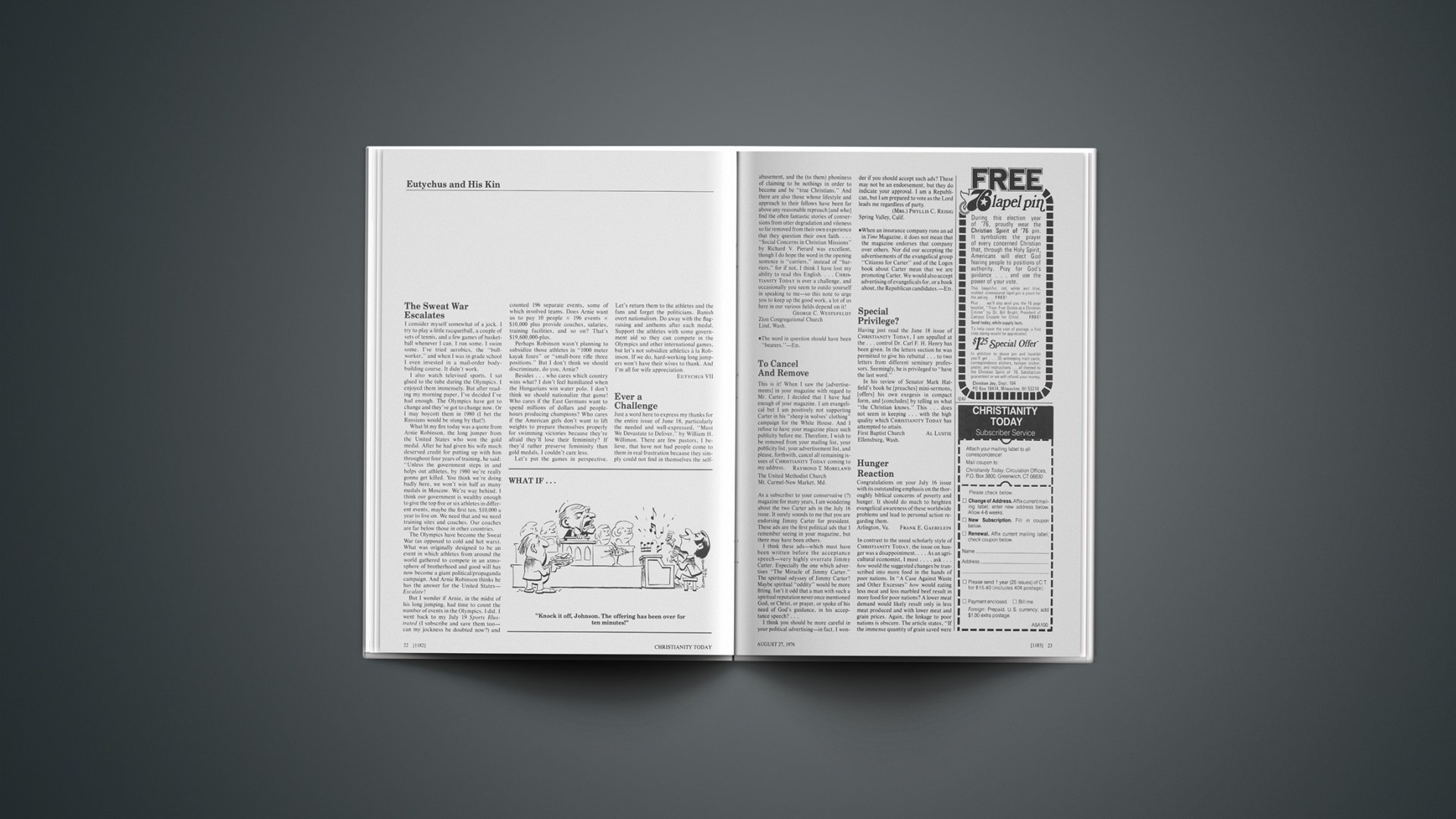
Eutychus and His Kin: August 27, 1976

The Sweat War Escalates

I consider myself somewhat of a jock. I try to play a little racquetball, a couple of sets of tennis, and a few games of basketball whenever I can. I run some. I swim some. I’ve tried aerobics, the “bull-worker,” and when I was in grade school I even invested in a mail-order bodybuilding course. It didn’t work.

I also watch televised sports. I sat glued to the tube during the Olympics. I enjoyed them immensely. But after reading my morning paper, I’ve decided I’ve had enough. The Olympics have got to change and they’ve got to change now. Or I may boycott them in 1980 (I bet the Russians would be stung by that!).

What lit my fire today was a quote from Arnie Robinson, the long jumper from the United States who won the gold medal. After he had given his wife much deserved credit for putting up with him throughout four years of training, he said: “Unless the government steps in and helps out athletes, by 1980 we’re really gonna get killed. You think we’re doing badly here, we won’t win half as many medals in Moscow. We’re way behind. I think our government is wealthy enough to give the top five or six athletes in different events, maybe the first ten, $10,000 a year to live on. We need that and we need training sites and coaches. Our coaches are far below those in other countries.

The Olympics have become the Sweat War (as opposed to cold and hot wars). What was originally designed to be an event in which athletes from around the world gathered to compete in an atmosphere of brotherhood and good will has now become a giant political/propaganda campaign. And Arnie Robinson thinks he has the answer for the United States—Escalate!

But I wonder if Arnie, in the midst of his long jumping, had time to count the number of events in the Olympics. I did. I went back to my July 19 Sports Illustrated (I subscribe and save them too—can my jockness be doubted now?) and counted 196 separate events, some of which involved teams. Does Arnie want us to pay 10 people x 196 events x $10,000 plus provide coaches, salaries, training facilities, and so on? That’s $ 19,600,000-plus.

Perhaps Robinson wasn’t planning to subsidize those athletes in “1000 meter kayak fours” or “small-bore rifle three positions.” But I don’t think we should discriminate, do you, Arnie?

Besides … who cares which country wins what? I don’t feel humiliated when the Hungarians win water polo. I don’t think we should nationalize that game! Who cares if the East Germans want to spend millions of dollars and people-hours producing champions? Who cares if the American girls don’t want to lift weights to prepare themselves properly for swimming victories because they’re afraid they’ll lose their femininity? If they’d rather preserve femininity than gold medals, I couldn’t care less.

Let’s put the games in perspective.

Let’s return them to the athletes and the fans and forget the politicians. Banish overt nationalism. Do away with the flagraising and anthems after each medal. Support the athletes with some government aid so they can compete in the Olympics and other international games, but let’s not subsidize athletics a la Robinson. If we do, hard-working long jumpers won’t have their wives to thank. And I’m all for wife appreciation.

EUTYCHUS VII

Ever A Challenge

Just a word here to express my thanks for the entire issue of June 18, particularly the needed and well-expressed, “Must We Devastate to Deliver,” by William H. Willimon. There are few pastors, I believe, that have not had people come to them in real frustration because they simply could not find in themselves the self-abasement, and the (to them) phoniness of claiming to be nothings in order to become and be “true Christians.” And there are also those whose lifestyle and approach to their fellows have been far above any reasonable reproach [and who] find the often fantastic stories of conversions from utter degradation and vileness so far removed from their own experience that they question their own faith.… “Social Concerns in Christian Missions” by Richard V. Pierard was excellent, though I do hope the word in the opening sentence is “carriers,” instead of “barriers,” for if not, I think I have lost my ability to read this English.… CHRISTIANITY TODAY is ever a challenge, and occasionally you seem to outdo yourself in speaking to me—so this note to urge you to keep up the good work, a lot of us here in our various fields depend on it!

GEORGE C. WESTEFELDT

Zion Congregational Church

Lind, Wash.

•The word in question should have been “bearers.”—ED.

To Cancel And Remove

This is it! When I saw the [advertisements] in your magazine with regard to Mr. Carter, I decided that I have had enough of your magazine. I am evangelical but I am positively not supporting Carter in his “sheep in wolves’ clothing” campaign for the White House. And I refuse to have your magazine place such publicity before me. Therefore, I wish to be removed from your mailing list, your publicity list, your advertisement list, and please, forthwith, cancel all remaining issues of CHRISTIANITY TODAY coming to my address

RAYMOND T. MORELAND

The United Methodist Church

Mt. Carmel-New Market, Md.

As a subscriber to your conservative (?) magazine for many years, I am wondering about the two Carter ads in the July 16 issue. It surely sounds to me that you are endorsing Jimmy Carter for president. These ads are the first political ads that I remember seeing in your magazine, but there may have been others.

I think these ads—which must have been written before the acceptance speech—very highly overrate Jimmy Carter. Especially the one which advertises “The Miracle of Jimmy Carter.” The spiritual odyssey of Jimmy Carter? Maybe spiritual “oddity” would be more fitting. Isn’t it odd that a man with such a spiritual reputation never once mentioned God, or Christ, or prayer, or spoke of his need of God’s guidance, in his acceptance speech?…

I think you should be more careful in your political advertising—in fact, I wonder if you should accept such ads? These may not be an endorsement, but they do indicate your approval. I am a Republican, but I am prepared to vote as the Lord leads me regardless of party.

(MRS.) PHYLLIS C. REISIG

Spring Valley, Calif.

•When an insurance company runs an ad in Time Magazine, it does not mean that the magazine endorses that company over others. Nor did our accepting the advertisements of the evangelical group “Citizens for Carter” and of the Logos book about Carter mean that we are promoting Carter. We would also accept advertising of evangelicals for, or a book about, the Republican candidates.—ED.

Special Privilege?

Having just read the June 18 issue of CHRISTIANITY TODAY, I am appalled at the … control Dr. Carl F. H. Henry has been given. In the letters section he was permitted to give his rebuttal … to two letters from different seminary professors. Seemingly, he is privileged to “have the last word.”

In his review of Senator Mark Hatfield’s book he [preaches] mini-sermons, [offers] his own exegesis in compact form, and [concludes] by telling us what “the Christian knows.” This … does not seem in keeping … with the high quality which CHRISTIANITY TODAY has attempted to attain.

AL LUSTIE

First Baptist Church

Ellensburg, Wash.

Hunger Reaction

Congratulations on your July 16 issue with its outstanding emphasis on the thoroughly biblical concerns of poverty and hunger. It should do much to heighten evangelical awareness of these worldwide problems and lead to personal action regarding them.

FRANK E. GAEBELEIN

Arlington, Va.

In contrast to the usual scholarly style of CHRISTIANITY TODAY, the issue on hunger was a disappointment.… As an agricultural economist, I must … ask … how would the suggested changes be transcribed into more food in the hands of poor nations. In “A Case Against Waste and Other Excesses” how would eating less meat and less marbled beef result in more food for poor nations? A lower meat demand would likely result only in less meat produced and with lower meat and grain prices. Again, the linkage to poor nations is obscure. The article states, “If the immense quantity of grain saved were distributed to hungry people around the world it could prevent starvation world wide.” This may be true, at least in the short run, but how do you get the distribution? Eating less meat in itself won’t do it. Additionally, it could be argued that rich nations waste resources in more foolish ways than through their eating habits—such as in big cars, liquor, etc.

“Mischief by Statute” describes international trade patterns, resource use, and eating patterns as “social evils.” Designating these economic manifestations of economic development as “social evils” may make things simpler but no light is shed by so doing. Would the food balances in poor nations be better by changing international trade patterns? No, not without revolutionary sacrifices from rich to poor nations and that is something else. Would less resource use (also less resource development) by rich nations benefit hungry nations or similarly a change in eating patterns? No, not in themselves and in all of these the capacity to really help could be reduced by doing so.

The biblical challenges regarding the feeding of the poor in relation to preaching the gospel could well stand a scrutinizing examination. The manner in which it might be done as a Christian response is another question. Is the State Department an agency of … Christianity?

In any event, if long-run aid solutions are found, in whatever form they take, direct sacrifices of a large nature would need to be made by rich nations. This would involve more than not eating well-marbled meat.

GLENN A. HELMERS

Lincoln, Nebr.

Hypocrisy? Or simply inconsistency? The apparent concern for the hungry as expressed on the front cover—an excellent illustration—stands in marked contrast with the advertisement about “being a successful Christian businessman” on the back cover. Sitting on a fence in high winds is perilous, not to mention obnoxious. Stand on the side of the poor, or you will fall.

GORDON HOUSER

Newton, Kans.

You have done a significant service for the churches with your special issue on hunger and poverty. I hope you’ll do an occasional follow-up article so that you will keep us all reminded that the problem will be with us for a long time.

W. STANLEY MOONEYHAM

President

World Vision International

Monrovia, Calif.

Ideas

Bultmann—No Bread in the Balance

Rudolf Bultmann, theological giant of the neo-orthodox era, died last month at his home in Marburg, Germany, where he had lived since he formally retired as a university professor in 1951. Had he lived until August 20, he would have been ninety-two.

Until very recently, Bultmann continued to exert a powerful personal influence over German theological scholarship. Associated with Karl Barth, Emil Brunner, Paul Tillich, and lesser figures in the articulation of “dialectical theology” in the thirties and forties, he not only lived longer than they but his influence—for better or worse—was ultimately much greater in the world of academic theology.

Much that is positive could be said about his life and work, even by those who deplore the distinctives of his theological system (see editorial, CHRISTIANITY TODAY, August 16, 1974, p. 24). His scholarly labors, for example, were immense. Few biblical scholars of any theological persuasion have been his equals in either quality or quantity of work. And there is no question that his practice of developing warm, personal relationships with his students offers a model for all who teach theology. But there are also negative lessons to be learned.

As Barth observed on one occasion, no one ever talked more about understanding yet complained more that he was misunderstood than Bultmann. The irony of his program of “demythologization,” ostensibly an attempt to translate the Christian gospel into terms that “modern man” (whoever he/she is) could understand, was that nobody understood—at least not in the way that Bultmann intended (so he said). Many who heard his lectures or read his books concluded that he had given up the traditional heart of Christianity for secularism, and so they turned to secular humanism in its purer form. Others who maintained an orthodox faith concluded the same and denounced his teachings as heretical. A small but extremely influential group of disciples sought to interpret and to defend his thought to the world and thus were responsible for his continuing influence in the theological arena.

Bultmann admitted the impossibility of “presuppositionless exegesis” of the Bible. His presuppositions began with a conscious rejection of theological orthodoxy and did not allow for the presence of a personal, transcendent God who acts decisively and historically to redeem his people and who speaks in an intelligible manner to reveal himself and his ways to men and women. He excluded the supernatural by definition from his system, as also any real intervention of the living God into the affairs of the world; therefore, the concept of miracle was ruled out, including the greatest miracle of all, the resurrection of our Lord Jesus Christ. Little wonder, then, that he evoked more controversy in the German Protestant church during the past four decades than any other theologian.

Wedding his theology to the existentialist philosophy of the early Martin Heidegger, Bultmann assumed the most radical tradition of biblical criticism. He denied the historicity of all but a few basics of the life of Jesus (the “thatness”) and essentially dismissed the Old Testament and all Jewish elements in the Bible as irrelevant for Christian theology.

Though the influence of Bultmann is still strong, there are evidences of its waning during the past few years. For one thing, most of his immediate students are now retired or about to retire from their academic posts, and new leaders who “knew not Joseph” are coming to prominence. For another, many church leaders have begun to listen to the cries of laypeople (and also to note their absence from the pews) who have long been aware that they have been given stones instead of bread.

In spite of the widespread influence of Bultmann, it seems unlikely that he will be remembered as a “father of the church” by subsequent generations of believers. Rather, his writings—brilliant though they may be—will probably be of interest primarily to future generations of scholars who specialize in the history of theology (as is true also of the work of Baur, Overbeck, Harnack, and Tillich). Bultmann, unlike Augustine, Aquinas, Luther, and Calvin, will be remembered for his passing influence on Christian theology rather than for an enduring contribution to Christian faith and practice.

Abortion: No Adjustment

The U.S. Supreme Court had the chance this year to restore some legal standing to unborn children. So far it has chosen not to do so. The court issued decisions last month which showed that a majority of its members are no more respectful of the personhood of the fetus than they were three years ago when state laws prohibiting abortion-on-demand were ruled unconstitutional.

Three more abortion cases will be heard by the Supreme Court this fall, including one which asks for a determination as to whether public hospitals should be forced to perform abortions if their staffs object on religious grounds.

The July decisions struck down a Missouri law that required written consent of both the woman and her mate before an abortion could be performed, except that when the father withheld his approval an abortion could be performed if a licensed physician certified it necessary to preserve the life of the mother. Also ruled unconstitutional was a requirement that an unmarried woman under eighteen could not have an abortion unless at least one of her parents (or a person in loco parentis of the woman) gave written consent, again with the exception of maternal jeopardy. Even though the parents are legally responsible for an unmarried minor, the court’s argument was that “any independent interest the parent may have in the termination of the minor daughter’s pregnancy is no more weighty than the right of privacy of the competent minor mature enough to have become pregnant” (italics added).

When one considers that the court’s 1973 ruling insists that medical advice is appropriate and medical assistance should be required by the state, some arguments in the 1976 decision lose their force. If only the woman has veto power, then the state is in no position to make her go to a certified physician.

Part of the problem was that the Missouri law was somewhat inadequately drawn. Christians need to realize that a great deal of intensive work is necessary if legislative relief from the 1973 ruling is to be obtained. Polemics is not enough. We need to channel more energy into seeking better jurisprudence.

Scientific Evidence For Life After Death?

Our Victorian forebears were reluctant to talk openly about sex, but not about death. The age in which we live turned the tables. Talk about sex is frank and explicit, while death has until recently been an unmentionable.

The most forceful influence in the development of a new openness concerning death has been the work of Dr. Elizabeth Kübler-Ross, who first began interviewing terminally ill patients in the hospital of the medical school of the University of Chicago a decade ago. Her book On Death and Dying (1969) brought the subject to public attention and launched her into a career as the foremost writer, lecturer, and leader of seminars on thanatology, the study of death and related subjects.

In her early work Kübler-Ross was agnostic—perhaps “uninterested” would be the better word—concerning the question of life after death. Recently she has joined a growing number of researchers impressed by the testimonies concerning out-of-body experience (OBE) by people who have been declared “clinically dead” (i.e., their hearts have stopped beating) but who have subsequently regained consciousness.

An article in Harper’s Weekly for July 12 (“Is There Life After Life?”) surveys some of the evidence for OBEs. A Virginia psychiatrist, Dr. Raymond A. Moody, in a recent book, Life After Life (Stackpole), details the stories of one hundred fifty patients who came close to death but lived to describe their sensations. And an August Reader’s Digest article tells of Kübler-Ross’s OBE investigations.

Before Christians run to jump on the bandwagon or add these data to their apologetic arsenal, they should be aware that no essential difference is reported between the OBEs of believers and unbelievers! All testify to a distinctively positive experience—a feeling of perfect peace, floating outside the body, restoration to wholeness (in the case of those who have lost limbs), hearing beautiful music, and the like. Christians testify to seeing Christ while Hindus say they come face to face with Krishna. Cultists tend to have their worldview validated, and some nominal Christians adopt heterodox opinions. A Scottish Presbyterian, for example, testified: “I know beyond a doubt that the Christ I saw will accept everyone, good or bad.”

Christians should encourage further serious research in the area while recognizing that faith cannot be “proved” by scientific research. The only certain evidence we have for the existence of life beyond the grave is the resurrection of Christ (1 Cor. 15:20–23; 2 Cor. 4:14) and the indwelling Holy Spirit, who has been given to believers as a pledge of the good things prepared for those who have put their faith in Jesus (2 Cor. 1:22; 5:5; Eph. 1:13–14).

‘If My People … Pray’

In the closing days of October, Christians will gather in Dallas, Texas, to claim the promises of Second Chronicles 7:14 for the United States and Canada. This gathering, a National Prayer Congress sponsored by “Here’s Life, America,” will take place just before America’s presidential election, and sponsors hope that some five to ten thousand Christians will come to pray at this crucial time.

We urge that churches in the United States and Canada keep their doors open during this period, October 26–29, and that they ask their members to make these days a time when they “humble themselves, and pray, and seek God’s face, and turn from their wicked ways,” and ask God to heal their land.

Anne Sexton’s Rowing Toward God

Anne Sexton’S Rowing Toward God

Since 1967, when she won the Pulitzer Prize, Anne Sexton has been recognized as a major American poet. She began to write almost by accident in her late twenties, after an early marriage, two children, and a psychotic break during which she tried to kill herself. Her short career has followed the pattern of a shooting star flashing against the backdrop of a dark universe. Her first volume, To Bedlam and Part Way Back (1960), was followed by All My Pretty Ones (1962), Live or Die (1966), Love Poems (1969), Transformations (1971), The Book of Folly (1972), and The Death Notebooks (1974)—all published by Houghton Mifflin. Mercy Street, a play, was produced in New York in 1969.

At first, poetry was only therapy for Sexton as she attempted to relieve her psychic pain. In time she could claim that “poetic truth is not necessarily autobiographical. It is truth that goes beyond the immediate self.” She seemed to choose creation over destruction or poetry over suicide: “Suicide is, after all, the opposite of the poem.” Poetry thus became a vehicle to find, to reclaim—to save the self. “When I’m writing,” she told an interviewer, “I know I’m doing the thing I was born to do.” (Prose quotes are from an interview published in the Paris Review, 1971.) “There is something there/ I’ve got to get and I dig/ down … / … and because/ of this I am a hoarder of words” (The Book of Folly, p. 34).

But in the end, even poetry could not rescue her from the death that beckoned her. “It is snowing and death bugs me/ as stubborn as insomnia./ … I hear the filaments/ of alabaster. I would lie down/ with them and lift my madness/ off like a wig. I would lie/ outside in a room of wool/ and let the snow cover me” (Folly, p. 7). Anne Sexton took her own life in 1974.

The publication in 1975, again by Houghton Mifflin, of another volume, The Awful Rowing Toward God, revealed Sexton as a profoundly religious poet. Many critics, interested in the poet’s primitive, confessional nature, had not paid attention to the theological thrust of her writing, but these poems simply bring to fruition themes that go back as far as 1960. “The Division of Parts,” written after her mother’s death, has a Good Friday setting, and Sexton’s persona declares: “The clutter of worship/ that you taught me, Mary Gray,/ is old, I imitate/ a memory of belief/ that I do not own” (To Bedlam and Part Way Back, p. 63).

Belief, however fragile, came to be hers. She commented: “There is a hard-core part of me that believes, and there’s this little critic in me that believes nothing. Some people think I’m a lapsed Catholic.” Although she was raised as a Protestant, her poems contain strong criticism of the mildness of the type of Christianity she first knew (e.g., “Protestant Easter”). When asked if the death of her mother had forced her to confront her own belief in God, she replied affirmatively. “The dying are slowly being rocked away from us and wrapped up into death, that eternal place. And one looks for answers and is faced with demons and visions. Then one comes up with God. I don’t mean the ritualized Protestant God, who is such a goody-goody … but the martyred saints, the crucified man.”

An attraction toward Catholicism and the suffering Christ is evident in several poems. A prayer addressed to Mary is entitled “For the Year of the Insane.” “The black rosary with its silver Christ/ lies unblessed in my hand/ for I am the unbeliever./ … O Mary, permit me this grace,/ this crossing over,/ although I am ugly,/ submerged in my own past/ and my own madness” (Live or Die, p. 44).

Critics have frequently coupled Anne Sexton with Sylvia Plath and Robert Lowell. Both women studied under John Holmes and Lowell; both deal with their split psyches, with a dark, ugly side often full of self-loathing, that contrasts with their public image as charming, middle-class young women. Sexton referred to much of her life during which she conformed to the image of the “woman of the American Dream” in the terms of “Those Times:” “At six/ I lived in a graveyard full of dolls,/ avoiding myself” (Live or Die, p. 29). Lowell, Plath, and Sexton have written uncompromisingly of madness, and Sexton sometimes linked her poetic gift to her dark visions, calling writing “The Black Art.” But she minimized the influence of Lowell and Plath upon her, emphasizing that poetry finds its roots in the subconscious.

Because of the frankness with which she deals with the body, feelings, and her personal past, some have criticized Sexton as self-indulgent, unable to create aesthetic distance in her poems. At the same time, the form of her work varies tremendously, ranging from carefully crafted poems using rhyme to open-ended transcripts of the metaphors of the psyche. But her best work is controlled and marked by penetrating images drawn from the New England landscape and middle-class American culture; it embodies the psychic malaise of our era and underscores the link between that malaise and spiritual hunger. “Small Wire” is constructed on the basic comparison between the poet’s faith and a weight suspended on a fragile wire. “God does not need/ too much wire to keep Him there,/ just a thin vein,/ with blood pushing back and forth in it, and some love./ … He will enter your hands/ as easily as ten cents used to/ bring forth a Coke” (The Awful Rowing Toward God, p. 78).

Anne Sexton confessed that she had religious visions. Although she refused to discuss them in detail, she implied that they were extensions of herself but also enveloped her in a reality larger than herself. “I have visions—sometimes ritualized visions—that come to me of God, or of Christ, or of the Saints, and I feel that I can touch them almost … that they are part of me.… I feel very much in touch with things after I’ve had a vision. It’s somewhat like the beginning of writing a poem; the whole world is very sharp and well-defined, and I’m intensely alive, like I’ve been shot full of electric volts.”

She thought that eventually people would be more shocked by her mystical poetry than by her so-called confessional poetry. Pieces such as “In the Deep Museum” (All My Pretty Ones) and those in the series called “The Jesus Papers” (The Book of Folly) portray a Jesus who is “postfigured”—humanized by the author’s twentieth-century imagination. If readers think them blasphemous, they must read the epigraph Sexton affixed to the poems. “ ‘And would you mock God?’ ‘God is not mocked except by believers.’ ”

The Awful Rowing Toward God is given a framework by the first and last poems, “Rowing” and “The Rowing Endeth.” The motif of the quest for God permeates the book and highlights, in turn, the poet’s moments of doubt, ignorance, despair, love, and joy. The poet’s persona is never irrevocably cut off from God, but separation from him equals homelessness, and ignorance of him, madness. “The place I live in/ is a kind of maze/ and I keep seeking/ the exit or the home” (“The Children,” p. 5). The poet speaks to a walking fish, telling him that she has a vague memory of a country she has lost. The fish replies: “You must be a poet,/ a lady of evil luck/ desiring to be what you are not,/ longing to be/ what you can only visit” (“The Fish That Walked,” p. 21). There is a sense of imprisonment in the false bourgeois world, in the body, in the self, in madness—and a longing to escape to permanent identity, to joy, to love, to God. “Take off your life like trousers,/ your shoes, your underwear,/ then take off your flesh,/ unpick the lock of your bones./ In other words/ take off the wall/ that separates you from God” (“The Wall,” p. 47).

God is transcendent, yet strangely present. Love between humans, joy among the objects of everyday life—these emotions give evidence of him. “I wouldn’t mind if God were wooden,/ I’d wear Him like a house,/ praise His knot holes,/ shine Him like a shoe” (“Is It True?,” p. 51). In contrast, the poet sees herself as having grown “like a pig in a trenchcoat” and as being devoured by a gnawing, pestilential rat, but “God will take it with his two hands/ and embrace it.” Like a fallen angel she is “both saved and lost,/ tumbling downward like Humpty Dumpty.”

Two moments of grace illuminate the book. In “The Sickness Unto Death,” Sexton depicts the nadir of her life, when God “went out” of her. “My body became a side of mutton/ and despair roamed the slaughterhouse.” She thus transforms a crisis of madness into a religious crisis when self-revulsion leads the way to the disappearance of self and renewal through the kiss of grace. “So I ate myself,/ bite by bite,/ and the tears washed me,/ wave after cowardly wave,/ swallowing canker after canker/ and Jesus stood over me looking down/ and He laughed to find me gone,/ and put His mouth to mine/ and gave me His air” (p. 40). The final poem depicts Anne Sexton’s joyful union with God. She docks her rowboat at the island of God and—“can it be true”—plays poker with him. “I win because I hold a royal straight flush./ He wins because He holds five aces./ A wild card had been announced/ but I had not heard it/ being in such a state of awe” (p. 85). The universe joins God in rollicking laughter over his win.

Readers can only leave to God’s infinite understanding the untimely end of Anne Sexton’s life when they hear the rhythms celebrating God’s gamble of love in the final stanza of The Awful Rowing Toward God. “Dearest dealer,/ I with my royal straight flush,/ love you so for your wild card,/ that untamable, eternal, gut-driven ha-ha/ and lucky love.”

PATRICIA WARD

Patricia Ward teaches French and comparative literature at the Pennsylvania State University, University Park.

Asian Strategy for Evangelism

Question. There are many reports of revival and awakening coming out of Asia. Have you seen this in your Asian travels in the last few months?

Answer. Burma is a good place to start. It has had no missionaries from the outside world for a long time. Yet the Burmese have taken on evangelism so intimately as part and parcel of their churches’ life that there has been great growth there. In the last decade the Baptist church has more than doubled, from 224,000 to 480,000. One Anglican diocese reported over 30,000 baptisms of new Christians during the last four years. The Burmese are finding new forms of evangelism, using indigenous types of communication. They have adapted drama, dance, and song for their witness. When I was there in 1975 I met more than 250 Christian Burmese clergymen in a conference, and the entire lot had completely given up Western dress. This is indicative of how their minds are ticking. In order to propagate the Gospel they believe they must contextualize it and live among the people.

Q. Have you been to Korea recently?

A. Yes, and that is a miracle of God. A minister goes into a police academy and finds 13,000 souls prepared to receive the Gospel. You find this kind of preparation wherever you go. The secret of Korea is that its Christians are biblically oriented and holiness oriented. This spirit of holiness is appealing to them more than any contextualization of the Gospel. Koreans are turning from their old faiths and their old thinking to Christ, and they are living holy, separated lives. The greatest penetration has been around Seoul, Pusan, and other large cities. There is still a tremendous amount of work to be done in rural areas; many villages have not been evangelized.

Q. What word do you have on North Korea?

A. We have no information, but I’m sure there is a church there, particularly in the mountains.

Q. What of the talk of eventual unification of North and South Korea?

A. It’s really very doubtful in my mind. I don’t believe that the North wants to unify the country if that means giving the South Koreans the right to decide how they will be governed. South Korea’s biggest danger, it seems to me, is not from any sudden military or diplomatic move from the North. Instead, sooner or later, the ways of the North will begin to seep in among the young people, the American troops will leave, some of the old regime will be out, and the Communists will begin to buy up the opportunity. The young people in the South are not learning what true Communism is. Christians, with their unique understanding of the world systems, are able to teach this and should do so while they have the freedom to do it.

Q. Haven’t some professing Christians been in trouble for speaking out about the government in the South?

A. Yes, and I have had to agonize about this quite a bit. The National Christian Council in Korea and some Roman Catholic liberals have been entangled with government, and some of the leaders were imprisoned. Yet the president of Korea openly says to young people that the way of life is the Christian way. At many times and in many ways he has encouraged the youth to turn to Christ. The government has given permission for 80,000 baptisms per year. The Church is growing four times faster than the general population of South Korea. So there has been freedom to evangelize, though other freedoms have been curtailed. Now, what does one do in that situation? We need to have independence for the Church and a guarantee of human rights.

Q. Bangladesh is a country about which Christians have been concerned lately. What is happening there?

A. So far this has been a sad state of affairs. Bangladesh has taken on the Indian view that missionaries from outside are to be restricted, although it seems to be somewhat open again. The World Council of Churches and evangelical groups have brought in a lot of money to help there. Personally, I have grave doubts that it has really helped the situation.

Q. Do you mean that money should not be sent to Bangladesh?

A. I mean that just pouring in money is not enough. I’m not against the idea of helping people. Our love must be shown so that people can see that we are concerned and love them. If the life of Christ is in me, then surely that love must be shown as Christ himself showed it. However, when it is shown without any verbalization of the Christian message, or when it is shown almost entirely as a foreigner’s love (and not that of the local Christians), then something is lacking.

Q. What about the preaching that has been done in Bangladesh?

A. In some areas the response has been good. The movement is not large, and some of the leading Christian workers are depressed. There is some reason for encouragement. Many of the Christians in one tribal group that was driven into India during the war are now coming back across the border. When people come back, they are always keener about their whole life.

Q. Is Malaysia open to the Gospel?

A. Yes. Now is the time to send missionaries to Malaysia. A real political tussle is going on. The British made a contract with the government pledging that they would not evangelize the Muslims, but more than half of the population is non-Muslim. I think the missionary movement should come from Indonesia.

Q. If half of the Malaysians are not Muslims, what are they?

A. Many are animists, but many of those with Chinese backgrounds are Buddhists.

Q. How strong is the Church there?

A. In the Chinese community it is quite strong. All missionary entry into the province of Sabah has been stopped, but 24 per cent of the population there is Christian. That is one of the highest percentages anywhere in Asia. (In South Korea the figure is 15 or 16 per cent.) This province—a part of what we used to call Borneo—has a population of about four million, and the Chinese there are the “moneybags,” very influential people.

Q. Is the Church as strong in that part of Malaysia which is on the Asian mainland?

A. Thailand is on that same peninsula, of course, and the danger is seeping down from there. Despite this difficulty, I think the churches in Southeast Asia are generally encouraged. The rate of church growth is perhaps greater in Southeast Asia than anywhere else in the world if you are speaking of evangelical churches. Remember that the fast growth reported from Africa includes all churches, not only those that would be considered evangelical.

Q. With all these Christians in Southeast Asia, why have they failed to have enough political influence to keep the Communists from taking over in some countries?

A. There was little evangelical or Protestant strength in Cambodia, Viet Nam, or Laos. The Roman Catholics had gotten so involved with certain elements of political life that they ended up with little influence. Remember that I mentioned in connection with Korea that I thought the young people should be taught about Communism. We are weak and afraid in this area, but we should not be. I have taught this subject in Thailand, and I will be teaching it in the Haggai Institutes in Singapore and India. We must teach the dangers in it, but we must also teach the positive side. I thank God for Communism, but not for Communism per se: I thank God for the true ideas in Communism that have made us rethink our social responsibility.

Q. Is there a large Christian community in Nepal?

A. The devil is very strong, but we are thankful that God’s power is stronger. I was there not long ago, leading a preaching mission for the pastors and evangelists. God has worked a miracle there. There are twenty-three organized congregations. Our mission was attended by twenty-seven ordained men. With the exception of the Japanese, foreign missionaries are not permitted to preach the Gospel at all. The Japanese have been welcome in the king’s palace as well as in village gatherings. There was a ban on baptizing Christians, punishable by imprisonment. The first converts were baptized when a man came over from India, and I was present at that service on the river that flows through Katmandu. Many of the converts there accepted the government’s penalty when they became Christians with the hope that they would be immune from subsequent prosecution (and persecution). There may now be as many as 900 believers.

Q. Do you think that Asian Christians are taking enough political initiatives?

A. I wouldn’t say they are, but a lot of background must be taken into account. Remember that they are the outgrowth of missions, and the missionaries coming from outside did not want to enter into politics. Also, most of these countries were colonies of the West, and our people were urged to shun politics. Only recently have we begun to feel our own identities and to take part in the processes of government. Often we were taught that politics was of the devil. Now we must correct this situation. It can’t be done overnight.

Q. Aren’t the Communists re-colonizing in Asia?

A. Communism is no more indigenous than Western forms of government, but the Communists have managed somehow to indigenize it. They never really colonized in the open style of the Spanish, or the Portuguese, or the British. Even the Americans had some of that type of colonization, the kind that takes control of the government. But the Chinese first infiltrate and take hold of seats of learning and other places of influence.

Q. But isn’t it the nationals in these countries who do that, and not the Russians or Chinese?

A. Yes, that’s the point. It is done by nationals who are committed to Communism and are following leadership from China.

Q. There was tremendous church growth in Cambodia starting in 1971, especially among the young people in the military and other government work. There have been reports that many of them were killed after the Communist takeover. Do you have any information about the Christians there and in Viet Nam?

A. In your country, nothing is a secret; it all comes out in the papers sooner or later. Information is more difficult to obtain in some other places. This question is difficult. I don’t know that the Communists picked out Christians as such, but there is no doubt that they have picked out those who were formerly linked with foreigners. We must ask, What are the lessons we can learn from this? How much do we need to keep “outside”? If Christianity in these countries began to contextualize more, then perhaps it would be so much within their own context that Christians would not be considered agents of foreign missionaries.

Q. Would you say that as a matter of missionary strategy it is important to keep government money out of the picture?

A. I would say as positively as possible that whenever a mission accepts money or favors from any government, it always works against the mission in the long run.

Q. Are you saying not to send “American” or “Christian” money? We’re always being told that we must help the Third World, the developing nations. Can this be done without money?

A. This is a big question, and answering it brought me to change over to my work with the Haggai Institute. Instead of bringing missionaries from abroad, the strategy is to train men to be missionaries among their own people. The money that comes from abroad to help with expenses is given for the sake of helping these men to be self-supporting. It is all right when it assists them in the development of self-propagating and self-governing churches. However, when it is given to carry out a particular program within the context of a certain denomination, then we must bear the label of American Baptists, or American Methodists, or American Episcopalians, and so on.

Q. What is distinctive about the approach of this institute?

A. Our teachers are outstanding Asian Christians, speaking out of their experience in Asia. Fifty students at a time come and live together under one roof in Singapore. Those who are invited are already men of some experience, with at least ten years of work behind them. Leaders teach them the “how” of evangelism, youth work, dealing with other religions, communications, and church growth.

Q. Do the graduates go back to work primarily as personal evangelists or as trainers of others?

A. Many of them have multiplied what they learned many times by training others. However, if a man is sitting at a desk all the time and is not personally involved in evangelizing, he is not going to teach anyone else how to evangelize. I feel that unless every one of us spends at least one day a month being evangelists in the highways and the byways, we are not going to be able to inspire others in their evangelism. When I was a bishop in Pakistan I reserved two or three hours at least three days a week to go into the market place to preach, sell gospel portions, and otherwise show myself keen for my faith.

Q. Are you teaching any distinctive methods?

A. Our main instruction is: use the mode that would be most meaningful among your own people. For instance, those working among Hindus are asked to relate to that point of view. They are asked, What are the concepts in the Hindu mind of the godhead?

Q. What about Islam?

A. We ask why Islam is always attacked as anti-Christian. Indeed, I thank God for Islam because it brings people to one God; it is an iconoclastic religion; it destroys all idolatry; its adherents have an idea of prayer and fasting. Why do we condemn them? Why do we never believe they can ever bring a man to salvation? Cannot Christ fulfill whatever preparation has been done to bring them to one God? It was the colonial way to condemn Islam.

Q. If Islam can function as pre-evangelism, why is it considered so resistant to the Gospel?

A. It is because we Christians put a thousand years of theology into our teaching instead of the method of the Holy Spirit.

Q. What do you mean?

A. The Holy Spirit had Matthew put first in the New Testament, and this gospel gives the genealogy of Jesus Christ as the son of Abraham and the son of David, not the son of God. Then immediately it goes on to the Virgin Birth, which Islam accepts, and therefore says Jesus was a holy man and God’s wonderful gift to the world. Then it brings in politics, with the account of Herod and the children’s deaths. Next comes the reinterpretation of the law in the Sermon on the Mount (and this is not difficult for the Muslim since Muhammad himself came as a reformer). Then the miracles of Jesus Christ show his power in the physical world and how much more he can do in the spiritual world. After that come the parables to make the message specific. Then only after all that do we see the transfiguration, and Jesus asks, “Who do men say that I am?” The disciples could not have been expected to answer “the son of the living God” any earlier, but we expect every Muslim to believe in the son of God from the word go.

Q. Then you are saying to approach the Muslim through the Gospel of Matthew and not John?

A. Yes; we cannot be wiser than the Holy Spirit. John was written much later. Now I believe every word of John, and I hold to the whole Scripture as the inspired Word of God. But I must ask, Why wasn’t John put first?

Q. Is there evidence of any significant move to Christ from Islam?

A. The best example is Indonesia. Many streets that were formerly populated completely by Muslims are now populated by Christians.

Q. Is Transcendental Meditation a “popular” variety of Hinduism for American consumption?

A. I think TM is a wonderful thing—if you focus your mind on Jesus and absorb him within yourself. TM is meditation on a particular character. If young people are going to focus on Krishna, I don’t always condemn this immediately. I say, “Hold it a moment. What is the picture or character of Krishna in your mind? Compare that to the picture and character of Jesus. Now whom would you rather concentrate on?” Sooner or later they find Jesus as superior. If you read the Epistle to the Hebrews, you find that is what it is all about, comparing all the Old Testament prophets and saying Jesus is greater. That is transcendental meditation to me.

Q. While some young people are turning to Eastern religions in North America, many are turning to Christ. What about Asian youth?

A. Come to the Anglican church in Singapore at 8 o’clock Sunday morning, and you will find that 70 per cent of the 800 to 1,000 persons there are under twenty-five. Go to a Brethren church with me in the afternoon, and there will be over 800 there, most of them under twenty-five. At the Billy Graham crusades in Hong Kong and Taipei last year, an overwhelming majority of those responding were young people—perhaps 90 per cent under twenty-five. Visit any congregation in Indonesia and you will find it full of youth.

Q. Are they being prepared for leadership?

A. They are asserting leadership, but the Asian churches need to learn from the West how you lost your young people so that we don’t lose them the same way!

Q. What are you doing now to try to forestall such a loss?

A. I am teaching that we should break up the church. By this I mean that we should encourage very small congregations, house churches, and so on, where people will spend time together opening the Word of God. Young people can enter into dialogue, show forth their love, and apply the Gospel in their daily lives with the encouragement of such small groups. They don’t get much of the Bible when they go to a big church, worship according to a ritual, and then hear a twenty-minute sermon on three or four texts. They need to do more exegetical thinking on the Word.

Q. This has implications for theological education, doesn’t it?

A. Yes. I’m not a great believer in the types of theological schools the Western world has built for us. Why should we always take this Oxford and Cambridge idea of learning when 80 per cent of Asia is still rural? Much of what is taught in the seminaries is applicable only in urban areas, in the big churches. I believe there should be a new pattern where we do six months of reading and thinking and then two or three months of practical work. Then the students would come back for a little more teaching. One mission decided to do this in Indonesia, but its board back in North America overruled the decision. Those people out there should be given more liberty to choose their own ways.

Q. Do you see any possibility that this will happen?

A. There have been several promising developments, including the founding of the Asian Missions Association and the Asian Theological Association. These associations are working to analyze the situation.

Q. With all the emphasis you put on indigenous training, are you suggesting that there is no room or no need for missionaries from outside the culture?

A. Far from it! So far Asia is only 2 per cent Christian. How dare we say we’ve done the job? We always need the fellowship and understanding. But CHRISTIANITY TODAY has reported repeatedly how the North American denominations have been declining in their support of missions. Surely something must be done to replace those workers who have been lost from the field. A missionary cannot separate himself from his culture, no matter how much he tries. This does not condemn him, but it must be recognized that an Indian can do a better job in India than a non-Indian. Still, Asia needs the help of Christians from overseas who will not come to plant their culture and who will try to understand ours. We especially need those who can train the nationals to work in their own countries.

What Is Truth in Art?

What is truth in art? What does a symphony or novel, a painting or a play, have to do with truth? Aesthetics has few more difficult questions than this. Yet the difficulty gives no excuse for not thinking about it, for the arts in one form or another pervade our environment and influence us all.

Genius and talent come from God. He gives some men and women the ability to make or perform works of art. To think of literature, painting, music, and the other arts as merely peripheral to the main business of life does no honor to the Giver of every good and perfect gift. Man’s aesthetic faculty reflects the image of the God who created him. While only a minority write, compose, paint, or design, everyone has some capacity for responding to art. As Abraham Kuyper said, “As image-bearer of God, man possesses the possibility both to create something beautiful and to delight in it.”

All truth is of God. Every facet of it is related to the Father, who is the God of truth; the Son, who is the truth; and the Spirit, who is the Spirit of truth. Moreover, truth is related to Scripture, the written word of truth. All the arts must be judged by Christians in relation to truth. They are, as Calvin Seerveld has said, not to be “excluded from the test of truth as if [they] were simply a collected insight in a realm outside of verifiability.”

My purpose in this essay is to propose several marks of truth in art—not to attempt to give a complete answer to the question of truthfulness in art but simply to shed some light on it.

1. A good place to begin is with durability. Truth is not transient. It never wears out. If something is true, it keeps on being true. One of the early works in aesthetics, the Greek treatise Longinus on the Sublime, expresses this insight: “That is really great which bears a repeated examination, and which is difficult or rather impossible to withstand, and the memory of which is strong and hard to efface.… For when men of different pursuits, lives, ambitions, ages, languages, hold identical views on one and the same subject, then the verdict which results, so to speak, from a concert of discordant elements makes our faith in the object of admiration strong and unassailable.” So art that is deeply true stands up to the passage of the years.

We must distinguish between durability in artistic works and the unique changelessness of God. “Jesus Christ is the same yesterday, today, and forever”—that is eternally durable truth. So are the other great truths about God and man revealed in Scripture. These constitute Truth, as distinct from truth in art and other fields of human endeavor. In the latter, truth has durability but on the finite rather than eternal level.

But the principle of durability does not help us with what is newer in art. However much we love the great aesthetic achievements of the past, to confine our attention to them alone is parochial. Durability must not be pressed so far as to rule out contemporary art from any claim to lasting truth. Nor does the application of it always require many years: occasionally contemporary judgment quickly recognizes a masterpiece and is proved right by posterity. More commonly, however, great works do not come into their own till years after their creation. For example, Melville’s Moby Dick, now a secure masterpiece, was practically forgotten for decades. And Bach’s St. Matthew Passion lay dormant for nearly a hundred years till Mendelssohn’s revival of it revealed its towering greatness.

2. Consider next unity as a mark of truth in art. Truth has its own inner coherence. The criterion is very old. Biblically it is rooted in the oneness of the Triune God. Outside the Bible it found classic expression in Aristotle’s Poetics. It has been well said that form is the cup of art. When one finds that a book or symphony lacks unity, he does not have to know the Poetics to say, “It doesn’t hold together.”

The concept of order, which is related to that of unity, is implicit in the cultural mandate in Genesis. When God created man, he was placed in a garden and told to cultivate and keep it. Order is implicit in this idea of cultivating a garden. The creative process in man is not innately disorderly.

At its truest, art tends toward unity and order. The reason for this relates to the incarnational nature of art. As Goethe said, “The spirit tends to take to itself a body.” In the arts, the concept or idea is given definite form; it is “embodied” in sound, color, or words; in wood or stone; in action or movement, as in drama or ballet. But embodiment requires unity and order; a body cannot function effectively in a state of disorganization.

Certain aspects of contemporary art show a centrifugal and even schizophrenic trend. This stems from the sense of lostness and rebellion so prevalent today. Contemporary art does serve as a barometer of the times. But is this enough? Surely art that is ultimately true can do more than reflect what is. It can also have its prophetic function. The history of literature, music, and the other arts contains notable examples of genius that not only spoke to the present situation but went beyond it to break new trails for aesthetic advance.

3. Closely linked to unity as a mark of truth in art is integrity. Although both terms have to do with basic form or structure, integrity is more comprehensive, having to do with the matter of wholeness. A novel may be structurally unified, yet fall short of integrity if the characters or dialogue are unconvincing. Integrity refers to the overall truthfulness of a work of art. When we say that a person has integrity, we mean his entire personality is morally sound. So it is with integrity in art.

In the arts, integrity demands that anything contrived merely for the sake of effect and not organically related to the purpose of the work must be ruled out. Regrettably, there is much in evangelical literature, music, and art that lacks integrity. Sentimental pictures of Christ are widely promoted, records dress up hymn tunes in commonplace variations, and fiction written by evangelicals rarely rises even to the level of competent literary craftsmanship. It is evident that many Christians have much to learn about integrity in their use of the arts. In contrast, think of the art with which our Lord used words. He told the parables of the Prodigal Son, the Good Samaritan, and the Pharisee and the Publican without moralizing and with an integrity that has never been surpassed. As St. Paul said of him, “He is before all things, and in him all things hold together” (Col. 1:17).

The Christian writer has the advantage of being in a position to tell the whole story. Because he is a Christian he can present the full picture of not only man’s alienation and lostness but also the possibility of his redemption through Christ. This added dimension has characterized the work of great Christian writers from Dante through Milton and Bunyan to Dostoevsky, T. S. Eliot, Graham Greene, François Mauriac, and Flannery O’Connor. In a letter written about ten years after his conversion, C. S. Lewis said, “One of the minor rewards of conversion is to be able [at] last to see the real point of all the literature we were brought up to read with the point left out.”

4. Still another mark of truth in art is inevitability. Some works of art seem to be the final and inevitable expression of an aesthetic idea. Here a kind of paradox we may call “the familiarity of the unfamiliar” is involved. We may experience this when we hear an unfamiliar work by a composer like Beethoven, in which the inevitability of certain phrases or modulations gives the impression of something already known. In painting, one recognizes that a picture by a master like Raphael is completely right and could have been done in no other way. In great poetry we have the same sense of inevitability. In such cases we say, “This is right; this is the way it has to be.”

In a letter to his publisher, Keats pointed to this quality in describing the kind of writing he hoped to achieve: “I think poetry should … strike the reader as a wording of his own highest thoughts and appear almost a remembrance.” And one of Haydn’s contemporaries, the critic Ernst Ludwig Gerber, said of that great composer, “He possesses the great art of making his music oftentimes seem familiar.” To be sure, this recognition of inevitability of expression does not always come at once. It may be delayed till one knows the work more thoroughly, because art does not always wear its heart on its sleeve.

These four criteria—durability, unity, integrity, and inevitability—give us some insight into the nature of aesthetic truth. They are not the whole answer to the question “What is truth in art?,” but they are components of it. And they are closely interrelated principles; each contains something of the others.

To these four marks of truth in art let us add two examples from art that is Christian. For here the criterion is the reflection of the reality of God himself.

The musically sensitive Christian who listens to a performance of Bach’s B Minor Mass experiences a supreme example of truth-telling in sound. Truth may be defined as correspondence with reality. The ultimate reality is God, and the Christian knows this reality in Jesus Christ, God manifest in human form. Anything in art that sheds light on this reality has truth at the highest level.

So consider a Christian hearing the B Minor Mass. As he listens to the hushed sound of the “Crucifixus” with its mysterious downward progressions, he hears a tonal portrayal of the atonement that goes straight to the heart. Then, at the end of the “Crucifixus,” there is the sudden outburst of joy in the “Resurrexit,” as choir and orchestra acclaim the risen Lord Jesus Christ with a power few if any written commentaries ever attain. This presentation of the truth transcends barriers of language as it speaks to all Christian hearers. Aristotle spoke of art as mimesis or “imitation.” Here is mimesis in the highest sense, as Bach puts into music the profound truths of Christ’s passion and victory over death.

To turn to another field, consider Rembrandt’s great portrayal of the supper at Emmaus. Here is truth in form and color. Unlike Salvador Dali, who painted a blond Christ on a cross suspended between heaven and earth, Rembrandt portrayed Christ with integrity. His pictures show us our Lord as he was—Jewish, a real human being here on earth. Yet when this great artist paints the supper at Emmaus, he gives us the very moment of truth when the disciples’ eyes are opened and they see the risen Lord. The person they see is indeed human. We recognize him as the Christ, but Rembrandt shows us at the same time his glory. Here again we have truth in art, mimesis in its highest Christian sense.

But what about truth in lesser works of art and literature? Truth in art cannot be limited to the works of supreme genius. Wherever there is integrity, honest craftsmanship, and devoted cultivation of talent, there something of truth may break through. Literature has its minor classics and painting its primitives. Folk music can speak as authentically as a sonata. Honest craftsmanship, as in functionally beautiful furniture or pottery, enriches culture. And though these may not receive universal renown, they can attain a measure of truth.

No discussion of truth in art can be considered complete without some reference to the relation of beauty to truth. After contemplating an ancient vase, John Keats wrote his “Ode on a Grecian Urn.” The final lines of the poem—“ ‘Beauty is truth, truth beauty—that is all/Ye know on earth, and all ye need to know’ ”—seem to provide a definitive answer to the question.

Yet this identification of beauty with truth, so often taken for granted, needs scrutiny. Writers and other artists correctly reject the tendency to put moralizing into art. But do they have no moral responsibility whatever? Is art devoid of any ethical dimension?

The great biblical phrase “the beauty of holiness” answers with a qualified negative. Even if one were to grant autonomy to the beauty found in works of art, there still remains the artist himself. Like every human being, he stands under the ethical judgment of God. What he creates may be beautiful and aesthetically true. Yet it may tell a lie. The French writer Jean Genêt writes beautiful prose, but his work is decadent. Picasso’s erotic drawings are beautiful but corrupt. For the basic analogy, however, we need to go back to what Scripture says about Satan. There is a depth of meaning in Paul’s statement that Satan himself is transformed into an angel of light. Beauty itself can become the vehicle for a lie.

To this possibility two kinds of beauty stand as exceptions—the chaste intellectual beauty encountered in such things as pure mathematics or scientific equations, and that beauty which Ernest Lee Tuveson has called “the aesthetics of the infinite.” The latter is the beauty reflected in God’s work in creation. The Scottish mountaineer W. H. Murray tells of seeing the Buachaille Etive Mor, the great peak in Glencoe, in brilliant winter moonlight: “Let us speak of the unspeakable, for there is no speech so profitable. [Its] face was washed by intense light so searching that no shade was cast by ridge or buttress. All detail merged in the darkness of one arrowy wall, pale as shadowed milk, impregnably erect. At the remote apex, a white crest broke spume on the high seas of infinity.… To my unaccustomed eye the scene at first bore an appearance of unreality; yet the more I gazed, the more surely I knew that I saw not an illusion greater than is usual, but truth made manifest” (Mountaineering in Scotland, Denton. 1947, p. 222). This was one of what Murray called those “fleeting glimpses of that beauty which all men who have known it have been compelled to call truth.” Such beauty is incorruptible.

And what of the purely intellectual beauty of higher mathematics or scientific equations? The physicist Dirac maintained that the truth of an equation is evidenced by its beauty. So those who are trained to think in these realms recognize beauty in the balance and symmetry of conceptual thought and in the disciplined simplicity of symbolic logic. Just as a chessmaster speaks of a beautiful series of moves, so a mathematician sees beauty in numbers and symbols. On this level, beauty, while manifest through the mind of man, has a certain incorruptibility, even though it may be put to debased uses, just as the pristine beauty of nature may be despoiled by man.

But for most of the beauty man attains, Keats’s identification of it with truth must always be qualified by the Christian artist. Nor can he accept the finality of the poet’s conclusion, “—that is all/Ye know on earth, and all ye need to know.”

The Christian artist has to know more than this. He must know his responsibility to the God who gave him his talent, and he must also know the misuses to which beauty is prone. Beauty is not exempt from the consequences of the fall. Like money or power, art may become an idol. Apostasy may assume angelic forms. This is why the Christian artist stands so in need of humility. Like Bach, who appended to his compositions the words “Soli Deo Gloria,” he must never depart from the priority of seeking to glorify God in all he does.

To identify beauty with what is immediately pleasing or captivating is to have a superficial view of beauty. The difference between a Rembrandt portrayal of Christ and one by Sallman is the difference between depth and superficiality.

Moreover, to identify beauty exclusively with harmony and orderliness does scant justice to the power and truth the arts are capable of. Rouault’s paintings of Christ are not conventionally beautiful, but they have the inner beauty of truth. Merely to look at Grünewald’s Isenheim altarpiece with its agonizing crucifixion scene is to be confronted with the most terrible yet true picture ever painted of Christ’s suffering for the sin of the world. Dissonance in music, stark realism in literature, and the “ugly” in visual art all have an indispensable relation to beauty. The concept of beauty in art must be large enough to include the aesthetic astringencies. For beauty wears different faces. There is the unclouded serenity of Raphael in his Alba Madonna or the seraphic slow movement of Mozart’s last piano concerto. In contrast, we have the thorny beauty of Browning in The Ring and the Book or the rugged beauty of Bela Bartok’s music.

To turn again to “the aesthetics of the infinite.” the incorruptible beauty of God’s handiwork in nature has its terrible as well as its pleasing aspect. The bleak wastes of the Sahara are beautiful in a different way from the smiling loveliness of a Hawaiian landscape. Moreover, our apprehension of beauty changes as we develop our aesthetic faculties. Only comparatively recently have some of the greater aspects of natural beauty been appreciated. In the eighteenth century, majestic mountain scenery was often avoided rather than recognized as sublime evidence of God’s creative power. Fashions in art and literature change. But elusive and difficult to define though it is, true beauty continues. Just as God has yet more light to shine forth from his Word, he has greater dimensions of beauty for us to comprehend in his creation and in man’s making of art.

Therefore besides being aware of the perils of the misuse of beauty, we must recognize that beauty has profound theological implications. Among the great theologians and Christian philosophers, no one saw this more clearly than Jonathan Edwards. He spoke of God as “the foundation and fountain of all being and all beauty … of whom, and through whom, and to whom is all being and all perfection; and whose being and beauty are, as it were, the sum and comprehension of all existence and excellence.”

The relation of beauty to God, so profoundly developed by Edwards, means that we cannot downgrade the arts as side issues to the serious business of life and service, as some Christians do. When we make and enjoy the arts in faithful stewardship and integrity, they can reflect something of God’s own beauty and glory. Through them we can celebrate and glorify the God “in whom we live, and move, and have our being.”

Apple PodcastsDown ArrowDown ArrowDown Arrowarrow_left_altLeft ArrowLeft ArrowRight ArrowRight ArrowRight Arrowarrow_up_altUp ArrowUp ArrowAvailable at Amazoncaret-downCloseCloseEmailEmailExpandExpandExternalExternalFacebookfacebook-squareGiftGiftGooglegoogleGoogle KeephamburgerInstagraminstagram-squareLinkLinklinkedin-squareListenListenListenChristianity TodayCT Creative Studio Logologo_orgMegaphoneMenuMenupausePinterestPlayPlayPocketPodcastRSSRSSSaveSaveSaveSearchSearchsearchSpotifyStitcherTelegramTable of ContentsTable of Contentstwitter-squareWhatsAppXYouTubeYouTube