Eutychus and His Kin: August 6, 1976

The Effect Of Sunday School On My Life

In the fourth grade I had a dedicated, evangelistic Sunday-school teacher whose name was Sid.

One Sunday, Sid had the departmental opening duty. He had decided to present an object lesson before the entire group of thirty kids (about two-thirds of whom were older than me). On the Wednesday before the Sunday, Sid asked me to star in the lesson. He said he would blindfold me and then ask me to sit in a chair sight unseen. He told me that even though I wouldn’t be able to see the chair, he would make sure it was there. I could sit down with confidence. That would be a great example of faith, Sid said.

But I didn’t trust him. I could see myself blindly sitting down and splat!—no chair, all the kids laughing at me, and Sid taking ten minutes to describe what the writer of Proverbs meant by the term “fool.” So I had my buddy Dennis Beatty keyed to give me a signal. If there was no chair behind me, Dennis was to cough.

Sunday came. I was blindfolded. Sid told me to sit. Dennis coughed. I didn’t sit. Sid continued to plead with me to sit. Finally he pushed me into the chair.

I was embarrassed. Sid somehow survived the object lesson (I think he talked about how God sometimes gets tough with those of little faith). And as soon as Sunday school was over, I cornered Dennis. Dennis explained that he thought he was supposed to cough if there was a chair behind me.

That’s all I remember about Sunday school in the fourth-grade year of my life.

EUTYCHUS VII

On Women

I appreciated reading the articles by John and Letha Scanzoni in the June 4 issue because I have heard of them previously but had never before read any of their writings. The letters to the editor by Virginia Ramey Mollenkott and Nancy A. Hardesty were also instructive. The letters together with the articles demonstrate that one’s doctrinal statement concerning the inspiration and authority of Scripture is not always practiced consistently.…

In “How to Live With a Liberated Wife” the feelings of the wife, rather than the Word of God, become the norm which guides her action toward self-fulfillment and which determines her husband’s role in their life together. This is a practical reversal of the biblical pattern with the added “freedom” of direction and purpose governed by whim.… In “Assertiveness For Christian Women” a great mistake is made by assuming that “God’s will” is whatever one may do with one’s abilities for the supposed good of others. The Scriptures throughout teach us that God’s will is expressed by God’s Word.… Whether some of the women mentioned in the article were actually doing the will of God may be doubted.

ARLIE D. RAUCH

Zion Mennonite Church

Bridgewater, S. D.

“How to Live With a Liberated Wife” is a timely and practical article. I agree with its main thesis but am quite uncomfortable with its overstatement of one issue and understatement of another. Its overstatement concerns fulfillment through career and economic pursuits.… Without denying the possibility of self-actualization through career, we should mention the sober reality. Husbands themselves may not be reveling in self-fulfillment in that domain. Mrs. Scanzoni cites Abigail Adams’s wish to attend the first Continental Congress and participate in the travel and challenges that made up her husband’s life. But she fails to mention the husband whose travel may be the forty-five-minute drive to the plant and whose challenge lies in screwing trunk lids onto Ford Pintos. A recent survey confirms this situation to be quite common. Only 4 per cent of young workers reported satisfaction from their job.… Certainly a woman can and should use her talents outside the home, but let’s beware of glamourizing those “distant lands of achievement”.… For Christian women, there is a lot of fulfillment right around the corner in the most significant voluntary ministry.…

And that suggests the understatement. All of that career chatter about full human potential outside the house doesn’t do justice to the potential inside. I don’t resent giving a hand to the career gal, but I do dislike giving the back of the hand to the housewife in the process. Homemaking is more than “making the home happy and comfortable for the whole family.” Building values into the lives of children, especially during early childhood, may be the most important role anybody could play.

CHARLES M. SELL

Associate Professor of Christian Education

Trinity Evangelical Divinity School

Deerfield, Ill.

Humanism—A Religion

CHRISTIANITY TODAY erred in reporting that “Americans United for Separation of Church and State rejects the view that secular humanism is a religion” (Editorials, “George Could Be Expelled,” June 18). On the contrary, we recognize secular humanism as a religious movement and position, but maintain that it is in no way synonymous with the religious neutrality demanded of our public schools by the First Amendment and the religiously pluralistic nature of our society. Further, since the great majority of our teachers, administrators, and school-board members are Christians or Jews, there is an almost infinitely greater probability that any deviation from religious neutrality in our schools will be in the direction of traditional Judeo-Christian positions rather than specifically secular humanist stances.

EDD DOERR

Director of Communications

Americans United for Separation of Church and State

Silver Spring, Md.

The Lost World: Decadence in the Fiction of Thomas Pynchon

The Lost Word: Decadence In The Fiction Of Thomas Pynchon

According to Lionel Trilling, “modern literature … is directed toward moral and spiritual renovation; its subject is damnation and salvation.… It asks us if we are content with ourselves, if we are saved or damned …” (Beyond Culture). The law of the excluded middle, as it applies to the alternatives of damnation or salvation, has not been revoked. Nor are we permitted to be content with ourselves as we read the fiction of Thomas Pynchon. For the vision of Pynchon is one of apocalypse, of decadence, of a streamlined Doomsday Machine tooling, to the accompaniment of a kazoo chorus, down “the street of the twentieth century, at whose far end or turning—we hope—is some sense of home or safety. But no guarantees” (V.).

At age thirty-nine, Thomas Pynchon is perhaps one of the most accomplished American writers of our time. He has published short stories in various magazines, but his reputation rests primarily on his three novels: V. (Lippincott, 1963; winner of the Faulkner First Novel Award), The Crying of Lot 49 (Lippincott, 1966), and Gravity’s Rainbow (Viking, 1973; winner of the National Book Award). Immediately obvious to readers is the remarkable breadth and depth of Pynchon’s fiction. He synthesizes philosophy, sociology, science (he was an engineering major at Cornell), popular culture, the humanities, and theology. And his novels are brilliant collages of literary modes and styles, defying classification. One reviewer commented that it is easier to nail down a blob of mercury than to describe a novel by Pynchon.

The three novels have been aptly characterized as an extended meditation on the twentieth century: When, how, and why have we gone wrong? And where, if anywhere, do we go from here? “What next? What apocalypse?” (V.). Central to all the fiction is the theme of decadence, a word that appears repeatedly in V. and is implicit elsewhere. To Pynchon, the word seems to denote six elements that also may constitute stages of decline.

Basic to the concept of decadence in Pynchon is (1) decline, a falling away—from traditional values. “All shared this sensitivity to decadence,” the narrator of V. remarks, “of a slow falling.…” Because it is a falling away from humanity, decadence is (2) dehumanization. “A decadence … is a falling-away from what is human, and the further we fall the less human we become. Because we are less human, we foist off the humanity we have lost on inanimate objects and abstract theories” (V.). (Gravity’s Rainbow deals with the dehumanizing effect of an apotheosized V-2 Rocket.) “To have humanism,” the narrator of V. says, “we must first be convinced of our humanity. As we move further into decadence this becomes more difficult.”

With dehumanization comes (3) distortion of traditional human values, most notably love and faith. “Don’t ask me if we’re in love,” Benny Profane remarks; “the word doesn’t mean anything” (V.). Pynchon, like Eliot and various other modern writers, seizes upon pervasive sexual derangement as the most dramatic symptom of a lack of spiritual health. F. J. Hoffman has noted in another context that “a failure of love is a failure of belief; the struggle for a meaningful sexual experience is identical with the search for a satisfactory religious experience” (The 20’s: American Writing in the Post War Decade). In a grotesque scene worthy of Bosch or Brueghel, the mysterious “V”—Venus, Virgin, Victoria Wren, Vera Meroving, Veronica Manganese; doyenne of decadents, goddess of the wasteland, Whore of Babylon—masquerades as “Bad Priest,” transvestite, composed of plastics, glass, metal springs, and jewels. Perverted love and faith become “fashionable during a Decadence.”

Pynchon’s vision of decadence also involves (4) disorder and resultant violence, deracination or uprooting of individuals. Among symbols of decline, as Spengler points out in The Decline of the West, the most conspicuous is the notion of entropy, subject of the Second Law of Thermodynamics, according to which mechanical energy can be converted completely into heat but heat cannot be converted completely into mechanical energy. Entropy, a central metaphor in Pynchon’s fiction, is the unavailable heat energy that cannot be put to work. In any closed system—whether engine or man, galaxy or culture—entropy increases and as it does, the system declines toward disorganization and eventual heat-death.

In Pynchon’s story “Entropy” (Kenyon Review, 1960), Callisto finds “in entropy or the measure of disorganization for a closed system an adequate metaphor to apply to certain phenomena in his own world.… He found himself … restating Gibbs’ prediction in social terms, and envisioned a heat-death for his culture in which ideas, like heat-energy, would no longer be transferred since each point in it would ultimately have the same quantity of energy; and intellectual motion would, accordingly, cease” (pp. 283, 284). Accordingly, the final stages of decadence—(5) deterioration, decay, and (6) death, physical demise culminating long-standing death-in-life—are swift. “Decadence, decadence. What is it? Only a clear movement toward death or, preferably, non-humanity” (V.).

Pynchon’s vision of decadence, anything but simplistic or banal, poses the question of whether the various conditions are attributable to a real system of evil (with, logically, an opposite system of good) or simply to hallucination or paranoia. At the end of The Crying of Lot 49 Pynchon suggests that mankind waits with Oedipa Maas, and her excluded middle, for illumination: “Behind the hieroglyphic streets there would either be a transcendent meaning, or only the earth.… Another mode of meaning behind the obvious, or none. Either Oedipa in the orbiting of a true paranoia or a real Tristero.” Transcendent meaning or madness? Revelation or apocalyptic annihilation? Salvation or damnation? Apostasy or parousia? “Waiting for the end, boys, waiting for the end./What is there to be or do?/What’s become of me or you?… /Sitting two and two, boys, waiting for the end” (William Empson, “Just a Smack at Auden”). The questions are also Pynchon’s. Is it the end (telos, meaningful purpose) of man or the end (termination) of man?

Perhaps the answer, for Pynchon, lies in how one reacts in the face of increasing entropy. According to Norbert Wiener, so long as man can retain his essentially human nature, he can achieve local enclaves of temporary resistance to the increasing entropy—what Wiener calls “homeostasis” (The Human Use of Human Beings). Pynchon seems to exemplify such homeostasis in his description of deaf-mutes dancing—each to a different rhythm but never once colliding, dancing “to some unthinkable order of music, many rhythms, all keys at once, a choreography in which each couple meshed easy, predestined. Something they all heard with an extra sense atrophied in herself” (Lot 49, italics mine). One character labels it “an anarchist miracle,” defined earlier as “another world’s intrusion into this one.” If this be so, the only hope in the face of decadence/entropy is the recognition that this world is not, or need not be, a “closed system,” that there is “transcendent meaning” beyond the natural. Oedipa comes to realize that “there was nobody who could help her. Nobody in the world” (italics mine), a possible implication being that perhaps someone out of the world, someone outside the “closed system,” transcendent, could help.

By implication Pynchon would seem to corroborate C. E. M. Joad’s summary of decadence as “a sign of man’s tendency to misread his position in the universe, to take a view of his status and prospects more exalted than the facts warrant and to conduct his societies and to plan his future on the basis of this misreading. This misreading consists in a failure to acknowledge the non-human elements of value and deity to which the human is subject” (Decadence: A Philosophical Inquiry; italics mine). Oedipa Maas seeks to “make up for her having lost the direct epileptic Word, the cry that might abolish the night” (Lot 49)—so described perhaps because the epileptic reportedly recognizes signals—“an odor, color, pure piercing grace note announcing his seizure.”

Failure to acknowledge deity and transcendent value—losing the Word, allowing that “extra sense” to atrophy—leads to decadence. The problem of the lost Word, like “the problem of language, began … with the Fall, when words and things were rent apart” (Max Picard, Man and Language). Eliot asked the same questions in “Ash Wednesday”: “If the lost word is lost … / Where shall the word be found, where will the word/Resound?”

D. G. KEHL

D. G. Kehl is professor of English at Arizona State University, Tempe.

Hume’s Heresy: Believing Is beyond Knowing

David Hume died in his native Edinburgh, Scotland, two hundred years ago this month. His writings, like those of Kant, are a watershed in the history of philosophical theology. The bicentenary of his death offers an occasion for taking another look at some of his views.

Hume’s ideas on religion are found primarily in the last three sections of his Enquiry Concerning Human Understanding (Section X being his famous essay on miracles), several shorter essays on such subjects as the natural history of religion, suicide, and immortality, and his classic Dialogues Concerning Natural Religion. Hume acceded to the urging of several friends (including some clergymen) that he have publication of the Dialogues delayed until after his death. They contain a profound and influential analysis of the empirical arguments for God’s existence, especially the argument from design.

Much of the notoriety Christians usually associate with Hume’s name results from a less than careful reading of his works. Hume is commonly believed to have attacked the foundations of Christianity, such as the existence of God, personal survival after death, and miracles. While it is true that his personal beliefs about many of the doctrines of orthodoxy were anything but reflective of the Calvinism that surrounded him in his early youth, what Hume intended in his writings is often quite removed from what his interpreters have thought.

Hume’s writings on religion cover more topics than can be surveyed in one short essay. One can easily find competent discussions of his views about the theistic arguments, miracles, and survival after death. My conviction is that Hume’s major threat to Christianity today comes not from the theories for which he gained notoriety but rather from his espousal of a notion that has, in fact, become widely held in Christendom. For two hundred years, Christians have fussed and fumed over Hume’s arguments on such topics as miracles. In these debates Christian theism has more than held its own. But while Hume was not triumphant in the areas where Christians have been most concerned, he has apparently won in an area that may be the pivotal one facing Christianity today. Before I identify that view (which, more for alliteration than for disparagement, I’ll call “Hume’s Heresy”), we need to look at some background material.

I

There are three common misconceptions about Hume’s philosophy. The first: Hume denied the reality of causal relations; that is, he denied that there is ever a necessary connection between that prior event we call a cause and the subsequent event we call its effect. Misconception two: Hume rejected the existence of what philosophers call “the external world”; that is, he doubted the existence of the real world, the world outside his mind. It is claimed that he was a solipsist and a skeptic. Misconception three: Hume doubted the existence of what philosophers call the self that is, the real I, the basis of my identity through time. These claims (which make up “the philosophical package”) are all false. But what led to their promulgation has a bearing on a key doctrine of Hume and through that doctrine is linked to Hume’s Heresy.

The philosophical package came to be attributed to Hume because of the writings of two of his fellow Scotsmen, Thomas Reid and James Beattie, who became famous for their defense of common sense against the supposed skepticism of Hume. They believed that Hume was simply borrowing certain premises from the empiricism of two earlier British philosophers, John Locke and George Berkeley, and extending those premises to their logical but bitter end, namely, total skepticism about God, the world, and the self.

But Hume’s entire enterprise was quite different from what Reid and Beattie envisaged. According to Hume, men hold to a number of pivotal beliefs, around which most other beliefs, individual actions, and social institutions turn. These pivotal beliefs include the reality of causal relations (that some things can and do cause changes in other things), the reality of the external world (that the existence of the world does not depend upon its being perceived by any human being and that it continues to exist even when it is not being observed), and the reality of the knowing self. It would be fundamentally foolish to doubt these beliefs. But what concerned Hume was how men come to know them. In a brilliant analysis (to say it was brilliant is not to suggest agreement) too long and complex to reproduce here, Hume showed that neither reason nor experience is sufficient to bring man to a knowledge of these matters. But there simply is no other way for man to know them. Therefore, if man cannot know these things by reason and experience, he cannot know them.

It was at this point that Reid and Beattie made one of their mistakes. They jumped to the conclusion that Hume was actually denying these pivotal beliefs. That is wrong. Hume was denying that there is any sense in which men can be said to know these things. But this is not to say that men should doubt them. That would be the height of folly. Obviously, we must continue to believe them. The consequences of not believing are too absurd to contemplate. And no one has to force or persuade us to believe them; believing them is the natural thing to do. With this last observation we begin to approach Hume’s basic point. Hume tried to show that most of our pivotal beliefs about reality are matters that our reason is powerless to prove or support.

Hume was really doing two things. First, he was attacking the supremacy of human reason, one of the cardinal tenets of the Enlightenment, by seeking to show that human reason has definite limits. Whenever men attempt to extend reason beyond its limits, they become involved in absurdities and contradictions and become prone to the disease of skepticism. Philosophers have been entirely too optimistic in assessing the claims of human reason. Most of the important things we think we know are not known at all. That is, they have not been arrived at on the basis of reasoning; they are not supported by experience. Hume’s second point is that these pivotal beliefs rest on something other than reason and experience, namely, on instinct, habit, custom. Some non-rational force within men compels them to accept these pivotal beliefs. In his writings on ethics, Hume also tried to argue that man’s moral judgments rest not on reason but on man’s non-rational nature. In ethics, as in metaphysics and religion, man’s reason is and ought to be the slave of his passions, that is, his non-rational nature.

Well, what does all this have to do with theology? Where is the “heresy”?

Hume is claiming that man simply cannot have knowledge about the transcendent. This axiom was the foundation of Hume’s Heresy.

If Hume was a skeptic, he was not one in James Beattie’s sense; he did not doubt the existence of the world. As Hume saw it, this kind of skepticism is absurd because it contradicts common sense and violates our natural instincts to believe in certain propositions against all reasoning. Nature, instinct, and common sense all lead us to believe in an external world. We should ignore the arguments of the rationalists and trust our instincts. According to Hume, men ought to limit their investigations to those areas where knowledge is possible, such as mathematics, and avoid speculative knowledge-claims about certain topics in metaphysics, epistemology, theology, and ethics. These matters should be accepted on the basis of faith, not knowledge.

II

Hume’s religious views are, for the most part, an extension of the position just discussed. But there are some blatant distortions of his religious position that should be noted. It is sometimes thought that Hume was an atheist, that he attempted to prove God does not exist, and that he argued that miracles are impossible. To be sure, Hume was not a Christian in the New Testament sense. He did not believe in miracles (which is, however, something quite different from trying to prove them impossible). He did not personally believe in special revelation or immortality or religious duties like prayer. But he was not an atheist; he did not attempt to prove that God does not exist. And he certainly never argued that miracles are impossible.

Hume believed in the existence of a divine mind that was in some unknown way responsible for the order of the universe (see Section XII of the Dialogues). He was shocked and amused by the dogmatic atheism of the French philosophes. Their mistake was the same as that of the orthodox Calvinists: they thought they could obtain knowledge about the transcendent.

It would have been inconsistent for Hume to attempt to disprove God’s existence. His point was that men cannot have any knowledge about God. But it is entirely natural for them to have faith that God exists. In fact, the same nature that compels men to hold the pivotal beliefs mentioned earlier leads them to believe in the existence of God.

But nature does not compel us to go beyond this basic belief in God’s existence and accept the theological claims that orthodoxy insists on adding. Those claims must be rejected because they go beyond the limits of human reason. When Christians claim that reason can prove the existence of God from certain features of the world, or that reason can infer many of the divine attributes from features of the world, and that the Christian religion (or any religion, for that matter) is supported by miraculous events, these claims exceed the bounds of human reason and must be rejected. Also to be rejected are the many assertions that Christians make about God in their creeds, items allegedly derived from special revelation.

Therefore, Hume’s goal in his discussions of religion was the same as his objective in philosophy: he wished to show that reason is powerless to convert us to the claims of faith. “To be a philosophical skeptic is,” he wrote, “the first and most essential step towards being a sound, believing Christian.…” Hume’s own preference seems to have been for a non-rational faith in a god unsupported by reason, revelation, miracles, or evidence. Like Kant, Hume was engaged in denying knowledge in order to make room for faith. To both Hume and Kant, knowledge and faith have nothing in common. The spurious arrogance of rational religion must be destroyed so that faith (a non-rational faith, that is) can assume its proper place as the only legitimate ground of religion.

III

With this background, we can now turn to the matter of Hume’s Heresy. Hume’s Heresy is the rejection of the possibility of a rational knowledge of God and objective religious truth. Hume grounded man’s belief in God in man’s non-rational nature. He is a precursor of those philosophers and theologians who insist that religious faith must be divorced from knowledge and who say we cannot have knowledge about God, mistakenly assuming that this approach will in some way enhance faith.

Historic Christianity has affirmed both (1) an intelligible revelation from God and (2) man’s divinely given ability to know the transcendent through true propositions. Carl F. H. Henry, however, observed more than ten years ago, “Almost everywhere in non-evangelical Protestant theology today, there lurks the destructive notion … that man can have no cognitive knowledge of transcendent Being, no rational knowledge of the supernatural world.” Henry has continued to call on evangelical theology to resist “this needless relinquishment of cognitive knowledge of the spiritual world.”

The last two centuries of Christian theology are the record of an evolving attack on the place of knowledge in Christianity. Following Hume and Kant, liberal theologians rejected the truth content of Christianity and asserted that the essence of faith is feeling or trust or obedience. Neo-orthodoxy, too, rejected objective, rational revelation and replaced God’s disclosure of propositional truth with personal encounter.

By the time Paul Tillich expressed his version of Hume’s Heresy, what was left was a “religion” that was neither objective, rational, miraculous, supernatural, nor even personal. About the only thing non-evangelical thinkers can agree about is that God has not spoken. Neo-orthodoxy is not really an exception, because of its denial of cognitive revelation. The contemporary eclipse of God can be seen in Sartre’s “silence of God,” in Heidegger’s “absence of God,” in Jasper’s “conceal-ment of God,” in Bultmann’s “hiddenness of God,” in Tillich’s “non-being of God,” and finally in radical theology’s assertion of “the death of God.” St. Paul’s sermon to the philosophers on Mars Hill (Acts 17) concerning man’s worship of the Unknown God is all too relevant to the contemporary theological scene. Non-evangelical theology since Hume and Kant is a chronicle of futile attempts to retain respectability for religious faith while denying religion any right to revealed truth.

While contemporary non-evangelicals have, to quote Carl Henry once more, “virtually reduced faith to courageous ignorance,” evangelicals have hardly been faithful in defending God’s objective communication of truth. Hume’s Heresy has infected orthodoxy to the extent that if evangelicals are not de-emphasizing the cognitive dimension of revelation, they are successfully ignoring it.

The new anti-intellectualism that threatens evangelicalism is evidenced by its disregard for the revealed truth of God and its effort to substitute other concerns for that truth. Christian anti-intellectualism may be manifested in a variety of ways: in a contempt for creeds, in a search for God through the emotions, in a dependence upon some kind of mystical experience. Hume would be comfortable in many of our churches today, for he would not hear the truth of God proclaimed and defended. He would hear stories and testimonies about religious experiences that appeal to the emotions. Hume could teach in most theological seminaries (including some that call themselves evangelical). He would find acceptance among the twentieth-century Kierkegaardians who hold that the quotient of faith increases as its rational content decreases.

The most obvious consequence of Hume’s Heresy is a minimal theism. Once Hume’s stance is adopted, New Testament Christianity, with its proclamation of a divine Christ whose death and resurrection secured redemption from sin and gave man hope beyond the grave, must be replaced with a religion that talks about how good it feels to have an experience with a god about whom nothing definite can be known.

The threat to Christianity today from the legacy of David Hume is not a full-fledged frontal assault upon Christian theism, with all the troops advancing in full light of day. That kind of attack would fail because it would arouse Christians to a rational defense of their faith. David Hume's legacy is more insidious. This time around, the enemy comes while everyone is asleep. He undermines the faith not by denying it but by directing our attention away from the importance of its knowledge-claims and its truth-content.

Ronald H. Nash is head of the Department of Philosophy and Religion at Western Kentucky University, Bowling Green, where he also directs graduate studies in philosophy, religion, and humanities. His Ph.D. is from Syracuse. His books include "Ideas of History."

Putting Hell In Its Place

What is the final destiny of the wicked? For many of us, the answer is simple and quick: “They go to hell.” And, indeed, that response rests on good authority, no less than that of the Lord Jesus himself. Yet I suspect, on reading through the New Testament, that the specific figure of “hell” may have crowded out other equally worthy figures.

We would be ill advised to neglect any subject that found place in the teaching of our Lord, and “hell” is one that did. But we need to guard against putting words in his mouth, and against reading into scriptural terms unscriptural meanings.

Much popular literature on hell both falls short of and goes beyond the clear teaching of Scripture. It falls short by neglecting a variety of other New Testament language regarding the eternal destiny of the lost. It goes beyond by injecting literalistic imagery based more on Dante’s Inferno than on the carefully exegeted Word of God.

The earliest creeds did not mention the punishment of the wicked. The so-called Apostles’ Creed speaks of “the resurrection of the body and the life everlasting,” but that is, all it says about eschatology. The Nicene Creed affirms that Jesus Christ “shall come again, with glory, to judge the living and the dead,” and expresses anticipation of “the resurrection of the dead, and the life of the world to come.” The Athanasian Creed goes a bit further concerning the punishment of the wicked, but limits itself to the simplest language. When Christ returns, it says, “all men shall rise again with their bodies; and shall give account of their own works. And they that have done good shall go into life everlasting and they that have done evil into everlasting fire.”

Just how far from this unadorned and unimaginative language popular religion can go is illustrated in this vivid passage from a sermon by Charles H. Spurgeon:

“There is a real fire in hell, as truly as you have a real body—a fire exactly like that which we have on this earth, except this: that it will not consume though it will torture you. You have seen asbestos lying amid red hot coals, but not consumed. So your body will be prepared by God in such a way that it will burn forever without being consumed. With your nerves laid raw by the searing flame, yet never desensitized for all its raging fury, and the acrid smoke of the sulphurous fumes searing your lungs and choking your breath, you will cry out for the mercy of death, but it shall never, never, no never, give you surcease.”

Or take these lines from a hymn of Isaac Watts:

What bliss will fill the ransomed souls

When they in glory dwell,

To see the sinner as he rolls

In quenchless flames of hell.

But enough of that; let us look to the Scriptures.

“Hell” (Greek gehenna, from the Hebrewge-hinnom, “valley of Hinnom”) appears just twelve times in the New Testament and never in the Septuagint. Of the twelve New Testament occurrences, one does not speak of the end of the wicked (James 3:6). Of the other eleven, seven are in Matthew’s Gospel and four are in Mark or Luke, in passages that parallel Matthew. Not one of these uses the word to contrast the fate of the wicked with that of the righteous. “Hell,” or more properly “Gehenna,” is a Jewish term. It is absent from John’s Gospel, the Acts of Apostles, all the epistles of Peter, Paul, John, and Jude, and the Apocalypse, and for Gentiles it would have had no meaning in familiar experience.

What, then, does the term signify? What did it mean to those who heard Jesus use it? After reading material in the lexicons of Thayer and Bauer-Amdt-Gingrich, the Zondervan Pictorial Encyclopedia of the Bible, the Interpreter’s Dictionary of the Bible, and the Hastings Dictionary of Christ and the Gospels, I concluded that Joachim Jeremias expresses all that is readily known in his article on the subject in the Theological Dictionary of the New Testament (1:657–58). The term, he notes, was given to the Wadi er-rababi, in South Jerusalem, a site of human sacrifices to Moloch during the days of Ahaz and Manasseh (2 Chron. 28:3). Prophetic warnings of judgment on this macabre valley led to the familiar equation between the Valley of Hinnom and the “hell” of the last judgment, a correspondence that can be found as early as the intertestamental book of Enoch. This is the usage reflected in the New Testament, which, unlike other literature of the first century A.D., stops short of using “hell” for a place of punishment in the intermediate state. Nor does the New Testament give any particular descriptions of the torments of hell, as some apocalyptic literature before it did and as many Christian popularizes have since done.

We may safely say, therefore, that when Jesus was teaching in his earthly ministry, the figure of Gehenna was the most vivid and appropriate picture he could use to warn his Jewish hearers in terms familiar to them. Gehenna was not, to their minds, a raging fire that would quickly consume all but asbestosized bodies. Rather, it was the Valley of Hinnom, a putrifying place of horrible odor and filth, a place where maggots did their needed but repugnant work, accompanied by the always smoldering garbage fires.

It is important to remember that this is not the only figure used in the New Testament, nor is it the primary one. However, this image can speak to us very powerfully. For while we need not think of a thermometer (Gehenna was not a raging fire), we must certainly be warned by the thoughts of maggots, decaying flesh, and smoldering garbage. These terms are not one whit too severe in picturing the just punishment awaiting those who now reject God’s deliverance. Nor may this impression be dismissed as antiquated and unfashionable, for it rests on the words of Jesus.

But while the figure of “hell” or “Gehenna” is true, it is not exhaustive. The problem comes in trying to use concepts appropriate to one category to express truths about an entirely different category. Jesus once encountered such a question regarding the Age to Come. Who will be the husband of the much-loved lady in the resurrection—her first husband, or one of the six who followed him? And the Lord’s answer was, None of them. The categories don’t fit, he said: “in the resurrection there is neither marriage nor giving in marriage” (Matt. 22:30).

Here is the crux of the matter, so far as language is concerned: we are trying to speak of one age or aeon in terms drawn from a qualitatively different aeon. The biblical picture presents two ages: the Present Age and the Age to Come. The Present Age is the age of “time,” from the creation of the space-time physical universe to its end at the return of Christ. The Age to Come is “eternity.”

The problem we face may be illustrated like this: suppose a man from a two-dimensional world of length and breadth but no height should pay a visit to our three-dimensional world, and then return to his own fellows. How could he possibly describe to them what he had seen here? This illustration might be closer to the truth of our situation than we first think, especially when we remember that time is called the “fourth dimension.”

Scripture uses many pictures, many figures, many categories to impress on us the truths we need to know about the Age to Come, about future reward and punishment. Most often it expresses the nature of that which belongs to the Age to Come by using a special adjective, the Greek word aiōnios. In our common versions this word is usually translated “everlasting” or “eternal.” A better translation would probably be the transliteration “aionic,” or “new-age.” Aiōnios designates a quality of the Age to Come. And, even allowing for the great truth that the Age to Come has already begun to break into the Present Age—that this occurred with our Lord’s first advent, his cosmic victory over Satan and sin, his powerful resurrection, and his gift of the Spirit—we may still say that the Age to Come is as different from anything we now know and experience as our own world would be to the imaginary two-dimensional people suggested above. It is enough, therefore, to say of something yet to be that it is “aionic.” It is of “new-age” quality.

Most often in the New Testament, this adjective is attached to the word “life.” Forty-one times we read of “aionic” life, so that “eternal life” is in reality “new-age” life, life of a quality that cannot be adequately described in terms we now know. Scripture also uses the adjective “aionic” to describe habitations (Luke 16:9), weight of glory (2 Cor. 4:17), glory (2 Tim. 2:10; 1 Pet. 5:10), salvation (Heb. 5:9), kingdom (2 Pet. 1:11), redemption (Heb. 9:12), inheritance (Heb. 9:15), and the house not made with hands (2 Cor. 5:1). We know all those nouns, and they are rich in meaning to us, in terms of our own experience in the Present Age. God is telling us that all the good things these words suggest are in store for the righteous in the Age to Come, but of a quality altogether new, describable only by “aionic.”

On the other hand, we read also of “aionic” destruction (2 Thess. 1:9), damnation (Mark 3:20), judgment (Heb. 6:2), and fire (Matt. 18:8; 25:41; Jude 7). Again we can identify with the nouns. But again the adjective “aionic” or “new-age” warns us not to think that our present experiences can really provide a framework for comprehending the quality of each phrase when applied to the post-judgment fate of the wicked. The term “aionic” or “new-age” must suffice. All the terrible things these nouns suggest are in store for the wicked, but the horror these words carry does not begin to exhaust the reality. That must be subsumed under the adjective “aionic.”

If this were all God said, it should be enough to terrify the wicked, reinforce the righteous, and convince those who were vacillating and weak. And if it were all God had said, it should have to suffice for our curious minds, for we can know only what he has seen fit to reveal. But God has said more on the subject, and we will do well to let allhe has said influence our thinking and our behavior.

Twelve times the New Testament presents us with comparative statements about the destiny of the righteous and the wicked. Three observations about these twelve passages are worthy of note: (1) In each, the picture is drawn in terms of a specific situation, and the words used fit that situation. (2) In each, the expressions used describe the reward or punishment in the most severe and extreme manner. (3) The various passages taken together, though they overlap at times, give us a wide variety of pictures, using many images and sources.

1. Romans 2:6–10

“God ‘will give to each person according to what he has done.’ To those who by persistence in doing good seek glory, honor and immortality, he will give eternal life. But for those who are self-seeking and who reject the truth and follow evil, there will be wrath and anger. There will be trouble and distress for every human being who does evil … but glory, honor and peace for everyone who does good …” (quotations from the NIV).

On the side of the ledger marked RIGHTEOUS, put the words “glory,” “honor,” “immortality,” and “peace.” On the side marked WICKED, put the words “wrath,” “anger,” “trouble,” and “distress.” These two sets of words describe contrasting conditions in extreme terms familiar to Gentiles as well as Jews, now as well as then.

2. Romans 6:23

“For the wages of sin is death, but the gift of God is eternal life through Christ Jesus our Lord.”

Under RIGHTEOUS re-emphasize the term “eternal” or “aionic” or “new-age” life. Under WICKED put “death.” Both “life” and “death” have meaning to us in terms of the Present Age. Some of that meaning is intended here, but it is enlarged by the attachment of the “new-age” adjective to “life.” Nevertheless, we see contrasting conditions.

3. Galatians 6:7, 8

“Do not be deceived: God cannot be mocked. A man reaps what he sows. The one who sows to please his sinful nature, from that nature will reap destruction; the one who sows to please the Spirit, from the Spirit will reap eternal life.”

Again we see “aionic” or “new-age” life. In contrast here is “corruption.” The one extreme is healthy, wholesome life. The other is decay, corruption.

4. Philippians 1:28

[Do not be] frightened in any way by those who oppose you. This is a sign to them that they will be destroyed, but that you will be saved—and that by God.”

Here “salvation” is contrasted with “destruction.” When an angry God takes righteous and reasoned judgment, these are the two alternatives. Students of the prophetic literature of the Old Testament will recall many parallel passages there.

5. Philippians 3:19–21

“[The heretics’] destiny is destruction, their god is their stomach, and their glory is in their shame. Their mind is on earthly things. But our citizenship is in heaven. And we eagerly await a Savior from there, the Lord Jesus Christ, who … will transform our lowly bodies so that they will be like his glorious body.”

Again we enter “destruction” and “Savior.” But this time “salvation” is further described; it includes the transformation of our body so that it will be like His. The terminology here is distinctly Christian; it is not particularly Jewish, nor is it Hellenistic in origin.

6. First Thessalonians 5:9

“For God did not appoint us to suffer wrath but to receive salvation through our Lord Jesus Christ.”

Again we meet “wrath,” and again “salvation.” The destruction that usually stands opposite salvation is seen to be the expression of an offended God who is justly furious! Although it comes first to mind to say, “Therefore warn one another with these words …,” Paul speaks instead to those presumed to be faithful: “Therefore encourage each other with these words.”

7. Second Thessalonians 1:6, 7

“God is just: He will pay back trouble to those who trouble you and give relief to you who are troubled, and to us as well. This will happen when the Lord Jesus is revealed from heaven in blazing fire with his powerful angels.”

The righteous are here given “relief.” The wicked receive “trouble.” These Thessalonian saints had been suffering pressure of every imaginable kind from their enemies (“pressure” is the literal sense of thlipsis, here translated “trouble”). All this will change, Paul assures them. Those who have dished out the trouble will get their own dish—prepared by God himself! And those who have had little but trouble will instead be given blessed relief (the Greek word is anasis, from which comes the trade-name “Anacin”). All this is prefaced by the statement that what God does will be just and fair; we must remember this alongside the earlier statement that God’s punishment will be the product of divine wrath.

8. Second Thessalonians 1:8–10

He will punish those who do not know God and do not obey the gospel of our Lord Jesus. They will be punished with everlasting destruction and shut out from the presence of the Lord and from the majesty of his power on the day that he comes to be glorified in his holy people and to be marveled at among all those who have believed.”

Again we meet “aionic” destruction. This time what is emphasized is that this punishment means being shut out from the Lord’s presence and power, and away from the fellowship of God’s holy people. By way of contrast, Jesus will then be glorified in his own people, and marveled at among the believers. A different picture from any yet, but clear within itself and sharp in contrasts.

9. Hebrews 10:39

“But we are not of those who shrink back and are destroyed, but of those who believe and are saved.”

Here “salvation” is literally the acquiring of life (peripoiēsis psychas). We note in passing that this text also contrasts the recipients of these fates, presumably distinguishing between the readers. On the one hand are those who shrink back from completing their race; on the other are those who press on in constant faith.

10. James 4:12

“There is only one Lawgiver and Judge, the one who is able to save and destroy. But you—who are you to judge your neighbor?”

Enter again the two words (the most common so far) “save” and “destroy.” And if these are the most common, they are in themselves the most colorless. Perhaps their undefined lines make them loom all the larger in our imaginations!

11. Revelation 21; 22

These chapters are generally held to describe the final fates of the righteous and the wicked—in terms familiar to the Jews and clearly drawn from the apocalyptic literature that preceded it. Here we have the “Holy City” contrasted with the “Lake of Fire.” The first is all-glorious, with God as personal shepherd, the Lamb as the light, the faithful as companions. In it are the tree and water of life, trees that bear health-giving fruit each season, gold streets and jeweled gates. There is no curse, no death, no sickness, no pain. The Lake of Fire burns with fire and sulphur; it is the second death.

All elements in both pictures are figurative, and are well known in apocalyptic literature . This is not to say they do not express the truth, however, for they do—in words full of emotive force in our own age and experience. And the Holy City includes, as has often been noted, the restoration of all that was lost with the entrance of sin into the original paradise, Eden. This picture is not, however, the definitive one, into which all other terms are to be forced. It is one of many. Each, in its own context, is complete.

12. Matthew 25:46

“Then they will go away to eternal punishment, but the righteous to eternal life.”

This last passage, first in canonical order, sums up in a word all that we have seen in the other eleven. Here is “punishment”—punishment that expresses both wrath and justice. There stands “life.” Both terms are rich in meaning for inhabitants of the Present Age. But both are here qualified by that same word “aionic.” Both punishment and life are of a quality belonging to the Age to Come and may be described finally only by “aionic.”

“Hell” is one New Testament picture portraying the fate of the unsaved. But, as we have seen, it is not the only one; it is not even the primary one. Nor is it the definitive one. God’s Word is rich in illustrations and terminology describing the divine punishment of the Age to Come. All serve a useful purpose. The very variety of expression adds to our limited conception. Let us be warned—and stop where God has stopped. To do otherwise is, according to Revelation 22:18, to risk the very punishment we seek to understand.

Edward Fudge is a writer and publisher who lives in Athens, Alabama. He received the M.A. from Abilene Christian College. Among the books he has written is "Our Man in Heaven," a commentary on Hebrews.

People of Light

Thank God! for people of Light

Who are not afraid of Darkness:

People who realize that the light and love of God

Can illuminate the loneliest and darkest night,

Can shed light in the darkest cave,

Can make safe the most dangerous and precarious of paths.

People of Light: people not afraid to bear the candle,

knowing that those to whom they bear i

may well attempt to extinguish it.

Thank God! for people of Light

Who are not afraid of Darkness.

Not afraid to get their hands dirty,

Or to taint their reputations by association

with persons so disclaimed as “evil”;

Who do not attempt to kick while down—even by gossip

but rather are not afraid to be seen

lending an uplifting hand;

Who are not afraid to journey to ghetto stench

or to sweet-smelling mansion

where persons, rich, place needle in sore veins;

Not afraid to cross well-established lines of social,

racial, and financial standards,

Or to lend a helping hand to one whom everyone else had given up on;

Who are not afraid to spend hours with lonely alcoholics

even see them drink and not frown that frown of disapproval

which closes all lines of communication;

Who can listen to young and old pour out their hearts

not sadly nodding the head

at poor and indiscriminate word choice;

Not saying “I have the way of life” or “I have the Light”

But accepting that the person is living—and that the lighted have a better way of life.

Thank God! for people of Light

Who are not afraid of Darkness.

Danny Cade

Note: After his death, these lines Danny Cade had written were found, obviously still uncompleted, among letters he had gratefully received from a counselor during his time of Darkness. Cade was murdered on July 11, 1975, while he was trying to be of help to a friend in a drug-related incident. He was a 1973 graduate of Greenville College.

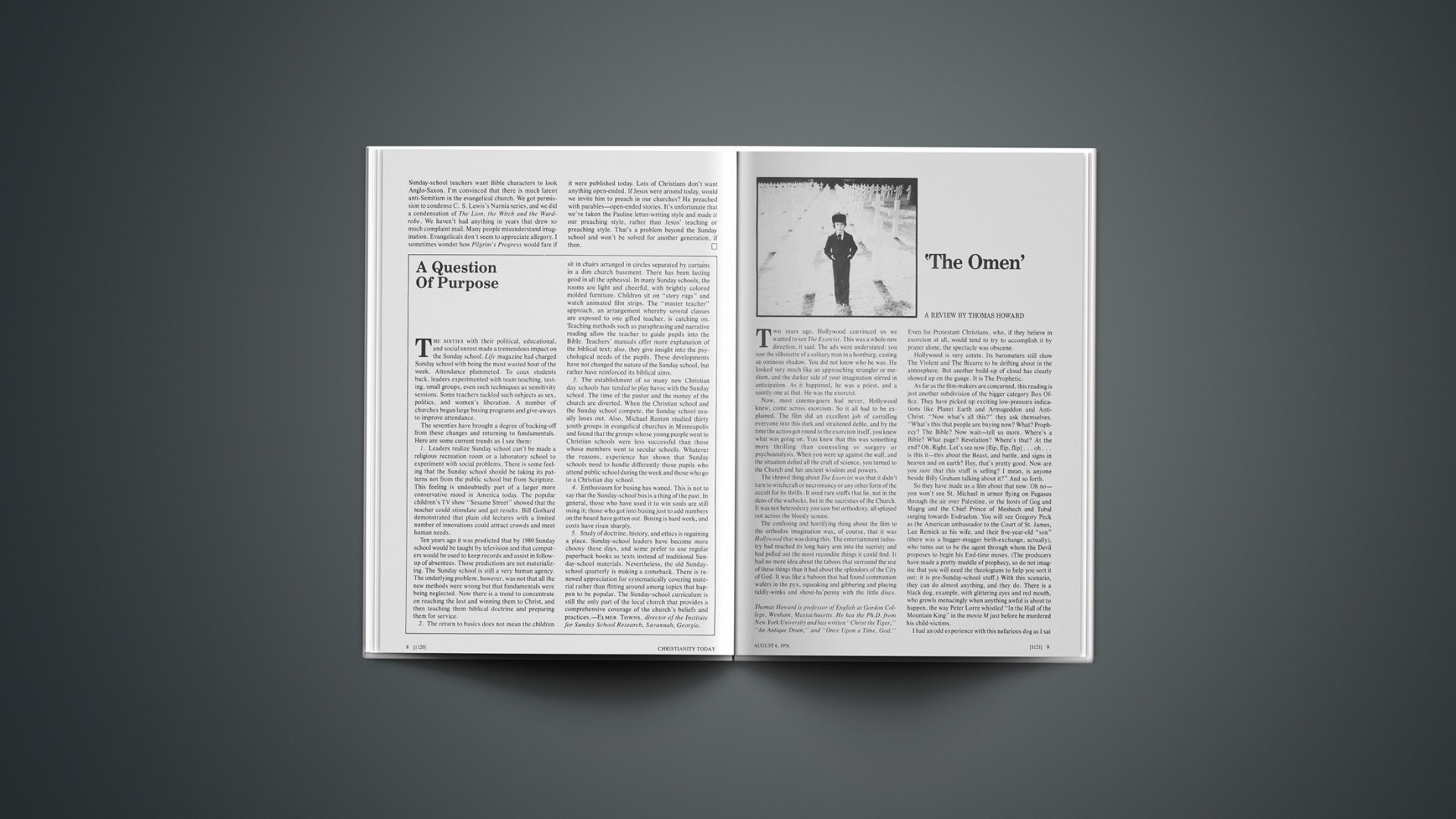
The Omen

Two years ago, Hollywood convinced us we wanted to see The Exorcist. This was a whole new direction, it said. The ads were understated: you saw the silhouette of a solitary man in a homburg, casting an ominous shadow. You did not know who he was. He looked very much like an approaching strangler or medium, and the darker side of your imagination stirred in anticipation. As it happened, he was a priest, and a saintly one at that. He was the exorcist.

Now, most cinema-goers had never, Hollywood knew, come across exorcism. So it all had to be explained. The film did an excellent job of corralling everyone into this dark and straitened defile, and by the time the action got round to the exorcism itself, you knew what was going on. You knew that this was something more thrilling than counseling or surgery or psychoanalysis. When you were up against the wall, and the situation defied all the craft of science, you turned to the Church and her ancient wisdom and powers.

The shrewd thing about The Exorcist was that it didn’t turn to witchcraft or necromancy or any other form of the occult for its thrills. It used rare stuffs that lie, not in the dens of the warlocks, but in the sacristies of the Church. It was not heterodoxy you saw but orthodoxy, all splayed out across the bloody screen.

The confusing and horrifying thing about the film to the orthodox imagination was, of course, that it was Hollywood that was doing this. The entertainment industry had reached its long hairy arm into the sacristy and had pulled out the most recondite things it could find. It had no more idea about the taboos that surround the use of these things than it had about the splendors of the City of God. It was like a baboon that had found communion wafers in the pyx, squeaking and gibbering and playing tiddly-winks and shove-ha’penny with the little discs. Even for Protestant Christians, who, if they believe in exorcism at all, would tend to try to accomplish it by prayer alone, the spectacle was obscene.

Hollywood is very astute. Its barometers still show The Violent and The Bizarre to be drifting about in the atmosphere. But another build-up of cloud has clearly showed up on the gauge. It is The Prophetic.

As far as the film-makers are concerned, this reading is just another subdivision of the bigger category Box Office. They have picked up exciting low-pressure indications like Planet Earth and Armageddon and Anti-Christ. “Now what’s all this?” they ask themselves. “What’s this that people are buying now? What? Prophecy? The Bible? Now wait—tell us more. Where’s a Bible? What page? Revelation? Where’s that? At the end? Oh. Right. Let’s see now [flip, flip, flip] … oh … is this it—this about the Beast, and battle, and signs in heaven and on earth? Hey, that’s pretty good. Now are you sure that this stuff is selling? I mean, is anyone beside Billy Graham talking about it?” And so forth.

So they have made us a film about that now. Oh no—you won’t see St. Michael in armor flying on Pegasus through the air over Palestine, or the hosts of Gog and Magog and the Chief Prince of Meshech and Tubal surging towards Esdraelon. You will see Gregory Peck as the American ambassador to the Court of St. James, Lee Remick as his wife, and their five-year-old “son” (there was a hugger-mugger birth-exchange, actually), who turns out to be the agent through whom the Devil proposes to begin his End-time moves. (The producers have made a pretty muddle of prophecy, so do not imagine that you will need the theologians to help you sort it out: it is pre-Sunday-school stuff.) With this scenario, they can do almost anything, and they do. There is a black dog, example, with glittering eyes and red mouth, who growls menacingly when anything awful is about to happen, the way Peter Lorre whistled “In the Hall of the Mountain King” in the movie M just before he murdered his child-victims.

I had an odd experience with this nefarious dog as I sat in the nearly empty theater at the shopping mall in Manchester, New Hampshire, at a 3 P.M. showing. A menacing panting and snuffing began to sound just under a seat nearby. No one was near me; there were only about six people in the whole theater. I thought at first it was the stereophonic sound, arranged under our seats to frighten us. But it wasn’t. Then I thought perhaps it was someone who had fainted during the 1 P.M. showing and was now coming to life. But I could find no body. I thought of a stray dog skulking about, but there was none. Finally I tried out my own breathing: perhaps I was puffing asthmatically and the acoustics of the theater were bringing it back to me from a few feet away. But I could not get it to synchronize with the noises. So I did what you do when you find yourself alone with the unmanageable: I sought company. I moved back to where two boys and an old man were sitting. I thought that if some miserable and blackguardly ghost were going to use this tawdry scene for an entry (and for any Christian this is never completely ruled out), he’d have to cope with more than one person.

In any event, there is a black dog, and there are prophecies (all higgledy-piggledy), and strange people who know things, and then a sequence of increasingly sinister events that takes you from London to Rome to the excavations at Megiddo, and that finally leads to the violent death of every single character in the film.

I do not think I am spoiling a good story for you by letting the cat (the dog?) out of the bag like this. The first thing to be said about the film is that it is not worth anyone’s two hours or two dollars. For a start, Hollywood and its actors have no resources, emotional, dramatic, or intellectual, to draw on for this sort of subject matter, and hence have to draw on their usual bag of melodrama, sentimentalism, and sham-horror, evoked for the audience by stuttering, brimming eyes, jutting jaws, gritted teeth, and mad dashes up and down stairs. Gregory Peck may have talent, but he is miscast here.

Besides this, the “special effects” are not nearly so stunning as they were in The Exorcist. (If it is objected that I am spending too much time in comparison with that film, the rejoinder is that the makers of this film have invited, nay forced, such comparisons, by patently trying to cash in on the Exorcist market. They will have to live with the comparisons they have purchased.) In The Omen, you have people dangling from ropes and crashing through high windows to the street below, and one man’s head being sheared neatly off by a huge pane of glass that slips from a truck, and a priest impaled with a toppling lightning rod at the door of a church, and so forth. The unnerving thing about all this is that the producers are apparently correct in supposing that you can mix biblical prophecy and this sort of jejune carrying-on, and get the public to buy it. It is like trying to dramatize the Ascension by using the Pink Panther: it is bad enough to find it done at all, but infinitely more dismaying to discover that it is selling.

But there is more than film criticism to be done here. Two points need to be made. First, a film like this is, alas, a yardstick. You can tell something about a civilization from its artifacts. If they are made of enameled gold, that indicates something. If they are made of polystyrene foam, that suggests something else. If you find copies of Sophocles buried in the rubble, you can make some guesses about what the people liked. If you find cans full of celluloid strips with spectacles like The Omen recorded on them, you can guess what they liked.

When a civilization has jettisoned the platitudes of plain, ancient, moral truth that are the very guardians and guarantors of its people’s real freedom and joy, then it sets itself on the feverish quest for excitements to replace that moral truth. This quest leads with depressing predictability straight through from the diverting to the odd to the bizarre to the grotesque to the bestial to the demonic. With increasing stimulus, boredom sets in, and at the same time the threshold of people’s capacity for being aroused goes up and up. This is why pornography, orgies, violence, gladiatorial combats, and jiggery-pokery crop up in rotting civilizations: people are bored with ordinariness and don’t know what to do, and it takes more and more to rouse them from their ennui. I was amazed, for example, at the sheer force of the sounds and colors used for the screen announcements that told us we could smoke only in the rest rooms, could rent the theater auditorium, and so on. These items were accompanied by crashing Sousa-type fanfares over the PA system and whirling kaleidoscopic and stroboscopic effects on the screen. Clearly we are a people who need to be assaulted if we are to be budged at all. The Omen was made for the likes of us.

Secondly, the film is a disquieting reflection of the vocabulary and preoccupations of contemporary pop Christianity, and the evangelical church is not without guilt here. Biblical hucksters in the last seventy-five years have made Daniel, the Gospels, and Revelation their toys, giving us wild and vivid pictures and graphs as to what it was all about. Evangelicalism bought a great deal of this trinketry and helped to bruit it abroad, and Hollywood has heard the sound thereof. In so doing, this wing of the Church departed from the ancient stream of catholic orthodoxy that has always affirmed, “We believe that Thou shalt come to be our Judge,” but has at the same time been reluctant to nail a given prophetic text down to a given historic event of either the past or the future. Dragons and phials and bowls and horsemen and falling stars and splitting mountains—what do they all mean? They mean something, surely, but it is something infinitely more dread and real than what our charts depict for us. And it will all be recognizable when the time comes. The recognition will not come from alchemists and grizzled hermits with their retorts and their cabala, or even from shouting stump-preachers with their flapping Bibles. It will come, rather, from holy souls who have lived faithfully in obedience to those ancient platitudes of moral truth found, not by picking the Scriptures to bits and Scotch-taping them back together into a scrapbook, but by submitting their entire imagination to the whole counsel of God.

A Question of Purpose

The sixties with their political, educational, and social unrest made a tremendous impact on the Sunday school. Life magazine had charged Sunday school with being the most wasted hour of the week. Attendance plummeted. To coax students back, leaders experimented with team teaching, testing, small groups, even such techniques as sensitivity sessions. Some teachers tackled such subjects as sex, politics, and women’s liberation. A number of churches began large busing programs and give-aways to improve attendance.

The seventies have brought a degree of backing-off from these changes and returning to fundamentals. Here are some current trends as I see them:

1. Leaders realize Sunday school can’t be made a religious recreation room or a laboratory school to experiment with social problems. There is some feeling that the Sunday school should be taking its patterns not from the public school but from Scripture. This feeling is undoubtedly part of a larger more conservative mood in America today. The popular children’s TV show “Sesame Street” showed that the teacher could stimulate and get results. Bill Gothard demonstrated that plain old lectures with a limited number of innovations could attract crowds and meet human needs.

Ten years ago it was predicted that by 1980 Sunday school would be taught by television and that computers would be used to keep records and assist in follow-up of absentees. Those predictions are not materializing. The Sunday school is still a very human agency. The underlying problem, however, was not that all the new methods were wrong but that fundamentals were being neglected. Now there is a trend to concentrate on reaching the lost and winning them to Christ, and then teaching them biblical doctrine and preparing them for service.

2. The return to basics does not mean the children sit in chairs arranged in circles separated by curtains in a dim church basement. There has been lasting good in all the upheaval. In many Sunday schools, the rooms are light and cheerful, with brightly colored molded furniture. Children sit on “story rugs” and watch animated film strips. The “master teacher” approach, an arrangement whereby several classes are exposed to one gifted teacher, is catching on. Teaching methods such as paraphrasing and narrative reading allow the teacher to guide pupils into the Bible. Teachers’ manuals offer more explanation of the biblical text; also, they give insight into the psychological needs of the pupils. These developments have not changed the nature of the Sunday school, but rather have reinforced its biblical aims.

3. The establishment of so many new Christian day schools has tended to play havoc with the Sunday school. The time of the pastor and the money of the church are diverted. When the Christian school and the Sunday school compete, the Sunday school usually loses out. Also, Michael Ruston studied thirty youth groups in evangelical churches in Minneapolis and found that the groups whose young people went to Christian schools were less successful than those whose members went to secular schools. Whatever the reasons, experience has shown that Sunday schools need to handle differently those pupils who attend public school during the week and those who go to a Christian day school.

4. Enthusiasm for busing has waned. This is not to say that the Sunday-school bus is a thing of the past. In general, those who have used it to win souls are still using it; those who got into busing just to add numbers on the board have gotten out. Busing is hard work, and costs have risen sharply.

5. Study of doctrine, history, and ethics is regaining a place. Sunday-school leaders have become more choosy these days, and some prefer to use regular paperback books as texts instead of traditional Sunday-school materials. Nevertheless, the old Sunday-school quarterly is making a comeback. There is renewed appreciation for systematically covering material rather than flitting around among topics that happen to be popular. The Sunday-school curriculum is still the only part of the local church that provides a comprehensive coverage of the church’s beliefs and practices.—ELMER TOWNS, director of the Institute for Sunday School Research, Savannah, Georgia.

Sunday School—Expanding Structure Creatively

Question. Can you justify the continued existence of the Sunday school?

Answer. Very definitely. Since the Schempp-Murray decision of the Supreme Court (which declared that required Bible reading and prayer in public schools were unconstitutional) we have lost any significant basis for values in our society. The Sunday school is desperately needed to teach moral values today. Lots of non-Christians are just as concerned about what has happened as Christians are. Also, the Sunday school has become the primary Christian-education instrument of the church. Parents have turned the responsibility of educating their children over to the church, and few Christian homes today have Bible reading and prayer. If you lose the Sunday school you have very little left.

Q. Aren’t Christians taking care of that by operating day schools?

A. The number of Christian day schools is insignificant compared to the total number of schools, and they train only Christian children. Sunday schools reach children who may not come from Christian homes.

Q. Aren’t Sunday-school enrollments down?

A. They’re down in the mainline denominations. But evangelical churches in those denominations haven’t had a significant decrease. And many smaller denominational and independent church schools are growing. On the other hand, in Canada, if the present decline in Sunday-school attendance in the United Church of Canada and the Anglican Church continues, Sunday school will go out of existence by the 1980s.

Q. What are the trends in making Sunday-school materials more creative?

A. We feel responsible to teach the Bible according to contemporary educational methods. A few years ago we realized that many children in pre-school Sunday-school classes had been affected by “Sesame Street,” and so we asked two “Sesame Street” people to review our pre-school and kindergarten curricula. We implemented their suggestions and updated our material. They helped us understand how a child influenced by television learns and also views life.

Q. Are you stressing the visual nature of material rather than the verbal?

A. Everything today has to be more visual than in the past. We are now a sight-oriented society. Of course, the Sunday school still has to have a high content of factual material. Christianity can never become perceptual. There are still concepts to be learned.

Q. Are there new trends in adult Sunday-school education? Is the primary method still the lecture?

A. The lecture method has never been the best way to teach any age group. But churches have been so tied to the lecture system that it’s hard to change. With young adults we have a different ball game. We just put out a new “Lifestyles” series edited by Denny Rydberg of the Wittenburg Door. In preparation for that we went to the best youth workers and directors to determine what areas to cover. The result is a series of multi-media courses covering three years. I did one on death and dying, “If I Should Die Before I Wake.” We included a cassette, a guidebook with material for an overhead projector, and a response book.

Q. Do you deal with children’s problems from a biblical perspective as you do with adults?

A. Yes. If the Sunday-school material doesn’t speak to children’s needs at age four or five, they aren’t going to pick up much Bible knowledge. We have a four-step program. We talk about a particular need. Then we present the Bible passage. After that, we show how it applies to them. Then we try for a response to the lesson. For example, with junior boys we talk about how to deal with the class bully in school. With teen-agers it’s more difficult. We know what the problems are, but sometimes teachers are not willing to get into them. For instance, we deal with premarital intercourse and the reasons for not engaging in it beyond the biblical injunctions against it. I think this is necessary for kids growing up in today’s permissive society. But we sometimes get criticism from teachers who think that’s not spiritual enough for Sunday school.

Q. What’s the purpose of Sunday school?

A. It’s not only to convert children. Some don’t find Christ until the teens or later; St. Augustine was in his thirties when he found Christ. In Sunday school you help them come to the beginning of Christian education, which is conversion, and also learn what moral values are important. You teach them Amos to show the evil of a society that neglects the poor. The book of Proverbs helps instill common sense in teen-agers. All of this is part of what we are trying to do. We try to teach the whole Bible, because Sunday after Sunday of only a salvation emphasis turns kids off. A good Sunday-school curriculum should try to instill a knowledge of biblical principles to be applied to everyday living.

Q. A good curriculum is only half the solution, isn’t it? Do you ever suggest the kind of teachers that churches should choose?

A. We have teacher-training built into our programs. Five to ten years ago many Sunday schools depended on public-school teachers as the backbone of their staff. But now pastors find that when teachers have dealt with students all week, they don’t want to do it on Sunday also. Some churches are getting around this by having teachers change levels—for instance, junior-high teachers instruct pre-school or early-elementary children. That usually works out well. More teacher-training is necessary. That’s the weakest point of the Sunday-school movement, because most churches have to depend on untrained volunteers.

Q. Do you publish Sunday-school materials for minority groups?

A. Our materials are imprinted by some black groups, such as the Progressive National Baptists.

Q. Are the curricula any different from those that go to white churches?

A. No. Some years before we sold material to black churches we decided to integrate children in church and home situations. Rather than showing black children and white children in Africa, as was typical, we showed them together in this country. At the same time we thought we should show contemporary blacks rather than George Washington Carver and Booker T. Washington, who were about the only blacks ever mentioned in Sunday-school material. Having our material go to black churches puts us where we should be in terms of our message to our white audience. We’d be in trouble with our black denominations if we were less than Christian in our attitudes. Our job is to relate to that great bulk of black churches. In many instances they are culturally different from white churches; to insist that they be the same is to say, You have to follow the standards of our club in order to belong. Even though the total approach may be different, Sunday school is just as important for blacks as for whites. Those in the black churches want a fair representation of all the minorities in our country, including the black. We also solicit editorial and art input from the black denominations with which we work.

Q. So you don’t make any significant changes in the material you send to black churches?

A We may occasionally show black families on the covers rather than white. But the situations are similar. The main difference in our audience is not between black and white but between urban and suburban or rural. The black urban church has more problems in common with the white urban church than either does with a rural church. With our curriculum we include alternative suggestions to cover differing situations.

Q. Sunday school will soon be 200 years old. Do you find any significance in it in addition to its role in education?

A. It has always involved laymen. Our Protestant evangelical churches have tended to forget about laymen and concentrate on ordained ministers. The Sunday school has kept laymen teaching the Bible. Women in particular have found a significant role in the church through the Sunday school.

Q. When did you come to David C. Cook?

A. In 1963. Some of my friends thought I wouldn’t be happy in such a structured job. But I developed an analogy then, and I think it’s still true. Each situation is like an iron cage, no matter how structured or unstructured. My job is to blow up a creative balloon to fill all the nooks and crannies of that cage. Paradoxically, when you begin to fill up that cage with the creative balloon the cage itself begins to expand. And that has happened here in various areas. One example is teaching teen-agers about sex. When I came we couldn’t use the word “sex.” Now we have Christian sex education built into our teen-age curriculum. Another example is integration.

Q. What other changes have taken place? What are your goals?

A. We sensed a need to be educationally responsible in our material. We now make sure we’re educationally as well as biblically sound. If Sunday school seems bush league to kids, we’ve lost them. We’re now using a full multi-media approach. We’re quite excited about some of our educational changes, such as transparency books to be used with overhead projectors. That’s a continuing challenge. Another challenge is to deal in Sunday school with any area that the Church itself is struggling with, such as the women’s movement. To do this, the material must stay current. While no Sunday-school publisher can redo materials each time around, we orginally planned a one-third change in art and copy each time. But as it turned out the changes in junior and senior high have been so radical that we’ve had to make about 80 per cent change in both art and text. We’ve tried to keep up. And we want to provide, as much as possible, good art as well as good words. For example, we were dissatisfied with the take-home nursery pictures, so we asked a children’s book artist from New York City to redo our pictures. We sent them out and our sales went right down. We found that this happened for two reasons. One, not everybody in the new pictures looked happy. The other, and this was harder to determine, was that the people looked Jewish; Sunday-school teachers want Bible characters to look Anglo-Saxon. I’m convinced that there is much latent anti-Semitism in the evangelical church. We got permission to condense C. S. Lewis’s Narnia series, and we did a condensation of The Lion, the Witch and the Wardrobe. We haven’t had anything in years that drew so much complaint mail. Many people misunderstand imagination. Evangelicals don’t seem to appreciate allegory. I sometimes wonder how Pilgrim’s Progress would fare if it were published today. Lots of Christians don’t want anything open-ended. If Jesus were around today, would we invite him to preach in our churches? He preached with parables—open-ended stories. It’s unfortunate that we’ve taken the Pauline letter-writing style and made it our preaching style, rather than Jesus’ teaching or preaching style. That’s a problem beyond the Sunday school and won’t be solved for another generation, if then.

Editor’s Note from July 16, 1976

The stark reality of food shortages, waste, and overconsumption by the affluent is reflected in this issue. As our writers make clear, there are no easy solutions. The totalitarianisms of the left or the right provide no real hope, though nation after nation has succumbed to their siren calls. We Christians are to be the light of the world and the salt of the earth.

David E. Kucharsky is now Senior Editor of CHRISTIANITY TODAY. He has been with us almost from the beginning, since 1958. He will be working on special projects. Kudos to this devoted servant of God.

The Revolution: Christian In Spite of Itself

The single most paradoxical aspect of American history is that though the country’s Founding Fathers were deists and not Christians, the nation got off to a Christian start nonetheless. Both the American Revolution and the founding documents arising from it turned out to be—often in spite of the motives of their creators—fully compatible with historic Christian faith. In this sense our national origins might be said to exemplify the fundamental principle of divine economy that men are saved by God’s free grace and not by their own works—“lest any man should boast!”

True enough, as Staughton Lynd (Intellectual Origins of American Radicalism) and others with radical axes to grind maintain, the deists were the ones who in particular strove for revolution, having confidence in their own ability to define the eternal moral law and lacking any restraint from biblical revelation. Moreover, studies of the Loyalists by Mary Beth Norton and other specialists have emphasized the extent to which the Christians among them relied upon Romans 13: the believer’s duty to be subject to the governmental powers under which he lives. Indeed, in the Federalist reaction that occurred some years after the Revolution, President Timothy Dwight of Yale—one of the great names in evangelical Christianity during Revolutionary times—could say that the Revolution had “unhinged the principles, the morality, and the religion of the country more than could have been done by a peace of forty years.”

But the support of orthodox Christians for separation from the mother country was at least as powerful as opposition to it. One thinks at once of Revolutionary general John Peter Muhlenberg (eldest son of pastor Henry Melchior Muhlenberg, the “patriarch of the Lutheran church in America”), who saved the American forces from annihilation at the Brandywine; or of John Witherspoon, distinguished Presbyterian clergyman and signer of the Declaration of Independence.

Particularly among Calvinists, who looked back with approval on the beheading of Charles I and the era of the Commonwealth, revolution was justified when a sovereign so exceeded his legitimate powers that he could be said to have abrogated his proper sovereignty. Since he was no longer sovereign except in name, the people could topple him from his throne without violating Romans 13.

This viewpoint harks back at least to Thomas Aquinas’s definition of human law in the Summa: law is “nothing else than an ordinance of reason for the common good, made by him who has care of the community, and promulgated.” By such a definition, laws that are not reasonable or for the common good can be regarded as no laws at all. Those who ignore them or oppose them by revolutionary action can do so without falling into sin.

But such an approach oversimplifies the issues and is highly dangerous theologically. Who is to determine what laws are really for the common good or are truly reasonable, or whether a sovereign has exceeded his powers to such a degree that Christians can oppose him by revolution without violating the apostolic command to subjection? In a sinful world where untainted laws, princes, and governments never put in an appearance, such a political philosophy theoretically allows Romans 13 to be deemed inapplicable in any given case—and thus saps it of all meaning!

The proper theological answer to this dilemma of maintaining authority yet opposing tyranny comes with recognition of the lesser-of-evils principle in Christian ethics. Over against Aquinas (whose casuistic, hierarchical ethic is at the opposite pole from central Reformation teaching), Romans 13 applies universally, for it is an unqualified assertion: it is always wrong to oppose constituted authority, for God himself has established the ordered structures of life to prevent us as sinful men from anarchically destroying ourselves. Even the worst laws and rulers are better than none, and they too fall within the purview of Romans 13.

However, another fundamental scriptural teaching has to be taken into account: the absolute necessity of freedom of choice in order for genuine acceptance of Christ to occur (John 7:17). Curtailment of freedom of choice may destroy effective gospel preachment, and this may become a greater evil than the (admitted) evil of revolution against constituted authority.

The agonies of such a situation for believers are tremendous, and not every Christian will weigh the pros and cons identically: some will agonizingly opt for authority, while recognizing that they sin by aiding and abetting tyranny of conscience; others will opt for revolution, aware that they are perhaps unleashing the demons of anarchy on an already sin-impregnated earth. Werner Elert, in his Christian Ethos, has well described the Angst experienced by German Christians who faced this choice in the early years of the Hitler régime.

Were the American revolutionaries correct and the loyalists wrong? To the casual observer, it may appear very doubtful that in an age of increasing Parliamentarianism George III really offered a serious threat to English liberties, and taxation without representation seems a considerable distance from that abridgment of free decision-making which would imperil the Gospel. Likewise, the belief of many colonial pastors that the potential establishment of the bishopric in America would unify church and state so as to eliminate free expression religiously and politically (cf. Carl Bridenbaugh’s Mitre and Sceptre) perhaps appears to be little more than a typical example of escalation-theory among the clergy. However, we of the twentieth century have—or should have—a perspective on totalitarianism that the eighteenth century itself lacked, and we can now see how fragile a flower liberty is and how readily its abridgment in one respect can lead to its destruction in general.

The American revolutionaries, whatever the theoretical justification they personally offered for their action and however unbiblical the beliefs of some of them were, did in fact choose to preserve the scriptural ideal of liberty and became the chief torchbearers of that ideal in the modern world. As so often happens in a fallen creation, to opt for one teaching of Scripture is to run afoul of another, and our revolutionary forefathers can well be criticized for the ease with which they glossed over the obligations of Romans 13 in choosing the “liberty wherewith Christ hath made us free.” But their dilemma is the dilemma of every person in a fallen world, and—looking back on their decision from a 200-year vantage point—it is difficult to believe that they erred in creating a nation dedicated to the principle of individual freedom, where decisions for Christ could take place without fear or favor.

JOHN WARWICK MONTGOMERY

Southern Presbyterians: Changing Patterns

Conversation under the magnolia trees was perhaps more subdued at the 1976 Presbyterian Church in the U. S. (Southern) general assembly than it was in 1969, but the topics were the same. This year’s assembly, held on the Stillman College campus in Tuscaloosa, was the denomination’s first in Alabama since the Mobile meeting seven years ago.

Some of the Mobile actions, particularly the authorization to draft a new confessional stance, were the signal for an exodus of thousands of conservatives. Many of those who left in the aftermath of the 1969 decisions became a part of the Presbyterian Church in America, which reported a communicant strength of over 60,000 at the end of 1975. Meanwhile, the PCUS continued its decline in communicant strength, recording a net loss of 12,000 in 1975 to a total of 878, 126 on the rolls at year’s end.

One of the committees named to implement Mobile’s major actions brought its final recommendations to Tuscaloosa, and their approval may pave the way for still more defections. The assembly’s 330-to-55 vote for a new doctrinal position is the first of three steps necessary for a change in the PCUS constitution. Before the committee’s package becomes the official theological stance of the denomination, it must be approved by three-fourths of the sixty presbyteries (district governing bodies) and by a subsequent general assembly.

The package that the presbyteries will be inspecting in coming months includes new ordination vows, a book of confessions, and a new contemporary declaration of faith. The United Presbyterian Church adopted a similar, but not identical, package in 1967. If the PCUS proposal becomes its official doctrinal position in 1977, an early vote on union with the United Presbyterian Church is anticipated.

Another of the 1969 actions that displeased conservatives was the authorization to begin merger talks with the United Presbyterians. A plan of union for the nation’s two largest Presbyterian bodies is now being studied at all levels of both churches, but it has not been submitted for formal approval in either. Under the PCUS constitution, both union and doctrinal changes require approval by three-fourths of the presbyteries, and the merger advocates are waiting to see how the vote goes on the confessional question before submitting the merger plan. Meanwhile, the 1976 assembly went on record in favor of reunion of the churches, divided since 1861.

When plans for the “continuing church” (later to become the PCA) were announced five years ago, some of the leading evangelicals who stayed in the PCUS identified union and doctrinal change as the decisive issues for them. They made the point then that one assembly’s expression of its opinion on either question was not a constitutional mandate to the church. Consummation of a merger or inclusion of new doctrinal standards in the constitution would be cause for separation, however, some of them explained. Those who hold this position may need to take a new look at it next year since both proposals are expected to be closer to constitutional status.

The political facts of life in the denomination have also changed in the last five years. Not only has much of the conservative leadership departed, but the voting patterns have been altered. The number of presbyteries has been reduced, with boundaries changed in many places.

If the presbyteries follow the patterns of the 1976 assembly, most of the debate on the new theological stance will be over the contemporary declaration. The other elements in the new package, the concept of a book of confessions and new ordination vows, got little attention on the floor of the assembly.

The declaration written by the ten-member committee would be one of ten documents in the book of confessions. The denomination’s current doctrinal standards, the Westminster Confession of Faith and Larger and Shorter Catechisms, would be included also. Others in the proposed collection are the Apostles’ Creed, the Nicene Creed, the Geneva Catechism, the Scots Confession, the Heidelberg Catechism, and the Barmen Declaration.

If the new theological stance is incorporated into the church’s constitution, future ordinands will vow that they “sincerely receive and adopt the confessions of this church as, in their essentials, authentic and reliable expositions of what Scripture leads us to believe and do,” and will affirm their intention to “be instructed and led” and “continually guided” by the ten creedal statements.

Currently, lay officers and clergy vow that they “sincerely receive and adopt the Confession of Faith and the Catechisms of this Church, as containing the system of doctrine taught in the Holy Scriptures.”

The vow concerning the Bible was nearly doubled in length. Currently it reads: “Do you believe the Scriptures of the Old and New Testaments to be the Word of God, the only infallible rule of faith and practice?” The new question, to which all ordinands would be required to give an affirmative answer, is: “Are you convinced by the inward testimony of the Holy Spirit that the Scriptures of the Old and New Testaments, as unique and faithful witnesses to Jesus Christ, are the Word of God and therefore the authoritative standard by which your faith and life are to be directed?”

Only one of the elements in the vows as proposed by the committee was changed at the assembly. The committee, in fact, proposed the vow that has been in use many years, “Do you promise subjection to your brethren in the Lord?” As amended, it would require submission to “brothers and sisters.”

It took only a voice vote to defeat a proposal that the three Westminster documents be retained as the primary standards of the denomination, with the others in the book serving as supplementary standards. One of the principal speeches against staying with Westminster exclusively came from a former moderator and retired seminary professor, Ernest Trice Thompson of Richmond, Virginia. He warned against a “narrow confessionalism.”

One of the principal opponents of the entire new theological stance for the PCUS was a member of the ten-person panel that brought the package to the assembly, Robert T. L. Liston, retired president of King College, Bristol, Tennessee. He submitted a written minority report, but no motion was made to consider it.

Only minor amendments were accepted in the committee’s declaration. At one point the word “free” was substituted for “liberate” in deference to members of the assembly who had expressed fears that the document might appear to promote “liberation theology.” Even with the change of this word, the chapter on “the Christian mission” retains an emphasis on achieving changes in the structures of society.

One of the critics of the chapter on mission was the veteran missionary who was elected moderator of the assembly. Jule C. Spach, who has served as a lay missionary in Brazil for twenty-five years, won the top post on the second ballot. He got 204 votes to the 193 cast for Sara B. (Mrs. John D.) Moseley, chairman of the denomination’s Division of International Mission and the wife of the president of Austin College. He says the closest he came to having his record ruined was in 1950 when he was taken to a Wichita Falls hospital for surgery. By vote of First Baptist’s deacons, the Sunday-school class was moved to his hospital room.

Spach turned presiding duties over to Mrs. Mosely during most of the debate on the confessional issue. He did not speak from the floor on the issue, but prior to his election he had said he thought the declaration was weak, especially in the mission section. He told reporters at the end of the meeting that he was happier with the doctrinal package than he had been when he came to the assembly and that he could “back it” as he traveled around the church.

Whether the moderator’s position will be strong enough to swing votes in the presbyteries remains to be seen. The overwhelming vote of the assembly for the new stance was seen by some observers to suggest that the proposal will get through the presbyteries without much difficulty. Organized evangelicals who have remained in the PCUS are expected to mount a campaign to get more than a quarter of the presbyteries to vote against it. A leader in that fight will be Harry Hassall, new executive editor of the Open Letter, a publication of the independent Covenant Fellowship of Presbyterians. As a commissioner in Tuscaloosa he called for defeat of the whole package, which he described as inconsistent with the Scriptures and with the Westminster Confession and Catechisms. Hassall charged that the new declaration was based on a low view of Scripture. Among the other deficiencies he cited were its lack of a clear statement on the physical resurrection and the physical return of Christ, an “agnostic” view of heaven and hell, and a universalistic approach to salvation.

Among the former moderators attracted to the debate were J. McDowell Richards, retired Columbia Seminary president, and Matthew Lynn, the 1969 presiding officer who appointed the drafting committee. Richards asked for a delay in sending the matter to the presbyteries, but Lynn spoke successfully for dispatching it immediately. The vote will be the first in the PCUS requiring a three-fourths margin since 1968–69, when the necessary number of presbyteries approved a plan of union with the Reformed Church in America. (The RCA did not muster enough votes on its side to consummate the union.)

The assembly also:

• Ruled, as the church’s highest court, that presbyteries cannot commit to any other body (such as the East Alabama Presbytery commission that honored dismissal requests from more than twenty congregations in 1973) the power to dismiss churches to other denominations, thus setting the stage for civil actions by “loyal minorities.”

• Refused a presbytery’s request that an outright condemnation of homosexual practice be issued, referring the proposed document to a unit that has been studying the issue several years.

• Authorized a study of the unofficial organizations in the denomination, a move prompted by some commissioners’ objections to the assembly-related activities of the Covenant Fellowship of Presbyterians.

• Reaffirmed its continued participation in the Consultation on Church Union (COCU) by defeating an attempt to halt funding for the church’s COCU delegation.

On finances at the national level, the assembly adopted a plan that supporters said would encourage more people to give to keep missionaries at work overseas. The plan, if fully funded in 1977, would still not guarantee a specific number of workers abroad, however. Supporters hope that it would keep at least 300 at work through the year. From a high of over 500 earlier in this decade, the number is being cut to 310 by the end of 1976. Even if the assembly-approved plan succeeds in 1977, the amount of money available to those missionaries as work budgets would be further reduced from the amount available this year.

Technically, all members of the denomination are represented when the church governing bodies assemble for a vote. The “votes” that will be watched just as carefully in the remainder of 1976 and in 1977 are those collected when the offering plates are passed in every congregation every Sunday.

PERFECT ATTENDANCE

When Bill T. Adams was 7 he showed up for a Sunday-school class at a small church in Colorado City, Texas. That was seventy years ago, and he hasn’t missed a Sunday since, according to a Dallas Morning News story. The retired educator now attends First Baptist Church in Wichita Falls, Texas, where last month he marked his seventieth year of perfect attendance in Sunday school.

Pulpit Vacancy

Ernest T. Campbell, 51, minister of the 2,500-member Riverside Church of New York City since 1968, resigned unexpectedly last month. His last sermon was on July 4. Citing “pressures and demands” of a recently enlarged administrative role that deprived him of “joy and satisfaction” in the ministry, he said he has no immediate vocational plans. During his tenure, the ministerial staff shrank from seven to four, membership dropped by more than 600, and budgets were trimmed (last year’s income was $35,000 short of the $450,000 budget goal). There were social-action controversies, but the church weathered them (responding with more than $400,000 in minority-aid programs). Board members, describing themselves as “shocked” by Campbell’s announcement, say the minister has been under no pressure to resign.

Campbell, a Presbyterian, succeeded Robert J. McCracken, who followed the famed Harry Emerson Fosdick (both were Baptists) in Riverside’s noted liberal pulpit. The church is affiliated with the American Baptist Churches and the United Church of Christ.

COMING SOON

Important congressional hearings on cult leader Sun Myung Moon and on religious repression in the Soviet Union were held in Washington last month. Reports on these hearings, along with coverage of evangelistic outreach during the Bicentennial, will appear in the next issue of CHRISTIANITY TODAY.

Cristival ’76

One of the spin-offs of the European Congress on Evangelism in Amsterdam in 1971 was a German coalition called AFEVA (an acronym for the German version of Working Group for Evangelistic Action). Last month AFEVA sponsored Cristival ’76 in Essen, a week-long program of Bible study, career-oriented workshops, modern music, and seminars on contemporary issues that attracted 10,000 German young people. It was capped by a Sunday-morning service in a stadium at which evangelist Billy Graham spoke. Open to the public, the rally drew 40,000.

At the request of organizers, Graham refrained from issuing an invitation to receive Christ at the end of his message. The evangelist said he was not entirely happy about that arrangement but acquiesced anyway. Leaders explained that by avoiding an invitation, “a basis of credibility” for extensive evangelism later could be better established with the state church (whose Lutheran members are unaccustomed to traditional evangelical styles).

A special AFEVA committee with 150 advisors worked successfully to enlist the cooperation of state-church congregations. (Many churches in the Rheinland and Westphalia districts took part, and contributed the equivalent of hundreds of thousands of dollars.) A state-church youth pastor, Ulrich Parzany, was named Cristival’s chairman. The vice-chairman was Peter Schneider, general secretary of the German Evangelical Alliance and a key figure in AFEVA.

Part of the inspiration for Cristival came from two other youth events, SPREE ’73 in London and Eurofest ’75 in Brussels, said Schneider. “They showed us what could be done in Germany,” he commented. Like those two events, Cristival featured a big bookstore and many display booths sponsored by a variety of Christian organizations and institutions.

There was a heavy emphasis on missions, and correspondent Robert P. Evans reports that the participants gave a sizable offering to Anglican bishop Festo Kivengere of Uganda, one of the Cristival speakers, for his evangelistic work throughout Africa.

Canadians Concerned

About 1,100 persons were on hand for the opening meeting of the Presbyterian Church in Canada’s 102nd general assembly, but many had to watch on closed-circuit television from the basement of St. Andrew’s Presbyterian Church and two other locations in Arnprior, a town of 6,000 near Ottawa. It was the first time an assembly had met in so small a town.

The commissioners (delegates) elected as moderator A. Lorne Mackay, 61, minister of Central Presbyterian Church in Hamilton, Ontario. (Mackay says he intends to speak out, especially on society’s moral permissiveness.)

Taiwanese Presbyterian executive C. M. Kao outlined church response to recent troubles on Taiwan involving alleged repression of religion, including the confiscation of Scriptures in minority languages.

In response to a presentation by missionary Glen Davis, who serves with the Korean Christian Church in Japan, the assembly sent a cable to Korean president Park Chung Hee. In it the commissioners voiced distress at the way government critics are treated, and asked for mercy and compassion in the case of Kim Chul Hyun, a Presbyterian theological student convicted of spying for North Korea and sentenced to death. Davis implied that Kim may have been manipulated into confessing to the crime after spending five months in jail and seeing a lawyer only once.

Correspondent DeCourcy Rayner reports that the denomination’s communicant membership decreased by 2,764 in 1975 to 171,791—part of the reason a study of the state of the church was ordered for the next assembly.

Church-history teacher Allan L. Farris, 56, was elected to head Knox College in Toronto.

DEATH

WILLIS J. KING, 88, retired United Methodist bishop and educator; in New Orleans.

Sticking With The Wcc

Twice there were neighborhood bomb alerts during the general assembly of the Irish Presbyterian Church in Belfast, but participants simply moved away from windows and the proceedings continued. A nearby explosion caused no damage to the meeting hall—or to the assembly’s agenda. Among the resolutions passed were some about various aspects of Northern Ireland’s political troubles. One paid warm tribute to the police and security forces; another asked the media to refrain insofar as possible from using the words “Catholic” and “Protestant” in reporting on the violent situation.

The predominant issue was that of membership in the World Council of Churches. A motion to withdraw, backed earlier by three of the denomination’s five synods, was vigorously debated. Eventually, the assembly voted 481 to 381 to “withdraw … only if the basis of the WCC is so altered as to deny the fundamental doctrines of the faith confessed by the Presbyterian Church in Ireland and/or its constitution is so altered as to infringe upon the freedom of our church to order its own life and witness.”

The church’s general secretary, Jack Weir, formerly a missionary to Manchuria, was elected moderator. American consul W. Alan Roy gave an address on the role of Presbyterianism in the founding of the United States. He singled out for special praise Ulster minister Francis Mackeemie, who founded the Presbytery of Philadelphia and helped to establish freedom of religion in America in a landmark case in 1707.

S. W. MURRAY

Religion In Transit

The Democratic party’s plank on abortion is “irresponsible” and “morally offensive,” declared Archbishop Joseph L. Bernardin, president of the National Conference of Catholic Bishops, last month. He said the so-called compromise plank amounts to “opposing protection for the life of the unborn and endorsing permissive abortion.” The mildly worded plank states that an attempt to pass a constitutional amendment to overthrow the Supreme Court’s decision on abortion is “undesirable.”

Following protests by right-to-life forces, Macmillan Science Company of New York announced it will no longer offer human embryos embedded in plastic through its catalogues that are distributed to teachers. A spokesman told Religious News Service that the firm has sold no “fetal material in over a year.” He also denied that any embryos were the result of “induced abortions.”

Some Harvard scientists want to experiment with creating new forms of life (at U. S. government expense of $500,000), but fellow scientists and city officials are opposed. They say the genetic experimentation (in which simple and complex organisms are mixed) is a health hazard.

Of the 130 bishops expected to attend the general convention of the Episcopal Church in September, 82 will vote for approving ordination of women to the priesthood, predicts northern Ohio bishop John H. Burt. The decisive vote will take place among the clergy and lay delegates in the House of Deputies. As of now, the vote in this body is shaping up as an extremely close one, with a slight edge expected for the pro-ordination forces. In another development, Presiding Bishop John M. Allin was quoted as telling Milwaukee bishop Charles T. Gaskell in a letter that he is opposed to approval of women’s ordination, an apparent reversal of an earlier stand.

Rose Kennedy, mother of the late President, declared her son “did believe in and practice his religion.” Her comment came in response to New York Times columnist James Reston’s comment that John F. Kennedy was not “a deeply religious man” like Jimmy Carter. Kennedy attended church regularly and understood the meaning and value of prayer, said his mother.

Officials of Aide Olympique, an agency coordinating Christian outreach at the Olympics, expect up to 3,000 young people to hit Montreal this month in a vast and varied outpouring of Christian witness. Some recruiters, however, say they are having trouble signing up participants to help reach the anticipated six million visitors, the 10,000 athletes, and the city’s three million residents. Organizers meanwhile say adequate housing is available for the young missionaries.

Several publishers are scrambling to get into print with books on presidential hopeful Jimmy Carter. Logos International had advance orders for more than 150,000 copies of its June 28 release, The Miracle of Jimmy Carter, by journalists Howard Norton and Bob Slosser.

The National Courier, a biweekly tabloid published by Logos International, will switch from covering both the secular and religious beats to reporting only religion stories, according to an announcement by editors. Hassles with the Internal Revenue Service are partly to blame, say sources.

World Scene

The government of Nepal has ordered the Summer Institute of Linguistics (Wycliffe Bible Translators) to withdraw its overseas workers. Some ninety adults from several nations are affected by the order. They were working on twenty minority languages. No official reason was cited for the action, but sources surmise that the conversion of some nationals to Christianity prompted it. Elsewhere, Wycliffe’s future appears more secure: government and university officials in Columbia have toned down opposition in recent months, and national leaders in Peru are asking the government there to rescind its Wycliffe ouster order.

An estimated 2.6 million persons, slightly more than half of them women, have been sterilized in India as part of the nation’s population-control program, say government sources.

Israeli archaeologists have discovered an ancient Judean fortress on a hill overlooking a plain north of Mount Sinai. Inside: a rare collection of Hebrew and Phoenician inscriptions dating to about 800 B.C. The fortress was apparently built by King Jehoshaphat to protect a trade route between southern Judea and the Red Sea port of Elath. Bedouins still use ten ancient wells at the foot of the hill.

Methodist bishop Emilio Julio Miguel de Carvalho of Angola claims Protestants in his land have more freedom under the present Marxist-oriented government than they did under former Portuguese colonial rule. Protestants are opening up churches that have been closed since 1961, when a nationalist uprising was followed by arrests and deaths of many Protestants, he says. The state is supervising education, but churches are still operating schools, he adds, and Sunday schools and seminaries are open.

Despite President Ford’s evacuation advice, hundreds of Americans were still staying in Lebanon early this month, including a number of missionaries (six Southern Baptists were among them).

Italy’s Communists won thirty seats on Rome’s Municipal Council—the most gained by any party—and garnered 35.5 per cent of the city’s total vote (676,000 to 630,000 for the Christian Democrats, the next highest of eight other parties). Thousands of Communists marched through Rome, chanting “Rome is red, Italy will be.” A coalition headed by the Christian Democrats, however, still holds the balance of power—and the mayor’s chair.

The Canadian parliament voted 133 to 125 last month in favor of abolishing capital punishment.

Southern Baptists: Platform for Presidents

Despite muggy weather, a record registration of 18,672 messengers (delegates) trying to jam into a facility with a capacity of about 11,000, and some potentially divisive issues making the rounds back home, the three-day annual meeting of the Southern Baptist Convention in Norfolk. Virginia, ended with most feelings remarkably intact.

The highlight of the meeting last month was a fifteen-minute address by President Ford. It was the first time an incumbent President addressed the SBC in its 131-year history. Ford’s speech revealed an awareness of SBC history and concerns (thanks to input by former SBC pastor Richard Brannon, a White House executive), and he was applauded numerous times. The longest applause came when he challenged Southern Baptists to avoid the “shifting sands of situation ethics” and to adopt instead the stand that says, “This is right, this is wrong; there is a difference.”

His remarks were cast against a background of unfolding sex scandals in Washington and the more-distant Watergate revelations. He said America needs a strong moral foundation, and he maintained that public officials “have a special responsibility to set a good example.” He decried the “abuse of the moral imperatives of honesty and decency on which religion and government and civilized society must rest.” The answer, he asserted, is not only in good government, but in “the Bible, the church, the human heart.” Ford said that in his own life he has found the Bible “a steady compass and a source of great strength and peace.” He spoke of praying for God’s guidance.

In his introductory remarks, the President noted that the last time he spoke to an SBC audience (a men’s breakfast at the 1974 convention in Dallas), he was introduced by SBC layman Jimmy Carter. The comment evoked some good-natured chuckles and applause.

There had been some objections to Ford’s appearance during a campaign year, and there were a few attempts to get the program committee to invite Carter to give an equal-visibility talk, but these were dismissed with little debate.

Sample interviews indicated that the predominantly Southern audience will give Carter solid support in November for both religious and cultural reasons, but a surprising number of clergymen expressed reservations about Carter’s “ambiguity on the issues,” as one minister put it.

Ford may have picked up some votes at the convention, but he probably lost some, too. Only the first 10,500 registrants were issued admission tickets to the speech in the Scope center, and the view of many of these was blocked by a huge press platform erected on the main floor. Angry pickets outside complained they had traveled thousands of miles and spent hundreds of dollars only to be shut out of their own meeting. Overflow facilities next door and miles away in Virginia Beach accommodated up to 4,000 others through closed-circuit TV (although the speech was televised live on a local station). Those left stewing in the afternoon heat blamed it all on Washington and Nashville (SBC headquarters).

In reaction later, the messengers passed a resolution that banned future conventions in any city with a hall that seats fewer than 16,000 and with fewer than 6,500 easily accessible hotel rooms. Officials argued in vain that this would restrict meetings to only a handful of cities.

Except for the furor over facilities, there was little else that ruffled feelings.

In a first-ballot decision the messengers elected James L. Sullivan, 66, as president of the 12.7-million-member body. He is the retired executive of the SBC Sunday School Board.

The office is one of prestige rather than power, but there had been a lot of pre-convention controversy over the presidency. Some leaders had called on Pastor Adrian Rogers of the large Bellevue Baptist Church in Memphis not to run. His candidacy was being promoted by the conservative Baptist Faith and Message Fellowship, of which he is a director. Opponents alleged that he would divide the convention.

Weeks before the convention Rogers announced he was not a candidate and would decline if nominated—a pledge he carried out at the convention when he was indeed nominated. He said the Holy Spirit had clearly led him to make that decision.

His friends feel the attacks against him by several editors of SBC state newspapers and other critics were unfair and unwarranted. Rogers was president of the SBC pastors’ conference for the past year, a post that traditionally has been a springboard to the SBC presidency. His critics accused him of “loading” this year’s pre-convention conference program with fellow members of the Baptist Faith and Message Fellowship (BFMF). In reality, however, only one of the many participants was a BFMF member; a number of the speakers were prominent SBC personalities, including two former presidents. There were no factious remarks from the podium, and a number of the 6,000 pastors attending said it was the most inspiring conference in years.

Pastor Jerry Vines of Dauphin Way Baptist Church in Mobile, Alabama, was elected to succeed Rogers. Vines said he was not a member of the BFMF, but he has addressed two of its national meetings since its founding in 1973.

“Many people have prejudged the pastors’ conference as a political cause,” Rogers told a reporter. “That is simply not true.”

The BFMF leaders feel that the SBC is drifting from its evangelical moorings, especially at the seminary level. A main issue is biblical inerrancy; the BFMF’s people say it is no longer taught or believed in many seminary classrooms. They say they want to awaken the grass roots to what is happening, and they accuse the denomination’s leadership of adhering to a peace-at-any-price philosophy.

Quizzed in a press conference about his position, president-elect Sullivan—considered a middle-of-the-roader—said that some of the BFMF leaders were personal friends but that they were wrong to organize formally into a group intent on fragmenting SBC fellowship. BFMF executive-editor William A. Powell of Atlanta asked Sullivan if he believed the original manuscripts of the Bible were without error. “Yes, certainly,” replied Sullivan. “But we don’t have a copy.”

In an address to the convention before his election, Sullivan urged Southern Baptists to continue to look to the Bible and to the commandments of Jesus as the source of authority for the Church.

The messengers adopted a $55 million budget for the coming year along with resolutions that:

• Affirmed the biblical view of the sanctity of human life, including fetal life, but also affirmed the “limited role of government” in abortion matters and the right of mothers to a full range of medical services (two anti-permissive abortion amendments were defeated).

• Expressed “commitment to the biblical truth regarding the practice of homosexuality as sin” (a phrase expressing compassion for homosexuals was deleted in favor of one expressing “concern that all persons be saved from the penalty of sin through our Lord Jesus Christ”).

• Reaffirmed support of religious and political freedom for all, calling especially for the release of imprisoned Soviet Baptist leader Georgi Vins.

• Opposed government support of teaching Transcendental Meditation.

• Supported Sunday as a day of rest.

• Opposed use of alcoholic beverages and pornography.

The most hostile confrontation came during a report of two SBC units that had studied a controversial social studies curriculum series called MACOS (Man: A Course of Study) used by some public elementary schools. The report recommended that the convention neither endorse nor condemn the material. Georgia pastor Herschel A. Markham then denounced the curriculum as “Satanic” and demanded time to read passages to the messengers, threatening to sue if he were turned down. But he offered no motions or amendments, and the debate ended with messengers denying him time to read the passages and adopting the report. (Markham, 42, was later picked up by police in Atlanta after warning passersby there was a “time bomb” in his briefcase. He was apparently referring to the MACOS samples, but he was arrested and held for psychiatric observation.)

Outgoing president Jaroy Weber, a Texas pastor, urged his listeners to become more involved politically and to support candidates who can lead the nation back to Christian principles. He did not say they should vote for Carter, but there were some veiled and some not-so-veiled suggestions to that effect from the podium. Louisiana pastor Bill Hale, one of those who wanted a place for Carter on the program, said: “We’ve been talking about the need for Christian statesmen. Now that we have one, let’s just unwrap him and show him.” And Pastor Bailey E. Smith of First Southern Baptist Church of Del City, Oklahoma, suggested in the opening-night sermon that the nation needs a “born-again Christian” for President. “While it certainly would be improperforme to name that man,” said he, “his initials are the same as our Lord’s.”

The scores of reporters covering the convention had a field day with that remark.

IMPROMPTU PRAYER

Rabbi Maurice S. Sage, 59, president of the Jewish National Fund of America, was about to present a Bible to Betty Ford during a dinner fete last month when he collapsed. As Secret Service agents and others tried to revive him, the First Lady stepped to the podium at New York’s Hilton Hotel and asked the stunned audience to stand and pray for Sage. “I’ll have to say it in my own words,” she said.

She prayed: “Dear Father in heaven, we ask thy blessing on this magnificent man. Rabbi Sage. We know you can take care of him. We know you can bring him back to us. We know you are our leader. You are our strength. You are what life is all about. Love and love of fellow man is what we all need and depend on. Please, dear God.”

Then she asked everyone to join together in silent prayer for the rabbi.

The program was concluded abruptly. Sage, apparently the victim of a heart attack, was pronounced dead at a nearby hospital a short time later.

The (New) Law Of The Land

In the U.S. Supreme Court’s recent rash of major decisions were some that dealt with church-state issues.

The court voted 5 to 4 to uphold as constitutional Maryland’s five-year-old program of direct financial aid to church-related colleges. Maryland’s only restriction is that the funds must be used for “secular” and not “sectarian” purposes. The ruling, which will affect similar plans in other states and make it easier for church institutions to get aid, upheld a lower court’s 1974 decision involving four Catholic colleges, one of which no longer exists. Originally, Western Maryland College, a United Methodist school, was included, but the school disaffiliated with the denomination in order to qualify for uncontested aid and withdrew from the case (see May 9, 1975, issue, page 49).

Justice Harry A. Blackmun, who wrote the majority opinion, argued that a “hermetic separation” of church and state is impossible, that the Maryland law does not have the “primary effect” of advancing religion, and that “excessive government entanglement with religion” has not been proved in the law’s application. He also pointed to the “essentially secular educational functions” of the four schools in contrast to the religious character of parochial elementary and secondary schools. The courts have struck down a number of state-aid programs involving the latter.

Dissenting justices objected to any public subsidy of religious institutions, and John Paul Stevens—the newest justice—warned that state subsidies carry with them the “pernicious tendency … to tempt religious schools to compromise their religious mission.”

Reaction in the church community has been mixed. Some denominational officials see the ruling as a way of preserving the existence (and affiliation) of their hard-pressed schools; some conservatives tend to agree with Stevens, and they fear subsidies will lead to controls.

In a 7-to-2 decision, the court ruled that private schools may not refuse to admit black students. It stressed, however, that the decision does not affect the right of a private school to admit only those of a particular faith. It also said that the decision would not stop a private school from keeping out members of one race, if that were done “on religious grounds.” Many of the academies and other private schools set up in the aftermath of the high court’s landmark desegregation decision years ago were established by Southern churches. Presumably, most of those schools that still exist will cite religious reasons for keeping blacks out. The ruling grew out of a case involving two secular schools in Virginia that have since integrated.

In another action, the high court ruled that civil courts have no right to decide internal disputes in hierarchical denominations. The civil courts, according to the decision, are bound by decisions of such denominations about “their own rules and regulations for internal discipline and government.” The decision overturned a 1975 ruling by the Illinois Supreme Court. That court said the 1963 defrocking of Bishop Dionisije Milivojevich of the Serbian Eastern Orthodox Church was impermissible because it was not in accord with prescribed church procedures.

Under the final decision, the question of who owned church property formerly under the bishop’s control must also be settled by the church’s authorities, not by civil courts.

Rectifying An Omission

One of the most important contributions to the American Revolution went largely unnoticed in official Bicentennial celebrations. The part played by colonial preachers and churches received relatively little recognition, and evangelist Billy Graham tried to do something about that during the days preceding the Fourth of July.

His organization produced a television special in Colonial Williamsburg and placed it on more than 250 stations across the nation during the July 4 weekend. Graham preached twice at a Bicentennial “festival of faith” crusade in Williamsburg in late June and then delivered a Sunday sermon at the Washington Cathedral.

In both the colonial capital of Virginia and in today’s national capital he paid special tribute to George Whitefield and other eighteenth-century evangelists.

“His impact upon the thirteen colonies cannot be measured,” the twentieth century’s most widely traveled preacher said of Whitefield. “He traveled and preached in them all.… The leaders of the thirteen colonies did not know each other, and it was George Whitefield more than any other person who introduced them to each other. By the time he died at the age of 56 in 1770, the way had been prepared for independence.”

The role of the itinerant preachers was far more important than just that of news-bearers to the patriots, however, Graham indicated. Many signers of the Declaration of Independence sat under the preaching of Whitefield and other Great Awakening evangelists. Biblical concepts were written into the founding documents. The clergymen founded the schools that trained the patriots.

“I do not see how anyone could study the history of America without recognizing religious influences that have helped mold this nation from the beginning,” Graham said. “Time after time in our history there have been appeals to the Supreme Judge in seeking to build a new nation. This idea of freedom as a ‘right’ of all men everywhere is absolutely unique among nations.”

The cathedral was packed for the North Carolina preacher’s sermon, and officials there estimated the crowd at 3,700. The Washington Post said the congregation was about three times larger than usual for an 11 A.M. Sunday service.

In Williamsburg, Graham preached in the College of William and Mary coliseum, and about 9,000 attended each night. In keeping with the Bicentennial theme, programs for both services featured patriotic hymns, and decorations were red, white, and blue. Otherwise, the usual crusade format was followed. More than 500 decisions for Christ were recorded. Many of the decision-makers were out-of-state visitors to the historic area.

In both Washington and Williamsburg the evangelist noted that the nation is ripe for another great awakening. “I believe that every problem facing us today as Americans is basically a spiritual problem,” he said at the cathedral. “Crime is a spiritual problem. Inflation is a spiritual problem. Corruption is a spiritual problem. Social injustice is a spiritual problem. The lack of a ‘will’ even to defend our freedoms is a spiritual problem.”

At Williamsburg he mentioned such worldwide crises as food shortages, war, uncontrolled scientific developments, and repression of free expression. Crises often bring wholesome changes to nations and individuals, he said.

He explained his emphasis on the historic themes by saying that he had declined an appointment to the commission planning the Bicentennial. The evangelist said he turned the job down because he did not want to spend a lot of time in meetings but later regretted the decision.

Graham told reporters in Williamsburg that he had spoken at a Senate Prayer Breakfast in Washington before the crusade. The attendance of over forty senators was the largest on record, sponsors told him. He also revealed that he had just returned from a European trip that included a day’s visit in East Berlin. He was a guest at the American Embassy there and had no public meetings. However, he said, East Germans who had seen him on West German television approached him on the streets and asked for autographs. Some identified themselves as Christians.

ARTHUR H. MATTHEWS

Congress Coming

For nearly a hundred years Catholics have been getting together for an event called the International Eucharistic Congress. It started out in Lille, France, in 1881 as a study assembly attended by 800 people. Held only once before in the United States (in 1926), the congress will convene in Philadelphia the first week of August, and organizers are expecting about one million participants from all over the world. Rooms and dormitories have been booked as far as 100 miles away, and virtually every stadium, convention facility, and assembly hall in the city will be in use for the various celebrations, conferences, exhibits, and workshops. Leaders say the congress is being held to help stem a decline in the practice of faith, apathy towards God, and a lessening of religious and moral values. It was still uncertain this month whether ailing Pope Paul VI would be able to attend.

Show Stopper

Four years ago nightclub entertainer Susan Haines, billing herself as Miss Nude Universe, performed in the altogether at Oklahoma City’s Playgirl Club. Police arrested her, but the indecent-exposure charges didn’t stick, and the city has had to put up with an increasing number of nude shows ever since.

Last month a large ad in the Oklahoma Journal’s movie and nightclub pages announced that Miss Haines, 29, was back in town—this time to give her “testimony for Christ” at suburban First Southern Baptist Church of Del City, sponsor of the ad. Seems she had a run-in with the law in 1974 and somebody gave her a copy of Hal Lindsey’s book, Satan Is Alive and Well on Planet Earth. She became a follower of Jesus as a result. Now she and her husband, residents of Jacksonville, Florida, are planning to visit the fifty cities across the nation where she worked as a dancer. This time she intends to bare her soul.

Apple PodcastsDown ArrowDown ArrowDown Arrowarrow_left_altLeft ArrowLeft ArrowRight ArrowRight ArrowRight Arrowarrow_up_altUp ArrowUp ArrowAvailable at Amazoncaret-downCloseCloseEmailEmailExpandExpandExternalExternalFacebookfacebook-squareGiftGiftGooglegoogleGoogle KeephamburgerInstagraminstagram-squareLinkLinklinkedin-squareListenListenListenChristianity TodayCT Creative Studio Logologo_orgMegaphoneMenuMenupausePinterestPlayPlayPocketPodcastRSSRSSSaveSaveSaveSearchSearchsearchSpotifyStitcherTelegramTable of ContentsTable of Contentstwitter-squareWhatsAppXYouTubeYouTube