Nothing Shocks Us

Continuing my exploration of America, I have discovered that there are some very questionable TV shows. I cannot claim that I have spent time watching them (is anything more boring than pornography?). But I have read attacks on them and defenses of them and in the process find myself in familiar territory.

In my homeland, Australia, as in America, it is contended that in times like these this kind of show is permissible, indeed laudable, for this is the way life is. The show is said to be holding up a mirror to life, as the arts should do. Perhaps some old-fashioned people do not like this sort of thing. But they are not typical of this generation.

As a generation we are shocked by nothing. We seem rather proud of this and regard it as a virtue. But is it? It implies a profoundly pessimistic view of mankind. People who can’t be shocked confess by that fact that they expect nothing better. They have a very low view of their fellow human beings. To be immune from being shocked is to be a thoroughgoing pessimist.

In a way, the Christian goes along with this estimate of human nature. He accepts the doctrine of original sin and sees evil people as the necessary consequence. He is no starry-eyed innocent, anticipating that if only we follow the advice of our latest prophet all our ills will be overcome. It is the most natural thing in the world that sin will come from sinful human beings. So when war succeeds to war, when mankind will not learn to live at peace, when greed leads to inflation and unemployment, when people make fortunes out of pornography, the Christian is not surprised. He is grieved and he may even be shocked, but he is not astonished. Since the race is a sinful one, this is the kind of thing that must be expected.

But the Christian cannot leave it there as the worldly minded can. The Christian rebels against all this, for he has a fundamentally optimistic view of life and knows what changes God can bring about in human beings.

In the Bible we learn that man was made in the image of God. The creation story means that man is made for something better than sin. It is not easy to see what being “made in God’s image” means. Whole books have been written about it. I do not wish to oversimplify a complex idea, but at the least it means that in some way man is like God, that he is more like God than anything else in all this mighty universe is like God. It is not fitting that man, made with such an excellent dignity, should fritter away his potential on violence, oppression, and other forms of wrong.

And it is not only the creation story that is relevant. The really great story in the Bible tells us how the Son of God himself became man, lived among men in obscurity and rejection, and finally laid down his perfect life on Calvary’s cross. This means that man not only is made in the image of God, but also is the object of God’s love, God’s redemption. The cross is not simply a gesture, a way of saying something with great emphasis. It is the way in which God redeems sinful men.

For God is not content to let sin have the last word. That is the pessimistic way of our generation. But it is not God’s way in which God redeems sinful men. For him, forgiveness is a wonderful reality, and so are reconciliation and justification and propitiation and cleansing in the blood of Jesus and the making of a new covenant between God and men. The Bible has a wonderful multiplicity of terms to bring out the meaning of Christ’s cross.

And every one of them points to the wonderful truth that God will not let sin be the last word. Although forgiveness is a costly affair and required the death of his only Son, God provided it. Could we say that for God anything is better than the triumph of evil? At great cost he overcame it.

“Grace” is one of the great Christian words. It tells us that putting away sin is not something we are expected to accomplish out of our own resources. The Bible talks of the importance of resisting temptation and the like. But it never rests man’s ability to do good on his own strong right arm. It speaks over and over of the grace of God.

That grace is seen first and most of all in the cross. “For you know the grace of our Lord Jesus Christ, that though he was rich, yet for your sake he became poor, so that by his poverty you might become rich” (2 Cor. 8:9). There was no compulsion on God to provide salvation. He did not have to redeem mankind. But because he is a God of grace he did. He sent his Son to be our Saviour, even at the cost of the cross.

But it does not stop there. Grace is given for daily life. The wonderful thing that our generation so often misses is that God is concerned about the way his people live out their lives and that he helps them along the way. The great saints in the history of the Church have been great not because of some special ingredient in their makeup but because they availed themselves of the power of God in their lives.

And the wonderful thing is that this grace is given not just to the great but to every humble Christian. If I can say it reverently, it would not be greatly to the credit of God if he were to do something wonderful through some outstandingly gifted people. But when he takes the most ordinary of people and makes of them the very saints of God, that’s something.

And that is what God has been doing for centuries. It is what he is still doing today. Our pessimistic generation misses this. It sees no possibility beyond man’s unaided effort and is cynical when that effort falls short.

The Church gives lip service to the power of the grace of God, but sometimes that is as far as it goes. What needs stress in our day is that grace is real. God does remake people. Conversion, being born again, dying to an old way and rising to a new one, putting off the old man and putting on the new—these and other biblical figures point to a great and glorious reality. It is possible for people to be remade by the power of God. It is possible for people to have a genuine concern for others. It is possible for a genuine community to replace the evil and competitiveness that are so much a part of modern life.

Love, Christian style, is not an achievement of the natural man. But it it is a warm and vital reality wherever the Gospel is taken with full seriousness.

LEON MORRIS

Editor’s Note from June 04, 1976

Questions about the role of women, married and single, and their relationships to society, husbands, business, government, and churches will be with us for a long time. In this issue Letha and John Scanzoni discuss various aspects of the current controversy. Readers should ponder their words and “prove” them, i.e., see how well they fit.

Rod Jellema talks about poetry, a theme about which I am somewhat dull. But this I know: poetry, true poetry, has its place and function. To me, the acid test of both poetry and prose is: what truths are they trying to tell us? However good they may be in technical form, if they tell me lies they do not meet the greatest test of all.

Solzhenitsyn is a prose artist. His main strength, however, lies not in his mastery of words but in his moral force, his deep convictions. Truth is the greatest written, oral, or thinking tool. Read him and weep! Assistant Editor Cheryl Forbes discusses this moral force in “Solzhenitsyn: Whose Face in the Mirror?”

Episcopal Showdown Shaping Up

With the triennial convention of the Episcopal Church less than four months away, opposing forces are digging in for battle. The two main issues concern acceptance of women into the priesthood and approval of a new Book of Common Prayer. Whatever the outcome on the women’s issue, some congregations are expected to leave the denomination. And a number of congregations vow they will use only the old-version prayer book. Some conservatives are saying that structural machinery has been set up secretly to receive schismatic congregations.

The prayer book issue, primarily of interest only to Episcopalians, is not as volatile as the one on women, but it affects directly more people in the pews. The book, a guide to liturgy and worship dating from the sixteenth century, has been undergoing revision for the last twelve years. Opponents of change contend that the revisions not only damage the beauty and majesty of the old liturgical language and styles but also imperil doctrinal purity. Advocates of change say the updating is necessary to facilitate understanding and to help keep the church abreast of the times. The new book incorporates on an experimental basis all the changes thus far. It must be approved by this year’s convention and the next one in 1979 to be final.

The women’s issue is more complicated and has already brought a degree of upheaval to the denomination. A majority of the church’s bishops favor opening the priesthood to women, and they are expected to vote accordingly as they did in 1973. Their vote, however, was nullified by the other branch of the governing body of the church—the House of Deputies (four clergymen and four laypersons from each of the 113 dioceses). Whether that will happen again this year is the burning question. Secretary Janice Duncan of the National Coalition for the Ordination of Women to the Priesthood and Episcopacy says preliminary surveys indicate that “we are within a dozen votes of having the necessary majority—far ahead of what we had in 1973.”

If women’s ordination is again voted down, some bishops and dioceses say they will proceed on their own to ordain qualified women. And Ohio bishop John Burt, for one, has vowed to resign.

On the other hand, if it is approved, a group of conservatives in the denomination say they will “refuse to recognize the validity” of such action. Ordination rests on scriptural standards, not majority vote, they say. In a written statement they warn that unity will be shattered. They express confidence that God will “in due season open an acceptable way of preserving the Christian heritage we have received.” Signers of the statement include representatives of The Living Church, the American Church Union, The Certain Trumpet, Episcopal Renaissance, The Christian Challenge, Foundation for Christian Theology, the Canterbury Guild, Episcopal Guild for the Blind, Episcopalians United, and The Anglican Digest.

Developments related to the women’s ordination issue have been piling up during the past few months.

A church appeals court in Wisconsin unanimously overturned the conviction of rector L. Peter Beebe, 30, of Christ Church in Oberlin, Ohio, ruling he had been denied due process. Beebe had been found guilty of defying Bishop Burt by a church tribunal in Akron, Ohio, last year. He had permitted two women to celebrate communion over Burt’s objections. The women were among fifteen ordained earlier by retired bishops in rebel action subsequently ruled invalid by the House of Bishops. (Although many of the bishops favor women’s ordination, they want to await official action on it by the convention). Burt fired Beebe before the appellate decision was handed down, and Christ Church split, with 100 members meeting with Beebe for worship elsewhere. Beebe says he will ask for a new trial.

A compromise agreement averted a split at St. Stephen and the Incarnation Church in Washington, D.C. When the church hired Alison Cheek, one of the fifteen illegally (or irregularly) ordained women, as a priest contrary to the wishes of Bishop William Creighton, the bishop threatened to suspend or unfrock rector William Wendt. The clergyman had been reprimanded by a church court earlier for defying Creighton in allowing Mrs. Cheek to officiate at communion. The church decided in a stormy session to switch Mrs. Cheek to part-time status and asked her to confine her priestly functions to home gatherings, something agreeable to Creighton.

Bishop Ned Cole of Central New York Diocese announced he will postpone the trials of one of the women along with a priest in connection with a communion celebration. He says he will wait until after the convention because “an ecclesiastical court is no place to decide the resolution of the issue.” The two are Betty Bone Schiess and Walter N. Welsh. Ms. Schiess has asked the U. S. Equal Opportunity Commission to rule that Cole is guilty of sex discrimination in refusing her a license to function as a priest. The church canons (laws), she argues, do not forbid female priests. She also took her case to the New York state human rights commission, which so far has not taken any action.

Two of the fifteen women have left the Episcopal Church because of all the uproar. They are Merrill Bittner, 28, of Rochester, New York, and Marie Moorhead of Topeka, Kansas, who switched to the United Methodist Church. How many of the others may leave if the vote goes against them is uncertain. Altogether, some 120 women who have been legally ordained as deacons are awaiting the convention’s decision. Meanwhile, a Catholic nun, Alice Dale Callaghan, 27, of Pasadena, California, left her order to join the Episcopal Church, where she will seek ordination to the priesthood.

Orthodox and Catholic observers warn that unity talks between the Episcopal Church and their church bodies will be hurt if women’s ordination is approved. A sister communion, the Anglican Church of Canada, has voted to permit ordination of women as priests beginning this October.

Episcopal presiding bishop John Allin says he wants to maintain neutrality on the issue, but earlier this year he told a Mississippi audience that he expects the convention to vote approval of women’s ordination.

On another front, another controversy is simmering. The standing committee of the Newark, New Jersey, diocese unanimously endorsed the election of John Spong as an assistant bishop and urged other church leaders to ignore criticisms of him circulated by conservatives. A group of seventy persons, including editor Carroll Simcox of The Living Church, executive director Robert Morse of the American Church Union, and editor Howard Foland of the Anglican Digest, signed a letter objecting to Spong’s theology. Spong’s selection must be approved by a majority of the 113 diocesan bishops, and their standing committees (diocesan policy making units).

The seventy urged the bishops and committees to withhold their consent if they found Spong “still stands upon an unorthodox view of the nature of our Lord, or other matters of Christian belief.” They quoted from Spong’s book, This Hebrew Lord, and a statement he made in a Christian-Jewish dialog during 1974: “… it would be inaccurate both historically and theologically to portray the Christian position as asserting that Jesus is God.” Passages from the book are quoted in which Spong questions the literalness of the resurrection and ascension of Christ, the account of the resurrection of Lazarus, and the like.

Spong replied that some of what he said was taken out of context, that a difference must be made between the “framework” of the faith and the manner in which it is expressed, and that he still holds to “orthodox” positions on essentials of the faith. The Episcopal Church, he stated, allows freedom of biblical interpretation and does not require “fundamentalism.”

Liberty For Some

A new stand on the remarriage of divorced persons and a new constitution for the denomination’s 1,434 local churches were hammered out by delegates to the General Council of the Christian and Missionary Alliance in Norfolk, Virginia, last month.

Beating back repeated efforts from the floor to give elders a larger role in administering the local church, the 1,400 clergy and lay delegates also concluded a six-year process of reorganization of the denomination’s structures. The new constitution does not require baptism for membership (that requirement hindered its adoption a year ago) and continues to give to pastors and local executive committees (rather than to elders or deacons of congregations) the dominant leadership role in the churches.

The council reaffirmed its opposition to divorce on any other than scriptural grounds but failed to spell out its understanding of the nature and extent of those grounds. At one point it adopted a 2,500-word statement of policy on marriage-divorce-remarriage only to vote to refer it back to a study commission in the closing moments of the business session.

Despite that action, the council voted to delete from denominational bylaws two provisions that have proven troublesome in many churches. Persons who have been divorced and remarried may now serve as elders and deacons, and for the first time since 1921 CMA pastors may perform the marriage ceremony for divorced persons.

The council balked at giving its pastors the same liberty it had just granted its lay people: it resoundingly defeated an attempt to grant an exception, under certain circumstances, to its hard line against the remarriage of clergymen after a divorce. A new clause was added that will prohibit any official worker (pastor, missionary, national staff officer) from marrying a divorced person.

The 105,000-member denomination’s growth rate for 1975 was reported to be the second highest among North American church bodies. Seventy-five new churches were begun in 1975. Twenty-three of these were Vietnamese churches established to minister to the 1,800 CMA-related refugees and the 2,500 Vietnamese converted in refugee camps last year.

An impassioned appeal by several former missionaries from Viet Nam that they be permitted to work alongside the Vietnamese pastors in North America was opposed by officials of the denomination who oversee the fledgling Vietnamese work. Fears were voiced that further evangelistic work by missionaries would create a body of converts who could not be adequately discipled by the existing churches.

Featured in public services were four of the five CMA missionaries released last October after six months of imprisonment by the North Vietnamese. Three missionaries captured by the Viet Cong in 1962 and unaccounted for since then were officially taken off missionary allowance.

JAMES DAVEY

Message To The Proletariat

Jesus is the only true and exemplary teacher of the proletariat.

An approach built around a statement like that might be one way to take the Gospel to mainland China, said director James Tai of the newly formed Chinese School of World Missions in Pasadena, California. Tai, who formerly directed Campus Crusade for Christ’s work on Taiwan, made his remarks at a recent three-night missions conference attended by more than 150 Chinese-Americans living in southern California. He told of his dream of a task force of 100,000 Chinese young people mobilized to work as missionaries, either full-time or in conjunction with other vocations. The time has come, he said, for the Chinese to establish their own missions to reach Chinese.

Other speakers included Donald McGavran of Fuller Seminary and Mary Wang of the London-based Overseas Christian Mission.

Tai’s school provides both short-and long-term missionary training in English and Chinese. He is assisted by Fuller’s School of World Mission.

Hunger At Home

World hunger is a major topic on the agendas of many church groups these days, and a number of church bodies are allocating funds to help the hungry. When these funds are voted in denominational conventions, the average delegate assumes the money will be used to purchase and distribute food overseas. Sometimes, however, the money is also used for purposes the delegate has not envisioned as part of the battle against world hunger.

For example, the National Task Force on World Hunger for the Presbyterian Church in the U. S. (Southern) recently gave Faith Presbyterian Church of Dunedin, Florida, $10,000 to support boycott projects of the United Farm Workers.

Faith’s reasoning goes something like this: Migrant farm workers receive substandard pay and benefits for their work, income is undependable, work and living conditions are bad, and many families are poor and hungry—as a result. The UFW is working to improve the lot of the workers and to help them achieve self-determination. Therefore, by helping the UFW, the church ultimately is helping to cure the causes of hunger among the workers’ families.

Coordinator Colleen Huss of the Atlanta-based Southern Presbyterian task force says the grant is a first for her denomination. The church, she states, has not taken a stand endorsing the UFW, but the grant shows “we will provide support for a local church that sees working with farm workers as a part of its ministry.” The program is a model for local-church involvement in UFW organizing efforts, says Wayne C. Hartmire, director of the National Farm Worker Ministry in California.

Hartmire, Ms. Huss, several other migrant-ministry specialists, and UFW organizers helped pastor Fred Webb and the people at Faith draw up the proposal. Included is a seven-page statement, “Theological and Ethical Reasons for Supporting the United Farm Workers’ Union,” attempting to justify biblically the church’s involvement.

Religious Book Awards

Winners of the national religious book awards were announced last month at the joint convention of the Catholic Press Association and the Associated Church Press, held in Washington, D. C. In previous years the Catholic periodicals had presented awards, but this was the first time that the major Protestant periodicals had joined with them in sponsorship.

The books, which had to be published in North America in 1975, were divided into ten categories, and in three of them the judges declared co-winners. The results: (1) Scripture: The Mother of Jesus in the New Testament by John McHugh (Doubleday); (2) History/Biography: Jesus: The Man Who Lives by Malcolm Muggeridge (Harper & Row); (3) Theology: Thinking About God by John MacQuarrie (Harper & Row) and The Priesthood of Christ and His Ministers by Andre Feuillet (Doubleday); (4) Personal/Family: Partnership: Marriage and the Committed Life by Edward DuFresne (Paulist); (5) Community Life: The New Demons by Jacques Ellul (Seabury) and A New Pentecost? by Cardinal Leon Suenens (Seabury); (6) Religion/Society: Bread For the World by Arthur Simon (Paulist and Eerdmans); (7) Youth: The Secret Country of C. S. Lewis by Anne Arnott (Eerdmans); (8) Illustrated: Landscape and Inscape by Peter Milward (Eerdmans) and Jesus, Son of God by Eugen Weiler (Franciscan Herald); (9) Fiction: A Nun in the Closet by Dorothy Gilman (Doubleday); (10) Special: The Zondervan Pictorial Encyclopedia of the Bible, five volumes, edited by Merrill Tenney (Zondervan).

A majority of the winning authors are Europeans.

Bad News For Editors

It was not the happiest convention on record for either the Associated Church Press or the Catholic Press Association. The two associations held joint sessions in Washington, D. C., last month. The ACP, composed mostly of Protestant journals but including some Orthodox and Catholic magazines, is declining in membership and digging into reserves to meet its payroll. The CPA members came to the meeting after several months of internal struggle over the question of whether to support anti-censorship efforts.

At the closing banquet there was more bad news. The speaker took on a favorite organization of many of the editors, the National Council of Churches. Robert C. Seamans, Jr., administrator of the Energy Research and Development Administration, lashed out at the NCC governing board’s call for a moratorium on commercial development of plutonium as an energy source. It is an ethical question, the former space-program official told the editors, and the NCC has come out on the wrong side of the issue.

Seamans, an Episcopalian, reminded his audience of President Roosevelt’s “four freedoms” objectives of World War II.

“As representatives of the religious press in a free country, you exercise daily the first two of those freedoms,” said Seamans, referring to speech and religion. “The other two freedoms, from want and from fear, are not so solidly established, either here or abroad.”

The government official said that if the NCC and the editors are as interested in helping the poor and the unemployed as they profess to be, they should be the leaders in looking for new energy sources. Nuclear energy not only will mean jobs but also will be better for the environment, he declared.

“It’s pretty tough to be a nuclear engineer and find that millions of Christians are against you,” Seamans said. “I believe there is too much emotion and too little understanding of the issues. The benefits to mankind are rated too low, the risks too high, and the motivations of those involved should be more carefully evaluated and understood.”

Evaluating the ACP’s financial situation was the preoccupation of many of its leaders. Dues have been doubled over a three-year period, but the income has not been enough to pay the bills. A few members were added this year, but others were lost. The current roster is 139. Ray Dobbins, president, expects to be able to pay the bills through next June, but reserves may be depleted to do so. At that time the contract of the current executive secretary ends, and the ACP will be faced with the question of whether it can afford the services of a full-time executive.

Catholic editors who had challenged the leadership of their association for alleged failure to speak out against censorship lost their bid to replace that leadership. The two top officers of the CPA, president Jeremy Harrington of Cincinnati and vice-president Robert L. Fenton of New York, were reelected. The challenge to their leadership grew out of the CPA board’s refusal to make a firm judgment in the case of Edward Byington, who was dismissed as editor of the Anchor, the Fall River, Massachusetts, diocesan paper, by Bishop Daniel Cronin. The board had expressed “deep concern over instances of editor-publisher conflict.”

Evangelical Press: Pay Day Someday

Why don’t evangelical magazine editors (or preachers) get as much pay as the Christians who are professional athletes?

That question was not the theme of the annual convention of the Evangelical Press Association but it did come up during the meeting. At the Philadelphia sessions the editors came back again and again to an examination of “the evangelicals”—those “40 million” people who are being scrutinized so closely this election year by the secular media.

Asking about the pay of their peers was more of a joke than anything else. The more serious inquiry was about that mysterious voting bloc that some politicians are courting. The more than 200 editors and their guest speakers had little more than tentative answers.

A leading evangelical educator, President Edmund Clowney of Westminster Seminary, told the convention, “I don’t know where the figure of 40 million [evangelicals] comes from.”

Jeb Stuart Magruder, who went to jail for his part in Watergate expressed his doubt about the magnitude of such a bloc. Magruder, now an executive with Young Life, told a banquet audience that although a degree of Christian commitment is evident he considers the country largely “secular.”

Dean Kelley, the sociologist-minister on the staff of the National Council of Churches and author of Why Conservative Churches Are Growing, acknowledged that leaders of major denominations are becoming aware of the existence of evangelicals—but are not doing much about it.

Famed pediatric surgeon C. Everett Koop, a Presbyterian elder, suggested that if there has been evangelical influence in national life it is declining fast. His prime illustration was the changing views on sanctity of life.

The current era is very unstable, cautioned Time religion writer Richard Ostling, and even though evangelicals “somehow managed to survive the Nixon fiasco,” they may be “on the slide” soon. He suggested, during a luncheon address, that evangelicals take advantage of the leadership vacuum by taking hold of new issues.

The query about editors’ pay had its serious side. It came during an appearance at the convention by Pat Williams, general manager of the professional basketball team, the Philadelphia ’76ers. Sports stars get big money simply because popular demand for sports as entertainment leads the owners to bid competitively for the services of the top athletes, he explained. On another topic, he told how Sports Illustrated recently published a series of articles on religion in the sports world in response to widespread interest. The magazine rarely runs a series on anything, he said, and the volume of mail received about these articles was unprecedented in the publication’s history. The publicity for Christians contained in the series “couldn’t be bought for eight million dollars,” he commented.

Escalating costs of fielding professional teams are beginning to “cut the average fan out of the market,” the Philadelphia manager acknowledged. He raised a question about the values of Americans and what they are willing to pay for what they want.

Evangelicals may pay $5 or $10 for a seat at a ball game, but they are still not paying much for the publications they receive regularly. Many of the convention participants spoke of escalating costs, and they sought to learn how other publications are increasing revenue from non-subscription sources.

Reflecting the type of shoestring budget on which many of its members live, EPA itself has no full-time staff members. For the first time next fiscal year (starting July 1) its budget will exceed $50,000. The association continues to grow, however, with 250 publications enrolled. Its weekly news service has over 450 subscribers, an all-time high.

ARTHUR H. MATTHEWS

Winners

Awards are handed out at the annual meetings of the religious press associations, and this year Moody Monthly won top honors from the Evangelical Press Association as “Periodical of the Year.” Edited in Chicago by Jerry Jenkins, the 76-year-old magazine published by Moody Bible Institute also took first place for excellence in the general-magazine category. Other first-place excellence awards were won by The Church Herald (Reformed Church in America), World Vision (World Vision International), Worldwide Challenge (Campus Crusade for Christ), Freeway (Scripture Press), and Insight (Young Calvinist Federation).

The winner of the largest number of first places for individual features in the EPA competition was The Wittenburg Door (Youth Specialties). Especially cited was Door’s cover photo by Paul Lewis of a frazzled middle-age woman in curlers reading the best-seller The Total Woman. Discarded at the side of her easy chair is a copy of Moody Monthly, and emblazoned across the bottom of the Door’s cover is the issue theme: “The Totaled Woman.”

At the Associated Church Press meeting, four magazines and a newspaper received general-excellence awards: U.S. Catholic (Claretian Publications), Cathedral Age (Protestant Episcopal Cathedral Foundation), Youth (United Church Press), These Times (Seventh-day Adventist Church), and The Mennonite Reporter (biweekly newspaper, Mennonite Publishing Service).

Baltimore: Bane And Blessing

Baltimore had been having a bad time. Just the month before, a councilman had been shot dead in City Hall. The governor of the state and leader of the party in power was facing trial on corruption charges. The party itself was being torn apart by a bitter presidential primary. Nevertheless the local politicians turned out en masse for the annual Mayor’s Prayer Breakfast. More than a thousand persons were on hand for the event, held appropriately enough on May 14, the date set aside by President Ford for the 1976 National Day of Prayer (see also editorial, page 30).

Speakers at the breakfast and at a luncheon gathering of similar size also spoke of blessings the city was enjoying. Mayor William Schaefer and finance director Charles Benton, both publicly acknowledging new commitments to Christ, were most thankful for the “answered prayers” enacted very narrowly by the state legislature, namely appropriations for a subway and convention center. Another reason noted for gratitude was the city’s rising credit rating.

For one reason or another the breakfast is traditionally held the day before the running of the Preakness, known as “the second jewel of horse racing’s triple crown.” Presumably, even non-betting Christians welcome the extra revenue brought into town by the sports classic. For whatever the fact may portend, however, the horse that came in last this year was named Life’s Hope.

DAVID KUCHARSKY

Moon Mission

Reverend Sun Myung Moon’s Unification Church has been attracting headline attention again. Last month it announced the purchase of the 41-floor, 2,000-room New Yorker Hotel to use as its “world mission center,” according to church president Neil A. Salonen. Funds for the purchase price—“in excess of five million dollars”—were raised around the world, he said. The church claims 30,000 members in the United States. They will be expected to raise the “million dollars or so a year” it will cost to maintain the center.

Moon has been advertising heavily his appearance at a church festival on June 1 at Yankee Stadium, at which time he will address a message to the nation.

Opposition to his movement continues to mount, however. A court is challenging its tax-exempt status in New York, where it has large property holdings. And a Jericho, Vermont, couple has filed a $1.8 million lawsuit against the church, charging it with holding their 19-year-old daughter, Tamara Schuppin, in involuntary servitude, with alienating her from them, and with violating federal labor laws as “a commercial enterprise” that has not paid the girl for work done. She left the University of Vermont last year to join the group.

A Unification Church spokesman dismissed the Schuppin charges as “totally ridiculous” and said the church attracts members “because of love.” He also accused Vermont of mounting a persecution campaign against the church.

Tommorow, The World

Garner Ted Armstrong, the golden-throated voice of “The World Tomorrow” broadcast of the Worldwide Church of God, has announced a goal of 2,000 radio stations for the program by 1980. Currently the program is being aired on 237 radio and 131 TV stations in the United States and Canada, plus an additional twenty-three international radio outlets. He told The Worldwide News, WCG internal information organ, that he wants to make it “impossible for Americans to disregard the program. The WCG “ought to be Number One” in religious broadcasting in America, he said. Stanley R. Rader, the WCG’s financial vice president, indicated that there will be changes in format as well and that the religious appeal will be intensified.

Armstrong made his announcement after an appearance before the National Association of Broadcasters in Chicago where he made off-the-cuff remarks and offered the invocation at a luncheon attended by 2,500 media personnel. (That night in Dallas he met Henry Kissinger and delivered to him a three-word message from Anwar Sadat: “I trust Henry.” Armstrong had recently returned from Cairo where he had interviewed Sadat for his television program.)

In another development, it was announced that the WCG’s staple publication The Plain Truth would revert to being a slick-paper monthly magazine after experiments as a biweekly and monthly tabloid. Circulation, which had peaked at 3.8 million with the November 22, 1975, issue, subsided to slightly over three million in March. The WCG is aiming for ten million circulation by 1980. The Plain Truth has been offered to the public free of charge throughout its forty-two-year history but in a March 11 letter to subscribers, Herbert W. Armstrong, founder and “pastor general” of the WCG (and Garner Ted’s father), solicited $5 payments toward the expense of sending the magazine to others (it will remain free to those requesting it, however).

Most notable of recent WCG innovations is the Ambassador International Cultural Foundation (AICF), “dedicated to the expansion of mankind’s collective knowledge and appreciation of itself, to the realization of the individual man’s full human potential, and to the building of bridges among all peoples everywhere.” Sparked by the administrative skill of Rader and the creative genius of Robert Kuhn, AICF’s executive vice presidents, the fledgling organization already has gained considerable notice on the Southern California cultural scene with its inaugural 1975–76 series of sixty-four concerts. The AICF picks up the tab for all the programs, ticket money being allocated to designated charities—or, if undesignated, to AICF philanthropies (such as archeological work in Jerusalem and Babylon). Visiting artists have hailed the lavish new $11 million Ambassador Auditorium as one of the finest concert halls in the world. Cultural programs in other American cities are projected, beginning with Milwaukee next year.

In addition to its concerts, the AICF will soon publish a lavish bimonthly journal. Human Potential. A pilot issue has been mailed to 30,000 charter subscribers. The first regular edition, to appear next fall, calls for an initial run of at least 100,000 copies with thousands to be placed on newsstands across the English-speaking world. Founding editor Kuhn hails it as the “flagship” of a series of quality publications to be produced by the AICF. Another project in the planning stage is a mobile archeological exhibit, to include a massive model of Jerusalem, which is being prepared for display by the AICF in major cities within the next few years.

Unaccredited since its founding in 1947, the WCG’s 800-student Ambassador College at Pasadena, California, was awarded “candidate” status by the Western Association of Schools and Colleges last year, and may win accreditation by next spring.

Despite adverse publicity and continuing defections following a major schism in 1974 (see March 15, 1974, issue, page 49; October 25, 1974, issue, page 48; and February 13, 1976, issue, page 62), the WCG reports net gains in membership over the past two years. Growth from 1973 to 1974 (when thirty-five ministers and 2,000 members bolted the church) was negligible, but baptized membership increased from 60,735 to 64,935 during 1975, and attendance averaged 95,188 last year, say WCG spokesmen. The membership figure includes 49,642 Americans, an increase of 2,400 since 1974. Income, which had climbed from $56 million in 1973 to $62 million in 1974, fell off to $60.7 million in 1975, but is on the increase again, say officials.

Former WCG executive Al Carrozzo says he knows of eighty ministers who have left the church in the past two years, but Rader insists the figure is highly inflated. The church acknowledges, however, that 2,988 members were “disfellowshipped” in 1974 and 1,808 in 1975, most of them U. S. members.

Disenchanted ex-members continue to charge WCG leadership with heresy, immorality, and mismanagement. Donald Prunkard, former pastor of three Minneapolis-area congregations who was dismissed last October because he pressed for doctrinal reform, was officially “disfellowshipped and marked” in March. “Marking,” similar to the Amish practice of “shunning,” imposes complete ostracism upon the offending individual.

Probably the most influential of the WCG detractors is Ernest L. Martin, former dean of the now-defunct Ambassador College in England and later chairman of the theology department at Pasadena. Although a universalist, Martin has adopted many points of evangelical doctrine. In two years of operation his Foundation for Biblical Research has distributed 230,000 pieces of literature and 25,000 cassette tapes, and it maintains a growing active mailing list of 5,200. Extensive lecture tours by staff members are being conducted throughout the United States and England.

The Associated Churches of God, headed by former WCG regional directors Ken Westby and George Kemnitz, reaches a more limited circle of former Armstrong adherents from offices in Columbia, Maryland. A newly formed organization of dissidents, some of them still members of the WCG, are airing their grievances through a publication entitled The Ambassador Review. Still further opposition emanates from Nashville, where William Hinson, former “local elder” (lay minister), slapped a $5 million lawsuit against Garner Ted Armstrong and the WCG last fall. The case involves Hinson’s loss of job and income after he decided to follow Armstrong. Hinson and interested friends are publishing anti-Armstrong literature through an organization called Religion in the News. The outcome of the legal battle is pending but Rader states confidently, “We haven’t lost a suit yet.”

Relentless efforts by the opposition notwithstanding, the WCG is seemingly undeterred in its bid to achieve its worldwide goals. The global tours of “ambassador for world peace without portfolio” Herbert W. Armstrong, who will celebrate his 84th birthday on July 31, continue apace. Letters (more than two million in 1975) and dollars flow unceasingly to Pasadena headquarters. Expansion is scheduled for all fronts.

“The Work,” the elder Armstrong told constituents in a recent letter, “is going forward with renewed vigor and power.” Yet he described his March 15 communication as a “special emergency letter” written under duress of “financial crisis,” and he appealed to his “Co-Workers and Brethren in Christ” to respond with “a very special financial sacrifice for God’s Work—a special and generous offering above regular tithes and offerings.” He further besought them to “go to your knees and take this very special need to Christ in special fervent and prevailing prayer. Even fasting and prayer.”

JOSEPH M. HOPKINS

HIDDEN MESSAGE

A “tribute” to William Shakespeare was included in the King James Version of the Bible, claims retired Anglican bishop Mark A. Hodson. The tribute appears as a “cryptogram” embedded in Psalm 46, says the bishop in a recent London Times article. The forty-sixth word from the beginning of the Psalm is “shake” and the forty-sixth word from the end of it (not counting “Selah”) is “spear,” he explains. Some of the translators placed the cryptic tribute in Psalm 46 to honor Shakespeare on his forty-sixth birthday in 1610, when the Bible was being prepared for publication, says Hodson.

Bangladesh Update

Under the firm reins of a martial-law regime following three violent changes of government, Bangladesh is making a rapid movement toward political normalcy. Some observers also cautiously predict a significant improvement in areas of economics and commerce. Last November’s rice crop was perhaps the best in Bangladesh history. Internal turbulence has not proved detrimental to Christian ministry in the land of 75 million Bengalis, and some veteran missionaries are regarding 1975 as the most fruitful year for evangelism thus far.

Thirty-two new churches were organized last year in co-operation with the British Baptist Missionary Society, twelve hundred Garo tribespeople were baptized under the leadership of Subhas Sangma, and forty-five Muslims came to faith in Christ through the influence of a national Bengali evangelist. Every Home Crusade in an accelerated literature-distribution campaign fielded one hundred workers in an effort to reach each family in Bangladesh with the Gospel in the shortest possible time.

The Association of Baptists for World Evangelism in cooperation with the United Bible Societies has produced a simplified Bengali New Testament that will soon be sent to the press. A similar translation of the Old Testament is under way.

The College of Christian Theology of Bangladesh, sponsored by eleven mission and church bodies, has experienced significant recent growth. Some 150 students are enrolled in this extension form of education.

Two hundred and seventy missionaries are in Bangladesh serving with twenty-three Protestant missionary societies The largest rise in ranks has been registered by the International Christian Fellowship which last September had only nine missionaries. In May their staff had increased to twenty-seven.

PHIL PARSHALL

Rhodesia: Too Late?

In an atmosphere charged with a sense of eleventh-hour dread, some 400 black and 100 white Christian leaders of troubled Rhodesia (see May 1 issue, page 41) gathered last month on a college campus in Bulawayo for the Rhodesian Congress on Evangelism in Context. The seven-day meeting was marked by frank debate, expressions of frustration and hurt, and—in the closing moments—a measure of reconciliation.

Most of the blacks were pastors; the whites included pastors, missionaries, and lay leaders. More than 100 other invited white delegates declined to attend, saying they did not want to mix discussion of social and political issues with evangelism.

On the final night of the congress, choir members from a Dutch Reformed church interspersed their musical numbers with prayers. Some choristers prayed for the destruction of guerrilla forces, for the safe perpetuation of the government, and the like.

“We were shocked,” says evangelist Ralph Bell of Colorado, a black who gave several major addresses at the congress.

With feelings running high, Gary Strong of New Life for All (he was the prime mover behind the conference) dismissed the choir and called the delegates into a special session to air their feelings and thoughts. After things settled down, the blacks concluded that such whites “were not bad people but only blind.” The session ended in prayer, with everyone aware that some sons of black delegates were serving in the guerrilla movement and some sons of whites and blacks alike were serving in the government’s armed forces.

Mornings were spent in Bible study (Michael Cassidy of African Enterprise spoke on John 17) and seminars, with regional units meeting together across racial and denominational lines to plan strategy for evangelizing their areas. Evenings were devoted to inspirational addresses. A lot of healing took place in Bell’s room after the evening sessions ended, according to participants. “I can’t love whites,” was said repeatedly. “You must,” Bell replied. “That’s the way of the cross.”

At the conclusion of the congress, the delegates issued a “Call to the Churches and Nations of Southern Africa.” In it they adopted a neutral or “alternative” stance, condemning both violence and racial-political injustice. The statement calls for an end to racial bigotry by both whites and blacks. It asks white “Christian” governments to rule scripturally, to make legislative reforms, and to make more room at the top for “the numerical majority.” It calls on black governments “professing to be Christian” to exert influence on other black governments hostile to Christianity so that “freedom of worship, assembly, and witness should not be curtailed in those countries embracing Marxist ideology.”

The paper also sees “an inconsistency” on the part of the “World Church,” in that it gives “implicit support to violence and bloodshed” without “due regard to a real search for alternatives.” The World Church, it says, should help seek reconciliation and not cause further polarization.

As the participants departed for their homes, there were mixed feelings. On the one hand there was appreciation for new ties of solidarity in Christ, while on the other there was a nagging feeling that the congress was a matter of too little too late.

Welcome Withdrawn

No longer is the welcome mat out for Wycliffe Bible Translators in some countries. The mission agency has been ordered out of Nigeria and Peru.

By the end of this month all forty-five Wycliffe workers in Nigeria were to be gone, and Wycliffe’s headquarters and activities were to be taken over by the new University of Jos on orders from the military government. Known in Nigeria as the Institute of Linguistics, Wycliffe leaves behind a core of Nigerian Christians trained in translation work, along with a one-year-old national organization to promote it. (Wycliffe has worked in Nigeria for twelve years.) The Wycliffe translators and their Nigerian co-workers had projects in more than twenty languages. About 100 other Nigerian languages are still without Scripture translations.

Peru has given Wycliffe until the end of December to leave after thirty years of linguistic work among Indians in about forty languages. The government canceled Wycliffe’s radio license earlier this year (Wycliffe’s pilots and tribal linguists depend heavily on the radio link). The mission’s main jungle base, complete with landing strip, reportedly will be taken over by the Peruvian air force. There are about 200 Wycliffe workers in Peru.

Wycliffe is under increasing attack by anthropologists, university students, and others overseas who allege that its workers are interfering with the culture of tribal people. Wycliffe officials deny that they are “westernizing” the cultures, but they concede that some changes in life-style may occur when people accept Christ.

In many countries (Nigeria and Peru among them) Wycliffe works under contract to the government in basic linguistic work, including the production of educational materials. The mission is therefore vulnerable to changing sentiment and political conditions within the country.

There are about 3,500 Wycliffe workers serving in twenty-six countries, with translation under way in 663 languages. Sixty-four aircraft, including several helicopters, are maintained to service this task force. Total income last year was about $16 million.

Religion In Transit

Americans gave $11.68 billion to religious causes in 1975, an increase of 7.6 per cent over the $10.85 billion given in 1974, according to a report on philanthropy by the American Association of Fund-Raising Counsel. The total given to all charitable causes last year was $26.88 billion, a 6.5 per cent increase over 1974.

For the fourth year in a row, the women’s ordination cause was defeated in the Reformed Church in America. At least two-thirds of the church’s forty-five districts must vote approval. The proposal fell only one vote short this time.

More than $300,000 in public funds, the bulk of it federal money, has been used in the last four years to teach or promote Transcendental Meditation, according to a study by Americans United for Separation of Church and State. TM is a variation of Hinduism containing many religious elements, and public tax support should thus not be given, contend officials of the watchdog group.

The Pentecostal Assemblies of Canada and the Toronto West Presbytery of the Presbyterian Church in Canada have joined the Catholic Church in withdrawing from the United Way 1977 fund-raising drive in the Toronto area. The church bodies object to the recent admission of Planned Parenthood to membership in the United Way, mainly because PP makes abortion referrals.

Evangelist Rex Humbard’s Cathedral of Tomorrow sold its defunct Mackinac College and adjoining estate to a Michigan developer who will turn the island campus into a vacation resort. The purchase price was $3.3 million, about half of what the Cathedral paid Moral Re-Armament for it in 1971.

As expected, Lane Petri, 26, told a Burbank, California, judge that she does not want to return to the Tony and Susan Alamo Foundation community in nearby Saugus. Police had removed her from the group and placed her in the custody of her parents under a temporary court order earlier, and she underwent “deprogramming” (see May 7 issue, page 38). Other parents are now turning to legal conservatorship proceedings to remove their children from offbeat religious groups rather than resorting to physical force and what amounts to kidnapping.

Campus Crusade for Christ’s “Athletes in Action” team captured the 1976 Amateur Athletic Union Men’s National Basketball Championship. Its 37–8 record was the best in nine years. Players give Christian testimonies during halftime.

America’s Roman Catholics number 48.8 million, an increase of 180,000, according to the latest Catholic yearbook. Catholics now make up 22.8 per cent of the population.

World Scene

Global Scripture distribution by the United Bible Societies soared last year to a new high of 303.4 million Bibles, New Testaments, and Scripture portions, 49.3 million copies higher than in 1974, according to UBS reports. Of this amount, American Bible Society donors underwrote the distribution of 191.2 million copies (109.4 million copies were distributed in the United States). The UBS is made up of fifty-seven national Bible societies.

That porno film on Christ is still earmarked for production, beginning perhaps next month. After being turned down for funds by the Danish and Swedish governments, Danish writer-producer Jens Joergen and a Swedish colleague have reportedly received $458,400 in backing from atheist groups in Sweden, where the film is to be made.

The New Zealand Anglican Synod approved the ordination of women to the priesthood, becoming the third Anglican body to give official sanction to women priests (Hong Kong and Canada are the others). The New Zealanders also voted not to accept the 1971 Plan for Union of five New Zealand denominations, but provisions were made for deeper cooperation with others. (Methodists and Presbyterians endorsed the full plan two years ago.)

CONVENTION COVERAGE

This is the time of year that many denominations hold their business meetings and conventions. Recent major meetings include the quadrennial conference of the United Methodist Church and the annual General Assembly of the United Presbyterian Church. Significant actions were taken at both meetings, and the United Methodist Church turned sharply to the right. Full reports will appear in the June 18 issue.

Billy Graham in the Kingdome

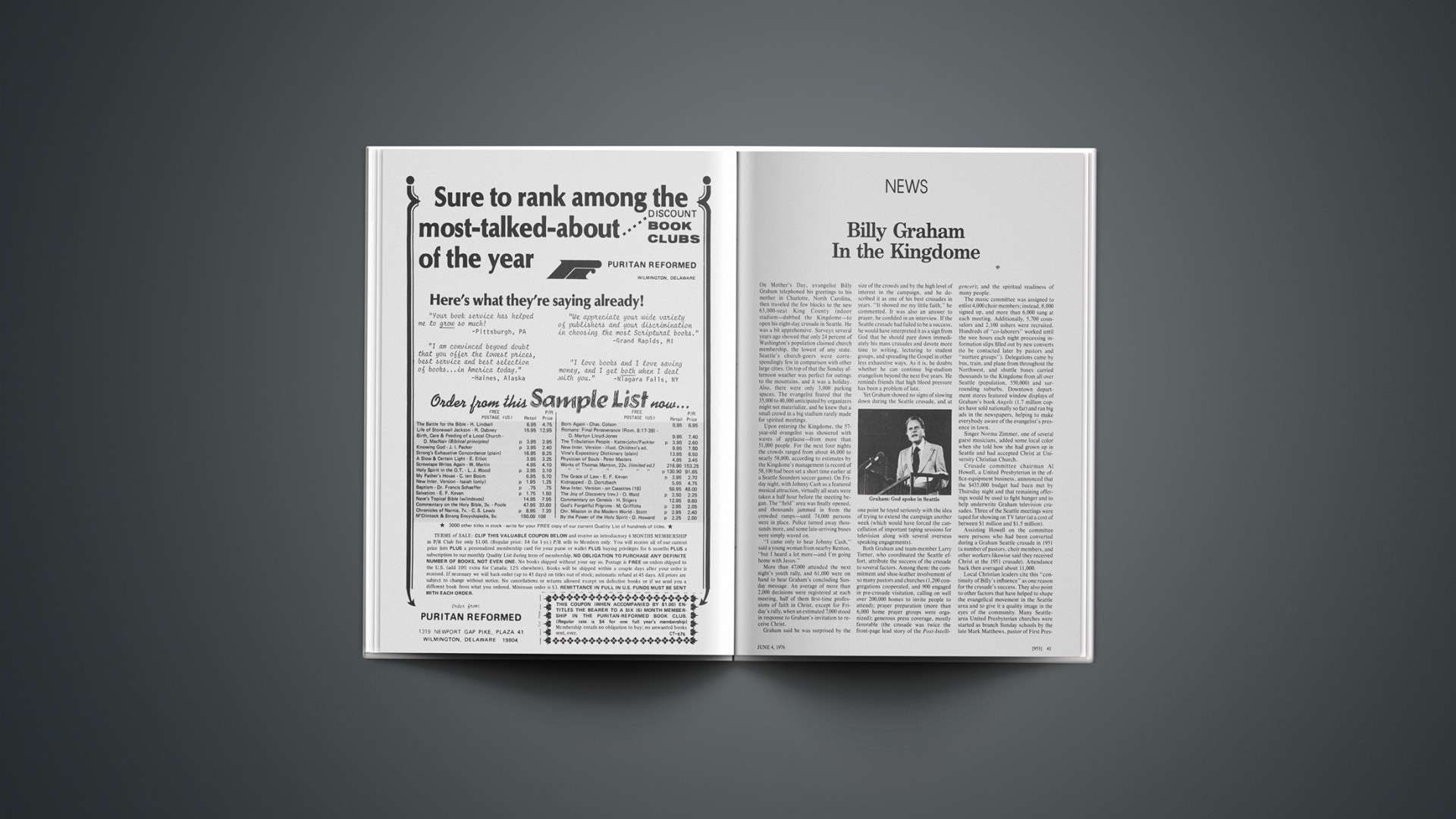
On Mother’s Day, evangelist Billy Graham telephoned his greetings to his mother in Charlotte, North Carolina, then traveled the few blocks to the new 63,000-seat King County indoor stadium—dubbed the Kingdome—to open his eight-day crusade in Seattle. He was a bit apprehensive. Surveys several years ago showed that only 24 percent of Washington’s population claimed church membership, the lowest of any state. Seattle’s church-goers were correspondingly few in comparison with other large cities. On top of that the Sunday afternoon weather was perfect for outings to the mountains, and it was a holiday. Also, there were only 3,000 parking spaces. The evangelist feared that the 35,000 to 40,000 anticipated by organizers might not materialize, and he knew that a small crowd in a big stadium rarely made for spirited meetings.

Upon entering the Kingdome, the 57-year-old evangelist was showered with waves of applause—from more than 51,000 people. For the next four nights the crowds ranged from about 46,000 to nearly 58,000, according to estimates by the Kingdome’s management (a record of 58,100 had been set a short time earlier at a Seattle Sounders soccer game). On Friday night, with Johnny Cash as a featured musical attraction, virtually all seats were taken a half hour before the meeting began. The “field” area was finally opened, and thousands jammed in from the crowded ramps—until 74,000 persons were in place. Police turned away thousands more, and some late-arriving buses were simply waved on.

“I came only to hear Johnny Cash,” said a young woman from nearby Renton, “but I heard a lot more—and I’m going home with Jesus.”

More than 47,000 attended the next night’s youth rally, and 61,000 were on hand to hear Graham’s concluding Sunday message. An average of more than 2,000 decisions were registered at each meeting, half of them first-time professions of faith in Christ, except for Friday’s rally, when an estimated 7,000 stood in response to Graham’s invitation to receive Christ.

Graham said he was surprised by the size of the crowds and by the high level of interest in the campaign, and he described it as one of his best crusades in years. “It showed me my little faith,” he commented. It was also an answer to prayer, he confided in an interview. If the Seattle crusade had failed to be a success, he would have interpreted it as a sign from God that he should pare down immediately his mass crusades and devote more time to writing, lecturing to student groups, and spreading the Gospel in other less exhaustive ways. As it is, he doubts whether he can continue big-stadium evangelism beyond the next five years. He reminds friends that high blood pressure has been a problem of late.

Yet Graham showed no signs of slowing down during the Seattle crusade, and at one point he toyed seriously with the idea of trying to extend the campaign another week (which would have forced the cancellation of important taping sessions for television along with several overseas speaking engagements).

Both Graham and team-member Larry Turner, who coordinated the Seattle effort, attribute the success of the crusade to several factors. Among them: the commitment and shoe-leather involvement of so many pastors and churches (1,200 congregations cooperated, and 900 engaged in pre-crusade visitation, calling on well over 200,000 homes to invite people to attend); prayer preparation (more than 6,000 home prayer groups were organized); generous press coverage, mostly favorable (the crusade was twice the front-page lead story of the Post-Intelligencer); and the spiritual readiness of many people.

The music committee was assigned to enlist 4,000 choir members; instead, 8,000 signed up, and more than 6,000 sang at each meeting. Additionally, 5,700 counselors and 2,100 ushers were recruited. Hundreds of “co-laborers” worked until the wee hours each night processing information slips filled out by new converts (to be contacted later by pastors and “nurture groups”). Delegations came by bus, train, and plane from throughout the Northwest, and shuttle buses carried thousands to the Kingdome from all over Seattle (population, 550,000) and surrounding suburbs. Downtown department stores featured window displays of Graham’s book Angels (1.7 million copies have sold nationally so far) and ran big ads in the newspapers, helping to make everybody aware of the evangelist’s presence in town.

Singer Norma Zimmer, one of several guest musicians, added some local color when she told how she had grown up in Seattle and had accepted Christ at University Christian Church.

Crusade committee chairman Al Howell, a United Presbyterian in the office-equipment business, announced that the $435,000 budget had been met by Thursday night and that remaining offerings would be used to fight hunger and to help underwrite Graham television crusades. Three of the Seattle meetings were taped for showing on TV later (at a cost of between $1 million and $1.5 million).

Assisting Howell on the committee were persons who had been converted during a Graham Seattle crusade in 1951 (a number of pastors, choir members, and other workers likewise said they received Christ at the 1951 crusade). Attendance back then averaged about 11,000.

Local Christian leaders cite this “continuity of Billy’s influence” as one reason for the crusade’s success. They also point to other factors that have helped to shape the evangelical movement in the Seattle area and to give it a quality image in the eyes of the community. Many Seattle-area United Presbyterian churches were started as branch Sunday schools by the late Mark Matthews, pastor of First Presbyterian Church years ago. He was a staunch evangelical, and most of those churches still reflect that legacy. J. Murray Marshall. First Presbyterian’s present pastor, is known for his evangelical leadership in the city, and he led the way in providing the crusade with strong ministerial support.

Chairman Howell and other leading laypersons are part of a downtown fellowship that was begun in 1935 by the late Norwegian immigrant Abraham Vereide, a Methodist preacher and father of the international prayer-breakfast movement. The group has helped to promote spiritual maturity and unity among the city’s lay Christian leadership.

Also helping the cause is the presence of 2,200-student Seattle Pacific College, an evangelical school related to the Free Methodist Church. It is one of only two private colleges in the area, gets plenty of coverage in the cultural and sports columns of the daily press, and commands wide respect in the community. Mayor Al Uhlman is an SPC graduate. The son of a United Methodist minister, he told the opening-day crusade audience in a welcome speech that Jesus Christ is “the only one who can bring the peace, hope, and sense of purpose we need.” (He is now running for the Democratic nomination for governor.)

Another highly regarded evangelical organization is King’s Garden, which operates one of the best Christian retirement communities in the country, a first-class radio ministry, schools through grade twelve (the sixty-voice high school choir packed 7,500 crusade choir packets with twelve musical selections each), and an international Christian relief program (World Concern) that has been adopted by many Seattle citizens as their own.

Thus, thanks in part to such evangelical visibility and involvement, Seattle was “ready” for Graham’s visit. In pre-crusade appearances he addressed a record-breaking crowd of 800 civic, business, and professional leaders at a Rotary Club meeting. His suggestion that a copy of the Ten Commandments ought to be hung in every classroom got an ovation. In another meeting, he was interviewed by editors from fifty high-school newspapers.

During the crusade, Graham spoke on family life, personal and national morality, international problems, the new-birth experience, and the second coming of Christ. In one talk he made an off-the-cuff comment against abortion that drew a round of applause. His sermons are chock-full of Scripture and tend to be more expository than in his early years in evangelism, and he keeps interest high with an illustration about every four minutes or so.

Graham has spoken personally to more than 80 million persons in dozens of countries since 1947, and there have been some 1.5 million “inquirers,” the majority of them making professions of faith. He hit the sawdust trail in 1947 with singer George Beverly Shea and associate evangelists Cliff Barrows and Grady Wilson. The Billy Graham Evangelistic Association (BGEA) was formed in 1950. It embraces many facets of outreach today: television and radio ministry, book and magazine publishing, motion picture production (some 300 films), a syndicated newspaper column carrying Graham’s by-line, crusades led by a staff of evangelists, sponsorship of evangelism congresses, aid to other Christian projects, and schools of evangelism for pastors and seminarians.

The schools of evangelism are one of the most important but least-known phases of major crusades. In all, more than 20,000 pastors, seminarians, and other Christian leaders have been trained in the week-long U. S. schools since the first one in Anaheim, California, in 1965. They are underwritten about evenly by retired businessman Lowell Berry, a Presbyterian of Walnut Creek, California, and by the BGEA. Costs run about $100,000 per school. Travel and lodging scholarships are provided; participants buy their own meals. Training materials are offered free, and the schools feature some of the best-known leaders in the country. Some of them: Charles Allen, 62, best-selling author (God’s Psychiatry) and pastor of the 11,000-member First Methodist Church of Houston, United Methodism’s largest; Thomas Zimmerman, general superintendent of the Assemblies of God; Pastor D. James Kennedy (Evangelism Explosion) of Coral Ridge Presbyterian Church in Florida. Graham staffers also participate.

The schools are under the direction of BGEA staffer Noble Scroggins, 48, a former Four-Square pastor, and Kenneth Chafin, 49, pastor of the 6,500-member South Main Baptist Church of Houston and former evangelism chief for the Southern Baptist Convention. Scroggins handles administration. Chafin looks after programming.

Mornings are spent in plenary sessions (Bible study, The Minister’s Devotional Life, Training the Laity, Women in the Church, Church Growth) and afternoons in seminars. The goal, says Chafin, is not to train people to be mass evangelists but to strengthen the local church’s program of evangelism through helping to motivate and equip the pastor. Wives are invited to attend; often they gain new insight into the problems and challenges of the ministry and are better able to relate sympathetically to it. Thus reinforced, some pastors on the verge of leaving the ministry have chosen to stay.

One such pastor among the 1,340 registrants at the Seattle school said having his wife along was the most valuable feature of the school. “We had a long talk,” he said. “She’s fired up and wants to go back and win our neighborhood to Christ.” With his wife’s new zeal and encouragement, the inspiration and training at the school, and the remarkable response at the crusade to cheer him on, he headed back to his less-than-200-member church—apparently determined to fulfill his role in the Great Commission.

“The school’s leaders recognize that the pastor is hurting and has needs, and what is offered here is right on target,” commented James Christianson, pastor of Seattle’s Trinity Presbyterian Church.

“Alumni” of the schools report lasting benefits. A United Methodist pastor returned from a school in Cleveland and for the first time in a service offered an invitation to receive Christ. Twenty persons responded.

A Southern Baptist church in the Lubbock, Texas, area has grown 100 percent in five years, and the pastor credits an evangelism school’s influence in his ministry.

The full significance of the Seattle crusade is still to be unfolded in the years ahead, stated Pastor Marshall, in whose church the school of evangelism was held. In making the remark, he had the long-term potential of the school mainly in mind.

So did Presbyterian pastor William Bray, 45, of Walla Walla when he declared: “This week may mark the beginning of a wave of evangelistic fervor and church growth throughout the entire Northwest.”

STOP SCOTT MOVEMENT

First-grader Scott Jenkins of Salem, New Hampshire, has been ordered by a unanimous vote of authorities to stop praying out loud during the silent meditation period in his classroom. The boy had been told to stop praying aloud by school officials, but his father appealed, claiming his son’s inalienable rights were being violated. The appeal was denied, and Scott is now praying silently.

Look-Up Hookup

The National Aeronautics and Space Administration has approved the use of a $260 million satellite for a Christian broadcasting experiment called “Project Look-up.” Expected to be launched in January, the project involves broadcasters from about fifty Christian organizations who will beam “community service programs” to South American lands.

Dud In Dallas

Explo ’76 has fizzled. The vision of 21-year-old Lowell Beasley, a Southern Baptist of Aurora, Illinois, it was a plan to enlist nationally known speakers and singers to fill the Texas Stadium near Dallas for a week-long rally this month. But most advertised personalities said they either had not been contacted or had not made any firm commitments. Some mistakenly thought the event was being sponsored by Campus Crusade for Christ, which put on Explo ’74. The Postal Service says Beasley is returning $10 deposits that were mailed to him in response to advertisments.

Book Briefs: June 4, 1976

Two Views Of John

Christianity According to John, by D. George Vanderlip (Westminster, 1975, 224 pp. $8.50), and The Gospel of John, Volume I, by James Montgomery Boice (Zondervan, 1975, 443 pp., $9.95), are reviewed by Donald A. Carson, dean, Northwest Baptist Theological Seminary, Vancouver, British Columbia.

Both of these books are concerned with the Fourth Gospel, and each was written by an evangelical living in the Philadelphia area. There the similarities between them end.

Christianity According to John apparently arises out of Vanderlip’s classroom experience. Its twelve chapters constitute a basic theology of the Gospel of John. The chapter headings cover many of John’s most important themes: “Jesus as the Word,” “The Children of God,” “Believe,” “Know,” “Love,” “Light and Darkness,” “The Spirit of Truth,” and so on. Vanderlip writes clearly and concisely and shows competence in the secondary literature (in fact, there are too many quotations).

For better or for worse, Vanderlip goes out of his way to show that John is “relevant.” The first chapter, for instance, “John Speaks to Our World,” begins with several pages devoted to discussing “life’s true meaning,” reality, genuineness, oppression. “John’s understanding of love,” we read, “involves creative human response to need.” Several chapters conclude with a section seeking to develop the contemporary meaning of the exposition. I would be the last to eschew the relevance of the Scriptures, but I think Vanderlip’s efforts to demonstrate this relevance are the weakest part of his book. At one point he even finds it necessary to apologize for the Evangelist’s negative comments on “the Jews.” We have, he says, no right to speak of the Jews, or of anyone else, as “children of the devil” (8:44) as John has done (though it should be observed that John ascribes the remark to Jesus). “We can understand it, but we must not perpetuate it.” I would think that Jesus’ remark, far from being “racist, could be extended to all human beings everywhere apart from the grace of God.

Vanderlip thinks the Gospel of John was written toward the end of the first century, with both Jewish and Gentile believers primarily in view. However, he later allows that the book’s purpose includes both evangelism and instruction. The Apostle John probably stands behind it with his oral preaching and teaching; but one of his disciples prepared the first draft based on John’s proclamation, and a subsequent editor or editors enlarged the draft by incorporating supplementary material—including that which makes up chapters 15–17; 21. It was published in Ephesus. The brevity of Vanderlip’s book means that Vanderlip’s reconstruction of the Fourth Gospel’s early history is compressed into a few pages. It may be convincing to the beginning student or to the student who has already adopted some scheme such as those of R. E. Brown, B. Lindars, and R. Schnackenburg; I doubt if it will commend itself to those who see greater significance in the claims to eyewitness reporting, and who allow that only 21:24 f. was added by other writers.

Vanderlip focuses his attention on the Gospel itself, but in the case of two themes, knowledge and dualism, he includes a fair bit of background material. On the other hand, there are certain omissions. Many of Jesus’ titles are discussed but not “Lamb of God.” Much is made of John’s emphasis on love, relatively little of his stress on wrath and judgment.

Vanderlip reserves the last chapter for a discussion of “History and Interpretation.” It is in this area that I find myself in strongest disagreement with him. Twice he argues that John 9:22; 12:42, and 16:2 are references to excommunication from the synagogue by virtue of an alleged Jamnian decree (c. A.D. 85), even though he acknowledges that Leon Morris “prefers to interpret the excommunication as related to the time of Jesus.” It is not only Morris: M. J. Lagrange, C. F. D. Moule, and even C. H. Dodd, among others, raise doubts as to whether this is an anachronism.

Not just an isolated incident is at stake. Everyone can agree that John gives his material his own impress, and that he uses his own vocabulary; and indeed the problem of the relation between history and interpretation is extremely difficult. But when entire chapters that the Evangelist ascribes to Jesus are now cast as later pious expansions of the significance of Jesus, then the problem becomes acute. Vanderlip is basically saying that the theology of the Fourth Gospel is true while its historical referents are doubtful. To justify this conclusion, he calls up two crucial arguments. First, he draws attention to Paul, who regularly gives his opinion on various matters: is John not entitled to the same recognition of inspiration that is confidently granted to Paul? But there is a qualitative difference: John ascribes his material to Jesus directly, in historical settings, sometimes even claiming eyewitness veracity. And both John and Paul are quite capable of distinguishing between statements from Jesus during his ministry, and post-resurrection insights (e.g., John 2:17, 22; 1 Cor. 7:10, 12). Second, Vanderlip makes repeated appeal to the Spirit (John 16:12–15), who will lead Christ’s people into truth. He compares First Corinthians 7:40 (“And I think that I have the Spirit of God”), and writes: “If through the years Christians had not acknowledged the validity of this claim by Paul, the writings of Paul would not have been admitted into the New Testament canon. Extending the same principle to John, can we deny to the author of the Fourth Gospel the right to freedom of religious expression under the guidance of the Spirit (John 16:12–15)?”

Hence Vanderlip cites with approval the opinion of Sanders and Martin that “the material in the Fourth Gospel consisted originally of sermons, preached by a man who was a Christian prophet, whose own words were as truly ‘words of the Lord’ as those spoken by Jesus beside the sea of Galilee or in the Upper Room.” But the Christian prophets were always able to distinguish between what Jesus said during his ministry and what his Spirit appeared to be saying through them (see D. Hill, “On the Evidence for the Creative Role of Christian Prophets,” New Testament Studies 20 [1974], 262–74).

I am far from arguing that John is presenting verbatim reports of Christ’s discourses; but I am persuaded that some model other than Vanderlip’s better explains the evidence. John gives condensations, in his own idiom (independence of idiom is especially easy when the original material is in another language, in this case presumably Aramaic); but condensed reports can be accurate reports—both theologically and historically.

The book by Boice arose from the author’s preaching ministry. This is the first volume of a projected series of five and covers 1:1–4:54. The fifty-six short chapters vary considerably in scope: they can cover just part of one verse (e.g., two sermons are given over to 1:14) or a more extended section (e.g. 2:1–11).

In both style and content the book is easy to read. Although written with the layman in mind, it contains insights that the Johannine specialist will appreciate. The work is marked by colorful examples and apposite quotations and illustrations. It is openly evangelistic.

Boice entertains no doubt about the truth of both theology and history in the Fourth Gospel, and occasionally ventures some explanatory remarks (see, for example, the part beginning on page 60).

The reader should be forewarned that the book is not simply an exposition of the first chapters of John—indeed, not quite an exposition. It is not quite an exposition in the sense that Boice selects certain teachings from many of his texts but does not attempt to expound the entire passage. The points he draws out of the text are usually valid; but not infrequently I was left with the impression that I was not being helped to understand John precisely as John wanted to be understood. Again, the book is not simply an exposition in the sense that Boice regularly draws in much material from elsewhere in the Scriptures. For example, in commenting on John 4:25 f., he manages to discuss the Matthean and Lukan genealogies. Three chapters are given over to a consideration of Christian baptism—mercifully, not in the categories of adult versus child baptism, or sprinkling versus immersion. In writing on John 1:4 Boice introduces us to Psalm 23. And, most noteworthy, in almost every chapter Boice ventures applications that, however valid, are not found in the text.

None of these features is blameworthy, if the book is accepted for what it is: a rewriting of sermons, preached in a textual/expository tradition. As such, the book is stimulating and helpful. I read it with pleasure.

Reference Book On Greece And Rome

Illustrated Encyclopaedia of the Classical World, by Michael Avi-Yonah and Israel Shatzman (Harper & Row, 1975, 510 pp., $20), is reviewed by Edwin Yamauchi, professor of history, Miami University, Oxford, Ohio.

The late Michael Avi-Yonah, who died in 1974, was the leading Israeli scholar of the classical and Byzantine periods. He directed a number of excavations in Israel and served as the editor of the Israel Exploration Journal and of the Encyclopedia of Archaeological Excavations in the Holy Land. He had planned this Illustrated Encyclopaedia of the Classical World, but its completion is largely the work of Professor Israel Shatzman of the Hebrew University, who is primarily a scholar of the Roman period.

In many respects this is perhaps the best reference work of its kind available. It is quite comprehensive; its articles cover 2,300 topics and are by and large concise and accurate. For the reader who is not a classical scholar, this is more serviceable and readable than the Oxford Classical Dictionary. It is more up to date than William Smith’s Classical Dictionary. It is superior to the comparable Praeger Encyclopedia of Ancient Greek Civilization in that it includes bibliographical references, some as recent as works published in 1974.

The work contains six maps and seven pages of chronological charts. There are helpful cross-references throughout, as well as a six-page index of items that are not the primary subjects of articles but are discussed in the course of articles. There are a generous number of black and white photos and some splendid colored illustrations. Regrettably, there is no list of the latter; they appear almost at random without any necessary relation to nearby articles, and there are no references in the text to them.

In view of the many excellent features of this encyclopedia, it is a pity that it has some rather glaring deficiencies, particularly in regard to the works listed in the unnecessarily spare bibliographies. In part this may be due to the publisher’s guidelines or to the limitations of works that are accessible in Israel. In part it probably reflects the fact that no one scholar can hope to be competent in all fields. The deficiencies are most obvious with respect to peripheral areas of the Greek world and the Roman Empire, such as Anatolia and Persia.

What is more lamentable, particularly in a work conceived by a leading archaeologist, is the lack of references to current excavations. Understandable but still regrettable is the omission of references to the New Testament; the articles on Galatia, Ephesus, and Corinth contain no explicit references to Paul’s mission or letters to these areas.

Although this encyclopedia is not addressed to students of the New Testament, readers will gain much useful background information from such articles as those on Athens, Epicurus, Caesar, and Augustus.

The Message Of Mark

Mark: Evangelist and Theologian, by Ralph P. Martin Zondervan, 1973, 240 pp., $3.95), The Gospel According to Mark, by William L. Lane (Eerdmans, 1974, 652 pp., $12.95), Mark: A Portrait of the Servant, by D. Edmond Hiebert (Moody, 1974, 437 pp., $7.95), and Exposition of the Gospel According to Mark, by William Hendricksen (Baker, 1975, 700 pp., $14.95), are reviewed by Harold Hoehner, associate professor of New Testament, Dallas Theological Seminary, Dallas, Texas.

Evangelical scholars produced four major works on the Gospel of Mark in the last three years. Since exegesis properly precedes theology, we will examine the three commentaries before Martin’s theology of Mark.

All the commentators agree that John Mark of Acts 13:5, 13 and 15:37–39 was probably the author of the gospel and that the content of Mark was a result of Peter’s preaching at Rome. Regarding the date of the composition, Hendricksen dates it in the early part of the period between A.D. 40 and 65, while Lane dates it in the latter half of the decade of A.D. 60–69. The difference: Hendricksen accepts the identification of a recently discovered papyrus fragment as a part of Mark; Lane does not. Hiebert does not even mention the controversy but dates Mark sometime between A.D. 64 and 67. Lane and Hendricksen assume that Mark was the first gospel; Hiebert does not commit himself. Lane is the only one who discusses redaction criticism in the introduction. All three commentators argue that the purpose of Mark was to present the good news of Jesus, the Son of God and Son of man, in order to call men to faith.

Lane and Hiebert use the ASV; Hendricksen uses his own translation. One of the problems of Mark is whether or not to accept the long ending (16:9–20). Hiebert seems undecided but does comment on that portion. Lane and Hendricksen do not think it is genuinely Markan, but Hendricksen comments on it anyway. All three agree that Christ ate the Passover on Thursday and was crucified on Friday.

Lane investigated every piece of literature on Mark available through 1972. He deals adequately with the textual problems. His lucid comments do not skirt the issues. He considers other sources such as rabbinical materials that can illumine the text. His extensive footnotes give not only supporting materials but also additional information. He makes a real attempt to grapple with the historical situation of Jesus’ ministry and its possible ramifications for the Roman believer for that day. This is truly a fine commentary. It is the only one with indexes that include authors, persons, places, subjects, and Scripture references, a feature that adds greatly to its usefulness. Apparently the author thought his material was valuable enough that others would want to be able to find it.

Hendricksen also deals lucidly with the issues but in a rather different manner. He is nowhere near as conversant with the literature of today as Lane. At several points he gives helpful charts comparing Mark with the other gospels, and he also has a map of Jesus’ journeys of retirement, He gives practical lessons on the passages discussed. Several times there are discussions he omits because they are in his commentaries on Matthew and John; this is somewhat inconvenient if one does not have those volumes.

Hiebert’s commentary is more devotional in nature. He virtually ignores recent discussions. There is very little new or fresh in what he says. The notes are in the back, which makes it cumbersome to use.

Martin’s work is not a commentary but rather an attempt to deal with the theology of Mark. After very ably discussing some of the introductory problems, Martin shows that Mark’s gospel is a theological document that is trying to convince the readers to put their faith in the earthly Jesus, now the exalted Lord in heaven. Martin sees that Mark’s gospel was a correction to Gentile churches that tended to see a docetic Christ. Martin interacts with recent works on Mark (but not with the three reviewed here; it was published before these). It is a fitting companion to any of the above commentaries.

For a new believer, Hiebert’s commentary would be helpful, and for the pastor, Hendricksen’s. However, Lane’s would be helpful to the layman, pastor, and scholar who is dealing not only with the past but also with the present discussions of Mark.

BRIEFLY NOTED

A great way to keep a very useful bibliography up to date: The Minister’s Library: Periodic Supplement #1 by Cyril Barber (Baker. 106 pp., $2.95 pb). The original volume was published in 1974 and costs $9.95.

Psychology of Religion is a major bibliographical guide to books and articles on that subject, compiled by Donald Capps, Lewis Rambo, and Paul Ransoloff (Gale Research Co., 364 pp., $18). Most items are after 1950. They are unannotated but are grouped into forty categories (e.g., festivals, glossolalia, prejudice, death) and are indexed by author, subject, and title. For all theological and psychological libraries and the personal libraries of researchers. This is the first volume to appear in Gale’s Philosophy and Religion Information Guide Series.

Richard Ruble, a psychology professor at John Brown, gathered twenty-eight articles, mostly by evangelicals, to use in his courses. They are available under the title Christian Perspectives on Psychology. Other teachers might want to consider using them. (MSS Information Corp. [655 Madison Ave., New York, N. Y. 10021], 147 pp., $3.75 pb).

Ever wonder what some of the symbols on church buildings and their accessories stand for? Tourists especially should welcome A Handbook of Symbols in Christian Art by Gertrude Grace Sill (Macmillan, 241 pp., $9.95, $5.95 pb). The difference between square and round halos, the significance of a closed gate, and the meanings of numerous other objects depicted in traditional Western religious art are briefly described, often with illustrations, under fifty headings (e.g., beasts, flowers, saints).

Four rather different aids to the study of Genesis were published recently. Origins: Creation Texts From the Ancient Mediterranean, edited by Charles Doria and Harris Lenowitz (Doubleday, 356 pp., $4.95 pb), offers a good opportunity for the interested non-specialist to see the contrast between the creation accounts of the Hebrews and those of their neighbors. The widely known evangelist John R. Rice has written a verse-by-verse commentary in sermonic style. In the Beginning.… (Sword of the Lord, 559 pp., $5.95). Another conservative commentary, much more scholarly in style, is Harold Stiger’s A Commentary on Genesis (Zondervan, 352 pp., $12.95). Ray Stedman, a widely known pastor, delves homiletically into the first three chapters of Genesis in Understanding Man (Word, 154 pp., $4.95).

The discovery of the Dead Sea Scrolls radically changed the understanding of the early history of the text of the Old Testament. Frank Moore Cross and Shemaryahu Talmon have collected fourteen previously published articles that illustrate some of these changes, and each has added fresh articles with his own proposals, in Qumran and the History of the Biblical Text (Harvard, 415 pp., $16.50, $5.95 pb).

The first half of volume one of Karl Barth’s Church Dogmatics was translated into English by G. T. Thomson in 1934. The second half appeared decades later, in 1956, under the editorship of G. W. Bromiley and T. F. Torrance, who went on to supervise the rest of the multi-volume translation. To make the set uniform in style, Bromiley has made a fresh translation of the first half-volume; it is available for£8 from the publishers, T. & T. Clark of Edinburgh.

Essays by various authorities on the educational contributions of twenty-six prominent religious leaders (e.g., Augustine, Aquinas, Luther, Loyola, Wesley, Bushnell, and William James) have been edited by Elmer Towns and somewhat misleadingly entitled A History of Religious Educators (Baker, 330 pp., $8.98). Primarily a college or seminary text.

How an Episcopal minister went about the increasingly difficult task of finding a church to pastor is narrated in Do You Know the Way to San Jose?: One Pastor’s Search For a Job by A. Richard Bullock (Alban Institute [Mount St. Alban, Washington, D. C. 20016], 20 pp., $2.50). Alban Institute publishes many other studies of clergy-laity relations and activities. Write for a catalogue.

Lois Glenn has compiled an annotated and nearly complete bibliography (through 1974) of material on Charles W. S. Williams and his writings (Kent State University, 128 pp., $7.50).

Human Life Review begins its second year of publication as a quarterly journal with scholarly articles from an anti-abortion/pro-life perspective. All academic, theological, and medical libraries should subscribe, and many individuals will want to do so as well ($12/year; Room 540, 150 East 35 St., New York, N. Y. 10016).

An easy-to-read, sympathetic report of the major World Council of Churches meeting at the end of last year is presented in Nairobi 1975 by James W. Kennedy (Forward Movement [412 Sycamore St., Cincinnati, Ohio 45202], 144 pp., $1 pb).

Renewing Our Minds

Basic Principles of Biblical Counseling, by Lawrence J. Crabb, Jr., (Zondervan, 1975, 111 pp., $4.95) is reviewed by W. J. Donaldson, Jr., professor of psychological Services, Georgia State University, Atlanta.

Two basic tenets underlie Crabb’s model of biblical psychology. First, every person must first reach the goal of personal fulfillment before he is free to live for something or someone else. “The basic personal need of each personal being is to regard himself as a worthwhile human being.” Personal worth is defined in terms of significance and security. Both of these needs are seen to be met in God, who is totally sufficient. All behaviors are attempts to meet our deepest needs.

Second, “all personal problems are really thinking or belief problems, wrong beliefs about how to meet [our deepest] needs.” Using Romans 12:2 (“be transformed by the renewing of your minds”) Crabb states that Scriptures “support the belief that psychologists are right when they emphasize the importance of thinking.” “Paul taught that transformation comes from renewing neither feelings nor circumstances, but our minds.”

This basic cognitive approach linked with some social learning and Adlerian concepts forms the basic content of Crabb’s theory. Diagnosis is “uncovering wrong beliefs supporting sinful patterns of behavior.” Sin is basically wrong thinking, i.e., thinking that does not lead to absolute dependency upon a sovereign God for our personal needs. Treatment is “teaching right beliefs, and encouraging right behavior consistent with right beliefs.” The ultimate goal of biblical counseling, then, becomes one of assisting a person “to change in the direction of Christlikeness.”

Crabb offers a perceptive blend of Schaeffer’s apologetics, cognitive behavior therapy, and Adlerian theory, but he needs to deal more fully with the following questions: (1) Does Paul’s use of nous in Romans 12:2 refer exclusively to cognitive processes or, as Ladd suggests, to “moral judgment” as well? Or to put it another way, how are the will and cognition tied together? (2) In Crabb’s discussion of sin, he sees it as wrong thinking. But is all wrong thinking sin, as he implies? (3) Wrong thinking is ultimately not depending “on a sovereign God for all our needs.” Crabb claims that no situation is intolerable; “the basic cure is learning to be content in whatever circle is mine.” Is there no time when the biblical counselor can label a situation unjust and rightfully assert himself against it in cooperation with the client? It seems that Crabb has negated the necessity of standing up against evil situations. (4) In his attempt to be absolutely dependent upon God, Crabb only gives slight acknowledgment of Christian community. Is not the body of Christ a necessary part of God’s plan for meeting our deepest needs for significance and security?

God’S History And Man’S

The Gospel as History, edited by Vilmos Vajta (Fortress, 1975, 246 pp., $10.95), is reviewed by Malcolm L. Peel, chairman, Department of Philosophy and Religion, Coe College, Cedar Rapids, Iowa.

This volume of collected essays is the last of four in a series sponsored by the Ecumenical Institute in Strasbourg, France. The series, entitled “The Gospel Encounters History,” has provided a set of working papers for ecumenical discussion. The contributors are from a variety of countries and a variety of theological disciplines. The result is a wide spectrum of opinion, in accord with the institute’s policy of promoting open dialogue.

The Gospel as History begins with two essays devoted to the possible interrelation of holy history (God’s acts among men) and human history (man’s acts in the secular realm). Regin Prenter, professor of systematic theology emeritus of the University of Aarhus, Denmark, argues in “Words and Works of Jesus Christ” that these two histories really converge in God’s incarnation in the world. Christ is the “linguistic event” (i.e., supreme example of the unity of works and interpreting words) that forms the redemptive, center point of history. In his two natures the two types of history are seen to coalesce. By its conduct of baptism, preaching, and the Eucharist, the Church continues the incarnational history of God in the world, the ultimate goal being the overcoming of self-love and the redemption of all history.

In contrast to this Christocentric interpretation, Gustaf Wingren, professor of systematic theology at the University of Lund, Sweden, asserts in “God’s World and the Individual” that the first article of the creed (God as Creator) has been neglected amid the contemporary stress on kerygmatic theology. The Gospel (God’s saving act in Christ whereby freedom is granted from sin, guilt, law) is addressed primarily to the individual and makes sense only against a background of cosmic Fall and cosmic Providence. Wingren stresses God’s positive work in redeeming the world as Creator, even apart from the Church and the Gospel. Both Prenter and Wingren agree, however, that there is no gospel basis for the use of violence in achieving justice, though Wingren does contend that social barriers are shattered when the Gospel is proclaimed.

Part Two contains two essays on “Creation and Gospel in the Scriptures.” In the first, “Creatio, Continua, and Nova,” John Reumann, professor of New Testament at Lutheran Seminary in Philadelphia, gives an exegetical, traditio-historico survey of biblical traditions about Creation and New Creation. This is designed to provide insight into the history of God’s dealings with his world. Reumann offers twelve theses in conclusion, summarizing biblical theologies of Creation and offering pointers for today’s theological tasks.

The second of these essays, “The Historicity of Scriptures and the Witness to One Gospel” by Jürgen Roloff, professor of New Testament at the University of Erlangen, Germany, really has nothing to do with study of Creation but concentrates on the problem of identifying the unity of the Gospel in the plurality of its New Testament witnesses. Roloff maintains that the rise of historical criticism and its application to the Scriptures resulted in their fragmentation into separate strands of tradition. Awareness of their fundamental unity was lost, and different church groups were easily able to justify their subsequent separate existences. On the other hand, this same historical criticism, by making us aware of diversity in primitive Christianity, should warn us against accepting any one theology as normative, should lead us back to Christ, who is witnessed to throughout the diverse New Testament interpretations, and should impress on Christians that the New Testament must remain the only norm and guideline for the Church in its preaching and content.

Part Three, “The Passing on of the Gospel,” contains three articles that explore the very important issue of Scripture and tradition. Andre Benoit, professor of patristics at the University of Strasbourg, surveys “The Transmission of the Gospel in the First Centuries,” breaking off with Irenaeus at the end of the second century. Harding Meyer, a research professor at the Ecumenical Institute in Strasbourg, offers “The Ecumenical Reconsideration of Tradition: An Evaluation.” Two points are most significant in these articles. The first is that Protestants (through insights yielded by synoptic form and editorial criticism into the importance of pre-literary, oral transmission of gospel traditions, as well as through their acknowledgment of having twisted the Reformation principle of “sola scriptura” into that of “scriptura solitaria”) have moved closer to Catholic theology in acknowledging the importance of tradition in the interpretation of Gospel. The Second is that Catholics (through their increasing use of historical critical biblical study and post-Vatican II reexamination of the role of Scripture) have moved closer to Protestant theology in recognizing the normative primacy of apostolic writings in the order of precedence within the various entitles of tradition.

Philip Hefner, professor of systematics at Lutheran School of Theology in Chicago, Illinois, concludes Part Three with an article on “Dogmatic Statements and the Identity of the Christian Community.” His thesis is that dogmatic statements, whose formulation is always the task of theology, serve to establish the identity of and give direction to the Christian community as it develops through history and nature. Still, given what we know about how organisms and institutions are affected by processes of historical development and individuation, dogmas cannot be viewed as fixed entities and must always be subject to review in light of Scripture.

This volume demands of the reader a serious level of engagement. Poor translation from German obscures the already difficult argument in several of the articles. Even so, Wingren’s insistence on the importance of the doctrine of Creation to contemporary theology and insights into modern Protestant-Catholic dialogue on Scripture and Tradition should not go unheeded. It is, in sum, a significant contribution to constructive theology and ecumenical discussion.

Strife Over Social Concerns

Sixth in the Series “Evangelicals In Search of Identity”

Despite renewed awareness that the Christian Gospel has indispensable social implications, evangelicals seem to divide increasingly over the relation between social concern and evangelism and over what program Christian social ethics implies.

At the far right are fundamentalists who consider evangelism the Church’s only proper task in the world and justify social effort—like rescue missions and relief for the poor—only as a means of converting people to personal faith. Evangelist Billy Graham is not so extreme; while he distinguishes evangelism as the primary mission of the Church, he also recognizes the propriety of an evangelical response to human need generally, and the Billy Graham Evangelistic Association recently established a framework for evangelical social response. The National Association of Evangelicals, which links a vast network of theologically conservative churches, has more fully channeled the gospel dynamic to such human needs as post-war relief in Europe and South Korea, and by means of its World Relief Commission it has ministered even more widely through socio-spiritual programs administered by evangelicals in disaster and poverty-stricken areas.

The demand of Third World evangelicals that the Christian Gospel not be limited to personal conversion but incorporate also a vigorous demand for social justice that indicts oppressive politico-economic forces has shaken up the World Evangelical Fellowship, whose American supporters concentrate on personal regeneration. Leighton Ford, John Stott, Bishop Jack Dain, and many WEF participants view the restriction to personal conversion as a limitation of the Gospel.

A number of evangelical agencies are responding creatively to diverse human needs. Among them are Food for the Hungry, which maintains an evangelical witness and administration in various programs in many countries; Medical Assistance Program, which provides workers, training, medicine, and supplies in the area of health needs; and the Institute for International Development, which brings together Christian entrepreneurs in fifteen countries and their American counterparts to sponsor job-creating efforts. Giant of them all is World Vision International, a global humanitarian work. Annual contributions by Christians mainly in the United States, Canada, Germany, Australia, and New Zealand now make World Vision the largest evangelical agency.

The cultural conformity of establishment evangelicalism distressed many earnest evangelical students at the time of the racial and Watergate crises, and they began to enunciate socio-ethical imperatives. The Jesus movement, moreover, called for a life-style that lifted believers above the prevalent secular love of money. Criticism of secular capitalism, of racial inequities, and of mounting military budgets in an era of widespread poverty issued in the founding of magazines such as The Other Side, Post-American (now Sojourners), and The Wittenburg Door. Some spokesmen showed evident sympathy for democratic socialism, and several approve certain forms of violence to achieve social change.

Meeting over Thanksgiving, 1973, a coalition now known as Evangelicals For Social Action issued the Chicago Declaration, which with a vigor uncharacteristic of the evangelical establishment indicts injustices on the American scene. They emphasized that evangelicals and others have social duties to one another irrespective of religious beliefs, and that promoting social justice is everyone’s responsibility.

The cohesion of this vanguard is increasingly threatened, however, and its future seems unsure. While the young activists hold divergent views of Scripture, they share the verities of the early Christian creeds and insist on personal regeneration. But like the Jesus movement, they are plagued by evangelical independence and lack a sense of larger Christian community. Participants tend to be committed to a particular area of need rather than to a comprehensive life-world view; they push for support of their own special interests in disregard of significant dissent, show a tendency to urge a legalistic imposition of goals where possible, and on the whole harbor exaggerated expectations of the socio-political arena.

The loose cooperative character of this thrust has most recently been further strained by the charges of William Bentley, president of the National Black Evangelical Association. Ignoring antiracist efforts already represented in the alliance, Bentley accuses the group of racism in mood, structure, method, and theology. Inasmuch as the 1975 workshop lost focus on any long-term function and reached no consensus on an undergirding theological statement and model for social action, let alone on any united program, some observers sense the beginning of the end.

This development was painful for some coalition leaders who cultivate closer relations with conciliar ecumenists to shape a cooperative socio-economic thrust. Renewed evangelical commitment to social engagement has been somewhat fogged by ecumenical depiction of this as a belated endorsement of the “social gospel” that a generation ago provoked the fundamentalist withdrawal from ecumenical socio-cultural commitments. But the “social gospelers,” in contrast to socially concerned evangelicals, dispensed with the need for personal conversion, promoted socialism (and sometimes communism) as a divine alternative to capitalism, and considered legislation the instrument for orchestrating the Kingdom of God.

Mennonite spokesman John Yoder declined to sign the Chicago Declaration because he favors (in The Politics of Jesus, Eerdmans, 1972, and earlier works) larger priorities for the cultural distinctiveness of the Christian community as the new society, including pacifism. Some evangelicals on the other hand emphasize that for all its faults the American system is not irremediably wicked and that evangelical initiative can reform it. Paul Henry, political science professor at Calvin College and chairman of the Kent County (Grand Rapids) Republican party, in his Politics For Evangelicals (Judson, 1974) pleads for Christian political involvement. Like some other young scholars he overindicts his own heritage by depicting evangelical political indifference as symptomatic of agnostic denial of the immediacy and reality of the Kingdom in this world. He tends to treat political engagement, moreover, as a test of orthodoxy, and views acceptable political engagement somewhat in terms of liberal conservatism. Stephen Monsma, former Calvin professor who serves as a Democratic representative in the Michigan House, in The Unraveling of America (Inter-Varsity, 1974) also deplores evangelical neglect of political instrumentalities, although as a Reformed scholar he is less acerbic about his tradition and he is somewhat a conservative liberal. Young academicians such as these are shaping evangelical student enthusiasm for practical political engagement, which closer to the top in the Washington arena is exemplified by, among others, Senator Mark Hatfield (Between a Rock and a Hard Place, Word, 1976) and Congressman John Anderson (Vision and Betrayal in America, Word, 1975).

CARL F. H. HENRY

Ideas

Serving Singles—Don’t Play Mix and Match

With the number of single people rising rapidly (since 1960 one-person households have nearly doubled in the United States, from 6.9 million to 13.9 million), churches should be reevaluating their programs for single adults. If someone wanted to start a singles ministry, where would he or she find resource material? Certainly not in a church library. Probably not in a general library. And writing to a magazine like CHRISTIANITY TODAY for information wouldn’t really help, either. Our book editor has shelf after shelf of material on marriage—pre, post, and intra. But books on being and staying single are scarce. If one does find a book on singleness, its purpose is likely to be to advise women how to hitch a husband.

A couple of books on marriage do include chapters on unmarried persons. John and Letha Scanzoni’s new textbook Men, Women, and Change (McGraw-Hill) has a chapter on marriage alternatives that refreshingly points out the positive aspects of remaining unmarried. Creating a Successful Christian Marriage (Baker) also devotes a chapter to the single life. Its author acknowledges that churches have been ignoring their single members but refers readers to a book on singles ministries that is nearly ten years old. Given our quickly changing society and the steady rise in the number of people choosing to remain single, can a book that old still be pertinent?

Some Christian magazines are now giving space to singleness. Since 1972 His magazine has run at least one article a year on being single. Faith at Work magazine devoted its October, 1974, issue to singles. Two issues ago CHRISTIANITY TODAY printed a long overdue editorial entitled “Celebrate Singleness—Marriage Might Be Second Best” (which, incidentally, was quoted on CBS radio and in the Washington Post). But the recognition that single people are not abnormal has not yet seeped through the walls of the average local church.

The “college and career” group provides a convenient answer for some churches. Anyone who has been both a college student and a career person knows, however, that about the only thing those two groups have in common is their initial letter. Any church that wants to serve single adults ought first to undo that euphonious combination.

Perhaps most churches should stop thinking in terms of “singles ministries.” The concluding rationale for them usually reads something like this: “After all, your single adults can find Christian husbands and wives through your programs.” A singles program should not become primarily a dating bureau; that offends those who have no interest in marriage and makes open friendship between the sexes strained and difficult. Isolating people into homogeneous groups—whether single or married—may be the easy but not necessarily the best way. Everyone needs contact with persons unlike himself. Married people with children should know couples who have none. And single people need married friends.

One way to minister to single people is to bring them into the life of the church by encouraging them to serve. Make a list of them by name and profession. Match professions and persons with congregational needs. Don’t be content with the traditional they-can-teach-Sunday-school approach (though that should not be ignored). Find out the other interests of your single adults. Perhaps a single person could lead a class in cooking, gardening, car repair, or furniture refinishing. Too many Christians don’t know how simply to enjoy one another under the grace of God. A single person with few family ties could lead the way. At the same time, one must guard against taking advantage of a single person because he has no family responsibilities.

Do you have someone in your congregation who speaks another language? Ask him to start a class using the Bible as the textbook. Familiar passages can take on new life when read in another language. Or he could broaden your church’s outreach by teaching a Sunday-school class for a non-English-speaking part of your community (most cities have Spanish communities, at least).

The possibilities for creative, interesting, and well-rounded programs are numerous when a congregation fully explores the persons God has given it. Discover your own.

Consulting Those Who Know

Religious liberty will be the topic next month when the World Council of Churches holds a special consultation. Attention will be focused on Eastern Europe and the status of believers there.

The consultation is a product of the concern expressed at the WCC assembly in Nairobi last year. That body specifically asked the general secretary, Philip Potter, to confer with the member denominations and to make a preliminary report at the August, 1976, meeting of the WCC’s Central Committee. The assembly’s insistence on “intensive consultations” was only one part of a much debated and much amended resolution. As originally approved before it was sidetracked by a parliamentary tangel, the document was an outright WCC condemnation of Communist mistreatment of Christians. The final compromise version put the assembly in the position of only suggesting concern and study. Some observers thought, however, that in this statement the WCC went further than it has ever gone before in pointing up the discrimination behind the Iron Curtain. Delegates who wanted a stronger stand against repression insisted on a deadline for WCC reporting.

Potter sent a list of questions to all member churches in the countries that signed the 1975 Helsinki Agreement on Security and Cooperation. The answers, he said, will provide “major input” for the consultation. The key question is, “Can you identify practices in your society which may contradict the spirit or the letter of the Helsinki Declaration?” The meeting could be very productive if churchmen from behind the Iron Curtain tell what they really know. But if they answer the letter the way they answer reporters, as is likely, little will be learned.

If he cannot get good information on religious liberty from church bureaucrats, Potter might turn to other sources. He could go, for instance, to the eight members of the Norwegian parliament who have been awaiting Soviet visas since February. In their applications they named religious leaders they wanted to visit. Or he could check with the head of the British Broadcasting Corporation, who made the mistake of airing an Alexander Solzhenitsyn interview just before he was to fly to Moscow. He was denied permission to visit. These respected European leaders have learned hard lessons about the free flow of people and ideas—something the Helsinki Agreement was supposed to promote.

E. S. James: A Conscience Gone

For twelve years E. S. James wielded a powerful pen in Texas as the editor of the Baptist Standard. When he retired in 1966, the Standard had a circulation of 368,000 and was the largest publication in the state. Much more important was the fact that it was avidly read and respected even beyond the Texas boundaries. In reporting the death of James on April 26, Religious News Service noted that he had often been spoken of as “the conscience of Southern Baptists.”

James staunchly opposed those who doubted that the Bible was the inspired Word of God. He strongly supported the separation of church and state. He played a pivotal role in the 1960 presidential election campaign when he expressed kind words about John F. Kennedy, whose nomination had aroused considerable anxiety among Protestants.

Good Vibes, In Wichita And Elsewhere

The Guatemalan earthquake has caused some good vibrations outside the country. The Eastminster United Presbyterian Church in Wichita, Kansas, whose pastors are Frank Kik and James Tony, is an illustration. Instead of going forward with a half-million-dollar addition to its church plant, the Eastminster congregation voted to scale the project down to $180,000. Then the people agreed to give $120,000 (and they had to borrow some money to do it) to help their distressed brethren in Guatemala. The money will help rebuild twenty-six Presbyterian churches and twenty-eight pastors’ homes that were destroyed or damaged by the earthquake. This will enable churches and pastors to continue to minister to the spiritual and human needs of suffering thousands.

Many other churches, agencies, and individuals have responded in similar ways. We mention the Eastminster action as an example of what one congregation can do, in the hope that it will stir the imagination of hundreds of other congregations and Christians to help not only in Guatemala but in other needy areas of the world as well. By doing with less at home, all of us can better help other Christians around the world—and “as you did it to one of the least of these my brethren, you did it to me.”

Should America Postpone Prayer?

Friday, May 14: was it a special day in America? Was it noticeably different from the day before?

It was the official National Day of Prayer for 1976, proclaimed by the President, in conformity with a request from Congress.

But did anyone pray?

“I call upon all Americans to pray that day,” said the presidential proclamation, “each in his or her own way, for the strength to meet the challenges of the future with the same courage and dedication Americans showed the world two centuries ago.” The document noted that May 16, 1776, was a day of “humiliation, fasting, and prayer” in the colonies and that the Continental Congress had asked each colony “publicly to acknowledge the overruling Providence of God.”

The United States is one of the few countries where the chief executive officially asks the citizens to bow before God. What other top national legislative body asks its chief executive to do so? Americans should be grateful that after 200 years of stresses and strains this is still possible.

But did anyone pray?

It seemed to be “business as usual” everywhere in the nation. Candidates were hard at work on the campaign trail. Few churches held a special service. School had no prayer. Families that pray regularly seemed not to spend any extra time at it.

By coincidence or providence, the President chose a day that had already been set aside for the Mayor’s Prayer Breakfast in Baltimore, Maryland. So although no Christians took any major initiatives for a corporate observance in Washington, D. C., more than a thousand people did gather for intercession less than fifty miles away. They met both for breakfast and for lunch. The event was the fifth annual extension of a weekly breakfast prayer meeting that is held in a downtown hotel and is heard live by many thousands via a Christian radio station.

Did most people know it was the National Day of Prayer? Maybe not. The secular media did little to inform them. The proclamation came too late for most religious journals (many of which are monthlies, with deadlines long before issue date) to promote it. Denominational offices apparently put out no special communications to encourage the observance.

But many religious people did know, and few, apparently, did anything about it. Do we no longer believe in the power of prayer? Are we afraid of being branded fanatics if we bow before God? Has the great hue and cry about “civil religion” neutralized all efforts at anything spiritual on a national level.

As they say in baseball, maybe next year. Those concerned about the spiritual state of the nation should start praying now for the first National Day of Prayer in the nation’s third century. If there is to be a great outpouring of prayer then, responsible officials from the parish house to the White House must be moved to cooperate and take timely action to encourage it.

Up The Coverage Before The Storm

In looking over the church records, pastor Eugene Irby of the Old Austin Baptist Church in Cabot, Arkansas, spotted a glaring need for more insurance on the church’s buildings. The congregation took his advice and updated the policies. About a month later a tornado virtually leveled the entire town. Five persons were killed. At Old Austin, the sanctuary was severely damaged and the education building was destroyed. They were covered for 90 per cent of replacement value. Before the updating of the insurance, the sanctuary had been covered for 50 per cent of replacement value and the education building hadn’t been covered at all.

Values and construction costs have risen sharply over the past few years, but many churches have neglected to keep their coverage current. Old Austin’s experience may be taken as a word to the wise.

Seven Ways To Love

Christians know that love is important. Our Lord specifically commanded us to love one another just as he had loved us and added, “By this all men will know that you are my disciples” (John 13:35). We readily say we love one another, but do we show it? Can those who do not know Christ see something different about us? Alas, often the difference they see is that Christians seem inordinately given to feuding.

What does it mean, specifically, to love someone? To focus on just one short passage of Scripture: consider the seven manifestations of love that Paul presents in chapter four of Ephesians, a passage summed up at the beginning of chapter five with the exhortation to “be imitators of God … and walk in love, as Christ loved us.”

First, to love means to walk “with all lowliness and meekness” (4:2a), which is probably the same idea as being “subject to one another out of reverence for Christ” (5:21). Arrogance, haughtiness, and pride are ruled out, not only in our dealings with almighty God but also in our relationships with one another.

Second, we are to be patient and forbearing with one another (4:2b); that is, we are to “be kind …, tenderhearted, forgiving one another, as God in Christ forgave [us]” (4:32). All of us give others many opportunities to lose patience; how much more reason God has to be impatient and unforgiving.

Third, Paul tells us that love is to be concerned with conveying sound doctrine, “speaking the truth in love” (4:15a) “so that we may no longer be children, tossed to and fro … with every wind of doctrine …” (4:14).

Fourth, love requires honest speech: “putting away falsehood, let every one speak the truth with his neighbor” (4:25).

Fifth, perhaps surprisingly, love calls for what might be called honest anger, that is, the anger that is justified but is not turned into a grudge (“do not let the sun go down on your anger,” 4:26). This is amplified by the admonition to put away “all bitterness and wrath and anger and clamor and slander.… with all malice” (4:31).

Sixth, there is to be honest labor, not the kind of effort required to steal but its opposite, the kind that brings remuneration not only so we can meet our own needs but also so we are “able to give to those in need” (4:28).

Seventh, love shows itself by helpful speech, a necessary corollary to honest speech. Instead of filthy or silly talk (5:4), there is to be “only such as is good for edifying, as fits the occasion, that it may impart grace to those who hear” (4:29).

These seven ways of demonstrating love present a large challenge, one we could not meet by ourselves. But Paul preceded this passage with a confident prayer reminding us of God’s will and power to enable us to love: “that.… he may grant you to be strengthened with might …, grounded in love” (3:16, 17). Indeed, God. “by the power at work within us, is able to do far more abundantly than all that we ask or think.”

Going Somewhere

Have you ever watched a dog chasing his tail? Round and round he goes in dizzying circles that take him nowhere, wasting energy, frustrating his friends, and amusing his foes. The same sort of thing is seen in some debates: round and round the discussion goes, covering the same ground with no starting place, no ending place, no progress. Energy and precious time are wasted, and any onlookers are either frustrated or amused.

There is a sharp difference between the agnostic or unbeliever who is really searching for truth and one who is simply trying to think up new ways of stating the same question, a question that has already been answered but, the answer having been rejected, is posed again and again. The one searching for truth asks questions, seriously considers the answers, and goes on to another question, in the way that a person walking on a winding path through the woods follows the trail markers, choosing the path that will take him to the desired destination.

The other kind of debater is like a dog chasing his tail, making no progress. Miles there are to be covered, miles of fragrant forest with beautiful sights—a sudden break in the woods when mountains come into view, or a fern-filled hollow where violets and mosses are breathtaking. There are warm moments of uphill effort that will leave one panting, but also cool, refreshing moments of stopping to rest and have lunch by a stream. But none of this will be experienced by the tail-chasing atheist or agnostic who refuses to go on the path at all.

It is a joy to see the one who “walks” from one question to another, from one answer to another, discovering the satisfying, logical steps there are to be taken along the path that is unfolding in unexpected beauty. Such a one may slip, stub his toe, or step into a puddle, but he goes on and on, and in time he reaches his destination. Bunyan has wonderfully pictured this in Pilgrim’s Progress.

“Unto thee will I cry, O LORD my rock; be not silent to me; lest, if thou be silent to me, I become like them that go down into the pit.” David cried this in Psalm 28, but it can be the cry of those who are honestly seeking to go from answer to answer, to move along through the Word of God, not bogging down on one verse, chasing their tails in one spot.

God has not been silent. He has not left an unmarked path. It will be possible to say one day, “I sought the LORD, and he heard me, and delivered me from all my fears. They looked unto him, and were lightened: and their faces were not ashamed” (Ps. 34:4, 5). Those who are honestly asking questions and listening to the honest answers can look forward to reaching a place where they will look back with wonder, realizing that the intellectual fears and the fear of being “ashamed” to be a Christian were unnecessary, and that they have experienced the reality of the Psalm 34:22—“The LORD redeemeth the soul of his servants: and none of them that trust in him shall be desolate.”

There is a path to truth that remains undiscovered by those who persist in mentally chasing their tails. And whoever of us is debating with such a person needs to pray for help in recognizing when it is time to stop the discussion and walk off on the path alone, hoping to help break the cycle. There comes a point when it no longer is kind or helpful to give audience to the endless chase of the tail.

But it is not only the non-Christian who may get stuck on a single point of the Christian faith, or waste time on secondary details, rather than considering the basics and getting on into all the wealth there is to be had in what can be understood. Christians can get into the round-and-round discussion of secondary points of doctrine. Christians can fail to walk the wonderful paths the Lord has prepared. Christians can live a lifetime and never know what it means to experience the opening lines of Psalm 23: “The LORD is my shepherd; I shall not want. He maketh me to lie down in green pastures: he leadeth me beside the still waters. He restoreth my soul: he leadeth me in the paths of righteousness for his name’s sake.”

Christians who spend hours and hours arguing over secondary details of doctrine can’t be spending those hours in another walk that leads somewhere, described in Psalm 26:6, 7—“I will wash my hands in innocency: so will I compass thine altar, O LORD: that I may publish with the voice of thanksgiving, and tell of all thy wondrous works.” Or consider Psalm 9:1, 2—“I will praise thee, O LORD, with my whole heart: I will shew forth all thy marvelous works. I will be glad and rejoice in thee: I will sing praise to thy name, O thou most High.”

It takes time to pray in a way that is described in Psalm 26 as “compassing” the altar of God. It takes time to publish the results, the answers, with a voice of thanksgiving. It takes time to tell of the wondrous works of God to those with whom we have conversation. When we spend our time going round and round in circles of discussion that are not going anywhere, then during those hours the paths leading somewhere, the prayer that brings results, the telling of God’s wondrous works, are neglected.

We need to learn to say, “We’ve had that conversation” and start off on a walk in fresh, edifying areas. First Thessalonians 5:11 commands us clearly, “Wherefore comfort yourselves together, and edify one another, even as also ye do.” The comfort we are to give each other in conversation is defined in chapter 4; there the second coming of Christ is marvelously described, and then we are told, “Wherefore comfort one another with these words.”

Ephesians 4 admonishes us, “This I say therefore, and testify in the Lord, that ye henceforth walk not as other Gentiles walk, in the vanity of their mind, having the understanding darkened, being alienated from the life of God through the ignorance that is in them because of the blindness of their heart” (vv. 17, 18). We are not to be running in circles that lead nowhere in our thought lives or in our conversations. We who are born again are meant to walk in the light, with our understanding full of light, and our lives and our use of time quite changed. Ephesians 4:23 says, “And be renewed in the spirit of your mind.”

In that same chapter, verse 29 speaks of letting no corrupt communication come forth out of our mouths but rather that which is edifying, so that it will “minister grace” to those who are listening. Our conversation is to be more than not corrupt; it is to be a positive thing that helps growth. “And grieve not the holy Spirit of God, whereby ye are sealed unto the day of redemption”: this next verse, verse 30, tells us that not only are we in danger of wasting our own time or hindering other people’s walk; we are also in danger of “grieving the Holy Spirit.”

What am I doing, what are we doing? Chasing our tails, or going somewhere?

EDITH SCHAEFFER

Eutychus and His Kin: June 4, 1976

Fact Of Life No. 1: The Religious Circuit

I believe that as Eutychus I have a responsibility to share with readers the religious facts of life. In this column I’d like to examine one of these.

Across this great land of ours there is a religious circuit—conferences, conventions, camps, and seminars sponsored by religious organizations. All the meetings require speakers. Some stops on the circuit involve thirty-four speakers. Others have only one. Some pay well. Others don’t. But regardless of the pay, the camps, conferences, conventions, and seminars require warm bodies to stand in front of other warm bodies, and inspire, instruct, inform, and/or convict.

On the circuit there are “big guns” and “lesser guns.” The big guns appear at many of the more prestigious events and usually have the keynote speech or at the very least a “plenary session.” (“Plenary session” is the current term. It replaced “general session” approximately nine months ago.)

If a person is an expert on a currently hot topic, he or she may be asked to speak at many conferences in a short period of time. Hot topics in the past have included evangelism, relational theology, prophecy, body life, spiritual gifts, and church growth. A topic now climbing to prominence is the family.

If the person does well on the topic and is authoritative enough, he or she may be asked to speak on another subject when the currency of the first topic wanes. In the past few years, there have been some versatile persons who have had little trouble shifting from body life to prophecy to cults (an increasingly hot item on the more conservative fringes of the circuit).

Some speakers come and go depending on their topic. Many of those who were strong on the occult, for example, have had a tough transition moving to the family.

But there are some speakers whose popularity never fades. Their subjects are timeless. Or their voices are. Deep. Melodic. Or foreign. Foreign accents have drawn well for years on the American circuit. The English and Scottish are especially effective. However, there is an exception to the rule: Oriental accents don’t go over well. This explains why Captain Fushida, the Japanese fighter pilot who bombed Pearl Harbor and was later converted through the ministry of Jake De Shazar, never succeeded, although he tried to crack the big time in the fifties and early sixties.

Each stop on the circuit also requires special music. For many years, gospel quartets, trumpet trios, and marimbaists were in. Lately mild folk-rock has gained respectability.

For those readers interested in getting on the circuit, I suggest one or more of the following: (1) Do an outstanding job in a local church and get some media exposure. (2) Write a book that sells more than 10,000 copies. (Be sure to take truckloads of the book to conferences for further sales.) (3) Develop a close relationship with the program chairman of one of the conferences. (4) Start your own series of meetings and invite yourself to speak.

I’m sure you will find that these tips will enrich your Christian life.

EUTYCHUS VII

For The First Twenty

I have just finished reading your excellent issue of April 23. Cheryl Forbes’s article, “Narnia: Fantasy, But …” on C. S. Lewis’s children and adult stories, alone is worth the price of a year’s subscription! Please have her article issued as a CHRISTIANITY TODAY reprint! It should be given with every set of Lewis’s Chronicles. Consider this an order for the first twenty reprints!

TERRY L. MIETHE

Assistant Director

University Honors Program

St. Louis University

St. Louis, Mo.

Politics And The Bible

It is curious that Congressman John B. Anderson should begin his “Get Active Politically” article (March 26) with an affirmation of “the full authority of the Word of God.” The remainder of his article is a reverential affirmation of the secular ideology of equality, into whose service Anderson presses Scripture. Anderson tells us there is an “admonition and reminder” in St. Paul “that all men are created of one blood and are therefore equal in the eyes of God.” His “quote” is inventive mischief. No Scripture exists with such an admonition (certainly not Acts 17:26, which Anderson apparently has in mind). Is it conceivable that Paul, who plainly teaches that nonworkers should not eat (2 Thess. 3:10), would assert with Anderson that “the emphasis of the church” should be equality of distribution? Would Paul ever believe St. Francis and Adolf Hitler are “equal in the eyes of God?” Would the Paul who (Rom. 9) shows that the notion of equality leads only to stupid dissatisfaction with God (who dispenses his favors unequally according to his own sovereign and free will), would this Paul really make equality the political ideal of the Church? Of course not. To do so would only suit the strategy of the Deceiver, whose first act of defiance was under the banner of equality, whose first temptation of mankind was to be equal to God, and who ever incites us to join his rebellion.…

If American Christians are to “get active politically”—and I agree they should—they must do so responsibly, and that means truthfully. They must constantly beware of the Tempter’s doctrinaire egalitarian enthusiasm, which corrupts both God’s Word and our precious liberties.

JOHN D. KLENK

Editor

The Cambridge Fish

Cambridge, Mass.

Sharpened Suspicions

Reading John Leax’s defense of Thomas Merton (The Refiner’s Fire, April 9) left me decidedly unconvinced. Leax’s insightful parallel of Merton with Aquinas serves helpfully to sharpen my suspicions of Merton’s later work, for it was precisely the elements which Aquinas imported from Aristotle that vitiated his attempt to develop a distinctively and consistently Christian system. Most notable of these anti-Christian elements is a concept which Aristotle and Aquinas appear to share with Merton, Buddhism, and the editors of the Jerusalem Bible: an ontological monism which “starts instead with a concept of Being which is ‘seen to be beyond and prior to the subject-object division’ ” (or, as the Jerusalem Bible puts it, the idea that “There is only Christ; he is everything and he is in everything.”).…

The fundamental problem in Leax’s understanding appears to lie in his claim that since “we are not here directly dealing with matters of faith but with a philosophical problem,” “any source that does not contradict Christian doctrine is available to us,” including Buddhist ontology. Leax’s naive separation of philosophy and doctrine leads him to accept a concept of “abiding in Christ” which, in fact, destroys the very basis of Christian doctrine.

KARL T. COOPER

Philadelphia, Pa.

Exegeting Implications

Thanks to Harold Lindsell (Current Religious Thought, March 26) and to George Knight III (“Male and Female Related He Them,” April 9) for clearly stating the implications behind the so-called Biblical feminism and for soundly exegeting the biblical teachings on the issue. Regardless on which side of the issue one stands, one should be able to recognize by now that the real issue is no longer the rights and responsibilities of men and women within their respective roles. Rather, the issue on which we must each decide is the issue of ultimate authority in our lives and in our theology: are we going to be subject to the Scriptures or are we going to subject the Scriptures to our current cultural whims? Either the Scriptures are truly the authoritative Word of God to which we will willingly submit, or Paul, Peter, and even Jesus are mistaken, and so, alas, are the Scriptures. Although it may be in fact possible to be at once a Christian and an unbeliever in the infallibility of Scripture, it is certainly not possible to disbelieve in the infallibility of Scripture and to remain an evangelical, as evangelicalism’s supreme and primary tenet is the doctrine of inspiration and infallibility. To write Paul off as prejudicially misguided is necessarily logically equivalent to declaring the Scriptures as mistaken in fact and in intent.

RICHARD LARIBEE, JR.

Wheaton, Ill.

I appreciated the April 9 issue. Each one of the lead articles was significant. “The Image of the Cross” and “The Cross in Modern Thought” I intend to use as the primary human resources for a message on the Cross. “Male and Female Related He Them” did a tremendous job of sorting out the biblical-theological errors associated with the evangelical (??) movement to erode the divine foundation of marriage. “Transcendental Meditation …” I appreciate for its forthright warning.

In the past I have thought of not renewing my subscription to CHRISTIANITY TODAY at its depletion. But if the articles continue to run like this, I hope to be able to continue.

PAUL M. ZOSCHKE

Warroad, Minn.

Without checking with me, Dr. Harold Lindsell has stated that I “cannot hold to an infallible Scripture” on the basis of one sentence from a hostile review of one of my speeches published in the Cambridge Fish. Although I do believe that Genesis 1 teaches the simultaneous creation of male and female, anyone who has heard me speak in recent years knows that I see no conflict between Genesis 1 and 2. Genesis 2 is a poetical account using the “ring” effect of Hebrew poetry, describing the creation of Adam (the human race) by placing male and female in the first and last positions, the positions of greatest emphasis. Dr. Lindsell instead chooses to believe literally the chronology as presented in Genesis 2; what does he do with the chronology of Genesis 1, which is, as he says, the “general statement?” And if he is literal about the chronology of Genesis 2, is he equally literal about every other detail, such as the handful of dust? In Genesis 1, the vegetation and animals are clearly stated as being created before either Adam or Eve, whereas anyone who interprets Genesis 2 literally must explain the discrepancy of saying Adam was created before anything else. By my interpretation, there is no problem; by Dr. Lindsell’s, there is a serious discrepancy between Genesis 1 and 2 which forces him into a denial of scriptural infallibility—if, that is, infallibility is defined as the perfect harmonizability of all the data in all the Bible. In my forthcoming book Women, Men, and the Bible (Abingdon), I have based my thinking directly on Scripture. Never have I denied that the Bible is the infallible rule of faith and practice.

VIRGINIA RAMEY MOLLENKOTT

Hewitt, N.J.

Since I have been slandered in the past two issues of your magazine on the basis of my alleged view of Scripture, I would like to clarify my position. I believe all Scripture to be inspired by God, the “infallible, authoritative word of God,” normative for all questions of Christian faith and practice. My views concerning the equality of women in home, church, and society are grounded solidly in what I contend is the clear teaching of Scripture. I base my interpretation of the Bible on the most literal readings of the texts, upon the most straightforward understanding of the Book in the light of serious study of its words, grammar, rhetorical constructions, literary styles, cultural settings and historical contexts.

Unlike some feminists, I do not rest my conclusions on any supposed contradictions within the writings of Paul, or between Paul and Jesus, on any alleged “rabbinic interpretations,” or on the cultural relativity of any text. I see no difficulty in harmonizing all of the Bible’s teachings on this subject nor in harmonizing feminism with the teaching of Scripture. I do not disagree with any teaching of Scripture on this issue. I disagree, rather, with the distorted interpretations based on patriarchal social patterns and neo-platonic philosophical systems which men have used to obscure the radical message of the Gospel and to oppress women.

Harold Lindsell.… quotes the unsubstantiated accusation that we “reject Scripture” and use it “irresponsibly.” George W. Knight III … accuses feminists of being “willing to appeal to the passages in Scripture that support their position and to minimize other passages.” Yet ironically, Knight in his defense of hierarchy concentrates on five passages which he contends definitely describe women’s role: Genesis 1:28–3:17, First Corinthians 11:3, 8, 9; 14:34–37; Ephesians 5:22–31, and First Timothy 2:11–14. I would argue that everything which the entire Bible has to say about human beings applies to women, and that to use only these five passages is to use an extremely selective hermeneutic which ignores many important principles of Scripture as a whole.

To illustrate: Knight has twenty-eight references to Genesis 1:28–3:17 but assiduously avoids mentioning Genesis 1:27; 5:1–2, or any of the New Testament’s theological passages on Genesis (e.g., Romans 5:12–19, First Corinthians 15:21, 22). Blurring any distinction between relationships in society, church, and marriage, he interprets Genesis through a very selective filter: his own interpretations of First Corinthians 11:8, 9 and First Timothy 2:13, 14, again carefully avoiding any mention of First Corinthians 11:11, 12 and Second Corinthians 11:3. By doing so Knight gives an interpretation of Genesis which coincides with that of the Jewish rabbis but misses that of the Christian Paul by a wide mark.…

In support of their hierarchical positions both Knight and Elisabeth Elliot Leitch, as quoted by Lindsell, espouse a subordinationist Trinity. Knight refers to “the ontological relationship of pre-in-camate and submissive Sonship” and Mrs. Leitch says that the Trinity “exist in a hierarchical relationship to one another.” Though this position is a logical extension of their misinterpretations of Scripture, it was declared unacceptable to orthodox Christians by the Council of Nicea in 325.

NANCY A. HARDESTY

Chicago,Ill.

The article by George W. Knight III is a welcome addition to the growing discussion on this subject. CHRISTIANITY TODAY is to be commended for printing this article and also giving publicity to the views of Mrs. Elisabeth Leitch. Such action helps to provide the evangelical community with an alternative to views being aggressively promoted by those having another perspective.

HUDSON T. ARMERDING

President

Wheaton College

Wheaton, Ill.

Avant-garde Art: What’s Going On Here?

Avant-Garde Art: What’S Going On Here?

To the uninitiated, modern art is distressingly ambiguous. “What in the world is this artist trying to say?” There may be no answer to this question. The artist himself may not know what he is “saying.” Or he may feel that whatever is being said is as much up to the viewer as to the artist. Many artists today think that the creative process is as important as the created product. Furthermore, they point out that since art is a social process, the artist can only begin the work; the viewer must finish it, or “get out of it” what he will. Modern art is notable for its lack of closure. (In an excellent article, David Jeffrey argued—from a clearly Christian perspective—that this is true of modern poetry as well; see “Conclusion and the Form of the Personal in Modern Poetry,” Journal of the American Academy of Religion, June, 1975, pages 153–163.)

The artist no longer considers himself a prophet, burning with a message for the people. He is rather someone with an unusual sensitivity to life and its experiences. Ideally, everyone ought to be as creative as everyone else, and some modern artists want to encourage this. “I think it would be great,” said Andy Warhol, “if more people took up silk screens so that no one would know whether my picture was mine or somebody else’s.” But of course if one person is as creative as the next, it soon will follow that one object is as much “art” as another—which is exactly what has happened. Consider a random sampling of “subjects” displayed in New York galleries last summer: wall formations of real tree branches, postage stamps of imaginary countries, sculpture of huge feet (the artist’s?), easels and chalkboards with notes for pictures, and simple rope dipped in primary colors and stretched taut between walls and floor.

Allan Kaprow, who is now considered one of the “old masters” in the move to take art off the pedestal, believes art is simply the choice of certain experiences rather than others, experiences removed from their (inhibiting?) functional framework. The outcome of these experiences, or happenings, unpredictable, and often fascinating. In one happening that I attended, Kaprow distributed a large and a small mirror to each of several teams of participants. They were told to go out to the street, whenever they liked, early or late. They were then to walk away from each other to see how long, and in what way, they could keep each other in view, using the mirrors. Later they all came together to “report,” or give their particular ending. Perhaps this is the sort of thing existentialist philosopher Jean-Paul Sartre had in mind when he said in 1947: “Man … is nothing else than the ensemble of his acts, nothing else than his life.”

In any case, traditional art adjectives—beautiful, ugly, colorful—have come to be considered inappropriate. And the divisions between the arts no longer apply. When an artist draws lines on the gallery walls or lays out a mile-long strip in the desert, is it painting? Or sculpture? Or perhaps theater?

Carl Andre is a “sculptor” but calls himself the first post-studio artist. He denies that art is something separate from life, and so for him there can be no work necessary to prepare art. In his work he limits himself to the complexities and texture of the material itself. Sometimes speech itself is his “material”; he has written “operas” for speakers who recite rhythmically and alphabetically related words. One critic commented that “the basis for the choice of specific words is not readily apparent.” Indeed it isn’t, for Andre has no interest in communication or meaning. He uses things as elements in themselves, rather than things in relation to other things.

His evolution as a sculptor has taken him from the traditional interest in form to an interest in structure, and finally to a concern with “place” alone. Forms, he explains, stand for, signify, and therefore mitigate the impact of the material itself. Of late he has been attempting only to amplify the quality of the material itself. To do this he has avoided verticality in his sculpture. Whenever something rises in space, structure supersedes materials, he says; it becomes a sign. He prefers what he calls “anaxial symmetry” where one part can replace any other. In the words of another critic: “His works … do not exemplify a theory; they propose a real experience to the spectator.” Again the viewer finishes the work.

The accompanying illustration on page 20 is one of his “works.” He has taken photographs of materials as they happen to have been found on the streets of New York. We are, one supposes, to “enjoy” the impact of the material. But is this all? Perhaps he is unconsciously making a comment about signs. There are two sorts of signs in the picture. One is denotative—“No Right Turn.” The other is merest connotation—the materiality of a pile of bricks, weight, texture, and so on. But even to say this may be more than Andre intends. For he has chosen his “place” for reasons only he knows. Perhaps the most we ought to do is assign a kind of personal value—its having-been-chosen-by-Andre.

What is going on here? Critic Gregoire Muller (writing in The New Avant-garde) explains what he believes is the significance of Andre’s art. Our civilization has chosen an arbitrary system of signs, he says, to place between our mind and reality. By this system we have ordered and arranged our experience into traditional wholes. When we say “tree,” everyone understands that we mean that leafy object in the yard. Why is it, he wonders, that this “word” must always stand between us and the real object? The real challenge facing modern man is to break down this traditional system, which many believe has produced much evil and suffering. When this gap between life experience and intellectual experience has been eliminated, we will be able to integrate everything into one unified whole. (We are assured there are societies that have done this, though they are not identified.)

Does meaning lie in an immediate contact with reality? Muller believes that when we insist on using signs we are having false and unreal experiences. But one wonders what possible meaning such pure experience might have, or how one could share it with someone else. This of course is just what the critic cannot tell us, for my experience will not be the same as his. To each his own “conclusion.” If we were to follow these rules strictly, no one would be able to talk to anyone else at all. This is a hard game to play. How hard is illustrated by the careful use of the “traditional symbols” these critics make in order to explain to us how this symbolic system is to be destroyed!

Man by nature is a symbol-maker. In the Genesis account of creation, Adam was told to “name”—that is, order—the world into which he was placed. One can of course destroy one set of symbols, but if society is to continue, another set will rise in its place. Community life depends on symbols. The loneliness of modern life may in part reflect the destruction of many of our traditional symbols—family dinner at six, church on Sunday, and so forth. Anthropologist Mary Douglas argues that upsetting our symbolic structure weakens the basis of relationships and eventually the sense of personal identity, of who I am.

There is something fearfully promethean here. Rather than submit to a world whose structures and meaning have been built in by a loving God, we are left free to go our own way. Again one cannot help wondering what such “freedom” might mean in a world bereft of love and beauty, even the possibility of communication. Is this freedom worth its horrible price? Or is it only another name for slavery to instinct and the rule of the strong?

But our last word must be one of understanding and not judgment. “Personal value” after all is not without importance. For however much artists may disdain traditional values, they still carry with them this precious treasure: they can still value, choose. They bear this indelible mark that the Bible calls the “image” of their Maker. How important this mark is to God is seen in the great cost he went to to redeem it, so that it might come to reflect something of his Goodness.

WILLIAM A. DYRNESS

William A. Dyrness is professor of theology at Asian Theological Seminary, Manila, the Philippines.

Apple PodcastsDown ArrowDown ArrowDown Arrowarrow_left_altLeft ArrowLeft ArrowRight ArrowRight ArrowRight Arrowarrow_up_altUp ArrowUp ArrowAvailable at Amazoncaret-downCloseCloseEmailEmailExpandExpandExternalExternalFacebookfacebook-squareGiftGiftGooglegoogleGoogle KeephamburgerInstagraminstagram-squareLinkLinklinkedin-squareListenListenListenChristianity TodayCT Creative Studio Logologo_orgMegaphoneMenuMenupausePinterestPlayPlayPocketPodcastRSSRSSSaveSaveSaveSearchSearchsearchSpotifyStitcherTelegramTable of ContentsTable of Contentstwitter-squareWhatsAppXYouTubeYouTube