Eutychus and His Kin: April 23, 1976

Did We Love Her Out Of Hell, Guys?

“Atheist Leader Quits in Dallas,” the heading on this news item said:

DALLAS (UPI)—Madalyn Murray O’Hair has quit as the unofficial leader of American atheists. She said attacks by the Christian community and the lack of support of other atheists proved too much.

“I quit,” she said. “Anyone who desires to take over leadership of the American atheist community can have it.

“For thirteen years the Christian community in the U.S. has abused and brutalized me.”

Congratulations, guys. We did it. We took on that compact little Irishperson and beat her. We forced her into a corner and made her quit. We grabbed that woman who took our prayers out of the public schools … that woman who almost made the astronauts stop reading Genesis … that woman who tried to take our religious programs off the air … and we thrashed her good. Nice going, men.

And we did it our way. Verbal abuse. Hate mail. Vitriolic prayers. Pressure. Pressure. Pressure.

We did it.

We divided the atheistic community and wiped their noses in the dirt. Once more, because of us, the forces of good triumphed over evil. The Father must be proud of us today. Jesus rejoices. The Holy Spirit’s happy. We did her in.

And I’m sure she’s convinced now that Christ is really the answer. That love does make the world go round. That Christians do have it together and are faithful to their leader. After all, didn’t Jesus abuse and brutalize the people he overcame?

Nice going, guys. The world’s a better place because of us.

EUTYCHUS VII

• Soon after that press conference Ms. O’Hair repudiated her statement. Eutychus says that proves all atheists are indecisive—ED.

High Marks

The illustrations by Joe DeVelasco are super plus (Jan. 30 and Feb. 27 issues). Chicago Tribune

WAYNE STAYSKAL

Chicago, Ill.

Roof Relief

It was with real interest that I read your news story in the February 27 issue, “Tragedy in Guatemala,” and the March 12 story on relief activities after the tragic earthquake there. I know that in an operation of this kind it is very easy to overlook the work of some organizations. Seventh-day Adventist World Service was there. In addition to the nearly $500,000 worth of relief which we have already expended in Guatemala, we have now ordered another $250,000 worth of aluminum roofing which will be sent on eleven tractor trailers to San Francisco, where it will be loaded on ship. This is important, as the 1.5 million homeless people need to be placed under roofs; the rainy season is about to begin. Seventh-day Adventist World Service has set as a goal 5,000 houses which we will rebuild in this devastated country.

We are happy to report that of 14,000 members we have in the country, only six were killed, and only 300 families were made homeless. We do, however, feel that our obligation is to everyone, which of course is the type of relief we give throughout the world.

H.D. BURBANK

Executive Secretary

Seventh-day Adventist World Service Inc.

Washington, D. C.

• In fast-breaking articles of this type it is often not possible to list every group that is involved. Our stories were intended to portray the types of relief being provided.—ED.

Help That Refreshes

The more I read your magazine, the more refreshing help I derive from its articles. I am especially grateful for the article “Christianity Faces the Eighties” (Feb. 27). As much as we’d like to stick our haloed heads in the sands and wait till all the bad weather passes, it just isn’t practical.… The article on euthanasia in the same issue is one of which I hope to see many more.

(Mrs.) CHARLOTTE RIEGEL

Lumphanan, Aberdeenshire

Scotland

Thank you for publishing Gary Hardaway’s [article]. We Christian futurists rejoice at the appearance of such articles in your journal. Perhaps instead of developing a “last days” mentality, we should develop a “first days” mentality. From this perspective we can define a more forceful and creative ethic for the 1980s. Hardaway’s article would have been much stronger had he expanded the thoughts in the last eight lines of his second point. This is the heart of the matter.

R. HOWARD MCCUEN, JR.

Stone United Presbyterian Church

Wheeling, W. Va.

The Rent Free Myth

In your editorial “Where Do Retired Pastors Live?” (March 12) you made an excellent point, but at the expense of disseminating some false information. You referred to the “pastor’s rent-free housing,” and this just isn’t so. Instead of a minister earning X number of dollars he earns X minus $3,000 (give or take $500) and he lives in the parsonage. He is, in effect, renting from the church. His situation differs from other renters because most churches do not adequately maintain their parsonages. The minister keeps it up; he improves their property while its value appreciates with the rising cost of real estate. Having renovated three parsonages with my own time and money, and having spent the first nineteen years of my ministry without a nickel of equity built up, I appreciate the sentiment of your article, but wish to demythologize the ancient superstition that the minister lives rent-free.

W. NORMAN MACFARLANE

Philippus United Church of Christ

Cincinnati, Ohio

Marred Interview

Your welcome and timely interview with Charles Colson (March 12) was sadly marred by the egregious picture on the cover.… I know he became famous for saying that he’d walk over his grandmother if it would help Nixon get reelected, but that unfortunate statement belongs to his pre-conversion past which he has repudiated. Why rake it up again when he is trying hard to make a new life for himself?

EDWARD A. JOHNSON

Ohiowa, Neb.

Unique Thumbnail

Sincere, hearty thanks are due to you once again for providing a splendid thumbnail review of the latest Christian books (March 12). No one else does this sort of thing.

ALAN J. RIDER

Holy Cross Lutheran Church

Livermore, Calif.

Where ‘Obey’?

My friend Harold Lindsell seems to have read something into the New Testament when he refers to the biblical injunction for wives to “obey” their husbands (Current Religious Thought, “Egalitarianism and Scriptural Infallibility,” March 26). Nowhere in the New Testament are wives commanded to “obey” their husbands or husbands encouraged to exercise authority over their wives. However, the New Testament requires all Christians to be subject to each other. This includes wives submitting to their husbands as well as husbands to their wives.

GILBERT BILEZIKIAN

Associate Professor of Biblical Studies

Wheaton College

Wheaton, Ill

Harold Lindsell’s article has prompted this support of egalitarian marriage and biblical infallibility. The two are not incompatible as he has implied. The crux of his argument seems to be that egalitarian marriage and wifely submission are mutually exclusive concepts, and since wifely submission has biblical support that therefore egalitarian marriage cannot. They need not be mutually exclusive concepts as long as wifely submission is not considered the whole picture. A marriage of mutual submission of wife to husband and husband to wife certainly qualifies as an egalitarian marriage. Moreover, it does not contradict Scripture. Since mutual submission is the pattern set up for all Christians, then surely this pattern must exist in the Christian marriage as well. Nowhere in the Bible is the husband commanded to “lord it over” his wife. That kind of language is reserved for the curse of sin as a result of the Fall. Egalitarian marriage is the pattern present in Genesis before the Fall, and there is no indication that the “new heaven and the new earth” will have anything to do with the order established by that curse. In the meantime, husbands are told by Paul to love their wives. Our understanding of what it means to love as we have learned through the whole messsage of the New Testament is intimately bound up in the idea of service and submission. If Paul’s language on the subject (submission for wives and love from husbands) in the Ephesians 5 passage seems to indicate different requirements for the different sexes it is only because we … are blinded by the order that sin has created—and have even gone so far as to absolutize that order and claim that God’s infallible Word promotes it.

BETTY M. VANDERSCHAAF

Iowa City, Iowa

I would like to ask Dr. Lindsell how he interprets the following passages in terms of twentieth-century church practice: First Corinthians 11:2–16 (veiling of women, length of hair); First Corinthians 14:33–35 (women speaking in church); First Timothy 2:8–15 (women’s apparel, women not allowed to teach or have authority over men).… If he is going to call Drs. Jewett and Mollenkott, Ms. Hardesty and Ms. Scanzoni heretics, then let him come right out and say so. These are very serious accusations [he] is raising.

JOHN D. KEPLER

Associate Pastor

Newport Covenant Church

Bellevue, Wash.

To Think And Act

Let me thank you for the outstanding issue of January 16. As I turned through the pages before reading, I found it hard to know where to begin.… “The Passivity of American Christians” is one of the finest pieces I have seen in a very long time. Indeed it does give us much to think upon and some things to act upon, which is always helpful. Just one little question about what I feel sure was an error: surely in the twelfth line down on the last column the word protest should have been protect! This would make a difference in the meaning, and it might not be as readily recognizable as wisdom in the final paragraph, which any reader would know should be wisdom.

CLARA H. STUART

New Orleans, La.

• Thanks for the corrections—ED.

ERRATUM

In the February 27 news story “The Rise and Fall of Billy James,” it was stated that the board of American Christian College agreed to give Mr. Hargis an annual stipend of $24,000. Instead, the funds were to come from the David Livingstone Missionary Foundation
The Gospel and Architecture

The Gospel And Architecture

The purpose and duty of a church is to preach the full Gospel, purely and powerfully, and to minister to the needs of its people. But a congregation should also realize that the architecture of its building or buildings is a matter of Gospel.

I don’t wish to imply that the responsibility of a church is to proclaim the virtues of fine building, or that salvation is dependent upon good architecture. Salvation is a free gift of God through faith in Christ. It seems to me, though, that when salvation comes, when our lives are transformed by a renewing of our minds after we have offered our bodies as a living sacrifice to God, as we work out the implications of our salvation, as we grow in the fear and knowledge of the Lord, then all aspects of our lives are subject to renewal: our work, our play, our social lives, even our architecture. This renewal is not a condition for our salvation; it is rather an expression of our thankfulness for it.

Having said all this I want to repeat that the architecture of the Church is neither irrelevant nor unimportant; it is a matter of Gospel. The building that a church occupies and the furnishings within it either reinforce or contradict what the church preaches. I am sure that this is why God himself was the architect of the Tabernacle of the Israelites (Exodus 35 through 39). Architecture is not to be ignored or left only to the elite and artistically sensitive. All Christians should strive to live aesthetically as well as theologically obedient lives as part of their service to God.

There are some signs that churches are increasing in awareness of the relation of church architecture to their message. New church buildings as often as not seat the congregation in circular, semi-circular, and opposing patterns rather than in the traditional parallel rows facing one end of the church. The latter is not unlike a theater where people gather to watch a performance on the stage. No interaction is encouraged between spectators.

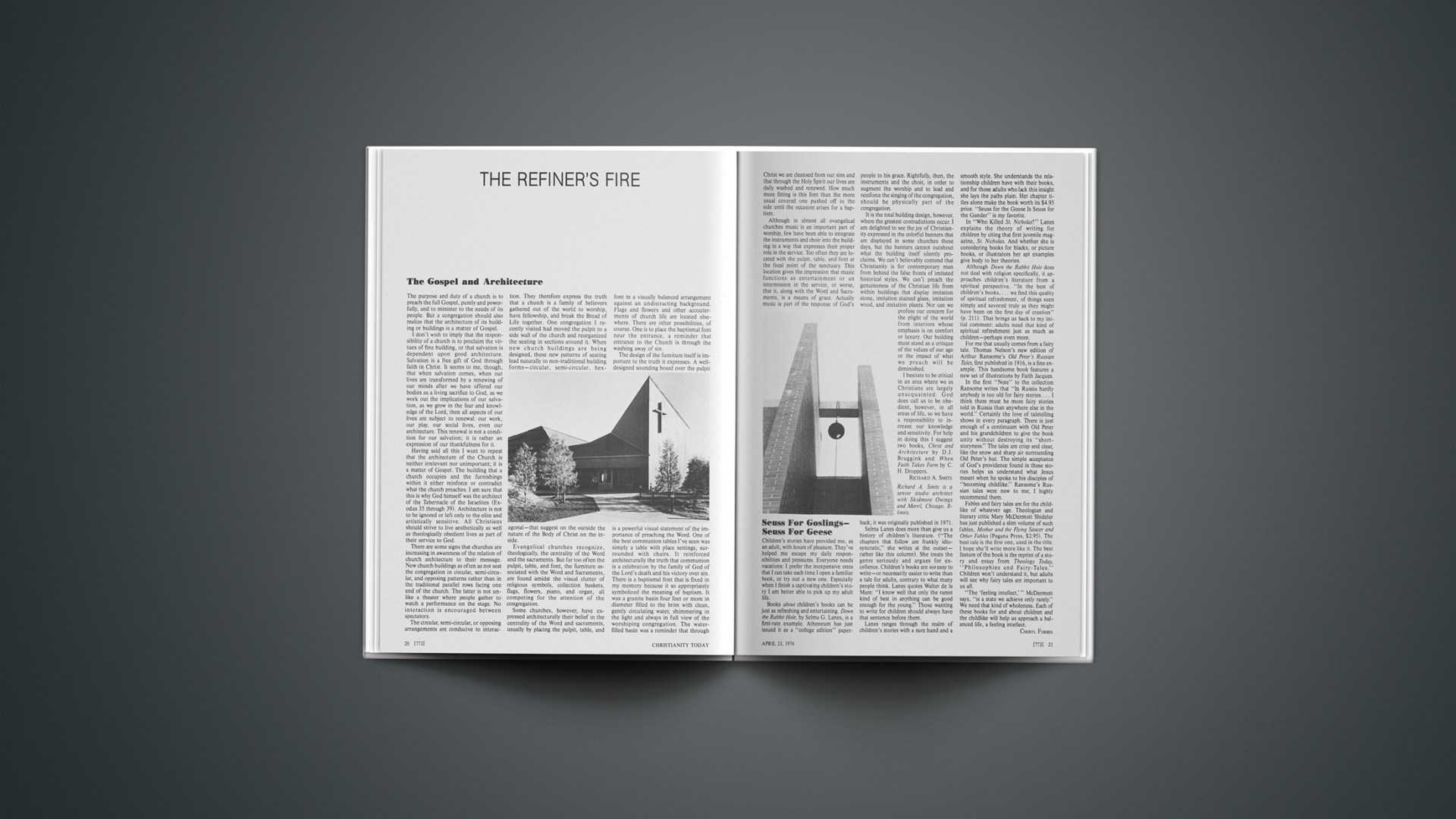
The circular, semi-circular, or opposing arrangements are conducive to interaction. They therefore express the truth that a church is a family of believers gathered out of the world to worship, have fellowship, and break the Bread of Life together. One congregation I recently visited had moved the pulpit to a side wall of the church and reorganized the seating in sections around it. When new church buildings are being designed, these new patterns of seating lead naturally to non-traditional building forms—circular, semi-circular, hexagonal—that suggest on the outside the nature of the Body of Christ on the inside.

Evangelical churches recognize, theologically, the centrality of the Word and the sacraments. But far too often the pulpit, table, and font, the furniture associated with the Word and Sacraments, are found amidst the visual clutter of religious symbols, collection baskets, flags, flowers, piano, and organ, all competing for the attention of the congregation.

Some churches, however, have expressed architecturally their belief in the centrality of the Word and sacraments, usually by placing the pulpit, table, and font in a visually balanced arrangement against an undistracting background. Flags and flowers and other accouterments of church life are located elsewhere. There are other possibilities, of course. One is to place the baptismal font near the entrance, a reminder that entrance to the Church is through the washing away of sin.

The design of the furniture itself is important to the truth it expresses. A well-designed sounding board over the pulpit is a powerful visual statement of the importance of preaching the Word. One of the best communion tables I’ve seen was simply a table with place settings, surrounded with chairs. It reinforced architecturally the truth that communion is a celebration by the family of God of the Lord’s death and his victory over sin. There is a baptismal font that is fixed in my memory because it so appropriately symbolized the meaning of baptism. It was a granite basin four feet or more in diameter filled to the brim with clean, gently circulating water, shimmering in the light and always in full view of the worshiping congregation. The water-filled basin was a reminder that through Christ we are cleansed from our sins and that through the Holy Spirit our lives are daily washed and renewed. How much more fitting is this font than the more usual covered one pushed off to the side until the occasion arises for a baptism.

Although in almost all evangelical churches music is an important part of worship, few have been able to integrate the instruments and choir into the building in a way that expresses their proper role in the service. Too often they are located with the pulpit, table, and font at the focal point of the sanctuary. This location gives the impression that music functions as entertainment or an intermission in the service, or worse, that it, along with the Word and Sacraments, is a means of grace. Actually music is part of the response of God’s people to his grace. Rightfully, then, the instruments and the choir, in order to augment the worship and to lead and reinforce the singing of the congregation, should be physically part of the congregation.

It is the total building design, however, where the greatest contradictions occur. I am delighted to see the joy of Christianity expressed in the colorful banners that are displayed in some churches these days, but the banners cannot outshout what the building itself silently proclaims. We can’t believably contend that Christianity is for contemporary man from behind the false fronts of imitated historical styles. We can’t preach the genuineness of the Christian life from within buildings that display imitation stone, imitation stained glass, imitation wood, and imitation plants. Nor can we profess our concern for the plight of the world from interiors whose emphasis is on comfort or luxury. Our building must stand as a critique of the values of our age or the impact of what we preach will be diminished.

I hesitate to be critical in an area where we as Christians are largely unacquainted. God does call us to be obedient, however, in all areas of life, so we have a responsibility to increase our knowledge and sensitivity. For help in doing this I suggest two books, Christ and Architecture by D.J. Bruggink and When Faith Takes Form by C. H. Droppers.

RICHARD A. SMITS

Richard A. Smits is a senior studio architect with Skidmore Owings and Merril, Chicago, Illinois.

Seuss For Goslings—Seuss For Geese

Children’s stories have provided me, as an adult, with hours of pleasure. They’ve helped me escape my daily responsibilities and pressures. Everyone needs vacations: I prefer the inexpensive ones that I can take each time I open a familiar book, or try out a new one. Especially when I finish a captivating children’s story I am better able to pick up my adult life.

Books about children’s books can be just as refreshing and entertaining. Down the Rabbit Hole, by Selma G. Lanes, is a first-rate example. Atheneum has just issued it as a “college edition” paper-back; it was originally published in 1971.

Selma Lanes does more than give us a history of children’s literature. (“The chapters that follow are frankly idiosyncratic,” she writes at the outset—rather like this column). She treats the genre seriously and argues for excellence. Children’s books are not easy to write—or necessarily easier to write than a tale for adults, contrary to what many people think. Lanes quotes Walter de la Mare: “I know well that only the rarest kind of best in anything can be good enough for the young.” Those wanting to write for children should always have that sentence before them.

Lanes ranges through the realm of children’s stories with a sure hand and a smooth style. She understands the relationship children have with their books, and for those adults who lack this insight she lays the paths plain. Her chapter titles alone make the book worth its $4.95 price. “Seuss for the Goose Is Seuss for the Gander” is my favorite.

In “Who Killed St. Nicholas?” Lanes explains the theory of writing for children by citing that first juvenile magazine, St. Nicholas. And whether she is considering books for blacks, or picture books, or illustrators her apt examples give body to her theories.

Although Down the Rabbit Hole does not deal with religion specifically, it approaches children’s literature from a spiritual perspective. “In the best of children’s books, … we find this quality of spiritual refreshment, of things seen simply and savored truly as they might have been on the first day of creation” (p. 211). That brings us back to my initial comment: adults need that kind of spiritual refreshment just as much as children—perhaps even more.

For me that usually comes from a fairy tale. Thomas Nelson’s new edition of Arthur Ransome’s Old Peter’s Russian Tales, first published in 1916, is a fine example. This handsome book features a new set of illustrations by Faith Jacques.

In the first “Note” to the collection Ransome writes that “In Russia hardly anybody is too old for fairy stories.… I think there must be more fairy stories told in Russia than anywhere else in the world.” Certainly the love of taletelling shows in every paragraph. There is just enough of a continuum with Old Peter and his grandchildren to give the book unity without destroying its “short-storyness.” The tales are crisp and clear, like the snow and sharp air surrounding Old Peter’s hut. The simple acceptance of God’s providence found in these stories helps us understand what Jesus meant when he spoke to his disciples of “becoming childlike.” Ransome’s Russian tales were new to me; I highly recommend them.

Fables and fairy tales are for the childlike of whatever age. Theologian and literary critic Mary McDermott Shideler has just published a slim volume of such fables, Mother and the Flying Saucer and Other Fables (Pegana Press, $2.95). The best tale is the first one, used in the title. I hope she’ll write more like it. The best feature of the book is the reprint of a story and essay from Theology Today, “Philosophies and Fairy-Tales.” Children won’t understand it, but adults will see why fairy tales are important to us all.

“The ‘feeling intellect,’ ” McDermott says, “is a state we achieve only rarely.” We need that kind of wholeness. Each of these books for and about children and the childlike will help us approach a balanced life, a feeling intellect.

CHERYL FORBES

How Do We Make Belief?

When I was a little girl I filled hours narrating my life to myself in a ceaseless interior monologue. I was always a third-person character in these narratives—“Then she cast a withering glance at her teacher and, holding her head high, swept from the room.” I viewed my every action from the vantage point of an astonished, admiring, detached observer. But as I grew older, I began to develop a vague uneasiness about this sort of unremitting narration of my life inside my head.

I don’t really know what caused the narrating urge. Although my family was by no means a literary one, I suppose that whatever exposure I had to story-telling, whether gossip, reminiscences, Bible reading, or outright lying, might have fostered the narrative impulse. That does not explain it fully, however. I do not know how widespread this phenomenon is among children nor how late it is likely to persist into adulthood. Nor do I know whether other children are as adept at concealing it as I was.

I do have a somewhat clearer idea of why I ousted the narrator from my mind. It happened when I realized that this was not what was going on inside other people’s heads, and what is more, that if they knew it was going on inside mine they would find it queer to say the least, and very probably disagreeable as well. And, too, I began to find that I wanted room for more in there than simply this voice reading (or writing) my life away. I wanted to stuff in algebraic equations and logical syllogisms, Icelandic saga, recipes, songs, and the imprint of important pictures. To concentrate on this, I needed to shut down the voice and concentrate. It was, after all, a relief not to have it harping away, describing my every movement to myself. At various times, primarily highly dramatic moments, it has come back, though with narratives of broader scenes that do not so narrowly focus on one character.

Another phenomenon in my life connected with story-telling is probably a great deal more common than the first. It is the burning desire for a story not to end, for it to go on forever. “And what happened next?” was always my rejoinder to the closing of a story. The story-teller was often annoyed that I didn’t seem properly grateful for what I’d been given. It was not ingratitude at all, of course, but simply an insatiable desire for more, for a fictional world that stretched out as interminably before me as the “real” world.

After I learned to read for myself it was the same thing. When I began to near the end of an absorbing book, I always slowed down, going over every word carefully so as to come to the end more gradually. This phenomenon did not disappear as the other one did, however. First of all, there seemed to be no need to suppress it, since many of my acquaintances felt the same way, and second, it would have been impossible to feel any other way. I remember vividly, for example, my reactions as a graduate student to Tolkien’s Ring Trilogy. After hundreds and hundreds of pages of a world where everything was more—more beautiful, more dreadful, more cozy, more terrifying—than my own mundane experience, I suffered profound withdrawal pangs. Why wasn’t life more like literature?

What I was dissatisfied with in life was not its ambiguity. Often the people or situations I was most fascinated with in the Ring Trilogy, or any story, were the ambiguous, shadowy ones. Nor did I deceive myself into thinking that “adventure,” i.e., going cold and hungry over mountain passes or being tortured by Ores, was fun. It was just that there were so many possibilities for excitement in Middle-earth, whether over mushrooms or monsters. Life, on the other hand, seemed inescapably boring. I understood fully what a character in one of Goddard’s movies (which I saw during the same year) meant when he spoke of “the movie we would all like to live.”

Now I suddenly hear and read many voices calling for “stories”—stories in politics, stories in psychotherapy, stories in theology, talk of myth and metaphor and parable. I was at first quite expectant, not having heard many good stories lately; but I was to be once more disappointed. For what I had thought of as story was not at all what these voices meant by it. (I had long since given up trying to track down what they meant by myth.)

For example, story is defined by Michael Novak (certainly an honest enough voice in other areas) as “an imagined form linking actions in ordered sequences.” He supplies this as an example of story: “The communists invaded South Viet Nam and have been attempting to undermine an independent government whose sovereignty has been recognized by over sixty nations” (“Story” in Politics, Council on Religion and International Affairs, 1970, p. 18). Now if that is Michael Novak’s idea of a story, God help his children at bedtime. There has never yet been a story in which “government” of whatever political persuasion has been a character, though there are lots of stories about kings and queens, generals and soldiers, camp followers and revolutionaries, even a few about presidents. Novak’s example is no more than an impoverished discursive declarative sentence. A blik does not a story make.

On the other hand, if what one wants is a political story, heaven knows there is no dearth of them these days. For months we had the continuing saga of Watergate spun out for us daily in all imaginable mediums—print, sound tape, television. Sometimes it seemed like a tawdry soap opera and at other times like a Greek tragedy in slow motion. The plot was dictated by the multifold ramifications of evil, one lie building upon another, until the structure’s height could not be supported by its base and down it crashed, with agonizing slowness, like a fall in a dream. There was a strong undercurrent of Elizabethan correspondences—ill health mirroring internal decay, blocked blood passages as the body politic stagnates. The story of the century on a cosmic scale.

Harvey Cox, always one to get in on the ground floor, raises one’s expectations to a fever pitch in the first chapter of The Seduction of the Spirit. He actually has some idea of what a story is and tells one. He doesn’t reveal himself as a particularly great story-teller, but at least it is a story, however truncated. One eagerly turns to chapter two, ready for the next exciting installment, only to find that chapter one was only a come-on, a gimmick. For now we must wade through the same old warmed-over neo-bourgeois sociological anthropology. An upper-middle-class travelogue about (among other things) story-telling cultures.

Sam Keen, lately embraced in ecclesiastical circles as a quasi-theologian, is also partially responsible for the revival of interest in stories, but again for the sake of something other than the story itself. This time it is story-as-therapy. (Who will free us of these utilitarians!) One can applaud some of his reasons for this enterprise, for example, the desire to break free of psychological metaphors that have imprisoned us in a Freudian three-storied universe. However, Keen does not take storytelling seriously enough; he insists on seeing it as a mere tool. Although he presses all the “primitive” buttons for which his audience has learned a positive response (scenario of tribesmen hunkered around a fire, of Israelites relaying tradition), this is a facile, and ultimately patronizing, way of reading our twentieth-century consciousness back into that tribal circle.

Pre-technological cultures probably took their stories both a great deal more and a great deal less seriously. They were either a matter of life and death or a matter for laughter, but never a means by which to explore one’s subjectivity. They had a real and objective life independent of the whims of narcissism. Keen’s psychodrama technique seems as irresponsible as dabbling in diabolism and the interpretations as predictable and banal as black magic usually is. Such irresponsible play-acting sometimes has dire consequences. Anyone who is unimpressed with this argument should perhaps read Hamlet. If one would use a play to catch the conscience of a king, or even just your ordinary neurotic, he must be prepared to accept the consequences.

What accounts for this narrative impotence among contemporary theologians? When they are pulled towards the story as toward a magnet, why do they continually stop short?

The trouble is primarily theological. Novelists are having no trouble at all writing on religious themes; in fact, they are concerned with scarcely anything else, except sex. But theologians, who cry up the idea of story in every new issue of various journals, cannot get it together to tell one.

One need only go back to the great demythologizing dictums of the 1930s to locate the castration of the theological imagination. God knows it is not the story we are interested in, poor primitive thing; it is the great idea behind the story. One hears the echo of his high school English teacher—“Now what does this story mean? What is the theme, the message?” (And somewhere from a dark corner the irrascible, irrational, and largely unnoticed voice of Barth protesting: “It’s not my story. I didn’t make it up. I don’t have to apologize for it; I only have to tell it.”) And we have been ripping away the leaves, ripping away the petals in order to get to the unripened ovary of the kerygma ever since. Small wonder it has not borne fruit.

When we began to awaken to our folly, there was a great outcry for “myth.” (Put the myth back in Christmyth.) Learned men nodded knowingly at humankind’s “need” for myth. Myths are somewhat like vitamins, which Larousse’s Gastronomique calls “ineffable substances.” They are necessary for good mental health. Therefore the theologians, taking a cue from Dostoyevsky’s Grand Inquisitor, have decided that it is all right to administer periodic doses of myth to the masses, at least until they can learn to live without it or until some synthetic substitute is developed. What is particularly ridiculous about this theological stance, however, is that the Grand Inquisitor has been left talking to himself. No one is any longer interested in his make-believe myths, to be applied like an old-fashioned poultice to the aches and pains of the human soul.

The novelist Walker Percy says the Christian storyteller is “like a man who finds a treasure buried in a field and sells all he has to buy the field, only to discover that everyone else has the same treasure in his field and that in any case real estate values have gone so high that all the fieldowners have forgotten the treasure and plan to subdivide” (Katallagete, Fall, 1970, p. 11). I propose then that we shut down the mining operation on this particular vein of supposed gold. After all, the operation is bankrupt. The backers have cashed in their chips and there wasn’t enough there to redeem them. Bultmann’s image of contemporary man has been challenged by the poet Robert Duncan as “too hygienic and highminded.” He reminds us—and we remember with a rush of relief—“that theologians … aren’t all religion, are they? Saints, for instance.… But what saints and most religious lives—the intense ones—show us are people who live what all the rest of us see meaning in, see through …” (A Meeting of Poets and Theologians to Discuss Parable, Myth and Language, The Church Society for College Work, 1968, p. 14).

What I would like to try, in place of the old sanitized demythologizing or the new synthetic remythologizing, is a much older notion, almost lost to us who are sunk up to our very noses in the quicksand of subjectivity. It is the old metaphor of the author and the play. What if it is not we who are writing the story at all, putting in cameo appearances at appropriate intervals for our cultural myths, like pulling out the turkey at Thanksgiving and the Advent candles at Christmas, but what if we are being written, narrated into existence by something much realer than ourselves? What if it is the “myth” that is real and we are the mere reflection of reality, being the metaphor that only points to meaning?

One could, of course, go back to Plato to locate this idea, but I would rather not. Plato is, for us, so safe and categorizable. We nod and say, “Oh yes, Platonism. I’d recognize it anywhere.” Besides, Plato’s Forms are much too deistic and do not push and shove the shadows sufficiently. Instead, let us consider an ill-assorted gaggle of relatively recent writers who have suggested this idea to us.

The first, Robert Duncan, anticipated the outbreak of utilitarian Christian story-tellers by a few years when he criticized such exploitation by saying: “In the tribute poets pay, after Dryden [the demythologizer of Shakespeare], to deliver over their art to the consensus of reasonable men, poetry, like the universe of rationalist science, ceases to be primal Creation and becomes a commodity, a material for human uses and self-development” (A Meeting …, p. 41). In other words, we have created the illusion that myth is primarily functional, that it is a tool we can use to integrate our personalities, to be O.K. And though some aspects of myth may still be hissing and bubbling down in the dark recesses of our unconscious, we will eventually dredge it all up into the landfill of sanity. The concept that we ourselves are being used by myth seems beyond our imaginations. To continue with Duncan:

The operations of allegory and metaphor case to be magical and become manners of speaking plays of wit, and the sense of historical events themselves cease to be thought of as informed by a creative intent, to be read as omens and portents, showings forth of meaning within meaning, intent within intent, of a momentous design in which men in their acts participate and to which they contribute, in terms of which men know or do not know their roles [A Meeting …, p. 41; italics mine].

But we are forever bumping up against the stage furniture, something that we cannot see but that nevertheless will not yield to our hypotheses. And instead of recognizing that the chair leg that has just confronted us in such a painful fashion is real, we simply rearrange the furniture of our mind to exclude that particular chair leg. Duncan again, zeroing in on Christian religion:

And many Christians have twisted the poetry of the Bible in vices of interpretation to see the divine as conforming to our highest ethical precepts, and, where their humanitarian ideals were strong, come to apostasy when faced with the immovable reality of Jehovah who declares Himself a God of Jealousy, Vengeance and Wrath. Reason falters, but our mythic, our deepest poetic sense, recognizes and greets as truth the proclamation that the Son brings that just this Wrathful Father is the First Person of Love [A Meeting …, p. 38].

Thus we have at least two generations of theological schizoid apostates: their reason demands the renunciation of an irrational God, yet they cannot bring themselves to renounce him, so strong is the enchantment of the story. In order to relieve this unbearable tension, they set about blocking out their roles so as to avoid crashing into the stage sets to which they refuse to grant credulity. Miracles are unaccountable; therefore we will take no account of them. We will rewrite the story (as many have done before us) to suit ourselves. But the rewriting of the story simply becomes (as it did before) part of the story. Bultmann is our new Chronicler. Or to let Duncan finally speak through a poem (in his volume Roots and Branches) in the guise of Bobbin, an elf-shadow, about the limitations of humans:

Yet whenever they see us

we must look like men,

for men see not what things are but what

they are in things. The world changes

dark to light as their eyes change.

Next in my cloud of witnesses is C. S. Lewis, with his use of fantasy as a means of making myth lucid, or rather of jolting our preconceived world view off its precarious pedestal so that we can at least be open to other possibilities. One of his strategies in The Great Divorce is to out-materialize the materialists, certainly a proper undertaking for a story-teller. In Lewis’s fantasized Heaven, it is the recently arrived mortals who are phantasmagoric and insubstantial. The very heavenly grass is like spikes to their feet. Drops of water spray are like bullets. One can see through them, but not through the creatures whose natural habitation is heaven.

One of these fully realized creatures attempts to explain the nature of “myth” he is now experiencing to a new arrival who is interested only in the “meaning” and not in the “thing itself’: “Hitherto you have experienced truth only with the abstract intellect. I will bring you where you can taste it like honey and be embraced by it as by a bridgegroom” (The Great Divorce, 1971, Macmillan, p. 43). The recalcitrant Episcopalian, a member of the Theological Society, resists, however, and for the old familiar reasons: “These great mysteries cannot be approached in that way. If there were such a thing … quite frankly, I should not be interested in it. It would be of no religious significance. God, for me, is something purely spiritual.”

It is against this disembodied ontologizing that Lewis protests again and again. If creation is to be redeemed, then it must be thoroughly redeemed, not just its meaning. Resurrection without a body is a hollow victory. Likewise myth has a reality that we, in our present state of incompleteness, catch only glimmers of. As Ransom in Perelandra confronts the guardian gods of Malcandra and Perelandra he recognizes them as Ares and Aphrodite:

In the mind of the fallen Archon under whom our planet groans, the memory of Deep Heaven and the gods with whom he once consorted is still alive. Nay, in the very matter of our world, the traces of the celestial commonwealth are not quite lost. Memory passes through the womb and hovers in the air. The Muse is a real thing.… Our mythology is based on a solider reality than we dream: but it is also at an infinite distance from that dream [Perelandra, Macmillan, 1968, p. 201].

In fact, so far removed are we from the basis of myth, so blind, that all we can pick up are random threads that lead from one story to another. Yet Lewis has a “suspicion that what was myth in one world might always be fact in some other” (Perelandra, p. 102). Ares and Aphrodite are real, much realer than you or I could ever hope to be. At any rate, Lewis sees us as poor, insubstantial stage-blusterers when we claim that the author of the play in which we are merely characters is less real than we are, that we are writing a play in which he is a character.

My third witness, Muriel Spark, is much harder to catch hold of since she does not explain or theorize as do the previous two. Yet her story, The Comforters, is unsettling and frightening and brings us back to where we started from. In this story the heroine, Caroline, through some quirk of clairaudience, hears a typewriter and voices recording her life. It is not a mystery story wherein the whole point lies in doing away with the mystery, in explaining “away” the psychic phenomenon, but it is a mystery story in that the voices and the typewriter are never explained. They simply cease when the story comes to an end, after having recorded that part of Caroline’s life. No one else hears the voices or the typewriter, so of course they think the whole thing is merely a mental aberration, even though the typewriting voices record not only events in which Caroline is involved but also events concerning people she does not even know about until the entire story is complete. She finally explains the phenomenon this way: “ ‘But the typewriter and the voices—it is as if a writer on another plane of existence was writing a story about us.’ As soon as she had said these words, Caroline knew she had hit on the truth” (The Comforters, Avon, 1965, p. 68). Her fiancé, of a much more mundane mentality, attempts to record the voices:

“If the sound has objective existence it will be recorded.”

“This sound might have another sort of existence and still be real.”

“Well, let’s first exhaust the possibilities of the natural order—”

“But we don’t know all the possibilities of the natural order” [p. 70].

Caroline, a recent Catholic convert, is at first inclined to think she has merely gotten involved in the novel of “a writer on another plane of existence.” She is thus determined to assert her free will, to act oppositely from the voices’ descriptions of her future activity. Yet her every attempt to do this is foiled. The story is inexorable:

Her sense of being written into the novel was painful. Of her constant influence on its course she remained unaware and now she was impatient for the story to come to an end, knowing that the narrative could never become coherent to her until she was at last outside it, and at the same time consummately inside it [p. 196],

I do not think that Caroline’s experience is really all that rare. Who knows what unarticulated currents of story run through the lives of children, only to be dammed up because they do not run in culturally sanctioned channels? Or in what perverse ways they are rerouted to the detriment of both the person and his society? Yet how often does the overwhelming sense that our lives have dramatic form sweep over us, especially when we feel one chapter ending and another beginning? Perhaps for those of us who have led disjunctive lives, the sense of discrete, episodic stories is stronger, more apparent. However, while we are still “inside” the story, we perceive its coherence dimly, which is why it is dangerous not to take it seriously, or to take it seriously in the wrong way.

I have proposed that the way of thinking about ourselves as characters in a story might be a necessary way of reorienting ourselves to reality. Certainly if we perceive of ourselves as both character and author, serious problems could result. I believe this is the way Charles Manson probably saw himself—the ultimate unrestrained existentialist (see the book on Manson, Helter-Skelter). If, on the other hand, we see ourselves to be characters within the story but not the Creator of it, then we can fully enjoy our creatureliness, and await with expectation (and sometimes dread) the next development of the plot. We can, in Duncan’s words, “open ourselves to myth [so that] it works to convert us and to enact itself anew in our lives.”

The Mind’s Eye, Or Words And Sounds

Fashions in children’s literature since 1776 have changed almost as often as fashions in adult literature. And the trends in the two have not always followed the same pattern. What were children reading when our nation was founded? During colonial times didacticism certainly motivated adults writing for children. Then imagination and fairy tales gained prominence but disappeared until the 1950s in favor of realism. Now, as seen by the publication of such books as Mr. Death by Anne Moody (Harper & Row; see “Books” for a review of that and two other children’s stories about death), realism seems to be regaining ground.

In colonial America the Puritan influence was reflected in the religious nature of children’s reading matter, for example, the Bible and The New England Primer. But young people have always liked adventure stories, and religious strictures could not keep them from enjoying works written for adults. The Pilgrim’s Progress by John Bunyan, Robinson Crusoe by Daniel Defoe, Gulliver’s Travels by Jonathan Swift were just such books. Children undoubtedly read these great stories and simply skipped the parts that did not interest them.

Children’s books in the nineteenth century were often highly didactic; that is, they instructed the young in proper values. Books were produced by the hundreds in which good always triumphed over evil. Many a little girl identified with the heroine in the Elsie Dinsmore series by Martha Finley (1828–1909), who clearly was the chief moralist of the period. The pinnacle of didactic writing was unquestionably reached in William H. McGuffey’s Eclectic Readers (1836–7), which taught reading for the sake of patriotism, industry, and good citizenship.

Didacticism gradually gave way to a more imaginative form of writing that grew out of the popular fairy-tale collections of the Grimm brothers and the original creations of Hans Christian Andersen. A hundred years ago virtually every child was familiar with tales like “Hansel and Gretel” and “The Emperor’s New Clothes.” Clement Moore wrote a Christmas poem in 1822 that children still love, “The Night Before Christmas.”

Other authors, such as Louisa May Alcott and Mark Twain, brought a new dimension to children’s literature with more realistic, life-like stories. Who could forget the March family? And what little boy who has read Twain’s stories has not wished he were Tom Sawyer or Huckleberry Finn?

In the later nineteenth century, novels especially suited for children began to appear, such as Robert L. Stevenson’s Treasure Island, Anna Sewell’s Black Beauty, and Lewis Carroll’s Alice’s Adventures in Wonderland. They met the needs of young readers for adventure and excitement.

By the early twentieth century the market was flooded with literature for children, most of it mediocre. To encourage better writing, the American Library Association in 1922 established the Newbery Award. One of the all-time favorite Newbery winners is Esther Forbes’s Johnny Tremain (1943), the realistic story of a crippled apprentice and his involvement in revolutionary activities in Boston during the 1770s.

Some twentieth-century works can justifiably be called “modem classics” because of their continuing appeal. Examples of these include A.A. Milne’s books about Winnie-the-Pooh, E.B. White’s touching story of friendship entitled Charlotte’s Web, Pamela Travers’s account of the magical nanny Mary Poppins, and The Little House on the Prairie, a series by Laura I. Wilder that drew upon her own childhood experiences. C.S. Lewis’s Chronicles of Narnia and J. R. R. Tolkien’s Hobbit are outstanding pieces of modem fantasy that appeal to both children and adults.

Whether a child loves adventure tales, fairy stories, or realistic novels, a book should expand his understanding of reality, exercise his imagination, and encourage him to love the sound and sight of words.

CHARLENE PIERARD1Charlene Pierard is assistant branch librarian at the Vigo County Public Library, Terre Haute, Indiana.

The Books No One Notices

Children’s books reflect quite accurately what’s going on in American life, what adults consider to be important; what values they see as desirable. Although books certainly aren’t the primary influence on many children, they help to shape children’s values and attitudes in subtle ways. And the books our children read are more likely to reinforce the largely secular influence of the general culture than to open up alternatives.

This is not to say that most children’s books are bad for children. North American publishers have produced many excellent ones, many that give children flashes of insight into human life in language that is a delight to experience.

But there is hardly any Christian presence in this field. Most books for children are not controversial but simply secular. Perhaps that is part of the reason why few Christians involve themselves in assessing children’s books and in producing books that reflect a Christian perspective for young readers.

The vision of life children find in their books is largely the same vision that inspires the thousands of adult titles that pour out each year. In 1966, for instance, Zena Sutherland suggested in her column in Saturday Review that American children needed more books about minority races. Within a year, the climate of opinion had moved in that direction and she had stacks of such books on her desk, waiting for her evaluation. Books about minority children became books for minority children as adults shifted their goals from full and immediate assimilation to preserving cultural differences. To Kill a Mockingbird, published in 1960, has a character that is very dated today, a strong white lawyer who tries to use his professional skills to rescue a defenseless black man. Today’s book about minorities is more likely to be in the vein of Virginia Hamilton’s M. C. Higgins, the Great, winner of numerous awards, including the 1975 Newbery Award. Ms. Hamilton’s excellent and very modern novel reflects the more progressive minority view that whatever strength minorities develop must be built by their own efforts and on the basis of their own roots and traditions rather than on mere acceptance into the white American mainstream.

Between 1973 and 1975, a large number of books considered the World War II experience of Jewish people; on the whole they reflected the new widespread conviction that anti-Semitism in any form is wrong, an attitude one couldn’t take for granted a few decades ago.

The depression is another inspiration for numerous recent children’s books. In Naomi Karp’s Nothing Rhymes With April, for instance, the young heroine reflects on the fate of the suffering poor, on the uncle who jumped from a window, on the disrupted families, and rages in her way at the faceless rich who, she believes, caused the whole depression. Such an approach reflects a considerable change in the view of economics and the history of the depression from what was current during the forties and fifties.

Changes in adult living patterns also influence children’s books in subtle ways. One of the most significant cultural developments in recent decades has been the shift in adult patterns of work and leisure. During the fifties and sixties, continuing education became increasingly important to many people. They felt the need to upgrade their job skills during their leisure hours and so leisure activities gradually became an extension of work for a good number of people.

According to publishers, librarians, and teachers, this work-leisure pattern has had a profound effect on children’s books and reading patterns. When a representative of a leading trade publisher for children remarked that the market for children’s fiction was rapidly dwindling, teachers and librarians present explained that their students considered themselves too sophisticated to waste their time on made-up stories that would do them little good on the job. In earlier decades when most people could get jobs with a minimum of specialized training, gaining competitive skills wasn’t quite as urgent as it is for some today; in that period fiction dominated children’s reading, particularly for those whose families considered the leisurely reading of novels to be a sign of high social status. Today, the old-style leisure pursuits have fallen to those who make them their profession, those who don’t care about vocational achievement, and those who are financially secure. This change strikes another blow at the aesthetic side of life in God’s creation. The imagination is gradually pressed into the services of pragmatic geniuses who can make it earn its keep, or it will find itself left to the “nonproductive” members of society—the very young and the very old, women of “leisure,” and dilettantes on university campuses. Little or no room remains for the expansive vision of the novelist, the dramatist, or the poet who pulls the specialists’ fragmented views of reality into a compressed and comprehensive whole, freighted with symbolic meaning that expresses elements of the truth in a way that grips the whole person rather than primarily the intellect. Where fiction is considered irrelevant and impractical, the novelist becomes at best a purveyor of diversions, more likely a spinner of society’s lies, as positivists and followers of Nietzsche have said all along.

In that kind of climate, it is small wonder that a Christian vision of life is conspicuously absent from children’s books. Of course, the inclination toward nonfiction is neither total nor irreversible, as the recent interest in fantasy and science fiction suggests. Nevertheless, the place for a Christian vision of life that rejects positivistic notions of truth and the meaning of life is considerably restricted.

Similarly, the role that religion itself plays in people’s lives is restricted in children’s books. In fact, very few books for children suggest that any kind of religion—exotic or traditional—plays a role in the lives of contemporary North Americans. Religious people appear primarily in three very specialized places in children’s literature: the ethnic ghetto, the past, and never-never land.

The book about the religious ethnic group may treat the Jewish people, for instance, or certain black communities where the store-front preacher is a central figure. A variation on that theme is the book about the Amish or some groups of Mennonites, who function as an ethnic group because of their distinctive ways. Thy Friend, Obadiah, a story of a charming Quaker child who lived in colonial times, is a well-known example. So are the very successful and deeply moving novels of Robert Newton Peck (A Day No Pigs Would Die and Soup). Peck looks back on the religious faith operating in his family as one of a whole series of elements that shaped his childhood. As far as the reader knows, it differs little from the other childish things that fell away as the narrator grew to the sophisticated, nostalgic person he is today.

People may also take faith seriously in books set in the past, particularly during the periods of obvious religious conflict. Faith seldom plays a significant role in people’s lives in realistic juvenile novels set in the twentieth century, certainly not those after the Second World War. Authors sometimes examine crises in the lives of “professional religious people” like ministers and priests, but ordinary people are unlikely to have any sense of the divine.

The other category in which faith can be taken seriously is fantasy, with its relative, science fiction. In this kind of literature the speculative character of the plot seems to make faith and religious practices as plausible as anything else.

One might expect to turn to religious publishers of children’s books for greater vision; unfortunately, it is hardly worth the effort. Evangelical authors of great insight and writing ability have seldom written for children, C. S. Lewis being the outstanding exception out of a rapidly receding past. Our reluctance to write for children about the matters that concern us implies that childhood is an adjunct to the more important periods of life. Although there are many fine religious books for university students, younger people have little more than a few novels and books related to saving individual souls in the narrow sense and to handling personal problems.

At one time I thought the painfully contrived “novels” about witnessing, controlling one’s sex drives, surviving in school, and so on were the result of a lack of writing talent among Christians. However, conversations with some of the better known authors of these convinced me that this kind of book was produced quite intentionally in the belief that fiction has no place in the creation unless it carries a moral. As one author put it, the story was intended only to make the moral more pleasant to take. The result has been a large number of books with predictable plots set in exotic lands, where every ten-year-old child is a potential evangelist or at least a hero who can deter a political coup, stop a hijacking, and witness with one hand tied to a stake. In small doses, these books are not harmful, but they are a far cry from the “Christ is Lord of all life” vision that we evangelicals have espoused for so long.

There are, however, very hopeful signs that Christian publishers are beginning to sense the great need for better books for children. A few years ago, for instance, Eerdmans published Gordon Oosterman’s People, a book about three Indian tribes of the southwest United States. It is by no means the most scintillating book on Indian culture, but it approaches the culture, the problems, and the needs of the Indian tribes with the kind of Christian anthropology that children need to encounter at least occasionally if they are to be convinced that adults believe God is concerned about human life.

A good children’s book meets the same standards that a good adult book meets. The text assumes that the readers love the sound of language, the variety of new words and new ideas, the logical relations implicit in our sentence patterns, and so on. If the book is fiction, the story ought to meet the usual standards for fiction, such as well-motivated tension, a plot in which meaning inheres rather than one on which a moralistic meaning has been imposed, characters who are distinguishable and credible, and so one. The illustrations should fit the text, interpreting it and symbolically expanding its meaning. They should be accurate, imaginative, properly placed, and skillfully done. The total effect ought to be coherence, rather than a memory of a plot outline through which a moral has marched. The entire book ought to “work” so that the child experiences the logical, the aesthetic, the linguistic, the psychological, and other elements as one. Nonfiction books ought also to be lucid, clearly organized, free of unsupported generalizations, and so on.

Finding good books for children is difficult in many areas. Two sources of help are Adventuring With Books by Shelton L. Root (Citation, 1973) and Children’s Literature: A Guide to Reference Sources edited by Virginia Haviland (Library of Congress, 1966, supplement 1972). Root’s book, the most valuable tool for the lay person, is a comprehensive and well-annotated handbook for selecting books. Titles are arranged by subject area and level of difficulty. The Haviland volume is a basic bibliography of books, articles, bibliographies, and other resources about children’s books. The annotations are unusually thorough.

It is helpful to watch for publishers with a reputation for quality, such as Farrar, Straus and Giroux, Seabury, Harper & Row, and Harlin Quist. The worst places to buy children’s books are supermarkets, department stores, many church-supply stores, and general-interest adult bookstores. The books available in these outlets are likely to be “merchandise books,” which sell by the hundreds of thousands, usually at a price under $1.95. The essential ingredient is the book’s ability to sell as an impulse item; that may mean a flashy cover to make it stand out, a gimmick, or a place in a long series with a perpetuating market. Any adult who tries to read such books to a child more than three or four times will be driven back to the store for replacements because the plots are boring and the language pedestrian.

The better-bred cousin of the merchandise book frequents some of the same outlets, but seldom the supermarket, the drugstore, or the airport. These are books whose mediocrity is strongly influenced by subtle forces because they must be distributed as widely as possible. There’s nothing particularly wrong with mediocre books; they provide children with considerable information, and they are certainly better constructed than the merchandise book. However, their very innocuousness is part of the difficulty, for the problems they pose are inevitably trivial or at least easily resolved. People seldom suffer in such books, sin (never given that name) is easily dealt with, and the evil-doers of the world can be quickly sorted out into a class of THEM—bullies, kids who cheat, girls who sleep around, mothers who alienate their children, or fathers who are too busy. These are the books that make up the mainstream, that convey in quiet ways a contemporary and secular vision of life.

Children’s books of high quality are usually sold through the better bookstores, sometimes at universities. Otherwise, they can be located through media reviews and annotated lists from various agencies concerned with children’s books. The high-quality book doesn’t need a special seal or a literary/philosophical analysis to prove its worth. Its character stands out almost immediately and generally survives numerous readings, even by adults.

In these books authors refuse to condescend to children, choosing instead to tell their stories simply as they see them. They share their insights into human behaviour and the meaning of life—however small and however limited. They tell children of the needs they see around them, about the kinds of people they admire, about the things that make a person’s life worthwhile. They also face them with a real world, one that is terribly distorted and for which there are no simple solutions to be found in techniques alone. A good author gives children insight into a world where sin has real consequences—marriages break down and children suffer and strike out; some live sumptuously in this world while others barely stay alive; self-centered, corrupt people distort their social structures to exploit others and eventually destroy themselves. The best authors also offer them hope that goes beyond conventional platitudes.

However delightful high-quality books may be, they always lead the reader more deeply into life until he or she instinctively responds, “Yes, that is really the way it is,” or “I wonder how the author knew that about me.” Not every book will have that effect. However, every child deserves at least the opportunity to encounter books that were written by authors who believe that children’s needs, interests, and tastes are as important as those of adults. They need to see books whose authors are honestly trying to share with them, not dominate them or propagandize them, no matter how noble a cause. They need to see books whose illustrators believe children can appreciate beauty as much as adults can. And they need to see books that lift the cover just enough to reveal both the mystery and the put-togetherness of life in the creation, where God himself has set his footprints.

Some Noteworthy Titles

Adams, Richard: Watership Down; Aiken, Joan: Midnight Is a Place; Benchley, Nathaniel: Bright Candles; Bodecker, N. M.: Let’s Marry, Said the Cherry; da Paola, Tomie: Watch Out For the Chicken Feet in Your Soup and Strega Nona; Flory, Jane: We’ll Have a Friend For Lunch; Hickman, Janet: The Valley of the Shadow; Hughes, Richard: Gertrude’s Child and The Kidnapping of the Coffepot; Kerr, M. E.: Is That You, Miss Blue?; Jarrell, Randall, and Burkett, Nancy Eckholm: Snow White and the Seven Dwarves; Meltzer, Milton, and Cole, Richard: The Eye of Conscience; Moskin, Marietta: Waiting for Mama; Murphey, Shirley Rousseau: Poor Jenny, Bright as a Penny; Murray, Michele: The Crystal Nights; Preussler, Otto: The Satanic Mill; Rheiss, Joanna: The Upstairs Room; Richler, Mordecai: Jacob Two-Two and the Hooded Fang; Shulevitz, Uri: The Magician; Singer, Isaac Bashevis: The Wicked City; Smith, Gene: The Hayburners; Starkey, Marion L.: The Visionary Girls; Tripp, Wallace: A Great Big Ugly Man Came Up and Tied His Horse to Me; Walsh, Jill Paton: The Emperor’s Winding Sheet; Wolberg, Barbara: Zooming In.

Some Noteworthy Authors

For younger children

Edward Ardizonne

Kay Chaoro

Paul Galdone

Lorenz Graham

Tomie da Paola

Maurice Sendak

Uri Shulevitz

Isaac Bashevis Singer

Dorothy Van Woerkom

For the middle years

Judy Blume

Robert Burch

Betsy Byars

Bill and Vera Cleaver

Meindert De Jong

Louise M. Fitzhugh

Nat Hentoff

Jean Merrill

Robert Newton Peck

Ivan Southall

Wallace Tripp

For Older years

Richard Adams

Joan Aiken

Nathaniel Benchley

Julia Cunningham

Sylvia Louise Engdahl

James Foreman

Virginia Hamilton

M.E. Kerr

Marilyn Sachs

Elizabeth George Speare

Jill Paton Walsh

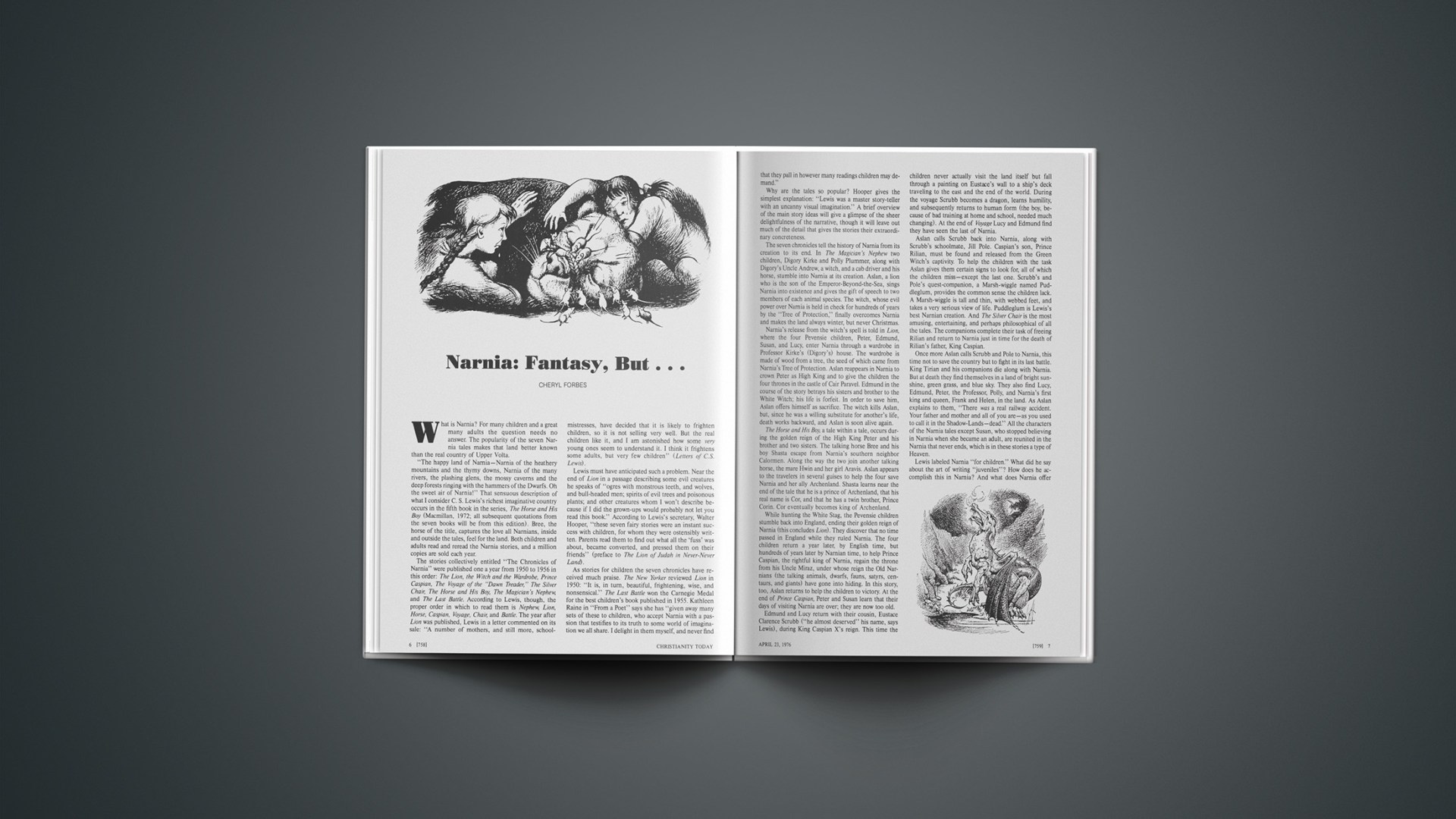
Narnia: Fantasy, but …

What is Narnia? For many children and a great many adults the question needs no answer. The popularity of the seven Narnia tales makes that land better known than the real country of Upper Volta.

“The happy land of Narnia—Narnia of the heathery mountains and the thymy downs, Narnia of the many rivers, the plashing glens, the mossy caverns and the deep forests ringing with the hammers of the Dwarfs. Oh the sweet air of Narnia!” That sensuous description of what I consider C. S. Lewis’s richest imaginative country occurs in the fifth book in the series, The Horse and His Boy (Macmillan, 1972; all subsequent quotations from the seven books will be from this edition). Bree, the horse of the title, captures the love all Narnians, inside and outside the tales, feel for the land. Both children and adults read and reread the Narnia stories, and a million copies are sold each year.

The stories collectively entitled “The Chronicles of Narnia” were published one a year from 1950 to 1956 in this order: The Lion, the Witch and the Wardrobe, Prince Caspian, The Voyage of the “Dawn Treader,” The Silver Chair, The Horse and His Boy, The Magician’s Nephew, and The Last Battle. According to Lewis, though, the proper order in which to read them is Nephew, Lion, Horse, Caspian, Voyage, Chair, and Battle. The year after Lion was published, Lewis in a letter commented on its sale: “A number of mothers, and still more, school mistresses, have decided that it is likely to frighten children, so it is not selling very well. But the real children like it, and I am astonished how some very young ones seem to understand it. I think it frightens some adults, but very few children” (Letters of C.S. Lewis).

Lewis must have anticipated such a problem. Near the end of Lion in a passage describing some evil creatures he speaks of “ogres with monstrous teeth, and wolves, and bull-headed men; spirits of evil trees and poisonous plants; and other creatures whom I won’t describe because if I did the grown-ups would probably not let you read this book.” According to Lewis’s secretary, Walter Hooper, “these seven fairy stories were an instant success with children, for whom they were ostensibly written. Parents read them to find out what all the ‘fuss’ was about, became converted, and pressed them on their friends” (preface to The Lion of Judah in Never-Never Land).

As stories for children the seven chronicles have received much praise. The New Yorker reviewed Lion in 1950: “It is, in turn, beautiful, frightening, wise, and nonsensical.” The Last Battle won the Carnegie Medal for the best children’s book published in 1955. Kathleen Raine in “From a Poet” says she has “given away many sets of these to children, who accept Narnia with a passion that testifies to its truth to some world of imagination we all share. I delight in them myself, and never find that they pall in however many readings children may demand.”

Why are the tales so popular? Hooper gives the simplest explanation: “Lewis was a master story-teller with an uncanny visual imagination.” A brief overview of the main story ideas will give a glimpse of the sheer delightfulness of the narrative, though it will leave out much of the detail that gives the stories their extraordinary concreteness.

The seven chronicles tell the history of Narnia from its creation to its end. In The Magician’s Nephew two children, Digory Kirke and Polly Plummer, along with Digory’s Uncle Andrew, a witch, and a cab driver and his horse, stumble into Narnia at its creation. Aslan, a lion who is the son of the Emperor-Beyond-the-Sea, sings Narnia into existence and gives the gift of speech to two members of each animal species. The witch, whose evil power over Narnia is held in check for hundreds of years by the “Tree of Protection,” finally overcomes Narnia and makes the land always winter, but never Christmas.

Narnia’s release from the witch’s spell is told in Lion, where the four Pevensie children, Peter, Edmund, Susan, and Lucy, enter Narnia through a wardrobe in Professor Kirke’s (Digory’s) house. The wardrobe is made of wood from a tree, the seed of which came from Narnia’s Tree of Protection. Aslan reappears in Narnia to crown Peter as High King and to give the children the four thrones in the castle of Cair Paravel. Edmund in the course of the story betrays his sisters and brother to the White Witch; his life is forfeit. In order to save him, Aslan offers himself as sacrifice. The witch kills Aslan, but, since he was a willing substitute for another’s life, death works backward, and Aslan is soon alive again.

The Horse and His Boy, a tale within a tale, occurs during the golden reign of the High King Peter and his brother and two sisters. The talking horse Bree and his boy Shasta escape from Narnia’s southern neighbor Calormen. Along the way the two join another talking horse, the mare Hwin and her girl Aravis. Aslan appears to the travelers in several guises to help the four save Narnia and her ally Archenland. Shasta learns near the end of the tale that he is a prince of Archenland, that his real name is Cor, and that he has a twin brother, Prince Corin. Cor eventually becomes king of Archenland.

While hunting the White Stag, the Pevensie children stumble back into England, ending their golden reign of Narnia (this concludes Lion). They discover that no time passed in England while they ruled Narnia. The four children return a year later, by English time, but hundreds of years later by Narnian time, to help Prince Caspian, the rightful king of Narnia, regain the throne from his Uncle Miraz, under whose reign the Old Narnians (the talking animals, dwarfs, fauns, satyrs, centaurs, and giants) have gone into hiding. In this story, too, Aslan returns to help the children to victory. At the end of Prince Caspian, Peter and Susan learn that their days of visiting Narnia are over; they are now too old.

Edmund and Lucy return with their cousin, Eustace Clarence Scrubb (“he almost deserved” his name, says Lewis), during King Caspian X’s reign. This time the children never actually visit the land itself but fall through a painting on Eustace’s wall to a ship’s deck traveling to the east and the end of the world. During the voyage Scrubb becomes a dragon, learns humility, and subsequently returns to human form (the boy, because of bad training at home and school, needed much changing). At the end of Voyage Lucy and Edmund find they have seen the last of Narnia.

Aslan calls Scrubb back into Narnia, along with Scrubb’s schoolmate, Jill Pole. Caspian’s son, Prince Rilian, must be found and released from the Green Witch’s captivity. To help the children with the task Aslan gives them certain signs to look for, all of which the children miss—except the last one. Scrubb’s and Pole’s quest-companion, a Marsh-wiggle named Puddleglum, provides the common sense the children lack. A Marsh-wiggle is tall and thin, with webbed feet, and takes a very serious view of life. Puddleglum is Lewis’s best Narnian creation. And The Silver Chair is the most amusing, entertaining, and perhaps philosophical of all the tales. The companions complete their task of freeing Rilian and return to Narnia just in time for the death of Rilian’s father, King Caspian.

Once more Aslan calls Scrubb and Pole to Narnia, this time not to save the country but to fight in its last battle. King Tirian and his companions die along with Narnia. But at death they find themselves in a land of bright sunshine, green grass, and blue sky. They also find Lucy, Edmund, Peter, the Professor, Polly, and Narnia’s first king and queen, Frank and Helen, in the land. As Aslan explains to them, “There was a real railway accident. Your father and mother and all of you are—as you used to call it in the Shadow-Lands—dead.” All the characters of the Narnia tales except Susan, who stopped believing in Narnia when she became an adult, are reunited in the Narnia that never ends, which is in these stories a type of Heaven.

Lewis labeled Narnia “for children.” What did he say about the art of writing “juveniles”? How does he accomplish this in Narnia? And what does Narnia offer children? I must emphasize, as Lewis does, that his books were written for adults as well as children. Perhaps it would be better to say that Lewis wrote Narnia for the childlike. Not all children will like Narnia, since not all like fairy tales or fantasies. Some people, like Lewis himself or Tolkien or me, may gravitate to fantasy in adulthood. Lewis understood that there were as many different types of child readers as adult readers.

I think parents should read fairy tales to their children. That genre requires, at least initially, oral, rather than silent, reading. The excitement comes from hearing the story, as though it were happening at that instant. Also, the author must touch something within a child, so that the two separate personalities understand one another. Lewis described it this way in “On Three Ways of Writing For Children”: “Once in a hotel dining-room I said, rather too loudly, ‘I loathe prunes.’ ‘So do I,’ came an unexpected six-year-old voice from another table. Sympathy was instantaneous. Neither of us thought it was funny. We both knew that prunes are far too nasty to be funny. That is the proper meeting between man and child as independent personalities.… [An author] is a freeman and an equal, like the postman, the butcher, and the dog next door.”

Lewis wrote for children because he had a story to tell. It seemed to him that most of the adult reading population was more interested in psychological characterization than in a ripping good tale, while children still were able to enjoy a story. He outlined three ways to write for children: write a story giving children what you think they want or need, write a story from a story told extemporaneously to a particular child, or write a children’s story because that is the form best suited to what you have to say. He used the latter way, and in “On Juvenile Tastes” deplored the former: “The wrong sort [of writers for children] believe that children are ‘a distinct race.’ They carefully ‘make up’ the tastes of these odd creatures—like an anthropologist observing the habits of a savage tribe—or even the tastes of a clearly defined age-group within a particular social class within the ‘distinct race.’ They dish up not what they like themselves but what that race is supposed to like. Educational and moral, as well as commercial, motives may come in.”

It is interesting that Lewis was hard on those who write to teach children “morals.” The Narnia tales have been criticized for just that reason. Since Lewis was an outspoken Christian, and since his children’s stories contain a great deal of, at times, thinly veiled Christianity and what are now considered old-fashioned moral virtues, people assume that he wrote his stories to teach certain things. “This,” he says, “is all pure moonshine. I couldn’t write in that way at all. Everything began with images; a faun carrying an umbrella, a queen on a sledge, a magnificent lion. At first there wasn’t even anything Christian about them; that element pushed itself in of its own accord” (“Sometimes Fairy Stories May Say Best What’s to Be Said”). The author in him fell in love with the form of a child’s fairy tale.

Writing for children brings necessary restrictions on vocabulary, reflective passages, digressions, and descriptions of erotic love. And Lewis tried to write chapters of equal length for convenience in reading aloud. Those limitations paradoxically provided Lewis the right amount of freedom to create a world that the reader can see and smell and almost touch. There are no wasted words or chapters or ideas. Form and content meld into a compact, artistic unity.

After the author in him began to boil, he says the man in him “began to have his turn”:

I thought I saw how stories of this kind could steal past a certain inhibition which had paralysed much of my own religion in childhood. Why did one find it so hard to feel as one was told one ought to feel about God or about the sufferings of Christ? I thought the chief reason was that one was told one ought to. An obligation can freeze feelings. And reverence itself did harm … But supposing that by casting all these things into an imaginary world, stripping them of their stained-glass and Sunday school associations, one could make them for the first time appear in their real potency? Could one not thus steal past those watchful dragons? I thought one could [“Sometimes Fairy Stories May Say Best What’s to Be Said,” in Of Other Worlds, Harcourt, 1966, p. 37].

Lewis did not think it wrong for a story to contain a moral; all his do. But he did think it wrong to put in morals as medicine. If a writer wants a moral in his story, he should include one he needs. That gives some immediacy. Even so, Lewis thought starting with didacticism was sure to produce a bad moral as well as a bad story.

In letters and essays Lewis wrote much about the requirements of good writing, no matter what the form. Write for the ear, not the eye. Use simple, straightforward language. Describe a situation or an emotion. Make the reader feel or see what you are presenting; don’t rely heavily on adjectives or adverbs. Read as many good books as possible, but avoid nearly all magazines (the one the reader now has in hand is, of course, an exception). And always write about what interests you. Following the last suggestion an author will never write down to anyone but will find those universal interests (or dislikes, as with prunes) that bridge the gap between the author, the printed page, and the reader. That is particularly important when the author is an adult and the reader a child.

Lewis certainly follows his own advice in the Narnia tales. Though the simple vocabulary under less talented hands would sound stilted, he manages to explain situations and describe scenes clearly and vividly. Even when the scene is utterly fantastic—such as entering another country through a wardrobe—touches of what Lewis calls “presentational realism” (a technique he learned from medieval romance) brings the scene immediately before the mind’s eye.

The four children are exploring the professor’s house on a rainy day when they discover the room with the wardrobe. “There was nothing else in the room at all except a dead blue-bottle on the window-sill,” says Lewis. That small detail is a contact point between the reader and the writer. Each of us remembers rainy days and dead bugs, and that simple sentence conveys well how empty the room is. Lewis uses the technique repeatedly. Lucy opens the wardrobe and two mothballs drop out. After a long march the children are tired and “Susan had a slight blister on one heel.” Similar touches are found in paragraph after paragraph.

The dialogue, too, flows naturally. The children get tired and cranky, and the older ones lord it over the younger ones. Here’s an example that occurs early in Lion:

“I think he’s an old dear,” said Susan [about the professor], “Oh, come off it!” said Edmund, who was tired and pretending not to be tired, which always made him bad-tempered. “Don’t go on talking like that.” “Like what?” said Susan; “and anyway, it’s time you were in bed.” “Trying to talk like Mother,” said Edmund. “And who are you to say when I’m to go to bed? Go to bed yourself’ [p. 2].

Lewis spends a lot of time talking about such basics as food and drink. Narnians celebrate victories with sumptuous feasts. But during wars, food and water are scarce. Eating and drinking are universals Lewis shares with his readers; they are also part of common grace. Aslan in creating Narnia provided plenty of good things to be enjoyed as gifts of the Creator and not for themselves alone. The simple description of the first tea Lucy has in Narnia makes the reader hungry: “And really it was a wonderful tea. There was a nice brown egg, lightly boiled … and then sardines on toast, and then buttered toast, and then toast with honey, and then a sugar-topped cake.” The reader who doesn’t like boiled eggs or sardines is likely to feel that there must be something about them that he has been missing.

Lewis in different ways throughout all seven books presents the potency of Christianity. A good example is found in The Magician’s Nephew:

Both children were looking up into the Lion’s face.… And all at once (they never knew exactly how it happened) the face seemed to be a sea of tossing gold in which they were floating, and such a sweetness and power rolled about them and over them and entered into them that they felt they had never really been happy or wise or good, or even alive and awake, before. And the memory of that moment stayed with them always, so that as long as they both lived, if ever they were sad or afraid or angry, the thought of all that golden goodness, and the feeling that it was still there, quite close, just around some corner or behind some door, would come back and make them sure, deep down inside, that all was well [p. 160].

Paul describes it as peace passing understanding, and theologians explain it as the work of the Holy Spirit. Lewis brings it to us in beautiful, evocative language that appeals to our senses as well as our minds.

Lewis offers children, then, a vivid story filled with familiar details and extraordinary events. He also presents to them logic, differing concepts of time, loyalty, how to tell whether someone is telling the truth or lying, common sense, love, sacrifice, evil and goodness, war and violence, death, and the importance of the imagination. Children learn what pride is, how difficult obedience can be, and how temptation works. In short, Lewis introduces them to reality, both physical and spiritual.

Another scene from The Magician’s Nephew explains love and temptation and obedience in a striking, real way. Aslan sends Digory to get an apple from a faraway garden to plant in Narnia as the tree of protection. One bite of the fruit brings health and youth, and Digory’s mother is dying. The witch tempts him to steal an apple for his mother. She says, “ ‘All will be well again. Your home will be happy again. You will be like other boys.’ ‘Oh!’ gasped Digory as if he had been hurt, and put his hand to his head. For he now knew that the most terrible choice lay before him” (p. 145). But promises—he had promised Aslan—and loyalty—the witch suggests he leave his friend Polly behind—help Digory see how “false and hollow” are the witch’s suggestions. He learns that real love for his mother means acting as she would expect him to, not saving her life at any price. He also finds out what it means to obey Aslan. Such a passage gives children a better understanding of Christ’s statement that loving and following him make our relationships with parents seem like hate. And for those children who read the book and have no knowledge of Christ, hearing about him in later life could trigger a memory of that passage: “Oh, yes. I remember reading something like that years ago. I see what the Bible means.” Of course what follows in the story—Aslan gives Digory an apple for his mother, who does recover—shows that for God’s children all events work for good.

In Voyage Eustace Scrubb learns the price of pride the hard way. After he turns into a dragon his superiority gives way to humility and helpfulness. Aslan rips off the dragonskin to make him a new boy—human for the first time. Eustace explains it to Edmund: “The only thing that made me able to bear it was just the pleasure of feeling the stuff peel off. You know—if you’ve picked the scab of a sore place. It hurts like billy-oh but it is such fun to see it coming away” (p. 89).

War and other forms of violence play a great part in the stories of Narnia. They are always a direct result of evil, the tyrannical inflicting of one person’s wishes on a whole country. Lewis describes battles with realism, as when Peter fights the wolf captain to save Susan in Lion:

Peter did not feel very brave; indeed, he felt he was going to be sick. But that made no difference to what he had to do. He rushed straight up to the monster.… He had just time to duck down and plunge his sword, as hard as he could, between the brute’s forelegs into its heart. Then came a horrible, confused moment like something in a nightmare, He was tugging and pulling and the Wolf seemed neither alive nor dead, and its bared teeth knocked against his forehead, and everything was blood and heat and hair [p. 106].

People have objected to the realism with which Lewis depicts war. The possibility of the death of the children, too, is always present in the story. During a duel in Prince Caspian Peter tells Edmund, “Give my love to … to everyone at home, Ed, if he gets me.… So long, old chap.” Lewis doesn’t pull back from the logical possibility that war in Narnia may result in the death of one or all of the children. But he thought that to avoid violence was “to give children a false impression and feed them on escapism in the bad sense”:

Since it is so likely that they will meet cruel enemies, let them at least have heard of brave knights and heroic courage. Otherwise you are making their destiny not brighter but darker.… Let there be wicked kings and beheadings, battles and dungeons, giants and dragons, and let villains be soundly killed at the end of the book [“On Three Ways of Writing For Children,” in Of Other Worlds, Harcourt, 1966, p. 31].

Narnia demands much of the children who enter there. No one can visit that land without undergoing some change. Edmund finds out he’s a traitor and must seek and receive forgiveness. Eustace needs to be converted. Digory must learn to obey. In each tale the children learn that courage, resourcefulness, and sheer hard work are necessary in their adventures. The presence of death is part of the atmosphere that teaches them these things. The Last Battle is the only children’s story know of in which everyone and everything dies. But after their deaths the children find light, not darkness; they have escaped from death into life. (But Lewis is not giving us universalism in fancy dress. Susan does not get into the final Narnia.)

Behind all these ideas stands imagination. Lewis constantly appeals to the reader’s imaginations: Have you heard it? Can you remember? Can you see it? Here is where he explains spiritual reality. The fact that we cannot see or touch something does not mean that it does not exist; empiricism cannot explain everything. The Green Witch in The Silver Chair tries to make the children doubt the reality of sun and sky and lions by saying they are made-up things, only products of the imagination. Naturally in Narnia such an argument fails, for using imagination helps us know reality. As the witch strums her mandolin she says, “Your sun is a dream; and there is nothing in that dream that was not copied from the lamp. The lamp is the real thing; the sun is but a tale, a children’s story. (A children’s story symbolizes spiritual reality for Lewis.) To too many people the supernatural is merely an imaginative—and therefore false—copy of the physical world. The witch equates her underworld with our world; the lamp in her world is the reality of which the sun is a mere image. She does the same thing with Aslan, calling him an enlarged version of cat: “And look how you can put nothing into your make-believe without copying it from the real world, this world of mine, which is the only world.

Shelley in “A Defence of Poetry” says that “a man, to be greatly good, must imagine intensely and comprehensively; he must put himself in the place of another and of many others.… The great instrument of moral good is the imagination.… Poetry strengthens the faculty which is the organ of the moral nature of man, in the same manner as exercise strengthens a limb.” Christ’s command to love your neighbor as yourself is an appeal to imagination.

Lewis uses that idea in Narnia. He draws the reader into the tales by imagination, and stretches and exercises that faculty so that children will recognize good and evil (for instance) in the real world because they have with their imaginations experienced it in Narnia. Aslan uses that faculty to teach the children who he is in England. Lucy and Edmund find it hard to part with Aslan, knowing they are too old to return to Narnia:

“It isn’t Narnia, you know,” sobbed Lucy. “It’s you. We shan’t meet you there. And how can we live, never meeting you?”

“But you shall meet me, dear one,” said Aslan.

“Are—are you there too, Sir?” said Edmund.

“I am,” said Aslan. “But there I have another name. You must learn to know me by that name. This was the very reason why you were brought to Narnia, that by knowing me here for a little, you may know me better there [p. 209].

We can say of Lewis what he says of another fantasy writer in “William Morris”: “He seems to retire far from the real world and to build a world out of his wishes; but when he has finished the result stands out as a picture of experience ineluctably true.… There are many writers greater than [Lewis]. You can go on from him to all sorts of subtleties, delicacies, and sublimities which he lacks. But you can hardly go behind him.”

Race Relations in Britain

General secretaries of the World Council of Churches are not given to irresponsible statements for public consumption. At Nairobi, however, Dr. Philip Potter evidently felt the need to create a diversion, for he fired an unexpected broadside at the British. That people he called “one of the most racist in history”; they have, he said, “established a racist system wherever they have gone in the world.” This remark, made in a press interview, has caused much ill feeling in Britain. Some of us wish that he would further underline his hatred of racial discrimination by directing his fire at a Russian Empire that was collecting dependencies when Britain was relinquishing them.

The normally irenic archbishop of Canterbury felt constrained to deliver a rebuke—in more courteous terms than this piece of crass non-ecumenicity deserved. Dr. Coggan admitted that the British and other Western nations had much to repent of. “We have been racist,” he said, “in many of our attitudes in the past, but during the last thirty years we have been engaged in a process … of rectifying the situation. Some kind of historical balance must be kept if the truth is to be told.”

The need for balance and truth-telling was stressed also by an African priest, writing in a prestigious Anglican newspaper. The democratic system Britain had given her former colonies, he pointed out, “has been dethroned and replaced by a bogus democracy which in fact is a cloak for African-type hitlerism and is dishonestly called a one-party system of government.” No one who looks around Africa today is likely to deny it.

But back to Britain. Let me update my race-relations comments on this page of six years ago when I forecast troublous days ahead. First a few facts about England and Wales (Scotland and Northern Ireland are so far less affected). England and Wales have an area rather less than that of Florida but a population roughly equal to that of California, New York, and Texas combined.

Since Britain is edgy about identifying its residents according to color, one can only estimate numbers, but 1.3 million from immigrant families will not be far out. That means 2.6 per cent of the population trace their ancestry to former British possessions in Asia, the Caribbean, and Africa (the latter group includes a sizable influx of Uganda’s Asians whom President Amin deported in 1972, and whom Britain took in as an act of compassion against black racism that Dr. Potter might applaud).

How are the immigrant families as a whole faring? The Race Relations Act is there to protect their interests, but it would be foolish to deny evidence of race discrimination in a land that in modern times ruled millions of black and brown peoples.

A visiting American radio speaker this week advised the enactment of good strong laws against discrimination, lest Britain experience the agony America has known too well. I know what she meant, but you can’t legislate for changed hearts, and Britain is in any case finding variations on the problem that America has scarcely known. It could not be otherwise when Sikhs, Hindus, and Muslims are transplanted with their languages, cultures, and traditions into a distant island nation that is nominally Christian.

That nominal Christianity is a real stumbling block to those educated in African mission schools; they are bewildered and distressed at the religious indifference they often encounter here. It is a stumbling block also to the West Indian community, which was greatly augmented after the 1952 McCarran Act made it more difficult to enter the United States. They had no difficulty with language, but they could not abide the lifelessness of church services, and so they formed their own churches in Britain. We cannot blame them. The indigenous British churches were the losers. And it underlined differences, for that section of immigrants looked for integration.

Not so the Asians, who generally form communities within communities. It is hard to fault this either, but conflict arises when, for example, a Sikh would rather go to prison than offend against his religion by replacing or covering his turban with a crash helmet, which British law requires of all motorcyclists.

The authorities have tried desperately hard to be fair to all. Sikh bus conductors, for example, have been allowed to retain turbans in place of the normally mandatory uniform cap. British publishers have been asked to “show black people in ordinary situations” in reading materials intended for young people. Immigrant communities, for their part, organize their lives to insure minimum exposure to potentially discriminatory situations, but this frequently involves withdrawal inward.

It is hard to put a precise finger on root causes. No one is likely to emulate the cartoon landlady saying to a black applicant for a room, “Sorry, no coloreds—it’s not the neighbors, it’s me—I’m prejudiced.” In Britain’s October, 1974, general election, none of the anti-immigration National Front candidates got more than a few hundred votes.

Where, then, are the tensions seen? In Leeds last November, five policemen were injured in ghetto violence. A few weeks later the city (population 750,000) opened its first race-relations festival in an effort to ease tensions among its 25,000 immigrants. City authorities, however, imposed “insensitive” restrictions on the festival, refusing to permit singing and dancing events to run beyond midnight in colored areas with high unemployment rates and poor amenities. This reportedly caused irritation and a sense of injustice in the colored community.

In Liverpool, Home Office minister Alex Lyon after a tour of the area described an immigrant group he met as “more desolate and despondent than any” he had seen. A community-relations officer in that city (5 per cent immigrant population) says that blacks, who live in their own areas, “have always been at the bottom of the list when it comes to homes, schools, or employment, and the feeling is that they always will.”

A survey of nearly 300 industrial firms showed that colored workers were at a disadvantage in the kind of employment offered and in the procedure of obtaining it. Most employers simply did not upgrade colored workers. Trade unions did little to help and were accused sometimes of allowing discriminatory practices to develop. During 1973–74, the Race Relations Board reported a 69 per cent rise in cases of alleged discrimination in England’s industrial northwest.

In a symposium on race held a few years ago, an Indian Christian said: “It is impossible to distinguish in Britain between a Christian and a non-Christian by his behavior. Where the colored immigrant is concerned they all behave alike.” I don’t believe this is true—but we do still have a lot to learn.

J. D. DOUGLAS

Editor’s Note from April 09, 1976

The resurrection of Jesus is forever tied to the Cross of Calvary. In this Easter issue, Thomas Howard and David Wells promise thoughtful, biblical examinations of the meaning of the Cross.

George Knight’s essay is an exegetical study of the biblical data relating to one of the most widely discussed topics of the day: What is the role of women in the Christian faith and church? Letter writers take heed: this may offer you a golden opportunity.

Part two of David Haddon’s piece on Transcendental Meditation shows clearly that T.M. is a religion masquerading as a non-religion. If schools want to teach it, let it be taught under its proper identity—as a cult.

Happy Easter to all our readers. Jesus is risen!

Reconciling the Charismatics

Last month thirty-eight Protestant and Catholic leaders in the charismatic movement met behind closed doors in Oklahoma City in an attempt to settle their differences. The disagreements led to a rupture in the movement last year, troubling many Christians around the world. At issue were concepts of shepherding, discipling, and submission as applied by teachers associated with Christian Growth Ministries (CGM) of Fort Lauderdale, Florida (see October 10, 1975, issue, page 52). Critics of CGM included Pentecostal envoy David du Plessis, Ralph Wilkerson of Melodyland church in Anaheim, California, Pat Robertson of Christian Broadcasting Network, Episcopal clergyman Dennis Bennett, Demos Shakarian of the Full Gospel Business Men’s Fellowship International, Charles Farah of Oral Roberts University, and the late Kathryn Kuhlman.

Efforts at reconciliation were attempted at a meeting of fourteen leaders in Ann Arbor, Michigan, last December. After studying the issues they concluded that there were indeed differences of opinion but that these were within the bounds of “allowable variety” in the Body of Christ. The group blamed much of the controversy on “misunderstanding and poor communication.” Logos and New Wine magazines then published responses of CGM ministers to their critics. They denied intentions of organizing a new charismatic denomination, they denied charges that tithes were being pyramided to them from far-flung groups identifying with them, and they drew a line at how much authority a “shepherd” could exercise over a disciple. Neither the Ann Arbor meeting nor the disavowals, however, stopped the criticism and controversy.

At the outset of the five-day meeting in Oklahoma City, held in the Catholic-owned Center for Christian Renewal, Lutheran pastor Larry Christenson suggested that a “wild boar was loose in the vineyard of the Lord.” The vivid description stuck, and after some discussion the conferees concluded that indeed the “wild boar of rugged Protestant individualism” was the real problem behind the controversy.

In an emotional address, CGM leader Bob Mumford charged that he had been “betrayed” by some of his former friends and backers. Echoing the feeling of his Fort Lauderdale colleague, Charles Simpson declared his inability to join in communion with those who had broken confidence with him.

For two days, host coordinator Brick Bradford of the Presbyterian Charismatic Communion and others labored to reconcile the two sides. When a mild compromise was suggested, du Plessis shocked the gathering with a call for the CGM group to retract some of their teachings, to acknowledge their mistakes, and to repair the damage that had been done to many charismatic groups around the world. Amid apprehension, the participants adjourned for the night.

The next morning the log-jam was broken when CGM’s Derek Prince read a carefully worded “Statement of Concern and Regret” on behalf of the CGM ministers. Their statement acknowledged that problems had arisen as a result of their teachings on authority and discipleship. It expressed regret for the problems and stated that “insofar as they are due to fault on our part, we ask forgiveness from our fellow believers whom we have offended.” The statement continued:

We realize that our teachings, though we believe them to be essentially sound, have in various places been misapplied or handled in an immature way; and that this has caused problems for our brothers in the ministry. We deeply regret this and ask for forgiveness. Insofar as it lies in our power, we will do our best to correct these situations and to restore any broken relationships.

It was signed by all six CGM ministers (Mumford, Prince, Simpson, Ern Baxter, Don Basham, and John Poole).

The other conferees responded by receiving the statement “with gratitude,” and they joined in calling for an end to public attacks on the CGM teachers and to “the multitude of rumors and stories of alleged or actual abuses … that are doing serious harm to [Christ’s] kingdom.” An appeal was made for Christians to settle their grievances privately in accord with Scripture, and related ethical guidelines drawn up in 1971 were reaffirmed.

A consensus statement specified that “allegations of heresy were unfounded [and] that there was no reason to question the integrity of the teachers involved.” The group also voiced conclusions similar to those expressed at Ann Arbor.

A “Charismatic Concerns Committee” was appointed to handle differences that might arise in the future. Its members: Catholic layman Kevin Ranaghan, Dominican priest Francis MacNutt, Presbyterian Bob Whitaker of Melodyland, Episcopalian Everett Fullam of Houston’s Church of the Redeemer, Larry Christenson, Derek Prince, and Assembly of God pastor James Hamann.

The thirty-eight participants included pastors, mission leaders, educators, and editors from a variety of church and para-church backgrounds. (Two Catholic lay leaders, Steve Clark and Ralph Martin, were among the participants. They say they will move to Brussels for “the indefinite future” to work more closely with Belgian cardinal Leon Joseph Suenens, a strong backer of the Catholic charismatic movement. Clark handed his chairmanship of the vital Catholic Charismatic Renewal Service Committee to President Michael Scanlon of Steubenville [Ohio] College, a Franciscan. Clark will, however, retain leadership of the Word of God Community in Ann Arbor; Martin hopes to help establish a Belgian counterpart to Word of God.)

In the closing prayer, the “wild boar” of independence was pronounced dead and the controversy healed—at least for those at the conference. Conciliatory moves were planned to reach those who were not present. They include antagonists Bennett, Shakarian, and Robertson, plus about twenty others.

Death And Dyeing

Groups of environmentalists associated with the Greenpeace Foundation of Vancouver, Canada, failed in their efforts to halt the clubbing to death of tens of thousands of baby harp seals off the Newfoundland coast. The pups are killed for their snowy white pelts. Hunters bash their heads with spike-tipped clubs. Last year an estimated 150,000 were killed by Canadian and Norwegian hunters to supply a $12 million fur industry (the furs are banned in the United States).

The environmentalists had planned to spray green dye in the shape of a cross on the animals, rendering their pelts useless. A spokesman said many of the hunters “are very much fundamentalists when it comes to religion,” and the crosses would help instill the fear of God in them. Townspeople at St. Anthony, Newfoundland, persuaded the Greenpeace people not to spray the seals, however, and Canadian authorities thwarted their efforts to protect the seals with their bodies.

Conservative Methodists

By the time the quadrennial General Conference of the United Methodist Church opens later this month in Portland, Oregon, participants will have had plenty of information from various sides on how they should vote on important issues. And there will be plenty of last-minute corridor lobbying by special-interest groups and caucuses.

One data source is an informal survey taken recently by Interpreter, the UMC’s program journal. Questionnaires returned by some 13,000 persons from across the country indicate that United Methodists are more conservative—both theologically and sociologically—than the church’s programs, according to a special news report in the journal’s April issue. The editors say the responses show that members care very much about their church and faith and that “many are bitterly frustrated because they feel the church doesn’t listen to them when policies and programs are being shaped.”

Respondents showed remarkable agreement on the need to strengthen the Sunday church school in the years ahead (88.8 per cent of the clergy and 90 per cent of the laity). Strong agreement was also expressed on providing special funds for alleviation of world hunger. The majority voted for more emphasis on evangelism and salvation in the coming quadrennium, but only 36.9 per cent of the clergy and 23.3 per cent of the laity indicated an interest in the establishment of new churches. About 58 per cent of the clergy and 41 per cent of the laity showed support for the National Council of Churches, and the World Council of Churches got slightly less backing. Only 38 per cent of the clergy and 30 per cent of the laity thought the UMC should continue to support the Consultation on Church Union.

On social issues, only 36 per cent of the clergy and 20 per cent of the laity favored a proposed quadrennial study of human sexuality. Nearly 75 per cent of the clergy and 78 per cent of the laity said the ordained ministry should not be opened to people regardless of their sexual orientation, an issue that may be debated at the conference. However, 55 per cent of the clergy and 47 per cent of the laity thought membership and fellowship in the church should be open to all people without such regard.

Roving Editor: How James Helped Jimmy

Both Jimmy Carter and James M. Wall are native Georgians and Democrats. The similarities pretty much end there, except that Carter is trying to get to the White House and Wall gave him a big push in that direction last month.

Wall, a United Methodist clergyman and a McGovern-type liberal, is the editor of the Christian Century. Between deadlines Wall served as the campaign chairman for Carter in the Illinois Democratic primary. He did it as an unpaid volunteer, and he performed well enough that Carter emerged on top. Wall has also worked on Carter’s behalf in other states.

Carter is more conservative than Wall, theologically as well as politically. Wall concedes that, but feels that Carter’s ability to govern and his character are overriding considerations. Wall, who also is a Democratic state committeeman, did not meet Carter until last May. Until then he had been leaning toward Morris Udall.

Prior to coming to the Chicago-based Century, Wall ran unsuccessfully for Congress. He says he has no current aspirations except to see Carter elected. He has talked to Carter about theology, he states, but does not regard himself as a religious adviser.

DAVID KUCHARSKY

Mandates For Ministry

What qualities are American and Canadian church people looking for in their young ministers and priests?

To find the answers, the Association of Theological Schools in the United States and Canada sponsored a three-year research project costing more than $500,000 (financed mostly by Lilly Endowment and carried out by the Youth Research Center of Minneapolis). More than 5,000 persons in forty-seven denominations were surveyed after research among 3,200 others established criteria and categories.

The results show that humility (willingness to serve without regard for acclaim), honesty (personal integrity, the ability to honor commitments by carrying out promises despite pressures to compromise), and Christian example are the most sought-after qualities. Particular pastoral skills rank fourth.

Traits criticized most: catering to self-serving motives while avoiding intimacy and repelling people with a critical, demeaning, and insensitive attitude; indulging in illicit sex and other actions that irritate, shock, or offend; and evidencing emotional immaturity, insecurity, and insensitivity when buffeted by the demands and pressures of the job.

The analysis will help in preparing seminarians for the ministry, says project director David Schuller.

John 3:16

A preacher widely known as John 3:16 Cook ran into some trouble in St. Petersburg, Florida, one afternoon last month. Cook, 43, who bills himself as the reformist model for drunken derelicts and drug addicts, was charged with drunken driving after his silver 1975 El Dorado Cadillac plowed through two service stations, mowed down five gas pumps, and smashed two other cars. The roof of one station caved in, and a fire broke out.

One witness who barely missed being hit exclaimed: “He was coming like the devil.” A police spokesman said it took three officers to wrestle the uninjured Cook to the floor of an emergency room so that blood samples could be taken. The ruckus reverberated throughout the hospital halls.

Cook has been featured in television and newspaper profiles since his up-from-the-gutter conversion in 1969, and he has headed up a number of rescue missions. Asked how the charges will affect his skid-row ministry, he replied: “I’ll always be in God’s business.”

Danger Zone

Eunice Diment, 37, of Dorset, England, a member of Wycliffe Bible Translators, was still being held by Muslim insurgents in the southern Philippines late last month. She was kidnapped on February 28 while making a boat trip with her Filipino landlord. The Muslims were demanding $26,000 and the release of two political prisoners for her safe return. Sources said she had been seen since her capture and was well. She and her partner, Jo Ann Gault of San Diego, had been working among islanders who speak the Bangingi Samal language.

In a separate incident, a Filipino woman teacher with the Christian and Missionary Alliance was held for $1,800 ransom. And near Zamboanga City, Josue Laviña, the national youth director of the CMA churches in the Philippines, was killed in a bus ambush.

Unthinkable

Atheism promoter Madalyn Murray O’Hair told reporters that a rumor that her son Bill, 29, had converted to Christianity was unthinkable. In announcing his candidacy for Congress, the youth had issued a statement widely interpreted as a disavowal of his mother’s atheistic movement, in which he had been a leader. Mrs. O’Hair shrugged it off as a matter of “political expediency.” (Months ago, CHRISTIANITY TODAY learned that one of William Murray’s close friends was active in Campus Crusade for Christ student work and that Murray was attending Christian meetings, ostensibly to do research for his mother’s organization.)

Mrs. O’Hair also has had to contend with other woes on the home front. Her estranged husband Richard was given temporary possession of the couple’s property. Everything, she lamented, is in Richard’s name. The society’s property, she said, is worth at least $250,000, and she values a rare book collection on atheist literature at $1.5 million. But what upsets her more is that Richard is reportedly attending a Methodist Church.

For The Record

The Seattle Pacific College basketball team closed its season with a not-so-impressive 14–12 won-lost record (the schedule included such tough opponents as Arizona State, Oregon State, and the University of Washington). Although they strive hard to excel in their NCAA division, coach Keith Swagerty and his varsity team members also strive to accomplish some other things besides winning games. Since all of them are Christians, they feel outreach should have a place in their schedule. This concern has taken them to churches, youth meetings, schools, service organizations, camps, neighborhood centers, and convalescent homes—proclaiming the Gospel in word and deed.

Sometimes they testify and preach in formal meetings. On other occasions they converse informally (during basketball clinics for youngsters, visits to hospitals, work sessions at buildings in need of repair). They serenaded elderly people with carols at a nursing home during Christmas, and through a Salvation Army contact they provided Christmas dinner and gifts for a needy family.

“Being able to combine basketball with my faith is one of the reasons why I came to a Christian college,” says junior guard Mike Downs, the past season’s speciality captain, who coordinates the outreach program. The program was voted a team goal two years ago. The team members attend an annual retreat before the season begins to discuss objectives and lay plans. During the season they meet for weekly Bible studies. They say that before they can be effective with others they need to have a right relationship with one another and with God.

Swagerty’s insistence on excellence on and off the court doesn’t fall on deaf ears. Lutheran youth worker Richard Fleming of Seattle says that many young people see the college athlete as someone who indulges in immoral activities on the side. “But these fellows,” said he, “showed our group the falsity of this image.”

Not everything that’s important about a basketball team is written down in the record books.

Religion In Transit

Boys Town, a private Catholic institution in Nebraska, reported income of $20.9 million in 1975 and assets of more than $242 million at year’s end.

Evangelist Arthur Blessitt snagged 8,171 votes as seventh-place winner in the Florida primary election last month, finishing ahead of anti-abortion candidate Ellen McCormack (7,481) and four other Democratic presidential hopefuls (Sargent Shriver, Robert C. Byrd, Fred Harris, and Frank Church).

The U. S. Defense Department is studying a proposal to merge the Army, Navy, and Air Force chaplain schools, according to a government spokesman. About 150 chaplains a year attend the training centers.

Captain Jack Williamson, formerly associate pastor of First Friends Church in Salem, Ohio, is the first Quaker to enter the U. S. Air Force chaplaincy. His first assignment is at Lackland Air Force Base in Texas.

Tran Minh Hai, a former student in a seminary extension program directed by Southern Baptist missionaries in South Viet Nam, was ordained to the ministry at the First Baptist Church of Fort Walton Beach, Florida, where he has organized a congregation of Vietnamese refugees. He is believed to be the first Vietnamese to be ordained to the ministry in this country. (Meanwhile, resettlement agencies report that many of the Viet refugees originally sponsored in the northern part of the country have migrated southward—to a warmer climate.)

Vermont’s senate voted 20 to 7 to establish a joint legislative committee to investigate Sun Myung Moon’s Unification Church.

Complaints by church people were credited in part for the removal of ads for King James whiskey from newspapers in St. Louis, Detroit, Cleveland, Cincinnati, Columbus, and Charlotte. The ads showed a bottle of scotch identified as “The King James Version.” A case of bad taste, said critics. An American Distilling Company spokesman dismissed it as a cute idea that didn’t catch on.

Traditional church structures, styles, language, and teaching are failing to meet the spiritual needs of Canadians, according to a survey commissioned by Canada’s Catholic bishops. But many of the 750 respondents spoke positively of their own faith in God and pointed with enthusiasm to the growth of house churches, home Bible-study groups, the charismatic movement, and the like. Everywhere, both inside and outside the churches, there are “heart yearnings” for greater spiritual awareness, says the report. It recommends a “collective examination of conscience” and a rapid move toward renewal by the churches.

E. Eugene Poston has resigned as president (since 1961) of Gardner-Webb College, a Southern Baptist school in North Carolina, to run for Congress against fellow Baptist James Broyhill, Republican incumbent. Poston said he made his decision after hearing evangelist Billy Graham’s New Year’s message calling on Christians to get involved in politics.

Pastors and members of sixteen churches near Baltimore’s Memorial Stadium, home of the Baltimore Colts, are fighting proposed legislation that would allow the scheduling of football games one hour earlier on Sundays (1 P.M). Under the plan, no parking would be allowed on the main streets leading to the stadium after 11 A M.; this would interfere with parking for church services. The football people say the Colts are losing national TV exposure because of the late starting time; the church leaders fear they will lose members—and part of their right to worship freely.

Nearly ten million tons of grain and other foodstuffs are consumed annually by the alcoholic beverage industry, according to government figures.

About 58 per cent of Catholics responding to a National Opinion Research poll said they believe in life after death—fewer than the 69 per cent. of Americans expressing no religious preference and 72 per cent of Protestants who affirmed such belief.

Health officials in West Virginia were investigating a Hare Krishna commune following the hepatitis death of Professor Kenneth M. Plummer of West Virginia Weslevan College. Plummer and seven of his students visited the commune on a field trip. The students described the commune as unsanitary and dirty (no toilet facilities, hands and dishes were unwashed, a dead cow lay outside the living quarters until sanitation officials ordered it buried).

Four church-related hospitals in Brooklyn are among twenty-seven recommended for closing by a New York state health council. The council said New York City has more than enough hospital beds, and it advised closing “facilities which in general are not appropriate for meeting the hospital needs” of the city. The hospitals are run by Catholics, Episcopalians, Lutherans, and American Baptists. The Baptists will fight to keep their Samaritan Hospital open. Samaritan’s director Thomas Bryan charged the council wants to close church-related hospitals “so that some larger hospitals will not have to claim bankruptcy.”

Nearly three-fourths of the 13,500 persons responding to a poll conducted by the National Observer, a weekly newspaper, said they favored the controversial 1973 Supreme Court decision liberalizing abortion. About 24 per cent said they wanted a constitutional amendment outlawing abortion.

Monitors of the Federal Communications Commission finally pinpointed the illegal station that was broadcasting gospel rock for months in the Charlottesville, Virginia, area. The programs came from the Holy Temple Church of God and Christ where John Brown, the pastor’s 20-year-old son, was operating a station (WHGC) he had built. The signal carried for 100 miles. FCC agents have closed down the operation, and Brown faces a fine of up to $10,000 and a year in jail.

Amid waves of controversy, Georgetown University, a Jesuit school in Washington, D. C., temporarily shut down its radio station WGTB-FM for “reorganization and technical renovation.” University officials and many listeners had complained about objectionable language, program content that was counter to the station’s stated policy, and lack of university control over staffers and programming. There was also a threat of intervention by the Federal Communications Commission.

American Lutheran Church executive George S. Schultz, 59, was elected president of the Lutheran Council in the U.S.A., a pan-Lutheran program agency. Because of reduced cooperation by the Lutheran Church-Missouri Synod in LCUSA’s programs and funding, the budget has been cut to $2.6 million for next year, down $130,000, and there have been further staff and project cutbacks.

Union conversations have been reopened between the 1.8 million-member United Church of Christ and the 1.3 million-member Christian Church (Disciples of Christ). Negotiations had been broken off upon the establishment of the Consultation on Church Union (COCU) in the expectancy that COCU would bring about wider Protestant union, according to leaders. COCU, however, has become bogged down.

United Methodist publishing executive Roger L. Burgess was elected part-time executive secretary of the Protestant Church-Owned Publishers Association, and publisher Lloyd H. Knox of the Free Methodist Church was elected president. The PCPA has twenty-four members, including publishing houses of most major Protestant denominations. It reports combined sales of $160 million a year.

In the future, when United Methodist-related colleges and universities seek to disaffiliate with the denomination, it will be considered a “normal process of response to take whatever steps are necessary to determine whether any endowment or capital funds are recoverable” for the church, according to a denominational directive. Some schools have severed church ties in order to qualify for greater federal aid.

Parochial and other religiously operated schools are affected by the Family Education Rights and Privacy Act of 1974, but only if the schools receive federal funds administered through the U. S. Commissioner of Education’s office. The law gives parents access to children’s school records and certain control over their use.

Senator Richard S. Schweiker of Pennsylvania introduced legislation in Congress that would exempt the Amish and members of several other small groups from paying Social Security taxes. The groups consider Social Security a form of insurance, and they object to insurance on religious grounds. They feel it compromises their dependence on God (and each other) to care for their future needs.

World Scene

The Israeli Supreme Court upheld the authority of police to ban Jews from praying on the Temple Mount in Jerusalem, a site sacred also to Muslims (according to Islamic legend, Muhammad ascended into heaven from here). The Jewish religious establishment forbids Jews from setting foot on the former temple ground, but some Jews have held prayer meetings in adjacent areas, infuriating devout Arabs. Police last year arrested eight young Jewish prayer demonstrators.

Some 130 Christians from ten countries engaged in cooperative evangelistic outreach at the recent Winter Olympics in Innsbruck. Nearly 1,000 persons visited the coffeehouse run by the Christian group, more than 30,000 Scripture portions in twenty-two languages were handed out, and there were films, concerts, and other activities.

Operation Mobilization’s missionary ship Logos has in its five-year tour visited 117 ports in thirty-eight countries in Europe, Africa, and Asia. More than two million visitors have been hosted aboard the vessel. Books are displayed and sold, Christian literature is distributed, and conferences are held for pastors and other Christian leaders. Its crew has had opportunities to minister in many places closed to traditional missionary work. A sister ship may soon be added.

The Islamic religious leadership in Egypt is backing a move to give more rights to women. A new draft law protects wives from quick automatic divorces by their spouses, and it grants them the right to sue for divorce if their husbands take other wives (Islamic law permits a man to have four wives, but only 2 per cent of Egyptian husbands have more than one, and many Egyptians would like to see polygamy vanish completely).

The foreign-relations unit of the Church of Norway has objected publicly to the dismissal of two Russian Orthodox clergymen from their church jobs. The priests, Gleb Jakunin and Dimitri Dudko, wrote a letter to the World Council of Churches assembly in Nairobi last fall asking for WCC support for the exercise of human rights in the Soviet Union. Dutch church leaders too are following the case closely.

A Common Market survey of nearly 10,000 persons in nine countries concludes that the happiest people in western Europe are those living together without being married (23 per cent of unmarried couples described themselves as very happy but only 17 per cent of the married people and 13 per cent of the singles). Of more significance to church leaders, say observers, is the fact that so many Europeans are unhappy.

Eleven Auca Indians were baptized in the initial phase of a missionary effort by neighboring Quechua Indians in the Ecuadorian jungle.

Sudan Interior Mission linguists have started work on the Gurage language. The Gurages, who number around 750,000, are located about 110 miles southwest of Addis Ababa, Ethiopia. The first congregation was started in 1971 with about twenty believers. Early last year there were 100. Presently there are more than 200 in three congregations. Two Ethiopian evangelists are working among them.

SPECIAL DELIVERY

An English clergyman has complained that the cremated remains of an elderly woman, due for burial in the local churchyard, arrived at his vicarage—by mail.

Writing in his parish magazine, vicar Peter Spivey of the Yorkshire parish of Meltham said that he found this increasingly common practice on the part of morticians “degrading and distasteful.” The woman had been cremated in London; the undertaker paid $3.70 in mailing fees to ship the small metal box containing the ashes.

Vicar Spivey is now advising parishioners to add a provision to their wills specifying that they “not be sent by registered post for burial.”

J. D. DOUGLAS

Spiritual Boom in Bogota

Bogota, the capital of Colombia, is a boom town. Its population, estimated at between three and five million, is growing so rapidly that officials can’t keep count. On a plateau 8,000 feet high in the northern Andes, it is a city of beauty and contrast. Here are the very rich and the very poor. Slum villages of lean-to shacks are squeezed between gleaming skyscrapers and the mountains that rise abruptly east of downtown. Crime, mostly of the purse-snatching variety, is a problem. Panhandlers furtively approach tourists with shiny green objects; they may be contraband emeralds from the nearby mines, they may be soda-bottle glass. Wages are low (Colombia’s per capita income is about $350), and so are some prices. A good steak dinner in a fine restaurant may cost $2.50.

Stretching for miles to the north are new neighborhoods of the middle and upper classes, many of them patroled by heavily armed private guards. To the south are the teeming barrios (suburban districts) of the lower classes. Modern industrial complexes are going up on the western edges of the city, close to the airport and other barrios. During working hours the main streets downtown are choked with crowded Blue Bird buses and ancient American cars. Students abound; there are twenty universities in the city.

Colombia, its 24 million population predominantly Catholic, was the last Latin American country to give legal status to foreign missionaries. Loyalties were fierce; in some areas Protestant services were constantly disrupted, members were harassed, Protestant church buildings were burned. Over the years, however, intense loyalty gave way to indifference, and the Catholic Church experienced spiritual decline. Some of its younger leaders drifted into Marxist causes (the last principal Communist leader was a priest). Many simply dropped out.

But after Vatican II things began to change, interest picked up, and now—with the recent arrival of the Catholic charismatic movement on the scene—a spiritual boom is under way among the Catholics of Colombia. Hundreds of Catholic charismatic groups are meeting throughout Bogota.

Two of the key figures in the spiritual renewal are Jose Vicente Pinto, 55, and Father Rafael Garcia-Herreros, 66, both of Bogota. From widely different backgrounds, they represent two divergent streams within the Catholic charismatic movement. Both express a strong personal commitment to Christ, but Pinto—a layman—stresses evangelical doctrine and outreach methods that virtually any evangelical Protestant would commend. Garcia-Herreros, an authority on social reform, integrates charismatic teaching and experience with traditional Catholic views and practices, much like the movement’s mainstream in America.

Garcia-Herreros heads a barrio community west of the city known as El Minuto de Dios (The Minute of God). It got its name from a one-minute television program he launched in 1956 to appeal for help for poor families. With an eye on building a community based on Christian principles in which the poor could live in dignity, he built a small three-room house with his own hands and moved in one of the poor families. He taught the people how to cook, sew, and keep house. As money came in from the broadcasts, more houses were built.

Today, more than 10,000 people live in some 2,000 houses in El Minuto de Dios. To qualify to move in, families must be in desperate need, be willing to cooperate with their neighbors, and be willing to change their lives. Alcoholics must join an Alcoholics Anonymous group. Rules of the community must be followed. Houses must be kept in good condition. One Saturday a month is donated to community projects. Children must attend school (the community provides schools through high school). Garcia-Herreros keeps his checkbook handy for people’s immediate needs.

Rent ranges from about $5 to $25 a month. After five years the house belongs to the family. Larger homes are available to families with good records.

There are democratic structures of administration. Each block elects a coordinator, the coordinators choose a governor for their sector (there are ten), and the governors elect a president. (Each block also has its own Bible study and prayer group.)

Shops and factories (cabinet, woodworking, leather, textile, art goods) within the community provide employment to residents, and a number of small manufacturers have set up factories near the barrio to take advantage of the dependable labor supply. Other facilities in the community range from a bank to a museum of art, a theater, and a circular-shaped church that seats 1,000 (about 9,000 persons attend Sunday Masses.)

While on an evangelistic tour in 1967, youth worker Sam Ballesteros of the charismatic-oriented First Baptist Church, Chula Vista, California, was housed at El Minuto through a mixup. Later Garcia-Herreros asked him to come and work for a while at El Minuto. In 1968 the Chula Vista congregation sent Ballesteros as a missionary to help the priest. Armed with Campus Crusade material and other evangelical resources, he headed up the church’s catechism program and conducted a number of youth retreats, leading many young people to Christ. He also led Garcia-Herreros into a deeper, personal relationship with Christ and later into the charismatic experience known as the baptism of the Holy Spirit.

In 1973, leaders of the Catholic Pentecostal renewal movement in Latin America began holding their annual conference at El Minuto. During Easter week of that same year, more than 3,000 young people from throughout Colombia gathered there, and witnesses say a mighty outpouring of the Spirit occurred. Revival spread as the youths returned home.

Each morning and evening priests from the parish teach the Scriptures on radio broadcasts. During vacations, young people of El Minuto travel to outlying towns and villages to witness for Christ. A number of priests have settled in the parish, and some of them teach in nearby colleges and seminaries.

One of the priests, Pedro Drouin, a French Canadian, said in an interview that his encounter with Christ in the charismatic movement had changed not only his life but also his theology. A theology teacher in a Jesuit seminary, he said he formerly spent a lot of time demythologizing the Bible. “Not any more,” said he. “The miracles Jesus performed really happened; the Bible is true,” he declared. He said he now teaches his students accordingly.

Garcia-Herreros and others at El Minuto de Dios have been instrumental in spreading the renewal throughout Catholic circles in Colombia. The priest is well respected in high government and academic circles, and many Catholics and Protestants alike are hoping for a spiritual breakthrough at that level.

Meanwhile, thousands of lives have been influenced by Jose Vicente Pinto. A Jesuit seminary dropout (he had concluded that God had left the church and would have to be sought outside the church), he drifted into social-action causes and eventually into Marxism, discarding his belief in God. As a professor of philosophy and economics in the National University, he wielded much influence upon his students, helping to recruit a number of them for Marxist causes. But not wanting to jeopardize his lucrative government consulting roles, he left the demonstrations and public rhetoric to others.

Plagued by guilt over his hypocrisy, he turned to yoga and drink. His marriage nearly fell apart. In 1973 he reluctantly agreed to attend a charismatic house-group meeting with his wife and other relatives. As a result he began reading the Bible and soon made a profession of faith in Christ. Six months later, he stated, he received the baptism of the spirit. Meanwhile, he had been studying Christian literature and the human scene around him, and he came to the conclusion he should give up his teaching post and work full-time in evangelism and renewal—“on faith.”

“I’ve been totally delivered from Marxism,” explained Pinto, who has been supporting his family on faith for more than a year. “If Christ can solve personal problems, then he can solve humanity’s problems.” And, he implied, the needs were urgent enough to demand his full time. He considered joining Campus Crusade or the Assemblies of God but said he felt God wanted him back in the Catholic Church.

Pinto hosts a number of Bible-study meetings (they often last three hours) both in Cali and Bogota, and hundreds attend. His knowledge of the Scriptures and his ability to communicate them are impressive. He has helped to restore life to the large Our Lady of Carmen Church. A year ago, said the parish priest, attendance at the main mass dropped to about two dozen people. Nearly 1,000 attend now. The services are marked by joyful singing (of mostly evangelical choruses), Scripture reading, and testimonies. The music is led by a “people’s choir” of charismatics.

One of these is Marie Escalante, a harpist with the national orchestra. She and her husband host a meeting of seventy to eighty persons in their home almost every Sunday after the church service. Pinto preaches at the meeting, and each week dozens profess Christ.

The church recently held a two-week training course in discipleship and evangelism. It was conducted by Wedge Alman of Youth With a Mission. (Alman last fall moved YWAM’s Latin American headquarters to Bogota because of the “spiritual openness and response” in Colombia. YWAM has held schools of evangelism in seven Latin countries and trained more than 2,000 South American young people to share their faith.)

Also attending the church is Aicardo Beltran of Campus Crusade. Beltran is part of an experimental ministry Crusade is sponsoring in connection with the Catholic charismatic movement. He oversees thirty prayer groups involving about 1,000 students at eleven universities. He has been with Crusade five years but says that a spiritual breakthrough did not occur among Bogota’s students until two years ago. There has been opposition, he says, “but now even Marxist leaders are coming to Christ.”

Traditionally, Protestant missionaries throughout the world have worked among the poor. Comparatively few have directed their efforts toward students or the middle and upper classes. What is happening in Bogota suggests that this void is at last being filled in the Latin world—by Catholic charismatics who don’t intend to leave their church or their world in the same condition as they found it.

Brazil: A Bright Hope

Evangelical life in Brazil is entering a new era, in the view of observers with international experience. One of the marks of the new day is a publishing venture planned by the Brazilian affiliate of the International Fellowship of Evangelical Students (IFES). The Allianca Biblica Universitaria (ABU) and its equivalent of Inter-Varsity Press began the project by preparing three books for the recent ABU missionary congress.

The congress itself, held at the Federal University of Parana, in Curitiba, has also been cited as a milestone in the development of evangelicalism in Brazil. It was attended by 600 university students and graduates, selected from among 3,000 applicants. Most came from Brazil, but a few attended from other Latin American nations.

An unusual system of selection was publicized in advance. Those who were accepted were required to present their pastor’s recommendation and to complete a correspondence course before the congress. Planners began their work over a year in advance, and the participants they chose came from a wide denominational spectrum.

“Christ Is Lord” was the theme, with “lordship, purpose, and mission” as sub-themes. Of the seven principal speakers who addressed these topics and led Bible studies, four had been participants from Latin America at the 1974 International Congress on World Evangelization in Lausanne.

Improvisation, often considered necessary in South American meetings, was largely absent at Curitiba. Registration was handled efficiently; well-prepared materials were ready for distribution on schedule; cassette tapes of major talks were available within a few hours; and a congress declaration was printed before adjournment.

Missionary opportunities, especially those open to young professionals, were emphasized. Reports came from graduates who had put their professional expertise to work for Christ in Brazil as well as in other countries, particularly those of Portuguese-speaking Africa. One young doctor reported on an evangelical hospital he and a team opened in Brazil’s interior. Afternoon elective seminars showed the need for Christian workers in such fields as agronomy, education, and psychiatry. They revealed the emergence of Christian graduate fellowship groups in several specialized areas.

The week-long Curitiba missions conference, first of its type ever held in Brazil, ended with a service of commitment and communion. Dennis Pape of Ottawa, Canada, former IFES worker in Brazil, was the final speaker. The meeting, as well as other developments he observed on his return to the country, give promise of a new generation of well trained, deeply committed missionaries from the Third World, he said.

Confession In Alexandria

A document confessing various “sins” of African Christians was issued in Cairo by the General Committee of the All Africa Conference of Churches. More than 100 persons from the AACC’s 114 member denominations in thirty-three countries took part in the drafting, according to press reports. Its first public reading was before 2,000 members of the Coptic Church of Egypt at a meeting in St. Mark’s Church in Alexandria.

Entitled “The Alexandria Confession,” the statement says that African Christians have sinned in “speaking against evil when convenient, siding with oppressive forces in their own societies, condemning evils done by foreigners and condoning the same evils by our own people, turning a blind eye to injustice in our societies; in short, being a stumbling block for many.” It calls for a more comprehensive understanding of liberation in the face of what it calls “enslaving forces and abuse of human rights in independent Africa.”

In business sessions, the AACC committee called for an end to apartheid in South Africa, backed the Palestinians on the issue of “national rights,” and urged the people of newly independent Mozambique and Angola to unite “to advance the frontiers of national liberation, justice, and freedom as far as the Cape of Good Hope.”

A Moratorium On Moratorium

The call for a moratorium on foreign mission personnel and funds is still “too vague, irrelevant, and empty of content and context,” commented General Secretary John Kamau of the National Christian Council of Kenya at a recent meeting in Arusha, Tanzania, of heads of church councils in eastern Africa. (Kamau’s Kenya council was the principal host for the General Assembly of the World Council of Churches in Nairobi last fall.)

Until the Arusha meeting, Kamau had remained silent in the five-year-old debate on moratorium, a proposal aimed at preserving cultural identity and giving national churches time to develop their own resources and priorities. It had been assumed that Kamau had supported his close friend and fellow Kenyan, General Secretary John Gatu of the Presbyterian Church of East Africa. Gatu, a main spokesman for the moratorium concept, is also chairman of the All Africa Conference of Churches (AACC), which issued an official call for moratorium at a meeting in Lusaka, Zambia, in 1974 (see June 21, 1974, issue, page 35). He was also a participant in the 1974 Lausanne Congress on World Evangelization.

Kamau, however, sternly criticized Gatu, AACC general secretary Burgess Carr, and Kofi Appiah-Kubi, the AACC’s secretary for theology. The debate led by these men, he said, “has no positive goal.… What the church in Africa wants is development towards self-reliance.” He went on to dispute Appiah-Kubi’s contention that moratorium is working well in many areas of secular life in Africa.

Kamau argued that the emphasis should be not on whether money and personnel are sent but on how these resources are being used in the development of the churches. “It is freedom in the decision-making processes that is vital,” asserted Kamau. “There should be no hidden pressure whatever regarding acceptance and use of funds and personnel, and programs ought to be designed and managed locally.”

Evangelism and relief work ought to be regarded as urgent operations for the churches of Africa, he said. And “such opportunities for service should not be clouded up or bypassed while we engage in vague and confusing debates.”

In the end, Kamau carried the day. The leadership gathering adopted a statement calling for measures to enable east African churches become self-reliant as soon as possible, and for development of mature patterns of relationship between the churches and Christian aid agencies in Europe and North America. In effect, it called for a moratorium on moratorium.

ODHIAMBO OKITE

Search For Meaning

The Salvation Army, a founding member of the World Council of Churches, has apparently decided to live with a recently approved amendment to the WCC’s constitution rather than contest it any further. The amendment, passed at the WCC’s general assembly in Nairobi in December, calls member churches “to the goal of visible unity in one faith and in one eucharistic fellowship expressed in worship and in common life in Christ, and to advance towards that unity in order that the world may believe.”

Prior to the assembly, Salvation Army commissioner Harry Williams discussed the proposed wording with other Army officials and with representatives of the Society of Friends (Quakers). Because the groups do not celebrate the Eucharist (communion), they cannot be called “eucharistic” fellowships. Williams, a member of the WCC’s executive committee, then raised the issue on the floor of the assembly. A strict interpretation of the amendment would exclude the Army, he argued.

WCC general secretary Philip Potter replied that there was no wish to exclude the Army or any other non-sacramental group, and that such an implication should not be read into the statement.

The amendment carried, but “it was made clear by many delegates that there was widespread sympathy for our position,” Williams told correspondent Roger Day. “Perhaps the reaction was most beautifully expressed by a Swiss theologian who said, ‘We all regard the total life of the Salvation Army as sacramental.’ ”

For now, Army leaders seem intent on avoiding hassles over the statement’s phraseology. Critics of the WCC, though, view the situation as just one more reason for asking, Does the World Council of Churches really mean what it says when it speaks?

Saint In Waiting

John Fagan was 52, weighed seventy pounds, and was dying of stomach cancer. He had not eaten for seven weeks, and his wife had been told by their doctor that he would not last the weekend. It was Saturday, March 4, 1967. On Monday morning Fagan startled his wife by asking for a boiled egg. When the doctor arrived he was “visibly shaken” on seeing his patient.

John Fagan is now 61, weighs 120 pounds, and shows “no clinical or radiological evidence of residual disease.” His story was revealed at a press conference last month in Glasgow, Scotland. His cure has been hailed as a miracle in the Catholic Church, and it may give Scotland its first “saint” since Queen Margaret was canonized in 1250.

The medical facts, both before and after, are not in dispute. The family doctor was astonished by Fagan’s recovery but ruled out the possibility of a miracle. He was not, he said, a religious man. Other non-religious medical specialists admit to being baffled, and refer somewhat imprecisely to a cancer phenomenon known as “spontaneous regression” or “natural remission.”

The Fagans have a different explanation. During what seemed to be the terminal stage in 1967, a local priest gave Mrs. Fagan a medal of Blessed John Ogilvie. The only post-Reformation Catholic to suffer martyrdom in Scotland (1615), Ogilvie is also the only one to have been beatified (1929).

Mrs. Fagan pinned the medal on her husband’s clothing and began praying for Ogilvie’s intercession. The cure took place a few weeks later. Fagan says that the experience has humbled him and that his faith, formerly “wishy-washy,” is “much stronger now.”

Meanwhile the process toward Ogilvie’s canonization has continued with a thorough investigation into the case. The “devil’s advocate” did his traditional best to disprove the supernatural explanation, but admitted defeat.

The Vatican has now decided that a miracle did indeed take place, and it seems probable that Ogilvie will be raised to sainthood toward the end of the year.

Said Dr. Thomas Winning, archbishop of Glasgow: “We are not asking the public to believe that a miracle took place. We only state the facts of the case and leave them to decide for themselves.”

J. D. DOUGLAS

DISORDERLY CONDUCT

A congregation of the Church of God in Christ in Wichita, Kansas, has asked a court to stop four of its members from disrupting services. Bishop Graze Kinard says the four have run through the sanctuary moaning and shouting while he tried to conduct services. He alleges that they shut the pastor’s Bible while he was preaching, took away the pastor’s microphone and hit him over the head, and pinned down the pianist’s arms. Police have had to step in several times, and the congregation has dwindled from 600 to fifty because of the trouble, complains the bishop. The trouble apparently stems from a battle over control of the church, say police.

Stop The Ceremony

A call to end “this wedding hypocrisy” was made recently by a Church of Scotland minister who suggests that since the church cannot prevent people being divorced by the state it can at least stop them marrying in church. In Life and Work, the official publication of the Kirk, minister James Miller of Peterhead Old Parish church said that if the church continues to conduct marriage services it ought also to be the authority to divorce those married by it. If not, then both marrying and divorcing should be done by the state.

Miller declined to go into what he called the “notoriously ambiguous” Gospel testimony about divorce. What troubles him is the “ecclesiastical self-delusion” whereby “those whom God joins together are not infrequently put asunder by the state, without so much as a theological quiver.”

Introduced as an expression of personal opinion, his brief article hit the national headlines at a time when parliament is discussing bringing Scottish divorce laws into line with those that apply to England and Wales. If legislation is passed it would mean that in Scotland also the only ground for divorce would be expressed by the comprehensive description “the irretrievable breakdown of marriage.”

J. D. DOUGLAS

Book Briefs: April 9, 1976

Inerrancy Is Indispensable

The Battle For the Bible, by Harold Lindsell (Zondervan, 1976, 288 pp., $6.95), is reviewed by Francis RueSteele, home director, North Africa Mission, Upper Darby, Pennsylvania.

What is the Bible: a record of man’s search for God or God’s revelation of himself to man? What does “inspiration” of the Bible mean: does the Bible inspire or motivate man or is it inspired of God and therefore entirely trustworthy for man? And what has inerrancy got to do with it? This is the single most important issue confronting the Church today because it is basic to all others.

And this is the subject of Harold Lindsell’s latest book. It is a timely book, since it seems that evangelicals who do not accept biblical inerrancy are not aware of the seriousness and danger of their decision, and also many evangelicals who believe in inerrant Scriptures are not sufficiently aware of the threat to biblical Christianity that denying this doctrine presents. The author’s stated purpose for writing his book is to encourage frank, open discussion, especially among evangelicals, that will, hopefully, confirm committed Christians and restore those who have doubts or questions about inerrancy and its importance.

Over the centuries grave theological issues have arisen in the Church regarding such basic doctrines as the Trinity, the natures of Christ, and the personality of the Holy Spirit. And they have always been resolved by appeal to the authority of Scripture. The issues that led to the Reformation arose not from the reliability of the Bible but from false interpretations of and additions to Scripture. Therefore, they too were solved through an appeal to the teachings of authoritative Scripture. In the last two centuries, however, the authority of Scripture itself has been called into question. For eighteen hundred years the Bible stood virtually unchallenged as the source of truth for the Church. Now, doctrinal controversy touches on the very foundation of Christian faith. It is no longer a matter of a single doctrine but of the integrity and consequent reliability of the Bible itself.

With the rise of evolutionary dogma in science and the tenets of destructive higher criticism in biblical studies, the Bible suffered a mounting attack that at its height claimed to have reduced the Bible to a mishmash of jumbled source materials gathered by various editors and redactors into a composite text of late date. As these new and radical concepts permeated the Church, they produced a polarity which in America soon became the fundamentalist-modernist confrontation. Serious though this division was, it had the advantage of clarity; the opposing camps were fairly easily recognized and identified.

In recent years, however, the situation has become much more confusing and therefore much more dangerous. Instead of two relatively sharply defined camps, there are now orthodox, neo-orthodox, evangelical, neo-evangelical, and conservative Christians espousing every position from form criticism and a demythologized Scripture through partial inspiration and limited inerrancy to the historic position of the Word of God, inerrant in its autographs and therefore infallible in its message. Moreover, not only does the line separating those holding the historic high view of biblical inspiration from their opponents divide evangelical Christians, but its course is so vague and changing, through obscure definitions of inspiration and reliability, as to confuse the unwary layman. Nevertheless, the issue is basic and vital: if the Bible is not totally trustworthy in “all that it affirms,” no one or no group is competent to determine what parts are true, and therefore certainty in religious faith is impossible.

This is what Lindsell addresses in his book. If this issue does not appear to many Christians to be of great moment, it is not for that reason any less important. Rather, the fact that so few Christians fully appreciate the problem makes the danger, and the need for frankly facing the issue, that much greater.

Others have written on the subject before. But this book includes three aspects of the problem that needed extra emphasis. First, inerrancy has always been the conviction of the Church from the first century until the last two centuries. Inerrancy is not, therefore, a new refinement in doctrine designed to embarrass intelligent people. It has always been the foundation of a revealed religion based on inscripturated truth.

Second, there is far less material apparently damaging to the concept of an inerrant Bible now than just a few years ago. Rather, new manuscript discoveries and archaeological data increasingly confirm and illuminate the Bible, showing it to be an incredibly accurate record of history. In fact, it is hard to understand why evangelicals have any problem with the doctrine of inerrancy today.

Third, abandoning inerrancy does not solve embarrassing problems regarding the Bible for evangelical believers. It raises an unanswerable question regarding the determination of accuracy in the Bible and also effectively undermines its reliability. Lindsell cites several instances of eventual departure from the faith by both individuals and institutions after they had abandoned inerrancy.

The issue is vital if not fully appreciated. The book is right on target—clear, cogent, and convincing. It is to be hoped that a wide reading of The Battle For the Bible will inform and alert Christians to the seriousness of the situation so that remedial action can be taken.

Who Are The Evangelicals?

The Evangelical Renaissance, by Donald Bloesch (Eerdmans, 1973, 165 pp., $2.95 pb), The Evangelical Heritage, by Bernard Ramm (Word, 1973, 180 pp., $5.95), The Young Evangelicals, by Richard Quebedeaux (Harper & Row, 1974, 157 pp., $2.50 pb), and The Evangelicals, edited by David Wells and John Woodbridge (Abingdon, 1975, 304 pp., $8.95), are reviewed by Ralph Winter, professor of the historical development of the Christian movement, Fuller Theological Seminary, Pasadena, California.

Like a poor family that gets rich and suddenly wants to know more about its ancestry, evangelicals, having come into new prominence, are eager to trace their family heritage. At least, this is what we might judge by the appearance of the first two of these books. But whatever the appetite of the market, Ramm and Bloesch are serious theologian-historians and are not appealing to snobbery. Their goals are partly to explain who the evangelicals are, and partly to exhort evangelicals to live up to their rich heritage by responding faithfully to the new weight of responsibility thrust upon them by their very growth and success.

Ramm’s book, according to the flyleaf, is his thirteenth. Looking down the list of his previous books, all of them impressive, one wonders if any other evangelical theologian alive today has as successfully combined an abundant output with consistently thorough foundational scholarship. Perhaps Bloesch runs a close second. Ramm’s book is more comprehensive than Bloesch’s. His nine chapters move systematically from the split between the Eastern and Western churches through the Reformation, the division of Protestantism, Scholastic Orthodoxy, the triple impacts of the Enlightenment, liberalism, and neo-orthodoxy, to contemporary evangelical theology and its future. His treatment is sprightly and concise: you have the feeling that paragraph after paragraph he is giving you the distilled essence of a great amount of additional knowledge over which he has confident command. In all this, Ramm is a sturdy, balanced guide.

Yet neither Bloesch nor Ramm stirs an inch out of his basic role as a theologian. Ramm makes no attempt to describe either Christianity or evangelicalism as a human cultural movement. Bloesch has only one chapter that describes present-day evangelical movements. These men are concerned more with what evangelicals have written than what they have done or are; that is, they focus on the formal, philosophically structured thinking of evangelicals—as theologians should. For example, Ramm makes no reference at all to Billy Graham, not even his theology, nor the major evangelism congresses he has sponsored, which have produced quite a literary fallout. Why? Probably because they have not in his estimation broken new ground theologically. Less understandable: neither author attempts to trace the extensive involvement of evangelical leaders in much of the ecumenical movement that led up to the formation of the World Council of Churches.

Strangest of all is the almost total absence of reference to the Protestant missionary movement, which has girdled the globe, and not only has been 90 per cent an evangelical enterprise, taken historically, but has put a deep evangelical stamp on the majority of the so-called younger churches in the now world-wide phenomenon of Christianity. Ramm, in fact, refers to missions in only a single paragraph that I can find, and there mentions only fundamentalist mission attempts to bypass liberal denominations. Bloesch’s single paragraph on missions occurs in an otherwise most welcome sixty-five-page chapter on “The Legacy of Pietism,” which constitutes one-third of his book.

This omission is especially surprising in the case of Ramm, who, while he predicts great contributions to evangelical theology from linguistics, anthropology, philosophy of language, and communications theory, betrays no awareness of at least a hundred evangelical Ph.D.’s who have long been working and writing in such fields as part of the strong evangelical participation in missions scholarship. For nineteen years, for example, Practical Anthropology, now called Missiology, has been a forum of scholarly application of these secular fields to the most profound problems of theology. It is hard to believe that some of Eugene Nida’s more technical books on language and communication, for example, would not have deserved notice as examples of what Ramm hopes to see more of.

Every serious evangelical needs at least these two books. They do not seriously overlap each other, and the others assume their existence. They are both superb sketches of the bare minimum that evangelicals ought to know about the Protestant (and Roman Catholic) theological traditions that stand immediately behind the origins of today’s burgeoning evangelical movement. Both authors rightly insist that evangelicals must not ignore this inheritance, and both are earnest, effective apologists for this larger knowledge. Bloesch’s huge section rescuing Pietism from long-standing prejudice in theological circles is the most unusual and valuable element in the two books. He makes it clear that there are extensive theological writings in the Pietist tradition to which evangelical theologians have paid little attention. Such writings, incidentally, show the great divide between Pietism and enthusiasm, words that Ramm uses synonymously. Ramm does at least take the trouble to excuse himself from treating the Pietist theologians.

The most crucial problem, however, is shared by all these books. In pleading for a knowledge of the past, neither Ramm nor Bloesch takes at all seriously the Evangelical Awakening, which stands midway between the Reformation and the present time. Bloesch explicitly acknowledges that fact when he explains that “theological meaning will be normative” in his treatment of the meaning of “evangelical.” Ramm does the same thing implicitly.

I am convinced that while this procedure is clear (and is typical of evangelical theologians as distinguished from historians), to look at evangelicalism merely through theological glasses is desperately misleading. The tremendous spiritual vitality, organizational flexibility, and missionary passion of today’s evangelicalism are as much the product of the eighteenth-century Evangelical Awakening as Protestantism is the product of the Reformation, and the new element—“the evangelical experience”—is not a new theological system. Present-day evangelicalism may have been conceived in the Reformation, but it was born two centuries later in the Evangelical Awakening.

Now the other books fall into place. Quebedeaux’s, the subject of a full-length article in CHRISTIANITY TODAY, by Carl Henry (April 26, 1974, issue), in some ways describes his own intellectual pilgrimage, but it is more a backward look at the movement within which he grew up but where he no longer feels entirely at home. His meticulous taxonomy of the different cultural-theological traditions within the evangelical stream is his greatest contribution; his foot slips only rarely. His treatment is slightly dated, and the categories he describes were probably less confused seven or eight years ago than they tend to be at present. But it is very difficult, with book publishing cycles being what they are, for any book to represent the latest in a movement changing as rapidly as evangelicalism is today. Quebedeaux, more than any other, by naming places, dates and people, introduces evangelicals to themselves, and provides an excellent guidebook for those outside the evangelical movement.

We come now to the most recent book (also the subject of a full-length article in CHRISTIANITY TODAY, December 5, 1975). That a symposium edited by Two Trinity Evangelical Divinity School professors, Wells and Woodbridge, would be published by Abingdon signifies the increasing interest mainline denominations have in the contemporary resurgency of evangelicalism. This symposium in its thirteen chapters displays the continuing lack of consensus as to what evangelicalism is. Yet it does not just present competing views. It intends conscientiously to examine the phenomenon from all sides and is positively a gold mine of information.

There is not space to comment on each of the many chapters. Donald Tinder’s valuable closing commentary on other books about evangelicals must be mentioned. But the book does not, with all its helpful information, surmount the divergence (noted above) between the theologians’ evaluation of the evangelical phenomenon and that of the historians. Gerstner’s Reformed bias is so strong that although he is a historian, he starts from a theological and Reformation stance and simply classifies all deviation therefrom as departures from evangelicalism. Thus Finney’s Arminian emphasis (branded Pelagian) makes Finney “the greatest of nineteenth-century foes of evangelicalism.” Gerstner not only ignores the large Arminian-Holiness element in the evangelical movement but also betrays his lack of familiarity with the evangelical mainstream by making five errors in the attempt to spell out the full names of the EFMA and the IFMA. But we must at least give him credit for noticing the prominent mission dimension in evangelicalism (despite the absence of missions in Reformation theology).

Marsden and Moberg, one a historian and the other a sociologist, more effectively treat evangelicals in dimensions other than theological. But it is Martin Marty, writing frankly as an outsider, who is the most willing to recognize that one does not understand evangelicals best by viewing them simply through theological glasses. He in fact musters Bloesch and Carl F. H. Henry in his defense for noting that evangelicalism is “a mood and not a theological system” (Bloesch) and “a temperament as fully as a theology” (Henry). He points out that attitudes toward cooperation, for example, more effectively define differences between evangelicals than do specific doctrines about the millennium.

One reason for this confusion of perspectives is that theologians (who produce most of these books) are being paid to follow the innovations in formal theological statement, not to trace as behavioral scientists the outlines of social movements. Yet my thesis is that evangelicalism is a precious, vital movement today, and like it or not is far more than a theological inheritance. I readily grant that the Evangelical Awakening did not produce any new Calvin’s Institutes. However, the Evangelical Awakening not only broke away from Protestant Scholasticism and returned to the Bible and the Reformers, but was a major, historic showdown, in which the entire Western Christian intellectual heritage was taken to the streets, the towns, the mines, the prisons, the courts, the schools, and the highest legislative bodies of the land, and now more recently has been the mainspring of impetus in the development of Christianity in the entire non-Western world. The world we live in today would otherwise have been radically different. Through evangelicalism the Reformation and Bible truth were brought to society on a scale never before seen in history. This eighteenth-and nineteenth-century phenomenon did not distort Reformation truth but illuminated it through extensive practical—even political—and socio-cultural implementation.

We have yet to see a major treatment of the evangelical movement that uses other than, or more than, theological tools of description, one that will recognize evangelicalism as a movement, not just a theological system. Evangelicals are not so distinctive in what they believe (compared to certain Catholics, Eastern Orthodox, and confessional Protestants) as in how they believe what they believe, and one can no more describe their movement purely theologically than one can eat soup with a fork.

BRIEFLY NOTED

Bread For the World, by Arthur Simon (Paulist and Erdmans, 177 pp., $1.50 pb), What Do You Say to a Hungry World?, by W. Stanley Mooneyham (Word, 272 pp., $6.95), New Hope For the Hungry?, by Larry Minear (Friendship, 140 pp., $1.95 pb), Toward Stewardship, by William S. Byron (Paulist, 89 pp., $1.65 pb, Running Out, by W. Dayton Roberts (Regal, 139 pp., $1.95 pb), and The Church and the Rural Poor, edited by James O. Cogswell (John Knox, 107 pp., $1.95 pb). Simon, a Lutheran minister and leader of Bread For the World (an interdenominational citizens’ movement to influence government policies affecting the hungry) gives a well-organized, calm, factual, very readable examination of the problem of hunger. He is particularly helpful in laying out economic and political aspects. Mooneyham’s book is a fine, personal survey of hunger, written out of his experience with the hungry around the world (he’s the head of the evangelical relief organization World Vision International). It’s a gentle, conversational, very effective presentation imbued with love of Christ and of suffering human beings. Minear, a hunger consultant to two church relief bodies, surveys the worldwide hunger problem and some attempts to alleviate it. He says a lot about the 1974 World Food Conference. In a thoughtful, non-abrasive, biblically based examination of stewardship, (“wealth possessed is held in trust for others”), Byron derives principles for Christian response to poverty and pollution, quoting effectively from Scripture, the Church Fathers, papal documents, and other literature. He calls for structural reform within the economic and social system. Roberts, an evangelical mission leader, offers “a modest Primer of Christian Ecology,” giving a brief overview of starvation, overpopulation, and diminishing and polluted resources and suggesting “Christian life-style.” The Presbyterian U. S. and United Methodist churches have been cooperating to help rural poor in the South to help themselves; the book edited by Cogswell tells what they are learning and doing.

Religion and Public Education, by Lawrence Byrnes (Harper & Row, 161 pp., $3.95 pb). Brief overview of the legal background and the permissible role of instruction on religion, together with available resources to help teachers.

The Encyclopedia of Missions, edited by Henry Dwight, H. Allen Tupper, Jr., and Edwin Bliss (Gale Research Co., 865 pp., $37). Reprint of the 1904 second edition (the first was 1891). A very important reference book for schools with history-of-missions courses.

A Bibliography of Festschriften in Religion Published Sine 1960, Third Edition, compiled by Betty Alice O’Brien and Elmer John O’Brien (United Theological Seminary Library [1910 Harvard Blvd., Dayton, Ohio 45406], 111 pp., $5 pb). Lists nearly 1,600 books containing scholarly essays in honor of someone. Valuable tool for all theological and university libraries.

No Longer Alone, by Joan Winmill Brown (Revell, 157 pp., $5.95). A former British actress whose husband is the president of World Wide Pictures, the film arm of the Billy Graham Association, tells the story of her conversion at a Graham crusade and what preceded and followed.

Dream a New Dream: How to Rebuild a Broken Life, by Dale Galloway (Tyndale, 128 pp., $.95). A prominent young evangelical pastor is suddenly deserted by his wife. This is the story of how God dealt with him subsequently, together with principles that are applicable to a variety of tragedies.

Between Time and Eternity: The Essentials of Judaism, by Jacob Neusner (Dickinson, 196 pp., n.p.), Christ-Killers, Past and Present, by Jacob Gartenhaus (Hebrew Christian Press, 122 pp., n.p.), Thy Brother’s Blood: The Roots of Christian Anti-Semitism, by Malcolm Hay (Hart, 1975, 365 pp., $8.95), Christianity Is Jewish, by Edith Schaeffer (Tyndale, 244 pp., $5.95), and Judiasm in German Christian Theology Since 1945: Christianity and Israel Considered in Terms of Mission, by Eva Fleischner (Scarecrow, 205 pp., $7.50). Differing perspectives on Jewish-Gentile-Christian relations. Neusner, a leading scholar of Judaism, presents a college-level introduction to his religion in its past and present forms for those who know nothing about it. Gartenhaus is a Jewish Christian who, regretting the epithet “Christ-killers” hurled against his people over the centuries, focuses on such questions as, Were the Jews uniquely responsible for the death of Christ? (no), and Do Hebrew Christians cease to be Jews? (again, no). Hay’s book was first published in 1950 as The Foot of Pride. It seeks to show that professing Christians have in fact historically hated Jews as deliberate policy rather than an aberration. Schaeffer leads us on an informal tour of the Scriptures to demonstrate the thesis of her title. But if Christianity is Jewish, where does that leave Judaism? Fleischner’s doctoral dissertation demonstrates the shift in one nation among many non-evangelical theologians away from seeking to lead Jews to Messiah Jesus to an endorsement of Judaism for Jews.

The Church Resource Library, by Maryann Dotts (Abingdon, 47 pp., $2.95 pb). Useful for any congregational library, both starting and expanding. Good section on non-print materials. Pages are large.

Religion and Revolution, by Guenter Lewy (Oxford, 694 pp., $17.50), Religion and Political Modernization, edited by Donald Eugene Smith (Yale, 340 pp., $15), and Religion and World History, by Christopher Dawson (Doubleday, 351 pp., $2.45 pb). Various religions, large and small, have had considerable social impact both in promoting and in resisting change. These books are almost essential for serious students of the interaction between religion and other aspects of society globally. Lewy ranges from the Maccabees to the Spanish Civil War and Gandhi’s India. Smith brings together fifteen papers from a 1971 conference treating Asia, Latin America, and the Middle East. Selections from published and unpublished writings of Dawson provide a good introduction to one of the best-known historians of religion, a convert to Catholicism.

Uppsala to Nairobi, edited by David Enderton Johnson (Friendship, 256 pp., $6 pb). Official report of the activities of the World Council of Churches between its fourth general assembly, in 1968, and its fifth, last year.

The New Believers: Young Religion in America, by Daniel Cohen (Evans, 192 pp., $5.95), The Spiritual Supermarket: An Account of Gurus Gone Public in America, by Robert Greenfield (Saturday Review, 277 pp., $11.50), Sacred Tradition and Present Need, edited by Jacob Needleman and Dennis Lewis (Viking, 146 pp., $10), A Sense of the Cosmos: The Encounter of Modern Science and Ancient Truth, by Jacob Needleman (Doubleday, 178 pp., $6.95), The Game of Wizards: Psyche, Science and Symbol in the Occult, by Charles Ponce (Penguin, 240 pp., $2.50 pb), Unfinished Animal: The Aquarian Frontier and the Evolution of Consciousness, by Theodore Roszak (Harper & Row, 1975, 271 pp., $10), and On the Margin of the Visible: Sociology, the Esoteric, and the Occult, edited by Edward A. Tiryakian (Wiley, 364 pp., $9.95). More or less neutral or sympathetic accounts, each treating a wide variety of the new or newly imported sects in America, almost all of which reflect an Asiatic or occultic religious world-view. Only Tiryakian is aimed at scholars. Recommended not for the idly curious but only for mature Christians ministering to those who are ensnared in one of these groups.

Options In Current Theology

Thinking About God, by John Macquarrie (Harper & Row, 1975, 238 pp., $8.95), is reviewed by Donald Bloesch, professor of theology, Dubuque Theological Seminary Dubuque, Iowa.

This book is a collection of essays on the doctrine of God and related subjects. Several chapters focus on specific theologians or philosophers including Schleiermacher, Bultmann, Daniel Williams, and Heidegger.

Macquarrie terms his position an “organic theism” as over against monarchial theism in which God is conceived of as essentially independent of the world. In his view, God and the world are “distinguishable but not separable within an organic whole which embraces both of them.” While recognizing the ontological priority of God, he maintains that this is not incompatible with the eternality of the world. The principle of plenitude (Arthur Lovejoy) is very apparent in his thinking: the very nature of a God of love entails an overflow of his love, thereby accounting for the existence of the world. Although Macquarrie seeks to affirm the freedom of God, it seems that in effect he denies this freedom by making the world a logical or necessary predicate of the nature of God. He acknowledges the affinity of his position with the panentheism of Whitehead, Daniel Williams, Hartshorne, and Teilhard de Chardin.

Despite his desire to maintain a biblical perspective, Macquarrie takes for his point of departure the exploration of the mystery of man. He argues for the existence of God on the basis of analogies drawn from human experience. The only transcendence that can be attained in our time, he says, is through the mystery that belongs to our humanity. He looks with favor upon a renewal of natural theology and insists that man is the primary datum in such a theology.

Macquarrie identifies himself with the mainstream of liberal theology rather than radical theology; while the former seeks a rapprochement between Christ and culture, the latter signifies a decisive break with secular culture. He sees the early Barth as a radical theologian and Schleiermacher as the epitome of liberal theology. Whereas radical theology is directed toward the future, liberal theology is oriented toward the present. Macquarrie tries to forge a synthesis of Greek and Hebraic ways of thinking, philosophy and theology, Idea and Word, Christ and culture. Although the biblical basis is always evident in his speculation, he compromises certain biblical distinctives in the interest of a more inclusive or global theology. In his theological schema he seeks to incorporate insights from William’s process theology, Buri’s theological humanism, and Sam Keen’s Dionysian mysticism. He quotes with seeming approval Buri’s definition of God as “the mythological expression for the unconditionedness of personal responsibility.” Yet he does not accept philosophical constructions without qualification: he questions whether an all-inclusive naturalism, as seen in Daniel Williams, is consistent with the Christian theistic tradition.

This book can be helpful in acquainting the student with the contemporary discussion of the doctrine of God. It deftly confronts one with the two principal theological options today: a philosophical theology beginning with human experience or a kerygmatic theology based on the divine revelation of God given in the Bible.

Apple PodcastsDown ArrowDown ArrowDown Arrowarrow_left_altLeft ArrowLeft ArrowRight ArrowRight ArrowRight Arrowarrow_up_altUp ArrowUp ArrowAvailable at Amazoncaret-downCloseCloseEmailEmailExpandExpandExternalExternalFacebookfacebook-squareGiftGiftGooglegoogleGoogle KeephamburgerInstagraminstagram-squareLinkLinklinkedin-squareListenListenListenChristianity TodayCT Creative Studio Logologo_orgMegaphoneMenuMenupausePinterestPlayPlayPocketPodcastRSSRSSSaveSaveSaveSearchSearchsearchSpotifyStitcherTelegramTable of ContentsTable of Contentstwitter-squareWhatsAppXYouTubeYouTube