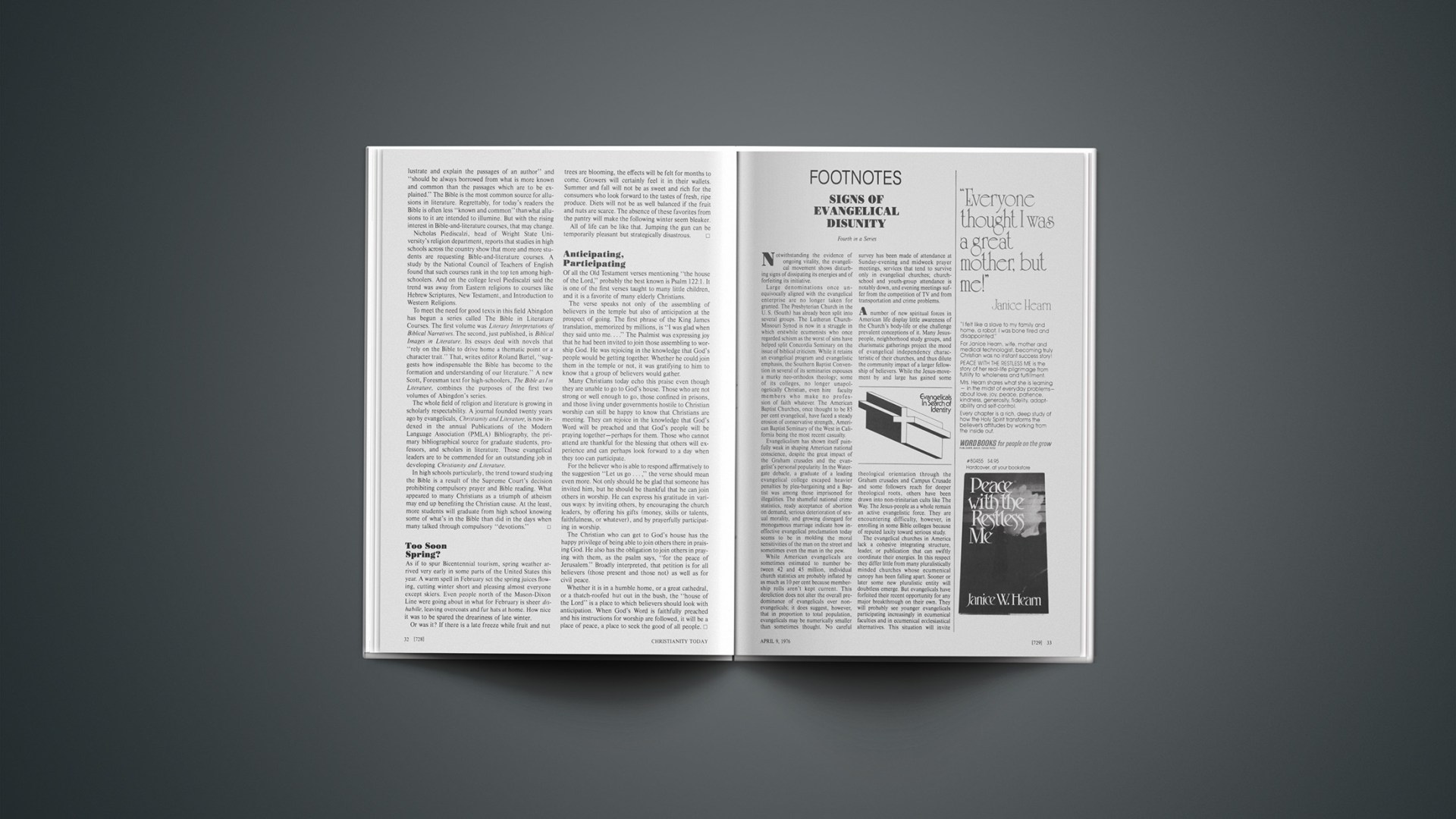
Signs of Evangelical Disunity

Fourth in a Series

Notwithstanding the evidence of ongoing vitality, the evangelical movement shows disturbing signs of dissipating its energies and of forfeiting its initiative.

Large denominations once unequivocally aligned with the evangelical enterprise are no longer taken for granted. The Presbyterian Church in the U. S. (South) has already been split into several groups. The Lutheran Church-Missouri Synod is now in a struggle in which erstwhile ecumenists who once regarded schism as the worst of sins have helped split Concordia Seminary on the issue of biblical criticism. While it retains an evangelical program and evangelistic emphasis, the Southern Baptist Convention in several of its seminaries espouses a murky neo-orthodox theology; some of its colleges, no longer unapologetically Christian, even hire faculty members who make no profession of faith whatever. The American Baptist Churches, once thought to be 85 per cent evangelical, have faced a steady erosion of conservative strength, American Baptist Seminary of the West in California being the most recent casualty.

Evangelicalism has shown itself painfully weak in shaping American national conscience, despite the great impact of the Graham crusades and the evangelist’s personal popularity. In the Watergate debacle, a graduate of a leading evangelical college escaped heavier penalties by plea-bargaining and a Baptist was among those imprisoned for illegalities. The shameful national crime statistics, ready acceptance of abortion on demand, serious deterioration of sexual morality, and growing disregard for monogamous marriage indicate how ineffective evangelical proclamation today seems to be in molding the moral sensitivities of the man on the street and sometimes even the man in the pew.

While American evangelicals are sometimes estimated to number between 42 and 45 million, individual church statistics are probably inflated by as much as 10 per cent because membership rolls aren’t kept current. This dereliction does not alter the overall predominance of evangelicals over non-evangelicals; it does suggest, however, that in proportion to total population, evangelicals may be numerically smaller than sometimes thought. No careful survey has been made of attendance at Sunday-evening and midweek prayer meetings, services that tend to survive only in evangelical churches; church-school and youth-group attendance is notably down, and evening meetings suffer from the competition of TV and from transportation and crime problems.

A number of new spiritual forces in American life display little awareness of the Church’s body-life or else challenge prevalent conceptions of it. Many Jesus-people, neighborhood study groups, and charismatic gatherings project the mood of evangelical independency characteristic of their churches, and thus dilute the community impact of a larger fellowship of believers. While the Jesus-movement by and large has gained some theological orientation through the Graham crusades and Campus Crusade and some followers reach for deeper theological roots, others have been drawn into non-trinitarian cults like The Way. The Jesus-people as a whole remain an active evangelistic force. They are encountering difficulty, however, in enrolling in some Bible colleges because of reputed laxity toward serious study.

The evangelical churches in America lack a cohesive integrating structure, leader, or publication that can swiftly coordinate their energies. In this respect they differ little from many pluralistically minded churches whose ecumenical canopy has been falling apart. Sooner or later some new pluralistic entity will doubtless emerge. But evangelicals have forfeited their recent opportunity for any major breakthrough on their own. They will probably see younger evangelicals participating increasingly in ecumenical faculties and in ecumenical ecclesiastical alternatives. This situation will invite further disruption from the far-right and predictable losses to the left if, as remains likely, ecumenical enterprises are controlled by non-evangelicals who trade power for theological tolerance. Many young evangelical scholars want a larger vision of the Church and find little choice between an objectionable fundamentalist independency and an objectionable ecumenical pluralism. Of the two they prefer ecumenical tolerance of contradictory views instead of evangelical intolerance and uncritical acceptance of inherited traditions.

During the past decade mounting internal tension has beset the American evangelical scene. Persistent criticism has come especially from two groups of people, those who have switched to a somewhat more critical view of Scripture, and those who deplore evangelicalism’s seeming cultural captivity and lack of socio-political engagement. Both emphases have in the recent past been shared by influential evangelicals whose positive contributions to the conservative cause earlier in this century are well known to young intellectuals abreast of modern church history.

Sometimes the scriptural and the social concerns overlap, although no logical connection exists between asserting scriptural errancy and supporting neglected scriptural emphases. Those involved in the Scripture debate and in the social debate include Daniel E. Stevick (Beyond Fundamentalism, John Knox, 1964), Donald Bloesch (The Evangelical Renaissance, Eerdmans, 1973), Bernard Ramm (The Evangelical Heritage, Word, 1973), and Richard Quebedeaux (The Young Evangelicals, Harper & Row, 1974). These scholars voice many legitimate concerns—Bloesch and Ramm in a more mature and balanced way—although their allowances for biblical errancy or myth sometimes elicit diatribes against neo-evangelicals and eclipse their proper demand for evangelical reform in other matters.

More and more doctoral students now graduate from nonevangelical institutions that deplore biblical inerrancy as uncritical. They are attracted to the disparate evangelical emphases retained by neo-orthodox scholars and cheered by neo-orthodox spokesmen who like John Mackay have wearied of ecumenical pluralism and commend evangelical dynamisms. Not a few are pressing for bolder evangelical involvement in serious intellectual, cultural, and political engagement; their pleas are too often met obliquely or not even heard at all by some who consider inerrancy the only basis on which to speak evangelically on anything. Not a few of these seeking scholars have invested their critical learning constructively in order to advance other evangelically crucial commitments.

CARL F. H. HENRY
Ideas

Traditions that Teach the Truth

When the sun appears on the horizon this Easter morning, Christians will be out in force to see it. It has become a tradition to attend sunrise services on the day when the Lord’s resurrection is commemorated. Alongside the many Christians who go to the cemeteries, the mountainsides, the parks, and the beaches for the sunrise worship services will be many uncommitted people, roused from sleep by the call of tradition.

Traditions die hard. Most of Western Europe has a long weekend for Easter. Many businesses close on Thursday, not to reopen until the next Tuesday. The original idea was to allow workers time to attend a full schedule of religious services, starting with Maundy Thursday. Today the attendance at those services is pitifully small in most European churches, but the holiday is defended with great vigor.

Going out to watch the Easter dawn is not a bad tradition. Neither are the traditions of serving hot cross buns, hiding Easter eggs, or dressing up in new clothes, to go to church (or elsewhere). The problem with these and with many other traditions that Christians have developed in various cultures is that they no longer teach the truths they were intended to teach. These observances are, after all, little more than visual aids. Without accompanying verbal instruction they are not dependable teachers.

Sunrise services have continued to draw large crowds, perhaps because nature’s tribute to the resurrection is so striking a visual aid that the Biblical teaching comes easily to the preacher’s lips. People who hear the Gospel at no other public worship services do hear it on Easter morning. Could it be that once-a-year churchgoers attend on Easter because they expect the preacher to give them a word about eternity then, while they can not be sure of it any other time?

The appearance of the sun on the horizon marks the end of night and darkness, and the beginning of a new day filled with light. It is also a reminder of the first resurrection day. That first Easter sunrise was not just a sign of God’s faithfulness in keeping the cycle of nature going. The dawn’s light revealed the empty tomb to a grieving Mary. It said that her friend and Saviour had overcome one of nature’s certainties, death.

That first Easter dawn confirmed what the prophets had foretold and what Christ had taught his disciples: on the third day he did rise again.

That first Easter drove away doubt from Thomas and many other followers of Jesus. Their Lord was there, to see them and to be seen by them. Some did not immediately recognize him, to be sure. Why should they? Such a resurrection, in a glorified body, had never happened before. However, those who were willing to accept his return soon saw the characteristics that identified him to them.

That first Easter spoke eloquently of God’s power over all the hierarchies of earth. No ecclesiastical authorities could thwart his plans. No government—not even that of the Romans—could do away with his ambassador.

That first Easter testified to God’s love in a new way. Not only had God sent his only son for the sins of the world, but now he was returning him to show that death had been conquered. The compassionate Christ walked again where people had to walk, listened to their problems, helped them physically, and assured them of God’s eternal provisions for them.

Easter says all this and so much more, then as now. These are facts, not fiction, and it is the Christian’s privilege to report them accurately. Unlike the father in Fiddler on the Roof who sang that traditions thwarted his purposes, Christians should make the most of those traditions that can help them teach the glorious truth of Christ’s resurrection and his conquest of death.

Restraining The Foes

At least since World War II, Jewish people have repeatedly shown their ability to perceive and assail anti-Jewish sentiments, even when Gentiles might see the offense as slight or even imaginary. The slogan “Eternal vigilance is the price of liberty” has been taken to heart. Recently, for example, the Nazi past of the man nominated as president of Rotary International was disclosed, and he was forced to withdraw. On the larger scene, outrage at the United Nations’ equation of Zionism and racism was widely conveyed.

Is this wrong? Not at all, so long as ethical forms of protest are employed. Even if the strategy backfires forty times out of a hundred, the sixty successes are worth it. For example, the number of Soviet Jews allowed to leave the U.S.S.R. was sizably increased, at least for a few years, as a result of international Jewish pressure. Hostility toward the Jews has been pervasive since their beginning and reached its barbaric climax during World War II, when the Germans murdered six million of them while the rest of the world refused to believe the reports.

To be sure, Jewish people are not the only ones who have been horribly persecuted. The massacre of Armenians by Turks during World War I was enormous. American Indians and aborigines on all continents continue to be the objects of scorn if not wrath. Also, those who captured, transported, and held black slaves will surely have much to answer for in the Day of Judgment.

There is disturbing evidence that the persecution of Christians is increasing. The hostility from Marxism is generally recognized. (For one explanation of this, see the article by Romanian Baptist Josif Ton, March 26 issue, pages 6–9.) Anti-Communist governments can be repressive, too. Greece and Spain are examples of countries where both religious and political leaders have shown hostility to some Christians. Nationalism is a potent force when harnessed against an international movement such as Christianity; many African countries are making institutional life difficult for evangelicals and anyone else who does not give supreme loyalty to whatever government happens to be in power.

Christians should do their best to counter this hostility. They can learn a lesson from Jewish people who continually bombard the media, governments, businesses, and other religions with complaints about real or apparent anti-Jewish words and deeds. The Apostle Paul set another example for Christians. In Philippi he did not let the authorities cover up the fact that they violated their own procedures in beating and imprisoning him; he forced an apology (Acts 16:35–40). Later in Palestine he made use of his rights to avoid a scourging (Acts 22:25–29) and to appeal to a higher court when he feared he would not receive a fair trial (Acts 25:8–12).

Christians cannot escape all persecution. Paul writes, “All who desire to live a godly life in Christ Jesus will be persecuted” (2 Tim 3:12). But neither should they court persecution or passively accept it for themselves or others when ethical means of resistance are available.

Evangelicals ought to establish the same kind of world network that their Jewish neighbors have, both to identify areas of difficulty and to mobilize appropriate action. The fact that there are so many denominations and organizations makes this difficult, but not impossible. The Jews have not had to abandon their various groups in order to work together toward certain goals. Neither would the evangelicals of the world be required to submit to any “pope” to keep up with cases of persecution. Such an effort could go a long way toward restraining the foes of the Gospel.

Carter’S Credibility

When John F. Kennedy ran for the presidency in 1960 he battled what was then “the religious issue.” That issue, a very potent one, was whether a Roman Catholic had enough of a mind of his own to be president; many Americans feared that a Catholic president would take orders from the Vatican. Kennedy turned the tide in his favor by convincing a lot of Southern Baptists that he believed in the separation of church and state.

A different kind of religious issue is developing in the 1976 presidential campaign, and Southern Baptists are again involved, for the Democratic early leader is one of their own. A question already raised this year is whether in a political scene saturated with situationism a candidate who promises to be honest can survive.

It says something about the days in which we live that a simple vow of honesty can cause a controversy. Not so long ago a candidate’s promise not to lie would have been dismissed as redundant political rhetoric. Jimmy Carter now says, in fact, that he had not expected anyone to take notice of it. He adds in retrospect that it may have given the impression that he was throwing down a gauntlet. Whatever he intended, the net result was a focus on Carter’s credibility. A Washington Post reporter told him of “the seeming inability of the press to accept at face value your statements that you will not lie to the American people or mislead them.”

Situation ethics recognizes the right to lie under certain circumstances if one does it in genuine love. Conceivably the lie could be that one will not lie!

It is good that the question has been raised. It ought to be put to all the candidates. Can we, or should we, trust them? Christians in particular ought to be concerned about the ethical and religious convictions of those who aspire to the presidency. The basis upon which a leader makes his decisions is more important than what side he takes in current transient controversies.

A Promising Report Card For The Bible

Joseph Addison once gave some advice on writing with allusions. A good allusion “casts a kind of glory round it, and darts a luster through the whole sentence,” he explained in 1712. An allusion has as its purpose “to illustrate and explain the passages of an author” and “should be always borrowed from what is more known and common than the passages which are to be explained.” The Bible is the most common source for allusions in literature. Regrettably, for today’s readers the Bible is often less “known and common” than what allusions to it are intended to illumine. But with the rising interest in Bible-and-literature courses, that may change.

Nicholas Piediscalzi, head of Wright State University’s religion department, reports that studies in high schools across the country show that more and more students are requesting Bible-and-literature courses. A study by the National Council of Teachers of English found that such courses rank in the top ten among high-schoolers. And on the college level Piediscalzi said the trend was away from Eastern religions to courses like Hebrew Scriptures, New Testament, and Introduction to Western Religions.

To meet the need for good texts in this field Abingdon has begun a series called The Bible in Literature Courses. The first volume was Literary Interpretations of Biblical Narratives. The second, just published, is Biblical Images in Literature. Its essays deal with novels that “rely on the Bible to drive home a thematic point or a character trait.” That, writes editor Roland Bartel, “suggests how indispensable the Bible has become to the formation and understanding of our literature.” A new Scott, Foresman text for high-schoolers, The Bible as / in Literature, combines the purposes of the first two volumes of Abingdon’s series.

The whole field of religion and literature is growing in scholarly respectability. A journal founded twenty years ago by evangelicals, Christianity and Literature, is now indexed in the annual Publications of the Modern Language Association (PMLA) Bibliography, the primary bibliographical source for graduate students, professors, and scholars in literature. Those evangelical leaders are to be commended for an outstanding job in developing Christianity and Literature.

In high schools particularly, the trend toward studying the Bible is a result of the Supreme Court’s decision prohibiting compulsory prayer and Bible reading. What appeared to many Christians as a triumph of atheism may end up benefiting the Christian cause. At the least, more students will graduate from high school knowing some of what’s in the Bible than did in the days when many talked through compulsory “devotions.”

Too Soon Spring?

As if to spur Bicentennial tourism, spring weather arrived very early in some parts of the United States this year. A warm spell in February set the spring juices flowing, cutting winter short and pleasing almost everyone except skiers. Even people north of the Mason-Dixon Line were going about in what for February is sheer dishabille, leaving overcoats and fur hats at home. How nice it was to be spared the dreariness of late winter.

Or was it? If there is a late freeze while fruit and nut trees are blooming, the effects will be felt for months to come. Growers will certainly feel it in their wallets. Summer and fall will not be as sweet and rich for the consumers who look forward to the tastes of fresh, ripe produce. Diets will not be as well balanced if the fruit and nuts are scarce. The absence of these favorites from the pantry will make the following winter seem bleaker.

All of life can be like that. Jumping the gun can be temporarily pleasant but strategically disastrous.

Anticipating, Participating

Of all the Old Testament verses mentioning “the house of the Lord,” probably the best known is Psalm 122:1. It is one of the first verses taught to many little children, and it is a favorite of many elderly Christians.

The verse speaks not only of the assembling of believers in the temple but also of anticipation at the prospect of going. The first phrase of the King James translation, memorized by millions, is “I was glad when they said unto me.…” The Psalmist was expressing joy that he had been invited to join those assembling to worship God. He was rejoicing in the knowledge that God’s people would be getting together. Whether he could join them in the temple or not, it was gratifying to him to know that a group of believers would gather.

Many Christians today echo this praise even though they are unable to go to God’s house. Those who are not strong or well enough to go, those confined in prisons, and those living under governments hostile to Christian worship can still be happy to know that Christians are meeting. They can rejoice in the knowledge that God’s Word will be preached and that God’s people will be praying together—perhaps for them. Those who cannot attend are thankful for the blessing that others will experience and can perhaps look forward to a day when they too can participate.

For the believer who is able to respond affirmatively to the suggestion “Let us go …,” the verse should mean even more. Not only should he be glad that someone has invited him, but he should be thankful that he can join others in worship. He can express his gratitude in various ways: by inviting others, by encouraging the church leaders, by offering his gifts (money, skills or talents, faithfulness, or whatever), and by prayerfully participating in worship.

The Christian who can get to God’s house has the happy privilege of being able to join others there in praising God. He also has the obligation to join others in praying with them, as the psalm says, “for the peace of Jerusalem.” Broadly interpreted, that petition is for all believers (those present and those not) as well as for civil peace.

Whether it is in a humble home, or a great cathedral, or a thatch-roofed hut out in the bush, the “house of the Lord” is a place to which believers should look with anticipation. When God’s Word is faithfully preached and his instructions for worship are followed, it will be a place of peace, a place to seek the good of all people.

Doors

Nothing hurts quite so much as being shut out. Have you ever approached a lovely gate leading to an avenue of trees with a mansion you longed to enter almost out of sight around a curve, only to be stopped short by a dignified little sign “Private Property”? Have you looked hopefully toward a marvelous wood door waiting to see if it would swing open to welcome you in for tea? Have you stopped on the beach to admire a beautiful seaside cottage with flagstones leading to the steps and a sign “No Admittance” at the point where sand stops and the green begins? Have you ever knocked at the door of acquaintances who you thought would be glad to get to know you better, seen the curtains move slightly, felt eyes observing you, but then found the door stayed shut? Have you ever had a door open a crack after you had knocked and then suddenly close again with a slam?

Surely sometime in your life you have experienced rebuff in the form of shut doors keeping you outside when you wanted to be inside. It wasn’t just the desire of sharing the fireside and food with the person on the other side of the door but also the desire to communicate, and perhaps to offer something that you thought would be welcome and helpful. Just the words shut door, locked door, barred door, can bring to mind memories of deep disappointment.

Happily, most of us have a longer string of memories of open doors, of shouts of welcome. “Come in! It’s great to have you here! We have been getting ready for you.” We have seen curtains move aside before we have been halfway up the path and the door burst open before we could knock. We have heard cries of, “Tea is ready! Come eat with us. Here, take the most comfortable chair.”

“Behold, I stand at the door, and knock: if any man hear my voice, and open the door, I will come in to him, and will sup with him, and he with me” (Rev. 3:20). What an overwhelming statement of fact: the everlasting God, the second Person of the Trinity, the Creator of the universe, the Prince of Peace, the Good Shepherd, the King of Kings, the Lord of Lords, stands at the door and knocks. What a picture! The mighty One who is able to do all things does not force his way in but waits for someone on the other side to open the door. What a staggering picture of the importance of human beings made in the image of God! God knocking at the heart’s door of an individual whom he has created, and waiting for the door to open or to remain closed. The person is not a zero, nor just a computerized number; he or she is a being who chooses whether to let God in or keep him out.

Then the gentle, overwhelming words, “I will come in to him, and will sup with him, and he with me.” They suggest the personalness of sharing a fireside teatime, or an intimate suppertime on a balcony, with the One at whose feet John fell, and who replied to John, “Fear not; I am the first and the last: I am he that liveth and was dead; and, behold, I am alive for evermore” (Rev. 1:17, 18). Amazing thought: we can sup with the One who was the first and is the last and who will be forever.

When? When the time comes for the marriage supper of the Lamb and he serves us the bread and the wine as we remember together his death for us? That is future. But this knocking, opening, and eating together seem also a present possibility, to be our experience when we first hear the knock and open in the sense of believing, accepting, and being born again.

However, even after this the shut door is an ever-present temptation, one that Satan would like to keep before us at all times. When calamity hits, when disappointment plunges us into depression, when uncertainty as to what to do next smashes our nerves, when fears about decisions tear at us, when we grow impatient about waiting for the Lord’s guidance and are tempted to rely on our own cleverness, when we feel an urge to push aside prayer and jump into something first, then the gentle “knock” can easily be left unanswered. It is easy to fail to recognize what we are substituting for a time of “supping” with the Lord. It is easy never to think of prayer and an intimate time of being with the Lord as two-sided.

It is the worst kind of egoism to ignore what God has told us clearly in Revelation 3:20, to refuse to think of his waiting outside on our front step or our flagstone walk. We picture ourselves as deciding not to knock at his door, deciding not to rush into his presence with our communication, deciding not to call upon him in our trouble. Indeed, God has given us this set of pictures, too. But it has struck me recently that many of us are time after time selfishly ignoring the fact that we have failed to open “the door” that depends on our specific choice and action.

Many of us never connect Christ’s standing at the door and knocking, his waiting for us to let him in, his expectation of supping with us and communicating with us, with prayer, or with our times of desperate need. We forget to take literally the fact that we have a Friend, Counselor, and Guide knocking at our door at the very time we need his help. We may think we are too low in faith or even in energy to call for his help, but we forget that we are told to open the door, sit down, and share a time of refreshment. Things don’t have to be sparkling; we don’t need to feel ready for a guest. This friend standing at the door is a truly understanding friend who knows us well and is always sensitive to our state of mind.

What makes it even more wonderful is to remember, that this One who knocks at the door knows what is is to be The Door himself. He himself is an open door! “Then said Jesus unto them again, Verily, verily, I say unto you, I am the door of the sheep. All that ever came before me are thieves and robbers: but the sheep did not hear them. I am the door: by me if any man enter in, he shall be saved, and shall go in and out, and find pasture” (John 10:7–9). There is only one door that opens into the place of eternal salvation, and Jesus himself is that door. Others try to point to themselves or to others as doors to eternal life, to peace, to heaven, to God, but Jesus says any other “doors” would lead the sheep away from the fold for which they are looking.

This One who is our Door himself takes our hand when we come in through him, “and I give unto them eternal life; and they shall never perish, neither shall any man pluck them out of my hand” (John 10:28). So his hand holds us fast, inside the door. “My Father, which gave them me, is greater than all; and no man is able to pluck them out of my Father’s hand” (v. 29). His welcome inside his open door is for ever and ever!

Christ’s work to prepare this welcome was nothing less than the agony of the cross, his death. What bitterness, what icy hardness of heart, what sharp disappointment, what misunderstanding can keep us from opening the door and pouring out all that troubles us into his listening and understanding ears? There are many doors upon which he knocks; don’t keep him standing outside the only one you can open.

EDITH SCHAEFFER

Eutychus and His Kin: April 9, 1976

The Giggling Guru

Several weeks ago I accidentally turned the TV on to the Merv Griffin show. Within moments I realized that this hour would be a big moment in my life. (That’s the impression Merv conveyed to me.) And it would definitely be another high point in his.

You see, the most honorable Maharishi, driving force behind Transcendental Meditation, was going to appear live on Griffin’s show. Griffin was overjoyed. Ever since Merv had discovered Transcendental Meditation and the teachings of the Maharishi, he had become a new creature. And it appeared to me that in the process Merv’s objectivity had also changed—it had disappeared! (A conversion characteristic of other than TM enthusiasts.)

So instead of the usual talk-show setup—several chairs, a small table, and the like—the studio was arranged like a mini-worship center. A special high-backed chair had been set up for the Maharishi. It looked as if it was covered in satin (but who can tell you when your TV isn’t doing its job?). And there were flowers everywhere; it seemed that everyone in the studio audience held one.

After movie star Clint Eastwood had been introduced and had given his TM “testimony,” the Maharishi made his entrance. Merv stood in awe. So did Clint and the rest of the studio audience. I sat. The guru, dressed in a white flowing robe, pitty-patted to his place smiling his patented, inane smile. And this was his most significant action during the show. From then on, he proceeded to giggle as Merv and Clint gushed over him.

Basically, the whole program made me sick.

I could never imagine Jesus appearing on Merv’s talk show like that. I think he would have wanted a regular chair, and I’m certain he would have responded to questions with much more than a silly giggle. If he had responded with giggles, I don’t think I would have responded to him.

And I’m also certain that the talk-show crowd would have been much tougher on Christ than they were on the Maharishi. In fact, I couldn’t believe that so many supposedly sane, educated people would leave their minds on the floor when the Maharishi came in.

Then later it hit me. Isn’t that true of much of Christianity today? We think we worship a giggling God who requires little more than a few flowers, a special chair, and the adoration of a celebrity.

I wonder if that makes God giggle?

EUTYCHUS VII

On The Ewc

I should like to correct several misconceptions which Elisabeth Elliot’s letter (February 13 issue) might have left in the minds of CHRISTIANITY TODAY readers.

First, the Evangelical Women’s Caucus national conference included no workshop on lesbianism. In the opinion of EWC leaders, an opinion based on reputable anthropological and psychological studies, there is no causal connection between feminism and lesbianism. On the contrary, most authorities consider it probable that a widespread reduction in sex-role stereotyping will lead to a reduction in homosexual activity.

Secondly, part of my keynote speech was concerned with the significant amount of feminine imagery in the Bible concerning each member of the Trinity. Although this imagery has been present in the Bible all along, the Church has paid little attention to it. Our theological purpose at the conference was to study the Scriptures in light of current questions and seek answers which have always been present but which tend to be overlooked until social conditions raise our consciousness and stimulate our concern in new areas. That was the spirit of the whole EWC conference, and I regret that Ms. Elliot found it a “horrifying experience.”

VIRGINIA R. MOLLENKOTT

Chairperson, Department of English

The William Paterson College of New Jersey

Wayne, N. J.

Which Benet?

In your February 27 issue there was an article “Sniffing Out Science Fiction,” by John Vernon Lawing, Jr. (Refiner’s Fire).… His memory played him false when he tried to recall “By the Waters of Babylon.” It was not written by William Rose Benet, but by his brother, Stephen Vincent Benet … Thanks for this, and for the fine magazine you put out, which we enjoy very much.

ETHEL L. HANNUM

Riverside, Calif.

Exceptional Issue

I want to thank you for the exceptional articles that were printed in the January 30 issue. It is very informative and I’m sure that many readers shall catch new insights regarding the Negro churches.

EDWARD V. HILL

Director

World Christian Training Center

Los Angeles, Calif.

It is unfortunate that John Warwick Montgomery did not first read Clarence Hilliard’s article “Down With the Honky Christ—Up With the Funky Jesus” before expounding on an “Encounter in Florence” (Current Religious Thought). Mr. Montgomery writes, perhaps not intentionally so, but with much egotistical disdain.… This one article for me detracted from what was otherwise one of the best issues of CHRISTIANITY TODAY that I have had the pleasure to read.

HAROLD TURNER

Columbus, Ohio

The article by Clarence Hilliard is especially valuable because it puts very hard truths in language which should strike Christians deeply. The cost of Christian commitment is indeed great.… This article puts that cost in terms we can all understand.

Teaming that article with an interview with John Perkins was an excellent idea. Here is an example of the sorts of actions Christians should have been taking for years and years.…

The portion of the Christian church served by CHRISTIANITY TODAY needs such issues as this one. Keep them coming.

JAMES W. SIRE

Editor

InterVarsity Press

Downers Grove, Ill.

Clarence Hilliard’s article is so far out that it misses the whole point of the humiliation of the Son of God.… There is no evidence that he was ever involved in raising the living standard of one group by insisting that others provide financing for everything from “hot-dog stands” to “pawn shops.” … Some of us rich (?), white Christians … missed the trip to Lausanne in 1974. Did it ever occur to Mr. Hilliard that the fare would have more than paid for a “hot-dog stand”?

W.B. RICE

Lopez Island Community Church

Lopez, Wash.

Thomas Merton: Abiding in Christ

Thomas Merton: Abiding In Christ

Last year in the May 23 issue (“The Refiner’s Fire,” pp. 21–24) we printed an article by John Leax about the poetry of Thomas Merton; his writing and contemplative lifestyle have become important to many young evangelicals. After that article was published we received several enquiries about Merton’s shift in later life from Christianity to Buddhism. Here is Leax’s reply.

Following the publication of The Seven Storey Mountain, Thomas Merton was continually beset by the rumor that he was, for one reason or another, abandoning his monastic vocation. When he left Gethsemani, his Kentucky monastery, in October, 1968 to visit the Orient, this rumor gained a specificity it had previously lacked: Merton was converting to Buddhism. As unlikely as such a conversion sounds, one must consider the testimony of Merton’s last years carefully before discounting the possibility. Not only had he been studying Oriental religions for some years, his essays on Buddhism had seemed to many far too sympathetic to have been written by an orthodox Catholic monk.

Merton probably intended to edit the three journals he had kept while in Asia. If he had lived to do so, many of the ambiguities that puzzle his readers would have undoubtedly been removed. But his accidental death by electrocution in Bangkok left the journals incomplete. Wisely Naomi Burton, Brother Patrick Hart, and James Laughlin, his editors, concentrated on arriving at an accurate text of the journals and studiously avoided guessing at Merton’s sometimes obscure intentions. This unfortunately creates difficulties for the reader of The Asian Journal seeking to understand the full depth of Merton’s involvement in Buddhism.

Merton’s comments on the possibility of finding a Tibetan guru and making a long retreat can serve as an illustration of the difficulty The Asian Journal presents the reader. On November 2, after about two weeks in Asia Merton wrote:

Sonam Kazi.… thinks I ought to find a Tibetan guru and go in for Nyingmapa Tantrism initiation along the line of “direct realization and dzogehen (final resolution).” At least he asked me if I were willing to risk it and I said why not? The question is finding the right man. I am not exactly dizzy with the idea of looking for a magic master but I would certainly like to learn something by experience [New Directions, 1973, p. 82].

Two weeks later Merton visited with Chatral Rimpoche. They discussed meditation, discovering to their surprise that they “agreed very well.” At the end of their discussion Chatral called Merton a “natural Buddha.” Merton was delighted and concluded his account of the interview with the following observation:

He (Chatral) was surprised at getting on so well with a Christian [italics mine] and at one point laughed and said, “There must be something wrong here!” If I were going to settle down with a Tibetan guru, I think Chatral would be the one I’d choose. But I don’t know yet if that is what I’ll be able to do—or whether I need to [p. 144],

These two passages show that Merton was open to the Eastern experience. Indeed, from them one can safely conclude that he considered it a valid experience. But one cannot say with any certainty how Merton related to that experience. The humor of his offhanded “why not?” and the choice of the phrase “magic master” in the first passage should probably be read as qualifying the expressed desire to learn by experience. More importantly, in the second passage Chatral’s consciousness that he is speaking with a Christian indicates that Merton’s willingness to learn did not compromise his identification with Christ. Yet, even with these positive aspects emphasized, the passages remain troublesome.

Other entries, as enigmatic as these, appear with some frequency in The Asian Journal and create no small difficulty for the Westerner used to equating Eastern thought with either nihilism or pantheism. One thing, however, is clear; the journal shows that Merton intended to remain a monk of Gethsemani. Just two days after recording the entry regarding Chatral Rimpoche he wrote, “There is no problem of wanting simply to ‘leave Gethsemani.’ It is my monastery and being away has helped me see it in perspective and love it more” (p. 149). To properly evaluate the import of this, one must remember that Merton could have established a hermitage at any geographic location (he was seriously considering Alaska) and still have been faithful to his vow of stability. Nevertheless his faithfulness to his vow should be read as an affirmation of his faith in Christ and as an indication that a conversion to Buddhism was not imminent.

If this conclusion is true, what then was the object of Merton’s Eastern studies? A clue to his purposes lies in a brief note he makes on St. Thomas Aquinas in Conjectures of a Guilty Bystander:

The great originality of St. Thomas lies in his vocation: the realization that he was called by God to evangelical perfection and to the study of Aristotle.… Hence the theology of St. Thomas is a theology of intellectual reconciliation, which, instead of maintaining itself in existence by the insistence on those opposites which create problems, justifies itself by uniting opposites and looking beyond the stereotyped solution of problems.

This archetypal reconciliation was present in his own vocation which, as he lived it, told him daily that the confrontation of apparently irreconcilable opposites presents no problem at all. One could love and serve God in the city, teaching Christian clerks from the book of a pagan philosopher [Doubleday, 1968, p. 206].

With the realization that Aquinas began his study of Aristotle when Aristotle was under the Church’s ban, the parallel to Merton becomes clear. Like Aquinas, Merton recognized that because God has been continuously revealing himself to man something of his truth is present in all cultures and in all faiths. What is true is of God. The Christian, who possesses the revelation of Jesus Christ, can, discerning what is true and what is false, lay claim to that which is true and thereby grow not only intellectually but spiritually. The danger here, of course, is syncretism. But as Aquinas avoided it, so does Merton.

Merton starts with an affirmation of his own Catholicism:

Certainly I find in myself not the slightest inclination to “be” anything but “Catholic.” Any further question of other institutions, other organizations, appears to me to be totally ludicrous. I am in the place where Christ has put me. Amen [p. 250].

His next step, however, is not the expected. Instead of allowing his Catholicism to define him in terms of opposition to all that is not Catholic, he emphasizes the fact that one becomes more truly himself as he discovers himself in others and others in himself:

I will be a better Catholic, not if I can refute every shade of Prostestantism, but if I can affirm the truth in it and still go further.

So, too, with the Muslims, the Hindus, the Buddhists, etc. This does not mean syncretism, and indifferentism, the vapid and careless friendliness that accepts everything by thinking of nothing. There is much that one cannot “affirm” and “accept,” but first one must say “yes” where one really can [p. 144].

The object then of Merton’s study is to discover what one may say “yes” to and what effects that “yes” might have on his life.

While a conclusive evaluation of what may be affirmed and an estimate of the effects of such an affirmation is a task for students of comparative religion, two related topics can be singled out as appropriate starting points. Neither is specifically “religious” but both have applications to the spiritual life. The first involves the nature of contemplation.

Here the modern Western Christian, whose life has been oriented to action and action only, is severely handicapped. The contemplative life, particularly as it is lived by the Asian masters, appears quietistic. Merton assures us that it is not. An openness to this way, as it is reflected not only in the lives of the Asians but in the lives of the fourth century desert fathers and in the lives of innumerable Christian saints and mystics, might lead to a deeper understanding of the nature of the peace which Christ promised us and a more consistent manifestation of the fruits of the Spirit.

It must be emphasized, however, that no technique of contemplation is ever sufficient for spiritual growth or maturity. As Merton wrote, “We must also look to the transcendent and personal center upon which this love, liberated by illumination and freedom, can converge. That center is the Risen and Deathless Christ in Whom all are fulfilled in One” (Mystics and Zen Masters, Delta, 1969, p. 42).

If the only gain promised by Merton’s pilgrimage to the East was a renewed vision of the contemplative life, his pilgrimage was probably unnecessary. But there is a more profound truth to be learned, one that, though not alien to Christianity, has largely been lost.

In Mystics and Zen Masters, Merton wrote, “We are plagued today with the heritage of that Cartesian self-awareness, which assumes that the empirical ego is the starting point of an infallible intellectual process to truth and spirit” (p. 26). This Cartesian self-awareness operates by means of a subject-object division. The “I,” the subject, perceives an object, which it stands apart from and in opposition to. This leads both to the sophistication of modern technology and to the alienation of modern life. Merton claims its logical end is the death of God:

Cartesian thought began with an attempt to reach God as object by starting from the thinking self. But when God becomes an object, he sooner or later “dies,” because God as object is ultimately unthinkable [Zen and the Birds of Appetite, New Directions, 1968, p. 23].

Note, here we are not directly dealing with matters of faith but with a philosophical problem. Consequently, any source that does not contradict Christian doctrine is available to us.

It is at this point Merton finds Buddhist ontology helpful. Put most simply, the Buddhist does not begin with an affirmation of himself. Neither does he begin by affirming something outside of himself. Either affirmation would lead to the Cartesian dilemma. He starts instead with a concept of Being which is “seen to be beyond and prior to the subject-object division”:

This is totally different from an experience of self-consciousness. It is completely nonobjective. It has in it none of the split and alienation that occurs when the subject becomes aware of itself as a quasi-object.… It is not “consciousness of” but pure consciousness, in which the subject as such “disappears.” … Here the individual is aware of himself as a self-to-be-dissolved in self-giving, in love, in “letting go,” in ecstacy, in God—there are many ways of phrasing it [pp. 23, 24].

The similarity of this philosophical, Buddhist position with Christian doctrine is obvious. It is not unorthodox to suggest that the nature of rebirth is ontological. Certainly Christ is concerned with actions; he places a heavy responsibility on his followers, requiring them to go to all nations preaching the gospel. But his first requirement is for the believer to be in him. St. Paul describes this in Galatians 2:20 when he writes, “I have been crucified with Christ, and I live now not with my own life but with the life of Christ who lives in me” (The Jerusalem Bible). He makes it even more emphatic in Colossians 3:10, 11. “You have put on a new self which will progress toward true knowledge the more it is renewed in the image of its creator; and in that image there is no room for distinction between Greek and Jew … There is only Christ; he is everything and he is in everything” (The Jerusalem Bible).

The Christian who takes Scripture seriously must regard these passages as more than figurative expressions of unity. Otherwise the doctrine of the mystical body of Christ is nonsense. And if the mystical body of Christ is nonsense, there not only is no Church, there is no Christianity.

So, from Buddhist ontology, from its conception of the nature of being, Merton learned something of the meaning of abiding in Christ. What he learned was not something alien that he added to Christianity, but something essential that had been and continues to be obscured by cultural additions to the gospel.

As positive as these conclusions are, a word of caution is necessary. Merton’s interpretations of aspects of Buddhism are often radically opposed to those found in most comparative religion textbooks. Consequently, more study is necessary before we can give more than tentative approval or disapproval to his judgments. Until that study is done, we would do well to heed the advice Merton himself received from Bramachari, a Hindu monk he met in 1938:

There are many beautiful mystical books written by Christians. You should read St. Augustine’s Confessions, The Imitation of Christ.…

Yes, you must read these books. Merton, I’m sure would concur [The Seven Storey Mountain, New American Library, 1952, p. 195].

JOHN LEAX

John Leax is assistant professor of English at Houghton College, New York.

Transcendental Meditation Challenges the Church

Second of Two Parts

Transcendental Meditation is presented to the public as a scientifically verified technique for gaining deep rest and many other benefits, including release of the boundless potential for creativity and intelligence claimed to reside in each person. These claims are supposedly substantiated by the charts and graphs of various research studies on TM arrayed in a fifty-page booklet entitled “Fundamentals of Progress.” This booklet gives the impression that the benefits suggested by these studies are the scientifically established results of the practice of TM. In most cases that impression is misleading. A British neurophysiologist, Dr. Peter Fenwick has put the research on TM in scientific perspective as follows:

All these studies need to be looked upon with reservations. Few include adequate control groups and none that I am aware of have yet used a blind control procedure … Until this sort of study is carried out in meditating groups it is almost impossible to draw any conclusion.

Psychological results are capable of being influenced by many non-specific factors … [London Times Educational Supplement, May 17, 1974].

It does seem that TM is relaxing, and Harvard Medical School cardiologist, Herbert Benson, a pioneer researcher on TM, is convinced that it can reduce blood pressure in persons with hypertension. He has even developed a secularized meditation technique similar to TM that can be self-taught in a few minutes without involvement in any ritual or philosophical explanation. Before we applaud Dr. Benson’s initiative, we must realize that the meditative technique he has abstracted from its religious context has effects on the meditator that are not physiologically measurable. To believe that the psychophysiological essence of these practices can be abstracted for particular physical benefits without any other mental and spiritual effects reflects a naive materialism.

Three effects of doing TM or any similar meditative technique completely aside from the religious rituals involved are:

1. It alters consciousness in a cumulative way that tends to convince the meditator of the Eastern presuppositions about the nature of reality and of man.

2. It desensitizes conscience by masking real guilt and relieving its symptoms of restlessness and psychosomatic illness.

3. It induces a passive state of mind and body that opens the meditator to the hazard of demonic incursion.

I cannot discuss these points thoroughly in a brief article (I am investigating them in detail in a book I am writing). I want to make a couple of comments, however.

The Eastern techniques of meditation have been cultivated because they lead to the classical unitive mystical experience of the merging of the individual with the cosmos. This experience in turn induces the concept of the unity of all being, and recurrent mystical experiences seem to verify this concept. From this unitive mystical experience emerged the monist doctrines of the unity of all being and of the identity of the soul of man with the “Soul” of the cosmos (the identity of atman/Brahman).

When a person commits himself to the practice of Eastern meditation for an extended period (twice daily for the rest of his life for a hypertensive patient, for example), whatever his conscious motive for meditating; he is subjecting himself to a rigorous process of mental conditioning that tends to modify his concept of himself and of the universe into conformity with the Eastern world view. Since this view conforms to the basic delusion of fallen man that he is autonomous—a divine being, really—it is virtually irresistible. Whether or not the meditator attaches himself to a particular guru, he is confirmed by his meditation in an idolatrous concept of himself as independent of the personal Creator.

C. S. Lewis would be monumentally unsurprised by the hailing of Hindu monism in scientific guise as a new discovery by the theologically naive dwellers in the post-Christian West. In Miracles he wrote of pantheism in a historical perspective that now seems prophetic:

Modern Europe escaped it only while she remained predominantly Christian.… So far from being the final religious refinement, Pantheism is in fact the permanent natural bent of the human mind; the permanent ordinary level below which man sometimes sinks …, but above which his own unaided efforts can never raise him for very long.… It is the attitude into which the human mind automatically falls when left to itself. No wonder we find it congenial. If “religion” means simply what man says about God, and not what God does about man, then Pantheism almost is religion. And “religion” in that sense has, in the long run, only one really formidable opponent—namely Christianity. Modern philosophy … and modern science … have both proved quite powerless to curb the human impulse toward Pantheism.… Yet, by a strange irony, each new relapse into this immemorial “religion” is hailed as the last word in novelty and emancipation.

The present relapse into the religion of pantheism is novel, then, only in that it is often presented as a matter of science rather than religion or philosophy. Despite Lewis’s insight into the seductiveness of pantheism to mankind, he might be dismayed at the lack of theological definition and spiritual discernment that permits Hinduism to pass unchallenged by the Church when it comes in scientific disguise.

By offering the mystical experience of transcendence and the monist philosophy of oneness as the essence of all religion, including Christianity, Maharishi challenges the Christian Church sharply and directly. He doubtless has observed the spiritual deadness of some parts of the professing church; a spiritual hunger leads many from Christian backgrounds to become his followers. He correctly (if unwittingly) assesses the dessicating effect on spiritual life of liberal and existential theology on the one hand and of dead orthodoxy on the other when he says:

The whole field of religion is just left on the mental, on the basis of mental hallucination. Think, think, think, think, what is it? Thought of God is a thought of God, keep on thinking. You are thirsty, keep thinking of water, water, water, water and it does not satisfy the thirst. Thought of water is not water. No, it is not the thought of God that is going to help. It is the content of Godhead … that is going to help [Meditations of Maharishi Mahesh Yogi, p. 64].

The Church can be subjected to this reproach of its spiritual drought only because theologians, pastors, and people have not responded wholeheartedly to the life-giving call of Jesus, “Whoever is thirsty, let him come to me and drink. He who believes in me, just as the Scripture says, streams of water will flow from his innermost being” (John 7:37, 38).

The testimonial letters by Christian clergymen published in The TM Book deserve special scrutiny because of their potential to mislead Christians. One of these letters was written by a Lutheran clergyman and professor of theology at Valparaiso University, Karl E. Lutze. His letter reads in part:

I had some initial reservations about TM from a religious and theological standpoint. It was not without careful and serious study and reflection that I attempted to learn whether or not this art … from the traditions of the far East might be compatible or in fact in conflict with my Christian faith.…

I do not find Transcendental Meditation an alternative to Christian faith; I practice it within the context of my Christian life.… I regard meditation as another of God’s good gifts to me.

The other letter by a Christian clergyman in this book was written by Leo McAllister, a Roman Catholic priest who is the pastor of Immaculate Conception Church in Sacramento, California, who was for six years chaplain of the California Assembly. He writes:

I am writing this letter to allay any fears, anxieties or misconceptions which Catholics may have concerning the practice of Transcendental Meditation.… It is not a religion or a religious practice. It in no way conflicts with a person’s belief in God or in his church.… A persons’s relationship to God and the practice of one’s faith should be enhanced, rather than diminished, by the use of Transcendental Meditation.… I am happy to say that I can recommend it highly.

Another striking testimony to the value of TM written by a clergyman appeared in the Christian Century of December 10, 1975. Presbyterian Pastor John R. Dilley of Fairfield, Iowa (home of MIU), became a meditator in 1974 out of concern for a heart condition. He wrote:

Our entire family have become meditators, and we have found no compromise in our commitment to Jesus Christ and to his church. Indeed, we have found that our entire life style has become more Christian as we both give and receive love with less tension in our lives.

The failure of some Christian clergymen to discern the anti-Christian character of the practice of TM may have stemmed in part from an innocent acceptance of Maharishi’s non-religious claim at face value. Jesus warned us, however, that we are to be “as shrewd as snakes,” as well as “as innocent as doves,” because he sends his disciples into the world “like sheep among wolves.” For those with pastoral authority, a failure of spiritual discernment that exposes those entrusted to their care to idolatrous ritual and practice is no light matter; “they keep watch … as men who must give an account” (Heb. 13:17). Had their initial vague misgivings about TM been reinforced by a firm theological understanding of the challenge of Christianity to Eastern religion, neither TM nor any other pantheistic system based on the premise of human autonomy would have caught them unawares. Spiritual discernment, however, is finally a matter of the work of the Holy Spirit stemming from an experience of spiritual rebirth that brings us into a conscious, personal relationship with the Father through the mediation of Jesus Christ. It must be cultivated, of course, by a life of continuing obedience to the Lord Jesus Christ and his ministers in the church. Knowing theology can never be a substitute for knowing God, but both are needed to challenge missionary Hinduism in the post Christian West.

Given the theological and spiritual disarray in large sections of the Church that has been exposed by the success of Hinduism in scientific disguise, it is encouraging to note a pair of books, one by a pastor, the other by a theologian, that correctly take the measure of TM as a Hindu religious practice and reject it as obscuring the truth of reality as it is in Christ Jesus. The two books are The Meditators by Doug Shah (Logos, 147 pp., $3.50) and What Everyone Should Know About Transcendental Meditation by Gordon Lewis (Regal, 92 pp., $1.45). Shah is an associate pastor at Valley Christian Center in Dublin, California, and Lewis is professor of systematic theology at Conservative Baptist Seminary in Denver. Shah is an Indian Christian whose grandfather made the discovery of Christ while living as a yogi in India. Shah’s gradual revelation of Jesus Christ through his own investigation into the Eastern spiritual currents in today’s America as well as in the pilgrimage of his grandfather makes an evangelistic appeal tailored to those who are seeking God in TM or other Eastern bypaths. Lewis’s book is a forthright exposure of the Hindu basis of TM together with a contrast of Hindu and Christian doctrine of God, man, and salvation.

Convinced meditators hold important positions in government, the academic world, the public schools, big business, psychiatry, medicine, the media, entertainment, sports, and religion. Their numbers are still relatively small, but many of them are willing to use their influence to promote TM because they believe that it has benefited them personally and that it provides answers to social and political problems. Maharishi’s WPEC appears to run as a well-oiled international corporation on the basis of its large American revenues and the frugal life-style of the typical TM teacher, who is dedicated to the transformation of mankind by TM.

At the moment, the spiritually starved members of our secularized society continue to flock to Maharishi’s technique for rest of body and peace of mind. The monism of materialism and naturalism feeds rather readily into the monism of Brahmanism. Maharishi’s teaching feeds on the insatiable spiritual thirst of a race secretly convinced of its divinity but never at ease in it because of all the contrary evidence of man’s creaturehood. An “innocent” technique to tap the “unlimited potential” of inner divinity reassures fallen man of his autonomy.

The prospects, then, for a continuing expansion of the practice of TM in the United States would seem to be excellent—except for one thing: the contradiction between the public presentation of TM as a non-religious technique of relaxation and the private reality of TM as a religious practice requiring ritual initiation. Maharishi’s shrewd opportunism in shifting from a spiritual to a scientific emphasis in the presentation of TM in the late sixties led him to make a total public denial of the religious aspects of TM. But now the religious aspects of TM are being exposed to public view by the publication of the English translation of the text of the Sanskrit hymn (“puja”) of worship to Guru Dev and the major Hindu divinities used in the required initiation ceremony, and Maharishi’s credibility as a spiritual leader is being undermined.

The most serious threat to the TM organization in this regard may come in the form of consumer-fraud suits. According to Christian Century special correspondent Robert B. Fulton, a Fairfield, Iowa (home of MIU), clergyman named Charles Sloca has requested that the state attorney take action against the TM organization for violating the consumer’s right to know the true nature of a service offered. Sloca claims that TM is being sold as a scientific technique when it is really a religious practice. The prospect of a consumer-fraud suit must be a nightmare for WPEC officials, because a judgment against the TM organization might mean that any initiate could demand a refund of his initiation fee.

Missionary Hinduism may severely challenge the Church where its relationship to its Lord, Jesus Christ, has been weakened by bad theology, a loss of church discipline, and disregard of the work of the Holy Spirit. There is no basis for pessimism, however. Christianity alone challenges the fundamental premise of Eastern religion that man is autonomous, divine, God. Christianity rejects the concept of human divinity because of the biblical revelation of the absolute distinction between Creator and creature (Rom. 1:25). Only Christianity reveals to man the humility and dignity inherent in what he is—a creature made in the image of the living God. And only Christ himself provides the fullness of life for which all human beings yearn. Our challenge to missionary Hinduism is to present the living reality of Christ, “for in him all the fullness of the Godhead dwells bodily, and in him, who is the head of all rule and authority, you are enjoying fullness of life.”

Male and Female Related He Them

An interaction with Jewett, Scanzoni and Hardesty, and the Bible

The role relationship of women and men is one of the most discussed topics of our day, in evangelical circles as well as elsewhere. Two books claiming to be written from the evangelical perspective have aroused considerable interest: All We’re Meant to Be: A Biblical Approach to Women’s Liberation by Letha Scanzoni and Nancy Hardesty (Word) and Man as Male and Female: A Study in Sexual Relationships From a Theological Point of View by Paul K. Jewett (Eerdmans). Attention has been focused on the necessity for justice and equality in the male-female relationship. Man is made male and female in God’s image. This equality is basic to the discussion. It is one of the bases upon which the husband is urged by the Apostle Peter to honor his wife as a joint heir of the grace of life (1 Pet. 3:1–7), while the wife is asked to submit to her husband. This emphasis on equality and unity reiterated in the great redemptive passage of Galatians 3:28 has brought these authors to disavow any role of submission by women to men in the marriage relationship or in the ruling/teaching functions in the church.

I disagree. I believe that equality and difference of role are not mutually exclusive but are indeed the two sides to the teaching of the Word of God about the subject.

It is significant that the two notes of equality and difference of role are joined in the marriage relationship in the treatment presented by the Apostle Peter (1 Pet. 3:1–7). The equality is appealed to when Peter instructs the husband to honor his wife as a “joint-heir” at the same time that he urges her to submit to him and urges him to recognize her femininity (the “weaker vessel”). Likewise, the Apostle Paul, who writes of man and woman as one in Christ (Gal. 3:28), also writes of the wife’s submission to the headship of her husband (Eph. 5:22 ff.; Col. 2:18, 19).

But why is it that the husband is the head of the wife and why must the wife submit to him? The Apostle Paul speaks of the headship concept in First Corinthians 11. In verse 3 he says that “the head of the woman is man.” As he develops this concept of headship, he grounds it in the creation order and in the relationship of Genesis 2:18 ff., which he explains as establishing the relationship between man and woman (1 Cor. 11:8, 9). This same passage and principle is appealed to in First Timothy 2:11–15 and First Corinthians 14:34–37, where the Apostle Paul does not permit women to teach or have authority over men or over the church. In First Timothy 2:13 he cites that same order of creation, “For Adam was first formed, then Eve,” and in First Corinthians 14:34 he refers to this same passage with the words “as also says the law.” The relationship of men and women in marriage and their relationship in the church are founded on exactly the same passage and on the same principles; the teachings on the two points must stand or fall together.

Not unexpectedly, certain objections have been brought against this uniform New Testament and apostolic position. Full, free, and frank discussion of the matter is desirable; it will enable Christians to come to a clearer and more balanced understanding of the total biblical teaching on this subject. But I am distressed that some who have written on the subject seem to be abandoning the inerrancy of Scripture and the authority of its teaching. Even some who claim to be evangelical Christians, to submit to the authority of God and his Word, seem willing to appeal to the passages in Scripture that support their position and to minimize other passages or declare them to be either wrong or only culturally relative and not normative, even when these passages themselves claim to be normative and not culturally relative.

First, it is said that the statement of Paul in First Timothy 2:13, “For it was Adam who was first created, then Eve,” is not significant for the role-relation of man and woman, as Paul claims it is. Scanzoni and Hardesty say, “If beings created first are to have precedence, then the animals are clearly our betters” (p. 28; cf. also Jewett, p. 126 f.). However, the point of Paul’s statement is not mere chronology but also the question of derivation and relationship, as his fuller handling of the Old Testament episode in First Corinthians 11:8 and 9 shows. And the recognition of this point removes the objection of Scanzoni and Hardesty, because mankind in general, or man or woman in particular, is not made from the animals. Nor is man derived from the dust of the ground as from a living entity from which he is shaped or fashioned (contra Jewett’s appeal to this aspect). The Old Testament narrative says, “The Lord God fashioned [built] into a woman the rib which he had taken from the man” (Gen. 2:22). We see that Paul is concerned with source of origin, and not mere chronology, when we read his exegetical language of First Corinthians 11:8 and 9, “For man does not originate from woman, but woman from man; for indeed man was not created for the woman’s sake, but woman for the man’s sake.”

This matter of the way in which woman is made out of man is highly significant for the relationship of man and woman, not only in the eyes of Paul but also from the time of its occurrence, as seen in the text of Genesis itself: “And the man said, this is now bone of my bones, and flesh of my flesh; she shall be called woman because she was taken out of man” (Gen. 2:23). In addition, the next verse says, “For this cause a man shall leave his father and his mother, and shall cleave to his wife; and they shall become one flesh.” Not only for Paul but also for Adam and Moses, as well as for God, who created woman in such a way and evoked the responses and principial applications, the creation order and relationship is a most important factor in how man regards woman and how woman regards man, and how they both regard their relationship to one another.

The co-humanity comes through eloquently, as does the relationship expressed by the play on words, “she is called woman because she was taken out of man.” Further, this action of God provides the basis for marriage and sex: “For this cause a man … shall cleave to his wife; and they shall become one flesh” (vs. 24). It is prejudicial to assert that this activity should not provide a basis for Paul to indicate the relationship of men and women, when the very episode and text itself have already shown that at the very time when it occurred, and also when it is first written about, under the inspiration of God’s Spirit, its theological significance was vigorously affirmed. What Paul says in First Corinthians 11:8 and 9 is quite evidently the fact of the matter. Verse 8 affirms that man was not created out of or from woman, but woman out of or from man. Similarly, Paul affirms in verse 9, to intertwine the language of First Corinthians and Genesis, that man was not created for (to be a helper for) woman, but woman for man. With this affirmation Paul has given the scriptural basis why he has affirmed in verse 3 that the man is the head of a woman. He is saying in effect that it is simply the proper application of concepts and of reality to affirm that if one human being is created to be the helper for another human being, the one who receives such a helper has a certain authority over that one who is his helper.

It is said that because the Hebrew word for “helper” is applied to God, this argument cannot be valid. However, cannot a word when applied to God have a different nuance than the same word applied to mankind?

Second, Jewett insists that Paul’s exegesis of Genesis 2:18 ff. is not what that passage means or implies at all but is rather the remnant of his rabbinical thinking (cf. especially p. 119 in the context of pages 111–19). Contrary to that assumption of Jewett is this fact: the order as Paul says is evidenced by the Genesis 2 account is presumed immediately in Genesis 3 as lying behind the judgment of God on man’s sin. The Genesis 3 account presumes the reality of childbearing (Gen. 1:28) as that in which the woman will now experience the effects of the fall and sin. (3:16). It presumes the reality of work (Gen. 1:28 and 2:15) as that in which the man will now experience the effects of the fall and sin (3:17 ff.). And it presumes the reality of the role relationship between wife and husband established by God’s creation order in Genesis 2:18 ff. as that in which woman and man will now experience the effects of the fall and sin (3:16). “He shall rule over you” expresses the effects of sin corrupting the relationship of man’s headship over his wife. Just as the other realities are seen to be established before the fall and corrupted by the fall and sin, so this relationship was understood to be in existence and to be corrupted by it. In none of the three realities—childbearing, work, and relationship of wife and husband—is a new reality or concept introduced, but only the effects of the fall and sin on the already existing reality.

If Genesis 3 can so readily presume that what has gone before in Genesis 1 and 2 provides the data for the reader to understand God’s decision, surely it is erroneous to say that Genesis 2 does not and and cannot teach what Paul says it does. That understanding is already seen to be held in the first post-fall treatment of the relation of man and woman.

It is often said that the biblical view of the relation of man and woman in marriage and in the Church is based solely upon the effects of sin and the fall. Furthermore, it is said that just as we try to alleviate the effects of sin with anesthesia for childbirth and air-conditioned tractors for work, so we should try to eliminate the headship of men based solely on the fall and sin.

I have two points in response. First, I agree that we should seek to relieve the effects of the fall and sin in all three of those areas. But we do so not by removing the realities altogether—childbirth, work, and the role relationship of men and women—but by alleviating that which corrupts the realities. For the apostles and the New Testament, that means urging husbands to love, honor, and not be bitter to their wives; it does not mean urging them to cease being the head of the household. The removal of an oppressive rule of a husband over a wife is not the removal of headship and the role relationship but the replacement of the effects of sin in the role relationship by love.

My other point of response is this: we should carefully recognize that the Bible never builds its case for the role relationship of men and women in marriage or in the home upon the effects of sin manifested in Genesis 3:16. The Apostle Paul appeals to the pre-fall creation order as normative—as he does in Ephesians 5, First Corinthians 11 and 14, First Timothy 2. (The closest he comes to the other is in First Timothy 2, and there not as the grounds for the relationship but to show the dire consequences of what happened when the relationship was reversed.) It is God’s creation order for the man-woman relation as evidenced in Genesis 2 (and also Genesis 1) that is normative for the New Testament, not the effects of sin as evidenced in Genesis 2 (and also Genesis 1) that is normative for the New Testament, not the effects of sin as evidenced in Genesis 3. Genesis 3 does function, as we have seen, in highlighting the areas of reality, in reflecting the already existing role relationship, and in showing the need for love and compassion—but not as the basis for the structure of the relationship between man and woman.

Third, it is often argued that since Paul gives directions about slaves in the context in which he deals with husbands and wives, and parents and children, that therefore if one follows his views on the latter two groups, one must be in favor of slavery and seek to implement slavery, and that if one is opposed to slavery, one should equally oppose the related cultural expressions in regard to marriage and the family (cf. Jewett, pp. 137 ff.; Scanzoni and Hardesty, pp. 91, 107, 202–5). Admittedly, Paul and Peter deal with slaves in close juxtaposition to husbands and wives as part of what is called the household table, that is, the section dealing with the relationships in the household. They do so, of course, because slaves were part of the household, and so slaves should certainly be discussed when the household and its relationships are under consideration. This must not cause us to assert, either naively or with an apologetic thrust, that they are all based on and guided by the same principles or controlling considerations.

Paul and the New Testament are giving slaves and masters who are already related in that way directions about how they should live as Christians within those relationships (cf. Eph. 6:5–9; Col. 3:22–4:1; 1 Pet. 3:18 ff.). The New Testament is not seeking either to establish or to maintain that relationship as one ordained of God. (I think that Paul sows the seed for the abolishment of the slave relationship in his remarks to Philemon concerning Onesimus—verses 10; 12; 14; 15; 16; 17, and especially 21.) We may therefore say that the directions Paul gives concerning slaves in Ephesians and Colossians are like those God had Moses give about divorce: they are to regulate an existing situation that is a result of the hardness of men’s hearts (cf. Matt. 19:8). As in the case of divorce, so also in the case of slavery, God directs the writers of Scripture to give directions to regulate them while they are being practiced. Not once does Paul appeal to either God’s creation order or God’s moral law as the grounds for the institution of slavery. This radically distinguishes the treatment of slavery from that of marriage and the family.

In the New Testament handling of the role relations of husbands and wives and that of parents and children, there is an appeal to the foundational norm of God’s creative activity and creation order and also to his moral law that enshrines God’s ethical code for these relations he has established. Therefore, we find Paul appealing to the one-body motif and to the headship-helper motif, or the subordination-headship motif, as the basis upon which we may determine God’s will as to the order and attitudes that should obtain in marriage. It is evident that the Genesis 2 account and its theological significance permeate his account in Ephesians 5, and that is made plain when it is finally quoted in verse 31.

The significance of this appeal is twofold. On the one hand, it sets this relationship off from slavery and the basis upon which slavery existed and was ordered. On the other hand, the apostolic handling of marriage ties in tightly with Paul’s handling of the question of women in the ruling-teaching relationship in the Church, and at the same time with Jesus’ handling of marriage and divorce. Jesus himself appeals to Genesis 2 and the very same verse in Matthew 19:4 and 5. This interlocking of appeal to the authority of Genesis 2 and the understanding Paul has of that passage makes both Jewett and Scanzoni/Hardesty overthrow Paul’s view of marriage (and that of the Apostle Peter as well). Once one opposes the understanding Paul has and gives in regard to the ruling-teaching functions in the Church, one has already overthrown the use of the same passages and the same understanding in the realm of marriage.

But we notice that those passages on marriage claim to give God’s order. The apostles say that the teaching on marriage is grounded in God’s creation order and activity and also appropriately in the male-female images of the analogy of Christ and the Church. Is it not equally logical and consistent for those who oppose the apostles to overthrow that which is sandwiched in between, namely, the demand that children honor and obey their parents? Could not one go on to argue that such a strict form of submission and subordination is only a reflection of the patriarchical culture of the Jewish society?

Fourth, Jewett (p. 131) and other writers insist that subordination and/or submission that rests on the fact of woman’s femininity is intrinsically antithetical to equality and necessarily implies inferiority. This claim of inferiority is that of these writers, not of the New Testament. The New Testament insists, in opposition to Jewett, that subordination does not imply inferiority or make any one inferior, even if the aspect of “ontology,” namely, femininity, is brought into the picture (cf. 1 Cor. 11). Paul in his appeal to the relation of God and his Son, Jesus Christ, does not regard the fact of Christ’s sonship and therefore resultant incarnation as implying inferiority for the Son, Jesus Christ. Although Christ the Son’s submission is expressed in the area of action and as incarnate (the area of service and the accomplishing of salvation; cf. also First Corinthians 15:24–28), it is also an expression of the ontological relationship of preincarnate and submissive Sonship (the so-called ontological area) (cf. John 5:18–23, 30, and elsewhere in John).

The analogous ontological relationship to masculinity and femininity, man and woman, cited by Paul is that of God and Christ. That Christ submits as Son and as incarnate, i.e., because of certain ontological aspects, does not mean therefore that he is inferior to God, nor does it cast any doubt about his deity. Likewise, that the woman submits as woman does not mean therefore she is inferior or that her humanity as an image-bearer is in doubt or threatened. In both cases, it is equals in relationship to one another. In both cases, one, because of the “ontological” and ordained role in relation to the other, acknowledges headship and submits. Just as no inferiority may be asserted or assumed for Christ in his submission, so also no inferiority may be asserted or assumed for woman, and also no objection may be justly made because her submission rests on her co-created identity as woman in relation to man.

Fifth and finally, Jewett says, in a most striking and vigorous way, that Paul’s teaching is simply a reflection of an erroneous rabbinical view, that his exegesis of Genesis 2 is wrong, and therefore that this teaching is simply a human statement that should not be followed (cf. pp. 134 ff., p. 139 [bottom], and p. 145). The full impact of this evaluation must be reckoned with. It is saying that this portion of Scripture, the Word of God, is wrong in what it professes to teach as God’s Word. It is saying that not only the Apostle Paul but also the Apostle Peter is wrong. In fact, it is saying that all the instruction we get on the subject of marriage relative to this point, and on women in authority in the Church in the whole New Testament, even in the whole Bible, is wrong. Let that carefully come into focus. God has allowed his Church, both in Old Testament and in New Testament days, and his apostles and writers to communicate on these subjects that which is in error and out of accord with his revealed will. And not only that: we must say also that Jesus also made no attempt to correct this misunderstanding in the area of marriage and the Church. In fact, by selecting twelve men, Jesus perpetrated this supposedly horrendous male-chauvinistic approach and direction.

This position of apostolic error is maintained over against the assertion of the apostles that what they teach is God’s will and is founded on God’s order. Paul asserts in First Timothy 2 that the question of women in the ruling/teaching function of the church is based on the creation order and is evidenced in the fall, the two most basic factors that touch all men everywhere. Paul in First Corinthians 11 appeals to the authority relationships that God has established of God—Christ—man—woman (vs. 3); this is the most comprehensive appeal to interpersonal relationships, involving even the relationship of Christ and God. And in verse 16 of First Corinthians 11, he affirms that this is a uniform view of the churches of God. In First Corinthians 14 he emphatically says that what he teaches the Law also says (vs. 34). And finally, in reference to his teaching in First Corinthians 14, including that teaching under discussion, he says in vs. 37, “the things which I write to you are the Lord’s commandments”! The Apostle Paul and also the Apostle Peter insist the exact opposite of Jewett, and they are saying, “Thus says the Lord.”

Notice finally that both the apostles and the Church have realized that equality and differences of roles do indeed fit together, just as they have recognized that people are both equally image-bearers as men and women and also different as men and as women. Must we make view these two factors of equality and differences in roles as contradictory when they exist in God’s creative reality in harmony together?

The Cross in Modern Thought

The New Testament never says that Christ lived for us, thirsted for us, was tempted for us, or became weary for us, true as all this is. What it says, and says repeatedly, is that he died for us. More precisely, it says that he died for our sins, bearing them as his own, assuming responsibility for them, and suffering the full wrath of God in consequence. In view of the clarity and insistence of this apostolic witness, the fact that it is so commonly misunderstood is remarkable.

In 1894 R. W. Dale wrote in Christian Doctrine that there were two types of belief about the Atonement, and his division still holds. According to the one conception, “Christ achieves our redemption by revealing God’s love to us,” and according to the other, “he reveals God’s love to us by achieving our redemption.” In both views, Christ’s life shows human life in its perfection and his work divine love at its height. But to the question, “Does Christ redeem us by revealing God, or does he reveal God by redeeming us?,” they give differing answers.

That Dale’s delineation is still strikingly accurate suggests that despite the more biblical insights injected into Protestant theology during the Barthian era, matters now stand more or less where they did during the age of classical Protestant liberalism; indeed, theologians today are not infrequently pleased to speak of themselves as “chastened liberals.”

Protestant liberals like Ritschl and especially Harnack expressed an optimism that grew out of their evolutionary understanding of life. They announced the coming Kingdom that would consist of the realization of God’s universal fatherhood and man’s corresponding brotherhood; Jesus was the historic pioneer of this message, they said, and his pioneering, in revealing God’s love, is redemptive. This conception evoked the scathing response from Niebuhr that it offered a God without wrath who had brought men without sin into a Kingdom without judgment through a Christ without a real cross. The shallow optimism that underlay it was shattered by the First World War in Europe and the Depression of the 1930s in America.

Although the same optimism has not reappeared, there is nevertheless a widespread understanding of Christ’s death that is still classically liberal. For instance, the 1973 Bangkok assembly of the World Council of Churches defined salvation as freedom from societal sins. Working back from the effects of sins, it then deduced from these the nature of the Atonement.

Sin was here conceived in a purely horizontal manner: what we need to be saved from is racial oppression, economic injustice, sexual prejudice, class distinctions, and psychological inhibitions. Jesus is important because he exhibited freedom from, and opposition to, these evils. Indeed, his example, by which the love of God was revealed, has provided our redemption. The Church’s mission is to call men to a full humanity through Jesus, whose “salvation” brings liberty, unity, justice, and peace.

During the last ten years, the same model of understanding the work of Christ has been used in the so-called political theology that has refined the horizontal understanding of salvation in relation to the political order. Salvation means freedom from economic injustice, political corruption, and class oppression. Towards this end a Christian-Marxist dialogue has been established, and the cost of discipleship has been described in terms of revolution by Jürgen Moltmann, or at least active resistance by Daniel Berrigan. Similarly, James Cone has made black racial identity the basis for his assertion that “Black Power” demands are gospel correlates. Different as these conceptions may be in details, they agree that sin is a disruption of just horizontal relationships in society, that salvation is the rectification of these, and that insofar as Jesus is important it is because he pioneered this movement as a revolutionary, or at least a dissenter.

Sin undeniably has horizontal ramifications, though this is hardly the discovery of the World Council of Churches. While government exists to curb lawlessness, it is sometimes the vehicle of it; minorities are oppressed in spite of the law and sometimes because of it. Given man’s inherent greed, it is a foregone conclusion that the American economic system, even if it is preferable to the alternatives, will never deliver equitable treatment to all who are embraced by it. And sin, even if it is at root a religious concept, issues in psychological disruptions and even personality derangements.

The basic divergence in interpreting Christ’s death, then, does not arise because some think of sin societally (horizontally) and others think of it only religiously (vertically). New Testament faith acknowledges the horizontal dimension, but the new liberalism denies the vertical aspect.

Is sin most to be feared because it breeds distrust, foments greed, causes personality to disintegrate, fuels cruelty, and leads to institutional corruption? Not according to the New Testament. It is most to be feared because it draws down the anger of God. What makes man’s predicament hopeless, on the one hand, and what necessitates a Gospel, on the other, is not man’s inhumanity to man, ghastly as that sometimes is, but the fact that the world lies under God’s condemnation. The Atonement, therefore, cannot be understood merely as the genesis of societal reform; it must be seen, centrally and primarily, as God’s provision for averting his own anger.

This vertical dimension to the Atonement gives God’s love its real sanctity, but for several reasons it has not been as prominent in evangelical thought and preaching as I believe it is in the New Testament.

It is obvious that the notion of God’s wrath is subject to serious misunderstanding, for it could be equated with human anger. Human anger is invariably tainted with and becomes the servant of evil; with anger comes malice, hatred, revenge, jealousy, distrust, and uncontrolled passion. Clearly, God’s anger is free of these defilements. What, then, is divine wrath? According to Frederick Godet, it is:

… moral indignation in all its purity, the holy antipathy of the Good Being for that which is evil, without the slightest alloy of personal irritation, or of selfish resentment. It is the dissatisfaction which is excited in a pure being by the sight of impurity; it signifies the outward manifestations which testify to this deep dissatisfaction, and the sufferings which result from it to him who has provoked it. The wrath of God, so understood, is a necessary consequence of the profound difference which separates good from evil. To deny this would oblige us to consider evil not as the opposite, but simply an imperfect form, of good [Godet’s Biblical Studies: Studies on the New Testament, ed. by W. H. Lyttleton, London, 1895, p. 152].

What God’s wrath achieves primarily, says P. T. Forsyth, is the practical recognition that his holiness is still unchanged and unabated. “Without that God cannot remain God; He would be Father, but a partial not Sovereign Father,” as Samuel Mikolaski puts it in The Creative Theology of P. T. Forsyth). Brunner, who speaks of wrath as “the negative aspect of holiness,” goes on to say that it is necessarily an “objective reality” that stands between God and man. The price of affirming all this may be the appearance of “foolishness,” as Paul said, a lack of sophistication; but it is that kind of “foolishness” in which God excels.

And is it really so unsophisticated? What the divine judgment tells us is that good and evil are not equally ultimate, they are not on the two ends of a cosmic seesaw tilting up and down eternally. The days when error can be on the throne and when truth can be condemned to the scaffold are numbered. The time is coming when God’s zeal will “burst into flames.” What opposes his will, on earth and in heaven, will be destroyed.

This fact alone gives us both a mandate and a rationale for interpreting life in moral terms. This is what provides a major incentive to be moral, and this is why the New Testament, which is so intensely ethical, so insistent upon our choosing good, is so often eschatological. To speak of God without acknowledging his wrath is to postulate his ethical indifference; more than that, it is to require man’s ethical indifference, too. What at first sight may appear to be rather cross, and has no doubt been treated crassly in innumerable “fire and brimstone” sermons, is actually of the essence of the nature of God and the whole moral order. Inevitably, then, it is of the essence of the Atonement, too.

We should be grieved that eschatology has been so trivialized by the recent rash of popular books on the subject. Some of these books amount to nothing more than Christian horror stories; they pander to the same morbid interest that leads people to read cheap scandal sheets. Eschatology, instead of dealing with the deep and profound issues of good and evil, has been reduced to a calendar of events, a fair number of which, I dare say, Jesus himself would have been amazed to learn. This is not the level on which we are invited to think about good and evil in Scripture; if we insist on doing so, our grasp of the Atonement will be correspondingly shallow.

The work of Christ is a complex mystery, and the New Testament writers ransack their vocabulary to find language to express it. Their chief words are: redemption, by which Christ delivers sin’s captives from their bondage at the ransomed price of his life; sacrifice, by which our guilt, both as subjective shame (its psychological dimension) and as objective blame (its metaphysical dimension), is dealt with; propitiation, the way in which God’s wrath is averted; and reconciliation, the restoration of fellowship between God and man.

Although each of these words focuses on a different aspect of this mysterious exchange, whereby our sin is imputed to Christ and his righteousness to us, the theme of reconciliation probably takes in as much of the work of Christ as any. Reconciliation presupposes a prior hostility between two parties. At first sight it may appear that man is hostile toward God but that God is not hostile toward man, for in Romans 5:10 and Second Corinthians 5:20 only man’s reconciliation is mentioned, and in Second Corinthians 5:18; Ephesians 2:16; Colossians 1:20 God is spoken of as reconciling us to himself. If this were the case, then Christ’s work would be directed only toward changing our distrust of God and not toward changing his disapproval of man.

In the other instances of reconciliation in the New Testament (Matt. 5:23, 24; 1 Cor. 7:10, 11), however, the focus actually falls, not on the enmity of the offending party, but on the need to assuage the anger of the person against whom the offense was committed. This pattern is duplicated precisely with respect to the Atonement. In Romans 5:8–11, for example, what is underlined is not primarily that Christ has changed our feeling about God but rather that he changed God’s feelings about us. The enmity to which Paul refers (v. 18, “For if, when we were enemies, we were reconciled …”) is clearly God’s, not ours; otherwise he would have said: “If, when we felt enmity toward God, we were able to lay it aside through Christ’s death …” On the contrary, what he affirms is that in reconciliation, no less than in justification, we are helplessly passive: we must be reconciled and we must “receive,” rather than effect, our reconciliation (v. 11). Man is therefore separated from God by sin and God is separated from man by wrath. For reconciliation to be effective, God must be able to look on man without displeasure and man must be able to look on God without fear. And what was required has been done, as the words of that well-known hymn affirm:

Bearing shame and scoffing rude, In my place condemned he stood; Sealed my pardon with his blood. Hallelujah.…

In the reconciliation of Christ, sin is expiated, wrath is propitiated, and our alienation from God is overcome.

Our redemption is not achieved by Christ’s revealing God’s love to us; rather, Christ reveals God’s love to us by achieving our redemption. Indeed, the apostle John goes so far as to say that we would not even know the real nature of love (1 John 3:16) unless God had undertaken to shoulder our guilt and make common cause with us in our sin. Divine love, therefore, is not even understood outside the context of this Cross. It is with the Cross that we must begin and it is with the Cross that we will end (Rev. 5:9, 10). The simplest message of the evangelist and the profoundest message of the theologian are the same: Christ bore our sins, mediating between the estranged parties. There was no other Gospel known in the early Church; there should be no other Gospel known in ours.

IMAGO DEI

Not quite furry, not quite bald,

The ablest and most awkward of the primates,

Always is something or other inordinately—

Bare on a beach, obscene; robed, absurd,

As on his hind legs neighing

Of his dignity.

(His rochets and rockets, thrones and symphonies,

Wall-to-wall carpeting, power steering,

Virtues, touchdowns, sexual attainments.)

Queens have caries.

Boxers, musclebound, grow weak.

Prelates defecate and even prelates

Are undignified on toilet seats.

Sculptors are not made of marble

And they too have warts.

The saints sin, and have bellybuttons.

The ablest and most awkward of the primates,

Not quite furry, not quite bald,

Faces wars and want and looking-glasses,

Making systems, singing, building, carving, striving,

Moon-going, loving—

Is flayed for goodness, unresisting,

Looks on circles and sees alternately

Zero and Eternity,

And says another, an immanent Breath,

Includes his own.

HENRY HUBERT HUTTO

The Image of the Cross

At the center of Christian vision and imagery stands a great and enigmatic sign, the sign of the Cross. Like the brass serpent held aloft on a pole by Moses in the desert, the Cross has drawn and fixed the gazes of men ever since it was raised. It is there at the center of Christian vision because it is there at the center of the divine drama celebrated in that vision—the drama unfolded on the stage of our history in the sequence of Annunciation, Nativity, Passion, Resurrection, and Ascension. And, like all these mighty mysteries in this sequence, the Cross defies all our efforts to grasp its full significance, and all our attempts to respond adequately. Shall we approach in sackcloth or in festal garments? Shall we sing songs of penitence or of triumph? Shall we bring ashes or garlands?

The difficulty we mortal men have in the presence of the events that make up the Gospel is that, while the events themselves are straightforward enough for any peasant to understand (the angels appeared to shepherds), the significance of those events exhausts the efforts of the most sublime intellects to grasp them. The plain gospel story is told, century after century, to peasants, children, and philosophers, and calls forth adoration and faith from all alike. The stable, the upper room, the garden, the cross, the tomb, and so forth: these are points in a tale that is plain enough for all of us. But they are also points on the frontier between the seen and the unseen, the historic and the eternal, the contingent and the unconditioned, and hence open out onto vistas where the divine immensities loom in all their terror and splendor.

For this reason, the Cross, which is a clear enough object, attracts the unceasing efforts of human intellect, imagination, and affection to respond in some manner fitting its significance. It is carried in procession with great pomp in Rome, and hangs on a string around the neck of an Irish farmer. It glimmers from a plaque next to a child’s crib, and shines from the pages of Aquinas, Calvin, and Barth. It is hailed in sorrowful chants (“O vos omnes … videte si est dolor sicut dolor mei”) and in hymns of contrition (“When I survey the wondrous Cross”) and of triumph (“Onward, Christian soldiers”). There are gold crosses, plastic crosses, wooden crosses, jeweled crosses, and stone crosses. There are huge crosses towering in the Alps and the Andes, and tiny crosses on dashboards and shelves. There are crosses on spires and crosses on gravestones. There are Celtic crosses, Crusaders’ crosses, crosses of St. Anne, and Coptic crosses. There is the bare cross, the crucifix, and the Christus Rex (Christ crowned and in royal robes on the Cross). And of course there is no counting the frescoes, mosaics, icons, and oil paintings that have for their subject the crucifixion scene.

What can we say of the Cross—this mystery so celebrated, extolled, lauded, adored, and followed for two thousand years? Nothing new, certainly.

For Protestant imagination, the focus has always been not so much on the image of the Cross as on the work of the Cross: the work of atonement wrought by Christ there for us, from which proceed our redemption and the forgiveness of our sins; and the work of the Cross in the heart of the Christian who embraces it, dealing death to the Adam in us with all of his sin, and opening the way to new life. Hence, in this imagination, the Cross is thought about, and spoken about, and preached and written about, but not much depicted. The idea here is that if you externalize and visualize your representations of the Cross, you will get to looking at the thing you have made and miss the significance behind it. It is a caution that has been alive in the Church from the beginning, and one that will need to be kept alive until we pass from faith to sight in the final triumph.

But whether Christians’ meditations on the Cross have been accompanied by any sort of visual representation or not, all Christians have known that this Cross is right at the center for them. The story that they call Good News anticipates and moves straight toward the Cross from the outset; nay, there is shed blood and the promise of bruising some thousands of years before that story itself unfolds. And there is no victorious denouement to the gospel story (what Professor Tolkien calls the “eucatastrophe”—the good outcome) in Resurrection and Ascension without the Cross first. There is no question of eternal life for us without our going down into crucifixion and burial with Christ, like seeds of wheat planted in the ground before the crop and harvest. There is no putting away of sin by any method other than crucifixion. There is no doing away with the debt piled against us unless it is nailed to the Cross.

Christians see themselves, then, as a people under the sign of the Cross. It is the sign of their salvation; it is their ensign, their banner, their cover, their plea, and their glory. It is an interesting datum in the history of the Church that there has never been defined for Christian orthodoxy one universally satisfactory doctrine as to what happened at the Cross. All creeds and councils agree that at the Cross Christ effected our salvation, and that our debt was, somehow, paid there (paid to whom? God? the Devil?), and that we have forgiveness of sins and eternal life on the basis of that event. But the fullness of the transaction remains a mystery. The words Offering, Sacrifice, Substitution, Atonement, Example, and Victory all crowd around the Cross, but no one can get all the pieces fitted together, any more than they can fit together the pieces in the other events of the gospel story. We affirm these events and the dogmas that define them; we confess them, we believe them, we bow to them, we preach them, and we sing of them. But we cannot explain them.

This, surely, is at least part of the glory of Christian faith: it speeds like a light between two poles, the one pole being the plain events in the gospel story, the other being the great mysteries evinced in the events. For Christians, the very act of contemplating the events and the mysteries is nourishing and gladdening. For two thousand years now, peasants and sages have focused on the few simple events of the Gospel in their meditations; but no one has come near to exhausting it.

The Cross, as much as any other item in the Gospel story, has been a fountainhead of Christian contemplation. It is sometimes helpful for us in our meditations to reach away from our own time, or our own tradition, in order to get a fresh glimpse of familiar things. We may do this with some profit in connection with the Cross.

For example, there is an Anglo-Saxon poem that celebrates the Cross in terms we might not have thought of. It is called “The Dream of the Rood,” and the earliest version of the poem is carved in runes on the eighteen-foot stone cross in the chancel of the church in Ruthwell, Dumfriesshire, in Scotland. This version dates probably from the seventh century A.D. The poetry of that era tends to have battle and heroic deeds for its subject matter, so it is not strange to find that this poem speaks of the Cross in heroic terms. The poet tells us that he dreamed a dream:

Me-seemed I saw

A wondrous Tree towering in air,

Most shining of crosses compassed with light

I gazed on the Rood arrayed in glory,

Shining in beauty and gilded with gold

The cross of the Saviour beset with gems.1Charles W. Kennedy, trans., An Anthology of Old English Poetry. New York, 1960. p. 144ff. All quotations from “The Dream of the Rood” are from this translation.

[“The Dream of the Rood,” An Anthology of Old English Poetry, Charles Kennedy, trans., Oxford, 1960].

But through this splendor there “outgleamed a token/Of the ancient evil of sinful men”: the Cross is wet and stained with blood. As the dreamer dreams on, the Cross speaks to him, and tells him of its own experience of having borne the young Warrior in His battle with evil. This is the Cross itself speaking:

Then I saw the King of all mankind

In brave mood hasting to mount upon me.…

Then the young Warrior, God, the All-Wielder,

Put off His raiment, steadfast and strong;

With lordly mood in the sight of many

He mounted the Cross to redeem mankind.

This notion of Christ as the young Warrior entering the battle in our behalf is one that occurs again and again in Old and Middle English literature. The best-known instance of it is in the fourteenth-century poem called The Vision of William Concerning Piers the Plowman, written, most scholars think, by one William Langland. It is an immense work in every way. In the course of the poem there is a description of Christ’s Passion, the Harrowing of Hell, and the Resurrection. Here, in a modern prose translation, is how the poet visualizes Jesus coming to Jerusalem and the Cross:

A man came riding along barefoot on an ass, unarmed and without spurs. He looked like the Good Samaritan—or was it Piers the Ploughman? He was young and lusty, like a squire coming to be dubbed knight and receive his golden spurs and cut-away shoes. Then Faith, who was standing at a window, cried out, “See! The Son of David!”—like a herald proclaiming a knight who comes to the tournament.… So I asked Faith the meaning of all this stir—“Who was going to joust in Jerusalem?” “Jesus,” he said, “to win back Piers’ fruit, which the Devil has claimed.” “Is Piers in this city?” I asked. He looked at me keenly and answered, “Jesus, out of chivalry, will joust in Piers’ coat-of’ arms, and wear His Helmet and mail, Human Nature; He will ride in Piers’ doublet, that no one here may know Him as Almighty God. For whatever blows He receives, they cannot wound Him in His divine nature [Piers the Ploughman2J. F. Goodridge, trans., Piers the Ploughman. Baltimore, 1964. pp. 256, 257., trans. by J. F Goodridge, 1964, Penguin, p. 256].

This is an image of Christ’s work on the Cross that is admittedly difficult to suit to the imagination of modern people whose picture of battle is conditioned by napalm and thermonuclear considerations. But the image itself has protohistoric warrant in the promise in Eden of the One who would bruise the head of the serpent, and himself be wounded (a picture of close-quarters combat seems inevitable). Here, perhaps, is a case in point of our need to keep alive ancient imagery, no matter what changes the passing of centuries makes in our culture and our outlook. To take a corollary example, Christians would insist that, no matter how “relevant” or “irrelevant” it may appear to modern imagination, the gospel story must include a cross, even though crucifixion is a total irrelevancy now, since we take our socially unadjusted people and put them on couches, not crosses, and ask them to tell us about their mothers. But no Christian would feel comfortable with the effort to update Christian imagery by substituting small silver couches on necklaces for the traditional silver cross.

The point is, the ancient story with its exact imagery must continue to be told. If you change the imagery, you change the substance. The same would be true of the Eucharistic feast—we can’t substitute spinach and Coke for bread and wine; or again, of the image of Christ as Shepherd—the substitute picture of Him as friendly corner cop, for ghetto children, say, who know nothing of sheep and fields: this will not quite serve. And in our case here of Christ as the young champion entering the lists for us: modern battle imagery of espionage, frogmen, and supersonic pilots may incline us to leave any combat-imagery of the Cross to one side, since it does not fit our pictures of modern warfare. But the argument here is that, on the contrary, we must keep alive not only the old story, but old forms of the story, that help us to visualize what it was all about. Christ as knight seems consonant with the significance of the story: Christ as frogman does not.

Again, the jewels and gold that deck the Cross in “The Dream of the Rood” signify, not fatuous opulence or idolatry, but rather the same thing signified by the woman’s costly box of spikenard: the effort of human imagination to give visible, tangible shape to its awareness of immense worth. When it comes to this sort of thing, we cannot, like Judas, raise “practical” questions such as how much it costs, or whether it is realistic or not. Of course it is not realistic, and no one for a moment supposes that the Cross was anything other than a ghastly, rough-hewn, splintery affair clumsily knocked together. But just as we hail the Cross in high song and anthem (there was no singing on Golgotha that Friday), so we may deck it with gold, both acts testifying to the infinitely precious nature of that which the Cross, all unknown to Caiaphas or Pilate, signifies.

In the poem, the Cross continues to speak:

Now you may learn, O man beloved,

The bitter sorrows that I have borne,

The work of caitiffs.…

On me a while God’s Son once suffered;

Now I tower under heaven in glory auired

With healing for all that hold me in awe.…

Lo! The Lord of glory

The Warden of Heaven, above all wood

Has glorified me as Almighty God

Has honored His Mother, even Mary herself,

Over all womankind in the eyes of men.

Here we come upon another notion rich in devotional significance for Christians: the idea that, just as God took the plain maiden Mary and, by making her a participant with him in the mystery of the Incarnation, raised her to a unique place so that she was highly favored among women, to be called blessed by all generations, so mutatis mutandis, the humble stuff, wood, by “participating” in the mystery of the Atonement, has been raised to a unique glory. It is as though we are imagining a tremendous procession in heaven, say, after the final consummation of all things, when every creature—men, women, beasts, stars, angels, seas, mountains, the lot—comes past the witness stands thronged with the redeemed, and the heralds cry out as each one passes, “Here is the Maid Mary! Hail her as the one chosen to bear the Incarnate Word!” and then “Here comes Water! Hail it as the chosen sign of new birth!” and “Here is Wood! Chosen to bear the body of the Son of God in his travail! Hail! Hail all wood, highly favored!”

Fanciful? Of course. But how do we propose to think of these things? We have all sung the Christmas carol about the friendly beasts: perhaps there is a truth in that way of imagining things that escapes all of our sober calculating.

And, lest we think that this sort of thing may detract from the glory and adoration due to God alone, we must remember that such things as crowns, and “praise and honor and glory,” are promised to the faithful. What does that mean? Whatever it means, it will all be offered up to God in one tremendous offering, with the whole multitude “casting down their golden crowns around the glassy sea.”

Almost a thousand years after “The Dream of the Rood” was written, a poet much closer to us in sensibility as well as in time, spoke similarly of the Cross. The dear and noble George Herbert, trying to find some mode of song adequate to answer to the Grace he had experienced, wrote this:

Awaks, my lute, and struggle for thy part

With all thy art.

The crosse taught all wood to resound his name,

Who bore the same.

His stretched sinews taught all strings, what key

Is best to celebrate this most high day.3F. E. Hutchinson, ed., The Works of George Herbert. Oxford, 1972. p. 41.

Here the poet pursues the extraordinary idea of a synonymity between the Cross and a musical instrument: both of them are made of wood, both “resound His name,” and both have sinews stretched across them. This is illogical in the extreme, of course, and stands at a polar opposite from expository prose: but it may participate in the same sort of thing we find in the Psalms, where the only language appropriate to the high and bright realities of Sion is poetry, with all of its high and bright absurdities. Poetry, psalmody, hymnody—we reach for these modes when our meditations have exhausted expository prose.

There is in the Church an ancient ceremony for Good Friday that goes back to fourth-century Syrian usage, in which the faithful are hailed with “Ecce lignum Crucis in quo salus mundi pependit” (Behold the wood of the Cross on which hung the Saviour of the world). Here the idea is not that Christians worship wood: rather, it is that our whole consciousness (touch and sight and smell as well as hearing and thinking) is called into the act of worship, and that hence our physical faculties may be appropriately pressed into service (we are not angels). This, of course, is why Christians often bow their heads or kneel when they pray: these muscular movements of neck and knee joints might seem to be wholly unrelated to the business of adoring the Deity, but somehow, being the flesh-and-blood creatures we are, we find that we are helped thereby. Hence also such things as hymn tunes, or incense: our ears and noses are not written off as unworthy or irrelevant.

In this Good Friday ceremony, the hymn “Crux fidelis” is sung. It is a peculiar hymn for sensible and logical people to sing, but again, as with the language of the psalms, it bespeaks paradoxes and high reaches of vision that elude common sense and logic. Here are the words, from The Saint Andrew Sunday Missal (Bruges, 1962):

Faithful Cross, above all other,

One and only noble tree,

None in foliage, none in blossom,

None in fruit thy peer may be.

Sweetest wood and sweetest iron,

Sweetest weight is hung on thee.4Dom Gaspar Lefebure, O.S.B., ed., The Saint Andrew Sunday Missal. Bruges, 1962. p. 238.

A well-intentioned humanitarian bystander might well huff and puff over the savagery of these sentiments: “Sweetest wood! Sweetest iron! You Christians are barbarian—celebrating the instruments of torture that wracked and pierced your own prophet!” And the faithful can only answer that the Christian mysteries are full of rich and staggering paradoxes, and that in the case of the Cross, the eye of faith sees the worst thing that ever happened (deicide) to be the best thing that ever happened (salvation), and the most appalling instrument of torture to be the very thing to which we cling for our refuge and joy. A similar paradox is uttered in the ancient formula “O felix culpa Adae” (O happy fault of Adam), the idea being, not that we laud sin, but that that sin became the occasion for the greatest thing of all (Grace) to manifest itself.

The same idea is at work in one of the Orthodox liturgies for the Elevation of the Precious Cross of the Lord. At the vigil, these chants are sung:

The Cross, being set up, doth command every created being to sing the most pure Passion of him who was lifted up thereon. For having upon the same slain him who had slain us, he endowed with life those who were slain, and adorned them and vouchsafed that they might dwell in heaven.… O come, all ye nations, let us adore the blessed Tree, through which the righteousness eternal hath come to pass: for he who beguiled our forefather Adam with the tree is himself beguiled by the Cross, and he who, like a tyrant, did lord it over that which the King had fashioned, falleth, being overthrown by a downfall strange. The poison of the serpent is washed away by the blood of God, and the curse of just condemnation is abolished, in that the Righteous One hath been condemned by unrighteous judgment: for it was meet that the tree should be healed by the Tree, and that by the passion of the Passionless One upon the Tree, the passions of the condemned one should be destroyed.5I. F. Hapgood, ed., Service Book of the Holy Orthodox-Catholic Apostolic Church. Brooklyn, 1965. p. 167. [Service, Book of the Holy Orthodox-Catholic Apostolic Church, Brooklyn, 1965, p. 167].

Perhaps as we approach Holy Week this year, our efforts to contemplate the mysteries of our Redemption in the Passion and Crucifixion of the Lord may be helped by some of these ancient forms that Christian meditation on the Cross have taken.

The NCC on Evangelism: ‘Correcting’ the Dichotomy

For nearly all of its twenty-five-year life, the National Council of Churches has been criticized for its lack of attention to evangelism.

In one of the first acts of its three-year term, the council’s newly-constituted governing board responded to the attacks. At its Atlanta meeting on a warm spring day early this month it quickly passed a policy statement on evangelism.

Although the statement was the council’s first on the subject, it attracted little attention and no floor debate. No votes were cast against it. The favorable vote did not carry with it, however, any commitment of personnel or funds to put evangelism higher on the council’s priority list.

Even though 1975 was reported to be the NCC’s best in terms of dollar income, none of its ninety-eight executives was assigned to work full-time on evangelism. The portfolio has been a part-time responsibility of Dean Kelley, the council’s expert on religious and civil liberty. Asked at a news conference if adoption of the policy statement would be followed by a beefing up of the staff in evangelism, general secretary Claire Randall said there were no such plans.

“Not intended as a comprehensive theological treatise on evangelism,” according to its introduction, the new statement is a carefully-worded “corrective to the recent dichotomy between ‘personal’ evangelism and ‘social action.’ ” It was drafted by a working group composed primarily of denominational secretaries of evangelism, some from within the NCC and some from non-member churches. A draft presented to the board said the group had “hammered out” the paper, but after someone objected to the description on grounds that it sounded combative, the word “developed” was substituted in the published introduction.

The document was adopted on a vote of 124 for, O against, and 4 abstaining. Notable among the abstainers was president Robert Marshall of the Lutheran Church in America. When the statement was introduced at the end of the previous board meeting last October, he had suggested amendment at several points. Asked by a reporter why he had not spoken to the issue in Atlanta, Marshall replied that he felt it would be useless since he had no evidence that he was heard when he spoke last October or when he submitted written objections later. The chief criticism he voiced after the first reading was that the paper said too much about human action and too little about God’s action in evangelism. After the statement was altered slightly between meetings and then finally adopted, it was still deficient in that area, the Lutheran leader said.

In its opening paragraph, the policy statement disclaims that it is a “final or definitive description” of evangelism. Instead, it claims to be a review of the way that evangelism, a “central issue in American church life,” has been treated for twenty-five years. It concedes that many of the churches connected with the NCC have minimized evangelism as a congregational function. These churches “still seem strangely bound by a reluctance to name the Name of Jesus as Lord and Saviour,” says the pronouncement.

The paper then goes on to describe “naming the Name and bearing witness to it” as a profound and complex event with personal, social, public, and community implications. “That commitment to Jesus Christ must have an impact on the issues of social and economic justice through the stewardship, integrity, and inter-dependence of Christian disciples,” it states.

“Commitment to Jesus Christ,” says the document, “is not a once-for-all event. It is the beginning of one’s spiritual pilgrimage of discipleship.”

The only substantive amendment offered on the floor was one which added Bible study and prayer to a list of items included in the task of evangelism. It was accepted without challenge by the framers of the document and by the board.

While the text of the statement was not debated at the meeting, there were some speeches about it. Marion de Velder, stated clerk of the Reformed Church in America, said, for instance that his denomination would send the paper to all its ministers. He indicated that the mailing would also include the World Council of Churches document “Confessing Christ Today,” a statement on evangelism adopted at the WCC’s-recent Nairobi assembly.

Kelley, the council staffer responsible for evangelism, told reporters after the vote that one of the purposes of the statement is to promote cooperative efforts between member churches and those outside the NCC.

The overwhelming vote for the new pronouncement was typical of most of the actions at the Atlanta meeting. The only close votes were on procedural matters. Most important (though not close enough to be counted) was the tally on a proposed constitutional amendment which would have reduced the quorum for governing board meetings. If passed, the proposal would have allowed the board to conduct business with only 25 per cent of its members present. After being reminded that the current 40 per cent requirement is unusually low, the governing body turned down the change.

Presiding over his first meeting of the triennium, council president William P. Thompson noted that denominational leaders must be responsible for getting their delegations to the board sessions. Quorum problems are not new, and the reduction was suggested by the constitution and bylaws committee after council leaders analyzed attendance patterns. After proxies were seated, Thompson announced at the end of the first day’s meeting that 145 members had been seated out of an eligible 240. The total of 128 votes on the evangelism statement was the largest number counted on any issue.

Members stayed until the end of the three-day meeting in Atlanta, so the president had no trouble keeping a quorum. A probable reason for the turnout was the highly-publicized plutonium issue on the docket. At the previous board meeting in October, a policy statement was introduced citing “unprecedented hazards” in plutonium extracted from used nuclear fuel. The first reading fired a debate in the scientific community as well as within the NCC, and sponsors of the document downgraded it to a resolution at the Atlanta meeting.

Technically, the policy statement was sent back for further study and expansion (with a report due in two years), but the board passed as a resolution one of the chief points: a call for a moratorium on the commercial processing and use of plutonium as an energy source. Board members had been subject to intensive lobbying throughout the meeting (mostly from proponents of the moratorium), and they debated it for an hour, but when the vote was taken, there were only a few negative responses.

In other resolutions, the board:

• urged the United States to recognize the People’s Republic of Angola, the government formed by the Soviet-backed MPLA (Popular Movement for the Liberation of Angola).

• requested its president to extend greetings to the Roman Catholic eucharistic congress planned for Philadelphia this August.

• called on the federal government to make full employment the nation’s “number one priority,” with an unemployment rate of no more than 3 per cent within two years.

• backed the New York State Council of Churches in asking for clemency for principals in the Attica prison riot.

• reaffirmed its support of the United Nations.

• directed that a letter be sent to the President of the United States expressing the council’s commitment to a policy of self-determination for Puerto Rico.

The board also heard the first reading of a proposed policy statement on handgun control and authorized the drafting of a policy statement on American Indian concerns.

ARTHUR H. MATTHEWS

State Of The Nation

In a candid “state of the nation” address that lasted more than two hours, Wallace Muhammad told thousands watching closed-circuit TV in seventeen city auditoriums and fifty prisons that the Nation of Islam (Black Muslims) has fallen on hard times. The Nation, he said, is in debt $4.6 million, down from $9.5 million at the time of his father’s death a year ago.

Wallace, who succeeded his father Elijah as supreme minister of the Nation, blamed his father for unwise investments (he paid $4 million for a headquarters mosque valued at $1.4 million) and “inaccessibility” that kept him from facing losses of nearly $5 million annually on Muslim-owned farms. Also uncovered were vast amounts of unpaid taxes.

The leader placed his organization on an austerity budget, ordering pay cuts for employees, ministers, and other officials. He pushed through management changes and some badly needed reforms. One source told a New York Times reporter that when Wallace Muhammad took over “he found no bookkeeping, no record system whatever. Cash was taken in and spent with no accountability.” Commented Salim Muwakkil, editor of the Bilalian News, the Muslim newspaper: “There was corruption in the Nation of Islam.” To help balance the ledgers, a number of properties may be sold, say sources.

Muhammad’s speech was the focal point of the Nation’s annual Savior’s Day observances in Chicago last month. An estimated 700 were on hand to hear it. It was full of surprises, including the desacralization of the Nation’s founder, W. D. Fard, who was promoted as “God in the flesh” by Elijah. Wallace stated point blank that Fard was not Allah in physical form. He also denied that his father was equal to the Arabian prophet Muhammad, as Elijah had suggested.

The supreme minister said his father was “bluffing” in his demand for a separate state for blacks and was mistaken in his refusal to allow members and ministers to study and preach from the Koran (Elijah had indicated that his own writings and speeches would supersede the Koran). Places of worship will no longer be called temples, but mosques, he decreed.

These changes are viewed as moving the organization to a position in harmony with other Islamic groups. Wallace Muhammad, a close friend of Malcolm X, was himself put out of the Nation at one time. He has always been known to favor orthodox Islam. A puritan, he has instructed the Muslims to follow faithfully the group’s religious teachings, and he has imposed discipline on violators.

The changes follow other sweeping revisions announced earlier (see March 12 issue, page 51), including the admission of whites (see following story). Some members say the changes are too radical and are coming too rapidly, and they fear a coup or schism will occur.

For years, the Nation was reputedly America’s largest black economic enterprise with assets rumored to be $70 million, an amount sources now say was exaggerated. No official membership figure has been released (an increase of 27 per cent over the preceding year’s total was reported, however); the figure mentioned most is 750,000. Some observers feel that this is an inflated number too.

Whatever, Wallace Muhammad’s followers say that the Nation is on its way to recovery and that its best years are yet to come.

JAMES S. TINNEY

White Muslim

The first reported white member of the Nation of Islam (Black Muslims) is Dorothy 13X (formerly Dorothy Hill) of Lawrenceburg, Kentucky, a convent dropout who holds a Ph.D. in sociology and taught at Beloit College. She has had ties with the Muslims since at least 1970, when she married a member of the Nation, Donald 12X Dorsey. The couple met at a Black Panther rally in Washington, D. C. Ironically, Dorsey was ousted from the Nation because of the ban on such marriages then in effect. He presumably rejoined and his wife joined soon after Muslim leader Wallace Muhammad last summer lifted the ban on whites.

Religion In Transit

Of the “minor” candidates in the New Hampshire primary, anti-abortion candidate Ellen McCormack got 1,004 votes and evangelist Arthur Blessitt received 836. (In the primary race for mayor of Milwaukee, Nazi candidate Arthur Jones received 4,765 votes, placing fourth in a field of seven.)

The confessional “box” appears to be on its way out among Catholics. It has not been abolished, but it is being outmoded in favor of a “reconciliation room,” where a penitent may discuss his shortcomings face to face with a priest, if he wishes to. Under a new rite of penance, more emphasis is being placed on counseling.

The money crunch at United Presbyterian Church headquarters has led to several official recommendations. In one, support would be given next year to only one of two four-year minority colleges related to the church (Barber-Scotia College in North Carolina or Knoxville College in Tennessee), and there would be cutbacks in funds for five other minority schools. Another recommendation calls for further restructure of the denomination through the merger of the UPC’s three mission agencies (Program, Support, and Vocation).

The controversial Child and Family Services Act (see February 13 issue, page 69) will die in committee, according to congressional sources. If sponsors on Capitol Hill are still interested, it will have to be reintroduced in both houses in the next Congress (1977 or 1978). The bill has occasioned a lot of angry mail, much of it based on a campaign of misinformation.

Anglican leaders in Canada are trying to put an end to what they describe as indiscriminate baptism of infants and children. Anglican bishop Lewis S. Garnsworthy of Toronto laid down stiff guidelines on who is to be baptized and when in the 200 churches under his care. The guidelines specify that if parents do not attend church or exhibit strong intent to do so they will be asked to wait until their children are mature enough to ask for baptism themselves. Garnsworthy, a former Baptist, says he doesn’t want to discourage outsiders; he only wants baptism and its implications for the family to be taken more seriously.

By a vote of 134 to 132, delegates to the American Bar Association convention came within two votes of recommending repeal of criminal penalties for prostitution.

Women now constitute almost half of the enrollment at some seminaries in the Boston area, according to a Boston Globe report. They number between 40 and 50 per cent at Harvard Divinity School, Boston University School of Theology, and Andover Newton. Of the 2,000 students enrolled in a consortium of nine seminaries, 500 are women—up from 125 four years ago. The 203 fulltime teachers in these schools include seventeen women.

Temperance advocate Sam Morris, 75, is still in there pitching. He recently helped the “drys” win over the “wets” by 1,614 votes of 24,325 cast in a local option liquor election in Abilene, Texas (population: 100,000). Church forces and students at Abilene Christian College and Hardin-Simmons University were credited for the winning margin.

National leaders of the various branches of the charismatic movement have been meeting quietly in an effort to bring about peace and reconciliation in their ranks. There have been recent controversies in the movement over issues of authority and submission, trans-local chains of command, and the influence of certain teachers.

The Living Bible is now available in an edition containing the eight apocryphal books considered to be part of the canonical Old Testament by Catholics. The paraphrase was prepared by Our Sunday Visitor in cooperation with Tyndale House.

Fires destroyed two historic Massachusetts churches—St. Paul’s Episcopal Church in Brookline and the First Unitarian Universalist Church of Lynn. Some officials believe the arson-set blazes to be acts of a “Bicentennial terrorism” campaign.

Personalia

Robert McAfee Brown, the controversial United Presbyterian theologian who has been a leading proponent of “liberation theology” in the United States, has signed on as professor of ecumenics and world Christianity at Union Seminary in New York.

World Scene

At a Catholic mass in Seoul marking Korean Independence Day on March 1, a statement was read calling for the resignation of South Korean president Park Chung Hee. It was signed by twelve prominent South Korean political and religious figures, including general secretary Kim Kwan Suk of the Korean National Council of Churches and Lee Woo Jung, president of Korean Church Women United. Kim was questioned but others were jailed, according to reports.

The Anglican-Roman Catholic International Commission, an official dialogue group concerned with unity, is “running into great difficulties” on the issue of authority, according to Archbishop Donald Coggan of Canterbury. He cited infallibility and papal supremacy as two problem areas. Earlier, the group issued statements of agreement on the ministry and the Eucharist.

The general synod of the Church of England approved a report calling for better care of the dying and rejecting euthanasia (mercy killing). Modern drugs make it unnecessary for the most prolonged and incurable conditions to be painful, said the report.

Communist Albania, self-avowedly the world’s “first atheist state,” has ordered a change of all citizens’ names that are “unsuitable” from “a political, ideological, or moral viewpoint.” These include Christian names.

The social action unit of the Catholic hierarchy in Peru issued a statement that endorses Peru’s socialist form of government but warns that it might become totalitarian if there is not greater participation by the people. The paper specifically urges the military regime to do something about soaring unemployment. It says that socialism can be upheld “if human values such as liberty, responsibility, and openness to the spiritual are respected.”

Amid a blaze of press attention, Archbishop Laszlo Lekai was installed as the first functioning primate of the Catholic Church in Hungary in nearly three decades. The death of Cardinal Josef Mindzenty in exile in Vienna last year cleared the way for the Vatican and Budapest to agree on a new primate.

An international conference on Soviet Jewry in Brussels called on Moscow “to end the campaign of anti-semitism” and to allow free emigration of Jews to Israel.

DEATHS

C. EMANUEL CARLSON, 69, internationally noted authority on religious liberty and for seventeen years executive director of the Baptist Joint Committee on Public Affairs; in Dundee, Florida, of a heart attack.

ALLAN S. MECK, 89, former president of Lancaster Seminary, past moderator of the United Church of Christ; in York, Pennsylvania.

Apple PodcastsDown ArrowDown ArrowDown Arrowarrow_left_altLeft ArrowLeft ArrowRight ArrowRight ArrowRight Arrowarrow_up_altUp ArrowUp ArrowAvailable at Amazoncaret-downCloseCloseEmailEmailExpandExpandExternalExternalFacebookfacebook-squareGiftGiftGooglegoogleGoogle KeephamburgerInstagraminstagram-squareLinkLinklinkedin-squareListenListenListenChristianity TodayCT Creative Studio Logologo_orgMegaphoneMenuMenupausePinterestPlayPlayPocketPodcastRSSRSSSaveSaveSaveSearchSearchsearchSpotifyStitcherTelegramTable of ContentsTable of Contentstwitter-squareWhatsAppXYouTubeYouTube