Get Active Politically?

Yes

… but responsibly so, says Congressman John B. Anderson1John B. Anderson, a member of First Evangelical Free Church, Rockford, Illinois, has been a congressman since 1960 and chairman of the House Republican Conference since 1971. He holds the J.D. degree from the University of Illinois and the LL.M. from Harvard Law School.

In a Declaration of Evangelical Concern signed by fifty-three evangelical leaders in Chicago in November, 1973, the following statement appears:

As evangelical Christians committed to the Lord Jesus Christ and the full authority of the Word of God, we affirm that God lays total claim upon the lives of his people. We cannot, therefore, separate our lives in Christ from the situation in which God has placed us in the United States and the world.

An appreciation of this point should compel us to participate in rather than be passive toward the political process.

I recently attended an international meeting at which the global crisis was summed up as an outcry of the 70 per cent of the world that lives at or below the subsistence level not only for freedom but for greater equality among mankind. To those who would answer that human beings are not born equal, the great Norwegian writer Sigrid Undset had an answer:

That element of Democracy which is in Christianity is the only one which cannot be argued out of existence. Against all talk of equality there remains the irrefutable objection that human beings are not equal—one is a coin of copper, another of silver. Christianity meets this objection by maintaining that all of them are minted with a King’s picture on them.

Many Christians have taken to heart St. Paul’s admonition and reminder that all human beings are created of one blood and are therefore equal in the sight of God. They have correspondingly rejected racism and the idea that some people bear a badge of servitude because of the color of their skin. However, economic inequality can condemn people to lives blighted and shortened by inadequate nutrition, education, and health care. Poverty can be as devastating to the growth and development of the human personality as racism.

In this Bicentennial year, American Christians need to remember that our Declaration of Independence begins with the idea that “all men are created equal” and that all are endowed by their Creator with those inalienable rights of “life, liberty and the pursuit of happiness.” And yet we accept inequality very matter-of-factly and assuage our conscience by paying taxes and giving alms. As Christians we readily see the moral content of social issues like abortion, drug abuse, and pornography. We write letters protesting the income-tax provisions that permit corporations to deduct as a business expense advertisements for alcoholic beverages. However, I rarely receive a letter from one of my Christian friends seeking tax reform and the elimination of loopholes for the rich so that we can enjoy greater equality under the law.

Christian involvement in the political process requires a far greater degree of understanding of what the really basic issues are in this final quarter of the twentieth century. I venture to say that most evangelical Christians not only are economic illiterates but don’t spend five minutes a week worrying about it. As a result they incline toward excessively simplistic political judgments because they can’t begin to know when Politician A is making sense and Politician B is really insulting their intelligence.

The 1970s were launched with some fanfare as a decade when the “quality of life” would be accented in what government would do. The emphasis was to be on improving our physical environment—a highly commendable goal. Yet I believe that an aim of Christian involvement in the political process should be to put the letter “e” in front of that word “quality.” That ought to be the emphasis of the Church—to make the crooked straight, to let justice mean something in the area of distribution, not only retribution. Then, in the words of the prophet Amos, justice would roll down like a mighty flood, cleansing us from the hypocrisy of a system founded on equality but flourishing amid the grossest forms of inequality.

How shall we involve Christians in an effort to reform the political process that has permitted this to happen? Not, I believe, through a separatist movement to form its own political faction. This would be offensive to our constitutional tradition. One such movement just recently announced its formal demise; it was doomed from the outset. I think the task can be done within existing institutions. However, it must begin with a conscious effort to encourage Christians to become far better informed on a wide range of issues that bear upon the need for basic reform of our society.

The director of the American Revolutionary Bicentennial Commission has called for Bicentennial programs that will do more than simply culminate in a celebration of the date when we achieved our independence. They should somehow carry seeds of new ideas that will provide inspiration for the century to come.

The churches, with seminars, study groups, and commissions, could mount a great educational effort on the local level to examine our society and see where we have fallen so far short of our original noble goals. A truly informed Christian electorate could provide that spiritual dimension so lacking in our national life today.

No

… not necessarily, explains Professor Achie Penner2Archie Penner is professor of religion at Malone College, Canton, Ohio. He holds the M.A. from Wheaton College and the Ph.D. from the University of Iowa. He is an ordained minister of the Evangelical Mennonite Church.

Biblical pacifism, in contrast to political or humanitarian pacifism, seeks to base its conclusion squarely on the Scriptures. “Pacifism” is a biblical word. It comes from two Latin words, pax and facere (“peace” and “to make”) and is therefore equivalent to the Greek, eirenopoioi, translated “peace-makers” in Matthew 5:9. Whether the content of the position described by the word is indeed biblical must be determined by sound exegesis.

Politics, as popularly viewed, is that function and activity which concerns promoting and seeking public governmental office, along with the exercising of the power and privileges of that office. To the question of whether Christians ought to be involved in the political process, some individuals and groups within the tradition of biblical pacifism respond in unconventional ways.

Christians agree that all of life, therefore also the political aspect of it, is ethical to the core. But how are ethics for the Christian determined? The biblical pacifist takes the proclamation of Christ, in word and action, including every dimension of his life and death, as constituting both the content and the finality of a Christian’s ethics (1 Peter 2:18–25). He does not see this as an escape from the Old Testament. Rather, he feels he has accepted it as it should be accepted, namely as interpreted and exemplified in Christ. He bases his ethics on the ethic of Jesus’ love, a love which will not return evil for evil, but which forgives in every domain of life and relationship. Therefore, both his social and political responsibilities can find their expression only within the sphere of for-giving, agape love. He does not need to see this as a withdrawal strategy, but rather as an involvement within those limits imposed by this concept of love. In fact, this love impels him to social participation.

Also, the biblical pacifist does not recognize any differentiation between a private or personal and official ethic. There is only one ethic, the ethic of love which is expressed in Jesus, for every relationship and responsibility.

Pragmatic demands for social action or participation, determined by human reason and dictated by the situation, and not subjected to the will of Christ and thus to the ethics of Jesus, are invalid for the biblical pacifist. He, too, believes in relevancy, but it is the relevancy of a given social or political action to the divine purpose, not a relevancy to human goals selfishly formed and executed. He would consider ill advised the claim that the fact of participation itself already spells relevancy. Could not non-participation in social action at times be far more relevant than participation which demeans and destroys?

The biblical pacifist believes in justice. He desires it. He works for it. In fact, true agape produces true justice. But what he cannot do and remain consistent with his concept of the love ethic, as C. H. Dodd puts it, is to take part in the administration of a “retributive system of justice.” If it is argued that this retributive system is necessary in the structures of social and political relations, and that this necessity is indeed the justification for participation in the system of retributive justice, the pacifist would object. It surely would not have been justifiable for a follower of Christ to have participated actively in the crucifixion of the Lord of glory, even though Christ’s death was by far the most necessary action in all of history (in the light of human sinfulness and the love of God).

In summary, the love ethic of Jesus applied in all human relations at every moment of history dictates the sphere, the amount, and the kind of action and participation which the biblical pacifist considers alone legitimate in his endeavor to please his Lord. The ethical code of the pacifist believer can be described as “kingdom” ethics, relevant today. Or, to state a parallel to C. H. Dodd’s realized eschatology, we can call it realized ethics.

It has been necessary to describe some essentials of the ethical positions of the biblical pacifist in order to understand his specific view on social and political involvement. The principles have led to various applications.

First, there are those in the tradition of biblical pacifism who avoid as best they know how all direct involvement in the political scene. At the same time, they generally accept some aspects of social responsibility.

A second approach strongly emphasizes social and political involvement in terms of practical expressions of agape: help the needy, feed the hungry, and minister in the entire context of human needs congruent with scriptural standards. Politically, there must be the dynamics of moral influence in terms of requests, referendums, appeals, persuasion, and the like, but primarily because of the governmental “sword carrying function,” neither office holding nor the use of the ballot are acceptable.

However, a third approach for the same reasons of ethics would argue that the use of the ballot, different from actually holding office, does not organically make a person responsible for those functions of the state which contravene a voter’s ethics. Consequently, the ballot becomes this pacifist’s responsibility. Admittedly, the gap between pulling a lever and participating personally, even with a passion, is a narrow one.

Political office holding, a fourth option, presents another problem. Many who adhere to kingdom ethics, feel there is much of a positive nature with which the biblical pacifist has no quarrel, and to which he can be related effectively as an incumbent of any one of a number of political offices. However, because political offices by their nature are organically bound up with coercion and retribution, he must refrain from office holding. This school of thought would agree with Brunner’s statement that coercive action “of the state is a contradiction of the law of love.… [It] is contrary to love; it is sinful.”

Yet others would argue that an office holder is not compromised by offensive decisions and actions if he personally is not involved in them. Therefore, he can hold political office and apply his ethics, characterized by forgiving love in every one of his decisions and actions. But the incongruence of these with the necessity of coercion and retribution, either in actuality or principle, could spell his unacceptability at any time.

The biblical pacifist’s position would seem to demand the greatest social responsibility. However, it must not be demanded of him that he contravene his ethics. In fact, it is precisely at the juncture where his ethics are contravened that his responsibilities cease.

The Socialist Quest for the New Man

While in Oxford, as well as in other English universities, I became involved in many discussions with students on the situation of religion and believers in socialist (Communist) countries. On one such occasion, an Oxford student asked a question I had not encountered before: “Why are Marxists against religion? What has Marxism to do with religion?”

The question put me on the spot. I did not know how to answer it. But the essential importance of the question was such that I determined to do everything possible to find the answer. It was obvious that a dialogue on the place of a Christian in socialism must begin with this question.

It is known that Marx, Lenin, and Stalin were deeply interested in religion in their youth. They studied it seriously and wrote about it sympathetically. What caused these men to turn against religion and find it imperative to fight for religion’s destruction, its removal from men’s thoughts and lives? In attempting an explanation, one writer cites certain traumatic experiences which these leaders had with the church or Christianity in general. But this attributing of a vast social phenomenon to the unfortunate experiences of a few, even though they were the creators of Marxism-Leninism, seems to be inadequate.

Many years of Marxist studies at school and university, and ten years of political education as a teacher in a country with a Marxist government, have taught me that an idea cannot take root and become a phenomenon of the masses unless it meets with favorable social and political conditions. Therefore, applying Marxist thought to the interpretation of an aspect of Marxism, I posed this pertinent question to myself. What special historical conditions persuaded the teachers of Marxism-Leninism to consider the religious problem so important that they gave a good part of their time to it? What were they pursuing in their fight against idealism in general and Christianity as such? There must have been specific social and political conditions which determined this course of action. Whatever the personal experiences of Marx or Lenin may have been, these would have remained personal. They would not normally have been transformed into a mass movement.

Marx lived much of his life in England where, at that time in the last century, nearly two-thirds of the population attended church every Sunday. England was a country where the majority of people were at least nominal Christians, among whom were a major portion of the working classes. In England Marx discovered the mechanism of capitalist exploiters, and he worked out the pattern of revolution which would end this exploitation. He believed that the proletarian revolution must be realized in the country which had at that time the most developed industry and the largest number of the proletariat. It was at this very point that the projected revolution collided with the religious world outlook. When the working class believes in a better life in heaven and trusts in a God who punishes violence, there can be no revolution. A man who believes in a better life beyond the grave will not risk eternity by venturing into a war for happiness in this ephemeral life, especially if victory is uncertain. The person who believes that God punishes the murderer will never raise his hand against his exploiters; he will leave vengeance and his liberation from misery to God, regardless of whether these things happen now or in eternity. To the creators of Marxism-Leninism, religion was an obstacle on the road to revolution, and this above all else led the Marxist teachers to fight against Christianity.

Their main problem was this: for a man to be persuaded to take up arms in protest against “the crude and unjust system” he first had to arrive at two psychological states. First, he needed to be a desperate man, a bitter man without any hope in an after life, one who had reached the conclusion that the present is his only chance. Second, he had to be a man without scruples, one who “knew” that God does not exist to punish (or reward) him, and who consequently was not troubled by his conscience when faced with the question of armed violence against those who withhold material goods. Marxist-Leninists believed that only atheism could produce such a man. They were convinced that a special ideology would produce a certain character in man, and this fundamental and vitally important contribution was significant for the future of socialism.

It was this conviction which led the Marxist teachers to launch their attack against religion by indoctrinating the working classes with atheistic ideology, action which they called “the ideological preparation for revolution.”

It was their sincere, incensed desire to rid the working masses of exploitation which made them begin this. The necessity for the mechanical formulation of a special type of revolutionary man made them attack the Christian faith, regardless of the truth or falsity of Christianity.

This desperate and unscrupulous man through whom the revolution had to be realized was not foreseen by the Marxist-Leninist teachers as an essential ingredient of the Communist society which would be established as a result of the revolution. On the contrary, in regard to that society they introduced another concept, that of the “new man.”

Two major premises should be noted concerning the new man in the socialist system. First, he should not be alienated from the means of production. All means of production will be the property of everyone. Therefore, man will yield all his energies freely to the process of producing material goods for society as a whole, and by this he will discover fulfillment in the creative process. Second, freed from corruption by the strength of the socialist system, he will handle the goods honestly and will distribute them freely, taking only as much as he needs so that enough will remain for all his kinsmen. He will be a man who will yield all his forces freely for others, a totally committed altruist.

This was the dream that Marxist-Leninist teachers had of the new man in socialism, and without whom they clearly demonstrated that Communism would not be realized. They were convinced that a radical and essential change of man’s character would happen automatically once the economic, political, and social systems were altered.

Today, many years after the revolution has passed, it is clear that socialist man’s character has not changed. He has remained as he was in the capitalist society: an egoist, full of vice, and devoid of uprightness. It follows that the creation of the new man still remains today a burden to be realized, the fulfillment of which is forever encountering obstacles.

Why is it that this new man refuses to appear in conformity to all the visions and expectations? (Not wishing to be misunderstood, I must make it clear that we are not suggesting that there are no men in today’s socialist society who are altruistic, correct, or of a noble character. Far from it. Rather, I am referring to the new man as a general phenomenon of the masses, a transformation that is not happening.)

The present impasse, from a historical point of view, has been caused by the materialistic concept of man. Marxist teachers considered man’s character to be the product of his environment. The social systems of serfdom, feudalism, and capitalism were corrupt, based on the exploitation of man. Their social characteristics were theft, violence, and dishonesty. No man shaped within these systems could escape, and of necessity he acquired a vicious character, similar to the system which produced him. Subsequently, since a man is only the product of his environment, one needs only to create a social system founded on justice and honor to produce a man of noble character, an honest, upright man.

Lenin, thinking on these lines, wrote shortly before the revolution in 1917 that Marxists did not consider it necessary to preach morality to the working classes: the bourgeois did this with the intention of keeping the workers in subjection. Marxists have a better way: they will change the social order, and this in turn will produce a new type of man.

There are indications Lenin realized shortly after the revolution that his hope in the spontaneous appearance of the new man in socialism was not being fulfilled. Despite the change in the social-political system, man’s character had not been changed. On the contrary, the problem of corruption and dishonesty in the socialist administration became a serious deficiency.

There is evidence that Lenin then turned to Pavlov, who on the basis of his experiments with animals produced a 400-page paper on how to create a new type of social character with conditioned reflexes. But Pavlovianism in the name of Soviet reforms achieved nothing but immense suffering and terrible tragedy for a million people. Thus the materialistic concept of man led to a socio-political mistake. Instead of bringing joy to society it brought terror and horror. It is a concept that hinders the process of formulating a new man.

So here we face a contradiction in Marxist thought. Before the revolution a specific ideology was proclaimed that would provoke a particular world outlook in a man. For a short while after the revolution it was believed that the new economic, social, and political system would produce the new attitude, the new character in man. This failure to produce a new man raised a fundamental question. What produces the character of man: social order or ideology? Is the character of man an automatic product of social forces, or is character shaped by the world outlook which inspires a man?

Evidence indicates that ideology, the inspiring concept of life and the world, shapes and forms men’s character. For example, look at the monstrosities produced by Hitler’s ideology.

Assuming this, we must ask an important question: “Since the ideology of atheism produces a character that is not essential to a victorious socialism, but on the contrary works against it, why continue to spread it?”

In Romania there is wide acceptance of the view that education is the determining factor in the formulation of character. It was the task of the schools to produce the new man needed by the socialist state. Each autumn, in his remarks to the teaching staff, our local Party leader impressed upon us our primary responsibility of producing the new man. But why could the school not succeed in rising to the task assigned by the Party?

I once discussed this issue with the Party secretary of a school where I taught. He was a young physics teacher. I reminded him that he and other science teachers taught their pupils that life is the product of chance combinations of matter, that it is governed by Darwinian laws of adaptation and survival, and that it is man’s only chance. There is no after-life, no “saviour” to reward self-sacrifice or to punish egoism or rapacity. After the pupils have been thus taught, I am sent in to teach them to be noble and honorable men and women, expending all their energies on doing good for the benefit of society, even to the point of self-sacrifice. They must be courteous, tell only the truth, and live a morally pure life. But they lack motivation for goodness. They see that in a purely material world only he who hurries and grabs for himself possesses anything. Why should they be self-denying and honest? What motive can be offered them to live lives of usefulness to others?

After a period of silence, the physics teacher commented: “To be candid, I do not see why I should be good and honest. I know that if I don’t pull some strings or stab someone in the back, I will not advance or succeed in life. And success is everything for me.”

Recently I have asked many Marxist ideologists how Marxist philosophy endeavors to promote morality and nobility of character. They replied that the only way of inspiring the giving of self for others is to claim that the pursuit of the common good means the realization of personal good. They pointed out, however, that this motivation fails when an individual realizes that this common good is only slowly achieved, a process that may last for generations, and that by using the various levers and means available to him he can have the goods now—ahead of the majority. Once a person knows this, there is no moral principle preventing him from using every means for personal advantage, even if it is detrimental to society.

Again the socialist society finds itself in a paradoxical situation. It desires a new man of noble character, but it propagates an ideology which cannot offer men any assistance or inspiration. Moreover, it pushes men towards desperate and dishonest action, to a life-style totally dominated by egoistic purposes.

The next question that follows logically is this one: “In light of Marxist-Leninist teaching that ideology makes the man, what ideology is capable of producing the new man of high aspiration and noble character, one who will sacrifice himself for the common good and be absolutely upright in his behavior?”

The only answer: the ideology of the one who possessed the most noble character of all, Jesus Christ, who sacrificed himself for the good of his fellow men. For almost 2,000 years he has not ceased to produce the finest people who ever walked the earth. As we look at his disciples in Scripture and in history, we can see that wherever the spirit of Christ’s teaching was accepted and assimilated in its totality, the result was a noble life put to the service of the common good, even at the cost of self-sacrifice.

When an individual accepts Christ, he experiences fundamental change. Drunkards and adulterers forsake their ways. Those weak in character grow in strength and in integrity. Drug addicts are delivered. (Government studies show that delinquency and crime rates among young people in our churches are virtually zero.)

The apostle Paul coined the concept of the “new man.” He began by declaring: “If anyone is in Christ, he is a new creation” (2 Cor. 5:17). He later introduced the precise terminology, “the new man,” to show those united with Christ their mode of life as it should be in him. Paul’s concept was not an innovation. Christ himself enunciated man’s need of a radical transformation he called “the new birth.” One who trusts in him becomes a new creation, a new man after the likeness of Christ, who is the new man par excellence.

Far from denying the value of religion, modern science shows its indispensable character for a wholly integrated human personality. We are told that man is born with certain inherent structures. One of these structures is religious in nature. Without religious life, man has a sense of incompleteness, a feeling of inner emptiness that leads him to believe he is unfulfilled, his destiny unaccomplished. If socialism seeks the complete fulfillment of human personality—and this is its declared intention-then it must take note of the religious dimensions of man that seek to be realized.

Why has Christianity in its 2,000 years of existence not achieved the ideal Christian society? How is it that in the name of religion so many atrocities have been committed over the years? An answer is found in a historical look at Christianity. As time passed, Christianity’s original source of truth was neglected, and preference was given to thought-forms foreign to the Gospel. With Christianity’s acceptance as the state religion of the Roman Empire, emphasis shifted from the power of Christ to change individuals and society to the power of the church to decide the fate of men’s souls. The situation encouraged a life free from restraint or care. Thus institutionalized, religion lost its revolutionary power.

The advent of Protestant Christianity restored the centrality of the Bible. It was placed in the hands of the people, where they could read it for themselves and develop their own spiritual lives. Brought face to face with God, the individual became responsible, and this resulted in transformation of life. When this experience became general on a national scale, the improvement in societies like Sweden, Norway, Denmark, and England was immense.

Decline and abandonment of religion in Protestant countries began with the widespread acceptance of the theories of Charles Darwin. Many theologians capitulated to the new explanation of origins, and they tried to make their peace with science in other areas. Moral standards plummeted.

Scholars no longer are as sure as they once were, however. Materialism has created an immense spiritual vacuum. As long as the scientific world was shielded with a conviction of absolute knowledge, the emptiness was not felt. But in moments of tragedy when science could no longer give a confident answer, the emptiness was felt. Man’s soul can never be satisfied with purely material and cultural goods. Man thirsts for a spiritual world and cannot be satisfied with less than a living contact with it. Spiritual hunger, aspirations after the transcendent, and an avid seeking of religious experience is the new, dominant characteristic of the younger generation in both the West and the East.

Do Protestant Christians have any role as Christians in a socialist society? Is a Christian accepted as such by society? Will he be given the trust that will enable him to work in any employment at any level?

Legally, Christians in Romania have the right to assess and practice a religious belief, but in practice believers here and in other socialist countries are treated with great mistrust and are discriminated against.

Socialist policy on religion is centered on the theory that religion will vanish with the disappearance of the older generations of believers. An East German theologian at a Lutheran convention in 1972 had the courage to comment publicly on this theory. Analyzing the position of Christians as a result of this policy, he described it as one of “toleration to vanishing point.” He said Christians had been granted a period of grace until they were snuffed out. Every regulation, prohibition, and restriction of religious freedom of the churches was imposed with the purpose of accelerating the hoped-for disappearance of religion in socialism.

In reality, religion has not faded away in socialism. Instead, there has been a deepening of religious phenomena. Even among the young people of Romania today there are signs of great spiritual hunger. The fact that religion is not vanishing under socialism but rather growing in strength must cause, sooner or later, a revision and an alteration of the Communist party’s attitude toward this aspect of the individual and social life.

Socialism is fighting against its own interests when it maintains the war against religion. Socialism needs the new man, the moral man. This new man cannot be created by slogans or moral codes of behavior or laws. Only the spirit of Christ can revolutionize a man, transform him, and make him a new kind of person.

Che Guevara, the passionate revolutionary, said: “If socialism does not mean the transformation of man’s character, it does not interest me.” Socialism has tried many ways to achieve this end. Why does it not allow Christ the opportunity to prove his power to transform men? Jesus Christ is not the enemy of this society; he is its only chance. Let socialism give him a free hand to manifest his revolutionary and character-transforming power.

We believers have a place in the socialist state. God chose us to follow him from within socialism. He wants us here. God is at work here. Evangelical Christians are increasing rapidly despite opposition. God has set the Christian within socialism and given him a mission to socialist society. Our task and mission is to present God’s solution to mankind. God has replied to man’s problems, both individually and socially, by giving his son Jesus Christ. He is God’s solution, God’s unique and final response to man’s need. The evangelical Christian is a Christ-bearer, one who reveals Christ and offers him to others. The believer does this joyfully, even if it brings suffering, discrimination, deprivation, or even death.

The divine task of the evangelical Christian living in a socialist country is to lead such a correct and beautiful life that he both demonstrates and convinces this society that he is the new man which socialism seeks.

Open Doors to Gays: Grounds for Separation?

Defending their homosexuality as “God-given” and a “blessing” constituents of the metropolitan Community Church of San Jose, California, have won a major victory for the gay-church movement. In December the Santa Clara County Council of Churches approved the congregation’s request for membership. After nine weeks of controversy, the council last month declined to rescind its action.

SCCCC executive director R. Kenneth Bell says it was probably the most difficult decision faced by the council during the eighteen years he’s been with it. At last count five churches had withdrawn from the council as a result of the decision, and several more were contemplating similar action.

The San Jose church is reportedly the seventh congregation in the Metropolitan Community Churches (MCC) network to be accepted into a local council of churches. Last year the New York City Council of Churches rejected a gay church, the first time it has ever turned down any application. Increasingly, MCC congregations are knocking at the doors of church councils, seeking acceptance—and acceptability. More confrontations like the kind that shattered the long-standing harmony within the SCCCC can be expected in the coming months.

In accepting the San Jose church, the SCCCC declared that the action “should not be construed as condoning homosexuality.” Rather, explained leaders, the council has traditionally accepted in love any church which affirms the constitutionally stated purpose and spirit of the council. This includes the desire to manifest oneness in Jesus Christ as divine Lord and Saviour and the agreement to cooperate with other bodies in the ministries of the council. Doctrinal matters and other grounds for passing judgment have been avoided intentionally, the leaders said.

Pastor Aahmes E. Overton of the 340-member Trinity Presbyterian Church of San Jose, a spokesman for the minority view on the council, objected. “If the desire of the council is, in fact, to manifest oneness in Jesus Christ as divine Lord and Savior, then we must recognize that he saves from sin and that he is Lord of our lives,” the 34-year-old minister argued. “Based on the Scriptures, the MCC therefore must be excluded from membership.”

The uproar began at a meeting of the council in December when by a 35–14 vote the MCC was accepted as a member. Two San Jose churches immediately quit the council: the United Presbyterian Church of West Valley and the Blossom Hill Baptist Church. Three others followed: Sunnyvale Baptist, St. Edward’s Episcopal, and Christ United Presbyterian.

Meanwhile, other opponents of the SCCCC’s action began seeking a way within the council to reverse the decision, partly because they felt the entire membership had not had ample opportunity to be fully informed on the issue, and partly because of their belief that the council does perform many valid social ministries and therefore any reaction requires thoughtful consideration.

To help air the issue a paper by Overton, “Another View of the Bible and Homosexuality,” was distributed to the council’s ninety-one member churches, and an informational forum was held by the SCCCC early last month. In his paper, Overton rebutted the MCC’s progay interpretation of Scripture that is contained in a pamphlet widely distributed by the MCC. Overton cited several medical and sociological assertions that homosexuality is a learned behavior. Since this behavior is rejected by the Bible, reasoned Overton, it can be unearned and cleansed through Christ.

At the forum Ms. Jackie Harris, 32, a member of the San Jose MCC board of directors who was married last April to another woman by MCC pastor William D. Chapman, expressed a different view. She declared that she has been able to accept “my God-given sexuality” only in the past four years since she and her “spouse” joined the MCC. “When I stopped condemning myself,” she asserted, “I realized that I had the right to believe I too could be the Christian that I always wanted to be.”

At a meeting of the council on February 10, with a record crowd present, members by a vote of 63–22 and one abstention defeated a motion that would have forced a reconsideration of the SCCCC’s decision to admit the gay church.

Following the vote, Overton called for a study of whether the council’s bylaws should be amended to designate the SCCCC as an association of religious groups banding together for human need rather than a group of churches proclaiming the lordship of Christ. At least in this way, he explained, churches disagreeing with the majority viewpoint could legitimately participate in the council’s social ministries without being forced to equate the lordship of Christ with issues such as homosexuality. His motion was defeated by about the same margin as the earlier one.

What remaining members of the minority opinion will do now is uncertain. Overton maintains that despite what has been stated by the council, the action has the effect of condoning homosexuality and institutionalizing sin. “I don’t believe that members of the majority opinion have a clear sense of the guidance of the Word of God, and that’s really the issue—the authority of the Scriptures,” he declared.

Gay Confrontation

“Stop Christian persecution of gays!” admonished a placard held high by gay activists at the entrance of Indiana University’s Whittenberger Auditorium. The occasion was a lecture last month by Guy Charles, former gay activist who after thirty-seven years of practicing homosexuality committed his life to Christ in 1972 and left the gay life to launch Liberation, a counseling ministry to homosexuals in Arlington, Virginia.

Charles, 52, who had previously lectured only before Christian groups, told his audience: “This is the first time I’ve confronted Gay Liberation, and I thank the Lord for the opportunity.” Addressing many of his remarks to “my gay brothers and sisters,” he spoke of his love for them, saying he realized he had come to Bloomington “at a bad time for both the gay community and the Christian community” and wanted to show “how the two can coexist” in the south-central Indiana city of 62,000.

The “bad time” to which Charles referred began last November with a city building inspector’s refusal on moral grounds to grant an occupancy permit for a gay community services center. Subsequently, the city council enacted human rights legislation making Bloomington one of some thirty cities with ordinances barring discrimination based on sexual preference in such areas as housing, education, employment, and access to public accomodations.

In the midst of the debates surrounding these two events, a number of evangelicals were busy launching a campaign to condemn homosexuality on biblical grounds. There were paid newspaper and radio announcements. (“God says ‘no’ to gay” was the title of one newspaper advertisement which stated: “The real issue is not homosexuality [but] whether the Bible is the word of God”) Letters protesting the ordinance poured in to the local press, citing Romans 1, warning of God’s judgment on the city, and challenging the city council (“Why legalize sin?”).

Gays presented their side as well. One responded to a letter quoting Leviticus 20:13 by asking, “Is God suggesting that heterosexuals kill us?” Some drew upon behavioral science research findings to correct misunderstandings about homosexuality. Other gay persons spoke of their own experience of having accepted Christ as personal Saviour, and they reminded readers that Christ died for all and denied no one. A newspaper advertisement entitled, “Our God, too!” decried the fact that homosexuals have had to form their own churches because other churches have refused them.

The biggest stir was caused by a businessman’s letter urging prayerful personal decisions “to shun the sodomites and their supporters … and to rededicate our community to the standards set forth by God.” After appearing in the newspaper, the letter was circulated among a number of area churches. More than 2,500 persons signed concurrences in time to be listed with a reprint of the letter of a full-page newspaper advertisement. Hundreds more signed later.

Members of the gay community were described as stunned and hurt. “I felt like somebody hated me, and I couldn’t understand it,” recalls one gay woman. “I felt this must be a group of people who knew nothing of homosexuals as people. They didn’t want us to be able to get jobs or have clothing or food or housing. That must be hating.”

Although a few ministers had spoken of going to court in hopes of having the city ordinance ruled illegal on the basis of state sodomy statutes, a decision was made by the Monroe County Evangelical Ministers’ Association to “look for a more helpful way to deal with the issue.”

“We had already taken a negative stand against homosexuality,” says United Presbyterian pastor David Faris, “and we felt that now we had a chance to do something positive. We decided to bring Guy Charles for two reasons: to minister to homosexuals who are unhappy with their lifestyle and looking for answers, and to give some training to ‘straight’ Christians who are concerned but don’t understand the gay life.” Joining the ministers in sponsoring Charles were the Navigators, Inter-Varsity Christian Fellowship, Campus Crusade for Christ, International Students, and the Christian Student Fellowship. A three-day series of seminars was organized to help Christian leaders to learn how to understand and communicate with gay persons. Charles’s final evening lecture was open to the public.

Perhaps the biggest surprise for many ministers was Charles’s clear support for gay civil rights. He told of the pain of having been rejected from an important job because of his sexual orientation and of his years of suffering even physical violence as a gay activist. “I had my head bashed in so that you could be where you are today in terms of civil rights,” he told the gay men and women in the audience.

“Not only did Guy Charles surprise the ministers,” comments Jim Heuer, co-director of the gay community services center, “but he also surprised the gay people.” In response to a question from the audience about whether the evangelical ministerial group would “be glad” they had brought Charles and “would change as a result,” Charles replied: “They heard things they never expected from me, and there was a lot of soul-searching and struggling. I saw men striving to overcome prejudices, fears, and biases, and to learn something about gays in order to help.” After apparently having done some rethinking as a result of the meetings, most ministers interviewed later said Charles’s stand had indeed surprised them, yet they indicated that nothing would be lost from their viewpoint if they went along with his position. “Most of the ministers have come to the place that they realize these people must earn a living,” said one pastor.

“Guy Charles showed us where we were too severe,” said Free Methodist pastor Elmer Riggs. “He said that instead of hammering them with Romans 1, we should remind ourselves of Romans 2:1, and we should present John 3:16 to them.” He laughed as he added, “I took that rebuke good-naturedly and thought I needed it.” Clergyman Faris made a similar point: “He showed us we should really care about homosexuals as people and stop worrying about our image.”

LETHA SCANZONI

The Finding Of A Minister

Donald LaRose, the Baptist minister who disappeared under mysterious circumstances from his Maine, New York, church in November (see February 13 issue, page 53), was found last month in Minneapolis. He was living under an assumed name and did not appear to remember his past or his family. He is now under psychiatric care in Pennsylvania.

Shortly before his disappearance on November 4 LaRose had been preaching on Satan and had received threatening calls and letters. Investigators and church officials later established that the 34-year-old clergyman had arranged his own disappearance, and the church dismissed him in absentia.

Last month several families who attend a Plymouth Brethren chapel in Minneapolis recognized LaRose from an article and photo in CHRISTIANITY TODAY They knew him as Bruce Williams. He had shown up unshaven and unkempt at a Minneapolis rescue mission on November 12. When the invitation to receive Christ was given, he responded.

Honeywell engineer Fred Phillips and his family, members at the chapel, took Williams (LaRose) under wing. They helped him to obtain a job as a dishwasher in a cafeteria. Within weeks his supervisors tapped him for a management training program. Meanwhile, observed Phillips, Williams was growing rapidly in the Christian faith (at the outset, said Mrs. Phillips, Williams didn’t seem to know anything about the Bible).

Williams told his new friends at the chapel that his mother and father had been killed in an auto accident, and that his wife and children had left him because he was an alcoholic. He no longer knew where they were. Now that he was a Christian, he said one day, he would like to be reconciled to his family. His friends assisted him in tracking down seeming leads, but they led nowhere.

Williams’s landlady, however, informed a Minneapolis reporter that he had told her a somewhat different story. She said that he identified himself as a salesman in business with his father, and that he told her he was spending Christmas with his parents (he actually spent it with friends from the chapel).

Phillips, upon learning Williams’s true identity, telephoned the LaRose family. A reunion took place on February 12 at the Phillips home. But, said Mrs. Phillips, the minister showed no sign of recognition of his parents or his wife.

LaRose possessed a birth certificate identifying him as Bruce Williams. With this he had been able to obtain a duplicate social security card. He explained that one day he found an application for a copy of the birth certificate in his wallet and mailed it.

Bewildered, some church people suggest he may have been drugged or hypnotized or possessed by a demon, others mention mental disorders.

New York police disclosed that Bruce Williams was a New York resident who was killed in an accident in 1958. Since no “police problems” are involved in the LaRose matter, they stated, the case is closed.

EDWARD E. PLOWMAN

Guatemala: Up From The Rubble

With the dead buried and the wounded bandaged, Guatemala has embarked on the long, hard process of massive cleanup and reconstruction in the aftermath of the earthquake that devasted the Central American country February 4 (see February 26 issue, page 37). The slogan “Guatemala esta en pie”—Guatemala is on its feet—can be seen everywhere, and it describes a spirit that runs strong in the country.

The official statistics showed over 22,000 dead and 75,000 injured. By three weeks after the quake, the initial emergency phase of getting to stricken towns with food, water, and medical aid had pretty well passed, and attention was beginning to center on the urgent problem of housing for the more than one million people left homeless. People are living in makeshift tents made of plastic or bed clothes. Continuing tremors—over 1,000 recorded in the three weeks following the initial shock—do nothing to calm fears or encourage thinking about construction.

The government of President Kjell Laugerud Garcia was credited by most observers with doing a far superior job of handling relief operations than was true in the recent disasters in Honduras and Managua, but there were scattered reports of supplies being diverted by officials and army officers. Aid poured in from around the world (see following story).

Contrary to some sensational reports, food supplies were adequate, for the corn had just been harvested. Most people in rural areas were able to dig out their stores from under the rubble. Said one observer, “If you had to have an earthquake, this was a good time to have it.” An intense cold wave which had battered the country most of January had passed, and the rains are not due until May. Clouds of dust from powdered adobe and lack of water, however, compounded the grief of the victims in most of the towns.

Three weeks after the quake, it was still impossible to assess total evangelical losses. The Central American Mission (CAM) had initially reported no pastors killed, but subsequent information showed that two died in the catastrophe. More than a hundred evangelical church buildings were completely destroyed, and many others were heavily damaged. Many congregations have been meeting in the open air as a result (see photo).

CEPA, the Permanent Evangelical Committee for Aid, had organized ninety local relief committees throughout the affected area. The majority of denominations within the country along with outside relief agencies were cooperating with CEPA, but many churches had their own programs as well. In ten cities, the evangelical committees were the only government-authorized groups aiding local people.

Evangelist Billy Graham flew to Guatemala to give a ten-minute talk on nationwide television, to speak at a meeting of Christian leaders, and to visit the disaster zones. He and his interpreter, Argentine-born evangelist Luis Palau, were given a helicopter tour by the President’s son. Graham said the devastation in Guatemala surpassed anything he had ever seen, including war damage in Viet Nam.

Palau, who conducted crusades in the nation in 1971 and 1972 and who has had a continuing radio and television ministry there since then, reported that the demonstration of interest and concern by leading evangelicals was received with appreciation.

Graham addressed a meeting of evangelical leaders in the Central Presbyterian Church, a historic building right behind the National Palace. The church had lost much of its ceiling, but it was not structurally damaged. Halfway through the message, another strong tremor was felt, but the evangelist continued speaking and his capacity audience resisted the temptation to run into the streets.

Missionary Aviation Fellowship planes from Honduras and several independent missionary pilots were kept busy flying supplies and the wounded. Three weeks after the quake an MAF Mexico-based helicopter was called in to reach some still-isolated villages.

With local radio stations all on the government network for over two weeks after the disaster, the Christian stations were not able to minister spiritually, but they did serve an important role in communicating official information.

The spirit among believers following the tragedy continued to amaze observers. Members of the CAM-related Ezel church in the town of Patzun, which was a total loss, brought their traditional offering of corn to the church the second Sunday after the quake. “We always have a thankgiving service after the harvest,” said one of the elders, “and the believers wanted to do it this year too. But we have lost so many.”

Evangelical groups were also actively taking advantage of the spiritual climate created by the disaster for evangelism. Many churches mounted an intensive effort of meetings, films, and distribution of literature, including a special booklet based on the story of the earthquake.

STEPHEN SYWULKA

Tools, Trucks, And Traumatologists

Tons of relief and rehabilitation supplies were still flowing into Guatemala late last month following Central America’s worst earthquake, and attention was turned to rebuilding.

While much of the assistance was provided by governmental and other secular organizations, Christian groups sent millions of dollars worth of aid. That help, distributed by missionaries, agency staff, and volunteer workers, took many forms. Evangelicals were involved in providing communications services, transportation, and specialized medical work in addition to food, tools, blankets, clothes, and building supplies.

The Salvation Army, for instance, had no personnel in Guatemala at the time of the disaster, but a team was on the field within forty-eight hours. At the height of its effort, the Army had eighteen bi-lingual officers there. Among their unique contributions was operation of a hospitality center at the Guatemala City airport. Volunteer relief workers who arrived there were given help in locating the agencies with which they would work.

Another unique service of the Army was establishment of an international locating and message service. Operating ten hours daily from the home of an amateur radio operator in Atlanta, Georgia, the service averaged twelve messages per minute. In Guatemala, personnel receiving the messages assigned volunteers to find the people about whom anxious relatives overseas were inquiring.

World Relief Commission, an arm of the National Association of Evangelicals, held a special meeting during the NAE’s Washington convention and decided to add $153,000 to the $97,000 it had already spent in Guatemala. Following its policy of using evangelical personnel already in the region, the commission’s initial grants went to ten mission organizations for emergency supplies.

In just over two weeks, Medical Assistance Programs (MAP) sent supplies with a fair market value (wholesale cost) of $800,000. The Wheaton-based interdenominational group provided its help to a variety of missions and promised to send all the medical needs of CEPA, the Permanent Evangelical Committee for Aid, until sixty days after the earthquake.

MAP got a boost from evangelist Billy Graham, whose organization gave $50,000 toward the costs of its disaster program in Guatemala. The agency also distributed two planeloads of high protein bread which a Texas baker sent through the Graham organization.

The Southern Baptist Foreign Mission Board appropriated $100,000 for aid. It also recruited medical teams including such specialists as traumatologists and surgeons.

Church World Service, relief arm of the National Council of Churches, sent $500,000 worth of aid last month. CWS is serving as the agent for many denominations in the United States as well as for the World Council of Churches. It has appealed to its supporting agencies for $1 million.

Catholic Relief Services reported that it had sent $600,000 worth of goods in the three weeks after the disaster, including 100 tons of corrugated roofing material.

Guatemalans face not only the task of rebuilding houses, schools, churches, and public buildings, but they also face deeper needs to rebuild families and disrupted institutions. Among the million or more homeless people are at least 3,000 orphans. Efforts to give them adoptive homes outside the country have so far received no encouragement from top Guatemalan officials.

Best-Seller

Angels: God’s Secret Agents, by evangelist Billy Graham, was by far the runaway best-seller during 1975 among current, hardcover, nonfiction books, according to final tabulations released last month. Publisher’s Weekly compiles the bestseller lists on the basis of books sold through regular trade channels. Included in the figures are copies of books issued in 1974 but sold last year. Angels, a Doubleday publication, had sold 810,000 copies by year’s end despite not getting started until October. Sales reached one million in January, according to Doubleday. It is believed to be the first time a best-seller has hit the one-million mark within four months. (The figure includes several hundred thousand copies purchased by the Graham organization for resale.)

Number two, Winning Through Intimidation, was published in mid-1974 and sold 265,000 copies throughout 1975. The leading hardcover fiction book, Ragtime, sold 232,000 copies. (Last year’s nonfiction leader The Total Woman, sold 260,000 hardcover copies in 1975 but is not ranked because it first appeared in late 1973. There are also 2.3 million copies in print in paperback.)

Another religious title (although it claims to be secular) was number three, TM: Discovering Energy and Overcoming Stress, by Harold Bloomfield (Delacorte). Number thirteen was Catherine Marshall’s Something More: In Search of a Deeper Faith (McGraw-Hill).

New Cia Policy

The Central Intelligence Agency announced last month it would no longer recruit missionaries and clergymen for informational purposes. No secret paid or contractual relationship now exists with any American clergyman or missionary, said the CIA, and this policy will continue.

In the past, most of the relatively few CIA-missionary links that did exist were voluntary, but in many of these cases the CIA initiated the contact. At a White House briefing last month for nearly 300 leaders attending the joint convention of the National Association of Evangelicals and the National Religious Broadcasters, government spokesman Michael DuVal said the CIA would no longer initiate contacts. However, said he, the CIA would listen if a missionary or clergyman volunteers information, a practice many mission boards have banned.

Responding to concerns expressed by mission leaders, the spokesman said new CIA director George Bush has taken “firm” steps against any use of missionaries that could compromise the integrity of others.

Religion In Transit

The National Council of Churches communication commission urged broadcasters to develop prime-time programs to inform teen-agers about venereal disease and unwanted pregnancies. It also called for studies to see if radio and TV ads of nonprescription contraceptives do in fact reduce such disease and pregnancies. Meanwhile, widespread radio and TV advertising of contraceptives “is not justified at this time,” it said.

Federal studies show that divorces in the United States topped one million last year, up from 479,000 ten years ago. An estimated 33 per cent of American marriages end in divorce.

Interest in religion is soaring in America’s public high schools. A study by the National Council of Teachers of English revealed that “Bible in Literature” is one of the top ten courses requested by high schoolers. In seven years, for example, the number of Pennsylvania students registered in academic religion courses shot up from 700 to 12,000.

Evangelist Billy Graham canceled plans to hold a rally during the summer Olympics in Montreal. His decision was made in consultation with sixty area churches that invited him. He made it after Lord Killanin, chairman of the International Olympic Committee, noted that Olympic rules ban political and religious meetings at the place and time of the games.

The Supreme Court rejected attempts by the University of Delaware to prevent the celebration of masses by Catholic students in the common-room area of a dormitory. From now on, campus religious groups must be treated like any other student activity and furnished university space. The decision has far-reaching implications for evangelical campus groups across the country.

World Scene

The Bible, or portions of it, appeared for the first time in twenty-nine additional languages last year, according to Bible Society reports. There are now 1,577 languages and dialects in which at least one Bible book has been published—about half the world’s tongues.

Pope Paul named Abbot Basil Hume of a Benedictine abbey in northern England as the ninth Archbishop of Westminster and Catholic primate of England and Wales. He is 52.

Ethiopia’s military rulers removed from office the patriarch of the country’s Orthodox Church, Abuna Theophiles. They charged him with a series of crimes, including misappropriation of relief funds.

The British House of Commons appointed George Thomas, 66, a Methodist lay preacher and Labor Party leader from Wales, as Speaker.

Cardinal Leon Joseph Suenens of Belgium was awarded the Templeton Foundation Prize for Progress in Religion. The first Templeton award in 1973 went to Mother Teresa of Calcutta.

Bishop Mortimer Arias, 52, resigned as head of the Methodist Evangelical Church in Bolivia in order to help prevent schism in the 4,000-member body. Half the members are Aymara Indians who in recent months have been clamoring for decentralization, for a greater role in the life and work of the church, and for more leaders who speak their native language. Restructure reflecting these reforms was voted by 136 delegates at the church’s general assembly. Meanwhile, the missionary presence continues to diminish. Seven years ago there were seventy United Methodist missionaries in Bolivia. Now there are eighteen.

Black theologian Manas Buthelezi has been selected as general secretary of the 500,000 member Evangelical Lutheran Church in South Africa, a black denomination formed in December through a merger of four bodies.

Correspondent James Mitchell reports that some 450 Christian families who fled from Laos and their seventeen pastors have settled down to a new life in central Thailand.

The Dutch government shipped $200,000 worth of food to Lisbon, Portugal, for distribution by the Portuguese Evangelical Alliance to some of the 500,000 refugees from Angola.

Historian-clergyman Michael Nuttall, 41, is the new Anglican bishop of Pretoria, South Africa. He joins two other South Africa bishops who like himself are identified with the charismatic movement. Archbishop Bill Burnett of Cape Town and Bishop Bruce Evans of Port Elizabeth.

Pham Tai Son, a former Scripture Union staffer in South Viet Nam who was educated at London Bible College, reports from a village farm seventy miles from Saigon that churches in the country are still open but that many Christian students must work on farms while schools remain closed.

The government of Kuwait has forbidden the sale of all periodicals that could “damage morals and religion,” according to the French Evangelical Alliance. The decision is directed at both local papers and the foreign press, says a spokesman, and all such offending publications will be impounded.

The Kyodan (United Church of Christ in Japan) reports a membership of about 200,000 in 1,602 congregations, only one-sixth of whom have more than 100 members. Sunday worship attendance averages 45,479, up for the first time since 1967.

The fourteen Dutch delegates who attended the World Council of Churches assembly in Nairobi issued a statement of support to two Russian Orthodox priests who appealed to the WCC on behalf of persecuted believers in the Soviet Union.

The Way It Is Today

Having recently arrived in America on sabbatical from my post in Australia, I have been trying to learn how the natives live. Among other things I have been listening to the radio, and I find this very illuminating.

A sports commentator interested me recently by claiming that in this country over a wide area sport is being ruined by a “win-at-any-price” attitude. He and another announcer began to talk about ice-hockey games in which physical intimidation is a feature of the playing; about a high school coach who had led his basketball team off the court, forfeiting the game rather than risk injury to the players; about golfers who falsify their scores. They gave other examples of “sportsmen” who bent the rules rather than lose.

One of them made the acute observation that people who engage in such tactics are not playing the game they think they are but quite another. Basketball, for example, is a game of grace and beauty with rules devised to bring out play of a certain type. The result is that the gifted athlete finds ample scope for exercising a variety of skills and the spectator for appreciating them. But when a brutal team wins a game by strong physical measures, it has not won a game of basketball so much as destroyed it. It has preferred to destroy the game rather than lose.

We may protest at this. But when we do we are likely to be met with some such retort as, “That’s the way it is today!” We are exhorted to face up to reality.

The complaint of my sporting commentator was that this is precisely what the “win-at-any-price” players and coaches are not doing. They are coming out ahead on the scoreboard by their tactics, but they are not facing up to the reality of what they are doing to sport and to themselves.

This led him into a reference to Scripture. He was reminded of the destruction of Sodom when Abraham pleaded that the city be spared if fifty righteous men could be found in it, if forty-five, if forty, and so on down to ten. He ended by suggesting that we are heading for a situation in which we will not be able to find even the barest minimum of people who know what sport is all about.

I found all this fascinating, not least because it has such a familiar ring. I think it was a great American coach who first said, “Winning is not the most important thing. It’s the only thing.” But Australians have made the sentiment their own. The games we play are for the most part different, but they are marred by the same ugly features, the same “win-at-all-costs” philosophy, the same readiness to use physical strength to excess, the same cynicism about those quaint souls who play games for the fun of it.

And the attitude is surely not confined to our two nations. We read of most unattractive behavior at British soccer matches, and at cycle racing on the continent of Europe. The Olympic Games are once more upon us, but no one any longer expects them to embody the ideals that led to their formation. Modern athletics can be a fierce and hate-filled thing.

The point of all this for a column headed “Current Religious Thought” is that it has its theological aspect, as my friend the commentator saw with his reference to Sodom. Why do people adopt tactics like those I have been deploring? There may be many reasons on the surface, but deep down it is surely because of the truth that theologians have enshrined in the doctrine of original sin. The trouble is not that there has suddenly arisen a new generation of coaches who do not understand sportsmanship. The trouble is that deep down in the heart of every human being there is a tendency to do evil and this is finding an outlet on our sporting fields.

It is not, of course, confined to them. Another piece of Americana that has come to my notice is an article by James Reston in which he wonders why people try to assassinate presidents (and sometimes succeed). He finds himself unhappy with the suggestion that deeds of this kind spring from a few aberrant individuals. He agrees with Edmund Burke that it is not possible to “indict a whole people,” but he does not think that the problem has been solved when that is said.

Reston ranges over a variety of evils and cites a number of opinions. But when he comes to round it all off, he refuses to accept the view that all the tragedies he sees in the national life are no more than “accidents and personal failures.” It is not necessary to “indict a whole people” to see “that something has gone wrong with the common purpose of the nation.”

It would be presumptuous for an outsider to pass judgment on the informed comments of an acute observer from the inside. All the more is this the case when the outsider recognizes that in his own nation there are evil tendencies at work to the point that Reston’s very words apply: “Something has gone wrong with the common purpose of the nation.”

And what shall we say of Lebanon, of Northern Ireland, of Angola? Of Britain and other nations of Western Europe? Or of those Communist nations that neither solve their own problems nor refrain from interfering in the affairs of others? Does not the modern world afford many a striking illustration of man’s inability to order his own life in such a way as to serve his own wellbeing?

The doctrine of original sin is often caricatured and is widely dismissed as quite untenable in a thoughtful age like our own. But I doubt whether any age has offered more widespread illustrations of the truth of the doctrine. We may have our doubts as to the way in which the doctrine has sometimes been formulated, but that does not alter the main point. There is a flaw in human nature, and unless that is recognized there is little room for optimism.

Christians are often accused of pessimism. They are pessimistic where the fatal flaw is unrecognized and where it is expected that man can solve his problems out of his own resources. Sin will always in the end defeat man’s aspirations, and it is only clearsightedness to recognize the fact.

But Christians are also optimistic. They refuse to accept man’s sin as the deciding factor. The love of God is stronger than the sin of man, and in the cross they see God at work, overcoming sin and providing the way of righteousness. So they proclaim the cross, knowing that without it man is lost, knowing also that redeemed man enters into that life which is life indeed.

LEON MORRIS

Editor’s Note from March 12, 1976

The death of Kathryn Kuhlman leaves an aching void in the hearts of thousands of those who followed her on television and in her public meetings. She was an unusual and certainly a controversial figure. CT ran an interview we had with her in 1973. She said “I have never healed anyone. I am absolutely dependent upon the power of the Holy Spirit.” I sat in one of her meetings at the First Presbyterian Church in Pittsburgh. Scores of people responded to the invitation to receive Christ. I talked to an Episcopal clergyman who recounted several healings in his family. Miss Kuhlman died weeks after she had open heart surgery. She will not soon be replaced.

A physician friend called from Asheville, North Carolina regarding the Hearst trial. We both agreed that Christians should pray for Patty Hearst’s parents. Theirs has been a lonely, frustrating, and tragic time. Whether Miss Hearst is convicted or pronounced innocent they have some more rough years ahead. Join me in prayer for them and for her.

Help Us Get Our Children Back

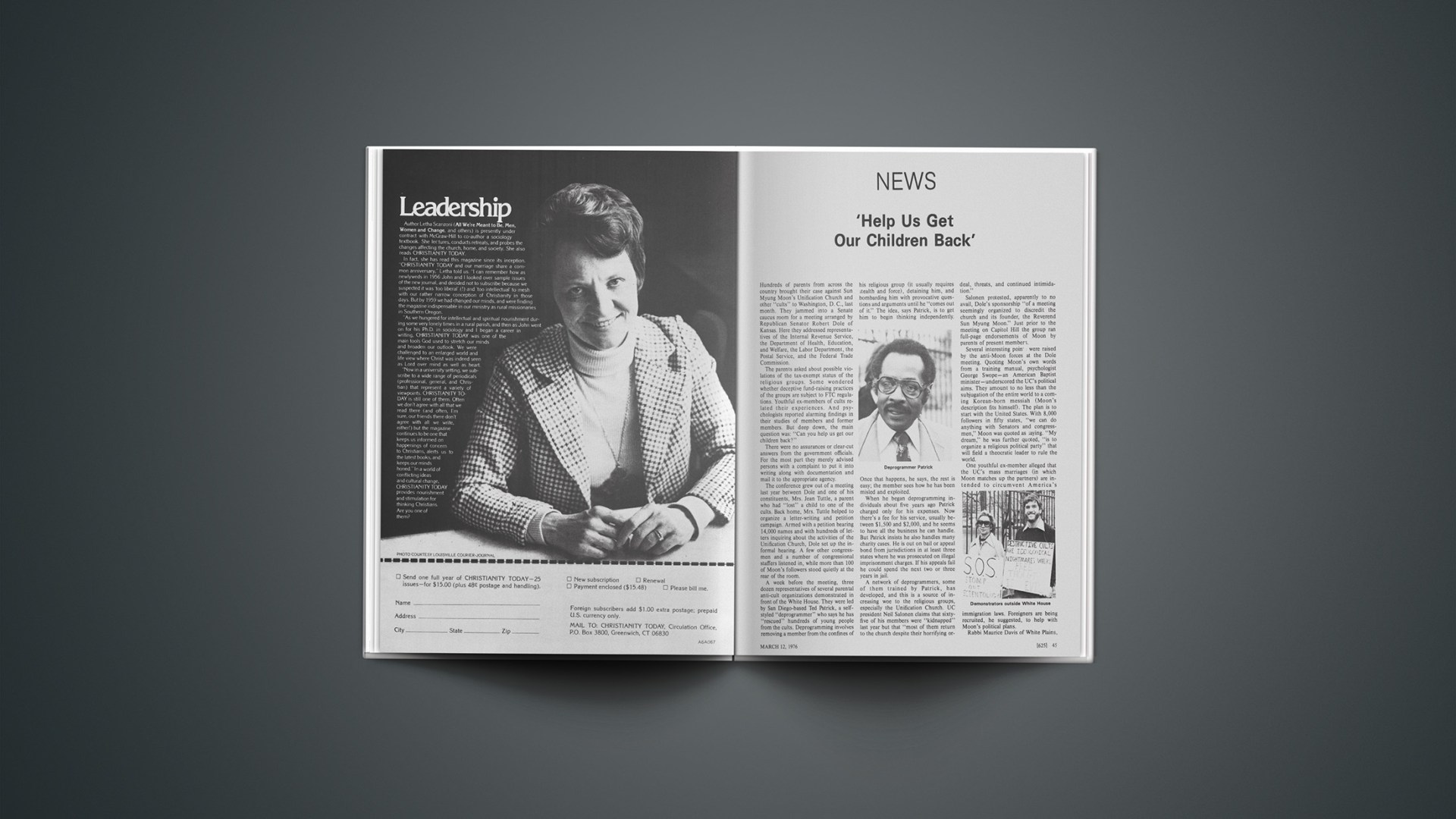
Hundreds of parents from across the country brought their case against Sun Myung Moon’s Unification Church and other “cults” to Washington, D. C., last month. They jammed into a Senate caucus room for a meeting arranged by Republican Senator Robert Dole of Kansas. Here they addressed representatives of the Internal Revenue Service, the Department of Health, Education, and Welfare, the Labor Department, the Postal Service, and the Federal Trade Commission.

The parents asked about possible violations of the tax-exempt status of the religious groups. Some wondered whether deceptive fund-raising practices of the groups are subject to FTC regulations. Youthful ex-members of cults related their experiences. And psychologists reported alarming findings in their studies of members and former members. But deep down, the main question was: “Can you help us get our children back?”

There were no assurances or clear-cut answers from the government officials. For the most part they merely advised persons with a complaint to put it into writing along with documentation and mail it to the appropriate agency.

The conference grew out of a meeting last year between Dole and one of his constituents, Mrs. Jean Tuttle, a parent who had “lost” a child to one of the cults. Back home, Mrs. Tuttle helped to organize a letter-writing and petition campaign. Armed with a petition bearing 14,000 names and with hundreds of letters inquiring about the activities of the Unification Church, Dole set up the informal hearing. A few other congressmen and a number of congressional staffers listened in, while more than 100 of Moon’s followers stood quietly at the rear of the room.

A week before the meeting, three dozen representatives of several parental anti-cult organizations demonstrated in front of the White House. They were led by San Diego-based Ted Patrick, a self-styled “deprogrammer” who says he has “rescued” hundreds of young people from the cults. Deprogramming involves removing a member from the confines of his religious group (it usually requires stealth and force), detaining him, and bombarding him with provocative questions and arguments until he “comes out of it.” The idea, says Patrick, is to get him to begin thinking independently. Once that happens, he says, the rest is easy; the member sees how he has been misled and exploited.

When he began deprogramming individuals about five years ago Patrick charged only for his expenses. Now there’s a fee for his service, usually between $1,500 and $2,000, and he seems to have all the business he can handle. But Patrick insists he also handles many charity cases. He is out on bail or appeal bond from jurisdictions in at least three states where he was prosecuted on illegal imprisonment charges. If his appeals fail he could spend the next two or three years in jail.

A network of deprogrammers, some of them trained by Patrick, has developed, and this is a source of increasing woe to the religious groups, especially the Unification Church. UC president Neil Salonen claims that sixty-five of his members were “kidnapped” last year but that “most of them return to the church despite their horrifying ordeal, threats, and continued intimidation.”

Salonen protested, apparently to no avail, Dole’s sponsorship “of a meeting seemingly organized to discredit the church and its founder, the Reverend Sun Myung Moon.” Just prior to the meeting on Capitol Hill the group ran full-page endorsements of Moon by parents of present members.

Several interesting point were raised by the anti-Moon forces at the Dole meeting. Quoting Moon’s own words from a training manual, psychologist George Swope—an American Baptist minister—underscored the UC’s political aims. They amount to no less than the subjugation of the entire world to a coming Korean-born messiah (Moon’s description fits himself). The plan is to start with the United States. With 8,000 followers in fifty states, “we can do anything with Senators and congressmen,” Moon was quoted as saying. “My dream,” he was further quoted, “is to organize a religious political party” that will field a theocratic leader to rule the world.

One youthful ex-member alleged that the UC’s mass marriages (in which Moon matches up the partners) are intended to circumvent America’s immigration laws. Foreigners are being recruited, he suggested, to help with Moon’s political plans.

Rabbi Maurice Davis of White Plains, New York, who has helped to organize an anti-Moon parents’ group, quoted Moon as recommending that three pretty girls be assigned to each Senator in order to gain political leverage.

Ex-members told how they raised money for Moon’s church, using front names (One World Crusade, for instance) and false stories (the selling of candles, candy, and dried flowers for nonexistent drug programs and nonexistent programs for poor children).

Martha Lewis, a New Hampshire young person who spent nearly three years in the UC said she was taught that two wrongs make a right. Because Satan deceived God’s children, the “Moonies” (as UC members are called by outsiders) are justified in deceiving Satan’s children, a practice known as “heavenly deception.”

Cynthia Slaughter of suburban Dallas said she averaged more than $100 daily in her fundraising activities while a member. Told “to use my fallen nature” to get money, she said she found bars to be especially productive.

Rabbi Davis noted that with only 1,000 members averaging $100 daily, the UC’s take would be $36 million a year. (Moon claims 30,000 followers in the United States, of whom one-fifth are “hard-core.”)

Some parents told Dole they are looking for legislative (reform of tax exemptions and the like) and judicial (extend parental rights) relief to cope with the Moon group. If they don’t get it, they made it clear that deprogramming—which some of them dislike—is all they have left.

Kathryn Kuhlman: Dying To Self

Evangelist Kathryn Kuhlman looked out at her audience at Melodyland Christian Center in Anaheim, California, and said, “Some of you will never know what I’m talking about.” Her eyes glistened and a tear spilled onto her cheek. To have peace with God, she said, one must intentionally “die to self, to all self ambition, until you are only living for Jesus.”

The appeal was part of a brief sermon she preached last August after allegations involving her handling of finances and purported use of hard liquor were aired in the press. The charges were disclosed in connection with a $430,000 lawsuit filed against her by a former business manager (see August 8, 1975, issue, page 35). In her talk, Miss Kuhlman told of her own suffering and anguish in learning to “die to self.”

On February 20 the struggle ended when she died in a Tulsa hospital of a heart ailment. “She just seemed to give up,” commented a close friend.

The lawsuit was settled out of court, and the participants agreed not to comment further on any of the issues surrounding it, but observers close to Miss Kuhlman say that her health suddenly deteriorated about the time the allegations came to the attention of the press and that afterward she was not the same emotionally.

She was hospitalized in Tulsa last summer and in Los Angeles in November and December for what were described as “minor heart flare-ups.” She entered the Hillcrest Medical Center in Tulsa again on December 27 and the next day underwent surgery to replace a heart valve and repair a tendon.

Miss Kuhlman was born about 1913 in the village of Concordia, Missouri. Her father, the mayor, was a Baptist, and her mother was a Methodist. She became a Christian at age 14 during a Methodist revival meeting in town and was baptized in a Baptist church where she retained her official membership for the rest of her life. About two years later she dropped out of high school to become a traveling evangelist. Then she settled down with a storefront congregation in Denver. Within three years she was filling a 2,000-seat sanctuary.

Records show that she was married in 1938 to Texas evangelist Burroughs Waltrip. The ceremony was conducted by a Methodist minister in Mason City, Iowa. Because Waltrip left his wife and family to wed Miss Kuhlman, controversy broke out in the Denver church, and the flock scattered. Not long afterward the marriage dissolved.

In 1946 Miss Kuhlman was preaching in Franklin, Pennsylvania, when she had an experience in which she “surrendered completely to the Holy Spirit.” A healing occurred in the audience, and from then on she centered her ministry on the work of the Holy Spirit.

A dispute erupted in the Franklin church, and Miss Kuhlman moved to Pittsburgh, where in 1947 she rented the municipal Carnegie Auditorium for weekly rallies. These were moved later to First Presbyterian Church.

At the time of her death Miss Kuhlman was seen and heard on about fifty radio stations and sixty television stations. For years she traveled back and forth across the continent with the message of the saving and healing power of God. She was virtually a commuter between rallies in Pittsburgh and Los Angeles.

Many people claimed they were healed as they listened to her preach, and at times Miss Kuhlman had medical authorities on the platform to verify the healings. There were detractors, however. Some skeptics alleged that many of the cures were of self-diagnosed ailments, and one doctor wrote a critical book after studying twenty-five persons whose healings at a 1973 service did not hold up.

Miss Kuhlman herself never guaranteed that a cure would take place. She did suggest specific miracles God was performing at her meetings, and she exhorted the affected individuals to identify themselves. If a healing did occur, she insisted that it was of God alone, not of any power she possessed. She told CHRISTIANITY TODAY in a 1973 interview that her main concern was “the salvation of souls.” Divine healing, she asserted, “is secondary to the transformation of a life.”

Sunday Brunch At Jerry’S Place

The following story is based in part on a report filed by correspondent Watson Spoelstra, a former Detroit sports writer now active in the professional baseball chapel program.

President Ford, describing it as his kind of White House function, came right out and said it: “No more outstanding representation of athletic prowess has ever been in this house before.”

Yet there were no introductions of the scores of Super Bowl personalities, World Series participants, and other athletes and coaches among the 200 guests at a “professional athletes prayer brunch” in the East Room. Instead, eight speakers representing seven sports stood up and told how they had accepted Jesus Christ as Savior and now possessed the power of God in their lives.

President and Mrs. Ford seemed moved by the presentation. “What you said and how you said it,” commented the President, “meant a great deal to all of us. You are special because of your faith in God and your love for him.” Afterward, he and the First Lady gave all the athletes signed copies of the Living Bible.

The brunch was arranged by evangelist Billy Zeoli, head of Gospel Films and a close friend of Ford. Before he became President, Ford—who starred at center on the University of Michigan football team in the early 1930s—teamed up with Zeoli to sponsor a Capitol Hill luncheon for top players and officials following the annual National Prayer Breakfast. The brunch was a souped-up version of the earlier get-togethers.

Upon arrival at the White House, the guests were greeted with orange juice. After some mixing they made their way through a reception line (Ford sometimes introduced sports greats to his wife and without coaching outlined their accomplishments) to a spread of baked ham, grilled tomato stuffed with chicken and mushrooms, asparagus tips, and coconut pie. (Coach Chuck Noll of the Pittsburgh Steelers, Super Bowl champs, sat at the President’s table; losing coach Tom Landry of the Dallas Cowboys sat at Mrs. Ford’s.) Small talk, spiced with plenty of humor, centered on games and sports figures.

Ford said that as a boy he’d always wanted to excell in sports. Even now, he said, he turns to the sports pages before reading the front pages of newspapers, partly because he wants to keep abreast of the sports world and partly because the sports pages have a better chance of being correct. Everybody applauded.

The program was put together by Eddie Waxer, long active in sports chapel work. “Our prayer was that Christ only would be glorified,” he commented afterward. “I feel that occurred.”

Elvin Hayes, the Washington basketball whiz, in the opening prayer thanked the Lord “for the opportunity to honor your name in this place.” Dave Boyer, who lettered in fine arts rather than the brawny kind, sang of love for Jesus and America.

Phillies pitcher Jim Kaat related how he committed his life to Christ many years ago. “Others have found this same peace, purpose, and direction through our chapel program,” he reported. “God’s Spirit is moving in baseball.” When he described a religious fanatic as “someone who knows Jesus better than you do,” the President chuckled along with the others.

Norm Evans, Miami lineman, and Calvin Jones, Denver defensive back, told of spiritual growth in football through chapels and midweek Bible-study groups. “When we say ‘yes’ to God,” said Evans, “we discover blessing far more important than being world champion or all pro.”

Madeline Manning Jackson of Cleveland is not a pro but an Olympic 800-meter gold-medal winner in the last Olympics who will be trying for more this summer at Montreal. “My thing is running for Jesus,” she said simply. “Last year I talked to all Russia on television about the Lord’s goodness.”

The women’s view also came from Janet Lynn Salomon, the ice skating champion from Rockford, Illinois. Other speakers were Dennis Ralston, tennis; Kyle Rote, Jr., soccer; and Rik Massengale, golf. Massengale, who reported on the Tuesday night Bible study on the golf tour, gave his personal testimony and told how he had gone from 127th to twenty-fifth on golf’s money-winning list after accepting Christ. Sports writers Red Smith and Dick Schaap had a field day with that comment.

Elvin Hayes rushed from the White House to outscore Kareem Abdul-Jabbar for the Bullets. And Phil Esposito, the National Hockey League’s greatest scorer until he was shipped to the losing New York Rangers, hurried back to New York and scored two goals and an assist in a 5 to 1 victory over Kansas City.

It was a day for winners.

Deferred Income

The economic crunch of 1974–75, with double-digit inflation and a tight money market, caused the red ink to flow in many U. S. businesses, not the least of them church-related ventures. Money woes hit church retirement and healthcare projects especially hard, forcing more than a few to go under or to totter on the brink of bankruptcy.

Among them is an ailing foundation set up and operated by ministers (and some lay persons) of the Christian Church (Disciples of Christ) in southern California. Financial problems of the Churchman’s Foundation and its five retirement-care facilities are, unfortunately, by no means unique; the story line could be repeated across the country with different names and different faces.

But what left a particularly sour taste in the mouths of many of the 250 persons who invested a total of more than $1 million in unregistered Churchman’s certificate loans was the fact that when a severe cash-flow problem developed, the officers and directors of the foundation seemed “to vanish into the woodwork,” as one disgruntled widow put it.

As pieced together from interviews with a number of the investors (many of them elderly people who had little money to spare but who trusted their church leaders) and directors (who would speak only anonymously), the story went this way:

Last spring, Jean Hosokawa of Pasadena, a teacher who had invested $7,500, asked to withdraw some of her money in order to send her daughter to Disciples-related Chapman College. Her letters requesting withdrawal were not answered. Six weeks later she learned indirectly through her pastor that the foundation was in severe financial trouble. But repeated phone calls to the foundation office elicited no help: an employee gave no information and said officers and directors were unavailable.

At the same time that Mrs. Hosokawa was trying to retrieve her money, the foundation was soliciting church members for new investments, promising an 8.25 per cent return on five-year loans. All the while, the officers and directors knew that several of the Churchman’s facilities were in serious financial jeopardy.

Mrs. Hosokawa, a long-time member of the Christian Church, said she invested savings from eight years of part-time teaching. But at an investors’ meeting last October she learned chances of recovering anything were practically nil, and she “just about crumpled.”

“I feel they shouldn’t have advertised in church papers,” she said. “We felt that if the money wasn’t safe with the church, then it wasn’t safe anywhere.… What really got us was that they couldn’t give us any honest statement of true conditions—there was no response to our letters or calls.”

One director, a top official in the denomination’s regional office, explained that a basic problem had been that a loan for the projected “keystone” project of the foundation, in Las Vegas, fell through. That project was expected to keep afloat the others, which included retirement high-rises, apartments, and an extended-care hospital. Tight money, inflation, and poor management then combined to bring on collapse, he said.

Another director said he quit the board quickly when he learned foundation officers were continuing to accept investment loans in which the proceeds were used for current operations. Not long afterward, however, the foundation did refuse to accept more investment money.

Nobody seemed to know last month what would happen next—if anything. The foundation’s attorney said he had been holding meetings with some former officers, but many have moved away, are without funds, and can’t get to meetings. A seven-person steering committee, headed by clergyman Wilbur Parry of Camile Christian Church in Santa Ana (the church invested about $20,000 in the foundation), was waiting to hear from the federal Securities and Exchange Commission and the state Corporations Commission, to which it turned over data last November. Investigations may take several more months.

And the denomination? There are no plans to step in, declared a highly placed official, “though it’s a great concern to a great many people.” The Southern California-Southern Nevada unit of the church commissioned the directors in 1959, but the foundation corporation is a separate entity. The Christian Church has no legal responsibility for debts of the foundation, its attorney says.

A director, acknowledging that foundation officers had been advised by the attorney not to talk, said the most frustrating thing about the foundation’s misfortunes had been “lack of communication” to investors.

Church involvement doesn’t assure an investor that his money is safe, cautioned Richard Johnson, an investment counselor with the Lee Bernard Company of Pasadena, which specializes in fund-raising for evangelical accounts. “The bottom line on church-related investments is that you’d like to give the organization the money if you could because you’re sold on its work. But an investment implies income, and you’ve got to follow the ‘prudent man rule’: what would the prudent man do with these funds?”

RUSSELL CHANDLER

Bilalian Muslims

Black members of the Nation of Islam (Black Muslims) can now salute the American flag, engage in electoral politics, dress in a more self-styled manner, and even serve as members of the armed forces “to defend the American government against aggressors.”

And what’s more, the once-excommunicated Malcolm X, whose death has sometimes been attributed to Black Muslims, has now been posthumously accepted back into the fold, his holy title “Shabazz” restored, and a temple named after him.

All these changes were officially to be explained at the group’s annual Savior’s Day Convention in Chicago late last month by the new head of the Nation of Islam, the Honorable Wallace Muhammad, son of Elijah Muhammad, who died last March. The convention marks the anniversary of Wallace’s first year at the helm. More than 15,000 attend the conclave each year to celebrate founder W. D. Fard as the “savior.”

“For us to be alive we must be changing and growing,” says Abdul Farrakhan, national spokesman for the Black Muslims. “Unless you are changing and growing you are dead.” Once the rumored rival to accede to the “throne” upon Elijah’s death, Farrakhan has been Wallace Muhammad’s chief representative ever since Wallace himself brought him to the Chicago headquarters office.

In another dramatic move, the mosque Farrakhan once headed in New York’s Harlem—the second largest in the country, preceded only by the Chicago center—has changed its name from Muhammad’s Temple of Islam No. 7 to Malcolm-Shabazz Mosque No. 7. The name change was officially approved by Wallace, signaling that Elijah Muhammad’s name will no longer adorn every temple of the group. Others of the eighty local temples are expected to opt for a name change.

These follow closely two other radical moves taken earlier by the Nation of Islam. Immediately upon taking leadership last year Wallace announced that whites would be welcomed as members (though none reportedly has joined yet). Later he said the preferred term would no longer be Negroes or blacks but “Bilalians.” This new name for Afro-Americans reflects emphasis upon a historical African convert to Islam named Bilal, who later became the “first muzzein” or minister of the Arabian Prophet Muhammad.

The name of the group’s weekly newspaper has also been changed from Muhammad Speaks to Bilalian News.

In other revisions, dress codes for both men and women have been relaxed (women may now wear pants, for example), as have hair-style codes. Members are being urged to register to vote and to enter political office. Plans are for the Nation to produce commercial movies, once a taboo. And jazz is now played in temples before some gatherings.

For the first time, a woman has been designated as a “minister.” She is Sharolyn X, an instructor in the Chicago University of Islam, who holds graduate degrees from Rutgers. Another woman, Fatimah Ali, formerly a professor at Purdue, has been named a regional director. Noted writer Sonia Sanchez (her name has been changed to Laila Mannun) now heads the Office of Human Development, which is producing new textbooks for forty schools sponsored by the Muslims.

In other developments, an Accident and Mishap Committee has been formed to set up food and clothing banks in every major city, a Social Censor Committee has originated to monitor practices of both blacks and whites in leadership roles in the ghettos, and a college scholarship program has been set up.

Theologically, the Nation is also undergoing change. The traditional apocalyptic language no longer is given political or racial implications, and Wallace is moving the group closer to orthodox Islam, at the same time incorporating more Christian terminology into his teachings. The Nation of Islam is now officially designated the “Body-Christ,” for instance. For the first time, the group also last year celebrated its Ramadan (month of fasting) in conjunction with other Islamic groups throughout the country.

All of these changes appear to be paying off in terms of increasing popularity. Since he has taken charge, membership is up 40 per cent (though official totals are still secret), Wallace states. Circulation of the Bilalian News now stands at 950,000 weekly—up 12 per cent.

JAMES S. TINNEY

Decades of Gains and Losses

Third in a Series

Despite a slowdown in initiative and a crumbling of unity in the last ten years, American evangelicalism has nonetheless undergone some noteworthy developments.

World Vision as an international humanitarian agency has gained remarkable favor as an outlet for the growing commitment to social effort combined with Christian witness.

Evangelically oriented seminaries (among them Dallas, Conservative Baptist, Fuller, Gordon-Conwell, Trinity, and Westminster) continue to show record enrollments. Inter-Varsity Christian Fellowship has somewhat come through its financial slump and has significantly expanded its publications programs; its triennial missionary conferences remain vigorous. Campus Crusade continues to enlarge its collegiate evangelistic ministry. The Institute for Advanced Christian Studies has provided over $100,000 to underwrite meritorious research by mature evangelical scholars.

Evangelical scholars continue to work on Bible translation, and the Living Bible paraphrase has gained readers in many circles where more traditional versions seemed linguistically remote. Wycliffe Bible Translators continues to extend the availability of Scripture in developing countries.

Dean M. Kelley observed in Why Conservative Churches are Growing, that despite the secular cultural pressures on American churches, significant growth is taking place particularly in the evangelical wing of Protestantism. Graham evangelistic crusades, while few and somewhat shorter than in earlier years and in some places under some attendance pressure, nonetheless still provide a focus for cooperative evangelism wherever they occur. A staggering number of counseling youths, and church-renewal programs have added depth to local evangelistic follow-up. The church-growth interest nurtured by Fuller Seminary’s Institute of Church Growth gave rise to related books and symposiums (cf. Donald McGavran, Understanding Church Growth, Eerdmans, 1969; McGavran, ed., The Eye of the Storm: The Great Debate in Mission, Word, 1972; Alan R. Tippett, ed., God, Man and Church Growth, Eerdmans, 1973).

The emergence of a literature by evangelicals that criticized the evangelical stance proved not to be an unmitigated liability. Occasional conservative books on social ethics appearing in the mid-sixties (e.g., David Moberg, Inasmuch: Christian Social Responsibility in the Twentieth Century, Eerdmans, 1965, and my own Aspects of Christian Social Ethics, Eerdmans, 1964) touched off a veritable tide of literature in the field. Sherwood Wirt’s The Social Conscience of the Evangelicals (Harper & Row, 1968) and a score of other works appeared in quick succession.

Younger church historians like James A. Hedstrom have assessed the appearance in the late sixties “of very honest and critical analysis of evangelicalism itself, by evangelicals” as a constructively significant sign. Hedstrom notes the call for change, for renewal and reform, that issued from black evangelicals, notably Tom Skinner (Words of Revolution, Zondervan, 1970, and How Black Is the Gospel?, Lippincott, 1970) and the protest of evangelicals against cultural conformity (Robert G. Clouse, Robert D. Linder, and Richard V. Pierard, eds., Protest and Politics: Christianity and Contemporary Affairs, Attic, 1968: Mark Hatfield, Conflict and Conscience, Word, 1971; Carl F. H. Henry, A Plea For Evangelical Demonstration, Baker, 1971; David O. Moberg, The Great Reversal: Evangelism Versus Social Concern, Lippincott, 1972). The growing interest in ethics was crowned finally by the cooperative evangelical effort Baker’s Dictionary of Christian Ethics (Baker, 1971). It led also to the forging by young evangelicals of a notable declaration of social concerns (cf. Ronald J. Sider, ed., The Chicago Declaration, Creation House, 1974). Unprecedented numbers of young evangelical students ventured into social service, law, political science, and other public fields as a Christian vocation.

The call for evangelical renewal precipitated and reflected significant divergencies. Nothing was more needed at the beginning of the seventies than incisive evangelical theological perspective and influential direction to maintain unity in the midst of creative debate. Francis Schaeffer’s L’Abri Fellowship in Switzerland reenlisted some runaway evangelicals for apologetic thrust on neglected cultural frontiers. But divergencies multiplied as comprehensive evangelical leadership was increasingly absent. At critical points—especially in the debate over scriptural authority and socio-political stance—the movement’s institutional spokesmen seemed to lack incisive power.

Billy Graham was the one voice that, in concert with CHRISTIANITY TODAY, could until five years ago have sparked a massive realignment of American evangelicals in a new and larger fellowship embracing the National Association of Evangelicals, many clergy and laymen in ecumenically oriented denominations, and even some loosely committed to the fundamentalist right. But such a move would have aroused denominational resistance to cooperative crusades. Graham’s late father-in-law, L. Nelson Bell, had notably opposed an evangelical realignment by Southern Presbyterians. The North American Presbyterian and Reformed Council is currently emerging as a framework to include the Christian Reformed Church, Orthodox Presbyterian Church, Reformed Presbyterian Church, Evangelical Synod, Reformed Presbyterian Church of North America. (The last named emerged primarily from the Presbyterian Church (Southern).) The time seems now to have passed in America for the emergence of a comprehensive evangelical para-ecumenical movement, if indeed that was ever a desirable development. The charismatic movement, welcomed or tolerated as a potentially potent force for uniting evangelicals across denominational barriers, is now increasingly strained by internal dispute over church authority, tradition, and mission, and by external denominational opposition and theological criticism; Southern Baptists have declared charismatic congregations to be divisive.

Meanwhile, CHRISTIANITY TODAY essayists have been drawn more largely from independent sources than from ecumenically oriented denominations; the fortnightly seems to be putting more and more distance between itself and the call to reexamine the evangelical sociopolitical stance while tightening a commitment to biblical inerrancy as the determinant of evangelical authenticity.

CARL F. H. HENRY

Illusion or Reality?

It was the perfect moment of a perfect sunset hour as our car sped on toward San Francisco’s Golden Gate Bridge. “Look, the part of that structure at the left of the approach really looks as if it were made of gold! The sunset light giving just that effect must have given the Golden Gate its name. What a fantastic sight! An illusion of gold.” Our appreciation of the designing and engineering skill and of the sheer wonder of the effect continued as we drove over the bridge itself.

Then as we gained altitude on the road on the other side and looked back at the city, seemingly hung between sky and bay water, glistening with the light of the setting sun in myriads of windows in tall buildings, it gave the illusion of a golden city as high as it is wide, floating in space. After the evening filming was over, in a nearby town, the drive back brought us to the same spot in moonlight; thousands of twinkling lights caused that city on a hill to give the illusion again of being hung in space among stars and moon, almost a cube, reflected in water, breathtakingly beautiful. Perfection? Dream’s end? Paradise found?

And he carried me away in the spirit to a great and high mountain, and shewed me that great city, the holy Jerusalem, descending out of heaven from God, having the glory of God: and her light was like unto a stone most precious, even like jasper stone, clear as crystal; … and the city lieth foursquare, and the length is as large as the breadth: and he measured the city with the reed, twelve thousand furlongs. The length and the breadth and the height of it are equal. And he measured the wall thereof, an hundred and forty and four cubits, according to the measure of a man, that is, of the angel. And the building of the wall of it was of jasper: and the city was pure gold, like unto clear glass. And the foundations of the wall of the city were garnished with all manner of precious stones [Rev. 21:10, 11, 16–19].

Is this heavenly city a real place? Do you believe our eyes will see it, our hands touch the material it is composed of, our nostrils become filled with the air we can breathe there? What is real?

Jesus says, Let not your heart be troubled: ye believe in God, believe also in me. In my Father’s house are many mansions; if it were not so, I would have told you. I go to prepare a place for you. And if I go and prepare a place for you, I will come again, and receive you unto myself; that where I am, there ye may be also [John 14:1–4].

In Hebrews 11:16 the promise of Jesus to prepare a place is confirmed by a strong statement from God the Father: “But now they desire a better country, that is, an heavenly: wherefore God is not ashamed to be called their God: for he hath prepared for them a city.” God here is telling us that the very real existence of this city, a place we are going to come to know by experience in the future, is one very valid reason why he, God the Creator, can state that he is “not ashamed to be called their God.”

But I saw with my own eyes San Francisco as a golden, glistening city of fairy beauty, floating in space.” Was what I saw with my own eyes real? Was it not painted with sunlight, moonlight, and imagination? What is more trustworthy, our eyes as we watch a magician, our eyes as we “add and subtract” with our own imagination, or God’s clearly stated factual promises? God is trustworthy. God’s Word can be depended upon. He is not ashamed of his promises, and we need never fear that we will later be ashamed of believing him.

Drive into San Francisco now. Hear the sirens screaming as the police answer a call, listen to ambulances with their peculiar shrieks, watch fire engines swerving around corners to get to a fire before it is too late. Remember that this is where the “drug thing” had its beginning. As you are remembering the sixties, look at the porno advertisements hanging out in the streets on today’s buildings. Smog is not only a matter of polluted air that hurts human lungs; there is intellectual, emotional, psychological, and spiritual smog pouring forth in so many mediums in all the cities of the world.

The golden beauty and twinkling lights of San Francisco do not spell perfection—this is paradise lost! Here are lost dreams, agony, depression, ugliness. Here are all the marks of the spoiled creation, spoiled at the time of “the fall.” This golden city has so much that mars or “defiles” it; the golden perfection was only an illusion.

Come back to Revelation 21 now and read the last verse: “And there shall in no wise enter into it anything that defileth, neither whatsoever worketh abomination, or maketh a lie: but they which are written in the Lamb’s book of life.” Nothing is going to mar, spoil, or pollute this city in any way. No person who is not perfect will even be there: only those whose names are written in the Lamb’s book of life will be present. And when are the names recorded? A name is recorded at the same moment that Jesus gives “eternal life” and states that a person will never perish, the moment when that person is born again by accepting the substitutionary work of Christ Jesus.

Listen:

And God shall wipe all tears from their eyes; and there shall be no more death, neither sorrow, nor crying, neither shall there be any more pain: for the former things are passed away. And he that sat upon the throne said, Behold, I make all things new. And he said unto me, Write: for these words are true and faithful [Rev. 21:4, 5].

This is reality. Heaven is a place. There is a city we are going to see and walk in. Neither the place, nor the singing instead of sighing, nor the pleasure instead of pain, is an illusion. We await that which is real.

Are you sitting by the bed of someone struggling for breath in a painful, terminal illness? Have you just had a shattering telegram about a plane crash? Do you have fears about the moment of leaving your body? Has a child of yours died? Do you long for beauty and perfection but fear you will never find it? Has your life been a series of disappointments and depressions? Does the spoiled universe cause you to doubt that God can keep his promises and restore all things?

Remember with Isaiah that God spoke centuries ago to reassure his children:

For the mountains shall depart, and the hills be removed: but my kindness shall not depart from thee, neither shall the covenant of my peace be removed, saith the Lord that hath mercy on thee. O thou afflicted, tossed with tempest, and not comforted, behold, I will lay thy stones with fair colors, and lay thy foundations with sapphires. And I will make thy windows of agates, and thy gates of carbuncles and all thy borders pleasant stones [Isa. 54:10–12].

This hints at the shining, golden, gleaming beauty God is preparing for his children. Enjoy a distant view of San Francisco by sunset, but thank God while you look at it for his city, which will fulfill all his promises of perfection, with no letdown.

EDITH SCHAEFFER

Ideas

Some Things Are Always Wrong

Suddenly a number of people have rediscovered ethics. In recent months Americans have been deluged with information about wrong-doing by people in high places. In the unfolding of events the question of right and wrong has surfaced in a provocative manner.

The Watergate disclosures created waves of disgust, the ripples of which are still with us. Among those who most fervently flogged the offenders were some who in their own actions were also transgressors. They called upon a higher morality only to justify their own actions and to salve their consciences. The hands of the one who stole the Pentagon papers and of those who published them were not that much cleaner than the hands of Nixon, Haldeman, Ehrlichman, and Colson (whose story of repentance and conversion is featured in this issue of CHRISTIANITY TODAY.)

Wrongful corporate contributions to politicians and political campaigns are another category of dark doing that has recently come to light. The executives who made these decisions knew they were breaking the law. But the politicians and their aides who sought and accepted such contributions knew they too were breaking the law. Should we not call to account the receivers as well as the givers? Some of these disclosures occasioned the reference by Ray Garrett, Jr., former chairman of the Securities and Exchange Commission, to “bribery, influence-peddling and corruption on a scale I had never dreamed existed.”

Then the public heard about the corporate bribery by some American businessmen who sell their products overseas. Right now certain Japanese are feeling the heat of the money given them by Lockheed in an effort to increase the sale of its planes to Japan. In the Opinion Research Corporation’s survey among more than five hundred leaders in business, 48 per cent said they thought bribes should be paid to foreign officials if that practice is prevalent in the officials’ country.

Americans have also in recent months been given a taste of corporate, political, and governmental interference in Chile and other nations. Some politicians on Capitol Hill have deliberately breached their own rectitude by leaking documents, tearing down reputations, and drawing conclusions sometimes far removed from documentary evidence. Secretary of State Henry Kissinger recently spoke out against the damage wrought by certain congressional activities. He had in mind the publication by the Village Voice of the still-secret report of the House Select Committee on Intelligence. The Voice publisher stated that the report had fallen on his doorstep; but whatever the circumstances, he printed what he knew was supposed to be a private report.

To turn to the positive side: thousands of businessmen and politicians have never paid bribes to foreigners, given money illegally to political campaigns, or accepted illegal contributions or bribes, and would never do so. And it is good to see that people generally agree that some things are definitely wrong, despite the inroads of situation ethics, endorsed by some who claim to be in the Christian tradition.

The president of the Sperry and Hutchinson Company said recently: “There is no earthly way to defend bribery, kickbacks, or attempts to buy votes.” He was stating what the Judeo-Christian tradition had always affirmed: there are some things that are always wrong. No matter who the person is, what office he holds, or what cause he represents, to lie, cheat, steal, or covet is never right. And for those who confess Christianity to do any of these things is even worse than for those who do not. The Communists pose as ethicists when it suits their purposes to do so. They pretend that what the democracies do is wrong. But they violate every rule they lay down for the conduct of others. Since they neither fear God nor keep his commandments, what they do is understandable even though wrong.

The Rotary “Four-Way Test,” though sometimes scorned as simplistic, is still a useful and reliable guide for evaluating what one proposes to say and do: “Is it the truth? Is it fair to all concerned? Will it build good willand better friendship? Will it be beneficial to all concerned?”

Bad ethics is bad business, bad religion, bad politics Those who know and practice this truth must ever stand as guardians of what is essentially the Christian tradition and call before the bar of human justice and public opinion those who traduce these truths of natural and special revelation.

Where Do Retired Pastors Live?

The cost of a house continues to climb almost everywhere. The experts tell us that a smaller and smaller percentage of households can scrape up enough money for a down payment and earn enough to handle the monthly mortgage payments and upkeep. In many countries the situation is even worse than in the United States and Canada. And as the costs of buying a house go up, so do those of renting.

Especially hard hit by this escalation are pastors who live in parsonages. Some in the congregation may envy their pastor’s rent-free housing, but they need to ask themselves, What happens when he retires? What happens to his wife when he dies? If the average churchgoer has not paid off the mortgage on his home by retirement, he generally has enough equity so that he could sell it and purchase a smaller house or condominium; or he will have received enough income over the years to provide for suitable housing upon retirement.

But the pastor who has always lived in parsonages has no equity upon retirement, nor has he usually had a salary high enough to enable him to save for retirement housing. Moreover, the combination of social security and, one hopes, a pension is likely to be very inadequate. Frankly, we don’t know what retired pastors are doing about housing these days; many may be living with grown children, or are getting by some other way.

The key question is, What is the responsibility of a congregation in today’s economy toward its pastor and his dwelling? In our opinion, in most cases the parsonage should be sold and the pastor be paid enough to enable him to afford the kind of housing that is average for his congregation. (The Internal Revenue Service grants the same benefits for a properly designated housing allowance as part of a salary as it does for a parsonage provided by the congregation.)

In some instances it may simply not be feasible to sell the parsonage; it may be unsaleable or an inseparable part of the church plant. In such cases it would be in order to pay the pastor a higher salary; a better solution would probably be to increase the church’s pension contribution. Non-profit groups may make pension contributions that are tax deferred up to 20 per cent of the employee’s total compensation. Such a pension plan could provide a lump sum upon retirement that could be used for the down payment on a house. It would also have the advantage, unlike many company pensions, of moving with the pastor without diminution wherever he goes.

Clear Away The Cloud

Just before he left office as director of the Central Intelligence Agency, William Colby told reporters that it would be “inappropriate” to order his agents to cease contact with American missionaries. He added that such contacts were very limited.

Just after the new director, George Bush, was sworn in, he declared that the CIA would continue its policy of having no paid informants among American clergymen or missionaries.

What is the difference in the position of the former and the present directors? There is none that we can see. The key word in Mr. Bush’s statement last month seems to be “continue.” He was not announcing anything new. He was affirming publicly that it is the policy of the CIA not to pay ministers or other missionaries from the United States to spy abroad. Mr. Colby had said earlier that there were no missionaries on the payroll.

So, what is the fuss about? The policy reaffirmed by Mr. Bush does not rule out contact by his agents with missionaries who might volunteer information. This still leaves a cloud of suspicion over any ambassador of Christ, whether or not he does cooperate with America’s intelligence community.

Shortly after Mr. Bush announced his position, President Ford went on television to explain a new intelligence oversight plan. Simultaneously, he sent a message to Congress, asking its cooperation in safeguarding the nation’s secrets. The President indicated that he was willing to work with the Senate and the House of Representatives as they reconsider their oversight responsibilities.

At first glance, these pronouncements from the executive branch of government seemed a movement in the constructive direction requested by many missionary agencies (See January 2 issue, page 23). Upon examination, however, they indicate no real change. Thus, missionaries still need some authoritative word from Washington that they are “off limits” to the CIA.

Since that assurance has not come from the executive branch, it is time for Congress to act. The President has said he wants to cooperate with the legislative branch. One Congressional attempt is the bill introduced by Senator Mark Hatfield. Both houses of Congress should get to work soon on this proposal or a similar one, and we hope the President will assist in its enactment.

Meanwhile, missionaries must be alert to any attempts to compromise their position as ambassadors of Christ and not representatives of foreign governments. Churches at home should support them as they follow the dictates of their consciences in this matter. Some who are genuinely concerned about developments in their area may be led to share the information. For the good of the mission enterprise, they should not share this with the intelligence community. Until the current questions are cleared up in Washington, all American missionary personnel abroad could be adversely affected by what any one of them does.

Counterpressure On Their Peers

Peer pressure on teenagers is a powerful force. Today Christian young people face degrees of pressure that would have been unimaginable in their parents’ youth.

Some of the most difficult challenges are those to join the crowd in the consumption of tobacco, alcohol, and marijuana. Promoters of these products are now publicizing scientific claims of various beneficial effects, and young non-consumers do not know how to respond. The research on potential harm or good is not yet complete, but one incontrovertible statistic has been fully established: the number of teenagers who use these products is increasing rapidly.

Led by girls, the number of cigarette smokers in their teens continues to rise. The number of teenage alcoholics keeps going up. Larger percentages of young people try (and continue to use) marijuana each year.

One day last month, an ounce of a preferred strain of marijuana cost more on the streets of New York than did an ounce of gold on the London market. Despite the inflated prices, acceptance continues to grow. Maybe Christian youth and their advisers can find a clue in this inflation. What about the stewardship involved?

The Christian’s obvious answer to the question of whether to consume any of these harmful drugs is that his body is the temple of the Holy Spirit, and that he is accountable for its stewardship. To answer peers, the young Christian could also point to the costliness of the products themselves.

Whether Christian or not, most young people today claim a social consciousness. Injustice, poverty, and war stir them to demonstrate. This concern for the cause of the less fortunate should lead them to question the propriety of spending their money on these expensive luxuries. Can they justify the cost of a daily pack of cigarettes when that money could keep starving children alive? Can they justify the cost of regular drinking when that amount could provide simple shelter to a destitute family in a disaster area? Can they justify the exorbitant expense of the marijuana habit when those funds could buy medical care for many who are dying? Christian young people can put such counterpressure on their peers, and in the process ease their strain.

The Word In Washington

America’s evangelical community put on an impressive show of strength in Washington last month. Several thousand of its most influential clergymen and laymen turned out for the first joint convention of the National Association of Evangelicals and the National Religious Broadcasters. A patriotic spirit characterized the four-day bicentennial meeting, but while most participants were respectful and appreciative of their nation’s heritage they also expressed a wide variety of concerns about its moral direction and its lingering injustices.

President Ford addressed the opening session, which suggests that evangelical political potential is now being recognized at the highest echelons of government. That potential had been significantly underscored by the precedent-shattering total of more than three million letters received by the Federal Communications Commission opposing a petition, since denied, to freeze broadcasting permits for certain religious organizations.

NAE delegates pledged to “commit ourselves to participate in every lawful and morally right function of human government and oppose with all our determination whatever is unlawful and morally wrong. While we work, we wait for the return of him whose right it is to reign, whose kingdom shall abide throughout eternity.”

(A comprehensive news report on the NAE-NRB convention will appear in the next issue of CHRISTIANITY TODAY.)

Simeon: Filled, Taught, Led

The name of Simeon appears in the New Testament in the account of the presentation of the infant Jesus in the Temple (see Luke 2:22 ff.). He is in a sense an unknown; we are not told his work, his age, his tribe, or whether he was a layman, a scribe, a Pharisee, or a Sadducee. But this much we do know: he was a man of God and a prototype of the kind of person each of us ought to be.

Luke tells us three things about Simeon that throw light on his life. First, “the Holy Spirit was upon him.” The full meaning of this we do not know. But we do know Simeon had something that not everyone possessed. Scripture says elsewhere that John the Baptist would “be filled with the Holy Spirit, even from his mother’s womb.” We can conclude that Simeon was in some similar fashion filled by the Spirit.

Second, Simeon was taught by the Spirit. In this instance it was more than illumination of what already existing Scripture meant. It was some kind of direct revelation that would not have come to one who was not under the lordship of the Spirit: “it had been revealed to him by the Holy Spirit that he should not see death before he had seen the Lord’s Christ.”

Third, he was led by the Spirit. The account says that “inspired by the Spirit he came into the temple” at the time Mary and Joseph brought Jesus for the presentation. Had he been late he would have missed this event. But led by the Spirit he was there at God’s appointed time.

The words Simeon spoke as he held the infant Son of God in his arms are beautiful, for they express the heartbeat of the loving Father who wants everyone to be saved: “Mine eyes have seen thy salvation.” Simeon was a true believer, a saved man. “A light for revelation to the Gentiles, and for glory to thy people Israel.” What a large vision! God is not the God of Israel alone. He is also the one who loves the Gentiles and sent them, too, the light of the world, Jesus.

What God could do through this unknown personage he can do through us, too—if we are filled, taught, and led by his Spirit.

Choice Evangelical Books: 1975

Elsewhere in this special issue we have mentioned numerous books written from a variety of religious stances on topics related to the Bible and theology Here we call special attention to a few books, both for reference and for general reading, that are aimed at all Christians who take their faith seriously, not just scholars or professional ministers. Books from areas such as practical theology are included even though they were not in the scope of the preceding surveys. Also, the titles we commend here are written from a more or less orthodox Christian perspective, a kind of book often sadly underrepresented in public and academic libraries.

By far the most significant reference sets by evangelicals to appear last year are the five-volume Zondervan Pictorial Encyclopedia of the Bible edited by Merrill Tenney (Zondervan) and the two-volume Wycliffe Bible Encyclopedia edited by Charles Pfeiffer, Howard Vos, and John Rea (Moody). One or the other should be in every school and public library and in the personal libraries of Christian workers and theological students.

We also specially commend the publishers for finally completing (except for the index volume), after some twenty years, a fifty-four-volume set of Luther’s Works: American Edition (Concordia and Fortress). Although Luther is to be tested according to the same Word of God to which he sought to be faithful, many of his insights remain of crucial value to the whole Church. Reading him can be more profitable than trying to keep up with the latest theological fads spawned in his homeland.

Besides these three multi-volume sets, there are seven single-volume works to which we wish to call attention. They are major overviews of important subjects and will serve for reference or reading or both. So Many Versions? by Sakae Kubo and Walter Specht (Zondervan) is of immense help for understanding the seemingly endless stream of English Bible translations. Paul: An Outline of His Theology by Herman Ridderbos (Eerdmans) is likely to be a standard work. Lutheran Cyclopedia edited by Erwin Lueker (Concordia) is a dictionary of general church history rather than the history of only the sponsoring denomination. The Evangelicals edited by David Wells and John Woodbridge (Abingdon) is a good though incomplete beginning at group self-understanding. Toward a Biblical View of Civil Government by Robert Duncan Culver (Moody) is a thorough exegetical study with particular foundational value at a time when numerous books for the times are appearing. Note that Culver claims merely to write toward a biblical view; in this he offers welcome contrast to the propagandists who imply that they have arrived. A Theology of Christian Education by Lawrence Richards (Zondervan) and Childhood Education in the Church edited by Roy Zuck and Robert Clark (Moody) are major contributions to practical theology.

In addition to the above ten titles for reference or comprehensive study, we also note (alphabetically by author) ten books that are more limited in scope, often advocating particular viewpoints. They deserve consideration even when they do not compel wholehearted acceptance. Almost all treat some aspects of the relations between God and man and among men in the context of the pressures and challenges of contemporary life. The New Demons by Jacques Ellul (Seabury) looks at the new forms of false religion characterizing a supposedly secular world. Angels: God’s Secret Agents by Billy Graham (Doubleday) is both a runaway bestseller and a competent presentation of the biblical data. Would that were true of more books! In Picking Up the Pieces (Eerdmans) W. Fred Graham is, like Ellul, concerned with Christian witness amid a strangely religious secularity.

The Unraveling of America by Stephen Monsma (InterVarsity) presents a Christian approach to government. Jesus by Malcolm Muggeridge (Harper & Row) is a well-illustrated presentation of the Saviour by a fairly recent convert. I Pledge You My Troth by James Olthius (Harper & Row) offers a fresh look at family and friends. Faith, Psychology and Christian Maturity by Millard Sall (Zondervan) seeks to reconcile what many consider opposites. What Is a Family? by Edith Schaeffer (Revell) is a very practical guide to improving parent-child ties. The Problem of Wineskins: Church Structure in a Technological Age by Howard Snyder (InterVarsity) is a creative contribution to church renewal discussion. Testament From Prison by Soviet evangelical leader Georgi Vins (David C. Cook) reminds us both of the persecution that can come to any Christian and of the corresponding provision of God’s power to stand firm.

Finally, we call attention to last year’s additions to three established series: Holy Scripture in G. C. Berkouwer’s massive Studies in Dogmatics (Eerdmans) is not without weaknesses but cannot be ignored; C. E. B. Cranfield has revived the multi-author International Critical Commentary with a masterly volume on the first eight chapters of The Epistle to the Romans (T. & T. Clark); and William Hendricksen’s volume on Mark continues his highly valued one-man New Testament Commentary (Baker).

Apple PodcastsDown ArrowDown ArrowDown Arrowarrow_left_altLeft ArrowLeft ArrowRight ArrowRight ArrowRight Arrowarrow_up_altUp ArrowUp ArrowAvailable at Amazoncaret-downCloseCloseEmailEmailExpandExpandExternalExternalFacebookfacebook-squareGiftGiftGooglegoogleGoogle KeephamburgerInstagraminstagram-squareLinkLinklinkedin-squareListenListenListenChristianity TodayCT Creative Studio Logologo_orgMegaphoneMenuMenupausePinterestPlayPlayPocketPodcastRSSRSSSaveSaveSaveSearchSearchsearchSpotifyStitcherTelegramTable of ContentsTable of Contentstwitter-squareWhatsAppXYouTubeYouTube