Eutychus and His Kin: March 12, 1976

The Acts Of The Church

According to radio commentator Paul Harvey, a problem arose in Milwaukee recently. The association of tavern owners was upset with the Roman Catholic Church. The church was hurting their business, they said.

It wasn’t that revival had struck Milwaukee and that all loyal beer drinkers had abandoned the bar for baptism. The problem was more direct than that. The church was attempting to get a hard liquor permit for New Year’s Eve and the bartenders were upset.

It was bad enough that the church could serve beer at bingo, they contended, but now the Catholics were going all the way and the tavern owners felt they couldn’t compete. After all, whose side would God be on anyhow?

But if the Catholic church is competing head to head (or mouth to mouth) with the tavern owners in Milwaukee, then the conservative Protestant church is competing claw to claw and jaw to jaw with the circus in America. All you have to do is look at almost any major metropolitan area church page.

How can any law-abiding, conscientious circus promoter compete with “Ronald McDonald in person at First Baptist’s Sunday School,” or Fred Heyerbrund, Christian skydiver, parachuting to earth in a chute that reads, “Jesus Saves. Yes, even you.” And all the while Fred is floating “into church property from 5,000 feet,” he speaks to the crowd in the parking lot via two-way radio.

And Ronald and Fred aren’t the only acts at the church. We now have gospel magicians, talking birds, Christian karate experts, and strong men who speak. We have pastors who swallow goldfish, preach from the roof if over 600 attend the service, and generally make animals of themselves.

If the tavern owners can complain to the City Council of Milwaukee, then Ringling Brothers and Barnum and Bailey ought to complain to pastors across the continent. But there’s a bright side to the picture. If the church keeps perfecting its act, it can soon move to circus life all together and quit messing around with the gospel. After all, what can the gospel compete with?

EUTYCHUS VII

Who And Where

In a recent essay (Footnotes, Jan. 16) Dr. Carl Henry made reference to the volume we edited entitled The Evangelicals: What They Believe, Who They Are, Where They Are Changing. He wished to know who among the authors defined what “authentic Christianity” is. The answer is that the editors did (pp. 18–19), Dr. Kantzer did (pp. 38–67), Dr. Gerstner did (pp. 21–37), and Dr. Ahlstrom (pp 270, 271) and Dr. Williams (pp. 211–48) reinforced their definitional work.

JOHN D. WOODBRIDGE

DAVID E WELLS

Trinity Evangelical Divinity School

Deerfield, Ill.

Provoking Redefinition

Thank you for your thought-provoking issue, “The Church in Black and White” (Jan. 30). I found the article “Down With the Honky Christ—Up With the Funky Jesus” particularly stimulating. The phrase “personal salvation and little beyond that” occupied my attention for more than an hour.

We hear much today from evangelicals concerned with social issues to the effect that personal salvation is an inadequate solution to the problem of sin—particularly collective, institutionalized, social sin. Perhaps we need to redefine “personal salvation.”

If by personal salvation is meant the passive acceptance of an alleged change in one’s standing before God upon condition of a supposed sterile “faith” that does not necessarily produce a moral rebirth in the life … then it could be truthfully said that “personal salvation” is ineffective.… But if by personal salvation is meant the active experience of the grace of God that brings salvation … and that is accompanied by the personal moral revolution that Jesus said consists in supreme love for God and equal love for our neighbor … then it can be truthfully said that “personal salvation” is the basic solution for everything human.

J.W. JEPSON

First Assembly of God Church

McMinnville, Oreg.

The January 30 issue of your magazine opened a door and let fresh air into what had become a stuffy room. If you would like to send sample copies to the seniors at George Fox College … this is the issue to send.

ARTHUR O. ROBERTS

Professor of Religion

George Fox College and Philosophy

Newberg, Oreg.

It should not surprise Mr. Hilliard that central in the preaching of the “honkey gospel” is the cross on which Christ died. This cross, not the ones Christ carried before, was central in the writings of Paul (1 Cor. 1:18; Gal. 6:14). It is the message of this cross that is an “offense” to unbelieving man (Gal. 5:11), not the ones Christ carried “before He shouldered the last one,” nor “the crosses he expects us to lift.”

Mr. Hilliard seems to be calling the white middle-class church to deliver the Gospel from its social and cultural accretions, since “the call of the gospel is to join the black nigger Jesus at the very bottom of the social order.” I am wondering if Hilliard would interpret this literally or in a “spiritual” sense. It would seem that he means this “move to the bottom of the social order” in a literal way. If this is the case, do we not end up with a Christ who is still locked into a certain cultural and social level as much as He supposedly is in the “honkey gospel”? Putting Hilliard’s statements into a cross-cultural context, would he tell a Brahman that he must become a low caste person in order to become a Christian? Does not Christ rather both identify with and transcend every culture? Hilliard seems to have merely moved Christ from one social level to another and in the process lost sight of Him as the Son of Man who meets all men where they are. DR. JOHN GRATION Wheaton Graduate School Wheaton, Ill.

ERRATUM

In the article “Committing Seminaries To the Word” by Carl F. H. Henry (Feb. 13) the three lines above the featured quote on p. 8 should read: … earnestness tend to be committed mainly to relativism. Scripture speaks of those who are “ever learning, and never able to come to the knowledge of truth”.…
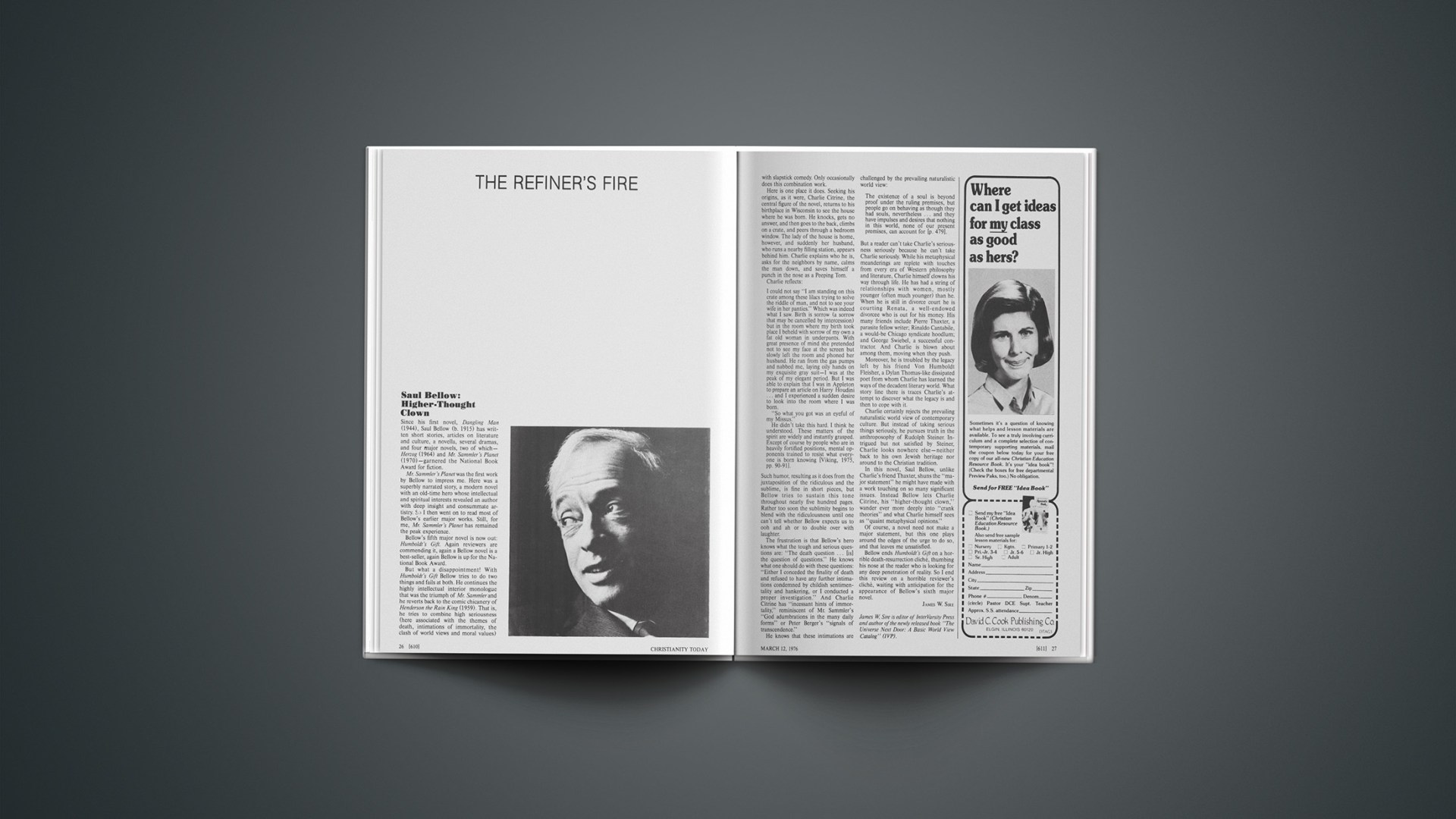
Saul Bellow

Saul Bellow: Higher-Thought Clown

Since his first novel, Dangling Man (1944), Saul Bellow (b. 1915) has written short stories, articles on literature and culture, a novella, several dramas, and four major novels, two of which—Herzog (1964) and Mr. Sammler’s Planet (1970)—garnered the National Book Award for fiction.

Mr. Sammler’s Planet was the first work by Bellow to impress me. Here was a superbly narrated story, a modern novel with an old-time hero whose intellectual and spiritual interests revealed an author with deep insight and consummate artistry. So I then went on to read most of Bellow’s earlier major works. Still, for me, Mr. Sammler’s Planet has remained the peak experience.

Bellow’s fifth major novel is now out: Humboldt’s Gift. Again reviewers are commending it, again a Bellow novel is a best-seller, again Bellow is up for the National Book Award.

But what a disappointment! With Humboldt’s Gift Bellow tries to do two things and fails at both. He continues the highly intellectual interior monologue that was the triumph of Mr. Sammler and he reverts back to the comic chicanery of Henderson the Rain King (1959). That is, he tries to combine high seriousness (here associated with the themes of death, intimations of immortality, the clash of world views and moral values) with slapstick comedy. Only occasionally does this combination work.

Here is one place it does. Seeking his origins, as it were, Charlie Citrine, the central figure of the novel, returns to his birthplace in Wisconsin to see the house where he was born. He knocks, gets no answer, and then goes to the back, climbs on a crate, and peers through a bedroom window. The lady of the house is home, however, and suddenly her husband, who runs a nearby filling station, appears behind him. Charlie explains who he is, asks for the neighbors by name, calms the man down, and saves himself a punch in the nose as a Peeping Tom.

Charlie reflects:

I could not say “I am standing on this crate among these lilacs trying to solve the riddle of man, and not to see your wife in her panties.” Which was indeed what I saw. Birth is sorrow (a sorrow that may be cancelled by intercession) but in the room where my birth took place I beheld with sorrow of my own a fat old woman in underpants. With great presence of mind she pretended not to see my face at the screen but slowly left the room and phoned her husband. He ran from the gas pumps and nabbed me, laying oily hands on my exquisite gray suit—I was at the peak of my elegant period. But I was able to explain that I was in Appleton to prepare an article on Harry Houdini … and I experienced a sudden desire to look into the room where I was born.

“So what you got was an eyeful of my Missus.”

He didn’t take this hard. I think he understood. These matters of the spirit are widely and instantly grasped. Except of course by people who are in heavily fortified positions, mental opponents trained to resist what everyone is born knowing [Viking, 1975, pp. 90–91].

Such humor, resulting as it does from the juxtaposition of the ridiculous and the sublime, is fine in short pieces, but Bellow tries to sustain this tone throughout nearly five hundred pages. Rather too soon the sublimity begins to blend with the ridiculousness until one can’t tell whether Bellow expects us to ooh and ah or to double over with laughter.

The frustration is that Bellow’s hero knows what the tough and serious questions are: “The death question … [is] the question of questions.” He knows what one should do with these questions: “Either I conceded the finality of death and refused to have any further intimations condemned by childish sentimentality and hankering, or I conducted a proper investigation.” And Charlie Citrine has “incessant hints of immortality,” reminiscent of Mr. Sammler’s “God adumbrations in the many daily forms” or Peter Berger’s “signals of transcendence.”

He knows that these intimations are challenged by the prevailing naturalistic world view:

The existence of a soul is beyond proof under the ruling premises, but people go on behaving as though they had souls, nevertheless … and they have impulses and desires that nothing in this world, none of our present premises, can account for [p. 479].

But a reader can’t take Charlie’s seriousness seriously because he can’t take Charlie seriously. While his metaphysical meanderings are replete with touches from every era of Western philosophy and literature, Charlie himself clowns his way through life. He has had a string of relationships with women, mostly younger (often much younger) than he. When he is still in divorce court he is courting Renata, a well-endowed divorcee who is out for his money. His many friends include Pierre Thaxter, a parasite fellow writer; Rinaldo Cantabile, a would-be Chicago syndicate hoodlum; and George Swiebel, a successful contractor. And Charlie is blown about among them, moving when they push.

Moreover, he is troubled by the legacy left by his friend Von Humboldt Fleisher, a Dylan Thomas-like dissipated poet from whom Charlie has learned the ways of the decadent literary world. What story line there is traces Charlie’s attempt to discover what the legacy is and then to cope with it.

Charlie certainly rejects the prevailing naturalistic world view of contemporary culture. But instead of taking serious things seriously, he pursues truth in the anthroposophy of Rudolph Steiner. Intrigued but not satisfied by Steiner, Charlie looks nowhere else—neither back to his own Jewish heritage nor around to the Christian tradition.

In this novel, Saul Bellow, unlike Charlie’s friend Thaxter, shuns the “major statement” he might have made with a work touching on so many significant issues. Instead Bellow lets Charlie Citrine, his “higher-thought clown,” wander ever more deeply into “crank theories” and what Charlie himself sees as “quaint metaphysical opinions.”

Of course, a novel need not make a major statement, but this one plays around the edges of the urge to do so, and that leaves me unsatisfied.

Bellow ends Humboldt’s Gift on a horrible death-resurrection cliche, thumbing his nose at the reader who is looking for any deep penetration of reality. So I end this review on a horrible reviewer’s cliche, waiting with anticipation for the appearance of Bellow’s sixth major novel.

JAMES W. SIRE

James W. Sire is editor of InterVarsity Press and author of the newly released book “The Universe Next Door: A Basic World View Catalog” (IVP).

Theology

Theology

DOCTRINE Relatively few books of 1975 sought to present systematically one or more of the doctrines revealed by God in Scripture. Systematics by F. Leroy Forlines (Randall House) expounds on God, man, and salvation. The author teaches at Free Will Baptist Bible College. Retired Baptist pastor Herschel Hobbs presents in brief, alphabetical entries A Layman’s Handbook of Christian Doctrine (Broadman), an admirable work. Truths That Transform by noted Presbyterian pastor D. James Kennedy (Revell) focuses on salvation.

Two notable reprints were Fundamentals of the Faith edited by Carl F. H. Henry (Baker), thirteen essays that first appeared in CHRISTIANITY TODAY in the mid-sixties, and The Protestant Faith by George Forell (Fortress), first issued in 1960. In his new preface, Forell, a professor at the University of Iowa School of Religion, tells us, “I have ignored the so-called radical developments in theology since 1960 because they appear to be as evanescent as the pop songs of yesterday.”

Although it properly belongs in the area of biblical theology, handled elsewhere in this issue, Paul: An Outline of His Theology by Herman Ridderbos (Eerdmans) deserves notice here as well. It is an outstanding work. Much more popularly aimed presentations are What Did Jesus Say About That? by Stanley Baldwin (Victor) and Mystery Doctrines of the New Testament by T. Ernest Wilson (Loizeaux).

Three of the twelve essays in The Evangelicals edited by David Wells and John Woodbridge (Abingdon) deal with evangelical theology. Excerpts from the numerous writings of two prominent evangelicals are arranged topically in Blow, Wind of God! Spirited Messages From the Writings of Billy Graham (Baker) and The Meditations of Elton Trueblood (Harper & Row).

A rather large number of books appeared treating the range of Christian doctrine from one or another Roman Catholic perspective. (There is no longer One Catholic stance, if indeed there ever really was.) Encyclopedia of Theology edited by Karl Rahner (Seabury) is a massive reference work for those who do not have access to the six-volume Sacramentum Mundi of which it is an abridgment. An American Catholic Catechism edited by George Dyer (Seabury) and The Catholic Catechism by John Hardon (Doubleday) are major attempts to restate doctrine in the wake of Vatican II. Although not in catechetical format, several books are concerned with explaining Catholic teaching to (probably confused) laymen: Positioning: Belief in the Mid-Seventies by William Bausch (Fies), An Introduction to the Faith of Catholics by Richard Chilson (Paulist), Searching For Sense: The Logic of Catholic Belief by Frank De Siano (Paulist), and Focus on Doctrine by James Gaffney (Paulist).

The widely publicized Common Cathechism edited by Johannes Feiner and Lukas Vischer (Seabury) is a joint Catholic-Protestant effort and covers the whole range of doctrine, including areas of dispute. However, lay persons, to whom it is addressed, will be sorely misled if they think it represents anything close to orthodox Catholic or Protestant doctrine.

SCRIPTURE By far the most noteworthy book in this area is Holy Scripture by G. C. Berkouwer (Eerdmans), the thirteenth volume to appear in his Studies in Dogmatics series. No Final Conflict: The Bible Without Error in all That It Affirms by Francis Schaeffer (InterVarsity) brings together four brief studies of the subject. More Evidence That Demands a Verdict by Josh McDowell (Campus Crusade), a sequel to his bestseller, presents competent evangelical rebuttals to the documentary hypothesis of the Pentateuch and form criticism of the Gospels.

A very important kind of study is The Uses of Scripture in Recent Theology by David Kelsey (Fortress). Case studies of the way scriptural authority was invoked by seven theologians, including Barth, Bultmann, and Warfield, show that there was no common concept of “Scripture” or of “authority.” More of this kind of inductive study of what is done, not just what is claimed, can be profitably undertaken over a wide range of topics on which Christians disagree. In this same area the widely known religious writer William Barclay asks By What Authority? (Judson).

ANGELS Of the large number of works dealing with holy and wicked spirit beings we mention three: Angels: God’s Secret Agents by Billy Graham (Doubleday), Angels, Elect and Evil by C. Fred Dickason (Moody), and The Real Satan by James Kallas (Augsburg).

CHRIST AND SALVATION Limited atonement—the view that Christ died only for Christians rather than for all—is one of the key distinctives of the Calvinist theology that has long been a major force within evangelicalism and is currently receiving renewed emphasis, especially through conferences and book reprints. In defense of the view that Christ died for all Clark Pinnock has gathered thirteen essays under the title Grace Unlimited (Bethany Fellowship). Some of the contributors part from Calvin chiefly on this point; others disagree on other matters such as the perseverance of the saints. A brief defense of the latter point is Once Saved, Always Saved by Perry Lassiter (Broadman). A major challenge to this doctrine is posed in a comprehensive exegetical study by I. Howard Marshall, Kept By the Power of God: A Study of Perseverance and Falling Away (Bethany Fellowship).

Other books in this area that appeared last year were chiefly popular presentations of common evangelical teaching. Among them are Studies in the Person and Work of Jesus Christ and Regeneration and Conversion, both by W. E. Best (Baker), The Word Made Flesh by John Bisagno (Word), A Day That Changed the World by Gordon Bridger (InterVarsity), Yes, Virginia, There Is a Hell by Harold Bryson (Broadman), Free For the Taking: The Life-changing Power of Grace by Joseph Cooke (Revell), He Has Come! Messages Proclaiming the Birth of Christ edited by W. Glyn Evans (Broadman), The Messianic Hope: A Divine Solution for the Human Problem by Arthur Kac (Baker), I Believe in the Resurrection of Jesus by George Eldon Ladd (Eerdmans), and Jesus: The Man Who Lives by Malcolm Muggeridge (Harper & Row).

More technical and controversial is Sacrifice and the Death of Christ by Frances Young (London: SPCK).

THE HOLY SPIRIT Books on the Spirit pour forth in a seemingly endless stream; they are rivaled in number only by those on the return of Christ. By far the most significant to appear last year is a major work of scholarship, Jesus and the Spirit: A Study of the Religious and Charismatic Experience of Jesus andthe First Christians as Reflected in the New Testament by James Dunn (Westminster). Noteworthy popular titles include: Speaking in Tongues: Seven Crucial Questions by Joseph Dillow (Zondervan), The Person and Work of the Holy Spirit in the Life of the Believer by George Duncan (John Knox), Help! I Believe in Tongues by K. Neill Foster (Bethany Fellowship), I Believe in the Holy Spirit by Michael Green (Eerdmans), and Touched by the Spirit by Richard Jensen (Augsburg). I prefer not to say which authors are for “tongues” and which are against; on this kind of controversy among Bible-believers it is best to read books that take a variety of positions.

Two other books not only are on the Spirit but theologize on behalf of the emerging groups within Christianity that lay special claim to charismatic enduement. A New Pentecost? (Seabury) is by Leon Joseph Cardinal Suenens, the best-known Catholic charismatic. The Spirit and the World (Hawthorn) is by James W Jones, a charismatic Episcopal minister who teaches in a state university religion department.

THE CHURCH The numerous practical studies of congregations and how to improve them usually have some exegetical basis even though that is not the emphasis. Three that are primarily practical but whose authors seek repeatedly to tie their contents to Scripture are Life in His Body by Gary Inrig (Harold Shaw), The Growing Local Church by Donald MacNair (Baker), and The Problem of Wineskins: Church Structure in a Technological Age by Howard Snyder (InterVarsity). The authors are from three distinct denominational traditions. It might interest the vast majority of our readers who are not in the widely publicized maxi-congregations to know that none of these authors is, either.

THE RETURN OF CHRIST If you want to read only one of the numerous books that appeared last year on the second coming of Christ and related events, make it When Is Jesus Coming Again? (Creation House), which contains six brief essays by writers with differing understandings of the relevant Scriptures, such as Hal Lindsey, Robert Gundry, and J. Barton Payne. As a bonus there is an annotated bibliography of scores of books for those of a mind to read more on the subject. The views represented in the Scofield Reference Bible and The Late Great Planet Earth are conveyed in Jesus the King Is Coming edited by Charles Feinberg (Moody), which contains messages given at a 1973 congress on prophecy, Biography of a Great Planet by Stanley Ellisen (Tyndale), which covers Bible prophecy in general, and Next Year in Jerusalem by Walter Price (Moody), which is not a prediction but a study of the relation of the State of Israel to Messiah’s return.

Views different from the above on such matters as the Church during the Tribulation and the meaning of the Millennium are presented in The Approaching Advent of Christ by Alexander Reese (Kregel), which is a reprint of an often cited 1937 book, The Tribulation People by Arthur Katterjohn (Creation House), The Incredible Cover-Up: The True Story of the Pre-Trib Rapture by Dave MacPherson (Logos), which attempts to refute the view by tracing historical roots rather than countering the exegetical arguments by which the view is defended, What, Where, and When Is the Millennium? by R. Bradley Jones (Baker), and Waiting For His Coming by Lewis Neilson (Mack Publishing).

Meanwhile, a well-known pastor and writer on prophecy, W. A. Criswell, wisely tells us What to Do Until Jesus Comes Back (Broadman).

APOLOGETICS Defenses of more or less traditional Christian doctrine in the face of contemporary (as well as perennial) challenges, aimed at the general reader rather than the theological specialist, include The Battle For Your Faith by Willard Aldrich (Multnomah), God, I Don’t Understand by Kenneth Boa (Victor), Christianity on Trial by Colin Chapman (Tyndale), The Untamed God by George Cornell (Harper & Row), How Can I Find You, God? by Marjorie Holmes (Doubleday), Fallacies of Unbelief by Arlie Hoover (Biblical Research Press), The Law and Essence of Love by Philip Ney (Pioneer Publishing [1900 Richmond Ave., Victoria, B.C., Canada]), The Gospel in a Pagan Society by Kenneth Prior (InterVarsity), and Man in the Maelstrom of Modern Thought by Douglas Vickers (Presbyterian and Reformed). Chapman, a minister in Egypt, and Ney, a psychiatrist, are the most comprehensive. Prior offers very worthwhile reflections on today’s scene in the light of Paul’s address on Mars Hill.

Especially valuable are three serious but not technical defenses of Christianity over against the challenges of modern secularism and ancient, revived paganism. They deal not so much with specific objections to doctrines as with the overall climate. They are The New Demons by Jacques Ellul (Seabury), Picking Up the Pieces by W. Fred Graham (Eerdmans), and Our Savage God: The Perverse Use of Eastern Thought by R. C. Zaehner (Sheed and Ward).

Two notable technical works on the classical arguments for the existence of God in which the arguments emerge somewhat better than has been customary in academia are Experience, Inference and God by John Shepherd (Barnes and Noble) and The CosmologicalArgument by William Rowe (Princeton). Another perennial topic, suffering received treatment also in Suffering by Dorothee Soelle (Fortress) and, with a new twist, God Suffers For Us by Jung Young Lee (The Hague: Martinus Nijhoff). A related but popularly oriented book is Why Me? Why Mine? by Paul Andrus (Augsburg).

DENOMINATIONAL CONCERNS One of the hottest religious issues currently, focused in the denominations claiming apostolic succession for their leaders, is the role of women in the ministry. Two books of Episcopal origin but wider interest are The Ordination of Women: Pro and Con edited by Michael Hamilton and Nancy Montgomery (Morehouse-Barlow) and To Be a Priest: Perspectives on Vocation and Ordination edited by Robert Terwilliger and Urban Holmes III (Seabury).

Those interested in Roman Catholicism will welcome Documents of Vatican II edited by Austin Flannery (Eerdmans and four other publishers), which contains not only the sixteen council documents but also some fifty related post-conciliar pronouncements. Christian Truth by John Coventry (Paulist) and Why We Need the Pope by Karl-Heinz Ohlig (Abbey) are brief treatments of authority for Catholics. The Priesthood of Christ and His Ministers by Andre Feuillet (Doubleday) is an exegetical defense of a priestly class distinct from the priesthood of all believers.

The Basic Ideas of Calvinism by H. Henry Meeter (Baker), first issued in 1939, is now back in print. Meanwhile, writing from a different, putatively Reformed stance, John Fry bemoans The Trivilization of the United Presbyterian Church (Harper & Row). Another tradition is reflected upon in Theology in the Wesleyan Spirit by Albert Outler (Tidings).

Concern for Christian unity is evidenced in a treatment of one long-divisive issue, Baptism: A Pastoral Perspective by Eugene Brand (Augsburg), and in a prominent Anglican theologian’s considerable concessions to Rome, Christian Unity and Christian Diversity by John Macquarrie (Westminster).

ETHICS Of widest interest in this category in Living by Grace by William Hordern (Westminster), who contends that Protestants preach justification by grace through faith but in practice they live otherwise. The following books are for those with some knowledge of ethical theory: The Radical Imperative: From Theology to Social Ethics by John C. Bennett (Westminster), Can Ethics Be Christian? by James Gustafson (University of Chicago), Character and the Christian Life: A Study in Theological Ethics by Stanley Hauerwas (Trinity University), Love and Society: Essays in the Ethics of Paul Ramsey, edited by James Johnson and David Smith (Scholars Press), Honest to Man by Margaret Knight (Prometheus), Becoming Human: An Invitation to Christian Ethics by William E. May (Pflaum), and Gift and Call: Towards a Christian Theology of Morality by Enda McDonagh (Abbey).

A collection of essays to honor Henry Stob, longtime professor at Calvin Seminary, includes studies on topics in a variety of areas. Among the fifteen contributions by leading evangelical thinkers to God and the Good edited by Clifton Orlebeke and Lewis Smedes (Eerdmans) are studies of Pauline ethics, natural law, private property, evil, and robots.

MARRIAGE AND FAMILY This large area of ethics always brings forth numerous books. Especially noteworthy ones written by evangelicals for general readership are: I Pledge You My Troth: A Christian View of Marriage, Family, Friendship by James Olthuis (Harper & Row), What Is a Family? by Edith Schaeffer (Revell), and The Right To Remarry by Dwight Hervey Small (Revell). All three break ground in reflecting upon the current difficulties in families, and they offer practical suggestions. Olthuis stresses mutual trust, Schaeffer primarily considers parent-child relationships and the joyful effort to make them work, and Small emphasizes the need for reading Scripture in terms of grace as well as law.

Some conservative colleges may wish to adopt the text, Creating a Successful Christian Marriage by Cleveland McDonald (Baker), but indicative of his rigidity is his seeming endorsement of the view that divorce is never permissible.

More than marriage is in view in Paul Jewett’s controversial study, Man as Male and Female (Eerdmans). His arguments are worth considering even by those who cannot accept his conclusions or methodology.

SOCIAL AND POLITICAL ETHICS Three notable books by evangelicals are Toward a Biblical View of Civil Government by Robert Culver (Moody), which is a major study of all the pertinent biblical teachings and examples; The Unraveling of America by Stephen Monsma (InterVarsity), a professor at Calvin College and member of his state’s legislature; and Vision and Betrayal in America by John B. Anderson (Word), a prominent member of the nation’s legislature. Anderson acknowledges considerable assistance from Paul Henry, a colleague of Monsma’s at Calvin and the author of the 1974 book Politics For Evangelicals (Judson). These non-technical books are much more worth reading than the many pouring off the presses specifically aimed at the Bicentennial market.

A useful selection of writings representing a variety of so-called theologies (hope, revolution, development, liberation, black) concerned with the poor was compiled by Alistair Kee for A Reader in Political Theology (Westminster). For advanced students, specific positions are advocated in books such as Post-Theistic Thinking: The Marxist-Christian Dialogue in Radical Perspective by Thomas Dean (Temple University), which argues that only an atheistic understanding of Christianity can really interact with Marxism. Why Dean wants to call a view that leaves out God “Christian” is perplexing, but the book can be used by theists to show the futility of dialogue with Marxists. Also of interest are The Transfiguration of Politics by Paul Lehmann (Harper & Row), Liberation, Revolution, and Freedom: Theological Perspectives edited by Thomas McFadden (Seabury), and Theology in Red, White, and Black by Benjamin Reist (Westminster), the “red” representing native Americans rather than Marxists.

On the more immediate, less political need for helping the poor, see, among others, Bread For the World by Arthur Simon (Eerdmans or Paulist) and What Do You Say to a Hungry World? by W. Stanley Mooneyham of World Vision (Word).

Although the important book Contours of a Christian Philosophy: An Introduction to Herman Dooyeweerd’s Thought by L. Kalsbeek (Wedge) could be mentioned in a number of categories, Dooyeweerdism is probably having its greatest impact among North American Christians in the area of political and economic philosphy, especially through a number of organizations based in Toronto.

A major aspect of social relations is law, yet surprisingly little has been written from a Christian perspective on legal philosophy or ethics. A brief work that whets the appetite for more is The Law Above the Law by polymath John Warwick Montgomery (Bethany Fellowship). Christian lawyers, let us hear from you!

One has come to expect almost anything from Catholic priests. Polygamy Reconsidered by Eugene Hillman (Orbis) challenges historic Christian teaching especially with reference to African practice. Binding With Briars by Richard Ginder (Prentice-Hall) is by one who claims to be an orthodox Catholic and who edited a major periodical for his fellow priests for twenty-four years. However, on virtually all matters sexual he parts company with biblical teaching as customarily understood.

From another perspective, psychiatrist Charles Socarides, without appealing to dogma, finds much to fault in the current public alteration of longstanding sexual norms in Beyond Sexual Freedom (Quadrangle).

MEDICAL ETHICS This burgeoning field was highlighted by the publication of Bibliography of Bioethics: Volume One edited by LeRoy Walters (Gale Research Co.) with 800 entries for items that first appeared in one year, 1973. Publication is to be annual. Abortion and the Sanctity of Human Life: A Philosophical View by Baruch Brody (MIT Press) is probably the most significant recent contribution on that controversial topic. Paul Ramsey examines The Ethics of Fetal Research (Yale) and John Dedek gives a textbook overview of Contemporary Medical Ethics (Sheed and Ward).

WAR AND PEACE The extreme political activity of war always calls forth some books. From last year’s offerings consider War and Christian Ethics, a collection of readings covering the whole period of Christian history and even before, edited by Arthur Holmes (Baker); Perfect Love and War: A Dialogue on Christian Holiness and the Issues of War and Peace edited by Paul Hostetler (Evangel Press) and reflecting the differences on this question within the Holiness family; Peace: On Not Leaving It to the Pacifists edited by Gerald Pedersen (Fortress); and No King But Caesar? A Catholic Lawyer Looks at Christian Violence by William Durland (Herald Press).

BUSINESS ETHICS Recent revelations of wickedness in high corporate places should stir more examinations of this long neglected area. Not only top officials but low-level employees need to grapple with ethical and unethical decision (or their knowledge of them), and preachers and teachers have traditionally given very little help to Christians in business. For a starter see Ethics For Executives by Samuel Southard (Nelson).

CHRISTIANITY AND LITERATURE Some titles that not only theologians but also lovers of literature should know about are The Dark Interval: Towards a Theology of Story by John Dominic Crossan (Argus), The Drama of Salvation by Rosemary Haughton (Seabury), Narrative Elements and Religious Meaning by Wesley Kort (Fortress), Passion and the Passion: Sex and Religion in Modern Literature by Francis Kunkel (Westminster), Speaking in Parables by Sallie TeSelle (Fortress), and Religion as Story edited by James Wiggins (Harper & Row).

Slightly different is an analysis of the scripts (literature of a sort) of one of the most popular television shows, God, Man, and Archie Bunker by Spencer Marsh (Harper & Row).

CHRISTIANITY AND HISTORY Nine Christian historians, six of them professors at Calvin College, reflect on the Christian approach to history, both in theory and as it has been practiced, in a major collection of essays, A Christian View of History? edited by George Marsden and Frank Roberts (Eerdmans). Also, Bethany Fellowship has reprinted John Warwick Montgomery’s The Shape of the Past: A Christian Response to Secular Philosophies of History.

CHRISTIANITY AND PSYCHOLOGY The numerous books on practical aspects of psychological counseling at least implicitly deal with the theological issues of the relations and conflicts between the Bible and psychology. Two books by evangelicals that treat the question on a non-specialist level are Faith, Psychology, and Christian Maturity by Millard Sall (Zondervan) and Basic Principles of Biblical Counseling by Lawrence Crabb, Jr. (Zondervan). A different approach is used by Vernon Grant in a work reflecting upon religious issues from the perspective of a psychiatrist, The Roots of Religious Doubt and the Search for Security (Seabury).

CHRISTIANITY AND SCIENCE There is a sustained apologetic literature aimed at showing that prevailing theories regarding evolution do not adequately account for the facts of nature and that the Bible’s explanations, literally interpreted, are preferable. See for example Remember Thy Creator by C. Richard Culp (Baker), The Creation Explanation: A Scientific Alternative to Evolution (Harold Shaw), and The Troubled Waters of Evolution by Henry Morris (Creation-Life). Also, eight technical articles are collected by Donald Patten for A Symposium on Creation, Volume Five (Baker).

MODERN THEOLOGY There is a tendency to confuse the study of theology with the study of theologians and theological schools. God, his nature, his relations with man, and how we find out about him—that is what theology is about. However, an acquaintance with differing theological approaches can sometimes help one wrestling with the questions of theology for oneself.

An introductory overview of a dozen competing theologies (such as neo-orthodoxy, process, and hope) that commendably includes “conservative theology” as one of the live options, something rarely done in such surveys, is The Happy Science by Ralph Chambers (United Church Observer [85 St. Clair Ave. E., Toronto, Ont. M4T 1M8]). The author is a prominent United Church of Canada theologian.

René Marlé briefly surveys a number of contemporary theologies and finds they are too quick to cut off Christianity from its historical roots in Identifying Christianity (Abbey).

A variety of theologians (including Küng, Teilhard, and Moltmann) speak for themselves in a collection of essays edited by Michael Ryan, The Contemporary Explosion of Theology (Scarecrow). Testimonies from a diverse group of religious thinkers (Georgia Harkness, Frederick Sontag, Helmut Thielicke, and others) were gathered by Claude Frazier for What Faith Has Meant to Me (Westminster).

Studies of prominent theologies include A Dissent on Bonhoeffer by David Hopper (Westminster), which claims he has been misunderstood; What Is Process Theology? by Robert Mellert (Paulist), on Whitehead and his influence; and Mounier and Maritain: A French Catholic Understanding of the Modern World by Joseph Amato (University of Alabama).

COLLECTIONS A number of religious thinkers were honored by publishers who thought selections from their previous writings worth compiling. Since we now have Theological Investigations: Volume XIII consisting of articles by Karl Rahner (Seabury), we can be thankful for A Rahner Reader edited by Gerald McCool (Seabury) with topically arranged selections from the multivolume collection and from separately published books as well.

Another leading Catholic theologian, Bernard Lonergan, now has A Second Collection (Westminster).

Other collections are The Restless Quest by Julian Hartt (Pilgrim Press), The Experiment Hope by Jürgen Moltmann (Fortress), Canterbury Pilgrim by Michael Ramsey (Seabury), and Seeking a Faith For a New Age by Henry Nelson Weman (Sacrecrow).

PHILOSOPHICAL THEOLOGY Gone are the days when Protestants or secularists, whether traditional or innovative, could disregard Roman Catholic thought. It now shows considerable unpredictability. For theological libraries and for scholars interested in fundamental questions in the philosophy of religion and theology, the following volumes by Catholic thinkers are worth considering: Exercises in Religious Understanding by David Burrell (Notre Dame), The Winter Name of God by James Carroll (Sheed and Ward), A Processive World View For Pragmatic Christians by Joseph Culliton (Philosophical Library), Beyond the New Theism by Germain Grisez (Notre Dame), Darkness and Light: The Analysis of Doctrinal Statements by Garth Hallett (Paulist), Faith Under Scrutiny by Tibor Horvath (Fides), Understanding Religious Convictions by James McClendon, Jr., and James M. Smith (Notre Dame), The Way of the Word: The Beginning and Establishment of Christian Understanding by John Meagher (Seabury), Man Without Tears: Soundings for a Christian Anthropology by Christopher Mooney (Harper & Row), The Case Against Dogma by Gerald O’Collins (Paulist), Opportunities For Faith: Elements of a Modern Spirituality by Karl Rahner (Seabury), The Mystery of Man: An Anthropologic Study by Owen Sharkey (Franklin), and Blessed Rage For Order: The New Pluralism in Theology by David Tracy (Seabury). Meagher’s book will also be of special interest to New Testament scholars, since he examines the canonical writings to discern the beginnings of theologizing. The books by Grisez, McClendon and Smith, Rahner, and Tracy are also especially noteworthy.

Protestant (to use the word loosely) approaches to philosophical theology from the theological side include: The Foolishness of God by John Austin Baker (John Knox), Christ in a Pluralistic Age by John B. Cobb, Jr. (Westminster), Fantasy and the Human Spirit by John Charles Cooper (Seabury), Ecclesial Man: A Social Phenomenology of Faith and Reality by Edward Farley (Fortress), Mystery and Meaning: Personal Logic and the Language of Religion by Douglas Fox (Westminster), Ascending Flame, Descending Dove: An Essay on Creative Transcendence by Roger Hazelton (Westminster), To Speak of God by Urban Holmes, III (Seabury), The Search For God by Hans Schwarz (Augsburg), and Christ in Context: Divine Purpose and Human Possibility by Eugene TeSelle (Fortress).

From the more philosophical side of the philosophy of religion, the following books are worth noting, some of them by secularists: A Vast Bundle of Opportunities by Kenneth Barnes (Crane, Russak), Reason and Belief by Brand Blanshard (Yale), The Problem of Religious Language by M. J. Charlesworth (Prentice-Hall), The Logic of God: Theology and Verification edited by Malcolm Diamond and Thomas Litzenburg, Jr. (Bobbs-Merrril), Phenomenology and Religion by Henry Dumery (University of California), Truth and Method by Hans-Georg Gadamer (Seabury), Legitimation of Belief by Ernest Gellner (Cambridge), Meaning by Michael Polanyi and Harry Prosch (University of Chicago), and Logic and Transcendence by Frithjof Schuon (Harper & Row). Blanshard, Gadamer, Gellner, and Polanyi and Prosch are especially significant for Christian apologetics, both in raising questions and in suggesting, not always intentionally, ways in which the questions can be answered.

The New Testament

By far the most significant book published in the area of New Testament studies during 1975 was the volume marking a fresh start of the long acclaimed International Critical Commentary series: The Epistle to the Romans, Volume One (on chapters 1–8) by C. E. B. Cranfield (Edinburgh: T. & T. Clark). The very appearance of a new volume in this prestigious series is noteworthy; but when the volume is a replacement of the long standard commentary by Sanday and Headlam, first published in 1895, and is by so distinguished and judicious a commentator as Cranfield, the event is doubly important. It would be difficult to praise this new commentary too highly. To those who know the older series and the work of Sanday and Headlam, it is sufficient to say that it not only updates their work and maintains the high standard of the best of the series but is double the size of the commentary it replaces while being a model of lucid brevity. If you have studied any Greek at all—or if you have a pastor or a friend who has—this is the book to buy. It is pure gold! (For more comments see my lengthy review of this book, scheduled to appear in this periodical soon.)

WORKBOOKS An unusual number of aids to serious Bible study were published last year. Perhaps the most creative and generally useful is Pauline Parallels by Fred O. Francis and J. Paul Sampley (Fortress or Scholars Press), which prints each letter of Paul (excluding the Pastorals) side by side with passages from the other letters that use similar language, images, literary forms, or (occasionally) contrasting ideas. Also included are references to pertinent passages in Acts, the Pastorals, and elsewhere in the Old and the New Testament. Hence the student has at his fingertips a wealth of information that is normally contained only in marginal references in his Bible or in the small print of learned commentaries. This handbook will doubtless be used in many classrooms in colleges and seminaries, but it will also be of use to any serious student of the Pauline corpus. The Horizontal Line Synopsis of the Gospels by Reuben J. Swanson (Western North Carolina Press [Box 29, Dillsboro, N.C. 28725]) offers the traditional gospel parallels in a form that enables the reader to note more quickly and easily the similarities and differences among the four Gospels. The text used is the RSV, as is the case in Pauline Parallels. H. E. D. Sparks’s The Johannine Synopsis of the Gospels (Harper & Row) supplements his earlier Synopsis of the Four Gospels (1964) by following the order of the Fourth Gospel. This second volume should be added to theological libraries but really adds little or nothing to Swanson.

Budding students of New Testament Greek will all rush out and order copies of An Analysis of the Greek New Testament, Volume One: Matthew-Acts by Max Zerwick and Mary Grosvenor (Rome: Pontifical Institute Press), a translation and adaptation in English of a work hitherto available only in Latin. Here the student has the meaning of words, the identification of forms, and brief grammatical comments on the text, as well as references to the standard grammars and commentaries, in the order in which the words and expressions occur in the individual New Testament writings; the student is thereby saved the time of looking up each word in a pocket lexicon or using an analytical lexicon for especially difficult forms. Purists will not approve of an aid such as this, which can, admittedly, become a substitute for necessary hard work in learning a language; but I will certainly recommend it to my students. The new edition of Sakae Kubo’s A Reader’s Greek-English Lexicon of the New Testament (Zondervan), which offers only lexical information following the same general format, is also to be warmly recommended to students, especially those who have learned their paradigms well. Those who have no knowledge of Greek at all will find the Layman’s English-Greek Concordance by James Gall (Baker), a reprint of a work more than a hundred years old, a little easier to use than the similar Englishman’s Greek Concordance. It also contains a basic glossary of Greek terms, but this should be checked with more recent lexicons that incorporate up-to-date findings.

FOUNDATIONS New Testament Foundations: A Guide For Christian Students, Volume One: The Four Gospels by Ralph P. Martin (Eerdmans) is intended as a supplement to the standard introductions to the New Testament by Guthrie and Kummel. With an emphasis upon recent scholarship, it deals with the literary form “gospel” and with trends of current study. It presents historical and literary background of the New Testament period and gives a brief introduction to each Gospel, emphasizing its theology. Already known for two volumes of introduction to the epistles, Mennonite scholar D. Edmond Hiebert now contributes An Introduction to the New Testament, Volume One: The Gospels and Acts (Moody).

Of interest to the more advanced student will be Charles Talbert’s Literary Patterns, Theological Themes, and the Genre of Luke-Acts (Scholars Press), which traces suggested parallels between and within Luke and Acts, significant theological motifs, possible literary models from the Greco-Roman world, and the like. Not least of the valuable features of this important monograph is the low price, typical of books published by Scholars Press! A work that complements the material contained in Talbert’s work is my own A History of the Criticism of the Acts of the Apostles (Eerdmans). Suffice it to say that the book has been gratifyingly commended by reputable scholars.

A helpful guide to interpretive principles influencing the New Testament authors in their handling of the Old Testament and also Jewish hermeneutics of the same period is Richard Longenecker’s latest work Biblical Exegesis in the Apostolic Period (Eerdmans). Once again Longenecker shows himself to be the master of his materials and leads the way in making an important evangelical contribution to contemporary biblical scholarship. In Kerygma and Comedy in the New Testament (Fortress), Dan O. Via, Jr., employs the literary category of comedy for interpreting death and resurrection in Paul and Mark’s passion narrative.

JESUS AND THE GOSPELS The book in this general category that will have an appeal to almost everybody is Jesus: The Man Who Lives by Malcolm Muggeridge (Harper & Row), though few if any readers will agree with everything he says. Here is a book, beautifully illustrated from classical Christian art and drawing its inspiration from a wide variety of literary sources, in addition to the Gospels, to wake up sleepy believers and to interest men and women outside the faith. Those who have followed the author’s pilgrimage for some years will be glad to see him clearly within the fold. The Child Jesus by Adey Horton (Dial) gathers paintings on the early years with commentary on the influence of non-canonical sources for Christian beliefs in areas where the Gospels say very little.

Of a very different nature and much more technical, but also bound to have a wide appeal because of its subject matter, is Jesus and the Spirit by James D. G. Dunn (Westminster). The author is a Scottish theologian who has specialized in pneumatology for some years. Dunn’s book should be studied by charismatics, anti-charismatics, and simply unhyphenated Christians alike.

Two other books in this area should be of wide general interest, the first of them more popular and the second decidedly technical: The Difficult Sayings of Jesus by William Neil (Eerdmans) and Jesus and the Law in the Synoptic Tradition by Robert Banks (Cambridge). The first is a commentary on some of the more important sayings of our Lord that have been often misunderstood or that seem to be difficult for the ordinary Bible reader to understand; one hopes the author will issue a sequel, since his selection by no means exhausts the list. Banks’s study, originally a Cambridge doctoral dissertation, is a magnificent work dealing with the problem of “law” vs. “freedom,” authority, and structure in the context of our Lord’s teaching. His work will be important for the area of systematic theology as well as for biblical studies.

Parables Told by Jesus (Alba) is a non-technical introduction to the subject by Wilfrid J. Harrington, a Roman Catholic scholar who has the ability to communicate the results of contemporary research in extremely readable language. Of a more academic orientation is The Parables of the Triple Tradition by Charles E. Carlston (Fortress), which deals with representative parables and will be primarily of interest to teachers and more advanced students. The Jesus of the Parables by Charles W. F. Smith (Pilgrim), first issued in 1948, has now been updated and revised.

Three important works on the Gospel of John appeared last year: The Gospel of John and Judaism by C. K. Barrett (Fortress), presenting reflections of the subject subsequent to his well-known commentary published in 1955; D. George Vanderlip, Christianity According to John (Westminster), an exposition of the author’s conception of the major motifs of the evangelist’s message; and J. Painter, John: Witness and Theologian (London: SPCK), a revision of a doctoral dissertation written under Barrett. On Mark, the professor of New Testament at Strasbourg, Etienne Trocme, has written The Formation of the Gospel According to Mark (Westminster), a discussion of the sources that he thinks the author used in writing his Gospel. And on Matthew, there are The Passion Narrative According to Matthew by Donald P. Senior (Gembloux, Belgium: Editions Duculot, for Leuven University Press), a redactional study by an American Catholic scholar, and Matthew: Structure, Christology, Kingdom by Jack Dean Kingsbury (Fortress).

Focusing on the place of the Lord in the Kerygma is Graham N. Stanton’s Jesus of Nazareth in New Testament Preaching (Cambridge), a Society of New Testament Studies monograph by a younger evangelical scholar. Also beginning with the Gospels but moving quickly into the realms of historical and systematic theology—how else could one write more than 500 pages on the subject?—is The Mother of Jesus in the New Testament by John McHugh (Doubleday), a very learned and orthodox Roman Catholic. Reading this book will be an eye-opener for all Protestants and liberal Roman Catholics. In much smaller compass but of major significance is Der Sohn Gottes by Martin Hengel (Tübingen: J. C. B. Mohr), an attempt to show that the title “Son of God” applied to Jesus by Paul had its origin in a Jewish context, not in a pagan-hellenistic one, as some scholars have alleged. Ordinary Christians have always supposed this, but it is nice to hear it from the lips of a famous German scholar! Finally, a work written in honor of Hans Conzelmann of Gottingen, that contains essays in French, English, and German is Jesus Christus in Historie und Theologie edited by Gerhard Strecker (J. C. B. Mohr); among others, the essay by E. Earle Ellis, “New Directions in Form Criticism,” which challenges some of the major assumptions of contemporary scholarship, will be of broad general interest. Advanced students will also want to consult Resurrection and the Message of Easter by Xavier Leon-Dufour (Holt, Rinehart and Winston).

PAUL Last year brought a harvest of good books on Pauline theology. One of the finest was the translation of Dutch theologian Hermann Ridderbos’s Paul: An Outline of His Theology (Eerdmans), which is bound to be a standard textbook, in conservative circles at least, for many years to come. Other important contributions to the understanding of Paul’s theology include Paul and the Anatomy of Apostolic Authority by John Howard Schutz (Cambridge), who combines New Testament exegesis with modern sociological insights in an attempt to come to grips with the apostle’s understanding of the nature of his own authority in the church as an apostle of Jesus Christ; Paul, Libertine or Legalist? by James Drane (SPCK), a Manchester graduate under F. F. Bruce, who suggests that Paul’s missionary stance led him to vary his approach to ethical and theological problems and that the result is the appearance of inconsistency; and a very welcome reprint of an important but heretofore out-of-print study by R. N. Longenecker, Paul, Apostle of Liberty (Baker). Newness of Life: A Study in the Thought of Paul by Richard E. Howard (Baker or Beacon Hill) is an exposition of Pauline anthropology by a Nazarene scholar.

Faith and Human Reason is the title of an investigation of Paul’s method of preaching as illustrated by the Thessalonian letters and Acts 17:2–4 by Dieter Werner Kemmler (Leiden: E. J. Brill), a young German scholar who presented this creative study as a thesis at Cambridge University under C. F. D. Moule before going out to Africa as a missionary. He points out that Paul in no way depreciated human reason but rather was concerned to anchor the Gospel in the minds of his hearers, and he offers a valuable examination of the key New Testament terms related to reason. His study is important not only for biblical theology but also for systematic theology.

A. van Roon presents a massive defense of The Authenticity of Ephesians (Brill), which will be welcomed by conservative Christians but will also have to be seriously considered by all scholars concerned with the study of Paul. Despite its rather high cost—about $40 for 450 pages—it is a very important book that should be in all institutional libraries. Rather more esoteric is Elaine H. Pagels’s The Gnostic Paul (Fortress), which looks at how key passages of the Pauline corpus were interpreted by the Valentinian Gnostics. Pagels concludes that, contrary to the suggestions of some scholars, Paul neither writes to refute Gnosticism nor adopts Gnostic terminology; rather, the second-century Gnostics adopted his terminology to expound their peculiar doctrines.

Although it is intended as a commentary for laymen, J. C. O’Neill’s decidedly eccentric intepretation of Paul’s Letter to the Romans (Penguin) will be primarily of interest to scholars—one would expect historians of theological curiosities. O’Neill excises more than 60 per cent of the letter, which he regards as the product of many editorial hands, by what most critics will regard as the most arbitrary methods of textual criticism, and he expounds Paul’s theology in hyper-Pelagian terms. Fortunate for the reputation and usefulness of the Pelican New Testament Commentary, the editor excluded this work from the series.

COMMENTARIES The number of commentaries and guides to the study of individual biblical books appearing on publishers’ lists boggles the mind. Most of these works are disappointingly superficial, offering the Bible student pious thoughts that often have little to do with the text supposedly underlying the comments and that often fail to go beyond what the thoughtful reader could produce for himself, if he had any literary gift at all. There are exceptions. Certainly the most provocative commentary published this past year was J. Massyngberde Ford’s contribution to the Anchor Bible series, Revelation (Doubleday). She argues that the author, or at least the recipient of the revelations, was not John the beloved disciple but rather John the Baptist; hence the book provides a link between the Old and New Testaments. It is not likely that many people will accept the author’s thesis, but the scholarship with which she marshalls her case and the insights she offers into the message of the book should not therefore be ignored. More down to earth is the equally scholarly work by G. R. Beasley-Murray, The Book of Revelation (Attic), the respected British Baptist leader who now resides in the United States and who has made it his life’s work to study New Testament apocalyptic. Two additional expositions of the Apocalypse that are helpful for the novice are I Saw Heaven Opened: The Message of Revelation by Michael Wilcock (InterVarsity) and The Revelation to John by J. W. Roberts (Sweet).

Two important but contrasting commentaries of major proportion are William Hendriksen’s The Gospel of Mark (Baker) and Hans Conzelmann’s First Corinthians (Fortress). Biblical expositors will enthusiastically embrace Hendriksen for giving them just the right balance between technical exegesis and pastoral concern. Although the volume is priced a little higher than earlier volumes in his series, it is still a bargain at $14.95 for 700 pages. Conzelmann’s work, another translation from German for the Hermeneia series, succeeds in turning one of the most exciting letters ever written into a very dull document. I challenge anyone to read, for example, his comments on Paul’s great love chapter (1 Cor. 13) and then tell me he was enlightened.

Homiletically oriented works abound. Among the finest of this genre is the first volume of a projected five-volume commentary on The Gospel of John by James Montgomery Boice (Zondervan), who seems to be walking in the footsteps of Donald Grey Barnhouse in more ways than one. Chapters one through four are covered. The indefatigable D. Martyn Lloyd-Jones continues his exposition of Romans with 450 pages on thirteen verses of the eighth chapter in Romans: The Sons of God (Zondervan) and expounds Ephesians 5:18–6:9 under the title Life in the Spirit in Marriage, Home, and Work (Baker). Anyone who has never been exposed to the ministry of this prince of preachers should complete his education by reading one of these books; those who are disciples will already have purchased copies. Among a host of other books in this genre are H. L. Eddleman, An Exegetical and Practical Commentary on Acts (Books of Life [Box 1647, Dallas, Texas 75221]); John F. Walvoord, Matthew: Thy Kingdom Come (Moody); Arnold Bittlinger, Letter of Joy (Bethany Fellowship), on Philippians; Leonard Griffith, Ephesians: A Positive Affirmation (Word); George Allen Turner, The New and Living Way (Bethany Fellowship), on Hebrews; and William Greathouse, Romans (Beacon Hill), in the Beacon Bible Expositions series.

BACKGROUND Two books seeking to introduce students to the literature and history of this era are The History and Literature of the Palestinian Jews From Cyrus to Herod by W. Stewart McCullough (University of Toronto) and Introduction to the Intertestamental Period by Raymond F. Surburg (Concordia). Both cover roughly the same material, though McCullough is heavier on the historical side while Surburg stresses the literature of the period, extending his coverage to writings that are not strictly Palestinian. The format and price make Surburg a more useful student’s text, but McCullough’s book is a little more scholarly and carefully written.

The prolific Judaic scholar and professor at Brown University, Jacob Neusner, produced yet another study that will be of value to all Bible students. His Early Rabbinic Judaism (Brill and Abingdon) brings together a collection of essays published elsewhere (plus a new one on “The Meaning of Oral Torah”) in a form that makes them more readily accessible. The same author’s First Century Judaism in Crisis (Abingdon) is on the foundation of Judaism as we know it today in the wake of the Christian “defection” and the destruction of Jerusalem and its temple.

A useful technical collection of Post Biblical Jewish Studies by Geza Vermes, well known for his study of the Dead Sea Scrolls, was issued by Brill. An extremely helpful work is The Dead Sea Scrolls: Major Publications and Tools For Study by Joseph Fitzmyer (Scholars Press).

The other side of New Testament background is the subject of a major reference work, Illustrated Encyclopedia of the Classical World by Michael Avi Yonah and Israel Shatzman (Harper & Row). Some 2,300 entries cover the whole of Greek and Roman culture.

POTPOURRI Very important for the history of exegesis is a book by Horton Harris, a New Zealand evangelical who resides in Cambridge, England, on The Tübingen School (Oxford), that small but extremely influential band of nineteenth-century scholars who gathered around Ferdinand Christian Baur (1792–1860) and whose ghosts have continued to haunt contemporary New Testament scholarship. Harris’s work, together with his definitive earlier study of David Friedrich Strauss and His Theology (1973), should be required reading for all theological students and their professors.

The title of Jack T. Sanders’s book, Ethics in the New Testament (Fortress), might lead someone to expect some positive guidance about applying New Testament principles to contemporary personal and social ethical issues, but he would be mistaken. What relevance, in the author’s view, do the ethical teachings of the New Testament have for today? Answer: Not much. The author refers to his conclusions as “overwhelmingly negative,” and I am afraid that this phrase will apply equally to the reaction of the majority of his readers.

A major study of Worship in the Early Church by Fuller Seminary professor Ralph Martin (Eerdmans) is now available in a slightly revised edition.

Jesus und Paulus is a collection of essays written in honor of W. G. Kümmel, the present dean of German New Testament scholars, and is edited by E. Earle Ellis and Erich Grässer (Göttingen: Vandenhoeck and Ruprecht). Essays in English are by C. K. Barrett (on Mark 11:15–17), F. F. Bruce (Gal. 1:11–2:15), C. E. B. Cranfield (Rom. 9:30–33), N. A. Dahl (Eph. 3:18), M. D. Hooker (Phil. 2:6–11), H. C. Kee (Mark 11–16), B. M. Metzger (the “Nazareth” inscription), and C. F. D. Moule (Mark).

Christianity, Judaism and Other Greco-Roman Cults is a four-volume festschrift for Morton Smith of Columbia University, edited by Jacob Neusner (Brill); it contains numerous important essays that shed light—or, in a few cases, cast darkness—on the New Testament. The contributions I found to be the most helpful were Max Wilcox’s on the speeches in Acts, E. E. Ellis’s on Paul and his opponents, and S. E. Johnson’s on early Christianity in Asia Minor. Much lighter weight in every way is a volume in honor of Christopher Evans of London University entitled What About the New Testament?, edited by Morna Hooker and Colin Hickling (SCM). It at least makes plain the fact that old-fashioned liberal theology has not quite died out, though it also contains one very solid essay by an evangelical.

Donald Guthrie provides an account of the New Testament writings from Acts to Revelation in terms that young Christians of high school age and older will appreciate in The Apostles (Zondervan), a sequel to Jesus the Messiah.

Finally, to conclude on a note that touches the crucial issue in the study of the New Testament, I Believe in the Resurrection of Jesus by George Eldon Ladd (Eerdmans) is the testimony of an eminent scholar who gives good reasons for continuing to believe in the traditional Christian view of what happened on the third day following the crucifixion of our Lord.

The Old Testament

Two books to which special attention should be called both reject many popular notions, in the one case those of scholars and in the other those of the laity. Both are written with some critical presuppositions that conservatives may consider debatable, but neither is dependent for its thesis on such secondary matters.

In Anthropology of the Old Testament (Fortress) Heidelberg scholar Hans W. Wolff has given us the first major treatment of the subject from an Old Testament perspective. Anthropology is one area where there exists, to be perfectly frank, a world of distance between evangelical scholars (who will welcome this volume) and the popularizing practitioners whose seminars and books have created a pop theology cum psychology for the person in the pew. Part I (The Being of Man) defines words like soul, flesh, and spirit, Part II (The Time of Man) discusses the life of man and its cycles, while Part III (The World of Man) sets man in his sociological relationships. This should be required reading for every pastor.

A second volume comes from a young Harvard scholar, Paul D. Hanson, and is entitled The Dawn of Apocalyptic (Fortress). Scholars are used to thinking of apocalyptic as a late, intertestamental movement, sharply divergent in outlook and teaching from the earlier prophetic literature. In a day when contemporary apocalyptic movements are on the rise (by no means limited to Hal Lindsey and Christian apocalyptic), Hanson has taken a fresh look at the roots of Jewish apocalyptic, particularly its views of the end time. His basic conclusion will challenge generations of scholarly output: both prophetic and apocalyptic writings share the essential vision of a restoration of Yahweh’s people in a glorified Zion. The roots of this vision are to be found in the continuity carried through into exile from the pre-exilic prophets and not in some foreign import taken over in the Persian period. Some interesting critical conclusions about Isaiah, together with careful studies of Zechariah 9–14, form the subject matter of this important and challenging study.

HISTORY OF ISRAEL AND ITS NEIGHBORS. The most comprehensive of the new historical studies is Siegfried Herrmann’s A History of Israel (Fortress). Herrmann, a student of Albrecht Alt, builds on the work of both M. Noth and J. Bright but reflects the views of neither. His attitude toward early Israel will appear to many to be skeptical. Though at points Herrmann has given the material a fresh treatment, the book does not command the interest of Bright’s prose, nor do the author’s conclusions command more frequent assent. It is, nevertheless, an able assessment of an old subject, and we welcome its appearance in English.

Sure to be provocative and controversial is the suggested etymology for “Philistine” given by Allen H. Jones in Bronze Age Civilization: The Philistines and the Danites (Public Affairs Press). The author, who teaches English literature, apparently with more than a dash of classics and ancient history thrown in, finds the elusive identification in the Greek phyloi (tribes) and the Ionian hearth goddess Histie. The rest of the book traces the origins of various Sea Peoples, particularly the so-called Danites, through various linguistic, lengendary, and archaeological strata. If Jones turns out to be right, this is probably the most important book of the year, though at present I would like to see far more evidence for the shift from phil– to phyl– in his etymology.

Less speculative but clearly breaking new ground is a dissertation entitled Imperialism and Religion: Assyria, Judah and Israel in the Eighth and Seventh Centuries B.C.E. by Morton Cogan (Scholars Press). Cogan contends for a new understanding of Assyrian policy regarding the religion of conquered peoples: not unless and until the area was incorporated into the Assyrian empire (as with Northern Israel in 721) was Assyrian religion imposed. Native deities were recognized, with the argument that these gods had abandoned their own peoples. The reforms of Hezekiah and Josiah are then seen again as distinctly religious, the idolatrous propensities of Ahaz and Manasseh are voluntary in nature, and the blame attributed to Manasseh by the book of Kings for the fall of Judah is vindicated.

Samaritans and Jews by the British scholar R. J. Coggins (John Knox) focuses on the origin of the breach between Jews and Samaritans. He argues that neither the traditional view (which traced schism between the two groups back to the eighth century) nor the more recent opinion (which dates the division after the time of Ezra) is correct. Rather, Coggins suggests, the two groups probably grew apart gradually over the years between the third century B.C. and the beginning of the Christian era, with no one event playing a decisive part in the separation. This is a very important book for scholars, though it is written in a fairly non-technical way and can be used with profit by any serious student of the Bible.

An overall view of the various aspects of Israelite life from King Saul to the fall of Jerusalem in 586 B.C. is provided by Andre Chouraqui in The People and Faith of the Bible (University of Massachusetts).

THEOLOGICAL STUDIES An important study that goes well beyond the available researches of James Barr without resorting to that scholar’s propensity for rejecting everything in sight is Yesterday, Today and Tomorrow by Simon J. DeVries (Eerdmans). Words for “day” and “today” and the various expressions pointing to the “day of Yahweh” are examined from a perspective informed not only by word studies (thereby sidestepping Barr’s criticism) but by the full range of investigation into the history of ideas. With the nature of time an important current and biblical theme, DeVries’s contribution should find a wide audience.

Another dissertation that explores philosophical as well as linguistic concepts in the Bible is Mary K. Wakeman’s God’s Battle With the Monster (Brill). Following a comparative survey of Near Eastern myths, Wakeman examines both sea and earth monsters in the Old Testament and the nature of their destruction at the hands of God. Her conclusions affect our understanding of myth and anti-myth as reflected in the Bible, together with our vision of the nature of a victorious God.

Drawing on Ancient Near Eastern, biblical, and mythical materials, Karen R. Joines connects serpents, seraphim, sex, and cult in a fascinating study entitled Serpent Symbolism in the Old Testament (Haddonfield House). Suggestions that the serpent motif loomed much larger in the history of the Southern Kingdom than allowed by our texts are intriguing, but much of the evidence remains somewhat conjectural.

Fatherhood and Motherhood in Israelite and Judean Piety by P. A. H. deBoer (Brill) concludes that God is really more “Eternal Parent” than Father. His evidence is clear enough up to a point; very few biblical scholars would argue with the metaphorical presentation of God in motherly as well as fatherly terms. But deBoer finds mother-goddess mythology in a good many unlikely figures, including Eve (originally a representation of mother earth) and Deborah (a Lady of Battle) as well as in the familiar and forbidden Asherah.

A boon to all future students of Old Testament theology, especially those trying to understand the intricacies of the subject as set forth by W. Eichrodt and G. von Rad, comes in the published dissertation (Oxford) of D. G. Spriggs, Two Old Testament Theologies (SCM). Rather than just a critique of the two, Spriggs’s work is an attempt to determine the real nature of that elusive discipline, Old Testament theology. His conclusion: von Rad is closer to the mark than Eichrodt, whose methodology, Spriggs feels, implies a lack of objectivity. It is, nevertheless, an appreciative statement and should help the ongoing task of the discipline.

An outstanding introduction has been expanded and updated to take into account developments since it was first published in 1972: Old Testament Theology: Basic Issues in the Current Debate, revised edition, by Gerhard Hasel (Eerdmans). Also, Baker has reissued John Bright’s valuable book The Authority of the Old Testament in paperback. This is still the best contemporary introduction to the subject.

PENTATEUCH John J. Davis, a professor at Grace Seminary, has added yet another archaeologically based study of biblical history with his Paradise to Prison: Studies in Genesis (Baker). Those who know his other work will expect, and find, copious documentation, continual reference to Ancient Near Eastern backgrounds, and fairly straightforward acceptance of quite traditional conservative viewpoints. His statement that “perhaps the most impressive evidence for the earlier date of the patriarchal period is archaeological” is especially interesting in light of John Van Seters’s latest work, Abraham in History and Tradition (Yale). In more than three hundred pages, the iconoclastic Toronto don concludes that the Abraham story is essentially tradition rather than history. So-called archaeological proofs are his favorite target. Time-honored parallels between the patriarchal period and the second millennium are examined and found wanting, with giants like W. F. Albright, N. Glueck, and E. A. Speiser supposedly falling at every turn. When Van Seters is finished with the archaeologists, he takes on the literary critics, especially those who, following H. Gunkel and M. Noth, argued for a long oral tradition or tradition history. The result: Abraham is largely the product of the Yahwist, a story teller who wrote during, and reflects conditions of, the exilic period (yes, you read that correctly), with the Priestly Document a literary supplement from a later time. An “E” source for the Pentateuch is doubted, and the idea of oral tradition preserving earlier legends is dismissed as unappealing! Although the tendency of most scholars is to put down Van Seters’s arguments as a case of classic overkill (his thesis is so radical that it lacks the “ring of truth”), he is a careful critic and has called into question many of the assumptions so comfortably woven into a book like Davis’s.

A major German work has been translated, Elias Auerbach’s Moses (Wayne State University). The book is something of a curiosity, for the author, an Israeli physician and historian, begins with radical criticism as his touchstone and ends with a Moses as tall and magnificent as any figure created by Cecil B. DeMille. Much that surrounds the figure of the great lawgiver falls to the critic’s sword; Moses himself not only survives but becomes “one of the greatest geniuses to whom the world has given birth.” More popular and lavishly illustrated works are Moses, the Lawgiver by Thomas Keneally (Harper & Row), based on the six-part CBS television series, and Moses: The Man and His Vision by David Daiches (Praeger).

Three other books in this area are worthy of mention. Deuteronomy by J. A. Thompson (InterVarsity) is a welcome addition to the Tyndale Old Testament Commentaries series, a major project of evangelical scholarship. Genesis by W. Gunther Platt (Union of American Hebrew Congregations) is the first volume of a series on the Pentateuch entitled The Torah: A Modern Commentary. The liberal views of Reform Judaism are expressed. The Vitality of Old Testament Traditions by Walter Breuggemann and Hans Walter Wolff (John Knox) contains essays on the Pentateuch that combine common critical views with a profession of submission to the Word of God.

HISTORICAL BOOKS Certainly the most polished offering in this category is Edward E Campbell’s Ruth (Doubleday) in the Anchor Bible series. Campbell writes with grace and humor (even refusing to his advisors the usual exoneration from responsibility for errors—“they should have corrected me!”), a fact that does nothing to obscure and much to illuminate the message of Ruth. The book is seen as a historical novelette, composed with great skill and developing a theology of God as the omnipresent moving force in history. As is customary with the later volumes in this series, a full archaeological and philological commentary accompanies the text.

A work of equally careful research, but without any of the style of Campbell’s treatise, is Distressing Days of the Judges (Zondervan) by Leon Wood. He is a capable scholar, and predictably conservative in all his conclusions. In this volume he has given us a wealth of supporting data to illuminate the period in question: it is to be regretted that the work does not capture the spirit of the age as well as it transmits the details. A small book, completely lacking the scholarly apparatus given by Wood but strong in the areas where he is weak, is John Hunter’s Judges and a Permissive Society (Zondervan). Hunter, an English educator, presents a series of sermons on the theme of permissiveness (bad) and discipline (good), based on the stories in the book of Judges.

Francis A. Schaeffer continues to direct his attention toward more biblical exposition with Joshua and the Flow of History (InterVarsity). No attempt is made to fill in exegetical details, and the result is a kind of running expositional comment on the text, rising occasionally to the heights of keen insight for which the author is justly famous in his more philosophical work. In Elijah Speaks Today (Abingdon) G. Gerald Harrop thoughtfully and sometimes provokingly sets the Elijah stories (in some of which he sees little historical value) into a variety of contemporary preaching situations. And to round out the fare, we have a volume from Clayton Publishing House, the publishing arm of the “exiled” Missouri Synod Lutherans. Walter Wifall’s The Court History of Israel is a short commentary on the books of Kings, showing some good philological and archaeological insights but really too brief to capture the theology that the author wanted to convey.

PROPHETIC BOOKS No major commentaries appeared in 1975, but several important studies, at least one of which is primarily for the lay reader, are on the list. Jeremiah: Spokesman Out of Time (Pilgrim) is the product of William L. Holladay’s rich repository of original and scholarly study. Building on the idea of Jeremiah as a second Moses and dating the prophet to the days of Jehoiakim (Jeremiah 1:2 gives the date of the prophet’s birth, not coll!), Holladay carries the reader back into Jeremiah’s time and the prophet forward into our day with a facility that many a technical scholar will envy.

Four books for scholars follow. The Norwegian scholar A. S. Kapelrud, in a study entitled The Message of the Prophet Zephaniah (Oslo: University Press), examines the man and his message. Zephaniah is seen as colored in his preaching by cultic terminology (the terms and their transmission are examined in detail) but not himself a cultic prophet. The section on message and themes is outstanding, capturing the tones of that gloomy yet hopeful figure with sensitivity and care. Ezekiel Among the Prophets (SCM), an important background on a suggestion of W. Zimmerli that there are similarities between Ezekiel and the pre-classical prophets Elijah and Elisha. Equally stimulating but of more specialized interest is the 1973 dissertation of Jack R. Lundbom entitled Jeremiah: A Study in Ancient Hebrew Rhetoric (Scholars Press). Under the inspiration of Professor Holladay and the late James Muilenburg, Lundbom turned from consideration of the style and content to the rhetorical structure of the prophet. His finding that two devices (inclusio and chiasmus) control the poetry is carefully documented. Prophecy and Tradition by R. E. Clements (John Knox) briefly examines the relationships between the prophets and other aspects of Israel’s religious heritage.

More popular expositions, often in small paperback form, continue to appear. With the completion of his study of Hosea, Prophet of a Broken Home (Eastbourne, Sussex: The Prophetic Witness), British businessman-turned-lecturer Frederick A. Tatford rounds out his slender twelve-volume series on the Minor Prophets. The author is well informed and writes with clarity and insight, relating the prophets to contemporary concerns without losing the original life-setting. Hosea and His Message by Roy L. Honeycutt (Broadman) and Hosea: Prophet of God’s Love by T. Miles Bennett (Baker) represent the work of Southern Baptist scholars and are written as simple study aids. From InterVarsity comes Jeremiah, Meet the 20th Century, a study guide written by James W. Sire, the editor of that press.

WISDOM AND POETRY No major works in this field were published in 1975, though several interesting and helpful small volumes appeared. Psalms 73–150 by Derek Kidner (InterVarsity) completes the Tyndale Old Testament Commentary on Psalms, begun in 1974. This is a good place to begin your library on Psalms. Also published in 1975 was Psalms, by Robert Alden, the first of a three-volume commentary in the more popular-level Everyman’s Bible Commentary (Moody). In treating the first fifty psalms, Alden concentrates on themes, structure, and simple explanations of linguistic anomalies. Similarly devoid of critical concerns is Erik Routley’s Exploring the Psalms (Westminster), a slender paperback capturing the teaching of various psalms under the headings suffering, victory, covenant, praise, pilgrimage, royalty, nature, wisdom, and so forth. While none of these three books is a true technical commentary, each one demonstrates its author’s ability with his sources and translates the material into a form that will be of service to many.

A sensitively illustrated volume on the Song of Solomon by artist Dhimitri Zonia, Arise My Love (Concordia), celebrates the tenderness and mystery of courtship and love. With the drawings is printed the text of the King James Version in a volume that immediately suggests itself as an appropriate Valentine’s Day gift (for those among us who honor such mundane customs). Two similar books, but without illustrations, are Song of Love by Mike Gemme (Victor), a loose, contemporary paraphrase, and Lessons For Lovers in the Song of Solomon by Bob Dryburgh (Keats), a commentary.

The great profusion of literature on wisdom seems to have abated. A single offering entitled Israel’s Wisdom: Learn and Live by L. D. Johnson (Broadman) is a laymen’s introduction Although simple in format, this little book is full of useful reliable information and is recommended for study groups of beginning students.

TEXT AND LANGUAGE Leading the way in this category is a massive study by the late Israeli scholar E. Y. Kutscher entitled The Language and Linguistic Background of the Isaiah Scroll (Brill). In a volume marked by a lifetime of scholarship, as well as a lordly price, Kutscher concludes that the Qumran scroll (I Q Isaa) reflects a later textual type than the thousand-year-younger Massoretic Text (MT) and is, in fact, descended from a text “identical (or at least very similar) to that of the Massoretic Text,” while the converse is improbable. In a day when popular theories about the Scrolls still tend toward the spectacular, this kind of solid study needs all the more to be done.

Another fine textual study is The Greek Chronicles by London Bible College professor Leslie C. Allen (two volumes, Brill). Volume One explains the methodology used, while Volume Two presents the results of a comparison between the various Septuagint manuscripts and the Massoretic Text, concluding that corrections need to be made from both sides.

Bringing new linguistic theory of deep and surface grammar to the subject of Hebrew, Francis Y. Andersen’s The Sentence in Biblical Hebrew (The Hague: Mouton) will appeal to a limited audience despite the ground-breaking technique employed. More traditional is the second volume of a classic joint dissertation by Frank M. Cross and D. Noel Freedman entitled Studies in Ancient Yahwistic Poetry (Scholars Press). These studies have deeply influenced scholarly opinion regarding the dating and character of passages like Exodus 15; Genesis 49, and Deuteronomy 33, and the appearance of the completed edition is welcome.

A couple of additional tools for learning Hebrew come in the reissue of the small paperback Hebrew-English Lexicon (Shocken) for students. A beginner’s manual, Biblical Hebrew by H. E. Finley and C. D. Isbell (Beacon Hill), adds yet another to a growing list of introductory grammars.

INTRODUCTION In the tradition of German scholarship associated with names like M. Noth, A. Weiser, and O. Eissfeldt comes a somewhat more elementary volume by Otto Kaiser, Introduction to the Old Testament (Augsburg). The book is designed for “students, teachers and ministers,” for all of whom it is a most readable compilation. Kaiser has some questions about certain standard reconstructions of Israel’s history and religion, and he feels that traditio-historical research needs again to be balanced by literary criticism, but other than that there is no great new ground broken. For the student wanting a contemporary German critical viewpoint but a bit afraid of Eissfeldt’s bulk, this is the book to consult.

Beginnings in the Old Testament (Moody) by Howard E Vos is a kind of narrative introduction to the material of the Bible, with some study questions for use at the end of each chapter. Much more a teachers’ manual, and designed for the public-school classroom, is Teaching the Old Testament in English Classes edited by James S. Ackerman et al (Indiana University English Curriculum Study Series). Intended to be a complete guide, this book gives a fairly standard critical reconstruction of historical and literary considerations, to which are added questions for class discussion, a bibliography for school library acquisition (a real attempt has been made to include conservative works), and a section on backgrounds. Inasmuch as the literature in this field is growing rapidly, teachers and interested parents should conduct a rather careful study when school boards are considering selection.

MISCELLANEOUS The Cambridge Bible Commentary on the New English Bible comes closer to completion with the appearance of six volumes: The Book of Judges by James D. Martin, The Books of Ruth, Esther, Ecclesiastes, The Song of Songs, Lamentations: The Five Scrolls by Wesley Fuerst, The Book of Job by Norman Habel, The Book of the Prophet Isaiah, Chapters 40–66 by A. S. Herbert, The Book of the Prophet Jeremiah, Chapters 26–52 by Ernest Nicholson, and The Books of Joel, Obadiah, Jonah, Nahum, Habakkuk, and Zephaniah by John D. W. Watts.

A remarkable series began to appear with the publication in book form by Zondervan of the first three of ten volumes of The Doorway Papers by Arthur C. Custance. The papers were first published separately over many years, and now several are brought together in each volume. Noah’s Three Sons has parts dealing with Shem, Ham, and Japheth, the names in Genesis 10, the curse of Canaan, and a summary chapter developing a “Christian” view of history. No reader will question the inventive and stimulating nature of the author’s thought, but some of his conclusions seem so speculative as to be incredible. All world history is to be understood by examining the different contributions of the three distinct (culturally and racially as well as linguistically) groups emanating from Shem, Ham, and Japheth. The Hamites (and their Canaanite descendants) were black, but also red, yellow, and brown. And it is from these Hamitic people that “almost everything basic to World Civilization” comes, including Eskimo igloos, Amazon enema syringes, Sumerian (they were black too) drinking straws, Chinese rockets, and Minoan indoor plumbing! Genesis and Early Man reconsiders primarily matters of physical anthropology with a liberal dose of cultural consideration as well. Custance, whose Ph.D. is in anthropology, ranges widely through a dozen different fields (including biblical studies, Semitic philology, and geology) with a sweep reminiscent of Immanuel Velikovsky. But it is difficult, despite the wealth of material presented, to escape the feeling that we are being led down a garden path to a never-never land where things are as we wish they were rather than as they are. Man in Adam and in Christ includes papers on “image” and “likeness” as used in Genesis 1:26, the subconscious and forgiveness of sins, the difference between “sin” and “sins,” and the two species of homo sapiens.

It is fitting that this survey be drawn to a close with reference to two books honoring one of the greatest Old Testament scholars. William Foxwell Albright, A Twentieth-Century Genius (Two Continents) is an appreciative tribute to the late dean of American biblical archaeologists, largely from the pen of his former assistant and pupil Leona Glidden Running. Great biography in the tradition of James Boswell it is not, being rather a kind of running commentary on Albright’s life. But for those whose earliest memories of Old Testament studies were tied up with every move and pronouncement of the great Hopkins scholar, the commentary supplied by Running (and supplemented by Noel Freedman) will evoke a good bit of nostalgia. Unity and Diversity edited by Hans Goedicke and J. J. M. Roberts (Johns Hopkins) contains eleven papers presented at a symposium in Albright’s honor. The papers, many of them by Albright’s students, testify to his ability to stimulate others to inquiry into and synthesis of data from the ancient Near East.

Significant Books of 1975

This year, unlike in previous annual book issues, we are surveying only books relating fairly directly to the Bible and to theology and ethics. Other kinds of books, such as those focusing on topics in the history of Christianity, are to be surveyed in the book issue planned for this fall.

These surveys are intended for the serious Bible student, but we have not restricted ourselves to books for scholars. The books are written from a variety of theological stances, which we normally indicate when pertinent. On page 32, we feature a few books that we think are especially noteworthy and that are written from a more or less orthodox perspective. They deserve a wide circulation.

The number of books may seem excessive, but we have in fact been selective (as many pained authors and publishers could testify). Most of the books were first published in North America during 1975, although a few late-1974 titles crept in, and we have mentioned a small number of reprints. We apologize for any unintentional omissions. Although our comments in these surveys must be quite brief, we remind you that many of these books have been or will be the subject of longer reviews in our regular book sections.

Clearly last year’s major publishing accomplishment in the area of biblical studies was the release of two major encyclopedias by evangelicals. Under the editorial hand of veteran New Testament scholar Merrill C. Tenney, the five-volume Zondervan Pictorial Encyclopedia of the Bible leads the way. The ZPEB serves as the conservative counter-part to Abingdon’s four-volume Interpreter’s Dictionary of the Bible (1962). Scholarship is generally adequate, bibliographies are extensive, and the format is pleasing, although the overall impression could have been strengthened by more careful editorial attention to accurate visuals.

Shorter but equally comprehensive is the two-volume Wycliffe Bible Encyclopedia edited by C. F. Pfeiffer, H. F. Vos, and J. Rea (Moody). Drawing on many of the same contributors, WBE has a slightly different theological flavor, but only the expert would distinguish the difference. Both sets are good buys, but ZPEB at double the price of WBE is for the slightly more demanding reader. And if you think these two sets create a difficulty in choosing, it should be noted that the same list of contributors will eventually be appearing in the long-in-the-works third complete revision of the five-volume International Standard Bible Encyclopedia (Eerdmans).

Another reference work was a fairly comprehensive revision of an old standard. Harper’s Bible Dictionary, originally edited in 1952 by M. S. and J. L. Miller (Harper & Row), has been given a facelift, but its lack of consistent bibliographical help, unevenness of revision, generally crowded format, and more liberally oriented theology will keep it from displacing the New Bible Dictionary (1962) for most of the readers of this survey.

Hard on the heels of the Eerdmans’ Handbook to the Bible (1973) comes Edward P. Blair’s Abingdon Bible Handbook. Functioning more like an introduction to the various Bible books than a running commentary, ABH follows fairly standard critical conclusions in the Old Testament section (though with continual reference to conservative alternatives and bibliography) but shows less distance from the author’s conservative roots in handling New Testament materials. There is no question about the author’s goal: he wants to lead the inquiring reader into a viable and intelligent faith in Christ through the witness of the Bible. Blair neither ignores nor appears patronizing toward conservative works, an attitude that we can hope will increasingly mark books of all types. A uniformly conservative survey by William Deal is now reprinted in paperback as Baker’s Pictorial Introduction to the Bible (Baker).

Essentially an archaeological history is Harry T. Frank’s Discovering the Biblical World (Harper & Row). Frank’s book, designed to be read by itself rather than simply as a companion to the Bible, is beautifully illustrated, clearly written, and a worthy companion volume to his Bible, Archaeology and Faith (1971).

William C. Lincoln’s Personal Bible Study (Bethany Fellowship) is a “how to” manual, with no attempt to deal with each book of the Bible. In contrast, the Reader’s Companion to the Bible (Fortress) by Ralph D. Heim gives, in highly digested form, key events, personalities, passages, teachings, and motifs of each book.

The Family Bible Study Book (Revell) edited by Betsy Scanlan is a house-wife’s collection of daily devotions for families, set out in a “this is how you go about it” format. A fine new Encyclopedia of Bible Stories (Holman) comes from the British Scripture Union, featuring more than a hundred short narratives retold by Jenny Robertson. Gordon King has provided good illustrations in full color.

Unlike anything else is Getting Straight About the Bible (Abingdon), a short work in which Horace R. Weaver discusses subjects from creation through apocalyptic literature and extraterrestrial travel. Taking on everyone from atheistic Russian astronauts, who didn’t find God in the stars, through Hal Lindsey, who finds fulfilled prophecy in too many places, to Erich von Däniken, who invents gods where they are not needed, Weaver has written a most stimulating and delightful book.

John R. Link in Help in Understanding the Bible (Judson) provides us with a manual as unhelpful as some of the others are helpful. Beginning with many of the right questions, Link, a Baptist, manages before he is finished to muddy the waters, coming up with such obfuscations as “if archaeological evidence would be found to prove that there was a general flood at the time of Noah, the value of the biblical story would be weakened, to say the least”! As with so many other statements attempting to explain faith in a historical vacuum, how and why this is so is never made very clear.

Probably the easiest way for the average minister or seminarian to learn what is involved in various forms of biblical criticism is through the Fortress Press series of paperbacks, Guides to Biblical Scholarship. As an introduction to the complete series we now have The Historical-Critical Method by Edgar Krentz. The author, a Missouri Synod Lutheran, represents the “moderate” wing of his denomination, and his book reflects a slight defensiveness as a result, but he is fair and complete in considering the issues.

In the tradition of his Crash Go the Chariots (1972), Australian Clifford Wilson has issued another scorcher. That Incredible Book, the Bible (Moody) is designed for the mass-market paperback trade. This time the enemy is not von Däniken’s Chariots of the Gods? but a variety of attacks on the uniqueness and reliability of the Bible. For a book so trendy and fast-paced, Wilson’s little volume is remarkably well informed. Evangelical apologists, lamentably given to stretching or selectively using archaeological material, would do well to consider the commendable caution Wilson exercises.

A lavishly illustrated coffetable book by the noted Israeli archaeologist Benjamin Mazar is entitled The Mountain of the Lord (Doubleday). Although not a detailed discussion of technical data, this survey of the holy city of Jerusalem through the ages is clear, accurate, and authoritative. Mazar’s own work in the temple area, carried on since 1968, assures a wealth of fresh material. A similar book, but by a non-specialist, focuses on The Temple of Jerusalem. The author is Joan Comay (Holt, Rinehart, and Winston). A brief Historical Atlas of Jerusalem by Dan Bahat (Scribner’s) covers down to the present.

Two notable paperbacks are designed to help us sort out the mass of available translations. Both give the reader an opportunity to decide for himself. So Many Versions? by Sakae Kubo and Walter Specht (Zondervan) is clearly the more technical, being an extensive review of all the major twentieth-century versions. The authors have taken pains to comment on every major questioned reading, comparing version with version and then with the original text or texts. Their closing section presents helpful comments on the text; it serves as a refutation of current passionate but misleading defenses of Textus Receptus. What Bible Can You Trust? (Broadman) is less detailed, though equally helpful. An excellent chapter by veteran translator Eugene Nida tells why translations are not all the same, and this is followed by a chapter detailing the reasons for each newer translation, in the words of those who did the translating.

The Face of Christ in the Old Testament by Georges A. Barrois (St. Vladimir’s Seminary) interacts with contemporary scholarship and uses the messianic theme as a foundation for an Old Testament theology. Barrois has given us what is one of the first biblical theologies issued by an Eastern Orthodox scholar. Protestants, who will not always concur with his dependence on tradition, will nevertheless find this a useful short introduction to the subject. Another book ties the Testaments together under the familiar rubric of Grace and Torah (Fortress). The well-known Lutheran professor Jacob M. Myers returns to the Old Testament to find that Gospel preceeds law from the beginning, a pattern followed right through to the New Testament.

The Apocalyptic Movement by Walter Schmithals (Abingdon) is the translation of an influential German book that links the Testaments and seeks to understand both the background and the message of biblical apocalyptic (principally Daniel and Revelation). It should be noted that Schmithals’s views are very eccentric and speculative in many details and are not accepted by the majority of other scholars. The book should be used with some caution. Still, it is an important one and should be included in theological libraries.

Current Issues in Biblical and Patristic Interpretation edited by Gerald F. Hawthorne (Eerdmans) is a potpourri of essays by twenty-eight former students of Merrill C. Tenney of Wheaton Graduate School. Despite the variegated nature and inevitably unequal quality of the contributions, the volume offers exceptionally good value and should be of interest to all serious students of the Bible and the early Church.

Biblical Images in Literature edited by Roland Bartel (Abingdon) looks at fiction, poetry, and drama, examining biblical motifs in such authors as Melville, Hawthorne, Vonnegut, Kafka, Eliot, Twain, and MacLeish. The editorial interest lies in the use of common biblical themes rather than quotations or allusions, and we have here a most worthy companion to last year’s Literary Interpretations of Biblical Narratives. These are the first two volumes of a series called The Bible in Literature Courses.

“Watergate or Something like It Was Inevitable”

An Interview With Charles Colson1Charles Colson was one of the principal White House aides to former President Nixon. His reputation is probably best represented by the statement attributed to him that he would be willing to walk over his grandmother (as depicted on our cover) to ensure Nixon’s election. Although, as is often the case with famous quotes, he really didn’t say it, he admits that his attitude was such that he could have—speaking figuratively. In his new book, Born Again (distributed by Revell), Colson recounts the story of his conversion to Christ, and the events in his life in earlier and later years that prepared for it. He also tells of his subsequent prison experiences. Christianity Today’seditors interviewed Colson recently and here is the edited distillation.

Question. You are traveling around quite a bit now, and with the publication of your book you will probably keep doing so. How do you sense the mood of the country?

Answer. My basic concern is that you have in this country today a widespread apathy and disenchantment. A feeling on the part of the people that as individuals they can’t do anything. What we are living with is the result of a decade of frustration over war, Watergate, riots, domestic dissent, turmoil, and a period of about twenty-five years or more in this country in which people have had steadily inflated expectations of what government can do for them. Each time around they are disappointed. As long as people are looking to a man or a group of men to provide the leadership, they are going to be disappointed. There are Christians who seem to say, “If only we had a Christian in the White House we would solve all our problems.” Well, I think that is nonsense. It is false to think that the one man who is head of the government has a particular, divine influence and has the only pipeline to God so that the rest of us can just rely on that.

Q. We shouldn’t expect too much then even from the Christian who is in politics?

A. The real answer is in the heart of each one of us as believers, and each one of us as citizens of a free country. The parallels in this country right now with the conditions in the Weimar republic in pre-Hitler days are terrifyingly vivid, in my mind. It would be the easiest thing in the world for a demigogue of the left or the right to come in and sweep the country if he had a charismatic personality, if he could promise people that he was going to solve all the ills of our society and gave them hope. If a country is desperate enough, it will rally behind a strong leader.

Q. Then you think we could avoid a retreat by Christians by urging them to be more active in local politics and paying more attention to what goes on in the county courthouse?

A. Yes, that’s part of it. To get Christians to take on more civic responsibility and more involvement in their community. Government is a big part of the problem, but the other part of the problem, it seems to me, which is even more fundamental, is that every believer in this country should once a day at least be looking inside of himself, realizing that it begins with him. He needs to decide whether he has his own priorities in order, and is trying to live his own life according to what Christ teaches us. And then he needs to reach out and touch one other person with Christ’s love. I think if you had a spiritual awakening in this country, it would be a lot less important whom we elect to office because the politicians still mirror the mood and the attitudes of the American people.

Q. To be elected to high office—local, state or national-does one need the help of people of the sort you say you were before your conversion? If that is so, how can a Christian be in politics and remain consistent as a Christian?

A. If you want to get elected to public office by the conventional standards, you need guys who know how to mix it up in the give-and-take battles of American politics. But I don’t believe that is the only way to get elected. Today, there are a number of men in this government who are committed to Jesus Christ first, and I believe several would step down from public office before they would compromise their commitment to Christ. One Senator I know well has his office staffed with brothers who know the Lord, he has all the protection built right into his own offices, and he has a prayer group that meets with him regularly, if they saw him doing something they thought was contrary to his commitment, they would be the first to tell him.

Q. You refer in your book to “the enemies” as “those who opposed the noble goals we set up … for peace in the world.” Of all the political opponents of President Nixon, which ones did you think really wanted, instead of peace and stability, war and instability?

A. If you believe that your policies were going to lead to a stable peace in Southeast Asia, and you were being opposed by people who had equally patriotic motives and believed that their opposition to the war would lead to a more stable peace, then you looked upon them as opposing your goals.

Q. Your goals or your methods?

A. Your goals. I happen to believe that going into Viet Nam was a serious mistake and I believed that in 1964. I thought the Gulf of Tonkin incident was phony. I also believe going out the way we did—hundreds of thousands of people were depending on us, staking their lives on us, and then we walk away from them and you now have heard about the blood baths in Cambodia—that is just as immoral as whatever questionable judgments led us into the war, if not more so.

Q. Weren’t there some things Christians ought to have done during Watergate to keep it all from happening?

A. No, Watergate or something like it was inevitable. If Watergate marks the point at which we begin to reassess our whole national value structure of individual and government, what government can do, what the individual’s responsibility is, and the limitations on government, then it could be a very healthy, cleansing process. The nation needed some kind of cleansing process, because there was the growth of what is called the imperial presidency. If there had not been a Watergate, there would have been something like a Watergate. If Watergate could mark the beginning of a re-evaluation of people’s goals and dreams, their ideals and dreams about themselves and their government, then it would be a healthy country. I don’t think the Christian community in the United States could have done anything to prevent Watergate.

Q. Would you comment on the frequent observation that it is not good that new Christians be widely publicized soon after their conversion?

A. I never would have sought publicity about my conversion. I was really very genuinely upset when the first inquiry came. But then I had to figure that God had put me in that position for some reason, and I knew I would get a lot of ridicule, and I did, and still do. But I did not feel under all the circumstances I had any choice. If I had not spoken exactly the way I believed at that time, then I think I would have been, in effect, renouncing my beliefs. On the other hand, I never would have made it without a small group of men around me who sustained me all the time. I would never be making it today without brothers in Christ. I have a great deal of difficulty going somewhere and speaking unless they meet with me and we pray hard ahead of time. A couple of times last fall I was ready to abandon speaking. I hope I am not on an ego trip, but that is something you worry about constantly and your brothers will protect you against. The best advice I could give a young Christian, a new believer, which I still consider myself to be, is to go very slow, to surround himself with people who care about him, who will help him, who will encourage him when he needs encouragement, and knock him down when he needs knocking down. He should not allow himself to be used to the point where he is milked for a good story but isn’t himself growing spiritually.

Q. In your travels now, is there anything that you sense that may make you think we could be on the verge of a great spiritual awakening?

A. Very spotty. You don’t get the same feeling everywhere in the country. Some places I can feel the power of God and the Holy Spirit just sweeping and people really hungering and wanting and feeling. In other places that isn’t happening.

Q. Do you find any pockets of spiritual strength and interest and impact near Washington?

A. Yes. I think one of the places where, in talking with large groups and small, I feel a tremendous spiritual power and a spiritual force at work is right here in the city. I really believe that God is working in a very powerful way in this city.

Q. Do you feel that with the coming of a spiritual awakening there would be a greater neglect of government institutions?

A. Oh, no. If the heart of the country really is turned to God, the pagans would have a very difficult time running the country. Or they would certainly at least have to run it in accord with what the heart of the nation wanted. You know, we do still have a very responsive system of government. I sat there for four years figuring out a way to respond to the will of the people. Politicians are going to be very, very sensitive to the pulse beat of the country.

Q. Do you think such an awakening would make any difference in the racial tensions that are still very present in our country?

A. Well, I don’t suppose changes like these automatically follow; it takes leadership. But if a person is really in Christ, if he is really walking with Christ, he could not possibly discriminate against anyone. Christians live in two worlds, and we get torn by the social mores of the areas in which we live. I really believe a Christ-centered revival would be a tremendous reconciling force in the country at a time when we need reconciliation.

Q. Has your conversion made any significant differences in your political opinions?

A. Oh, I think it has made some difference. It has brought me back to some fundamentals that I had gotten away from. You know, I regarded myself as a kind of Jeffersonian liberal. But when a man gets in the government, then he becomes a sort of statist, which is neither Jeffersonian liberalism nor modern-day conservatism. On fundamental issues about the relationship of men and government, and the role of government in society I do not believe my conversion has changed my political views; it has probably reinforced them.

Q. You weren’t being consistent with your underlying political views then when you were serving President Nixon.

A. No, I realize that I was not.

Q. What counsel would you give to churches about how they can get their members to witness better?

A. The last thing that I would do as a layman who has known Christ for less than three years is to tell any church how to do a better job of witnessing. However, one of the things I believe very strongly in is that a Christian, no matter how fervent his belief, is really unable to make it if he is walking alone. The only way you can have spiritual power is by having a fellowship of men and women around you who will really help you and guide you and be as one with you. You need the spiritual power that comes from the unity of men and women bonded together in Christ.

Q. If you had been a Christian when you were in the White House, would you still have been able to work with the President and give him the kind of political help he needed?

A. Yes, I honestly believe I could have done that. I think if I believed the way I do today and had the support of a group of brothers, then I could have helped Nixon in some very, very fundamental ways in which I did not help him.

Q. How long could you have stayed there under those circumstances?

A. Maybe not very long. But long enough to have made a dent in a few areas. I used to argue with Nixon. I used to take him on. Some of the tapes that have never been published show me really telling him off about Watergate. “Tell the truth. Get rid of it.” And he didn’t like it. He got angry at me. But very few people did that, and I only did it near the end, when I knew I was leaving anyway. If you really believed that Christ is the center of your life and that’s all that matters, then you wouldn’t care if you get thrown out by telling the President exactly what he should hear.

Q. What are you doing now to occupy your time?

A. I’m finding it really thrilling and exciting to work with men in the prisons, to try to change the terribly oppressive way of life that is so contrary to building the kind of character in men that will enable them to come back into society. The prison system is so self defeating, and there is so much that needs to be done. Frankly, I’m speaking more than I enjoy, but when I realize I do have a platform and an opportunity to confront people with the reality of Christ, it’s hard to say no. I have no idea where the Lord is leading me to, all I know is I’ve turned down three or four very attractive propositions in private industry because I’d rather be doing what I am doing.

Q. You said that a large part of our prison system is counter productive, and self defeating.

A. Yes, it’s very self defeating. The basic problem is that the culture and entire way of life inside prison is 180 degrees opposite to the way of life that you’re trying to inculcate in a criminal offender who is going to be put back into the street. If you want a man not to be a criminal you must teach him to have self-respect, respect for the law, belief in family, in community, and in himself, ability to work, dignity. As a deterrent to crime punishment is important, but punishment and prison we too often think of as synonymous. You can punish a man without putting him in that kind of debilitating, demoralizing, depressing, oppressive environment.

Q. How?

A. By fines, loss of professional status, alternate public service, counseling if the offender is a drunk. Many Americans are in prison because they are alcoholics who were drunk or had black-outs when they broke a law.

Q. How can Christians be involved effectively in a prison ministry? It now mostly consists of a Sunday afternoon jail service; that’s it.

A. That’s the worst thing Christians can do: going into a prison and promising things they can’t deliver. The history of a typical prisoner’s life is one of rejection, and this goes way back in his life. Then people go into a prison and say, “I want to help you;” they give the inmates a nice talk, and then walk out and don’t come back. The typical convict’s reaction is, “Oh, another con job, more of those who say they want to do something, and then we never see them again.” If enough people went into the prisons with the idea of taking a personal interest in one man or one woman you would quickly, quickly begin to reduce the prison population and the crime rate in the United States. When the prisoner is released, such a friend takes that ex-convict and tries to help him or her find a job and a place to live. The biggest single deterrent for that person to go back to prison is that he is not going to let his friend down. Sometimes for the first time in his life, someone is taking a real interest in him and cares for him, and he isn’t going to mess it up, he isn’t going to betray that friendship.

Q. Could you comment on this whole philosophy of person-to-person contact with respect to the kinds of prisons without bars, for example, the ghettos, hunger, being on welfare with no opportunity to work.

A. Alcohol is a prison, the country club is a prison, the executive suite is a prison, society is full of prisons. I believe God put me in a prison with bars for a purpose and that is where I put my primary effort. You are absolutely right; there are many, many prisons in our society, and I would hope that believers who feel that they are being led by the Lord would be dealing with those areas. My brother Harold Hughes deals with alcoholics. Another brother works with the inner-city problems. But no one of us is going to be able to turn the world upside down overnight. We just keep doing our work each day and hope it will spread out from there.

Theology as Servant

There is in our generation in evangelicalism an estrangement, even a cleavage, between Church and theology. Some would express it as an antithesis between doctrine and life; theology is then understood to be a purely theoretical business while the task of the Christian is to be active in shaping practical life. Elsewhere the seductive power of philosophy has caused some to fall prey to what has been aptly called “fear of thinking.”

Another common sign of what we are speaking of is the polarization of evangelism and teaching. Among evangelicals the first loyalty then goes to evangelism; teaching is easily held to be a matter of secondary importance for which one does not care greatly or has little energy left.

This cleavage in evangelicalism between Church and theology seems to be particularly wide at present. It has been deepened by the attitude toward the Word of God held by influential schools of modern theology. This attitude issues not just in form criticism but in unbridled criticism of the contents of the biblical message. Theology has posed as master of the Gospel.

Add the fact that certain church leaders have not only let this go unchallenged but have asked their churches to acquiesce to the development, and everything is set for conflict, even a divorce. A theology dominating will produce a church suspicious, then seditious or separating.

The Church cannot remain indifferent to this separation between itself and theology. For this division causes inestimable damage to the Church in at least three ways.

First, a lack of doctrine leaves the preaching of the Church (which naturally will go on) without re-examination and therefore without possible correction. Since the lack of theology also entails a lack of tradition and relation to the Fathers of the Church, so the corrective given with the history of Christendom is lost, too. The Church must surrender to the reign of subjectivism. It is likely to fall victim to strong individual personalities, to heresy and division.

Second, without vivid theology the Church has no reply to the questions put to it from the outside, questions for which—according to First Peter 3:15—it ought to have answers ready at all times. Unfit to meet the ideological and philosophical challenges of its surroundings, the Church withdraws into a ghetto existence and so loses touch with reality, with the normal life of mankind, and therefore with the task of mission, which is the lifeblood of the Church.

Third, the Church pays for its lack of theology with the loss of a substantial part of its own young generation. Those questions that are addressed to the Church from the outside the young will put to the church leaders also from the inside. When these leaders, because they lack theological resources, simply refuse to enter the dialogue, to the mind of the questing they deny the absoluteness of Christianity and suggest that the Christian faith after all has no answer for the twentieth century. In short, a church without vitality of doctrine will be guilty of losing its own children.

These things actually do happen, although they are not at all unavoidable. The fathers of evangelicalism were powerful theologians who influenced the whole of Protestant Christendom and provided it with a strong doctrinal base. The separation of Church and theology or of evangelism and doctrine is not justified biblically, either. Christ exercised both throughout his earthly ministry, both primary proclamation and doctrine (see Matthew 13). Paul traveled the route of his first missionary journey for a second time in order, as we read, to “strengthen the brethren.”

That many evangelicals are avoiding theology is bound to have disastrous consequences. They react to the wrong theology by abstaining from all theology. They resemble a person who, having once been served rotten food, decides to abstain from eating in the future altogether. His decay is only a matter of time.

The cleavage between theology and Church is also a problem of theology.

In Matthew 24 Jesus describes two types of servants of the Lord. The first one is forgetful of his Master, eats and drinks with strangers, and beats his own people. The other one faithfully follows his Lord’s commission to feed his fellow servants at the proper time. These two figures to my mind also represent the alternatives facing the theologian. He can live one way or the other. His true calling, though, is expressed in Christ’s words addressed to Peter: “Once you have been converted, strengthen your brethren!” It is expressed also in those parallel words spoken after his resurrection when he thrice asked Peter “Do you love me?” and finally commissioned him to “feed my sheep, feed my lambs.”

Much of today’s theology seems still to be before its conversion; therefore it fails to “feed the sheep” and strengthen the brethren. The problem is that it perhaps cannot as yet answer Christ’s question, “Do you love me?” A conversion of theology to the love of Christ is the first thing needed. Conversion to God would also further conversion to brethren, and love of Christ would bring about caring for his household.

It is the task of theology not to get drunk with foreign ideas and beat up God’s children but to feed and strengthen them. Theology’s task is part of shepherding the Church.

Of course there still exists that third type of a theologian, lovable and learned, who quietly serves his research interests and, with great satisfaction and the inner glow of a slightly heightened blood pressure, follows the path of his studies.

He would not think of beating his fellow Christians. They simply don’t exist in his world view, and therefore he would neither beat them nor feed them.

Theology as art for art’s sake—that attitude, too, fails to fulfill the task set to theology.

Today theology’s problem is a widespread lack of responsibility toward the Church, a failure to recognize its obligation. It likes to reign, and is little prepared to serve. It is not unlike the maid who deserts her household, runs away from the kitchen to the fair, and returns with paper flowers and a little cotton candy thinking they will cheer and feed the family.

From the Christian point of view, theology must never be satisfied with its own pursuit of the knowledge of God, but must move on to teaching the doctrine of God, passing on to others what it has been given in listening to the Word and Spirit.

“It is more blessed to give than to receive”—this is also true for theology. Service, the special province of Christian ethics, is for the theologian, too.

KLAUS BOCKMÜHL

Editor’s Note from February 27, 1976

The Humanist Manifesto II called for the legalization of “the right to die with dignity, including euthanasia and the right to suicide.” It bore some well-known signatories, including B. F. Skinner, Corliss Lamont, Betty Friedan, Gunnar Myrdal, and Julian Huxley. Can Christians endorse these “rights”? They need to know what Scripture has to say in this area. Be sure to read the two articles in this issue on death, one on mercy killing and the other on the bereaved, and the lead book review, which evaluates eight recent books on death. And then do something to make it possible for people to “die with dignity” without resorting either to suicide or mercy killing, both of which are foreign to biblical revelation.

Not so Clear in Clearwater

For weeks the citizens and officials of Clearwater, Florida, were trying without success to clear up a mystery: Who was behind the $2.3 million purchase in December of the ten-story Fort Harrison Hotel downtown?

The purchaser was announced as Southern Land Development and Leasing Corporation, which in turn rented the facility to a new organization known as the United Churches of Florida (UCF). The UCF proceeded to move more than 200 of its people into the hotel. Guards were posted to keep outsiders out. A nearby bank building was also purchased by Southern Land and turned into an office complex, presumably for UCF use.

Attempts by reporters to obtain information on who was behind Southern Land and UCF were thwarted. Sorrell Allen, identified as UCF’s “membership director,” said the purchase was made by property investors who wished to remain anonymous. UCF, he said, was simply a non-profit lay organization trying to promote church unity. (As a start, UCF offered to sponsor an hour-long broadcast on Sunday mornings by pastors of area churches.)

Clearwater mayor Gabriel Cazares was rebuffed in his demand for full disclosure, and he tangled with Allen during a riproaring broadcast on a local radio station. Meanwhile, rumors were spreading that the Mafia or the Arabs were taking over.

Some of the mystery was suddenly cleared up at the end of last month when a spokesman arrived from Los Angeles and announced that the controversial Church of Scientology had put up 95 per cent of the purchase price and was sponsoring UCF. The spokesman, Scientology minister Arthur J. Maren, said the secrecy was to spare the UCF from being overshadowed by the mention of any “dominant religion.” (Even the Jack Tar hotel chain, which sold the Fort Harrison, was not told the true identity of the buyer, say sources.)

At first Maren denied that the hotel would become a Scientology center; it would be open to all churches for conferences, retreats, and the like, he insisted. But a few days later, under incessant pressure from Cazares and reporters, Maren conceded that the hotel would be available only to Scientologists who are at “advanced levels” of training.

Mayor Cazares expressed outrage. “This confirms what we suspected from the beginning—they did not level with us.… They have misused our ministers, they have misled the public, and they have evaded the truth,” he declared.

Some of the ministers signed up by UCF immediately disavowed the relationship. Then came another bombshell. Shown photos, three pastors who had already taped broadcasts said the chief technician at the taping sessions was none other than L. (for Lafayette) Ron Hubbard himself, the millionaire science-fiction author who founded Scientology. Hubbard, who is about 65, moved to England in the 1960s at a time when the church was under pressure from various government agencies, and he has been seen in America only a few times in the last seven years or so.

Maren confirmed that Hubbard was in the area. Then a telephone tipster sent reporters scurrying to an apartment complex in nearby Dunedin. The voice said they would find Hubbard living there amid a lot of young people, teletype machines, offices, and a cafeteria. Guards, however, barred the reporters from the eighteen-unit building. A young woman who identified herself as Mrs. Laurel Watson, Hubbard’s chief spokesman “when he is not here,” confirmed that the condominium was indeed Hubbard’s residence but that he was out for the moment. She said the teletype machines were used for communication between the apartment and the offices downtown, but she declined to answer most other questions.

Within half an hour Maren and an aide came hurrying to the scene. Maren said Hubbard was actually living in Miami, and he appeared to contradict Mrs. Watson on other points. Eventually, the newspeople were ordered off the property.

The hubbub in the press continued, and Cazares and Maren exchanged bitter charges. At one point Maren suggested that Cazares’s background and real estate holdings ought to be investigated. Cazares had ready answers to Maren’s accusations, but it was evident that the Scientologists had done considerable digging into the mayor’s past.

At mid-month, Maren announced that the Church of Scientology was suing Cazares and the St. Petersburg Times, and Cazares declared he was filing a counter suit.

In its short but stormy history the Church of Scientology has sued a number of individuals and newspapers, plus dozens of government agencies. Many of the suits are dropped, dismissed, or lost, but the effect has been to make critics wary about speaking out. Hubbard has been quoted as saying, “We should be very alert to sue for slander at the slightest chance, so as to discourage the public press from mentioning Scientology [except on the religion page].”

Scientology’s beginnings can be traced to a book Hubbard wrote in 1950, Dianetics: The Modern Science of Mental Health. It contained principles that, he said, restored him to health after a serious illness. A lot of people latched onto the dianetics idea, essentially a blend of many philosophies and psychological principles into a sort of do-it-yourself method of psychotherapy (see November 7, 1969, issue, page 110).

When the dianetics fad faded, Hubbard introduced a battery-operated device dubbed the E-meter. With it, one’s “engrams” (hangups) could be detected and worked on with the help of a counselor until cleared up, according to Hubbard. Thus, for a price, one could move from “pre-clear” to “clear” status and thence to advanced stages. The process can cost an adherent thousands of dollars in a single year.

Hubbard chartered his idea and movement as the Church of Scientology in Washington, D. C., in 1952, and it has been in and out of trouble with a host of government agencies ever since. Its main centers are located in suburban London and Los Angeles.

The Rise And Fall Of Billy James

Thanksgiving Day, 1974, was a sad occasion for evangelist Billy James Hargis and his family. At the dinner table Hargis asked his son, Billy James II, to say the prayer—something he’d never done before. Minutes later, Hargis bolted from the table and ran to his room. His wife Betty Jane and Brenda, the youngest of four daughters, followed. Billy James II waited a minute or so, then went to see if he could help. He recalled the scene for readers of Hargis’s Christian Crusade Weekly, a tabloid of 200,000 circulation:

“My father slumped crying in a chair. [Brenda was crying] also, her arms wrapped tight around his neck doing all she could to comfort him. My mother [who was recuperating from a serious operation] stood over them both with tear-stained cheeks repeating again and again words of love and devotion.… It is not an easy memory to discard.”

A month earlier, Hargis had abruptly ended a world tour and returned home to Tulsa broken in health, the evangelist’s organization would later explain. But at the time, said his son, “there was doubt within our own minds as to whether he would ever again be physically able to be used of God.”

Hargis announced publicly that on doctor’s orders he had resigned from the presidency of his six-year-old American Christian College in Tulsa, was cutting back on other activities, and would retire for health reasons to his farm in Missouri. Aides were named to head the various entities related to the Christian Crusade, founded in 1950 by Hargis to push right-wing politics and conservative religious causes.

Less than a year later, however, Hargis came bounding back to Tulsa and resumed command of all of his old operations except the college. He said he had experienced physical and spiritual renewal at the farm.

Throughout this entire period rumors about Hargis’s troubles were spreading all over Tulsa and in fundamentalist circles across the land. The stories linked Hargis’s departure from the college to alleged homosexual acts with students.

The rumors began with a student couple whom Hargis had married in September, 1974. They returned from their honeymoon and told David Noebel, then vice-president of the college, that they had compared notes and made a shocking discovery: Hargis had had a sexual relationship with each of them. (Their marriage is now “on the rocks,” states a source close to the couple. Both are undergoing counseling. The boy has psychological hangups involving images of Hargis, says the source.)

In an interview, Noebel said three more male students told him of affairs they’d had with Hargis. The evangelist justified his acts by pointing to the friendship between David and Jonathan in the Bible, Noebel says he was told. The youths also alleged they were threatened with blacklisting if they talked.

In October, 1974, Noebel and other college officials summoned Hargis from Korea, where he was touring, and confronted him with the allegations. According to Noebel and another who was present, Hargis, 50, acknowledged his guilt and blamed it all on “genes and chromosomes.” Hargis agreed to resign as president and sever ties with the school. Noebel said the health reasons Hargis announced were a “cover.”

At one point Noebel asked twelve prominent evangelical leaders to come to Tulsa and offer counsel on how to deal with the situation. Only one came, he said.

In the succeeding weeks and months there were personnel shakeups and hassles between Hargis and the college over financial arrangements (Hargis persuaded the board to give him an annual stipend of $24,000 as part of the settlement). When Hargis handed over the college to the new board, with it went a $700,000 mortgage (and $3.5 million in assets), but the evangelist declined to permit the college any further access to the all-important mailing list of contributors.

When Hargis announced his comeback last year, Noebel claimed it was a “royal double cross.” The idea originally was for all the leaders “to stick together and try to save the Hargis ministries,” explained Noebel. Saving the ministries, he implied, meant keeping Hargis out. Most of the leaders, however, handed the reins back to their former boss. Sagging finances were blamed.

Things remained unsettled on campus. Two dozen angry parents, having heard the reports of Hargis’s alleged sexual involvement with students, arrived to remove their offspring. Noebel was able to convince most of them that as a result of the housecleaning all was now well. Enrollment nevertheless dropped from 204 to 174.

Last fall one of Hargis’s youthful accusers took his story to the district attorney’s office. An assistant prosecutor suggested that because he was of age and had consented to the acts it was useless to file charges.

CHRISTIANITY TODAY learned that the youth then went to the Tulsa World and told religion editor Beth Macklin “everything.” Ms. Macklin conferred with other editors. But World policy prohibited them from doing anything with such a story unless it was a matter of court record.

Time magazine eventually got wind of the story and published a full-page account in its February 16 issue. Asked by Time about the charges, Hargis through his lawyer replied simply: “I have made more than my share of mistakes. I’m not proud of them.” He went on to say that he had made his peace with God.

After Time’s story appeared, other reporters from across the nation pressed for information, and Hargis appeared to change his position. Through a spokesman he denied “emphatically” the charges leveled at him, and he attributed them in part to a power struggle not unlike a church fight “where one group wants to take over from another group.” He warned against “a new anti-hero wave sweeping across our country that could ruin America.” It is, he said, “a wave of destruction of people’s reputations to serve any purpose that the liberals and the Communists have in mind.” There are always people around, he asserted, who are “willing to cooperate with these extremist elements to satisfy their own jealousies and vendettas.”

As for himself, declared Hargis, “I know that my conscience is clear.”

At mid-month his lawyers said they were considering the possibility of filing legal charges against Time and therefore would have no further immediate comment.

Among Christian Crusade’s related ministries that Hargis heads are the David Livingstone Missionary Foundation (Jess Pedigo is its chief officer), a daily broadcast, the weekly paper (edited by newcomer Dan Lyons, an ex-Jesuit priest—an identification Hargis has never disclosed to his readers), the Billy Hargis Evangelistic Association, a Tulsa church (Charles Secrest is pastor), a foundation known as Evangelism in Action (purpose: publish tracts, build retirement homes, establish institutional ministries), a tour agency, and a direct-mail firm. To house all this activity, the evangelist recently leased with a purchase-option a large new six-story building in Tulsa.

In the January 25 issue of Christian Crusade Weekly, Billy James Hargis II remarked: “my father has been given strength to be placed once again at the helm of this mighty movement; but for how long?”

It is a question that many in and out of the Hargis camp are pondering.

EDWARD E. PLOWMAN

AVOIDING SHIPWRECK

Rosamond Lilly Swan, a 75-year-old widow, wanted to be remembered not as a “poor old shipwreck” but as an “active, vital person.” She had cancer, however, and she was wasting away, unable to convince her doctor and loved ones to let her go in peace—without all the drugs and gadgetry. In an appeal published in her church’s newsletter, she asked for the right to die. Her fellow members of the First Church (Unitarian) of Dedham, Massachusetts, then unanimously passed at the church’s annual meeting a resolution in which they pledged to work for right-to-die legislation. That very night they informed the suffering woman of their action. She seemed pleased.

On the next day she died.

Vatican Views: Quo Vadit?

What’s a loyal Catholic to believe—and do—these days?

More and more, the Roman Catholic faithful are unsettled by actions of the Vatican, its worldwide hierarchy, and Catholic scholars. Positions accepted throughout the church are now being questioned on all sides. The resulting confusion shows up in a variety of ways, including a decline in attendance at mass and widespread disobedience of the prohibition against contraceptives.

A new Vatican document on sex had hardly left the hands of the bishops last month before Catholic editors and professors started raising questions about it.

Unlike the 1968 pronouncement on birth control, which was a papal encyclical, the new document is from one of the Vatican’s administrative sections, the Sacred Congregation for the Doctrine of the Faith. However, it was issued with the Pope’s approval, and within a week of its distribution he defended it at a weekly audience.

“Why this unlikely and deplorable demonstration by screaming people?” he asked after hearing of an invasion of the Milan cathedral by a group of feminists. The protest had been staged in the see where he once had presided as archbishop.

He said the document showed the “wise and beneficial love of the church, really mother and teacher.” It was generally seen as a reaffirmation of traditional Catholic teaching against any sex outside of marriage. It condemns premarital sex, homosexual acts, and masturbation.

Criticism came not only from Italian women fighting for an abortion referendum but also from official Catholic sources. The Tablet, a Brooklyn diocesan weekly, described the statement as a “difficult document with serious flaws.” Said a Tablet editorial: “We are deeply committed to the right and duty of ecclesiastical authority to teach the truth, but not to the presumption that ecclesiastical authority can create the truth.”

The document was welcomed as “very good and very needed” by Editor Joseph O’Hare of the Jesuit weekly America, but he expressed disappointment that it did not deal with a positive “theology of sex.” A Maryknoll priest-psychologist, Eugene Kennedy of Loyola University, criticized it as “out of date.”

More predictable reaction to the ban on extramarital liaisons came from vocal homosexual-rights groups in Italy and the United States. Their opposition to the document’s section on homosexuality simply spotlighted parts of the pqper that defenders were having difficulty explaining. A distinction was made in the paper between those whose tendencies toward homosexuality are “incurable” and those whose tendencies are “transitory or at least not incurable.” While it said that homosexual acts “can in no case be approved of,” it suggested that some individuals are not personally responsible for their behavior.

In its editorial, the Brooklyn Tablet said that for the Vatican to direct pastors to sustain the incurables in “the hope of overcoming their personal difficulties” is to “counsel the impossible.” “It is precisely because of the frustration of such a situation that moral theologians are exploring other pastoral solutions,” the diocesan weekly declared.

In the United States, comment on the Vatican document was overshadowed by the larger controversy over abortion. While many Protestants joined with Catholics to seek a constitutional amendment banning abortions, both Protestant and Catholic figures criticized the hierarchy for its anti-abortion emphasis. Three top United Church of Christ officials, for instance, issued a statement blasting the bishops and urging resistance to attempts “to erode or negate the Supreme Court decision on abortion.” Within the pro-amendment ranks, there was division over the question of whether to seek a constitutional revision involving the principle of states’ rights or one that would prohibit abortion nationwide.

It is not only in the realm of sex that loyal Catholics are wondering about official teaching these days. Perhaps a more important issue is the papacy itself. Pope Paul last fall dashed the hopes of many of the faithful when he issued a new constitution on papal elections. There had been hope that he might accept a suggestion to widen the group that will vote for his successor; he had gone on record in 1973 saying he hoped to make the body that elects popes “more representative.” There was wide speculation that more conservative members of the curia pressured him to back off from the position, however. His new rules provide that only cardinals may vote. He did specify that none over 80 could participate. (He has asked many members of the hierarchy to give up their posts when they reach 75. He himself is 78.)

Another jolting development for Catholics was the Pope’s unprecedented gesture in December of kneeling to kiss the foot of Metropolitan Meliton of Chalcedon, a leading figure in Eastern Orthodoxy. The metropolitan had come to the Vatican after the Nairobi World Council of Churches assembly to greet the Pope on the tenth anniversary of the new era of Rome-Constantinople fellowship. (In 1965 the Pope and the patriarch of Eastern Orthodoxy lifted the mutual excommunications that had been in effect since 1054.) The Pope’s anniversary statement said he looked forward to the overcoming of difficulties “which still exist and which prevent us from celebrating the eucharist of the Lord together.”

The Pope left many of the faithful wondering what to believe and do on another important topic when he issued his “apostolic exhortation” on evangelization in December. In it, he turned down a number of the proposals from the 1974 Synod of Bishops, including calls for more political involvement and flexibility in evangelism. The pontiff’s statement did call for “more just structures” and non-violent methods to liberate the oppressed.

The response to the bishops’ synod, as well as the new procedures for papal elections, raised new questions about the relation between the Pope and the bishops and how much decision-making power he would share with them.

Much of the attention in the political area has been focused on the Vatican’s attitude toward Communism. The threat of a Communist takeover of Rome or of all of Italy has prompted new anti-Communist activity by the hierarchy in recent weeks. While the pontiff has taken a personal role in warning the Italians against electing Marxists, he has left the faithful wondering about his position on Communism elsewhere. He has been sending Vatican diplomats to work out new accommodations with some Eastern European governments while he has retired or silenced some of the leading Catholic anti-Communist clerics in several lands.

One Italian priest decided he could not live with the ambiguity. After reading the Italian bishops’ statement that said it was impossible to be a Christian and a Marxist simultaneously, Mario Campli promptly quit the priesthood to join the Party. He announced at a mass that he was going to join “the struggle of the proletariat.”

AIRPORT

One of the most eloquent witnesses at a U. S. government hearing on the supersonic Concorde airliner was British bishop Hugh Montifore of Kingston-upon-Thames. The bishop, who lives near London’s Heathrow airport (where the Concorde has landed frequently), advised American transportation officials not to grant landing rights to the Concorde. Concorde’s noise, he said, “can be. unbearable, above the threshold of pain.… It is not hell, because hell goes on forever. It is more like a secular form of purgatory.” He expressed hope that the U. S. would ban the Concorde out of a “sense of obligation to your oldest allies.”

Religion In Transit

A St. Louis judge ordered a four-year-old Missouri scholarship program for needy students to be stopped June 30 because some of the students enroll at religiously affiliated schools. The $3.8 million program offers up to $900 to students enrolled in thirty-one private and twenty-six public colleges in the state. The suit was spearheaded by Americans United for Separation of Church and State.

Suits aimed at halting federally financed classes on Transcendental Meditation in New Jersey schools have been filed against the U. S. Department of Health, Education, and Welfare and against the state school authorities.

Thirty-three Protestant and Catholic bodies have filed stockholder resolutions with ten major U. S. companies demanding disclosures of overseas political contributions. The groups also filed resolutions with thirteen other corporations concerning policies in southern Africa and in Chile. In all, the groups—affiliated with the Interfaith Center on Corporate Responsibility of the National Council of Churches—hold more than $25 million worth of stock in the twenty-three companies.

Organizers of an ambitious film endeavor known as The Genesis Project plan to produce a series of film segments of every event of the Bible, using the King James Version without extra-biblical commentary. The project is expected to take more than thirty years and cost hundreds of millions of dollars. Already $5 million has been spent; films of parts of Genesis and Luke may be released by September. Michael Manuel, former general manager of the Metropolitan Opera Company, conceived the idea.

The Manitoba (Canada) Court of Appeals overturned the ruling of the Labor Board and a lower court in declaring that Henry Funk had the right not to join a Winnipeg labor union local because of his religious beliefs. He had been fired from a bakery in June, 1974, for refusing to join the union. The court said the Labor Board should have tried to determine Funk’s own beliefs rather than form a judgment on the basis of what his denomination, the Mennonite Brethren Church, stands for.

New publications:The Catholic Charismatic, a quarterly to be issued by the Paulist Press of Paramus, New Jersey, beginning in March; and Religious Media Today, a quarterly to be launched in April as an evaluation service of what’s current in the religious media, from books to films.

Silenced:New Life, the monthly magazine about renewal in the Episcopal Church. Published since 1973 by the Anchor Society of Denver, it succumbed to rising costs and a low circulation base.

President Ford reaffirmed at a press conference in New Hampshire his position favoring a constitutional amendment that would restore voluntary non-sectarian prayers in public schools. His comments came two days after a federal judge struck down as unconstitutional New Hampshire’s law that permits voluntary recitation of the Lord’s Prayer.

Chairperson Evelyn Underwood of the history department at Mars Hill College in Mars Hill, North Carolina, was elected to chair the board of deacons at the Mars Hill Baptist Church, one of the few women ever to hold such a position in a Southern Baptist church.

Paul Trulin, an Assemblies of God minister who directs crusades for evangelist Morris Cerullo, was appointed chaplain of the California state senate. He is the first fundamentalist or Pentecostal to hold the post in the seventeen years that Senator Albert Rodda has been selecting the chaplains. He succeeds a Buddhist, Shoko Masunaga, whose appointment last year raised a furor in evangelical circles.

A New York City Council committee approved changing the name of a park across the street from the United Nations headquarters to Zion Square. The name change is to protest the recent U. N. resolution against Zionism.

At next month’s biennial meeting of the Anglican Consultative Council at Port-of-Spain, Trinidad, the main topics will include the Anglican role in the ecumenical movement, the ordination of women to the priesthood, social justice and the place of violence, and evangelism. The sixty-member council represents churches in the worldwide Anglican Communion (including the Episcopal Church) with an aggregate membership of more than 60 million.

DEATH

LOUIS T. TALBOT, 87, chancellor and former president of Biola College (formerly Bible Institute of Los Angeles), well-known pastor and Bible teacher; in Los Angeles.

Personalia

United Presbyterian clergyman Sherwood E. Wirt, 64, editor of Decision since its launching in 1960 as the magazine of the Billy Graham organization, will retire April 1. Associate editor Roger C. Palms, formerly an American Baptist campus pastor, will succeed him.

For forty-two years blind singer Bob Findley of Cedar Rapids, Iowa, and Baptist preacher Paul Levin of Normal, Illinois, traveled the land together as an evangelistic team (“Paul and Bob”). Last month Findley announced his retirement. Levin will go on preaching and directing a tract ministry.

Apple PodcastsDown ArrowDown ArrowDown Arrowarrow_left_altLeft ArrowLeft ArrowRight ArrowRight ArrowRight Arrowarrow_up_altUp ArrowUp ArrowAvailable at Amazoncaret-downCloseCloseEmailEmailExpandExpandExternalExternalFacebookfacebook-squareGiftGiftGooglegoogleGoogle KeephamburgerInstagraminstagram-squareLinkLinklinkedin-squareListenListenListenChristianity TodayCT Creative Studio Logologo_orgMegaphoneMenuMenupausePinterestPlayPlayPocketPodcastRSSRSSSaveSaveSaveSearchSearchsearchSpotifyStitcherTelegramTable of ContentsTable of Contentstwitter-squareWhatsAppXYouTubeYouTube