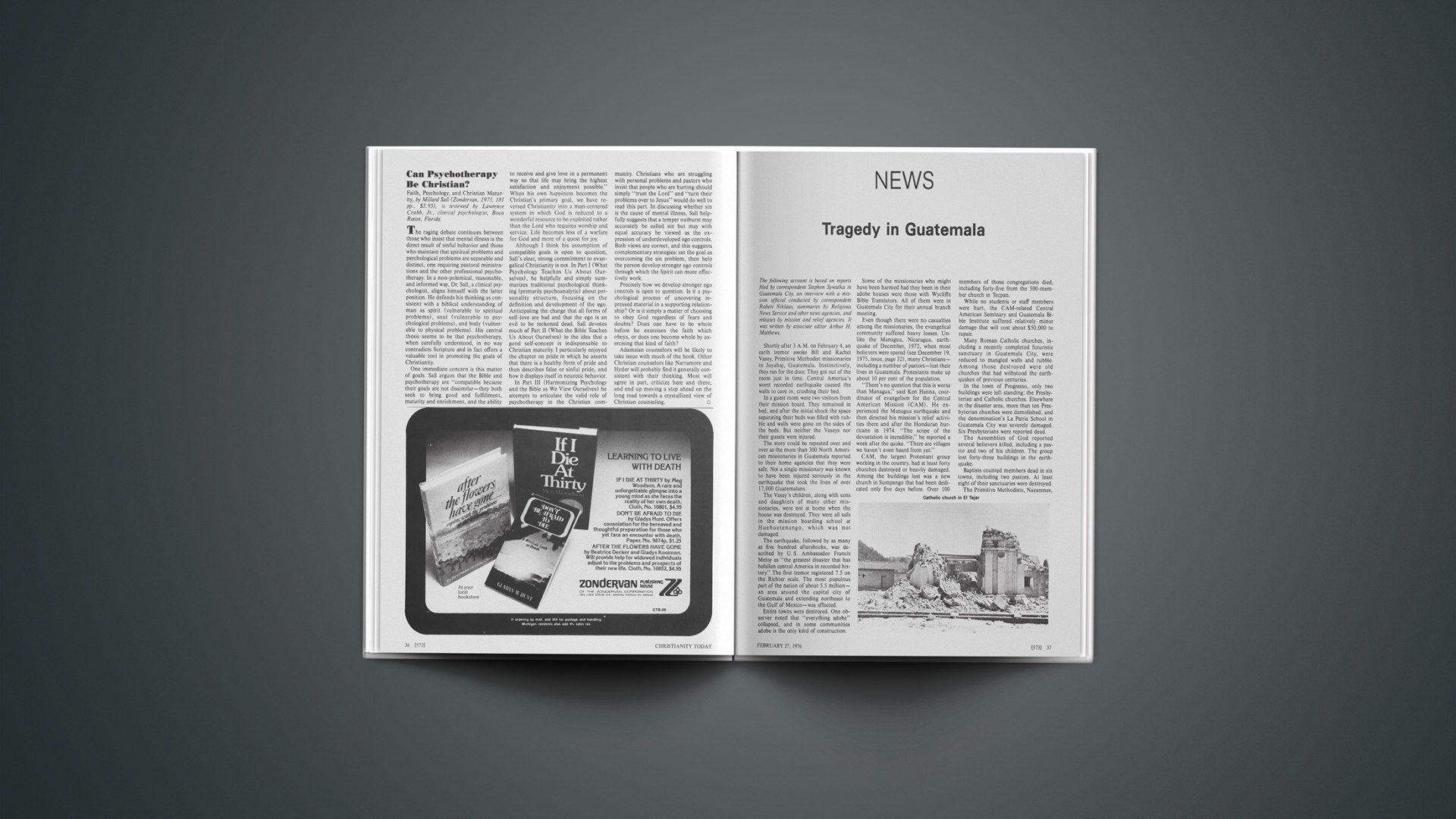
Tragedy in Guatemala

The following account is based on reports filed by correspondent Stephen Sywulka in Guatemala City, an interview with a mission official conducted by correspondent Robert Niklaus, summaries by Religious News Service and other news agencies, and releases by mission and relief agencies. It was written by associate editor Arthur H. Matthews.

Shortly after 3 A.M. on February 4, an earth tremor awoke Bill and Rachel Vasey, Primitive Methodist missionaries in Joyabaj, Guatemala. Instinctively, they ran for the door. They got out of the room just in time. Central America’s worst recorded earthquake caused the walls to cave in, crushing their bed.

In a guest room were two visitors from their mission board. They remained in bed, and after the initial shock the space separating their beds was filled with rubble and walls were gone on the sides of the beds. But neither the Vaseys nor their guests were injured.

The story could be repeated over and over as the more than 300 North American missionaries in Guatemala reported to their home agencies that they were safe. Not a single missionary was known to have been injured seriously in the earthquake that took the lives of over 17,000 Guatemalans.

The Vasey’s children, along with sons and daughters of many other missionaries, were not at home when the house was destroyed. They were all safe in the mission boarding school at Huehuetenango, which was not damaged.

The earthquake, followed by as many as five hundred aftershocks, was described by U. S. Ambassador Francis Meloy as “the greatest disaster that has befallen central America in recorded history.” The first tremor registered 7.5 on the Richter scale. The most populous part of the nation of about 5.5 million—an area around the capital city of Guatemala and extending northeast to the Gulf of Mexico—was affected.

Entire towns were destroyed. One observer noted that “everything adobe” collapsed, and in some communities adobe is the only kind of construction.

Some of the missionaries who might have been harmed had they been in their adobe houses were those with Wycliffe Bible Translators. All of them were in Guatemala City for their annual branch meeting.

Even though there were no casualties among the missionaries, the evangelical community suffered heavy losses. Unlike the Managua, Nicaragua, earthquake of December, 1972, when most believers were spared (see December 19, 1975, issue, page 32), many Christians—including a number of pastors—lost their lives in Guatemala. Protestants make up about 10 per cent of the population.

“There’s no question that this is worse than Managua,” said Ken Hanna, coordinator of evangelism for the Central American Mission (CAM). He experienced the Managua earthquake and then directed his mission’s relief activities there and after the Honduran hurricane in 1974. “The scope of the devastation is incredible,” he reported a week after the quake. “There are villages we haven’t even heard from yet.”

CAM, the largest Protestant group working in the country, had at least forty churches destroyed or heavily damaged. Among the buildings lost was a new church in Sumpango that had been dedicated only five days before. Over 100 members of those congregations died, including forty-five from the 500-member church in Tecpan.

While no students or staff members were hurt, the CAM-related Central American Seminary and Guatemala Bible Institute suffered relatively minor damage that will cost about $50,000 to repair.

Many Roman Catholic churches, including a recently completed futuristic sanctuary in Guatemala City, were reduced to mangled walls and rubble. Among those destroyed were old churches that had withstood the earthquakes of previous centuries.

In the town of Progresso, only two buildings were left standing: the Presbyterian and Catholic churches. Elsewhere in the disaster area, more than ten Presbyterian churches were demolished, and the denomination’s La Patria School in Guatemala City was severely damaged. Six Presbyterians were reported dead.

The Assemblies of God reported several believers killed, including a pastor and two of his children. The group lost forty-three buildings in the earthquake.

Baptists counted members dead in six towns, including two pastors. At least eight of their sanctuaries were destroyed.

The Primitive Methodists, Nazarenes, Friends, Foursquare, and independent and Pentecostal groups also reported property and human losses.

A Christian and Missionary Alliance church in the capital city was not destroyed, but the earthquake picked up the 400-seat sanctuary and moved it three inches off its foundation.

By 3:45 A.M., the first radio station was on the air, and it was broadcasting hymns and passages of Scripture. The station, signing on an hour and forty-five minutes earlier than usual, was TGNA, an affiliate of CAM. For four hours it was the only station operating in Guatemala City. And for two days it was one of only two stations broadcasting information from the government network, including many personal messages to families about the condition of their separated members. As more stations returned to the air, they were all put on the network.

Without making a public appeal, TGNA collected relief supplies that were distributed to some twenty towns by the staff and volunteers from CAM churches and the seminary. TGBA, the mission’s Indian language station, is located at Barillas, in an area not affected by the earthquake. Its personnel staged a marathon appeal for relief. On the first day, 629 Indians came in with $374. In the area served by TGBA the Indians have an average daily income of thirty-five cents. The donors, mostly Christians, also brought more than 5,000 pounds of corn and other food to the station. Some walked several hours over mountain trails to bring their gifts.

The relief effort that began with Christians in Guatemala soon attracted help from many parts of the world. Within a week, it was estimated that supplies worth $15 million had been shipped to the devastated areas.

Some fifteen outside agencies and twenty-one denominations within Guatemala were cooperating in CEPA (the Spanish acronym for Permanent Evangelical Committee for Aid). The committee was organized two years ago in the aftermath of disasters in neighboring nations. A similar group was organized by CAM churches.

Immediate aid came from Nicaragua’s CEPAD emergency group and CEDEN in Honduras. CAM congregations in Honduras sent $1,000, as did Baptist churches in that nation. Volunteer workers rushed in from Christian groups elsewhere in Central America.

Within hours of the tragedy officials of Christian agencies in North America were also surveying the needs. Immediate shipments of tools, blankets, food, and medical supplies were authorized. Appeals for earthquake relief funds went out from a variety of agencies.

Initially, relief workers faced a problem of having more material at the Guatemala City airport than they could distribute. The tremors had been so strong that many highways were destroyed and railway tracks were badly bent. Helicopters sent by the U. S. government helped with the distribution problem until roads to the interior towns were repaired.

After the first pile-up of goods was moved, it was reported that subsequent shipments were being sent quickly to rural areas of need. More than half of the supplies came from either private or governmental sources in the United States.

Executives of relief agencies began emphasizing early that long-term help will be needed by many of the communities. Instead of asking for medicine, food, or clothes, they were stressing the need for tools, shelter, and means of livelihood.

With housing destroyed in many areas of Guatemala City and in the outlying towns, thousands were sleeping out of doors. Some whose houses still stand were afraid to enter them for fear that aftershocks would topple them.

One CAM congregation that lost its building met on the first Sunday after the disaster on a basketball court. They sang, “Great Is Thy Faithfulness.”

Missionary Helen Ekstrom said after the outdoor meeting: “There was a tremendously beautiful spirit among the believers. I cried when I saw how they were not just putting up with the situation but were praising the Lord.”

Said one leader at the basketball court service: “If we are still here, it’s because God has a work for us to do.” Several conversions were reported after that service, as well as at many others in the country. Both the CEPA and CAM relief committees have stressed a strong evangelistic effort in connection with their work.

Matias Gudiel, president of the Christian and Missionary Alliance (CMA) in Guatemala, surveyed the damage in the city of Tecpan. Among the fatalities were four of the city’s six evangelical pastors. He found an elder who lost four of his children and then told those who tried to console him: “They are with the Lord; they are much better where they are now.”

At mid-month evangelist Billy Graham flew to Guatemala to offer comfort and encouragement in a talk on national radio and television.

As Guatemalans and Christian workers from abroad continued the job of burying the dead, treating the sick and injured, and rebuilding churches, they did so with a firm and positive faith.

Prayer Breakfast: Waxing Eloquent

That grinding noise in the kitchen came from a tooth that U. S. Senator Mark Hatfield had unknowingly dislodged and placed in the disposal with some orange peels. His wife Antoinette quickly filled the gaping hole with white candle wax. En route to last month’s National Prayer Breakfast, where the senator was to give the major address, the Hatfields stopped to buy some chewing gum in case the need for additional adhesive became apparent. A dentist among the 3,000 persons in attendance at the Washington Hilton Hotel assured the Oregon Republican he could not have improvised any better.

Hatfield, who said he had been praying for humility, delivered his speech without a hitch—or smile. It was a sobering call for spiritual revolution. (The address is scheduled for publication in the March 26 issue of CHRISTIANITY TODAY.)

President Ford spoke also. He said that many times since becoming Chief Executive he has derived strength from Proverbs 3:5 and 6. “Often as I walk into my office,” he said, “I realize man’s wisdom is not enough.”

The breakfast drew evangelical leaders and businessmen from all over the country. Many diplomats and government officials also were on hand, including Secretary of State Henry Kissinger. The event is put on each year by the House and Senate prayer-breakfast groups with help from a low-profile organization formerly known as International Christian Leadership but currently referred to as simply “the Fellowship.” A letter of invitation spoke of the need for reconciliation and unity, and described the breakfast as an opportunity for “building stronger links of friendship on a spiritual basis.”

Congressman James W. Symington of Missouri, an Episcopalian, made his debut as a soloist with a black choral group from St. Louis. He sang a song that he and his wife had written, “It Takes Time to Know a Country.”

A prayer for national leadership was given by U. S. Treasurer Francine Neff, and Secretary of the Interior Thomas Kleppe pronounced the benediction.

DAVID E. KUCHARSKY

Tackling The Pros

Tackling professional football players for Christ has been one of the goals of such Christian organizations as the Fellowship of Christian Athletes (FCA) and Athletes in Action (AIA), the athletic arm of Campus Crusade for Christ. Both groups work mainly with college athletes. But the pros need Christ, too, theorize leaders. And when well-known players are recruited for Christ, they point out, there are some great fringe benefits for the Christian—and organizational—cause. As guest speakers, the pros command a wide hearing, and their Christian testimonies carry special weight, especially among young people. Understandably, the competition among sports ministries seeking to sign up the superstars has been fierce on occasion.

About two years ago, ten professional football players met in Chicago and issued a statement of concern about the “lack of communication” between these ministries, and they called for a more cooperative effort in sports outreach. The statement was aimed primarily at the FCA and AIA. A number of pros also were involved in Ira Lee “Doc” Eshleman’s Sports World Chaplaincy. But that ministry was winding down following Eshleman’s announcement that he was retiring as pro football’s first full-time chaplain.

The ten players added that they didn’t want to be identified exclusively with any of the existing ministries. Instead, they wanted to establish a movement of their own that would complement the work of the other groups. Yet they wanted to be free to work with the others if they chose to do so.

With the help of Phoenix businessman Arlis Priest, California attorney Thomas Hamilton, and others, they organized Pro Athletes Outreach (PAO). Priest and his friends agreed to be responsible for the legal, business, and fund-raising activities of the group, while a steering committee of players directed programming. (Priest, a real estate broker and investment consultant, has had counseling ties to a number of players in recent years. He also has served Campus Crusade in important capacities.)

Norm Evans of the Miami Dolphins heads the PAO steering committee. Other members include Mike McCoy of the Green Bay Packers, Jeff Siemon of the Minnesota Vikings, Tom Graham and Andy Hamilton of the Kansas City Chiefs, Ken Houston of the Washington Redskins, Gregg Brezina of the Atlanta Falcons, and Calvin Jones of the Denver Broncos.

From its beginning, PAO has concentrated on evangelism and training. This month it sponsored a five-day conference in Phoenix. More than seventy football players attended, along with some sixty wives and other guests. The event continued a series of annual conferences begun six years ago by Eshleman. The last four conferences were run by Campus Crusade’s AIA. David Hannah, AIA director, said that these were boycotted by people associated with the FCA (an FCA official claims FCA representatives were not invited). But now, noted Hannah, bridges are being built between those working to evangelize and train the pros in discipleship.

This cheerful note was echoed by Priest at a steak dinner for 555 people, most of them Phoenix-area believers who simply wanted to get a close-up glimpse of the football huskies. “It’s a thrill to me to see directors of all these ministries gather together,” commented Priest. “We all have our own things to do.”

Priest in an interview pointed out that representatives of various sports ministries attended the conference and were given an opportunity to tell about their own work.

The conference program had a variety of offerings. Among them: a seminar on marriage and the home, conducted by evangelist Lane Adams; a workshop on how to maintain a Christian testimony in the competitive crunch, led by ex-Campus Crusade staffer Wes Neal, head of the Arizona-based Institute for Athletic Perfection; and a talk by evangelist Tom Skinner, chaplain of the Washington Redskins.

The Campus Crusade touch was pervasive. Slides, films, training materials, and evangelistic literature used at the conference were all Crusade-produced, and the conferees—armed with the “Four Spiritual Laws”—hit the streets in a Crusade-style Saturday witness outing.

An FCA leader reacted good-naturedly to the Crusade input. “After all,” he remarked privately, “Crusade’s materials are the best that are readily available.”

Many non-Christian pros and their wives are invited to attend such conferences (staked by first-time-only “scholarships” worth up to $800 or so), and some of these profess Christ. Among them are linebacker Dave Washington of the San Francisco Forty-niners and his wife, both of whom accepted Christ at a 1972 conference. Washington says that other pros are searching for spiritual satisfaction, too, and that they notice the changes in those who have followed Christ.

One of the searchers at this year’s conference was defensive tackle Ernie Holmes of the Pittsburgh Steelers. En route to the PAO meeting he stopped over in Amarillo, Texas, where he was arrested on drug possession charges. Released on $1,000 bond, Holmes—divorced and on probation from a 1973 gun charge involving assault—traveled on to Phoenix. In a closing-banquet testimony, he said he had come to the PAO conference to find himself. Optimistic friends say that with Christ’s help he did.

GENE LUPTAK

Cited

Mrs. Claire Collins Harvey, a black funeral-home operator in Mississippi, received this year’s citation award by The Upper Room, a devotional magazine. Editor Maxie Dunnam said she was cited for her leadership in the fields of human rights and the worldwide Christian fellowship.

Mrs. Harvey, a United Methodist, was Religious Heritage of America’s 1974 Woman of the Year. She is the founder of Womanpower Unlimited, and a former national president of Church Women United, and she has attended important World Council of Churches conferences (she heads a WCC committee).

She says that faith and social activism go together: “There is no effective Christian witness in the social arena unless it is rooted in the Bible, in personal experience with the Holy Spirit, and with the knowledge that Jesus Christ is Lord.”

Gunn: Taking Aim

A United Methodist pastor from Gaithersburg, Maryland, will take over the reins of Americans United for Separation of Church and State. He is Andrew Leigh Gunn, 45, who succeeds the retiring Glenn L. Archer. Gunn’s appointment effective April 1, was announced at the group’s annual meeting.

“Let the word go forth again in this bicentennial year,” Gunn said, “that Americans United is the advocate and not the adversary of religious peoples who treasure religious liberty.” He promised “no malice on our part,” but he also vowed not to “hesitate to speak out when religious freedom is in jeopardy.”

The search for a successor to Archer took more than two years. Archer had been the organization’s guiding light since its inception in 1947. Over the years, the group’s primary aim has been to prevent tax dollars from flowing to church-affiliated schools.

Book Briefs: February 27, 1976

A Formula For Dying?

If I Die at Thirty, by Meg Woodson (Zondervan, 1975, 166 pp., $4.95), Free Fall, by Jo Ann Kelley Smith (Judson, 1975, 138 pp., $5.95), When a Loved One Dies, by Philip W. Williams (Augsburg, 1976, 95 pp., $2.50 pb), Straight Talk About Death With Young People, by Richard G. Watts (Westminster, 1975, 92 pp., $2.95 pb), Ye Shall Be Comforted, by William R. Rogers (Westminster, 1950, 92 pp., $1.95 pb), Let Christ Take You Beyond Discouragement, by Albert L. Kurz (Accent, 1975, 128 pp., $1.75 pb), Raise the Dead, by Myron C. Madden (Word, 1975, 118 pp. $4.95), and Death: The Riddle and the Mystery, by Eberhard Jungel (Westminster, 1974, 141 pp., $6.95), are reviewed by Gladys M. Hunt, author of “Don’t Be Afraid to Die,” Ann Arbor, Michigan.

The statistics about death are very impressive, observed George Bernard Shaw: one out of one dies. Yet until recently we have been tiptoeing around death as if ignoring it would make it go away.

As late as 1969 Rollo May in his book Love and Will complained about contemporary values that make sex an obsession and death a matter of poor taste. When I was writing my own book on death, which was first published in 1971, I noticed an awkward silence each time I answered the query, “What are you writing about now?” People seemed embarrassed. Only one or two bothered to ask what I was saying about death. Joe Bayly when he was writing The View From the Hearse had a similar experience and sometimes felt like an untouchable socially because he had three sons who died.

But times have changed, so much so that recently the Journal of the American Medical Association carried an article entitled “Dying is Worked to Death.”

Without question the breakthrough for a realistic handling of death came with the publication of On Death and Dying by Elizabeth Kubler-Ross. The resistance she encountered in doctors and hospital workers as she attempted to interview dying patients revealed the medical profession’s uneasiness with death.

Dr. Kubler-Ross has described five stages she believes most dying patients experience: denial (It can’t be true!), followed by anger or resentment (Why me?), then a stage of bartering to prolong life, a period of depression, and finally acceptance.

Her observations have become the basic outline for the seminars and films on death. Several books reviewed here relate personal experience to stages she describes. It’s like finding a formula for dying. The problem with this is that some zealous speakers and counselors almost insist that to be normal a person must pass through these stages. Kubler-Ross, however, does not investigate any of the resources of the Christian faith. While these do not rule out the stages she describes, neither is a dying Christian hemmed into that formula.

For instance, it is refreshing to me to read the statement of Orville Walters, a capable psychiatrist and a committed Christian, written just before his own death and published in the Fall, 1975, issue of the Christian Medical Society Journal: “With the self awareness that is required in the competent psychiatrist, I cannot identify in my own experience the stages commonly attributed to the dying patient.” Why? Because God’s presence and grace has been a consistent reality. “I believe,” he wrote, “the vitality of that relationship made possible the acceptance of uncertainty concerning the end of my earthly life.” We cannot program the experience of dying; we can only make observations.

The Church has done a poor job in preparing people for death, both to face their own mortality and to handle grief. An amazing number of people who claim to be Christians still believe that people become angels in the next world or else plague themselves with guilt over failure to “believe more” when someone they love dies. Only a few books have been written to help believers see that grief is good, natural, necessary, and often irrational—and that it is not obliterated by our great and steadfast hope in Jesus Christ. We sorrow, but not as others who have no hope. We have sometimes not allowed people to be as human as God does.

Meg Woodson’s If I Die at Thirty and Jo Ann Smith’s Free Fall are likely to be a new experience for readers, for they were written by people facing death. Free Fall was written in the final months of JoAnn Smith’s life as she was dying from cancer. It is a very honest book, sharing the confusion, doubts, fears, and alienation she experienced. She likens death to the “free fall” experience in parachute jumping—the sense of freedom, the separation from those she loves, the assurance that God will be there in the end.

JoAnn Smith previously learned how to share openly, particularly in the supporting Christian community to which she and her husband belonged. Her openness makes the book possible and may even prove too much for some readers. It is a book to give not so much to a dying person (except as its insights might help someone who needs his or her humanity affirmed) as to the family of a dying person.

As JoAnn and Gordon struggle to accept the news that her illness is terminal, their friends tend to retreat into silence, not knowing what to say or how to act. The Smiths are led to write out their personal theology about what is happening to them and share it with their friends, asking them to stay close, to simply be there and understand. JoAnn is frank about the instability of her emotions: she finds herself trying to use her illness to manipulate events in the family; she sometimes knows she is making others feel guilty for living because she is dying. When she needs her husband’s support the most, she ends up rejecting his expressions of tenderness, which confuses them both and necessitates honest conversations.

She disdains ministers who come to call with their own agenda clearly in mind, never bothering to find out where she is emotionally and spiritually. She talks about the kind of people who really help her. Ministers, theology students, doctors, nurses—and all the rest of us—need to hear this woman simply because she is telling it as she experiences it. You meet a person instead of examining theories.

Meg Woodson’s If I Die at Thirty is a creative retelling of conversations with her thirteen-year-old daughter, who has discovered that cystic fibrosis gives her a limited life expectancy. Spiritually it is a far more buoyant book than Free Fall, without being sticky. (One senses that JoAnn Smith never had this much solid, consistent teaching about the nature of the Christian life or Christian death or about the personal friendship of God.) Here is a loving family trusting in God, believing the Bible, facing their own humanity, struggling, making mistakes, hurting, and knowing the comforting care of God as he gives them flashes of insight into great realities. It is no less honest than Free Fall, but death is the prognosis, not the imminent reality.

And this thirteen-year-old is special. Her authenticity may be questioned by some who have never met a spiritually perceptive child, but my own experience confirms the beauty and simplicity of this kind of young adult. Uncluttered with adult hang-ups, this half-child, half-adult sees life with a clear eye. I’d like to see teen-agers reading this book.

In Let Christ Take You Beyond Discouragement Albert Kurz shares what Donna, his wife, recorded of her own experience in facing death. But I couldn’t help feeling that he included only her triumphant words, or perhaps she wrote only when she felt spiritually good, knowing how he wanted to use her material. Kurz writes to inspire readers to take hold of God’s promises. The effect is essentially sermonic. Everything he says about God is true; the weakness may be that he does not say what is true about humans. Still, Donna Kurz faced death with a firm faith and is a model for those so caught up in self-pity and discouragement that they never dream Christ can take them beyond it. My concern is that for some this book may produce more guilt than comfort.

Of the books reviewed here (eight books on death at one time is quite a dose), When a Loved One Dies by Philip Williams is the most comforting. He takes grief seriously. He handles feelings honestly. Williams understands the problems of concentration in grief and the difficulty in prayer. Hence, the chapters are short, concluding with a brief prayer. You can start anywhere in the book, depending on how you feel. Chapters like “It Can’t Be True,” “If Only,” “You’ll Never Know,” and “Those Old Feelings” will take the grieving person from where he or she is to a brief important truth about God.

It’s hard to tell whether Watts wrote his book for adults or for young people, despite its title. He shows a good understanding of questions important to young people and surveys beliefs common among teen-agers. We do indeed need to do some “Straight talk about death with Young People,” as his title puts it. Teen-agers today have a morbid fascination with death, and few know biblical teaching. The drug culture, Eastern mysticism, rock singers, and television programs—everything from “The Littlest Angel” to police dramas where someone dies nightly—all serve to leave a hazy feeling about death.

Westminster issued in paperback a book by William E Rogers written some time ago. It has good insights into the grieving process and decision-making in grief. Its major suggestion is that a grieving person seek out a counselor very soon after the death. The author believes that well-meaning friends often block our show of emotion with advice to brace up, while other family members are trying to cope with their own reactions and cannot be expected to listen to ours. In view of the statistic that three-fourths of all couples who lose a child have marriages that end in divorce, Rogers’s advice may be right. Grieving people need to be understood and to understand something of what is happening to them.

I had a hard time with Myron C. Madden’s Raise the Dead. It hardly qualifies as a Christian book because of its lack of biblical perspective; I kept trying to figure out why Word published it. Madden does not believe death is a foe (unless we let it be), does not believe in the resurrection of the body or in the existence of demons. What he does believe in is his proposal for a new therapy that takes Freud a step further: beyond sex to death. He wants to get death out of life and help update and correct false ideas about death that give it an unreal vitality, he says. He wants, in addition, to help people let the dead be dead, in a final, clean way, whatever that means. To him “biology says life is the aggressive, thrusting, pulsating force, and it takes any death as a bonus. Death has no power but the power we give it.” His view of death is consistently biological rather than biblical or social. He does handle one area not often touched in other books: the problem of dead relationships. However, Madden is better at defining the problem than encouraging a solution. As director of pastoral care for the Southern Baptist hospital in New Orleans he has evidently counseled many people with severe disorders, and much of what he writes is a discussion of what is essentially psychotic behavior. He believes that when the trap that has been locking death into your psyche is sprung, you will get twice as much out of life. I’m hard pressed to think of anyone this book would help.

Jungel’s book, Death: The Riddle and the Mystery, is in a different league altogether from the others in this review. It is a heavy, probing book contrasting the secular and philosophical view of death with a theological view. Basically it is a book for philosophers and serious theological students, raising theoretical questions about the meaning of death. Part I discusses the anthropological and biological view of death, and then death as a social fact. Part II examines the theology of death from the Old and New Testaments and has a strong chapter on “the death of death.” It is a thorough, meticulous book. The author is a professor of theology at Tübingen.

When I finished reading these books on death, I opened my Bible and read First Corinthians 15. Now there is a refreshing look at death. I thought of the early Christians, marked in history by the confidence and poise with which they faced death. Any book that really helps us die must tell us about the resurrection. Something has happened in human history to destroy death and to deliver us from its bondage. That doesn’t mean we won’t suffer, that we won’t be afraid, that we won’t know terrible sorrow. It just means that Jesus meant it when he said, “Because I live, you shall live also.”

BRIEFLY NOTED

Those Curious New Cults, by William Petersen (Keats, 272 pp., $1.95 pb), Reincarnation, Edgar Cayce, and the Bible, by Phillip Swihart (InterVarsity, 55 p., $1.25 pb), The Quija Board, by Edmond Gruss (Moody, 191 pp., $1.50 pb), Transcendental Meditation: A Christian View, by David Haddon (InterVarsity, 27 pp., $.25 pb), and The Meditators, by Douglas Shah (Logos, 147 pp., $3.50 pb). Evangelical refutations of Eastern religious sects. Petersen’s is a reprint treating briefly but capably eighteen groups or practices, two more (Moon’s and Maharaj Ji’s) than in the hard-cover edition. The titles of the other indicate their scope. Recommended.

Jesus Christ Is Not God, by Victor Paul Weirwille (distributed by Devin-Adair, 180 pp., $6.95). At least the leader of a growing Christian deviation does not try to conceal his anti-trinitarianism. For orthodox Christians who might be tempted to think well of The Way because of its adherents’ zeal, claimed biblicism, tongues-speaking, or whatever. Compare with defenses of the biblical teaching in The Deity of Christ by W. J. Martin (Moody) or The Lord From Heaven by Leon Morris (InterVarsity).

Living Christian Science, by Marcy Babbitt (Prentice-Hall, 255 pp., $7.95), The Universal Flame, edited by L. H. Leslie-Smith (Theosophical Publishing House, 263 pp., $5), and The Trumpet of Prophecy by James Beckford (Halsted, 244 pp; $17.95). Some sects are a century old and still going strong. Beckford’s scholarly study of Jehovah’s Witnesses is a major addition to the literature. The other two are by or about several adherents of Christian Science and Theosophy.

Abingdon Bible Handbook, by Edward P. Blair (Abingdon, 511 pp., $15.95). Has brief accounts for laymen of how we got the Bible and what its chief teachings are but is mostly devoted to separate introductions to each of the books of the Bible and Apocrypha. The author affirms the authority of Christ, but takes a mediating or inconclusive position on most matters of conflict among scholars (e.g., personality of Satan, authorship of Ephesians). Although he believes the Bible is “indispensable” for learning about God, he also expects us to decide which parts of the Bible are reliable and which are not! “We should therefore expect different levels of truth and some error in the Bible.” Not recommended for its intended audience.

The Empty Pulpit: A Handbook for Churches Calling a Pastor, by Gerald Gillaspie (Moody, 159 pp., $2.50 pb), Getting the Books Off the Shelves: Making the Most of Your Congregation’s Library, by Ruth Smith (Hawthorn, 117 pp., $3.50 pb), Ministry to the Hospitalized, by Gerald Niklas and Charlotte Stafanics (Paulist, 135 pp., $3.95 pb), Phone Power: Using the Telephone in Ministry, by Augustus Dowdy, Jr. (Judson, 96 pp., $2.95 pb), and How to Build an Evangelistic Church Music Program, by Lindsay Terry (Nelson, 198 pp., $3.95 pb). Five worthwhile “how-to” books.

Contemplative Christianity by Aelred Graham (Seabury, 131 pp., $6.95), and Yoga and God by J. M. Dechanet (Abbey, 161 pp., $3.95 pb). Attempts by two Christian monks to strengthen Western religion by borrowing from the East. We do better to stay with or recover the revelation to the Hebrews rather than go farther east.

Some Ways of God, by C. Stacey Woods (InterVarsity, 131 pp. $2.95 pb). Interesting reminiscences and very helpful exhortations and insights by a pioneer in worldwide work among university students.

From Day to Day: A Message From the Bible For Each Day of the Year, by Frank Gaebelein (Baker, 193 pp., $6.95, $2.95 pb). A book of meditations by one of the most widely respected elder statesmen among evangelicals.

Faith and Freedom, by Mary Senholz (Grove City College [Grove City, Pa. 16127], 179 pp., $6.50). Biography, with numerous excerpts from writings and speeches, of J. Howard Pew (1882–1971), prominent evangelical businessman and munificent donor.

Sons of God Return, by Kelly Segraves (Revell, 191 pp., $1.40 pb), UFO: What on Earth Is Happening, by John Weldon and Zola Levitt (Harvest House, 156 pp., $2.95 pb), and Gods in Chariots and Other Fantasies, by Clifford Wilson (Creation-Life, 143 pp., $1.50 pb). A new religion of sorts—UFOlogy is perhaps the best name for it—has been gaining more publicity, especially since the best-selling books of Erich von Daniken. Generally UFOlogy starts with flying-object sightings and other strange phenomena past and present but attributes to extra-terrestrial, naturalistic beings what Christians attribute to the supernatural. However, these three evangelical books opposing UFOlogy give more concessions to the alleged phenomena, only with a supernatural interpretation, than other investigators would be willing to grant. They are probably better used to woo away cultists than to instruct Christians.

Can Psychotherapy Be Christian?

Faith, Psychology, and Christian Maturity, by Millard Sall (Zondervan, 1975, 181 pp., $5.95), is reviewed by Lawrence Crabb, Jr., clinical psychologist, Boca Raton, Florida.

The raging debate continues between those who insist that mental illness is the direct result of sinful behavior and those who maintain that spiritual problems and psychological problems are separable and distinct, one requiring pastoral ministrations and the other professional psychotherapy. In a non-polemical, reasonable, and informed way, Dr. Sall, a clinical psychologist, aligns himself with the latter position. He defends his thinking as consistent with a biblical understanding of man as spirit (vulnerable to spiritual problems), soul (vulnerable to psychological problems), and body (vulnerable to physical problems). His central thesis seems to be that psychotherapy, when carefully understood, in no way contradicts Scripture and in fact offers a valuable tool in promoting the goals of Christianity.

One immediate concern is this matter of goals. Sall argues that the Bible and psychotherapy are “compatible because their goals are not dissimilar—they both seek to bring good and fulfillment, maturity and enrichment, and the ability to receive and give love in a permanent way so that life may bring the highest satisfaction and enjoyment possible.” When his own happiness becomes the Christian’s primary goal, we have reversed Christianity into a man-centered system in which God is reduced to a wonderful resource to be exploited rather than the Lord who requires worship and service. Life becomes less of a warfare for God and more of a quest for joy.

Although I think his assumption of compatible goals is open to question, Sall’s clear, strong commitment to evangelical Christianity is not. In Part I (What Psychology Teaches Us About Ourselves), he helpfully and simply summarizes traditional psychological thinking (primarily psychoanalytic) about personality structure, focusing on the definition and development of the ego. Anticipating the charge that all forms of self-love are bad and that the ego is an evil to be reckoned dead, Sall devotes much of Part II (What the Bible Teaches Us About Ourselves) to the idea that a good self-concept is indispensable to Christian maturity. I particularly enjoyed the chapter on pride in which he asserts that there is a healthy form of pride and then describes false or sinful pride, and how it displays itself in neurotic behavior.

In Part III (Harmonizing Psychology and the Bible as We View Ourselves) he attempts to articulate the valid role of psychotherapy in the Christian community. Christians who are struggling with personal problems and pastors who insist that people who are hurting should simply “trust the Lord” and “turn their problems over to Jesus” would do well to read this part. In discussing whether sin is the cause of mental illness, Sall helpfully suggests that a temper outburst may accurately be called sin but may with equal accuracy be viewed as the expression of underdeveloped ego controls. Both views are correct, and this suggests complementary strategies: set the goal as overcoming the sin problem, then help the person develop stronger ego controls through which the Spirit can more effectively work.

Precisely how we develop stronger ego controls is open to question. Is it a psychological process of uncovering repressed material in a supporting relationship? Or is it simply a matter of choosing to obey God regardless of fears and doubts? Does one have to be whole before he exercises the faith which obeys, or does one become whole by exercising that kind of faith?

Adamsian counselors will be likely to take issue with much of the book. Other Christian counselors like Narramore and Hyder will probably find it generally consistent with their thinking. Most will agree in part, criticize here and there, and end up moving a step ahead on the long road towards a crystallized view of Christian counseling.

The Minister’s Workshop: Forced to Choose

Doran’s dead. He died early this afternoon.” Those were Betty’s first words on the telephone.

The words shocked me. We had known it would happen, but had not expected it so soon. My mind numbed as Betty told me the circumstances of his death.

My wife Shirley sat across the table. She and my son watched my face. They knew what was coming next.

“Would you conduct the funeral?”

Another time I would have said yes without a second thought. I felt myself tense. Betty needed an immediate answer. I couldn’t say, “Wait a couple of hours while I pray about it, Betty, and I’ll call you back.”

I had been Doran and Betty’s pastor for two years before the fatal brain tumor. During that time we experienced a close fellowship. A few months after Doran’s surgery I moved to another church twenty miles away. Doran spent the next eight months as an invalid. He could no longer hear, and his muscular coordination deteriorated rapidly. Because of brain damage he lived completely in the past. Consequently he never knew my successor; I had been his last pastor.

For the final two years of Doran’s good health, he and Betty, along with several other business people, had a time of prayer and Bible study every Wednesday morning in Doran’s office. In those seconds while Betty talked to me on the phone, pictures flashed through my mind of those who had been ministered to through our prayer group. David, who had lost his job and his home and was ready to give up on life, found new courage through the group. Tony went through months of deep depression after his divorce, but it was Betty who kept reaching out and saying “Don’t give up. All of us love you.” I remembered Ruth, too. She had grown from a cynical woman of the world into a tender, caring person. Bob once remarked, “I get more out of this than anything else in my week. People are so close to each other here.”

And now Betty wanted me to conduct Doran’s funeral.

Lord, please show me what to do.

I glanced at my teen-age son. He said nothing. His eyes betrayed no flicker of emotion. But I knew what he was thinking.

It was now Saturday, and the funeral was to be Monday afternoon. Another delay.

Delay. That was the word for our vacation. After an especially busy and tiring summer, we had planned to leave the previous Thursday. Twice problems had arisen in the church that kept us from leaving. Twice we had changed our reservations. We had only one week before John’s school started.

I remembered something my son had said a few weeks earlier. He had gone with me to see a family who had not been to church recently and about whom I felt concerned. John made only one comment: “Preachers never get time to do what they want to do.”

Had I neglected him? Not intentionally. But I had put the ministry and the call of other people ahead of my family.

I’ve tried to be available to people and to respond to their needs. On occasion, it has meant postponing or canceling family activities. I can recall times when I scarcely saw my children for two or three days at a time because of the heavy commitment of my time to the ministry.

Lord, guide me.

I looked at John. By going to summer school he would graduate in June. Then college. I knew only too well that this might be the last vacation we could share with him as a teenager. Soon he would be an adult.

I thought of all the things I had wanted to do with my son during his growing years. Now he was sixteen, and few of them had happened. I had been too busy.

Words of Scripture flowed easily through my thoughts: “If any man will come after me, let him deny himself …”

Is that your will, God?

Where does responsibility to my family end? Or to the church? What about ministry to my son? Which is God’s will—going with the family or upsetting our plans?

I had wrestled with that question many times before. A year earlier I had gone two days late to a retreat with Shirley because of a funeral. One year we had no vacation at all because of pastoral demands.

Then suddenly I knew what to reply to Betty. After what had seemed like a long period of reasoning, though it must have been only a few seconds, I decided.

“Betty,” I said, “I love you. And you know how much I loved Doran. But I’m going to say no. I can only hope you’ll understand.”

In a few sentences I explained that this time I owed my family priority. Doran had been known and loved by several pastors in the area. One of them, Bill, had frequently joined in our sharing sessions and was Doran’s parents’ pastor. Betty said she would ask him to conduct the funeral.

“I feel guilty about this, Betty. No matter what I say, I feel guilty.”

“I understand. Honest, I do. We know how much you care. You showed your love while he was alive. Doran would have understood, too.”

I stared at my wife and son, seated at the table. Their expressions had changed little, but I noticed a softening. My son’s eyes communicated his thanks.

We went on the vacation, and during that week my wife and I felt we learned to know our son again. We had hardly realized the changes that were taking place in his life. We now could appreciate the maturity of his thinking and the sharpness of his mind.

Several times guilt troubled me. Had I done the right thing?

I believe I did. Later I would ask myself, “Isn’t ministry to my family one of my highest priorities?” The Apostle Paul gave as a condition for ordaining a man as elder that he rule his household well. In trying so hard to minister to people, how many times had I failed to minister to my own family?

Our struggles don’t always center on temptations to do evil rather than good. It sometimes is a question of choosing between two good possibilities. There will often be questions—even afterwards—but being a disciple means living by faith, not by facts that substantiate our decisions.

Did I choose correctly? My faith assures me that God guided my answer because I honestly sought his will. After all, Jesus said, “The Holy Spirit will guide you into all truth.”—CECIL B. MURPHEY, pastor, Riverdale Presbyterian Church, Riverdale, Georgia.

Truth Translated

Circle the earth in imagination for a few moments. Walk down the streets of Hong Kong and look up at the apartment houses crowded with more people living in one room than you would think possible. What strikes you as you look from the outside? Lines strung from window to window, or sticks protruding from a window, hung with shirts, socks, dresses, underwear. Washed clothing, drying.

Make your way through Bombay streets by lurching taxi, avoiding the cows, goats, and heavy man-drawn carts. See people living on the sidewalks in a little pile of rags, or under a few makeshift bits of cardboard or tin. What strikes you? Even with water so scarce that there is a line of hundreds waiting at one outdoor watertap, yet saris are being washed in buckets right on the street. Slosh, slosh—dirt is coming off, and soon this sari will join the splash of colors over the rails separating the sidewalk from the railroad line, or any bit of available fence, where those without four walls to make a home still dry their washed garments.

Look out of train windows as you speed along through Switzerland, Germany, Holland, and whether you are passing poor sections or wealthier ones, the view often consists of lines of clothing from window to window, on rooftops, above little railroad stations from the station-master’s apartment windows—five blue shirts, six sizes of children’s pajamas, babies’ diapers, sheets, socks.

Come to the impressive art museum in Florence, The Academia, and walk away from Michelangelo’s David down a wing to look out a window the guard has left open. The next-door neighbor of the art museum has the family’s weekly wash flapping in a slight breeze, to be seen in one glance with the ancient art works. And as you marvel over the Roman ruins in Aosta, Italy, it is impossible not to notice the underwear of the people living in humble nearby houses, drying in the sun close to century-old columns.

Americans’ clothes are often tumble-dried in machines; they too have been washed with detergents to remove the dirt. And country houses still have clothes lines strung between trees, or between posts in a garden, drying clothes with fresh air and sunshine. The English finish off their outdoor drying in inside “drying cupboards,” but still one travels through the English countryside conscious of washed and drying clothes.

I recently thought about the universal understanding of the meaning of “clean” as I stood looking at a painting in the Boston Museum of Art. A small oil painting, “The Washer-women,” by the nineteenth-century French artist Eugene Boudin centers on the community scene of a few women washing clothing in a river, bending over, undoubtedly talking together, with a view beyond them of horses and wagons, fields, trees, and sky. No explanation is needed. In every moment of history, in every geographic location, the washing of dirty clothing means something.

Time after time God has used understandable illustrations. The important central teaching of the Bible is very understandable. It does not need to be “translated into everyday concepts,” because God himself gave it to us that way. God translated truth into terms anyone can comprehend.

David understood the “dirt” of his sin when he cried out in Psalm 5:2, “Wash me thoroughly from mine iniquity, and cleanse me from my sin.” God speaks understandably to Israel through Isaiah as he likens them to Sodom and Gomorrah and states that their sacrifices are making him weary because of the insincerity of it all. He goes on to say that he will hide his eyes from them and not hear their prayers because their hands are “full of blood.” Then comes this:

Wash you, make you clean; put away the evil of your doings from before mine eyes; cease to do evil; learn to do well; seek judgment, relieve the oppressed, judge the fatherless, plead for the widow. Come now, and let us reason together, saith the Lord: Though your sins be as scarlet, they shall be white as snow; though they be red like crimson, they shall be as wool [Isa. 1:16–18].

God speaks to Israel through Jeremiah (4:14), “O Jerusalem, wash thine heart from wickedness, that thou mayest be saved. How long shall thy vain thoughts lodge within thee?” This particular washing has to do with getting rid of false ideas, “vain thoughts,” ideas that are contrary to God’s truth.

In First Corinthians 6:11, after naming a variety of types of sinners, (idolators, adulterers, thieves, covetous, drunkards, revilers, and the like), God speaks through Paul to say to us, “And such were some of you: but ye are washed, but ye are sanctified, but ye are justified in the name of the Lord Jesus, and by the Spirit of our God.” The sins have been washed away. The sins spoken of before are things that can be washed away; people can become clean.

It is crystal clear in the last book of the Bible, as if God were gathering together all that is said throughout the Bible and emphasizing it in a last burst of trumpet music so that no ears could be deaf to the wonder of its meaning. Here is truth translated with no shadow of misunderstanding possible. John is speaking:

Grace be unto you, and peace, from him which is, and which was, and which is to come … and from Jesus Christ, who is the faithful witness, and the first begotten of the dead, and the prince of the kings of the earth. Unto him that loved us, and washed us from our sins in his own blood, and hath made us kings and priests unto God and his Father: to him be glory and dominion for ever and ever. Amen [Rev. 1:4, 5, 6].

I wanted to use italics for the trumpet sound of those wonderful phrases of the past, present, and future of our glorious Saviour, the one who washed us! Later on in the Book of Revelation (7:13, 14) a question is asked by John and answered, that we too might know how marvelously effective this washing is:

And one of the elders answered, saying unto me, What are these which are arrayed in white robes? and whence came they? And I said unto him, Sir, thou knowest. And he said to me, These are they which came out of great tribulation, and have washed their robes, and made them white in the blood of the Lamb.

And in Revelation 19:7, 8:

Let us be glad and rejoice, and give honor to him: for the marriage of the Lamb is come, and his wife hath made herself ready. And to her was granted that she should be arrayed in fine linen, clean and white: for the fine linen is the righteousness of the saints.

This is the bride of Christ, made up of all believers, dressed for the occasion in His righteousness, cleansed completely within and without.

We are told that some from every tribe and nation and kindred and tongue will be there in that marvelous gathering of people forever and ever. All these have understood what it means to be made clean by God’s washing and have experienced that cleansing in the blood of the Lamb. God so effectively “translated truth” that it has been, is now, and will be until the end of history understandable and understood by some from every nation every culture, every language group.

EDITH SCHAEFFER

Ideas

Twixt Tweedledum and Tweedledee

In January, 1975, the so-called Hartford Declaration, entitled “An Appeal for Theological Affirmation,” appeared. Our editorial comment on the declaration said in part:

Other than focusing on “the apparent loss of a sense of the transcendent,” the signers identified no real theological enemy; instead, they simply slapped the backside of a wriggling centipede and crippled some of its legs. Specific disclaimers include facets of the secular theology promoted in recent decades by Harvey Cox and Paul van Buren; of the situation ethics of Joseph Fletcher and John A. T. Robinson; of the liberation theology of Gustavo Gutierrez and James Cone; of the process-perspectives of Schubert Ogden and the late Teilhard de Chardin. By eclipsing divine transcendence in whole or in part, such religious theorists had acclimated Christian theology to secular naturalism and humanism. The Hartford theologians—mostly non-evangelicals—have now laid down certain limits of tolerance [CHRISTIANITY TODAY, February 28, 1975].

The editorial went on to assert that the wording of the Declaration was “technical and not without ambiguities; it hardly carried ‘good news’ intelligible to the man in the street and in search of a viable faith.”

The Hartford Declaration was hardly a thunderbolt, but it stirred up Harvey Cox of Harvard and The Secular City and other theological professionals in New England. Not to be outdone, Cox and his colleagues last month pasted together their response to Hartford under the title “The Boston Affirmations.” It brought the two groups more or less into open conflict, and charges and countercharges are flying back and forth. The irrepressible Harvey Cox, tongue in cheek, bared his soul in a recent issue of the Christian Century (January 21), claiming for himself the title “Most Maligned Theologian of 1975.” His writing suggests that he may be a better fiction-writer than theologian. And whatever may be his current convictions, as soon as the theological wind shifts one can be sure of seeing Professor Cox spin off in another direction.

No sooner had the “Boston Affirmations” appeared than some of the framers of the Hartford Declaration went back into the pit with Cox. Dr. Peter Berger, a Rutgers University sociologist who signed the Hartford statement, welcomed the encounter, saying: “The Boston group wants to nail us down to a particular agenda which, broadly speaking, is a left-liberal agenda.… What gets across from the Boston Affirmations is that this agenda is what Christians ought to be concerned with. And I don’t buy this.”

Also in the fray was Richard Neuhaus, who had earlier debated with Cox and William Sloane Coffin over the Hartford Declaration (Cox modestly stated in the Century, “I was afraid the news that I had won [which I did] might deprive me of the prize,” i.e., the “Most Maligned” title). “I think,” Neuhaus said, “that the Christian Gospel always begins with an affirmation of the negative.” He later added that both the Hartford and the Boston statements were “made from, and to, as I understand it, the Christian community in America. And therefore they cannot be mutually exclusive unless we are trying to excommunicate one another.”

Boggled by the advocacy of transcendence in the Hartford statement, the Boston affirmers came down hard on immanence. They repeated the common slogan that “the transforming reality of God’s reign is found today” in the struggles for social justice—in efforts to better the lot of the poor, the sick, and the elderly, to foster political honesty and openness, and to “overcome sexist subordination” of women, among others. But apparently God’s reign does not include the quest for imputed righteousness through faith in Christ, through whose shed blood sinful man can be reconciled to God.

The two statements, when placed side by side, remind us of John Byrom’s satirical poem “On the Feuds between Handel and Bononcini:” “Strange that such high dispute should be / ‘Twixt Tweedledum and Tweedledee.” Let both sides withdraw to some cloister far removed from the hustle and bustle of life and fight it out. The outcome won’t make much difference, because neither side is getting at the very heart of the matter. Neither answers the most pressing question for 2.7 billion people around the world: “What must we do to be saved?” The answer comes not from the philosophers or theologians but from a man with a missionary heart: “Believe on the Lord Jesus Christ and thou shalt be saved.” This is one missing note in the declarations. Without it what Tweedledum and Tweedledee say makes little difference to a perishing world.

‘The Church That Is In Their House’

When writing to the Romans Paul sent his greetings to, among others, the church that met in the house of Priscilla and Aquila (Romans 16:5; see also First Corinthians 16:19 and Colossians 4:15). The infant church faced many difficulties in a hostile empire, but it did not have to contend with petty zoning ordinances that prohibited religious services in private homes.

In our day, an increasing number of American jurisdictions from coast to coast have been trying to enact this prohibition, and some have succeeded. Similar zeal has not been shown over meetings held in homes for political candidates, or large private cocktail parties that contribute disproportionately to the incidence of automobile collisions. In Michigan, the American Civil Liberties Union is involved in litigation appealing a district court’s decision that forbids meetings for prayer, Bible study, and singing in a home. The ACLU is defending the First Amendment rights of the harassed Christian minority.

Reasonable limitations on the number of persons that can assemble in a building are desirable. The hazards of fire or other calamities must be considered. Citizens should be protected from excessive noise in their neighborhood, especially at late hours, and from excessive automobile congestion. Christians should be careful “peaceably to assemble,” as the First Amendment phrases it. But a local government should not be permitted to regulate meetings by means of arbitrary restrictions that bear no relation to public safety and public nuisances.

The highest authority, God himself, saw fit to institute Holy Communion in a private home in an upstairs room (Mark 14:12ff.). Subsequently he sent the Holy Spirit to all the disciples in Jerusalem, apparently about 120, who were gathered in what must have been a rather large private home (Acts 1:15; 2:1–4).

There is no documentary or archaeological evidence for the existence of church buildings in the first century. A few Christians today do not approve their use, and no Christians hold that they are essential. In many countries today, Christians, if they are to obey the command not to forsake assembling together (Heb. 10:25), must meet in private homes. That day may come to the United States as well. Governments may start by prohibiting groups that function as a regular New Testament Congregation from meeting for the Lord’s supper. Many localities have gone even further to prohibit small prayer meetings by people who are part of a larger group that gathers in a church building on Sundays.

Christians should not let local officials remove their God-given right to meet in homes. Happily, in this country, this freedom is recognized, we believe, in the First Amendment to the Constitution, which forbids “prohibiting the free exercise” of religion. Since higher courts normally enter the case only after arrest and conviction, Christians should be willing to endure such inconveniences in order to bring about eventual legal recognition of their right of peaceable assembly. When the magistrates at Phillipi wanted Paul quietly to forget their improper behavior toward him, he would not acquiesce (Acts 16:37). Neither should Christians today silently consent to the capricious orders of local authorities.

Naturally, the freedom that Christians seek for themselves must be granted to adherents of other religions as well. So long as genuine safety hazards are not created, and so long as noise and traffic pollution and congestion are moderate, Christians should defend the rights of all persons to meet peaceably in homes.

Liberty Limited

India’s postponement for perhaps as long as a year of the parliamentary elections scheduled for next month is only one of the indicators of a loss of freedom around the world recently. According to New York based Freedom House, only one in five of the world’s people now has full political and civil rights. No more than a year ago the ratio was one in three.

For a variety of reasons, the Indian situation calls for special attention. It is the world’s second most populous nation. Mahatma Gandhi, the hero of Indian independence, is revered by people seeking freedom around the world. His political heir (though she is no kin), Indira Gandhi, is often described as the world’s most powerful woman. Christians have had a special concern for the subcontinent over the years, particularly during the height of the modern missionary movement.

Now there is a new reason for concern. India is in a severe political and economic crisis. Mrs. Gandhi has been operating under emergency powers since last June, and the Parliament agreed last month to extend those powers. Government censorship of the press has been given permanent status—even beyond the end of the current “emergency.” For the duration of the emergency, the Indians’ rights of free speech and free assembly have been curtailed. Many of the ruling party’s opponents are in jail. The right of a citizen to know why he has been arrested has been suspended. Other personal freedoms have disappeared.

India’s problems are admittedly great. The country has about three times as many people as the United States, with a third of the area. It inherited problems from its colonial rulers twenty-five years ago. Ethnic, class, and linguistic differences have not been dissolved by independence. Outside political pressures have not helped.

Now Mrs. Gandhi is claiming that the central government must have more power to deal with the crises. Some foreign observers, including a few missionaries, agree. She still has great popular support from the population. (Strangely, international bodies that have criticized the curtailment of citizens’ rights elsewhere have said little about India’s situation.)

In its annual meeting last month, the Synod of the Church of South India expressed appreciation for the prime minister’s “commitment to preserve the democratic structure of the constitution.” The synod appealed to her, however, to withdraw the restrictions on freedom “as early as possible.”

If this current loss of liberty has been necessary to keep India from chaos, then history will record that. If the curtailment of freedom leads to still less freedom for that great nation’s citizens, that sad fact will be noted also. It is to be hoped that the emergency regulations will not prevent legitimate Christian work and witness.

Around the world, Christians ought to pray for their brethren in India. As they pray they should remember that freedom is fragile everywhere. It must be guarded and used responsibly in the 200-year-old United States as well as in countries with a much shorter life.

Help Wanted … Everywhere

“Missionary, go home!” is not a new cry. Anti-Christians have shouted it for years. What is relatively new is “Missionary, come home!”—the proposal for a moratorium on missionaries. This concept was advanced at the World Council of Churches’ Bangkok conference on Salvation Today and endorsed at the Lusaka assembly of the All Africa Conference of Churches. Advocates say that younger churches are too dependent on and influenced by foreign workers and funds.

So far, however, there have been few signs that Third World churches are willing to cut their overseas ties. On the contrary, there is fresh evidence that many of the younger denominations continue to want missionaries even though they have strong leadership and financial resources of their own.

In 1974 the International Congress on World Evangelization, a large portion of whose participants were from the Third World, confronted the moratorium issue. Two sentences in the Lausanne Covenant are to the point:

A reduction of foreign missionaries and money in an evangelized country may sometimes be necessary to facilitate the national church’s growth in self-reliance and to release resources for unevangelized areas. Missionaries should flow ever more freely from and to all six continents in a spirit of humble service.

Since the Lausanne congress the flow has indeed increased. More workers are going from the evangelized areas to regions where the Gospel has not been presented. More of the younger churches are taking their missionary obligation seriously.

The latest indicator that the moratorium call is not representative of the younger churches is an action of Japan’s United Church of Christ (Kyodan). Beset by troubles of their own, leaders of the largest Protestant group in Japan have asked the Presbyterian Church in the United States (Southern) not to withdraw missionaries. The Japanese have backed up their request with a promise of $26,000 to keep two Presbyterian teachers at work for the next year.

If the PCUS General Executive Board accepts the offer next month, the denomination will be able to keep at work two more missionaries than it had planned (see February 13 issue, page 59). Like so many other younger churches, Kyodan is saying loud and clear, “Missionary, come over and help us!” Neither Kyodan nor any other church can do the job alone.

The Vulnerable Christian

Pastors and teachers often exhort Christians to “be prepared to make a defense to any one who calls you to account for the hope that is in you.” This part of a verse in First Peter 3 bears repeating, but there is a need for seeing it in context.

This advice to be ready with words of witness falls in the midst of a passage about persecution. Throughout the New Testament it is taken for granted that Christians face suffering for their testimony. While the final paragraph of the chapter (beginning at verse 13) starts with a sentence of assurance to the zealous, the main thrust is a warning.

“Keep your conscience clear,” the passage advises us, “so that, when you are abused, those who revile your good behavior in Christ may be put to shame.” Unbelievers will sometimes malign the Christian for clear words of testimony from God’s Word and for conduct based on that Word. And God does not promise exemption from criticism. What he does promise is that the critics will eventually be put to shame for their attitudes and actions.

How does the Christian face those who are bearing down on him because of his stand for Christ? “Have no fear of them, nor be troubled, but in your hearts reverence Christ as Lord,” says Peter. Taking a stand for Jesus as Lord is sometimes a hard and lonely thing to do. But there is the comfort of knowing that God rules over all human affairs, including those of the persecutors.

Often believers skip over the warning in this passage against expecting God’s protection of the wrongdoer. Christians do suffer for doing wrong. Many self-styled martyrs are having all sorts of difficulty because they have promoted causes that are not God’s. They misquote the Bible to achieve their own goals. They use God’s people and money given by God’s people for their own purposes. And when they run into trouble they wrongly cry that they are being persecuted for Christ’s sake.

For the person who does wrong, there are certain consequences. But there is an assurance of God’s care for the person who, with a clear conscience, speaks and acts for a holy God. The last sentence of this chapter reminds us that Christ is at the right hand of God, “with angels, authorities, and powers subject to him.”

Eutychus and His Kin: February 27, 1976

Redundant Redundancies

One of Francis Schaeffer’s contributions to the Church (and there are many) is the phrase “true truth.” When he wants to distinguish between what the world calls truth and the absolute truth of God, he uses that term. You cannot read a Francis Schaeffer book without coming across the term. And you cannot read an Edith Schaeffer book without seeing the phrase another dozen times.

Now I am a fan of Francis Schaeffer. I applaud his contributions. But I abhor the term “true truth.”

To me it highlights a problem among Christians: the problem of being redundant. We use so many redundant redundancies that we are in danger of eliminating or abandoning the meaning of perfectly good words.

Why can’t a Christian be a Christian? Why does he have to be a born-again Christian? Aren’t all Christians born again, according to Scripture? And why does a born-again Christian have to be an evangelical Christian? According to my Funk and Wagnalls, evangelical is an adjective “of, relating to, contained in, or in harmony with the New Testament, especially the Gospels.” That seems to me to be a definition of a Christian if I ever heard one.

And how about charismatic Christians? According to my understanding of spiritual gifts (charisma), all believers have at least one spiritual gift whether we’re evangelical, born-again, or just plain run-of-the-mill Christians. So all of us are charismatics. But now some of us can’t call ourselves charismatics even if we are because the term has been taken away from us by redundant redundanters.

If the trend continues, we’ll find ourselves describing real sin as sin-sin. (Isn’t that a breath freshener … or a federal penitentiary?) An individual person will have a born-again conversion experience, followed by a liquid water baptism at which time he will join a church fellowship and give a tithe of one-tenth.

Redundant redundancies could get so bad that books would double in size and so would CHRISTIANITY TODAY magazine column columns. God Jehovah forbid deny.

EUTYCHUS VII

Issuing Excellence

Thank you for another excellent issue (January 16) of CHRISTIANITY TODAY. Harold O. J. Brown has done an outstanding job saying some things about “The Passivity of American Christendom” which are right on target.… The Supreme Court’s own dissenting members have not hestitated to refer to some of its majority opinions as “tortured interpretation” of the U.S. Constitution. The school-prayer decisions (1962 and 1963), in my opinion, all fall into this category. Brown’s very fine analysis … demonstrates how far afield the Court has drifted from the original intent of the Constitution and the Bill of Rights.

FLOYD ROBERTSON

Secretary of Public Affairs

National Association of Evangelicals

Washington, D.C.

On behalf of the Christian Action Council and indeed of all Christians who recognize what the Bible teaches about human life, I want to thank you for the January 16 issue of CHRISTIANITY TODAY. The combination of Dr. Selzer’s article describing an abortion with the lead editorial was very good.

HAROLD O. J. BROWN

Christian Action Council

Washington, D.C.

Music Moves

Apparently my paper presented at the fifth annual meeting of the scholarly Society of Pentecostal Studies failed to communicate to reporter Vinson Synan what was intended. (News, “Shaking Up the Pentecostals,” Jan. 2). While stress was given, as Synan correctly suggests, on the proper evaluation of hymn and song texts, I certainly did not intend to make an appeal, as such, “to develop a greater appreciation for the great old hymns of the church.” In fact, one may find fault with the texts of “old hymns” as often as new songs.… To quote from my paper, “the point is not when the hymn was written, not who wrote it, but what was written.… Is it theologically sound? Is it biblically correct?” Synan’s suggestion that “the Pentecostals and charismatics seem to be moving in opposite directions on the matter of hymnody” strikes me.… as inaccurate both in terms of positions taken at the conference and what is in reality happening in our churches today.

JOSEPH NICHOLSON

Springfield, Mo.

Help In Honduras

Your columns have published two stories over the last few months telling of the relief services of churches and religious groups following the disastrous hurricane in Honduras which occurred in September, 1974. You mentioned the identity and described the contribution of several groups which took part in one of the best cooperative relief efforts which has occurred in recent years.

Unfortunately, some of our people have been disappointed that your coverage gave inadequate mention to the very substantial efforts of The Salvation Army in that disaster. The Salvation Army contribution was one of the largest privately funded efforts of all the relief programs in Honduras following the hurricane. The value of Salvation Army services in that disaster was in excess of $2.5 million, utilizing eighty-one professional Salvation Army people who traveled to Honduras from seven different nations. The official State Department report of the disaster told of 550 tons of canned and packaged food, 213 tons of clothing, tents, and bedding, 3 tons of medical supplies, communications equipment, and a full field hospital transported to Honduras and operated by the Salvation Army.

We understand that in a “wrap-up” story involving the work of very many it is often easy to overlook the significant contribution of some. In behalf of the dedicated volunteers, however, who worked with The Salvation Army in this instance, and who helped to support the cost of it, it will be much appreciated if your columns can make room for just this little bit more.

ERNEST A. MILLER

Major

The Salvation Army

Washington, D.C.

No Negotiation

A number of our people were quite upset about Guy Charles’s reference to homosexuals in the Church of the Nazarene and the inference that our denomination was negotiating with them (“Gay Liberation Confronts the Church,” Sept. 12, 1975). This, of course, has never been the case. While we have not condoned such practices we have endeavored to hold out to those who are participating in homosexual activities the redemptive power of the grace of God.

Our statement on homosexuality is found in Paragraph 704.10 on page 400 of the 1972 Manual of the Church of the Nazarene and is as follows:

We recognize the depth of the perversion that leads to homosexual acts, but affirm the biblical position that such acts are sinful and subject to the wrath of God. We believe the grace of God sufficient to overcome the practice of homosexuality (1 Corinthians 6:9–11). We urge clear preaching and teaching concerning Bible standards of sex morality. We deplore any action or statement that would seem to imply compatibility between Christian morality and the practice of homosexuality.

EUGENE L. STOWE

General Superintendent

Church of the Nazarene Church of the Nazarene International Headquarters

Kansas City, Mo.

On Rings

Thank you for Cheryl Forbes’s exciting, “literary” article on Tolkien’s The Lord of the Rings (“Frodo Decides—Or Does He?,” Dec. 19). It is simply fantastic, beautiful, and wonderful.

NAOMI L. HUNT

McLean, Va.

Concluding Correctly

Thank you for the Editor’s perceptive analysis of the Nairobi General Assembly of the World Council of Churches (“Nairobi: Crisis in Credibility,” Jan. 2). While I believe that the judgment rendered on Dr. Robert McAfee Brown was too severe—and certainly one cannot question the basic Christian presuppositions out of which his analysis was made—I, nevertheless, feel that your conclusion in which you point out the seriousness of the socialism-capitalism issue is an accurate one.

WILLIAM F. KEESECKER

Moderator

The United Presbyterian Church in the U. S. A.

Wichita, Kans.

ERRATUM

In the letter from David M. Stowe in the January 30 issue, his name was inadvertently misspelled “Stone.”

Science Fiction

Sniffing Out Science Fiction

Science fiction is now making it big in the pop culture field. But there was a time when scifi fans were closet believers, carefully covering their science-fiction treasures with the dust covers of more reputable volumes.

The current popularity didn’t happen overnight. It has been growing for some time. Michael Crichton’s Andromeda Strain may have contributed to bringing scifi out of the closet. Crichton placed the action of the novel in the near enough future to avoid the fantastic ethos that has usually been a part of this genre.

The most visible evidence of the new popularity of science fiction is the continual replaying of the television series “Star Trek.” It has gathered a group of fanatical fans among the young.

Defining science fiction is as difficult as analyzing it. Brentano’s Washington store in a shoulder-shrugging gesture has simply put all fantasy and science fiction together. There sit H. G. Wells and Charles Williams comfortably side by side. That would probably disturb neither author as much as the fantasy devotees. A scifi fan who has graduated to fantasy freak is as intolerant of his past as a reformed alcoholic. Perhaps it will suffice to call science fiction technological fantasy.

My own on-and-off infatuation with the genre began in my teens when my father presented me with a small anthology of science fiction short stories. Among them was a gem by William Rose Benet entitled “By the Waters of Babylon.” If you can find it, read it! Written in the thirties, it describes the return of humanity to stone-age culture following an undescribed disaster and the rediscovery of an automated New York City by a stone-age youth. The city is deserted, but the lights still go on automatically each evening.

From there my scifi search went along the usual paths: Ray Bradbury, Robert Heinlein, H. G. Wells, Isaac Asimov, Arthur Clarke, and Kurt Vonnegut, Jr.—with side trips to the likes of Edward Bellamy and C.S. Lewis.

Before writing this I checked with my local bookstore to see what kinds of works the new scifi buffs are buying. The manager affected the role of the piano player in the bordello: he knew there was considerable activity but he wasn’t sure of its precise nature. However, he consented to look over the shelves with me for whatever helpful comments he might be able to make.

I did learn several interesting facts about the science-fiction patrons of his store. One of my discoveries may destroy a lot of theories about the reading tastes of Americans. It seems that there are devotees of scific cover art. These people buy the books just for the highly stylized, symbolic, super-realistic covers. They would no more think of reading them than a stamp collector would think of using a stamp from his collection to mail a letter.

A second fact I discovered is that the old favorites headed by Heinlein and Bradbury are still the top sellers. Some of the newer entrants like Ursula K. LeGuin and Robert Silverberg are gathering a following, but they have not yet overtaken the writers from the golden age of scifi—the thirties and forties.

All this new activity may be deeply significant or it may simply mean that the Saturday morning “Jetson” fans have grown up and are unwilling to leave science fiction behind. I leave that profound determination to someone else.

Any literature, of course, reveals something about its readers and even more about the age that produced it. Science-fiction writers usually look at their own times from a vantage point in the future. From there they can show where the follies of their day are leading.

While a number of science-fiction “predictions” have come true, the authors have done better at revealing the age from which they speak. Edward Bellamy’s Looking Backward: 2000–1887 is highly revealing about the manners, morals, and ideals of nineteeth-century liberal socialists. However, since it predicts the demise of human selfishness, labor unions, management, money, and war, one concludes that Bellamy’s prophetic gifts left something to be desired. (It is probably the only novel that ever resulted in the formation of a political party. The Nationalist party was founded to work toward the utopia pictured by Bellamy.)

In the same way, Ursula K. LeGuin’s The Left Hand of Darkness, with its society of hermaphrodites, tells us more about the twentieth century’s confusion and difficulties over sexual roles than about the future or meaning of sexual polarity.

Science-fiction writers operate very much within the thought patterns of their day. Someone has said that the secondary artists of any age show the age more clearly than the artists of first rank. Artists of the first rank have their own independent vision. The secondary artists reflect the views of the culture around them. And that’s just as true of science-fiction authors as any others.

As for those who sniff that science fiction is inferior simply because it’s escapist literature, let them sniff. Those of us who know the territory know that the escape to Erhenrang is essentially the same as the escape to Lilliput.

The subjects of science fiction are overwhelmingly politics, technology, and their interaction. Religion, sex, and other interesting social activities normally appear only peripherally or occasionally.

One of the more overtly religious “Star Trek” episodes experiments with a religious theme about the conflict of Christianity and the Roman Empire. The Star Ship Enterprise discovers a civilization that is a modern Roman Empire complete with televised gladiator contests. A dissident minority is interpreted by the space crew as being sun worshipers. Only after they leave do they realize that the dissidents were worshipers of the Son—Jesus.

This raises an interesting theological question: if there are other fallen civilizations, would God become incarnate for them? Or is his dealing with the human race unique?

A number of religious and theological themes run through the works of Kurt Vonnegut, Jr. His book Cat’s Cradle has a humanistic religion, Bokononism, complete with Bible, sacraments, and a messiah. Vonnegut uses Bokononism and its conflict with the government as a vehicle for his own humanistic philosophizing.

The film Planet of the Apes featured a religion that aped fundamentalism. The remaining intelligent human beings had descended to the idolatrous worship of the last nuclear ballistic missile.

This put-down of religion is more typical of science fiction than is the sympathetic treatment a few authors give the subject.

In 1972 Revell published an interesting volume of Christian science-fiction short stories edited by Roger Elwood entitled Signs and Wonders. The stories were Christian in the sense of being written from the standpoint of orthodox Christian doctrine. In one story a visitor from another world is evangelized by an earthly Christian.

C. S. Lewis’s work, of course, falls into a special category. One of his striking devices was the assumption that the inhabitants of another planet might never have rebelled against God. Since the woods are full of Lewis thralls ready to pounce on any critic who might make a misstatement about the master, let me simply say that Lewis has produced what—at this point—is the ultimate in theological science fiction.

Even though religion itself is a minor and despised subject in scifi, one theological theme continues to appear: sin. And that theme threatens to last a long time.

JOHN VERNON LAWING, JR.

John Vernon Lawing, Jr., is feature editor of the “National Courier,” Plainfield, New Jersey.

College Credit for Sunday School?

Enroll in our Sunday school and become a college graduate.”

Preposterous. Maybe. Then again, maybe not.

Nontraditional ways to acquire college credits or a degree are growing in number and variety. The most familiar ones are extension, correspondence, and evening courses. Some newer developments, though, suggest the possibility of providing college-level training through Sunday school and other church organizations.

• Every year colleges grant credit or degrees to thousands of adults who make satisfactory scores on the College-Level Examination Program (CLEP) tests. Where, when, and how recipients acquired their knowledge is not a consideration.

• Courses for credit are offered in such unusual off-campus settings as railroad commuter cars, office buildings, factories, and union halls.

• Many colleges cooperate with social institutions, business and industry, government agencies, and the armed forces in tailoring degree programs to the special needs of these groups.

Participants in nontraditional college programs are primarily adults who are unable or unwilling to attend fulltime on-campus courses because of other responsibilities. The likeliest participants are those with some previous college experience. In 1971, 12 million persons over the age of twenty-two had one to three years of college education. Each year a greater percentage of high school graduates enter college. Generally, fewer than half of those who enter graduate with their entering class. Most of those who drop out would like to finish college someday.

Another group of potential participants in nontraditional education are the 15 million college graduates over twenty-five. Many are interested in continuing their education, to earn other credentials or just for intellectual development.

Then there are countless people who have always felt deprived because they did not go to college and who long to make it up to themselves by going someday.

Not only older learners but also college-bound teenagers can use nontraditional programs. High school students can begin their college studies early.

Christians who want nontraditional college programs often must turn to secular institutions. Christian colleges and local churches could cooperate to meet their needs.

The purposes of church and college are different, it’s true. However, their purposes often overlap.

The purpose of attending Sunday school is generally agreed to be to acquire “heart” knowledge as well as “head” knowledge. Well, educators too recognize the benefit of this kind of learning, which they call “affective learning.” It is considered to be a valid component of liberal arts education.

An important purpose of general or liberal arts education is to develop the ability to think critically and communicate effectively. Certainly, Christians need that ability. They need it in order to witness effectively and to discern and counter false doctrine and false religious, social, economic, and political propaganda. Sunday school and other church educational experiences should help develop the ability to think and communicate well.

Degree requirements in general education, especially in the humanities, could be accommodated by a modified church education and training program. For example, history, art, music, biblical studies, and comparative religion would readily fit in.

College-church joint programs might lead to the common associate of arts or bachelor of arts degrees. Or a new degree (or major) might be created to reflect special preparation, as, say, a Christian lay counselor or other lay worker.

Nontraditional education does not have to conform to traditional patterns of requirements, core courses, distribution of credits, and academic disciplines to be sound. Some colleges shape their requirements in terms of an individual learning “contract.” Others recast requirements to build on specific demonstrated competencies.

Faculty in some nontraditional programs work more as resource persons, advisors, and mentors than as instructors. They help learners find their best learning styles and the best methods for reaching their learning goals. In college-church joint programs, aspects of this new “facilitator” role might be performed by a lay or paraprofessional person. Campus ministers interested in expanding the scope of their ministry might serve in this capacity also. Of course, regular college faculty too could fill this role.

In some nontraditional programs, no period of “residency” is required. In others, residential periods might be just a three-day weekend each semester, or two Saturdays a month, or a week or two during vacations. Other colleges redefine residency to mean continuous enrollment and “keeping in touch.” Contact with instructors in these various programs may be through audio cassettes, telephone, mail, radio, television, and systems that use computers.

Few Christian colleges have the resources to help churches set up complete degree programs. Many, however, are able and willing to cooperate in developing some courses. Credits obtained in these courses could help adults enrolled in degree programs elsewhere.

A consortium of colleges or a denominational board of higher education would be more likely to be able to help churches create total degree programs. Degrees might then be awarded in the name of the consortium, the board, or possibly the churches. There is some precedent for this approach. Degree-granting authority and regional accreditation has been extended to some groups that are not teaching institutions. These include the Union for Experimenting Colleges and Universities, an Ohio-based consortium; education coordinating bodies in New York, New Jersey, and Illinois; and a Connecticut agency created for the express purpose of granting degrees and other academic awards.

Nontraditional college-level programs do not necessarily set aside educational standards. Accrediting bodies have devised new procedures for evaluating nontraditional programs. And steps are being taken to set up state regulations that would guard against certain pitfalls. Christian efforts in offering nontraditional education through church programs would need to avoid academic shoddiness, inflated promises that raise false hopes, and fiscal naivete or irresponsibility.

Christian colleges stand to gain from cooperating with churches in college-level programs. The supply of new high school graduates to recruit from is leveling off and due to decline. Many colleges need to seek new audiences and find new ways to serve them if they are to survive. Persons who become involved in a Sunday school-based college course are also likely to enroll for other courses sponsored by the college—on or off campus. Increased enrollment means increased tuition income. And participation and involvement also stimulate giving.

Meanwhile, the churches’ adult programs could be revitalized by this cooperation process. Adult Christians, capable of accelerating intellectual and spiritual growth, could be helped to “put away childish things” and move on to Christian maturity.

Christianity Faces the Eighties

Headline of the future: May 1983—“Brain Transplant Successful! Scientist Lives on in Borrowed Body.”

A bizarre fantasy? A page from one of Robert Scheckley’s far-out science fiction novels? Definitely not. The date is an educated, conservative guess, and the event is a near certainty. Incredible as it may seem, most of the technical difficulties have already been solved. Evidence from organ research and animal experimentation increasingly indicates that brain transplantation can be performed now—with existing techniques. Only moral inhibition prevents one neurosurgeon from trying it today. Dr. Robert White of Cleveland Metropolitan General Hospital believes that “the Japanese will be first. I will not because I haven’t resolved as yet this dilema: is it right or not?”

Regrettably, Dr. White’s question is not typically asked by scientists. Alvin Toffler sums up the prevailing attitude of the scientific community as “if something can be done, someone, somewhere will do it.” That terrifying doctrine gnaws away at the concept of a society based on appreciation of the individual. It gives short shrift to Thomas Jefferson’s idea that all men are endowed by their creator with inalienable rights. It appears that the 1980s will usher in an era of experimentation on human beings that asks only, “Is it possible?” and “Is it feasible?”

Toffler lays out some stunning prospects: genetically prescribed babies bred in test tubes and purchased by parents in a baby mart; astronauts biologically modified for space travel; cold-war rivalry to breed super-brains to engage in further warfare; “cloning,” physically copying a living organism from its genetic material; and finally, merging of man with machine. “If we assume that the brain is the seat of consciousness and intelligence,” says Toffler, “it may then become possible to combine the human brain with a whole set of artificial sensors, receptors and effectors, and to call that tangle of wires and plastic a human being” (Future Shock, Bantam Books, 1970, p. 209).

Whether we like it or not, we are a part of a kaleidoscopically changing world. Some of these changes appear to bode ill for our way of life, our children, our church. Now is the time for Christians to analyze their position and to prepare a strategy for the future. I have three points of strategy to suggest.

Develop a “last days” mentality. Dr. Jose Delgado of Yale University suggests that our culture move “toward a psychocivilized society.” In this new civilization some persons would be manipulated by electronic brain stimulation. Delgado has already developed the techniques on both animal and human subjects. And what about the ethical considerations? Delgado views them calmly:

The prospect of any degree of physical control of the mind provokes a variety of objections; theological objections because it affects free will; moral objections because it affects individual responsibility; ethical objections because it may block self-defense mechanisms; philosophical objections because it threatens personal identity.

These objections, however, are debatable. A prohibition of scientific advance is obviously naive and unrealistic [The Physical Control of the Mind, Harper Colophon Books, 1969, p. 214].

One suspects that in Delgado’s scheme theology and morality yield to the god of “scientific advance.” Delgado also advocates “governmental intervention in our bodies” for the purpose of “health.” But who defines health?

In the March 19, 1973, issue of Newsweek, Dr. Kenneth Clark, psychology professor at City University of New York, extolled the advantages of “psychotechnological intervention for the control of negatives … in human behavior.” He argued that opposition to this wave of the future is “immoral” on the grounds that without such controls nuclear war is inevitable.

“Human problems are increasingly seen as technological problems” writes Will Herberg, a distinguished Jewish sociologist, “to be dealt with by adjustment and manipulation.… In fact the belief seems to have merged that there is nothing beyond man’s desires, nothing beyond man’s power. His values are his to make or unmake.”

Paul’s warning to Timothy appears to fit the direction of our age: “in the last days perilous times will come.” But we have not yet come to grips with the new perils. We have assumed that the social patterns of the past couple of decades would remain stable until the end of our lives and possibly until the end of the Church’s stay on earth. We have rooted our expectation in permanent democracy and ongoing affluence. We’ve been betting heavily that the future will being us more “normalcy” and a slightly updated, more sumptuous version of the status quo.

With the definition of man greatly blurred, with values up for grabs, with science clamoring for the reins of our biological and neurological future, the next decade appears sinister and perilous indeed. Such times call for a biblical philosophy of crisis.

The Apostle Peter commands us, “Be sober, be vigilant.” We must prepare to discard all that is superfluous to our faith and ready ourselves to defend, perhaps even to suffer for, what we know is essential. We have no more years to relax. If today I am not increasing in wisdom, spiritual understanding, and knowledge of God, I may well be shell-shocked by the explosions of tomorrow. This means I should master the eternal facts and precepts of my faith right now. It means disentangling myself from purely temporary goals. It means grappling with the spiritual errors of today, diagnosing their ungodly heredity, foreseeing their disastrous consequences.

Define a 1980s Christian ethic. The range of ethical decisions confronting mankind will expand rapidly in the 1980s. New biology and ultra-modern genetics will force us to ask many hard new questions. Should we accept brain transplants to save our lives or our children’s? Should we, in unusual circumstances, opt for offspring conceived in the test-tube instead of in the womb? Should women accept a transplanted egg from a donor? Shall men allow their sperm to be stored for possible use in case of premature death?

Even old matters like abortion and euthanasia will become more complex as medical progress creates new life-prolonging drugs, birth-control mechanisms, and life-support systems. A well-known physician was quoted in Time magazine about his basic approach to the act of euthanasia:

There’s no single rule you can apply. For me it is always an intensely personal, highly emotional, quasireligious, largely unconscious battle.… I and most doctors I know have acted in ways which would possibly shorten certain illnesses—without ever verbalizing it to ourselves or anybody else.

This statement underscores the plight of our world. It has no substance. No specifics. No reasoned propositions. The doctor seems to be saying that he makes these life-and-death decisions in a psychological nether-world, not bound by rules or reasons.

This is to be expected from unregenerate man. But Christians who have access to God’s Word sometimes commit the same blunder by ignoring the difficult questions or condemning all change. Such gut-level Christianity will be of little use in dealing with the issues of which we have been speaking. We must define our values—articulately, rationally, dynamically. We must study the array of mind-boggling new issues before us. Which biblical principles apply to these new possibilities? How can we communicate the timeless laws of righteousness in the dialect of the eighties? Keeping good theology in the refrigerator while the world urgently needs its refreshing truth simply won’t do.

Demonstrate reality to our children. Not long ago Dr. James Watson, co-discoverer of the DNA double helix, suggested a new policy that would allow parents and doctors to kill grossly malformed infants conceived in the laboratory: “If a child were not declared alive until three days after birth, then all parents could be allowed the choice.” As Father Richard McCormick of Loyola University of Theology warns, “Once you pass judgment that certain kinds of life are not worth living, the possible sequence is horrifying. In Nazi Germany they went from mental defectives to political enemies to whole races of people.” This may be the shape of the world the next generation will inherit.

Thirty years ago, in his novel That Hideous Strength, C.S. Lewis set down the following prophetic dialogue:

LORD FEVERSTONE: Man has got to take charge of man.… You and I want to be the people who do the taking charge, not the ones who are taken charge of.

MARK STUDDOCK: What sort of things do you have in mind?

FEVERSTONE: Quite simple and obvious things at first—sterilization of the unfit, liquidation of the backward races, selective breeding. Then real education.… It’ll have to be mainly psychological at first. But we’ll get on to biochemical conditioning in the end and direct manipulation of the brain [That Hideous Strength, Macmillan, 1946, p. 42].

The intervening years have breathed the breath of possibility into these ghastly visions. Now it’s all possible, and some of it is being preached as the message of salvation by the apostles of behaviorism and ethology.

We must teach our children who they are and what God intends them to be. They should learn how significant, how special they are—persons, not objects or machines; persons made in the image of God.

At the same time we must instill in them a sense of divine mission: “to show forth the praises of him who called you out of darkness into his marvelous light.” God has apprenticed our sons and daughters to us for a few years not only to absorb our shoptalk but to learn the skills of discipleship. Our job is to show them how to become journeyman saints, skilled spiritual craftsmen.

In family devotions we teach them good doctrine: God loves, Jesus saves, the Holy Spirit empowers. They attend Sunday school and learn their memory verses or catechism. Good. But it all becomes real when they watch us walking with God. As they catch us in the acts of receiving answers to prayer, of being fruitful in every good work, of expressing Christ-like love in the home and family, they grasp abundant life. If the beauty of our holiness contradicts the folly of man’s horrible concept of himself, they will want it.

Of course, we can also turn them off all too easily. Here are a few ways to obscure reality.

1. Stress cultural norms as emphatically as biblical absolutes.

2. Integrate family life around something other—and therefore less vital—than fellowship with God.

3. Teach them not to ask questions about matters of faith and conduct. Always advise them, “Only believe.”

Eventually they are likely to give up whatever seeking of God they might have undertaken, having found so little evidence that it is worth the bother.

When the Romanian pastor Richard Wurmbrandt and his wife were thrown into prison by the Communists, their nine-year-old son was hauled off to a government school to be indoctrinated in Marxism and atheism. Some years later, as part of a program of psychological torture, the boy was brought to see his mother for the purpose of denouncing Christianity to her face. As he studied the marks of suffering mixed with the evidence of joy written in his mother’s face he suddenly exclaimed, “Mother, if Christ means this much to you, I want him too.” Years of intensive brainwashing evaporated with one touch of Christlike encounter. God help us to demonstrate a living Christ as well as a correct doctrine to our precious observant apprentices.

Can a Church that has often been charged with complacency and apathy find the compelling force it needs to develop and carry out a strategy for the future? There is some hope. Observers have noted a “greening of the Church” in quiet renewals and, occasionally, spectacular revivals. We have begun to examine some of our 1950s attitudes and have found them wanting. Surely most of us are convinced that the will of God has profound implications for the culture of today and tomorrow. Now is the crucial time to face the 1980s and prepare for future shock.

FOLLOWERS OF CHRIST

We have not come to You at last from tears

Long freed; they are yet ours. We do not rise

And, rising, leave behind late pain, late fears;

We live the hours with silence in our eyes,

Not living day alone, but also night.

We reach, but there is darkness; search, but find

Not glory. Yet we come, our faces white

With weariness we cannot leave behind.

Yet we have come. Receive us, for your eyes

Hold worlds of radiance, and Your hands were torn.

We dare to ask of You long ways that rise

From pain; we see the pain that You have borne.

Morning and darkness we shall follow yet;

For having known You, we cannot forget.

MARGARET HUDELSON

‘Mercy Killing’—Is It Biblical?

Throughout human history people have known prolonged illnesses and other sufferings for which the relief of death would seem welcome. The Bible is an accurate record of humanity in general and Israel in particular, and so it is naturally full of examples of suffering and misery, including the misery of prolonged fatal illness. We need to know what if anything it says or implies about euthanasia.

Euthanasia is the practice of mercifully terminating the life of a person who is hopelessly sick or injured, so as to hasten the relief of death. Euthanasia is commonly divided into “active” and “passive” forms. What is called “passive euthanasia,” rarely objectionable to Christians, involves a refusal to use life-sustaining medical equipment to prolong a life when there is no prospect of recovery. There was no opportunity to make this decision in biblical times, since there was no life-prolonging equipment. This does not mean that Christians have no right to take a stand for or against passive euthanasia. It simply means that a purely exegetical analysis cannot dwell upon that topic.

Active euthanasia, on the other hand, involves taking purposeful action to end a person’s life. The difference between the two practices is the difference between refusing to prolong life “artificially” and “artificially” shortening that life. Throughout human history people have known how to shorten life—i.e., to cause death—and so the matter of active euthanasia is very much subject to biblical scrutiny.

Although the word euthanasia comes from Greek roots that may be translated “good death,” it more strictly means either “easy death” or mercy killing. The function of euthanasia is to make an inevitable death easier. It is often argued that there is benefit to all concerned if a person who is surely going to die can die not in prolonged agony or misery but in an easier, less painful way. For a cancer victim, for example, the reason for considering euthanasia is often just the desire to end the terrible pain often suffered in the terminal stages of the illness. Sometimes the agony is not so much that of the dying person, who may be unconscious, as that of his or her family, or perhaps of other sectors of society. Psychological agony can be as severe as physical agony, as many biblical persons could attest—Moses, Naomi, David, Elijah, and Paul among them.

But what of God’s specific revelation to us as we find it in the Bible: First, do we actually have the opportunity to examine any cases of people who were fatally ill or injured and who wanted to end their lives quickly? If so, can we learn anything from their circumstances?

We have precisely one such case: the death of King Saul of Israel (1 Sam. 31:1–6). Mortally injured in battle against the Philistines, Saul pleaded for his own armor-bearer to stab him to death so as to prevent either a slow death or torture or humiliation at the hands of the victorious Philistines. When the aide refused to kill him, Saul did his best to kill himself with his own sword.

We learn from Second Samuel 1:1–10 that a bystander who was observing the battle actually helped Saul to kill himself. He did so because Saul pleaded with him, “Stand beside me and slay me; for anguish has seized me, and yet my life still lingers.” This is a classic description of the reasons for euthanasia. And the response of the bystander, a neutral Amalekite, is precisely that of the practitioner of euthanasia: “So I stood beside him, and slew him, because I was sure that he could not live after he had fallen.” The Amalekite was convinced that since death was certain anyway, he might as well help shorten Saul’s life and put him out of his misery.

The response to this single clear case of euthanasia in the Scripture is one of severe disapproval. King David had the Amalekite killed (2 Sam. 1:15, 16). At this point we are faced with an interpretational difficulty. We cannot tell definitely whether David loathed the Amalekite’s act in itself or only because it was done to “the Lord’s anointed” (his king). Most likely, both reasons were involved, since David describes the act as “putting forth the hand to destroy” (2 Sam. 1:14), which does not sound like a description of mercy killing. It is clear at the very least that David considers the act as entirely unacceptable regardless of the motive, which the Amalekite has carefully explained to him. David equates the Amalekite’s act with an act of assassination.

David was not always the best example of ethical behavior. Possibly he was wrong in this instance and should have appreciated what the well-meaning Amalekite had done. But since we have no other commentary on this text here or elsewhere in Scripture, nor any prophet who appears in the story to judge David’s action, we are left to assume that David reflects the biblical stance of the sacredness of life and the importance of preserving it. At any rate, we certainly cannot purport to find any justification for euthanasia in this text.

In the Bible life is regarded as precious. The biblical people who ask God that their death, when it comes, might be a “good death,” such as Balaam (Num. 23:10) and Simeon (Luke 2:26, 29), show no desire for an early death.

Even in the personal misery described in Psalm 22, the psalmist’s immediate as well as prophetic plea is not for death but for deliverance and a continuation of the covenant life (vv. 19–21). In Psalm 88, which contains a long list of expressions for the nearness of death, death itself is neither sweet nor welcome. What is desired is deliverance and restoration to life. In fact, in the dozens of psalms that portray the speaker or writer as painfully near death, we never find expressed a desire for the end of life—but always a pleading for restoration to a full, active life.

Perhaps the only place in the Bible where we might seem to find a genuine praise of death is in Ecclesiastes (7:1, 2). But this represents such a cynical, twisted outlook (see verse three, where sorrow is said to be better than laughter) that one cannot make much of it as a biblical theme, especially since one purpose of the Book of Ecclesiastes is to preserve a variety of unorthodox views.

Euthanasia was indeed possible in biblical times. It was not difficult for a person to kill his or her neighbor, especially if the neighbor was dying already. We must ask why we have no word from God commanding its use in certain kinds of circumstances. Why did Job not take his wife’s suggestion that he end his misery by ending his life (Job 2:9, 10)? Why was David furious at the Amalekite’s mercy killing of Saul, equating it with assassination?

The answer to questions like these is to be found in the fact that the Bible has a different perspective on death and life from that on which the modern euthanasia debate is based. One dramatic difference is that the Bible consistently presents the hope of a life after death. From the time of the Old Testament patriarchs, who took care that their bones were properly buried with their fathers awaiting the resurrection (Gen. 50:25; Exod. 13:19; Josh. 24:32; Heb. 11:22), to the guarantee of this resurrection in the victorious eternal life expressed in the Book of Revelation (Rev. 20:6), the Scriptures testify to the surety of the world to come, with its guarantee of freedom from death for those who belong to God.

Now, when certainty of life after death enters the picture, the events of this life, whether miserable or joyful, are placed in a very different perspective. This life is seen as by definition temporary and transitory (Jas. 4:13), and its miseries are not ends in themselves but are potentially beneficial.

In fact, the Bible presents two important alternatives to euthanasia. The first is the opportunity for healing, which is available precisely and specifically in cases of terminal illness or injury where there is no other hope for recovery. It is these situations that occasion the miraculous healing stories of the Bible. These stories provide a kind of opposite of euthanasia. We even have eight cases in the Bible of temporary resurrections from death itself (the first is reported in First Kings 17:22, the last in Acts 20:10). People who had died were brought back to life, so that they would actually have to go through death again. It may well be that their second earthly death was as bad as the first, or even worse. Yet such a priority is placed on the goodness of life that even a temporary resurrection to this current miserable life is seen as a blessing of God in all eight cases.

For Christians who suffer from an incurable illness, the opportunity of healing is always an alternative to the impending death. But healing, like temporary resurrection, is not universally available. No less a saint than Paul, having sought healing three times, finally had to reconcile himself to the fact that he was not going to be divinely cured. The explanation given to Paul in connection with this very circumstance (2 Cor. 12:7–10) is that God has a purpose in suffering. Paul realized that God’s power and effectiveness would be demonstrated by his accomplishments through an infirm servant. So for the Apostle, suffering turned out to be a blessing from God.

Non-Christians find it a cruel suggestion that God somehow allows suffering in order to please himself. Their perspective obviously cannot take into account the ways in which God will, by means of his Judgment, make all things new, make the first last, and establish a complete healing and renewing of the universe (Rom. 8:18, 21; Rev. 21:1–4). Furthermore, they cannot understand that if God is pleased with suffering it is for a purpose. Thus Jesus can say in Matthew 5:4, “Fortunate are those who mourn, for they shall be comforted.” Surprising as it may seem, a person who mourns in this life may well be fortunate or blessed above a person who does not! There is a benefit to suffering.

Some biblical texts extol the benefits of suffering in connection with actual persecution; for example, First Peter 4:12–17. But others, such as Hebrews 2:18, suggest that any kind of involuntary suffering is of benefit—and Hebrews is a letter written to people who are not suffering from persecution but are growing “soft,” partly from the lack of suffering. James certainly makes this clear in saying that suffering is good (5:10, 11), and that it should be endured as necessary to spiritual growth.

This does not mean that we should not pray for healing for those who suffer. James assures us that the prayer of faith can save the sick. But we know that this does not automatically or universally occur. What we do know is that James describes the benefits of general suffering in 5:10 with the same term that he uses to describe the suffering of serious illness in 5:13. Suffering does not need to be the result of persecution in order to be spiritually beneficial, according to Scripture. God himself will compensate those who have suffered and mourned, when he brings into being the new heaven and earth.

Eventually, the argument against euthanasia from the biblical point of view comes down to an argument from silence—a legitimate one. Euthanasia was plainly possible in biblical times. It could well have been included in the ample ethical standards of the Scriptures, but it does not appear. It is not condoned or encouraged even when suggested or requested. And obvious alternatives to euthanasia are found in temporary resurrections and healings and in the benefits of endured sufferings.

We certainly presume that God loved people in biblical times just as much as now. And we suppose that he took no more delight in human suffering then than now. Nevertheless, he does not seem to have provided for the “active” variety of euthanasia as a solution to physical suffering. He could have done so but did not. Even in cases of miserably infirmed people who suffered for most of their lives, people who went through every sort of trial, people whose agonies were not foreshortened though they were saints dear and precious to him, we find no biblical justification or encouragement for euthanasia. We just don’t find it.

This in itself will hardly prevent the practice of euthanasia. It should, however, give great pause to anyone who seeks support from the Bible for the practice; he or she will have to support it by means of an indirectly derived principle, such as the idea that it is more loving to cause a person in misery to die than to live. And we will still be left to contemplate why God, who is himself Love, and his servants, including his revealing son Jesus, never practiced or championed euthanasia but looked instead either to healing or to the benefits of suffering as an alternative.

Apple PodcastsDown ArrowDown ArrowDown Arrowarrow_left_altLeft ArrowLeft ArrowRight ArrowRight ArrowRight Arrowarrow_up_altUp ArrowUp ArrowAvailable at Amazoncaret-downCloseCloseEmailEmailExpandExpandExternalExternalFacebookfacebook-squareGiftGiftGooglegoogleGoogle KeephamburgerInstagraminstagram-squareLinkLinklinkedin-squareListenListenListenChristianity TodayCT Creative Studio Logologo_orgMegaphoneMenuMenupausePinterestPlayPlayPocketPodcastRSSRSSSaveSaveSaveSearchSearchsearchSpotifyStitcherTelegramTable of ContentsTable of Contentstwitter-squareWhatsAppXYouTubeYouTube