Carlos Castaneda

A Separate Reality

Some bookstores classify them as “Anthropology,” others as “Religion.” In still others, you may find them shelved as “Science Fiction” or “The Occult.” The objects of this classificatory confusion are four books by Carlos Castaneda, sales of which to date total more than three million copies.

Graduate student turned sorcerer’s apprentice, Castaneda published his first book, The Teachings of Don Juan, in 1968. He watched it climb to the top of university best-seller charts, as did the three subsequent works, A Separate Reality, Journey to Ixtlan, and Tales of Power. His books record experiences in his apprenticeship to an old Indian sorcerer named Don Juan (a pseudonym), who patiently guides Carlos to “warrior-hood.” In order to divest Carlos of traditional Western ways of thinking, seeing, and doing, Don Juan gives him drugs and leads him into the desert for lonely hikes interspersed with Socratic dialogue. The four books are ostensibly the result of meticulous notes taken by Carlos, to the initial annoyance and later amusement of his mentor.

There is still some question as to whether Castaneda’s books are fact or fiction, although as one critic puts it: “Either Carlos is telling the documentary truth about himself and Don Juan, in which case he is a great anthropologist. Or else it is an imaginative truth, and he is a great novelist. Heads or tails, Carlos wins.”

The following example of Castaneda’s dialogue illustrates why there is a fact/fiction controversy and shows the “Western logic” that Don Juan is attempting to dispel. The incident occurs quite early in the apprenticeship, after Carlos has been on a drug-induced “trip” in which he flies like a bird. Describing his hallucinogenic experience to his mentor, Castaneda asks:

“Did I really fly, Don Juan?”

“That is what you told me. Didn’t you?”

“I know, Don Juan. I mean did my body fly? Did I take off like a bird?” “You always ask me questions I cannot answer. You flew”.… [Then follows a dialogue in which Castaneda states that he thinks he flew only in his imagination, not literally.]

“Let’s put it another way, Don Juan. What I meant to say is that if I had tied myself to a rock with a heavy chain I would have flown just the same because my body had nothing to do with my flying.” Don Juan looked at me incredulously. “If you tie yourself to a rock,” he said, “I’m afraid you will have to fly holding the rock with its heavy chain” [Teachings of Don Juan, Ballantine, 1968, p. 132].

Castaneda would doubtless have understood Paul’s uncertainty in Second Corinthians 12:2, “I knew a man in Christ above fourteen years ago (whether in the body, I cannot tell; or whether out of the body, I cannot tell: God knoweth;) such an one caught up to the third heaven.”

Further on in the apprenticeship, after outgrowing his need for drugs to experience “non-ordinary reality,” Carlos wanders out to the mountains by himself and encounters a coyote:

I had never seen a wild coyote that close, and the only thing that occurred to me at that moment was to talk to it. I began as one would talk to a friendly dog. And then I thought that the coyote “talked” back to me. I had the absolute certainty that it had said something. I felt confused but I did not have time to ponder upon my feelings, because the coyote “talked” again … I had said, “How are you little coyote?” and then I thought I had heard the animal respond, “I’m all right, and you?” Then the coyote repeated the sentence and I jumped to my feet. The animal did not make a single movement. It was not even startled by my sudden jump. Its eyes were still friendly and clear. It lay down on its stomach and tilted its head and asked, “Why are you afraid?” I sat down facing it and I carried on the weirdest conversation I had ever had [Journey to Ixtlan, Simon and Schuster, 1972, p. 296.]

Carlos expresses more surprise at encountering a talking animal than did Balaam, the prophet in Numbers 22. Balaam was riding his ass on his way to visit Balak, king of the Moabites. Twice the angel of the Lord stood in Balaam’s way, visible only to the ass. When the animal stopped, Balaam beat her. And then it happened a third time:

And when the ass saw the angel of the LORD, she fell down under Balaam: and Balaam’s anger was kindled, and he smote the ass with a staff. And the LORD opened the mouth of the ass, and she said unto Balaam, What have I done unto thee, that thou hast smitten me these, three times? And Balaam said unto the ass, Because thou hast mocked me: I would there were a sword in mine hand, for now would I kill thee. And the ass said unto Balaam, Am I not thine ass, upon which thou hast ridden ever since I was thine unto this day? Was I ever wont to do so unto thee? And he said, Nay. Then the LORD opened the eyes of Balaam, and he saw the angel of the LORD standing in the way, and his sword drawn in his hand: and he bowed down his head, and fell flat on his face.

In this case, it was the ass who saw the “non-ordinary reality” of the angel with a drawn sword. Balaam could not see the angel until the Lord opened his eyes.

Does Castaneda have anything to say to Christians? We have traditionally claimed belief in “a separate reality,” the classic statement of which is found in Hebrews 11:1, “Now faith is the substance of things hoped for, the evidence of things not seen.” The writer of Hebrews continues: “Through faith we understand that the worlds were framed by the word of God, so that things which are seen were not made of things which do appear.” In these two statements, the writer is testifying to the independent and objective validity of non-empirical reality. He goes further to claim that it is the revelations of the supernatural and eternal realities that give meaning to our pilgrimage in this temporal reality.

Few Christians will dispute the existence of these supernatural realities, but where are the Christians who believe in “a separate reality” outside the covers of the Bible? If I walked up to the typical Christian and mentioned that I had just had a conversation with my pet dog, I would probably be kept under close observation for other examples of abnormal behavior. Yet we claim to believe the story of Balaam and the ass. What would happen if your minister stepped into the pulpit next Sunday and stated that while you were driving to church that morning, he had been witnessing to a Hindu priest in a remote village in India? You would probably think he needed a long vacation. But notice what Acts 8:39 and 40 says. Philip had just baptized the Ethiopian eunuch, and when they came out of the water “the Spirit of the Lord caught away Philip that the eunuch saw him no more … but Philip was found at Azotus.”

We have no reason to believe that Castaneda worships the God of Abraham, Isaac, Jacob, and Paul. Yet if his writings are true, he has experienced a reality foreign to most Christians; and if it is not God who has opened his eyes, it is likely Satan. As Christians, we have access to the source of all power. We may not be anxious to talk with a coyote, but perhaps God wants to communicate with us in a dream as he did with Daniel or in a vision as he did with Peter. Or perhaps he just wants to shake us loose from some of our “Western logic,” the categories we prescribe for everything, including God. If the Holy Spirit wanted to speak to you through a donkey, would you let him?

CAROL PRESTER MCFADDEN

Carol Prester McFadden is a free-lance writer living in Arlington, Virginia.

Affirming The Arts

Last month in Philadelphia two meetings occurred simultaneously, each suggesting half of Charles Williams’s two-part sentence, “This also is thou; neither is this thou.” The second part, the way of negation, was represented by the planning committee for the fourth meeting of evangelicals for social action (the first, at Chicago’s YMCA, developed A Declaration of Evangelical Social Concern). The major concerns of that group, part of the so-called young evangelical movement, are racism, sexism, world hunger, and living a simpler life-style.

In another part of the city a different group of “young evangelicals,” symbolizing the first part of Williams’s phrase, the way of affirmation, gathered to discuss the relation between Christianity and the arts. The movement among many young evangelicals to the arts is as significant as the move among others toward social issues, though it is less publicized. The arts now are taken seriously. The idea that the theater or fiction is sinful seems to be fading. Many of those attending the three-day conference were pursuing careers in the arts.

Regrettably, the two groups seem mutually exclusive. I served for two years on the social-action committee; only once did someone (not I) ask why artists were never included in our meetings. Artists, after all, have moved many people to work for better social conditions. Dickens is an obvious example. And Solzhenitsyn is both artist and social commentator.

At the Westminster Seminary-sponsored Christian Arts Festival, poverty and world hunger were ignored. While listening to Calvin Seerveld’s excellent lecture on “An Obedient Aesthetic Life” (Seerveld is from the Institute for Christian Studies in Toronto), I kept thinking that for much of the world the problem of how to live aesthetically doesn’t exist; people are too busy trying to sustain any life at all. But contemporary philosophy and popular culture were analyzed, and sexism was both discussed and seen in action. Of the major participants—lecturers and workshop leaders—only one was a woman, and she volunteered.

Although there have been other arts conferences sponsored by Christians, such as the annual fine-arts conference held at Calvin College, this too-packed program included performing artists as well as theoreticians, critics, poets, and those involved in the visual fine arts. And a small gallery gave artists a chance to display their work.

A myriad of workshops ranged from pottery and painting to twentieth-century music, architecture, and drama. Lectures on such topics as Wagner, Negro spirituals, and inspiration and the artist showed a fine breadth of planning.

H. R. Rookmaaker (Modern Art and the Death of a Culture) lectured on “The New Ultra-naturalism.” His fits of pique at mismounted slides lessened the impact of his point. Once, claimed Rookmaaker, artists painted what they knew; now they paint what they see: thus the depersonalization of painting. Unfortunately he loaded his case by ignoring contemporary artists who do not fall into the ultra-naturalism category.

Seerveld’s convoluted lecture on the theory of aesthetics needed editing. Clarity above all should be the goal when dealing with such a topic, and his main point, that great art should be judged not by its beauty but by its allusiveness, was succinctly and lucidly articulated. However, “ubiquitous obliquity,” to use one of his phrases, characterized the lecture.

This under-publicized conference drew 650 people from as far away as Kansas and Canada. Most of the lectures had overflow crowds. Those who couldn’t get into the auditorium saw the program over closed-circuit television.

The enthusiasm of the participants, and the broad scope of topics programmed suggest to me that next year Westminster ought to plan a week-long conference on the arts. And an important area not to overlook is the relation between the arts and the pressing social needs of our time.

CHERYL FORBES

The Taiwan Transformation

An amazing transformation happened in Taiwan during the nineteen years between the two Billy Graham crusades there (January, 1956, and October, 1975). Where narrow, squatter-hut-lined streets once ran, wide, now tree-lined avenues with high-rise office and apartment buildings fan out from the modern international airport. The pedicab and bicycle have long since been replaced by a staggering—some might say “suicidal”—fleet of taxis and motorcycles. The burgeoning population of the city of Taipei is over two million, while the total population of the island grew from just over ten million in 1956 to more than sixteen million in 1975. This population is two-thirds that of Canada and four times that of Norway. But Taiwan has only 14,300 square miles to Norway’s 125,000 and Canada’s 3,852,000.

In accord with the Cairo Declaration signed by Roosevelt, Churchill, and Chiang Kai-shek in 1943, Taiwan was restored to Chinese sovereignty on October 25, 1945. Thus ended fifty years of colonial rule by Japan. It was after 1949, when the mainland of China fell to the Communists and the Nationalist government retreated to Taiwan, that the groundwork was laid for Taiwan’s miraculous transformation. Then, under the enlightened leadership of the provincial governor, Chen Cheng, a very successful land-to-tiller program was inaugurated. This program has since become a model for other Third World countries. Today, 88 per cent of Taiwan’s arable land belongs to the farmers, who till their own fields. Production for the rice farmer is now 65 per cent above what his father got per hectare thirty years ago. Other agricultural products that Taiwan has successfully developed include sugar cane, bananas, pineapples, asparagus, and mushrooms. In 1974 Taiwan exported nearly $50 million worth of mushrooms alone. It has become the world’s leading exporting nation.

With a firm agricultural base and a stable economy, Taiwan moved in the 1960s to develop trade and manufacturing. Today, TV sets, transistors, and textiles made in Taiwan are found in homes around the world. As a result, in twenty years the gross national product has risen from 2.5 billion Taiwanese dollars to 53.7 billion in 1974, and current projections are that it will increase 7 per cent in 1976. During the same period, Taiwan’s total trade volume has risen from 3.3 billion Taiwanese dollars to 260 billion, with foreign reserves now at a record high of 88 billion. Economic growth of the Republic of China during the 1960s actually averaged close to 10 per cent per year. There is no unemployment problem; in fact, there is actually a labor shortage. Wages rose another 10 per cent in 1975 after an astounding 50 per cent increase in 1973 and 1974.

All of this has greatly altered the life-style in Taiwan. With per capita income over $700 (Communist China is still under $200), it has the second-highest standard of living in Asia; only Japan is higher. Nearly all homes have electricity. Electric rice cookers, fans, and refrigerators are found in the cities, rural hamlets, and even aboriginal mountain villages. In 1956 there was no television. Today three channels cover the entire island, and more than 80 per cent of the homes have a TV set. Half of the homes have a refrigerator, and one-fourth have an electric washing machine. In 1975 the millionth telephone was installed.

Despite staggering political setbacks in the United Nations and the loss of formal diplomatic relations with many countries, and despite severe economic blows sustained in the energy crisis and through worldwide inflation, Taiwan is moving forward on schedule with its ten major economic development projects for the seventies. These include the North-South Expressway, railroad electrification, a new international airport for Taipei, nuclear power plants, and a steel mill. The total cost of the ten projects is estimated at 222 billion Taiwanese dollars. Premier Chiang Ching-kuo predicts that when they are finished Taiwan will be counted a developed rather than a developing nation.

Between 1956 and 1975, significant changes took place in the Church also. Presbyterians had long been in Taiwan, but most other missionaries entered in the 1950s. Since a sizable percentage of these missionaries had previously served on the mainland, it was natural for them to direct their energies toward evangelizing the more responsive Mandarin-speaking segment of the population, which was predominantly refugee. Millions of dollars were pouring into the island annually as missions bought land, built churches, and supported pastors. Many churches became centers for distributing the U. S. government relief supplies of flour, milk powder, and butter that were being channeled through Church World Service. Motives were mixed, and the churches often seemed to lack a clear sense of direction. Sometimes one wondered whether the Church had in fact learned anything from its 140-year experience in China.

Two decades later, the Church in Taiwan is something very different. Some groups, such as those associated with Watchman Nee, had always had Chinese leadership. Now in all the major denominational groups leadership is firmly in indigenous hands. In some cases missions have withdrawn their foreign workers, but in many others missionaries are welcomed as partners in ministries ranging from pioneer evangelism, pastoral responsibilities, and youth work to administrative positions in synods and annual conferences. The institutional ministries of most mission-related bodies such as hospitals, radio, and TV, as well as theological education, are still generally under missionary leadership and are underwritten by money from abroad. However, most local congregations have long since become self-supporting.

The response to the Christian message in 1956 came largely from soldiers and civil servants, particularly that segment of the population that had been uprooted; in contrast, in 1975 young people, and especially students, seemed the most responsive. Campus Evangelical Fellowship (a local equivalent of Inter-Varsity) has had great success in establishing chapters on the campuses of nearly all the island’s eighty-one colleges and universities, as well as at a number of leading high schools. More than a thousand students attend CEF’s evangelistic camps each summer. The work of the Spirit among students in Taiwan (Hong Kong should be included also) has had far-reaching effects in North America as thousands have gone abroad for graduate study during the last twenty years. More than 250 Chinese Bible-study groups have sprung up on university campuses from UCLA to Harvard.

Christian witness on college and university campuses in Taiwan has been further strengthened by two other developments. During the past five years, more and more Christian scholars have been returning to teach after completing graduate study abroad. The influence of their witness on campus has been extensive. Coupled with this is the selection of evangelical Christians as presidents of four government-accredited colleges and universities: Dr. M. S. Hsieh at Tunghai University, Dr. Paul W. Han at the newly established Yang Ming Medical College, Dr. Daniel T. N. Yuan at Chung Yuan College of Science and Engineering, and Dr. M. C. Chang at Tsinghua University.

Campus Crusade has broadened the focus of its ministry and now helps local congregations train laymen in intensive programs of community evangelism. Another group of young Christian leaders has developed a plan for rural evangelism; they recruit students from colleges and universities to work with a local church during the summer in a program of calling, preaching, and teaching.

Here a pastor involves his church in a slum clean-up project to bring in water and resolve serious sanitation problems, while there a group encourages Christian teachers to request assignment to schools in remote areas where the local church is struggling or where there is no Christian witness at all. A number of pastors are involved in prison evangelism. A young evangelist visits a Christian coffee shop each week to witness to drop-outs who gather there.

In 1956 the Church in Taiwan focused its attention almost entirely on itself. Christians had yet to learn the spiritual lesson that it is more blessed to give than to receive. But change has come. Many churches now take special offerings each year to assist in a wide range of ministries around the world. The Taiwan Presbyterian Church has sent its own missionaries to Malaysia and Mauritius. In 1968, Elder Wu Yung, a leading pastor-evangelist, organized Chinese Missions Overseas with strong support from Christians all over the island. Some of the initial enthusiasm has been dampened by difficulties in recruiting qualified candidates and the added complication of getting a visa for a missionary holding a Republic of China passport.

Striking changes have also taken place in theological education. During the fifties and sixties, as the initial phase of indigenization began in Taiwan’s leading theological colleges, new leaders arose who did not share the faith of Barkley and Dickson, distinguished pioneer missionaries who had contributed greatly to the development of theological education. Perceptive church leaders soon became alarmed as they saw the personal faith of students neglected and a declining number of graduates entering the pastoral ministry. The vitality of the Church was further impaired as many mainland veterans sought security in seminary or as students who had failed to pass the annual college entrance examination were admitted to seminaries despite obviously mixed motivation.

Then in the sixties representatives of evangelical missions and Chinese bodies began to plan a cooperative program designed for the college and university graduate. Their vision was to establish a seminary “distinguished by its purpose to nurture vital spirituality, genuine scholarship, and effective service for God … an expression of the Chinese church, providing training in the context of its indigenous culture and fitted to the needs of its own society.” In 1970 China Evangelical Seminary was born.

The year 1975 will undoubtedly go down in Chinese church history as one in which the Church of Taiwan had an unprecedented opportunity for evangelistic outreach. This came about primarily through two very different and unrelated events.

On April 5 President Chiang Kai-shek died. A week earlier, with Madame Chiang and six of his most trusted senior ministers at his side, the eighty-eight-year-old Nationalist leader had publicly and unequivocally reaffirmed in a final will and testament his lifelong commitment to Jesus Christ. The state funeral, which was carried by television to every corner of the island, was thoroughly Christian, with a funeral sermon from Hebrews 11 by the Reverend Chow Lien-hwa. As the hearse made its way through the streets of Taipei, which were lined with hundreds of mourners, then out on the new North-South Expressway to Tze Hu, a large white cross was displayed prominently, declaring to all President Chiang’s faith in Jesus Christ. Young people immediately responded to a new openness they sensed to the Gospel. They organized choirs, wrote and distributed tracts, and held mass rallies. Clearly the Spirit of the Lord was moving in Taiwan.

At this time preparations for the Billy Graham crusade in Taipei were nearing the halfway point. Ably led by Henry Holley, representatives of all major Protestant groups were laying the foundation for the greatest gathering in the history of the Chinese church. Every committee was headed by a Chinese pastor or layman. For many, this was the first experience in interdenominational cooperation. It was an experience few would forget. The churches were to learn many invaluable lessons, perhaps the most significant of which was the strength they had in unity.

Other important lessons were to follow: the need to emphasize prayer and planning and the importance of training and publicity. More than 2,000 Christians enrolled in an intensive course on Christian nurture and witnessing. Newspapers, radio, and TV advertising was so effective that even a non-Christian specialist in the field openly expressed his admiration for the fact that nobody could escape knowing that the crusade was on.

Then there was also the lesson on faith through finances. Few really believed that the original budget of five million Taiwanese dollars was realistic. A month before the crusade there was even talk of cutting it back to three million. But faith was stimulated as Jonathan Chu, leader of the youth committee, rose to declare that there could be no retreat, only advance. Then, as if in response, a Chinese refugee who had managed to escape from Viet Nam just before the fall of Saigon, having no money, came in person to the crusade office to donate a gold ring. By the second night of the crusade, the five million figure was passed, and three days later, with gifts coming in from all over the island, the offerings had surpassed seven million Taiwanese dollars. What a lesson in faith!

Twelve hundred persons had preregistered for the School of Evangelism held during the crusade. More than 3,000 showed up—pastors, seminarians, and laymen from every part of the island. Some were from mountain tribal churches. Churches and chapels were transformed into dormitories; pews were pushed together to make “crusade bunks.”

A final significant feature of the Taipei crusade was the prominent role played by young people from start to finish. They were involved in committee planning. They organized highly effective mobilization teams to visit the churches and promote prayer and financial support. All 4,000 persons in the crusade choir were young, as were a majority of the counselors and ushers. When during one of the meetings Graham asked all those who had not yet been born when his last crusade was held in Taipei nineteen years ago to wave their umbrellas (it rained during four of the five crusade services), it seemed as though the whole vast audience began to sway. Night after night it was young people who were responding to the invitation to decide for Jesus Christ. More than eighty per cent of the 11,580 who came forward were under thirty. What potential and promise this holds for the Church in China!

From the beginning, discerning Christian leaders in Taiwan realized that the crusade was not an end in itself but an important step in a continuing sequence. It provided training for more effective witness and service through local churches and in missionary outreach. In 1976 there will be the Chinese Congress on World Evangelization in Hong Kong. Then the next year, Explo 77 in Taipei. These conferences will bring together Chinese Christian leaders from around the world. They will pray together, study together, plan together, and presumably initiate bold new steps in evangelism—for Taiwan, for mainland China, for the world!

TEE: Brazil’s Success Story

The development of Theological Education by Extension (TEE) in the Third World may well be one of the most important religious innovations in the twentieth century. The program enables students to get a good academic preparation for the ministry without disrupting their productive relationship to society. They are not required to leave family, church, or daily work to pursue their studies. Instead, they work at home, using programmed texts. Teachers periodically come to centers near their homes.

TEE now is furnishing hundreds of trained leaders for churches and missionary organizations that might not otherwise be able to get educated persons. The graduates are at work in a variety of denominations and in many countries. The method has been used successfully in the developed nations and in urban areas as well as in developing nations and rural areas.

TEE enrollment has been rising steadily to reach a current level of over 25,000 students in more than 250 institutions in sixty countries. In the last two or three years the fastest enrollment increases have been in Africa and Asia, but Latin America still accounts for about half of the world total.

Nowhere else in the Third World has the TEE concept caught on so well and developed so steadily as in Brazil. The lack of trained pastors and the vast distances between church and educational institutions in Brazil are factors in the success of TEE there, but they alone do not explain its acceptance. The important factor is that Brazil had the resources, human and technological, that enabled TEE to spread; well prepared leadership—both missionary and Brazilian—that was willing to launch out to meet the needs; facilities for getting books printed; and a network of established theological schools.

The TEE idea was planted in Brazil in August, 1968, during a visit by Ralph Winter of the Fuller Seminary School of World Mission. He and others had pioneered TEE work in Guatemala, and he spoke about the concept at a two-day meeting of missionaries. The Association of Evangelicals for Theological Training by Extension—AETTE—was formed, and by January, 1969, a few texts had been prepared and some Bible institutes and seminaries had begun extension programs. Before the end of that year 200 students were enrolled. The number had climbed past 3,000 by 1972.

Today in Brazil, more students are enrolled in TEE programs than in all the seminaries and Bible institutes together. Participating institutions now have some 3,500 students studying by the extension method.

TEE was originally known as “seminary extension,” since when it originated in Guatemala it was used primarily for training ministers. In Brazil, however, there has been a dual thrust from the beginning. Both pastors and lay leaders have been trained. In 1970, half of Brazil’s 65,000 evangelical pastors had no formal training. Therefore, training lay leaders is as important as ministerial education.

The number of theological graduates is still small when compared to the rapid growth in the number of churches in Brazil. For instance, in 1966 the Presbyterian Church in Brazil adopted the slogan “1,000 in 10,” meaning 1,000 new churches in ten years. Considering the size of the country and the phenomenal growth of evangelicals generally, it was a modest goal. There is every reason to believe that the thousand new congregations will have been organized before the end of the decade. But the graduates of the Presbyterian seminaries during that period will add up to less than half the number needed to pastor these new churches.

The need for trained leadership can be met only by educating the laity. Any person who is spiritually and intellectually qualified can get a complete theological education without having to quit his job or uproot his family. Those who finish the extension curriculum do extensive outside reading and research as well as the required courses in a variety of subjects. Offerings are often more varied than in the campus programs.

Training of lay leaders takes into consideration the wide educational range represented in most Brazilian congregations. Often there are university-trained professionals as well as those who cannot read. TEE curricula are being prepared on three levels to meet this diversity. It is thrilling in Brazil to see local church members prepared for and performing the work of the church, rather than relying on the “professionals.” This includes all aspects of the work, and especially the preaching.

This emphasis on educating the laity is not intended to underrate the ordained ministers. Rather, it is meant to face the reality of the situation. This need for trained people was especially impressed upon me when, as a new missionary, I was assigned fifteen congregations and thirty preaching points for which I would be the sole pastor.

One of the most impressive things that has happened in the TEE movement in Brazil is the cooperation of various denominations. The formation of AETTE included forty-three evangelical theological institutions from Presbyterian, Baptist, Mennonite, Assemblies of God, Nazarene, Methodist, Lutheran, and other denominations. These various denominational institutions were able to agree on a declaration of faith, one that is truly evangelical. There was even agreement about what courses should be included in the curriculum. Most of the self-instructional texts produced under AETTE supervision meet the needs of all the groups participating. AETTE has also opened the door to many contacts between denominations, and a warm personal fellowship has grown up among those who participate.

The TEE movement in Brazil was largely composed of missionaries at first, but soon the number of Brazilians participating increased. Often a Brazilian was sent to AETTE meetings as the official delegate of an institution heavily staffed by missionaries. AETTE itself has made a conscious effort to “nationalize” the membership. Among its four current officers, two, the president and secretary, are Brazilians.

Most of the first generation of texts were written by missionaries. Now more than thirty Brazilians are doing post-graduate work (using extension methods) to prepare themselves to write programmed texts for theological education in Brazil.

One of the early predictions of the effect of TEE in Brazil was that the number of students enrolled in theological institutions would be reduced, since practically the same education would be available at the local church level. The opposite has happened. The number of students in institutions has increased, in part because the extension program has made the local churches aware of church vocations.

Sixty self-instructional texts are now available in Portuguese, and at least forty more are being prepared. In the future the number of titles is sure to increase markedly, as is the demand. An ever-expanding program of TEE can insure a trained ministry and theologically trained lay leaders in Brazil.

Seminary Costs—Up, up, and … Help!

Help wanted: committed, capable people to staff evangelical churches, mission boards, and other church agencies. They are not always available. Persons with the needed combination of professional training and evangelical conviction are sometimes in short supply.

The evangelical church ought to be doing everything in its power to fill this leadership gap. Men and women are urged to enter church-related vocations, and they are applauded when they announce their decisions to do so. Too often, however, the encouragement ends there. It is just at this point that the support should be intensified.

The cost of the average evangelical seminary education, like the cost of living in general, has skyrocketed in the past five years. According to figures published by the Association of Theological Schools, as recently as 1970–71 the average cost of a year’s tuition in seminaries across the nation was about $600. Today, at eight leading evangelical seminaries tuition costs average over $1,400. The typical seminary student used to be able to pay tuition and fees, as well as bare-bones living expenses, from a part-time job. Now he or she must work nearly full time, have a spouse working, or both, simply to make ends meet; and if the student has children, the financial plight is likely to be serious. The prospects for the future look even darker. According to the best estimates, the cost of a seminary education will continue its rise in the next decade, squeezing many students out. They will simply be unable to afford it.

The average seminarian has few places to turn for financial help. The beleaguered seminaries themselves cannot offer much aid; many of them are struggling to remain solvent. Generally, the older and more liberal seminaries have large endowments to draw upon in difficult times, and these tend to lighten the burden upon the student. For example, over one-fifth of the revenues of the accredited Protestant A.T.S. schools comes from endowment funds, and only a quarter has to come from tuition. Contrast this with seven of the leading evangelical seminaries, most of which do not have sizable endowments: they must pass on to the student an average of one-half of the cost of his education; and recent advice from educational experts was that they must increase the amount the student pays to approximately 65–75 per cent if they are to survive in the decade ahead. These seem to be the financial facts of life for private educational institutions in the seventies and eighties. But how will the average seminarian, already staggering under his financial burden, manage this additional load?

The more traditional ways of financing an advanced, professional education are insufficient for the seminarian. For example, though grants, fellowships, and assistantships are fairly abundant for secular M.A. and Ph.D. students, relatively few are available to seminary students at evangelical schools.

Nor is borrowing the answer. Medical, dental, and law students can incur large educational debts fairly easily, since their future income holds the promise of easy repayment. But seminary students can look forward to no such income. They are viewed as poor risks by lending institutions. Even though certain kinds of governmental (or at least governmentally insured) loans from the state and federal governments, from banks, or from seminaries that meet federal Affirmative Action requirements continue to be available, these are seldom the total answer to a student’s financial needs. If he is able to borrow enough to finance his three or four years of training (which is not likely), he is then saddled with $4,000–$6,000 of indebtedness that he must begin paying off when he graduates. Given the pay scale of the typical young minister, a financial burden this large is staggering. The fact is that, while the student should be willing to borrow to help finance his education if loans are available to him, he ought not be expected to mortgage the next twenty years of his ministry just to get through seminary.

Most seminarians do some form of outside work, but such jobs are seldom high-paying. Thus the student is forced to work more hours. This is inevitably detrimental to his studies, and sometimes to his health, physical, mental, and spiritual. What many Christians may not understand is that the curriculum at most evangelical seminaries requires a rigorous commitment of time and energy. Extensive outside work for the student often impedes the effectiveness of the training. Some seminaries have toyed with the idea of stipulating, as do certain medical schools, that the student can have no outside job, but have dismissed this option as unrealistic.

If the student cannot look to the seminary, the government, or the banks for the solution, where can he look? The most obvious answer, it seems, is that the local church must step into the gap. Even though most congregations are feeling deeply the economic crunch, the training of future leaders ought to be high on their list of priorities. Regrettably, many congregations are willing to support a person only after he or she has been trained and is ready to come as a pastor or begin service as a missionary. What about all that has gone into making that person what he or she is? Should not the churches be willing to help support a seminarian’s training as well as his consequent ministry?

Certain denominations have taken steps to aid their candidates for the ministry. The United Methodists, for example, collect money from each church for their Ministerial Education Fund, from which seminary students can receive substantial scholarship aid. Other denominations help their candidates by subsidizing the seminaries so that educational costs to the student remain low. Tuition and fees at Southern Baptist schools, for instance, remain significantly below those at other seminaries because of institutional support by the churches. But a large percentage of evangelical students choose to attend the independent or smaller denominational schools where such help is not available, and they must bear most of the cost of their education. For them, the local church can be an immense help and encouragement.

I speak from my own experience. My home church gave me a scholarship that paid all four years of seminary tuition expense and supplied $100 per semester for books. What an encouragement and help this was! It allowed me to get more out of my seminary training than I could have otherwise, and knowing that the folks back home cared enough about me and my prospective ministry to give me this support was an emotional and spiritual boost. It was precisely what I needed, and I coveted this sort of support for my classmates. Regrettably, I could find only two other students of an incoming class of approximately 145 who had any similar help.

The toll the evangelical churches pay for this oversight may be a large one. How many men and women have wanted a seminary training but have dismissed it as beyond their financial reach? How many students already in seminary have dropped out because they could not pay their bills? How many seminary graduates have gotten far less out of their seminary years than they might have because they had to work many hours just to feed and clothe their families? How many have turned aside from their studies because they could not bear the emotional strain of the financial pressure?

A few churches do have scholarship programs. My home church—a large, independent work in Michigan—is one. A sizable denominational church in Atlanta not only supports its own seminaries but also provides tuition scholarships to students who want to study in acceptable independent schools. A church in Oregon sees the preparation of potential ministers as so strategic a ministry that it has given its scholarship program priority over its mission commitments. But such farsighted programs are rare. Far more churches need to recognize the pressing need and to consider what they can do to meet it.

What should church scholarship programs be like? Each church would have to design its own of course, but it should probably be only for those who are planning for a full-time Christian ministry and who have enrolled in an acceptable seminary or Bible college. Some churches might decide to limit their support to students from their own congregation. In those rare churches that regularly produce a large number of Christian workers, perhaps the students could compete for the scholarships in some way. Still better are standing scholarships for any student who is enrolled in a chosen seminary and who meets a given set of requirements. It may be that the church cannot afford to pay full tuition plus a book allowance, but some program should be initiated as a starter, however small. Anything is better than nothing.

What if thousands of churches across the nation set up a program of support for candidates for the ministry? It could revolutionize the seminary experience for numberless students, as well as encourage others to enter full-time Christian service. The student must not, of course, be induced to enroll in seminary by a promise of financial aid; but this would hardly happen. There are too many other prices the student must pay spiritually, emotionally, and mentally for such a program to become in itself an inducement to enter the ministry. Rather, this support would help to free the committed, qualified student to get the most out of his or her seminary education and become a well-trained, effective minister.

Committing Seminaries to the Word

Evangelical seminaries and colleges generally require their teachers to subscribe to a rather fulsome doctrinal statement. When these institutions are seeking or being reexamined for accreditation, such statements have almost routinely been challenged as possibly restrictive of academic freedom. I have served as professor or visiting professor on half a dozen evangelical campuses and have noted that accreditation inspection teams seldom fail to ask how, in view of such commitments, academic liberty can be preserved.

I well recall the founding of Fuller Theological Seminary. First we were told that no application from the school could be considered until after it had graduated its first class of seniors. Then, in the year following the first commencement ceremonies, Dr. Daniel Williams of Union Theological Seminary, New York, paid a preliminary visit. In a meeting with faculty he asked how Fuller’s official doctrinal commitments could be maintained alongside a regard for professorial freedom. Dr. Edward Carnell asked in turn whether Union Seminary would add to its faculty a professor who did not subscribe at least to some beliefs, say belief that there is a God. Williams conceded that belief in God would probably be an indispensable minimum. Carnell then remarked that the difference lay not in whether any beliefs were required but in which beliefs were required.

I should explain that this conversation occurred at mid-century. More recently, some nonevangelical seminaries seemed to consider the presence of a death-of-God spokesman in their faculty a doctrinal imperative. Others seemed to feel it was imperative not to have any full-time evangelical professor. It is tempting to consider others broadminded only if they are broadminded in the way in which I am broadminded.

Yet we cannot escape the imperative of ongoing intellectual appraisal of our own heritage as well as of rival views and recent innovations. To be sure, gazing at one’s own navel is not an advisable classroom preoccupation. But simply taking for granted that one’s vital positions are properly covered may lead to embarrassing public exposure and charges of nudity. Academic integrity is served neither by censorship of foreign views nor by an authoritarian inculcation of one’s own ideology.

The temptation merely to indoctrinate is not confined to any one school of thought. The fiercest ideology in our times, Communism, does not dispute revelational theism on its own merits. Rather, it has made atheism the advance ideological commitment of national governments and university campuses alike.

Let me speak for a few moments as an evangelical journalist rather than as a professional theologian. In my experience, evangelical campuses—though they reflect the theological commitment of a majority of American churchgoers—on the whole do a fairer job than non-evangelical campuses in examining and presenting the views of opposing scholars, and in giving them personal representation. At Union Seminary’s commemorative convocation for Karl Barth, Geoffrey Bromiley, who translated Barth’s Church Dogmatics, was not even invited, let alone given a place on the program. Only last year a Nashville seminary that professes to represent all points of view in the classroom rejected a request by some of its ablest students that one course be offered based on the writings of twentieth-century evangelicals like Machen, Carnell, Clark, Ladd, Ramm, Schaeffer, and Van Til.

Some years ago, Gerald Beavan was working for a master’s degree in religion on a Texas campus where the only significant classroom reference to evangelical Christianity he can recall was a professor’s passing remark that “the only scholar the fundamentalists have ever had was Machen.” Beavan therefore thought it strange that not even Machen was on any of his reading lists, and from the library he signed out The Origin of Paul’s Religion. Reading it he had a conversion experience. Later he became the ablest promotion specialist that evangelist Billy Graham has ever had (after the Harringay crusade, the Advertising Council of Great Britain gave him—the first time ever to an American—its award of the year). Unofficial censorship of competing views breeds in the present student generation a reaction that outwits a narrowly protective mental custody.

The special protection of theological perspectives is not confined to any one tradition. I took a master’s degree in 1940 in Illinois where Karl Barth then got about the same silent treatment as Gresham Machen in Texas.

Let me pay special tribute to the most genuinely liberal scholar under whom I have studied, Edgar Sheffield Brightman. Brightman championed a finite god and repudiated miraculous theism. After I completed doctoral work in philosophy, we were walking together to the commencement exercises when he said in effect: “It always pleases a professor when his ablest students hold his own views. You don’t share my philosophy, but you have done good work. I know how easy it is simply to parrot a professor’s views, especially on the way to a degree, and you haven’t done that. It’s been a pleasure to have had you as one of my students.” My dissertation, The Influence of Personal Idealism on the Theology of A. H. Strong, was a criticism of the baneful effect on evangelical theology of a philosophy like Brightman’s (that of his predecessor, Bordon P. Bowne). Brightman went the added mile; when the dissertation was published, he wrote a commendatory foreword.

An academic institution that offers publicly recognized degrees should not penalize students for not subscribing to views of the faculty. The student should be expected only to master the course requirements, faithfully reproduce this content, give reasons for accepting or rejecting debatable positions, and demonstrate the ability to use his scholarly tools creatively.

I well recall the days at Northern Baptist Seminary when nonevangelical students began to attend my classes in theology. When some of them finished graduate degree work, we as an evangelically conservative faculty decided that we were not ordaining candidates to the ministry nor putting an imprimatur on the views of graduates but were certifying only that they had fulfilled certain academic requirements.

A great deal of attention is now being given to the subject of manipulation. While the discussion focuses upon the use of drugs, electrodes, and hypnosis for mind control, it has widened to include the education of children.

Advocates of self-sovereignty think it is deplorable for parents to impose a value-system and religious beliefs on their children. The charge of manipulation in the home is readily extended to manipulation in the schools. Educational instruction is increasingly scrutinized as an arena of compulsion in which teachers exercise subtle forms of mind and behavior control.

The issue at stake is not presuppositional versus non-presuppositional learning. No learning takes place in a presuppositional vacuum; the speaker who disavows a doctrinal stance merely masks his assumptions. But if students are given a censored or heavily biased view, or if certain positions are reduced to inarticulate manikins, a form of classroom manipulation occurs because the student is not involved at the level of dialogue that his or her intellectual maturity deserves. An academic setting becomes in these circumstances a theater for skillful mind-control. The question that an instructor needs continually to ask is, Would I want my convictions treated as I treat those of others?

The Bible exhorts us: “Train up a child in the way that he should go, and when he is old he will not depart from it” (Prov. 22:6). Need such training be considered manipulation? If training involves no apppeal to self-responsibility and self-formation, it is dehumanizing in that it arbitrarily imposes beliefs and conduct, refuses discussion of the why, and regards the teacher as beyond all answerability to the learner.

If faculty colleagues are to remain colleagues, the bond that holds them together must be more than mutually held salary contracts and a mutually felt burden to impart individual beliefs. Ideally a theological faculty has a spiritual bond. But it would be futile to argue that such a bond is most secure where no doctrinal consensus exists. I know scholars of high excellence serving on ecumenically pluralistic campuses who have confided that they are among the loneliest of men. I also know evangelical campuses where personality differences and rivalries place faculty members at a distance despite common doctrinal loyalties.

A theological institute owes its faculty, students, supportive constituency, and the larger Christian Church an articulate statement of the principles on which it stands. No school can be a distinctive institution without some shared beliefs. Its principles should be in clear view, and should be renewed periodically. An institution committed to nothing articulate is not only intellectually unstable but also vulnerable to forfeiting whatever it considers valuable at any given time.

To many secular scholars today, any and every claim to final truth seems specious. Since the secular campus knows only opinion and not final knowledge, any community that salutes fixed beliefs appears to be restricting liberal learning. To such scholars it makes little sense if we emphasize that great philosophers and early scientists were devout Christians; to be a Christian, as they see it, is not to take seriously either science or philosophy. A faculty generation and a student generation filled with doubts about everything in the name of academic earnestness tend to be knowledge of the truth” (2 Tim. 3:7). Neither the classic Greek philosophers nor the great Christian theologians, however, saw in relativism a commitment that poses a threat to enduring truth. What relativism threatens most of all is true freedom and any claim whatever that the relativist himself would care to make about truth or anything else.

Yet doctrinal commitment can be less than intellectually honest if it is blind commitment. The assumption regarding a seminary faculty is, of course, that invited scholars have wrestled the issues for themselves before uniting with that faculty. One lamentable feature of theological education today is that some prospective faculty members assert their intellectual concurrence when seeking a position but, after receiving tenure, disavow those commitments. The practice extends the readiness of some ministerial candidates to be ordained in accord with historic church standards and then to defect from those standards in the pulpit. I know of at least two instances in which scholars gave unqualified assurance to the president and then to faculty colleagues only to reverse those assurances after they became securely entrenched. Academic tenure than is invoked to protect theological vacillation, and administrative protest is deplored as a compromise of academic freedom. Similarly, the Church is frequently accused before the world and through the secular press of intellectual sterility if it insists that its ordained clergy be faithful to their vows.

It is always possible that a scholar may develop sincere doubts about institutional commitments after uniting with a faculty. Such doubts should not be simply deplored; they should be taken seriously by colleagues who profess to be leaders in an academic community. The issues can be discussed and debated objectively in special faculty meetings without placing the scholar in jeopardy. Serious theological discussion is regrettably at a premium, even on many conservative campuses; I was associated with one seminary for five years during which the faculty on no occasion gathered to hear and discuss a theological presentation by one of its members. The extensiveness of an institution’s theological statement ought to coincide with a faculty willingness to evaluate it critically no less than to be critically governed by it.

A faculty member who has doubts about institutional commitments is either right or wrong. If he is wrong, or colleagues are convinced that he is, he should withdraw from the institution, unless his colleagues and those responsible for the institution are persuaded that the issue is no longer as important to the institution as its founders thought. In that event all faculty members should consider themselves free concerning this commitment, and the constituency should be told.

It is highly important that students not simply parrot an inherited tradition but rather win the Christian heritage for themselves. Objections to the great doctrines of the faith must be earnestly wrestled in theological college and seminary, and not merely glossed over. The very existence of God, the fact and nature of divine revelation, the precise significance of Jesus Christ, the unity and triunity of God, indeed the whole gamut of religious beliefs, is to be fully debated. A commitment based on unexamined assumptions is always weak in the next generation.

Yet not every professor has a chair whose duties center in challenging all Christian positions. The prime responsibility of the faculty is to clarify Christian claims and consistently set forth their implications. A faculty that is dominated by critical professors and that fails to communicate the content of the Christian heritage fails to fulfill the mission of theological education. Criticism has its rights, but so does the criticism of criticism; on balance, the latter has been more widely neglected in modern theology than the former. In my student days one divinity school in the Midwest was notorious for its circuitous handling of the Bible. Professors would indicate that their courses were not the ones in which the content of the Bible was taught; that would be gotten elsewhere in the curriculum. But graduates complained that they never found the course in which the content of Scripture was actually taught. Patrick Henry said: “This book [the Bible] is worth all the books which were ever printed.” It is a supreme tragedy when the Bible does not appear on a seminary’s required reading list and books about the Bible usurp its place.

In critically evaluating one’s own heritage, it is easy in our day to challenge historic commitments in the name of current deviations. One may dispute some or all ecclesiastical positions out of professed love for the Church or out of a desire to preserve respect in an academic environment gripped by secular presuppositions; but Jesus reminded theologians of an earlier generation that it is more important to honor God than to honor man and that only if God’s Word abides in us can we be preserved from deceptive loyalties to our religious communities (John 5:38, 44). Freedom to be a school respected among its peers does not require theologians to repudiate the distinctive way of knowing that is appropriate to the science of God. What it does require is the presentation of rational supports for a truth that neither empirical science nor conjectural philosophy can attain, a truth that has its basis in God’s intelligible initiative and act and Word.

A theological seminary has the high duty of justifying all its doctrinal commitments in view of divine revelation. Holding the Word of God as the central referent for all theological discussion keeps doctrinal affirmation from deteriorating into a mere salute to tradition and keeps theological commitments perpetually open not to human divergence but to the Word of God. Gamaliel’s counsel is not an adequate platform for theological education: even if Christianity won its way in the ancient world, the synagogues were steadily sealed against the Gospel of Christ, and those who delayed decision forfeited redemptive truth and grace. Pragmatism involves a kind of detente between the claims of God and of the devil more appropriate to political ecumenism than to theological lucidity.

The justification of theological commitments by the scriptural Word will also best preserve the vitality of theological education. Those who hold that academic excitement depends upon a diversity of viewpoints forfeit a transcendently valid norm. The intellectual force of divergent contemporary views can be preserved by other means than a theologically divided faculty. One is by required reading and critical evaluation of competitive viewpoints in courses on current religious thought. A scholar’s books often present his position in a more orderly and disciplined way than do his classroom lectures. Additionally, the guest-lecture circuit, which does not involve the question of faculty tenure, can provide live contact and discussion opportunity with scholars of other viewpoints. On occasion I have invited one of the scholars whose work we have studied in a course in contemporary theological perspectives to dinner and an evening’s informal dialogue with members of the seminar.

The notion that no seminary can give a fair hearing to dissenting scholars except by according them faculty status is more agreeable in principle to those committed to theological pluralism than to those adhering to revealed theology. In practice, however, nonevangelical seminaries tend to make little more room on their faculties for competent evangelical scholars than do evangelical institutions for nonevangelical scholars.

I see no prospect of transcending the divisions within Christendom by a misguided emphasis on the intellectual propriety of pluralistic and contradictory theologies and the consequent severance of divine revelation from truth. To be sure, our perceptions of divine revelation are vulnerable to the abuse of skewed perspectives. But to admit that is quite different from resigning ourselves to skewed perspectives as a victory for faith. If our traditions are answerable to no superior criterion, if they are to be viewed as fallible testimony to some inexpressible truth, to truth that depends ultimately upon individual decision, then we had better give public notice that theological truth is not openly identifiable and that truth in religion is whatever one commits himself to. We would not need to learn from each other if we already had a theology of glory, if we were sons of God wholly conformed to Christ’s image, if our theological truth-claims were unscarred by evident theological contrariety and even contradiction. The designation of the Pope as antichrist by the Lutheran confessions and the Roman Catholic confession of him as Christ’s unique vicegerent on earth cannot both be true; you may even excuse a Baptist for suggesting that both are wrong.

What could be real gain for the Christian witness in the modern world would be not simply to wrestle our differences but to emphasize also what we affirm in common in view of the scripturally revealed truth of God. The real issue is not whether theological commitment is compatible with academic freedom to believe whatever one prefers. It is whether, in the absence of commitment and more particularly of commitment to the intelligible revealed truth of God, we educators can long preserve sense for either freedom or academia.

Freedom: An American Delusion

Black people aided the colonies in their fight for freedom from England. But what happened to their rights?

We hold these truths to be self evident, that all men are created equal, that they are endowed by their Creator with certain unalienable rights; that among these are life, liberty, and the pursuit of happiness … [Declaration of Independence, 1776].

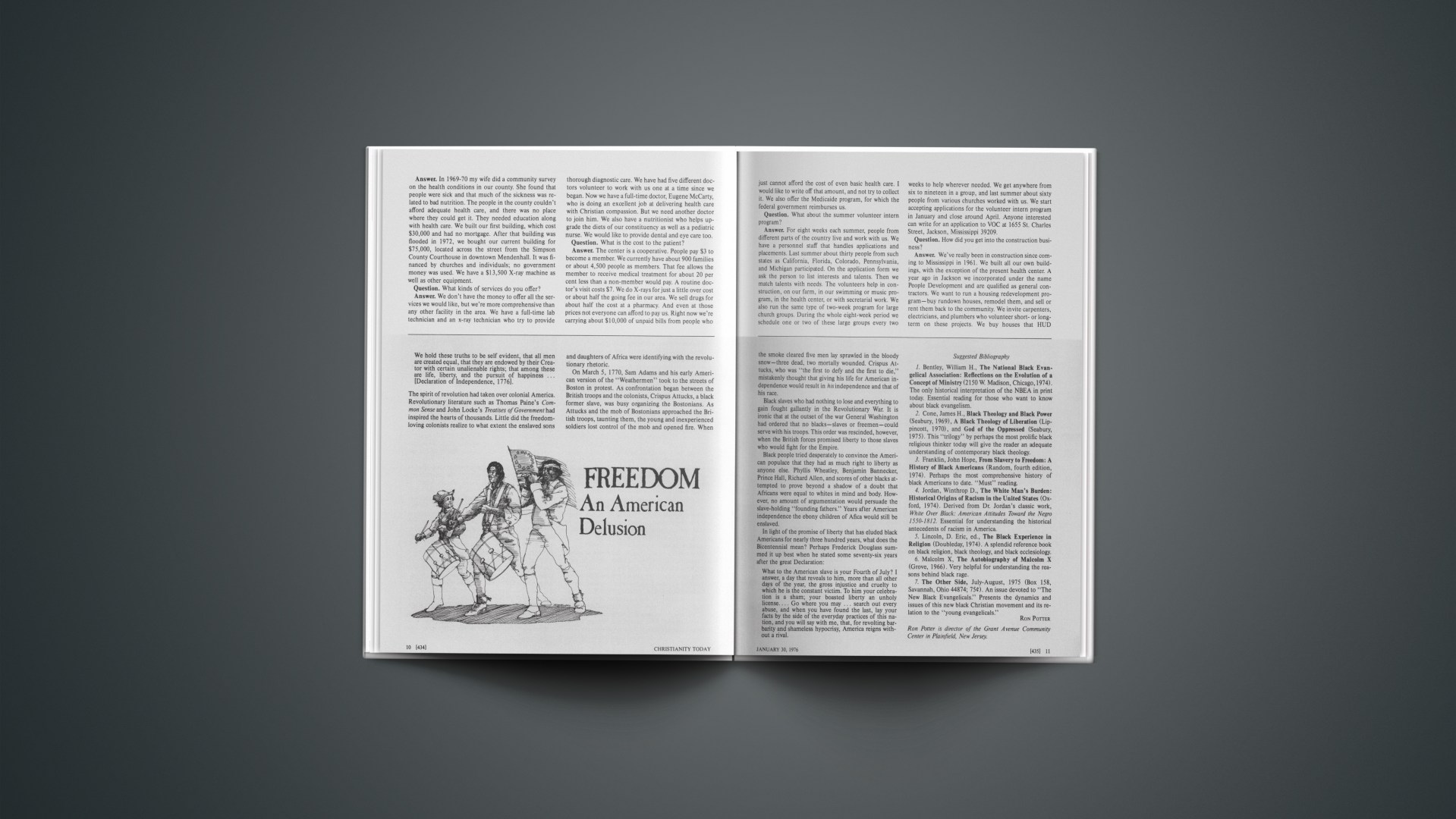
The spirit of revolution had taken over colonial America. Revolutionary literature such as Thomas Paine’s Common Sense and John Locke’s Treatises of Government had inspired the hearts of thousands. Little did the freedom-loving colonists realize to what extent the enslaved sons and daughters of Africa were identifying with the revolutionary rhetoric.

On March 5, 1770, Sam Adams and his early American version of the “Weathermen” took to the streets of Boston in protest. As confrontation began between the British troops and the colonists, Crispus Attucks, a black former slave, was busy organizing the Bostonians. As Attucks and the mob of Bostonians approached the British troops, taunting them, the young and inexperienced soldiers lost control of the mob and opened fire. When the smoke cleared five men lay sprawled in the bloody snow—three dead, two mortally wounded. Crispus Attucks, who was “the first to defy and the first to die,” mistakenly thought that giving his life for American independence would result in his independence and that of his race.

Black slaves who had nothing to lose and everything to gain fought gallantly in the Revolutionary War. It is ironic that at the outset of the war General Washington had ordered that no blacks—slaves or freemen—could serve with his troops. This order was rescinded, however, when the British forces promised liberty to those slaves who would fight for the Empire.

Black people tried desperately to convince the American populace that they had as much right to liberty as anyone else. Phyllis Wheatley, Benjamin Bannecker, Prince Hall, Richard Allen, and scores of other blacks attempted to prove beyond a shadow of a doubt that Africans were equal to whites in mind and body. However, no amount of argumentation would persuade the slave-holding “founding fathers.” Years after American independence the ebony children of Africa would still be enslaved.

In light of the promise of liberty that has eluded black Americans for nearly three hundred years, what does the Bicentennial mean? Perhaps Frederick Douglass summed it up best when he stated some seventy-six years after the great Declaration:

What to the American slave is your Fourth of July? I answer, a day that reveals to him, more than all other days of the year, the gross injustice and cruelty to which he is the constant victim. To him your celebration is a sham; your boasted liberty an unholy license.… Go where you may … search out every abuse, and when you have found the last, lay your facts by the side of the everyday practices of this nation, and you will say with me, that, for revolting barbarity and shameless hypocrisy, America reigns without a rival.

Suggested Bibliography

1. Bentley, William H., The National Black Evangelical Association: Reflections on the Evolution of a Concept of Ministry (2150 W. Madison, Chicago, 1974). The only historical interpretation of the NBEA in print today. Essential reading for those who want to know about black evangelism.

2. Cone, James H., Black Theology and Black Power (Seabury, 1969), A Black Theology of Liberation (Lippincott, 1970), and God of the Oppressed (Seabury, 1975). This “trilogy” by perhaps the most prolific black religious thinker today will give the reader an adequate understanding of contemporary black theology.

3. Franklin, John Hope, From Slavery to Freedom: A History of Black Americans (Random, fourth edition, 1974). Perhaps the most comprehensive history of black Americans to date. “Must” reading.

4. Jordan, Winthrop D., The White Man’s Burden: Historical Origins of Racism in the United States (Oxford, 1974). Derived from Dr. Jordan’s classic work, White Over Black: American Attitudes Toward the Negro 1550–1812. Essential for understanding the historical antecedents of racism in America.

5. Lincoln, D. Eric, ed., The Black Experience in Religion (Doubleday, 1974). A splendid reference book on black religion, black theology, and black ecclesiology.

6. Malcolm X, The Autobiography of Malcolm X (Grove, 1966). Very helpful for understanding the reasons behind black rage.

7. The Other Side, July-August, 1975 (Box 158, Savannah, Ohio 44874; 75¢). An issue devoted to “The New Black Evangelicals.” Presents the dynamics and issues of this new black Christian movement and its relation to the “young evangelicals.”

Ron Potter is director of the Grant Avenue Community Center in Plainfield, New Jersey.

What Happened in Italy

Last spring I conducted a seminar tour to Renaissance Italy. Europe was experiencing its seasonal rebirth; Christendom was celebrating Resurrection victory and Easter newness: everything conspired to reinforce the impact of that amazing epoch heralding the Reformation which John Addington Symonds referred to as “the fascination of a golden dream.” Our regular itinerary gave us Milan’s La Scala opera, the Byzantine magnificence of St. Mark’s Cathedral in Venice, Petrarch’s home at Arqua, the breathtaking Giotto frescoes in Padua, and Florence over the Easter weekend. But an unscheduled theological “extra” was provided in the Renaissance capital: a dialogue of more than routine interest.

It was Easter Monday. On Easter day we had spent time with Riccardo Paul, who is carrying on valiant evangelical missionary work in Florence under the aegis of the Worldwide European Fellowship; then for two days we had made detailed visits to the Duomo, Ghiberti’s golden “doors of paradise” at the Baptistry of San Giovanni, Michelangelo’s David at the Uffizi, Santa Croce, and the house where Christian poets Robert and Elizabeth Barrett Browning lived.

Now, back at our pensione—once a Renaissance palace—we were assembled for one of my lectures. The subject: pre-Reformer Savonarola, who had been burned at the stake on May 23, 1498, and his ashes thrown into the Arno from the Ponte Vecchio. Just before the execution, the bishop declared: “I separate you from the Church Militant and from the Church Triumphant.” Replied Savonarola, in words worthy of Luther a generation later: “You may separate me from the Church Militant, but only God can separate me from the Church Triumphant.”

As may be evident, I am a Savonarola buff; but I recognize the friar’s inadequacies. In my lecture, I quoted his stinging Advent sermon of 1493, in which he condemned the luxury of the Roman church of his day and its indifference to the poor: “The first prelates … had fewer gold mitres and fewer chalices, for, indeed, what few they possessed were broken up to relieve the needs of the poor; whereas our prelates, for the sake of obtaining chalices, will rob the poor of their sole means of support.” I praised Savonarola for such “Law” preaching, but expressed regret that, unlike Luther, he had not been able to provide the positive counteractive: gospel preachment of salvation by grace alone, through faith alone. I emphasized that giving to the poor was no more Gospel than giving to the church: a man is saved not by anything he does but by what God has already done for him in Jesus Christ; and I noted that one of the greatest sources of weakness in the contemporary church is its confusion of social action with gospel proclamation.

As I spoke I noticed a scholarly fellow in the corner, trying (it appeared) to listen without seeming to listen. He looked like one of that perennial band of sabbatical Fulbright professors in rumpled tweeds studying everything from ancient Roman toilet graffiti to medieval entomology. Who did he turn out to be? A professor of systematic theology from the Garrett Theological Seminary (Evanston, Illinois; United Methodist; pretensions of being evangelical—I well remember my old acquaintance, the English Methodist Luther scholar Philip S. Watson, castigating his colleagues on that faculty for knowing little of Wesley or historic Methodist theology, to say nothing of Luther, whose Romans Commentary brought about Wesley’s conversion!). Needless to say, the professor (we’ll call him G, for Garrett) had not cared for my lecture. The following dialogue ensued:

G. Giving to the poor is not “Law.”

M. The proper distinction between Law and Gospel is, as Luther said, the distinguishing mark of the true Christian. We must never confuse justification and sanctification; all works are equally inadequate for salvation, no matter how socially beneficial they may be.

G. But works are a dimension of the Gospel.

M. “Dimension” is a current theological weasel-word; it implies a structural relationship. What structural relationship would permit works to contribute to salvation? Martin Luther King and company are entirely off base when they imply or suggest that serving the poor equals salvation.

G. Such unconscious works are saving; don’t you think they are done by God’s Spirit? Remember what Karl Rahner says about “secret Christians”—those who do God’s will though they may not realize it.

M. Like Nebuchadnezzar? Was Pilate saved because the Spirit led him to refuse to take down the superscription from the Cross? You are hopelessly confusing common grace with saving grace.

G. I reject that distinction; there are many good arguments against it.

M. And in behalf of it we have Luther, Calvin, and Scripture.

G. What about “giving a cup of water in Jesus’ name” (Matt. 25)?

M. Do you seriously think the passage means that one not knowing or accepting Christ is in a saving state because he does good from a loving motivation? What about Acts 4:12 (only the name of Jesus saves) and Romans 10:14 (how shall they hear without a preacher)? These passages can only be reconciled by the recognition that Matthew 25 speaks of Christians already saved by grace through faith who haven’t yet comprehended how their faith motivates them to do good works—who haven’t yet seen good works as the fruit of faith.

G. I don’t worry about reconciling Scripture. Do you really think the Bible presents a single, consistent theology?

M. Most definitely, the one Paul (Gal. 1:8) refers to when he says, “Though an angel from heaven—or a professor from Garrett?—preach any other Gospel than that which we have preached unto you, let him be accursed.”

G. Or a professor from your institution?

(Exeunt omnes.)

Present during my lecture were Pastor Paul and his gracious wife Laura. I thought of them—thirteen years in the barren, heartless, powerfully Communist mission field of Northern Italy. He had told me how hard it was for the two of them and their six children merely to survive the ethical dilemmas (for example, he was told that if he declared more than 60 per cent of his income for tax purposes he was crazy, for the government assumes everyone cheats and ups the declared income accordingly!).

His wife explained: “We want people here to see the difference in our lives. Then we can tell them about the Source of our strength and they will listen.”

Here were missionaries, like the apostolic company, whose very lives are predicated on the assumption that “secret Christians” don’t exist—that the Gospel must be preached in word. For them, as for the members of Savonarola’s Church Triumphant, God-honoring works are a fruit of faith, never a substitute for it.

JOHN WARWICK MONTGOMERY

Editor’s Note from January 30, 1976

This issue gives voice to a segment of the black community. The writers cannot be said to be speaking for black Christians as a whole. But what you will read does portray what some of our black brethren are thinking and saying. Clarence Hilliard is an angry evangelical from Chicago who calls it as he sees it. Michael Haynes deals with the Boston busing impasse; he is a minister, a politician, and a board member of an evangelical college. The interview with John Perkins tells the story of one man’s pilgrimage against great odds. Finally, James Tinney describes black preaching style, one of the main differences between black and white worship services.

Mission ’76: A World View

The following account of a significant Christian youth gathering in Europe is based on reports filed by correspondents Robert P. Evans and Dale G. Vought, and on a dispatch by the Ecumenical Press Service.

At first glance, Mission ‘76 seemed like a replay of the 1974 International Congress on World Evangelization. The site, the spacious Palais de Beaulieu in Lausanne, Switzerland, was the same. Both events were attended by several thousand participants concerned about reaching the world for Christ. But contrasts with the 1974 congress soon became apparent, too.

Most of the roughly 3,000 persons who gathered at Lausanne during the last week of 1975 were young people, many were students, and they came from twenty countries on one continent. (The world congress in 1974 attracted 4,000 persons, the vast majority of them seasoned Christian leaders, from 150 lands on five continents and in Oceana.)

Northern Europeans dominated the registration list. There were large groups from England, the Netherlands, Belgium, Germany, France, Switzerland, and the Scandinavian countries. Forty came from Finland. Most were housed in university dormitories, army barracks, and private homes. English and French were the main platform languages, with simultaneous translation into eight other tongues.

The event was sponsored by the European Student Missionary Association which maintains chapters at fifteen Bible institutes and colleges. Lending important support were Campus Crusade for Christ, Operation Mobilization, Youth for Christ, and Youth With a Mission.

While the plight of the millions in the Third World was a major concern to both the world congress in 1974 and the Mission ‘76 body, secularized Western society as a needy and strategic mission field got more attention at Mission ‘76 than at the 1974 gathering. France’s Yves Perrier and Germany’s Anton Schulte and Werner Burtlin, leading evangelicals in their countries, hammered home this theme.

Some leaders representing the Third World differed from certain views expressed by key speakers at the 1974 meeting. Opening speaker Luis Palau, an Argentine-born evangelist operating out of Mexico City (see December 19, 1975, issue, page 31), said that evangelism is more important than even food for the hungry, if the choice had to be made. In an interview, Palau told correspondent Robert P. Evans that much of what had been called in 1974 “the cultural imperialism of missionaries,” especially of missionaries in Latin America, was exaggeration.

News of the accidental death of African evangelical leader Byang Kato of Nigeria (see January 16 issue, page 30) reached Lausanne just before he was scheduled to arrive there as a speaker. Pastor Kassoum Keita of Mali at the last minute took his topic, “the lostness of man.” (Another scheduled speaker replaced earlier was Paul Little of Inter-Varsity Christian Fellowship, who was killed in an auto accident in Canada last summer. Little had been one of Mission ‘76’s key advisors.)

India’s Akbar Abdul Haqq was among a group of speakers who presented a series of talks on the world’s great religions. Important regions of the world were examined by Britain’s Michael Griffiths of the Overseas Missionary Fellowship, Hector Espinoza of Mexico, Fouad Accad of Lebanon, and others.

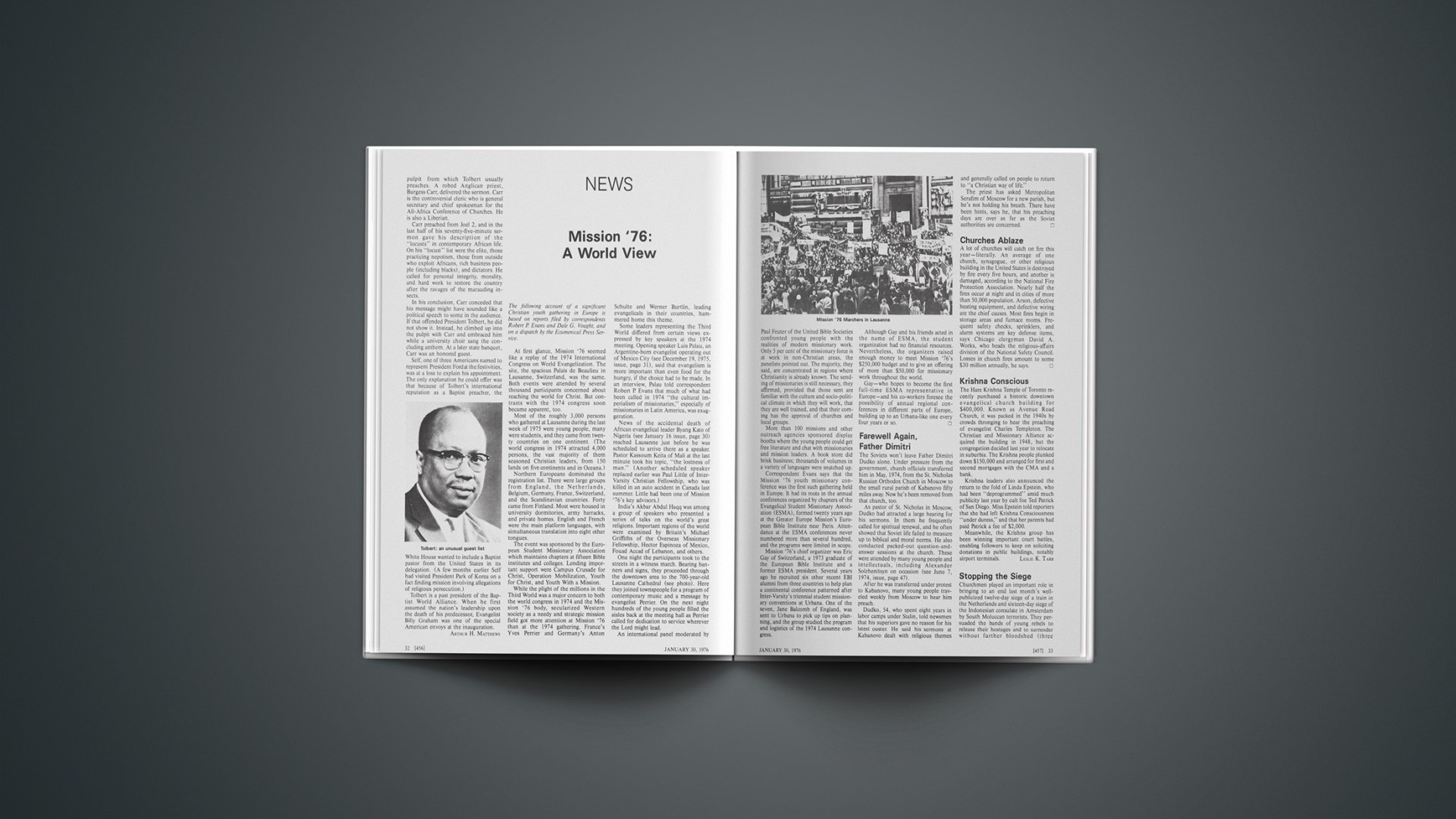
One night the participants took to the streets in a witness march. Bearing banners and signs, they proceeded through the downtown area to the 700-year-old Lausanne Cathedral (see photo). Here they joined townspeople for a program of contemporary music and a message by evangelist Perrier. On the next night hundreds of the young people filled the aisles back at the meeting hall as Perrier called for dedication to service wherever the Lord might lead.

An international panel moderated by Paul Feuter of the United Bible Societies confronted young people with the realities of modern missionary work. Only 5 per cent of the missionary force is at work in non-Christian areas, the panelists pointed out. The majority, they said, are concentrated in regions where Christianity is already known. The sending of missionaries is still necessary, they affirmed, provided that those sent are familiar with the culture and socio-political climate in which they will work, that they are well trained, and that their coming has the approval of churches and local groups.

More than 100 missions and other outreach agencies sponsored display booths where the young people could get free literature and chat with missionaries and mission leaders. A book store did brisk business; thousands of volumes in a variety of languages were snatched up.

Correspondent Evans says that the Mission ‘76 youth missionary conference was the first such gathering held in Europe. It had its roots in the annual conferences organized by chapters of the Evangelical Student Missionary Association (ESMA), formed twenty years ago at the Greater Europe Mission’s European Bible Institute near Paris. Attendance at the ESMA conferences never numbered more than several hundred, and the programs were limited in scope.

Mission ‘76’s chief organizer was Eric Gay of Switzerland, a 1973 graduate of the European Bible Institute and a former ESMA president. Several years ago he recruited six other recent EBI alumni from three countries to help plan a continental conference patterned after Inter-Varsity’s triennial student missionary conventions at Urbana. One of the seven, Jane Balcomb of England, was sent to Urbana to pick up tips on planning, and the group studied the program and logistics of the 1974 Lausanne congress.

Although Gay and his friends acted in the name of ESMA, the student organization had no financial resources. Nevertheless, the organizers raised enough money to meet Mission ‘76’s $250,000 budget and to give an offering of more than $50,000 for missionary work throughout the world.

Gay—who hopes to become the first full-time ESMA representative in Europe—and his co-workers foresee the possibility of annual regional conferences in different parts of Europe, building up to an Urbana-like one every four years or so.

Farewell Again, Father Dimitri

The Soviets won’t leave Father Dimitri Dudko alone. Under pressure from the government, church officials transferred him in May, 1974, from the St. Nicholas Russian Orthodox Church in Moscow to the small rural parish of Kabanovo fifty miles away. Now he’s been removed from that church, too.

As pastor of St. Nicholas in Moscow, Dudko had attracted a large hearing for his sermons. In them he frequently called for spiritual renewal, and he often showed that Soviet life failed to measure up to biblical and moral norms. He also conducted packed-out question-and-answer sessions at the church. These were attended by many young people and intellectuals, including Alexander Solzhenitsyn on occasion (see June 7, 1974, issue, page 47).

After he was transferred under protest to Kabanovo, many young people traveled weekly from Moscow to hear him preach.

Dudko, 54, who spent eight years in labor camps under Stalin, told newsmen that his superiors gave no reason for his latest ouster. He said his sermons at Kabanovo dealt with religious themes and generally called on people to return to “a Christian way of life.”

The priest has asked Metropolitan Serafim of Moscow for a new parish, but he’s not holding his breath. There have been hints, says he, that his preaching days are over as far as the Soviet authorities are concerned.

Churches Ablaze

A lot of churches will catch on fire this year—literally. An average of one church, synagogue, or other religious building in the United States is destroyed by fire every five hours, and another is damaged, according to the National Fire Protection Association. Nearly half the fires occur at night and in cities of more than 50,000 population. Arson, defective heating equipment, and defective wiring are the chief causes. Most fires begin in storage areas and furnace rooms. Frequent safety checks, sprinklers, and alarm systems are key defense items, says Chicago clergyman David A. Works, who heads the religious-affairs division of the National Safety Council. Losses in church fires amount to some $30 million annually, he says.

Krishna Conscious

The Hare Krishna Temple of Toronto recently purchased a historic downtown evangelical church building for $400,000. Known as Avenue Road Church, it was packed in the 1940s by crowds thronging to hear the preaching of evangelist Charles Templeton. The Christian and Missionary Alliance acquired the building in 1948, but the congregation decided last year to relocate in suburbia. The Krishna people plunked down $150,000 and arranged for first and second mortgages with the CMA and a bank.

Krishna leaders also announced the return to the fold of Linda Epstein, who had been “deprogrammed” amid much publicity last year by cult foe Ted Patrick of San Diego. Miss Epstein told reporters that she had left Krishna Consciousness “under duress,” and that her parents had paid Patrick a fee of $2,000.

Meanwhile, the Krishna group has been winning important court battles, enabling followers to keep on soliciting donations in public buildings, notably airport terminals.

LESLIE K. TARR

Stopping The Siege

Churchmen played an important role in bringing to an end last month’s well-publicized twelve-day siege of a train in the Netherlands and sixteen-day siege of the Indonesian consulate in Amsterdam by South Moluccan terrorists. They persuaded the bands of young rebels to release their hostages and to surrender without further bloodshed (three hostages were killed aboard the train and one died when he leaped from the consulate).

The two key mediators between the terrorists and the authorities were Johannes Manusama, 62, a Rotterdam mathematics teacher, and Samuel Metiari, 58, pastor of a South Moluccan congregation in northern Holland.

Manusama is the Bible-reading president of the self-styled government-inexile of the Republic of the South Moluccas. There are an estimated 35,000 South Moluccans in the Netherlands. Many came as refugees after an abortive uprising to gain independence in 1950, when the Dutch ended their rule in the Indonesian archipelago. At that time the South Molucca islands—known also as Spice Islands—became part of Indonesia. Many South Moluccans are devout adherents of the Reformed faith, while the predominant religion of Indonesia is Islam.

The thirteen young men involved in the siege (six on the train and seven at the consulate) demanded help in getting an independent homeland for their people in exchange for release of the hostages (twenty-three on the train, twenty-five at the consulate).

The older generation for years has been praying for independence, commented an observer, and the young people have become impatient. Now, says he, they feel they must fight for their freedom.

Manusama and Metiari appealed frequently to the religious heritage of the youths over the days of negotiation. Toward the end, Bible reading, singing of psalms, prayers, and tears marked some of the sessions, with several of the hostages joining in.

The terrorists face long prison terms, some possibly for life.

Time Capsule

What item would you select for a Bicentennial time capsule to represent what Americans have become in 200 years?

That was the question asked of scores of “opinion moulders” by TWA Ambassador, the in-flight magazine of Trans World Airlines. The answers ranged from Bibles and credit cards to Watergate tapes and a “Peanuts” cartoon.

Evangelist Billy Graham chose an open Bible because, he wrote, “this reminds us first of all that our nation has deep spiritual roots in the soil of the Scripture. This nation was founded by God-fearing men and women who sought to build a nation on the foundation of God’s unchanging moral truths. Second, the open Bible is a challenge to us as we enter our third century—to rediscover the spiritual commitment and moral fiber that have helped build our nation.”

Singer Pat Boone also chose the Bible, but he specified a copy of the Living Bible paraphrase because “the printing and distribution of this book, in which America has taken the lead, is the single most important contribution America has made to the world.”

Well-known rabbi Marc H. Tanenbaum chose the concept of democratic pluralism.

THE LONGEST SERMON

A few months ago Pastor Robert Marshall of the Birmingham Unitarian Church in suburban Detroit read in a church publication that a new record had been set in non-stop preaching. The previous record had been established in 1955 by independent preacher Clinton Locy, then in his sixties, in a West Richland, Washington, church basement. Locy’s sermon, blared to townspeople on loud speakers, lasted 48 hours and 18 minutes, according to the Guinness Book of Records. The paper Marshall was reading reported that Unitarian minister Robin Williamson of County Antrim in Northern Ireland had set a new Guinness record last July with a sermon lasting 60 hours and 25 minutes.

To Marshall, 55, a former bookseller, it was all a challenge. So, at 12:01 A.M. on New Year’s Day, a Thursday, he stepped to the pulpit and began preaching. He did not stop until 12:32 PM. on Saturday—60 hours and 31 minutes later, besting Williamson by six minutes. Or so it seemed. Marshall learned much later from a news service that he had been sort of victimized by a typographical error: Williamson’s sermon had lasted only 50 hours and 25 minutes, not 60.

Marshall’s 1,120-page (double-spaced) sermon was entitled “From Abraham to Augustine.” But he managed to complete only 850 pages, stopping somewhere in Acts. On hand when he stopped was a standing-room-only crowd of some 400 members of the 700-family congregation that he has served for fourteen years. They gave him a standing ovation. For more than an hour afterward they milled about, shaking hands and congratulating him. Many had manned an attendance-shift plan that provided Marshall with round-the-clock audiences—and with the necessary witnesses required by Guinness. His church board had debated the proposal for three months before granting him cautious approval.

The cleric in an interview described the post-sermon celebration as “almost a revival experience, as if the Holy Spirit had visited us.” It was, he added hastily, “a heart-warming affirmation of the human spirit.”

The last ten hours were the toughest, he stated. He said he experienced spatial disorientation (stationary objects appeared to move), and he had to keep asking his hearers if he was making sense (they said he was). “I kept dreaming while I was preaching,” he explained.

In accordance with the Guinness guidelines, Marshall took a five-minute break each hour. During some of the breaks his wife Doris and several friends led him around the church courtyard in subfreezing temperatures to help keep him awake. At the pulpit he consumed vitamin pills, raisins, throat lozenges, vegetable soup, and lots of orange juice and coffee. Part of the time he preached while perched on a stool.

When it was all over, he went to bed and slept from 3:00 P.M. Saturday until 8:00 A M. Sunday. Then he began packing for a sabbatical study leave at the University of Haifa in Israel.

EDWARD E. PLOWMAN

Religion In Transit

Evangelist Billy Graham’s bookAngels (Doubleday) for several weeks last month and this month ranked near the top on the non-fiction bestsellers’ lists published by Time and the New York Times (more than a million copies of the book are in print). Observers say it is rare for evangelical books to make such lists. Graham recently returned from a three-months tour around the world during which time he met with a number of heads of state and discussed world conditions. On New Year’s Eve he made a major television address on more than 300 stations, calling the nation to a year of prayer, humiliation, and fasting.

President Ford this month signed into law the Overseas Citizens Voting Rights Act, enabling an estimated 33,000 American missionaries and hundreds of thousands of other citizens working abroad to vote in federal elections. It provides that absentee ballots can be filed in the state of last residence, at the same time nullifying the past requirement of filing a declaration of intent to resume residence in a given state upon one’s return. The new law, which was before Congress for ten years, also prohibits income taxes from being levied on the basis of absentee voting.

If a minister’s congregation gives him rent-free housing as part of his pay, he doesn’t have to pay income tax on the rental value of the housing. If he dies, however, and his widow is allowed to stay in the rent-free house, she must declare its value as income and pay tax on it. Republican congressman John J. Duncan of Tennessee has introduced a bill that would enable such a widow to retain her church-provided housing tax-free. The U. S. Treasury department opposes it—and some tax officials are pressing for removal of housing exemptions from ministers.

Some overseas missionaries report they are victims of harassment and suspicion as a result of recent publicity of alleged links between the Central Intelligence Agency and certain mission personnel. They insist that most missionaries have never had such ties, and they would like to see the matter disappear from press notice. The United Methodist Board of Global Ministries meanwhile issued a stern warning, threatening to fire any missionary “knowingly engaged in intelligence activities.”

When the Catholic Archdiocese of Denver purchased the six-story Bankers Union Life Building in the city, church members discovered that one of the tenants was the Central Intelligence Agency, whose lease does not expire until next year. Protesters picketed the building and complained to archdiocesan leaders. A spokesman said existing leases would be honored but ruled out any working relationship between the church and the federal agency.

The clergy-deployment office of the Episcopal Church has contracted with Snelling and Snelling, a worldwide employment agency, to help clergymen find jobs outside the church. The move may be a first among denominations. Of seventy-eight applicants so far, fifty-one have obtained job offers. The Episcopal Church presently has a clergy surplus,and some priests simply feel they can be happier or more effective in a secular position. The number of ministers seeking work elsewhere is a growing problem for many denominations, says a Snelling and Snelling spokesman.

President M. G. “Pat” Robertson of the Christian Broadcasting Network (CBN) announced plans to build a $23 million international headquarters and communications school to teach broadcasting to students from around the world. To be located at Virginia Beach, Virginia, it will include two large television studios, a satellite-transmitting facility, a 2,400-seat conference center, and a school of theology. CBN recently received a Distinguished Merit Citation from the National Conference of Christians and Jews.

Sign of the times: Evangelist Duane Pederson of Hollywood, California, changed the name of his organization from Jesus People International to International Christian Ministries “to create a wider base of operation.” Part of his time currently is spent in prison ministry.

Catholic Bishop Raymond A. Lucker, the newly appointed head of the Diocese of New Ulm, Minnesota, has declared himself: he’s part of the charismatic renewal. Spiritual renewal is the single most important need of the church, he told a newsman. “The Lord calls us to a deep conversion and to a faith in his word and response to his revelation,” he said.

A Pennsylvania superior court ruling last month left the state with no law governing or controlling smut. In overturning a 1973 conviction, it held that the state’s laws—based on a “community standards” provision—were unconstitutional and unenforceable. Earlier, a higher court okayed X-rated movies and a commercial photo studio featuring nude models.

Bishop Demetrius of Olympus, 65, the spiritual leader of Greek Orthodox churches in the Midwest, has retired.

The William B. Eerdmans Publishing Company in Grand Rapids, Michigan, and the Christian College Consortium, of Washington, D. C., an alliance of evangelical colleges, have jointly established the Christian University Press to publish books dealing with Christian thought.

Nearly half of the 10,000 persons who contacted Intercristo in 1975 were put in touch with Christian organizations having specific work opportunities, says an Intercristo spokesman. Based in Seattle, Intercristo serves as sort of a computerized bulletin board of Christian job opportunities for job seekers. Its toll-free number is 800-426-0507.

The twelve-member Board of Bishops of the African Methodist Episcopal Zion Church voted to increase the denomination’s four-year budget from $1.5 million to $3 million. Approval must be given at the church’s quadrennial conference in Chicago in May.

DEATHS

C. EWBANK TUCKER, 80, a bishop of the African Methodist Episcopal Zion Church, attorney, and civil rights activist who backed President Nixon; in Louisville, Kentucky.

LESLIE D. WEATHERHEAD, 82, well-known British Methodist minister, pastor of London’s City Temple from 1936 to 1960, and author of more than thirty books, many of them on the relationship between religion and psychology; in London.

Personalia

New Testament professor Simon J. Kistemaker of Reformed Seminary in Jackson, Mississippi, was elected president of the Evangelical Theological Society at the ETS annual meeting in Jackson. Edmund P. Clowney of Westminster Seminary in Philadelphia was elected vice-president and thus will probably succeed Kistemaker next year. More than 130 attended the meeting.

New bishop: Episcopal clergyman Martin Tilson, 53, was named to head the Diocese of Louisiana, succeeding the late Bishop Iveson Noland, killed in a plane crash last year.

Resigned: Larry Kehler, as editor of The Mennonite, the weekly periodical of the General Conference Mennonite Church published in Newton, Kansas. Effective August 31.

Evangelist Kathryn Kuhlman had a mitral valve replaced in open-heart surgery at the Tulsa General Hospital last month. Before operating, the surgical team held hands while Evangelist Oral Roberts prayed for them and touched them, according to a witness. Miss Kuhlman has had heart trouble since she was a child, says her secretary.

World Scene

A church version of the World Bank, the Ecumenical Development Cooperative Society, has been established in the Netherlands to provide capital for loans to churches in developing nations. The venture is headed by Cyril Bennett, financial secretary of the British Methodist Missionary Society.

Hans W. Florin, 47, an ecumenical media specialist of Hamburg, Germany, is the new general secretary of the World Association for Christian Communication.

A number of missionaries who formerly served in Cambodia and South Viet Nam are working in France among the many Indochina refugees there, and the French Evangelical Alliance has set up a fund to aid the displaced persons.

A record 64.8 million people visited famous shrines and Buddhist temples throughout Japan during the first three days of the new year to pray for good luck, according to Japanese police officials. They cite as reasons good weather and the national recession, which apparently caused many to turn to Shintoist and Buddhist deities for help.

The leading religious periodicals in Britain have suffered a loss of 500,000 in circulation in the past decade, according to a recent study. Only the Salvation Army’s War Cry showed an increase. Higher prices because of rising costs were blamed.

The world’s Jewish population is estimated at 14.2 million, according to the 1976 American Jewish Yearbook. Of these, 5.7 million live in the United States, 2.9 million are in Israel, and 2.7 million are Soviet citizens.

CHURCH POLL

Church attendance last year, according to a national Gallup Poll, remained at the same level as in the four previous years: 40 per cent of America’s adults and about 30 per cent of its young adults (age 18–29 years) attended church or synagogue services in a typical week. Young adult attendance declined from 40 per cent in the late 1960s. The 1975 figures reveal that 54 per cent of the nation’s Catholics and 38 per cent of its Protestants attended church during the test week, while 21 per cent of the Jews attended synagogue. Of the 71 per cent holding membership in a church or synagogue, only a little over half attended that week.

Twenty per cent of those polled said they had participated during that week in religious activities other than church services,” such as prayer group meetings, Bible reading classes, and the like.”

On another topic, a Scholastic magazine survey of teen-agers found that 86 per cent believe a religious ceremony is important to a marriage.

Is the United Methodist Church Coming Back to Life?

On the surface, the United Methodist Church (UMC) appears to be in deep trouble. Recently released figures place current membership at 9.9 million—a loss of one million in the past seven years. Restructure years ago caused problems that still aren’t straightened out. These include a $1.4 million deficit for 1974 and 1975 by the important Board of Discipleship, budget-crunch layoffs, and disgruntled personnel. Last year the denomination was left without a general church-wide magazine when United Methodists Today was axed. (Subscriptions were declining—there were fewer than 140,000 at the end—and deficits were rising.) Controversies over doctrine and practice have been a source of distress for a number of the church’s 39,000 congregations.

But there are some bright sides to the situation. Average attendance at the main worship service is up (3.6 million nationwide), and total income for all purposes in the last fiscal year topped $1 billion, an increase of $74 million over the previous year. At the Board of Discipleship officials seem to be getting things under control. The UMC’s communication cause is being served well by the high-quality United Methodist Reporter, a national weekly newspaper published by the United Methodist Conferences of Texas. (Circulation is nearing 325,000.)

Several organized groups have been lobbying for doctrinal and policy reforms along evangelical lines. The reforms would affect curricula materials, emphases of program agencies, assumptions underlying missionary work, how money is spent, and the like. The best known of the reform groups is the so-called Good News Movement, based in Wilmore, Kentucky, home of Asbury Seminary, an evangelical Methodist school. A related group is the Evangelical Missions Council (EMC). They have scored some gains but the going is tough. Last year the denomination’s world mission unit broke off dialogue with the EMC, seeing no point in continuing the talks. So far, the evangelical lobbying has been low key enough to avoid widespread dissension throughout the church.

One issue that did cause an uproar was raised last year by the thirty-member United Methodist Council on Youth Ministry (UMCYM). The elected body drew up statements affirming homosexuality as a valid life style and sexual orientation, and it served notice that it would call on the church’s quadrennial conference in Portland this April to approve the ordination of avowed homosexuals. In the ensuing tumult and arm-twisting, the UMCYM members backed off from the ordination issue. At a meeting this month they said they would go along with a proposal to ask the 984 conference delegates instead to commission a study of human sexuality. But they also said they would request the conference to remove a clause from a statement of social principles passed at the 1972 conference in Atlanta. The clause: “we do not condone the practice of homosexuality and consider this practice incompatible with Christian teaching.”

Observers say there is virtually no chance of the UMCYM purge attempt passing. Many state conferences have already reaffirmed that section of the social principles, and a survey shows that an overwhelming percentage of United Methodists oppose homosexual behavior.

Such controversial issues easily catch the notice of the press while significant spiritual events and trends go unreported. The result is that the public image of the church becomes distorted.

This is at least partly true of the UMC. Early this month, for example, 2,300 UMC leaders of evangelism from throughout the country, their spouses, and others interested in outreach gathered at the Philadelphia Sheraton for the United Methodist Congress on Evangelism, an event that is held every four or five years. No secular newspeople covered it.

The participants represented the broad mainstream of evangelicals in the UMC. Their singing was loud and joyful, and they frequently punctuated speeches with an “Amen” or “Hallelujah” or “Praise the Lord.” Nearly everyone attended the early morning Bible studies (in Acts) conducted by Presbyterian minister Lloyd Ogilvie. He spoke on the Holy Spirit’s role in evangelism. There were thirteen daily mini conferences. The one on the work of the Holy Spirit was jammed. Second in attendance was the one on local church evangelism.

“Something is happening; God is at work in our church.” Every day somebody volunteered an observation like that. “The renewal of the Holy Spirit within the United Methodist Church is not a dream but a reality,” declared evangelist Oral Roberts on the final night of the five-day congress. His comment drew enthusiastic response.

Among the main congress speakers was UMC evangelism staffer George H. Outen, 44, who has been nominated to head the denomination’s Board of Church and Society. Confirmation is expected next month. Many see the selection of Outen to run the social-action arm of the church as another sign of basic change, an attempt to provide a firmer biblical footing for the UMC’s social-action programs.

Outen, a black and one of the UMC’s outstanding preachers, speaks forthrightly of his “new birth” experience through personal faith in Christ. He comes down just as clearly and firmly on issues of social justice.

He sees three trends ahead in the UMC’s social-concern emphases: programs and priorities will begin at grassroots level, not at the top; they will be grounded in the Gospel “with Jesus as a frame of reference”; and they will have proper motivation (growing out of response to the Gospel).

At one point in his address Outen sparred with an earlier speaker, Bishop William R. Cannon of Atlanta, who filled in when President Ford sent word that he could not be the keynote speaker as planned. Cannon declared that evangelism should have top priority in church life. But he also suggested that polarization impedes pursuit of the priority. He criticized the present-day emphasis on racial and ethnic differences which, he charged, cause polarization. In this connection he denounced quota systems in hiring and placement, especially in the the church. Outen replied that he doesn’t like quota systems either, “but they are a necessity precisely because of our past and current sins.”

UMC evangelism executive Ross Whetstone in an interview agreed that tides of spiritual renewal are flowing in the church. He notes great interest in the Holy Spirit, some of it within the charismatic context, much of it not. This, he says, is due in part to the cultural shift going on, a move from the rational to the sensate, brought on by the electronic age and a depersonalized world. “People are searching for significant personal experiences,” he concludes.

Whetstone is identified as a charismatic himself, but not a hand-waving one. He has conducted a number of conferences, often with an emphasis on healing, “to help United Methodists come to terms with the charismatic movement and to help experience-oriented churchmen understand the more rational-oriented part of the denomination.” He warns against “the cult of goose-bump strokers who get latched onto a spiritual high and never get into the life of the world” and against the dangers of misunderstanding and divisiveness.

Whetstone and others distinguish between charismatics and classical Pentecostals. The latter teach that glossolalia is the sign of Spirit baptism, while many charismatics say it may be a sign. There are other gifts of the Spirit, not just tongues, says Robert Tuttle, a parish minister of evangelism. Discernment is a needed gift today, he says.

Oral Roberts, however, came close to declaring that tongues as a prayer language is for every Christian although the gift of tongues (for public ministry) is not. Much of his nearly two-hour address dealt with glossolalia.

Many individuals in the UMC are involved in Bible study groups and lay-witness campaigns. A number of ministers and leaders also point to another trend: an increasing number of local churches are devising ongoing programs of evangelistic outreach in their communities and are no longer relying simply on a yearly preaching mission to fulfill the Great Commission.

That, said an old-timer at the congress, is a sure sign that the United Methodist Church is coming back to life.

EDWARD E. PLOWMAN

VIEWS ON VIEWING

Many Americans are concerned about the moral drift of television programming, according to a TV Guide poll conducted by Opinion Research Corporation of Princeton, New Jersey. The poll, involving more than 1,000 viewers, showed that 71 per cent feel too much violence is depicted, and that 54 per cent think there is too much emphasis on sex.

Last year TV executives established a “family viewing time” policy to prevent programming “inappropriate for viewing by a general family audience during the early evening hours.” This policy has been under attack by writers, actors, and producers who claim it is a form of censorship that has inhibited them. The TV Guide poll showed that 82 per cent of the viewers surveyed favor the policy while 7 per cent oppose it and 11 per cent have no opinion. But more than half of those polled had not known of the family viewing time and could not respond until pollsters told them what it is.

It is no secret that theological liberalism has fallen upon ho-hum times. Gone are the social-action crusades and mass demonstrations that provided a platform—and sometimes diversion—for many in the liberal camp. God has moved into the Secular City, and now there’s a growing sacred quarter that has helped to quiet the whole town. Many of the former liberal ideologists have settled down to rethink basic spiritual issues. Some even concede that not everything they formerly did in the name of God was necessarily of God. The charismatic movement, which has spread to liberal circles (including seminaries), has undone decades of demythologizing of Scripture. Conservative churches and schools are growing, and evangelicals are speaking out on the justice side of social concerns but, unlike many similarly minded liberals, from a solid biblical foundation.

A year ago a group of prominent theologians and other church leaders met at Hartford Seminary and hammered out an “Appeal for Theological Affirmation.” The Hartford paper identified and rejected thirteen “dangerous” trends in theology, including some pet premises of hard-core liberalism (see February 14, 1975, issue, page 53, and February 28 issue, page 32). The majority of the signers were themselves classified as liberals. In effect, they were saying there are limits to liberal theology, and here are the boundaries.

All of these developments distressed avant-grade types like Harvard’s Harvey Cox, well-known American Baptist theologian and author, and others who interpreted them as trends toward theological escapism. This month Cox and twenty other Boston theologians and church leaders struck back with a position paper of their own: “The Boston Affirmations.”

The four-page Boston statement amounts to a reaffirmation of the Church’s need to be involved socially—on liberal terms. “The living God is active in current struggles to bring a reign of justice, righteousness, love, and peace,” the paper begins. It goes on to show how God delivers from oppression through human instruments. Illustrations of such activity are drawn from the Church’s past. But, cautions the paper, “the question today is whether the heritage of this past can be sustained, preserved, and extended into the future.” It is gloomy about the answer: “Society as presently structured, piety as presently practiced, and the churches as presently preoccupied evoke profound doubts about the prospects.”

The paper sees “the transforming reality of God’s reign” in such “witnesses” as “the struggles of the poor to gain a share of the world’s wealth,” the “drive for ethnic dignity against racism,” the “endeavor by women to overcome sexist subordination,” and “the voices of citizens and political leaders who demand honesty.”

The signers assert that they “cannot stand with those secular cynics and religious spiritualizers who see in such witnesses no theology, no eschatalogical urgency, and no Godly promise or judgment.”

Those behind the Boston Affirmations are members of the Boston Industrial Mission Task Force, a social-action group formed in 1974. Social ethics professor Max Stackhouse of Andover Newton seminary did most of the editing.

Immediate reaction came from several framers of the Hartford statement, including Rutgers sociologist Peter Berger. “The Boston group wants to nail us down to a particular agenda which, broadly speaking, is a left-liberal agenda,” he observed. “It’s a very serious mistake to say that this is what Christians are to be concerned with.”

EDWARD E. PLOWMAN

African Unity

It is not unusual in Africa for church meetings to begin a little late, but there was an unusual reason for the late start of a worship service in Monrovia, Liberia, this month. The service in Zion Praise Baptist Church was a part of the program for the first full-term inauguration of Liberia’s president William Tolbert.

The service was delayed because Tolbert, who is also pastor of the church, was not there. It was an invitation-only affair, and the sanctuary was packed with political and ecclesiastical leaders as well as the diplomatic corps. While they waited, the rumor circulated that the president had gone to the airport to pick up the guest of honor. Among those waiting was a Southern Baptist pastor, William Self of Atlanta, Georgia, who was one President Ford’s special envoys to the inauguration.

Self said that the back door swung open an hour and a quarter after the stated starting time, and President Tolbert came in carrying his swagger-stick, which is topped by a carving of the head of Christ, and walked up the aisle to a chair beside the communion table.

The atmosphere was “electric” when his guests followed him to the front, Self told a reporter. The man he picked up at the airport was none other than Uganda’s Muslim president and the chairman of the Organization of African Unity, Idi Amin. The Ugandan field marshal, in military garb and with a pistol on each hip, took his place in a chair at the opposite end of the table from Tolbert.

After the opening liturgy, something else unusual happened in the Baptist pulpit from which Tolbert usually preaches. A robed Anglican priest, Burgess Carr, delivered the sermon. Carr is the controversial cleric who is general secretary and chief spokesman for the All-Africa Conference of Churches. He is also a Liberian.

Carr preached from Joel 2, and in the last half of his seventy-five-minute sermon gave his description of the “locusts” in contemporary African life. On his “locust” list were the elite, those practicing nepotism, those from outside who exploit Africans, rich business people (including blacks), and dictators. He called for personal integrity, morality, and hard work to restore the country after the ravages of the marauding insects.

In his conclusion, Carr conceded that his message might have sounded like a political speech to some in the audience. If that offended President Tolbert, he did not show it. Instead, he climbed up into the pulpit with Carr and embraced him while a university choir sang the concluding anthem. At a later state banquet, Carr was an honored guest.

Self, one of three Americans named to represent President Ford at the festivities, was at a loss to explain his appointment. The only explanation he could offer was that because of Tolbert’s international reputation as a Baptist preacher, the White House wanted to include a Baptist pastor from the United States in its delegation. (A few months earlier Self had visited President Park of Korea on a fact finding mission involving allegations of religious persecution.)

Tolbert is a past president of the Baptist World Alliance. When he first assumed the nation’s leadership upon the death of his predecessor, Evangelist Billy Graham was one of the special American envoys at the inauguration.

ARTHUR H. MATTHEWS

Apple PodcastsDown ArrowDown ArrowDown Arrowarrow_left_altLeft ArrowLeft ArrowRight ArrowRight ArrowRight Arrowarrow_up_altUp ArrowUp ArrowAvailable at Amazoncaret-downCloseCloseEmailEmailExpandExpandExternalExternalFacebookfacebook-squareGiftGiftGooglegoogleGoogle KeephamburgerInstagraminstagram-squareLinkLinklinkedin-squareListenListenListenChristianity TodayCT Creative Studio Logologo_orgMegaphoneMenuMenupausePinterestPlayPlayPocketPodcastRSSRSSSaveSaveSaveSearchSearchsearchSpotifyStitcherTelegramTable of ContentsTable of Contentstwitter-squareWhatsAppXYouTubeYouTube