Book Briefs: January 30, 1976

The Negro Church Becomes The Black Church

If Christ Is the Answer, What Are the Questions?, by Tom Skinner (Zondervan, 1974, 219 pp., $2.95 pb), The Black Experience in Religion, edited by C. Eric Lincoln (Anchor/Doubleday, 1974, 369 pp., $3.95 pb), A Black Political Theology, by J. Deotis Roberts (Westminster, 1974, 238 pp., $3.95 pb), The Negro Church in America, by E. Franklin Frazier, plus The Black Church Since Frazier, by C. Eric Lincoln (Schocken, 1974, 216 pp., $2.95 pb), are reviewed by James S. Tinney, Ph.D. candidate in political science, Howard University, Washington, D. C.

The “Negro” church has died, says C. Eric Lincoln; and in its place there now exists the new “black” church, an unapologetic force determined to lead the fight for social and spiritual justice in America. As the “Negro” church was structured and conditioned by accommodationism, the new “black” church is undergirded by a sanctified belligerence.

To this basic premise all the writers here considered give assent, although their individual interpretations sometimes modify or expand this thesis slightly. Skinner, for instance, allows that the black church “has historically been the most powerful social institution” while emphasizing that it needs to be revolutionized further. Roberts views the black church as liberating its people and others only when it emphasizes reconciliation, and as such, he may be seen somewhere in transition between the old and new definitions. (His book also offers little that is new and is, for all practical purposes, a restatement of his earlier work, Liberation and Reconciliation. In no sense does it live up to its title claim to be “a black political theology”.

At any rate, Lincoln’s counterposing of the old and new formations of black religion should be viewed against the backdrop of Frazier’s 1964 work, The Negro Church in America. It is appropriate that Frazier is here reprinted and bound together with Lincoln’s updating and reassessment. Frazier, as long-time chairman of the Howard University Department of Sociology, became the earliest leading black sociologist (along with W. E. B. DuBois). Lincoln is chairman of the Department of Religious Studies at Fisk University.

Frazier is often criticized by the newer black sociologists for failing to recognize the continuity of the African past with modern Afro-American experience, and for being preoccupied with an assimilationist black middle class, as well as with so-called negative features he ascribed to black religion. These criticisms are aimed at the work reprinted here, among others; witness the following: “The Negro church and Negro religion have cast a shadow over the entire intellectual life of Negroes and have been responsible for the so-called backwardness of American Negroes.” It was Frazier who also predicted that the church would “crumble” as blacks became integrated into the larger society. Lincoln’s statement, then, that the “Negro” church has died may be viewed as recognition of the Frazier prophecy or as its contradiction (i.e., the continued resistance of white society has led to a more viable and resistant strain of black religion), depending on one’s point of view.

In The Black Church Since Frazier, Lincoln attempts to interpret how his mentor would have viewed the Black Power movement, the rise to prominence of the Nation of Islam (Black Muslims), and new trends in black religion.

The best overview of what black church scholars currently are thinking and emphasizing, however, is the anthology, The Black Experience in Religion, also compiled by Lincoln. More than two dozen articles from leading journals are reprinted under five general subject sections: black church structures and modes, black theology, black protest and the church, black cults and sects, and linkages to African and Caribbean religions.

Throughout this volume common conclusions are reached by most writers—a phenomenon that may seem all the more remarkable since nearly every major religious tradition is represented, including writers from those who labor in predominantly white denominations and those who do not. Some of the unified themes that constantly reappear include: (1) black religion is in contradistinction to white religion in that it is more humanistic, more biblical, and more dynamic, and is the only instrument capable of calling the nation to reform. (2) The black church holds a proper balance between individualism and community, the sacred and the secular, experience and tradition, rationality and emotional content, and social and spiritual salvation. (3) The genius of black religion lies with these movements that have remained closest to the masses and have not negated African survivalisms. (4) Black theology should emphasize the favored, but not exclusionary, position of blacks (some would add other oppressed classes or groups) as God’s choice people, and should functionally advance the causes of black social and political liberation.

The omission of Skinner from the Lincoln collection is most glaring since the book is otherwise very comprehensive in its representation. Although Skinner is located within the stream of black religion as interpreted in the Lincoln anthology, the collection does not include a black evangelical with an interdenominational ministry such as he. Indeed, it is almost impossible to talk about black theologizing or ministry without taking Skinner into account. For this reason, the latest Skinner book should be read hand-in-hand with the anthology for a more complete understanding. Its easy-to-read question-and-answer format also makes it more accessible to the average reader.

Biblical Studies In Tribute

New Testament Christianity For Africa and the World, edited by Mark Glasswell and Edward Fasholé-Luke (London: SPCK, 221 pp., £5.95), and Current Issues in Biblical and Patristic Interpretation, edited by Gerald Hawthorne (Eerdmans, 1975, 377 pp., $9.95), are reviewed by W. Ward Gasque, associate professor of New Testament, Regent College, Vancouver, Canada.

These two volumes of essays are dedicated to two scholars who probably have never met and who live in totally different parts of the world but who have, in many respects, had remarkably similar ministries. Each has been a pioneer in academic work, particularly in setting an example for students to follow when the immediate cultural context was not favorable to the intellectual enterprise.

Harry Sawyer, to whom the first volume is dedicated, is an African theologian—the first African theologian to be honored by a Festschrift—who has done as much as any man to lay a solid foundation for academic theology in West Africa (Sierra Leone). Merrill C. Tenney, recipient of the second, is an American who through long years of teaching, first at Gordon Divinity School and then at Wheaton College Graduate School, has probably done more to initiate two generations of North American evangelicals into the ways of biblical scholarship than any other man. As is clear from the writings of each, and also from the biographical appreciations and personal notes included in each collection, both Sawyer and Tenney are churchmen as well as scholars; and both have given themselves primarily to teaching and academic administration rather than research, though each has made significant contributions through his writings.

New Testament Christianity For Africa and the World contains eighteen essays on a wide variety of historical, biblical, and theological topics by European and African scholars. Among the more interesting ones related to the New Testament are “Nations in the New Testament” (N. A. Dahl), “Paul’s Speech on the Areopagus” (C. K. Barrett), and the superb “Interpreting Paul by Paul” (C. E. D. Moule). Of theological interest are “Justification by Faith in Modern Theology” (H. E. W. Turner) and “Towards a Theologia Africana” (K. A. Dickson), neither of them earthshaking but both full of common sense and acute observation.

But perhaps the most stimulating are the articles devoted to the history of missions: “Missionary Vocation and the Ministry” (A. E Walls) and “The Missionary Expansion of Ecclesia Anglicana” (M. Warren), both containing incisive observations that, if noted, will provide valuable lessons for mission leaders even today. Finally, the essay in which Fasholé-Luke seeks to relate the ancestor veneration of African traditional religion to the Christian doctrine of the communion of saints will doubtless prove controversial; but it should not be dismissed out-of-hand since it advocates not the practice of baptizing a pagan doctrine but rather the seeking of a point of contact between the old customs and the new fellowship in Christ without compromising sound doctrine.

Current Issues in Biblical and Patristic Interpretation contains contributions by twenty-eight of Dr. Tenney’s former students, again treating a wide variety of biblical and theological subjects. With a few exceptions the essays are more technical than those contained in the Sawyer volume, and they are also generally longer. Among the notable contributions are the following. Historical: “The Development of the Concept of ‘Orthodoxy’ in Early Christianity” (R. A. Kraft) and “The Power of Giving and Receiving: Reciprocity in Hellenistic Benevolence” (S. C. Mott). Old Testament interpretation: “Were David’s Sons Really Priests?” (C. E. Armerding). Biblical theology: “The Weightier and Lighter Matters of the Law” (W. C. Kaiser), “The Deity of Christ in the Writings of Paul” (W. Elwell), and “The Holy Spirit in Galatians” (G. E. Ladd). New Testament criticism: “The Composition of Luke 9” (E. E. Ellis), “The Johannine Prologue and the Purpose of the Fourth Gospel” (E. J. Epp), “Bultmann’s Law of Increasing Distinctness” (L. R. Keylock), and “Literary Criteria in Life of Jesus Research” (R. N. Longenecker). New Testament exegesis: “Sins Within and Without: An Interpretation of 1 John 5:16–17” (D. M. Scholer) and “The Limits of Ecstasy: An Exegesis of 2 Corinthians 12:1–10” (R. P. Spittler). And finally, theology: “Charismatic Theology in the Apostolic Tradition of Hippolytus” (J. E. Stamm) and “Christology and ‘the Angel of the Lord’ ” (W. G. MacDonald). Unique among the contributions is a careful, even beautiful translation of the until recently little-known Paschal Homily of Melito, bishop of Sardis (d. ca. A.D 190), by the editor. This, in my view, is easily worth the price of the book and should be a part of any library. And there are other worthwhile contributions that I do not mention because of lack of space.

Two impressions stood out after I had read this thick and rather technical tome. Paramount of these is the impact one man can have on his students, and through them on the world. The twenty-eight contributors represent nearly that many different academic institutions, both Christian and secular, and serve in four countries. True, not all of them have followed their former teacher in all their later conclusions (but then Tenney has never been one to expect his pupils simply to repeat his opinions back to him), but each one has, in his own way, followed the teacher’s example of honesty and excellence. Secondly, I was impressed by the developing maturity of contemporary North American evangelical scholarship. Gone are the days when faithfulness to the Bible implied an anti-intellectual stance or an unscholarly obscurantism. And if this is so, Dr. Tenney, under God, is one of the people most responsible for the new situation.

Promising Beginning

The Southern Hill and the Land Beyond, by Pauline Davies (Eerdmans, 1975, 149 pp., $2.45 pb), is reviewed by Cheryl Forbes, assistant editor, CHRISTIANITY TODAY.

This series of short stories or vignettes is tied together by an overall theme, the return of King Gerald. The author uses a picture-frame technique in the first and last stories. When the book begins, King Gerald reigns, his enemy comes, and he leaves. He returns at the end of the book.

As a unified, consistent story, the volume fails. Too many questions are left unanswered, too many details remain unexplained. What is King Gerald’s golden box? What happens to it after the enemy takes it? Why does the king suddenly leave? The first two vignettes are excellent first chapters to two different books—interesting, imaginative, and fantastical, with few allegorical overtones. I hope Davies takes at least one of these ideas and writes a full-length fantasy. She certainly has the ability.

Some of the other chapters work well as short stories, and in places remind me of some of George Macdonald’s best tales (which can be found in Gifts of the Child Christ, two volumes, also from Eerdmans). The best story in the book is the longest one, “Kerry and the Westels.” She describes her creation, the westels, simply and hauntingly. Davies successfully evokes an atmosphere aching with sadness.

Her too heavy use of allegory and explicit Christian doctrines at the end of the book weakens the ending. King Gerald descending in a mist, with his people dressed in white gowns and veils—he says, “The people have become my bride”—indicates a failure of imaginative power and a surrender to an easy resolution. With a little more thought and work Davies could have created new images for us.

Considering the inability of most Christian writers to produce acceptable fiction, I am pleased to recommend Davies’s first book. There are some fine things in it, with evidence that as she practices her art she should produce compelling and consistent fantasy.

The Riches Of Paul’S Thought

Paul: An Outline of His Theology, by Herman Ridderbos (Eerdmans, 1975, 587 pp., $12.95), is reviewed by William S. Smith, missionary of the Presbyterian Church in the United States, Patrocinio, Minas Gerais, Brazil.

What Professor Ridderbos did for the Synoptic Gospels in The Coming of the Kingdom he does for Paul’s epistles in this monumental study.

What is the key to Paul’s thought? The fact that in the death and resurrection of Christ, the history of salvation has been completed. In Christ the old world of “the flesh” has been replaced by the new creation of the Spirit. And since Christ is the second Adam—“the One” representing “the many”—all those “in Christ” or “with Christ” share in that new creation, now, already! The consummation, however, is still future, at the coming of Christ. Thus the Church now lives in tension between the “already” and the “not yet.” Along these Christological, eschatological lines, Ridderbos unfolds the various themes of Paul’s preaching. A few samples follow.

On Christ:

Without any doubt Christ is for him [Paul] the Son of God, not only in virtue of his revelation, but from before the foundation of the world, God, to be blessed forever. But as such he is from before the foundation of the world and to all eternity God-for-us. It is not the Godhead of Christ in itself, but that he is God and God’s Son for us which is the content and foundation even of the most profound of his Christological pronouncements [p. 77].

Thus no purely functional Christology, but no abstract ontological Christology either.

On sin and the law:

For Paul the striving of man to obtain his righteousness before God in the way of the works of the law is doomed to failure not only because man cannot come up to the fulfillment of the law as God requires it of him, but because it is already fundamentally sinful to wish to insure oneself righteousness and life; indeed this is the human sin par excellence. This insight, which one may surely call the foundation of Paul’s whole view of man outside Christ, can be characterized as a radically deepened concept of sin [p. 142].

What implications for evangelism!

On legalism:

Pauline Ethics has no place for the “legalistic” view of life in the sense that the law would cover all “cases” of the Christian life and the right use of the law would consist only in a logical particularizing of the individual pronouncements of the law.… Insight into the will of God for concrete life situations is no less dependent on faith in Christ, being led by the Spirit, and the inner renewal of man than on the knowledge of the law [p. 286].

On the ecumenical church:

For the treasures of wisdom and of knowledge are more than can be comprehended by one man, one church, and—we may add to this—one generation [p. 245].… Nor can one restrict this unity to the sphere of what is invisible and hidden [p. 394].

On solidarity with the world:

The thought is never that the same solidarity exists between believers and unbelievers as between believers and other believers. For the love that is of God cannot attain its end outside fellowship in and love for Christ (1 Cor. 16:22). For this reason the church, even when love of neighbor is demanded of it in its full scope, is always addressed on the ground of what is peculiar to it and not what it has in common with those “who are without”; and for the church the real purpose of the demonstration of wisdom, humanity, love toward others must always be that these may be won for Christ and that the name of God may be praised [p. 300].

On election:

What prompts Paul to hark back again and again to the divine purpose is not an abstract predestinarianism or reference back to God’s decrees as the final cause in the chain of events, but the designation of sovereign, divine grace as the sole motive of his work of redemption in history [p. 350].

On baptism and the supper: all the emphasis here falls not on some supposed symbolism, but on union with Christ and on real participation in the benefits of his sacrifice and resurrection.

Both of them … establish contact with the death of Christ—baptism as baptism-into-his death, the Supper as communion with the body and blood of Christ [p. 424].

In dealing with the riches of Pauline thought, Ridderbos achieves an admirable balance throughout; the phrases “on the one hand” and “on the other hand” recur again and again. Paul furnishes us with one instance after another of careful exegesis. (And we can never know what Paul wrote without knowing why he wrote it!) For Ridderbos the text of the New Testament is the authorized, apostolic tradition, and he bows before it even when it leads him to differ from his own Reformed tradition. Last of all, we see in this book how beautifully practical and pastoral “theology” can be.

Paul is not easy reading; the translation faithfully reflects the often long and complex sentences of the Dutch. I very much missed the italics used so extensively in the original. The title of the last chapter raises a question in either case, but might “The Lord’s Future” be less problematic than “The Future of the Lord”?

Our profound thanks to the author, translator—Dr. John Richard de Witt—and publisher (the price is only half that of the third Dutch edition!). May Paul, through Paul, continue to disturb and comfort the people of God!

The Minister’s Workshop: How to Find Those Elusive Illustrations

At an alumni meeting recently, a friend of mine told me about his greatest problem. He is the pastor of a large church in Los Angeles and, in addition to the regular weekly services, teaches five Bible-study groups. “I need at least twenty-five new illustrations each week just to stay afloat!” he confided.

Most pastors are dogged by the question, Where can I find timely, relevant illustrations? Books of illustrations are of little help. Their material is often dated, and at best they yield only one or two really usable stories.

But there are other more productive sources. Books in local college or public libraries contain a limitless supply of useful illustrative material. All we need to know is how to use these reference tools. Then, by setting aside time each week, we can draw what we need from these inexhaustible reservoirs of information. A little reflection on this factual data and we have our illustrations.

For a good source of current information, the New York Times Index is the place to look.

I will deal here with only two of these basic sources of material, the New York Times Index and Public Affairs Information Service (PAIS). Those desiring additional ideas might consult pages 253–56 of my book, The Minister’s Library (Baker, 1974), and note in particular how to use such works as The Annual Register of World Events and Facts on File. And those who need illustrative information for special occasions can read up on how to use The Book of Days, Famous First Facts, and other reference works dealing with the origin of the many events scattered throughout our calendar.

I use the New York Times Index for up-to-date, authoritative illustrations whenever I am preparing a sermon, getting ready to teach a Bible-study group, or writing an article. The Times boasts that if it does not record an event, “then it never happened.” Entries in the Index are arranged alphabetically by topic and are taken from the Late City edition of the paper—the edition that is microfilmed and becomes a part of the holdings of most institutional and public libraries. Each entry is accompanied by a synopsis of the article. Often the synopsis contains enough information that one need not look up the newspaper itself.

The sermonic use of current events has an appeal to listeners. They have a “handle” on this kind of information, because they have read about it in newspapers or news magazines or heard about it on TV.

Index sections on “heavy” topics like abortion, children, divorce, drugs, education, and marriage are overflowing with usable data, all there ready for us to take. In doing research for this article, I decided, however, to avoid these areas of great social concern and concentrate on more obscure subjects. I chose the danger of the commonplace.

Under “Accidents and Safety” in the Index, I found columns of facts, human-interest stories, and other information about the unheeded dangers that are all about us. These included not only incidents such as fires, pills inadvertently swallowed by youngsters, children getting hurt while playing in abandoned buildings or being asphyxiated in old refrigerators, but also information about the millions of dollars being spent in research by the Commission on Public Safety. But there was no mention in other parts of the Index of any special plans or commissions to safeguard the spiritual or moral well-being of our nation’s young people.

Included in the Index are statistical tables on topics such as alcoholism, crime, debt, divorce, family mobility, gambling, and population growth. In addition, in each annual volume there are capsule summaries of events that have taken place in the Middle East over the past twelve months—something that cannot fail to please those who preach on prophecy. And there is an abundance of material on sports, changes taking place in our life-style, the plight of minority groups, firms (“thumbnail” reviews), and so on.

The New York Times Index is published semi-monthly with annual cumulative volumes. It can become a most valuable resource tool for new illustrations.

A similar work is Public Affairs Information Service. PAIS contains entries on everything from abandonment to Zionism. Like the Index, it is arranged alphabetically by topic and is complete with information on all the issues of current concern. In contrast to the Index, the data in PAIS comes from books, pamphlets, reports of public and private agencies, and journals. In preparing this article I chose as topics old age and those themes that would highlight a series of messages on the Minor Prophets.

PAIS listed the kind of practical material one could use in challenging the members of a congregation with the needs of the elderly. Each entry carried a reference to a journal article or a publication. Most of the articles contained human-interest stories as well as a wealth of practical information on the everyday problems of the aged.

Anyone choosing to preach on the Minor Prophets will find his time spent with PAIS amply rewarded. PAIS is filled with information on social problems—the rich exploiting the poor, the perversion of justice, crime and corruption, and the like. Anyone who works with PAIS for an hour or two is likely to be ready to retrieve the writings of the Minor Prophets from the limbo to which modern neglect has confined them.

The Times boasts that if it didn’t record an event, it didn’t happen. Entries are arranged alphabetically by topic from the Late City edition. For facts and figures on a myriad of topics, look there.

PAIS is published weekly. There are cumulations of the material five times a year, and the fifth cumulation becomes the annual volume.

The New York Times Index and Public Affairs Information Service are available in nearly every institutional or public library. The material they offer is timely and readily accessible, and far more rewarding than even the latest book of illustrations!—CYRIL J. BARBER, director of the library, Rosemead Graduate School of Psychology, Rosemead, California.

The Busing Crisis

Michael E. Haynesis minister of Twelfth Baptist Church in Roxbury, Boston, Massachusetts, and a black, native Bostonian. He serves as senior member of the Massachusetts Parole Board, and is on the board of Gordon college. He also served three terms in the Massachusetts House of Representatives.

Busing is not the real issue in Boston, as I believe is also true in other sectors of our nation. Since I know the Boston situation personally, I will use it as my focal point.

First, the problem is racism. Certain minorities are not wanted, not liked, and/or feared. Many bugaboos, superstitions, and stereotypes have been resurrected, if they ever were dead, against blacks, Hispanics, and other minorities.

Second, some people have found the issues of integration and busing advantageous. Because of greed and overt political ambition, they are willing to exploit the school situation for their own self-aggrandizement and political advancement.

Third, too many flame-feeders wanted to keep the busing crisis alive because they have profited by it, particularly in overtime pay, while the situation remained heated. That is the economical issue.

Psychologically, the cost of busing cannot be measured: the drop-outs who ultimately may become wards of the state, on welfare or in prisons; the still birth of possible doctors, teachers, scientists, and useful citizens. Economically, it cost Boston in the first fourteen months some $25 million to correct this evil situation consciously and deliberately perpetuated by certain city fathers and mothers over the past decades. Some 1,800 police are diverted from other duties as they continue to maintain surveillance over children, school personnel, buses, and buildings. Over $7 million has been expended in police overtime to date. The outlay of public money continues to soar for additional school personnel, bus monitors, civilian school security people, and trouble-shooters.

For decades children in Boston and elsewhere have been bused without bitter opposition. And evangelical churches across the country are developing bus ministries. Old and young are bused across all kinds of neighborhood and town boundaries, in and out of color, caste, and class ghettoes to attend Sunday schools, worship services, and mid-week church programs. Why is that right and school busing for integration wrong?

Boston symbolizes part of the great tragedy of America. And we are celebrating “liberty and justice for all,” our Bicentennial. God forbid that because of our selfishness and innate hatreds, our unwillingness to love our neighbors as ourselves, our failure to recognize, redress, and rectify evils too long perpetrated and tolerated, our Bicentennial celebration becomes a death watch at the bedside of a sick, decaying nation that refused to do that which is right in the sight of God.

Ideas

Counting the Cost of Giving

No other people in the world give as much to voluntary agencies, such as churches, as do citizens of the United States. The record is remarkable, and it is envied by the leaders of private causes in many other countries. This has been so from the earliest days of the nation. One of Alexis de Tocqueville’s best-known observations about early America was that its people “are forever forming associations.” Americans continue to support those associations generously, and some experts estimate that they contributed over $50 billion to private causes last year.

While the nation can point with gratitude to this record, danger signals have arisen. The Commission on Private Philanthropy and Public Needs hoisted some of these in a recently released report. John H. Filer, commission chairman, described as “alarming” the discovery that giving by individuals, as a proportion of personal income, has dropped 15 per cent in the last decade.

Churches and missionary societies are definitely feeling the pinch; they realize that something is happening to stifle the generosity of Americans. Belt-tightening is the general rule. Churches and broadly based missionary groups that have been able to maintain programs at the level of a few years ago are the exception, not the rule. Most have had to cut their programs back because of the declining purchasing power of the dollar even if their total income has remained steady. And many are getting fewer of those deflated dollars.

Many private and church-related organizations have in the past received substantial gifts of supplies and equipment as well as hard cash. The total value of these gifts too has been dwindling. An example is the contributions of pharmaceuticals to mission hospitals. Drug manufacturers were put at a disadvantage in this kind of giving when Congress passed the 1969 tax-reform law. They can no longer deduct the fair-market value of these contributions from their tax returns, and mission hospitals have suffered as a result.

Dire warnings continue to be heard that the government may soon decide no contributions are tax-deductible. If this happens, it will dry up many sources of charitable giving. Whether the churches would suffer as much initially as would colleges, hospitals, community agencies, and other private groups is debatable, but they would certainly be affected.

While we cannot endorse all the recommendations of the Filer Commission, we commend this group of American leaders for making the study, and for asking questions that need to be raised at this point in the nation’s life. People all across the country who are concerned about the support of their churches, schools, hospitals, and other private helping organizations should read the report.

As Americans reconsider these matters, they should ask again why they have been the world leaders in voluntary action. They should take a fresh look at the accomplishments of all the private organizations operating at national, state, and local levels. They should consider what would happen if all of these were to go out of business overnight. They should estimate how much it would cost governmental, tax-supported agencies to hire people to do the work that millions are now doing voluntarily.

The freedom to invest in causes close to one’s interests is an element in America’s strength. Americans who have supported the multitude of private causes have done so because of their personal interest in them. Take away the element of personal concern and interest and the contribution is often lost. And the people who have given money and materials have often given time and energy as well.

In the Church, experience shows that the giver who is personally acquainted with a cause and who prays for it regularly will give more. Moreover, the Christian who believes he is responsible to God for his stewardship should make it a point to know where his offerings go after they leave the collection plate.

When the tax-writing committees of Congress and other responsible leaders consider the Filer Commission’s recommendations, we hope the incentives to individuals to give generously will be strengthened instead of weakened. America has much to lose if these incentives are taken away. There are always objections, of course, that any tax deduction for religious rather than purely social contributions is a subsidy of religion by government. But there is little reason to claim that church-state separation has been breached on these grounds as long as the citizen is perfectly free to give to any religious group or to no group at all.

The United States can emerge from this Bicentennial year a greater, more benevolent nation if the government takes steps to encourage the support of voluntary organizations. It will suffer if the only solutions to national problems adopted in this two-hundredth anniversary year are those involving government action with tax dollars.

Persecution That Perseveres

Times have seldom been easy for evangelical Christians in Eastern Europe. The “happy” times of history have usually been those when there has been a slight let up in repression. The anniversary of one such bright spot in Hungarian Christianity will be observed next month, and it is an event that deserves the attention of modern Christians.

Twenty-three Protestant pastors and three teachers knelt on the deck of a Dutch ship in Naples harbor on February 11, 1676, after being freed from their chains. These Hungarian believers were all that were left of a group of about 400 leaders condemned to death over ten months earlier by King Leopold. The young ruler and his mentors decided that instead of killing the Protestants they would torture them, force them to march to Naples, and then sell them to be galley slaves.

The end of the survivors’ captivity was signaled by the arrival of the Dutch fleet under the command of Admiral Michael A. De Ruyter. Entering the harbor with full sail, his ships formed a semi-circle with guns facing the city and the Spanish galleys on which the pastors and teachers were enslaved. The Dutch naval hero demanded freedom for the men, and their chains were loosed. They joined in singing Psalms 46; 114, and 125 before they left the slave ships. When they were safely aboard a Dutch vessel they knelt to praise God in the words of Psalm 116. Their deliverance was an answer to their prayers and the appeals of evangelical leaders in several nations.

Admiral De Ruyter refused their thanks. He had been at sea fifty-eight years and had many victories to his credit. He told the Hungarians: “We are only instruments; give all the glory to God.… Of all my victories not one has caused me so much joy.” It was his crowning achievement; ten weeks later he was dead.

The pastors and teachers were unable to return home immediately, but the Hungarian king was beginning to feel the pressure of an aroused public opinion in Western Europe. The English and German rulers, as well as the Dutch, brought diplomatic pressure to bear. The Protestants were finally allowed to go home, but with restrictions.

Religious persecution is still a fact of life 300 years later in many parts of the world. Lamentably, little seems to have been learned from history. Organized ecumenicity, as represented in the World Council of Churches, has difficulty speaking a consistent word on behalf of oppressed believers in the last quarter of the twentieth century.

Excellence For The Prime

The so-called family hour, which runs from seven to nine each evening on commercial television, has been with us for half a season. It is the industry’s attempt to answer consumer pleas for less sex and violence on television. But the programs produced for this time-slot have been dismal, sterile and dull.

The failure of “Beacon Hill,” a spin-off of the award-winning public TV series “Upstairs, Downstairs” (a British import now in its third and, regrettably, final season), may have been due in part to the non-prime hour at which it had to be aired. “Beacon Hill” was the most ambitious night-time commercial TV venture to date. The acting was taut, the script was well-written, and the plot frequently dealt with serious, if not philosophical, questions. But they were questions the network considered inappropriate for “family” viewing.

The family-hour concept is artificial and ineffective, a shallow concession to consumers. Children can view more explicit sex and violence on soap operas any afternoon of the week than on programs after nine in the evening. Even the talk/news programs can give offense. Maureen and John Dean on a recent “Good Morning America” interview discussed the value of living together before marriage; Mrs. Dean gave advice on how a woman can get a man to marry her if he’s already living with her. Parts of the interview were then rerun on evening news programs. If that is the sort of programming to which people object, pressing the off-button appears to be the only solution.

Serious or “adult” subjects can be treated without salaciousness, as in the recent “George Sand” series on public TV’s “Masterpiece Theatre.” The immoral lives of nineteenth-century French artists were presented tastefully, and the ill results of such living were shown without apology.

The television industry has not found the key to good prime-time programming. It should take a close look at its far less flush but far more stylish neighbor. If artistic and moral excellence were the goals for commercial television as they are for its public counterpart, much of the problem would be solved.

Believers: In Good Hands

The biblical account of Hagar and Ishmael is a touching one. A young woman and her teen-age child are sent off with bread and a skin filled with water to perish in the wilderness. Abraham did this at the behest of Sarah, his wife, who had given birth to Isaac, the son of promise and the heir of his father. Sarah was jealous of Abraham’s son by Hagar, an Egyptian slave woman.

When the water was gone, Hagar put her son under a bush so she would not have to see him die. The lad wept aloud, and we are told that “God heard the voice of the child.” The angel of the Lord came to Hagar with the promise that Ishmael would become the father of a great nation. He also told her, “Hold him fast with your hand.” There is something beautiful in the scene: bereft of material resources but in response to God’s command, Hagar takes her son’s hand and holds it firmly. Reassurance must have filled his heart.

Many of us can remember a parent who held us by the hand at some troubling junction point of life. What strength came to us by that simple act! Hope rose in our hearts, and life suddenly seemed safe again. Is that not a true picture of God for the Christian today? All who belong to God by faith are held in the hollow of his hand.

Christians who have any doubts about this can lean heavily on the testimony of Jesus. He had told his disciples that he is the shepherd of the sheep and that the shepherd died to give life to the sheep. But some doubted whether he was really the Christ. They asked him, and his response was this: “My sheep hear my voice … and I give them eternal life … and no one shall snatch them out of my hand.” And then he added: “No one is able to snatch them out of the Father’s hand. I and the Father are one.”

Safe in the hands of Jesus and the Father! No one can snatch us out of their hands. There we are certain of provision for this life and for the life to come. We need not fear tomorrow, for all our tomorrows are in their hands also. And when those earthly tomorrows come to an end, we shall cross the river that separates time from eternity, still in good hands.

On Goals and Green Lights

Green lights blink in double eyecatching announcement. The name beside the lights can be read easily with eyes searching for confirmation of a specific destination—Beirut, Rome, Ankara, Tokyo, New York, London, Zurich, Chicago, Hong Kong, Sao Paulo, San Francisco, Houston, Amsterdam, Frankfurt. What can be read by watchful eyes is suddenly further confirmed as a deep voice announces in two or three languages the departure gate.

I observed this procedure for some hours recently. We were filming in an airport, and since my job was just to watch the crew’s coats and extra equipment, I had plenty of time to watch and think. Blink-blink, blink-blink, green signals pulling eyes to check the accuracy of plane number and seat assignments. People, people, people, of all nationalities, all races, all ages, all sizes and sorts—all with several things in common: their passports have been checked and are in order, their baggage has gone through the controls and has passed inspection, they have walked through the arch with the electric test declaring that they are not taking any forbidden weapons. They have fulfilled the requirements for going from where they are to another place. But can each one know, with absolute assurance, that he or she will reach that destination?

There are such things as storms, faulty motors, sabotage, and highjacking. Machines can fail, and human beings can fail, and enemies can succeed in destroying what they set out to destroy, so that the expected destinations are never reached.

The certainty of having a destination with a name, and a ticket, and the official permission to board a plane, is not a guarantee of arrival. The life jackets under the seats, the oxygen masks being demonstrated a few minutes after takeoff, emphasize the fact that no absolute guarantee is possible when one is depending upon man and machine.

Many people have troubled feelings about their destinations as they travel, whether for pleasure, or business, or in flight from wars or earthquake regions. However, far more universal is the recognition that there is another kind of “going” that everyone has to face, whether he or she packs a suitcase, buys a ticket, makes a plan, or not.

A five-year-old child of a woman in my Bible class here in Switzerland recently was in the bedroom with her little brother, three and a half, when he died choking, with croup. “Mother, Mother, he has gone! I’m alone! Philippe has gone!” Although she had never seen death before, this little girl recognized that Philippe had gone away. Where? What destination is ahead when people “go” in this way? Can one be absolutely sure of arriving there when the time comes to “go” out of the body, to somewhere else?

The Lord Jesus was speaking directly to that haunting fear when he said so clearly,

Let not your heart be troubled: ye believe in God, believe also in me. In my Father’s house are many mansions: if it were not so, I would have told you. I go to prepare a place for you. And if I go and prepare a place for you, I will come again, and receive you unto myself; that where I am, there ye may be also [John 14:1–3].

Don’t be fearful about the journey ahead; don’t worry about where you are going or how you are going to get there. If you believe in the first Person of the Trinity, God the Father, believe also in the Second Person of the Trinity, the One who came as a light into the world not only to die for people but to light the way to a certain destination. This One, Jesus Christ, the Lamb of God, provides the ticket, is himself the light, will guide our footsteps along the way, and is even now preparing a specific, definite mansion, a place for us who are on our way. He not only promises with the absolutely certain promise of God that he is preparing the place, but states that he himself will one day return to take us there in resurrected bodies.

Hebrews chapter eleven is speaking of those who have believed, and who are part of the family of the living God, and who desire a better country, a heavenly country. Is their desire a fanciful idea, wishful thinking? God states to them, and to us, in verse sixteen, “God is not ashamed to be called their God: for he hath prepared for them a city.”

There is a certain destination ahead for all who have come through “The Lamb” into the family of the living God. That destination is a very real city, a place so definite that God can say that because of the existence of this place, he is not ashamed to be called the God of those who are expecting to go there, nor to be called the God of those who are suffering tribulations, persecutions, hardships, afflictions, weariness, pain. He is not ashamed to be called the God of those who are having a hard journey, because the destination is perfect and sure.

The testimony of the Lord is sure, making wise the simple” (Psalm 19:7). When God makes a promise and declares a prophecy, even a “simple person” may be sure of the fulfilment of that promise or prophecy. God has what no human being has, the absolute power to fulfill his promises. When God states that there is a destination that is real, and also perfect, there is no doubt about its existence. When God explains the requirements for getting, there, and they are fulfilled, no storm or enemy can intervene and “hijack” or “kidnap.” God the Son is able to say,

My sheep hear my voice, and I know them, and they follow me: and I give unto them eternal life; and they shall never perish, neither shall any man [any created being] pluck them out of my hand. My Father, which gave them to me, is greater than all; and no man [no created being] is able to pluck them out of my Fathers hand [John 10:27–29],

God, who spoke to the Israelites concerning a land of brooks of water, a land of wheat and barley and vines, a land of oil olives and honey, a land where they would eat bread without scarceness (Deut. 8:7–9), also speaks of the destination ahead of us with just as much certainty in Hebrews 12:22, “But ye are come unto mount Sion, and unto the city of the living God, the heavenly Jerusalem, and to an innumerable company of angels.” John was describing a real destination when he said, “I John saw the holy city, new Jerusalem, coming down from God out of heaven, prepared as a bride for her husband … having the glory of God; and her light was like unto stone, clear as crystal” (Rev. 21:2, 11). This is an absolute destination, based on the promises of an absolute God.

What about the temporary “destinations,” our day-by-day “journey” through time and space in present history? Is there any assurance that the “now” is protected? Isaiah 52:12 gives assurance, as we step into the “next thing” whatever that is for you or for me, that the Lord who is preparing the future destination cares about the details of the now: “For ye shall not go out with haste, nor go by flight: for the Lord will go before you; and the God of Israel will be your reward.” He will go before, and be our rear guard, this One of whom we can say, “For this God is our God for ever and ever: he will be our guide even unto death” (Ps. 48:14).

EDITH SCHAEFFER

Eutychus and His Kin: January 30, 1976

He Wasn’T Good For The Game

At the conclusion of the World Series last October, Sparky Anderson, manager of the World Champion Reds, made an earth-shaking announcement. Sparky said that the 1975 World Series had been “good for baseball.” The close games, the exciting plays, the contested calls had given the game a shot in the arm, according to Anderson.

Two months later, Joe Morgan (also from the Reds) was voted the National League’s Most Valuable Player. Joe said his selection was “good for baseball.” A little man who played well-balanced ball (Joe ran, hit, and fielded well) had proven that the big, homerun sluggers don’t always have to win the award.

Not everyone is good for baseball. I can think of two pitchers who weren’t. One was Jim Bouton, who wrote a bestselling exposé (aren’t all exposés bestsellers?) of the players and the game. Another was Bo Belinsky, who threw a no-hitter, used a combination of iodine and baby lotion to develop a deep tan, and was considered a genuine flake. When Jim and Bo left the scene, I’m sure some managers said, “I’m glad they’re gone. They weren’t good for the game.”

Personally I don’t know what’s good or bad for baseball. But those quotes made me wonder. If Jesus were to arrive today, would most Christians say, “You know, he’s good for Christianity”?

I don’t think so.

Jesus would seem inconsistent to some. (Inconsistency doesn’t win awards.) Jesus would announce the kingdom was at hand and then tell some of those he healed not to tell who did it.

He would alienate the establishment. (You don’t preserve the unity and integrity of the game by alienating the establishment.) Being compassionate toward losers and tough on the religious winners is not the way to win friends and influence people.

And he would probably be misquoted by the media. (What did he say, Jack?) In general to most twentieth-century Christians, Jesus would seem weird. A man with a mission who said his burden was light and then demanded so much.

And when he finally left the scene and headed for the cross, I’m afraid many would say, “It serves him right. I’m glad he’s leaving. He wasn’t good for the game.”

EUTYCHUS VII

Politics Or Theology?

“Missionaries, Not Mercenaries” (Editorials, Jan. 2) makes a valid point in the final paragraph when it states that “all American missionaries should be put ‘off limits’ to the CIA.” To introduce this laudable position, however, by implying that Helmut Frenz, exiled bishop of the Evangelical Lutheran Church in Chile, is some sort of “mercenary” is unfortunate at best, and vicious distortion at worst.

Even the harshest interpretation of the role of Frenz in ministering to prisoners of conscience and their families would rule out “meddling in politics of a host nation.” This is like saying that John the Baptist was meddling in the politics of Herod when he pointed out the immorality of his court.

What is a missionary supposed to do in order to be faithful to his Lord’s expectations: “I was in prison and you visited me”? Compliment the police force for warrantless arrests, secret detentions, and false reports of whereabouts? Frenz interpreted his mission to provide documented histories and legal defense for the prisoners, and food and shelter for their families, and all U. S. Lutheran officials have supported him in this activity.

CHRISTIANITY TODAY may call this getting involved in the politics of a nation. I think it is the very embodiment of your final sentence: “Emissaries of Jesus Christ should be free to represent only him, and their only offense should be the offense of his cross.” Because Frenz has participated in that offense, he is out of favor with the government of Chile. The WCC made no mistake in inviting him to speak. In Nairobi I heard him talk not as a politician but as a theologian about what it means to enter into the suffering of others as a witness of God’s love. You owe Frenz an apology.

EDWARD C. MAY

Director, Office of World Community Issues

Lutheran Council in the U.S.A.

New York, N. Y.

Exciting Excerpt

Dr. Lindsell’s forthcoming book The Battle For the Bible is going to be a marvelous one! The excerpt in the article “The Christian Source of Truth” (Dec. 5) was so exciting that I have been passing out copies right and left. It is just the kind of modern-mind proclaiming of the authority of Scripture that is the most urgently needed today.

ROBERT M. METCALF, JR.

Chairman

Christian Studies Center

Memphis, Tenn.

The Nairobi Amendment

I would like to commend you for a number of excellent features in your issue of January 2. The interview with Rachel Saint is thought-provoking and stimulating.

In particular, as a delegate to the Nairobi Assembly of the World Council of Churches, I would like to comment with appreciation on your two articles dealing with that assembly. The article by the editor seems to me quite fair and perceptive, except that he makes one significant mistake. This mistake, fortunately, is corrected in the news coverage on Nairobi later on, where it is clearly stated that, contrary to Dr. Lindsell’s statement, the U.S.S.R. was specifically named as a country in which serious violations of religious liberty are alleged. The strong action to institute a serious study, with early reporting, regarding this issue, indicates how seriously the assembly took this whole matter.

DAVID M. STONE

Executive Vice President

United Church Board for World Ministries

New York, N. Y.

• We stand by both the Nairobi article (pp. 10–12) and the news coverage (pp. 31–35). The proposed amendment by Jacques Rossel of Switzerland would have named the Union of Soviet Socialist Republics as a violator of religious freedom, but this wording was not included in the assembly’s final document. Instead, the accepted version spoke of the “alleged denial of religious liberty in the U.S.S.R.” Thus the WCC’s top governing body refused to charge the U.S.S.R. with violating human rights while easily voting to do so in the cases of other nations.—ED.

Historical Scale—Shifting

Mark Shaw’s “The Spirit of 1740” (Jan. 2) appears to be an attempt to shift the scales of historical interpretation. Unfortunately, his interpretation of the Great Awakening and its influence on the “Spirit of ‘76” presents a simplistic either-or cause for what was in reality a complex generation of spirit. He sees the commonly understood cause of the Revolution as that of taxation (“the trigger issue”), which is an oversimplification in the extreme. True, the Great Awakening is one of the foundation stones in the building of an American spirit, but to give it predominance over the taxing issue and all other issues is a parochial view at best. John Adams said that “the Revolution started before the war commenced. It was in the hearts and minds of the people.” Much was in the hearts and minds of the people—some minds held very high and noble ideals of self-government; others held mundane materialistic concerns, having lost huge sums of money through British curtailment of colonial smuggling.

Without going into a lengthy historical discourse, I would like to comment on the “previous alienation of heart and mind” that Shaw mentions as dating to 1740 and solidifying in 1776. The Pilgrim fathers came here out of an alienation of heart and mind. So did the Quakers, Presbyterians, and Catholics. The colonies were founded in a large part by separatists who saw here an opportunity to exercise greater control over their personal lives. A separate spirit existed throughout the colonial period based on personal experience, remoteness, and local self-government.

We will get a lot of shallow history this year. I was disappointed to see it in CHRISTIANITY TODAY. There are certainly inspiring thoughts from the Spirit of ‘76, that spirit that culminated from many sources, secular and religious. The one that we evangelicals should find especially inspiring is that the Revolutionary spirit grew from a very small minority and never engulfed a majority of the people during the war. But the spirit prevailed. Let us not lose that perspective for our faith and His Spirit.

Sewell, N. J.

WAYNE E. MORLEY

Sewell, N. J.

ERRATUM

James S. Tinney was the author of the news story “Angola: Practicing Christians” in the January 16 issue. His byline was inadvertently omitted.

Review of a Black Musical: ‘Box’ Is Best

“Your Arms Too Short to Box With God” is the clearest presentation of the Gospel seen on any stage.

Black ‘Box’ Is Best

First came Jesus Christ Superstar, then Godspell, and now the best modern musical to date about the life of Jesus, the all-black Your Arms Too Short to Box With God. Conceived and directed by award-winning Vinnette Carroll (Dont Bother Me I Can’t Cope) and composed by Alex Bradford (also from Dont Bother Me), the musical had an extended run at Washington, D. C.’s historic Ford’s Theatre before going to New York. Bradford, who is director of music of the Greater Abyssinian Baptist Church in Newark, also sang and performed in the show. His wife Alberta plays the piano.

Part one in song, modern dance, and narration tells the passion of Christ. Wearing costumes muted in color with geometric designs, the performers enter one at a time to begin the breathlessly energetic gospel show. The audience is immediately introduced to Jesus. A soloist, designated as the preacher, asks the audience, “Do you know Jesus?” Throughout the production, which, like Godspell, is not confined to the stage, the audience is questioned and cajoled about Jesus. There is no waffling here about who Jesus is or about why he died and rose from the grave.

The combo and singers blend well and keep the audience clapping and shouting. But the dancers provide much of the visual enjoyment. During the death and crucifixion of Jesus, drums and dancers achieve a rare perfection. As the singers intone “kill him kill him,” Jesus’ body jerks and moves painfully with each drum beat, the two beautifully synchronized. Jesus hangs motionless with a staff under his arms between two other cast members for the Good Friday crucifixion scene.

The title of the show comes from the warning Pilate’s wife gives her husband before he gives the order to crucify Jesus. She has a dream and tells Pilate, “You don’t know what the Lord told me cause you weren’t there. Pilate, your arm’s too short to box with God.”

While Jesus hangs from the blocks-built hill on stage, the preacher walks through the audience, singing, “Somebody here don’t believe in Jesus. I’m glad I believe.” As he kneels at the foot of the hill Jesus is taken from the cross and laid on the stage floor. After a moving a capella solo the dancers surround Jesus, who leaps in the air, is caught by three men, and is carried back to the top of the hill triumphantly alive.

Critics who did not enjoy part two perhaps did not understand its purpose, or have never been to a black worship service. In part one we learn what happened to Jesus, and in part two we have the response of performers and audience. The cast comes out in orange costumes reminiscent of choir robes. And the first song reinforces that this is the praise part of the performance. “Didn’t I tell you he’d be all right?” they exclaim. All during the second half Jesus stands with his staff in a yellow robe at the top of the hill, the risen Lord reigning over his congregation.

The structure of the second half, like the structure of a black worship service, provides freedom for ad lib lines and innovative singing, depending on the enthusiasm and nature of the audience. The night I attended the woman who sang “I love you Jesus” finished the song with her face wet with tears. As she moved from center stage with piano and organ holding the last chord, the audience clapped and shouted amen. She began singing again, a moving improvisation of the gospel song, obviously not part of the staging.

Members of the audience testified to their faith in Jesus in responding to such questions as “Do you know Jesus?” and “Does Jesus take care of you?” The cast closed the show with everyone singing “When the Saints Go Marching In.” If the house lights hadn’t been raised, the audience would surely have stayed for another two hours of singing and praise.

Certainly Your Arms Too Short to Box With God is the clearest presentation of the Gospel seen on any stage. Add to that good singing, fine instrumentation, and excellent dancing and you have a combination that is hard to beat.

CHERYL FORBES

The ‘Miracle’ of Black Preaching

Six elements that make black preaching distinctive from the fare served to white congregations

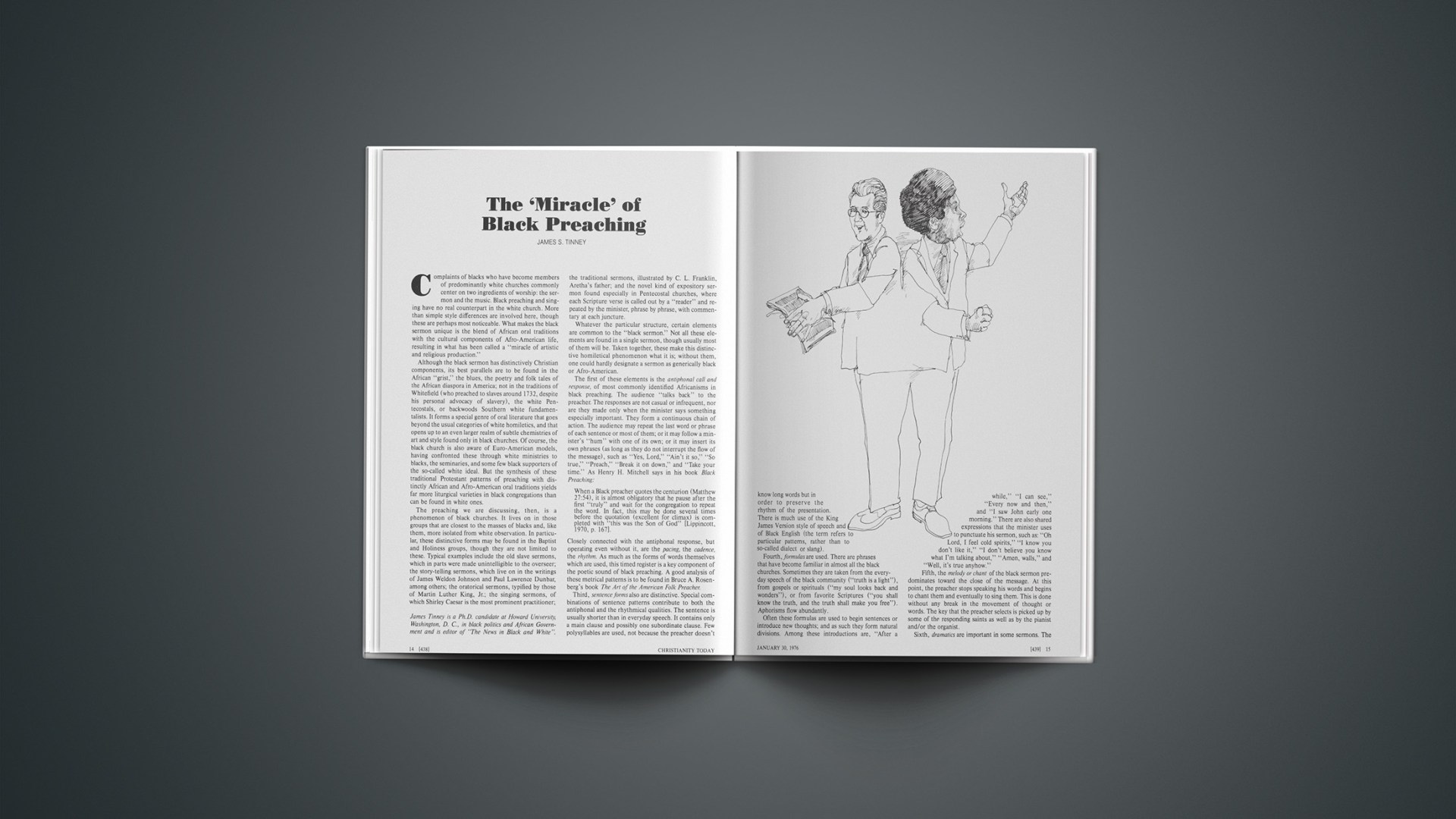
Complaints of blacks who have become members of predominantly white churches commonly center on two ingredients of worship: the sermon and the music. Black preaching and singing have no real counterpart in the white church. More than simple style differences are involved here, though these are perhaps most noticeable. What makes the black sermon unique is the blend of African oral traditions with the cultural components of Afro-American life, resulting in what has been called a “miracle of artistic and religious production.”

Although the black sermon has distinctively Christian components, its best parallels are to be found in the African “grist,” the blues, the poetry and folk tales of the African diaspora in America; not in the traditions of Whitefield (who preached to slaves around 1732, despite his personal advocacy of slavery), the white Pentecostals, or backwoods Southern white fundamentalists. It forms a special genre of oral literature that goes beyond the usual categories of white homiletics, and that opens up to an even larger realm of subtle chemistries of art and style found only in black churches. Of course, the black church is also aware of Euro-American models, having confronted these through white ministries to blacks, the seminaries, and some few black supporters of the so-called white ideal. But the synthesis of these traditional Protestant patterns of preaching with distinctly African and Afro-American oral traditions yields far more liturgical varieties in black congregations than can be found in white ones.

The preaching we are discussing, then, is a phenomenon of black churches. It lives on in those groups that are closest to the masses of blacks and, like them, more isolated from white observation. In particular, these distinctive forms may be found in the Baptist and Holiness groups, though they are not limited to these. Typical examples include the old slave sermons, which in parts were made unintelligible to the overseer; the story-telling sermons, which live on in the writings of James Weldon Johnson and Paul Lawrence Dunbar, among others; the oratorical sermons, typified by those of Martin Luther King, Jr.; the singing sermons, of which Shirley Caesar is the most prominent practitioner; the traditional sermons, illustrated by C. L. Franklin, Aretha’s father; and the novel kind of expository sermon found especially in Pentecostal churches, where each Scripture verse is called out by a “reader” and repeated by the minister, phrase by phrase, with commentary at each juncture.

Whatever the particular structure, certain elements are common to the “black sermon.” Not all these elements are found in a single sermon, though usually most of them will be. Taken together, these make this distinctive homiletical phenomenon what it is; without them, one could hardly designate a sermon as generically black or Afro-American.

The first of these elements is the antiphonal call and response, of most commonly identified Africanisms in black preaching. The audience “talks back” to the preacher. The responses are not casual or infrequent, nor are they made only when the minister says something especially important. They form a continuous chain of action. The audience may repeat the last word or phrase of each sentence or most of them; or it may follow a minister’s “hum” with one of its own; or it may insert its own phrases (as long as they do not interrupt the flow of the message), such as “Yes, Lord,” “Ain’t it so,” “So true,” “Preach,” “Break it on down,” and “Take your time.” As Henry H. Mitchell says in his book Black Preaching:

When a Black preacher quotes the centurion (Matthew 27:54), it is almost obligatory that he pause after the first “truly” and wait for the congregation to repeat the word. In fact, this may be done several times before the quotation (excellent for climax) is completed with “this was the Son of God” [Lippincott, 1970, p. 167].

Closely connected with the antiphonal response, but operating even without it, are the pacing, the cadence, the rhythm. As much as the forms of words themselves which are used, this timed register is a key component of the poetic sound of black preaching. A good analysis of these metrical patterns is to be found in Bruce A. Rosenberg’s book The Art of the American Folk Preacher.

Third, sentence forms also are distinctive. Special combinations of sentence patterns contribute to both the antiphonal and the rhythmical qualities. The sentence is usually shorter than in everyday speech. It contains only a main clause and possibly one subordinate clause. Few polysyllables are used, not because the preacher doesn’t know long words but in order to preserve the rhythm of the presentation. There is much use of the King James Version style of speech and of Black English (the term refers to particular patterns, rather than to so-called dialect or slang).

Fourth, formulas are used. There are phrases that have become familiar in almost all the black churches. Sometimes they are taken from the everyday speech of the black community (“truth is a light”), from gospels or spirituals (“my soul looks back and wonders”), or from favorite Scriptures (“you shall know the truth, and the truth shall make you free”). Aphorisms flow abundantly.

Often these formulas are used to begin sentences or introduce new thoughts; and as such they form natural divisions. Among these introductions are, “After a while,” “I can see,” “Every now and then,” and “I saw John early one morning.” There are also shared expressions that the minister uses to punctuate his sermon, such as: “Oh Lord, I feel cold spirits,” “I know you don’t like it,” “I don’t believe you know what I’m talking about,” “Amen, walls,” and “Well, it’s true anyhow.”

Fifth, the melody or chant of the black sermon predominates toward the close of the message. At this point, the preacher stops speaking his words and begins to chant them and eventually to sing them. This is done without any break in the movement of thought or words. The key that the preacher selects is picked up by some of the responding saints as well as by the pianist and/or the organist.

Sixth, dramatics are important in some sermons. The preacher may choose one or more persons from the audience to “act out” or pantomime some event while he leads them both in the action and by preaching.

Seventh, many sermons begin on a low note and spend considerable time in “teaching” before moving to the higher and more complex elements involved in “preaching” that have been discussed here.

Other qualities too separate the black sermon from the white sermon. This second group of trademarks is not as related to the special African and Afro-American cultural influences. Again at the risk of oversimplifying, these differences may be noted: (1) The black sermon is usually given a much longer title than the white, usually in sentence form, and the title is often repeated aloud by the congregation when it is announced. (2) Commercial outlines are not used; neither are commercial sermonic illustrations. Most of these materials, prepared by white publishers, are too artificial or too far removed from black experiences to be of any use. In fact, little use is made of the usual three-point outline format. (3) Black sermons do not typically use the sensational “life story,” testimony approach common to some white evangelists. (4) The black sermon is seldom conversational in tone, and is rarely read from a prepared manuscript. (5) Few doctrinal sermons are preached. This does not mean that doctrine is unimportant to black Christians; it does imply that there is less criticism of other churches or other ministers that believe differently. One exception to this is the Apostolic or “Jesus Name” groups, which have made their particular mode of water baptism essential to salvation. (6) On the other hand, black preaching does not attempt to be “objective,” in the sense that some white denominational preachers strive for objectivity in discussions of current affairs. Personal doubts a minister might have are seldom raised in the pulpit. Sermons generally express an emphatic quality of assurance that is largely missing from prominent white pulpits. And one also seldom finds a black preacher employing the shock technique to alert (or alarm) listeners.

These characteristics of black preaching among the masses are, in my opinion, very valuable. I reject the condescending note of Joseph R. Washington, who in Black Religion describes some of these elements as mere “folk religion” and says they are derived from economic class factors. If black preaching has been “overlooked, ignored, and judged illegitimate and subhuman,” the reasons are those set forth by Bishop Joseph A. Johnson in The Soul of the Black Preacher:

To elevate and articulate the Black Christian experience by white theological technicians would have inevitably resulted in the elevation and appreciation of the Black Americans who produced this new interpretation of the Christian faith. It would further have meant that the Black man in America would have to be glorified culturally and elevated socially and economically. The Black preacher and the Black community would have to be accepted on a new level. The white American cultural ego would not permit this [Pilgrim, 1971, p. 152].

Down with the Honky Christ—Up with the Funky Jesus

Christ came as the ultimate nigger of the universe. Why are we preaching a bleached Jesus?

Most white people understand what a black person means when he calls someone a “honky.” If they can’t define it verbally they feel what it means—oppressor, bigot, slave-trader, exploiter, and in many ways, middle-class. A honky belongs to the status quo, the safe, the comfortable. “Funky,” on the other hand, may be a new term to many of you. In black parlance funky often has certain positive connotations. For example, if I call a song funky I mean that either voice or instrument stepped creatively from behind the strictures of the notes, boldly and freely authenticating his or her own soul in the rendition of the number. Funky stands opposite to honky—liberated, authentic, creative.

These two adjectives used in relation to the Gospel incarnate in Jesus pinpoint the problem I see in traditional evangelical circles, black or white. We and our leaders have been preaching a honky Christ to a world hungry for the funky Jesus of the Bible. The honky Christ stands with the status quo, the funky Jesus moves apart from the ruling religious system. Jesus stood with and for the poor and oppressed and disinherited. He came for the sick and needy.

Jesus announced his call in Luke 4:16–20. God’s spirit was upon him “to preach good news to the poor. He has sent me to proclaim release to the captives and recovering of sight to the blind, to set at liberty those who are oppressed, to proclaim the acceptable year of the Lord.” Nothing else is added to the call. He closed the book, gave it to the attendant, and sat down. And to ensure that his audience understood why he read that passage, he added, “Today this Scripture has been fulfilled in your hearing.”

Christ never strayed from the focus of his call. When people questioned his messiahship such as John did in prison, Jesus confidently pointed to his work among the unloved: “the blind receive their sight and the lame walk, lepers are cleansed and the deaf hear, and the dead are raised up, and the poor hear good news.”

Most Christian black theologians today would agree that ministry to the poor, the powerless, and the oppressed defines Christ’s life on earth. The best adjective to describe it for me is funky, and the best symbol for his life is black. In our culture black has meant nigger, outcast, leper. In a way the Old Testament Hebrews were niggers. James Cone in Black Theology and Black Power approaches this when he says, “To be black means that your heart, your soul, your mind, and your body are where the dispossessed are.” Black is the antithesis of white, and since the founding of our nation (even though black people aided the revolution—see page 10), black has symbolized the outsider.

If Christ was called to the poor and oppressed, as the Bible indicates, then that is also the call of his followers. And if black (or funky) is in our culture the most basic image for that group of people, then that call is to be black theologically. Someone has said that all persons seek to be equal to their superiors. That is the world’s way; Christ’s way is just the reverse. He came into the world as the ultimate “nigger” of the universe. He moved to the bottom of the social order, and his people and his culture rejected him. Christ’s situation sounds like that of Any Black Person, Anywhere, U.S.A., giving added weight and validity to the symbol of a black Christ. In a deeper sense, however, Christ Jesus became blacker than black since “he was made sin for us.” And he died on the cross, a death reserved for the niggers of his day. The system sought to lock him eternally in that despised, black status—damned forever.

Just as Jesus moved to the bottom of the social order, voluntarily giving up heaven for us, we as his followers are to move to the bottom of the social order—to become niggers with him. The black Christ calls the world to become black, to deny everything for what can only be a nigger’s death—the cross. The black church sings a song like no one else: “Must Jesus bear the cross alone and all the world go free?” And we come back with, “No! There is a cross for everyone, and there is a cross for me.” To be black theologically is to join yourself to Jesus and his cross.

Black Christians must consciously choose to be black. Our skin color does not automatically make us black theologically. The siren call of the system to move up the social ladder and out from among the poor means death. Theological blackness is a spiritual challenge for all, white and black, and is similar to that Paul gave the Jews in Romans 2:28 and 29.

The challenge Jesus brings to white Christians is to deny their theological whiteness. Just as black is the best symbol for Jesus’ ministry in our culture, so white or honky symbolizes what Jesus fought against. Theological whiteness frustrates and denies Christ’s call and his methods. Each one of us is tempted to become white, as Moses (Heb. 11:24, 25) was tempted to remain within the Egyptian power structure.

If what I have described is the authentic call of Jesus through his Gospel, what is it that we evangelicals have been preaching? I said at the outset that we have been preaching a honky Christ to a hungry world. This honky Christ has no content; he does not come to the dispossessed. We preach a honky Christ of easy salvation. Specialists in getting quick, easy decisions for a strange, mystical, theologically white Christ are rapidly increasing. These persons peddle a Jesus easy to accept, a Jesus who demands very little commitment of energy, money, life.

The honky Jesus does not come down from heaven to the lowest social stratum, but grabs greedily upwards for the good things in life—at least that’s the conclusion we could draw if we look at how some of his followers act. I seriously question the nebulous, almost contentless “Lord and Saviour Jesus Christ” present in some prominent evangelistic efforts. The Gospel, we are told, means personal salvation and little beyond that. We do not hear about Jesus’ uncompromising commitment to liberation from all oppressive, satanic forces. The only cross in the honky gospel is the one on which Christ died. There is little mention of the crosses he carried before he shouldered the last one, or of the crosses he expects us to lift.

I sometimes get the impression that such an inoffensive Christ jumped off a mountain and impaled himself on the cross so that people could have someone to invite into their hearts as saviour. A person has only to pause, pray the prayer of faith, receive some minimal instruction, and then continue his life. The primary requirements for the new life shared with the new believers are: read your Bible, pray, attend church, and tell someone else about Christ. There is no call to feed the hungry and clothe the naked. The only call this gospel makes is to personal pietism. Sin, repentance, conversion, and the new life are dealt with almost exclusively in vertical dimensions. The horizontal dimensions of the Gospel are presented as optional, not intrinsic to it.

That is what frustrated some of us who attended the International Congress on World Evangelization at Lausanne, Switzerland, in July, 1974. Donald McGavran of Fuller Seminary clearly articulated the position held by the majority of black and white evangelical leaders present. He said, “The conditions for conversion are only three—repentance, belief on the Lord Jesus, and baptism” (Let the Earth Hear His Voice). The wise evangelist, he continued, “intends that becoming a Christian should always be seen as quite simply—trusting Jesus and being arrayed in his righteousness.” From what was presented as evangelism, one would never know that the call of the Gospel is to join the black nigger Jesus at the very bottom of the social order. We cannot be content to be white niggers, but must go all the way to become black niggers with him.

We evangelicals need to develop a supportive community to present an effective alternative way of life to the disinherited. And this community needs to be practical and physical as well as spiritual. As one works among the poor, the necessity of a new financial base becomes apparent. The system that relates to the poor only from a questionable base of charity will never suffice, for such charity is designed not to liberate the poor and make them self-sustaining, contributing members of society (as in Second Corinthians 8:14) but to keep them in a state of dependency. New structures providing greater resources are needed. Christ’s disciples must develop the means to provide, not all, but some of all the goods and services required by the poor. These services should include such establishments as newspaper and hot dog stands, bakeries, stores that sell groceries, hardware, clothing, furniture and appliances, automobile, electrical, plumbing, remodeling, and construction services, shoe repair and pawn shops, finance and insurance companies, educational and banking institutions (see the interview with John Perkins of Voice of Calvary, page 8, for information about a black organization developing these kinds of services). If there were banking institutions for the specific purpose of serving the poor, then commercial banks could not so easily red-line poor housing areas. It seems to me that for maximum benefit to the community, some if not all of such businesses and services should be profit-making. Christians engaged in this type of work would not engage in profiteering, a common practice in poor communities. And profits made would provide additional capital to expand and provide other needed services, rather than to make individuals wealthy.

From such practical models, Christians would be able to affect the way secular businesses relate to poor communities. The scope and quality of influence would be in direct proportion to the breadth and diversity of business in which Christ’s people are involved. We would become what Christ called us to be—salt, leaven, God’s agents of influence on the larger society. We would also become light, God’s city sitting on a hill and visible to all. Our children would no longer have to follow the world’s corrupt system in respect to models of business, or to search for opportunities to use administrative and business skills. We could challenge the next generation to commit the whole of their lives to validating Christ’s presence to the poor in a concrete, tangible way.

Such a comprehensive life of faith would call for new approaches to Christian education, evangelism, and mission. Christian education would move from the classroom into the street to provide feet, legs, hands, and arms to the knowledge we put into minds. Similarly, evangelism would become total biblical social evangelism. Daily physical contact with both new creatures and new works in Christ would draw people to ask with the Philippian jailor, “What must I do to be saved?” And we could direct them to believe on Jesus, convinced that the deeper implications of his call helped to bring them to their decision.

Every believer must be involved in mission. White people would tell other whites caught in the system that Christ liberates and that he has chosen the poor. This is essential, since the decisions affecting the poor are made not in the inner city, but in the primarily white-controlled social structure. Blacks would tell their people outside the system that the Gospel liberates them from the need to get into the “inner ring.”

I do not have a problem per se with someone who is called to minister to the rich, to suburbanites, to urban high-rise apartment dwellers. But I want to know that he or she is working for a new community that calls those persons to use their resources to help the powerless and oppressed. Understandably, to minister to certain people one may be required to live a relatively comparable lifestyle. But Christ told us how to test our attitudes in any community: “where your treasure is, there will your heart be also.”

When I say, “down with the honky Christ and up with the funky Jesus,” then, I am suggesting not that we change Jesus but that we see him as he is. He moved creatively from behind the strictures of the religion of his day and obeyed God by serving the causes of justice, mercy, and faith. As his followers we dare not do less.

The Mendenhall Model Answers the Black Muslims

John Perkins, founder of Voice of Calvary, presents a working model for bringing the “funky Jesus” to the poor and oppressed.

In 1960 a recently converted black man moved his family from California back to Mendenhall, Mississippi, to which he had sworn never to return. He had left years before after his brother was shot by a policeman and killed outside the Negro entrance to a movie theater. The killing was never reported, then a frequent practice in Mississippi when black people were murdered. But John Perkins heard and answered God’s call to return to a society that still oppressed the black community. During the years since he returned Perkins has planned and built a pilot community called Voice of Calvary, which includes a health center, a gym, a library, and a Bible institute. He was persecuted during the civil-rights era. He was arrested while trying to post bail for a friend and colleague and nearly died from a police beating; he spent six months in a hospital recuperating from his night in jail. “Even then,” says Perkins, “when my circumstances shouted defeat, I felt undefeated.” God gave this man a resilient spirit and a broad vision of helping his black brothers and of healing the wounds of white-black tensions. An able administrator, Perkins says that he takes a positive outlook. And anyone who spends even a short time with him cannot long remain pessimistic about race problems.

Perkins spoke at last year’s Evangelicals for Social Action workshop, where tensions between black and white participants dominated much of the meeting. Our interview, an edited version of which follows, was conducted at that workshop. Perkins, his large hands extended in front of him and his glasses resting on the end of his nose, explained what he and his black and white staff members were doing in Mississippi to bring the whole Gospel to those in the Southern rural black community.

Question. Is the white community still listening to blacks?

Answer. No. To a certain degree blacks have had their chance to speak. I don’t know whether the white community will listen any more or will hear what blacks are saying. The confrontation period is over, and since there’s little open violence between whites and blacks, white people see no need to listen. We need some kind of visibility. The Voice of Calvary gives visibility to the continuing race problem and offers constructive solutions.

Question. What do you think of black theology?

Answer. Black theology and theologians do not have wide acceptance in the black community any more than within the white community. Some blacks decided they needed a theology that would better fit the black experience. But it’s not something we are seeing worked out in many black churches. It is still a theology of the books and not of the streets. (The theology of the black Muslims is an exception.) What we need is a theology that presents solutions to our problems. White evangelical theology has not been able to do this in the black community. As Christians we need to give ourselves, both individually and as a community, to programs and ideas that work. These must be rooted in Jesus Christ and his body of believers as revealed to us in the Holy Scripture. If programs work, get other people to adapt them to their community. We need to bring healing to the race problems. At Voice of Calvary this is beginning to happen.

Question. Are you talking about integration?

Answer. Yes. I believe that the biblical church model, as in Antioch, must be open to the participation of all races. Otherwise it’s not a New Testament church. But to see integration itself as a force that develops a community and brings healing is false. It takes a commitment deeper than just integration. I believe that the only commitment able to bring healing is a commitment to Jesus Christ.

Question. How many staff members do you have?

Answer. VOC has about thirty full-time workers, about half of them white.

Question. What kinds of programs does VOC support?

Answer. In Mendenhall we have a two-acre community that houses the VOC plant. The largest project we have is a county-wide community health center. We have a predominantly black-run year-round tutoring program. We sponsor a summer intern project and hold vacation Bible school for thirteen area churches. We have a Bible institute, a gymnasium, a farm, a summer camp, an evangelism training program, and a co-op housing development. In Mendenhall we rent three-bedroom apartments for sixty dollars a month. In Jackson we run People Development, Incorporated, a year-old housing and construction company.

Question. In brief, how has VOC developed?

Answer. When we first came to Mississippi we started the Voice of Calvary Bible Institute. My wife and I taught Bible stories in the schools to more than 10,000 children each month. We held rural home Bible studies with adults. We began to see how we could meet people’s needs as we came face to face with them in their homes and in the schools. We began a program of tutoring and adult education to help children and parents learn how to read. We needed housing for our growing staff, and wanted to provide good, low-income housing for the community, so we built new houses—we did most of the labor ourselves—and five duplex apartments. We borrowed money from the federal government to build them. Next we organized 200 farmers into a purchasing co-operative, and out of that came my involvement with several co-operative farms throughout Mississippi and a co-operative food store in Mendenhall. The farms in different parts of the state sell their produce—cucumbers, okra, soybeans—to companies like Bird’s Eye and Heinz. These were founded on some of the same principles at work in Voice of Calvary, such as self-help and indigenous leadership. As these co-ops became more organized, I, along with a few others, helped to found a community development fund, initially begun with government help and $1,000, and now an independent organization with assets of $8 million. It lends money to people and organizations in the community at 10 per cent interest. This organization is separate from VOC but has helped us in some critical areas of development. We needed key leaders to run with the programs as they expanded. In Mendenhall, leaders like Artis Fletcher and Dolphus Weary came from our church and from our leadership development institute. Next we needed a larger building than our church, which only seated 200, to serve as a community center for tutoring, recreational activities, and vocational workshops. So we also built that. Then came the health center. All that took twelve years. In 1973 I moved VOC’s headquarters to Jackson and started the Jackson Bible Institute, which reaches out to students at Jackson State University, and the construction company.

Question. How did the health center come into being?

Answer. In 1969–70 my wife did a community survey on the health conditions in our county. She found that people were sick and that much of the sickness was related to bad nutrition. The people in the county couldn’t afford adequate health care, and there was no place where they could get it. They needed education along with health care. We built our first building, which cost $30,000 and had no mortgage. After that building was flooded in 1972, we bought our current building for $75,000, located across the street from the Simpson County Courthouse in downtown Mendenhall. It was financed by churches and individuals; no government money was used. We have a $13,500 X-ray machine as well as other equipment.

Question. What kinds of services do you offer?

Answer. We don’t have the money to offer all the services we would like, but we’re more comprehensive than any other facility in the area. We have a full-time lab technician and an x-ray technician who try to provide thorough diagnostic care. We have had five different doctors volunteer to work with us one at a time since we began. Now we have a full-time doctor, Eugene McCarty, who is doing an excellent job at delivering health care with Christian compassion. But we need another doctor to join him. We also have a nutritionist who helps upgrade the diets of our constituency as well as a pediatric nurse. We would like to provide dental and eye care too.

Question. What is the cost to the patient?

Answer. The center is a cooperative. People pay $3 to become a member. We currently have about 900 families or about 4,500 people as members. That fee allows the member to receive medical treatment for about 20 per cent less than a non-member would pay. A routine doctor’s visit costs $7. We do X-rays for just a little over cost or about half the going fee in our area. We sell drugs for about half the cost at a pharmacy. And even at those prices not everyone can afford to pay us. Right now we’re carrying about $10,000 of unpaid bills from people who just cannot afford the cost of even basic health care. I would like to write off that amount, and not try to collect it. We also offer the Medicaide program, for which the federal government reimburses us.

Question. What about the summer volunteer intern program?

Answer. For eight weeks each summer, people from different parts of the country live and work with us. We have a personnel staff that handles applications and placements. Last summer about thirty people from such states as California, Florida, Colorado, Pennsylvania, and Michigan participated. On the application form we ask the person to list interests and talents. Then we match talents with needs. The volunteers help in construction, on our farm, in our swimming or music program, in the health center, or with secretarial work. We also run the same type of two-week program for large church groups. During the whole eight-week period we schedule one or two of these large groups every two weeks to help wherever needed. We get anywhere from six to nineteen in a group, and last summer about sixty people from various churches worked with us. We start accepting applications for the volunteer intern program in January and close around April. Anyone interested can write for an application to VOC at 1655 St. Charles Street, Jackson, Mississippi 39209.

Question. How did you get into the construction business?

Answer. We’ve really been in construction since coming to Mississippi in 1961. We built all our own buildings, with the exception of the present health center. A year ago in Jackson we incorporated under the name People Development and are qualified as general contractors. We want to run a housing redevelopment program—buy rundown houses, remodel them, and sell or rent them back to the community. We invite carpenters, electricians, and plumbers who volunteer short-or long-term on these projects. We buy houses that HUD repossesses; we get about a 30 per cent discount on them. We pay, say, $8,000, for a house, spend about $1,000 for materials (not counting labor costs), and resell it for $12,000. Over the last two years we’ve remodeled about ten houses. We’ve rented some of these; others we’ve used as staff houses. We’re in the process of selling our first house to a staff member. Our biggest project, remodeling an old, big doctor’s house into our conference center, the Samaritan’s Inn, cost about $6,000 in heating, air conditioning, and interior decorating. This along with the expert labor was all donated by a church, First Presbyterian Church in Aurora, Illinois. Pastor Calvin Marcum accompanied a huge work crew of adults and teen-agers. It didn’t cost us anything.

Question. Where did you get the start-up money for the construction business?

Answer. We borrowed $30,000 from the development fund I mentioned before. And our staff all regularly invest money in it. It works kind of like a credit union. People lend us money at low interest rates, or they make direct contributions. Some people have given us short-term loans of $500 or $1,000 at no interest, which we repay after we finish working on a house. Eventually we hope that any profit the company makes will be reinvested in the Voice of Calvary ministry.

Question. What about staffing?

Answer. Right now we depend mostly on volunteers. But we hope to have a full-time staff—a plumber, an electrician, a cement finisher, a brick layer. Then these people would train and work with others in the community, and as we expand we would hire those we’ve trained. We now have one full-time manager, Herbert Jones.

Question. How have these programs lessened racial tensions?

Answer. We have found that as white and black people share in physical, manual labor, racial tensions lessen and disappear. I am dedicated to the work of Voice of Calvary because I think blacks need to make solutions visible and practical. We design projects to bring people together for a tangible goal. As we learn from each other hostilities evaporate. Right now in Jackson we’re trying to develop a strong integrated core community. I believe that real Christian faith can break down racial barriers, as Paul described in Ephesians 2:14: “For he is our peace, who has made us both one, and has broken down the dividing wall of hostility.…”

Question. Do you have a college scholarship program? If so, how do you decide who receives financial aid?

Answer. About sixty teen-agers over the years have gone to college with some assistance from VOC. If in the tutoring program a teen-ager shows promise and makes good progress, we make that person a junior staff member who then tutors young children. We give the junior staffers $50 a month during the winter: $25 goes into PDI and $25 goes into a savings account for their college expenses. We also operate the Rural Education and Leadership Foundation, a non-profit scholarship fund to which people can make tax-deductible contributions. We want our black teen-agers to return to the community to work after college. One of our young men is in medical school right now. When he was in high school we started the health center. That’s when he decided to become a doctor and some day direct our health program. We’ve recently begun to emphasize vocational majors, such as business administration, nursing, and other technical fields.

Question. Have you asked any evangelical colleges for scholarships?

Answer. We get lots of requests for students from evangelical schools. But the problem is not getting students into colleges, or getting money for them. We need people to support our tutoring program to get students ready for college. We need to change the image among rural blacks of what it is like, and we need to provide proper motivation, so that teen-agers want to attend college.

Question. What is the next project you plan to start working on?

Answer. I want to get the construction company firmly moving, and then would like to found a bank that would provide financial aid to Christian organizations or churches, not individuals, who want to develop community-oriented programs like Voice of Calvary. We want to reproduce Christian outreach communities.

Question. What is your daily schedule like?

Answer. I get up at 5:30 and spend an hour in prayer and Bible study. Then I take fifteen to twenty minutes organizing my work day. The kids leave for school by bus at 7:45. My wife and I leave together at 8:00. She sorts the mail while I begin my morning meetings, the first of which is with my executive assistant. We go over the projects that need attention that day. In the afternoon I usually have a speaking engagement at a college or church. If it’s a good day I’m home by six, though sometimes I don’t get home before ten. I function as the driver of the organization. That’s my gift.

Question. Do you have any hobbies?

Answer. I enjoy all sports, especially baseball. And I love working with my hands and building, but I don’t get a chance to do that any more. I tried all last summer to do some building, but never got even one hour of building in.

Question. What books have influenced your life?

Answer. Books by G. Campbell Morgan, whom I consider a master teacher. Richard DeHaan had a profound effect on my life. Francis Fannon, who wrote The Wretched of the Earth, helped me understand the spirit of oppressed people and helped me move forward in my life. And of course James Baldwin’s books have had a heavy impact on my life.

Question. What books would you recommend for white people to read?

Answer. First of all I feel ignorant about the black situation in northern cities. My knowledge and concern is the South. The books that I want my southern white friends to read would be different from those northern whites should read. Before working with me and my program I want whites to know as much as possible about blacks in the South, but I also want them to know about white behavior in the South. So I would recommend Mississippi: the Closed Society, Three Lives For Mississippi, and The Autobiography of Malcolm X.

Question. What are your goals in the area of helping the race problem?

Answer. We are making a concentrated effort to reach the greater white population now with the story of Voice of Calvary and to get the white community more involved with us, while remaining a black-led home mission group that approaches evangelism from the community-development point of view. We have a specific goal of getting 200 to 300 suburban churches to support our ministry regularly.

Question. Do you mean monetary support?

Answer. Of course we want and need money. But churches could send us materials. Or people. Many white evangelical suburban churches don’t have a personal way to express their missionary concern. Working with us on short-term projects is perhaps more helpful to the people in these churches than check-writing. But we need both. We need people concerned about us enough to join hands with us in real ways, either by giving financially or by coming down and working. We have developed a fellowship with people all over the country in this way. We would like the names of more people who would like to join this fellowship. We want people to get involved. For this reason our mailing list is something special. We don’t want the kind of list where, if you send a few dollars, you receive information about Voice of Calvary for life. For six or seven years our list stayed around 300. In the last five years it’s jumped to 3,000. We want it to continue growing, but only through relationships with people who are really with us.

Question. What is your own church connection?

Answer. I have no formal connection with any denomination. I was converted in a holiness church but ordained in a Baptist church. I lean toward people like the Mennonites who have a strong sense of community, who preach the Gospel, and who then demand that their converts and constituency work to change society. I believe we need to restore the sense of community, or perhaps of family, within the Church. In many cases the black church has served as the family unit. One of the problems facing the black community is the lack of a strong male image. For families with no father, the black pastor has become the surrogate father. And that’s good. The white churches haven’t felt this strong need for community, since in most cases the family unit provided it.

Question. How would you sum up your ministry?

Answer. We feel we have developed a total community-type program, and we’d like to see similar programs started in other communities throughout the South. I call Voice of Calvary a home mission society, a gospel center that also meets the social needs of the people with whom it lives. Central to our program, of course, is the message that Jesus Christ is Saviour. We are using a Black Muslim approach to reaching people. The difference is the centrality of the Cross in our ministry.

Apple PodcastsDown ArrowDown ArrowDown Arrowarrow_left_altLeft ArrowLeft ArrowRight ArrowRight ArrowRight Arrowarrow_up_altUp ArrowUp ArrowAvailable at Amazoncaret-downCloseCloseEmailEmailExpandExpandExternalExternalFacebookfacebook-squareGiftGiftGooglegoogleGoogle KeephamburgerInstagraminstagram-squareLinkLinklinkedin-squareListenListenListenChristianity TodayCT Creative Studio Logologo_orgMegaphoneMenuMenupausePinterestPlayPlayPocketPodcastRSSRSSSaveSaveSaveSearchSearchsearchSpotifyStitcherTelegramTable of ContentsTable of Contentstwitter-squareWhatsAppXYouTubeYouTube