In Defense of Missions

For fifty years we have been criticizing Christian missions. Why? “Because,” our major criticism goes, “Christian missions interferes with and Westernizes non-Western cultures.” But that is not really the right answer.

In its first century, Christianity, with strong rootage in Judaism, went eastward, and in Syrian trappings affected the culture of Persians and Indians who became Christian. It went westward and took on Greco-Roman trappings and for centuries interfered with the cultures of Europe; it “Greco-Romanized” them at the same time that it injected them with Oriental and Judaic concepts.

No criticism for that, however. An amalgam gradually took place between the introduced Christianity and the culture it brought from the Mediterranean to the rest of Europe. That amalgam became “Christendom.”

It is the modern missionary movement—beginning with the Roman Catholic “Counter-Reformation” and continued in “The Protestant Missionary Enterprise”—that we criticize. What is behind these fifty years of self-criticism in mission?

Many of the ablest missionaries in the earlier years of the modern missionary movement were people who thoroughly “indigenized.” They adopted the culture of the people to whom they went and sought to apply the Gospel in that cultural context. Matteo Ricci, Robert de Nobili, Robert Morrison, and John Williams were foremost but typical. Even David Livingstone, who hoped to open Africa to European commerce as an antidote to slavery, would not practice his Western medicine among tribal people without consulting and acting on the approval of the African witch doctors, whom he treated as colleagues.

Later, when converts needed fellowship and continuity, missionaries did tend to organize them in patterns of the churches they had known in their homeland, just as the early Jewish Christian missionaries in the Greco-Roman world organized the first congregations on the pattern of the synagogues they had known. After early modern missionaries had established the first works of medical, educational, and economic assistance, generations of new missionaries with special skills were sent to carry them forward. These later missionaries were expected, by the very nature of their skills, to bring to non-Western peoples the advantages of medical, educational, agricultural, and industrial know-how from the West.

As early as the beginning of the twentieth century, mission leaders began to get nervous about the extent of this Westernization and about the relation of missionaries to Western imperialism. This would have surprised non-Western Christians of that period, for they benefited by the Westernized institutions that were planted among them. It would also have surprised the Western imperialists, who generally tried to keep the missionaries and their movement at arm’s length.

In the meantime, quite regardless of the missionary presence, Western imperialism, commercial interests, and technological processes continued to infiltrate the East at an increasing rate. On the other hand, missionary scholars were studying with deepening appreciation the religions of the people to whom they went. They were translating many of their scriptures and were awakening not only the Western world but also the non-Western world itself to the religious heritage of the East.

The World Missionary Conference held in 1910 in Edinburgh, though frankly Western in its composition, called attention to the fact that there was a church around the world, and not just a church in the West and a mission field elsewhere. Before the First World War, mainline denominational mission boards were already asserting the need for “devolution.” They called for a winding down of Western leadership and a strengthening of non-Western leadership.

Between the two world wars, missionary candidates who presented themselves for service in the non-Western world were told to “indigenize.” It was catechetically drilled into them that they should be prepared to serve under national leaders abroad and to find ways to interpret the Gospel through local cultural forms.

By the end of the Second World War, in which the Western world suffered a moral defeat, the self-laceration that marks modern Western civilization had set in. It was affecting the missionary movement from the West. Young missionaries went abroad convinced that the previous generations of missionaries had made the horrendous mistake of “Westernizing” the Church abroad and of sadly interfering with the cultural foundations of people everywhere.

Actually, the new missionaries did little more than the old missionaries to change the life-style of the Christians they served or to reduce the Westernization of their institution. To the extent that some dared to try to do so, they were usually opposed by national Christians for whom indigenization meant compromise with a religious culture they had turned from and therefore a loss of Christian identity.

Some anthropologists (who owe a great deal to the pioneering cultural studies of earlier missionaries such as the Abbé J. A. Dubois in late eighteenth-, early nineteenth-century India) have picked the missionary as a favorite whipping boy. Missionaries are chastised for having undermined non-Western cultures and for having alienated peoples from their past. This was partially true. It is still true that any person in any culture anywhere who embraces the Christian Gospel thereby accepts patterns of life that stand in opposition to many of the practices of his own culture, whether in the East or in the West. It is a fact, however, that if missionaries had never gone from the Western world, commercial, political, and technological pressures would have changed and Westernized the cultural milieu of the non-Western world. It is also a fact that missionaries have often sought to withstand these pressures and to protect the people to whom they had gone from undesirable culture-changing forces.

The tides of culture have always been on the move, the more aggressive ones influencing and changing the more passive forms. And this has happened not only with Christianity in its early penetration in to Europe but with other religious forces, forces less apologetic than modern Christianity. It is instructive to look at the Indian missionaries who carried Budhhism into China. Many of them, like many missionaries of the early days of the modern Christian missionary movement, sought indigenous ways of presenting their message, and they made translations of Buddhist scriptures into Chinese. It is well known that China modified Mahayana Buddhism into Chinese forms. Nevertheless, not only Sanskrit terminology but also many forms and influences of Indian Buddhism have remained fixed forms in the Buddhism of China, Korea, and Japan until this day. Even though Hindu cultural imperialism was pushed back from southeast Asia many centuries ago, Hindu religious terminology, Hindu practices and festivals, and even small pockets of Hindu religion still remain throughout southeast Asia as part of the life of the people.

Mission were to candidates accepted interpret the Gospel the ‘notion’ that they through local culture.

Muslims, in their sweep out of Arabia into Europe, into Africa, and into Asia, made no effort at all to indigenize as they converted great masses to their faith. Most Westerners, for example, when they think of India think of the architectural forms brought out of Arabia by Arabian Islamic imperialism through Persia into India. To this day, Indians who are Muslims, descendants of Hindu converts to Islam, attend prayer at mosques whose basic architectural form comes from Arabia. They still bury their dead and build mausoleums in distinct contradiction to the Hindu cultural heritage of their environment. Their dress is distinct from that of their Hindu neighbors, but similar to that of Muslims to the west of them. They maintain in their speech a vocabulary modified greatly by the use of Arabic and Persian terms. And yet with all their Arabized, Persianized, religious culture, they are truly Indians and have been accepted as such for centuries.

The most successful missionary movements from the East to the West have been those that have not consciously attempted to indigenize. The missionaries of Islam have brought to the West the patterns of mosque and worship that are Arabic in form. Western Muslims are encouraged to read the Koran in Arabic, the one true language of Islam. Many individual Hindu missionaries have garbled their message with Western terms but as a consequence have been able to influence and affect only a few intellectuals of the West. The most successful Hindu movement in the modern West has brought over the worship of Krishna in the forms of the famous Caitanya revivalist movement of India of several centuries ago. The converts sing hymns in Hindu, they adopt Indian clothing, the men shave their heads as do Hindu orthodox persons in India, the illustrations for their literature published in the West are in the style that has been popular for several centuries in India depicting scenes that are indigenous not to America or Europe but to the tropical Indian world.

Nevertheless, unlike many Buddhist, Hindu, and Muslim missionaries of the past, Christians should be concerned about indigenization. They should look for a worldwide Christianity of which it could be said, as the second-century letter-writer to Diognetus said, that Christians everywhere follow the custom of the society in which they live while at the same time they become the “soul” that holds the world together—citizens but aliens, like but unlike their non-Christian neighbors.

But indigenization is not authentic if it is feigned by foreign missionaries or if it is adopted by national Christians as an expression of nationalism. Indigenization that is authentic grows spontaneously among Christians who belong to their own society while at the same time they conciously and obviously belong to a worldwide community of faith. It is authentic only when the people who practice the indigenous form of Christianity are “in Christ.”

Our critique of Christian mission must come from the vantage point of the faith and love we have received and by the biblical articulation of that faith and love. We need to look more carefully at the current of criticism of past missionary methods flowing both inside and outside the Church. Our eager acceptance of that criticism, our attempts to adapt mission to contemporary humanist movements, our readiness to withdraw from the missionary activity of winning disciples to Jesus Christ, may not be motivated by faith and love. It is arrogance to assume that Christianity belongs to the West. It is indifference to posit that non-Christian religions are necessary for the culture of the non-Western (and rapidly secularizing) world. The root reason for continuing criticism and withdrawal is found in the contemporary loss of confidence in Western civilization, with which we wrongly identify Christianity.

An aggressive missionary movement was, unfortunately, associated with an aggressive Western civilization. What the Peloponnesian Wars did to the glory that was Greece the world wars of this century have done to the glories that were the West. A disintegrating civilization has lost its creativity, has lost faith in itself, and turns in frustrated anger at its own heritage.

It is time for Christians from both East and West to discover together their unity in Christ and the universality of God’s love, without dependence either on the contemporary West or on the nationalism of the East. Christianity at its best is not something to represent or to be woven into any human culture. It is rather to influence and transform human culture everywhere.

BLACK FROST

If springtime is our hope, then you are gone:

Brown asters rattle in the cold black frost;

The beech tree crackles as the wind blows on

Its hollow trunk; it dies; and l am lost

In grieving if the total life of you

Becomes a mulch for probing roots in gray

Wet hours; birth has no meaning for me through

A bitter April, feeding on decay.

Yet even now in winter stark and pure

I cannot grasp that life could pass, denied

An instinct strong as hunger: to endure.

If springtime is our promise, you have died …

The evanescent hope of April ends;

Man needs a Savior when the cold descends.

MARGARET HUDELSON
Liberation Theology: The Gains, the Gaps

How do you proclaim the Gospel of Christ on a continent where for centuries the name of Jesus has been intoned by the ruling elite, together with their priestly functionaries, in support of their regimes of political repression and economic oppression? In Latin America at the present time some Christian theologians and activists are at work, enquiring after the meaning of faith and the mission of the Church in the light of a grievous social situation. What does it mean to believe in such a context, they ask, and what should faith lead us to do?

Latin America is the only continent in the world that is both poor and (at least nominally) Christian, and it is natural that the question would first come into sharp focus there. But it is an important question for the whole Church. The human problem, so dramatically portrayed in Latin American society, is increasingly characteristic of the world at large beyond the pockets of affluence.

Who are these theologians? They are Catholic thinkers such as Hugo Assmann, Gustavo Gutierrez, and Juan Luis Segundo, and Protestants like Rubem Alves, Emilio Castro, and José Miguez Bonino. Their theology, called the theology of liberation, is not at all abstract; it is grounded in the actual struggles for liberation now going on in the countries of Latin America. As Gutierrez puts it in his book A Theology of Liberation, “it is a theological reflection born of the experience of shared efforts to abolish the current unjust situation and to build a different society, freer and more human.”

The evangelical Christian is quick to see certain dangers in a theology that starts from the sinful human situation rather than the Word of God. The potential for syncretism and adulteration is very real. But we also recognize the importance of taking the concrete human situation seriously into account. Like the sermon, theology ought to address people in their actual life-setting. That is a lesson we have learned from the Incarnation.

The theologians of liberation have a socialist political perspective. The economic structures of the Latin American countries are, they believe, fundamentally unjust and will not be significantly improved by “development” and “reform” (words they use cynically). In almost every Latin American country, a rich and privileged ruling elite, supported by the United States and its multinational corporations, holds all the power and is most responsible for the exploitation of the people. Indeed, the capitalistic system operating in the “free world” today, responsive as it is to profit above all, will never, in their opinion, voluntarily give priority to the needs of the poor masses over the wants of the rich. The situation is so deeply resistant of change that nothing short of revolution is likely to alter it.

The fate of Salvador Allende—the Marxist elected freely (though by a plurality) as president of Chile—at the hands of repressive elements assisted by the CIA will never be forgotten. It confirmed to these theologians who profess to stand in the Christian tradition their worst fears and suspicions about the capitalist economic system. The theologians of liberation are convinced that socialism is the necessary precondition for the construction of a just and humane society. Only the social appropriation of the means of production will pave the way to a new order in which the needs of all the people can be met (See Christians and Socialism, edited by John Eagleson, Orbis Books, 1975).

I think I know the reaction of many of my readers to this last paragraph. It is simply proof positive to them that the theology of liberation has allowed the Gospel to be swallowed up by a socialist political ideology that is foreign to it. Before we conclude that, however, we need to think about two factors.

First, these theologians do not understand their endorsement of the socialist viewpoint to be a betrayal of the Christian faith; they consider it simply an honest description of economic realities, as they see them, and they are surely entitled to the political standpoint they find plausible even if it does go against our own. Is it wrong to believe that you know who the culprits are in society, and the mechanisms of oppression as well? Is it wrong to name them, and to propose actions to change the situation? Citizens of the North American democracies ought to be the last to deny socialist Christians these rights. Nor can these theologians be charged with adopting Marxism uncritically; there is evidence throughout their writings of a very profound comprehension of the issues involved. It would be good for evangelicals to become informed about the theology of liberation and allow this perspective to challenge our own.

When we accept an alliance between the Gospel and the ‘free enterprise’ system, we take a political stance.

Secondly, for fairness, I think we ought to admit that when we in North America accept the comfortable alliance between the Gospel and the “free enterprise” system, we are also taking a political stand ourselves. And when other Christians in Latin America (e.g., some Pentecostals in Chile) cooperate with a given regime, and say nothing from the Word of God about unjust social conditions, have they not made a political decision every bit as much as these theologians of liberation have? So rather than reacting emotionally to a political viewpoint strange to us, we ought to appreciate the passion for God’s will in society that fires the hearts of these theologians of liberation, and carry on the discussion with them about the nature of a humane social order. It seems to me on reading their books that they have thought a good deal more about this question than we evangelicals have done up to this point.

What kind of theology underlies this political creed? How do these political convictions relate to the Word of God, and what effect have they had in the interpretation of biblical concepts? There is much here to alarm the evangelical reader, however broad his sympathies.

1. The interpretation of Scripture.

You often can get the distinct impression that political analysis has taken precedence over biblical theology. Gutiérrez, for example, gets halfway through his book before engaging any scriptural concepts, and his book is in many ways the textbook of this movement. Then when he does discuss biblical ideas, his selection of themes like exodus and liberation and his omission of themes like justification and sin lead the reader to suspect that Scripture is being used to sustain positions developed outside its orbit.

2. The meaning of salvation.

This suspicion is confirmed in their discussion of the meaning of salvation. Salvation according to Scripture is holistic. It has both theological and social dimensions that are not to be suppressed. It relates to man’s life in the world and to his eternal destiny. But although Gutiérrez features salvation centrally in his theology, he errs greatly in his exposition of it, one mistake leading to another. He begins with the universalistic assumption that all men now participate in Christ and will finally be saved. Therefore, evangelism is quite superfluous to his concerns. Men do not need to be, since they have already been, justified by faith. The unevangelized do not need to hear the Gospel because they can open themselves to God apart from it. There is little or no awareness that, although salvation is meant for all persons, each must appropriate it in order for it to become effective for him.

Holding this view, that all human beings will finally be saved, Gutierrez is free to concentrate exclusively on the mundane and intrahistorical form salvation takes. He is able to define salvation in terms of building the new society, and to speak of conversion as the commitment to transforming human reality. We who are evangelicals are sympathetic to the goal of humanizing life on earth; it is not that we wish to relegate that concern to second or third place on our agenda. We simply object to any interpretation of salvation that claims to be Christian and yet obscures man’s need to be saved from sin through faith in Christ.

3. The nature of man.

It is not true that the theologians of liberation completely overlook the sinfulness of man. On the contrary, they are acutely aware of it, especially in an area we tend to ignore: the pernicious way sin affects social institutions so that people are conditioned and even compelled to take action in the wrong direction. Nevertheless we find a concept counterbalancing it that has the effect of relativizing sin. Gutierrez, for example, believes that, on account of the Incarnation, God is now permanently present in humanity as such, which he calls the ‘temple of God.’ Jesus is in every neighbor of ours. The human race is now the people of God, not just potentially but actually. Human history is in a process of sanctification. The Church is the community, not of those who have been reconciled to God through faith in Jesus, but rather all those who are willing to participate in the struggle for liberation.

We agree, of course, that God can work in history through profane and godless men. But the idea that these have all been sanctified by the Spirit and are indwelt by God is unbiblical and unrealistic foolishness.

4. The mission of the Church.

Because the concept of salvation is so truncated and the understanding of human nature so distorted, it is inevitable that there will be an erroneous onesidedness in the view of the Church. The theology of liberation can teach us something about the Church as a sign of the coming kingdom of God, the beachhead or pilot project of the promised shalom. But the liberation theologians show almost no appreciation of the Church’s role as the proclaimer of the unsearchable riches of Jesus, or of its missionary structure, which is to be oriented toward winning people to him. Gutierrez admits as much: “The unqualified affirmation of the universal will of salvation has radically changed the way of conceiving the mission of the church in the world” (A Theology of Liberation). The mission of the Church is described exclusively in terms of political liberation. There is no way this can be squared with the Word of God.

Latin America may be underdeveloped economically, but it is not undeveloped theologically. Reading Alves, Gutierrez, and the others, one cannot fail to be impressed by the quality of their theological thinking. But our admiration as evangelicals is mixed with sadness and alarm when we see the deliberate twisting of biblical concepts to suit a set of a priori political principles. It is sad because it does not need to be so. It is not necessary to omit or deny some important biblical truths in order to affirm others. We can have the fiery social passion of Amos and James without having to dismiss the Pauline doctrine of justification by faith.

There is some indication that there are leaders in the theology of liberation who realize the need of theological balance and orthodoxy. In a response to Cardinal Silva of Santiago, for example, a committee of them insisted that their aim was not to deny any aspect of the traditional Christian faith but simply to elaborate on the political aspect of it. Indeed, they expressed amazement that the prelate could have thought differently (see Christians and Socialism, pp. 49, 59). But reading Alves and Gutierrez, evangelicals will need to be persuaded on this point. Denial of scriptural truth has found a home in the theology of liberation.

What a sad thing it would be if this movement for social justice should veer from its Christian basis and lose itself in the quagmire of secular revolutionary groups. There is a glorious social vision in the Bible, showing us what human life can and will be like. It is an integral part of the eschatological hope of Christian salvation. But it is perverse and mistaken to allow even so important a biblical truth to blot out everything else in the field of theological vision, suppressing other momentous concepts—in particular, the fact that there are millions in the world who need to hear the Gospel and be confronted with Christ.

On the other hand, if it is true that the theology of liberation puts a political twist into its understanding of almost all biblical ideas, it is also true that we evangelicals have often been busy taking the political edge off them. Neither activity is to be commended. We need to listen to the witness of the theology of liberation on behalf of a more just and humane social order. (For a brilliant exposition of an evangelical “theology of liberation,” see Orlando E. Costas, The Church and Its Mission, Tyndale House, 1974.) Here are Christians wrestling with important questions that are still quite new to the rest of us: what is the role of a believer within a system of legal oppression? How should Christians decide between political options in their concern to help needy people? By means of this encounter God wants to lead us forward to a fuller grasp of the wholeness of God’s mission in the world, toward a passionate commitment to shalom that is not added on to a conception of the Gospel otherwise complete but is seen to be integral to the Christian mission.

What I Saw at the Abortion

I am a surgeon. Particularities of sick flesh is everyday news. Escaping blood, all the outpourings of disease—phlegm, pus, vomitus, even those occult meaty tumors that terrify—I see as blood, disease, phlegm, and so on. I touch them to destroy them. But I do not make symbols of them.

What I am saying is that I have seen and I am used to seeing. We are talking about a man who has a trade, who has practiced it long enough to see no news in any of it. Picture this man, then. A professional. In his forties. Three children. Lives in a university town—so, necessarily, well—enlightened? Enough, anyhow. Successful in his work, yes. No overriding religious posture. Nothing special, then, your routine fellow, trying to do his work and doing it well enough. Picture him, this professional, a sort of scientist, if you please, in possession of the standard admirable opinions, positions, convictions, and so on—on this and that matter—on abortion, for example.

All right.

Now listen.

It is the western wing of the fourth floor of a great university hospital. I am present because I asked to be present. I wanted to see what I had never seen. An abortion.

The patient is Jamaican. She lies on the table in that state of notable submissiveness I have always seen in patients. Now and then she smiles at one of the nurses as though acknowledging a secret.

A nurse draws down the sheet, lays bare the abdomen. The belly mounds gently in the twenty-fourth week of pregnancy. The chief surgeon paints it with a sponge soaked in red antiseptic. He does this three times, each time a fresh sponge. He covers the area with a sterile sheet, an aperture in its center. He is a kindly man who teaches as he works, who pauses to reassure the woman.

He begins.

A little pinprick, he says to the woman.

He inserts the point of a tiny needle at the midline of the lower portion of her abdomen, on the down-slope. He infiltrates local anesthetic into the skin, where it forms a small white bubble.

The woman grimaces.

That is all you will feel, the doctor says. Except for a little pressure. But no more pain.

She smiles again. She seems to relax. She settles comfortably on the table. The worst is over.

The doctor selects a three-and-one-half-inch needle bearing a central stylet. He places the point at the site of the previous injection. He aims it straight up and down, perpendicular. Next he takes hold of her abdomen with his left hand, palming the womb, steadying it. He thrusts with his right hand. The needle sinks into the abdominal wall.

Oh, says the woman quietly.

But I guess it is not pain that she feels. It is more a recognition that the deed is being done.

Another thrust and he has speared the uterus.

We are in, he says.

He has felt the muscular wall of the organ gripping the shaft of his needle. A further slight pressure on the needle advances it a bit more. He takes his left hand from the woman’s abdomen. He retracts the filament of the stylet from the barrel of the needle. A small geyser of pale yellow fluid erupts.

We are in the right place, says the doctor. Are you feeling any pain? he says.

She smiles, shakes her head. She gazes at the ceiling.

In the room we are six: two physicians, two nurses, the patient, and me.

The participants are busy, very attentive. I am not at all busy—but I am no less attentive. I want to see.

I see something!

It is unexpected, utterly unexpected, like a disturbance in the earth, a tumultuous jarring. I see something other than what I expected here. I see a movement—a small one. But I have seen it.

And then I see it again. And now I see that it is the hub of the needle in the woman’s belly that has jerked. First to one side. Then to the other side. Once more it wobbles, is tugged, like a fishing line nibbled by a sun-fish.

Again! And I know!

It is the fetus that worries thus. It is the fetus struggling against the needle. Struggling? How can that be? I think: that cannot be. I think: the fetus feels no pain, cannot feel fear, has no motivation. It is merely reflex.

I point to the needle.

It is a reflex, says the doctor.

By the end of the fifth month, the fetus weighs about one pound, is about twelve inches long. Hair is on the head. There are eyebrows, eyelashes. Pale pink nipples show on the chest. Nails are present, at the fingertips, at the toes.

At the beginning of the sixth month, the fetus can cry, can suck, can make a fist. He kicks, he punches. The mother can feel this, can see this. His eyelids, until now closed, can open. He may look up, down, sideways. His grip is very strong. He could support his weight by holding with one hand.

A reflex, the doctor says.

I hear him. But I saw something. I saw something in that mass of cells understand that it must bob and butt. And I see it again! I have an impulse to shove to the table—it is just a step—seize that needle, pull it out.

We are not six, I think. I think we are seven.

Something strangles there. An effort, its effort, binds me to it.

I do not shove to the table. I take no little step. It would be … well, madness. Everyone here wants the needle where it is. Six do. No, five do.

I close my eyes. I see the inside of the uterus. It is bathed in ruby gloom. I see the creature curled upon itself. Its knees are flexed. Its head is bent upon its chest. It is in fluid and gently rocks to the rhythm of the distant heartbeat.

It resembles … a sleeping infant.

Its place is entered by something. It is sudden. A point coming. A needle!

A spike of daylight pierces the chamber. Now the light is extinguished. The needle comes closer in the pool. The point grazes the thigh, and I stir. Perhaps I wake from dozing. The light is there again. I twist and straighten. My arms and legs push. My hand finds the shaft—grabs! I grab. I bend the needle this way and that. The point probes, touches on my belly. My mouth opens. Could I cry out? All is a commotion and a churning. There is a presence in the pool. An activity! The pool colors, reddens, darkens.

I open my eyes to see the doctor feeding a small plastic tube through the barrel of the needle into the uterus. Drops of pink fluid overrun the rim and spill onto the sheet. He withdraws the needle from around the plastic tubing. Now only the little tube protrudes from the woman’s body. A nurse hands the physician a syringe loaded with a colorless liquid. He attaches it to the end of the tubing and injects it.

Prostaglandin, he says.

Ah, well, prostaglandin—a substance found normally in the body. When given in concentrated dosage, it throws the uterus into vigorous contraction. In eight to twelve hours, the woman will expel the fetus.

The doctor detaches the syringe but does not remove the tubing.

In case we must do it over, he says.

He takes away the sheet. He places gauze pads over the tubing. Over all this he applies adhesive tape.

I know. We cannot feed the great numbers. There is no more room. I know, I know. It is woman’s right to refuse the risk, to decline the pain of childbirth. And an unwanted child is a very great burden. An unwanted child is a burden to himself. I know.

And yet … there is the flick of that needle. I saw it. I saw … I felt—in that room, a pace away, life prodded, life fending off. I saw life avulsed—swept by flood, blackening—then out.

There, says the doctor. It’s all over. It wasn’t too bad, was it? he says to the woman.

She smiles. It is all over. Oh, yes.

And who would care to imagine that from a moist and dark commencement six months before there would ripen the cluster and globule, the sprout and pouch of man?

And who would care to imagine that trapped within the laked pearl and a dowry of yolk would lie the earliest stuff of dream and memory?

It is a persona carried here as well as person, I think. I think it is a signed piece, engraved with a hieroglyph of human genes.

I did not think this until I saw. The flick. The fending off.

We leave the room, the three of us, the doctors.

“Routine procedure,” the chief surgeon says.

“All right,” I say.

“Scrub nurse says first time you’ve seen one, Dick. First look at a purge,” the surgeon says.

“That’s right,” I say. “First look.”

“Oh, well,” he says, “I guess you’ve seen everything else.”

“Pretty much,” I say.

“I’m not prying, Doctor,” he says, “but was there something on your mind? I’d be delighted to field any questions.…”

“No,” I say. “No, thanks. Just simple curiosity.”

“Okay,” he says, and we all shake hands, scrub, change, and go to our calls.

I know, I know. The thing is normally done at sixteen weeks. Well, I’ve since seen it performed at that stage, too. And seen … the flick. But I also know that in the sovereign state of my residence it is hospital policy to warrant the procedure at twenty-four weeks. And that in the great state that is adjacent, policy is enlarged to twenty-eight weeks.

Does this sound like argument? I hope not. I am not trying to argue. I am only saying I’ve seen. The flick. Whatever else may be said in abortion’s defense, the vision of that other defense will not vanish from my eyes.

What I saw as that: a defense, a motion from, an effort away. And it has happened that you cannot reason with me now. For what can language do against the truth of what I saw?

The Passivity of American Christians

While blacks and women in America have been gaining rights and a share in decision-making on the national level that they should have had decades ago, another large group of Americans seems to be losing influence. Many Christians are now strangely intimidated into silence. Their contribution to public-affairs debates is being increasingly disqualified as sectarian.

The “disfranchisement” of Christians in America, like the oppression of blacks and the ward or tutee status imposed on women, depends on myths. These myths are expressed without being clearly understood and are repeated, in many cases, by the very people whose interests they suppress. Undoubtedly the myth of white supremacy intimidated a substantial portion of the Negro population for decades, substantiated as it appeared to be by the continuing relegation of the Negro to servile or inferior status. But at a certain point in their history, blacks repudiated it. And once its existence was acknowledged, it was rather quickly rejected, in principle at least, by whites as well.

What of the status of women? We should distinguish between the biblical distinction of the function and role of the two sexes, accepted by all biblical Christians, and the complex of social and cultural attitudes now customarily if somewhat oddly entitled “male chauvinism.” Needless to say, such a complex of attitudes, particularly when it was accepted or at least to some extent unresisted by women themselves, was a powerful factor in keeping them from enjoying the full measure of the dignity with which the Creator endowed them as well as the formal rights to which the Constitution and public laws entitle them.

The situation of Christians in America today, like that of blacks and women only a short time ago, also suffers from the prevalence of a derogatory and harmful mythology, substantial elements of which are accepted by Christians themselves. Not until Christians recognize that they are kept ineffective in a society major facets of which they themselves have shaped will they recognize the prevalence of these debilitating myths and do something to eradicate them from popular consciousness. Like the androcentric myths of male supremacy, the secularistic myths of Christian inferiority represent a whole complex of attitudes and assumptions. Their effect, unless bared and renounced, can put believers in a position that anti-Christian forces easily exploit.

Ours is an age of slogans rather than of mythology so called, and we may identify elements of the myth of Christian inferiority in terms of generally accepted slogans that support and maintain it. Consider the currently fashionable catchword “pluralism.” In a “pluralistic” society such as ours, we are told, no one group should dominate or impose its opinions on others.

“Pluralism” is a concept void of content. It can mean everything or nothing. As Professor Perry London of the University of Southern California pointed out at a recent Wheaton College conference, the political freedoms of which Americans are justly proud—freedom of speech, freedom of religion, freedom of association—have their origin in a relatively homogeneous society in which there was a broad consensus on fundamental values. A considerable degree of freedom could be allowed because there was a wide measure of agreement and self-discipline concerning the limits within which freedom was to be exercised. As the consensus has deteriorated, the limits have been forgotten, and the exercise of freedom in various areas is pushing toward extremes that will unravel the fabric of society and ultimately force upon us a desperate choice between chaos and authoritarian control.

Early America was “pluralistic” within a Christian context. No one was obliged to worship God according to the manner of one particular group—e.g., Congregationalist, Episcopal, or Baptist—but it was rather generally taken for granted that most Americans would worship God within the framework of one or another branch of the Christian tradition. Those who placed themselves outside the tradition—Jews and other members of non-Christian religions, freethinkers, and atheists—were few in number, and society could easily accommodate their diversity without danger to its fundamental cohesion.

To speak of “pluralism” in a context in which those who wish to revere God and those who militantly deny his existence have equal status would certainly be awkward, but even this would not be an absurdity for the Christian. If he were expected to accept the fact that public institutions and ceremonies would at times be indifferent to God and appear to presuppose the autonomy of man, he could also expect that the atheistic minority, in the name of pluralism, might tolerate the occasional expression of public reverence for God and the presupposition of his sovereignty in certain public institutions and ceremonies. But this is precisely what “pluralism” as currently understood does not do. It never allows public institutions to reflect the views of the theistic and nominally Christian majority; in fact, it demands that they explicitly repudiate them and affirm the autonomy and self-sufficiency of man, a concept as odious to Christian minds as it is untrue to objective reality. It is as absurd to think that substantial actions could be launched to prevent astronauts from public reading of Bible texts while traveling at government expense as it would be to suggest that they ought to be prevented from not reading them. But somehow a commitment to “pluralism” permits the one and inhibits the other. It is just another element in the mythology that effectively keeps Christians in America from contributing any of that which is most precious to them to general public discussion, even when it is concerned with ultimate values and the nature and destiny of man.

Another area of modern American life in which the substantial weight of the Judaeo-Christian ethical tradition has been explicitly rejected in favor of a permissiveness derived from paganism is the continuing controversy over abortion on demand. From the historical perspective, the overwhelming testimony of Christians from the earliest days to the present has been one of opposition to abortion except in cases involving a serious threat to the life of the mother. Major Protestant ethicists, including in our own generation figures as diverse as Barth, Bonhoeffer, Thielicke, Ramsey, Outler, and Schaeffer, agree on this point. Yet, as it happens, several major American denominations support not merely a limited liberalization of abortion but the unique access to abortion on demand created by the Supreme Court in January, 1973.

Christians suffer from intimidation and oppression in our American culture. As blacks and women have done, we must reject the mythology that debilitates us.

What has led denominational Protestant executives to break so dramatically with the ethical standards of Christendom during almost two millennia? What consideration could be strong enough to persuade not only many leaders of liberal or less-than-biblical denominations but also a number of conservatives thus to repudiate a major and constant element of the Christian ethical heritage?

Incredibly, nothing more seems needed than the slogan “freedom of choice.” For instance, at the recent International Conference on Human Engineering and the Future of Man, several participants said in discussion that they personally deplored abortion on demand but nevertheless supported “freedom of choice.” Such an attitude reveals a grave defect in logical and moral reasoning: Christians’ willingness to accept it as a valid argument on a substantial issue suggests that we are losing our influence on public policy less because it is being wrested from us than because we are simply lacking in basic intellectual tools and discipline.

“Freedom of choice” is a slogan, not a position. It contains everything and nothing. Another word for choice is decision, and choice or decision-making is the chief issue in ethics. The task of ethics as a discipline is to teach and enable people to make right choices. Unless one has freedom to choose, one cannot make an ethical decision. But unless one uses one’s freedom to choose the right, the decision is unethical and immoral.

If by “freedom of choice” we mean that people should be allowed to use their free will to make either an ethical or an unethical decision, without suffering for choosing unethically, we are engaged in an absurdity that, if carried to its logical conclusion, would put an end to public law. The man who has been cuttingly insulted may have to choose between an act of vengeance and acceptance of his humiliation. Factually he has the potentiality—in other words, the freedom—to choose either course, vengeance or patience. But it would not occur to us to legalize the vendetta on the grounds that we must permit freedom of choice. Those societies and subcultures that permit or even require an offended individual to seek to avenge himself justify it not as “freedom of choice” but as an ethical decision made, for example, for the sake of an ethical good such as personal honor. By saying that we must allow “freedom of choice” in the abortion/right-to-life issue, we cannot really mean that we advocate freedom to choose between an ethical and a radically unethical course of conduct.

In this respect, to advocate “freedom of choice” is a more serious moral error than merely to support freedom from punishment. Homosexual acts have long been punishable by law in many societies. A Christian might legitimately argue that such acts should be free from punishment, on the grounds, for example, that the attempt by the state to restrain homosexual behavior by the penal code is ineffective and produces more abuses than it hinders. But for a Christian to argue that homosexual behavior should be legitimated in the name of freedom of choice is not really to support the general principle of freedom of individual decision; it is, rather, to remove this particular area of decision-making from the moral and ethical sphere, and thus to break drastically with biblical teaching and the Christian moral heritage.

The widespread acceptance of the slogan “freedom of choice” among Christians is more likely to stem from defective training in moral reasoning than from an explicit rejection of biblical teaching or of the Christian’s right to a voice in the formulation of public policy, but the end result is the same: Christians are in effect disfranchised, and society as a whole is deprived of the value of any ethical insights drawn from or embedded in our biblical heritage. A liberal society in which there is no attempt to write laws on a theocratic basis may frequently reject such biblically derived insights or decline to embody them in its public laws. However, the Christian has every right to share such insights with society at large and to attempt to persuade it of their validity.

lt is absurd to espouse a ‘freedom of choice’ that allows people to do evil rather than good, with no thought given to the consequences.

No American historian would seriously contend that the phrase “regarding an establishment of religion” in the First Amendment means anything other than what it says: it forbids the establishment of a national religion or church. It did not in fact forbid the establishment of state churches, as both Massachusetts and Connecticut had them at the time of the amendment’s adoption and retained them for many years to come. The limitations of federal power contained in the Bill of Rights have subsequently been extended to apply to the individual states as well. Yet even when applied to the states, the First Amendment means only that no state may establish a state church, just as the federal government may not establish a national church. It certainly did not mean, in its conception, that nothing in public law or policy may reflect the convictions or insights of any church or of the Christian religion.

It is absurd to suppose, as the Supreme Court did in a 1961 decision on prayer in public schools, Engel v. Vitale, that the recitation of a prayer in public school constitutes an “establishment of religion” in the sense of the First Amendment. In fact, the Court’s reasoning in that case was based more on the contention that the state authorities of New York, in formulating or designating a prayer, were becoming “entangled” in a religious issue rather than on the obviously absurd contention that they were thereby establishing a religion.

The transition from the precise and limited prohibition of establishment to a general and all-embracing prohibition of “entanglement” is another way in which the influence, convictions, and counsel of Christians are rendered ineffective. The doctrine of entanglement is derived from a concept that is not constitutional in origin (although it goes back to one of the Founding Fathers, Thomas Jefferson), namely, the “wall of separation” between church and state. Even though Jefferson himself was opposed to revealed religion and wished to reduce the influence of the Christian churches in American society, his concept of the wall of separation was far less noxious in the early nineteenth century than it has become in our day. In Jefferson’s day, government at all levels was extremely limited; there was no compulsory education, for example. Hence to insist on a rigid separation, an exclusion of the church and religion from all areas of state activity, represented far less of a repression of religion and its relegation to the fringe of social life than a similar insistence does today.

According to a recent ruling of the United States Supreme Court (Meek v. Pittenger, 1975), states are forbidden by the First Amendment from providing services such as remedial reading therapy for slow learners in private, religious schools. A state-paid therapist working in a religiously oriented school, the Court reasoned, might be subjected to certain pressure to conform to the religious orientation of the school. This would make it necessary for the state to act as a watchdog to protect the freedom of conscience of its therapists from such religious propaganda, and this watchdog role would then “entangle” the state with religious issues in an unconstitutional way.

The result of this is that parents of children with learning disabilities are triply disadvantaged if they choose to provide religiously oriented education for them: first, because their children are handicapped, which itself alone constitutes a heavy emotional and psychological burden for the children and their families; second, because they must themselves support the private school in addition to being taxed for public facilities they do not use; and third, because they also must pay separately for private therapy provided by the state free of charge to those who are willing to cooperate with the government educational system.

The reasoning involved is so contrived that one must look behind it for some motivation other than that given. It would seem that the Court, consciously or unconsciously, is intent on increasing the cost to individual parents of not submitting to the state-run educational establishment. In other words, the long-range effect of such regulations is to price independent schools out of the market for all but the very wealthy. Thus, without actually closing or forbidding them, the government ultimately will effectively eliminate non-government schools and thus strike a heavy blow against the “pluralism” and “freedom of choice” it so greatly extols in other matters.

Before the government assumed responsibility for so many areas of human life and development, elementary and secondary education were relatively inexpensive, and millions of people of modest financial means were able to provide alternative schools for their children. Additional special educational services, such as remedial education, generally had to be provided outside the schools in any case. It is evident that when the state starts to provide such services on a broad basis, but only for those who are willing to buy the whole package of government-planned education, it is subjecting religious beliefs to a kind of financial discrimination.

Separation of church and state does not mean the systematic exclusion of anything religious from every aspect of life involving the state.

For the sake of argument, we may assume that there might be valid political and sociological reasons for such discrimination, and perhaps the majority of Christians would accept such reasons as sufficient. But it should be recognized that discrimination, not impartiality, is precisely what such decisions as Meek v. Pittenger involve. They are not interpretations of the “separation of church and state”; they are implementations of a policy of suppression of the church by the state. At present, such implementations are mild and relatively innocuous. But Christians should be aware that this is where present legislative, judicial, and regulatory trends are headed, and recognize that, carried to their logical conclusion, they will result in the relegation of Christians and their Christian convictions to the fringes of their own society.

The doctrine of the separation of church and state, if it refers to institutions and organizations, is salutary and acceptable. If it is interpreted to mean the systematic exclusion of all religious attitudes, insights, and values from every aspect of life and every square foot of space where the state exercises a measure of involvement or regulation, then it is illegitimate and represents nothing less than a long-range program for the suppression of religion, and specifically, of the most widely represented and active religion in America, Christianity.

Perhaps the indifferent majority of Americans who bear the name of Christian but do not exhibit any consistent Christian convictions in their lives may some day be supinely subjected to the activistic minority who would like to restructure society on fully secularistic principles. This has happened elsewhere in the world; there is certainly no guarantee that it will not happen here. But when Christians themselves promote an increasing disfranchisement—and, in the long run, their own relegation to outsiders and second-class citizens in their own society—by giving automatic, quasi-religious assent to the fullest expansion of doctrines such as the separation of church and state, they are as foolish and self-destructive as the Negroes who tolerate the myth of white supremacy.

Faced with these trends, the Christians of America must take some prompt measures. In fact, if it is true, as Tertullian wrote to a pagan Roman audience, that the Christians are to society as the soul is to the body, then Christian efforts to protest the Christian aspects of our society and civilization are in the interest not merely of Christians but of society as a whole.

First of all, Christians must learn to apply more rigor in their moral reasoning. They must, for example, learn to distinguish between a principle that has a definite content, such as the commandment against false witness, and one that is merely an empty, adaptable slogan, such as “freedom of choice.” If pluralism means that committed Christians are not to impose their convictions on the nominal Christian majority or the non-Christian minority, then it must also mean that Christians can expect that society not attempt to suppress or discredit their convictions and rights.

Second—because the process of education in moral reasoning will take some time—Christians must challenge the slogans, the “sacred cows” of modern Americanism that serve as convenient tolls for the destruction of Christian institutions and values. As a beginning, every time a Christian encounters the slogans “freedom of choice,” “pluralism,” and “separation of church and state,” he must challenge them, require the person voicing them to give them a specific content, and deal with them then not as doctrines deserving of mythological or quasi-religious reverence but on the basis of the specific content that their advocates ascribe to them.

Third, Christians must acknowledge that if God has placed them in a largely non-Christian society (at least in the sense of genuine commitment, as opposed to merely nominal Christianity), it is not in order that they be transformed by it, but for its healing and transformation by them. Can God expect less of Christians than that they at least have the courage to attempt to persuade non-Christians that the organization of society according to Christian, biblical principles to the advantage of all?

Conversely, if Christians, who through our historical development have been the trustees of most of the ethical and moral widsom of our civilization—for it has come to us through Christian sources—refuse or are too timid to share it with others, they are depriving the whole nation and all its people of a good of which they are supposed to be stewards and disseminators, not mere warehousemen. What this simply means is that it is a Christian duty to proclaim to all society, not just to the like-minded, the social value of the laws, principles, and insights that we derive from our biblical heritage, but that correspond in their ultimate validity to the nature of man as a creature made in the image of God.

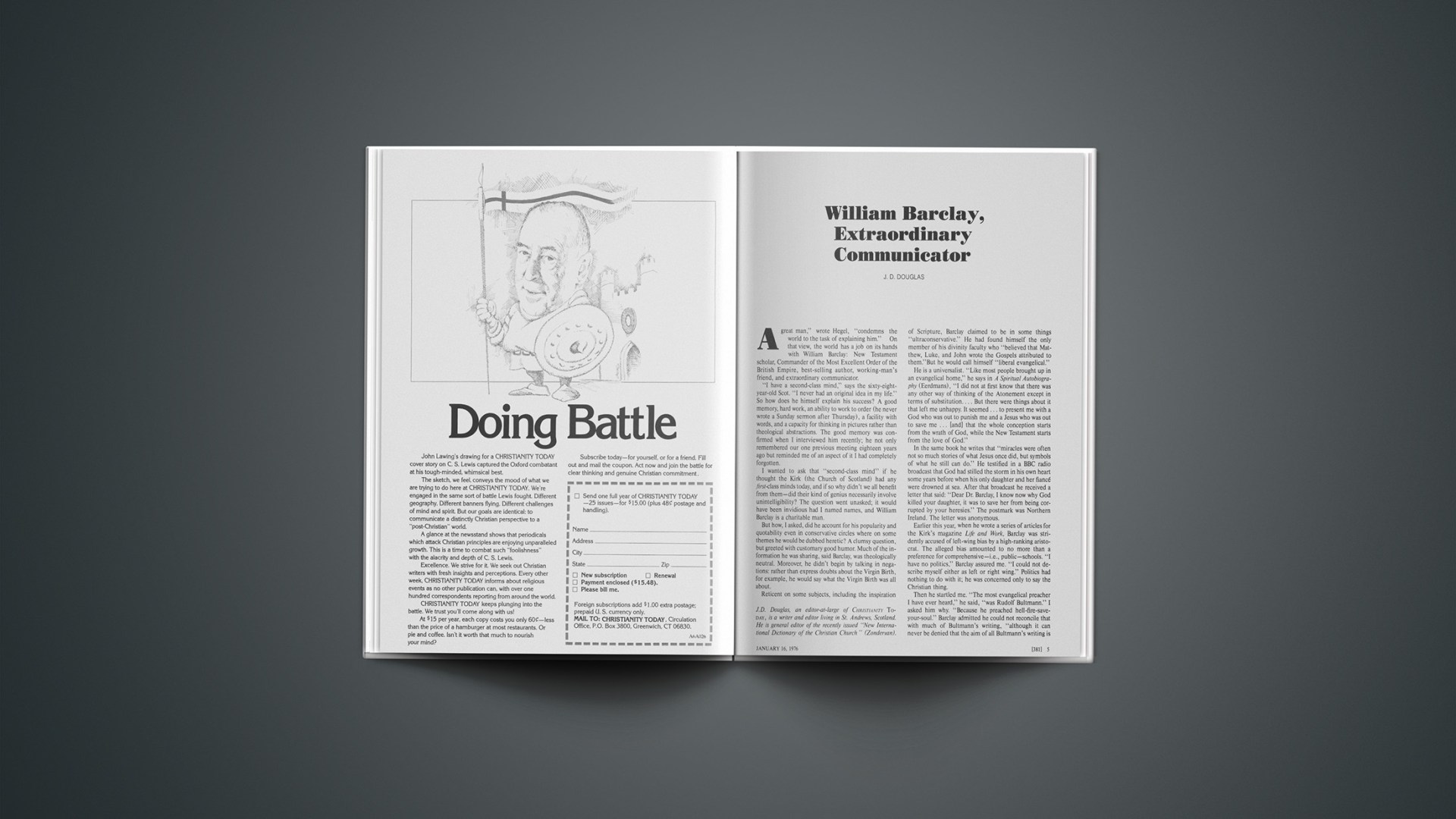
William Barclay, Extraordinary Communicator

A great man,” wrote Hegel, “condemns the world to the task of explaining him.” On that view, the world has a job on its hands with William Barclay: New Testament scholar, Commander of the Most Excellent Order of the British Empire, best-selling author, working-man’s friend, and extraordinary communicator.

“I have a second-class mind,” says the sixty-eight-year-old Scot. “I never had an original idea in my life.” So how does he himself explain his success? A good memory, hard work, an ability to work to order (he never wrote a Sunday sermon after Thursday), a facility with words, and a capacity for thinking in pictures rather than theological abstractions. The good memory was confirmed when I interviewed him recently; he not only remembered our one previous meeting eighteen years ago but reminded me of an aspect of it I had completely forgotten.

I wanted to ask that “second-class mind” if he thought the Kirk (the Church of Scotland) had any first-class minds today, and if so why didn’t we all benefit from them—did their kind of genius necessarily involve unintelligibility? The question went unasked; it would have been invidious had I named names, and William Barclay is a charitable man.

But how, I asked, did he account for his popularity and quotability even in conservative circles where on some themes he would be dubbed heretic? A clumsy question, but greeted with customary good humor. Much of the information he was sharing, said Barclay, was theologically neutral. Moreover, he didn’t begin by talking in negations: rather than express doubts about the Virgin Birth, for example, he would say what the Virgin Birth was all about.

Reticent on some subjects, including the inspiration of Scripture, Barclay claimed to be in some things “ultraconservative.” He had found himself the only member of his divinity faculty who “believed that Matthew, Luke, and John wrote the Gospels attributed to them.”But he would call himself “liberal evangelical.”

He is a universalist. “Like most people brought up in an evangelical home,” he says in A Spiritual Autobiography (Eerdmans), “I did not at first know that there was any other way of thinking of the Atonement except in terms of substitution.… But there were things about it that left me unhappy. It seemed … to present me with a God who was out to punish me and a Jesus who was out to save me … [and] that the whole conception starts from the wrath of God, while the New Testament starts from the love of God.”

In the same book he writes that “miracles were often not so much stories of what Jesus once did, but symbols of what he still can do.” He testified in a BBC radio broadcast that God had stilled the storm in his own heart some years before when his only daughter and her fiancé were drowned at sea. After that broadcast he received a letter that said: “Dear Dr. Barclay, I know now why God killed your daughter, it was to save her from being corrupted by your heresies.” The postmark was Northern Ireland. The letter was anonymous.

Earlier this year, when he wrote a series of articles for the Kirk’s magazine Life and Work, Barclay was stridently accused of left-wing bias by a high-ranking aristocrat. The alleged bias amounted to no more than a preference for comprehensive—i.e., public—schools. “I have no politics,” Barclay assured me. “I could not describe myself either as left or right wing.” Politics had nothing to do with it; he was concerned only to say the Christian thing.

Then he startled me. “The most evangelical preacher I have ever heard,” he said, “was Rudolf Bultmann.” I asked him why. “Because he preached hell-fire-save-your-soul.” Barclay admitted he could not reconcile that with much of Bultmann’s writing, “although it can never be denied that the aim of all Bultmann’s writing is confrontation, the confrontation of the individual with the living Christ.”

When I took him to task for his equation of home and happiness with marriage and family (a bachelor interrogator could do no less), I challenged his apparent dogmatism on the issue. But the man whose own marriage has been very happy (though he doubted if his wife had read any of his books) was unrepentant. He disapproved of a celibate ministry; parish work was likely to be carried on more effectively by a married man who needed the help of a partner in his work. Resisting the temptation to ask if this was not connected with an earlier admission that he was “a handless creature,” domestically helpless, I pressed him on the broader issue, but he was reluctant to make exceptions, other than for missionaries. Oddly enough, he turns things on their head regarding women ministers: he disapproves of their being married. Working wives on the whole he thought were bad for home and children.

In a magazine article Barclay had cited the danger of misrepresentation in journalism. I asked if he had been a victim of this, but he had no substantial complaint; his concern rather was about those who condemned him without having read a word he had written. It was not unusual for conservative students to come to him apologetically after their first year in his class, admit that they had been warned against him, and say how unfounded had been their fears. Barclay genuinely does not mind criticism—if critics get their facts right. A naturally friendly man, he finds nothing more offensive than a shut mind, but he would still knock “the mind which is open at both ends.”

He does not think anyone has a right to confront a total stranger with “Are you saved?” It was like asking about the state of the stranger’s bank account. “A relationship has to be arrived at in which it is possible to talk of these things. But the great and grave danger is to lose the chance of talking about them at all.”

Like Baron von Hügel, William Barclay urges ministers to have some non-religious interests, including TV-watching to keep them abreast of current talking points. His own hobbies are stamp-collecting, following the soccer scene, and golf, which he gave up reluctantly in recent years because of emphysema (he had “come to look on heaven as a place where there will be no more stairs”). Although deaf for more than forty years, he had a hearing aid that not only overcame the deficiency but enabled him to conduct choirs. I recall that my college entertained Barclay’s once. His triumphed on the soccer field, then under Barclay’s baton sang to soothe the wounded feelings of the vanquished. Music has been an integral part of William Barclay’s life. As a parish minister in Renfrew he always listened to the Scottish Orchestra on Saturday evenings, convinced that “great music is a tension-reliever,” and by far the best preparation for Sunday activity.

I asked if he had any suggestions about how to arrest the alarming decline in church membership (the Kirk has lost 120,000 communicants or 10 per cent of the total in the past five years). The professor said he found an openness to religion, but he saw a problem in how to make Christianity meaningful to those outside the church. The traditional conservative evangelical approach he described as being “too authoritative in the beginning.” The church had to be taken to the people; he would be glad to conduct a service in the golf-club bar on a Saturday evening—but how the Gospel was got across depended on the place and the circumstances.

In church services, Barclay would like to see on Sunday evening a radical reordering of the traditional format that presented visitors with hymns they might not know and prayers that meant little. How would he do it? “Begin with the sermon,” he replied promptly, “talk for forty-five minutes on a topical theme like ‘Christianity and Money’ or ‘Christianity and Sex.’ ” That strategy was followed in the suburban Glasgow church of which he is an elder. After the sermon/lecture there was an interval for tea in the church hall, then discussion when those with a point of view—trade unionist, communist, or anyone else—could have his say. The proceedings concluded with an epilogue. Barclay said that such occasions might bring 400 to church, of whom perhaps 150 would stay for discussion—this, it should be added, in a land where many churches have canceled their evening services for lack of support.

There seemed some link here with Barclay’s advocacy of a two-tier membership, put forward in one of his books where he deplores the virtual disappearance of church discipline. In one category he would place those who are “deeply attracted to Jesus Christ and the Christian way,” in another “the many fewer who are prepared to make a total commitment to Jesus Christ.”

Although he retired from Glasgow University in 1974, Dr. Barclay is now a visiting professor in the biology department in the University of Strathclyde. The title is an administrative expedient; his task is to lecture on professional ethics. This is not too demanding, however, and most weekdays he is found in his office at the Collins publishing house, not far from Glasgow’s ancient cathedral. There he works on the Old Testament part of his Daily Study Bible. The New Testament series (published in the United States by Westminster) has in two decades sold about 1.5 million copies and has been translated into many languages, including less well-known ones such as Estonian and Burmese.

Barclay plans to produce three volumes every two years, and to complete the Old Testament in six years. The first installment is due at the end of March. Lady Collins, a devout Roman Catholic and head of the company sponsoring the present project, made only one proviso: that he begin with the Book of Psalms.

Explain the phenomenon as we will, William Barclay’s writings and broadcasts have spoken about Christianity to many millions otherwise unreached. Those who criticize his message could well copy his method, lest he reasonably point out that he prefers his way of doing it to their way of not doing it. Only with culpable slowness are some of us learning that it is not enough to know the Lord’s song in a strange land; we must also learn how best to sing it.

Editor’s Note from January 02, 1976

Our new anonymous correspondent, Eutychus VII, begins his column in this issue. We look to Eutychus to “prove that the pin is mightier than the sword in deflating ecclesiastical pretense, sham, and present-day religiosity” (the quote is from a collection of Eutychus I’s letters, Eutychus (and his pin), published by Eerdmans in 1960). Our first Eutychus was Edmund Clowney. The sixth scion in this provocative line was Harold O. J. Brown, unmasked last issue, and I want to thank him for two years’ worth of good reading. To the latest occupant of that window-seat at Troas: Welcome! Stay awake, and help us stay awake.

Another Look at Moratorium

The East African church newspaper Target recently carried an article entitled “Moratorium, A Bitter Pill to Swallow” (issue of October 12, 1975). Christian Council secretaries of Zambia, Mozambique, Malawi, Tanzania, Kenya, Uganda, and Sudan have categorically rejected the idea of a “moratorium” on missions. The term has, they say, “created unnecessary confusion and misunderstanding both in Africa and abroad, and should therefore be dropped and substituted with the more direct term ‘self-reliance.’ ” When about 1,000 evangelical church delegates met at the Congress on Evangelization in Nigeria last August, they flatly rejected moratorium.

Western Christians should not use moratorium as a cover-up for spiritual inertia. Encouragingly, at the 1970 Urbana missionary convention 884 students signed up for missionary service if God so led, and in 1973 there were 5,585.

The concept of a moratorium on missions as proposed at the Lusaka Assembly of the All Africa Conference of Churches (AACC) means the unconditional withdrawal of all missionaries and financial resources from overseas for five years. This has not been followed through even by the advocates of moratorium. The Chicago Daily News for two successive days in January, 1975, reported two pleas by Canon Burgess Carr. In one report the headline was, “Keep Missionaries Home.” But the next day another read, “Financial Help Still Is Being Requested.”

In its July 26, 1975, press release, the AACC announced the following concerning the financing of its new $1 million Nairobi headquarters: “The Committee authorized the raising of grants and loans from mission boards in the U.S.A. to a total of $500,000.”

In the April, 1975, International Review of Mission, Professor Peter Wagner outlined four reasons behind the call for moratorium. Let me examine these first and then add three more.

1. Western cultural chauvinism. The thinking runs like this: Missionaries have destroyed our culture and imposed theirs on us. They should therefore go home and take their money with them. Only when this is done can the church in Africa find its identity.

Admittedly, some aspects of culture have been condemned by missionaries unnecessarily. Wagner cited as examples of “Western cultural chauvinism” efforts to advance such concepts as two-party elections, capitalism, and literacy as second to godliness. But how widely are these concepts pushed by missionaries?

2. Theological developments. It is usually felt that foreign missionaries are standing in the way of the development of theologies that speak in various cultural contexts. Some missionaries may indeed think that the final word has been said in theology. But this view is not general. Undoubtedly, members of a given culture have certain advantages in contextualizing theology, within that culture. But they do not necessarily make use of these advantages. Some African champions of “African theology” have been branded “black Europeans” by fellow Africans.

3. Paternalistic interchurch aid. It is true that some missionaries fall into the temptation of the “syndrome of church development”—that is, staying on the scene too long after planting a church, and not moving on to plant new churches. But is moratorium the answer to this? Wagner rightly suggests: “Perhaps in this case a relocation of missionary personnel would be in order rather than a moratorium.”

4. Nonproductive missionaries. It is suggested that some missionaries are not producing. But who can be the judge? Even the non-fruit-bearing branch is to be pruned and not torn off. The Church can help in the pruning by prayerfully working out the solution in each individual case rather than by listening to a pontifical pronouncement from Nairobi or Geneva.

I want to add the following points.

5. Moratorium is a part of the liberation process. Some Christian leaders see the Church as a party to the colonial strategy of oppression of Africans. In the early colonial days the missionary was a hero who risked his life contacting the Africans. The white colonial officer found him an asset. A few missionaries shared in the paternalism of the day. Unfortunately, that is still the case in some situations today. But this does not warrant the description of Christianity as a system of servitude from which African Christians should be liberated. Missionaries have preached the message of freedom. “If the Son shall make you free, you shall be free indeed” (John 8:36).

6. Moratorium is part of a wider ecumenical strategy. At the New Delhi assembly of the World Council of Churches in 1961, the International Missionary Council was integrated into the WCC Commission on World Mission and Evangelism. At Bangkok in 1973, salvation was described as “the peace of the people in Vietnam, independence in Angola, justice and reconciliation in Northern Ireland” (assembly papers, Section II, p. 90). The preparatory material for the recently concluded WCC Fifth Assembly in Nairobi presented mission only as dialogue. To accept the unconditional withdrawal of missions is to sign a death warrant for worldwide evangelism. Evangelicals cannot afford to do that while 2.7 billion people are still unevangelized.

7. Moratorium and politicizing seem to go together. The emphasis placed by ecumenicals on human development rather than spiritual new birth as a priority makes missionaries irrelevant. An African Christian leader pled for a replacement of spiritual sermons with lessons on economic development. It has been reported that many churches in Mozambique have been turned into medical clinics and food-distribution centers, and that some missionaries have been imprisoned. In some countries, political indoctrination is now replacing religious instruction. Some ecumenical leaders in Africa praise these moves.

Political and social circumstances may necessitate a withdrawal of missionaries. In such situations our sovereign Lord can still bring good out of a humanly tragic situation. But the Church should not be disobedient to the heavenly vision. The 3,000 missionaries emerging in the Third World should join hands with the missionaries from the West and “be occupied” till He comes.

In rejecting moratorium I do not mean to imply that all is well in the household of faith. My main concern is the remaining task of evangelism, which requires a cross-cultural sharing of the Gospel. The strategy that would meet this need is the training of Africans for leadership.

Missionaries with paternalistic and culturally chauvinistic attitudes should bring these sins to the cross and plead with the Lord for a new heart. Nationals and missionaries should cry before the Lord, “Wilt thou not revive us again, that thy people may rejoice in thee?” (Ps. 85:6). When Christians are filled with the Spirit of God, cultural relevance and contextualization will be brought about in the church without moratorium. It is pruning we need, not uprooting.—

BYANG H. KATO,

general secretary of the Association of Evangelicals of Africa and Madagascar,

Nairobi, Kenya.

Jews and Evangelicals: Mutual Concerns

A first was recorded in both evangelical and Jewish circles when more than forty scholarly participants met last month in New York City to discuss the state of their relationship. Organized by Interreligious Affairs Director Marc H. Tanenbaum of the American Jewish Committee and G. Douglas Young of Jerusalem’s Institute of Holy Land Studies, the three-day exchange was designed to evoke frank and clear discussion of areas that have traditionally kept the two communities apart. Papers from both sides considered the following topics: The Messiah, The Meaning of Israel, Social Concerns, Biblical Authority, Current Morality, and the Problems of Minorities in a Pluralistic Society.

The conference was the fulfillment of a long-held dream of Canadian-born, U. S.-educated Young, himself now an Israeli citizen and a leading spokesman for Christians in that country. Conference sessions were held in New York’s Calvary Baptist Church and at the American Jewish Committee’s headquarters.

Although the evangelical delegates were hand-picked to represent a wide variety of theological expression all were known to be reasonably friendly to modern Jewish and Israeli interests. Some, typified by elder statesman Arnold T. Olson of the Evangelical Free Church, have gained considerable prominence with Christian advocates for Israeli causes.

Major topical addresses were delivered from the evangelical side by Marvin R. Wilson (Gordon College), William A. LaSor (Fuller Seminary), Carl E. Armerding (Regents College), Paul E. Toms (President, National Association of Evangelicals), Vernon C. Grounds (Conservative Baptist Seminary), and Young.

Jewish positions were set forth by scholars representing all three traditions (Orthodox, Conservative, and Reform).

For many on both sides the highlight was a luncheon address by Evangelist Leighton Ford of the Billy Graham organization. Ford’s forthright presentation, a number felt, enabled the Jews to have a better understanding of the Christian dynamic of evangelism. “For me to disclaim a desire to evangelize all people would be dishonest,” he said. On the other hand, he acknowledged, “the experience of getting to know you and of reading and praying for this dialogue has been a great learning experience for me.” He went on to point out that “my Lord is of your people. To be anti-Semitic is to be anti-Christ.”

Perhaps more significantly, says Armerding, Ford’s talk underscored wide areas of shared social concern, a theme echoed later by Toms, Tanenbaum, and others at the landmark symposium.

Key issues emerged on which both sides seemed to share a basic understanding. These included the Jewishness of the New Testament, social and moral concerns, and the need for fair and equitable treatment of Israel in world opinion.

On several other issues a beginning was made, reports Armerding. LaSor opted for a development of Messianism in the Old Testament that would not set Christian hermaneutics totally at variance with Jewish biblical scholarship. Armerding argued that the New Testament preserved the distinction between Israel and the church, but he pleaded for Christians not to see modern Jews merely as pawns in the Christian eschatological scheme. A panel discussion led by Kenneth Kantzer (Trinity Evangelical Divinity School) featured papers on scriptural authority. The Jews clearly represented a much wider divergence in positions than their evangelical counterparts.

In two areas especially, much remains to be done, says Armerding. Jews neither appreciate nor fully understand the “conversion” mentality of evangelicals. Although discussion was frank and friendly, he states, it is apparent that evangelicals must learn why Jews react as they do, and adjust their own approach to what years of “forced conversion” have taught the Jewish community.

The second area concerns responsibility for the death of Christ. Despite a sincere attempt by the evangelicals, notably Kenneth Kantzer, Edwin Yamauchi (Miami University, Ohio), Roger Nicole (Gordon-Conwell seminary) and A. T. Olson to define the matter biblically, feelings were ruffled in both camps.

A persistent note of special concern came from the only three women in the dialogue (two Jewish, one Christian). They forcefully reminded the overwhelmingly male audience that neither community had done much to recognize the real issues of women and their role in faith and life.

The exchange was seen as a good beginning. The organizers expressed satisfaction with the results and spoke of plans for a second stage of talks.

A Bash For Cecil

Ten years had passed since A. Cecil Williams landed on the San Francisco scene as pastor of Glide Memorial United Methodist Church. It was time for a big bash, a “Celebration of Change” to honor the black mesmerizer who had transformed a dwindling traditional inner-city church into a pulsating funky haven for those who wanted to “get it on” in a psuedo-religious way.

The celebration, held on a recent Sunday, began with the usual two jam sessions of jazz, light shows, dance exhibitions, and soul singing and pop preaching by Williams that characterize Sunday mornings at Glide. Both “services” were packed. The festivities continued with street entertainment by a mime troupe. Tables in the social hall and parking lot overflowed with free literature promoting a variety of controversial causes, from gay liberation and the Black Muslims to Socialist parties. On display was a soon-to-be-marketed “Cecil Doll” that resembles remarkably its namesake: lanky, Afro hair style, black-rim glasses, bright clothes.

The major event of the celebration drew 3,000 of Williams’ followers to the church and the sidewalks of the neighboring Tenderloin district to hear twenty speakers pay him tribute. Among them were prominent politicians, spokesmen for ethnic groups, radical leader Angela Davis (she got a standing ovation), and Margo St. James, founder of Coyote, the union for working prostitutes. Ms. St. James recounted how Williams had provided a meeting place at Glide so she could start her organization which now has chapters in twelve cities. (Dedicated to legalizing prostitution, Coyote will hold its third national convention in Washington, D. C., this July.)

Methodist bishop R. Marvin Stuart of San Francisco, who sometimes disagrees with Williams, sent a letter commending the minister for his “courage, dedication, and vision” in reaching social outcasts. “Despite upset and controversy, we will not forget the dignity, hope, and fuller life that Glide United Methodist Church is bringing to people in this community,” said Stuart. “Your ministry is, of course, central to Glide’s witness.”

The final event was a benefit concert in the evening by Marvin Gaye and Quincy Jones at the Cow Palace to raise money for Williams’ new “Center for Self-Determination.”

Williams said that when he came to Glide ten years ago “it wasn’t a good day. Not with the people who were here then. No, they were determined to drive me away, and I was determined to drive them away, and I won.” The unusual changes wrought by Williams prompted religion columnist Lester Kinsolving to describe Glide Church as “America’s only Sunday morning night club.” Ironically, many of Glide’s new styles were financed from a foundation set up by a staunch conservative for the furtherance of evangelism.

A theological assessment of Williams was offered by maverick Abraham Feinberg, a retired reform rabbi and unpaid member of Glide’s staff. In an interview, Feinberg said he is more conservative in his theology than Williams. He said he does not consider Williams a Christian. Wielding a cane given by Ho Chi Minh in Hanoi in 1967, the 76-year-old social-justice crusader declared: “Cecil has never spoken Christian doctrine in the church in the three years I’ve been here. If this were a Christian church I wouldn’t be here. I don’t understand why the United Methodist Church tolerates Cecil here.”

Williams has been asked many times whether he is a Christian, but he indicates that he shrugs off the question—or angrily stares down the questioner. “When you come in here, I’m not going to ask you, ‘Are you a Christian?’ I can tell by the way you walk, the way you talk whether or not you’re a person.”

ROBERT CLEATH

Religion In Transit

RAP ’76, a three-day conference on Religion and the Presidency, will bring together the major presidential hopefuls and several hundred religious leaders January 19–21 in Washington, D. C. Each candidate will read a paper and answer questions by panelists. RAP is the brainchild of Fred B. Morris, a former United Methodist missionary jailed on political charges in Brazil. Among the co-sponsors he enlisted are evangelical leaders Carl F. H. Henry and Clyde W. Taylor.

A United Methodist Congress on Evangelism will be held in Philadelphia January 4–8. Speakers include President Ford.

A random survey of 50,000 churchgoers by clergyman-editor Norman Vincent Peale’s organization indicated that they want more sermons dealing with prayer, God’s guidance, and the Bible, and less on politics and social action.

Highschool students affiliated with the United Pentecostal Church were boycotting schools in the Pittsburg, California, area. The school superintendent had refused to excuse the youths from audio-visual and television instruction. Parents and UPC pastor Jack Smith insist that movies and TV are sinful.

More than 10,000 persons participated in the recent convention of the Greater Los Angeles Sunday School Association (GLASS), a record.

Personalia

William Sloan Coffin, 50, the controversial Yale chaplain, announced his retirement from campus ministry to embark on “a ministry to the world.”

Jesuit Daniel Lyons, 55, the well-known conservative Catholic columnist who is leaving the priesthood (he recently married 24-year-old Irish singer Mary Cooney), was named editor-in-chief of the 200,000-circulation Christian Crusade Weekly, the paper published by Evangelist Billy James Hargis.

World Scene

After more than five months in captivity, French medical missionary Paul Horala of the Sudan United Mission was finally released by rebels in Chad.

More than 23,000 decisions for Christ were recorded at a four-week evangelistic campaign in Bogota, Colombia, according to correspondent Lindsay Christie. The meetings, held on a vacant lot, were attended by as many as 20,000 or so per session. About 150 churches supported the crusade. Pentecostal healer Yiye Avila of Puerto Rico was the evangelist.

Southern Baptist missionaries report that more than 700 Cambodian and Vietnamese refugees in three camps in Thailand have professed faith in Christ. In one camp two dozen Christians who escaped from Pailin, Cambodia, reportedly led seventy fellow refugees to Christ.

Ten Southern Baptist missionaries were still in embattled Beirut last month. They said they were safe but that church and personal property had been damaged, and that “things are quite critical.”

The WCC: Words in the Wilderness

In the words of Philip Potter, organized international ecumenicity is in the wilderness.

That assessment of the World Council of Churches’ position, given by its own general secretary, summed up the feeling of many delegates on the last day of the council’s Fifth Assembly, held in Nairobi, Kenya. For the organization’s top executive and other veterans, as well as for the 80 per cent of the delegates who were attending their first assembly, it was hard to see ahead to any “promised land” after their eighteen days together in November and December.

Potter is confident, however, that there is at least a call to the “holy land” even though current ecumenical leaders may not see its features clearly. The 54-year-old Methodist from the West Indies has participated in one capacity or another in all five of the assemblies, and he has a theory about the council’s historical development that labels the fourth one (in 1968, at Uppsala, Sweden) as the “exodus.” It was that turbulent meeting which mandated a clear turn from more “churchly” activity to the more “worldly.”

Even though there may be general agreement on the WCC’s distance from Zion, the consensus ends there. Some of the delegates went home with a conviction that the ecumenical body is now headed toward an emphasis on evangelism and missions. For others, the council is finally ready to promote utopian socialism on a worldwide basis. Another group is convinced that the “holy land” is the organic union of all denominations. Still others think the WCC will concentrate on combatting repression, colonialism, and violence.

Whatever the destination, Potter is the WCC’s Moses. He became its top executive between the Uppsala and Nairobi assemblies, succeeding Eugene Carson Blake in 1972. He got a mandate to continue in the post when the new Central Committee, the between-assemblies policy-making body, met for a full day after the Nairobi assembly adjourned.

Sharing leadership duties with the general secretary during the next seven years will be the moderator of the new Central Committee, Archbishop E. W. Scott, Anglican primate of Canada. He has a reputation as a social activist as well as that of a unity advocate.

One of the Nairobi meeting’s little-noticed acts was the adoption of a revised constitution that concentrates power in the Central Committee. The old charter said that the assembly, in which all member denominations are represented in proportion to their membership, should “ordinarily meet every five years.” While the meeting pattern has never followed this provision strictly, the new constitution specifies the less frequent schedule of meetings “at seven-year intervals.”

Despite a projected deficit in 1976, the assembly elected an enlarged Central Committee, increasing the number by about fifteen. The new constitution allows up to 145, but the final number named in Nairobi was 136.

When the Central Committee meets in August it will have a full docket of matters committed to it by the 700 Assembly delegates. Among the first tasks will be to fill the many vacant spots on WCC commissions and committees. Most of them will be directed until then by staff along with only a “core” of advisory members.

In its eighteen days, the assembly was largely preoccupied with its African setting and with various presentations from the platform. Most of the business was crammed into the last week.

The assembly was the first in Africa for the WCC. Early in the program, delegates viewed a drama commissioned by the All Africa Conference of Churches to depict an African view of the missionary effort and its effect on culture. The play opened with non-Christian tribesmen living peacefully and closed with carnage after foreign Christians appeared. Its author and director was described as the product of mission schools who had since decided “not to continue in the church.”

Daily news reports reminded delegates of the fighting by rival factions in Angola, formerly Portuguese West Africa. The World Council has given funds to all three of the “liberation movements” in that country (see November 7, 1975, issue, page 57), but spokesmen emphasized that no money has gone from the special fund of the Program to Combat Racism since Angola’s independence day. Attempts were being made to send relief supplies to areas under the control of all the groups, officials said. The assembly passed a resolution calling for the cessation of all foreign military intervention, but the only nation named was South Africa. Nothing was said of the Cuban and Soviet assistance.

Kenya’s president, one-time freedom fighter Jomo Kenyatta, did not make a scheduled appearance at the assembly, but he invited delegates to a reception at his residence. He was also the featured speaker at the laying of the cornerstone of a new headquarters building for the All Africa Conference of Churches during the assembly.

Voted down was a motion to restrict grants from the Program to Combat Racism to non-violent groups. The Central Committee was authorized to determine the future shape of the WCC’s most visible program.

Repeated appeals were made during the assembly to leave specific details to the Central Committee, and delegates generally complied. There were exceptions, however. On the last day, for instance, Potter asked for passage of a statement condemning the government of Korea. One of the eight delegates named by member churches of that nation had been refused permission to travel to Kenya, and WCC attempts to get him (and three other Koreans who had been invited to participate in other capacities) out of the country failed. Even though the general secretary wanted specific action in this case, the delegates voted to refer the matter to the Central Committee.

The assembly’s difficulty in deciding whether to be general or to name names came into clear focus on the document which came to be known as the “Helsinki resolution.” A drafting committee had brought to the floor a document describing the 1975 Helsinki Agreement on Security and Cooperation in Europe as “a sign of hope in a world tom apart by opposing ideologies.” The paper called on all signatory governments to implement its principles, including the clause calling for respect for freedom of religion.

A Swiss delegate’s attempt to amend the resolution by pointing to “restrictions on religious freedom, especially in the Union of Soviet Socialist Republics,” brought the meeting to one of its most heated moments. Soviet speakers said there was no evidence of denial of rights. Westerners pushing for the amendment were accused of wanting to break fellowship with the Soviet bloc. There were amendments to the amendment, and the parliamentary situation got entangled. M. M. Thomas, who was then presiding, declared a tea break. The two veteran Soviet members of the Central Committee and the experts in the Moscow Patriarchate’s foreign affairs department, Metropolitan Nikodim and Vitaly Borovoy (see photo), rushed to the platform. They huddled there with Thomas, Potter, and other council leaders. A few minutes of debate followed the recess, but then a vote of 259 to 190 sent the document back to the drafting committee.

Overnight, the panel worked for a compromise acceptable to the Soviet delegation and the movers of the amendments. The result was one that spoke only of “alleged denial of religious liberty in the USSR” and asked all signatory governments to the Helsinki agreement to implement all provisions of the pact.

Finally approved by a show of hands, the resolution sent the whole discussion to the Central Committee, asking it to consult with member churches in all the affected nations. The resolution also requested the general secretary to report those consultations by the August meeting of the committee.

On some other topics, the assembly was specific. The new war in the former Portuguese colony of East Timor caused the delegates to ask for withdrawal of Indonesian forces as well as for Australian reception of refugees. A paper on human rights in Latin America castigated Chile and asked Argentina to be more hospitable to refugees. However, a floor attempt to include Brazil by name was thwarted by Brazilian delegates. Several Asian nations were identified as having human rights problems.

DUMPING THE REVEREND

The Right Reverend Mervyn Stockwood, outspoken Anglican bishop of Southwark, London, wants to abolish ecclesiastical titles such as Reverend and Venerable. He condemns them as both unscriptural and ridiculous. He feels that, like gaiters, they should be dumped in the trashcan of “pompous ecclesiastical absurdities.”

ROGER DAY

The six new presidents will be influential in the WCC’s decisions during the next seven years over what issues to handle in a general way and what issues to handle in detail. While the Central Committee officers (a moderator and two vice-moderators) have in recent times been more visible and more powerful than the largely ceremonial presidents, the members of the presidium still have a vote and power in the between-assemblies policy-making.

Most prominent and controversial member of the new presidium is 46-year-old Russian Orthodox Metropolitan Nikodim (born Boris Georgievich Rotov). The world traveler from Leningrad has been on the WCC’s Central and Executive committees since his denomination joined the council in 1961, but he is the first Soviet to be elected to the presidium. In addition to his other duties, he has been president since 1971 of the Prague-based Christian Peace Conference.

There was a widely publicized effort to keep Nikodim off the list of presidents, but it never got to the stage of a clear-cut issue at the Nairobi meeting. M. M. Thomas of India, the retiring moderator of the Central Committee, was suggested as an alternate, but he refused to stand for election. William P. Thompson, stated clerk of the United Presbyterian Church U. S. A., was generally given the credit for trying to prevent Nikodim’s elevation. The American Presbyterian succeeded, however, only in getting the assembly in a parliamentary tangle and apparently in getting the Soviets to substitute the name of one of their delegation for another on the Central Committee.

In addition to having its first Soviet, the new presidium will be unique in that it will have two women, Cynthia Wedel and Annie Baeta Jiagge. They are not the first women to serve as presidents, but they will be the first two to serve simultaneously. Mrs. Wedel, now an official of the American Red Cross, is an Episcopalian and former executive and then president of the National Council of Churches in the U. S. A. Mrs. Jiagge is a justice of Ghana Appeal Court and a member of that nation’s Evangelical Presbyterian Church.

Completing the presidium are J. Miguez-Bonino, a Methodist and dean of post-graduate studies at Union Seminary of Buenos Aires, Argentina; General T. B. Simatupang, a member of the Indonesian Christian Church and president of the Indonesian Council of Churches; and Olof Sundby, Lutheran Archbishop of Sweden.

Reelected honorary president was W. A. Visser’t Hooft, the Dutchman who guided the organization of the council and then served as its general secretary until his retirement. He was present and active throughout the Nairobi meeting.

A Thompson motion to provide for election of an additional honorary president and to have duties of the office specified by the Executive Committee was withdrawn before delegates could vote on it.

While the retiring Central Committee chairman, M. M. Thomas, would not allow his name to be proposed in opposition to that of Nikodim’s for the presidency, the Indian ecumenical veteran was voted a seat on the Central Committee. Also returned to that body was his vice-moderator during the past seven years, Pauline Webb of England.

The new Central Committee includes more women, more young people, and more representatives of churches in developing nations than ever before. The committee’s meeting on the day after assembly adjournment had been advertised to reporters as an open session, with the possibility of an executive session of a few minutes to decide some personnel questions. After an hour and a half for opening preliminaries and adoption of some rules changes, the new committee went behind closed doors for more than five hours to select its own officers and its Executive Committee, which is empowered to act on many matters between the annual sessions of the Central Committee.

When the elections were concluded, the Executive Committee also included more people from the youth, female, and “third world” categories than previously. Among the young members are Gundyayev Kirill, 29-year-old Russian Orthodox seminary dean, and Bena-Silu, a leader of Zaire’s Kimbanguist Church.

Named vice-moderators of the Central Committee (and thus members of the Executive Committee) were Jean Skuse, a Methodist woman who recently was appointed general secretary of the Australian Council of Churches, and Karekin Sarkissian, a native of Syria who is currently archbishop of the Armenian Apostolic Church of America. They, Archbishop Scott, and sixteen other members were elected to the Executive Committee during the Central Committee’s long executive session. Its next meeting will be in August.

The small Executive Committee will be faced with decisions on staff and budget during a year in which revenues are expected to fall far short of the amount necessary to carry on the program at the 1975 level. Few specific directives were voted by the assembly, but broad guidelines were approved. Potter told reporters at the end of the eighteen days that no program had been scrapped by delegates, and that there were requests for new staff and programs in several areas.

Among the problems facing administrators will be how to serve the expressed needs of the ever-widening circle of member denominations. There were 271 churches on the rolls before Nairobi. Fifteen more were admitted by the assembly, eight as full members and seven as associates (because they do not meet the minimum 25,000-communicant strength specified in the constitution for full membership). Among the newest affiliates are such African independent denominations as the Nigerian-founded Church of the Lord (Aladura) and the Kenya-based African Israel Church, Nineveh.

The assembly was unable to produce consistent WCC positions on a number of issues. One was a common date for Easter. Eastern Orthodox spokesmen refused to join in setting such a date until their own pan-Orthodox conference agrees on changing the time of the observance.

Another standoff issue was that of Zionism. Just before the assembly Potter had issued a statement urging the United Nations General Assembly to “reconsider and rescind” its resolution branding Zionism as racism. Palestinians and their friends at Nairobi were not able to get the WCC assembly to label the handling of Palestinian refugees as racism, but they were able to keep the assembly from saying what Potter had said before it met.

Continuation of the council’s program of dialogue with people of other faiths was voted, but not before addition of a preface opposing syncretism. The preface drew some bitter attacks, especially from Asians. Present on the platform as the program was considered were the first official assembly guests from non-Christian religions: a Jew, a Hindu, a Buddhist, a Muslim, and a Sikh.

Also taking an active part in the meeting were sixteen observers delegated by the Vatican Secretariat for Promoting Christian Unity. The Pope sent a message of greetings.

The presence of the non-Christian guests and the Roman Catholic observers was publicized widely. Not so noted was a group invited by the WCC as “conservative evangelical advisers.” Ten were supposed to have attended, but council officials could furnish the names of only five who attended: Michael Cassidy of the African Enterprise missionary organization in South Africa; Larry Christenson, charismatic Lutheran pastor from California; David Hubbard, president of Fuller Seminary; Juan Carlos Ortiz, charismatic pastor in Argentina; and John Stott, well-known Anglican preacher and author. Some of them stayed only a few of the eighteen days.

Other evangelicals were at the assembly in other categories, and a few of them had an off-the-record meeting with Potter to express their concerns. How their causes fare, as well as those of all others who were at Nairobi, will be seen in the coming seven years as Potter, his staff, and the new Central Committee look for what they think is the “promised land.”

ARTHUR H. MATTHEWS

Mozambique: Reeducating The Trapped

There are no member churches of the World Council of Churches in Mozambique, the former Portuguese East African colony. The country, however, was never far from the minds of delegates at the WCC’s Nairobi assembly, since the Marxist government there is one which the council helped bring to power. FRELIMO, which got funds from the WCC’s Program to Combat Racism when it was a liberation movement, is now ruling the nation.

Near the end of the assembly, the delegates received a letter from the officers of the Presbyterian Church in Mozambique, praising the council “as an instrument of unity and international peace” and applying for membership. WCC procedures for admission of new members require a six-month waiting period after the formal application is received, so the assembly was unable to admit the Body. The Central Committee will be authorized to act on the matter in August, though.

Even if no denomination is ever admitted from Mozambique, the country will continue to be a WCC concern. Several times during the assembly, newsmen asked for a WCC explanation of why the government it helped empower has jailed national pastors and Christian missionaries (among them two Nazarenes from America, Armand Doll and Hugh Friberg). There was no response. WCC spokesman were asked what the council had done to seek their release. There were only hints that anything had been done, and on the record a spokesman would say only that there was no written appeal to FRELIMO. (It was learned that at least one WCC executive visited Mozambique just prior to the assembly.)

In the letter from the Presbyterians was an acknowledgement of an invitation to send an observer to the Nairobi meetings. The letter, written by Church president Osias Mucache and moderator Isaias Funzamo, revealed much about the situation of the church there. A paragraph in the WCC’s “provisional translation” into English (from French) said:

At the present time, the major preoccupation of our church is the problem of adaptation to the new social structures of independent Mozambique. It is a matter, on the one hand, of finding new forms for the presence of the church in society, and, on the other, of finding means of devoting ourselves to the Christian edification of believers and of giving an effective biblical formation to the laity in view of their increasingly close collaboration in the work of evangelization. In this great work of reconstruction and reorganization in our church, we hope to have the collaboration of all our brothers in Christ, by prayer and the Christian experience of their country, and chiefly of those whose political system is similar to that chosen by the government of our country.

Another Presbyterian, Valente Matsinhe, identified in a news release of the Nairobi-based All Africa Conference of Churches (AACC) as an “administrator” of the denomination, is also described as a FRELIMO general secretary in his area. Matsinhe told an AACC interviewer he was a “committed Christian and socialist.” He explained that FRELIMO knew that prior to independence Mozambique’s churches were controlled from “outside” and that this was inconsistent with the party’s policy of self-reliance. For this reason, said he, the government has designated one church organ, the Christian Council of Mozambique, to represent all churches.

“The government of Mozambique wants a self-reliant church and is very firm that only the Christian Council of Mozambique should represent all the Christian Churches,” he declared. He went on to ask the AACC for more assistance so that “we shall be able to mentalize the Christians toward their role in a socialist nation.”

The FRELIMO government has taken a hard line toward the churches and especially toward foreign missionaries. Armando Emilio Quebuza, the nation’s political commissar and interim minister, published an official “circular” last October accusing churchmen of a variety of crimes against the new nation. In a paragraph on the last of eleven pages of his document, he said:

Once we can detect these architects of division who travel in darkness from house to house and who stick leaflets threatening the dignity of the people, or who meet with a view to manipulating and making plans for ideological attacks or even attacks which are anti-Revolutionary and against our people, these people must be neutralized and the truth communicated to the competent bodies.

All this is because Mozambique people led by FRELIMO are decisively engaged in the construction of new men, liberated from all vicious qualities and all corrupt ambitions of imperialism. This will only be possible if we reeducate those who willingly and unwillingly fell into the former traps of imperialism.…

The “traps” identified in his paper are not only such denominations as the Nazarenes, but also African independent churches and the Jehovah’s Witnesses.

After the WCC assembly in Nairobi, the plane to Mozambique’s principal city, Lourenco Marques, carried several assembly participants in addition to the observers from Mozambique. Some were WCC staff members going on an unpublicized mission. Also aboard was American William P. Thompson, stated clerk of the United Presbyterian Church and president of the World Alliance of Reformed Churches. Asked if he were going to Mozambique on behalf of the WCC, Thompson said he was not. The mission, he explained, was for his denomination. He added that he would be visiting the Christian Council, the Presbyterian Church, and missionaries of his own denomination.

Thompson’s observations, together with those of the WCC staffers on the trip, will no doubt be taken into consideration when the Central Committee considers its future relationships with churches in Mozambique.

ARTHUR H. MATTHEWS

Irish Ired

In many denominations around the world battles are being fought over membership in the World Council of Churches. One such struggle involves the Presbyterian Church in Ireland, which has some 145,000 members in both Ulster and the republic.

A group of Irish Presbyterians who want their church to withdraw from the World Council of Churches sent observers on a fact-finding mission to the Fifth Assembly of the WCC in Nairobi. Clergymen James Neely and John Kelly, their travel expenses raised by the 1,000-strong anti-WCC group known as the Campaign for Complete Withdrawal, are to report their findings in a series of meetings around the country.

The Presbyterian Church in Ireland is deeply divided on the issue of WCC membership. At last year’s General Assembly a crucial vote was deferred for twelve months to allow for further discussion. A showdown is shaping up for this June when the assembly meets again. Both the pro-WCC and anti-WCC groups have been lobbying strenously through meetings and literature.

Opposition to the WCC concerns theology and finances. Some feel that the WCC has a liberal theological orientation that is out of step with churches of the Reformed faith, and they suspect that some WCC funds are helping to finance African terrorist groups.

The Inter-Church Relations Board is a major group within the denomination lobbying for staying in the WCC. It has prepared papers by local church scholars and historians outlining the Presbyterian Church’s official position and links with the WCC. One of the board’s leaders, cleric Ian McDowell, was a delegate at Nairobi.

A third group not yet committed either way was represented at Nairobi by WCC delegate Alastair Dunlop.

The outcome of the debate will probably remain uncertain right up to the final discussion at this year’s assembly in Belfast. Denominational information officer Donald Fraser, a pro-WCC man, predicts that the “prolonged debate at all levels in the church will probably lead to a majority for staying in the World Council.” Anti-WCC leader James Neely feels that the vote will be close but that his side will win.

One possible outcome is a compromise in which the church stays in the WCC with certain fixed guarantees to satisfy the dissidents. At any rate, whether the deliberations at Nairobi provided adequate ammunition for either of the warring factions in the church remains to be seen.

ALF MCCREARY

Seeking Sisters

Some 1,200 persons, mostly Catholic nuns, attended a Detroit conference on ordination of women to the Catholic priesthood. A continuation task force was organized to press for ordination, and nearly 100 women who are actively seeking ordination signed a statement. Bishop Carroll T. Dozier of Tennessee, for one, came away convinced that the U. S. hierarchy had better take seriously what was said there.

Fortunate Fathers

At the prodding of the Roman Catholic archbishop of Baltimore, a mammoth mail-order charity operation conducted by the Pallottine order is being subjected to an audit. If the results are made public as promised they will reveal for the first time how much money is being attracted by the order’s highly sophisticated solicitations.

The Pallottine fathers gained notoriety in recent weeks through disclosures of their financial dealings with scandal-ridden politicians in Maryland.

The order is believed to be one of the largest mail-order charities in the country. It was founded in Italy in 1835 by St. Vincent Pallotti.

Included in alleged improprieties was a $54,000 loan said to have financed the 1974 divorce of Maryland governor Marvin Mandel. Mandel, who is Jewish, has since married a Catholic divorcee who converted to Judaism. Mandel is currently under federal indictment on fraud charges.

The order’s practices first came to public attention through an investigative account in the Baltimore Sun. The newspaper found that the order had spent more than $1.9 million in 1974 mailing 106 million computerized appeals for donations that, with a sweepstakes contest, may have brought in as much as $ 15 million. Of this amount, only $261,895 in cash and $146,148 in supplies were transferred to overseas missionary work, according to Pallottine records. The order declined to disclose how much it holds in investments.

THE CIA: KEEPING CLOSE

Republican senator Mark Hatfield of Oregon was among the churchmen disturbed by reports last year that the Central Intelligence Agency had used missionaries in its information-gathering operations (see October 10, 1975, issue, page 62). In August, Hatfield sent a letter to CIA director William Colby requesting that clergy and church officials be placed on the CIA off-limits list. (The CIA earlier had issued internal directives prohibiting operational contacts with Peace Corps volunteers and Fulbright scholars.)

In a reply made public last month by Hatfield, Colby said it would be neither “necessary nor appropriate” to bar CIA-clergy links. “In many of the countries of the world,” said Colby, “representatives of the clergy, foreign and local, play a significant role and can be of assistance to the United States through CIA with no reflection upon their integrity nor their mission.… Any sweeping prohibition such as you suggest would be a mistake and impose a handicap on this agency which would reduce its future effectiveness to a degree not warranted by the real facts of the situation.”

Hatfield, a Conservative Baptist who attends Fourth Presbyterian Church in Washington, next appealed to President Ford. He pointed out to Ford that many innocent missionaries are harmed by the CIA’s policy, and that legitimate missionary programs are “suspect and frustrated by the taint of previous CIA involvement with other religious groups.” Further, said he, such CIA-mission ties “pervert the Church’s mission and create the view that the United States will resort to any means in pursuit of its particular interests.”

Presidential counselor Philip W. Buchen replied, saying that Ford “does not feel it would be wise at present to prohibit the CIA from having any connection with the clergy.” Explained Buchen: “Clergymen throughout the world are often valuable sources of intelligence, and many clergymen, motivated solely by patriotism, voluntarily and willingly aid the government by providing information of intelligence value.” A review of the matter, however, is underway within the CIA, added Buchen. The review is to determine “whether any regulations are needed to guide the CIA in its future relations with clergymen,” he stated.

Hatfield last month introduced legislation in the Senate aimed at ending the CIA’s religious connections (see editorial, page 23).

A missions executive in Washington, D. C., shook his head when informed of the government’s stance on CIA-clergy relationships. “This is bad news for our missionaries overseas.” he said.

Shaking Up The Pentecostals

It didn’t register on the Richter scale, but a sharp jolt shook up the fifty delegates and other participants at last month’s fifth annual meeting of the scholarly Society of Pentecostal Studies, held in Ann Arbor, Michigan. The jolt came not through a new upper-room visitation of the Spirit but in a banquet talk by the main speaker, Nazarene clergyman Timothy Smith, the renowned Johns Hopkins historian. Smith challenged his audience of old-line or “classic” Pentecostals and modern-day charismatics to abandon the use of tongues.

While acknowledging that tongue-speaking is attractive “because of its mystery” and because it “transcends the rational” and represents a “renunciation of intellectual pride,” Smith nevertheless declared that the modern use of tongues is a “mistaken bypass” based on a misunderstanding of Scripture. He maintained that glossolalia in the New Testament refers to known dialects, not unknown tongues. The entire thrust of Scripture is “reasonableness and clarity,” he argued, and unknown glossolalia would defeat understanding. Concluding that there is “no evidence of [such] religious glossolalia in the New Testament, the early Church, or in history,” Smith called on Pentecostal leaders to “use intellectual honesty responsibly to face this misuse.”

Not surprisingly, there was some aftershock. Pentecostal responses offered by Russell Spittler and Hollis Gause criticized Smith on exegetical grounds, and informal discussions continued on into the night.

In his first paper, “Radical Wesleyanism and American Culture,” Smith emphasized that Christian perfectionism “was the dominant influence in promoting nineteenth-century American idealism.” This paper created no controversy since most Pentecostals recognize the vital part played by the Wesleyan-Holiness movement in producing the Pentecostal movement.

Smith’s challenge—reflective of increasingly vocal views in the Wesleyan-Holiness camp—could be the beginning of deeper dialogue between Wesleyans and Pentecostals. In the closing business session of the conference, the delegates elected Assemblies of God educator Donald Argue as their president, and they strongly suggested that the next annual meeting be devoted to a study of the biblical basis of Pentecostal teaching and practice in order to respond to Smith’s challenge.

Most of the other papers concerned the conference theme—“The Pentecostal and Charismatic Movements: Where Are They? Where Are They Going?” Black Pentecostal scholar Leonard Lovett called for “more authentic social involvement among the oppressed.” Grant Wacker, a Harvard graduate student, suggested that Pentecostal and charismatic groups are growing rapidly around the world because of the great stress of the 1960s and 1970s. “People need the Comforter in times of stress,” he concluded. Another student, Harold Hunter, asserted that ancient texts show glossolalia flourishing in the early Church during the persecutions but slowly fading away after A.D. 325 when the Church gained acceptance in the Roman Empire.

Two papers on the music of Pentecostalism added insight on current trends. Joseph Nicholson of Evangel College called on Pentecostals to “evaluate musical texts for correct theology” and to develop a greater appreciation for the great old hymns of the Church. On the other hand, Phil O’Mara, a Catholic charismatic researcher, explained that Catholic charismatics were much less interested in the “old hymns” than in “folk, gospel-rock, and Protestant-inspired “choruses.” His study of song-books used by Catholic prayer groups found that as many as one-third of the songs were written by Protestant Pentecostals. Thus Pentecostals and charismatics seem to be moving in opposite directions on the matter of hymnody.

The three-day conference was hosted by the Word of God Community in Ann Arbor, the 1,500-member nerve-center of the Catholic charismatic renewal movement.

VINSON SYNAN

Book Briefs: January 2, 1976

Captive Missionary

Kidnapped, by Karl and Debbie Dortzbach (Harper & Row, 1975, 177 pp., $5.95) is reviewed by Philip Siddons, pastor, Wright’s Corner United Presbyterian Church, Lockport, New York.

It has been said that man’s greatest fear is fear of the unknown. The narrative of the missionary nurse taken hostage by rebel Ethiopian guerrillas supports the theory. The chapters are alternately written by Karl and Debbie Dortzbach. Though Karl’s reflections are mostly theological in tone, it should be remembered that all he had was a blind hope that his wife would be returned safely—a trust in God’s provision that had to defy every painful image his imagination could evoke.

Debbie was pregnant, was forced to run two hours at gunpoint, and underwent the horror of seeing her nurse companion murdered. She was exhausted physically and mentally. She suffered meager food allotments, unsanitary conditions, and constant fear of what her captors would do to her. Still she was with human beings—creatures capable of almost any horror, yet also capable of doing right.

Her underlying trust in God enabled her to make several discoveries. She realized that true freedom is not defined by one’s relationship to others; freedom is within. In the midst of a cholera-and malaria-infested chaos of fear and uncertainty, she was freed to rise above her situation. Although she constantly felt bitter toward her captors, she was able to turn her attention from herself toward them—and to attempt to love them. She was able to discern some of the meaning of denying self, taking up one’s cross daily, and following Him. Although she was a captive, she was free to see the charm of an obscure nomad woman, free to observe bugs and birds, and free to notice a sign of her Creator’s sense of humor in a wrinkled and weather-worn lizard.

The story ends happily; the Dortzbachs are reunited. But perhaps a deeper source of satisfaction to the reader is the reminder that God is above time—that he looks on the completed side of the tapestry which we occasionally see as only a hodge-podge of knots and frayed ends.

Did John The Baptist Write Revelation?

Revelation, by J. Massyngberde Ford (Doubleday, 1975, 450 pp., $9.00), is reviewed by Robert Mounce, dean of the College of Arts and Humanities, Western Kentucky University, Bowling Green.

For several years students of apocalyptic have been waiting for this Anchor Bible commentary on Revelation by Professor Ford of Notre Dame. Now it has appeared, and it promises to stimulate critical discussion for a number of years.

Ford’s “bold hypothesis” is that chapters 4–11 come, not from the Apostle John (or any other John about the end of the first century), but from John the Baptist at a time prior to the public ministry of Jesus. Chapters 12–22 come from a disciple of the Baptist who had a partial knowledge of Jesus, and chapters 1–3 plus a few verses in chapter 22 were added later by a Jewish-Christian editor. Therefore the book of Revelation is essentially a Jewish apocalypse—“a composite work from the ‘Baptist School’ who represented a primitive form of Christianity and inherited the Baptist’s prophetic, apocalyptic and ‘fiery’ (boanergic) tendencies.”

How does Ford arrive at this conclusion? By arguing that Revelation is unlike Christian apocalyptic and is similar in a number of points to the role and message of John the Baptist. For instance, the image of the Lamb of God applied to Jesus is found only in the gospel sections associated with the Baptist. The image of the bridegroom, the idea of baptism by fire, and the emphasis on wrath all reveal the rhetoric and outlook of the Baptist.

What should be said about this novel hypothesis? That the author argues her point well cannot be denied. Yet the questions raised by the thesis are far harder to answer than the details it explains. Upon learning that “Revelation is not primarily a Christian work”—it “does not fit into the Christian apocalyptic genre”—one must ask, How then was it ever included in the Christian canon? Until that question is answered, many will wonder whether Revelation isn’t more Christian than Ford will allow.

The format of the commentary is excellent. Translation of each unit is followed by a section of critical notes. For the first time an English commentary on Revelation has given careful attention to the Qumran materials and their eschatological outlook. The critical notes are helpful and to the point. The reader should be cautioned, however, to check all primary references. On pages 296–300 I found nine errors, including a non-existent Greek word (strenao), the citation of a Latin botanical term (thuia articulata) as the transliteration of the Greek zulon thuinon, and the statement that katoiketerion occurs only in Revelation 18:12 in the New Testament (it is also used in Ephesians 2:22).

The section of notes is followed by broad comment on the basic themes of the unit. Here we find some interesting suggestions—among them, that Flavius Josephus is the second beast, and that the Harlot of chapter 17 is Jerusalem rather than Rome.

Ford rearranges the final chapters in an effort to untangle the millennial Jerusalem (21:9–27, 8; 22:1–2) from the eternal Jerusalem (21:1–4c, 22:3–5; 21:5a, 4d, 5b, 6, 7; 22:6, 7a, 8–13, 7b, 17b, 18, 19). Exactly how the two Jerusalems became so interwoven is not explained. In the introduction Ford says that the editor has “masterfully” arranged “the most exquisitely and artistically constructed of all the apocalypses.” Perhaps the final chapters were altered by yet another editor!

Ford’s commentary marks out a new direction for the interpretation of Revelation. Her ideas will generate a great deal of critical discussion. With the important exception of the major thesis, the book will supply a significant amount of basic information that, properly understood, will shed considerable light on Revelation.

The Variety Of Sexuality

The Sexual Celibate, by Donald Goergen (Seabury, 1974, 266 pp., $8.95), is reviewed by Nancy Hardesty, doctoral student, University of Chicago, Chicago, Illinois.

Books on marriage and the family multiply like rabbits on publishers’ lists of late. Conferences and congresses consider the state of marriage today and strategies for saving the nuclear family. Seldom does anyone stop and ask, Are our priorities in the proper order?

Donald Goergen reminds us that Christians have only one choice in vocation: discipleship. Marriage, religious community, singleness are only three concrete expressions of that vocation. Our thinking about them should be shaped by biblical and theological concepts and not by contemporary cultural institutions.

The Sexual Celibate is a valuable contribution to such thinking. Georgen draws not only on his life as a Dominican and his work as a teacher of theology at a Catholic seminary in Iowa, but also on training at the Kansas Neurological Institute and the Menninger Foundation.

Sexuality, says Goergen, has to do with the sexes, our relationships with each other. The Bible and historical theology have seen sexuality not only in procreative terms but also in terms of celebration, fellowship, eschatology, and love. Sexuality is not synonymous with genitality but has an affective dimension as well. Both dimensions must be integrated in the mature person, who can then make responsible decisions concerning its expression. Chastity, which Goergen defines as the virtue concerned with touch, should characterize all Christians. It is not a synonym for celibacy, and celibacy is not a synonym for virginity in Goergen’s book.

The high point in the book is Georgen’s discussion of friendship, which picks up strands from Scripture, medieval treatises on friendship, examples from the lives of great Christians, and contemporary psychological insights. He reminds us that all mature people, regardless of their life style, need both intimate friendship and periods of solitude.

The Sexual Celibate is one of those books that should be read from beginning to end. Unless one has Goergen’s definitions clearly in mind, one may be a bit unnerved by his use of the word “homosexual” to describe what sociologists would call “homosocial” friendships, close relationships with those of one’s own gender. Protestant readers, likewise, should not be put off by the fact that Goergen speaks from within the tradition of Roman Catholic religious community life. His excellent discussion has a multitude of insights to offer all Christians, whatever their life style.

Inner-City Ministry

Everybody’s Afraid in the Ghetto, by Keith W. Phillips (Regal, 1975, 182 pp., $1.45 pb), is reviewed by Wesley G. Pippert, reporter, United Press International, Washington, D. C.

Keith Phillips has written a straightforward, clear-eyed account of the white Christian working in the black inner city. It is not only a book in which Phillips’s love shines through; it is an honest piece of writting as well. He writes of almost as many setbacks and failures as victories and changed lives. Anyone who has spent even the slightest amount of time in inner-city ministries knows that this is the reality of the ghetto.

Phillips, now twenty seven, is the founder and president of World Impact Incorporated. He had entered UCLA in 1964 with dreams of going into politics. Then he became director of Youth for Christ clubs in the Los Angeles inner city, and it changed his life. Eventually he recruited busloads of Biola students to go with him into Watts.

A few years later, his commencement address at Tabor College in Hillsboro, Kansas, led to the start of a similar ministry in Wichita. And a chapel talk at Grace Bible Institute led to a ministry in urban Omaha. In each case he enlisted the student bodies to help him.

Phillips built his witness upon genuine friendship. He talked to the youth of the inner city, listened to them, played ball with them, accepted them, and conducted Bible studies. Some accepted Christ. Many rejected him.

I began reading Phillips’s book with skepticism, and in the first chapter, in which he told of his fears during his first trips into Watts, he sounded to me like the typical white suburbanite. But his evident honesty, genuineness, and love convinced me his work is worthy.

BRIEFLY NOTED: REFERENCE BOOKS

Lutheran Cyclopedia, edited by Erwin Lueker (Concordia, 845 pp., $24.95). Major revision of the 1954 edition. Not just on Lutheranism but on all sorts of religious topics that Lutherans and others might wish to look up. There are also numerous entries that few are likely to look up, at least in a book with this title (Agnes, Eliza Agnew, Agni, and Agnoetae, to name four that appear consecutively). Properly speaking, this is a dictionary of church history much as those issued by Oxford, Westminster, and Zondervan, and it will be helpful to consult along with the others. All dictionaries are fallible, but for a variety of reasons church-history dictionaries are especially prone to error or distortion.

Lutherans in North America, edited by Clifford Nelson (Fortress, 557 pp., $22.50, $12.95 pb). The six parts, by six authors, are chronological, so this can be read as a narrative history. Thanks to a detailed index, together with abundant bibliographical references in the margins, it will probably be used more for reference by those wishing information on some topic in American Lutheran history. Unlike many denominational histories, this one tries to be reasonably fair to the various subdivisions instead of ridiculing “schismatics.”

Encyclopedia of Theology: The Concise Sacramentum Mundi, edited by Karl Rahner (Seaburg, 1,841 pp., $32.50). Major theological libraries already have the six-volume work, issued in the sixties and now out of print, of which this is the abridgement. No one with ready access to the large work need consult this, but for others this is a helpful presentation of progressive Catholic scholarship. Beware of unevenness: Calvinism merits six pages, Lutheranism nary a line.

A Guide to Indexed Periodicals in Religion, by John Regazzi and Theodore Hines (Scarecrow, 328 pp., $10). Superb! Some 2,700 religious periodicals are covered one or more times in seventeen abstract and index services. This book has not only a listing by title of each such periodical and where it is indexed but also a listing by the key words in the titles.

A Treasury of Quotations on Christian Themes, compiled by Carroll Simcox (Seabury, 269 pp., $12.95). An excellent collection of 2,859 quotations arranged by topics (e.g., prayer, friendship, silence), which are in turn grouped into six areas: God, creation, man, Christ and his Church, life in the Spirit, and the End. Indexes of sources and subjects.

The Golden Treasury of Puritan Quotations, compiled by I.D.E. Thomas (Moody, 321 pp. $7.95). More than 1,500 brief quotations from those sixteenth and seventeenth-century English Christians who wanted the church to reform itself considerably more than it had. Arranged by topics such as affliction, excess, mercy, worship. Better for personal reading than for inserting into public discourse.

The Cambridge History of the Bible, three volumes, edited by P. R. Ackroyd et al. (Cambridge, 1,873 pp., $24.50/set pb). Originally published 1963–70 in hardback, this set is a standard, multi-authored survey of the original compilation of the Scriptures, and of their subsequent transmission, translation, and exegetical study. The focus is on the major languages of Western Europe.

A Dictionary of Protestant Church Music, by James Robert Davidson (Scarecrow, 349 pp., $12.50). A few long articles (e.g. on psalmody), but most entries are less than a page (e.g. burden, precentor). Bibliographies at almost all entries plus a full index to persons and topics referred to in the entries. A distinctive contribution.

Dictionary of Sects, Heresies, Ecclesiastical Parties and Schools of Religious Thought, edited by John Henry Blunt (Gale Research Co., 656 pp., $28.50). As the title suggests, this is a reprint. Originally published in 1874 in England. While treating the whole range of church history, the work is tilted toward English movements. The editor’s strongly establishmentarian views and prejudices come through loud and clear. Discerning users can find a lot of helpful information together with abundant illustrations of how not to write history.

Apple PodcastsDown ArrowDown ArrowDown Arrowarrow_left_altLeft ArrowLeft ArrowRight ArrowRight ArrowRight Arrowarrow_up_altUp ArrowUp ArrowAvailable at Amazoncaret-downCloseCloseEmailEmailExpandExpandExternalExternalFacebookfacebook-squareGiftGiftGooglegoogleGoogle KeephamburgerInstagraminstagram-squareLinkLinklinkedin-squareListenListenListenChristianity TodayCT Creative Studio Logologo_orgMegaphoneMenuMenupausePinterestPlayPlayPocketPodcastRSSRSSSaveSaveSaveSearchSearchsearchSpotifyStitcherTelegramTable of ContentsTable of Contentstwitter-squareWhatsAppXYouTubeYouTube