Continente ’75: From Managua to the Masses

Christmas has a special new meaning for thousands of persons in Managua, Nicaragua. They are among many in Latin America who for the first time are celebrating the day as Christians, thanks to evangelist Luis Palau and and his Continente ’75 crusade, one of the most ambitious mass-communication efforts in church history.

Billed locally as Nicaragua ’75, the $200,000 Continente project used a three-week evangelistic crusade in Managua’s earthquake-battered baseball stadium as a launch pad to reach all of Latin America. This was done through a communications satellite and a radio hook-up of fifty-six stations in twenty countries. HCJB, the 400,000-watt mission radio station in Ecuador, relayed the satellite signal to the other stations. Also, on the final three days of the crusade, a series of taped half-hour programs were shown on 100 television stations in twenty-three countries. These included stations that serve Spanish-speaking communities in California, Florida, and New York. Stations in every capital city in Latin America except Havana, Mexico City, and Lima aired the programs.

The telecasts featured Palau—probably Latin America’s best-known evangelist-discussing questions on youth problems, the home, and death. Listeners were invited to send for Palau’s booklet, The Fall of the Twentieth Century, provided by Bible Literature International of Columbus, Ohio. The full response to Continente will not be known for some time, but letters were pouring in daily early this month to Palau’s office in Mexico City, according to a Palau spokesman.

Managua, crippled by a devastating earthquake three years ago (see following story), was an unlikely site for such a historic endeavor. The stadium, all but the outfield bleachers rendered useless by damage, sits on the southwestern edge of the vacant expanse that used to be downtown. Bus service in the area is limited and virtually ceases citywide at 9 P.M. Much of the population has been relocated far from the city’s center—and the stadium. Many of the people are too poor to afford an auto, or even a nightly bus ride. Government censorship prohibits live broadcasts, even news; Palau therefore had to do without the live telephone talk shows on TV that here help spark crusade attendance.

As a result, the crowds were not as large as anticipated. They fluctuated from 20,000 on opening night, 10,000 the second Sunday, and 22,000 the closing Sunday to a week-night average of between 3,500 and 5,500. Even so, attendance was impressive by Nicaraguan standards (an audience of 4,000 in 400,000-population Managua is equivalent to 100,000 in New York City). And a number of taped programs were shown on local TV. People in some outlying areas assembled in churches to listen to crusade broadcasts.

Nicaraguan church leaders say the crusade was the largest evangelistic campaign in the country’s history. It enjoyed the support of most of Managua’s 125 Protestant churches and many Catholics. Catholic charismatic groups attended.

Managua’s Protestant constituency is estimated at 30,000 persons (including children and nominal adherents), according to a recent survey by the Evangelical Committee for Development (CEPAD). Some missionaries feel that figure may be inflated, but so far the CEPAD study is the only in-depth attempt to arrive at an accurate church census. Several mission leaders say their constituencies have doubled since the earthquake. The CEPAD survey shows 550 Protestant churches with a constituency of 180,000 among Nicaragua’s population of 2.1 million. These include 40,000 adherents in the Moravian Church.

Evangelicals have been badly divided over the years, and there have been numerous splits within denominations. After the earthquake many congregations banded together to help with relief efforts. This move led to the formation of CEPAD and later to the decision to sponsor the Palau crusade. Some churches and missionaries opposed to Pentecostalism refused to support the crusade because of its cooperative nature, even though Palau himself is not a Pentecostal. Officially, the Central American Mission declined to back the campaign, but the three largest of its six Managua churches did participate, and contributed important leadership to it. (The Dallas-based CAM has a constituency of 3,500 in fifty churches in Nicaragua, with a missionary force of twelve.) Similar reports came from other groups.

In interviews, a considerable number of pastors and lay leaders alike remarked that the crusade had brought their churches together for the first time. They expressed hope that the new sense of unity will continue. Several new churches have already been organized as a result of the crusade, say local leaders.

Hundreds of persons walked forward at every service in response to Palau’s appeal to receive Christ. Of the 6,000 recorded decisions, the vast majority were first-time professions of faith, and 75 percent were by persons under age 25, according to follow-up workers.

“The young people of Nicaragua have a deep spiritual hunger, and many are accepting the Lord,” commented Ernesto Duartes, 16, of Managua’s First Nazarene Church, himself a convert of only a year.

When Palau first hit town, a slugfest of words broke out between the city’s two dailies, and other reporters and commentators joined the melee. Several writers in La Prensa, a liberal tabloid with a circulation of 60,000, suggested that Palau was a tool of wealthy Americans to lull back to sleep the now socially aware Latin Americans. They also accused Palau of exploiting the psychological condition of the earthquake victims, and they charged that the evangelical orientation of the crusade violated the modern spirit of ecumenism.

Novedades, a conservative tabloid of 25,000 circulation, struck back with sympathetic coverage of the crusade. It checked with the archbishop and reported that he had no problem with the Palau campaign. Editorial director Antonio Diaz Palacios, who says he became a follower of Jesus in a Catholic charismatic meeting about six months ago, defended Palau in front-page articles as “a preacher who tells how to love God and one’s own fellow men, and not how to hate them out of one’s own political and personal interests.” He chided La Prensa’s newsmen for “trite and infantile” statements, and he advised them to read the Bible “before mixing religion and politics.”

The news executive brought one of his reporters to the crusade on opening night, and the reporter walked forward with others at Palau’s invitation to receive Christ. At a meeting a week later the newsman’s wife was the first to respond. After interviewing Palau, another reporter for Novedades sought counsel from Palau regarding marital problems. At the following Sunday rally he walked forward with his wife and all fourteen of their children.

Another who professed Christ was the 17-year-old son of one of La Prensa’s writers who had bombarded Palau. The writer is also an Anglican priest who started out as a fundamentalist Baptist but then drifted into theological liberalism. A prominent Baptist pastor close to the situation said the priest’s household was thrown into turmoil by the son’s decision. Perhaps the boy will be the key in restoring the home spiritually, said the pastor.

Palau devotes a lot of attention to family-life themes in his messages, publications, and broadcasts. He blankets Latin America with daily five-minute and fifteen-minute radio broadcasts on some forty stations. Programs on family-life topics prompt the most mail, he says.

Born in Argentina, Palau, 41, is married and the father of four young sons. He studied at St. Albans College in Buenos Aires and Multnomah School of the Bible in Portland, Oregon, where he maintains his home. Of independent evangelical background, he is associated with the Overseas Crusades mission agency, based in Santa Clara, California.

Palau holds four major crusades a year in Latin America, each in conjunction with a mass-media outreach. For the latter he usually sits in an easy chair in front of a TV camera and discusses questions telephoned to him by viewers. He has led a number of callers to Christ while on the air. Viewers making decisions for Christ are encouraged to meet with him at the studio or another meeting place before or after crusade rallies.

Palau is always under pressure to speak out about Latin American politics and to use his crusades as a platform for social-justice issues. He resists doing so, citing the need to retain evangelical unity and to keep the doors of certain countries open to his ministry. But he acknowledges that he is deeply disturbed by the poverty and corruption so rampant in the Latin world, and that he struggles with the question of speaking out.

Members of the Christian Social (Democrat) party, Nicaragua’s third-largest political party, handed out pamphlets that welcomed the crusade to Managua. The tracts implored Christians to become politically active. Christians say that Christ alone can save and change an individual, stated the pamphlet. But, it added, changed individuals must be the ones to save society.

An evangelical tract of questionable taste landed Palau in hot water with La Prensa. To promote the crusade, the Bible Society of Nicaragua advertised it on tens of thousands of tracts showing a Managua earthquake scene with the headline, “Not Even Punishment Breaks Them.” “I caused the hunger.… I destroyed them with a catastrophe … but they did not turn to me,” quoted the tract from Bible passages bearing the caption, “The Lord has spoken.” Palau disavowed the tract, but the outraged La Prensa blamed him anyway.

Human-interest stories were plentiful. For example, physician Ernesto Lopez and his wife persuaded a couple who are their best friends to accompany them to a crusade meeting. Lopez had received Christ in February at a luncheon for professionals (Palau was speaker), then had become part of the Catholic charismatic movement. His wife and daughter also became Christians.

The Lopezes’ friends were among the first to leave their seats that night as Palau invited those who wanted Christ to come forward.

“There have been great changes in Managua,” said Lopez, his voice choked with emotion. “It’s like Christmas, having a crusade like this.”

EDWARD E. PLOWMAN

Evangelical Development In Nicaragua

As was their custom before retiring, Norma and Adonirum Salazar were on their knees praying by their beside. It was about one-half hour past midnight on the morning of December 23, 1972, and the sky around Managua, Nicaragua, had an eerie red glow. Weeks earlier, in preparation for a trip to the United States, the couple had packed their things and moved from their rented house to the guest home of the Central American Mission, for which they worked.

Suddenly the room began to sway violently and the lights went out. Instinctively, the couple ran to another bedroom to get their children. Along with two other families in the house they stumbled their way to the safety of the patio outside.

Mrs. Salazar remembers vividly the roar from the earth, the trees around the patio whipping back and forth, the crashing and tinkling of articles falling inside the house. Later, they would find the TV and dishes smashed and the stove and freezer moved nearly a foot from the wall. Miraculously, the house stood.

There were two spasms of side-way shift in quick succession, lasting less than a minute, followed forty-five minutes later by a vertical oscillation.

Across town a wall caved in on a hospital nursery, crushing thirty babies. At the Grand Hotel downtown the roof and top floors collapsed, killing two dozen guests. A huge chunk of the presidential palace tumbled into the crater of a dormant volcano, but General Anastasio Somoza Debayle, the president, was unhurt.

Christmas parties were in full swing in many homes and clubs when the earthquake hit. Many of the revelers perished. The Hotel Intercontinental withstood the quake, but billionaire recluse Howard E. Hughes fled from his seventh-floor suite and spent the rest of the night on the parking lot. He left Nicaragua soon after daybreak.

The Salazars joined others who drove in the morning darkness to downtown Managua to check on relatives and friends. From the crest of a hill they could see three large fires downtown burning out of control. The central-district streets were impassable. Buildings were down everywhere. Gone was the home the Salazars had been renting. Dazed and injured people were wandering about. Rescue workers were probing debris. Screaming children tugged at motionless forms prostrate on the sidewalk.

In all, perhaps 10,000 people died, and 20,000 were injured. More than 50,000 homes were destroyed, as were most of Managua’s schools, shops, factories, and office buildings. Overnight, 50,000 lost their places of employment. (Church leaders say fewer than thirty Protestants lost their lives in the quake.)

It was like a war movie set, only real, recalls physician Gustavo Parajon, a Baptist and a leader in the evangelical community. After checking to make sure some relatives and missionary friends were okay, Parajon proceeded to the Baptist hospital. It was a shambles. The main building was badly damaged, and most medicines and supplies had been destroyed. Parajon and others set up makeshift facilities outdoors and worked around the clock until medical volunteers and mobile hospitals arrived from abroad.

To help dispense the relief aid flowing in, Parajon assembled leaders of eight denominations on December 27, and under a tree in front of the Baptist high school they formed a disaster aid committee. By March, thirty denominations were represented on the committee, and attention shifted to long-range rehabilitation and development projects along a broad front. The name was changed to Evangelical Committee for Development, known as CEPAD (the abbreviation of its name in Spanish).

Today, thirty-two denominations along with the Bible Society of Nicaragua and Alfalit, a literacy organization, are members of CEPAD. They represent most of Nicaragua’s 550 churches. It has a monthly budget of $30,000, staked by Church World Service ($200,000 per year), the Christian Reformed World Relief Committee, the TEAR fund of British evangelicals, Christian Aid of Britain, the Mennonite Central Committee, Bread for the World, World Vision, and others.

Parajon serves as president. The paid staff includes Executive Director Benjamin Cortes-Marchena, a former bank officer who doubles as a pastor, and Gilberto Aguirre, a Baptist who directs CEPAD’s program activities. Aguirre, 30, a former high school teacher, served as coordinator of last month’s Palau crusade in Managua (see preceding story). Both the elected and staff leaders of CEPAD are evangelicals. Oversight is in the hands of a general assembly and a six-member executive committee.

So far, CEPAD has granted $400,000 in loans for low-income housing and small businesses. It has constructed 450 houses itself and operates a training center for carpenters where small prefabricated houses are built. It conducts sewing courses for women, seminars on family life, health, and nutrition, and conferences on development, management, and agriculture. With branches in six cities, it operates day-care centers, urban and rural clinics, and scholarship and literacy programs. CEPAD sent thirty tons of food and tools and $5,000 in cash to Honduras hurricane victims. It also sent Aguirre to help set up a relief operation similar to CEPAD.

In cooperation with World Vision, CEPAD sponsors pastors’ conferences that have drawn together the majority of Nicaragua’s Protestant ministers. One of the topics discussed, says Aguirre, is the social responsibility of the Christian. “Pastors change suddenly because of this course,” he says. “They begin asking, ‘What can the Lord do through me to help change the condition of my people?’ ”

A few churches and mission groups have backed away from CEPAD. A spokesman for the Central American Mission says he fears the heavy support of Church World Service, the relief arm of the National Council of Churches, will lead to NCC influence over CEPAD. He also complains that some CEPAD seminars have been led by liberals.

In interviews, Parajon, Cortes-Marchena, and Aguirre all discounted the possibility. Parajon said there are “absolutely no strings” tied to the CWS money. A CWS worker who was in Managua for two years, Lutheran Gerald Akers (“a real brother in the Lord”), returned to the states months ago, he said. Cortes-Marchena stated that he is counting on CEPAD’s staff leaders and representatives to maintain CEPAD’s evangelical stance. Aguirre agreed but lamented that CEPAD has had to hire some non-evangelicals in special areas because evangelicals have not always been willing—or competent—to help out.

At any rate, there is plenty for CEPAD to do. Nicaragua, with a population of 2.1 million and a land area the size of Alabama, has many problems. About half of its people are illiterate. Poverty is everywhere. Many people live in small shacks with dirt floors and no electricity, running water, or sewage. Wages are low (a laborer earns $50 to $75 a month, a secretary averages $150), and the cost of living is high (a can of peas costs $2).

Five per cent of the people own 85 per cent of the land. Nicaragua has some of the richest soil on earth (even the fence posts grow), but much of it is badly mismanaged. Improper farming methods are used, and vast stands of valuable forests are being stripped with no planting of new trees.

Corruption and bribery are a way of life. Part of the reason is political. President Somoza and his relatives own many if not most of the country’s commercial enterprises, from banking and utilities to manufacturing and construction. They hold a virtual stranglehold on government, business, and the press. The U. S. government meanwhile has pumped $140 million in grants and loans into the land and is responsible for much of what little reconstruction is taking place.

There are some bright spots for the churches. Tides of revival are flowing in many churches, especially among young people. Some denominations have doubled since the earthquake. The quake and its aftermath, according to church leaders, have led to a search for God—with much response. A handful of Catholic cursillo members after the quake visited charismatic leaders in Honduras, then planted the movement in Nicaragua. Today, say leaders, there are more than 7,000 Catholic charismatics, 4,000 of them in Managua, and the end is not in sight.

EDWARD E. PLOWMAN
Book Briefs: December 19, 1975

Guides To Middle Earth

Tolkien’s World, by Randel Helms (Houghton Mifflin, 1974, 167 pp., $5.95, and A Tolkien Compass, edited by Jared Lobdell (Open Court, 1975, 201 pp., $7.95), are reviewed by Cheryl Forbes, assistant editor, CHRISTIANITYTODAY

Happily, J. R. R. Tolkien is not the exclusive property of Christians. Unlike many writers who profess the Christian faith, Tolkien is read and reread by atheists and agnostics as well. And that is how he wanted it. In The Lord of the Rings and in The Hobbit, his short stories, and his poems, he meant to tell stories, and wanted to appeal to people who enjoyed the kind of story he did.

But what sets him apart from the vast and growing number of other fantasy taletellers of this century is his vision, which stems from his faith in Christ. All sorts of people love him. Those who do not believe as he does, cannot escape the realization that Tolkien knows and sees something they don’t. And that is part of his appeal. Helms, in the afterword to his fine book, without defining the source of Tolkien’s vision as I do, points out why the medieval stands apart from the other fantasy writers of the latter half of this century:

Fantasy that is worthy of us, that gives us what we need without degrading us, will require of its author not only a strong narrative gift and a vivid imagination but a vision as well, a vision of man’s potential nobility, of the kind of heroism suitable to the second half of our century. It seems to me that Tolkien’s popularity is an index to his successful pursuit of that vision [p. 151].

Helms not only pinpoints Tolkien’s success in this afterword but also succinctly explains why we need his vision now.

Helms writes out of love for The Lord of the Rings, but that doesn’t blind him to what he sees as Tolkien’s weaknesses in some of the minor works. To me, he wrongheadedly and harshly criticizes The Hobbit as a dry run for LR. In claiming that the story is all right for children but not fit for adult consumption, he perhaps knowingly plunges headlong into a fallacy one might have thought had been once and for all dispelled by Lewis, that a children’s story unfit for adults is nevertheless fit for children. Despite that, most of his book contains astute criticism. There is some humor, as in his parody of Freudian criticism in the chapter “Hobbit as Swain,” which could be titled “The Sexual Development of Bilbo Baggins.” Helms also writes well, with a clear, straightforward style, and while some of what he writes will interest only serious scholars or critics, all Tolkien types will benefit from the book.

The same can be said for most of Tolkien Compass, a reliable tool for Middle-earth travelers. It is a good companion volume to Helms’s book.

Dorothy Matthews in “The Psychological Journey of Bilbo Baggins” does in earnest what Helms handles in jest. Several of the essays consider themes found in sections or all of The Lord of the Rings; these should most interest the everyday readers. What is Tolkien’s view of power or the city or paradise? Is Middle-earth ruled and ordered by an omniscient being, or does free will or chance operate? (see page 10 in this issue).

The selling point of this book is its final section, “Guide to the Names in the Lord of the Rings,” a kind of glossary that includes etymologies written by Tolkien himself and edited by his son, Christopher. It is divided into three sections, Persons and Peoples, Places, and Things.

The person who wrote the witty back-cover blurb is also to be commended. “How many times have you read The Hobbit and The Lord of the Rings? Is your grey cat named Gandalf? Your summer cottage called Rivendell? What! You named your son Bilbo! Then this book is definitely for you, Middle Earth dweller.” And so it is.

So You Want To Be A Writer?

The Christian Writer’s Handbook, by Margaret Anderson (Harper & Row, 1974, 270 pp., $8.95), You Can Tell the World, by Sherwood Wirt (Augsburg, 1975, 127 pp), How I Write, by Robert Hastings (Broadman, 1975, 57 pp., $3.95 pb), Wanted: Writers For the Christian Market, by Mildred Schell (Judson, 1975, 160 pp., $4.95 pb), and Handbook For Christian Writers, by Christian Writers Institute (Creation, 1974, 155 pp., $3.95 pb), are reviewed by Janet Rohler Greisch, free-lance writer, Ames, Iowa.

Everywhere I go,” Flannery O’Connor once said, “I’m asked if I think the universities stifle writers. My opinion is that they don’t stifle enough of them.” Anyone who has read the scores of manuscripts that arrive at an editor’s door in one week is likely to agree. Too many people seem to think that whatever else they can or cannot do, at least they can write. And too few people who know better dispute that notion.

The same criticism applies in varying degrees to these five books. This is surprising because four of the five authors are editors. (Mildred Schell edits children’s church-school materials and perhaps is not deluged with unsolicited manuscripts.) It is even more surprising because all these books are about Christian writing, and Christian writing should never be mediocre but often is. Sherwood Wirt makes the strongest demand for excellence: “Our task is to find new ways of stating scriptural truths, vividly, imaginatively, compellingly.” Robert Hastings echoes him, and Mildred Schell makes a strong plea for accuracy and integrity.

The notion that anyone can write demeans the art. Good writing is hard to do. It should not be lightly undertaken. “A writer,” says Schell, “is one who … is willing to admit that writing is work.” Also a writer knows there are no shortcuts.

The value of a writer’s work depends on what goes into it; “out of the abundance of the heart the mouth speaketh” and the typer writes. But wide experience and deep insight are not all a writer needs to succeed. Flannery O’Connor spent three hours every morning at her desk, which, incidentally, faced away from the window. She did not always produce pages of immortal prose, but at least, she says, she was ready to write if something came to her.

Ideas when they come are generally unruly beasts requiring rigid discipline to corral them into some kind of structure. Wirt claims that “a writer with average gifts can turn out a book, a good book, if he has a good outline, if his material is organized.”

When the time comes “to clothe those dry bones of your manuscript with living flesh,” as Hastings puts it, these books assume their greatest value. How I Write offers Hastings’ Laws, a dozen chapters on such solid flesh as clarity, word choice, conciseness, emotion, and brightness. Margaret Anderson’s Christian Writer’s Handbook goes into great detail about beginnings, endings, transitions, and other elements of genres from puzzles to fiction. She includes a “Challenge Assignment” at the end of each chapter. Hers is the only book that deals with writing book reviews, and only she and Schell discuss fiction writing. Schell also includes sections on poetry, audio-visual materials, and drama.

Once a piece is written it must be rewritten. Word by word. A writer is not worth his return postage until he respects words for their sound as well as their sense. Wirt spends two of his eleven chapters on the significance and use of words. Schell even discusses and advises the use of non-sexist words. Only when every word seems precisely right is the manuscript finished.

Marketing it requires as much care as the actual writing, and the choice of market should not be left till the piece is finished. All five of these books provide useful information about selling manuscripts; Handbook For Christian Writers also has an essay on writing for Christian radio. Schell lays it on the line about payment: “The workman is worthy of his hire; writers deserve to be paid for their efforts and to be paid as well as possible.” Only the Handbook For Christian Writers lists names and addresses of religious markets. Although the listings do not provide names of editors, that information is available in some of the books in Anderson’s and Schell’s bibliographies.

The Christian Writer’s Handbook provides the most extensive information on copyrights and reprints. It also gives step-by-step instructions on how to keep track of manuscripts, and the attention to specifics seems excessive at this point. Careful record-keeping is obviously important. Any writer published so frequently that he can’t remember what went where must be clever enough to attend to that detail.

You Can Tell the World and How I Write are good reading, delightful as well as informative. Wanted: Writers For the Christian Market is a good springboard for the leap from amateur to professional writer. The Christian Writer’s Handbook and Handbook For Christian Writers are useful reference tools. Although similar to other reference books available for writers, these have the advantage for the Christian writer of speaking specifically about religious publications.

The ability to write well is a gift that study can refine. An aspiring writer could learn a great deal by reading Sherwood Wirt’s little paperback for inspiration and rereading it with perspiration, discovering how Wirt practices what he preaches. Then, if that call for crisp, forceful elegant writing fails to discourage, let him write. If his skills are as strong as his ambition, his manuscript may find its way past the editor and into print.

New Testament: Jewish Background

Judaism and Hellenism, two volumes, by Martin Hengel (Fortress, 1974, 314 and 335 pp., $34/set), is reviewed by Edwin Yamauchi, professor of history, Miami University, Oxford, Ohio.

The professor of New Testament and early Judaism at Tubingen first came into prominence in 1961 with a major study on the Zealots. Most of his publications have not been translated, and we are most grateful to John Bowden and to Fortress for the English edition of this important study of the relation of Judaism and Hellenism.

This work is an expanded version of the author’s Habilitationsschrift, the second dissertation expected of professors in German universities. It was first published in German in 1969.

Judaism and Hellenism is not for the average laymen. One encounters untranslated passages of Greek, Latin, and French. Two thousand learned footnotes make up the second volume. The author’s immense erudition, which encompasses archaeological, numismatic, inscriptional, and papyrological data, will be a bonanza for the serious student.

The first volume has four chapters: (1) Early Hellenism as a Political and Economic Force, (2) Hellenism in Palestine as a Cultural Force and its Influence on the Jews, (3) The Encounter and Conflict between Palestinian Judaism and the Spirit of the Hellenistic Age, and (4) The “Interpretatio Graeca” of Judaism and the Hellenistic Reform Attempt in Jerusalem.

Each chapter and the volume as a whole have helpful summaries. A bibliography of fifty pages, tables, and indexes contribute to the reference value of this work.

The period examined extends from Alexander’s conquest in 332 B.C. until the Maccabean Revolt in 167–164 B.C. The primary areas of study are Palestine, Jordan, Syria, Phoenicia, and Egypt.

In the first chapter Hengel gives a compressed account of the incessant conflicts between the Ptolemies and the Seleucids over Palestine in the third century B.C. (cf. Dan. 11): “Palestine was to savor to the full the fearfulness of Hellenistic warfare in the twenty-two years between the death of Alexander and Ipsus (301 B.C): it was crossed or occupied seven or eight times by armies.…”

In tracing the development of Palestine’s economy in the third century we can follow the fascinating career of Joseph, a member of the influential Tobiad family (cf. Neh. 2:10; Ezra 4:7–23), who became the chief tax collector of Syria and Phoenicia for Ptolemy III (246–222 B.C.). Hengel observes:

“Even the milieu of the parables of Jesus, with its great landowners, tax farmers, administrators, moneylenders, daylabourers and customs officials, with speculation in grain, slavery for debt and the leasing of land, can only be understood on the basis of economic conditions brought about by Hellenism in Palestine” [I, 57].

In the second chapter Hengel discusses the evidences for Greek language, education, and literature in Palestine. His basic contention is that “from about the middle of the third century BC all Judaism must really be designated ‘Hellenistic Judaism’ in the strict sense …” It is noteworthy that Jason, the high priest who pressed the Hellenistic “reforms” (2 Maccabees 4:7–10), ended his life in Sparta.

Hengel describes the importance of the gymnasium as the chief educational and social institution of Hellenism. It bears reflecting that the nude athletics of the Greeks, which caused such consternation among the orthodox Jews, are used as sermon illustrations some two centuries later by an ex-rabbi and “Hellenist” from Tarsus.

One must balance Hengel’s emphasis on the Greek elements in Palestine by remembering that the vast majority of Jews spoke Aramaic, and that others such as members of the Dead Sea Scrolls community still used Hebrew.

Furthermore, as Hengel himself notes but perhaps not sufficiently, the noted Hellenistic writers of Gadara, a city of the Decapolis—Meleager, Philodemus, and Menippus—were non-Jews. That is, they are examples of Hellenism in Gentile Palestine and are therefore not directly relevant for the issue of Hellenistic Judaism.

The third chapter deals with the intellectual influences of Hellenism in Jewish literature. It is both filled with brilliant insights and based upon certain disputable assumptions. Hengel discusses certain books of the Old Testament and the Apocrypha, the Hasidim, and Essenism. He considers the last to be “the most impressive theological contribution produced by Judaism in the time ‘between the Testaments.’ ” He notes that even the Essenes of the Dead Sea Scrolls community, who opposed Hellenism, unconsciously succumbed to its influence in accepting the dominant astrology of the day.

With great skill Hengel sketches the social and economic situation presupposed by Ben Sira (Ecclesiasticus), written about 190–175 B.C. He contrasts the latter’s confidence in divine retribution in the present with the rise of the apocalyptic interpretation that expected an imminent end to history.

More controversial are his ready assumptions of Hellenistic dates for Koheleth (Ecclesiastes), Job 28, Proverbs 1–9, and Daniel. (On the latter see my Greece and Babylon, Baker, 1967, and D. J. Wiseman, et al., Notes on Some Problems in the Book of Daniel, Tyndale [London], 1965.) Quite speculative is his suggestion that the personified Wisdom of Proverbs 8 was created by the transference to Wisdom of the attributes of Isis-Astarte by Jewish wisdom schools in the third century B.C.

In his final chapter Hengel interprets the outbreak of the Maccabean Revolt by following Bickermann’s thesis, “that the impulse to the most extreme escalation of events in Judea came from the extreme Hellenists in Jerusalem itself” But this presupposes that Jason, Menelaus, and the Tobiads had a calculated program to transform the Jewish state into a Greek polis so as to overcome the separation between the Jews and the rest of the Hellenistic world.

Such an interpretation has been criticized by other scholars, such as Tcherikover. In my view, it gives far too much credit to the Hellenist Jews, who may have simply been interested in power and position, and it hardly does justice to the role of Antiochus Epiphanes, the Seleucid ruler who authorized the anti-Jewish measures that precipitated the revolt.

Hengel concludes that the reaction against these Hellenists led to the later Jewish exaltation of the Torah, which in turn made it difficult for the Jews to accept Christianity with its emphasis upon Christ rather than the Torah.

However one may differ with the author in particulars, one will be indebted to him for his brilliant and provocative study. Without doubt this is one of the most important studies of the intertestamental period, if not the most important one, to appear in our generation.

Fuzzy View Of Love

Dimensions of Love: East and West, by James Mohler (Doubleday, 1975, 392 pp., $9.95), is reviewed by Robert Brow, associate rector, Little Trinity Anglican Church, Toronto, Ontario.

If you want quotations about love from all the main Eastern and Western religions, plus Plato, Ovid, Dante, Freud, and the Jewish Kabbalah, try Mohler’s book. My difficulty with it is that the result is a string of unrelated beads. There is a minimum of analysis, criticism, or classification. It is as if someone were to produce a supposedly scientific work on plants and animals by collecting those that have blue as part of their coloration. The situation is even worse when the common element is a word with a vast imprecision of meaning. What would one find in common between the love of an S.S. man for his Fuehrer, the Good Samaritan’s love, and “I love Bach”? And the uses of the word “love” in religion can cover anything from fertility cults, sacred prostitution, and the lusts of Greek gods to Gnosticism.

Chapter eight has a collection of quotations from Ovid’s love poems, then parts of Ovid’s Art of Love and his Remedies of Love. Now, it makes sense to collect and compare love poems and love songs. You could also compare Ovid’s seduction manual with the Kama Sutra and the many modern examples of the genre. What you cannot do is to suggest that in moving from falling in love, to seduction, and then to Plotinus and Augustine in the next chapter you are dealing with the same topic.

In chapter 4 the Kama Sutra is grouped with several quite different forms of Hindu bhakti, and the author asks, What is the relation between them? The answer should have been, None whatever, apart from the use of the word “love” in both. The Kama gives us techniques for catching and holding another by means of sex. Bhakti is the relationship of a worshiper to his god. Mohler could have used Rudolph Otto’s classic book on Bhakti, India’s Religion of Grace, and Christianity: Compared and Contrasted (1930) to indicate some of the vital contrasts that need to be made between the different schools of Hindu bhakti and the Christian faith. There could have been comparisions with devotion to Buddha in Mahayana Buddhism and the love of God in Islamic Sufism. There we can find points of contact. What I question is the juxtaposition of “love” in a Hindu sex manual, love for Krishna, and the homosexual relation between philosopher and pupil in Plato’s Symposium, and the consequent suggestion that all these illuminate a true Christian view of love for God and man.

Admittedly the author tries to excuse himself from the rigorous critical task of making distinctions and evaluations. He claims in the prologue that he wishes merely “to present different views and let the reader make his own comparisons and parallels.” But by suggesting comparisons between incomparables he promotes theological confusion.

The key to his own theology is his rejection of Nygren’s distinction between two forms of love in Agape and Eros (1937). Mohler’s only argument against Nygren is a quotation from D. Morgan’s Love: Plato, the Bible and Freud (1964), which he takes to be authoritative. He then asks the good question, “What is the difference between Christian, Jewish, and Platonic views of love?,” but in one brief unsatisfactory page he confuses the answer. He claims that eros is as much of divine origin as agape, which is true, and that “the ascending view of love had added much to the growth of mysticism in Christianity, Judaism, and Islam,” which is also true. But the conclusion we are to draw is the false idea that the New Testament agape from God for sinners, which then flows out in love for the brethren and the world, is after all only another form of the Greek eros. Mohler fails to see what Nygren clarified so well, that agape loves regardless of the goodness of the object, whereas eros loves only the beautiful, the pleasing, the self-gratifying.

In panning this book am I merely reflecting my own theological stance? Obviously I do assume that neither manuals for sexual conquest, nor Krishna’s affairs with the milkmaids, nor the seduction of beautiful boys to impart philosophy, has anything to do with a truly Christian experience of God. I also assume that all forms of devotion that begin with man’s desires, as opposed to the unmerited grace of God, are fundamentally mistaken. I am convinced that comparative religion must insist on making careful distinctions instead of assuming that all religions are somehow doing the same thing in the general direction of the same God. I take it that Mohler either rejects my assumptions or refused to make his views plain.

Perhaps Dimensions of Love should be viewed by an impartial observer as a brilliant work of Christian syncretism. The syncretism suggested is much greater than the old assumption that all religions somehow relate to the same God. Here we have the love for gods and men in all religions linked to the whole of what our modern world calls sexuality. Human love in whatever dimension illumines and is illuminated by love for whatever one cares to worship. That is a very modern and extremely appealing notion. As Mohler points out from selected texts in the Old Testament and the New, one could make a case for saying the view is biblical.

The author’s method is also very modern. You avoid logical distinctions and theological clarity, avoid or dismiss all contrary views, and arrive at your end by letting the reader become entangled in his own confusion. That is what worries me. The book is thoroughly bad theology by my standards, but I have a feeling it will be hailed as liberating in all seminaries of the new syncretism.

Mohler is a Jesuit. If he represents the current trend of thinking in his order, the right arm of Rome has moved a long, long way from the Council of Trent. The trouble is that the new confusion seems to me far far more perilous for the Church than the old bigotry.

What Harvest?

Harvest time in many parts of the world brings golden glow of changing leaves, balanced beauty of grapes thick in triangular clusters, heavy branches of apples red, yellow, or green streaked, rows of brown tassled corn with hidden yellow kernels popping with juice, curling spirals of sweet-smelling smoke from burning leaf mounds, the rich odor of charcoal roasting chestnuts.

What are the crops? Terraced vines climbing old stone pillared arbors on Italian hillsides, or wrapped around individual wood or iron sticks in Swiss fashion, bring forth grapes. Neat garden patches in suburban gardens produce peas, beans, beets, broccoli. Orchards in the American northwest fill endless boxes with individually wrapped pears or apples or plums for distant customers, while people in warm climates are packing crates of tangerines and grapefruits from their groves. The universal answer to the question “What are you harvesting?” is, “What I planted.” A harvest consists of what at one time or another was carefully, or carelessly, planted.

The time to pour over seed catalogues or tree descriptions is before planting season. It is too late when harvest time arrives to change one’s mind and say, “I really wanted blackberries, not raspberries.” “I don’t like spinach. What I actually wanted was cabbage.” And God means the yearly time of harvesting to remind us of the solemn reality that there is an unbreakable connection between what we plant and what we harvest.

God has warned us, “Be not deceived; God is not mocked: for whatsoever a man soweth, that shall he also reap.” Don’t let Satan deceive you, God says to us. Don’t let your own foolish optimism fool you. Your choices of what to do with your days and years, the decisions you make, are like seeds. A reaping time will follow, and your harvest will be apparent to you and others.

It would be good to stop and read the whole book of Proverbs in this context. “My son, forget not my law.… Trust in the Lord with all thine heart; and lean not unto thine own understanding. In all thy ways acknowledge him, and he shall direct they paths” (Prov. 3:1, 5, 6). So much has been given us as warning, as direction, as signs of the dangers we can so easily tumble into through our own weaknesses or Satan’s carefully placed traps.

What are we sowing? Are we looking day by day into the “catalogue” of God’s Word, to find the precious seed we need when faced with a pressing problem, a titanic decision, a strong temptation? Our decision in this moment’s need, our choice among the alternatives that come into our minds, will affect our reaping. We can’t put off planting time; in the land of the living we plant every day right up to the end!

Going to Galatians, let us think soberly for a few moments about another statement of this principle. “For he that soweth to his flesh shall of the flesh reap corruption; but he that soweth to the Spirit shall of the Spirit reap life everlasting” (Gal. 6:7, 8). This faces us not only with the basic and central decision—that of choosing to accept what Christ has done, to be born into God’s family with the assurance of being indwelt by the Holy Spirit—but also with the fact that it is possible for us as children of the living God to “sow to the flesh” and “reap corruption.”

This happens when we deliberately put self first. An angry Christian can create much destruction or corruption. A Christian giving in to pride, or engaging in malicious gossip, can be sowing corruption that will result in a corrupted harvest. A Christian saying inside himself, “I don’t care what God wants me to do; I will do thus and so; later I can do the Lord’s will, after I finish what I am determined to do first”—such a Christian is sowing seeds of corruption, no matter how good the thing he is doing seems to be.

As Paul begins this sixth chapter of Galatians, he says very carefully that if we find a fellow Christian who has been overtaken by a fault, we who are “spiritual” (and no one is spiritual except through the cleansing blood of Christ, and the strength of God that is made perfect in our weakness) are to “restore such a one in the spirit of meekness; considering thyself, lest thou also be tempted.… For if a man think himself to be something, when he is nothing, he deceiveth himself” (6:1, 3).

The Word of God to us as individual Christians is very strong here. Not one of us is above doing the thing we are with meekness to point out in another person. “Spiritual” persons fall. We are told to watch out that we don’t get filled with a blinding kind of spiritual pride and miss the trap Satan will set before our feet. To think that we cannot fall, that we cannot ever sow the wrong seed, is the first wrong move. We are not heeding God’s warning if we shrug it off with the feeling that it no doubt applies to someone else, but not to ourselves.

“And let us not be weary in well doing: for in due season we shall reap, if we faint not” (Gal. 6:9). “But ye, brethren, be not weary in well doing” (2 Thess. 3:13). There is a danger of saying, “Why bother to do this hard thing, to put in a lot more working hours than the others, to care about the burdens of other people, to try to live according to the Word of God,” when one is surrounded with others who are tearing off to do “their own thing.” There is a danger of turning away from the absolutes of the Word of God and making up a list of rules for living that fit into the hedonistic self-first pattern.

Come to Hebrews 10:36–38: “For ye have need of patience, that after ye have done the will of God, ye might receive the promise. For yet a little while and he that shall come will come, and will not tarry. Now the just shall live by faith; but if any man draw back, my soul shall have no pleasure in him.” It takes patience to go on and not draw back, not be weary in well doing. It takes patience to go on with a desire and willingness to do the Lord’s will, no matter what he unfolds it to be. It takes patience to wait for the promise to be fulfilled of the Lord’s coming.

But we don’t have to wait until the coming of the Lord to be affected by our sowing. He has warned us. Our earthly lives will be greatly influenced in future years by what we are sowing today. “But this I say, he which soweth sparingly shall reap sparingly, and he which soweth bountifully shall reap also bountifully” (2 Cor. 9:6)—that is true in this life. Today we can bow before the Lord and ask him to help us in today’s sowing, and tomorrow’s, that the harvest might be changed.

This is true of churches, universities, towns, states, and nations as well as in individual lives. As we read the newspapers each day we see reaping of what has been sown. What will be tomorrow’s harvest? What responsibility do we have in our personal decisions for the wider “reaping,” locally, nationally, and internationally?

EDITH SCHAEFFER

The Minister’s Workshop: Preaching Takes Work

When asked what his hobby was, Joseph Parker responded, “Preaching.”

G. Ray Jordan points out in You Can Preach that “if there is blood in a man’s preaching he will have to make preaching the great business of his life. Other important matters will not be excluded; rather they will give one’s message vitality and life.”

More than anything else a preacher must like to preach. If he doesn’t, then he is in the wrong calling. Preaching must course through his veins until he lives and breathes the message. The message will compel him, drive him, even explode within him. So great will be the desire to preach that he will find it difficult to wait for the time to deliver the message of God.

“The pastor,” notes G. B. Williamson, must be “primarily a preacher. Any excuse for failure at that point is invalid. God’s call is not to be an organizer, promoter, a mixer, or an ecclesiastical mechanic, but a preacher of the Gospel of Christ, which is the power of God unto salvation to everyone that believeth. The understanding that preaching is primary will have far-reaching effects” (Overseers of the Flock, Beacon Hill, p. 30).

If the message is to have “far-reaching effects,” then the preacher must make that message relevant to the needs of his hearers. And relevance permits no lackadaisical approach towards preaching. There must be discipline, study, and hard work. God will not do for the preacher what he can do for himself.

Without discipline the preacher will not accomplish anything worthwhile. Without study his mind will be empty, and an empty head and heart make empty pews. We have had enough misty-eyed orators delivering book reports and ear-salving messages that stir no one. What is needed is a message direct from God, supported by Scripture and delivered as banner-headline news for this confused age.

Preparing for preaching that is relevant will require the preacher to shut the door of his study and seek his message from God. This is not a plea for monasticism, but sermon preparation calls for sweat, even tears at times, and this can best be done behind the closed door of a study when the preacher is alone with God.

James S. Stewart has asserted: “There is no short cut to escape the burden and the toil. Any evasion of the cost will inevitably rob a man’s ministry of power. Any refusal to accept the relentless, implacable discipline will result in diminished spiritual influence. Put into your sermons your unstinting best” (Heralds of God, Scribners, 1946, p. 118). No matter how great the preacher’s zeal and enthusiasm, they can never be a suitable substitute for study.

How often the sentiment has been expressed by a learned layman: “My preacher is as dry as dead bones.” Perhaps one conspicuous reason is because the preacher has failed to make adequate preparation. And thorough preparation cannot be made if the preacher waits until the eleventh hour to seek God’s help and message. Thomas Shepard puts it like this: “God will surely curse that minister who lumbers up and down the world all week, and then thinks to prepare for his pulpit by a hurried hour or two on Saturday night.”

“In equal condemnation,” says G. B. Williamson, “is the man who allows his time for preparation to preach to be lost in idleness, pursuit of pleasure, or preoccupation with secondary considerations. He comes to the pulpit empty in mind and soul, prepared to do nothing better than thresh over old straw—to feed the hungry sheep nothing but chaff and to substitute a little perspiration for inspiration, expecting much heat to make up for a lack of light” (Overseers of the Flock, p. 50).

The sermon that lives, that moves and compels, that draws the net, will be a sermon made up with up-to-date illustrative material, including a trace of humor, and two or three potent, practical points that continually draw attention to the text selected from the Bible. This is to be packaged and kept within a space of time that can command the listener’s close attention.

Preparing for this kind of preaching is hard and rigorous work. There is no room for lightly held opinions or shallow notions. Such preaching is the only kind that will repeatedly bear fruit—The Rev. C. D. HANSEN, First Church of the Nazarene, Lowell, Indiana.

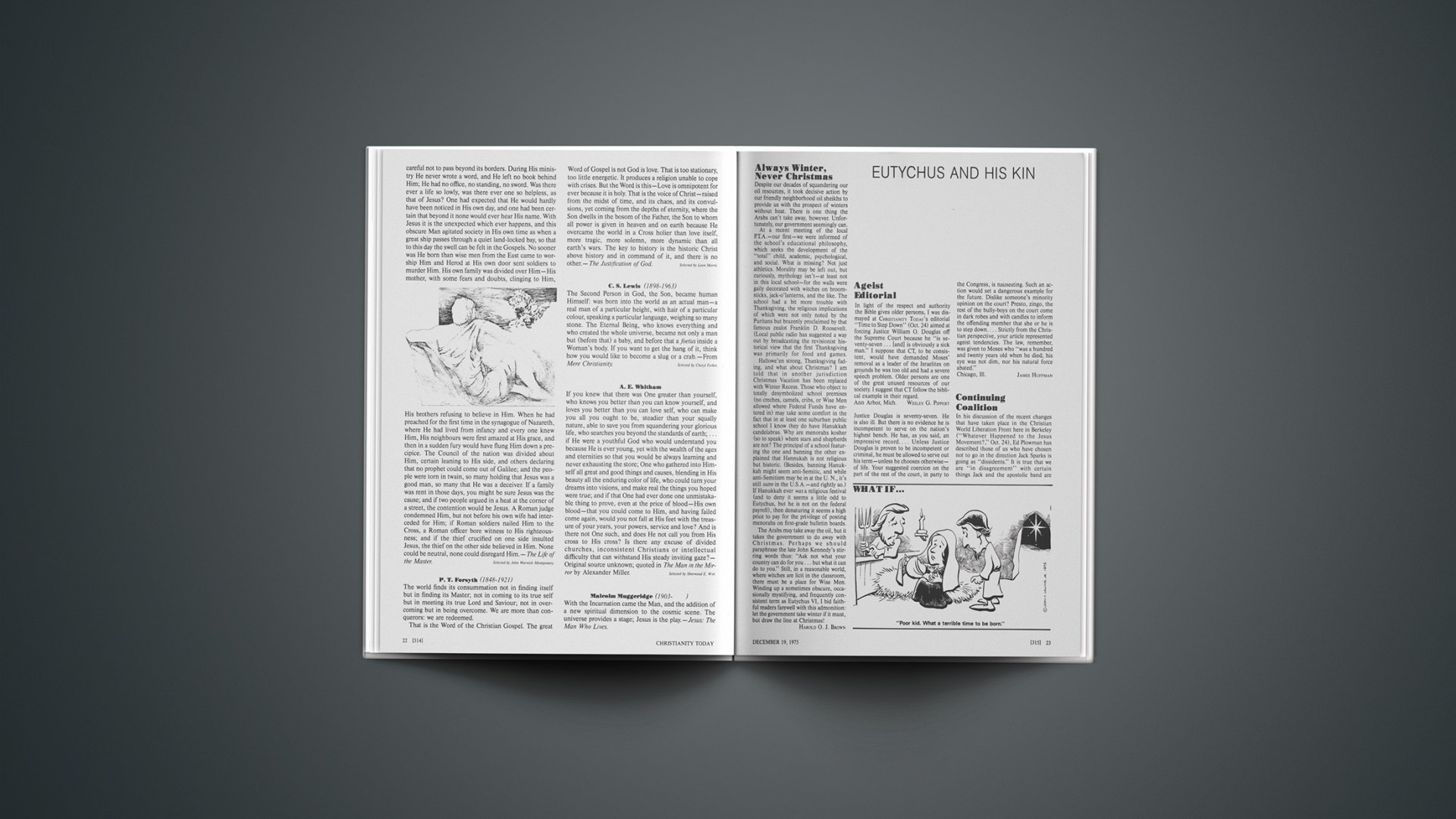
Eutychus and His Kin: December 19, 1975

Always Winter, Never Christmas

Despite our decades of squandering our oil resources, it took decisive action by our friendly neighborhood oil sheikhs to provide us with the prospect of winters without heat. There is one thing the Arabs can’t take away, however. Unfortunately, our government seemingly can.

At a recent meeting of the local P.T.A.—our first—we were informed of the school’s educational philosophy, which seeks the development of the “total” child, academic, psychological, and social. What is missing? Not just athletics. Morality may be left out, but curiously, mythology isn’t—at least not in this local school—for the walls were gaily decorated with witches on broomsticks, jack-o’lanterns, and the like. The school had a bit more trouble with Thanksgiving, the religious implications of which were not only noted by the Puritans but brazenly proclaimed by that famous zealot Franklin D. Roosevelt. (Local public radio has suggested a way out by broadcasting the revisionist historical view that the first Thanksgiving was primarily for food and games.

Hallowe’en strong, Thanksgiving fading, and what about Christmas? I am told that in another jurisdiction Christmas Vacation has been replaced with Winter Recess. Those who object to totally desymbolized school premises (no creches, camels, cribs, or Wise Men allowed where Federal Funds have entered in) may take some comfort in the fact that in at least one suburban public school I know they do have Hanukkah candelabras. Why are menorahs kosher (so to speak) where stars and shepherds are not? The principal of a school featuring the one and banning the other explained that Hannukah is not religious but historic. (Besides, banning Hanukkah might seem anti-Semitic, and while anti-Semitism may be in at the U. N., it’s still outre in the U.S.A.—and rightly so.) If Hanukkah ever was a religious festival (and to deny it seems a little odd to Eutychus, but he is not on the federal payroll), then denaturing it seems a high price to pay for the privilege of posting menorahs on first-grade bulletin boards.

The Arabs may take away the oil, but it takes the government to do away with Christmas. Perhaps we should paraphrase the late John Kennedy’s stirring words thus: “Ask not what your country can do for you … but what it can do to you.” Still, in a reasonable world, where witches are licit in the classroom, there must be a place for Wise Men. Winding up a sometimes obscure, occasionally mystifying, and frequently consistent term as Eutychus VI, I bid faithful readers farewell with this admonition: let the government take winter if it must, but draw the line at Christmas!

HAROLD O. J. BROWN

Ageist Editorial

In light of the respect and authority the Bible gives older persons, I was dismayed at CHRISTIANITY TODAY’S editorial “Time to Step Down” (Oct. 24) aimed at forcing Justice William O. Douglas off the Supreme Court because he “is seventy-seven … [and] is obviously a sick man.” I suppose that CT, to be consistent, would have demanded Moses’ removal as a leader of the Israelites on grounds he was too old and had a severe speech problem. Older persons are one of the great unused resources of our society. I suggest that CT follow the biblical example in their regard.

WESLEY G. PIPPERT

Ann Arbor, Mich.

Justice Douglas is seventy-seven. He is also ill. But there is no evidence he is incompetent to serve on the nation’s highest bench. He has, as you said, an impressive record.… Unless Justice Douglas is proven to be incompetent or criminal, he must be allowed to serve out his term—unless he chooses otherwise—of life. Your suggested coercion on the part of the rest of the court, in party to the Congress, is nauseating. Such an action would set a dangerous example for the future. Dislike someone’s minority opinion on the court? Presto, zingo, the rest of the bully-boys on the court come in dark robes and with candles to inform the offending member that she or he is to step down.… Strictly from the Christian perspective, your article represented ageist tendencies. The law, remember, was given to Moses who “was a hundred and twenty years old when he died; his eye was not dim, nor his natural force abated.”

JAMES HUFFMAN

Chicago, Ill.

Continuing Coalition

In his discussion of the recent changes that have taken place in the Christian World Liberation Front here in Berkeley (“Whatever Happened to the Jesus Movement?,” Oct. 24), Ed Plowman has described those of us who have chosen not to go in the direction Jack Sparks is going as “dissidents.” It is true that we are “in disagreement” with certain things Jack and the apostolic band are teaching. However, the word “dissident” has very strong negative connotations in our society today, and we are very sorry that Mr. Plowman chose to use this word to describe us.

The Berkeley Christian Coalition is continuing the ministry of the Christian World Liberation Front as a non-denominational evangelical Christian organization. Twenty-six out of the thirty-one former CWLF staff are now with the Coalition. All of the CWLF ministries have stayed in the Coalition intact—Right On newspaper, The Crucible study program, Dwight House (ministry to Berkeley’s transient youth), and the Spiritual Counterfeits Project. The exception is the street-theater ministry. Two of the seven members of street theater, including the director, have chosen to function under Jack Sparks’s church in Berkeley, while the other five members are continuing street theater in the Coalition. As a community of Christians in Berkeley, we are excited about the opportunities God has given us to serve him in this important American city.

BILL SQUIRES

Director

Berkeley Christian Coalition

Berkeley, Calif.

As Plowman can attest, having been one of the San Francisco ministers to whom he made reference, Moishe Rosen was drawn to the Bay Area largely because of information that a significant proportion of converts from the counterculture were Jewish. He was welcomed by the Evangelical Concerns group and became an active participant in its ministries. No further documentation on Jews For Jesus is necessary. One would be going too far to claim that the Jesus movement was the sole cause of JFJ’s emergence. But it was certainly a major factor. Rosen should be credited with astute recognition of the right time and place for his movement’s beginning.

JOHN MACDONALD

Blossom Hill Baptist Church

San Jose, Calif.

• Space limits required us to select a few ministries that are representative of what is happening. Jews for Jesus and some other groups will be featured in a forthcoming follow-up account.—ED.

Only One Alternative?

In a recent editorial (“Capitalism: ‘Basically Unjust’?,” Oct. 24) you say that the “time has come for Christians who believe in capitalism … to make themselves heard.” But if capitalism is truly “in need of correction,” by what ideological standard (or is it a moral standard, which may be a different matter) do we decide which changes to implement? I agree that to call capitalism “basically unjust” is absurd, but to suppose that Christians do or should “believe in capitalism” is a little silly too. Moreover, to imply that the only alternative to capitalism is the sort of economic system to be found in the Soviet Union (and, somewhat differently, in China) is quite misleading. Whatever happened to democratic socialism—e.g. of the Swedish sort? The point is, it is not very helpful to say “I believe in capitalism” without also saying in just what ways one would like to see some of its admitted evils corrected. One error of fact which ought to be corrected: according to all of the available information—and the information is ample—Chinese socialism has in fact succeeded in “producing enough food to feed the people.” Perhaps not the same can be said of Russia.

F. R. STRUCKMEYER

Department of Philosophy

West Chester State College

West Chester, Pa.

Capitalism is not merely an economic system which is inherently good save for a few flaws which can be worked out. The fact is that at the very base of this system are concepts which are antithetical to the Christian faith. Our whole consumer economy is built upon the endless accumulation of material wealth. Is avarice still considered a vice or has it been made an article of faith? The market economy elevates the principle of competition and aggressiveness so that man looks upon his fellow man as merely a means to a material end. Indeed the entirety of God’s creation is viewed as a commodity to be exploited toward the ultimate goal of greater profit.

Capitalism is not a Christian economic theory.… It is a humanistic philosophy based upon humanistic values. Any attempt at synthesizing Christianity with a pagan value system is tantamount to idolatry and leads to a diluted syncretism.

Socialism is not the alternative to capitalism. It is an alternative. The NCC is basically correct in its rejection of capitalism, but if this leads them to baptize Marxism, then they have only fallen into the same trap since this economic theory is also based on similar humanistic values. For instance, it has essentially no different view of God’s created resources from that of capitalism.…

It is rather ironic that the editorial about capitalism appeared on the same page as the one concerning values. You are most certainly correct that there is a difference between man-made values and biblical values. I suggest that you take your own advice and not be “pressured to accept—e.g. a … philosophy [economic or otherwise]—that has won high acclaim in some circles but weighs in poorly on the scale of biblical values.”

DAVID KOYZIS

St. Paul, Minn.

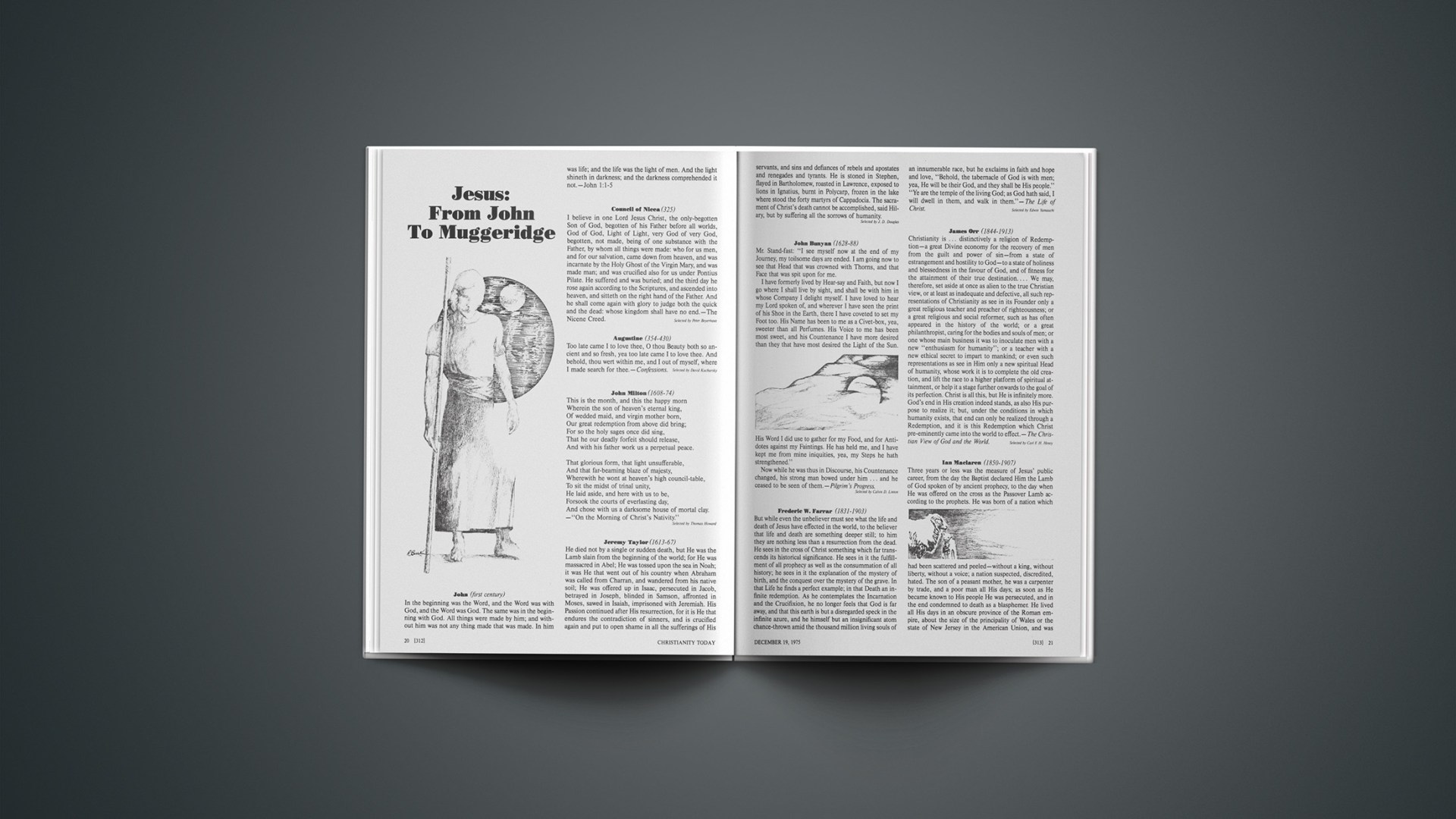
Jesus: From John to Muggeridge

John (First Century)

In the beginning was the Word, and the Word was with God, and the Word was God. The same was in the beginning with God. All things were made by him; and without him was not any thing made that was made. In him was life; and the life was the light of men. And the light shineth in darkness; and the darkness comprehended it not.—John 1:1–5

Council Of Nicea (325)

I believe in one Lord Jesus Christ, the only-begotten Son of God, begotten of his Father before all worlds, God of God, Light of Light, very God of very God, begotten, not made, being of one substance with the Father, by whom all things were made: who for us men, and for our salvation, came down from heaven, and was incarnate by the Holy Ghost of the Virgin Mary, and was made man; and was crucified also for us under Pontius Pilate. He suffered and was buried; and the third day he rose again according to the Scriptures, and ascended into heaven, and sitteth on the right hand of the Father. And he shall come again with glory to judge both the quick and the dead: whose kingdom shall have no end.—The Nicene Creed.

Selected by Peter Beyerhaus

Augustine (354–430)

Too late came I to love thee, O thou Beauty both so ancient and so fresh, yea too late came I to love thee. And behold, thou wert within me, and I out of myself, where I made search for thee.—Confessions.

Selected by David Kucharsky

John Milton(1608–74)

This is the month, and this the happy morn

Wherein the son of heaven’s eternal king,

Of wedded maid, and virgin mother born,

Our great redemption from above did bring;

For so the holy sages once did sing,

That he our deadly forfeit should release,

And with his father work us a perpetual peace.

That glorious form, that light unsufferable,

And that far-beaming blaze of majesty,

Wherewith he wont at heaven’s high council-table,

To sit the midst of trinal unity,

He laid aside, and here with us to be,

Forsook the courts of everlasting day,

And chose with us a darksome house of mortal clay.

—“On the Morning of Christ’s Nativity.”

Selected by Thomas Howard

Jeremy Taylor(1613–67)

He died not by a single or sudden death, but He was the Lamb slain from the beginning of the world; for He was massacred in Abel; He was tossed upon the sea in Noah; it was He that went out of his country when Abraham was called from Charran, and wandered from his native soil; He was offered up in Isaac, persecuted in Jacob, betrayed in Joseph, blinded in Samson, affronted in Moses, sawed in Isaiah, imprisoned with Jeremiah. His Passion continued after His resurrection, for it is He that endures the contradiction of sinners, and is crucified again and put to open shame in all the sufferings of His servants, and sins and defiances of rebels and apostates and renegades and tyrants. He is stoned in Stephen, flayed in Bartholomew, roasted in Lawrence, exposed to lions in Ignatius, burnt in Polycarp, frozen in the lake where stood the forty martyrs of Cappadocia. The sacrament of Christ’s death cannot be accomplished, said Hilary, but by suffering all the sorrows of humanity.

Selected by J. D. Douglas

John Banyan(1628–88)

Mr. Stand-fast: “I see myself now at the end of my Journey, my toilsome days are ended. I am going now to see that Head that was crowned with Thorns, and that Face that was spit upon for me.

I have formerly lived by Hear-say and Faith, but now I go where I shall live by sight, and shall be with him in whose Company I delight myself. I have loved to hear my Lord spoken of, and wherever I have seen the print of his Shoe in the Earth, there I have coveted to set my Foot too. His Name has been to me as a Civet-box, yea, sweeter than all Perfumes. His Voice to me has been most sweet, and his Countenance I have more desired than they that have most desired the Light of the Sun. His Word I did use to gather for my Food, and for Antidotes against my Faintings. He has held me, and I have kept me from mine iniquities, yea, my Steps he hath strengthened.”

Now while he was thus in Discourse, his Countenance changed, his strong man bowed under him … and he ceased to be seen of them.—Pilgrim’s Progress.

Selected by Calvin D. Linton

Frederic W. Farrar(1831–1903)

But while even the unbeliever must see what the life and death of Jesus have effected in the world, to the believer that life and death are something deeper still; to him they are nothing less than a resurrection from the dead. He sees in the cross of Christ something which far transcends its historical significance. He sees in it the fulfillment of all prophecy as well as the consummation of all history; he sees in it the explanation of the mystery of birth, and the conquest over the mystery of the grave. In that Life he finds a perfect example; in that Death an infinite redemption. As he contemplates the Incarnation and the Crucifixion, he no longer feels that God is far away, and that this earth is but a disregarded speck in the infinite azure, and he himself but an insignificant atom chance-thrown amid the thousand million living souls of an innumerable race, but he exclaims in faith and hope and love, “Behold, the tabernacle of God is with men; yea, He will be their God, and they shall be His people.” “Ye are the temple of the living God; as God hath said, I will dwell in them, and walk in them.”—The Life of Christ.

Selected by Edwin Yamauchi

James Orr(1844–1913)

Christianity is … distinctively a religion of Redemption—a great Divine economy for the recovery of men from the guilt and power of sin—from a state of estrangement and hostility to God—to a state of holiness and blessedness in the favour of God, and of fitness for the attainment of their true destination.… We may, therefore, set aside at once as alien to the true Christian view, or at least as inadequate and defective, all such representations of Christianity as see in its Founder only a great religious teacher and preacher of righteousness; or a great religious and social reformer, such as has often appeared in the history of the world; or a great philanthropist, caring for the bodies and souls of men; or one whose main business it was to inoculate men with a new “enthusiasm for humanity”; or a teacher with a new ethical secret to impart to mankind; or even such representations as see in Him only a new spiritual Head of humanity, whose work it is to complete the old creation, and lift the race to a higher platform of spiritual attainment, or help it a stage further onwards to the goal of its perfection. Christ is all this, but He is infinitely more. God’s end in His creation indeed stands, as also His purpose to realize it; but, under the conditions in which humanity exists, that end can only be realized through a Redemption, and it is this Redemption which Christ pre-eminently came into the world to effect.—The Christian View of God and the World.

Selected by Cart F. H. Henry

Ian Maclaren(1850–1907)

Three years or less was the measure of Jesus’ public career, from the day the Baptist declared Him the Lamb of God spoken of by ancient prophecy, to the day when He was offered on the cross as the Passover Lamb according to the prophets. He was born of a nation which had been scattered and peeled—without a king, without liberty, without a voice; a nation suspected, discredited, hated. The son of a peasant mother, he was a carpenter by trade, and a poor man all His days; as soon as He became known to His people He was persecuted, and in the end condemned to death as a blasphemer. He lived all His days in an obscure province of the Roman empire, about the size of the principality of Wales or the state of New Jersey in the American Union, and was careful not to pass beyond its borders. During His ministry He never wrote a word, and He left no book behind Him; He had no office, no standing, no sword. Was there ever a life so lowly, was there ever one so helpless, as that of Jesus? One had expected that He would hardly have been noticed in His own day, and one had been certain that beyond it none would ever hear His name. With Jesus it is the unexpected which ever happens, and this obscure Man agitated society in His own time as when a great ship passes through a quiet land-locked bay, so that to this day the swell can be felt in the Gospels. No sooner was He born than wise men from the East came to worship Him and Herod at His own door sent soldiers to murder Him. His own family was divided over Him—His mother, with some fears and doubts, clinging to Him, His brothers refusing to believe in Him. When he had preached for the first time in the synagogue of Nazareth, where He had lived from infancy and every one knew Him, His neighbours were first amazed at His grace, and then in a sudden fury would have flung Him down a precipice. The Council of the nation was divided about Him, certain leaning to His side, and others declaring that no prophet could come out of Galilee; and the people were torn in twain, so many holding that Jesus was a good man, so many that He was a deceiver. If a family was rent in those days, you might be sure Jesus was the cause; and if two people argued in a heat at the corner of a street, the contention would be Jesus. A Roman judge condemned Him, but not before his own wife had interceded for Him; if Roman soldiers nailed Him to the Cross, a Roman officer bore witness to His righteousness; and if the thief crucified on one side insulted Jesus, the thief on the other side believed in Him. None could be neutral, none could disregard Him.—The Life of the Master.

Selected by John Warwick Montgomery

P. T. Forsyth(1848–1921)

The world finds its consummation not in finding itself but in finding its Master; not in coming to its true self but in meeting its true Lord and Saviour; not in overcoming but in being overcome. We are more than conquerors: we are redeemed.

That is the Word of the Christian Gospel. The great Word of Gospel is not God is love. That is too stationary, too little energetic. It produces a religion unable to cope with crises. But the Word is this—Love is omnipotent for ever because it is holy. That is the voice of Christ—raised from the midst of time, and its chaos, and its convulsions, yet coming from the depths of eternity, where the Son dwells in the bosom of the Father, the Son to whom all power is given in heaven and on earth because He overcame the world in a Cross holier than love itself, more tragic, more solemn, more dynamic than all earth’s wars. The key to history is the historic Christ above history and in command of it, and there is no other.—The Justification of God.

Selected by Leon Morris

C. S. Lewis(1898–1963)

The Second Person in God, the Son, became human Himself: was born into the world as an actual man—a real man of a particular height, with hair of a particular colour, speaking a particular language, weighing so many stone. The Eternal Being, who knows everything and who created the whole universe, became not only a man but (before that) a baby, and before that a foetus inside a Woman’s body. If you want to get the hang of it, think how you would like to become a slug or a crab.—From Mere Christianity.

Selected by Cheryl Forbes

A. E. Whitham

If you knew that there was One greater than yourself, who knows you better than you can know yourself, and loves you better than you can love self, who can make you all you ought to be, steadier than your squally nature, able to save you from squandering your glorious life, who searches you beyond the standards of earth; … if He were a youthful God who would understand you because He is ever young, yet with the wealth of the ages and eternities so that you would be always learning and never exhausting the store; One who gathered into Himself all great and good things and causes, blending in His beauty all the enduring color of life, who could turn your dreams into visions, and make real the things you hoped were true; and if that One had ever done one unmistakable thing to prove, even at the price of blood—His own blood—that you could come to Him, and having failed come again, would you not fall at His feet with the treasure of your years, your powers, service and love? And is there not One such, and does He not call you from His cross to His cross? Is there any excuse of divided churches, inconsistent Christians or intellectual difficulty that can withstand His steady inviting gaze?—Original source unknown; quoted in The Man in the Mirror by Alexander Miller.

Selected by Sherwood E. Wirt

Malcolm Muggeridge(1903–)

With the Incarnation came the Man, and the addition of a new spiritual dimension to the cosmic scene. The universe provides a stage; Jesus is the play.—Jesus: The Man Who Lives.

The Pornography or Moral Indignation

George Orwell once wrote that the root myth Western story was Jack the giant-killer. All of us do respond to forms of David-and-Goliath: the lone, noble hero; the apparently omnipotent conspiracy of evil; the close-shave ending; a coronation, a marriage—some utopian event reinstating the rule of sweetness and light.

This plot works inside most love comedies and most “threat-to-civilization” or “war-of-the-worlds” stories. More remotely, it lies behind the traditional detective story in all its varieties.

Previously I argued in these pages that the detective story has a theological aura about it (“Corpses, Clues, and the Truth,” August 30, 1974, page 16). It postulates a moral universe in which sin is always punished, because it is always discovered and assigned to its proper agent. The detective story is a species of moral fantasy. As such it acknowledges a simplified or partial vision of Christian ethics.

So far so good. But there are problems with this. The basically ethical vision is vulnerable to distortion. In a sense the detective story’s black-and-white ethics tell the truth; in a sense, they do not. They simplify the content of human experience. When does this simplification become a distortion? Perhaps only when it is taken too seriously. The classic ‘tec is a discreet, conventional form with its own revenge on over-zealous critics.

But it can be taken too seriously, I think, and this happens when it begins to satisfy a social need, or to express too fully a social attitude. Innocently pursuing its seminal fantasy—good (reason) over bad (murder)—the detective story may slip into another opposition: good (us) versus bad (them). What is originally a celebration of reason can become a celebration of power; the strength of justice degenerates into mere aggression. Thus the detective story may express, or even stimulate because it provides a means of expressing, social attitudes that are definitely sub-Christian—in any Christian sense, sub-ethical. It becomes part of what I am calling the “pornography of moral indignation.”

This is not merely speculative. Socially accepted violence against a minority scapegoat is and has always been part of the American tradition. It is realized in fiction as the elimination of whole tribes of Indians to make Abilene safe for the schoolmarm. In actual social history the impulse surfaces in race lynchings or comanchero justice. Currently it is visible in American TV’s binge of detective shows, where cops of all shapes and specialties hunt a monotonous array of criminals. Violence, both of language and of action, is essential.

Both the monotony and the violence are significant. One is the principle of the criminal’s characterization; the second the accepted way of dealing with him. Objectified, standardized, carefully alienated from understanding or sympathy, the villain is normative but in no sense “normal,” expected but undeveloped. He is no more human than a predatory Martian. He wears a predictable warpaint, making him easy to spot but quite devoid of human content.

The detective, in contrast, is compounded of “human touches.” He is endowed by his creators with charm as well as lethal fists and intellect. This is to be expected; he is the hero. It is the story’s essence that he win, and that he retain our sympathy. Every Jack-the-giant-killer story works this way. The problem arises in the detective’s real goal, and in the means he is allowed to use to reach it. In the traditional detective tale—that of Conan Doyle, Agatha Christie, or Dorothy Sayers—the goal is a just solution to a problem; the means are intelligence, speed, and fair play. On TV the goal is normally the elimination of a threat risen from another social world—gangster, junkie, foreigner—and, by implication, the preservation of our more familiar social world. The means is self-righteous violence.

A third consideration may be added to goal and means: the placing of the community, of the victims or bystanders with whom we identify. Everybody cheers for David, as against Goliath. But then everybody cheers for Israel as against the Philistines. The TV detective, like any other, acts on the community’s behalf, as our agent. But what values do we, the community, invest in his action? Justice, whoever suffers? Or the security of our own social world, whoever (else) suffers?

This narrowing of values from a more or less impersonal justice to the problem of preserving a definite social construct sets in motion a narrowing of the representative community as well. It always excludes more than it includes. Further, anyone outside the recognizable community that the detective represents is potentially suspect, and if suspect then alien, and if alien then disposable. This progressive exclusion reached a climax in a statement by one of these TV sleuths. Some people, he ruminated, regard the police as protecting the community. He, on the other hand, regards them as constituting the community. “Mankind” (served by justice) has shrunk to “society” (served by order) has shrunk to “us” (served by anything that will serve to keep us safe). Thus the detective is authorized to treat his opponents with any violence he deems necessary or desirable. He counts; they do not.

The social force behind this is anxiety—specifically, the anxiety of the patrons of TV and the cinema. Caught in a time of financial and ethical extremes, any class tends to shrink back for strength against a backbone of prejudice and self-absorption. The suburbanite who is no longer safe in car or home, who struggles to keep his domestic preserve free of the corruption he meets in the city where he works—it is inevitable that for him, society splits into “them” (evil) and “us” (good). This attitude is not new. It was, historically, the attitude of the class that first welcomed the emergence of the police novel from other sorts of crime literature—the Victorian bourgeois. For such a class, the detective naturally becomes a symbol of order and security; and the literary form, a natural expression of its insecurity and aggression.

Of course, the detective story’s ethical simplification invited this sort of use. Guilty or not guilty, black or white, is easily transformed to us or them. The dangerous but possible extension of this, which damages the detective tale irreparably, is the subtraction of moral restraint. When its anxiety reaches a certain intensity, the community becomes perfectly willing to forget the man in the criminal (or social disturber), to see him as an animal or a machine, and to sanction any means taken to snare and pacify him. “Anything to protect society (or civilization),” goes the official rubric. What is really being said is, “Anything to protect me and mine.”

It may be possible to extend this logic beyond the quest for security. For the dialectic of “us” and “them,” with established force supporting “us,” can be used to achieve as well as maintain power. Hitler was not the first or last to see the use of a cartoon enemy in organizing social anxiety for his own benefit. This observation can be exaggerated; some critics have argued that Fascism waits behind every Agatha Christie or Dorothy Sayers story. They are wrong, as we shall see, but not because the detective story is never bent that way—only because it need not be.

“Anything to protect me and mine,” measured by Christian standards, is clearly unacceptable. Even its milder versions, such as common moral indignation, are at best ambiguous feelings. Righteous anger has always the disadvantage of being anger. The response to sin which condemns the sinner wholesale was attacked by Christ himself in the Pharisees, and violates basic tenets of his message, such as the communities of sin and grace. For pharisaism was and is popular because it has ethical as well as social advantages. It allows us to isolate our sense of corruption in certain spots in the social fabric. We are pure. They—the “others,” publicans, infidels, or Mafiosi—are the source of the stench.

Some critics consider this sort of pharisaism the basic posture of all detective fiction. This is not historically true. The traditional detective story has its sights elsewhere, on the rational solution of a problem—sorting out complications and building inductive arguments. Sadism wrought on dehumanized villains would be out of place, bad form, and contrary to the story’s compulsory if narrow sense of fair play. In addition, and most important, the murderer is generally someone already plugged into the social system. He is the butler, for example, or Colonel Hawthorne back from India, or Roderick, the beautifully mannered cad from Cambridge. He is clearly one of us. The shock offered by the story’s denouement is not meeting an alien being but meeting an alien impulse in a familiar being. We are surprised and sobered. We allow the murderer to end his miserable life (and he is miserable, knowing he has let the side down) with a revolver in the library, the decent way.

It would be untrue to deny the presence of xenophobia and class awareness in early detective fiction. Conan Doyle, for instance, often had Holmes purging country estates of some apparently docile, socially “absorbed” being with a ghastly secret or an exotic past. In The Sign of Four the actual murder is committed by a dwarfish, evilly shaped Pacific aborigine. He is gladly done away with. But this is not quite the same as busting the anti-social weirdo or gangster. Doyle’s villain is too inhuman and sensationalistic to represent real social dangers—a toy, though a toy in a nightmare.

The true historical roots of the pharisaism we are tracing lie in the slightly later spy story. The “Bulldog Drummond” tradition, starring blond, blue-eyed athletes from British public schools and West End clubs, is a variation on this pharisaism, but not another thing. Drummond himself, the creature of H. S. Macneile, solved his cases with simple violence. In the name of civilization Drummond mauled the devious Italian or dirty Bolshevik who was making trouble. He did so with the hearty approbation of a certain class of British readers.

There is, however, a school of detective writing that avoids the pornography of moral indignation altogether. It is represented by Georges Simenon’s Inspector Maigret and G. K. Chesterton’s Father Brown. Both Maigret and Brown approach their detective problems not by violence, or even impersonal logic, but by way of imaginative sympathy. Their chief identification may remain with law or justice. But their means of identifying culprits is by identifying with them—their needs, habits, circumstances.

Maigret runs the Quai des Orfevres (the Parisian Scotland Yard), and Simenon fills his books with meticulous detail. Like Holmes in London or Gervase Fen in Oxford, Maigret is most in his element in Paris. He has a knack, a genius, for absorbing atmosphere. He sizes up furnishings as a key to their owner’s mind; he moves from favorite bar to place of business in search of a dead man’s rhythm of life. Observers baffled by his superficially aimless wandering are missing the point. Maigret identifies the criminal by taking him in, so to speak; and when the chase is done, detective and murderer regard each other at least with understanding, not seldom with sympathy.

Father Brown takes this method to its proper conclusion by introducing a dose of theology. Chesterton’s stories are often explicitly religious. This distinguishes them from Simenon’s secular novels. They are also different by way of Chesterton’s fanciful settings and admittedly improbable crimes. The similarity between authors and detectives is exactly methodological. Like Maigret, Father Brown catches murderers by getting inside their skins, and the end is (or can be) some degree of sympathy.

The insignificant little priest starts his investigations with a specifically Christian notion: anything a murderer is capable of, I, the detective, am capable of; what drove him to murder could do the same to me. Correspondingly—and this is how theology completes the pattern—if I am the recipient of grace, so is the murderer. Father Brown’s motive is not the force of law or society’s security, but the call of his pastor’s heart. The murderer must be caught, so that he may be given the chance to repent.

This frees Father Brown from many obligations governing the average fictional detective. He need not arrest, detain, destroy, or even uncover the murderer to anyone but us. He does not feel himself responsible for any class’s protection. (The sin Brown finds in himself first and the culprit second, he has no trouble finding in accepted society as well.) His sole concern is the villain’s spiritual state. Repeatedly he submits himself to fatigue and danger (what else can he do?) in order to offer a man the opportunity of penitence—in other words, the opportunity to rejoin the community of grace as he, Father Brown, has joined the community of crime.

This exchange of roles embodies the Christian pattern. Christ became our sin that we might become his righteousness. No sinner is to be condemned, destroyed, exulted over. He is to be identified with, persuaded, won; quicunque vult. If the pornography of moral indignation has sources in traditional detective stories, it is no inalienable ingredient of them. Their point is reason and justice. Its chief stimulus is social anxiety, the fear that drives one social level to dehumanize another in order to justify its efforts to protect itself. Behind this is the impulse to project one’s pain and one’s sense of moral responsibility onto someone else; he is responsible, not I—let him suffer, not me. Allowing this, we would be rejecting Christian charity. The kingdom of grace is only for those who by grace accept their own responsibility for what hurts and disgusts them.

Pharisaism also coarsens the detective story. This is not equivalent with rejecting charity; but the coincidence of the two errors is interesting. As Father Brown himself might have said, rejecting the highest good ultimately means rejecting a host of lesser, simply wholesome goods as well.

LIONEL BASNEY

Lionel Basney is associate professor of English at Houghton College, Houghton, New York.

By the Light of a Masterly Moon

A look at Unification doctrine—complex, coherent, and heretical

What has 1975 brought? Among other things, “a new international level in the work of the Unification Church”:

Reverend Moon assigned three missionaries each to ninety-five new countries, to begin their assignments by the end of April.… The coming three years are crucial years for expanding the work in America and building an international foundation [The Way of the World, January, 1975, p. 2].

The Unification Church has for its more formal name The Holy Spirit Association for the Unification of World Christianity. “Reverend Moon” is Sun Myung Moon, who organized the movement in Korea in 1959. Formerly a Presbyterian minister, he kept the title “Reverend” when he was ousted by the Korean Presbyterian Church.

From twenty thousand in 1960 the church has increased to hundreds of thousands of adherents, and it is growing faster each year. The expansion plans announced in The Way of the World call for sending crusade teams on three-month tours of four countries. Mass rallies are planned for New York’s Yankee Stadium in April, 1976, and for Washington, D.C., the following April. A university and theological seminary are being established at Sun Moon’s extensive estate in Barrytown, New York.

The doctrine of the Unification Church clanks harshly in an evangelical ear. But to dismiss it because it is heretical is to be guilty of tactical error.

The doctrine, so dynamic in being ever open to further revelation through the founder, is a carefully systemized discipline of detailed biblical interpretation; it is hyper-dispensational, with a striking blend of Oriental and Occidental attitudes and philosophies. Let’s look at the main aspects of this complex, coherent heresy and try to locate its appeal.

Revelation Based

Nearly all the “revealed truths” of the Unification heresy are interpretative of the Bible. The doctrine is a rejection not of the Bible but of all previous theological systems. These revelations to the Reverend Mr. Moon have purportedly come directly from God at a divinely fitting moment in time:

Since God has started His new dispensation and the era of the Christian Church is over, He is removing his direct guidance from existing churches. This is why today we see churches the world over undergoing great spiritual decline [Divine Principle and Its Application, by Young Oon Kim, 1969, page x].

Such a concept capitalizes on the disenchantment that many people, especially younger ones, have experienced with Christianity. They feel that in the two thousand years of its existence it has failed to transform society and has settled for mere institutional self-service. Followers of Moon are given to understand that they are involved in an irresistable new universalist movement that will in the very near future establish “the peace of mankind, the brotherhood of all peoples, and the unification of all religions.” This is the cause to which they give themselves unstintingly, for it has given meaning to their lives and an acceptance within the fellowship of a counter-establishment force that thrives on a bad press and claims the future. In Moon they have a palpable, present Messiah, not an invisible Christ, though that Christ yet has value to them:

Jesus was chosen [by God] to be the Lord of lords, but because he could not complete his work he was unable to attain that position. Through the accomplishment of his ministry, however, the Lord of the Second Advent [Moon] will eventually be recognized by the people of the world.… The Lord of the Second Advent is to restore the sovereignty of the cosmos to God by prosecuting Satan before Him.… It is he who, through his prosecution and subjugation of Satan, established the crossing point between good and evil in 1960 [Divine Principle.… p. 196].

The 1960 “crossing point” was Moon’s marriage to his second wife (the first was divorced on the grounds of her alleged adultery). This marriage is said to fulfill the prophesied marriage of the Lamb in Revelation 19. Moon, the Lord of the Second Advent, and his wife, the incarnate Holy Spirit, became “the true Parents of mankind.” Like Jacob of the Old Testament times, Moon is in a twenty-one-year testing; this makes 1981 the year of destiny.

These are the last times, according to Moon, and perhaps the most significant of all the signs of these times is the identity given to the antichrist:

The “Son of Perdition” that Paul predicted, who opposes God and claims to be God, is clearly the atheistic Communist system. “He” is especially personified in Joseph Stalin, the Red master whose purges cost the lives of 30 million Russians, most of them Christian.… We are in the “great tribulation” now! [The Way of the World, Sept./Oct., 1974, p. 45].

Divine Principle Of Creation

The creation of man in the image of God, requiring both male and female, indicates polarity in God. “That is, He must possess within Himself the dual characteristics of masculinity and femininity, which are perfectly harmonized in His nature.” (This and all further direct quotations are from the official book, Divine Principle and Its Application, by Young Oon Kim.)

The basic premise about God’s nature leads to a statement of human function and the primacy of the family:

A man and woman who are the separate images of God’s polarity, have the capacity to form a perfect reciprocal relationship and to have give and take of love between them. The purpose of marriage is to unite man and woman that they may fully reflect God as a unit and remain forever in a complete relation of give and take with Him. In this relationship they form a trinity with God.… It is God’s desire to see the entire earth covered with such God-centered families. [Divine Principle …, p. 6].

God, however, cannot manifest himself freely since he is limited to man’s response, and man has failed—until now, until the rising of Sun-Moon.

The Fall Of Man

The original sin was totally sexual in nature. From the use of fig leaves by Adam and Eve to cover their sexual organs, the Abrahamic rite of circumcision so that “his descendants might make symbolic restitution for the original sin,” and the biblical expression “to know” as indicating sexual experience, Unification teaching concludes that eating the fruit of the tree of the knowledge of good and evil meant having sexual relations.

God intended such relations for Adam and Eve, but they experienced sex prematurely, before they had fully moved through the threefold process of formation, growth, and perfection. Furthermore, Lucifer not only was jealous of this new creature of God but fell in love with Eve because of her beauty and seduced her. Both he and Eve fell spiritually in the same act of fornication. When Eve tempted Adam to share her sexual liberation, he did, and man established a fatal trinity with Satan rather than God.

The Meaning Of History

From the birth of Cain and Abel, history to the year 1960 was a record of thwarted opportunities for men to fulfill the Divine Principle by uniting with God. This failure extends to Jesus Christ himself, for he came “to bring a physical kingdom into the world, and not merely a spiritual kingdom in the hearts of men” (p. 56).

Christ did not come to die on the Cross. Prophecies of that death (e.g., Isaiah 53) were only expressions of what God saw as the rejection possibility as over against the acceptance possibility. “If the people of Israel had fully accepted Jesus, he could have revealed to them the full significance of his mission for the establishment of his kingdom” (p. 67). They could have welcomed Jesus and provided him with a wife by whom he could have had children; then he and she could have established that perfect Trinity with God.

Because of his rejection by Israel, Jesus could only partially succeed. By joining fully with the Holy Spirit, he completed Trinity at the spiritual level, and he provided in his death the condition of restitution of those who believe in him. He accomplished salvation spiritually only:

Since Jesus achieved only spiritual salvation, the physical restoration of the world, the kingdom of heaven is yet to come. To complete Jesus’ unfinished mission, the Second Advent of Christ must come to pass [p. 70].

The Christ of the Second Advent is not this same Jesus, however:

It has been implied throughout this book that the New Age has now dawned and that the Second Advent is being fulfilled by a man other than Jesus of Nazareth. Then from what part of the world and from what nation does the Lord of the Second Advent come? [p. 191].

The answer:

To be chosen as the universal altar, this nation must itself be divided into two sections symbolizing Cain and Abel.… Korea has providential significance.… The establishment of the kingdom of heaven and the destruction of Satanic rule will be effected in this country first. From there it will spread universally [pp. 194, 195].

Jesus bears relationship to the new Messiah in the same way Elijah did to John the Baptist: John was the promised Elijah; Moon is the promised Messiah.

Principle Of Indemnity

Finally, the Unification heresy corrupts the grace of God, which provides the believer full salvation through faith in the complete and finished work of Christ. It demands a humanly achieved righteousness instead of the imputed righteousness of Christ.

God does not and cannot forgive men unconditionally.… If we pay only five per cent of our actual indebtedness to God, He will wipe out the rest—the ninety-five per cent [p. 48].

This indemnity principle, which Unification teaching admits is simple bankruptcy, has a most practical effect in promoting dedicated effort by adherents.

First, “payment [of the five per cent] requires utmost devotion and commitment … and when man fulfills this condition, his whole debt is discharged and he is acknowledged by God as though he had not sinned at all” (p. 48). This is simple justification by works. Works are required dues, in addition to faith, for one seeking divine approval.

Second, payment of indemnity is much easier at the physical level, by such means as fasting, whereas if any “arrive in the spirit world with unpaid debts, they will have to work to assist perhaps the very ones they hurt in order to pay what they owe” (p. 50). Buddhists and Hindus will recognize the Law of Karma, and Catholic converts will be comfortable with penance and the propsect of purgatory.

Third, the indemnity principle, or the law of restitution as it is also called, when understood by Unification followers provides both understanding of and protection against defection at any point. “Satan works particularly hard on those who hear the Principle, for they are most likely to leave his realm immediately” (p. 49). Inducements to defect come from Satan in the form of family, friends, jobs, wealth, and comfort! With each further step into the teaching, Satan attacks with “headaches, colds, indigestion, doubts, fears, trivial accidents and inconveniences, et cetera” (p. 49). The pattern of resistance ingrained into members is to “accuse Satan before God, pray for God’s assistance, and pay indemnity at your convenience” (p. 50).

The indemnity principle results in financial benefit to the movement. All members must at least balance care and expenses provided them with income they produce for the church. Special assignments in solicitation and sales or other work are assigned whenever a particular member’s costs outstrip his productivity. It is passing strange, also, and worthy of IRS investigation, that members can qualify for leading credit cards on declared income of, say, $2,000 a month, and yet declare no income for tax purposes!

A Final Warning

Training of new converts is intensive under the ubiquitous ever-smiling photographs of Moon, but it is hardly “criminal brainwashing” of unwilling victims, according to a recent court decision in a suit brought by distraught parents. The successful graduate has not only an extensive knowledge of the Bible set within a fully charted and diagrammed scheme of interpretation but also an equally extensive scheme of history, a psychologically sound method of approach to the unconverted, and a sense of destiny for this present hour. The dark future is transformed into a very close-at-hand moment of triumphant glory in which adherents are the very special heralds of their visible founder, who leads the way in making trinities with God and establishing God’s Kingdom on earth.

Unification teaching eradicates Hell, promising that even Lucifer will one day be reclaimed. It welcomes all people. It sees common roots in all faiths of the world. It sees one world, promoting this in political—economic messages in its newspaper The Rising Tide (which identifies itself as “America’s fastest growing freedom newspaper”).

They label themselves the servants of mankind and come on with a soft-sell love approach. For each convert, the new faith is self-chosen, not a parent-influenced or inherited belief. It is not a call to bear arms, though God help us if the movement continues to grow and requires fulfillment of the Book of Revelation’s symbolism of flaming swords, conquering armies, and the Man on the white horse!

Books

Tolkien Reminds Us God Still Controls History

The Lord of the Rings offers a meditation on free will and divine providence.

Tolkien and an illustration from one of his books.
Illustration by Elizabeth Kaye / Source Images: Wikimedia Commons


In 1975, CT assistant editor Cheryl Forbes offered an incisive review of J. R. R. Tolkien’s The Lord of the Rings. Her words, written during the Cold War, reflect the tensions Christians often feel as they approach the end of one year and the beginning of the next. God calls his followers to active faith, desiring that they move forward with free will while trusting in his providential hand. Tolkien “gives us a world that is graciously ordered by a beneficient Creator,” writes Forbes. His timeless story and Forbes’s accompanying insights bring that word afresh to us still, 50 years later.

C.S. Lewis in Williams and the Arthuriad comments that the first thing we ought to demand of a great poem is “something that can be called Wisdom. We wish, after reading it, to understand things in general, or at least some things, better than we did before.” This is true for novels or plays as well as for poetry, and gives a reason why Christians should read imaginative literature. Of course, we should also read for the pleasure of the story.

Among the most popular and consistently best-selling books of the last two decades is a trilogy that answers the demand for both pleasure and wisdom. J. R. R. Tolkien filled The Lord of the Rings with intriguing characters, exciting events, and compelling themes. He set the story in Middle-earth, similar and yet foreign to our world, rather like a very ancient Britain. Wizards, dwarfs, elves, hobbits, and ents, or tree people, populate the country as well as men, and together they must fight to overthrow the Dark Lord, Sauron, who seeks to rule Middle-earth.

Elves and dwarfs and wizards are familiar to us all. But hobbits need some explanation, which Tolkien lovingly provides. They are small, quiet-loving, agrarian creatures, with curly brown hair on both head and feet. They don’t need shoes, because the soles of their feet are leather-like. They love food and drink and convivality. They like to smoke pipes. And they hate adventures. But in the story four hobbits—Frodo Baggins, Sam Gamgee, Peregrin Took (Pippin), and Meriadoc Brandybuck (Merry)—set out on a quest to defeat the Dark Lord.

Frodo bears the ring, the power of the Dark Lord, which he must throw into the Cracks of Doom to destroy the ring and thereby Sauron’s power. The ring makes its wearer invisible, but the more often a person uses it, the more control over the person the ring exerts. Eventually the ring rules the person, and he becomes permanently invisible, a shadow, like the Ringwraiths, the nine servants of the Dark Lord. For their task the hobbits have the help of Gandalf the Wizard, Aragorn, heir to the throne of Middle-earth, and the rulers of both elves and dwarfs. To balance the Ringwraiths, the nine servants of Sauron, nine beings make up the quest company that hopes to destroy the ring.

Such a skeletal outline gives only a hint of the rich texture of the plot, but it does provide a basis for discussing one of the most compelling themes of the story, that of free will and Providence. Much of the wisdom in The Lord of the Rings comes from Tolkien’s handling of this theme. Middle-earth is a much narrower and more linear world than our universe. But the author gives us a wonderful picture of an omniscient Creator. He brings into perspective the relation between our will and God’s. We in this century have so stressed individual freedom that we have forgotten the providence of God—or at least have only given intellectual assent to that doctrine. Reading The Lord of the Rings brings a feeling of freshness to the fact of God’s rule. And in discouraging days it can remind us who controls history.

Tolkien carefully constructs a world where the tension between free will and Providence is a central issue. The word “choice” recurs—throughout the trilogy. Although each character must make decisions, often with limited knowledge and time, certain characters feel the weight of decision-making more heavily than do others—Frodo and Aragorn, for example. Gandalf tells Frodo that he must take the ring. Frodo exclaims:

“I wish it need not have happened in my time!” “So do I,” Gandalf answers, “and so do all who live to see such times. But that is not for them to decide. All we have to decide is what to do with the time that is given us.” [Houghton Mifflin, 1965, I, 60; all subsequent quotations are also from this edition].

That reminds us of Paul’s warning to the Ephesians that they should, as the King James puts it, “redeem the time, because the days are evil.” Providence rules the times; we do not. But we are responsible for our response to the times.

During the quest, Frodo (like us) has guides to encourage him and to advise him how to respond. Gandalf is only one of these. Chance meetings—and Tolkien constantly questions the idea of chance—help Frodo fulfill the task to which he’s been called.

The characters often have difficulty determining which choices are right. Every reader can empathize with them. For example, when the four hobbits decide to leave the path in the forest, “at first their choice seemed to be good.” Then Old Man Willow—trees are alive in Middle-earth—captures Merry and Pippin, and the decision seems ill-fated. But the Willow episode brings Tom Bombadil, the oldest creature in Middle-earth, who helps them through the forest.

Throughout the story Frodo finds it hard to choose his path; sometimes each way seems bad. His companions feel the same anguish: “Why cannot we decide, and so help Frodo?” asks Legolas the elf. Not until the end of the trilogy do any of the characters fully realize the good or ill of their choices. In real life we may never know that with certainty. Gimli the dwarf astutely says, “Maybe there is no right choice.”

In balancing the relation between our wills and God’s, Tolkien shows that sacrifice is an inescapable part of choice. Denethor, Steward of Gondor, tries to kill both his son and himself. He unlawfully wants to deny his son the choice of returning the scepter to the king, Aragorn. (The stewards held “rod and rule in the name of the King, until he shall return.”) But Denethor admits he does not have the “authority … to order the hour of death.” Gandalf asks him, “What then would you have if your will could have its way?” But no one really is allowed to have his or her total will. One must give up one thing to gain another. Even Arwen Evenstar, the daughter of Elron elflord, who chooses mortality and life with Aragorn the King, does not have her complete will. In choosing Aragorn she loses her father. Denethor answers Gandalf:

“I would have things as they were in all the days of my life, and in the days of my longfathers before me.… But if doom denies this to me, then I will have naught: neither life diminished, nor love halved, nor honour abated [III, 130],

In refusing to bow to God’s will Denethor nearly ruins the quest.

Tolkien gives us a vivid portrait of Romans seven. When Frodo puts on the ring, he thinks he is in control. Only later does he understand whose will he obeyed. Like each of us, Frodo must discover whose will he obeys, either consciously or unconsciously. After putting on the ring Frodo at one point cries out: “Never, Never! or was it: Verily I come, I come to you? He could not tell—For a moment, perfectly balanced between their piercing points, he writhed, tormented.” The hobbit wants to resist the ring while he longs to yield to it. In yielding to temptation he acts what he does not will; in this Tolkien captures the struggle of every Christian. Later when Frodo and Sam are in the heart of Mordor, the Dark Lord’s country, Frodo gets the strength to resist from outside himself. “Aiya Earendil Elenim Ancalimal! he cried, and knew not what he had spoken; for it seemed that another voice spoke through his, clear, untroubled by the foul air of the pit.”

We, like the people of Middle-earth have a duty to discern good and evil. And once we’ve determined that, we must fulfill the tasks given to us. In a sense, we choose to be chosen. As the elflord Elrond tells Frodo: “I think that this task is appointed for you.… I do not lay it on you. But if you take it freely, I will say that your choice is right.” God chooses us, but he leaves it to us to accept or reject that choice.

Often we interfere with God’s plans because we misunderstand our roles. Aragorn hesitates to choose because he fails to see where his will fits into the plans of Providence. He says that “the fate of the Bearer [Frodo] is in my hands no longer.” But Frodo is in the hands of Providence hands and always was. To some extent Frodo recognizes that his role is to go to the Cracks of Doom, though he, too, wonders at times who directs his course. At some point all the characters ask with Frodo, “Is it the will of the Dark Tower that steers us? All my choices have proved ill.” Where hobbit or human admits that will has failed, that free choice is inoperative, then, paradoxically, the will is strongest. We must admit our weaknesses to God to get his help. Frodo on two occasions resists the ring when he thinks he cannot. When the Ringwraiths command him to halt, “he had no longer the strength to refuse”; yet he does. In Mordor, the Dark Lord’s country, he thinks himself powerless to disobey:

There was no longer any answer to that command in his own will, dismayed by terror though it was, and he felt only the beating upon him of a great power from outside. It took his hand, and as Frodo watched with his mind, not willing it but in suspense … it moved the hand inch by inch towards the chain upon his neck. Then his own will stirred [II, 316].

Yet even here he might have failed without the phial of Galadriel, the elf, her gift to Sam. The phial of light in some ways symbolizes the light provided by the Holy Spirit. Sam, too, experiences this same release and accompanying victory.

When the thought of free will is most tenacious the characters are the least free.—Bilbo, Frodo’s uncle, is controlled by the ring when he tells Gandalf, “I’ll do as I choose and go as I please.” Even after he relinquishes it, the fate of the ring governs his life, as it does the life of all those in Middle-earth.

As Saruman, the wizard who forsakes good for evil, tries to dismiss Gandalf and company from his fortress, and starts to walk away from them, Gandalf commands him to return. Against his will Saruman turns to face the other wizard. In arrogantly presuming freedom, Saruman—like Frodo near the end of the story—finds himself more enslaved. Frodo’s greatest arrogance comes when he chooses to possess the ring. He comes to the Cracks of Doom: “But I do not choose now to do what I came to do. I will not do this deed. The Ring is mine!” In that climactic passage of will and choice, we see the futility of trusting in free will. Here we watch Providence at work. The quest is accomplished regardless of Frodo’s choice.

The struggle to understand Providence is fundamental in the trilogy. “How on earth did it [the ring] come to me?” asks Frodo. And each character in his own way asks that. Gandalf tells Frodo:

Behind that there was something else at work, beyond any design of the Ring-maker. I can put it no plainer than by saying that Bilbo was meant to find the Ring, and not by its maker. In which case you also were meant to have it. And that may be an encouraging thought [I, 65].

Events are purposefully predetermined. The elf Gildor tells the hobbits on one occasion that “in this meeting there may be more than chance; but the purpose is not clear to me.” Decisions and situations that seem wrong work out well. For example, the company was warned against Fangorn Forest, the most ancient forest in Middle-earth, but without Merry and Pippin’s visit in the forest with Treebeard, the oldest tree shepherd, Saruman might not have been overthrown. Gandalf was delayed in getting to the Shire, the home of the hobbits, which “nearly proved our ruin. And yet I’m not sure: it may have been better so.”

The narrator makes it clear that the travelers are following rather than directing their path, as in the Old Forest: “the path that had brought them”; “they were being headed off, and were simply following a course chosen for them”; “found themselves following.” Tom Bombadil’s timely appearance reinforces the narrator’s word choice: “Just chance brought me then, if chance you call it. It was no plan of mine, though I was waiting for you.” Chance is only a convenient word for that of which the hobbits have no previous knowledge. Elves, wizards, and men all recognize that the One or God is acting to preserve Middle-earth. Even accidents are questioned.

Elrond’s speech during the council when they decide to send the ring to the Cracks of Doom is perhaps the most familiar passage dealing with the One who calls and rules:

That is the purpose for which you are called hither. Called, I say, though I have not called you to me, strangers from distantlands. You have come and are here met, in this very nick of time, by chance as it may seem. Yet it is not so. Believe rather that it is so ordered that we, who sit here, and none others, must now find counsel for the peril of the world [I, 255].

Elrond brings in the element of faith in convincing the council that each one has been called in some personal, private way. The call of each is renewed repeatedly.

Galadriel and Gandalf echo what Elrond tells the council. These three keepers of the elf-rings all make strong cases that events have been ordered by someone outside Middle-earth. Gandalf’s words, “a strange chance, if chance it was,” become a kind of haunting refrain. Galadriel, too, understands that what seems like chance is really the outside ordering of events. She speaks of her part in terms of faith: “For not in doing or contriving, not in choosing between this course and another can I avail; but only in knowing what was and is, and in part also what shall be.” Her part is to be faithful to what has been revealed to her. The One provides knowledge of certain events through dreams, visions, and prophecies. Frodo in a dream sees Gandalf resurrected and has premonitions of danger in Mordor; Gandalf senses danger through “forebodings” and knows that “the tide has turned”; Aragorn prophesies that Gandalf will fall if he enters the Mines of Moria, Boromire dreams that he should seek for the sword that was broken; Faramir learns of his brother’s death through a vision. The sons of Elrond tell Aragorn to “remember the words of the seer, and the Paths of the Dead.”

Galadriel relies on prophecy; whether solely through her mirror, in which one can see both past and future, or through some sort of direct revelation we are not told. Both her mirror and the palantiri, the stones of vision, are instruments of the One. Before the company leaves her country Galadriel comforts each one: “Do not trouble your hearts overmuch with the thought of the road tonight. Maybe the paths that you each shall tread are already laid before your feet, though you do not see them.” Similarly, Christ tells us not to be anxious, since God controls the universe. As with our lives, chance events become pivotal. Pippin against his will looks into one of the palantiri. Gandalf realizes that “at this time we have been strangely fortunate. Maybe, I have been saved by this hobbit from a grave blunder.” That is the recurring pattern in the trilogy.

In Tolkien’s heavy use of vision, prophecy, call, order, and plan we find a full, rich interpretation of God’s promise to those who are called according to his purpose. God’s plans, just as those of the One, ultimately do not fail. Although Tolkien has not described the world in which the biblical history of fall and redemption took place, he creates a parallel universe in which similar principles rule. He gives us a world that is graciously ordered by a beneficient Creator. The One intervenes in the events of Middle-earth. Tolkien provides an atmosphere in which what he calls the “evangelium” can be introduced, and certainly there are echoes of it in the story. But he has done this implicitly rather than explicitly. He thought that “myth is at its best when it is presented by a poet who feels rather than makes explicit what his theme portends; who presents it incarnate in the world of history and geography.” Tolkien makes us feel the force of Providence, the love and concern of God active in human events. He presents his incarnate in the history and geography of Middle-earth.

The Infant Massacre-History or Myth?

Who was the first martyr for Christianity? Stephen, the victim of stoning in Acts 7, is usually awarded this honor, but incorrectly. Jesus himself would be a better candidate for this distinction, but he, too, was not the first. Instead, a strong case could be made that some nameless baby boy in Bethlehem, two years old or under—the first of the infants slashed or dirked to death by Herod’s soldiers—was properly the first Christian martyr …

if indeed the infant massacre at Bethlehem actually happened. Except for the Virgin Birth itself, no aspect of the Christmas story has come under heavier critical attack than the slaughter of the Holy Innocents. The episode has been drenched with doubt from various quarters. Many ancient historians, church historians, biblical commentators, biographers of Herod the Great, and critical scholars have called it into question, and now there are even calls for eliminating the Feast of the Holy Innocents (celebrated on December 28) from the liturgical calendar.

Why the fuss? Some of the objection might be emotional. Amid all the joy and gladness of Christmas, the story of the butchery of babies in Bethlehem strikes an unwelcome discordant note, some argue. True, but Scripture never was a book to spare the feelings of its readers. It has a positive habit of introducing a clashing chord into the harmony of the whole. Think of Luke, who in relating the Nativity story reports that aged Simeon looked Mary in the face at the Temple and said: “A sword will pierce through your own soul also” (2:35).

Other objections to the infant massacre might well have an ethical motivation. Christians are used to the idea of Jesus dying for people, not people dying for Jesus (at least prior to the founding of the Church), and when the “people” are babies, the ways of God become inexplicable. There is, of course, no pat answer to the ethical problem, and it must be affirmed that here also God’s ways are not ours. The ultimate triumph in Christian eschatology, however, must have special application for the hapless infants of Bethlehem.

It is rather the scholarly and historical objection to the baby slaughter that I wish to probe here. Christians have a right to know if Matthew’s account is history or allegory, fact or drama. The question is important, because the entire visit of the Magi is also called into question when a large question mark is superimposed over the infant massacre. If there were no threatened atrocity, the whole flight to Egypt could also be canceled as unnecessary. Perhaps half the events traditionally included in the Nativity story might then be surrendered, although that could be carrying a “domino theory” a bit too far.

But the critical treatment accorded Matthew 2 also provides a warning to all scholars that the historical method must always be used with caution and fairness. As an ancient historian, I blush to note how often many otherwise well-meaning theologians so easily surrender sizable segments of the Gospels in a very uncritical use of Bultmann and others. They do so on a quite arbitrary basis, without beginning to exhaust all the hard data and crucial clues from antiquity.

Matthew’S Myth?

Questioning the carnage at Bethlehem is nothing new. Critical scholars have challenged the episode for several centuries. Today, three out of four recent biographies of Herod the Great deny it entirely. Only one, by Stewart Perowne, states that Herod’s ordering the slaughter “is wholly in keeping with all that we know of him” (The Life and Times of Herod the Great). The other three dismiss the episode as “legend” (A. H. M. Jones, The Herods of Judaea) and offer such comments as this: “The tale is not history, but myth or folk-lore … The story is invented” (Michael Grant, Herod the Great). The worthy Jewish scholar Samuel Sandmel concurs, calling Herod “maligned” by Matthew’s Gospel. “None of these motifs is historical,” he claims; “they are simply extensions of the animosity which the ancients felt for Herod” (Herod—Profile of a Tyrant).

Such statements, frankly, are a cavalier misuse of the historical method by three otherwise extremely reputable scholars. So elementary an item as documentation seems to have been beyond Jones in this instance, since he nowhere supports with any source notes what must finally be only his opinions regarding the “legend” of the massacre. Grant, similarly, offers as evidence only a very tenuous argument from analogy, discussed below. And Sandmel’s one and only documentation is no better than an argument from silence: “Not a word of this is in Josephus.” (In a delightful contradiction, however, all three volumes are studded with art works dealing with the infant massacre!)

These are extremely slender supports for the flat declarations by all three authors that the massacre is legend, or is not historical. A more careful historian would at least have conditioned such a claim with “probably,” or have styled Matthew’s account “questionable,” rather than denying it outright. What seems to have happened is critical tradition-building. Some time ago, it became high scholarly fashion in secular circles to doubt the infant massacre, and soon many biblical scholars followed suit. Both groups cheerfully assumed opinion to be fact and did not bother to make a careful historical search of the probabilities of Matthew’s claims. They operated from a series of false premises that I hope to expose.

Those who doubt or deny Matthew’s account generally do so for one or more of the following three reasons:

1. The silence of Josephus. Unquestionably, the first-century Jewish historian is the prime source for any information on Herod the Great, and he does not mention any baby slaughter in Bethlehem. But this strongest argument that can be marshalled against the historicity of the infant massacre is the weakest form of evidence in use: the argument from silence.

If Josephus had known about the atrocity, he would have written about it, so the argument runs. One obvious reply is that Josephus may indeed not have known about it, whereas Matthew did. From many considerations, this seems indeed to have been the case. But even if Josephus had heard about it, he would not necessarily have referred to it in his life of Herod. Why not? Because he had such a withering—and wearying—variety of horrendous things to report about Herod throughout his last years and months that this item might not have ranked high enough for inclusion.

What? Not report the ghastly slaughter of “hundreds of Jewish boys,” as one recent commentator put it? Wrong premise! According to best scholarly estimates, the actual number of victims probably lay between twenty and twenty-five, if that many. Too many have been misled by bad translations of Matthew’s phrase that the holocaust was “in Bethlehem and in all the coasts thereof” (KJV), that region (RSV), its surrounding district (Jerusalem), and its neighbourhood” (NEB and TEV). The last version is the best, because the Greek at Matthew 2:16 is horiois, which means “its borders” or “boundaries.” Today we would say “Bethlehem and its suburbs,” except that Bethlehem was too small to have suburbs in those days. Anything more than a mile or two from town would have fallen immediately under the horiois or borders of Jerusalem a scant five miles away, not Bethlehem.

Any word studies on how Matthew uses horos later in his Gospel for wider districts and regions are futile, because the term itself is just as elastic as the term “boundaries” is in English. There are boundaries of a hamlet and boundaries of a nation. A figure larger than a dozen or two victims cannot be supported even if a larger region were allowed for Matthew’s horiois. The hilly Judean badlands around Bethlehem are extremely arid and forbidding, and most of that desert territory is uninhabited to this day. The area immediately east of the town is afflicted with intense daytime heat.

Best demographic and actuarial estimates, on the basis of a small town of perhaps 2,000 inhabitants, would be three or four dozen children two years old and under, only half of whom would be boys. The human imagination, of course, enlarges not only the beautiful but also the atrocious. So Hollywood’s version in films on Jesus show Herod’s troops going from house to house, slashing swords through babies who, mirabile dictu, are present two and three babies strong in every house, on both sides of the street! Not even “Fertile Acres” or otherwise-named young-married housing on pre-Pill college campuses could boast rabbit-warren statistics like that!

Quite probably Josephus never even heard of so local an event. Born almost a half century later, he had far more grisly things to report concerning the close of Herod’s tortured career. In one of his lucid moments, the aging king was worried that no one would mourn his death—a likely possibility, to say the least! So he issued orders from his deathbed that leaders from all parts of the country were to be locked inside the great hippodrome at Jericho. The moment he died, archers were to massacre these thousands in cold blood, so that there would indeed be universal mourning associated with his death.

Now weigh such a datum—threatened death to “all the principal men of the entire Jewish nation” [Antiquities xvii, 6, 5]—with the loss of a dozen or so babies in overlooked Bethlehem. Which do you include in your history as you are trying to wind up Herod’s rotting life, provided (as seems unlikely) you had even heard of the Bethlehem episode? Moreover, Josephus wrote for a Greco-Roman audience, which would have had little concern with infant deaths. The Roman father had the right not to lift his baby off the floor after birth, letting it die, while Greeks regularly practiced infanticide as a kind of birth control, particularly in Sparta.

Does the silence of Josephus, then, mean anything in this connection?

2. A “construction” to “fulfill” prophecy. Matthew’s motivation in reporting such a tale, it is argued, is to make an honest prophet of Hosea by helping “fulfill” his prediction: “Out of Egypt I called my son” (11:1). Matthew had to have a good reason to place Jesus in Egypt to get him out again, in this scenario.

But this is extremely arbitrary reasoning, which in essence proves absolutely nothing. If Matthew were merely scheming to “fulfill” an Old Testament prophecy, he could have chosen other prophecies far more easily demonstrable. For this one he had to construct a whole Rube Goldberg-type scenario involving magi from the east, a star, the confrontation with Herod, murdered babies, a trip to Egypt, and the like—all to “fulfill” a line from Scripture. This reasoning makes of Matthew little more than a rabid novelist with one of the wildest imaginations in the ancient world. Isn’t it more likely that he chose a quotation from the Old Testament that corresponded to events that actually happened to the infant Jesus?

3. The argument from analogy. The premise here seems to be that no atrocity can happen twice: if a similar episode is claimed, the later account must have been copied from previous reports. So Grant writes that the infant massacre “offers analogies with the Midrash of Moses’ rescue from the slaughter of Hebrew children in Egypt, and is paralleled by similar stories referring to the births of Augustus and Nero.”

But a check on those stories shows remarkable differences from the Bethlehem massacre. And even if they were congruent, would this prove anything? History and biography repeat themselves with a monotony even in their surprising twists. Take the childhood stories of great men, for example: nearly all of them seem to have almost died of some dire infant illness, did they not? And why did the father of almost every great man—ranging from Martin Luther to Karl Marx—want his son to become a lawyer rather than what he eventually became?

Throughout history, all suspicious men in power have had a nearly paranoid fear of slipping from that power. There are so many documented reports of rulers behaving almost exactly as Herod did that, far from disproving Herod’s conduct because of analogy, they rather tend to confirm it. In Herod’s own life, according to Josephus, we have an example of what he could do to any younger rivals for his post: he merely put them to death, as he did three of his own sons! Why go back to Moses, or Cyrus, or anywhere else for parallels when Herod himself had gone the route of killing possible threats to the throne before?

So, I would plead, whenever historical method is employed: let the arguments be solid rather than arbitrary; let them actually prove something, rather than providing interesting speculations that are really remarkably unconvincing when compared with the hard data that do survive from the ancient world.

Matthew’S History

A better use of historical method is to compare the details of the Matthew account with the copious extrabiblical evidence. Is there any real conflict, any genuine clash when Matthew’s account is superimposed on the panorama of the Palestinian past as we know it so well from Josephus, Philo, the rabbinical traditions, and archaeology? As I demonstrate in my First Christmas, there is surprisingly little, if any.

Matthew blends even better into Josephus than into his co-evangelist, Luke, who reports the Holy Family as returning from Bethlehem to Nazareth, not Egypt (although I’ve never found that as difficult to harmonize as some would have it). Both Matthew and Josephus—again, the prime source for Herod—show the king in his advanced years as a scheming, suspicious, unpredictable, violent, hypocritical, brooding wreck of a man. First read Josephus’s portrait of Herod in his last years (Antiquities xvi and xvii). Then read Matthew 2. You will be overwhelmed by the identical personality profiles that emerge of Herod, once rightly styled “the Great.”

Compute the infant massacre at Bethlehem into all these data and it “programs” nicely. Such a crime was very much in character for Herod in his last months, when illness and court intrigue had nearly deranged the man. His ten wives had borne a wriggling, ambitious brood of sons who turned the palace into a human can of worms in their scheming to succeed him.

Herod was so jealous of his favorite wife, Mariamne, that on two occasions he ordered that she be killed if he failed to return from a critical mission. And then he finally killed her anyway, as well as her grandfather, her mother, and his brother-in-law, not to mention numerous subjects. During a swimming party at Jericho he also drowned the high priest, who happened to be another of his brothers-in-law.

His last months were even worse. He spent most of his days sniffing out plots against the throne. Racked in the body with cancer and gonorrhea, and in the mind with advancing paranoia, he was continually writing Rome for permission to execute several of his sons for treason. He finally killed three of them, as cited earlier. Finally, even his patron and friend Augustus had to admit: “I’d rather be Herod’s pig than his son.” It was both a play on the similar-sounding Greek words for son and pig, and a wry reference to the fact that pork was not consumed by Jews.

Is this the sort of person who could have ordered the elimination of a couple dozen babies in Bethlehem? Unquestionably. As it was, Bethlehem lay just northwest of his fortress-palace called the Herodium, a large, breast-shaped mountain where he was arranging his own tomb. Here least of all could he tolerate sedition in the name of any infant “king of the Jews.” And no magi would turn him into a lame duck!

But of Herod’s final plans two miscarried. The Jewish leaders jammed inside the Jericho hippodrome were not slaughtered but released after his death was announced. And the baby who was supposed to die in the Bethlehem massacre was instead jogging along in the arms of his mother on a donkey-back ride to Egypt.

Matthew’s novel? Or Matthew’s history? All evidence supports the latter.

Apple PodcastsDown ArrowDown ArrowDown Arrowarrow_left_altLeft ArrowLeft ArrowRight ArrowRight ArrowRight Arrowarrow_up_altUp ArrowUp ArrowAvailable at Amazoncaret-downCloseCloseEmailEmailExpandExpandExternalExternalFacebookfacebook-squareGiftGiftGooglegoogleGoogle KeephamburgerInstagraminstagram-squareLinkLinklinkedin-squareListenListenListenChristianity TodayCT Creative Studio Logologo_orgMegaphoneMenuMenupausePinterestPlayPlayPocketPodcastRSSRSSSaveSaveSaveSearchSearchsearchSpotifyStitcherTelegramTable of ContentsTable of Contentstwitter-squareWhatsAppXYouTubeYouTube