Pinball Trivia

Pinball Trivia

In many high school English classes Julius Caesar is taking a back seat to “that deaf, dumb, and blind kid,” Tommy the pinball wizard, the new messiah.

Peter Townshend created the rock opera Tommy and the British rock group The Who performed it on a recording released in 1969. Now Tommy, in a slightly different version, has become a film, written and directed by Ken Russell (Women in Love, The Devils) and produced by Robert Stigwood. Columbia Pictures is the distributor.

No grand opera ever had a plot so fragmented or a hero so weak. One wonders what English teachers find solid enough to discuss. Mother (Ann-Margret) bears son, Tommy (Roger Daltrey of The Who); the boy’s father is missing in action and believed dead. About seven years later, the mother decides to remarry and beds Bernie (Oliver Reed), a camp director. Tommy’s father returns to find his wife and Bernie in bed, and Bernie kills him, all of which Tommy sees. The shock causes the boy to become deaf, dumb, and blind. As a teen-ager he becomes the pinball champion, famous and rich. After regaining his sight, speech, and hearing, Tommy creates a new religion with himself as messiah and a pinball machine as altar. But fame flies, his followers rebel, and Tommy escapes to a mountain top. End of film.

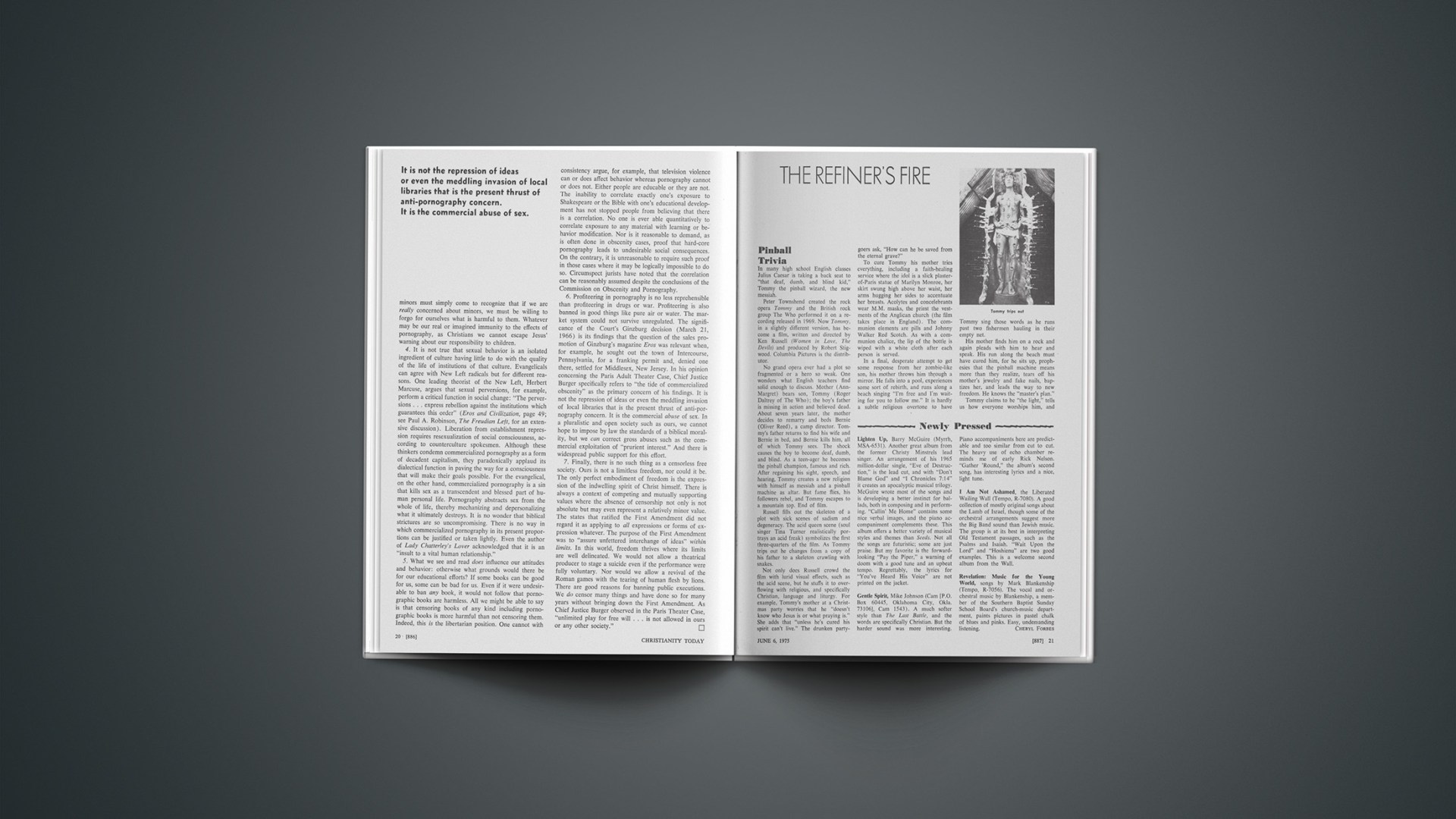
Russell fills out the skeleton of a plot with sick scenes of sadism and degeneracy. The acid queen scene (soul singer Tina Turner realistically portrays an acid freak) symbolizes the first three-quarters of the film. As Tommy trips out he changes from a copy of his father to a skeleton crawling with snakes.

Not only does Russell crowd the film with lurid visual effects, such as the acid scene, but he stuffs it to overflowing with religious, and specifically Christian, language and liturgy. For example, Tommy’s mother at a Christmas party worries that he “doesn’t know who Jesus is or what praying is.” She adds that “unless he’s cured his spirit can’t live.” The drunken party-goers ask, “How can he be saved from the eternal grave?”

To cure Tommy his mother tries everything, including a faith-healing service where the idol is a slick plaster-of-Paris statue of Marilyn Monroe, her skirt swung high above her waist, her arms hugging her sides to accentuate her breasts. Acolytes and concelebrants wear M.M. masks, the priest the vestments of the Anglican church (the film takes place in England). The communion elements are pills and Johnny Walker Red Scotch. As with a communion chalice, the lip of the bottle is wiped with a white cloth after each person is served.

In a final, desperate attempt to get some response from her zombie-like son, his mother throws him through a mirror. He falls into a pool, experiences some sort of rebirth, and runs along a beach singing “I’m free and I’m waiting for you to follow me.” It is hardly a subtle religious overtone to have Tommy sing those words as he runs past two fishermen hauling in their empty net.

His mother finds him on a rock and again pleads with him to hear and speak. His run along the beach must have cured him, for he sits up, prophesies that the pinball machine means more than they realize, tears off his mother’s jewelry and fake nails, baptizes her, and leads the way to new freedom. He knows the “master’s plan.”

Tommy claims to be “the light,” tells us how everyone worships him, and commands his followers to evangelize. “Bring everyone in,” he tells them, and he enlarges his house to hold them all.

Although he starts off being against materialism (no jewelry), he soon charges his followers high prices for sunglasses, earplugs, and a mouth cork, the required equipment for freedom. Tommy says they need to be deaf, dumb, and blind before they experience release. (He’s also against booze, drugs, and cigarettes.) But the crowd revolts, shouting, “We won’t take it. We never have, we never will.”

Tommy escapes only slightly injured from a fire that destroys his camp of eternal happiness. As he climbs a mountain he sings to someone, “I see glory from you. Right behind you I see millions following.” The message, if there is one, stops there, blurred throughout by an excess of conflicting, kaleidoscopic images.

Russell views our culture as hungering desperately for a leader, any leader. Even a deaf, dumb, and blind pinball wizard can capture our loyalty, if only briefly. The triviality of Tommy’s talent increases the bleakness of that vision and ridicules our messianic tendencies. Clearly, Tommy is Russell’s idea of a modern-day Christ—or his idea of the type of Christ modern man would follow.

Dostoevsky in The Brothers Karamazov also speculated on the Christ man wants. Perhaps beneath the bizarre, cheap, shallow trappings of Tommy, Russell is repeating Dostoevsky. But with the great Russian novelist one senses that he knows the truth before he explains why the masses want something different and less demanding. Russell seems to know only the perversion.

CHERYL FORBES

Newly Pressed

Lighten Up, Barry McGuire (Myrrh, MSA-6531). Another great album from the former Christy Minstrels lead singer. An arrangement of his 1965 million-dollar single, “Eve of Destruction,” is the lead cut, and with “Don’t Blame God” and “1 Chronicles 7:14” it creates an apocalyptic musical trilogy. McGuire wrote most of the songs and is developing a better instinct for ballads, both in composing and in performing. “Callin’ Me Home” contains some nice verbal images, and the piano accompaniment complements these. This album offers a better variety of musical styles and themes than Seeds. Not all the songs are futuristic; some are just praise. But my favorite is the forward-looking “Pay the Piper,” a warning of doom with a good tune and an upbeat tempo. Regrettably, the lyrics for “You’ve Heard His Voice” are not printed on the jacket.

Gentle Spirit, Mike Johnson (Cam [P.O. Box 60445, Oklahoma City, Okla. 73106], Cam 1543). A much softer style than The Last Battle, and the words are specifically Christian. But the harder sound was more interesting.

Piano accompaniments here are predictable and too similar from cut to cut. The heavy use of echo chamber reminds me of early Rick Nelson. “Gather ’Round,” the album’s second song, has interesting lyrics and a nice, light tune.

I Am Not Ashamed, the Liberated Wailing Wall (Tempo, R-7080). A good collection of mostly original songs about the Lamb of Israel, though some of the orchestral arrangements suggest more the Big Band sound than Jewish music. The group is at its best in interpreting Old Testament passages, such as the Psalms and Isaiah. “Wait Upon the Lord” and “Hoshienu” are two good examples. This is a welcome second album from the Wall.

Revelation: Music for the Young World, songs by Mark Blankenship (Tempo, R-7056). The vocal and orchestral music by Blankenship, a member of the Southern Baptist Sunday School Board’s church-music department, paints pictures in pastel chalk of blues and pinks. Easy, undemanding listening.

CHERYL FORBES
Sex Profiteering and the Evangelical

One of the ironies of recent American history is that free-market success has come to an industry that exploits persons and sex in a society dedicated to the preservation of personal worth and privacy. Here is a new kind of slavery that hides behind the skirts of the First and Fifth Amendments and limits itself only by the limitations of the appeal to prurience. Pornography today enlists the services of not just skid row derelicts or seasoned prostitutes but young people. It sells its product not just to lonely old men but to Americans of all kinds and all ages. Pornography is a huge and profitable business that has managed to thwart most attempts to prohibit or curb it.

Consider some figures released by Daily Variety, the show-business bible. In the major U. S. population centers, some two dozen key cities, The Devil in Miss Jones placed fifth among all movies in 1973, earning $7.3 million, and Deep Throat placed eleventh, grossing $4.6 million. The nearest Disney picture, World’s Greatest Athlete, earned only half of Deep Throat’s income. The Devil in Miss Jones and Deep Throat are not ordinary X-rated movies but examples of hard-core pornography that, as one UPI reported put it, “detail just about every sexual exercise known to man and woman.”

In the short time since the passage of the revised Criminal Code in the 1971 Oregon legislative session, pornography has become a multi-million dollar industry in Oregon. In the same period there has been an alarming increase in certain categories of crime such as rape, and a serious penetration of the state by organized crime. The national income figure for the pornography industry staggers the imagination: it is estimated to exceed a billion dollars.

Not even the most liberal champions of the protections of the First and Fifth Amendments were prepared for the flood of pornography and commercialized sex that washed over the land after the Roth-Alberts decision of the Supreme Court (June 24, 1957). The result of that decision was that literary works like Lady Chatterley’s Lover were given constitutional protection despite their explicitly sexual nature. What the Court did not expect was that once a few “respectable” literary works with explicit sex were given constitutional protection, they would become enormously profitable as pornographic merchandise and open the way for a floodtide of hard-core pornography that claimed in one way or another to serve some serious “educational” purpose. There can be no denying the sheer quantity and pervasiveness of sex profiteering in American culture today. It is simply a misrepresentation to attribute the complaints to a resurgence of Puritan prudery. And it is not constitutional rights that are at stake but the quality of American life itself.

The dimensions of the problem are no longer solely moral or religious, however important these dimensions may be. They are political. Unlike the older libertarian whose beliefs appear, for example, in the findings of the federal Commission on Obscenity and Pornography, the new libertarian of the Freudian and Marxist left recognizes the social importance of the sexual revolution. He does not find “liberated” sexual behavior to be a relatively harmless pastime for those who choose to indulge; rather, it is the prerequisite for a “liberated” social order. Like the biblical Christian, he takes sex seriously because he knows that it eventually affects the whole life-style of a people. It is not surprising, therefore, that the Supreme Court reversed its trend towards permissiveness and in 1973 relieved courts and juries of the intolerable burden of, for example, having to prove that obscene material is “utterly without redeeming social value” before banning it.

The simple fact is that the growing opposition to pornography is not an attempt to undermine constitutional guarantees, nor is it an attempt by a religious minority to impose biblical morality upon a majority that rejects it. It is a response to the growth of sex profiteering. The Supreme Court itself clearly reaffirmed that “obscene material (especially hard-core pornography) is unprotected by the First Amendment” (Chief Justice Burger for the majority in Miller v. California, June 21, 1973).

Two troublesome claims effectively thwart attempts to deal with pornography. These claims are that constitutional protections are threatened or that there is no such thing as pornography that isn’t relative to someone’s tastes. Both of these claims are unjustified.

We all do know what hard-core pornography is. For example, we can say that the movie Deep Throat is an example of what people are referring to when they speak of hard-core pornography. To deny that one did know would be to claim an inability to use the English language. Thus Justice Potter could say concerning The Lovers that while he would not attempt a definition of obscenity, “I know it when I see it.” It is simply a mistaken or deliberately evasive move to claim that one cannot know something unless one is able to give a formally adequate definition. That jurists cannot agree upon criteria of judgment does not mean that they don’t know what pornography is. There is no Platonic essence of pornography to be found by the Supreme or any other court and stated in some final and all-encompassing language. Nor need we lose faith in our ability to know because of disagreements over borderline cases or differences in taste. The problem is not that people don’t know what pornography is—that, for example, they might not known that Deep Throat is an obscene movie. The problem is that they wouldn’t necessarily find it “patently offensive.” Indeed it may be the case that they approve of the movie because it is obscene and not the case that it can’t be obscene because they enjoy it or approve of it.

There can be no doubt that many Americans do approve and want hard-core pornography—after all, they spend millions of dollars on it—and that many others are willing to tolerate it for the sake of those who want it. Yet there is evidence that a still greater number of Americans—mostly in smaller communities—want regulation or outright prohibition.

Libertarians often argue that people ought to be given what they want. Yet when a state legislature overwhelmingly votes to prohibit “activities including but not limited to live public (sex) shows, prostitution and dissemination of obscene materials,” as did the Oregon legislature, it is the pornography industry that organizes a “People Again Censorship” committee and secures the signatures needed to refer the measure to voters. Initially the appeal is to the protections of the First Amendment. If the voters sustain the view of their representatives in the legislature, the pornographers will then turn to the courts to take advantage of labyrinthian legal maneuvers involving matters such as what is specifically prohibited or what are “places of public accommodation.” Eventually the issue will reduce to arguments concerning censorship or definition of the obscene. If it is acknowledged that “obscene material is unprotected by the First Amendment”—to use Chief Justice Burger’s words—then it is argued that it is impossible to establish that any material is obscene because either the Court itself hasn’t adequately defined obscenity, the state law is not specific enough, or the local community standards cannot be identified.

The difficulty in overcoming this situation is illustrated by the fact that the Supreme Court itself in June of this year overruled a Georgia jury that had banned the “borderline” movie Carnal Knowledge on the grounds that its 1973 decisions did not give juries “unbridled discretion to apply local standards …,” and that only works depicting “patently offensive hard-core conduct” failed to enjoy the protection of the First Amendment. Hence the Court acknowledged that local community judgments are no more reliable as standards of judgment than some universal pronouncement of its own. Yet the Court is moving in the direction of curbing hard-core pornography insofar as it is trying to say that the 1973 ruling is about hard-core pornography and not just anything that happens to offend the police or parents of a particular community, such as novels in school libraries that contain four-letter words. I quote from Chief Justice Burger’s 1973 ruling:

Sex and nudity may not be exploited without limit by films or pictures exhibited or sold in places of public accommodation any more than live sex and nudity can be exhibited or sold without limit in such places. At a minimum, prurient, patently offensive depiction or description of sexual conduct must have serious literary, artistic, political, or scientific value to merit First Amendment protection.… Under the holding announced today, no one will be subject to prosecution for the sale or exposure of obscene materials unless these materials depict or describe patently offensive “hard-core” sexual conduct specifically defined by the regulating state law, as written or construed … [No. 70–73, U.S. Law Week, Vol. 41, pp. 4925–35].

Clearly the Court is moving in a direction that establishes both that hard-core pornography is unprotected and that the American people in their various communities can curb it depending upon how it is “specifically defined by the regulating state law.”

But here the rub comes. Recently a three-judge federal panel in California struck down as unconstitutional California’s obscenity statute on the grounds that it violated Fifth Amendment guarantees of due process because it did not specifically define what types of sexual activity should be prohibited. The panel of judges ordered the community of Buena Park to permit the showing of Deep Throat. And so on an important but purely legal technicality, a particular community’s attempt to curb hard-core pornography was thwarted despite the fact that the Supreme Court has clearly ruled that hard-core is not protected and despite the fact that community tastes were “patently offended.” Perhaps the California statute was badly worded, as the panel claimed, but obviously the municipal judge in Buena Park knew hard-core when he saw it. Not even a jaded inhabitant of downtown San Francisco would have wanted to argue that Deep Throat isn’t hard-core.

The federal panel in Los Angeles that overruled the local judge expressed concern that “there was not fair notice of what California permits or prohibits.” Yet the fact is that if the Supreme Court has not yet been able to come up with a definition that satisfies everyone (including those who have no intention of being satisfied), it is unlikely that any state legislature or local municipality can do much better. Either we allow informed and responsible persons to implement the will of the people or we allow ourselves to be thwarted by paralyzing technicalities. The difficulty of resolving controversial cases is no argument for sidestepping the more clear-cut ones. People must be able to act in behalf of their interests, or else the democratic process will be given over to special-interest groups like the sex profiteers.

Several propositions can be reasonably argued:

1. There are such things as obscenity and pornography if only because we do know what we are talking about when we refer to them even though we may disagree about them or find that we can’t define them. There are, of course, borderline cases. Yet meaningful distinctions can be made between, for example, hard-core and non-hard-core pornography. Chief Justice Burger writes in Miller v. California that the “Court has agreed on concrete guidelines to isolate ‘hard-core’ pornography from expressions protected by the First Amendment.”

2. The difficulties of regulating and prohibiting pornography together with the ever present possibility of giving rise to abuses or violating constitutional protections in no way justifies abandoning the responsibility to regulate or prohibit pornography—any more than the difficulty of enforcing any law with its attending possibilities of abuse justifies failure to enforce it. We do not fear the loss of meat from our tables simply because we regulate its quality in our markets. Past restrictions on pornography did not lead to the loss of First Amendment rights. There is no reason to believe that present measures must necessarily do so. In the Miller v. California ruling (June 21, 1973) Chief Justice Burger argued for the majority that his dissenting colleague’s “doleful anticipations assume that courts cannot distinguish commerce in ideas, protected by the First Amendment, from commercial exploitation of obscene material” (italics mine). And he argued in the Paris Adult Theater Case (June 21, 1973):

The States have a long-recognized legitimate interest in regulating the use of obscene material in local commerce and in all places of public accommodation, as long as these regulations do not run afoul of specific constitutional prohibitions.

In particular, we hold that there are legitimate state interests at stake in stemming the tide of commercialized obscenity, even assuming it is feasible to enforce effective safeguards against exposure to juveniles and to the passerby. Rights and interests “other than those of the advocates are involved.” These include the interest of the public in the quality of life and the total community environment, the tone of commerce in the great city centers, and, possibly, the public safety itself.…

As Chief Justice Warren stated, there is a “right of the nation and of the states to maintain a decent society” [No. 71–73, U.S. Law Week, Vol. 41, pp. 4935–55].

3. The issue of regulating or prohibiting traffic in pornography cannot be resolved by an attempt to limit access to these materials to consenting adults only. Whatever is easily available to adults will be easily available to minors. There is no evidence that “for adults only” has effectively restricted the use of cigarettes, alcoholic beverages, drugs, or anything else if such items are readily available to adults. Those libertarians who are sincerely concerned about keeping pornography out of the hands of minors must simply come to recognize that if we are really concerned about minors, we must be willing to forgo for ourselves what is harmful to them. Whatever may be our real or imagined immunity to the effects of pornography, as Christians we cannot escape Jesus’ warning about our responsibility to children.

4. It is not true that sexual behavior is an isolated ingredient of culture having little to do with the quality of the life of institutions of that culture. Evangelicals can agree with New Left radicals but for different reasons. One leading theorist of the New Left, Herbert Marcuse, argues that sexual perversions, for example, perform a critical function in social change: “The perversions … express rebellion against the institutions which guarantees this order” (Eros and Civilization, page 49; see Paul A. Robinson, The Freudian Left, for an extensive discussion). Liberation from establishment repression requires resexualization of social consciousness, according to counterculture spokesmen. Although these thinkers condemn commercialized pornography as a form of decadent capitalism, they paradoxically applaud its dialectical function in paving the way for a consciousness that will make their goals possible. For the evangelical, on the other hand, commercialized pornography is a sin that kills sex as a transcendent and blessed part of human personal life. Pornography abstracts sex from the whole of life, thereby mechanizing and depersonalizing what it ultimately destroys. It is no wonder that biblical strictures are so uncompromising. There is no way in which commercialized pornography in its present proportions can be justified or taken lightly. Even the author of Lady Chatterley’s Lover acknowledged that it is an “insult to a vital human relationship.”

5. What we see and read does influence our attitudes and behavior: otherwise what grounds would there be for our educational efforts? If some books can be good for us, some can be bad for us. Even if it were undesirable to ban any book, it would not follow that pornographic books are harmless. All we might be able to say is that censoring books of any kind including pornographic books is more harmful than not censoring them. Indeed, this is the libertarian position. One cannot with consistency argue, for example, that television violence can or does affect behavior whereas pornography cannot or does not. Either people are educable or they are not. The inability to correlate exactly one’s exposure to Shakespeare or the Bible with one’s educational development has not stopped people from believing that there is a correlation. No one is ever able quantitatively to correlate exposure to any material with learning or behavior modification. Nor is it reasonable to demand, as is often done in obscenity cases, proof that hard-core pornography leads to undesirable social consequences. On the contrary, it is unreasonable to require such proof in those cases where it may be logically impossible to do so. Circumspect jurists have noted that the correlation can be reasonably assumed despite the conclusions of the Commission on Obscenity and Pornography.

6. Profiteering in pornography is no less reprehensible than profiteering in drugs or war. Profiteering is also banned in good things like pure air or water. The market system could not survive unregulated. The significance of the Court’s Ginzburg decision (March 21, 1966) is its findings that the question of the sales promotion of Ginzburg’s magazine Eros was relevant when, for example, he sought out the town of Intercourse, Pennsylvania, for a franking permit and, denied one there, settled for Middlesex, New Jersey. In his opinion concerning the Paris Adult Theater Case, Chief Justice Burger specifically refers to “the tide of commercialized obscenity” as the primary concern of his findings. It is not the repression of ideas or even the meddling invasion of local libraries that is the present thrust of anti-pornography concern. It is the commercial abuse of sex. In a pluralistic and open society such as ours, we cannot hope to impose by law the standards of a biblical morality, but we can correct gross abuses such as the commercial exploitation of “prurient interest.” And there is widespread public support for this effort.

7. Finally, there is no such thing as a censorless free society. Ours is not a limitless freedom, nor could it be. The only perfect embodiment of freedom is the expression of the indwelling spirit of Christ himself. There is always a context of competing and mutually supporting values where the absence of censorship not only is not absolute but may even represent a relatively minor value. The states that ratified the First Amendment did not regard it as applying to all expressions or forms of expression whatever. The purpose of the First Amendment was to “assure unfettered interchange of ideas” within limits. In this world, freedom thrives where its limits are well delineated. We would not allow a theatrical producer to stage a suicide even if the performance were fully voluntary. Nor would we allow a revival of the Roman games with the tearing of human flesh by lions. There are good reasons for banning public executions. We do censor many things and have done so for many years without bringing down the First Amendment. As Chief Justice Burger observed in the Paris Theater Case, “unlimited play for free will … is not allowed in ours or any other society.”

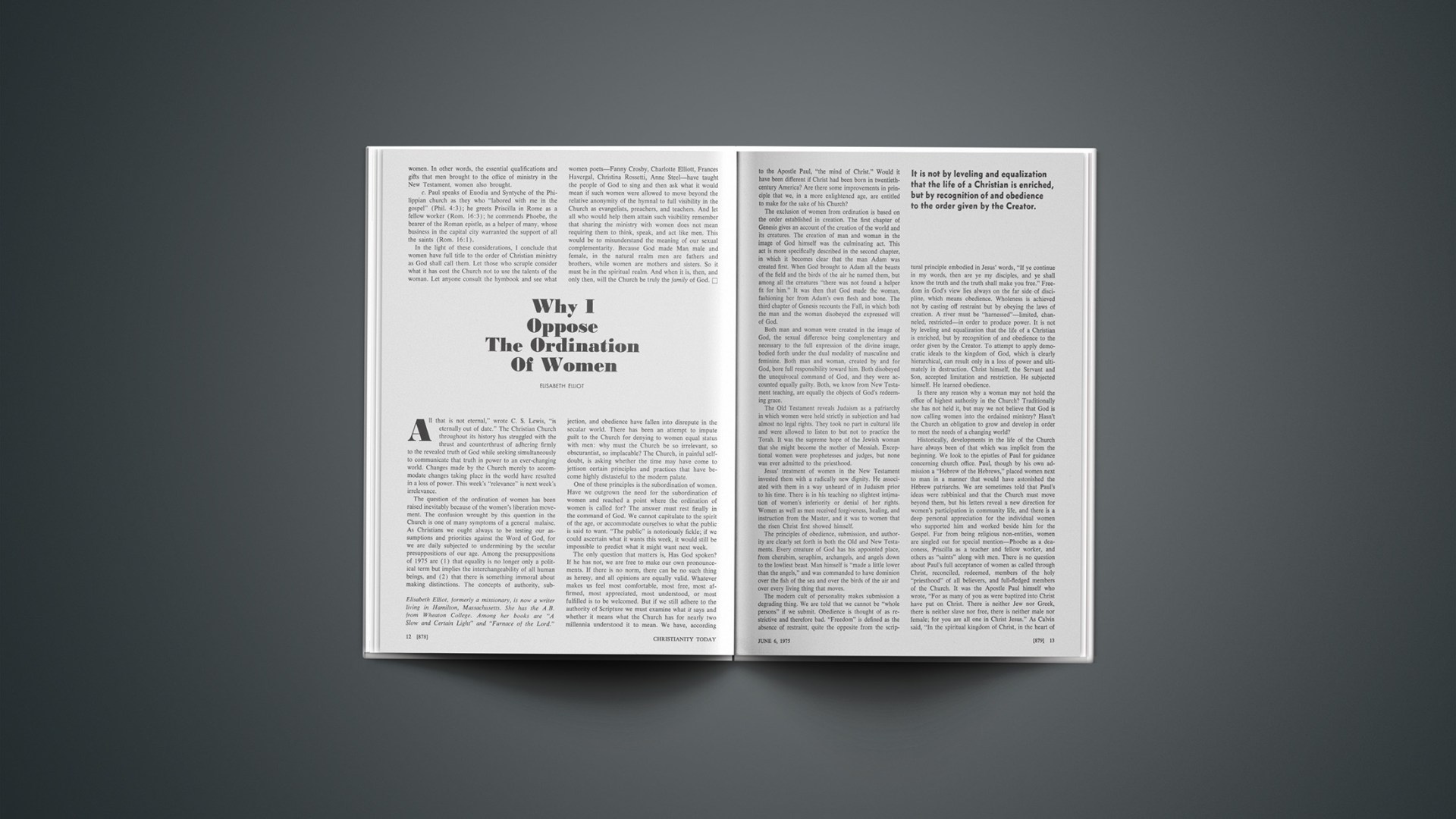
Why I Oppose the Ordination of Women

All that is not eternal,” wrote C. S. Lewis, “is eternally out of date.” The Christian Church throughout its history has struggled with the thrust and counterthrust of adhering firmly to the revealed truth of God while seeking simultaneously to communicate that truth in power to an ever-changing world. Changes made by the Church merely to accommodate changes taking place in the world have resulted in a loss of power. This week’s “relevance” is next week’s irrelevance.

The question of the ordination of women has been raised inevitably because of the women’s liberation movement. The confusion wrought by this question in the Church is one of many symptoms of a general malaise. As Christians we ought always to be testing our assumptions and priorities against the Word of God, for we are daily subjected to undermining by the secular presuppositions of our age. Among the presuppositions of 1975 are (1) that equality is no longer only a political term but implies the interchangeability of all human beings, and (2) that there is something immoral about making distinctions. The concepts of authority, subjection, and obedience have fallen into disrepute in the secular world. There has been an attempt to impute guilt to the Church for denying to women equal status with men: why must the Church be so irrelevant, so obscurantist, so implacable? The Church, in painful self-doubt, is asking whether the time may have come to jettison certain principles and practices that have become highly distasteful to the modern palate.

One of these principles is the subordination of women. Have we outgrown the need for the subordination of women and reached a point where the ordination of women is called for? The answer must rest finally in the command of God. We cannot capitulate to the spirit of the age, or accommodate ourselves to what the public is said to want. “The public” is notoriously fickle; if we could ascertain what it wants this week, it would still be impossible to predict what it might want next week.

The only question that matters is, Has God spoken? If he has not, we are free to make our own pronouncements. If there is no norm, there can be no such thing as heresy, and all opinions are equally valid. Whatever makes us feel most comfortable, most free, most affirmed, most appreciated, most understood, or most fulfilled is to be welcomed. But if we still adhere to the authority of Scripture we must examine what it says and whether it means what the Church has for nearly two millennia understood it to mean. We have, according to the Apostle Paul, “the mind of Christ.” Would it have been different if Christ had been born in twentieth-century America? Are there some improvements in principle that we, in a more enlightened age, are entitled to make for the sake of his Church?

The exclusion of women from ordination is based on the order established in creation. The first chapter of Genesis gives an account of the creation of the world and its creatures. The creation of man and woman in the image of God himself was the culminating act. This act is more specifically described in the second chapter, in which it becomes clear that the man Adam was created first. When God brought to Adam all the beasts of the field and the birds of the air he named them, but among all the creatures “there was not found a helper fit for him.” It was then that God made the woman, fashioning her from Adam’s own flesh and bone. The third chapter of Genesis recounts the Fall, in which both the man and the woman disobeyed the expressed will of God.

Both man and woman were created in the image of God, the sexual difference being complementary and necessary to the full expression of the divine image, bodied forth under the dual modality of masculine and feminine. Both man and woman, created by and for God, bore full responsibility toward him. Both disobeyed the unequivocal command of God, and they were accounted equally guilty. Both, we know from New Testament teaching, are equally the objects of God’s redeeming grace.

The Old Testament reveals Judaism as a patriarchy in which women were held strictly in subjection and had almost no legal rights. They took no part in cultural life and were allowed to listen to but not to practice the Torah. It was the supreme hope of the Jewish woman that she might become the mother of Messiah. Exceptional women were prophetesses and judges, but none was ever admitted to the priesthood.

Jesus’ treatment of women in the New Testament invested them with a radically new dignity. He associated with them in a way unheard of in Judaism prior to his time. There is in his teaching no slightest intimation of women’s inferiority or denial of her rights. Women as well as men received forgiveness, healing, and instruction from the Master, and it was to women that the risen Christ first showed himself.

The principles of obedience, submission, and authority are clearly set forth in both the Old and New Testaments. Every creature of God has his appointed place, from cherubim, seraphim, archangels, and angels down to the lowliest beast. Man himself is “made a little lower than the angels,” and was commanded to have dominion over the fish of the sea and over the birds of the air and over every living thing that moves.

The modern cult of personality makes submission a degrading thing. We are told that we cannot be “whole persons” if we submit. Obedience is thought of as restrictive and therefore bad. “Freedom” is defined as the absence of restraint, quite the opposite from the scriptural principle embodied in Jesus’ words, “If ye continue in my words, then are ye my disciples, and ye shall know the truth and the truth shall make you free.” Freedom in God’s view lies always on the far side of discipline, which means obedience. Wholeness is achieved not by casting off restraint but by obeying the laws of creation. A river must be “harnessed”—limited, channeled, restricted—in order to produce power. It is not by leveling and equalization that the life of a Christian is enriched, but by recognition of and obedience to the order given by the Creator. To attempt to apply democratic ideals to the kingdom of God, which is clearly hierarchical, can result only in a loss of power and ultimately in destruction. Christ himself, the Servant and Son, accepted limitation and restriction. He subjected himself. He learned obedience.

Is there any reason why a woman may not hold the office of highest authority in the Church? Traditionally she has not held it, but may we not believe that God is now calling women into the ordained ministry? Hasn’t the Church an obligation to grow and develop in order to meet the needs of a changing world?

Historically, developments in the life of the Church have always been of that which was implicit from the beginning. We look to the epistles of Paul for guidance concerning church office. Paul, though by his own admission a “Hebrew of the Hebrews,” placed women next to man in a manner that would have astonished the Hebrew patriarchs. We are sometimes told that Paul’s ideas were rabbinical and that the Church must move beyond them, but his letters reveal a new direction for women’s participation in community life, and there is a deep personal appreciation for the individual women who supported him and worked beside him for the Gospel. Far from being religious non-entities, women are singled out for special mention—Phoebe as a deaconess, Priscilla as a teacher and fellow worker, and others as “saints” along with men. There is no question about Paul’s full acceptance of women as called through Christ, reconciled, redeemed, members of the holy “priesthood” of all believers, and full-fledged members of the Church. It was the Apostle Paul himself who wrote, “For as many of you as were baptized into Christ have put on Christ. There is neither Jew nor Greek, there is neither slave nor free, there is neither male nor female; for you are all one in Christ Jesus.” As Calvin said, “In the spiritual kingdom of Christ, in the heart of God, and in conscience, no difference exists between men and women.”

But for the temporal order of the Church and home (as distinct from the baptismal order described in Galatians 3) certain differences remain. Paul called for the subjection of women. He pointed to the order of creation: quite simply, woman was made for man. Man was not made for woman. For those who accept Scripture as authoritative, any attempt to evade or reinterpret this statement is mere tergiversation. A knowledge of what a thing is made for is prerequisite to its proper use. In the vastly harmonious arrangement of the universe, it is not so much a question of whether a creature is higher or better, or lower or worse, but a question of what it’s there for. The stars move perfectly in their courses and the morning stars sing together. The archangel goes on the mission to which he is sent, the clam lives out his clamness without sin. Those creatures alone who took issue with the purpose of the Creator forfeited their wholeness.

It has been no part of the Church’s purpose to suppress the gifts that God has given to its members; rather, it is to ensure their full and proper use within the divinely given framework. This is the will of God, and the working out of that will reveals the deepest meaning of our human existence. Isak Dinesen in Out of Africa wrote:

Pride is faith in the idea that God had when He made us. A proud man is conscious of the idea and aspires to realize it. He does not strive toward a happiness or comfort which may be irrelevant to God’s idea of him.… People who have no pride are not aware of any idea of God in the making of them, and sometimes they make you doubt that there has ever been much of an idea, or else it has been lost, and who shall find it again? They have got to accept as success what others warrant to be so, and to take their happiness, and even their own selves, at the quotation of the day [Modern Library, Random House, 1952, p. 261].

If a woman “feels called” to do a work that on scriptural grounds is outside the “idea of God in the making” of her, it is the duty of the Church theologically rather than sociologically to judge her vocation. Service to God is never a purely private matter. No one, merely because he or she has the Spirit, may disregard the judgment of the congregation.

Let us be very clear that the ordination of women is not proscribed because of women’s lack of spiritual qualification. The ministries of both Jesus and Paul give abundant testimony to their recognition of women’s gifts and devotion. It is a question of appropriateness. The natural order established at creation has not been abrogated either by the Fall or by redemption. Jesus did not choose women for his disciples, nor were women among the Seventy sent out to preach. The Apostle Paul did not allow women to teach or to usurp authority over men—not because women were incompetent, but because the structure of Church and home, as an image of the relationship between the God of the Old Testament and his covenant people, and between Christ and his Bride, requires subordination. The Church has always seen such imagery as highly important, not random, accidental, or trivial, and therefore not to be tampered with. The distinction between the sexes is a permanent one so far as this world is concerned. (Indeed, there is no reason to believe that it will be erased in heaven—we know only what they don’t do up there; we are told nothing of what they do do.) Subjection of wives to husbands as the Church is subject to Christ is an important aspect of the Church’s message. The Church cannot, therefore, negate this truth that it teaches by ordaining women to the office of minister of Word proclaimer.

The relationship between the sexes is most fully understood in the light of monogamous marriage. God’s commands regarding marriage leave no room for speculation as to the special responsibilities of husbands and wives toward each other—self-giving love is required of the former, submission of the latter. To say that submission is synonymous with the stunting of growth, with dullness and colorlessness, spiritlessness, passivity, immaturity, servility, or even the “suicide of personality,” as one feminist who calls herself an evangelical has suggested, is totally to misconstrue the biblical doctrine of authority. Supreme authority in both Church and home has been divinely vested in the male as the representative of Christ, who is the Head of the Church. It is in willing and glad submission rather than grudging capitulation that the woman in the Church (whether married or single) and the wife in the home find their fulfillment.

Equality in the kingdom of Christ, as set forth in Galatians 3:28, does not erase, for the politia ecclesiastica, the distinction established from the beginning, the distinction that Paul sought to preserve when he admonished women to be silent or, when praying or prophesying (clearly exceptions to the rule of silence), to cover their heads as a sign of subjection. The particular ways in which sexual differentiation is signaled in various cultures may differ widely. The use of the headcloth or veil in Paul’s time may perhaps be an example of a custom that might vary in a different time and place; but what it represented, the subjection of women, is a divinely inspired principle and not negotiable. Paul recognized in the desire to dispense with the head covering an attempt to nullify the hierarchical order by equalizing men and women, whose respective positions in church and home had been assigned by God. The ancient heresy of Gnosticism had, by dissolving the relation between redemption and creation, succeeded in making the sexes equal and thereby destroying marriage itself. Montanism, another heresy, by an overemphasis on the imminent return of Christ and on charismatic experience, fostered an indifference to the distinctions established in creation. Paul was certainly acquainted with the havoc wrought by these false teachings, and he sought to direct the attention of Christians to the foundation truths.

In non-liturgical churches the office of Word proclamation is perhaps the most important, but in liturgical churches, where there is a deeper understanding of the meaning of signs and symbols, the priest’s office of dispensing the sacraments is primary, an act in which it is of paramount importance that the ancient imagery be preserved. As C. S. Lewis pointed out, a woman may properly represent the people to God, but she may not represent God to the people. A woman may be godly, but the propriety of speaking of God as womanly would be questionable, inasmuch as the pronouns referring to him in Scripture are without exception masculine. This, too, cannot be a matter of indifference. The few times when God’s treatment of his children is compared to that of a mother can only by the wildest stretch of imagination be taken as authorization for speaking of God as our mother which is in heaven. Not only in biblical imagery but in all of imagery of poetry, mythology, and chivalry, masculinity gives, creates, and rules, while femininity receives, responds, and submits.

The soul has always been seen by the Church as feminine toward God, while God is masculine toward mankind. Man and woman have each a unique function to fulfill in recognizing their proper appointment and accepting its responsibilities. It is the very magnetism of two opposite poles that not only signifies vast eternal verities but also lends interest, fascination, even a certain glamor to our earthly life that those who agitate for equality and/or interchangeability seem to ignore—or what is much worse, to hate. What is more lamentable than the spectacle of one who, through hubris, arrogates to himself a position never assigned, unless it is the spectacle of one who, assigned a position, from false humility refuses it? The commands of God in Scripture clearly delineate the structures of the Church, the relation between its members and leaders, the disciplined use of gifts for its edification. We cannot have it both ways. The Church must choose between the ordination and the subordination of women. Which does God command? If subordination is the command of God, ordination is excluded. It is a contradiction.

The fruit of the Spirit which is called meekness is, I believe, the ability to see one’s proper place in the scheme of things. If I as a woman have been endowed with certain gifts that may be good for the “use of edifying,” let me use them within the boundaries set, recognizing that the Spirit of God does not contradict himself. Any attempt to obfuscate the lines drawn will not only impoverish the one who makes the attempt but also deprive the Body of Christ of depth, of variety, and of that maturity which is described as “the measure of the stature of the fullness of Christ.”

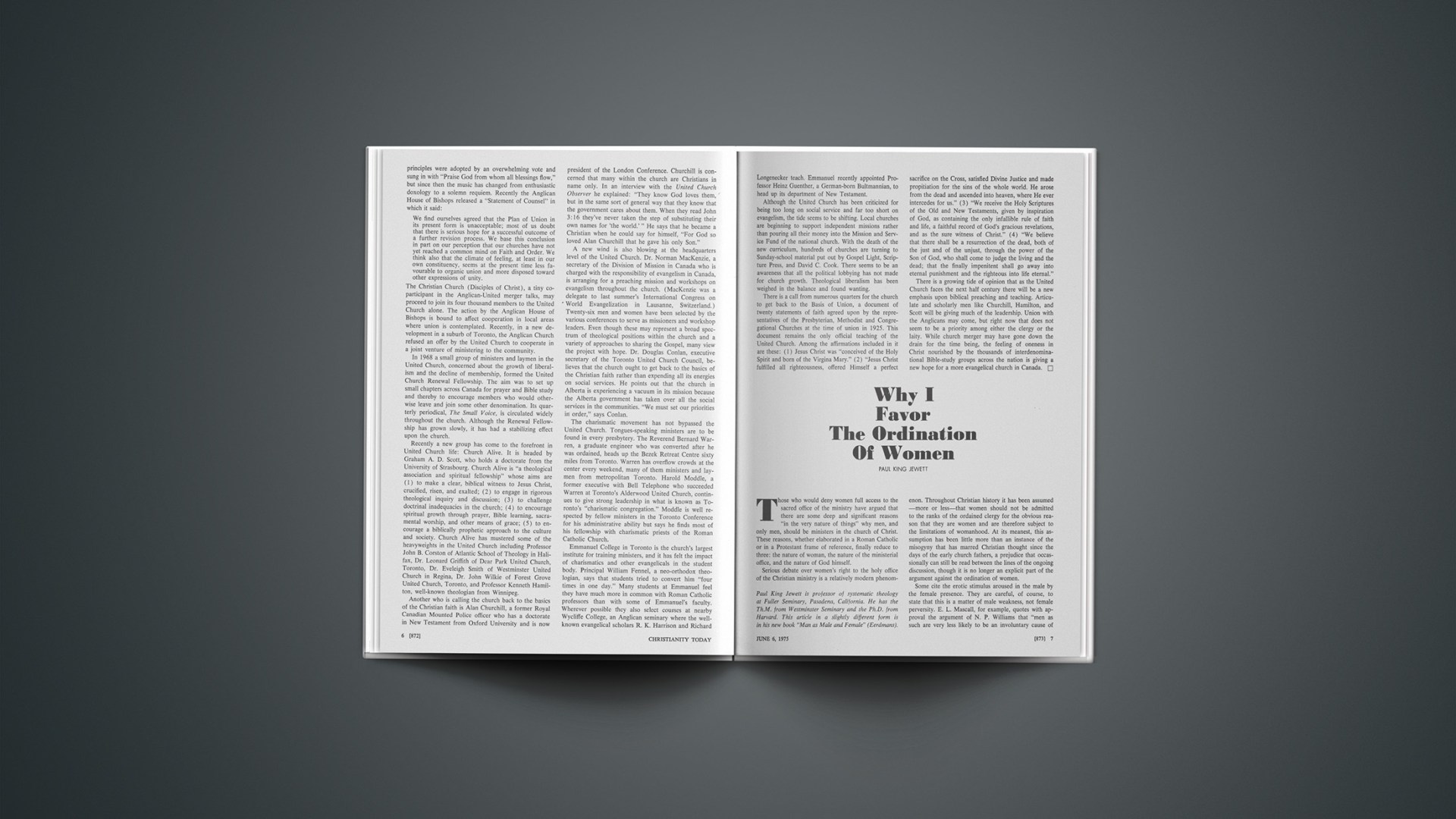
Why I Favor the Ordination of Women

Those who would deny women full access to the sacred office of the ministry have argued that there are some deep and significant reasons “in the very nature of things” why men, and only men, should be ministers in the church of Christ. These reasons, whether elaborated in a Roman Catholic or in a Protestant frame of reference, finally reduce to three: the nature of woman, the nature of the ministerial office, and the nature of God himself.

Serious debate over women’s right to the holy office of the Christian ministry is a relatively modern phenomenon. Throughout Christian history it has been assumed—more or less—that women should not be admitted to the ranks of the ordained clergy for the obvious reason that they are women and are therefore subject to the limitations of womanhood. At its meanest, this assumption has been little more than an instance of the misogyny that has marred Christian thought since the days of the early church fathers, a prejudice that occassionally can still be read between the lines of the ongoing discussion, though it is no longer an explicit part of the argument against the ordination of women.

Some cite the erotic stimulus aroused in the male by the female presence. They are careful, of course, to state that this is a matter of male weakness, not female perversity. E. L. Mascall, for example, quotes with approval the argument of N. P. Williams that “men as such are very less likely to be an involuntary cause of distraction to women, under the circumstances of public worship, than women are to men; and that this is a permanent fact of human nature which can no more be abolished by modern progress than the law of gravitation can be abolished by human progress” (Women and the Priesthood of the Church, Church Literature Association, no date, page 8). Another statement of this argument was made by Herbert Carson: “If a man stands in the pulpit the average woman is not unduly affected by his appearance; but if a woman stands there, men, being men, will often find that their thoughts are less on the word spoken than on the speaker” (Reformation Today, Spring, 1971, page 9).

The trouble with this argument is that it proves too much. As Mascall admits, pressed to its logical conclusion it would exclude women from all visible, official participation in worship and, unless the senses of sight and sound are fundamentally different, would appear to exclude them from participation even in an invisible choir, a restriction even more stringent than the limitations imposed by Eastern Orthodox and Roman Catholic communions.

In truth, the argument that females should not be ministers and priests because males have a “weakness” is wholly without merit. It is simply a disarming nuance of the age-old assumption on man’s part that the woman is a sex object; that she differs from the man in that while he is capable of erotic love, she is made for it. As Byron wrote,

Man’s love is of man’s life a thing apart;

’Tis woman’s whole existence.

Instead of trying to limit the woman in her freedom as a child of God by denying her calling to the ministry on such grounds, men ought to redeem the man/woman relationship in the Church by repenting of their sin.

The Nature Of The Ministerial Office

Every major ecclesiastical tradition recognizes that there is an office of ministry and that ordination is the way one is inducted into it. Hence ordination, however one may conceive it, is (ordinarily) necessary if one is to function as a minister in Christ’s Church with the authority of one divinely called to the task. Since one is “called of God” to the office, one does not simply choose to be a minister as one would choose to enter a profession. One must be called and the call must be confirmed by the Church. The question, then, is: Does God call women, as he does men, to be ministers in his name? No, say those who oppose the ordination of women. And they deny that such an answer is obscurantist, in that emancipated women have excelled in all other professions, by pointing out that the ministry cannot be equated simply with a profession like law or medicine.

But having granted this needed clarification, we can hardly accept this as the final word on the subject. The question then must be asked, “Why should God call only men; why should he not also call women?” To this question it has been answered that what the husband is to the bride, Christ is to the Church in the teaching of the New Testament. Hence the one vested with authority to minister in his name must be one whom God has appointed to function in the Church as does the husband at the natural level, as the head of the family. In other words, to ordain a woman to holy orders would be analogous to assigning her the role of husband and father in the family, a role that properly belongs to the man. We see, then, that so far as the nature of the ministerial office bears on the question of woman’s ordination, the ultimate issue proves to be her relationship of subordination to the man.

This is true regardless of one’s specific theological view of ordination. It really matters little whether one has a Catholic view of ordination, wherein the essential element is the sacramental commissioning of a priest to pronounce absolution and celebrate the sacrifice of the Mass, or a Protestant and evangelical view, wherein the essential element is the setting apart of a minister to preach the Gospel and shepherd the flock of God. In both traditions it is the woman’s relationship to the man that disqualifies her for ordination. I say this fully aware of the often made disclaimers and realizing that other considerations enter in. So far as the nature of ordination is concerned, those who object to giving it to women always come at last to the same place: the Christian minister is Christ’s representative, and this implies a spiritual authority in the Church that belongs to the man.

The question of female ordination, then, is a nuance of the larger question of female subordination. Contemporary thinkers who stand in this tradition speak not of the inferiority of the woman to the man but rather of her difference from him, especially as this difference is reflected in her role as wife and mother in the natural family, a difference that must be reflected in the Church as the spiritual family of God. The woman was created from and for the man (Gen. 2) and therefore stands under his authority.

The creation account, however, need not be thought to subordinate one sex to the other. Rather, mankind in the divine image is created a partnership of male and female. By the same token the new mankind “foreordained to be conformed to the image of his Son” (Rom. 8:29, ASV) is likewise a partnership of the sexes. Translated into the language of ecclesiology, this is to say: The Church is a universal priesthood of all believers in Christ, female as well as male. To this affirmation it has been answered that such references as First Peter 2:5, in which Christians generally are called a “holy” or “royal priesthood,” refer to the priesthood communicated to the Church in its corporate aspect. Hence the priesthood of all believers implies nothing for the ordination of women to holy office unless one adopts the radical laicism implied in that form of Protestantism which admits of no essential difference between laity and clergy.

Although I am a Protestant in this radical sense, I am not convinced that such an answer is valid even from a Roman or Anglo-Catholic perspective, since according to the Catholic view, “priestly character,” committed individually by ordination to those who function as priests, arises directly out of the priestly character, which is committed generally to the Church as Christ’s body. But if this is so, if individual priesthood rests upon the general priesthood of the laity, then women, who, like men, are incorporated (symbolically) by baptism into the body of Christ and so made “to be priests unto his God and Father” (Rev. 1:6), are equally qualified to become priests in the individualized meaning of the term. Whatever difference one may postulate between the priesthood in its general and in its individual form, this difference implies nothing for men that it does not imply for women. In fact, since the Church is the bride of Christ and therefore feminine to him, one could just as well reason that the universal priesthood of all believers should find its individual expression in the woman rather than in the man, an inference that the theologians, as males, have never drawn.

The Nature Of God

Theologians have always known and admitted that God transcends the sexual distinctions of our humanity. However, they have hardly been consistent in applying this truth. While they have assumed that God is not female, it has been less clear to them that he is not male either. Although their own bias as men has been a factor in this lack of perception, there are, no doubt, more substantive reasons for the general tendency of theologians to think of God as a male Deity. Scripture uses the masculine pronouns in speaking of God; and this God, who reveals himself in Scripture, is the Father who sent his Son to redeem mankind; and this Son became incarnate as the man Jesus of Nazareth.

Surely it is understandable—if not defensible—that theologians should have inferred from all this that God is more like the male than the female of the human species. Though herself a bearer of the divine image, the woman does not bear that image to the same degree as the man. She is, as it were, one degree removed from the original. This is the way in which the theologians traditionally have understood Paul’s affirmation that the woman is the “glory of the man,” who is the “image and glory of God” (1 Cor. 11:7). By the same token, it is surely understandable that Christian women have struggled with the implications of their faith at this point. Theresa of Avila’s bitter lament, “The very thought that I am a woman is enough to make my wings droop,” has struck a responsible chord in many, and today’s women theological students have turned the saint’s lament into a complaint that they find the male Deity of the theologians more oppressive than redemptive.

Those who reject the claim of women that the Church should confirm their call to the ministry and invest them with the authority of office through ordination have pointed out that the teaching that God is the “Father,” who sent his “Son” to be our Redeemer, rests on revelation, not human invention. C. S. Lewis sharpens the issue by asking a series of rhetorical questions: Can one say that we might just as well pray to “our Mother who art in heaven” as to “our Father”? Dare we suggest that the Incarnation might just as well have taken a female as a male form and that the second person of the Trinity might just as well be called “Daughter” as “Son”? Can we reverse the mystical marriage so that the church is the “Bridegroom” and Christ the “Bride”? All this, Lewis avers, is involved in the claim that a woman can stand in the place of God as does an ordained minister. Hence, to admit women to the office of the ministry would be, for Lewis and those who share his views, to turn Christianity into a different sort of religion (see his essay “Priestesses in the Church,” reprinted in God in the Dock, Eerdmans, 1970).

These profound mysteries of God’s being, mysteries revealed in the Incarnation, explain (allegedly) why our Lord, himself a man, restricted the personal exercise of the ministry in his church to apostles who were men. Being God’s eternal Son, he became a man, not a woman; and for this reason he commissioned men, not women, to represent him in the Church, which is his body, his bride. In fact, the Gospels testify more clearly to Jesus’ institution of the ministry than to his institution of the Church. He founded the Church, one could say, by founding the ministry. Hence the Church is built upon the foundation of the apostles and prophets, Christ Jesus himself being the chief cornerstone (Eph. 2:20).

It is from this perspective, also, that we must understand the controversial pronouncements of Peter and Paul, leading apostles, that women should keep silent in the church and not aspire to the teaching office (1 Cor. 14:34, 35; 1 Tim. 2:11–14). And because all this is so plain in the New Testament, the burden of proof lies with those who would simply set aside the ecclesiastical tradition of entrusting to men as mere tradition having no authority in the Church today.

Although I cannot here respond fully to this argument, some response to it is necessary, for it is incompatible with my affirmation that human sexuality is a life partnership of equals under God. Obviously there can be no true partnership of the sexes in the life of the Church so long as those vested with the authority to speak for God are men and men only. My response will take the form of a series of brief affirmations.

1. If, as the theologians have taught, there is only a personal distinction in God (Trinity), not a sexual one, then the creation of Man in the divine image as male and female can hardly mean that Man is like God as male rather than female. Since God is a fellowship of persons (Father, Son, Spirit) and Man is a fellowship of persons (man and woman), therefore Man is like God as man in fellowship with woman, not as man in distinction from woman.

2. Such a conclusion, which appears to be beyond dispute, requires that we construe the masculine language about God analogically, not literally, when we interpret Scripture. The univocal element in the analogy is the personal, not the sexual, meaning of the language.

3. Related data of Scripture, when carefully examined, support this conclusion. Even in the Old Testament, where God reveals himself to Israel as like a Father (Mal. 1:6; 2:10), he also reveals himself like a Mother: “Can a woman forget her sucking child that she should have no compassion on the son of her womb? Yea, she may forget, yet will I not forget you” (Isa. 49:15). The fact that God likens himself to a father much more frequently than to a mother does not alter the analogical character of the paternal, as well as the maternal, language of such Scriptures.

When we turn to the New Testament, the same situation prevails. Jesus likens God to an anxious shepherd who rejoices when he finds a lost sheep (Luke 15:3–7) and to an anxious woman who rejoices when she finds a lost coin (Luke 15:8–10). Such male and female analogies are equally revelatory because Man is like. God as male and female. It should also be noted that whereas a yearling male lamb or a goat answers in type to Jesus, our Passover, sacrificed for us (Exod. 12:5–6; 1 Cor. 5:7), yet our Lord likened himself to a hen who gathers her chicks under her wings (Matt. 23:27). Likewise Paul, who likens himself to a father who begot the Corinthians through the Gospel (1 Cor. 4:15), also likens himself to a nurse who cherishes her children (1 Thess. 2:7) and to a woman in travail, laboring to bring children (in this case, the Galatians) to the birth (Gal. 4:19).

4. Because the language of the Bible about God is analogical, the personal pronouns used of God—he, his, him, himself—in Scripture, theology, and devotion are to be understood generically, not specifically. Although such personal pronouns are necessary because God is not the philosophical absolute or Ground of Being (Tillich) but the God who reveals himself as personal Subject (I am who I am, Exod. 3:14), it is just as wrong to understand these personal pronouns as masculine as it would be to use feminine or neuter pronouns. God is no more (or less) “he” specifically than “she,” no more (or less) like the male than like the female.

5. Since the trinitarian fellowship of the Godhead knows no distinction of male and female and since the human fellowship of male and female knows no discrimination against the female as less in the divine image than the male, therefore the Incarnation in the form of male humanity, though historically and culturally necessary, was not theologically necessary.

To the argument that God must have known what he was doing when he became incarnate as a man, the answer may be given that indeed he did! And what exactly was he doing? He was entering into the stream of human life, and this life had a history. God was crossing the line, coming from beyond time and place into our time and place. Hence he could not ignore the actualities of the human historical situation. But this is just to say that there is no ultimate reason, in the nature of either Man the creature or God the Creator, but only a proximate one in history—and that a history marked by sin and alienation—why God should uniquely reveal himself in a man rather than in a woman. The faith of the Christian, to be sure, acknowledges that Jesus, a first-century Jew, is Lord. But this confession implies not that salvation is of the male but that it is of the Lord. This is the meaning of the confession that makes one a Christian.

As the Incarnation cannot be understood apart from the actualities of the historical situation in which it occurred, so it is also with the male constitution of the original apostolate. Although in Christ there is no male and female, the apostles whom our Lord commissioned had to preach in a world that knew male and female in terms of hardship and submission. While our Lord’s intent, through the preaching of the apostles, was to redeem mankind and so create a new humanity in which the traditional antagonisms of the sexes would be reconciled, such redemption could not be accomplished by simple confrontation. One can understand, then, why he chose only men to herald the truth of the Gospel in the Greco-Roman world of the first century. But one should no more infer from this fact that the Christian ministry must remain masculine to perpetuity than one should infer from the fact that the apostles were all Jews that the ministry must remain Jewish to perpetuity.

6. Congruent with this last consideration is the fact that the New Testament itself points beyond this limitation of an all-male apostolate, and it does so in a remarkable way when one considers the times and circumstances in which the Church was born. Here I have in mind such considerations as the following:

a. According to the fourfold gospel tradition, the risen Christ first appeared to women and commissioned them to tell his brethren. Hence women were the initial witnesses to the event that is at the heart of the apostolic message and the basis of all Christian kerygma.

b. Women shared in the Pentecostal effusion of the Spirit. Hence there is no reason to suppose that they observed a discreet silence when the Church was born, since Peter himself quotes Joel: “I will pour out my Spirit on all flesh, and your sons and your daughters shall prophesy (Acts 2:17). Reinforcing this account is the statement that the daughters of Philip exercised the prophetic gift (Acts 21:9), as well as the statement that women prophesied even in the Pauline churches (1 Cor. 11:5). Further, as the same apostle says, the Church is built upon the foundation of the apostles and prophets (Eph. 2:20), some of whom, it would appear, were women. In other words, the essential qualifications and gifts that men brought to the office of ministry in the New Testament, women also brought.

c. Paul speaks of Euodia and Syntyche of the Philippian church as they who “labored with me in the gospel” (Phil. 4:3); he greets Priscilla in Rome as a fellow worker (Rom. 16:3); he commends Phoebe, the bearer of the Roman epistle, as a helper of many, whose business in the capital city warranted the support of all the saints (Rom. 16:1).

In the light of these considerations, I conclude that women have full title to the order of Christian ministry as God shall call them. Let those who scruple consider what it has cost the Church not to use the talents of the woman. Let anyone consult the hymbook and see what women poets—Fanny Crosby, Charlotte Elliott, Frances Havergal, Christina Rossetti, Anne Steel—have taught the people of God to sing and then ask what it would mean if such women were allowed to move beyond the relative anonymity of the hymnal to full visibility in the Church as evangelists, preachers, and teachers. And let all who would help them attain such visibility remember that sharing the ministry with women does not mean requiring them to think, speak, and act like men. This would be to misunderstand the meaning of our sexual complementarity. Because God made Man male and female, in the natural realm men are fathers and brothers, while women are mothers and sisters. So it must be in the spiritual realm. And when it is, then, and only then, will the Church be truly the family of God.

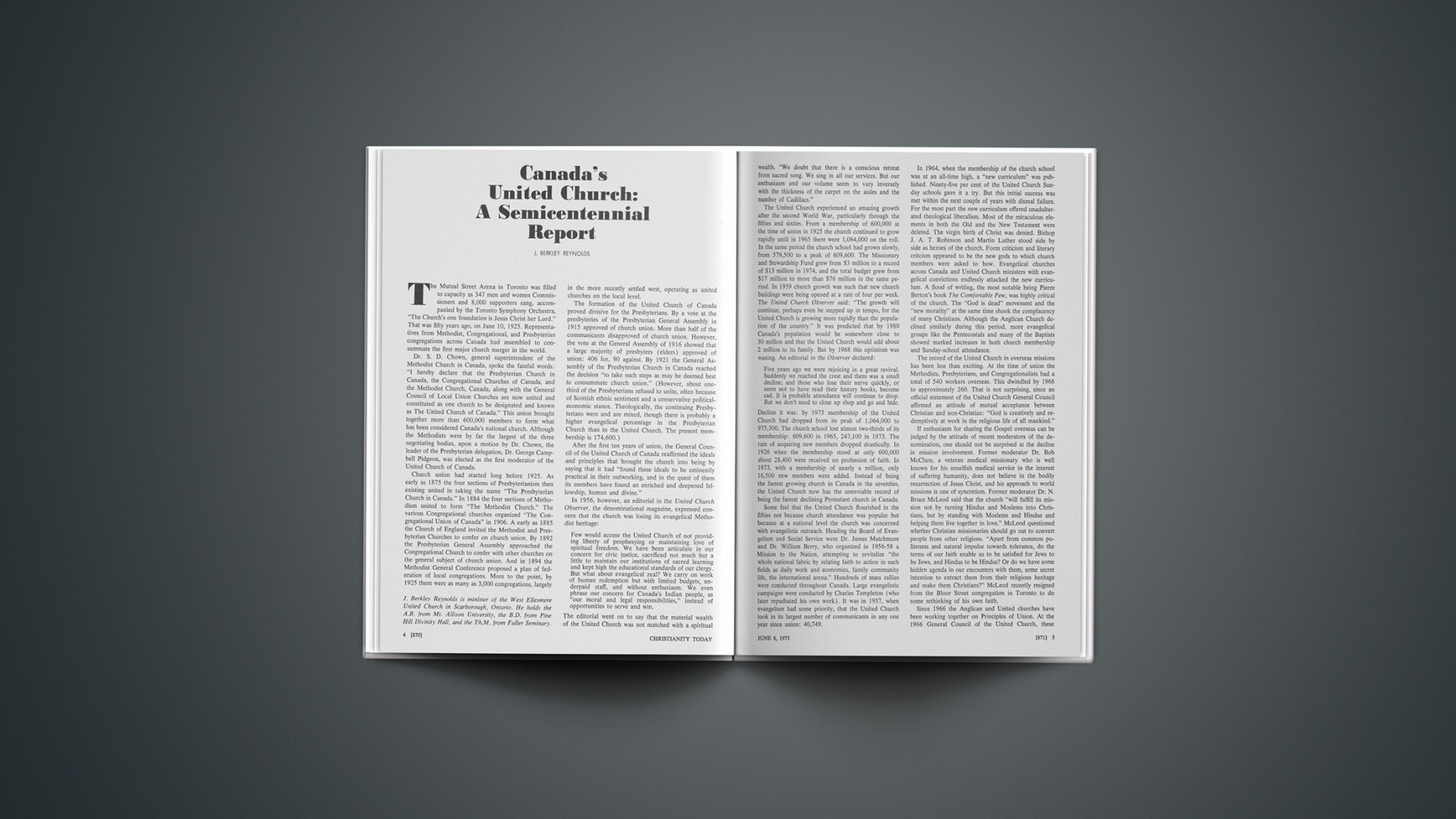
Canada’s United Church: A Semicentennial Report

The Mutual Street Arena in Toronto was filled to capacity as 347 men and women Commissioners and 8,000 supporters sang, accompanied by the Toronto Symphony Orchestra, “The Church’s one foundation is Jesus Christ her Lord.” That was fifty years ago, on June 10, 1925. Representatives from Methodist, Congregational, and Presbyterian congregations across Canada had assembled to consummate the first major church merger in the world.

Dr. S. D. Chown, general superintendent of the Methodist Church in Canada, spoke the fateful words: “I hereby declare that the Presbyterian Church in Canada, the Congregational Churches of Canada, and the Methodist Church, Canada, along with the General Council of Local Union Churches are now united and constituted as one church to be designated and known as The United Church of Canada.” This union brought together more than 600,000 members to form what has been considered Canada’s national church. Although the Methodists were by far the largest of the three negotiating bodies, upon a motion by Dr. Chown, the leader of the Presbyterian delegation, Dr. George Campbell Pidgeon, was elected as the first moderator of the United Church of Canada.

Church union had started long before 1925. As early as 1875 the four sections of Presbyterianism then existing united in taking the name “The Presbyterian Church in Canada.” In 1884 the four sections of Methodism united to form “The Methodist Church.” The various Congregational churches organized “The Congregational Union of Canada” in 1906. A early as 1885 the Church of England invited the Methodist and Presbyterian Churches to confer on church union. By 1892 the Presbyterian General Assembly approached the Congregational Church to confer with other churches on the general subject of church union. And in 1894 the Methodist General Conference proposed a plan of federation of local congregations. More to the point, by 1925 there were as many as 3,000 congregations, largely in the more recently settled west, operating as united churches on the local level.

The formation of the United Church of Canada proved divisive for the Presbyterians. By a vote at the presbyteries of the Presbyterian General Assembly in 1915 approved of church union. More than half of the communicants disapproved of church union. However, the vote at the General Assembly of 1916 showed that a large majority of presbyters (elders) approved of union: 406 for, 90 against. By 1921 the General Assembly of the Presbyterian Church in Canada reached the decision “to take such steps as may be deemed best to consummate church union.” (However, about one-third of the Presbyterians refused to unite, often because of Scottish ethnic sentiment and a conservative political-economic stance. Theologically, the continuing Presbyterians were and are mixed, though there is probably a higher evangelical percentage in the Presbyterian Church than in the United Church. The present membership is 174,600.)

After the first ten years of union, the General Council of the United Church of Canada reaffirmed the ideals and principles that brought the church into being by saying that it had “found these ideals to be eminently practical in their outworking, and in the quest of them its members have found an enriched and deepened fellowship, human and divine.”

In 1956, however, an editorial in the United Church Observer, the denominational magazine, expressed concern that the church was losing its evangelical Methodist heritage:

Few would accuse the United Church of not providing liberty of prophesying or maintaining love of spiritual freedom. We have been articulate in our concern for civic justice, sacrificed not much but a little to maintain our institutions of sacred learning and kept high the educational standards of our clergy. But what about evangelical zeal? We carry on work of human redemption but with limited budgets, underpaid staff, and without enthusiasm. We even phrase our concern for Canada’s Indian people, as “our moral and legal responsibilities,” instead of opportunities to serve and win.

The editorial went on to say that the material wealth of the United Church was not matched with a spiritual wealth. “We doubt that there is a conscious retreat from sacred song. We sing in all our services. But our enthusiasm and our volume seem to vary inversely with the thickness of the carpet on the aisles and the number of Cadillacs.”

The United Church experienced an amazing growth after the second World War, particularly through the fifties and sixties. From a membership of 600,000 at the time of union in 1925 the church continued to grow rapidly until in 1965 there were 1,064,000 on the roll. In the same period the church school had grown slowly, from 579,500 to a peak of 609,600. The Missionary and Stewardship Fund grew from $3 million to a record of $13 million in 1974, and the total budget grew from $17 million to more than $76 million in the same period. In 1959 church growth was such that new church buildings were being opened at a rate of four per week. The United Church Observer said: “The growth will continue, perhaps even be stepped up in tempo, for the United Church is growing more rapidly than the population of the country.” It was predicted that by 1980 Canada’s population would be somewhere close to 30 million and that the United Church would add about 2 million to its family. But by 1968 this optimism was waning. An editorial in the Observer declared:

Five years ago we were rejoicing in a great revival. Suddenly we reached the crest and there was a small decline; and those who lose their nerve quickly, or seem not to have read their history books, become sad. It is probable attendance will continue to drop. But we don’t need to close up shop and go and hide.

Decline it was: by 1973 membership of the United Church had dropped from its peak of 1,064,000 to 975,300. The church school lost almost two-thirds of its membership: 609,600 in 1965, 247,100 in 1973. The rate of acquiring new members dropped drastically. In 1926 when the membership stood at only 600,000 about 28,400 were received on profession of faith. In 1973, with a membership of nearly a million, only 16,500 new members were added. Instead of being the fastest growing church in Canada in the seventies, the United Church now has the unenviable record of being the fastest declining Protestant church in Canada.

Some feel that the United Church flourished in the fifties not because church attendance was popular but because at a national level the church was concerned with evangelistic outreach. Heading the Board of Evangelism and Social Service were Dr. James Mutchmore and Dr. William Berry, who organized in 1956–58 a Mission to the Nation, attempting to revitalize “the whole national fabric by relating faith to action in such fields as daily work and economics, family community life, the international arena.” Hundreds of mass rallies were conducted throughout Canada. Large evangelistic campaigns were conducted by Charles Templeton (who later repudiated his own work). It was in 1957, when evangelism had some priority, that the United Church took in its largest number of communicants in any one year since union: 40,749.

In 1964, when the membership of the church school was at an all-time high, a “new curriculum” was published. Ninety-five per cent of the United Church Sunday schools gave it a try. But this initial success was met within the next couple of years with dismal failure. For the most part the new curriculum offered unadulterated theological liberalism. Most of the miraculous elements in both the Old and the New Testament were deleted. The virgin birth of Christ was denied. Bishop J. A. T. Robinson and Martin Luther stood side by side as heroes of the church. Form criticism and literary critcism appeared to be the new gods to which church members were asked to bow. Evangelical churches across Canada and United Church ministers with evangelical convictions endlessly attacked the new curriculum. A flood of writing, the most notable being Pierre Berton’s book The Comfortable Pew, was highly critical of the church. The “God is dead” movement and the “new morality” at the same time shook the complacency of many Christians. Although the Anglican Church declined similarly during this period, more evangelical groups like the Pentecostals and many of the Baptists showed marked increases in both church membership and Sunday-school attendance.

The record of the United Church in overseas missions has been less than exciting. At the time of union the Methodists, Presbyterians, and Congregationalists had a total of 540 workers overseas. This dwindled by 1966 to approximately 260. That is not surprising, since an official statement of the United Church General Council affirmed an attitude of mutual acceptance between Christian and non-Christian: “God is creatively and redemptively at work in the religious life of all mankind.”

If enthusiasm for sharing the Gospel overseas can be judged by the attitude of recent moderators of the denomination, one should not be surprised at the decline in mission involvement. Former moderator Dr. Bob McClure, a veteran medical missionary who is well known for his unselfish medical service in the interest of suffering humanity, does not believe in the bodily resurrection of Jesus Christ, and his approach to world missions is one of syncretism. Former moderator Dr. N. Bruce McLeod said that the church “will fulfill its mission not by turning Hindus and Moslems into Christians, but by standing with Moslems and Hindus and helping them live together in love.” McLeod questioned whether Christian missionaries should go out to convert people from other religions. “Apart from common politeness and natural impulse towards tolerance, do the terms of our faith enable us to be satisfied for Jews to be Jews, and Hindus to be Hindus? Or do we have some hidden agenda in our encounters with them, some secret intention to extract them from their religious heritage and make them Christians?” McLeod recently resigned from the Bloor Street congregation in Toronto to do some rethinking of his own faith.

Since 1966 the Anglican and United churches have been working together on Principles of Union. At the 1966 General Council of the United Church, these principles were adopted by an overwhelming vote and sung in with “Praise God from whom all blessings flow,” but since then the music has changed from enthusiastic doxology to a solemn requiem. Recently the Anglican House of Bishops released a “Statement of Counsel” in which it said:

We find ourselves agreed that the Plan of Union in its present form is unacceptable; most of us doubt that there is serious hope for a successful outcome of a further revision process. We base this conclusion in part on our perception that our churches have not yet reached a common mind on Faith and Order. We think also that the climate of feeling, at least in our own constituency, seems at the present time less favourable to organic union and more disposed toward other expressions of unity.

The Christian Church (Disciples of Christ), a tiny co-participant in the Anglican-United merger talks, may proceed to join its four thousand members to the United Church alone. The action by the Anglican House of Bishops is bound to affect cooperation in local areas where union is contemplated. Recently, in a new development in a suburb of Toronto, the Anglican Church refused an offer by the United Church to cooperate in a joint venture of ministering to the community.

In 1968 a small group of ministers and laymen in the United Church, concerned about the growth of liberalism and the decline of membership, formed the United Church Renewal Fellowship. The aim was to set up small chapters across Canada for prayer and Bible study and thereby to encourage members who would otherwise leave and join some other denomination. Its quarterly periodical, The Small Voice, is circulated widely throughout the church. Although the Renewal Fellowship has grown slowly, it has had a stabilizing effect upon the church.

Recently a new group has come to the forefront in United Church life: Church Alive. It is headed by Graham A. D. Scott, who holds a doctorate from the University of Strasbourg. Church Alive is “a theological association and spiritual fellowship” whose aims are (1) to make a clear, biblical witness to Jesus Christ, crucified, risen, and exalted; (2) to engage in rigorous theological inquiry and discussion; (3) to challenge doctrinal inadequacies in the church; (4) to encourage spiritual growth through prayer, Bible learning, sacramental worship, and other means of grace; (5) to encourage a biblically prophetic approach to the culture and society. Church Alive has mustered some of the heavyweights in the United Church including Professor John B. Corston of Atlantic School of Theology in Halifax, Dr. Leonard Griffith of Dear Park United Church, Toronto, Dr. Eveleigh Smith of Westminster United Church in Regina, Dr. John Wilkie of Forest Grove United Church, Toronto, and Professor Kenneth Hamilton, well-known theologian from Winnipeg.

Another who is calling the church back to the basics of the Christian faith is Alan Churchill, a former Royal Canadian Mounted Police officer who has a doctorate in New Testament from Oxford University and is now president of the London Conference. Churchill is concerned that many within the church are Christians in name only. In an interview with the United Church Observer he explained: “They know God loves them, but in the same sort of general way that they know that the government cares about them. When they read John 3:16 they’ve never taken the step of substituting their own names for ‘the world.’ ” He says that he became a Christian when he could say for himself, “For God so loved Alan Churchill that he gave his only Son.”

A new wind is also blowing at the headquarters level of the United Church. Dr. Norman MacKenzie, a secretary of the Division of Mission in Canada who is charged with the responsibility of evangelism in Canada, is arranging for a preaching mission and workshops on evangelism throughout the church. (MacKenzie was a delegate to last summer’s International Congress on World Evangelization in Lausanne, Switzerland.) Twenty-six men and women have been selected by the various conferences to serve as missioners and workshop leaders. Even though these may represent a broad spectrum of theological positions within the church and a variety of approaches to sharing the Gospel, many view the project with hope. Dr. Douglas Conlan, executive secretary of the Toronto United Church Council, believes that the church ought to get back to the basics of the Christian faith rather than expending all its energies on social services. He points out that the church in Alberta is experiencing a vacuum in its mission because the Alberta government has taken over all the social services in the communities. “We must set our priorities in order,” says Conlan.

The charismatic movement has not bypassed the United Church. Tongues-speaking ministers are to be found in every presbytery. The Reverend Bernard Warren, a graduate engineer who was converted after he was ordained, heads up the Bezek Retreat Centre sixty miles from Toronto. Warren has overflow crowds at the center every weekend, many of them ministers and laymen from metropolitan Toronto. Harold Moddle, a former executive with Bell Telephone who succeeded Warren at Toronto’s Alderwood United Church, continues to give strong leadership in what is known as Toronto’s “charismatic congregation.” Moddle is well respected by fellow ministers in the Toronto Conference for his administrative ability but says he finds most of his fellowship with charismatic priests of the Roman Catholic Church.

Emmanuel College in Toronto is the church’s largest institute for training ministers, and it has felt the impact of charismatics and other evangelicals in the student body. Principal William Fennel, a neo-orthodox theologian, says that students tried to convert him “four times in one day.” Many students at Emmanuel feel they have much more in common with Roman Catholic professors than with some of Emmanuel’s faculty. Wherever possible they also select courses at nearby Wycliffe College, an Anglican seminary where the well-known evangelical scholars R. K. Harrison and Richard Longenecker teach. Emmanuel recently appointed Professor Heinz Guenther, a German-born Bultmannian, to head up its department of New Testament.

Although the United Church has been criticized for being too long on social service and far too short on evangelism, the tide seems to be shifting. Local churches are beginning to support independent missions rather than pouring all their money into the Mission and Service Fund of the national church. With the death of the new curriculum, hundreds of churches are turning to Sunday-school material put out by Gospel Light, Scripture Press, and David C. Cook. There seems to be an awareness that all the political lobbying has not made for church growth. Theological liberalism has been weighed in the balance and found wanting.

There is a call from numerous quarters for the church to get back to the Basis of Union, a document of twenty statements of faith agreed upon by the representatives of the Presbyterian, Methodist and Congregational Churches at the time of union in 1925. This document remains the only official teaching of the United Church. Among the affirmations included in it are these: (1) Jesus Christ was “conceived of the Holy Spirit and born of the Virgina Mary.” (2) “Jesus Christ fulfilled all righteousness, offered Himself a perfect sacrifice on the Cross, satisfied Divine Justice and made propitiation for the sins of the whole world. He arose from the dead and ascended into heaven, where He ever intercedes for us.” (3) “We receive the Holy Scriptures of the Old and New Testaments, given by inspiration of God, as containing the only infallible rule of faith and life, a faithful record of God’s gracious revelations, and as the sure witness of Christ.” (4) “We believe that there shall be a resurrection of the dead, both of the just and of the unjust, through the power of the Son of God, who shall come to judge the living and the dead; that the finally impenitent shall go away into eternal punishment and the righteous into life eternal.”

There is a growing tide of opinion that as the United Church faces the next half century there will be a new emphasis upon biblical preaching and teaching. Articulate and scholarly men like Churchill, Hamilton, and Scott will be giving much of the leadership. Union with the Anglicans may come, but right now that does not seem to be a priority among either the clergy or the laity. While church merger may have gone down the drain for the time being, the feeling of oneness in Christ nourished by the thousands of interdenominational Bible-study groups across the nation is giving a new hope for a more evangelical church in Canada.

Christian Colleges: An Endangered Species?

Like the inconspicuous, pensive Spotted Owl of the American West, the small church-related college is an endangered species. More than seventy private schools, the vast majority of them church-affiliated colleges, have folded in the last five years, and a number of others are in trouble. Still others have shed their denominational affiliations in a bid for broader support.

Despite the soaring costs and recruitment problems, however, there are significant exceptions to the trend. A CHRISTIANITY TODAY survey shows that many evangelical colleges are as strong as ever, and some are enjoying their best health in years.

The survey suggests that the more blurred a school’s reason for being, the poorer its chances for survival. In other words, evangelical schools may be making a good showing because of, not in spite of, their distinct Christian commitment.

Fiscal problems plague everybody, even the big secular schools receiving enormous injections of public aid. College costs for the student have risen faster than the Consumer Price Index: in the last ten years tuition alone has more than doubled, while the CPI has risen 66 per cent. Along with the tuition hikes have gone boosts in fees, room and board, books, and other expanses. College costs will be 6 to 8 per cent higher this fall than last, according to College Entrance Board findings. Tuition rates in excess of $3,000 per year are already the rule rather than the exception at private colleges.

The soaring costs undoubtedly have priced otherwise qualified and interested students out of the private-college market. Heavily subsidized schools like the community junior colleges can charge lower rates, hurting recruitment efforts of the church-related colleges.

Various remedies have been proposed. Last March the Carnegie Council on Policy Studies in Higher Education urged the federal government to increase its aid to private colleges and universities. The council suggested that “tuition equalization grants,” averaging about $750 a year, be paid directly to the student.

Among some 5,700 institutions eligible for federal aid are the estimated 700 to 800 church-related and independent Christian schools, according to Robert Andringa, a congressional staff specialist in educational affairs. Aid to religious schools is subject to limitations imposed by the principle of church-state separation, and some Christian colleges as a matter of policy have resisted all government funding other than scholarship and student loan programs. Direct grants to students would be a way around such funding problems and would provide a greater variety of options, similar to those enjoyed by war veterans under GI bills (many vets got their education at Bible institutes and Christian colleges that rejected or were ineligible for federal aid).

Student grants would also enable the private schools to stand more stably in the fiercely competitive recruitment marketplace. During the 1950s, says Andringa, private schools enrolled nearly 50 per cent of all college students, but that figure is now down to under 25 per cent. Competition, he points out, will become exceedingly stiff by 1980, when the number of prospective students will decrease by 25 per cent, reflecting the population decline. In some states the decline may be as high as 35 per cent. As of now, he adds, only about one-half of America’s graduating high school seniors enter college.

Andringa, a member of Fourth Presbyterian Church in Washington, D. C., foresees serious difficulties for the small church-related colleges that have lost their distinctiveness as Christian institutions. “If such schools offer no more than a public university does at a much greater cost to the student, they cannot hope to survive,” he asserts. Of the more than 700 church-related and independent Christian schools, he speculates, only about eighty show in classroom atmosphere and requirements a firm commitment to Christianity.

Until recently Andringa believed that evangelical schools could accept government support without compromising their Christian position. But now he thinks such schools “will be forced slowly and subtly into a secular mold if they continue to accept public aid.” College officials are also concerned about the prospect, and one dean says, “We’re all watching the developments very closely.”

Nearly every Christian college receives some form of governmental assistance, if only indirectly in the form of the National Direct Student Loan Program. There are other federal student-aid programs, and about thirty-five states offer student-help plans.

Advocates of strict separation of church and state argue that all public aid to religious institutions is a violation of the establishment-of-religion clause in the First Amendment of the U. S. Constitution. Americans United, based in Washington, D. C., has led many battles against such government funding. AU spokesman Ed Doerr says that the states of Washington and Nebraska have had their aid programs ruled unconstitutional within the past year. Maryland’s plan was ruled unconstitutional in 1966, but that decision in effect was negated last year in an action involving three Catholic schools. In Tennessee, AU fought a successful court battle in which direct aid to students who attend religious colleges was ruled unconstitutional. The U. S. Supreme Court will hear both the Maryland and Tennessee cases this fall in what may be a watershed decision, especially in light of the direct-student-aid issue. The survival of many religious colleges could depend on it.

(The 1966 Maryland decision established criteria for determining whether or not a private college can be considered a sectarian one. Among the criteria are board composition and the way the school is governed, entrance and behavioral requirements such as a profession of faith and compulsory chapel, and the image of the college in the community.)

Gordon R. Werkema, executive director of the Christian College Consortium, a twelve-member organization of non-denominational and church-affiliated evangelical schools, thinks the significant issue is not the first half of the First Amendment but the second, that the state cannot make any law prohibiting the free exercise of religion. For those schools in the consortium, says Werkema, religion and education are inextricably bound together. He fears that if government aid is granted only to secular institutions the subtle effect will be to sponsor a religion of secular humanism. What the state will be saying, explains Werkema, is that “since we’re supposed to be neutral, we’ll only support those institutions that appear neutral.” But in reality, he insists, secular institutions espouse secular humanism as a religious philosophy or world view.

Contrary to the trend of many church-related schools that are broadening their base to ensure public aid, the consortium schools are taking a firmer stand on their commitment to Christianity, says Werkema. Enrollments at the consortium schools are stable or rising (see chart, this page); some enrollments are constant only because the schools are operating at capacity and can’t take any more students. Also, the consortium schools are not revamping their liberal-arts orientation to accede to the mounting cries for a more vocation-centered education.

Dean Richard Gross of 1,000-student Gordon College in Wenham, Massachusetts, says that not only enrollment but also the retention rate is up at his school. He estimates Gordon’s retention rate as 92 per cent and says the average for most institutions is between 60 and 70 per cent. Rising costs have not hurt the school’s growth, he adds.

Admissions director J. David Yoder of 950-student Eastern Mennonite College in Harrisonburg, West Virginia, says his school maintained a constant enrollment from 1970 until last fall, when it dipped about 5 per cent.

The enrollment of 1,460-student Bethel College, a Baptist General Conference school, shot up 40 per cent after its move three years ago from downtown St. Paul, Minnesota, to the suburbs, according to Acting Dean Dwight Jessup. “We were simply at capacity level at our old campus,” he explains.

National studies show that enrollments decrease in small private schools as costs increase. But George Fox College, an Evangelical Friends school in Newberg, Oregon, with an enrollment of 470, is an illustration of the counter-trend going on among Christian schools. Costs have risen about 5 per cent annually for the past five years, but enrollment has increased at about the same rate. Gift income is also up (more than $2 million for the building program in the last two years). A school official gives credit to an aggressive development and recruitment program.

The 5 per cent rate of increase in both costs and enrollment also applies to 2,250-student Seattle Pacific College, says Dean William Rearick. Costs at 2,200-student Wheaton and at Eastern Mennonite have risen even more dramatically—about 50 per cent since 1970.

While the consortium schools are resisting pressures to have a more career-oriented curriculum, they are developing what Werkema calls “links” between the liberal arts and vocational courses.

For instance, Gordon plans to add finance and management courses to its economics major next fall, and it is emphasizing special education in its elementary education program. Officials are also looking into the possibility of a cooperative program with a secular university for students who desire an engineering degree. The first two years would be spent at Gordon, the last two at the university. But, says Gordon’s Gross, 840-student Westmont College in Santa Barbara, California, has had this arrangement with Stanford University for several years and “not many students take the option.” (Several other schools are contemplating similar joint-education plans.)

Additionally, Gordon is expanding its fine-arts program (drama, speech, art), and its music program has accreditation pending by the National Association of Schools of Music.

Houghton College, a Wesleyan Church-related school in western New York, is also at near-capacity with 1,200 students. It is working with adult and continuing-education programs and is conducting career-motivation studies.

Some schools that have not had business or social-work majors are adding them. But other majors are suffering, especially languages. At Wheaton, German and Greek have been dropped as majors. A spokesman says not enough students chose these majors to justify their continuance. On the other hand, says academic dean Donald Mitchell, the new self-instructional language program has been so successful this year that faculty cuts in the language department may be unnecessary.

Special workshops and intern programs are two other ways in which consortium schools plan to help meet the career needs of their students.

Dean Ron Sider of the Philadelphia campus of 840-student Messiah College, a Brethren in Christ school near Harrisburg, Pennsylvania, predicts more schools will create urban campuses, where students can live in a Christian community and still have the opportunity to major in such areas as film, radio, and television. Houghton already has a Buffalo campus, and Westmont has one in San Francisco.

All things considered, it appears that the evangelical colleges are not as endangered as many of the private schools whose religious commitments are less defined. But, administrators caution, it will take tight-fisted management to get by the difficult places. Expensive low-priority expansion plans are likely to be shelved, courses will be cut if student sign-ups are consistently low, and frills will be eliminated.

In the face of all this, Werkema sums up the attitude expressed by leaders of the evangelical schools:

“We’re concerned but not worried about the economic situation. We’re deepening our commitment to Christ, to community, and to preparing people to function Christianly in society. And we will not give up our distinctive mission as Christian institutions of higher education.”

REGRETFULLY YOURS

Vacationing professor Curtis Vaughan of Southwestern Baptist Seminary in Fort Worth, Texas, was about to board an underground train in London when a man blocked his way. Two men behind Vaughan began to push and yell at the man blocking the way. Suddenly, the man steppied off the train and left with the other two.

Strange behavior, thought Vaughan. At the next train stop he discovered his wallet was missing. It contained identification cards, traveler’s checks, credit cards, and more than $300 in cash.

Later, he received in the mail a bulky envelope containing a wad of money and a note:

“From an apologetic pickpocket. Dear Rev. I am returning my share of the wallet. I apologize for robbing a man of the church.”

FOREIGN MISSIONS FIRST

Toronto’s 2,200-member Peoples Church (“the church that puts foreign missions first”) at its recent annual World Missions Conference received a record $960,000 in “faith promises” (pledges) for the congregation’s vast world outreach program. Of this amount, $ 169,000 came in response to a two-hour telethon SOS (Survival Or Starvation) appeal on four TV channels. Pastor Paul B. Smith said that all of the appeal money would be sent to the World Relief Commission of the National Association of Evangelicals for its sub-Sahara relief work.

The bulk of the faith-promise income, to be spread out over the next year, is for the support of 355 Canadian missionaries serving in sixty-eight countries under forty-two missionary agencies. The Peoples Church-supported force also includes 125 national workers, some of whom were at the conference.

One of the persons attending the conference was Peoples Church founder Oswald J. Smith, Pastor Paul Smith’s father, 84, who introduced the faith-promise idea back in 1933. At a conference that year $23,586 was raised. Since then, more than $8 million has been given to evangelical foreign mission work ($711,000 last year).

Both Smiths have helped other churches around the world implement similar plans, and the annual conferences always attract a number of American pastors who want to see the plan in action where it all began.

Religion In Transit

Oral Roberts University, founded by the evangelist known best as a faith healer, announced plans to build a $60 million medical school. Officials hope it will be operating by 1980, along with graduate schools of law and dentistry. An undergraduate school of nursing will open this fall.

A federal court jury dismissed a $1 million lawsuit against H. R. Haldeman and other former White House aides in connection with an October 15, 1971, rally in Charlotte, North Carolina, honoring evangelist Billy Graham. Eighteen anti-war demonstrators had claimed they were excluded illegally from the rally, which was addressed by then-president Richard Nixon.

Fundamentalist minister Carl McIntire is facing another fiscal crisis. A fund-raising letter indicates he needs $235,000 by May 27 or the bank will not renew the mortgage on his Christian Admiral seashore conference center and other New Jersey properties. He is asking for donations and short-term loans “at whatever rate you desire.” Tax officials said that as of January 1 he owed more than $220,000 in taxes on the Admiral and other property.

All twenty-four major-league baseball teams now have a Sunday pre-game chapel session when they are on the road, according to Baseball Chapel coordinator Watson Spoelstra. Total attendance for thirteen teams on the first Sunday of the season was 247 (home team Los Angeles held a chapel), four times better than last year.

Delegates of the 4,000-member Federation for Authentic Lutheranism (FAL) voted to merge with the 390,000-member Wisconsin Evangelical Lutheran Synod. The action must be confirmed by the eleven congregations of FAL, begun in 1971 by conservatives who left the Lutheran Church-Missouri Synod over alleged liberalism.

The 4,825-congregation American Lutheran Church celebrated its fifteenth birthday with a special United Mission Appeal that has resulted in gifts and pledges of $30 million to expand the denomination’s ministries at home and abroad.

Executive Director James E. Wood, Jr., of the Baptist Joint Committee on Public Affairs in Washington, D. C., fired off a protest to the American Revolution Bicentennial Administration (ARBA). An ARBA plan would provide matching grants of up to 50 per cent of the total cost of bicentennial projects undertaken by religious and other private groups. Wood cited church-state separation issues.

Evangelist Bill Glass and 128 volunteers, including well-known sports personalities, conducted evangelistic meetings at three Florida prisons. An estimated 1,000 of the 4,600 inmates made professions of faith in Christ.

Personalia

Divinity professors James S. Stewart (University of Edinburgh) and William Barclay (University of Glasgow) last month became the first Scots to receive the annual Upper Room citations. Printed in forty languages, the Nashville-based Upper Room is the world’s most widely used daily devotional guide.

Presbyterian minister A. Donald MacLeod of Toronto has been appointed general secretary of Inter-Varsity Christian Fellowship of Canada, succeeding Samuel Escobar, effective August 1.

Pastor Paige Patterson of First Baptist Church in Fayetteville, Arkansas, has been named the new president of Criswell Bible Institute, succeeding H. Leo Eddleman who has retired. The school is operated by the 18,000-member First Baptist Church of Dallas.

World Scene

The World Council of Churches will spend $479,000 to step up its antiracism campaign. Half of the money will go to groups seeking black majority rule in South Africa and Rhodesia. The American Indian Movement in the U. S. will receive $15,000.

Ecumenism seems to be ebbing in Northern Ireland. The majority of the Irish Presbyterian synods have endorsed a request calling for the withdrawal of the denomination from the World Council of Churches. The petition will be acted upon at next month’s General Assembly.

Ioan (John) Samu, perhaps Romania’s foremost Gypsy evangelist, has been jailed on charges stemming from his religious activities. He was fined many months of salary in past incidents.

DEATH

WILLIAM J. WALLS, 89, retired senior bishop of the African Methodist Episcopal Zion Church; in Yonkers, New York, of a kidney ailment.

The Nuclear Family: Today’s Whipping Boy

Discussion of marriage and family, whether by religious or by secular thinkers, seldom continues long without making disparaging statements about the nuclear family. The term itself has a negative implication. “Nuclear” suggests self-containment and lack of creative interaction with others of the same type.

The conventional wisdom is that the family consisting of two parents, permanently committed to each other, and their children is an institution out of keeping with the times. Such a family is considered to be a residential and inheritance group whose members have mutual affinities and interests so self-regarding that an adequate value system for the times cannot be transmitted in it.

Some think the monogamous family is totally inadequate to the task of meeting, not only social needs, but also the personality development needs of the persons involved. These include the romantic and sexual requirements of adult members and the needs of the young to develop young toward wholeness and creative adulthood. Many persons, including some Christians, feel that the conjugal family has been weighed in the balances at this point and found wanting.

Various remedial proposals are being made. The more moderate retain the basic features of the monogamous family; the more radical propose life-styles that frankly challenge and supplant it.

The moderate proposals are usually attempts to overcome the isolation that the conventional family is said to produce. This isolation is often identified with the separate family dwelling. What is proposed is an extension of the “family” that would involve monogamous groups in a network or grid of families, three or four being the ideal number, and would extend many aspects of the intimacy that belongs to conventional marriage.

What limits should this have? What degree of privacy is essential to meaningful marital life? What degree of unity among parental figures is necessary to the discipline of children? These are some of the unanswered questions.

Underlying this kind of proposal is the assumption that couples need some type of close exposure to other conjugal units, and that children need to be exposed to more than two parent-figures. These needs are held to overbalance the need for the privacy and compactness provided by the usual form of family life. These are, to say the least, major assumptions.

The various types of communes offer more radical solutions to the problems presumably posed by the nuclear family. Underlying most commune-forms is the view that it is emotionally and socially desirable for a man to love more than one woman and a woman to love more than one man. This love may or may not have a sexual aspect; certainly in many cases it is not ruled out.

Some communes claim a religious and spiritual basis, but the majority of the 3,000-plus operating in the United States apparently do not. There are both rural and urban communes. As a general rule, the religiously based groups are more stable than the others. Also, the rural communes suffer less from the incursions of transients, runaways, and drug addicts that plague those in urban areas.

One gains the impression that rural communes are more orderly. The relative degree of sexual permissiveness in the two geographic types is undetermined; there are evidences both ways. Many communes seem to subsist largely on romantic enthusiasm and novelty. If reports may be believed, many break up over sleeping arrangements.

A common denominator seems to be the desire to develop extended or group familial relationships. But some of the problems involved seem insuperable. The splitting of authority over children when there are multiple parent-figures, the normal desire for male certainty about paternity—these and other factors seem to lend at least some support to the view that the monogamous family is one of the Creator’s orders for mankind.

The story is told of the fond mother who sent the following message to her son’s schoolteacher: “DEAR TEACHER: If my Archibald is naughty—and he sometimes is—just whip the boy next to him. This will frighten Archibald and make him behave.” One is tempted to wonder whether the concerned attack upon the nuclear family, by writers of both religious and secular orientation, is an attempt to do something of this sort. The real target may be, not the nuclear family, but something much more profound.

Involved in many of the “new and creative life-styles in marriage” is the downgrading of what has been commonly accepted as Christian morality. In the United States, the attack upon this is much less vehement and virulent than it commonly is in Europe, where the one concerned to maintain such standards is dubbed a Philistine. Here, he or she is more likely to be called a WASP (white Anglo-Saxon Protestant), and his or her ethical standards are likely to be termed “middle-class morality.”

While the defects of the controversial family are many, it is far from clear that the comparisons between it and proposed alternative life-styles are fairly made. The alternatives are often portrayed in less than realistic terms, designed to give a better impression than is warranted.

A case in point is found in an article in the January, 1975, issue of the Christian Home, publication in which three major denominations participate. The article, “The ‘Commune’ Next Door,” presents a glowing picture of Iris Mountain Community, a religiously based community of the less radical type.

Quite possibly the report is wholly factual. What is misleading is the implication that this is a representative commune. Nothing is said about the deeper familiar arrangements or the type of marital theory that underlies the community. In my view, it is grossly misleading to imply that this is a typical commune, and that communes in general are the idyllic places that the report suggests. If few are as perverse as Charles Manson’s, few seem as ideal as Iris Mountain.

Might not spokesmen for the Christian Church, instead of presenting glowing pictures of communes and favorable reviews of books such as Nena and George O’Neill’s Open Marriage, do better to recognize the “new life-style” adventures in marriage for what they are, namely, a rejection of structured relationships and of divine ordinances? And why not emphasize instead family life based upon fidelity, upon lifelong commitments made and kept?

Editor’s Note from May 23, 1975

We have had some staff changes of late—not so dramatic as the one that took place at a nearby office (the Oval) last year but important to us. Irma Peterson, my loyal, faithful, and very competent secretary, has retired and she will be returning to California. She left the Golden State nearly two decades ago to throw in her lot with CHRISTIANITY TODAY. Through the years she has occupied an office at the corner of our Washington Building suite, and it does seem as if we have lost a piece of our cornerstone. Miss Peterson takes with her our hearty affection and appreciation.

Stephen Wike, formerly our advertising manager, has been appointed business manager. We welcome him to this responsible new post. Melvin Sorenson has left the staff to join the Evangelical Foundation in Philadelphia. He did a great job for us, and we are sorry to see him go. Sterling Mehring is now our advertising representative, and Johanna Patterson is acting circulation manager.

The Wendt Case: Women on Trial

Until this month the only ecclesiastical trial ever held in the Episcopal diocese of Washington, D. C., was one in 1898 when a rector (parish pastor) was charged with immoral conduct. Early this month another rector went on trial, charged with disobeying his bishop in a matter involving the ordination of women to the priesthood. Clergy and laity throughout the three-million-member Episcopal Church followed the nationally publicized trial with keen interest; the issues raised there have been the topics of intense debate in the denomination for some time, and some high-church leaders warn of schism if the issues are resolved against them. The trial even enmeshed Presiding Bishop John M. Allin (see following story). Ironically, he faces possible disciplinary charges for trying to keep out of the case.

On trial was William A. Wendt, 55, rector since 1960 of the controversially innovative Church of St. Stephen and the Incarnation in Washington. In November, against the instructions of diocesan bishop William Creighton, he had invited a woman, Alison Cheek, to celebrate the Eucharist at a Sunday morning service (see November 22, 1974, issue, page 63, and December 6, 1974, issue, page 45).

The Australian-born Mrs. Cheek, raised a Methodist, was one of eleven women deacons ordained to the priesthood by three retired bishops in a service last July in Philadelphia. The service was attended by nearly 2,000, including seventy-five clergy who joined in the laying on of hands. In an emergency meeting the following month, the House of Bishops ruled that the ordinations were invalid. The bishops, most of whom favor ordination of women, asked that no further actions be taken until after next year’s denominational convention when the issue will again be voted upon (it failed to gain approval at the 1973 convention).

Wendt had originally invited Mrs. Cheek, 47, a staff assistant at a suburban church in Virginia, to preside at communion in August but canceled her at the request of Bishop Creighton. After the November service Creighton expressed his disappointment but said he would not discipline Wendt. Some of Wendt’s fellow clergymen, however, preferred charges.

The three-day trial was held in the gothic-styled St. Columba’s church in Washington. The panel of five black-robed judges (three clergymen and two lawyers, one of them a woman) sat at a long table in front of the pulpit area. At their right sat their legal counsel, Edmund D. Campbell, the attorney who successfully argued the one-man, one-vote case before the U. S. Supreme Court. Attorney Llewellyn C. Thomas acted as presiding judge.

A folding card table served as the witness stand. Behind another table just inside the altar rail on the right sat attorney E. Tillman Stirling, the tall, youngish-looking church prosecutor who technically represented the group who lodged charges against Wendt. With Wendt at the defense table were attorneys Edward C. Bou, who is a member of St. Stephen’s, and the pint-sized William Stringfellow of Rhode Island, a noted lawyer and Episcopal lay theologian.

All the lawyers donated their services, though Wendt’s backers reimbursed Stringfellow for expenses.

A band of St. Stephen’s members sat in a wing to the right of the communion area. In the wing opposite them sat reporters and artists who sketched for TV coverage. Spectators, up to 200 or so, sat in the main pew section.

From the outset, prosecutor Stirling argued that only Wendt was on trial, not anyone else, with disobedience the only issue, not the ordination of women. “We can’t settle all the differences of the church here,” he said.

Stringfellow, on the other hand, insisted vigorously that the validity of Mrs. Cheek’s ordination was a central issue. The defense, he contended, needed to establish her right to celebrate the Eucharist as part of its case.

Presiding judge Thomas ruled that testimony on the ordination issue would be received subject to a decision later regarding its relevance.

The first prosecution witness was Bishop Creighton. He said he sent letters to both Wendt and Mrs. Cheek forbidding her from celebrating communion at St. Stephen’s, and he admonished Wendt verbally as well.

In cross-examination, Stringfellow inquired about the priestly vows of obedience to the bishop (see box, next page). “What on earth is a ‘godly admonition?” ’ he asked. Creighton hesitated a moment, then said, “I’m not sure, sir,” evoking laughter from the audience. Whatever, said Creighton, he expected the admonition to be obeyed.

An ardent advocate of women’s ordination, Creighton may have undercut the prosecution’s case. Probed by Stringfellow, he said if the church again votes against women’s ordination he will proceed to act on the issue himself according to the dictates of his conscience. This enhanced Wendt’s point that he too was acting on the basis of conscience, making the difference between them little more than a matter of timing.

Stirling rested his case after merely establishing that Wendt acted contrary to Creighton’s directives.

Stringfellow fielded an all-star cast. First came Bishop Robert DeWitt, resigned bishop of Pennsylvania who participated in the Philadelphia ordination service. He told of the months of talking and planning that preceded the service. No active bishop would join them, he conceded, and Presiding Bishop Allin had counseled against it. The ordinations were “irregular” but valid, he asserted. He said he acted in “obedience to the Holy Spirit.”

Under questioning, he told Stirling he had been an active bishop for fourteen years before the action. Asked how many women he had ordained in those years, he replied, “None.” “Didn’t the Spirit move you during that time?” Replied DeWitt: “The Spirit was moving for some time, but I didn’t move until July.” More laughter.

Stirling asked whether it would be good to do away with the canons (church laws) in favor of letting everyone do as the Spirit or conscience leads. No, said DeWitt, such defiance of law should be restricted to only the “most difficult” cases.

Asked about the meaning of “godly admonitions,” DeWitt seemed to imply that a priest is free to interpret which admonitions are godly ones and which ones are not.

Alison Cheek, chubby and clad in a light blue skirt and coat over a black shirt and clerical collar, told her story. It took her six years to go through Virginia Seminary instead of three because she had to look after her four children. Ordained a deacon in 1972, she soon found herself in a “crisis of integrity” over the women’s issue. When the Philadelphia opportunity was offered she took it as a way to be fulfilled, and the vestry (ruling board) of her church approved. “We must reaffirm and recapture the universality of Christ’s ministry,” she exhorted.

She conceded to Stirling that her diocesan Standing Committee had refused to give its consent to her ordination, basing its stand “on a sexist interpretation of the canons.” She also acknowledged that she had declined “to accede to requests” of the bishop of Virginia (he ordered her not to participate in the Philadelphia event), but again the questioning bogged down on the meaning of godly admonitions. “There is nothing godly in inferiorizing women and squelching their vocations,” she snapped. God is a God of love, she added, in whom there is neither male nor female.

Mrs. Cheek indicated that while she has not been invited to celebrate communion at any large public gatherings in Virginia, she does it regularly in small-group meetings.

Harvard sociologist Charles Willie recounted how he had resigned as Vice President of the House of Deputies (clergy and lay delegates) when the bishops invalidated the ordinations of the Philadelphia Eleven. He said it was his way of protesting the “inhumane treatment of women in the Episcopal Church.” He was the main speaker at the Philadelphia ordination service.

Why, Stirling asked Willie, did he not resign earlier—when Willie’s own House of Deputies failed to approve women’s ordination in 1973? Visibly discomforted, Willie said something about having a different strategy at the time.

Willie and other defense witnesses, including former presiding bishop John Hines, said their studies of the canons led them to conclude that the bishops’ action of invalidation was itself invalid, that they had no authority by themselves to legislate. They also maintained that there are no prohibitions against women’s ordination in the canons. Many observers concurred, saying the canons are silent except for the “he” pronoun, which could be interpreted generically.

(The normal requisites for regular ordination to the priesthood are as follows: The candidate must be at least 24 and serve as a deacon for one year, working on the staff of a church or church agency. He must be certified by his bishop and by his parish minister and vestry, then be recommended to the bishop by the Standing Committee of the diocese. Finally, there is the signed vow to obey the bishop.)

Lawyer Bou led Wendt through his background of work as a priest in the slums of New York and his involvement in the civil rights movement, including five arrests. Wendt was portrayed as one always out front fighting for the rights of dispossessed minorities. The decision to invite Mrs. Cheek to celebrate communion in November “was not taken flippantly,” said Wendt. There was a lot a prayer and a lot of consultation with many people, he said, with conscience being the final determinant.

Prosecutor Stirling recalled that Wendt had gone along with Bishop Creighton’s request to cancel a celebration by Mrs. Cheek in August. “Conscience persuaded you not to [let her] do it in August but persuaded you to [let her] do it in November?” “Yes,” replied Wendt softly. “Was the bishop acting in good conscience in making his decisions?” asked Stirling. “Certainly,” replied Wendt, launching into an attempt to explain why such dilemmas exist and how to cope with them. Some observers felt he was implying that bishops can act in good conscience but still be wrong because of their institutional trappings.

The trial ended much like it began, with Stirling objecting to all the “irrelevant” testimony on women’s ordination and asking the judges to rule strictly on the issue of disobedience. Stringfellow reiterated his points: Alison Cheek as a validly ordained priest had a right to celebrate the Eucharist, and Bill Wendt was justifiably bound by conscience to enable her to celebrate her priesthood.

A ruling by the judicial panel was expected within two or three weeks. A guilty verdict could bring Wendt censure or worse.

One of the important issues that surfaced in the trial was Congregationalism: To what degree can local churches order their own affairs? The high-church or Anglo-Catholic faction wants power concentrated at the top. The Wendt defense witnesses represent increasing numbers who have an opposite viewpoint, and it colors the way they see women’s ordination. Declares Bishop DeWitt, for example:

It needs to be said, clearly and strongly, that the place for the resolution of the ordination issue is wherever a congregation, or any comparable company of the faithful, desires the temporary or ongoing sacramental ministrations of a woman priest. The place is wherever a diocesan bishop who, with his Standing Committee, is convinced of the calling and qualifications of a woman deacon in his diocese, and proceeds to ordain her. And the time is now.

The Philadelphia Eleven have celebrated the Eucharist publicly in several cities (Rector L. Peter Beebe of an Oberlin, Ohio, church was scheduled to go on trial this month for action similar to Wendt’s), and other churches will probably invite them. “This is not a matter of schism or anarchy,” says DeWitt, “but the wide-scale expression of an emerging fact in the life of our church.”

As a sort of doxology, Bishop Creighton invited a woman priest to celebrate communion on May 4 at the Church of the Epiphany in Washington, D. C. She is Jane Hwang Hsien Yuen, 57, rector of the 2,000-member Holy Trinity Church in Kowloon, Hong Kong. In 1971 she and Joyce Bennett became the first women to be officially ordained to the full priesthood within the worldwide Anglican Communion. They were ordained by Anglican bishop Gilbert Baker of Hong Kong with the approval of their diocesan synod.

Miss Hwang is also the first woman priest officially to exercise priestly functions in an Episcopal church service in the United States, according to church sources.

This claim is disputed by Canon Charles H. Osborn, executive director of the American Church Union, a so-called high-church group. He says there is a question about the validity of these ordinations because they were not done with the approval of the church jurisdiction to which the Hong Kong diocese belongs.

The invitations to Miss Hwang are “additional coals heaped on the fire of divisiveness and unlawfulness,” says Osborn.

Miss Hwang doesn’t want to become entangled in the ordination controversy in America, but she says that “if women are not allowed equal positions with men, it means that a lot of persons have no opportunities to use their talents and to develop their potential fully in the fight against evil.”

ORDINATION VOW OF PRIESTHOOD

Q. Will you reverently obey your Bishop and other chief ministers, who, according to the Canons of the Church, may have the charge and government over you; following with a glad mind and will their godly admonitions, and submitting yourselves to their godly judgments?

A. I will so do, the Lord being my helper.

UNFINISHED BUSINESS

Convinced religious believers and convinced atheists have the least trouble in facing death, says psychiatrist Ivan K. Goldberg of the Columbia University medical school. “The people in the middle who can’t decide what they believe have the most difficulty,” he adds.

Goldberg believes terminally ill patients should be told by their doctors of approaching death. “There is evidence that patients who are told that they are dying are able to deal with the situation much better,” he says.

The basic approach for spiritual counselors, Goldberg points out, is to listen for clues of the patient’s awareness of his impending death (talk of not renewing a magazine subscription or seeing a wedding, for example). This usually indicates he is ready to talk about death. The counselor should show he is willing to listen (sitting relaxed by the side of the bed).

The process of dying, says Goldberg, involves the process of completing unfinished business and saying good-bye. Clearing up questions about the funeral and straightening out estrangements may be part of the unfinished business, he notes.

The Case Of The No-Show Bishop

One of the high-drama moments of the Wendt church trial (see preceding story) occurred on the final afternoon when the judges announced a citation of contempt against Episcopal Presiding Bishop John M. Allin. The court, at Stringfellow’s request, had issued a writ to Allin in early April ordering him to testify. Allin attempted to quash the subpoena on grounds he had no relevant evidence to give. Wendt and his lawyers insisted that Allin’s testimony regarding the bishops’ invalidation action was “absolutely essential.” On April 26 Allin announced, he was unable to accept the court’s “invitation” to testify because of prior commitments but would be happy to give testimony by deposition. The court replied sternly, pointing out the seriousness of the subpoena and Allin’s canonical obligations to show up. Allin again cited his prior commitments and failed to appear.

The contempt citation carries no power to impose penalties, but charges can be brought against Allin if signed by three bishops or at least “ten male communicants in good standing,” two of whom must be priests and seven of whom must reside in the diocese where the bishop lives. Allin lives in Greenwich, Connecticut, and at mid-month a group was gathering signatures for a formal complaint. The complaint would have to clear several formidable hurdles before leading to a trial. A guilty verdict could, as in the Wendt trial, result in anything from mild censure to defrocking.

Both Allin and his legal advisor, Hugh R. Jones, an associate justice of New York’s highest state court, replied to the contempt citation. They said Allin’s prior commitments included a commencement address in Canada, a visit there with Archbishop of Canterbury Donald Coggan, and a diocesan convention speaking engagement in Arizona. (Officials at the Wendt trial who were informed of Allin’s itinerary, however, say the citation was issued because Allin could have testified on the final morning and still fulfilled all his commitments.)

Jones argued that a diocesan ecclesiastical court could not compel the appearance of witnesses outside the diocese. Also, said he, the court had failed to give notice of intention to cite for contempt, thus depriving Allin of the opportunity to show cause why he should not be held in contempt.

The duty to testify at church trials, he said, “like other duties imposed on all of us, was necessarily relative rather than absolute.”

Wendt trial advisor Edmund Campbell disputed Jones’s contention that the court had no authority over witnesses outside the diocese. He quoted from the canons: “It is hereby declared to be the duty of all members of this church to attend and give evidence when duly cited in any ecclesiastical trial or investigation under the authorization of this church.”

Faults In The System

These are gloomy days for the 910,000-member Presbyterian Church in the U. S. (Southern). Wounds from the 1973 schism over doctrine, in which some 50,000 members left to form the Presbyterian Church in America, are slow in healing. An updated confession of faith, once scheduled for presentation to next month’s PCUS annual General Assembly, has encountered stiff opposition from conservatives who want some doctrines spelled out more specifically. The statement, now undergoing further revision, won’t be ready until next year at the earliest. In addition, recent restructure of the Atlanta-based denomination has resulted in management headaches and may be partly responsible for the latest PCUS woes.

Faced with a $2 million deficit, the seventy-two-member PCUS General Executive Board in a four-day meeting last month slashed salaries, personnel, and program activities. Salaries of both domestic and international staffers will be 5 per cent less for the rest of the year. The overseas mission force will be reduced by attrition from about 400 to 355 (sixty-five are expected to resign, retire, or complete their term; twenty missionaries will be appointed or reappointed). Sixteen domestic vacancies will not be filled, and ten staff employees will be laid off. In all, proposed expenditures of $9 million will be trimmed to $7.6 million.

Board spokesmen blame part of the financial crisis on accounting shortcomings. They claim they were not given proper reports in time to stop the overspending and to make other decisions. A fiscal report earlier this year indicated that denominational benevolence giving in 1974 was nearly 4 per cent higher than in 1973. Later computations, however, showed there had been a drop in giving instead.

The board voted 31–19 to adopt an Executive Committee recommendation to fire William F. Henning, Jr., as PCUS central treasurer and director of the Division of Central Support Services, one of five PCUS program divisions. “Areas of specific critical failure were found in relation to fiscal matters and in the delivery of necessary materials to the church,” explained the board.

Henning, 43, whose dismissal is effective in July, argued in vain that the system was at fault, with too much expected of his division. The division has oversight of PCUS finances and such major operations as John Knox Press, Presbyterian Survey, the denomination’s news service, the radio, television, and audio-visual offices, data processing, and the PCUS conference center in Montreat, North Carolina.

Some PCUS leaders reportedly feel Henning was made a scapegoat for the overspending of other agency heads. One high PCUS source insisted that Henning is a capable administrator but that his position constitutes “an impossible task.” Also, said he, the ouster is related “to some of the politics going on around here.” (Several of Henning’s fellow divisional heads expressed a lack of confidence in him at recent meetings.)

In another development, the board in February anounced the reelection of G. Thompson Brown as director of the Division of International Mission for a four-year term but announced a replacement would be sought for national mission head Evelyn L. Green—in effect firing her about three years short of retirement age. Arthur M. Field, Jr., a curriculum development executive, was selected to replace her on an interim basis, effective July 1. The PCUS Committee on Women’s Concerns this month went on record questioning the board’s action concerning Dr. Green, who has worked for the denomination for four decades.

A committee spokeswoman said the group is opposed not to the ouster of Dr. Green as such but to the evaluation process that led to the ouster. The forms used for evaluation, she said, are weighted toward a traditional male style of management and should be revised. The group, she added, is also distressed that a man has been appointed for the interim; this deprives women of representation on the PCUS six-member executive management team. Under the terms of restructure, one of the six is to be a woman, she points out.

EDWARD E. PLOWMAN

Kentucky Weekend

The following story is based on a report filed by correspondent Gregg A. Lewis.

Two big events took place in Kentucky on the first weekend in May. At the Kentucky Derby in Lexington, Foolish Pleasure was on everybody’s mind. But down around Wilmore, a little town less than twenty miles away, people were more intent on Simple Truth, Master Design, and New Directions. These were not horses but music groups on the program at Ichthus ’75, a Christian folk-rock festival sponsored by an Asbury Seminary student group.

In buses, cars, and campers they came, 12,000 young people and their leaders, from Florida, Wisconsin, New Jersey, Texas, Colorado, and most of the states in between. A tent city sprouted overnight at the Wilmore Camp Meeting Grounds on the edge of town, its population outnumbering the townspeople four to one.

Andrae Crouch and the Disciples, the Archers, and other musicians sang and played for fifteen hours. Inter-Varsity’s Paul Little spoke. Debbie Dortzbach, the missionary nurse to Ethiopia who was kidnapped last year by Eritrean rebels, told of her experiences as a hostage. There were seminars on spiritual growth and leadership, small-group Bible-study sessions, a session by Little for 200 youth sponsors, and opportunities to speak privately with roving counselors (120 in all). The counselors reported that they interviewed nearly 1,000 persons and that many of these made first-time professions of faith in Christ.

Ichthus, the sixth such annual festival at Wilmore, had evangelism and deeper Christian commitment as its twofold purpose. That has been the case each year from its beginning in 1970, when fewer than 1,000 attended. The crowds have gotten bigger each time. Preparations for the festival took almost a year, according to general chairman William Sommerville. More than 600 Asbury college and seminary student volunteers helped out, he said. Proceeds are to be channeled into special student-selected service projects, the largest chunk earmarked for the world hunger fund sponsored by the college and seminary.

Some of the townspeople seemed a little nervous over the huge influx of outsiders; others—including Mayor Joseph Thacker—threw out the welcome mat. “I’m thrilled by the potential this group can have for Jesus Christ,” said Thacker. Several residents were pleased at the upturn in customers at yard and sidewalk sales. The Ichthus security force of 200 student volunteers assisted local and state police in handling traffic and in general kept things running smoothly.

Rain fell intermittently on Saturday but failed to douse the joy and enthusiasm of the thousands who huddled beneath plastic sheets and umbrellas on the blanket-covered hillside.

“This weekend gave us a unity and a spirit like we’ve never had before,” beamed Associate Pastor John R. Smith of Peace Temple in Benton Harbor, Michigan, organizer of the largest single group to attend Ichthus (an eleven-vehicle caravan of 253 people).

“One of the boys who came with our group of twenty-five became a Christian this weekend,” said Pastor Charles Shaw of an inner-city church in Atlanta. “I think Ichthus will have a lasting, positive impact on the youth of our church,” he added.

Back on the highways heading home the people from Ichthus mingled with Derby stragglers whose minds were still on Foolish Pleasure.

HIGH HONOR

The Country Club Christian Church of Kansas City named one of its members, FBI director Clarence M. Kelley, a life elder, the highest honor bestowed by the congregation. In the Sunday-morning presentation service Kelley said everybody was so nice “I almost am tempted to tear up all the files I have on you.”

Switching to a serious note, Kelley said faith and the church had made “a very decided impact on me in my profession, on how I carry out my responsibilities, on the way I make decisions.” Spiritual faith, he asserted, can help public officials face the responsibilities and criticisms associated with their work.

Book Briefs: May 23, 1975

Paul’S Most Personal Letter

A Commentary on the Second Epistle to the Corinthians, by C. K. Barrett (Harper & Row, 1973, 354 pp., $8.95), is reviewed by Philip E. Hughes, visiting professor of New Testament, Westminster Theological Seminary, Philadelphia, Pennsylvania.

Of the several volumes of Harper’s (Black’s in Britain) New Testament commentaries that have appeared so far, C. K. Barrett has written three—Romans, First Corinthians, and now Second Corinthians. These were preceded by the publication (in 1955) of his large commentary on John’s Gospel. This harvest of his submission to what he calls “the discipline of exegesis” has not only enhanced his high reputation as a scholar but also eased the way for many less well equipped students of the sacred text. This new volume; like its predecessors, is founded on an, impressive knowledge of contemporary literature and research and is distinguished by clarity of perception and economy of language.

Second Corinthians has suffered more than any of the other New Testament epistles at the hand of modern scholars. Some have cut it into pieces and then have rearranged the pieces. It is pleasing to find Barrett taking his stand with those who maintain the unity and integrity of the epistle—or nearly so, for he does suggest that there was a slight interval between the writing of the first nine and the last four chapters.

Barrett observes that Paul never wrote a more personal or more theological letter. His reconstruction of the situation that called forth the writing of this letter follows a pattern that is widely accepted today: Paul had paid an intermediate visit to Corinth, had been grossly insulted by a particular person without the intervention of the believers there, had departed without taking disciplinary action, had abandoned his intention of paying Corinth a second visit on this journey, and had subsequently written an intermediate severe letter (“intermediate” means here intermediate between the writing of our two canonical epistles to the Corinthians).

Far simpler and fully satisfactory is the solid tradition of the Church until comparatively recent times, in accordance with which Second Corinthians is explained in terms of the epistle of First Corinthians.

The purpose of Second Corinthians is to affirm the authenticity of Paul’s apostleship over against the claims of the “false apostles” who have invaded the Corinthian church—not for his own sake but for the sake of the Gospel of Jesus Christ, which he preached there, and the authenticity of which is undermined if his own trustworthiness is discredited. “The apostle’s legitimacy,” Barrett writes, “appears not in the power of his personality, not in his spiritual experiences, not in his commissioning by the right ecclesiastical authorities, but only in the extent to which his life and preaching represent the crucified Christ.”

It is important to appreciate, as Barrett points out, that “no denial of a valid doctrine of the inspiration of Scripture is involved in the recognition that Paul’s theology evolved in concrete situations under the stimulus of events and especially of controversy.” Unconvinced though we are by Barrett’s hypothesis concerning the occasion of Second Corinthians, it should not be thought that he overlooks the importance of First Corinthians as evidence contributing to our overall understanding of the Corinthian situation; for he perceptively affirms that “it is Christology that binds together the two epistles and gives unity to their very miscellaneous contents,” and, moreover, that “Paul’s apostolic behaviour is a reflection of his Christology.”

In connection with the contrast between “letter” and “Spirit” in 3:6, Barrett rightly explains that “it was certainly not Paul’s intention to suggest that the Old Testament law was merely a human instrument; it was, on the contrary, spiritual, inspired by the Spirit of God (Rom. 7:14).” The context makes this perfectly plain; yet this continues to be one of the most misunderstood and perversely misinterpreted texts in the New Testament.

Paul’s distinction between the “outward man” and the “inward man” in 4:6 does not imply that he was under the influence of Greek dualistic philosophy. Barrett comments:

That Paul is using language that would be familiar in his non-Christian, and non-Jewish, environment is certain, but he supplies it with his own, Christian, meaning, which can only be ascertained if the whole range of expressions (not only outward and inward man but also old and new man—note renewed in this verse) is taken into account.… Inward and outward man are not the elements of a psychological dualism … but refer to the man of this age and the man of the age to come [p. 146].

Similarly, with Paul’s use of the term “naked” in 5:3, “though he uses in this context a quantity of Hellenistic language, he does not use it in its normal Hellenistic sense.” Unlike Philo, who “shared the Greek view of the nakedness of the soul as a desirable thing,” in Paul’s view “nakedness”—that is, a state (in the context, between death and the Lord’s coming) in which the soul is deprived of the body—“was to be abhorred and if possible avoided”; and it is “precisely bodilessness that makes this period of waiting undesirable in Paul’s eyes.” But how can Barrett suggest that “we must probably conclude that Paul had not yet fully integrated his eschatological program with his conviction that God was Lord over life and death alike and that those who were in Christ could not be separated from him,” when in verse 8 of this same passage Paul asserts that to be “away from the body” is to be “at home with the Lord”?

The menace to the Gospel and to the practice of authentic Christianity posed by false apostles is attested not only here and elsewhere in the New Testament and also in the annals of the post-apostolic Church, for, as Barrett insists,” that “the theologia gloriae they represent is a permanent threat to Christianity is written on every page of church history and is in itself a sufficient reason for the continued study of Second Corinthians.” Sage counsel indeed: let us act upon it!

Required Reading

The Clash Between Christianity and Cultures, by Donald McGavran (Canon, 1975, 84 pp., $1.75 pb), is reviewed by Raymond B. Buker, professor emeritus of missions, Conservative Baptist Theological Seminary, Denver, Colorado.

Fifteen years on a mission field where I was exposed to at least five major cultures and four other religions prepared me for this book. As I studied anthropology in its cross-cultural aspects and religions historically and existentially, I increasingly felt the need of a definitive statement on the uniqueness of Christ and the superiority of his way to all others in all situations. Despite the short length of McGavran’s latest book, it quite adequately fills that need.

Chapter one sets the problem: “Is it many ways or ‘one way’?” Cultures are many and rich, each with its values. We must approach them with neutrality, yet recognize the differences between learning, education, knowledge, and cultural mores. Humanism accepts the relative values of religion as equal in substance to the conclusion that all religions are equal. Cultural imperialism leading to religious imperialism is not to be accepted. When general revelation is rejected and the dictates of conscience are violated, then the only sure knowledge of God is his Word. The Word “asserts that God set forth the one way of salvation, the one path for men to walk in, the one pattern of righteousness pleasing to the eternal God, the one church, the one faith, the one baptism, the one sure knowledge about God.” The externals in the various cultures are unalike, but the essentials—the morals—are alike.

McGavran poses such questions as, Does Christianity change cultures? When Christianity and culture clash, which one gives way? The next four chapters are given to answering these questions.

Chapter two shows how attempts at a truce between cultures are valid to a certain extent but never to the modification of Christianity as revealed in God’s Word.

Chapter three clarifies the issues by dividing Christianity into four aspects. The first relates to its beliefs and is unchangeable from its biblical base. The other three aspects—the values or ethics, the customs of church ways, and the local habitat—are adjustable.

In his last two chapters McGavran deals with three proposals for resolving the clash between Christianity and culture. The first proposal assumes the necessity of a high view of Scripture and its inspiration. The low view of Scripture resolves nothing; it only compounds the clash. The high view alone guarantees the correct evaluation of culture. The last two proposals hold for a high view of cultures with latitude for differences of opinion but always with the guiding principle of God’s Word as the ultimate truth and guide.

This book is a brief presentation of a very important subject. From a background of twenty-two years in missionary administration and teaching, I heartily recommend that every missionary and missionary candidate read it.

BRIEFLY NOTED

Perfect Love and War, edited by Paul Hostetler (Evangel Press, 170 pp., $2.50 pb). Papers and responses to them presented by leaders who are in the Holiness movement and/or historic Peace Churches. A very helpful addition to the growing body of evangelical literature on social concerns.

The Practice of Death, by Eike-Henner Kluge (Yale, 250 pp., $10), Living With Dying, by Glen Davidson (Augsburg, 111 pp., $2.95 pb), A Boy Thirteen: Reflections on Death, by Jerry Irish (Westminster, 62 pp., $3.95), Helping a Child Understand Death, by Linda Vogel (Fortress, 86 pp., $2.95 pb), Fear Not: A Christian View of Death, by Manford Gutzke (Baker, 96 pp., $1.25 pb), God, Grass, and Grace: A Theology of Death, by Ronald Starenko (Concordia, 80 pp., $2.50 pb), and Preaching About Death, edited by Alton Motter (Fortress, 86 pp., $2.95 pb). Death has become in recent years one of the more popular topics to write about. Kluge, presenting a non-Christian philosophical approach, should interest many believers because his conclusions stress a return to “morality.” Davidson’s convictions on the morality of taking life are supposedly religious (he begins each chapter with Scripture), but his evaluations of terminal patients’ responses to death are more in line with a secular position. Irish, a religious-studies professor at Stanford, wrestles with the fact of his son’s death and attempts to find some meaning in it. Vogel grapples admirably with the various stages and approaches children take in learning of death; she offers some good suggestions for helping them learn. The last three books are theological examinations of death. Gutzke presents a study of various biblical doctrines concerning the sinfulness of man and Christ’s atonement as a prelude to a Christian view of death. Starenko presents death as a personal encounter with God, tracing this through history and philosophy. Motter offers eighteen sermons from Protestant, Catholic, and Eastern Orthodox pulpits, each stressing the hope of the resurrection.

Freedom Under Siege, by Madalyn Murray O’Hair (Tarcher, 278 pp., $8.95). See for yourself what America’s best-known atheist has to say. She ranges far and wide, with scarcely a kind word for her foe, and especially denounces tax privileges that religious bodies have (as do many other kinds of organizations, including her own). Most religious leaders probably wish they were in fact as influential as Ms. O’Hair alleges!

Discovering the Biblical World, by Harry T. Frank (Harper & Row, 288 pp., $16.95). Archaeological findings in the Holy Land, presented with colorful photos and maps, make more vivid the history of God’s chosen people from Abraham to the destruction of Jerusalem. A basically conservative, very readable narrative accompanies the visual aids.

A Complete Guide to the Christian’s Budget, by Michael Speer (Broadman, 170 pp., np., pb). A balanced and practical guide that combines biblical teaching with good management sense. Emphasizes Christ’s Lordship over all areas of life. Highly recommended.

The Foolishness of God, by John Baker (John Knox, 409 pp., $9.95). So much dross is mixed with some helpful insights that we cannot recommend this popularly written overview of doctrine.

The Lunn Log, compiled by the M. Lunn family (Beacon Hill, 303 pp., $2.95 pb). More than 1,500 pithy quotes in scores of categories from “abiding” to “zeal.”

Process and Permanence in Ethics: Max Scheler’s Moral Philosophy, by Alfrons Deekens (Paulist, 282 pp., $5.95 pb). For the philosophy student. Includes extensive bibliography.

Theology and Christian Ethics, by James M. Gustafson (Pilgrim, 315 pp., $8.95). Gustafson applies his theological ethics to social and moral life and to scientific fields. Technical in spots.

A Return to Christian Culture, by Richard Taylor (Bethany Fellowship, 95 pp., $1.25 pb). The author contends that Christians need to become more aesthetically and intellectually aware. “How” is less discussed than “why.” Curiously, his style often violates his own standards.

The Art of Christian Promotion, by Paul Moore (Revell, 127 pp., $4.95). Christians should apply certain “Madison Avenue” techniques in presenting the Gospel, according to this Nazarene pastor. Some forty fairly obvious principles (such as “go where the people are”) are fleshed out with his and others’ experiences. Worth dipping into.

Gods of Goodness, by Bruce Blackie (Westminster, 170 pp., $5.95). The pastor of First Presbyterian, Akron, reveals numerous subtle idolatries of the mainline denominations, such as prestige and power. Concludes with a brief appeal to return to the Bible. Evangelicals are not immune to many of these temptations.

Philosophical Essays, by Hans Jonas (Prentice Hall, 348 pp., n.p.). Eighteen previously published essays, mostly on Jewish or Christian thinkers such as Spinoza, Origen, Paul, the Gnostics.

The Wonders of Creation, by Alfred Rehwinkel (Bethany Fellowship, 288 pp., $3.95 pb). Staunch defense of the view that the world was created in six twenty-four hour days a few thousand years ago.

Confusion and Hope: Clergy, Laity and the Church in Transition, edited by Glenn Richard Bucher and Patricia Ruth Hill (Fortress, 128 pp., $3.50 pb). Eight essays by various authors on American Christianity from an ecumenical perspective.

Speaking of God Today, edited by Paul Opsahl and Marc Tanenbaum (Fortress, 187 pp., $6.95). A dozen essays by scholars from various branches of Judaism and American Lutheranism on law, grace, election, the state, and pluralism.

Journey With David Brainerd, by Richard Hasler (InterVarsity, 120 pp., $2.50 pb). Excerpts from the diary of the young eighteenth-century missionary to the American Indians stressing the importance of a committed devotional life. The full-length diary had great influence. This book can whet the appetite.

How to Manipulate Your Mate, by John W. Drakeford (Nelson, 166 pp., $2.95 pb). A psychology professor at Southwestern Baptist Seminary writes a book on personal change that is much better than its title.

The Love Formula, by Richard Andersen (Concordia, 163 pp., $2.50 pb). Philosophy and application of forgiveness of others and of yourself. Practical and simply phrased.

The Apostles, by Donald Guthrie (Zondervan, 422 pp., $8.95). A companion to his earlier book, Jesus the Messiah, this should be especially helpful to beginning Bible students. Traces the lives of Jesus’ followers correlating Acts with the epistles. Paul naturally has the leading role.

The Bible and Civilization, by Gabriel Sivan (Quadrangle, 524 pp., $15). The impact of what Christians call the Old Testament on moral, social, and artistic development is examined in this latest contribution to the “Library of Jewish Knowledge.” Insightful.

Once a Carpenter, by Bill Counts (Harvest House, 254 pp., n.p., pb). A Bible believer makes full use of his imagination to expand on the settings and to speculate on the feelings, attitudes, and the like of people involved in numerous encounters with our Lord throughout his earthly ministry.

A Light Unto My Path, edited by Howard Bream, Ralph Heim, and Carey Moore (Temple University, 529 pp., $15). Thirty-three scholarly essays on various Old Testament topics (e.g., ecology, Second Samuel 7, the life of Joel) in honor of Jacob Myers of Gettysburg Lutheran Seminary.

Powell: In Pursuit Of Paradox

No Easy Answers, by Enoch Powell (Seabury, 1974, 135 pp., $6.95), is reviewed by J. D. Douglas, editor-at-large, CHRISTIANITY TODAY.

Enoch Powell is an erstwhile brigadier general, professor of Greek, and British minister of health. He fell out with the Conservative establishment because he opposed its immigration policies and (later) its plans to enter the European Economic Community. As a latter-day Ulster Unionist he now represents a constituency in that troubled province.

As a young man, Powell tells us, he was convinced that textual criticism, history, and the psychology of religion had made “a clean sweep” of the gospel narratives. Twenty years and a world war were to pass before he perceived that “the assertions which the Church was making were not vulnerable to the weapons with which I had thought them demolished.” Not mystical experience, then, but that intellectual analysis so characteristic of the man made him embark on “the endless journey of exploration of the meaning and content of the Mass” as found in the higher reaches of Anglicanism.

These chapters, taken from public utterances on diverse occasions, are about his private beliefs, his public life, and how the two are connected. His biblical references are prominently listed as an appendix: five from the Old Testament, sixty-six from the New. His out-look is highly individualistic and totally bewildering. With original sin, the resurrecton of the body, and the eternal lostness of the unbelieving he has no difficulty. The “hard sayings” of Jesus he finds fascinating and on the whole acceptable.

Let no one be misled by this. Powell is uneasy about the Good Samaritan story; the identity of his neighbor is not all that simple. And Abraham was “only partially right” in his handling of the Dives and Lazarus affair. Moreover, the appearance of the word stauros, “cross,” in Matthew 16:24 Powell bluntly dismisses as “grotesque”; it should have been rhabdos, “staff” (cf. Mark 6:8). So much for our translations ancient and modern.

There are lively chapters on dialogues with Malcolm Muggeridge and, a more formidable adversary, antiapartheid champion Trevor Huddleston. Driven finally to defining his terms on racial equality, Powell denies the superiority of one race over another but seems to approve of “separation,” and affirms also that “in many contexts … one person is inferior in quality to another.”

Two impressions remain from a reading of Powell. First, controversy and publicity are meat and drink to him. He invites us to dislike him, and would crumble under compliments. He loves predicaments and would compass a continent in pursuit of a paradox.

Second, here is a man who sees no neat distinction between religious and civic duty, a position for which a good case could be made. The danger comes when such a man speaks with all the authority of a professional politician words that come from an amateur theologian. To decide what precisely pertains to Caesar and what to God is not easy for the Christian politician who is further inhibited by partisan loyalties, but there is at least an obligation to give Caesar no more than his due—and to subdue personal prejudices. The reader who pays more than a nickel a page for this book might wish that the questions to which Mr. Powell has no easy answers had been raised in a less disagreeable way.

Pascal Intriguing But Incomplete

Blaise Pascal: The Genius of His Thought, by Roger Hazelton (Westminster, 1974, 217 pp., $7.50), is reviewed by Charles MacKenzie, president Grove City College, Grove City, Pennsylvania.

The presence of genius in a human life always intrigues and astonishes us.” With these words Roger Hazelton, the distinguished Abbot Professor of Christian Theology at Andover Newton Theological School, begins what he hopes will be “a useful, reliable introduction to what may be called the genius of Pascal’s thought.” In six well written and interesting chapters he discusses Pascal the individual, the scientist, the humanist, the believer, the artist, and the philosopher. His thesis is that the theme of “man in relation to the infinite” unifies Pascal’s thought. The relation between infinity and humanity, he states, is the subject of the book.

Hazelton has for years studied Pascal and the vast literature about him, and he gives brief but excellent descriptions of Pascal’s key concepts. The three orders—the heart, faith, and reasons—are skillfully elaborated. Hazelton’s rich understanding of the history of ideas enables him to relate the thinking of Pascal to their historical stream of thought. For example, he compares Pascal as a creative social thinker to Plato, Hobbes, Machiavelli, Rousseau, Montesquieu, and Aquinas.

He does not hesitate to criticize. For example, he finds Pascal’s thought about human society “lacking in profundity. His categories are too few and narrow to probe the depths of social experience and his mind seems to be made up in advance on many of the most important issues.” Yet he appreciates the genius of Pascal and views him as a universal man, relevant to all ages.

His first chapter is a fine sketch of Pascal’s life. The chapter might have been strengthened had Hazelton recognized, at least in footnotes, some of the lingering historical questions (i.e., Pascal’s relationship with Charlotte Roannez, and his purported death-bed renunciation of Jansenism). Throughout the volume Hazelton seems either to avoid a number of these historical questions or to take a position without sufficient explanation.

My major criticism, however, is that he does not do full justice to his announced subject: Pascal’s understanding of man’s relation to the infinite. In his chapter on Pascal as scientist, Hazelton shows great discernment when he says, “One might wish, indeed, that he himself had explored more thoroughly the points of connection he intuited between the problem of mathematical infinity and the theological dimension of transcendence.” Hazelton, quite properly, sees “the Wager” as an attempt by Pascal to express an intrinsic connection between the two. Yet, having touched on this important note, Hazelton does not develop and interpret it. Pascal’s mathematical awareness of the infinite encouraged him to view the universe in its unity and wholeness. It whetted his appetite for the transcendent. The point merits fuller development than Hazelton gives it.

In his chapter on Pascal the humanist, Hazelton deals with Pascal’s words, “For what is man in nature? A nothing, compared with the Infinite; an all compared with the nothing.” Here he aptly elaborates on Pascal’s understanding of man suspended between the infinitely great and the infinitely small. For Pascal, the universe mirrored man’s contradictions and brought him to the realization that “man is not made but for infinity.”

As Hazelton probes Pascal’s understanding of man, he describes man’s predicament not only as he faces the physical universe but also as he is confronted by the moral plane of existence. Imagination, custom, and self-love deceive man. At this point, Hazelton does not follow Pascal in tracing man’s misery and blindness to their source in man’s sin. To Pascal, the sin of man, his distorted self-love, his proclivity to play god, are barriers separating man from the infinite. Yet Hazelton, strangely enough, does not relate the miseries of man to the sin that has alienated him from the infinite.

When Hazelton deals with Pascal as a believer, again he neglects Pascal’s consciousness of sin. In dealing with Pascal’s treatment of “the hidden God,” he has the chance to elaborate on Pascal’s thought that man’s sin, self-love, and pretensions to be God blind him to the truth of God. But he lets it pass with the observation that “God’s hiddenness … is also secondarily due to man’s contrary mindedness.” Hazelton mentions Pascal’s view of sin when he discusses grace, but even then he does not acknowledge Pascal’s teaching on the nature of sin, the effects of sin on the thought processes of man, or sin as a barrier between man and the infinite.

Another deficiency in an otherwise creditable chapter on Pascal as a believer is Hazelton’s neglect of Pascal’s view of the Bible and the Church. Pascal drew much strength, wisdom, and inspiration from the Bible, which he accepted as the unique, inspired, authoritative Word of the infinite God. Yet Hazelton gives little hint of this. Pascal also had deep convictions about the Church. Hazelton mentions those Gallican tendencies that led Pascal to see the authority of church councils as superior to the authority of the pope. But he shows little awareness that Pascal found fulfillment for his essential selfhood in the Body of Christ. Hazelton says, “One wishes that Pascal had distinguished sick self-love or amour propre from the healthy amour de soi … but he did not.” But he did! Pascal saw the Body of Christ as that fellowship which purifies one’s self-love and transforms amour propre into a healthy amour de soi: “By loving the body it loves itself because it has no being except through and for the sake of the body.… We love ourselves because we are members of Jesus Christ” (Pensée 688).

In dealing with Pascal the artist, Hazelton skillfully analyzes both Pascal’s art of persuading and the artistry he displayed in the “Provincial Letters” and the “Pensées.” When he deals with Pascal’s sources and models, he has an opportunity to analyze Pascal’s estimate of the Bible as a revelation of the infinite to man. But he does not do so. And so this chapter, though well done and informative, contributes little to Hazelton’s chosen thesis—man’s relation to the infinite.

Turning to Pascal as a philosopher, Hazelton aptly distinguishes Pascal from Descartes. He summarizes what he believes to be Pascal’s epistemology. And he accurately describes the dialectical and existential nature of Pascal’s thought. With great insight he speaks of Pascal’s “pensée de derriére la tête,” a type of presupposition underlying all Pascal’s thinking. The closest, however, that Hazelton comes to defining that “pensée de derriére” is an “idea of the whole.” He does not recognize that the infinite, the God of biblical revelation, is the basic presupposition of Pascal’s mature thought.

Consequently Hazelton makes the very unpascalian statement that faith for Pascal “remains an uncertain certitude.” He says, “If we miss in Pascal the decisive flourish, the conclusive word regarding truth, it may at least be argued that this lack represents an openness to truth on his part which cannot be found in those philosophies which claim to have defined it.” Such statements may have been true of the early Pascal but certainly are not characteristic of the mature man. Again, when Hazelton declares that “Pascal was not among those Christian thinkers who claim that Christianity is inherently superior to all other religions” he shortchanges Pascal, who was certain that Christ was the ultimate and absolute revelation of the infinite even though He cannot be completely identified with or separated from Christianity in general and the Church in particular.

Roger Hazelton’s book is an intriguing interpretation of one of the great geniuses of history. It contains a host of valuable insights, and as an “introduction to … the genius of Pascal’s thought” it is eminently useful. It could have become a high-water mark in Pascalian research if the author had really described the fullness of Pascal’s mature thought on man’s relation to the infinite.

However, this stated theme tends to get lost in the book. Much that Pascal said on the subject is neglected or is passed over lightly. The author fails to deal with Pascal’s understanding of the infinite in the finite, a presence that confronted Pascal in the contradictions of philosophy and the silent mysteries of science. He fails above all to describe the fullness of the revelation of the infinite, a revelation made throughout thousands of years of Jewish-Christian history, supremely given in the historical Jesus, and continuously offered to mankind through the Bible and the Church. Helpful and valuable as this book is, it gives us only a partial view of Pascal and of his understanding of man’s relation to the infinite.

Apple PodcastsDown ArrowDown ArrowDown Arrowarrow_left_altLeft ArrowLeft ArrowRight ArrowRight ArrowRight Arrowarrow_up_altUp ArrowUp ArrowAvailable at Amazoncaret-downCloseCloseEmailEmailExpandExpandExternalExternalFacebookfacebook-squareGiftGiftGooglegoogleGoogle KeephamburgerInstagraminstagram-squareLinkLinklinkedin-squareListenListenListenChristianity TodayCT Creative Studio Logologo_orgMegaphoneMenuMenupausePinterestPlayPlayPocketPodcastRSSRSSSaveSaveSaveSearchSearchsearchSpotifyStitcherTelegramTable of ContentsTable of Contentstwitter-squareWhatsAppXYouTubeYouTube