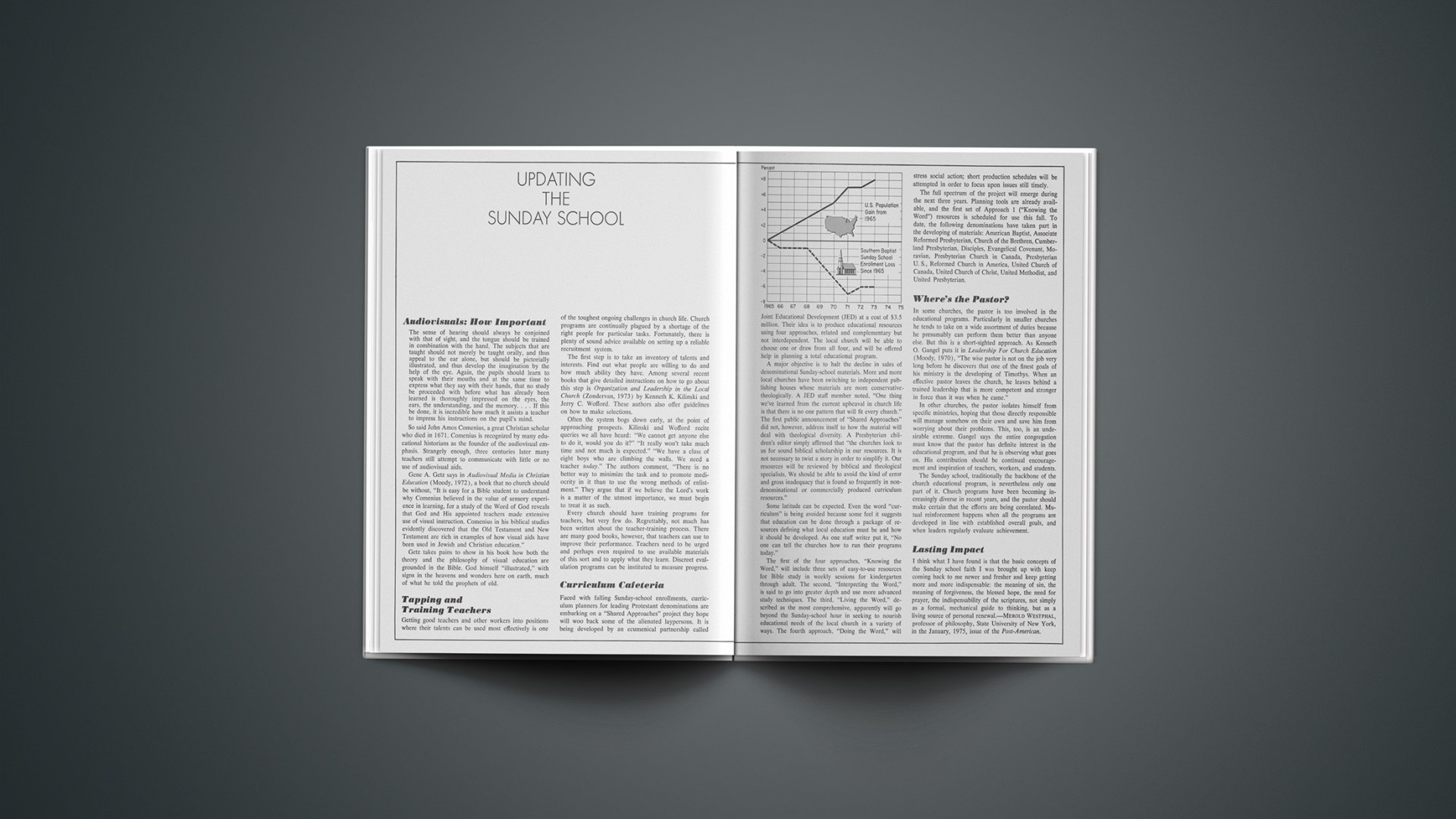
Book Briefs: April 25, 1975

Lewis And Friends

Bright Shadow of Reality: C. S. Lewis and the Feeling Intellect, by Corbin Scott Carnell (Eerdmans, 1974, 180 pp., $2.95 pb), and Myth, Allegory, and Gospel: An Interpretation of J. R. R. Tolkien, C. S. Lewis, G. K. Chesterton, Charles Williams, edited by John Warwick Montgomery (Bethany Fellowship, 1974, 159 pp., $2.95 pb), are reviewed by Cheryl Forbes, editorial associate, CHRISTIANITY TODAY.

No other author, of this century at least, analyzed, explored, and used Sehnsucht as thoroughly as did C. S. Lewis. Defining Sehnsucht as a disorienting longing, Carnell isolates it as an aspect of Romanticism overlooked by most critics and writers—but not by Lewis. Carnell presents a convincing explanation of why this is so and shows that Sehnsucht is not a twentieth-century phenomenon.

Bright Shadow of Reality, then, is not only about C. S. Lewis. Rather, as Carnell states at the beginning of chapter two, it “is an attempt to explore an idea, to discover how that idea finds expression in Lewis’s writing, and to examine the validity of that idea as an instrument of literary analysis.”

Carnell spends too much time rehashing facts readily available in Lewis’s autobiography, Surprised by Joy. And he develops his argument about Lewis’s “feeling intellect” without thoroughly considering the Narnia Chronicles (he refers the reader to Walter Hooper’s essay, “Past Watchful Dragons,” in Imagination and the Spirit, edited by Charles Huttar, and to The Lion of Judah in Never-Never Land, by Kathryn Lindskoog). Yet his book performs two valuable functions for the scholar or advanced Lewis student. Carnell not only relates Sehnsucht to the past and isolates it as an aspect of Romanticism, but also shows how it forms part of what he calls the “new Romanticism.” He concludes:

Lewis’ explanation of Sehnsucht reveals to me a basic continuity between nineteenth-and twentieth-century literature.… Lewis’s concept of Sehnsucht provides a key to understanding the New Romanticism [Dylan Thomas, Edna St. Vincent Millay, D. H. Lawrence].… It suggests a useful and illuminating approach to modern literature.

Such a conclusion, validly and solidly argued, is intriguing for both literary historian and critic.

Carnell also explains the influence and impact that Charles Williams had on Lewis’s thought and writing, something no other critic has done so well or so thoroughly. Critics writing on Charles Williams have discussed Lewis’s comments on Williams’s Arthurian Poems, but after reading Carnell one finds it strange that such critics as R. J. Reilly and Charles Moorman have overlooked Lewis’s “Williams and the Arthuriad.” For those interested in reading Williams’s poems along with Lewis’s analysis, Eerdmans has just published Taliessin Through Logres, The Region of the Summer Stars, and Arthurian Torso in one volume with an introduction by the exceptional critic Mary McDermott Shideler ($5.95 pb).

Now that the poems and commentary are more readily available in this country we can expect further recognition and development of Carnell’s thesis. I recognize, of course, that anyone who has read the introduction by Lewis to Essays Presented to Charles Williams, which he edited, realizes the impact Williams had on Lewis. But Carnell makes clear how deep was Williams’s theological influence on Lewis. Many of Lewis’s ideas remain unfocused unless we understand that he, too, reflected the doctrines of co-inherence, substituted love, and the Way of Affirmations. For bringing this out so clearly, I, for one, am grateful to the University of Florida professor.

John Montgomery and Bethany are to be commended for making widely available four fine lectures given in 1969–70 at DePaul University. The one by Chad Walsh, English professor at Beloit College, stands out in both style and content. “Charles Williams’s Novels and the Contemporary Mutation of Consciousness” makes clear that for Williams “the entire universe is theological through and through, and meaningful life consists of being caught up into that dance where the musician is the one who first created the dance.” (Interestingly, Carnell ends his book on Lewis with the image of the Great Dance.)

Interesting Apologetic

Theology, Physics, and Miracles, by Werner Schaaffs (Canon, 1974, 100 pp., $2.95 pb), is reviewed by Richard H. Bube, professor of materials science and electrical engineering, Stanford University, Palo Alto, California.

It is the purpose of the author, a professor of physics at Berlin Technical University, to show that the objections of modern theologians to biblical miracles are based on an outmoded understanding of physical science. The theological key to Professor Schaaffs’s reasoning is his interpretation of Genesis 1:31; since this passage states that the natural laws of creation are “very good,” it is improper to argue that God later set these laws aside to perform miracles. Rather it must be taken as a presupposition that “all the miracles of the Old and New Testament, including the Resurrection, are consistent with the natural laws of creation.” The scientific key to the author’s approach is the conclusion that modern physical understanding depends upon a statistical description of reality and hence makes miracles plausible.

As for theology, Schaaffs believes that the high point occurred in the early Church and is summarized in the Apostles’ Creed, the Nicene Creed, and the Athanasian Creed. The error of modern demythologizing theologians such as Bultmann has resulted from their failure to realize that science has changed radically in the last hundred years from a position of physical determinism to one of physical indeterminism.

In spite of much valid and helpful material, the book takes on a curious flavor through manifestations of unwarranted dogmatism or unexpected naïveté. Schaaffs argues that acceptance of the Big Bang theory of the origin of the universe makes “the demand for a Creator-God … unavoidable.” His arguments that atomistic indeterminism leads directly to macroscopic indeterminism appear simplistic. He claims to have explained the miracle of Moses’ burning bush in terms of solar heating of “the volatile aroma of a large bush beyond its flash point,” in the absence of wind or winged insects. On several occasions he makes the mistake of supposing that scientific indeterminism, i.e., chance, is the foundation for human freedom of choice; in one place he even goes so far as to say, “Like human beings, the atomic system behaves freely.” In describing the relation between soul and body, the author departs from both scientific and biblical evidence for the whole person and argues for a body-soul dualism, with the soul and the body living in two separate worlds. He calls “the human spirit … a bit of God’s Spirit,” and attributes omnipresence to the Devil with the words, “Just as the Spirit of the Lord has access … to each atom in our body, … so the confuser, too, has access to them.”

The book starts with a curious exchange between the author of the foreword, who commends the book but rebukes Schaaffs for seeking to demonstrate that all miracles have a scientific explanation and for championing evolution over fiat creation, and a “word from the publisher” that expresses Schaaffs’s “serious reservations” concerning the criticisms given in the foreword.

Basically Schaaffs is on the right track, but his interlacing of a sound integration of science and theology with speculative and debatable material appreciably weakens his book for general use.

The Rise Of Modern Science

Cross and Crucible: Johann Valentin Andreae (1586–1654), Phoenix of the Theologians, two volumes, by John Warwick Montgomery (The Hague, Netherlands: Martinus Nijhoff, 1973, 350 pp., 144 guilders), is reviewed by Charles D. Kay, Department of the History and Philosophy of Science, University of Pittsburgh, Pittsburgh, Pennsylvania.

In these two volumes, Montgomery attempts to discredit further the persistent stereotype of a frozen and intellectually sterile seventeenth-century Lutheran orthodoxy by making an in-depth study of a prominent figure of the era, Johann Valentin Andreae.

Volume I first provides a detailed portrait of Andreae’s life assembled from primary sources—bringing order to the confusion that has accumulated in the secondary literature over the past three centuries. A chapter on Andreae’s Weltanschauung argues that his work reflected a consistently orthodox Lutheran position throughout his lifetime. The belief that Andreae in his early years was associated with the beginnings of Rosicrucianism is further attacked in the final section as Montgomery argues against Andreae’s supposed authorship of the early Rosicrucian manifestos, suggesting instead that he actively opposed early occult science: Andreae maintained a position that was “evangelical, sane, non-esoteric.”

This first volume is truly a mine for references and citations of hundreds of difficult to obtain manuscripts and early publications. Along with the second volume, which provides a facsimile reprint of the rare 1690 English translation of Andreae’s Chymische Hochzeit and an extensive bibliography of his writings and manuscript sources, it is an invaluable reference for those who wish to examine Andreae closely without having to rely on poor secondary accounts.

But why study Andreae? Perhaps Montgomery does not make this entirely clear. The introductory essay does discuss the early Lutheran attitudes toward the new science, but it fails to bring in the broader historical-philosophical problem of the relation of Christianity to modern science. As Montgomery says, “the simultaneity of the Copernican and Lutheran revolutions suggests more than an accidental relationship between them.” However, to use the old example, the fact that two clocks strike the hour together does not mean that one caused the other to do so. Indeed, there has been a major debate on the possible origins of modern science in the Reformation, not just in Lutheran Germany, but especially in Calvinist England and the Low Countries. It was in 1938 that R. K. Merton suggested on the basis of his sociological research that the high correlation between English Puritanism and scientific interests in fact reflected a casual relationship. Since then, the “Merton thesis” has been widely debated by historians of science. Professor R. Hooykaas has suggested that the same relation holds true for Holland and has written extensively on the basis for the rise of modern science in Reformed theology.

In all of this, Lutheran support for science has been largely neglected, primarily because of the inaccessibility of the primary materials, and the unfavorable image prevalent in the secondary tradition. Some recent studies have appeared in support of a new view of the Lutheran contribution, and Montgomery’s work adds further support to the new image: “It is this theology of a restored nature in Christ that makes possible Andreae’s union of natural and spiritual phenomena …, and his conviction that each properly complements and reflects the other.”

Yet Montgomery’s arguments are not consistently successful throughout his book. Only toward the end does he outline an alternative to the traditional view of Andreae and the origins of Rosicrucianism. He devotes a great deal of attention to the task of detracting from or demolishing the old stereotypes, showing how errors have accumulated as secondary and tertiary accounts have built up one on another; but Montgomery’s alternative, unfortunately, does not rise as a phoenix from the ruin of its opposition. A mere outline is all that is constructed. It remains for another, using the immense labors that Montgomery has obviously spent in laying this new foundation, to write a comprehensive biography of Andreae, which this study specifically does not claim to provide.

Montgomery focuses on Andreae’s life and work, but he does not adequately reflect on their context. Evidence of this is seen in his extensive (fifty-four-page) bibliography of secondary literature, which is intended to guide the interested student to further research; it contains many references of a very peripheral or general nature, while many more significant and relevant authors, such as Merton and Hooykaas, are missing. This narrowing of scholarship may have been necessary because of the depth of primary work required to produce this study, but it leads Montgomery into unnecessary errors about Bacon, Hartlib, the Royal Society, and other subjects.

A careful understanding of Andreae’s milieu is as necessary to the proper understanding of his work as was the rewriting of his biography, for the world was very different before the rise of modern science. Andreae’s weltanschauung consisted of more than Lutheran orthodoxy. His was also the world in which the works of Galileo and Kepler first circulated among intellectuals. It was a world not yet mechanized by Descartes and Newton, a world still full of the magic of God’s own hand. Occultism ca. 1600 did not have many of the connotations it does now, for much of nature still lay hidden from man’s view. Montgomery’s use of phrases such as “scientific, non-mystical” and “true precursor of modern chemistry” is meaningful only with the exercise of hindsight. Such hindsight, along with the use in the text of many parallels and references to modern authors, clouds the gap that separates our world from Andreae’s. Montgomery himself insists that the historian must “relive and re-enact the past” to best understand it, but his present text has too many links with the present to allow free access to that past.

A survey of Montgomery’s bibliography of secondary references reveals another important aspect of this study: much of the work is fairly old. The introductory essay was first published in 1963; the bibliography was not revised after 1964 (see p. 531). Later translations and editions of many references were apparently not used. A bibliographic addendum includes several historical works that have made a great impact on the history of science in the past decade (e.g., Yates; Debus), yet were not used in Montgomery’s work. Some classics (e.g., Kuhn) are not mentioned at all. Although this does not greatly detract from the value of Montgomery’s work, it does make it difficult to relate his study to the rest of current scholarship, and perhaps explains many of the apparent problems of the text.

Kittel For The Old

Theological Dictionary of the Old Testament, Volume One, edited by G. Johannes Botterweck and Helmer Ring-gren (Eerdmans, 1974, 479 pp., $18.95), is reviewed by Larry L. Walker, associate professor of Old Testament, Southwestern Baptist Theological Seminary, Fort Worth, Texas.

Students now have for study of the Old Testament a companion tool to Kittel for the New. More complete than the similarly titled work edited by Ernst Jenni and Claus Westermann, this Theologisches Wörterbuch zum Alten Testament edited by G. Johannes Botterweck and Helmer Ringgren is now being made available in English. The translator is John T. Willis of Abilene Christian College. The reader is told that he may expect the English volumes “to appear annually, about a year after each fourth German fascicle.” This first volume has fifty-three entries—forty-nine words beginning with aleph, and four begining with beth.

Those interested in Bible word studies should realize that this is not a “popular” word study like several others on the New Testament. These word studies have the goal of organizing and presenting succinctly the biblical data and the non-biblical technical information available on key Hebrew terms.

Students of the Hebrew Bible have long awaited such a lexical aid, and this series should stimulate scholars to probe further the depths of the Old Testament as they react to some of the new meanings suggested for words. The unending inflow of new lexical information makes Hebrew scholars hesitate to attempt any definitive statements on Hebrew vocabulary. But the time is now ripe—perhaps overdue—for a study such as this. The new light provided by the ancient cognate languages is relevant and impressive. Generally speaking, TDOT makes good use of the important cognate languages of Ugaritic and Akkadian; in some cases, references are made to Egyptian, Hittite, and Sumerian. Brief but pertinent attention is given to the Septuagint and the Dead Sea Scrolls, less to the Pseudepigrapha.

The contributors reflect an international (mostly European—including East Germany) and interconfessional perspective.

At the beginning of each entry the root or the basic form of the word is printed (in Hebrew) in a box, along with cognate words in Hebrew, but no meanings are given there. The reader must learn the meanings and semantic range from the ensuing discussion, where the Hebrew is mostly transliterated. The German version used unvocalized Hebrew throughout the discussion. The English version does use unvocalized Hebrew script in the discussion when reference to another entry is made. The German edition usually printed Greek in its own script, but sometimes it was transliterated; the English edition consistently transliterates the Greek. References to all other languages are in transliteration.

The editors and contributors appear to want to be helpful to a large readership. Technical terms used by scholars in this field are notably absent. Transliteration for all Hebrew is given, and notation is made when Hebrew and English versification differ. Proper nouns are usually omitted, but a few such names as Abraham, Asherah, Babel, and El are included. The usual format for discussion has three parts: etymology (including cognate words), distribution and usage in the Old Testament, and theological significance. Some entries are quite extensive; “signs” covers twenty-one pages, “light” twenty, God (El) nineteen, God (Elohim) eighteen, and “earth” seventeen; but some are as brief as two pages. Extensive bibliographies attached to the articles add to the usefulness of TDOT.

The unevenness of TDOT is understandable in view of the variety of contributors. The selection of articles, on the other hand, is the responsibility of the editors. One wonders why they included such words as “behind,” “with,” “alone,” “well,” and “end” but omitted such words as “mother,” “ear,” and even “stone.” In view of the stated intention of a “theological dictionary,” why discuss the seven Hebrew words for “lion”? Some entries are of cultural and archaeological significance, yet do not seem to fit into the dictionary’s stated purpose—“to analyze its [the Hebrew Bible’s] religious statements.” Critical presuppositions are occasionally reflected. The article on Abraham by Professor Clements assumes

the essential validity of the documentary hypothesis. These documents (J, P, E, L) are sometimes made to contradict each other (p. 55). In his article on Adam, Professor Maass tells us the word occurs as a common noun (“man”) in the earliest traditions (J, E) but as a proper noun (“Adam”) in P (with H). The reader has been assured in the preface that “the form-critical and traditio-historical methods have been refined to such a point that one can expect rather certain results.” Evangelical scholars will be more impressed with the factual linguistic data brought to light through archaeology and the study of ancient languages cognate to Hebrew, and how all this information helps us understand the sacred text.

Some kind of additional cross-reference index seems needed if the reader is to make full use of the dictionary. He needs to be aware that “woman” is discussed in the entry on “man.” It would be helpful to know that in connection with one word for “lion” he will find a discussion on six other semantically related (not necessarily etymologically related) words. The words discussed in each volume of TDOT are listed in the table of contents, but they are not all listed in alphabetical order. Some are subsumed under other major entries and elude a casual glance through the main alphabetical listing. Another aid to the reader would have been the inclusion of the meanings of the words in the table of contents.

In some cases a brief discussion of the phenomenon of parallelism would have helped in the study of a word. This basic characteristic of Hebrew poetry has been studied in depth in recent years, and it has important implications for hermeneutics and theology. Some reference to common word-pairs—words that are often found in parallel—would be useful for the study of Hebrew poetry in particular and the study of the Old Testament in general. Also, more information on semantic equivalents in addition to the etymological equivalents would have been helpful. For some of the words, a statistical analysis reflecting their distribution throughout the Hebrew Bible (as commonly done in Jenni and Westermann’s Handwörterbuch) would have been a convenient resource.

Undoubtedly these studies will prove to be a base from which more popular Hebrew word studies will evolve—the lack of which has long been noted by preachers of the Old Testament. We are all in debt to the publishers, editors, and contributors for what will undoubtedly be one of the most significant theological projects of this century.

BRIEFLY NOTED

For a survey of recent books on children and youth see The Minister’s Workshop, page 24.

The Evangelical Faith, by Helmut Thielicke (Eerdmans, 420 pp., $10.95). The well-known German theologian launches a three-volume project: a comprehensive examination of Christian dogmatics in the twentieth century. Here he explores, with commendable scholarship and lucidity, the relation of theology to modern thought-forms, particularly teaching about the “death” of God and the “mythology” of Scripture.

Ritschl and Luther, by David W. Lotz (Abingdon, 215 pp., $10.50). A “revisionist” interpretation of Albrecht Ritschl’s theology in light of his intensive Luther study. Uncovers his main themes.

Why Me?, by Rabbi Hyman Agress (Creation, 201 pp., $5.95). A rabbi’s story of his brain damaged son and the spiritual growth the situation has produced. Inspirational.

Oral Reading of the Scriptures, by Charlotte Lee (Houghton Mifflin, 198 pp., $8.50. Speech teachers in Christian high schools and colleges take note. Also for those outside the classroom who are seriously interested in improving their public Bible reading.

St. Thomas Aquinas 1274–1974: Commemorative Studies (two volumes), edited by Armand A. Maurer et al. (Pontifical Institute of Mediaeval Studies [59 Queen’s Park, Toronto, Ont. M5S 1G4], 1,014 pp., n.p.) Thirty-five scholarly studies, three-fifths of them in English, treating a variety of aspects of Thomas’s life, thought, and influence. For major theological libraries.

Noah’s Three Sons: Human History in Three Dimensions, by Arthur Custance (Zondervan, 368 pp., $8.95). The author, who has a Ph.D. in anthropology, recognizes the lack of academic support for his view that all humans are descended from Japheth (the Indo-Europeans, whose forte is philosophy), Shem (the Semites, man’s spiritual leaders), and Ham (Africans, Asians, American Indians, and others, whose strength is technology and who founded the world’s civilizations). The author admits to much speculation and unavoidable errors in detail. Readers should be aware that even conservative biblical exegetes differ widely among themselves on the matters Custance treats.

‘What If …,’ by Don Hillis (Victor, 96 pp., $1.50 pb). Brief reflections by the well-known missionary leader accompanying thirty cartoons by CHRISTIANITY TODAY’S own John V. Lawing, Jr. Naturally we commend it.

What’s Ahead For Old First Church, by Ezra Jones and Robert Wilson (Harper & Row, 132 pp., $5.95). Study of the plight of old, declining, downtown congregations. Not very encouraging.

The Six Version Parallel New Testament (Creation, 697 pp., $12.95) and Eight Translation New Testament (Tyndale, 1,897 pp., n. p.) Several years ago, the modern rash of parallel translations began, first with one set of four New Testament versions, then with different combinations, culminating in two rival publications (from Zondervan and World Wide), each of which had four translations of both testaments. Now we are back to the smaller testament, but the ante has been upped! The Six has large pages with three columns on each, so that on facing pages one has King James, Living, Revised Standard, New English, Phillips, and Jerusalem. The Eight has smaller pages with two columns divided top and bottom. It has the same six as The Six plus two other important ones, New International and Today’s English (alias Good News for Modern Man.) Regrettably, New American Standard and Modern Language are left out. Who’ll make it ten?

Hosea, by Hans Wolff (Fortress, 258 pp., $19.95), Ephesians, by Markus Barth (two volumes, Doubleday, 849 pp., $16 / set), and The Johannine Epistles, by J. L. Houlden (Harper & Row, 164 pp., $6.95). Latest additions by European scholars to three notable commentary series: “Hermeneia,” “The Anchor Bible,” and “Harper’s New Testament Commentaries,” respectively.

Pit-Men, Preachers and Politics, by Robert Moore (Cambridge, 292 pp., $16.50). Sociological study of the influence of Methodism on the political life of four English mining villages between 1870 and 1926.

Bibliography of Society, Ethics and the Life Sciences, compiled by Sharmon Sollitto and Robert Veatch (Hastings Center [623 Warburton Ave., Hastings-on-Hudson, N.Y. 10706], 93 pp., $3.50 pb). Probably the best major bibliography of works dealing with all aspects of medical ethics from genes to graves.

Expectation—Vague or Vivid?

Japjohn Berg is bending his blond head over a piece of wood. He is very carefully carving letters as well as his nine-year-old skill will allow. Come closer and you will see that the letters are the beginning of a street name in Holland. What can it be?

It’s an address, the address of the new apartment to which Japjohn, his mother Marry, and his little brother Stephan have recently moved, leaving their beloved house because Daddy can no longer drive Stephan to his school and they needed to be many kilometers closer. Stephan is very handicapped from cerebral palsy and must learn in a special school to point out with his chin the pictures he is matching, because he can not use his hands or legs and is deaf.

Here is a family drawn close together by great difficulties, and amazingly close to the Lord. The resurrection of the dead and the coming changed bodies of all believers who in this life are handicapped have taken up much time in family conversation—conversation around a beautifully set table, always with flowers in the center; or during outdoor walks where leaves, ferns, butterflies, a special tree, a bird on a bush, are noticed and enjoyed. In the midst of enjoying the little things for which we can say “thank you” each day this family has always looked forward with vivid expectation to the return of Jesus—“for then Stephan will run and jump, make and feel things with his hands, be able to hug us, and jump over things like that log. Stephan will do wonderful things when Jesus comes and all believers are changed in the twinkling of an eye, and when we are finally in the new heaven and the new earth!”

Now Japjohn is carving his new address, and he wants to put it on the grave so that “if Jesus comes back and Daddy rises first [Scripture says that ‘the dead in Christ shall rise first’] then he can find us quickly.” “But Japjohn, Jesus will bring us all together quickly. Jesus knows where we are.” “But Mommy, please? May I? I would feel better if I knew he could find the address there right away.” Marry is a sensitive, understanding mother. She hasn’t denied this nine-year-old’s request because someone else might think the carved address on the grave was out of place.

On a grey morning a few months ago the rain was driving across the Dutch landscape as Hans drove to work, having left his family in a cottage where they were to have a week’s vacation in the woods. Suddenly a young truck driver made a wrong movement and skidded into the front of Hans’s car. Hans was killed.

Death is not beautiful. It separates soul from body, husband from wife, father from children. Jesus let it be known that death is not beautiful when he stood at the grave of Lazarus and wept. Jesus wept not just with sorrow, not just with sympathy for the dead man’s sisters and friends, but also with anger at the enemy death. Satan brought death with his taunting temptation to Eve and Adam to choose to believe him rather than heed God’s warning. Jesus wept with a strong emotion, not with polite tears to enter into an atmosphere of mourning. His tears were real and the feelings they conveyed were real.

The amazing thing to me is that Jesus wept after he had already said to Martha, “I am the resurrection, and the life: he that believeth in me, though he were dead, yet shall he live; and whosoever liveth and believeth in me shall never die. Believest thou this?” He believed completely what he had said; yet he wept.

Jesus was speaking of the reality of the resurrection of bodies that will be changed bodies, as he would demonstrate with his own resurrected body later, as well as speaking of the fact that he had power to raise Lazarus. Now the resurrection of Lazarus was a miracle, but his body was in the same condition it had been in before. Jesus was speaking of something that no one really understood that day, as he pointed to the future, or else they would have been waiting with vivid expectation after his death for his resurrection. Instead of vivid expectation, the disciples had something less even than vague expectation; they had depression and no expectation at all. As far as they were concerned, it was all over.

The resurrection of Lazarus was a demonstration, an object lesson of the fact that Jesus could raise the dead. The term “firstfruits” used by Paul in his letter to the Corinthians shows that the resurrection of Jesus has no precedent. Jesus after the resurrection was not like Lazarus at all; his body was the same body, but one that cannot ever die or be hurt again.

In the book of Corinthians the true believers are no longer mixed up, but others even then were still just as confused as many had been when Lazarus died. People can be blind as to what is being shown them, and to what is being told them. Paul that day wrote, “If Christ be preached that he rose from the dead, how say some among you that there is no resurrection of the dead?” He goes on to say that hope is a vain hope if it is only a vague kind of hope in this life. “For if in this life only we have hope in Christ we are of all men most miserable.”

Two things are important to notice in Jesus’ speaking of himself as the resurrection and the life, and then afterwards weeping with anger and sorrow. First: it is not wrong to weep, and it is not wrong to be angry at death and at Satan, who causes death. It is not wrong to long for the change that will occur after Jesus comes back. The wrong comes when we turn away from God with bitterness and anger. Then our weeping becomes a separation and sinfulness, rather than a running into the Lord’s arms.

Second: it is also important to believe before we see the resurrection with vivid expectation. Jesus was asking Martha to believe a double thing, his power to do an immediate thing that would be temporary, and his power to do that which would be forever. Asking us to believe, also, Jesus speaks to us the same words. Do we really believe in the lasting resurrection of our bodies with vivid expectation, with the kind of expectation that causes us to have practical thoughts about laying up treasures in heaven, practical thoughts about putting the kingdom of God first, practical thoughts about meditating upon his Word day and night, so that as we read and think we might find out what it is he means us to be doing? How vivid is my expectation? How vivid is yours?

Don’t you think that Jesus sees Japjohn as one who in carving his address is showing before angels and demons as well as before his loving Shepherd that he believes with vivid expectation that Jesus is coming back? The any-moment expectation of Jesus’ return is also the any-moment expectation of the resurrection. How are we showing our vivid expectation?

“Be ye ready also … for the Son of man cometh at an hour when ye think not.”

Ideas

Do Something for Your Sunday School!

Back in his Air Force days, a CHRISTIANITY TODAY staff member, serving as a squadron adjutant, got some unusually good advice from his commander. The counsel came consistently when the two faced complex decisions that would entail problems no matter what course of action they chose. It was simply, “Do something!”

Any capable leader knows that no step at all can often cause more trouble than even a step in the wrong direction. The latter at least furnishes the information of what not to do in the future. Failure to take a step does not provide even that.

The “do something” principle cannot be recommended to irresponsible people. But for responsible ones, faced with a sticky situation, to move quickly is often better than to stand still and wait. A good example of this comes from the founder of the Sunday-school movement, Robert Raikes, of Gloucester, England. Distressed by the “lawless behavior” of children on the streets of Gloucester on Sundays, he set up a Sunday school in Sooty Alley, hiring women to instruct the children in reading and the church catechism. Raikes did not wait for a church committee or an annual denominational meeting to get going. He saw the need and moved decisively to meet it.

In attempting to speak about Sunday-school problems, we realize that different churches have different problems, and that what works at, say, First Baptist in Sacramento will not necessarily work at Second Presbyterian in Syracuse. Clergy and laity alike will be helped most if they take the principles that appear in these pages and in other books and articles about the Sunday school and use them in an imaginative mix suited to their particular situation.

The simple advice to “do something” may be more valuable than it might initially seem. In many Sunday schools today, the number-one problem is apathy. The program has settled into a deep rut. Goals have not been updated for years. No attempts are made to measure success. And no one is greatly concerned.

One determined person, whether the pastor or a layperson, can do something, can bring about some change. It takes perseverance and a deep sense of obedience to God’s direction, achievable only through prayer.

Whoever takes on the challenge should go about it as intelligently as possible. But he should not be deterred by doubts about his intellectual qualifications and preparation. That can be a trick of the enemy to hinder beneficial change. In the face of obstacles, tact, combined with a positive attitude inspired by the Holy Spirit, can work wonders.

A recent how-to book for the Sunday school asserts that in most churches the greatest obstacle to change is the lack of an adequate rationale for it. (Your Sunday School Can Grow, by Lowell E. Brown with Bobbie Reed, Gospel Light/Regal, 1974). “It is always difficult to get people to change when they are not convinced that the change is needed.” A process of explanation and encouragement is essential. The place to begin is to ask leaders to communicate what they believe about good education and why, and to show how changes will benefit all concerned.

The one abiding principle that should be kept in the forefront of discussion is that the Sunday school exists for training. If a Sunday school is attended by a lot of unbelievers, the training should center on evangelism. If those who attend are largely Christians, the program should be focused upon teaching the Word and helping people relate it to their lives. The innovator must analyze the spiritual state of those who are to be taught and proceed accordingly.

In recent years there has been a great deal of promotion of the discussion rather than lecture approach to learning. The idea is that students learn more thoroughly and lastingly that which they get at themselves through discussion than that which they hear from a teacher. There is merit to this approach. But we may have gone overboard. If a teacher is well prepared, he has a lot to offer students that they cannot arrive at through group discussion, which sometimes amounts to little more than a sharing of ignorance. Perhaps we need to stride a better balance between the two approaches, taking into account what the Bible has to say about teaching as a spiritual gift.

Here are some ideas worth considering if you want to do something for your Sunday school: (1) Teach the catechism. Every child should be exposed to it somewhere along the teaching route, and it would be helpful for adults as well. (2) Pay teachers. This might mean there would be fewer teachers, but it is better to sit fifty feet from a good teacher than one foot from a poor one. (3) Train teachers, and have them meet in advance of the Sunday session to discuss the lesson, exchange suggestions for making the teaching count, and evaluate the previous Sunday’s session. (4) Require teachers to follow up on absentees, visit pupils’ homes, and in the case of children attempt to enlist the parents as Sunday-school participants. (5) Provide a good social program for all ages. (6) Consider sending buses to bring pupils to the Sunday school. (7) Provide refreshments before or after Sunday school. (8) Integrate the work of the Sunday school with other church programs so that they complement and reinforce each other. (9) It’s your turn:

The Indochina Fiasco

It is safe to say that had America known in the beginning what it knows now, it would not have sent armed forces to Viet Nam. Given the present climate, perhaps it would not even have supplied military aid. But the fact is that the government of the United States, with the approval of four presidents and the congresses that voted the money, did commit the nation to involvement on a huge scale.

The Bible speaks approvingly of those who swear to their own hurt and change not. However, those who realize they have made bad decisions can change their minds instead of obstinately sticking to their original path. The United States properly, in our opinion, withdrew its troops but continued its involvement with military aid. Now congressional opposition is bringing this to a halt. There is no hard evidence that the unexpected collapse of the South Vietnamese forces was directly caused by inadequate supplies. Nor is there much excuse for the failure of Thieu’s armies to fight instead of panicking and fleeing in wild disorder.

At a time when the United States was decreasing its aid to the governments it supported, the Soviets and the Chinese were increasing their supply of weapons to Hanoi. They have not faltered in their commitment, and what they did turned the tide in favor of the Communists. Strangely enough, many Americans who so strongly opposed U. S. involvement and were successful in their battle for withdrawal are silent in the face of the Communists’ flagrant violation of the Paris agreement and the death of so many civilians. Probably most Americans who long opposed support of the Diem and later the Thieu regime regret the use of force instead of free elections to bring a change in government. Undoubtedly only a few are led by pro-Marxist sympathies to welcome Hanoi’s victories.

The Bible demands morally consistent behavior, but the United States has been inconsistent. Richard Nixon and Henry Kissinger claimed to bring détente into being, and Washington cosied up to Peking and Moscow. Whatever “détente” means, it obviously did not mean that the communists would stop sending supplies to Hanoi. If it is desirable to have detente with China and Russia, why not let the Communists take over South Viet Nam and perhaps all of Indochina and then seek detente with them? Nations reap as they have sown. The United States with its inconsistency in policies has sown the whirlwind, and it will reap the whirlwind.

Sir Robert Thompson, a British expert on Asia observed: “The administration can no longer conduct a credible foreign policy. But do not worry, a new policy line already has been laid down by Congress: If you surrender, the killing will stop. It is a clear message, to the world, of the abject surrender of the United States” (quoted in the Washington Post, April 9, 1975). He also said, while public and congressional opinion loudly denounced permanent U. S. commitments in Indochina: “Eternal dishonor is a permanent commitment.” This is the load America will have to carry for years to come. Other European observers, however, have long expressed the view that America’s prolonged involvement was more dishonorable than any end to it could be.

America’s allies will loudly proclaim their confidence that the nation will not welsh on its commitments to them in Europe and the middle East. What else can they do under the circumstances? But we can be sure that the chancelleries of the world are not so naïve as to rely on that certainty, and that they are already making plans in the event the United States reverses its pledges to them. What is most distressing is that the U. S. Congress, apparently acting in accord with what it thinks to be the wishes of the citizenry, is in effect telling the whole world that nations like China and the Soviet Union are more dependable allies and more to be trusted for their pledges than “decadent capitalist America.”

It looks as if peace will come to Indochina by Communist conquest after some kind of bloodbath against the enemies of Hanoi. We have a strong moral obligation to provide sanctuary for those whose close link with the United States or the governments it supported marks them as likely targets for execution by the Communists. The peace that comes will not be “peace with honor” for the United States. It will be a peace stained by desertion and defeat, one that is bound to have further unfavorable repercussions in the years ahead.

Chiang Kai-Shek

Although his advanced age made death no surprise, a special sadness befits the death of Chiang Kai-shek. He was a determined leader to the end, though undoubtedly brokenhearted and bitter that so much of the world ultimately decided to pass him by in favor of his Communist foes who ruled the mainland of China, a vast land that he for so long tried to organize and ally with the West.

Many have taken issue with Chiang, associating him, not without justification, with a great assortment of wrongs. Even Time magazine, which under the late Henry Luce did much to build Chiang’s American image, sharply criticized him in its obituary, citing his “intractable insistence on shortsighted, ineffective policies.”

But one cannot help wondering whether the disenchantment with Chiang is attributable less to his wrongs than to disappointment over his failure to achieve what was expected. And perhaps too much was expected.

Here was the largest nation on earth, virtually unmanageable politically at the beginning of this century. Sun Yat-sen and Chiang made an extraordinarily ambitious effort to pull China together, and went a long way toward their goal. It is very doubtful, in fact, that the Communists could have set up a government had they not been able to build upon the years of spadework under Chiang—and also upon his weaknesses. To his credit, Chiang conceded blame:

I must put the blame on myself. The disastrous military reverses on the mainland were due not to the overwhelming strength of the Communists but to the organizational collapse, loose discipline and low spirits of the [Nationalist] party members.

Chiang as a middle-aged man was baptized a Methodist, and in the 1940s he was described as “Christendom’s most famous living convert.” He championed a “New Life Movement” that had a spiritual as well as political orientation; although it accommodated Confucian perspectives, it was based on Christian principles as Chiang saw them. The Chinese leader became known for his simple, almost austere life style and for his daily meditation and Bible reading. He obviously saw the good that missionaries had done for his people over the years. Yet he repeatedly shunned good advice, for whatever reason, and he died a beaten man.

More Orphans

The outpouring of sympathy for Vietnamese orphans is commendable. Many of them are the offspring of American soldiers and Vietnamese women and hence are of mixed ancestry. That this consideration and the unknowable emotional scars the children bear have not deterred thousands of Americans from wanting to adopt them is noteworthy.

To the families applying for Vietnamese orphans who are turned away because there are no more available, we suggest an alternative. Approximately 120,000 children in the United States are waiting to be adopted. Like the Asiatic Vietnamese, most of these children are not of northern European stock. Their ancestry is mainly African, American Indian, and Puerto Rican. Many have physical handicaps, and others are emotionally disturbed. But it is doubtful that raising these children will be any more difficult, or less fulfilling to adoptive parents, than raising Vietnamese.

This is not to say there will not be problems. Bringing up any children, whether they are one’s own biological offspring or not, is a challenging undertaking. Ethnic differences create additional problems, especially in the larger community.

But Christians belong to a subcommunity, the Church, that according to its authoritative Scripture transcends ethnic, racial, and socio-economic differences. They are in a better position than unchurched families to adopt children of different ethnic origins, for they can supply them with a supportive group, the family of God. Best of all, Christians are more likely to introduce their adopted children to the one who alone heals for eternity all the hurts human beings inflict upon one another.

Debatable Behavior

The role of women in the home and in the church from a biblical point of view is currently a popular topic, and one that it is important to resolve. The eastern region of the Evangelical Theological Society thought so too, and at its meeting in Philadelphia this month members considered the question from both the traditional and the more feminist positions. Without commenting on the central question itself, we would like to make a point about the desirable spirit for a debate of this kind.

Persons on both sides of the issue have a responsibility to present their case with thorough theological and biblical evidence. It is not enough to say “the Bible says” without showing what the Bible actually records on this question and where. Both feminists and traditionalists have scriptural evidence to cite. There is little excuse for offhand or theologically sloppy discussion, and there is no excuse at all for discourtesy and disrespect toward the other side.

At the ETS meeting the more traditional theologians did not appear to take the issue as seriously as it deserves. And groans and moans during a controversial presentation showed a disturbing lack of professionalism on both sides.

We urge scholars and theologians to do their homework, study all sides of the question, and present their arguments in a logical, rational and serious way. The outcome of this debate could change the complexion of church and home.

Crime: Emphasizing Deterrence

Serious crime in the United States rose 17 per cent in 1974. This was the largest annual increase since the FBI began keeping records forty-five years ago. Washington, D. C., and its suburbs reported an overall 14.7 per cent rise; the increase in the suburbs was more than twice that in the city. The largest regional increase was recorded in the southern states: 21 per cent in 1974.

United States attorney general Edward H. Levi saw in the figures “a dismal and tragic failure on the part of our present system of criminal justice,” and he went on to say, “We must understand that an effective criminal justice system has to emphasize deterrence.”

“Emphasize deterrence”—how?

The increasing crime rate supports the observation that the claims of our Judeo-Christian tradition with its emphasis on the Ten Commandments have lost their hold on much of society. Let’s ponder some other statistics. In 1974, 112 million Americans were attached to Protestant, Roman Catholic, Jewish, and other congregations. (The figure is for “inclusive” membership; full communicant or confirmed membership would be less than half of this.) This means that 98 million Americans had no identifiable connection with any of these churches. Canada, with a population of 22 million, reports a current figure of 3 million church-related people.

This leads to a question for which we can only assume an answer: What percentage of crimes are committed by people who have no church connections? It has been said that few people who start out in Sunday school end up in jail. Whether or not this is so, and we suspect it is, certainly the 98 million Americans who are unchurched are a missionary challenge. When we add to these the unregenerate among the “churched,” this large mission field becomes immense.

As the attorney general pointed out, our system of criminal justice has shown “a dismal and tragic failure,” and concerned Christians may well involve themselves in efforts to improve our laws, our courts, and our prisons. Or they may choose to concern themselves with the social conditions that foster crime. But Christians can go beyond these good endeavors because they know the root cause of crime, that “the heart is deceitful above all things and desperately wicked.” There lies the most dismal and tragic failure of all, and there is the place where Christians have a special responsibility beyond that of their fellow citizens. The surest way to keep a person from committing a crime is to win him or her to Jesus Christ. That is the particular way Christians have to “emphasize deterrence.”

Rebate Rebound

American taxpayers: what will you do with your tax rebate? Virtually every taxpayer will get one within a few month’s time. A reader sent us a suggestion that we heartily commend to your attention.

The tax rebate is intended to stimulate the economy by giving Americans an extra chunk of money to spend on “durable goods.” Perhaps we can stretch the term beyond the government’s intention. Human life is certainly a good, and it is durable. But in various areas of the world this “durability” is in jeopardy. How about sending your refund to some organization dedicated to caring for the hungry or the homeless or the sick—those who are starving in Bangladesh or Africa, for intance, or the suffering refugees in Indochina? Evangelicals have often been charged with neglecting bodies in their zeal for winning souls. Here is a good opportunity for them to demonstrate their concern for the bodily needs of people, to respond generously and sacrificially for the sake of Christ.

God will look with delight upon his people who do this. It will indicate to him their desire to obey his commandments, the second greatest of which is to love our neighbors as we love ourselves. The giving should not be based upon the idea that God will do something for us in return. That may occur, but even if we were sure it would not, we should nevertheless obey. The satisfaction of walking obediently is reward enough.

By Faith …

The lives of the great heroes of the faith catalogued in Hebrews 11 have had an impact for good on millions of readers of Scripture. But Christian heroism did not end when the canon of Scripture was closed, and many other writers have given us inspiring accounts of latter-day heroes. A recent example is Richard Hasler’s Journey With David Brainerd, put out in paperback by InterVarsity Press.

Brainerd was a missionary to the American Indians. He came to a point at which he thought of himself as a failure, and he was about to return home, convinced that he was wasting his supporters’ money. He felt it was “unjust to spend money consecrated to religious uses, only to civilize the Indians, and bring them to an external profession of Christianity.…”

Then God broke through in an amazing way among some Indians in New Jersey. Their response to the preaching of the Gospel was startling and unexpected, and a church was begun. Brainerd was quick to recognize the social implications of his mission. He raised money to buy land where the Indians could plant crops and hunt, and saw to the construction of a church, a school, an infirmary, and a carpentry shop.

Brainerd wrote in his diary, as a result of that experience, of God’s power to break through apparent failure and accomplish his purposes. “It is good to follow the path of duty,” he wrote, “though in the midst of darkness and discouragement.”

Brainerd died young, at twenty-nine, from tuberculosis. But that short life has inspired many, including John Wesley. Deeply moved by the example of this apostle to the Indians, Wesley made this recommendation: “Let every preacher read carefully over the life of David Brainerd. Let us be followers of him, as he was of Christ, in absolute self-devotion, in total deafness to the world and in fervent love to God and man.”

Christian Education Bibliography

Books on Christian education that appeared in 1974 and early 1975 offer a broad spectrum of approaches and creativity. This compensates in part for a decline in new titles in comparison with the previous few years.

Those who minister to children take note: the single most significant book to come along recently is Childhood Education in the Church edited by Roy Zuck and Robert Clark (Moody). A comprehensive picture of childhood training, encompassing philosophy and methodology, is painted by a host of leaders in the field. This is a commendable integration of time-proven education practices with sound Christian teaching. Treatment of some of the techniques is rather brief, but bibliographies are provided for further study.

Continuing with the pre-school and very young learner: Moody Press is to be thanked for its five paperback how-to books by Marie Frost entitled: A Guide For Visitation, Songs to Sing, Effective Teaching, Pupil Characteristics, and Action Rhymes. Victor Books has a very fine list of paperbacks including You Can Teach 2s and 3s by Mary Barbour and You Make the Difference for 4s and 5s by Mary Le-Bar. A really helpful book for use in both home and church is Wesley Haystead’s You Can’t Begin Too Soon (Regal). Smile! Jesus Is Lord by Lavern Franzen (Augsburg) offers fifty basic lesson plans, using a variety of visual aids, to enliven the Sunday-school or children’s-church message. Pre-teens deficient in the basics of how we got our Bible and how it spread can be given no finer instruction tool, planned as a self-instruction book, than Paul and Mary Maves’ Discovering How the Bible Message Spread (Abingdon). Michael and Libby Weed coauthored the excellent Bible Handbook For Young Learners (Sweet), written from an unobtrusive Church of Christ perspective. From England and from the pen of the venerable William Barclay come two paperbacks published by Hodder and Stoughton, Marching Orders and Marching On, both subtitled “Daily Readings for Young People.” Silent Thunder by Bernard Palmer (Bethany), the fictionalized account of an American Indian boy’s discovery of Jesus, offers a clearly written, intriguing presentation of the Gospel for pre-teens. This has recently been made into a film as well. Offers solid supplementary material.

The junior-high category was poverty-stricken this year. Explore, a resource edited by Janice Corbett (Judson), will be useful. High schoolers fared better. Continuing Explore, and decidedly more evenly evangelical, is Respond edited by Mason Brown (Judson). The American Baptists also give us the excellent total-church plan for youth in Youth Ministry: Sunday, Monday, and Every Day (Judson) by John Carroll and Keith Ignatius. Four more good books are Turnabout Teaching (David C. Cook) by Marlene LeFever, Making Youth Programs Go (Victor) by Terry Powell, Impactivity: Youth Program Resources (Broadman) by Helen May, and Extend: Youth Reaching Youth (Augsburg) by four Lutheran-oriented experts. Of an odd sort is Dennis Benson’s Electric Love (John Knox), which ought not to be ignored as slightly kooky: evangelicals can recycle him to make his ideas scintillating.

The philosophy of Christian education at its most pragmatic is found in Tailor-Made Teaching in the Church School (Westminster) by Mary Duckert. A sound premise and unsound application characterize Ronald Goldman’s Readiness For Religion (Seabury); he advocates a developmental base that lacks sufficient biblical grounding. A publisher of high-quality teaching aids for a Roman Catholic audience, easily adapted to an evangelical use, is Twenty-Third Publications; Continuing Christian Development is a collection of essays, editor unnamed. Planning Christian Education in Your Church (Judson) is a little booklet by Kenneth Blazier and Evelyn Huber. Baptists of a different variety will garner much from The Sunday School Reaching Multitudes (Sword of the Lord) by Tom Malone. He has no use for professional curricula, but many of his ideas are worth study.

Two books from Pflaum are for consideration in teacher-training workshops. The Learning Process in Religious Education by Richard Reichert pulls together the hows and whys of learning that many Sunday-school teachers lack. Integrating Values by Louis Savary demonstrates various religious value applications through exercises that implement his theory.

Project suggestions were plentiful. Among them: Margaret Self’s Creative Fingerfun (Regal) for tiny tots; Banners and Mobiles and Odds and Ends (Morehouse Barlow) by an author known only as “Vienna,” whose ideas are clever but whose theology we avoid (in other books); and Robert Hill’s You Can Be a Ventriloquist (Moody). Dennis Benson collected program and project ideas from church groups across the country and presents them in potpourri fashion in his Recycle Catalogue (Abingdon). Lawrence Richards makes available his impressive training, experience, and insight in a more complete form with the publication of the final four books of his Effective Teaching Series (Moody). You and Preschoolers (which he did with Elsiebeth McDaniel), You and Adults, and You the Parent are the texts, while You and Teaching serves as a study guide for the full six-volume series. The American Lutheran Church continues its yearly volume series with The Pastor’s Role in Educational Ministry (Fortress) edited by Richard Olsen. The magazine Trading Post (Twenty-Third) is chocked full of teaching ideas for all levels, drawn periodically from its sister monthly, Religion Teacher’s Journal (Twenty-Third).

Summer calls for VBS Unlimited (Victor) by Jerry Jenkins and W. A. Blakely. Camping programs can use two David C. Cook paperbacks, both by Yvonne Messner: Camp Devotions and Campfire Cooking.

The Christian day-school movement gets a helping hand from propagandist Elmer Towns in Have the Public Schools “Had It”? (Nelson). The same idea is pushed less polemically, by Paul Kienel in The Christian School: Why It Is Right For Your Child (Victor). Far and away the best is To Prod the “Slumbering Giant” (Wedge), essays by a group of staunch Reformed Christians who demand that thinking believers establish their own school systems.

Wheaton college philosophy professor Arthur Holmes examines The Idea of the Christian College (Eerdmans), contending that the primary purpose is to integrate faith and learning.

The sophisticated student and church can’t go wrong by using Don Gillis’s The Art of Media Instruction (Crescendo). A much simpler and useful book is Audiovisual Idea Book For Churches (Augsburg) by Andrew and Mary Jensen. Everything You Need to Know For a Cassette Ministry by Viggo Sogaard (Bethany) tells you just that, in detail.—DALE A. SANDERS, pastor of Riverside United Methodist Church, Fort Dodge, Iowa, and CATHERINE DAY, CHRISTIANITY TODAY staff.

Eutychus and His Kin: April 25, 1975

A Modest Proposal

In Washington, D. C., Episcopal bishop William F. Creighton recently announced that until the Protestant Episcopal Church begins ordaining women to its priesthood, he will not ordain any men. Now, some columnists, less scrupulous in their journalistic principles than Eutychus, would use this incident to get into the whole question of ordaining women. We choose to focus more narrowly on the bishop himself and the good that can be drawn from his example, whether we consider his attitude right or wrong.

Because the bishop is not allowed to do something he wants to do, he refuses to do something he is appointed, hired, and paid to do. At first glance this may seem unreasonable, even unethical. Some would say that if Bishop Creighton feels ordination is wrong, then, since one of the chief functions of a bishop in the Episcopal Church is to ordain, perhaps he ought to resign his see. However, this would be rather a lot to ask of a bishop in these days of rising prices and high unemployment. It also seems a bit unfair to demand that bishops do what no one else has to do (especially since at least two Episcopal bishops of note have gotten away with not doing something that every Christian is supposed to do: proclaim the bodily resurrection of Jesus Christ).

This practical lesson—that the way to protest not being allowed to do something you want to do is to refuse to do something you are supposed to do—would find ready acceptance in countless situations. For example, the policeman who is not allowed to beat up suspects could refuse to arrest them at all. The doctor not allowed to practice acupuncture could refuse to inoculate against contagious diseases. The automobile manufacturer not allowed to use non-safety glass in his cars could refuse to put in any windows at all. The football player not allowed to kick his opponents could refuse to kick the ball. The husband who runs into opposition to the proposal that he take a charming female colleague out for cocktails, dinner, and a show may refuse to take his wife. A child who is not given a chocolate bar may refuse to eat carrots and spinach. (If I can’t have my beer, I won’t drink my milk!)

In both theoretical and practical morality, it has been customary to reward good behavior after the fact. The bishop is introducing the principle that good behavior must be rewarded in advance; otherwise one may protest by not engaging in that behavior. These abstract considerations can all be summed up in a new maxim, recently added to Eutychus’s collection of proverbs: Eat your cake now and bake it later.

At The Center

This is to express my gratitude for publishing the article by Leon Morris entitled “The Cross at the Center” (Current Religious Thought, March 28). The centrality of the Cross cannot be overemphasized. I suppose it would be better expressed to say that the figure of Jesus on the Cross cannot be overemphasized—lest we worship the symbol.

Berkeley, Calif.

Easter Sense

Each Easter season I read the “proof” articles in periodicals.… I could not put Paul Maier’s article down (“The Empty Tomb as History,” March 28). It is the best I ever read on the subject. To put it plainly, his article made sense—good faith-sense.

First United Methodist Church

Siloam, Ark.

Confusing Makes

Your editorial on the Hartford Statement (“More Questions Than Answers,” Feb. 28) was quite accurate in its list of important things the document does not say. We never intended the statement to be a theological treatise or a new ecumenical confession. So your criticisms of it were a little like faulting a Volkswagen for not being a Cadillac.

Our endeavor was a modest but direct confrontation of some seriously errant theological trends of our time. You came close to what we had in mind when you said that we “laid down certain limits of tolerance.” The basic issue is whether we are going to let God interpret his will to us or whether we are going to cut God and his will to our own standards, whatever their source.

Our purpose was to stir up theological encounter and discussion. It was not to produce confession to solidify the ranks of our own group. There is certainly value in rallying our own people around ringing covenants. But there is also value in smoking opponents out into theological confrontation. This is what we wanted to do. I hope you will re-evaluate Hartford in terms of its own definition of what it was about.

You are surely right in being skeptical about “freewheeling clusters of conferees” meeting “unofficially on multitudinous issues.” We should know, since nobody is better at it than us evangelicals. By the way, the closing biblical quotation on the Resurrection was meant not as a caboose but a climax.

Professor of Theology and Ethics

Fuller Theological Seminary

Pasadena, Calif.

Fuller Shift

Although I can understand Dr. Ives’s chagrin (Eutychus and His Kin, March 28), I believe that he is in error with respect to Dr. Wilbur Smith’s departure from Fuller Theological Seminary. According to my information, Dr. Smith did resign, and the reasons behind his resignation involved his dissatisfaction with what I called Fuller’s “shift of emphasis.” In addition, his personal library was not given to Fuller, but sold.

I would not want to give the impression that I think that Fuller is in the same category as Harvard, Yale, and Andover. However, I think that—despite the fact that Fuller has a strong and admitted evangelical commitment—it is only fair to say that the school has undergone a shift in emphasis since its early days, and that this shift has given rise to considerable apprehension among its friends.

Falls Church, Va.

By Any Other Name

I read your editorial in the March 28 issue, “The Good News Is Hard News,” [and] especially appreciated what you had to say about the word “Easter”.… As you said, “It would be far better if in English some other word of less questionable derivation could be applied to the celebration of the resurrection of Jesus Christ.”

The Fellowship Church

Phillipsburg, N. J.

Crucial Relation

Harold B. Kuhn’s discussion of “Relationalism: Principle or Slogan?” (Current Religious Thought, Feb. 28) is perplexing. Of course relational theology is a reaction to “the depersonalization and the alienation of our time.” Do not Satanic forces have to be met at our interpersonal level, too?… My major concern is with the “Bible vs relational theology” tone of the article. Must new insights always be over-against a helpful rendering of tradition? I think not. Relational theology does not, of necessity, reject “the structured and fixed in human nature.” Rather, it permits it to exist with greater integrity and wholeness. It loves people as well as arguments. It reads the Bible for inspiration as well as for memorization. It sees persons representing “original righteousness” as well as “original sin.” Right relationships and right ideas are not counterbiblical. They are crucially interdependent. It is their separate-togetherness which gives our biblical faith the gestalt it not only deserves but demands. This divine dialectic needs positive reinforcement in a society that can so easily create great persons in a “lonely crowd.” Please, let’s not reject as a fad such a profound approach to helping us Christians “put it all together.”

Director of Marketing

The Brethren Press

Elgin, Ill.

Corrections

In “Latin America: Cooperate to Evangelize” (Current Religious Thought, Jan. 17), “Oxford” (“the Oxford Conference in 1910”) should read “Edinburgh” and “Madras” (“the Madras Conference in 1928”) should read “Jerusalem.”

In Personalia (News, March 14), the item about Donald Gibson should say that he will replace John L. Knight as executive secretary of the Department of Evangelism of the Church of the Nazarene.

“Ralph Vaughan Williams: The Glow of Tradition” (The Refiner’s Fire, March 14), should have referred to the “angry, clashing arguments of the fourth” symphony, not the ninth.

An Allegory

Journey To Singing Mountain

The autumn air was crisp and cool. The moon shone brightly and the stars twinkled merrily. Far off in the distance the Castle of the Great King on Singing Mountain was clearly evident in the moonlight. As the young man and woman walked slowly among the trees, the newly fallen leaves swirled playfully at their feet. “Good night, dear Alice,” said the young man. “I must hurry or I shall be late arriving home, and my father will again be displeased.” He kissed her gently on the cheek. “Tomorrow night at the same time.” With that he turned and ran quickly toward the lights of a cottage twinkling in the distance through the trees.

As young Charles neared the cottage he was surprised to see it brightly lighted. “Father must have started fires in both fireplaces,” Charles thought, something done only on the coldest days of winter. Suddenly he realized that his father was standing at the door waiting for him. “Charles,” said his father gravely, “there is a visitor to see you.” He had never seen his father look quite this way. “The Great King himself from the Castle on Singing Mountain has come to see you. I do not know exactly why. Remember to act as is fitting to his dignity.” The best Charles could manage was a feeble nod of the head. With that his father turned and led him into the brightly lighted room.

Entering the room Charles saw three men, dressed in the clothes of travelers. They looked much alike; yet somehow he had no doubt that the one seated nearest the fire was the Great King. He took several steps toward him until he remembered. “My Lord,” he said, and bowed a bit clumsily. “I am Charles, thy faithful servant.” To his great surprise the king rose from his chair and walked to where Charles was still attempting to bow.

“Rise, my son, and sit here by me near the fire, for I have come to talk with thee.” Later Charles could remember little that the Great King had said to him. He remembered only that it had been a rather frightening experience, sitting that close to the Great King. Not that the king had been unkind. He was, to be sure, a stern and dignified man. And yet there was always a slight twinkle in his eyes, not the sort to make one take liberties or speak out of turn, but the sort that hints at untapped resources of good will.

One thing from that conversation Charles did remember for as long as he lived. “Charles, my son, I have come to call thee to my castle. No, thou canst not travel with me; for I have other tasks to fulfill before I return to the Castle on Singing Mountain. The task of journeying is thine, and the trip must be thine alone. But be assured, I shall be there when thy journey ends.” Charles did not understand. He glanced quickly at his father, but his father’s gaze was fixed firmly on the Great King. Charles had felt his heart leap at the words of the Great King. For what could be better than to travel to the castle? But still, he could not understand why the king had come to him and called upon him to make this journey. Then he remembered that it was not his place to keep the king waiting.

“If that is thy wish, my Lord, then I shall travel to thy castle.”

“Good. Thou must leave at once. Thy father has packed food for thee. The moon will light thy way by night. Travel quickly, for the journey is not a short one.”

“Tonight, my Lord?” Suddenly Charles’s joy had vanished. What of Alice? Surely he could not leave without telling her why and bidding her farewell.

“Thou wishest to say goodbye to the fair maiden Alice, dost thou not?” Charles was so startled to find that the king knew his thoughts that he forgot all about using language appropriate to the dignity of the Great King. “Yes sir,” he said, as if he were talking to the grocer—and blushing at the same time.

“Nevertheless, thou must leave tonight. But be of good cheer. For as surely as I am the Great King, thou hast my promise that the maiden Alice shall be thine.” Then the Great King rose and turned to address Charles’s father. “Well, good sir, canst thou provide lodging this night for me and my men? It appears that thou wilt have at least one extra room.” With that he glanced at Charles, his eyes twinkling merrily.

“My Lord,” said Charles’s father, “to have thee lodge with us is both our bounden duty and our delight.”

“Excellent,” replied the Great King. “But first thou must say farewell to young Charles and bid him Godspeed on his journey.”

That was all Charles could remember. The firm handshake of his father as he bade him travel quickly and safely. The gentle and tearful embrace of his mother. It had been four days since Charles had set out from the cottage, and soon he would be entering the foothills of Singing Mountain. The nearer he came the more his joy increased. The trees, the wind, the lakes, the leaves—all appeared to join in a song that seemed to Charles to be coming from the Castle of the Great King. Yet there was always a touch of sadness in his joy. What must Alice be thinking of him? Would she imagine that he had forgotten the promises he had made to her?

And, to tell the truth, Alice did not quite understand. She had waited long for Charles the next evening. Again the following evening she had waited. Finally, on the fourth day of his absence, plucking up her courage, she had spoken to Charles’s father as he worked in the fields. It had been a brief conversation, but his father had been surprisingly gentle and kind—as if he understood her grief only too well. He told her, as simply as he could, the story of the visit of the Great King.

“But why could not Charles have come to bid me farewell, even as he did to you and his mother? Is his love for the king so great that it destroys his love for me?”

Charles’s father was silent, and Alice blurted out: “No doubt the king warned him not to love me too much.”

“Alice,” said Charles’s father, “you are young, and you must learn to speak with greater care. Yet I understand what you say. Do you not think that his mother and I are sad to see him leave so hurriedly?”

“But then the same is true in your case,” Alice said, feeling more insistent all the time. “For it seems that in order to love the Great King, Charles must love you and me and his mother less. If that is true, I do not know why we should love the Great King at all.”

“Careful, Alice.” Charles’s father had himself thought many of the things that Alice now put into words. “These are deep questions you ask, and I do not know the answers. I can only tell you what I think, for the king has not explained these matters to me. To love you without loving the Great King would be to love you not like a maiden but rather like a king. I do not think it is possible for Charles to love you too much, nor do I think the Great King wants him to love you less than he does. No, Alice, that cannot be. It is not possible for Charles to love you too much. It is only possible for him to love the King too little. That is what I think.”

“And yet,” said Alice, a bit more slowly and thoughtfully, “the king does not really need Charles. And I do need him—very much.” Blushing, she glanced quickly to the ground.

“True,” said Charles’s father, “the Great King does not need him. But Charles needs the king.” Then he bent over and picked up his tools. “And now, Alice, I must get back to my work, for the sun will soon be setting.”

As the sun finished its journey to western lands on that fourth day, Charles entered the foothills of Singing Mountain. Suddenly he realized that two men were traveling with him. No one said a word for a long time; all attention was fixed on the Castle of the Great King, which now seemed much nearer.

“Stupidity!” The word startled Charles out of his reverie. It had been spoken by the stranger on his left, the man whom Charles ever after called simply “the terrible stranger.” Here in the foothills of the mountain, where everything seemed alive with song, it sounded to Charles worse by far than any curse word he had ever heard.

“Stupidity!” repeated the terrible stranger. “And to think that fools actually imagine the singing comes from the castle.”

“And dost thou not, my friend?” asked the other traveler, the one whom Charles called simply “the kind stranger.”

“Of course not,” replied the other, “for I know where it comes from. I have been there—to the cave of many delights by a lake near here. There one can find dancing and singing and reveling all night long. That is where the song comes from. There by the lake the ground is lush and fertile. Why would anyone want to go up the mountain to that castle where all is cold and barren?”

“Mayhap that shall prove true. But methinks the song in the cave may prove to be but an echo of music from the castle and the reveling but figures of shadows on the wall of the cave.”

The terrible stranger looked as if he would curse, but just then Charles spoke for the first time. “Excuse me, sir,” he said, addressing the kind stranger, “but why do you speak in that manner when the Great King is not here?”

“We are in the foothills of Singing Mountain, my son,” he replied. “And I never speak any other way here. It is a sign of respect for the Great King.”

“He has called me to his castle, you know,” Charles said. “He visited me at my father’s cottage and told me to come to him at his castle.” And then, as the words rushed out, Charles told the strangers about the visit of the king, about his joy, and about his love for Alice and his sorrow at leaving her.

“It doth not surprise me,” said the kind stranger.

“Well,” broke in the terrible stranger, “I don’t understand anything about late-night visits of the Great King or about song coming from this castle, but I do understand the sorrow of the boy at leaving a beautiful young damsel. In fact, I too have left my wife for the sake of my calling. It was a tearful farewell, but I was firm. One must be strong and pitiless if one hopes to achieve noble deeds.”

“Ah, but dost thou truly think the cases to be similar?” interjected the other stranger. “For the Great King hath not asked young Charles to give up his love for fair Alice. In fact, it seemeth that he hath expressly promised that the maiden shall be his. No, methinks the cases are quite unalike.”

“But noble sir,” broke in Charles, beginning like the kind stranger to talk as if the Great King were present, “dost thou truly think the Great King wishest me to love fair Alice? For it seemeth that I dare not love her too much if I am to love him as he hath commanded.”

“My son, I tell thee truly, thou canst not love dear Alice too much. Thou canst only love the Great King too little.”

At this the terrible stranger could restrain himself no longer. “Fools’ talk! Fools’ talk! The only thing to be loved is life at the cave of many delights. There life is good—not cold and barren as on the mountain.”

“Perhaps,” said the kind stranger, “but it is not to the cave that young Charles hath been called. The Great King is not to be found there. And I should think that the most lovely place in the world would be void and bare were not the Great King there with me.”

“Come, come,” said the terrible stranger, with a very funny (but also a little frightening) look on his face. “Let us not argue. It is dark. Shall we not make camp together tonight? Let us sit by the fire, and I shall tell you some stories about the cave of many delights.” Even as he spoke he was guiding Charles off the path into a small clearing among the trees. Charles had not really intended to stop. He was eager to push on and finish his journey to the castle. But the stranger’s hand was strong and firm, and Charles felt he had almost no choice. He was glad to see that the kind stranger had joined them.

For several hours at least they sat by the fire and—true to his word—the terrible stranger told story after story of the happy life to be found at the cave. And always as he talked he looked directly at Charles. Finally, weary from the long journey, Charles lay down beneath an ancient oak tree and was quickly fast asleep.

How long he slept he never knew. He woke suddenly in the darkness to hear the kind stranger saying to him, “quickly now, my son. Quickly. Do not stop until thou hast reached the castle. It will not be far.”

“Why? Will you come along, good sir?” asked Charles. Yet even as he spoke he knew that this could not be.

“No, my son. The Great King hath not called me to the castle just yet. I must stay here to deal with our traveling companion.” At that Charles thought he heard someone coming toward them. “Now, off with thee. And do not stop no matter what thou hearest. Farewell, my son, and God speed thee to the castle.”

Charles was on his feet and running before he realized what was happening. He thought he heard behind him the sound of men struggling, but, finding the path, he ran straight toward the castle.

As he approached the gate of the castle, Charles saw the sentry standing guard. He tried to decide how to explain that he had been called to the castle by the Great King, but before he could decide the gate swung open. Charles entered the courtyard, breathless from his run. Immediately he saw another member of the palace guard who said to him, “This way, sir. They await thee in the great banquet hall.”

He led Charles to a magnificent oak door and swung it open. The room was flooded with light, and for a moment Charles was dazzled by it. Inside the banquet room were countless guests, all dressed in beautiful garments. As Charles entered, a man—who he later learned was a steward—stepped up and put on him too a beautiful garment. At that moment the Great King saw Charles, and he came across the banquet hall, walking quickly, yet in a very stately manner. All eyes turned to gaze at Charles as he bowed before the king.

“Rise, my son. Thou hast come even as I asked of thee. Welcome to the banquet hall of the Castle on Singing Mountain. Dost thou know why thou art here? We have called thee here so that we may celebrate with thee. For in this castle there must always be singing. And what better occasion for merriment shall we find than that of thy marriage to lovely Alice?”

Charles did not know why he had not seen her sooner. Perhaps it was because his attention had been focused on the Great King. But it was true. There beside the king stood Alice, looking lovelier than ever before. “I have promised her to thee, my son,” said the Great King, “and she shall be thine.”

“And now,” he said, in a voice that was suddenly very loud and very regal, “now, my guests, let there be singing and merriment.”

And very solemnly but very joyously Charles said to no one in particular, “And may the Great King be praised forever.”

GILBERT MEILAENDER, JR.1Gilbert Meilaender, Jr., is a graduate student in religion at Princeton University and part-time assistant pastor at Lutheran Church of the Messiah in Princeton.

Updating the Sunday School

Audiovisuals: How Important

The sense of hearing should always be conjoined with that of sight, and the tongue should be trained in combination with the hand. The subjects that are taught should not merely be taught orally, and thus appeal to the ear alone, but should be pictorially illustrated, and thus develop the imagination by the help of the eye. Again, the pupils should learn to speak with their mouths and at the same time to express what they say with their hands, that no study be proceeded with before what has already been learned is thoroughly impressed on the eyes, the ears, the understanding, and the memory.… If this be done, it is incredible how much it assists a teacher to impress his instructions on the pupil’s mind.

So said John Amos Comenius, a great Christian scholar who died in 1671. Comenius is recognized by many educational historians as the founder of the audiovisual emphasis. Strangely enough, three centuries later many teachers still attempt to communicate with little or no use of audiovisual aids.

Gene A. Getz says in Audiovisual Media in Christian Education (Moody, 1972), a book that no church should be without, “It is easy for a Bible student to understand why Comenius believed in the value of sensory experience in learning, for a study of the Word of God reveals that God and His appointed teachers made extensive use of visual instruction. Comenius in his biblical studies evidently discovered that the Old Testament and New Testament are rich in examples of how visual aids have been used in Jewish and Christian education.”

Getz takes pains to show in his book how both the theory and the philosophy of visual education are grounded in the Bible. God himself “illustrated,” with signs in the heavens and wonders here on earth, much of what he told the prophets of old.

Tapping And Training Teachers

Getting good teachers and other workers into positions where their talents can be used most effectively is one of the toughest ongoing challenges in church life. Church programs are continually plagued by a shortage of the right people for particular tasks. Fortunately, there is plenty of sound advice available on setting up a reliable recruitment system.

The first step is to take an inventory of talents and interests. Find out what people are willing to do and how much ability they have. Among several recent books that give detailed instructions on how to go about this step is Organization and Leadership in the Local Church (Zondervan, 1973) by Kenneth K. Kilinski and Jerry C. Wofford. These authors also offer guidelines on how to make selections.

Often the system bogs down early, at the point of approaching prospects. Kilinski and Wofford recite queries we all have heard: “We cannot get anyone else to do it, would you do it?” “It really won’t take much time and not much is expected.” “We have a class of eight boys who are climbing the walls. We need a teacher today” The authors comment, “There is no better way to minimize the task and to promote mediocrity in it than to use the wrong methods of enlistment.” They argue that if we believe the Lord’s work is a matter of the utmost importance, we must begin to treat it as such.

Every church should have training programs for teachers, but very few do. Regrettably, not much has been written about the teacher-training process. There are many good books, however, that teachers can use to improve their performance. Teachers need to be urged and perhaps even required to use available materials of this sort and to apply what they learn. Discreet evaluation programs can be instituted to measure progress.

Curriculum Cafeteria

Faced with falling Sunday-school enrollments, curriculum planners for leading Protestant denominations are embarking on a “Shared Approaches” project they hope will woo back some of the alienated laypersons. It is being developed by an ecumenical partnership called Joint Educational Development (JED) at a cost of $3.5 million. Their idea is to produce educational resources using four approaches, related and complementary but not interdependent. The local church will be able to choose one or draw from all four, and will be offered help in planning a total educational program.

A major objective is to halt the decline in sales of denominational Sunday-school materials. More and more local churches have been switching to independent publishing houses whose materials are more conservative theologically. A JED staff member noted, “One thing we’ve learned from the current upheaval in church life is that there is no one pattern that will fit every church.” The first public announcement of “Shared Approaches” did not, however, address itself to how the material will deal with theological diversity. A Presbyterian children’s editor simply affirmed that “the churches look to us for sound biblical scholarship in our resources. It is not necessary to twist a story in order to simplify it. Our resources will be reviewed by biblical and theological specialists. We should be able to avoid the kind of error and gross inadequacy that is found so frequently in non-denominational or commercially produced curriculum resources.”

Some latitude can be expected. Even the word “curriculum” is being avoided because some feel it suggests that education can be done through a package of resources defining what local education must be and how it should be developed. As one staff writer put it, “No one can tell the churches how to run their programs today.”

The first of the four approaches, “Knowing the Word,” will include three sets of easy-to-use resources for Bible study in weekly sessions for kindergarten through adult. The second, “Interpreting the Word,” is said to go into greater depth and use more advanced study techniques. The third, “Living the Word,” described as the most comprehensive, apparently will go beyond the Sunday-school hour in seeking to nourish educational needs of the local church in a variety of ways. The fourth approach, “Doing the Word,” will stress social action; short production schedules will be attempted in order to focus upon issues still timely.

The full spectrum of the project will emerge during the next three years. Planning tools are already available, and the first set of Approach 1 (“Knowing the Word”) resources is scheduled for use this fall. To date, the following denominations have taken part in the developing of materials: American Baptist, Associate Reformed Presbyterian, Church of the Brethren, Cumberland Presbyterian, Disciples, Evangelical Covenant, Moravian, Presbyterian Church in Canada, Presbyterian U. S., Reformed Church in America, United Church of Canada, United Church of Christ, United Methodist, and United Presbyterian.

Where’S The Pastor?

In some churches, the pastor is too involved in the educational programs. Particularly in smaller churches he tends to take on a wide assortment of duties because he presumably can perform them better than anyone else. But this is a short-sighted approach. As Kenneth O. Gangel puts it in Leadership For Church Education (Moody, 1970), “The wise pastor is not on the job very long before he discovers that one of the finest goals of his ministry is the developing of Timothys. When an effective pastor leaves the church, he leaves behind a trained leadership that is more competent and stronger in force than it was when he came.”

In other churches, the pastor isolates himself from specific ministries, hoping that those directly responsible will manage somehow on their own and save him from worrying about their problems. This, too, is an undesirable extreme. Gangel says the entire congregation must know that the pastor has definite interest in the educational program, and that he is observing what goes on. His contribution should be continual encouragement and inspiration of teachers, workers, and students.

The Sunday school, traditionally the backbone of the church educational program, is nevertheless only one part of it. Church programs have been becoming increasingly diverse in recent years, and the pastor should make certain that the efforts are being correlated. Mutual reinforcement happens when all the programs are developed in line with established overall goals, and when leaders regularly evaluate achievement.

Lasting Impact

I think what I have found is that the basic concepts of the Sunday school faith I was brought up with keep coming back to me newer and fresher and keep getting more and more indispensable: the meaning of sin, the meaning of forgiveness, the blessed hope, the need for prayer, the indispensability of the scriptures, not simply as a formal, mechanical guide to thinking, but as a living source of personal renewal.—MEROLD WESTPHAL, professor of philosophy, State University of New York, in the January, 1975, issue of the Post-American.

Who Will Study Justice?

The legal profession in this country is slowly awakening to the realization that, as Robert Hutchins suggested thirty years ago, it is becoming a technical trade. At the beginning of this century, its “law schools” had gained from the colleges a monopoly of the basic tools of finance and economics, as well as those of politics, jurisprudence, and social welfare—the instruction in contracts, agency, corporations, trusts, sales, credit transactions, property, taxation, wills, and estates, and in torts, criminal law personal relations, constitutional and administrative law. Now the emphasis is on techniques—drafting, sophistic reasoning, organizing, administering, financing, selling, and buying. Increasingly, law-school graduates are “admitted to the bar” as members of the judicial body and from then on never function in that capacity. They are immediately solicited by banking and business, by real estate and insurance, by administrative agencies—the SEC, Internal Revenue, Labor Relations, HEW, the ICC, the “White House,” the “Pentagon.”

Meanwhile, as law schools have grown (practically none existed 100 years ago), they have quietly retreated from the basic field of law relinquished to them by the colleges, the field of jurisprudence. Jurisprudence is the study of justice, “of what is right, just”—the essentially theological and philosophical foundations of governmental laws. Jurisprudence is no longer taught by theologians who are college presidents or deans—by Princeton’s John Witherspoon, Yale’s Timothy Dwight, or Georgetown’s Father Carroll. If offered, it is an elective. And jurisprudence also has been transmuted imperceptibly into a technical course on laws, “positive law”—legis, not juris, prudentia: a study of how the courts make law, not what law should be, or even whether the courts should be the law-makers.

Not so very long ago Noah Webster, a lawyer, commented in his dictionary that the study of “jurisprudence, next to that of theology, is the most important and useful to man.” Since the law schools have all but abandoned it, have the theologians, the theological schools, and the college philosophy faculties been happy to recover their proper field of study? They should be, for the study of Law, as distinguished from man-made laws, involves eternal absolutes. “It must be derived from the depth of philosophy.… Principles may be discovered in comparison with which the rules of positive law are but of trivial importance,” concludes Cicero himself a lawyer, in De Legibus. But there has been no such reclaiming of the lost ground. Jurisprudence is deserted. Yet everyone clamors for it. Within the past year, specialists in prison parole, international law, and law and politics in this country and England have repeatedly demanded a “standard of values,” a “moral consensus,” a “moral code of law,” proclaiming it essential for political survival.

How was such a sudden deterioration in the concept of “law” possible in our society, which has available the accumulations of legal history? Have we forgotten that the Babylonian Code of Hammurabi placed the chief of the gods, Marduk, at its center? What about Moses and the Hebrew Decalogue? Of Demosthenes: “Every law is a discovery and gift of God”? Or Aristotle: “He who bids the law rule may be deemed to bid God and reason rule, but he who bids man rule adds an element of the beast”? Or Cicero, in De Legibus: “I agree with you, brother, that what is right and true is also eternal, and does not begin or end with written statutes.… Law began … with the mind of God”? Or Paul’s assertion in Romans 13 that all law and government is a product of God’s will? And so on and on, through Augustine and Calvin, Suarez and Grotius, on down to Blackstone, the teacher of John Marshall’s age; and our own Chancellor Kent, who refers to “the brighter light, the more certain truths, and the more definite sanctions which Christianity has communicated to the ethical jurisprudence of the ancients.”

Classical scholars will insist that our modern ignorance of their field has permitted the rise of the new concept of “law.” It is true that the architects of our legal system were familiar with Moses, David, Demosthenes, Cicero, and Paul in their original tongues. Even such a busy farmer-scientist-administrator-legislator as Virginia’s lawyer-trained William Byrd continued to read his Hebrew Bible, his Greek New Testament, and his Latin classics each morning, long after his college days in Europe. We now classify these ancient tongues as “dead languages” and forget all that was written in them. Thus we lose both the classical and the biblical heritage that molded our society.

The permissive school of Dewey and its surrender to students of the choices of electives may partly explain this mystery. We should ask why our English language alone has failed to distinguish “law” meaning justice (jus, tsedek, droit, recht) from “law” meaning rules of government (lex, den, loi, gesetz), man’s law? More than mere forgetfulness of ancient history is seen in the fact that the term jurisprudence is now limited in effect, to legis-prudence.

Professor J. E. Holland’s nineteenth-century work entitled Jurisprudence is enlightening. Numerous editions were published in England and the United States, the tenth appearing in 1908. Professor Holland studiously begins his section on “Elements of Jurisprudence” by observing that this is a science involving justice—“the pursuit of truth” (tenth edition, 1908, citing Cicero). He reminds his readers that Cicero includes jurisprudence with astronomy, geometry, and dialectic (logic) among “the arts which have to do with the pursuit of truth” and goes on to say:

Cicero tells us that the study of law must be derived from the depths of philosophy, and that, by an examination of the human mind and of human society, principles may be discovered in comparison with which the rules of positive law are but of trivial importance.… Thus the way was prepared for Ulpian’s well-known definition of jurisprudence … [as] “the science of the just and unjust.”

In his second chapter, Holland considers “Law as a rule of action.” Again he cites Cicero: “Lex est recta ratio imperandi atque prohibendi.” (Law is the right measure of commanding and prohibiting). So, says Holland, the term “Law” is employed in jurisprudence, not “in the sense of the abstract idea of order,” but in the sense of “rules of conduct.” He further develops this idea in saying that:

The rules of human action which are most often confused with laws proper, are those which are called laws of God, laws of nature, and laws of morality. So closely are these topics connected with those proper to jurisprudence that many of the older works are occupied as much with the laws of God or of nature as with law proper” [he cites Walter Raleigh, Hobbes, Hooker, and Locke].… Such laws, the author of which is superhuman, are within the province of quite a different science.… The jurist must be warned “not to put his sickle into the dread field of Theology” [p. 39, 40].

So Holland adopts the term “positive law” for his subject. Having accepted “lex” as the definition of Law, he concludes that his treatise will be limited to legis prudentia.

What we mean by Jurisprudence is “politike” as distinguished from “ethike.” … Ethike is “ethics.” Politke is “Nomology.” … Ethike is the science mainly of duties.… Nomology looks to the definition and preservation of rights [the science of making laws] [p. 26].

Holland’s work on legis prudentia is still entitled Jurisprudence. Numerous works have followed Holland bearing the same title and similarly interested in politike, rather than ethike—in legal rights rather than jurisprudential duties. The allegiance between theology, morality, and laws—between ethics and politics—is severed. Blackstone and Kent have disappeared from the law schools. And it is politike that now sets the standards for ethike.

The experience of the College of New Jersey, Princeton, the home of John Witherspoon’s jurisprudence, is similarly enlightening. In 1889, young Woodrow Wilson had lunch with President Francis Patton concerning a new professorship “to include the history and philosophy of laws and institutions.” This was to be the first step toward “a worthy school of law.” Patton “had come to Princeton to stem the tendency which was setting strongly away from theological and classical leadership,” wrote Wilson’s biographer, W. S. Baker. “My dearest scheme, the establishment of a law school here on the Scottish and European plan of historical and philosophical, as well as technical, treatment,” said Patton.

But Wilson failed him. For example, when former president James McCosh remonstrated, after a Wilsonian lecture on sovereignty, “I have always held that sovereignty rests with God,” Wilson’s reply was not reassuring: “So it does, but I did not go so far back with my discussion.” Patton and McCosh always started there. And in the end, Wilson came to look on learning as a service to the nation, rather than as a development of the individual. His “chief end of life [was] … to discipline men to serve the state, devotedly, religiously, loyally.” True jurisprudence was forgotten. The state—politike, not ethike—comes first.

Are we condemned to perpetuate a situation in which the province of legal education is only technical, where jus has been superseded by lex—in other words, to a situation in which it is the will of the state, lex, that determines what is right, jus? Are we to have only a pluralistic society with regulations, but no shared morality to unify and to preserve social peace? England’s highest legal authority, Sir Alfred Lord Denning, Lord Justice of Appeal, has this to say in The Changing Law:

This brings me to the end. And what does it all come to? Surely this, that if we seek truth and justice, we cannot find it by argument and debate, nor by reading and thinking, but only by the maintenance of true religion and virtue. Religion concerns the spirit in man whereby he is able to recognize what is truth and what is justice; whereas law is only the application, however imperfectly, of truth and justice in our everyday affairs. If religion perishes in the land, truth and justice will also. We have already strayed too far from the faith of our fathers. Let us return to it, for it is the only thing that can save us.

There are, of course, many “religions,” and so there are differing concepts of Justice and of Law: of the jus upon which our lex is based. A society that consciously accepts the Great Commandments will produce a sense of justice and positive laws quite different from those of a society based on the principle of the “survival of the fittest.” Thus Babylonian, Roman, Greek, and Aztec law differed profoundly from one another because their religious concepts were different. This we must not forget.

Within our own legal tradition, there can be no question what the source of the sense of justice was. Noah Webster, a Yale graduate who was admitted to the bar in 1781, clarified what he meant when he spoke of “religion” as “the basis of government”

I do not mean an ecclesiastical establishment, a creed, or rites.… I mean primitive Christianity in its simplicity … consisting in a belief in the being, perfection and moral government of God; in the revelation of His will to men, as their supreme rule of action.

In the first edition of his dictionary he defines religion as “the performance of all known duties to God and our fellow men, in obedience to divine command, or from love to God and his Law. James 1.” As to revelation, Webster defines it as “the communication of truth to man by God for his instruction and direction … contained in the Old and New Testaments.”

We will never be able to restore the health of our society simply by tinkering with lex. We must recover our sense of the nature of justice, and this means a recognition of the sovereignty of God and of the fact that the divine standard for true justice is set in his Word.

OUT OF THIS NIGHT

To the world’s end

Through time and tide

Jesus our Lord

Is crucified

And by His passion

And His pain

He draws all men

To Him again.…

(O great the grace

That buoys me up

So even I

May share His Cup!)

Still through

The darkest deeps of sin

Love seeks His own:

He calls us in

Out of this night

Of dust’s despair;

And through

The angel-ambient air

Past cherubim

And seraphim

The Lord of Life

Lifts us with Him.

M. WHITCOMB HESS

Adult Sunday School Needs to Grow Up

Consider Sunday school: a representative sampling of ordinary humanity—smart and dumb, rich and poor, good and bad, lazy and energetic, sincere and phony, ignorant and learned—gets together for an hour or so each week. These assorted human beings meet to exchange innocuous pleasantries and inimical gossip or perhaps to pile up credits in God’s great ledger.

The latter sometimes still calls for enduring a dull opening exercise followed by either an ill-prepared and poorly delivered lecture or by some sort of pooling of communal ignorance called “experience sharing.”

The purpose of all of this: to affect behavior through the application of Bible knowledge. The knowledge itself is acquired through a glance at two to four pages of “easy reading” material. And all this is to be accomplished at an amazingly low cost of about a quarter a person.

When looked at this way, Sunday school really should not be expected to offer very much to adults. Yet the feeling persists that people ought both to expect a lot and to get a lot from Sunday school—and that they would if we just changed something. Maybe if we spent more time or money … or got better people involved … or used different teaching materials … or reorganized … or, well, did something different.

Changes often do, in fact, create renewed expectations for a period. But sooner or later, when these expectations are not realized, interest begins to lag. And the round of “improvements” begins … again, and again, and again.

Doubtless, this pattern will continue as long as the “we-they/us-them” attitude on which Sunday school is based continues. This kind of thinking is implied in the goal or purpose of Sunday school: “To teach.…” No matter what is filled in to complete the statement, “to teach” gives the game away. The intent is for some all-competent “we” to impose instruction on incompetent “them”—whether or not they want to be instructed in what we have to teach.

A first step in getting away from the we-they/us-them syndrome might be to replace “to teach” with “to learn.” Learning is not something we do for or to them. Neither is it something they can do for us. Learning—in contrast to being taught—implies self-direction, -motivation, and -initiation. It epitomizes the proper exercise of the spiritual freedom with which the redeemed person is endowed. It is one way to fulfill Paul’s injunctions to “grow in grace.”

The material used in this sort of Sunday school would reflect learners’ needs rather than catering to the egos of teachers and organization leaders.

Learning, unfortunately, is not first on the list of what we have come to expect from Sunday school. Yet there is abundant evidence that a desire to learn is very strong among many adults. For instance, a 1972 Educational Testing Service study for the Commission on Non-Traditional Study found that three-quarters of those between eighteen and sixty, representing nearly 80 million adults, said that they wanted to learn more about something or how to do something better. (Full-time students were excluded from the survey.)

A 1975 survey of adults over fifty-five often found religion the area most selected as a preferred topic of study. It is not that adults don’t want to learn. It’s just that Sunday School hasn’t proven to be the place in which to do it. Perpetuation of the we-they/us-them syndrome seems to be the chief reason.

Enlightened adult Sunday-school classes now lean heavily toward student-centered discussions. But, according to a recent study of students over thirty, many adult learners dislike student-centered classes. These people, who were presumed by the study to have specific learning goals, showed little interest in the views of their uninformed peers. They preferred to learn from an articulate authority. In Sunday school this preference is confirmed by the tendency of adults, when given a choice between the two class types, to opt for a class taught by an authority—say, the pastor’s class.

Student-centered classes are likely to be unappealing to those who really want to learn. Many of the students share a mixture of ignorance, dogmatism, and misunderstanding. The better informed student who elects to endure this situation is shortly skimmed off to become a half-able teacher/leader of some other group. He or she leaves behind a yakking emptiness.

A self-motivated, self-directed learning environment stands in sharp contrast to this. It requires a different organizational structure for the Sunday school. It should be able to accommodate individual differences in learning styles, learning ability, and learning goals.

Each person has a unique learning style, a combination of ways in which he or she searches for and acquires information and meaning. Family background, talent, life experiences, spiritual understanding, and personal goals all contribute to—and form—this learning style.

People of the same age may be at different levels of learning ability. One important factor in the ability to learn is the level of educational attainment, and this level for the population as a whole is rising. For instance, in 1910 only 13.5 per cent of those over twenty-five had completed at least four years of high school; by 1973 this figure had risen to 60 per cent. In this same period, the percentage of those with four or more years of college rose from 2.7 to 12.6.

Ten years ago slightly more than one young person in six went on to earn a four-year degree; in 1976, approximately 23 per cent of those who entered first grade in 1960 are expected to graduate with a bachelor’s degree. And a larger percentage of college graduates continue for advanced degrees. Of all degrees conferred in 1945, 87 per cent were four-year degrees, 12 per cent were master’s, and 1 per cent were doctorates. But by 1972, bachelor’s degrees were only 77 per cent of all degrees conferred; master’s had increased 20 per cent, and doctorates to nearly 3 per cent.

Educational research consistently indicates that the more education a person has, the more he or she values it. The rise in educational level can be expected to continue.

The adult Sunday School class has not kept pace with this rise in educational attainment. The Sunday-school materials publishers are not to be faulted for this; they have produced what local church leaders seem to have wanted. Again, the we-they syndrome at work.

Despite tinkering with graphics and format, the approach to most adult Sunday-school curriculum materials has not changed materially in decades. They still are aimed at the lowest common denominator. The goal has been to bring abstract concepts down to earth and make it possible for every person to grasp at least an edge of them and to be elevated somewhat by doing that.

Whatever their formal educational experience, many mature persons—especially those raised in Sunday school and church—are capable of moving beyond these easy-to-grasp presentations to somewhat meatier material. And more expressive and mature language can be used to present these concepts. Those capable of greater comprehension need to have their potential realized, too.

Self-selection of learning methods and materials could be offered. For example, a popular encyclopedia divides entries into three stages of difficulty, beginning with an easy-to-read summary and proceeding to more complex details. A reader can stop when his informational needs are satisfied or when the going gets too tough. If publishers of adult Sunday-school materials adopted this method, everyone would not be required to conform to the lowest common denominator.

Another possibility is cooperation between churches and Christian colleges to provide college-level courses for credit through the Sunday school. (Some people might object to this idea on the grounds that some Christian colleges aren’t doing a very good job with the students they already have. However, part of the reason may be that their students are too young to appreciate what they are getting.) Although this may be a novel idea for Sunday school, it isn’t novel for colleges. Other social institutions already are cooperating with colleges to structure their educational programs so that members can obtain college credit for particular learning experiences.

A suggestion of Christian-college/Sunday-school partnership would be met in a we-they/us-them environment with complaints of “elitism.” But when we assume control of our own goals and aims in the Sunday school, we can be free to sample a variety of levels and systems of learning and to find those that suit us best. Undoubtedly, some of us will opt for a college-level course because we feel that it confers greater status upon those who participate in it; the desire to feel important is very strong among some adults. But for that matter, to say that it is bad for another person to strive for status through the Sunday school is to revert to the we-they/us-them syndrome.

Unfortunately, “to learn” is not at the top of everybody’s list of expectations about the Sunday school. Many adults are primarily interested in fellowship and acceptance in this environment.

Fellowship seems to develop naturally among people with common interests. The success of home Bible-study groups—even among those who have severed connections with church and Sunday school—is a singular example of this phenomenon. College-level Sunday school seems to hold promise for similar genuine fellowship.

Persona] acceptance found in a Sunday-school setting is often of a contrived variety. For instance, think of the community leader who “accepts” the garage mechanic and his family in the church milieu but not in his social life outside the church. And if the mechanic mistakes this church-related “acceptance” for something broader and more genuine, and tries for “fellowship” away from the church environment, he may discover that he has been extended a very limited and compartmentalized acceptance. That is, he will realize he is accepted only as a fellow Christian, not as a whole person.

Such contrived, compartmentalized, ad hoc acceptance springs from an effort on “our” part to do something to or for “them.” And it is this attitude—what we have called here the we-they/us-them syndrome—that we want to discourage.

Moving away from that syndrome could affect every aspect of Sunday school: time, financing, materials, content, participants, and outcomes. However, T. S. Eliot reminds us that:

Between the idea

And the reality

Between the motion

And the act

Falls the shadow.

And here is the shadow. The concept of Sunday school is overlaid with many associations of the familiar and expected. If it changes to such an extent that it no longer evokes these associations, it may not be recognized as Sunday school. If we fail to recognize it and consider it to be some other creature, we will no doubt insist on having familiar “Sunday school” in addition!

That shadow can be lightened by self-discovery. We can examine our individual goals and aspirations, learning styles and educational development level, and Sunday-school expectations. Sunday-school members can do this themselves or call on professional advisors for help. Outside advisors provide an objective viewpoint and can develop valid and reliable instruments to help individuals assess themselves. They can interpret data gathered through these instruments and recommend ways to realize individual preferences.

Self-directed, self-aware, and self-motivated adults can create a Sunday school of new opportunities for Christian growth.

Advice to Teachers

Years ago a Sunday-school teacher, looking at one of her pupils, asked him a question. “I see you’ve had a haircut. Did your father put a bowl on your head?” Both the words she spoke and the tone of her voice had their effect—permanently. I was the boy. I cannot remember anything else she ever said. She had cut me off from her ministry forever. She was a memorable teacher, certainly, but for very wrong reasons.

When I think of good teachers, two examples come first to mind. One is Jesus, the master teacher. The other is Mark Hopkins, president of Williams College in the mid-nineteenth century, who was described in the well-known tribute by James Garfield as “a true teacher” (“Give me a log hut, with only a simple bench, Mark Hopkins on one end and I on the other, and you may have all the buildings, apparatus and libraries without him”). Neither of these teachers taught in an air-conditioned room equipped with blackboards and film projectors and tape recorders. Useful as such things are, it is the teacher, not the teaching aids, that really counts.

There are generally three places where pupils and teachers come together: the home, the school, and the church. Virtually everyone is at some point a teacher, and all are at some point students. Most people never teach in a school or a church. But most people become parents, and as such they are teachers. How can they be more like Hopkins, an opener of minds, than like my Sunday-school teacher, a closer of minds?

Many years ago John R. Mott in a book on missions laid down four cardinal principles of preaching. They are equally applicable to teaching.

1. The teacher must lay before the student the principle that he or she wishes to communicate. It might be the proposition that God is love; that as a person sows, so shall he reap; that God is sovereign in human affairs; that salvation is by faith alone. No one can teach effectively unless he is certain of what truth he wishes to present. But it is not enough for the teacher to know decisively what he wants to say if he fails to make it clear to the students.

2. The principle must be shown to be true by the presentation of supporting facts. How do we know, for example, that God loves us? Some supporting facts are: that God sent his only Son in the incarnation (Gal. 4:4, 5); that Jesus died to save sinners (Rom. 5:6, 8, 10); that God offers salvation freely by faith apart from works (Eph. 2:8–10); that God provides for the spiritual and material needs of his children (Phil. 4:19). Indeed, we can know from Scripture that God does love us.

The sovereignty of God can be illustrated in a great number of ways. One can use examples from our own times, such as Corrie ten Boom’s story A Prisoner and Yet …, which tells how a sovereign God preserved her amid the torment of Hitler’s concentration camps. In the Old Testament God sovereignly delivered the Israelites from Egypt; he slew 185,000 Assyrian soldiers in response to King Hezekiah’s prayer (2 Kings 19); he delivered the Jews from death when Haman plotted their extermination (Esther 3). In the New Testament God sovereignly delivered Peter from prison (Acts 12) and Paul from the Philippian jail (Acts 16:19–40). A supreme example of God’s sovereignty was the resurrection of Jesus Christ from the dead (1 Cor. 15:4; Acts 10:40; Eph. 1:20).

3. Once the principle has been stated and the supporting facts have been presented, the listener must be informed of his duty. Some kind of response is expected of the hearer as a result of the teaching. If God is love and Jesus died for the sinner, the sinner ought to repent and receive Christ as Saviour. If God is sovereign, the believer is called to a life of submission as well as the acceptance of God’s will. If what is reaped depends upon what is sown, then the Christian should sow only what will produce a good, not a bad, harvest.

4. The fourth principle is that the teacher should inspire the student to act in accordance with what he has just been taught. This means that an appeal must be made to the will. A decision is called for. Those who teach without pressing for a decision have failed to fulfill their function and have lost an opportunity. If someone is selling a radio or a rug and a prospective buyer does not respond because he is not asked to do so, the consequences are hardly lamentable. But if what is being offered is eternal life, failure to press for a decision can have an effect not only in this life but also in the life that is to come.

Joshua’s last sermon, recorded in Joshua 24, illustrates the four principles beautifully. The basic proposition is that Jehovah God is Israel’s deliverer. Joshua recounts the numerous deliverances that support this proposition. Then he informs his hearers of their duty: they are to “fear the Lord, and serve him in sincerity and faithfulness,” and “put away the gods which their fathers served beyond the River, and in Egypt.” Then Joshua demands a decision: “Choose this day whom you will serve.” The sermon was effective, for the people responded: “We also serve the LORD, for he is our God.” Elijah, too, demanded a decision from the people of his generation. In his contest with Ahab and the priests of Baal atop Mount Carmel, he asked a question and demanded a response. “How long will you go limping with two different opinions? If the LORD is God follow him; but if Baal, then follow him” (1 Kings 18:21). When God’s fire fell from heaven and consumed the animal sacrifice, the people shouted, “The LORD, he is God.” They seized the priests of Baal, whom Elijah then killed.

For the teacher to know what to teach is one thing; knowing how to do it is another. Pedagogy, the art of teaching, uses the principles of human psychology. Some Christians are suspicious of “psychology”; they think of it as almost a kind of black art, a devious scheme used to manipulate people against their will, or a form of brainwashing. In part this suspicion probably results from an awareness of the highly developed manipulative skills of the advertising media. But psychology itself is morally neutral; only its abuse is wrong. And, of course, those who claim to reject the use of “psychology” are likely to be in the position of Moliere’s character, who, when he learned what “prose” was, was astonished to realize that he had been speaking it all his life. From early childhood everyone has principles of psychology used on him and he in turn uses them on others. Young children learn, for instance, how to get what they want from mama and papa, whether by staging a temper tantrum, being cute and winsome, or whining and being unbearable.

Psychology is the study of how the mind functions. It deals with traits, feelings, actions, and the attributes of the mind. As every teacher knows, some students have closed minds; they are hard to reach. Their minds are screened with a fine grid that is difficult to penetrate. Others have a large grid. Everything goes in; almost everything goes out. Teachers, too, have either open or closed minds. The teacher whose mind is closed finds it hard to tolerate those who differ from him; he feels hostile toward those who question his views or disagree with them. The closed mind never lacks for convictions, and if some of these convictions are wrong, they are no less vigorously held. Such a mind does not consider alternatives attractive. At the other extreme is the mind so open that it has no convictions, no absolutes, no standards. The ideal teacher and the ideal pupil are the ones with a medium grid through which ideas can be filtered and tested and reasoned choices made.

People vary greatly, and although changes do take place, most people remain fairly constant in personality through the years. Even conversion does not usually modify the basic personality structure. Paul was an intense person, driving, strongly opinionated, crusading, persevering. He was this kind of person before and after he came to Christ. The Apostle Peter, too, was much the same in personality after his conversion as he was before. Both Peter and Paul, very different in personality, were useful in the ministry to which God called them, and God used them for his own glory.

Personality differences are reflected in the styles of worship people choose—liturgical or non-liturgical, formal or informal, in cathedrals or in halls and homes. Some prefer an intellectual approach to the faith; others find a more emotional framework more conducive to worship. Some knowledge of psychology can help the teacher reach the pupil where he is. The teacher who wishes to convince his pupils of certain Christian principles must bear out those principles in his own life. If he wishes to teach that materialism is wrong, he must be sure that he himself is not a materialist. If he sets his affection on things below, his teaching will lose its effect.

The teacher who is eager to talk but unwilling to listen will turn students off. Pupils’ opinions should be respected and dealt with understandingly; their questions should be answered responsibly. Lack of love for others, egocentricity, selfishness, superciliousness—these all are shortcomings that impair teaching effectiveness. So are such practices as nagging, cutting people down, downgrading them, and failing to praise when praise is merited.

Jesus repeatedly drew attention to the Pharisees, whose life style made them bad teachers and bad examples. They majored on minors and tried to make absolute what God had made relative. They objected to Jesus’ healing on the sabbath (see Luke 6:6 ff.) because they said it was work and therefore a violation of the sabbath command to rest. They measured the distance of a sabbath day’s journey (see Acts 1:12, the scribes and Pharisees defined it as about 1,000 yards) and forbade anyone from taking another step after that limit had been reached. They required an outward washing of hands (see Luke 11:37 ff.) but forgot the washing of the heart. Standards are necessary, but there are right and wrong ways of trying to teach them. How the standards are presented and what the attitude is toward those who disagree makes a great deal of difference.

Howard Kuist in his now out of print book The Pedagogy of St. Paul analyzes the “how” of the Apostle’s teaching. Paul appealed to the intellect, to the feelings, and to the will. A look at his ways of doing this can be helpful to those who engage in the ministry of teaching.

In appealing to the intellect Paul first sought to gain the attention of the prospective listeners. He exhibited enthusiasm, frankness, courage, zeal, poise, sympathy, and personal radiance. He mingled freely with the people he sought to reach and never hesitated to call directly for their attention to what he wished to say. His writings are punctuated with attention-getting phrases such as “hearken,” “beware,” “behold,” and “my little children.” He varied his physical positions: sometimes he stood; at other times he sat. Whether sitting or standing he used gestures. Sometimes he beckoned with his hand, or stretched out his hand. He used dramatic action—such as tearing garments—that was certain to provoke interest. He excited people’s curiosity to gain their attention; on occasion he even performed miracles, a sure attention-getter.

Paul made appeals to memory, asking the listener to recall to mind things he knew about but might have forgotten (see Eph. 2:11, 2 Tim. 2:8). Old and established facts can be used to open the door for the presentation of new ones or for new interpretations (e.g., Rom. 4). Paul’s vivid descriptions of previous events stimulated his hearers (e.g., Acts 13:16 ff.). He appealed to memory to create interest and sympathy. He used it to generate listeners’ confidence in him and to establish prestige (see Acts 27:10, 21, 42–44). He called for a hearty response to his teaching on the basis of memory, saying, “Be imitators of me” (1 Cor. 11:1). He even used memory to unite the common interests of a group whose members could not get along with one another (see Phil. 1:3–5, 27; 2:4; 4:2, 3). He instructed young Timothy to appeal to memory on the part of his hearers as a matter of good pedagogy (1 Tim. 4:6, 2 Tim. 2:8–14).

CHMSTOGRAPHIA XXX

Depictions of sorrow on a cathode tube

Pale traces of light pulsing with heartbeat

Sine waves limning a crisis of muscle

(Listen for the respirator’s suck)

Twice in the night the nurse opens a valve

Glass teats trickle sugarwater & blood

Between the sheets’ aseptic crease

The patient lingers, tasting gauze

The pastor’s nervous prayer scatters upward

The plasma sinks from flask to vein

The monitors gleam with monotone chirp

The patient curls his tongue for a last word

As electrons flow to a still horizon

The gate of sorrow opens to the Lord

EUGENE WARREN

The Apostle effectively appealed to the feelings also. In his speeches and his writings he used vivid descriptions, worked up to fervid climaxes (e.g. Eph. 6:10 ff.), asked pointed questions (e.g., Acts 22:25; 1 Cor. 9), gave grave warnings (e.g., Gal. 5:2 ff.), spoke with sympathy, called people by endearing names (Rom. 16:8), and employed reverent benedictions (Rom. 16:25–27). His ardent exclamations, his worshipful thanksgiving for people, and his obvious affection for those he addressed (e.g., 2 Tim. 1:3 ff.) were emotional appeals that may well have brought tears to the receivers’ eyes.

Paul did not stop with appeals to the intellect and to the affections; he demanded a response from those he addressed. He always appealed to the will. He expected a decision and he pressed for one. In Romans, for example, he urges his readers to present their bodies as a living sacrifice and asked them not to be conformed to the world but to have renewed minds (12:1, 2). In Philippians he urges believers “to think on these things” (4:8). In Ephesians he asks the Christians to pray always (6:18), to stand fast (6:14), to honor fathers and mothers (6:2), and to put on the whole armor of God (6:10 ff.). In Colossians he appeals for believers to seek those things that are above and to shun those things that are evil (3:1 ff.). In First Thessalonians he warns the Christians not to quench the Spirit (5:19), to prove all things (5:21), and to be sure that the epistle is read to all the brethren (5:27). Appeals like these called for a response, for an act of will, a decision.

The Christian teacher in and of himself cannot bring people to a decision. Everywhere Scripture teaches that while God works through the secondary means of men and women, the first means is the Holy Spirit. When the secondary agents have done their work, the results depend on the work of the Holy Spirit, who convicts of sin and of righteousness and of judgment, regenerates, gives the gift of faith, enlightens the mind, gives dynamic to the word that is spoken or written, emboldens speakers, and touches their lips with coals from the altar.

Yet the work of the Spirit does not make the work of the teacher unimportant. The teacher should work to improve his teaching skills. A helpful start is for the teacher to tape some of his actual lessons and then listen to them critically. The teacher who wants to be a better one needs to study his own performance and study human psychology as well as studying the subject he is teaching. Chaucer said of one of his pilgrims in The Canterbury Tales, “And gladly would he learn, and gladly teach.” It is an effective combination.

Apple PodcastsDown ArrowDown ArrowDown Arrowarrow_left_altLeft ArrowLeft ArrowRight ArrowRight ArrowRight Arrowarrow_up_altUp ArrowUp ArrowAvailable at Amazoncaret-downCloseCloseEmailEmailExpandExpandExternalExternalFacebookfacebook-squareGiftGiftGooglegoogleGoogle KeephamburgerInstagraminstagram-squareLinkLinklinkedin-squareListenListenListenChristianity TodayCT Creative Studio Logologo_orgMegaphoneMenuMenupausePinterestPlayPlayPocketPodcastRSSRSSSaveSaveSaveSearchSearchsearchSpotifyStitcherTelegramTable of ContentsTable of Contentstwitter-squareWhatsAppXYouTubeYouTube