What Is My Mess of Pottage?

Do you remember the story of the day when Esau came back from a day of hunting exhausted and ravenously hungry (Gen. 25:29–34)? One burning desire filled his being: Esau wanted food! His blood sugar was low, and his stomach was giving him a gnawing ache; his imagination was filled with thoughts of what a bowl of hot food would taste like, what it would feel like going down, and how comfortable a full stomach would be once the meal was over. His passion was rising, all in the direction of the physical satisfaction of eating. “I want what I want at any price” was his set of mind.

Jacob was cooking, and as Esau approached, the red lentil minestrone filled the air with a tantalizing odor. This was Esau’s favorite meal. “Dish me up some of that red pottage—I’m about to faint with hunger,” he said. Jacob set forth to make a bargain on the strength of what he felt would be the extent of his brother’s greedy desire. He was sure the price would be high. “Jacob said, Sell me this day thy birthright.”

The birthright was a most important inheritance and would be something that would affect the whole course of Esau’s life, as well as the lives of his children and his children’s children. But Esau didn’t count the cost. He wanted what he wanted, and so he replied: “I am at the point to die: and what good shall this birthright be for me?”

Jacob made him sign on the dotted line so that he couldn’t go back on this rash statement. “And Jacob said, Swear to me this day; and [Esau] sware unto him: and he sold his birthright.”

What a distressing sight we would have seen if we’d been there! A priceless bowl of soup fast disappearing into Esau’s mouth, dripping from his beard. “What an exchange!” we would exclaim to ourselves. “How awful to watch a man eating a bowl of lentil soup bought with a birthright that would have affected generations of people, as well as the rest of his own life. It is as bad as watching someone burn up his own paintings to warm his hands for a moment, I don’t want to look any longer.”

“Then Jacob gave Esau bread and pottage of lentils; and he did eat and drink, and rose up, and went his way: thus Esau despised his birthright.” Despised his birthright! This is the description of the attitude of heart. Rather than feeling that no hunger, no difficulty, no sacrifice could be too great to protect the birthright for himself and his family, he “despised” or kicked aside his birthright. The truth of the future meant nothing to him; only the existential moment counted.

Stupid Esau!

But what about me? What about you? How often do we put the question to ourselves, “What is my mess of pottage?” It is important to verbalize the question. We are in constant danger of being tempted to give up something very precious in order to indulge a sudden strong desire. The desire may involve greedy eating and drinking, lusting after money or material things, letting loose our anger in abandonment of reason, succumbing to depression without check, cursing God in despair or disappointment without even thinking of the trap Satan set for Job and is setting for us, giving in to a sweeping sexual desire without waiting for the right framework. The mess of pottage that is dangerous to you and to me is any temptation to gratify the “feelings” of the immediate moment in a way that shows we “despise” the promises of the living God for our future.

Time after time we have the opportunity to show our belief in the truth of God, our trust in God’s promises. Time after time we can demonstrate by our responses and our choices that we really believe that “no suffering for the present can be compared with the glories that are ahead” of us in the plan of God. We have a minuscule amount of time to show this. We have such a short time to “run with patience”; when the race is over, the patience is not needed and cannot be a proof of our love and confidence in God.

Come to the twelfth chapter of Hebrews, where we are being warned in the context of Esau’s values. We are warned that people—called “a cloud of witnesses”—are watching to see if we are going to lay aside the sin that easily overcomes us and run the race with patience. The possibility of doing this is outlined in the second verse: we are to look unto, or keep our eyes on, Jesus, who endured the cross and who despised something, but that something was the shame of all the agony he had to go through so that we could be handed the birthright! The extreme “imbalance,” if one can put it that way, is the excruciating price the Messiah paid to give us the birthright!

What a responsibility is ours not to treat like dirt that which he paid to give us. We are told to consider him, think about what he endured, when we get faint and weary in our minds. Yes, minds. When we are swept by violent desire, we still have a possibility of consciously choosing to resist rather than giving in and, like Esau, gratifying the desire. We can look to Jesus for help, but the choice is ours.

The warning is clear as we go on in the chapter. We are to follow peace and holiness diligently so that we will not allow bitterness to spring up. There are things we can do, choices we can make, that will remove from us the fulfillment of the things God has for us in this “race.” As we kick aside the cost of running with patience, and dart off into the bushes to get out of the race for a time, the result will be a loss of something precious.

We who believe strongly that God will keep his promise of everlasting life, that the price Jesus paid on the cross to wash away our sins was complete, know that nothing shall separate us from the love of God, and that Romans 8:38 and 39 stands unchanged. However, we are told in that same chapter of Romans (vv. 24, 25) that if we honestly hope for that which we do not now see, we wait with patience for it. We are not in danger of losing our salvation, but we are in danger of losing something that can never be had again, the actual fulfilling and living of this period with some measure of patience. We are constantly demonstrating something. There is not a neutral time. We are either showing that we honestly believe what God has said, or we are showing that we despise it. We are to be “looking diligently lest any man fail of the grace of God; lest any root of bitterness springing up trouble you, and thereby many be defiled, lest there by any fornicator, or profane person, as Esau, who for one morsel of meat sold his birthright.”

How often we must bring ourselves up short! Verbalize the words: “What is my mess of pottage?” Then conjure up a vivid picture of a cloud of witnesses watching us slurp the soup of the moment while we kick aside the precious things God has for us.
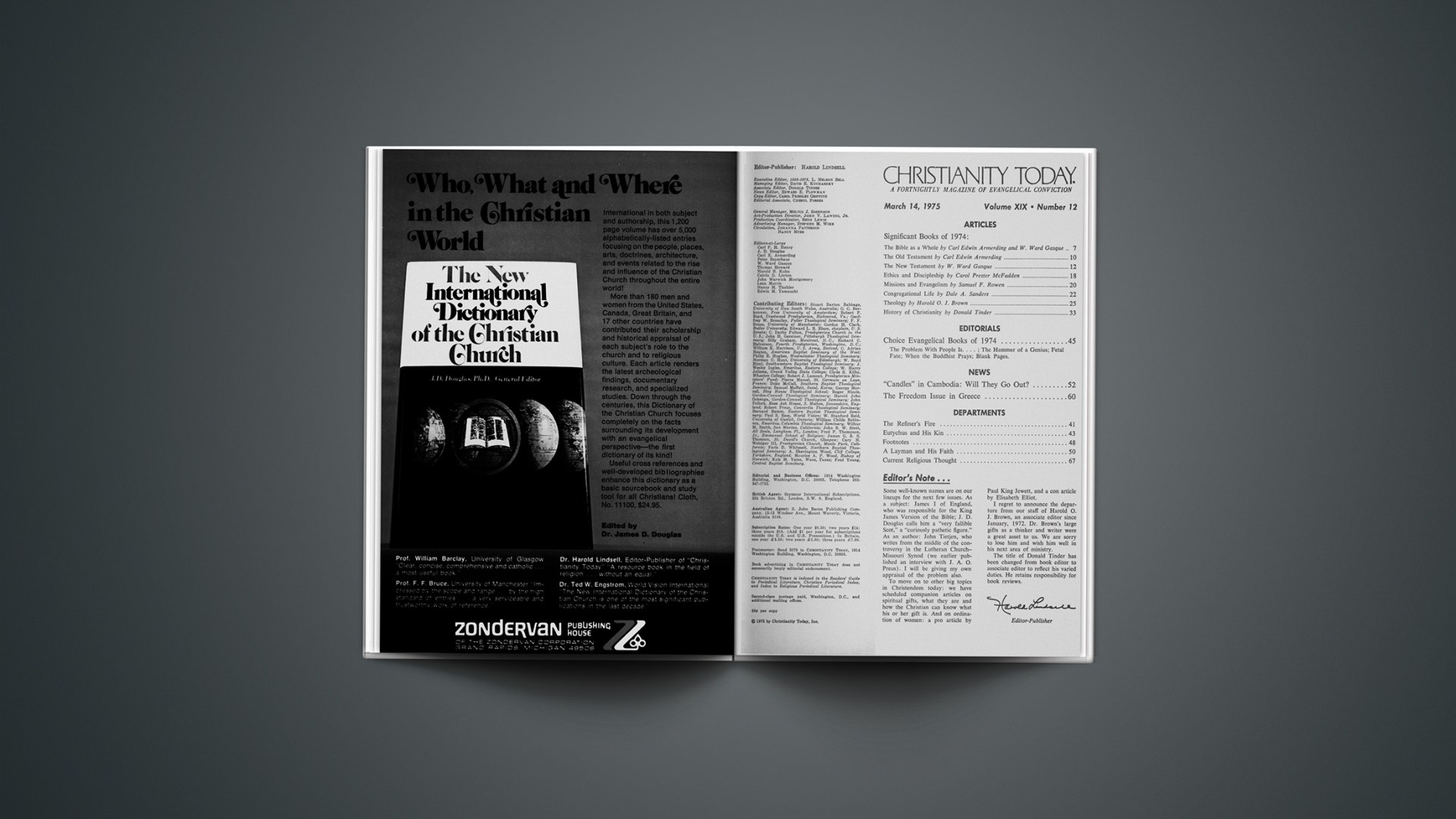
Editor’s Note from March 14, 1975

Some well-known names are on our lineups for the next few issues. As a subject: James I of England, who was responsible for the King James Version of the Bible; J. D. Douglas calls him a “very fallible Scot,” a “curiously pathetic figure.” As an author: John Tietjen, who writes from the middle of the controversy in the Lutheran Church-Missouri Synod (we earlier published an interview with J. A. O. Preus). I will be giving my own appraisal of the problem also.

To move on to other big topics in Christendom today: we have scheduled companion articles on spiritual gifts, what they are and how the Christian can know what his or her gift is. And on ordination of women: a pro article by Paul King Jewett, and a con article by Elisabeth Elliot.

I regret to announce the departure from our staff of Harold O. J. Brown, an associate editor since January, 1972. Dr. Brown’s large gifts as a thinker and writer were a great asset to us. We are sorry to lose him and wish him well in his next area of ministry.

The title of Donald Tinder has been changed from book editor to associate editor to reflect his varied duties. He retains responsibility for book reviews.

Ideas

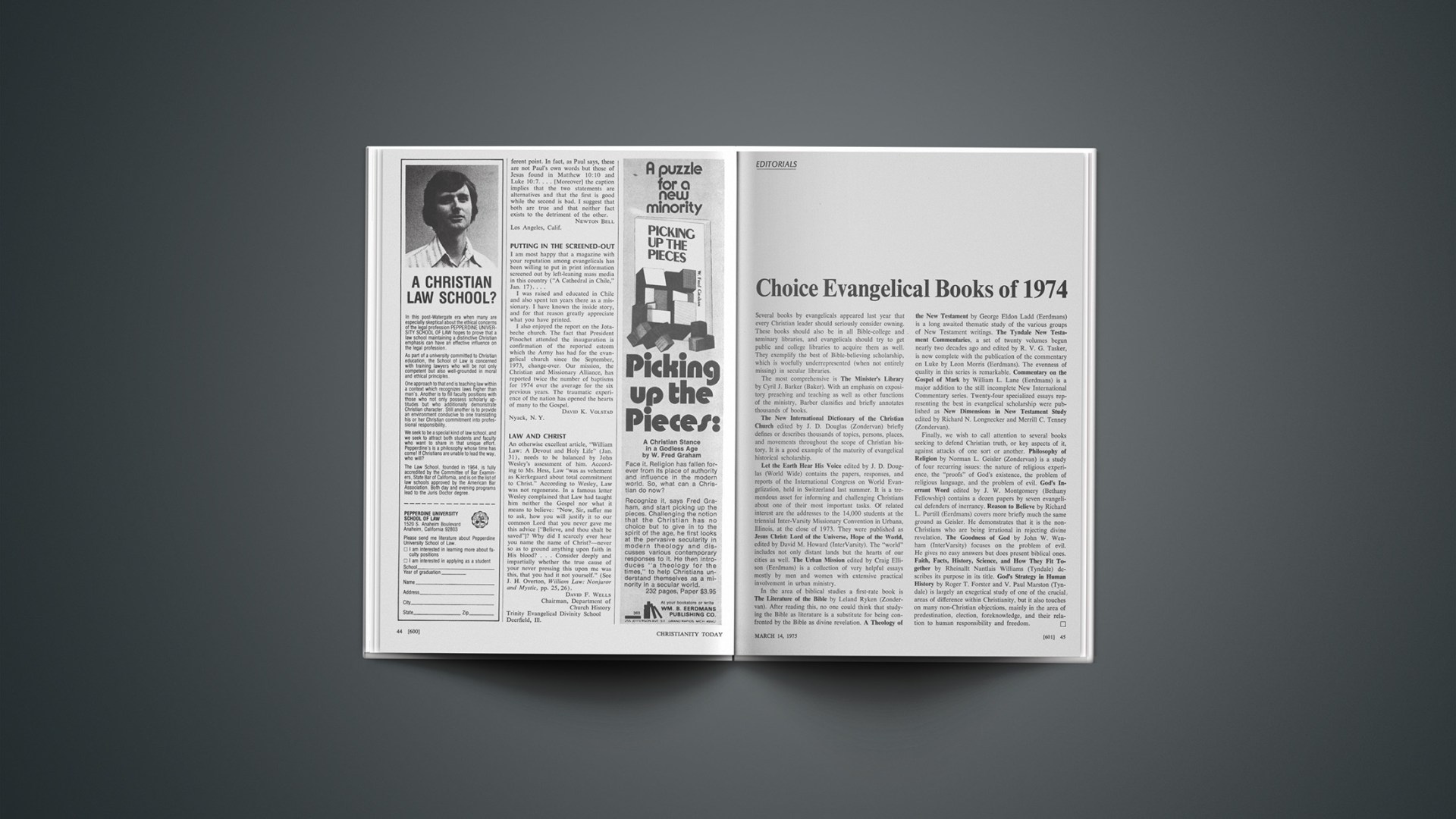
Choice Evangelical Books of 1974

Several books by evangelicals appeared last year that every Christian leader should seriously consider owning. These books should also be in all Bible-college and seminary libraries, and evangelicals should try to get public and college libraries to acquire them as well. They exemplify the best of Bible-believing scholarship, which is woefully underrepresented (when not entirely missing) in secular libraries.

The most comprehensive is The Minister’s Library by Cyril J. Barker (Baker). With an emphasis on expository preaching and teaching as well as other functions of the ministry, Barber classifies and briefly annotates thousands of books.

The New International Dictionary of the Christian Church edited by J. D. Douglas (Zondervan) briefly defines or describes thousands of topics, persons, places, and movements throughout the scope of Christian history. It is a good example of the maturity of evangelical historical scholarship.

Let the Earth Hear His Voice edited by J. D. Douglas (World Wide) contains the papers, responses, and reports of the International Congress on World Evangelization, held in Switzerland last summer. It is a tremendous asset for informing and challenging Christians about one of their most important tasks. Of related interest are the addresses to the 14,000 students at the triennial Inter-Varsity Missionary Convention in Urbana, Illinois, at the close of 1973. They were published as Jesus Christ: Lord of the Universe, Hope of the World, edited by David M. Howard (InterVarsity). The “world” includes not only distant lands but the hearts of our cities as well. The Urban Mission edited by Craig Ellison (Eerdmans) is a collection of very helpful essays mostly by men and women with extensive practical involvement in urban ministry.

In the area of biblical studies a first-rate book is The Literature of the Bible by Leland Ryken (Zondervan). After reading this, no one could think that studying the Bible as literature is a substitute for being confronted by the Bible as divine revelation. A Theology of the New Testament by George Eldon Ladd (Eerdmans) is a long awaited thematic study of the various groups of New Testament writings. The Tyndale New Testament Commentaries, a set of twenty volumes begun nearly two decades ago and edited by R. V. G. Tasker, is now complete with the publication of the commentary on Luke by Leon Morris (Eerdmans). The evenness of quality in this series is remarkable. Commentary on the Gospel of Mark by William L. Lane (Eerdmans) is a major addition to the still incomplete New International Commentary series. Twenty-four specialized essays representing the best in evangelical scholarship were published as New Dimensions in New Testament Study edited by Richard N. Longnecker and Merrill C. Tenney (Zondervan).

Finally, we wish to call attention to several books seeking to defend Christian truth, or key aspects of it, against attacks of one sort or another. Philosophy of Religion by Norman L. Geisler (Zondervan) is a study of four recurring issues: the nature of religious experience, the “proofs” of God’s existence, the problem of religious language, and the problem of evil. God’s Inerrant Word edited by J. W. Montgomery (Bethany Fellowship) contains a dozen papers by seven evangelical defenders of inerrancy. Reason to Believe by Richard L. Purtill (Eerdmans) covers more briefly much the same ground as Geisler. He demonstrates that it is the non-Christians who are being irrational in rejecting divine revelation. The Goodness of God by John W. Wenham (InterVarsity) focuses on the problem of evil. He gives no easy answers but does present biblical ones. Faith, Facts, History, Science, and How They Fit Together by Rheinallt Nantlais Williams (Tyndale) describes its purpose in its title. God’s Strategy in Human History by Roger T. Forster and V. Paul Marston (Tyndale) is largely an exegetical study of one of the crucial areas of difference within Christianity, but it also touches on many non-Christian objections, mainly in the area of predestination, election, foreknowledge, and their relation to human responsibility and freedom.

The Problem With People Is.…

Back in the days before cars were air conditioned, bees and wasps often flew in through open car windows, creating panic among the occupants and occasionally causing accidents. Dr. Claude A. Frazier, a noted allergist who is a Christian, turned an incident like this into a modern parable that appeared in The Upper Room. The characters were a boy and his father, and the boy was one of those people who have violent reactions to bee stings. He had gone into convulsions previously. The next sting could kill him.

When he saw the bee in the car, the boy became hysterical. His father spoke reassuring words, pulled over to the side of the road, and caught the bee in his hand. A moment later he released it, and the boy became frantic again. The father, turning his palm toward the lad, said, “Son, you don’t need to be afraid. See, the barb of the stinger is imbedded here in the palm. I have taken the sting out of that insect, and it can’t harm you.”

Christ’s atonement involved a lot more, of course, than a single simple story can illustrate. The basic principle that does come through is that one person’s hurt saves another. The wages of sin is death, but “God commended his love to us in that while we were yet sinners Christ died for us.” And like the father in Frazier’s parable, Jesus after his resurrection allowed doubting Thomas to see the evidences that the substitutionary suffering had indeed been endured. Death, like the bee, still exists, but it no longer brings judgment to those who trust the Saviour. Its sting is gone.

The view of the Atonement that has for ages been regarded as the orthodox doctrine, in its essential features common to the Latin, Lutheran, and Reformed churches, is that which evangelicals proclaim today. The great Presbyterian theologian Charles Hodge describes it this way in his Systematic Theology:

According to this doctrine the work of Christ is a real satisfaction, of infinite inherent merit, to the vindicatory justice of God; so that He saves his people by doing for them, and in their stead, what they were unable to do for themselves, satisfying the demands of the law in their behalf, and bearing its penalty in their stead; whereby they are reconciled to God, receive the Holy Ghost, and are made partakers of the life of Christ to their present sanctification and eternal salvation.

A contrasting view espoused by some of the church fathers held that the Atonement accomplished only our deliverance from the power of Satan, and did not remove guilt or restore divine life. Also prevalent in the past have been the moral and mystical theories of the Atonement according to which Christ’s work was intended to produce a subjective effect for good in the sinner. The governmental theory held that the suffering and death of Christ were designed as an exhibition of God’s displeasure against sin. Proponents of these various views appealed to special interpretations of the Bible to support their case.

The great tragedy of modern theology is not that it has an unscriptural view of the Atonement but that all too often it shies away from any concept of the Atonement. Many theologians and exegetes in good standing in so-called Christian institutions have abandoned the doctrine altogether. And so a highly respected form critic, Martin Dibelius, could write a 160-page book entitled Jesus, now considered a standard work (and published by the United Presbyterian-owned Westminster Press), without giving any hint as to God’s purpose in sending his son to the cross, or even a suggestion that sinful people would have been hopelessly doomed had Christ not given his life as a ransom for them.

The Hammer Of A Genius

Michelangelo lived the words of J. R. R. Tolkien, written centuries later: “We make still by the law in which we’re made.”

This month we celebrate the five-hundredth anniversary of the birth of the great artist, whose work includes sculpture, such as the Pieta, of St. Peter’s Basilica, the David that marks the entrance to Florence’s city hall, and the Moses on the tomb of Pope Julius II in Rome, the frescoes of the Sistine Chapel, and some of the finest Renaissance poetry. As most commentators on Michelangelo’s life note, the artist lived tormented, torn between the ache for perfection and the despair of failure. In this agony we see his dependence on the Creator. A sonnet written about 1528 by Michelangelo says it well:

If my rude hammer forms the hard stones

Into human semblance, now this shape, now that,

And taking its motion from the minister who guides, watches, and holds it,

Follows the movements of another,

That divine hammer which in Heaven lodges and stays,

Others, and especially itself, with its own motion makes beautiful;

And if one can make no hammer without a hammer

From that living one every other is made;

And since the blow is the more full of strength

The more it lifts itself above the forge,

Above mine, that to heaven has taken flight;

So my unfinished work will fall short

If now the divine workshop does not give me

That help to make it which is alone in this world.

Fetal Fate

A resolution now before the U. S. House of Representatives calls for the creation of a select committee to study the constitutional basis of the Supreme Court decision that struck down anti-abortion statutes. The author of the resolution, Congressman Paul Findley of Illinois, wants to determine “what course is most desirable from the standpoint of the moral issues involved, as well as from the standpoint of public convictions.” Such an investigation seems necessary in the light of the manslaughter conviction of Dr. Kenneth C. Edelin. His trial laid bare the current ambiguity over the steps of fetal development at which an abortion becomes illegal.

Protesters following the trial chanted, “Not the church, not the state, women must decide their fate.” But the woman’s right to decide the fate of the fetus was not infringed in this particular case. The real issue was, When does a fetus become a person under the law, with the consequent right to protection by the state?

When The Buddhist Prays

The religious diversity of the United States was highlighted recently when a Buddhist was appointed chaplain of the California senate. The consequent uproar could be heard all over the country. Chaplaincies, at least in the nation’s capital, have always gone to Protestant ministers. California in 1971 had a Reform Jewish rabbi as chaplain but this appointment from a religion within the Judeo-Christian heritage did not cause the flap that the appointment of a Buddhist did. In any event we suspect that the California senate chambers, if they are like others, are pretty empty when the chaplain prays anyway.

The presence of this Buddhist as a chaplain should help to disabuse those who still think that the United States is a Christian nation. Today it is a secular nation, despite the assertion on our coins that “In God We Trust.” We live in a pluralistic society in which freedom of religion is guaranteed and church and state are separate. No particular religion, Christian or non-Christian, is to be singled out as normative or given support by the state.

What is distressing to the Christian in this pluralistic climate is the idea it fosters that it makes little difference what religion one chooses. Christians believe that the Christian faith is not on the same level as other religions, that it is unique, the only true religion. However, this is a far cry from saying that only those in the Christian tradition can be considered for appointment as chaplains. That policy would be in violation of the Constitution, though it would probably be a fair reflection of what prevailed in the colonial period of American history.

No convinced Christian will join in a Buddhist prayer; he could not do so without profaning his own faith. And no legislator in California need do so either. A senator can stay out of the Senate chamber when the Buddhist chaplain offers his prayer, or he can be present in body without joining in the prayer. It would seem that not a lot of them will have a problem in this area, or else the nomination of the Buddhist would not have been approved.

The true Christian will carry his Christian convictions with him into his work. Christians in California who are distressed by the selection of the Buddhist—and Christians elsewhere who fear the precedent—should remember this when they go to the polls. If they think that the chaplaincy should go to Christians, they should vote for legislators who, besides attending to their major duties of responsible lawmaking, would choose Christian chaplains.

Blank Pages

No matter how ardently we profess to believe that the Bible is the Word of God and truthful in its entirety, most of us have great lapses in the way we act upon this truth in our day-to-day Christian walk.

In First Thessalonians 5:16 the Apostle Paul says: “Rejoice always, pray constantly, give thanks in all circumstances: for this is the will of God in Christ Jesus for you.” How many of us do these three things regularly? Who can thank God in all the adverse circumstances of life? Is it not abnormal to expect a bereaved husband or wife to thank God in the midst of bereavement? Is it really possible to thank God when a much beloved child has succumbed to leukemia? Can we thank God when a life-loving teen-ager is cut down on the highway by a drunken driver? Can we thank God in the midst of the recession that grips most of the world?

Praying, on the other hand, comes easier under rough circumstances. How easy it is to stop praying when we feel good, the sun is shining, and the larder is full. Yet Paul says we are to pray constantly. Constant prayer is an imperative, not an option, in the Christian’s life.

The hardest part of Paul’s three-part prescription is probably the first: “Rejoice always.” It is possible to thank God in hard circumstances in a forced manner or grudgingly, and with a hardened or hurt heart. But here we are told to rejoice always. Grudging obedience is not enough.

Rejoicing in the midst of the bad times is not something we can do by dint of sheer will. We can hardly say that to do what God commands is abnormal, but maybe we ought to say that this rejoicing is supernormal. The only way can can do it is to allow the Holy Spirit to work in our hearts and supply us with the grace that makes rejoicing possible.

God never asks the impossible, and so we know that it is possible to rejoice always, to pray constantly, and to give thanks in all circumstances. If we do not feel constrained to do these things, we might as well have a blank page in our Bibles. Those of us who claim that the whole Bible is the Word of the living God do not have the option of being selective in obeying it.

Eutychus and His Kin: March 14, 1975

Money Talks

“It’s only money.” With those remarkable words a bank specializing in foreign-currency transactions began an ad in a big metropolitan newspaper. The cut showed a stack of Swiss 100-franc notes, and the copy argued that while they too are only money, some money is in effect more like real money than the rest.

It is interesting to notice the difference not only in what the franc and the U. S. dollar are worth but also in what they say. The currency of the United States suggests great solidity, building as it were for eternity. Americans enshrine past presidents and certain other leaders on the banknotes rather as the few remaining monarchies do with their reigning monarch. Impressive public buildings grace many of the notes, and the widely circulated but somewhat devalued one-dollar bill testifies to the Pharaonic and Roman elements in America’s spiritual heritage with the pyramid and eagle. The one-dollar bill also bears the legend, under the pyramid, “Novus Ordo Saeculorum” and the date 1776, suggesting, perhaps unwittingly, a comparison between the New Order of the Ages supposedly begun in 1776 and the New Covenant Era that began (approximately) 1776 years earlier.

The franc-notes have a different message. The fifty-franc note shows an old woman, a young woman, and a child amidst a harvest scene, perhaps suggesting that while the money may not be much by itself, it will buy food. The hundred-franc note shows a medieval knight cutting his cloak to share it with a beggar; many Christians will recognize this as an incident from the life of St. Martin, and anyone might see it as a suggestion that if you have a hundred francs ($23.80 in early 1971, and about $42.50 today), you ought to share with others.

It is the 1,000-franc note, though, that really gets personal. A thousand francs is a lot of money in one bill, and if you have one in your hand, you may feel that you really have something. It bears on one edge a picture of a wealthy medieval merchant sitting behind his countingtable, in robes and a fur-trimmed cap; next to him stands a beautiful young girl. At the other edge of the engraving stands the symbolic skeletal figure of Death, bearing a scythe and beckoning to the rich man and the lovely girl. The message is obvious: You may have 1,000 francs, you may even be beautiful, but you can’t take it with you. If the Swiss have a 5,000-and a 10,000-franc note, it would not be surprising to find them bearing images to illustrate such texts as “The love of money is the root of all evil” and “Repent, or ye shall all likewise perish.”

The Swiss are a very hard-headed and practical people, and are materialistic in some ways and to a degree that many Americans are not. But they also seem to know something that we, in our zeal for this-worldly security and a “novus ordo saeculorum,” had better not forget: You can’t take it with you.

Three And One

Three cheers and Amen to Dr. Carl F. H. Henry’s “Reflections on Women’s Lib” (Footnotes, Jan. 3). In preparation for a recent college lecture, I surveyed the current literature on women in religious thought. Books coming from evangelical publishing houses stress the family role of women and tend to ignore other talents (beyond volunteer church work). Remembering that the fellow workers with Paul included Lydia, a seller of purple, as well as Dorcas, who sewed garments for the poor, there is indeed a diversity of gifts! Women who combine Christian family commitments with specialized working talents need to make their voices heard and their examples known.

Editor

The Review of Books and Religion

White River Junction, Vt.

Sly Masterpiece

With all due appreciation of prior Eutychuses, it seems to this cover-to-cover reader that contemporary VI (may the Lord long preserve him) is tops. “At E.A.S.E. in Zion” (Jan. 17) is a masterpiece of tongue-in-cheek humor, with sly implications much needed in our day.

First Chinese Church of Christ

Honolulu, Hawaii

Cartoon Capsules

“The What If …” cartoons are both clever and humorous. In capsule form they often contrast biblical and non-biblical viewpoints very effectively. They tend to remain with the reader longer than much of the more seriously presented material.… [But] humor at the expense of truth is a poor bargain.

The January 3 cartoon is a case in point: “Paul, it’s a masterful letter, but could you change ‘The laborer deserves his wages’ to ‘Labor is a negotiable commodity’?” I found this remark witty and certainly worth an appreciative chuckle. However … the quotation from First Timothy 5:18 has been taken out of its context to make quite a different point. In fact, as Paul says, these are not Paul’s own words but those of Jesus found in Matthew 10:10 and Luke 10:7.… [Moreover] the caption implies that the two statements are alternatives and that the first is good while the second is bad. I suggest that both are true and that neither fact exists to the detriment of the other.

Los Angeles, Calif.

Putting In The Screened-Out

I am most happy that a magazine with your reputation among evangelicals has been willing to put in print information screened out by left-leaning mass media in this country (“A Cathedral in Chile,” Jan. 17).…

I was raised and educated in Chile and also spent ten years there as a missionary. I have known the inside story, and for that reason greatly appreciate what you have printed.

I also enjoyed the report on the Jotabeche church. The fact that President Pinochet attended the inauguration is confirmation of the reported esteem which the Army has had for the evangelical church since the September, 1973, change-over. Our mission, the Christian and Missionary Alliance, has reported twice the number of baptisms for 1974 over the average for the six previous years. The traumatic experience of the nation has opened the hearts of many to the Gospel.

Nyack, N. Y.

Law And Christ

An otherwise excellent article, “William Law: A Devout and Holy Life” (Jan. 31), needs to be balanced by John Wesley’s assessment of him. According to Ms. Hess, Law “was as vehement as Kierkegaard about total commitment to Christ.” According to Wesley, Law was not regenerate. In a famous letter Wesley complained that Law had taught him neither the Gospel nor what it means to believe: “Now, Sir, suffer me to ask, how you will justify it to our common Lord that you never gave me this advice [“Believe, and thou shalt be saved”]? Why did I scarcely ever hear you name the name of Christ?—never so as to ground anything upon faith in His blood?… Consider deeply and impartially whether the true cause of your never pressing this upon me was this, that you had it not yourself.” (See J. H. Overton, William Law: Nonjuror and Mystic, pp. 25, 26).

Chairman, Department of Church History

Trinity Evangelical Divinity School

Deerfield, Ill

The Refiner’s Fire: Music

Ralph Vaughan Williams: The Glow Of Tradition

Ralph Vaughan Williams was born in 1872, the son of a minister. He studied music at the Royal College of Music and at Cambridge, from which he eventually received a D.Mus. Perhaps his most important compositional study was with Maurice Ravel. He went to Ravel not in order to bring back to England the French style—English music had been overwhelmed with Continental influence ever since Handel moved there in the eighteenth century—but to correct what seemed to him an insufficient musical technique.

Meanwhile his own sense of Englishness, nurtured by his discovery of and consequent involvement with English folk music, had fused with a highly individual style which, for the first time since Purcell (1659–95), brought England back to an indigenous musical language. This can be called nationalism, not because of a superficial overlay of folk tunes but because the composer belonged to a heritage that merged with his own individual vision.

In addition to a prolific output of operas, ballets, incidental music, film scores, church music, choral works, songs, ensemble and solo music, concerti, and symphonies, Vaughan Williams co-edited the very important Oxford Book of Carols and was music editor of the English Hymnal (1906).

In Vaughan Williams’s life and music there is a pleasant congruence. One sees a whole man, profoundly humane and unpretentious, a shepherd of the aesthetic needs of the amateur and the artist. In Working With R. V. W., Roy Douglas’s description of his uprightness is a balm to those who have been inhibited by the legends of artistic hauteur and hypothetical perfectionism. We see in Vaughan Williams a man fighting deafness, needing the help of others, seeking technical advice and responding quite often with revisions. He had that rare quality of taking himself with a grain of salt. His irrepressible humor comes out in his music—listen to the Scherzo of his Eighth Symphony—and in the delightful program notes he often furnished. From those he wrote for his Ninth Symphony:

The saxophones … are not expected, except possibly in one place in the scherzo, to behave like demented cats, but are allowed to be their own romantic selves.

Further on:

G major is reached. The correct key for the second subject at last; but, oh dear, it is not a new subject at all but a version developed and extended. Never mind, Haydn often does much the same, and what is good enough for the master is good enough for the man.

Finally:

The second movement … seems to have no logical connection between its various themes. This has led some people to think it must have a programme since apparently programme music need not be logical. It is quite true that this movement started off with a programme, but it got lost on the journey—so now, oh no, we never mention it—and the music must be left to speak for itself—whatever that may mean.

And so it does, often masterfully.

Vaughan Williams is one of the few major recent composers a large part of whose music was for the church. This is the more enticing because his output ranged all the way from hymn tunes and arrangements to expansive choral and instrumental works. He had a lifelong affection for amateur choirs and liked to have them perform his works. He possessed a mobile integrity, that rare capability of writing simple music of unquestioned excellence: hymn tunes such as Sine Nomine or King’s Weston, the quietly elegant organ prelude on Rhosymedre, or the dignified setting of Old Hundredth, for instruments, chorus and congregation, prepared for the coronation of Queen Elizabeth II. His songs, for example those extracted from his opera Pilgrim’s Progress, the Five Mystical Songs, or On Wenlock Edge, demonstrate his skill in vocal line coupled with a distinct textural and harmonic sense.

His love for the hymn tune and for congregational singing is shown in the compositions that combine the latter with chorus and instruments, as in the strong setting of Miles Lane (“All Hail the Power of Jesus’ Name”). Then there is the unduly neglected Fantasiaon Old 104th, for piano, orchestra and chorus, which again brings the hymnic tradition to bear, this time in the company of the instrumental concerto. The Mass in G Minor for solo quartet and double chorus is a synthesis of the constraint of chant and the tracery of Renaissance polyphony. As churchly as these and others of his compositions are, they are not out of place in the concert hall. And this has always been the mark of great sacred music.

Finally, a word about his symphonies. They run a wide stylistic gamut. To his last day (he composed steadily up to his death in 1958), Vaughan Williams was searching. The Eighth and Ninth Symphonies utilize unusual instruments: the flügelhorn, saxophones, vibraphone, xylophone, and gong; the Sinfonia Antarctica, originally a film score for Scott of the Antarctic, makes use of a wind machine, wordless female chorus, and pipe organ. In addition he composed a concerto for tuba as well as the Romance for Harmonica, Strings and Piano. He was constantly searching out ways of reshaping musical form, but always within a classic-romantic framework. The Scherzo of the Eighth Symphony starts out properly but ends up foreshortened; yet it is musically right. The first movement of the same work is a set of variations without a theme. His nine symphonies range from a pastoral romanticism, as in his third, to the angry, clashing arguments of the ninth. To be sure there is a single Vaughan Williams, but the listener must be sure he has heard him out, for within his supposed conservatism there are rich and variegated excursions.

A conservative always runs a risk. Yet what is a conservative but one who sees something newly individual to say within a tradition thought by others to be exhausted? Those who strike out on new paths have no different artistic responsibility, for they too must say something new. The difference is not so great after all, for each must speak individually despite procedural variances.

Creative history has never been without these overlays. While Bach exhausted one tradition, his contemporaries set out on another, and we have learned to love them both. In this century, too, Vaughan Williams, among others, was freshening an older tradition while Stravinsky, among others, set out on a new. We must not overlook the glow of the one for the dazzle of the other, but reach out for both. In this way we truly celebrate creativity and therefore each artistry, of which Ralph Vaughan Williams is a singular example.

HAROLD M. BEST1Harold M. Best is director of the Conservatory of Music, Wheaton College, Wheaton, Illinois.

History of Christianity

Far and away the most significant book in this area to appear last year was The New International Dictionary of the Christian Church edited by J. D. Douglas (Zondervan). More than 180 British and North American evangelicals contributed close to 5,000 articles on all the highways and many of the byways of the nearly 2,000 years of Christianity. Every seminarian and minister should have a copy, as should public libraries and school libraries from secondary level up.

A revised second edition of The Oxford Dictionary of the Christian Church edited by F. L. Cross and E. A. Livingstone (Oxford) also appeared last year.

The Encyclopedia of the Unexplained: Magic, Occultism and Parapsychology edited by Richard Cavendish (McGraw-Hill) covers a far wider range than Christian fringe movements; it does so in a more scholarly and responsible way than one is accustomed to find in trade books.

The Encyclopedia of World Methodism edited by Nolan Harmon (Abingdon) is a massive two-volume set—nearly 3,000 pages treating every aspect and branch of a major expression of Christianity. Still another important reference work, Historical Atlas of the Religions of the World (Macmillan), breaks new ground. Christianity is treated along with living and dead religions, global and regional. Twenty major articles, edited by Isma’il Ragi al Faruqi, present histories of the various religions. These are supplemented by sixty-five maps, edited by David Sopher. Chronologies and photographs enhance the value.

A short, comprehensive text, A History of Christianity in the World by

Clyde Manschreck (Prentice-Hall), indicates something of its tone by its subtitle, “From Persecution to Uncertainty.” The author’s confidence in the message of the resurrected Christ transcends both the persecution by the world in which the Church began and the present uncertainty within the Church that worldly influences have engendered.

The second volume in Jaroslav Pelikan’s projected five-volume work The Christian Tradition: A History of the Development of Doctrine appeared, The Spirit of Eastern Christendom (600–1700) (University of Chicago). Pelikan is perhaps the scholar best equipped to convey a better understanding of Eastern Orthodoxy to other branches of Christianity.

SPECIAL TOPICS There were several interesting presentations of various aspects of Christianity over many centuries. The Faces of Jesus by Frederick Buechner and Lee Boltin presents in word and splendid photographs the life of Christ as artists have portrayed it in such varied media as wall paintings in the catacombs and silk screens in Japan (Simon and Schuster). The well-known historian Roland Bainton has done likewise in Behold the Christ (Harper & Row). Half of another book does the same in a presentation keyed to the days of the Christian year: The Christian Calendar by L. W. Cowie and John Gummer (Merriam). (The other half of the book lists, with some descriptions and illustrations, all the “saints” on the Roman calendar, arranged by the day on which they are remembered.) These books will give readers a greater appreciation of the richness of the Christian artistic heritage, together with a better understanding of the perceptions of Christians in different ages.

The Roots of American Order by Russell Kirk (Open Court) goes back to Old Testament times to trace the Hebrew, pagan, Christian, and secular influences that have contributed to the relative stability of the United States when compared to other large nations.

The Old Testament influence on the political and artistic dimensions of the Western world is delineated by Gabriel Sivan in The Bible and Civilization (Quadrangle).

Devotional life is portrayed in its various historical expressions from ancient to early modern times in a series of translations of articles from Dictionnaire de Spiritualité:Jesus in Christian Devotion and Contemplation by Irenee Noye et al., A Christian Anthropologyby Joseph Goetz et al., and Imitating Christ by Edouard Cothenet et al. (Abbey). A similar book, The Breath of the Mystic by George Maloney (Dimension), focuses on the eastern fathers. Opposition to false spirits is surveyed responsibly by Martin Ebon in The Devil’s Bride: Exorcism, Past and Present (Harper & Row). A wide variety of corporate religious awakenings is presented in Spiritual Revivals edited by Christian Duquoc and Casiano Floristán (Seabury).

Collections of miscellaneous essays of high caliber by two distinguished historians of ideas are Christianity and Culture by Georges Florovsky (Nordland) and Philosophical Essays: From Ancient Creed to Technological Man by Hans Jonas (Prentice-Hall).

Three crucial themes are briefly and provocatively surveyed in Philosophical Anthropology (on the history of human self-understanding in the West) by Michael Landman (Westminster), The Interaction of Law and Religion by Harold Berman (Abingdon), and Western Attitudes Toward Death by Philippe Aries (Johns Hopkins). (A notable cross-cultural counterpart to the latter is Death and Eastern Thought edited by Frederick Hoick [Abingdon].)

EARLY AND MEDIEVAL The most comprehensive book, though it does not aim at textbook-style completeness, is The Medieval Experience: Foundations of Western Cultural Singularity by Francis Oakley (Scribners). The most lavish is The Monastic World: 1000–1300 by Christopher Brooke with numerous photographs by Wim Swaan (Random). The combination of scholarship and beauty is commendable. An earlier period of artistry is displayed in The Origins of Christian Art by Michael Gough (Praeger).

F. F. Bruce in his clear, accurate style tells us about Jesus and Christian Origins Outside the New Testament (Eerdmans). From Josephus to Islamic tradition is the scope. A reprint of T. R. Glover’s The Conflict of Religions in the Early Roman Empire (Canon) helps us better understand the setting of the first two Christian centuries. From a slightly later time, Hugh Riley compares the interpretations of baptism in Cyril, Chrysostom, Theodore, and Ambrose in Christian Initiation (Consortium).

Some forget that Christianity in Britain and Ireland was vibrant long before a pope sent Augustine to Canterbury. The Celtic Churches: A History, A.D. 200 to 1200 by John T. McNeill (University of Chicago) gives us a comprehensive and accurate overview of this missionary-minded movement.

Several studies on particular topics should be of interest to more than specialists: Rhetoric in the Middle Ages: A History of Rhetorical Theory from St. Augustine to the Renaissance by James J. Murphy (University of California); in some respects from the opposite pole, Silence: The Meaning of Silence in the Rule of St. Benedict by Ambrose Wathen (Consortium) (the author’s suggestions of contemporary relevance are worth considering); Heresy, Crusade and Inquisition in Southern France, 1100–1250 by Walter Wakefield (University of California); Bernard of Clairvaux by Henry Rochais et al. (Consortium), ten studies in honor of Jean Leclercq relating Bernard to his own and to other times; Rome Before Avignon: A Social History of Thirteenth-Century Rome by Robert Brentano (Basic); and The Cardinal Protectors of England: Rome and the Tudors Before the Reformation, by William Wilkie (Cambridge).

Two noteworthy collections of essays on various topics are Contemporary Reflections on the Medieval Christian Tradition edited by George Shriver in honor of Ray Petry (Duke) and The Pursuit of Holiness in Late Medieval and Renaissance Religion edited by Charles Trinkaus and Heiko Oberman (E. J. Brill).

Anabaptism and Asceticism by Kenneth Ronald Davis (Herald Press) focuses on the late medieval monastic antecedents of the Anabaptist movement.

REFORMATION Especially welcome is Trumpeter of God: A Biography of John Knox by W. Stanford Reid (Scribners), a noted evangelical historian. As usual, several books appeared on Luther. Richard Marius, a religious skeptic, presented an extremely critical harangue entitled simply Luther (Lippincott). Confrontation at Worms: Martin Luther and the Diet of Worms by De Lamar Jensen (Brigham Young) includes many illustrations plus the complete text of the edict. Luther’s confrontations in the other direction are treated in scholarly fashion in Luther and the Peasants’ War by Robert Crossley (Exposition), Luther’s Response to Violence, also on the peasants, by Lloyd Volkmar (Vantage), and Luther and the Radicals by Harry Loewen (Wilfrid Laurier University). One of those whom Luther opposes was given a thorough and sympathetic treatment not distorted by the customary approach of looking over Luther’s shoulder: Andreas Bodenstein von Karistadt by Ronald Sider (E. J. Brill).

Other Reformation-era books include: The Spirituality of John Calvin by Lucien Joseph Richard (John Knox), Ecumenism in the Age of the Reformation: The Colloquy of Poissy by Donald Nugent (Harvard), The Counter Reformation: 1559–1610 by Marvin O’Connell (Harper & Row), Every Need Supplied: Mutual Aid and Christian Community in the Free Churches, 1525–1675 edited by Donald Durnbaugh (Temple University), and The English Bible: 1534 to 1859 by Peter Levi (Eerdmans).

MODERN Most books dealing with persons, events, and movements since the Reformation are grouped by continent. A few are comparatively global in scope. The ecumenical movement is well represented by The World of Philip Potter (general secretary of the World Council) by William Gentz (Friendship), In Search of a Responsible World Society: The Social Teachings of the World Council of Churches by Paul Bock (Westminster), Baptist Relations With Other Christians edited by James Leo Garrett (Judson), and Ecumenical Testimony: The Concern For Christian Unity Within the Reformed and Presbyterian Churches, by John T. McNeill and James Nichols (Westminster). A responsible but critical overview is provided in Ecumenism: Boon or Bane, by Bert Beach (Review and Herald) and also, with special reference to the ecumenical missionary conferences from 1910 on, in World Evangelism and the Word of God by Arthur Johnston (Bethany Fellowship).

One of the most widely influential Christian thinkers of our time was the subject of three more books, two of them of special significance. C. S. Lewis: An Annotated Checklist of Writings About Him and His Works by Joe Christopher and Joan Ostling (Kent State University) has more than 300 pages full of annotated items; C. S. Lewis: A Biography by Roger Green and Walter Hooper (Harcourt Brace Jovanovich) is the best so far; and Bright Shadow of Reality: C. S. Lewis and the Feeling Intellect by Corbin Scott Carnell (Eerdmans) focuses on sehnsucht (yearning).

Some seventy years ago Edwin Dargan wrote a two-volume history of preaching up to his time, except that he omitted American preaching. Now Ralph Turnbull’s A History of Preaching: Volume III remedies that and also brings the account down to 1950 for the rest of the world. The set is published by Baker.

Three quite different global influences illustrate various approaches to Christianity. Protestant communal living is the subject of Donald Bloesch’s Well-springs of Renewal (Eerdmans). Groups like Operation Mobilization and Bethany Fellowship are included along with more conventionally monastic houses.

The Armstrong Empire: A Look at the Worldwide Church of God by Joseph Hopkins (Eerdmans) is the best history and refutation of that deceptive Christian deviation. An account of a movement considerably more influential in academic circles but no less deviationist is given in Existentialism by Francis Lescoe (Alba House). Six key thinkers are studied, from Kierkegaard to Camus.

EUROPE A number of biographical studies, mostly concentrating on intellectual development and significance, were issued. Cross and Crucible by John Warwick Montgomery is on Johann Valentin Andreae (The Hague: Martinus Nijhoff). The Religion of Dostoevsky by A. Boyce Gibson (Westminster) considers evidence from both outside and inside the great novels. FitzRoy of the Beagle by H. E. L. Mellersch (Mason and Lipscomb) is about the captain of the voyage made famous by Darwin, who was religiously very interesting in his own right. P. T. Forsyth by A. M. Hunter (Westminster) is a brief introduction to an insightful theologian. Kant on History and Religion by Michel Desplan (McGill-Queen’s University) is an important interpretive study. The same applies to The Christian Revolutionary: John Milton by Hugh Richmond (University of California). A once-renowned apologist, now little read, is revived by M. L. Clarke in Paley: Evidences For the Man (London: SPCK). A still-read apologist is freshly introduced by Roger Hazelton in Blaise Pascal: The Genius of His Thought (Westminster). A more recent intellect is briefly portrayed by David Edwards in Ian Ramsey: Bishop of Durham (Oxford). Ritschl and Luther, by David Lotz (Abingdon) offers a fresh perspective on the influential theologian. David Friedrich Strauss and His Theology by Horton Harris (Cambridge) studies the most notorious theologian of last century. The Presence of Other Worlds: The Findings of Emanuel Swedenborg by Wilson Van Dusen (Harper & Row) is a sympathetic summary of an eighteenth-century polymath whose dreams and trances of “other worlds” led to radical deviation from biblical revelation. He has had few but intense followers. Martin Schmidt’s John Wesley: A Theological Biography is now complete with the appearance of volume two, part two (Abingdon).

Perhaps the most significant non-biographical study pertaining to modern European Christianity is The Eclipse of Biblical Narrative: A Study on Eighteenth and Nineteenth Century Hermeneutics by Hans Frei (Yale). Church historians, theologians, and biblical and literary critics should all find it provocative.

There was a potpourri of scholarly books on British church history: The Witchcraft Papers: Contemporary Records of the Witchcraft Hysteria in Essex, 1560–1700 edited by Peter Haining (University Books), The Religious Order: A Study of Virtuoso Religion and Its Legitimation in the Nineteenth-Century Church of England by Michael Hill (Crane, Russak), Scottish Theology in Relation to Church History by John Maclead (Banner of Truth, reprint), The Last Crusade: The Church of England in the First World War by Albert Marrin (Duke University), Pit-Men, Preachers, and Politics: The Effects of Methodism in a Durham Mining Community by Robert Moore (Cambridge), Hell and the Victorians: A Study of the Nineteenth-Century Theological Controversies Concerning Eternal Punishment and the Future Life by Geoffrey Rowell (Oxford), and Between Science and Religion: The Reaction to Scientific Naturalism in Late Victorian England by Frank Turner (Yale).

Of many books on the troubled Emerald Isle we call attention to Church, State, and Nation in Ireland, 1898–1921 by David W. Miller (University of Pittsburgh), Northern Ireland: Captive of History by Gary MacEoin (Holt, Rinehart, Winston), The Bitter Harvest: Church and State in Northern Ireland by Albert Menendez (Luce), and, in a more popular vein, Tonight They’ll Kill a Catholic by R. Douglas Wead (Creation).

Three major scholarly studies dealt with the Church and German Fascism: Above Parties: The Political Attitudes of the German Protestant Church Leadership, 1918–1933 by J. R. C. Wright (Oxford), The Vatican in the Age of the Dictators (1922–1945) by Anthony Rhodes (Holt, Rinehart, Winston), and The German Church Struggle and the Holocaust edited by Franklin Littell and Hubert Locke (Wayne State University). In view of the all too frequent ease with which churchmen support totalitarian regimes in our own time, we need constant reminders of what such support meant in the recent past.

Finally, three popular but more or less responsible reports of Christian life under the major, but not the only, expression of totalitarianism today are: Discretion and Valour: Religious Conditions in Russia and Eastern Europe by Trevor Beeson (Glasgow: William Collins Sons), Christians Under the Hammer and Sickle by Winrich Scheffbuch (Zondervan), and Memoirs by Jozsef Cardinal Mindszenty (Macmillan).

ASIA AND THE PACIFIC One of the best-known Chinese Christians is the late Watchman Nee, whose story is told by Angus Kinnear in Against theTide (Christian Literature Crusade). A different sort of ecclesiology is reflected in Wallace Merwin’s Adventure in Unity (Eerdmans). It tells of the Church of Christ in China, formed in 1927 as one of the first of the modern unions of denominations. Communism eventually wiped it out. A longtime evangelical “China watcher,” Robert Larson, has written Wansui: Insights on China Today (Word). Of scholarly interest is The Foochow Missionaries, 1847–1880 by Ellsworth Carlson (Harvard).

The earlier Christianity in Japan (1549–1639) is authoritatively presented with crucial documents in Deus Destroyed by George Elison (Harvard). More recent Christianity is interpretively reported in Church Growth in Japan: A Study in the Development of Eight Denominations, 1859–1939 by Tetsunao Yamamori (Carey).

Christians in Persia by Robin Waterfield (Barnes and Noble) covers the major branches of Christianity from the second century to the present. Herman Tegenfeldt gives a detailed account of The Kachin Baptist Church of Burma (Carey). Heart of Fire by Barry Chant is the story of Pentecostalism in Australia (Luke Publications [95 Wattle St., Fullarton, South Australia]).

Two scholarly books that will enhance understanding of various trends in India are India and the Latin Captivity of the Church by Robin Boyd (Cambridge), which, despite the title, is primarily concerned with Protestantism, and Christians in Secular India by Abraham Vazhayil Thomas (Fairleigh Dickinson University).

Five noteworthy books of popular appeal are The Triumph of Pastor Son

by Yong Choon Ahn (InterVarsity), about a Korean’s faith amid persecution; God’s Tribesman by James and Marti Hefley (Holman), about a vibrant minority-group Christian from India, Rochunga Pudiate; Pioneers in the Arab World by Dorothy Van Ess (Eerdmans), chiefly on the Reformed Church of America-sponsored ministry of the author and her husband; Exodus to a Hidden Valley by Eugene Morse (Reader’s Digest), about a missionary family and a thousand tribesmen who set up a secret settlement because of Burmese government pressure; and I Always Wore My Topi: The Burma Letters of Ethel Mabuce, 1916–1921 (University of Alabama).

LATIN AMERICA A major revision with a new title is Understanding Latin Americans: With Special Reference to Religious Values and Movements by

Eugene Nida (Carey). His insights are extremely helpful. Student Evangelism in a World of Revolution by Jack Voelkel (Zondervan) examines differing ways of evangelism by several groups that are active in Latin America and makes some suggestions. Donald Palmer reports on an Explosion of People Evangelism: An Analysis of Pentecostal Church Growth in Colombia (Moody). A different sort of explosion is described in The Political Transformation of the Brazilian Catholic Church by Thomas Bruneau (Cambridge).

AFRICA A complex and contradictory pioneer is the subject of yet another biography: Livingstone by Elspeth Huxley, distinguished mainly by its more than 100 helpful illustrations (Saturday Review). The Challenge of Black Theology in South Africa edited by Basil Moore (John Knox) offers insights into how black South Africans perceive what Christianity has done to them. An Anglican dean from South Africa narrates his experiences in Encountering Darkness by G. A. ffrench-Beytagh (Seabury). An Anglican archbishop’s story is presented by South Africa’s best-known writer, Alan Paton, in Apartheid and the Archbishop: The Life and Times of Geoffrey Clayton (Scribners). Missionary reminiscences of a little-known country are provided in We Went to Gabon by Carol Klein (Christian Publications). Scholars will appreciate Christianity and Ibo Culture by Edmund Ilogu (E. J. Brill).

Noteworthy books on North America were so numerous that limitations of space in this issue require us to survey them in future issues in the regular book-review section. Social-scientific studies of religion will also be noted in a future issue.

Theology

Theology

The closest thing to a systematic theology is the revision by John F. Walvoord of Major Bible Themes (Zondervan) by Lewis Sperry Chafer, whom Walvoord succeeded as president of Dallas Seminary. A work of current usefulness, despite the brevity of its treatment of traditional themes in theology such as Creation, Major Bible Themes is also of historical value because of its characteristic dispensational views. God’s Inerrant Word edited by John W. Montgomery (Bethany Fellowship) contains seminal essays in vigorous presentation and defense of the historic, orthodox view of Scripture.

PHILOSOPHY OF RELIGION Several substantial works have appeared in this field. Norman Geisler’s Philosophy of Religion (Zondervan) is really a textbook on fundamental theological problems, such as religious experience, the knowledge of God and the “proofs” of his existence, religious language, and the problem of evil; it is straightforward, easily understood, and very valuable. Malcolm L. Diamond in Contemporary Philosophy and Religious Thought (McGraw-Hill) goes into greater detail than Geisler does, and has extended treatments of several thinkers: Rudolph Otto, Martin Buber, William James, Sören Kierkegaard, Rudolf Bultmann, and, in a whole section of the book, Tillich, whose work Diamond calls “the most comprehensive system [of religious thought] that has been introduced in the twentieth century,” without himself adopting it. W. Donald Hudson in A Philosophical Approach to Religion (Barnes and Noble) examines and supports the logical structure of religious belief and its objectivity. He deals with the attempts of several theologians of the secular—Bonhoeffer, Braithwaite, Van Buren, Tillich, and Cox—to meet the challenge, attempts that Hudson feels are inadequate. Frederick C. Copleston, S.J., in Religion and Philosophy (Barnes and Noble) explains and defends the discipline of metaphysics as “a way to the Absolute through the activity of rational reflection”; the book is a very useful if somewhat scholastic corrective to the analytic philosophers’ familiar attempt to dismiss metaphysics—and the rest of philosophy and religion—as meaningless.

The anthology Philosophy of Religion: Contemporary Perspectives edited by Norbert O. Schedler (Macmillan) contains representative selections from outstanding recent thinkers on the borderline between philosophy and religion, including both atheistic and religious existentialists. The somewhat larger Readings in the Philos ophy of Religion edited by Baruch A. Brody (Prentice-Hall) presents a much broader historical perspective, going back to Augustine, and illustrates the ways in which traditional Christians, as well as some others, have dealt with some of the recurrent problems of religious philosophy.

Charles H. Malik in The Wonder of Being (Word) gives a fresh presentation of the cosmological argument in a reasoned defense of biblical faith. More technically, in opposition to the familiar attacks of linguistic analysis on religious language and hence on the content it expresses, Basil Mitchell proclaims The Justification of Religious Belief (Seabury). That such books are still necessary is evident from William Hamilton’s pretentious attempt to reinflate secularistic, God-is-dead theology in a subjectivistic way, in On Taking God Out of the Dictionary (McGraw-Hill). Much more substantial, and clearly intended to undergird the meaningfulness of the philosophical-religious quest, is the impressive tome by Paul Weiss, Beyond All Appearances (Southern Illinois University Press), which unfortunately remains more idealistic than Christian despite the author’s position as a professor at Catholic University.

An ambitious project, somewhat in the spirit of C. S. Lewis, is Morton T. Kelsey’s Myth, History, and Faith: The Remythologizing of Christianity (Paulist). Kelsey explains the function and value of myth and sees Christianity as myth, in his special sense, and also as true. A rather poetic plea for a more responsible use of language in proclamation and liturgy is Robert Farrar Capon’s Hunting the Dixine Fox: Images and Mystery in Christian Faith

(Seabury). Two collections of essays by eminent Christian philosophers, generally in support of Christian teachings against the disintegrating skepticism of linguistic analysis, are Ian Ramsey, Christian Empiricism, edited by Jerry H. Gill, and Austin Farrer, Reflective Faith, edited by Charles C. Conti (both Eerdmans). Ramsey offers some useful thoughts on the validity of theological discourse, and Farrar presents some solid arguments for the reality of God.

Rounding off the works dealing with the now old arguments of linguistic analysis is the translation of an important new book by a Dutch Catholic thinker who has concentrated on the problem of revelation, Edward Cornelis Florentius Alfons Schillebeeckx, The Understanding of Faith: Interpretation and Criticism (Seabury). This short but substantial work offers an insightful appreciation of some of the positive aspects of linguistic analysis, while explicitly rejecting its usual conclusions. Schillebeeckx also grapples with the “new critical theory” of the Frankfurt school led by Jürgen Habermas. Inasmuch as Habermas’s theory is an attempt to understand society while promoting (revolutionary) liberation and has had considerable influence on theologians of similar inclinations, Schillebeeckx’s careful presentation and critique of the “new theory” is particularly useful today.

A valuable book that is hard to categorize is Wayne C. Booth, Modern Dogma and the Rhetoric of Assent

(University of Chicago); the author exposes the way in which modern cliches and practices in public and private debate on values undermine reason and logic and make it extremely difficult to arrive at truth or to appreciate genuine values. He makes specific suggestions for combatting these trends.

DOCTRINE Perhaps the English version of the first volume of Helmet Thielicke’s massive Der evangelische Glaube (1968), skillfully translated and edited by Geoffrey W. Bromiley. The Evangelical Faith, Volume I, Prologomena: The Relation of Theology to Modern Thought Forms (Eerdmans), should appear in the thinly represented opening section of systematics. Thielicke is familiar to North Americans as a major German theologian who is not a liberal and who offers trenchant criticisms of the programs of the existentialists and secularizers. This first volume of three shows Thielicke’s tremendous mastery of his material. Never one to follow the crowd, Thielicke creates a new distinction in theology, between “Cartesian” (ego-centered modernist theology) and a message-centered “Theology B,” which is rather conservative but shies away from the name. It suffers from Thielicke’s typical hesitation between a recognition of what is false in modern theology and the academically uncouth decision to condemn and separate oneself from it because it is false.

John Knox Press offers two brief surveys of Christian doctrine today: A. M. Hunter, Taking the Christian View, and Stephen Sykes, An Introduction to Christian Theology Today. Both authors are on the conservative side of the theological spectrum.

A Roman Catholic contribution in the same area, by contrast, can serve both as a concise, trenchant presentation of basic doctrine and as a persuasive apologetic for the traditional Catholic (and, in many areas, evangelical) position on a number of important issues: John D. Sheridan, The Hungry Sheep: Catholic Doctrine Restated

Against Contemporary Attacks (Arlington). Malcolm Furness, Vital Doctrines of the Faith (Eerdmans), is one of the best short presentations of historic Christian doctrines available. It deals with the doctrines of God, man, sin, salvation, church, ministry, sacraments, and the last things. Basically conservative, Furness’s handbook describes rather than promotes any specific denominational emphases. J. Rodman Williams, Ten Teachings (Creation House), presents relatively conservative answers in ten basic areas, including God, Jesus Christ, the Holy Spirit, salvation, and everlasting life, but has nothing on revelation, a crucial issue in current struggles. Karl E. Kreig, What to Believe? The Questions of the Christian Faith (Fortress), is a concise summary of popular liberal nostrums.

Claude Geffré addresses a different topic in A New Age in Theology: The Marriage of Faith and History and the De-Ghettoization of Christian Thought (Paulist), an optimistic view of the theological directions pursued by Pannenberg, Moltmann, and Metz, with their interest in history, the future, and politics. Geffré himself is unwilling to abandon the necessity of conversion, and recognizes no great threat in the secularistic orientation of some of the currents he discusses.

THEOLOGY PROPER The noted dogmatician and successor to Karl Barth in Basel, Heinrich Ott, has written God (John Knox). He attempts to elucidate what is valid in the existentialist approaches of Buber and Tillich but in the process abandons the historical Christian doctrine of the Trinity; his book serves as a good example of the difficulty a theologian encounters in attempting to show the continuing relevance of teachings that he really does not accept. Little better is Juan Luis Segundo, Our Idea of God, Volume III of his five-volume opus, A Theology For Artisans of a New Humanity (Orbis). With impressive erudition and a noteworthy feeling for people and their concerns, Segundo attempts to create a theology that will accomplish something like what Jürgen Habermas expects from his “new critical theory” in society. Lacking a stable foundation in biblical truth, Segundo combines valid insights with eccentric interpretations, generally resulting from his constriction of the biblical doctrine of salvation to some kind of “liberation” in history.

S. Paul Schilling, God Incognito (Abingdon), looks for evidence of God in the experience of psychologists, artists, et al., and attempts to meet the major objections to religious belief in this evocative way. Not without value as a corrective to skepticism, it still falls far short of articulating a biblical doctrine of the reality and presence of God. Similar, farther reaching, and less satisfactory in terms of biblical doctrine is Conrad Simonson, In Search of God (Pilgrim). Both of these works make it evident that modern man knows something is missing, but that neither is good at connecting the something they are seeking with the God of the Bible.

God Is With Us (Review and Herald) by Jack W. Provonsha, a noted Seventh-day Adventist scholar, is an attempt to surmount the modern tension between faith and reason by a fresh approach to natural theology. The author’s experience as a physician gives him great insight into the personal dilemmas that challenge and sometimes strengthen faith. Unfortunately, he has a rather superficial approach to the early church and patristic theology, and only faintly suggests several of the fundamental revealed doctrines that distinguish biblical Christian faith from liberalism, such as inspiration.

GOD THE SON Hans W. Frei, The Identity of Jesus Christ: The Hermeneutical Bases of Dogmatic Theology (Fortress), deals with the texture of our subjective response to the proclamation of Jesus. Avoiding doctrinal assertions and approaching the theological implications of the kerygma in a very oblique way, Frei takes a very subjective approach and contributes more to understanding the psychology of belief than the doctrine of Christ. Does Jesus Make a Difference? edited by Thomas M. McFadden (Seabury), is a series of contributions by Roman Catholic scholars and gives insight into the doctrinal ferment of Catholicism today. Jesus: Inspiring and Disturbing Presence by Marinus de Jonge (Abingdon) is a well-done, relatively conservative attempt to reaffirm the traditional understanding of Jesus’ person and work over against the tendencies of liberalism and secularism, though the author prefers to label these “weak” rather than wrong.

Jürgen Moltmann, The Crucified God: The Cross of Christ as the Foundation and Criticism of Christian Theology (Harper and Row), appears to be a reflective return to thinking about the original work of Christ in the light of the author’s frustration at the failure of the “theology of liberation” to make significant progress in producing general “salvation,” seen as political liberation. Like so much that is written by people of Moltmann’s stature, it is brilliant but unreliable, indeed fundamentally unsound; there is much in it that the evangelical should take seriously, and yet it is characterized by what seems a perverse refusal to accept the authoritative biblical witness without first subjecting it to existentialist and other historically conditioned mutations. The same author’s The Gospel of Liberation (Word) is a collection of talks and shows how a theologian can preach sermons that are far more biblical than his theories ought to allow.

THE HOLY SPIRIT The doctrine and work of the Holy Spirit received less attention this year than last, but two books more than make up for a dozen lesser works. William Fitch in The Ministry of the Holy Spirit (Zondervan) attempts to help evangelicals overcome their tendency to a “unitarianism of the Son” by relating the biblical doctrine of the person and work of the Spirit to daily individual and congregational life and experience. The sections on the gifts of the Spirit are helpful to those sympathetic to the author’s critical but not hostile approach to Pentecostalism and neo-Pentecostalism. Charles W. Carter, The Person and Ministry of the Holy Spirit: A Wesleyan Perspective (Baker) is equally biblical and evangelical. Based in the Wesleyan Holiness (non-tongues) tradition, Carter in this larger work goes into much greater biblical and historical depth than Fitch, and has correspondingly less to say about the Christian and the Church today. Each of these books is a major contribution.

ESCHATOLOGY Not surprisingly in light of the current world situation, there are several books on the Last Things. Concerned at the false information about the future given through astrology and by occultists, James Montgomery Boice give us his view of The Last and Future World (Zondervan), a clear exposition of pretribulationalist premillennialism without dispensational adumbrations. A well-written, thorough, dispensational treatment not merely of eschatological prophecies but of prophecy in general is Paul Lee Tan, The Interpretation of Prophecy (BMH Books). The well-known Lutheran theologian Carl E. Braaten offers an example of the liberal theologian’s concern for eschatology mentioned by Boice in the work cited above in Eschatology and Ethics: Essays on the Theology and Ethics of the Kingdom of God (Augsburg). Braaten really deals more with the currently popular concept of hope than with a literally understood personal return of Christ.

ANTHROPOLOGY The Origin and Destiny of Man by Francis Nigel Lee (Presbyterian and Reformed) is brief but thorough and entirely biblical. In view of the prevalent tendency to make man the starting point of all our thinking, even religious, without knowing who or what man is, Lee’s book is highly valuable. In The Problems of Being Human (Judson) Lloyd J. Averill professes his Christian commitment but nevertheless deals far more with man’s existential situation as defined by art, sociology, and politics than with what God tells us about our nature and destiny.

Productive Jürgen Moltmann in Man: Christian Anthropology in the Conflicts of the Present (Fortress) provides much evocative imagery but remains mired in his merely tentative identification of the Son of Man as the Only-begotten of the Father, his explicit if unfounded universalism, and his use of God not exclusively but largely as a key-word to unravel the cryptogram of man’s apparent meaningless. The ethical implications he draws from his unfortunately fragmentary doctrines of God and man are nevertheless valuable. The naïve optimism of Theodore M. Hesburgh, C.S.C., in The Human Imperative: A Challenge For the Year 2000 (Yale) is suggested by this educator-government commissioner’s evaluation of “ecumenism” (including all world religions) as one of the “strongest” among the “most important movements” for mankind today.

Man’s worldly end is dealt with in two identically titled books, Richard Wolff, The Last Enemy (Canon), and Richard W. Doss, The Last Enemy: A Christian Understanding of Death (Harper & Row). Wolff deals briefly but cogently with the sharp edges of death in human experience and offers a clear and biblical statement of the Christian answer to death’s questions, as well as some practical psychological advice for dealing with the problems attending it. Doss, by contrast, is more literary and does not distinguish clearly between biblically warranted hope and poetic speculation. His book would be more useful for introducing outsiders to the Christian framework than for instructing believing Christians in sound teaching. Norman Cousins, The Celebration of Life: A Dialogue on Immortality and Infinity (Harper & Row) is poetic pantheism. Osborn Segerber, Jr., The Immortality Factor (Dutton), is about possibilities and consequences of the indefinite prolongation of physical life.

OTHER DOCTRINES The continuing development of the implications of Herman Dooyeweerd’s philosophy by his Toronto-based admirers (a development that many claim distorts Dooyeweerd’s basic intent) has now promoted a response from Reformed thinkers who fear that this trend is downgrading the authority of propositional biblical revelation: Harry L. Downs, Power-word and Text-word in Recent Reformed Thought, and Robert A. Morey, The Dooyeweerdian Concept of the Word of God (both Presbyterian and Reformed). Morey’s book is valuable as a warning, while Downs’s longer treatment will be helpful to the aficionado. John P. Newport and William Cannon, Why Christians Fight Over the Bible (Nelson), is an astonishingly balanced presentation of the issues and differences between the various forms of liberalism on the one hand and conservatism and the “New Evangelicals” on the other, and also illuminates some of the tensions between traditional conservatives and the “New Evangelicals.”

Robert Glenn Gromacki, The Virgin Birth (Nelson), is an excellent restatement of the historic Christian doctrine, a worthy successor to J. Gresham Machen’s classic work on the topic. Gromacki argues that the doctrine is not merely true but that attitudes toward it are critical indicators of the soundness of one’s basic theological position. Secure Forever by Howard Barker (Loizeaux) is a well-written, perceptive presentation of the arguments in favor of the doctrine of eternal security and of replies to the major objections against it. Richard A. Seymour, All About Repentance (Harvest House), is really a well-done evangelistic appeal that incidentally deals with the biblical doctrine of repentance. Turning to what is renounced in repentance, Catholic sociologist Andrew M. Greely examines The Devil, You Say! Man and His Personal Devils and Angels (Doubleday). Somewhat comparable to De Rougemont’s little classic The Devil’s Share, Greeley’s book deals well with the structural, sociological, and intellectual concretizations of the demonic in our world but unwisely dismisses the personal power of Satan and the reality of the occult with idle jesting.

Understanding the Kingdom of God, a posthumously published work of one of the most eminent contemporary Methodist theologians, Georgia Harkness (Abingdon), is a beautifully written statement of what might be called doctrinally nostalgic liberalism, for the author believes in the importance and “value” of doctrines related to the theme of the kingdom, including the personal return of Christ, without accepting them as objectively true. A much more satisfactory contribution is that of John W. Wenham, The Goodness of God (InterVarsity). Wenham deals skillfully with some of the traditional issues in apologetics and ethics, such as the fate of the heathen. A rather interesting and certainly timely little work is Udo Middelmann, Pro-Existence: The Place of Man in the Circle of Reality (InterVarsity). An associate of Francis Schaeffer, Middelmann deals with work, property, and community in a positive and perceptive way, and offers a creative rebuttal to pantheistic and statist-socialist tendencies that are gaining ground among Christians.

APOLOGETICS This category outdoes the others in number of titles this year. Gordon R. Lewis has produced another workbook, a first-rate tool for study and discussion groups, Judge For Yourself (For Those Who Are Tired of Being Told What to Think): A Workbook on Contemporary Challenges to Christian Faith (InterVarsity). Thomas Howard’s Once Upon a Time, God … (Holman) is a very good presentation, in informal dialogue fashion, of some of the best answers to familiar religious questions. Henry M. Morris, familiar for his defense of biblical authority with respect to Creation and the Deluge, offers Many Infallible Proofs (Creation-Life), a very valuable handbook in defense of biblical inerrancy. Oliver R. Barclay, in Reasons for Faith (InterVarsity) argues the same case equally cogently, but along rather different lines. Cosmological and scientific problems are evoked, but Barclay devotes more attention to moral and psychological objections and suggests effective ways of meeting them. Briefer but similar in tone and direction is Rheinallt Nantlais Williams, Faith, Facts, History, Science and How They Fit Together (Tyndale), arguing for the unity of knowledge, its compatibility with Christian doctrine, and the Christian’s title to assurance.

Richard L. Purtill, Reason to Believe (Eerdmans), deals chiefly with the linguistic and moral objections to Christian belief. Help Thou My Unbelief by Manford George Gutzke (Nelson) is apologetic in the sense that it chronicles, with appropriate argument, the author’s pilgrimage from atheism to a conservative, evangelical faith. Francis M. Tyrrell, Man: Believer and Unbeliever(Alba), is a remarkably comprehensive study of the problem of belief in the modern world, vis-a-vis secularistic humanism, and gives a detailed Christian anthropology from the author’s Roman Catholic perspective. He attempts, boldly if unconvincingly, to preserve the normative status of Christian revelation while finding truth in all faith and universalistically embracing all mankind in God’s plan of redemption.

Arthur E. Travis, Where on Earth Is Heaven? Biblical Answers to Questions About Heaven, Time, and Eternity (Broadman) is a good general apology but lacks a treatment of inspiration and authority. Robert McAfee Brown, Is Faith Obsolete? (Westminster), does not answer the question with any relevance for evangelicals inasmuch as he deals not with the historic Christian faith but with modern surrogates. The same reduction of faith from what it means in biblical terms to a vague attitude towards life characterizes Eugene C. Kennedy’s Believing: The Nature of Belief and Its Role in Our Lives (Doubleday).

Moving from such vague non-faith to exaggerations of faith we have former priest Charles Davis’s Temptations of Religion (Harper and Row), in which the author’s often apt warnings against elements of arrogance and self-righteousness in religion do not adequately distinguish in their criticism between the distortions of faith and the type of real Christian faith for which he longs.

Donald M. MacKay, The Clock Work Image (InterVarsity), is an ambitious attempt to resolve the apparent conflict between faith and science by stressing the complementarity of mechanistic and theological explanations and attacking the “nothing-buttery” that thinks that understanding how a mechanism works eliminates the need to ask its origin or ultimate purpose. Werner Schaaffs, Theology, Physics, and Miracles (Canon), is somewhat similar. Schaaffs, a noted physicist who believes that the biblical reports of miracles are historically true, suggests complementary natural scientific interpretations of signs and wonders performed by God in an effort to show that believing in them does not necessarily mean thinking that the “laws of nature” were set aside.

Diogenes Allen, Finding Our Father

(John Knox), is a well-written presentation of some basic Christian truths, including love, death, and the Resurrection, but is a bit evasive of questions of historicity. James Hitchcock, The Recovery of the Sacred (Seabury), is essentially a conservative case against secularism in theology and worship, strongly centered on the deterioration of the Roman Catholic liturgy in the wake of the Second Vatican Council. Richard Holloway, New Vision of Glory

(Seabury), reaffirms the validity of the Christian vision in the light of the Resurrection, but in so doing does not deal with skeptical objections.

Francis and Edith Schaeffer of L’Abri have written Everybody Can Know (Tyndale), a remarkable kind of apologetic work for family reading. Those who know the Schaeffers’ approach will not expect them to have watered down the seriousness of man’s predicaments nor of God’s solutions, and they have not; nevertheless, the book is understandable by sub-teens. Francis A. Schaeffer’s No Little People (InterVarsity), is a collection of sermons centering on the theme that the people and places God chooses are not insignificant.

Ian G. Barbour, Myths, Models, and Paradigms (Harper & Row), is an interesting but inconclusive attempt to blend a concern for truth with the conception of religious statements as (somehow valid) models and paradigms. Marshall and Sandra Hall in The Truth: God or Evolution (Craig) offer a well-done, impressive attack against the doctrine of evolution that is unfortunately now part of our cultural orthodoxy. Juan Luis Segundo, Evolution and Guilt, which is Volume 5 of A Theology For Artisans of a New Humanity (Orbis), tries unsuccessfully to preserve the biblical doctrine of sin in a universe seen as the product of a virtually mechanistic evolution.

MISCELLANEOUS TOPICS David L. Miller, The New Polytheism: Rebirth of the Gods and Goddesses (Harper & Row), is a cunning and perverse attempt to lure fallen-away Christendom back into an antique and deceptive dream no longer really accessible even to the imagination, except for those sustained by the ample livings of an effete affluence that can afford to subsidize the theoretical trivialization of all reality. Truth and Dialogue in World Religions edited by John Hick (Westminster), contains articles by first-rate scholars in the field of comparative religions, most of whom see a measure of truth in everything, and is more helpful in illustrating the limitations of this method than in arriving at any trustworthy approximation of truth. The dialogue volume Speaking of God Today: Jews and Lutherans in Conversation edited by Paul D. Opsahl and Marc H. Tanenbaum (Fortress) contains some interesting essays and is enlightening on the approach of Jewish theology to grace; and at least one Lutheran contributor demands, mildly but definitely, the proclamation of the Gospel to the Jews. The famed Jesuit authority on Buddhism, Heinrich Dumoulin, gives us Christianity Meets Buddhism (Open Court), very helpful for the understanding and appreciation of Buddhism, but dismal in its implications for world evangelism. By contrast, Dick Hillis in Is There Really Only ‘One’ Way? (Vision) clearly asserts the necessity of belief in Christ.

The strange book by Singapore-based Japanese Protestant theologian Kosuke Koyama, Waterbuffalo Theology (Orbis), is a disorganized but extremely interesting attempt to relate Christian doctrine and Western Christian theology to Asia, and is much more evangelistic in its intent than Dumoulin. Harvey Seifert, Reality and Ecstacy: A Religion For the 21st Century (Westminster), is a nice try.

INDIVIDUAL THINKERS In Biography as Theology: How Life Stories Can Remake Today’s Theology (Abingdon), James William McClendon, Jr., has hit upon a very provocative theme but unfortunately has chosen ambivalent examples with which to work. Sharon Maclsaac, Freud and Original Sin (Paulist), has eighty-eight pages in appreciative summary of Freud compared to thirty on original sin, which Maclsaac sees as symbolic rather than historic. Joseph Allen Matter, Love, Altruism, and World Crisis: The Challenge of Pitirim Sorokin (Nelson-Hall), is a good survey of the work of one of the greatest sociologists, one who appreciated Christianity in a rather Tolstoi-like fashion but who always attempted to preserve his detachment.

John W. Robbins, Answer to Ayn Rand: A Critique of the Philosophy of Objectivism (Robbins [P.O. Box 4028, Arlington, Va. 22204]) is a long-over-due analysis from a biblical perspective of the Mary Baker Eddy of the objectivist movement. Because Ayn Rand’s particular variety of individualistic humanism, often called libertarianism, makes common cause with Christian conservatism at many points while denying and seeking to overthrow its basic convictions, this book is significant for all Christians interested in economic, political, and social structures. Tibor R. Machan, The Pseudo-Science of B. F. Skinner (Arlington), is a very important analysis of a thinker and a school of thought whose insidious influence is more dangerous and already more influential than we like to think. Unfortunately Machan’s critique does not deal with the religious aspects of the apostate vision behind Skinner’s explicit teachings.

Congregational Life

Books examining the nature of the Church were sparse in number and even more sparing in content. Evangelical books tend to describe what the Church does rather than explain what the Church is. In Models of the Church (Doubleday), Avery Dulles, a prolific Roman Catholic theologian, challenges our thinking from a progressive Scripture/tradition stance that characterizes his communion. Another provocative study from the Roman Catholic side is Edward Schillebeeckx’s The Mission of the Church (Seabury). Schillebeeckx is the theological pen of the restively outspoken Dutch hierarchy. A bit breezy on the cover with a gale inside is Arthur Tennies’s A Church For Sinners, Seekers, and Sundry Non-Saints (Abingdon). The Church Christ Approves (Broadman) is steered by James Draper between “The Tragedy of Liberalism” and “The Fallacy of Fundamentalism” with the blessing of W. A. Criswell’s foreword. Fuller Seminary president David Hubbard asks Church—Who Needs It? (Regal) J. Sidlow Baxter is simply sage, and he says it all here (as he has elsewhere) in Rethinking Our Priorities: The Church: Its Pastor and People (Zondervan). He maddeningly ends every fourth or fifth word with an “ly,” but he does it splendidly.

The well-known author and teacher Kenneth Gangel offers a complementary volume to his earlier Leadership in Church Education with Competent to Lead: A Guide to Management in Christian Organizations (Moody). The scope is broader than just pastoral leadership in congregations. The book is clear and concise, and gives many suggestions for further study.

The church-in-the-world is the coming concern of the seventies and not only of the hitherto monopolistic liberals. Evangelicals can learn from the second blockbuster by Robert Hudnut, Arousing the Sleeping Giant (Harper & Row). He insists that the ideology of do is more important than the theology of faith, and he calls it a “new fundamentalism.” Lay Action (Friendship) is Cameron Hall’s program for lay people as the church’s “third force” in social and political activism in the mainline bodies.

RENEWAL Books on renewal of inner-city churches include: What’s Ahead For Old First Church? (Harper & Row) by two United Methodist experts, Ezra Jones and Robert Wilson, who examine situations sociologically. From there we move, evangelically, to Main Street and the Mind of God (Judson); author William Keucher is an able, clear writer. Two more books, both approved by Elton Trueblood, are Breakthrough Into Renewal (Broadman) by David Haney and From Tradition to Mission by Wallace Fisher (Abingdon). Patterns for Parish Development edited by Celia Hahn (Seabury) is an Episcopal-oriented collection of papers on the dynamics of congregational change.

Among the best examples of the “body life” renewal movement are the outstanding Spiritual Gifts and the Church (InterVarsity) by Bridges and Phypers and the excellent Sharpening the Focus of the Church (Moody) by Dallas Seminary’s Gene Getz. Getz is thoroughly biblical and practical—and applicable. Similar is When All Else Fails … Read the Directions (Word), by which Bob Smith means read the Bible’s program for God’s work today. Also good is Rebirth of the Congregatian by R. E. Bieber (Christian Literature Crusade). The small-group movement continues to spread rapidly, and among the guidebooks are Your Guide to Group Experience by Samuel Southard (Abingdon), Experiential Bible Study by John Drakeford (Broadman), Me, You, and God by George Edmonson (Word), and Growth Through Groups by Clemmons and Hester (Broadman).

Books on the charismatic movement continue to deluge the Christian reader. Offering a churchly rather than individual slant is The Charismatic Church by William Olson (Bethany Fellowship), a balanced proponent. More objective is Erling Jorstad’s Bold in the Spirit (Augsburg). Jorstad, like Olson a Lutheran, is an interpreter of the charismatic movement rather than a propagandist.

WORSHIP AND SACRAMENTS The corporately worshiping church didn’t receive a great deal of encouragement in 1974, but among the better helps are: Creative Ways to Worship by James Christensen (Revell), Minister’s Worship Handbook by James Robertson (Baker), and Worship: Good News in Action edited by Manders Egge (Augsburg). Ways to Spark Your Church Program (Abingdon) might unplug some: its author is Frank Kostyu, senior editor of A.D. The worship environment is the subject of Architecture for Worship by E. A. Sovik (Augsburg). The Rhythm of God offers a philosophy of worship by Geddes MacGregor (Seabury).

On the subject of the sacraments the worshiping church received Eating and Drinking With Jesus by Arthur Cochrane (Westminster), a challenging ethical and biblical study of the Lord’s Supper; the author carefully uses words like myth and fantasy while retaining the historical fact of creation and consummation. Very little comes to our Protestant attention from the Eastern Orthodox, but this is slightly remedied in The New Man (Agora), a dialogue between Orthodox and Reformed theologians centering on the sacraments. The editors are John Meyendorff and Joseph McLelland.

MUSIC The singing of Scripture is returning to churches, and all 150 psalms are set to more or less traditional tunes in The Book of Psalms For Singing published by the Reformed Presbyterian Church of North America. Most of the psalms and many New Testament passages have been set to extraordinarily beautiful, simple tunes in Psalm Praise (Falcon). The tunes single out the words and the words fit the tunes. The collection is suitable for public worship. Two imaginative additions to the hymnody of America are Hymns For the Living Church (Hope) and the much smaller Living Praise Hymnal (Zondervan). Stately is the word for The Church Hymnary (Oxford), published for the Presbyterian bodies of the British Isles. Many Protestant hymns have found their way into The Catholic Hymnal (Our Sunday Visitor). About fifty Opinions on Church Music from Erasmus and Luther to the present have been collected by Elwyn Wienandt (Baylor University).

THE PASTOR The well-known counselor Jay Adams launched what is to be a series entitled Shepherding God’s Flock (Presbyterian and Reformed). Volume one focuses on the pastor’s personal life and his ministry of visitation. A long-recognized need for help on using one’s time wisely is being met by seminars across the land, and now come the books. Olan Hendrix’s comes to us by way of India, then the Philippines, and now North America: Management and the Christian Worker (Christian Literature Crusade). High quality is the worthy goal Joseph McCabe has in mind in How to Find Time For Better Preaching and Better Pastoring (Westminster).

The pastor needs advice on beating inflation, and Manfred Hoick, Jr., provides it in Making It on a Pastor’s Pay (Abingdon). Revised and updated from the 1968 edition is John Banker’s Personal Finances For Ministers (Westminster). Laymen need a lot of myth-exploding about the perquisites of the ministry, and Time to Negotiate (Friendship) does just that.

An invaluable aid for pastors in the active ministry with suggestions for both personal and group planning is Competent Ministry: A Guide to Effective Continuing Education (Abingdon) by Mark Rouch. Add to this Person and Profession: Career Development in the Ministry (Abingdon) by Charles Stewart, who is a pastor’s pastor through the crises of the ministerial career.

We need a lot of helps in the area of the pastor and his own family, and humor makes it all easier to bear as we guffaw through the Underground Manual For Ministers’ Wives (Abingdon) by Ruth Truman.

Leonard Griffiths, former pastor of London’s City Temple, brings out of a wealth of experience We Have This Ministry (Word). Behold My Servant (Liturgical) by Gaétan Bourbonnais is subtitled “A Study in Reading the Bible Thematically.” It is written from a conservative but biblically enlightened Roman Catholic viewpoint. Ideal for the beginning pastor is Pointers For Pastors (Crescendo) by Charles Koller. Once past the beginner stage he may become what Gerald Gillaspie identifies as The Restless Pastor (Moody), and every pastor should have this volume. A guide for the bereft flock is provided by fourteen case studies in The Minister Is Leaving (Seabury).

PREACHING The bright spots in the homiletic art include the 1973 Lyman Beecher lectures at Yale, given by the distinguished New York Presbyterian David H. C. Read and printed in Sent From God (Abingdon); here are distilled the art and passion of preaching for our visual rather than auditory age. Allow for Clement Walsh’s misunderstanding of evangelicalism and you have a fine approach for preaching in today’s milieu in Preaching in a New Key (Pilgrim). James Massey likes to say “Jesus was a hermeneut” in his helpful The Responsible Pulpit (Warner). Donald Demaray’s excellent volume An Introduction to Homiletics (Baker) is short, handy and rich. Baker is to be thanked for its continuing paperback reprints of past masters, including Andrew Blackwood’s Preaching From the Bible and G. Campbell Morgan’s Preaching. The year almost ended before a real winner arrived: Baker reprinted Dargan’s classic History of Preaching in two volumes and added a much-needed and appreciated third, covering 1900–1950, by Ralph Turn-bull. Two important books related to preaching are James Daane’s The Freedom of God (Eerdmans), subtitled “A Study of Election and Pulpit”—all that’s missing is a sample sermon to demonstrate his position—and Jesus’s Audience (Seabury) by J. D. M. Berrett, a splendidly provocative volume.

Space limitations require us to survey last year’s books on pastoral counseling, and on ministry to children and youth, in future installments of our monthly Minister’s Workshop feature, probably March 28 and April 25.

Missions and Evangelism

The biggest event for evangelism in 1974 was of course the International Congress on World Evangelization in Lausanne, Switzerland. The large number of non-Western speakers and delegates made it truly an international congress. All the major addresses and papers are in a large volume bearing the title Let the Earth Hear His Voice edited by J. D. Douglas (World Wide). The address by Ralph Winter on cross-cultural evangelism has the greatest implications for global evangelistic strategy. This volume will be the starting point for evangelistic thinking for years to come.

So that the ideas of the congress will influence the life of the local church, excerpts from the congress papers were also published as Reaching All edited by Paul Little (World Wide). (Each of the six chapters is available also as a separate booklet.) Questions are graded on three levels and are suitable for Sunday school or study groups. Also in preparation for the congress, the World Congress Country Profiles, giving the status of Christianity and unreached peoples in more than fifty countries, were published by the Missions Advanced Research and Communication Center, or MARC (919 W. Huntington Dr., Monrovia, Calif. 91016). The theoretical base for the definition of unreached people and the methodology for collecting the data are included in Reaching the Unreached by Edward C. Pentecost, published by the William Carey Library (305 Pasadena Ave., South Pasadena, Calif. 91030). The profiles use political divisions while Pentecost divides along ethnic lines. All who are interested in missions should get on the MARC and Carey mailing lists.

Another major event was InterVarsity’s triennial student missionary conference at Urbana, Illinois, which closed out 1973. More than 5,600 of the 14,000 students who attended have signed cards stating their willingness to consider seriously ministry overseas. Many persons hope that this is indicative of a new large-scale student movement. The major addresses are included in Jesus Christ: Lord of the Universe, Hope of the World edited by David M. Howard (InterVarsity).

REFERENCE Western Religion: A Country by Country Sociological Inquiry edited by Hans Mol (The Hague: Mouton) covers most of Europe, the United States, Australia, New Zealand, and South Africa. Latin America is excluded because of a 1965 book by Houtart and Pin. The stature of the authors makes this an important starting point for understanding the relation between such realms as education, labor, and politics and the practice of religion. The Means of World Evangelization: Missiological Education at the Fuller School of World Mission edited by Alvin Martin (Carey) is a useful book. It contains course outlines, a bibliography, and abstracts of theses that give an insight into the philosophy of one of the important schools of missionary thinking. The eighth edition of Ethnologue edited by Barbara F. Grimes (Wycliffe) brings together in one volume the best information available on the languages of the world and the status of Bible translation in each. Studies in Missions: An Index of Theses on Missions (MARC) is a computer-based file of theses; it will be updated periodically.

MISSIONS Two hard-hitting books are important reading. In Bangkok 73: The Beginning or End of World Mission? (Zondervan) Peter Beyerhaus concludes that the time has come for evangelicals to realize that it is not possible to change the course of the World Council of Churches. Evangelicals should join hands in the pursuit of a biblical theology of missions and the proclamation of the biblical Gospel. Orlando E. Costas in The Church and Its Mission: A Shattering Critique From the Third World (Tyndale) is both kind and devastating. Costas recognizes the strength and bares the weaknesses of North American missiology.

Growing out of a concern for understanding are The New Man: An Orthodox and Reformed Dialogue edited by John Meyendorff and Joseph McClellard (Agora) and Christian-Muslim Dialogue edited by S. J. Samartha and J. B. Taylor (WCC). These collections touch many topics and will be of specific interest to those working in countries where there are large bodies of Orthodox and Muslims. The role of the Holy Spirit in the Christian mission is discussed by John V. Taylor in The Go Between God (Fortress). Although it is a comprehensive book on the Holy Spirit, it probably will not satisfy many on the subject of Pentecostalism, nor does it provide the substance of Pentecost and Missions (1961) by Harry Boer. Mission Trends No. 1 edited by Gerald H. Anderson and Thomas F. Strausky (Paulist or Eerdmans) is a collection of twenty-three essays on crucial issues in missions today. Regrettably, not much space is given to evangelical perspectives.

Church growth is still a dominant theme. The reprinting of Planting and Development of Missionary Churches (fourth edition) by John L. Nevius (Presbyterian and Reformed) is a reminder that many of the current discussions have a noble ancestry; Nevius’s practical suggestions are still relevant. In a similar vein is a how-to book, A Guide to Church Planting by Melvin L. Hodges (Moody). A critique of the “church growth” approach is attempted by J. Robertson McQuilken in Measuring the Church Growth Movement: How Biblical Is It? (Moody). He examines the five presuppositions of the movement that have been debated and concludes that the movement is essentially biblical. This popular treatment will not satisfy those looking for a solid theological critique. For those interested in learning church-growth theory Principles of Church Growth by Wayne Weld and Donald A. McGavran (Carey) will serve the purpose. A programmed text, it originally was written for use as a textbook in theological-education-by-extension programs. Its format lends itself to both individual and group study.

A small work with an important theme is Who Really Sends the Missionary? by Michael C. Griffiths (Moody), Griffiths makes an eloquent plea for the local church to assume its rightful role in sending the missionary. Marjorie A. Collins in Who Cares About the Missionary? (Moody) suggests ways the church can help the missionary and increase interest in missions. Understanding Christian Missions by J. Herbert Kane (Baker) will become standard reading in introductory missions courses. Its broad scope will make it useful for groups studying the nature of the Christian mission. The cultural dimension in missions is approached in Christianity Confronts Culture: A Strategy For Cross-Cultural Evangelism by Marvin K. Mayers (Zondervan). While not exactly an evangelistic strategy, it provides excellent models for communicating cross-culturally, and strategy can be built on these. Donald McGavran in The Clash Between Christianity and Culture (Canon) says Christianity must adjust to each culture while remaining true to its God-given revelation. The “remaining true” is theological in nature and is not adequately resolved. The problems of translation are the subject of Translating the Word of God by John Beekman and John Callow (Zondervan); the book helps one understand why so many translations exist. Some of the finest articles from the journal Practical Anthropology (now replaced by Missiology) have been reprinted in Readings in Missionary Anthropology edited by William A. Smalley (Carey). Becoming Bilingual by Donald N. Larson and William A. Smalley (Carey) will help the user do just that.

EVANGELISM One of the most important books of the year is Political Evangelism by Richard J. Mouw (Eerdmans). Mouw attempts to go beyond the stance that evangelicals should take a “both/and” position on social action and evangelism. Political evangelism is a holistic view that seeks a comprehensive understanding of evangelism. Those who believe that missionaries should remain politically neutral should read this book with care. Student Evangelism in a World of Revolution by Jack Voelkel (Zondervan) provides valuable insights into the challenges of evangelism in the world of students and a world of revolution. The author draws upon his experiences as a missionary with the Latin America Mission. Arthur P. Johnston in World Evangelism and the Word of God (Bethany Fellowship) presents a historical and theological analysis of evangelism. The book affords an excellent background for understanding how and why contemporary definitions of evangelism in conciliar and evangelical circles came to be. Yesterday, Today, and Forever edited by T. A. Raedeke (Canon) provides a comprehensive, inside view of the origin, organization, and impact of Key ’73.

Personal evangelism is still of primary importance. A practical book that guards against manipulation in evangelism is Reborn to Multiply by Paul J. Foust (Concordia). Calling For Christ by Luther T. Cook (Moody) is more of a package approach, geared to tying the knot. Four other popular presentations by experienced personal evangelists are Winning Ways by Leroy Eims (Victor), Witnessing for Christ by Leith Samuel (Zondervan). The Power of Positive Sharing by Virginia Whitman (Tyndale) and Bring Them In! by Bob Harrington (Broadman). A book that tries to make personal evangelism palatable to those not committed to it is Because We Have Good News by Wallace E. Fisher (Abingdon).

A book of interest for both its content and its format is Everything You Need to Grow a Messianic Synagogue by Phil Goble (Carey). Each chapter is a tear-out tract, so that the book becomes an evangelistic tool. Some of Goble’s conclusions are controversial. His description of a culturally relevant church does not do justice to some of the necessary changes implied in the New Covenant.

Ethics and Discipleship

It is hardly surprising that a nation wracked by Watergate was ethically unproductive in 1974. Given time to reflect, ethicists may produce substantive works in ’75, but for the time being the national conscience seems enervated. Those ethical views commonly denoted as situationism were dealt such a blow that they are not likely soon to regain the prominence they enjoyed in the sixties, although the broader strain of relativism still thrives. A dazed inconclusiveness characterizes many of the general ethical discussions, such as James Gustafson’s Theology and Christian Ethics (Pilgrim), where theology is seen not as uniquely authoritative but as equally significant with areas such as the social and natural sciences and the humanities for developing a Christian ethic. Offsetting this book is Millard Erickson’s perceptive analysis, Relativism in Contemporary Ethics (Baker), which effectively counters relativism with biblically based directives.

In a highly theoretical work, Process and Permanence in Ethics: Max Scheler’s Moral Philosophy (Paulist), Alphons Deeken explores the notions of relativity and absoluteness in the work of one of the twentieth century’s seminal thinkers. Vision and Virtue by Stanley Hauerwas (Fides), another theoretical work, makes a creditable attempt to do Christian ethics (with a Roman Catholic emphasis) while focusing on the nature and moral determination of the self. William Barclay writes more practically in The Ten Commandments for Today (Harper & Row), of the centrality and applicability of God’s laws for any system of ethics.

POLITICS What was certainly ’74’s most notable spate of paperbacks had to do with the Christian’s attitude toward politics. From insights gathered as a principal UPI reporter for the 1972 McGovern campaign, the Agnew resignation, and the Watergate case, Wesley Pippert delineates potential political stances for the Christian in Memo For 1976 (InterVarsity). Politics For Evangelicals by Paul Henry (Judson) and Politics Is a Way of Helping People by Karl Hertz (Augsburg) offer constructive suggestions for taking one’s faith beyond the ballot box. In Political Evangelism (Eerdmans), Richard Mouw goes so far as to couple two concepts that for many believers are irreconcilably polarized. The Chicago Declaration edited by Ronald Sider (Creation House) elaborates on events leading up to the 1973 Thanksgiving Workshop on Evangelical Social Concern, giving verbatim some of the major addresses buttressing the conference statement.

Using Reinhold Niebuhr as a springboard, William Coats attempts to persuade us that by changing existing political structures we can avoid the twin perils of Marxism and capitalism, ushering in the kingdom of God on the wings of theological socialism. His book God in Public (Eerdmans) is a confusing mixture of bad theology and naïve politics. A superior proposal is outlined in Religion and Political Society (Harper), a collection of essays by Jurgen Moltmann, Herbert W. Richardson, Johann Baptist Metz, Willi Oelmuller, and M. Darrol Bryant. Using the methodological principle of Enlightenment criticism, these writers espouse a conception of politics based on plurality and diversity, rejecting both Marxism and capitalism because they are ideological. The writers also concur in their refusal to identify utopian thinking with Christian eschatology.

Jose Miranda has written a provocative work that deserves a wide reading among evangelicals. Marx and the Bible (Orbis) is a critique of the philosophy of oppression especially where the Church has been the ally and authority of the oppressor. Although Miranda’s biblical exegesis slants noticeably toward his “liberation theology” (particularly in the Pauline Epistles), his rigorous methodology exposes the enormous contradictions between the Church’s typical stance and biblical injunctions.

At the other end of the spectrum, Arlington House published three books that subsequently became selections of the Conservative Book Club. Christ and Revolution by Marcel Clement, a prominent French layman, gives a well-reasoned rebuttal to the notion that Christianity and radical politics go hand in hand. In Pagans in the Pulpit Richard Wheeler argues forcefully that Christianity is a doctrine of individual salvation and not of social or political reform. The Cult of Revolution in the Church by John Eppstein weighs religious revolutionaries and finds them lacking in theological balance.

Countering Arlington House is a deceptively slim paperback called Responsible Revolution (Eerdmans) by Johannes Verkuyl and H. G. Schulte Nordholt of the Free University of Amsterdam. These well-informed thinkers propose a theology of transformation with “justified revolution” replacing the just-war theory.

Paul Bock’s collection of the social teachings of the World Council of Churches entitled In Search of a Responsible World Society (Westminster) confirms the prevalent notion that the WCC speaks for so many that it can say little of significance. An evangelical spokesman from the Third World, Orlando E. Costas, has contributed a fresh perspective to the growing body of work in the area of missiology. Though lacking a seasoned maturity, his book The Church and Its Mission (Tyndale) performs the valuable function of shattering some of the West’s most comforting illusions concerning the future of world mission.

DISCIPLESHIP Only a few of last year’s many self-help books merit attention. Larry Christenson, author of the widely read volume The Christian Family, tells how to bridge the gap between what we are and what we ought to be in The Renewed Mind (Bethany Fellowship). Walter Henrichsen, personnel director worldwide for The Navigators, writes a stirring challenge to a stronger commitment: Disciples Are Made—Not Born (Victor). Best-selling author Catherine Marshall points the way to bedrock principles in her search for a deeper faith entitled Something More (McGraw-Hill).

Thomas Nelson issued two substantive books: the first, Why Live the Christian Life? by T. B. Maston, is a systematic apologetic for the Christian life, and the second, Christian, Be a Real Person by Carl Franke, is an invitation to make that life exciting. Dwight L. Carlson, medical doctor and brother of the martyred Paul Carlson, makes an excellent analysis of the problem of fatigue in an overscheduled life and how to overcome it. Run and Not Be Weary (Revell) should be on every busy person’s shelf. One more self-help book published by Zondervan deserves reading: Putting It All Together, a guide to emotional security by Maurice Wagner.

MARRIAGE Typically, the subjects of love, sex, marriage, and divorce received wide attention, and just as typically only a minority of the books on these subjects were substantive. His magazine collected various articles into a light but readable Guide to Sex, Singleness and Marriage by C. Stephen Board and others (InterVarsity). Dwight Hervey Small follows his two well-received books about marriage with Christian: Celebrate Your Sexuality (Revell), a solidly based affirmation. Revell also published Two to Get Ready, a guide for emotional maturity by Anthony Florio. Two humorous but hard-hitting paperbacks designed to refresh marriages are How to Manipulate Your Mate (Nelson) by John Drakeford and Communication: Key to Your Marriage (Regal) by H. Norman Wright.

A helpful little prerequisite to selecting child-rearing books is Diane Kessler’s Parents and the Experts (Judson), in which she analyzes the psychologies behind the experts’ advice. Two practical guides to understanding and raising children were James Dobson’s Hide or Seek (Revell) and Evelyn Duvall’s Handbook For Parents. Five Cries of Youth (Harper & Row) is a research-backed study of five persistent youth conditions: loneliness, family trouble, outrage, closed minds, joy. The author, Merton Strommen, treats such interesting questions as “Are church youth significantly different in attitudes and lifestyle from non-church youth?” and “What are some of the mistakes that churchgoing parents make that unchurched ones might not?” You Can’t Begin Too Soon is a valuable aid to instructing children in godliness, written by Wesley Haystead and published by Regal.

OTHERS Joseph Fletcher unleashed an appalling book entitled The Ethics of Genetic Control (Anchor) that pushes his infamous situationism to a new nadir. Two weighty hardbacks, Death by Choice (Doubleday) by Daniel C. Maguire and The Gods of Life (Macmillan) by Neil Elliott, plead for death with dignity, unencumbered by artificial life-prolonging devices.

After watching her mother die slowly of cancer, Joyce Landorf wrote Mourning Song (Revell), which escapes the maudlin and will surely provide solace and understanding for many bereaved. B. W. Woods combines substance with clarity in his illuminating book Understanding Suffering (Baker). This study should disabuse many Christians whose inadequate view of suffering intensifies their misery. The Last Enemy (Canon) by Richard Wolff surveys attitudes on death, concluding with the Christian perspective.

William J. Petersen of Those Curious New Cults fame has issued a slim but enlightening study of a much ignored problem: What You Should Know About Gambling (Keats). Where Do You Draw the Line? (Brigham Young), a collection of essays edited by Victor Cline, is of uneven quality but takes a hard look at the thorny issues of media violence, pornography, and censorship. As a research tool, the book is helpful.

Finally, two books deserve mention because they treat the much touted subject of the woman’s role from opposite poles within the evangelical framework. The first, All We’re Meant to Be (Word) by Letha Scanzoni and Nancy Hardesty, is a well-informed, scholarly, if at times arbitrary analysis of multifaceted womanhood. The other book, The Total Woman (Revell) by Marabel Morgan, regrettably a best seller, takes some sound principles, bows them before the great god sex, and wraps them in pink baby-doll pajamas for delivery to the unsuspecting as an alternative to hard-core Women’s Liberation.

Apple PodcastsDown ArrowDown ArrowDown Arrowarrow_left_altLeft ArrowLeft ArrowRight ArrowRight ArrowRight Arrowarrow_up_altUp ArrowUp ArrowAvailable at Amazoncaret-downCloseCloseEmailEmailExpandExpandExternalExternalFacebookfacebook-squareGiftGiftGooglegoogleGoogle KeephamburgerInstagraminstagram-squareLinkLinklinkedin-squareListenListenListenChristianity TodayCT Creative Studio Logologo_orgMegaphoneMenuMenupausePinterestPlayPlayPocketPodcastRSSRSSSaveSaveSaveSearchSearchsearchSpotifyStitcherTelegramTable of ContentsTable of Contentstwitter-squareWhatsAppXYouTubeYouTube