Presbyterian Church in America: In Quest of Name and Niche

In a confrontation considered the crisis point in the fledgling denomination’s brief history, the newly rechristened Presbyterian Church in America (PCA; nee National Presbyterian Church last December) decided in its second General Assembly to consider itself as a city open to the world rather than a community needing the protection of massive walls labeled “Reformed.” At the same time it also, in effect, served notice that tongues-speaking charismatics would not be welcome in town.

It was a test of basic philosophies within the largely Southern-based church that everyone was expecting. Nobody, however, knew over which particular item on the agenda the battle would be fought. Ever since the organizing assembly in December in Birmingham (see January 4 issue, page 52), where the original lines had been drawn between hardline followers of latter-day Calvinists and those referred to by the hardliners as “evangelical,” the trenches had been dug and the guns loaded.

In Birmingham the church’s right wing, largely identified with some graduates of the new Reformed Seminary in Jackson, Mississippi, had surfaced with such demands as that an absolutist stand be taken against so-called special gifts of the Holy Spirit, and against women’s work of any kind in the denomination.

Prior to the opening of last month’s four-day assembly, held in the First Presbyterian Church of Macon, Georgia (whose ante-bellum sanctuary has been placed in the National Register of Historic Places in America), observers agreed the denomination’s future would be decided over one of several subjects scheduled for consideration: charismatic experiences, inter-church relations, or overseas missions policy.

Setting the stage for debate, a large number of overtures (formal requests for action), chiefly from two of the church’s nineteen presbyteries, sought to guarantee not the slightest affiliation with any existing ecumenical or non-Reformed body, and to ensure that all extension work at home and overseas would be conducted either through established Presbyterian and Reformed churches or through new Presbyterian and Reformed work.

One overture to the some 600 commissioners (delegates) demanded that the PCA’s overseas missions agency “terminate its membership in the National Association of Evangelicals before the meeting of the [next] General Assembly.” (The PCA has thirteen missionary families serving in six countries.)

The battle was joined when a committee that had been working on the problem of overseas policy for nearly three days recommended missionary work in relationship “with other evangelical missionary agencies that welcome the services and teaching of missionaries holding the Reformed faith and polity.”

Four hours later, following debate that was spirited but never acrimonious, sometimes heated but always polite, and unblemished by unfair parliamentary maneuvering, the assembly set the pattern that will no doubt become a general operational philosophy in all areas: Presbyterian and Reformed, open to cooperation with evangelical bodies, searching the Scripture for further light.

The vote was nearly six to one. Nearly four dozen in the minority signed a protest, but as in the case of the wife who reported after fifty years that she had often thought of murder but never of divorce, no suggestion of division was heard—not even in the back rooms.

On the issue of spiritual gifts, the commissioners adopted a pastoral letter stating that “any view of tongues which sees this phenomenon as an essential sign of the Baptism of the Spirit is contradictory to Scripture.” It cautioned against “any practice of tongues which causes division within the church or diverts the church from its mission.”

The commissioners also approved a replacement for a section of the PCA Book of Church Order, declaring that the “extraordinary officers … and gifts” of the church in New Testament times “have no successors since God completed His revelation at the conclusion of the Apostolic Age.”

A committee headed by Reformed Seminary teacher Jack B. Scott drafted the letter and replacement wording after last year’s assembly failed to agree on a position on the charismatic issue.

Pastor Erskine L. Jackson, 66, of Kosciusko, Mississippi, newly elected moderator of the 70,000-member PCA, commented: “If tongues are a true gift of the Spirit, it should produce unity. You wonder when it produces divisiveness if it as a true gift of God.”

In another major action, the denomination changed its name to avoid a contest with the National Presbyterian Church, a local congregation of the United Presbyterian Church located in Washington, D. C. Attorneys for the congregation had initiated steps to have the name registered with the U. S. Patent Office and were threatening to sue.

Debate in Macon centered not so much on the possible outcome of legal action as on “the Christian thing to do.” From a field of seventeen suggested names, the assembly first selected “National Reformed Presbyterian Church.” This too was opposed by the Washington church, but a spokesman said the congregation would not fight it in court. Overnight, sentiment developed for eliminating the word “National” altogether, “if we really mean to do the Christian thing.” In another extended session, nine proposed names were systematically eliminated before the commissioners overwhelmingly settled on the name finally chosen.

In other action, a working relationship with the Orthodox Presbyterian Church was approved, aimed at making the OPC’s publications unit the publishing arm for both denominations. The PCA has been using the OPC’s Sunday-school materials.

The PCA is the outgrowth of a split within the 113-year-old Presbyterian Church in the U. S. (Southern) over what some conservatives felt was a drift away from theological orthodoxy and excessive involvement in controversial socio-political issues. Several exiting congregations lost their property in court battles; others are in litigation.

The PCA has grown by nearly 100 churches since it was organized with some 250 churches in December. It is served by about 260 ministers and is represented in more than twenty states, including some northern ones. The budget for the coming year is $1.8 million.Moon Eclipse

The Reverend Sun Myung Moon, 54, a self-proclaimed “prophet” from South Korea who is regarded by many of his followers as the Messiah (see March 1 issue, page 101), appeared before a capacity crowd at New York’s Madison Square Garden last month. But his impact was at least partially eclipsed by protests involving several hundred Christian demonstrators.

Moon’s Unification Church followers, including hundreds imported from Japan, Great Britain, and other foreign countries,1Moon’s Unification Church is fight ing in court the possible deportation from the United States of 582 missionary trainees who allegedly violated their visitors’ vi sas by e ngaging in street vending on behalf of the church. plastered New York City with thousands of full-color posters and handbills that declared, “September 18th Could Be Your Re-birthday.” They also saturated local television and radio stations and newspapers in an advertising campaign that was estimated to have cost $350,000.

The main Christian opposition to the Moon effort came from a seventeen-church coalition called “Christians United For Jesus as Lord,” which was organized by Pastor Paul Moore of the Manhattan Church of the Nazarene. The main argument made by Moore’s group was that Moon improperly holds himself out as a Christian, even though he denies such basic Christian tenets as complete salvation for believers through Christ’s death on the cross. In addition, they charged that Moon encourages his followers to hail him, rather than Jesus, as the Lord of the Second Advent. A number of other Christian groups, including the forty-member Korean Ministers Association of Greater New York, also accused Moon of propagating false doctrines.

The Christians United campaign captured the fancy of the New York news media, and Moore frequently found himself on television and in the newspapers. “Christians follow Jesus Christ, but moonbeams follow Mr. Moon,” Moore told interviewers.

On the night of the Madison Square Garden rally, hundreds of political demonstrators gathered in their own picket lines and charged that Moon is a “fascist preacher” who supports the South Korean “dictatorship.”

Christians United, mobilizing about 400 supporters, carried placards that proclaimed such things as “Jesus Is Lord, Not Mr. Moon.” They also distributed 50,000 tracts and 20,000 copies of the Gospel of Luke supplied by the American Bible Society. One of the Christians’ pamphlets used Moon’s slogan, “September 18th Could Be Your Re-birthday,” but the inside pages revealed an anti-Moon message: “Accept Jesus Christ as Your Saviour.… Don’t Settle for Moonshine!” Seven vans with huge pro-Jesus signs cruised the streets, and Christian United supporters handed out 2,000 fortune cookies that contained slips saying, “Jesus is Lord.” Inside the Garden, an executive rented a private box where a group of Christians prayed during the rally.

An ingenious strategy was concocted by Moore and his colleagues on the day of the rally when they learned from police that Moon’s followers had handed out 380,000 free tickets for only 20,000 seats in the Garden. Because a turn-away crowd seemed inevitable, Moore set up an “overflow concert,” with gospel music and preaching, at the nearby Glad Tidings Tabernacle, and he printed 10,000 handbills to announce the event. As expected, a capacity crowd forced police to close the doors of the Garden, and thousands of people were left milling around outside. Christians United volunteers immediately started circulating their handbills, and the result was a turn-away crowd at the Tabernacle. More than 1,000 people heard at least part of the gospel program, and Moore said that two dozen made Christian commitments.

Meanwhile, a standing-room-only crowd at the Garden watched Moon’s colorful Korean Folk Ballet and heard his New Hope Singers. Then Moon himself spoke for two and a half hours. The crucifixion of Jesus was a “mistake,” he said, and a Second Coming is necessary to complete salvation. Drawing parallels between John the Baptist and Billy Graham, he said the world is entering a messianic era and must prepare to greet the “coming Messiah,” whom he did not identify. By the time Moon had finished his speech—which he punctuated with kicks, karate chops, tears, and even a song—only half of his audience remained. But he will have other opportunities to get his message across because New York was only the first stop on a planned evangelistic tour of eight major American cities. Already, the signs were out all over Washington, D. C.: “October 16 Could Be Your Re-birthday.”

WILLIAM PROCTOR

DEATHS

WILLIAM W. BRECKBILL, 67, organizer and pastor of the Evangelical Methodist Church denomination, and a leader in the American Council of Christian Churches and the International Council of Christian Churches; in Williamsburg, Pennsylvania, of a heart attack.

ERNEST C. COLWELL, 73, New Testament scholar, former president of the University of Chicago, and first president of the interdenominational Claremont School of Theology in California; in Deland, Florida.

JAMES H. STRAUGHN, 97, retired United Methodist bishop and an architect in the unification of American Methodism in the thirties; in Baltimore.

SADIE WILSON TILLMAN, 79, prominent Methodist churchwoman, former vice-president of the World Council of Churches and a member of the WCC’s Central Committee; in Nashville, Tennessee, of a heart attack.

HAROLD L. YOCHIM, 71, American Lutheran Church leader and for twenty-three years president of the church’s Capital University in Columbus, Ohio; in Columbus, of a heart attack.

PRESERVING THE WOOD IN WOODBURN

Many were the sermons at St. Mary’s Episcopal Church in Woodburn, Oregon, that were interrupted by woodpeckers pecking away at the church belfry. But things are quieter now. The congregation decided to give the birds the bird—literally. A large, stuffed owl presently stands guard outside the holey wooden tower, and those pesky peckers are keeping their distance.

Deprogrammer Patrick: Pressing His Case

Cult deprogrammer Ted Patrick, convicted in Denver, Colorado, recently of the false imprisonment of two Denver women (see July 26 issue, page 38), says he will appeal to the state supreme court. (He’d been given a $1,000 fine and a year in prison; except for seven days of the jail term, those were suspended.) In the meantime he will remain free. Although ordered not to engage in such practices, his name has nevertheless cropped up in newspaper stories around the country in connection with alleged deprogramming incidents.

Last month Patrick was indicted by a federal grand jury in Seattle on charges of kidnapping Kathy Crampton from the “Love Israel” sect and transporting her to San Diego for attempted deprogramming. The case was given wide publicity on a CBS television documentary (see August 31, 1973, issue, page 40).

Patrick’s legal problems in the Denver case continue. He and the parents of five Denver girls have been sued by the girls for $2.5 million in damages for alleged suffering incurred when two of the girls were kidnapped for deprogramming. The other three are roommates of the pair and all five claim damages for harassment by Patrick and the parents. (The parents who pleaded “no contest” to a misdemeanor on the false imprisonment charge earlier, are on probation with orders not to contact the girls.)

Meanwhile, a California legislative committee has begun a probe into the non-profit status of various religious sects. The first hearing in Los Angeles, under the chairmanship of state senator Mervyn Dymally, centered on deprogramming and the “dangers” of the sects. Among the featured witnesses were Patrick and numerous parents whose children have joined the sects. Charging that the sects exercise mind control over members, the parents said they wanted the state to intervene in some way.

Several dozen parents met recently in Denver and formed a new organization, Citizens Freedom Foundation (CFF), to muster support to restrict the influence of religious sects. Many of the parents in CFF have called on Patrick to help “deprogram” their children, but a spokesman says Patrick has no official connection with the organization.

Spreading The Word

Bibles—249 million in full or in portions—were distributed through the United Bible Societies in 1973, up more than 14 percent over 1972. And despite paper shortages, persecution, and inflation, said UBS general secretary Ulrich Fick, translation and production work shot up, too.

The UBS, with headquarters recently moved from London to Stuttgart, placed 40 per cent more full Bibles last year than in 1972, and 42 per cent more portions. Translators servicing the UBS’ fifty-six member societies in 1973 translated the Scriptures into twenty-six new tongues, bringing the language count to 1,526. The UBS annual report, released last month, also said translations were made last year in seven new Latin American Indian languages in Mexico, Peru, Colombia, Bolivia, and Argentina.

The UBS, formed in 1948, raised its budget in 1973 to $9.4 million, up from 1972’s $8.7 million. New directions cited by Fick: Except for countries where Christian churches are a small minority, congregations rather than colporteurs must distribute Bibles, and Roman Catholic cooperation in translation and distribution projects is increasing. Hierarchies in Spain, Portugal, and Brazil now officially recommend that Catholics use Bible-society New Testaments, and the World Catholic Federation for the Biblical Apostolate has also moved to Stuttgart, making joint work easier.

RUSSELL CHANDLER
West Virginia Uproar: Contesting the Textbooks

Parents, school officials, and church leaders across America are following with interest a textbook controversy that centers in Charleston, West Virginia. The uproar that erupted there last month may spread elsewhere; the basic classroom and supplemental textbooks involved (mainly literature anthologies) are used widely in schools throughout the nation, and parents from other states have been calling protest leaders to get more information.

The dispute has its roots in decisions last spring by Kanawha County school personnel and the five-member county school board, okaying use of certain texts1The text s are anthology volumes in these series: “Communicating” (published by D. C. Heath); “Man” (McDouglass-Littell); Interaction” (Houghton-Miffiin); and “Man in Literature” and “Galaxy” (Scott Foresman). in the county’s schools. (Charleston, the state capital, is located in Kanawha County.)

School-board members did reject eight suggested volumes that they felt contained the most objectionable materials, including Eldridge Cleaver’s Soul on Ice and Freud’s Character and Anal Eroticism.

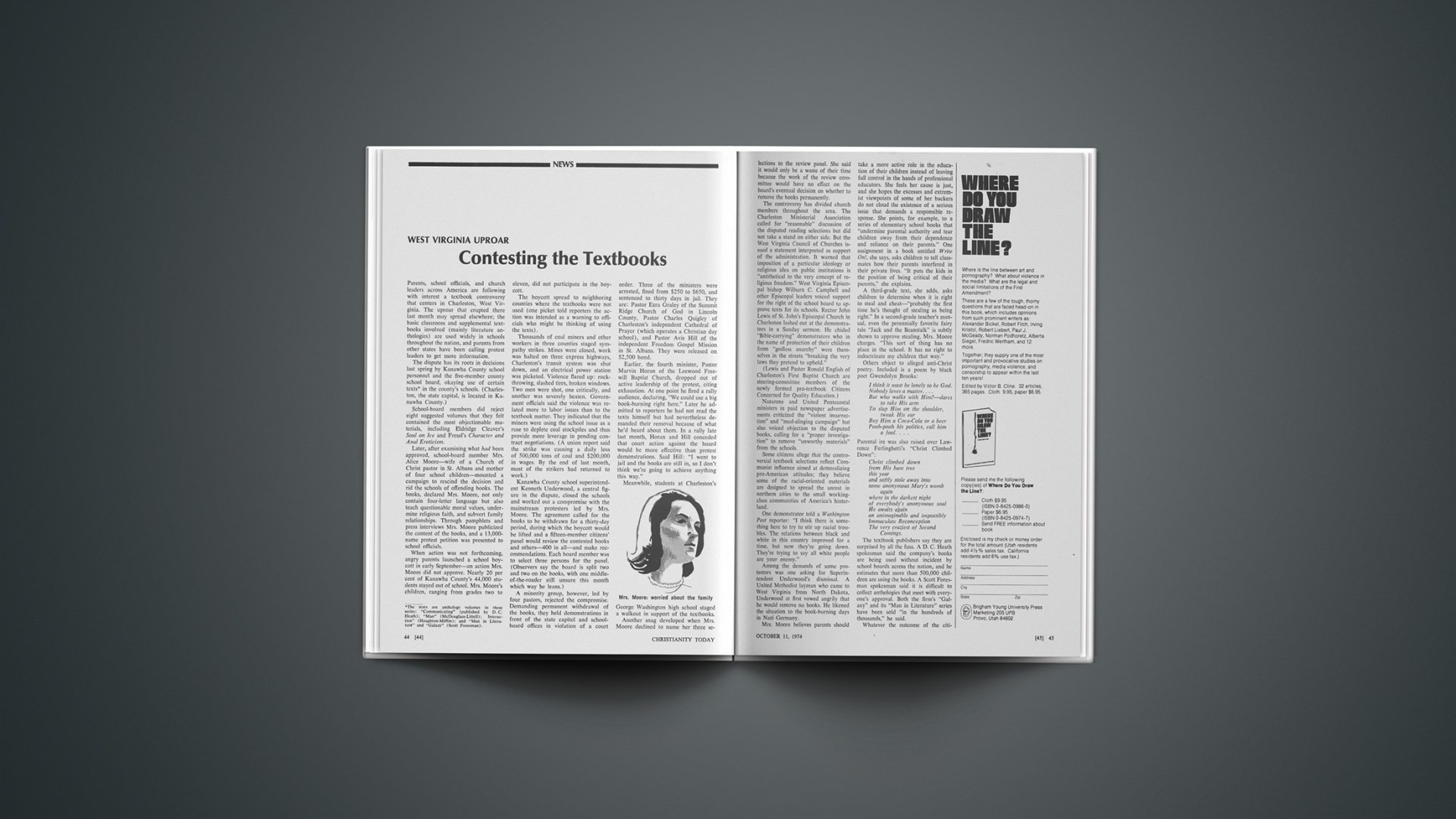
Later, after examining what had been approved, school-board member Mrs. Alice Moore—wife of a Church of Christ pastor in St. Albans and mother of four school children—mounted a campaign to rescind the decision and rid the schools of offending books. The books, declared Mrs. Moore, not only contain four-letter language but also teach questionable moral values, undermine religious faith, and subvert family relationships. Through pamphlets and press interviews Mrs. Moore publicized the content of the books, and a 13,000-name protest petition was presented to school officials.

When action was not forthcoming, angry parents launched a school boycott in early September—an action Mrs. Moore did not approve. Nearly 20 per cent of Kanawha County’s 44,000 students stayed out of school. Mrs. Moore’s children, ranging from grades two to eleven, did not participate in the boycott.

The boycott spread to neighboring counties where the textbooks were not used (one picket told reporters the action was intended as a warning to officials who might be thinking of using the texts).

Thousands of coal miners and other workers in three counties staged sympathy strikes. Mines were closed, work was halted on three express highways, Charleston’s transit system was shut down, and an electrical power station was picketed. Violence flared up: rock-throwing, slashed tires, broken windows. Two men were shot, one critically, and another was severely beaten. Government officials said the violence was related more to labor issues than to the textbook matter. They indicated that the miners were using the school issue as a ruse to deplete coal stockpiles and thus provide more leverage in pending contract negotiations. (A union report said the strike was causing a daily loss of 500,000 tons of coal and $200,000 in wages. By the end of last month, most of the strikers had returned to work.)

Kanawha County school superintendent Kenneth Underwood, a central figure in the dispute, closed the schools and worked out a compromise with the mainstream protesters led by Mrs. Moore. The agreement called for the books to be withdrawn for a thirty-day period, during which the boycott would be lifted and a fifteen-member citizens’ panel would review the contested books and others—400 in all—and make recommendations. Each board member was to select three persons for the panel. (Observers say the board is split two and two on the books, with one middle-of-the-roader still unsure this month which way he leans.)

A minority group, however, led by four pastors, rejected the compromise. Demanding permanent withdrawal of the books, they held demonstrations in front of the state capitol and school-board offices in violation of a court order. Three of the ministers were arrested, fined from $250 to $650, and sentenced to thirty days in jail. They are: Pastor Ezra Graley of the Summit Ridge Church of God in Lincoln County, Pastor Charles Quigley of Charleston’s independent Cathedral of Prayer (which operates a Christian day school), and Pastor Avis Hill of the independent Freedom Gospel Mission in St. Albans. They were released on $2,500 bond.

Earlier, the fourth minister, Pastor Marvin Horan of the Leewood Freewill Baptist Church, dropped out of active leadership of the protest, citing exhaustion. At one point he fired a rally audience, declaring, “We could use a big book-burning right here.” Later he admitted to reporters he had not read the texts himself but had nevertheless demanded their removal because of what he’d heard about them. In a rally late last month, Horan and Hill conceded that court action against the board would be more effective than protest demonstrations. Said Hill: “I went to jail and the books are still in, so I don’t think we’re going to achieve anything this way.”

Meanwhile, students at Charleston’s George Washington high school staged a walkout in support of the textbooks.

Another snag developed when Mrs. Moore declined to name her three selections to the review panel. She said it would only be a waste of their time because the work of the review committee would have no effect on the board’s eventual decision on whether to remove the books permanently.

The controversy has divided church members throughout the area. The Charleston Ministerial Association called for “reasonable” discussion of the disputed reading selections but did not take a stand on either side. But the West Virginia Council of Churches issued a statement interpreted as support of the administration. It warned that imposition of a particular ideology or religious idea on public institutions is “antithetical to the very concept of religious freedom.” West Virginia Episcopal bishop Wilburn C. Campbell and other Episcopal leaders voiced support for the right of the school board to approve texts for its schools. Rector John Lewis of St. John’s Episcopal Church in Charleston lashed out at the demonstrators in a Sunday sermon. He chided “Bible-carrying” demonstrators who in the name of protection of their children from “godless anarchy” were themselves in the streets “breaking the very laws they pretend to uphold.”

(Lewis and Pastor Ronald English of Charleston’s First Baptist Church are steering-committee members of the newly formed pro-textbook Citizens Concerned for Quality Education.)

Nazarene and United Pentecostal ministers in paid newspaper advertisements criticized the “violent insurrection” and “mud-slinging campaign” but also voiced objection to the disputed books, calling for a “proper investigation” to remove “unworthy materials” from the schools.

Some citizens allege that the controversial textbook selections reflect Communist influence aimed at demoralizing pro-American attitudes; they believe some of the racial-oriented materials are designed to spread the unrest in northern cities to the small working-class communities of America’s hinterland.

One demonstrator told a Washington Post reporter: “I think there is something here to try to stir up racial troubles. The relations between black and white in this country improved for a time, but now they’re going down. They’re trying to say all white people are your enemy.”

Among the demands of some protestors was one asking for Superintendent Underwood’s dismissal. A United Methodist layman who came to West Virginia from North Dakota, Underwood at first vowed angrily that he would remove no books. He likened the situation to the book-burning days in Nazi Germany.

Mrs. Moore believes parents should take a more active role in the education of their children instead of leaving full control in the hands of professional educators. She feels her cause is just, and she hopes the excesses and extremist viewpoints of some of her backers do not cloud the existence of a serious issue that demands a responsible response. She points, for example, to a series of elementary school books that “undermine parental authority and tear children away from their dependence and reliance on their parents.” One assignment in a book entitled Write On!, she says, asks children to tell classmates how their parents interfered in their private lives. “It puts the kids in the position of being critical of their parents,” she explains.

A third-grade text, she adds, asks children to determine when it is right to steal and cheat—“probably the first time he’s thought of stealing as being right.” In a second-grade teacher’s manual, even the perennially favorite fairy tale “Jack and the Beanstalk” is subtly shown to approve stealing, Mrs. Moore charges. “This sort of thing has no place in the school. It has no right to indoctrinate my children that way.”

Others object to alleged anti-Christ poetry. Included is a poem by black poet Gwendolyn Brooks:

I think it must be lonely to be God.

Nobody loves a master.…

But who walks with Him?—dares to take His arm

To slap Him on the shoulder, tweak His ear

Buy Him a Coca-Cola or a beer

Pooh-pooh his politics, call him a fool.…

Parental ire was also raised over Lawrence Ferlinghetti’s “Christ Climbed Down”:

Christ climbed down

from His bare tree

this year

and softly stole away into

some anonymous Mary’s womb again

where in the darkest night

of everybody’s anonymous soul

He awaits again

an unimaginable and impossibly

Immaculate Reconception

The very craziest of Second Comings.

The textbook publishers say they are surprised by all the fuss. A D. C. Heath spokesman said the company’s books are being used without incident by school boards across the nation, and he estimates that more than 500,000 children are using the books. A Scott Foresman spokesman said it is difficult to collect anthologies that meet with everyone’s approval. Both the firm’s “Galaxy” and its “Man in Literature” series have been sold “in the hundreds of thousands,” he said.

Whatever the outcome of the citizens’ review of textbooks in Kanawha County, one thing is certain: not everyone is going to be pleased. And given the nation-wide publicity of the dispute, the unrest is likely to spread.

Unaccredited

A county judge in Greenville, Ohio, fined six couples $20 each for sending their children to an unaccredited school opened a year ago by God’s Tabernacle Church in nearby Bradford. The children may remain there pending appeal. One of the parents is Levi W. Whisner, pastor of God’s Tabernacle and principal of the school, which meets in the church basement (a new building is under construction). Whisner says the parents feel their children should have a Bible-oriented education.

In Good Hands

“My surgical skills are a gift from God. Thank him for them.”

That’s how Chief Surgeon C. Everett Koop of Children’s Hospital in Philadelphia often responds to grateful parents whose little ones he has helped. Koop, 57, world renowned for his surgical techniques on infants born with congenital defects in their gastro-intestinal tracts, is an elder at Tenth Presbyterian Church in Philadelphia, a leader in the Christian Medical Society, and board vice-chairman of Medical Assistance Programs (MAP), an evangelical relief agency based in Illinois.

Last month his skills were applied in one of the most dramatic medical events of the year: separation of thirteen-month-old Siamese twin girls Clara and Altagracia Rodriguez of the Dominican Republic. Koop led a team of eighteen doctors and five nurses in the day-long series of complex procedures (Dr. Louise Schnauffer, Koop’s first assistant surgeon on the team, and Dr. Gene Betz, head anesthetist, also attend Tenth Presbyterian). The hospital and the medical team donated their services.

The girls were born connected at the waist and abdomen. Without surgery they would have survived, says Koop, but they would never have been able to walk or sit independently. They had two hearts, four kidneys which had been linked to each other’s bladders, and a shared intestinal tract. Koop’s team gave the existing tract to Alta and constructed an artificial waste system for Clara. Only three of six known previous attempts to separate similarly joined Siamese twins have been successful, and these have had colostomies. If Clara’s operation withstands the test of time, she will be the first such patient to have a “normal” elimination system. Both girls should also be able to bear children, says Koop.

Through a relative’s maid in Puerto Rico, Mrs. Diana Zimnoch of Warrington, a town north of Philadelphia, heard of the Rodriguez children. She learned that their parents were poor Catholic peasants who lived in the Dominican Republic, working a one-acre farm without electricity or plumbing. Mrs. Zimnoch telephoned Children’s Hospital and asked if anything could be done, a contact that eventually led to Koop. Meanwhile, the thirteen-family “Community of Christ”—an evangelical Catholic fellowship to which Mrs. Zimnoch belongs—chipped in enough money to fly the girls and their mother to Philadelphia.

Other churches (including Tenth Presbyterian) and groups also lent a hand. A Catholic church held a special mass attended by 2,000 to raise funds for the girls’ future education.

Koop says he believes “in the sovereignty of God over all circumstances and events.” He acknowledges candidly that he “doesn’t know why children are taken from the world or why they suffer.” Yet, he believes, “God never makes a mistake.”

God works through natural laws established in the development of a baby before its birth, says Koop. “Other laws, however, may upset the orderly consummation of the development of a child,” he adds. ‘This is no more difficult to believe,” he says, “than seeing a man fall on the sidewalk and fracture his wrist. I would no more berate God for a child born with a congenital defect than to rail at God for a crack in the sidewalk.”

Koop offers parents spiritual counsel when the opportunity arises, and he makes a special effort to speak with parents whose child has died. Many of them express their gratefulness in Christmas greetings year after year.

Whether he applies scalpel or spiritual salve, say Koop’s friends, his patients are in good hands.

JAMES C. HEFLEY and EDWARD E. PLOWMAN

THE PLIGHT OF PASTORAL PAY

Many ministers are hurting financially as inflation spirals upward faster than increases in traditionally low salaries. In a recent study that confirms those low salary levels, the National Council of Churches found pastors are getting along on an average of $7,700, with other income sources such as housing and utilities allowances bringing the median equivalent to about $10,350—about half of what a comparably educated attorney, accountant, or personnel director earns.

Of those pastors in nineteen Protestant denominations who were surveyed, 14 per cent reported over-all salaries of less than $6,000, while 11 per cent reported pay in excess of $15,000, including benefits.

The study, financed by a grant from Ministers’ Life and Casualty Union of Minneapolis, shows many lack fringe benefits common in other vocations: only 67 percent of the ministers have any kind of pension plan, only 55 per cent are covered by health insurance, and only 15 per cent are compensated for Social Security payments (ministers, as self-employed persons, must pay the entire employment tax—which has been increasing yearly—out of their own pockets). Fully 65 per cent of the 4,635 pastors polled said their income was not adequate for family and personal needs.

A Winner

“Gift of Tears,” an episode in the Lutheran Church-Missouri Synod’s “This Is the Life” television drama series, won the only 1974 Emmy Award for religious programming given by the National Academy of Television Arts and Sciences.

Questioning The Validity

Since the House of Bishops of the Episcopal Church in mid-August ruled that the ordination of eleven women to the priesthood was invalid (see September 13 issue, page 68), several proponents of female priesthood have questioned the validity of the bishops’ ruling. John Lathrop, rector of St. George’s Church in La Canada, California, thinks the ruling violated the canons (laws), a reason given by the bishops for declaring the renegade ordination invalid. The bishops, he maintains, can only declare an ordination “invalid” after a local-diocesan-level, canonical trial has taken place.

Meanwhile the eight-member standing committee of the Washington, D. C., diocese has asked its bishops to work for a special convention in 1975 to decide the issue of women’s ordination. (Bishop William F. Creighton voted for the bishops’ ruling, while Suffragan Bishop John T. Walker abstained.) With a vote of 7 to 0 and one abstention the committee (which is the highest elected body of lay and clergy in the diocese, without whose consent the bishop cannot ordain) requested “positive action” to ordain “qualified women to the priesthood and episcopate at the earliest possible moment.”

Lonesome For Love

Lonesome Stone. A symbol. A person. A rock musical. And this fall it’s rolling through some small American cities in the Midwest, declaring that “Jesus is just all right with me.”

Lonesome Stone had its American première with a four-night stand in Toledo, Ohio, last month (it was also scheduled for Duluth, Minnesota; Kansas City, Missouri; and Sioux City, North Dakota). Most of the some 1,200 in the opening-night audience at Masonic Auditorium were under twenty and, according to producer Jim Palossari, non-Christians.

Palosarri, once a bartender in San Francisco, was an early Jesus-movement convert. He headed a 600-member Christian youth group and commune in Milwaukee until two years ago, when he moved to the London area and organized a ministry called “The Jesus Family.” The musical was an outgrowth of this work. It played for weeks at a London theater, then went on the road last year to other United Kingdom cities and to cities on the Continent. Just before its American debut the show played at two U. S. military bases in Germany in connection with drug-rehabilitation programs run by chaplains.

Many in the international thirty-six-member cast plus crew were formerly dope users or pushers; they come from America, France, Sweden, Germany, and the United Kingdom. The production is sponsored by the Gloria Deo trust, founded by London-area real estate man Kenneth P. Frampton, a member of a Plymouth Brethren chapel.

The musical’s story—based on actual experiences of the cast—is framed against the Haight-Ashbury district of San Francisco in 1967, the place and year of the start of the Jesus movement. A drug user and dealer known as “The Bear” gets arrested and sent to jail, where he becomes a Christian. He returns to his friends with the Gospel. They are looking for love, but only a handful turn to Jesus.

If the audience is receptive—as it was in Toledo (the crowd was still shouting “more, more” when the house lights were turned on)—the cast and the band, “The Sheep,” give a brief Christian rock concert at the end of the musical. The audience is invited backstage to talk with the cast or to ask questions about the show’s theme. While no formal “altar call” is given, Palossari says his intention in conceiving the show was to build a good “mouse trap,” not necessarily to create “Christian art” (he thinks the term is a misnomer, anyway). Judging by the response in Toledo, he has succeeded.

CHERYL FORBES

Where Is Television Going?

Many social critics now correlate, as does James T. Laney, “the … change of behavior so visible and audible across the land” with the coming to adulthood of the children of a mass-media age (see Laney, “The New Morality and the Religious Communities,” Annals of the American Academy of Political Science, Jan., 1970).

Television’s impact, they say, goes far to account for the widening revolt against traditional moral and religious views. With prime time projected mainly for commercial reward, network programs reflect no composite values. One recalls the remark of Yama, the god of death, in Robert Zelasny’s Lord of Light (Mercury, 1967): “Lying? Who asked you to lie about anything? Quote them the Sermon on the Mount if you want. Or something from Popul Voh, or the Iliad. I don’t care what you say. Just stir them up a bit, soothe them a little. That’s all I ask.”

It was the ancient Sophists for whom dramatic impact meant more than truth, and it is dramatic impact in which television specializes.

More than thirty years ago Pitirim A. Sorokin warned against the flowering of “commercial amusement” that is “more and more divorced from truly cultural values and turns into an empty art known euphemistically as ‘art for art’s sake,’ at once amoral, nonreligious, and nonsocial, and often antimoral, antireligious and antisocial” (The Crisis of Our Age, Dutton, 1942, p. 19).

We live near the climax of such a generation, one in which the mass media have abetted the saturation of modern society with sexual motifs. By depicting borderline decency and sin itself with great technical artistry, periodically exalting the prostitute-actress among the captivating personalities of our day, and routinely intruding sexually permissive and multi-divorced entertainment idols into the living room, the media have left an indelible imprint on cultural and social life. One critic’s verdict that the American television audience thinks more and more with its testes and ovaries is doubtless a harsh exaggeration, but it is not entirely pointless. No civilization in history has so openly published to itself and to the world its cultural mediocrity, its moral shallowness, the emptiness of its alienated spirit, and the paucity of public conscience, despite its superlative excellence in technological and scientific endeavor.

In an essay entitled “The 1960s: Radicalism in Theology and Ethics,” Sydney Ahlstrom remarked: “That the ‘television generation’ now coming of age and going to college in unprecedented numbers is unsatisfied by the ‘old-time religion’ does not strike me as accidental” (Annals of the American Academy of Political Science, Jan. 1970, p. 13, n. 28). Ahlstrom’s comment does not anticipate the Jesus movement, but he rightly notes that the mass media popularized the major themes of Bishop Robinson’s Honest to God and Harvey Cox’s The Secular City and also of death-of-God and demythology literature. “In dialoguing the ‘new morality,’ ” says Ahlstrom, “they often exploited a new permissiveness by dealing frankly with long-forbidden subjects” (ibid., p. 5).

Television in 1973 justified as social realism the showing of such films as Patton, Love Story, and Who’s Afraid of Virginia Woolf? For all its social commentary, the last named with a few deletions became adult network programming just six years after it was tagged as raw and rough and just short of “condemned.” It retained on television eight uses of “God” as an expletive, fifteen uses of “damn” and eight of “hell,” and four uses of the phrase “hump the hostess.” Network policy here seems to be one of walking only a scant step or two above the moral slums. One commentator predicts that by 1977 TV-viewers, possibly watching Last Tango in Paris in their living rooms, will look back on the 1973 era as an age of innocence.

Nobody puts the overall goal of television more bluntly than Les Brown, head of Variety’s TV and radio section: “Programs come into being to attract an audience. Not to feed their minds, or to elevate them morally or spiritually but to deliver them to an advertiser …” (Television: The Business Behind the Box, Harcourt, Brace, Janovich, 1971). The media thus hone the sensate perspective that captures the imagination of more and more people, and give point to Marcuse’s somewhat exaggerated complaint that they have “created a second nature of man which ties him libidinally and aggressively to the commodity form” (An Essay on Liberation).

The role of religion on television has meanwhile been undergoing significant change, as interest shifts from the biblical centralities to modern aberrations such as exorcism and the occult. Most religious broadcasting occurs during the Sunday “ghetto,” either early in the morning or late at night. As television becomes largely an entertainment medium, management considers religious programming less and less appropriate, and few evangelical programs are sufficiently creative to break through this station and audience prejudice into prime time.

The television combination of religion, comedy, and sex can only cheapen spiritual realities and moral sensitivities; a churchman appearing on a comedy program, and trying to inject a serious note into a stream of bawdy humor, or attempting to balance the ludicrous with a bit of ecclesiastical dash, is no less incongruous than a comedian who appends a closing spiritual blessing to fleshly exhibitionism. Except for educational channels most television programming is a scramble of entertainment and commercials, and theology has not yet found its stride on educational stations.

Telecasting has its noteworthy exceptions to the gawdy and garish, and they are to be commended. Learning courses such as “Sunrise Semester” are often outstanding. Not a few special documentary network programs provide luminous background information on world and special events, and local stations originate documentary programs of high quality from time to time. One must concede that the best film fare has been shown along with the worst. Moreover, Edwin Newman’s interview features have added to NBC’s cultural values, Walter Cronkite’s interviews on the political scene have often been remarkably informative, and in its nightly newscast by Howard K. Smith and Harry Reasoner ABC still does a stalwart job in the battle among the network giants.

British television has long programmed a cultural channel around the clock along with the popular alternatives. Government ownership and control is a high price to pay for worthy programming, even if the absence of commercials would give some sanity to television listening. But unworthy programming is an unsatisfactory course for free enterprise to take if it hopes long to escape demoralization and depravity and/or political pressures.

Books

Book Briefs: October 11, 1974

Biblical Perspective On The Race Issue

A Biblical Perspective on the Race Problem, by Thomas O. Figart (Baker, 1973, 185 pp., $1.95 pb), and Break Down the Walls, by Johannes Verkuyl (Eerdmans, 1973, 168 pp., $2.95 pb), are reviewed by Patricia Wright, Philadelphia, Pennsylvania.

Both Thomas Figart, head of the Bible-theology department at Lancaster (Pennsylvania) Bible College, and Johannes Verkuyl, head of the mission and evangelism department at the Free University, Amsterdam, confront the arguments of segregationists with biblical teachings that seem to indicate the Lord’s desire for the unity of mankind. Verkuyl does so by pointing out that ha-Adam of Genesis 1 and 2 is a species name rather than a personal name, thus distinguishing the Genesis story from tribal or national myths. Also, by comparing Pentecost with the account of Babel, he shows the reconciling ministry of the Gospel: language is used to create a fellowship of believers rather than erect barriers and disperse peoples. Finally, he reveals Jesus as the one who breaks down the walls of hostility between races and who calls us to help build the Father’s kingdom, God’s ecumenopolis, where justice dwells.

Figart approaches the portrayal of the unity of man by concentrating on matters that Verkuyl often describes as beside the point or introductory. He dwells on the origin of the races, discussing whether or not the dispersion at Babel caused gradual or immediate anthropological changes along with the abrupt linguistic multiplication. He examines the Noahic curse on Canaan, concluding with Verkuyl that no racial overtones are implied in the passage, though Figart stresses that the Canaanites were Caucasoid, not Negroid, and Verkuyl that the term Canaanite referred to a political-geographical distinction as found through the “table of nations” in Genesis 10.

In tracing the race problem in the New Testament, Figar illuminates the cause of the Jewish-Samaritan conflict, placing the origin in the Old Testament rivalry between northern and southern Israel. But I feel he makes a giant leap in concluding a rebuke of all racial militancy from the Lord’s refusal to heed the plea by James and John for the fiery destruction of the Samaritans. I’m not advocating racial militancy, but I think it is a rather long issue to be decided so easily on the basis of that text alone. Figart appears to be trying to touch on every conceivable aspect of racial problems and differences; some more concentrated attention would have been welcome.

The distinguishing feature of Verkuyl’s study is his excellent treatment of apartheid as practiced in South Africa. Using documents stating the policies of such groups as the National Party and the Afrikaner Brotherhood, he depicts the motifs of Christian nationalism (the idea of a sacred African nation blessed with the “virtues” of Western Christian culture) and guardianship (the protection of non-whites, which actually creates a racial caste system) that are garbed as divinely inspired support of racism. Perhaps the sheer absurdity of the population proportion increases the feeling of guilt: by the year 2000 a predicted 30 million Bantus (black Africans) will face 5 million whites. The Bantus are jammed into a migratory labor system; the men are forced to live and work in prescribed areas of cities, visiting their families only a few days a month. (This situation is very similar to that inflicted on the Navajo, who has to leave the reservation to work for the white man’s money to barter for the white man’s goods.)

Most discouraging of all is the consistent support of apartheid policies by such churches as the Dutch Reformed Church of South Africa, the Dutch Reformed Church, and the Reformed Church of South Africa. However, credit is deserved by most of the member churches of the World Council of Churches in Africa, the Roman Catholic Church, and various other churches that have attempted to resist the practice and ideology of apartheid. In fact, Verkuyl presents the message the Council of Churches addressed to the people of South Africa in 1968, calling for commitment to the whole Gospel of the Lord Jesus in breaking down barriers of racial hostility. He then rightfully appeals to all churches outside South Africa—particularly those in fellowship with the Reformed churches of South Africa—to support this South African message.

With the growth of a world “culture” that brings Chiclets to every port and, more seriously, in the name of amalgamation seems to have no care for a man’s true culture, one remembers how good and pleasant it is for brothers to dwell together in unity and longs with Figart and Verkuyl that some precious oil would come down upon the beard of this old world.

A Very Helpful Commentary

A Commentary on Daniel, by Leon Wood (Zondervan, 1973, 336 pp., $6.95), is reviewed by James A. Stahr, editor, “Interest,” Wheaton, Illinois.

The incentive for a new commentary on Daniel was the availability of much more historical background material than was known a few years ago. Especially important, says the author of the commentary, has been “the reading of the Babylonian Chronicles, giving the official history of Babylonia from the point of view of the royal court.” The professor of Old Testament and dean of Grand Rapids Baptist Seminary has made good use of such material in this up-to-date, thoroughly conservative, scholarly volume on Daniel.

The commentary is arranged very conveniently, with each verse treated separately. Although the writing style is smooth, the book is designed more for study than for reading.

The original Hebrew or Aramaic is frequently given, but in Roman letters with translation. Even grammatical points are explained for the benefit of users who never learned—or have forgotten—the original languages. For example, this is the comment on the first words of Daniel 9:25: “The two verbs employed (roots: yada‘ “to know” and sakal “to be wise, understand”) are imperfects, but are used in the jussive (indicating urgent obligation).”

There are occasional references to other commentaries, usually in footnotes. One never gets the impression—common among scholarly commentaries—that the author is more concerned with what the scholars taught than what the Holy Spirit taught. Nevertheless, Leon Wood is obviously well acquainted with other writers’ views. He seems more prone to cite amillennial writers like Keil, Barnes, Leupold, and Young than to refer to those who share his own position. He gives close attention to interpretations held by conservative scholars (for example, his point-by-point refutation of the view that the Messianic kingdom of Daniel 2:44 is the spiritual rule of Christ established at his first coming).

To the prevailing critical views, however, he gives short shrift, having little time to bow to the altars of skepticism. The common scholarly approach to Daniel is that it was written in the time of the Maccabees, with Daniel’s name attached for prestige purposes. What was already history was presented as prophecy to give it effectiveness. Wood makes an interesting comment when discussing the related view that the four successive empires of Daniel 7 were Babylon, Media, Persia, and Greece:

The motivation for making this identification is mainly to avoid identifying the fourth beast with an empire as late in history as the Roman (recognizing that this would call for supernatural prediction) [p. 183].

Regarding the detailed prophecy of Daniel 11, Woods writes:

When subsequent history proves to fit it exactly …, it is no wonder that liberal expositors, who deny the supernatural in the Bible, insist that it must have been written after the history has transpired. Because it was indeed written before, it provides conversely, an excellent demonstration of the fact that the Holy Scriptures are truly a product of supernatural revelation [p. 283].

Woods’ position is the standard, premillennial viewpoint. He does not offer novel twists of his own. Nor does he have the future figured out to perfection and in considerable detail. He gives the broad, general picture of things to come as Daniel gives it and leaves it at that. The four empires of Daniel 2 and 7 are Babylon, Medo-Persia, Greece, and Rome. Wood holds that an extensive time gap in the history of the Roman Empire is symbolized in all Daniel’s prophecies, the restoration of that empire being necessary to provide the setting for the second advent of Christ.

In the final stage of the Roman Empire a powerful king will emerge who is “commonly and properly called the Antichrist,” says Wood, and

who will be Satan’s counterfeit world ruler, trying to preempt the place of God’s true world Ruler, Jesus Christ, who will later establish His reign during the millennium.… [This Antichrist] breaks covenant with Israel at the midpoint of a week of years, which means at the three-and-one-half-year mark, after which he brings severe persecution on the nation for the last half of the week, a period of three and one-half years, called in Matthew 24:21 the Great Tribulation [pp. 187, 202].

The return of Christ terminates his rule.

The commentary is quite helpful in historical matters such as the insanity of Nebuchadnezzar, the fall of Babylon, and the absence of Darius the Mede from secular history.

From a personal standpoint, the high point of Daniel’s experience came when he saw the man clothed in linen (10:5) who stood over the waters of the river (12:6). The remarkable similarity of the descriptions of this person (10:5, 6) and the Lord Jesus Christ as seen by John (Rev. 1:13–16) would indicate that Daniel also saw Christ. Both Daniel and John responded by falling at His feet as dead, and were restored by His hand to receive a prophetic message.

This is one of the relatively few places where Leon Wood’s commentary is weak. Wood says, “He may have been the second Person of the Godhead, because the description given is much like that set forth regarding Christ in John’s vision on Patmos.” Then, instead of detailing the parallel, he dismisses it by noting that the person whom Daniel saw received assistance from the chief angel, Michael. “It is not likely that a mere angel could be, or would be called upon to be, of assistance to Christ.” This statement ignores the fact that the Lord was strengthened by a mere angel in Gethsemane (Luke 22:43), and could have called on twelve legions of angels for assistance if he so desired (Matt. 26:53).

Sensitivity To Jewish Feelings

The New Anti-Semitism, by Arnold Foster and Benjamin R. Epstein (McGraw-Hill, 1974, 354 pp., $7.95), and Your People, My People: The Meeting of Jews and Christians, by A. Roy Eckardt (Quadrangle, 1974, 275 pp., $8.95), are reviewed by Gordon Melton, director, The Institute for the Study of American Religion, Evanston, Ill.

One of the imperatives of biblical ethics is to be sensitized to the places where people are hurting as preparation for Christlike action toward them. These books aim to sensitize.

Foster and Epstein are both high officials of the Anti-Defamation League of B’nai B’rith and are authors of an outstanding study of extremism, Danger on the Right (1964). Here they ask, “Do you know what hurts me? If not, how can you truly love me?”

The book describes a new form of anti-Semitism arising since the Holocaust by Nazi Germany. The prime characteristic of this anti-Semitism is a callous indifference to both Jewish concerns and to attacks on the Jewish community. The authors describe, for example, the “Christ of the Ozarks” and Passion Play project of Gerald L. K. Smith in Eureka Springs, Arkansas. I myself was among those drawn into this commercialized tourist trap only to discover that it was a phoney road to respectibility for Smith; he continues to preach his anti-Christian message, including anti-Semitism, with Christian trappings.

In Your People, My People, Eckardt, having established himself in earlier books as a major voice in the Jewish-Christian dialogue, turns his attention to his Christian brethren and offers counsel concerning our response to the existence of the Jewish community in our midst. Theologically, he is trying to deal, on the one hand, with the New Testament imperatives on Christian behavior toward the people of the Messiah out of whom the Church emerged, and, on the other hand, with the imperatives of Christian guilt, because of centuries of anti-Semitism for the Holocaust. His challenge is to penitence for anti-Semitism and to reparation for the evils done.

Both books raise questions more than they give obvious solutions. For example, they raise the question of definition: Who are the Jews? Are they a religious group, a cultural group, a racial group, or some combination? Who speaks for the Jewish community or articulates a Jewish position?

Most significantly, especially in light of increased publicity of Jewish Christianity represented by such groups as Jews for Jesus, is the question, How does the Christian imperative to preach the Gospel to all men distinguish itself from strong cultural associations? This question is crucial and demands the attention of all thoughtful Christians, especially those actively engaged in mission work to minority cultural groups. The effect of Christian mission has often been, not the intended communication of Christ and him crucified, but an onslaught on a people leading to cultural (and sometimes physical) genocide. Christians, bemoaning a post-Christian era, do not realize that they are still viewed as the religious power in the United States by non-Christians.

The two books also challenge us to reexamine just what constitutes anti-Semitism. We have no trouble recognizing anti-Semitism in its blatant forms. With effort, more subtle forms can be perceived. What is difficult is the borderline area where strong differences of opinion exist as to what “activities” constitute anti-Semitic behavior.

Both books agree that attitudes toward the State of Israel are a key item in current definitions of anti-Semitism. But are they correct? In the polarized Middle East, can a priori attitudes toward Israel, especially in terms of supporting a pro-Israel lobby in Congress, ever be a “Christian” perspective? Can the demands placed upon Christians by the simple imperative of justice and retribution for past persecution dictate the policy toward displaced Palestinians and political relations with Arab states?

After reading these two books, you may not find you agree even with the major points. But you will be unable to walk away from the issues the authors raise.

Modern Idolatry

To Turn From Idols, by Kenneth Hamilton (Eerdmans, 1973, 232 pp., $3.95 pb), is reviewed by James Houston, principal, Regent College, Vancouver, British Columbia.

Readers of CHRISTIANITY TODAY may remember an award-winning article by Professor Hamilton on the cult of relevance in the issue of March 21, 1972. That essay has been included in a slightly altered form in this original and challenging book, which thoughtful Christians should read. Hamilton, a professor in the Department of Religious Studies at the University of Winnipeg, shows that the origins of idolatry lie in the imaginations of men’s hearts. In exploring the role played by the imagination, he challenges us to adopt a Christian imagination as well as possess Christian knowledge. Insights that he gained in the writing of his previous works on the relations between theology and literature he has used in a fresh way in this challenging book.

The first three chapters deal with the images of idolatry, examining the biblical view of idolatry, the dynamics of the idolatrous imagination, and the need to distinguish the spirits today. Hamilton has wise insights into the role of the imagination in contemporary world views, including demythology.

In the second part of the book he identifies three idols of the modern market place: the cult of relevance, “the Great God Change,” and the cult of liberation. Hamilton has critical contempt for the modern use of slogans and catchwords, but his use of the phrase “the Great God Change” might seem to some to make it a catchword, too. Here the author perhaps fails to analyze, from the mechanistic and evolutionary world views of the last two centuries, how this cult of change has come into such prominence.

In turning from the idols, the third section of the book then deals with the need for the Church to be cleansed from idolatry in worship, preaching, and the furtherance of the community. These are key matters, but perhaps the author has been too ambitious in trying to cover them all. Perhaps he could have investigated more thoroughly the role of the imagination in human life, and narrowed the range of his topics.

However, Hamilton has pioneered in an original and significant area about which we shall hear much more in the future. Symbolism will be increasingly important, and evangelicals do not understand much about it. As the author concludes: “Adequate biblically based symbols can prevent us from adapting ourselves to the pattern of this present world by pointing us to a better pattern, which is God’s will for us.” Perhaps in the context of Romans 12:2 we need “a transformation of the images of our imagination.” In this age of renewed polytheism, To Turn From Idols is a book I highly recommend.

NEWLY PUBLISHED

All About Repentance, by Richard Seymour (Harvest House [Box 800, Hollywood, Florida 33022], 180 pp., $1.50 pb). A theology professor at Florida Bible College shows from a detailed study of the Scriptures that repentance is included in coming to true faith in Christ rather than being a separate step to salvation.

The Paraphrased Perversion of the Bible, by Gene Nowlin (Bible for Today [900 Park Ave., Collingswood, N.J., 08108], 297 pp., $6). An impassioned polemic against the Living Bible. Cites alleged misquotations, errors, false teachings, and vulgarisms. Bitter.

Understanding Mental Illness: A Layman’s Guide, by Nancy C. Andreasen (Augsburg, 110 pp., $2.95 pb). An introduction to mental illnesses and their treatments. Includes a vague chapter on religion and psychiatry. For the general reader.

Old Testament Form Criticism, edited by John Hayes (Trinity University, 289 pp., $8). Six scholarly papers on the study of forms for various genre.

Rules: Who Needs Them?, by Ethel Barrett (Regal, 150 pp., $.95 pb). Casual, contemporary retelling and application of selected stories from Judges and first Samuel. For the youthful reader.

Between Science and Religion, by Frank Miller Turner (Vale, 273 pp., $12.50). Study of six members of the nineteenth-century English intellectual community who abandoned Christianity for scientific naturalism, only to discover a lack of fulfillment.

World’s Largest Sunday School, by Elmer Towns (Nelson, 189 pp., $5.95). Story of First Baptist of Hammond, Indiana, and its pastor, Jack Hyles.

Eschatology and Ethics, by Carl E. Braaten (Augsburg, 182 pp., $3.95 pb). A scholarly yet readable collection of essays by the modern theologian that develops his “eschatological theology” and applies it to current social and political issues.

No Easy Answers, by Enoch Powell (Seabury, 135 pp., $6.95). A collection of addresses and dialogues wherein a British right-wing politician discusses Christianity and the problems of living in Caesar’s world. Widely criticized for views on immigration that allegedly increased racial tension in Britain, this idiosyncratic Anglican holds that as a politician he “cannot apply” the Good Samaritan principle to the whole world.

Tailor-Made Teaching in the Church School, by Mary Duckert (Westminster, 124 pp., $2.95 pb). From practical experience come suggestions and illustrations on individual church development of curricular material to meet the specific congregation’s needs.

Everybody Can Know, by Francis and Edith Schaeffer (Tyndale, 403 pp., $4.95). A presentation of basic Christian truth based on the Gospel of Luke, designed for family participation. A wide variety of acts and topics are suggested. Delightful and challenging.

Beyond Petition, by Paris Reidhead (Bethany Fellowship, 84 pp., $.95 pb). Good basic book on prayer.

The Coming Antichrist, by Walter Price (Moody, 240 pp., $4.95), and Where Is the Antichrist?, by H. A. Maxwell Whyte (2 Delbert Dr., Scarborough, Ont., Canada M1P 1X1, 70 pp., $1 pb). Two divergent views of prophecy, each convinced that it is the only one true to the Scriptures. The former represents the popular futurism of today, the latter the historicist approach common among earlier Protestants.

Tyndale Bulletin, Number 24 (Tyndale Fellowship [36 Selwyn Gardens, Cambridge CB39BA, England], 128 pp., £2). The latest edition of this foremost evangelical scholarly annual has five articles, including three on resurrection (in Matthew, Luke, and the prevailing culture).

Research in Religious Behavior: Selected Readings, edited by Benjamin Beit-Hallahmi (Brooks/Cole, 404 pp., $4.50 pb). A collection of previously published articles on the study of religious behavior, especially the sociology and psychology of religion.

Unreached Peoples (Missions Advanced Research and Communication Center [919 W. Huntington Dr., Monrovia, Ca. 91016], 117 pp., $4 pb). Variously classified lists of some 600 “peoples” (tribes and the like) that have very few if any professing Christians. Admittedly incomplete.

Zen Meditation For Christians, by H. M. Enomiya Lasselle, translated by John C. Maraldo (Open Court, 175 pp., $7.95). Christian theology and belief seen as compatible with Zen meditation. Stretches Christianity considerably.

The Academic Melting Pot, by Stephen Steinberg (McGraw-Hill, 183 pp., $8.95). An informative study of changing roles of Catholics and Jews in American higher education.

Man: Believer and Unbeliever, by Francis M. Tyrell (Alba, 415 pp., $5.95 pb). A Catholic theologian interacts with various modern thinkers (such as Freud, Sartre, Mao, Teilhard, and Rahner) and then offers his own understandings of the faith. Attempts to find points of contact with “modern man.”

Hunting the Divine Fox: Images and Mystery in Christian Faith, by Robert F. Capon (Seabury, 167 pp., $5.95). A slim but entertaining book on God-words, likening God to an elusive fox and theological works to a pack of foxhounds.

The Truth: God or Evolution?, by Marshall and Sandra Hall (Craig, 186 pp., $2.95 pb). A vigorously presented case for special creation by two who formerly accepted naturalistic evolution.

The Pentateuch in Its Cultural Environment, by G. Herbert Livingston (Baker, 296 pp., $8.95). A handbook that is both an analysis of the content and interpretation of the Pentateuch and a basic study of its Ancient Near Eastern context. Informative and visual. Intended for the non-academic Bible student.

Captive on the Ho Chi Minh Trail, by Marjorie Clark (Moody, 160 pp., $2.25 pb). Inspiring story of the two young Plymouth Brethren missionaries to Laos who were captured by North Vietnamese. They have since returned to the field. (Two of their co-workers were executed.)

Christianity and Culture, by George Florovsky (Norland, 245 pp., $8.95). Volume II of this Russian Orthodox scholar’s collected works includes nine articles on church history. Primarily concerns the Orthodox churches.

Jesus the Jew, by Geza Vermes (Macmillan, 286 pp., $6.95). A prominent Jewish scholar’s presentation of Jesus against the background of his times. Scholars can find it of value in some ways.

Atheism: The Case Against God, by George H. Smith (Nash, 355 pp., $8.95). People who are atheists for practical purposes are all around us. It is good to see one willing to argue for the position ideologically. Useful for exposing some improper defenses of doctrine. Reassuring if this is the best that opponents of God can do.

Living in the Word, edited by Frederick Coutts (Augsburg, 320 pp., $5.95). Comments on short passages that take one through the four Gospels. Suitable for daily Bible study. Very well done.

Oriental Mysticism, by Edward Stevens (Paulist, 186 pp., $1.95 pb). The surge of Asian religious practices in America warrants this brief introduction, which, unlike many books, combines psychological, philosophical, and devotional approaches.

The Triumph of Pastor Son, by Yong Choon Ahn with Phyllis Thompson (InterVarsity, 96 pp., $1.50). Account of Japanese and Communist persecution of a Korean citizen for his belief in Christ. Challenging reading.

A Modern Pilgrimage in New Testament Christology, by Norman Perrin (Fortress, 148 pp., $6.25). Seven technical essays published over the past eight years are reprinted with postscripts showing where and why the author no longer agrees with himself. An interesting idea. For advanced scholars.

Theology

Unequal Equipment

The estimated power of destruction bound up in a hydrogen bomb causes us to gasp if we really let the thought penetrate our minds, if we think of bomb matching bomb over some imaginary battlefield. What nation is really properly “equipped”?

Football helmets and suits come with complicated padding these days. Technology provides deep-sea divers with more and more complicated equipment to delve into the depths, and spacemen soar off into the atmosphere surrounded by tested equipment from the skin out. We travel in fully equipped cars and stay home in fully equipped houses.

People press to be equipped at least as well as their friends and colleagues. It takes longer and longer to be prepared for whatever we are preparing for because the preparation gets increasingly complicated, and the future keeps getting pushed further off. One can imagine that before long people will be waddling on through life so weighed down with equipment and bound up in it that they will forget what they were getting ready for and never even arrive at the starting place! The complexity of technical equipment, educational equipment, psychological equipment, makes some people fear to do anything without spending “one more year” getting ready, or earning enough to buy the “latest,” before starting.

It is not only interesting but very important to consider how God has equipped the people to whom he has given especially difficult tasks at crisis moments of history. When men equip men, they attempt to equalize the equipment so as to match the opponent in battle or confrontation. God’s way has been different.

When we are told in First Corinthians 1:27 that God has chosen the weak things of the world to confound the things that are mighty, and the foolish to confound the wise, we are reminded of many examples of God’s doing exactly that. We see slim young David, a sensitive harpist and a poet, a conscientious shepherd lad refusing to put on the heavy armor and helmet, walking out simply in his ordinary clothing with a little slingshot to pick up five stones. There he stood facing the scornful, jeering Goliath, a giant warrior equipped with the heaviest of armor. What a confrontation! How unequal! After listening to the giant’s taunts and threats, hear David’s confident statement: “Thou comest to me with a sword, and with a spear, and with a shield: but I come to thee in the name of the LORD of hosts, the God of the armies of Israel, whom thou hast defied” (1 Sam. 14:45).

Think of Gideon’s equipment against thousands of Midianites: not only did God remove his troops, leaving only 300, but his technical equipment was made up of pitchers, lamps and trumpets! Another unequal confrontation! Remember also Moses going before Pharoah with a stick of wood, and Joseph going before the Pharoah of his time with no study of dreamology or any magic tricks. Think of Jonah’s weakness spiritually as he ran away from God, yet had to retrace his steps and preach to a large city, giving it an opportunity to hear the truth. For that matter, think of the twelve apostles and the first disciples, given the task of telling the whole world the Gospel, as Jesus ascended to heaven. No flashing human equipment was provided to give them special standing in the eyes of men.

We are in danger of telling God, “Oh, I can’t. I’m not equipped. It would be too unequal for me to stand against professionally trained people.” “Oh, I’d make a fool of myself. I can’t be president, peasant, general, private. I can’t do that—it’s too much for me!” What kind of things hit you, hit me, and cause us to feel that our equipment is outdated and insufficient and that we have to back out? Perhaps it is when Satan attacks us as he did Job, and we feel too weak to love and trust God in the midst of grave illness, flood, famine, depression, loss of bank accounts, spoiled crops, burned-down houses. We feel we are not “noble,” not spiritually strong,” not “emotionally ready” for difficulties Satan has thrown at us. We don’t want to win any spiritual battles or be used to prove anything to angels or demons.

Perhaps God seems to be thrusting upon us competition from a human viewpoint, with “giants” in a variety of fields. Perhaps we are surrounded by scientists and historians with marvelous “equipment” to laugh us to scorn as we defend the Word of God. Perhaps we feel we have not been equipped to fight for a Christian family life, or for a Christian factory setup. Time after time Satan attacks to bring about defeat, and time after time God calls upon the “weak things to confound the mighty.”

Why? Come to David’s explanation of his situation: “This day will the LORD deliver thee into mine hand … that all the earth may know that there is a God in Israel. And all this assembly shall know that the LORD saveth not with sword and spear; for the battle is the LORD’s, and he will give you into our hands” (1 Sam. 17:46, 47). Stand beside Gideon and listen to God speaking to him: “The people that are with thee are too many for me to give the Midianites into their hands, lest Israel vaunt themselves against me, saying, Mine own hand hath saved me” (Judg. 7:2). Listen to Elijah’s prayer as he puts water on the wood and the sacrifice and prays for the fire to fall: “Hear me, O LORD, hear me, that this people may know that thou art the Lord God, and that thou hast turned their heart back again” (1 Ki. 18:37). Come now to First Corinthians again: “God hath chosen the weak things of the world to confound the things which are mighty … that no flesh should glory in his presence … that, according as it is written, He that glorieth let him glory in the Lord” (1 Cor. 1:27, 29, 31).

Yes, there is a purpose in the inequality of the equipment. Unequal equipment—time after time in the past, in the present in a diversity of places and people, and in the future until Jesus comes back—serves to demonstrate God’s existence and power and glory. If we pray, “O God, use me so that men may know that you are there,” and God answers us, then we will be involved in various kinds of confrontation through which watching, seeking men will see that the power is God’s and not ours.

What does our God, who promises that his strength is made perfect in weakness, say to us when we begin to tremble, looking down at our feeble equipment? “For I the LORD thy God will hold thy right hand, saying unto thee, Fear not; I will help thee” (Isa. 41:13).

Ideas

Laziness in the Church

Impatience and laziness. These are two cardinal sins, said Franz Kafka, from which all the others spring. Both extremes—acting too hastily or failing to act at all—cause trouble in the Church.

In church life there is much more likelihood of laziness than impatience, however. Churches are undergoing a great deal of sophisticated analysis these days, and a lot of complex problems that impede progress are being discovered. But plain old laziness persists whether we want to admit it or not, and whether we call it by that name or use some more contemporary-sounding term. Affluent circumstances, increasing automation, and the trend toward more government guarantees in a wide range of human activities are helping to stifle initiative. So is the tendency to enlarge full-time staff, especially in large churches.

There is a lazy streak in most of us, and some allowance has to be made for it in church procedures. But perhaps we are being too accommodating. Perhaps Christian leaders should contend more forcefully with laziness.

One reason why laziness is hard to combat is that it is sometimes hard to identify. It is not necessarily characterized by inactivity. Lazy people can be very active; they may keep busy doing things that do not count for much because they want to avoid more demanding tasks.

Intellectual laziness is the worse sort for the Christian believer. The whole Church should echo the slogan of the United Negro College Fund, “A mind is a terrible thing to waste.” Few churches really encourage hard study. Some, regrettably, are growing because they advocate spiritual short-cuts. Among these are some congregations that are theologically liberal as well as some that are decidedly evangelical.

Rank-and-file evangelicals today are appallingly unaware of their intellectual heritage, which goes back to the scriptural emphasis on sound thought. The great commandment of Jesus laid down the principle for time and eternity: You shall love the Lord your God with all your heart, and with all your soul, and with all your mind. Regardless of whether the original words correspond to the current English meanings of heart, soul, and mind, it is clear that the Christian is challenged to commit all of his being to divine purposes, and this must surely include his intellectual ability. Most of the great figures of church history were scholars, though they lived in times when education was not nearly as available as it is today. The Puritan era probably had the strongest Christian impact of all, and its leaders made great intellectual demands upon the common people. What a rebuke it is to realize that the average Puritan pew-sitter probably knew more about biblical teaching than does the contemporary Christian, who has vast learning opportunities at his disposal.

Fundamentalism was not a product of emotion and irrationalism, as it is commonly caricatured. No thinker on the liberal side of the fundamentalist-modernist controversy could match J. Gresham Machen.

We need to discover anew the value of the idea, and the need for Christians to have a good understanding of theological beliefs. The plan of salvation is very simple, but the discipleship that the Scriptures teach is not easy. The Bible itself is a demanding book. Doctrinal and moral issues must be dealt with at their deepest levels, and laziness has no place here.

Should not Christian leaders try to set preaching and teaching standards at a more intellectually responsible level? There is, of course, the risk of aiming too high. But despite some signs to the contrary, human nature prefers to reach rather than stoop, and churches should get parishioners in the habit of stretching.

Why Do The Christians Rage?

We deplore the violence, illegal and dubiously related strikes, and other morally reprehensible behavior of those who oppose the use of certain textbooks in the schools around Charleston, West Virginia (see News, page 44). Nevertheless we think that the same sort of concern for discerning underlying issues which was properly manifested in the wake of black rioting a few years ago needs to be applied here. It is not enough to denounce violence without asking what drives people to such strong demonstrations of feelings. To the extent that blasphemy and immorality are encouraged, it is well to be (non-violently) enraged!

Penetrating questions have been asked with regard to black, brown, and red militancy. Attention is being paid to the concerns of the women’s liberation movement. Urban, largely Catholic “ethnics” are having their fears and aspirations noticed. We ask that the same concern be shown to the sensitivities of white, Anglo-Saxon Protestants of the working class. Textbook publishers nowadays (as they should have been all along) are generally careful to avoid insulting or demeaning references to most minority groups, even in literature anthologies that purport to reflect the diversity of our culture. The same recognition and respect is due to the minority who believe that the Bible is literally true.

Bible-believers, and they come in all colors and classes, ought not to try to have their ways prevail by force or government coercion, especially not in a pluralistic society. But at the same time; Bible-believers ought to be treated as courteously as other citizens.

Charles Ives: Notes In Stone

Not until late in life did Charles Edward Ives, one of America’s foremost composers, the centenary of whose birth we celebrate October 20, begin to receive the recognition he deserved (he died in 1954). Now, more and more recordings of his music are appearing, and this year his music is being performed by orchestras, choruses, and chamber ensembles across the country.

Ives was born and reared in Danbury, Connecticut, and much of his music reflects his Puritan heritage. As a child he and his father, a musician, attended camp-meeting services together. The young Ives preferred the “great waves of sound” (as he later put it) “when things like Beulah Land, Nearer My God to Thee, [and] In the Sweet Bye and Bye were sung by thousands of ‘let-out’ souls” to the “too easy” music of Haydn and Mozart.

Many of Ives’s compositions were written for the church or have religious themes. He was long an organist and choirmaster, first at the First Presbyterian Church in Bloomfield, New Jersey, and later at New York City’s Central Presbyterian Church. He wrote many anthems using Psalms as his texts. Even some of his symphonic music was based on his spiritual roots: his third symphony is called “The Camp Meeting,” and the Largo of his second symphony was part of a musical setting for a revival service, played by a string quartet in New Haven’s Centre Church. His three “Harvest Home Chorales” are among the best known of his works.

In theme and structure his music reflects the Puritan attitude toward God. His harmonies are often strident and uneasy, lacking the lush warmth of late nineteenth-century composers, and suggestive of God’s wrath and judgment. Listening to Ives’s music one is reminded of the words of Ephraim, the old New England Puritan in Eugene O’Neill’s Desire Under the Elms: “God’s hard. God’s in the stones.”

Although the composer’s choral anthems are difficult, sometimes requiring the men and the women to sing in two keys simultaneously, proficient church choirs would find the effort of learning them worthwhile. For non-singing music lovers, recordings of his choral pieces are worth buying. Despite the frequent atonality and dissonance of his music, Ives beautifully captured the meaning of America’s Puritan heritage.

Pastoral Salaries Still Lag

A recent study shows that income for ministers remains well under that of other comparably educated professionals. And a significant percentage still are not receiving fringe benefits common to most American workers. About one-fifth have second jobs. Almost half say their spouses work, and nearly three-fourths of the spouses who work do so to supplement family income. Despite these facts, 93 per cent of the respondents are satisfied with the ministry. The statistics come from a study done by the National Council of Churches dealing with 1973 clergy incomes (see News, page 46).

The study revealed that female ministers tend to have less education, serve smaller congregations, and receive less in salary and benefits than their male colleagues.

With the worsening economic situation, congregations ought to establish a yearly cost-of-living increase for their ministers, something most American workers receive. Many also need to improve ministers’ fringe benefits. To pastor a congregation is a full-time job. If salaries are not improved, more ministers will be forced to seek second jobs. Need we remind one another again that “the laborer is worthy of his hire”?

Abortion On Command

We have previously spoken about the Religious Coalition for Abortion Rights and its massive support for abortion on demand. So distasteful is the expression “abortion on demand” to the leaders of the RCAR that several members of its board of directors visited the offices of CHRISTIANITY TODAY to protest what they consider to be continuing “misrepresentation.”

Insofar as a number of church bodies have joined the RCAR, although their denominations do not officially endorse abortion on demand, we can understand the embarrassment of the RCAR leaders at having their position so labeled. But any reluctance we may have felt to cause them such embarrassment has been diminished by their newsletter, Options, for September, 1974:

We reiterate, therefore, the beliefs of the Religious Coalition for Abortion Rights membership [emphasis added] that the right of access to abortion services, guaranteed a civil right by the Supreme Court of the United States, shall not be abridged or denied by any institution which is either partly or wholly subsidized by public funds, although the right of individual conscience in participating in such procedures must be protected.

A subsequent “Draft of Conscience Clause” adopted by the RCAR Policy Board said essentially the same thing. The RCAR not only unequivocally opposes any change in the Supreme Court’s pro-abortion stand but would compel all institutions receiving any public assistance, regardless of any ideological commitments they might have, to provide “abortion services.” Given the scope of government today, is there any health-care institution that operates without any tax-money benefits? Individual doctors for the moment might be exempted from performing abortions, but perhaps the RCAR will soon decide that if any public money has gone into their medical training, for example, they too may be compelled.

Talk of religious freedom and freedom of conscience, which the RCAR freely disseminates when opposing all human-life amendments, is quickly forgotten when the coalition sees itself presented with the opportunity to impose abortion on command.

Serving By Phone

In November, 1953, pastor Chad Varah advertised his telephone number at St. Stephen’s Church in London for pastoral counseling services to the suicidal and despairing. Since that time, telephone distress ministries have been started in nearly thirty countries. Many of them profess a Christian base, such as Contact Teleministries, Incorporated, founded in this country in 1970. As one Contact official put it, the Christian basis is his group’s greatest asset. Yet it may also cause problems.

When someone in distress calls, the trained volunteer should hear him out. Evangelistic pressure can offend a despairing person or seem to make matters worse for him. The counselor’s first responsibility is to listen to the caller’s problems and to establish trust and mutual respect. He must be sensitive to both the words and the tone of the caller, and he needs to be aware of the Holy Spirit’s guidance. Is the caller ready to hear the Gospel? Is that why, consciously or unconsciously, he called a Christian telephone ministry in the first place? There may indeed be an opportunity for the counselor to share the hope that is in him. But it must be done with care.

Telephone distress ministries provide help and hope to persons who are in desperate need of it. And on the other end of the line, such a ministry stretches a Christian’s understanding of what it means to walk by faith, not by sight.

Not As The Trespass

Part of Paul’s intention in Romans 5 is clearly to establish the relation, the parallel, between the First Adam, the progenitor of a fallen race, and the Second Adam, the progenitor of a restored one. Yet somewhat curiously, after the parallel between Adam’s disobedience, which brought death, and Christ’s obedience, which brings life, there is this contrast: The free gift is not like the trespass.

In at least one sense the contrast is obvious: life is not “like” death, nor liberty “like” freedom. The trespass and the obedience were alike in that each had momentous consequences for the whole human race, and in that the consequences, in a way, were of like magnitude. But rebuilding is not like destroying, and in this sense, as in others, Christ’s work was quite different from Adam’s.

Paul also makes the contrast explicit in that the condemnation, although universal, follows one trespass, whereas the justification follows many. The condemnation can be likened to the result of an infection. One contaminated person can spread an infection among a whole population, without effort or design. But to heal each sick person in a whole population requires a work quite different in magnitude from the original work of infection. In this sense, then, although both the fall and the redemption affect all mankind, the task of redemption is much more than merely a reversal of the act that brought the fall.

Both of these contrasts, that of quality (life versus death) as well as that of magnitude (many healings versus one infection), are fairly evident ones. The great Princeton theologian and Bible expositor Charles Hodge suggests a third in his classic commentary on Romans: that of certainty. Paul writes, “If, because of one man’s trespass, death reigned through that one man, much more will those who receive the abundance of grace and the free gift of righteousness reign in life through Jesus Christ our Lord” (Rom. 5:17). The contrast expressed by the “much more” is precisely one of certainty. There is no doubt that each of us will inherit death because of Adam’s disobedience: that is sure. Even more certain, Paul would have us see, is a subsequent “reigning in life” for those who receive the abundance of grace.

It may be hard to conceive that if one thing is sure (death), another can be even surer. In part, of course, the distinction is rhetorical and emotional, intended to assure us of life, for of death we are already sufficiently persuaded. But in another sense the “much more” is justified existentially, if perhaps not altogether logically. Death will come surely; but in this sureness there is no assurance, for in death apart from God there is an eternal isolation that is the total negation of all trust, all comfort, all confidence. Reigning in life, through the one act of obedience of Jesus Christ, is surer, for this sureness is assurance: trust, comfort, confidence, joy. Thus the obedience of the One is “not as the trespass,” but in truth, “much more,” as life is more than death, assurance more than despair.

Eutychus and His Kin: October 11, 1974

The Wages Of Sin (Tr.)

N.B. As Eutychus VI is on vacation, he has offered this column to the noted demythologizing theologian Heinrich v. Schlunk. Originally entitled “Die Sündenbelohnung im Hinblick auf das mythologische Selbstverständnis,” this article first appeared in Entmythologisierte Rundschau, 1973, and was widely hailed as an example of relevant contemporary exegesis.

The attractive if elusive Pauline concept of the wages of sin has its locus classicus in the lapidary, aphoristic assertion of Rom. 6:23, “The wages of sin is death.” Although each of the concepts, wages1Extensive mention of wages is found in the Nag-ei-Hammadi tablets excavated by the late Sol Hurok in the course of a talent search., sin2Sin Is also frequently mentioned in extrabiblical literature; cf. e.g. the Code of Hammurabi, passim., and death3That death was a familiar concept to ancient Near Eastern man may be inferred from the Egyptian Book of the Dead, as well as from numerous funerary inscriptions. is freqently encountered in earlier literature, it is to the former rabbinical scholar and world traveler Paul that we owe the revolutionary concept of wages of sin.

The somewhat jarring amalgamation of the three concepts, wages, sin, and death, into the Gestalt the-wages-of-sin-is-death may prove misleading and even alarming, until we recognize that the third element, death, is clearly mythological in nature. In antiquity, death was associated with a voyage, particularly over water: the crossing of the river, such as Lethe, Styx, or Jordan. Boats are found in Egyptian tombs.4A survival of this ancient Egyptian journey-motif is found in the slang expression “take [someone] for a ride.” Paul has evidently taken over this primitive mythical element, perhaps unconsciously, and added it to form his characteristic tripartite Satz. This is probably to make it more acceptable to ancient man, who, as we know, had a three-storey view of the universe and was very particular about such things. It is by discarding the mythological element “death” that we at once see with clarity that Paul is trying to draw our attention to the radical concept of wages of sin. This clearly goes against the puritanical economic stringency associated with the Jewish and Christian minorities in the pluralistic Roman Empire and suggests that the apparently conflicting sentence 2 Thess. 3:10, also attributed to Paul, “If any will not work …,” may be a later interpolation.

It is important to recognize that much sinning is not directly remunerative, and may even involve work (hence no advantage over not sinning). Here too Paul, although perhaps obliquely, offers a clue with his reference to those who “not only do such things, but have pleasure in them that do them” (Rom. 1:32). The obvious suggestion is that sins, if not followed by too drastic and incapacitating a punishment, may be publicized in such a way as to make them remunerative: hence, the “wages of sin.” It was a publishing loss of the first degree, for example, that controversial figures such as Adolf Hitler and Heinrich Himmler committed suicide before writing their memoirs. (Rash actions of this sort may have been precipitated by the thought of the death penalty, now abolished in progressive countries.) It is evident from the American publishing world, for example, that relatively insignificant figures have been able to turn far less spectacular sins into highly attractive “wages” by suitable post-sin publication. (Repentance is possible but not mandatory.)

The relevant message, then, is that one must attend to the wages of sin, i.e., sin in such a way that there will be (a) no incapacitating penalty and (b) the opportunity for subsequent remuneration of a substantial nature. The troublesome reference to death as a long-range consequence may safely be ignored if our exegesis is sound.5The opinions and conclusions here expressed are those of Prof. v. Schlunk and do not necessarily represent those of the editors of Christianity Today.

Reflecting Sensitivity

I am compelled to voice my appreciation for Andre Bustanoby’s article on “The Pastor and the Other Woman” (Aug. 30). He should be congratulated for his insights and efforts in this area. I would also like to thank CHRISTIANITY TODAY for publishing this kind of article. It reflects sensitivity to a set of problems a large number of us face. I would also like to encourage you to include this kind of article on a regular basis.

Wheaton Evangelical Free Church

Wheaton, Ill.

As a professional counselor, but more importantly as a Christian counselor, I was grieved that you printed the article. Not once was mention made of Jesus Christ! Not of his person; not of his redemptive love; not of his willingness and his power to meet needs and to transform lives. That article could have been printed in any secular magazine. I am reminded of a professor at a seminary; in speaking of seminary students he said in essence, “They are human beings and as such are subject to all the problems and temptations of other human beings. But they are redeemed men! And their redeemedness should show!” How much more should that be true of mature men who have made a vow before the Lord their God to “Feed his sheep” and to walk worthily and uprightly before him. If a pastor is tempted by another woman, his problem is much deeper than anything touched on in that article.

MRS. M. LINN

San Francisco, Calif.

This article is a surprising addition to your publication. It indicates that CHRISTIANITY TODAY has succumbed to “Evangelicalitus.” Evangelicalitus is evangelical Christianity without the regenerating power of the Evangel.… The psychological mumbo-jumbo of Bustanoby simply clouds the real problem. The pastors he speaks of are not men of God, they are not regenerate, they serve Satan and not the living Christ. They should not be tested psychologically. They should be called to repentance by their brothers and sisters in Christ. And if they refuse, turn them over to Satan, for they are not of God.

United Presbyterian Church

Big Lake, Minn.

Andre Bustanoby reveals a strong humanistic influence.… But that is what happens when you spend your time reading the likes of Timothy Leary.… With that kind of influence it is no wonder the author suggests “psychological testing” to eliminate “the narcissistic” types from the ministry. He makes no mention of the real cause of ministerial adultery—sin.… Until we stop seeking humanistic solutions to man’s problems and start following biblical principles, they will get worse. Frankly, I feel this article was an insult to every sincere minister who was called to the ministry by the Holy Spirit, and who says with the Apostle Paul, “Woe is me if I preach not the gospel.”

Scott Memorial Baptist Church

San Diego, Calif.

Opposing The Opposite

I read with consternation the grossly unfair report of Jesus ’74 in the August 30 issue of CHRISTIANITY TODAY (“Farm Fellowship”). I am particularly chagrined because my name is given, with that of Craig Yoe, as co-author of this travesty. I want it known that I completely disavow the negative slant of the article and that I deplore the inclusion of irrelevant material about performers who either didn’t show or who did but whose motives were then impugned—this at the expense of really pertinent data about Jesus ’74: its excellent organization; its attendance by 20,000 worshipers from all over the United States (nearly twice the size of Jesus ’73); its top-drawer speakers and entertainers; the overflowing spirit of love and praise which prevailed; the good behavior of the crowd (no drugs, alcohol, free sex, or litter). These are among the deleted highlights of my enthusiastic report, in which I wrote, “Coming away from Jesus ’74 one received the distinct impression that the Holy Spirit is alive and well on Planet Earth.” The distorted version of the event in CHRISTIANITY TODAY conveys the very opposite impression.

Westminster College

New Wilmington, Pa.

A Refresher Course?

Your editorial “Another President Topples” (Aug. 30) is astonishingly and disturbingly naïve. It reflects a distorted and biased sense of history, and in particular, a definite lack of historical facts concerning Cyprus past and present. Archbishop Makarios was duly and legally elected president. Is he to be denied that right because he also was called by the Orthodox of that island to be their ecclesiastical leader as well? Since when have clergymen been disenfranchised of their political rights?

There is little to commend your Christianity when you assert that the Turks have “old scores” to settle. How far back must we go to settle “old scores”? Since 1453 A.D. the Greeks have suffered under the tyranny of the Turks. Did you forget so soon the events of 1921 or the 1956 events in Constantinople that left over ninety Orthodox churches destroyed and desecrated, and the systematic persecution of over 100,000 Greeks who were forced out of their homes in Constantinople since 1921? And you talk of settling “old scores.” You would do best by going back and taking a refresher or perhaps a remedial course in history before you editorialize on Cyprus again.

Greek Orthodox Church

Salt Lake City, Utah

ERRATUM

In the September 13 News story entitled “The Episcopal Church: When Is a Priest Not a Priest?” we incorrectly attributed to Robert Hall of Virginia a statement made by Charles Hall of New Hampshire.

In the September 13 editorial “Hearkening to Harkness” we incorrectly stated that Barrington College had no women on its Board of Trustees. Dr. Mary T. Thorp is a member.

Theology

The Wary Witness of the Poets

Two experiences set me to thinking about the relation between poetry and the Christian faith. The first dates back many years, when I helped start a national quarterly, the Beloit Poetry Journal. For more than a decade I served as one of its editors. It didn’t take long for word of the magazine to spread the poetic grapevine, and soon we were receiving close to twenty thousand unsolicited poems a year, of which we had space to print less than ½ of 1 per cent.

This, I suppose, was normal experience for a new magazine of verse. But as I took my turn screening poems, it struck me that the percentage of piety was very high for a period in history usually considered pretty secular. I wondered if some of the poets had heard that I had published books on various phases of religion in addition to verse, and that I served as a weekend assistant priest at the local Episcopal church. Maybe it was my combination of hats—English professor, poet, and priest—that helped provoke the flood of “Christian poetry” soon pouring across our editorial desks.

At any rate, most of the flood was awful. Awful, that is, if it aspired to be called poetry. Time after time I picked up a manuscript and found that it read as though someone had written a sermon or prayer and then, with the aid of a rhyming dictionary and a handbook of poetic forms, had set about converting it into a poem. Rhymes that sounded like afterthoughts were forced into fixed places, and the prose rhythm was tortured into some semblance of hymnal metrics.

The “message” always seemed to be the primary thing. The “poetry” was a kind of frosting applied to the doctrinal or devotional cake. In the great majority of cases, if the cake had been left alone it would have tasted better than it did with a clumsy addition of frosting. I suppose the frosting of poetry was added with some vague feeling that the message would thereby be beautified and made more persuasive.

In theological terms, these poems were “docetic.” The idea or theme never became fully incarnate in the form of poetry. The poetry was dispensable; the message or theme would still have been there if the writing had been left in the form of honest prose. It isn’t this way in a successful poem. The two “natures”—content and form—are so much one flesh that no surgery of analysis can cut them apart.

The vast bulk of these poems quickly went back to their creators. Often I would then receive plaintive letters. These first reminded me that I was a minister of the Gospel, and presumably eager to see the truths of Christianity made available and attractive to a wide public. Then the question would follow: “Don’t you agree with the message of my poem?” Indeed, in most cases I could not fault the message. I had to reply, “This would make a good sermon or a moving prayer; just don’t call it a poem.”

I finally came to realize that many devout persons are so intent on putting across a religious message that they really have no respect for poetry as poetry. They value it only when it can serve a P.R. purpose. The devices of poetry are, for them, like capital letters or a fancy typeface, an aid to catching the attention of busy people. In short, these hopeful poets wrote propaganda, not poetry. Their approach was akin to that prevailing among the obscure writers in the U.S.S.R. who dutifully or enthusiastically grind out literature based on the principles of socialist realism, aiming to whip up enthusiasm for the Soviet way of life.

I even dreamed up a “Walsh’s Law,” which went something like this: the more important the subject or theme, the less likely that an inexperienced poet will make a good poem out of it. But enough of my first experience. I come now to the second experience, which was more heartening.

A publisher asked me to edit a large anthology (Today’s Poets) of British and American poets since the generation of Auden. This launched me on a vast program of reading, to fill in the gaps in my background. I do not think, particularly after experience #1, that I was biased in favor of pious poets. As an unconscious overcorrection, I probably held them to slightly sterner standards of poetic quality than their unbelieving fellows.

After I made my selection of poets to include, some professorial impulse impelled me to do a statistical breakdown. Card-carrying Christians seemed scarce among the British poets, but with the American the results were startlingly different.

It is true that almost half of the American poets ended in what I called the “not interested” category. By this I mean that their work gave no indication, direct or indirect, that they were Christians or indeed concerned with religion at all—unless one makes that word so broad that any kind of ultimate concern suffices to make a poet “religious.” I was using the term in a narrower sense, roughly equivalent to theistic.

If almost 50 per cent were “not interested,” this was still a smaller percentage than one would find in the faculty of the average large university. And at the other end I discovered an impressive 25 per cent or so—poets whose poetic vision had been deeply shaped by some variety of the Christian faith. Some major figures fell into this category, notably Robert Lowell and Richard Wilbur.

The remaining fourth were poets whose work showed a strong sense of the reality and workings of God but did not seem to reveal a specifically Christian orientation. In this interesting intermediate group I would include Theodore Roethke, the major American poet of his generation, who toward the end of his life seemed in his verse to be moving from a kind of nature mysticism to a mysticism much more closely allied to the classical Christian type. As a personal note, I recall that toward the end of his life he sent me a typed copy of “In a Dark Time” and asked me “as an Episcopal priest” to react to it.

Another interesting and poignant case is that of John Berryman. A few years before his suicide he had powerful mystical experiences that inspired some very strong poems. I have heard he was contemplating conversion to Judaism at the time of his death. It is possible that his career ended just as he was beginning to find a center for his life and his poetry.

In the third group—poets theistic in their poetry but not explicitly Christian—I would include such important figures as Robert Hayden (a deeply committed Baha’i) and Allen Ginsberg. Ginsberg is profoundly religious in his sensibility, and has in his eclectic way embraced a number of religious traditions, from Judaism to Hinduism, in his personal quest.

The moral is the obvious one. It has long been true (as witness Dante, Milton, and Donne) and is still true that a Christian commitment and first-rate poetry often coexist. But this is possible only when the writer deeply respects, loves, even reveres the art and craft of poetry. It cannot hold true if he regards poetry as merely a means toward some other end. But what major poet has ever done this?

That great period of poetic flowering that stretched roughly from World War I to the death of the individual giants in recent decades included among its major figures a number of poets who were Christian poets in the double sense: they were committed members of some Christian denomination and they often dealt with Christian themes in their verse. The two outstanding examples were T. S. Eliot and W. H. Auden. The case of Robert Frost is more complex. So far as I know, he had no formal church connection, and he was cagey about making credal affirmations in his poetry. Yet his work is shot through with biblical (especially Old Testament) imagery, and belief in the reality of God meant enough to him that on one memorable occasion, I am told, when his future biographer was defending the agnostic viewpoint, the outraged Frost let go with a sock to the chin and knocked him sprawling.

Being a “Christian poet” is not professionally advantageous. The major critics, with some exceptions, tend to be suspicious and to anticipate a sterile repetition of ancient pieties. They are aware (as indeed I became aware through my editorial work) that religious poetry is often bad poetry. Eliot and Auden were lauded in spite of, rather than because of, their defiant stand as poets who actually appeared on a regular basis in a local church. (I recall one weekday when Auden was staying with us while on a lecture tour, and I had to arise at six in the morning to drive him to an early Communion he wanted to attend.)

What is the truth today? That a fair number of poets, some well known and some obscure, are producing excellent poetry on Christian themes. (A larger number, of course, are writing bad poetry on the same themes, but I suppose the same could be said of love poetry, nature poetry, any kind of poetry.) But the question should be looked at more broadly. There is a kind of negative witness to God as well as a positive one. In “Christ Climbed Down” (A Coney Island of the Mind, New Directions, 1958) the ex-Catholic Lawrence Ferlinghetti depicts the commercialization of Christmas in a way that by implication suggests what a genuine Christmas would celebrate:

Christ climbed down

from His bare Tree

this year

and ran away to where

there were no rootless Christmas trees

hung with candycanes and breakable stars

Of the poets who deal directly with the assertions of Christian dogma, Jack Clemo is one of the most unusual. Blind, living in a little cottage in Cornwall with a framed portrait of Billy Graham on the wall, Clemo has taken the starkest doctrines of Calvinism, found images for them from the austerities of the local landscape, and made effective poetry. Setting up an absolute conflict between nature and grace (which I have to deny theologically but can respond to poetically!) the poet writes in “Neutral Ground” (The Map of Clay, Methuen, 1961):

God’s image was washed out of Nature

By the flood of the Fall:

No symbol remains to inspire me,

And none to appal.

His Hand did not fashion the vistas

These poets admire,

For He is too busied in glutting

The worm and the fire.

In “The Irony of Election” (also in The Map of Clay) he concludes with a similar thought, powerfully expressed:

When His triumph is complete,

When He paces our disrupted shore,

Bidding His Kingdom integrate once more,

The foolish thrill, but the wise are numb;

The stones cry out, but the flowers die dumb.

By contrast, an Episcopalian who sees nature as revealing its Creator is the fine poet John Bennett. In The Zoo Manuscript (Sydon Press, 1968), a book of verses describing animals in a zoo, he writes of the otters:

Then here see water, flesh, and fire glance upon and through each other:

such acts praise

A God who swims through all evolving worlds

As He creates them out of death and night.

The Paraclete sustains the otter dance and all the dances in the spheres of light.

I suppose the modern tradition of Catholic poetry stems from Gerard Manley Hopkins more than from anyone else. Certainly the spirit of Hopkins infuses many lines by Ned O’Gorman, whose work deserves to be better known. Another Catholic poet, William Everson (Brother Antoninus), presents an odder line of descent. He acknowledges the strong influence of Robinson Jeffers’s poetry in giving him models for the craft—and Jeffers, of course, is far from Jerusalem or the Vatican; he celebrates a savage and impersonal God, closer to hawks than to men. Everson’s religious sensibility is to see God everywhere, revealed by all the creatures upon His earth and even by the grime and smell of a settlement house (the poem here is entitled “Hospice of the Word”):

For in the crucible of revulsion

Love is made whole. St. Francis

Ran on gooseflesh toward the leper’s sore:

He saw His God.…

THE PRAIRIE OVERCOMER

says The Unbelievable Pre-Trib Origin is “thoroughly researched … MacPherson’s case seems to be watertight.” Order this unique book from: HEART OF AMERICA BIBLE SOCIETY, INC., 5528 Lydia Street, Kansas City, Mo. 64110. Only $2.95 until Christmas!

WELCOME THE NEW YEAR WITH LUTHER AND BACH!

This Christmastide you can take a lecturetour that has already become historic. Join Christianity Today’s editor-at-large DR. JOHN WARWICK MONTGOMERY on his seventh visit behind the iron Curtain to the places where the Reformation began: Wittenberg, Wartburg Castle, Erfurt, etc. Also Buchenwald, Berlin, Weimar. New Year’s Eve midnight service at Bach’s church in Leipzig. Day in Paris. Dec. 26—Jan. 3. Free on enrollment: Dr. Montgomery’s hardcover book, In Defense of Martin Luther. Departures from Washington, D.C. or Boston (full price only $744) and Chicago ($794). For detailed brochure write Christmastide Reformation Tour, 504 E. Broad St., Falls Church, Va. 22046; or phone collect (703) 532-6880. Registration deadline Nov. 15, but apply NOW to avoid disappointment due to limited number of places.

Grenades in the Archbishop’s Mercedes

Speaical report from the Holy Land.

As an Episcopal priest, I am well aware of an unusual aspect of my denomination’s history: a “Fighting Bishop.” The Right Reverend Leonidas Polk, bishop of Louisiana, was a West Pointer who became a Confederate general and was killed at the battle of Pine Mountain.

Bishop Polk’s unusual case is, however, a far cry from that of Archbishop Hilarion Capucci, who was arrested in Jerusalem on August 8, 1974. Archbishop Capucci, the Greek Catholic (Melchite) Vicar of Jerusalem, was arrested by Israeli police after he had crossed the Lebanese border in his Mercedes. Under the seats, in the trunk, and concealed inside the door panels, the police found ten hand grenades, two revolvers, four Soviet submachine guns, and some plastic bombs.

More weapons and explosives were found in Archbishop Capucci’s residence—after which he reportedly signed a confession that he was not only a gun- and bomb-runner but chief paymaster for the Palestinian terrorist organization, Al Fatah. The extensive murder record of Fatah and other Arab terrorist organizations—for instance, the massacres of Jewish children in Kiryat Shemona and Ma’alot—suggests that the battle cry of these Palestinian terrorists is “Women and Children First!”

During the past year, Archbishop Capucci has made fifty trips from Lebanon to Israel. On each occasion his car was automatically waved through checkpoints and customs inspection. For although Israel is considered by many to be one of history’s bravest nations, its government has proved dangerously sensitive toward holy places and alleged holy men.

This was evident in an earlier case, in which a Christian clergyman actually got away with being an accessory to murder in the first degree.

On February 23, 1969, Jerusalem’s Supersol supermarket (near the headquarters of the Israeli rabbinate) was blown up; one of the bombs had been placed in the candy counter. Two Hebrew University students, Edward Joffe and Leon Kanner, were killed, and a number of other civilians were wounded.

Two Arab sisters named Odeh, ages twenty-four and twenty-two were convicted of the bombing and are now serving life sentences. But the Jerusalem Post reported that the Odeh sisters were driven through police and military checkpoints by another Arab—the Reverend Elia Khadler Khalil Khoury, age forty-five. Khoury was at that time pastor of the Anglican (Episcopal) church in Ramallah, just north of Jerusalem.

By striking contrast to the sentences handed down to the Odeh sisters, Khoury was merely deported, across the Jordan. Today he is the Anglican church’s parish priest in Amman.

“There was no case against him,” explained the Reverend Canon Faik Hadded, who has just been appointed by the archbishop of Canterbury to be bishop of a new Diocese of Jerusalem (it will include Jordan, Syria, and Lebanon and will replace the present English archbishopric). Bishop-designate Haddad was unable to explain why, if there is no case against Khoury, the Anglican church has failed to conduct any official investigation—or even move in court to have Khoury’s deportation set aside.

But the files of the Jerusalem Post as fully verified by the highest authorities of the military government of Judea and Samaria reveal the following case against Khoury:

• On February 23, 1969, wearing clergy garb, Khoury drove the Odeh sisters through the checkpoints with their bombs in the trunk of his car.

• When police and soldiers searched his rectory in Ramallah, they discovered explosives, which Khoury confessed to having stored as the leading link between Arab terrorist groups in the West Bank and the Gaza Strip.

• Khoury, in his clergy garb, was easily able to transport letters, money, guns, and bombs for the Popular Front For the Liberation of Palestine run by Dr. George Habash, one of the leaders in the Palestinian campaign of murdering civilians and skyjacking.

The Jerusalem Post reported, and the military government recalled vividly that after Khoury was arrested, local and overseas clergy groups immediately put “considerable pressure” upon Israel’s foreign office, demanding his release. Only five days after Khoury’s arrest, the Reverend Eugene Carson Blake, general secretary of the World Council of Churches, visited Khoury’s Cathedral (St. George’s, in Jerusalem) and subsequently met with—and pressured—the Israeli Foreign Ministry regarding Khoury.

Because Israel is extremely sensitive about Christian clergy, the government agreed to deport rather than imprison Khoury—particularly when he and Anglican bishop Najib Cuba’in of Jerusalem both signed a promise that Khoury would involve himself in no more political activities. Bishop Cuba’in wrote to the military governor of Judea and Samaria, saying:

It is clear that the Reverend Elia Khoury has taken upon himself not to associate in any illegal or terrorist activities against Israel. Knowing him well, I am sure he will keep his promise, and I, as his superior, will assure that he will do so. It is needless to emphasize that the duties and message of my Church is to preach peace, justice and good will amongst all people. This being so, our Church disassociates itself from any illegal and destructive activities contrary to the teachings of Christianity.

But Khoury was no more than across the Jordan when he violated this promise—and was promptly hired by the World Council of Churches.

Only this past June, Khoury was one of nineteen people elected in Cairo to the executive committee of the Palestine Liberation Organization, an umbrella group for several Arab terrorist organizations, one of which (Al Fatah) nominated him.

Khoury’s diocese refuses even to investigate his bloody ministry. And next Good Friday, more than 7,000 U. S. Episcopal churches are scheduled to send their offerings to this diocese “for work in the Holy Land.” Perhaps, in view of what this diocese tolerates, some Episcopalians may want to deposit a note instead of cash in the collection plate: “Thou shalt not murder.”

A similar concern should motivate the nation’s 48 million Roman Catholics. For Pope Paul VI has called upon all the world’s Catholic churches for “special prayers offered for our brethren of the Church in the Holy Land, and a collection is to be taken up for them, once a year, on Good Friday, or on another day.” The pontiff, in this thirteen-page exhortation issued last April 5, told his flock of half a billion:

Unfortunately the Church in the Holy Land is lacking in material means.… It is not possible to ask the local faithful for sufficient help, since many of them have barely enough to keep themselves alive.

Yet on the very day that the Holy Father’s moving appeal for money was issued, April 5, his Mercedes-driving Melchite Archbishop Hilarion Capucci reported to Israeli police that his residence had been robbed—in what the Jerusalem Post called “the biggest burglary in Israel’s history.” The archbishop reported that in addition to $2,250 worth of jewelry and other valuables, the thieves had gotten away with a suitcase containing $250,000 in foreign currency. (Five days later, Israeli police disclosed that this loss amounted to $25,000 rather than $250,000.)

This interesting news in the Jerusalem Post contained no mention of the Israeli law prohibiting hoarding of foreign currency. Moreover, Capucci was not jailed for this felony.

When, four months later, Capucci was arrested for transporting bombs and machine guns, Patriarch Maximos V. Hakim of Damascus joined numerous Palestinian terrorist groups in branding this arrest as a “conspiracy” against Catholics.

Patriarch Hakim, the former Melchite archbishop of Galilee (and the first Arab to join Israel’s trade union, Histadrut), has accumulated an impressive fortune from his holdings in such enterprises as a Nazareth hotel and candle factory, vast dealings in real estate, and a travel agency that handled the visit of the Pope and the hundreds of bishops to the Holy Land.

Israeli authorities, according to Newsweek’s Jerusalem bureau chief, have at long last disclosed what the Israeli daily newspaper Yedioth Ahronoth and I have been trying for years to obtain: the police record of Patriarch Hakim’s arrest for smuggling gold coins and rings across the Lebanese border.

(Hakim has been a frequent visitor to the United States. When he visited San Francisco in 1969, he and his entourage were officially welcomed by Mayor Joseph Alioto and San Francisco’s then Auxiliary Bishop Mark Hurley. Hakim has now announced in Beirut that he will take up Capucci’s arrest with both Pope Paul and President Gerald Ford.)

Any Israelis who may be outraged by such behavior on the part of Christian bishops may now contemplate with delight the fact that from Alabama, of all places, the Almighty seems very possibly to have summoned up an asp for Hakim’s bosom. For the Melchite bishops selected as Hakim’s successor in Galilee the Reverend Joseph Raya of Birmingham—a beguiling and irrepressible clergyman who was once thrown out of Egypt by Hakim’s good friend, the late King Farouk.

Archbishop Raya was further tempered by a savage beating given him by the Ku Klux Klan, which objected to his advocacy of civil rights and his friendliness with Birmingham’s Jewish community.

On August 3 during an exclusive interview in Haifa, Archbishop Raya confirmed to me reports that his life has been threatened by Al Fatah. Even at that point, before the arrest of Archbishop Capucci, there were a number of reasons for the Fatah threats on his life, such as:

• Immediately after he arrived in Haifa, he ordered the elimination of all anti-Semitic references from his church’s liturgy. (By contrast, the predominantly Arab Anglican church in the Holy Land has reportedly planned to develop a prayer book whose psalms eliminate all mention of Israel.)

• Archbishop Raya publicly prayed for Israel’s border soldiers and called upon his clergy to join him in offering to donate blood during the bloody fighting in last October’s Yom Kippur war.

• He offered, during this war, to serve in any way he was needed, and suggested that perhaps he could help by collecting garbage.

• When the war was over and the Israeli government was faced with mountainous war costs, Archbishop Raya called on his entire flock to join him in helping the government meet this staggering financial crisis.

All of this has astounded the Israeli government, in whose side Raya has often been something of a thorn. For he has demanded decent housing for Arab families in Haifa, as well as the right of Arab families to return to their villages of Ikrit and Bar Am, near the Lebanese border, which were evacuated in the 1948 War of Independence. “I love Israel too much not to ask for this justice,” he explains in regard to his leading numerous protest demonstrations.

What really incensed his predecessor, Patriarch Hakim, was Archbishop Raya’s virtually giving away of 1,000 dunams of church land to fifty-nine Muslim tenant families who have farmed it for generations and who, according to Raya, were “enslaved.”

I asked Raya how Hakim responded to this.

“He fumed—and I let him!” said the archbishop of Galilee. He went on to disclose a proposal on which he had been writing extensively: that the Roman Catholics in Jerusalem give up the holy places to the Orthodox, rather than continuing to present “a scandal of Christian division in the Holy City.”

This suggestion (the equivalent of offering a sizable chunk of Vatican City to the Southern Baptist Convention) was shocking enough, but Archbishop Raya, after the arrest of Archbishop Capucci, offered an even more dangerous observation: “I can say that the Israeli government cannot be so unjust as to fabricate reports to implicate people, particularly a religious man, if there is no truth in the matter.” Raya went on to say that he had recently intervened with Israeli authorities when Capucci was arrested on another occasion—and then quietly released.

On August 22, page one of the Beirut Daily Star featured a photograph of Patriarch Hakim meeting with the same Al Fatah that has threatened the life of his brother bishop in Galilee.

On September 17, Archbishop Joseph Raya announced that he is resigning to return to the United States because “I am protesting the illegal interference of the Pope and Maximos V in my diocese.”

Why Your Neighbor Joined the Mormon Church

Analysis of its powerful appeals

You say you feel that a great spiritual loss has occurred? All your prayers, witnessing, and concern for the family next door seem futile now, because they have just been baptized into the Church of Jesus Christ of Latter Day Saints? Now that they have embraced strange doctrines and new revelation, you don’t even have the freedom to discuss spiritual things with them that you once had, you say? I can sympathize with you! It is a tragedy indeed.

But you say this is all the work of Satan—blinding minds, leading people into error? Do I hear you asking, “How can people be so misled? How could they ever accept such teaching?” At this point I can only partly agree with you, for I think we cannot blame it all on the devil.

In recent years the Mormon church has been recording fantastic gains. Since 1967 nearly a million people have been added, giving the church over 3.2 million followers. No other cult confronts the true Church with a more serious challenge.

If we look into the reasons for the growth of the Mormon church, I am convinced that we will be shocked with a tremendous reality: the Mormon church is growing today because people see in it the very points of appeal that the Word of God says a church should have!

Let me clarify this. First, I do not mean to suggest that most people know the biblical teaching on what the qualities of a church should be. They simply become convinced that the church can help them as individuals and as families. Second, I do not mean that Mormons are biblical in their practice of these qualities. Their whole understanding of revealed truth is a concept Christians must reject. Furthermore, their motivation in building these qualities into their church life is an attempt to “establish their own righteousness,” having not given themselves to “the righteousness of God” (Rom. 10:3). It is a complicated works-righteousness system in which the faithful are always moving up the ladder into a better and better life.

What I do mean when I speak of the reasons for their growth and appeal is that this cult has placed an emphasis on some of the basic biblical principles of life, and people are responding because they find these principles very satisfying. Once people are drawn to the church by these appealing ministries they are open to be drawn into the church and accept its doctrine. This “conversion” takes place when they acknowledge that God is giving continuing revelation to the (Mormon) church through his chosen instruments—their leaders.

Let us look at some of these qualities that bait the Mormon fishhook so well. Do they have any lessons for us?

1. The Mormons show genuine love and concern by taking care of the needs of their people.

Since the time of the Great Depression the Mormon church has developed a commendable system of care in material things. The program strives to meet needs while at the same time training and involving the needy in areas of usefulness to the extent that they are able to work. There are no able-bodied non-workers in Mormonism. Throughout the world storehouses are filled with food, clothes, and other articles provided by welfare farms, church-owned enterprises, and the hard work of Mormons everywhere.

A need might come to the attention of the church through the Women’s Relief Society, or perhaps a monthly visit made by the church’s “teachers” to each family will reveal a situation of need. Immediately the bishop of the local ward is informed. The bishop can then act to meet the need, perhaps by issuing an order for help that the person in need can present at a storehouse. At all times the needy are treated with respect and dignity, and the assistance they get is first-rate.

A survey of New Testament passages dealing with church finances will reveal that the most basic use of the Lord’s money was to meet the material needs of God’s people (Acts 11:29; 1 Cor. 16:1–3). This is the divine pattern, and yet we have passed over it in our budgets and left the problems to government or charitable agencies. Yet Jesus said that through demonstrations of love the world would understand something about the Incarnation.

2. The Mormons strive to build the family unit.

The family is the basic unit of Mormon life. The father is the head of the home, the priest of the family. Church life is oriented around the family and does not conflict with family activity. Family prayer and Scripture reading, joint family projects, basic courtesies and graces—these good practices are an integral part of Mormonism.

Mormons are admonished that they need not seek Sunday enjoyments outside the family structure. After a busy morning of church activities, the rest of the day is to be reserved for the family. No church activities are scheduled for Monday evenings. This is “Family Home Evening” when family members gather to work, share, and discuss family goals together. The church has published several attractive books to provide a format for the weekly home evening. Other advice for family life is provided as needed when the “teachers” make their monthly call.

Evangelical churches, by contrast, may tend to fragment the family through the “beehive of activity” syndrome of numerous meetings and events that are rarely evaluated as to effectiveness. Have we like the Pharisees laid aside basic, biblical family responsibilities in the name of “religious service” (Mark 7:9–13)?

3. The Mormons provide for their young people.

Although Mormons think of this as part of their overall family ministries, their youth program is so extensive that it requires separate mention. From their earliest days they have had a strong youth ministry. They were among the first to integrate Scouting into the church. Most wards have a gymnasium and stage as part of their facilities. The church boasts the largest basketball and softball organization in the world. Emphasis is placed on music, drama, the dance, and amateur theatricals. Supplementing the “Family Home Evening” is the “Mutual Improvement Association.” This weekly evening is devoted to wholesome activity for all young people up to age twenty-five.

Furthermore, every Mormon boy looks forward to beginning his progression through the levels of priesthood by becoming a deacon at age twelve. These eager young men are consistently used even in the regular worship services of the church.

As a result, the Mormon young person does not see his church simply as an indoctrination center, a place where he gets a piecemeal understanding of a faith that fails to relate itself to his life. His church ministers to him as a whole person. He sees his faith integrated into all areas of life. Marion D. Hanks, a general authority of the church, says that at the age of twenty-one “at least three-fourths of all Mormon young people are still tightly attached to the church.” And fully a third of the Mormon converts are teen-agers.

We may take exception to some of the Mormons’ concepts of youth involvement, but we still owe serious thought to the success of their multi-faceted ministry to the young person.

4. The Mormon church is a layman’s church.

President N. Eldon Tanner has said, “Our people don’t dodge, alibi, or evade when they are asked to take on a job. We are taught from childhood that a call from the church is a call from God. And when God calls you to a task, you can only say ‘yes’ if you take your faith seriously.”

In any given ward of the church (involving approximately 500 families) there may be as many as 250 jobs for volunteer labor. In fact, the Mormons take lay ministry so seriously that they reject any idea of a paid ministry!

One key area of lay ministry is the missionary program. Young men and women are encouraged to give the church two years of missionary service, supported fully by personal or family funds. This missionary band, now about 18,000 strong, provides a tremendous opportunity for personal character-building and is also the vanguard of the church’s outreach activity.

Most evangelical churches can be commended for stressing lay involvement, but can we say that we have developed programs on this large a scale requiring such full commitment? Imagine what could happen if sharp teen-agers gave just six months of active missionary service within your local church! The outsider is likely to be much impressed by the serious commitment of so many people to the Mormon church.

5. The Mormons believe that Divine Revelation is the basis for their practices.

I have been impressed with the commitment the faithful Mormon makes to Divine Revelation (though certainly not in the sense that we take the Bible to be the complete and sufficient expression of God’s truth). I was visited one morning by two courteous young men who told me much of what I have related here. Again and again they made it clear that they believed their church’s ongoing vitality was due to obedience to a constant flow of divine guidance. I asked, “What in your church, if anything, do you feel needs to be changed?” When they indicated that no changes were needed, I replied, “Your answer must mean that you believe you have received all the truth, and that you are living up to it fully.” They agreed to this with no hesitation.

One of the great principles of the Protestant Reformation was that the Word of God has the power to validate itself as true and believable. If God’s Word is credible within itself, the Christian need not hesitate to say that Scripture alone is the basis for what he believes and does. In a day when many are hesitant to claim that God has said anything definitive, the Mormons stand out in contrast, and many people are ready to listen to what the Mormons think the voice of God says. It is tragic that their message is false, but it is nonetheless a lesson to us that people are many times ready to hear a voice of authority.

So if your neighbor has just joined the Mormon church, I sorrow with you—particularly because I am quite sure that the appeal the church has for your neighbor was an appeal that should have come just as loud and just as clear from an evangelical church, which then could have given him the true Word of Life.

Apple PodcastsDown ArrowDown ArrowDown Arrowarrow_left_altLeft ArrowLeft ArrowRight ArrowRight ArrowRight Arrowarrow_up_altUp ArrowUp ArrowAvailable at Amazoncaret-downCloseCloseEmailEmailExpandExpandExternalExternalFacebookfacebook-squareGiftGiftGooglegoogleGoogle KeephamburgerInstagraminstagram-squareLinkLinklinkedin-squareListenListenListenChristianity TodayCT Creative Studio Logologo_orgMegaphoneMenuMenupausePinterestPlayPlayPocketPodcastRSSRSSSaveSaveSaveSearchSearchsearchSpotifyStitcherTelegramTable of ContentsTable of Contentstwitter-squareWhatsAppXYouTubeYouTube