Theology

He Loved Me—He Loved Me Not

How it might have been.

The place was perfect—Paradise.

The time? Well, time was endless and had little meaning for us.

My beloved Adam was the hero. God, the Eternal, moved with decisiveness and devotion among us while the serpent slithered satanically round the tree, waiting his chance. My name is Eve and this is my story.

I had everything, but I craved more, and in my frenzy to obtain it I stirred up a storm of events—a whirlwind that gripped me, shook me lifeless, and dashed me down in a strange and wicked land. But I’m getting ahead of myself. Let me go back and tell it as it was in the beginning.

O Fairest of Creation, last and best

Of all God’s works, creature in whom excelled

Whatever can to sight or thought be formed …

It’s true that I never viewed creation with the crisp curiosity of a little girl or the rose-colored vision of a young maiden. Yet I think no one ever cried “Hello, world!” with quite the same wonder and delight as I.

The first thing I knew I was standing in front of a huge, handsome creature who regarded me with such a mixture of amazement and appetite that even for that brief moment in which I didn’t know what sort of thing I was I knew I was something special.

“O Lord God,” Adam exclaimed, “this is finally what I want!” He grabbed hold of me as though he would never let me go. “This is bone of my bone. This is flesh of my flesh. I will call her she-man, for she is part of my body.” He said the word wo-man and with a sort of reverence, and hugged me close.

Then, awed by his own exuberance, he set me apart, and we stood quietly devouring the line and substance of each other so intensely that it seemed neither of the two of us would ever be able to separate from the one of us. I trembled at what I did not recognize then as the beginning of a complete human relationship.

Adam took my hand and led me through the park. It was like coming home, but to a new home. Like being someplace I’d always been, yet had never been. Eden teemed with life, whirring in the air, swimming through the rivers. The scent of virile beast and fertile soil hung everywhere about us. We walked through beauty—lovely, lacy, lush.

“All this land is ours to cultivate,” exclaimed Adam, standing tall and gesturing dramatically. How exultant he was as he displayed his domain. “We must care diligently for the plants and trees, for they will provide our food,” he said, “and we are to have mastery over all the animals as well.”

The sunlight flickered through the trees, warming our bodies, and in its golden glow I caught the look on Adam’s face as he gazed at me. I felt wonderfully warm and somehow weak beneath his touch.

“I love you, wo-man.”

“I love you, man.”

We returned to Lord God, and there, where He had joined us, He formally commissioned us. Pity, oh pity the woman who has never stood in the cool of the day with her own true love in Paradise and been blessed by God, the Eternal. He was the “author of our being and our bliss.”

There was a primacy about Adam in our relationship. Lord God made him first and formed me as a helper fit for him. It’s difficult to think of Adam existing without me, but more difficult to conceive of my being apart from him. He was my background, the source from which I came and the scenery in which I moved.

I found nothing to object to in this, for no thought of superiority-inferiority came between us. I, too, was made to resemble Lord God. It was He who made us partners, not only in the production of offspring but in the controlling of all creation. I took my share of the blessing … and later of the blame. Everything that is distinctively female about me was conceived of first in the very good mind of God, the Eternal.

Whenever Adam called me she-man, I knew he realized I differed from him only in sex and in the qualities bound to my sex. He never thought of me as a lesser being. I was his helper, true. But then, Lord God Himself was helper to us both.

It’s difficult for me to analyze it now as I look back over the endless brown hours that separate the spoiled world in which I now survive from that resplendent one in which I once increased. An order of authority did hold in that world, and woman ranked below man in that order. But we couldn’t have understood what subservience or exploitation were had these concepts been urged upon us. I gave of myself to Adam with no thought of whether he gave to me in like manner, or even whether he appreciated what I gave, but only for the love of giving. For the love of Adam. I couldn’t give enough to him, nor he to me.

How Adam valued me. How he cherished me. He cared for me; he cared about me. He held me protectingly. I ended his solitude. He was whole with me.

And I was marvelously beautiful for him, though no child of nature but full-blown woman in spirit as well as body. A constant exchange of knowledge and affection flowed between us, a continuous feeding of complementary qualities. I experienced various kinds of fulfillment in those days, but I never felt a satisfaction greater than knowing I was what Adam needed.

I could never decide whether the intimacy of mind we enjoyed was more created by or cemented by the communion of our bodies. I do know we experienced sex without selfishness. We looked at and handled each other with pleasure so intense it was close to pain, for no stimulus had been diminished by sin and no sense inhibited by shame. We knew absolute love, robust and refined.

Thou, therefore, also taste, that equal lot

May join us, equal joy, as equal love …

I can’t dwell on my sin. I cannot. I don’t know why I did it, but I do know I can’t plead innocence. I always liked pretty things. And I was hungry for new tastes, new thoughts, new heights of spiritual experience—just plain hungry to achieve. Somehow in the end I let these good and gratifying appetites become a greed, a blasphemy. I guess my sympathetic woman’s mind couldn’t quite believe Lord God’s stern edict.

At any rate I became a sinner one moment and a temptress the next. “Reach for the heavens with me, beloved,” I cried, and I pulled my beloved to the depths.

The next thing I knew we were hiding—hiding from Lord God in the bushes and from each other behind fig leaves, angry voices raised loud in accusation.

“It’s her fault,” Adam shouted. “She’s the one. She gave me the fruit.”

Pity, oh pity the woman who has stood in the chill of the day with a love grown false in Paradise Lost and been cursed by God, the Eternal. The feel of degration encased us.

I didn’t cry then, but later when Lord God made tunics of skin and clothed us with them I sobbed uncontrollably. I wore those clothes till they became hard and cracked and literally fell off my back, and even then I couldn’t throw them away. Somehow they symbolized for me the indomitable affection with which Lord God views His whole damned human race. He cursed me but He cared. It was too much for me.

He expelled us then from the garden He had planned for us. Adam shambled along by my side, but the air between us hung thick with a long, lethal loneliness.

How art thou lost! how on a sudden lost,

Defaced, deflowered, and now to death devote!

Adam changed in a moment. I saw it happen. And he continues to change to this day—a visible, audible, touchable, smellable decay.

A sort of prickiness, a nettlesomeness invaded his life, and his work, once nothing but pleasure and pride, exhausted him. He worried a lot and grew irritable and harsh. A coarse, cruel ugliness violated the graceful artistry and basic kindness of nature, and Adam wrung his hands in helpless outrage. At first, that is. For as time passed some niceness in him shriveled, and he became insensitive to the beauty and the rights of creation. In the end, of course, he added to the whole defacing process.

Most of all, it seemed, he resented the gradual weakening of his own body. Frequently I’d catch him scrubbing his foot in the dust of the earth with the scent of wear about him. A bewildered look watered in his eyes.

As for me, I suffered repeatedly in childbirth. I don’t minimize it, and yet of all my punishment this pain has been the easiest to bear. For I would have children gladly, with or without the hazard and the hurt. And from something Lord God said to Satan that fateful day about my seed attacking Satan’s head, I hugged to myself the conviction that somehow through my bearing and rearing of children I was contributing to a process that would in some measure, at some time, in some way unknown to me, right the universal wrong I had committed. If it hadn’t been for this hope, I would never have survived. I’d hated Lord God for seeking me out in the garden that day, but often since then I’ve wondered: suppose He hadn’t come, suppose He’d let me wander endlessly alone in guilt and shame.

For there’s no shedding the blame that coats me as a second skin. What I suffered in the manner in which I lost my first two children I could never convey. Can you imagine my state as I watched every son come to hate every brother and each man develop his own method of destroying himself?

“You’ll become sophisticated,” Satan had implied. He’d implied nothing of the ravaging effects of remorse.

I remember, especially in the early days when Cain and Abel were small, how I’d beat them in rage all out of proportion to some mild infraction.

“No, mama, no!” I can still hear Abel’s screams.

“I’ll die! I’ll die!” Cain would cry. Always those same words, and always as I heard them I’d burst into a paroxysm of tears, as in some moment of partial truth, out of some corner of my mind, there would flick the memory of a serpent’s venomous tongue.

“You shall not die,” he’d said. “You’ll be free of restraint,” he’d said. He’d said nothing of the loss of innocence.

And I thought I could sin with impunity.

Of course as Adam changed and I changed, our relationship was altered beyond recognition.

It began, I guess, with a simple rift in our rapport. The generosity went out of our goodness to each other, and we failed to move in on each other’s needs. As our love grew more and more stingy, each of us felt his value diminished, became lacking in a sense of his own worth. We became vulnerable and wrapped ourselves up tightly, defensively. The rift widened and we spiraled downward, round and round, down and down, with no way to break the fall.

Lord God had spelled out specifically what would happen to us. My desire would be to my husband, He’d said. He’d used such a strong word, as if the desiring would be almost a disease, that I’d have a violent craving for him. And how I have strained for love all through these years, for the love of my husband. Put all of us together, me and my daughters and daughters-in-law and numerous female cousins countless times removed, and more than anything else, it seems to me, we resemble a starving wolf pack, heads thrown back, howling our hunger to the moon. I’ve never known a man who had the time or inclination to develop the kind of relationship with his wife for which she craves.

“Your desire will be to your husband, and he will rule over you.” You won’t be able to live without him, but you won’t be able to live with him, either.

Adam was telling one of his famous Woman in Paradise stories to Irad and Mehujael the other day. It wasn’t a terribly proper story, and Adam told it in a loud, strutting voice that my woman friends and I in the next room couldn’t help hearing. That’s the way it is these days—Adam and his cronies in one corner and we in another, the subtle contempt they feel for us sounding through their loud guffaws.

Adam would go mad, I guess, if he couldn’t laugh. And we put him down just as adequately with our kitchen gossip as he puts us down with his jokes. He never used to laugh at me at all, unless in delight. Now even his humor intensifies the war between us, the hate in him and the fear in me.

I know I’ve lost my beauty. But Adam doesn’t have to follow the young girls swaying through the fields with such gluttonous eyes.

Nor does he have to rule me with such disregard for my feelings. He capitalizes on his superior physical strength. Eve is Adam’s cheap labor. Eve is Adam’s sexual prey.

People around me seem convinced that goodness is dull, that perfection is stifling. Well, I too once thought I could sin with improvement.

A time or two I actually tried to go back. Senseless moments they were as I tore out of the house and down the lane. I never did get far before, out of breath and out of vision, I sank down at the side of the road, the swords of myriad cherubims flaming on my neck.

It would help, I know, if I had a forward look, some hope of a better land ahead to relieve the tedium and the trauma of these endless years. But I no longer hope.

Oh, sometimes I dream—an impossible dream, I know, but sometimes I just suppose there could be another first man. Silly as it sounds, a sort of second Adam. Someone who would be tempted but would not fall. Someone to walk by my side and let down a hand to me.

How I would grab it! How tightly I would hold!

FROM JAFFA

From Jaffa, Jonah once set sail

To find himself sole cargo bale

In a submarine with a muscled tail.

Coward and rebel, determined to fail;

Slack to obey, and pitched over the rail;

Chagrined when his preaching was found to avail.

Jonah from Jaffa: blood brother we hail.

ELVA McALLASTER
Theology

How Are You Feeling?

Chiding the cult of sensibility

“How are you feeling?” asks the friend of a sunburn victim. “Far too much,” is the reply.

And so, it seems, are we all, in practically every segment of contemporary life, including education and religion. Emotional intensity (preferably coupled with verbosity) and subjective judgment are increasingly valued more highly than facts and logic to authenticate personal opinion, and truth is more often imagined to be spontaneously generated by passion than patiently discovered by reason. One need not look for evidence only at the more obvious arenas of mass group-gropes—at rock concerts, among shaven-headed groups hypnotically chanting “om,” or in the “consciousness raising” courses of the “open” universities. The cult of feeling (or “sensibility,” to give it its eighteenth-century term) has invaded the most unbrageous center of the groves of academe, and the innermost court of the temple of religion.

As to the former, there was recently offered (not on my own campus) a seminar in Shakespeare in which the teacher (the new term is “facilitator,” or “change agent”) repeatedly asked: “But how do you feel?” about this or that. One student, thus exhorted to lay down the burden of thinking, opined that, for him, subjectively, King Lear is a comedy, and the blinding of Gloucester hilarious. The slight impediment to this as a critical judgment—namely, that it is wrong—was not permitted to stanch the flow of gabble. Rather, the student was commended for the “freshness of his personal vision.” The implication, of course, is that nothing that can be said about King Lear is, objectively, either right or wrong, but only either deeply felt (valid) or merely rationally demonstrable (irrelevant).

For obvious reasons, the cult of sensibility has made few inroads into the teaching of mathematics and the hard sciences, though its form is often unmistakably visible beneath the disguising garments of technical (or pseudo-technical) language when scientists express social, philosophical, or religious opinions.

The fact that neither “feeling” nor “reason” can be satisfactorily defined, nor can “subjective” and “objective” be precisely separated, poses something of a problem to one wishing to discuss them. Not an insuperable one, however. We all have a working understanding of the difference between emotion and intellect, just as we do of the difference between life and death, though neither philosopher nor physician has ever satisfactorily defined those terms, either at the fetal beginning or at the moribund end of human existence. Added to the problem of fuzzy definitions is the hazard of seeming to over-emphasize one or the other part of an already over-simplified dichotomy between emotion and reason. Without the interplay of both, man is less than human, and the fallibility of unaided human reason is as apparent in the disappearance of the Encyclopedists into the desert as is the inadequacy of the emotions in the vanishing of the Romantics into the blue.

In the Christian view, of course, the entire volitional, intellectual, and emotional apparatus was marred in the Fall, as was the body. And the spirit (that third element in man’s triune nature, that which “sits in the middle and knows,” to use Frost’s phrase—though I am not sure he was talking about the same thing) died in trespasses and sins. Only through the quickening power of the Holy Spirit can the “new creature” in triune completeness be born, capable of experiencing in some measure true spiritual love (agape). Such love is not, it may be noted, an “emotion” in the ordinary sense, but is one of the attributes of God imparted by his grace to those conformed to the image of his Son.

Returning to the natural realm, it seems clear that though both reason and emotion are susceptible to error, there is a clear hierarchical relation between them, and that reason must be assigned the higher seat. Paul probably spent a great deal more time reasoning with his hearers in the classroom of Tyrannus in Ephesus than in feeling with them, and Isaiah issued his call to come and reason, not feel, together. Emotions normally derive from thoughts, circumstances, and conditions. We do not “authenticate” God by feeling emotional about him; rather, we feel the emotion because he exists and has revealed himself to us. “This is the Lord’s doing; it is marvelous in our eyes” (Ps. 118:23). We are not sinners because we happen occasionally to feel guilt; nor are we virtuous because we sometimes feel complacent about not being so bad as some we could name. God’s existence and our moral condition are objective facts, like the chemical composition of salt.

Natural man would much like to have it otherwise, and to believe that his consciousness, not God, creates reality. This, of course, is the ultimate rebellion, the essence of pride. Milton, with his usual rightness when important things are involved, puts this issue at the center of Satan’s debate with Abdiel, when the latter bursts out in horror at Satan’s officially announced program of rebellion. “Shalt thou,” asks Abdiel, “give Law to God, shalt thou dispute/ With him the points of libertie, who made/ Thee what thou art, and form’d the Pow’rs of heav’n/ Such as he pleas’d …?” And Satan, with the awed eyes of his minions upon him, replies: “That we were form’d then saist thou? and the work/ Of secondarie hands, by task transfer’d/ From Father to Son? strange point and new!/ Doctrine which we would know whence learnt …” (Paradise Lost, V, 822–25 and 853–56). The rebellious angels do not feel created, Satan suggests; rather they feel themselves to be “self-begot, self-rais’d/By our own quickening power.… Our puissance is our own …” (861–2, 864). Satan, of course, was the first Romantic—and Rousseau his latter-day prophet.

Easily following an emotional belief in self-generation is a belief in natural innocence at least, and natural goodness at best. And for some reason—perhaps because it is less burdensome to feel feelings than to think thoughts—it seems natural to imagine the emotions to be the most positively virtuous of man’s capabilities. The dogma of the natural goodness of the emotions (served by its submissive handmaiden, Primitivism) has myriad devotees today, and its doxology is usually some variant of Swinburne’s “Glory to man in the highest!” Its worship services may be as deficient in rationality as Israel’s orgy about the golden calf, its emotions as intense—its noise, thanks to electronic magnification, is even louder. And if old Reason (like Keats’s bald-pated philosopher in Lamia) interferes, clout him with drugs and you will soon see him skipping about on his thin shanks with the best of them. “My great religion,” wrote D. H. Lawrence, “is a belief in the blood, the flesh, as being wiser than the intellect. We can go wrong in our minds. But what our blood feels and believes and says is always true. The intellect is only a bit and a bridle.”

Among the benefits of the cult of sensibility is its ability to accept as “true” two or more beliefs that, to reason, seem mutually contradictory. To one a portion of Scripture may “feel” like God’s word; to another it does not; and both estimates are accepted as true, with no need for the tiring quest for objective reality. Morality by feel (sometimes called “situational”) may at different times call an act either bad or good, depending on one’s “vibes.” (“Woe unto them that call evil good, and good evil; that put darkness for light, and light for darkness, that put bitter for sweet, and sweet for bitter!”—Isa. 5:20.) For the materialistic existentialist it is the work of but a moment to declare that any act, whether of supreme beneficence or of abominable atrocity, is equally “good” if it intensifies the feeling of angst that enhances one’s “isness.” For reason (as Bergson said) is radically incapable of understanding life.

But the major benefit of the cult of sensibility is that it authorizes natural man to concentrate his attention where he wants to anyway, namely, on himself. “We ought to look at ourselves,” again wrote D. H. Lawrence, “and say, ‘My God, I am myself.’ ” Communication, therefore, becomes not a shared search of the truth beyond ourselves but a mere description of our feelings. Each talks about himself, to himself. “Myself alone!” cries Rousseau. “I know the feelings of my heart, and I know men. I am not made like any of those I have seen; I venture to believe that I am not made like any of those who are in existence.” And of his growing up, he says, “I had conceived nothing, but felt everything.… How could I become wicked …?” (Confessions, Part I, Book I). And so James Joyce (literary genius though he was) arrogantly requires (as he said to Max Eastman) that we devote our lives to the study of him, tracing every tiny tendril of his feelings. And so, too—though hackles will be raised here—do some in the Christian charismatic movement require us to listen interminably to how they feel about being saved, not about the objective reality of a cross and an empty tomb. Some even go so far as to assert that unless one has the right feelings (the more intense the better) he is not truly Christian at all, or at least not of the elite class.

This is not, of course, meant to depreciate the emotional consequences of the objective fact of salvation—chiefly the feeling of joy—but only to stress that the feelings are secondary and are lacking in instructional and hortatory value. John does not say that he wrote in order that we may feel saved, but that we may know that we are (1 John 5:13). Nor is it asserted here that emotions do not have a symptomatic value, when they are appropriate responses to reality. Fear is an appropriate emotion of natural man, and is symptomatic of his plight: “Put them in fear, O Lord: that the nations may know themselves to be but men” (Ps. 9:20); and joy is an appropriate emotion of the redeemed: “Rejoice ye in that day, and leap for joy: for, behold, your reward is great in heaven” (Luke 6:23). But emotions not derived from reality are unreliable and disobedient servants; they may be falsified, and they may be induced, chemically by drugs or psychologically by self-delusion. They cannot themselves be evidence of objective reality, but only of the reaction (possibly perverse) of an individual to it. To judge by the emotions felt by the kings and princes of Israel when they cut up and burned the roll containing Jeremiah’s warning words from the Lord, there was no offense, for “they were not afraid, nor rent their garments” (Jer. 36:24). But their complacency was a symptom of their disbelief, not evidence of the innocence of their actions. As T. S. Eliot writes in a different context: “It is not in his personal emotions, the emotions provoked by particular events in his life, that the poet is any way remarkable or interesting” (“Tradition and the Individual Talent”).

Among the unique glories of the Gospel are its historicity, its objective reality, its revelation of what God has done (not what men feel about what he has done), and its emphasis on the sovereignty of God and the irresistibility of his will. There is doubtless a place in evangelism for a description of one’s emotional response to these things; but compared to our duty to give the reason (logos) for the hope that is in us (1 Pet. 3:15), it is a mighty small one.

Theology

The Voice of the Prophet

Prophecy is an embarrassing subject for a religion “come of age,” says James J. G. Dunn, for “true prophecy suffers from that most damning of all indictments for a respectable Westerner—it is ‘not nice.’ ”

It is not that we do not esteem prophets. We talk about them in terms of highest praise. We write books about Isaiah and Jeremiah and the others. We come behind no generation in building their tombs (Luke 11:47 ff.).

We even clamor for “a prophetic voice” to be raised in our own day against the evils that we see on every hand. And from time to time we hail some vocal protester as a modern-day prophet. Our generation finds it strange to be accused of embarrassment in the face of prophecy. Who could honor prophets more than we do?

But Dunn is right. Where prophecy is concerned we have debased the currency. What we call a prophet is not what the Bible knows by that name. When, for example, we praise somebody for being a prophetic voice in this degenerate modern world, chances are that he is putting out an opinion with which we agree but which we have not been able to persuade people to accept. And if the opinion in question happens to be rejected by the leaders of some ecclesiastical group, particularly the leaders of one or more of the old-line denominations, that makes it just about perfect. That is the kind of prophecy we understand and appreciate. What more could we look for in a prophet?

Sometimes, it is true, the “prophet” says something that affects our conduct. But we dismiss that. After all, it is unreasonable to expect a man to be right all the time. So we reject him when he rebukes us and accept him when he sets forward our pet ideas.

We do much the same thing when we read the prophets of the Bible. We find Isaiah sternly rebuking extravagance in dress and accessories (Isa. 3:18 ff.) and it never enters our heads that this has anything to do with our keeping up with the fashions.

We read that Jeremiah complained of the attitude of the men of his day toward their place of worship. They could not imagine God’s allowing the overthrow of a place of worship that meant so much to them and must also, they presumed, mean a lot to him. So they went on in their ways of wickedness, complacently thinking that God would never allow trouble to come to his temple and those who worshiped there. But this could not refer to us and our place of worship and the kind of lives we lead. Could it?

Or, in our prosperous age, we read Amos’s denunciations of the luxuriously selfish, “those who are at ease in Zion” (Amos 6), and never reflect that this might have implications for us. It is always someone else who is the proper object of the denunciations. Prophets just don’t hit us. They hit other people.

The trouble is that we are largely unconscious of all this. We never take a good look at what we understand by prophecy. We simply go on our complacent way, secure in our conviction that true prophets never mean us. But is this good enough?

Prophets are first and foremost men who can say, “Thus saith the Lord.” They speak from their immediate experience of God, and they say what God wants said to the men of their day. Sometimes that word is a word of consolation. More often it is a word of condemnation. But, whichever it is, it is to be received as the word of God, not man. It is to be obeyed, not argued with or evaded.

In the strictest sense the prophets are a closed group, “the godly fellowship of the prophets,” men who were inspired to utter the words that are enshrined for us in the Scriptures of the Old Testament. Those words are part of the definitive revelation. They stand for all time as God’s word to man, a word that is capable of being applied to the new needs of every new generation. It is well that we take this not as fossilized revelation, telling us how men of other days came short of what was required, but as God’s rebuke to us for our repetition in our own day of the sins and shortcomings of the men of old.

But the term “prophet” has been used of other men. We read of prophets in the New Testament, men who left no books to be included in Scripture but who spoke the word of God boldly to the men of their day. And the New Testament church is recorded as having taken notice of the way these men spoke.

We need such a sensitivity to what God is saying today. Someone has said that Thomas Carlyle believed in a God who lived until the days of Oliver Cromwell. This may be a libel on a great man, but certainly the attitude is one we can recognize. Some of us live as though God’s activity ceased when the last book of the New Testament was written. Others take his activity down a bit in the pages of history, until such time as the Catholic church appeared in all its fullness, or until the time of the Reformation, or the Enlightenment, or the Evangelical Revival, or something else. We do not expect God’s activity today.

But for vital religion it is imperative that we hear the voice of God in our own day. It is not enough that God spoke in earlier days if he is silent to us.

This does not mean we should abandon the revelation made in Scripture and rely on our own living experience. I am convinced that Scripture is more than ever necessary in our day. Every word that God has spoken is important, and there is no future in overlooking the guidance he has given in the authoritative words of Holy Writ.

But there is a danger in trying to confine God to his revelation and his past activity. It is desperately important that we find the word of God to this generation, not simply luxuriate in his word to the days of old. Some of our problems are new, and all of them have to be seen for what they are, not for what the problems of men of old were. In other words there is a constant need for this (as for every other) generation to hear the word of God for its own day.

And that means listening carefully to those who have genuine insight into the ways of God and the word of God. We no longer have prophets in the sense of men who speak the authoritative word of Scripture. Perhaps we no longer have men who can say “Thus saith the Lord” in the sense of giving us some new word of God. But we do have men who can relate the revealed will of God to the new day in which we live. They are not comfortable men. If we are looking for someone to confirm us in our prejudices we must look elsewhere.

In view of their differences from the canonical prophets it may be that we should not call them “prophets.” But call them what we will, they are important. And it is important that we heed them.

For without a living word from God there is no future either for individual piety or for the church.

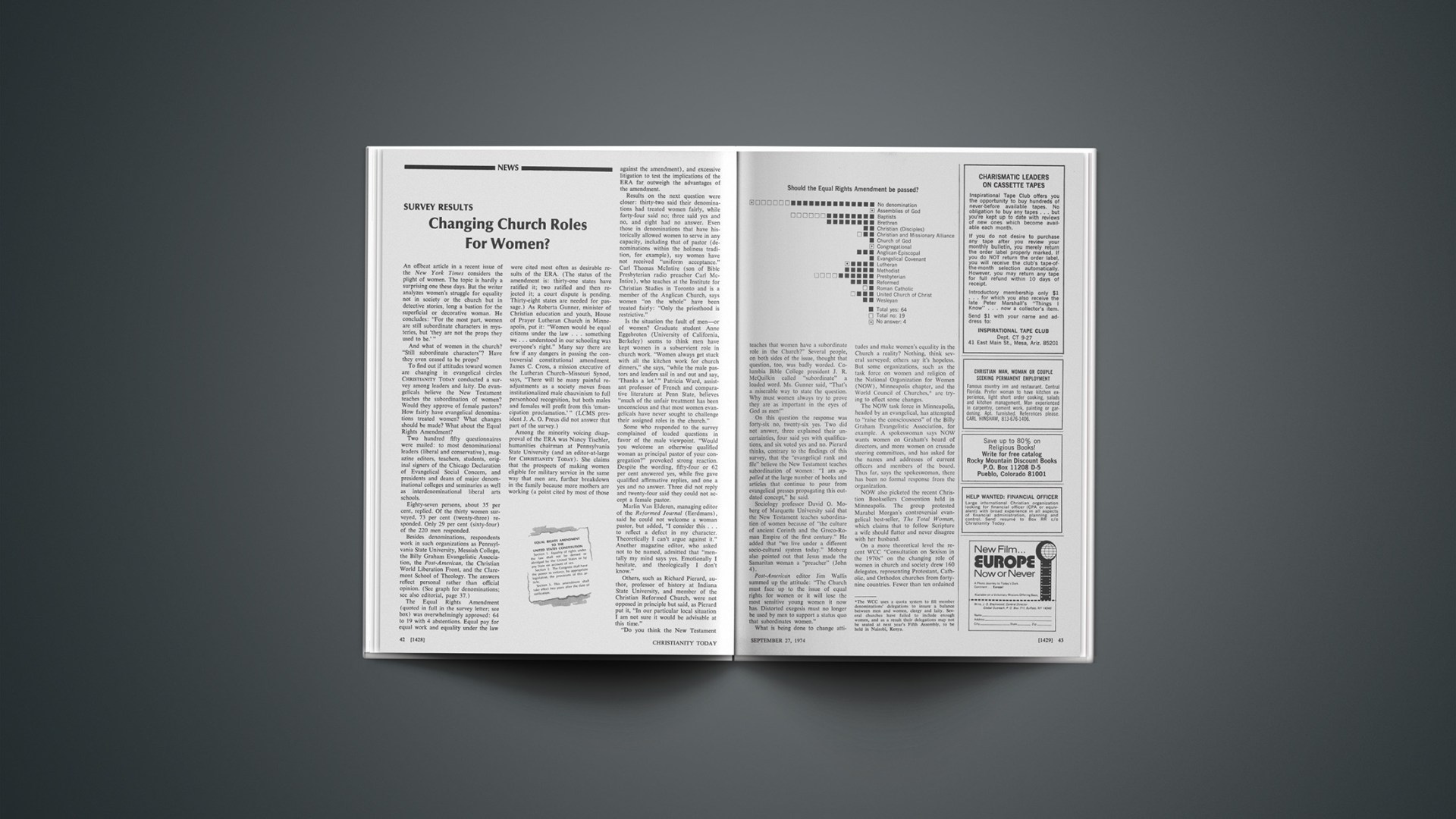
Survey Results: Changing Church Roles for Women?

An offbeat article in a recent issue of the New York Times considers the plight of women. The topic is hardly a surprising one these days. But the writer analyzes women’s struggle for equality not in society or the church but in detective stories, long a bastion for the superficial or decorative woman. He concludes: “For the most part, women are still subordinate characters in mysteries, but ‘they are not the props they used to be.’ ”

And what of women in the church? “Still subordinate characters”? Have they even ceased to be props?

To find out if attitudes toward women are changing in evangelical circles CHRISTIANITY TODAY conducted a survey among leaders and laity. Do evangelicals believe the New Testament teaches the subordination of women? Would they approve of female pastors? How fairly have evangelical denominations treated women? What changes should be made? What about the Equal Rights Amendment?

Two hundred fifty questionnaires were mailed: to most denominational leaders (liberal and conservative), magazine editors, teachers, students, original signers of the Chicago Declaration of Evangelical Social Concern, and presidents and deans of major denominational colleges and seminaries as well as interdenominational liberal arts schools.

Eighty-seven persons, about 35 per cent, replied. Of the thirty women surveyed, 73 per cent (twenty-three) responded. Only 29 per cent (sixty-four) of the 220 men responded.

Besides denominations, respondents work in such organizations as Pennsylvania State University, Messiah College, the Billy Graham Evangelistic Association, the Post-American, the Christian World Liberation Front, and the Claremont School of Theology. The answers reflect personal rather than official opinion. (See graph for denominations; see also editorial, page 37.)

The Equal Rights Amendment (quoted in full in the survey letter; see box) was overwhelmingly approved: 64 to 19 with 4 abstentions. Equal pay for equal work and equality under the law were cited most often as desirable results of the ERA. (The status of the amendment is: thirty-one states have ratified it; two ratified and then rejected it; a court dispute is pending. Thirty-eight states are needed for passage.) As Roberta Gunner, minister of Christian education and youth, House of Prayer Lutheran Church in Minneapolis, put it: “Women would be equal citizens under the law … something we … understood in our schooling was everyone’s right.” Many say there are few if any dangers in passing the controversial constitutional amendment. James C. Cross, a mission executive of the Lutheran Church-Missouri Synod, says, “There will be many painful readjustments as a society moves from institutionalized male chauvinism to full personhood recognition, but both males and females will profit from this ‘emancipation proclamation.’ ” (LCMS president J. A. O. Preus did not answer that part of the survey.)

Among the minority voicing disapproval of the ERA was Nancy Tischler, humanities chairman at Pennsylvania State University (and an editor-at-large for CHRISTIANITY TODAY). She claims that the prospects of making women eligible for military service in the same way that men are, further breakdown in the family because more mothers are working (a point cited by most of those against the amendment), and excessive litigation to test the implications of the ERA far outweigh the advantages of the amendment.

Results on the next question were closer: thirty-two said their denominations had treated women fairly, while forty-four said no; three said yes and no, and eight had no answer. Even those in denominations that have historically allowed women to serve in any capacity, including that of pastor (denominations within the holiness tradition, for example), say women have not received “uniform acceptance.” Carl Thomas McIntire (son of Bible Presbyterian radio preacher Carl McIntire), who teaches at the Institute for Christian Studies in Toronto and is a member of the Anglican Church, says women “on the whole” have been treated fairly: “Only the priesthood is restrictive.”

Is the situation the fault of men—or of women? Graduate student Anne Eggebroten (University of California, Berkeley) seems to think men have kept women in a subservient role in church work. “Women always get stuck with all the kitchen work for church dinners,” she says, “while the male pastors and leaders sail in and out and say, ‘Thanks a lot.’ ” Patricia Ward, assistant professor of French and comparative literature at Penn State, believes “much of the unfair treatment has been unconscious and that most women evangelicals have never sought to challenge their assigned roles in the church.”

Some who responded to the survey complained of loaded questions in favor of the male viewpoint. “Would you welcome an otherwise qualified woman as principal pastor of your congregation?” provoked strong reaction. Despite the wording, fifty-four or 62 per cent answered yes, while five gave qualified affirmative replies, and one a yes and no answer. Three did not reply and twenty-four said they could not accept a female pastor.

Marlin Van Elderen, managing editor of the Reformed Journal (Eerdmans), said he could not welcome a woman pastor, but added, “I consider this … to reflect a defect in my character. Theoretically I can’t argue against it.” Another magazine editor, who asked not to be named, admitted that “mentally my mind says yes. Emotionally I hesitate, and theologically I don’t know.”

Others, such as Richard Pierard, author, professor of history at Indiana State University, and member of the Christian Reformed Church, were not opposed in principle but said, as Pierard put it, “In our particular local situation I am not sure it would be advisable at this time.”

“Do you think the New Testament teaches that women have a subordinate role in the Church?” Several people, on both sides of the issue, thought that question, too, was badly worded. Columbia Bible College president J. R. McQuilkin called “subordinate” a loaded word. Ms. Gunner said, “That’s a miserable way to state the question. Why must women always try to prove they are as important in the eyes of God as men!”

On this question the response was forty-six no, twenty-six yes. Two did not answer, three explained their uncertainties, four said yes with qualifications, and six voted yes and no. Pierard thinks, contrary to the findings of this survey, that the “evangelical rank and file” believe the New Testament teaches subordination of women: “I am appalled at the large number of books and articles that continue to pour from evangelical presses propagating this outdated concept,” he said.

Sociology professor David O. Moberg of Marquette University said that the New Testament teaches subordination of women because of “the culture of ancient Corinth and the Greco-Roman Empire of the first century.” He added that “we live under a different socio-cultural system today.” Moberg also pointed out that Jesus made the Samaritan woman a “preacher” (John 4).

Post-American editor Jim Wallis summed up the attitude: “The Church must face up to the issue of equal rights for women or it will lose the most sensitive young women it now has. Distorted exegesis must no longer be used by men to support a status quo that subordinates women.”

What is being done to change attitudes and make women’s equality in the Church a reality? Nothing, think several surveyed; others say it’s hopeless. But some organizations, such as the task force on women and religion of the National Organization for Women (NOW), Minneapolis chapter, and the World Council of Churches,1The WCC uses a quota system to fill member denominations’ delegations to insure a balance between man and women, clergy and laity. Several churches have failed to include enough women, and as a result their delegations may not be seated at next year’s Fifth Assembly, to be held in Nairobi, Kenya. are trying to effect some changes.

The NOW task force in Minneapolis, headed by an evangelical, has attempted to “raise the consciousness” of the Billy Graham Evangelistic Association, for example. A spokeswoman says NOW wants women on Graham’s board of directors, and more women on crusade steering committees, and has asked for the names and addresses of current officers and members of the board. Thus far, says the spokeswoman, there has been no formal response from the organization.

NOW also picketed the recent Christion Booksellers Convention held in Minneapolis. The group protested Marabel Morgan’s controversial evangelical best-seller, The Total Woman, which claims that to follow Scripture a wife should flatter and never disagree with her husband.

On a more theoretical level the recent WCC “Consultation on Sexism in the 1970s” on the changing role of women in church and society drew 160 delegates, representing Protestant, Catholic, and Orthodox churches from forty-nine countries. Fewer than ten ordained women participated in the week-long meeting. The group discussed the need to legislate equality but said little of the church’s role in the issue or of how to change attitudes.

Youth Specialties, Incorporated, which publishes the Wittenburg Door, is surveying twenty-five evangelical organizations on hiring practices. Unpublished preliminary results indicate attempts to provide women with equal employment and advancement opportunities, says Roberta Gunner, who is handling the survey for Youth Specialties.

Those responding to CHRISTIANITY TODAY’S survey had some suggestions. Let women serve as elders, deacons, and ministers, said some; others wanted to see more men in church kitchens and more women in board rooms. Encourage women to assert themselves to lead and administer in the local church, said most. Some said they would like no changes made. Among them were Harold J. Ockenga, president of Gordon-Conwell seminary, and the president of another well-known Christian college, who asked not to be named. G. A. Miles, president of the Washington Bible College, summed up this attitude: “The role of women in our church is biblical.”

Yet a majority of those who returned the survey say the Church at the present time is still “a strong force against women’s equality.” As Pierard put it, the Church needs to “challenge and refute the sexist doctrines so latent in our faith as practiced today.”

A German First

She’s an attractive, six-foot German blonde, single, fluent in three languages (including English)—and the first woman to hold a major post in the far-flung Billy Graham Evangelistic Association. Recently appointed editor of Entscheidung, the German edition of Decision magazine, Irmhild Barend was raised in Berlin and holds a Ph.D. in literature from the Free University there (her thesis was on the meaning and function of biblical quotations in the writings of the nineteenth-century German novelist Wilhelm Raabe). She formerly edited Contrapunkt, an international German-language youth magazine, and first met members of the BGEA in 1971, when she was elected to the executive committee of the European Congress on Evangelism in Amsterdam.

DAVID VIRTUE

Black Catholics: Is There A Future?

Whether or not the Catholic Church can survive in the black community remains a crucial question.

In July the third black American Catholic bishop was selected: Father Eugene A. Marino, vicar general of the Josephite Fathers and a member of the team of black priests that went to Rome last year to confer with the Pope about black concerns. He will serve as an auxiliary bishop for the Archdiocese of Washington, D. C. At forty, he is the youngest of the some 300 American bishops. The son of a Puerto Rican father and a black American mother, Marino was considered the preference of the diocese’s 70,000 black Catholics.

But rather than signifying success for blacks in the Catholic Church, Marino’s appointment actually reveals their plight, according to some critics. The Washington auxiliary bishop was appointed only after four years of pleading, they say, and as an alternative response to an original request for a black to succeed Cardinal Patrick O’Boyle as titular head of the entire diocese. As a compromise to whites, the critics allege, a white auxiliary bishop was also appointed at the same time.

Warned the Illinois Black Lay Caucus: “If the church politicians do not appoint more black bishops soon, there will be no Catholic churches left in the black community.” Stern warnings have also come from James Dulin, former head of the National Black Lay Caucus, who has said, “I cannot in conscience continue to represent black Catholics in the Catholic Church in America, which is a racist institution.”

Blacks quickly cite examples of racism: No black ordinaries (bishops over dioceses) exist in the United States. No dioceses have social-action offices, though a few have recommended them. No blacks serve on as important a committee as the Committee on Health Affairs of the U. S. Catholic Conference. And there are no black members on three executive committees of the National Catholic Education Association, even though there are 369 predominantly black parochial schools. Even the Society of African Missions has not a single black priest.

The shortage of black priests is especially severe. Out of 57,000 Catholic priests, only 175 are black. There is but one black pastor in Harlem’s seven parishes. Baltimore, which boasts the oldest black Catholic church in the nation, only this year ordained its first black parish priest. Even the two largest black constituent dioceses in Louisiana have a total of only four black priests. Los Angeles has none.

“With only one black priest for every 4,573 black Catholics in the country, the situation is bleak,” commented Robert Robinson, community coordinator for the National Office of Black Catholics. He noted, though, that twelve more are to be ordained this year.

Another cause for concern is the flight of blacks from the Catholic Church. Rumors are that many of the reported 855,000 black members are becoming increasingly disenchanted with the structure’s alleged slowness to change. Since 1968, at least twenty priests have left the ministry, and 200 black sisters have withdrawn from congregations. And since 1973, twenty-five black seminarians have quit.

Other special problems center in parochial schools. All across the country, parochial schools in inner-city areas are being closed. Black auxiliary bishop Joseph L. Howze of Natchez-Jackson, Mississippi, says many Catholics are unhappy about supporting Catholic schools where so much of the population is black and non-Catholic. Although black Catholics in Chicago reportedly raised $6 million annually for their schools, charge complainants, the church this year closed its last school on the West Side. The protests of 315 black families who sent children there were in vain, and when parents milled angrily in the halls of the chancery, fourteen were arrested.

On the other hand, some positive changes have occurred for blacks in the church within recent months, largely as a result of pressures brought by black organizations within the church. These groups date back only to 1969, when 1,000 packed St. Peter’s Church on Washington’s Capitol Hill for the first mass concelebrated by ten black priests from various cities. This was followed by the first Black Caucus Convention in 1970 at Catholic University. There are now more than thirty-five chapters of the Black Caucus in various cities.

Conferences on black education, liturgics, and ministry are now frequent. The National Office of Black Catholics (NOBC) is doing research for a black religious-education curriculum, and plans are under way for a black Catholic theological center.

Fully 10 per cent of the church’s deacons are blacks. The NOBC has released a book of experimental black liturgies by Father Clarence Joseph Rivers of Washington, D. C. And in St. Louis a new Urban Service Apostolate has been created, specializing in inner-city ministries. This is joined by special black secretariats newly formed in several dioceses, the latest in Washington, D. C.

The Campaign for Human Development, called the anti-poverty arm of the church, this year has distributed more than $5 million to 150 black community programs.

But the National Black Catholic Clergy Caucus has reportedly still not been able to raise its goal of $70,000 in foundation grants to spearhead a drive to recruit candidates for the priesthood and other religious vocations.

JAMES S. TINNEY

The Verdict On Vets

A U. S. district court in Charleston, South Carolina, upheld the refusal of the Department of Justice to allow federal funds under any U. S. program to go to Bob Jones University, Greenville, South Carolina, because of the school’s refusal on religious grounds to admit black students on an equal basis with whites. The court agreed that for the Veterans Administration to expend public tax money under the G.I. Bill of Rights to support students at a college that prohibits the enrollment of blacks would violate the Constitution.

BJU is expected to appeal the decision to higher Federal courts on the ground that it interferes with the free exercise of religion by a veteran when his religious belief requires segregation.

GLENN EVERETT

The Day Of Prayer

Nearly 5,000 Americans met at the foot of the Washington Monument in Washington, D. C., last month to hear speakers urge a return to prayer for the nation and to lead in prayers of repentance as part of the If My People project (see July 26 issue, page 39). But fewer than 700 (according to police estimates) participated in the second part of the day’s activities—a march and prayer in front of the Afghanistani and Russian embassies for believers being persecuted in Muslim and Communist lands.

According to If My People coordinators, similar prayer emphasis days were held in Denmark, Australia, New Zealand, Singapore, Canada, Guyana, and other countries. Project officials said they were unable to give figures on the numbers of participants in each country until reports were received from local leaders. In Morocco, a sense of immediacy was added to the prayer day, attended by fifty Youth With a Mission (YWAM) staffers and others. Several days earlier some Christian nationals were arrested for, they claim, engaging in evangelistic activities.

At Washington, the crowds listened while speakers exhorted them to pray for repentance. They were disappointed to find that the headline speaker, Bible smuggler Brother Andrew, had canceled for health reasons. YWAM head Loren Cunningham instead gave the keynote address, exhorting his hearers to extend “Christian forgiveness” to the Muslim and Iron Curtain governments.

Religion In Transit

University of Pittsburgh scientists are scratching their heads over plants that grew when prayed over, according to the Pittsburgh Press. The scientists placed eight kernels of corn in each of two pans and prayed over one of the pans. Seven kernels sprouted in the prayed-for pan, three in the other. Now the scientists wonder whether it was the prayer or tone of prayer that caused the increased sprouting.

The American Broadcasting Company has purchased Word, Incorporated, which publishes books, tapes, records, Faith at Work magazine, and other multi-media material for a largely evangelical audience. The Waco, Texas, publisher’s authors include Keith Miller, Charlie Shedd, and Bruce Larson.

Dr. Andre Appel will leave his post as general secretary of the Lutheran World Federation in October to assume the presidency of the 235,000-member Church of Augsburg Confession (Lutheran) of Alsace and Lorraine in France. He will be the first clergyman to hold the position.

DEATHS

Samuel Hepburn, 73, former national commander of the Salvation Army in the United States: in Los Gatos, California.

George E. Wright, 64, biblical scholar, archaeologist and divinity professor at Harvard University; in Jaffrey, New Hampshire.

Americans gave more money to religious groups and causes last year than ever—$10.9 billion, up $650 million from 1972’s total. This was 41.4 per cent of the record $24.5 billion philanthropic total, continuing a decrease from 1964 when virtually half of philanthropic giving went to religion. The figures are reported in a study by Giving USA, a publication of the American Association of Fund-Raising Counsel.

The Black Unitarian Universalist Caucus has officially changed its name to the Black Humanist Fellowship. The name change created a controversy among some blacks in the Unitarian Church who felt the change would lead to schism and a separate black denomination from the Unitarian Universalist Church. In a lawsuit over the proposal a common pleas court allowed the change of name.

Ford’s First Month: Christ and Conflict

Shortly after slipping into the early service at St. John’s Episcopal Church across the park from the White House, President Ford joined others for communion. Then he returned to the White House and announced his presidential pardon of Richard Nixon, his resigned predecessor.

That was Sunday, September 8, the day the nation’s press announced that after one month the honeymoon was over (see editorial, page 37). Like the rest of the nation, religious leaders were divided over the controversial action.

Evangelist Billy Graham said Ford acted with “decisiveness, courage, and compassion” in saving Nixon from prosecution, which “would have torn the country apart more than Watergate itself.” Nixon, he added, has already paid “a terrible price for the mistake of his administration.”

Theologian Carl F. H. Henry, however, cautioned that Ford’s act “confuses even more the distinction between justice and mercy at a time when both need to be clarified in American affairs.” Pardon undisciplined by justice tends to be amoral, if not unethical, he said.

Dr. W. Sterling Cary, president of the National Council of Churches, commended Ford for his desire to effect healing. But, insisted Cary, “this must be balanced by insisting on accountability for one’s acts.”

Dr. Hudson Armerding, president of Wheaton College and of the World Evangelical Fellowship, said Ford’s act “calls into question the principle of equal justice under law for all.” Nixon, he said, is entitled to the full protection of the law, but he is “also obliged to take the consequences of proven wrongdoing.” The reasons offered by Ford, said Armerding, don’t seem compelling enough to justify a pardon.

Many questioned the timeliness of the pardon. Congressman John Anderson of Illinois, an evangelical, said that he didn’t feel Nixon ought to go to jail if convicted but that the legal process should have been allowed to run its course. With no confession and no conviction, Nixon can propagate the false notion that he was hounded out of office, said Anderson.

But in Dallas the impact of the decision upon many church members was cushioned somewhat by a front-page story in the Dallas Morning News less than a week earlier. The story, written by religion writer Helen Parmley and entitled, “A New Billy at the White House,” quoted from a letter Ford had sent to a friend, evangelist-film maker Billy Zeoli of Grand Rapids, Michigan. In the letter, Ford congratulated Zeoli on the upcoming twenty-fifth anniversary of Gospel Films, a firm Zeoli heads. The President noted the influence of Christian films on church and family life, remarked that church had always meant a lot to him and his family, and then stated:

Because I’ve trusted Christ to be my Saviour, my life is His. Often, as I walk into my office, I realize that man’s wisdom and strength are not sufficient, so I try to practice the truth of Proverbs 3:5, 6.1“Trust the Lord completely; don’t ever trust yourself. In everything you do, put God first, and he will direct you and crown your efforts with sucess” (Living Bible). And, Billy, I’ve experienced His leadership just as you have!

… I also want to thank you for taking the time to help me learn more about our Saviour.

Zeoli, in an interview, said his friendship with Ford began several years ago. “I just dropped by his field office in Grand Rapids and told him I wanted to meet my congressman,” he explained. They talked about sports, a mutual interest, the evangelist recalled (Zeoli is an unofficial chaplain for several professional football teams and often speaks at pre-game chapel sessions; Ford was a college football star). There were more visits, the conversations moved from sports to spiritual matters, and soon Zeoli was meeting with Ford regularly for prayer and Bible study.

“I’ve never been one to be ostentatious about my religious views,” Ford recently told a reporter. “But I don’t hesitate to say that Billy has had an impact on my perspective.” (Zeoli is a graduate of Philadelphia College of Bible and Wheaton College.)

They continued to meet monthly after Ford became Vice President, and Zeoli says there are no plans to scrap them now that his friend has become President. Zeoli and Ford met in the Oval Office hours before Ford’s first nationally televised press conference and discussed several passages in Proverbs that deal with wisdom and good judgment (they use the Living Bible in their studies). Meetings were also planned for this month and next. In between sessions, they occasionally call each other, and Zeoli mails a weekly prayer memo.

In recent months Ford has spoken more openly about his faith than ever before. Is this the result of a sudden new experience? Zeoli says change has been gradual. “I have seen growth in Christ and in Christian concern.” But, adds the evangelist, “his personality has not changed. He’s as loving, open, and straight as when I first met him.”

Ford’s parents were active Episcopalians in Grand Rapids. Grace Episcopal Church there still carries his name on its membership rolls, though he has been seldom able to attend since his election to congress in 1948. From 1955 until he assumed the presidency his “home parish” was Immanuel Church-on-the-Hill, a 500-member church on the grounds of Virginia (Episcopal) Seminary in Alexandria. He had served as church usher, once headed up a parish commission working to achieve fair housing and to provide aid to low-income families, helped establish a Capitol Hill issues-discussion luncheon group made up of parish members (an outgrowth was a prayer group for congressmen), and he had even preached several times.

It is believed Ford and his family will go on attending services at Immanuel, but not as often; St. John’s is closer now, and for security reasons Ford must vary his churchgoing habits. Meanwhile, he meets weekly for prayer with several friends (see August 30 issue, page 33), and he has dropped by the fortnightly prayer-breakfast meeting at the White House (on his first visit Iowa Senator Harold Hughes was speaker).

Ford’s first Sunday at Immanuel as President highlighted for some the struggle in the Episcopal Church over the rights of women. On the church steps after the service Ford thanked Immanuel’s rector, William L. Dols, Jr., for his sermon but noted that according to the printed program the Reverend Patricia M. Park had been scheduled to preach. Mrs. Park, 27, an ordained deacon who graduated from seminary in June (her husband is a clergyman at nearby Christ Church), is Dols’s assistant. She had intended to preach on the Beatitudes that day, she said in an interview.

Dols told reporters he’d been vacationing on Cape Cod and did not hear until Saturday afternoon that the new President would be in church on Sunday. He flew back to the Washington area Saturday night and applied the final touches to his hastily prepared sermon. “Mrs. Park probably could have done a better job of preaching,” he said. “But it was the President’s first public appearance, and I thought I owed him the respect to come back and deliver the sermon.”

Mrs. Park, an outspoken advocate for ordination of women to the priesthood, said she was angry at first for being bumped in favor of her male superior. Some seminarians and teachers also expressed concern at what they considered was a putdown of womanhood by Dols, a liberal by reputation.

Two weeks later Ford was again in the audience and this time Mrs. Park preached—on the women’s issue in the Episcopal Church (she had just attended an emergency meeting of the House of Bishops in Chicago, where the rebel ordination of eleven women to the priesthood was invalidated). On his way out, Ford thanked her for the sermon.

Whether as President or Episcopalian, Ford will have plenty to think about in the months ahead.

Arms And The Clergyman

Gun-running for Arab guerrilla groups might seem incongruous with blessing babies on Sunday mornings, but gun-running is what Greek Catholic archbishop Hilarion Capucci of Jerusalem has been charged with. Israeli authorities recently indicted the archbishop as an arms smuggler and an agent for Al Fatah and Black September, among other guerrilla groups, and so far have refused to release him on bail. Capucci’s lawyers are arguing that since the clergyman carries a Vatican passport and a service visa issue by the Israeli foreign ministry, he in effect has diplomatic immunity.

The Syrian-born archbishop is vicar of the Greek Catholic (Melchite) Church in East Jerusalem. (The church, while enjoying a measure of independence, does recognize the Pope as ranking patriarch.) The charges brought by Israel have stirred up a hornet’s nest: the National Catholic News Service in the United States reported reaction in Jerusalem that the charges may be “trumped up,” while Israel maintains that Capucci is a threat to state security.

Afghanistan: A Living Church

Although the Afghanistan government demolished the only Protestant church building in Kabul, the capital, last year (see July 6, 1973, issue, page 43), the church itself is alive and well and increasingly grateful that its building was razed.

J. Dudley Woodberry, pastor of the church since former pastor J. Christy Wilson, Jr. was expelled last year, said “a Monday-morning quarterback’s hindsight” shows that the building was “obviously more ostentatious than was wise for the times.” And, he said, the 100-member congregation has discovered that the church “is not a building. It is people. We are a living church.” Morale, which dropped when the government stepped in, is now good.

Since a military coup in July, 1973, the congregation has been seeking an understanding with the new government about the rights of non-Afghan Christians to worship and legal rights to a church site. (The old Afghan government’s objection to the church was twofold: it claimed that the congregation had no legal right to the site, and it insisted that the church’s spire offended Afghan Muslims by rising above other structures in the capital.) The new regime criticized the destruction of the church but refused to pay compensation to the congregation and instead declared the case closed.

At present, the congregation meets in a house that has been converted into an auditorium. Only the image of a fish on an outside wall suggests it is a Christian meeting place. The church serves the foreign community in Kabul. Under Afghan law, it is a capitol offense for a Muslim to convert to Christianity.

NO INTEREST

Miami electrical engineer Hugh McNatt, 43, has dropped the suit he filed against his church, 4,200-member Allapattah Baptist. In his suit he had charged that God, contrary to what Pastor Donald Manuel of Allapattah had promised, did not bestow blessings and rewards for his $800 tithe given three years ago (see September 13 issue, page 73).

He dropped the suit this month after getting his $800 back, though without interest. A San Antonio businessman, Alton S. Newell, read a news story about the case and decided to repay on behalf of the church. Newell is a member of San Antonio’s First Baptist Church.

According to Israeli security forces, Capucci transferred arms and sabotage materials from Beirut to Jerusalem in his Mercedes during church-oriented visits to the Lebanese capital. As a clergyman, he had the freedom to cross the border without security checks. Police said that on at least three occasions, in April, May, and July, Capucci picked up arms in Beirut and deposited them in several locations in Israel to be picked up later by terrorists. More arms were later found in the archbishop’s residence. Authorities charge that Capucci was caught “red-handed,” pointing to ten hand grenades, two revolvers, four Russian submachine guns, and several plastic bombs, found concealed under the car’s seats, in the trunk, and inside the door panels, as evidence.

Capucci was indicted on three charges: maintaining contact with foreign agents, possessing illegal arms, and performing services for unlawful groups. Conviction on the three could bring a maximum penalty of thirty-five years in prison.

El Salvador: Lausanne Fallout

Five nights after the two El Salvador participants in the International Congress on World Evangelization returned home from Lausanne, they got together with pastors and lay leaders to discuss the congress and hold a prayer vigil. The gathering took place in the nation’s capital city, San Salvador, at the First Baptist Church, and was led by host pastor Roger Velasquez Valle.

After a devotional service the pastors and laymen discussed the happenings at Lausanne, reviewed the Lausanne Covenant, and began to work out ways of implementing the various ideas for evangelization that had been suggested in the strategy group for Central America, Panama, and the Dominican Republic. Then they prayed, in a vigil that lasted from 1:30 A.M. till 5 A.M.

Twenty-seven pastors and nearly two hundred lay leaders attended, from the Assemblies of God, the Association of American Baptists, the Central American Mission, and the Prince of Peace churches. They made plans for another prayer vigil in the near future to set in motion evangelistic plans for the nation.

JUAN BUENO

Lutheran Charismatics: The Growing Spirit

Compared to the two previous conferences, this year’s Third International Lutheran Conference on the Holy Spirit, held last month in Minneapolis, Minnesota, had a distinctly greater Lutheran flavor. The conference listed no Roman Catholics among the headline speakers—a fact that may have lowered formerly high Catholic attendance. Conference chairman Morris Vagenes, a Roseville, Minnesota, pastor, said more than 80 per cent of those attending the four-day affair were Lutherans. A major value of the conference, he added, was that Lutheran charismatics gained strong positive feelings regarding their Lutheranism.

The biggest crowd of the entire conference—10,000—jammed the Minneapolis Municipal Auditorium to hear a classic Pentecostalist leader and author, Robert Mumford. Discussing the charismatic movement in general, Mumford predicted that a “full-blown New Testament church” will emerge from the charismatic renewal, which, he said, is being discussed in every seminary and every denomination.

In a switch from earlier meetings, conference conveners placed strict restrictions on speaking in tongues from the audience. A conference program warned that “prophecies” would be limited to persons seated on stage who had “a proven and recognized prophetic ministry” in their local communities. The result of the restriction, said Vagenes, was a “much higher caliber” of prophecies.

As at the Catholic charismatic gathering in Notre Dame (see July 5 issue, page 47), healing had a prominent place at the Lutheran conference. Independent evangelist Herbert Mjorud prayed following one evening service for those suffering a variety of ailments—from heart disease to hemorrhoids—and in each case there were those who stood up and claimed they were healed. In praying for curvature of the spine and other back problems, Mjorud said that “Jesus Christ is not only a great physician—he is a great chiropractor.”

Attendance at the conference was open, and no registration fee was levied. Nevertheless, offerings at the conference amounted to more than $42,000, more than enough to cover expenses. Vagenes said the surplus would be used to further Lutheran charismatic renewal.

WILLMAR THORKELSON

The Saints Go Marching In

Six fluted facets interfaced

With bastions strong and tall,

One for each day from Adam

Till He comes whose House it is.

Seven stories build upon each other,

One for each period of creation and rest.

LYLE R. DRAKE

Some 800,000 persons are filing through the big “House” this fall, the sixteenth temple of the 3.3-million-member Church of Jesus Christ of Latter-day Saints, located in the Washington suburb of Kensington, Maryland.

First President Spencer W. Kimball2Kimball, now 79, has occupied the highest Mormon office since last December. He appears to be in sound health, having overcome, among other ailments, cancer, smallpox, and typhoid. cemented a time capsule into the cornerstone of the $15 million structure to mark the end of construction this month. The temple was then opened to visitors, and tickets soon became as scarce as those for the home games of the Washington Redskins football team. No contributions are asked or accepted—the temple was paid for two years ago.

Following dedication ceremonies in November, the public will be forever barred from the temple. So will an estimated 40 per cent of Mormons not considered in good standing.

The temple sits on a fifty-seven-acre wooded tract that the Mormons purchased in 1962 for $850,000. It is the first to be built in North America east of the Mississippi and will serve some 300,000 Mormons scattered from Montreal to San Juan.

Mormon temples are used primarily for so-called eternal marriages and for proxy baptisms. No regular services are held there. In the Washington Temple a small chapel will be used for occasional inspirational meetings and a somewhat larger hall for special assemblies. Most of the space is taken up by relatively small rooms designed for the performance of various rites. All elegantly appointed, perhaps most of all a marble-decorated bride’s chamber. There is also a huge locker room where participants change from street clothes into white robes.

The Washington Temple is larger than the most famous of the Mormon edifices, the one located in Salt Lake City, but is not as big as the Los Angeles Temple.

Ideas

The Place to Start

The practice of medicine is based upon certain established procedures. First, the physician must diagnose the ailment of the patient. Second, he must determine the prognosis. And third, he must provide the cure. If the illness is fatal and there is no cure, all he can do is to make the patient as comfortable as possible for the remaining days of his life. But if the patient is expected to live, there are several possibilities. For some minor ailments the physician can let nature take its healing course; he can use drug therapy; he can use surgical therapy; he can prescribe a change in diet, rest, exercise, or other aspects of the patient’s way of life; or he can combine several of these options. Some patients suffer from a chronic complaint that cannot be cured, at least with present knowledge, and they must learn to live with the handicap.

The procedures and options are roughly similar for those who wish to cure the economic, political, and social illnesses of our day.

United States senator Mark Hatfield recently quoted approvingly a proclamation of the Protestant Confederation of France concerning the state of modern French society. The confederation said: “The present economic and political system of our society is unacceptable. The domination and manipulation of the weak by the strong in the socio-economic activity is radically incompatible with the Gospel.” Senator Hatfield accepts this diagnosis and goes on to say: “Our [U. S.] wealth and our standard of living is a cause of endless other problems such as our energy crisis, the ruining of our physical environment, and our outright monopoly on the world’s basic resources. But, at its heart, such wealth simply manifests corporate selfishness, and individual self-centeredness.” He goes on to speak of other sins such as lying, cheating, stealing, and drug abuse.

Hatfield has called attention to many of the illnesses that characterize the national life of America and other countries. There may be differences in degree but certainly not in the kind of ailments. A coronary occlusion can be minor or massive; an allergy can be incidental or monumental.

We commonly hear “prophetic” voices analyzing the ills of society. Regrettably, these prophets are usually long on analysis and short on therapy. Symptoms of the sickness of society are easily seen in every nation in our day. The despoiling of the physical environment is as serious (if not more so) in Moscow, Bangkok, London, Tokyo, and Rio as in New York. The Mississippi River and the oceans surrounding the United States are not more polluted than the Rhine, the Ganges, and the Yangtze and the oceans into which they flow.

“The domination of the weak by the strong in the socio-economic activity” is no more pronounced in the United States than in China, the Soviet Union, South Africa, Chile, Spain, and North Viet Nam.

The energy crisis is not a solely American phenomenon. The standard of living of all the industrialized nations has produced the same problems everywhere. And the energy crisis is also to be found in underdeveloped nations where there is little wealth and the standard of living is exceedingly low. In India there is sure to be famine within a year or two because of oil shortages (India cannot afford to buy the oil needed for making essential fertilizers) and because of the demand for more food for a population that increases daily and requires additional food at a time when there is sure to be less. Tens of thousands of Ethiopians are dying right now. And the Arab nations that have vast money reserves from their oil sales are doing virtually nothing to meet these human needs around the world.

For all its faults, the social, economic, and political system that exists in America today is better than its counterparts in all other nations. Can anyone point to another existing—not theoretical—system that works better for a sizable number of people? To change from a relative free-market economy to doctrinaire socialism or to Marxism would not solve the world’s current problems. Indeed, there is good reason to believe it would make them worse.

The evils that have developed in capitalism (which, as Marx stated, has its origins in the Mosaic law) are due not to an inherent weakness in capitalism but to our failure to apply stewardship under the law that undergirds the commandment “thou shall not steal.” This is the law of love: Thou shalt love the Lord thy God and thy neighbor as thyself.

The remedy for the world’s ills lies in the acceptance and practice of the law of love. There can be no permanent cure of political, social, and economic ills until this law of God becomes regnant in the hearts of men. Even if all men were to acknowledge and try to obey this commandment (which they will not), to make the world what it ought to be would require the most exacting commitment and the most diligent labor.

In this kind of world, Christians who profess this law of love are called to do all they can to provide a cure for the ailments that beset men and nations. We continue to affirm that the place to start is to preach the Gospel of salvation, which leads to changed and changeable hearts. Believers, rather than repeatedly denouncing the evils of society, should be taught specific ways to contribute to the healing of society for the good of men everywhere.

The Pardon Of Richard Nixon

The pardon granted to Richard Nixon by President Gerald Ford did not end the Watergate controversy, as public response indicates. Even if it had, would that have justified a pardon at such a time? A pardon releases a person from liability for an offense. But Mr. Nixon had not admitted guilt, nor had he been given any judicial penalty for commission of a crime. How can a person be released from all penalties for an offense before charges have been brought or his culpability has been established? God pardons repentant believers without injury to justice because Jesus paid the penalty and we accept him as our substitute. Was Mr. Nixon’s acceptance of the pardon an acknowledgement of guilt? If not, why did he accept it, since that implies guilt?

Can those who take a strong law-and-order position approve the pardon and still maintain that position? And if they do approve the pardon, should not the same have been done for all the Watergate offenders and draft evaders as well? How will the pardon affect the cause of justice in the trials of men like John Mitchell and John Erlichman? Mr. Nixon has been subpoenaed and presumably could be subjected to rigorous cross-examination. If, in the course of his own testimony, he were to admit guilt, would justice be served if Mitchell and Erlichman were convicted at least partly on the basis of the testimony of one who has been put beyond the law’s reach?

The necessity of dealing with illegalities and immoralities in high places must be faced even if it conflicts with the government’s obligation to end domestic strife and restore a measure of common purpose. Unless there were overriding reasons of which we have no present knowledge, it would appear that President Ford was mistaken in granting the pardon when he did. But let us not suppose that he was influenced by base motives, nor by any obligation to Mr. Nixon, who in effect chose him for the post he now occupies.

It is a moral obligation for Americans to continue the quest for justice and to understand Watergate and its implications for our individual and public standards and conduct. At the same time we must try to end the paralysis that so hampers our ability to deal with external and internal problems.

Youth And Religion: A Rare Change

The Jesus movement among young people and the continually growing ministries of older evangelical youth organizations such as Inter-Varsity, Campus Crusade, Youth for Christ, and Young Life are indeed cause for rejoicing. But before waxing rhapsodic over “revival,” let us keep the broader picture in view.

A respected national polling organization found in 1969 that 59 per cent of the sixteen-to twenty-five-year-olds interviewed considered religion of some kind to be a “very important value” in their lives. This year a comparable poll found that only 39 per cent in that age group feel the same way! “Changes of this magnitude in so brief a time span are rare,” observed the research team. One of the most noticeable trends in this year’s poll was for noncollege youth to come closer to the attitudes of their collegiate counterparts.

Corresponding to the decreasing importance of religion was a loosening of moral attitudes. Only 31 per cent, down from 52 per cent, consider casual premarital sexual relations to be wrong. The proportion who thought “living a clean moral life a very important value” fell steeply also, from 71 to 52 per cent. (Considerably more blacks than whites valued a clean moral life.) Not quite everything is bleak from a biblical perspective however: 75 per cent of youth would welcome “less emphasis on money,” up 6 per cent from five years ago.

We should rejoice at reports of flourishing evangelistic activities and growth in Christian discipleship. But we dare not overestimate what has been accomplished. The task of sharing the Gospel and forming mature Christians does not proceed on its own momentum. We cannot coast. We cannot be indifferent to reaching young people because we think others are doing the job adequately. The need is greater than ever. □

Some Thoughts For The Era Era

In the News section of this issue the results of a CHRISTIANITY TODAY survey on the place of women in the Church and in society are reported. A small survey based on responses to a questionnaire may involve some self-selection and is not, of course, as revealing as interviews of a large cross-section. And Christians are to take the teaching of Scripture rather than human opinion as the rule of faith and practice. Nevertheless, the survey merits attention, especially as it indicates that the majority of evangelicals may think otherwise on this issue than the popular impression would have it.

Most respondents favor the fundamental idea behind the Equal Rights Amendment, and so do we: the view that there should be no arbitrary discrimination among people on the basis of sex. We would, however, agree with those of our respondents who warn that the present amendment would produce a Gordian knot of legal and social (and grammatical) entanglements that would put bread in the mouths of generations of jurists to come. We do feel that many respondents, even the theologically trained among them, are inadequately coming to grips with the biblical doctrine of Creation and the reality of a Creation order. Much analysis and reflection remains to be done.

We note that almost all respondents want more women to be included in responsible positions of Christian leadership, as we have already urged editorially (see September 13 issue, page 51). This survey shows that a gap remains between attitude and act. We urge that the two be brought together.

To Live Is To Pollute

To talk about ending pollution is vain. To exist, man must pollute. Modern technology has created new kinds of pollution, but it has greatly reduced older kinds. Anyone who could take a trip back in time could determine that for himself. Or, for that matter, just travel around the world a little. Primitive peoples and developing societies do not pollute as much per capita, but the accumulation is still sufficient to make most travelers glad to return to a homeland that because of technology has more pollution but is also more healthful. Smog is at best a nuisance, and a high carbon monoxide level in one’s bloodstream is dangerous. But technology also provides air that doesn’t stink, food that isn’t rotten, and water that isn’t infested with parasites.

Although we can’t end pollution, we can keep it under reasonable control. It costs money to clean up the air, the water, the streets, and anything else. But such costs have to be weighed against the real, though sometimes harder to detect, costs of not cleaning up after ourselves. Anti-pollution devices on automobiles are costly both to make and to keep working, but a study by the National Academy of Sciences (that cost half a million dollars) estimated that as many as 4,000 deaths and four million illness-related days off per year could be caused by auto air pollution in urban areas. We can’t eliminate auto air pollution completely, any more than we can stop all highway deaths. But we can improve the records in both areas.

Any new technology needs to be carefully scrutnized; its potential for increasing pollution, illness, and death should be compared to its potential for benefit. For example, during the debate over the SST aircraft one of the worries expressed was whether the nitrogen-oxide emissions might weaken the ozone shield in the upper atmosphere, which in turn could allow an overdose of the sun’s ultraviolet rays to reach the earth’s surface. MIT researchers now report after two years of study that such fears were well-founded. The possible benefits to a relative handful of people who would be able to cross the oceans a few hours faster are not worth the possible risks to our planet’s delicate ecological balance.

No, we cannot end pollution. But we can decrease it, and we can take a responsible interest in keeping our society from introducing unnecessary new sources of pollution and risk.

Three Great Certainties

The great English preacher John Henry Jowett once said that the Bible is a limitless quarry out of which he had had the privilege of extracting a few blocks of marble in his lifetime. Every generation of Bible students can say the same thing. There is always more marble left to be quarried. The Apostle Paul left us enough in his writings to last us a long time.

The eighth chapter of Romans is one of the finest of the Pauline blocks of marble. From the eighteenth verse to the end the chapter Paul speaks of a sure hope, a sure help, and a certain salvation. These are worth pondering in an age of great uncertainty, when the whole world is threatened by economic dislocation, numerous wars, and the possibility of nuclear carnage despite the claims for an enduring state of peace.

Speaking of the sure hope Paul mentions our present sufferings, which are not to be compared with the glory that is to be revealed. He pictures the creation’s bondage to decay and its groaning in travail. Then he goes on to talk of Christians’ inward groaning as they wait for the redemption of their bodies. And this waiting for the redemption is not a present reality; it is a future hope. Once Christians embrace this hope that is theirs in Jesus Christ, they wait with patience for its fulfillment.

While believers wait for the redemption of the body they must live from day to day. God has not left his people stranded, without succor until their hope is realized; Paul tells us of the sure help of God for day-to-day living. We have the Holy Spirit, who aids us in our weaknesses. We do not know how to pray as we ought, but the Spirit intercedes for us “with sighs too deep for words.” And he does this in accordance with the will of God for our lives. There are no accidents, no happenstances, no afterthoughts in the plan of God for us. All things do work together for good. And the greatest of all goods is the assurance that God will make us like Jesus Christ. We have been called; we have been justified; and at last we will be glorified.

Paul ends chapter eight by touching upon our certain salvation. All things are subject to the vicissitudes of time and decay—except our salvation. God is for us; who then can be against us? The Lord Jesus died, rose from the dead, and now intercedes for his people, and we are more than conquerors through him. Life’s great uncertainties yield to God’s certainty; life’s ambiguities cannot change God’s immutable purpose; life’s worst and man’s and Satan’s attacks cannot overthrow us—nothing “will be able to separate us from the love of God in Christ Jesus our Lord.”

Theology

Who Is Ashamed-God or Me?

On an icy winter day many years ago in Greene City, Pennsylvania, our first little girl was skipping along beside me as I did our grocery shopping. Arms clutched around a huge brown bag, heavy on my feet because our second daughter was soon to be born, I suddenly slipped on a patch of ice. My arms flew out, my legs went up in the air, and I landed squarely on the side of my forehead. I painfully sat up, gathered my scattered belongings, put my hand up gingerly to the side of my right eye, and felt a rapidly rising lump, which was soon to close that eye and turn blue-black. A passerby stopped to help me, but I assured him I was all right and I would go not to the hospital but to the fish counter of the A & P, where I was sure they could give me a lump of ice and I could sit down until the dizziness stopped.

Embarrassment and shame flooded the child at having a mother whose plight might make anyone connected with her seem ridiculous. Running ahead of me she was soon busy examining vegetables on the other side of the store from the fish counter, so that no one would think she belonged to me.

How quickly Peter dissociated himself from Jesus when he saw the Lord being led off by soldiers to be tortured and examined. Not only fear but shame swept over him as he disclaimed any connection with this man whom he loved, and had believed to be the Messiah. The apparent unkinglike weakness of being spit upon and slapped blotted out, temporarily, the loyal love and trust, and Peter was ashamed of his former connection with One who was being led off to judgment. This is the same person who a short time before had answered Jesus by saying, “Thou art the Christ.” It was also the one who had “rebuked” Jesus for saying that “the Son of man must suffer many things, and be rejected of the elders, and of the chief priests, and scribes, and be killed, and after three days rise again” (Mark 8:31).

It was after Peter’s rebuke that Jesus asserted that following him included the need to deny self, take up a cross, and be willing to lose one’s life. “Whosoever shall lose his life for my sake and the gospel’s … shall save it.”

Often we think of physical martyrdom in connection with this statement and the question that follows it, “What shall a man give in exchange for his soul?” (Mark 8:37). But it is very important to see what comes next in the context.

“Whosoever therefore shall be ashamed of me and of my words in this adulterous and sinful generation, of him also shall the Son of man be ashamed, when he cometh in the glory of his Father with the holy angels.” There is a coming time when Jesus will no longer be rejected and spit upon; no longer will his disciples be tempted to be ashamed. There is a coming time when there will be blazing glory surrounding the Second Person of the Trinity as he comes in his magnificent beauty accompanied by angels. The desire then will be to be claimed by him as one of his people. There is a serious warning connected with the promise given to us.

What is involved in fulfilling the admonition to “deny self” and not to be ashamed? There is the promise that there will be moments of danger during which other people, described as “this adulterous and sinful generation,” will be full of ridicule and criticism that will threaten the believer’s ego and make it easy for him to deny the words of Jesus, the word of God, rather than denying self.

“But I’m not ashamed of Jesus,” we might say, without thinking of the fact that the statement is strong: “Whosoever is ashamed of me and of my words.…” John describes Jesus: “In the beginning was the Word, and the Word was with God, and the Word was God. The same was in the beginning with God. All things were made by him; and without him was not anything made that was made.” And God had had Moses write, “In the beginning God created the heaven and the earth.… So God created man in his image, in the image of God created he him; male and female created he them.”

It is easy to be strong and brave about the past. It is especially easy to fight battles after they are over. The danger is in slinking away in the present moment of discomfort or attack. “No, no, no, I don’t really believe all that literally. I believe in a spiritual application. You see, it is all religious. No, of course I do not take the biblical view about science and history. But I do believe in all this spiritually.” Who doesn’t “believe” some kind of “spiritual” thing today? Mysticism of some sort is easily accepted by twentieth-century people. The Bible can be considered acceptable as long as it is equated with other religious pronouncements and kept in its place.

Jesus is not talking about an airy fairy spiritual moment when he speaks of the coming time of his return. He means something, not nothing, by his warning that there is danger of our missing the opportunity not to be ashamed of his words. The moment will be past one day, and there will be no more opportunity to be unashamed. We can’t go back and do it over again. It is a serious thing to be told that we have a period of time during which we can be not ashamed of Jesus and his word.

Paul says strongly (Rom. 1:15, 16), “I am ready to preach the gospel to you that are at Rome also. For I am not ashamed of the gospel of Christ: for it is the power of God unto salvation to every one that believeth; to the Jew first, and also to the Greek.” What is the Gospel of which Paul declares he is not ashamed?

In First Corinthians the connection is clear, even as it is in John. The need is always to go back to the beginning and understand the continuity. That “the first man Adam was made a living soul” is important for our understanding that Jesus is “the last Adam.” The One who is coming back again in glory is the One who was there in the beginning and who made all things, who made man in his image.

The desire to be praised by men for finding clever substitutes for the explanations given in God’s Word—can this be reduced to being “ashamed”? Being ashamed is a subtle thing. A child can easily be embarrassed into a kind of denial that is temporary and not serious. A child of God also becomes embarrassed, and Satan works on this sudden embarrassment to pressure God’s people into outward actions based on the feeling. These actions then speak to God and the angels, giving declaration of our being ashamed.

Who matters most? Who are we trying to impress?

“Ye shall know that I am in the midst of Israel, and that I am the LORD your God, and none else: and my people shall never be ashamed” (Joel 2:27). May we take our opportunity now to stand before the accusations that hit us from strange sources, and be unashamed.

Evil and the Short Run

About a year ago I was hospitalized in poor condition. The diagnosis was, and remains, an inoperable and probably terminal brain tumor. At the time I was not overjoyed to have visitors. The people who came to see me almost invariably said the wrong things. I do not question their motives. I appreciated their efforts, and I believe they genuinely tried to encourage and comfort me. They just were not successful.

Comfort, as I came to see it, has two components, the long run and the short run. The long-run aspect is far easier for the Christian to deal with, because he is assured that all present troubles will seem like small stuff when we are finally in the presence of God, in eternity. This is the message of, for example, Romans 8:18 ff. The long run presents no special difficulties.

The short run is where the problem is for many of us sick people, and generally for anyone who experiences any kind of evil. One’s attention is drawn repeatedly, and with great force, to the disease or other evil, to what is happening in the short run. For anyone entirely caught up in an evil situation, the events of the short run swamp everything else. The long run simply does not count for much.

It might be argued that blotting out the long run and all but a particular aspect of the short run is inappropriate for a Christian. Some of what follows is an attempt to see its legitimacy. In addition, we seem to have an important precedent. When there was sufficient psychological distance between Jesus and the corpse, Jesus was able to talk quite calmly about the death of Lazarus. When he was in the cemetery he was overcome.

The short run is a rather complicated matter. There are some short-run assurances. For example, we are promised that the grace of God will be sufficient for the immediate situation. This kind of promise should not be minimized, but it does not answer the questions that many people have when overtaken by evil. The “Why me?,” “Why now?,” “Why like this?,” and “Why here?” queries are almost always agonizingly asked and left unanswered. These are short-run questions and legitimate questions. Any attempt to make them into long-run questions or to give them long-run answers is bound to fail. Any attempt to give a short-run promise that, though actual, is inapplicable will fail, too. Most of the comments made to those overcome by bad things are answers to questions they did not ask.

Certain suggestions are made to afflicted people of God’s possible purpose in the situation. (These hypotheses regularly seemed very hollow to me, and I would guess that my experience was not unique.) Maybe God is trying to get the attention of the person; maybe God is trying to teach him something; maybe God is trying to correct him somehow; and so on. This type of suggestion does not appeal to many unfortunate people, nor do they see how it could be applied to them. It is not that they think they are already perfect and do not require changes. They are quite aware that they are sinners. It is just that they can usually see no purpose in the events happening to them and feel that if there is some purpose it is bought at a very high price. In general it is a mistake to think that the class of afflicted people is especially hard to teach and recalcitrant. It appears that if severe misfortune were God’s way of getting the attention and allegiance of people, he could accomplish those ends in a less dramatic and deadly way.

Second, the usual theodices are out of character with the New Testament. We are told that Jesus went about doing good. There is no indication that to give some physical benefit was damaging to anyone’s spiritual condition. (Try to imagine Jesus saying, “I refuse to heal you, feed you, or make you whole because that would stunt your spiritual growth.)

Notice that even if the adversity were relieved, there would still be a gap in explanations of the events of the short run. We might still wonder why people get brain tumors, why there are earthquakes, why some things have evil characters. I think it is not accidental that the questions we would most like to have answered seem to get lost in that gap.

What we are up against is the enemies of Christ. The New Testament makes clear that one of these enemies is death. The natural evils are good candidates for the enemy list. The enemies of Christ are not a long-run problem, because in the long run all enemies will be destroyed. But they are a short-run problem because the enemies are real and only partially escapable.

This is the point that I wanted some visitor to express. All things are not “all right”; we are dealing with the enemies of God. The appropriate Christian response to a situation of physical lack or decay is “Damn death and disease to hell.” The same for all evils. We ought to indicate to the unfortunate that we know the seriousness of it all and that we will stick with him to the end. But we should not pretend that everything is all right. Everything is not all right, according to the Saviour of the world. In the long run everything will be all right. In the short run it cannot be. In the short run we should cry. To fail to do so indicates existential and theological confusion.

What I wanted in my need was assurance where it could be given, or promises repeated, and the explicit realization that assurance is not promised and cannot be given in all respects. This is the kind of balance I was looking for. To make believe that there is complete assurance, to say that everything is okay, is really to fail to take brain tumors, or whatever, seriously. Anyone who does take the enemies of Christ seriously is bound to be saddened by them. Even though there is ultimate victory, the enemies of Christ are still real enemies. Even though in the long run what happens in the short run will decrease in importance, the enemies are still important.

At times God’s favor is evident. Only he can bring good out of evil. We should be glad to watch him, but the good outcomes are by-products of his redemption. The evils themselves would not happen if God had his way in the short run.

Not much progress has been made here on the classical problem of evil. It could be asked, in the vocabulary used so far, why God tolerates enemies in the short run when he does not tolerate them in the long run. To this problem I have attempted no answer here. However, the recognition of the enemies of Christ is not only a very useful foreword to good theology and philosophy, but it is crucial in the matter of counseling. People who do not want to talk about their illnesses or other afflictions are not just exhibiting a common psychological trait; they are also making a theological error. Good and effective counseling means using good psychology and good theology.—ALLEN J. HARDER, assistant professor of philosophy, Iowa State University, Ames.

Books

Book Briefs: September 27, 1974

The Compleat Kittel

Theological Dictionary of the New Testament, nine volumes, edited by Gerhard Kittel and Gerhard Friedrich(Eerdmans, 1964–1974, 8,420 pp., $209 the set)is reviewed by F. F. Bruce, professor of biblical criticism, University of Manchester, Manchester, England.

With the publication of the ninth volume of the English edition of this Theological Dictionary, a gigantic task of translation has been accomplished. Dr. Bromiley may well contemplate with satisfaction this impressive set of volumes, amounting to more than 8,400 large and closely printed pages, and New Testament students who use the work may well contemplate them with a feeling of gratitude to him for his industry and accuracy, as well as to the original writers for the scholarship which they have so generously shared with their readers.

The first volume of the German original was published in 1933; the ninth has appeared at the same time as the ninth English volume. (The latter part of the English Volume IX was translated from uncorrected proofs of the German text.) When the project was launched no one could have foreseen the hindrances that were to beset it—particularly the dislocation caused by World War II and its aftermath. A new generation has grown up since the first part of Volume I was dedicated to the octogenarian Adolf Schlatter. Some contributors to the later volumes had scarcely left their cradles when the first volumes were coming out. Many contributors to the earlier volumes have not lived to see the completion of the work. The lists of contributors to Volumes I and IX contain about five names in common, including that of Rudolf Bultmann, who celebrates his ninetieth birthday this year. To read the earlier volumes is to be reminded of what was being said and thought by New Testament theologians a generation and more ago; to read the more recent ones is to be confronted with matters of contemporary concern. The interval of twelve years between the publication of Volume IV in German (1942) and of Volume V (1954) witnessed, among other things, the discovery of the Qumran and Nag Hammadi texts, to which the later volumes make increasing reference.

The plan of the founders of the enterprise was to follow the precedent set by Hermann Cremer’s Biblico-Theological Dictionary of New Testament Greek Usage (1883). Julius Kögel, the continuator and reviser of Cremer’s work, bequeathed the task of carrying it on to Gerhard Kittel, and Kittel’s editing of the first four volumes of the Theological Dictionary bears ample witness to the fidelity with which he discharged his trust. A theological dictionary must be more than a lexicon, and at times, especially in the earlier volumes, theological interests threaten to swamp semantic precision. Some of the articles on prepositions, for example, read into the prepositions themselves a wealth of significance that belongs more properly to their contexts. It is difficult to disagree with James Barr when he observes that a book organized under words may not be the best instrument for bringing out the integration of the linguistic usages of the New Testament and its deep and living theological thought, or that the pursuit of “inner lexicography” (to use the phrase by which Kittel denoted the attempt to penetrate the inner world of thought as distinct from being content with semantic indications) lays upon individual words a burden too great for them to bear.

In this respect, however, the later volumes show a visible improvement over the earlier ones—and not in this respect only. It was perhaps inevitable, in view of the pressures under which the earlier volumes were produced, that some things should be said in them that could be regarded as anti-Semitic The translator has made it his business to see that nothing that might be criticized on this score passed into the English version.

Readers who like their works of reference to be theologically monochrome could be disconcerted by the wide spectrum from which the contributors are drawn—from Rudolph Bultmann to Johannes Schneider. But this is one of the strengths of the work; it is not a sectarian production but aims to serve the needs of New Testament students of all shades of opinion. Students will know how to make allowance for the contributors’ varying viewpoints.

As for its usefulness to working preachers, it will be appreciated most by those who know that their primary calling is to be ministers of the Word of God. Those to whom the painstaking grammatico-historical exegesis of Scripture is irrelevant “in this day and age” (as they say) may dismiss with impatience the wealth of Greek ’quotation appearing on page after page. But the expository preacher will greet this feature with enthusiasm and will treat the time and labor expended on mastering it as well spent if he is helped thereby to a fuller understanding of the Scriptures which he in turn interprets to his people.

The nine volumes of the English edition are to be supplemented in a few months by a volume of detailed indexes to the complete work. This will greatly facilitate the use of the Dictionary.

A Good Word For Authority

The Velvet Covered Brick: Christian Leadership in an Age of Rebellion, by Howard Butt(Harper & Row, 1973, 186 pp., $5.95), is reviewed by John Marshall, editorial assistant, Canon Press, Washington, D. C.

Authority and submission are principles that have an archaic ring in an age of liberation, revolution, and striving for equality. But they have a freshness about them as well: the archaic is not necessarily the obsolete. In fact, it can be revolutionary (more precisely, counter-revolutionary), as Howard Butt seeks to show in a candid, personal study of Christian leadership.

Butt is vice-chairman of the board of a large supermarket chain and a popular lay preacher, and he himself has grappled with many questions of when to submit to authority and when to exert it. In his title, The Velvet Covered Brick, the brick is authority; the velvet is gentleness and patience, characteristics of the leader whose authority is from God, and it is also submission. Authority and submission are interwoven: “the brick is all through the velvet and the velvet is all through the brick.” Butt offers a thought-provoking analysis of what true leadership is, how it works, and the role of love in authority. Leadership, as opposed to tyranny, is essentially service, he says, exemplified by Christ in his role as the Servant-King. From Christ’s example Butt concludes that submission is the key to authority.

His style is pithy, epigrammatic, anecdotal. He shows a striking ability to penetrate, to clarify, and to propose meaningful advice. Equally impressive are his honesty in revealing his own failures in the area of submission and his acute understanding of submission as inherently noble. Of course, he is careful to distinguish between a proper biblical-centered submission and an irrational, fearful submission to despotism. But he does not hedge in making the point that submission to proper authority is a duty.

Quoting freely but not profusely from well-known figures in the worlds of business, philosophy, literature, and religion, Butt insists that the counterrevolutionary nature of submission be taken seriously. Since the natural human bent is toward revolution and rebellion, it is nonsense to talk about Christ as a revolutionary or about a so-called Christian revolution. God is a God of order, of authority and submission; the Trinity serves as the perfect example of these principles at work.

This book could serve for devotional reading; there are many digestible paragraphs and sections that could be read profitably a day at a time. The author’s avoidance of pious clichés and his efforts toward clarity of thought are refreshing. The reader will have two main reactions to the book: conviction at recognizing that here or there is a deadly flaw that, if not rooted out, will lead to disaster, and comfort in the fact that Christ actually lives within the believer to overcome every weakness.

Comprehensive But Not Self-Critical

Contemporary World Theology: A Layman’s Guidebook, by Harvie M. Conn(Presbyterian and Reformed, 155 pp., $2.95 pb)is reviewed by Colin Brown, visiting professor of theology, Regent College, Vancouver, British Columbia.

This paperback provides a menu of what is offered in theology today. Although it is directed at the layman, many a minister will find it helpful for catching up on what has happened since he graduated. It is clear, comprehensive, and informative.

A book like this must be judged by two questions: (1) How adequate is it as a statement of the views it attempts to survey? (2) Does it give good, convincing grounds for its critique of others and for its own position?

In answer to the first question, I would say that I know of no other popular guide that is so up to date or so comprehensive in the ground it attempts to cover. It has to be understood that theology here means systematic theology with excursions into situation ethics, demythologizing, and Heilsgeschichte. Conn does not really cover developments in biblical studies. But what other book embraces Pannenberg, Moltmann, and process theology on the one hand and dispensationalism, neo-fundamentalism, and neo-conservatism on the other? The points of leading thinkers are systematically stated in numbered paragraphs and are, for the most part, documented by reference to chapter and verse of the author concerned. Time and time again we are given a useful lead for discovering the main points of what a thinker is saying and also for spotting his strengths and weaknesses.

But not only are we given a menu; we are also told what to eat and why we should eat it. And it is here that some readers may well feel misgivings. Symptomatic of the approach is the final choice we are given: “Which shall it be? Biblical Calvinism? Or ‘conservatism’?” A few pages earlier Carl F. H. Henry, Edward Carnell, and Bernard Ramm appear to be judged on whether their approach can really be called “presuppositionalism” and “whether you can associate the name of Cornelius Van Til with these men.” This seems to be equated with “an apologetic completely consistent with the self-authenticating Christ.” The alternative is an apologetic typified by men like Butler and Paley.

NEWLY PUBLISHED

The Minister’s Library, by Cyril Barber (Baker, 376 pp., $9.95). A comprehensive, classified, generally well-annotated guide to the books a minister should know about and, in many cases, own. Highly recommended.

Freedom in Faith, by H. D. McDonald (Revell, 157 pp., $3.95). Concise, helpful commentary on Galatians by a professor at London Bible College.

Reason to Believe, by Richard Purtill (Eerdmans, 166 pp., $2.95 pb). A philosophy professor at a state college looks at objections to Christianity, and presents reasons and revelation to counter them. Well done.

The Southern Baptist Convention and its People: 1607–1972, by Robert A. Baker (Broadman, 477 pp., $11.95). A rather austere but well-documented account of Southern Baptist growth and development.

The Celtic Churches: A History, A.D. 200–1200, by John T. McNeill (University of Chicago, 289 pp., $10). An excellent, well-written overview of early Christians in the British Isles, their missionary work to Europe, and their gradual incorporation into the Latin church.

The Law and the Prophets, edited by John H. Skilton (Presbyterian and Reformed, 499 pp., $12.50). As a tribute to the late Oswald T. Allis, more than forty articles on Old Testament studies, interspersed with biographical data.

Rethinking Our Priorities, by J. Sidlow Baxter (Zondervan, 255 pp., $6.95). Calculated and well-phrased criticism of many of the practices within the evangelical community. One may not like what he is saying but will be compelled to re-evaluate many practices. For ministers and laymen.

Pastoral Counseling, by Wayne E. Oates (Westminster, 236 pp., $7.50). The ambiguous position of the counseling pastor is dealt with practically and creatively. Relates current methods of counseling to pastors’ situations.

Judge For Yourself, by Gordon R. Lewis (InterVarsity, 127 pp., $2.25 pb). This “workbook on contemporary challenges to Christian faith” deals with seven of the most commonly voiced problems concerning the credibility and workability of Christianity. Geared to the searching skeptic or the questioning Christian.

How to Win Over Depression, by Tim LaHaye (Zondervan, 244 pp., $2.95 pb). Depression is the number-one emotional illness in the country today, and Christians are not immune. Pastor LaHaye uses psychological and biblical insights in discussing causes, symptoms, problems, and solutions. Recommended.

Our Idea of God and The Sacraments Today, both by Juan Luis Segundo (Orbis, 206 and 154 pp., $6.95 each). Volumes III and IV of Segundo’s five-volume “Theology For Artisans of a New Humanity.” The post-Vatican II theological reflections of a Latin American Catholic.

Today’s English Version New Testament in Color (American Bible Society [1865 Broadway, New York, N.Y. 10023], 429 pp., $3.50, $2.50 pb). “Good News for Modern Man” is the common name for the TEVNT, and more than 45 million copies have gone into circulation since 1966. This edition warrants mention because of the more than 200 well-chosen color photographs, together with maps and other aids to understanding the Bible, that grace its large-size pages. An outstanding value.

The Last Enemy, by Richard Wolff (Canon, 80 pp., $1.75 pb). Overview of the philosophies and practices surrounding death, with special emphasis on the Christian approach.

In Pursuit of Values, by Marjorie E. Kelley (Paulist, 44 pp., $.95 pb). Bibliography of value-teaching books for preschool through high school readers, with a summary and limited evaluation of each selection. Helpful for parent and teacher.

Ecumenism in the Age of the Reformation, by Donald Nugent (Harvard, 260 pp., $14). Account of the colloquy of Poissy, a last attempt to stem the division of the Reformation. Aimed at promoting ecumenism today.

Religious Systems and Psychotheraphy, edited by Richard H. Cox (Thomas, 518 pp., $19.95). Forty contributors present a variety of religions and their relation to psychotheraphy. A supermarket of religious options.

Ramm’s approach to science and Scripture is criticized in the words of John C. Whitcomb as a “double revelation theory.” There is a revelation in nature and a revelation in Scripture, and the scientist is the interpreter of the former, the theologian the interpreter of the latter. But Conn tells us (quoting Van Til), “If science is to do its work it needs the presuppositions which the Bible alone can give it.” Unfortunately, he does not go on to spell out what this means. What presuppositions has he in mind? Does he mean to say that there is a difference between science as practiced by a Christian and science as practiced by a non-Christian? If so, what? Does he mean that all our essential knowledge (and with it our presuppositions) must be derived deductively by exegesis of biblical texts, and that science, history and experience have nothing to contribute to our understanding of Scripture?

Again quoting Van Til, Conn characterizes Carl F. H. Henry’s position as “Greek theism.” To me, this tells me as much about Van Til as it does about Carl Henry.

At the outset, Conn stresses the importance of presuppositions. No argument can proceed without them. He himself professes to move “from the Scriptures, through the Scriptures, to the Scriptures.” All argument is argument in a circle. “The only question becomes, Who has drawn the circle?” In support of this contention he refers to Van Til’s The Defense of the Faith, which is a stimulating book but one that raises as many questions as it answers. Nor are we helped in this by the final chapter on “The Reformed Faith”; instead of a constructive statement, Conn offers assorted reflections on the Synod of Dort, G. C. Berkouwer (who apparently is not quite the man he used to be), and thoroughgoing, consistent Christianity.

What is missing is a careful, self-critical statement of the presuppositionalist position in the light of the genuine questions that others have raised about it. This is not to say in advance that no such statement can be given. Rather it is to say that, it not only has to be done; it has to be seen to be done.

Jews, Prophecy, And Jesus

Faith Strengthened, by Isaac Troki(Hermon Press [175 Fifth Ave., New York, N.Y. 10010], 308 pp„ $9.75), is reviewed by David W. Baker, lecturer in religious studies, Acadia University, Wolfville, Nova Scotia.

In a recent issue of the Jewish Observer, former editor Yaakov Jacobs notes “the recent resurgence of Christian missionary efforts directed toward young Jews particularly.” He admits that such efforts have had “minor success” and says that “one is too much for us to lose.” To arm against the recent anti-Jewish polemic he recommends a master resource: an English translation of Isaac Troki’s classic work Hizzuk Emunah, a systematic and scholarly refutation of Christian doctrine as it impinges on traditional Jewish belief. The book is once again in print.

Isaac Troki (1533–94) has been described as the most powerful opponent of Christianity ever to appear among the Jews. He was a Karaite, a member of an influential minority party in Judaism that based its faith and practice on the Bible, in contrast to the majority party, who were Talmudists.

Faith Strengthened, the English title, is a carefully prepared, biblically based, reasoned argument against the claims of Christianity concerning Jesus Christ. Troki argues that Jesus was not the Messiah because of his pedigree, his deeds, and the period in which he lived, and because during his existence the promises were not fulfilled that are to be realized on the advent of the expected Messiah. Much of the last argument was met by Christians in their renewed emphasis on the two comings of the Messiah. Christians affirm that the fulfillment of all the promises concerning the Messiah depends on two comings, one in humiliation, one in glory, and that promises unfulfilled at Jesus’ first coming will be fully realized when he comes again. A rejoinder against this Christian emphasis on Jesus’ second coming, and a more up-to-date argument than Troki’s against Jesus’ being the Messiah, may be seen in more recent Jewish affirmations of belief in the coming of a Messianic Age and a Messianic People rather than the coming of a personal Messiah. Despite modern de-emphasis on—and even disavowal of—the coming of any personal Messiah, it is refreshing to read all that classic, orthodox Judaism has believed about the Messiah. Significantly, when applied to Jesus this book sets forth in astonishing detail all that historic Christianity has always believed will be fulfilled and realized in Jesus when he returns in glory!

Over the centuries the influence of Troki’s Hizzuk Emunah has been immense. Troki was a native of Lithuania, where he lived in contact with Simon Budny, Blandrata, and numerous other Socinians, early Unitarians, and followers of Michael Servetus. Among these there was much interchange of ideas and much controversy with Greek and Roman Catholics, Lutherans, Calvinists, and Anabaptists, as well as Jews. In this milieu the Hizzuk Emunah was born. How much of it derived from Servetus and the anti-trinitarian reformers of Eastern Europe, and how much may have been imparted to them by Troki, possibly from ancient Jewish sources, is not clear.

The Hizzuk Emunah was clandestinely circulated among European Jews in manuscript for many years. Shortly before 1650 the renowned Rabbi Manasseh Ben Israel of Amsterdam rejected a suggestion that it be published even then. It soon fell into Christian hands, however, and was published with a Latin translation and a refutation by Johann Christopher Wagenseil in his Tela Ignae Satanae in 1681.

It may be that close association with East European Socinians and Unitarians was the conduit through which Troki’s ideas first found their way to Britain and America, for certain of his arguments appear among English-speaking anti-trinitarians and theological radicals very early. On the other hand, they may have come directly as a result of the publicity attending Wagenseil’s publication in 1681. After that date the influence of the Hizzuk Emunah was very great, extending to every part of Europe and America. Voltaire relied heavily on this anti-Christian work and called it a “masterpiece.” A line on the jacket of the recently published reprint says that the book may well be considered a forerunner of later textual criticism of the New Testament, and that it was used by all freethinkers in the period of the French Enlightenment and contributed to the intellectual ferment of the eighteenth-century, which led to the French Revolution.

To counter the barrage of anti-Christian polemic in the world today, it would be helpful to have the kind of scholarship that could take a work like Troki’s and study and answer it line by line, with the same carefully documented use of the authoritative Scriptures.

Eutychus and His Kin: September 27, 1974

America’S Classical Heritage

During July and August, a group proclaiming “Christ is the answer” received official permits to set up a tent and hold meetings on the Mall in Washington, D. C. A quick-witted government clerk and fourth-year law student, Fred S. Souk, has brought suit in U. S. District Court attempting to ban such Christian propaganda from public park land. For the moment, Manus J. Fish, director of National Capital Parks, is claiming that the permits were justified in view of the First Amendment guarantees of freedom of speech and religion. As Souk cannily points out, however, allowing Christians to assemble and speak on public property constitutes a government advancement of religion and entanglement in religious affairs.

Although his name might suggest Arabic, not classical, antecedents (Arabic souk or suq, market), Souk has put in his debt all those who cherish America’s classical heritage by rising up to defend that heritage against the encroachments of those impertinent Christian enthusiasts. Anyone contemplating the Mall, which stretches serenely from the neo-Grecian temple portals of the Lincoln Memorial past the monumental Egyptian eminence of the Washington Monument to the opulent Roman expanse of the Capitol, will see that any Christian elements on those grounds must immediately clash, and can hardly be construed as other than a direct, wanton, and provocative attack on America’s classical heritage.

The continuing burrowing activity of Christians all over America bodes fair to undermine America’s unique and sacred Graeco-Roman classical tradition. If religious ideas that can only be classified as of foreign (i.e. Judaeo-Christian) origin are not checked, they may soon begin to influence American political leaders. Anyone looking at the noble if somewhat bulky Grecian colonnades of our public buildings, beholding the august Senate in sagacious deliberation, or reading the Olympian (fr. Greece, not Washington) decisions of the exalted “Justices” of the Supreme Court, will recognize the tremendous debt this nation owes to Greece and Rome and their great intellectual and political leaders, such as Themistocles, Aristides, Pericles, Cicero, Caesar, Nero, and P. Clodius Pulcher.

What if the foreign-born emperor Constantine the Great forcibly introduced Judaeo-Christian ideas into the politcal life of the Roman Empire (at that time combined with the Greek)? What if his equally religious successors Theodosius and Justinian even reformed Roman Law according to Christian principles? That is behind us now. The establishment of a republic in the new world broke with such religious entanglements, and brought America back to the traditional, classical heritage of Livy, Sallust, Caligula, and Crassus. What a sad commentary on America today that it should take a Souk to alert us to the fact that our proud classical heritage is again in danger of Christian contamination, and that not even the soil between Lincoln’s temple and Washington’s obelisk is safe from it.

EUTYCHUS VI

Hymns For Children

I was delighted to discover the issue of July 5 on Sunday-school operation. The authors chose to give only passing attention to hymnody in the Sunday school and Vacation Bible School, but happily the articles on Watts lent emphasis to this important area of instruction. The scant attention which hymnody for children frequently receives suggests the opinion that hymns can do neither much good nor much harm in child training. One denomination in its ’74 VBS output included in the hymn material only one selection, tune and text, from its current hymnal. How this church hopes to perpetuate its hymnody among children and youth is not quite clear. It can hardly be in the interest of Christian education to confront children during the Sunday service with a formidable hymnal containing for the most part unfamiliar tunes and texts. In the absence of enough trained teachers, we might follow the example of black Sunday schools and inaugurate a liberal program of hymnody, with due attention to the doctrinal, musical, and literary worth of the material.

M. J. BANGERT

Lutheran Music and Mission Camps, Inc.

Milwaukee, Wis.

No Rebuke

In Edward Plowman’s news article “The View From Lausanne” (Aug. 16) there is an inaccuracy that needs to be corrected. Plowman states that “at one impromptu meeting of about 100 Latins, Escobar spoke critically of missionary relationships in Latin America, and he was promptly rebuked by a dozen leaders who said they not only rejected the idea of a moratorium but also would welcome all the missionaries they could get.”

I was present in several impromptu meetings of Latin Americans and I did not see Plowman at any of them, so I imagine the inaccuracy comes from whoever his informant was. The meeting at which relations between national leaders and missionaries were discussed was chaired by my colleague Rene Padilla, and there were several of those present who insisted on a discussion of that controversial issue. I spoke only once and it was to ask instead that we consider the congress itself, as several others present wanted. So I was not myself rebuked by any of the brethren present there.

Moreover, those who know my ministry in Latin America and in North America, could testify that in relation to missions, my position could be summarized as follows: “The alternative to ‘ugly American’ type of missions is not the end of missions, but rather the development of better missions that would operate on a biblical basis.” That was expressed in my paper and in my response at Lausanne.… I deplore the multiplication of agencies that have not considered or learned the lessons that missiologists have been writing and talking about since 1948 and the bitter “China lesson.” I pray that God will raise everywhere missionaries according to the standards that his Word sets.

SAMUEL ESCOBAR

Generall Director

Inter-Varsity Christian Fellowship

Toronto, Ont.

Animal Protection

Many thanks for “A Message to Polluters From the Bible” by Martin LaBar (July 26). Especially appreciated is mention of the increase of endangered species of animals from 78 to 101 between 1967 and 1970 alone and of two in danger of extinction, the alligator and bald eagle. Actually, over more years, the total is of many, many more.… Let us have a few more articles … concerning our need to protect our God-created animal friends and helpers, who cannot plead for themselves.

VIRGINIA W. SARGENT

President

Animal Protective Association

Garrett Park, Md.

Malcolm Muggeridge’S Mind

I have enjoyed CHRISTIANITY TODAY for many years, but especial thanks for printing Malcolm Muggeridge’s “Living Through an Apocalypse” (Aug. 16). American Christianity needs almost desperately to hear and respond to this scintillating and serious mind.

BILL ANDERSON

First Baptist Church

Euless, Tex.

Thank you for publishing Malcolm Muggeridge’s address.… I hope it is read by every seminary student and every clergyman who has ever grappled with what his ministry is about.… Muggeridge’s witness to the person of Jesus Christ as the ultimate deciding factor in all men and women in all cultures is what we Christians are about.

HARALD K. HAUGAN

Associate Rector

All Saints Episcopal Church

Jacksonville, Fla.

Widening The Spotlight

While I am in agreement with your August 30 editorial, “Fifteen Turbulent Years,” other aspects of that mess remain to be dealt with. Your focus was on the politicians, the war, and an appeal for Ford to use Christians to help clean up the mess.

1. Many of the persons involved in Watergate and Viet Nam conceived themselves to be real soldiers in the cause of Christ and a Christian nation. What responsibility have the Christian Church and its communicators to sensitize all of us who name the name of Jesus as Lord? We do not want our consciences to become inured or deceived by the wedding of political, economic, and religious loyalties.

2. Why do we focus on the politicians who were purchased by huge campaign contributions and let the corporations and their officers go? When will we begin to get an accounting in this area, too?

3. And what about the cheating endemic in our society on a lot of other levels and in many kinds of relationships? Are we ready to expose it and give it up too? Many of us Christians are unaware of the slippery ground on which we stand, even as the White House was.

We have our work cut out for us and focusing our attention too narrowly may miss some of the most important areas needing attention. May God continue to lead you in using your spotlight.

BOYD NELSON

Elkhart, Ind.

A Model Change

After your critically appreciative editorial, “Bultmann at 90: Still a Long Shadow” (Aug. 16), I find I must change my feeling about your editorial policy. I expect to call the attention of my biblical theology classes to the model you have given for evaluation of writers with whom you have fundamental disagreements. Thank you!

JACOB J. ENZ

Professor of Old Testament and Hebrew

Associated Mennonite Biblical Seminaries

Elkhart, Ind.

I would like to add one more item to your list of Rudolf Bultmann’s “positive contributions” to contemporary theology. One of the things I have most appreciated about Bultmann, especially in his sermons but also in his more systematic writings, is his emphasis on the fact that the Word of God in the Gospel demands a response of the whole person, a crucial decision which changes one’s life, rather than merely an intellectual assent. Indeed, I believe the phrase “the hour of decision” was used by Bultmann long before it was discovered by our more “conservative” brethren. I pray we can all affirm the “invitation” given by Bultmann at the conclusion of his December 19, 1939, sermon at Marburg (published in This World and the Beyond):

Let us rightly understand this summons to decision, let us obey the call to discipleship. Which of us can tell how much longer he will have to hear the Word?

DAVID R. PLUMB

Union Congregational Church

Friona, Tex.

Public Confession

If, indeed, Gerald Ford is a true Christian who has experienced regeneration by the Holy Spirit (“The New President: Prayer and a Quiet Faith,” Aug. 30), then he is no less responsible to share that living faith than any of the rest of us who are in the body of Christ. One’s faith in Christ should be personal, must be personal, but that does not mean it is to be kept private. Any unregenerate person can use familiar religious words such as “God,” “prayer,” and “faith”.… If President Ford is a “believer,” he should consider it his highest privilege to unashamedly confess Jesus Christ as the center of his personal faith.

MRS. STEPHEN E. JORDAN

Tulsa, Okla.

Inhuman Persons?

Eutychus’s short and ostensibly well-reasoned article on the use of the ending-person vs. -man or -woman (Aug. 16) seems to me an example of the doubletalk he deplores. How can “person” have inhuman associations? As opposed to animal, vegetable, mineral?

Surely it occurs to you that the tradition of having masculine endings in the professions arises from the fact that in the past the professions only related to masculine persons, but happily this tradition is no longer with us.

Personally, I think the male who signs himself chairperson shows a degree of sensitivity toward his female and beleaguered compatriots, rather than being provocative at best and hastening the police state at worst.

Arlington, Va.

Apple PodcastsDown ArrowDown ArrowDown Arrowarrow_left_altLeft ArrowLeft ArrowRight ArrowRight ArrowRight Arrowarrow_up_altUp ArrowUp ArrowAvailable at Amazoncaret-downCloseCloseEmailEmailExpandExpandExternalExternalFacebookfacebook-squareGiftGiftGooglegoogleGoogle KeephamburgerInstagraminstagram-squareLinkLinklinkedin-squareListenListenListenChristianity TodayCT Creative Studio Logologo_orgMegaphoneMenuMenupausePinterestPlayPlayPocketPodcastRSSRSSSaveSaveSaveSearchSearchsearchSpotifyStitcherTelegramTable of ContentsTable of Contentstwitter-squareWhatsAppXYouTubeYouTube