Culture

The Refiner’s Fire: The Dance

Reclaiming An Image

Although we have been given our orders regarding “graven” images, we find the Bible abounding in mental images that the Lord apparently uses to serve spiritual growth by means of our imaginations. All these images seem to compose a method by which the infinite Mind communicates with the finite mind. Any one image will fall short of the Fact and yet can help mortals conceive of that which for the present they cannot know in its entirety. The images of the Lord as Shepherd, Christ as Way, Truth, Life, Light, Bread, Water, Morning Star, Lily of the Valley, the Holy Spirit as Breath, Wind, Dove, the Church as Body and Bride, all speak to our imaginations and help us to understand certain aspects of the Unknowable by means of the known, the Real by means of the real.

Bruce Larson’s book Ask Me to Dance illustrates the effectiveness of a biblical-oriented image in conveying a needed lesson. Larson cites David’s exultant dance before the Ark of the Covenant, joyous act of worship that it was, as an example of the missing element of joy greatly needed in many modern churches. Perhaps because of the conservative Christian’s view that the “devil approaches the heart through the door of the toes” and “all who take part in a waltz or cotillion are mounted for hell on the devil’s own pillion,” we are in danger of losing even as image that which some reject only as act.

Both ancient Hebrews and Greeks regarded creation as an “act of music.” In Job 38:4, 6, 7, God asks Job: “Where were you when I laid the foundations of the earth?… What supports its foundations, and who laid its cornerstone, as the morning stars sang together and all the angels shouted for joy?” The early Greek mathematician Pythagoras concluded that the clear relation between numbers and music reflected the harmony of the universe and that the movements of planets around the sun produced a musical tone dependent on orbit, rate of speed, and relation to other heavenly bodies. This notion of celestial music or mysterious heavenly harmony has had a powerful appeal for centuries, especially to poets and philosophers.

Kepler built on Pythagoras’s idea and formulated the laws of planetary motion, computing mathematically for each planet a “tune” that was harmonious with the Pythagorean musical scale. This dance of the planets around the sun meant to Kepler that man-made music and dance were a simple projection of the God-ordained music of the spheres.

The Psalms offer numerous examples of the Hebrews as people acting out their convictions about the power and harmonious precision of the Creator of music with praise in joyful dance. “Thou has turned for me my mourning into dancing … and girded me with gladness” (Ps. 30:11). “Let them praise his name in the dance.…” (Ps. 149:3). In addition to the Second Samuel reference to David’s dancing “before the Lord with all his might,” we read in Ecclesiastes that there is a “time to laugh … a time to dance.” Christ uses a dance metaphor in the New Testament when he compares the hypocritical Hebrews to perverse children who refuse either to mourn or to dance.

The Renaissance in England abounded in literary references to the dance as an image reflective of God’s order of things. Professor E. M. W. Tillyard describes the text of Sir John Davies’s Renaissance poem “Orchestra” in his The Elizabethan World Picture:

Since … the universe itself is one great dance, we should ourselves join the cosmic harmony. It was creative love that first persuaded the warring atoms to move in order. Time and all its divisions are a dance. The stars have their own dance, the greatest being that of the Great Year which lasts six thousand years of the sun. The sun courts the earth in a dance [Vintage, p. 104].

Tillyard describes such “invention” as a “cosmic commonplace” in the sixteenth century. Lorenzo in Shakespeare’s The Merchant of Venice advises Jessica:

Look how the floor of heaven

Is thick laid with patines of bright gold:

There’s not the smallest orb which thou behold’st

But in his motion like an angel sings.… [V.1.58–61],

John Milton in the next century continues the image when he writes in Paradise Lost:

With the fixt Stars, fixt in thir Orb that flies,

And yee five other wand’ring Fires that move

In mystic Dance, not without Song, resound

His praise, who out of Darkness called up Light [V. 176–9].

In Comus he assumes that the earth’s seas dance, subject to the moon’s influence: “The Sounds, and Seas with all their finny drove / Now to the Moon in wavering Morrice move.”

Anyone who has seen modern time-lapse photographic techniques in such films as Walt Disney’s Nature’s Half-Acre could hardly find fault with the following Renaissance poem, which includes even plants in the dance:

What makes the vine about the elm to dance

With turnings windings and embracements round?

Kind nature first doth cause all things to love;

Love makes them dance and in just order move.

In this twentieth century we speak casually of the whirling protons, neutrons, and electrons of the atom. What a dance our image-loving ancestors might have made of that! Or had they been permitted to hover in a helicopter at rush hours viewing traffic patterns, they might have seen multiple clover-leafs offering a “light fantastic,” or north-and south-bound drivers waiting while left-turn arrows allow east- and west-bound vehicles to “do-si-do” on their way. Once we recover consciousness of the image we may find it everywhere—to our delight, for the image of the dance carries with it characteristics desirable in the Christian community. In addition to order, form, grace, harmony, and rhythmic motion, we should expect to find interaction, exchange, and courtesy.

The Quaker hymn “Simple Gifts” popularized in a Judy Collins album implies the dance:

When true simplicity is gained To bow and bend we’ll not be ashamed

To turn, to turn ’twill be our delight

Till by turning, turning, we come round right.

This same melody is used by young Jesus-people as they sing “Lord of the Dance”:

I danced in the morning when the world was begun

And I danced in the moon and the stars and the sun

And I came down from heaven and I danced on the earth

At Bethlehem I had my birth.

I danced for the scribe and the Pharisee

But they would not dance and they would not follow me,

I danced for the fishermen for James and John

They came with me and the dance went on.

I danced on the Sabbath and I cured the lame

The “holy” people said it was a shame:

They whipped and they stripped and they hung me high

And they left me there on a cross to die.

I danced on a Friday when the sky turned black

It’s hard to dance with the devil on your back.

They buried my body and they thought I’d gone

But I am the Dance and I still go on.

They cut me down and I leapt up high

I am the Life that’ll never, never die.

I’ll live in you if you’ll live in me.

I am the Lord of the Dance said He.

Beautiful modern use of the dance image is found in the closing chapter of C. S. Lewis’s space-fantasy Perelandra. Ransom, the hero, is dazed by the voices of angels (eldila) who speak praise like that of the Psalms:

The Great Dance does not wait to be perfect until the peoples of the Low Worlds [planets] are gathered into it. We speak not of when it will begin. It has begun from before always. There was no time when we did not rejoice before His face as now. The dance which we dance is at the centre and for the dance all things were made. Blessed be He! [Macmillan, 1965, p. 214].

Lewis’s writing is consistent with the ancient tradition here, but he is doctoring modern imaginations and the fragmentation of twentieth-century Christendom by using the dance image. In The Problem of Pain he describes the abdication from selfhood necessary for participants in the dance and concludes:

All pains and pleasures we have known on earth are early initiations in the movements of that dance: but the dance itself is strictly incomparable with the sufferings of this present time. As we draw near its uncreated rhythm, pain and pleasure sink almost out of sight. There is joy in the dance, but it does not exist for the sake of joy. It does not exist for the sake of good or of love. It is Love Himself, and Good Himself, and therefore happy. It does not exist for us, but we for it [Macmillan, 1961, p. 141].

Perhaps modern uses like these will lead us to reclaim the image of the dance and to recognize its efficiency in portraying that Love which is the Source of Music and Lord of the Dance.

Who knows? The day may come when we will even accept Sir Toby’s advice in Shakespeare’s Twelfth Night: “Why dost thou not go to church in a galliard1 and come home in a coranto?2 Thy very walk should be a jig.”

Figuratively speaking, of course!

COURTNEY ASHER MCKAY

1. Lively dance in triple time.

2. Dance with a running gliding step.

Courtney Asher McKay teaches English and French in Monterey High School, Lubbock, Texas.
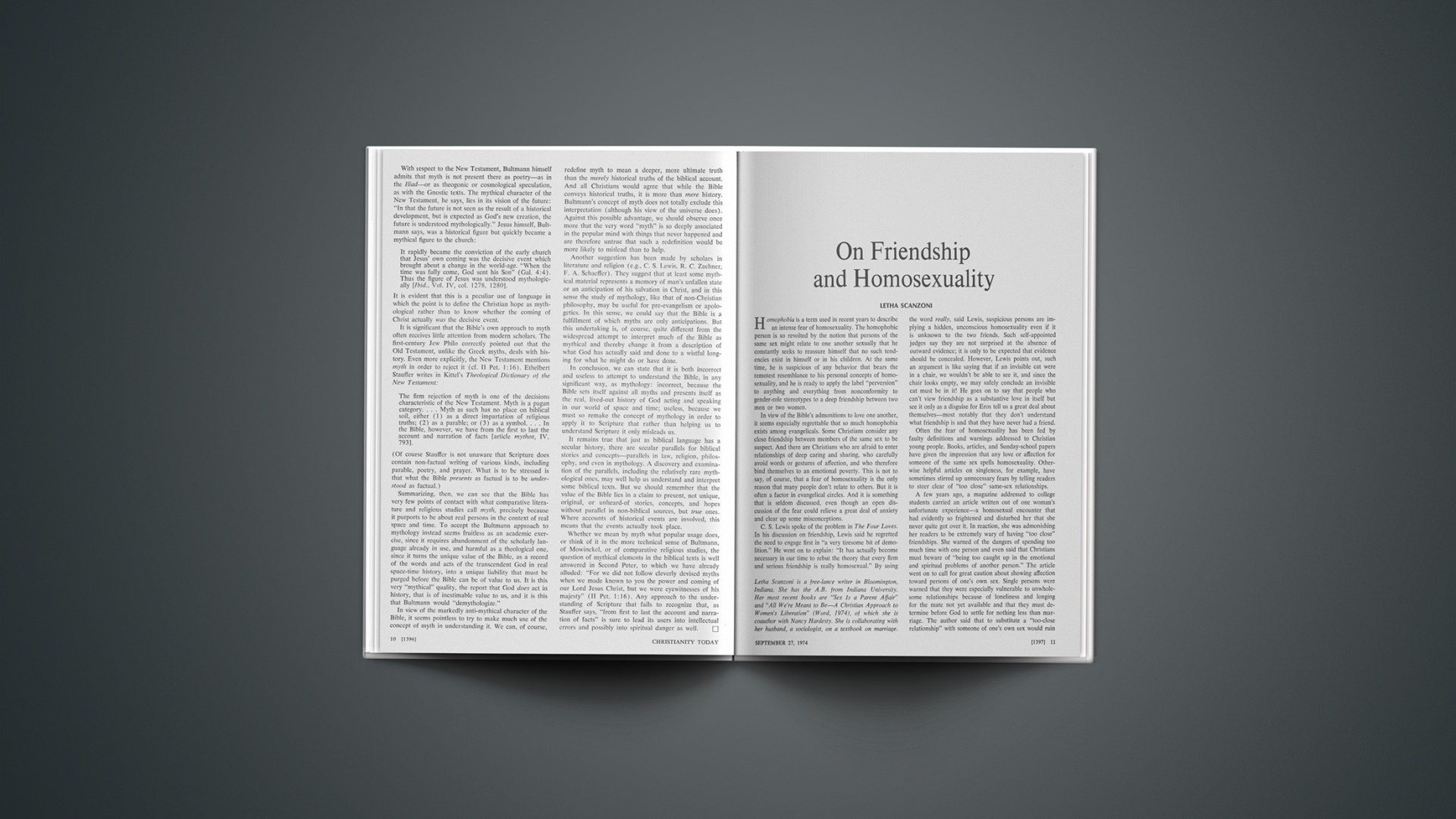
On Friendship and Homosexuality

Homophobia is a term used in recent years to describe an intense fear of homosexuality. The homophobic person is so revolted by the notion that persons of the same sex might relate to one another sexually that he constantly seeks to reassure himself that no such tendencies exist in himself or in his children. At the same time, he is suspicious of any behavior that bears the remotest resemblance to his personal concepts of homosexuality, and he is ready to apply the label “perversion” to anything and everything from nonconformity to gender-role stereotypes to a deep friendship between two men or two women.

In view of the Bible’s admonitions to love one another, it seems especially regrettable that so much homophobia exists among evangelicals. Some Christians consider any close friendship between members of the same sex to be suspect. And there are Christians who are afraid to enter relationships of deep caring and sharing, who carefully avoid words or gestures of affection, and who therefore bind themselves to an emotional poverty. This is not to say, of course, that a fear of homosexuality is the only reason that many people don’t relate to others. But it is often a factor in evangelical circles. And it is something that is seldom discussed, even though an open discussion of the fear could relieve a great deal of anxiety and clear up some misconceptions.

C. S. Lewis spoke of the problem in The Four Loves. In his discussion on friendship, Lewis said he regretted the need to engage first in “a very tiresome bit of demolition.” He went on to explain: “It has actually become necessary in our time to rebut the theory that every firm and serious friendship is really homosexual.” By using the word really, said Lewis, suspicious persons are implying a hidden, unconscious homosexuality even if it is unknown to the two friends. Such self-appointed judges say they are not surprised at the absence of outward evidence; it is only to be expected that evidence should be concealed. However, Lewis points out, such an argument is like saying that if an invisible cat were in a chair, we wouldn’t be able to see it, and since the chair looks empty, we may safely conclude an invisible cat must be in it! He goes on to say that people who can’t view friendship as a substantive love in itself but see it only as a disguise for Eros tell us a great deal about themselves—most notably that they don’t understand what friendship is and that they have never had a friend.

Often the fear of homosexuality has been fed by faulty definitions and warnings addressed to Christian young people. Books, articles, and Sunday-school papers have given the impression that any love or affection for someone of the same sex spells homosexuality. Otherwise helpful articles on singleness, for example, have sometimes stirred up unnecessary fears by telling readers to steer clear of “too close” same-sex relationships.

A few years ago, a magazine addressed to college students carried an article written out of one woman’s unfortunate experience—a homosexual encounter that had evidently so frightened and disturbed her that she never quite got over it. In reaction, she was admonishing her readers to be extremely wary of having “too close” friendships. She warned of the dangers of spending too much time with one person and even said that Christians must beware of “being too caught up in the emotional and spiritual problems of another person.” The article went on to call for great caution about showing affection toward persons of one’s own sex. Single persons were warned that they were especially vulnerable to unwholesome relationships because of loneliness and longing for the mate not yet available and that they must determine before God to settle for nothing less than marriage. The author said that to substitute a “too-close relationship” with someone of one’s own sex would ruin the chances of someday having a happy marriage. (Such warnings could have disastrous effects on the adolescent for whom a best-friend relationship is not only normal and desirable but is also excellent preparation for future experiences of marriage and family living, since it affords opportunities for self-revelation and sharing in another person’s life—including hopes, dreams, fears, triumphs, problems, sorrows, and joys.)

Christian colleges have sometimes fanned the flames of homophobia by excessive precautions against problems of homosexuality. The article cited above suggested that individuals or groups of students report to the deans any cases that they considered suspect. Innocent persons have been hurt deeply by such witch-hunting. One woman was called before the dean because during room inspection a housemother had noticed a letter in which the woman had written the words “I love you” to a dear Christian friend. In two other cases, women were called into deans’ offices and told that their close friendships seemed “unnatural.” In one case, the young woman and her friend had been close friends since early childhood. Stunned that such unwarranted conclusions had been drawn, they demanded (and received) a retraction before the student council. In another case, the suspicion evidently grew because one young woman was spending time in prayer and counsel with another girl whose mother had died recently.

Christian students at state universities aren’t immune to the effects of such fears and suspicions, either. A Christian physician at one major university says that often Christian young men come to the student health center to seek reassurance that they are not homosexual. Hearing their colleagues boast of sexual exploits with girls, these students have become worried because they haven’t wanted to take part in this promiscuous behavior. “Do you think this means I have homosexual orientation?” they ask. Sometimes such men may conclude that the only way to prove to themselves and others that they are not homosexual is to engage in sexual conquests, treating women as sex objects and using them as “things” to be conquered instead of relating to them as persons. Somehow they sense that fellow Christians are less uptight about this kind of behavior than about any hint (no matter how erroneous) of anything resembling homosexuality.

Strenuous concern to avoid any suspicion of homosexuality may even affect the ways we read the Bible. Perhaps this is why David’s goodbye to his friend Jonathan (“They kissed one another and wept one with the other,” KJV) has been paraphrased in the Living Bible to read: “They sadly shook hands, tears running down their cheeks …” (1 Sam. 20:41).

Compounding the problem in recent years have been attempts by persons associated with gay liberation to work out a theology of homosexuality, seeking a biblical justification for homosexual practices. One tactic has been to suggest that many relationships in the Bible were homosexual—including the friendship of David and Jonathan. Other examples sometimes cited are Ruth and Naomi, Paul and Timothy, and even Jesus and John. To Christians who are already uptight about homosexuality, such suggestions are extremely upsetting.

Dealing With The Confusion

There is really no need to be upset—if we can learn to distinguish between friendship and homosexuality. By calling our attention to these biblical examples, gay liberationists may actually be performing a commendable service by reminding us that the Scriptures contain many illustrations of deep feelings and warm relationships. Persons of the same sex can, did, and do love each other.

But where gay theology errs is in suggesting that such relationships must necessarily be sexual. Where there is deep friendship-love between persons of the same sex, but no sexual behavior or sexual attraction between them, the relationship is not homosexual. That’s why it is crucial to have in mind an accurate definition of homosexuality. When the Scriptures condemn homosexual practices, the focus is on specific acts—not on a special nature, condition, orientation, or personality. (Applying reasoning similar to Jesus’ warning about adultery in the heart and thought-life, we might also rule out homosexual fantasies as well as overt acts.)

Dr. Paul Gebhard, director of Indiana University’s Institute for Sex Research, suggests the most workable and practical definition of homosexual behavior to be “physical contact between two individuals of the same gender which both recognize as being sexual in nature and which ordinarily results in sexual arousal. Psychological homosexual response may be defined as the desire for such physical contact and/or conscious sexual arousal from thinking of or seeing persons of the same gender.” In a similar vein, psychoanalyst Clara M. Thompson has written that “it seems unfortunate that, in developing his theory of bisexuality, Freud chose to use the word homosexual to characterize relationships with one’s own sex whenever there was any degree of friendship or intimacy.” She suggests that only situations with overt genital activity should be labeled homosexual.

In an effort to make the distinction even clearer from a biblical perspective, I have tried in my book Sex Is a Parent Affair to differentiate between a one-soul relationship and a one-flesh relationship. The Bible speaks of the souls of David and Jonathan as being knit together in love and loyalty (1 Sam. 18:1–4; 20:17). In such a one-soul friendship, there is a union of minds, hearts, and spirits, but not a union of bodies. Such a relationship was described in ancient Rome by Cicero in his essay on “The Value and Nature of Friendship.” Cicero considered friendship the greatest gift ever given to humankind, with the possible exception of wisdom. Reasoning in the manner of the second great commandment’s admonition to love one’s neighbor as oneself, Cicero wrote that each person is dear to himself and that “if the same thing is not transferred into friendship, a true friend will never be found. For a friend is, so to speak, a second self. A person loves himself and looks for the other whose soul thus mixes with his own to make one out of two. What is in fact sweeter than to have him with whom you dare to speak as with yourself?” Such is a one-soul relationship.

A one-flesh relationship, on the other hand, is what takes place in marriage (Gen. 2:24; Matt. 19:5; Eph. 5:31). Ideally, it includes all that is involved in a one-soul relationship (husbands and wives should be best friends as well as lovers); but in addition, there is added the physical or sexual element. Marriage means a union of bodies as well as of souls.

An additional factor about the relationship of David and Jonathan might be mentioned at this point. Some persons have jumped to the conclusion that a homosexual element existed in their friendship because of David’s lament upon hearing of Jonathan’s death in battle. “I am distressed for you, my brother, Jonathan,” cried the heartbroken David. “Very pleasant have you been to me; your love to me was wonderful, passing the love of women” (2 Sam. 1:26).

However, there is no reason to assume sexual love was meant here. Evidently, in all his marriages, David never knew the joy of true partnership, deep communication, soul-sharing, and warm companionship that is possible between a husband and wife; but these were treasured characteristics of his relationship with Jonathan. This has been a problem throughout history because societies have so often insisted on a kind of sexual apartheid, stressing artificial differences between the sexes and insisting on narrow and rigid gender roles, thereby keeping men and women apart rather than helping them see how much they have in common as human beings alike made in the image of God. Male-female friendship, whether in or out of marriage, has often been difficult to build. But that is another subject.

Fear Of Feelings

There are various ways that the fear of homosexuality (or of giving the impression of homosexuality) manifests itself in the evangelical community. First, there is the general area of feelings. Some persons hold back their emotions because they are frightened of them. To feel warmly toward someone else, to care deeply about that person so that his or her welfare matters as much to one as one’s own, to enjoy being with that person, to share one’s innermost thoughts and to receive such self-disclosure from the other person, can seem overwhelming.

Reasons for fear of such deep relationships vary. For example, some fear being hurt by a severing of the relationship, whether by a falling-out or by geographical separation (a very real possibility in our mobile society). Others hesitate to build intimate friendships because the cost of involvement seems too great. They are unwilling to spend the time and emotional energy required to build a friendship.

However, some people fear deep relationships with members of their own sex simply because they associate such friendships with homosexuality. What happens then is that Christians can actually become afraid to fulfill all the New Testament commandments to love one another, to have our hearts knit together in love, to be kindly (or tenderly) affectioned toward one another. This expression from Romans 12:10 expresses, in the Greek, the mutual and tender love that should mark husbands and wives and parents and children. Paul used this most intimate, affectionate term to describe the way Christians are to relate to one another. Christians are to look upon one another as brothers and sisters in Christ, members of God’s family. And the world is to recognize us by how much we love one another—not by how well we succeed in holding back love because we’re afraid of it!

Fear Of Words

If many Christians are afraid of feelings, many more seem afraid of the verbal expression of these feelings. We might hang on our walls plaques that say, “If you love somebody, tell him!” or “I like not only to be loved, but to be told that I am loved; the realm of silence is large enough beyond the grave.” But how ready are we to do it? Why are we so afraid that to say “I love you” is the same as saying “I want you sexually”? It need not mean any such thing.

One of the most meaningful communion experiences I can remember occurred one evening in the small group with whom my husband and I were meeting in a home. As we sat in a circle and passed the elements of the Lord’s Supper, each of us would address the person next to us by name and say, “This is the Lord’s body, broken for you,” or something similar. That evening the young woman beside me departed from the usual practice and said simply, “The Lord loves you, Letha; and I love you, too.” Somehow the love of Christ and the concept of Christian sisterhood and brotherhood took on new meaning at that moment. Truly we were “one in the Spirit and one in the Lord.”

Another friend of ours told recently of a meaningful visit with his closest friend who had come to our city on a one-day business trip. The men, both happily married and devoted fathers, had missed each other immensely since the one had moved away. Phone calls and letters weren’t adequate substitutes for the camaraderie they had formerly enjoyed. That day as they ate lunch in a restaurant before going their separate ways once more, they commented on how much they had enjoyed their brief time together that morning. Suddenly, the one man said, “You know something? I love you.” Our friend said tears came to his eyes when he heard those words. The words were true and fitting, not at all wrong or out of place. These men love each other as brothers.

Fear Of Touch

If we have hangups about our feelings toward friends, and even more difficulties with the verbal expressions of such feelings, the greatest inhibitions of all are in the realm of physical demonstrations of affection—the warm hug, the squeeze of a hand, the pat on the head, the comforting cry on a shoulder. Perhaps one reason for the popularity of encounter groups and sensitivity training in recent years has been the longing people have to be free from the taboos against physical contact. There seem to be longings in human beings to experience the warm closeness and touch of another human being. Persons in families usually (though not always) have these “hug needs” fulfilled, but people alone complain of missing such expressions. Increasingly, Christian groups seem to be growing aware of this and doing something about it. Holding hands during prayer or embracing before, or after certain kinds of religious services is no longer considered unusual—any more than the holy kiss mentioned in First Corinthians 16:20 was unusual among the early Christians.

The Bible talks a great deal about touch. In that culture, there wasn’t the fear and holding back that characterizes ours. Jesus often touched those to whom he brought healing. He didn’t hesitate to let the apostle John rest his head on His bosom nor shake him away out of fear of what people might think. He ignored the taunts of the self-righteous Simon, who couldn’t bear the thought that any real prophet of God would permit a street-walker to cover his feet with her slobbering kisses and salty tears and then have the audacity to use her hair to wipe them dry. Paul, too, followed Christ’s example in a warm openness toward human touch. He spoke of being “affectionately desirous” of the Thessalonian Christians and of relating to them as a gentle mother and loving father. And when he left Ephesus, the elders unashamedly “wept and embraced Paul and kissed him” (Acts 20:37).

Northern European and Northern American societies are the most reserved about touch, it seems. Most of us are acquainted with photographs of men in Arab societies walking hand in hand as a sign of friendship, or Russian diplomats greeting each other with a warm hug and a kiss on each cheek. Latin culture also encourages demonstrations of affection. But in our country, such demonstrations among men are rare, except in connection with sports events. Signs of affection between women seem more readily accepted. Some of the men’s liberation groups are suggesting that men ought to be able to relate to one another openly just as women do. Among some Christians, this is already happening.

Sometimes, people are so touch-hungry that they become frightened when they at last experience some kind of physical contact. One student told me of an experience during his undergraduate days when he was extremely lonely. He had gone to a barber shop, and as the barber prepared to cut his hair, the student was startled by the warm feeling that came over him when the barber’s hand touched his neck. “Could I possibly have homosexual inclinations?” he wondered, scared and surprised. Then it occurred to him that he had not experienced human touch for weeks and had nearly forgotten what it felt like.

Actually, if we are at home with our sexuality, aware of God’s standards, and determined to follow them, we needn’t become panicky if feelings that might in some sense be called sexual arise unbidden. Mothers who are nursing infants at their breasts have known such experiences. So have fathers as they hug their college-bound daughters goodbye. This doesn’t mean such people are evil; it simply means they are human with normal human feelings. The problem (and the sin) comes only if we act out feelings that could lead to wrong behavior. But if we recognize such sudden, momentary feelings for what they are and determine not to act upon them, what is there to worry about? There is no reason to be frightened, or to despise and condemn ourselves.

The Longing For Friendship

There are many evidences today of an intense hunger for deep, warm interpersonal relations. In other words, there is a longing for friendship. Amid the change, insecurity, mobility, and fast pace of modern society, people need to learn anew what it means to know one another, care about one another, love one another. A renewed emphasis on cultivating friendship not only requires ridding ourselves of fears that hinder it; it also requires a vision of what friendship can be.

The ancient world had its legend of Damon and Pythias. When Pythias was condemned to death for rebelling against the king, Damon offered his own life as a pledge so that Pythias could return to his hometown to put his affairs in order and say goodbye to his relatives. As the execution date grew near and there was no sign of Pythias, the tyrant taunted the loyal friend, telling Damon he was an utter fool to think friendship could ever be so great that a person would forgo an opportunity to save his own neck by betraying the friendship. The ruler made it clear that if Damon had any understanding at all of the ways of human nature, he’d know that Pythias would surely take advantage of the opportunity to escape. Damon, however, clung to his belief that his friend would return. On the day of the execution, as Damon was being led out to die, Pythias ran up, trembling and breathless, afraid that an unexpected delay had caused him to arrive too late. With deep affection, the friends greeted each other and prepared to say their final farewell. The king, however, was so deeply moved that he pardoned Pythias. With a shaky voice he said, “I would gladly give up my kingdom to have such a friendship as this.”

In more recent times, we have the example of the close relationship between Dietrich Bonhoeffer and Eberhard Bethge. Mary Bosanquet in her excellent biography The Life and Death of Dietrich Bonhoeffer refers to the early years when Bonhoeffer “in his deepest experiences remained alone” and then goes on to tell how this changed years later when “he was to receive the gift of a friendship through which the deepest springs of his creative energy were to be set free.” Ms. Bosanquet mentions the comment of a colleague of these men who spoke of their relationship as one of the great friendships of history.

These two outstanding men complemented each other, “Bethge’s spirit … quickened by Bonhoeffer’s fire,” and Bonhoeffer’s dynamic nature finding rest and stability in Bethge’s quiet steadfastness. In those tension-filled days of Hitler’s rise to power and with the churches of Germany beset with struggles, these friends drew both spiritual strength and intellectual stimulation from each other. Mary Bosanquet writes:

As the years went on, and the strains of living increased to a point which might have weakened and disintegrated the humanity of lesser men, these two grew in stature together, while their friendship was strengthened and intensified by the stresses of the years through which it passed. Continually enriched by the sharing of multifarious joys, tempered by the challenge of disappointments, difficulties and finally of mortal danger, it was fulfilled at last in separation, and out of it the great last letters were born [The Life and Death of Dietrich Bonhoeffer, Harper & Row, 1968, pp. 197, 198],

Surely such a friendship was in the mind of the writer of Proverbs 27:17—“Iron sharpeneth iron; so a man sharpeneth the countenance of his friend.” All of us need such friends; they can enrich our lives beyond measure. It is well worth our while to heed the advice of Ecclesiastes 6:14–17, which in the New English version reads:

A faithful friend is a secure shelter;

whoever finds one has found a treasure.

A faithful friend is beyond price;

his worth is more than money can buy.

A faithful friend is an elixir of life,

found only by those who fear the Lord.

The man who fears the Lord keeps his friendships in

repair, for he treats his neighbour as himself.

Theology

The Bible and Mythology

Nowhere is it more apparent that “a little knowledge is a dangerous thing” than in the realm of the Bible and its interpretation. Many non-Christians have been frightened away from taking the Bible seriously, and many Christians have had their trust in its reliability shaken or even destroyed, by some information about the Bible that appears to be damaging but that would, with more complete knowledge, be revealed as misleading or false.

An example is the widespread habit of loosely speaking of “myths” or “mythical elements” in the Bible. When we ask “To what extent does the Bible contain mythical elements or represent a mythological point of view?” we are confronted first of all with the problem of definition: what do we mean by myth and mythical? Then we have to examine the Scriptures of the two Testaments to see whether, or to what extent, mythical elements can be found in them, and if found, what their purpose and function are.

Theologians have a habit of using certain common words in a special, technical sense. They are not the only ones who do this; every guild has its own trade language, so to speak, and often this language includes special uses of terms from common speech that would be misunderstood by laymen. But theologians are often addressing themselves to laymen. Their words are likely to sound familiar enough, and the layman is not always aware that a particular word or expression is being used to mean something quite different from what it means in ordinary usage. If a nonscientist overhears two physical chemists talking about “free radicals,” he will quickly recognize that they are not talking about political extremists. But when theologians use the word “myth,” it is often not so obvious to a nonspecialist that in their usage the word has a special meaning.

In common speech, when we say that something is a myth we mean—among other things—that it is not true in a literal sense. In everyday conversation we might apply the word myth to different kinds of concepts (e.g., “the myth of Horatio Alger,” “the myth of American military invincibility”), but in all cases the implication is that what is mythical cannot be true in a literal or historical sense. Scholars in literature and comparative religion make a technical distinction between myth on the one hand and saga or legend on the other. Myth, dealing with the gods, does not refer to historical persons and events; the saga or legend, although seldom strictly true, does refer to actual historical persons and events. In Homer’s Iliad, the account of the Trojan War is legendary (there was certainly at least one war fought between the Greeks and Trojans), but the stories of the direct intervention by certain gods in the battles involve unreal persons (the gods) and unreal incidents (their intervention) and therefore represent mythical elements. This example also shows how myth differs from fairy tale: the fairy tale has a time all its own, not related to our historical time (“Once upon a time there was a king …”), but the myth has a contact point in history. Creation myths describe the beginning of our time; the Germanic Götterdämmerung myth describes its end. A myth may be tied to a real place, as the pagan festival at Eleusis in Greece, celebrating the mythical visit there of the goddess Demeter.

Since most of what is called mythology describes a plurality of gods, myth would appear to be at home in the realm of polytheism. There are nonpolytheistic stories that can be called mythical, such as the famous Gnostic text The Hymn of the Pearl. But even such a Gnostic text, while not mentioning a plurality of gods, moves in a world of tremendous complexity animated by a plurality of mysterious divine forces. The Bible, both the Old and the New Testament, is strictly monotheistic, and its theological universe, by contrast with that of Graeco Roman paganism, Gnosticism, or Hinduism, is extremely simple. In fact, the Bible itself deliberately distinguishes the apostolic message from “cleverly devised myths” (2 Pet. 1:16): the Bible is simple, straightforward testimony.

But contemporary theology, and especially Rudolph Bultmann, introduced another definition of myth, one that does not imply polytheism: myth is that which speaks of the transcendent or divine in terms of the immanent, the things of this world; in brief, it portrays God, who is by definition transcendent, totally beyond this finite world, as involved in it (see Bultmann’s contributions to Kerygma and Myth: A Theological Debate, edited by Hans W. Bartsch, Harper, 1958; an illuminatting discussion is offered in Wolfhart Pannenberg, The Idea of God and Human Freedom, Westminster, 1973).

Bultmann’s approach, which is common in theological circles today, creates two problems. First, if one asserts that anything that speaks of God as acting in history is mythological, then of course the whole Bible is mythological by definition, without further discussion, from cover to cover. It is universally understood that the teaching that God intervenes in human history is precisely what distinguishes the Bible from many other religious texts. To call the Bible mythical, if by myth we mean what Bultmann does, is to ignore the question of whether the biblical (or “mythical”) events ever actually happened in history; merely to speak of such events as having happened is all that is needed to make the Bible mythical. This does not of itself imply that the Bible’s stories are untrue. However, Bultmann himself believes that God cannot or at least does not intervene in space-time history, and so for him to call a story mythical is also to stamp it as untrue, just as most ordinary users of English would understand him.

Nevertheless Bultmann is not saying what the historian of religion would say about a pagan myth, that it is mythical because it did not happen (e.g., no such person as Demeter ever existed to visit Eleusis); he is saying that it is mythical because it could not happen: by definition, God does not act in history. The Bultmann approach would have a far less destructive impact among readers of the Bible if it were recognized that scholars who take it are not proving anything but presupposing everything. Unfortunately, many people, Christians and non-Christians alike, think that Bultmann is talking about evidence and conclusions, rather than about presuppositions of his own peculiar sort. As a result they understand him to be saying that the Bible is mythical in the common sense of the word, i.e., untrue, and therefore not a “perfect rule of faith and practice.” Bultmann’s subsequent attempts to explain how the Bible, though mythical (in his sense), is nevertheless of the utmost value to us, consequently fall mostly on deaf ears except among theologians who can follow his language and accept his presuppositions.

A second problem involved in using “myth” and “mythical” in this special sense is that this usage is contrary to the sense in which the words are used in secular studies of religion. Secular scholars in the field of myth find very lean pickings in the Bible precisely because even those stories that have most in common with myths from non-biblical sources are presented by the Bible as tied to real history. For instance, Adam and Eve, who might otherwise easily be interpreted as mythical figures, are tied, by specific genealogical references in both Testaments, to ordinary chronological time. They are presented as real, historical persons. We know that the Old and New Testament genealogies beginning with Adam are not complete, but it is evident that they are meant to describe a true family succession of real, historic individuals, even if not every generation in the succession is specifically mentioned. The same holds true for the story of Noah and the Flood: there are flood myths in many cultures, but the biblical account of Noah ties him into what is presented as a sequence of historical events; in addition, his ark as it is described corresponds to a floatable craft. Consequently, the secular scholar looking for mythical material in the Bible, finds little, even in the story of Noah.

It is of course possible to claim that the complex, often fantastic stories of Babylonian mythology, for example, were taken over by the Hebrews and “cleaned up”; that is, they were simplified and purged of their polytheistic references in order to be usable by the monotheistic Hebrews. But this goes against the commonly observed trend for myths to become more, not less complex in the process of transmission. In any case, it is not very fruitful for the scholar trying to study myths to study the Bible, because he must first hypothetically reconstruct all the mythical and polytheistic elements supposedly once there but later purged. But then he will wind up studying the product of his own imagination.

Another approach that would permit one to designate much of the Old Testament as myth is that of Norwegian scholar Sigmund Mowinckel, who, after admitting that the Old Testament contains nothing that would tradiditionally be understood as mythical, redefines the word his own way: “Myth in its essence relates, in epic form, the ‘salvation’ which is made present and experienced again in the religious cult” (Die Religion in Geschichte und Gegenwart, third edition, Vol. IV, col. 1,275). What this means is that the Bible, as Mowinckel sees it, consists of stories created to form a backdrop to the religious experience that the Jews had in their worship. But interestingly enough this approach would stamp as mythical the biblical event that is most clearly tied to history, namely, the Exodus. Others, such as the stories of Adam and Eve, of Noah, and of the Tower of Babel, although they more clearly resemble pagan myths, play no role in Old Testament worship. Needless to say Mowinckel’s theory is generally recognized as fanciful by those who are not predisposed from the outset to call the Bible myth.

With respect to the New Testament, Bultmann himself admits that myth is not present there as poetry—as in the Iliad—or as theogonic or cosmological speculation, as with the Gnostic texts. The mythical character of the New Testament, he says, lies in its vision of the future: “In that the future is not seen as the result of a historical development, but is expected as God’s new creation, the future is understood mythologically.” Jesus himself, Bultmann says, was a historical figure but quickly became a mythical figure to the church:

It rapidly became the conviction of the early church that Jesus’ own coming was the decisive event which brought about a change in the world-age. “When the time was fully come, God sent his Son” (Gal. 4:4). Thus the figure of Jesus was understood mythologically [Ibid., Vol. IV, col, 1278. 1280].

It is evident that this is a peculiar use of language in which the point is to define the Christian hope as mythological rather than to know whether the coming of Christ actually was the decisive event.

It is significant that the Bible’s own approach to myth often receives little attention from modern scholars. The first-century Jew Philo correctly pointed out that the Old Testament, unlike the Greek myths, deals with history. Even more explicitly, the New Testament mentions myth in order to reject it (cf. 2 Pet. 1:16). Ethelbert Stauffer writes in Kittel’s Theological Dictionary of the New Testament:

The firm rejection of myth is one of the decisions characteristic of the New Testament. Myth is a pagan category.… Myth as such has no place on biblical soil, either (1) as a direct impartation of religious truths; (2) as a parable; or (3) as a symbol.… In the Bible, however, we have from the first to last the account and narration of facts [article mythos, IV, 793].

(Of course Stauffer is not unaware that Scripture does contain non-factual writing of various kinds, including parable, poetry, and prayer. What is to be stressed is that what the Bible presents as factual is to be understood as factual.)

Summarizing, then, we can see that the Bible has very few points of contact with what comparative literature and religious studies call myth, precisely because it purports to be about real persons in the context of real space and time. To accept the Bultmann approach to mythology instead seems fruitless as an academic exercise, since it requires abandonment of the scholarly language already in use, and harmful as a theological one, since it turns the unique value of the Bible, as a record of the words and acts of the transcendent God in real space-time history, into a unique liability that must be purged before the Bible can be of value to us. It is this very “mythical” quality, the report that God does act in history, that is of inestimable value to us, and it is this that Bultmann would “demythologize.”

In view of the markedly anti-mythical character of the Bible, it seems pointless to try to make much use of the concept of myth in understanding it. We can, of course, redefine myth to mean a deeper, more ultimate truth than the merely historical truths of the biblical account. And all Christians would agree that while the Bible conveys historical truths, it is more than mere history. Bultmann’s concept of myth does not totally exclude this interpretation (although his view of the universe does). Against this possible advantage, we should observe once more that the very word “myth” is so deeply associated in the popular mind with things that never happened and are therefore untrue that such a redefinition would be more likely to mislead than to help.

Another suggestion has been made by scholars in literature and religion (e.g., C. S. Lewis, R. C. Zaehner, F. A. Schaeffer). They suggest that at least some mythical material represents a memory of man’s unfallen state or an anticipation of his salvation in Christ, and in this sense the study of mythology, like that of non-Christian philosophy, may be useful for pre-evangelism or apologetics. In this sense, we could say that the Bible is a fulfillment of which myths are only anticipations. But this undertaking is, of course, quite different from the widespread attempt to interpret much of the Bible as mythical and thereby change it from a description of what God has actually said and done to a wistful longing for what he might do or have done.

In conclusion, we can state that it is both incorrect and useless to attempt to understand the Bible, in any significant way, as mythology: incorrect, because the Bible sets itself against all myths and presents itself as the real, lived-out history of God acting and speaking in our world of space and time; useless, because we must so remake the concept of mythology in order to apply it to Scripture that rather than helping us to understand Scripture it only misleads us.

It remains true that just as biblical language has a secular history, there are secular parallels for biblical stories and concepts—parallels in law, religion, philosophy, and even in mythology. A discovery and examination of the parallels, including the relatively rare mythological ones, may well help us understand and interpret some biblical texts. But we should remember that the value of the Bible lies in a claim to present, not unique, original, or unheard-of stories, concepts, and hopes without parallel in non-biblical sources, but true ones. Where accounts of historical events are involved, this means that the events actually took place.

Whether we mean by myth what popular usage does, or think of it in the more technical sense of Bultmann, of Mowinckel, or of comparative religious studies, the question of mythical elements in the biblical texts is well answered in Second Peter, to which we have already alluded: “For we did not follow cleverly devised myths when we made known to you the power and coming of our Lord Jesus Christ, but we were eyewitnesses of his majesty” (2 Pet. 1:16). Any approach to the understanding of Scripture that fails to recognize that, as Stauffer says, “from first to last the account and narration of facts” is sure to lead its users into intellectual errors and possibly into spiritual danger as well.

Theology

Has God Lost Control?

The condition of our world is such that many wonder whether the classical doctrine of the Absolute Sovereignty of Almighty God can still have any meaning. Human society is in a state of seething unrest. Quite apart from “natural” calamities such as famine and flooding, earthquakes and tornadoes, there is the appalling carnage and destruction of modern warfare. No corner of the globe can escape the possibility of becoming a battlefield, subject to an annihilating holocaust. Scientific achievements that hold out immense benefits to mankind are perverted into machines of slaughter and instruments of lying propaganda. While millions are perishing for want of the barest necessities of existence, billions of dollars are being spent on death-dealing weapons capable of blotting out still more millions. The conquest of outer space vastly expands the opportunities for spying and for raining down destruction on the cities and countries of our planet. An alarming increase in senseless violence, brutality, and crime goes hand in hand with an alarming increase in mindless superstition, moral degeneracy, and gross materialism. It is a dark and frightening scene indeed! What has happened to God?

Two cautions are necessary. First, we must beware of judging by appearances only; and second, we must beware of blaming God for the sickness of our world. It is true that on all sides we see men and nations behaving with the utmost insanity and the most callous inhumanity, ignoring God and his laws. But it does not follow that God has lost control of the world. Nor does it follow that he is either powerless or unwilling to intervene and set things right.

The fault, as Cassius admonished Brutus, is not in heaven above but in ourselves. Man, not God, is responsible for the mess this world is in. Generation after generation, man is pleased to listen to the satanic lie that in rebelling against God he himself will be as God (Gen. 3:4, 5). Moreover, in suppressing the truth about God (Rom. 1:18 ff.), man simultaneously suppresses the truth about himself; for to deny his Creator is to deny his own creatureliness. And this in turn is to deny the true meaning of his existence, because only in his creaturely relationship to and dependence on his Creator, who is the source of his existence and also of his knowledge, can man realize the purpose and the integrity of his being.

Thus in the folly of his wickedness and ingratitude man cuts himself adrift from the source of his existence and its meaning. His condition, consequently, has become one of lostness and alienation; he is estranged from God, from his fellow men, and from himself, because of the disruptive effect of sin at the very center of his being. How can it be otherwise when he has exchanged the truth for a lie and worships and serves the creature rather than the Creator (Rom. 1:25)? Man has set up Satan, who also is a creature and certainly no god, as the god of this age (2 Cor. 4:4), with the result that the whole world is in the power of the evil one (1 John 5:19; cf. John 12:31; 14:30; 16:11; Eph. 2:2). This is the biblical diagnosis of the world’s sickness. Yet one may feel constrained to ask: why doesn’t God take action to rid his world of this usurpation?

The answer to this question is, briefly, that God both has taken action and will take action. We will soon examine the meaning of this assertion. But first we must note that God’s action, precisely because it is God’s action, cannot fail to be effective. In other words, it is important that we know just what we mean when we speak of God. The powerlessness of the churches today is in large part due to the fact that preachers and theologians have reduced the size of God. They have presented a God who is too small. Many, indeed, have reduced him to merely human proportions. But the infinity of God cannot be diminished. God, by definition, is the Supreme, the Infinite, the Eternal Being who as Creator necessarily exercises absolute sovereignty over the whole of creation. This is the meaning of the term “God,” and if we speak of God in lesser terms we cease to speak of God and are speaking instead of a figment of man’s imagination or a projection of his arrogance. We must, as Luther put it, let God be God!

If, therefore, we speak of God, we are speaking of him who is absolutely sovereign. To challenge the sovereignty of God is to challenge God himself. To confine him within any degree of relativity or contingency is to dethrone him and to bring all things under the chaotic uncertainty of uncontrolled chance. God who is not completely sovereign is a contradiction in terms. Under God, however, all things without exception are fully controlled. Hence when God sovereignly takes action, as he has done and as he will yet do, he cannot fail to do so in a manner that is altogether effective.

The sovereignty of God and the infallible power of his action may be considered under three main headings: creation, redemption, and judgment.

1. CREATION. All things were created and brought into existence by the will of God (Rev. 4:11; Eph. 3:9; Gen. 1:1). As the maker is master of what he has made, so God is sovereign over the whole of his creation. Created reality is the expression of the divine will, and in its cosmic perfection it reflects the perfect order of the divine mind. As, moreover, nothing that God does is aimless or futile or without purpose, so creation, designed in accordance with the will of God, is conformed to the purpose of its Creator.

The sovereignty of God is displayed in the indefectibility of all that he purposes: a failure of his purpose would be a failure of his sovereignty. And all things are from him and through him and to him (Rom. 11:36); it is for him as well as by him that they exist (Heb. 2:10). That the divine purpose in creation should meet with frustration is unthinkable, for then it could not be the divine purpose. It is unimaginable, likewise, that God should abandon his creation and allow it to collapse into perdition, for this would mean the abandonment and the defeat of his purpose, which in turn would mean that he does not possess that sovereign supremacy which belongs properly to God alone, and therefore is not God after all.

Accordingly, we find that as Creator, God also sustains his creation. Not only were all things brought into being through the Word, who is God the Son (John 1:3), but the Son also upholds the universe by the word of his power (Heb. 1:3—where the sense of the Greek verb is not static but dynamic: he bears the universe onward to its destined goal). A father who begets a son also cares and provides for him; how much more does God care and provide for his creation!

This is what we mean when we speak of divine providence; for providence is the corollary of creation. The whole created order is totally dependent on God, not merely at the moment when it is brought into being, but at every moment for the continuation of its existence. The psalmist expressed this truth in the following words:

O LORD, how manifold are thy works! In wisdom hast thou made them all; the earth is full of thy creatures.… These all look to thee to give them their food in due season. When thou givest to them, they gather it up; when thou openest thy hand, they are filled with good things [Ps. 104:24, 27, 28].

The providence of God is seen, year after year, in the unfailing sequence of the seasons, in the blessings of sunshine and rain and the productivity of the earth, in seedtime and harvest. It is apparent also in the settled courses of the heavenly bodies—indeed, in the orderliness of all things, whether it be the immensities of cosmic space, astonishing patterns of cell-structures of animal and plant life, or the marvelous designs even of inanimate matter. No less wonderful is the discovery that the basis of all matter is energy, that every infinitesimal atom has its own solar system the potential energy of which is beyond our comprehension. Such is the dynamism of God’s creation. All things, both great and small, testify to the wisdom, the purpose, and the power of Almighty God, who by his word has brought them into being and who by the same word also providentially sustains his creation and carries it forward to the destiny he has willed for it. The dynamic of providence, then, is identical with the dynamic of creation, namely, the totally efficacious word of the divine will.

2. REDEMPTION. But, again, all is not well in our world. Evil is present as well as good, darkness as well as light. On all sides human society is marred by hatred, greed, brutality, and irrational behavior of every kind. The individual self is torn asunder by passions and frustrations. The disintegrating force of sin is such that it threatens the very structure of creation. Why does not God take effective action to deal with this problem? Why does he not assert his sovereignty?

To this we have already said that God both has taken and also will again take action to vindicate his sovereignty. But it must also be affirmed that sin, though mysterious in its origin and destructive in its effect, presents no threat to God and the fulfillment of his will. The devil, who is the leader of the rebellion against God and his sovereignty, has no possibility of success. To be sure, we know evil as a dreadful reality, and there are depths here that our understanding cannot plumb; but, as we have already observed, the very fact that creation is the work of God and the expression of the will of God means that it cannot fail in its purpose. Satanic evil is indeed an assault upon the sovereignty of God, but it is doomed by its own futility. The assault has been going on for a very long time now; God, however, continues providentially to sustain his creation in accordance with his indefectible purpose.

At the same time God certainly does not ignore evil as though it did not exist; nor is he powerless to deal conclusively with it. The action he has already taken, sovereignly and decisively, to eradicate evil from his creation is to send his Son into the world to partake of our human nature, so that “through death he might destroy him who has the power of death, that is, the devil, and deliver all those who through fear of death were subject to lifelong bondage” (Heb. 2:14, 15). This is the intervention of God, for, as Paul explains, God was in Christ reconciling the world to himself (2 Cor. 5:19).

The divine sovereignty is evident, moreover, in the fact that in this reconciling work the initiative belongs entirely to God. The prior love of God for his creation is the sole fountain of its redemption (John 3:16). To quote Paul again: “God shows his love for us in that while we were yet sinners Christ died for us” (Rom. 5:8); or as John says: “In this is love, not that we loved God but that he loved us and sent his Son to be the propitiation for our sins” (1 John 4:10).

Christians therefore ascribe their salvation entirely to the sovereign grace of God, who has miraculously raised them from the death of sin to the new life in Christ. This is their confession: “God, who is rich in mercy, out of the great love with which he loved us, even when we were dead through our trespasses, made us alive together with Christ.… For by grace we have been saved through faith; and this is not our own doing, it is the gift of God” (Eph. 2:4, 5, 8).

Therefore the incarnation itself is an act of God’s sovereignty. Far from being a makeshift operation to meet an unforeseen emergency, it took place in fulfillment of the promises and prophecies given from the earliest times onward, as the pages of both Old and New Testaments testify. And it took place in the moment in man’s history sovereignly chosen by God. Hence the apostolic affirmation that “when the time had fully come God sent forth his Son” (Gal. 4:4). The Son’s coming into our world was his sovereign coming to fulfill a predetermined purpose: “to give his life as a ransom for many” (Mark 10:45).

Appearances, however, were to the contrary. It is true that the divine power and glory of the incarnate Son shone through for all to see in his wonderful works of mercy and healing and in the sublime perfection of his teaching. But in his humble poverty, without property or possessions, he did not look like God incarnate; when he was thirsty and fatigued he did not look like God incarnate; alone in the wilderness and close to death after forty days and nights without food he did not look like

God incarnate; when he was arrested, falsely accused, and unjustly condemned, and most of all when he was nailed to the cross and died there, and when his dead body was taken down and laid in the tomb, he did not look like God incarnate. Appearances proclaimed the contrary, for all seemed lost in the dark powerlessness of death. Even his apostles were engulfed in despair.

But the reality was quite otherwise. At every moment of all that happened, God was in complete control. Christ’s death on the cross was precisely the fulfillment of the purpose of his coming into the world. It was for this reason that he became man, for specifically as man he was able to offer himself, the holy and just one, in the place of mankind, which was defiled and separated from God by sin; and by bearing our sins and their punishment he was able to bring about the exchange of his righteousness for our unrighteousness (1 Pet. 1:18; 2:24; 3:18; 2 Cor. 5:21). Thus the incarnate Son sovereignly proceeds to Calvary: “I lay down my life that I may take it again,” he declares. “No one takes it from me, but I lay it down of my own accord. I have power to lay it down, and I have power to take it again” (John 10:17, 18).

This does not mean that what was done to Jesus was not sinful and wicked; on the contrary, in the judicial murder of him who was the incarnate Son we see the greatest concentration of evil and hatred in the history of the world. But God’s sovereignty is shown in the fact that he makes the lowest depth of human viciousness to be at the same time the highest summit of divine grace. Instead of frustrating the divine purpose for our redemption, the satanic raging against Christ actually promotes it!

This striking perspective is certainly that of the apostolic church. Peter for example proclaims that Jesus, though “killed by the hands of lawless men,” was actually “delivered up according to the definite plan and foreknowledge of God” (Acts 2:23). On a later occasion, the disciples express their interpretation of the recent events in Jerusalem as they pray to God in the following terms: “Truly in this city there were gathered together against thy holy servant Jesus, whom thou didst anoint, both Herod and Pontius Pilate, with the Gentiles and the peoples of Israel, to do whatever thy hand and thy plan had predestined to take place” (Acts 4:27, 28). Their intention, of course, was exactly the opposite, but God sovereignly overrules their enmity for the fulfillment of his own redemptive purposes. Thus the futility of all opposition to the divine will is demonstrated, and we see that that God truly “accomplishes all things according to the counsel of his will” (Eph. 1:11).

The redemptive work of Christ not only brings salvation to mankind but also achieves the restoration of the whole created order in accordance with God’s unchanging purposes. Just as man, who had been given dominion over the works of God’s hands (Gen. 1:26–28; Ps. 8:6), dragged down the rest of creation with himself when he fell away from God, so also the salvation of man means the raising up of the rest of creation with himself as in Christ he is reconciled to God. By virtue of Christ’s saving work “the creation itself will be set free from its bondage to decay and will obtain the glorious liberty of the children of God” (Rom. 8:21).

The effect of redemption, then, is a new creation, or the renewal of creation, in Christ—that is to say, the bringing of the created order to its destined goal as sovereignly decreed by God. Hence the man who is in Christ is a new creation (2 Cor. 5:17); he has experienced a new birth (John 1:13; 3:3, 5); he is God’s workmanship, “created in Christ Jesus for good works, which God prepared beforehand, that he should walk in them” (Eph. 2:10). God, who at creation said, “Let light shine out of darkness,” renews his creation by causing the light of his glory to shine in the heart of man (2 Cor. 4:6). Now, therefore, “according to his promise we wait for new heavens and a new earth in which righteousness dwells” (2 Pet. 3:13), evermore free from pain, sorrow, defilement, and death (Rev. 21:4, 22–27). This is the predestined fulfillment of all God’s purposes in the creation of the world and the ultimate vindication of the divine sovereignty.

3.JUDGMENT. But, it may again be objected, if God has sovereignly and decisively intervened by sending Christ into the world, why is the world still in such a sorry state, nearly two thousand years later? Where are the peace and justice that he came to establish?

The answer to such questions is that God, who has already intervened redemptively in Christ, will intervene yet once more, this time in judgment, when Christ comes again at the end of this age. The day of reckoning will surely come, and then the rule of universal peace and righteousness will be fully and eternally set up. Meanwhile the risen and ascended Redeemer is already glorified and enthroned (Acts 5:30, 31; Phil. 2:9; Heb. 1:3; 8:1), and those who acknowledge him as Saviour and Lord know the joyful love and peace of his rule in their lives.

Judgment, after all, belongs to the very fabric of society. Human dignity suffers a monstrous affront when crime and violence flourish unchecked. The whole system of justice that condemns and punishes the guilty is a necessity if we are to live together as communities with any degree of sanity. And this in itself reflects the justice of God, who is the source not only of all life and knowledge but also of all authority. Paul even describes those who exercise civil authority, commending well-doing and punishing wrong-doing, as ministers of God (Rom. 13:6).

The distinction between right and wrong operates at every level of our existence. Government is expected to be just and impartial; business must be honorably conducted; schools must function in accordance with approved standards of learning and behavior; in the family there must be discipline and mutual respect; games and sporting contests must be played according to rules, with penalties for infractions. With our awareness of right and wrong, fair and foul, we instinctively accept judgment as a necessary part of everyday life.

The injustices that we deplore in the world cry out for judgment. This is generally agreed. But this agreement makes no sense if there is no absolute standard of justice and no supreme judge. It is in effect an acknowledgment both of the necessity and of the inevitability of ultimate judgment. Now if we, finite and fallen though we are, have this sense of what is just, “shall not the Judge of all the earth do right?” (Gen. 18:25). The Lord is indeed a God of justice (Is. 30:18), who “will judge the world with righteousness” (Ps. 96:13).

Moreover, as Paul told his Athenian audience, “God commands all men everywhere to repent, because he has fixed a day on which he will judge the world in righteousness,” and regarding this final judgment, which will be executed by Christ, God “has given assurance by raising him from the dead” (Acts 17:30, 31). The apparent delay of judgment affords the opportunity for repentance and is a sign of the forbearance, not the weakness, of God, “who does not wish that any should perish, but that all should come to repentance” (2 Pet. 3:9). All history, nonetheless, is moving toward the coming of Christ Jesus in glory, when he will judge the living and the dead (2 Tim. 4:1).

This universal judgment, then, will be God’s final act of intervention. It will purge creation of all that is unjust and ugly and hateful. It will establish forever the reign of justice and righteousness throughout the whole created order (Isa. 9:7). God, who in the fullness of time acted for our redemption in Christ Jesus, will again at his appointed hour act for the ultimate judgment and permanent purification of his creation. Thus his absolute sovereignty will be conclusively demonstrated to the whole world and his purposes as Creator, Redeemer, and Judge everlastingly achieved.

Meanwhile, those who know the transforming power of the Gospel expectantly move on to the glorious consummation that awaits them, assured that as their new life in Christ is entirely due to the sovereign grace of God, so also he who has begun a good work in them “will bring it to completion at the day of Jesus Christ” (Phil. 1:6). On the other hand, those who refuse to acknowledge the sovereignty of their Creator and despise the redemption freely offered in Christ Jesus hasten on inexorably to the destiny of final judgment. All will at last confess the supremacy of Almighty God and the triumph of his will both in creation and in the renewal of creation, as they experience either the joy of his redemption or the terror of his judgment (John 3:36).

The serene constancy of the divine will is displayed, finally, in the declaration that those who are God’s redeemed were chosen in Christ before the foundation of the world (Eph. 1:4)—indeed, that their names were “written before the foundation of the world in the book of life of the Lamb that was slain” (Rev. 13:8). The unassailable sovereignty of Almighty God and the immutability of his will guarantee the security of those who by grace and through faith are united to Christ; and they also guarantee the inevitability of judgment for those who persist in suppressing the truth of the eternal power and deity of him who is the Creator of all.

Has God lost control? Indeed not. He is still, as he always has been and always will be, the Sovereign Lord of his creation!

Editor’s Note from September 27, 1974

I was looking out over the wide expanse of the Pacific Ocean at Laguna Beach, not very far from San Clemente, when the news came of the presidential pardon for Richard Nixon. The previous day we had cruised by the Nixon compound on a boat, talking idly about Watergate, never imagining the next day’s development.

The full implications of Mr. Ford’s decision will not be known for some time, if ever. Initial reports were that the citizenry was sharply divided, either wholly approving or wholly disapproving the pardon. An editorial which addresses the admittedly complex and difficult issue is found on page 37.

Recently the Lutheran Church-Missouri Synod has been in the news again, with the former president of its St. Louis seminary, John Tietjen, getting plenty of media attention. In our Reformation issue (October 25) we will present an interview with President Preus that will be of interest to Lutherans and to every denomination that has faced or is facing similar problems.

How Far from Geneva Is Lausanne?

On thursday, July 25, at noon, one of the most significant assemblies in modern mission history closed: the International Congress On World Evangelization (ICOWE), held in Lausanne, Switzerland. Only a quarter of an hour later a small panel was on the air to attempt a first evaluation of the Lausanne meeting. Involved were Emilio Castro, director of the World Council of Churches’ Commission on World Mission and Evangelism (the WCC headquarters are in Geneva, less than forty miles from Lausanne), two ecumenical journalists, a YMCA worker, and I. The main question presented to us was: How far has the ICOWE widened or closed the gap between the two competitive Protestant movements of world missions, the ecumenical and the evangelical?

Our ecumenical partners pleaded that the gap had been closed considerably. This was not surprising. Today one of the main concerns of WCC leaders is to show a generous attitude toward their conservative evangelical brethren. The ecumenical fellowship is considered wide enough to include evangelical concerns as well as those of other groups in world Christianity.

The evangelical side has the unpleasant duty of expressing reservations. They cannot accept an inclusiveness that is built on the fallacious assumption of theological and ideological pluralism. Biblical truth cannot coexist with humanistic ideologies.

In the radio discussion, Dr. Castro spoke of his pleasure at the friendly spirit in which he, an official observer from Geneva, was received by the evangelical participants. In fact, at a press conference Billy Graham and Bishop Jack Dain, the two chairmen of the congress, had expressed similar feelings in regard to their personal relations with individual representatives of the WCC. But on the following day the chairmen went on to voice their strong reservations about the ecumenical concepts of salvation and evangelism.

Our partners in the panel, however, argued that here, too, the two positions had met in Lausanne. They mentioned three points at which the ICOWE had taken up major concerns of the World Missionary Conference, held in Bangkok last year: (1) the dialogue with men of other religions, (2) the connection between evangelism and socio-political action, and (3) the moratorium call. But a close examination of the Lausanne Covenant makes it clear that the evangelical understanding of these issues takes us far away from the spirit of Bangkok.

1. What is meant by “dialogue”? Stanley Samartha, director of Geneva’s “Programme of Dialogue with Men Living Faiths and Secular Ideologies,” defines its task like this: “to become sensitive to the working of the Holy Spirit in the whole world, and that, to be sure, not only within religions but also within secular beliefs and ideologies.” As Christ is believed to work savingly in them and to speak to us through them, their adherents are regarded as our brothers and sisters with whom we are to strive for a coming world community borne of a common spirituality.

This unbiblical idea is clearly refuted in the Lausanne Covenant: “We reject as derogatory to Christ and the Gospel every kind of syncretism and dialogue which implies that Christ speaks equally through all religions and ideologies.” Dialogue is seen as merely a prelude to the proper task of evangelization. Its purpose is “to listen sensitively in order to understand. But evangelism itself is the proclamation of the historical, biblical Christ as Saviour and Lord.…”

2. The social and political concern for the exploited and oppressed was indeed articulated at Lausanne with an unusual passion. The forceful lectures of the two Latin American main speakers, Rene Padilla and Samuel Escobar, resound in the section on “Christian Social Responsibility,” which is the longest in the covenant. My ecumenical radio partners were really pleased. But here I could point out to them that socio-political concern as such is no new evangelical discovery at Lausanne. The Minneapolis Congress of October, 1969, and the Chicago Declaration of November, 1973, had struck a similar note.

Still the basic difference between ecumenical and evangelical involvement in politics remains. Bangkok had attributed a direct soteriological significance to it: “Salvation is the peace of the people in Viet Nam, independence in Angolia, justice and reconciliation in Ireland, and release from the captivity of power in the North Atlantic community.” Lausanne regarded evangelism and social action as “both part of our Christian duty,” but, the covenant went on to say: “Reconciliation with man is not reconciliation with God, nor is social action evangelism, nor is political liberation salvation.”

3. What about the demand to withdraw Western funds and personnel from Latfricasian churches? In his opening speech Billy Graham reaped roaring applause when he denounced the moratorium idea as unacceptable in view of the 2.7 billion people who still have not heard the saving Gospel. Yet, curiously enough, John Gatu, the champion of the moratorium idea at Bangkok and Lusaka, was present as a convenor at the Lausanne congress, and he advocated moratorium in the African strategy section. The participants agreed with him in the demand for African church leadership. But in view of the unfinished evangelistic task they rejected the idea of a complete withdrawal of foreign missionary personnel.

The covenant gives credit to both concerns. After calling all churches “to send missionaries to other parts of the world” it states:

A reduction of foreign missionaries and money in an evangelized country may sometimes be necessary to facilitate the national church’s growth in self-reliance and to release resources for unevangelized areas.

This is a far cry from the Bangkok version of the moratorium. There it was suggested that the funds saved by a missionary moratorium be reallocated to combatant liberation movements!

These three examples prove that the seeming similarities between Bangkok and Lausanne hide a vast gulf of disagreement. While Lausanne reaffirmed “the divine inspiration, truthfulness and authority of both Old and New Testament Scriptures” as “the only infallible rule of faith and practice,” Bangkok in its Bible studies handled scriptural authority rather loosely, and the experiences of contemporary man in his historic movements, his religions and ideologies were treated as other expressions of divine revelation. Here the Lausanne Covenant voices its severest warning:

We detect the activity of our enemy, not only in false ideologies outside the church, but also inside it in false gospels that twist Scripture and put man in the place of God. We need both watchfulness and discernment to safeguard the biblical gospel.

Explo ’74: ‘Christianizing’ Korea

At times Explo ’74, the five-day evangelistic training event sponsored last month in Seoul by Korea Campus Crusade for Christ (KCCC), seemed caught up in the swirling tides of national destiny. For example:

• Some 300,000 registrants—about 1 per cent of South Korea’s population and 10 per cent of its Christians—were offered training in personal evangelism, discipleship of others, and effective Christian living. Heavy newspaper and television coverage included interviews with KCCC head Kim Joon Gon (in Korea last names are listed first); with these 300,000, said Kim, Korea can become “Christianized” within a short time and be the springboard for reaching all of Asia for Christ.

• The week before Explo opened, ten of Korea’s top churchmen—including Explo’s honorary chairman, Dr. Han Kyung Chik, retired pastor of the huge Young Nak Presbyterian church, risked prison and possible death in petitioning President Park Chung Hee to restore democracy and to release persons arrested under his emergency decrees for criticizing the government. Those under arrest, about 250 in all, included Christian students, clergy, and laity. A week earlier, leaders of the National Council of Churches in Korea (NCCK), some of them involved in Explo, threatened demonstrations if Park failed to relent.

• During the week that Explo opened, some 1,000 Protestants gathered at Seoul’s Saemunan Presbyterian Church for a mild protest service based on the theme of liberation from all bondage. Also, 2,000 Catholics attended a mass to express their concern for Bishop Daniel Tji Hak Soun of Wonju, seized for allegedly helping to finance proposed student protests. But that same day stiff prison sentences were announced for Bishop Tji (fifteen years) and several other churchmen.

• On the second day of Explo, a Korean-born assassin from Japan failed in his attempt to kill President Park during Liberation Day ceremonies at the National Theater (August 15, 1945, marked the end of decades of Japanese rule of Korea), but he fatally wounded the attractive and popular Mrs. Park. Explo sessions included public prayers for Park and his family. The tragedy and a disclaimer of responsibility by the Japanese government opened old wounds and many of the 900 Japanese delegates to Explo found themselves the targets of hostility on the part of Korean Explo participants.

• At a press conference during Explo, Campus Crusade’s founder and international director Bill Bright defended Park’s crackdown on dissent on the grounds that it was in the best interests of national security from North Korea. His views were carried by the press worldwide, giving Explo in the eyes of many a political tint Bright had never intended.

• The funeral for Mrs. Park, a Buddhist, was more Protestant than Buddhist. Dr. Han—evidently still in favor with the president despite the protest letter—led in prayer amid Christian hymns. “We will be more firmly united because of this tragic event,” Han told an Explo crowd the night before. A few minutes later Japanese clergyman Akira Hatori gave one of the main Explo addresses, helping to cement somewhat the fractured fellowship.

• Immediately after Explo, Park announced he had withdrawn a January decree forbidding all discussion and criticism of a 1972 constitutional revision giving him unlimited power and an April decree banning all dissent against his regime. The murder attempt proved his point, he said. But on the surface it seemed that Dr. Han and his fellow church leaders had won their point.

With or without the backdrop of national turmoil Explo was a notable event in modern church history, if for no other reason than the sheer numbers it attracted.1Figures announced as official police estimates of attendance at the plenary rallies, held on a former airstrip on Yoida Island, ranged from 1.36 million on opening night to a high of 1.6 million on Saturday night and a low of 650,000 on Sunday afternoon. But both head-by-head row counts and seating-capacity measurements by reporters and Campus Crusade staffers indicated the largest crowd was closer to 300,000. Explo ’72 in Dallas drew 85,000, mostly young people. As Bright pointed out to reporters, never before have so many people from so many lands met together for such a purpose (evangelistic training and “disciple building”). That it was held in a developing country like Korea and not the United States makes it all the more remarkable—and underscores the growth and vitality of evangelical Christianity in the Third World.

Nearly 3,000 foreigners, most of them young people, from eighty countries joined the tens of thousands of Koreans (the majority of them adults) for the event. Of these, 900 came from Japan, 700 from the United States, and about 200 each from Hong Kong, Taiwan, and the Philippines (the largest delegations in years to get exit permission from the latter two lands—but not without a lot of praying and stringpulling that continued right up to the last minute, said a Crusade official).

Explo was the outcome of a “vision” Korean Crusade head Kim says he had during a KCCC conference in Taejon in 1971 when more than 10,000 persons (6,000 of them university students) were trained in personal evangelism and led 16,000 others to Christ. He announced his plan on a visit to Explo ’72 in Dallas.

Raised in a Confucianist home, Kim became a Christian as a teenager, joined a Presbyterian church, and after college studied at Korea (Presbyterian) Seminary in Seoul. During the Korean War Communist sympathizers beat his wife and father to death. Badly beaten himself, he managed to escape with his four-year-old daughter into the coastal mountains where, he says, he underwent a spiritual crisis that transformed him. He later sought out and led to Christ the Communist most responsible for the deaths of his loved ones (the man is today an officer in a Presbyterian church). Over the next years he served as a pastor and as a school principal, then traveled to Fuller Seminary in California for graduate study. Here he met Bright, who asked him in 1958 to return to Seoul and launch the Korean branch of Campus Crusade.

Beginning with a handful of part-timers and a commitment “without reservation to the total evangelization of Korea,” Kim today leads a full-time staff of 120, assisted by thousands of college graduate volunteers. His offices are located in a $3 million 18-story building that KCCC built as a conference center in downtown Seoul in 1970. Here, says Kim, 50,000—up to 2,400 at a time—have received evangelistic training. KCCC maintains ministries at fifty-seven colleges and universities (95 per cent of Korea’s campuses). Its outreach extends to 300 high schools in Seoul. An estimated 350,000 have attended nearly 4,000 KCCC-sponsored leadership training institutes.

Kim, 50, who aims to reach every Korean with the Gospel by the end of next year, has devised something he calls the “Village Plan Strategy.” Half the nation’s 33 million people, he says, live in 62,500 villages. The plan involves winning and training the two most influential people in each village, the primary school teacher and village leader, and getting them to establish study-discussion groups in village homes. Called sarang-bangs (“love rooms” in Korean), these home sessions often expand beyond Bible study, becoming dispensaries of information and aid in such matters as literacy, health, and agriculture, according to Kim. His goal is to link the sarang-bangs to local churches where possible. So far, about 18,000 teachers and village leaders have taken the five-day training course and already they report tens of thousands of conversions, says Kim.

KCCC also sponsors a Christian service corps, enlisting volunteer educational and medical teams to work—and evangelize—in villages during summer months. Another project is the establishment of “model” churches, schools, villages, and cities, where an entire unit is developed into a Christian community. Kim tells reporters that he means changed people will produce a changed society when he speaks of “Christianization” of the land.

Another of Kim’s plans involves Explo follow-up. He wants every Explo delegate to recruit ten other Christians for evangelistic training this fall; each of these ten is then to “adopt” for witness and nurture ten non-Christians in 1975.

Formidable obstacles stood in the way of Explo. Although he is a friend of President Park, Kim had to hassle with the government into July before getting permission to allow more than 50,000 to assemble at one time. Similarly, schools and classrooms for housing and small-group instruction were provided only grudgingly. The army helped to erect a tent city to house 44,000 on Yoida Island in the Han River. To feed everybody, Kim invented giant ovens fed by steam from nearby apartments under construction on Yoida; they were capable of steaming enough rice hourly to feed 100,000. The food was trucked to the various housing locations across the city. Boy Scout troops were enlisted to help handle crowd control.

The six-denomination National Council of Churches of Korea refused to endorse Explo, even taking out a newspaper ad to say so. “The Graham crusade was a cooperative effort, but with Explo one man gives all the orders,” commented an evangelical NCCK official. (He also knocked Explo for not including more emphasis on social justice.) Yet many of the local churches within the NCCK bodies gave strong support. Finally, says Kim, nearly 10,000 pastors of the nation’s 12,000 churches took part in Explo. More than 6,000 attended the Explo conference for pastors, held in Central Full Gospel Church on Yoida (with a congregation of more than 20,000, the Assemblies of God church is one of the largest in the world.)

Delegates represented a cross-section of Korea itself: wealthy businessmen from the cities, poor farmers from the villages, many students, large numbers of middle-aged women. The long hours imposed on many Korean workers prevented larger numbers of men and young people from attending.

Why did they come? “So I can find out how to win my friends to Christ,” said a high school girl in Tent City. “To help change my country,” said a Myong Ji University youth (300 of the school’s 3,000 students attended Explo). “I want to be a missionary to the Middle East,” explained Chung Kwang Ho, a Presbyterian seminarian, “and that’s one of the reasons I want this training.” A middle-aged mother said she simply wanted to be better able to explain the Christian life to her Sunday-school pupils.

Days were spent in seminars and training sessions, nights at the mass rallies. On several occasions many thousands remained at the rally site for all-night prayer meetings. (“None of us from America has ever been exposed to such an unbelievable emphasis on prayer night after night,” remarked Bright to reporters. “More than anything else, the Koreans have taught us how to pray,” said a Japanese delegate.)

Armed with Korean editions of “The Four Spiritual Laws” and “How to Be Filled With the Spirit” tracts, participants fanned out across Seoul Saturday afternoon to present the Gospel to as many of its six million inhabitants as possible. A number of delegates brought back their new converts—sometimes shy, sometimes beaming—and introduced them at joyous tell-how-it-was sessions afterward.

When missionaries first arrived in Korea (Catholics in the late 1700’s, Protestants one hundred years later) they found persecuted but thriving communities of baptized Christians. Bibles had somehow preceded the missionaries. Although Western hymnody and worship styles characterize the Korean Church today, the Koreans in the beginning got it started without Western help.

That’s sort of how it was with Explo—and, say missiologists, how it may be in the future with the evangelization of much of Asia.

Graham Celebration

As part of this month’s twenty-fifth-anniversary commemoration of the Los Angeles crusade that launched evangelist Billy Graham, Variety Clubs International (a charity supported by persons in show business) is sponsoring a testimonial dinner to Graham.

It marks the first time Graham has allowed a charitable organization to honor him.

Proceeds from the event will be used to purchase twenty-five vehicles in Graham’s name for transportation of children between hospitals, orphanages, and other children’s organizations.

Planned for the Beverly Hilton Hotel in Beverly Hills, California, the $50-a-plate dinner will kick off three evening rallies at the Hollywood Bowl to honor the evangelist. Co-chairmen for the Variety Club affair are film producers Mike Frankovich and Howard M. Koch.

Canada: Moving Toward Rome?

The twenty-sixth General Council of the United Church of Canada committed Canada’s largest Protestant denomination to the pursuit of further church union. The council firmly stated its commitment to an ongoing process that began when the United Church of Canada came into being in 1925 through a merger of Presbyterian, Methodist, and Congregational churches.

This year’s council predictably called for action on the Plan of Union designed to bring together the United, Anglican, and Disciples of Christ denominations. Then, in a last-minute spurt, the council adopted a resolution to “authorize the church to begin the long journey toward reunion with the Church of Rome.” In the closing moments of the council that resolution, described as “a real sleeper” from the floor, was greeted with dead silence, then applause, and acceptance.

DEATHS

GEORGIA HARKNESS, 83, retired United Methodist theologian, author, and early women’s rights crusader; in Claremont, California, of a heart attack.

W. A. MOORE, 105, Disciples of Christ minister, acclaimed as the oldest active clergyman in the United States (he preached sermons and performed marriages and baptisms until shortly before his death); in Tacoma, Washington.

ROBERT LEE CARVILL, 31, former editor of Vanguard magazine, a journal of the Toronto-based Institute for Christian Studies; in Toronto, Ontario, of leukemia.

The more immediate prospect of union with the Disciples and Anglicans was given general approval, and the council called for a special session next June to vote on the Plan of Union. Only three commissioners dissented. But the plan has hard sledding ahead in the Anglican camp.

This year’s council, held at the University of Guelph in Ontario, selected a black minister as moderator. Dr. Wilbur K. Howard of Ottawa was one of eight nominees (including a female minister, a laywoman, and a layman). Howard, a 62-year-old bachelor, is the first non-white ever nominated for the church’s highest post.

Despite the action on church union, some activists tagged this year’s council “reactionary.” The commissioners called for a reexamination of the church’s policy on abortion. Then evangelicals rocked the boat by criticizing the church for lax doctrinal moorings.

The council expressed concern at the brutality in Brazil, South Korea, and South Viet Nam, and called for a boycott of California-grown grapes. On the other hand there was praise for the government of Portugal and its recent actions regarding its African colonies. On the domestic front, the council called on the Canadian government to curtail the use of food grains in the production of liquor and beer.

The denomination’s magazine, The United Church Observer, continued an upward climb in circulation and added more than 10,000 new subscribers this past year to top 300,000.

This year’s council brought together 453 commissioners, 148 of whom (including eight ministers) were women. The United Church of Canada has nearly two million members and adherents.

LESLIE K. TARR

World Council: Berlin Busyness

Fallout from the recent International Congress on World Evangelization (ICOWE), held at Lausanne, Switzerland, reached Berlin and a meeting of the Central Committee of the World Council of Churches nearly a month later. The Lausanne Covenant, signed by most of the ICOWE participants (see August 16 issue, page 22), was “enthusiastically” accepted for study at the WCC’s upcoming Fifth Assembly according to some reports: WCC leaders called for more emphasis on evangelism in the ecumenical movement; and Bible study and prayer permeated business sessions.

At one point, delegates were moved to silent prayer after a presentation of the world food problem. They later created the Ecumenical Development Cooperative Society—a kind of church world bank—in which members would provide money for low-interest loans to developing nations. The target is $5 million to start, and WCC delegates expect to get that within six months.

After abandoning its plan to hold the 1975 Fifth Assembly in Jakarta, Indonesia (see August 30 issue, page 42), the 120-member committee tentatively selected Nairobi, Kenya, for the meeting, generally held every seven years, but delayed it from August to November or December.

In other actions, the committee voted to continue the WCC’s controversial grants to African guerrilla groups under the WCC’s Programme to Combat Racism. This year, $300,000 was appropriated for the fund. The committee also: asked for “effective and immediate” measures by the United Nations to end the Cyprus conflict; scored repression and misuse of power in South Korea and the Philippines; pledged $3.5 million for Indochina reconstruction; and accepted four new churches—Huria Kristen Indonesia and the Church of Sangir Talaud of Indonesia, the Protestant Church of Algeria, and the National Council of Community Churches, a 125,000-member, 125-congregation church based in Worthington, Ohio—as full member denominations, bringing WCC membership to 271.

Meanwhile, a group of Church of England ministers called on their church to withdraw from the WCC, which it accused of “false ecumenism” based on “humanistic world fellowship.”

Bugbrooke’S Believers

The growing and widespread impact of the charismatic movement on religious life in Great Britain was featured in a special documentary aired recently on the Independent Television network. Entitled “The Lord Took Hold of Bugbrooke,” the fifty-minute program studied the effects a dynamic Pentecostal church has had on the small village of Bugbrooke near Northampton in Central England. The story centered around the Reverend Noel Stanton, middle-aged Baptist minister gone charismatic, and his growing congregation of “committed believers.”

Five years ago Stanton “had a vision” to evangelize the area. This involved a return to what he described as the simple, radical Christianity of the New Testament. His vision led him to preach total commitment to Christ, as well as to urge his people to receive the so-called baptism of the Holy Spirit, divine healing, and release from demon oppression. Subsequently, a struggling chapel was transformed into a congregation of more than 300 people with meetings five nights a week and most of the day on Sunday.

But, as the documentary points out, not everyone in the village feels that these developments are in the best interest of the community or of Christianity. The local Anglican vicar commented that he preferred a less emotional type of religion that stressed more the humanitarian virtues of old-fashioned theological liberalism. (His congregation of regulars numbers about thirty each Sunday, mostly elderly women.) Another villager, a businessman, expressed the fear that the believers’ emphasis on sharing would ruin local capitalism if carried too far. A third, a young girl interviewed at the local discotheque, deplored the “strange swaying about” that went on in the church. A fourth leveled the more serious charge that those who had been converted during the last few years had lost all interest in the political and social needs of the community.

Despite apparent editing attempts to cast the Christians in an unfavorable light, three things came through loud and clear to viewers of the documentary: (1) the last five years of Stanton’s ministry at Bugbrooke have produced some spectacular conversions to Christ (among the converts are former drug addicts, blasphemers, and actors); (2) there is genuine warmth, companionship, and friendship present in the community of believers at Bugbrooke; and (3) to some extent the chapel has organized care for the social and economic needs of believers by establishing “Jesus homes” run by families mature in the faith.

All things considered, despite some local hostility and obvious shortcomings, the Bugbrooke congregation seems to validate the sign that hangs across the front of its chapel: “Jesus Lives Today.”

ROBERT D. LINDER

Religion In Transit

Transfer of radio station WCAS, Cambridge, Massachusetts, to Family Stations of Oakland, California, for a sum of $225,000 was approved by the Federal Communications Commission. The FCC, in rejecting protests from several groups that don’t want the station’s format changed from popular music to religion, noted that similar music was available on other stations in the Boston area.

The next big Billy Graham crusade will be held in Rio de Janeiro October 2–6 at the 150,000-seat Maracana Stadium. Some 10,000 choir members, 10,000 ushers, and 25,000 counselors are being organized.

The Jehovah’s Witnesses regained tax-exempt status for their international headquarters in an appeals-court decision recently. The New York court rejected a 1971 decision that the headquarters building in Brooklyn was not used solely for religious purposes and was therefore not exempt. Under protest, the sect reportedly paid the city $2 million after the 1971 decision.

Personalia

New presidents: Southern Baptist pastor Randall Lolley of Winston-Salem, North Carolina, to Southeastern Baptist Seminary in nearby Wake Forest; psychology professor Colin D. Standish, Columbia Union College, a Seventh-day Adventist school in suburban Washington, D. C.; science educator and track coach Lloyd M. Richardson, Aurora College, an Advent Christian school in Illinois. Standish and Richardson were faculty members in the colleges they now head.

Greg Brezina, a six-year veteran linebacker for the Atlanta Falcons of the National Football League, has quit the players’ association over this summer’s football strike. Brezina cites the Bible and his commitment to obeying God’s principles for the decision. Also in sports, Olympic gold-medal swimmer Shane Gould of Australia has publicly declared her conversion and commitment to Christ.

Denominational executive John Stapert of the Reformed Church in America will become editor of the Church Herald, an RCA journal, this fall.

World Scene

Protestant churches in Colombia grew 42 per cent between 1968 and 1973, according to a study initiated by the Confederation of Evangelicals in Colombia.

The most expensive hotel in Bombay, India, the Oberoi Sheraton, has a problem: visitors keep stealing Gideon Bibles. Since its opening a year ago, more than 200 of the hotel’s 500 Bibles have disappeared, retarding Bible distribution to other Bombay hotels.

The Episcopal Church: When Is a Priest Not a Priest?

Meeting last month in an overcrowded room at O’Hare Airport’s overpriced Tower Hotel—press tables jammed with reporters and TV cameramen, aisles clogged with anxious women—the House of Bishops of the 3.1 million-member Episcopal Church invalidated the ordination of eleven women deacons by a vote of 129 to 9, with 8 abstentions. They were made priests July 29 by three retired bishops, Robert L. DeWitt, Edward R. Welles II, and Daniel Corrigan; a Costa Rican bishop participated peripherally (see August 16 issue, page 39). Presiding Bishop John M. Allin called the emergency meeting two days later. The bishops will meet in regular session next month in Oaxtepec, Mexico.

In his opening remarks to the 150 bishops who attended the two-day meeting, Allin stressed that the issue before them was “not the ordination of women to the priesthood or episcopacy” but the “internal question of episcopal responsibility to constitution and canon.” “What,” he asked, “is the evaluation and response of the House of Bishops to the Philadelphia happening?”

Allin requested that the bishops go into executive session, which would have barred press and observers from the proceedings, but the bishops disagreed. For the most part they did agree that the issue was canonical and constitutional, not theological. In a straw vote taken two years ago in New Orleans, the bishops approved the ordination of women by a vote of 74 to 61, with five abstentions.

Alexander Stewart of the Western Massachusetts diocese said the controversy of whether or not the “Philadelphia happening” was a valid ordination would have been raised regardless of the sex of the ordinands. While there were elements of validity, the canonical requirements had not been met, he said. An ordinand needs the approval of his diocesan standing committee and bishop. Each woman had been asked by her bishop not to participate in the allegedly illegal service.

Philip F. McNairy of Minnesota claimed the issue was “bishops, not women.” As James L. Duncan of the Southeast Florida diocese put it, “Are we going to have a constitutional church? We are preoccupied here with authority.” Duncan added that the house had been put into this position by “irresponsible bishops.”

Debate, heated at times, ranged from an assertion that the Philadelphia service was reminiscent of the “Watergate conspiracy” to a comment that the “Philadelphia four had gone too far so that we could go far enough.” Robert B. Hall of Virginia, who along with Paul Moore of New York was involved in the planning of the ordination service but decided not to participate, said he felt nothing but the deepest admiration for those who had not withdrawn. Much of the irritation expressed during the debate seemed to stem from the fact that nearly two-thirds of the bishops found out about the planned ordination through press reports. Allin himself first learned of it in a New York Times story shortly before the service occurred.

Although the issue before the house was said to be constitutional and canonical, the eight-member theological committee met to determine what the theological response to the “Philadelphia four” ought to be. Their report stated that the committee “in no way seeks to minimize the genuine anguish” of many that the church has not yet approved women’s ordination, nor did it “question the sincerity of the motives of the four bishops.… Yet in God’s work ends and means must be consistent with one another.” The report reinforced Allin’s conviction that the issue was not women’s ordination but “the nature of the Church, the nature of ministry, the authority of bishops, and the meaning of ordination.” (Part of the wording of the report was incorporated into the final resolution approved by the house.)

Arthur A. Vogel, former seminary professor and bishop of West Missouri, answered each of the four questions raised by the committee. In explaining that ordination and the laying on of hands are the culmination of a process in and for the community of believers, he stressed that the four bishops did not represent a recognized community. Ordination is “not an isolated act,” he said. He also explained that since the ordination service had both valid and invalid elements, the service presented two contradictory messages to the church as a whole—the proper words and the “fracturing of the Episcopal community.” “Which are we to believe?” he asked. Because of this “schizophrenia,” the committee, he concluded, believed that while the service was valid as “outreach” it was not an ordination.

The house listened to a statement of the three retired bishops and the bishop of the missionary diocese of Costa Rica, J. Antonio Ramos. “What we did was done with informed conscience and in good faith,” their report said, “and we believe that what we did was right.” Ramos in separate remarks called the failure to ordain women “the new circumcision” and added that canon law was “no more sacred than civil law.” Although ten of the eleven women were present at the Chicago meeting, none was asked by the bishops to speak.

The eight diocesan bishops of the ordinands also issued a statement calling for the house to “reaffirm its support” of the ordination of women and asking that the bishops “urge the acceptance of this principle by the next meeting of the General Convention.” In addition to Moore, Vogel, McNairy, and Hall, the eight include: Ned Cole, Central New York; Lyman C. Ogilby, Pennsylvania; George E. Rath, Newark; and Robert R. Spears, Rochester. The eight bishops said also, however, that the bishops who have violated the constitution and canons “must be censured by this House.” They asked that the next General Convention, not the bishops, decide whether the ordinations were invalid.

The resolutions committee received thirteen requests, most of them dealing with the question of validity. In its first recommendation to the house the committee presented a brief—and to some bishops, cavalier—resolution stating that “priestly orders were not conferred on the eleven deacons at the service in Philadelphia on July 29, 1974.” Even those bishops who agreed with the content disapproved of the offhand wording of the statement. After further consideration the committee presented a seven-paragraph resolution that expressed understanding of but disagreement with the four bishops, stated a “conviction that the necessary conditions for valid ordination … were not fulfilled on the occasion in question,” asked that the Minneapolis convention reconsider the issue, and called “upon all concerned to wait upon and abide by whatever action the General Convention decides upon in this regard.”

In voting, some bishops did not understand that the resolution invalidated the ordinations, and several later changed their votes from yes to no or abstention. Among the nine who voted no were Spears, Ramos, and Welles.

Moore, who said, “I don’t know how I could go home if this house just says flat out that the ordination was invalid,” abstained.

After the decision several bishops said, “I just don’t know what else we could have done.” Three bishops who had drawn up charges that the three retired bishops had violated canons, the constitution, and rubrics of the Book of Common Prayer, later withdrew them. A presentment of charges requires the signatures of at least three bishops or two priests and eight laymen. Allin told reporters he hoped no other presentments would be filed. If any are, he said, he would be required to appoint an ecclesiastical court of not fewer than three or more than seven bishops. Inside observers say that other charges are likely.

Allin, who before his election as presiding bishop last fall was a strong opponent of women’s ordination, said he no longer has theological objections. “But I’m not sure that there are any theological reasons for it.” When asked if the real issue was not theological rather than canonical or constitutional, Allin said, “Yes, but it’s d—— hard to get bishops to discuss theology.” Because constitutional amendments need approval at two consecutive conventions, even if the 1976 convention voted for women’s ordination, it could be as late as 1979 before the church had valid women priests.

Allin is concerned with the pastoral care of all communicants, and would like his fellow bishops to share his attitude. Replying to an offhand remark by Stuart Wetmore of New York that “many look to this house as the best club in the country,” Allin at the close of the meeting said, “If that’s true, then there is a real need for renewal among us.” He asked his fellow bishops to consider “deeply and prayerfully the nature of our fellowship” and expressed hope that the meeting in Mexico would be one of renewal and refreshment. He emphasized that “we are involved in a cause greater than this house or this church.”

Charles V. Willie, a black sociologist who preached the ordination sermon and has been vice-president of the denomination’s House of Deputies, called the decision “the most blatant exercise of male arrogance I ever saw.” Several days later he resigned as vice-president and executive-council member in protest. The eleven women said they could not accept the decision. “By what authority does the House of Bishops rule on such a weighty question?” asked their statement. Carter Heyward for one reaffirmed that “I’m still a priest,” and several others declared they would exercise their priestly functions wherever and whenever possible. A priest commenting on the decision said, “It’s as easy to de-ordain someone as it is to return a non-virgin to a state of virginity.”

William Frey of Colorado, who approves the ordination of women but who voted in favor of the resolution, explained the attitude of a female deacon in his diocese (who, unlike the other women deacons, was not asked to participate in the rebel service): “When it is God’s time for me to be ordained, the church will approve the ordination of women.”

Targeted For Death

Accused assassin Marcus H. Chenault, Jr., whose real name was often replaced in common usage by the title “Servant Jacob,” may have been apprehended in time to save the lives of ten black ministers allegedly on a Chenault “death list.”

The 23-year-old accused slayer of Mrs. Martin Luther King, Sr., presented the list to Atlanta detectives, declaring, “I’m a Hebrew and was sent here on a mission, but it’s only partially accomplished.” Columbus, Ohio, police found an identical list in Chenault’s apartment. Targeted for death were ministers Jesse L. Jackson of Operation PUSH in Chicago, Ralph D. Abernathy of Atlanta’s SCLC, Cecil Williams of the Glide Memorial Church in San Francisco, and the increasingly popular “Reverend Ike,” among others.

Police are also investigating the possibility of Chenault involvement in the mysterious deaths recently of two Dayton ministers: William Wright of

Straightway Baptist Church and Eugene Johnson of True Holy Church of the Living God. Both were unexplainably shot during normal pursuits; no money was taken from either.

How Marcus Chenault, whose father “didn’t send them but took them to the Tabernacle Baptist Church every Sunday,” became involved in his anti-Christian crusade is a strange story. The change began, it is believed, while he was a student at Ohio State University. Particularly influencing the youth was a 69-year-old religious teacher and pamphleteer named Hananiah E. Israel (formerly Stephen Holiman), whose home Chenault visited frequently.

Leon Vaughn, 20-year-old OSU senior, said of his former fellow-student: “Marcus was really a beautiful cat. He interpreted things to me like the Bible and the Star of David. He told me the real church of God was facing east and that parts of the New Testament were false.” Also, added Vaughn, “he resented preachers riding around in Cadillacs.”

Much of what Chenault professes sounds similar to teachings of various organized groups of Black Jews or Black Hebrews scattered in various major cities. But neither he nor his mentor Israel is formally attached to any such body.

In fact, Chenault had pretty well organized his own following in Dayton, Cincinnati, Columbus, and Youngstown, Ohio. These followers, numbering about two dozen, are all blacks with a college education, and they rely on the twenty-third chapter of Jeremiah for guidance. The group is known as “The Truth” (mistakenly reported as “The Troop” by some newspapers).

Israel (Holiman), who insists that he did not preach violence to Chenault admits to giving the youth “the key to understanding the Scriptures,” which saved Chenault from “the sleep of death, the grave of ignorance.” He apparently is the source of Chenault’s belief that blacks are the “original” Jews who had their beginnings not in Africa (though the Falashas there are viewed as a continuation) but in Palestine. Comments Israel:

We are original Hebrews, Israelites, or Jews. And our God is the great, good, and terribly black God, the one who created heaven and earth. He sent black people here among these devils for 400 years to teach us to fear him. The real God is not a God of love. He is a terrible God, and the first precept is to fear him. White folks are not in that book [the Bible] except on the damnation list. And they know that as long as we are here in captivity, our God cannot destroy them.”

Israel believes that all blacks will return to Palestine, where “my people will have a chance for 1,000 years to obey him.” He says that he is “not too close to Black Jews or Black Hebrews.

“I [don’t] take on with them too fully since they seem to be integrated with the so-called Jews, the white ones. And I don’t fool with no churches, period.”

JAMES S. TINNEY

The Right To Reply

The “Life Line” radio program does not constitute “a commentary within a newscast” and therefore cannot be exempted from the so-called fairness doctrine, the Federal Communications Commission has ruled. The ruling grants religious groups attacked on the program the right to free time to reply on stations airing the program.

The decision was in response to requests by stations WGCB of Red Lion, Pennsylvania, and WXUR of suburban Philadelphia that the FCC reconsider its 1973 decision that the United Church of Christ (UCC) was entitled to free time for reply. (WXUR, denied renewal of its license, is no longer on the air.)

“Life Line” had charged that the UCC is part of a conspiracy to cause prison unrest through illegal means and that it financed violent and subversive anti-white militant groups.

The FCC cautioned stations offering free time in compliance with the fairness doctrine not to use it as an occasion to repeat and renew the previous charges. Such a practice, said the FCC, would discourage the attacked party from defending himself, and thus would frustrate the objective of the fairness doctrine—to encourage “robust debate.”

GLENN EVERETT

SHOWERS OF BLESSINGS?

Complaining he didn’t receive the “blessings, benefits, and rewards” promised him by his church, a Miami electrical engineer is suing Allapattah Baptist Church in Mami for a refund of $800 in donations. Hugh McNatt claims he tithed at the urging of Allapattah’s pastor. Exactly what blessings he expected are between himself and the church, he told reporters.

Nearly One In The Spirit

Since the first official meeting in Zurich, Switzerland, in June of 1972, a dialogue team of Catholics and Pentecostals (including mainline charismatics) has been pressing toward a common understanding of the historic, scriptural, theological, psychological, and sociological dimensions of the Pentecostal renewal movement. During the fifth year, in 1976, the team hopes to issue a statement on witness and evangelism.

The results of the dialogue which was initiated by the Vatican Secretariat for Promoting Christian Unity, won’t be officially binding on Catholic or Pentecostal Churches, or on charismatic fellowships within mainline Protestant denominations. Still, the annual meetings appear to be making progress at the nitty-gritty theological level of the worldwide movement—a dimension somewhat overlooked or subordinated in the popular enthusiasm for Holy Spirit baptism.

This summer’s conference, held at the Ecumenical Academy, Wetzhausen, Germany, came to grips with what the Holy Spirit does in the rites of baptism, both infant and adult, and confirmation. Delegates had trouble with water baptism; the classical Pentecostals insisted on immersion of the adult believer. Also, according to a summary paper, there was inconclusive argument about confirmation and the imparting of the Holy Spirit: is it a part of initiation, or a kind of ordination? How many impartings of the Holy Spirit are there? Delegates agreed, however, that in regard to infant baptism “the New Testament reflects the missionary situation of the apostolic generation of the Church and does not clearly indicate what happened to the second and following generations of believers.”

Dr. Rodman Williams, Presbyterian (U. S.) president of Melodyland School of Theology (an ecumenical, charismatic school at Anaheim, California), and a dialogue member since 1972, noted a “mutual appreciation” among members: Pentecostals are cautiously seeing value in the sacraments and church order, and Catholics are recognizing that the sacraments, to be meaningful, must be appropriated by personal faith.

Catholic members of the dialogue were purposely non-charismatic, Williams said: “We don’t want to be talking to ourselves.” But, he added, in the time since core teams were picked, one of the Catholic members has “had the charismatic experience.”

Topics that didn’t surface in this, the “theological” discussion year, were the inspiration of Scripture (rather, Williams said, the role of tradition in the transmission and interpretation of Scripture was raised with “considerable disagreement”) and Mariology, which “wasn’t even brought up” despite Cardinal Leo-Josef Suenen’s plea at Notre Dame’s huge Catholic charismatic conclave in May (see July 5 issue, page 47) that the movement maintain allegiance to Mary.

Dialoguers, speaking of the charismatic movement in the historical churches, agreed in the uncirculated summary paper that “there is justification for new groups and communities within churches. But such groups should strengthen and participate in the full life of their church and not compete or be separate from it, and should recognize the authorities of their church.”

RUSSELL CHANDLER

Reverend Ike: He’S Back

The flamboyant “Reverend Ike” is back on the scene after an absence of several months, during which the national black press carried rumors of a nervous breakdown or hospitalization. Rumors began to circulate after several radio and television stations stopped broadcasting Ike’s programs. (Spokesmen said tapes ceased to come and contracts expired without being renewed.)

The disappearance took on special significance for followers who were aware that Ike had begun a shake-up of his organization just before he disappeared from view. But Mrs. Priscilla Alexander, office manager for Ike’s United Christian Evangelistic Association, at 175th and Broadway in New York City, said simply that Ike was “in retreat in his private home in the Los Angeles area” working on a new “Science of Living” textbook.

At his reappearance in New York recently, he chided the 5,000 attending for believing the rumors. “I gave you a test, and some of you flunked it royally,” he scolded. Nevertheless, said he, “I’m not going to work as hard as I did last year.”

JAMES S. TINNEY

The Gospel and Society

The international congress on World Evangelization in Lausanne achieved its planning committee’s objective: to accelerate global evangelism amid a world population that will surpass four billion in January, 1975. That was the primary concern of the conference.

Clearly secondary were other concerns: intellectually confronting non-Christian ideologies and religions, shaping a worldwide para-ecumenical evangelical fellowship and witness, stipulating evangelical social duty in a time when multitudes of humans beings are woefully impoverished or oppressed by powers eroding the dignity and worth of their existence.

Since Lausanne formulated its evangelical positions only forty miles from Geneva, headquarters of the World Council of Churches, which notoriously subordinates evangelistic to socio-political concerns, the social stance of the congress is noteworthy. The validity of evangelical social action was recognized by the 1966 Berlin World Congress on Evagelism. Lausanne participants were even more explicit, viewing social engagement as indispensable. Yet they disagreed over its intrinsic relation to the Gospel.

Evangelist Billy Graham’s opening remarks drew spirited applause when he acknowledged in a post-Watergate mood that one danger of his own ministry had been to identify the Gospel with a particular political system and culture. Graham rejected, as do all evangelicals, deference to social action as the Church’s all-consuming task or priority. But he pointed to the social relevance of the Gospel and said that the Gospel deals with man’s outward as well as inner plight. He did not, however, echo his statement (a comment, quoted by CHRISTIANITY TODAY, January 3, 1974, on the Chicago Declaration adopted by the Thanksgiving/73 Workshop): “I think we have to identify with the changing of structures in society and try to do our part.”

Numerous congress speakers transcended Graham’s stance, pointedly so in the case of Latin Americans like Rene Padilla of Argentina and Samuel Escobar of Peru. Padilla denounced American culture-Christianity, deplored the socio-political conservatism of American evangelicals, and derogated the religious pragmatism that produced Watergate in a national context in which evangelicals were presumably influential. Latin American evangelicals subdivided into four groups; only one group subscribed to the sharp criticism by Orlando Costas of Costa Rica and others that American evangelical missionary support is tainted by links to imperialistic culture and vested economic interests.

Some Americans at Lausanne remarked that it will be time enough to listen to such complaints about evangelical cultural entrapment when Latin Americans put their own house in order. But that response is disappointingly evasive. American evangelicals must learn the importance of social and political criticism at home, even if the reminder emanates from outsiders who seem most ferocious when leveling criticism at situations other than their own.

In view of its open rejection of the ecumenical moratorium on foreign missionaries and of the ecumenical priority given to socio-political concerns, Lausanne/74 needed a clear statement on what sort of Christian social involvement has legitimacy and why. Without this, the congress would lack principal importance in confronting the socio-political stance of institutional ecumenism. The paragraph devoted to social concerns in the first draft of the Lausanne Covenant, however, was bland and even ambiguous, and many participants pressed for a more vigorous wording and fuller commitment.

The subsection on “Evangelization and Personal and Social Ethics,” which I served as resource leader, gathered more than a hundred participants from two dozen countries. They wrestled with large issues, convinced that if Lausanne said no more than that the biblical faith logically involves Christians in social action and social service it would not significantly advance beyond Berlin/66. Instead of Graham’s emphasis that the changing of social structures is not to be confused with evangelism, the subsection held that the evangel itself anticipates the triumph of righteousness in social as well as personal relations.

A vanguard of “young evangelicals” meeting under a “radical discipleship” banner drew up an independent minority response even before the final draft of the congress statement appeared. When the gifted London Anglican John Stott, who had invested many days and nights heading the covenant revision committee, publicly announced that he would sign not only the projected Lausanne Covenant but also the hurriedly prepared “radical discipleship” response, and that covenant signing was in any event to be considered a voluntary individual rather than a binding community matter, the significance of both statements seemed somewhat dwarfed.

The final draft of the Lausanne Covenant carried a more comprehensive statement on evangelical social concern. It was nonetheless still too imprecise to foster significant ecumenical dialogue and too bland to be biblically adequate. Yet most participants welcomed it as the strongest statement yet formulated by a major evangelical assembly.

The post-congress study booklet Reaching All Needs (World Wide Publications, Minneapolis) will bring many of these social concerns into focus in a manner serviceable to discussion by Sunday-school classes, Bible-study groups, and other forums. Involvement of churchgoers in a consideration of these issues will be a noteworthy forward step. Another recent publication, Politics For Evangelicals (Judson Press), by Paul Brentwood Henry, promotes constructive Christian involvement in the political arena, an involvement that could go far to counteract post-Watergate disenchantment with the American political process.

The Lausanne Covenant left in doubt whether social concern, while grounded in God’s creation of man and the world, is a legitimate aspect of—and not simply compatible with and supplementary to—evangelism. Instead of the emphasis that social action is not (in any way? exhaustively?) evangelism, we must ask whether the overcoming of social alienation is not rather a necessary aspect of the evangel. Instead of the emphasis that political liberation is not (in any way? exhaustively?) evangelism, we must ask whether it is not rather a legitimate and even intrinsic aspect of the evangel.

The “response to Lausanne” signed by the self-proclaimed champions of “radical discipleship” had the merit of identifying the evangel as “the good news of liberation, of restoration, of wholeness, and of salvation that is personal, social, global and cosmic.” Had they not insisted on doing their own thing, had they been a little more social, the “radical disciples” would have found the subsection on “Evangelization and Personal and Society Ethics” contending for much the same emphasis.

Books

Book Briefs: September 13, 1974

Speaking For Itself

A Literary Survey of the Bible, by Joyce Vedral (Logos, 1973, 243 pp., $2.50 pb), is reviewed by Virginia R. Mollenkott, chairperson, Department of English, William Paterson College, Wayne, New Jersey.

That faithful standby A Handbook to Literature by Thrall, Hibbard, and Holman rightly makes the point that few English or American authors can be read with satisfaction by anyone ignorant of biblical literature. The influence of the Bible (especially the King James Version) is seen in subsequent literature in the use of scriptural themes and phraseology, the use of allusions or modified quotations, and the conscious or unconscious incorporation of biblical phraseology into common speech. Yet modern students, even college English majors, are so ignorant of the Bible that they can hardly tell a Jonah from a Joshua, much less the Apocrypha from the Apocalypse.

To meet that need in a Manhattan high school, Joyce Vedral built a course called “The Bible as Literature,” and it became so popular that four sections had to be scheduled to accommodate the overflow. Out of that class grew A Literary Survey of the Bible. Because it does its job well, concentrating on basic information and inductive questioning, it is appropriate not only for high school classes but for college and adult study groups and indeed for individual study.

In a foreword to the teacher, Ms. Vedral suggests that those who adopt the book as a classroom text should act as moderators, confronting controversial issues head on but withholding their own views in order to allow students to express their individual beliefs without fear of censure. This practice may be necessary on the high school level, and Ms. Vedral has obviously used the technique with great success; but in my own experience on the college level the opposite is true: students tend to become bored or withdrawn unless their mentor is willing to reveal his or her personal commitments and the basis on which they were made. The secret in either case lies in building an atmosphere of trust. Whether or not the teacher reveals personal beliefs is not as important as proving to the students that their individuality is respected and will not be violated by coercion of any sort. Such tolerance is especially important in an area as vital, as loaded with controversy, as laden with emotion, as the study of the Bible.

Ms. Vedral establishes such an atmosphere in her book by assuring students in a brief foreword that “the aim of this course will not be to make anyone change his opinions, but rather to teach what is in the Bible.” Evangelicals who wince at this objectivity because they would prefer a more militantly Christian approach must remember how they would feel had this book been written by a Jewish person or an atheist: in that case, they would have considered objectivity about what the Bible teaches absolute minimum requirement. It is no less a basic requirement because the book is written by an orthodox Christian.

As a matter of fact, if the book has any serious weakness at all, it is a very subtle slant in favor of fundamentalism. For instance when Ms. Vedral discusses what happens after death, she mentions only that “the spirits of the faithful live in heaven (cf. Luke 16:19–31), there awaiting the final day of resurrection when their spirits will be rejoined, not with their corruptible bodies, but with ‘spiritual’ bodies suited for eternity (1 Cor. 15:42–44).” This treatment is certainly acceptable to Protestant or Catholic fundamentalists, but one wonders about the objectivity of a book that suggests no other possibilities—mortalism or soul-sleeping, for instance—while claiming to confront controversy head on.

Similarly, the author gives support to the “chain of command” concept of female subordination, failing to wrestle with the problem of the severe versus the liberating strand of biblical attitudes concerning the male-female relationship. Although she is able to distinguish a first-century cultural situation from a universal principle when it comes to slavery, showing that Paul respected Philemon’s rights as a slave owner yet inculcated “principles that would lessen the harshness of slavery and ultimately abolish it,” she fails to make the same distinctions concerning first-century female subordination as opposed to the liberating principle of Galatians 3:28—a failure that is particularly unfortunate in these days of Women’s Liberation and in a course that is helping to formulate the self-concept of hundreds of young women.

Ms. Vedral also sidesteps the “situation ethics” implications of the Book of Hosea, raising no questions whatsoever concerning the complexity of moral choice on the basis of God’s directing Hosea to marry “a wife of harlotry.” And there is no mention of the possibility of universal redemption, although there are many biblical Christians who strongly believe that that glorious promise is definitely “in the Bible.” Many fundamentalists will no doubt regard this subtle slanting of the materials as a strong recommendation of the book; but those who truly believe that the public schools should treat religion with strict objectivity will regard it as a weakness.

A short but solid preface concerning the influence of the Bible on European and American literature is supplied by Samuel T. Logan, Jr., of Barrington College. Ms. Vedral’s own introduction includes pithy sections on oral and written tradition, the making of the canon, the various English versions, the Apocrypha, the arrangement of the books of the Bible, and the chronology of biblical times (the latter presented, quite properly, in a tentative spirit).

The major portion of A Literary Survey of the Bible takes up each book one by one, giving basic information about dating, authorship, and major themes, and raising questions about various doctrines, some of which require students to ponder the implications of the Bible for twentieth-century experience. Frequently questions are answered in the text, and occasionally they are answered too soon after they are raised to allow reasonable time for students to work independently; for instance, students are asked to infer the meaning of the phrase “Job’s comforter” from the accounts in Job 1–6; 8–9, and 11, but are told in the very next line that the phrase means “someone who comes to a person in time of grief, only to make that person feel worse than before.” This is a problem of editing.

An appendix supplies brief studies on modern Israel, the Devil, witchcraft, the end of the world, Judgment Day, hell, and messianic prophecy, the latter tactfully supplying a list of thirty-five Old Testament passages (along with “some of the more explicit passages in the New Testament in which the writers assert or imply that a certain Old Testament Scripture has been fulfilled.” Then follows an annotated bibliography, a list of suggestions for book reports—plays, novels, and non-fiction works that require a fairly good knowledge of the Bible—and an anthology of forty-three biblically oriented selections by poets ranging from Edmund Spenser of sixteenth-century Britain to John Updike of twentieth-century America. The anthology supplies literature that is excellent enough and varied enough to provide a basis for many hours of spirited discussion. The general index is thorough, and there is also an index of biblical passages.

NEWLY PUBLISHED

The Chicago Declaration, edited by Ronald Sider (Creation, 144 pp., $2.45 pb), Political Evangelism, by Richard Mouw (Eerdmans, 111 pp., $1.95 pb), and Politics For Evangelicals, by Paul Henry (Judson, 127 pp., $1.95 pb). Three important reflections of the increasing evangelical discussion on social action. The first presents the declaration signed by fifty-three evangelicals last Thanksgiving and includes five essays plus nine brief comments. The other two, both by young men who teach at Calvin College and signed the declaration, are good brief examinations of the present state of evangelical political thinking and proposals for more biblically informed patterns.

Calling For Christ, by Luther T. Cook (Moody, 127 pp., $1.95 pb). Practical guide for house-to-house evangelism. Touches the basics.

Beyond the New Morality, by Germain Grisez and Russell Shaw (University of Notre Dame, 240 pp., $7.95, $2.95 pb). Very readable college-level introduction to ethics. General principles and specific applications are considered.

The Church Christ Approves, by James Draper (Broadman, 128 pp., $3.95). The associate pastor to W. A. Criswell of Dallas’s huge First Baptist Church shares his views of Christian life and witness. Interesting.

Opinions on Church Music, edited by Elwyn A. Wienandt (Markham [Baylor University, Waco, Texas], 213 pp., $10). Excerpts on music criticism from Martin Luther, J. S. Bach, Samuel Wesley, and many other eminent church figures since the Reformation. Portrays changing attitudes and practices within the Church. For the specialist.

Be Joyful, by Warren W. Wiersbe (Victor, 130 pp., $1.75 pb). Practical study of Philippians by the pastor of Moody Church in Chicago.

Multiplying the Witness, by Lawrence T. Slaght (Judson, 192 pp., $4.95). Traces 150 years of the publications and educational ministries related to the denomination now known as American Baptist Churches. Numerous photographs.

Finding the Old Testament in the New, by Henry M. Shires (Westminister, 251 pp., $7.50). A very helpful study of the dependence of the New Testament on the Old for theme, doctrine, and general approaches. Includes lengthy tables of recurring phrases, prophetic fulfillments, and repeated narratives.

Paul and His Teachings, by Fred L. Fisher (Broadman, 160 pp., $5.25). Good introductory overview.

Sexist Religion and Women in the Church, edited by Alice Hageman (Association, 221 pp., $8.95, $5.95 pb). Eleven essays on such topics as women and ministry, women in Judaism, black women and the church, women and missions, sexism and the contemporary church.

Tonight They’ll Kill a Catholic, by R. Douglas Wead (Creation, 115 pp., $4.95). American journalist’s personalized and people-centered account of both sides of the battle in Northern Ireland but with an added dimension of the charismatic revival that is crossing religious lines and feelings. Sensitive, challenging, depressing, and hopeful.

Journey Into Fullness, by James Mahoney (Broadman, 144 pp., $2.95 pb). Excellent blend of the narrative of the Exodus with New Testament principles of Christian maturity. Very readable.

The Reluctant Vision: An Essay in the Philosophy of Religion, by R. Patrick Burke (Fortress, 136 pp., $3 pb). A philosophical analysis of religion (that looks at the “structural laws” by which religion operates without questioning its essential nature and without distinguishing between religions.

Faith, Facts, History, Science and How They Fit Together, by Rheinallt N. Williams (Tyndale, 140 pp., $3.95). An apologetic work that seeks to clarify faith’s claims on facts and history and science. Discusses philosophical questions with clarity and style.

The Beatitudes Are for Today, by George L. Lawlor (Baker, 131 pp., $2.95 pb). Exposition of Matthew 5:1–16 based on the original Greek text. For the student.

Ms. Vedral, Mr. Baker, and Logos publishers are to be congratulated for producing this attractive and meaningful book at a price students can afford, and for emphasizing the inductive approach. Too often in the process of education, especially religious education, questions are answered before they are deeply felt and struggled with; and too often, Bible lessons are much too biased in their implication that a certain passage can mean only what the teacher takes it to mean. Within the limitations previously discussed, Ms. Vedral supplies a healthy corrective for both tendencies. From the secular point of view, A Literary Survey of the Bible is worthy of study in the public schools because of its relatively dispassionate and objective presentation. From the Christian point of view, its appeal is to those who believe that without powerfully biased interpretations, the Bible can do its own persuading.

Is Decretal Theology Biblical?

The Freedom of God: A Study of Election and Pulpit, by James Daane (Eerdmans, 1973, 208 pp., $5.95), is reviewed by W. Fred Graham, professor of studies in religion, Justin Morrill College, Michigan State University, East Lansing.

More than twenty years ago a seminary student went on his honeymoon and took along one book besides the Bible: Reformed theologian Lorraine Boettner’s The Reformed Doctrine of Predestination. The purpose of James Daane’s The Freedom of God is to rescue the biblical and Reformed doctrine of election from the “decretal” predestinarianism of men such as Boettner, Cornelius Van Til, Gordon Clark, and (within his own Christian Reformed Church) Louis Berkhof and Herman Hoeksema. I was that honeymooning seminary student, and while I don’t suppose I so much as opened Boettner’s tome on that trip with my bride (I hope not!), I wish Daane had performed his rescue two decades ago. For though introduced to the great elective decree of God in seminary by professors I still esteem, the impossibility of preaching that “God predestines whatsoever comes to pass” (Westminster Confession of Faith), or counseling anxious people with the aid of immutable doctrines of election and reprobation (i.e., election to damnation), soon convinced me that Reformed theology, as I knew it, was of no practical pastoral help.

“Why is election, which runs like a vertebra through the Scriptures, so rarely preached?” asks this Fuller Seminary professor. He does not intend to follow the Arminians, who delete election from the corpus of classical Christian doctrine. Election is inescapably and gloriously biblical. But rather, his “main concern is to demonstrate that God’s only decree is the gracious and elective purpose that he in divine freedom purposed in Jesus Christ, and that this decree can be preached because it can be believed.”

Some readers may not be aware that a major tenet of much Reformed or Calvinist theology since the Westminster Confession (1647) is that from the beginning (either before or after the Fall) God has elected a certain number of the human race to be saved, and either “reprobated” or left un-elect the rest of humankind. Although Daane insists that the Dutch Synod of Dort (1619) does not allow (but detests) treating election and reprobation “in the same manner,” the fact is that many Reformed theologians have done so, and those who have not—such as Charles Hodge and Benjamin Warfield—have rather weakly defended their slighting of reprobation against their more logical, if less scriptural, brethren.

Daane’s criticisms of this “decretal” theology (so-called from the one decree of God electing certain people to salvation, or the twin decrees of election and reprobation) are numerous and convincing. It is Aristotelian, not biblical; it binds God, rather than allowing him freedom to respond in love to sinful men; it drives Arminians to ignore a basic scriptural teaching; it downgrades God’s election of Israel (Romans 10 and 11) and must erroneously assume that after Christ, Israel has no place in God’s plan; it treats the Church as a collection of elect and non-elect individuals rather than the “elect lady” of God; it is incapable of being used for anything but teaching—you cannot really preach the Good News with the mental reservation that many hearers are reprobate and are really “hated” by God for Christ’s sake! As I said, had I read Daane in 1953, I might not have given up for so long a key doctrine that seemed then to be arid, having no contact with my own experience and showing no concern for sinful humanity. But because good and zealous professors taught it, a modicum of guilt was never completely taken away until I wrestled myself back into the Reformed fold by hard study of Romans 9 through 11. Daane’s help would have made it an easier struggle.

Mark well: there is a great gulf fixed between a theology that teaches that before all things were created God planned to the tiniest detail everything that would happen, and a theology of a biblical God who calls and carries, who redeems and destroys, who argues and pleads, who peers behind bushes for Adam and fingers the tablets of stone, who has a controversy with Israel, yet weeps over Jerusalem as God Incarnate, who “wants all men to be saved and come to a knowledge of the truth” and “consigns all men to disobedience that he may have mercy upon all.” As Daane puts it, “God is immutable in his grace, but mutable in his judgment.”

I shall leave to the reader Daane’s helpful study of the election of Israel, the election of Jesus Christ, the election of the Church. Suffice it to say that his work is solidly, seriously, and joyfully biblical. I will refrain from criticizing him for letting both Calvin and the Synod of Dort off the hook too easily—the decretal theologians mined their material somewhere! This is a needed book, a solid study that can help rescue a (the?) most important doctrine of the Bible for pastoral care and gospel proclamation today.

The Angelic Doctor

Friar Thomas D’Aquino: His Life, Thought, and Work, by James A. Weisheipl (Doubleday, 1974, 464 pp., $8.95), is reviewed by Sue Peterson, M.A. candidate in philosophy, Catholic University, Washington, D. C.

Although the study of Thomas Aquinas has regained popularity in recent decades, biographers have not concluded the date of his birth, nor have they agreed on the years of his major writings and travels. There remains much to be discovered about the life of the Angelic Doctor, who died March 7, 1274 (a date that even one medieval source disputes). To commemorate the 700th anniversary of the death of Thomas, Father Weisheipl gives us a conclusive, well-researched biography that truly honors in its scholarship the thirteenth-century philosopher and theologian. Weisheipl, who like Thomas is a Dominican, is an authority on Thomistic studies and professor of the history of medieval science at the Pontifical Institute of Mediaeval Studies in Toronto.

Weisheipl maintains that we must view Thomas’s intellectual achievements in the context of his own day: “Strange as this may seem, unless the teaching of Aquinas is seen in its true historical perspective, there is not only the danger of misunderstanding his teaching, but also the danger of rendering Thomas irrelevant to our age.” He explains in lengthy detail the early stages of the Dominican order, its evangelical spirit and growth at the universities; the controversy that raged against mendicant orders at the University of Paris; and the political unrest between papal and secular forces in which the Aquino fortunes and Thomas’s brothers were involved. He notes that the “political situation in which Thomas lived … was one of the most confused experiences of the Catholic Church.” Thomas considered worldly wealth and power to be extraneous to the spiritual authority of the pope; he rejected papal offers to make him abbot of Monte Casino, archbishop of Naples, and a cardinal, all of which promised financial and political benefit. That Thomas practiced a position novel to his century “surely grew out of his experiences with his own family,” Weisheipl comments.

He charts meticulously the stages of the career of Thomas and offers suggestions for resolving contradictions between other accounts on matters such as Thomas’s travels, when he obtained the commentaries of Aristotle translated by William of Moerbeke, and the chronology of manuscripts. Following the text he has tabulated this data into a chronology of Thomas’s life and a listing of his writings.

Although Weisheipl does not hesitate to recount several plausible anecdotes and miracles from earlier traditions, the wealth of this biography lies in its description of Thomas’s intellectual development. He provides a summary of each major work, showing that “early in his life Thomas grasped certain fundamental philosophical principles that never changed.” Of recent interest is the influence of Platonic doctrine on the thought of Thomas; Weisheipl discusses thoroughly Thomas’s interaction with the Pseudo-Dionysius and the Elementatio Theologica of Proclus. He brings out the spiritual mission behind many of Thomas’s works, such as the Summa Contra Gentiles, written to aid missions to Islamic cultures, and the Commentaries on Aristotle’s Metaphysics, written to help students combat the heresies of Averroes.

Weisheipl has given us an invaluable reference aid for the study of the life of Thomas Aquinas. With him we may concur that “even men who are not Thomists must pause and marvel at the life of this saint who directed all his energies to the pursuit of truth.”

The Spirit On Groups

The Go-Between God: The Holy Spirit and the Christian Mission, by John V. Taylor (Fortress, 1973, 246 pp., $5.50), is reviewed by William Conard, Christian Missions in Many Lands, Chiclago, Peru.

The Holy Spirit has become a hot topic in current bookmaking, and it is no surprise to see another volume added to what has become a pretty long list. However, as John V. Taylor draws from his experiences as missionary, churchman, and student of world cultures he produces some fresh and very stimulating concepts. Seeing that the subtitle refers to missions we would expect another rehearsal of the Spirit’s power over decadent religions, but we discover a far more delicate case.

Broadly defined, mission is a recognition of “what the Creator-Redeemer is doing in his world” and our seeking to do it with him. In this sense, the soul’s salvation is but an intermediary step toward a much greater objective—the unity of Christ’s people in a world deeply influenced by his teaching. How is this to be realized? By the go-between Spirit, who creates a current of communication through every area of life, making us aware of ourselves and others, things and God. Indeed, Taylor sees the first work of the Spirit as producing awareness, followed by the necessity to make a personal and responsible choice, leading then to a path of self-oblation and sacrifice for others. When men do encounter the Spirit they are met not so much by rationale as by emotion, which is just as much God’s message as any words that are pronounced.

What, then, is the distinction between Spirit and Word? The Spirit is the power, the total impact, the forcefulness (wind) that inexplicably drives one, while the Word is more particular, with form, meaning, and purpose. It is only while these two are kept in constant proximity that the Word is able to address and make an impression on the hearer, so that the idea comes upon him with the Spirit’s mighty force. We have too long relied principally on the word, and the “vast majority of mankind is not going to find God through such a cerebral religion as the Christianity it has so far encountered”!

Taking a cue from his understanding of our Lord’s life, the author contributes to the current Christological debate as he sees the answer to the human/divine relationship in Jesus in his being totally and uniquely filled with the Spirit, identifying the divine nature with the Spirit. While the human Jesus is borne along by this Spirit he becomes increasingly aware of his own unique relationship to God as Son and Servant, and as the Prototype of the Spirit-filled man he breaks religious and social barriers to accomplish the necessary. He is free.

I was favorably impressed throughout the book by the repeated assertions that the Spirit comes upon and abides within the groups of Christ’s followers. For too long various victorious Christian life schemes have neglected this essential truth, and as a result have not seen the reality of new life and victory over sin that only Christian fellowship offers. The church of the future—and the present!—then is in the warm and loving fellowships often called “house churches.”

Very interesting is the chapter on ethics, and the presentation of a Spirit situation ethic instead of the codified legal systems that commonly stultify the spiritual growth of nascent churches. And I found even more stimulating Taylor’s thoughts on the charismatic practices of healing, prophecy, and tongues. Feeling that many illnesses are psychosomatic, he believes that the Pentecostals’ vibrant faith in God, loving enthusiasm, and uniting with the sick in the laying on of hands goes a long way toward treating such illnesses. Prophecy is simply a primitive teaching ministry that later gives way to more rational teaching methods. Tongues finds its attraction in that the simplest new believer can stand and be heard in a church (even if his words are unintelligible). If this description is correct (and I think it is), we need to express our loving concern more frequently by having church leaders visit sick parishioners to lay on hands (which may also be just the required obedience for a genuine healing), provide openings for primitive teaching (even if considered inadequate by advanced standards), and encourage verbal participation by more church members in meetings.

The author must be classed as a very liberal evangelical, and many readers will object to some of his arguments and examples. He accepts evolution without question, is quite entranced by Paul Tillich, and seems to doubt legitimate miracles. He leans heavily upon many divergent sources and quotes them to buttress his case, when available scriptural references would have served his purposes better and made his work more palatable to evangelicals. But as a springboard for serious discussion by missionaries and church leaders, The Go-Between God can be well used.

Perfectly Clear

Once Upon a Time, God …, by Thomas Howard (Holman, 114 pp., $4.50), is reviewed by John Marshall, editorial assistant, Canon Press, Washington, D. C.

In her exceptional work The Mind of the Maker, Dorothy Sayers points out the futility of the complaint that man measures God by his own experience. The fact is, man cannot measure anything except by his own experience. It is the only gauge he has. In speaking about God and heaven, Scripture continually draws upon earthly images (thrones, crowns, kingdoms, treasures, seeds), as if that is the only way spiritual truth can be communicated to us; St. Paul himself seems to hint at this in one place (2 Cor. 12:4). If we are to make Christianity understandable we must use language that is clear to the hearer as well as to us. To our dismay, many of us discover that the language we use is so cliché-and jargon-ridden that it is difficult even for us to know exactly what we are saying, and if we try to pin our beliefs down more accurately the result is not always satisfactory.

One certainly cannot fault Thomas Howard on this score. With the aid of an imaginary interrogator he expounds in clear, everyday speech the essential message of Christianity. The novelty in this well-worn exercise is that it is not novel. There is nothing here that cannot be verified by historic orthodox Christianity as exemplified by the creeds of the Church. It is therefore not surprising to find the author making statements similar to those of other articulate Christians, notably C. S. Lewis. And this is as it should be. It is in using this approach that Howard is most original, for it is not in the quest for originality that one finds it but, as Lewis says, in the attempt to speak the truth as one sees it. The author does this in a graceful colloquial style that is simple but not simplistic. The muscle of Christianity is all there: the uncompromising demand for obedience, the tender compassion, even the humor. One doesn’t often think of the Gospel as humorous, but humor is essentially a way of coming out of oneself, an ability to sec oneself momentarily from another’s point of view. And the result is mirth. “The shouting and the waving of palms and the flourishing of trumpets,” the “embracing and kissing and greeting,” the “rushing up of the whole creation in victory and joy” that make up heaven are all represented here.

The dialogue form of the narrative is intriguing. So often in conversations with non-Christians we have had the experience of being at a loss for the right way of saying what we mean, or for the proper reply to a difficult question. We sometimes fall back upon a few pat answers and then go away disappointed in our shoddy performance. In reading this one is inclined to imagine oneself in the role of the believer who, without being slick and with clearly thought-out principles, is able to confront the unbeliever with his faith. This exercise can help clarify many affirmations of the Gospel we have so taken for granted that it is questionable whether we do in fact understand them.

One accusation that traditional evangelicals level at the method of approach typified here is that it tends not to use much Scripture to back up what it has to say. This objection is understandable in view of the need to avoid making statements apart from the authority of the Word of God. But it is equally true that the words of Scripture can often be used by those who have not mastered its sense, to batter people with the Gospel. Real questions need real answers from those who know the message of the Gospel, not just the words that compose it. That he indeed grasps the message Howard demonstrates to a tee.

Apple PodcastsDown ArrowDown ArrowDown Arrowarrow_left_altLeft ArrowLeft ArrowRight ArrowRight ArrowRight Arrowarrow_up_altUp ArrowUp ArrowAvailable at Amazoncaret-downCloseCloseEmailEmailExpandExpandExternalExternalFacebookfacebook-squareGiftGiftGooglegoogleGoogle KeephamburgerInstagraminstagram-squareLinkLinklinkedin-squareListenListenListenChristianity TodayCT Creative Studio Logologo_orgMegaphoneMenuMenupausePinterestPlayPlayPocketPodcastRSSRSSSaveSaveSaveSearchSearchsearchSpotifyStitcherTelegramTable of ContentsTable of Contentstwitter-squareWhatsAppXYouTubeYouTube