The Pastor and the Other Woman

“I know personally of twenty-nine alumni whose marriages are on the rocks because of affairs with women in their churches, and California heads the list of trouble spots.” This unnerving bit of information was handed me by one of my seminary professors five years ago as I traveled to California to take a new church assignment. Although I came through those five years in California with my marriage intact, it was not without a greater appreciation for a major problem that confronts pastors in every denomination—the problem of “the other woman.”

This problem has not gone unnoticed. Every pastoral ministry course in seminary includes a lecture on the pastor’s relations with women in the church. He is instructed not to touch them, not to visit them at home unless accompanied by his wife or another suitable person, never to counsel a woman privately with his study door closed. But one dimension of the problem has not been adequately considered. It is the pastor’s need for what the other woman has to offer.

Men are attracted to the ministry not only for spiritual reasons but also for the emotional fulfillment it offers. Men I have known who have gotten involved with women in the church are what Timothy Leary, Everett Shostrom, and others call maladaptive “top-dog” personalities. Leary, in his Interpersonal Diagnosis of Personality (Ronald, 1957), puts three personalities in this category: the narcissist, the autocrat, and the overgenerous person. (Leary wrote this before achieving his drug-related notoriety, and his theories continue to be widely recognized.)

According to Leary, the narcissist holds down anxiety and promotes a feeling of self-worth by impressing others with his competence and attractiveness. He does this by muscle flexing, boasting, and engaging in seductive and flirtatious maneuvers. He “pushes” the message “I’m wonderful,” and this behavior “pulls” dependence and admiration from others. The narcissist enjoys compliments on his attractiveness from men, women, and even children. And because of this he will disclaim particular gratification over compliments from women. Nevertheless, he is particularly pleased at being noticed by women.

In the church this interpersonal “push-pull” can be dynamite. Here is a man who needs to be told he is strong, competent, and attractive. In his congregation there are likely to be one or more women who feel dependent. Such women often feel unloved, and they may have weak, unattractive husbands. They find in such a pastor their ideal of a man. And because he is a spiritual man he is even more attractive. It does not take much verbal or nonverbal exchange for two people like this to become locked into a very fulfilling complementary relationship. He receives from her admiration and dependence, and she receives from him loving, protective care through his pastoral ministry—which can easily degenerate into a very personal and intimate interest.

Meanwhile, back at the parsonage, the pastor’s wife is troubled over her husband’s response to the admiring women of the congregation. She wonders about his feelings for her. If he were satisfied with her, why would he bask in the attention of other women? Resentment, distrust, and withdrawal follow. He gets the nonverbal message from his wife, “I don’t think you’re so great,” which makes him all the more vulnerable to the admiring words and looks of the women in his congregation.

The tragedy of the compulsive narcissist is that his security operation is designed to cover up real feelings of inadequacy. Rather than face these tormenting feelings and deal with them, he uses his narcissistic façade to pull from people the message that he is not as inadequate as he feels.

I am currently doing research to determine what personality types enter the ministry, and I expect to corroborate my observation that the narcissistic-competitive personality is the most common personality type among ministers. The ministry is an especially suitable profession for this sort of person. Not only is he given an opportunity for public display and competition; he also has an opportunity to indulge self-righteous tendencies.

Leary describes this personality as a “self-righteous moralist.” He says:

The most outstanding characteristic of the self-righteous moralist, as exemplified by these patients, is the need to be right or to show up the other fellow as wrong, particularly when some moral issue is involved which impinges on his own system of value [Interpersonal Diagnosis of Personality, p. 337].

It may seem strange that a “self-righteous moralist” should be especially vulnerable to sexual misconduct. Yet his great capacity for self-justification covers a multitude of sins. When he does get involved with a woman in his congregation, he rarely seems excessively troubled by the immorality of it. He appears more troubled by what his behavior has done to threaten his status as a leader. If he is removed from his post, he either seeks quick reinstatement as a leader or writes off the religious community with typical self-justification.

I recall, for example, a pastor who had left the ministry because of involvement with a woman in his church. He was reinstated after a few years and given another church. All the members of his new congregation agreed that he was just the man for the job. He then began to see his old girlfriend again, visiting her at home. Once he took her out to dinner, and they were seen by someone in the congregation.

Although he was chided by his fellow pastors for his behavior, he maintained he was innocent of any wrongdoing. His deacons supported his plea of innocence. Then, one Wednesday evening, after what was reported to be an excellent Bible study and prayer meeting, he announced to the church that he was leaving his wife to live with this other woman. His behavior was totally justified in his eyes.

In writing as I do about the narcissist I do not mean to sound deterministic. The narcissist is by no means the victim of a personality flaw that is irremediable. He is a man who refuses to give up his narcissistic behavior because he finds security in it. It is fear of being exposed as inadequate that makes him hang on! And it is exactly this fear that keeps him from letting the Husbandman of the Vine prune him (John 15:1).

When he resists spiritual growth, he experiences ultimately what every child of the Father experiences—chastening. The history of Israel was written to warn us against resisting changes that God wants to bring about in us (1 Cor. 10:6). Fear of change is a neurotic block that the Bible calls sin—a block that God sometimes breaks up by a sound spanking.

Why does the narcissist prefer the admiration of women other than his wife when, after all, she was once his greatest admirer? The answer lies in the nature of maladaptive narcissism. The maladaptive narcissist is so hungry for admiration that one woman’s is not enough. He needs many admirers to keep his faltering ego built up.

It is my contention that the minister who errs sexually does not start out with sexual encounter on his mind. He starts out to build his ego on the admiration of all the people in his congregation—men, women, and children. The women of the congregation provide ego satisfaction for his doubts about his masculinity. These doubts are allayed by messages from the women that he is an attractive male. He then finds himself with the opportunity to check out these messages more fully.

The wiles of the devil are extremely subtle. Every man starts his ministry knowing full well the dangers of involvement with women in the church. It is through a circuitous route that Satan traps the man. The trap is deadly because the bait is not sex. The bait is ego satisfaction, a normal human need; this leads to an opportunity for sexual involvement.

Another “top-dog” type especially vulnerable to involvement with women in his congregation is what Leary calls the “hypernormal” personality. He is just as dominant as the narcissist, but he is more tender and affiliative. Says Leary:

He strives to be close to others—to help, counsel, support and sympathize. He wants to be seen as tender with his intimates, reasonable and responsible with his acquaintances [Ibid., p. 315].

He holds down anxiety and promotes self-worth by being involved in tender, protective relations with others. This mode of adjustment, being close to our cultural ideal, is especially suitable for the ministry. But used in an extreme way it can be a problem to the minister, his wife, and his congregation.

This personality pulls dependence and respect from others. In the extreme it tends to pull extreme forms of dependence, the kind offered by the clinging vine who likes to be taken care of.

The “hypernormal” minister is a special burden to his wife because he sees himself fulfilling the ideal of the ministry. He sees himself as kind and reassuring, tender and soft-hearted, giving freely of self. But he does not see that he goes too far in his affiliative behavior. He is often oversympathetic, overprotective, too willing to give to others—especially to his admiring women.

Once again, this extreme behavior is a security operation designed to hold down anxiety and promote feelings of self-worth. He craves the response of the clinging vine to satisfy his ego. She lets him know that he is a kind, tender, warm, loving, and strong man. He must be told this by others because he, like the narcissist, has a deep feeling of self-doubt.

A third “top-dog” type is the “autocratic” personality. In Leary’s scheme of interpersonal behavior he falls between the narcissist and the hypernormal. He is not as hostile as the narcissist or as loving as the hypernormal. But he is as power oriented as the other two, if not more so. He pulls a docile following who will obey, respect, and flatter him. Because he has a need to be flattered, the autocrat sets himself up for a fall, especially if he thrives on the flattery of women in his congregation. The push-pull phenomenon of interpersonal behavior is again at work. The weak, dependent woman seeks a strong, powerful man. She thrives on his strength, and he thrives on her flattery. And complications with his wife are the same as they are for the narcissist and hypernormal.

The narcissist needs women to tell him he is attractive. The autocrat needs women to tell him he’s strong. The hypernormal man needs women to tell him he’s warm, tender, and giving. And it is likely that some women in the congregation of each will comply! This is the dynamic of interpersonal behavior, and the attraction is as compelling as opposite sides of pole magnets. I should add, however, that this attraction can be minimized by the man who is aware of his vulnerability.

The less extreme forms of these personalities are adaptive and less vulnerable. They do not have as great a neurotic need to be told they are wonderful because they are properly satisfied with themselves. It is the extreme “top-dog” type of minister, given the opportunity to feed his need, who often winds up in an affair.

What can be done for the extreme forms of these personality types? It is good that the “top-tog” ministerial student or pastor be cautioned about his comportment with women. But more important is that he get in touch with the emotional needs that make him push the message, “I’m wonderful,” and pull the message from women, “You certainly are—and I’d like to tell you just how wonderful!”

I suggest that at least three steps be taken. First, I suggest a greater use of psychological testing in seminary admission procedures, especially testing designed to measure interpersonal responses. The Interpersonal Check List is a good tool. It should be given not only to the applicant but also to his wife or, if he is not married, to some significant woman in his life, such as his girlfriend or mother. The woman taking the test would describe how she sees the man. He, of course, would describe himself. An analysis of the ICL would give valuable information about the applicant’s personality type and the degree to which his personality is expressed—whether adaptively or maladaptively. Comparing the applicant’s test results with those of the woman would of course show whether the applicant sees himself as this significant woman in his life sees him. Major discrepancies between the two profiles might mean there should be further testing and analysis.

Interpersonal behavior is where the action is in the ministry. Psychological testing must include this if the man’s chances of success are to be measured adequately.

Another test that may be of considerable help in the screening process is the Willoughby Schedule. This is a test for neuroticism, which is defined as “persistent unadaptive anxiety reactions.” The questionnaire deals mainly with common types of social situations. Again, the emphasis is placed on interpersonal behavior.

A second suggestion is aimed at men already in seminary or already in the ministry, though the man considering the ministry must also take this into account. He must take a hard look at this marriage. The Apostle Paul advocated marriage to avoid fornication, and if a marriage is to serve this purpose, it needs to be well-adjusted sexually. But there is more to marriage than the bed. Other satisfactions must accrue from the marriage if the relationship is to be satisfying. Is anything lacking in this man’s relation with his wife that makes him respond inappropriately to other women?

Everett L. Shostrom, director of the Institute of Therapeutic Psychology in Santa Ana, California, maintains that successful marriage involves five types of love, all essential to a fulfilling marital relationship: affection, which he defines as a helping, nurturing form of love involving unconditional giving and acceptance of the kind that characterizes the love of a parent for a child; friendship, a peer love based on appreciation of common interests and respect for each other’s equality; eros, a possessive, romantic form of love, including such features as inquisitiveness, jealousy, and exclusiveness; empathy, a deep feeling for the other as another unique human being, including such features as compassion, appreciation, and tolerance. The fifth type of love is self-love, which is the ability to accept one’s weaknesses in the relationship with the spouse as well as to appreciate one’s own unique sense of personal worth. It includes the acceptance of one’s full range of positive and negative feelings toward one’s spouse.

Shostrom has devised a test called The Caring Relationship Inventory, which is designed to measure the degree to which these elements exist with the real spouse and with an ideal spouse. The difference between the real and ideal is very revealing and provides a forum for the husband and wife to tell each other what they would like to get out of their relationship. Church leaders who are charged with the oversight of pastors would do well to sponsor marriage-enrichment workshops or retreats for their pastors and wives, using the CRI as an evaluation tool. This evaluation could be handled so that the pastor and his wife could keep the information to themselves if they wanted to.

A third suggestion is that pastors and their wives set aside some time, either at home when they will be undisturbed by children or away from home, in which they open the lines of communication about the things that bother them. They should plan at least one hour for this exercise. They start by writing about their feelings for ten minutes. Then they exchange papers, and each goes off alone to read what the other has said. After fifteen minutes they return to discuss what was written. They are to observe three rules in the discussion: (1) They cannot defend the behavior the other finds objectionable. (2) They cannot verbally attack the other. (3) They cannot argue about the factuality of what is said. They must agree that the spouse has registered true feelings. This discussion should last at least thirty-five minutes. It is likely to go on for hours! This is why a chunk of time must be set aside for this exercise.

Psychiatrist-clergyman Paul Qualben offered a few more suggestions to pastors and wives gathered at Luther Seminary in St. Paul: (1) Learn how to argue constructively. (2) Do all you can to identify problems and react properly. (3) Don’t be afraid of regression. A pastor can’t be a hero or man of iron all the time. He can’t always be a mature sophisticate.

Those who are concerned about the problem of the other woman in the minister’s life should not look first for a seductress in the congregation. They ought first to concern themselves with the “top-dog” minister who grasps at every opportunity to fortify his faltering ego.

STAY NOW WITH ME

After the German of Friedrich Rückert

(1788–1866), “Kehr’ ein bei mir!”

You are my rest

And perfect peace;

Love’s longing blest

In its surcease.

To You I bring

Joy, pain, the whole

Inhabiting

My eyes and soul.

Stay now with me

And fasten sure

(Ah, quietly!)

The open door.

Leave grief no part

Within this breast;

Stilled be my heart

But with Your rest.

So may Your Light

Fill every space:

O stay! Make bright

This dwelling place.

M. WHITCOMB HESS
Theology

Where Has the Charisma Gone?

Well, the way I see it, charisma is out!” This was the caption on a Saturday Evening Post cartoon that showed two politicians talking, the Capitol dome in the background. In a sense, charisma is indeed “out.” It became a fad word several years ago, and fads pass away. But although political charisma may be out, a deeper kind of charisma is very much in.

In general usage, charisma denotes a special attractiveness that gives a person influence over large numbers of people. But in a real sense, only Christians who daily appropriate divine grace can be said to have “charisma,” which is derived from the Greek word charis, “grace.” This world, no friend of divine grace, knows nothing of true charisma. “That word ‘grace’/In an ungracious mouth is but profane,” Shakespeare wrote. In a cartoon that appeared in McCall’s, a young boy is surrounded by a bevy of admiring girls, while off to the side one “isolate” is saying to another, “He hasn’t got charisma. He’s got a bag of jelly beans.” This world has only a pseudo-grace, what Bonhoeffer called “cheap grace,” a paltry bag of jelly beans.

Believers should be gracious experts on grace and graceful exemplars of the graces. But perhaps no word in all the language of Christianity is so beautifully significant and yet so little understood as the word grace. Many Christians, if asked to define the term, can manage only such a response as “unmerited favor” (a redundancy less than adequate, for not only do we not deserve God’s loving kindness; we deserve his unmitigated wrath); “God’s Riches At Christ’s Expense” (an acronym that sacrifices clarity for virtuosity); or “what everybody needs and nobody deserves” (a definition too general to be very helpful). We might well take Paul’s assertion, “Ye know the grace of our Lord Jesus Christ” (2 Cor. 8:9), and rephrase it to ourselves: “Do I know the grace of our Lord Jesus Christ and, as a result, manifest the Christian graces, genuine charisma?”

Could it be that some of the difficulty in defining the words grace and charisma might reflect a failure to heed Peter’s admonition to “be constantly growing in the sphere of grace and an experiential knowledge of our Lord and Saviour Jesus Christ” (2 Pet. 3:18, Wuest)?

Many Christians tend to relegate grace to the past, unwittingly confining it to the Incarnation or perhaps exclusively to conversion. To be sure, grace is past: “The grace of God that bringeth salvation hath appeared to all men” (Tit. 2:11). But the next verse shows it is also present: “Teaching us that, denying ungodliness and worldly lusts, we should live soberly, righteously, and godly in this present age” (v. 12). Grace not only wrought and brought our salvation, but it has taught us, and continues to do so as long as we are willing to learn.

And the following verse reveals that grace is also future: “Looking for that blessed hope and the glorious appearing of the great God and our Saviour, Jesus Christ” (v. 13). Similarly, Peter urges believers to “gird up the loins of your mind, be sober, and hope to the end for the grace that is to be brought unto you at the revelation of Jesus Christ” (1 Pet. 1:13). Throughout the limitless ages, Paul says, God will show “the exceeding riches of his grace toward us through Jesus Christ” (Eph. 2:7). Grace was the source of our conversion past; grace is the secret of our victory present; grace will be the subject of our praise future. As someone has said, “Grace is but glory begun, and glory is but grace perfected.”

Sometimes we singularize grace, failing to recognize and experience its limitless plurality. It is interesting that the ancient pagans personified and pluralized grace as the graces, three comely daughters of Zeus and Eurynome: Euphrosyne, representing joy, Thalia (also the inspiring Muse of comedy and pastoral poetry), representing flourishing bloom, and Aglaia, representing brilliance. These three maidens depicted as standing in a circle with arms entwined came to represent the grace of art itself and became a popular subject of artists, including Botticelli, Rubens, Raphael, Canova, Regnault, and Picasso. Should believers, whose lives themselves are works of divine art, manifest less than this graceful triad of joy, fruitful growth, and light?

Only God’s grace begets true Christian graces. “There is a grace in our lives because of his grace,” John wrote (John 1:16, Phillips). Thus the appropriation and working of grace is not a one-time matter: there is “one grace after another [“grace upon grace,” Weymouth] and spiritual blessing upon spiritual blessing, and even favor upon favor and gift heaped upon gift” (John 1:16, Amplified). George Herbert, the seventeenth-century Anglican poet, conveyed this concept of the plurality of grace in the opening stanza of his poem “Grace”:

My stock lies dead, and no increase

Doth my dull husbandrie improve:

O let Thy graces, without cease

Drop from above!

This should be the believer’s daily prayer and experience. A “second work of grace”? Yes, and a third and fourth and four-thousandth.

If, as the French novelist Albert Camus wrote, the nineteenth century was dominated by the question of how to live without grace and the contemporary world is tortured by the question of “how to live without grace and without justice” (The Rebel), the victorious believer, in any age, is dominated by the question of how to live by grace. “It is becoming clearer every day,” Dietrich Bonhoeffer wrote, “that the most urgent problem besetting our church is this: How can we live the Christian life in the modern world?” The answer, with its provision, constitutes grace itself and is abundantly clear: “He gives grace more and more” (Jas. 4:6, Moffatt); “He gives more abundant grace” (Weymouth); “He gives us grace potent enough to meet this and every other evil spirit, if we are humble enough to see it” (Phillips).

But how often we hinder the flow of divine grace, and the charisma is gone. Brother Lawrence, in The Practice of the Presence of God, wrote:

Blind as we are, we hinder God and stop the current of His graces. But when He finds a soul penetrated with a lively faith, He pours into it His graces and favors plentifully; there they flow like a torrent which, being forcibly stopped against its ordinary course, when it has found a passage, spreads itself with impetuosity and abundance.

What, then, is a workable definition of grace and charisma, one specific enough to be meaningful but general enough to fit the diversity of contexts in which the terms appear? The Greek word translated “grace” is charis, undoubtedly one of the richest words in the Scriptures. It appears 150 times in the New Testament and is translated variously “grace” (129 times), “favor” (6), “thanks” (4), “thank” (3), “pleasure” (2), “thankworthy” (1), “thanksgiving” (1), “benefit” (1), “acceptable” (1), “liberality” (1), and “gracious” (1). Green’s Greek-English Lexicon lists a variety of meanings of charis: pleasing show or circumstance, charm, beauty, gracefulness, graciousness, a matter of approval, kindly bearing, generous gift, charitable act. The monumental Oxford English Dictionary uses fifteen columns and six pages in its attempt to define grace in its various forms and to trace its historical usage. Grace is so rich and “manifold” (“many-colored,” “many-sided,” “varied,” “unmeasured,” 1 Peter 4:10) that it almost defies definition, which necessarily involves imposing limits.

Yet it is possible to isolate a basic kernel of meaning that applies in any use of the term. The quintessence of grace is the transforming of an unpleasing circumstance into a pleasing one. Grace, like the Trinity from which it issues, is threefold. It is the divine alchemy that transmutes the base circumstance into precious gold; it is the transmutation itself; and it is the pleasing beauty and charm of the transmuted gold. It is grace in this third form that constitutes genuine charisma.

The unregenerate man’s circumstance is an unpleasing one, for he is dead in sin, alienated from God (Eph. 2:1–3); but the grace of God transforms this circumstance into a pleasing one of spiritual life and reconciliation with God (Eph. 2:4–7). Grace is at once the gratuitous provision for the gift, the gift itself, and the resultant charm and loveliness that response to the gift brings.

Grace is always something charming, lovely, pleasing. The believer, every day of his life, encounters unpleasant circumstances, but grace finds a way to confront them and transform them into pleasing circumstances. Paul had a “thorn in the flesh,” an actual “messenger of Satan to buffet” him, but all-sufficient grace made Paul’s very weakness his strength, enabling him to “glory” in his infirmity. This passage (2 Corinthians 12) illustrates two characteristics of grace: (1) Grace is always paradoxical to the natural mind. (2) Grace does more than enable one simply to endure adversity; it transforms the unpleasing situation into a pleasing one. Grace transforms bane into blessing, pain into pleasure, loss into gain, ugliness into beauty.

Grace, then, can be said to be the gratuitous, abounding provision—initiated by and emanating from the very essence of the Father, made personally attainable through the Son, and supernaturally applied by the operation of the Holy Spirit—of the divine influence and benignant endowment that transforms an actual or potential unpleasing circumstance into a pleasing one.

Grace can be further understood in terms of what it does. Thomas à Kempis, in his classic work The Imitation of Christ, wrote:

Thy grace is the mistress of truth, the teacher of discipline, the light of the heart, the solace in affliction, the driver away of sorrow, the expeller of fear, the nurse of devotion, the mother of tears. Without this, what am I but a withered branch and an unprofitable stock only meet to be cast away!

And in his novel Les Miserables, Victor Hugo wrote: “What is grace? It is the inspiration from on high; it is the breath, fiat ubi vult; it is liberty. Grace is the spirit of the law.”

Grace teaches us the godly life. “For the grace of God that bringeth salvation hath appeared to all men, teaching us that, denying ungodliness and worldly lusts, we should live soberly, righteously, and godly, in this present age” (Tit. 2:11, 12). Paul further wrote that “in simplicity and godly sincerity, not with fleshly wisdom but by the grace of God, we have behaved ourselves in the world” (2 Cor. 1:12). Readers of Bunyan’s Pilgrim’s Progress will remember Great-Grace, and his son in Part II, who “is set there to teach Pilgrims how to believe down, or to tumble out of their ways, what difficulties they shall meet with, by Faith.” Grace takes the unpleasing ugliness of an unrighteous life and transforms it into the pleasing “beauty of holiness” (Ps. 29:2; 96:9).

Grace establishes the heart. The writer of the Book of Hebrews, having just discussed the unchangeableness of Christ, admonishes us, “Be not carried about with various and strange doctrines. For it is a good thing that the heart be established with grace …” (Heb. 13:9). It is grace that makes the believer mature and strong in the faith. “Thou, therefore, my son, be strong in the grace that is in Christ Jesus,” Paul wrote to the young Timothy (2 Tim. 2:1). Grace takes the unpleasing instability and weakness of a life and transforms it into the pleasing stability and strength of a consistent, established life “stayed upon Jehovah.”

Grace helps us in time of need. We are admonished to “come boldly unto the throne of grace that we may obtain mercy and find grace to help in time of need” (Heb. 4:16). “Grace under pressure” was Ernest Hemingway’s definition of “guts.” When the pressures of life threaten to overwhelm the believer, the grace of God can transform this unpleasing situation into a pleasing one. Grace can make not only our actions but also our reactions graceful. How we react in the mundane situations of life is the real test of whether or not we possess charisma. When you go out of your way to be friendly and you get an icy non-response, how do you react? When, after driving around for several minutes looking for a parking place, you finally approach one and then another car slips in before you, how do you react? When your motives are impugned, when a friend fails you, when gossip casts a dark shadow on your testimony—how do you react? In each case—and in hundreds like them—we must pray for grace and then allow grace to transform irritating circumstances into delightful ones of blessing. Only thus can we, to quote Brother Lawrence, “make a virtue of necessity.”

Grace not only gives us a song in the night but enables us to sing in the midst of adversity. “How shall we sing the Lord’s song in a foreign land?” the Israelites in captivity asked (Ps. 137:4). Paul supplies the answer in Colossians 1:16: “Singing with grace in your hearts to the Lord.” Paul knew what he was talking about, for only grace could have enabled Silas and him, beaten and bruised, to sing at midnight in a Philippian prison. Grace took that seemingly dismal situation and turned it into a transcendent blessing. And it would have been so even if the earthquake had not come, just as grace abounding transformed Bunyan’s prison term into a source of blessing for millions of readers of Pilgrim’s Progress.

Grace enables us to answer men who question our faith. “Let your speech be always with grace, seasoned with salt, that ye may know how ye ought to answer every man” (Col. 4:6). In The Republic Plato wrote: “Absence of grace and inharmonious movement and discord are nearly allied to ill words and ill nature, as grace and harmony are the sisters and images of goodness and virtue.” “In the sacred world,” Camus wrote, “every word is an act of grace”—or should be, we might say. The Psalmist speaks of grace being poured into the lips (Ps. 45:2): “Grace is poured out through your lips” (Smith-Goodspeed); “Charm is playing on your lips” (Moffatt); “Your lips are moulded in grace” (NEB).

Grace is so important in the Christian life that without it the believer cannot render acceptable service. “Let us have grace,” Hebrews 12:28 tells us, “by which we may serve God acceptably with reverence and godly fear.” Similarly, Paul wrote: “By the grace of God I am what I am; and his grace, which was bestowed upon me, was not in vain, but I laboured more abundantly than they all; yet not I, but the grace of God which was with me” (1 Cor. 15:10). “God is able to make all grace abound toward you, that ye always having all sufficiency in all things, may abound to every good work” (2 Cor. 9:8). Grace can transform our bungling efforts into lasting, fruitful, pleasing labors of love.

“This is grace,” Peter writes (1 Peter 2:19; the word translated “thankworthy” in the Authorized Version is charis), “if a man for conscience toward God endure grief, suffering wrongfully. For what glory is it, if, when ye are buffeted for your faults, ye shall take it patiently? But if, when ye do well and suffer for it, ye take it patiently, this is acceptable with God.” Peter here gives the definition of genuine charisma, the quintessence of grace: the supernatural ability to return good for evil, to react gracefully in adversity, to see an unpleasing circumstance supernaturally transformed into a pleasing one.

The believer’s life should be grace-full, typified by an attraction, a charm, that lifts up Christ and thereby draws men unto him (John 12:32). “He uses us to tell others about the Lord, and to spread the Gospel like a sweet perfume. As far as God is concerned, there is a sweet, wholesome fragrance in our lives. It is the fragrance of Christ within us, an aroma to both the saved and the unsaved all around us” (2 Cor. 2:14, Living Bible). Benjamin Disraeli expressed it well in his novel Coningsby: “Grace, indeed, is beauty in action.”

The believer should—and can—experience a daily renewal of grace in, by, and through grace. Only to the extent that we appropriate divine grace daily will our lives demonstrate the graces, genuine charisma.

Editor’s Note from August 30, 1974

My wife and I were in Switzerland for a hectic month marked by two major events, one a peak and one a valley. First, the peak: the International Congress on World Evangelization at Lausanne, for which I served on the convening, planning, and program committees. The congress was one of the crowning experiences of my life. It left me with the conviction that evangelicals do indeed have a common theology, a spiritual unity, and a serious commitment to the task of preaching Christ to the nations.

There were some cross-currents at Lausanne, but nothing vitiated the feeling of community or distracted us from the main thrust of world evangelization. Our readers whose gifts helped to make Lausanne possible should know that their money was used for a very good purpose and with a great goal in mind.

The second event was the resignation of Richard M. Nixon. Even though the resignation was expected, it came as a shock. It was, after all, something that had not happened before in the almost two hundred years of our history. Evangelicals have had widely varying opinions about Richard Nixon throughout his presidency, and they still do. But they should not let what has happened damage their own unity—so clearly displayed at Lausanne—nor should they fail to pray that God will work in saving power in the hearts of all the people involved in the Watergate tragedy, and that all, like Charles Colson, will openly repent, place their faith in Jesus Christ, and receive forgiveness for their sins.

Leprosy Today

In a day when Britain listened to its prime ministers, Benjamin Disraeli said, “Never take anything for granted.” Unless one takes a firm grip on oneself this can lead on to Uncomfortable Thoughts. Take water: always on tap for us, but in African parched areas a precious commodity. “What do the people of the Jehun river know of the value of water? Ask those wearied utterly in the sun.”

Or earthquakes: something that happens to other people in newspapers. Then one day I was drinking tea in an Anatolian mountain village, in an area where some 3,000 inhabitants had two weeks earlier been killed in an earthquake. Suddenly there was a rumbling sound. Everyone rushed out of the café except two old men and me. They were resigned to the will of Allah. My own ignorance of earth tremors was mistaken for astonishing piety in an infidel.

My immovable tea-drinkers returned to mind last week when I read that in Muslim lands leprosy was accepted patiently and endured as the will of Allah. Then this week came the proofs of Walter Fancutt’s little book With Strange Surprise. Written for the centenary celebrations of The Leprosy Mission, it is the biography of Wellesley C. Bailey (1846–1937), whose work in India led on the founding of the mission (see CHRISTIANITY TODAY, News, September 28, 1973).

As a schoolteacher with the American Presbyterian Mission at Ambala in the Punjab, Bailey had met his first lepers in 1869. Two decades earlier in that region Sir John Lawrence had issued a triple decree: “Thou shalt not burn thy widows; thou shalt not kill thy daughters; thou shalt not bury alive thy lepers.”

Bailey wrote of that first encounter. “They were in all stages of the malady, very terrible to look upon, with a sad woe-begone expression on their faces—a look of utter helplessness.… I felt, if ever there was a Christ-like work in this world it was to go among these poor sufferers and bring to them the consolation of the Gospel.” So the young Irishman began to visit them regularly, and bit by bit gained their confidence. He learned too that with the Gospel other things were called for: good food and quarters, clothing, medical treatment, sanitary regulations.

Back in Ireland in 1874, Bailey pleaded for his lepers. Friends promised £30 annually ($72; enough to support five lepers in an asylum for a year), but this increased twenty-even-fold within two years. A touching item was a gift of almost twelve shillings from the “Native Christian Church, Chamba” (where Bailey was by then serving as a Church of Scotland missionary). There in the Himalayan foothills the first Inn called Welcome was established.

Soon afterwards Bailey sent £23 to Dr. John Newton of the American Presbyterian Mission, who had longed for just such help in doing something for the lepers in his poorhouse at Subathu. Thus right from the start Bailey’s policy was international and ecumenical in the truest sense, and leprosy missions still give help worldwide to many different societies.

The work was concerned not only with the nature and treatment of the disease. Its concern was a total one and involved dealing with social ostracism, physical want, and spiritual distress. No hard division could be made between sacred and secular needs. The total man called for total help in his total need. Workers among lepers early came to terms with this truth that some missionary societies are awkwardly grasping a century later.

To Christians these afflicted people were brethren, and changing attitudes in India owe not a little to the compassionate spirit seen among leprosy workers—a compassion that inspired independent India’s first president, a Hindu, to tell indigenous leprosy relief workers, “What we need is the missionary spirit.” What a testimony! More recently, the Korean government was so impressed by the impact of the work that it expressed the official appreciation: “You have put new heart into our people.”

Such a spirit found new applications of First Corinthians 13. “Even if I dress ulcers with thick felt pads, and if I apply plasters which do not easily crack, if I have not love, I am really no use at all.… Love takes the time that is necessary to solve individual problems. Love does not speak impolitely to the patients or herd them around like animals; it tries at all times to restore the patient’s sense of dignity.… Love endures forever. But as for methods of treatment they shall be changed. Research results may sometimes be contradicted. Even leprosy, one day, will vanish away.… However for now there is DDS [diamino-diphenyl-sul-phone], reconstructive surgery, and love, these three; but the greatest of these is love.”

Peculiar difficulties still beset the work. Government attitudes are often equivocal. Sufferers are often denied schooling, housing, employment. Leprosy is not strictly a killing disease, and developing countries have high priorities in other areas. Patients, because of the nature of their disease, are slow to present themselves for treatment, for a stigma attaches to leprosy. Many sufferers are hidden from official eyes and never appear in statistics.

Leprosy still rouses fear, prejudice, and superstition in backward communities, and sufferers may be driven out and become beggars. Said a doctor serving in Asia: “All female and 80 per cent of our male patients believe their leprosy is due to a curse from God. They regard their situation as hopeless.” If leprosy is indeed held to be a divine punishment, such outcasts must feel rejected by both God and man. Can we imagine what this must mean?

The disease itself presents difficult medical problems: confinement to man; almost inaccessible pockets of infection; insidious onset; very varied human response. But enough is known about leprosy—transmission, diagnosis, treatment, prevention—to bring new hope to most of the world’s estimated fifteen million sufferers. The development of effective new drugs means that progressive deformity is no longer inevitable, and the disease may become an incident in life rather than a life experience.

Nevertheless the conquest of leprosy is still in the pious-hope category for 80 per cent of sufferers today. It is not just a matter of staffing, though doctors, nurses, physiotherapists, and administrators are always badly needed. New knowledge is not always being applied. “The Christian Church and men of goodwill,” says Dr. S. G. Browne of London, “in spite of their admirable recent record, have failed to tackle this problem … with the determination and the resource that its importance and gravity demand.… We know enough—but we are not doing enough.” Perhaps this is because we whose lines are set in the pleasanter places of God’s world take the absence of leprosy for granted.

Lutheran Church in America: A Matter of Identity

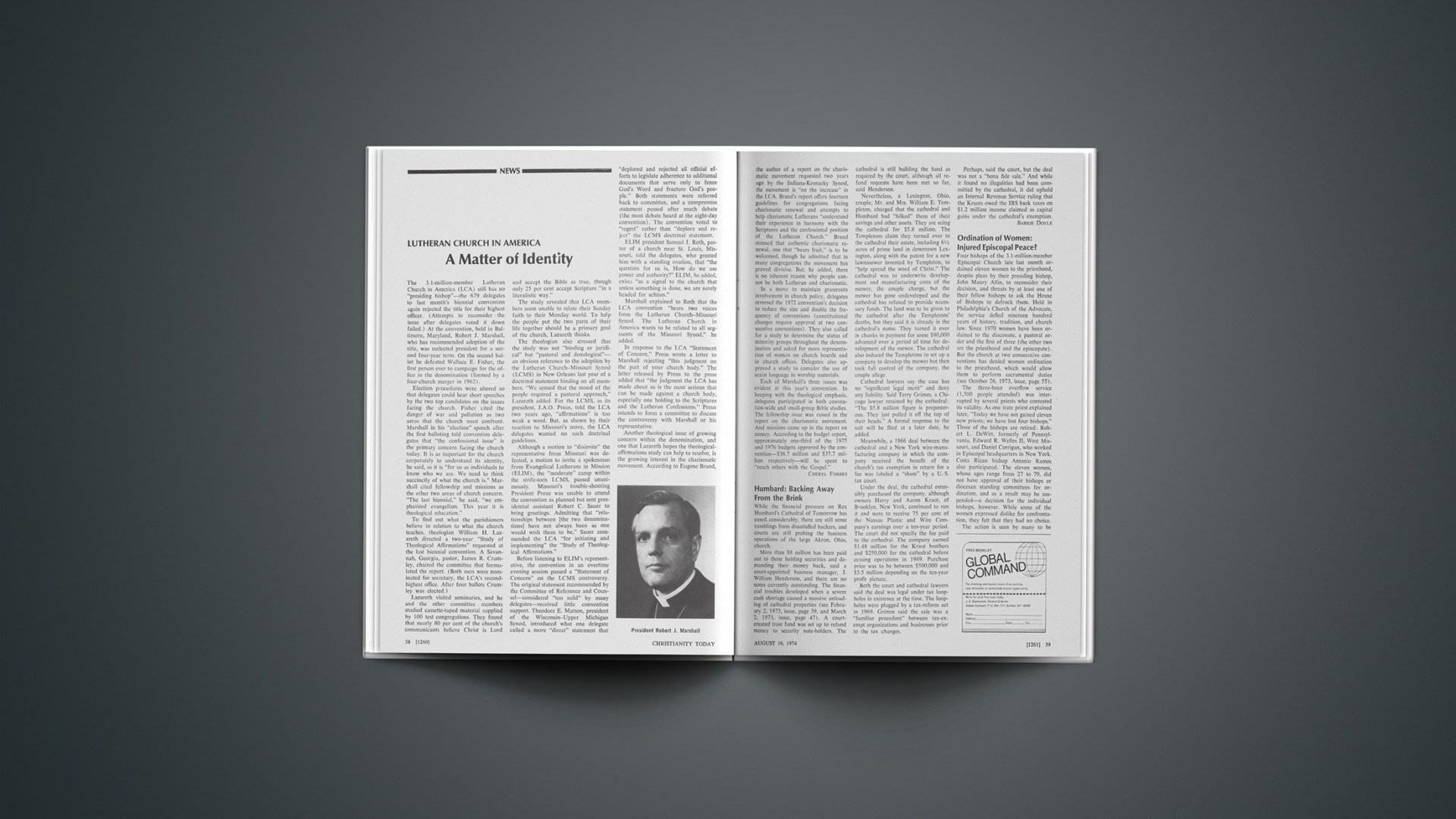
The 3.1-million-member Lutheran Church in America (LCA) still has no “presiding bishop”—the 679 delegates to last month’s biennial convention again rejected the title for their highest officer. (Attempts to reconsider the issue after delegates voted it down failed.) At the convention, held in Baltimore, Maryland, Robert J. Marshall, who has recommended adoption of the title, was reelected president for a second four-year term. On the second ballot he defeated Wallace E. Fisher, the first person ever to campaign for the office in the denomination (formed by a four-church merger in 1962).

Election procedures were altered so that delegates could hear short speeches by the two top candidates on the issues facing the church. Fisher cited the danger of war and pollution as two areas that the church must confront. Marshall in his “election” speech after the first balloting told convention delegates that “the confessional issue” is the primary concern facing the church today. It is as important for the church corporately to understand its identity, he said, as it is “for us as individuals to know who we are. We need to think succinctly of what the church is.” Marshall cited fellowship and missions as the other two areas of church concern. “The last biennial,” he said, “we emphasized evangelism. This year it is theological education.”

To find out what the parishioners believe in relation to what the church teaches, theologian William H. Lazareth directed a two-year “Study of Theological Affirmations” requested at the last biennial convention. A Savannah, Georgia, pastor, James R. Crumley, chaired the committee that formulated the report. (Both men were nominated for secretary, the LCA’s second-highest office. After four ballots Crumley was elected.)

Lazareth visited seminaries, and he and the other committee members studied cassette-taped material supplied by 100 test congregations. They found that nearly 80 per cent of the church’s communicants believe Christ is Lord and accept the Bible as true, though only 25 per cent accept Scripture “in a literalistic way.”

The study revealed that LCA members seem unable to relate their Sunday faith to their Monday world. To help the people put the two parts of their life together should be a primary goal of the church, Lazareth thinks.

The theologian also stressed that the study was not “binding or juridical” but “pastoral and doxological”—an obvious reference to the adoption by the Lutheran Church-Missouri Synod (LCMS) in New Orleans last year of a doctrinal statement binding on all members. “We sensed that the mood of the people required a pastoral approach,” Lazareth added. For the LCMS, as its president, J.A.O. Preus, told the LCA two years ago, “affirmations” is too weak a word. But, as shown by their reaction to Missouri’s move, the LCA delegates wanted no such doctrinal guidelines.

Although a motion to “disinvite” the representative from Missouri was defeated, a motion to invite a spokesman from Evangelical Lutherans in Mission (ELIM), the “moderate” camp within the strife-torn LCMS, passed unanimously. Missouri’s trouble-shooting President Preus was unable to attend the convention as planned but sent presidential assistant Robert C. Sauer to bring greetings. Admitting that “relationships between [the two denominations] have not always been as one would wish them to be,” Sauer commended the LCA “for initiating and implementing” the “Study of Theological Affirmations.”

Before listening to ELIM’s representative, the convention in an overtime evening session passed a “Statement of Concern” on the LCMS controversy. The original statement recommended by the Committee of Reference and Counsel—considered “too mild” by many delegates—received little convention support. Theodore E. Matson, president of the Wisconsin-Upper Michigan Synod, introduced what one delegate called a more “direct” statement that “deplored and rejected all official efforts to legislate adherence to additional documents that serve only to fence God’s Word and fracture God’s people.” Both statements were referred back to committee, and a compromise statement passed after much debate (the most debate heard at the eight-day convention). The convention voted to “regret” rather than “deplore and reject” the LCMS doctrinal statement.

ELIM president Samuel J. Roth, pastor of a church near St. Louis, Missouri, told the delegates, who greeted him with a standing ovation, that “the question for us is, How do we use power and authority?” ELIM, he added, exists “as a signal to the church that unless something is done, we are surely headed for schism.”

Marshall explained to Roth that the LCA convention “hears two voices from the Lutheran Church-Missouri Synod. The Lutheran Church in America wants to be related to all segments of the Missouri Synod,” he added.

In response to the LCA “Statement of Concern,” Preus wrote a letter to Marshall rejecting “this judgment on the part of your church body.” The letter released by Preus to the press added that “the judgment the LCA has made about us is the most serious that can be made against a church body, especially one holding to the Scriptures and the Lutheran Confessions.” Preus intends to form a committee to discuss the controversy with Marshall or his representative.

Another theological issue of growing concern within the denomination, and one that Lazareth hopes the theological-affirmations study can help to resolve, is the growing interest in the charismatic movement. According to Eugene Brand, the author of a report on the charismatic movement requested two years ago by the Indiana-Kentucky Synod, the movement is “on the increase” in the LCA. Brand’s report offers fourteen guidelines for congregations facing charismatic renewal and attempts to help charismatic Lutherans “understand their experience in harmony with the Scriptures and the confessional position of the Lutheran Church.” Brand stressed that authentic charismatic renewal, one that “bears fruit,” is to be welcomed, though he admitted that in many congregations the movement has proved divisive. But, he added, there is no inherent reason why people cannot be both Lutheran and charismatic.

In a move to maintain grassroots involvement in church policy, delegates reversed the 1972 convention’s decision to reduce the size and double the frequency of conventions (constitutional changes require approval at two consecutive conventions). They also called for a study to determine the status of minority groups throughout the denomination and asked for more representation of women on church boards and in church offices. Delegates also approved a study to consider the use of sexist language in worship materials.

Each of Marshall’s three issues was evident at this year’s convention. In keeping with the theological emphasis, delegates participated in both convention-wide and small-group Bible studies. The fellowship issue was raised in the report on the charismatic movement. And missions came up in the report on money. According to the budget report, approximately one-third of the 1975 and 1976 budgets approved by the convention—$36.7 million and $37.7 million respectively—will be spent to “reach others with the Gospel.”

Humbard: Backing Away From The Brink

While the financial pressure on Rex Humbard’s Cathedral of Tomorrow has eased considerably, there are still some rumblings from dissatisfied backers, and courts are still probing the business operations of the large Akron, Ohio, church.

More than $8 million has been paid out to those holding securities and demanding their money back, said a court-appointed business manager, J. William Henderson, and there are no notes currently outstanding. The financial troubles developed when a severe cash shortage caused a massive unloading of cathedral properties (see February 2, 1973, issue, page 39, and March 2, 1973, issue, page 47). A court-created trust fund was set up to refund money to security note-holders. The cathedral is still building the fund as required by the court, although all refund requests have been met so far, said Henderson.

Nevertheless, a Lexington, Ohio, couple, Mr. and Mrs. William E. Templeton, charged that the cathedral and Humbard had “bilked” them of their savings and other assets. They are suing the cathedral for $5.8 million. The Templetons claim they turned over to the cathedral their estate, including 6½ acres of prime land in downtown Lexington, along with the patent for a new lawnmower invented by Templeton, to “help spread the word of Christ.” The cathedral was to underwrite development and manufacturing costs of the mower, the couple charge, but the mower has gone undeveloped and the cathedral has refused to provide necessary funds. The land was to be given to the cathedral after the Templetons’ deaths, but they said it is already in the cathedral’s name. They turned it over in chunks in payment for some $80,000 advanced over a period of time for development of the mower. The cathedral also induced the Templetons to set up a company to develop the mower but then took full control of the company, the couple allege.

Cathedral lawyers say the case has no “significant legal merit” and deny any liability. Said Terry Grimm, a Chicago lawyer retained by the cathedral: “The $5.8 million figure is preposterous. They just pulled it off the top of their heads.” A formal response to the suit will be filed at a later date, he added.

Meanwhile, a 1966 deal between the cathedral and a New York wire-manufacturing company in which the company received the benefit of the church’s tax exemption in return for a fee was labeled a “sham” by a U. S. tax court.

Under the deal, the cathedral ostensibly purchased the company, although owners Harry and Aaron Kraut, of Brooklyn, New York, continued to run it and were to receive 75 per cent of the Nassau Plastic and Wire Company’s earnings over a ten-year period. The court did not specify the fee paid to the cathedral. The company earned $1.48 million for the Kraut brothers and $250,000 for the cathedral before ceasing operations in 1969. Purchase price was to be between $500,000 and $3.5 million depending on the ten-year profit picture.

Both the court and cathedral lawyers said the deal was legal under tax loopholes in existence at the time. The loopholes were plugged by a tax-reform act in 1969. Grimm said the sale was a “familiar procedure” between tax-exempt organizations and businesses prior to the tax changes.

Perhaps, said the court, but the deal was not a “bona fide sale.” And while it found no illegalities had been committed by the cathedral, it did uphold an Internal Revenue Service ruling that the Krauts owed the IRS back taxes on $1.2 million income claimed as capital gains under the cathedral’s exemption.

BARRIE DOYLE

Ordination Of Women: Injured Episcopal Peace?

Four bishops of the 3.1-million-member Episcopal Church late last month ordained eleven women to the priesthood, despite pleas by their presiding bishop, John Maury Allin, to reconsider their decision, and threats by at least one of their fellow bishops to ask the House of Bishops to defrock them. Held in Philadelphia’s Church of the Advocate, the service defied nineteen hundred years of history, tradition, and church law. Since 1970 women have been ordained to the diaconate, a pastoral order and the first of three (the other two are the priesthood and the episcopate). But the church at two consecutive conventions has denied women ordination to the priesthood, which would allow them to perform sacramental duties (see October 26, 1973, issue, page 55).

The three-hour overflow service (1,500 people attended) was interupted by several priests who contested its validity. As one irate priest explained later, “Today we have not gained eleven new priests; we have lost four bishops.” Three of the bishops are retired: Robert L. DeWitt, formerly of Pennsylvania, Edward R. Welles II, West Missouri, and Daniel Corrigan, who worked in Episcopal headquarters in New York. Costa Rican bishop Antonio Ramos also participated. The eleven women, whose ages range from 27 to 79, did not have approval of their bishops or diocesan standing committees for ordination, and as a result may be suspended—a decision for the individual bishops, however. While some of the women expressed dislike for confrontation, they felt that they had no choice.

The action is seen by many to be “schismatical, constituting a grave injury to the peace of Christ’s church,” in the words of Charles H. Osborn, executive director of the American Church Union, a conservative Episcopal group. But despite the controversy and irregularity of the service, some consider it valid.

Bishop Allin in a statement released shortly after the ordination service said the four bishops “have exceeded their authority, and have not acted for the whole church, as is the norm in ordinations.” Therefore, he added, the newly ordained women will not be allowed to function as priests. In keeping with Allin’s directive the bishop of the Washington, D. C., diocese, William F. Creighton, ordered the rector of St. Stephen and the Incarnation, a controversial inner-city parish, to cancel plans for the newly ordained Alison Cheek to celebrate communion.

Relief, Not Revolution

Directors of Church World Service, relief arm of the National Council of Churches, have rejected plans to broaden the agency’s scope, although a similar stand by the CWS executive director reportedly cost him his job (see July 26 issue, page 37).

James MacCracken was fired last month in a policy disagreement with Eugene Stockwell, head of the NCC’s overseas ministries board. Reports after the dismissal indicated that Stockwell wanted the CWS to step up activities to change societies and systems that foster poverty.

Turning down that view, denominational representatives on the agency’s overseeing committee reaffirmed the organization’s “historic ministry” and refused to allow policy changes. Specifically rejected was the view that the agency should be involved in “systematic change” in areas of injustice. The organization “is not in the business of promoting violent revolutionary change,” said the committee.

The group of about thirty-five representatives met at an all-day closed meeting that reportedly centered on MacCracken’s dismissal.

Following the meeting, committee vice-chairman J. Harry Haines, a United Methodist relief official, assured his denomination that funds sent to CWS would be used only for relief and rehabilitation.

DEATH

DR. FREDERICK C. GRANT, 83, Episcopal clergyman and a translator of the Revised Standard Version of the Bible; in Gwynedd, Pennsylvania.

Religion In Transit

Arguing that marriages solemnized by the church should be dissolved by the church, a Delaware Unitarian minister has written a divorce ceremony for churches. David R. Kibby wants separating couples to settle legal matters involving children and property, get a divorce “license,” and then have a church ceremony before receiving a divorce certificate.

The Free Methodist Church will continue studies toward merger with the Wesleyan Church, it decided recently at its annual conference, held at Winona Lake, Indiana. Administrative boards of both churches approved a union plan in May.

World Wide Pictures, the movie arm of the Billy Graham organization, acquired from Twentieth Century Fox the distribution rights to The Gospel Road, singer Johnny Cash’s eighty-minute color film on the life of Jesus. World Wide will dub in several foreign languages and show the film in some sixty countries.

Five evangelical churches in Puerto Rico are in the forefront of opposition to the introduction of slot machines on the island. Luxury hotels want the machines to help win back vanishing tourists, but the churches warn they will bring more problems than they solve.

The 400,000 member Christian Methodist Episcopal Church will have future Sunday-school material supplied by a predominantly black-owned Chicago publisher, Urban Ministries Incorporated. The new material will relate Bible truths “in the black idiom,” according to church officials.

Personalia

Lutheran theologian Peter Beyerhaus, an outspoken German evangelical, is the new dean of the Protestant Theological Faculty of the University of Tübingen, considered by many to be the leading theological school in Germany. Beyerhaus succeeds Jürgen Moltmann, known as a theologian of “hope” and of “revolution.”

New president of the American Leprosy Missions is Roger K. Ackley, of Carmel, Indiana, a specialist in international refugee-resettlement work.

World Scene

Britain’s evangelical relief agency. The Evangelical Alliance Relief (TEAR) Fund, reports that in 1973 it channeled over $1 million to 132 evangelical sponsored relief projects in forty-one countries. Forty of the projects involved the support of short-term medical and other personnel working overseas. The two projects with the highest budget (about $80,000 each) were a hydroelectric power scheme in Burundi and a well-drilling program in Maharashtra, India.

The women’s rights movement is credited for the change in the theme for the Baptist World Congress to be held in Stockholm in July, 1975. The theme will now be “New People [rather than New Men] for a New World—Through Christ.”

Communist China and Soviet Russia are at loggerheads again, this time over religion. In a Radio Peking broadcast the Chinese expressed dismay that the Kremlin has “allowed a religious fervor” to grip Russia and that “tens of thousands of religious believers … swarmed into churches” over Easter.

ROLLING STONES

Fundamentalist preacher Billy James Hargis dropped his strident anti-Communist message for a brief time this summer to urge his followers to “stone” Congress over the impeachment issue. The result was an avalanche of rocks and pebbles arriving in congressional offices daily, each wrapped in a Scripture verse: “He that is without sin among you, let him cast the first stone.” The aim, according to Hargis, is to register displeasure with “impeachment-minded liberal congressmen” and point out what he feels is a double standard among those judging President Nixon.

Predictably, the House Judiciary Committee was the target for most of the rocks. Aides to New York Republican Hamilton Fish, Jr., who supported the first two impeachment articles, told newspapers he had “a drawer full of rocks.” Robert Drinan, a Jesuit priest and Massachusetts congressman, has a box full and also received a telegram saying, “If you can’t impeach him, exorcise him.” A woman telephoned Virginia congressman M. Caldwell Butler’s Washington office asking for the address of his district office. She wanted to send the pro-impeachment Butler thirty pieces of silver. Another voter was even more aroused, the Washington Star-News reported. Ohio Democrat John F. Seiberling received a package containing a five-pound rock mailed at a cost of $2.05 parcel post.

The entire episode led one wag to suggest that the Judiciary Committee members now had enough rocks and pebbles to build a stone wall.

The View from Lausanne

Less than forty miles separates Lausanne and Geneva, Switzerland, but last month they were worlds apart theologically. The document that went out from the International Congress on World Evangelization (ICOWE) at Lausanne bore no address, but the World Council of Churches (WCC) headquarters in Geneva was clearly an intended recipient. Indeed, Anglican bishop Jack Dain of Australia, ICOWE’s executive chairman, said he had won assurances from WCC leaders that the paper—entitled the Lausanne Covenant (full text on p. 22)—would be studied at this month’s meeting of the WCC Central Committee in West Berlin. In effect, the paper says to the WCC: We don’t agree with what you said last year in Bangkok about evangelism (see February 2, 1973, issue, page 37), and we want to set the record straight.

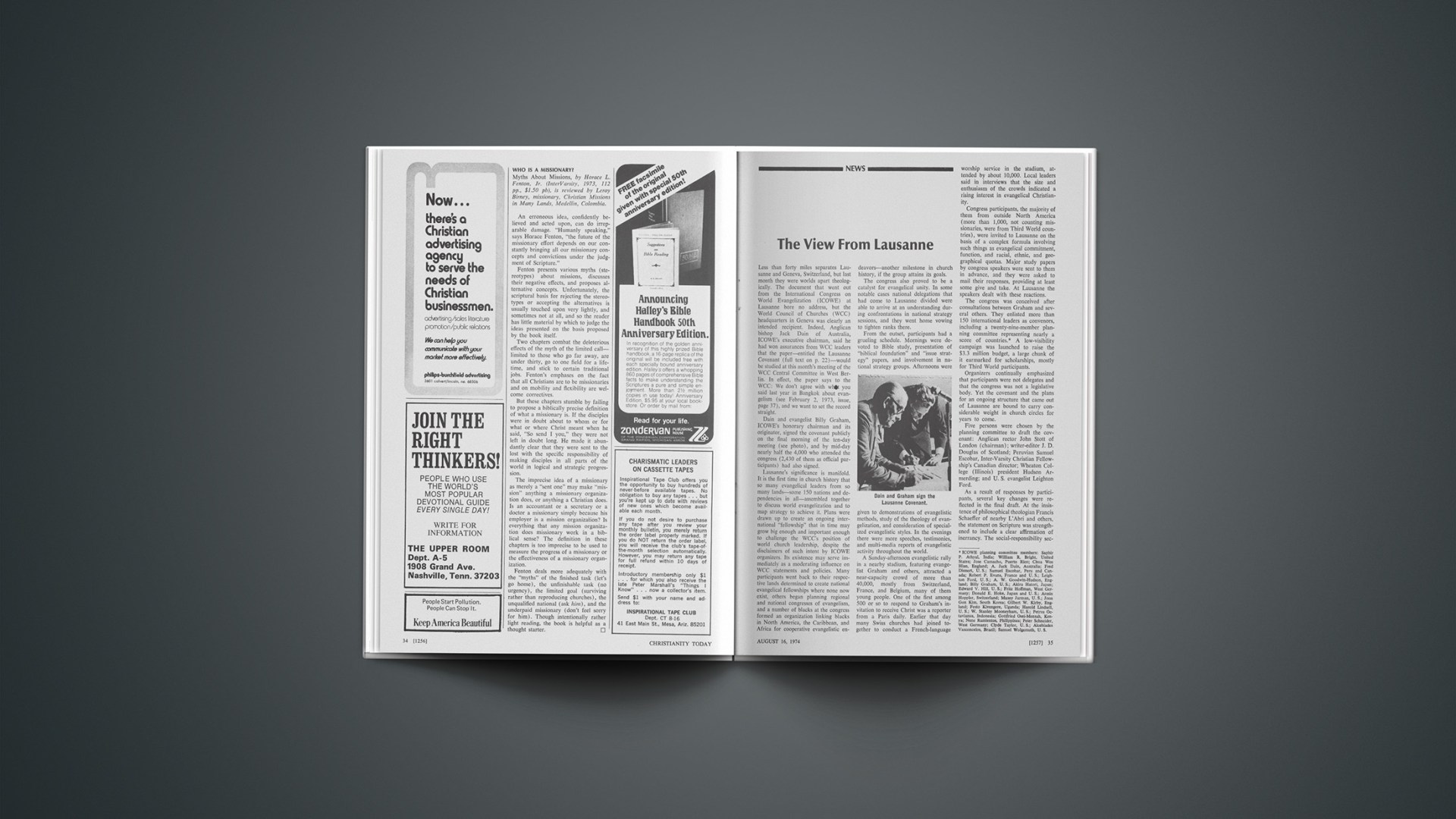
Dain and evangelist Billy Graham, ICOWE’s honorary chairman and its originator, signed the covenant publicly on the final morning of the ten-day meeting (see photo), and by mid-day nearly half the 4,000 who attended the congress (2,430 of them as official participants) had also signed.

Lausanne’s significance is manifold. It is the first time in church history that so many evangelical leaders from so many lands—some 150 nations and dependencies in all—assembled together to discuss world evangelization and to map strategy to achieve it. Plans were drawn up to create an ongoing international “fellowship” that in time may grow big enough and important enough to challenge the WCC’s position of world church leadership, despite the disclaimers of such intent by ICOWE organizers. Its existence may serve immediately as a moderating influence on WCC statements and policies. Many participants went back to their respective lands determined to create national evangelical fellowships where none now exist, others began planning regional and national congresses of evangelism, and a number of blacks at the congress formed an organization linking blacks in North America, the Caribbean, and Africa for cooperative evangelistic endeavors—another milestone in church history, if the group attains its goals.

The congress also proved to be a catalyst for evangelical unity. In some notable cases national delegations that had come to Lausanne divided were able to arrive at an understanding during confrontations in national strategy sessions, and they went home vowing to tighten ranks there.

From the outset, participants had a grueling schedule. Mornings were devoted to Bible study, presentation of “biblical foundation” and “issue strategy” papers, and involvement in national strategy groups. Afternoons were given to demonstrations of evangelistic methods, study of the theology of evangelization, and consideration of specialized evangelistic styles. In the evenings there were more speeches, testimonies, and multi-media reports of evangelistic activity throughout the world.

A Sunday-afternoon evangelistic rally in a nearby stadium, featuring evangelist Graham and others, attracted a near-capacity crowd of more than 40,000, mostly from Switzerland, France, and Belgium, many of them young people. One of the first among 500 or so to respond to Graham’s invitation to receive Christ was a reporter from a Paris daily. Earlier that day many Swiss churches had joined together to conduct a French-language worship service in the stadium, attended by about 10,000. Local leaders said in interviews that the size and enthusiasm of the crowds indicated a rising interest in evangelical Christianity.

Congress participants, the majority of them from outside North America (more than 1,000, not counting missionaries, were from Third World countries), were invited to Lausanne on the basis of a complex formula involving such things as evangelical commitment, function, and racial, ethnic, and geographical quotas. Major study papers by congress speakers were sent to them in advance, and they were asked to mail their responses, providing at least some give and take. At Lausanne the speakers dealt with these reactions.

The congress was conceived after consultations between Graham and several others. They enlisted more than 150 international leaders as convenors, including a twenty-nine-member planning committee representing nearly a score of countries.1ICOWE planning committee members: Saphir P. Athyal, India; William R. Bright, United States; Jose Camacho, Puerto Rico; Chua Wee Hian, England; A. Jack Dain, Australia; Fred Dienert, U. S.; Samuel Escobar, Peru and Canada; Robert P. Evans, France and U. S.; Leighton Ford, U. S.; A. W. Goodwin-Hudson, England; Billy Graham, U. S.; Akira Hatori, Japan; Edward V. Hill, U. S.; Fritz Hoffman, West Germany; Donald E. Hoke, Japan and U. S.; Armin Hoppler, Switzerland; Maxey Jarman, U. S.; Joon Gon Kim, South Korea; Gilbert W. Kirby, England; Festo Kivengere, Uganda; Harold Lindsell, U. S.; W. Stanley Mooneyham, U. S.; Petrus Octavianus, Indonesia; Gottfried Osei-Mensah, Kenya; Nene Ramientos, Philippines; Peter Schneider, West Germany; Clyde Taylor, U. S.; Alcebiades Vasconcelos, Brazil; Samuel Wolgemuth, U. S. A low-visibility campaign was launched to raise the $3.3 million budget, a large chunk of it earmarked for scholarships, mostly for Third World participants.

Organizers continually emphasized that participants were not delegates and that the congress was not a legislative body. Yet the covenant and the plans for an ongoing structure that came out of Lausanne are bound to carry considerable weight in church circles for years to come.

Five persons were chosen by the planning committee to draft the covenant: Anglican rector John Stott of London (chairman); writer-editor J. D. Douglas of Scotland; Peruvian Samuel Escobar, Inter-Varsity Christian Fellowship’s Canadian director; Wheaton College (Illinois) president Hudson Armerding; and U. S. evangelist Leighton Ford.

As a result of responses by participants, several key changes were reflected in the final draft. At the insistence of philosophical theologian Francis Schaeffer of nearby L’Abri and others, the statement on Scripture was strengthened to include a clear affirmation of inerrancy. The social-responsibility section was intensified, putting signers on record as affirming that “evangelism and socio-political involvement are both part of our Christian duty.” Added to the statement on evangelistic urgency was an indirect reference to the missionary moratorium issue (see June 7 issue, page 45), as raised by some African blacks: “a reduction of foreign missionaries and money in an evangelized country may sometimes be necessary to facilitate the national church’s growth in self-reliance and to release resources for unevangelized areas.” Also, a new introduction was added to the church partnership section: “We rejoice that a new missionary era has dawned. The dominant role of western missions is fast disappearing.”

An entirely new section was added on freedom and persecution in response to a resolution from a sixty-member strategy group dealing with evangelism in countries whose governments are hostile to Christianity.

Meanwhile there was no toning down of the covenant’s strongly worded rejection of universalism, syncretism, and the premise that social action and political liberation can be construed as evangelism. (Favorable references to all these concepts can be found in public statements of the WCC or its leaders over the past few years.)

For a while it appeared that the proposal for an ongoing fellowship might split the participants. Some Latin American and African leaders suspected a “hidden agenda” aimed at creating an opposing parallel organization to the WCC. Not so, Dain asserted several times from the podium. Of more than 1,000 who responded to a questionnaire, he said, 86 per cent indicated they wanted some kind of ongoing “fellowship” to keep the spirit and purpose of Lausanne alive, and 79 per cent approved the establishment of a thirty-member Continuation Committee.

Indeed, in preliminary papers that had been mailed months ago to participants several speakers called for such an association, and, said Dain, many advance responses from participants expressed a similar wish. Unconvinced, several leaders engaged in corridor politicking in apparent hopes of creating enough dissent to get the ICOWE planners to quash the idea. They failed, and plans moved ahead.

In national and regional caucuses participants nominated 102 persons. For the Continuation Committee the planning committee will select twenty-five of these (plus five others on or off the list) as follows: one each from Oceania and the Middle East; three each from Central-West Asia, East Asia, Africa, and Latin America; five from Europe; and six from North America. The Continuation Committee probably will establish an executive office to link national and regional post-Lausanne fellowships.

Another document, “A Response to Lausanne,” came from a rump session (there were many) on radical discipleship attended by several hundred who felt the congress had not said enough on Christian social responsibility. Its point: “There is no biblical dichotomy between the word spoken and the word made visible in the lives of God’s people.” The planning committee permitted distribution of the statement to participants.

Many dismissed the paper as superfluous. The social-responsibility theme in fact was given heavy emphasis not only in the covenant but also in plenary presentations. Its two most vocal advocates perhaps were Escobar and C. Rene Padilla, an executive of the Latin American branch of the International Fellowship of Evangelical Students. Both men seemed more popular among Anglo-Saxons than among their Latin peers, who declined to nominate them to the Continuation Committee. At one impromptu meeting of about 100 Latins, Escobar spoke critically of missionary relationships in Latin America, and he was promptly rebuked by a dozen leaders who said they not only rejected the idea of a moratorium but also would welcome all the missionaries they could get.

The moratorium issue arose in the East Africa National Strategy group, composed of about sixty representatives from Kenya, Tanzania, and Uganda. In that group was an ICOWE convenor, John Gatu, executive head of the Presbyterian Churches of East Africa and president of the Central Committee of the All Africa Conference of Churches (AACC), who issued the call for a moratorium on Western missionaries and money at the recent AACC meeting in Lasaka, Zambia. (Moratorium hit the headlines in 1972 when delegates to the WCC Conference on Salvation held in Bangkok called for it.) Several of the East Africans, including well respected Anglican bishop Festo Kivengere of Uganda, said they felt the group needed to say something because of all the bad press and negative understanding attached to the word. Debate was spirited but calm and reasonable. (In an interview later, Kivengere said the AACC had not really represented grass-roots sentiment; the Lusaka statement, he said, was occasioned by the paternalism of some missionaries.)

In the debate Gatu reasserted his belief that a meaningful partnership with Western missionaries is impossible because they regard Africans as ecclesiastical children. The only way to break the back of paternalism is through a moratorium, he argued. Former Anglican archbishop Erica Abiti of Uganda and Bishop Henry Okullu of Uganda led the opposition. A compromise statement was finally approved:

Although the idea of moratorium has been recommended to the churches in Africa, the churches have not yet discussed the recommendations or approved it. Therefore the impression that the churches in Africa have already declared moratorium is misleading. It is however important to recognize that the idea behind moratorium is concerned about over-dependence upon foreign resources both personnel and finances, which sometimes hinders initiative and development of local responsibility. [Our] group felt that the application of the concept behind moratorium might be considered for specific situations rather than generally.

Meanwhile, several platform personalities, including Graham, criticized the call for a moratorium. But all things considered, the emergence of the moratorium issue and the timing of the ICOWE may be of deep significance in the history of evangelicalism. Many Westerners at the congress said that they were impressed by the zeal and competence of the Third World Christians and that they no longer fear for the future of the churches if the missionaries must leave. They said they now see their Third World counterparts as full partners in the task of world evangelism and no longer as objects of special aid or as international subsidiaries to be looked after.

Wef: Is There A Future?

Immediately following the International Congress on World Evangelization (ICOWE) at Lausanne, Switzerland, some sixty of the leaders there traveled to the nearby mountain resort of Chateau D’Oex for the Sixth General Assembly of the World Evangelical Fellowship (WEF). Normally the WEF assembly is held every four years, but because of lagging finances it had not convened since the Fifth Assembly in 1968 in Lausanne.

In light of the time gap, the implications of the ICOWE, and the pending retirement of Clyde Taylor as the WEF’s international executive secretary, the Sixth Assembly was a crucial one. But the delegates got bogged down in revising the WEF constitution. Many of them left early, including some who had important roles in the ICOWE, and as a result little was accomplished. Left undiscussed were the purpose and the future of the WEF, especially important in view of the ICOWE’s plans to create a Continuation Committee aimed at linking the world’s evangelicals—inside and outside the mainline denominations—in evangelism.

Anglican John Stott, president of the Evangelical Alliance of Great Britain (a WEF member organization) and a drafter of the ICOWE Lausanne Covenant, said in an interview that the WEF must radically restructure itself to enable a de facto merger with whatever develops from the ICOWE Continuation Committee. Otherwise, he said, the WEF “may as well commit hari-kari.”

Taylor privately envisions the Continuation Committee as possibly the evangelism commission of the WEF, but ICOWE executive Donald Hoke dismisses the notion. The WEF, he implies, is too narrow in theology and policy to appeal to many whom the ICOWE leaders hope to attract, and half of those present at the ICOWE were unfamiliar with it, he said.

Meanwhile, a multi-national conservative bloc in the WEF, espousing a we-were-here-first line, is opposed to any restructure that will compromise present membership policy or will in effect dismantle the WEF.

In passing the revised constitution, WEF leaders nevertheless said they were open to negotiation with the ICOWE committee. Wheaton College president Hudson Armerding was elected WEF president. Other officers are Stephen Damaris of Indonesia; Byang Kato, head of the Association of Evangelicals of Africa and Madagascar; Gordon Landreth, executive secretary of the Evangelical Alliance of Great Britain; Anglican bishop Jack Dain of Australia (the ICOWE executive chairman); Claude Noel of Haiti; and C. C. Rema of India.

A 1975 budget of $81,500 was approved. This amount includes $35,000 that must be raised in a special supplemental campaign, and it does not include anything for a new international secretary (Taylor is staked by the U. S. National Association of Evangelicals).

The WEF is made up of about two dozen national fellowships of evangelicals plus several other groups. Its roots go back to 1846, when the Evangelical Alliance of Great Britain was founded. The movement spread to continental Europe and became known as the World Evangelical Alliance (WEA). The WEA became the WEF in 1951. Some in Europe complained that the new group was too fundamentalist, and in 1952 they formed the European Evangelical Alliance (EEA). With the years came mellowing, and today most of the EEA members are also members of the WEF.

EDWARD E. PLOWMAN

Slapping The Wcc Wrist

In a “gesture of criticism” the Church of England General Synod voted to reduce the church’s contribution to the World Council of Churches by $2,400. This protest against some WCC activities—“particularly its controversial grants to liberation movements”—was made at the synod’s summer meeting, held at York University.

Debate on the $41,760 earmarked for the WCC was at times heated. Some synod members seemed to think that the grant should be cut by half. “One rarely opens a daily newspaper without seeing some fresh idiocy of the WCC,” said one. Another compared the liberation movements under criticism with the Irish Republican Army. Cooling things down a little, Oliver Tomkins, bishop of Bristol, claimed that media reporting of the work of the WCC was always highly selective.

It was left to the Reverend Christopher Wansey to move that the synod should “just chop off a thousand pounds.” It was not right to withdraw support from an organization simply because one aspect of its work gave cause for concern, he said. The motion was approved 181 to 138.

A warning that in the coming years inflation may strip the church of its possessions came from Donald Coggan, archbishop of York, in his presidential address to the General Synod.

Coggan, who will become Archbishop of Canterbury in January, 1975, urged the church to assume a prophetic role in the present crisis of inflation. Necessary first of all, he said, is a change in man’s attitude toward work: now he works merely to acquire, instead of from a sense of vocation.

The synod voted itself a decisive voice in appointing bishops, until now left to the state. The legal, administrative, and constitutional implications of this decision were left unclear.

The synod committed the church to full participation in the proposed Church Unity Commission, whose eventual aim is union involving Anglican, Methodist, and United Reformed Churches in Britain.

DAVID COOMES

Endangered Species

The Anglican diocese of Toronto by a 248–18 vote asked the Anglican Church of Canada to renegotiate the terms of the Basis of Union designed to merge the Anglicans with the United Church of Canada and the Christian Church (Disciples of Christ). The diocese was responding to the criticisms of Bishop L. S. Garnsworthy, who charged that the new church’s bishops would be “emasculated relics of all we have believed about episcopacy.” He added that “the bishop emerges as yet another personnel officer, denuded of marks of episcopacy.”

The Toronto diocese is the most influential and wealthy in Canada, and its action has had a chilling effect on church-union enthusiasts. (According to the present union plan the new church would have about four million members and 100 bishops. The Anglican Church now has twenty-eight diocesan bishops and a few suffragans.)

LESLIE K. TARR

Books

Opening and Sutting

Winds of Change in the Christian Mission, by J. Herbert Kane (Moody, 1973, 160 pp., $2.25 pb), is reviewed by Date Rhoton, missionary, St. Pölten, Austria.

“We are told that missions are at the crossroads, but this should not unduly disturb us. Missions have always been at the crossroads. That is where they began; that is where they belong.” In keeping with this statement in the opening chapter, Kane shows a zest throughout the book for telling it like it is.

Not many years ago missionary biographies, challenges, and reports were mainly intended to shock people at home about the need abroad, to thrill them with answers to prayer, and to challenge them to full commitment, which often meant the willingness to work in another land. This book, instead of focusing on these areas, seeks with a high degree of success to present the various aspects of missionary work, including the problems and failures.

Sound counsel is offered for the problem facing modern missions. For example, there is a student-missionary tension today that was little known fifteen or so years ago. The student today is taught to accept people as they are and not to seek through any form of imperialism (even religious) to impose his beliefs on people of another culture. Thus the “old-time missionary” is met with bored if not disgusted faces when he challenges a student body to join him in delivering people from the blindness of Islam or Buddhism. Kane suggests that the missionary should seek to understand the student of today. He must speak on relevant topics in a coherent and concise way and after careful preparation. Some missionaries must come to grips with the fact that they might not be speakers for student bodies and possibly might not be speakers at all.

The students, on the other hand, must also be fair. They pride themselves on accepting people as they are and should therefore also accept missionaries as they are. The present swing of the pendulum away from all that connotes imperialism should not mean that we are to be indifferent to the people living in other countries, or that we are to forget the uniqueness of the Gospel.

Where are the missionary candidates today? Could it be that many are not going to the field because they lack the dedication that characterized the famous missionaries of the past century? Kane reminds us of Hudson Taylor: when he “arrived in China he didn’t find any indoor plumbing, central heating, electric light, or telephone service.” And many of us missionaries would leave the point at that. But Kane faithfully goes on: “So what? He didn’t have them back in England either.” The point is that the young people who do go forth to other lands today are doing it at even greater sacrifice in many ways, for they have much more to give up.

One often hears astounding figures about the number of missionaries who drop out after only a short time abroad. Kane goes through the statistics with a fine-toothed comb and discovers that actually the drop-out rate is encouragingly low. Only 2.5 per cent drop out in the first twenty-one months, whereas even the fairly successful Peace Corps has had a drop-out rate of 17.2 percent for the same length of time. Only 14.4 per cent of missionaries drop out after six years.

Balanced and helpful pointers are given concerning the training of the missionary for today’s world. The advantages and the disadvantages of going abroad in secular employment (but with a Christian witness) are carefully weighed.

The sensitive and very fair treatment of all sides of issues is continued throughout the book, though some minor points could be challenged. Certainly Kane is generally correct when he maintains that “the teaching profession offers the best opportunity for the non-professional missionary”; yet his section on this point does not make room for the possible exceptions that do exist. Similarly, his assertion that English-speaking short-term workers should go only to English-speaking countries seems a little dogmatic. There is truth in this point, of course, but I know personally of many short-termers who went to lands where they could not speak the language and were well used.

In calculating the expense of the short-termer, Kane mentions the large round-trip air fares from Chicago to Johannesburg and to New Delhi. He would have done well to cite as another example the far cheaper air fare to Europe.

Likewise, it would have given a more balanced picture if, when discussing the “lack of continuity” in short-term work, he had mentioned something that he did allude to earlier in the book: if the short-termer is simply helping a missionary or a national who is there year in and year out, then lack of continuity may be less of a problem.

Kane’s statement that “Billy Graham and other evangelists from the West have held meetings in most of” the Eastern European lands is certainly misleading. Billy Graham was in Yugoslavia for a few days. Any meetings by Western evangelists in the other lands would be on a much more restricted basis than Kane’s statement implies. But the overall point that the author is making is valid: closed doors do not remain closed forever.

The book closes on a note of encouragement, reminding us that God is sovereign. God is the One who opens and shuts the doors:

During the fifth decade of the nineteenth century the church of Christ, like a mighty army with its banners flying, moved into China. On its banners were inscribed the words of Revelation 3:7, “[I am] he that openeth, and no man shutteth.” It was a great day for the Christian church.… Exactly one hundred years later the missionaries were again on the move, only this time they were coming out of China. The “mighty army” had been badly mauled; and the banners, tattered and torn, were trailing in the dust. But on those banners were inscribed the words of Holy Scripture: “[I am] he that … shutteth, and no man openeth” (Rev. 3:7) [158].

Christ is building his church. No matter how the situation may look, we know that he is in control. The absence of missionaries in a country does not mean that God is not at work in that land. As Kane puts it, “It is one thing to get rid of the missionaries; it is another to get rid of Almighty God.”

Sex Education And You

Sex Is a Parent Affair, by Letha Scanzoni (Regal, 1973, 261 pp., $1.95 pb), From Parent to Child About Sex, by Wilson W. Grant (Zondervan, 1973, 183 pp., $3.95, $1.95 pb), Sex Is More Than a Word, by Andrew D. Lester (Broadman, 1973, 92 pp., $1.95 pb), and Teaching Your Children About Sex, by John C. Howell (Broadman, 1973, 118 pp., $1.95 pb), are reviewed by Sandra Swisher Chandler, Arcadia, California.

“Parents are only fooling themselves if they think sex education can be dodged … for it is ignorance in sexual understanding, rather than accurate sex knowledge, that produces curiosity, experimentation and misguided conduct.”

So writes Letha Scanzoni in one of four recently published books on sex education. All are worth reading; you might pick the one most relevant to your situation.

Frank and forthright, writing with no holds barred, Mrs. Scanzoni takes an A to Z look at anatomy and reproduction (the cut-away diagrams throughout are helpful) and vividly describes the functions of sexual glands and organs. Her book can stand up to the best in the field, secular or religious, and she backs what she says with Scripture.

The only overworked point is her repeated assertion that most parents are inadequately prepared to discuss sex with their children.

Wilson Grant, a medical doctor, belabors no points in From Parent to Child About Sex, and what he says should help to give a parent confidence about including sex education as a natural part of everyday life. He combines medical knowledge with psychology and common sense. There are excellent discussion questions, and the book is a good choice for family reading or for sex-education classes in churches or schools.

Dr. Grant is up to date on statistics, makes good use of Scripture, and offers valuable biblical insights. His basic premise is that “the child’s attitudes toward sex start right in the home with what his parents feel, say and do.” A glossary of terms is convenient.

Lester’s and Howell’s books are part of a Broadman series entitled “Sexuality in Christian Living.” Lester deals with the physical and psychological sexual adjustments of teen-agers. The book doesn’t tell about Lester’s background or how he is qualified to write.

I would recommend this book only to extremely mature teen-agers who are already—or are on the brink of being—involved in sexual intimacies. Lester says, “A Christian must be willing to take responsibility for the consequences of his sexual behavior.” Many Christian teens appear willing enough to take the responsibility, but they lack the emotional maturity to handle the implied freedom that goes with such a statement.

The viewpoint of Lester’s book is liberal—in fact, too liberated from Scripture to keep sexual scales balanced. Example: “Each of you must decide at every moment within the loving relationships you establish with boyfriends or girlfriends what levels of lovemaking are appropriate, responsible, ethical responsibilities for you and your date, steady, or fiancee.”

Howell attempts to help parents execute a well-rounded sex-education program emanating from the home. The book is well written and easy to understand. Basic questions are presented and answered concretely. The writing tends to sound a bit textbookish, but while some might consider this a drawback, most readers will be gratified to find the book a sex-education minicourse.

I was pleased to find Erik Erickson, David Mace, and Robert Havighurst—among others—quoted by Howell. These authors are well known and respected by authorities in psychology and child development.

Preaching The Whole Bible

The Old Testament and the Proclamation of the Gospel, by Elizabeth Achtemeier (Westminster, 1973, $7.50), is reviewed by Joseph Galle III, chaplain, United States Army, Fort Meade, Maryland.

Professor Achtemeier is to be congratulated for providing a much needed theological perspective for our preaching. Today, when much of the sermonic menu offers “specials” from the untidy kitchens of secular humanism, optimistic romanticism, and individualism, the “steak and potatoes” of this book prove substantially satisfying and nourishing.

The author states succinctly and forcefully what many of us feel but have had difficulty articulating, that American popular religion has degenerated into the worship of some vague, inactive, undemanding, private “presence.” There is in the American church, she says, “a widespread ethical humanism which equates the good or the will of God with the fulfillment of human needs and desires and rights.” Elements of humanism manifest themselves in the widespread faith in the worth of the individual and in an overwhelming reliance on the psychological, social, and political sciences to define what is proper for man to do and be. Ethics has become synonymous with that which fulfills personality and builds a sense of community. In such a context man’s life loses its transcendent base in God and becomes its own enclosed measure.

NEWLY PUBLISHED

Studies in Missions, compiled by William Needham, and World Congress Country Profiles, by the Congress Research Committee (both from Missions Advanced Research and Communication Center [919 W. Huntington Dr., Monrovia, California 91016], $3 and $10 respectively). The first of these very useful tools contains abstracts of numerous graduate-level theses produced from about 1969 through 1973, indexed by subject and author. The second is a series of fifty-three booklets, averaging eight pages, surveying the status of Christianity in various countries and regions. It was prepared for the recent International Congress on World Evangelization.

C. S. Lewis: An Annotated Checklist of Writings About Him and His Works, compiled by Joe Christopher and Joan Ostling (Kent State University, 390 pp., $15). The growing legion of Lewis admirers will welcome this massive, well-done compilation. The annotations are especially valuable. Many individuals will want this; all theological and major college libraries should definitely acquire it.

The Oxford Dictionary of the Christian Church, Second Edition, edited by F. L. Cross and E. A. Livingstone (Oxford, 1,518 pp., $35). A completely revised edition of the dictionary that has been the principal reference work in its field since it was first published (1957). Its editorial origins give it a British emphasis. There are some 6,000 entries. Bibliographies are updated. All theological libraries will need this new edition.

Christians Under the Hammer and Sickle, by Winrich Scheffbuch (Zondervan, 214 pp., $4.95). General survey of what is happening to evangelicals in the Soviet Union today. Documents, photos, lists of names enhance the inspiring and balanced narrative.

Put It All Together, by Maurice E. Wagner (Zondervan, 162 pp., $4.95). The first of two volumes by a Christian psychologist/pastor/chaplain. A practical book dealing with “developing inner security” in light of biblical principles. The follow-up will explore the building of an adequate self-concept.

Minister’s Worship Handbook, by James D. Robertson (Baker, 136 pp., $3.95). Careful study of the meaning and application of worship in Scripture and history by the professor of preaching at Asbury Seminary. Gives numerous practical suggestions and aids for the conduct of worship.

Yearbook of American and Canadian Churches: 1974, edited by Constant Jacquet, Jr. (Abingdon, 276 pp., $9.95). Useful for current names and addresses of leaders of the principal denominations, church councils, and specialized institutions. Users should heed the warnings of pitfalls in handling the statistical data. The title is misleading since non-Christian groups are included. It would be helpful for future editions to include even more of the non-Christian groups, mainly from Asia, that are so often in the news.

Revival!, by Eleanor Dickinson and Barbara Benziger (Harper & Row, 180 pp., $4.95 pb). Appalachian religion portrayed in drawings, photographs, long quotations.

Religion in America: History and Historiography, by Edwin Gaustad (American Historical Association [400 A St. S.E., Washington, D. C. 20003], 59 pp., $1 pb). Excellent brief overview of American religious history, plus an essay on the shifting ways in which Church history has been written. Numerous footnote references for further study.

Biomedical Ethics, by Kenneth Vaux (Harper & Row, 131 pp., $5.95). An attempt to offer a workable morality for questions of organ transplants, euthanasia, and the like. Blends the ethics of Ramsey, Fletcher, and Thielicke. Religiously vague, but the subject is of increasing importance.

Blaise Pascal: The Genius of His Thought, by Roger Hazelton (Westminster, 218 pp., $7.50). An admirer attempts to introduce readers to the vast range of Pascal’s thought. Generous but not excessive use of quotations. Enticing.

Vanya, by Myrna Grant (Creation, 222 pp., $4.95). Account of a Christian soldier in the Soviet Army who was persecuted and executed because of his faith. Translations of pertinent documents are appended.

Very Sure of God, by E. LeRoy Lawson (Vanderbilt University, 168 pp., $8.95). A study by an evangelical minister of the religious language in the poetry of Robert Browning. Shows his use of orthodox terms with heterodox meanings. Based on a doctoral dissertation.

The New Testament: An Introduction, by Norman Perrin (Harcourt Brace Jovanovich, 385 pp., n.p., pb). Comprehensive overview, reflecting the latest critical positions. Useful as an introduction to twentieth-century scholarship more than to first-century Christianity.

This has come about, according to Achtemeier, because the Church lost the Old Testament—and subsequently New Testament—understanding of God and man. The result of this loss is the emergence of that “popular American faith” which Achtemeier dubs “Readers’ Digest Religion.” This religion presents Jesus as the supreme humanistic example, God as a vaguely defined mystical presence, and both as too removed, impersonal, or inaccessible to make significant demands on the individual’s life in society. “Readers’ Digest Religion,” therefore, remains largely private, individual, undemanding; it is never clearly defined and may be isolated from every other realm of the worshiper’s life.

The non-irenic thesis of The Old Testament and the Proclamation of the Gospel is:

The valid use of the Old Testament in the Christian pulpit is built upon the historical fact that Jesus Christ, as proclaimed in the New Testament, is the completion and fulfillment of the word of God witnessed to in the Old Testament. On this basis, the Old Testament is given to the Christian as the promise of Jesus Christ, not just in its prophetic portions but as a whole [p. 163].

Achtemeier emphasizes what we desperately need today—preaching that proclaims the Living God, the God of Abraham, Isaac, and Jacob, the covenant-making God, the God and Father of our Lord Jesus Christ. In a particularly illuminating section—“The Relation of the Two Testaments”—she shows the world of God to be alive and lively. Israel experienced (felt, sensed, engaged, confronted, and knew) that word in running dialogue with Yahweh, a leading, guiding, turning, renewing God. In these experiences God made his nature clear; men discovered him to be demanding, holy, all powerful, totally other, and One who desires to live in fellowship with them in a relationship of love and trust.

Since the New Testament understands Jesus Christ to be the completion of every major Old Testament theological tradition, neither Jesus Christ nor the Church can be understood apart from the Old Testament. Therefore the preacher who intends to proclaim the Gospel fully and faithfully must understand the message of God’s steadfast love of Israel. Not only are the followers of Christ the heirs of God’s promises to Israel, but it is they who become the new Israel in Christ. Through Jesus Christ the Church inherited the Old Testament as its Scripture.

In this book we are not only admonished to preach the Old Testament message concomitantly with the New but are shown how to do so without allegorizing, spiritualizing, or otherwise violating the Bible’s historical integrity. Achtemeier blends theology and homiletical methodology so as to offer wholesome sermonic provisions. The book is a companion that will help preachers serve the Bread of Life to those who want to be fed.

Who Is A Missionary?

Myths About Missions, by Horace L. Fenton, Jr. (InterVarsity, 1973, 112 pp., $1.50 pb), is reviewed by Leroy Birney, missionary, Christian Missions in Many Lands, Medellin, Colombia.

An erroneous idea, confidently believed and acted upon, can do irreparable damage. “Humanly speaking,” says Horace Fenton, “the future of the missionary effort depends on our constantly bringing all our missionary concepts and convictions under the judgment of Scripture.”

Fenton presents various myths (stereotypes) about missions, discusses their negative effects, and proposes alternative concepts. Unfortunately, the scriptural basis for rejecting the stereotypes or accepting the alternatives is usually touched upon very lightly, and sometimes not at all, and so the reader has little material by which to judge the ideas presented on the basis proposed by the book itself.

Two chapters combat the deleterious effects of the myth of the limited call—limited to those who go far away, are under thirty, go to one field for a lifetime, and stick to certain traditional jobs. Fenton’s emphases on the fact that all Christians are to be missionaries and on mobility and flexibility are welcome correctives.

But these chapters stumble by failing to propose a biblically precise definition of what a missionary is. If the disciples were in doubt about to whom or for what or where Christ meant when he said, “So send I you,” they were not left in doubt long. He made it abundantly clear that they were sent to the lost with the specific responsibility of making disciples in all parts of the world in logical and strategic progression.

The imprecise idea of a missionary as merely a “sent one” may make “mission” anything a missionary organization does, or anything a Christian does. Is an accountant or a secretary or a doctor a missionary simply because his employer is a mission organization? Is everything that any mission organization does missionary work in a biblical sense? The definition in these chapters is too imprecise to be used to measure the progress of a missionary or the effectiveness of a missionary organization.

Fenton deals more adequately with the “myths” of the finished task (let’s go home), the unfinishable task (no urgency), the limited goal (surviving rather than reproducing churches), the unqualified national (ask him), and the underpaid missionary (don’t feel sorry for him). Though intentionally rather light reading, the book is helpful as a thought starter.

New Initiatives in Asia

The asian continent has been the scene of some of Christianity’s most spectacular gains and losses. Mainland China, where Christian workers scored a remarkable missionary penetration, today is emerging as a mighty Communist force aligned on the side of public atheism. But South Korea and Indonesia—and they are not alone—dramatically exemplify an ongoing Christian vitality and initiative in Asia. One might also mention gratifying Christian evangelistic successes in India, and the fact that a third of the graduates of Singapore University are evangelical Chinese Christians, many of them awakening to new concern for implications of the Christian world-life view.

The growing awareness of the significance of revealed religion not only for personal evangelism but also for the whole arena of life commitments, including the highest intellectual concerns, is a timely development. The great Asian cities will face mounting intellectual pressure from the secular naturalism of the West and the dialectical materialism of Russia and China. In the face of these two atheistic mythologies, devotees of non-Christian religions present these religions as authentically Asian alternatives to materialism on the grounds that Christianity is a Western religion. This claim is, of course, propagandistic and baseless. Not only does the biblical drama have its geographical setting in Asia, but, as noted by Dr. Samuel H. Moffett (who has begun work on a history of the Christian Church in Asia), it gained missionary momentum in Asia even while the early apostles were carrying the Gospel into Europe.

As evangelical strength has increased in Asia, Christian leaders have increasingly felt the need for training centers to equip an intellectual task force to do battle for the Asian mind. Union Biblical Seminary in Yeotmal, India, now under the presidency of Dr. Saphir Athyal, is being strengthened as a base for doctoral studies in western Asia. Another base is now being established in eastern Asia in the new Asian Center for Theological Studies and Mission, located in Seoul, South Korea, with Dr. Moffet as acting director and Dr. Chul-Ha Han as dean.

The choice of Seoul, tenth largest city in the world, as the site for this international theological center is based on sound reasons. While Indonesia has Asia’s largest Christian population (the proportion of people committed to Christ in that land is between 4 and 5 per cent of the 116 million inhabitants), the Indonesian church still functions mainly at the evangelistic level. To provide pastoral leadership for the harvest of converts, the evangelical seminaries there have moved beyond their fixed campuses to a theological extension ministry, since all students serve congregations and many senior students minister to more than half a dozen churches.

In South Korea, however, 10 per cent of the 32 million people are Christian—with Protestants outnumbering Catholics five to one—and believers have long been sacrificially involved on both evangelistic and educational levels. South Korea has a striking percentage of all the Christians in Asia (who make up less than 2 per cent of the continent’s inhabitants), and national Christian leadership increasingly senses its responsibility as a sending nation.

Korean Christians have shown their ability to carry out evangelistic and educational goals, having pioneered in women’s education as well as in education for the lower class. The three largest Protestant seminaries in Asia, all having student bodies of more than 400, are in Seoul. South Korea, in fact, has more than 8,500 seminary and Bible school students—more than in all the rest of Asia—and many are eager for the highest theological training in an Asian rather than American context. All too often Asian divinity students studying in America have become too infatuated with American culture to return, even where they have escaped infection by non-evangelical theology.

The Asian Center for Theological Studies and Mission began functioning this year as an institute offering special seminars and research study, in expectation of early approval by national authorities as an independent graduate school of theology offering the doctoral degree.

The launching of such a center would have been impossible without a new spirit of cooperation among South Korean evangelicals. World Vision has had a unifying ministry in Korea ever since it first helped the widows of evangelical pastors martyred during Communist aggression twenty-one years ago. Despite an appropriate cutback of its orphange work as South Koreans are themselves increasingly able to share in this work, it still ministers to more than 17,000 needy children, half of them in babies’ homes and day-care centers, medical centers, crippled children’s homes, vocational training schools, schools for the blind, deaf, and mute, and resettlement villages. Its Bible correspondence course enrolls 77,426 laymen, including many soldiers and prisoners, and its pastors’ seminars have drawn together Christian workers for cooperative effort across denominational lines.

The 1973 Billy Graham crusade promoted a widening spirit of cooperation among conservatives, who have been split much along American party-lines as well as by divisions of their own. The spectacle of half a million persons gathered nightly for the preaching of the Gospel, with 1.1 million assembled for the closing service (North Korea claimed that the South Korean government compelled the people to attend), was a clear sign of divine blessing on cooperative engagement when mutual suspicions are overcome. The response—85,000 signed decision cards, 25 per cent already having come into church membership—prepared the way for the Explo 74 effort to reach college and university students on the evangelistic level.

Even ACTS, as the new Asian Center is called, must overcome denominational, geographical, and personality rivalries to achieve its full potential as a pan-Asian evangelical thought center. American Christians have generously assisted the venture’s beginnings. World Vision made the headquarters site and buildings available at a $25,000 saving and sponsored my own participation as first visiting lecturer. An American layman gave $150,000 to purchase the property, and the Billy Graham Evangelistic Association has promised $100,000 for library purposes. Korean and other churches have begun to share in equipment and other needs, including scholarships for students from various Asian countries.

In a day when the strategic significance of Third World missions is increasing, it becomes all the more important that Third World missionaries have the intellectual and spiritual qualifications to carry the Gospel effectively to their fellow Asians. The saturation of Asia with less than competent missionaries could only be self-defeating.

Theology

The Most Dangerous Pollution of All

Many of the world’s beaches look romantically beautiful at sunset and by moonlight. As the sun dips into the sea, a gorgeous streak of apricot light comes through the turquoise and green of water to one’s feet. The moon crosses darkening water in a silver path and lights up the white froth of waves, lending enchantment to the rough twists of cedar (I am thinking of Italy, where I recently went on vacation) or, elsewhere in the world, to the fronds of palms moving in the breeze. Nothing seems to have changed for centuries; one seems to be witnessing the breathtaking pure beauty of creation.

Ah, but … when night changes to day, the pollution of plastic mingled with oil emptied in midsea shows up in ugly drifts at the edge of the waves. The lovely sand is mixed with sticky blobs of greasy tar; fingers get soiled with brown-black smears as one picks up bits of leaf or stone to try to scrape away the offending gummy wads on one’s feet.

Pollution! Pollution marring the beauties of sight and smell, besmirching bodies that in past days could freely run, lie, and be buried up to the neck in this same sand. Pollution spoiling a certain kind of pleasure and freedom. Pollution changing and limiting the fulfillment of a day at the beach.

This sort of pollution, this ugliness, is bad enough, especially when it spoils a long awaited vacation; but it is less serious than other kinds.

Polluted air can be a gradual thing. As one day follows another with barely noticeable change, whole cities full of people can be breathing a certain amount of poison. Some people may become ill, and others may even die from resultant lung problems.

Polluted air and food and drinking water can be deceptive; the person who takes them into his body may not recognize that they are poisonous. The illnesses that result from polluted food and water can cause death.

But there is a pollution far more dismaying than the pollution of beaches and oceans, and more to be feared than polluted air, dangerous drinking water, poisoned food. The extreme results of shorter life spans and the death of fish, animals, and people are not the most disastrous results of pollution.

The most dangerous pollution of all is the pollution of truth, of the absolute Word of God, the Bible. The music and the light through the stained glass seem the same. Phrases seem the same. Only a little is removed—a word here, a shade of meaning there. This portion is seen as a myth or parable. That portion is set aside as unimportant or questionable. The early part of Genesis is treated with a shrug. Areas of the Bible that deal with history and science are no longer taught as true. “Infallibility” is a word that becomes an embarrassment.

Satan whispers “Hath God said?” over and over again in different tones of voice, and with fresh sneers as he speaks not through a serpent but through pastors, professors, teachers who lend themselves to Satan’s twisting of the Word of God. Satan twisted God’s Word to Adam and Eve. “Hath God said? God hath not said.… Ye shall surely not die.” And as Satan polluted the verbalized spoken teaching of God to the first man and woman, so he has continued to pollute the written Word, the Bible, from one moment of history to another.

In this moment of heightened concern over pollution of other created things, we need to be aware that the purity of the teaching of the Bible is the most important purity of all. Poisoned translations, poisoned teaching, poisoned writing, poisoned preaching, poisoned commentaries, poisoned Sun-day-school lessons: people are taking in polluted spiritual air, food, and water. This is the most dangerous pollution of all.

Matthew 10:28 gives us Jesus’ strong warning: “And fear not them which kill the body, but are not able to kill the soul: but rather fear him which is able to destroy both soul and body in hell.”

God carefully warns us that there is danger in tampering with his Word. In the final chapter of the Bible there is a warning against adding anything to God’s book, and against taking anything away from the words of this prophecy. In Second Peter at the end of the first chapter we are told that Scripture is “a more sure word of prophecy” than even the audible voice these men heard with their ears, and we are warned to “take heed as to a light that shineth in a dark place, until the day dawn, and the day star arise in your hearts: knowing this first, that no prophecy of the scripture is of any private interpretation. For the prophecy came not in old time by the will of man: but holy men of God spake as they were moved by the Holy Ghost.” We are told that the Bible is the light that shows us, in the midst of the darkness of men’s words, what truth is, and that the Word of God judges, gives light. We are told that God has spoken, and we are meant to have his Word in a pure form.

John 20:31 states forcefully, “These are written that you might believe that Jesus is the Christ, the Son of God; and that believing ye might have life through his name.” The result of knowing not only the Gospel of John but the complete Bible is having sufficient knowledge and understanding to believe truth is true, and acting upon that belief to have life through Jesus Christ. This One is the Bread of Life, and the Water of Life. He is to be our atmosphere as we live in his presence. How? We are told that by abiding in him, and having his word abide in us, we are prepared to be in his presence, ready for communication. Jesus prays in John 17:7, “Sanctify them through thy truth; thy word is truth,” as he intercedes for us. And the warnings are clear that false prophets, unfaithful shepherds, pastors who “scatter my flock,” are to be avoided, and not allowed to pollute the direct Word of God to us.

The Word of God is pure, unchanging. But there has been no time in history when someone has not been deceived by Satan and then stepped into the place of trying to pollute God’s word for others so that they would be destroyed unawares.

Beware of the pollution of the Bible in any form. Don’t let this glucky black waste-oil spoil the beauty of your walk with the Lord.

Ideas

The Lausanne Covenant

Here is the complete text of the Lausanne Covenant, which grew out of the International Congress on World Evangelization. We present it not in the traditional sense of an editorial viewpoint but as the best effort in modern times toward expressing an evangelical consensus on matters that matter most.

Introduction

We, members of the Church of Jesus Christ, from more than 150 nations, participants in the International Congress On World Evangelization at Lausanne, praise God for his great salvation and rejoice in the fellowship he has given us with himself and with each other. We are deeply stirred by what God is doing in our day, moved to penitence by our failures and challenged by the unfinished task of evangelization. We believe the gospel is God’s good news for the whole world, and we are determined by his grace to obey Christ’s commission to proclaim it to all mankind and to make disciples of every nation. We desire, therefore, to affirm our faith and our resolve, and to make public our covenant.

1. The Purpose Of God

We affirm our belief in the one eternal God, Creator and Lord of the world, Father, Son and Holy Spirit, who governs all things according to the purpose of his will. He has been calling out from the world a people for himself, and sending his people back into the world to be his servants and his witnesses, for the extension of his kingdom, the building up of Christ’s body, and the glory of his name. We confess with shame that we have often denied our calling and failed in our mission, by becoming conformed to the world or by withdrawing from it. Yet we rejoice that even when borne by earthen vessels the gospel is still a precious treasure. To the task of making that treasure known in the power of the Holy Spirit we desire to dedicate ourselves anew.

(Isa. 40:28; Matt. 28:19; Eph. 1:11; Acts 15:14: John 17:6, 18; Eph. 4:12; 1 Cor. 5:10; Rom. 12:2; 2 Cor. 4:7)

2. The Authority And Power Of The Bible

We affirm the divine inspiration, truthfulness and authority of both Old and New Testament Scriptures in their entirety as the only written word of God, without error in all that it affirms, and the only infallible rule of faith and practice. We also affirm the power of God’s word to accomplish his purpose of salvation. The message of the Bible is addressed to all mankind. For God’s revelation in Christ and in Scripture is unchangeable. Through it the Holy Spirit still speaks today. He illumines the minds of God’s people in every culture to perceive its truth freshly through their own eyes and thus discloses to the whole church ever more of the many-coloured wisdom of God.

(2 Tim. 3:16; 2 Pet. 1:21; John 10:35; Isa. 55:11; 1 Cor. 1:21; Rom. 1:16; Matt. 5:17, 18; Jude 3; Eph. 1:17, 18; 3:10, 18)

3. The Uniqueness And Universality Of Christ

We affirm that there is only one Saviour and only one gospel, although there is a wide diversity of evangelistic approaches. We recognize that all men have some knowledge of God through his general revelation in nature. But we deny that this can save, for men suppress the truth by their unrighteousness. We also reject as derogatory to Christ and the gospel every kind of syncretism and dialogue which implies that Christ speaks equally through all religions and ideologies. Jesus Christ, being himself the only God-man, who gave himself as the only ransom for sinners, is the only mediator between God and man. There is no other name by which we must be saved. All men are perishing because of sin, but God loves all men, not wishing that any should perish but that all should repent. Yet those who reject Christ repudiate the joy of salvation and condemn themselves to eternal separation from God. To proclaim Jesus as “the Saviour of the world” is not to affirm that all men are either automatically or ultimately saved, still less to affirm that all religions offer salvation in Christ. Rather it is to proclaim God’s love for a world of sinners and to invite all men to respond to him as Saviour and Lord in the wholehearted personal commitment of repentance and faith. Jesus Christ has been exalted above every other name; we long for the day when every knee shall bow to him and every tongue shall confess him Lord.

(Gal. 1:6–9; Rom. 1:18–32; 1 Tim. 2:5, 6; Acts 4:12; John 3:16–19; 2 Pet. 3:9; 2 Thess. 1:7–9; John 4:42; Matt. 11:28; Eph. 1:20, 21; Phil. 2:9–11)

4. The Nature Of Evangelism

To evangelize is to spread the good news that Jesus Christ died for our sins and was raised from the dead according to the Scriptures, and that as the reigning Lord he now offers the forgiveness of sins and the liberating gift of the Spirit to all who repent and believe. Our Christian presence in the world is indispensable to evangelism, and so is that kind of dialogue whose purpose is to listen sensitively in order to understand. But evangelism itself is the proclamation of the historical, biblical Christ as Saviour and Lord, with a view to persuading people to come to him personally and so be reconciled to God. In issuing the gospel invitation we have no liberty to conceal the cost of discipleship. Jesus still calls all who would follow him to deny themselves, take up their cross, and identify themselves with his new community. The results of evangelism include obedience to Christ, incorporation into his church and responsible service in the world.

(1 Cor. 15:3, 4; Acts 2:32–39; John 20:21; 1 Cor. 1:23; 2 Cor. 4; 5; 5:11, 20; Luke 14:25–33; Mark 8:34; Acts 2:40, 47; Mark 10:43–45)

5. Christian Social Responsibility

We affirm that God is both the Creator and the Judge of all men. We therefore should share his concern for justice and reconciliation throughout human society and for the liberation of men from every kind of oppression. Because mankind is made in the image of God, every person, regardless of race, religion, colour, culture, class, sex or age, has an intrinsic dignity because of which he should be respected and served, not exploited. Here too we express penitence both for our neglect and for having sometimes regarded evangelism and social concern as mutually exclusive. Although reconciliation with man is not reconciliation with God, nor is social action evangelism, nor is political liberation salvation, nevertheless we affirm that evangelism and socio-political involvement are both part of our Christian duty. For both are necessary expressions of our doctrines of God and man, our love for our neighbour and our obedience to Jesus Christ. The message of salvation implies also a message of judgment upon every form of alienation, oppression and discrimination, and we should not be afraid to denounce evil and injustice wherever they exist. When people receive Christ they are born again into his kingdom and must seek not only to exhibit but also to spread its righteousness in the midst of an unrighteous world. The salvation we claim should be transforming us in the totality of our personal and social responsibilities. Faith without works is dead.

(Acts 17:26, 31; Gen. 18:25; Isa. 1:17; Psa. 45:7; Gen. 1:26, 27; Jas. 3:9; Lev. 19:18; Luke 6:27, 35; Jas. 2:14–26; John 3:3, 5; Matt. 5:20; 6:33; 2 Cor. 3:18; Jas. 2:20)

6. The Church And Evangelism

We affirm that Christ sends his redeemed people into the world as the Father sent him, and that this calls for a similar deep and costly penetration of the world. We need to break out of our ecclesiastical ghettos and permeate non-Christian society. In the church’s mission of sacrificial service evangelism is primary. World evangelization requires the whole church to take the whole gospel to the whole world. The church is at the very centre of God’s cosmic purpose and is his appointed means of spreading the gospel. But a church which preaches the cross must itself be marked by the cross. It becomes a stumbling block to evangelism when it betrays the gospel or lacks a living faith in God, a genuine love for people, or scrupulous honesty in all things including promotion and finance. The church is the community of God’s people rather than an institution, and must not be identified with any particular culture, social or political system, or human ideology.

(John 17:18; 20:21; Matt. 28:19, 20; Acts 1:8; 20:27; Eph. 1:9, 10; 3:9–11; Gal. 6:14, 17; 2 Cor. 6:3, 4; 2 Tim. 2:19–21; Phil. 1:27)

7. Cooperation In Evangelism

We affirm that the church’s visible unity in truth is God’s purpose. Evangelism also summons us to unity, because our oneness strengthens our witness, just as our disunity undermines our gospel of reconciliation. We recognize, however, that organizational unity may take many forms and does not necessarily forward evangelism. Yet we who share the same biblical faith should be closely united in fellowship, work and witness. We confess that our testimony has sometimes been marred by sinful individualism and needless duplication. We pledge ourselves to seek a deeper unity in truth, worship, holiness and mission. We urge the development of regional and functional cooperation for the furtherance of the church’s mission, for strategic planning, for mutual encouragement, and for the sharing of resources and experience.

(John 17:21, 23; Eph. 4:3, 4; John 13:35; Phil. 1:27; John 17:11–23)

8. Churches In Evangelistic Partnership

We rejoice that a new missionary era has dawned. The dominant role of western missions is fast disappearing. God is raising up from the younger churches a great new resource for world evangelization, and is thus demonstrating that the responsibility to evangelize belongs to the whole body of Christ. All churches should therefore be asking God and themselves what they should be doing both to reach their own area and to send missionaries to other parts of the world. A re-evaluation of our missionary responsibility and role should be continuous. Thus a growing partnership of churches will develop and the universal character of Christ’s church will be more clearly exhibited. We also thank God for agencies which labour in Bible translation, theological education, the mass media, Christian literature, evangelism, missions, church renewal and other specialist fields. They too should engage in constant self-examination to evaluate their effectiveness as part of the Church’s mission.

(Rom. 1:8; Phil. 1:5; 4:15; Acts 13:1–3; 1 Thess. 1:6–8)

9. The Urgency Of The Evangelistic Task

More than 2,700 million people, which is more than two-thirds of mankind, have yet to be evangelized. We are ashamed that so many have been neglected; it is a standing rebuke to us and to the whole church. There is now, however, in many parts of the world an unprecedented receptivity to the Lord Jesus Christ. We are convinced that this is the time for churches and para-church agencies to pray earnestly for the salvation of the unreached and to launch new efforts to achieve world evangelization. A reduction of foreign missionaries and money in an evangelized country may sometimes be necessary to facilitate the national church’s growth in self-reliance and to release resources for unevangelized areas. Missionaries should flow ever more freely from and to all six continents in a spirit of humble service. The goal should be, by all available means and at the earliest possible time, that every person will have the opportunity to hear, understand, and receive the good news. We cannot hope to attain this goal without sacrifice. All of us are shocked by the poverty of millions and disturbed by the injustices which cause it. Those of us who live in affluent circumstances accept our duty to develop a simple life-style in order to contribute more generously to both relief and evangelism.

(John 9:4; Matt. 9:35–38; Rom. 9:1–3; 1 Cor. 9:19–23; Mark 16:15; Isa. 58:6, 7; Jas. 1:27; 2:1–9; Matt. 25:31–46; Acts 2:44, 45; 4:34, 35)

10. Evangelism And Culture

The development of strategies for world evangelization calls for imaginative pioneering methods. Under God, the result will be the rise of churches deeply rooted in Christ and closely related to their culture. Culture must always be tested and judged by Scripture. Because man is God’s creature, some of his culture is rich in beauty and goodness. Because he has fallen, all of it is tainted with sin and some of it is demonic. The gospel does not presuppose the superiority of any culture to another, but evaluates all cultures according to its own criteria of truth and righteousness, and insists on moral absolutes in every culture. Missions have all too frequently exported with the gospel an alien culture, and churches have sometimes been in bondage to culture rather than to the Scripture. Christ’s evangelists must humbly seek to empty themselves of all but their personal authenticity in order to become the servants of others, and churches must seek to transform and enrich culture, all for the glory of God.

(Mark 7:8, 9, 13; Gen. 4:21, 22; 1 Cor. 9:19–23; Phil. 2:5–7; 2 Cor. 4:5)

11. Education And Leadership

We confess that we have sometimes pursued church growth at the expense of church depth, and divorced evangelism from Christian nurture. We also acknowledge that some of our missions have been too slow to equip and encourage national leaders to assume their rightful responsibilities. Yet we are committed to indigenous principles, and long that every church will have national leaders who manifest a Christian style of leadership in terms not of domination but of service. We recognize that there is a great need to improve theological education, especially for church leaders. In every nation and culture there should be an effective training programme for pastors and laymen in doctrine, discipleship, evangelism, nurture and service. Such training programmes should not rely on any stereotyped methodology but should be developed by creative local initiatives according to biblical standards.

(Col. 1:27, 28; Acts 14:23; Tit. 1:5, 9; Mark 10:42–45; Eph. 4:11, 12)

12. Spiritual Conflict

We believe that we are engaged in constant spiritual warfare with the principalities and powers of evil, who are seeking to over-throw the church and frustrate its task of world evangelization. We know our need to equip ourselves with God’s armour and to fight this battle with the spiritual weapons of truth and prayer. For we detect the activity of our enemy, not only in false ideologies outside the church, but also inside it in false gospels which twist Scripture and put man in the place of God. We need both watchfulness and discernment to safeguard the biblical gospel. We acknowledge that we ourselves are not immune to worldliness of thought and action, that is, to a surrender to secularism. For example, although careful studies of church growth, both numerical and spiritual, are right and valuable, we have sometimes neglected them. At other times, desirous to ensure a response to the gospel, we have compromised our message, manipulated our hearers through pressure techniques, and become unduly preoccupied with statistics or even dishonest in our use of them. All this is worldly. The church must be in the world; the world must not be in the church.

(Eph. 6:12; 2 Cor. 4:3, 4; Eph. 6:11, 13–18; 2 Cor. 10:3–5; 1 John 2:18–26; 4:1–3; Gal. 1:6–9; 2 Cor. 2:17; 4:2; John 17:15)

13. Freedom And Persecution

It is the God-appointed duty of every government to secure conditions of peace, justice and liberty in which the church may obey God. serve the Lord Christ. and preach the gospel without interference. We therefore pray for the leaders of the nations and call upon them to guarantee freedom of thought and conscience, and freedom to practise and propagate religion in accordance with the will of God and as set forth in The Universal Declaration of Human Rights. We also express our deep concern for all who have been unjustly imprisoned, and especially for our brethren who are suffering for their testimony to the Lord Jesus. We promise to pray and work for their freedom. At the same time we refuse to be intimidated by their fate. God helping us, we too will seek to stand against injustice and to remain faithful to the gospel, whatever the cost. We do not forget the warnings of Jesus that persecution is inevitable.

(1 Tim. 1:1–4; Acts 4:19; 5:29; Col. 3:24; Heb. 13:1–3; Luke 4:18; Gal. 5:11; 6:12; Matt. 5:10–12; John 15:18–21)

14. The Power Of The Holy Spirit

We believe in the power of the Holy Spirit. The Father sent his Spirit to bear witness to his Son; without his witness ours is futile. Conviction of sin, faith in Christ, new birth and Christian growth are all his work. Further, the Holy Spirit is a missionary spirit; thus evangelism should arise spontaneously from a spirit-filled church. A church that is not a missionary church is contradicting itself and quenching the Spirit. Worldwide evangelization will become a realistic possibility only when the Spirit renews the church in truth and wisdom, faith, holiness, love and power. We therefore call upon all Christians to pray for such a visitation of the sovereign Spirit of God that all his fruit may appear in all his people and that all his gifts may enrich the body of Christ. Only then will the whole church become a fit instrument in his hands, that the whole earth may hear his voice.

(1 Cor. 2:4; John 15:26, 27; 16:8–11; 1 Cor. 12:3; John 3:6–8; 2 Cor. 3:18; John 7:37–39; 1 Thess. 5:19; Acts 1:8; Psa. 85:4–7; 67:1–3; Gal. 5:22, 23; 1 Cor. 12:4–31; Rom. 12:3–8)

15. The Return Of Christ

We believe that Jesus Christ will return personally and visibly, in power and glory, to consummate his salvation and his judgment. This promise of his coming is a further spur to our evangelism, for we remember his words that the gospel must first be preached to all nations. We believe that the interim period between Christ’s ascension and return is to be filled with the mission of the people of God, who have no liberty to stop before the End. We also remember his warning that false Christs and false prophets will arise as precursors of the final Antichrist. We therefore reject as a proud, self-confident dream the notion that man can ever build a utopia on earth. Our Christian confidence is that God will perfect his kingdom, and we look forward with eager anticipation to that day, and to the new heaven and earth in which righteousness will dwell and God will reign for ever. Meanwhile, we rededicate ourselves to the service of Christ and of men in joyful submission to his authority over the whole of our lives.

(Mark 14:62; Heb. 9:28; Mark 13:10; Acts 1:8–11; Matt. 28:20; Mark 13:21–23; John 2:18; 4:1–3; Luke 12:32; Rev. 21:1–5; 2 Pet. 3:13; Matt. 28:18)

Conclusion

Therefore, in the light of this our faith and our resolve, we enter into a solemn covenant with God and with each other, to pray, to plan and to work together for the evangelization of the whole world. We call upon others to join us. May God help us by his grace and for his glory to be faithful to this our covenant! Amen, Alleluia!

Bultmann At 90: Still A Long Shadow

On August 20 the doyen of German New Testament scholars, Rudolf Karl Bultmann, will celebrate his ninetieth birthday. Associated with Martin Dibelius and Karl Ludwig Schmidt in the development of form criticism and with Emil Brunner and Karl Barth in the heyday of “dialectical theology” (neo-orthodoxy), Bultmann has not only outlived them all but also out-influenced them all. For while the names of the others may be warmly remembered by many, only Bultmann continues to cast a long shadow over contemporary theological discussion.

It is usual for his name to be mentioned only negatively in conservative Christian circles: he is the theologian whose attempt to convey the Gospel in terms that would appeal to modern men and women—“demythologization” is the name of the program—led to a jettisoning of the revelatory essence of biblical Christianity. However, on such an occasion as this we might well note some of his positive contributions.

First and foremost, Bultmann has provided every theologian with an example of scholarship. Whatever one thinks of his personal conclusions, one has to acknowledge the quality of his production: his major commentary on John, his massively important Theology of the New Testament, and some of the most valuable articles in Kittel’s famous Theological Dictionary of the New Testament. The challenge that this presents to conservative scholars is to produce works of comparable learning and value.

Second, Bultmann has rightly emphasized both the eschatological orientation and the kerygmatic character of the New Testament writings. That is to say, he has convincingly shown that the Gospels are concerned with a Christ who is the object of faith and not simply of historical research, and who preached a kingdom of God that will come in power and not simply symbolically in the hearts of men.

Third, he has led the way to the rediscovery of the New Testament as the Church’s book, as a confession of faith rather than merely a collection of literary documents to be critically analyzed. Theological exegesis has once again become fashionable.

Fourth, Bultmann’s attempt to reinterpret the Christian message in terms that commend it to contemporary men, though a failure from the orthodox point of view—as well as from the response of modern man—does at least draw attention to the need that theologians translate the Gospel into the language of each age. And one cannot fail to be impressed that Bultmann is one of the very few theologians—in Germany at least—who have gained a hearing in the universities.

Finally, Bultmann has developed a warm personal relationship with many former students, some of them now influential professors in German and American universities. His students are intensely loyal. In the vocabulary of the New Testament, he has concerned himself with “training disciples,” ensuring that what he believes to be the truth will be propagated among future generations. Perhaps it is this personal dimension of the Marburg professor’s career that does most to explain his great influence on theological scholarship, and from this evangelical scholars have much to learn.

Apple PodcastsDown ArrowDown ArrowDown Arrowarrow_left_altLeft ArrowLeft ArrowRight ArrowRight ArrowRight Arrowarrow_up_altUp ArrowUp ArrowAvailable at Amazoncaret-downCloseCloseEmailEmailExpandExpandExternalExternalFacebookfacebook-squareGiftGiftGooglegoogleGoogle KeephamburgerInstagraminstagram-squareLinkLinklinkedin-squareListenListenListenChristianity TodayCT Creative Studio Logologo_orgMegaphoneMenuMenupausePinterestPlayPlayPocketPodcastRSSRSSSaveSaveSaveSearchSearchsearchSpotifyStitcherTelegramTable of ContentsTable of Contentstwitter-squareWhatsAppXYouTubeYouTube