Prison Ministry: Jesus in Jail

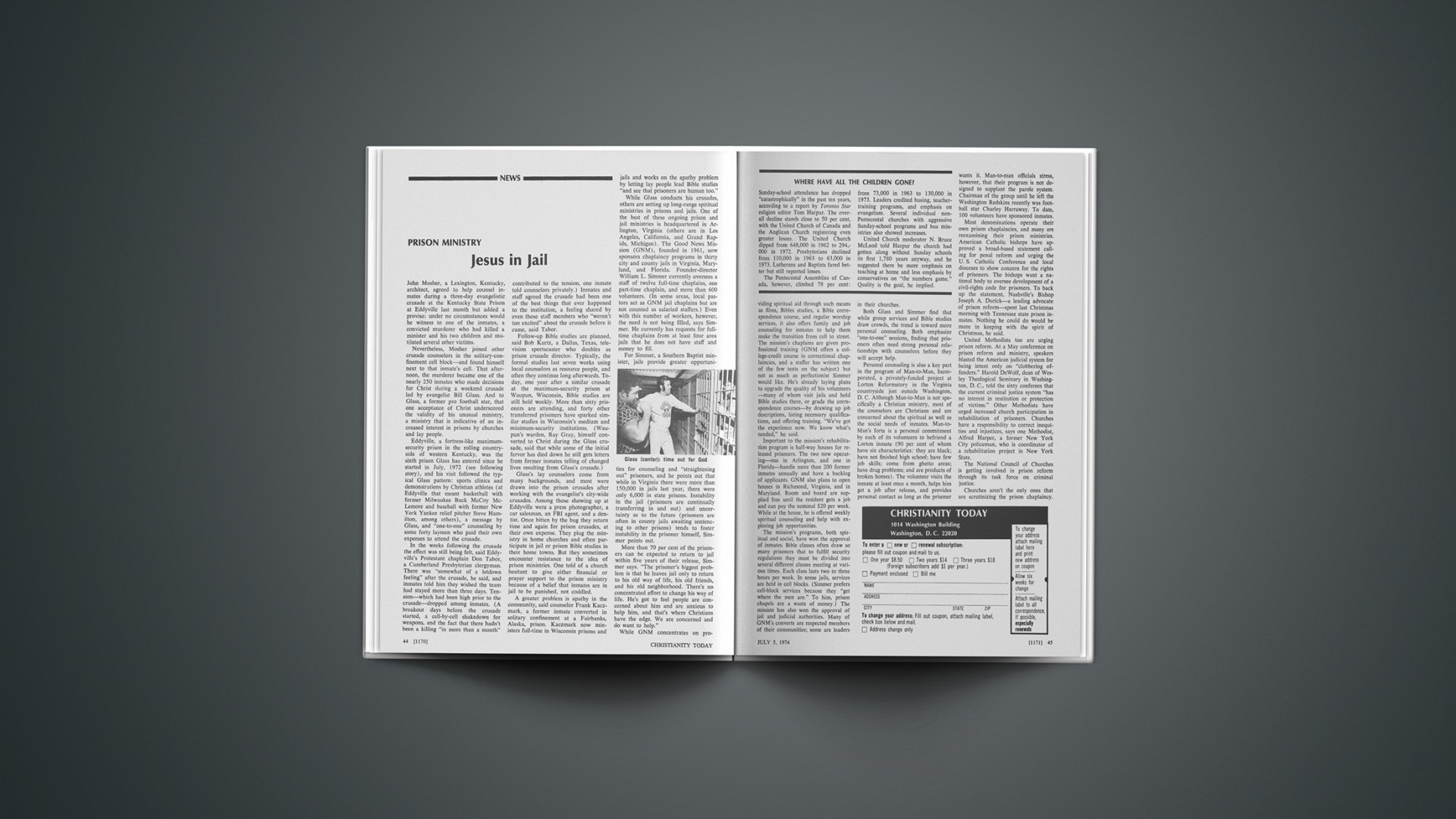
John Mosher, a Lexington, Kentucky, architect, agreed to help counsel inmates during a three-day evangelistic crusade at the Kentucky State Prison at Eddyville last month but added a proviso: under no circumstances would he witness to one of the inmates, a convicted murderer who had killed a minister and his two children and mutilated several other victims.

Nevertheless, Mosher joined other crusade counselors in the solitary-confinement cell block—and found himself next to that inmate’s cell. That afternoon, the murderer became one of the nearly 250 inmates who made decisions for Christ during a weekend crusade led by evangelist Bill Glass. And to Glass, a former pro football star, that one acceptance of Christ underscored the validity of his unusual ministry, a ministry that is indicative of an increased interest in prisons by churches and lay people.

Eddyville, a fortress-like maximum-security prison in the rolling countryside of western Kentucky, was the sixth prison Glass has entered since he started in July, 1972 (see following story), and his visit followed the typical Glass pattern: sports clinics and demonstrations by Christian athletes (at Eddyville that meant basketball with former Milwaukee Buck McCoy McLemore and baseball with former New York Yankee relief pitcher Steve Hamilton, among others), a message by Glass, and “one-to-one” counseling by some forty laymen who paid their own expenses to attend the crusade.

In the weeks following the crusade the effect was still being felt, said Eddyville’s Protestant chaplain Don Tabor, a Cumberland Presbyterian clergyman. There was “somewhat of a letdown feeling” after the crusade, he said, and inmates told him they wished the team had stayed more than three days. Tension—which had been high prior to the crusade—dropped among inmates. (A breakout days before the crusade started, a cell-by-cell shakedown for weapons, and the fact that there hadn’t been a killing “in more than a month” contributed to the tension, one inmate told counselors privately.) Inmates and staff agreed the crusade had been one of the best things that ever happened to the institution, a feeling shared by even those staff members who “weren’t too excited” about the crusade before it came, said Tabor.

Follow-up Bible studies are planned, said Bob Kurtz, a Dallas, Texas, television sportscaster who doubles as prison crusade director. Typically, the formal studies last seven weeks using local counselors as resource people, and often they continue long afterwards. Today, one year after a similar crusade at the maximum-security prison at Waupun, Wisconsin, Bible studies are still held weekly. More than sixty prisoners are attending, and forty other transferred prisoners have sparked similar studies in Wisconsin’s medium and minimum-security institutions. (Waupun’s warden, Ray Gray, himself converted to Christ during the Glass crusade, said that while some of the initial fervor has died down he still gets letters from former inmates telling of changed lives resulting from Glass’s crusade.)

Glass’s lay counselors come from many backgrounds, and most were drawn into the prison crusades after working with the evangelist’s city-wide crusades. Among those showing up at Eddyville were a press photographer, a car salesman, an FBI agent, and a dentist. Once bitten by the bug they return time and again for prison crusades, at their own expense. They plug the ministry in home churches and often participate in jail or prison Bible studies in their home towns. But they sometimes encounter resistance to the idea of prison ministries. One told of a church hesitant to give either financial or prayer support to the prison ministry because of a belief that inmates are in jail to be punished, not coddled.

A greater problem is apathy in the community, said counselor Frank Kaczmark, a former inmate converted in solitary confinement at a Fairbanks, Alaska, prison. Kaczmark now ministers full-time in Wisconsin prisons and jails and works on the apathy problem by letting lay people lead Bible studies “and see that prisoners are human too.”

While Glass conducts his crusades, others are setting up long-range spiritual ministries in prisons and jails. One of the best of these ongoing prison and jail ministries is headquartered in Arlington, Virginia (others are in Los Angeles, California, and Grand Rapids, Michigan). The Good News Mission (GNM), founded in 1961, now sponsors chaplaincy programs in thirty city and county jails in Virginia, Maryland, and Florida. Founder-director William L. Simmer currently oversees a staff of twelve full-time chaplains, one part-time chaplain, and more than 600 volunteers. (In some areas, local pastors act as GNM jail chaplains but are not counted as salaried staffers.) Even with this number of workers, however, the need is not being filled, says Simmer. He currently has requests for full-time chaplains from at least four area jails that he does not have staff and money to fill.

For Simmer, a Southern Baptist minister, jails provide greater opportunities for counseling and “straightening out” prisoners, and he points out that while in Virginia there were more than 150,000 in jails last year, there were only 6,000 in state prisons. Instability in the jail (prisoners are continually transferring in and out) and uncertainty as to the future (prisoners are often in county jails awaiting sentencing to other prisons) tends to foster instability in the prisoner himself, Simmer points out.

More than 70 per cent of the prisoners can be expected to return to jail within five years of their release, Simmer says. “The prisoner’s biggest problem is that he leaves jail only to return to his old way of life, his old friends, and his old neighborhood. There’s no concentrated effort to change his way of life. He’s got to feel people are concerned about him and are anxious to help him, and that’s where Christians have the edge. We are concerned and do want to help.”

While GNM concentrates on providing spiritual aid through such means as films, Bibles studies, a Bible correspondence course, and regular worship services, it also offers family and job counseling for inmates to help them make the transition from cell to street. The mission’s chaplains are given professional training (GNM offers a college-credit course in correctional chaplaincies, and a staffer has written one of the few texts on the subject) but not as much as perfectionist Simmer would like. He’s already laying plans to upgrade the quality of his volunteers—many of whom visit jails and hold Bible studies there, or grade the correspondence courses—by drawing up job descriptions, listing necessary qualifications, and offering training. “We’ve got the experience now. We know what’s needed,” he said.Important to the mission’s rehabilitation program is half-way houses for released prisoners. The two now operating—one in Arlington, and one in Florida—handle more than 200 former inmates annually and have a backlog of applicants. GNM also plans to open houses in Richmond, Virginia, and in Maryland. Room and board are supplied free until the resident gets a job and can pay the nominal $20 per week. While at the house, he is offered weekly spiritual counseling and help with exploring job opportunities.

The mission’s programs, both spiritual and social, have won the approval of inmates. Bible classes often draw so many prisoners that to fulfill security regulations they must be divided into several different classes meeting at various times. Each class lasts two to three hours per week. In some jails, services are held in cell blocks. (Simmer prefers cell-block services because they “get where the men are.” To him, prison chapels are a waste of money.) The mission has also won the approval of jail and judicial authorities. Many of GNM’s converts are respected members of their communities; some are leaders in their churches.

Both Glass and Simmer find that while group services and Bible studies draw crowds, the trend is toward more personal counseling. Both emphasize “one-to-one” sessions, finding that prisoners often need strong personal relationships with counselors before they will accept help.

Personal counseling is also a key part in the program of Man-to-Man, Incorporated, a privately-funded project at Lorton Reformatory in the Virginia countryside just outside Washington, D. C. Although Man-to-Man is not specifically a Christian ministry, most of the counselors are Christians and are concerned about the spiritual as well as the social needs of inmates. Man-to-Man’s forte is a personal commitment by each of its volunteers to befriend a Lorton inmate (90 per cent of whom have six characteristics: they are black; have not finished high school; have few job skills; come from ghetto areas; have drug problems; and are products of broken homes). The volunteer visits the inmate at least once a month, helps him get a job after release, and provides personal contact as long as the prisoner wants it. Man-to-man officials stress, however, that their program is not designed to supplant the parole system. Chairman of the group until he left the Washington Redskins recently was football star Charley Harraway. To date, 100 volunteers have sponsored inmates.

Most denominations operate their own prison chaplaincies, and many are reexamining their prison ministries. American Catholic bishops have approved a broad-based statement calling for penal reform and urging the U. S. Catholic Conference and local dioceses to show concern for the rights of prisoners. The bishops want a national body to oversee development of a civil-rights code for prisoners. To back up the statement, Nashville’s Bishop Joseph A. Durick—a leading advocate of prison reform—spent last Christmas morning with Tennessee state prison inmates. Nothing he could do would be more in keeping with the spirit of Christmas, he said.

United Methodists too are urging prison reform. At a May conference on prison reform and ministry, speakers blasted the American judicial system for being intent only on “clobbering offenders.” Harold DeWolf, dean of Wesley Theological Seminary in Washington, D. C., told the sixty conferees that the current criminal justice system “has no interest in restitution or protection of victims.” Other Methodists have urged increased church participation in rehabilitation of prisoners. Churches have a responsibility to correct inequities and injustices, says one Methodist, Alfred Harper, a former New York City policeman, who is coordinator of a rehabilitation project in New York State.

The National Council of Churches is getting involved in prison reform through its task force on criminal justice.

Churches aren’t the only ones that are scrutinizing the prison chaplaincy. In New York City, twenty-eight part-time chaplains in city institutions were fired and replaced by a full-time “ecumenical” chaplain at each institution. The chaplains are assisted by volunteer local clergy. Massachusetts officials meanwhile are busily denying reports that they plan to phase out state prison chaplains. Newspaper reports stating the chaplains would be supplanted by social workers were branded as false by correction officials. Nevertheless, the threat is real, not only in Massachusetts but in other states as well, declare some ministers.

Max P. Metcalf, a Lutheran Church-Missouri Synod minister who is senior chaplain at New York’s Nassau County Jail, urged churches to act to “prevent the pastoral care ministry from being swept under foot by the politics of prison reform.”

Chaplains and denominational officials point out that often inmates distrust state-hired chaplains. One of the strong points of Glass’s ministry, he believes, is that inmates understand that no one pays the crusade team to be there (crusade costs run $6–10,000 and are subsidized by Glass’s evangelistic association) and that team staff and counselors visit the prison out of sheer compassion for the prisoners.

For Glass, the rewards are the murderer-turned-Christian, the rapist whose life was changed by ongoing Bible studies, and the prisoner who, after praying quietly in the prison yard with a counselor, looked up at the manned machine-gun posts of Eddyville’s fortress-like walls and said, “At last I know what real freedom is. I’m freer now than those guards who go home at night.”

WHERE HAVE ALL THE CHILDREN GONE?

Sunday-school attendance has dropped “catastrophically” in the past ten years, according to a report by Toronto Star religion editor Tom Harpur. The overall decline stands close to 50 per cent, with the United Church of Canada and the Anglican Church registering even greater losses. The United Church dipped from 648,000 in 1962 to 294,000 in 1972. Presbyterians declined from 110,000 in 1963 to 63,000 in 1973. Lutherans and Baptists fared better but still reported losses.

The Pentecostal Assemblies of Canada, however, climbed 78 per cent: from 73,000 in 1963 to 130,000 in 1973. Leaders credited busing, teacher-training programs, and emphasis on evangelism. Several individual non-Pentecostal churches with aggressive Sunday-school programs and bus ministries also showed increases.

United Church moderator N. Bruce McLeod told Harpur the church had gotten along without Sunday schools its first 1,780 years anyway, and he suggested there be more emphasis on teaching at home and less emphasis by conservatives on “the numbers game.” Quality is the goal, he implied.

Glass On God’s Turf

For Bill Glass, his current occupation of leading sinners to Christ is a far cry from his previous task of hurling his 6’6”, 250-pound frame around the National Football League.

Now, in addition to his three-day prison crusades (see preceding story), the former all-pro Cleveland Brown conducts eight-day citywide crusades, a practice he began even before quitting the game in 1969. And instead of helmets and shoulder pads, he’s equipped now with a divinity degree from Southwestern Baptist Seminary in Fort Worth, Texas. Glass, who is not ordained, studied for his degree part-time while still clobbering NFL opposition. With his new team, the Bill Glass Evangelistic Association, Glass already has held fifty-seven city and six prison crusades.

The city crusades—particularly one at Marion, Ohio, in 1972—led Glass into the prisons. A board member “challenged me to do a prison crusade just like the city crusades,” Glass said. In short order, a crusade was held at the Marion Correctional Institute. Besides Marion and Eddyville (see preceding story), Glass also held crusades at the California Correctional Institute at Tehachapi, the Ohio State Reformatory at Mansfield, the Wisconsin State Prison at Waupun, and the Men’s State Reformatory at La Grange, Kentucky. Upcoming is a September gathering at the state prison in Santa Fe, New Mexico.

Support from correction officials, especially the wardens of those prisons already visited, is a key to continuing entry, Glass believes. Waupun’s warden sent endorsements to fellow wardens around the country, and invitations are now numerous enough that the Glass team cannot fill them all. Glass and his co-workers mingle freely with inmates, spending all day with them.

Some of Glass’s former NFL teammates and opponents support his ministry. Association treasurer is Jimmie Ray Smith, a former all-pro guard for Cleveland and the Dallas Cowboys, and a leading board member is Raymond Berry, former Baltimore Colt star receiver.

BARRIE DOYLE

Catholic Pentecostals: Something New

Next year, Rome.

The announcement that the 1975 international Catholic charismatic conference will be held in Rome during Pentecost week in May elicited applause and cheers from the 30,000 gathered in the Notre Dame stadium at South Bend, Indiana, for this year’s conference. Significantly, the conference will be held at the nerve center of Catholicism in the midst of the Vatican-decreed year of evangelism. (Meetings will be held next summer at Notre Dame as they have been since the Catholic charismatic movement—or “renewal,” as its leaders prefer—got started seven years ago; the event will be billed simply as a conference for U. S. Catholics.)

Reports of rapid growth globally and an emphasis on healing, “community,” and social involvement highlighted last month’s meetings at Notre Dame.

Leaders estimate 600,000 are now involved in the renewal, double last year’s figure. About 3,000 Catholic Pentecostal prayer groups in sixty countries are registered with South Bend headquarters, and there are scores, perhaps hundreds, not yet recorded. The movement in France, for example, is growing so fast leaders can’t keep records current; some 10,000 French Catholics are involved, and leaders there say they expect that figure to quadruple within the year.

Registration for the Notre Dame conference was cut off in May at 18,500, when housing resources were depleted. Thousands more came anyway, bedding down on floors or in tents, even in their cars. Chartered and group flights came from as far away as California and Puerto Rico.

Bad weather marred two of the stadium events: rain at the Friday night healing service and unseasonably cold winds and drizzle at the Sunday afternoon evangelistic rally. Yet the people sat—and sang—through it all, the atmosphere seemingly charged with joy.

The mass healing service was perhaps a first for modern Catholicism. Scores of persons testified they were healed as they laid hands on each other in the bleachers and prayed, and as leaders on the platform called out specific ailments and declared cures were taking place. The word “miracle” was scrupulously avoided in favor of “healing”; the Catholic church has strict procedures that must be followed and documentation that must be obtained before anything can be called a miracle. Nevertheless, people said they had been cured of arthritis, poor vision, deafness, short legs, even cancer.

Leading the healing team were Father Michael Scanlan of Loretto, Pennsylvania, Father Francis MacNutt of St. Louis, and Barbara Shlemon, a Tampa nurse. Under intense questioning by incredulous reporters from the Catholic press, team members acknowledged that many of the ailments may have been psychosomatic and that verification was lacking, but they insisted the healings were valid. “It’s what I call evangelical healing,” said Scanlan. “The ultimate purpose was to build faith.” MacNutt, author of a major Catholic book on healing and a veteran on the healing-meeting circuit, said he has documentation of many remarkable healings.

Some clergymen, including Bishop Joseph McKinney of Grand Rapids, Michigan, initially expressed reservation at the style of the meeting. After a night’s sleep, McKinney said he was satisfied after all; healings come in a context of praise, he concluded.

Everyone, including the reporters, agreed that the meeting was something new for Catholicism. More attention can be expected to be given to healing in the local weekly prayer groups.

Another highlight was the Saturday night mass. To the strains of “For You Are My God” 700 robed priests, a dozen bishops, and Cardinal Leo-Josef Suenens of Belgium marched onto the field; the music gave way to sustained applause, and candles later were lit throughout the stadium. (Leaders say 80 per cent of the 700 priests have been involved in the renewal for a year or more.)

Suenens in a press conference ticked off the blessings the charismatic movement has brought to the church: a revival of Bible study, hope for visible unity, healing, renewal of parish life, social involvement. An iconoclast in some ways, a traditionalist in others, Suenens drew light applause when in a brief talk at the Sunday rally he urged the movement to keep intact Catholic allegiance to Mary and Peter (the pope).

A series of seminars and talks filled out the weekend. Members of several prayer communities reported their experiences in neighborhood evangelism. Persons in the Alleluia Community of Augusta, Georgia, told how they sold their homes to “enter into a community of goods as landlords and residents of a city block of duplex apartments” and how they have been attempting to win their neighbors to Christ.

Members of prayer groups in El Paso, Texas, and Juarez, Mexico, described their work among the poor living on the Juarez dump (literacy classes, medical services, building of a school, church, and cooperative grocery store).

Lay leader Tom Flynn outlined the growth of the movement in Ireland, where groups of Protestant and Catholic charismatics are praying together—and providing inspiration and guidance for a dozen similar groups in Northern Ireland.

The movement’s well-edited magazine, New Covenant, added 15,000 subscribers in the past year; circulation now is about 40,000. Its December issue featured last fall’s meeting of movement leaders with Pope Paul VI, who prefaced his remarks with: “We have heard so much about what is happening among you. And we rejoice.”

That attitude is contrary to a vision evangelist David Wilkerson says he saw: the Vatican booting the charismatics out of the church. Indeed, if the movement maintains its rate of growth, it may instead represent the future wave of the church—reason enough for all the applause when someone announced, “Next year, Rome.”

EDWARD E. PLOWMAN

Salvation Isn’T Everything

Social reform, strides toward freedom, and securing of peace are actions that Christians must take, but they do not define salvation, a Finnish Lutheran-Russian Orthodox dialogue group concluded in meetings at Jarvenpaa, Finland.

The group was critical of papers produced at the 1973 World Council of Churches Conference on Salvation Today in Bangkok. Christians have a duty to abolish poverty and oppression, said the group in agreeing with a conference statement, but “we cannot approve of the fact that both in the Bangkok conference’s discussions and in its final communique the salvation of man through the Gospel of Christ as well as his moral fulfillment were … inadequately dealt with.”

The Russian Orthodox participants were led by Archbishop Vladimir of Dmitrov, dean of the Moscow Spiritual Academy. (Last summer the Orthodox Patriarchate of Moscow voiced similar objections to the WCC, indicating his belief that a false view of salvation came out of Bangkok.)

The dialogue group also discussed peace, urging churches to repulse attempts to use the Bible to justify racism, colonialism, economic oppression, and selfish political aims.

Palau In Spain

City-wide evangelistic campaigns are new to modern Spain. Even with the Law of Religious Liberty passed in 1967 there have been few attempts to hold mass meetings. Permission for evangelicals to use theaters and meeting halls comes only after much patient work if at all. But as a prelude to the Iberian Congress on Evangelism last month, five evangelical churches in Seville with some 300 members joined hands to sponsor a five-day crusade featuring Argentine evangelist Luis Palau. The meetings were held in the city-owned theater “Lope de Vega,” a stone’s throw from where evangelical Christians were burned alive in the sixteenth century. In all, there were about 120 professions of faith.

It was the first such public campaign in the Andalucian capital since May, 1932, when two popular evangelists, Carlos Arujo and Miguel Aguilara, issued their “Manifesto to the Spanish People.” One of the sponsoring churches of the present campaign traces its roots directly to those meetings.

Spot announcements on two radio stations, thousands of posters along major streets, and a house-to-house distribution program helped create awareness of an evangelical presence. Special music was provided by a united choir and musical groups from as far away as Madrid, where the Iberian Congress was to be held. Among the hundreds of Sevillanos who turned out to hear Palau were a member of the Spanish Cortes (parliament) and the owner of one of the largest chains of radio stations in Spain. On the last night a high official of the secret police, present to check up on the meetings, indicated he was deeply moved by Palau’s prayer for the leadership of Spain. Seeking out the evangelist after the meeting, he assured him of more cooperation in the granting of permission for such meetings in the future. Also the mayor received Palau and representatives of the church for a brief visit.

A young radio announcer became especially interested and aired five interviews on the local station. One interview dealt with a day in the life of an evangelical pastor in Spain, and the questions opened the way naturally for a strong statement of evangelical witness.

DALE G. VOUGHT

World Scene

After a late check on advance reservations and firm commitments, Campus Crusade for Christ’s Explo ’74 staff estimated a minimum attendance of nearly 500,000 for the event next month in Seoul. Some 30,000 are expected to march to Explo from villages throughout South Korea.

Father Dmitri Dudko, a Russian Orthodox priest whose Saturday-night question-answer sessions in church were attended by many intellectuals and young people (see June 7 issue, page 47), apologized to church officials for “disobedience.” He had resigned as pastor of Moscow’s St. Nicholas Church after being ordered to halt the sessions (in which he sometimes criticized the Soviet system). The men who led him to his car the night he resigned apparently were friends, not secret police, as reporters had first surmised.

Israel’s Orthodox-oriented National Religious party has refused to be a part of Prime Minister Yitzhak Rabin’s coalition government. NRP leaders say they will join only if the government will sponsor legislation to amend the Law of Return to recognize as valid only those conversions to Judaism performed by Orthodox rabbis.

Leading churchmen in South Africa have criticized the no-strings-attached gift of $5,000 by the All African Conference of Churches (AACC) to liberation movements. Also, Moderator J. D. Vorster of South Africa’s largest Dutch Reformed Church (NGK) took issue with AACC general secretary Canon Burgess Carr, who told the recent AACC assembly that God had sanctified violence. “I know of no source in the Bible for this viewpoint,” said Vorster.

The Assemblies of God denomination approved 68 candidates for foreign missions work last year. There are now 1,102 AOG missionaries in 93 countries and 109 overseas Bible training schools with more than 6,000 students enrolled. The AOG’s overseas constituency has doubled in the last six years.

Southern Baptists: Unity the Priority

Watergate, women, Weber, and The Wonderful World of Disney.

Those were four of the topics considered at last month’s 117th annual meeting of the Southern Baptist Convention in Dallas, attended by a record 18,000-plus messengers (delegates).

Watergate was alluded to in several talks and a resolution. Pastor Edwin Young of the 4,300-member First Baptist Church of Columbia, South Carolina, issued a stinging rebuke of President Nixon in a speech to SBC pastors. He called the transcripts “one of the most pornographic, vulgar, and blasphemous documents” he’s ever read. Not once, said Young, does one find in the tapes the President asking “What is right?” “What is moral?” “What is honest?” Young was given generous applause after the Watergate reference, but later he was also given some stiff reprimands privately by the opposition.

Introduced as a committed Christian, Texas governor Dolph Briscoe declared that when government departs from the principles of justice, equality, and morality, “it ceases to serve the people.” He said ministers can play a vital, dominant role in building a state and nation that is “dedicated to the best interests of all the people.”

Pastor W. A. Criswell of the Dallas First Baptist Church lamented the President’s language. Georgia governor Jimmy Carter, an active SBC layman (he’s a deacon and Sunday-school teacher in Atlanta), predicted Nixon will be impeached. He chided Christians for lack of involvement: “There has never been an adequate role played by Christians in this nation … in shaping the standards and quality of public life.”

Vice President Gerald Ford, however, evoked thunderous applause at a laymen’s meeting when he said he’d prefer to speak on what’s right about America.

Without debate the messengers passed a mildly-worded Christian Life Commission (CLC) resolution calling for morality in government and urging “that when there is gross failure … legal procedures be scrupulously followed in assessing guilt and removing from office those judged guilty.”

On the matter of women, messengers wavered somewhat. They rejected a constitutional amendment by a Texas man which would have forbidden SBC boards and agencies from endorsing anyone but men to the military and institutional chaplaincy. But they also tabled a CLC recommendation that SBC agencies and churches elect “women to positions of leadership for which God’s gifts and the Holy Spirit’s calling equip them.” Observers said some feared the measure tacitly endorsed women as deacons and pastors. (About one dozen women have been ordained to the ministry by local SBC churches, a source of agitation to many other churches.) Additionally, the messengers turned down a CLC proposal that at least 20 per cent of the membership on SBC boards be women.

THE NEW PRESIDENT

A last-minute dark-horse candidate, Jaroy Weber, 52, was as surprised as anybody when he was elected president of the Southern Baptist Convention. But he’s not exactly an unknown. He is pastor of the 9,700-member First Baptist Church of Lubbock, Texas, the SBC’s second largest, and for the past year he was president of the SBC Pastors’ Conference. Earlier, he served pastorates in Alabama, Louisiana, and elsewhere in Texas, and at one time he was evangelism secretary for the Louisiana Baptist Convention.

A graduate of Fort Worth’s Southwestern Seminary, he describes himself as a “conservative, Bible-believing preacher.” He favors a new name for the SBC, thinks women have been great for the church but isn’t ready to see any ordained as deacons in his church, and sees no theological storm clouds that might disrupt the SBC. As for goals, he wants to see the SBC push on in evangelism.

Relatedly, the convention overwhelmingly reaffirmed a 1971 resolution approving abortion in cases of “rape, incest, clear evidence of likelihood of damage to the emotional, mental, and physical health of the mother.” An outright anti-abortion proposal was referred to next year’s convention.

In a surprise of sorts, Lubbock pastor Jaroy Weber was elected SBC president (see box, this page), defeating in the run-off Kenneth L. Chafin, a Houston pastor and former evangelism professor and executive. Weber was nominated by prominent Memphis pastor Adrian Rogers, a board member of the Baptist Faith and Message Fellowship (BFMF), a small group of SBC pastors and laypersons concerned about doctrinal purity in SBC seminaries and printed materials. Some thus saw Weber as “BFMF’s man,” but several BFMF leaders, while expressing approval of Weber, said they had voted for Wichita Falls (Texas) pastor Landrum P. Leavell, who was among those defeated on the first ballot. (Some observers interpreted Weber’s win as essentially a backlash vote against Chafin and Leavell, both of whom allegedly politicked for months for the job.)

Weber said his only connection to BFMF is that he has friends who are members of it. In an interview he stated that he is not gunning for a fight on the seminary issue (the documentary theory of interpretation, for example, is taught in some SBC seminaries; this is the same issue at the heart of the upheaval in the Lutheran Church-Missouri Synod). There is room in the SBC for differing interpretations, he said, and any gross deviance can be looked after by the respective seminary boards. SBC unity, he added, has priority.

Among other actions, the delegates voted to ask NBC-TV to move the Sunday evening show, “The Wonderful World of Disney,” to another time or to show re-runs at another time. Most Southern Baptists, the statement said, are in training union or church services at that hour.

The convention also:

• passed a resolution on peace after deleting a statement recognizing that each individual should determine “God’s will concerning participation in war”;

• approved a statement urging SBC agencies to promote programs and establish employment practices that show “racism is theologically untenable”;

• rejected quota plans for assuring racial and ethnic representation on boards;

• elected Pastor Charles King, 78, of Frankfort, Kentucky, as second vice president, the first black in history to serve as an officer of the 12.3 million-member denomination;

• approved without debate a $40 million budget;

• approved a motion by Criswell that a committee study the possibility of changing the name of the 129-year-old body;

• tabled a measure that would have created a Commission on Evangelism separate from the home mission board (a committee is studying the issue);

• heard evangelist Billy Graham conclude the proceedings with a message before some 25,000 on Christ’s second coming.

Showers And Skinflints

Retired pastor J. D. Grey of New Orleans, a former president of the Southern Baptist Convention, at last month’s annual SBC meeting mildly rebuked another former SBC president, Pastor W. A. Criswell of the 18,000-member First Baptist Church of Dallas. Criswell, 65, had remarked during a Sunday sermon in May that he intends to return to the church “every penny” he earned in salary during his thirty years as pastor. The sum amounts to more than $600,000. He has already begun to put it into the offering plate; much of it, however, may be given posthumously as a bequest. “I have always wanted to do God’s work without any kind of financial reward,” he said.

His remark was not reported by the press until the week before the denomination’s convention in Dallas. Grey, in a speech to SBC pastors, said he was worried that “some tightfisted skinflint of a church member somewhere” might pick up the news story and try to cut his pastor’s salary, and that pastors all over the country might be hurt financially by the report. “God’s word says the laborer is worthy of his hire,” he asserted. He evoked laughter when he said, “I’m computing how much they owe me. I never was paid as much as I was worth back there in those early days.” Grey said later he objected not to Criswell’s decision but rather to his announcing it.

Criswell’s annual salary is $25,000. He owns his home, his tape cassettes and fifteen books have sold well, he fills numerous speaking engagements, and he has received many “private gifts,” from suits and automobiles to corporate stock. Along with these showers of blessing, says Criswell, “God has given me the ability to save money and to invest it wisely.”

Showers also fall upon his church, which has an annual budget in excess of $4 million and has just embarked on a multi-million-dollar expansion program, partly to provide facilities for the thriving three-year-old Criswell Bible Institute. A few days before the convention convened a lawyer telephoned and announced that a Methodist woman who had never visited the church had nevertheless bequeathed it land valued at more than $300,000. She had seen Criswell on television and was impressed by his preaching, the lawyer explained.

Canadian Presbyterians: Establishing The Priorities

The Presbyterian Church in Canada (PCC), formed in 1875 when four branches of Presbyterianism in Canada came together, began a year-long celebration of its centennial with the opening of its 100th General Assembly in Kitchener, Ontario. A capacity crowd filled St. Andrew’s Presbyterian Church (with 2,900 communicants, it’s the PCC’s largest) for the opening service, and a large overflow audience viewed proceedings on closed-circuit television at a nearby Lutheran church.

About 250 commissioners were on hand for the assembly’s study and business sessions. They unanimously chose as moderator Hugh F. Davidson, 65, stewardship and budget-promotion secretary of the church for the past fourteen years. To Davidson has gone much of the credit for the increase in the PCC’s budget from $1.5 million during his first year in office to more than $2.2 million last year. The commissioners also voted to increase the basic minimum stipend for ministers by $900 to $6,400 next January. (Twenty graduates enter the ministry this year, sixteen from Knox College in Toronto and four from The Presbyterian College in Montreal.)

His predecessor, the Reverend Ag-new H. Johnston of Thunder Bay, Ontario, suggested that the PCC moderator, largely a figurehead, from now on be encouraged to speak out for the church “even if he says the wrong thing.”

A long statement detailing the basis and purpose of the mission task of the Church sparked lively debate. Presented by a former moderator, Murdo Nicolson of Calgary, Alberta, convenor of a special committee, the statement laid down the distinctions between evangelism and social service, establishing the former as a priority. In amended form it is to go down to the synods and presbyteries for study and report to the committee on church doctrine.

A special committee report on the charismatic revival aroused debate that culminated in acceptance of the following summary as an interim statement until the whole document has been more carefully scrutinized:

A charismatic experience is an experience of the presence of Jesus Christ through the Holy Spirit in a gathering of Christians or in an individual’s personal life, and a response of enthusiasm and exaltation thereto. This experience of the presence of Jesus Christ is documented in Holy Scripture, and, therefore, has a legitimate place in the life of the Body of Christ, the Church.

The communication-services committee, criticizing the quality of television programming, urged that “all broadcasters in Canada provide television entertainment for children, presenting social values that encourage a sensitive approach to life and respect for people.”

By a strong vote the assembly agreed to continue support of the World Council of Churches’ fund to combat racism, although a number spoke in opposition.

A gift of $1,000 for youth evangelism was received from the Reverend and Mrs. Donald R. Sinclair of Guelph, Ontario, whose 19-year-old daughter was killed by Zambian soldiers on the Rhodesian border last year. The money came from interest on a trust fund that the Sinclairs set up with the ex gratia payment of $50,000 from the government of Zambia.

DECOURCY H. RAYNER

Lester Roloff: Trouble In Texas

Aiming to “put a little fear of God into the press,” evangelist Lester Roloff, 60, of Corpus Christi, Texas, last month filed libel suits totaling $35.5 million against several newspapers, reporters, and the National Broadcasting Company (NBC).

Roloff’s troubles with the press began a year ago when sixteen of the several hundred girls at his Rebekah Home for Girls in Corpus Christi signed statements complaining about the treatment they had received. Some told of beatings. One father said he saw a girl being beaten while two men held her upside down. County authorities launched an investigation and reported their findings to the state’s Department of Public Welfare (DPW), then to the attorney general’s office when no action was forthcoming by the DPW. Word was leaked to reporters; their stories led to moves by the DPW and hearings in the Texas House of Representatives.

Citing biblical grounds, Roloff candidly admitted that spankings were administered occasionally at his Texas homes, all unlicensed (Rebekah, the Anchor Home for Boys near Zapata, and the Lighthouse for Adults and Boys on Padre Island); “better a pink bottom than a black soul,” he quipped. He acknowledged that he fed the girls only two meals a day and one on Sundays, that he provided little education and no counseling or sex instruction (as required by welfare regulations), and that the girls were marched into a hall to listen to his daily broadcasts but were not permitted any other radio or television programs.

But, he pointed out, the girls—ages 12 to 18, committed by courts as delinquents or by parents—benefited by the Rebekah brand of discipline, and he introduced several girls whose testimonies backed him up. The girls were in good health, he noted, adding that the Bible was the only handbook of regulations he needed, especially since most of the girls were “problem cases.”

A court ordered Roloff nevertheless to conform to minimal DPW regulations and to obtain licenses or close. The order also enjoined Roloff’s employees from any punishment that caused physical harm to the youngsters, from withholding food, from using handcuffs, and from pulling hair. Also, boys under 16 were barred from the Lighthouse.

Meanwhile, reporter Mimi Crossley of the Houston Post ferreted out accounts of Roloff’s placement of babies born out of wedlock; these were given to adoptive parents in various states—often in violation of law. DPW officials warned Roloff he could not operate an adoption agency without a license. Roloff indicated he was concerned only that the babies be placed in the homes of believers, and he denied that money other than costs figured in placement.

The evangelist at first agreed to bring his operations up to standard and to get a license, but then he balked. Since he received no public funds, he argued, he should not be required to submit to public supervision. Many of the youths were returned home or sent elsewhere, and the Lighthouse and the Anchor Home were closed. But there were still seven girls under 18 at Rebekah when the October 1 deadline for getting a license passed.

Roloff was slapped with a $5,400 fine and ordered to jail on contempt charges. Freed on appeal, he took his case to the state supreme court which, in a technical decision in late May, ruled in his favor. The court said that the DPW had always defined children as persons under 16, that the law permits up to six children in such homes without a license, and that fewer than six under 16 were at Rebekah on October 1. Therefore, it ruled, Roloff had complied with the lower court’s order and was not guilty of contempt.

Shocked DPW officials, warning that the ruling would remove a number of child-care institutions from state supervision, said they will press for definitive legislation next year.

A few days after the ruling Roloff filed the libel suits, alleging that the reports shattered his image as a man of God “in the eyes of those who do not understand the truth.” Cited were the Houston Post and reporter Crossley ($5.5 million), the Texas Observer of Austin and reporter Molly Ivins ($5 million), the Chicago Daily News and the magazine New Times ($5 million each) for running the Ivins reports, National Spotlight of Canada ($5 million), and NBC and its correspondent Floyd Kalber ($10 million) for a January news telecast.

Roloff, an independent evangelist who broadcasts on some 100 stations, graduated from Baylor University and started out as a Southern Baptist pastor in Corpus Christi in the forties. In 1954 he left the Southern Baptists when they banned him from a Baptist-owned radio station for his “attacks against individuals, churches, schools, and denominations.” Two years later he bought the station. His current annual income is reportedly about $2 million. A licensed pilot, he flies his own plane on visits to rehabilitation facilities he still runs elsewhere in the nation.

Theology

The Big Ones

The following is a guest column by Gladys M. Hunt, author, Ann Arbor, Michigan.

For the most part we can be thankful for modern translations of the Bible that have made truth plainer and sharpened the Two-edged Sword. But some biblical concepts just can’t be simplified in translation, and the choice of a simpler word, if it is lesser in content, weakens the understanding of great truths and is unfaithful to biblical inspiration.

Justification is one such word. No one single word or phrase can translate into simpler language a concept as enormous as this. Justification by faith is the bedrock truth of our salvation. We must wrestle with its meaning. To translate it “being put right with God” or “made right in God’s sight” is not enough.

Our need to be justified implies a profound lack. Something is missing. And Paul in Romans 3 has made amply clear what it is that we lack: it is the righteousness of God. We fall short of God’s glory. We are in want, like the prodigal son in the pigsty in a foreign land. We are in want of the righteousness of God.

It isn’t just that we sinners have a few black marks against us that need to be taken care of; it is that we lack the positive quality of righteousness that could make us acceptable to God. None is righteous; no not one. Our state is desperate.

The remarkable, awe-inspiring transaction that takes place in response to our personal commitment and faith in Jesus Christ is that God gives us what we need. He gives us the righteousness of Jesus Christ. He justifies us.

Justification is not only the removal of our sins, a slate wiped clean, but a slate inscribed with the perfect righteousness of Jesus Christ. It is not a process but a legal declaration made by God: he declares us righteous by faith through the death of our Lord Jesus Christ. Surely Romans 3:24 is one of the most important verses in the Bible: We are “justified freely by his grace through the redemption that is in Christ Jesus.”

That is grace indeed: that deserving the wrath of God we should be given the righteousness of Jesus Christ. What we need most, we have been given as a gift.

Does it matter so much if the fine points of justification are not understood? Indeed, I think so. It is too great a truth to be neglected, and it profoundly affects the quality of our Christian living. How much of the instability in Christian living could be traced to failure to understand that God has done what needed doing?

On the basis of our having been given the righteousness of Christ we immediately possess three important privileges. We have peace with God (Rom. 5:1)—not the peace of God, but peace with God. The enmity has been removed. God sees believers clothed in his Son’s righteousness.

Secondly, we have access to God because we stand in this grace (Rom. 5:2). No merit of our own allows us to approach a God who is infinitely holy. No, it is the righteousness of our Lord Jesus Christ given to us as a gift that makes it possible for us to come into his presence. Therefore, we come boldly. How this should encourage our prayer life and our sense of belonging to God. We are in Jesus Christ loved and forgiven. We come to our Father as his children, standing in grace.

And thirdly, we rejoice in our hope of the glory of God. Our hope of being with him in glory is based solely on our having been justified. It is no small concept!

Righteous living is expected of those who have been given the righteousness of Jesus Christ. But unless our understanding of our position is adequate we can easily live out a kind of theology that feels it is necessary to supplement justification, as if we could add to the work of Christ or the dedication of God on our behalf.

Our personal hang-ups come when we disappoint ourselves (and, more importantly, our Lord) and serious doubts arise in us about our peace with God, our access, and our hope. Did we receive them in the first place because of our personal goodness? Satan comes to drag up our past; our conscience accuses us. We cannot tell Satan or ourselves that we are good enough for God. But we can say, “Jesus died for me and God has given me his righteousness.” And because of such grace, we go on to claim First John 1:9—“If we confess our sins, he is faithful and just to forgive us our sins, and to cleanse us from all unrighteousness.” No marvel that this beloved Apostle wrote about “grace upon grace.”

The second word we can’t afford to water down is reconciliation. The word implies that a serious break in relationship exists; it takes sin seriously. It is more than the idea of the restoration of a friendship, which could have been broken by a petty quarrel. No, we were enemies of God, and needed to be reconciled. Anything that weakens the seriousness of our sin problem lessens the wonder of our reconciliation.

Furthermore, it cost God to reconcile us. It is not that we have changed our mind about God, but that he has changed his mind about us. He has changed his mind about us because Jesus Christ died on the cross for us and took care of our heinous sin problem. Look at the cross and see what it cost God to reconcile us!

All our blessings come to us in grace because of the love of God in our Lord Jesus Christ.

The assurance this offers us as believers is worthy of meditation. We have changed our minds about God only because he first changed his mind about us. He did the reconciling, and he did it through the death of Jesus Christ.

It is God who justifies us; it is God who reconciles us.

Now if we understand all that, it seems inadequate simply to state that we have been put right with God and have been made God’s friends. That much is true. But there is so much more.

God, the just one, becomes the justifier of those who believe because of the death of Jesus Christ. He declares us righteous by his grace. He is our reconcilation.

Who is a pardoning God like thee?

And who has grace so rich and free?

Will we ever really understand it? Surely eternity will be taken up with praise and joy for such mercy and grace.

Books

Book Briefs: July 5, 1974

What’S Coming Up?

Behold I Come, by Ralph Earle (Beacon Hill, 1973, 86 pp., $1.50 pb), The Bible and Future Events, by Leon J. Wood (Zondervan, 1973, 208 pp., $2.95 pb), The King Is Coming, by H. L. Willmington (Tyndale House, 1973, 237 pp., $1.95 pb). Population, Pollution, and Prophecy, by Leslie H. Woodson (Revell, 1973, 159 pp., $4.95), Satan in the Sanctuary, by Thomas S. McCall and Zola Levitt (Moody, 1973, 120 pp., $3.95), Prophetic Problems, by C. E. Mason (Moody, 1973, 254 pp., $4.95), The Church and the Tribulation, by Robert H. Gundry (Zondervan, 1973, 224 pp., $5.95), Is This Really the End?, by George C. Miladin (Puritan-Reformed [1319 Newport-Gap Pike, Wilmington, Del. 19804], 1972, 55 pp., $1.25 pb), and A Survey of Bible Prophecy, by R. Ludwigson (Zondervan, 1973, 187 pp., $2.95 pb), are reviewed by R. Clyde McCone, professor of anthropology, California State University, Long Beach.

As international and internal problems continue to threaten the future of the nations of Western civilization, the curious and the anxious seek the predictions of the crystal ball and the stars. Others see in the Bible an outline of future socio-political and military events. Even those who look into “the more sure word of prophecy” see diverse visions of the future.

The nine books reviewed here illustrate that disagreements among “prophetic” Bible expositors continue to run along traditionally established lines. The first six books, however, show almost complete consensus in that each presents the future in the framework of the pre-tribulational rapture of the Church and the premillennial return of Christ to reign on the earth.

Ralph Earle’s Behold I Come is a brief statement without argument against opposing views. The pretrib-premil framework of events is assumed. The author’s concern is that the reader be ready for the imminent and certain coming of Jesus.

In The Bible and Future Events, Leon Wood contends strongly for the pretrib-premil position. He presents the imminence of the return of Christ in the hope of the Christian as proof against the tribulation’s preceding the rapture. By interpreting the falling away of Second Thessalonians 2:3 as departure from the earth rather than departure from the faith, he finds textual proof for the pre-tribulation rapture of the Church.

In a similar fashion Willmington in The King Is Coming defends the pretrib-premil position by marshalling a large number of Scriptures into its categories. He summarily refutes post-tribulationism by referring the reader to such Scriptures as First Thessalonians 5:9, “For God hath not appointed us to wrath, but to obtain salvation by our Lord Jesus Christ.” Many readers would see in this Scripture no necessary reference to the tribulation. The questionableness of proof by the assignment of Scriptures to the chosen categories is increased when the prophecy from Joel that Peter quoted as being fulfilled at Pentecost is used as proof of the active presence of the Holy Spirit in the tribulation after the rapture of the Church.

Modern environmental problems of population and pollution are used to introduce another pretrib-premil survey in Population, Pollution, and Prophecy by Leslie H. Woodson. The rapture of the Church is seen as temporarily relieving the population problem for those who are left behind. By identifying the king of the North as the leader of Russia, Woodson estimates that the destruction of this leader and five-sixths of his people will relieve the earth of another 300 million people. Finally, at the close of the tribulation Christ will return and slay with the sword of his mouth all Jews and Gentiles who have not been converted during the tribulation. Evidently the population problem will be solved for the next thousand years. There will be no pollution on a renovated earth during the millennium.

In Satan in the Sanctuary, McCall and Levitt present the total pretrib-premil position from the perspective of the rebuilt tribulation temple. The book’s stated purpose is “to show how the end of the world will be.” The fact that the temples of Solomon and Herod were destroyed as phophesied is presented as proof that the author’s identification of the tribulation and millennial temples is prophetically reliable. “Temple prophecy” thus becomes proof for the pretrib-premil interpretation.

Mason, in Prophetic Problems, is aware that many of the arguments by his pretrib-premil colleagues are not defensible. As a member of “the loyal opposition” he hopes to strengthen, not challenge, this position. His concern is that some teachings of pretrib-premil scholars “play into the hands” of opposing positions and “work against and not for premillennialists in our disagreement with amillennialists.” Among the teachings he regards as vulnerable is the idea of a single endtime Antichrist.

The issue of post-tribulation vs. pre-tribulationism among premillennialists is supported by extensive Scripture reference and logically convincing argument in Gundry’s The Church and the Tribulation. He presents a biblical case against the imminence of Christ’s return and thus disarms the pretrib argument. Gundry also points out an inconsistency of the pretrib position: The Holy Spirit as the restraining factor before the tribulation is removed with the rapture of the Church so that the Man of Sin can be revealed, and then the Holy Spirit continues to carry on a much more effective evangelism during the tribulation without faintly hindering the free hand of the Antichrist during this period.

Since both pretrib and posttrib premillennialists are committed to locating Daniel’s seventieth week at the end of the age, neither Gundry nor Mason considers the logical possibility that the source of their conflicting ideas may be in the tribulation concept itself. At this point, as tribulationists, they join ranks against all opponents. One opponent, George Miladin, in Is This Really the End?, dares to question the idea of an amputated seventieth week of Daniel projected down to the end of the age. This short essay is an attempt to give the reader a positive non-dispensational eschatological system that does not overwhelm him with a plethora of controversial details about endtime events. Miladin finds the use made of Daniel’s seventieth week by tribulationists the chief source of unscriptural speculation. The importance to the tribulationists of their interpretation of the seventy weeks of Daniel is indicated by Willmington when he describes it as “the most important, the most amazing, and the most profound single prophecy in the entire Word of God.” Miladin’s brief essay deserves the serious consideration of those who may believe that they have the inside track on the future history of planet earth. It will be welcomed by many who are confused by diverse biblical chartings of the future. Miladin’s protest against the idea of the return to the types and shadows of animal sacrifice is shared by many Christians.

In the preface to Ludwigson’s A Survey of Bible Prophecy, Wilbur Smith observes:

There have always been … differences of opinion regarding some of the basic doctrines of the Christian faith.… But in no area have these diversities been so many, and so pronounced as in the area of Biblical prophecy, especially those prophecies which point to events still in the future.

Ludwigson, in this update of a former work, has made available a useful analysis of the major divergent views of prophecy in terms of the categories commonly used.

It would be incorrect to leave the impression that all is conflict in the study of Bible prophecy. There is, of course, a degree of consensus within each of the divergent schools of prophetic thought. But beyond this Miladin has expressed four eschatological certainties with which it would seem most Christians would agree. They are:

1. Jesus is coming.

2. Since the time of Christ we have been living in the last days.

3. This age is characterized by revival and reformation on the one hand and by decadence and decline on the other.

4. Watching and waiting is the scriptural stance of endtime people.

It will be observed that these certainties have little to do with a predictive outline of future events.

If deep-seated disagreements over future events are confusing to many Christians, and if, as some have observed, they could be a laughingstock to unbelievers who chance to read prophetic books, then it would seem that “prophetic” Bible expositors could afford to withdraw, at least briefly, from their somewhat polemic positions to ask themselves, “Is this what Bible prophecy is really all about?” It might be worth the time out to consider this anthropological suggestion: The roots of disagreement among interpreters of Bible prophecy may be in the culture of Western man.

Our Greek cultural heritage establishes in our minds unconscious postulates that lead us to order and understand human events in the lineal time scale of history. Both the Old and New Testaments came through those who did not share the Greek motivations and philosophical foundations of the West. If this is true, then the attempt to identify from divine revelation specific socio-political events within a detailed outline of future historical sequence may not be in line with the purpose for which these Scriptures were written. A number of the authors in the books reviewed here have all too briefly recognized this fact on occasions when their efforts ran into difficulties.

Wood expressed the possibility that in certain sections of the Mt. Olivet prophecy “chronological sequence is not pertinent.” More explicitly Mason observed, “It has been almost uniformly assumed that because we in the Western world have a habit of writing things sequentially and chronologically, this must be the Bible’s way of writing.” He then pointed out the obvious fact that the Book of Revelation is not written in the framework of chronological sequence. Gundry also recognized that the “Semitic style of Revelation” is not similar to Western thought:

Chronologically, the apocalyptic visions dart back and forth with a swiftness that sometimes bewilders our Western minds.… The Semitic and apocalyptic character of Revelation forbids, then, our assuming that the seals, trumpets, and bowls follow one another in smooth succession.

And yet, both Mason and Gundry then forge ahead to devote their Western genius to unraveling the Semitic character of Revelation and rearranging it into a “historicized” future demanded by Western thought. A part of this “historicization” is usually disguised under the misleading label “literal interpretation.”

Miladin’s contribution at this point must not be passed by. He introduces the concept of the prophetic parable by which accounts are understood to illustrate a great truth rather than to refer to any specific historical event. This concept is then not really preterist or futurist but regards prophecy as directly relevant to the experience of every generation in every century. The prophetic parable is far more than the interpretational crutch of allegory. It leans rather in the direction of understanding Semitic thought.

Jesus pointed out that the prophecies regarding his first coming spoke of himself and of the events that must come to pass, i.e., his crucifixion and resurrection (see Luke 24:25–46). Revelation, the climaxing book of the Bible, presents prophecy also as the “revelation of Jesus Christ … to show unto his servants the things that must come to pass.” The revelation of Christ in the midst of the churches focuses our attention on the must of world evangelism (Rev. 1–3). The revelation of Christ on the mediatorial throne assures us that “he must reign until his enemies be made his footstool” (Rev. 4–11). The focus throughout Revelation is on the unveiling of Christ; the events that must come to pass are Christological promises, not “crystallogical” predictions.

The speculative character of Western thought requires the use of assumptions to arrange phenomena into its explanations of science or history. Similarly basic assumptions characterize “prophetic systems” that attempt to construct the biblical order of future events. Gundry refers to two postulates that all tribulationists accept and adds a third that characterizes only pre-tribulationists. Pre-tribulationist assumptions are inherent in Mason’s reference to “the boundaries of an agreed order of events.” When portions of the Bible are selected out as “prophetic” Scriptures according to culturally inspired assumptions and organized on the basis of diverse sets of postulates into historical explanations of future events, no level of scholarship, no degree of fidelity to the canons of hermeneutics, no amount of Bible study, no depth of Christian consecration, will enable the competing schools of thought to arrive at a consensus. As a result, the assurance of the angels, “This same Jesus … shall so come in like manner as ye have seen him go,” and the cry of the Christian, “Even so come Lord Jesus,” become confused with Western man’s carnal and cultural concerns about the future.

The Lower East Side

So Long Sweet Jesus, by Bill Milliken, (Prometheus, 1973, 187 pp., $5.95), is reviewed by Thomas Howard, associate professor of English, Gordon College, Wenham, Massachusetts.

There is one sense in which nobody except the author or someone who has been with him through every stage of the experience related in this book can “review” it. My trying to make some comments about it is a bit like someone from the tranquility of his fastness in the Vermont hills commenting on some war correspondent’s reports from Anzio beachhead, or Khe San. Except that I live among the woods and fields north of Boston, and Bill Milliken writes about the Lower East Side of New York City.

That is the locale of this odyssey, for that is what it is. The events—and a terrifying sequence they are—are all points, or phases, in the unfolding of consciousness in a Christian who is trying to obey Christ. The obedience is not merely the technical one of getting the right vocation (“Lord, do you want me as a parson or as an actuary?”) or the right geography (“Ultima Thule or Grosse Point, Lord?”). It is the much more gritty business of trying, daily, in threatening situations, to understand exactly what is asked of a man who is committed to Christ and his Gospel. And again, the threat itself is not simply the external one posed by knives, pistols, and fists (and this story is full of them); nor is it even simply the more internal one posed by the assault on one’s self-esteem and good intentions by bitter and violent colleagues (and the story is full of that, too). Rather, it is the far more radical threat to one’s whole understanding of himself and of God, and the awful possibility that one has got the whole thing wrong, or, worse, has got it right enough but lacks the courage and integrity to follow through.

That is the thing that impressed me about this account. There are at least two inviting places at which Bill Milliken could have stopped in his odyssey. He could have stopped with his early, easy, respectable apprehension of Jesus (whom he calls “the Jolly Green Giant” Jesus); or again, he could have stopped, after a tempestuous voyage through the turbulence and shoals of Young Life work among blacks, Puerto Ricans, and spaced-out East Village drug cultists and Maoists, with the “other” Jesus—the Jesus made over into the image of the angry revolutionary, the two-fisted, harsh Jesus who loves only blacks and radicals, and detests suburbanites and Republicans.

But Milliken pressed on—or was pressed on, perhaps. Circumstance after circumstance, encounter after encounter, flogged him along. You meet quite an array of people in this account—Watson and Eddie and Bobo and Chino and Santos and Gia; and Jean, Bill’s wife; and Dean Borgman and Tim Hansel and Clarence Jordan. By their anger, their love, their wisdom, their humanness, their own struggles, and their relationship with Bill, they became helpers on his pilgrimage. And he, for his part, because he did not pack it all in but kept going, has become a helper on the pilgrimage of who knows how many human beings, including at least one book reviewer.

Qualified Usefulness

The Evangelical Renaissance, by Donald G. Bloesch (Eerdmans, 1973, 165 pp., $2.95 pb), is reviewed by Ronald J. Sider, dean and associate professor of religion and history, Messiah College, Philadelphia, Pennsylvania.

With the belated recognition that resurgent evangelicalism constitutes a new religious majority in American Protestantism, a flood of new analyses has recently appeared. Among the more astute and useful of these is The Evangelical Renaissance by the professor of theology at Dubuque Seminary. In the first two chapters (which should have been combined to avoid repetition), Bloesch briefly presents evidence to support the thesis of a genuine renaissance and then offers an initial evaluation. Three subsequent chapters deal with evangelical theology, Barth’s importance for evangelicals, and the significance of our pietist heritage.

Bloesch wants to help shape the new movement that is now emerging. He hopes for a “catholic evangelicalism” open for ecumenical dialogue with other traditions from which it can learn and to which it can contribute. Hence in part his critical appreciation of Barth. He wants a strengthened emphasis on the devotional life. Hence in part his highly positive treatment of Pietism. And he hopes to temper what he considers both a dangerous tendency toward a rationalistic apologetic in some circles and also the continuing identification of a conservative position on biblical authority with “wooden literalism” and “divine dictation.”

The excellent treatment of Pietism may help foster a much needed reassessment. Bloesch devotes one-third of the book to the correction of false impressions of Pietism and a successful demonstration of Pietism’s historical connection and significant contribution to contemporary evangelicalism. (His analysis is an important corrective to the one-sided genealogy offered in Bernard Ramm’s The Evangelical Heritage.) In addition to Pietism’s outstanding contributions in such areas as missions and the devotional life, it also contained a major emphasis on social concern. “Evangelicals today who simply say that belief in the gospel is the only answer to the social crisis without pressing for corrective legislation are not being true to their own [Pietist] heritage,” says Bloesch.

In spite of this and several other positive references to social concern (on p. 26, the recovery of the social implications of the faith is one of the “signs of hope”), Bloesch both tends to ignore the growing movement of evangelical social concern and also repeats inadequate theological formulas. He fails to transcend an unbiblical spiritual-secular dichotomy that labels prayer and evangelistic proclamation as “spiritual” and social action as “secular.” “Whatever you do, in word or deed, do everything in the name of the Lord Jesus” (Col. 3:17). Nor it is helpful to say that “the primary task of the church is to convert individuals.” It was precisely this type of formulation that contributed to earlier controversies from which all sides emerged with a partial, one-sided (and therefore heretical) message. It is time for evangelicals to refuse to use sentences that begin with “the primary task of the Church is …” regardless of whether the sentence ends with worship or evangelism or Bible teaching or “social concern.” They are all integral, necessary aspects of the Church’s task. If we are to remain faithful to the Bible and avoid new divisions, we must forsake formulations that suggest that any one of these tasks is “primary” and the others are “secondary” and therefore to be done in our spare time.

Nor can I accept Bloesch’s view that social service is integral to the Church’s task but social action is not. Is it really more “spiritual” or more in keeping with Jesus and the prophets to man the ambulances that pick up the bloody victims of destructive social structures than to work to change the structures themselves? Was it more spiritual to nurse Sri Lanka’s hospitalized malaria victims than to persuade governments to drain the swamps where the malaria carrying mosquitoes bred?

In spite of weaknesses, however, the book deserves wide circulation.

NEWLY PUBLISHED

Bright Shadow of Reality: C. S. Lewis and the Feeling Intellect, by Corbin Scott Carnell (Eerdmans, 180 pp., $2.95 pb). In what was originally a doctoral dissertation Carnell explores the ideas of sehnsucht and the numinous in Lewis’s writing. Provides a basic introduction to these two important concepts in Lewis’s philosophy.

Living Together in a World Falling Apart, by Dave and Neta Jackson (Creation, 304 pp., $1.95 pb). If you’ve wondered about the inner day-by-day workings of evangelical communal living, this is the book for you. Active participants in several communities, the authors chat about goals, duties, roles, money, marriage, and parenthood. Includes addresses of two dozen communities.

A Church For Sinners, Seekers, and Sundry Non-Saints, by Arthur Tennies (Abingdon, 144 pp., $4.50). Personal observation on the gap between what Christians should be like and what they actually are. Refreshingly honest and thought-provoking.

Creative Ways to Worship, by James L. Christensen (Revell, 256 pp., $5.95). Numerous fresh ideas including poems, role-playing, and dialogues for small groups, church worship services, communion, sermons, and funerals. Worth a look.

The Devil and Mr. Smith, by Hershel Smith (Revell, 192 pp., $2.95 pb). Perhaps excessively alluring autobiographical account by an ex-Satan-worshiper who now heads Teen Power, a ministry seeking to warn against occultism and aid those entrapped by it.

Jesus: The Fact Behind the Faith, by C. Leslie Mitton (Eerdmans, 152 pp., $2.95 pb). Designed for the layman with little knowledge of the theologians’ debate over the historical Jesus. Provides a general background and then builds a case for substantial authenticity. Useful as far as it goes.

Agency and Urgency, by Thomas E. Wren (Precedent [160 Fifth Ave., New York, N. Y. 10010], 169 pp., $7.50). A philosophical analysis of the concepts used to formulate rights and obligations over the centuries of Judeo-Christian civilization. Aimed not at specific issues but the underlying approaches. Raises profound questions about the basis for morality in a secularistic culture.

One Home Under God, by Jack R. Taylor (Broadman, 157 pp., $4.95). A best-selling author and prominent Southern Baptist pastor tells how in the midst of external blessing an internal crisis was developing in his home life (an all too common ministerial hazard) and how by God’s grace this has been resolved. Biblical submission—the mutual kind—is stressed.

Encountering Darkness, by G. A. ffrench-Beytagh (Seabury, 283 pp., $6.95). Autobiographical account of the South African Anglican leader’s ordeal resulting from charges of terrorism and Communism because of his activities in opposition to apartheid. Serious reflection on the political and moral situation in South Africa. The extreme depravity of the professedly “Calvinist” rulers of that land is depressingly evident.

Calling For Christ, by Luther Cook (Moody, 127 pp., $1.95 pb). A thorough and easy-to-assimilate guide to door-to-door evangelism. Very practical do’s and don’ts and samples.

The Church: United or Untied?, by Leslie Woodson (Zondervan, 156 pp., $1.25 pb). A thoughtful evangelical reflection on relations with Judaism and other non-Christian religions, Catholicism, and Protestant ecumenism, and on how local congregations should function.

Church Growth in Japan, by Tetsunao Yamamori (William Carey, 185 pp., $4.95 pb). Documented study of eight Protestant denominations from 1859 to 1939.

The Christian Home in the Seventies, edited by George W. Knight (Broadman, 126 pp., $1.50). Brief accounts of experiences of seventeen families originally reported in the Southern Baptist periodical Home Life.

Christ in the Home, by Robert R. Taylor, Jr. (Baker, 282 pp., $3.95 pb). A Church of Christ minister presents a comprehensive look at biblical precepts and examples pertinent to marriage and the family.

2700 Quotes for Sermons and Addresses compiled by E. C. McKenzie (Baker, 140 pp., $1.95). Serious one-liners on scores of topics from ability to zeal. Samples: “There are no idle rumors. They are all busy.” “Be bold in what you stand for but careful in what you fall for.”

Tradition And Innovation

Faith and Morality in the Secular Age, by Bernard Häring (Doubleday, 1973, 237 pp., $6.95), is reviewed by Herbert C. Bradshaw, editorial-page editor of the “Durham Morning Herald,” Durham, North Carolina.

The spiritual indifference and unconcern commonly attributed to the influence of this secular age present formidable barriers to the Christian witness. So potent are they that a few years ago some were labeling this the post-Christian era. Later, extremes of this attitude found expression in the “death-of-God” cult. Bernard Häring, a distinguished Roman Catholic theologian, offers a thoughtful and challenging analysis of this problem and proposes a solution in Faith and Morality in the Secular Age.

Building his thesis on the solid orthodoxy of such premises as “time cannot alter the spirit, truth, and intrinsic value of Christian morality” and “the raison d’etre of the Church is the proclamation of any testimony to the kingdom of God,” Father Häring argues cogently for presenting the message in terms (vocabulary, liturgy, structure, organization) understandable to the age in which it is proclaimed.

In distinguishing between secularization and secularism, Häring finds that the former in one sense helps the Church by freeing it for its primary mission and in another sense is a neutral force in regard to religion. Secularism, however, is antagonistic toward the Church and spiritual concerns. In Häring’s view, sacralization of things is more inimical to the work of the Church than is secularization. Protestants who cherish the spirit of the Reformation will agree. The distinction between “secular” and “profane” is essential to this study.

A prominent feature of this book is its reconciliation of views generally regarded as opposing. For example, Häring sees biblical theism, in regarding all things as creatures, as desacralizing everything, but also finds it teaching, since everything is created in the Word, “the universe’s intrinsic sacredness.” He also brings together faith and practice, a separation all too common in religious thought; the kingdom of God and the earthly city; criticism of divisiveness in Christendom and acceptance of pluralism in the religious aspect of society.

Faith and Morality in the Secular Age is also an interpretation of and an apologia for the documents of Vatican II. Together with the Scriptures, these documents provide the basis on which Häring develops his book; he quotes both the Bible and the documents frequently.

Integral to life is prayer, which “forms the main orientation of life through which man gradually becomes aware of his existential dependence on God since he is a creature coming from the Father and a pilgrim son, who, through his brother, Jesus Christ, is going back home to him in the mystery of the Holy Spirit.” While prayer is communion with God, it finds implementation as man works “as God’s instrument for liberating love, mercy and justice.”

A valuable study for Protestants, Faith and Morality in the Secular Age is primarily a Roman Catholic work, intended to help that communion adapt its traditional structure and practices to contemporary society. It stresses freedom in religious expression and encourages such innovations as the Catholic Pentecostal and “House of Prayer” movements. Häring seeks to synthesize the traditional and the innovative in his Church. At the same time, admitting the constructive impact of the Protestant Reformation through the Council of Trent, he defends Catholicism against Martin Luther’s strictures and challenges such formulas as sola fides, though acknowledging that the Catholic can accept it “within an orthodox interpretation.”

The book has a chaste and spare style, which makes close reading necessary. Strangely, the author’s suggested creed is the most verbose portion of the book (a characteristic of the secular age?), and, again strangely, he includes in that creed no affirmation of belief in the Holy Spirit, referring to him only in the mention of “God’s triune love.”

PERIODICAL NOTES

One of the largest indigenous American denominations is Adventism, which, especially through the efforts of its largest branch, the Seventh-day, has spread to every corner of the world. Now there is a semi-annual journal devoted to the entire Adventist Heritage and intended for both scholars and laymen. The first issue (January, 1974) is very well illustrated and includes articles on the splits in the Millerite movement right after the “Great Disappointment of 1844,” SDA’s on World War I, and the rise of black Adventists. Every theological and university library should subscribe. ($4/year; P.O. Box 341, Loma Linda, Cal. 92354.)

The Bible-Science Newsletter considers the world to have been created a few thousand years ago in 144 hours. However, it seeks to give scientific as well as exegetical bases for this belief and reports on those who, often dogmatically, maintain opposing positions. In short, one does not have to agree with it to find it of value as an information source. (Box 1016, Caldwell, Idaho 83605; $3.00/year, ten issues.)

Ideas

From Berlin to Lausanne

Ten years ago a few men had a dream that resulted in the 1966 World Congress on Evangelism, held in Berlin. This was followed by regional congresses around the world. Two years ago, in the midst of the European Congress on Evangelism, another dream was born that went far beyond Berlin or any regional congress. It was an enlargement of the original vision, an expansion from evangelism to evangelization. This seemingly minor change of the original word altered the whole concept. Evangelism and missions were now linked inextricably, and missionary agencies as well as evangelists were drawn into the plans for the International Congress on World Evangelization, which opens in Lausanne, Switzerland, on July 16.

A splendid theological foundation was laid in Berlin, and this work on the theology of evangelism will not need to be redone. The achievement of Berlin will be the starting point from which the Lausanne congress approaches the ultimate objective embraced in the Great Commission of our Lord Jesus Christ: worldwide evangelization. Lausanne is intended not to be an end in itself. As Berlin was the theological launching pad for Lausanne, now Lausanne must be the launching pad from which the people of God go on to finish the work of proclaiming the Gospel to every creature.

It is not liberal and nonbiblical ideologies that are the greatest hindrance to world evangelization. Resolving the confusion over the mission of the Church, universal salvation, syncretism, and social action would not guarantee the evangelization of the world. For the greatest threat to the fulfillment of this vision is sheer indifference. One would expect evangelistic indifference among those who believe that all men will ultimately be saved or that the mission of the Church is to work for justice on earth by changing economic and political structures. The central problem is the indifference of evangelicals themselves. They say they believe that men who die without Christ are everlastingly separated from God. But many of them do not support this contention with their bodies, their money, and their prayers.

Lausanne should face realistically the changing missionary situation around the world. Evangelicals must see that missions must be divorced from any kind of imperialism, even spiritual imperialism, which after all is nothing less than imposing one’s own will and life style in spiritual matters on others. They must see that while the Gospel has to be proclaimed within a cultural context it is at the same time trans-cultural. When churches are planted they will take on a variety of forms; in non-essential ways they will differ from the churches of the missionaries themselves. In these times of great flux, changes may be needed in missionary methodology, in evangelistic techniques, in sending and receiving agencies, in the relations between older and younger churches. These matters must be discussed frankly and openly. More humility, more integrity, and a willingness to play second or third fiddle in the light of the larger goal are greatly needed qualities in the movement toward world evangelization.

We hope that Lausanne will make available to many, many people models for proclaiming the good news; that all participants will see that God works in different ways and with different tools and approaches; and that all will find at Lausanne the tools and approaches needed for the task in their own parts of the world.

There are many varying approaches to evangelization. There is Evangelism-in-Depth, church growth a la McGavran, the Wycliffe vision, mass evangelism, student work like that of Inter-Varsity, Campus Crusade, and Young Life. We hope that Lausanne will be the time for cross-fertilization, for an appreciation of what others are doing, and for the development of a pattern that will bring all the divergent outreaches into focus.

If Lausanne succeeds it will be nothing more than the opening gun in what we hope will be the final battle for the salvation of men. And whatever is needed to secure this result we hope to see developed at this congress. But most of all we pray for the dominant presence of the Holy Spirit and the commitment of all the participants in subjection to the Spirit so that he may have his way, do his work, and exhalt Jesus Christ, the Saviour of the world.

Grace Vs. Grunt

Box lacrosse, called by some “the game for muggers,” is the most obscure of a number of professional sports that have recently enjoyed a burst of new popularity. With much bodily contact built in, box lacrosse seems to be just the sport for our violence-prone society. Despite inflation, other kinds of professional play have been expansion-minded of late and apparently have access to much investment money.

By contrast, the performing arts are suffering. The National Ballet, the capital’s only dance company, folded last month because of inflation, a $300,000 deficit, and lack of community support. Throughout its twelve years of life the founder, Mrs. Richard J. Riddell, had poured over $2 million into the troupe. But her money alone could not support eighty dancers and administrators. Three months ago the Dallas Symphony Orchestra, facing a half-million-dollar deficit, ceased operation midseason. Only an intensive fund drive enabled the symphony to begin plans for next season. Last season the deficit of the world-renowned Metropolitan Opera Company reached $7.8 million. Even with consistently sold-out houses, the Met loses $30,000 each time the curtain rises. Private and in some cases public money is unable to keep our symphonies, ballets, and opera houses out of debt. Rising ticket prices—sometimes as much as $15 per seat—prohibit many from attending concerts.

Meanwhile the World Football League backers found enough investors to begin operation this summer. The World Hockey Association is in its third season. World Team Tennis just started, as did professional track, and the National Football League is planning to start a European league. Last year the average club in the NFL made a profit of $472,500 after taxes. Soccer, once ignored in this country, is gaining in popularity, perhaps in part because of Boys Club soccer programs.

Football, hockey, and soccer exploit the violent competitiveness in man, and to a certain extent this may be good. It is certainly better for fallen man to release his aggression through sports than to do it through wars, public or private. The arts, on the other hand, explore the beauty and harmony of God’s creation, and direct man away from himself. The disparity between the financial state of sports and that of the performing arts says something about where our values lie.

Followers of Christ are commanded to spend their minds on beauty, holiness, and purity. Perhaps that applies to their time and money as well.

The Gospel In Creole

Official Haiti has clung tenaciously to French since its independence from France in 1804 even though 90 per cent of its five million people can but poorly understand French. But recently there has been a greater use of Creole, the universal language of Haiti. This trend now is boosted with the publication of a new Creole New Testament and Psalms. This latest translation by the United Bible Societies will improve considerably upon earlier ones, which adhered idiomatically to French.

Tender Loving Need

Anyone looking for a good nursing home is likely to assume that more money will buy better care. Right? And that if nursing homes aren’t run well, the government should step in and straighten things out. Right?

More money and more regulations are two of the false panaceas cited in a new and shocking exposé called Tender Loving Greed: How the Incredibly Lucrative Nursing Home “Industry” Is Exploiting America’s Old People and Defrauding Us All (Knopf, 245 pp., $6.95). More money is what the “industry” grafters would have us believe is the key to a comfortable old age, says author Mary Adelaide Mendelson. And “more and better laws” is the cry of well-meaning would-be reformers. But ten years of working around nursing homes, uncovering case after case of horrible and dehumanizing treatment of patients, and discovering graft in every aspect of nursing home operation led Mendelson to reject the idea that more money or more laws can solve the problems. What is needed is better use of what presently exists: billions in public monies—approximately $3.5 last year—and many unenforced laws.

In a 1972 article, consumer advocate Ralph Nader cited a fifteen-state survey of nursing-home inspection reports collated by the Department of Health, Education and Welfare. Deficiencies were common in the areas of fire safety, medical records, diet, housekeeping, and sanitation. There were reports of food poisoning and of frequent drug experimentation upon patients. More recently, the New York Times Magazine quoted a Government Accounting Office audit of nursing homes showing that in over half of the homes inspected administrators were ignoring the requirement that patients be visited by a doctor every thirty days. Since the GAO report, the situation has changed: the homes have not mended their ways; instead, the new HEW guidelines dropped the requirement.

All these reports distinguish between profit-making and non-profit nursing homes. In general, the non-profit homes are far better. And of these, the ones connected to religious groups (and they are in the majority) are, for the most part, the very best. The waiting lists for these homes are long.

There are no easy solutions to the problems, but consumer pressure is one effective tool. Nursing homes are dependent upon consumers and afraid of adverse publicity. Information about what the consumer can expect from a good nursing home and how to get it can be obtained from the American Nursing Home Association, Box C, 1200 15th Street, N.W., Washington, D. C. 20005. But in future days, compassionate, patient Christians must consider and respond to the need in our society for excellent, honoring care for the aged or leave a vacuum that invites grafters.

That Roof Over Your Head

Poor people have all kinds of problems, and the poor in America face still another major difficulty: the dwindling volume of low-rent housing. One reason for the shortage is the back-to-the-city trend, which has been bolstered by the shortage and high price of gasoline. Old inner-city rowhouses that used to be rented to poor people are being renovated and turned into “town-houses” that they cannot afford.

Another factor is the trend toward condominiums: many older apartments are being sold off, forcing families who cannot afford to own property to look for somewhere else to live. There is irony here in that one reason for the popularity of condominiums among developers is that local governments have legislated rent-hike ceilings. And so an action intended to protect the poor is working against them.

Christian concern for the poor ought to be manifested in this situation, but how? The problem is too new to hazard specific corrective proposals. At the very least, however, community leaders ought to be prodded to confront it squarely and state their positions.

The Traveling ‘Tribe’

Evangelistic work among people of a different culture doesn’t require going to another country as a missionary. It can also be done at home, because citizens of other countries come to us. For example, special efforts have long been in existence to reach college students from abroad for Christ. And agencies have arisen to evangelize the many laborers from Turkey and southern Europe who have settled in northern Europe, leaving their families behind.

One group that may be overlooked is at the other end of the affluence scale: Japanese businessmen. In most major commercial centers in the Western world many energetic Japanese are minding their business. But probably in many if not most of these centers there is no Japanese-language Christian church witnessing to its compatriots. Even where there is, chances are the members will welcome cooperation in attempts to reach other Japanese for Christ. Opening one’s home and making Japanese Bibles and literature available in hotel lobbies are only two of many possible ways of evangelism. Let’s be alert to such opportunities to spread the Gospel globally.

Too Bad About Bonaventure

We’ll use the 700th anniversary of the death of St. Bonaventure to lament the fact that this great Christian thinker was overshadowed by St. Thomas Aquinas. They were contemporaries, and died the same year—Bonaventure on July 15 after participating in the Council of Lyons. Had Bonaventure lived at another time he might have more greatly influenced the history of thought.

Bonaventure and Aquinas were adversaries. Aquinas, as the magnificent systematizer, repelled the attempt of Islamic philosophers to dominate Western thought (the supremacy had been held by Christians since Augustine). But in so doing he made drastic concessions that started a trend toward empiricism, and Christians today are still unable to cope with this trend adequately.

Bonaventure was much more in the Augustinian and neo-Platonic tradition. His emphasis is needed in a day when so many are swayed by empiricism and feel that only that which we can see, hear, feel, touch, or smell can be verified as real.

The End Of A Fiction?

Auri sacra fames, the accursed hunger for gold, has driven men and nations to deception, crime, and war throughout human history. During most of our history, gold and silver competed for the role of a universally acceptable medium of exchange and standard of value. By the outbreak of World War I, gold, the scarcer metal, had proved itself the more widely acceptable of the two. During World War I the gold standard, involving the ready convertibility of paper money in gold and free trading in gold, was abandoned by almost every country in the world. After the war it was temporarily restored. The Great Depression, however, caused it to be abandoned a second—and apparently final—time.

In the United States, Franklin D. Roosevelt in effect nationalized all privately-owned gold. Citizens were forbidden to own it except for certain ornamental and numismatic purposes. At the same time the value of the United States dollar continued to be expressed in terms of a fixed weight of gold. America was therefore on the gold exchange standard for international transactions while obliging its citizens to be satisfied with paper money redeemable only in silver, or, more recently, not redeemable at all. The paper dollar, Americans were assured, remained as always “good as gold.”

Under such circumstances, the desire for individual ownership of gold might appear to be unpatriotic and anti-social. Indeed, as long as the paper dollar could be and was being exchanged for gold in international transactions, there was at least a certain reality behind the fiction. Unfortunately the declining value of the dollar led to an increasing drain on America’s gold reserves and ultimately to the effective abandonment of its convertibility even in international transactions. It remains illegal for United States citizens to own gold, a rather strange kind of law that seems to be intended to support that now abandoned fiction that the paper dollar is good as gold. Harsh reality makes it clear that in an inflation-ridden economy, paper money does not represent reliable value, and hence there is an increasing auri sacra fames, even among Americans, who previously placed unlimited confidence in the dollar.

Now the secretary of the United States treasury is proposing that private ownership of gold once again be made legal in America. In view of its immensely high price—now nearing $200 an ounce—it seems unlikely that many Americans will be able to buy much gold. But the proposal at least represents a certain return from fantasy to realism, and perhaps it will be followed by greater realism in other economic areas.

How Not To Have A Garage Sale

The current popularity of the garage sale shows how quickly we outgrow “needs.” That aquarium and electric juicer and exercise bike that we absolutely had to have soon turned into white elephants. We can’t bear to throw them out, and thus concede that we didn’t need them after all, so we seek to sell them. If we can get a little something for them we’ll feel less uncomfortable about our mistakes. And besides, we’ll have something to apply toward our new-found needs.

Alas, the cycle is not easy to break in our affluent society. A place to start is to resist impulse buying, even at “50% OFF!” Christians particularly should set the example by concentrating their spending on things of more lasting value.

Playing With History

What do Roger Williams, Brigham Young, and Martin Luther King have in common? Caspar Nannes, who holds a Ph.D. in modern drama from the University of Pennsylvania and was for twenty years the religion editor of the Washington Star-News, provides a vivid answer in “Calvacade ’76,” which premiered at Washington’s National Presbyterian Church in May. “Our country,” he says, “has grown into greatness because religious bodies and their leaders have fought for what is right spiritually, politically, economically, socially.” Williams, Young, King, and a host of other religious men and women significantly influenced our nation’s development.

Using a tableau-like format with narration, organ, and soloists singing such well-known hymns as “Amazing Grace,” Nannes tells the story of America’s religious leaders during the early struggle for independence and expansion through the Civil War and this century’s attempts to finish what people like Harriet Beecher Stowe began. The original production suffered from weak staging and acting, and the National Presbyterian Church sanctuary lacked the needed stage. But the idea and script are good and the play is easy to produce, meriting further exposure. Nannes thinks one of its strengths is that local churches could mount their own productions.

The American Revolution Bicentennial Administration should recognize the role religious leaders played in America’s history and make “Cavalcade ’76” part of the official celebration of our country’s two-hundredth anniversary.

Diversity, Unity, Differentiation

Christians are willing to acknowledge with the Apostle Paul that “by one Spirit we were all baptized into one body—Jews or Greeks, slaves or free—and all were made to drink of one Spirit” (1 Cor. 12:13). However, the visible outworkings of this profession are elusive. It is true that believers bring a diversity of backgrounds—religious, ethnic, cultural, economic—into the body of Christ. But are such factors irrelevant, as they ought to be, when it comes to recognizing and exhibiting the great truth of the unity of the people of God, not simply abstractly but in a concrete, visible way? Our Lord prayed for his people “that they may become perfectly one, so that the world may know that thou hast sent me” (John 17:23). But do we really think that when nonbelievers see typical Christian meetings they observe a diversity of backgrounds—black and white, middle-class and lower-class, well-educated and poorly educated? Or is the world more likely to discern basic similarities in background—much as in most country clubs, lodges, and sororities?

Unity does not mean sameness. We are not required to leave behind cultural distinctives, tastes in food, and the like when we become Christians. Paul objected to Jewish customs only when they appeared to compromise the one Gospel or the liberty of Christians under grace. Moreover, immediately after reminding the Corinthians of the unity of the body of Christ, he went on in verses 14–26 to talk about differences within that body. But observe that this differentiation is one of function, as in the differences between hands and feet, eyes and ears. They were not differences which reflect a person’s ancestry and over which he has no control, such as national origin or skin color, nor were they differences over his status in the world, such as the extremely crucial distinction (for secular purposes) between slave and non-slave.

In practice most congregations fall woefully short of both aspects of this Pauline teaching. They do not adequately reflect the diversity of background that makes up the body of Christ in almost every place. Neither do they have all of their members functioning in the various roles that God has intended. The result of both of these failures is a hindrance to the answering of our Lord’s prayer for a unity that the world can see while it hears the message of his love.

Has Democracy a Future?

Christianity makes loyalty to civil government a kind of religious obligation. It bases dutiful subjection to the powers—within certain limits—upon God’s revealed will for man in a fallen society (Rom. 13) and thus considers civil obedience a Christian responsibility.

Because the Christian’s supreme loyalty is to God alone, he must resist the temptation to make the nation and its institutions an object of religious loyalty. When exaggerated patriotism and uncritical loyalty to the state readily excuse its moral compromises and questionable power tactics, then a near-religious loyalty to one’s government can, in fact, threaten loyalty to Jesus Christ.

Christians become vulnerable to misguided loyalty when they center spiritual commitment exclusively in personal piety, and interpret separation of church and state to mean that government leaders have the prerogative of formulating political commitments independently of the criticism and influence of Christian citizens. Whenever patriotism co-exists with non-participation in public affairs, it is easily correlated—as a matter of faith in the nation—with whatever policies national leaders may pursue.

When the state becomes one’s object of ultimate loyalty, then authentic Christian patriotism yields to the religious cult of nationalism. And when faith results ultimately in the nation, the faith of citizens becomes essentially idolatrous. The nation’s military and economic might soon become the distinctive criteria of national greatness, and special interests are able to erect patriotism as a sheltering umbrella for their ambitions. In time each national participant tends to absolutize private interest into a loyalty for which all citizens are expected to lay down their lives. And the nation as a military and economic force is easily cast in the role of world deliverer.

Pride in the prestige and power of a nation has no moral legitimacy apart from national dedication to justice; furthermore, all that is represented as justice—insofar as Christians are concerned—must be tested by the revealed commandments of God. Apart from such dedication and evaluation, national pride remains an ethical prerogative only if one suspends it on the prospect of national repentance.

Only an awareness of the majesty of the Lord can guard us from considering any nation, however great, as the providential hinge of history, and preserve us from the myth that any modern nation is the instrument of world redemption rather than a body in urgent need of Christian discipling.

Evangelical Christians have no biblical right to indulge the notion that civil government is a source of human salvation. Only when America’s self-interest as a nation is conformed to the will of God can and will its fortunes as a nation be identified with the highest good.

In the recent past democracy has for many Americans functioned as a false religion, much as state absolutism functions in Communist countries as the embodiment of political omnipotence and the means to utopia. These people think that the principles and ideals of democracy are inherently and unconditionally valid. Democracy’s virtues have been extolled and defended, and its indispensability for human freedom and hope emphasized above the Church of Christ. American patriots dedicated themselves to the goals of democracy more than to those of the Church as a bearer of hope for humanity, and expressed more concern over what threatened democracy than over what imperiled the Christian community.

We can rightly ask, however: What has happened to the Church of Christ as a bearer of the moral fortunes of mankind, once the ethical vitality of the nation as a political entity is thought to surpass that of the Church as a new society, and the moral energy of the body of Christ is considered inferior to that of the body politic?

Surely, democracy is not the only form under which justice might prevail, and many now think it just as potentially frustrating to justice as many another alternative. Around the free world Watergate has darkened even further the shadow engulfing American democracy as an ideal for other nations to emulate. The growing refusal in democratic lands to accept government policies is an ominous spectacle, since no society can long be vigorous without such acceptance. It nurtures the frightening fear that before the present century ends surviving democracies may succumb to and perish under dictatorships.

For all that, democracy still has a great deal in its favor. Those who glamorize political dictatorships seem never to learn from history.

But if not even the regenerate Church as a community of believers rises—or can rise—to the moral power and curtailed egoism of its best saints, how can we attribute to the collective national spirit (even of a democracy) the ethical superiority and natural restraint that best exemplifies individual self-denial?

Apart from shared principles and earnest moral dedication, democracy crumbles into chaos. The positive political achievements of a democratic nation are not to be exempted from critical evaluation. Moreover, if the friends of democracy do not pursue such an evaluation, it will be left to those who commend fascist, Communist, or other forms of government as more utopian.

The only perfect reign known in the Bible centers in one absolutely sovereign Ruler, the Messiah; all self-appointed candidates for this totalitarian leadership are antichrist in spirit.

To expect more from any nation than it can give is not patriotism but political illusion. A decline of faith in democracy, or in any other form of civil government, and a critical questioning of national values and goals, is not devastating for the believer because faith in God is a very different faith from faith in democracy or in politics. For the Christian patriot, the nation reaches its highest pinnacle of prestige when it recognizes God as the sovereign source, support and sanction of all that is true and right, and makes its political institutions an instrumentality of public justice and order.

Perhaps the only way to avoid inordinate pride in thinking that the United States is indispensable to an exhibition of the final purpose of history is to provide a context in which human life best finds its temporal and ultimate meaning. That context must assuredly be more than political, although the political is inescapably important. The acme of national achievement will more properly and more surely be found when the nation rises to its true role in service to God and to man.

Eutychus and His Kin: July 5, 1974

Far-Darting Apollo

One of the unfortunate aspects of the widely discussed Watergate affair is the bad name it has given to expletives. Of course when the presidential transcripts were published with so many (expletives deleted), it was widely assumed by the gullible reading public that the deletion took place because the expletives were particularly distinctive, pungent, or embarrassingly apt. Needless to say, the major news media have hastened to reinforce this suspicion.

As a result, the original and fundamental significance of expletives has been obscured, and their proper use may have been indefinitely set back. One of the more sinister sides to the transcripts is the very fact that by deleting all expletives, they leave us in doubt as to which were actually used by the president and his henchpersons. This has the effect of discrediting all expletives in the eyes, or rather the ears, of those who do not wish to be identified with the White House lifestyle.

As a matter of historical fact, the original and fundamental definition of an expletive is a meaningless expression added to preserve the meter or rhyme. Homer, well known to students for his great Iliad and its sequel, The Odyssey, would never have been able to achieve those great literary triumphs without expletives. Many occur repeatedly: for example, “far-darting Apollo,” or “Apollo the far-darter,” “golden-haired Achilles,” “strong-limbed Ajax.” Almost invariably it is Homer’s intention not to communicate his idea that Apollo darts far, or to remind us that Achilles had golden hair, but merely to make his verses work out. As a matter of fact, according to one noted classical scholar, the late Milman Parry, expletives were very useful in helping Homer and other bards remember whom they were talking about and what they wanted to say or sing. (He who says far-darting must say Apollo, and so on.)

Needless to say, the promiscuous use of the same expletives to apply to everyone, with little or no discernible bearing on that person’s actual character or conduct, completely destroys their usefulness as aids to memory. Thus when a political adviser begins, “That (expletive deleted) …” he has said nothing to help himself remember whom he meant to denounce, as the same expletives are habitually deleted quite promiscuously for everyone, without respect of persons.

In addition, there is little or nothing in the transcripts to suggest that the President and his advisers were seriously attempting to speak in verse, the traditional and most acceptable rationale for using expletives. Although it has been argued (see Cedric Percival’s article “The Transcripts, Verse or Blank?” in Anachreon, Spring, 1974) that the transcripts attest a prolonged but futile struggle to achieve the epic form, it is evident that the product, possibly from inexperience, falls far short of recognizable verse, even blank.

It would not be practical to suggest that politicians and appointed officials stop using expletives altogether, but the least that those concerned with the quality of life in a literate society can expect is that they be required to incorporate their expletives into suitable verse—preferably not blank. Otherwise the utility of these time-honored literary tools will be irreparably damaged and they will ultimately have to be phased out as totally inoperative, even for those of us who know how to use them wisely.

EUTYCHUS VI

Resolved

I just read your news story about our work (“Rochunga Pudaite: Direct Lines to the World,” May 24). In the fourth paragraph mention was made that a “minor hassle erupted” with the leaders of World Home Bible League in connection with our mailing of Bibles to Malaysia. I would like your readers to know that the “minor hassle” has been resolved in the spirit of Christ. Also, we have received over 600 letters from Malaysia indicating that our mails go through without problems. The readers are grateful.

ROCHUNGA PUDAITE

President

Bibles For the World

Wheaton, Ill.

Outside The Church

Your editorial on “The State of the Tithe” (May 10) puts the finger on one of the greatest faults in American Christianity, namely, the failure of believers to be faithful stewards of the material God has given them. Part of the problem here, however, is created by those who seek to confine the tithe to the Mosaic legislation. They loudly proclaim that they do not want to limit people in this age of grace to 10 per cent. It seems to me, however, that if the average church member was giving 2.5 per cent to his local church, then our greatest danger is not one of stifling giving by suggesting that believers tithe. True, the New Testament teaches percentage giving; so does the Old, and it would seem that a good beginning percentage is not less than 10 per cent.

One item that your editorial did not take into consideration is that in our day of individualism many believers do not feel the need to give through their local church program. This is not true, however, with the Seventh-day Adventists, whom you cite as the only ones who came close to obeying the tithing commandment of the Scriptures. If other churches gave as loyally through their local church program as Seventh-day Adventists do, there would probably be a more favorable comparison. Among Conservative Baptists in Oregon, for example, we estimate that 50 per cent of the giving to Christian causes is outside the budget of the local church.

EARL D. RADMACHER

President

Western Baptist Seminary

Portland, Ore.

Your analysis of the tithe leaves out an important consideration. Your figure of $4,164 per capita income might be before income taxes—you do not clarify. If such is the case, and if, for illustration, the average rate of income tax is 15 per cent, then the per capita income tax is $625, leaving a per capita after-tax income of $3539. The tithe would be $354. As for the question of whether to tithe gross income or net income, the answer is clear. One cannot do anything with income he never receives, let alone with one-tenth of it. Of course, a person may give contributions amounting to one-tenth of his gross income, if he wishes, but the actual ratio to his received income is larger than one-tenth, depending on his income-tax rate.

THOMAS W. NOONAN

Brockport, N. Y.

Payroll Reduction

The satirical treatment of Christianity and economics by Eutychus VI (May 24) is most fitting. To carry the punchline even further, I would suggest that all bureaucrats be removed from public payrolls. After all, they have had much to contribute toward the reduction of paper money to the status of “ontological unreality.”

EDWARD ROWE

Editor

Applied Christianity

Christian Freedom Foundation, Inc.

Buena Park, Calif.

Since money obviously exists, in the sense that we count it, use it in transactions, and collect data on its quantity, it is evident that poor Eutychus is caught in a semantic trap. Perhaps I can help him regain his belief in the existence of money. The first step is to distinguish between “the dollar” and money. The distinction is the same as that between “the yard” and yardsticks, or “the quart” and quart bottles. The first item in each of these pairs is a unit of measure—respectively, economic value, length, and volume—and the second is a class of items that bear a fixed relation to the unit of measure. A dollar bill always equals one dollar; a yardstick, one yard; and a quart bottle, one quart. The “ontological reality” of the dollar is thus on the same basis as that of the quart, yard, pound, or any other unit of measure.

As for money itself, its essence is general acceptability in exchange for goods and services and in settlement of debt. Whether a given amount of money is evidenced by metal or paper or (as is the case with checking accounts) has no physical existence is not germane to the question of its existence. After all, our entire financial system is built on claims, some of which are associated with pieces of paper while some are not. I hope Eutychus has no trouble believing in the existence of bonds, savings accounts, and the like.

I hope these words will help him regain his faith in the existence of money. But if they fail, and if he and other doubters wish to get rid of their ontologically unreal money and other claims, I would be happy to take them off their hands.

THOMAS E. VAN DAHM

Kenosha, Wis.

No More Ties

In the May 10 issue of CHRISTIANITY TODAY it is stated in “Personalia” that I am on the Advisory Board of the Korean Cultural and Freedom Foundation, Inc., “a front group for the Unification Church.” It is true that for a period of three or four months I was a member of their Advisory Board, having been asked to join in the interest of compassion and concern for Korean children. I can certainly be for that and was glad to have my name used accordingly. However, in March it was called to my attention that this organization was affiliated with Mr. Sun Myung Moon and his World Unification Movement; so on March 19, 1974, I wrote them the following:

Since it has come to our attention that Mr. Sun Myung Moon founded the Little Angels of Korea, and since the Children’s Relief Fund is responsible for the Little Angels, I am in a dilemma.

I have no use whatsoever for Mr. Moon and consider him a false prophet. If he has any connection with the Little Angels of Korea, I must withdraw my name from your Advisory Council, as much as I regret to do so. I cannot be consistent and remain a part of an organization that has any tie with Mr. Moon.

BOB JONES III

Bob Jones University

Greenville, S. C.

The Refiner’s Fire: Worship

‘Te Deum Laudamus’

Ernst Cassirer, philosopher, anthropologist, and author, has said that “nature yields man nothing without ceremony.” Neither does God, who gave us nature’s ceremony of seasons and sea-tides, colorful and musical.

Most Christians reflect an inborn need for ceremony in their weddings, funerals, and, in some cases, baptisms. And today many evangelicals are overcoming their historic dislike and distrust of ceremony in worship services. Ceremony properly centered on God, they are discovering, reinforces the glory and majesty that rightly belong to him.

Episcopalians have always known that God yields nothing without ceremony, and they showed this in the colorful and impressive installation of John Maury Allin as their twenty-third presiding bishop. The service took place June 11 in Washington, D. C., in the still unfinished National Cathedral. The interior view contrasts sharply with the exterior. Approaching the cathedral’s entrance the worshiper passes by graveyard-like rows of carved stone awaiting final placement. But inside, the massive blue-grey limestone, cream-colored marble, and deep blue stained-glass windows reflect completion. The tension between the inside appearance and the reality of the total structure seems a fitting symbol of the work of God in his church.

The service lasted an hour and forty-five minutes and began with a dramatic procession. The congregation of 3,000 rose as each of the six segments of the procession entered the cathedral. First came representatives from the church in Mississippi (Allin’s home state), led by bearers of a Coptic cross and the state’s flag. Then a Sinai cross preceded the Washington delegation. Next came another Coptic cross and representatives of the seminarians, clergy, and laity of the denomination. A cross of Paul V led the representatives of other Christian bodies such as Greek Orthodox and Roman Catholic. Finally the bishops entered the cathedral, and as they did the choirs sang Leo Sowerby’s beautiful interpretation of Psalm 122.

The marble surfaces and vaulted nave of the cathedral provided a setting for choir, brass, tympany, and organ that cannot be matched by concrete block and laminated beams. The music seemed to reach down to the congregation from the arches of the ceiling rather than rising from ground level. “I was glad when they said unto me, we will go into the house of the Lord,” the choirs sang, and the words aptly conveyed the sense of worshipful joy alive in the cathedral. The verbs of the psalm summarized each aspect of the service: the congregation testified and gave thanks to God, prayed for peace, and promised to seek the good of the fellowship of believers for God’s sake.

The ancient costumes of the eastern and western branches of Christendom—robes of black with red hoods for the bishops, a rose robe for Archbishop William Baum of Washington and a brighter scarlet robe for Josef Cardinal Suenens of Belgium (both from the Roman Catholic church), and flat, pointed, black veil-draped hats for the Greek Orthodox clergy—heightened the sense of ceremony and majesty.

After the choir sang the final words of the “Te Deum Laudamus,” “O Lord, in thee have I trusted; let me never be confounded,” a regal trumpet fanfare announced the entrance of the new presiding bishop. He was attended by the bishop of Mississippi and the retired bishop of Louisiana. Francis B. Sayre, dean of the cathedral, officially welcomed Allin, and the people shouted, “The Lord be unto thee a strong tower,” an apt prayer after which Sayre conducted Allin to the pulpit area under the central tower.

Perhaps “dedication” describes the service better than “installation.” The fifty-three-year-old bishop concluded his inaugural sermon with a familiar text from Second Corinthians: “All things are of God, who hath reconciled us to himself by Jesus Christ, and hath given to us the ministry of reconciliation.” Allin, who takes the leadership of a denomination fragmented by dissent (see the October 26, 1973, issue, page 55, and the November 9 issue, page 64), dedicated himself to the task of reconciling the church in Christ.

For this task the presiding bishop must be a proclaimer of the word, one who prays, pastors, and heals, one who baptizes and breaks the bread and blesses the cup, and one who serves the Cross of Christ as soldier of it. As symbols of these duties Allin received gifts of balsam, water, a Bible, the Book of Common Prayer, a loaf of bread and a flagon of wine, and the primatial staff.

As in Psalm 122 the emphasis here and in every other part of the service was on verbs, not nouns, on acting rather than naming. The service each person owes to Christ because of his work on the cross was never overshadowed by the celebration of the new presiding bishop. The shepherd and the flock together participated in dedicating themselves to obey God’s commands.

The ceremony with which John Allin began his service as presiding bishop proclaimed the glory in God’s creation and the splendor and joy of serving him. It also was an impressive reminder that those who now serve God, however feebly, are part of the “blessed company of all faithful people” who will one day gather around God’s throne in unending ceremony to proclaim his praises.

CHERYL FORBES

Theology

Young Man, Give Us Something Better!

A 300th Birthday Tribute to Isaac Watts.

Few men in the history of Christian literature have soared as high or sparkled as long as the little giant born on July 17, 1674, in Southampton, England.

Isaac Watts came from bold and adventurous stock. His grandfather died as a naval commander in the Dutch War, and his father was sitting in jail as a nonconformist when Isaac was born. His sharp mind was honed on Latin at four, Greek at nine, French at eleven, and Hebrew at thirteen.

By the time he was a teen-ager he found church music to be very monotonous and dry, so Watts complained to his father. The lifeless repetition of Psalms set to dreary tunes did not seem conducive to warm worship. His deacon father gave him a terse challenge: “Young man, give us something better!” Watts took the challenge seriously.

Other people had tried to alter the custom, but the opposition was harsh. A famous preacher, Robert South, warned that “enthusiasm” was “worse than popery.” Christians were very leery of hymns of “human composure.”

Benjamin Keach, a Baptist pastor in London, introduced a hymn in a communion service and six years later tried one at Thanksgiving. Fourteen years later he presented one in a morning service, after which the church split and a minority started a songless church.

Samuel Wesley, father of John, called the metrical renderings of Psalms “scandulous doggrel.” But when King James ordered that hymns be included in the services, fierce opposition forced him to rescind the order.

At the age of twenty Watts began his bold adventure by writing “Behold the Glories of the Lamb.” By the time he was twenty-two he had written hundreds of hymns and was teaching them to the congregation to which he preached.

While it is uncertain how many he wrote, he was extremely prolific, and Winchell published an edition of 761 Psalms and hymns by Watts in 1823. It is not uncommon to find twenty or more of his hymns in modern hymnals, 275 years after they were written. “Joy to the World,” “Alas and Did My Savior Bleed?,” “At the Cross,” and “Am I a Soldier of the Cross?” are among his best known. Matthew Arnold called “When I Survey the Wondrous Cross” (based on Galatians 6:14) the greatest hymn in the English language. John Wesley may have considered “I’ll Praise My Maker While I Breathe” his favorite and reportedly was reciting it when he died. “Come We That Love the Lord,” “We’re Marching to Zion,” and “When I Can Read My Title Clear” are a few more of the titles that gave Watts claim to the title “Father of English Hymnody.”

While Watts was not the first English hymn writer and did not compose the music, he completely turned the tide with his overwhelming success. He lived to see the day when many churches in England refused to sing any hymn other than a Watts hymn. Doddridge wrote to Watts concerning the effect on his congregation, “I had the satisfaction to observe tears in the eyes of several of my people; and after the service was over some of them told me they were not able to sing, so deeply were their minds affected.”

Watts’s stated goal was “to write down to the level of the vulgar capacities and to furnish hymns for the meanest of Christians.” He based many of his hymns on the Psalms and, explaining his intentions to Cotton Mather in 1717, said: “ ’Tis not a translation of David that I pretend, but an imitation of him, so nearly Christian hymns that the Jewish Psalmist may plainly appear, and yet leave Judaism behind.”

For all of his gifts, Watts led a weak and difficult life. He barely reached five feet tall and was continuously sick. He had hoped to marry Elizabeth Singer, but she reportedly replied, “While I love the jewel, I cannot admire the casket.”

He remained a bachelor all of his seventy-five years. Attempting to take a typically poetic view of life, he wrote:

Had I an arm to reach the pole,

or grasp old ocean with a span,

I must be measured by my soul

The Mind’s the standard of the man.

Despite his handicaps, Watts was a forceful and successful preacher. In March, 1702, he became the full-time pastor of the Mark Lane Independent Chapel in London. He served there for ten years, and twice the growing congregation had to move to larger facilities.

In 1712 his health failed him markedly. He went to recuperate for a week or two at the residence of Sir Thomas Abney and remained there for thirty-six years. Only occasionally did he visit his pulpit, where he remained titular minister.

During this time he turned to other literary pursuits for which he became enormously famous. In 1705 he had published a book of poetry, Horae Lyricae. He also completed four volumes of hymns, but they were only part of the story. Earlier in his ministry Watts had tutored children, and in 1715 he wrote The Divine and Moral Songs for Children, which became a landmark in English children’s literature. It was so popular that for a hundred years it sold as many as 80,000 copies annually. Six generations of children were brought up to know “How doth the little busy bee.…”

His attention also centered on astronomy, philosophy, social concerns, and prayers. His theology was often controversial, but he led the battle against deism.

The World to Come was translated into several languages. Guide to Prayer was well received. The Improvement of the Mind was eulogized by Johnson. Logic, or the Right Use of Reason in the Inquiry of Truth (1725) was used as a standard textbook. Until the early nineteenth century, his books were used in classrooms at Cambridge, Oxford, Harvard, and Yale.

Watts published a total of fifty-two books, twenty-nine of them on theology. He received the highly prized Doctor of Divinity degree from the University of Edinburgh in 1728.

Success and fame did not automatically give Watts’s hymns acceptance in America. Many of his hymns are heavy with the majesty of God, and revolution-conscious Americans saw in them references to the British throne. Nevertheless his friends and supporters broke the barrier.

Revivalism under John and Charles Wesley helped establish hymnody in the Colonies, and the Wesleys included some of Watts in their hymnal. Benjamin Franklin published an edition of Watts’s hymns, but it proved a financial failure. A few years later, however, they became very well accepted. Watts edited a book entitled Systems of Praise especially for America, and it became immensely popular during the Great Awakening. He even entitled Psalm 107 “A Psalm for New England.”

The accomplished and devoted author died of a stroke on November 25, 1748. He was buried in a Puritan cemetery at Burnhill Fields as an extremely respected man. Three monuments were erected to him, in Abney Park, Southampton Park, and Westminster Abbey.

One can only speculate how long the hymns of Isaal: Watts will live. Yet many will agree that English Christendom has been spiritually richer for being able to sing them.

This very gifted man taught us humility when he gave us these words to sing:

When I survey the wondrous Cross

On which the Prince of Glory died,

My richest gain I count but loss

And pour contempt on all my pride.

NORMAN V. HOPENorman V. Hope is Archibald Alexander Professor of Church History at Princeton Seminary, Princeton, New Jersey. He has the Ph.D. from Edinburgh University.

To understand Watts’s contribution to English hymnody one must understand what had been happening in the matter of praise in public worship before his day. “In the Middle Ages,” says Roland H. Bainton in Here I Stand, “the liturgy was almost entirely restricted to the celebrant and the choir. The congregation joined in a few responses in the vernacular.”

But the Protestant Reformers insisted that the offering of praise to God in the public worship of the sanctuary was both the privilege and the duty of the whole congregation. Accordingly, Luther—who Bainton says “may be considered the father of congregational song”—wrote hymns of his own for the corporate worship of his Lutheran churches. Of these the greatest and best-known is “A Mighty Fortress Is Our God,” that great battle hymn of the Reformation. Luther started a tradition of such eminent hymnologists as Georg Neumark (1621–81), author of “If Thou But Suffer God to Guide Thee,” and Paul Gerhardt (1607–76), who composed such hymns as “O Sacred Head, Now Wounded” and “Jesus, Thy Boundless Love to Me.”

John Calvin was just as eager as Luther that the singing in church should be done by the whole worshiping congregation. But he disliked hymns “of human composition.” He thought that the only kind of praise that should be offered to God in public worship was what He himself had provided in his holy Word, the Bible—that is to say, the Psalms, the hymnbook of the Second Temple. Calvin therefore had the Psalms rendered into meter for the worship of the Genevan church over which he presided, and the metrical Psalms became the staple of public praise in Calvinistic churches—e.g., in the Netherlands and Scotland—and even in England, particularly in the Congregational or Independent churches, of which Watts was a minister.

This, then, was the tradition of public praise into which Watts entered. Apparently it was not very inspiring or uplifting. Watts himself spoke about it thus: “To see the dull indifference, the negligent and the thoughtless air, that sits upon the faces of a whole assembly, while the psalm is on their lips, might tempt even a charitable observer to suspect the fervency of inward religion” (Works, IV, 253). Watts therefore set about the task of revitalizing congregational singing. The way in which he proposed to do this was to orient the Psalms in a Christian direction, to make David “speak like a Christian.” If “we would prepare David’s Psalms to be sung by Christian lips,” he said,

we should observe these two plain rules: First, they ought to be translated in such a manner as we would have reason to believe David would have composed them if he had lived in our day. And therefore his poems are given us as a pattern to be imitated in our composures, rather than as the precise and invariable matter of our psalmody.… [The second principle is] the translation of Jewish songs for gospel worship [Works, IV, pp. 378, 379].

What kind of hymns did Watts produce? They were of uneven quality, as might have been expected in one who wrote a vast amount. He could write sheer doggerel; for example:

Let dogs delight to bark and bite

For God hath made them so,

Let bears and lions growl and fight,

For ’tis their nature to.

or

Birds in their little nests agree

And ’tis a shameful sight

When children of one family

Fall out, and chide, and fight.

But at his best Watts deals with the greatest themes of Christian experience and devotion, the Christian centralities of “ruin, redemption, and regeneration,” with a depth of conviction, a grace and dignity, and a cosmic range and sweep that few hymnwriters have ever equaled, much less surpassed. Examples of such hymns are “There Is a Land of Pure Delight,” “Joy to the World,” “Come We That Love the Lord,” “Blest Morning, Whose First Dawning Rays,” and “Jesus Shall Reign Where’er the Sun”—a remarkable hymn, considering that it was written long before the beginning of the great Protestant missionary movement of the late eighteenth and early nineteenth centuries.

Perhaps his two greatest hymns are “O God, Our Help in Ages Past” and “When I Survey the Wondrous Cross.” Concerning the former hymn the late Joseph Fort Newton said that it “is almost the religious national anthem of English-speaking folk” (River of Years), and he quotes George Bernard Shaw as having said to him (Newton) this: “Doctor, I would rather have written that hymn than all my foolish plays.”

In the Life of John Watson, by Sir William Robertson Nicoll, it is recorded that Matthew Arnold, the distinguished English literary critic, on the last day of his life in 1888 attended morning worship in the Sefton Park Presbyterian Church of Liverpool, England, in which his brother-in-law, with whom he was staying at the time, was a regular worshiper. The minister of the church, Dr. John Watson, preached a sermon on “The Cross of Christ,” and one of the hymns sung during the service was Watts’s “When I Survey the Wondrous Cross.” Arnold, on reaching his brother-in-law’s home after the service, repeated the lines of Watts’s hymn, declaring it to be the finest in the English language.

A judicious and balanced estimate of Watts’s contribution to British hymnody is the statement of Dr. W. B. Selbie, former principal of Mansfield College, Oxford:

Watts laid all the Churches under obligation by his hymns. Some of them, no doubt, are now entirely obsolete, but there are others which will live as long as sacred song does. And it may be said of all of them that they were so great an improvement on anything that had gone before as to amount to a revolution [Nonconformity, p. 164].

Are Christian Teachers Different?

According to the New Testament, Christians are always different. They have the tangy, preservative quality of salt. They are as light in an age of spiritual darkness. Christians are called to be a different kind of people, and the degree to which they allow God’s Spirit to transform them as people will be reflected in their vocations.

The Christian teacher should be professionally competent but never stagnantly satisfied with his present level of performance. He should not be in the profession because of the pay or the holidays involved. He will know the hours of forced isolation required for preparation and marking. He will love the children he teaches but be wary of courting popularity. He will always be more concerned for the quality of instruction and scholarship than for marks in an over-competitive system.

But these, surely, are features of any good teacher, not just of the Christian teacher. What characteristics distinguish the Christian teacher from all others?

1. He is governed by Scripture and thinks in a scriptural way. Romans 6:17 and 18 is one place where a certain way of thinking is clearly taught: “But thanks be to God, that you who were once slaves of sin have become obedient from the heart to the standard of teaching to which you were committed, and, having been set free from sin, have become slaves of righteousness.” It is the mind that is in a central, controlling position, and not the feelings or emotions (the heart). Paul teaches that the Holy Spirit directs the mind to an acceptance of doctrine clearly taught in the Bible (but often despised today). There is, then, an acceptance of the doctrines of fallen human nature, of man’s inability to save himself, and of man’s personal redemption through the finished work of Christ. These doctrines are accepted through the Holy Spirit’s activity upon the mind, and then the heart (feelings) responds, so that we love the Saviour we have come to know.

But this is not the end. This knowledge and this love affect the will and lead on to determined action. We set out upon a Scripture-directed path—this is real conversion—aimed at making us slaves to a new Master, the One who has set us free from selfishness, futility, and despair. The mind is thus at the head of our faculties but not autonomous. It takes its cue from Scripture (God-given truth) and is subject to Scripture. The emotions are to be controlled, and the actions are to be constantly checked, by Scripture. Scripture is thus the reference point outside of fallible humanity, and since Scripture was given by a God who loves us and who directs us for our own good, this reference point can produce stability of character and unified, purposeful action.

2. The Christian teacher discerns what agrees with biblical truth and what opposes it. There are two levels at which educational thought should be examined; the philosophical base and the curriculum base. The former ultimately decides the latter, and the teacher who does not think independently will find himself merely drifting within the system. If the Christian really thinks and lives according to the revealed truth of Scripture he will make it his business to examine the underlying influences in the educational system. Dr. R. S. Peters, professor at the London University of Education, has remarked that in education there now is “controversy about almost everything of importance … conflict about the aims of education, about the curriculum, about teaching schools, discipline and school organization.” Within such a turmoil of ideas it is important for the Christian teacher to discern the drifts.

In considering curriculum, one must question also and not merely accept trends automatically. Professor J. F. Kerr has defined “curriculum” as “all the learning which is planned and guided by the school—the outcome of deliberate intention.” Here is a clear statement that what is taught and what is left untaught and unmentioned are the results of deliberate choice. Who makes this choice? How do the personal beliefs and values of the leaders affect the choices, i.e., the curriculum? In an age of increasing secularization and widespread rejection of Christian standards, just what are we allowing to be fed to youth?

We need to keep asking two questions: What does this mean? Where does it lead? The Christian will be concerned to accept that which is meaningful and wholesome, and that which leads to a better knowledge of God and his truths (and not just a better knowledge of mankind).

3. The Christian teacher recognizes the areas under attack and the sources of the attacks. He will recognize that absolute freedom is an unattainable ideal that only panders to self-indulgence and irresponsibility. The established traditions and institutions are all under attack, and one should not fool oneself into believing that any single one will remain untouched. From the dissatisfied Left and from the rallying Right, from universities, teachers’ colleges, theological colleges, from spokesmen in the Church and in society, the attacks come. Permissiveness and materialism increase, and spiritual values are not insisted upon.

Oddly enough, many people see no relation between the discarding of Christian standards and such developments as the collapse of family life, and the decline of the individual’s ability to cope with the pressures of life, juvenile delinquency, and so forth. R. B. Kuiper has described the situation well in The Bible Tells Us So:

Two supremely important questions are with us every moment of our lives. It is utterly impossible to dodge either of them. They are: What is true? and What is good? God has answered both of these questions for us in the Bible, and, of course, His answers are right. To reject the Bible as the Word of God is to reject those answers. And he who does that is like a vessel drifting on the ocean without rudder or compass. He is “at sea” in the most complete and most terrifying sense of that term.

The Christian teacher will be testifying constantly to the truth of such words, and while the world turns its back on God, he will not be surprised when personality disorders and role conflicts spiral and little children show signs of utter frustration and confusion.

4. The Christian teacher is aware of the clash between the traditional Christian values and the permissiveness or despair of the ultra-moderns. The latter reject learning by antithesis and discard all absolutes. They wield a tremendous influence (though many Christians still seem to be unaware of it), an influence that is shifting our whole culture into an anti-Christian relativism. When children have been brought up almost entirely on the value system of the ultra-moderns, they will tend to reject out of hand the traditional Christian values. The tragedy is that they will have, in fact, no real free choice to choose Christian standards. On the other hand, if Christian training is given and if the children choose to reject it later, at least they have a valid choice open to them.

5. The Christian teacher sees connections between people, and between beliefs and teachings. In general he sees that our twentieth-century world is largely the product of an almost unchallenged acceptance of the ideas of Karl Marx, Charles Darwin, and Sigmund Freud. When one looks more closely one sees that even seemingly harmless entertainers are peddling serious philosophies of life and presenting life-styles contrary to the Christian way of life. The popular American comedian Woody Allen is far from funny, really. He is philosophically akin to the great and serious Swedish film director Ingmar Bergman, whom he most admires. Bergman, in turn, has been most captivated by August Strindberg, the rather mentally unstable Swedish playwright of the turn of the century who repeatedly failed to find happiness in marriage and turned to Indian religions in order to find some meaning in life. Bergman has twice tackled one of Strindberg’s greatest plays, A Dream Play, for he is fascinated by its nebulous, mystic character. Bergman’s films reflect this interest, and many film makers follow Bergman. But how far these people are from the world of reality and historic Christianity! Strindberg wrote a preface to A Dream Play in which he says:

Everything can happen, everything is possible and probable. Time and place do not exist: on an insignificant basis of reality the imagination spins.… The characters split, double, multiply, evaporate, condense, disperse, assemble. But one consciousness rules over them all, that of the dreamer; for him there are no secrets, no illogicalities, no scruples, no laws. He neither acquits or condemns, but merely relates.

The Christian teacher sees connections between people, and seeks to analyze and reveal the beliefs of the leaders of today’s culture.

6. He builds on the truth revealed by God in Scripture. He does not build on feelings and experiences that fluctuate and cannot be analyzed. Faith rests on fact, and faith is reasonable (though it is more than reason). The Christian teacher appreciates the whole of Scripture and does not believe that the Holy Spirit has a monopoly on a few verses such as John 3:16 and Romans 3:23. He will evangelize in depth by declaring the whole counsel of God and not favorite passages only, passages that some Christians have come to believe have a magical way of converting people. The Christian teacher should be careful to point out two things that are often neglected today: that the Christian enters the narrow way by a narrow gate. The gate is narrow and unpopular for it involves a cost; the way is narrow and unpopular for it involves a cross.

7. Finally, there are things that the Christian teacher does not underestimate.

First, there is the frailty of human nature. He knows that “the heart is deceitful and desperately corrupt” and that it is easier to lead people in an immoral direction than in a godly one. He knows that we all tend to choose soft options, to save our own skins, to conform, to become absorbed with the material things that cannot really satisfy our heart’s desires.

Secondly, he does not underestimate the strength of the attacks being made upon the Christian faith, especially through the mass media. He recognizes how they lower moral standards, stimulate and feed our lusts, encourage greed and selfish ambition, emphasize the outward and superficial.

Thirdly, he does not underestimate the power of God to intervene. In fact, this is what encourages him to oppose all that is ungodly and to face the loneliness and criticism that will inevitably be his lot. The longer he lives, the more God’s Spirit reveals to him the emptiness of men’s philosophies and the selfishness of their designs. Increasingly, like the prophets of old, he walks by faith and abides in Christ’s Word, and he declares the old remedy as the only remedy, for there is only one name given under heaven by which men must be saved.

The Christian teacher is called to be different: different in his walk; different in his insights; different in what, for Christ’s sake, he opposes; different in his positive commendation of a loving, holy God whose reality he knows.

Apple PodcastsDown ArrowDown ArrowDown Arrowarrow_left_altLeft ArrowLeft ArrowRight ArrowRight ArrowRight Arrowarrow_up_altUp ArrowUp ArrowAvailable at Amazoncaret-downCloseCloseEmailEmailExpandExpandExternalExternalFacebookfacebook-squareGiftGiftGooglegoogleGoogle KeephamburgerInstagraminstagram-squareLinkLinklinkedin-squareListenListenListenChristianity TodayCT Creative Studio Logologo_orgMegaphoneMenuMenupausePinterestPlayPlayPocketPodcastRSSRSSSaveSaveSaveSearchSearchsearchSpotifyStitcherTelegramTable of ContentsTable of Contentstwitter-squareWhatsAppXYouTubeYouTube