The Refiner’s Fire: Cinema

Between Denial And Desire

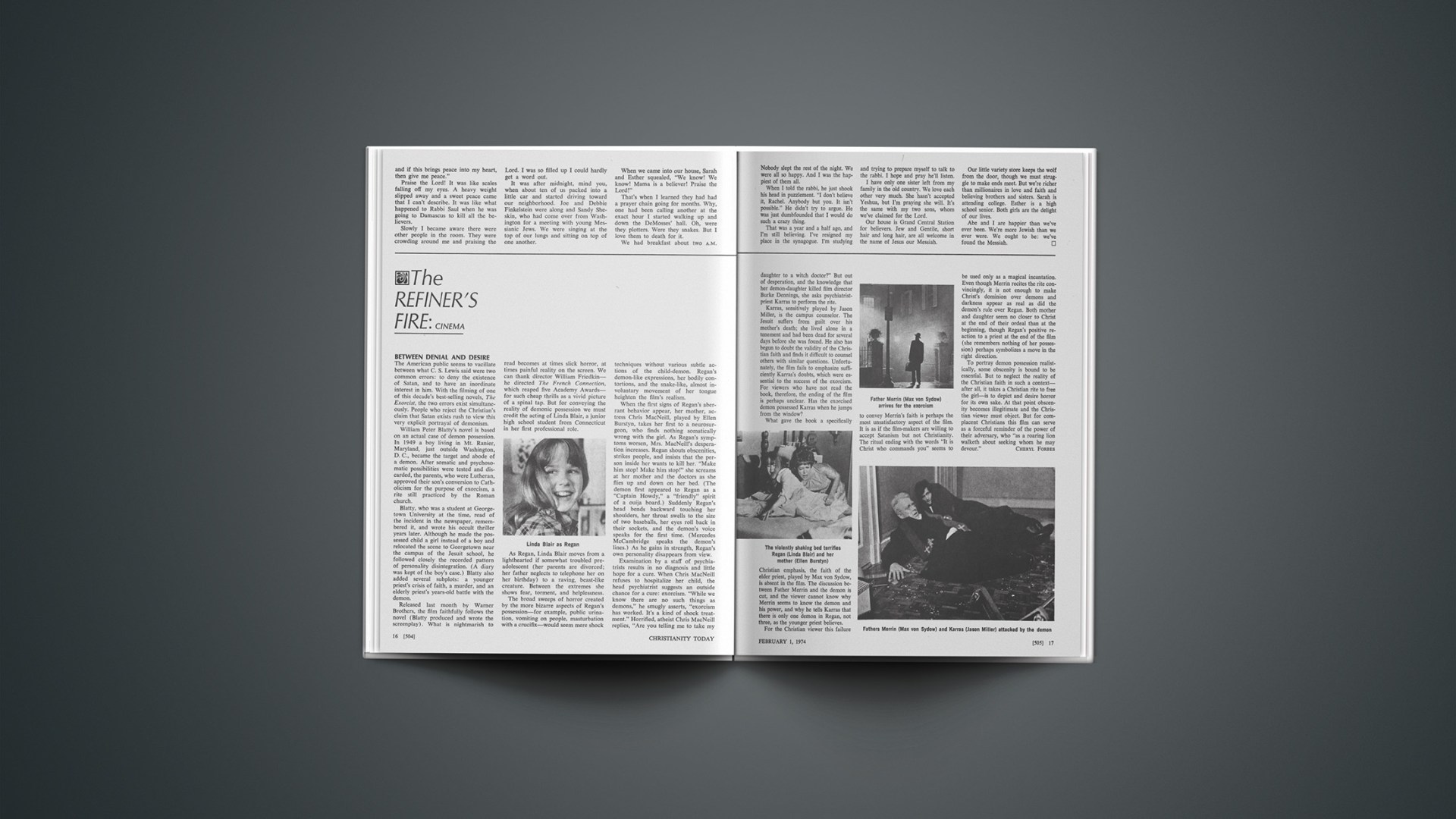
The American public seems to vacillate between what C. S. Lewis said were two common errors: to deny the existence of Satan, and to have an inordinate interest in him. With the filming of one of this decade’s best-selling novels, The Exorcist, the two errors exist simultaneously. People who reject the Christian’s claim that Satan exists rush to view this very explicit portrayal of demonism.

William Peter Blatty’s novel is based on an actual case of demon possession. In 1949 a boy living in Mt. Ranier, Maryland, just outside Washington, D. C., became the target and abode of a demon. After somatic and psychosomatic possibilities were tested and discarded, the parents, who were Lutheran, approved their son’s conversion to Catholicism for the purpose of exorcism, a rite still practiced by the Roman church.

Blatty, who was a student at Georgetown University at the time, read of the incident in the newspaper, remembered it, and wrote his occult thriller years later. Although he made the possessed child a girl instead of a boy and relocated the scene to Georgetown near the campus of the Jesuit school, he followed closely the recorded pattern of personality disintegration. (A diary was kept of the boy’s case.) Blatty also added several subplots: a younger priest’s crisis of faith, a murder, and an elderly priest’s years-old battle with the demon.

Released last month by Warner Brothers, the film faithfully follows the novel (Blatty produced and wrote the screenplay). What is nightmarish to read becomes at times slick horror, at times painful reality on the screen. We can thank director William Friedkin—he directed The French Connection, which reaped five Academy Awards—for such cheap thrills as a vivid picture of a spinal tap. But for conveying the reality of demonic possession we must credit the acting of Linda Blair, a junior high school student from Connecticut in her first professional role.

As Regan, Linda Blair moves from a lighthearted if somewhat troubled preadolescent (her parents are divorced; her father neglects to telephone her on her birthday) to a raving, beast-like creature. Between the extremes she shows fear, torment, and helplessness.

The broad sweeps of horror created by the more bizarre aspects of Regan’s possession—for example, public urination, vomiting on people, masturbation with a crucifix—would seem mere shock techniques without various subtle actions of the child-demon. Regan’s demon-like expressions, her bodily contortions, and the snake-like, almost involuntary movement of her tongue heighten the film’s realism.

When the first signs of Regan’s aberrant behavior appear, her mother, actress Chris MacNeill, played by Ellen Burstyn, takes her first to a neurosurgeon, who finds nothing somatically wrong with the girl. As Regan’s symptoms worsen, Mrs. MacNeill’s desperation increases. Regan shouts obscenities, strikes people, and insists that the person inside her wants to kill her. “Make him stop! Make him stop!” she screams at her mother and the doctors as she flies up and down on her bed. (The demon first appeared to Regan as a “Captain Howdy,” a “friendly” spirit of a ouija board.) Suddenly Regan’s head bends backward touching her shoulders, her throat swells to the size of two baseballs, her eyes roll back in their sockets, and the demon’s voice speaks for the first time. (Mercedes McCambridge speaks the demon’s lines.) As he gains in strength, Regan’s own personality disappears from view.

Examination by a staff of psychiatrists results in no diagnosis and little hope for a cure. When Chris MacNeill refuses to hospitalize her child, the head psychiatrist suggests an outside chance for a cure: exorcism. “While we know there are no such things as demons,” he smugly asserts, “exorcism has worked. It’s a kind of shock treatment.” Horrified, atheist Chris MacNeill replies, “Are you telling me to take my daughter to a witch doctor?” But out of desperation, and the knowledge that her demon-daughter killed film director Burke Dennings, she asks psychiatrist-priest Karras to perform the rite.

Karras, sensitively played by Jason Miller, is the campus counselor. The Jesuit suffers from guilt over his mother’s death; she lived alone in a tenement and had been dead for several days before she was found. He also has begun to doubt the validity of the Christian faith and finds it difficult to counsel others with similar questions. Unfortunately, the film fails to emphasize sufficiently Karras’s doubts, which were essential to the success of the exorcism. For viewers who have not read the book, therefore, the ending of the film is perhaps unclear. Has the exorcised demon possessed Karras when he jumps from the window?

What gave the book a specifically Christian emphasis, the faith of the elder priest, played by Max von Sydow, is absent in the film. The discussion between Father Merrin and the demon is cut, and the viewer cannot know why Merrin seems to know the demon and his power, and why he tells Karras that there is only one demon in Regan, not three, as the younger priest believes.

For the Christian viewer this failure to convey Merrin’s faith is perhaps the most unsatisfactory aspect of the film. It is as if the film-makers are willing to accept Satanism but not Christianity. The ritual ending with the words “It is Christ who commands you” seems to be used only as a magical incantation. Even though Merrin recites the rite convincingly, it is not enough to make Christ’s dominion over demons and darkness appear as real as did the demon’s rule over Regan. Both mother and daughter seem no closer to Christ at the end of their ordeal than at the beginning, though Regan’s positive reaction to a priest at the end of the film (she remembers nothing of her possession) perhaps symbolizes a move in the right direction.

To portray demon possession realistically, some obscenity is bound to be essential. But to neglect the reality of the Christian faith in such a context—after all, it takes a Christian rite to free the girl—is to depict and desire horror for its own sake. At that point obscenity becomes illegitimate and the Christian viewer must object. But for complacent Christians this film can serve as a forceful reminder of the power of their adversary, who “as a roaring lion walketh about seeking whom he may devour.”

CHERYL FORBES
Theology

More Jewish than Ever—We’ve Found the Messiah

True story of an orthodox family.

ABE, RACHEL, SARAH, AND ESTHER COHEN

Reports from all around the country tell of a growing movement among Jews toward accepting Jesus as their Messiah. No one knows how many, but certainly thousands have become believers. Here is a true story of one orthodox family’s experience. The names of the principals are fictional for the protection of the family (there is opposition in their area to the Messianic movement among Jews). But all incidents and the names of believers who were used by God to lead them to the Messiah are real. Joe and Debbie Finkelstein, for example, conduct a ministry for Jewish young people in Philadelphia.

The Cohens’ story is taken from the forthcoming Tyndale compilation of Messianic Jewish testimonies by James C. Hefley, entitled “We Have Found the Messiah.” Hefley, a well-known writer, interviewed the family and taped the story in their home.

RACHEL: We were orthodox—strict orthodox. We lit the candles, kept the sabbath strictly, ate only kosher. I was vice-president of the synagogue across the street and was there for everything. But Abe wasn’t so active.

ABE: Well, I did observe the holy days. But not much else. I had reached a point where I didn’t believe much in any religion. I came from Russia and was brought up a good Jewish boy. But after serving in the Army I dropped out of Judaism and fell in with the Jehovah’s Witnesses. After a while I gave that up and tried Judaism again. But it didn’t satisfy.

RACHEL: We have two older sons away from home. We sent them and our girls to Hebrew school. I thought everything was fine until Sarah came home one day and informed me that she believed Jesus was our Messiah. Why she might as well have said, “Mother, I’ve fallen in love with Hitler.”

“I’ll give you two weeks to forget this nonsense,” I said, “or out you go.” Two weeks later, out she went. I couldn’t have someone living in my house, not even my own daughter, who believed in the man responsible for killing my parents.

Jewish kids today don’t understand what persecution was like for their parents in the old countries. When I was a little kid in Poland, the local Christians called Jews “Christ killers.” The big kids threw Jewish children off a bridge and down near a railroad track. When I got old enough to learn that Christ was a Jew I would mock them back and say, “Jesus was a Jew, so whose behind do you kiss every Sunday?”

But the worst trouble started in 1939, when the Germans came and put the Jews in our town in a concentration camp. They did it in the name of Jesus. I was one of the lucky ones. I did see my parents before they died. I survived and was able to come to America.

I was glad for the freedom, but I didn’t trust Gentile people who thought they were Christians. And I hated any Jew who would become a traitor and go over to their camp. When I was pregnant with Sarah, a Jewish woman handed me a pamphlet on the street. It had a picture of a Jew with a prayer shawl conducting a Passover dinner. When she said the Jew believed in Jesus, I blew up. The Lord forgive me for what I said to her. Then when Sarah was fifteen and joined up with the enemy, I didn’t think I could take it.

SARAH: What my parents didn’t know was that I had been on drugs, just as a lot of other Jewish kids in this neighborhood were. I wanted to stop but couldn’t. Then a girlfriend told me about Bible studies at the Finkelsteins’. I didn’t see how it would hurt to go.

Joe and Debbie showed me prophecies about Messiah right in the Jewish Bible. I could hardly believe what I was reading at first. They told me I could accept Jesus and remain a Jew. One night I prayed for Jesus to forgive my sins and get me off drugs, and it worked. I went home and told Mother, and she laid down the ultimatum.

ESTHER: My sister and I were always close. When Sarah had to leave home, I hated the Finkelsteins because they had taken her away and who did I have left?

Mother wouldn’t let her come home, so I went over to see her. A lot of what the Finks told me made sense. Like the Bible being the inspired Word of God. The teacher at the private Jewish school I attended said it was just a bunch of Jewish fairy tales.

I kept sneaking back, sometimes just to spite my mother. We were having a lot of fights at the time.

RACHEL: I had a tight rope around her, for fear she would end up like Sarah.

ESTHER: I had tried Judaism, astrology, yoga, and Buddhism. Nothing satisfied. There was something about Joe and Debbie and the kids who came to their house. But it was mostly the Bible that got to me. Joe showed me Isaiah 53, which he claimed was a prophecy of the sufferings and death of Jesus for the forgiveness of our sins. I asked my rabbi, and he said the prophet was talking about Israel. But it didn’t make sense that Israel could forgive sins.

Sarah gave me a complete Bible for my birthday which I kept hidden from Mother. I was afraid to read it, but curiosity got the best of me. I wanted to find where it said “Christ killer.” Then I could say, “See, Jesus doesn’t love me.” When I did open it, my eye fell on Matthew 6:5 where Jesus said, “And when you pray, you shall not be as the hypocrites are: for they love to pray standing in the synagogues … that they may be seen of men.” Wow! Was I shook. I would put on a long dress and go to the synagogue just to show how religious I was. But I would wear a mini to the roller rink where the guys were.

One night I went to a Purim party given by Joe and Debbie and some other Jewish believers. After the party Sarah brought an older believer named Bob over to talk to me. We ended up going upstairs to pray, and I accepted Jesus as my Jewish Messiah.

I was afraid to tell Mother that I believed like Sarah. When she did find out that I was going to the Finks she blew a fuse.

I got in more trouble when I went to school and told my classmates, “Guess what? I believe in Jesus and you should, too.” The principal called me to his office and said, “Esther, I’m very sorry to hear that a nice Jewish girl like you should be fooled by such people, but if you keep quiet, nothing will happen. If you insist on talking about this thing, we’ll have to ask you to leave.”

Kids who heard about my being called in would come up and say, “Do you still believe in Jesus?” My lips were sealed until I read in James 1:8 about a double-minded person. I just had to talk. That’s when the kids from the Jewish Defense League really made it rough. They told the principal that I was causing trouble by saying “Praise the Lord” and stuff like that. He sent a letter home requesting my parents to come in with me. Mother never saw it, but Daddy did and he came.

ABE: My Esther was standing before the principal crying, for she really liked the school. I asked him, “Are kids that practice witchcraft allowed to stay in school?” He said, “Yes.” Oh, did I get angry. “Because she said ‘Praise the Lord’ she has to leave,” I exclaimed. “What’s wrong with praising the Lord?”

The principal just stood there. “That’s the way it is,” he finally said. “If we didn’t know she believes in Jesus, it wouldn’t mean anything. But we know. I’m sorry, Mr. Cohen, but she’ll have to transfer to public school.”

RACHEL: It’s a good thing they didn’t bring me in on this. Another Jewish mother told me she thought the Finkelsteins were having sex orgies and drug parties at their house and that our daughters were in them. I called the district attorney, but he said nothing could be done without proof. My friend and I parked up the street from the Finks and spied on them with a telescope. Although we didn’t see anything incriminating, we felt sure something terrible was going on.

ABE: I figured I’d better check into it. When I walked in the door they were on their knees praying. Sarah was thanking the Lord for delivering her from the drug habit and asking for strength to keep walking the straight and narrow. I didn’t even know she had been messing with drugs. I was crying and she was crying and we hugged each other. That night I gave my life to Jesus. He became my Messiah.

RACHEL: When Abe told me he believed in Jesus I was really bitter. “Okay. You’re all dead to me,” I said. “I lost my first family in the concentration camp to Jesus lovers and my second family here.”

I packed my bag and called our lawyer. When I came to America, his father had helped me get my first decent job and taught me my first word in English. He said, “Rachel, you can’t do it. As soon as you leave the city, you’ll be picked up for desertion of minors.”

All during the conflict I had been running back and forth to our rabbi. I told him I wanted to leave my family. “It’s against the law of God,” he said. “Not that you should stay for the sake of your husband. He’s dead. But your daughters might recover their senses and repent.”

I begged Abe to give it up. “No,” he said. “I love you, but I’ve found the Messiah and I’m not letting go.”

I was stricken like Job. “Oh God, how can I be so trapped?” I moaned. “What have I done to deserve the loss of my husband and daughters?”

God was punishing me. Of that I was sure. Okay, I would stay home. But I didn’t have to be a wife to Abe. I cooked the meals and shoved the food at him. I treated him like an animal.

They went right on loving me. Sometimes the girls would bring friends home and take them upstairs to their rooms. One evening I caught them praying. “Get out!” I screamed. “I won’t have you praying to that man in my house.”

But I couldn’t help noticing the manners of these kids. Some were hippy types. Yet they were as respectful of me as if I were the queen. “Can we help you with anything, Aunt Rachel?,” they’d ask.

Once I heard Sarah sass her father. He turned her over his knees and spanked her. Her—sixteen, and she took it. That had never happened before in this house. The girls and their father were kind and loving to each other and to me, and I was a monster to them.

They would leave Bible verses and little notes on pillows, in corners of mirrors, on the TV. For a while I threw them in the garbage. Then my eye caught Isaiah 9:6, “Unto us a child is born, unto us a son is given: and the government shall be upon his shoulder: and his name shall be called Wonderful, Counsellor, The mighty God, The everlasting Father, The Prince of Peace.” I looked it up in my Yiddish Bible and it said the same. The next day Sarah left me Isaiah 53. One of her friends put Psalm 22 in a note. I ran across the street to the rabbi.

He tried to explain the first two passages. But when he came to Psalm 22, he just said, “Oh, Rachel, we don’t bother with those things. That was slipped into the psalms by some scribe.”

My mouth hung open. “What?” I declared. “Hold it, Rabbi. If this psalm was just put in to fill the pages, then we might as well take out Leviticus. And why I should keep a kosher house, separate dishes, silverware, and everything, I don’t know. Why do I light candles on the Sabbath? Why? Why? Why?”

He got mad. I mean he really got mad. He shook a finger in my face and called me a “Gentile girl.” And I didn’t even believe in Jesus then.

My husband invited over a Jewish couple. The man said he was a pastor who preached Yeshua (Jesus) as the Messiah.

“For real?” I exclaimed. “How can you be a Jew and believe in Christ?”

“Why don’t you try it and help Jeremiah’s prophecy come true?” he invited. He read Jeremiah 31:31, “Behold, the days come, says the LORD, that I will make a new covenant with the house of Israel.”

“Oh yeah,” I answered. “Just like the milkman said in Fiddler on the Roof: ‘Lord, we are the chosen people, but why don’t you choose someone else for awhile?’ ”

“Well, how about coming to our Friday-night services? Just to listen. You don’t have to do anything.”

“Ha!” I laughed back. “If I come in the middle of your services you’ll have Jesus Christ for dessert.”

Oh, I was terrible. I didn’t have a good word for any of them.

SARAH: May I tell this, Mom? It was about this time when Father had his heart attack. The eve of Rosh Hashanah, our Jewish new year. I was at the airport to meet a friend coming in from Cincinnati when a Jewish believer called me and told me he had been stricken. When I got home, you were in a panic. I started crying and said, “Look, Mom, if God wants him, he’ll die. If God wants you, you’ll die, but not until you surrender to him.”

RACHEL: I remember. I went to see him in the intensive-care unit in Lincoln Hospital. He made me promise to go to the Friday-night service of the believers. The doctor didn’t think I should refuse him. So I promised.

I asked the rabbi to say a special prayer for Abe. He refused. Now the rabbi had made me mad before, but this time he hurt me down deep. “Rabbi, my husband is sick,” I begged. “He needs all the prayers he can get. I have worked and slaved for this synagogue and you’re not going to pray for him?”

He chilled me all over when he said, “No, your husband is dead. He believes in Jesus Christ. To pray for him is against all my beliefs.”

I was still a Jew. I attended Rosh Hashanah services in the synagogue. Then I went to the believers’ services with my daughters. I had hardly sat down when Ed Singer, the leader, said, “Now let’s pray for Brother Abe who is in the hospital.” Why, I hadn’t even asked!

You’d better believe I listened to what Ed had to say. He made it so clear about Jesus fulfilling the prediction of our prophets and making atonement for our sins. But I wasn’t ready to accept this yet. It would be going against the grain of everything I had been taught from infancy. But I did see that the people who had persecuted and murdered my family were not true believers in Jesus.

Four days later the doctors couldn’t find a trace of evidence that my husband had had a heart attack. The hospital was in an uproar. They couldn’t understand the difference in the cardiograms. I knew immediately the explanation was God.

But I still wasn’t ready to cross over to Jesus’ side. It was just too much for this stubborn woman to swallow.

Then Debbie Finkelstein called and said, “A millionaire named Arthur DeMoss is having all of us for a meeting at his house. We’ll have a delicious meal. How about joining us?”

I said to myself, “When will I have another chance to see how a millionaire lives?” “Okay,” I told Debbie, “I’ll come.”

What a surprise. Mr. and Mrs. DeMoss acted just like plain people. They even had a phony painting hanging on a wall, not an original. Just like the one in my living room.

After dinner they showed a film called Dry Bones, about the rebuilding of Israel according to Ezekiel’s prophecy. I got up and started walking up and down the hall like an expectant father. I didn’t know why.

Debbie, that sweet girl I had so mistrusted, came over and put her arm around me. Then Arthur DeMoss came.

“Rachel, couldn’t you pray and accept your Messiah?” he asked.

“What kind of prayer? What are you talking about?” I was plenty nervous and wishing they would let me go.

So this millionaire said, “Well, could I pray?”

And I replied, “I don’t care if you stand on your head.”

With his arm around me, he started praying. Then he stopped and said, “Rachel, won’t you ask Jesus to come into your heart?”

“Look,” I said stubbornly, “it was five years for me in the concentration camp. I was born a Jew and I’ll die a Jew. You can’t change the spots of a leopard and you can’t change me from Judaism to Christianity.”

He refused to give up. “Well, won’t you pray anyway? You’re a religious woman. If it doesn’t work, it doesn’t work. You have nothing to lose.”

He and Debbie held me tight. At last I said, “Okay, God. If you really had a Son and your Son”—I was choking on the words—“was Jesus Christ, and if this brings peace into my heart, then give me peace.”

Praise the Lord! It was like scales falling off my eyes. A heavy weight slipped away and a sweet peace came that I can’t describe. It was like what happened to Rabbi Saul when he was going to Damascus to kill all the believers.

Slowly I became aware there were other people in the room. They were crowding around me and praising the Lord. I was so filled up I could hardly get a word out.

It was after midnight, mind you, when about ten of us packed into a little car and started driving toward our neighborhood. Joe and Debbie Finkelstein were along and Sandy She-skin, who had come over from Washington for a meeting with young Messianic Jews. We were singing at the top of our lungs and sitting on top of one another.

When we came into our house, Sarah and Esther squealed, “We know! We know! Mama is a believer! Praise the Lord!”

That’s when I learned they had had a prayer chain going for months. Why, one had been calling another at the exact hour I started walking up and down the DeMosses’ hall. Oh, were they plotters. Were they snakes. But I love them to death for it.

We had breakfast about two A.M.Nobody slept the rest of the night. We were all so happy. And I was the happiest of them all.

When I told the rabbi, he just shook his head in puzzlement. “I don’t believe it, Rachel. Anybody but you. It isn’t possible.” He didn’t try to argue. He was just dumbfounded that I would do such a crazy thing.

That was a year and a half ago, and I’m still believing. I’ve resigned my place in the synagogue. I’m studying and trying to prepare myself to talk to the rabbi. I hope and pray he’ll listen.

I have only one sister left from my family in the old country. We love each other very much. She hasn’t accepted Yeshua, but I’m praying she will. It’s the same with my two sons, whom we’ve claimed for the Lord.

Our house is Grand Central Station for believers. Jew and Gentile, short hair and long hair, are all welcome in the name of Jesus our Messiah.

Our little variety store keeps the wolf from the door, though we must struggle to make ends meet. But we’re richer than millionaires in love and faith and believing brothers and sisters. Sarah is attending college. Esther is a high school senior. Both girls are the delight of our lives.

Abe and I are happier than we’ve ever been. We’re more Jewish than we ever were. We ought to be: we’ve found the Messiah.

Theology

The Messianic Jew

A look at both ethnic and religious factors.

A group of people in the State of Israel today call themselves “Messianic Jews.” According to a popular Israeli dictionary, Messianic Jews are “a sect of Jews who have declared themselves as Jews in their nationality and for their faithfulness to the State of Israel and as Christians in their religious expression.” In conversations with many of these people, I was told that the word “Christian” is actually an expression of their particular Messianic faith and hope. Their faith and hope is centered in Jesus as the Messiah, but they identify with Jewish people and claim that they are still Jewish.

In the West there is a growing interest among Jewish people in general in the claims of Jesus and in what the New Testament has to say. In the period since the 1968 unrest on the campuses of many universities, newspapers and magazines, secular as well as religious, have reported the stories of many Jewish young people who have become Jewish believers in Jesus the Messiah. These Jewish young people say that they are Messianic Jews, and they feel they are still Jewish. This state of affairs has alarmed many Jewish leaders, and they have taken steps to stop the “conversion.” Some have proceeded in a drastic manner while others have taken the slower route of a reeducation, trying to provide the values for a stronger Jewish identity among their young people.

Understandably, Judaism does not want to lose its young people through “conversion to Christianity.” On the other side, however, Jewish believers in Jesus do assert their Jewishness by their allegiance to the Bible (both the Hebrew Scriptures and the New Testament were written almost entirely by Jewish people). These believers aver that acknowledging Jesus as the Messiah does not make them any less Jewish.

The confusion arises as to whether such Jewish believers are still Jewish because of the well structured lines of the Jewish and Christian communities. Through the years of Christian-Jewish encounters the lines have been carefully drawn. Judaism teaches that when a Jewish person “converts to Christianity,” he is no longer a Jew but has become a Christian. The Church, too, generally speaking, will tell the Jewish “convert” that he is now Christian and is no longer a Jew. In other words, the Church tells the Jewish “convert” that his Jewish identity is no longer valid and therefore severs his Jewish tie.

We need to look at two facets of the problem as to whether a Messianic Jew is still Jewish or not: the traditional Jewish view of what it means to be a Jew, and the place of the Jewish believer within the Church.

The Jewish Point Of View

Across the centuries of post-biblical history, Jewish people have defined a Jew as one who was born of Jewish parents or who is a convert to Judaism. In cases of intermarriage, the Talmud defines the Jewish person as the child of an Israelite woman: the child of a non-Israelite woman is not a Jew. Therefore a child born of a mother who is not Jewish has to undergo the ritual conversion to be considered Jewish, even though the father may be Jewish. The State of Israel follows this interpretation. Although under the Law of Return a non-Jewish spouse of a Jewish person can be a citizen of the state, for purposes of determining who is a Jew the Halakic (from Halakah, the legal part of Talmudic literature) definition still applies. A Jewish person who does not subscribe to Judaism, although he has not embraced another religion, is still classified as a Jew, a “relapsed” one to whom the laws of Judaism still apply.

The problem arises when a Halakic Jew changes his religion. Some rabbis would still consider the person a Jew, while other rabbis would not. Under the Law of Return in the State of Israel, such a person is not considered Jewish. No one position satisfies all Jewish people today, but the Halakic definition is the workable one applied by the Israeli authorities.

Is this all there is to being a Jew? By no means. A “good” Jew is one who subscribes to the precepts of Judaism or its dogmas and seeks to perform the mivot, or good deeds. The more traditional the Jewish person is, the more he observes the many traditions of the fathers. The less traditional—i.e., the Reformed and secular in the Western countries and the secular in Israel—have in various ways diminished the practice of Jewish traditions.

There is, however, a definite contrast between what the Hebrew Scriptures and New Testament say and what Jewish dogma declares. According to what Jewish people themselves have described in the Scriptures, we note two different groups of Jewish people among the people of Israel insofar as basic doctrines are concerned: (1) the traditional Jew who sees the Scriptures through the developed tradition and the Reformed Jew who has applied a critical, secularized stamp to the Scriptures, and (2) the Messianic Jew who bases his beliefs upon the Scriptures as seen within the first-century context.

In other words, those in category one insist either that tradition is necessary to reinterpret Scripture so it can be applied to various conditions, or that the higher-critical approach is imperative for intellectual respectability. But what do these assertions mean? Are we to change the concept of the atonement, or revise the biblical description of man’s nature, or change the whole concept of Messiah, because of tradition or rationalism? No, these are basic doctrinal positions that man cannot revise or replace without doing harm to his own soul or the soul of a nation.

There have always been two groups within the people Israel, one of whom championed God’s Word. Abraham and Isaac were men who walked with God. Jacob began his walk with God when he was called “Israel,” that is, a prince of God, while wrestling with the Angel of the Lord by the brook. The Hebrew Scriptures and New Testament abound with examples of persons who walked with God and obeyed his word.

At the same time, throughout Scripture not all people knew God. There are many illustrations of apathy toward God or his revelation; in addition, many people appeared pious but supplanted the revelation of God with a mixture of Scripture and tradition so that the truth of the Word of God was minimized. Jesus described the situation in this way: “You have nicely set aside the commandment of God in order to keep your tradition … thus invalidating the Word of God by your traditions which you have handed down” (Mark 7:9, 13). In view of this I believe that those who followed in the example of Jacob as an Israel are to be called the real “princes of God,” or Messianic Jews.

By no means am I disparaging the people Israel. God has a purpose to preserve this nation for the day when the fullness of the Messianic kingdom will be instituted and all within the nation will know the Messiah. The people Israel are a witness people to the covenants and promises of God. Out of this people have come the distinctives of the oneness of God, the oracles of God, and the Messiah of God. Scripture also notes, however, that not all individuals within the people Israel knew the Lord. This was a concern to the prophets, who envisioned the day when, in the kingdom, everyone would know the Lord.

The Messianic Jew insists he is still a Jew although the Traditional Jew will have great qualms about this assertion. However, the Messianic Jew does fulfill the Halakah definition: he can trace his ethnic tie to Jewish people, even as other Jewish people do.

Like the Traditional Jew, the Messianic Jew has his concept of a “good” Jew. As I have pointed out, in every generation during the days of the first and second Temples there were “princes of God,” circumcised not only in the flesh but also in the heart, who by their very presence bore testimony and sought to rally Israel around the Word of God. In the first century A.D. the princes of God were, after the establishment of the body of Messiah (the Church) because of the rejection of Jesus as Messiah, the Messianic Jews. By their very presence they were a testimony to God’s Word. Messianic Jews across the centuries in the function of presence and witness continue in the direct line of the earlier princes of God. This in no way detracts from the responsibility of the body of Messiah in general to function in its totality of witness to all peoples, including the people Israel. But there is a specific function of the Messianic Jews: their presence shows the people Israel that there are Jewish people who declare solidly on the Word of God that Jesus is Messiah and Saviour. In this function there is the encouragement for some to take the step of believing what the Scriptures proclaim concerning Jesus. The presence of a Jewish believer will often be the decisive factor for the Jewish person who is considering the claims of Jesus.

Therefore, as part of the heritage of the progeny of Jacob as princes of God, the Messianic Jew can be considered a Jew by his people because he finds his tie to Israel’s “princes of God.” Furthermore, the very springs of his faith gush forth from the Word of God, written by Jewish people who knew God and were sensitive to his Word and will. Even when the Messianic Jew observes some of the developed traditions, such as the Passover Seder, if the traditions emphasize the redemptive fulfillment of Jesus the Messiah, the Messianic Jew thereby demonstrates the full truth of God’s Word and relates to some of the finest princes of God within Jewish ranks in the first century.

The Church’S Point Of View

In the second and third centuries the Church gained more and more universal appeal and became more and more Gentile Christian, because there were more Gentiles than Jewish people. But by the time we come to the fourth century we see a theological pattern developing that had drastic consequences for subsequent Church-Jewish relations. We will look at two Scripture passages to see how the Church in general has finally come to regard the Jewish believer in its ranks. Yet at the same time we need to have a first-century insight into scriptural assertions.

1. Galatians 3:28—“There is neither Jew nor Greek … for you are all one in Christ Jesus.” This passage of Scripture is interpreted to mean that the Jewish “convert” is now Christian and no longer Jewish. Many Christians will emphasize that there is neither Jew nor Greek (Gentile) but that both are one in Christ.

On what is this oneness based? I view it as oneness in the spiritual sense. Jewish and Gentile believers are one in the spirit, and thus they are a part of the one body of the Messiah. This was Messianic prophecy from the view of the Hebrew Scriptures, for the prophets declared that a kingdom would be set up one day comprised of both Jewish and Gentile believers. There was to be a spiritual bond among all people of the earth who knew the Lord within the Messianic kingdom.

But the oneness should not be at the cost of denying the identity of the Jewish person. This verse also speaks of male and female and of slaves and free men. Even though men and woman, slaves and free men can have a spiritual unity as believers in the Messiah, they do not shed their earthly distinctions as long as they are here on earth. Being one in the spirit does not erase earthly characteristics. This is true also of the various ethnic groups. A Jewish believer is Jewish, and other ethnic designations similarly retain their ethnic ties. A Jewish believer, however, needs to stress his ethnic origin because of the common points of contact in faith-sharing with his people, e.g., the facts that the Bible was written by Jewish people and the Saviour is of Jewish extraction. It is extremely important to stress this ethnic tie because of all that has happened between the Church and the Jewish poeple, so that the Jewish believer will not be regarded as a traitor and stigmatized as anti-Jewish by his own countrymen.

2. Galatians 6:16—“And those who will walk by this rule, peace and mercy be upon them and upon the Israel of God.” Many commentators interpret “those who walk by [the] rule” of God and “the Israel of God” as a reference to “the Church.” Charles Erdman indicates that “the Israel of God” refers to all who put their trust in Christ, while J. B. Lightfoot identifies “Israel of God” as spiritual Israel generally, referring to the whole body of believers, whether Jew or Gentile. Thus the “and” is thought to connect a term with its explanation by the use of another term.

Heinrich Meyer admits there are two possible ways of understanding “Israel of God”: as a reference to true Christians in general, both Jewish and Gentile (seeing it as an explanation of the previous term) and as a reference to Jewish believers (seeing a conjunctive use of “and” between two terms). He himself opts for the former; he believes Paul wanted only to emphasize the true believers in Christ, not to make any distinctions between Jewish and Gentile believers.

H. A. W. Meyer goes on to explain that the phrase “Israel of God” is a more precise description of the genuine believers spoken of in the chapter. His argument is that to refer to two groups, i.e., Jewish and Gentile believers, would draw unusual attention to the Jewish believers in the Church! He thinks also that this would be contrary to what Paul says in the previous verses of that chapter.

However, I question whether those who interpret the verse in this way have considered the full implication of the first-century context from the point of view of the Messianic Jews who formulated the basic decision of the Jerusalem church. Paul’s insight concerning the body of the Messiah was that God was doing something quite different than what the Hebrew Scriptures spelled out. The fullness of the kingdom, the fullness of material and spiritual blessings, was not to be established, since the Messiah-King was not allowed to function. But God was not caught by surprise, and in the mystery revealed in the New Testament the body of the Messiah was being formed to include Jewish and Gentile believers in a period prior to the day when the Messiah-King will reign.

Therefore, in the body of the Messiah, the Gentile believer was not asked to become, as in the older period, a “righteous proselyte” or a ger tushay within Jewish ranks. In a new set of conditions he was asked to be a righteous proselyte in the spirit, or heart, by receiving Jesus as Messiah and Saviour. Hence, what Paul uses in the first part of verse 16 is a beautiful picture of the Gentile believer as a ger tushay in the spirit, one who walks by the Jewish shemoneh esre, the eighteen-petition prayer of peace and mercy that the Jewish person knew so well. He would have the indwelling power of God to enable him to do so.

The “Israel of God,” on the other hand, is to be regarded as meaning the Jewish believers as a part of the body of Messiah, who recognize God’s purposes for the Gentile believers as part of the body of Messiah. But because of God’s new order and economy, the “Israel of God,” or the “princes of God,” would stand in contrast to Jewish people who were still continuing the older dispensation of proselyting among the Gentiles. Yet the “Israel of God” are still ethnically related to their countrymen so as to be a witness to the Word of God. In still another aspect, the “Israel of God” would not agree with the misguided Jewish believer who did not recognize God’s new economy of the body of the Messiah.

The rupture between the Church and the people Israel is significant, therefore, because of the definite shift in the Church’s eschatology in the third and fourth centuries. The implication is that if God is finished with the people Israel and the Church is spiritual Israel, then there is no need to specify earthly distinctions within the Church’s membership. The Church is then regarded as a spiritual body, and so if a Jewish person enters this body, he is no longer a Jew of a rejected people Israel but a member of spiritual Israel. From this argument it is not difficult to accept the explanatory use of “and” between the two parts of Galatians 6:16. The Church eventually became a victim of a problem in hermeneutics centuries ago in its regard of Jewish people.

However, Messianic Jews for the most part declare that God is not through with the people Israel, and ethnically speaking the Jewish believer insists that he is a Jew. Hence the use of the “and” between the two groups of people, Gentile believers and Jewish believers, in the body of Messiah. In the Messiah’s body there is a oneness of all believers in the spirit, but the Jewish person does not lose his ethnic identity and it should not be stripped from him.

Only recently have many Gentile Christians sought for further insights into the Church of the Circumcision as well as the common heritage of the Church and Jewish people. Of special interest is the common history of the two groups. In fact, church history and Jewish history should be shared for a general understanding of the two groups in relation to each other.

Study of the first-century activity between the Church and Jewish people reveals a specific pattern of function. When Jesus as Messiah-King was tragically not recognized by national Israel’s leadership, with the result that the kingdom’s fullness did not begin, the body of the Messiah came into being. This body has a universal ministry, but it also has a specific ministry to the people Israel. The time of Jewish dispersion began in the year 70 of the Christian Era when the second Temple was destroyed and Jerusalem sacked, but this wasn’t until after the providential establishment of local assemblies of believers in Jesus as Messiah. This sequence of events became the opportunity for the positive function concerning the people Israel. Thus God’s mercy and grace was and is to be demonstrated by the body of Messiah in the days of the Diaspora difficulties.

As Jewish people spread out across the Roman Empire after 70 C.E., these local assemblies of believers, Jewish and Gentile, in love and concern shared the possibility that all spiritual blessings were available in Jesus, e.g., the assurance of atonement for sin, peace of mind and soul, the blessed hope of an eternal presence with the Father after this life. This was and is to be the express intention of God for the body of the Messiah in its relation with the people Israel. With Paul as the channel, God instructed this body of Messiah so to demonstrate His love that individuals of the people Israel would be jealous of what Messiah’s body had and would desperately long for it (Rom. 11:11–14). The people Israel were certainly not to be provoked or persecuted in any way! To do so would flout God’s purposes and would be a travesty against the dignity of the Jewish soul. The Church is reminded that “from the standpoint of God’s choice they [the people Israel] are beloved for the sake of the fathers” (Rom. 11:28). For this reason God has made Messiah’s body responsible for sharing its faith so that Jewish people can enter into the aspirations and hopes of their own prophet’s dreams and visions. And, as mentioned, Jewish believers, because of their ethnic identity, can provide the bridge by which Jewish people can enter into peace and eternal life.

Conclusion

I have sought to show that the Messianic Jew has his place in the body of Messiah as part of a spiritual bond with all Gentile people who have responded to the claims of Jesus the Messiah and Saviour. He will have his place in local assemblies. Yet the Messianic Jew is, ethnically, a Jew. In most cases today, he will never want to forget his people, his background culture, and his identity tie.

Jewish people in general have suffered much because they are a witness people to some aspects of God’s Word. Whenever the Church has taken a purified stance with respect to the Word of God, Jewish and Gentile believers in Jesus the Messiah, as a witness to the Holy Scriptures, have been severely persecuted. It is particularly pathetic, however, when the Messianic Jew’s tie to his fellow countrymen is not recognized and he is regarded as an outcast.

But all Messianic Jews can take courage because the princes of God in days gone by, in the period of the Hebrew Scriptures, the intertestamental period, the first-century period, and the succeeding centuries, have always suffered for God as they have sought to be a presence witness, among their people and among all people. If this is the appointed portion, there is cause to rejoice, even as the Messiah said. As the Messiah leads, his purposes will redound for the honor and glory of Israel’s Shepherd, the Holy One of Israel.

Theology

The Christian and the Head-Spreader

Straight talk from a satisfied customer.

Apart from the sacrificial figure on the cross and the blessed emptiness of the tomb, at present God is showing his love for me most in the office of a Christian clinical psychologist. It is only a transition time in my life, but the experience of relief and growing calm is so real that at least for now this statement is true.

I write in the full consciousness of the many other spiritual and physical blessings God has given me. My marriage, my children, my husband’s job, our home, are all part of God’s goodness. God is working in our church in fresh and fruitful ways. I find God’s love in depth in the freedom and acceptance of a psychologist’s office because I know that He could be saying instead, with the same perfect justification with which he always acts, “Shape up, child. Count your blessings. You already have far more than enough.”

I also write knowing full well that if I were a woman in a place like Burundi, a wife who had just felt the last embrace of a Christian husband taken from his home to execution, or a mother whose child had just been snatched from a Christian school and mutilated, my problems would melt in the intense heat of that fiery trial. We Christians in our Western affluence are subject to a different kind of trial—to the many faces of depression, to shadowy goals that defy attainment, to our general preoccupation with grasping at spiritual formulas to find fulfillment. How do we meet these trials?

Twice recently someone has said, “You don’t need a psychologist when you have the Bible.” I disagree. It may well be reading the Bible that shows a person his need for professional care. In verse after verse we are confronted with God’s standard, the awesome fact that we “should be holy and blameless before him.” How do we move forward to that standard? Some of us find ourselves faced with problems that block our growth in spite of prayer, Bible study, worship, and fellowship.

Satan has ways of insinuating himself into the lives of Christians to rob them of Jesus’ gift of peace and joy. Of course, multitudes of committed Christians have overcome simply in the light of God’s Word and the strength of his presence. But at the moment my vision is studded with the others, the others who are committed to Jesus Christ but for whom the battle is the reality—not the clean and strengthening battle of a healthy soul against the world, the flesh, and the devil, but the despairing conflict with an unknown enemy. Often for these Christians the message of the Bible, its beautiful insistence on the love of God, falls on deaf ears.

Actually, many of the Christian psychiatrist or psychologist’s clients are troubled Christians from evangelical backgrounds to whom the Gospel has become bad news. Then the psychologist has the opportunity to work with God to “untie things that are now knotted together and tie up things that are still dangling loose” (C. S. Lewis’s description of our predicament). Christian psychologists acknowledge the reality of sin. We do them an injustice when we claim that they work hard to explain it away. We also do them an injustice to call them by the slang term “shrink,” or “head-shrinker”; for me, at least, the psychologist has been a welcome “head-spreader.”

I write all this for several reasons: first, because I believe many persons in conservative pews could use some straight talk from the satisfied customer of a good “head-spreader”; second, to try to help children of the Father recognize when they need professional help; third, so that my own experience might pave the way for others who need therapy and hesitate to seek it; fourth, in the hope that a Christian psychologist or two might be encouraged to continue in a life of personal integrity and biblically oriented counseling; and fifth, in the hope that we in the Body of Christ, members of one another, might reproduce in our churches something of that rare, accepting atmosphere of the therapist’s office.

Several years ago Dr. Donald Tweedie, a professor at the graduate School of Psychology at Fuller Seminary, suggested that professional care is in order when a problem is so persistent that one has been unable to overcome it with sustained effort. He used as an example a man who has determined to give his wife and family the kind, personal attention and concern he knows God wants him to give but who finds that despite his earnest resolve he just cannot produce anything but negative responses.

In my case the immediate problem was my inability to function compatibly with my husband in handling our children. Often I asked God to make me as good a partner to him in our day-to-day lives as I was in the satisfactions of our physical union. (Beware of automatically assuming a sexual problem when a person goes for professional care!) Like a receding wave on the shore, my husband’s patience grew justifiably thin, and then in God’s own time and way we located the right psychologist.

Good news! I found a freedom to air the problem in the presence of a skilled, accepting person. But even as this happened, a whole thicket of brambles revealed itself—alien roots in the soil of a heart essentially bent toward God. Among the thorns was a self-consciousness that dogged me in almost every relationship, including an inability to look non-Christians in the eye and witness lovingly and without embarrassment and confusion. Then too I had begun to experience a depression, a kind of paralysis in daily living.

The handles of my problems were not hard to grasp. Together we found that I had unconsciously raised such rigidly high standards for myself and those I love most that I consciously majored in weaknesses. This led to nagging and preaching and that insidious kind of appreciation that responds only to good performance. Unnecessary feelings of guilt were there, too—not just a healthy sensitivity to sin, but self-imposed burdens. I had applied the old theologically sound “Fact, Faith, Feeling” formula to my personal walk with Jesus and then ruled out feelings. I needed a warm emotional experience with him that would be far better than my panic-prayers and the sporadic reality of his presence. As the kinks straighten I find my experience with God renewed. I’ve discovered how much he really loves me. I know him better.

How can others find the same kind of help on the road to emotional and spiritual maturity? No one would hesitate for a minute to make distinctions between effective and ineffective ministers, but we easily lump all psychologists together. That is a mistake. There are psychologists under the name Christian whose credentials are not trustworthy, or whose personal integrity or doctrinal stand is disappointing. There are good Christian men who have not been given adequate tools and skills in their graduate training; many a pastor and Christian physician have been discouraged by referring a person to one of these. There are dedicated non-Christian psychologists who can provide significant help along the road to emotional health but who cannot help to smooth the path to spiritual maturity. And then there are some with adequate training whose chief desire is to serve God and help people, and who sensitively seek to bring it all under the limits and freedoms of their personal experience of Jesus Christ. But there are too few of these, not nearly enough to go around. So there are many among us in the Body of Christ who need but may never have an opportunity to share my rich experience of elusive problems aired and answers found in a professional setting.

Many Christians are very tentative about therapy because they sense risks. There may be risks. Susan B. Strachan, the wife of the founder of the Latin America Mission, wrote a little pamphlet based on an old quotation she had found: “Life is only safe when it swings between a risk and an opportunity.” She did not know its original context, so we can borrow the quotation for our purposes. She wrote:

Does not the risk always wait on the opportunity, and is not the opportunity that is worthwhile ever attended by risks? We think it must be so, and the life that is worth living, the abundant life, the productive life, the life that blazes new trails, must always swing out into the unknown and take huge risks with God.

Taken in this spirit, therapy can be a major boost to the kind of life of which Mrs. Strachan speaks. But too many of us settle for the problem for fear of taking a risk in the effort to solve it.

I see two risks in therapy that lie in the introspection, the keen involvement with feelings, that accompany it. The first is that one can almost create another world, where the reality is the counselor’s hour and much of the rest of the week is filled with thoughts about past or future sessions. Often when problems are deep, progress may not be observable. Problems that have taken a long time to come can take a long time to go. Depression may increase for a while. The client does not always leave the therapy session with a sense of well-being. But I encourage any Christian who is involved in therapy to try actively to remember God’s love and acceptance at every level and his eager desire to be a conscious part of the healing process.

A second risk is that the same inward concentration can cause us to put aside the burning reality of a decaying world, a world whose problems are so immense that most of us tend to see them as unsolvable and ourselves as helpless. It is not unhealthy to look past our own troubles to the far greater ones of others.

There is the additional risk of what the psychologists call “transference,” when this accepting listener, this psychologist who with great sensitivity and gentleness allows us to see ourselves, begins to fill a role in our lives that at best can be only temporary and at worst can rob us of the health we are seeking. The good counselor maintains the balance between being involved and being impersonal.

All these risks have been involved in my time with the counselor. On the other hand, the psychologist too lives with risk. I think it possible for the Christian psychologist to become so immersed in his own private harvest field that his vision for the whole world is slight. In finding a large measure of wholeness for himself, a counselor can find himself without that longing after God that often comes with a sense of need. It would seem folly for him not to enter privately into active partnership with God in the therapeutic process. Certainly many times the roots of a problem lie in a twisted Christianity that won’t permit the counselor to talk about God in the counseling situation itself. But the counselor seeks to know a person already fully known by God. He seeks solutions God has already found.

Because of the scarcity of capable therapists, and because of risks, and often because of lack of funds, there are members of the Body who need other help. I want my brothers and sisters in Christ who are hurting to be able to experience this same atmosphere of freedom and acceptance, to breathe the sweet air that is free of judgment and criticism. What would God have us do?

A good start is to imitate the love of Jesus, the love that led him to die for us while we were yet unfriendly, cold, critical, sour, and full of pride. What about the man who approaches you on your way into the sanctuary? Could you love him more if he spoke a little less effusively, if he were a few shades lighter, or if you could only forget the rumor that he stepped out on his wife? What about that woman toward whom you are being ushered into the pew? Is she acceptable to you? Or could you love her more if she sang a little less enthusiastically, or if her wig were a little less obvious, or if you could only forget that she had recently begun speaking in tongues?

And those you love the most—are they absolutely free in your presence to be who they really are? Are they free to share without inviting a sermonette? Are friends free to cry in your presence with frustration or heartbreak in the comfort of unembarrassed silence? Are you willing to choke back the pat answers in the face of tragedy and enter the struggle with quiet compassion? Or are you afraid even to be in the presence of someone who is deeply troubled? Are you open to love strangers and to break your own comfortable molds in order to accommodate them?

Sometimes those of us who are undergoing professional care forget that God has the answers and that the psychologist is just one of the different members of the Body whom God uses. I am deeply thankful for a husband who seeks God’s best for me. Our worship service is a very crucial hour in my life. I am grateful for answers from my own family and from a few close friends in the larger family of God. As the Holy Spirit moves us toward one another, with our various gifts, we fulfill one another so that Jesus can be seen. And when because of circumstances he is not allowed to do his fulfilling work, when for some reason he cannot for lack of open channels, then I am grateful for the work of his particular servant, the dedicated psychologist.

Editor’s Note from February 01, 1974

Rejecting the term “head-shinker,” Joan Jacobs—a homemaker and a pastor’s wife—writes from her own experience about “The Christian and the Head-Spreader.” Many Christians feel, at one time or another, a need for professional psychological help. But they may be reluctant to seek it, believing that they should be able to find all the help they need in the Bible. Sure, the Bible provides answers, but sometimes we need the assistance of those who understand better than we the application of biblical principles to the human psyche.

The Israeli-Arab situation is still front-page news, and the Christian is concerned about the Jews from a religious perspective. In the essay “The Messianic Jew” Louis Goldberg makes the point that accepting Jesus as the Messiah does not make a Jew less of a Jew. He is actually more of a Jew in the true biblical sense. The moving true account recorded by James Hefley in the article “More Jewish Than Ever—We’ve Found the Messiah” reveals some of the difficulties a Jew experiences when he accepts Christ as the Messiah. The problems fall also on the rabbis, families, and friends of Jews who accept Christ.

Theology

Has God Spoken?

Has God Spoken? Not according to some recent biblical scholars. Revelation, they think, is an outworn idea, and we may as well discard it. It belonged to a pre-critical age. Now we know better.

There have always, of course, been people who denied the reality of revelation. Opponents of Christianity have taken up this position as a matter of course. Most of them have simply denied any possibility of relevation (how can a non-existent God reveal anything?). Some have been willing to accept the idea that revelation is possible but deny that Christians have it in the Bible. There is nothing new in the idea that Christians have no revelation.

What is new is that now some Christians are saying it. Up till recently Christians have disagreed about the nature of revelation and sometimes about its extent. They have differed about whether revelation is propositional or whether we should think of it as the revelation of a person. They have wondered whether the whole Bible is revelation or whether we should accept only part of it. They have argued about whether we should transfer the concept of inspiration from the book to the authors (thus thinking of inspired men doing their imperfect best rather than an inspired book to be accepted as it is).

But with all their differences they have agreed that there is such a thing as revelation. No matter how they have differed over the extent to which the Bible can be trusted, in the end almost all Christians have been ready to say: “This is what God has said.”

It is thus a new thing when people make a firm Christian profession but deny that there is any such thing as revelation. And, since any new idea must be given a fair hearing, it is worth our while to turn aside and see this strange sight.

People who take up this kind of position point out that the Bible says very little about revelation. We have to look hard to find the topic; by no stretch of imagination can it be said to be one of the subjects that preoccupied the writers of the biblical books. The inference is that it need not be important for us and that those who have spent so much time examining and defining the topic have been largely wasting their time (to say nothing of that of their readers).

I think it must be conceded that revelation is not a frequent topic in Scripture. But I doubt whether the right inference is being drawn from it. A man may be very sure that God has made a revelation, and even that God has revealed something to him, without feeling obliged to engage in a general discussion of the concept of revelation. The prophets cheerfully announce “Thus saith the Lord” without taking time off to propound a theory of revelation. But it is more than difficult to maintain that throughout their prophecies they are doing no more than give their best thoughts on topics of the day. As plainly as words can do it they say they are passing on a message they have been given.

A further objection to the whole idea of revelation is the fact that the followers of Jesus have understood the Bible (or should we say “misunderstood”?) in so many ways. Interpretations have varied from time to time and from place to place. This is thought to be very strange indeed if God has in fact made a revelation. The meaning of “revelation” is “a making clear,” and no one wants to accuse God of bungling. If God did decide to make a revelation, such scholars say, the very least he would have done would have been to speak so plainly that there would be no possibility of misunderstanding. People might reject what God said. But they would be clear about what it was they were rejecting.

To this more than one thing could be said. One is that it involves a piece of a priori reasoning that must be rejected. It lays down in advance the kind of revelation God must make. It is a much better plan to see what infact he has done (if anything—I do not want to prejudge the case). All too often, conservatives have been accused of this error. They have, it is said, made up their minds that the Bible must have such and such characteristics. It must be without error and so forth. Now it would seem some radicals are making the very error they accuse the conservatives of. There seems no particular reason why God should not make the kind of revelation that makes people think if they are to penetrate to the depths of its meaning. And if he were to do this, it would not be surprising if some people saw more than others and if some got it wrong.

Other possibilities could doubtless be thought of. It is too facile altogether to say that if there is revelation there is only one way it could happen and that all men must read the same thing out of it.

Exponents of the new approach often make a good deal of the fact that the Bible is culturally conditioned. Every writer, they point out, is subject to the limitations imposed on him by the culture in which he lived. He could not possibly break free from it any more than we can cease to think and live like twentieth-century men. Scholars ask why we with our very different culture should pay any particular attention to what has been said by a few men whose whole world was so very different from ours. The climax is reached when it is urged that we must understand Jesus himself as no more than a child of his time, subject to all the limitations of his day. His background was ancient Palestine, and it is asked why a modern Westerner (or for that matter, a modern Easterner) should regard him as ultimately authoritative.

Cultural differences are certainly real. But they are no barrier to the effectual communication of important truths as the great literature of every nation amply attests.

And when we come to Jesus we can say that few people, even among non-Christians, have up till now been ready to say that he was no more than a child of his times. What he said and did has relevance far beyond Judea of old.

This raises the not unimportant question, “What is the meaning of ‘Christian’?” It seems elementary that if we are to call ourselves by the name of Christ we should base our position on his. And on this matter of revelation there can be no doubting where he stood. He appealed to the Bible constantly, and he appealed to it as decisive. It is not easy to see why his followers should disavow him here.

There is an unexamined assumption behind the new position, namely, that God has never acted differently from today. Today there is no miracle, no incarnation, and therefore there never was. But we are entitled to ask, Why not? It is the Christian claim that the incarnation was unique, and that God made a once-for-all revelation. We need more than an easy assumption before we abandon this basic position.

Slacks Split Clergy

The following story was distilled from several news sources, including a report filed by correspondent Nancy Hamilton. It was written by Deborah Miller.

A twenty-month dispute between the Farah Manufacturing Company of El Paso, Texas (probably the nation’s largest non-union garment maker), and the National Labor Relations Board (NLRB) has developed into a nationwide “battle of the clergy.” The views of priests and clergymen have sometimes carried more weight than those of the labor leaders and others who are involved in the dispute.

As El Paso’s major industrial employer with about 8,000 workers in five plants, Farah has been the target of the Amalgamated Clothing Workers of America (ACWA), which has tried to organize Farah since 1969. Cutting room employees voted in 1970 to have the ACWA represent them. The NLRB ruled that the union won the election, but Farah is appealing on the contention that the voters could not have the same classification (because of their work skills and machinery) as cutting room workers in other clothing factory collective bargaining units. In retaliation, some Farah workers organized a strike against the company, a move opposed by many workers outside the cutting rooms. It may take two or three years for a final court ruling.

The Most Reverend Sidney M. Metzger, long-time Roman Catholic bishop of El Paso, supported a boycott of Farah products. “We are doing everything we can to contribute to your cause,” Metzger told strikers. “My advice to others in the church is to continue and support the boycott.” Eight thousand non-striking Catholic Farah workers signed an open letter to Metzger, explaining that his comments were “disheartening to all of us Catholics who are working at Farah and who know the true facts. We realize that the clergy is human, and therefore is entitled to mistakes. Your mistake is not to seek the two sides of the question before giving your support to the boycott of Farah pants.”

Syndicated columnist David Poling wrote several articles refuting Metzger’s allegations. “The bishop’s strongest weapon is the historic stance of the Christian church for the downtrodden and poor. Out of this came support for the union movement,” Poling acknowledged. But, said he, “In three years of campaigning, the union has not made much of a dent in the 8,000 employees of Farah. It appears that the people on the production line prefer the paternalism of a Willie Farah to that of a James Hoffa.”

An anti-boycott booklet by Dr. Paul Newton Poling, the columnist’s father and retired pastor of El Paso’s First Presbyterian Church, was published and distributed by Farah. “This boycott is designed to so seriously injure the industry that the workers will be forced to accept the ACWA as their bargaining agent—the union they have rejected for nearly three years,” he asserted.

But Episcopalian Francis B. Sayre of the Washington (D. C.) Cathedral endorsed the strike. “I, for one, am in sympathy with the strikers at Farah. In this instance, these so-called ‘Chicanos’ may have a keener perception of our American way than do those who simply ignore their long struggle for a decent standing,” he said.

The Committee on Social Development and World Peace of the United States Catholic Conference also issued a resolution supporting the strike and urging a nationwide boycott of Farah products.

Perhaps the strongest voice is that of Father Daniel Lyons of New York, a union member and teacher of labor union history. In a column for the National Catholic Register, he expressed doubts about the “wisdom, the knowledge and the balance of many clergymen who have sided against the Farah Manufacturing Company. So what is the boycott all about? It is a direct result of the fact that the union has failed to interest the workers in joining the union, but it wants their dues anyway.”

Alfred Belles, an El Paso Lutheran minister, registered yet another view: “It is inappropriate in any case for the church and its ministers to take a stand on ambiguous moral situations where there is probably some right and wrong on both sides. I feel it cheapens and weakens the Church’s moral authority, which should be reserved for pronouncements on more clear-cut and fundamental moral issues.”

The legal questions will eventually be settled in the courts, but religious fervor over the moral and social implications will not die easily in the near future. Meanwhile, the boycott has been blamed in the closing of several Farah plants, resulting in the layoff of hundreds of workers, mostly Mexican-Americans.

Educating Every Jew

Educators representing Conservative, Orthodox, Reform, and secular Jewish studies are organizing a major effort aimed at giving every Jewish child in the United States a Jewish education.

They exchanged views and suggestions on ways to meet this common need at a conference on ‘The Future of Jewish Education in America,” held in New York last month under the sponsorship of the American Jewish Congress. Less than half of U. S. Jewish children get a Jewish education, it was reported.

Rabbi Arthur Hertzberg, president of the American Jewish Congress, proposed that a “national census” be taken by the Jewish community “to find every Jewish child and redeem his birthright to a Jewish education” by providing aid to those who need it.

Lausanne Cuts

Inflation and the energy crisis combined to force a 10 per cent cutback in the number of invitations to the International Congress on World Evangelization, to be held at Lausanne, Switzerland, this summer. The executive committee voted the cut from 3,000 to 2,700 participants when faced with a 10 per cent hike in airline fares, a drop in the buying power of several currencies pledged in support of the congress, and the possibility of charter-flight cancelations because of fuel shortages (see December 21 issue, page 34).

The original budget was prepared in 1972 before the longterm effects of rising prices and fuel cuts could be seen. Even so, the budget is 12 per cent larger than the figure approved in 1972. Planners also point out that the Lausanne congress will be more than twice the size of the Berlin congress in 1966, which had 1,200 enrolled. Already, 1,250 invitations to Lausanne have been accepted.

Chile: The Heat Is On

In the aftermath of the recent military takeover in Chile, churches and clergymen—particularly Catholics—are coming under increased attack for alleged Marxist leanings.

The 2,600-student St. George’s College, a combined elementary-secondary school in Santiago run by the Indiana-based Order of the Holy Cross (it also operates Notre Dame University), was taken over by the military junta. The staff of twelve priests and three nuns was ousted, and the school now has a military administrator. Armed police guard the gates. Military sources said the junta acted on complaints (denied by the order) that the school was infiltrated by Marxist teachings.

The junta is also reported to be studying the possible deportation of more than 500 Catholic priests (40 per cent of the Chilean Catholic clergy) on similar charges, according to a Canadian priest. William Smith, Latin American affairs director for the Canadian Catholic Conference, said the majority of the priests worked in Chilean slums and therefore are identified with the late president Salvadore Allende. Smith said priests fear they might be arrested and “wiped out” by the junta.

PULPIT POUNDER

Clergyman Charles S. Yoak, 29, leads three lives. Three days a week he is pastor of the Mendota Heights Congregational Church near Minneapolis. Three days a week he is a Minneapolis taxicab driver. At night he becomes Gentleman Curt Yancy, a tough, hard-punching professional boxer.

His won-lost record in the thirteen matches he’s had since climbing into the ring two years ago isn’t very good, but he won three of his last four bouts. He took home a purse of $350 from one of them.

He sees no conflict in slugging bodies and shepherding souls at the same time. Boxing is a sport, a molder of character especially applicable to youth ministry, he feels, and he wants to set up a boxing program for the church’s youth as soon as his small congregation can afford to install a ring. Also, he says, his presence in the training gym has opened up opportunities for informal counseling he wouldn’t have had otherwise. And finally, the ring is a perfect pressure valve for a preacher, he says. The tension that builds up because of the gentleness required in personal relations and the constant carrying of others’ burdens, he explains, is blown out in punches at a bag—or an opponent.

Two emergency committees—one providing relief for families with relatives arrested or killed, the other assisting refugees seeking ways out of the country—have been set up by the Methodist, Pentecostal, Lutheran, and Catholic churches. Joint leaders of the domestic committee are Lutheran bishop Helmut Frenz and Catholic auxiliary bishop Fernando Arizta of Santiago. The refugee committee intent on assisting more than 13,000 foreigners—mostly other Latin Americans—who want to get out of Chile, has already helped 3,000 to leave. The World Council of Churches has launched a million-dollar appeal to aid the refugees with food, accommodations, legal expenses, and transportation to other Latin American countries.

An Evangelical For Canterbury?

Will an evangelical succeed A. Michael Ramsey as Archbishop of Canterbury and Primate of All England, the titular head of England’s 30 million Anglicans?

Ramsey, the 100th to hold the Canterbury title, turns seventy this year and is expected to retire. Conjectures concerning the next archbishop filled the corridors of power at the recent meeting of the 530-member Anglican General Synod in London.

Traditionally, the Archbishop of York has been selected to fill the Canterbury see when vacant. (Appointment is by the prime minister upon recommendation of a committee of bishops.) Many observers believe tradition would have been broken and another Ramsey named to the office if Bishop Ian Ramsey of Durham had not died in 1972. Now it appears the new archbishop will again come from York.

The York see is occupied by an evangelical, Donald Coggan, 64. He was principal of the London College of Divinity from 1944 until 1956, when he was consecrated Bishop of Bradford. Five years later he was named to York. He is president of the United Bible Societies, an organization of Bible societies and service affiliates in about one hundred nations. He also helped to lead a British ecumenical outreach effort known as Call to the North. Although he has not spoken out clearly on ordination of women, he has publicly championed the right of women to be involved in ministry.

Coggan’s public statements over the past decade show a drift toward the middle of the road—or even the left side, as some in the evangelical camp charge. Earlier this year he raised a general furor, and many evangelical eyebrows, by pleading on British radio for sympathy with homosexual clergymen. Some feel that this and other free-wheeling statements have seriously tarnished the evangelical image for which Coggan has been known. Others believe that Coggan is too old to take up the Canterbury post.

Still others feel he lacks leadership ability and that he does not speak out enough on issues of the day. (In addition to York, possible candidates for the Canterbury see include Bishop Robert Runcie of St. Albans; Bishop R. D. Say of Rochester, a former general secretary of the British Council of Churches; and Bishop Stuart Blanche of Liverpool, described by a colleague as “substantially evangelical.”)

With a cloud of speculation surrounding the retirement of Ramsey, the entire episcopacy has come under discussion. The Church of England now has forty-three bishops assisted by sixty suffragans and assistants. The annual cost of keeping these bishops surpasses $1.6 million. Many consider this too high a price for such a large company of men who, certain critics accuse; serve mostly as “bazaar openers” and “after dinner speakers.” A more sober description is found in a penetrating study prepared for the General Synod by Canon Paul Welsby of Rochester. It concludes that the bishop must fulfill several functions: guardian of the faith, representative of the Church, disciplinarian and administrator, teacher and prophet to the people. To provide for this pastoral role, several have called for more bishops with smaller dioceses. Some have also suggested the democratic election of bishops.

To most parishioners the episcopacy is remote; but more relevant matters also appeared on the synod’s agenda. Bishop Robin Woods of Worcester shocked conservatives by proposing the remarriage of divorcees in the Church. “The church must practice Christian forgiveness and compassion for divorced people,” Woods maintained. “Forgiveness implies not a life-long hardening of the situation but the possibility of a new life, and therefore, sometimes, a new marriage.” Reaction to Woods’s motion was fiery. Bishop R. R. Williams of Leicester was outraged by the prospects of a person standing on “the same square foot of church floor” promising fidelity for life to a “parade of partners.” The proposal was defeated 363 to 130.

Rejection by the synod, however, did not bury the marriage matter. Agitation continues at the grassroots, with some clergymen and dioceses holding out for the right to resolve the issue locally. At least one diocese has demanded the right to debate the issue and submit the conclusion at the synod’s spring meeting.

Another synod topic was the dramatic decline in missionary giving. Less than five per cent of the church’s aggregate income is now channeled into Anglican foreign missions, according to a report released at the Assembly. Local churches have attached overriding importance to their bells, organs, and physical plants, complained some synod members. An appeal was issued for parishes to give a tenth to missions.

WAYNE DETZLER

Pluralism At Harvard

A committee on the future of Memorial Church, Harvard University’s chapel built in memory of its graduates killed in World War I, has recommended that the church’s status as a Protestant place of worship be changed “to take account of religious pluralism.” Dean Krister Stendahl of Harvard Divinity School, who is a member of the Lutheran state Church of Sweden and a frequently mentioned aspirant for that church’s highest preferment (the archbishopric of Uppsala), presented a report calling for reconstitution of the Protestant Board of Preachers into a troika that would include a Protestant minister, a Roman Catholic priest, and a Jewish rabbi.

“We could consider these preachers to the university as co-equal in their roles and their relations to the university,” said the report. One committee member who did not sign the report objected to the fact that it says nothing about the religions of Africa and Asia. “Harvard,” he said, is a world community.”

The Spirit Of ’76

Explo ’72 … Key 73 … And now, Spirit in ’76. That’s the name of an international celebration planned for May and June of 1976.

The two-week observance was set in motion late in November at Melodyland Christian Center in Anaheim, California, when thirty-two selected charismatics and Pentecostalists formed an ad hoc committee “for charismatic advance.” Dr. J. Rodman Williams, president of the new Melodyland School of Theology, was named chairman.

“These two weeks, as sketched,” he said, “would include one week of an international theological conference on the Holy Spirit, and a second week of various national charismatic conferences climaxing in a large gathering on Pentecost Sunday [June 6] to express our unity in Jesus Christ.”

The final rally might draw 100,000 to the Los Angeles Coliseum, Williams added. The November 27 meeting was attended by members of charismatic fellowships and renewal in most mainline denominations, the Roman Catholic Word of God Community at Ann Arbor, Michigan, the Catholic Archdiocese of Los Angeles, the Pentecostal Fellowship of North America, and other groups. Participants stressed that they were acting individually and not on behalf of their constituencies.

The year 1976 was chosen because of the tie with the 200th anniversary of the United States and because it is also the seventieth anniversary of the birth of the Pentecostal movement at the Azusa Street Mission in Los Angeles.

The committee hopes members of an international dialogue team will hold their 1976 meeting in nearby Santa Barbara the week after Pentecost. That year’s meeting will be the fifth in a series organized by the Secretariat for Promoting Christian Unity at the Vatican and by some leaders of Pentecostal churches and renewalists within Protestant, Anglican, and Orthodox bodies.

The dialogue, to include published scholarly papers on the Spirit, might be held at a $10 million former Catholic school and retreat center Melodyland is seeking to acquire for an independent ecumenical research academy. The proposed academy will center on studies of the Holy Spirit and charismatic renewal.

Along with fervent prayers and “singing in the spirit” at the launching meeting, the committee approved a resolution that since the Spirit in ’76 can’t be limited to any single event, Spirit-filled Christians everywhere should be encouraged to develop additional regional and local programs to give high visibility to the Holy Spirit throughout 1976.

RUSSELL CHANDLER

Muslims And Mammon

Black Muslims, once thought to represent a thriving enterprise in the United States, now may be in a big bind. A New York Times story said last month that the so-called Nation of Islam is in “deep trouble.”

If the report is true, the social consequences could be considerable, for the highly-disciplined and industrious Black Muslims have been a major force for betterment in the ghetto.

The Black Muslims themselves never make official statements, so there is no way to determine with precision how prosperous they have been in the past or how they are doing now. The Times story by Paul Delaney was based on an independent investigation over several weeks, coupled with findings of police and other government agencies. Most of the data is attributed to unnamed sources.

Sackcloth For April 30?

A resolution proclaiming a National Day of Humiliation, Fasting, and Prayer was adopted unanimously by the U. S. Senate last month and sent to the House, where early action was expected.

The resolution, introduced, by Republican Senator Mark Hatfield of Oregon, sets aside April 30, 1974, and “calls upon the people of our nation to humble ourselves as we see fit, before our Creator to acknowledge our final dependence upon Him and to repent of our national sins.” In remarks on the Senate floor Hatfield suggested, “Our government and the other institutions of our society would all cease business as usual, as I envision it, so that we all would be free to consider actions appropriate to a time that would symbolize national repentance.”

April 30, which falls on Tuesday this year, was chosen because a similar resolution was issued by Abraham Lincoln in 1863. The Hatfield resolution is modeled after Lincoln’s, and incorporates much of the wording of the older document.

BILLBOARDS FOR JESUS

Millions of motorists in the Pacific Northwest are getting the word as billboards pop up along highways announcing “The Lord is coming” and similar messages. It all started when Seattle real estate man Roland J. Hoefer saw red after spotting a billboard that promoted a nudist colony. Now his Maranatha Association is marketing Jesus just as forthrightly. Hoefer cites Habakkuk in the Living Bible as rationale: “And the Lord said to me, ‘Write my answer on a billboard, large and clear, so that anyone can read it at a glance and rush to tell the others.’ ”

Cardinal Confronts Threat

Cardinal Stefan Wyszynski, in a Christmas Eve address to a group of bishops and priests, said “the greatest threat” to the Church in Poland since Communists came to power—the government’s proposed educational reform—had been “at least formally” repulsed.

At the same time, the Roman Catholic primate complained that local provincial authorities had not abandoned their attempts “to hinder the Church’s work particularly among school children and the young.”

He said that “this could delay and hinder efforts to normalize Church-state relations in Poland, as well as relations between Poland and the Holy See.”

Referring to the visit of Polish Foreign Minister Stefan Olszowski to Pope Paul last November 12, Cardinal Wyszynski quoted the pontiff as saying that he would not undertake any steps to “normalize” relations with Poland “without the agreement of the country’s Catholic bishops.”

The cardinal also quoted the Pope as saying that “problems between the Church and State in Poland” had to be settled before “any permanent system of mutual relations between Poland and the Holy See could be established.”

This was interpreted to cover the exchange of ambassadors and the setting up of formal diplomatic relations between the Communist state and the Vatican—a matter under consideration by both sides.

Turning to the Polish episcopate’s campaign against the state’s planned educational reform, Cardinal Wyszynski said the Church regarded the plan as an attempt “to impose a monopoly of atheistic education at the expense of religious instruction of local parish priests.”

The changes, scheduled to begin in 1975, are aimed at consolidating many church-operated rural schools and require children to spend more time in the classroom than under the present system.

“What we saw as the greatest threat to the Church in the past 25 years,” said the Polish primate, “has been, thank God, at least formally repulsed, but that does not mean that the threat does not in fact still exist.”

Cardinal Wyszynski expressed support for the social and economic reconstruction of the country by the authorities, but deplored its being “linked” to a struggle against religion.

RELIGIOUS NEWS SERVICE

Religion In Transit

The U. S. Supreme Court agreed to hear an appeal from Bob Jones University over the revocation of its tax-exempt status. The school lost its tax status when the Internal Revenue Service declared the school violated the 1964 Civil Rights Act by turning away prospective black students. Meanwhile, Tennessee Baptists and Methodists face more court battles over a 1969 tax case in which the churches objected to new property assessments. The state supreme court wants to rehear arguments—an unusual step—but gave no reasons.

The Roman Catholic archdiocese of New York is in the midst of a 13-week, $100,000 national advertising campaign aimed at recruiting candidates for the priesthood. The ads drew more than 100 serious inquiries the first week they ran.

Surveys by the National Catholic Reporter show overwhelming approval of abortion by Jews, Protestants, and Catholics alike in cases of danger to the mother’s health, rape, or the chance of a defective child. On a different topic, 76 per cent of the Protestants said homosexual relations are always wrong, 71 per cent of the Catholics said so, but only 31 per cent of the Jews agreed.

A Jewish study indicates that about one-third of the marriages of Jews in recent years have been intermarriages with a non-Jew.

The Canadian Parliament voted 119 to 106 to extend the ban on capital punishment another five years. Legislation limits the death penalty to the killers of policemen and prison guards, but the cabinet has commuted even those sentences in recent years. No one has been executed in Canada since 1962.

A South African tour is still on for United Church of Canada members despite objections by the church’s world-outreach board. The board complained that the tour, sponsored by the church magazine, would give credibility to the “un-Christian” government of South Africa. Not so, said the United Church Observer, which declared that tour members were mature enough to make up their own minds on the situation.

United Methodist Church membership dropped again in 1973, though not so much as 1972. Membership is now 10,192,265—down 142,256. The 1972 drop was 174,677. Church spending, meanwhile, increased by $42.6 million to $885.7 million.

Project Equality—an ecumenical employment-opportunities program—is cutting back after several major supporters cut back their support. Among the dropouts: two Roman Catholic archdioceses and the Ford Foundation.

A law was passed by the Massachusetts legislature in October requiring a minute of silent prayer or meditation at the start of each day in the public schools, but school administrators are ignoring it. The attorney general says the law is unconstitutional. Some pro-prayer people vow to slug it out in the courts;

The Guild of St. Ives, a group of Episcopal lawyers and clergymen in New York, has urged churches not to make voluntary payments “in lieu of taxes” to local governments in return for police and fire protection. It might jeopardize others who don’t, it might suggest that churches are to be treated differently from other tax-exempt institutions, and it might invite legislation to compel churches to pay, warned the group.

Despite warnings, cigarette smoking is on the rise, especially among young people. Among Americans over 21, 42.2 per cent of the men and 30.5 per cent of the women smoke. Domestic cigarette consumption is expected to reach a record high of 583 billion this year.

Cigarette smokers must kick the habit or face expulsion, Jehovah’s Witnesses were warned in their official publication.

While it hasn’t been banned in Boston—or anywhere else for that matter—twenty-six lay people and fourteen ministers picketed a Baptist bookstore in Nashville, Tennessee, to protest the selling of “The Living Bible.” The reason: “vulgarities” in the paraphrase.

Former White House aide John Dean considered Eugene Carson Blake, a United Presbyterian and retired general secretary of the World Council of Churches, a White House “enemy.” But the Internal Revenue Service, according to a Congressional investigation, ignored his request to audit Blake’s and two other ministers’ tax records.

Seven Jewish agencies petitioned the U. S. Supreme Court not to allow public school teachers in non-public schools—even when teaching non-sectarian subjects under a federal law. At issue, said the seven is the use of public funds to support remedial programs in sectarian institutions.

The Executive Council of the Episcopal Church has authorized the purchase of interest-bearing U. S. Treasury certificates in the amount of $60,000 to be used as bail bonds for those involved in the Wounded Knee uprising last sumtner.

Recently formed Beth Simchat Torah, “The House of Joy” in New York City, is this country’s second homosexual synagogue. The other, Beth Chayim Chadashim, or “House of New Light,” in Los Angeles, is awaiting a decision on its application for membership to the Union of American Hebrew Congregations (Reform). Both temples have received requests from such places as Rhode Island, New Orleans, and Mexico City for help in forming gay synagogues.

Personalia

The president of the Church of Jesus Christ of Latter-day Saints, Harold B. Lee, 74, died suddenly of heart and lung failure just hours after he checked into a Salt Lake City hospital for a routine examination. His seventeen-month tenure as head of the 3.3-million-member denomination was the shortest in Mormon history. The church elected Spencer W. Kimball, 78, as the new president.

Pedro Roderiquez, 19, a Catholic who preaches an evangelical message, started preaching in a shopping center two years ago and now has a movement that involves thousands of Puerto Ricans, mostly Catholics, according to the Evangelical Press news service. He maintains an outdoor “church” with a congregation of about 600 known as Catacumbas who preach on street corners, hand out tracts (many of them Protestant), visit the sick, and distribute food to the poor.

Dr. T. A. Patterson, retired executive secretary of the (Southern) Baptist General Convention of Texas, was named executive vice-president of the Dallas-based World Evangelism Foundation, a missionary organization headed by Dr. W. H. Jackson, an ordained Southern Baptist. Jackson organizes groups of American ministers and laypersons to work alongside local church members in cities overseas in connection with evangelistic campaigns.

Walter H. Smyth, a former Youth for Christ leader who has directed all of evangelist Billy Graham’s crusades for the past ten years, will now oversee international relations and team activities of the Graham organization.

World Scene

Reports from Nigeria indicate that quiet but fruitful evangelistic outreach is being carried out in the Nigerian army by chaplains and—to a larger extent—by Christian soldiers and their dependents.

The Church Missionary Society, Britain’s largest Anglican mission, will bring three evangelists from Uganda to work in the homeland next year. “African Christianity has a lot to teach the churches in Western Europe,” commented CMS executive John Taylor.

President W. R. Tolbert of Liberia, a Baptist World Alliance leader, invited Campus Crusade for Christ to send through its Agape Movement American lay persons having vocational skills to help with development needs in his west African country. To date, requests for 2,500 Agape workers have come from thirteen countries, says Crusade. The first group of 23 volunteers will report to three countries within a few months.

Campus Crusade for Christ reports it now has 162 staff members at work in South Korea, with more than 150 monthly College Life meetings scheduled near university centers and a monthly average of 15,000 enrollees in evangelism training institutes. A year ago 13,000 village leaders and teachers were trained, and they report the conversion of 42,000 others, says Crusade director Joon Gon Kim.

As a result of a consultation between leaders of local churches and representatives of overseas churches and mission agencies, the word “missionary” is likely to drop out of the vocabulary of the thirteen Lutheran churches in South Africa. The consultation was called to bring about more uniformity in dealings between churches in South Africa and those in Europe and America that have sent aid and missionaries for decades.

Researchers report that in Colombia approximately 12,000 Jews and 50,000 Arabs live together in peace, apparently untroubled by the differences between their compatriots in the Middle East.

Urbana ’73: ‘A Way I Can Help’

Despite near-blizzard conditions and the fuel shortage, more than 14,000 young people, mostly college students, gathered on the University of Illinois campus at Urbana December 27–31 for Inter-Varsity Christian Fellowship’s tenth triennial student missions convention. The record crowd at IVCF’s “Urbana ’73” was augmented by more than 500 missionaries representing 115 denominational and independent agencies. Also on hand were hundreds of Inter-Varsity campus workers and scores of recruiters from Christian colleges, Bible institutes, and seminaries. The delegates included 2,000 Canadians and 500 overseas students.1Other statistics: California led in delegate strength with 1,288, just ahead of Illinois’s 1,283. Missouri and Pennsylvania were next with 860 and 831 respectively. Baptists numbered 2,941, Presbyterians 2,175, and Methodists 975. Women led men 7,409 to 6,749. About 4,500 delegates said they were converted in 1970 or later.

For IVCF, Urbana ’73 was in a sense like a return to the good old days. Except for an after-hours black protest that went unnoticed by the vast majority of the registrants (some blacks felt there should have been more emphasis on urban America and on racism in missions), a “sweet spirit”—as a California coed put it—pervaded the convention. A quest for spiritual truth and concern for the missionary challenge seemed to upstage all other pursuits. Said a bearded University of Michigan student: “I used to be heavy into the political thing, but it didn’t go anywhere. Now I’m into Christ, and I find he’s leading me someplace.”

There were plenty of places to go on the Urbana campus itself, beginning with early-morning and late-night Bible-study groups in dorm areas. Mornings and evenings were given over to plenary sessions in the 17,000-seat circular Assembly Hall. During the afternoons participants could choose from a smorgasbord of thirty-five electives, 200 small-group discussions, 175 “unofficial” meetings (from “Wheaton College alumni” and “Anyone interested in Afghanistan” to “Arabic speaking delegates” and “Bear Trap Ranch Work Crew, 1972”), and conversation periods with convention speakers. Or they could simply browse among the scores of missionary and school booths in the huge armory building. (Intercristo, a computer service, matched most delegates to one or more mission agencies according to interests and skills. Some agencies were swamped with inquiries from youths interested in elementary education.)

Sixty-eight buses shuttled delegates between buildings on the sprawling campus. Walking in the snow and ice had its perils: there were several reports of falls and broken bones.

The convention began on a somewhat sad note. Urbana ’73 director David Howard, an IVCF executive, announced that two Inter-Varsity staffers had been killed and eight injured when the charter bus taking them from O’Hare airport in Chicago to Urbana was involved in an accident. The dead: Susan McClure, 23, of Bethlehem, Pennsylvania, and William Scadding, 25, of Barrie, Ontario.

Third World and minority-group spokesmen outnumbered whites on the Assembly Hall platform. Philip Teng, a Christian and Missionary Alliance pastor and educator in Hong Kong, presented four messages on the biblical basis of missions. Gregorio Landero, a self-help social-reform leader in Colombia who lacks formal training, spoke on evangelism and social reform. Others included Samuel Escobar, a Latin American who heads IVCF work in Canada; Rhodesian writer-editor Pius Wakatama; black student Russell Weather-spoon of New York; Bill Thomas, a black staffer serving with the International Fellowship of Evangelical Students (IFES) in Belgium; and Chua Wee Hian, the Singapore-born IFES general secretary whose headquarters is in London.

There were several firsts. Elisabeth Elliot Leitch became the first woman to give a major address at Urbana. She spoke on the place of women in world missions, taking a rather traditional viewpoint—and getting a standing ovation. It was also the first time students gave major talks (Wakatama, Weather-spoon, and Canadian Donald Curry of the University of Calgary).

Answers by the blacks and Third World people during question periods and press conferences were along conservative lines. Landero rejected the idea of Christian participation in the violent overthrow of government as a means of changing the system. Escobar said he sympathizes with the hopes of liberation theologians in Latin America, but he said they were wrong in embracing Marxism as the way to a better life. Wakatama stated flatly that liberationists are obstructionists to church growth. And Thomas vehemently opposed the notion that segregation—including black separatism—might be a good thing in Christian circles.

Many students expressed appreciation for what they had learned in addresses by Anglican rector John R. W. Stott on the authority of the Bible and by Edmund Clowney, president of Westminster Seminary, on the lostness of mankind. One of the most warmly received talks was missionary J. Christy Wilson’s. He told of witness opportunities through overseas study, employment, and summer travel.

The blessings ran in both directions. Missionaries said they were heartened by the spiritual interest and maturity of the students. “I have a less pessimistic view of American Christianity as a result,” commented veteran Presbyterian missionary Samuel Moffett, a seminary educator in Seoul, Korea.

Even outsiders and the disenchanted were affected. Friends persuaded Wellington Aeaujo, a Brazilian studying art in a suburban San Francisco college, to come along to Urbana. He told correspondent Cindy Schaible he was only an observer, not a believer, “I don’t like so much talk; I like to see action. How can ray people believe in Jesus if they don’t have food?” Yet, he added, “I have appreciated the unity and love here.” Barbara Wooten, a student at Laney College in Oakland, California, felt that because Urbana was “too silent concerning injustices in race and sex” she couldn’t get behind it. Nevertheless, said she, “I really believe the Holy Spirit is working here, and I don’t want to undo his work.”

There wasn’t much hand-wringing or doomsday talk at Urbana. Multi-media presentations accurately portrayed the world’s vast spiritual poverty, but these were balanced by accounts of remarkable evangelistic advances throughout the world.

“We are entering the greatest period of evangelistic outreach in history,” declared Far Eastern Gospel Crusade’s Philip E. Armstrong in an elective, adding that even now God is at work “in an unprecedented manner.” Then he spoke of the challenge facing missions in the future, and the figures came rolling forth. Within the next thirty years Tokyo will have more than 50 million people. India will have twenty cities of 20 million or more. Already, 75 per cent of the world’s people live in urban centers, half the population of Asia is under 20, and half the population of the West Indies is under 15. Important strategic opportunities lie in total-mobilization evangelism, mass communications, and church leadership development, he told his young listeners.

A number of mission representatives reported increased interest in short-term service. So many have applied to the Sudan Interior Mission for summer service, for example, that the agency is no longer accepting anyone with less than two years of college, according to a spokesman. (A few missionaries expressed displeasure at the emphasis on short-term missionaries in the convention program. Yet a number of missions are finding that the short-termers can make a valuable contribution to the work—and that they are a prime source for career candidates.)

It is impossible to predict how many will get involved in Christian work because of Urbana ’73. Some will. (Chua Wee Hian says one-third of Britain’s Anglicans studying for the ministry are Inter-Varsity alumni.) For countless persons like Colorado coed Nita Newram, Urbana has laid the foundation for solid commitment to Christ in daily life back home. And perhaps many can identify with Toronto pre-med student Pete Jervis’s assessment of Urbana’s impact: “Now I see there is a way I can help.”

Chad: Banning The Baptists

After nearly fifty years of work in the African nation of Chad, the independent American-based Baptist Mid-Missions agency was ordered by the Chad government to cease its church-related operations. All of the Baptist churches in south-central Chad (about 100 in all) and their outlying preaching stations were closed in mid-November, and the national Baptist pastors—about a dozen—were jailed. Following a brief detention, six missionary families and six single missionaries were ousted unharmed. Only a small medical force remained. Sources early this month said the pastors were still in jail.

The sources say the uproar was caused by the mission’s stand against certain practices, especially one involving secret initiation rites in which young men are allegedly indoctrinated against the past and become culturally “reborn.” The government interpreted the stand as opposition to the nation’s cultural revolution, according to the sources.

Missionaries working elsewhere in the land were apparently unaffected by the action. The area where Baptist Mid-Missions works is the home district of Chad president Ngarga Pombaleaye.

Greece: Priming For The Primacy

As expected, Archbishop Ieronymos, 67, primate of the Orthodox Church of Greece since 1967, resigned last month. Four prelates were being discussed as prime candidates for the job: Metropolitans Iakovos, 66, of Mytilene; Seraphim, 60, of Ioannian; Barnabas, 54, of Kitrous; and Dionyssios, 61, of Kozani.

Iakovos was given the best chance if election is by the full hierarchy, but Seraphim was given the edge in the event a special synod is held. Seraphim was selected over Ieronymos to swear in President Phaidon Gizikis, the leader of the new military government that seized power in late November.

Ieronymos announced his resignation in a sermon that was broadcast live over the state-operated radio network, which went off the air at one point during the prelate’s explanation of his action. “Sinister forces” were to blame, he charged, and cited ecclesiastical and political attacks against him that were damaging to the entire church.

Correspondent Thomas Cosmades reports that the mother of President Gizikis was a devout believer who held membership in one of the main evangelical churches in Athens. Upon her death three years ago she bequeathed her Bible to him. But, says Cosmades, Gizikis is cool toward his mother’s faith.

The new military regime probably faces difficulties no less severe than those encountered by the deposed Papadopoulos. One source of trouble concerns the weekly newspaper Christianiki, which persistently criticized both the military regime and the political role played by the church. The Gizikis regime halted publication of the 100,000-circulation paper, and the government is now busy banning books and films, among them a film about Jesus Christ.

Japan’S Kyodan: Unfinished Business

An observer at the recent general assembly of the 723,000-member United Church of Christ of Japan (Kyodan) commented afterward that his reaction was similar to that of English author Samuel Johnson who reported on a dog he’d seen dancing: “It wasn’t skillfully done, or beautifully done, but by God, sir, the astonishing thing is that it was done at all.”

The assembly—the seventeenth for the Kyodan, Japan’s largest church—had originally been scheduled for 1970, but several controversies resulted in bitter division within the denomination. In 1969 the Kyodan sponsored the Expo ’70 Christian exhibit in cooperation with Catholic and other groups. Dissidents had wanted the church instead to join in criticism of Expo, mainly along political lines. When students at the Tokyo Union Seminary protested the church’s sponsorship of the exhibit, seminary officials called in riot police, and the school was closed for three months.

At times it appeared the fragilely convened assembly might break apart amid the continuing debate and confusion over the same old issues. But the delegates managed to elect several key officers, table a motion that said Kyodan participation in Expo was a mistake, and ask the seminary to withdraw legal complaints against two leaders of the student protest. But time ran out on the 250 voting delegates and 150 observers before an executive committee could be selected, and the hotel where the meetings were held refused to grant the churchmen additional time (there had been threats of disturbances by outsiders upset with the Kyodan’s opposition to the nationalizing of a Shinto shrine).

Clergyman Isuke Toda, chairman of the assembly’s preparatory committee, was elected moderator (president). He said he will soon call another session of the assembly to deal with the unfinished business.

Evangelical Theologians: Shedding Inferiority

What was the largest convention in its history was a fitting tribute to the twenty-fifth anniversary of the Evangelical Theological Society (ETS). More than 200 scholars gathered at Wheaton College late last month to focus on a variety of topics related to the New Testament.

Plenary addresses at the three-day conference were delivered by F. F. Bruce, perhaps the world’s most widely heralded biblical scholar of evangelical persuasion; by Bruce’s fellow Britisher, I. Howard Marshall; and by outgoing ETS president Arthur Lewis of Bethel College, St. Paul, Minnesota. In other sessions the conferees discussed detailed papers on such topics as “The Significance of the Date of Our Lord’s Crucifixion” (a convincing case for A.D. 33 was made by Harold Hoerner of Dallas Seminary) and “Paul’s View of Death in Second Corinthians 5” (by Trinity Seminary’s Murray Harris). One paper contended that not only Aramaic but also Hebrew and Greek were widely spoken in first-century Palestine.

A series of brief presentations challenged evangelicals to shed any inferiority complexes regarding their potential contribution to academic study of the Bible and to recognize that God leads some Christians to serve him by the hard work that first-class scholarship entails.

The society now has more than 800 members. Richard Longenecker of Wycliffe College, an Anglican Church of Canada seminary, is the president for 1974. Most of the papers read at the convention are to be published in book form by Zondervan.

DONALD TINDER

RUBBER BAPTIST

Leonard Bernstein a convert to the Baptist brand of Christianity? At a worship service at Dallas’s First Baptist Church a man identified himself as Leonard Bernstein, Jr., and tearfully handed pastor W. A. Criswell a $20,000 check to cover travel expenses to New York City for the 410-member church choir. The benefactor, amid a standing ovation, said he wanted the choir to sing with his father and the New York Philharmonic. He said he and his father were Christian Jews attending New York City’s Calvary Baptist Church. After some investigation the church’s director of communications learned that Bernstein’s son is named Alexander, that the check was counterfeit, and that the conductor still was a Jew.

Books

Book Briefs: January 18, 1974

Provocative Reflections

The Seduction of the Spirit, by Harvey Cox (Simon and Schuster, 1973, 350 pp., $8.95), is reviewed by Lewis Rambo, graduate student, University of Chicago Divinity School, Chicago, Illinois.

The instability of the religious situation in the United States and Western Europe during the last decade is evident in the remarkable speed with which theological fashions and popular passions emerge and disappear. These trends, however ephemeral, are important indicators of the pervasiveness of man’s religious aspirations and the sterility of most of the available sources of spiritual nourishment.

A small group of theologians have maintained their popularity amid the flux of religious sensibilities. Whoever else is listed in such a group, one cannot omit Harvey Cox, widely known for The Secular City. Cox, a professor at Harvard Divinity School, is perhaps both the preeminent expression of and the molder of the varieties of contemporary religious movements.

His latest book is subtitled The Use and Abuse of People’s Religion. It is a chronicle of the recent years of theological ferment and Cox’s own attempt, through autobiography and theology, to create a religious orientation that fully reflects the diversity of man’s religious needs and is pertinent to contemporary society. The three central points of the book are the imperative urge for individual testimony, the vitality and importance of “people’s religion,” and the urgent need to create a theology of culture that will confront the destructive forces of modernity, especially the manipulative use of the mass media.

Cox writes that “all human beings have an innate need to tell and hear stories and to have a story to live by.” The individual’s testimony is a narrative account of personal experience that, though unique, contains themes that resonate at the deepest level with the experience of other humans. Cox’s own story began in Malvern, Pennsylvania—a small town that, he reports, “was a place the whole world had left behind.” Nevertheless, it was there that he “first learned about God.” Cox remembers the Baptist church with “a mixture of warmth, boredom, awe, guilt, and fascination.” He tells of his early desire to be a minister and of his doubts about some of the doctrines he heard from the ministers he wished to emulate. The experience of baptism by total immersion and early participation in congregational business shaped his views of the potency of symbolic behavior and the crucial role of “participatory democracy” in human affairs. With gratitude Cox writes this about Malvern:

It molded impulses and instincts that still move me every day. It aroused obsessions that still haunt me. It kindled longings I will feel until I die. Malvern was the place where, as I might once have said, and can still say in another way, “Jesus came into my heart,” where the awful sense of the fathomless mystery and utter transiency of life first dawned on me, and where I discovered that in the midst of all that terror and nothingness I was loved. What more could anyone’s tribal village do for him?

Formal education expanded Cox’s horizons (he received the B.A. from the University of Pennsylvania, the B.D. from Yale Divinity School, and the Ph.D. from Harvard). He was also influenced by the Marxist-Christian dialogue in Berlin, where he was an “ecumenical fraternal worker” with the World Council of Churches.

In Berlin, the challenge of forging a form of Christian life and thought adequate to the condition of Christians living under Communist rule in East Germany stimulated Cox’s interest in Bonhoeffer and “religionless Christianity.” Out of this struggle came The Secular City. The celebration of the secular and the disdain for the “religious” did not prevent Cox from further growth of his understanding of the positive role of rituals and symbols (see his book The Feast of Fools). Cox discovered that a Christianity devoted solely to social action lacked long-term depth and viability; indeed, Christianity must enrich and enliven the inner nature of man (Cox calls it “interiority”), which is being eroded by modernity.

The most dynamic force combating the debasement of contemporary life is, according to Cox, “people’s religion,” which he describes as a form of “collective testimony” and a genuine expression of “collective interiority.” People’s religion is a plea for hope, survival, and dignity. Although Cox previously felt that the religion of the oppressed was, as Marx said, their opiate, he discovered through observation and participation that religion can be a revolutionary force, galvanizing the will and determination of a people. Cox recognizes that these forces can be twisted into “instruments of domination”—thus the “seduction of the spirit.”

Cox calls Christians to challenge the perversion of our religious needs. He feels that the mass media are the locus of an effort to sedate and seduce modern man to acquiesce to a vision of himself as a mere machine designed to consume and to master the environment. Television, radio, the films, and other media mold our perceptions and inform our desires with symbols and images that will ultimately imprison us and render us vulnerable to outside control. (It should be made clear that Cox is not against technology per se but its misuse.) The message of Christianity, however, is one of liberation and fulfillment—a view of life diametrically opposed to that of the contemporary mass media.

The Seduction of the Spirit is rife with provocative ideas. Rarely will the reader find himself agreeing fully with Cox, but no one who reads the book with an open mind will fail to agree that Cox writes with zest and that the book reveals to us a man who is restlessly seeking the truth and has broad human empathy. Those who are theologically “conservative” will be uncomfortable with Cox’s eclecticism, and those who are “liberal” will probably be uneasy with his fascination with what might be considered atavistic (e.g., rituals, symbols, testimony, autobiography). Nevertheless, Cox’s experience of the modern world and his quest for a Christianity to sustain man in this time of perplexity should provoke interaction.

The Best Available

The Gospel of Matthew, by William Hendriksen (Baker, 1973, 1,015 pp., $14.95), is reviewed by Ronald Scharfe, assistant professor of Bible, Fort Wayne Bible College, Fort Wayne, Indiana.

Of all the New Testament books, Matthew’s Gospel seems to have suffered more than the rest from a lack of solid evangelical commentaries. One can recall the commentaries by Plummer and by Broadus, which are still helpful though definitely dated, or Tasker’s commentary in the Tyndale series, which is fairly recent (1961) but unfortunately brief. There is no doubt in my mind that this new one by William Hendriksen is about the best available on Matthew from a conservative viewpoint.

It is clearly contemporary in its major emphasis, yet not divorced from the literature of the past, and it certainly is substantial—1,015 pages, making it the largest in Hendriksen’s projected series of commentaries on the New Testament, so far numbering eight.

An immediate benefit for the careful reader is the author’s long introduction to the Gospels in general, and to Matthew in particular. This section alone covers the first ninety-nine pages of the book. Of special value is Hendriksen’s lucid consideration of the Synoptic problem. At every point he shows an acute awareness of the history of the problem together with presently held positions. Hendriksen cogently argues for the priority of Mark, though with certain qualifications. He cautiously states that “none of the arguments advanced against Mark’s priority has succeeded in overthrowing the weight of evidence in its favor.” It is moreover refreshing to note Hendriksen’s emphasis on the role of the Holy Spirit in the composition of the Gospels—a point currently overlooked by many in the heavy stress given to redaction criticism, which for the most part gives little or no attention to the divine origin of the Gospels. Nevertheless this emphasis of Hendriksen does not imply that he naïvely overlooks the historical and cultural context out of which the Gospels arose.

Hendriksen’s introduction also offers a helpful discussion of the reliability of the Gospels. Attention is focused on Harnack’s liberalism, Wrede’s skepticism, Schweitzer’s pessimism, and Bultmann’s radicalism, all of which are found wanting, basically because they fail to provide satisfactory explanations regarding: (1) the testimony of eyewitnesses to the risen Lord, (2) the fact that this testimony is too early for folklore to have done its work, (3) the fact that none of these early witnesses expected Christ’s resurrection, and (4) the dramatic growth of the church.

Among other introductory matters of interest is the author’s view, contrary to popular opinion, that Christ in Matthew is seen not so much as king but as prophet, and his reasoned position that Matthew is not a translation of an earlier Aramaic text, though it does have a Hebraistic character.

The commentary itself is marked by thoroughness of exposition, clarity of thought, and an uncomplicated style that makes for easy reading. Hendriksen’s comments are well thought out, scholarly in nature, based on an exact exegesis of the text, and practical in scope. Scrutiny of the footnotes reveals that he is abreast of Dutch and German scholarship as well as recent research in the English world. The finer points of exegesis coupled with grammatical insights into the Greek text are for the most part reserved for the footnotes (of which there are many), and these serve to support many of the author’s convictions firmly but graciously expressed throughout the body of his work.

Hendriksen prefers to see in Matthew not five great discourses by Christ, as held by many interpreters, but rather six—i.e., chapter 23 (the seven woes) is isolated from chapters 24 and 25 (the last things). This may disturb some who see a parallel between the five books of Moses and the Matthean Gospel, but the author’s reasoning seems to indicate otherwise.

Hendriksen is fond of using an acrostic method to convey biblical truth (examples are on pp. 79 ff., 694 f., 819, and 1,003). This device tends to give a somewhat artificial and forced character to an otherwise scholarly exposition, though it is not nearly as noticeable here as in his commentary on Ephesians.

The judicious comments, the plausible and clearly expressed positions, and the author’s well-known expertise make this commentary more than the product of an unreasoned traditionalism. I think it is sure to take its place as one of the finest conservative works on the Gospel of Matthew.

On Pornography

Pornography: The Sexual Mirage, by John W. Drakeford and Jack Hamm (Nelson, 189 pp., $6.95), Obscenity, Pornography, and Censorship, by Perry C. Cotham (Baker, 206 pp., $2.95 pb), and The Case Against Pornography, edited by David Holbrook (Open Court, 294 pp., $8.95), is reviewed by Jack Welch, associate professor of English, West Virginia University, Morgantown.

Recently in our small mountain town, a store opened that featured pornographic books, pictures, and films. The newly elected prosecuting attorney felt compelled to arrest the owner and his clerk and to stop all X-rated films showing in town, but any part of the community that might have supported him was paralyzed by questions that seemed unanswerable: Was someone’s freedom being jeopardized? Does pornography cause crime? Is pornography only a natural extension of every man’s fantasies? Is censorship ever permissible? In time, a grand jury refused to indict the store owner and his clerk, and now our town, like almost every other town in America, has pornography again, and mainly as a result of inaction.

If the people of our town had taken the time to read the three books under consideration here, the outcome might have been different. The authors and editors of these books raise three very different voices against pornography. The first voice is that of Drakeford and Hamm in Pornography: A Sexual Mirage: they earnestly describe pornography as an unmitigated menace that will ultimately destroy the nation. Dramatic drawings by Hamm show the great shotgun of pornography pointed at the head of an unaware America, and Drakeford’s text is similarly urgent. Their book also provides generous samples of pornographic writing, included on the assumption, no doubt, that the reader of an anti-pornography book will not be aroused by the samples. The voice also provides a battle strategy: we should (1) form groups, (2) write letters of protest, (3) organize boycotts of stores selling pornography, and (4) once success is attained, keep a sharp eye out for pornography’s return.

NEWLY PUBLISHED

The Captain America Complex, by Robert Jewett (Westminster, 286 pp., $10). Critical examination of the belief that America is God’s chosen country. Exposes the dichotomy of nationalism and religious interpretations. Thought-provoking.

Art and the Bible, by Francis Schaeffer (InterVarsity, 63 pp., $.95 pb). Two excellent essays by the well-known apologist dealing with (1) the uses of art in the Bible, and (2) the Christian world view as revealed in and through the Christian’s artistry. For both artists and non-artists.

Hidden God, by Ladislaus Boros (Seabury, 126 pp., $5.95). Scholarly, thought-provoking reflections on the closeness of God to man and the quiet working of God in men’s lives.

Saint Francis: Nature Mystic, by Edward Armstrong (University of California, 275 pp., $12) and Repair My House, by Glen Williamson (Creation, 173 pp., $4.95). A British ornithologist critically examines the nature stories about the thirteenth-century mystic to distinguish biographical fact from fancy. Attempts an unbiased, well researched portrait. The second book is an easy-to-read, imaginative biography seeking to show Francis’s relevance to evangelicals.

Sex, Satan and Jesus, by Richard Hogue (Broadman, 160 pp., $2.95 pb). Directed to the young, in their language. Hogue reveals Satan’s power in the sexual freedom of today. He presents Jesus as the strength and reason to overcome. Biblically sound and arrestingly written.

Grace Confounding, by Amos Wilder (Fortress, 52 pp., $4.95). Fine religious poems by an emeritus professor at Harvard Divinity School (and brother of Thornton Wilder).

Arousing the Sleeping Giant, by Robert Hudnut (Harper & Row, 186 pp., $5.95). A plan for making the church “a vital part of society.” Views the Church as a social agency that needs to function more as a reformer and example of social conduct.

The Proclamation of the Gospel in a Pluralistic World, by George Forell (Fortress, 138 pp., $3.50 pb). Twelve thoughtful, readable essays on such subjects as “varieties of religious commitment,” “work and vocation,” and “law and gospel as a problem of politics.” Stresses work through, not outside, the existing churches.

G. K. Chesterton, by Dudley Barker (Stein and Day, 304 pp., $8.95). Chesterton is delightful not only for his eloquent defense of orthodox Christianity but also for what he says on any other subject he chose to write about. He deserves more attention than he gets. This new biography delineates the warm, witty exuberance of the man as well as the literary genius. Includes a bibliography of his writings.

Statism in Plymouth Colony, by Harry Ward (Kennikat, 193 pp., $9.95). Careful examination of the establishment and evolution of government among the Pilgrims, presented in conjunction with their religious beliefs.

The History of the Jewish People in the Age of Jesus Christ, Volume I, by Emil Schürer, revised and edited by Geza Vermes and Fergus Millar (T. and T. Clark, 614 pp., £10). The scholarly world has long awaited the revision of this justly famous and indispensable—though now quite dated—work by the distinguished biblical scholar Emil Schürer (1844–1910). Despite its high price, this volume should be in every theological library.

Oriental Thought, by Yong Choon Kim (Thomas Books [301 E. Lawrence Ave., Springfield, Ill. 62717], 129 pp., $8.95, $5.95 pb). A useful introduction to and interaction with Hinduism, Buddhism, Confucianism, Taoism, and Shinto.

When Can a Child Believe?, by Eugene Chamberlain (Broadman, 80 pp., n.p., pb). How to help younger children genuinely know Christ as Saviour. Poses practical questions for parents.

Calling Our Cities to Christ, by Roger S. Greenway (Presbyterian and Reformed, 129 pp., $1.95 pb). Call to evangelize the cities for Christ. Much more history than practical suggestion. Defines the problem well.

It’s Faster to Heaven in a 747, by William M. Sheraton (Sheed and Ward, 167 pp., $5.95). Story of an airline pilot’s subtle awareness of God and his call to the ministry. Quiet, novel-like story that holds one’s interest throughout.

In Parables: The Challenge of the Historical Jesus, by John D. Crossan (Harper & Row, 141 pp., $5.95). Scholarly analysis of Jesus’ parables from a literary perspective. Strong use of secular poetry to interpret meanings.

The Children of Darkness: Some Heretical Reflections on the Kid Cult, by Richard S. Wheeler (Arlington, 189 pp., $7.95), and The Liberal Middle Class: Maker of Radicals, by Richard L. Cutler (Arlington, 255 pp., $8.95). Wheeler, a conservative Congregationalist journalist, and Cutler, a psychologist who does not reveal his religious commitment, look at the problem of youth rebellion against the outwardly successful affluent society. Wheeler sees the problem as basically spiritual, involving a rejection of Christianity and of the Bible’s civilizing mandate; Cutler views it more analytically, and uncovers many of its implicit—and usually invalid—presuppositions. Each book represents a contribution to our understanding of the problem, but neither comes through with a real answer.

Multi-Media in the Church, by W. A. Engstrom (John Knox, 128 pp., $3.50 pb). Suggestions for using various visual and sound devices to bring the gospel message to worship. Very practical for beginners in this area.

The Debonnaire Disciple, by Dana Prom Smith (Fortress, 120 pp., $2.95 pb). The Christian doesn’t have to prove himself and therefore is free to be himself. Provides discussion on various ramifications of this idea, especially on the true meaning of meekness. Very thought-provoking book.

The Church of England, the Methodists and Society, 1700–1850, by Anthony Armstrong (Rowman and Littlefield, 224 pp., $3.50 pb). Close look at the Methodist revival and evangelical renewal, its causes and effects. For advanced students.

Church Worker’s Handbook, by Godfrey Robinson and Stephen Winward (Judson, 96 pp., $1.50 pb). A very practical, introductory guide to congregational leadership.

Ethics and the New Testament, by J. L. Houlden (Penguin, 133 pp., $2.10 pb). Denies any overall “New Testament view” of morality, and insists that each book should be taken independently as the work of a practical Christian thinker answering contemporary ethical questions. Illustrates the need for more evangelical treatments of this critical subject.

A Guide to Preaching, by R. E. O. White (Eerdmans, 244 pp., $3.95 pb). Intended for the layman and the ministerial student. Stressing aims and techniques.

A quieter and somewhat more moderate voice is that of Perry C. Cotham in Obscenity, Pornography, and Censorship, a book that is like a civilized debate. For example, Cotham presents rather cogent arguments against censorship, but he also states clearly his own position for the censoring of pornography. Another aspect of his book is a discussion of the role the Church should play: (1) patronize the arts, (2) not join in a united action against pornography, (3) step up its teaching program so that children understand the part sex plays in the integrated personality, and (4) hang its corporate head in shame for ever teaching that sex was dirty or (worse yet) for ignoring the sexual nature of human beings. In other words, Cotham’s voice is cautious (“overkill” is a term he uses and warns against often), and he is even modest enough to admit that pornography, the subject of his book, is not of overriding importance to America.

Finally, the third voice is an analytical chorus assembled by David Holbrook in The Case Against Pornography, which describes, among other things, the social implications, the psychology, and even the rationale of the subject of love and its fragment, sexuality. Perhaps the central essay in this book is Viktor Frankl’s “The Meaning of Love,” which explains the psychology of love in its physical, psychic, and spiritual aspects. In the physical aspect, one person is first attracted to another by the way that person looks. Then “infatuation” sets in (Frankl’s term for “infatuation” is “eroticism”), and a person is compelled by his own emotions to understand the psychic qualities of the person he is infatuated with. Finally comes love, which Frankl describes as “living the experience of another person in all his uniqueness and singularity,” the last two nouns encompassing what Frankl calls the “spiritual.” Obviously pornography does not encompass the whole of a person but only that first physical element, and, furthermore, anyone believing that “love” is that mere first attraction is missing two-thirds of his humanity.

Similarly abstract but cogent arguments are offered concerning pornography’s deleterious effect on language (Ian Robinson’s “Pornography”) and about the specialties of pornography that appeal exclusively to persons with abnormal psychiatric patterns (Robert J. Stoller’s “Pornography and Perversion”). All in all, this volume is very likely to tell even well-informed readers some interesting new things about psychology, literature, and society that bear on pornography, and at least one writer quite sensibly reminds us that our individual complaints about offensive television programs, magazines, and advertisements will have the democratic, uncensorious effect of quashing pornography at least in the generally circulated media.

However, after reading these three books I still have a doubt about the various definitions. Cotham tends to put the subject in the mind of the beholder, while Drakeford and Hamm try to describe the varieties of pornography (“The Plot Sickens,” “Skin Flicks,” “Roughies,” “Kinkies,” and “Ghoulies”), and Case in at least one instance describes it as “an attitude of mind” (David Boadella’s “Pseudo-Sexuality and the Sexual Revolution”). From a literary point of view—and pornography is in fact a type of literature—pornography can easily be recognized as the presentation of some aspect of life (usually the sexual but also the violent and perhaps others as well) that has been taken out of the context of its usual. place in life and over-emphasized. Literature is not pornographic when it presents sexuality as most of us know it, with discretion and moderation and in the context of a whole life. It is pornographic when sexuality seems to be all of life.

But pornography is an accomplished fact in Scandinavia and West Germany and is spreading rapidly in Britain and the United States—perhaps as a result of our luxurious and materialistic age or perhaps as a profound failure of Protestantism. David Holbrook insists that pornography is, in any case, a symptom of the failure “in our intellectual life,” and all three books either directly or indirectly indicate that an ideology must replace that which we now have in order to stop pornography.

For the Christian, the spectre of pornography is surely not a surprise. John has warned us of the hollowness of what Kenneth Clark calls the “heroic materialism” that is surely the functioning principle of our present civilization: “For all that is in the world, the lust of the flesh and the lust of the eyes and the pride of life, is not of the Father but is of the world” (1 John 2:16). The Christian, then, who honors the “true,” the “honorable,” the “just,” the “pure,” and the “lovely” (Phil. 4:8) stands squarely opposed to pornography, and it remains only that every Christian writer, editor, minister, and teacher give no comfort to the pornographer and, more importantly, turn desperate persons to Christianity, where the only genuine peace may be found.

College Religion Boom

Religion For a New Generation, edited by Jacob Needleman, A. K. Bierman, and James A. Gould (Macmillan, 1973, 592 pp., $5.95), Ways of Being Religious: Readings For a New Approach to Religion, edited by Frederick J. Streng, Charles L. Lloyd, and Jay T. Allen (Prentice-Hall, 1973, 627 pp., $9.95), and Readings on the Sociology of Religion, edited by Thomas F. O’Dea and Janet K. O’Dea (Prentice-Hall, 1973, 244 pp., $5.95), are reviewed by Watson E. Mills, associate professor of philosophy and religion, Averett College, Danville, Virginia.

Here are three books from the flood of new material coming out of the religion boom in American higher education. The day when only pre-ministerial students elected to take religion courses is gone. Today the young are packing every seat for the religion courses that “speak to them.” And they are eager to examine mysticism, occultism, and Eastern religions, rather than to confine their studies to the traditional Western systems.

Many church-related universities and colleges are abandoning the older seminary model for teaching religion in favor of a broader model that includes what traditionalists will regard as rather unorthodox dimensions of religious experience. The state universities are rapidly creating departments of religion, and these, too, have a non-traditionalist look.

This emerging approach to the study of religion emphasizes the diversity of experiences called “religious.” Many of the new textbooks, such as these three, consist of excerpts selected from widely divergent sources. Theoretically, the student is exposed to many views, often in conflict, and in the process sifts out what is meaningful for him.

Religion For a New Generation follows the Macmillan hit Philosophy For a New Generation, first published in 1970 and reprinted in that same year! But success for the latter does not necessarily spell success for the former, since Philosophy did not undertake to enlarge the scope of philosophical enquiry so much as merely to contemporize it by presenting readings on “The Hippie Revolt” and Eric Fromm’s love theory among others, many of which were taken from the classical writers. Religion, however, is offered, the editors tell us, because most existing textbooks limit the study of religion to “western religion.”

Like Streng, Lloyd, and Allen, who offer eight ways of being religious, so Needleman, Bierman, and Gould present eight chapters, each consisting of several readings. Among these chapters are: “The Religious Diagnosis of Man” (“The Delusion of Selfhood According to the Buddha”; “Spirit in Bondage”; “The Two Natures of Man”; “The Diagnosis of Religious Man”); “The Sacred Word” (“Moses Maimonides”; “Paul van Buren”; “Daniel Berrigan”; “Martin Lings”); “The Struggle With Death” (“Fyodor Dostoyevsky”; “Johannes von Saaz”; “Nikolai Berdyaev”; “Paul Tillich”). The authors explain:

It no longer seems courageous or even reasonable to affirm that modern man has grasped the essential scheme of reality. And as it is impossible to return to the narrow and often sentimental sense that we used to have of religion, there has arisen a hunger for a wider and deeper sense of the religious.

Perhaps an alternative response would be responsible college-level courses that take a historical-critical, no-nonsense approach to the study of the Judaeo-Christian tradition. Chapter three will certainly shake some students because these readings deal with social action within the religious context—an area that greatly needs attention in American Protestantism. These pages may expose a student’s provinciality, but he will be the better for it.

The O’Dea husband and wife team have collected readings in the sociology of religion—another course that is very popular on many campuses. Here, too, there are some rather pronounced “existential” notes as the authors explore the character of religion and its relation to man’s struggle for significant existence. This reader is a companion volume to Thomas O’Dea’s The Sociology of Religion (Prentice-Hall, 1966) and follows the general organization of that text. Some of the readings in this area that appear crucial are missing from the reader because they are condensed or paraphrased in the textbook. The reader deals primarily with Western religions, though several sections are devoted to Eastern thought.

These three volumes and the courses in which they will be used raise two basic questions: (1) Can a college student of average ability really choose, from the wealth of material flashed before his mind, those traditions worthy of further study? Is the relevance test anything more than the appeal to experience with a pragmatic twist? (2) The definition of religion is a question long debated by philosophers. Does expanding the range of entities included under that umbrella really begin to solve the intrinsic problem? In my own opinion, no. Neither does recasting the definition in strictly existentialist terms! At points the definition seems so broad that the term has little specific meaning left. I think we should examine the unfolding “religion boom” on the university level in light of these questions.

Ideas

Missions in Transit

The triennial evangelical happening in Urbana, Illinois, that closed out 1973 provides a focus for some reflections on world missions (see News, page 41). There are many myths about missions that need continued refutation; often the myths are contradictory.

For example, some say foreign missions should cease because they have been so successful! The church is planted in virtually every land. We are told that nationals can evangelize their countrymen; westerners should concentrate their energies on making more Christ-like professing Christians who comprise and run their governments, armies, businesses, and other ventures. Certainly Christians should seek to promote discipleship at home. But half the world’s people are in Asia, and only two per cent of them profess any form of Christianity. Most believers there need and want our help. But they want the right kind of helpers, those who will be co-workers, or those who will minister under the supervision of national Christians. Statistically Latin America is almost completely Christian, but even Roman Catholic leaders admit that much of the Christianity is superficial at best. Africa’s church is indeed growing rapidly, though one must be careful to evaluate the data base on which rosy forecasts are predicated. Africans are just as susceptible to nominal Christianity and to heresy as are Europeans and Americans.

Others say that foreign missions should cease because they have been so unsuccessful! There are more non-Christians alive today than when William Carey in 1793 sparked the Protestant missionary movement. (Without detracting from Carey, Anglo-Saxons need to be reminded that Moravians and other continental Protestants were foreign missionaries earlier.) A variation of this approach is the argument in conciliar ecumenical circles that “disruptive” attempts at evangelism should be replaced by support of liberation movements that will free economically and politically oppressed peoples, while leaving their traditional religions intact. Such attitudes reflect a view of man’s eternal destiny that disregards the clear teaching of Jesus Christ and his apostles. One Urbana speaker compared it to throwing a drowning man a life preserver without pulling him aboard.

Clearly, foreign missions must be truly multi-national, multi-cultural, and multi-racial. Inter-Varsity, sponsor of Urbana, sets a good example. The 1973 convention surpassed previous ones in the degree of international participation at the highest levels. Canada’s Inter-Varsity is headed by a Latin American. The global federation of national movements, the International Fellowship of Evangelical Students, is headed by a Chinese from Asia. One of the Urbana speakers, an American of African descent, served in Zaire before moving to Europe to minister with IFES. The church will always need ministers who cross national and continental borders. There is one body of Christ for the whole world, not one for each country.

Third World speakers at Urbana stressed the need—and presented biblical evidence to support it—for the best qualified men and women to come to their lands. A Rhodesian speaker pointed out that those raised in evangelical ghettoes, who develop little or no appreciation for the positive or neutral aspects of their own culture, often are unappreciative of the cultures to which they go. They do not sufficiently distinguish between biblical and merely traditional or patriotic elements of the Christianity they proclaim.

Earlier in this century there was a great burst of enthusiasm for overseas missions on America’s liberal arts campuses. After graduate seminary education a host of recruits went abroad. We need to learn from their mistakes as well as their successes. Judging by the degree of earnestness and commitment demonstrated by the thousands of collegians assembled at Urbana, the Lord of the harvest may be preparing to send forth a new wave of evangelists, pastors, and teachers to represent the whole people of God as they seek in each generation to obey the Great Commission to go and make disciples of all nations.

In July of this year an International Congress on World Evangelization is to be held in Lausanne, Switzerland. Christian leaders from all over the world who believe in sharing the Good News are invited. May the momentum of missions interest manifested at Urbana be carried forward through congregations everywhere that the Lausanne congress might herald a truly global awakening to Jesus Christ, the hope of the world.

The Death Of Theology?

Evangelical books are the current sensation of the publishing world. Heading North America’s list, of course, is Kenneth Taylor’s paraphrased Living Bible. Books on eschatology, occultism, and practical spiritual concerns from an evangelical point of view have also done astonishingly well. Many publishers who have never before been interested in evangelical books—or in religious books of any kind—are now rushing to start an evangelical line. In Germany, the citadel of sophisticated academic theology and the birthplace of many of the theological movements we call liberal, modernist, or existentialist, the same thing is happening, though to a less spectacular degree. The German translation of Hal Lindsey’s The Late Great Planet Earth is the most spectacular example.

But what about scholarly theology, where Germany has so long been dominant that hardly anyone pursues a higher degree in theology anywhere in the world without trying to learn German? Says a spokesman for a publishing business in Germany: “the theological scene in Germany has simply changed radically. So-called ‘death-of-God’ theology has not resulted in the death of God, but it certainly has resulted in the death of theology.

In many quarters interest in theology has declined markedly. People have crossed over to psychology, sociology, and political science.” One immediate casualty of this development was a projected German version of Frederick Danker’s value-packed handbook, Multipurpose Tools for Bible Study; its biggest market would have been among theology students. But they are no longer interested in serious Bible study, or willing to put in the long and sustained effort to master the tools of exegesis and interpretation that Danker proffers. So publication of a German translation has been dropped, for the present at least.

On one hand, it is not surprising that considering the attitudes of theological teachers toward the Bible, students would finally tire of consecrating themselves to the meticulous study of Scripture in the original languages that has characterized German theological education since Luther’s days. On the other, it is ironic that precisely those scholars who thought they were making academic theology vitally relevant to the modern world have succeeded in causing, if not its death, at least a lingering and wasting sickness.

We applaud the increasing interest in good, readable books containing sound doctrine and spiritual advice. But it would be a sad thing if the vagaries, sensationalism, and absurdities of a number of celebrated modernist theologians should so discredit the whole subject of theology that serious study of the Bible and of the great and precious body of Christian literature and scholarship would vanish altogether. A new generation of Christians is arising, and its thirst for knowledge and sound teaching is demonstrated in the rising sales of evangelical books. As these new Christians go on in the faith, they will soon want more than mere edification or inspiration: they will look for solid and substantial teaching literature such as that supplied by the great figures of the church’s history. If the theological faddists want to destroy liberal theology, good riddance. But let’s not allow the whole theological enterprise to go down with it.

The Risks Of Church Attendance

The assassination last month of Spanish Premier Luis Carrero Blanco underscores the special vulnerability of political leaders who choose to attend church regularly. Murderers took advantage of the premier’s church-going routine to carry out their deed. Carrero Blanco had made it a habit during his six months in office to start the day by attending mass. He died when his car was blown up while driving away from a Madrid church.

The circumstances of the assassination should remind the world of the plight of Protestants in Spain. For decades there has been persecution of the devout evangelical minority in that country. Only in recent years has the government eased restrictions.

Spaniards and others may sadly ask, “Why should a person’s religious devotion be used against him?”. May they now be more sympathetic to the Spanish Protestants who have been asking that question for a long time.

The Lessons Of Death

Perhaps we should thank God more often for our tribulations. If he chastizes those whom he loves, then we should meditate with humility on those private and public disasters that come our way. A death may admonish us to delay no longer in our evangelism. We have this moment to tell others about our Saviour and this moment to prepare for eternity. Death may remind us of words left unsaid, opportunities for sharing the love of Christ not seized.

A death also brings our priorities into perspective. The reality of God’s breathing his spirit into the dust of earth to make a man is never clearer than when we see that dust emptied of spirit. Death reminds us not to be occupied overmuch in frail human happiness.

In the death or decline of a public man, we may see the perils of placing our faith in human efforts. The Kingdom will come not through our efforts but through the power of Jesus Christ. We trust men too much, and we need to be reminded that none among us is perfect, that our best hopes among rulers of this world are tawdry compared to the goodness and love of our Redeemer. The strutting, arrogant leader is as much the fragile vessel of the spirit as the helpless child—and Death is the great leveler. The death or dishonoring of the high and mighty can focus our attention once again on the real power and the real glory of the only enduring kingdom man will ever know. As Augustine saw the City of God transcending the city of man, so we may look at the ashes of human utopias with enlivened hopes of that millennium we have been promised.

The Christian use of tragedy is to be learned from Christ himself. By moving through pain, experiencing and comprehending it, he triumphed over it. The Christian must experience anguish, sorrow, disappointment, and finally death, but he has reason for gratitude in the midst of his pain. He knows that the testing will strengthen him, and he knows that evil ultimately will not triumph. For he knows that Jesus Christ is Lord. And he knows that for those who love Christ, Death himself is dead.

That Helpless Feeling

Seven years ago Harris pollsters started asking a cross-section of Americans questions that indicated the degree of feelings of personal helplessness. Back in 1966 only 29 per cent of those polled tended to feel that the people running the country didn’t really care what happened to them, that what they thought didn’t count much anymore, that the rich are getting richer while the poor are getting poorer, and the like. Now, for the first time, over half of the cross-section, 55 per cent to be exact, share such sentiments.

This is both bad news and good news. It is bad because constitutional democracy is a fragile form of government. Historically it has been rare and, when it has existed, short-lived. Dictators often rise to power on the basis of promises to alienated masses. Once in control they do not need to make good on their promises in order to maintain power. Christians can and do function under all kinds of government, but constitutional democracies have proved to be the best suited for both a flourishing church at home and support for the extension of the church abroad.

But the news of increasing feelings of helplessness is also, from the Christian point of view, good. Our Lord made the point clearly when he said, “I have not come to call the righteous, but sinners to repentance” (Luke 5:32). Those who deem themselves “all right” (Christ does not of course agree with their self-evaluation; he only reports it) are not usually ripe candidates for conversion to the truth of the Gospel. Why turn away from (what one perceives to be) a “good thing” in order to identify with a crucified Jew?

If the poll is reliable and more people feel helpless, Christians should be encouraged in their evangelistic task, because the fact is that, from the viewpoint of eternal salvation, people are helpless.

However, total dependence upon what God has done and continues to do for us in regard to eternal life does not mean that Americans should despair of all attempts to make our temporal government more responsive. If Christians and others were to give up on society, we might well find that our opportunities for sharing the Gospel would be severely curtailed through the emergence of totalitarian government.

Where Silence Is Guilt

Although in 1970 and 1971 there was an increasing public tolerance of abortion, even of proposals for abortion on demand, by 1972 the tide seemed to have turned. Legislatures in Massachusetts, Pennsylvania, and even New York, where permissive abortion was in full swing, passed restrictive laws. These were subsequently vetoed by the governors of those states. They were, however, probably more representative of public sentiment than the governors’ vetoes, for in the two states in which permissive abortion was submitted to popular vote in 1972, Michigan and North Dakota, the results were decisively against it. Therefore the January, 1973, decision of the United States Supreme Court that virtually swept aside all hindrances to nationwide abortion on demand appears psychologically puzzling as well as morally irresponsible.

Does abortion cause the death of an innocent human being? The Supreme Court evaded the issue and handed down its opinion on other grounds. Some pro-abortion forces deny that the fetus is human life; others admit that it is, but claim that this life may properly be terminated under certain variously defined circumstances. But the opinions of state governors, of Supreme Court justices, or even of the majority of American citizens, if they could be shown to be pro-abortion, can never justify abortion in the eyes of that very considerable number of citizens who are convinced that it means taking innocent human life. If it was necessary to appeal to moral absolutes against legalized racial discrimination at a time when the majority of Americans probably favored it or at least tolerated it, it is even more necessary to bring moral issues to the fore when the question is thought by many to involve not mere injury but killing.

That the issue of permissive abortion versus protection of unborn life is a burning one unresolved by the Court decision is indicated by the fact that fourteen states have already petitioned the United States Congress to pass an amendment protecting unborn human life, and that eighty such bills have been introduced in Congress. Unfortunately, all the bills proposed in the House of Representatives remain bottled up in a subcommittee of the House Judiciary Committee chaired by Don Edwards (D.-Calif.), an outspoken advocate of permissive abortion. They have not even been scheduled for committee consideration, allegedly because there is insufficient interest in them—this despite the memorials submitted by several states and a number of petitions, one of them signed by half a million people. Congressman Larry Hogan (D.-Md.), author of the so-called Human Life Amendment in the House (H.J.R. 261), has filed a discharge petition in an effort to bring his bill before the full House in 1974.

Both houses of Congress and the President found themselves able to act with alacrity to prohibit television blackout of professional football games just in time for the fall football season. Compared to this, intransigent foot-dragging on issues involved in the Human Life Amendment seems incredibly callous if not downright vicious. Perhaps abortion on demand should not be regarded as the legalization of homicide. But a very large number of Americans think it should, and Christian moral and ethical teaching through the centuries largely supports them. According to reliable estimates, at least one million legal abortions have been performed in the United States since Congressman Hogan first proposed his amendment.

Supporters of a similar amendment proposed in the Senate by Senator James Buckley (Cons.-N.Y.) suggest that the willingness of congressmen and senators to let pro-life bills languish in committee results from their fear of publicly taking any position on so controversial an issue. But while they hesitate, abortions are being performed at the rate of thousands weekly.

Of course, allowing the bills to languish unread in a subcommittee appears to get everyone off the hook. Legislators who believe abortion morally wrong are not faced with the necessity of crusading against it and thus attracting opposition, as long as the bills are never discussed. Those who think it right, or are indifferent, never have to take personal responsibility for their position either. In such a situation, failure to bring the issue into the open involves moral cowardice and evasion of responsibility. Refusal to face the question of mass abortions and either forbid or publicly endorse them is no more creditable on the part of Congress than was the silence of so many Germans when Hitler introduced his policies of racial repression.

Free Goodies And A Fine Spirit

Evangelicals do not agree on whether to separate themselves from theologically liberal groups or to stay in and try to turn those groups around. Therefore many of them have opposed creation of the new, decidedly evangelical National Presbyterian Church.

That Bible-believing Christians part company on this issue is unfortunate; it diminishes their collective impact. What is more lamentable, however, is the theological drift that has led some evangelicals to feel they can no longer stay in their churches and live with their consciences. Severe divine judgment awaits those responsible for this theological drift, as well as those who have done little or nothing to arrest it.

We compliment our National Presbyterian friends on the good spirit in which they established the new denomination. It was in the best Southern tradition (see January 4 issue, page 52)—complete with free coffee and doughnuts for all throughout their first General Assembly. The rancor has been minimal. John E. Richards summarized the situation well when he wrote in the Presbyterian Journal, “God has not given us great leaders, but by His grace, the weak and the ungifted are being welded by love into a Presbyterian Church that will be faithful to the Scriptures, to the Reformed faith and to the Great Commission of our Lord.”

Triumph In Adversity

As every follower of Christ should, the Apostle Paul wanted to avoid doing anything that would put an obstacle in the way of someone’s accepting the grace of God. He elaborates this principle in Second Corinthians 6:1–10. Paul recognizes that the message of the good news can itself be a stumbling block, but that the message-bearer should not.

Paul’s character, like that of any mature disciple, did not deteriorate in the face of unpleasant external circumstances. “Afflictions, hardships, calamities, beatings, imprisonments, tumults, labors, watching, hunger” (vv. 4, 5)—even such extremities as these do not justify unrighteous behavior.

How could Paul do this? How can we be good Christians in the face of provocation? Paul tells us: “by purity, knowledge, forbearance, kindness, the Holy Spirit, genuine love, truthful speech, and the power of God; with the weapons of righteousness” (vv. 6, 7). It is noteworthy that the Holy Spirit appears in the middle of the list, and the power of God near the end. One would think these would head the list. Perhaps they do not in order to make the point that we are not to seek the Holy Spirit for himself, nor the divine power he exercises for its own sake. Rather, the Holy Spirit is striving to develop and sustain within us, by the power of God, such virtues as forbearance, genuine love, and truthful speech. Our attention is to be focused not on the Holy Spirit but on the character he is seeking to form within us.

Paul is under no illusion that right behavior will everywhere evoke a position response. So in addition to stressing uprightness in the face of calamity, he also stresses rectitude even when others think and speak evil against oneself: “in honor and dishonor, in ill repute and good repute. We are treated as imposters, and yet as true …” (v. 8). We are to do right because it is pleasing to God, whether or not it is pleasing to men.

Paul was able to keep such positive attitudes, and hence positive behavior, in the face of pressures of various sorts because he kept the long-range view before him. He looked not simply to what was around him but also to what was in store for all eternity for him, and for all who believe the Gospel of the grace of God that he proclaimed. That is how he—and any other disciple—could honestly portray himself “as sorrowful, yet always rejoicing; as poor, yet making many rich; as having nothing, and yet possessing everything” (v. 10).

The same Holy Spirit that Paul used to develop and sustain such attitudes and behavior is available to all Christians at all times. Let us, like Paul, triumph in the midst of our difficulties and deprivations.

Apple PodcastsDown ArrowDown ArrowDown Arrowarrow_left_altLeft ArrowLeft ArrowRight ArrowRight ArrowRight Arrowarrow_up_altUp ArrowUp ArrowAvailable at Amazoncaret-downCloseCloseEmailEmailExpandExpandExternalExternalFacebookfacebook-squareGiftGiftGooglegoogleGoogle KeephamburgerInstagraminstagram-squareLinkLinklinkedin-squareListenListenListenChristianity TodayCT Creative Studio Logologo_orgMegaphoneMenuMenupausePinterestPlayPlayPocketPodcastRSSRSSSaveSaveSaveSearchSearchsearchSpotifyStitcherTelegramTable of ContentsTable of Contentstwitter-squareWhatsAppXYouTubeYouTube