The Refiner’s Fire: Samuel Beckett

Light In A Dark Place

Last February Loyd Rosenfield, a feature columnist for the Mexico City News, wrote a column about a Sunday-night church service in which he heard Francine Morrison perform. Rosenfield found that her joyous gospel singing and the audience’s participation served as very good medicine “to restore” his “soul.”

Whatever Rosenfield meant by his use of this biblical expression, the reason why he felt the need of soul restoration is interesting. He had recently attended a performance of Samuel Beckett’s Endgame. In his words, “After seeing Beckett’s Endgame … go on for three hours about the futility of life, there’s nothing to restore your soul like a good gospel singer.”

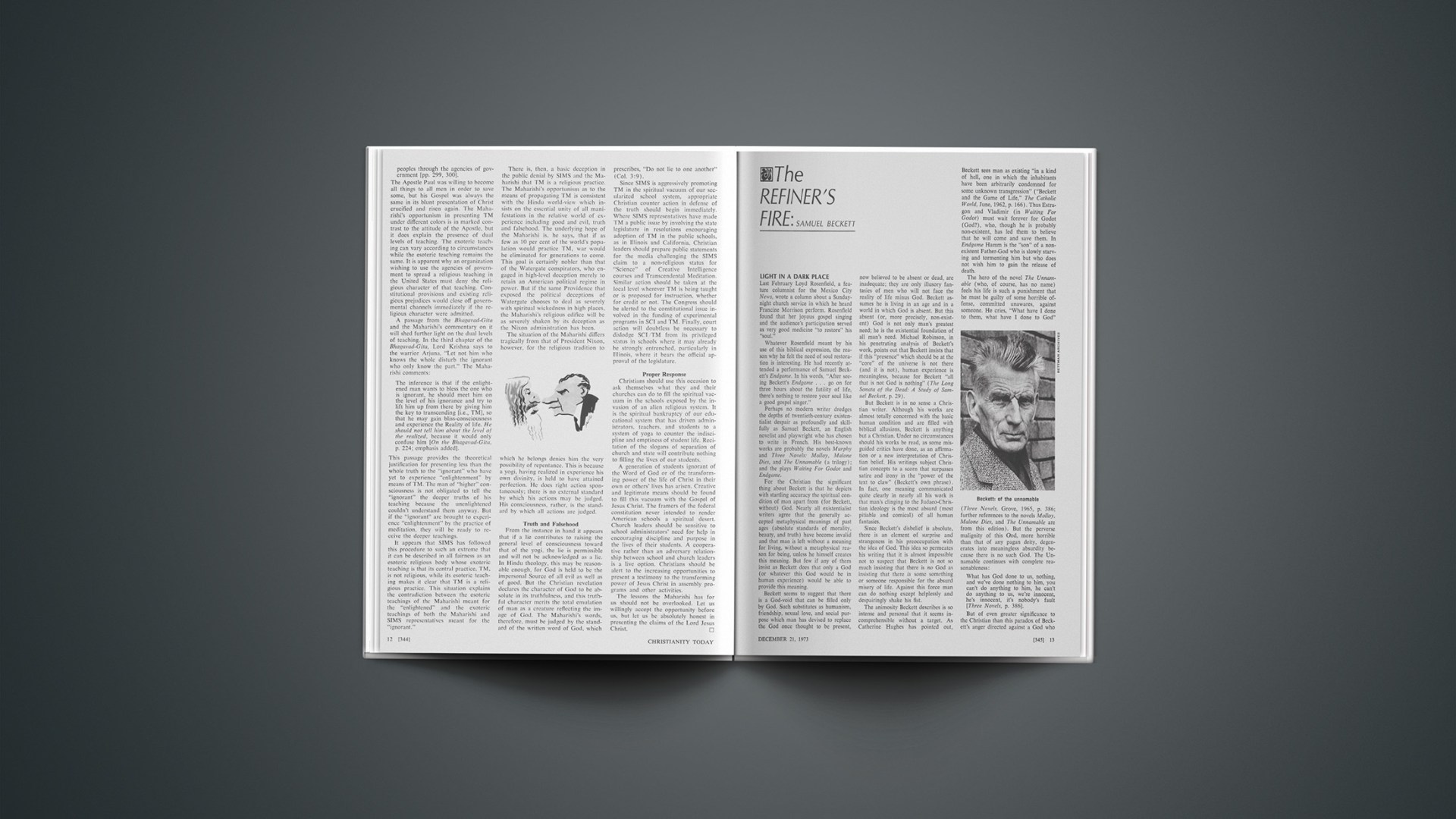
Perhaps no modern writer dredges the depths of twentieth-century existentialist despair as profoundly and skillfully as Samuel Beckett, an English novelist and playwright who has chosen to write in French. His best-known works are probably the novels Murphy and Three Novels: Molloy, Malone Dies, and The Unnamable (a trilogy); and the plays Waiting For Godot and Endgame.

For the Christian the significant thing about Beckett is that he depicts with startling accuracy the spiritual condition of man apart from (for Beckett, without) God. Nearly all existentialist writers agree that the generally accepted metaphysical meanings of past ages (absolute standards of morality, beauty, and truth) have become invalid and that man is left without a meaning for living, without a metaphysical reason for being, unless he himself creates this meaning. But few if any of them insist as Beckett does that only a God (or whatever this God would be in human experience) would be able to provide this meaning.

Beckett seems to suggest that there is a God-void that can be filled only by God. Such substitutes as humanism, friendship, sexual love, and social purpose which man has devised to replace the God once thought to be present, now believed to be absent or dead, are inadequate; they are only illusory fantasies of men who will not face the reality of life minus God. Beckett assumes he is living in an age and in a world in which God is absent. But this absent (or, more precisely, non-existent) God is not only man’s greatest need; he is the existential foundation of all man’s need. Michael Robinson, in his penetrating analysis of Beckett’s work, points out that Beckett insists that if this “presence” which should be at the “core” of the universe is not there (and it is not), human experience is meaningless, because for Beckett “all that is not God is nothing” (The Long Sonata of the Dead: A Study of Samuel Beckett, p. 29).

But Beckett is in no sense a Christian writer. Although his works are almost totally concerned with the basic human condition and are filled with biblical allusions, Beckett is anything but a Christian. Under no circumstances should his works be read, as some misguided critics have done, as an affirmation or a new interpretation of Christian belief. His writings subject Christian concepts to a scorn that surpasses satire and irony in the “power of the text to claw” (Beckett’s own phrase). In fact, one meaning communicated quite clearly in nearly all his work is that man’s clinging to the Judaeo-Christian ideology is the most absurd (most pitiable and comical) of all human fantasies.

Since Beckett’s disbelief is absolute, there is an element of surprise and strangeness in his preoccupation with the idea of God. This idea so permeates his writing that it is almost impossible not to suspect that Beckett is not so much insisting that there is no God as insisting that there is some something or someone responsible for the absurd misery of life. Against this force man can do nothing except helplessly and despairingly shake his fist.

The animosity Beckett describes is so intense and personal that it seems incomprehensible without a target. As Catherine Hughes has pointed out, Beckett sees man as existing “in a kind of hell, one in which the inhabitants have been arbitrarily condemned for some unknown transgression” (“Beckett and the Game of Life,” The Catholic World, June, 1962, p. 166). Thus Estragon and Vladimir (in Waiting For Godot) must wait forever for Godot (God?), who, though he is probably non-existent, has led them to believe that he will come and save them. In Endgame Hamm is the “son” of a non-existent Father-God who is slowly starving and tormenting him but who does not wish him to gain the release of death.

The hero of the novel The Unnamable (who, of course, has no name) feels his life is such a punishment that he must be guilty of some horrible offense, committed unawares, against someone. He cries, “What have I done to them, what have I done to God” (Three Novels, Grove, 1965, p. 386; further references to the novels Molloy, Malone Dies, and The Unnamable are from this edition). But the perverse malignity of this God, more horrible than that of any pagan deity, degenerates into meaningless absurdity because there is no such God. The Unnamable continues with complete reasonableness:

What has God done to us, nothing, and we’ve done nothing to him, you can’t do anything to him, he can’t do anything to us, we’re innocent, he’s innocent, it’s nobody’s fault [Three Novels, p. 386].

But of even greater significance to the Christian than this paradox of Beckett’s anger directed against a God who he claims does not exist is his astonishingly accurate and detailed portrayal of man’s “lostness.” This is not to say that Beckett sees man as sinful, fallen, and in need of redemption. The exact opposite is true. Along with most modern-day writers, Beckett conceives of man as amoral, and assumes that the cruel farce of life is simply a happenstance. It is not in his logic as to how man arrived at his present condition, but in his poetically beautiful and skillfully crafted verbalization of that condition, that he astonishes the Christian with his perception of man’s lostness. While Beckett would intend his description to encompass all men, the Christian would perceive it as encompassing all men without Christ. The very needs that this secular writer describes—the problems of human experience—are precisely those that the Christian sees as being met for man only through his reconciliation with God through Christ. In other words, Beckett’s darkness is the same darkness described in the Bible, that of man separated from the life of God. But for Beckett, there is no Christ to flood light into the darkness.

The Christian dare not ignore a writer who creates such characters (who are all actually the same character) who say such things (always actually the same thing) as Malone in Malone Dies:

But what matter whether I was born or not, have lived or not, am dead or merely dying, I shall go on doing as I have always done, not knowing what it is I do, nor who I am, nor where I am, nor if I am … not knowing what my prayer should be nor to whom [Three Novels, p. 226].

Surely he will feel a profound sympathy, or rather, a profound empathy (was not this lostness his own condition before God found him?), for Beckett and all such artists who have backed themselves into this darkest of all corners.

One aspect of Beckett’s darkness is his concept of time. If all of life from birth to death is only a passing from nothing through nothing to nothing, then each moment of life equals every other moment in total insignificance. Thus every moment is the same, time is essentially static, and any statement made about the past, the present, or the future is without content. Pozzo, in Waiting For Godot, is enraged at being asked to remember what happened on a certain day and insists that all time is the same empty day.

One day we were born, one day we shall die, the same day, the same second.… They give birth astride of a grave, the light gleams an instant, then it’s night once more [Waiting For Godot, Grove, 1954, p. 57b; further references to the play are from this edition].

But the Christian is not limited in his knowledge to the visible witness of nature to a continuing cycle of nights and days, each repeating the other in seemingly endless similarity. By divine revelation he knows that beyond all time there is a timeless God who created time, and that in time there is Christ, who is the Alpha and Omega (Rev. 1:8). Furthermore, this God began history (Gen. 1:1), entered time to redeem man at a precise moment in this history (Gal. 4:4), and is now directing all days toward that certain and unique day of the “glorious appearing of … Jesus Christ” (Titus 2:13).

God’s use of time gives significance and direction to the Christian’s use. He is to reckon each day as part of a stewardship for which he is eternally responsible (Rom. 14:12). Therefore each day must be redeemed (Eph. 5:16) as a unique opportunity to join with God in accomplishing his purposes in history. Such a viewpoint gives value, not only to each day, but to each moment of life.

Beckett’s characters long for time to end so that they can return to the condition of pre-conscious non-existence from which they came. Only in this condition do they think they can achieve the oblivion that they so earnestly desire. Vladimir and Estragon (Waiting For Godot) plan hopefully to hang themselves and thus to escape the inevitable fact that day always follows night, and Hamm (Endgame) is eager for the play of which he is the hero and everything in it to wind down and end. Their greatest fear, and perhaps the hindrance to self-destruction, is that death does not result in non-being. When Malone is dying he is horrified to imagine that he is “dead already and that all continues more or less as when I was not” (Three Novels, p. 219).

While the Christian knows that his self-consciousness is a result of his being a living soul (Gen. 2:7) created in the image of God (Gen. 1:26), and that he can never die, he considers this consciousness not as a burden but as a gift signifying God-likeness and as a necessary prerequisite for obtaining eternal life. Although the earth will be redeemed (Rom. 8:21), individual animals and plants (all life lacking self-consciousness) return to the earth in a continuing insensible state. But man, the crown of God’s earthly creation, is given the awesome responsibility and potentially joyful privilege of consciously existing forever. While apart from Christ such continued existence is a hell even worse than any Beckett could describe, in Christ it consists of a “glory which shall be revealed” that even Paul was at a loss to find words to describe (Rom. 8:18).

Related to his longing for non-being is the Beckett hero’s desire to return to his mother’s womb or to the closed interior of his own mind as the only places that he can call home, the only places where he has any sense of belonging. In Molloy, both heroes, Molloy and Moran, exhibit this desire. Molloy’s efforts to return to his mother have led him as far as her bedroom, and Moran’s “journey home” through “furies and treacheries” is toward the same goal. Life, then, is only a painful and meaningless exile in which the hero can find no place of abode. True, in Endgame Hamm has a house that is a refuge of sorts from the death outside, but it is probably only the inside of his own skull, and is itself a place of death. Similarly, in The Unnamable the only place the Unnamable is certain was made for him and he for it is the interior of his own mind. But this interior is a place of horror, not of refuge, for here he realizes there is no release from the crushing burden of self-consciousness from which he longs to escape.

Augustine knew that God made man for himself and that man cannot find rest or refuge outside God. David states that Jehovah God is a “refuge” (Ps. 62:8) and a “strong habitation” into which man may “continually resort” (Ps. 71:3). Jesus promised his disciples a present “abode” (John 14:23) because he and the Father would come to dwell with them, and a future house with many rooms prepared especially for them (John 14:2). Truly, man can be homeless, an orphan and an exile in the earth, but only because he will not come home to his Father’s house.

A major factor in the desire to return to the oblivion of the womb is a hatred of life. Nearly all of Beckett’s characters consider life to be not just an unwelcome gift but a curse forced upon them by their parents. Molloy has difficulty forgiving his mother for not getting him “unstuck” early in his conception. He calls her Mag because “the letter g abolished the syllable Ma, and as it were spat on it, better than any other letter would have done” (Three Novels, p. 17). Hamm is obsessed with the thought that if his father, Nagg, had not fathered him he would not have had to live, and he curses him (“accursed progenitor,” “accursed fornicator”).

The writer of Ecclesiastes, in considering human experience apart from God, also “hated life” because he realized that it “is vanity and vexation of spirit” (Eccl. 2:17). But Job, though in the extremity of his distress he cursed the day of his conception (Job 3:3), refused to heed his wife’s instruction to “curse God and die” (Job 2:9). Eventually he came to understand that in his great trouble he had “uttered” what he “understood not” (Job 42:3). For the Christian the occasion of birth is the beginning of an existence which may contain much sorrow, but in which it is possible to know God and to discover his purpose for life. Therefore he esteems human life to be of infinite worth because this life can be “hid with Christ in God” (Col. 3:3).

In a very perceptive essay Hugh Kenner explores Beckett’s concept of an irreconcilable split between the human mind and body (“The Cartesian Centaur,” Perspective, Autumn, 1959). The body is more of a prison than a useful instrument for the mind; a bicycle is a far more suitable instrument than the body. Some of Beckett’s pairs of characters (Lucky and Pozzo in Waiting For Godot and Hamm and Clov in Endgame) may be viewed as minds and bodies split but forced to remain together by a mixture of selfish love and loathing. The title character in Murphy sees his mind and body as separate entities that have hardly “anything in common.”

This concept is akin to the Greek idea of the inherent evil of the body and the goodness of the soul or spirit. But Hebrew and Christian thought does not view the body or flesh as inherently evil. Paul instructed the Ephesians to love their wives as they loved “their own bodies,” and claimed that man does not hate “his own flesh” but nourishes and cherishes it (Eph. 5:28, 29). Job was certain that although worms might destroy his body, yet in his flesh he would see God (Job 19:26) because the body, not just the spirit, will ultimately be redeemed (1 Cor. 15:35–44). Finally, further honor is accorded the body in that the Church is referred to as the body of Christ (Eph. 1:22–23) and that in the incarnation Christ himself became “flesh and blood” (Heb. 2:14). The Christian sees no division between his body, soul, and spirit but rather a unity and harmony patterned after the triune God (Father, Son, and Holy Spirit), in whose image he has been created. Thus his body is the instrument that, yielded by his spirit to the Holy Spirit, can best serve and glorify God.

Beckett conceives of nature (as the environment of man) as a paradox in that it is a dual setting of violent contrast. The tree in Waiting For Godot is “all black and bare” in the first act but grotesquely and impossibly “covered with leaves” in the second. This tree is not a normal renewal of life in spring after winter, but a symbol of the double face of nature—a green, budded, black, bare tree that is life (“Everything’s dead but the tree” [p. 59b]) and yet death (the tree is Vladimir and Estragon’s only chance at death, suicide by hanging). Nature, then, which appears to be a thing of life and beauty, is actually a thing of metaphysical emptiness and death. Holding such a concept, Beckett agrees with naturalistic writers in viewing nature as being so indifferent to man as to be pitted against him.

The Christian is no pantheist, or even a romantic, in his understanding of nature. Although he knows that God’s original creation was good and perfectly suited for man (Gen. 1:29, 31), he realizes that Adam’s sin and his own sin (the present pollution) have wrought havoc with nature. However, he also knows that nature even now is controlled and sustained by God (Col. 1:17; Ps. 119:90, 91) and will eventually be redeemed (Rom. 8:21). Furthermore, he sees the order and beauty of nature as the handiwork of God (Ps. 19:1) and the renewal of life through the seasons as bespeaking rebirth (Ps. 104:30), even to the point of the future creation of a “new earth, wherein dwelleth righteousness” (2 Pet. 3:13).

A problem common to much literature similar to Beckett’s is a search for lost identity—a longing to say “I” with full understanding and content. But as Ethel Cornwell has pointed out, “The Beckett hero does not seek his identity, he flees from it: his quest is for anonymity, for self-annihilation” (“Samuel Beckett: The Flight From Self,” PMLA, Jan., 1973). The Unnamable finally decides never to use the first person again because in so doing he is forced to admit that he is a person who exists. The characters in Waiting For Godot are never certain from one moment to the next of their identities. Vladimir may be Vladimir but he might be Mister Albert, and Pozzo answers to almost any name he is called. To assume an identity is to assume a responsibility for selfhood that the Beckett hero is not able to endure.

The Christian derives his identity from God. God has created him (Gen. 2:7) and adopted him by redemption into His family (Eph. 1:5, 7). Because of these relationships the Christian is certain of his identity as a son of God. This established identity determines his relation with others. Because he has been reconciled, he has been given the “ministry of reconciliation” and is an ambassador for Christ (2 Cor. 5:18–20). And so the Christian knows where he came from, who he is, and why he is here in regard to others. Every existentially defined need regarding identity can be met in Christ.

Most of Beckett’s characters are related to each other only in a hated dependency, though some are joined in a common sharing of despair. Clov cannot leave Hamm because only Hamm has any food left, and Hamm cannot evict Clov because Hamm is blind and crippled and has no one else to care for him. Vladimir and Estragon do not actually want to stay together, but because they are both shut up to a futile waiting for Godot to come, and because each has no one else with whom to play nonsense games, they remain together. But because undesired dependency usually breeds not love but a disgusting hatred, self-giving love between persons is almost wholly absent from Beckett’s writing. Another obstacle to such love is the self-loathing a character often feels for himself. Because he has no God to love (or who loves him) and because he loathes himself, he cannot love another person.

This need can be filled with all sufficiency by the God who is love (1 John 4:8). Because this God has loved each person and has esteemed him of such worth that he gave his Son (who also loved to the point of death) to die in his stead (John 3:16), the Christian has all the resources necessary to relate to others in self-giving love. Therefore the Christian sees himself and all other men as persons for whom Christ died (Rom. 5:8), and he is joined with all other Christians, not in despair, but in hope (Rom. 8:25). Furthermore, he is the recipient of the ministry of the Holy Spirit, who causes the “love of God” to be “shed abroad” in his heart (Rom. 5:5). The reason why a Beckett character cannot love another person is that he “knoweth not God; for God is love” (1 John 4:8).

Endgame is a grotesque travesty of the Christian concept of a God who is related to man as a father. Hamm (the hero of the play) feels compelled to relate a story of a man who comes crawling to him begging bread for his starving son. Although a catastrophe has rendered the earth incapable of producing food and Hamm has all the remaining stores of food in his locked cupboard, he will not give the man bread. Therefore the man has no bread to give to his son. Beckett’s implication is that man has no responsibility or ability to give to others because there is no heavenly Father who has ever given to him.

During this entire play Hamm is obviously being crucified by this cruel and non-existent Father-God. He is in a room resembling a skull, which may symbolize Golgotha, and his face is covered with a bloody handkerchief suggesting a handkerchief from early tradition said to have been marked with Christ’s features. He finally calls “Father! Father!” to a God who is not there, and the play ends with the blackest of metaphysical darkness.

This play is like a nightmare from which it is possible to awaken by reading the sixth chapter of John’s Gospel. Here Jesus explains that he is the “bread of God” who has come down from heaven to give “life unto the world,” and that whoever comes to him will never hunger. There is a Father-God, who in giving Christ has given spiritual bread and thus has provided for the metaphysical needs of man. Man, therefore. can give to others, not stones, but bread, because the heavenly Father has given so “much more” (Luke 11:11–13).

Vladimir and Estragon, two amusing but profoundly human tramps, wait for some person supposedly named Godot. They are most uncertain about this meeting—where and when it is to take place (they thought it was to be some Saturday, maybe by the tree), what Godot will do when he comes (he will either save or damn them; they are uncertain which), and even whether or not he exists (is he Godot or Godet or Godin and has anyone ever really seen him?). Despite this uncertainty, they must wait because there is nowhere else to go and nothing else to do. Also, the clowns long above all else (“in this immense confusion one thing alone is clear”) for Godot to come so that they might possibly “be saved.” When they imagine that he is coming, Vladimir shouts, “It’s Godot! At last! Gogo! It’s Godot! We’re saved! Let’s go and meet him” (p. 47b). But it is not Godot; he will never come because he probably does not even exist.

Beckett is saying that man must wait (he has no alternative except death) for a God (or for whatever this God would be) who cannot communicate with or save man because he does not exist. Thus man is shut up to a continual waiting or an event of paramount metaphysical significance that can never occur.

But the Christian knows that this event has occurred. God has come (from heaven to Bethlehem), and there is no uncertainty as to his name: it is Jesus Christ. Nor is there uncertainty as to his purpose: it is to save, to bring out of the place of death into the land of the living.

The validity of any Christian answer to Beckett’s metaphysical lostness is closely related to the story (already mentioned) that Hamm tells in Endgame. A close examination of this story reveals that it is a skillfully jumbled and blasphemous parody of the biblical narrative in a nutshell. Hamm’s story occurs on Christmas Eve, and Hamm designates the appearance of the man as an “invasion” from another place. The man asks for bread and is ridiculed by Hamm for thinking that there might possibly still be “manna in heaven.” Also, the man has left his son “deep in sleep” for “three whole days.” Later, when Clov asks Hamm to go ahead with his story, Hamm agrees but goes backward in biblical history to mention details from the story of the Fall in the Garden of Eden. The man (but also “another”) comes “crawling on his belly” and the man is “offered a job as gardener.” These allusions are intentionally only a confused jumble of words (Beckett’s “word” concerning the trustworthiness of the biblical record. For him, nonsense is the sum total of all metaphysical meaning that may be derived from the Hebrew and Christian Scriptures.

The answers that the Christian can offer all writers such as Beckett are abundantly sufficient, but their validity can be assumed only if these Scriptures are a “sure word of prophecy”—that is, if they came, not “by the will of man” but by the moving of “the Holy Ghost” (2 Pet. 1:19–21). Only then is there help for Hamm, who cries in darkness because his light is dying, and for the Unnamable, who in order to nullify the darkness within himself longs to be shut up in the “black dark.” Apart from this “sure word” there is no “light that shineth in a dark place” (2 Pet. 1:19). For it is this written word that tells of the living Word, who is the light of life.

Laura Barge is an M.A. candidate in English at Mississippi State University.
Transcendental Meditation: New Plant Thrives in a Spiritual Desert

That man cannot live indefinitely in the spiritual vacuum of secular humanism is being quietly demonstrated in a novel way in public high schools across the United States. Just ten years after the Supreme Court decision made de jure the de facto secularization of the American public school system, legislators and school administrators are looking to a new religious practice to help control their restive student changes. This new religious practice is called Transcendental Meditation, as taught by Maharishi Mahesh Yogi.

Amazingly enough, Transcendental Meditation (TM) has already achieved a semi-established status in Illinois: the State House of Representatives on May 24, 1972, passed a resolution by representative “Bingo” Bill Murphy, HR677, providing among other things “that all educational institutions, especially those under State of Illinois jurisdiction, be strongly encouraged to study the feasibility of courses in Transcendental Meditation and the Science of Creative Intelligence on their campuses and in their facilities.…” A similar resolution, ACR66, has been introduced into the California State Assembly by Oakland assemblyman Ken Meade. But it remained for the federal government to be the first to appropriate funds for the spread of Transcendental Meditation; a National Institutes of Health grant provided $21,540 for training 130 high school teachers as instructors in the Science of Creative Intelligence (SCI) at Humboldt State College, California, during August, 1972. (SCI is the doctrinal and TM the practical aspect of the system of yoga taught by the Maharishi.) As a result of this federal generosity, TM is being taught in high schools in a considerable number of states not previously reached.

Science Or Religion?

The organization promoting TM, the Student’s International Meditation Society/International Meditation Society (SIMS/IMS), insists in its publicity that SCI is a “science” and that TM is not a religion or a religious practice. Only on this basis has SIMS been permitted to teach the integrated SCI/TM course in public high schools across the country. But the less widely publicized yet authoritative writings of the founder and head of SIMS, the Maharishi Mahesh Yogi, contradict this non-religious view of TM and bear out the judgment that TM is a variant of Hinduism.

Although he is best known to the general public as the ex-guru of the Beatles, the Maharishi Mahesh Yogi deserves to be taken quite seriously as a religious leader in view of the worldwide organization he has developed in the last fourteen years. Since his first visit to the United States in 1959, his organization has trained more than 250,000 persons in TM in the United States alone. Currently more than 15,000 new meditators are initiated monthly at some 200 strategically located centers in this country. Fees of $35, $45, and $75 respectively are collected from high school, college, and adult initiates. From these figures it appears that the Maharishi’s organization receives over half a million dollars a month, or well over six million dollars annually, from this source. SIMS is a non-profit, tax-exempt educational organization incorporated in California.

Campus Impact

The initial appeal of TM was to college students, and instruction has been offered to students on nearly every campus in the nation. Campus chapters of SIMS are said to be active at more than 1,000 U. S. colleges. Interest in TM later broadened to faculty and beyond with the publication of scientific research supporting claims that TM is physically relaxing, mentally tranquilizing, and helpful in reducing drug abuse. SIMS has made a remarkable penetration of the academic and scientific communities on the basis of such research, which indicates that during the actual practice of meditation, TM markedly reduces body metabolism and increases alpha brain-wave production. A variety of mental and psychological benefits such as improved memory, superior motor control, and a more integrated personality have also been claimed on the basis of the work of various researchers.

SIMS has founded a university called Maharishi International (MIU) to preserve the purity of the teaching of TM and to sponsor further research. In cooperation with MIU, SIMS sets up the courses in SCI for colleges and high schools. An SCI course is even designed for elementary schools. The first SCI course for university credit was taught at Stanford in 1970 by SIMS national director Jerry Jarvis. At the university level the SCI course covers a variety of speculations about human consciousness and its alteration along with the basic writings of the Maharishi. The “laboratory work” for the course is always the same, the practice of TM. Such a course has been offered for credit at about fifty schools, including Yale, the University of Colorado, and several campuses of the University of California.

Symposiums on the Science of Creative Intelligence held since 1971 have drawn the sympathetic participation of a number of scientists and men of letters, including such notables as Buckminster Fuller and Marshall McLuhan. The importance of these meetings should not be underestimated, for they add impetus to a remarkable convergence of the world views of twentieth-century Western science Eastern religion. The Maharishi himself as a yogi, i.e., one who has attained union with God, and as the holder of a bachelor’s degree in physics is a kind of prototype for this convergence.

In the public high schools, SCI courses complete with initiation into TM have been offered for regular credit in New York, Massachusetts, Florida, and California. Officials of the San Francisco public school system are now considering the use of TM in their high schools. As a result of the National Institutes of Health grant for training 130 SCI course teachers, high schools in many states are presenting TM to their students on a non-credit or extra-curricula basis.

The initial basis for the adoption of TM in the public schools was primarily the claim that it is an effective drug-abuse control measure. A Harvard study by Benson and Wallace of 1,862 meditators found that after twenty-one months of meditation, use of marijuana dropped from 80 per cent to 12 per cent of the group, and use of LSD dropped from 48 per cent to 3 per cent. Dr. Benson, an associate professor at Harvard Medical School, has acknowledged that this research is inadequate, because it doesn’t take into account those who stop meditating and continue drug use or those who would have stopped drug use anyway. He has begun a more extensive study to correct this bias. SIMS, meanwhile, publicizes such studies as conclusive evidence of the effectiveness of TM in drug-abuse control. Dr. Leon Otis of the Stanford Research Institute has said that SIMS is in too much of a hurry to publish preliminary or unsubstantiated data about the results of meditation. Because of the severity of the drug problem in many schools and in the military, however, TM has appeared to be an attractive solution to administrators.

As a drug-abuse control measure TM has made a surprising impact in the Army. Major General Franklin M. Davis, Jr., became a meditator and promoted TM for controlling drug abuse while he was director of military personnel policies in the office of the Deputy Chief of Staff of the Army in 1971. His successor in the job, Brigadier General Robert Gard, became a meditator in 1972 and has included TM in the Army’s alcohol and drug-abuse program.

TM is presented by SIMS representatives as a non-religious technique for developing as a person by following a thought to its subtler levels until the field of thought is transcended in the Source of all thought or “Being.” To do this one sits in a relaxed position, with eyes closed, and silently repeats a Sanskrit word called a mantra. Knowledge of the mantras is secret and a would-be meditator receives his own individual mantra only by being initiated into TM by a SIMS instructor.

The introductory lectures emphasize the scientific research indicating that TM alters the physiology and psychology of the meditator in apparently desirable ways. SIMS representatives strongly deny that TM has any relation to religion at all. This is simply untrue: every instructor knows and honors the tradition of Shankara, the Hindu tradition to which he owes his knowledge of the mantras. But the roots of the practice in the Vedic tradition of the monist Hinduism of Shankara are ignored in favor of a modern, scientific image. By this means people are drawn in who would otherwise be hesitant to become involved in a religious practice. That the Maharishi perfectly understands this situation is indicated by his comment in Meditations of the Maharishi that “not in the name of God-realization can we call a man to meditate in the world of today, but in the name of enjoying the world better, sleeping well at night, being wide awake during the day” (p. 168).

TM as taught by Maharishi Mahesh Yogi really is, of course, a form of yoga.

In an article “Meditation Is Metatherapy” appearing in the Journal of Transpersonal Psychology (Vol. 3, No. 1, 1971), Daniel Goleman from Harvard said that “TM, like most yoga systems taught in the United States, traces its roots back to the tradition of which Patanyali’s Yoga Sutras is the classic statement.” Now “yoga” is a Sanskrit word for “union,” and the final object of yoga is union with God. A yogi such as the Maharishi is one supposed to have attained union with God or “God-consciousness.” For a yogi to teach any lesser study than that of “God-realization” or yoga would be absurd. But the Maharishi is quite willing to call his discipline by other names if that will help modern men to accept it.

It is quite true that many persons practice TM merely for its psycho-physical effects while ignoring its spiritual implications. But the religious aspect is present, nevertheless, from the beginning of meditation in the initiation ceremony at which the meditator receives his mantra. The candidate for initiation is told to bring an offering of flowers, fruit, and a clean white handkerchief to the ceremony. In a candle-lit precinct permeated by incense, he is invited to kneel before a picture of Guru Dev, the Maharishi’s dead master, while his initiator, also kneeling, presents the offerings and sings a song of thanksgiving honoring the departed masters of the Shankara tradition of Hinduism. This ritual specifically imposes the forms of worship in the offerings, the kneeling posture, and the hymn to the tradition of the dead masters. When it is understood that every one of the masters is considered to be a realized expression of divinity, the idolatrous character of the ritual becomes obvious. The title Guru Dev applied to the Maharishi’s teacher, for example, may be translated “Divine Leader.”

Worship Tradition

In his definitive commentary on the first six chapters of the sacred Hindu text the Bhagavad-Gita, the Maharishi makes his attitude toward the tradition of Shankara clear:

The holy tradition of great masters which is responsible for reviving the teaching after every lapse, has captured the minds and hearts of lovers of Truth in every age. It is not merely held in high regard, but has come to be actually worshiped by seekers of Truth and knowers of Reality. A verse recording the names of the greatest and most highly revered masters has not only inspired seekers, but has been a joy even to the fulfilled hearts of realized souls passing through the long corridor of time [Maharishi Mahesh Yogi on the Bhagavad-Gita, p. 257, emphasis added].

The verse referred to is, of course, the verse that the instructor sings in the initiation ceremony.

The Christian attitude toward this ceremony with its homage to the pictured image of Guru Dev and the hymn to the divinized tradition may be summed up by this passage from the Book of Leviticus: “You shall not make for yourselves idols, nor shall you set up for yourselves an image … to bow down to it; for I am the Lord your God (26:1, New American Standard Version).

Influence Upon Educators

While it is thus readily established for a Christian audience that TM is a religious practice, further evidence may be needed to convince school administrators who have been presented with apparently sincere protestations of the religious neutrality of TM. Consider the way in which TM is presented in this excerpt from a letter sent by the Berkeley SIMS center to the parents of students at area high schools: “TM is a natural, easy, systematic and scientifically verifiable technique. It is not a religion or philosophy, nor does it involve withdrawal from life” (emphasis added). SIMS instructor Jack Forem in the introduction to his book Transcendental Meditation describes the Maharishi’s lecturing on this point as follows: “He emphasized that he was not espousing philosophy or religion, or offering something to believe in or accept on faith. Rather, he said, transcendental meditation is a practical technique, based on verifiable, scientifically validated principles” (p. 3).

In striking contrast to statements like these of the religious irrelevance of TM stands the body of the Maharishi’s published writings. In Meditations of the Maharishi Mahesh Yogi, the Maharishi says, “Transcendental meditation is a path to God” (p. 59). In reply to a direct question recorded in the same book, “Is this meditation prayer?,” the Maharishi answers, “A very good form of prayer is this meditation which leads us to the field of the Creator, to the source of Creation, to the field of God” (p. 95). The glaring contradiction between SIMS leaders’ public denials that TM is a religious practice and the Maharishi’s written acknowledgement that TM is a “path to God” and a “very good form of prayer” at least raises some question about the veracity of these leaders. In response to probing at this point, SIMS representatives attempt to repudiate this particular book because of its disarming frankness about the religious aspects of TM, but its view is consistent with that of the books written by the Maharishi and distributed by SIMS. In the Science of Being and Art of Living, for example, the Maharishi writes, “The key to the fulfillment of every religion is found in the regular practice of transcendental deep meditation” (p. 254).

In reality the only basis for the claim that TM is not a religious practice is that faith in the teachings of the Hindu tradition from which TM springs is not a prerequisite to the practice of TM. But the irrelevance of the argument that defines a religious practice in terms of its faith prerequisite becomes apparent when it is discovered that the Maharishi considers meditation itself to be the way to faith for the faithless:

Meditation is a process which provides increasing charm at every step on the way to the Transcendent. The experience of this charm causes faith to grow.… Moreover the practice of transcendental meditation is such that it can be started from whatever level of faith a man may have, for it brings faith to the faithless and dispels the doubts in the mind of the sceptic by providing direct experience of Reality [Maharishi Mahesh Yogi on the Bhagavad-Gita, pp. 317, 319; emphasis added].

As a matter of fact, there comes a point at which faith becomes essential. In his comment on chapter 4, verse 39, of the Bhagavad-Gita, the Maharishi states that “the Lord [Krishna] names faith as a prerequisite to knowledge” (p. 316). The content of this faith as set forth in this repetitious yet novel commentary on the Bhagavad-Gita is the monist Hinduism of the Vedic tradition of Shankara. In this essentially pantheistic system, everything in the universe is held to be a manifestation of the One or the Absolute. The Absolute is attributeless and ineffable but may be characterized for practical purposes as impersonal consciousness or “Being.” Man’s purpose is to attain to direct, conscious experience of the unity of the Absolute or “God-consciousness” at all times. TM itself is a means to this end.

The Truth Claim

The practice of TM leads first to “Transcendental-consciousness” and then to “Cosmic-consciousness.” The transition to “God-consciousness” is accomplished by means of pure devotion to God, devotion of which man is virtually incapable until he has attained “Cosmic-consciousness.” This pilgrimage is likely to take many years, but if it is not completed in this life it will be taken up in the next, for the doctrine of reincarnation is integral to the Maharishi’s teaching. The Maharishi and SIMS insist that TM is compatible with all religions, but it is apparent that this system of self-salvation is incompatible with all the historic creeds of the Christian faith. Not only does it constitute a system of salvation by works rather than by grace, but it denies the personal nature of God as the ultimate reality and fails to acknowledge the role of Jesus Christ as the Way to the Father.

So despite the openness of SIMS to receive as meditators persons professing other faiths, the faith of the Maharishi has an ultimate and exclusive truth claim just as other religions do. In his commentary on the Bhagavad-Gita again, the Maharishi states that “the Lord [Krishna] declares that realization of the state of all knowledge is the only way to salvation and success in life; there is no other way” (p. 228; emphasis added). The “state of all knowledge” is, of course, realized by the practice of TM alternating with normal activity. The Maharishi considers that this knowledge has been lost to all of the great religions of the world and that they should therefore accept his teaching.

The contradiction between the public statements of the Maharishi and his representatives and the published writings of the Maharishi suggests that the teaching of the Maharishi has two levels: a public or exoteric teaching and a private or esoteric teaching. The two teachings are logically incompatible, but both serve the purpose of spreading TM. In Science of Being and Art of Living the Maharishi makes some shrewd observations on how to spread the message of TM as efficiently as possible. He writes,

Whenever and wherever religion dominates the mass consciousness, transcendental deep meditation should be taught in terms of religion.… Today, when politics is guiding the destiny of man, the teaching should be primarily based on the field of politics and secondarily on the plane of economics.… It seems, for the present, that this transcendental deep meditation should be made available to the peoples through the agencies of government [pp. 299, 300].

The Apostle Paul was willing to become all things to all men in order to save some, but his Gospel was always the same in its blunt presentation of Christ crucified and risen again. The Maharishi’s opportunism in presenting TM under different colors is in marked contrast to the attitude of the Apostle, but it does explain the presence of dual levels of teaching. The exoteric teaching can vary according to circumstances while the esoteric teaching remains the same. It is apparent why an organization wishing to use the agencies of government to spread a religious teaching in the United States must deny the religious character of that teaching. Constitutional provisions and existing religious prejudices would close off governmental channels immediately if the religious character were admitted.

A passage from the Bhagavad-Gita and the Maharishi’s commentary on it will shed further light on the dual levels of teaching. In the third chapter of the Bhagavad-Gita, Lord Krishna says to the warrior Arjuna, “Let not him who knows the whole disturb the ignorant who only know the part.” The Maharishi comments:

The inference is that if the enlightened man wants to bless the one who is ignorant, he should meet him on the level of his ignorance and try to lift him up from there by giving him the key to transcending [i.e., TM], so that he may gain bliss-consciousness and experience the Reality of life. He should not tell him about the level of the realized, because it would only confuse him [On the Bhagavad-Gita, p. 224; emphasis added].

This passage provides the theoretical justification for presenting less than the whole truth to the “ignorant” who have yet to experience “enlightenment” by means of TM. The man of “higher” consciousness is not obligated to tell the “ignorant” the deeper truths of his teaching because the unenlightened couldn’t understand them anyway. But if the “ignorant” are brought to experience “enlightenment” by the practice of meditation, they will be ready to receive the deeper teachings.

It appears that SIMS has followed this procedure to such an extreme that it can be described in all fairness as an esoteric religious body whose exoteric teaching is that its central practice, TM, is not religious, while its esoteric teaching makes it clear that TM is a religious practice. This situation explains the contradiction between the esoteric teachings of the Maharishi meant for the “enlightened” and the exoteric teachings of both the Maharishi and SIMS representatives meant for the “ignorant.”

There is, then, a basic deception in the public denial by SIMS and the Maharishi that TM is a religious practice. The Maharishi’s opportunism as to the means of propagating TM is consistent with the Hindu world-view which insists on the essential unity of all manifestations in the relative world of experience including good and evil, truth and falsehood. The underlying hope of the Maharishi is, he says, that if as few as 10 per cent of the world’s population would practice TM, war would be eliminated for generations to come. This goal is certainly nobler than that of the Watergate conspirators, who engaged in high-level deception merely to retain an American political regime in power. But if the same Providence that exposed the political deceptions of Watergate chooses to deal as severely with spiritual wickedness in high places, the Maharishi’s religious edifice will be as severely shaken by its deception as the Nixon administration has been.

The situation of the Maharishi differs tragically from that of President Nixon, however, for the religious tradition to which he belongs denies him the very possibility of repentance. This is because a yogi, having realized in experience his own divinity, is held to have attained perfection. He does right action spontaneously; there is no external standard by which his actions may be judged. His consciousness, rather, is the standard by which all actions are judged.

Truth And Falsehood

From the instance in hand it appears that if a lie contributes to raising the general level of consciousness toward that of the yogi, the lie is permissible and will not be acknowledged as a lie. In Hindu theology, this may be reasonable enough, for God is held to be the impersonal Source of all evil as well as of good. But the Christian revelation declares the character of God to be absolute in its truthfulness, and this truthful character merits the total emulation of man as a creature reflecting the image of God. The Maharishi’s words, therefore, must be judged by the standard of the written word of God, which prescribes, “Do not lie to one another” (Col. 3:9).

Since SIMS is aggressively promoting TM in the spiritual vacuum of our secularized school system, appropriate Christian counter action in defense of the truth should begin immediately. Where SIMS representatives have made TM a public issue by involving the state legislature in resolutions encouraging adoption of TM in the public schools, as in Illinois and California, Christian leaders should prepare public statements for the media challenging the SIMS claim to a non-religious status for “Science” of Creative Intelligence courses and Transcendental Meditation. Similar action should be taken at the local level wherever TM is being taught or is proposed for instruction, whether for credit or not. The Congress should be alerted to the constitutional issue involved in the funding of experimental programs in SCI and TM. Finally, court action will doubtless be necessary to dislodge SCI/TM from its privileged status in schools where it may already be strongly entrenched, particularly in Illinois, where it bears the official approval of the legislature.

Proper Response

Christians should use this occasion to ask themselves what they and their churches can do to fill the spiritual vacuum in the schools exposed by the invasion of an alien religious system. It is the spiritual bankruptcy of our educational system that has driven administrators, teachers, and students to a system of yoga to counter the indiscipline and emptiness of student life. Recitation of the slogans of separation of church and state will contribute nothing to filling the lives of our students.

A generation of students ignorant of the Word of God or of the transforming power of the life of Christ in their own or others’ lives has arisen. Creative and legitimate means should be found to fill this vacuum with the Gospel of Jesus Christ. The framers of the federal constitution never intended to render American schools a spiritual desert. Church leaders should be sensitive to school administrators’ need for help in encouraging discipline and purpose in the lives of their students. A cooperative rather than an adversary relationship between school and church leaders is a live option. Christians should be alert to the increasing opportunities to present a testimony to the transforming power of Jesus Christ in assembly programs and other activities.

The lessons the Maharishi has for us should not be overlooked. Let us willingly accept the opportunity before us, but let us be absolutely honest in presenting the claims of the Lord Jesus Christ.

Comets in the Bible

This Christmas, the gospel account of the Magi and the star of Bethlehem takes on new meaning as we observe the great “new” comet Kohoutek. It may well be like a cosmic performance of “You Are There: Christmas, 5 B.C.”

The comet was discovered by Lubos Kohoutek of the Hamburg Observatory on March 7 of this year on photographic plates he had taken while observing a minor planet (asteroid) he had discovered in 1971. The comet was then near the orbit of Jupiter, some 350 million miles from the earth, on its way toward the sun. By the end of March, its progress had been plotted well enough to calculate its orbit and to determine that it would become a spectacular object in December and January.

The closer the comet came, the more excitement it generated among astronomers. Some suggested Kohoutek would provide the sky show of the century. The National Aeronautics and Space Administration diverted $10 million for instruments alone to study the comet, and Skylab astronauts scheduled the first of two space walks on Christmas Day to point instruments at Kohoutek. Science magazine dubbed Kohoutek “the Christmas comet.”

The comet will reach perihelion (that point in its orbit closest to the sun) right after Christmas, passing behind the sun from us. Returning from perihelion, it will reappear east of the sun and continue to move eastward as it again approaches the earth’s orbit. It will still be very bright, and this will probably be the best time for viewing. On January 15, 1974, it will be closest to the earth, about 75 million miles away. By the end of January, the comet will have passed over the earth’s orbit and be on its way back to the outer reaches of the solar system. It may still be visible to the eye until the end of February.

Such a spectacular event at this particular time of the year naturally raises the question: Was the star of Bethlehem a comet?

Speculation about the star through the centuries has attributed it to several things: a conjunction of the planets Jupiter, Saturn, and Mars; the planet Venus at its brightest; the sudden appearance of a nova (an exploding star); a comet; and a wholly supernatural event. There are strong objections to the notion that the ancient astronomers would confuse a planetary conjunction with a single star, and the planet Venus was hardly a new star in 5 or 6 B.C., so the majority of commentators seem to incline toward one of two explanations: a nova, or a supernatural event. Curiously, few even mention the possibility of a comet.

Paul L. Maier notes in his First Christmas, however, that ancient Chinese annals record a comet visible for some seventy days in March and April of 5 B.C., and this must have been seen in the Middle East also. Its orbit was such that each night it appeared farther west, which may have prompted the Magi to make their westward journey. From the remarkable conjunction of Jupiter, Saturn, and Mars in the constellation Pisces a year earlier, they would have been alerted to expect a king (Jupiter) to arise in Palestine (Saturn) who would usher in a new epoch in history (Pisces). The comet of 5 B.C. then announced to them his arrival, and confirmed the location by traveling westward. By the time they had made the necessary preparations and taken their journey to Jerusalem, at least several months had passed. The holy family was by that time living in a house (Matt. 2:11), not a stable. Did a meteor point out the place (Matt. 2:9)?

Comets may also be referred to in several other biblical passages, as noted in George F. Chambers’s classic popularization published in 1909, The Story of the Comets. Chambers’s work was prompted by public interest in the impending return of Halley’s comet.

First Chronicles 21 gives an account (also told in Second Samuel 24) of David’s attempt to take a census of Israel, of God’s displeasure, and of the three-day pestilence that David accepted as the punishment to be visited upon his kingdom. God also sent an angel to destroy Jerusalem, then told the angel to stay his hand. The angel was standing by the threshing floor of Ornan the Jebusite on Mount Moriah, north of Jerusalem. “Then David lifted up his eyes and saw the angel of the Lord standing between earth and heaven, with his drawn sword in his hand stretched out over Jerusalem” (1 Chron. 21:16, NASV). Commentators often relate this vision of David to the angel Balaam saw blocking his path when he was on his way to curse the Israelites for Balak, king of Moab (Num. 22:21–35). But that angel was apparently man-size. The one seen by David from Jerusalem, one-half mile away, suspended in the sky with his sword stretched out over the town, must have been immense. Was it a comet, with its tail extended far southward like a sword? The Roman naturalist Pliny classified comets according to their apparent shape, and one of his twelve classifications he called Xiphiae or ensiformis (sword-shaped). Josephus observed that in A.D. 66 Halley’s comet, or another at about the same time, stood like a sword in the sky over Jerusalem. The simile may have been suggested to him by First Chronicles 21:16, but the shape of the comet apparently justified it.

After David offered a sacrifice on the threshing floor of Ornan (verse 26), the angel, which “was standing by the threshing floor” (verse 15), at the command of God “put his sword back in its sheath” (verse 27). In other words, perhaps, the cometary apparition lost its tail.

A second possible reference to comets is found in Job 38:31, 32:

Can you bind the chains of the Pleiades,

Or loose the cords of Orion?

Can you lead forth Mazzaroth in its season,

And guide Ayish with her sons?

What are Mazzaroth and Ayish? A wide variety of opinions prevails. Many assume they are constellations, like Kimah (the Pleiades) and Kesil (Orion) in verse 31. But they may be individual stars or other phenomena. The phrase “in its season” suggests that this passage could refer to a short-period comet, like Encke’s comet which returns every 3.3 years, or to a regular meteor shower like the Perseids, which appear every year about August 12. Ayish is thought by most commentators to be a constellation called the Bear, with its tail (sons). Curiously, the Septuagint translates this reference to Ayish “… drag out Hesperos [the evening star] by his hair.” The word comet is derived from the Greek komē, meaning hair.

Another much discussed Old Testament passage is Isaiah’s famous reference (14:12 ff.) to Helal, son of Shahar:

How you have fallen from heaven,

O Helal, son of Shahar!

You have been cut down to the earth,

you who have weakened the nations!

But you said in your heart,

“I will ascend to heaven;

I will raise my throne above the stars of God,

And I will sit on the mount of assembly

In the recesses of the north.

I will ascend above the heights of the clouds;

I will make myself like the Most High.”

Nevertheless you will be thrust down to Sheol,

to the recesses of the pit.

This is usually said to refer to the morning star (Lucifer, the planet Venus), son of the dawn, after the classical Greek myth of Phosphoros, son of Eos. Shahar in Hebrew means dawn, and Helal may mean bright, or shining.

But this interpretation does not explain Isaiah’s portrayal of Helal as trying to dominate the heavens and being cast down. Venus as the morning star may dominate the sky before sunrise, and as the evening star after sunset, but this is no one-time event. It happens regularly. And Venus is not cast down from its position—it simply disappears behind the sun and reappears on the opposite side. Its cycles are as regular as the phases of the moon. If Shahar here means Dawn, and Helal is indeed Venus, then the behavior of Helal as described in Isaiah is inexplicable, unless we accept the theory that Venus once had a highly eccentric orbit and behaved in a very dramatic fashion. (The recent discovery that there are craters, probably of meteoric origin, on Venus may mean that Venus was once struck by a group of meteorites, perhaps associated with a comet, and thereby forced into an eccentric orbit.)

A CHRISTMAS HARVEST

The fruit’s consumed, the vine is sere

The root moves into stupor

The sun’s slant glance supplies no warmth

The wind strips summer’s cover

Yet in this death and certain chill

A season of remembrance

A time of life and fellowship

A warmth from Heaven’s radiance

For springing from a spotless seed

The True Vine is restored

Its fruit is sweet and quickening

Its promise never flawed

So all who yearn may pick of it

Forgiving nectar savor

And all who do will find in it

Eternal joy and pleasure

KEN PEEDERS

In Ugaritic myth, however, Shahar is not the dawn but the morning star itself. If this is Isaiah’s meaning, then Helal, son of Shahar, may be a comet that originally appeared as a companion of Venus. A comet would appear very bright for a time, perhaps brighter than the stars or the moon. It might even challenge the sun by remaining brightly visible in daylight, as comet Kohoutek may do. It would then seem to fall away, perhaps toward the earth, as it passed outward from perihelion and disappeared.

The New Testament, too, contains passages in addition to the story of the Magi that may refer to comets.

The brief letter of Jude lists among the metaphors for those who were stains on the love-feasts of the early church “wandering stars, for whom the black darkness has been reserved forever” (Jude 13). These “wandering stars” could be planets, which appear to wander about the sky, unlike the comparatively fixed stars. The name planēs given them in this passage, which means “wanderer” in Greek, was applied by Greek astronomers to the planets.

But planets are not sent into “outer darkness.” They orbit the sun regularly, and shine continually by its light. Comets, on the other hand, spend most of their orbital careers in space beyond the planets. Most of them may come from a comet cloud (called the Oort cloud after the astronomer who has developed the hypothesis) forming a ring far out beyond Pluto—in outer darkness indeed! Interestingly, the pseudepigraphal book of Enoch speaks of a group of seven stars confined to a remote region of space for some offense against God until God releases them after 10,000 years. By coincidence, the orbital period (the time required to make one complete orbit) of comet Kohoutek is estimated to be 10,000 years.

By far the most dramatic portrait of a comet-like apparition in the Bible is that of the dragon in Revelation 12. It is pictured as a great red dragon with seven heads, whose tail swept one-third of the stars. Mention of the tail immediately suggests a comet. The tail of a large comet often covers much of the sky, as did that of the comet of 1843. The great comet of 1744 had several tails. The tail of comet Kohoutek may extend as much as 30° across the sky.

Several comets have been notably reddish. Virgil and Pliny both refer to comets as bloody. Homer likens the helmet and crest of Achilles to a red star (comet) “that from his flaming hair/Shakes down diseases, pestilence, and war” (Pope’s translation).

The seven heads seem at first more difficult to explain. But the head of Biela’s comet (1845–46) divided into two parts, the great comet of 1882 had several nuclei, plus a satellite comet, and comet Ikeya-Seki (1965) had a double nucleus. As early as Aristotle, observers noted also that on occasion more than one comet has been visible at a time.

Biblical and Ugaritic literature contain several references to Leviathan, a monster with seven heads, generally depicted in the Old Testament as a sea dweller. (See Job 41; Psalm 74:14, and Isaiah 27:1.) Earlier than these sources is a Sumerian seal that depicts a seven-headed monster being attacked by two heroes (Oriental Institute, University of Chicago). The monster has not only seven heads on long necks but also six plumes of smoke, or tails, issuing from its body. Quite possibly this scene represents the mythological memory of the appearance of a multi-headed comet, or a group of comets, in early antiquity. John, in his vision, may have been reminded of that ancient event.

The plagues John saw earlier in his vision lend support to the idea that the great red dragon was a comet. In Revelation 8 and 9 we read that the tribulations brought by the seven angels with trumpets included first hail and fire thrown upon the earth (8:7), then a mountain on fire falling into the sea (8:8), then a star falling (8:10), and later another star, or the same one, opening an abyss when it fell and releasing a swarm of locust-like creatures (9:1–3). These events plainly resemble first a meteorite shower and then individual large meteorite falls. (See also 6:13.)

Now, it is well known that meteoric debris is often distributed in regular orbits around the sun, so that the earth experiences annual meteor showers. (The Perseids, on or around August 12, are usually the most spectacular.) It is also clear that meteoric debris is distributed in and around the orbits of comets, including comets that have disappeared. It is thought to be largely the debris left by the gradual disintegration of the comets. Significantly, some of this debris is often gathered in clouds that not only follow but also precede comets in their orbits, causing meteor showers both before and after the comets appear. For example, Biela’s comet was preceded by the Andromedid meteor showers in 1798, 1830, and 1838, and since its disappearance these showers have continued.

Thus John has clearly pictured for us a catastrophic bombardment of the earth by meteorites, followed after an interval by the appearance of a great red multi-headed comet. If he wrote some time after A.D. 66, as most commentators believe, perhaps the appearance of Halley’s comet influenced his portrayal.

The return of Christ, too, may be heralded by something like a comet. Matthew says (24:30): “And then the sign of the Son of Man will appear in the sky, and then all the tribes of the earth will mourn, and they will see the Son of Man coming on the clouds of the sky with power and great glory.”

All this is not meant to say that these biblical events were merely natural phenomena, and just happened to appear at the right time to be significant in Bible history. To insist on so many astounding coincidences in the life of God’s people is ridiculous. God is master of his creation and can guide it according to his will, and all in accordance with what we call “natural law.” Natural law, after all, is only a rule derived from observation.

The Great Comet of 1973 is a remarkable demonstration of the power of God in the universe, and a reminder of the part that these and other members of the solar system have played in the history of God’s people. It should do much to help us keep Christ in Christmas this year. And it renews our faith for the years to come by reminding us: “The King is coming!”

On the Festival of Christ’s Nativity

The most astounding and the most familiar story of all is the story of the Nativity. And this very familiarity may give us trouble, from time to time. We feel as though we ought to be perpetually awestruck by a tale of such wonders; we hold it to be true. But we find that we can rehearse the whole thing, just as we can rehearse the events of the Passion, and not really be “moved” by it. What is wrong? Are we so cloddish that we can speak of God with us, and of such marvels as the Virgin Mother and archangels and the star, without being profoundly moved every time?

The notion that we ought to be so moved fails to take into account one big psychological datum, and it is this: we human beings cannot remain for very long in any highly intense frame of mind, whether it be grief or joy or awe or anger or whatever. That is, no matter what the original stimulus may have been that aroused the feelings, we find that, after the first flush, there is a pattern of receding and surging, and that the crest does not stay fixed at some high point. We find a respite, and then perhaps a return periodically to the intensity of feeling.

Anyone who has experienced a death close at hand knows this. The grief is there, but the wild surges of uncontrollable feeling come only at irregular intervals. Or joy: we don’t remain for long, steady periods in any elevated state of tingling bliss. It comes and goes. And the same is true with awe: you may be thunderstruck with the first glimpse of the Grand Canyon, or of a Saturn rocket launching, or of the Queen of England. But the guide who descends daily into the canyon, or the electrician at Cape Kennedy, or the equerry in the palace becomes accustomed to the thing. He can’t maintain his original awe.

This is as it should be. We have to function. We have to get on with it. T. S. Eliot was right when he said that human kind can’t bear very much reality. If we had the whole abyss of mystery and splendor gaping straight at us all the time, we would be paralyzed, or worse, shriveled to a clinker. We would not be able to take it. Tradition used to say that the seraphim, those high and burning celestial lords, could gaze steadily at the Divine Glory; but whether or not they can, we mortals surely cannot.

And so we find, for one thing, that the approaches Heaven has made towards us are “tailored” to our humanity. Sinai was wrapped in thick clouds—and even that proved to be a bit much for everyone. The Shekinah was veiled inside the unapproachable place. And when God himself came to dwell among us, his glory was wrapped in the ordinariness of infant flesh.

But we find that, even with the thing brought low, as it were, our responses are hardly consonant with the immensity of the story. Here is the greatest event of all—God with us—and we do not leap to our feet in a transport of joy. Here is the greatest paradox of all—the Eternal Word incarnate as an infant boy—and we do not boggle.

But if we take our humanness, with its limitations, into account, it is clear that the thing God had in mind when he came to us was not to transfix us, or to mesmerize us into a perpetual trance. It was, rather, by his life of obedience and by his offering up of that life in our behalf, to open up to us again what human life is all about: namely, the liberty to know, love, obey, and worship God in all our appointed tasks. The life he lived here among us, through his infancy, boyhood, adolescence, and young manhood, was, so far as we can tell, a very ordinary one of domesticity, work and play, learning, and obedience to his parents.

That life was a pattern for us, the Scriptures say. And the pattern suggests that, in the ordinary course of events, the thing for us is that we do our work, and learn, slowly perhaps, what it means to live and do that work wholly “unto the Lord.” There is one sense in which we can say that the Incarnation raised ordinariness to the possibility of glory. The common life of human flesh was shown to be the very realm in which the Father can be known.

But of course, we were not left with unrelieved ordinariness—a featureless plain, as it were, of sheer, plodding obedience. That would be a daunting vista for the mightiest saint to face. There are peaks—of inspiration, of encouragement, of renewal, and so forth. Or, to change the picture, there is a round, a rhythm. Just as we have the round of the year, with spring, summer, fall, and winter perpetually enacting for us the drama of renewal; or the round of the month, with the phases of the moon; or of the week, with the one day in seven regularly and rhythmically recurring; or even of the day, with twilight and dawn and the pauses for eating and sleeping organizing our life and work into a solemn dance—just as we have all this in the “natural” course of things, so we may suppose that there is a similar round or rhythm in the spiritual realm.

It is always risky, of course, to separate the natural and the spiritual realms, as though they were two independent worlds. Various religions and cults try it, but no Christian can be satisfied with this dichotomy, holding as he does right at the center of his vision the notion of the Incarnation, that is, that event where the natural became the vehicle for the spiritual, or the eternal was manifest in time.

It is perhaps because of this lively awareness in the Christian vision of the way in which our world and our ordinary life were made the vehicle, or the stage, for the disclosure of the eternal, that the Church has thought it was not amiss to celebrate periodically the great events of the Gospel—Christmas, Epiphany, Lent, Easter, Ascension, and Pentecost—precisely for the renewal and refreshment of the faithful.

Not all the churches in Christendom mark these events, and there is apostolic warrant for either way. St. Paul seems to permit the believers to observe or not to observe, as their outlook inclines them to do. And of course, no one claims that Jesus was born on December 25, or that he rose from the tomb on April 20, say. But it has been a very widespread practice in most of the churches to observe some or all of these occasions, and, if we reflect briefly, we can see how it makes sense.

For one thing, as we have seen, the created order in which we mortal men live is rhythmic, rather than linear and featureless. Spring and fall, dawn and twilight—we have the whole business enacted and vivified for us by earth and sky and trees and living creatures, a sort of natural antiphon, you might say, to some divine pattern. Our eyes and ears and noses are hailed with sights and sounds and smells that recurrently boost us along to renewed awareness of the wonder of this created order.

And, besides this external rhythm, we can find inside our own makeup, as we have seen, this need to be jogged and reminded of what we already know. We have no doubt, for instance, that we are married to our spouse, but the yearly marking of this event seems to spring from something in the very fabric of our being. Or again, we know quite well that our child was born one fine day, but we return every year to a formality with candles and cake to mark this event. It is not as though we don’t know it. But we need to enact it somehow, or to celebrate it.

This, surely, is what the yearly celebration of Christmas suggests for the Christian believer. Here is the recurrent marking and solemnizing of the event that stands above all other events for him—God’s appearance in our own flesh, our salvation made nigh, light bursting over our world, life and immortality brought to light, peace declared between God and man. If our own little anniversaries and birthdays claim our recurrent attention, how much more profoundly does the remembrance of this event—which occurred not simply in some legend, or in some transcendent ether, but in our real history—claim our attention.

But there is more. The event celebrated is the supreme point at which our ordinariness was attested to, as it were, by God himself taking our flesh, and our life was raised to glory. So that the things that make up our life here—work and eating and drinking and relationships and music and play and colors and sounds and smells and flavors—become, for the Christian, not simply chance details in a futile grind down toward oblivion but the very forms by which we participate in our appointed realm of the created order.

And so, in one sense, Christmas is the celebration of the birth of our Lord Jesus Christ; but it is more than a mere anniversary of a past event. It is the celebration of our life made new, of our humanness opened out to the possibility of glory; and therefore we bring everything that pertains to that humanness, and we deck this occasion with all of it, affirming that it all “belongs.” We call up, in song and pageant and picture and ceremony, the scenes and characters who appeared in that first drama: the Holy Family, Bethlehem, the shepherds, the angels, and the Magi. And we worship and feast and make merry in a hundred ways in honor of it all. We enact, in rituals of gaiety, and of giving and receiving, and of festooning and caroling, the joy that broke upon our world in that little town on that unlikely night.

We bring our wills, like Mary, who said, “Be it unto me according to thy word”; and we bring our adoration, like the shepherds, who hardly knew what they were seeing; and our songs, like the angels; and our offerings, like the Magi. As vividly as we can, we call up these scenes and characters for our imaginations, not by way of charade but in order that our whole being may be roused, by sights and sounds and even tastes and smells—for feasting and incense are of the very stuff of our humanness and have attended joyful occasions and celebrations from time immemorial. And we do this in order that we may find renewed in ourselves the appreciation of the very thing that the Nativity was all about, namely, that the whole of our humanness, and not just our immaterial spirits, is the object of the Divine Love, and the locale of his Incarnation for our salvation.

Editor’s Note from December 21, 1973

At a Billy Graham team meeting at which I spoke late last month I learned that Mr. Graham will speak to America via television on New Year’s Eve. Since a national hook-up was not available the message will be broadcast at different hours in various parts of the country.

Churches that hold watch-night services might consider bringing in a large TV set for the Graham telecast. He has a powerful and needed message at a critical point in world history. I hope all our readers will be sure to hear him on December 31.

In this issue I commend to your attention the article on “Comets in the Bible,” a subject that may have important implications in the days ahead. And feast your hearts on Tom Howard’s perceptive thoughts on the need for mountain-top moments, for experiences in which we scale the heights that then lead to the valleys.

The people in the Old Testament looked forward to the Incarnation, and we look back on it. But we look forward to the second coming of the Lord. At this Christmas season I send you greetings from the CHRISTIANITY TODAY staff, and our word to you is this: Jesus came; he is coming!

The London Stage

Conscientious readers of CHRISTIANITY TODAY (and is there any other kind?) may recall my articles of several years back on the Paris theater (issues of July 17, 1970, and January 15, 1971). These essays were predicated on the conviction that it is a mark not of spirituality but of unspirituality to “throw all secular theatrical activities into outer darkness.” Now—encouraged negatively by the memory of the delightfully unprintable letters I received after those articles, and positively by C. T.’s new arts feature, “The Refiner’s Fire”—I am ready to go at it again.

But what is an inveterate francophile doing in London? Admittedly, I share the strongest characteristic common to my Scots ancestors and my adopted French countrymen: suspicion of the English. I generally use Heathrow Airport as a necessary evil in the flight from Paris to Edinburgh. However, my tune has had to change in light of the ethereal quality of the current London theater season. Is there anywhere else in the world where one could see on stage in a single week Alec Guinness, Paul Scofield, Kenneth More, Anthony Newley, Lauren Bacall—and, to counter the racial imbalance, the greatest of contemporary Scottish folksingers, Kenneth McKellar?

As in all great theater (think of the drama of the Greek golden age and the medieval Everyman plays), theology abounded. Sometimes it was indirect, sometimes almost painfully direct; always it was there. The theater by its very nature tries to say something about the universal man, and you can’t touch life’s mainsprings without touching its relationship to heaven.

The most explicitly theological production was an often irreverent but thought-provoking musical, The Good Old Bad Old Days!, written by and starring the irrepressible Anthony Newley. (Americans will recall him as Rex Harrison’s sidekick in the movie version of Dr. Doolittle.) The story line is really cribbed from Genesis 18 and the Book of Job: God (“Gramps”) and Beelzebub (“Bubba”—Newley) observe the human drama, and the Lord asks himself if the time has not come to destroy the race for its repeated acts of selfishness.

The succession of tableaux offers a Cook’s tour through history from ancient times to our century, which begins in a lavatory, features such events as the World Wars (“a cast of millions—all dying”), and terminates with signs proclaiming KIDNAP, RAPE, FAMINE, DRUGS, POLLUTION. During all the scene changes, the stable element is the leaning tower of Pisa—representing man’s bent world and perhaps also suggesting Babel. In spite of the cop-out ending (Gramps and Bubba go off together for a holiday!), the production has some deeply moving and significant moments; the historical high point is the Puritans’ endeavor to find a new Eden, and few will forget their song: “Aren’t you glad you’re alive this glorious Thanksgiving Day?… Thanks for a world that’s always new.”

Kenneth More assured the success of Signs of the Times, whose theme is astrology. This light-hearted comedy centers on a cynical newspaper man who has the misfortune to be chosen as the London Times’ first astrological columnist. As it turns out, he really does have a prophetic gift, though it depends not upon the stars but upon a latent psychic power in him. The play underscores the reality of the super-sensible, while warning against simplistic interpretations of it. There are some classic lines, such as: “Religion is what you believe in but don’t act on; superstition you don’t believe in but do act on.”

Far and away the most important of current London plays is Christopher Hampton’s Savages, starring Paul Scofield (who brought Thomas More to life in A Man For All Seasons). The plot is deceptively simple: a slightly pompous, jaded English diplomat is captured and finally killed by Brazilian revolutionaries. His experiences—woven from actual events of current Brazilian history—show how little difference there is between Western capitalist exploitation of the natives and Marxist, revolutionary exploitation. In neither case do the “civilized” protagonists really care for the native: their interest is his absorption into their world-view and value system, even if it destroys him. French structural anthropologist Lévi-Strauss, to whom the playwright is indebted, explicates the lesson in his classic L’Origine des manières de table, when he notes that Sartre’s adage, “hell is other people,” is but a modern heresy (we love to attribute the problems of human nature to “the others”—the Communists, the capitalists, etc.), whereas the myths of certain primitive peoples remind us that “hell is ourselves.”

A particularly effective scene in Savages is the diplomat’s visit to a missionary compound, where the sincere, activistic American missionary (not at all stereotyped as in Michener) nonetheless hopelessly confuses the task of preaching the Gospel with the need to give the natives “a sense of private ownership.” How terrible when this confusion occurs, for then the natives’ true needs—to which their myths point—are lost in the imposition of a non-revelational lifestyle. Cried the Brazilian aborigine: “There is no joy in the field of the dead”; may our missionary church present only Christ, not the American way of life, as resurrection!

Habeas Corpus, by Alan Bennett, though it stars Alec Guinness, does not plumb such archetypal depths. Guinness plays an aging physician who, like all those around him, is preoccupied by sexual fantasies, and who imagines that somehow his problems would evaporate and life take on meaning if he could only have new and different physical experiences. “He is a doctor; what more does he want?” “Not more; different.” But this is a foolish illusion: “Having you I didn’t want you.” The playgoer is reminded that “if you get your heart’s desire, death will claim it all” anyway; and the Anglican clergyman in the play, instead of offering the corpus Christi as the true solution, is himself embroiled in a life of fantasy: “We could be at the forefront of Anglican sexuality: married and free!”

Bennett’s play, of the several current London productions, most reminded me of the one Broadway import I saw: Applause, with Lauren Bacall. Again the theme was aging and again the error was the confusion of fantasy with reality (this time, fantasy = show business itself). How common it is for us to sacrifice ourselves or our nation on the altar of a false god. “What are you living for? Applause!”

A good counteractive was Kenneth McKellar at the Palladium. I’m not ashamed to admit that he brought tears to my eyes when he sang the Battle Hymn of the Republic: “In the beauty of the lilies Christ was born across the sea / With a glory in His bosom that transfigures you and me.” That transfiguration is the only corrective to illusion, the only way to pass from life’s stage to eternal habitations when the curtain comes down.

Black Jews: A House Divided

Relations between American blacks and American Jews, deteriorating during the past five years, took a sudden turn for the worse with recent Mideast conflicts.

While Jews rallied to raise millions of dollars to support Israel (some even flew over to fight), blacks were supporting American-Arab appeals and even considering becoming CO’s if U. S. troops were called into the battle. The Afro-American Newspaper chain asked editorially, “Will Blacks Be Forced to Kill Africans?” Such reactions were not entirely new. The National Black Political Convention last year took a stand in favor of Arab nations, following the lead of dozens of black nationalist groups. (Blacks are aware that Arabs and many Africans share a common Islamic faith, and that, in fact, some of the African states are indeed Arab states).

If such moves appeared suicidal ten years ago when some civil-rights organizations were benefiting from Jewish contributions, they no longer do so, what with increasing political consciousness among blacks. It was almost ironic that Atlanta, for example, which last year saw Jews give the prestigious Temple Award to black insurance executive Jesse Hill, Jr., saw Maynard Jackson become the city’s first black mayor, wresting the reins from the city’s first Jewish mayor—and scarcely hours apart from the Mideast eruption. (Jackson, however, did credit local whites, including some Jews, with supporting his candidacy, but he refused to comment on the Mideast situation.)

Caught in the middle of all this are thousands of blacks who follow the Jewish faith. (In 1969, Time reported there were about 350,000 black Jews in the United States, a figure many feel is exaggerated.) And though reports have not as yet come back, it is thought that the Mideast war put increased burdens on hundreds of blacks in Israel, expatriate Americans, some of whom had already been ordered to leave.

Who are these black Jews? And what do they believe? There are at least three categories of blacks who follow some form of black Judaism in America (in addition to blacks in white Jewish synagogues, and in addition to the Falashas—Jews in Africa dating to the sixth century b.c.): Black Jews, Black Hebrews, and Black Israelites.

Black Jews as a separate, small grouping are black Americans who believe that Negroes are truly Jews but who accept Christ as a prophet.

These Black Jews are divided into at least two organizations: the Church of God and Saints of Christ (COG-SOC) dating from 1896 in Lawrence, Kansas (current headquarters: Portsmouth, Virginia), and the Church of God (Black Jews) with slightly later origins in Philadelphia.

The Philadelphia COG represents a more cultic variation. Started by Prophet F. S. Cherry after Christ supposedly appeared to him, this group substitutes the Passover observance for the Lord’s Supper, while retaining baptism by immersion. It uses Christian hymns, the Bible and Talmud, Yiddish and Hebrew, and practices no unusual dress except for skullcaps during worship. Members are, however, forbidden to speak in tongues, eat pork, observe Christian holidays, divorce, or take photographs. They may drink moderately. Pianos, public collections, and emotionalism in worship are shunned also.

The COG-SOC has developed similar traditions. Founded by Prophet William S. Crowdy, its 38,000 members in 217 churches opened a modern 110-acre youth camp in Galestown, Maryland, in 1970. To this camp come hundreds of youths all summer, many of them at the direction of court officers. The church also operates homes for orphans and the aged, schools, farmlands, and missions in Africa and the West Indies. Like other Black Jews, they worship on Saturdays; but two distinctive practices are the use of water rather than juice or wine for Communion, and the practice of smearing the exteriors of their homes with animal blood during Passover seasons.

Neither of these can be called Zionistic. The COG considers white Jews impostors and thus would tend to support Arab causes, while the COG-SOC claims to be only “the lost tribe of Israel,” and therefore identifies with all other Jews.

The second major division, Black Hebrews, includes numerous groups, mostly in large Eastern cities plus Chicago, St. Louis, and, surprisingly, Salt Lake City. Most local congregations look to either New York or Chicago for origins; the former identify with white Orthodox Jews, and the latter with white conservative Jews.

A few weeks ago, during Yom Kippur, Rabbi W. A. Matthews, for fifty years a leader of the Ethiopian Hebrew Congregation, led a hundred Harlemites on a walk to the East River in New York where they ritually pleaded for their sins to be cast into the depths of the waters and forgotten. Matthews’s group refuses to be called Negroes (“we are the original Hebrews”), and it also practices conjuring. Other than that, this group of reportedly 150,000 followers in seven cities differs not at all from Orthodox Judaism.

Matthews himself is from Africa. Because his father was a Falasha Jew there, Orthodox Jews consider Matthews entitled to rabbinic instruction, and he has studied in Cincinnati and Berlin. With a long history of association with white Jews, his group operates many businesses in Harlem as well as a home for the aged.

The Chicago following has about half a dozen congregations known as the United Hebrew Congregation, the House of Israel, and the Hebrew Cultural Center. One of the leaders, Rabbi Robert Divine, was educated in Conservative Judaistic schools, and this group also looks toward white Jews (though their whiteness is seen to be a result of a curse).

The Black Hebrews in Chicago predict they will return to Israel some day, though not any time soon. Even though they regard the U. S. as “Egypt,” they are attempting to build a huge synagogue in Chicago. Like New York followers, they would support Israel in any Arab-Israeli conflict.

The last American grouping, the Black Israelites, has attracted the most publicity because of its attempts to migrate to Africa and then to Israel within the past few years. Technically it uses the name Original Hebrew Israelite Nation, and represents thousands of followers in Cleveland, Philadelphia, Detroit, and Chicago (where a political unit is known as Bonazi-King).

Although as many as 1,000 have migrated to Israel since 1969, all but perhaps 400 have returned to the United States. The Israeli government refused to admit more of them; it says they form a “fifth column” within the state and in fact tell the others, “You’re not the real Jews. We are.” Politically, the migrants support the Arabs, many joining “Black Panther” groups of Middle East and African Jews, and there have been fights between them and Zionists. A recent issue of Flash, an official publication from Damascus, identifies their continuing struggle with Israel as a racist-political one. And the Black Israelites heighten the contest by declaring, “Israel will one day be a country run totally by black men.” Last month the Israeli government put off expelling more Black Israelites until December. But the group has vowed not to leave. Twenty-eight recently renounced their American citizenship at the U. S. Embassy there.

Three women, recently returned to Chicago, report there is also much internal strife among Black Israelites in Jerusalem. The women tell of enforced polygamy, enforced silence of the women, refusals to work, and fights among the men. The leader, Ben-Ami Carter, is reportedly in a power struggle with Warren Brown and Louis A. Brian, also emigrants from Chicago.

Of the various types of black Jews, the Black Israelites are the farthest from traditional Judaism in beliefs and practices. Their “Soul Messengers,” sixteen singers and a jazz ensemble—all emigrants from the United States to Israel—have won the attention of African kings, European crowds, and even Zionists.

Altogether, the three groups of Black Jews, Black Hebrews, and Black Israelites vastly outnumber both the more traditional black members of white Jewish congregations and the Falashas. The Falashas number about 50,000 East Central Africans who have practiced Judaism since 600 B.C., and who claim to be descendents of King Solomon and the Queen of Sheba. They observe all Jewish rites, sacrifices, and festivals except Hanukkah. No estimate is available as to the number of blacks in white synagogues. But the Orthodox Jews in the United States maintain a center in New York City, Hazaad Harishon, that gives special attention to the needs of these.

Nazarenes: Black Quest

Holiness churches, which once were strong voices crying against slavery and repeal of prohibition, may once again be honing the edge of their social awareness. That is the conclusion one draws after witnessing the recent Conference on Urban Ministries sponsored by the 394,000-member Church of the Nazarene at its headquarters in Kansas City, Missouri.

In the matter of race relations, the Reverend Roger Bowman, director of outreach for the denomination’s Home Missions Department, declared to the sixty ministers who attended that ethnic evangelism is the greatest challenge of the church. “We are far behind, but I believe God will forgive us for our neglect if we move quickly,” he said.

Although the Nazarenes abolished their segregated black conference in 1948—years before their kin, the Methodists, did so—black congregations have since languished for lack of support. There are now fifty-eight black Nazarene churches, actually fewer than there once were. And only around 300 of the denomination’s 4,654 churches have blacks attending. But that may change under Bowman, who recently became the first black to serve in a Nazarene administrative post. In 1974 he will conduct conferences on interracial evangelism across the nation for the Nazarenes. “Whites can win blacks, and blacks can win whites,” he believes.

JAMES S. TINNEY

Religious America

Religion has never really made it big on prime-time television. Nevertheless, the Public Broadcasting System, which supplies programming to educational stations across the country, is going to give it a try next year with a new thirteen-part series, “Religious America.”

The program, a sympathetic treatment of various deeply held religious beliefs, starts in January. Although PBS is undecided on day and time slot, it has promised prime time (usually defined as after 8 P.M.). Series producer Philip Garvin, 25, is a freelance filmmaker working with $525,000 from various foundations. He put the product together for Boston’s WGBH, which will distribute the programs to more than 300 other PBS-affiliated stations.

Described by Garvin as “intensely personal” and “non-analytical” views of each religious group, the documentaries run the gamut from an exuberant ultra-Pentecostal church to a serene Trappist monastery and a yoga sect. In each case, said Garvin, he was trying to capture the “reality” of the faith.

Garvin admits the program is an outgrowth of his own search for spiritual reality. After a totally non-spiritual upbringing in New York City, he said, a meeting with a group of Lubavitch Jews showed him that for some people religion is a deeply felt reality. Garvin spent several months in a Buddhist monastery in Thailand, then returned to the United States and became involved with Teen Challenge Pentecostalism and the Jesus movement on the West Coast. The series and pilot film, “Meeting in the Air,” about that Pentecostal church, grew from his West Coast experiences.

BARRIE DOYLE

Stalled

Evangelical students at Vanderbilt University Divinity School last spring asked that evangelical material be included in the bibliographies of the various courses and that an optional course in contemporary evangelical theology be offered for credit. While faculty response to the bibliographical proposal was said to be positive, it has not been implemented yet, and a recent memo on the suggested course showed the faculty in agreement that “other curricular needs” overshadowed the need for evangelical representation.

Religion In Transit

Southern Baptists will be asked to approve a $37 million budget next year, up $2 million. Meanwhile, in Dallas, site of the next SB convention, First Baptist Church adopted a budget of $4 million for 1974.

The Presbyterian Church in the U. S. (Southern) has budgeted a $10.5 million financial base for its mission programs next year, involving sixty-seven staff professionals to guide domestic work and 400 missionaries in twelve foreign countries.

As part of the centennial observance of evangelist D. L. Moody’s first preaching visit to Britain, a team of sixty-five students and staffers of Moody Bible Institute in Chicago will retrace some of Moody’s steps in a three-week evangelistic tour.

Seventh-day Adventists postponed until next year action on the ordination of women after a study committee told the 350-member ruling council it could not reach a decision. The council meanwhile adopted a record 1974 budget of $65.7 million, more than half of it earmarked for overseas work. The denomination has 2.2 million members.

DEATHS

AGATHA AVERY, 69, pastor of the Avery Bible Holiness Church in Chicago, who every week for the past thirty years conducted a much-publicized counseling program at Chicago’s Cook County jail; in Chicago.

LOUIS W. GOEBEL, 89, first president of the former Evangelical and Reformed Church (now part of the United Church of Christ) and ecumenical leader; in St. Louis, of a stroke.

ALAN WATTS, 58, ex-Episcopal priest and poet who popularized Zen Buddhism in America; in Muir Beach, California, of natural causes.

Schism continues in the Presbyterian Church in the U. S. (Southern) as conservative factions in churches throughout the denomination press for disaffiliation—and membership in the breakaway Continuing Presbyterian Church. PCUS officials meanwhile have made a resource file and a “legal memorandum” on church property available to members loyal to the PCUS in such disputes.

Estranged: the 600-member Brotherhood Synagogue and the 125-member Village Presbyterian Church in New York, which have shared the same Greenwich Village building for nineteen years. Rabbi Irving J. Block and Pastor William Glenesk have been squabbling ever since Glenesk arrived two years ago. The breaking point occurred when Block posted a victory-to-Israel sign out front and Glenesk published regrets for it in his church bulletin. Brotherhood says it will leave.

Is he or isn’t he? A computer that tabulated ballots at the annual convention of Texas Southern Baptists awarded the presidency to Fort Worth pastor James G. Harris, who held a press conference and was written up in all the newspapers. But a later hand count turned up an error, and Austin pastor Ralph Smith was declared winner. Amid blushes and smiles, Harris graciously bowed out.

Happy birthday: the Reformed Episcopal Church celebrated its centennial December 2. It was founded in New York in 1873 by Protestant Episcopal bishop George David Cummins to perpetuate the “low church,” evangelical, non-sacerdotal witness of the English Reformation, says Presiding Bishop Howard D. Higgins, who heads the 7,000-member denomination.

Personalia

Astronaut William R. Pogue, 44, pilot of the Skylab 3 mission, is a member of suburban Houston’s Nassau Bay Baptist Church, where he has been a deacon and Sunday-school superintendent.

Rector Charles H. Osborn, 51, of St. Mark’s Episcopal Church in Portland, Oregon, was elected executive director of the American Church Union. He succeeds the retiring Canon Albert J. DuBois, who was in turn elected ACU president. The ACU represents the Anglo-Catholic or “high church” wing in the Episcopal Church.

Theologian Carl F. H. Henry, former editor of CHRISTIANITY TODAY, has resigned as professor-at-large from Eastern (Baptist) Seminary in Philadelphia to become “lecturer-at-large” for World Vision both overseas and on American campuses.

Pastor Robert Lohnes of Maple Avenue Baptist Church in Georgetown, Ontario, was elected president of the Fellowship of Evangelical Baptist Churches in Canada at the group’s annual convention recently in Toronto.

Church of God (Cleveland, Tennessee) general overseer Ray H. Hughes was elected chairman of the Pentecostal Fellowship of North America at the group’s twenty-sixth annual convention.

Hundreds of harassing phone calls and a bomb threat were reportedly part of the housewarming when black pastor Leon Sullivan of Philadelphia’s Zion Baptist Church, founder of the self-help Opportunities Industrialization Center program, recently bought a $69,500 home in Rydal, a white suburb of Philadelphia (his three children have attended a private Quaker school there for four years).

Muhammad Ali turned down a million-dollar offer to star in a movie about a white boxer who never had a chance to fight and then is reincarnated as Muhammad Ali. Black Muslims don’t believe in reincarnation, said Ali.

The pastor and members of the East Whittier, California, Friends church are resisting pressure from other Quakers to ask President Richard Nixon to resign from membership. Pastor T. Eugene Coffin says a church committee discussed the matter and concluded it would be an unchristian request. Nixon has not attended there since his mother’s funeral in 1968.

World Scene

The Quichua church in Ecuador grows on. Recently some 400 Quichua Indians gathered in the Chimborazo region to witness the baptism of ninety new believers by two Quichua pastors. Fiftyone were baptized the following week. An entire village has reportedly been converted. About 5,000 of the nation’s two million Quichuas are now believers, up from 200 five years ago. Some 300 are in seminary extension programs.

More than 150 Southern Baptist laymen and pastors traveled at their own expense to Korea for a week of evangelism. Sponsored by the independent Dallas-based World Evangelism Foundation, they teamed up with missionaries and nationals, visiting schools, jails, factories, shops, and churches. They reported 14,000 decisions for Christ.

The schoolbooks of Israel today contain the most sympathetic picture of Jesus that any generation of Jewish children has ever been offered, says Israeli government press officer Pinchas Lapide. For centuries Jewish tradition forbade even the mention of his name, he points out. Jesus is seen as a martyr of the Roman cross, and “although a few texts speak of the ‘divergences’ of Jesus from the normative Judaism of his time, references to his ‘loyalty to Torah,’ Bible-rootedness, and his Jewish ethos predominate by far.”

WINNERS

Dust of Death by Os Guinness, voted this year’s most significant book for evangelicals by Eternity magazine, outpolled the year’s bestselling religious book, Hal Lindsey’s Satan Is Alive and Well, which placed twelfth in a list of twenty-five. To promote good evangelical writing such as that noted by Eternity, the Evangelical Press Association sponsored a Christian Writing Contest for Youth of Minority Races. Among the eight winners, Eugene T. Sutton of Washington, D. C., took first in non-fiction and Debbie Ann Owens of Brooklyn nabbed a first in poetry. No first place was awarded for fiction, though second went to Sheila Manning, also of Washington, D. C. Meanwhile, a Salvation Army documentary film, No Man Is an Island, took first place in the religion and ethics category at the annual Columbus International Film Festival.

The four-year-old Free Evangelical Theological Academy of Basel, Switzerland, the only German-language university-level theological school committed to inerrancy of Scripture, has moved to larger quarters in the suburbs to accommodate its eight students.

More trouble for Archbishop Ieronymos, primate of the Greek Orthodox Church. Stung by a number of legal and administrative setbacks over the past year (including the replacement of his hand-picked Holy Synod with a number of bishops who insist that he honor his tendered-but-later-withdrawn letter of resignation), Ieronymos postponed indefinitely last month’s scheduled meeting of the hierarchy. He said forty-two of the sixty-seven Greek bishops approved his action. The government is investigating rumors of financial scandal in the church.

Greater Europe Mission will purchase an eighty-two-bed hotel and two smaller adjoining buildings near Barcelona for its proposed Spanish Bible Institute and Seminary—if cash and pledges for the $225,000 purchase price are on hand by the end of December.

European church leaders are faced with a home-mission challenge: there are reportedly more than 12 million migrant workers on the move throughout Western Europe.

An Evangelical Awakening in the Catholic Church?

On the closing day of his St. Louis crusade last month, evangelist Billy Graham was asked by a local newsman if there were factors that made the campaign different from those held in other cities. Yes, said Graham (who celebrated his fifty-fifth birthday at the crusade). He cited support from the Roman Catholic community as one of two aspects that distinguished this crusade from the rest.1The other he mentioned was the extent of enthusiastic support from the black Christian community and from local black media people.

“When we were here for meetings twenty years ago,” Graham said, “I don’t think Catholics were even allowed to attend.”

This time, the official weekly newspaper of the St. Louis archdiocese carried an editorial giving the ten-day crusade unqualified endorsement (see reprint, this page).

Such turnabouts are becoming more common these days. They are the result not simply of an ecumenical spirit or the influence of the charismatic movement, as is generally supposed, but of a growing new appreciation for basic Christian virtues on the part of Roman Catholics at the grass roots (see also the editorial on page 30).

“I’m a fundamentalist,” said one Franciscan trainee for whom Graham’s St. Louis meetings represented a spiritual feast. That many Roman Catholics share his sentiments was attested by their wholehearted participation in the crusade. About fifty Catholics, including some sisters, were reported to have taken the pre-crusade counselor-training courses. Several nuns sang in the choir regularly. It was impossible to determine what percentage of the audience of 20,000 that jammed the St. Louis Arena at each meeting was Roman Catholic. But among those who respond to the invitation and complete commitment cards in the Graham meetings, the Catholic proportion is now up to 10 per cent in cities such as St. Louis and Cleveland where there are large Catholic populations. In St. Louis, Catholic contacts were referred to one of the more than 2,000 specially organized interdenominational “nurture groups” for spiritual follow-up. (This more intensive follow-up program is the result of studies done at another recent crusade.)

A number of evangelical Protestant enterprises besides Graham’s are attracting increasing Catholic interest. These include Young Life, Campus Crusade, Neighborhood Bible Studies, and Bill Gothard’s Institute of Basic Youth Conflicts. Kathryn Kuhlman draws more rank-and-file Catholic interest than any other Protestant figure.

Roman Catholic history has been punctuated by a number of attempts to return to fundamental biblical principles, the most obvious of which resulted in the Luther-led split we now know as the Reformation. Since the Reformation, many Protestants have feared that Rome was out to recapture the losses. But Pope John and the Second Vatican Council caused such an upheaval that many Catholics no longer are sure what they are supposed to believe. In the resulting vacuum there has been a surge of interest in Bible study and a quest for deeper spiritual reality. Many Catholics feel free to consort with Protestants who have the same interests, and some indeed look to Protestant ministries for inspiration and fellowship. Commenting on current developments, a number of Catholic leaders of spiritual-renewal efforts said in interviews that nothing less than “an evangelical awakening” is going on.

St. Louis has apparently been an especially fertile ground. Dioceses in Missouri were the first of some forty around the country to give public support to Key 73, and Catholics in St. Louis have been particularly active in such Key 73 projects as Scripture distribution.

Leighton Ford, Graham’s evangelist brother-in-law, also found Catholics sympathetic to a crusade he held in Milwaukee in October. Reporters noted at the time that the campaign was the first event of its kind in the area to have Roman Catholic support. As in St. Louis, Catholics were told in the diocesan weekly that the hierarchy approved of their participation.

Members of Roman Catholic religious orders feel they have been much more open to the new “enthusiasm movement,” as many call the spiritual renewalists, than diocesan churchmen. The latter represent the more institutionally oriented segment of the church and have more reason to toe the official Vatican—and national Catholic headquarters—line.

Most Protestants do not know that Roman Catholicism has at least two diverse “wings,” so they tend to associate hierarchical statements with the whole of the church. Catholics themselves tend to be doctrinally bewildered these days, which is undoubtedly one reason why a recent poll found that attendance at Mass has dropped sharply among older people. Use of the confessional is also reported to be dwindling.

A new kind of ecumenism is emerging. Thousands of Catholics attend Protestant-organized Bible-study groups around the world. There would undoubtedly be more if Protestants were more receptive to their participation. Younger evangelicals who do not share the militant anti-Catholic sentiments of bygone years are helping to break down the barriers, and intermingling is quite common in charismatic circles. Catholic parishes often do not provide as many fellowship opportunities as are usually found among evangelical Protestants, which may be another reason why many Catholics get involved in inter-Christian groups. The feeling may also be growing among both Protestants and Roman Catholics that the issues separating them are becoming less important than their common perils in an increasingly secular and atheistically dominated world.

The charismatic movement is currently the most remarkable phenomenon in the Roman Catholic Church (see June 22 issue, page 36). But there are other trends in the church that, while less spectacular, are nonetheless having a profound effect. One is the Cursillo Movement (cursillo means “short course”), which sponsors occasional three-day retreats in each participating diocese aimed at winning persons to Christ, promoting deeper relationships with God, and getting members involved in personal evangelism. The retreats are followed by weekly “sharing” meetings in which participants help one another to persevere. The movement was started by a priest and his laymen in Majorca, Spain, in the late forties.

Cursillo national coordinator Gerald Hughes, 44, of Dallas says part of the Cursillo strategy consists of selecting leaders in a given “environment” of society (advertising, education, communications, medicine, politics), then attempting to convert them and link them together in an ongoing witness. Those so reached make a threefold commitment: to nourish their spiritual life through prayer, to study (the Bible), and to “Christianize” their environment. A national conference on evangelization of environments will be held next July in the midwest.

KEEP THE CHAIN UNBROKEN

A Lutheran newsletter has some tongue-in-cheek suggestions for church members unhappy with their pastor:

“Simply send a copy of this letter to six other churches who are tired of their ministers. Then bundle up your pastor and send him to the church at the top of the list.

“Add your name to the bottom of the list. In one week you will receive 16, 436 ministers, and one of them should be a dandy.

“Have faith in this letter. One man broke the chain and got his old minister back.”

As for the future, Hughes sees evangelical Catholics and Protestants working together across denominational lines (“the power of the Holy Spirit will give us unity”).

Hughes and a number of other Cursillo leaders think highly of Campus Crusade and they exchange information with Crusade leaders. (Some Cursillo chapters use Crusade’s literature in their evangelistic programs.)

One such admirer of Campus Crusade is Richard Kieran, 33, an Irish priest who is principal of an Atlanta high school, head of the Atlanta priests’ council, and a Cursillo leader. Earlier this year Kieran spent ten days with Crusade leaders in Europe, helping to open Catholic doors there. His first contact with Crusade was in a neighborhood Bible study group four years ago. Since then, he has taught a number of mixed and Catholic Bible-study groups and has produced on tape a resoundingly evangelical study of Romans.

Kieran “very definitely” believes an evangelical awakening is taking place among Catholics. Quoting Scripture verses, he says that the inner power of the Spirit has been lost throughout much of the Catholic Church and that it will take a “spiritual revival” to get it back. Cursillo, he asserts, has developed key leaders in many parishes and they’re now “doing things for Christ.” He believes the charismatics are a part of the awakening, but he is wary of those who may rely on experience instead of faith.

Prior to Billy Graham’s summer crusade in Atlanta Kieran went to the sponsoring committee and asked why Catholics were not invited to participate in the planning. A committee leader cited fears of conservative backlash. Kieran says his bishop wasn’t very happy about his interest in the Graham crusade either. But he’s hopeful that the future will bring increased inter-evangelical contact.

The early prime leaders of the Catholic Pentecostal movement were once active Cursillo leaders (a quiet parting of ways took place in the late sixties). One of them, Ralph Martin of the Word of God Community in Ann Arbor, also received training from the Navigators and Campus Crusade. Evidences of evangelical stirrings in the Catholic Church, he says, can be seen in the widespread return to Scripture, the new emphasis on Scripture in Catholic religious education, the Vatican Council’s decrees that say, in effect, “bringing people to Christ is what it’s all about,” and the rise of spiritual renewal movements in the church.

“Because of the influence of Italian Catholic culture, it’s hard for Protestants to see beyond the mass and confession,” says Martin, “but there is more. Protestant evangelicals emphasize peak moments; Catholics place more emphasis on growth in Christ.”

Still another person convinced that renewal is happening is executive director John Burke of the Word of God Institute in Washington, D. C. Indeed, Burke, 45, is making a significant contribution to it. A Dominican priest who until recently taught at Catholic University, he organized last year’s National Congress on the Word of God, attended by 10,000 Catholics, including more than 1,000 priests and two dozen bishops. Its purpose was to emphasize biblical theology in preaching.

A lot of members are dropping out of the church because of the lack of spiritual nurture, Burke contends, and part of the answer is to revitalize preaching—the avowed goal of his institute. Revitalization begins with the preacher himself, he says. “He must realize he is a sinner saved by the blood of Jesus, and he must experience the life of Christ.” This is a necessary prerequisite to the annointing and illumination of the Holy Spirit, Burke believes; only then can authentic, powerful preaching flow forth.

Burke has conducted a number of parish renewal conferences (small Bible-study groups usually spring up afterward) and seminars for clergymen.

Bishops are getting involved too. At last month’s national meeting of Catholic bishops in Washington, the New England bishops met to discuss the need for spiritual renewal and the role that prayer can have. “To communicate the Gospel, the people who do it have to be on fire, and that means they must be people of prayer,” asserted Bishop Peter L. Gerety of Maine.

Meanwhile, things are happening in other lands too. According to a researcher, the Pentecostals in the Catholic Church in Ireland now outnumber non-Catholic Pentecostals.

Bolivian Catholic Pentecostal evangelist Julio César Ruibal, 20, converted at a Kathryn Kuhlman meeting, last month preached to huge crowds in Colombia. The biggest crowd in Medellin’s history, an estimated 70,000 or so, overflowed the stadium. “The impact he is making is phenomenal, and his preaching is soundly evangelical,” reported correspondent Leroy Birney, a Protestant missionary.

Overlapping Graham’s crusade in St. Louis was a month-long family prayer drive in the archdiocese. It was conducted by Father Patrick Peyton, the noted priest who has had a kind of movement of his own around the slogan “The family that prays together stays together.” Peyton said he and Graham “were together on the same program a while back, but this is the first time we’re conducting campaigns simultaneously in the same city.… You should not consider it competition. I think we’re both for the same beneficial thing. It’s just that here, instead of one voice, the plea is being made with two.”

Graham does not dilute his views to accommodate Roman Catholics, but he does try to relate to them. At the closing invitation, for example, he said that for many people, stepping out of a crowd in a religious service was a new experience. But, he added, “in a Catholic church or an Episcopal church you come forward in communion. So in a sense you know what it means.”

Some 5,600 responded at the St. Louis meetings (about half made first-time decisions). Total attendance came to 224,400, including overflow crowds that viewed the meetings on closed-circuit television in an adjoining auditorium.

Catholic interest in evangelism is expected to grow still more as the time approaches for the International Synod of Bishops, to be held in Rome next October under the theme “The Evangelization of the Modern World.” A 7,500-word document recently distributed by the Vatican through national episcopal conferences focuses on the theme. The document defines evangelization as “the activity whereby the Gospel is proclaimed and explained, and whereby living faith is awakened in non-Christians and fostered in Christians.”

Meanwhile, a joint commission of Catholics and Methodists is studying “Common Witness and Evangelization” in light of the upcoming synod and the World Methodist Council’s proclamation of 1975 as a “Year of Evangelism.”

DAVID KUCHARSKY and EDWARD E. PLOWMAN

Mary Redefined

America’s Catholic bishops in their annual meeting last month “redefined” the role of the Virgin Mary in an attempt to pacify traditionalists while maintaining an open door to ecumenicity.

In a fifty-six-page, 20,000-word pastoral letter, the bishops sought to “allay the fears” of Catholics who think Mary was “deemphasized” by Vatican II, said Marian theologian Eamon Carroll of Catholic University in Washington, D. C. Carroll, prime author of the statement, added that he hoped it would also give Protestants a new view of Marian theology. “We ask our brothers in other Christian churches to reexamine with us Mary’s place in our common patrimony.”

The document, approved by the 250 bishops at the meeting in Washington, couches Mary’s position in careful phraseology. While not disavowing Mary’s title as “Mother of God,” the bishops acknowledged the title had created tension with non-Catholics. For most of the letter, she’s referred to as “mother of the church.”

Also redefined was the contentious claim that Mary is a “mediatrix” between man and Christ. Mary, while occupying a special position, does not take precedence over man’s direct access to Jesus, “the supreme intercessor.” Instead, said Carroll at a press conference, Mary should be looked on as a “daughter of the church; sister of the faith.” That redefinition, he acknowledged, reflects a change in Catholic thinking “but not a loss.” She is still to be accorded devotion.

Describing Catholics as weak on biblical moorings, Carroll pointed out that the document spends ten pages carefully tying doctrinal positions to biblical passages. (He said, however, that he personally does not interpret all Scriptures literally—leaving open the question of what he does take literally.)

In all, said Carroll, the document provides a “good, clear, authoritative basis for the doctrine of Mary in the church.” And, said he, the document has “a stronger biblical basis for the doctrine than existed before Vatican II” along with a “greater sensitivity to ecumenism.”

BARRIE DOYLE

Overseas Missions: Stalled?

North American foreign-mission agencies are barely keeping ahead of 1969 levels, according to statistics in the 1973 Mission Handbook, published this month by the Mission Advanced Research and Communication Center (MARC), a subsidiary of World Vision.

The triennial handbook sets the total number of Protestant missionaries overseas at 35,070 as of the end of last year, an increase of less than 2 per cent over 1969. On paper, mission giving increased about 10 per cent—not enough to overcome the rate of inflation and devaluation. Mission giving in 1972 is listed at $393 million, including $30 million in estimates by researchers to cover gaps (some agencies failed to provide financial information).

Researcher William L. Needham, author of the MARC book, points out that while the number of career missionaries has remained somewhat static there has been a rapid rise in the number of short-term missionaries.

Brazil has the most U. S. and Canadian Protestant workers (1,986). Japan has 1,917, Mexico 1,294, India 1,195, and the Philippines 1,185.

The Southern Baptist Convention leads in fielding missionaries (2,507). Others in the top ten include: Wycliffe Bible Translators, 2,200; Churches of Christ, 1,623; Seventh-day Adventists, 1,546; Youth With a Mission, 1,009; The Evangelical Alliance Mission, 922; Assemblies of God, 967; United Methodist Church, 951; Sudan Interior Mission, 818; and the Christian and Missionary Alliance, 803.

The MARC report covers approximately 95 per cent of the denominational and independent missionary-sending organizations in the United States and Canada.

WHERE IT’S AT

Kids are changing. In its latest survey of 26,000 high school leaders, Who’s Who Among American High School Students of Northfield, Illinois, found that:

• 77 per cent believe religion is relevant to society and 66 per cent attend religious services regularly (last year it was 63 and 57 per cent);

• 83 per cent favor traditional marriage (71 per cent—including 66 per cent of the Catholics—would seek a divorce if the marriage was a failure);

• 72 per cent have never used drugs (though 82 per cent said drugs were readily available on or near campus), but only 19 per cent had never drunk alcoholic beverages;

• 95 per cent say their relations with their parents and other family members are good;

• 72 per cent say they have never engaged in sexual intercourse (up from 60 per cent in 1970), but only 41 per cent do not approve of pre-marital sex (up from 34 per cent four years ago).

Catholics lead in attending religious services (83 per cent attend, Protestants 70 per cent, Jewish youth 16 per cent), with attendance highest in the South and lowest in the Northeast.

The Ford In Our Future

Vice-President-designate Gerald R. Ford is a man “very committed to God,” says his son Michael, 23, a seminary student. “He’s not outspoken or vocal about his commitment—he’s not that kind of a man,” he said in an interview. “Dad is more a man of action who incorporates his faith into his work.”

The quiet faith is what makes Ford a “real man” to his old friend and Constituent, evangelist Billy Zeoli. Zeoli, president of Gospel Films in Grand Rapids, Michigan, and also noted for evangelistic work among professional football teams, says Ford has taken a definite Christian stand. “I can say he has accepted Christ as his Saviour and that he is a growing Christian.” Zeoli says he has spent time praying and studying the Bible with Ford for years.

Ford, a football star at the University of Michigan (he was voted outstanding player in 1934, when his team won only one game), and still a fan, accepted Christ at a Washington Redskins-Dallas Cowboys pre-game chapel service Zeoli conducted two years ago, according to the evangelist. Since then, Zeoli has met often with Ford, who as House Minority Leader invited the evangelist to lead Congress in prayer on October 11—as it turned out, the day following former Vice-President Spiro Agnew’s resignation. Ford and Zeoli also jointly sponsored an athletes’ luncheon the day of the Presidential Prayer Breakfast last winter.

Ford, 60, a lifelong Episcopalian, attends Immanuel (Episcopal) Churchon-the-Hill in Alexandria, Virginia. His home church is Grace Episcopal in Grand Rapids, where parishioners remember him as a Sunday-school teacher “who believed in what he said,” according to a Detroit Free Press story by reporter Hiley Ward.

While awaiting confirmation, Ford’s closely knit family was apparently finding growing unity through prayer. Said his son Michael: “It’s been an uplifting experience. We’ve all been drawn closer together and we’re giving each other spiritual support through prayer.… [The prospects] are so crucial, so demanding, that I know he’s getting deeper into the faith.”

Michael Ford, a first-year student at Gordon-Conwell Seminary in Wenham, Massachusetts, said he plans a career in full-time Christian service as a youth minister. The decision to drop out of a political science-law program (the course his father followed) and opt for the ministry came after he made a commitment to Christ at Wake Forest University last year. It caused some surprise at home, Michael said, “but Dad knew my Christian faith was playing a strong part in my decision.” He said his father helped him investigate seminaries, warning him away from “liberal” schools and suggesting instead a seminary that held a “strong orthodox view of Christianity.”

With all eyes on the vice-presidential post, the Ford family is hesitant about discussing the possibility of his becoming President (the family believes President Nixon will see his term through), Michael said. “Dad takes one step at a time.”

Ford, a leader of the congressional prayer groups, spends time in prayer meetings with Presidential Assistant Melvin Laird, says Zeoli. “He [Ford] has a real evangelical involvement.” To help him along, Zeoli sends him a weekly letter containing a Bible verse and a prayer.

The Ford family’s lifestyle has changed from the moment he was picked as Agnew’s successor, said Michael. “But I think it’s brought about a real revival of our dependence and trust in God. I think all of these events show that God is going to work his will for the glory of his Kingdom.”

BARRIE DOYLE

Urbana 73

A record crowd of nearly 15,000 is expected to attend Inter-Varsity Christian Fellowship’s tenth triennial missions convention December 27–31 on the University of Illinois campus in Urbana. Advance registrations were running well ahead of the 1970 pace.

IVCF traces its roots to a Christian student movement that arose one hundred years ago in England. It spread to the United States in the late thirties, and in 1941 IVCF was chartered. In 1945 the Student Foreign Missions Fellowship merged with it, and in 1947 Inter-Varsity joined with similar groups in other countries to organize the International Fellowship of Evangelical Students.

Inter-Varsity has about 120 campus staffers who assist chapters at more than 400 college and university campuses and 300 schools of nursing. Missionary preparation and activities are emphasized at 125 Christian colleges.

From its inception IVCF has stressed missionary work. Its stated purpose is to assist faculty and student members to evangelize, to grow spiritually, and to “discover God’s role for them in the world mission of the Church.”

The first missionary convention was held at the end of 1946 in Toronto. It drew 575 delegates representing fifty-two denominations and 151 campuses—along with representatives of fifty-six missionary agencies. Each successive convention grew in size, and at Urbana 70 there were more than 12,000 delegates from sixty-one nations. Over the years many hundreds of young people have volunteered for overseas missionary service. A computer at Urbana 70 helped to match prospective missionary candidates with sending agencies, a service that will be offered again at this year’s convention.

SUNDAY IN SLOW MOTION

Neither the church nor soccer suffered much, at least at the outset, when Holland banned Sunday driving because of the current oil crisis. (Few spectators showed up for the horse races, though—and even some horses didn’t get there.) Despite fears, the Reformed churches’ traditional fall offering for missions apparently held up well on the first car-less Sunday.

Undertakers took the day off; there were no traffic deaths (Sunday’s usual toll is eight). Special permission was granted some 16,000 doctors, midwives, journalists, and others (including a few pastors) to drive. Even so, there were only two accidents: a collision between a Belgian and a German car (foreign visitors were allowed on the road), and a horse and buggy that went out of control.

More than 80 per cent of Dutch oil comes from Arab countries, which shut off the flow because of Holland’s support of Israel. No-car Sundays may become the rule in the forseeable future. Many Dutch families in the cities have traditionally donned their Sunday best and pedaled to church on bicycles. But the outcome of the oil crisis may be a decline in church attendance in rural areas, where attendance has been best. A number of small congregations served by visiting preachers are already planning a cutback in the number of church services.

JAN J. VAN CAPELLEVEEN

A battery of ninety seminars arranged in interest clusters (medicine, education, media, evangelism, religions) will be offered at Urbana 73, says director David Howard. Among the speakers will be Anglican pastor John R. W. Stott, Samuel Escobar (IVCF’s Canadian director), missionary Samuel Moffett of South Korea, pastor-educator Philip Teng of Hong Kong, several students, and a lay worker from Colombia.

The event will conclude with a New Year’s Eve communion service in the huge assembly hall.

Sabbath Security

In the first court action it has undertaken to enforce the prohibition against “religious discrimination” in employment under the provisions of the Equal Employment Opportunity Act of 1972, the U. S. Department of Justice has filed suit against the city of Albuquerque, New Mexico, for discharging a fireman who is a member of the Seventh-day Adventist Church. Salomen Zamora was dismissed in October for refusing to work on Saturday, his sabbath.

The suit asks that the city be ordered to reinstate Zamora to his previous position in the fire department with back pay to date of discharge, allow him to observe his sabbath in the future without loss of leave time or other penalty, and correct its alleged discriminatory practices with respect to all city employees.

GLENN EVERETT

The Millennium: A Bad Beginning

Correspondents Gordon R. Lewis, a professor at Conservative Baptist Seminary in Denver, and Cal Thomas of KPRC-TV news in Houston covered last month’s “Millennium ’73” visit of Guru Maharaj Ji (see September 28 issue, page 46) to the Astrodome in Houston. The following story is based on the reports they filed.

The Millennium was ushered in last month in Houston, but it got off to a poor start. Instead of the 85,000 who were expected to be on hand to herald the coming of teen-age Guru Maharaj Ji, less than 15,000 (police said 10,000) showed up for the three-day event in the 66,000-seat Astrodome (estimated rental: $75,000). These included thirty-seven chartered plane-loads of disciples (twenty-five of the planes were from other countries). Nevertheless, the self-proclaimed “perfect master” unabashedly declared it to be “the most important event in human history.” And his devotees acclaimed him as the only true contemporary spiritual master, and they crowned him “king of kings.”

Why was it history’s most important event? “Just the fact that the guru is here,” said former anti-war activist Rennie Davis, coordinator of the affair who publicly kissed the guru’s feet. Previously the guru’s special “knowledge” was limited to monasteries, but “this is the first time there has been a perfect master to make the knowledge available to the whole world,” explained PR man Richard Profumo.

Yet the knowledge didn’t seem all that available. Maharaj Ji talked about love, peace, harmony, unity with God, light, and energy in three discourses, promising a “practical realization” of it all. To “receive knowledge” of these things is akin to a conversion experience, but Maharaj Ji had delegated the giving of the knowledge to mahatmas (great souls). Only thirty or so mahatmas were seated near the guru’s throne, which was perched atop a thirty-five-foot-high stage amid water-falls, lakes, and fountains. Many in the audience were unable to reach the mahatmas for the required seven-or eight-hour knowledge session, and they left frustrated and angry—without the millennial peace. The PR people seemed undisturbed; the sincere will receive knowledge at the right time, they said.

Getting the knowledge is the central objective, commented Rennie Davis. “Then we can do what the street people sought in the sixties—abolish capitalism and other systems that oppress.”

There were dramatic productions on Christ and Krishna—two earlier spiritual masters (there can be only one at a time), slide and light shows, a 50-piece rock band, offerings, hawking of guru merchandise (pennants, T-shirts, buttons, records, books, even ear plugs at 50 cents), demonstrations (HareKrishna chanters and several Christian groups held forth at the entrances), and a press conference.

Maharaj Ji packed the news conference with his own people and called mostly on them. He brushed aside the few questions reporters managed to ask (“Why don’t you look that up yourself?” and “Ask one of my devotees about that”). Then he abruptly concluded the session when a reporter asked him about his stomach ulcer, his Rolls Royce and expensive homes, and the starving people all over his homeland of India.

On the final night of the event Maharaj Ji disclosed that his Divine Light Mission will build a “divine city” at a site yet to be determined, a city where everyone in need of food and clothing can come and receive it free; payment will be in the form of service. Architect Larry Bernstein said the self-supporting city will have non-polluting factories and it will run on solar energy.

To build that city will cost a lot of money, a commodity that does not seem to be in short supply as far as the guru is concerned. He stayed in the Astroworld Hotel’s $2,500-per-day Celestial Suite (he brought his own sheets—“they’re very clean people,” explained a hotel staffer). The camera equipment that recorded Millennium ’73 for a film cost $500,000. Maharaj Ji says he gets all his money from tax-deductible contributions—apparently from sources other than offerings in meetings (the Astrodome offerings were not large).

The boy guru had to pay a $13,000 bond to the Indian government before leaving. In passing through Indian customs recently he was found to have thousands of dollars of undeclared cash and jewelry, and his passport was temporarily lifted.

While his devotees seek the millennium’s peace, Maharaj Ji is apparently already enjoying its prosperity.

Book Briefs: December 7, 1973

Dulling The Numinous

The Lion of Judah in Never-Never Land (Eerdmans, 141 pp., $1.95 pb), and C. S. Lewis: Mere Christian (Regal, 242 pp., $4.95, $2.95 pb), both by Kathryn Ann Lindskoog, are reviewed by Cheryl Forbes, editorial associate, CHRISTIANITY TODAY.

Part of the business of a literary critic is to analyze, synthesize and explicate the meaning behind the words, the tools of literature. Images, symbols, themes are all necessary considerations in such critical endeavors. The business of a “popular” critic, one who writes for the layman rather than the scholar, is to communicate the joy of literature and stimulate the desire to read. Kathryn Lindskoog’s two volumes on Lewis straddle the line between these two purposes. Such straddling is not necessarily bad; Lewis himself sometimes did it. But Lindskoog’s books do not fully succeed on either side of the line.

Lindskoog’s theological treatment of Narnia in The Lion of Judah in Never-Never Land (originally a master’s thesis at Wheaton under Clyde Kilby) deals with three subjects: nature, man, and God. She follows Lewis’s theology in a fairly consistent manner. However, the most important aspects of Narnia are found not in the theology behind the stories but in the stories themselves. Lindskoog discusses theology at the expense of imagination. As Lewis himself said, the Christian elements of Narnia were secondary to his desire to spin a tale.

Lindskoog also reveals an unfortunate misunderstanding of allegory when she forces Narnia into that mode. She has support for it from such a discerning critic as J. R. R. Tolkien, who disliked the seven chronicles because of what he saw as allegorical overtones. However, Walter Hooper in “Past Watchful Dragons” (found in Imagination and the Spirit, edited by Charles Huttar) convincingly argues against seeing Narnia as allegory. For example, Lindskoog finds a direct correspondence between Aslan and Christ. Hooper points out that Aslan is not the atoner for Narnia but merely Edmund’s redeemer. According to the text itself (The Lion, the Witch and the Ward-robe), any innocent person familiar with “the Deeper Magic from the Dawn of Time” could have volunteered for the sacrifice. Lewis himself once commented that Aslan was never intended to be Christ:

If Aslan represented the immaterial Deity in the same way in which Giant Despair represents Despair, he would be an allegorical figure. In reality however he is an invention giving an imaginary answer to the question, “What might Christ become like, if there really were a world like Narnia and He chose to be incarnate and die and rise again in that world as He actually has done in ours?” This is not allegory at all [Letters of C. S. Lewis, edited by W. H. Lewis, Harcourt, 1966, p. 283].

As a “theological guidebook” through Narnia to provide non-devotees of Lewis with background, Lindskoog’s simply written volume has merit. However, those interested in Narnia should first read the chronicles and then the criticism. And here is where Linkskoog falls short of fulfilling the popular critic’s function; her treatment of Narnia is not compelling enough to urge nonfantasy readers to travel to this other world.

The second book, written with the same general purpose, paraphrases Lewis’s pungent thoughts along broader lines. Lindskoog considers such additional topics as death, heaven, and hell. C. S. Lewis: Mere Christian deals with his major apologetic works as well as his fiction, while only occasionally mentioning his literary criticism. Included at the end of each chapter is a helpful list of “Further Reading About C. S. Lewis,” and in the “Afterword” Lindskoog compiles “Special Resources for C. S. Lewis Readers,” which is perhaps the best contribution of the volume. But the “Annotated Chronological Listing of C. S. Lewis” proves inadequately annotated.

Lindskoog’s works suffer when compared with Mary McDermott Shideler’s Theology of Romantic Love: A Study in the Writings of Charles Williams, which also criticizes topically. She dulls the numinous quality that characterizes all Lewis’s writings.

An Outstanding Commentary

Colossians: The Church’s Lord and the Christian’s Liberty: An Expository Commentary with a Present-Day Application, by Ralph P. Martin (Zondervan, 1973, 192 pp., $5.95), is reviewed by Edmon L. Rowell, Jr., minister of the Lee Street Baptist Church, Danville, Virginia.

Professor Martin, now of Fuller Seminary, whose previous Pauline studies are well known and respected, now presents an expository commentary in the best sense of the term. Its purpose is to interpret for our day and situation the meaning and message of Colossians on the basis of an honest and thorough exegesis of its meaning for those to whom it originally was addressed.

Any who come here for help should come prepared to do some serious reading. So prepared, however, one will not be disappointed. The serious student will be hard pressed to find a clearer statement of the problems of interpretation presented by Colossians or a more comprehensive review of the most viable attempted solutions.

Martin’s introduction is concise but thorough. The intriguing but really less important—and sometimes confusing—questions of authorship, date, and place of writing he relegates to an appendix at the end of the commentary. He rightly insists that, for interpreting Colossians, the important preliminary question concerns the nature of the teaching of those “errorists” in the church, against which teaching the epistle is directed. Martin first suggests the possibility that the church at Colossae was a young church in what was surely an old and decaying community. He suggests further that heretofore the Christians in Colossae had remained faithful, but that evidently the novelty of the theosophy of the errorists was appealing to some and disturbing to others.

Martin believes that Paul saw at least three reasons why this false teaching was a threat to the young church: (1) it degraded Jesus Christ (docetism), (2) it robbed the Christian of his liberty (legalism), and (3) it engendered a haughty exclusivism and human boasting (righteousness based on supposed self-achievement). Martin outlines what can be known of this “fake religion” with its elements of ascetism, strict dualism, and astrology and suggests that, in Paul’s eyes, it was deadly dangerous to the incipient church. Colossians, therefore, is Paul’s remorseless exposure of that “philosophy of vain deceit” which threatened the young church.

The main body of the commentary is a section-by-section (distinguished from verse-by-verse) interpretation of the letter (under fourteen sections). The exegesis is thorough but generally not highly technical. Rather than using a lot of footnotes, Martin refers, within parentheses in the text, to readily recognized sources by an abbreviated title or the author’s last name.

Martin’s exegesis follows the RSV (printed at the head of each section), but the original is always in the background and transliterated Greek appears on almost every page—which should be clear to the reader who knows Greek, unobtrusive to the one who does not. Without burdening the page with detailed word studies Martin calls attention to the basic need for understanding the words themselves in their original context. His definitions usually are crisp and clear. For example, “grace is the undeserved favour of God reaching out to men who need his pardon because they are sinners”; “peace is not just ‘spiritual prosperity’; it is the salvation of the whole man both body and soul as the direct result of God’s grace.”

Unlike many running commentaries, this one presents each section as a complete unit. The section on Colossians 1:12–20, for example, could stand as an independent short study of this important passage. Yet each section is related to the whole: its introduction and conclusion serve both to make the section complete in itself and to relate the particular passage to the rest of the commentary. For a minister who no doubt will turn to this commentary for help with a particular passage this feature is of considerable importance.

At three places the author digresses from his running commentary to deal with two particularly important and difficult passages. There are two “notes” on Colossians 1:15–20 and one on 2:11–13. These “notes” are set in reduced type, at the most occupy only a few pages, and necessarily deal with some rather technical issues. Martin is adept, however, at reducing the “technical problems” to that which is necessary for honest interpretation.

His “Note B: The Setting of Colossians 1:15–20 and Its Application” is an example of the best kind of New Testament exegesis—sensitive to all the problems, aware of the important solutions, yet recognizing that despite the problems involved (some of which can never with certainty be solved) the meaning and message of the passage can come through. Of Colossians 1:15–20 Martin concludes that Paul’s concern is not at all cosmological speculation. Rather, “Paul’s chief concern is with the new creation, actualized in conversion and Christian baptism.… Redemption does not consist in knowing the cosmic secrets of the Universe but in the experiences of sin’s release and cleansing.” Let it be noted that the haughty, boasting modern needs that good word as desperately as did the errorists at Colossae.

An outstanding feature of this commentary that will be especially helpful to every serious student of Colossians (and, in fact, of Paul in general) is the author’s stated intention to express in “popular form” the important insights of other interpreters. With the reservation that the “popular form” here is a bit heavier than average, this intention is admirably realized. Martin reviews especially the important commentaries of Lightfoot, Scott, Moule, Lohmeyer, Masson, and Bruce, and includes a host of articles in recent journals and the relevant material in Theological Dictionary of the New Testament. In addition he gives careful attention to a recent important critical commentary—Eduard Lohse’s (in Fortress’s “Hermeneia” series). Martin reviews both those important contributions with which he agrees and those with which he disagrees. Furthermore, he not only states his reasons for his own conclusions; he also fairly and clearly states the arguments in favor of conclusions with which he disagrees. This important feature greatly enhances, the usefulness of this commentary for today and the future.

In summary, the present work is a competent interpretation of Colossians by an experienced student of Paul who is fully aware of the contributions of others and who is adept in selecting what is most important and most helpful in relating the message of Colossians to our day. For this reviewer an important contribution of this work is Martin’s basic approach to the interpretation of Scripture. A statement in his preface indicates the nature of this approach: “Paul as apostle of Jesus Christ is primarily here writing in a pastoral context and concerned with a specific set of historical and cultural circumstances. What he writes has a timeless validity, but in its original form it is dressed in garments of its own day and age.” It is this sane and serious approach to biblical interpretation and this basic conviction of “timeless validity” that makes Martin’s commentary an important contribution to the Church’s ongoing task of rightly interpreting Scripture.

Philosophy Of Religion

Problems of Religious Knowledge, by Terence Penelhum (Seabury, 186 pp., $7.95), God the Problem, by Gordon D. Kaufman (Harvard, 276 pp., $10), and Risk and Rhetoric in Religion: Whitehead’s Theory of Language and the Discourse of Faith, by Lyman T. Lundeen (Fortress, 276 pp., $9.50), are reviewed by Robert Brow, Anglican Rector of Cavan, Millbrook, Ontario.

Penelhum’s work is elegant, readable, and rigorous. He is a thoroughly competent philosopher who also understands theology. Problems of Religious Knowledge should be required reading in university-level philosophy-of-religion courses, and many readers of CHRISTIANITY TODAY would profit by working through it. The aim is to clarify what is at issue between “the knowledge claims made in religious faith and the rejection of these claims by religious sceptics.” As examples of religious faith Penelhum selects St. Thomas Aquinas’s statement in the Summa and John Hick’s presentation of Protestant neo-orthodoxy in Faith and Knowledge (second edition, 1966). The argument, however, applies to a much wider range of theistic theology. Penelhum rightly takes it for granted that the proofs for the existence of God so far offered have failed.

He uses G. E. Moore’s “Proof of an External World” to illustrate the requirements for a successful indirect proof of the existence of God. This chapter alone is worth the price of the book if only to keep us from the perennial temptation to think we have proved the existence of God and the consequent implication of the stupidity of agnostics.

In the third chapter Penelhum argues that although no proofs of the existence of God have so far met the standards of proof, this is no proof that no proof is possible. A chapter on “Faith and Verification” has an important discussion of Hick’s doctrine of eschatological verification—the view that although no proof is possible now, the situation after death could verify the believer’s faith.

After a careful argument that revelation and proof need not be mutually exclusive terms, Penelhum suggests in a final chapter that St. Thomas’s dichotomy between faith and knowledge is not necessary. The man who has faith “considers himself to know certain things which the sceptic says he believes mistakenly.”

In the first four pages Penelhum notes and briefly dismisses two approaches to the philosophy of religion that stem from Wittgenstein’s later work. He refers the reader to the literature and to his own work on the argument that religious discourse is not intelligible. He also rejects “Wittgensteinian fideism,” a view that was never argued by Wittgenstein himself but can be vividly illustrated by the works of Castaneda. The argument is that neither Don Juan’s world of magic nor a Christian theistic world view can be criticized from outside the system. You can adopt or refuse to adopt, but you cannot say that it is wrong. Penelhum’s too brief but (I think) plausible answer is that “it needs a great weight of argument to force us to hold, a priori, that what men of faith proclaim and what unbelievers deny is not one and the same thing, and known to be.” Although discussion may not be possible between two world views like magic and theism, it should surely be possible for, say, a believing and an unbelieving scientist discussing their faith over a period of time in the same laboratory to understand what they are disagreeing about.

NEWLY PUBLISHED

Is the Day of the Denomination Dead?, by Elmer Towns (Nelson, 160 pp., $5.95). Towns is the unofficial publicist for large Baptist congregations. Two earlier books, The Ten Largest Sunday Schools (1969, Baker) and America’s Fastest Growing Churches (1972, Impact), overlooked giant Presbyterian, Pentecostal, and black congregations, among others. Drawing on his research Towns seeks to show in the present book that whatever benefits denominations—which, like church buildings, are admittedly extra-biblical—may have provided in the past, they are now in urban, technological, changing society more likely to hinder than to help the advance of the Gospel. His thesis will disturb many but deserves consideration.

The Jesus Scroll, by Donovan Joyce (Dial, 216 pp., $5.95). Sarcastic and bitter attack on Jesus and Christians. Joyce tells of a no longer available document he has seen in a language he doesn’t read which supports such wild speculation as that Jesus lived to be eighty. According to Joyce, early Christian writings turned the Lord “into the greatest bore the world has known.”

From Time to Time, by Hannah Tillich (Stein and Day, 252 pp., $7.95), and Paulus, by Rollo May (Harper & Row, 113 pp., $5.95). Both books are highly subjective and deal with Paul Tillich as a man rather than as a theologian. They read more like exposés than biographies. The first, by his wife, is a disclosure of their life together in intimate detail. The second, by a student and close friend, is highly psychoanalytical.

Theological Investigations, Volumes IX and X, by Karl Rahner (Seabury, 268 and 409 pp., $9.75 each). Thirty-four essays and lectures on a wide variety of topics, written 1965–67.

Pornography: The Sexual Mirage, by John Drakeford and Jack Hamm (Nelson, 189 pp., $6.95), and Obscenity, Pornography, and Censorship, by Perry Cotham (Baker, 206 pp., $2.95 pb). Two differing approaches by evangelicals to a current ethical issue, especially to what should be done about it. (It is noteworthy that those who have opposed laws against racial discrimination because “you can’t legislate morality” are sometimes avid promoters of anti-pornography laws.) Both books are worth reading.

Medical Ethics, by Bernard Haring (Fides, 250 pp., $8.95), and Human Medicine, by James Nelson (Augsburg, 207 pp., $3.95 pb). Two ethicists, a Catholic and Protestant, give excellent, readable analyses of such issues as abortion, euthanasia, birth control, and experiments on human beings. They examine all sides of the question, including their own opinions, from a Christian viewpoint.

Which Way?, by John and Karen Howe (Morehouse-Barlow, 136 pp., n.p., pb). Comments guiding young Christians on practical and theological problems in the Christian life. Brief treatments of major topics.

Whatever Became of Sin?, by Karl Minninger (Hawthorne, 242 pp., $7.95). A call by one of the foremost psychiatrists to recognize sin for what it really is. Informally written. Especially significant because of the author’s prominence and his closeness to a biblical view though he writes from a psychiatric rather than exegetical perspective.

Cutting the Monkey-Rope, by John Galen McEllhenney (Judson, 126 pp., $2.50 pb). A look at the question, “Is the taking of life ever justified?” The author decides it is not, whether judicially or by abortion or enthanasia. He uses both Scripture and literature, especially Moby Dick.

William Penn and Early Quakerism, by Melvin Endy (Princeton, 410 pp., $17.50). Detailed examination of William Penn and his relation to the Quaker movement and his own religious thoughts. Counters some established views on the origin and development of Quakerism.

Story and Reality, by Robert P. Roth (Eerdmans, 197 pp., $3.45 pb). A look at the Gospel in the framework of a narrative of life rather than, as is most usually done, philosophy. Roth sees the literary narrative approach to theology as the intended way of revealing truth.

Prayer in a Secular World, by Leroy T. Howe (Pilgrim, 159 pp., $5.25). An analytical rather than inspirational discourse on prayer, its structure and inner dynamics. Written for those who want to be Christians in some way but have trouble with the notion of praying. Howe teaches philosophical theology at Southern Methodist.

The Living God, edited by Millard J. Erickson (Baker, 513 pp., $7.95 pb). Thirty-three selections intended to acquaint students with a variety of views on what theology is, how God is known, and what God is like. Good refresher for those out of seminary. Tillich, Ramm, Bultmann, Warfield, Aquinas, Barth, Calvin, Berkhof, Henry, and Augustine are among the contributors. A much better balanced anthology than is customary.

Man in Motion, by Gary Collins (Creation House, 167 pp., $4.95, $2.95 pb). Fourth and final volume of the “Psychology for Church Leaders” series. The other titles—Man In Transition, Effective Counseling, Fractured Personalities—are each slightly longer and have the same prices.) Looks at learning, emotion, motivation, individual differences, interpersonal relations, and the psychology of religion.

The Old Testament Books of Poetry From Twenty-six Translations, edited by Curtis Vaughan (Zondervan, 710 pp., $9.95). The complete King James text of Job, Psalms, Proverbs, Ecclesiastes, and Song of Solomon is compared with selected significant variations from one or more of numerous other translations.

Death in American Experience, edited by Arien Mack (Schocken, 201 pp., $7.50), The Phenomenon of Death, edited by Edith Wyschogrod (Harper & Row, 235 pp., $12, $3.45 pb), Deaths of Man, by Edwin Shneidman (Quadrangle, 238 pp., $8.95), Death and Western Thought, by Jacques Choron (Macmillan, 320 pp., $6.95), and The Mystery of Death, by Ladislaus Boros (Seabury, 201 pp., $2.95 pb). The first of two contain eighteen essays by scholars and professionals in various fields, looking at the impact of death from a variety of perspectives. The third is by a psychologist and grows out of his daily experience of work with dying persons and the similar and varying patterns he has found. The fourth is a rarity: a hardback edition of a work issued in paperback ten years earlier. It is a philosopher’s survey of thinkers from Socrates to Sartre, and has become a classic. Since the reality of death is one of the key thrusts of the evangelistic appeal, it is well for Christians to know something of the feelings and thoughts of men regarding it. The fifth is a paperback edition of a worthwhile philosophical and theological treatise.

A flaw in Penelhum’s otherwise sparking philosophical work is the assumption that the point at issue is whether or not God exists. “Perhaps God exists, and perhaps not. Philosophy will not tell us. But if God exists, then Abraham and Isaiah and Peter and John and Paul knew that he does.” Since Kant, it has been objected that existence cannot be a predicate. Penelhum merely notes the discussion of this question in modern philosophy but dismisses as “misguided apologists” the many who have difficulty with the proposition that God exists.

For myself, I cannot see that it is misguided to hold that propositions such as “mauve exists,” “justice exists,” “love exists,” “Jones exists,” or “an artist exists for this painting” are meaningless. If those are meaningless, then “God exists” can fare no better. Once we have decided to use “mauve,” “justice,” or “love” in an agreed way, it then makes sense to discuss whether a particular dress is mauve, whether a particular law is just, and whether so and so exhibits love. Having agreed that we are going to apply the name “Jones” to such and such a person, we can ask whether Jones still lives in Toronto.

Now it obviously makes sense to discuss whether this painting was painted by an artist or by chance splashes of paint. If we admit that there was an artist, we can discuss whether he is still alive, and whether he is or was a loving man, a just man, and so on. Similarly the proposition “God exists” is totally meaningless, and philosophers and theologians should be reminded that it is not asserted in any of the great creeds. What is asserted in the first chapter of Genesis is that our world was created, and whoever did this is given the name “Elohim” in Hebrew, “Allah” in Arabic, or “God” in English. According to this use of the word, an atheist is then someone who denies that this world indicates creation in any sense that includes personal intention. The fool of Psalm 14:1 said not that “God does not exist” but that “there is no Creator” or possibly “there is no Judge.”

Most modern atheists would assert that instead of being created by intention this world came into being by haphazard chance. It is also possible to believe that this world was created, and then accuse the Creator of injustice, lack of love toward oneself or others, and so on. In this case one is not an atheist, but a Marcionite or a rebel against one’s Creator, and the form of the argument required to justify God is quite different.

Happily Penelhum’s otherwise excellent account of the difference between theists and atheists could be restated without making “God exists” the point at issue. For “God exists” read “this world of mountains, fish, mammals, and men was created.” This proposition would then be what is common to most theists, and it is obviously denied by true atheists.

Our second work is a collection of essays and lectures by Gordon Kaufman of Harvard Divinity School. The aim is to explain “the logic of the concept of God.” This is therefore a philosophy-of-religion preface to the author’s Systematic Theology: A Historical Perspective (1968). A chapter on “Christian Theology” makes clear that Kaufman views theology not as the study of a God-given revelation but as the exploration of a perspective on life. Chapter three is entitled “Transcendence Without Mythology.” Kaufman views God “as a limiting concept”; the word “refers to that which we do not know but which is the ultimate limit of all our experiences.” He then lists four types of limiting experience, and picks an experience “on analogy with the experience of personal limiting as known in the interaction of personal wills.” He later explains that just as we find ourselves limited and frustrated in our relation to other persons, we have a similar sense of limitation and frustration in relation to our world as a whole. This would then suggest that we are faced by, or answered back by, a personal being behind our world that we can then call “God.” This move later enables Kaufman in chapter six to change the meaning of revelation from personal acts of God, which to him would be mythological, to the whole process of world history.

In a chapter on “God as symbol” Kaufman uses a quite different method of analogy. He views the whole of Western culture centered on our theistic view of God as providing a map. The map has many roads, which go off the map, but all point in the direction of the city of God. We can if we choose use this map to order our lives in certain characteristic Christian ways. No proof of the existence of God is possible, but if we adopt the map we have a focus in what we call “God.”

We then ask on what basis we choose the Christian map over any other. The answer is that we cannot choose and act without some kind of map. The result is that “one does not ask first whether it is true that God exists (a speculative question), but rather whether this is an appropriate life-policy for men to adopt.” Kaufman then argues that speaking of God is one way, and perhaps the only way, to view our world as a moral universe. In chapter nine Kaufman contracts “secular” and “religious” world views with the “theistic” one that he has recommended.

Kaufman’s introduction is written in the shadow of Wittgenstein, but he does not use the methods that Wittgenstein has opened up for philosophy and theology. It is quite wrong to speak of theological discourse as a “language-game.” Often several language-games would be needed to clarify even a simple theological statement. Thus to understand “God created the world” Wittgenstein would want to know the speaker’s language-game for “the world.” Various language-games for using the word “created” could be constructed: e.g., would a beautiful pattern splashed on a white wall by a car driving through mud be a creation? Only then would the speaker’s language-game for the word “God” become clear, or it might in turn require several language-games to bring the use into proper focus. What then would Wittgenstein do with the following assertion by Kaufman: “The master act of God (which he has not yet completed) is the temporal movement of all nature and history toward the realization of his original intention in creation”? Are we back to theistic creation as usual, or is this theism of the Teilhard de Chardin variety? And how would ordinary men and little children learn the proper use of the word “God”? It is time that theologians who wish to venture into the philosophy of religion discipline themselves by a thorough exposure to the methods of Wittgenstein’s Philosophical Investigations.

Our third work is Lyman T. Lundeen’s presentation of Whitehead’s theory of language. The style is one of verbose obscurity, and philosophers will find the uncritical use of references extremely tiresome. Lundeen does succeed in showing that Whitehead wrestled with problems of language that are now commonplace since the modern linguistic turn in philosophy. Thus he notes Whitehead’s rejection of the notion of “substance.” “The standard of actuality is no longer the Cartesian independent substance, but subjects who are constituted by their experience of each other.”

Typical Wittgensteinian insights are that language deceives us into thinking that stones, planets, animals, and so on exist as distinct entities, and so we are lured into dangerous oversimplification. There is the denial of logical precision in any assertions except those of mathematics: “such clarity as is given is relative and partial. Things are clear enough for the moment.” It does not follow from this, however, that “religious assertions, like all other human claims about concrete experience, are a mixture of certainty, probability, and provisional projection.” “I have a headache” has nothing probable or provisional about it, nor does “I believe in God, Creator … and in Jesus Christ.”

The incredibly obscure string of statements about God collected from the works of Whitehead (pp. 149–53) cannot help anyone to do theology. This book may serve students of Whitehead as a collection of his thinking on language and religion, but it does not rate as serious philosophy.

The Seal of Faith

This column by the late Executive Editor ofCHRISTIANITY TODAYis reprinted from the October 8, 1965, issue.

“The just shall live by his faith.” Thank God for that one condition laid down for our salvation. But the seal of that faith, the evidence of its genuineness, is love and compassion for others. There is no such thing as a Christian with a right vertical relationship to God but without a right horizontal relationship to his fellow men.

One day a man asked our Lord which was the great commandment of the law, and Jesus replied: “Thou shalt love the Lord thy God with all thy heart, and with all thy soul, and with all thy mind. This is the first and great commandment. And the second is like unto it, Thou shalt love thy neighbor as thyself” (Matt. 22:37–39).

For some of us this is very strong meat. We think we love God deeply because we have an unquestioning faith in the Father, Son, and Holy Spirit. But we look around us and find it exceedingly difficult to love some of the unlovely, cantankerous, unwashed people with whom we come in contact.

Yet it is precisely at this point that we exhibit the validating seal of our faith. When the Apostle James wrote, “As the body without the spirit is dead, so faith without works is dead also” (Jas. 2:26), he was in no way contradicting the Apostle Paul’s affirmation, “By grace are ye saved through faith; and that not of yourselves: it is the gift of God: not of works, lest any man should boast” (Eph. 2:8, 9).

It is clear as crystal that a faith content with mere affirmations is spurious. True faith has a seal of its genuineness—love, concern, and action for others.

The story is told of a German church destroyed during World War II. Later, when the rubble was being cleared away, a statue of Christ was found with only the hands missing. A famous sculptor offered to restore the hands, but the officers of the church declined, saying that here was a symbol of our Lord’s dependence on the hands of his followers to serve him in loving concern and compassion for others.

How does this concern differ from that associated with the so-called social gospel? The difference is this: The latter can be an end in itself, but true Christian love and compassion is a by-product of the Gospel and a fruit of the Holy Spirit.

Our Lord illustrated our need of compassion by the story of the Good Samaritan. A man was beaten, robbed, and left wounded, unable to walk. One religious leader came along and, seeing the victim, passed by as far as possible from where he lay. Another came close, took a look, and also left the man unattended. But a despised Samaritan came, sensed the situation and the need, and did something about it; he bound up the man’s wounds, carried him to an inn on his own animal, and made full provision for the days of recovery.

“Which of these three, thinkest thou,” Jesus asked, “was neighbor unto him that fell among the thieves? And he said, He that showed mercy on him. Then said Jesus unto him, Go and do thou likewise.”

Does this make some of us uncomfortable? It should. We all too often wrap around ourselves the robes of orthodoxy while failing to exhibit love and compassion where it is so desperately needed.

The twenty-fifth chapter of Matthew gives us our Lord’s prophetic account of a coming judgment. What rivets our attention is the basis of the judgment: how men have responded to the needs of others. Here what matters is not what men have professed but how they have practiced it. The genuineness of faith is exhibited by love and compassion. Here in its stark nakedness one sees faith without works—dead, useless, spurious faith. Our Lord will recognize then—as he does now—the extent to which men are nothing more than pious frauds.

Our Lord’s depiction of this judgment scene makes plain the humility of those who serve him through their acts of mercy and the self-satisfaction of those who deny him by inaction.

The necessity of validating faith by actions of love in no way detracts from the prime necessity of faith, nor does it bypass the basic role of preaching in the ministry of the Church. Furthermore, social concerns can become distorted into a humanism that has no relation to Christianity. It seems that today the Church is often more concerned about making the prodigal comfortable and happy in the far country than about bringing him back to his Father through faith in Jesus Christ.

Where then is the dividing line between a faith validated by Christian action and social works centered in physical rather than spiritual welfare? Is not this division clearly found at the Cross? True Christian love and compassion should be a by-product of our love for the One who died for us.

It is possible to engage in all kinds of social action, not only without any Christian motive, but even to the detriment of the recipients of the action. It is also possible to call ourselves Christians but show neither love nor compassion to those who so desperately need both. Yet faith without works is dead, and social concern without spiritual concern is just as dead. Both are insidiously dangerous because they generate within us a satisfaction with ourselves that is wholly unjustified.

For twenty-five years the writer shared in the work of a large mission hospital in China. We had good buildings, good equipment, and well-trained doctors and nurses, and we tried to practice the best medicine and surgery possible in those days. But this humanitarian work was not an end in itself. In every way possible—by example, by word of mouth, by the printed page—we endeavored to preach and teach Christ as men’s basic and ultimate need. The cup of cold water was accompanied by the message of the saving Gospel. This long experience in “social work” has convinced the writer both that Christian love and compassion are an integral part of the Christian faith and that humanitarianism as an end in itself is a denial of that faith.

This is an area where Christians should search their own hearts and motives. Too often we pass by on the other side. And too often we look at human need without thinking of the need of the soul that Christ died to save. A hard orthodoxy without love and compassion is a travesty of the Christian faith. A sentimental humanism is likewise a travesty.

As Christians we must beware lest we belittle the efforts of some with whom we do not agree. After all, God is their judge. At the same time let us beware lest we deny our Lord by failing to love those about us with a love expressed in action.

Apple PodcastsDown ArrowDown ArrowDown Arrowarrow_left_altLeft ArrowLeft ArrowRight ArrowRight ArrowRight Arrowarrow_up_altUp ArrowUp ArrowAvailable at Amazoncaret-downCloseCloseEmailEmailExpandExpandExternalExternalFacebookfacebook-squareGiftGiftGooglegoogleGoogle KeephamburgerInstagraminstagram-squareLinkLinklinkedin-squareListenListenListenChristianity TodayCT Creative Studio Logologo_orgMegaphoneMenuMenupausePinterestPlayPlayPocketPodcastRSSRSSSaveSaveSaveSearchSearchsearchSpotifyStitcherTelegramTable of ContentsTable of Contentstwitter-squareWhatsAppXYouTubeYouTube