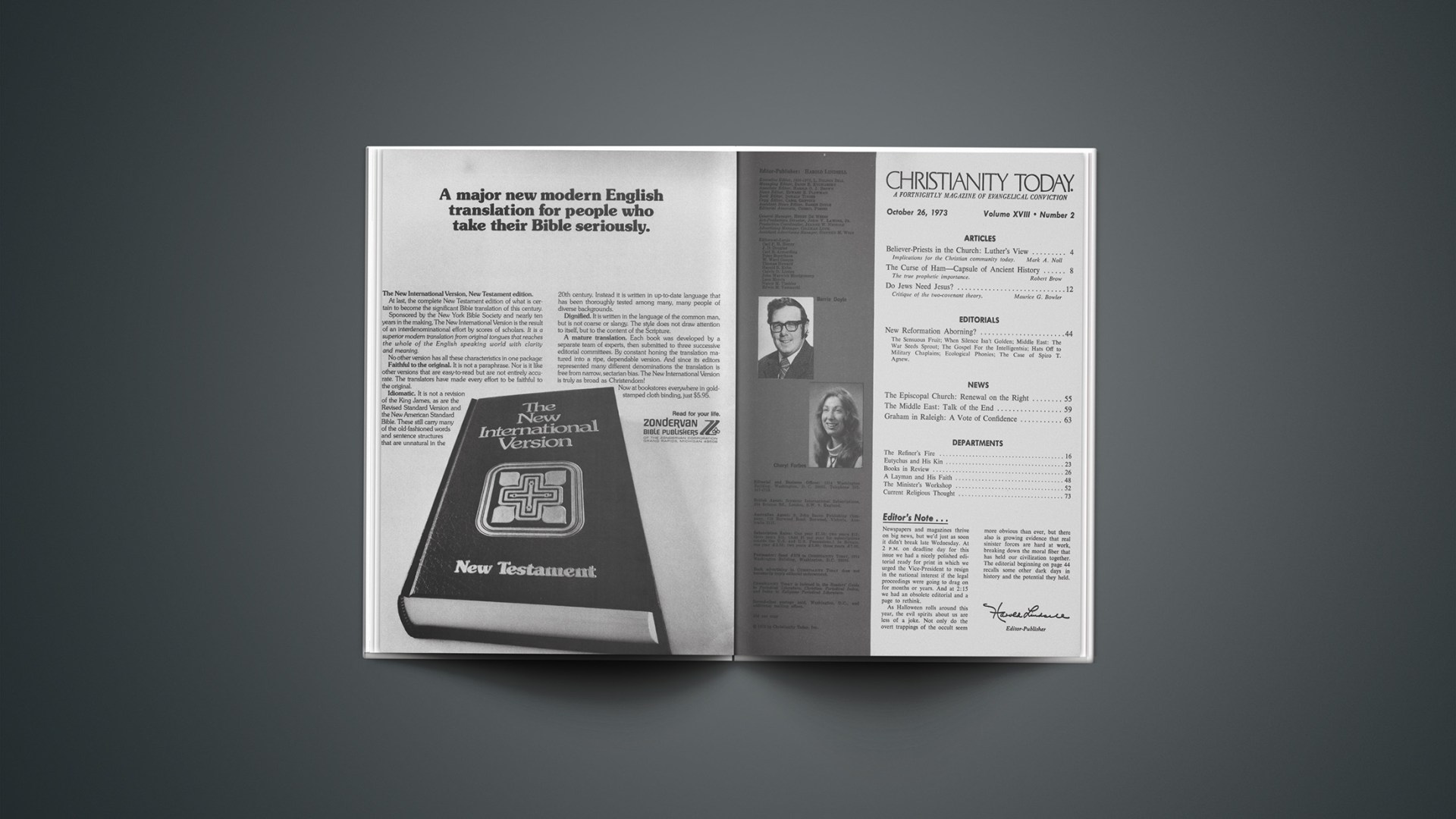
Editor’s Note from October 26, 1973

Newspapers and magazines thrive on big news, but we’d just as soon it didn’t break late Wednesday. At 2 P.M. on deadline day for this issue we had a nicely polished editorial ready for print in which we urged the Vice-President to resign in the national interest if the legal proceedings were going to drag on for months or years. And at 2:15 we had an obsolete editorial and a page to rethink.

As Halloween rolls around this year, the evil spirits about us are less of a joke. Not only do the overt trappings of the occult seem more obvious than ever, but there also is growing evidence that real sinister forces are hard at work, breaking down the moral fiber that has held our civilization together. The editorial beginning on page 44 recalls some other dark days in history and the potential they held.

To Be Free Men

“Christ set us free, to be free men” (Gal. 5:1, NEB), wrote Paul, and he lived up to his words. So did many in the church of his day. They saw it as a thing to be received with awe and wonder that Christ had paid the price of his life to win their freedom. It mattered accordingly that they live as free men.

Most men’s way of life in their day involved a good deal of bondage. Slaves, of course, were completely at the disposal of their owners. They had no freedom, and sometimes their masters were at pains to make this clear. But even men who were technically free often managed to find some form of bondage for themselves.

The classic example of self-chosen bondage is the case of the Israelites in the wilderness. They had been set free from their bondage in Egypt and theoretically were no man’s slaves. But when difficulties arose, as they always will in life, they reacted like slaves, not free men. They complained. They looked for someone to tell them what to do. They could not view their difficulties as challenges to be met, as victories to be won. Although there were no fetters on their wrists, in spirit they were not free.

So men may be in bondage to the world’s way of thinking and acting. They may prefer the ease of slipping into conventional and orthodox paths to the freedom of striking out in new ways in response to the promptings of the Spirit of God. Living with freedom is demanding. This was as true in the first century as it is today, and just as many avoided it then as now.

But one of the exciting characteristics of, the infant Christian Church was that it refused to be bound. Christ had indeed made its members free, and they entered into their glorious new heritage. I imagine that this could not be said of every one of its members. But it could be said of enough of them for an exciting new page to be written.

Take, for example, their attitude toward circumcision. This was an honorable institution, begun by divine command and hallowed both by the unvarying practice of generations and by its association with the great name of Abraham. Every Jewish boy was circumcised at the age of eight days. There is no reason for doubting that all the original followers of Jesus accepted this rite and saw it as the natural expression of their covenant membership. Some of the early Christians indeed held that it was impossible for men to be saved without it (Acts 15:1).

But to Paul and Barnabas and some others it was crystal clear that in regard to such ceremonial customs the Christian is free. They refused to give way on the principle, and the gathering of apostles and elders at Jerusalem sided with them when the matter had been fully ventilated. James summed up the result by saying, “My judgment therefore is that we impose no irksome restrictions on those of the Gentiles who are turning to God” (Acts 15:19, NEB), a notable pronouncement on Christian freedom.

It was not simply on this one matter that Christians showed their refusal to be bound by the ancient way of doing things. They saw in Christ the end to the law (Rom. 10:4), and that meant the end of a whole way of life. Jews had held that the divinely given law set forth the way of salvation and that there was no salvation apart from the law. It was a revolutionary approach when the Christians proclaimed that salvation was all of grace and that the law did not hold sway.

An interesting feature of their new approach was that they did not simply abandon or renounce the law. They held that it was of divine origin and was to be treated with respect (Rom. 7:12). It remained a useful guide, a tutor to bring men to Christ (Gal. 3:24). But with all their respect for the law they were not in bondage to it. They were free men, liberated by Christ, and they could take up a new and independent stance.

This ability to dispense cheerfully with old and hallowed ways makes a big appeal to people of our day. Indeed it is sometimes thought that our “permissive society” is simply a continuance of this strand of New Testament teaching. There is certainly an emphasis on freedom among our contemporaries, and not infrequently this is joined with another New Testament emphasis, the importance of love. To many today it seems that it is the quintessence of New Testament teaching to insist that men be bound by nothing other than the requirement to love.

But before we recognize the permissive society as the modern embodiment of the New Testament approach, it is well to pause and reflect. It may well be that traditional Christians have been far too ready to clutter up the Christian way with a multitude of petty restrictions, a host of “Thou shalt’s” and even more of “Thou shalt nots.” It is perhaps as well that some of our shibboleths are being called in question and that Christians must think through just what their Gospel is.

But that does not mean we can abandon the traditional Christian emphasis on high moral standards. The early Christians refused to confuse liberty with license, and so should we. Although they were ready enough to abandon anything that was unessential, that did not mean they held that there were no essentials. They were quite sure that the way set before the Christian is a way of self-denial and strenuous morality. They could speak of the Christian way as involving a death to an old way and a rising to a new one (Rom. 6:3ff.).

Indeed, few things are more striking than the way the men and women of the early Church refused to conform to the accepted standards of the day and insisted on living in accordance with the commandments of their God. They succeeded in lifting the moral tone of society.

For with real freedom goes discipline. The man who cannot control himself has entered not into the ultimate in liberty but into the ultimate in slavery. He is in bondage to himself, and to the worst of himself at that. Genuine freedom includes self-control, a virtue that is insisted on throughout the New Testament.

There is a cardinal difference between modern permissiveness and the New Testament freedom. The former spells freedom to do as I please, the latter freedom to serve. It is in the service of God that the Christian realizes his freedom, and that service flows over into the service of man.

Here is one of the great problems facing the Christian Church. We dare not compromise the great New Testament doctrine of freedom. We must be as flexible in our day as the early Christians were in theirs. But at the same time we must preserve the discipline and the high standards that meant so much to them. Finding the right combination is not easy.

Across Cultural Barriers

Isn’t every Christian who shares his faith with others a missionary? Not by the definition of the new United Presbyterian Center for Mission Studies in Fullerton, California.

“Some theologians may not agree, but we define ‘missionary’ pragmatically,” says lanky Charles Mellis, for twenty-seven years a top staffer of Missionary Aviation Fellowship and now ecutive director of the new mission center. “It’s a matter of culture. No, missionaries are not more cultured than other people. Rather, they serve in a culture different from their own. They attempt to share their faith across a cultural barrier. At least that’s how we like to distinguish them.”

Mellis’s view is at odds with the official stance of the denomination for the past decade or so. The Commission on Ecumenical Mission and Relations (COEMAR), now subsumed under the Mission Program Services unit of the Program Agency, has looked askance at even the word “missionary,” preferring “fraternal worker.” United Presbyterian brass, like other mainline denominational missions chiefs, see overseas work as mainly the job of nationals. North Americans, they feel, are apt to be considered “imperialistic,” or, at best, “paternalistic.”

But now comes the mission study center, organized under Chapter 28 of the Book of Order and constituted at the 1972 General Assembly, to challenge that view. Cross-cultural missions is the heart of the center’s cause, says Mellis, spawning “mission orders,” or groups of disciplined, committed Christians, focusing on one task in one area. This summer the center launched its first such fellowship, the Order of St. Paul, composed of several hundred of about 50,000 Presbyterians living and working overseas in nonmilitary jobs.

Overseas workers under COEMAR are disappearing, say Mellis and Ralph Winter, a professor at Fuller Seminary’s School of World Missions and a co-founder of the mission center. New York denominational officials concur: 520 under appointment now compared to 800 under COEMAR two years ago and a peak of 1,250 in 1963.

The UPCMS is financed by individuals and several large West Coast UPC congregations heavily committed to missions. Its board is made up of broadly evangelical men, including Dr. William Wysham, former COEMAR staffer in Iran. Said he: “There are thousands of Presbyterians overseas who are employed by governments, business firms, and foundations and who are in close contact with adherents of all the major religions, most of whom have never heard the Gospel of salvation.… Such an order [St. Paul] has unlimited possibilities as official missionaries dwindle.…”

Mellis puts it this way: “The near-neighbors of a given unreached cultural unit may not be as well accepted as someone from a Christian church farther away. For example, Filipinos might be more acceptable in Cambodia than Americans. Americans may be more acceptable than coastal Vietnamese among the hill tribes of Viet Nam.”

The mission center is also into what Mellis calls the “Ralph Nader function”: rating all overseas missions agencies to sort out the “plushy” outfits from “those sincerely trying to do a job.”

VICTORY IN DEFEAT

Victory Christian high school of Jacksonville, Florida, failed to live up to its name. In its first football game ever, Victory went down to defeat 130–0. “My coaching philosophy is a Christian philosophy,” commented Victory’s nondefeatist coach Don Ramsey to reporters afterward. At least it’s all in the family. The winner: University Christian from across town.

While expressing reservations, Riverside Drive UP officials say the mission-center approach to mission orders “could be creative.” “We have no reason to take a critical attitude,” says the Reverend Eugene Huff, coordinator of Mission Program Services. “We ourselves are in a shifting period and a reassessment. But we wouldn’t go in without invitation and consultation with the natives.”

Meanwhile, Mellis and associates are convinced they are a jump ahead of denominational thinking rather than two steps behind.

RUSSELL CHANDLER

Rings In The Baptistry

Cleanliness may have been forgotten in the rush to godliness in some of Nashville’s Baptist churches. Last month the city health department ordered churches to clean up their baptistries because of the danger of bacterial infection.

According to Dr. Joseph Bistowish, the department director, some churches empty their baptistries only once every month or two. That, says the good doctor, is not enough. So he ordered staff inspectors to wade in with bacteria-sampling equipment and to look particularly for green slime on the baptistry walls. Excessive bacteria could transmit skin disease and even Salmonella or typhoid, he warned.

The ideal baptistry would have circulation and filtration systems and be hand chlorinated, said Bistowish. Failing that, a baptistry should be emptied after each baptismal service. He thinks that baptistries should be subject to the same health standards as swimming pools.

The problem lies in accumulations of staphylococci bacteria, carried in the nose and throat, which could contaminate the water. Baptismal candidates who have upper respiratory disease or open sores, or who are carrying certain intestinal organisms, are among the sources of baptistry pollution.

Bistowish is also after church kitchens, which “because of improper kitchen equipment, sanitation procedures, and lack of trained personnel, can also potentially spread disease.”

Churches must realize that good health practices apply to them too, he commented. And cleanliness counts.

Chop Chaps

When evangelist Billy Sunday got up to preach, one thing his congregations could count on was that he would throw his arms around recklessly. Congregations today are as likely to see bricks, boards, and even bodies tossed around if the speaker is either Mike Crain or Dwight Dobson.

Crain, a 28-year-old Baptist minister, holds a second-degree black belt in karate, and Dobson, a 29-year-old Assemblies of God minister in India, is a judo black belt. Both men use their special interests to spread the Gospel.

At a Baptist camp site near Brownsville, Kentucky, Crain operates a oneweek “Judo and Karate for Christ” camp in cooperation with eighth-degree black belt Master Dan Pai, a former Buddhist monk. While Pai trains campers in the material arts (defense against muggings, gang attacks, and rape, say camp officials), Crain handles the spiritual warfare. He told Sports Illustrated magazine recently that karate lets him establish rapport which he follows up with preaching. His audience may see Crain smash a twelve-inch concrete block with his head, or a pile of bricks with his elbow, before they hear the Gospel.

Missionary Dobson, a Canadian native, finds himself in demand by the Calcutta police because of his judo expertise. He has trained more than 6,000 policemen in the past two years. And along with the physical instruction trainees receive spiritual lessons. His success with Calcutta police blossomed recently into training courses for the Indian government’s central police, the state armed police, and the West Bengal police. He also has a judo club for boys and girls at his Calcutta church.

Dobson holds services whenever he travels to judo competitions. Judo has taken him to Nepal, Sikkim, Assam, and Nagaland—places, he told his denomination’s general council last month, where missionaries find it hard to go.

And so, in these unusual ministries, hymns are interspersed with karate chops, Scripture readings follow flying bodies, and the amens are punctuated with a piercing Aiieeeeee.…

Religion In Transit

New construction by American churches totaled $419 million during the first six months of 1973, slightly ahead of last year, according to government estimates. But soaring costs and higher interest rates will probably result in a lower figure for the next six months.

A Catholic edition of The Living Bible is being published jointly by Our Sunday Visitor, a Catholic publication, and Tyndale House. It bears an imprimatur by Bishop Leo A. Pursley of Fort Wayne-South Bend. Meanwhile, Tyndale says 300,000 Living Bibles are distributed monthly. In the works: a million-dollar radio and TV ad campaign, the largest ever for a Bible.

David C. Cook has released what it calls “the first complete Bible in picture strip form,” a compilation of picture stories in Pix, Cook’s weekly take-home Sunday-school paper.

United Methodist evangelism executive Joe Hale says at least half of the 40,000 United Methodist congregations in the United States have been involved in Key 73.

First Baptist Church of Hammond, Indiana, averaged more than 10,000 in a ten-week Sunday-school attendance drive, gaining Christian Life’s recognition as the nation’s largest and fastest-growing Sunday school. About 5,000 were transported weekly by the church’s 135 buses. Nearly 4,000 were baptized. Pastor Jack Hyles, a hard-line separatist, says he stresses evangelism and “old-fashioned Christianity.”

Former astronaut James Irwin and his High Flight evangelistic association are still in the hole by about $200,000 after hosting some 900 persons in religious retreats for families of prisoners of war and men missing in action. Irwin says he has “faith that we’ll be able to raise the money.”

The U. S. Catholic hierarchy reversed its position and now backs efforts to permit both prayers and religious instruction in public schools.

The Federal Communications Commission granted short-term renewal (until June) of licenses to the Bob Jones University-owned radio stations WMUU and WMUU-FM in Greenville, South Carolina. The FCC ordered that equal-employment opportunities be provided to racial minorities and women, and that recruiting be done among non-university sources.

St. Therese Hospital, a Catholic hospital in Waukegan, Illinois, is offering to provide living facilities, medical care, and employment for unwed mothers as an alternative to abortion.

A radio program on rock music produced by the Presbyterian Church in the U. S. (Southern) was cited as the most outstanding special religious program of 1973 by Billboard magazine.

Personalia

Episcopal Bishop William Frey of Colorado told a Seattle audience recently that he has received the Pentecostal experience.

Joyce Stedge, 47, of Pearl River, New York, has broken one of the traditions of the Reformed Church in America as the first woman in its history to be granted a license to preach.

Glenn L. Archer, 67, the executive director of Americans United for Separation of Church and State for its twenty-six years, announced his retirement effective no later than September 1, 1974.

The annual Religious Liberty Award of Americans United for Separation of Church and State went to California congressman James C. Corman for leading the congressional fight against tax credits to parochial schools, and against the prayer amendment in 1971.

Resigned: President John A. Middleton of Morris Brown College, an African Methodist Episcopal school. Middleton was under pressure because of the school’s $1 million deficit, conflicts with board members, strained relations with the new AME bishop (Richard Allen Hilderbrand), and his opposition to reorganization of the six-college Atlanta University Center. His charge that the center was being dictated by the Ford Foundation through a promised grant of from $15 to $21 million gained him the ire of the college presidents.

World Scene

Uganda President Idi Amin has banned a number of religious groups in his country, but he says missionary teachers from Northern Ireland, Scotland, and England can stay. Without naming them or their churches, he cited them as Uganda’s “best friends.”

Kenya’s attorney general revoked a ban on Jehovah’s Witnesses.

The World Council of Churches voted in four new member bodies, bringing total WCC membership to 267 churches in ninety countries. The four: Zaire’s 100,000-member Community of Light and 25,000-member Mennonite Community, Indonesia’s 110,000-member Simalungun Protestant (Lutheran) Church, and the 25,000-member Japanese Orthodox Church.

As of late last month, war-troubled Cambodia still posed uncertainties for foreign missionaries. Some missons had evacuated everyone except adult males. World Vision, meanwhile, is helping 6,500 refugees move into twenty new villages, supplying building materials, food, and medical aid.

Australian Baptist missionary Noel Melzer reports that 13,000 of the 34,000 Dani tribespeople in Irian Jaya, Papua New Guinea, have been baptized.

Things are booming for Teen Challenge in Paris. Staffers are ministering in prayer groups springing up throughout the city (more than 500 Catholics reportedly have received the charismatic experience so far this year), and they operate a coffeehouse in a Catholic youth center. A Catholic educator recently burned his occult books outside Logos, a TC coffeehouse on the Seine where he received Christ.

Far East Broadcasting Company celebrated its silver anniversary by opening two new facilities: a new station in South Korea and new studios and offices in Hong Kong. The 250,000-watt Korean station beams its programming primarily at mainland China.

Researchers say Colombia has the greatest percentage of Catholics in Latin America. Nearly 98 per cent of the more than 22-million population is Catholic. Catholics account for about 95 per cent of the people in Costa Rica, Ecuador, and Mexico.

Brazil: The Coy Approach

“God’s solutions applied God’s way will always get God’s results.” This was the simple message of Baptist minister-lecturer Larry Coy to nearly 1,400 Brazilian evangelicals gathered recently for a week-long Conflicts of Life Seminar in São Paulo.

After a week’s seminar for missionaries in late August (attended by 300 first-timers and 150 taking the advanced course), Coy presented his basic-life-conflicts course in Portuguese to the Brazilians. Both seminars were sponsored by Brazil’s Missionary Information Bureau, headquartered in São Paulo. The following week Coy repeated the English seminar for 116 more missionaries in the northern Brazilian city of Belém. This was Coy’s second visit to Brazil; he gave his course two years ago at the annual MIB conference for missionaries.

An overflow crowd packed out São Paulo’s cavernous Independent Presbyterian Cathedral for the thirty-two-hour Portuguese course. Brazilian Baptist evangelist Walter Kaschel interpreted. More than 500 seminar notebooks in Portuguese, priced at $15 each, went like pasteis and were sold out the first night. More than 100 cassette tapes of the sessions were ordered at 200 cruzeiros a set (about $33). Ford-Philco supplied a closed-circuit TV hookup with five screens placed throughout the sanctuary.

Coy was formerly associated with lecturer-counselor Bill Gothard (see May 25 issue, page 44). His seminar is similar to Gothard’s Basic Youth Conflicts course, but is aimed more toward the family. Coy met Gothard while both were Wheaton College students, then teamed up with him for about twelve years. Coy says that he wrote about 20 per cent of Gothard’s basic course and 80 per cent of the advanced course. After Coy left Gothard, there was a bit of conflict between the pair over Coy’s use of his own material, whose copyright is owned by Gothard, but the hassle is apparently being worked out amiably.

Coy is now on the staff of the 13,000-member Thomas Road Baptist Church of Lynchburg, Virginia, where he has been heavily involved in the church’s battle with the federal Securities and Exchange Commission (see September 14 issue, page 49). His responsibilities at Thomas Road include administration of the church’s $12 million annual budget. Coy gives his seminars part-time as a ministry of the church, often flying to assignments in the church’s private airplane. His seminar notebook is copyrighted by Thomas Road’s nationwide broadcasting ministry, “The Old-Time Gospel Hour.”

“The things you’re going to hear in the seminar are not new,” advises Coy at the beginning of his course. “Our real goal is to impress upon people that the Word of God has the answers” to life’s practical problems. Essentially the seminar amounts to a course in applied biblical ethics. Coy begins with a study of the Beatitudes, from which he distills eight basic principles of Christian living. He places strong emphasis on maintaining a clear conscience (as does Gothard) and on ordering one’s life—including time and finances—according to biblical priorities. Careful scheduling of time and no credit buying are urged. The aim of the course is to put practical tools into the hands of the individual Christian to help him know how to live according to God’s standards.

Response from Brazilians was largely favorable. Coy was pleased and has agreed to return to Brazil next year. According to Missionary Information Bureau’s Bill Hewlett, Coy seminars will be held in June or July, 1974, in Porto Alegre and Rio de Janeiro.

Nonflammable Word

The first full-length feature color film made in the Malagasy language recently played on the cinema screens of Tananarive, capital of the Malagasy Republic (which occupies the island of Madagascar). It has packed halls wherever it has been shown, even though ticket prices have been tripled and even quintupled.

The film, called The Book That Would Not Burn, is not a Western, or a thriller, or even a romantic tragedy, but the story of the part played by the Bible during the persecution of Malagasy Christians around the middle of the last century. The story of the martyrs is well known not only by Christians but by all the people of Madagascar as a part of their history in which many take pride; this is a major reason for the film’s success.

The story is told through a lovely young girl, Ranivo, condemned to death because of her conversion to Christianity. When she is about to be hurled from a high rock, she recalls the martyrs who preceded her, especially the girl Rasalama, the first martyr, who was speared to death. Other martyrs were burned alive or stoned to death during persecution in the mid-1800s.

Ranivo thinks about the fearful queen, who is determined to root out missionary teaching. The young girl also thinks of her Christian mother, and of her father and her uncle, the village sorcerer, both of whom she loves despite their denunciation of Christians.

The persistent secret meetings of Christians to read their Bibles (when found, Bibles were burned, on the queen’s orders) and other memories make up the plot and give point to its dramatic ending. “I am frightened,” she says, “but I am discovering that I am also at peace.”

The shooting of the ninety-minute film took only six days. Money came from a small American church, and Ken Anderson Films furnished the producer.

Sponsored by the Malagasy Bible Society, the film was made on the initiative of the Malagasy church to celebrate its 150th anniversary.

After Lausanne, The World

The goal of next year’s International Congress on World Evangelization is, in a nutshell, to provide impetus and help for achieving the goal of world evangelization. To that end, about 3,000 evangelical leaders from throughout the world will pool their knowledge and ideas in the ten-day event that will convene July 16 in Lausanne, Switzerland. Also on hand: 300 mass media people and 200 observers. Participation will be on a by-invitation-only basis, with national advisory committees making recommendations to the ICWE planning committee.

ICWE director Donald E. Hoke, founder-president of the Tokyo Bible College, says his committee is seeking to ensure fair representation according to national, cultural, and other categories, such as women, laity, evangelists, missionaries, theological educators, and youth (approximately 600 of the participants will be under age 30). Quotas range from 946 from Europe to one from the Pacific island kingdom of Tonga. Special emphasis is being placed on Third World participation, adds Hoke. Participants from the more affluent countries will be expected to pay their own way; others will be subsidized. Meanwhile, the committee is rummaging for funds. (The Billy Graham organization has taken the lead so far in underwriting initial expenses.)

ICWE program director Paul Little says that speakers likewise will reflect a variety of national, cultural, and denominational backgrounds. They include:

Peter Beyerhaus (Lutheran), Germany; Rene Padilla (Baptist), Argentina; Susumu Uda (Reformed Presbyterian), Japan; Bishop Festo Kivengere (Anglican), Uganda; George Peters (Mennonite), United States; Howard Snyder (Free Methodist), Brazil; Donald McGavran (Disciples of Christ), United States; Samuel Escobar (Baptist), Peru; Canon Michael Green (Anglican), England; Henri Blocher (Baptist), France.

Opening addresses will be given by evangelist Billy Graham, ICWE honorary chairman, and Anglican minister John Stott of London, a well-known evangelical author.

Unlike the procedure at the 1966 World Congress on Evangelism, the major ICWE papers will be sent out in advance to the participants for study and response. Speakers will only summarize their papers, says Little, then address themselves to the comments and questions sent by participants. Additionally, the latter will also receive beforehand an “over-all view of world need” and an in-depth study of churches and evangelization of their respective countries or regions. Advance questionnaires will enable the participants to indicate how the congress can best help them in reaching particular groups, in the use of evangelistic methods, and in the discussion of theological issues, Little points out.

ICWE planners say they hope to make conference material widely available to church members across the world.

Continue The Quest

A revolt against liberalism’s view of Christ and the Gospels is going on, Archbishop of Canterbury A. Michael Ramsey asserted approvingly at last month’s Fifth International Congress of Biblical Studies at Oxford University. His keynote was a highlight for the 600 theologically diverse delegates and visitors who attended from throughout the world. They included a number for the first time from East Germany and Poland.

The apostles meant to present a trustworthy picture of Jesus not to be explained by existentialism and demythologizing attempts, affirmed Ramsey, more or less endorsing “the current revival of interest in a credible picture of Jesus to his contemporaries, applicable today.”

In all, 164 lectures and papers were delivered at the quadrennial four-day conference by authorities from Europe, Africa, Australia, and North America, with delegates unable to attend more than ten sessions daily. There was hardly unanimity of viewpoint, but the conservative position was well presented by a few. Evangelicals especially appreciated the daily devotional Bible expositions by University of Glasgow professor Robert Davidson and C. F. D. Moule of the University of Cambridge.

Most papers centered on the gospels of John and Mark, pointing up the growing interest in historicity (though hermeneutics remains in the foreground of current study). “The quest of history and faith in Christ must go together, for faith also gives historical insight; the quest must continue,” declared editor D. G. Wigmore-Beddoes of the Modern Free Churchman in Belfast.

ROBERT J. CAMPBELL

Pakistan: Worst Ever

Local press reports called the recent floods in Pakistan the worst in memory. Of the eight million people affected (10,000 villages were hit, 500,000 houses destroyed), thousands were Christians. Many lost everything. Some had only recently rebuilt their homes following the 1971 war with India over Bangladesh. A number of missionary residences in southern Punjab were flooded. Fortunately, however, loss of life was slight; most people had ample warning before run-offs from heavy rains in the northern mountains came cascading into the heavily populated plains.

Christians were quick to offer aid. The missionary community itself came up with more than $1,000. The Salvation Army in Britain sent nearly $20,000. Conservative Baptists and World Vision together offered $10,000; the World Council of Churches promised $250,000.

HUBERT ADDLETON

Hungary: Easing The Tensions

A remarkable church-state détente has been achieved in Hungary, according to the authoritative Catholic newsletter Overview, which credits the Pope John-initiated Vatican foreign-policy campaign to relax tensions with eastern European nations. Bishops are appointed from a list of candidates submitted by the Vatican and approved by the state. The state is no longer demanding veto power over appointment of local clergy. Only four priests are in jail now, and their release is expected shortly, says Overview. For its part, the Catholic church for almost two years has excommunicated no priests for cooperating with the communist regime.

The practice of religion within church buildings is reportedly unrestricted. Eight Catholic high schools are operating; their graduates enter state universities without trouble. The government pays the teachers, who are members of religious orders. It pays about $3.5 million a year to subsidize church operations and maintain church buildings. As in Czechoslovakia, religious instruction of children is allowed in state elementary and secondary schools (priests sometimes teach) and in the churches. Six seminaries are preparing 303 candidates for the priesthood.

There are more than five million Catholics in Hungary, about half the nation’s population, located in 2,345 parishes and served by 4,000 priests (including 452 of the Byzantine rite), says Overview.

Penalty For Preaching: Ten Years

In an eleven-day, closed-door trial last month, a Soviet court in Kharkov, the Ukraine, sentenced Boris M. Zdorovetz, one of the best-known evangelical preachers in the Soviet Union, to three years of solitary confinement in a “severe” labor camp (a harsher regime than the ordinary labor camps) and seven years of exile. His offense was leading an unauthorized open-air service attended by 2,000 people on May 2. In 1972 Zdorovetz completed a ten-year sentence for unauthorized religious activity. He is a member of the unregistered Council of Evangelical Christians-Baptists, or initsiativniki.

New Life In Germany

A total attendance of 35,000 was registered at last month’s week-long “New Life” evangelistic crusade in Hamburg held by “people’s missionary” Anton Schulte, Germany’s foremost evangelist. Two public halls, connected by a cable TV hook-up, could not accommodate the crowds on four nights, and two extra meetings were held. Polls revealed that more than half of those attending had never been to such an evangelistic rally before. According to the Information Service of the German Evangelical Alliance, several hundred came forward for personal decisions or counseling.

‘Evangelikal’: New Word, Old Faith

Because the normal German word for evangelical, evangelisch, has been downgraded in daily speech until it means nothing more than “non-Catholic,” Christians in Germany have been at a loss for a term that would attest their personal commitment to the Gospel of Jesus Christ and to an authoritative Scripture without the negative connotations of orthodox, konservativ, and pietistisch. A few years ago evangelikal, a direct loan from English, came in, and after initial opposition it has been more and more widely adopted. In the fall issue of the influential Oekumenische Rundschau (Ecumenical Review), Dr. Ulrich Betz, an Evangelikal, explained the word to non-evangelicals.

German television in a feature September 9 attributed the rise of the Evangelikale in large part to the Graham crusades. The non-evangelical producers left viewers some unanswered questions: “Why are so many Evangelikale so fervent … so hard-working … so active … so young … so happy?”

Hungary: No Betrayal

Bishop Zoltan Kaldy of the 430,000-member Lutheran Church in Hungary denied on a Helsinki broadcast that churches in socialist countries have “betrayed Christ” or have mixed Marxism with the Gospel. He said gospel preaching is permitted on Hungarian radio and that Bible smuggling is unnecessary (“anyone who wants one can get one”).

The Korean Christ

Full-page ads in major U. S. newspapers have heralded the arrival of “Rev. Sun-Myung Moon” of South Korea on a lecture tour. His Holy Spirit Association for the Unification of World Christianity (Tongil-kyo in Korea, meaning Unity Church) reputedly has 300,000 followers in Korea, with branches in Europe and North America. He is called the Korean Christ, and his third wife is the Holy Spirit.

He was born in 1920 in North Korea, suffered excommunication by the Presbyterian Church in Pyongyang in 1948 and imprisonment by the communists in the Korean War, and established his church in 1954 in Seoul. Claiming to have had special revelations at age 16, he believes that the first Christ (Jesus) failed in his mission. The Jewish Christ won spiritual salvation for man but died trying to achieve physical salvation for man, something the Korean Christ (Moon) accomplished through his marriage to the Holy Spirit, according to the sect’s teaching. Followers are organized with military precision and discipline, and marriages are arranged by the church.

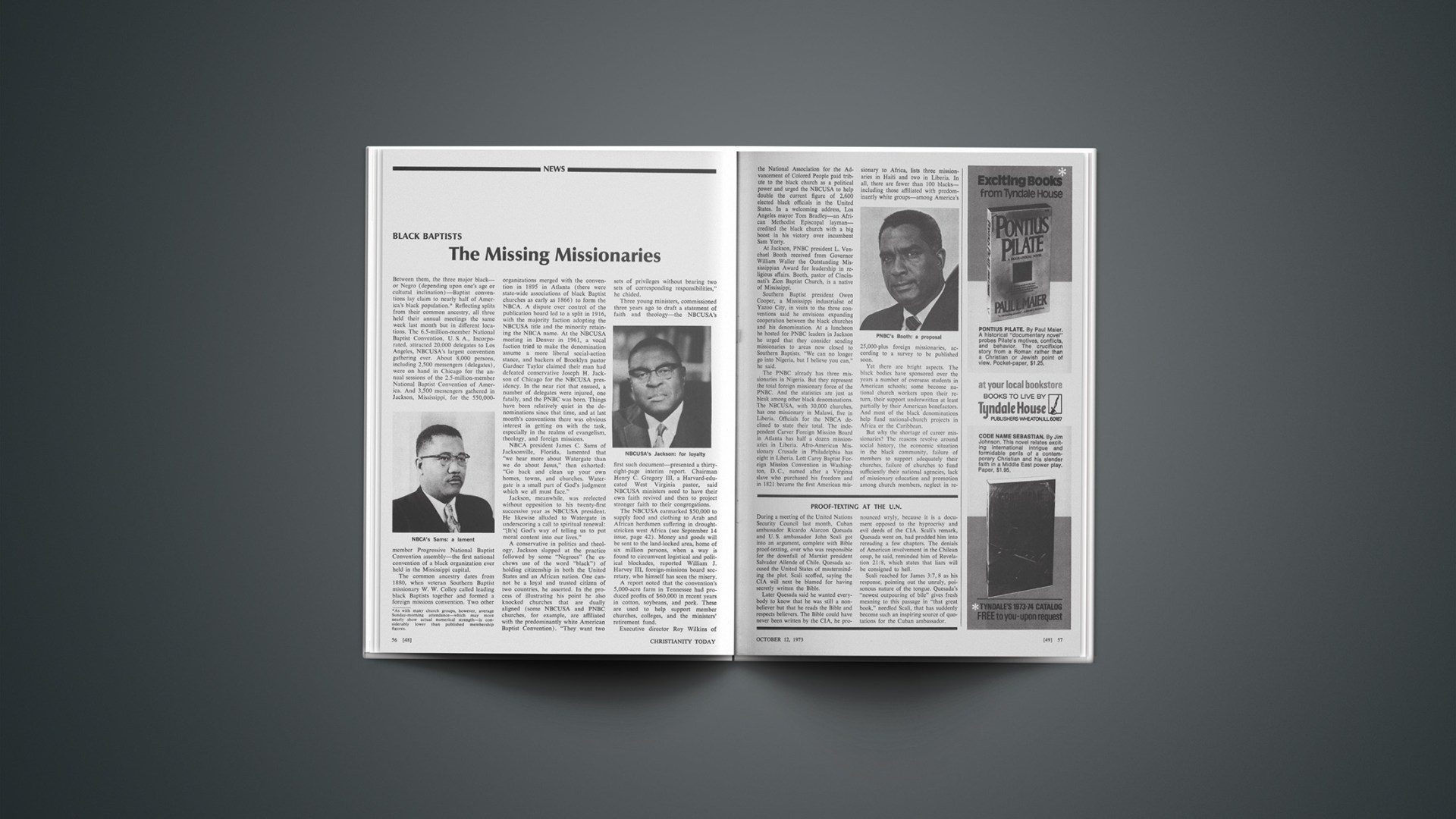
Black Baptists: The Missing Missionaries

Between them, the three major black—or Negro (depending upon one’s age or cultural inclination)—Baptist conventions lay claim to nearly half of America’s black population.1As with many church groups, however, average Sunday-morning attendance—which may more nearly show actual numerical strength—is considerably lower than published membership figures. Reflecting splits from their common ancestry, all three held their annual meetings the same week last month but in different locations. The 6.5-million-member National Baptist Convention, U. S. A., Incorporated, attracted 20,000 delegates to Los Angeles, NBCUSA’s largest convention gathering ever. About 8,000 persons, including 2,500 messengers (delegates), were on hand in Chicago for the annual sessions of the 2.5-million-member National Baptist Convention of America. And 3,500 messengers gathered in Jackson, Mississippi, for the 550,000-member Progressive National Baptist Convention assembly—the first national convention of a black organization ever held in the Mississippi capital.

The common ancestry dates from 1880, when veteran Southern Baptist missionary W. W. Colley called leading black Baptists together and formed a foreign missions convention. Two other organizations merged with the convention in 1895 in Atlanta (there were state-wide associations of black Baptist churches as early as 1866) to form the NBCA. A dispute over control of the publication board led to a split in 1916, with the majority faction adopting the NBCUSA title and the minority retaining the NBCA name. At the NBCUSA meeting in Denver in 1961, a vocal faction tried to make the denomination assume a more liberal social-action stance, and backers of Brooklyn pastor Gardner Taylor claimed their man had defeated conservative Joseph H. Jackson of Chicago for the NBCUSA presidency. In the near riot that ensued, a number of delegates were injured, one fatally, and the PNBC was born. Things have been relatively quiet in the denominations since that time, and at last month’s conventions there was obvious interest in getting on with the task, especially in the realms of evangelism, theology, and foreign missions.

NBCA president James C. Sams of Jacksonville, Florida, lamented that “we hear more about Watergate than we do about Jesus,” then exhorted: “Go back and clean up your own homes, towns, and churches. Watergate is a small part of God’s judgment which we all must face.”

Jackson, meanwhile, was reelected without opposition to his twenty-first successive year as NBCUSA president. He likewise alluded to Watergate in underscoring a call to spiritual renewal: “[It’s] God’s way of telling us to put moral content into our lives.”

A conservative in politics and theology, Jackson slapped at the practice followed by some “Negroes” (he eschews use of the word “black”) of holding citizenship in both the United States and an African nation. One cannot be a loyal and trusted citizen of two countries, he asserted. In the process of illustrating his point he also knocked churches that are dually aligned (some NBCUSA and PNBC churches, for example, are affiliated with the predominantly white American Baptist Convention). “They want two sets of privileges without bearing two sets of corresponding responsibilities,” he chided.

Three young ministers, commissioned three years ago to draft a statement of faith and theology—the NBCUSA’s first such document—presented a thirty-eight-page interim report. Chairman Henry C. Gregory III, a Harvard-educated West Virginia pastor, said NBCUSA ministers need to have their own faith revived and then to project stronger faith to their congregations.

The NBCUSA earmarked $50,000 to supply food and clothing to Arab and African herdsmen suffering in drought-stricken west Africa (see September 14 issue, page 42). Money and goods will be sent to the land-locked area, home of six million persons, when a way is found to circumvent logistical and political blockades, reported William J. Harvey III, foreign-missions board secretary, who himself has seen the misery.

A report noted that the convention’s 5,000-acre farm in Tennessee had produced profits of $60,000 in recent years in cotton, soybeans, and pork. These are used to help support member churches, colleges, and the ministers’ retirement fund.

Executive director Roy Wilkins of the National Association for the Advancement of Colored People paid tribute to the black church as a political power and urged the NBCUSA to help double the current figure of 2,600 elected black officials in the United States. In a welcoming address, Los Angeles mayor Tom Bradley—an African Methodist Episcopal layman—credited the black church with a big boost in his victory over incumbent Sam Yorty.

At Jackson, PNBC president L. Venchael Booth received from Governor William Waller the Outstanding Mississippian Award for leadership in religious affairs. Booth, pastor of Cincinnati’s Zion Baptist Church, is a native of Mississippi.

Southern Baptist president Owen Cooper, a Mississippi industrialist of Yazoo City, in visits to the three conventions said he envisions expanding cooperation between the black churches and his denomination. At a luncheon he hosted for PNBC leaders in Jackson he urged that they consider sending missionaries to areas now closed to Southern Baptists. “We can no longer go into Nigeria, but I believe you can,” he said.

The PNBC already has three missionaries in Nigeria. But they represent the total foreign missionary force of the PNBC. And the statistics are just as bleak among other black denominations. The NBCUSA, with 30,000 churches, has one missionary in Malawi, five in Liberia. Officials for the NBCA declined to state their total. The independent Carver Foreign Mission Board in Atlanta has half a dozen missionaries in Liberia. Afro-American Missionary Crusade in Philadelphia has eight in Liberia. Lott Carey Baptist Foreign Mission Convention in Washington, D. C., named after a Virginia slave who purchased his freedom and in 1821 became the first American missionary to Africa, lists three missionaries in Haiti and two in Liberia. In all, there are fewer than 100 blacks—including those affiliated with predominantly white groups—among America’s 25,000-plus foreign missionaries, according to a survey to be published soon.

Yet there are bright aspects. The black bodies have sponsored over the years a number of overseas students in American schools; some become national church workers upon their return, their support underwritten at least partially by their American benefactors. And most of the black denominations help fund national-church projects in Africa or the Caribbean.

PROOF-TEXTING AT THE U.N.

During a meeting of the United Nations Security Council last month, Cuban ambassador Ricardo Alarcon Quesada and U. S. ambassador John Scali got into an argument, complete with Bible proof-texting, over who was responsible for the downfall of Marxist president Salvador Allende of Chile. Quesada accused the United States of masterminding the plot. Scali scoffed, saying the CIA will next be blamed for having secretly written the Bible.

Later Quesada said he wanted everybody to know that he was still a nonbeliever but that he reads the Bible and respects believers. The Bible could have never been written by the CIA, he pronounced wryly, because it is a document opposed to the hyprocrisy and evil deeds of the CIA. Scali’s remark, Quesada went on, had prodded him into rereading a few chapters. The denials of American involvement in the Chilean coup, he said, reminded him of Revelation 21:8, which states that liars will be consigned to hell.

Scali reached for James 3:7, 8 as his response, pointing out the unruly, poisonous nature of the tongue. Quesada’s “newest outpouring of bile” gives fresh meaning to this passage in “that great book,” needled Scali, that has suddenly become such an inspiring source of quotations for the Cuban ambassador.

But why the shortage of career missionaries? The reasons revolve around social history, the economic situation in the black community, failure of members to support adequately their churches, failure of churches to fund sufficiently their national agencies, lack of missionary education and promotion among church members, neglect in recruiting and training young people for full-time service, the fierce independence of many local churches—even within denominations—that in turn hinders cooperative endeavors.

In an interview, PNBC’s Booth said he is “very concerned” about Cooper’s challenge. Already, PNBC leaders are preparing a cooperative-program proposal to submit to the Southern Baptists.

Increasingly, missions is a subject under serious study in black church circles.

Importing The Gospel

Changing some traditional roles, an American mission to Africa is taking steps to bring Africans as missionaries to black urban areas of the United States. The New York-based Africa Inland Mission is experimenting with the idea in response to a variety of needs and trends, both in Africa and in urban America. “Urban America’s needs are as great as or greater than those of the underdeveloped countries of the world,” says Tom Hopler, 37, a former missionary to Africa who is directing the urban ministry for AIM.

The 75-year-old independent evangelical mission traditionally has sent white Americans out as missionaries (it has 700 workers in six east and central African countries). But as churches in Africa have developed their own leadership and strength, African Christian leaders have objected to what they feel is cultural domination by Western missionaries. And missionaries have been less welcome since the demise of colonialism in some of the African nations. Therefore many missions have been undergoing adjustment, sometimes just providing technical assistance while turning over leadership and control to Africans. Meanwhile, African churches have been developing their own missionary programs, limited mostly to other African countries.

In line with the changing scene, AIM is also trying to recruit American blacks as missionaries to Africa. This too will take adjustment; most mission agencies are geared to white social, cultural, institutional, and educational patterns, note observers. The door will no doubt be open longer to black than to white American missionaries, and with the dearth of black missionaries serving overseas (see preceding story), it is imperative that mission agencies step up recruitment of blacks, say the experts.

AIM’s own search for new directions has led to a U. S. inner-city ministry, one that recognizes the distrust urban blacks often have toward whites. “Many black Americans believe that Christianity is a white man’s religion,” explains Bill Chavis, 29, a black law student who has worked in an AIM experimental urban project at Calvary Gospel Church in Newark. “Black Africans can show Christianity’s universality and show that blacks have played a role in the growth of Christianity.”

AIM is proceeding slowly in the project of bringing Africans over to the United States, seeking first to lay the groundwork for an urban ministry with churches in Newark and other cities. The first AIM missionary from Africa, Simon Kahunya, 35, of Kenya, is encouraging other African Christians to come to the United States as missionaries. A student at Gordon-Conwell Seminary in Massachusetts, he worked last year in the black neighborhoods around the Newark church, finding he could overcome barriers of mistrust that whites might encounter, and finding “that American blacks are seeking the African identity—culturally, economically, religiously.”

AIM is also working with several other African students on plans for urban ministries in Washington, D. C., and Philadelphia.

Hopler says the Africans generally will be financed by educational grants, because African churches cannot afford to pay full salaries for missionaries to the United States.

Bishop Wellington Mulwa, who presides over the 1,600 congregations of the AIM-sponsored Africa Inland Church in Kenya, recently came to America to talk to blacks in Newark and other cities about the project. He says his church may be sending Africans here within a year after he gets back and confers with his own church leaders. Mulwa believes the bitterness of many blacks in America will be healed only if they embrace Christ. Nothing is to be gained by “taking arms or being militant,” he says, affirming that hope lies only in the Christian message. Africans are uniquely qualified to bring this message to black Americans because they have endured similar experiences, he says. “We Africans went through the same suffering from the colonists. We have taken a position of forgiving, forgetting the past, and forging ahead.”

RUSS PULLIAM

In Black And White

For months the twelve-member Fellowship of the Cross black ministerial group in Washington, D. C., was concerned about the lack of communication across racial lines in the Christian community. The pastors and evangelists in the group were equally concerned about evangelization of young blacks. They decided to take the first step in doing something about both at the same time, securing local white evangelist Paul Rader to lead an “experimental” week-long crusade on the campus of the city’s predominantly black 11,000-student Howard University. The group chose Rader “because we had so much in common—a deep concern for this city,” said Fellowship leader Rufus Settles, pastor of the Refuge Church of God.

Attendance averaged 250 nightly; the meetings were not well publicized on campus, but interest ran high among those who attended. Questions, sometimes hostile ones, were fired at Rader and a panel of black believers at hour-long rap sessions that preceded the preaching. Rader said he was impressed by the way his friends fielded the questions and objections of Black Muslims, Black Panthers, and followers of Guru Maharaj Ji. A dramatic highlight: the testimony of a convert formerly involved with both Rap Brown and the Black Muslims. There were a number of decisions for Christ during the week, as many as twenty at one meeting, said Settles.

There were beneficial racial overtones too. “We wanted better relationships; we wanted to show that there are no black or white Christians, just God’s people,” Settles affirmed.

All things considered, the experiment was a success. It was a first—for Rader, the Fellowship, and Howard—but, asserted Settles, it won’t be “a last.”

Cocu: Generating Unity

Despite decisions and appearances seemingly to the contrary, the Consultation on Church Union (COCU) still insists that union of the participating churches is its top priority. At its meeting in Memphis, Tennessee, earlier this year, COCU admitted what many had known for some time: members of participating denominations (with the addition of the out-and-in-again United Presbyterians there are nine) were not keen on a giant united church. As a result, preparations for union were slowed down and the focus shifted slightly to local-level cooperation through “generating communities” (see April 27 issue, page 40).

Last month, in an effort to thwart reports that COCU had given up on union completely, COCU’s executive committee at a meeting in Princeton, New Jersey, reiterated its stand that unification was the prime intent of COCU.

The committee—composed of two representatives from each denomination—also laid out suggestions for local churches interested in COCU participation. Such churches, said the committee, could share sacraments, work together on area-wide mission projects, or even participate as full partners in a generating community in which they would worship together, share facilities, and be a mini version of what COCU has in mind.

BR-R-R

Soviet authorities in a few cases have invited members of unregistered churches (most are Pentecostal separatists) to come in from the cold—literally. According to recently returned travelers, officials in some towns requested the unregistered believers (who often meet in forests) to hold their Sunday afternoon services in registered-church buildings that are otherwise vacant at that time. In one city, however, the unregistered saints were evicted after the registered (government-recognized) pastor complained that he had lost many in his morning congregation to the afternoon service.

Another report by the committee: a guideline for common marriage rites between Catholics and Protestants has been worked out by a joint Catholic-COCU team. Drafting of a common ritual is already under way.

Deprogrammers Derailed

Self-styled “deprogrammer” Ted Patrick (see August 31 issue, page 40) is in trouble again, this time in Denver. Seven Greek Orthodox parents who had engaged him to help deprogram five daughters pleaded no contest to charges of unlawful imprisonment and conspiracy. They were given suspended sentences and ordered to have no communication with the young women unless the youth initiate it. Patrick pleaded not guilty; a trial was set for December 11.

Only two of the girls were actually detained by the deprogrammers: Dena Thomas Jones, 21, and Kathy Markis, 23. They were held for a week in Colorado and at Patrick’s home in San Diego. “There was nothing to deprogram,” they said, blaming the mess on deteriorating relationships with their parents, who in turn charge that their offspring are under Satan’s control.

Meanwhile, Patrick says he must start charging $1,500 per client if he is to continue his line of work.

Good News For New Readers

The 167-year-old American Bible Society unveiled its most ambitious effort to date last month: producing 725 million Scripture portions for distribution to newly literate people around the world.

The publications are scientifically designed for new readers in 200 languages. They are special translations illustrated and printed to have high impact. Officials speak of them as “literacy selections.”

“Good News for New Readers,” the society’s name for the program, is expected to take twelve years and cost approximately $62.8 million. The idea behind it is that the greatest lack in literacy programs today is the shortage of transitional reading material for the newly literate.

“Our literacy selections,” says Dr. Eugene A. Nida, the society’s head of Biblework translations, “lie somewhere between the level of the primer, which is focused primarily on language form and exemplified by drill materials, and the common-language or popular-language versions. They are designed to serve as bridge materials.”

According to Nida, millions of people who have been taught basic reading skills do not own a single piece of literature. Because of this, many are lapsing back into illiteracy.

Under Nida’s guidance a team of specialists has been working on the literacy selections for a number of years. It is a highly complex process, requiring not simply easy vocabulary but syntax that communicates well, and typography, illustrations, and format that take cultural variations into account.

Even the “content” is weighed. Says Nida: “To provide materials that correspond to the reading capacity of the average new literate, it is necessary to make certain slight modifications in the content of biblical passages” (see editorial, page 45).

Nida, one of the world’s foremost authorities on Bible translation, is an American Baptist clergyman. He was born in Oklahoma City fifty-eight years ago, studied at UCLA and USC, and holds a doctorate in linguistics from the University of Michigan.

DAVID KUCHARSKY

Book Briefs: October 12, 1973

All In The Family

Raising Your Child, Not by Force, But by Love, by Sidney D. Craig (Westminster, 1973, 190 pp., $5.95), Why Can’t I Understand My Kids?, by Herbert Wagemaker (Zondervan, 1973, 110 pp., $3.95, $1.95 pb), The Christian Home in a Changing World, by Gene Getz (Moody, 1972, 107 pp., $1.95 pb), and Christian Living in the Home, by Jay E. Adams (Presbyterian and Reformed, 1972, 143 pp., $3.95, $2.50 pb), are reviewed by Stephen L. Phillips, minister, Orthodox Presbyterian Church, Stratford, New Jersey.

One might wonder whether all this reading about the family has been of any value to me or to my children, since it is now one hour since lunch began and I am patiently waiting for my five-year-old son to finish so he may be excused from the table.

Sidney Craig would say that I am among those “most likely to produce delinquency in their children” since I group myself with the “most conscientious parents.” That’s from his book Raising Your Child, Not by Force, But by Love (my uncle claims the title is wrong—you rear children and raise hogs!). Craig contends at length that children react irrationally and that therefore parents should strive to produce loving feelings and avoid producing anger because “loving feelings produce loving behavior” and “angry feelings produce angry behavior.” The power to eradicate delinquency lies in the production of these love feelings, made most possible by the love principles of “certain of the Old Testament prophets, the scholarly rabbis, and Jesus,” boiled down to the Golden Rule. (There is no mention of a certain king who wrote excellent proverbs!)

Craig’s cases (he’s a clinical psychologist) appear to be largely from overly strict homes, and never from permissive homes. From this background he draws some helpful suggestions, such as: give due consideration to “biologically determined immaturity”; be careful not to show your child only disapproval; be ready to forgive; and be cautious in your choice of words when saying “no.”

The parents who want to exercise the means and methods of the whole of Scripture will find a lot to disagree with in this book. The norm is the will of the parent: “do what your own human feelings indicate should be done.” The child is basically good (sin is being irrational). There is no real distinction between punishment and discipline. Craig urges parents to practice moderation in the use of discipline and punishment—let the child blow off steam, and tolerate his temper tantrums (but don’t give him what he’s after). If a child or person is very, very angry, then someone else made him very, very angry; the poor lad couldn’t help it.

Interact and react I did, while taking my time reading through Craig’s book. The next one I tackled, Why Can’t I Understand My Kids?, by Dr. Wagemaker (a psychiatrist), was a fast, easy reader in chit-chatty style, but the discussion questions at the end of each chapter could really slow one down. Although some of them cried for answers, the answers were seldom given, the questions rarely discussed. I was disappointed. I was also disappointed, having seen this book prominently displayed at the local Christian bookstore, because there was scant use or mention of Scripture and because, except for up-to-date illustrations, the book did not seem fresh. The author tells us of the importance of listening and the benefit it has for both listener and talker; of sharing, failures as well as successes; of having a good, communicative relationship between parents; and of avoiding favoritism.

Contrary to Craig, Wagemaker is convinced (by his experience in psychiatric wards) of the importance of not acting on feelings but rather setting limits, which gives the child the chance to develop inner control and also shows him that someone cares.

A chapter on God-created individuality brings out this provocative question: Since one of the family roles is to take the children from dependence to independence, should we not allow them freedom to fail?

The book by Getz, associate professor of Christian education at Dallas Seminary, has virtually nothing personal. It is more what the subtitle says (“Biblical principles arranged as a guide for personal study and group interaction”) than what the title (The Christian Home in a Changing World) suggests, i.e., confrontation with practical and theoretical changes in the family of the seventies. Crowding thirteen chapters into 100 pages leaves little room for anything beyond an introduction and a short explanation of Scripture for each topic, and the book seems sketchy. The illustrative material was taken largely from Scripture. Generalities abound, without specific illustration, and the book tends to read like some dry sermons I’ve heard. “Children—their place in God’s plan” is a chapter not usually found in contemporary books on this subject.

Yet I would buy this book anyway. It is a good reference book on what Scripture says about the family. Group discussion, interaction, and projects suggested at the end of each chapter can “make” this book. In fact, it should prove useful to a Sunday school or couples class; it should be in the church library; and, as Getz says, it can be used by pastors, teachers, and prospective homemakers.

Meanwhile, my wife, who majored in Christian education, had been reading the books. “You’re going to like Adams best,” says she.

Here goes! Another seminary professor (Adams is professor of practical theology at Westminster), and chapters with the same old topics—the Christian wife, the Christian husband, single Christians, the Christian family, living with an unbelieving partner. But Christian Living in the Home is no ordinary book. A clue to that is its opening:

A truly Christian home is a place where active sinners live; but it is also a place where the members of that home admit the fact and understand the problem, know what to do about it, and as a result grow by grace.

The sinner is confronted at every turn of the page. I wasn’t wrapped in abstract ideas; I was faced with God’s demands on me! Adams deals with sin and its prevention “to avoid the trials and problems that the family next door must face simply because they have no [biblical] standard.” He deals with sin by laying a foundation of hope and help. Call sinful patterns of living “sin,” and not “sickness” and there is hope, because you have a Saviour, his Word, and his Spirit. Recognize that problems at Sinai and Corinth are the same basic ones as found in twentieth-century America (1 Cor. 10:13) and there is hope.

“Attack problems, not persons.” “Ventilation is plainly un-Christian” (agreeing with Wagemaker). “You ought never to begin [reconciliation] by taking the lid off the other fellow’s trash can until you have cleaned out your own garbage can first.” The style is never stuffy. Discussion of Scripture bristles with challenge. Every chapter is pithy, written with gusto, loaded with illustrations from next door, across the street, in your own home.

The chapter on single persons explodes the “myth of compatibility.” To be compatible, Christians must, by God’s grace, work hard at the task of becoming so.

In contrast to Craig, Adams shows love being not first a feeling but a giving of yourself. Feelings develop out of giving.

Christ commands, “Love your enemies.” You can’t sit around whomping up a good feeling for your enemies. It doesn’t come that way. But if you give an enemy something to eat or give him something to drink, soon something begins to happen to your feelings. When you invest yourself in another, you begin to feel differently toward him.

There is real help in discipline, too. A written code of conduct in the home means that parents are held to their side. Start with one rule and enforce it. After results set in, introduce a second rule. And keep the rules to a minimum (God gave us only ten commandments).

Ultimate responsibility for both family leadership and spiritual development is placed in dad’s lap. There is an unusual presentation of the manliness of Christianity and Christ in that chapter.

Major chapters have do-it-yourself worksheets that correlate with the practical suggestions and solutions offered, a big help for those who don’t know where to begin. Individuals and the family meeting together will benefit from the everyday scriptural and spiritual help found in this book.

Wagemaker I would borrow, Getz I would buy. But Adams I am recommending to my whole congregation.

My son? He finally decided to eat his lunch. And later on he hiked with, wrestled, and several times spontaneously hugged and kissed his dear ol’ disciplinarian dad.

An Exercise In Futility

The Human Face of God, by John A. T. Robinson (Westminster, 269 pp., $7.95), is reviewed by Harold O. J. Brown, associate editor, CHRISTIANITY TODAY.

The latest offering by the famous author of Honest to God is written with ingratiating skillfulness. The introduction is so kindly and pious that it could as well be prefixed to a sweetly orthodox book of devotions. Robinson, we are frequently assured, wants to offend no one, and certainly shrinks from imposing his views on others. Whether this tender style makes the book any more valuable or easier to digest in the light of its content, is another matter.

At the conclusion, Robinson tells us that Jesus, in order to be acceptable to us as “God for us,” may not be allowed to be anything other than a mere man, “psilos anthrôpos, to be served and loved for his sheer humanity.” But why does he believe this? Because he begins with his own presuppositions about what Jesus Christ may be allowed to be, in order to be acceptable to modern bishops and their friends. On the basis of what modern man’s real or imaginary intellectual triumphs (the “cracking of the genetic code,” and the wisdom of Darwin, Marx, and Freud), he cleverly marshalls rationalistic arguments against the Virgin Birth, and suggests—ever so tactfully, of course—that Jesus was begotten by an unknown father and later accepted by Joseph as his own. Arguing against Docetism (classically, the view that Jesus Christ was only seemingly human, but in Robinson, any view that maintains that he shared God’s divine nature), on the basis of his conviction that in order to be acceptable to us, Jesus must have been exactly like us, Robinson also disposes of the personality of the Logos, the Son in the Holy Trinity, and is thus implicitly Unitarian. He defines the Logos not as a Person but as “the self-expressive activity of God.” He is uncomfortable with the Atonement but knows that the Resurrection, even for Paul, “did not depend in any way on anything exceptional having happened to the flesh-body of Jesus.” “We must be free to say that the bones of Jesus may still be lying around somewhere in Palestine.”

There is a certain amount of useful exegetical material in Chapter 5, “God’s Man,” in which Robinson reminds us that, despite his smug reinterpretations, he is still capable of understanding, if not accepting, what the New Testament actually says. Curiously, Robinson seems to feel it necessary to review the development of orthodox Christology in order to show that his teaching corresponds not to what was rejected as heretical but rather to what was accepted as orthodox, though of course this correspondence exists only when the intent of the orthodox formulations is understood in the subtlest and most profound (i.e., Robinsonian) way.

NEWLY PUBLISHED

How to Choose a Christian College, by Robert Webber (Creation House, 209 pp., $4.95). A theology professor at Wheaton offers a very practical guide to Christian liberal arts and Bible colleges; charts give data on more than 200 of them. Size, cost, sponsorship, majors offered, and sports played are among the specific items treated.

Beginnings in the New Testament, by Howard Vos (Moody, 108 pp., $1.50 pb). A brief, nontechnical guide to New Testament origins, organization, and the specific books. A helpful resource for brand new Bible students.

The 13th American, by Pastor Paul (David C. Cook, 190 pp., $1.50 pb). A minister tells of his alcoholism and subsequent recovery through a specialized clinic and Alcoholics Anonymous. A full and useful discussion of the problem by one who has been there.

This New You, by Harold Myra (Zondervan, 120 pp., $.95 pb). An excellent book developed by Youth for Christ. Offers guidance by answering typical questions of new, teen-age Christians. Very readable; has pictures and cartoons. Avoids the terse, systematic approach of traditional “follow-up” materials.

Agape: An Ethical Analysis, by Gene Outka (Yale, 321 pp., $11). A scholarly analysis of the literature by recent religious thinkers on love as an ethical principle. Includes sketches of Kierkegaard, Niebuhr, Nygren, and Ramsey, among others, on specific aspects of love, concluding with a more detailed evaluation of Karl Barth’s views and the author’s summation. A well-written digest.

A Biblical Perspective on the Race Problem, by Thomas Figart (Baker, 185 pp., $3.95 pb). A discussion of racial origins is followed by a survey of Old and New Testament instances of racial problems. Noting that those on both sides of racial issues often base their positions on the Bible, the author offers a thorough, persuasive argument from Scripture against racial discrimination.

The Heritage of John Calvin, edited by John H. Bratt (Eerdmans, 222 pp., $5.95). Twelve lectures given at Calvin College and Seminary by prominent theologians and historians, including J. T. McNeill (Calvin as Doctor of the church), Quirinus Breen (Calvin and Thomas Aquinas), Philip Hughes (Calvin as Director of Missions), Franklin H. Littell (Calvin at Strassburg), Paul Woolley (Calvin and Toleration), and Carl Bangs (Arminius as a Reformed Theologian).

The Jews in the Roman World, by Michael Grant (Scribner’s, 347 pp., $10.00). A historian’s fast-moving survey of the Jews in Palestine and throughout the Empire. Lengthy discussion of Christianity’s inception and impact, with considerable (and unwarranted) disagreement with the apostolic accounts.

Romans: The Gospel of God’s Grace, by Alva J. McClain (Moody, 256 pp., $4.95). An orderly, well-written commentary on Romans by the late president of Grace Seminary. Includes both an overview and a more detailed exposition.

Communication in Pulpit and Parish, by Merril R. Abbey (Westminster, 231 pp., $7.50). A “philosophy of communication” introduction for the local pastor. Abbey concentrates on preaching as the primary form of communication but delves also into multimedia communication in the community. Has tips and suggestions for improving the preacher-congregation communication channel.

Within the Circle, by Rosalind Rinker (Zondervan, 120 pp., $3.95, $1.95 pb). Delightful spiritual autobiography of the well-known writer’s struggle in moving away from belief in entire sanctification and toward belief in eternal security. Refreshingly honest. Very well written.

The Idea of Fraternity in America, by Wilson C. McWilliams (University of California, 695 pp., $14.95). In an impressive and scholarly assessment of American social history McWilliams discusses fraternity—the bond of interpersonal affection through shared values or goals—as an essential quality of man that, though rooted in America’s religious traditions, has continually been challenged and eroded by the institutions and values of the liberal Enlightenment.

Beauduin, by Sonya Quitslund (Newman, 366 pp., $10.00). A Belgian monk and friend of the future Pope John XXIII, Lambert Beauduin (1873–1960) was an instigator of liturgical reform and ecumenism. His struggle culminated in Vatican II. Provides insights into Catholic tensions and changes. Scholarly and well written.

The New Testament: A Guide to Its Writings, by Günther Bornkamm (Fortress, 166 pp., $3.25 pb). A prominent German scholar proclaims the Resurrection as the primary theme of the New Testament in this well-written introduction for laymen. However, many of his views are unacceptable, and the helpful insights that are present should be gleaned only by advanced students.

Armstrongism’s 300 Errors Exposed, by S. E. Anderson (Church Growth Publications [Box 90361, Nashville, Tenn. 37209], 215 pp., $2.45 pb). A very extensive look into the theology and practice of Herbert W. Armstrong and his “Worldwide Church of God.” Points out how thoroughly unbiblical Armstrongism is. Clearly written; a good reference book for those who deal with members of the group.

The Evidence That Convicted Aida Skripnikova, edited by Michael Bourdeaux and Xenia Howard-Johnston (David C. Cook, 154 pp., $1.25). Contemporary Soviet persecution of religion is conveyed through an account of the trial and conviction of a young Leningrad evangelical.

Conscience, edited by C. Ellis Nelson (Newman, 353 pp., $5.95 pb). Recent, scholarly essays on conscience, thirteen from a theological perspective followed by nine from a psychological standpoint. The theological articles, while generally of a Christian framework, have no common ideology. The others follow a preference for Freudian-type psychology.

The Hebrew Humanism of Martin Buber, by Grete Schaeder (Wayne State University, 503 pp., $17.50). A thorough analysis of Buber’s philosophical development provided in a biographical context. Evaluates major influences that include Zionism, Hasidism, and the Old Testament.

The Worship of the Early Church, by Ferdinand Hahn (Fortress, 118 pp., $3.25 pb). A scholarly survey of early church worship, including Jewish backgrounds, Christ’s attitudes, and the Church itself on into the second century. Well documented and comprehensive.

Mysticism and Dissent, by Steven Ozment (Yale, 270 pp., $10). A scholarly, well-documented investigation of the appropriation of concepts from late medieval mysticism by six major sixteenth-century religious dissenters; Müntzer, Hut, Denck, Franck, Castellio, and Weigel. Well organized.

The Johannine Epistles, by Rudolf Bultmann (Fortress, 143 pp., $11). Latest addition to the scholarly and aesthetically appealing commentary series known as “Hermeneia.”

Weekday Ministry With Young Children, by Martha Locke Hemphill (Judson, 96 pp., $2.50 pb). Practical approach to planning and preparing for a weekday nursery school in the church. Questions to answer before beginning, lesson ideas, and sources of information make this a very useful guide.

Citing his German counterpart, Heinz Zahrndt, Robinson affirms that Jesus is God in the sense that “he alone allows God to be really his Father.” Here we see one of the curious paradoxes of Robinson’s variety of apostate thinking: having devoted half his book to showing that Jesus must not, under any circumstances, be thought of as essentially or metaphysically different from us, and not even as morally different in principle (in other words, he is not free from sin), Robinson nevertheless asserts that Jesus somehow managed to achieve such a moral triumph in his life that God is fully visible in him. An odd line of argument in view of the fact that—as Robinson himself knows—the life of Jesus is far less fully reported than his atoning death and bodily resurrection, which he finds so baffling and disagreeable. Under the heading “Man for All,” he develops his view of universal salvation (whatever salvation, in his view, may mean).

It goes without saying that Robinson, despite his erudition, gives no time to any writer on Christology (e.g. Brunner, Pannenberg) who does not share his loftily reductionist views.

All in all, it is a pity that so brilliant a mind must continue to devote itself to rationalizing its own now well-entrenched apostasy and commitment to error. The Human Face of God is the document of a spiritual tragedy.

Lundensian Theology

Meaning and Method: Prolegomena to a Scientific Philosophy of Religion and a Scientific Theology, by Anders Nygren (Fortress, 1972, 412 pp., $12.95), is reviewed by Marvin E. Repinski, campus minister, St. Cloud State College, St. Cloud, Minnesota.

To have been introduced to Anders Nygren via his biblical studies, as I was a dozen years ago, and then later to have come upon his more philosophical works gives one an impressing sense of the many-sidedness of this author. His fine biblical studies and theological reflections are a call to a stout faith and reveal a vigorous and devoted heart. Theological thinking, according to the author, is “nothing other than probing into the secrets of the divine Word.” In this volume he probes with his own scientific instruments, hoping to offer the reader means by which to embrace both the community of science and the company of the faithful.

Bishop Nygren is among those Scandinavian churchmen who have given voice to what has become known as Lundensian theology. It is really the generous and ecumenical spirit of Nygren that has been most responsible for giving an international status to what was once a rather parochial method. Now for a good fifty years a number of scholars have been involved in a study that has brought a thematic approach to bear upon scriptural study and philosophical analysis.

Nygren’s commentary on Romans is a fine statement of a bishop with a pastoral heart who wishes to counsel us in the critical, yet devotional, use of the Scriptures. A scholar’s brilliance is welded to a cultural historian’s perspective in his book Agape and Eros, which, though it describes the kinds of human love in overly rigid categories, launched a spirited and useful dialogue in the area of “motif research,” as have other of his works.

Nygren has made a noble effort to free himself, and European theological reflection in general, from Thomistic and other philosophical presuppositions and establish the biblical Word, the event of Christ, as normative within the setting of our age of scientific inquiry. He has fared well and on some fronts established a new level from which theology can proceed—for instance, his development of various forms of what he terms “scientific argumentation.” Scientific inquiry has a kind of built-in testing, an evaluative process that confirms or denies the data being examined. This, Nygren reminds us from several different angles, is very different from the widespread and mistaken notion that science is a deposit of “truths.” This very methodology of science, when properly understood, provides a touchstone for another discipline, namely theology.

Part of the Lundensian approach in theological matters has been to tackle the large terms, to find categories that would carry the freight of weighty discussion and deliver the content in tidy parcels. So Nygren is at home in this work with the big concepts: Good, True, Beautiful, Eternal. But after pursuing godly knowledge via the path of the large and heavy terms, we do well, I suggest, to pause and set another consideration beside Nygren’s manifold pages. Do we do justice to the content of theology by crowding it into “master concepts”? I would depart from Nygren’s methodology to argue that content in theological discourse is not necessarily clarified by being fit into large, universal-type concepts. Rather, words gain their meaning in a context. For the Christian, the context is a life stirred to seek and know the gift of faith. Finding themes, positing all-embracing concepts, can become a temptation to locate faith and its consequent virtues in an artificial context. The plea I make is that the human heart is the proper context for it.

I am convinced, as is Nygren, that one of the objectives of theologizing should be to free the discipline of metaphysical structures. The hard question is: Has he fulfilled his own intentions? One cannot escape the suspicion that there yet remains an ominous metaphysics in this author’s attempt at a scientific theology. Has a kind of “metaphysics of the mind” taken the place of other traditional uses of this approach in doing philosophy and theology?

Anyone who would dare to lead on the fronts of theology must undergo rigorous training in books like this. Those who hope to provide a dynamic in a counter-culture must be familiar with the culture. Likewise, a theology without knowledge of its underlying philosophy will evolve into a thin brew no matter how hearty the original ingredients. Nygren has proved that he can convey nourishment for both the heart and mind.

Fills A Significant Gap

A Manual For Evangelism/Church Growth, by Vergil Gerber (William Carey Library [533 Hermosa, S. Pasadena, Calif. 91030] 1973, 91 pp„ $1.50 pb), is reviewed by Leroy Birney, missionary, Medellín, Colombia.

Congregations and denominations that are serious about the Great Commission will certainly wish to evaluate the results of their evangelistic efforts during Key 73. They will want to discover their strengths and weaknesses and make plans that capitalize on the former and compensate for the latter. Here is a book that can be of great help to them.

The Manual is divided into four sections. The first lays the theological foundation for the use of the skills to be taught. Three concise chapters present the biblical goal, dynamic, and strategy for evangelism in a way easily adapted to presentation in a workshop.

Section II should have been placed at the end, perhaps as an appendix, because it obscures the connection between sections I and III. It summarizes the program of an actual church-growth workshop, presumably as a stimulus and model. The Manual is, in fact, a guide for such workshops on all levels—denominational, regional, city-wide, and congregational.

The key word in section III is diagnosis. It is a step-by-step guide for diagnosing the evangelistic program of a local church or group of churches. It presents not a “new” program or technique of evangelism but rather a method of evaluation.

The Manual introduces concepts such as the growth rate by decades, yearly growth rates, patterns of growth, and three distinct kinds of growth and loss. It shows how to compute each one, make it visual with line and bar graphs, and interpret its relevance for the church.

The diagnosis leads directly into goal setting for conversion growth during the following five years, with an annual evaluation of progress and goals. This process should be part of every church’s annual meeting.

Section IV is designed to promote the learning of the skills taught in section III by providing worksheets and instructions for immediate practice.

Vergil Gerber’s Manual fills a significant gap as a book with which to teach churches to do the diagnostic research necessary for effective evangelism, as recommended in “The Minister’s Workshop” by Peter Wagner (CHRISTIANITY TODAY, January 19, 1973). Each chapter of the book concludes with recommended further reading.

Double Focus

Our Visited Planet, by William M. Justice (Vantage, 1973, 168 pp., $5.95), is reviewed by Rachel King, adjunct professor of biblical studies, Barrington College, Barrington, Rhode Island.

The opening chapter of Our Visited Planet is a brilliant apology for the divinity of Christ based on the uniqueness of his personality and the claims he made for himself. I do not know of any book in the past quarter of a century that conveys so well the impression of numinous “otherness” that Christ made upon his immediate followers.

The book is characterized by a balanced rationality of approach, and it is written in a rhythmic, sonorous prose.

Although it is basically orthodox in its summarizing of the arguments for Christ’s pre-existence, incarnation, atoning death, resurrection, present glory and power, and future judgment of the world, it is not a rehash of old doctrines. Instead it has the double focus that is part of the intensity of Ibsen’s plays. Ibsen’s plays unfold in the present and in the process tell the story of the preceding decade. Just the opposite, Our Visited Planet unfolds the first-century story of Christ and in the process draws the picture of our contemporary thought and situation to which Christ’s career is relevant. The strength of the book lies in its Christ-centeredness and in the even sanity with which it combines the orthodox view of the historical resurrection with its modern social implications. Here is religious backing for a heroic stand for racial justice and against the insanity of war!

Although the title of the book makes it plain that Mr. Justice believes that the earthly career of Christ was an invasion of the world by the genuinely supernatural Deity, he of course is not thinking of the world beyond as a spatial “out there.” Discussing the ascension of Jesus, he stresses that in the “hard-core teaching of the early apostles as they spoke of Jesus’ exaltation to the right hand of God” what the primitive church was saying in effect was, “ ‘Don’t overlook the Crucified! The scepter of the universe is in these pierced hands’ ” (p. 145).

The book is a breath of fresh air. One feels that the author personally has—as C. S. Lewis said—“got ‘out’ in some sense which [makes] the Solar System itself seem an indoor affair.”

The Refiner’s Fire: Graphics and Film

Horror Center Stage

Albrecht Dürer might have become the artist of the Reformation “had not death intervened not too long after his crisis of the spirit,” according to historian Roland Bainton.

Dürer’s ten woodcuts based on the Book of Revelation, which were part of a recent exhibit of Apocalypse art at the University of Maryland, amply illustrate what the Reformation movement might have gained had he lived longer.

Like many other biblical illustrators of his day, Dürer used older illustrations as sources. Under his hand these traditional motifs were transformed from illustrations into works of art.

The term woodcut misleads when applied to Dürer’s work, bringing to mind as it often does a heavy, stencil-like impression. These prints with their subtle, delicate, yet masculine line, as detailed as a pen drawing, are visually satisfying in every way. One’s eye delights in details of jewelry, feathers, dragon scales; the anatomical construction; the careful modeling that gives form and depth; and faces so carefully treated that each character (including the dragons) exhibits its own personality.

In addition, Dürer’s work is fluid and action-filled, avoiding the static look of many of the woodcuts of his day.

These Apocalypse prints were produced early in the artist’s career, before his spiritual crisis. Rather than demonstrate an interest in Revelation as the word of God, they probably “underline the popularity of this enigmatic text among late-fifteenth-century readers and its appeal to the inventive artists” (Exhibit Notes).

Dürer, forty-six and an important artist when Luther posted his theses on the Wittenberg door, apparently was converted through the Reformer’s writings. He expressed the desire to engrave Luther’s portrait “as a lasting memorial of the Christian man who has helped me out of a great anxiety.”

Dürer’s later works are more warmly evangelical. (Reproductions of the Apocalypse series together with some of his later works are included in The Complete Woodcuts of Albrecht Dürer, edited by Willi Kurth, Dover Publications, $2.75.)

Dürer’s beasts from Revelation, repulsive as they are, are not really horrifying. It remained for English artist William Blake to provide truly horrible monsters.

Blake, eccentric artist, poet, and critic of rationalism and dogmatic Christianity alike, produced a series of twelve drawings on the Apocalypse and commented modestly, “There is not one touch in those Drawings & Pictures but what came from my Head & my Heart in Unison … I am Proud of being their Author.…”

Both of Blake’s watercolors chosen for this exhibit feature the beasts of Revelation 12 and 13. In one, the seven-headed dragon, untraditionally drawn with the body of a man, glows ominously against a darkened sky. He stands astride an expanse of water from which the seven-headed beast rises between his legs.

The dragon, featuring both male and female heads, has a thick, brutish, generously muscled torso with bat-like webbed fins at his knees. He so dominates the scene that one wonders whether God is dead in this painting.

Twelve shadowy lithographs by French artist Odilon Redon occupied a rather large part of the exhibit.

Redon has said of his work, “My originality consists in making incredible beings live according to credible laws.” With that feeling it was inevitable that he should turn to Revelation with its incredible beings as a source. His dark prints are more tenuous and less robust than the work of either Blake or Dürer and suggest that the world of the Apocalypse is a dreamy, poorly lit land of shadows.

The Apostle John has the triumphant Lamb of God center stage in his book. Unfortunately, artists have usually been more preoccupied with the books’ horrors. The Lamb of God covered with eyes seems to come across as another freakish curiosity. Even in Dürer’s prints, God the father is someone you’d hate to have to face on the bench in traffic court, to say nothing of the great white throne.

The artists represented are better at depicting horror and judgment than glory and forgiveness. Perhaps that’s an inherent limitation of art. Or perhaps it reflects the fact that we more easily believe the bad than the good.

JOHN V. LAWING, JR.

‘Superstar’ Brings Us Together—In Protest

Jesus Christ Superstar, though a theological disaster, has become an ecumenical triumph. Protestants, Catholics, Jews for Jesus, and Jews for Judaism have all joined in denouncing the Universal Pictures production as anti-Semitic. Moishe Rosen and his Jews for Jesus have picketed the film in California, carrying placards that invite viewers to “read the Bible and see for yourself” and not to “swallow this ‘super-lie.’ ” Handouts charge that the film is unfair both to Jews and to biblical Christianity in perpetuating “the anti-Semitic canard that the Jews are ‘Christ killers.’ ” “Superstar forgets that Jesus is not a fallen star.… He is Risen!”

While Rosen pickets for Jesus in California, Rabbi Marc Tanenbaum upholds Judaism in New York. Switching from Key 73 as his prime example of anti-Semitism, Tanenbaum in news releases and in a letter to the Christian Century declares that Superstar is a passion play, a genre that by its very nature tends to be anti-Semitic. (Malcolm Boyd agrees.) Tanenbaum states that “Passion plays—from Oberammergau … to Jesus Christ Superstar … ought to be abandoned voluntarily until some morally sensitive creative artist finds it possible to write one that allows the professed Christian message of love for fellow man and reconciliation to prevail as a dominant motif, rather than hatred and vilification.”

Late last month the controversy showed few signs of abating. The Religious Advisory Council of the New York State Division of Human Rights released a statement denouncing Superstar as a “provocation of racial, ethnic, and religious tension.” Baptist, Greek Orthodox, Catholic, and Jewish clergy signed the position paper.

Christian Century editor James M. Wall seems to be one of the few to approve the film, which was directed by Norman Jewison (not Jewish), who also directed Fiddler on the Roof. Wall says, “I found the film to be compelling, moving, and visually stunning. It is superb cinema, stimulating theology, and in no way anti-Semitic.” Wall differs from prevailing opinion among secular film critics not only in his views of Superstar as a film but also in his attitude toward its theology. Gary Arnold of the Washington Post says that pious people tend to confuse “any representation of Christ’s life with the Gospels themselves.” And Time critic Paul Zimmerman concludes his review by saying, “How did the tour leader write up that afternoon’s outing? ‘We danced and sang and Jesus was crucified and a good time was had by all.’ Lord, forgive them. They knew not what they were doing.”

While the film does possess a certain degree of pathos, it is directed toward Judas, not Jesus. Jewison, following O’Horgan’s lead (see December 3, 1971, issue, page 43), makes Judas the hero, the innocent dupe of a ghastly Providence. Judas objects to Jesus’ morals in allowing Mary Magdalene to kiss and caress him. (“I don’t object to her profession,” sings Judas, played by the new black actor Carl Anderson. “It just doesn’t fit in well with what you preach.”) He betrays Jesus out of fear and a misguided sense of patriotism and then hangs himself out of “innocent” remorse.

Jesus, played by Ted Neeley, looks and acts incompetent, insecure, and petulant. In the surrealistic healing scene Jesus screeches in rock falsetto, “Don’t push me. Don’t shove me. There’s too little of me.” He is hardly the son of God or man in this film.

During the agony in Gethsemane the film almost approaches biblical truth. The music moves and the viewer feels the fear Jesus as man must have known. But Jesus’ lack of understanding—“Why do you want me to die?—weakens the impact.

Using the play-within-the-play technique, director Jewison manages to end the film with wonder. As the cast reboards the bus that brought them to the desert at the film’s outset, each member looks back to the solitary, empty cross silhouetted against a dusky sky. Who is Jesus?

In many scenes with a Christian director and producer the film would have made a very different impact. One viewer as he left the theater said, “No matter what you believe, Jesus makes a good story.” What we need, however, is a Christian filmmaker to produce the true story.

CHERYL FORBES

Ideas

Needed: Evangelical Ethics

According to the great liberal church historian Adolf von Harnack (1851–1930), there were two rival theological tendencies in early Christendom, the Hellenistic and the Judaistic. The Hellenistic tendency was primarily concerned with “knowledge” (in reality often exotic philosophical and mystical speculation), while the Judaistic tendency was preoccupied with the Law and with ethics. The extreme form of Hellenism within Christianity took the form of Gnosticism, was pronounced heretical by the early Church, and after flourishing briefly in the second century gradually became extinct. The legal-ethical tendency, after losing some of its most extreme elements (the so-called Judaizers), triumphed as what we now call early Catholicism. In Harnack’s view, this was unfortunate, because the Church lost the cosmic vision of the Gnostics and became rather too practical and humdrum.

Those who know something about the Gnostic movement with its incredible creations compounded out of the most diverse spiritual and material elements—what the early Christian theologian Irenaeus satirized as “the delirious melons on Valentinus”—will not share Harnack’s regrets. As a matter of fact, we now know that his rather Hegelian theory of a Judaistic thesis and Hellenistic antithesis does not fit the facts; the whole picture is more complex than Harnack thought. But he was certainly right in his recognition of the importance of ethics to early Christian orthodoxy.

When this preoccupation with the ethical had developed over a period of centuries, it led to a distorted view of salvation labeled “works righteousness” by its opponents. Whether or not works righteousness was as integral to Roman Catholic theology as the major Reformers thought, their tempestuous attacks on good works as a means of grace or salvation were never intended to result in indifference to good works or the practical course of the Christian’s life. Both Luther and Calvin had to contend with antinomians and “libertines,” and both of them devoted a substantial part of their writing and preaching to offering practical guidance in the ethical and moral decisions of daily living to those already justified by faith.

Within the Lutheran, Calvinist, and Anglican traditions, systematic approaches to ethics were developed. There were variations, but in general these systems had much in common with the major ethical emphases of the older Catholic (and Orthodox) traditions.

The Protestant Reformation, then, although it rejected the error that good words can earn salvation, preserved the basic continuity of Christianity’s ethical tradition as a guide to Christian living. Major attacks on the substance of Christian ethics came later, especially through eighteenth-century rationalism and nineteenth-century romanticism. Rationalism, which was opposed to the very concept of special revelation, was hostile to any ethical standards that claimed to be derived from the Word of God and not from human reason alone. The Christian ethical tradition was so all-pervasive in the West that the ethics produced by such rationalists at first hardly seemed to differ in content from biblically-based Christian ethics. But with the passage of time, it moved farther from its original roots and finally degenerated into the moral relativism of our own day.

It was largely in reaction to rationalism that the romantic movement arose; chiefly literary and artistic, it also had a theological phase, represented by the highly subjective theology of feeling associated with the name of Friedrich Schleiermacher. Here too at first practical rules for conduct inevitably corresponded closely to those of the older Christian tradition, but the principle of total subjectivity again tended to produce an ethical relativism devoid of objective norms.

The disastrous spiritual legacy of rationalism and romantic subjectivism in the lands of Western Christendom is beginning to be overcome today. Individuals, congregations, and sometimes whole denominations are once again recognizing the validity of objective, propositional revelation and its absolute indispensability to a full and solid Christian faith. Wider and wider circles of nominal Christians have seen the necessity of knowing, believing, and obeying what the Bible says, and are thus becoming committed believers.

Unfortunately, this recovery of biblical authority has not adequately touched all aspects of Christian life and thought. The evangelical movement of the last century and a half has been primarily concerned with conversion and personal commitment; in the ethical realm, evangelicalism has tended, just as did the Reformers some centuries earlier, to accept the existing body of traditional Christian ethical teaching. But whereas in 1517 that body was healthy, since 1800 it has been gravely weakened through rationalism and subjectivism. In consequence evangelicals today are often at a loss to provide believers with a consistent biblical ethic to match their theology. Where the Bible is explicit in its commands and prohibitions, evangelicals will seek to be obedient and will reject contrary counsel from worldly sources. But once off the solid ground of explicit biblical precept, contemporary evangelicals tend to become unsure of themselves and to absorb, chameleon-like, the ethical coloring of their surroundings. These are predominantly relativistic, hedonistic, and utilitarian.

Many evangelical teachers are completely befuddled when confronted with demands for answers to questions that are not exhaustively dealt with in Scripture. In their bewilderment, they frequently resort to paraphrasing worldly opinions, occasionally interpolating a pious thought or two. Thus many evangelicals come close to sounding like utilitarians, situation ethicists, or even Marxists when confronted with hard questions from the contemporary world—questions of war, capital punishment, abortion, revolution, exploitation.

We know that evangelical faith needs to be formed and supported by a distinctively Bible-based evangelical theology that is full and comprehensive, and not limited to the repetition of selected Bible texts. Indeed, the theological tradition of the Church Fathers, the Reformers, and biblical theologians closer to our own day has found a substantial and worthy continuation in many mature evangelical theologians on the contemporary scene. Unfortunately, the same thing cannot be said for Christianity’s ethical tradition. The onslaught of rationalistic liberalism was directed first at Christian doctrine, and it was necessary to defend it with vigor. That battle, while not over, has certainly been successful to date. But in the meantime the ethical front, with some exceptions, has been all but abandoned.

According to historian Karl Heussi, one of the greatest attractions of the early Church to ancient pagans was the clarity of its beliefs and the consistency of its actions in the ethical realm. Evangelicals today need to make contact again with the solid substance of the Christian ethical tradition, and to do some new systematic, creative thinking as well, in order to be able to face the powers of this world not merely with a way of thinking but also with a consistent and biblically valid way of life.

On Free Exercise

If pro football is a religion, as is half-seriously suggested sometimes, then Congress showed a disestablishmentarian bent in enacting legislation that outlaws local blackouts of sold-out home games. What the government has actually done is to remove some of the public protection of policies the sport has enjoyed. Ultimate separation of sport and state must wait until players win the right to bargain with whatever team they choose.

We should be thankful for religious liberty. Imagine the National Council of Churches conducting an annual draft of seminary graduates. Imagine the Shakers, now down to 13 (all women), having first pick. Imagine the United Methodist Church trading Oral Roberts to the Reformed Church in America for Norman Vincent Peale and an undisclosed amount of cash …

Death Before Birth

According to recently published figures for 1972, the number of abortions performed in the nation’s capital exceeded the number of live births by almost two to one—38,868 legal abortions, 21,579 births. This was before the United States Supreme Court, in a decision of January 22, 1973, in effect legalized abortion on demand throughout the country. Thus there may be reason to think that the ratio of approximately two abortions to one live birth in the District of Columbia will not be maintained in the future. (Of course, the figure of 38,868 abortions in 1972 includes only legal abortions, and while figures on illegal abortions are lacking, it is generally assumed that they have taken place in considerable numbers.)

The statisticians tell us that 75 per cent of the abortions were performed on patients from other jurisdictions, while 60 per cent of the live births were to women residing in the District. This would mean that approximately 9,720 abortions were performed on District residents compared to 12,950 live births, a ratio of approximately three abortions per four live births for District residents taken separately. Several of the atheistic, totalitarian states of eastern Europe have had to recognize the long-range social consequences provoked, in part at least, by a policy of abortion on demand (e.g., declining population, aging work force, breakdown of family structure), and have consequently cut back on permissions for abortions as a partial remedy to alarming social trends. Since they evoke no pious claim to trust in God, as the United States does on its debased coinage and devalued currency, perhaps the Communist nations are showing an awareness of purely secular drawbacks to their policy to which we, in hypocritical piety, remain blind.

As for those in the United States who see no reason for disquiet either in the widely evoked religious arguments or in the emerging statistical picture, there is no better description than Paul’s: “Claiming to be wise, they became fools” (Romans 1:22).

Pressure On The Kremlin

Anyone who regularly reads newspapers in the West knows of Alexander I. Solzhenitsyn and Andrei D. Sakharov, but who has ever heard of Boris M. Zdorovetz? These three Soviet citizens have in common the courage to say what they think. Solzhenitsyn and Sakharov are so-called intellectual dissidents who through courageous liaison with the Western press won a measure of tolerance from a perturbed Kremlin. But Zdorovetz has no such leverage. He is an evangelical preacher, popular in his own country but not known anywhere else. He last preached on May 2 at an open-air service, reportedly to 2,000 people. It was his undoing: last month a court in Kharkov, Ukraine, gave Zdorovetz a stiff prison sentence (see News, page 67).

Commendably, opinion leaders in the free world are beginning to take up the cause of those in Communist lands who have been denied basic human rights. The proposed Jackson Amendment insists that the Soviet Union ease its emigration policy in exchange for trade benefits from the United States. Even officials of the World and National Councils of Churches who for years have kept silent on religious persecution are now showing sensitivity.

Another welcome development is the broadening of concern on the part of Jews. Harold Light, head of the Union of Councils for Soviet Jews, has expressed eagerness to work in behalf of all who have been harassed by the Communists. Jewish protests have been relatively successful in recent years (while Christians have done little). They have shown that although democratization of the Soviet Union may be out of reach, some compromises are possible.

Church And State And Fire

This is Fire Prevention Week (October 7–13), and hence we are led to reflect upon a predicament faced by local governments. As everyone knows, they are increasingly strapped for funds to provide the myriad services citizens have come to expect. The basic source of revenue on the local level has traditionally been the property tax, from which churches and other non-profit organizations have been exempt. Fire protection has usually been financed from general revenues. Now some localities have decided to charge a fee (a better term, in this context, than “tax”) to all property owners to help support the local fire department.

Predictably some churchmen have raised the cry of state infringement upon the rights of the churches. We are told that “the power to tax is the power to control or destroy.” Now, we do not take a back seat to anyone in insisting that government should keep free from needless entanglement with religion. However, paying one’s fair share of the cost of fire protection is much like paying government-controlled water departments for the use of water. All churches, presumably, pay their water bills. They should also be willing to pay for such readily calculable benefits as garbage collection and fire protection. Of course, unlike regularly performed services, one hopes never to have need of fire fighters. But when they are needed, we can be glad they’re available—and well equipped.

Congregations already have to obtain zoning-board approval and building permits to erect church buildings. If governments had wanted to “destroy” churches, as alarmists say, they could have been doing it through long established means.

Instead of opposing government fire-protection fees, churches and other non-profit organizations should ask themselves why they did not long ago begin voluntarily to “render to Caesar that which is Caesar’s.”

Repentance That Leads To Salvation

When he was elected president of Chile three years ago, Salvador Allende promised to do something new: to lead his country to “socialism” (Marxist variety) by democratic means. Loved by a large segment of the Chilean population and a favorite of leftists abroad, Allende was bitterly distrusted by much of Chile’s middle and upper classes and was from the outset the target of domestic and foreign hostility and opposition. At the same time his own relatively moderate policies were criticized and thrown into disorder by more radically Communist elements seeking instant revolution.

In three years under Allende, Chile’s once flourishing economy was reduced to a shambles. Allende’s last days must have been heavy with sorrow as he viewed the nation to which he had sought, perhaps in misguided or impossible ways, to bring prosperity and justice, tumbling into economic ruin and civil war.

Perhaps we shall never know whether Allende killed himself in despair during the September 11 coup d’ état, was killed by his opponents, or even—as some have suggested—was callously turned into an instant martyr by unscrupulous members of his own camp. If he died by his own hand, then his melancholy end may stand as a symbol of the enemy that stalks all hopes and plans that count on man alone and leave out God: despair.

Paul speaks of a worldly grief that produces death (2 Cor. 7:10). When the worldling’s plans collapse into dust and ashes, then the higher and nobler they were, the deeper the despair. How different this is from Paul’s “godly grief”! If we understand, as the secular materialist does not, that there is a God who judges and who is willing to forgive, then ruined plans cause us sorrow but not despair. The man who, like Adolf Hitler, seals the ruin of his life’s work by self-destruction, seeks to die as he sought to live, by making himself his own highest and ultimate authority. Such a man dies self-condemned, for he cannot save himself and will accept no other saviour. We can only hope that before the end, in the ruin of his own ambitions, Salvador Allende knew not worldly despair but the sorrow that leads to repentance, and turned to the Saviour whose title he himself bore as a name.

A Prize For Wycliffe

Even evangelicals might overlook the significance of a singular honor recently paid to the Summer Institute of Linguistics, more commonly known as Wycliffe Bible Translators. On August 31 in Manila this growing team of missionary linguists received the Philippines’ coveted Ramon Magsaysay Award for International Understanding, widely regarded as the Asian equivalent of the Nobel Peace Prize (see September 28 issue, page 57).

Notwithstanding the obvious good done by thousands of missionaries around the world, this is the first time a missionary organization has received an international peace prize. It is doubly significant that a Third World country bestowed the award, since nationalistic rhetoric regularly denounces missionaries as tools of colonialism. This charge is echoed by the World Council of Churches, which in recent years has been systematically downgrading missionary efforts.

Armed with the conviction that every tribe and nation must hear the Gospel in its own tongue, Wycliffe’s 3,100 missionaries and support personnel approach, on an average, a new tribe every other week. First they reduce the language to writing, and then they put the Word of God into the newly developed medium. As this goes on, native, sometimes savage people are transformed by that Word. With spiritual transformation come other liberating aspects, for knowing how to read and understand gives people a better chance to rise out of ignorance and poverty. No country could fail to appreciate this byproduct of Wycliffe’s presence, even if it were not grateful for the spiritual thrust.

Can those churches that for one reason or another are pulling back their missionaries by the hundreds learn from Wycliffe? Despite all the nationalistic rhetoric, the Magsaysay Award is an encouraging sign that at least some missionaries, in some places, are greatly appreciated.

Spreading The Word With Impact

The American Bible Society’s “Good News for New Readers” project (described in a news story on page 60) deserves the support of all persons and institutions that respect the Word of God. It puts Scripture into the hands of spiritually destitute persons, and does so in a way that can help them out of physical deprivation as well.

There are still 783 million illiterates in the world, and this staggering figure does not include people fifteen and under. Neither does it include those who have lapsed back into illiteracy because they had nothing to read. In many countries, the lapse rate is said to be more than 50 per cent. It is hard for people in the West, where there is such a glut of printed materials, to realize that in large portions of the world people cannot put their hands on a single piece of literature! Every UNESCO conference concerned with literacy has cited the lack of materials designed for new readers as the major block keeping those who have learned to read from actually doing so.

At the heart of the “Good News for New Readers” program is a series of brief stories from the Bible especially translated and printed for the newly literate. Some highly complex procedures are used in an effort to be sensitive to the particular intellectual and cultural states of the target audience. Minor modifications of the content are involved, and the translators must be trusted to overcome the temptation to “improve” upon Scripture.

This effort has such wide appeal and great potential that Christians should rally to its support literally by the millions. Enormous sums will be required if substantial impact is to be made, and if the hardly affluent Bible societies are not to curtail other Scripture-distribution programs. The rising cost of paper will make progress even more difficult. We hope that not only individuals but also major denominations that have been losing interest in the Bible societies will now be prodded to increase their giving.

The Parameters Of Prayer

A number of passages in the Bible strongly declare how much can be accomplished by prayer. God wants us to express our needs to him in specific terms, and not be inhibited by how hard the task may seem in human terms. What we call the Sermon on the Mount includes the exhortation of Jesus, “Ask, and it will be given you.…” As if to underscore the point, Jesus said on more than one occasion that all things are possible with God.

Very early in the life of the Church, however, this point must have been misinterpreted, for James was inspired by God to observe that a person can “ask amiss.” On the one hand we have the tremendous potential in prayer. On the other we have the temptation, as James puts it, to consume it upon our lusts. We need to be aware of both these factors if we are to have a wholesome prayer life.

Some people—including, unfortunately, many Christians—are so intimidated by a scientific world-view that they refuse to grant the possibility of anything but what to them are clearly repeatable phenomena. The creators of Godspell, tracing the life of Jesus as recorded by Matthew, omitted all the miracles. We do the same thing in our hearts when we let unbelief get the best of us. God is not tied down to what the mentality of our times is willing to grant him.

Our petitions must come out of a proper perspective supplied to us by the Holy Spirit in regeneration. This framework is based upon the Word of God as a whole and not upon a single phrase, sentence, verse, chapter, or even a whole book of the Bible. God’s promises to answer prayer are not to be understood as a willingness to cater to our every whim. Prayer is no Aladdin’s lamp. The God-man relationship is that of master and servant; we must never think that we can tell God what to do. If we could, God would not be God.

Religion in the Schools

Second in a Series

The supreme court considers it a violation of the First Amendment—that is, of the “establishment” clause—for a state to require religious exercises involving either sectarian or non-sectarian prayer and/or officially supervised required reading from a religious source-book, even if absence from or non-participation in these exercises is approved. Public schools are not free to hold religious or chapel services with officially approved readings or prayers even if attendance is wholly voluntary.

It follows, moreover, that public schools may not sponsor any program of an evangelistic nature, whether obligatory or elective, no matter what provision is made for non-participation; nor may school administrators or teachers include evangelistic activities in the instructional or related programs. It makes little difference that a public school happens to be located in an area that is predominantly Southern Baptist or Roman Catholic or Jewish. In the opinion of the Court, the majority’s right to free exercise of religion is not jeopardized by the prohibiting of required religious exercises even if these exercises are favored by a majority of those affected.

Traditional baccalaureate services seem to fall into somewhat of a gray area. They do involve the practice of religion with administrative initiative and sponsorship. Justice Black has commented, however, that the decision against the New York Regents’ prayer (in Engel v. Vitale, 1962) is not inconsistent with official encouragement to school children “to express love for country by reciting historical documents such as the Declaration of Independence which contain references to the Deity or by singing officially espoused anthems which include the composer’s professions of faith in a Supreme Being.… Such patriotic or ceremonial occasions bear no true resemblance to the unquestioned religious exercises that the State of New York has sponsored.…” School authorities doubtless may rent facilities or make them available without charge to community groups for religious services of various kinds, presumably including baccalaurate services.

The underlying principle here, as expressed by Justice Clark, who wrote the Schempp decision, is that the machinery of the state is not to be used for the practice of religious beliefs. He commented: “The breach of neutrality that today is a trickling stream may all too soon become a raging torrent.…”

Some saw in the Schempp decision a carte blanche for teachers to evangelize for atheism in the classroom, and who looked to a Constitutional Prayer Amendment as the best corrective recourse. Such persons, in my opinion, were wrong on both counts. Some people consider religious exercises such as devotions and prayer as the only important thing about religion, and even view the study of religion as inimical to the practice of religion. To identify religious concerns exclusively with religious exercises—whether prayer or Bible reading or both—seems to me a serious abridgment of the religious agenda.

I do not intend to minimize the importance of group affirmation of the reality of God, nor even of symbolic recognition of God simply as the Almighty upon whose blessing the felicity of men and nations depends, and I would insist that the practice of religion is not less important than its study. A long, hard look at Supreme Court decisions in the light of the Constitution may yet indicate that religious exercises on an unofficial voluntary basis are not inappropriate to the public schools. The question of sponsorship is the central issue, not necessarily use of the premises.

Paul G. Kauper of the University of Michigan Law School has noted that the decisions do not outlaw classroom prayer as such, that a school board may prescribe a period of meditation in which a child may pray or hear devotional literature, and that opportunity may be given for voluntary student participation in religious exercises congenial to his or her faith (Religion and the Constitution, Louisiana State University Press, 1964). The use of school properties for voluntary religious exercises not involving the influence of teachers but initiated and arranged by students with the permission of school authorities is not excluded. Religious practices including prayer and devotions may be arranged in a public school in whatever spontaneous expressions students wish providing the rights of fellow students are preserved and the functioning of the school is unimpeded. Robert Maynard Hutchins has called attention to the fact that all Supreme Court decisions involving religion have thus far been based on the “establishment” clause and not on the “free exercise” clause, which would bear on the right of students to express themselves religiously at their own initiative.

But if the public schools were to suppress classroom study and discussion of God and religion and the Bible, not even an expansion of religious exercises from ten to a hundred Bible verses and not even the supplementation of a non-sectarian prayer by the Lord’s Prayer would compensate for the inexcusable forfeiture of the classroom to anti-religious and anti-theistic prejudices. No informed person could welcome the segregation of religious concerns from the arena of rational persuasion and truth. Atheists and theists alike might for sound reason legally oppose mandated religious exercises in the public schools, but only an atheist should be gratified that the friends of religion concentrate their concern at the edge of the instructional program, on the matter of opening exercises reserved for internal experience, rather than in the realm of public truth and learning.

Despite its prohibition of authorized religious exercises, the Schempp decision did not foreclose all educational interest in God and the Bible. While the decision firmly closed the door on required religious practices, it also opened a window that many persons have ignored and that all must contemplate with great care.

Victory over Satan

This column by the late Executive Editor ofCHRISTIANITY TODAYis reprinted from the October 9, 1964, issue.

Can we have victory over the Devil? We know that Satan will ultimately be destroyed forever, and this is a comforting thought. But our immediate problem is to gain victory now.

The first lesson to be learned is that no one can overcome the Devil in his own strength and wisdom. Never forget that he is “as smart as the devil.” This means that in any chosen field he is more astute and stronger than any mere human being.

We are told—and this is true today as it has been true all through human history—that “the devil prowls around like a roaring lion, seeking someone to devour.” This figure of speech is given to alert us to the acuteness of our danger.

Unable to stand against the Devil in our own strength, confronted by the reality of his person and activities, we must look outside ourselves for the answer to our problem. Can we be victorious over this implacable enemy who tempts, accuses, distracts, and destroys?

The answer is an unequivocal Yes! Not only is his ultimate fate sealed; there is open to every Christian the means of victory—day-to-day victory—in the conflict. It is possible to stand firm, to defy and to defeat every wile of Satan. It is possible to overcome him whenever and wherever he attacks. This is not to imply perfect sanctification. Rather, it is to affirm the complete effectiveness of the triumph of Christ and of the provision he has made for those who look to him for victory.

In Christ there is victory over sin, the object of Satan’s temptations. There is victory over what has aptly been spoken of as “the world, the flesh, and the devil.” And there is victory over death.

At the heart of victory over Satan there lies the finished work of the Christ of Calvary, the one who died for our sins according to the Scriptures, who was buried, who arose again from the dead according to the Scriptures.

There is victory now and for all eternity because at Calvary, in his malignant wrath, the Devil overstepped himself so that the Cross was not his victory but his doom.

There is victory now because God has placed in our hands the means of subduing his attacks and of waging a counterattack. Protected by the whole armor of God, blunting Satan’s arrows by the shield of faith, we have in our hands the one weapon against which the enemy cannot stand—the Sword of the Spirit, the Word of God.

Little wonder that from the first insinuation, “Yea, hath God said?,” there has been an unceasing attack on the divine revelation. Little wonder that the Bible continues to be the object of the Devil’s unending hate, of ceaseless efforts to weaken it by refutation, alteration, interpretation, and infiltration. Where formerly the Bible was the object of ridicule from outside the Church, now some of its most avid critics are found within the Church itself.

Nowhere is there a more convincing proof of the usefulness of the Scriptures to defeat Satan than in our Lord’s three thrusts with the Sword when tempted in the wilderness.

Nothing explains the weakness of the average Christian today more clearly than his abysmal ignorance of the Word of God. And this cannot be remedied by reading a verse a day, or by reading a book about the Bible. To have the ability to make victorious use of the Scriptures in our daily living, we must take the time to read and reread and reread until God’s way becomes our way because he has spoken to us through his Word.

In the letters to the seven churches in Revelation 2 and 3 we find out that in each case there is held out a hope and a reward, all based on “overcoming.” And it is revealing to find repeated this phrase, “He who has an ear, let him hear what the Spirit says.…”

The war against Satan is a spiritual war. The means by which he is defeated are spiritual. The teaching and power of the Holy Spirit are necessary if we are to be victorious. Whenever man seeks victory by any other means he is always defeated.

To fight the Devil successfully we must exercise both confidence and distrust—confidence in the completeness of the means made available to us by God’s grace and distrust of ourselves and all man-devised weapons.

For us there is the daily ebb and flow of battle. Temptations come at unexpected times and in unexpected places. The enemy attacks where we are weakest. When we feel a sense of our own sufficiency, defeat is not far away. “Therefore let any one who thinks that he stands take heed lest he fall” (1 Cor. 10:12).

Looking at ourselves and considering the enemy, we would be overwhelmed except for promises such as this: “No temptation has overtaken you that is not common to man. God is faithful, and he will not let you be tempted beyond your strength, but with the temptation will also provide the way of escape, that you may be able to endure it” (1 Cor. 10:13, 14). The very practical application of this is that we look for the God-given exit when it is needed.

Our own victory over Satan is inexorably linked with our victorious Lord. Apart from him there is no victory; with him and by his grace we can overcome any attack to which we may be subjected. The words of our Lord hold forth a promise for us who live in an increasingly troubled world: “I have said this to you, that in me you may have peace. In the world you have tribulation; but be of good cheer, I have overcome the world” (John 16:33).

We should never forget that God has never promised peace and ease, as the world sees these things. But he has promised the necessary grace and strength, and ultimate victory. In the Revelation John tells of this victory: “They will make war on the Lamb, and the Lamb will conquer them, for he is Lord of lords and King of kings, and those with him are called and chosen and faithful” (17:14).

In our armament there is also prayer. William Cowper’s words: “And Satan trembles, when he sees the weakest saint upon his knees,” are fraught with meaning, for he who prays for strength and guidance finds himself fortified against evil and the way of escape made plain. David expresses this in his prayer: “Thine, O Lord, is the greatness, and the power, and the glory, and the victory, and the majesty” (1 Chron. 29:11). Once we realize that victory is in and through Christ, prayer becomes the imperative two-way communication with the divine Headquarters.

Finally, Christians are “more than conquerors through him that loved us.” As the Apostle Paul so graphically states, nothing can separate us from the love of God in Christ. He who has defeated Satan gives us the victory.

Apple PodcastsDown ArrowDown ArrowDown Arrowarrow_left_altLeft ArrowLeft ArrowRight ArrowRight ArrowRight Arrowarrow_up_altUp ArrowUp ArrowAvailable at Amazoncaret-downCloseCloseEmailEmailExpandExpandExternalExternalFacebookfacebook-squareGiftGiftGooglegoogleGoogle KeephamburgerInstagraminstagram-squareLinkLinklinkedin-squareListenListenListenChristianity TodayCT Creative Studio Logologo_orgMegaphoneMenuMenupausePinterestPlayPlayPocketPodcastRSSRSSSaveSaveSaveSearchSearchsearchSpotifyStitcherTelegramTable of ContentsTable of Contentstwitter-squareWhatsAppXYouTubeYouTube