Eutychus and His Kin: October 12, 1973

Lives Sublime

Lives of great men all remind us

We can make our lives sublime,

And, departing, leave behind us

Footprints on the sands of time.

—Longfellow

Occasions like Columbus Day often bring on me a recurrence of the “footprints in the sands of time” syndrome.

“What,” I ask myself, “have I done or am I likely to do to cause my name to be remembered by posterity?”

Will my accomplishments result in towering monuments reflecting the sun with more than Oriental splendor and having Eutychus V boldly graven on the base? Will Eutychus V Day give the workers of America a welcome day of respite from their labors?

Probably not.

I’m not sure what sort of men Longfellow had in mind in the “Psalm of Life,” but it’s hard to say what the lives of some “great” men remind us of.

If one is to believe the historical records, Columbus himself displayed arrogance, avarice, deceit, cruelty, and dishonesty.

Having been promised unprecedented honors, titles, and shares of the trade by the Queen of Spain, Columbus nevertheless claimed for himself the prize offered to the first seaman to spot land, defrauding the poor sailor who had actually done so. Yet he is piously enshrined in our history books.

On the coast of Massachusetts there’s a small beach known as “Singing Beach” because the sand is so fine that as you walk it collapses into your footprints with a musical sound. I suspect the sands of time are very much like Singing Beach.

The lives of most truly great men probably don’t remind us of anything. They were too busy doing God’s bidding to worry about leaving indelible footprints.

The Israelites had a better system. They erected their monuments to God, who had given them the victory or led them across a dangerous way. Their great holidays commemorated no leader but rather the mighty acts of God.

It’s better to leave our leaders and ourselves to the judgment of God and to join the Psalmist in saying:

Sing to the Lord and bless his name,

Proclaim his triumph day by day.

His Marvelous deeds among all peoples.

Remember, his “Well done, good and faithful servant” is worth ten thousand monuments reflecting the sun with more than Oriental splendor.

EUTYCHUS V

Characteristic

That was an excellent article on Dr. Trumbull by my friend Bernard De-Remer (“Henry Clay Trumbull: A Profile of Involvement,” Aug. 10). It may be that your readers would be interested in a characteristic anecdote which was told to me by the person I am about to mention.

When Trumbull began the publication of the Sunday School Times in 1875, he asked Philip E. Howard to be his business manager. Howard was then a very young man, and he told Trumbull he would not be the cause of the paper’s ultimately folding up due to poor business management. Trumbull replied, “I had rather have you working with me and failing, than to be a success without you.” The choice, of course, was wholly justified in the years ahead when the Sunday School Times became the most important Sunday-school paper in the English world. Though the life of Dr. Trumbull was written by Howard himself, the anecdote I have just related is not mentioned in these pages. Let me repeat, this was told to me by Howard himself.

WILBUR M. SMITH

Professor Emeritus

Trinity Evangelical Divinity School

San Marino, Calif.

The Right To Lie

Thanks for including “the lying reports about U. S. bombings in Cambodia” among the “immoral actions that must be condemned” in your editorial “Watergate and Religion” (August 31). I wonder whether you would include the bombings themselves among the immoral actions that must be condemned. Or are we to understand that the bombing was moral, but the lying about the bombing was immoral?

A similar question is raised by your quotation from Billy Graham, “Lying, cheating, stealing, fornication, and adultery are always wrong. They are a breach of God’s law no matter who does them.” Are we to understand that killing human beings is not always wrong? Is it wrong only when it is murder, that is, when the society in which one lives declares it to be wrong? If the society determines when killing human beings is wrong and when it is right, can it not also determine when lying, etc. are wrong and when right?

Can we Christians expect the world to take us seriously when we say that lying is always wrong, while at the same time we let the world decide for us when killing is right and when it is wrong? When we as Christians delegate to a few national leaders the responsibility to decide for us when it is right to kill human beings, can we blame them if they also assume the right to decide when it is right to lie?

MERLE E. BRUBAKER

Dillsburg, Pa.

In Remembrance

What a delight to see that those who gave their lives for what they believed to be a service to God and country have not been forgotten (News, “Sixteen Men,” Aug. 31). Chaplain Don L. Bartley was a dear friend and companion of mine who was on his way to visit me when his truck ran over a land mine, killing him and five others on assignment to make a film record of chaplain activities in Viet Nam. Chaplain Bartley was an outstanding chaplain (on the promotion list ahead of his contemporaries), a faithful proclaimer of the Word of God, and a sweet and loving Christain who attracted many to Christ by his life. May God grant we have many more examples like Don Bartley to follow. Thank you for remembering them.

GROVER G. DEVAULT

Chaplain (LTC), United States Army

Fort Hood, Tex.

Misplaced

Please note that under “Diabetic Deaths” (News, Sept. 14) you say [that the tragedy occurred] in Bakersfield, California. It was Barstow, not Bakersfield.

KEITH M. HOOD

Minister of Parish Life

First Presbyterian Church

Bakersfield, Calif.

‘Gospel’ Or Bible?

I deeply resented your editorial, “Missouri Synod: The Conservative Victory” (Aug. 10), particularly the implication that Southern Baptist seminaries are becoming increasingly unorthodox. Frankly, I think you are misinformed. However, if by unorthodox you mean placing primary emphasis on “the Gospel” rather than beginning with the Bible (one of the conflicts between “liberals” and “conservatives” in the Synod, according to your news article), then perhaps your remark has some basis. For it is true that many professors (and others as well) feel that a person will usually first come to faith in Christ and will then realize the authority of the Bible for his life. This is as it should be. Which came first, the Bible or the living Word (John 1:1)? The Bible is primarily a sword to be used, not a book to be defended. If this is unorthodox, then you should categorize many traditionally evangelical groups as unorthodox—Campus Crusade and Inter-Varsity, for instance. If not, then I see little justification for your statement.

It is interesting that you bemoan the “liberal drift” away from the “orthodox theology of the founding fathers,” yet in the Synod’s case it is not adherence to the historic Lutheran creeds that is at issue. Rather, Tietjen and others are apparently to be vanquished for their non-adherence to President Preus’s personal statement of doctrinal principles. I am glad that Southern Baptists have not come to the point of pitched battle over different theological interpretations. If the growing “unorthodoxy” of SBC seminaries has been harmful, it isn’t evident in the area of evangelism. A record number of baptisms, about 450,000, was reported for this past year. Perhaps diversity can even be an asset!

NORMAN LANGSTON

Eugene, Oreg.

It is most unfortunate that such a statement as “the theologically orthodox who are increasingly being crowded out of Southern Baptist seminaries” should appear in print. Southern Baptists are due a retraction and apology for this statement as it is unfounded and out of place. More and more your magazine is becoming a “witch hunter’s guide” for those who confuse orthodoxy by self-definition with Christianity. You were bred of better stock and would that you return to same.

JERARD W. THORNTON, JR.

The First Baptist Church

Goliad, Tex.

In your editorial commendation of Dr. Preus for his conservative victory, it is interesting that you noted only his courage and perseverance. Sadly missed is a recognition of the man’s love—perhaps, and tragically, because that mark of a New Testament man has not been one of our president’s strong attributes. I lost my respect for him as my spiritual leader when one of my letters of concern to him was answered in part by him thus: “… you had impressed yourself upon me as a cruel, insolent and loveless individual.” Others who have written to him out of their genuine concerns have received similar responses or been attacked with biting sarcasm.

DONALD R. HOGER

Saint Timothy Lutheran Church

Hyde Park, N. Y.

Fine Balance

I appreciate the quality of the articles in CHRISTIANITY TODAY. The fine scholarship and balance can be seen quite clearly in Clark Pinnock’s article “The New Pentecostalism: Reflections by a Well Wisher” (Sept. 14). I hope both “sides” listen well to it, especially the sentence, “Let us not permit Satan to use the occasion of the new Pentecostal revival to drive evangelical believers from one another as he has used eschatology, social practices, and the sovereignty of God in the past.”

JOHN SCRUTON

First Baptist Church

Hampton, N. H.

Thank you for the excellent article. With concise clarity and an economy of words yet with deep understanding Pinnock has reflected many of the hopes and fears elicited by this movement. Please, if it is possible, make this available in reprint form.

CHARLES H. SIDES, JR.

Gaffney, S. C.

I have just finished reading the September 14 issue of your magazine, and was especially pleased to read the article on the new Pentecostalism. CHRISTIANITY TODAY has not always been as conciliatory when it treated this subject. It seems to me that Dr. Pinnock has raised some legitimate questions that require a reply. I for one would like to see replies to this article by charismatic theologians from Protestant and Catholic branches of the Church.

Pinnock mentions Rodman Williams, a Presbyterian charismatic theologian. Dr. Williams has done some [thinking] on these problems, and might be persuaded to make a reply. Also, he is currently in talks with Catholic theologians in this country and in Europe, and might suggest one of them to make a reply as well. I firmly believe one of the ways CHRISTIANITY TODAY can open up a new offensive to make evangelicalism more creditable is by assisting in an effort to draw these two movements closer together. The differences in views and goals between charismatics and non-charismatic evangelicals is not a great one.

GORDON L. LYLE

First Presbyterian Church

Dadeville, Ala.

Dr. Pinnock’s otherwise penetrating article answers his own question on why many evangelicals reject the so-called charismatic movement. (With him, I believe the church is charismatic.) The genius of both the new and old Pentecostalism, which he does touch on, is the authority of experience, which bows to nothing else, including revelation. Pinnock’s helpful suggestions to the charismatics, mild as they may seem (and biblical as they are), would absolutely vitiate the movement. Twisted Scripture can never produce straight theology. Subjectivism will remain that, no matter what our purported spiritual objectives.

Surely we cry out for a greater fullness of the Holy Spirit, but he will not arrive at the cheap command of babbling. (See “Speaking in Tongues” by Stanley D. Walker, Youth in Action, May, 1964, for syllabic instructions on speaking in tongues.) His presence and power is available now just exactly on the same basis it always has been. “… the Holy Spirit … God has given to those who obey him” (Acts 5:32, RSV). The cost of the life in the Spirit remains the same as when Jesus promised to send the Comforter—the cross of complete submission.

LYNN BAERG

Seventh-day Adventist Churches of the Rio Grande Valley

Weslaco, Tex.

Clark Pinnock’s reflections are a healing balm on an old wound in the body of Christ. An important omitted fact is that the growing number of Christians who believe in spiritual gifts but not in a post-conversion baptism in the Holy Spirit overwhelmingly do not exercise these gifts. This doesn’t prove a “second blessing,” but points to the general need for bringing experience and biblical understanding into alignment.

JOHN KOHL

Arlington, Va.

Thank you very much for the most incisive and compassionate article on this most sensitive subject that I’ve read in a long while. As a pentecostal, evangelical, Episcopal priest (sic?), I felt Dr. Pinnock speaking spirit to spirit in the Holy Spirit. While I agree with most everything he had to say, I would offer this one reason for the apparent insistence upon the gift of tongues as normative if not necessary:

1. The Christian is to have the mind of Christ and do the works (even greater!) Christ did. This, obviously, can be only by his grace as we are totally yielded to the Spirit within us.

2. The yieldedness (as the branch to the vine) issues forth in the fruits of the Spirit, or the character of Jesus. James reminds us that our tongue is the last to be tamed of all our members, and is not subject to human control. He is not arguing for the gift of tongues (Jas. 3:1–12), but his truth is [obviously] self evident.

3. Therefore, we might say that the gift of tongues (glossolalia) is self-edifying in that it is a sign-gift from God of our more complete yielding. Somewhat like uncorking a bottle, the Spirit is then manifested in many other ways in the life of the believer. The overflowing seems to begin for many with this step of trust. Remember, speaking (more correctly “praying”—for it is to the Father) in tongues requires a walking-on-water kind of faith. Walking comes naturally, as does normal speaking; but as Peter’s faith in stepping out of the boat preceded the Lord’s evident provision, so must we open our mouths and pray, trusting him to provide the actual vowels and consonants which constitute the “tongue” or language he gives us.

TIMOTHY S. RUDOLPH

St. Martin’s Church

Daly City, Calif.
Addison H. Leitch: 1908–1973: Beyond Analysis

One of my favorite quotations comes from a Canadian humorist, the late Stephen Leacock. He tells about the hero who “flung himself from the room, flung himself upon his horse and rode madly off in all directions.” Don’t try to analyze the picture; just enjoy it. It won’t stand up to critical analysis. Or try this one from the same author: “Falling in love is like swallowing a sunset.” You either get the picture or you don’t.

These quotations from Leacock came to mind a couple of days ago when I studied the cover of the New Yorker. A very serious young thing painting a sunset is holding up her brush as artists do to get the measure of the subject. Now just how do you go about getting the measure of a sunset?

There are splendid pictures of sunsets, which means that artists have been able to “reduce” the whole scene to canvas. But if the artist is wise, his picture is not a photographic production all neatly measured but a reduction that is open-ended and allows the viewer to appreciate the picture and then to see through the picture to what the sunset can be or must have been. The viewer, of course, brings with him his own appreciation and understanding of sunsets. But he doesn’t come to analyze or criticize the technique of the picture unless his assignment is purely academic. He comes to appreciate and to grasp and happily to live with and feed upon what the artist has brought him.

Poetry was almost killed for me in high school by endless analysis and criticism. Shakespeare and Milton were almost destroyed in the same way. It seemed to me then that English literature consisted in looking things up in the back of the book. Later in Egypt I sat happily at the feet of Arch Owen, a great missionary teacher, and he simply read poetry to us as he might have played a piece of music.

There is endless theological argument about whether things in our holy faith can be defined. I think they can be so long as we know what we are doing. When we say that God is a spirit we are saying he is not matter or flesh, and this is a clear distinction and we have said a true thing about God. We have also said an open-ended thing, and the realm of the spirit must not be reduced unless the same thing happens as happened with the artist. The realm of the spirit must be handled in such a way that one is “in the spirit” (spiritual things are spiritually discerned). He is thus enabled to move far beyond what our definition has said. We define God not to limit him but to set him forth. The Bible seems to say that there are those who can see and there are those who cannot see, or again, “he that hath ears to hear let him hear.” Are we in danger of analyzing and criticizing the Bible to death? “The word killeth, the spirit maketh alive.”

IN MEMORIAM

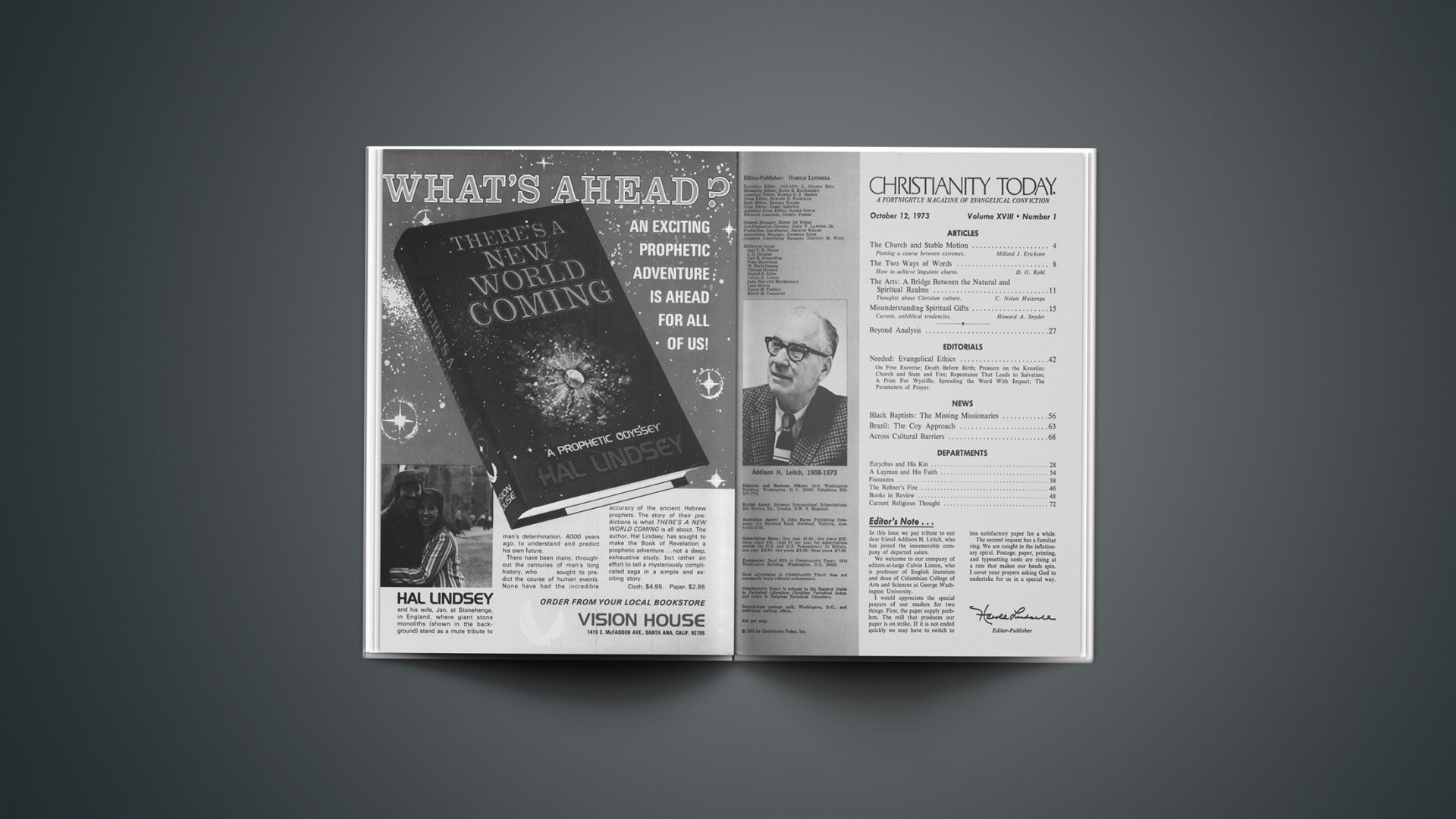
Our good friend and faithful co-worker Addison H. Leitch died September 17 at the age of sixty-four. Our hearts and prayers go out to his widow, Elisabeth Elliot, and his four daughters.

The funeral service was held at Gordon-Conwell Seminary, the sixth and last school to have had Dr. Leitch on its faculty. His longest term was at Pittsburgh (then Pittsburgh-Xenia) Seminary, 1946–61, the last four of those years as its president. He had a Ph.D. from Cambridge. He wrote six books.

The name Addison H. Leitch (the H. for Hardie) has always been well known among readers of CHRISTIANITY TODAY. He was a long-time contributor to “Current Religious Thought,” our anonymous “Eutychus II” for several years, and one of the magazine’s editors-at-large. An essay of his entitled “The Primary Task of the Church” appeared in the very first issue of the magazine, October 15, 1956. Now, in another first-in-October issue, we publish the last piece he sent us, intended for use in “Current Religious Thought.”

Add Leitch visited me in June when I was a patient at the Massachusetts General Hospital in Boston. We had a blessed visit together despite his grave illness and the debilitating side effects produced by the radiation therapy he had been undergoing.

A long-time friend of his wrote us recently to suggest the applicability of words Macaulay wrote of Charles Simeon: “… if he but knew with what authority and influence he swayed the church.… Who ever heard him deliver a dry sermon? Who ever had to listen to dull remarks in his conversation?” Not surprisingly, in a biographical data form we once asked him to fill out Addison Leitch listed as “a ‘favorite’ Bible … text,” “A merry heart doeth good like a medicine.” We miss that fine mind and devoted spirit and merry heart.

HAROLD LINDSELL

The other side of this whole discussion has to do with the person who is looking at the picture of the sunset or, more to the point now, the person who reads his Bible. It is an old and solid Reformed doctrine that the Bible must be treated as Word and Spirit. The Word without the Spirit becomes wooden. The Spirit-filled Christian uncontrolled by the words of Scripture becomes wild—what Calvin called a “frantic.” This is a danger in many charismatic movements today. It is also a danger in many enthusiastic youth movements where singing and “sharing” crowd out the Scriptures.

If our thesis still stands up, then we see that in the larger sense one does not stop with the immediate text but includes the whole of Scripture, which introduces wider interpretation.

Think of a simple phrase like “by grace you are saved.” There is no objection to a close analysis of grace and salvation, of course. I believe in exegesis. There is no question that the verse is literally word-for-word true. But how much it is enriched by the endless examples of Scripture, the endless experience of one’s own life, the testimony of the Church, and the sturdy support of the creeds. And the end is not yet, because when one lives with the Bible and feeds on it he continues to grow up into his understanding of the grace of God and will probably some day have to sing about it in some heavenly choir because ordinary definitions of that grace won’t do.

Some of this sounds like Tillich and his symbols and Tillich is always scary to fundamentalists and evangelicals, so why not try the word sacrament or sacramental? The bread and cup are literally what they are, and they are not changed into something else. Nevertheless, received in faith they communicate the Realities of the body broken and the blood shed; this is our expectancy and our hope at the holy table. In some sense also the words of Scripture communicate something larger than themselves, and all life in this sense can be thought of as sacramental. “The heavens declare the glory of God.… There is no speech nor language.…”

Misunderstanding Spiritual Gifts

God creates. Hence man, created in divine image, is also creative. And the Spirit of God who “was moving over the face of the waters” at the dawn of creation is the same Spirit who, according to Scripture, operates in the Church, giving to each Christian “the manifestation of the Spirit for the common good” (1 Cor. 12:7).

Great confusion exists today regarding the important biblical doctrine of the gifts of the Spirit. The institutional church often shows a crippling misunderstanding of this concept. And too often specific Christian traditions implicitly, if not explicitly, deny the possibility of real creativity.

When I speak of misunderstanding spiritual gifts, I speak from experience. I had read the passages on the gifts of the Spirit in First Corinthians, Romans, and Ephesians many times, always with a half-conscious puzzlement. Paul emphasized spiritual gifts, but there seemed to be no application of this teaching to the contemporary church. Then slowly it dawned on me: the contemporary church in its institutional form makes little room for spontaneous spiritual gifts. Worse yet, often it does not need spiritual gifts to function. When the local church is structured after an institutional rather than a charismatic model, spiritual gifts are replaced by aptitude, education, and technique.

Severall common misunderstandings of spiritual gifts need to be shown for what they are, unbiblical tendencies that restrict the working of the Holy Spirit in the Christian community. I suggest five that need to be explored.

1. The tendency to deny or discredit spiritual gifts. In its most extreme form, this tendency says that the gifts of the Spirit were given as miraculous signs at the birth of the Church but have no legitimacy today. Gifts of healing, prophecy, and tongues, especially, are no longer to be considered valid. In a milder form this tendency admits in theory the validity of spiritual gifts but in practice is suspicious of them and tends to discredit them.

An example of such thinking is found in John R. W. Stott’s little book One People. Stott arrives at the unwarranted conclusion that some New Testament gifts “certainly do not exist in the Church today, notably apostles and prophets.… Probably some others like ‘workers of miracles’ have also ceased” (Inter-Varsity, 1968, p. 27).

Such a position arbitrarily limits the operation of the Holy Spirit and the applicability of the New Testament to our day. There is no more warrant, for instance, to apply chapters twelve and fourteen of First Corinthians exclusively to the early Church than there is so to limit the thirteenth chapter. Gifts and love go together.

To deny spiritual gifts is to misunderstand their nature. Those who fear spiritual gifts (and often the problem is, in reality, one of fear) usually think of them as highly individualistic, irrational, and eccentric manifestations that disturb the unity of the Body of Christ. But this caricature is not at all what the Bible means by the gifts of the Spirit.

We cannot depreciate spiritual gifts without devaluating the biblical understanding of the Church and the Spirit-filled life. The charismata are not something merely tacked on; neither are they temporally or culturally bound. They are cross-culturally relevant, and their presence in the Church makes the Church cross-culturally relevant. Both in Romans 12 and in Ephesians 4, Paul relates the unity of the Spirit’s ministry in the Church to the diversity of gifts. The appeal to “present your bodies as a living sacrifice” and “be transformed by the renewal of your mind” is followed by the appeal, “Having gifts that differ according to the grace given us, let us use them” (Rom. 12:1–6). Both injunctions are for today.

We simply have no authority to declare specific gifts invalid. It may be difficult to accept the full range of biblical teaching on the subject, but this is necessary to avoid impoverishing the Church. And it is essential for a truly biblical doctrine of the Church and its ministry.

2. The tendency to over-individualize spiritual gifts. Western Christianity in general has tended to over-individualize the Gospel to the detriment of its more communal and collective aspects, and contemporary conceptions of spiritual gifts have suffered from this tendency. Spiritual gifts are too often thought of as strictly a matter of one’s “private” relationship to God, without regard for the Christian community. In contrast, Paul repeatedly emphasizes that the Spirit’s gifts are for the edification of the Church, and that they lose their significance if this emphasis is lost. The general principle is, “To each is given the manifestation of the Spirit for the common good” (1 Cor. 12:7). The individual gift is balanced by community responsibility and interaction. Paul prefaces his comments on gifts in Romans 12 with the assertion, “We, though many, are one body in Christ, and individually members one of another” (Rom. 12:5). This is the biblical balance, and spiritual gifts can rightly be understood only in this context.

The biblical conception is that the community of believers acts as the controlling context for the exercise of gifts, thus discouraging individualistic aberrations. And gifts must operate in this way. The Church is, to use Gordon Cosby’s phrase, “a gift-evoking, gift-bearing community.” When the Church really functions in this way, the various gifts not only reinforce one another but also act as check and balance to prevent extremes. Here the New Testament analogy of the body is helpful. The hand or foot is prevented from some extreme or uncontrolled action by its connection to the body, with its various organs and systems. Functioning as part of the body, the hand is helpful and nearly indispensable, but cut off from the body it becomes grotesque and useless. So it is with spiritual gifts.

It is at this point, incidentally, that small Bible-study groups find their usefulness. The small Spirit-directed group builds community and provides the context for both awakening spiritual gifts and disciplining their use. As a consequence of many such cells, the whole larger community of the Church is edified.

Spiritual gifts are not given merely for personal enjoyment, nor even primarily for the individual’s own spiritual growth. Rather, they are given “for the common good,” “that the church may be edified” (1 Cor. 14:5).

3. The tendency to confuse spiritual gifts and native abilities. The error here lies in the tendency to go to one extreme or the other: to make spiritual gifts and native abilities either synonymous or else antithetical.

Each person is born with latent potentialities that should be developed and used to the glory of God. This is stewardship. But when the New Testament speaks of spiritual gifts, it goes beyond this. Paul says the Holy Spirit “apportions to each one individually as he wills” (1 Cor. 12:11). There is an immediacy here that speaks of a direct relationship between man and God through conversion and life in the Spirit. The gifts of the Spirit result from the operation of the Spirit in the life of the believer, and so are something more than merely the wise and faithful use of native abilities. They must be understood as, literally, gifts of the Spirit.

But how and when does the Spirit operate? The Holy Spirit is the Spirit of creation that “was moving over the face of the waters,” the same Spirit who said to Jeremiah, “Before I formed you in the womb I knew you, and before you were born I consecrated you; I appointed you a prophet to the nations” (Jer. 1:5). God is sovereign and omniscient, and we must not suppose that he begins to operate in a person’s life only after conversion. There really is no such thing as a “native” ability—“What have you that you did not receive?” (1 Cor. 4:7). It is not too much to say that God in his foreknowledge has given to each person at birth those talents that he later wills to awaken and ignite. A spiritual gift is a God-given ability that has caught fire.

A native capacity does not really become a spiritual gift until it is given over to the Spirit. The principle of crucifixion and resurrection, of dying and rising, applies here. Natural abilities remain in the plane of human effort until given to God in self-sacrifice.

In his perceptive discussion of spiritual gifts in Full Circle, David R. Mains writes:

In those areas where I have natural abilities, such as a facility for public speaking, the difference between their being talents or gifts of the Holy Spirit is found in my attitude. If I recognize the talent as from God, and in prayer and continual dedication commit it to Him to be used in ministry in a special way, it becomes a gift of the Holy Spirit with supernatural expression. The proof of this is seen in the gradual way God increases this gift for His service [Word, 1971, p. 62].

So talents and gifts are neither synonymous nor antithetical. Both, after all, are bestowed by God. It is no accident that converted salesmen often make good evangelists. God is not capricious. Although we must not limit the sovereign working of the Spirit, yet we may normally expect some correspondence between a person’s “native” abilities and personality traits—latent or developed—and the spiritual gifts God will bring forth in him. The Spirit intends to transform us into what we were meant to become, not into Xerox copies of someone else.

4. The tendency to exaggerate some gifts and depreciate others. This is one of the most serious and most common errors regarding spiritual gifts: the tendency to think only certain gifts are legitimate gifts. How serious this aberration has become is seen in the fact that any discussion of spiritual gifts today usually becomes sidetracked on the question of tongues. The tendency to think only of the more spectacular gifts—such as tongues, healing, or prophecy—as spiritual gifts is wrong. All gifts are important, all are necessary, and all are given by God for the common good.

An examination of the relevant biblical passages suggests that the various lists of gifts mentioned are intended to be representative, not exhaustive. The multiform operation of the Holy Spirit may awaken a vast variety of gifts; gifts may be as varied as is human personality. The New Testament lists the specific leadership gifts of apostle, prophet, evangelist, and pastor-teacher (Eph. 4:11; 1 Cor. 12:28). But such designations as utterance of knowledge, helps, service, and acts of mercy may be understood as general categories that take in a wide spectrum of specific gifts. Any ability ignited and used by the Holy Spirit—whether in music, art, writing, intercessory prayer, homemaking, hospitality, listening, or whatever—is a legitimate spiritual gift. If God has given the gift, then it is good and is intended to be used. The biblical teaching is plain: “As each has received a gift, employ it for one another, as good stewards of God’s varied grace: … in order that in everything God may be glorified through Jesus Christ” (1 Pet. 4:10, 11).

The problem, too often, is the failure to affirm the full range of gifts—the failure to appreciate “God’s varied grace.” All gifts are important, and none is an anomaly when exercised rightly in the context of community. It is as wrong to overemphasize preaching and teaching and deny tongues and healing as it is, on the contrary, so to emphasize the more spectacular gifts that the less showy ones are forgotten. The Holy Spirit acts so “that there may be no discord in the body” only when all gifts are affirmed and operate cooperatively. To quote David Mains again:

Every true member of the local church has a minimum of one gift, and most people have many. Since no one has every gift, and everyone has at least one, there exists an interdependence among the members of the church. Scripture teaches (1 Cor. 12:22–25) that the less spectacular gifts are more necessary than the showy ones. In other words, the church can go a long time without a miracle, but let it try to exist without acts of mercy or contributions!… How disabled the body of Christ has become because our primary purpose for church attendance has been to hear one man exercise his gifts, rather than to prepare all the people to develop their gifts for ministry, not only within the church but also to society [Full Circle, p. 63].

The function of the local church should be to expect, identify, and awaken the varied gifts that sleep within the community of believers. When all gifts are affirmed under the leadership of the Holy Spirit and in the context of mutual love, each gift is important and no gift becomes an aberration.

5. The tendency to divorce spiritual gifts from the cross. This tendency arises from the failure to incarnate the tension between the cross and the charismata, between Passover and Pentecost. It is the tendency, on the one hand, to emphasize gifts in such a way that the cross is lost sight of and the community is fractured by self-centeredness. Or, on the other hand, it is the opposite: to deny any emphasis on gifts because of this tendency toward self-centeredness and self-aggrandizement.

What is the biblical position? How can the fact of each person’s discovering and exercising his gifts be reconciled with Christ’s fundamental words, “If any man would come after me, let him deny himself and take up his cross and follow me” (Mark 8:34)?

There is a danger here, for spiritual gifts are often misunderstood. The New Testament teaching concerning spiritual gifts is not a call for each Christian simply to “do his own thing” and forget the welfare of the group and the need of the world. Ministry is not determined exclusively by personal desire but by the cross.

And yet, biblically, there is no contradiction between gift-affirmation and self-denial. In fact, the two go together. The biblical principle, again, is that of death and resurrection. As one is crucified with Christ and dies to his own will, the Holy Spirit resurrects within him his significant gift. So the spiritual gift, rightly exercised, is not self-centeredness; it is self-giving.

But we must go further and say that the Christian discovers the true meaning of crucifixion as he really begins to exercise his gift. Faithful ministry of the gift of the Spirit will lead him into depths of self-giving he never dreamed possible—and God planned it this way. This is the way we are created, psychologically, emotionally, and spiritually.

Here we find the meaning of the life and death of Jesus Christ, God’s Son and the perfect man. We may suppose that Jesus possessed, at least potentially, all the gifts of the Spirit, and he publically exercised many of them—apostle, evangelist, healer, prophet, teacher, helper, comforter, friend. The faithful exercise of his ministry led him not to the throne but to the cross. But it led beyond, as well—to resurrection.

“For to this you have been called, because Christ also suffered for you, leaving you an example, that you should follow in his steps” (1 Pet. 2:21). Here we find the meaning of the gifts of the Spirit.

Elizabeth O’Connor has written helpfully along this line in Eighth Day of Creation. “When one really becomes practical about gifts, they spell out responsibility and sacrifice,” she says.

The identifying of gifts brings to the fore … the issue of commitment. Somehow if I name my gift and it is confirmed, I cannot “hang loose” in the same way. I would rather be committed to God in the abstract than be committed to him at the point of my gifts.…

If I develop one gift, it means that other gifts will not be used. Doors will close on a million lovely possibilities. I will become a painter or a doctor only if denial becomes a part of my picture of reality. Commitment at the point of my gifts means that I must give up being a straddler. Somewhere in the deeps of me I know this. Life will not be the smorgasbord I have made it, sampling and tasting here and there. My commitment will give me an identity [Word, 1971, p. 42].

Spiritual gifts come to their full biblical legitimacy and meaning only in the rhythm of incarnation-crucifixion-resurrection.

The urgent need today is that spiritual gifts be seen and understood in the context of ecclesiology, as in the New Testament. A biblical understanding of spiritual gifts is absolutely essential for a biblical understanding of the Church. For our understanding at this point will determine whether our ecclesiology is based on a charismatic or an institutional model.

When spiritual gifts are misunderstood—through being over-individualized, denied, divorced from community, or otherwise distorted—it is the Church that suffers. The Church truly becomes the Church only when the biblical meaning of spiritual gifts is recovered. A church whose life and ministry is not built upon the exercise of spiritual gifts is, biblically, a contradiction in terms.

A Bridge between the Natural and Spiritual Realms

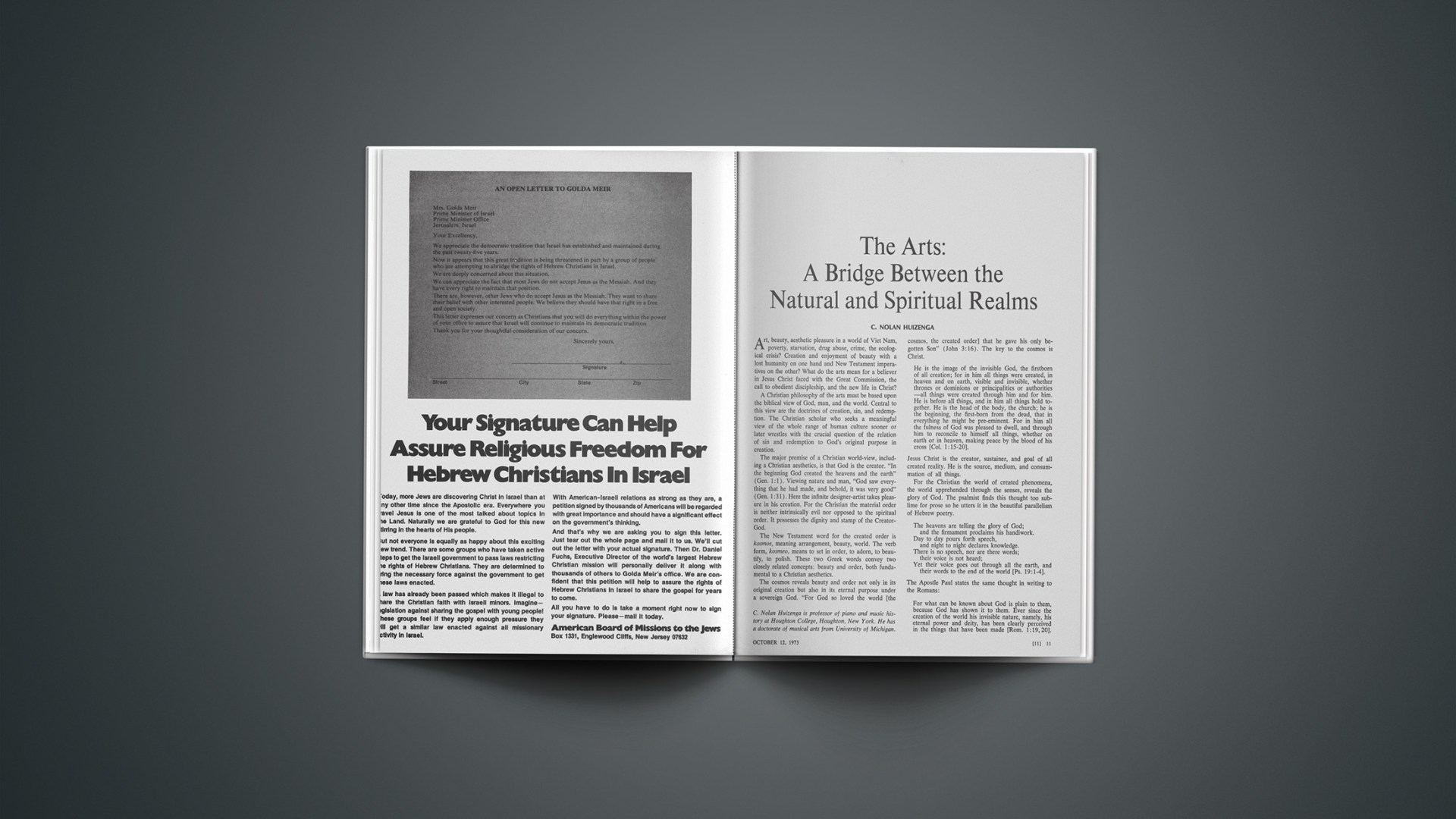
Art, beauty, aesthetic pleasure in a world of Viet Nam, poverty, starvation, drug abuse, crime, the ecological crisis? Creation and enjoyment of beauty with a lost humanity on one hand and New Testament imperatives on the other? What do the arts mean for a believer in Jesus Christ faced with the Great Commission, the call to obedient discipleship, and the new life in Christ?

A Christian philosophy of the arts must be based upon the biblical view of God, man, and the world. Central to this view are the doctrines of creation, sin, and redemption. The Christian scholar who seeks a meaningful view of the whole range of human culture sooner or later wrestles with the crucial question of the relation of sin and redemption to God’s original purpose in creation.

The major premise of a Christian world-view, including a Christian aesthetics, is that God is the creator. “In the beginning God created the heavens and the earth” (Gen. 1:1). Viewing nature and man, “God saw everything that he had made, and behold, it was very good” (Gen. 1:31). Here the infinite designer-artist takes pleasure in his creation. For the Christian the material order is neither intrinsically evil nor opposed to the spiritual order. It possesses the dignity and stamp of the Creator-God.

The New Testament word for the created order is kosmos, meaning arrangement, beauty, world. The verb form, kosmeo, means to set in order, to adorn, to beautify, to polish. These two Greek words convey two closely related concepts: beauty and order, both fundamental to a Christian aesthetics.

The cosmos reveals beauty and order not only in its original creation but also in its eternal purpose under a sovereign God. “For God so loved the world [the cosmos, the created order] that he gave his only begotten Son” (John 3:16). The key to the cosmos is Christ.

He is the image of the invisible God, the firstborn of all creation; for in him all things were created, in heaven and on earth, visible and invisible, whether thrones or dominions or principalities or authorities—all things were created through him and for him. He is before all things, and in him all things hold together. He is the head of the body, the church; he is the beginning, the first-born from the dead, that in everything he might be pre-eminent. For in him all the fulness of God was pleased to dwell, and through him to reconcile to himself all things, whether on earth or in heaven, making peace by the blood of his cross [Col. 1:15–20].

Jesus Christ is the creator, sustainer, and goal of all created reality. He is the source, medium, and consummation of all things.

For the Christian the world of created phenomena, the world apprehended through the senses, reveals the glory of God. The psalmist finds this thought too sublime for prose so he utters it in the beautiful parallelism of Hebrew poetry.

The heavens are telling the glory of God;

and the firmament proclaims his handiwork.

Day to day pours forth speech,

and night to night declares knowledge.

There is no speech, nor are there words;

their voice is not heard;

Yet their voice goes out through all the earth, and

their words to the end of the world [Ps. 19:1–4].

The Apostle Paul states the same thought in writing to the Romans:

For what can be known about God is plain to them, because God has shown it to them. Ever since the creation of the world his invisible nature, namely, his eternal power and deity, has been clearly perceived in the things that have been made [Rom. 1:19, 20].

These passages teach that the visible world of nature reveals the invisible realm of supernature, God’s eternal power and deity. That which we know through the senses and that which is spiritual are closely linked in God’s creative purpose. Christianity, in contrast with all asceticism, whether religious or philosophical, places a high value on natural creation and rejects the world-denying dualism of matter and spirit, body and soul.

The crowning example of the dignity of matter and the intimate relation between flesh and spirit is the incarnation of Jesus Christ, God’s own invasion of human history.

In the beginning was the Word, and the Word was with God, and the Word was God.… And the Word became flesh and dwelt among us, full of grace and truth; we have beheld his glory, glory as of the only Son from the Father [John 1:1, 14].

The Apostle John saw grace and truth and glory as he looked upon Jesus in the flesh. A Christian artist sees in the incarnation God’s glorious “self-portrait.”

But what do these truths mean for the arts? In my view, the arts are a wonderful bridge between the two worlds into which God placed man by creation. The arts can lead to a mysterious synthesis of the material world of the senses and the spiritual realm. Firmly rooted in the here and now media of sights and sounds, they nevertheless convey not only the pleasure of the senses and emotions but also intellectual, moral, and spiritual insights. The Christian is free to enjoy beauty wholeheartedly on all these levels while at the same time he insists on the supremacy of moral and spiritual values.

A Christian view of the arts rests on the biblical revelation of a sovereign, personal God who himself is ultimate truth, beauty, and goodness. This fact alone commits the Christian to seeking excellence in the intellectual, aesthetic, and moral realms. Moreover, a Christian in the arts finds it impossible to divorce beauty from truth or morality. His respect for God and ultimate truth means that he believes the arts must be subject to reasonable evaluation and criticism. This task, though difficult, is perhaps easiest in the verbal arts, harder in the visual and plastic arts, and hardest in the nonverbal, non-visual art of music.

Man is able to apprehend truth, beauty, and goodness because he is a rational being created in the moral and spiritual image of God. The Christian artist is convinced that a significant aspect of God’s image in man is his imagination, his mysterious and wonderful power to form new mental images. He believes that his urge to shape and create and his magnetic response to beauty derive directly from his creator. He creates in full and humble recognition that his abilities are not self-generated but rather given by God for his greater glory. The Scriptures affirm, “We love him because he first loved us.” To this we may add, “We create because he first created us in his image.”

In the presence of nature, a Christian is awe-struck by its profuse variety and extravagance, its infinite detail, its intricate design. In his love God had showered his gifts upon man without reserve. The Christian artist is compelled to share his creative gifts with others. He creates not merely for self-expression or psychological catharsis but out of a loving desire to communicate his view of beauty and reality to others.

Because man was uniquely created in God’s likeness, he was given a special commission as God’s agent over the natural order.

And God blessed them, and God said to them, “Be fruitful and multiply, and fill the earth and subdue it; and have dominion over the fish of the sea and over the birds of the air and over every living thing that moves upon the earth” [Gen. 1:28].

This command, sometimes called the cultural mandate, enjoins man to exercise his God-given power and dominion over the earth and nature. The psalmist expresses man’s noble task in these lines:

Yet thou hast made him little less than God, and dost

crown him with glory and honor.

Thou hast given him dominion over the works of thy

hands; thou has put all things under his feet.

O Lord, our Lord, how majestic is thy name in all

the earth! [Ps. 8:5, 6, 9].

Implicit in God’s command to subdue the earth is the responsibility to develop the entire range of human culture for man’s use under the sovereignty of God. Our English word culture derives from the Latin colere, to till or cultivate the ground. A comprehensive Christian definition of culture, in the words of Henry Van Til, is “the activity of man as image-bearer of his creator in forming nature to his purposes”; or “any and all human effort and labor expended upon the cosmos to unearth its treasures and riches and bring them into the service of man for the enrichment of human existence unto the glory of God.”

The arts are as universal as man. They exist in every human culture from the most primitive to the highly civilized. But how do they relate to the cultural mandate given man at his creation? It is easy to see how the sciences enable man to subdue and develop his environment, but what about the arts?

On one level the arts represent man’s celebration of his natural environment through his senses. On another, they embody his emotional responses to human experience. On still another level, the arts reflect man’s lifelong quest for meaning, for purpose, and his attempt through symbol and metaphor to bring unity to his fragmented existence. If the sciences represent man’s dominion over his physical environment, the arts on their highest level represent one phase of man’s cultural attempt to understand, control, and ennoble the psychological and spiritual areas of his life.

Thus far our consideration of the arts has centered in the biblical doctrine of God the creator and man the image-bearer and cultural agent of God under the creation mandate. We have omitted a crucial factor—sin, man’s rebellion against God, with the resulting defacement of God’s image in man, the subjection of nature to decay and death, and the perversion of human culture.

When man sinned, he did not lose his creaturehood, his humanity. Nor did God release man from the original creation mandate to multiply, to have power over nature, to use nature for his purposes. Man retains his cultural urge, his instinct to rule, his love of power, his ability to shape matter after his will. But culture now becomes an end in itself rather than a means to the glory of God.

Man’s culture becomes fragmented; the relation of the parts to the whole eludes him, and he worships and serves the creature (or creation) rather than the creator. Under the power of sin and Satan, man develops a self-centered culture that Augustine called the civitas terrena, kingdom of this world. By contrast, believers in Christ are motivated by the Holy Spirit to express their faith culturally in ways consistent with divine revelation and, therefore, glorifying to God. This concept of a faith-oriented culture Augustine called the civitas dei, kingdom of God. The resulting division of mankind into two opposing cultures is called by some “the antithesis.”

One of the toughest questions for a thoughtful Christian arises at this point. What attitude should he take toward this deep-seated antithesis in human culture and what are his cultural responsibilities? He is called to be “in the world”; he remains a human being. Yet he is not to be “of the world” in the sense of sharing its sinful desires, practices, and goals.

The Christian, on the basis of divine revelation, is a convinced cultural optimist. He believes that God “desires all men to be saved and to come to the knowledge of the truth” (1 Tim. 2:4) and that God’s ultimate purpose for creation is redemption and restoration in Christ. The ruin of God’s image in man is already in process of restoration by the Holy Spirit in the hearts of twiceborn men.

And we all, with unveiled face, beholding the glory of the Lord, are being changed into his likeness from one degree of glory to another; for this comes from the Lord who is the Spirit [2 Cor. 3:18].

More than this, the Christian is assured that this divine restoration will stop at nothing less than the complete transformation of his body into the likeness of Christ’s glorious body.

[He] will change our lowly body to be like his glorious body, by the power which enables him even to subject all things to himself [Phil. 3:21].

And finally the believer is promised a fully restored environment, the redemption of all nature.

For the creation waits with eager longing for the revealing of the sons of God; for the creation was subjected to futility, not of its own will but by the will of him who subjected it in hope; because the creation itself will be set free from its bondage to decay and obtain the glorious liberty of the children of God [Rom. 8:19–21].

In the light of all this, the Christian’s cultural stance is characterized by faith and hope. He lives his present life in the light of the comprehensive and pervasive nature of God’s redemptive plan for creation. He rejects all ascetic withdrawal from the world, he scorns a convenient sacred-secular dualism, and he seeks to bring all of life under Christ’s lordship, realizing that for him all things are his and he is Christ’s.

In the believer’s heart, that mysterious center of his being, God is transforming the defaced image of the first Adam into the image of Christ, the second Adam. As a member of the new humanity, Christ’s man begins to fulfill, though partially and imperfectly, the original cultural mandate given the first Adam.

But how should a Christian view the artistic products of a culture antithetical to Christianity? Is human culture so depraved that it reflects no truth, beauty, or goodness? The Scriptures teach that one aspect of God’s grace, sometimes called common grace, has to do with the restraint of sin, the maintenance of order, and the promotion of culture and civil righteousness in human life. Although the motivation and goal of human culture are sinful and selfish, unregenerate men are nevertheless enabled through common grace to produce works of relative truth, beauty, and goodness. God is the ultimate source of these qualities regardless of where they are found. For the Christian in the arts, the doctrine of common grace helps explain how unregenerate, even immoral men can produce artistic creations of enduring beauty and meaning. A Christian view of human culture must take seriously the antithesis between the kingdom of God and the kingdom of this world while at the same time recognizing the operation of common grace in worldly culture.

In this article I have tried to sketch the biblical and doctrinal bases for a Christian view of the arts. One of the greatest needs of contemporary evangelism is the development of a thoroughly biblical and Christian aesthetic and, in the case of the performing arts such as music, practical Christian criteria of performance.

We have only begun to bring the arts into captivity to Christ. For this profound and exciting endeavor Paul has given us a grand incentive:

Finally, brethren, whatever is true, whatever is honorable, whatever is just, whatever is pure, whatever is lovely, whatever is gracious, if there is any excellence, if there is anything worthy of praise, think about these things [Phil. 4:8].

The Two Ways of Words

Sticks and stones may break my bones, but words can never hurt me.” Right? Wrong! This threadbare saying expresses only a half-truth, and half-truths are often more seriously misleading than glaring untruths. It is true, of course, that words, being signs or symbols in the form of puffs of air passed through the larynx or dabs of ink on a page, cannot fracture my clavicle as can a brick thrown through my window. Yet words, mere sounds and signs, are able both to “be-thump” us, as Shakespeare put it, and to provoke a flurry of sticks and stones.

Physical violence may often be shown to be the result either of the misuse and abuse of words or of the non-use of words. Communication, someone has said, is “an act of faith, not a trick of grammar.” When men lose faith in the power of the word, mere trickery and, ultimately, physical violence are the alternatives; verbal style is abandoned for the violent style of sticks and stones—or of guns and bombs. Perhaps most ironically symbolic of the current rhetoric of violence is the letter-bomb, a device that turns a mode of communication into a mode of eradication.

Christ taught not only that we are accountable for our words but also that words will be the very basis of judgment: “For by thy words thou shalt be justified, and by thy words thou shalt be condemned” (Matt. 12:37). Suggested in this passage are two ways of words, each with its own destiny: justification or judgment, approbation or anathema. “Words may be either servants or masters,” wrote Bishop Horne. “If the former, they may safely guide us in the way of truth. If the latter, they intoxicate the brain and lead into swamps of thought where there is no solid footing.”

All too many Christians today display what might be called a kind of aphasia—an alarming insensitivity to words, especially their associative meanings. A common notion seems to be that since the gospel message is all-important, the words used to communicate it are relatively unimportant, that it does not really matter how we say it so long as we do say it.

If we are to be judged by our words, we must look to our language. Some Christians show a curious inconsistency in their attitude toward “offensive” language. While they are offended at the use of profane or scatological four- and five-letter words, they seem unaware that some expressions they themselves use are simply compromised distortions of the original forms. For example, secular linguists Robertson and Cassidy, in The Development of Modern English, list the following as “minced” distortions of sacred names: golly, gosh, goodness, gorry, Godfrey, Jeez, Geewhiz, for Pete’s sake, for the love of Mike, for crying out loud, Jimminy Crickets, Jeepers Creepers. Do you realize that when in a moment of disgust you tell someone to “go jump in the lake,” the “lake” is the Lake of Fire? Nonbelievers are sometimes amused at this curious inconsistency on the part of believers. Robertson and Cassidy conclude: “A curious exhibition indeed, of the human desire to sin combined with want of courage!”

Our very words can hinder, hurt, or help the cause of Christ. Words—little puffs of air or dabs of ink—can cause irreparable hurt. They may not break bones, but they can break hearts and lives. “The words of a talebearer are as wounds,” Solomon wrote, “and they go down into the innermost part” (Prov. 18:8).

Even if one argues, as linguists do, that there is no such thing as a “bad word” per se because language is merely a system of symbols, it is true nonetheless that word-symbols take on and convey definite connotations, positive or negative, colored by context and by relations with the ideas they represent. A clear example from the political realm is appease. Before 1938 this word was inoffensive. In the edition current in that year, Webster’s Collegiate Dictionary defined it simply as “to calm; soothe; allay; pacify, often by satisfying.” But almost overnight the word took on lasting negative connotations as a result of Neville Chamberlain’s ill-fated attempt to avoid war with Hitler by giving in to his demands at Munich. Today no meticulous statesman would use appease in reference to foreign policy for which he seeks public support, for the most recent edition of the same dictionary defines the word as “to pacify; conciliate, especially to buy off by concessions usually at the sacrifice of principles.”

A similar change, over a longer period of time, can be seen in the word fundamentalist, which today has negative connotations for many, perhaps in part because the news media often apply it to fanatical sects, as in the recent furor over the snake-handlers in Tennessee. Paul’s words to the Corinthian believers express both a moral and a linguistic principle: “Evil communication [association] corrupts good manners [morals]” (1 Cor. 15:33).

Sensitivity to and ability to control our words is, according to James, a sign of Christian maturity: “If any man offend not in word, the same is a perfect [mature] man, and able also to bridle the whole body” (3:2). James reemphasizes the two ways of words: “Therewith bless we God … and therewith curse we men” (3:9).

It is obvious that our words can blight or bless others and that we can be hurt or helped by the words of others. What I have never heard emphasized in evangelical Christendom, however, is that the words he uses can also affect, for good or ill, the user himself—his mental processes and spiritual attitudes. George Orwell expressed this significant linguistic principle in his essay “Politics and the English Language”: “If thought corrupts language, language can also corrupt thought.” Similarly, Benjamin Whorf, in Language, Mind, and Reality, wrote: “The forms of a person’s thoughts are controlled by inexorable laws of pattern of which he is unconscious. These patterns are the unperceived intricate systemization of his own language.…” Stuart Chase, in an article entitled “How Language Shapes Our Thoughts” appearing a few years ago in Harper’s, observed that language “molds one’s whole outlook on life,” for “thinking follows the tracks laid down in one’s language.” Thus, while it is true that our words reflect our state of mind and heart—for “out of the abundance of the heart the mouth speaketh” (Matt. 12:34)—it is also true that the words we use, the linguistic patterns we form, influence our thoughts and attitudes, for “those things which proceed out of the mouth come forth from the heart, and they defile the man” (Matt. 15:18).

Does such language as “cool cat,” “funky freak,” “groovy guy upstairs,” “swinging superstar” when used to describe the eternal Godhead reflect a scriptural concept of Deity? Does not such language actually demean the user’s concept of Christ and affect his attitude toward God? Dave Wilkerson has said: “You cannot win rebels by being like them. Put away your childish talk. God is not ‘groovy’ or ‘hip’ and Christ is not a ‘cool cat.’ ”

This is one way of words. If the thoughts are corrupt, the words will be, and the corrupt words will, in turn, further corrupt the thoughts. And so the thoughts and words spiral downward.

But Christ and James spoke of another way of words: the way of “blessing,” leading to justification. The question is, How can one be assured that his words are of the second way, the way of blessing? The answer lies in Christ’s words in John 12:48—“He that rejecteth me and receiveth not my words, hath one that judgeth him: the word that I have spoke, the same shall judge him in the last day.” Man will be judged not only on the basis of his own words but also on the basis of how he has reacted to the words of Christ.

The solution, then, to the problem of rendering our words acceptable in his sight lies in receiving his words and letting “the word of Christ dwell in [us] richly …, teaching and admonishing … and singing with grace in [our] hearts to the Lord” (Col. 3:16). The Psalmist, who prayed, “Let the words of my mouth … be acceptable in thy sight” (Ps. 19:14), expressed also the secret of acceptable words: “Thy word have I hid in my heart that I might not sin against thee” (Ps. 119:11). “Thy words were found and I did eat them,” Jeremiah wrote, “and they were the joy and rejoicing of my heart” (15:16). If we are filled with the Logos, the Living Word, and if we take our fill of and digest the written word, our own destiny in words will be one of blessing.

Paul admonished the Ephesian believers to “let no corrupt communication proceed out of your mouth [the first way of words] but that which is good to the use of edifying [the second way of words], that it might minister grace unto the hearers” (Eph. 4:29). Our words should edify, build up; they should minister grace. But words can minister grace only if they themselves are grace-full. To the Colossian Christians Paul wrote: “Let your language be always seasoned with the salt of grace” (Col. 4:6, Weymouth). Our words must be characterized by grace, charis, that favor which can transform an unpleasing circumstance into a pleasing one, an awkward situation into a glorious one. This linguistic charm is what Solomon must have had in mind when he wrote: “A word fitly spoken is like apples of gold in pictures of silver” (Prov. 25:11).

Solomon earlier spoke of the second way of words: “A man hath joy by the answer of his mouth; and a word spoken in due season, how good is it” (Prov. 15:23). Our words, if they are of the second way, will reflect the Word of Life, who “gave the Word” (Ps. 68:11). Written and spoken words are analogues of the Living, Eternal Word. The German philosopher Max Picard wrote in his book Man and Language: “The eternal and objective quality of language is the reflection of the divine Word by which the world was created and which is still actively at work in language.” God intends the same living, eternal word (Heb. 4:12), by which the worlds were framed (Heb. 11:3), by which all things are upheld (Heb. 1:3), by which we are made new creatures (1 Pet. 1:23), to indwell us and empower us. To whom can we go for acceptable words of life (John 6:68) but to the Word of Life (1 John 1:1)? And how can our words be acceptable unless we accept his words and make them a part of us?

Those who reject his words will be judged by them and condemned by their own; those who accept the Word and his words are justified, and to the extent that they are richly filled with his words of grace, their own words gracefully administer grace to others. Everyman’s destiny is a destiny in words; the question is simply which way of words that destiny will be.

Having begun with a threadbare saying, we might well conclude with a revision of another: “What you say speaks so loudly that I can’t see what you do.”

The Church and Stable Motion

It is a mark of the “now” generation, I suppose, that breakfast-food premiums, like the cereal itself, are instant. In my youth we had to save box tops and send them to the manufacturer, then wait an agonizing three weeks or more for the prize to arrive by mail. Today the precious trinket is enclosed in the cereal box. One day recently I found on our table a cereal box that promised to contain, in addition to the minimum daily requirement of certain vitamins and minerals, a toy plastic gyroscope. I eagerly removed the parts and assembled them, wound “a heavy thread, two feet long,” around the shaft, then with a quick pull set the flywheel spinning. The plastic wheel was not as heavy as the metal wheel of the gyroscope that had brightened one of my boyhood Christmases, nor was its shaft as straight, but its behavior was the same. It balanced on our table-top. When its base was tilted at an incline, it remained perfectly vertical, tipping neither right nor left.

The gyroscope is a helpful reminder that there are different types of motion. In an age that is dynamically-oriented, motion and change seem inherently desirable. Yet there is a vast difference between stable and unstable motion. Anyone who can remember his first efforts at bicycle-riding or ice-skating, or whose car has ever skidded out of control, will know immediately what I mean. Motion to be useful and constructive must be motion with equilibrium.

There is much motion in the Church today. Shifts are occurring in doctrinal conceptions, forms of worship, and life-style. Yet the history of the Church suggests a need for care that the motion shall be stable motion. Too often the Church has veered from one extreme to another, over-reacting to each in turn. To move forward with equilibrium would mean that corrections of direction are made, but that the major expenditure of energy and motion is directed toward the ultimate goal. To fail to do so means that most of the movement is given to the alternations from one sideline to another.

An interesting phenomenon today is what I term the “ecclesiastical crisscross.” As one segment of the Church reacts away from one extreme, a different portion moves from the opposite extreme, and the two careen past each other somewhere near the middle. For example, many evangelicals have reacted recently against informality of worship and are seeking more liturgy. At the same time, however, some persons from more liturgical backgrounds are abandoning pipe organs, Bach anthems, Gothic architecture, and polished homilies and are worshiping with guitars, sitting on the floor, and exercising charismatic gifts.

It is not my task to comment on the entire life of the Church. My responsibility on the seminary faculty is in the broad area of theology. I propose therefore to discuss a few areas of theology that have particular implications also for the Christian life. These are areas where we can examine this tendency to over-reaction, and can perhaps grow wiser as a result.

The first is concern with the fact that theological and ethical concepts presuppose a certain view of reality, an ontology (doctrine of being). Metaphysics is the discipline that asks about the nature of reality. As such, it goes beyond the phenomena perceived by the senses and tries to reveal the underlying basis of these experiences.

This whole metaphysical endeavor has been under fire in the nineteenth and twentieth centuries. Immanuel Kant in his monumental Critique of Pure Reason argued that the claim that there is knowledge without a sensory content is illusory. Existentialism insisted that abstract concepts relating to “being” are irrelevant to personal, subjective “existence.” Pragmatism rejected the attempt to find the meaning of objective reality in theoretical “objects” that cannot be perceived by the senses. Rather, the pragmatist insisted that the meaning (C. S. Peirce) and the truth (William James) of a statement are its practical consequences. Logical positivism attempted to give metaphysical inquiry the coup de grâce with its verification principle: that no statement has any meaning unless there is a set of sense data that shows it to be true (or false).

Theologians who accepted these changes altered the nature of theology accordingly. Thus Schleiermacher redefined the fundamental nature of religion to consist, not in doctrines about an objective reality beyond the sensible world, but in feelings, and particularly the feeling of dependence. Ritschl suggested that the essence of theology is to be found in value judgments—i.e., personal and social ethics—rather than in metaphysics.

To be sure, metaphysical speculation had sometimes been carried to incredible extremes. According to what is probably an apocryphal but apt story, some medieval scholastics went so far as to discuss how many angels could stand at once on the head of a pin. Some of the Lutheran orthodox developed in detail a Christological conception termed the “communicatio idiomatum”: that the attributes of the divine nature of Christ were communicated to his human nature, and vice versa. In seeking to avoid exaggeration, however, the danger of overreaction is ever-present.

The twentieth century is not charitable toward substantives. One of the commonplaces of neo-orthodoxy was that God reveals himself through his verbs, not his nouns, i.e., in what he does, not what he is. The person of Christ, according to Emil Brunner, should be approached through the work of Christ. The tendency is to speak disdainfully of metaphysics in theology and to prefer functional concepts.

We need to bear in mind, however, that adjectives, adverbs, and even verbs cannot stand alone. They must attach to some substantive. Function is always the function of something. We must ask what form is presupposed as a basis for such a function. If not, we will develop a “Cheshire cat theology.” Like the cat that gradually faded away, leaving only a grin but no face to which the grin belonged, a function without a form that functions will not endure long.

The same is true in Christian ethics. Joseph Fletcher has decried the metaphysical or ontological approach to ethical judgments. The only thing that is substantively good in itself is love. All other goods are so only derivatively. Yet Fletcher’s “love” is so lacking in content that it gives little real guidance for conduct.

A second area of concern is the approach to Scripture and what is necessary to understand it. Here, too, the theological teeter-totter is operative. In some pietistic circles, careful scientific study of the Scriptures was regarded as unnecessary. God spoke to the earnest seeker, through Scripture. On the basis of this, the person had something to live by.

Some of these messages from God appeared to serious students of the Bible to have relatively little relation to the historical meaning of the text. Either the passage was allegorized or an interpretation quite at variance with its historical setting was adopted. As a result, these students of Scripture advocated intensive exegetical study. The very best of the tools of biblical research were to be brought to bear upon a passage in order to determine its precise meaning in the historical context. Knowledge of biblical languages, historical-critical methodology, and hermeneutical techniques was essential if the message of the Bible was to be heard.

In this endeavor, however, a new danger is latent. Since the Bible is thought to be properly understood only by those possessing these special skills and tools, a new priesthood arises. Only the initiated can unlock the esoteric secrets of the sacred Scriptures. The ordinary layman finds merely the surface meaning of the text, which may be in actual contradiction to its true meaning. As in a new type of Gnosticism, certain higher truths elude most Christians.

A number of voices have arisen suggesting that this approach has gone too far. Robert Blaikie, noting that the Reformation insisted that Jesus was the only mediator between God and man, says:

Today, therefore, when exalted claims are made for the critically trained academic clergy as the essential mediators of the truth of God to men, then talk about the need for a New Reformation seems extremely apt.… The Church today, if it is faithful to the principles of the Reformation and to the guidance of the Living God, the Holy Spirit, will not continue to tolerate or approve a self-exalting hierarchy of would-be essential mediators-to-men of the truth of God. [‘Secular Christianity’ and God Who Acts, Eerdmans, 1970, p. 27].

James Barr, also, has suggested that although those who have a good grasp of the original languages will always have a more accurate understanding of the biblical text than those who do not, “it is unlikely that in more than a few special cases this knowledge will lead to a recognition of some Biblical conception which is vital to the understanding of the Bible, but which is invisible to the reader of the English Bible” (Biblical Words For Time, 1962, p. 162).

Paired with the emphasis upon technical rational study must be the doctrine of the internal illumination by the Holy Spirit of which Reformed theologians have made so much. There is also what Helmut Thielicke has termed the “spiritual instinct of the children of God,” which may be the same thing Calvin had in mind. The mainstream Reformation principle was neither the Word alone nor the Spirit alone but the two in conjunction. It would seem that neither the rationalistic study of the Bible nor the subjective inner speaking by the Holy Spirit is to be followed alone.

A third area of concern is the conception we hold of the Christian life, and beyond that of the nature of man himself. I refer to the tension between self-discipline and self-indulgence. Here again there has been the same tendency to radical veering from one extreme to another.

The Puritan heritage left a deep mark upon American Christianity. The original intention of the Puritans was positive: to develop to the maximum the believer’s spiritual potential, for the glory of God. Abstention from various activities was less because of the evil of the activity than for the purpose of highlighting the positive virtues. Over the years, however, this became distorted (in my judgment) into the negative ethic. The good Christian was measured by the length of the list of things he didn’t do: drink, smoke, gamble, and so on. Thus arose the caricature of the Puritan as a person who didn’t enjoy life and didn’t want anyone else to enjoy it either.

Recently we have seen a reaction against this view of the Christian life. Life is good, all things were made by God, and we ought to enjoy all things to the fullest. So goes the reasoning. In this pell-mell rush to declare our liberation from all false legalism, I see again the danger of over-reaction.

The New Testament ethic makes much of the idea of becoming that for which we are destined by God. In this there is a superficial resemblance to the Aristotelian self-realization ethic, and it surprises me that New Testament scholars have not seen herein a “Greek” influence. There is, however, a notable distinctive about the Christian thrust. The Christian exists for the glory of God (Eph. 1:12). He is to let his light shine so that men will see his good works and glorify his father in heaven (Matt. 5:16). To this end, Paul speaks of disciplining himself (1 Cor. 9:24–27; 2 Tim. 2:1–7).

Jesus seemingly indicated that happiness or satisfaction or a sense of fulfillment comes as a by-product of the effort to please and satisfy God, not as the object of direct effort. He said that one ought to seek God’s kingdom and his righteousness, and these much desired “things” would be added (Matt. 6:25–33). His instruction to the believer to deny himself (Matt. 16:24; Mark 8:34; Luke 9:23) has been much misunderstood. The word he used is the same word Jesus used to describe Peter’s denial of him. What was being suggested here, it appears to me, was a state of self-detachment in which one’s own ambitions, needs, wants are felt no more strongly than those of any other person, even the stranger. Is this not implicit, too, in the instruction to love one’s neighbor as oneself?

Our understanding of the nature of faith needs watchful care, as well. At times faith has become purely intellectual assent, and evidential proofs buttressed this commitment. At times this virtually wrung the experiential element out of Christian faith. Today we see the opposite tendency. Intellectual content and evidence are subordinated to personal experience and vivid immediateness.

In my judgment, both of these extremes are unwise. If Christianity attempts to make its appeal solely to one facet of human existence, it will fail to compete successfully with the other options. In an age of reason, Christians attempted to rest their case completely upon reason, and for the most part found themselves outgunned. Conversely, the appeal today simply to “get high on Jesus” puts the emphasis upon experiential immediacy. I seriously doubt that in this respect the Christian experience can exceed the force of the hallucinogenic drugs, or the rapidly growing Eastern religions with their mystical experiences. If there ever was a need for some rational criteria for choosing among emotional options, it would seem to be now. To deride the place of the intellectual and the cognitive seems to me to be a religious kamikaze mission, with the significant difference that the kamikaze pilot realized that his was a suicide trip. The genius of Christianity’s appeal is not in an ability to outdo competitors in any one-sided emphasis but rather in its balanced satisfaction of the whole man.

It is not enough to observe that the Church has sometimes behaved like a drunk, staggering from one post to another. What positive endeavors of Christians in general, and theologians in particular, would assure the kind of stable motion that is called for here?

A first suggestion is careful scrutiny, identification, and description of problems, issues, and alternatives. To the extent that the Church’s conceptions become vague, it will have difficulty knowing where it is and whether it has gone too far. We need to keep our thinking sharp. Some current communicators strive hard to put things in the lowest common denominator of language. With the blunting of language, clarity is gained but precision is lost. It is like turning up completely the contrast control on your television set: the white objects stand out sharply from the black but all the details are blotted out. Ultimately, only silhouettes remain. In our desire to communicate, we must make sure of what we are communicating. We lose some consensus when we get specific about what we are saying and doing, but we grow in our understanding of our own message and action. William Shakespeare had a usage vocabulary of more than 25,000 words! Think of what his recognition vocabulary must have been, and the richness of thought that resulted from the fine shadings of reality and nuances of meaning available to him.

Some time ago I came across a new punctuation mark: the interrobang. It is a composite of a question mark and an exclamation point, one super-imposed upon the other. I interpreted it as an emphatic question, a radical interrogative. Of late, however, I have come to see another meaning for it: an emphatic declaration that something is, accompanied by dubiety regarding what it is. The emphatic perhaps, the absolute whatever, and the unequivocal somewhat may sound impressive, but may call for careful examination.

I am reminded of the pilot of a transoceanic jet who announced to his passengers over the intercom, “I have some good news and some bad news. The good news is that we have a strong tail wind and are making 650 miles per hour. The bad news is that we are lost somewhere over the Atlantic Ocean—we have no idea where we are.” The evaluation of our effort depends not only upon how much we are doing but also upon where we are and what we are doing.

We need, secondly, to think through the implications of what we believe and do. Where will a contemplated course of action take us if we adopt it? Anticipating the results and the conclusions to which someone else will take them is hard work, but it must be done. Although we may not want to accept the consequences of our ideas, others will do so and will follow them.

Maturity, it seems to me, involves the ability to look ahead. One component in driving skill is how far beyond the hood of his car the driver drives. To put it another way: how good a driver you are can be measured by how long your brakes last (relative of course to the type of route you drive). Often a driver keeps his foot steadily on the gas pedal, or accelerates even though he sees a red traffic signal a short distance ahead, then vigorously applies his brakes. It is a mark of greatness to be able to admit one’s mistakes and sins and repent of them. The best time to turn away from both our errors and our sins, however, is before we commit them.

But how can one know what the future result of an idea or an action will be? Most of us are notoriously poor predictors of the future; I am reminded of Langdon Gilkey’s statement that what one thinks the future will be is usually simply a reflection of what he thinks it ought to be. We do have the past, and it is an invaluable help. This is why constructive theology for today must cling so closely to history. It is theology’s only laboratory, or at least the only one it can afford to use. What has been done with similar situations in the past? What has been the outcome? This may be a clue to the outcome of the present option.

Finally, we must carefully evaluate the adequacy of the evidence for the proposed way of thinking or acting. An idea is not good or bad because it is either old or new. It is good to the degree that it possesses merit. There are myriad theories that are plausible and appealing. If we simply respond to something that “grabs us,” we will be like the man whom James describes as “like a wave of the sea that is driven and tossed by the wind” (Jas. 1:6). Professors do sometimes leave their mark upon students, and one who influenced me was Eliseo Vivas, who had a convincing way of responding to plausible but unsupported hypotheses presented in class. With his Latin-American accent and gestures he would reply: “Very nice theory. Only one thing wrong: no evidence!” Bernard Baruch once said: “Every man is entitled to his own opinion. No one has a right to be wrong about his facts.” I am impressed that the successful investor is generally the one who does his homework. The same is true of the trial lawyer. Observe in books like Louis Nizer’s My Life in Court the painstaking research into detail that goes into this type of practice. These men strive to get at the facts.

Now the point is this: Christianity, its practice, its promulgation, is predicated upon truth. The truth will not be an extreme or a distortion, for it will be seen in the context of the whole of truth. The Church should have a brain-trust of its very best men and women, whose task it is to seek truth: vigorously, persistently, tenaciously, uncompromisingly. This cadre of leaders must ask of every idea and action: Is this the best?

Lest someone think that this is simply a restatement of Aristotle’s famous doctrine of the golden mean, let me set the record straight. I am not advocating a carefully calibrated position, precisely halfway between two alternatives. Sometimes the correct position will be farther to one side than to another. What I am suggesting, however, is that the Christian not be so swept along by the current fad that he loses sight of other truths. It is perhaps a modern version of Romans 12:1–2 that I commend instead:

With eyes wide open to the mercies of God, I beg you, my brothers, as an act of intelligent worship, to give him your bodies, as a living sacrifice, consecrated to him and acceptable by him. Don’t let the world around you squeeze you into its own mold, but let God remold your minds from within, so that you may prove in practice that the plan of God for you is good, meets all his demands and moves toward the goal of true maturity.

Editor’s Note from October 12, 1973

In this issue we pay tribute to our dear friend Addison H. Leitch, who has joined the innumerable company of departed saints.

We welcome to our company of editors-at-large Calvin Linton, who is professor of English literature and dean of Columbian College of Arts and Sciences at George Washington University.

I would appreciate the special prayers of our readers for two things. First, the paper supply problem. The mill that produces our paper is on strike. If it is not ended quickly we may have to switch to less satisfactory paper for a while.

The second request has a familiar ring. We are caught in the inflationary spiral. Postage, paper, printing, and typesetting costs are rising at a rate that makes our heads spin. I covet your prayers asking God to undertake for us in a special way.

Personal Pietism and Watergate

It was to be expected that segments of the press, both secular and religious, would seek to identify religious events and trends that contributed to the tragedy of Watergate. This falls within the function of a free press. To the surprise of no one, some journalists took the way of the easy answer. Typical of this was the assigning of major responsibility to what is variously called Personal Pietism, the American Style of Religion, and White House Religion.

At first the liberal religious press traced the scandals to individual pietistic conditioning. This is, of course, shorthand for personal and public evangelism that presses for personal conversions, personal commitments to Christ. The assertion is made that this emphasis leads inevitably to privatistic understandings of religious faith, and to blindness to corporate or systemic evil.

Lying behind much of this allegation is the implication, frequently left unexpressed, that the East Wing religious services, and President Nixon’s personal acquaintance with conservative-evangelical ministers, actually led to Watergate. What is lacking, to date at least, is any clear evidence that such men as Messrs. Dean, Ehrlichman, Haldeman, or Magruder were regular attenders at such services. More difficult to establish would be any contention that such men were interested in what was said there.

It is easy to allege that the East Room services produced a “climate” in which illegal and unprincipled conduct followed as a matter of course. The challenge lies in trying to produce any solid supporting evidence.

Then the testimony of Jeb Stuart Magruder before the Senate Watergate Committee compelled a shift of emphasis, particularly upon the part of the established religious press. Mr. Magruder suggested that he drew inspiration for some of his conduct from the behavior of his former professor of ethics at Williams College, the Reverend William Sloane Coffin, Jr.

This brought into prominence the sacred motif of “situation” ethics and drew immediate fire from editorialists of the more liberal religious organs. This is not the place to decide whether Magruder was justified in what he said about Dr. Coffin. What is worthy of note is that the line of attack now shifted to become as follows: Those accused of wrongdoing in the Watergate affair had, because of their pietistic conditioning, developed “a new kind of situation ethics.”

Presumably this new brand of situationism was a deterioration or betrayal of the (good) older form articulated by Joseph Fletcher, Bishop Robinson, and others. We are not told precisely what new factors have been introduced. We may surmise that the reply would be that the older situationism was socially sensitive and group-welfare controlled, while the newer form is privatistic.

The lead editorial in the May 30 Christian Century declared that the “new situation ethic rests its decisions upon such questions as: Was anyone killed? Was anyone robbed? Was anyone hurt?” The so-called love ethic appeals to the same sort of pragmatic considerations. On these bases, the theft and publication of the Pentagon Papers could no doubt be justified.

It helps little to say that the results at Watergate differed from those issuing from the older situational criteria. Loving objectives were sought and obtained—the reelection of the President, the protection of his peace of mind. A greater good was secured by the defeat of a candidate felt to possess inferior qualifications for the office. The point is that the apparent principals in the Watergate case and its aftermath applied the same old criteria that have marked situationism in its long history, and have in recent years been popularized as a rationale for the more articulated form of this consequence-ethic.

It was to be expected that Magruder’s former teacher, now chaplain of Yale University, would proclaim a total disjunction between his own breaking of laws as part of resistance to the Viet Nam war and the alleged breaking of laws in the current Watergate affair. Because I have not seen Coffin’s complete reply, it is perhaps unfair to comment upon it. There does seem to be in his response, as quoted in the newspapers, a certain self-righteousness, or at least a lack of recognition of the ambiguities inherent in his own position. He and other war resisters seem to have reached rather easily the conclusion that the means they used were the best available for the achievement of their objectives, or at least necessary to gain the desired end.

It may be shown to be true that their motives and ends were pure and their means in harmony with the best tradition of nonviolent resistance. One is tempted, however, to wonder why these resisters uniformly employed attorneys equipped with knowledge of every legal loophole by which they could secure acquittal for their clients upon technicalities. If they were willing to go to prison for conscience’ sake, they were seldom willing to remain there.

The secular press quotes a Texas pastor as inquiring: “What were all those preachers doing in the White House on Sunday mornings? What were they preaching?” The implication is that if liberal clergymen (who are by definition “prophetic”) had been invited to preach on these occasions, they would have thundered forth effectively against the conditions that produced Watergate. This represents fine hindsight. Actually, most of them were so preoccupied with Southeast Asia that they would probably have done little more than denounce U. S. policies in Viet Nam. It is open to doubt whether any would have been able to rise above this sufficiently to deal in the major moral principles greatly needing emphasis.

The fact remains that those who have lined up behind the pipers who for a decade now have trumpeted the “New Morality” have little grounds for placing the responsibility for Watergate upon the preaching of personal pietism. Certainly the empirical elements in ethics have been no more in evidence here than in the case of the Harrisburg group or the dealers in the Pentagon Papers.

I believe it can be shown that evangelicals have generally stood up reasonably well at the point of manifesting a principial rather than a situational or contextual ethic. And in those cases in which they have felt it necessary, in the name of a higher law, to challenge existing conditions, they have done so with no larger an admixture of empirical elements than that displayed by theological liberals.

Possibly those who in the name of a “new morality” have disavowed the application of principles as doing violence to people should take another look at their own posture. It is likely that they, no less than the apparent principals in Watergate, should enter the behavioral situation armed with some clear-cut rules concerning right and wrong.

One Hundred Years of Ministry to Lepers

Some years ago in a Midwest community a teen-age girl was found to have leprosy. Her school desk, her chair, and her books were burned. Irate citizens called the police to take her out of their town. The sheriff, with a pistol hanging from his hip, escorted the frightened girl like a criminal to the United States Public Health Service Hospital in Carville, Louisiana.

For this community and others like it, leprosy still is cloaked in myth, fear, superstition, and horror, and its victims are often treated inhumanely. But one hundred years ago the first great medical breakthrough gave new hope for the hapless victims of leprosy. In 1873 the discovery of the leprosy bacillus by Norwegian scientist Gerhard Armauer Hansen revealed that the affliction of divine displeasure actually was a germ-caused disease. (Most authorities today believe that modern leprosy—Hansen’s Disease—is different from the leprosy mentioned in the Bible.)

Two other significant events occurred a century ago also. Father Damien de Veuster, a Belgian Catholic, went to Molokai in Hawaii, where his service to the lepers who inhabited that lonely island and later his death as a fellow victim aroused worldwide concern. And Wellesley Bailey, an Irish Protestant, returned to Ireland from missionary service in India. He had been deeply moved by the tragic plight of that country’s leprosy sufferers and was determined to help.

Bailey formed a committee that spawned the Leprosy Mission, an interdenominational and international organization with headquarters in London, the parent body of American Leprosy Missions. These two Christian organizations have reached hundreds of thousands of leprosy patients the world over. And their Christian doctors have pioneered in the development of modern leprosy chemotherapy, rehabilitative surgery, and basic research.

In 1941 a breakthrough in drug therapy revolutionized leprosy treatment, giving patients their first real hope of a cure and return to normal living. Medical missionaries Robert Cochrane in India and John Lowe in Africa later developed an inexpensive form of the basic drug (Diamino-diphenyl sulfone), making it available to the masses worldwide.

About the same time a significant development in reconstructive surgery pioneered by Dr. Paul Brand at the Vellore Christian Medical College and Hospital in South India made it possible to restore not only paralyzed hands and feet but also collapsed noses, lost eyebrows, paralyzed eyelids, and other disfigurements that perpetuate the stigma of leprosy.

Today, most patients are treated as outpatients, living at home and going to the nearest clinic for treatment. Most patients respond to the sulfone drugs, and if cases are detected early enough, the victims can be spared disfigurement. Also, in many countries some mission and government hospitals are beginning to integrate leprosy treatment into their general medical programs.

There are, however, at least 15 million cases in the world today (some leprologists put the number as high as 20 million), and fewer than one-fifth are under regular treatment. More than 30 per cent suffer some disability. More than any other disease, leprosy has social and economic consequences that still affect not only patients but their families and entire communities. And faster-acting, safer, and more powerful—yet inexpensive—drugs are needed. We’ve come a long way since 1873, but such needs are still a challenge to the Christian Church today, say workers who are involved at all levels of ministry to lepers, from research to rehabilitation.

Asians: Ready To Go

Twenty-five Asian delegates from thirteen countries gathered last month in Seoul, Korea, for the First All-Asia Mission Consultation. Never before had a similar meeting, where the agenda was concerned with sending forth missionaries, taken place outside the Western nations. In the opinion of many, it marked a turning point in recent missionary history, which has seen a virtual Western monopoly on the sending of missionaries.

In contrast to the World Council of Churches’ “Salvation Today” conference held in Bangkok earlier this year, the consultation spoke clearly of the need of the unevangelized peoples of the world to hear the gospel message of salvation from sin. The final declaration reminds Christians that 98 per cent of Asian people have yet to respond to the love of Christ, and exhorts the churches and para-church organizations of all thirteen countries to accelerate the preaching of the Gospel.

Deviating from their usual practice, the Asians closed the doors tightly to all Westerners for the four days; they wanted to talk only to Asians this time. Among those shut out were several invited guests who arrived early for a two-day post-consultation symposium. These included such missionary dignitaries as World Evangelical Fellowship executive secretary Clyde Taylor, representing the Evangelical Foreign Missions Association, and Executive Secretary Jack Frizen of the Interdenominational Foreign Mission Association. Also on hand were four American seminary missions professors who presented papers to the symposium. They noted approvingly that Asian leaders were assuming responsible positions in the areas of mission theory and administration.

A warning was repeated during the consultation and the symposium: this new and exciting rise of missions from the third world does not mean that Western missions have ended. The opportunities and needs are so great today that all Western and third-world resources combined are insufficient for the task.

The consultation named Philip Teng of Hong Kong as Chairman of the nine-member continuing committee, Petros Octavianus of Indonesia as vice-chairman, and David Cho of Korea as secretary-treasurer. The consultation gave a four-fold mandate to the continuing committee:

(1) To encourage and assist in the formation of national associations in every country of Asia, consisting of a group of spiritually-minded, mature Christians, who will act as advisors to the Christian churches, missions, and agencies for receiving, placing, sending, and commissioning Asian missionaries; (2) to work in close cooperation with the Coordinating Office for Asian Evangelization (COFAE) for providing liaison and necessary information for these autonomous national associations; (3) to work for the establishment of a center for Asia in cooperation with Korea International Mission (KIM) for missionary orientation and research in Seoul, if possible; (4) to examine carefully through research and cooperation with the national associations and COFAE, the relationship between East and West missionary enterprises.

Bishop Chandu Ray of COFAE in Singapore and Cho, who is KIM’s general director, will probably play key roles in carrying out the consultation’s decisions.

C. PETER WAGNER

The Bishop And The Kirk

Eight years ago the High Kirk of Edinburgh (St. Giles’) was the center of a three-sided wrangle involving its minister, Harry Whitley, the late Bishop James Pike, and Bishop Kenneth Carey of Edinburgh. Carey had disapproved and Pike had approved Whitley’s appointment of an Episcopal clergyman from California as an assistant in the mother church of Presbyterianism.

Last month Carey returned to the attack on Presbyterianism when preaching in St. Giles’ at the first Anglican Communion service held there since 1689. The occasion was the observance of the World Council of Churches’ twenty-fifth anniversary; Carey came at the invitation of the new St. Giles’ minister, 30-year-old Gillespie MacMillan, who this year succeeded Whitley.

The usual contingent of demonstrating Protestants was on hand outside the church to register the usual black disapproval of bishops and their fellow travelers. Carey too was in no fence-mending mood. “It is inconceivable,” he declared, “that the Church of Scotland is the only Presbyterian Church in Christendom which is, at present, refusing to consider taking episcopacy into its system.” Even that redoubtable ecumenist Lord George MacLeod, former leader of the Iona Community, publicly took the bishop to task for an unhelpful statement (which happens also to be untrue).

Recalling that the Church of Scotland has more than 1.1 million communicants, the Episcopal Church fewer than 50,000, another minister saw no difference between the bishop’s attitude and that of a past visitor from Utah: “I’m all for unity,” said Elder D. O. Mackay cheerfully, “providing everyone joins the Mormon Church.”

J. D. DOUGLAS

Poland: Chilled Coexistence

Poland’s 28-year-old Communist government has taken notice in the past when Cardinal Stefan Wyszynski was unhappy, because an estimated 95 per cent of the 33.6 million Poles are Catholics. Now, once again relations between the government and church are chilled, though both sides are still talking.

The tough old conservative cardinal, regarded as the second most powerful man in Poland, after Communist party boss Edward Gierek, angrily denounced the government’s recently released youth education plan, which doesn’t mention a role for the church. He called on Polish Catholics to defend themselves against “enforced atheism” and demanded a stronger voice for the church in education policies. Talks on other fronts bogged down, too. The bishops want a free Catholic press without censorship and more churches.

Meanwhile, a recent Associated Press report says that Polish churches are jammed. A drive through most villages in the country reveals a church at the end of every main street, noted the reporter. According to Catholic sources, Poland has about 14,000 Catholic churches and chapels, 19,000 priests, 4,500 novices, 28,000 nuns, and 3,500 monks.

The Wcc At 25

It was the twenty-fifth anniversary of the World Council of Churches and was supposed to be a time of celebration, but the meeting of the 120-member policy-making Central Committee at Geneva, Switzerland, had its gloomy moments.

Delegates were greeted with reports of increased financial needs at a time of inflation and contribution cutbacks, and with bickering in the ranks, highlighted by a critical message from the Eastern Orthodox patriarchate in Istanbul. The message spoke of fears that the council has lost its religious pulse and committed itself instead to a socio-political gospel which declares that liberation is salvation. It called for a balance between social and theological extremes in the WCC, evoking some self-examination of its possible role in world-wide violence—a role that critics of the WCC have pointed to for a number of years. (The WCC has poured thousands of dollars into the coffers of terrorist groups in Africa. WCC staffers claim the money buys food and medicine, not arms.)

The council also debated its stand against repressive governments. Speakers urged that the WCC name east European governments as being among those restricting freedom of speech and religion. Not to do so, argued Kaare Stoeylen, primate of the Church of Norway, would strain the WCC’s credibility and leave it open to renewed criticism that it has a double standard when it comes to socialist governments.

Opposing the move to name names were representatives of east European churches, who called for “special understanding” of their situation. Indeed, one Russian delegate warned that inclusion of the countries in the proposed resolution smacked of a “cold war” tone.

Ultimately, the WCC chose an escape hatch. The resolution named the United States, South Africa, Latin America, Northern Ireland, and the Middle East as “reminders” of the multi-faceted nature of violence. However, those who wanted the Communist countries named won a small measure of victory in an amendment, passed from the floor, which noted that other areas should have been named, including other parts of Africa and Europe.

WCC general secretary Philip Potter criticized a recent Vatican statement reaffirming papal infallibility, saying it was aimed at ecumenically minded priests and limited ecumenicity in the church. But a Vatican official, Monsignor Charles Moeller, assured the central committee that the church will continue “discovering new ways of collaboration with the WCC.”

The WCC also got a boost from observer David Preus, president of the three-million-plus-member American Lutheran Church, who said his impressions of the WCC were extremely positive. The ALC ought to join the world body, he affirmed.

The committee later voted $250,000 in aid to Pakistani flood victims, and promised special aid for the estimated 16,000 to 20,000 Portuguese who fled Portugal for economic and political reasons or who deserted the army in Portugal’s African colonies. It also selected Jakarta, Indonesia, as the site of the 1975 fifth assembly, to be held under the theme “Jesus Christ frees and unites.”

A public celebration of the silver anniversary was attended by about 1,400 worshipers—Protestants, Catholic, and Eastern Orthodox—in Geneva’s St. Pierre Cathedral, where reformer John Calvin once preached.

Religion In Transit

The Los Angeles Times reports that the 5,000-member Christ Church, Unity, the largest Unity Church congregation in the U. S. (former L. A. mayor Sam Yorty is a member), has broken with the movement and dropped the “Unity” from its title rather than abandon its fairly new Pentecostal practices. Pastor John J. Hinkle says he began practicing tongues two years ago. Dissident ex-staffers say the church has left “metaphysics” for “an emotional, fundamentalist Christianity.”

Roman Catholic Archbishop James Hayes of Halifax, Nova Scotia, spoke approvingly of the Catholic Pentecostal movement at a regional meeting of charismatic Catholics attended by 4,000 in Montreal—the first such meeting in Canada.

The second of ten annual postal increases went into effect this month, increasing distribution costs for religious newspapers and magazines by 12 to 25 per cent.

An audit firm says the financial records of the Missouri Baptist Convention have been maintained unacceptedly, citing lack of controls and supporting evidence and the co-mingling of the personal funds of the late executive secretary, E. O. Harding, with denominational money.

A number of Canadian Anglican dioceses are upset with the General Synod’s recent approval of the ordination of women. A synod in New Brunswick even passed 67 to 64 a motion of censure and sent a letter of protest to the House of Bishops.

Behind-the-lines story? Creation House had been advertising a forthcoming book under the distinctive title Gay, mostly a correspondence exchange between a lesbian and Christian entertainer Pat Boone. But when the book appeared it bore the title Joy.

Personalia

After hearing local businessmen lament the shortage of manpower to fill available jobs, Baptist minister Dwight Strain of Clinton, a small town in western Ontario, advertised the plight in newspapers in high-unemployment areas of eastern Canada—and attracted more than 200 new settlers to his little community.

Elizabeth McAlister Berrigan, 35, the former nun and wife of Catholic antiwar cleric Philip Berrigan, was arrested with another woman identified as a nun for shoplifting $21 worth of tools from a suburban Baltimore department store.

Pastor John A. Huffman, Jr., of the Key Biscayne (Florida) Presbyterian Church, where President Nixon occasionally worships while at the Florida White House, will move to First Presbyterian in Pittsburgh.

World Scene

The Wycliffe Bible Translators-linked Summer Institute of Linguistics received the $10,000 1973 Magsaysay Award for International Understanding in the Philippines. Described as the Asian version of the Nobel Peace Prize, it cited the SIL’s literacy work among nonliterate tribespeople.

South Korea issued a large commemorative stamp honoring World Vision International on its twentieth anniversary of service in the republic, the first such honor for a foreign voluntary agency. Pictured on the stamp is World Vision’s Korean Children’s Choir.

Southern Baptist evangelist Sammy Tippit of San Antonio and several colleagues were among the Christians witnessing openly among the 100,000 or so at the recent Communist World Youth Festival in East Berlin. Tippit reports that about 200 prayed to receive Christ and that he has been invited to visit a number of them.

Kenya has banned missionaries of the Jehovah’s Witnesses.

Arsonists recently set fire to the new Baptist church in Warsaw, Poland, the fifth Warsaw church to be damaged by arson this year. Fast work by the fire department limited damage to about $2,000. A large number of Bibles were destroyed.

Not Condoned

Not Condoned

Eleven-year-old Wesley Parker of Barstow, California, is still in his grave. His parents—Lawrence, 34, and Alice, 29—have been charged with involuntary manslaughter and endangering the boy’s health. Denied insulin, he died two days after a visiting faith healer declared him cured in a service at the local First Assembly of God church (see September 14 issue, page 50). For days the Parkers had clung to the hope that God would resurrect their son.

William H. Robertson, a Southern California district superintendent of the Assemblies of God, deplored the incident. We believe in divine healing, he said, but do not “condone the throwing away of life-saving medication because an individual is presumed healed.” Pastor Gary Nash of First Assembly disavowed the parents’ actions, saying that he tried to convince them to get medical help for the boy. The parents were deceived by Satan, he asserted.

Authorities in San Bernardino County, meanwhile, are continuing their investigation of the incident, particularly the activities of the faith healer.

If convicted, the Parkers could be sentenced to up to fifteen years in prison on the manslaughter charge. The second charge, endangering the boy’s health, carries a penalty of one to ten years.

The Porno Jesus?

Danish film-maker Jens Joergen Thorsen, 41, will have to look elsewhere for a place to film his porno movie on the life of Christ (see August 31 issue, page 27). The French government’s cinema department banned the shooting of the film in France amid an international storm of protest, including denunciation by Pope Paul VI, who called the proposed movie “an ignoble and blasphemous outrage.” (Thorsen suggests that the movie will include group sex scenes and a bank-robbing Jesus riding a motorcycle in the nude and making love to Mary Magdalene in a brothel.)

Thorsen writes off the reaction as “ridiculous” and says he is going ahead with the project at a location in North Africa or South America, even if he loses the backing of the Danish government, which put up $100,000 to guarantee a loan to bankroll the film. The government, under pressure from Christians, now has second thoughts.

Apple PodcastsDown ArrowDown ArrowDown Arrowarrow_left_altLeft ArrowLeft ArrowRight ArrowRight ArrowRight Arrowarrow_up_altUp ArrowUp ArrowAvailable at Amazoncaret-downCloseCloseEmailEmailExpandExpandExternalExternalFacebookfacebook-squareGiftGiftGooglegoogleGoogle KeephamburgerInstagraminstagram-squareLinkLinklinkedin-squareListenListenListenChristianity TodayCT Creative Studio Logologo_orgMegaphoneMenuMenupausePinterestPlayPlayPocketPodcastRSSRSSSaveSaveSaveSearchSearchsearchSpotifyStitcherTelegramTable of ContentsTable of Contentstwitter-squareWhatsAppXYouTubeYouTube