The Seething Caldron

“As i stood there making a public profession as a Christian, my mind was full of lustful thoughts about a woman near me.” This was the confession of a man who later came to a deep experience with Christ and in so doing got the victory over his thoughts. Before his death he came to know the blessedness of those who are pure in heart.

The citadel of the mind is the hardest of all to capture for Christ, for the most vocal Christian can retreat within its walls and conjure up thoughts known only to himself—and to God.

The Bible is filled with warnings against the capacity for evil of the mind, often spoken of as the “heart,” the seat of emotions and thoughts. Jeremiah says: “The heart is deceitful above all things, and desperately corrupt; who can understand it?” (Jer. 17:9).

Because the cesspool of unholy thoughts can so easily be hidden beneath a cover of piosity, Christians often refuse to face up to it. “Let the wicked forsake his way, and the unrighteous man his thoughts” is often overlooked as a command for the Christian.

The Apostle Paul was keenly aware of the capacity of the mind for evil thoughts. The list of the sins of our lower nature is depressing, especially when we realize that they have their beginning in the mind: sexual immorality, impurity of mind, sensuality, worship of false gods, witchcraft, hatred, quarreling, jealousy, bad temper, rivalry, party spirit, envy, drunkenness, orgies, and so on. These evil things are present in our hearts in varying degree; in thinking on them there is sin, and in acting on them there is also sin.

Never have Christians needed this warning more than now. We live in a time when the eyes and ears are assailed by things that add fuel to the fires burning within. Yet because the fires cannot be seen we make a distinction between thinking and acting and the caldron seethes on.

Little wonder that the Apostle Paul, in pleading for lives dedicated completely to Christ, urges that we “let God remold [our] minds from within” (Rom. 12:2, Phillips).

David, in Psalm 51, speaks of this change of heart as a work of “creation.” In an agony of repentance he cries out: “Create in me a clean heart, O God, and put a new and right spirit within me” (Ps. 51:10).

The same thought is amplified by our Lord in a talk with the Pharisees: “For from within, out of the heart of man, come evil thoughts, fornication, theft, murder, adultery, coveting, wickedness, deceit, licentiousness, envy, slander, pride, foolishness. All these evil things come from within, and they defile a man” (Mark 7:21–23).

What is needed is self-discipline by the help of the Holy Spirit. We are confronted with the kaleidoscopic passage of impure images across the retina of the mind, or with the burning fires of hate and jealousy. The images of the mind may also center on pride with all its ramifications of self-esteem and self-interest.

Against all these things there must be exercised a God-given discipline, the ability to turn from them to thoughts that are wholesome and constructive. Paul gives us the corrective: “Finally, brethren, whatever is true, whatever is honorable, whatever is just, whatever is pure, whatever is lovely, whatever is gracious, if there is any excellence, if there is anything worthy of praise, think about these things” (Phil. 4:8).

No two people look alike, nor do any two think alike. One may conjure up and dwell upon erotic thoughts, another may seethe with jealousy and envy, a third may be consumed with pride. All these things dishonor the Lord and should have no place in the mind of a Christian. That few of us have conquered this hidden evil is but an evidence of self-deception, and until cleansed by the indwelling Christ the sin remains a festering sore.

Aware of this seething caldron of unholy thoughts within, we too often resolve to abandon it and to turn our minds to other things—only to fail miserably. One day our Lord told of an unclean spirit going out of a man, finding no rest, and returning. There he found an empty heart—emptied of the evil spirit and devoid of a new guest. “Then he goes and brings with him seven other spirits more evil than himself, and they enter and dwell there; and the last state of that man is worse than the first. So shall it be also with this evil generation” (Matt. 12:45).

Nature abhors a vacuum, and this physical fact is carried over into the spiritual world. Jesus described the Pharisees as making clean the outside of the cup, “but inside you are full of extortion and wickedness.” Obviously, if the indwelling evil of the human heart is to be expelled, something must take its place. For this God has made full provision, the indwelling Spirit.

But before filling there must be cleansing. Just as the infilling is with a supernatural being, so the work of cleansing is a supernatural work, and here Calvary comes into focus. The writer of the Epistle to the Hebrews recalls the symbolic meaning of the Old Testament sacrifices: “Indeed, under the law almost everything is purified with blood, and without the shedding of blood there is no forgiveness of sins” (Heb. 9:22).

However, we are no longer under the curse of the law, but are redeemed by the blood of Christ, the Son of God: “When Christ had offered for all time a single sacrifice for sins, he sat down at the right hand of God” (Heb. 10:12). The power of the blood of Calvary’s Cross is available to every sinner, to everyone whose heart is a seething caldron of things displeasing to God: “And the blood of Jesus his Son cleanses us from all sin.… If we confess our sin, he is faithful and just, and will forgive our sins and cleanse us from all unrighteousness” (1 John 1:7, 9).

The desperately wicked heart can be completely cleansed by the atoning blood of Christ, and it can be kept clean by the living presence of his Spirit in the heart. What is needed is regeneration, not reformation.

There must be a housekeeping, and there must be a new tenant. That God has provided the means and the Person is the hope of every sinner. And that this is obtainable by a single act of faith on our part is a marvelous provision of the gospel message.

The seething caldron of the human heart is the greatest killer of them all. It is the leprosy of sin, the cancer of lust, pride, and self; it is the heart disease of the soul.

But there is a cure. When the Holy Spirit takes possession, there is love, joy, peace, patience, self-control; and we are whole again.
How to Kiss a Frog

How To Kiss A Frog

Ask Me to Dance, by Bruce Larson (Word, 1972, 126 pp., $3.95), is reviewed by William F. Luck, graduate student, McCormick Theological Seminary, Chicago, Illinois.

Anyone who comes away from this book without warts on his lips may count himself fortunate. For, as Larson himself has said, “a good title for this book would be ‘How to Kiss a Frog.’ ” But this is no mere manual on “frog-kissing.” No, the book itself is “froglike.” It spends more than half its life under existentialist water. And when it comes to ethics, the frog never surfaces. The evangelical who wants to draw out the “enchanted prince” from this book must be prepared to kiss his way through a myriad of warts. For example:

The scriptural wart. Dance continues the seeming “policy” of Larson and others to support their teachings with a minimum of Scripture and a maximum of their own experiences and anecdotes of their friends and acquaintances. These are baptized “modern parables” and seem to carry the same weight as Scripture. Larson seldom misuses the Bible because he seldom uses it. “God” and “Christ” can be found in abundance, but serious exegesis is almost totally absent. When the Bible is used, it is often eisegeted. Dance seems to be based upon an eisegesis of John 11:44.

At one point Larson sees Paul as an inconsistent writer. When Paul speaks of the submission of women, we are reminded that he wrote (as did all writers of Scripture) in an age when people tried to placate God by sacrificing animals. When Paul speaks of male/female equality, we are told that Paul is an inspired prophet (who probably didn’t realize what he was saying!).

Jesus, we are urged to believe, only affirmed and loved people. It was his cousin, John, who condemned people and stressed their sin. Larson concludes that we are to follow the “Jesus style.” Later on, this principle becomes concrete in the case of known homosexuals. Objections are sure to be raised when Larson further explicates this “Jesus style” to mean we should not attempt to change people (homosexuals) but rather accept them as they are.

The psychology wart. Dance furthers the Larson practice of “pop-think” psychology. We are told that the body is a “spiritual barometer.” Colds, obesity, and sore hips reveal spiritual problems. Honesty (confession) with one another is our salvation from guilt. We are assured that it is “impossible” to pry secrets out of one without his implicit permission. Reformed faith is responsible for closing the confessional, which, in turn has caused much mental illness.

The ethical wart. Perhaps most objectionable in Larson’s book is his section on sex. (The book purports to be an explication of the way to achieve “wholeness” in what he calls the six areas of life.) Pornography is desirable reading material for a passive spouse. Adultery is always wrong and against God’s best plan, but is not as serious as some people make it out to be. Premarital sex is wrong because intercourse with several or more people would violate the rights of the persons involved. (Premarital sex with only one or two seems to be a more open question.) Divorce is not God’s best, but perhaps the “way out” for a couple who cannot live together “creatively.”

This book makes it abundantly clear that a closer look needs to be taken at Larson and his Faith at Work. Perhaps there never has been any prince, only a frog.

Newly Published

Christ and the Bible, by John Wenham (Inter-Varsity, 206 pp., $2.95 pb). An English scholar argues that Christ’s view of Scripture must be the Christian’s view. He develops the former from the Gospels and then evaluates major attacks against Scripture as well as questions about the extent of the canon and textual reliability. An excellent, up-to-date apologetic.

Breaking the Stained-Glass Barrier, by David Womack (Harper & Row, 167 pp., $4.95). A former missionary outlines coherent and persuasive principles for today’s missions by analyzing Paul’s ministry of Ephesus. Emphasizes need for well-trained, indigenous lay evangelists. The missionary is to be catalytic and teach to form a nucleus of national leaders.

Abortion II: Making the Revolution, by Lawrence Lader (Beacon, 242 pp., $7.95), Abortion Counseling and Social Change, by Arlene Carmen and Howard Moody (Judson, 122 pp., $2.95 pb), The Abortion Controversy, by Betty Sarvis and Hyman Rodman (Columbia University, 222 pp., $8.95), and Unwanted Pregnancy: The Medical and Ethical Implications, by Robert Bluford, Jr., and Robert Petres (Harper & Row, 116 pp., $4.95). The author of a 1966 breakthrough book, Abortion, follows it with Abortion II, a lively, insider’s account of the abortion movement since that time. In the 1966 book Lader suggested that clergy get involved in abortion referral, and one result was the Clergy Consultation Service on Abortion in New York City. The senior minister and the administrator of the controversial Judson Memorial Church tell the story of the CCS in Abortion Counseling and Social Change. Bluford and Petres are a Virginia minister and a gynecologist who have done a lot of abortion counseling. Their book is a rather folksy (“shake the hand of a gal with a lot of courage,” one “case study” begins) survey of the options available to the woman faced with an unwanted pregnancy. Promotes abortion and denigrates other options. The Sarvis-Rod-man book, by contrast with the other three, is balanced and relatively objective. It is a sociological research study of the state of abortion in the United States today, with many statistics, many references to the literature, and a bibliography of nearly 300 items.

Key 73 Congregational Resource Book Supplement (Key 73 [418 Olive St., St. Louis, Mo. 63102], 116 pp., $2 pb). Further aids on such topics as summer fair ministries, impact weeks, and new-life missions.

The Story of Faith Healing, by Sybil Leek (Macmillan, 179 pp., $6.95). A self-proclaimed witch discusses faith healing as a broad phenomenon that includes participants from Christianity, Christian Science, and occultism in a manner suggesting the validity of all such world views. Useful to confront those who think non-medical healing proves the truth of their doctrines.

Which Way?, by John and Karen Howe (Morehouse-Barlow, 136 pp., n.p., pb). A helpful guide for new Christians. Frank and relevant questions (“Why do I keep sinning? What can I do about it?”) are given careful answers from Scripture and personal experience.

The Text of the Septuagint, by Peter Walters (Cambridge, 419 pp., $37.50). A detailed study of the grammatical corruptions and Semitisms in the Septuagint with an eye to producing a new critical edition.

A Theology of Love, by Mildred Wynkoop (Beacon Hill, 372 pp., $6.95). In a review of Wesleyan theology the dynamic of love is stressed as the essence of Wesley’s concept of holiness. College or seminary level presentation.

God At My Elbow, by Harold Leestma (Word, 84 pp., $2.95). A minister shares the meaning of conversion to Christ in a simple and conversational style.

Soundings In Satanism, assembled by F. J. Sheed (Sheed and Ward, 236 pp., $6.95). Nineteen substantive essays, mostly by Europeans and/or Catholics, on the portrayal of the devil in the Bible, Dante, Dostoevsky, and others, and on devil worship from medieval times to the present.

Critical Issues in Modern Religion, by Roger Johnson et al. (Prentice-Hall, 472 pp., $10.95). Five professors of religion at Wellesley College evaluate the impact on religion of issues raised by thirteen Enlightenment thinkers. The epilogue extends a vaporous hope for a truly transcendent post-modern religion.

Heavy Bread, arranged by Elizabeth and Nancy Kauffman (Keats [212 Elm St., New Canaan, Conn. 06840], 210 pp., $1.25 pb). Two young people have compiled under appropriate topics Bible verses from many versions to help their peers live life as it should be. The topics range from “abundance” through “getting even” and “messed up” to “worship.”

From the Mountains of L’Abri, by Betty Carlson (Key Publishers [Box 991, Wheaton, Ill. 60187], 167 pp., $1.95 pb). Warm, humorous, uplifting book of short subjects by a neighbor of Francis Schaeffer.

Luther: A Profile, edited by H. G. Koenigsberger (Hill and Wang, 234 pp., $7.95). Twelve scholarly selections from diverse viewpoints. Luther’s theological and historical significance is considered along with interpretations by a Marxist and a psychoanalyst. Even includes an article on Luther the musician.

Paul Tournier’s Medicine of the Whole Person (Word, 207 pp., $5.95). A compilation of thirty-nine essays honoring Paul Tournier on his 75th birthday. Brief thoughts or tributes by a wide range of admirers and colleagues, the majority Europeans, most of which relate directly to Tournier’s emphasis on the “whole person.”

A Return to Christian Culture, by Richard S. Taylor (Beacon Hill, 94 pp., $1.50 pb). An intriguing and challenging book; calling on Christians to conform to the highest standards of culture, to enjoy culture as a gift from God, and to eliminate pagan elements. Provocative.

Prophecy Made Plain for Times Like These, by Carl Johnson (Moody, 272 pp., $5.95), and A Survey of Bible Prophecy, by R. Ludwigson (Zondervan, 187 pp., $2.95 pb). Two introductory surveys. Evangelist Johnson presents at length, and replete with quotations, the pre-trib pre-mill position. Ludwigson, former president of Trinity college and seminary, revised and updated his “Bible Prophecy Notes” to provide not only an excellent discussion of the above position, but also of its alternatives.

Memoirs, by W. A. Visser’t Hooft (Westminster, 379 pp., $15). The former general secretary of the World Council of Churches, who served from its earliest stages until his retirement in 1966, briefly reviews his personal background and more fully develops his role in the ecumenical movement and his perceptions of that period.

The Living Bible, paraphrased by Kenneth Taylor (Holman, 1,226 pp., $12.95). The best selling loose translation of the Scriptures is now available from another publisher with 550 full color illustrations plus maps. A good edition for one’s living room.

Studies in Richard Hooker, edited by W. Speed Hill (Case Western Reserve, 363 pp., n.p.). Six scholarly essays and an annotated bibliography on Hooker (1554–1600), English theologian and political philosopher. Discussions of his political views include the evolution of his Laws of Ecclesiastical Polity followed by essays on his hermeneutics, relation to Anglicanism, and his writing style.

The Story of My Life, by Aimee Semple McPherson (Word, 255 pp., $5.95). A dramatic autobiography by the founder of the International Church of the Foursquare Gospel. It was discovered, incomplete, many years after her death in 1944, and was completed by a sympathetic associate using excerpts from other McPherson writings and sermons.

The Case Against Pornography, edited by David Holbrook (Open Court [La Salle, Ill. 61301], 294 pp., $8.95). A good anthology for those concerned with the rise of pornography in our culture. However, there is no religious—to say nothing of Christian—orientation.

Introduction to a Theological Theory of Language, by Gerhard Ebeling (Fortress, 221 pp., $6.50). A complex and somewhat opaque study of language as communication, proclamation, and event by a disciple of Bultmann. Attempts to get at the meaning of the Christian message, but seems preoccupied with the linguistic and psychological mechanism of communication rather than with the objective validity of what the message is saying.

Break Down the Walls, by Johannes Verkuyl (Eerdmans, 166 pp., $2.95 pb). Drawing from anthropology, biology, and, most extensively, the Bible, the author argues against racial inequality. The largest chapter criticizes South African apartheid. Strong statements on a vital issue.

Personalities Around Paul, by D. Edmond Hiebert (Moody, 270 pp., $5.95). A New Testament professor introduces more than twenty-five associates of Paul, from Apollos through Lydia and Mark to Tychicus. Useful to Bible teachers.

Religions of the Ancient Near East, by Helmer Ringgren (Westminster, 197 pp., $7.50). A well written, scholarly overview of the religions of the Sumerian, Babylonian, Assyrian, and West Semitic cultures. Emphasizes some elements of particular interest to Old Testament studies, to which this book can serve as a useful background.

The Kingdom Seekers, by Merle Allison Johnson (Abingdon, 144 pp., $3.75). The Christian life should be worship but often is a spiritual “high,” sort of a substitute for drugs. Brings solidity to the current revival.

The Two Sides of a Coin, by Charles and Frances Hunter (Time-Light, 127 pp., $1.45 pb). A “how-to” approach to speaking in “tongues” by a couple who begin by relating their own introduction to the experience. Too subjective.

Generative Man: Psychoanalytic Perspectives, by Don Browning (Westminster, 266 pp., $10.95). The author sees and endorses a shift in Western ethics from Calvin and the “Protestant Ethic” to psychoanalytically oriented ethics rooted in Freud. He discusses in particular the contributions of four spokesmen, Philip Rieff, Norman Brown, Erich Fromm, and Erik Erikson.

Cardinal Newman in His Age, by Harold L. Weatherby (Vanderbilt, 296 pp., $11.50). The place of Cardinal Newman (1801–1890) in English theology and literature is examined, concentrating on his efforts to synthesize dogmatic catholic orthodoxy with key elements of modern thought. Scholarly and well written.

Bias and the Poor, by James E. Dittes, Bridging the Gap, by Merton P. Strommen, and I Hurt Inside, by Ralph C. Underwager (Augsburg, 100 pp. each, $1.95 each pb). Based on the extensive research of Lutheran religious, social, and personal beliefs published as A Study of Generations. The ideas are valuable for those in other denominations as well. Strommen suggests that the differences between the generations are smaller than supposed but that the loneliness of youth is growing. Loneliness can be overcome through Christian community. Underwager and Dittes rely more on the most noted conclusion of A Study of Generations, that a grace rather than a law orientation makes a positive impact on the churchgoer. Dittes applies this to prejudice; Underwager deals with self-acceptance. Both books have rewarding observations and suggestions. Each book has a useful guide to facilitate group discussion.

Martin Bucer, edited by David Wright (Sutton Courtenay [Appleford, Abingdon, Berkshire, England], 520 pp., £ 8). Selected writings on a wide range of topics by a prominent Protestant theologian and diplomat of the Reformation. Bucer’s role as a conciliator of various disputes including attempts at agreement with the Catholics is discussed in an extended introduction.

An Exodus For the Church, by William F. Keucher (Judson, 126 pp., $2.50 pb). An appeal to reexamine Christian traditions in the light of the Bible in order to offset stagnation. Raises doubts about some “traditions” that should be preserved, however.

A Christian Handbook on Vital Issues, edited by Herman Otten (Leader Publishing Co. [Box 168, New Haven, Mo. 63068], 854 pp., $4.95 pb). The controversial but often embarrassingly accurate editor of Christian News presents in handbook form many of the most noteworthy articles arising from a decade of struggle against theological vagaries in the Missouri Synod and elsewhere.

Kingdom of Darkness, by F. W. Thomas (Logos, 158 pp., $1.95 pb) and Strange Things Are Happening, by Roger Elwood (David C. Cook, 127 pp., $.95 pb). Still more evangelical surveys of occultism.

In the Presence of Mine Enemies, by Howard and Phyllis Rutledge (Revell, 124 pp., $4.95). Commander Howard Rutledge’s seven-year ordeal as a prisoner of war in Hanoi. Relates his spiritual awakening in the midst of extreme physical and mental hardships. His wife briefly tells her struggle during the separation. Dramatic and moving.

The Bible: A Modern Understanding, by J. Lindblom (Fortress, 197 pp., $3.95 pb). An Old Testament scholar at the University of Lund, Sweden, gives an explanation of the canonicity, translations, interpretation, authorship, literary and cultural merit, and religious meaning of the Bible. Accepts modern critical methods; does not specify orthodox beliefs.

Our Lord’s Sermon on the Mount, by Augustine (Fortress, 196 pp., $3.75 pb). One of the earliest works of the great theologian was a series of sermons on the great sermon. This is a contemporary translation (based on a recent critical edition of the text) published under the overly general title The Preaching of Augustine, with a good introduction by Jaroslav Pelikan.

Theology of Evolution, by Ervin Nemesszeghy and John Russell (Fides, 96 pp., $.95 pb). You can believe in certain types of evolution and still believe in God, Creator of the universe. Some thoughts on evolution and its relation to theology, including a chapter on Teilhard. Provocative, well-organized.

When Jerusalem Burned, by Gerard Israel and Jacques Lebar (Morrow, 177 pp., $6.95). A journalistic survey of the era of Roman rule in Palestine. Digested largely from Josephus’s account of the period, it is an engaging reconstruction. The view of Jesus as a frustrated war leader, however, is unacceptable.

The Black Muslims in America, by C. Eric Lincoln (Beacon, 302 pp., $2.95 pb). Revised edition of a classic case study on the history, ideology, and present influence of the Black Muslims. The author is founding president of the Black Academy of Arts and Letters and teaches at Union Seminary (New York). Thorough, well documented, objective, informative.

Book Briefs: August 10, 1973

Beyond Science, by Denis Alexander (Holman, 1972, 222 pp., $4.95), is reviewed by Richard H. Bube, professor of materials science and electrical engineering, Stanford University, Stanford, California.

It has been almost twenty years since Bernard Ramm’s The Christian View of Science and Scripture marked the first major breakthrough in the treatment of scientific problems with integrity by evangelical Christians. In recent years a number of significant contributions have been made to this category, including David Dye’s Faith and the Physical World, Aldert van der Ziel’s The Natural Sciences and the Christian Message, Malcolm Jeeves’s The Scientific Enterprise and Christian Faith, and this reviewer’s own The Encounter Between Christianity and Science and The Human Quest: A New Look at Science and Christian Faith. To these books in which adequate attention is paid both to scientific accuracy and Christian commitment Denis Alexander has now added Beyond Science. The book should be considered essential reading for every Christian concerned with the relation of science and the Christian faith.

Rather than starting with an abstract and philosophical attempt to define science and the Christian position, Alexander jumps head first into the many challenging matters that call for an integration of scientific and Christian understanding: the H-bomb, military usurpation of scientific research, public engineering, maturation of human oocytes, re-implanting human embryos, sex determination of the embryo, cloning, repair of genetic defects, formation of man-animal chimaerae, tinkering with human intelligence, drugs affecting the mind, sedatives or hypnotics, stimulants, tranquilizers, antidepressives, hallucinogens, implanted electrodes in the brain (not only for possibly evil effects but also as a possible computer radio link to control epileptic fits or to help blind people to see), brain-computer links, experiments on memory and memory storage.

At the same time Alexander points out the common experience of a disenchantment with science per se because (1) evil is still as present in our society as ever before, (2) the concept of scientific research as coldly rational and objective is a myth, and (3) science leaves us after all with a basic sense of incompleteness.

One of the paradoxes of modern science is that while on the one hand it appears to give man god-like powers, on the other hand it appears to reduce man to another rather puzzling animal in a very puzzling universe [p. 44].

The author then tackles the age-old problem of mechanism and meaning. He emphasizes that there is no such thing as purely objective knowledge, that the goal of science is to minimize interference between observer and observed (but never really to eliminate it), that scientific proof can never be strictly obtained, that many different kinds of descriptions are needed to describe reality and not just one, that no consistent claim to complete determination can be logically upheld. He challenges the body-soul duality and insists that man is a soul rather than has a soul. “The soul is therefore a ‘meaning word’ dealing with the over-all ‘life’ of a man, and not primarily with his mechanics.” He thinks the biblical doctrine of creation indicates that God is constantly in action creating and maintaining the universe today:

According to this view, which is derived from the Bible, he has not only created everything in the past, but is actively creating everything now and will continue to do so in the future. Everything is held together and consists by his power [p. 64].

Now when we use the word “supernatural,” it does not mean that what we call supernatural is any more or less an activity of God than any other aspect of nature [p. 138].

Alexander makes clear that science as god has failed on every account. Biological evolution, for example, has been extrapolated to justify two mutually exclusive economic systems, communism and capitalism. Another absurd extrapolation is that evolution can give rise to an ethical system. The common assumption that “what is” can define “what ought to be” is the “naturalistic fallacy.” Sociological “explanations” for religion, logical positivism, and existentialism are all shown to be inadequate.

Finally Alexander invites the reader to return to “Square One” and start over again on the exposition and evaluation of life from a Christian perspective. He turns his attention to the ultimate questions: What is the ultimate power that animates the universe? What is life? What is man? Who am I and what am I doing here? Having shown the bankruptcy of scientism and humanism, he challenges, à la Francis Schaeffer, the common world view of man in a box.

Accepting the biblical God as our basic presupposition, however, makes science possible, gives man a real and ultimate value, and provides meaning as well as mechanism to the universe. Finally, after a masterly representation of the Christian option, Alexander returns again to his theme,

The scientist who is a Christian sees the scientific method as neither completely objective nor completely individualistic.… He also realizes that there is no logical contradiction between “mechanism” descriptions of phenomena and “meaning” descriptions. He realizes that many levels of description are both valid and necessary [p. 203].

The Christian basis for ethics carries for Alexander a number of immediate consequences in the interaction between science and Christian faith: sex must be joined with marriage, marriage with parenthood, and child-rearing with the home; artificial insemination by donor must be forbidden; “cloning” should be forbidden; family control systems involving genetic engineering should be resisted; attempts to create a man-animal chimaera should be attacked; freedom of choice must be defended free of any external use of violence, drugs, or brain-washing.

A final quotation can serve as a summary of the book:

An answer that is to satisfy must both account for the real world and not limit man to what is less than human by removing the physical, or the mental, or the spiritual, or any other aspects of man’s social, rational, artistic or moral capabilities [p. 211].

My only criticism of the general utility of the book is that of some 110 references given in the bibliography, fewer than about 10 per cent are by American authors. At least that keeps us humble.

Souls on the Starting Line

Referring to his ten-day campaign held last month at the Minnesota State Fairgrounds, Billy Graham asked, “Is the crusade over? If it is, it really shouldn’t have begun.” For many, the crusade certainly did represent not a completion but a beginning, a beginning of a new life as a new creature in Christ. Out of an aggregate attendance of 318,350, a total of 16,520 stepped forward at the evangelist’s invitation. Appropriately enough, they stood on the track about where the starting line is for car races that are held there.

Behind the statistics lie moving stories of such matters as young people reconciled with their parents, or the profound compassion shown by a number of Christians in reaching those without Christ. One youth came to a School of Christian Writing sponsored by Graham’s organization but also responded to the invitation to acknowledge Jesus Christ as Saviour and Lord.

As one who went forward at Graham’s 1966 crusade in Earls Court, London, I was delighted to see, in another part of the world, so many converted in previous crusades whose lives demonstrated dramatically the lasting impact of trust in Christ. One was the Reverend John F. Anderson, pastor of Central Baptist Church, St. Paul. Another was Allen Palmquist, now a clergyman and a drug-educated specialist for the Minneapolis police, who showed his gratitude by chauffeuring Graham during the crusade.

The crusade itself was a panorama of activity. A Youth Evangelism Seminar dubbed YES 73 attracted 2,400 young people. Atheists picketed the opening service, and YES members made a peaceful counter-demonstration by forming a circle around some of the sign-carriers and singing “Amazing Grace.”

As is true in most of Graham’s crusades, the turnout of young people at the nightly meetings was remarkable. Some 40,000 were present for a youth night while “FOCUS,” a Dutch rock group, played to a half-empty Orpheum Theater in Minneapolis.

Some 700 ministers and other Christian leaders enrolled in a school of evangelism held in connection with the crusade, and another 200 took the Christian writing course.

How does one account for Billy Graham the phenomenon? Any attempt to answer this question on a purely naturalistic basis is not sufficient. First and foremost, God the Holy Spirit seems to dominate this man. As Dr. Gordon Johnson, dean of Bethel Seminary, sees it, people flock to Graham because “somehow God has put his hand on this man in a unique way.” Then there is the singleness of purpose. “Woe unto me if I do not preach the Gospel.” Graham’s ambition is to preach Christ and him crucified. He is an evangelist, one who tells the bad news about sin and the good news of the grace of God in the Gospel. He is not a teacher, though his evangelistic sermons contain teaching. He makes it his aim to confront every man with his responsibility to repent and believe the Gospel.

The crusade itself is a great educational experience. A minister never goes away without learning something about preaching, and that something may well be that his own preaching is overburdened with theological clichés and theoretical pronouncements. A minister learns that though Billy Graham may be speaking to thousands, he somehow seems to speak to each hearer personally. This direct presentation is not simplistic but reflects the very way our Lord reached his hearers.

Graham is not an expository preacher; rather, he interrelates biblical themes and “earths” them in contemporary events. His illustrations, whether biblical, historical, or topical, explode in the mind with a freshness of new morning.

His preaching has authority because he rests on the firm base of Christian theism and holds to the inspiration of the Scriptures. He does not echo the relativities of theological opinion but declares the absolutes of biblical revelation.

He also asserts the fundamental doctrines of Christianity—creation, fall, and redemption. The cross is never far from his lips, and the resurrection is never far behind, In his preaching the New Birth is given great emphasis, but it can be given this emphasis only when it flows from an orthodox framework that holds all this together.

Further, his approachability is evident. He is Billy, and he immediately generates love and concern for all with whom he comes in contact.

Dean Robert Roth of Northwestern Lutheran Seminary accounts for Graham’s popularity in these terms: “People are afraid and he gives them reassurance. His message is very comforting, and puts a kind of divine stamp of approval on the American way of life.” I disagree. Graham does question the direction of American life, and unlike most people he is able to communicate effectively to the majority of Americans.

Graham’s team rejects the notion, popular in some quarters, of rejecting organization. (Some Christians say it is more spiritual just to let things happen.) The team is composed of men and women with various gifts that are exercised to the glory of God.

Walter Smyth, director of crusades, quotes Graham as saying that with the organization anyone could preach and God would bless. He disagrees, but there is a certain amount of truth in the statement. When Christians in many churches are mobilized, great things can be accomplished. The Billy Graham Upper Midwest Crusade, as it was called, involved the help of perhaps 70,000 people.

In an interview, Graham said that reports of his impending retirement were false. He did admit that he found outdoor crusades very strenuous. Television, he added, puts on even more pressure; but though he loses some liberty with the medium, the rewards are great. Graham said he plans to concentrate on auditorium crusades, where he has closer contact with the congregation.

I asked him about evangelical church unity: crusades seem to bring believers together for a short time, and then they retreat behind denominational walls again. Graham said he hoped that the evangelism congress in Lausanne, Switzerland, next summer would give high priority to this issue, especially as it touches the third-world countries.

Graham also expressed renewed concern for Africa and in fact announced that the offering taken in the final meeting in Minneapolis would go to alleviate famine conditions there. Graham personally gave $1,000 to the cause and urged the crowd to do all they could to help. The total was $71,454.49. It will be administered by one of Graham’s associates, Howard Jones, who has ministered in Africa many years.

The Reverend Amos Brown, president of the Minnesota State Baptist Convention and pastor of St. Paul’s Pilgrim Church, said he was heartened by the announcement. Brown, who closed in prayer at the final meeting, had had discussions with Graham before endorsing the crusade.

Ends and Means in West Germany

Ends And Means In West Germany

The ruling Social Democratic-Free Democratic coalition (SPD/FDP) in West Germany has been shaken by a scandal similar to the Nixon administration’s Watergate but somewhat clearer in outline. In April, 1972, there was a virtual revolt against Chancellor Willy Brandt in the Bundestag. At stake was his Ostpolitik, which many Germans felt involved an abdication of rights and responsibilities to East Germany and the U.S.S.R. in exchange for meager or even imaginary concessions on the part of the Communists. A vote of confidence was taken, and on the basis of party loyalty and pledges from disaffected FDP members, Christian Democratic Union leader Rainer Barzel was ready to replace Brandt as chancellor.

When the secret ballot was tallied, Barzel fell two votes short of the number needed to oust Brandt. At the time, the SPD charged the CDU with trying to buy votes for the ouster. Now it has been revealed that the shoe was on the other foot. Kurt Wienand, business manager of the SPD, appears to have bribed a CDU member of the Bundestag to vote against his own chief, Barzel, and an FDP member not to do what he had publicly declared he would do, namely, vote to repudiate Brandt. Large sums of cash were involved.

Wienand has resigned in disgrace, and there may be further consequences for the Brandt government. The influential German newsweekly Der Spiegel comments: “The real scandal, the giant scandal, if you will … is that almost the entire SPD in the Bundestag expressed confidence and even thanks to its business manager [Wienand], even though he is quite evidently unable to defend himself against the charges … made against him” (June 25, 1973, p. 3).

The issue seems similar to that of Watergate: to some of those holding political power, their power (and the good it enables them to do?) is so important that they feel justified in using almost any means to hold on to it. If such attitudes predominate, we may well ask whether “free,” “representative” government can continue to mean anything at all.

What Good From Watergate?

It is better to trust in the Lord

Than to put confidence in man.

It is better to trust in the Lord

Than to put confidence in princes.

As the people of the United States continue to agonize over the Watergate affair, we might well try to sort out some of the lessons to be learned from it.

What emerges most clearly is that holding high office does not prevent human beings from succumbing to temptation. We naturally tend to expect higher quality ethical performance from people who are entrusted with great responsibility. Indeed, sometimes we allow our admiration of those in high office to invest them with a certain sanctity so that we find it unthinkable that they might take part in wrongdoing. This kind of idolizing is what the Psalmist may well have had in mind when he cautioned that ultimate reliance should be placed in God alone. We must never assume that mere selection of one party or another will guarantee moral order.

We have the news media to thank for blowing the whistle on Watergate, even if some did so out of ulterior motives. The Watergate affair is a vivid reminder that democratic governments need the services of watchdog journalists even though politicians often consider journalists a thorn in the flesh. There is a theological reason for this need: it is based upon the fact that man is by nature prone to sin, that under pressure he is susceptible to temptation. The Bible teaches that man cannot be thoroughly moral on his own. The more we can build this consideration into our culture, the more justice, peace, and order we will have.

A Church Mystery

On June 24, the Sacred Congregation for the Doctrine of the Faith, the highest standing authority on doctrine in the Roman Catholic Church apart from the Pope himself, issued a “Declaration in Defense of the Catholic Doctrine on the Church against Certain Errors of the Present Day.” The Latin title—by which the declaration will be known to scholars—is “Mysterium ecclesiae,” “The Mystery of the Church.” Put briefly, it reaffirms the traditional Catholic teaching that the church’s “magisterium” (teaching office) is infallible when the bishops dispersed about the world teach in communion with the “Successor of Peter” (i.e., the Pope), “but even more clearly both when the bishops … (as in Ecumenical Councils) together with their visible Head, define a doctrine to be held, and when the Roman Pontiff ‘speaks ex cathedra,’ that is, when, exercising the office of Pastor and Teacher of all Christians, through his supreme apostolic authority he defines a doctrine concerning faith or morals to be held by the universal Church” (Magisterium ecclesiae, chapter 3, italics ours).

This decree says nothing new, but it makes it clear that the Roman church, including the Pope (who formally ratified the declaration), is taking a definite stand against theologians such as Tübingen priest-professor Hans Küng, who would formulate papal “infallibility” in such a way as to define it out of existence. Küng’s reaction, predictably enough, has been to take refuge in his German academic tenure, the legal rights recognized “in all civilized countries of the West,” his popularity among Protestants, and the respect he enjoys in the media—all points that are irrelevant to the principle at stake. In other words, he is using his secular status against his church. If the church defends itself by withdrawing his “missio canonica” (his right to teach candidates for the priesthood), he will still retain his government-guaranteed tenure at Tübingen University.

Küng is popular enough and clever enough to use his leverage to evade, perhaps indefinitely, the sanctions of his church. Of course, we, like Küng, reject papal infallibility. But unlike him we do not belong to the Roman Church. We do wonder about Küng’s logic—or even his sense of fair play toward his Roman brethren—in continuing to insist that he is right and playing his secular status and media image for all they are worth. Earlier opponents of papal infallibility—such as the famous nineteenth-century scholar Ignaz Döllinger—reluctantly left the Roman church when they could not persuade it to abandon the doctrine. This is clearly more straightforward than Küng’s present game, and perhaps more honorable as well. He presents himself as a man constrained by academic integrity to hold a position rejected by his church. But is it fair to the church to refuse to let it define what it is, and to play off secular power and influence against it? Küng no doubt believes he is acting in his church’s best interests. To those on the other side, this must seem a “mysterium ecclesiae” indeed.

Heretics And Apostates

Paul speaks of two people “who have swerved from the truth by holding that the resurrection is past already” (2 Tim. 2:18). He opens the door to a distinction that Christians must make between heretics and apostates.

Every believer, however sincere, holds to some heresies. For example, if immersion is the proper form of water baptism, then those who sprinkle or pour are in error. If infants should be baptized, then those who do not baptize them are in error. A believer can fall into error or heresy through honest ignorance or an honest misinterpretation or misunderstanding of Scripture. But this kind of person is always willing to forsake error when properly instructed.

All heretics are not apostates, although all apostates are heretics. When, then, does a heretic become an apostate? “To be an apostate is to enter into unbelief and to dissolve any union one might have had with God in Jesus Christ. The normal mark of a genuine apostate is his denial that Christ is very God or his repudiation of Christ’s atoning work on the cross (Phil. 3:18; 2 Pet. 2:1; 1 Jn. 4:1–3)” (Harper Study Bible, p. 1,791).

In Paul’s letter to Titus (3:10) he uses the Greek word from which we derive the English word “heretic.” This is a man who refuses to abide by generally accepted teaching, and holds stubbornly to different ideas. In Second Peter 2:1, Peter condemns those who bring in destructive heresies. In Titus, Paul’s instructions are to admonish such a person and if he will not change his mind “to have nothing to do with him, knowing that such a person is perverted and sinful; he is self-condemned” (Titus 3:10, 11).

There are apostates in the churches today, and at the close of the age, just before the second advent of Christ, there will be widespread departure from the faith. Christians need to be careful about applying labels to those with whom they disagree, but they need to be even more careful that they themselves do not become apostates.

Missouri Synod: The Conservative Victory

American church history abounds with instances of a liberal drift in which the unorthodox theological left gained a foothold, promoted non-biblical doctrines, and at last controlled millions of dollars in assets that it then used assiduously to propagate views at odds with the orthodox theology of the founding fathers. Many of those who had helped to erect the institution or who sought to retain its identity stood by helplessly as the transition took place. Out of conscience, when they could no longer support alien institutions, they regrouped and financed new institutions faithful to the original goal.

The move from theological orthodoxy toward a liberal heterodoxy has been going on in the three-million-member Lutheran Church-Missouri Synod. But in this denomination the orthodox saw what was happening and decided to try to stop it. The actions of the Synod at its July convention in New Orleans show a measure of success so far. It has been a difficult experience, but the majority has preserved, at least for the time being, the basic theological integrity of the denomination. We recognize that many liberals in the Missouri Synod would doubtless be considered conservatives in some other large denominations. But conservatives in other denominations have learned, to their regret, that if strong decisive moves are not taken in the fairly early stages of drifting away from orthodoxy, recovery becomes virtually impossible.

We commend Dr. Jacob A. O. Preus for his courage and his perseverance in the face of an assortment of peripheral accusations. In the outpouring of sympathy for the liberals who have taken a beating, of sorrow over the disturbance of harmony, little concern is shown for the doctrinal purity of the fellowship. When did you last hear comparable compassion for the theologically orthodox who are increasingly being crowded out of Southern Baptist seminaries? Also one should recognize that within the Lutheran family there are two other large denominations, the Lutheran Church in America and the American Lutheran Church, which could readily provide a home for the more liberal Missourians. Why can’t liberals be content to leave at least one large, well established branch in each denominational tradition in the hands of their more conservative brethren?

The battle for Missouri is by no means over. But it is heartening to see Bible-believing people defend their rights and seek to preserve the integrity of their institutions. We are sorry that bitterness almost inevitably accompanies doctrinal strife. Both sides think their views best express the Word of God for the world that so desperately needs it. But while they are locked in internal conflict, they cannot live up to their potential. Would not peaceful separation be preferable to prolonged conflict? The Missouri Synod, sharing the name of the “show me” state, could well show the way for other denominations.

Ideas

WCC: Weighed and Wanting

As the World Council of Churches celebrates its twenty-fifth anniversary this month, the great question that hangs over its Geneva headquarters is not whether it has reached maturity but rather whether it is senescent if not moribund.

The road to Geneva began at Edinburgh in 1910. John R. Mott said the World Missionary Conference there was “the most significant gathering ever held in the interest of the world’s evangelization.” Four important organizations can be traced back to the impulse generated at Edinburgh: the International Missionary Council, the Faith and Order movement, the Life and Work movement, and, in 1948, the World Council of Churches. The other three organizations in due season became constituent parts of the WCC. Merger of the IMC and the WCC was agreed upon at Ghana in 1957 and consummated at New Delhi in 1961.

Following Edinburgh, theological liberalism gained ground everywhere. It was challenged, and for a time its progress was arrested, by the rise of neo-orthodoxy. But three conclaves in the last ten years have witnessed the triumph of theological liberalism in the WCC and the replacement of biblical evangelism with social, political, and economic pronouncements. The swing away from Mott and Edinburgh of 1910 was quite apparent when the WCC’s Commission on World Mission and Evangelism met in Mexico City in 1963. If there were any doubts about the direction and thrust of the WCC away from historic evangelism and into a secularistic approach they were dispelled by the Assembly at Uppsala in 1968. And if there was any hope that the missionary side of the WCC had escaped further contamination at Uppsala, this was dispelled at Bangkok in 1972.

A well-placed Anglican thinker who has one of the most vital pulpit ministries in Great Britain and who spent himself at Uppsala to gain a place in the ecumenical movement for conservative evangelical views has recently stated: “The subsequent tendency to replace evangelism with social and political liberation was apparent at Mexico City (1963) and dominant at Uppsala (1968), reached its logical and disastrous culmination at Bangkok (1972).” He is now convinced “that a world evangelical organization is now indispensable to take over the functions of the IMC that the WCC [has] betrayed. Many evangelicals will consider it right to retain links with the WCC and their own NCC, not the least in order to preserve our evangelical testimony within Ecumenism.”

The leadership of the WCC may not sense it, but that organization is in deep trouble. It has had the opportunity to forge a program and lift a banner consonant with the hopes expressed by Mott in 1910. It has failed to do so. It has not recognized the signs of the times, nor has it responded to the clamant appeals for worldwide evangelistic outreach. It has not sensed the pulse of evangelical believers expressed in the Berlin Congress on Evangelism in 1966, nor has it paid any heed to the regional congresses that have followed all around the world.

In 1974 an International Congress on World Evangelization will convene at Lausanne, Switzerland. Three thousand or more participants from around the world will gather to pick up the challenge of Mott that “the present [hour] is the decisive hour of Christian missions” and to forge a program to finish the evangelization of the world.

Curiously, at Bangkok the Commission on World Mission and Evangelism of the WCC offered its services to Lausanne in 1974. But of what value would those services be when the CWME has already denied in principle as well as in action the theology that underlay the Berlin Congress in 1966 and will lie at the heart of Lausanne in 1974? Can two walk together unless they be agreed?

Sadly, the WCC not only has strayed from its mission but also is losing out on unity. Its official programs and policies are representing fewer and fewer Christians in its own constituency, let alone outsiders. The ecumenism sought in the euphoria of the 1948 Amsterdam meeting is seldom even mentioned any more. The WCC has sacrificed unity for an aberrant mission.

Eutychus and His Kin: August 10, 1973

Forward … Back

The recent Southern Baptist Convention reaffirmed man’s headship in home and church, a move decried and lamented by some as “backward looking.” At the moment I don’t really care about the merits or demerits of the resolution. What really interests me is the use of the phrase “backward looking.”

Frightened liberals fear that we may look back, catch a glimpse of our carefree ancestors swinging by their caudal appendages, and be filled with envy.

It’s a fear that we may look at the past and like what we see. To such people, the past only is full of mistakes, while the future holds only promise.

I hereby reserve for myself the right to look backward, forward, or anywhere else to find truth and value.

I reserve the right to prefer the mandolin to the Moog, high button shoes to Hush Puppies, pocket watches with long fobs to digital wristwatches, Paul’s 2,000-year-old view of marriage to that of the O’Neills, and Moses to Joseph Fletcher.

Many years ago one of my fellow newspaper reporters commented: “You were born in the wrong generation.” Nonsense! If it comes to that, I was born in the wrong century. Of course, I am also willing to entertain the possibility that the whole century is out of step.

The fact that, in the providence of God, I was born in the twentieth century does not put any burden on me to prefer the follies of my own age to the wisdom of some other age.

Someone has commented that all it takes to make a man a conservative is for him to find something worth conserving. Surely even the most updated liberal can imagine a 1984 scene of total government domination when he might take a longing backward look to some past time of personal freedom.

So straighten up the line there, friends. Heads up! With a spit polish on our high button shoes, our bowlers firmly on our heads, watch fobs swinging in the breeze, eyes set firmly backward let us march rearingly into the sunrise. All together now—Hup, two three four.…

EUTYCHUS V

ROSARY MEDITATIONS

I thought that your article on the Catholic Charismatic Conference (“Memo From Notre Dame: The Spirit Is Moving,” June 22) was generally objective but there was one thing that you said that really bothered me. You implied in your article that Christ is not really central in the lives of those Catholics who pray the rosary. I think that is a misunderstanding. The purpose of a devotion to Mary is to bring one closer to Christ. The Mysteries of the Rosary consist of several events in Christ’s life that one mediates on while he is saying the rosary. I think that the statement you made is unfair to those Catholics within and without the Catholic charismatic movement who say the rosary.

JAMES MCMURTRIE

Ann Arbor, Mich.

As Christians we need to be aware that while the Holy Spirit is operating powerfully to lead us into all truth (John 16:13), the archenemy of Christ and of blood-bought souls is boldly parading his counterfeit operations “to deceive if possible the very elect” (Matt. 24:24). And when the counterfeit closely resembles the genuine, one must really know the truth—the Word of God (John 17:17) in order to detect error.… In these perilous and confusing times, we can not overemphasize the importance of the admonition in 1 John 4:1, “… try the spirits whether they are of God …” If any man is willing to do God’s will he shall know if the doctrine is from God (John 7:17). The charismatic movement may effect a unity of many people in many churches, but is this movement really based on the truth of the Bible or is it a counterfeit? The immortal words of Oliver Wendell Holmes ring down through the decades, “There is no substitute for truth.”

JEAN MARSA

Lake Orion, Mich.

Ed Plowman’s news story on the Catholic charismatics at Notre Dame was enough to warm the heart of any evangelical Protestant. However, it so happens that on the same day that CHRISTIANITY TODAY arrived in our home, so did Michigan Catholic—both carrying lead stories on Notre Dame. What Plowman didn’t report and Michigan Catholic did was the response of these 20,000 Catholic charismatics to specific statements made by their hierarchy.

Let me quote: “Father Cohen … got another [standing ovation] when he asked Pope Paul to give consolation and support to the charismatic movement. ‘We want your discernment. We are founded on this rock, and on this rock we stand,’ he said.

“The only other time that the stadium was rocked by such applause was when Cardinal Leo Suenens of Malines-Brussels, Belgium, giving the homily at the closing Mass, declared that the secret to achieving ‘unity with the Holy Spirit in the best way is our unity with Mary, the mother of God.’ ”

Michigan Catholic concludes its article by stating, “and from the response of the people in the stands, it was obvious he represented the mind of the conference.”

If these were the statements which received the greatest response, I can’t help wondering if Plowman’s assessment isn’t a bit starry-eyed.

MRS. ROBERT WILLIAMSON

Detroit, Mich.

A BURNING FORGE

A refiner’s fire will warm things up. It has for CHRISTIANITY TODAY. And Nancy Tischler’s June 8 treatment of literature had just that effect on me. It was excellent! But her fire went cold when she touched on “the narratives of the apostles” which she sees—except for the fourth gospel—as “simple catalogues of events with minimal stylistic interference.” An unfortunate statement! Thinking especially of Luke, I find Miss Tischler’s position disturbingly close to the usual fractured manner in which this gospel is all too often treated. When the third gospel is taken—unconsciously or not—as an awkward cataloging of miscellany extrapolated from our Lord’s ministry and fails to catch any of Luke’s careful thematic development, I cringe! Here, if anywhere, we needed some refining, but alas! Luke’s deeply personal approach which commends Christ to us all with such intensity is lofty (heavenly?) styling, a styling forged from a burning heart (24:32).

WALTHER OLSEN

La Couture-Boussey

France

CHECK FOR FACTS

It is unfortunate that Barrie Doyle did not do his homework sufficiently when he wrote “Bury My Tithe at Wounded Knee” (News, June 8).

The comment regarding the National Council of Churches keeping the insurgents supplied with food is blatantly misleading. I suggest that Mr. Doyle check with those who were at Wounded Knee such as the Reverend Wesley Hunter of the South Dakota Association of Churches and Mr. George Sturgen of Huron, South Dakota, for the facts. No mention was made in the article that the primary concern regarding the food supplies was distribution to the refugees. ARLEY FADNESS

Grace Lutheran Church

Lake Benton, Minn.

WITHOUT STRAIN

Harold O. J. Brown’s article, “Fantasy, Idolatry, and Evil” (The Refiner’s Fire, July 6), should be printed in every metropolitan newspaper in the United States. For once, we have it “told like it us.” I am tired of the many Christian reviewers of movies who strain to find good and “cultural understanding” in movie screen pornography and non-representational art. Let us have more courageous, honest-to-God Christian reviewers. MRS. GLADYS S. BURTON Pomona, Calif.

Associate Editor Harold O. J. Brown’s comments are typical of the knee-jerk responses of much of conservative Christianity to serious art containing explicit sex and violence. To equate a film like Clockwork Orange with peep-show pornography or even with the more “sophisticated,” but nonetheless exploitative, Oh! Calcutta is to betray a serious critical naïveté. And how can anyone take seriously a statement so logically irrelevant as Brown’s comment on Clockwork and Last Tango: “one is not merely degrading oneself but is in effect paying the wages of prostitutes and their promoters” by attending these performances? No doubt there is a point that the Christian critic may make against these films, but editor Brown is miles away from it.

The fact is that, regardless of what one personally thinks of their handling of sex and violence, films like Clockwork Orange present moral and even theological problems that they cannot answer—and which Christians like Brown are unwilling even to face.… There is clearly a moral problem in the extensive use of sex and violence in the contemporary cinema (though one wonders why editor Brown does not also list John Wayne and certain Walt Disney adventures as failing to measure up to Philippians 4:8 and Ephesians 4:29; indeed these films are not only violent, but portray a kind of naturalistic, survival-of-the-fittest philosophy that is most unbiblical and, for me, thoroughly reprehensible). But the sex and violence, which I personally found objectionable, were used in Clockwork to underline and to bring home to the hearts of the viewers some important observations about our society. Indeed, one wonders whether the film would have made these points so effectively had the filmmakers not used sex and violence. Never has a preacher convinced me so clearly of my susceptibility to even the basest of passions and of my need, and of the need of the entire American society, for salvation as did Clockwork Orange. The film fairly cries out for an answer to the question, How can mankind be saved from social controls of individual evil that violate our moral integrity on a scale unprecedented in history? And when the film cries out for the bread of truth, editor Brown responds with the stone of moral censoriousness.… It is only right that a religious journal like CHRISTIANITY TODAY should pay attention to the moral and religious implications of popular culture in this secular age, but if you wish to do more than reinforce the preconceived prejudices of your less thoughtful readers you are going to have to show more penetrating critiques than Brown’s.

ROBERT DUNN

Loma Linda University

Riverside, Calif.

SUPERFICIAL REASONS

That the Greek Orthodox Church in Greece is going through a deep crisis, there is no question. However, what I question is the way the writer sees the causes and the reasons of the conflict (News, “The Greek Church: Unruly or Unruled?,” July 6). It is, to say the least, superficial and one-sided. Although I do not condone many of Ieronymos’s tactics, yet I can’t see how a Western observer would find any merit in the views of the majority of the archbishop’s opposition. What most of the hierarchy want is a stagnated Church where they can rule as despots.

There are also a couple of inaccuracies in the note: it is not true that Ieronymos didn’t qualify to become an archbishop because he wasn’t a bishop. There are many similar instances recorded in the history of the Orthodox Church. Second, in the dispute of the Greek Church with the Ecumenical Patriarchate at Istanbul the name of Athenagoras is mentioned. Although involved in the conflict, Athengoras passed away more than a year ago. Presently the patriarchal throne is occupied by his Holiness Demetrius.

BASIL PAPANIKOLAOU

Saint George Greek Orthodox Church

Rock Island, Ill.

• Athenagoras’s name crept in during the editing process.—ED.

FURTHER INFORMATION

I noticed in your June 8 issue of CHRISTIANITY TODAY (News, “World Scene”) the statement concerning the Central American Mission’s seminary. I would like to supply the following information relative to institute training under the Central American Mission.…

Theological training at the Bible institute level within the Central American Mission will continue at the Guatemala Bible Institute in Chimaltenango and the Nicaragua Bible Institute in Managua when instruction at the institute level ceases to be offered at the Central American Theological Seminary in Guatemala City.

MALON COLLINS

Associate General Secretary

Central American Mission

Dallas, Tex.

The Refiner’s Fire: Cinema

‘GODSPELL’: FROM CITY TO CITY

“You are the light of the world! But if that light is under a bushel—brrr!—it’s lost something kind of crucial.” The light of Godspell’s twentieth-century-style Matthew has been turned on in such cities as Los Angeles, San Francisco, London, Paris, and Sydney, Australia, and in amateur productions elsewhere (see “Box-Office Religion,” August 27, 1971, issue, page 36).

Godspell has been produced without words or music in Washington, D. C., for deaf audiences, and in that same city a shortened version for the “Summer in the Parks” program introduced hundreds of children to the story of Jesus each week. The musical has had a run of well over a year at Ford’s Theater in Washington and has put this national landmark in the credit column for the first time since the National Park Service began running the theater several years ago. The popular Washington cast plans to tour the country beginning in September.

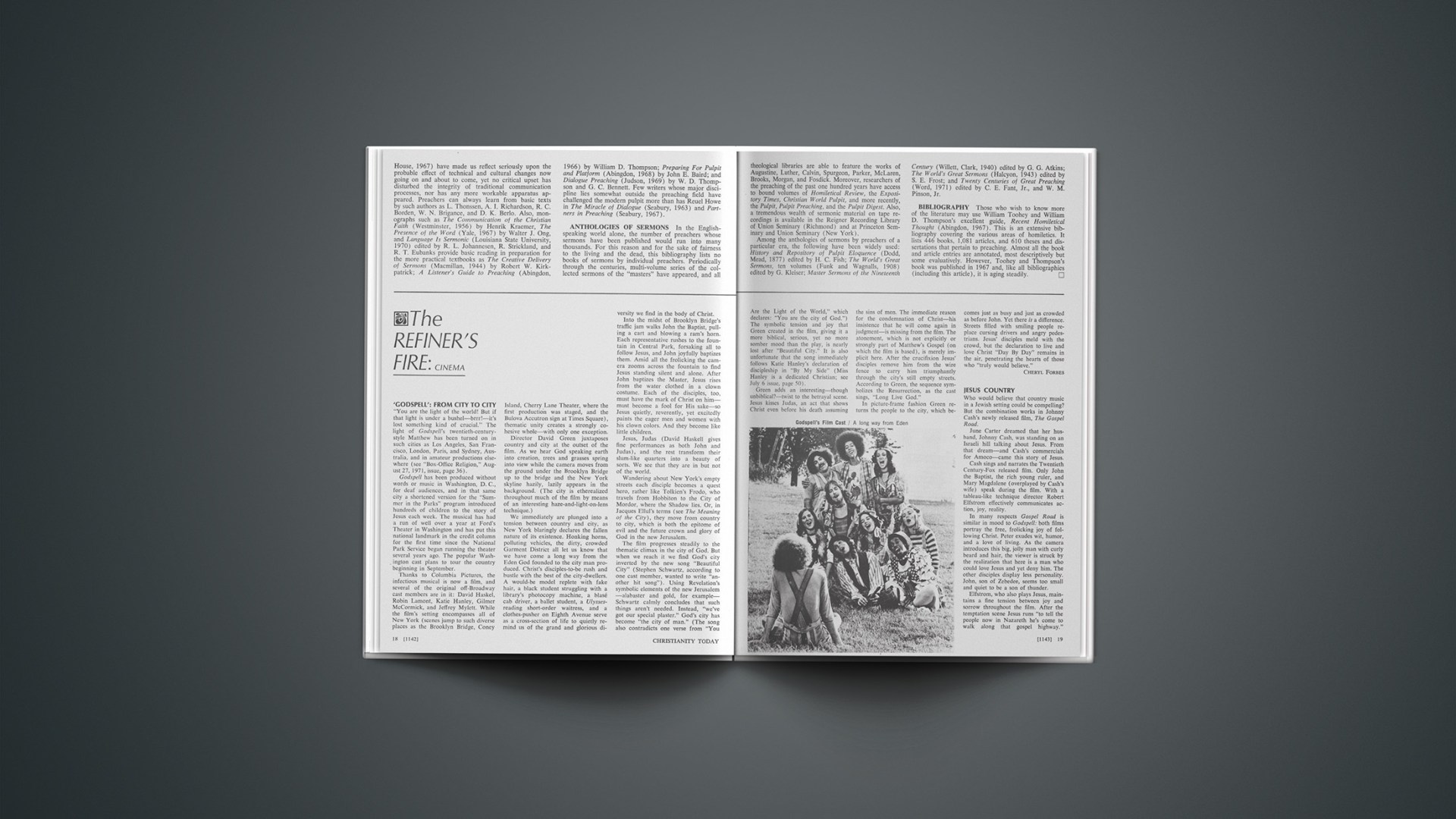
Thanks to Columbia Pictures, the infectious musical is now a film, and several of the original off-Broadway cast members are in it: David Haskel, Robin Lamont, Katie Hanley, Gilmer McCormick, and Jeffrey Mylett. While the film’s setting encompasses all of New York (scenes jump to such diverse places as the Brooklyn Bridge, Coney Island, Cherry Lane Theater, where the first production was staged, and the Bulova Accutron sign at Times Square), thematic unity creates a strongly cohesive whole—with only one exception.

Director David Green juxtaposes country and city at the outset of the film. As we hear God speaking earth into creation, trees and grasses spring into view while the camera moves from the ground under the Brooklyn Bridge up to the bridge and the New York skyline hazily, lazily appears in the background. (The city is etherealized throughout much of the film by means of an interesting haze-and-light-on-lens technique.)

We immediately are plunged into a tension between country and city, as New York blaringly declares the fallen nature of its existence. Honking horns, polluting vehicles, the dirty, crowded Garment District all let us know that we have come a long way from the Eden God founded to the city man produced. Christ’s disciples-to-be rush and bustle with the best of the city-dwellers. A would-be model replete with fake hair, a black student struggling with a library’s photocopy machine, a blasé cab driver, a ballet student, a Ulysses-reading short-order waitress, and a clothes-pusher on Eighth Avenue serve as a cross-section of life to quietly remind us of the grand and glorious diversity we find in the body of Christ.

Into the midst of Brooklyn Bridge’s traffic jam walks John the Baptist, pulling a cart and blowing a ram’s horn. Each representative rushes to the fountain in Central Park, forsaking all to follow Jesus, and John joyfully baptizes them. Amid all the frolicking the camera zooms across the fountain to find Jesus standing silent and alone. After John baptizes the Master, Jesus rises from the water clothed in a clown costume. Each of the disciples, too, must have the mark of Christ on him—must become a fool for His sake—so Jesus quietly, reverently, yet excitedly paints the eager men and women with his clown colors. And they become like little children.

Jesus, Judas (David Haskell gives fine performances as both John and Judas), and the rest transform their slum-like quarters into a beauty of sorts. We see that they are in but not of the world.

Wandering about New York’s empty streets each disciple becomes a quest hero, rather like Tolkien’s Frodo, who travels from Hobbiton to the City of Mordor, where the Shadow lies. Or, in Jacques Ellul’s terms (see The Meaning of the City), they move from country to city, which is both the epitome of evil and the future crown and glory of God in the new Jerusalem.

The film progresses steadily to the thematic climax in the city of God. But when we reach it we find God’s city inverted by the new song “Beautiful City” (Stephen Schwartz, according to one cast member, wanted to write “another hit song”). Using Revelation’s symbolic elements of the new Jerusalem—alabaster and gold, for example—Schwartz calmly concludes that such things aren’t needed. Instead, “we’ve got our special plaster.” God’s city has become “the city of man.” (The song also contradicts one verse from “You Are the Light of the World,” which declares: “You are the city of God.”) The symbolic tension and joy that Green created in the film, giving it a more biblical, serious, yet no more somber mood than the play, is nearly lost after “Beautiful City.” It is also unfortunate that the song immediately follows Katie Hanley’s declaration of discipleship in “By My Side” (Miss Hanley is a dedicated Christian; see July 6 issue, page 50).

Green adds an interesting—though unbiblical?—twist to the betrayal scene. Jesus kisses Judas, an act that shows Christ even before his death assuming the sins of men. The immediate reason for the condemnation of Christ—his insistence that he will come again in judgment—is missing from the film. The atonement, which is not explicitly or strongly part of Matthew’s Gospel (on which the film is based), is merely implicit here. After the crucifixion Jesus’ disciples remove him from the wire fence to carry him triumphantly through the city’s still empty streets. According to Green, the sequence symbolizes the Resurrection, as the cast sings, “Long Live God.”

In picture-frame fashion Green returns the people to the city, which becomes just as busy and just as crowded as before John. Yet there is a difference. Streets filled with smiling people replace cursing drivers and angry pedestrians. Jesus’ disciples meld with the crowd, but the declaration to live and love Christ “Day By Day” remains in the air, penetrating the hearts of those who “truly would believe.”

CHERYL FORBES

Jesus Country

Who would believe that country music in a Jewish setting could be compelling? But the combination works in Johnny Cash’s newly released film, The Gospel Road.

June Carter dreamed that her husband, Johnny Cash, was standing on an Israeli hill talking about Jesus. From that dream—and Cash’s commercials for Amoco—came this story of Jesus.

Cash sings and narrates the Twentieth Century-Fox released film. Only John the Baptist, the rich young ruler, and Mary Magdalene (overplayed by Cash’s wife) speak during the film. With a tableau-like technique director Robert Elfstrom effectively communicates action, joy, reality.

In many respects Gospel Road is similar in mood to Godspell: both films portray the free, frolicking joy of following Christ. Peter exudes wit, humor, and a love of living. As the camera introduces this big, jolly man with curly beard and hair, the viewer is struck by the realization that here is a man who could love Jesus and yet deny him. The other disciples display less personality. John, son of Zebedee, seems too small and quiet to be a son of thunder.

Elfstrom, who also plays Jesus, maintains a fine tension between joy and sorrow throughout the film. After the temptation scene Jesus runs “to tell the people now in Nazareth he’s come to walk along that gospel highway.”

Music, words, and action meld effectively.

Perhaps the best use of camera-action-narration combination comes in the song “I See Men as Trees Walking.” Jesus heals the blind man, and the camera’s eye too moves from blindness to sight. A kaleidoscope of unintelligible patterns slowly comes into focus as leaves and sunlight convey the joy of seeing.

For Jesus’ first miracle, Elfstrom shoots the action through water with Jesus smiling silently in the background. As Jesus wills the water into wine, the clear view turns red.

While Jesus’ story is freshly and energetically told, sections are dismal cinematic failures, often with heavyhanded symbolism. For example, three birds fly across the Jordan, a too obvious reference to the Trinity, as the people throw Jesus out of Nazareth (a prophet is without honor …). Also, the repetitious use of the sun to symbolize the first person of the Trinity wearies and bores. But perhaps the most cloying imagery comes during Jesus’ baptism. As a white dove lands gracefully on Christ’s shoulder, the newly anointed Messiah caresses the dove with his cheek, a too sentimental touch. Many reviewers have accused Cash of promoting a white Anglo-Saxon Protestant Jesus. But Elfstrom’s darkly bronzed skin offsets his blond Nordic hair and blue eyes.

June Carter’s acting is little more than maudlin melodrama. Contorted facial muscles and an excess of hysteria fail to create empathy in the viewer. Mary Magdalene’s cleansing seems more like an old-line Pentecostal meeting than a Galilean healing. Her body shakes, her eyes roll, and, as Jesus walks away, one is surprised not to hear her speak in tongues.

Cash allows a few minor biblical inaccuracies to sneak into the production. Nicodemus comes to Jesus during the day, though Cash comments that it’s nighttime, Peter is present at the crucifixion, and Jesus’ agony in Gethsemane occurs during daylight hours. (Did someone forget to add the blue filter before printing the film?)

The film weaves some subtle ideas together. “Help Me,” written by Larry Gatlin, its first part sung by Kris Kristofferson (the song is in four parts), is applied at one point to Jesus:

Lord, help me to walk another mile, just one more mile.… I know I just can’t make it on my own. I never thought I needed help before. I thought that I could do things by myself. But now I just can’t take it anymore. And with a hungry heart on bended knee I’m begging you please for help.

The lyrics emphasize that Jesus knew pain as we know it, that he needed God’s help as we do. There is no equivocation concerning the Gospel or the two sides to Jesus’ nature.

With flashbacks and foreshadowing (for instance, Jesus leans on a twisted tree that resembles thorns) the film assumes an artistic unity. Even the serious tone of the Last Supper suggests aspects of the joy of Jesus’ ministry. The juxtaposition of the two summarizes the tension we see and feel throughout the production. While his disciples don’t understand the “awesome things you’ve felt and seen at the touch of my hand,” Jesus tells them,

Have a little bread, Simon. Give a little wine to James my brother. Go ahead and eat, friends, and love one another. Have a good time now, for tomorrow I must die—and I’m never more going to eat with you again, till we eat the marriage supper in the sky.

The joy of sharing a meal with closest friends is superimposed on the sorrow that Jesus feels at his last supper with them.

From Gethsemane we are brutally plunged into the torture of the trial. With a slap, Jesus is thrown back from his knees, and we see him beaten and spat upon, his face misshapen and swollen.

Elfstrom carries a 200-pound cross, and his struggle up Golgotha seems real. The crucifixion, however, would have been more powerful had the camera not hovered on Mary Magdalene’s tears or replayed Christ’s final death-drop-of-the-head several times. The good idea of having Christ hang over cities, towns, and shopping centers loses impact with repetition. In fact, the basic problem with the production is that the director tends to work an interesting idea to death. But with all its limitations, The Gospel Road presents a real Jesus as he might have been.

CHERYL FORBES

The Five Most-Used Homiletics Texts

The Five Most-Used Homiletics Texts

To learn which books professors of homiletics are currently recommending and using, I made inquiries at 177 seminaries—including all U. S. members and associate members of the American Association of Theological Schools. Professors of homiletics were asked which available texts in homiletics they would currently recommend and which they were actually using in their courses. An exceptional 63 per cent of the seminaries responded. The five books discussed below were those most often mentioned by the respondents.

One book emerged as by far the most significant work in homiletics today: Design For Preaching by H. Grady Davis (Fortress, 1958). It was listed by more than half of the respondents; no other book even came close to this. Design For Preaching belongs in a class of its own. Davis begins with a particularly good chapter on the relation of substance to form, or, in effect, a rationale for the need to study homiletics at all (for doubters, this chapter alone is worth the price of the book). He then proceeds to develop a theory of preaching that Toohey and Thompson describe as “biblical, relevant, and contemporary.” It is also highly practical; yet Design For Preaching is not simply a cookbook for sermon-making. Rather, Davis lays heavy emphasis upon the nature of the sermon, that is, upon what the sermon is, or should be. He presents the sermon as the embodiment of an idea, an organic whole that must be “designed” as an architect designs a building, rather than “constructed” as a carpenter constructs a garage. He has chapters on the nature of a preaching idea, how and where to find it, how to develop it into a sermon, and the various forms sermons can take. This emphasis, the author’s lively style, and his excellent treatment of such practical issues as introductions, conclusions, and illustrations combine to make Design For Preaching the best homiletical theory text currently available.

Two other frequently mentioned homiletical theory texts were On the Preparation and Delivery of Sermons by John A. Broadus and Jesse B. Weatherspoon (Harper & Row, 1944) and Principles and Practice of Preaching by Ilion T. Jones (Abingdon, 1956). Both are designed for preachers at all levels of experience, and both espouse a more traditional approach than Davis. Broadus’s work, originally published in 1870 and subsequently revised twice, is heavily oriented toward classical rhetorical theory. Nevertheless, its usefulness is evidenced by the fact that it is still in print over a century later. Jones’s book, which was second only to Davis in the number of times it was listed by respondents, could almost be viewed as a modern version of Broadus. Its debt to classical rhetoric is almost as strong, if more implicit, and it covers much the same material. But it does have several features that set it apart from, and in some ways above, the Broadus text: for example, a helpful chapter on the neglected subject of the preacher’s speech mechanism, his voice.

Another popular text was Reuel Howe’s Partners in Preaching (Seabury, 1967). It deals more with a basic “philosophy of preaching” than with homiletical theory as such. Howe calls for a dialogue approach, not so much in method—in fact, he intimates that the usefulness of the dialogue technique is limited—as in one’s fundamental attitude toward what preaching is all about. He strongly emphasizes the role of the congregation in the preaching event. His views are based primarily upon a synthesis of Martin Buber’s I-Thou concept with modern principles of communication theory. While Howe may leave evangelicals with a few unanswered questions, this book is nevertheless an important one.

Finally, the respondents also listed Herbert H. Farmer’s The Servant of the Word (Scribner, 1942). Originally presented as the 1941 Warrack Lectures and then published in 1942, this small book has become something of a classic and was reprinted in 1964 (Fortress). While its emphasis is similar to Howe’s, it has numerous distinctive features that mark it as worth reading. For example, Farmer’s discussion of the uniqueness of the spoken word was well ahead of its time and should be required reading for all preachers.

PREACHING AND INTERPRETATION An able and comprehensive book on basic hermeneutical principles and their operative role in the making of the sermon has yet to be written. Background reading on interpreting the Scriptures through preaching includes such volumes as: Preaching From the Bible (Abingdon, 1941) by A. W. Blackwood; The Way to Biblical Preaching (Abingdon, 1957) by Donald Miller; The Essential Nature of New Testament Preaching (Eerdmans, 1960) by R. H. Mounce; Biblical Authority For Modern Preaching (Westminster, 1960) by C. W. F. Smith; Preaching and Biblical Theology (Eerdmans, 1961) by Edmund P. Clowney; An Introduction to Barth’s Dogmatics for Preachers (Westminster, 1963) by Arnold B. Come; Protestant Biblical Interpretation (Baker, 1970) by Bernard Ramm; Interpreting God’s Word Today (Baker, 1970) edited by Simon Kistemaker; and The Strange Silence of the Bible in the Church (Westminster, 1970) by James D. Smart. Other scholars have written with a closer orientation to method in exposition: An Expository Preacher’s Notebook (Harper, 1960) by D. W. Cleverley Ford; A Guide to Expository Preaching (pamphlet) by D. E. Stevenson (as well as his other books, including Preaching on Books of the New Testament (Harper, 1956); Art of Biblical Preaching (Zondervan, 1950) and Power in Expository Preaching (Revell, 1963) by F. D. Whitesell; Preaching From the Prophets (Broadman, 1942) and Preaching From the Psalms (Harper, 1948) by Kyle M. Yates.

Teachers and students in this important area of homiletical discipline should have at least a passing acquaintance with essays and monographs on contemporary biblical hermeneutics by G. Ebeling, James M. Robinson, John B. Cobb, Ernst Fuchs, Robert W. Funk, R. Bultmann, C. E. Braaten, Regin Prenter, G. Bornkamm et alia. Excellent articles are to be found throughout Volumes I–XXVI of Interpretation, a quarterly journal of Bible and theology (3401 Brook Road, Richmond, Virginia 23227), and in Dictionary of Practical Theology (Baker, 1967) edited by Ralph G. Turnbull.

BIOGRAPHY AND DIALOGUE IN PREACHING The sermons of all effective preachers are and have been dialogical in principle; hence it is only the dialogue format that is really new. The only volume of real substance on this craft is Dialogue Preaching (Judson, 1969) by W. D. Thompson and G. C. Bennett. Other cousins of this art are the dramatic monologue (in the first person) and the imaginary dialogue (recreating an exchange between two characters within a single scriptural incident). This is one of the most difficult of sermonic arts because no book of rules is useful or really effective. Dr. Blackwood once said, “Homiletics is the science of which preaching is the art and the sermon is the product.” The few preachers who combined successfully this art and product are: J. W. G. Ward, The Master and the Twelve (Doran, 1924); L. D. Weatherhead, Personalities of the Passion (Hodder and Stoughton, 1943); and F. B. Speakman, The Salty Tang (Revell, 1954).

PREACHING AND WORSHIP The Reformers, particularly Calvin, could never think of preaching apart from its context in worship. Indeed, the theological affirmations, confessions, and liturgical directories of the Reformed family were composed and written with such an assumption in mind. Nevertheless, few scholars have ever taken up this theme as a single research project;the tendency is to deal with it as a subdivision of a larger discussion. Moreover—and curiously enough—the only worthwhile books in this area have been written in the twentieth century. P. T. Forsyth, Positive Preaching and the Modern Mind (Independent, 1907; Eerdmans, 1964) is still the most comprehensive; others, narrower in range but sharper in focus, are Wilhelm Hahn, Worship and Congregation (John Knox, 1963); J.-J. von Allmen, Preaching and Congregation (John Knox, 1962); R. H. Fuller, What Is Liturgical Preaching? (SCM, 1957); Worship and Preaching (Epworth, 1956) by Thomas M. Morrow; and Preaching, Confession, the Lord’s Supper (John Knox, 1957) by W. Lüthi and E. Thurneysen. Thomas H. Keir in The Word in Worship (Oxford, 1962) provides perhaps the best recent treatise in which “the theme is the Word of God, read and preached, set within the context of the Church’s regular worship.” Other source books worth consulting are: Ways of Worship, Part II (Harper, 1951) edited by P. Edwall, E. Hayman, and W. D. Maxwell; Word and Sacrament, Part III (Prentice-Hall, 1960) by Donald Macleod; relevant articles in Baker’s Dictionary of Practical Theology (Baker, 1967) edited by Ralph Turnbull; and Dynamics of Worship (Fortress, 1965) by Richard Paquier (a translation by Donald Macleod of Traité de Liturgique).

PREACHING THE CHRISTIAN YEAR The renaissance of interest in the heritage of Protestant worship in the 1950s created an interest both in the proper planning of one’s program of preaching and in a greater recognition and understanding of the festivals of the Christian Year. This brought a new dimension to the substance of Christian sermons and an appreciation of the value and strength of liturgical preaching. Probably the two most basic books for grasping the historical development of the Christian Year are The Evolution of the Christian Year (SCM, 1953) and The Christian Year and Lectionary Reform (SCM, 1958) by A. Allan McArthur. Monographs with more of a focus upon planning a year’s schedule of preaching were Planning a Year’s Pulpit Work (Abingdon, 1942) by A. W. Blackwood and Planned Preaching (Westminster, 1954) by George M. Gibson. Others with a clearer denotation and closer espousal of the main festivals of the Christian Year and preaching are: Preaching From the Propers (Lutheran Publications, 1949) by Harry F. Baughman; Preaching the Christian Year (Scribner, 1957) edited by Howard A. Johnson, who writes that “the traditional Christian Year is the church’s safeguard against idiosyncrasies of its ministers”; Through the Christian Year (National Sunday School Union, 1962) by John Bishop; and Resources For Sermon Preparation (Westminster, 1955) by David A. MacLennan. Two other helpful volumes are A Symphony of the Christian Year (Seabury, 1954) by Randolph C. Miller, a Christian-education professor, and The Shape of the Gospel: The Bible Through the Christian Year (Abingdon, 1970) by Merrill R. Abbey, a professor of preaching.

PREACHING AND COMMUNICATION The art of effective communication antedates the beginnings of Christian preaching. Although oratory and rhetoric are now either unpopular concepts or merely labels for the bad habits of the communication discipline, yet the classic treatises by Aristotle, Isocrates, Cicero, Plato, and Quintilian have much to teach us and provide the key to the stronger presentations from pulpit and platform today. The McLuhan probes have been largely descriptive, and although his Understanding Media (McGraw-Hill, 1964) and The Medium Is the Message (Random House, 1967) have made us reflect seriously upon the probable effect of technical and cultural changes now going on and about to come, yet no critical upset has disturbed the integrity of traditional communication processes, nor has any more workable apparatus appeared. Preachers can always learn from basic texts by such authors as L. Thonssen, A. I. Richardson, R. C. Borden, W. N. Brigance, and D. K. Berlo. Also, monographs such as The Communication of the Christian Faith (Westminster, 1956) by Henrik Kraemer, The Presence of the Word (Yale, 1967) by Walter J. Ong, and Language Is Sermonic (Louisiana State University, 1970) edited by R. L. Johannesen, R. Strickland, and R. T. Eubanks provide basic reading in preparation for the more practical textbooks as The Creative Delivery of Sermons (Macmillan, 1944) by Robert W. Kirkpatrick; A Listener’s Guide to Preaching (Abingdon, 1966) by William D. Thompson; Preparing For Pulpit and Platform (Abingdon, 1968) by John E. Baird; and Dialogue Preaching (Judson, 1969) by W. D. Thompson and G. C. Bennett. Few writers whose major discipline lies somewhat outside the preaching field have challenged the modern pulpit more than has Reuel Howe in The Miracle of Dialogue (Seabury, 1963) and Partners in Preaching (Seabury, 1967).

ANTHOLOGIES OF SERMONS In the English-speaking world alone, the number of preachers whose sermons have been published would run into many thousands. For this reason and for the sake of fairness to the living and the dead, this bibliography lists no books of sermons by individual preachers. Periodically through the centuries, multi-volume series of the collected sermons of the “masters” have appeared, and all theological libraries are able to feature the works of Augustine, Luther, Calvin, Spurgeon, Parker, McLaren, Brooks, Morgan, and Fosdick. Moreover, researchers of the preaching of the past one hundred years have access to bound volumes of Homiletical Review, the Expository Times, Christian World Pulpit, and more recently, the Pulpit, Pulpit Preaching, and the Pulpit Digest. Also, a tremendous wealth of sermonic material on tape recordings is available in the Reigner Recording Library of Union Seminary (Richmond) and at Princeton Seminary and Union Seminary (New York).

Among the anthologies of sermons by preachers of a particular era, the following have been widely used: History and Repository of Pulpit Eloquence (Dodd, Mead, 1877) edited by H. C. Fish; The World’s Great Sermons, ten volumes (Funk and Wagnalls, 1908) edited by G. Kleiser; Master Sermons of the Nineteenth Century (Willett, Clark, 1940) edited by G. G. Atkins; The World’s Great Sermons (Halcyon, 1943) edited by S. E. Frost; and Twenty Centuries of Great Preaching (Word, 1971) edited by C. E. Fant, Jr., and W. M. Pinson, Jr.

BIBLIOGRAPHY Those who wish to know more of the literature may use William Toohey and William D. Thompson’s excellent guide, Recent Homiletical Thought (Abingdon, 1967). This is an extensive bibliography covering the various areas of homiletics. It lists 446 books, 1,081 articles, and 610 theses and dissertations that pertain to preaching. Almost all the book and article entries are annotated, most descriptively but some evaluatively. However, Toohey and Thompson’s book was published in 1967 and, like all bibliographies (including this article), it is aging steadily.

George M. Marsden is associate professor of history at Calvin College, Grand Rapids, Michigan. He has the Ph.D. (Yale University) and has written “The Evangelical Mind and the New School Presbyterian Experience.”

Preaching

Compiling a bibliography on preaching is beset by more than the usual quota of difficulties. Problems lie not only in the unmanageable bulk of resources involved and the futility of attempting to be exhaustive, but also in the matter of preserving the fine difference between books for the preacher and books about preaching. The former are legion and embrace almost every facet of human literary effort. Moreover, teachers of preaching who read a wide cross section of sermonic materials know that the ideas of thinkers of all faiths—and indeed, of no faith at all—have been tributary to the Christian pulpit, ancient and modern.

Books about preaching are not always easily isolated because of the interrelatedness of the many aspects of the religious field. Some of the most creative and useful things that have been said about preaching are found in books that are primarily biblical or theological. In these days, moreover, with the development of so many new pursuits in pastoral theology, literary interpretation and criticism, mass media and communications, and philosophy of language and semantics, no one discipline can claim autonomy in either content or method.

A further problem in the field of practical theology is a direct result of these many new developments: titles become obsolete more quickly than in other areas of theological science. The whole discipline of practical theology has undergone more radical changes in the twentieth century than most of the others, and has been more affected by the emergence of new fields of study. It has made marked progress through the massive accumulation of data and the discovery of new functions that demand fresh methods of handling. For these reasons, the “breakthrough” of the present is likely to become a back number tomorrow. From a close-in perspective, we cannot sift out the books of enduring value from those that will not last beyond today.

Therefore, I shall group the better titles under the traditional subdivisions of the preaching field and insert works from other disciplines wherever the theory and understanding of the sermonic art is suggested or defined.

HISTORY OF PREACHING A quick survey of the history of preaching is given in comprehensive articles in The Encyclopedia of Religion and Ethics (T. and T. Clark, 1908), The New Catholic Encyclopedia (McGraw-Hill, 1967), The New Schaff-Herzog Encyclopedia of Religious Knowledge (Funk and Wagnalls, 1911), and The Twentieth Century Encyclopedia of Religious Knowledge (Baker, 1955). The most thorough handling is found in Edwin C. Dargan, A History of Preaching (two volumes, Armstrong, 1905; one volume, Baker, 1954), although critics are inclined to praise Dargan for factual prowess more than for any demonstration of a theology of preaching. Other titles in the survey category are: John A. Broadus, Lectures on the History of Preaching (Armstrong, 1907), a concise handling of much factual material; A. E. Garvie, The Christian Preacher (Scribner, 1921), a scholarly and fairly comprehensive treatment of the history, theology, and theory of preaching; Yngve T. Brilioth, A Brief History of Preaching (Fortress, 1965), strong on the early Church and the Reformation, weak from the eighteenth century onward and on the American pulpit; and F. R. Webber, A History of Preaching in Britain and America, Parts I, II, and III (Northwestern, 1952), a useful compilation of persons and places but loosely organized and without a consistent perspective.

For those who want to explore in depth a particular age or period of the Christian pulpit, the following authors are the most helpful: H. T. Kerr, Preaching in the Early Church (Revell, 1942); J. M. Neale, Medieval Preachers (Mozley, 1856); G. R. Owst, Preaching in Medieval England, 1350–1450 (Cambridge, 1933); J. W. Blench, Preaching in England, 1450–1600 (Barnes and Noble, 1964); W. G. Blaikie, The Preachers of Scotland, Sixth to Nineteenth Centuries (T. and T. Clark, 1888); William M. Taylor, The Scottish Pulpit from the Reformation to the Present Day (Harper, 1887); John Brown, Puritan Preaching in England (Scribner, 1900); Ray C. Petry, No Uncertain Sound (Westminster, 1948) and Preaching in the Great Tradition (Westminster, 1950); and Horton M. Davies, Varieties of English Preaching, 1900–1960 (SCM, 1963). Several volumes with a more personal focus are: C. H. E. Smith, The Art of Preaching (SPCK, 1940); G. Renoux, Les Predicateurs célèbres de l’Allemagne (Bray and Retaux, 1881); Paul Stapfer, La grande prédication chrétienne en France (Fischbacher, 1898); and Elmer C. Kiessling, The Early Sermons of Luther and Their Relation to the Pre-Reformation Sermon (Zondervan, 1935).

In view of the excellent reputation and resources of the American pulpit, it is difficult to account for the lack of a classic treatment of its history. Some studies of real quality have been done, but they are of limited focus and give undue emphasis to popular appeal. Dargan’s third volume (available in microfilm) has been used by graduate students in a few theological libraries, but as a treatment of American preaching it is quite incomplete and has not gained wide support. Edgar DeW. Jones, The Royalty of the Pulpit (Harper, 1951), is a survey and appreciation of the Lyman Beecher Lectureship and contains a whole spectrum of facts, personal vignettes, and preaching theories of the “greats” of the American (and to some extent the British) pulpit. Lewis O. Brastow, Representative Modern Preachers (Macmillan, 1904), is a helpful research tool for students of pivotal preachers in both the American and British traditions. Probably one of the most scholarly discussions of the American pulpit is Changing Emphases in American Preaching (Westminster, 1943) by Ernest T. Thompson. Two more recent volumes are not so much a history of American preaching as a study of issues (political, social, and cultural) and of the sermons in which certain points of view were registered: DeWitte Holland (ed.), Preaching in American History (Abingdon, 1969) and Sermons in American History (Abingdon, 1971). A volume largely descriptive, Black Preaching (Lippincott, 1970) by Henry H. Mitchell, has a chapter on the history of the witness of the black pulpit in America.

Probably the most ambitious attempt at an encyclopedia of preachers and representative sermons is Twenty Centuries of Great Preaching (thirteen volumes) edited by Clyde E. Fant, Jr., and William M. Pinson, Jr. (Word, 1971). From the whole story of the Christian pulpit, the editors have chosen ninety preachers, from the first century to the present, and given examples of their sermons accompanied by sermon analyses, biographical sketches, and accounts of the preachers’ impact on their times. This series is one of the most useful and skillfully critical compilations published in our generation.

THEOLOGY OF PREACHING Books specifically on the theology of preaching are either very old or from the twentieth century. St. Augustine’s On Christian Doctrine (Liberal Arts, 1958) is one of the earliest treatises in which a whole section deals with the preacher and preaching. Most theologians, especially the central figures of the Reformation—Luther, Calvin, Bullinger, Zwingli—have written intermittent pages and/or chapters on the meaning and character of Christian preaching, but the largest number of definitive titles in this field have appeared since 1900. For depth and comprehension, few treatises surpass P. T. Forsyth’s Positive Preaching and the Modern Mind (Independent, 1907; Eerdmans, 1964, paper). Several decades later a new impetus occurred with the translation of Karl Barth, The Word of God and the Word of Man (Pilgrim, 1928). Then followed C. H. Dodd, Apostolic Preaching and Its Developments (Hodder and Stoughton, 1936); T. H. L. Parker’s study of Calvin’s preaching, The Oracles of God (Lutterworth, 1947); H. H. Farmer, The Servant of the Word (Scribner, 1942; Fortress, 1964, paper); and Donald Coggan, The Ministry of the Word (Canterbury, 1945). The next decade picked up this new emphasis upon the “Word,” and the following monographs were received approvingly: Robert E. C. Browne, The Ministry of the Word (SCM, 1958); John Knox, The Integrity of Preaching (Abingdon, 1957); James S. Stewart, A Faith to Proclaim (Hodder and Stoughton, 1953); and Gustav Wingren, The Living Word (SCM, 1960; Fortress, 1965, paper). Curiously enough, the decade of the sixties, which has seen the downgrading of the pulpit among quasi-Protestants, has recorded an unusually large number of books on the meaning of the Word through preaching by both Roman Catholic and Protestant scholars: Dietrich Ritschl, A Theology of Proclamation (John Knox, 1960); Jean-Jacques von Allmen, Preaching and Congregation (John Knox, 1962); Karl Barth, The Preaching of the Gospel, (Westminster, 1963); Heinrich Ott, Theology and Preaching (Westminster, 1965); Rudolf Bohren, Preaching and Community (John Knox, 1965); William Malcomson, The Preaching Event (Westminster, 1968); Paul Scherer, The Word God Sent (Harper & Row, 1965); Gerhard Ebeling, Theology and Proclamation (Fortress, 1966), a dialogue with Bultmann; Domenico Grasso, Proclaiming God’s Message (Notre Dame, 1965); and Otto Semmelbroth, The Preaching Word (Herder, 1965). Probably one of the ablest discussions of communication through words—and indirectly highly supportive of the role of preaching—is The Presence of the Word by Walter J. Ong (Yale, 1967).

THE OFFICE OF PREACHING More books were written on the nature and office of preaching when its integrity and identity were secure than in these times when strong apologists are especially needed. Such titles as Treatise on Preaching (Newman, 1951) by Humbert of Romans in the thirteenth century and Thoughts on Preaching (Scribner, 1864) by J. W. Alexander in the mid-nineteenth are basic. Phillips Brooks’s Lectures on Preaching (Dutton, 1902; SPCK, 1959) is still a classic in perception and comprehensiveness. Few treatises were done on this subject during the first quarter of the present century. Then the following decade gave us Jesus Came Preaching (Scribner, 1931; Baker, 1970) by George A. Buttrick; The Mystery of Preaching (Clarke, 1934) by James M. Black; and The Fine Art of Preaching (Macmillan, 1945) by Andrew W. Blackwood. The ministry of preaching was clarified considerably in Concerning the Ministry (Harper’s, 1937; John Knox, 1963) by John Oman, who was a theologian with a pastor’s concern for communicating the Gospel. Three volumes in the immediate post-war period that have had sustained approval are Heralds of God (Scribner, 1946) by James S. Stewart; Fire in Thy Mouth (Abingdon, 1954) by Donald Miller; and The Integrity of Preaching (Abingdon, 1957) by John Knox. The most recent monographs that take into account the new world of mass communication and multi-media with its challenge to the traditional conception of preaching are: Preaching Today (Epworth, 1969) by D. W. Cleverley Ford, head of the College of Preachers in London; The Renewal of Preaching (Paulist, 1968) edited by Karl Rahner; The Renewal of Preaching (Fortress, 1969) by David Randolph; and The Future Shape of Preaching (Fortress, 1971) by Thor Hall.

THEORY OF PREACHING In no area of the whole homiletical discipline has more writing been done than in the matter of preparing the sermon. Particularly in the nineteenth and early twentieth centuries, every preacher of any recognized stature was expected to describe his sermonic method for the benefit of his clerical brothers. Few of these have become classics; many have deserved the oblivion into which they have passed. Two time-honored works on the matter of the sermon have had considerable influence: François Fénelon, Dialogues on Eloquence (original Paris edition, 1717; Princeton University, 1951), and Jean Claude, An Essay on the Composition of a Sermon (Hunt and Eaton, 1779). For decades in America the textbook for introductory course in homiletics was John A. Broadus, On the Preparation and Delivery of Sermons (Armstrong, 1901), which Jesse B. Weatherspoon edited later and brought up to date (Harper, 1944). Any bibliography of basic sermon theory includes: Richard R. Caemmerer, Preaching For the Church (Concordia, 1959); W. E. Sangster, The Craft of the Sermon (Westminster, 1951); H. E. Luccock, In the Minister’s Workshop (Harper, 1944); Here Is My Method (Revell, 1952) edited by Donald Macleod; Ilion T. Jones, Principles and Practice of Preaching (Abingdon, 1956); Lloyd M. Perry, A Manual For Biblical Preaching (Baker, 1965); H. Grady Davis, Design For Preaching (Fortress, 1958); M. Reu, Homiletics (Wartburg, 1924; Baker, 1967); R. C. H. Lenski, The Sermon (Lutheran Book Concern, 1927; Baker, 1968); D. Martyn Lloyd-Jones, Preaching and Preachers (Zondervan, 1971); and An Introduction in Contemporary Preaching (Baker, 1972) by J. Daniel Baumann. Few preachers have influenced the theory of preaching more in America than Harry Emerson Fosdick. His essay “What Is the Matter with Preaching?” (Harper’s Monthly, July, 1928) is still referred to, while his sermon method and theory have been collected in an excellent monograph, Harry EmersonFosdick’s Art of Preaching (Thomas, 1971) edited by Lionel Crocker.

George M. Marsden is associate professor of history at Calvin College, Grand Rapids, Michigan. He has the Ph.D. (Yale University) and has written “The Evangelical Mind and the New School Presbyterian Experience.”

Apple PodcastsDown ArrowDown ArrowDown Arrowarrow_left_altLeft ArrowLeft ArrowRight ArrowRight ArrowRight Arrowarrow_up_altUp ArrowUp ArrowAvailable at Amazoncaret-downCloseCloseEmailEmailExpandExpandExternalExternalFacebookfacebook-squareGiftGiftGooglegoogleGoogle KeephamburgerInstagraminstagram-squareLinkLinklinkedin-squareListenListenListenChristianity TodayCT Creative Studio Logologo_orgMegaphoneMenuMenupausePinterestPlayPlayPocketPodcastRSSRSSSaveSaveSaveSearchSearchsearchSpotifyStitcherTelegramTable of ContentsTable of Contentstwitter-squareWhatsAppXYouTubeYouTube