Freedom from the Fear of Being Unforgiven

Pastor, I don’t know what’s wrong with me. I believe the Bible. I know we have a God of love. But sometimes I feel as if I cannot be forgiven.” This confession, coming from a sincere Christian, produces a difficult counseling situation for a young pastor.

Often, the feeling of not being forgiven indicates real guilt, either because the person is under the condemnation of unbelief (cf. John 3:18) or because, having been overtaken in a “trespass,” he needs restorative assistance (Gal. 6:1). But sometimes the fear of being unforgiven exists when no cause for guilt is apparent. Then the wise counselor will look for an emotional disturbance that can create a feeling of guilt and lead to an ineffective and unhappy Christian life. In my experience, every believer with this fear caused by neurotic guilt (using this term to distinguish the condition from real guilt) has been helped by the recognition that he has transferred into the spiritual realm a feeling caused by interpersonal relations, an emotional wound.

Some examples will help to distinguish between the two types of guilt feelings. After an evangelistic service, a man in a “crying drunk” condition asked, “Can I be forgiven, preacher? I’ve done some awful things. But I had to do them.” He showed real guilt for his sinfulness, guilt from which he sought to escape not only by means of alcohol but also through self-pity and self-justification. He needed to repent, to turn to Christ with humble confession for forgiveness.

Quite different was the case of a Christian mother. Her life appeared above reproach. She had led many to Christ, including all her family, one of whom was now in college. Nevertheless a troubled look clouded her face as she said tremblingly, “Pastor, I sometimes feel as if I have committed the unpardonable sin, and it disturbs me greatly. But I can’t for the life of me think of why I should ever feel that way.” She needed to see how her feeling of guilt was caused by a traumatic social experience in her past. The painful and damaging fear she experienced is one of the most needless difficulties that can assault the human soul.

Although God’s glorious forgiveness heals both kinds of guilt, the counselor must treat each differently. To be effective, he needs to know, first, some basic facts about guilt and fears; second, general guidelines for achieving full forgiveness; and third, how to recognize and overcome the fear of being unforgiven caused by emotional trauma.

Guilt And Fears

Guilt is a pain that warns of mental and spiritual ill health. It is conscious at first, but it can be submerged or repressed. Shakespeare portrays repressed guilt in Lady Macbeth’s attempt to rub an imaginary spot out of her hand. An atrocious act might destroy the objective enemy, but not the subjective one, guilt. Some people, like Judas (Matt. 27:3 ff.), resort to suicide in efforts to rid themselves of guilt. Others seek escape in alcohol and other drugs.

Fear is an emotional agitation aroused by a threat. Some fears are irrational. Psychologists list many, including claustrophobia (fear of narrow places), agoraphobia (fear of open places), and even triskaidekaphobia (fear of the number thirteen). Usually when a person learns what has caused his phobia, the principal difficulty disappears. For example, when a man with claustrophobia connects the feeling with his childhood mishap of getting caught in a drainage pipe, the morbid fear vanishes, though he might occasionally feel restless in close places. Just so, if a person who has experienced God’s forgiveness for sin learns what makes him sometimes fear he is unforgiven, he makes the mental adjustment.

Other fears, however, are reasonable—fears of sickness, traffic accidents, and moral corruption, for example. Indeed, the Bible and true gospel preaching raise fear. The fear of guilt is usually healthful. It is also a correct work of fear to awaken a person to his guilt; this should result in his recognizing his need for Christ’s forgiveness, and then repenting and living the Christian life.

Guidelines To Forgiveness

In dealing with guilt caused by specific sinfulness, as in other matters of evangelism, the counselor will use the Bible as skillfully and prayerfully as he can and depend upon the leadership and power of the Holy Spirit. Furthermore, he will permit the counselee to talk. Although statements may be couched in tones of self-protection, the pastor must depend upon these expressions to reveal the cause and cure for the pain.

Sometimes the underlying source of guilt will not readily come to light. The counselor must be not only gentle but firm. Occasionally he may need to say outright, “There is evidence you’ve either been doing something you should not do, or failing to do something you should do.” Christians do sin, after all, and need to confess to God in order to rid themselves of the pain sin causes.

Indeed, every Christian should be aware of forgiveness in three spheres, or at least not have unforgiven transgressions in those areas. First, he should have forgiveness from, and be in a complete attitude of forgiveness toward, his fellow men. Forgiveness from other people and forgiving other people go together (Matt. 6:14 f; Mark 12:1 f.). Second, he must forgive himself. Third, he must have a deep realization that God has forgiven him.

A big, strong young man came into my study, trying to control himself emotionally but admitting he had a dreadful, undefined fear. He said he had recently made claims of atheism and spoken derogatorily of the Christian faith. A small New Testament he carried had actually become a fetish to ward off danger. Calling attention to certain passages, I showed how he really needed and could have the Christ the Testament tells about. After a while he knelt and asked the Lord to forgive him. Within a few minutes he said, and then kept repeating, “I can’t understand why I feel so much better.”

Another young man declared he had sought God’s forgiveness but still felt guilty. We talked a few times about it but seemed to make little progress as he continued to say, “I don’t know why the Lord won’t forgive me.” Eventually I suspected the trouble and in our next conference read certain Scriptures I thought might be relevant. He was soon rejoicing in a newfound relationship with Christ, and he subsequently corrected the transgression. The Bible evidently pointed out his guilt.

Defeating The Irrational Fear

Christ’s forgiveness is glorious. Dark, unhealthful conditions are either driven out or transformed into wholesome drives, attitudes, capabilities, and directions when Christ comes into the human heart, so it is often difficult for the Christian to understand how he himself could ever be overcome again by doubts and fears. But some sincere believers may find their spiritual development thwarted by a fear of not being forgiven that is caused by an emotional disturbance rather than by actual unforgiven sin.

Three qualities should characterize this counseling situation: (1) careful diagnosis; (2) a worthy goal; and (3) tactful guidance.

Careful diagnosis. This fear should not be confused with other forms of spiritual pain. Deep concern for a friend or loved one, for example, might cause a believer to suffer the pain of guilt that is not his own. Or perhaps a problem of sin needs to be settled either first or simultaneously. I once saw a boy overcome with paradoxical emotions—both joy and sorrow—as he discerned how guilt feelings about a traumatic experience had robbed him of full acceptance of God’s forgiveness of sin.

This neurotic fear of unforgiveness may be difficult for the counselor to recognize. The feeling can sometimes hide from its victim. Knowing much of the happiness God’s forgiveness brings, the believer will enjoy his Christian experience for a while. Then suddenly the fear strikes. He finally makes an appointment to see his pastor, but may be reluctant to talk about his problem.

Three circumstances can make this counselee reticent. First, if he has witnessed to others of the love of God and of Christ’s faithfulness and of the peace God gives, he may hesitate to admit his own turmoil. Second, he actually may fear to take the chance of “blasphemy” and further lay himself open to “guilt” for committing the unpardonable sin. Third, since he has not lived a perfect life, he may think perhaps his problem is really one of shame that he unconsciously hides from himself and does not want to admit to the pastor. The fear may have to be coaxed to the surface.

A worthy goal. When the counselor recognizes the difficulty, he should envision a high goal. The fear of being unforgiven indicates depth in the life of the counselee. Solving this problem is not just a matter of house-cleaning; it requires refurnishing the house with new, valuable furniture. Victory is now in sight but must be approached with caution.

The counselee must not be permitted to lose his fear of sin and its subsequent guilt. The furious fear of being unforgiven caused by neurotic guilt stemming from trauma can, however, drive a person into some escape mechanism; it may make its victim try to forget spiritual and moral matters and adopt a devil-may-care attitude.

Temporary amelioration is possible, but permanent healing is the only adequate goal. The counselee who asks if it is unusual for a person who knows he has been forgiven to feel at times as if he cannot be forgiven may be relieved somewhat if the counselor replies, “You are just having a passing disturbance and will get over it.” But he will not get over it until he learns what causes it. Unless treated at its source, the “passing disturbance” will continue to pass through his life again and again.

Still another caution is that the counselor should not attempt psychoanalysis. Although the Christian’s irrational fear of unforgiveness is a psychological problem, a few tactful remarks will usually tend to put the counselee on the right track, and he himself will conquer his enemy.

Tactful guidance. The counselee should be encouraged to solve his own problem. Of course, it is usually wise for the counselor to reaffirm the thoroughness of God’s forgiveness, and to cite such Scriptures as First John 1:8–10 and Psalm 136.

Studies of some mentally ill people who are possessed by morbid convictions that they have committed the unpardonable sin show that they previously have had serious “breaks” or traumatic experiences in their lives. It follows, therefore, that the normal Christian, who fears he has committed the unpardonable sin or for some other reason cannot be forgiven, has had a “break” in his life. Once he sees that his own emotional history has disrupted his spiritual equilibrium, he can make an adjustment. Overcoming this difficulty will give him stamina for other conquests.

One might think this solution an oversimplification, unless he has tried it in counseling situations. The process works. Let us suppose that a young man, a high school graduate, comes to the pastor and says, “I don’t know how to say it, but I don’t just feel right at times.” The counselor understands that such a statement can cover a multitude of conditions. But after a few questions and answers, the young man expresses his condition more directly: “I feel sometimes as if I’ve committed the unpardonable sin, but other times I know I haven’t.”

Additional questions reveal that he has been reared in a Christian home, has attended church regularly, and has recently been quite active in personal evangelism. His mother died when he was young and home conditions are not happy now. He dislikes his job and wants to go to college. He has no steady girlfriend but had one a few months ago. He first noticed his fear when he was a child, and it has recurred from time to time.

The traumatic experience caused by the death of his mother was a “break” that upset his emotional system. Recent disappointments have aggravated the condition.

The counselor makes a few simple statements: “Feelings of this kind are most often caused by some ‘break’ that has taken place in a person’s social life, carried over into the spiritual life. Frequently they can be caused in childhood by death in the home, or by separation of parents.” Often the counselee will at once realize the validity of such statements. He will remember how disappointed he was when he broke up with that girlfriend, when the door to college seemed to close, when he failed to get the kind of job he sought, though he prayed much about it.

Sometimes, however, the counselee does not see it so readily and must be helped further. Consider a young woman who has just entered college. She is away from home, has never had any feelings like this before, and is shocked by the sudden force of the fear. The counselor may not quickly recognize all that is causing the girl’s fears. Perhaps much of the problem is real guilt. But one fact is sure: The girl’s situation is caused in part, if not entirely, by a “break”—living away from home.

The case in my own counseling experience that most clearly illustrates the point concerns a young person who had such recurring fears from childhood. Upon learning what causes such feelings in a Christian, he found the fears completely gone and became happy in church work. After a few years he suddenly recalled a serious disappointment that had caused a second traumatic experience in his youth. This second “break” happened after the first had already set up fears of being unforgiven. When he did finally go through the experience of recalling the forgotten incident, the old feelings of being unforgiven accompanied the return of the disappointing memory. But the fear did not accompany the feelings. Afterwards he told me, “I had no reason to fear, because I knew what was causing the feelings, and I knew God had forgiven me.”

George M. Marsden is associate professor of history at Calvin College, Grand Rapids, Michigan. He has the Ph.D. (Yale University) and has written “The Evangelical Mind and the New School Presbyterian Experience.”

Cover Story

Henry Clay Trumbull: A Profile of Involvement

Railroad office clerks were testing their strength. They had given the letter-press wheel the hardest turn they could, and they challenged Henry Clay Trumbull to turn it further.

He was a thin, wiry chap, strong enough in the arms but not powerfully built, and that wheel had been turned as far as the office strong man could force it. Henry jumped at the challenge. Seizing the letter press in a powerful grip, he wrenched it so violently that he broke the heavy turning screw.

It was like Henry Trumbull to give the wheel one turn beyond the power of other men in whatever he undertook. That intensity of character, always ready for instant service, carried him through many a difficult undertaking. It brought him to the ranks of outstanding heroes of faith, and gave him a remarkable ministry whose fruits continue today.

He was born in Stonington, Connecticut, June 8, 1830, of a distinguished colonial family, and he met or saw many notables, including Andrew Jackson, President Tyler, and John Quincy Adams. But it was Adoniram Judson and Albert Bushnell, the “patriarch of West African missions,” who were to impress him most profoundly.

From boyhood he was keenly interested in public affairs; at eighteen he actively worked to bring out voters in the 1848 presidential campaign. His formal education was brief, beginning in the “dame schools” of the period and closing in Williston Seminary when he was about fourteen. Uncertain health and distaste of schooling kept him from college preparation.

He worked at various times in his uncle’s drugstore, a bank, and a steamboat office, where he had to settle the day’s accounts with conductors and pursers amid the clatter of loading and unloading a freight and the screaming of steam whistles. Years later he recalled, “After that training, I could sit on a curbstone in a city street and write an editorial as easily as in a clergyman’s inner study.”

Henry’s home atmosphere exuded classical culture, New England wit, and strict religious practice. He took an active part in the local Sunday-school work and was also a social leader in the village, light-hearted, winsome, aesthetically inclined. He was gaining character and experience but no definite purpose in life, nor was he giving much thought to eternal matters.

At twenty-two he became a clerk in a Hartford, Connecticut, railroad office. His spiritual awakening came as the result of a letter and the preaching of Charles G. Finney, president of Oberlin College, in the Hartford revival of 1851–52. One afternoon a letter came from an intimate friend, who had written only a few days before concerning a revival at home. Henry opened the letter in the post office, read a few lines, then pocketed it, remarking to a companion, “There must be a big revival in Stonington if it has set my old friend preaching to me.”

Young Trumbull reached his office, on the third floor of a station tower, but went on to the fourth floor, where he shut himself in a small map closet and read the letter, urging him to accept Christ. Henry was deeply touched, and even before he finished the letter he was on his knees, brokenly asking God’s forgiveness. Under the impulse of this experience he attended some of the Finney meetings, and in the evangelist’s clear and reasoned message he found conviction. Soon he made a public profession of faith, uniting with the First (Center) Congregational Church in Hartford.

Immediately Trumbull began the work of soul-winning that he always counted his most enduring service. He also plunged into Sunday-school work in the Morgan Street Mission, receiving his first real training in the field in which he was to achieve world-wide prominence.

In 1854 Trumbull married Alice Cogswell Gallaudet, a daughter of the founder of deaf-mute instruction in America, Thomas Hopkins Gallaudet.

He was still a businessman, but a new vision of Christian service was beckoning urgently. He became superintendent of the Morgan Street Sunday School, entered into the local and state political life, and developed rapidly as a speaker in the Scott-Pierce national campaign. He also wrote on political subjects for the New York Tribune and other papers. He formed a drugstore partnership in Hartford; declined a place on Governor Buckingham’s military staff as colonel; refused the editorship of the Hartford Evening Press; and then went into a wool business. That venture was wiped out in the Panic of 1857, and he was listening for the next call of duty.

A city missionary greeted him one day: “Trumbull, I hear you’re out of business. I’m glad of it. I hope the Lord will harrow up your nest as often as you build it outside his field.”

It was a word in due season. Soon Trumbull’s chief life work opened unmistakably. At the first Connecticut State Sunday School Convention, in 1857, he made his initial convention speech. The American Sunday School Union appointed him missionary for Connecticut on September 1, 1858. During his first year he visited half of the 161 towns in the state, traveling more than 10,000 miles, holding union gatherings, seeking to build up 250 schools of ten denominations, writing more than 1,000 letters, and making about 300 public addresses.

When the Civil War began, Trumbull was engrossed in his missionary work. He strongly wanted to be at the front, yet his health was so uncertain he couldn’t pass the physical exam. So along with his Sunday-school work, he aided recruiting officers wherever he could. “You ask me why I don’t go myself,” he would say. “I tell you I would go if I could. If a recruiting officer will take me, I’ll enlist tonight. I’m willing to crawl into a 100-pound Parrott gun as a wad and be fired off for my country.”

Unexpectedly, he was called to become chaplain of the Tenth Connecticut Regiment in 1862. As he took his place at the borrowed table for his first sermon, in a rendezvous camp near Hartford, he saw an open pack of cards on the Bible, as if in mischievous test of the new chaplain. Quietly he gathered up the cards and put them away, saying in a low tone to the colonel, “Hearts are trumps today, and I’ve a full hand.”

One evening Trumbull was returning to quarters when he saw a faint light in a tent long after “lights out.” He entered and found a soldier seated on the ground, writing home by the flickering light of a small tallow candle. Trumbull soon learned that the soldier’s sister, a devoted Christian, had urged him to yield to Christ, and he was writing her just then.

“I urged him to a decision at that very time, and I would not consent that he should postpone it. I saw that all he needed was to come to the act of decision, and there might never be a better moment for him than now.”

Trumbull remained far into the night, while the soldier considered the matter well. “Finally he voluntarily knelt with me beneath that shelter-tent, and deliberately consecrated himself to the Saviour’s care and service. At this I rejoiced … then … went on to my quarters with a happier heart.

“It was but a little while after this, that in an engagement in which we had a part, he was killed. As I said earnest words of prayer over the grave in which we buried him, and as I looked down into his dead face, I was glad that I waited that memorable night until he knelt by my side and gave himself up to his loving and waiting Saviour.”

Here is an excerpt from Trumbull’s army sermon “A Good Record,” based on Joshua 22:3:

To become soldiers, you yielded home with all its comforts and delights, sacrificed your personal ease and security; left the side of loved ones, gave up all that you had before enjoyed and prized for this life, and entered knowingly upon a course of hardship, of privation, of toil, and of danger. Your patriotism cost you something.… For your generous sacrifice you deserve the same praise as was the due of Reuben and of Gad when they said, “Our little ones, our wives, our flocks, and all our cattle, shall be there in the cities of Gilead: but thy servants will pass over, every man armed for war, before the Lord to battle.”

What though dear ones were to be left alone in sadness and sorrow? What though position and property were to be yielded? What though army life was to be a life of privation and peril? What though your food was to be poor and scanty, your bed the hard ground, your home the open air in sunshine or in storm, and your comrades those who might be least congenial to you? What though you were to have your privileges of speech and action abridged, and be forced to submit to most rigorous discipline or to harshest military rule? What though you were to pine away in hospital or to lie bleeding on the field of battle; to suffer on for three long years, or to die in the first fight? Anything, everything, you would give or do for your country—your country, dearer to you than home or friends, than comfort or life.

Later Trumbull declared that he never felt so thoroughly at home anywhere as in the army. Seized as a spy, when he was ministering to the wounded on the battlefield near Fort Wagner, under a flag of truce, he was imprisoned in July, 1863, and released a few months later “as by a miracle.”

After the war Trumbull was beset with invitations. Among many lucrative calls that came was an offer from a life insurance company to act as New England agent on a minimum guarantee of $20,000 a year—an incredible amount for a century ago. But Trumbull could not disobey the heavenly vision. He was named normal secretary of the ASSU in 1871, to work in conventions and institutes all over the country. Thus he was to become known both in person and by pen. In 1872, as chairman of the National Sunday School Convention, he issued the historic call for the meeting that established the International Uniform Sunday School lessons, now widely used.

In 1875, John Wanamaker invited him to become Sunday School Times editor. After prayerful consideration he accepted, and told his wife, “Alice, if future events should seem to show that I have wrecked my business prospects, and even my reputation, by going to Philadelphia, I want you to know that I was sure, when I left Hartford, God wanted me to go there.… The result I am glad to leave with him.”

In 1877, with his son-in-law John D. Wattles, Trumbull bought the Sunday School Times, and the two men gave it new distinction and worldwide circulation. Trumbull practically gave up public speaking and devoted himself to writing and editing. Nothing was too good for his paper or for the Sunday school. He had a genius for choosing and securing writers, spared no expense in providing material, and gathered around him a staff of specialists, calling to Sunday-school service, through his paper, some of the foremost biblical experts of two continents. Bishop Ellicott of Gloucester and Bristol, chairman of the New Testament company of the English revision committee, once said to him: “That’s a very remarkable paper you have, Mr. Trumbull. We have nothing like it in this country. You have a way of securing contributions from all directions. I believe you got something from me. I don’t know how you did it.” And that was the experience of many another leader.

In 1881, completely worn out in body and mind, Trumbull made a pilgrimage to Egypt and the Holy Land in search of health. On this journey he turned aside from his first plan and went into the desert of the wanderings on a hunt for the then uncertain site of Kadesh-barnea, which he succeeded in finding by determined and keen-witted handling of his reluctant, secretive Arab guides. His subsequent volume on the results of that visit gave him at once a foremost place among Oriental investigators.

That book involved an amazing exploit in what were to him unfamiliar fields of scholarship. He had studied neither Greek nor Hebrew and no modern language but his own, yet he had to test his conclusions by the work of scholars written in various languages. An intuitive sense of word significance enabled him to trace key words through dictionaries to their shades of meaning in varied connections. During two and a half years on the Kadesh-barnea book, he kept up all his usual work on the paper and examined more than 2,000 volumes in seven languages in some of the principal libraries of America, meanwhile corresponding with European scholars regarding material abroad. When the book appeared, Professor A. H. Sayce of Oxford called it “a model of what archaeological research and reasoning ought to be, one of the few archaeological books in which the author knows how to prove his point by what constitutes a sound argument.”

Trumbull was tall and thin, black haired, with heavy eyebrows arching over intense, piercing blue eyes that could twinkle with merriment or flash with excitement. He was fluent and magnetic, and a master in dealing with men. His spirit almost burned out the life of his body with its intensity. Unsparing of himself, he shrank from vacations, commenting that he got his “sitting on my porch watching my neighbors come home in ambulances from their summer vacations.” He got his rest in sleep, his recreation in work, and had time for everyone in need.

Meanwhile he wrote voluminously, producing thirty-eight books in addition to his regular weekly departments in his paper. Nearly all his writing was done not in seclusion but in crowded editorial rooms, in his small but not isolated home library, or on trains or street cars. Much of his work required very extended and patient research, yet he did not neglect social engagements, church obligations, Bible class and teacher’s meetings, and Wednesday-night prayer meetings.

Outside the church he gave time to learned societies, conferences of college students, and groups of friends, in occasional addresses and lectures and in much-sought personal counsel. He was called upon for service on important state occasions, such as the address of welcome to former President U. S. Grant upon his return from a trip around the world. (He also led in prayer at Grant’s funeral in 1885.) It was a sign of his wide sympathies that he was invited to pronounce the benediction in a Jewish synagogue upon a memorial occasion.

Some of Trumbull’s most abiding work was done in the last decade of his life, and some of the most fruitful after he was physically disabled and confined much of the time to his room. His most widely circulated book, Individual Work For Individuals, which profoundly and immeasurably influenced personal evangelism, was written after he could no longer walk without assistance. He used to say, with a laugh over his disabilities, “I’d rather lose three legs than one head!”

Trumbull was distinctly a man among men. It is not enough to say that he interested them. He startled them, charmed them, made them forget self, brought them wide awake, face to face with the glory of living in the kingdom of God. John R. Mott said of him: “In his relationship with men, Dr. Trumbull impressed me as being more like Christ than any other man I have ever known.” Of the effect of his personality upon that of another, his friend Robert E. Speer, speaking for the younger generation, declared:

How boundlessly appreciative and generous he was—seeing good where there was no good except in his seeing. He loved his own ideals which he dreamed he saw in others, and then by his sheer love he began to create them in others. It was but our humiliation and our glory that he was ever finding in us nobleness which we did not know was possible for us until he loved it into being in us.

Out of his long experiences, Trumbull bore this testimony to the fruitfulness of the kind of service that increasingly seemed to him most needed and most honored by God among men:

Looking back upon my work, in all these years, I can see more direct results of good through my individual efforts with individuals than I can know of through all my spoken words to thousands upon thousands of persons in religious assemblies, or all my written words on the pages of periodicals or books. And in this I do not think my experience has been wholly unlike that of many others who have had large experience in both spheres of influence. Reaching one person at a time is the best way of reaching all the world in time.

When, on December 8, 1903, Henry Clay Trumbull went to be with the Lord, he must have had an abundant entrance. He had already deposited a multitude of treasures in heaven.

George M. Marsden is associate professor of history at Calvin College, Grand Rapids, Michigan. He has the Ph.D. (Yale University) and has written “The Evangelical Mind and the New School Presbyterian Experience.”

Editor’s Note …

Last month I spent several gratifying weeks in Minnesota. I spoke at the Decision School of Writing and renewed fellowship with Sherwood Wirt, who edits the world’s largest religious magazine, Decision—five million subscribers, published in ten languages. I also attended some of the Billy Graham Upper Midwest Crusade meetings in the Twin Cities (see report, page 29). I never cease to marvel as thousands respond to Mr. Graham’s simple, low-key invitation to receive Christ.

On July 28 I performed the wedding ceremony for my son John and Stephanie Larson of Minneapolis. They were married in the Shepherd of the Hills Lutheran Church, and I was assisted by the bride’s pastor.

My book The World, the Flesh, and the Devil, a Canon Press publication, should be off the press several weeks from now. It is a study of Christian personal conduct and deals with such matters as sex, abortion, drugs, social action, alcohol, situationism, and the law of God.

The sermon preached by the retiring moderator at the recent General Assembly of the Presbyterian Church in the United States

On the day of Pentecost, when Christ’s promise of his Holy Spirit was fulfilled, plain, ordinary people had their lives completely changed—so changed that all those about them could hear and see and sense the difference. Some observers asked, “What does this mean?” Others said, “They are drunk.” But Peter said: “These men are not drunk.… This is what was spoken by the prophet Joel: ‘And in the last days it shall be, God declares, that I will pour out my Spirit upon all flesh, and your sons and daughters shall prophesy, and your young men shall see visions, and your old men shall dream dreams’ ” (Acts 2:15–17).

I have been told that I am the oldest man ever to have served as moderator of this denomination—I will be seventy-nine next month—and I have a dream, a dream of a transformed and revitalized church that once more emphasizes those things of eternal import, things that were central on the First Pentecost:

1. Calling on the Lord for salvation.

2. The mighty works and wonders performed by Christ during his earthly ministry.

3. The death of Christ, God’s Son.

4. The witness to the fact of the resurrection.

5. Conviction of sin—“Brethren, what shall we do?”

6. Repentance for sin.

7. The need of God’s forgiveness, which is to be had through faith in Christ.

8. The wideness of God’s offer—“for the promise is to you, and your children.”

Have we gotten away from the simplicity of the Gospel and the need it meets for all who believe? The Apostle Paul clearly states the content of the gospel message:

Now I would remind you, brethren, in what terms I preached to you the gospel, which you received, in which you stand, by which you are saved, if you hold it fast—unless you believed in vain.

For I delivered to you as of first importance what I also received, that Christ died for our sins in accordance with the scriptures, that he was buried, that he was raised on the third day in accordance with the scriptures [1 Cor. 15:1–4].

The basic message of the Gospel is the death and resurrection of Christ for man’s salvation from sin. How far have we departed from this message? How much have we permitted the ills of this world to mislead us into thinking that the Gospel is not sufficient or that it is basically irrelevant—and in so doing have accepted and preached another gospel, which is no gospel at all?

None of us can deny that the world is in desperate straits. Have we lost sight of the fact that to the Church there has been entrusted the one and only answer to man’s predicament? Have we been led to reject God’s blood-bought solution and to substitute man-devised “solutions,” which are no solution at all?

Look at our programs, our stated objectives, our church-produced literature, our pronouncements and messages. How many of them refer to man’s sinfulness and lostness? How many stress the gospel message, that Christ died for the specific purpose of atoning for our sins so that man “should not perish, but have everlasting life”?

Take an honest look. We have been so concerned with the magnitude of the results of sin in the human heart that we have become obsessed with symptoms while we have neglected the cause—and the cure God has provided in the person and work of his Son. We have been so enamored of the fruits of Christianity that we have forgotten that fruits demand first roots and a tree.

Our world is a prodigal world, estranged from God by disobedience. The world is populated by prodigals. Humanism seeks to make the prodigal comfortable, happy, and prosperous in the “far country” and leave him there.

Christianity, too, seeks man’s immediate welfare, but above and beyond all else it seeks to bring the prodigal back to his Father through the Lord Jesus Christ.

You may say to me, “You have no social consciousness. You are blind to the misery of hunger, oppression, disease, and poverty to be found on every hand.” I reply to you that I am neither blind nor insensitive to the misery abroad in the world. But I am convinced that the message of redemption from sin through faith in Jesus Christ must go hand in hand with every social program.

For twenty-five years I worked in a 380-bed hospital in China, and during that time we treated hundreds of thousands of patients. We gave them the best we could from a professional standpoint. Where are they today? I would guess that 90 per cent of those patients are now dead. And death is the ultimate end of all human existence—a fact that the “social gospel” seems to ignore.

We saw the great majority of those patients leave the hospital physically cured or improved. But while they were in the hospital we earnestly sought to give them the message of Christ’s death and resurrection.

During those twenty-five years I spent a lot of time in jail. Almost every Sunday morning I went with a nurse to the city jail and the penitentiary, treating the sick and telling of Jesus’s love. I saw men and women living in unspeakable filth and enduring various forms of torture. And I saw many of these people come to be gloriously saved through faith in Jesus Christ. Treatment of their diseases was a humanitarian effort, but it would have been mere humanism had I not told them of the One who died for their sins.

“Reconciliation” is a popular word today. But for reconciliation the Bible requires a fixed sequence:

From now on, therefore, we regard no one from a human point of view: even though we once regarded Christ from a human point of view, we regard him thus no longer. Therefore, if any one is in Christ, he is a new creation: the old has passed away; behold, the new has come. All this is from God, who through Christ reconciled us to himself and gave us the ministry of reconciliation: that is, God was in Christ reconciling the world to himself, not counting their trespasses against them, and entrusting to us the message of reconciliation. So we are ambassadors for Christ, God making his appeal through us. We beseech you on behalf of Christ, be reconciled to God [2 Cor. 5:16–20].

Reconciliation with God must come before there can be a valid reconciliation with our fellow men, and Paul tells us the basis of this reconciliation, our Lord’s atoning word: “For our sake he made him to be sin who knew no sin, so that in him we might become the righteousness of God.”

Man’s reconciliation to man is a hopeless dream aside from reconciliation to God. Let’s face it: the world rejects—even hates—the Gospel of redemption from sin by Christ’s atoning work. At the same time the world applauds humanism, with its primary concern for the material and physical welfare of the individual. Unbelievers and the followers of other religions can, and often do, join in the efforts of the Church for human welfare provided Christ is left out of the picture.

The shift from Christianity to humanism can be insidious and deceiving. Humanism leads man to congratulate himself, while Christianity glorifies Christ. Essentially, humanism is the old doctrine of salvation by works—if it offers any salvation at all. Humanism is willing to make use of any secular power or means to accomplish its ends. Christianity depends on the presence and power of the Holy Spirit for its effectiveness.

Christians need to recognize the solemn fact that humanism is not an ally in making the world a better place in which to live. It is a deadly enemy, for it is a religion without God and without hope in this world or the next. In 1933 a group of humanists prepared a manifesto that was signed by thirty-four of their leaders, twelve of whom were prominent ministers. It reads in part as follows:

Religious humanists regard the universe as self-existing and not created.…

Humanism asserts that the nature of the universe depicted by modern science makes unacceptable any supernatural or cosmic guarantee of human values.… Religion must formulate its hopes and plans in the light of the scientific spirit and method.…

Humanism consists of those actions, purposes, and experiences which are humanly significant. Nothing human is alien to the religious. It includes labor, art, science, philosophy, love, friendship, recreation—all that is in its degree expressive of intelligently satisfying human living. The distinction between the sacred and the secular can no longer be maintained.…

Religious humanism considers the complete realization of human personality to be the end of man’s life and seeks its development and fulfillment in the here and now. This is the explanation of the humanist’s social passion.

In place of the old attitudes involved in worship and prayer the humanist finds his religious emotions expressed in a heightened sense of personal life and in a cooperative effort to promote social well-being.

It follows that there will be no uniquely religious emotions and attitudes of the kind hitherto associated with belief in the supernatural.

This manifesto is a frank statement of the great counterfeit being foisted on today’s world, one for which many within the Church have fallen. Recognize it and turn from it as you would turn from the plague. Our hope is in Christ and in nothing else.

In his monograph “The Case Against the Counterfeit Gospel” Dr. James Leon Kelso opens with these words:

In the days of the Apostle Paul his program of world evangelism was greatly handicapped by Judaizers in the congregations he had established. These Judaizers insisted that Christ’s own definition of the gospel was deficient and that something new must be added by these Judaizers. Today, world evangelism faces a similar tragic situation in modern Judaizers who, under the name of the “social gospel,” insist on adding something totally unrelated to the gospel as it is presented in the New Testament. The “social gospel” is a counterfeit gospel.

And near his conclusion Kelso says:

There remains one last feature of social work to be studied. Just being a Christian may increase your own social problems. Think of the Gerasene demoniac who was denied the privilege of joining Christ’s disciples but was instead sent home to work with his own people. Christ even pronounced a special blessing upon “peace makers” for they usually win the hatred of both parties. Again, just being a Christian may bring you persecution and even death itself (Matt. 24:9)!

Our conclusions on social work are the same as those of John Calvin who said, “Social transformation is a product of theological proclamation.” When the gospel is preached in plenitude and power, men will be converted, and through them the institutions of society will be permeated with the mind, manners and morals of Jesus Christ!

In these pages I am in no sense asking the church to abandon its social work. I was taught to do such work when I was a child, and I have done it all my life. Indeed, I am as enthusiastic for the church doing social work as any “social gospel” advocate. But I insist that we must do social work the way Christ wanted it done. The “social gospel” people, however, are urging the church to abandon Christ’s method and simply duplicate the work of Jews, Muslims, and other non-Christians. Their “gospel” is a blatant counterfeit.

One strange quirk of humanism into which the Church has fallen is that, while it is concerned about the “whole man” and about ecology and pollution, the Church says little about the pollution of the mind and spirit that has produced in America a sex obsession that is destroying our nation, even as Greece and Rome were destroyed.

Paul has given us the Church’s answer to obscenity and pornography in these words:

Put to death therefore what is earthly in you: immorality, impurity, passion, evil desire, and covetousness, which is idolatry. On account of these the wrath of God is coming [Col. 3:5, 6].

And on the positive side:

Away then with sinful, earthly things; deaden the evil desires lurking within you; having nothing to do with sexual sin, impurity, lust and shameful desires; don’t worship the good things of life, for that is idolatry. God’s terrible anger is upon those who do such things (Phil. 4:8).

We are concerned about poverty and its attendant hunger in the world. As Christians we must give prompt help to those in need where we meet them. To fail to do so would be to deny the faith. But let us also remember that our Lord has in one sentence given the ultimate solution to the economic problems of individuals—and the Church alone has that message. Jesus said, “Seek first his kingdom and his righteousness, and all these things [housing, food, clothing] shall be yours as well.” Those who put their trust in God will find that his promises are good today—in America, in China, India, Russia, and to the ends of the earth.

Let us turn from anything that is contrary to God’s clear teaching. Let us remember: “This is the word of the LORD, saying … Not by might, nor by power, but by my spirit, saith the LORD of hosts” (Zech. 4:6).

On the floor of the U. S. Senate, Daniel Webster made this reply to Hayne:

When a mariner has been tossed about for many days, in thick weather, and on an unknown sea, he naturally avails himself of the first lull in the storm, the first glimpse of the heavens, to take his bearings and to ascertain just how far he has been driven from his true course.

It is high time that the Church take its bearings and see how far it may have been driven from its course.

World out of Joint

Apocalyptic is making a comeback. This form of literature made a wide appeal during the last couple of centuries B.C. and the early period A.D. But it fell out of favor. Its bizarre imagery made it difficult to understand, and when the key was lost uninitiated readers were simply bewildered. It is not always easy to penetrate to the apocalyptist’s meaning, and people just gave up.

But the apocalyptists are not to be lightly dismissed. They wrote out of a deep conviction of the seriousness of their situation and of the importance of what they had to say. In many respects their problems were not unlike those of modern men, and it is not surprising, accordingly, that some today are finding this ancient form very congenial. It can certainly say some things very powerfully.

Apocalyptists old and new have a deep conviction that they are witnessing the collapse of a world. They are not troubled simply with a few personal problems; they see a whole world tumbling about their ears, a way of life passing away. The old familiar world has gone forever, and men are apprehensive about the shape of the new world to come—that is, if there is a new world to come. Some modern apocalyptists seem more than a little doubtful. They see the end of all things as upon us.

Little Judah in antiquity found itself in a position of considerable uncertainty at the time of the rise of the apocalyptic movement. There was a clash of empires that dwarfed the tiny nation’s puny might. The men of Judah might well feel that their best efforts under the circumstances were to no avail. There were, it is true, moments of triumph, as under the Maccabees. But these were all too rare. For the most part Judah was hopelessly outclassed and could do little but watch as its fate was determined by forces and nations beyond its control.

Sometimes it was the clash of cultures that created the problem. This was the period when Hellenism was sweeping all before it, and for loyal and faithful men of Judah this meant the denial of values they had held unflinchingly all their lives.

There were other factors, but these are enough to give us the feel of the crisis. The apocalyptists were men experiencing total disaster. The values men had always accepted were widely rejected. The forces that had availed to govern the world were no longer adequate. The whole world was crashing about their ears, and they were powerless to avert it.

Small wonder that in our day some are drawn to this kind of writing. The accepted values are often lost, as the hippie protest eloquently points out. And over all is the threat of a nuclear holocaust. This perhaps seems not quite as certain now as it did a few years back. But it has not been removed, and the fearful let their imaginations play with the prospect.

This brings us to a second major emphasis of the apocalyptists, their conviction that evil is powerful, far too powerful for good men to be able to combat it. In this we are seeing a major turnabout. In the heydey of evolutionary thought at the end of the last century and the beginning of this, there was a widespread conviction that men were getting better and better. It was only a matter of time before a solution was found for all our problems. Christians with their doctrine of orginal sin were dismissed as incurable pessimists.

But times have changed. A couple of world wars with a depression in between made it plain that man is not necessarily pressing on the upward way. Subsequently his nationalism, racism, and readiness to oppress his fellows underlined the power of evil within him. Ecological problems and the population explosion have convinced some that men are not much longer for this earth. A mood of pessimism is abroad.

This is the genuine apocalyptic situation. The classical apocalyptists saw no hope in the circumstances in which they were placed. They were in the grip of evil powers too strong to combat, caught in troubles from which they saw no exit open to men. All the best efforts of all the best men could not avail. Evil was seen as stronger than the greatest human strength.

With that there often went a rigid determinism. Men thought of supernatural forces at work in a way that would inevitably prevail. The modern equivalent is perhaps the conviction that science has shown we are all subject to natural laws and all we do and think is determined by what we are and by what happens to us. We are not free men but automatons caught in the grip of forces we cannot control.

All this, then, adds up to a modern picture that leaves us in a situation not so different from that of the apocalyptists of old. Like them we see a world that has entered on a new phase where we are no longer in control even of the things that have seemed so familiar. Old ways, old securities, old standards are gone. In vivid language modern apocalyptists are picturing the breakup of a universe. As Earl Rovit has put it, “The metaphor of the Apocalypse is our best model for viewing our contemporary situation. It alone gives us a large and flexible mythic form that is grand enough to allow a full expression of our agonies and aspirations.”

But in much modern apocalyptic there is missing the most important note in the classical variety, namely, the firmly held conviction that God is in control. The apocalyptist of ancient times might be pessimistic about man’s capacity to deal with the situation, but he never doubted God’s. He might feel caught up in the grip of forces too powerful by far, but he was sure that the forces that gripped him were in turn gripped by God.

There were differences among the apocalyptists in things that were of much more than passing importance. Some thought there would be a Messiah before the end and some thought there would not. Some looked for a kingdom set up on this earth and some expected the earth to pass away and be replaced by something different. And there were other differences. But more fundamental than all their differences was their impressive agreement in the basic thought that in the end God would do what pleased him. They thought of a judgment day when men would give account of themselves to the supreme God.

This gave meaning and dignity to life, a dimension we desperately need to recover from the classical apocalyptists. It is one of the tragedies of the modern world that those who have splendidly recaptured so much of the classical apocalyptic spirit and vision have all too often lost that which was its mainspring, its faith in the living God.

Solidarity with Cesar

Eighty pickets, many carrying the red and black flag of Cesar Chavez’s United Farm Workers Union, walked outside the four entrances to a vineyard in central California owned by the mammoth E. and J. Gallo winery of Modesto. The picketing, one of the calmer confrontations in California’s fertile farm lands in the past few weeks, was in response to Gallo’s plan to switch negotiations to the rival Teamsters’ Union.

The two unions have been vying for control of harvest hands, particularly table-grape and lettuce workers.

Farther south, in the hot, dusty, strife-torn Coachella Valley grape fields, 580 persons clashed on the picket lines June 23 in the worst violence since the strike began last April 16. Fifteen were injured and eleven arrested.

Next day, ninety-five United Church of Christ delegates chartered a jet from St. Louis, where the church was holding its ninth biennial synod, and flew to the scene to show solidarity with Cesar. They walked the line, sometimes only “inches away” from the Teamsters’ “burly, horrible goons,” according to David A. Tillyer of the UCC Office of Communications. The “Coachella 95,” as they came to be known, were given a rousing send-off from 1,000 persons at the St. Louis convention, who sang the civil-rights national anthem: “We Shall Overcome.” After braving 115-degree heat for six hours, they jetted back to report. They said they did not speak to Teamsters (no officials were there, Tillyer said), but they praised Chavez for the “intense calm he showed in the face of Teamsters’ jeers and taunts.”

In a further gesture of support, the Coachella 95 (among whom was National Council of Churches president W. Sterling Cary) returned with two huge crates of UFWU-picked grapes that were passed around at General Synod. Tillyer called it “a symbolic communion with the farm workers and with the cause.”

In the face of the Teamsters’ success in spiriting away major lettuce and grape contracts from Chavez, the AFL-CIO last May bolstered the UFWU for a showdown with a $1.6 million transfusion and “substantial” manpower in an attempt to break the Teamsters-growers alliance. The $1.6 million was for a three-month period only and marked a departure in strategy—an effort to keep the grapes from being picked rather than keeping them off the market. Chavez is using the money to pay striking workers, but the grapes are being harvested by non-UFWU hands.

Rich Freeland, a spokesman for the Council of California Growers, says that Chavez, a champion of Chicanos, needs all the help he can get because growers like Gallo who signed UFWU contracts several years ago are now dissatisfied. “The Teamsters, showing the promise of higher wages and fringe benefits, have detected the dissatisfaction,” he said in an interview with CHRISTIANITY TODAY.

Growers are claiming that the field workers themselves are disenchanted with Chavez’s unfulfilled promises and prefer Teamster contracts, a point sharply disputed by Chavez and virtually all organized clergy groups. The U. S. Catholic Bishops Committee on Farm Labor has been on the scene frequently since 1970 to attempt deviation. Bishop Joseph Donnelly of Hartford, Connecticut, who toured Mexican-American picket lines in Coachella last spring, played a major role in the signing of the first grower-UFWU contracts in 1970. California’s Catholic bishop, the northern California Ecumenical Council (Protestant church brass), and the Board of Rabbis of Southern California all have aligned themselves with Chavez in recent weeks.

Amid charges and counter-charges, a few solid facts emerge. The Teamsters have negotiated or renegotiated about 180 contracts with California vegetable producers. These include all but one Iceberg lettuce grower, Inter-Harvest, the largest conglomerate and a subsidiary of Chiquita brand, which still is under UFWU contract. D’Arrigo Brothers, another major Salinas Valley lettuce producer, signed with the Teamsters rather than renewing with Chavez, citing inability to maintain product quality control under UFWU labor. D’Arrigo spokesmen said a neutral third party (unnamed) counted union cards, two-thirds of which were for the Teamsters.

The central issue in the simmering feud is election for the rival union—or the option for the workers to join no union. “Most everyone seems to agree now some kind of union is necessary,” declared the Council of Growers’ Freeland. But how impartial elections can be set up is something no one—from the National Labor Relations Board on down—seems to be able to determine.

Monsignor George Higgins of Washington, D. C., vocal spokesman for the Bishops’ committee, has said, “It could be settled tomorrow by secret ballot.” To the growers, Teamsters, and many workers, this is a gross oversimplification. “Who is a disinterested third party acceptable to both sides?” asked a grower. “Certainly not a Roman Catholic priest who already thinks he knows what the workers want. Such elections are not secret and they are not impartial.”

Extending coverage of the National Labor Relations Act to farm operations would provide federal machinery for supervised elections to determine workers’ preferences. But it would also prohibit secondary boycott and refer grower-labor disputes to the NLRB, two conditions unacceptable to Chavez (his most effective weapon so far has been the boycott).

California farmers are far from delighted with the Teamsters’ unionizing, grower groups affirm. But, in the words of Caryl Saunders of Western Iceberg Lettuce Incorporated, in San Francisco, they feel the UFWU is an attempt to promote the Chicano, “a social crusade.… At least they’re going to be able to stay in business with the Teamsters.”

Although as late as December, 1971, the National Catholic Information Office stated that the bishops “attempt to be impartial,” the role of mediator—to seek justice without taking sides—appears forfeited with their endorsement of the UFWU and their scathing criticism of the Teamsters. The National Conference of Catholic Charities has followed suit with UFWU backing by its 1,600 affiliates. United Presbyterians were urged, through their General Assembly, to support the UFWU, particularly by participating in head-lettuce table-grape boycotts.1A West Coast group, InterFaith Committee For Justice For Farm Workers, has stoked up a series of “harassment” suits against Safeway stores because the supermarket chain handles non-UFWU grapes and lettuce. Meanwhile, Safeway has slapped a $451 million libel suit on Chavez and his union. Last month, on the recommendation of a fact-finding task force, the Executive Committee of the National Council of Churches supported Chavez.

No organized clergy opposition to the national boycotts has surfaced, though many ministers apparently are steering clear of the whole issue. But Monsignor Thomas Earley, vicar-general for California’s Catholic diocese of Monterey, sent a letter to all U. S. bishops and pastors urging them to get informed and not simply involved. He wrote:

“I hope my confreres across the nation will try a little harder to understand the produce picture and with knowledge and conviction follow the ideal of St. Francis in being an instrument of peace.”

Peace Talk In Ulster?

Representatives of the Roman Catholic hierarchy in Ireland, the Irish Council of Churches, and the Presbyterian Church in Ireland will meet in September in talks that some hope may ease tensions in strife-torn Ulster. The Presbyterian General Assembly, meeting last month in Belfast, declined a Catholic invitation to survey “the whole field of ecumenism in Ireland,” but indicated willingness to discuss church and community relations, reported CHRISTIANITY TODAY correspondent S. W. Murray. The Presbyterian General Assembly also approved an overture to ordain women to the ministry. A report on merger with the Church of Ireland (Episcopal) and the Methodist Church was transmitted to presbyteries and local congregations for further comments and study.

Religion In Transit

A $5,000 grant to a 35-year-old woman who is organizing a group of prostitutes in San Francisco came from a foundation housed in controversial Glide Memorial Church, but spokesmen for the church and foundation say they are separate entities. Earlier reports connected the grant with the church directly.

Union Seminary in New York City raised $500,000 to establish the Paul Tillich Chair, whose occupant is to link Christian faith and contemporary culture.

A sixty-acre tract of land has been donated as a campus site to Dag Hammarskjold College, a new liberal arts college that had its genesis within the ecumenical Church of the Saviour in Washington, D. C. The land, located midway between Washington and Baltimore, was given by developers of the new city of Columbia, Maryland.

Stanford University will begin an undergraduate major in religious studies this fall. The school has had a master’s and doctoral program in religion since 1969. UCLA has also announced inauguration of an undergraduate religion program.

Right after the big flood hit the east last year, someone put up a sign, “God Still Loves Us—We Guess.” Since then, United Methodists, hardest hit of all denominations, have raised more than a million dollars for restoration of churches and parsonages, aided by the motto, “God Still Loves Us—We Know.”

The Pax World Fund, a no-load mutual fund investing only in companies producing “life-supportive goods and services,” has declared a twenty-cents-per-share September dividend, bringing 1973 dividends to sixty-three cents per share (par value $10). Many church groups, under pressure to drop investments in arms industries, are said to be making heavy investments in the Pax Fund.

Personalia

Methodist Bishop Yap Kim Hao of Malaysia and Singapore was elected general secretary of the Christian Conference of Asia (formerly known as the East Asia Christian Conference). The 44-year-old church leader has also been a vice-chairman of the World Methodist Council’s Executive Committee.

Earl N. O. Kulbeck, one of Canada’s best-known church journalists, is giving up the editor’s post of Pentecostal Testimony, official organ of the Pentecostal Assemblies of Canada, to devote full time to public-relations work for the denomination. He will be succeeded at the magazine by Roy E. Upton on November 1.

Robert Bater, 45, was appointed principal of Queen’s University Theological College, a United Church of Canada seminary in Kingston, Ontario. Bater, now pastor of a church in Toronto, will take up his new post next spring.

DEATHS

JAMES V. SMITH, 46, former congressman and head of the Farmers Home Administration and a Churches of Christ minister; in a fire accident on his farm near Chickasha, Oklahoma.

EDWARD LAWRENCE BARHAM, 72, Anglican bishop of Rwanda and Burundi from 1964 to 1966 and former head of an Evangelical Alliance agency in Britain; in London.

Dr. Bernard H. Phaup is resigning as general superintendent of The Wesleyan Church to accept the pastorate of the Central Wesleyan Church in Thomasville, North Carolina.

The Reverend J. Bryan Hehir, 32, was named director of the Division for Justice and Peace of the United States Catholic Conference. He is a candidate for a doctorate at Harvard Divinity School.

Rabbi Robert I. Kahn of Houston was named to a two-year term as president of the Central Conference of American Rabbis. The organization consists of 1,100 Reform rabbis serving 1.1 million congregants.

World Scene

The government of Uganda reportedly declared a ban last month on twelve religious groups, including Campus Crusade for Christ, Navigators, and Child Evangelism. The Sunday Nation, a newspaper published in Nairobi, Kenya, said the groups had been found “dangerous to peace and order.” Pentecostal churches and Jehovah’s Witnesses also were reported banished.

Vandals damaged a nearly completed statue of Christ on the road between Jerusalem and Bethlehem last month. The head of the fifteen-foot statue was smashed with what appeared to be heavy hammer blows. The sculptor, a Christian Arab, had been working on the statue for about a year. It is situated near the Ecumenical Institute for Advanced Theological Studies.

The demolition last month of the only Protestant church in Afghanistan prompted a joint statement of concern from a number of top American religious leaders, including evangelist Billy Graham, General Secretary R. H. Edwin Espy of the National Council of Churches, and President W. Stanley Mooneyham of World Vision. Dr. Clyde W. Taylor, top executive of both the World Evangelical Fellowship and the National Association of Evangelicals, also signed the statement.

Bans on religious literature in Zaire reportedly have been replaced by “reasonable” controls, according to Dr. Robert G. Nelson, executive secretary of the Africa department of the Christian Church (Disciples of Christ). Thirty-one religious periodicals had been suspended in February.

The Big Issue: Women on the Move

The Big Issue: Women On The Move

The credit or blame for the most provocative remark to be heard during a church convention so far this year probably goes to Mrs. Harold Walker of Fort Smith, Arkansas. “Most church problems are caused by women!” she told the National Women’s Auxiliary of the American Baptist Association last month. Mrs. Walker, a thirtyish pastor’s wife and mother, made the observation in an address to the auxiliary in which she roundly denounced women’s lib.

“I believe Paul knew what he was talking about when he placed woman in her rightful place in the church,” said Mrs. Walker. “If you have been in church work very long, you know that most church problems are caused by women—women who rebel against fulfilling their God-given position.”

Some 1,000 women were on hand for the auxiliary meeting, which preceded the annual national-messenger of the ABA in Little Rock, Arkansas. The association now comprises 3,336 strongly fundamentalist local churches with an estimated total membership of 955,900. The churches’ historic stress on congregational polity (they are sometimes referred to as Landmarkers) is accompanied by a strongly separatist spirit. ABA churches are concentrated in Texas, Arkansas, Louisiana, and Oklahoma, though they are now found in forty-one states, including Alaska and Hawaii.

Mrs. Walker called abortion “nothing less than legalized murder of masses of human lives.” She said that “women of our generation promote murder of our babies while they march in protest in the streets of our cities against murder on the battlefield.” She said that the problem of women is not overwork but “rebellion against the will and purpose of God in our lives.”

Problem or no, women and their concerns surfaced as never before at this year’s church conventions. In Pella, Iowa, at the annual General Synod of the Reformed Church in America, women made their legal debut as delegates in a denomination that had its origin with the early settlers. Their presence was made possible by constitutional amendments enacted at last year’s synod. The RCA, which has had a peak membership of nearly 400,000, began in 1628 with a group of Dutch Calvinists.

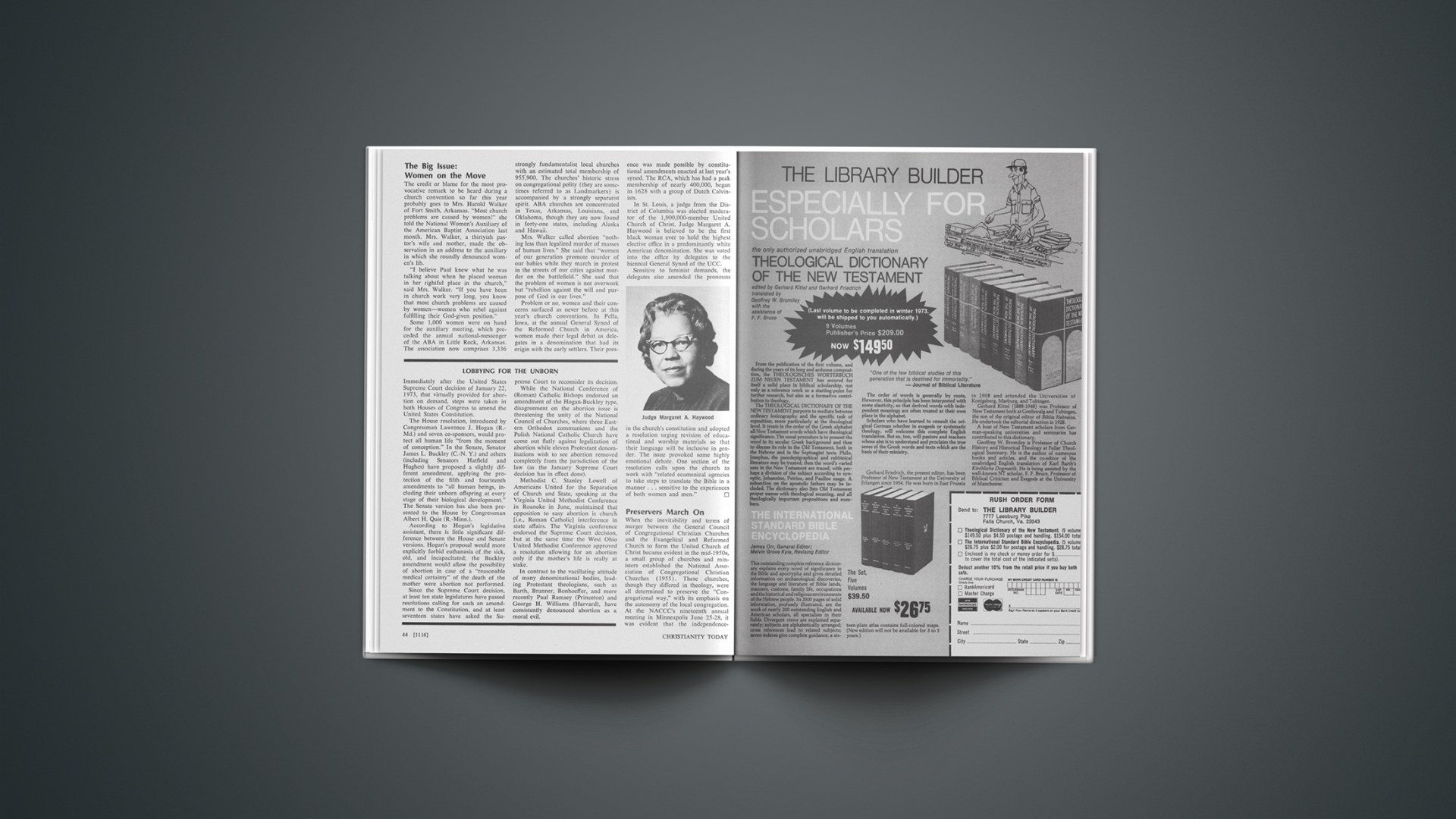
In St. Louis, a judge from the District of Columbia was elected moderator of the 1,900,000-member United Church of Christ. Judge Margaret A. Haywood is believed to be the first black woman ever to hold the highest elective office in a predominantly white American denomination. She was voted into the office by delegates to the biennial General Synod of the UCC.

Sensitive to feminist demands, the delegates also amended the pronouns in the church’s constitution and adopted a resolution urging revision of educational and worship materials so that their language will be inclusive in gender. The issue provoked some highly emotional debate. One section of the resolution calls upon the church to work with “related ecumenical agencies to take steps to translate the Bible in a manner … sensitive to the experiences of both women and men.”

LOBBYING FOR THE UNBORN

Immediately after the United States Supreme Court decision of January 22, 1973, that virtually provided for abortion on demand, steps were taken in both Houses of Congress to amend the United States Constitution.

The House resolution, introduced by Congressman Lawrence J. Hogan (R.-Md.) and seven co-sponsors, would protect all human life “from the moment of conception.” In the Senate, Senator James L. Buckley (C.-N. Y.) and others (including Senators Hatfield and Hughes) have proposed a slightly different amendment, applying the protection of the fifth and fourteenth amendments to “all human beings, including their unborn offspring at every stage of their biological development.” The Senate version has also been presented to the House by Congressman Albert H. Quie (R.-Minn.).

According to Hogan’s legislative assistant, there is little significant difference between the House and Senate versions. Hogan’s proposal would more explicitly forbid euthanasia of the sick, old, and incapacitated; the Buckley amendment would allow the possibility of abortion in case of a “reasonable medical certainty” of the death of the mother were abortion not performed.

Since the Supreme Court decision, at least ten state legislatures have passed resolutions calling for such an amendment to the Constitution, and at least seventeen states have asked the Supreme Court to reconsider its decision.

While the National Conference of (Roman) Catholic Bishops endorsed an amendment of the Hogan-Buckley type, disagreement on the abortion issue is threatening the unity of the National Council of Churches, where three Eastern Orthodox communions and the Polish National Catholic Church have come out flatly against legalization of abortion while eleven Protestant denominations wish to see abortion removed completely from the jurisdiction of the law (as the January Supreme Court decision has in effect done).

Methodist C. Stanley Lowell of Americans United for the Separation of Church and State, speaking at the Virginia United Methodist Conference in Roanoke in June, maintained that opposition to easy abortion is church [i.e., Roman Catholic] interference in state affairs. The Virginia conference endorsed the Supreme Court decision, but at the same time the West Ohio United Methodist Conference approved a resolution allowing for an abortion only if the mother’s life is really at stake.

In contrast to the vacillating attitude of many denominational bodies, leading Protestant theologians, such as Barth, Brunner, Bonhoeffer, and more recently Paul Ramsey (Princeton) and George H. Williams (Harvard), have consistently denounced abortion as a moral evil.

Preservers March On

When the inevitability and terms of merger between the General Council of Congregational Christian Churches and the Evangelical and Reformed Church to form the United Church of Christ became evident in the mid-1950s, a small group of churches and ministers established the National Association of Congregational Christian Churches (1955). These churches, though they differed in theology, were all determined to preserve the “Congregational way,” with its emphasis on the autonomy of the local congregation. At the NACCC’s nineteenth annual meeting in Minneapolis June 25–28, it was evident that the independence-minded Congregationalists are not merely carrying on but growing in numbers (currently 85,000 members) and strength; in addition, there are signs of spiritual revival and increasing participation by evangelicals.

Although the keynote address by Dr. Hubert G. Locke concentrated on social and political issues—Watergate, racial tensions, poverty, and others—the delegates showed more interest in spiritual matters and in their traditional preoccupation, local church autonomy. The Commission on Spiritual Resources was the best attended, especially a “sharing and healing” service conducted by the Reverend Arthur A. Rouner, Jr., of Edina, Minnesota. Personal testimonies, free prayer, and openness to the gifts of the Holy Spirit made that service reminiscent of meetings of the Catholic Pentecostals.

The opening business session June 26 revealed that the NACCC Executive Committee, concerned with the need for another permanent staff member, had decided in March to call the Reverend Richard P. Buchman of Wauwatosa, Wisconsin, to be a fourth member of the permanent staff. Buchman was to replace Dr. John H. Alexander as executive secretary, while Alexander would take over other staff duties.

A letter-writing campaign by the Reverend Malcolm K. Burton of Otis, Massachusetts, alerted member churches to what Burton and others considered a threat to the NACCC’s principles of local church initiative in the committee-decreed realignment, and Buchman was moved to withdraw his candidacy before the June meeting. Alexander received a standing ovation after he presented his annual report. Attorney Edward W. Adams of Marshalltown, Iowa, was elected moderator.

One distinctive of the NACCC is the Congregational Foundation for Theological Studies, with the Reverend George W. Brown, Jr., as dean. Rather than establish its own seminary, the NACCC organized the foundation to aid prospective ministerial students with advice and financial support so they could pursue individually tailored programs at various seminaries, often combining seminary work with independent study and field work. Approximately fifty ministerial candidates have gone through the CFTS program in the last ten years, many of them attending evangelical seminaries such as Trinity and Gordon-Conwell.

HAROLD O. J. BROWN

For Men Only?

When the subject of women’s liberation arises in evangelical circles, two very distinct types of scriptural interpretations appear (see also page 44). Both were much in evidence at the recent second annual Conference on Contemporary Issues at Conservative Baptist Seminary in Denver, Colorado. Discussion centered on “Evangelical Perspectives on Woman’s Role and Status.”

On the one hand are the traditionalists whose rallying cry is “Submission!” Speaking for them, Professor Gleason Archer of Trinity Evangelical Divinity School expounded the subjection of woman to the authority of man, whether husband or father. In marriage the husband is responsible for “captaincy in the family team” because he is the “head,” which Archer interpreted to mean “overlordship” or “authority.” In the Church, say traditionalists, women cannot represent God because he is masculine, and they are to remain silent because New Testament teaching is seen as based not on cultural expedients but on the theological “chain of command” rooted in Genesis two and First Corinthians 11:3.

On the other hand are those who stress Genesis 1:26–28, where men and women are given the same commission, and Galatians 3:28, where cultural polarities are overcome in Christ. They stress submission as a trait of all Spirit-filled Christians and interpret “head” more as “source” or “beginning.” And they see woman in a much broader perspective than simply wife and mother.

Paul Jewett, professor of systematic theology at Fuller Seminary, pointed out how freely and totally women were integrated into Jesus’ travels, teaching, ministry, and daily life-style—something the Church for the most part has been unwilling to imitate, charge women’s-equality advocates.

Virginia Mollenkott, professor of English at William Paterson College, Wayne, New Jersey, noted that God chose to reveal the resurrection first to women but that only two male disciples believed them enough to check. Observing an empty hole in the ground, they went away scientifically satisfied, but the women lovingly lingered and were rewarded not only with a visit by angels but also with a revelation by Christ himself, she noted. Jewett declared it might be judged an accident of history that women were first to see the empty tomb, but the appearances of the angels and Christ were deliberate and must have some implications for women’s role in ministry.

Author Letha Scanzoni raised some pertinent practical questions about women in the Church: Do we really believe that the Spirit gives gifts “to each one individually as he will” or is that “for men only”? What does the “priesthood of all believers” mean when we exclude women from any active ministry? Why do we constantly degrade women’s contribution to the missionary effort by saying God used them only because no men volunteered? If women are “unsafe repositories for doctrine,” why do we let them teach other women and children, write Sunday-school materials, or sing solos in church?

Psychiatrist E. Mansell Pattison gave the 150 conferees a provocative analysis of why anatomy is not destiny for human beings. He asserted that neither instincts, physical make-up, nor hormones really determines whether one is labeled “male” or “female.” The determining factors are role assignment by parents and subsequent socialization, he explained.

Anthropologist James Oliver Buswell III and sociologist David Moberg concurred. From their particular perspective both said that while certain groups think their definitions of “masculine” and “feminine” are “natural” and “God-ordained,” such definitions actually differ considerably from culture to culture and are purely the result of the enculturation process.

In the end the question seemed to be: Just how much of what we as Christians say about women is God’s word, and how much is the result of our own cultural biases?

NANCY A. HARDESTY

Brethren Back In The Black

Although the Church of the Brethren lost 1,200 members last year, congregations and districts within the 180,000-member denomination that have emphasized evangelism have grown. “If they have deliberately set out to do evangelism, they have made gains. I’m excited about areas where there is new life,” exclaimed Dr. Matthew Meyer, consultant for evangelism at the Church of the Brethren headquarters in Elgin, Illinois, during the church’s 187th annual convention in Fresno, California, this month.

Some congregations in the ecumenical, pacifist-tradition Church of the Brethren are indeed growing fast. An example is Broad Fording Church near Hagerstown, Maryland, where a fleet of buses picks up churchgoers and, according to Meyer, the minister emphasizes “saving souls.” Other congregations, emphasizing social action at the expense of evangelism, have declined, he added.

There are signs that the slide may be bottoming out, noted officials in an optimistic mood in the Fresno convention center while 110-degree heat sizzled outside in the raisin capital of the world. The 1972 membership loss was the smallest since 1963, when membership peaked at 202,257. Giving for local programs shot up about $4 million during 1972 to top $18 million for the first time; a $250,000 deficit that accumulated last year, resulting in the termination of five national staff workers, has been erased and a $750,000 “minimum” undesignated reserve fund has been banked.

Dr. A. G. Breidenstine of Lancaster, Pennsylvania, who is in charge of setting goals and budget for the next two years, observed that fifteen “listening conferences” involving a sampling of congregations revealed general satisfaction with the church’s programs. “There was opposition to over-emphasis on social-action programs,” Breidenstine said, “but at the same time there was recognition that race and poverty programs cannot be ignored.”

At the convention, position statements were presented recommending unconditional amnesty by the U. S. government toward draft evaders, and recognizing the right of Brethren to withhold taxes due the government for war and military purposes. Like the United Church of Christ, meeting the week before in St. Louis (see following story), the Brethren sent a delegation to check out grape picketing operations in southern California, where Cesar Chavez’s United Farm Workers Union is battling it out with the Teamsters for grower contracts.

Commenting in an interview about the effects that the Jesus and charismatic movements have had on the denomination, Meyer declared he sees “a willingness to receive and affirm persons with a variety of stances.”

Donald E. Rowe, executive secretary of the Mid-Atlantic District, was named moderator-elect to assume the duties of the present moderator, Wayne F. Geisert (president of Bridgewater College, Virginia), at the close of the 1974 convention.

RUSSELL CHANDLER

MINISTER AND MONSTER

The Scottish Tourist Board has reason to be grateful to the Loch Ness monster, and local inhabitants look indulgently even on earnest scientists who in ingenious ways try to solve the riddle of the waters. An English clergyman is now determined to put an end to the mysterious money-spinner once for all, and last month went to Loch Ness to “cleanse it of its phantom.” A well known exorcist, the Reverend Dr. Donald Omand of Devon, a retired vicar, said that Nessie had the power to cause people who have spotted her to suffer mental deterioration in later years. “It may seem nonsense to a lot of people,” he said, as he carried out his religious ceremony. No one was arguing with him.

J. D. DOUGLAS

ICCC At 25: Thunder on the Beach

Wind and rain swept the shores outside fundamentalist preacher Carl McIntire’s shoreline hotel at Cape May, New Jersey, but it was nothing compared to the turbulence generated by his followers within. Meeting for the silver anniversary of the McIntire-founded International Council of Christian Churches (ICCC), the 825 delegates from seventy countries stormed over Soviet Communist leader Leonid Brezhnev’s visit to the United States, raged over the Supreme Court’s decision to put McIntire’s radio station WXUR (in Media, Pennsylvania) off the air, lashed the World Council of Churches, rumbled over what they termed “neo-evangelicalism,” and flashed lightning at the Roman Catholic Church.

The unanimity of the eleven-day session was broken only during discussion of a proposed rally in Washington, D. C., to protest Brezhnev’s visit. While the majority of delegates approved dropping council business for the rally, several, including Dutch Christian Reformed Church minister Bauke van Smeden, objected to what they felt was interference by the world body into a nation’s internal affairs. Said van Smeden: “Matters pertaining to politics and the Church must not be mixed.” In an interview later, McIntire said the “entire” Dutch delegation “assured” him they did not hold van Smeden’s views and intended to participate in the anti-Brezhnev rally. (Nearly 1,000 ICCC delegates and East Coast McIntire supporters showed up for the four-hour rally at the Washington Monument on the first day of Brezhnev’s visit.)

Delegates unanimously approved a resolution condemning the closing of the radio station. (The Federal Communications Commission ordered WXUR off the air for failure to adhere to FCC fairness doctrines and broadcast opposing sides on controversial issues. The station, it charged, repeatedly failed to balance its theologically fundamentalist and politically right-wing programming.) Delegates ordered their resolution sent to President Nixon, the FCC, and congressional committees dealing with the FCC.

At the same time, McIntire announced he was planning a “pirate” radio station (to be named Radio Free America) aboard a ship anchored just outside U. S. territorial waters (and FCC control) but visible from his Cape May hotel. Such stations, he told backers, were operated off the coasts of Britain and Holland. (He failed to add that the British government later forced such stations off the air by prohibiting British companies to advertise on them. Stations off the Dutch coast were raided by Dutch police.)

In other actions at the council, delegates castigated the Roman Catholic Church for its “apostasy” and called on “distressed, disillusioned and frustrated Roman Catholics” to join the “reformation forces.” They also called on members of Protestant churches related to the World Council of Churches to withdraw from such churches.

Also roasted by the ICCC were “neo-evangelicals,” epitomized in McIntire’s eyes by evangelist Billy Graham, Gordon-Conwell Seminary president Harold Ockenga, and CHRISTIANITY TODAY. In an interview, McIntire named neoevangelicalism as the “biggest crisis” facing the Church. “They pretend they’re preaching the Gospel when they’ve only a fraction of it to present,” he huffed.

ICCC delegates approved the establishment of a war-crimes commission to investigate alleged Communist war crimes. “We want to know about atrocities,” McIntire said. Offices will be set up in Amsterdam and Washington, he announced, and the ICCC tribunal will hold “hearings” around the world. Budget is set at $250,000 in contributions from McIntire followers and ICCC members. McIntire was named commission chairman.

McIntire was elected president of the ICCC for the twenty-sixth year. Reelected as first vice-president was Canadian Baptist minister H. C. Slade. Also elected were thirty-three other vice-presidents representing the various regions of the ICCC.

In opening remarks to delegates, McIntire claimed the ICCC was persecuted in certain free countries, which he did not name. “We’re in trouble. No one can preach. No one can worship. Even in countries recently free it is not possible for the ICCC to meet,” McIntire claimed. Later, however, he privately admitted that the reference was to diplomatic problems over the site of the next ICCC congress rather than to persecution of ICCC churches. (India and Pakistan would not allow nationals to attend a congress in Formosa—they recognize Communist China—and an invitation from ICCC members in India was turned down because of current India-Pakistan tension.)

The next ICCC congress is scheduled for Nairobi, Kenya, in 1975. “We’re going to push the WCC out of Africa,” McIntire said. “Africa will be an ICCC continent.” Plans are already under way for “immense Billy Graham-type rallies”—“but with a different emphasis, of course,” he quickly added.

In other business, the delegates approved additions to membership (now up to 201 denominations), heard reports from various ICCC regions, and put finishing touches on statements condemning Communism and reaffirming faith in the inspired Scriptures.

A matter not discussed at the ICCC assembly was McIntire’s bitter fight with a fellow fundamentalist and anticommunist, Billy James Hargis. Hargis, involved in a dispute with the Internal Revenue Service over IRS removal of his tax exemption, accepted legal aid from his former enemy, the National Council of Churches (see February 2 issue, page 42). Hargis asked plaintively in his publication Christian Crusade Weekly, “Where was Carl McIntire twelve years ago when the IRS declared war on Christian Crusade?” In an angry open letter released to the press and printed in his Christian Beacon, McIntire blasted Hargis for consorting with the enemy and for attacking his former friend. The sharply worded letter contends that all tax exemptions should be removed because the groups that benefit most “are liberals and leftists” out to destroy America and historic Christianity. If the exemptions were removed, according to the McIntire polemics, non-biblical groups would “fold up” leaving unscathed only “those groups which are viable and which have the gospel.”

So, though the ICCC sailed on fairly calm internal seas, raging only at those outside, McIntire himself is embroiled in a bitter domestic conflict. It does little to clear the muddied waters of fundamentalism.

The Graham Tax Audits

The Graham Tax Audits

Billy Graham says he has no knowledge of any attempts by the White House to influence audits of his income-tax returns. Among a sheaf of memos turned over to the Senate Watergate committee by former presidential counsel John W. Dean III is one that reportedly alluded to audits on Graham and actor John Wayne. An accompanying routing slip was said to have asked if any “help” was needed. “No, it’s covered,” was the reply.

“I’m completely mystified,” Graham said. “I have never asked for any intervention and I have not been aware of any intervention.” He added that as far as he knows audits on his returns have been settled at the local level, in the Asheville, North Carolina, office of the Internal Revenue Service. IRS officials say the audit was routine. Most Americans in higher-than-average income brackets have their returns audited, some every year.

Graham stated that all his and Mrs. Graham’s assets are in a “trust” handled by a bank that also prepares his income-tax returns. He says he is requesting the IRS to audit his account every year.

Stamp For An Artist

One of America’s most noted religious painters, Henry O. Tanner, will be honored on an eight-cent commemorative stamp to be issued September 10. The black artist (1859–1937)—his most famous work is “The Raising of Lazarus”—graduated from Pennsylvania Academy of Fine Arts in the mid 1880s under painter Thomas Eakins. Prejudice hindered Tanner, with his conservative, traditional style, from being accepted by American art-lovers, but with the help of a white Methodist bishop he traveled to France where his talent was acclaimed. The painter made Paris his home, though he remained a life-long member of the National Association for Advancement of Colored People in the United States. New interest in Tanner’s art has recently sparked the Smithsonian Institution to sponsor touring exhibits of his paintings.

GLENN D. EVERETT

Burundi: Another Bloodbath

Once again the horror of mass murder sweeps across Burundi. A little more than a year ago, in retaliation for the killing of several thousand of the ruling Tutsi by bands of Hutu rebels, somewhere between 100,000 and 300,000 Hutu were ruthlessly slain. The rest of Africa and the world hardly noticed (see CHRISTIANITY TODAY, August 11, 1972, page 39). At that time the principal targets were the educated Hutu and their families, and the consequence was the extermination of many Protestant (and some Catholic) leaders.

In May of this year, some Hutu exiles again made a futile move to overthrow the ruling Tutsi (who make up about 15 per cent of the 3.5 million or so population). This time the Tutsi reprisals seem to be aimed at killing or driving out as many Hutu as possible. Missionaries, especially in neighboring Tanzania, have been the main source of what little information is reaching the outside world of the current horrors, which are causing thousands of additional Hutu to flee for their lives.

Debunking The Divine

With lighted cigarette in one hand and microphone in the other, a twenty-four-year-old youth in Colombo, Sri Lanka (formerly Ceylon), recently spoke to crowds in the street as his assistants from the “Rationalistic Convention” inserted five hooks into his back and thigh and hung him horizontally seven feet above the ground. As the man swung, without evidence of pain, he proclaimed to the crowd: “I am doing this because I have confidence in myself. I do not believe in gods or spirits.”

It is common in Sri Lanka, 95 per cent of whose population is either Buddhist or Hindu, for devotees to subject themselves to fire-walking and other bodily tortures at various shrines. Traditionally, these practices are meant to appease the gods for sin committed, to pay vows, and to thwart malefic influence. The devotee who chooses the hook-hanging way is believed to be able to endure the pain and have little or no bleeding because of his intense devotion and dependence on divine aid.

But more and more young people are forsaking the gods, and the hook-hanging demonstrator in Colombo is an example of the younger generation’s turn to outspoken rationalism. After he was released from his position, the audience gathered around to inspect the places where the hooks had penetrated. Only one of the wounds bled at all, reported correspondent Dudley Weeraratna, who also commented: “This experiment proved beyond any reasonable doubt that the so called ‘divine aid’ of the gods was not necessary to perform this fanatical sacrifice. As they debunk mythical beliefs and appeasement acts, the Ceylon rationalists have created a spiritual vacuum and thus paved the way, rather indirectly, to belief in the one true Creator God, who does not demand such tortures.”

Christian Untouchables

According to a report in the Hindu (Madras), Government of India grants and privileges intended to raise the social conditions and status of the Harijans (untouchables: the practice of treating a certain class as untouchable has been outlawed, but the former untouchables still suffer tremendous social disadvantages) are withheld on a discriminatory basis from Harijans who have become Christians. Members of “Scheduled Castes” (previously oppressed groups entitled by law to favorable treatment) who convert to Christianity, or in some cases to Islam, are no longer regarded as “backward,” and they lose their claim on special grants and privileges. The report states that 700,000 Harijan Christians are being deprived of state aid to which they ought to be entitled. The Catholic Union of India has resolved to seek the aid of all political parties for the restoration of grants to converted Harijans.

Pow Retreat

While much of the shouting about the returned prisoners of war has died down, the spiritual side of the years in Hanoi prisons continues to be told.

A new film, In the Presence of Mine Enemies, based on a soon-to-be published book by Navy captain Howard Rutledge, details Rutledge’s prison life and his turn to God. The film was produced by Gospel Films of Grand Rapids, Michigan. It premiered on television late last month and is now being distributed.

At the same time, more than 500 POW-MIA families have accepted an invitation by former astronaut turned evangelist James Irwin to attend a series of “spiritual renewal” retreats in the Rockies. Costs of the program are being underwritten by Irwin’s High Flight evangelistic association.

Melodyland School: The Spirit’S Tune

Six years ago, when the charismatic movement was starting to “come out” in the mainline denominations and the Roman Catholic Church, renowned Presbyterian John A. Mackay (former president of Princeton Seminary) predicted the future of the Church “could be with a reformed Catholicism and a matured Pentecostalism.”

Today there are signs his prophecy is being fulfilled. The Holy Spirit movement is sweeping the Catholic Church (see June 22 issue, page 36). And a new school of theology, tuning up for a full program this fall, represents an effort to upgrade academic training for seminarians who want to attend a charismatic school.

Melodyland School of Theology is headed by J. Rodman Williams, former professor of systematic theology and philosophy of religion at Austin Seminary, Texas. It will be the first charismatic institution to offer a master’s degree in theology. The school, related to Melodyland Christian Center opposite Disneyland in Anaheim, California, is based on spiritual dynamics (openness to gifts of the Spirit), academic excellence (a full curriculum at graduate level), and practical application (field work stressing charismata), says Williams, president of the Charismatic Communion of Presbyterian Ministers.

Melodyland’s ecumenical school, with a part-time faculty of fourteen (most hold master’s degrees), opened in January with 150 students and expects 200 by September. Classes are held at night and on Saturdays so students can pursue other schooling or jobs. One faculty member, Daniel Tappeiner (Th.D., Fuller Seminary), teaches at both Fuller and Melodyland with no apparent tension at either place.

Williams, leading Protestant theologian of the neo-Pentecostal movement, speaks of the school’s function: “Making connections with traditional theology and denominations … to provide balance so that the dynamic [of the charismatic movement] won’t be thwarted or subdued by the formal. But we need formal instruction lest the dynamic leads into destructive, chaotic manifestations.”

Melodyland thus will attempt to bridge the gap between typical Bible-college training offered by oldline Pentecostal bodies, and studies at non-charismatic denominational and interdenominational evangelical seminaries. Pending approval by the California Board of Education, Melodyland plans three sets of diplomas and/or degrees ranging from a diploma after sixty units for persons with no prior college education to a master of theology degree requiring a thesis and comprehensive exams for students who enter with a college degree.

Williams, who remains in good standing with the Presbyterian Church, U. S., says tongues is not required evidence for having received Spirit baptism but “the normal accompaniment and peculiar sign of being penetrated.”

RUSSELL CHANDLER

Billy and the Blacks: Atlanta and Graham Revisited

Atlanta, 1950, was something of a turning point for evangelist Billy Graham. During that five-week-long crusade in a tent in the old Atlanta Crackers ball park (cumulative attendance: 500,000, with 8,000 inquirers), he went nationwide for the first time, introducing the “Hour of Decision” radio program on 150 ABC network stations for the “astronomical” sum—to quote Graham—of $92,000 for a thirteen-week contract.

At the end of the crusade, the Atlanta Constitution carried a front-page photo of Graham waving goodbye as he stepped into a car to leave town. But next to it was a photo showing bags of money collected at the meetings (Graham had been given a $9,000 “love offering”). Agitated by the unfavorable implication, the evangelist—partly at the suggestion of then evangelism secretary Jesse Bader of the National Council of Churches—scrapped the love-offering system a short time later in favor of a board-paid annual salary ($15,000 then, $25,000 now). That act, over the long haul, perhaps did more than even William Randolph Hearst’s famous “puff Graham” order to his editors a year earlier to upgrade the image of evangelism and to establish Graham’s credibility in the eyes of the press.

Last month Graham returned to Atlanta. Both had gotten bigger (Graham’s organization spans the world and has a $20 million annual budget), and both had undergone changes in the intervening twenty-three years. Atlanta has grown more tolerant, more cosmopolitan, its stance in the sixties perhaps more accurately represented by Ralph McGill’s editorials in the Constitution than by Lester Maddox’s presence in the governor’s mansion. Many neighborhoods that were predominantly white in 1950 were now predominantly black. (About half of Atlanta’s nearly 1.4 million population is black.)

For his part, Graham—by now, like apple pie, virtually a national institution—commented that he, too, was sociologically different, more mature. He could point to blacks on his staff, blacks among the crusade’s planners and participants, blacks in the 6,000-voice choir, black ushers and counselors, and the endorsement of important black church leaders. The semi-retired Martin Luther King, Sr., was on the platform for three meetings and led in prayer at one. Special guest Edward V. Hill, a Los Angeles pastor, was introduced as co-founder of the Southern Christian Leadership Conference and one who seconded the nomination of King’s son as SCLC head. “I’ve come here to become involved in man’s number-one problem—his relationship to God,” thundered Hill. (Also making platform appearances: Governor Jimmy Carter, who included a resounding personal testimony of faith in Christ during a welcoming statement, and Lieutenant Governor Maddox). A joint appeal urging the area’s blacks to attend the crusade was issued by Christian Methodist Episcopal bishop P. R. Shy, president Oswald P. Bronson of Interdenominational Theological Center, crusade vice-chairman J. A. Wilborn (pastor of Union Baptist Church), and four other prominent blacks. If blacks turned out in large numbers, as predicted by some, Atlanta, 1973, would be another turning point in Graham’s ministry.

But the overall turnout of blacks among the cumulative total attendance of 270,000 at the seven-night crusade in the 50,000-seat stadium was disappointingly small—as low as 400 or so a night, according to a head count Graham ordered. Graham’s people blamed several factors: a high incidence of street crime in black neighborhoods, a bus strike halfway through the crusade that eliminated the use of 150 shuttle buses serving 10,000, and a downtown shoot-out between police and Black Muslims that shattered the peace and left two dead. Also, SCLC head Ralph David Abernathy—like Graham, a Baptist minister—was publicly critical, and local SCLC leader Hosea Williams led a handful of pickets in protest outside the stadium the first few nights. The SCLC men cited the Atlanta business establishment’s involvement in the crusade, Graham’s association with President Nixon, and the evangelist’s alleged failure to speak out more specifically on certain social issues.

Not mentioned: most black ministers didn’t take the time to boost the crusade adequately or to organize their own congregations. Another factor is that Graham’s meetings are culturally white in style. Exotic figures such as “Reverend Ike”—the Reverend Frederick J. Eikerenkoetter II—know better how to attract black audiences.

(Months earlier, many of the nation’s 200-plus black newspapers bitterly criticized Graham for his posited-then-retracted remark in South Africa that rapists should be castrated. Seemingly ignoring his apology and refusing his record on integration, they suggested that Graham was a racist after all. The furor strained—and may have damaged—Graham’s relations with black ministers in Minneapolis, where a crusade is being held this month. Proposals for a crusade in Washington, D. C., are in limbo because of black ministerial opposition there. Graham sympathizers point out—correctly—that criticism comes from only a minority, but it is apparently strong enough to keep the majority off balance.)

There were other minor skirmishes and distractions. A few theological liberals and fundamentalist separatists urged their congregations not to attend, and several prominent Reform rabbis in town for an annual meeting took pot shots at Graham. A faulty sound system plagued the evangelist on the opening night. Shouting and chanting members of the “Local Church” (or Little Flock) movement leafleted the crowd, and several leaders were arrested. Elvis Presley hit town at mid-week and drew a sell-out crowd of 17,000 to a neighboring hall. Also at mid-week, atheist Madalyn Murray O’Hair announced in the press that she was suing Graham for $3 million over a TV talk-show appearance last fall in which he said he had received a letter from her with obscenities, a letter she denied writing. (The Graham camp withheld comment, saying only that the matter was in the hands of attorneys.)

But framed against the entire week, all these issues were of little importance to the crusade’s outcome. What mattered was Graham’s credibility in his field of expertise: man’s relations with God. Night after night from the bright-blue $15,000 combination platform and sound studio astride second base, Graham drove home simple gospel truths. In all, nearly 10,000 streamed onto the field in response to the nightly invitations. They walked forward for different reasons. A reporter’s teen-age daughter and her friend admitted that they simply wanted to get a closer look at the handsome evangelist. About half indicated they wanted to receive Christ as Saviour. Most of the others were Christians wanting to get closer to God.

The majority in the stadium each night were, of course, church members, many brought in by bus from outlying towns. Does a crusade do anything for the Christians who attend? Yes, according to a number of pastors and youth leaders interviewed, most of them citing a new sense of unity and common purpose in the Christian community because of months of work together in crusade preparation. It also involved believers in personal outreach. Pamela White, 20, one of the hundreds of counselors trained for the event but a Christian herself for only a year, announced excitedly one night that she had just led someone to Christ—“my first, but not my last.”

Why do so many Christians respond for rededication at the invitation; why this need? “Many new Christians just don’t do what Billy Graham talks about, like praying, reading the Bible, and witnessing,” commented collegian Ann Tucker, 22, of suburban Decatur. “So they get sidetracked and defeated, sometimes because they’re in dead churches.” A newcomer, she’d been a counselor in Graham’s 1965 Hawaii crusade and was now leading one of the Saturday-afternoon “New Scene” follow-up Bible-study groups that had attracted 3,000 young people. The dead-church concern was cited by a number of youths. Collegian G. Wesley Channel, 19, a Jesus-movement convert who is now leader of a house-church, said the crusade could be a means of strengthening churches and making them come alive.

Crusade chairman Tom Cousins, 41, a Presbyterian and millionaire real-estate developer, thinks the crusade made a lasting impact on the city. He tells of a business associate who, after attending three meetings, was faced with a crucial decision with ethical implications. The businessman said he decided to do it God’s way even though the other way seemed more attractive from his former perspective. (Cousins’s committee was expected to meet its nearly $500,000 budget—about $100,000 for publicity alone—with enough left over for a contribution toward the cost of the fall telecasts.)

Black Methodist pastor Charles Singleton of Charleston, South Carolina, echoed the comments of many at another crusade side-benefit: a week-long daytime “School of Evangelism” attended by 1,000, primarily pastors and seminarians, and featuring some of the nation’s top evangelical leaders as well as members of the Graham team. “We need to do this more often,” he said. “My eyes have been opened to new ways of communication, I’ve made new friends, and Scripture has taken on new meaning.” Graham dropped in one morning to warn against ministerial pit-falls involving women, money, and pride.

Portions of the crusade were videotaped for international viewing this fall (estimated cost for television time: about $1 million); thus the Atlanta ball park was transformed into a studio from which to beam the Gospel into all the world. (Graham believes he reaches many blacks through TV.) There was wide—and favorable—press coverage. Both major dailies ran front-page summaries of Graham’s sermons. A young Jewish reporter had pleasant experiences aboard a Baptist church bus, and told her readers so. A popular sportswriter produced an exceptionally well-written headliner entitled “Salvation at Second Base,” pointing out that Graham had outdrawn the baseball Braves during their season to date and crediting the evangelist with a lot of “saves.” Television Channel 5 newsman Ray Moore, who heads a house-church ministry, and several radio disc jockeys plugged Graham openly on their shows. Editorial columnist Reg Murphy brushed aside the “couple of well-known loudmouths” who criticized Graham. Atlanta’s street crime wouldn’t stop overnight, he said, but the crusade could become “one of the mileposts toward a more humane city, toward a better relationship among people.”

Perhaps so. During the invitation one night a black teen-age boy in the crowd behind first base broke into tears. A white teen-age youth standing nearby went over and spoke softly with him. Then they joined the hundreds of others walking down the aisles onto the field.

In the final analysis, that’s really what the Graham crusades are all about.

The Grace of God

Rare indeed is the Christian who does not consciously or unconsciously harbor the feeling that in some measure he is earning his own salvation and therefore deserves to be saved. Innate human pride is such that we love to think of ourselves as good. Our every act of worship, kindness, or favor to others is apt to give us an inner satisfaction and a sense of self-righteousness that, we should know, God detests.

One of the signs of spiritual maturity is a growing realization of the grace of God. More than four centuries ago, on seeing criminals being led out to execution, John Bradford exclaimed: “But for the grace of God there goes John Bradford.” Today, when we see the wages of sin on every hand we should remember that but for God’s grace we too would face death and judgment.

Salvation through grace is the very heart of the gospel message. The fact that eternal life cannot be merited should cause us to ponder the mystery of our own redemption—an act of God’s sovereign mercy whereby the redemptive act of his Son becomes operative in our lives through faith, and faith alone.

The Apostle Paul, speaking of the sovereignty of God’s acts of mercy and election, exclaims: “O the depth of the riches and wisdom and knowledge of God! How unsearchable are his judgments and how inscrutable his ways!” (Rom. 11:33).

Nothing is more capable of bringing us to our knees in worship and thanksgiving than a realization that all we have is undeserved. Speaking of Abraham’s faith, Paul also says: “That is why it depends on faith, in order that the promise may rest on grace and be guaranteed to all his descendants—not only to the adherents of the law but also to those who share the faith of Abraham, for he is the father of us all” (Rom. 4:16).

But grace is not to be trifled with. To presume on the love and grace of God is to trifle with that which may turn and rend us. The Apostle Paul poses this question, and Phillips in his translation of Paul’s words says: “Now what is our response to be? Shall we sin to our heart’s content and see how far we can exploit the grace of God? What a ghastly thought!” (Rom. 6:1, 2). And yet we have known people who, taking the premise that we are “not under the law but under grace,” have seemed to feel they were therefore free to sin. “Ghastly”? Yes, and utterly perverse.

Grace has been spoken of as the free and eternal love and favor of God, which is the spring and source of all the benefits we receive from him. I recall as a young man hearing an old minister praying, “All that we have except sin comes as a blessing from thee.” How well this fits in with the gracious affirmation of Romans 8:28, “And we know that all things work together for good to them that love God, to them who are the called according to his purpose.”

Accustomed as we are to the idea of merit and payments, it comes as an overwhelming shock when we first realize that forgiveness of sin and eternal life are gifts of God’s grace and never earned or merited. Those who have tasted deeply of this truth can never be the same. “Just as I am, without one plea, but that thy blood was shed for me” takes on an eternal significance, and pride is humbled in the face of God’s redeeming love. Nowhere more than here do we see the sovereignty of God. Why has he been so kind to me? Why has he made it possible for me to stand in his holy presence without a sense of guilt? The answer is, of course, in the atoning work of his Son, through whom his grace becomes operative and magnified.

This combination of love—the gift of his Son—and grace, which is that love in action, reflects for all to see that the divine calling demands humble acceptance on our part. That pride so often suggests another way shows the blindness and perverseness of the unregenerate heart.

But grace is more than saving in its nature; it is also sustaining. All of us live confronted with a multiplicity of problems and difficulties, physical, material, and emotional. Often we experience, or see others experiencing, trying vicissitudes in life. The Apostle Paul plumbed the depths of such experiences only to have God tell him, “My grace is sufficient for you, for my power is made perfect in weakness” (2 Cor. 12:9). Here we have demonstrated once for all that God’s grace not only saves us but continues as the controlling and sustaining force in our lives as Christians.

Grace also has its fruits. From it proceed those evidences of the indwelling Christ that commend to others the faith we profess. People irritate us—God’s grace in our hearts will enable us to react in love and not in anger. Problems arise for which we have no immediate solution—the grace of God enables us to look beyond to the One who has the solution. Sorrows come—the grace of God enables us to look through our tears to the One who will some day wipe away every tear. The daily routine gets us down and we groan under its monotony and its burden—but God’s grace enables us to rise above this and to sense his presence and love.

Grace is spoken of as a fair ornament in Proverbs 4:9—“She [wisdom] shall give to thine head an ornament of grace: a crown of glory shall she deliver to thee.” How often we have seen this demonstrated in the lives of others, and how pleasant it is to see! “Graciousness” is one of the loveliest words in the English language, and one of the nicest attributes by which one may be described. Where affected it is hypocrisy, but where genuine it is a reflection of God’s glory in a work of his new creation.

The grace of God is shown in the perfection of his creation, marred only by the sinfulness of man. “Where every prospect pleases, and only man is vile” is far more than the poetic expression of a hymn. All around us we see evidences of the loving provision of God’s grace. Little wonder that the Bible concludes its revelation to man with the crowning act of all the ages: “The grace of our Lord Jesus Christ be with you all. Amen” (Rev. 22:21).

Living in the dispensation of grace, surrounded by its evidence on every hand, offered its perfection in the person and work of the Son of God, we, individual Christians and the Church in its corporate witness, should at all times proclaim that the grace of God is God’s offer of forgiveness and freedom from the penalty of sin to all who will accept it. The Gospel is as complicated and as simple as Paul’s words to Titus: “For the grace of God that bringeth salvation hath appeared to all men” (2:11).

Apple PodcastsDown ArrowDown ArrowDown Arrowarrow_left_altLeft ArrowLeft ArrowRight ArrowRight ArrowRight Arrowarrow_up_altUp ArrowUp ArrowAvailable at Amazoncaret-downCloseCloseEmailEmailExpandExpandExternalExternalFacebookfacebook-squareGiftGiftGooglegoogleGoogle KeephamburgerInstagraminstagram-squareLinkLinklinkedin-squareListenListenListenChristianity TodayCT Creative Studio Logologo_orgMegaphoneMenuMenupausePinterestPlayPlayPocketPodcastRSSRSSSaveSaveSaveSearchSearchsearchSpotifyStitcherTelegramTable of ContentsTable of Contentstwitter-squareWhatsAppXYouTubeYouTube