The End of the Renaissance Road

Four decades ago Aldous Huxley wrote his classic forecast of human history, Brave New World, in which Western civilization had become a hideous assembly line producing bottled babies whose physical, mental, and emotional characteristics were precisely controlled throughout their lives. In the plastic but highly contented society that resulted, personality and individuality had ceased to be.

Huxley, observing the state of scientific technology in the thirties, estimated that this world of biological engineering would emerge around the year 2500. He was drastically mistaken. In May, 1971, an article appeared in Look magazine entitled “Taking Life Into Our Own Hands: The Test Tube Baby Is Coming.” Referring to Brave New World, the writer said:

Now more than fifty printings later, passages from the book read like paragraphs from the daily newspaper.… Doctors have already removed human eggs, have fertilized them and incubated them in the lab. Now it is possible to implant a tiny embryo in the womb and create a new life.

Science has translated the fantasies of yesterday into the actualities of today. And just as Huxley predicted, what science has made possible, man plans to use in an amoral manner. Our generation faces an evil that no previous generation has faced. It is the two-headed monster of an astoundingly capable scientific machine in the hands of professionals with a blank conscience.

Dr. Francis Schaeffer, the brilliant modern Christian thinker, warned us in 1970,

Whoever achieves political or cultural power in the future will have at his disposal manipulations that no totalitarian ruler in the past has ever had. None of these are only future; they all exist today waiting to be used by the coming manipulators [The Church at the End of the Twentieth Century, Inter-Varsity, 1970, p. 91].

As if to underscore the truth of Dr. Schaeffer’s warning, two outstanding intellectuals have since stepped forward to put forth some frightening proposals. Dr. Francis Crick, winner of a Nobel prize for his work in unraveling some of the genetic mysteries of DNA, suggested the following to a group of scientists in St. Louis in March, 1971: “Some group of people should decide that some people should have more children and some should have fewer.” He went on to say, “I don’t think you’re going to solve all these problems just by tinkering with the genetic material.… I think really there should be some thinking if we’re to take this new view of looking at man.” Dr. Crick seems to anticipate:

1. The dictatorship of an intellectual elite who decide who should be born and who the parents should be.

2. Systematic tampering with genetic materials, i.e., programmed babies.

3. “A new view of looking at man.”

What is this new view? It seems to be elimination of the idea that man is an individual, that man has personality, inalienable rights, and essential worth.

Crick is no lone voice in the wilderness. Dr. B. F. Skinner, Harvard’s distinguished champion of behavioristic psychology, writes in his latest book, Beyond Freedom and Dignity, “To man as man we readily say, ‘Good riddance.’ We must delegate the control of the population to specialists.” Skinner believes that freedom and dignity are harmful ideas that have created all kinds of social problems. They must be abandoned; man must be placed in the hands of specialists who will predetermine his characteristics, restructure society, and guide human history from now on.

The philosophical thrust that started with humanism in the fifteenth century has now reached its logical destination. It began with the idea that man is the measure of himself, in fact, of all things. In accepting this it necessarily denied the idea of inspired revelation, absolute truth, and universal moral law. Rabelais, the famed satirist and irreverent Benedictine monk, expressed this leap in the inscription he placed on the gate of his lay abbey (open to both sexes), Abbaye de Theleme: “Do What You Like.”

Rabelais’s agreeable command makes sense if there is no God who watches and weighs the actions of men. The unpleasant fact that some men like to enslave and exploit others may be regrettable, especially to the victims, but in no sense can it be “wrong.” When man is the measure of all things, then right and wrong becomes a matter of taste, of personal choice. We can select our actions as we choose our wardrobe.

Through the centuries between the humanists and today’s builders of the Brave New World, Western culture has tried to preserve the values of right and wrong, the dignity of man, law rather than anarchy; but one central unanswered question has haunted that effort: What authority guarantees the validity of those values?

It cannot be God, for the universe of the humanist and later the rationalist is a closed machine. All knowledge must flow from carefully checked sensory perception or verifiable experimentation. Since God does not seem to have mass or a visible wave pattern, he can’t be there. Of course, the ideals of freedom and man’s inherent worth don’t show up on the spectrograph either. And with God discredited, his so-called Holy Word cannot be used to support such concepts.

What is left? The eighteenth century answered, “Reason.” Reason will lead men to understand themselves and their environment. Once man understands nature’s laws, he will conform to them in order to secure for himself the greatest possible comfort and well-being. Societies will see the golden dawn of magnificent enlightenment as they stride down the path of reason. But whose reason shall we follow? That of Jesus? Marx? Hitler? Our own?

This last option sounds attractive to those who believe man is basically good. It inspired Rousseau to write, “Man is born free, and everywhere he is in chains.” He believed that the great evil resides not in man’s heart but in civilization itself, its restraints, its laws, its institutions. Rousseau worked out his theory of social contract, giving his disciples criteria by which to decide whether to allow themselves to be governed or not. He tried exceedingly hard to define good government, which men should follow, and evil, which they should reject. However, he utterly failed to find an authority for these definitions other than himself. Reason ends with an appeal to blind faith in one more man.

The doctrine of Rousseau, Montesquieu, and Diderot helped to blaze the trail of the eighteenth century in France. These thinkers foresaw the French Revolution, but they failed to see its logical climax, the Reign of Terror. Thirty years after Rousseau’s call to faith, Robespierre mounted the rostrum of the French Convention and, following his own reason, declared a new creed: “Terror is nothing else than justice, prompt, secure, and inflexible. It is … an emanation of virtue.” The kind of reason that inspired the struggle for liberty died on the guillotine.

England provides a sharp contrast. Fired by national revival led by John Wesley and George Whitefield, England moved into the nineteenth century examining its conscience by the light of Holy Scripture. Thus William Wilberforce could climax his plea to end the African slave trade with this ringing claim:

There is a principle above everything that is political; and when I reflect on the command which says: Thou shalt not commit murder, believing the authority to be Divine, how can I dare to set up any reasonings of my own against it? What is there in this life that should make any man contradict the dictates of his conscience, the principles of justice, the laws of religion and of God? [an address delivered to the House of Commons, May 12, 1789].

Wilberforce could appeal to absolute principles of justice because he had the Word of God in his heart. Man’s dignity, rights, and essential worth rest solely on the revealed fact that God created man in his own image.

In tragic contrast to the man with the Bible, twentieth-century man, the heir of five centuries of humanism, rationalism, enlightenment, determinism, and existentialism, stands in an abyss of despair. Philosophy has given up the search for a firm basis on which to build him a morality. Behavioristic psychology defines him as a complex biological machine, nothing more. He looks out into a cold, dark, ugly universe without purpose and shrieks in the knowledge that he has no worth. And so the Skinners, the Cricks, the genetic engineers, the creators of test-tube babies, and the purveyors of unlimited abortion have arrived at the logical conclusion of Western history, the end of the road to which their secular wisdom inevitably leads.

No, not quite the end. The New Testament previews the end in these devastating terms: “God sends upon them … the full force of evil’s delusion, so that they put their faith in an utter fraud” (2 Thess. 2:11, Phillips). The Big Lie and the Great Liar may indeed be waiting in the wings of the final decades of this century.

How shall we react? If we allow the trend of events to paralyze us with dread, Christ will be invisible to our generation. The Body of Christ must not lie down and play dead. The warfare rages on, and the command “Fight the good fight of faith” has not been stricken from the combat manual.

Moreover, we have great news for the man in the street. Modern science tells him he is an accidental arrangement of molecules, but the Word of God proclaims he is crowned with glory and honor. He bears not only the influence of heredity and environment but the very image of God. He has potential for magnificence.

The enemy has established strongholds in the minds of men. By many subtle methods he manipulates their attitudes and their opinions. He uses books, magazines, movies, plays, TV, radio. He uses people in science, business, labor, politics, education, and, of course, religion. He plants deceptive fantasies and fake philosophies in men’s brains, designing these ideas to appeal to man’s pride and lust and yet not offend his conscience. His purpose is to overthrow every trace of God’s authority.

The brand of Christianity that dismisses man’s mind as irrelevant in the process of salvation actually forfeits the war. Man’s mind is the battlefield. He cannot be saved until at least one idea is crushed: the idea that he can live independently of or apathetically toward God. He must recognize God’s right to be God over all the universe, especially himself. That is why Paul declared, “We persuade men”:

The very weapons we use are not those of human warfare but powerful in God’s warfare for the destruction of the enemy’s strongholds. Our battle is to bring down every deceptive fantasy and every imposing defense that men erect against the true knowledge of God. We even fight to capture every thought [2 Cor. 10:3–5, Phillips].

John Bunyan conveys the nature of the battle in the vivid scenes of Pilgrim’s Progress. The city of Man-soul, once ruled by Emmanuel, has fallen to Diabolus. The evil king cannot kill Mr. Conscience, so he chains him deep in the bowels of the city dungeon. Under Emmanuel’s leadership Captain Conviction leads an assault on Ear-Gate and stirs the sleeping Mr. Conscience to shout so loudly that the entire city mobilizes to overthrow the usurper.

We assault men’s darkened minds and enslaved consciences through personal witness. Undoubtedly the Holy Spirit brings innumerable people to God through person-to-person sharing of Christ. He captures their thoughts when we wield the truth in love. “We can enlighten men only because we can give them knowledge of the glory of God as we see it in the face of Jesus Christ” (2 Cor. 4:6, Phillips).

Furthermore, when we demonstrate love and unity among ourselves before the watching world we batter the gates of hell to pieces. Real fellowship is so rare in the office, the factory, the country club, the fraternity, the bowling team, that when the worldly onlooker sees it among us he is likely to conclude that Christianity is real. Jesus prayed this amazing prayer: “I in them and you in me, that they may grow complete into one, so that the world may realize that you sent me” (John 17:21, Phillips).

Truth, love, and visible unity are powerful weapons that God has placed in our hands and expects all of us to use dynamically in personal and corporate witness. But as we befriend the children of this age, we must emphasize the doctrine of man’s infinite worth and personify its breathtaking implications of love, joy, and purpose.

Beyond these basic duties, some of us Christian warriors need to step into the arena of cultural life and tackle the difficult job of presenting truth to modern man through secular media. Our culture still gives room to effective spokesmen for Christ. One bitter November night my wife and I, along with several hundred other people, stood in line for forty-five minutes to buy tickets to the movie The Cross and the Switchblade. Night after night the theater was jammed.

Christianity needs more film producers who can bring the crowds through the turnstiles to see gripping sagas of Christian experience. It needs a few dozen highly skilled writing craftsmen who will launch out beyond the limits of the Christian market and determine to become the John Bunyans and C. S. Lewises of this generation.

Why concede the mass media to Satan? Why default all the university chairs of philosophy, psychology, and social science to men dedicated to secular myths? Why not invade these and other privileged sanctuaries of the opposing forces? The religion departments of the major news magazines seem like a strategic target for sharp reporters who can focus national attention on the remarkable events of spiritual significance happening in our time. The vocal minorities of Christian congressmen, astronauts, athletes, and scientists who make a strong case for biblical Christianity need reinforcements—the more the mightier.

In June, 1971, Jesus made the cover of Time magazine. Our world must remain Jesus-conscious. Not only his name but his personality, his words, and most of all his mission deserve unquenched publicity. The destroyers of man do not control the avenues to men’s minds—yet. Their ideas must compete with ours in the market places of our time. We face two alternatives: invade these secular domains or lose them by default.

Almost immediately after Winston Churchill presented his program of “blood, sweat, toil, and tears” to his threatened nation, France fell, and Britain’s future looked utterly dismal. Churchill again challenged his people not to despair but to fight:

If we fail, then the whole world … will sink into the abyss of a new Dark Age, made more sinister and perhaps more protracted by the lights of perverted science. Let us therefore brace ourselves to our duties and so bear ourselves that, if the British Empire and its Commonwealth last for a thousand years, men will say, “This was their finest hour” [address to the House of Commons, June 18, 1940].

A greater menace and a more perverted science dare us to cringe at their fierceness, but God has not given us the spirit of fear. He encourages us to be strong and to destroy the tempo of decadence. Let us rejoice that God has chosen us to represent him at this moment of history. Let us confront the Brave New World with a braver Church, a Church filled with a passion to finish its career in a blaze of glory to God. With “blood, sweat, toil, and tears” and with spiritual weapons let us recruit great numbers of the uncommitted to Christ. With his Spirit’s power let us conduct ourselves with such distinction that God’s eternal record books will declare of the Church at the end of the twentieth century, “This was their finest hour.”

George M. Marsden is associate professor of history at Calvin College, Grand Rapids, Michigan. He has the Ph.D. (Yale University) and has written “The Evangelical Mind and the New School Presbyterian Experience.”

Editor’s Note …

Speaking at an Easter sunrise service at the Aberdeen Proving Grounds in Maryland brought me into contact with a number of military persons. I had dinner in the home of a retired colonel, a West Point graduate whose two sons also graduated from West Point. What struck me was their commitment to Christ and their zeal for a positive witness in the armed forces. It is good to be reminded that there are thousands of fine Christians in the military serving God and the nation around the world.

My son John’s engagement to Stephanie Larson of Minneapolis was announced recently. Their wedding this summer will be a milestone in the lives of friend wife and myself: we will have no more unmarried children (and no more college expenses!). As I wrote this we are awaiting also the imminent arrival of a third grandchild to crown our blessings. All this led me to reflect that the story of Ruth and Boaz comes from the period of Judges, which was characterized by savagery, lust, strife, and lawlessness. But the Book of Ruth is marked by love and marriage, the birth of babies, simple faith, and the tilling of the land: the common activities of ordinary people as they lived and died quietly amid the turbulence of their age. It still has a familiar sound, doesn’t it?

Teeing off with TEE

Especially within the realm of evangelical missions, many eyes are turned toward a fast-growing educational phenomenon: the extension seminary, more properly “theological education by extension” (TEE), a sort of class-less approach to learning. In TEE, the student can stay at home—and on the job—with self-study materials and occasional contacts with his teacher. Denominations and missions are spared the costs of expensive school facilities and resident faculties. Churches need not suffer even the temporary loss of effective workers.

Rarely has a basic alteration of institutional modes moved so rapidly, hop-scotching its way completely around the world. Where TEE has touched, enrollments in theological education have skyrocketed. More importantly, according to some of its chief proponents, the educational experiences have taken on a fresh relevance to the needs of the Church.

TEE began ten years ago in the Presbyterian Seminary in Guatemala. Two engineers-turned-missionary-educators, Ralph Winter (now at Fuller Seminary) and Jim Emery, teed off with five extension students. Extension, a monthly newsletter reporting TEE developments worldwide, recently listed 9,030 extension students studying in 742 centers throughout Latin America. The largest program reported is that of the Presbyterian Seminary of Brazil, which involves 3,000 students.

Dr. John Sinclair, who oversees Latin American work for the United Presbyterian Church, thinks TEE has helped to open up an improved relationship between his denomination and the Presbyterian Church in Guatemala.

In January, 1971, extension programs began in five centers throughout India. By last November, there were twelve centers, and enrollment had jumped from 120 to 250. Similar organizations exist in Singapore, the Philippines, Taiwan, and Africa. The Theological Education Fund of the World Council of Churches has budgeted $245,000 for TEE projects. This is equal to the amount it designated for all other types of experiments in theological education. A major reason for the Fund’s interest in TEE is its financial viability in the third world.

One feature of TEE programs has been the use of programmed instruction. Extension students must have self-instructional materials that they can handle on their own between periodic contacts with the teacher. Opinions vary on the value and use of programmed materials but responsible research is going on. For instance, Lois McKinney, a Baptist missionary in Brazil, has just completed research under a Ford Foundation grant related to her studies in ethno-pedogogy. Such research may resolve some of the questions, especially those related to the cross-cultural transformation of instructional materials.

Although TEE has been primarily a third-world phenomenon, it is of increasing interest to North American theological educators. Several conferences to discuss the implications of TEE for North America are in the works. Wheaton College has included TEE in its summer graduate program, attracting not only missionaries but teachers from North American schools. Fuller Seminary has plans for four extension centers this fall.

Two factors suggest that the interest in TEE will not soon subside—a renewed interest in a theologically literate laity and the need for an effective continuing-education program for the professional ministry.

The search for more effective educational alternatives is not limited to theological education. The U. S. government is investing substantially in research on “non-formal” modes of education. TEE provides rome of the best examples of what is meant by non-formal educational programs, and Lois McKinney’s studies are part of the governmental research project. In a meeting in Penang, Malaysia, for ministers of education of ten Southeastern Asian nations, Dr. Ted Ward of the Institute for International Education at Michigan State University gave a paper on “Effective Learning in Non-Formal Modes.” Ward, an evangelical, has been a strong advocate of TEE and has conducted workshops for missionaries in Africa and Latin America.

Participants at a TEE seminar two months ago in São Paulo, Brazil, were told there are 60,000 functioning pastors in Latin America with no theological training. For most of them, TEE is their—and the churches’—best hope for a remedy.

Some see TEE as a fad or have taken a wait-and-see stance. Ward feels the fad stage is past. “Educational fads usually show signs of mortification and have peculiar odors within three or four years,” he says. “Aside from some setbacks related to overselling and some very responsible hesitation in certain countries, there are no real signs that the extension idea will die the death of a fad.”

The disciples of TEE vigorously promote their faith. Some of the difficulties of the early days are being remedied by the reorganization programs. In January, fifty-three delegates met in Medellin, Colombia, and formed the Latin American Association on Institutions and Theological Seminaries by Extension (ALISTE). In so doing they dismantled previous structures geared chiefly to the production of programmed textbooks. In Singapore, a filmstrip, “TEE Could Be the Answer,” is helping to push the extension idea in Asia.

Experts see two problems that may impede TEE expansion. The willingness to change does not always include an enlightened view of how change occurs, they caution; there is a danger of substituting one pattern for another without really coming to grips with the breadth of the problems underlying theological education. The second problem they cite is the cultural insensitivity that often underlies the exportation of institutional forms.

At the Brazilian seminar, sponsored by the Evangelical Association for Extension Theological Training in Brazil, a number of tough questions were discussed, including:

How are the dynamics of the classroom (group dynamics) maintained with only one hour of group study per week? How are music (voice) and speech (preaching) taught? Can extension training replace intensive, full-time reflection, in-depth research, with only marginal study time that may take up to ten years to complete? What happens to honest discussion, ethics by example, and lapidacao (knocking off the rough corners)?

In the long run, the central question facing TEE is whether the change to extension modes will be merely a movement from one rigid system to another. The advocates of TEE admit the danger. But they think TEE offers the most promise for breaking the mono-cultural death grip that has held back theological education in the third world.

A LOAN FROM PETER TO PAUL?

The eighty-five-year-old founder and president of the Home Echo nursing home in Columbus, Ohio, withdrew $45,000 of the home’s money from the bank and donated it to Rising Star Missionary Baptist Church. But the nursing home trustees knew nothing about the transaction. They are threatening, consequently, to charge Mrs. Carrie Stewart, the president, with criminal embezzlement, and several have asked for her dismissal.

It seems that not only did she obtain the money from the bank without the signature of a co-signer as required by the corporation’s by-laws, but she also could not give reasons for the withdrawal except that “it was to feed the poor and needy.”

Pastor T. R. Gasten of Rising Star maintains that the money was given to “the poor and hungry in Mississippi and North Carolina.” But no specifics or records have emerged regarding the gift or its disbursement.

Mrs. Stewart claims that she only borrowed the money and intends to pay it back.

Theology Down Under

The difficulty of theological training in the Southwest Pacific was recently highlighted by an eighty-five-page report from the Australian and New Zealand Society for Theological Studies. The five-year-old society, an ecumenical fellowship that includes a large Roman Catholic segment, was organized to support serious theological inquiry and to promote development of theological studies in Australian universities.

Denominational conflicts and ecclesiastical pressures operative when the universities were founded there more than a century ago resulted in statutes excluding formal religious disciplines from the official curricula. Several schools offer some biblical-type subjects in their liberal arts, history, or Semitic studies departments, but enrollments are low, and clergymen say the courses do not prepare a student for the parish ministry. Each of the churches has therefore founded its own theological colleges that prepare men for denominationally accredited ordination. These, in the main, require university entrance standards but—unlike their U. S. counterparts—have no power to confer recognized degrees, a practice reserved for the state universities.

The Australian College of Theology, an Anglican school, and the interdenominational Melbourne College of Divinity offer external examinations in theology in the “University of London” correspondence tradition. These appear to have little status, however, outside the churches.

The society’s report found there were 2,374 theological students in Australia, New Zealand, and the near Pacific Islands, with a full-time faculty of 264 and 154 part-time teachers. Anglican students numbered 363 in eleven schools, Presbyterians 274 in four, Methodists 203 in six, and Baptists 156 in six. Lutherans, Congregationalists, Reformed, and Churches of Christ enrolled a total of 209 students in nine other schools. More than 1,100 were enrolled in Catholic schools.

There now appears to be a real move toward improvement. Many of the students in the denominational theological colleges are taking concurrent or postgraduate secular university degrees, and some church-sponsored residential halls have been established at or near universities.

There is also a plan to establish a department of “religious studies” at the Australian National University, in Canberra, the capital. Because of Australia’s location, this university has a vital interest in the political, commercial, and cultural elements of Southeast Asian societies. The plan is to set up a department that, while centering on the Judaeo-Christian tradition in religion, will give greater attention to Buddhism, Islam, and other Southeast Asian religious interests. The liberal thrust of its approach can be seen in an extract from the foundation committee report: “No member of the [religious studies] department, either staff or student, shall be expected to share or not to share any particular religious belief or belief in religion in general.”

“Undoubtedly a very small and questionable beginning,” comments an informal observer. “But it is at last evident that the climate is favorable to a more academically respectable development of theological training than before.”

Evangelicals meanwhile remain concerned that the ecumenical thrust that has reduced university hesitancy may result also in a further crippling of conservative theological perspective.

CRAIG SKINNER

Extending The Seminary

Presbyterian churches in Birmingham, Alabama, have come up with an idea to plug the gap in theological education for clergymen and church workers lacking seminary training. Last fall they launched the Birmingham Extension Seminary for Theological Education, and now dozens of degree students—many of them college graduates—are enrolled.

“It’s just what I’ve been waiting for,” commented a black Cumberland Presbyterian minister with ten years of experience. “I have had to hold a secular job all of my years in the ministry, and still do. I have been dreaming of this all my life. God sent it.”

Classes, held on weekends, are taught by four volunteers, all Presbyterian ministers, and a visiting seminary professor (paid for by a low tuition fee). Covenant Seminary in St. Louis approves credits offered by the school, and three more seminaries are expected to do likewise. One church provides classrooms, another operates a library, and still another runs a bookstore for the extension students.

Missouri Synod: Stacked Deck?

Another entry in the simmering dispute between Lutheran Church-Missouri Synod (LCMS) president Jacob A. O. Preus, an advocate of biblical inerrancy, and the majority of the Concordia Seminary faculty is the LCMS Commission on Theology and Church Relations (CTCR). After studying the first of a two-part declaration of faith by the faculty, the commission rejected the document as “not correctly representing the issues under debate in our synod,” and said it would tend to “confuse rather than edify the church.” The CTCR also charged that when the statement does touch on issues at stake (the inspiration, inerrancy, and authority of the Bible), it departs from what is considered by the commission a “Lutheran position.”

This month at the seminary in St. Louis, the majority faction dismissed CTCR findings because the commission allegedly did not substantiate its charges and refused to discuss the theological positions set forth in the faculty document. There were also angry murmurings that the commission was stacked in favor of arch-foe Preus.

The CTCR reports on theological issues in the Missouri Synod, and, though it has no policy-making power, critics agree its views are respected in many LCMS churches. Several CTCR members are appointed by the synod president, some are elected by the synodical convention, and others represent LCMS seminaries.

In a related decision, the commission will recommend to the upcoming New Orleans convention that the synod reject any method of biblical interpretation that deprives Scripture of divine authority.

Meanwhile, Crossroads, a lay-clergy alliance, claims it has received more than 190,000 individual endorsements of its call for Preus’s reelection at the New Orleans convention.

Methodists: For Free Flow

The United Methodist Church’s powerful global ministries board adopted positions on several important issues at its annual meeting last month. In one, the agency committed itself to Key 73, calling on United Methodist congregations to develop evangelism programs that are “faithful to the full gospel of Jesus Christ.”

Stating it deplored “mounting efforts of governments” to control reporting and analysis of the mass media around the world, the board pledged itself to “a free flow of information about our own activities.” It also endorsed a National Council of Churches resolution calling on the U. S. government to be generous in providing relief and reconstruction in Indochina, and through one of its units voted $597,000 for Indochina aid.

Records show the board spent more than $42 million in 1972, including $17.4 million for overseas missions and $11.5 million for national missions.

Sentenced By Soviets

In the Soviet town of Osipovichi, Belorussia, two dissident Baptist leaders were recently sent to labor camps on charges of violating Soviet laws on the separation of church and state and failing to register their congregation. Pastor Lazar Sotnichenko was sentenced to five years at hard labor and lay minister Mikhail Dernovich to two years.

A Young Communist daily reported their trial and church-in-the-home activities. Police searches were said to have uncovered religious material smuggled in from Paris and Brussels and the secretly printed Reform Baptist (Initsiativniki) magazines Fraternal Leaflet and Salvation Messenger. Other seized items included tapes of gospel broadcasts in Russian, songbooks, religious poetry, sermons, and copybooks filled with Bible passages written by Russian Baptist teen-agers. Copies of appeals to the United Nations protesting religious persecutions were also confiscated.

ANGELO COSMIDES

Just Between Jews

Despite attempts at conciliation, the conflict over evangelism of Jews is still on, in both the United States and Israel.

In Portland, Oregon, rabbis say the Jewish community is “tense” over recent efforts by youthful Jews for Jesus to witness during and after synagogue services. Police were called to two synagogues to remove the Christians, who, rabbis claim, interrupted services by shouting, waving hands, and distributing tracts. A spokesman for the Christians said they did not intend to interrupt, but he admitted there were expressions of praise—as at a Jesus rally.

Washington, D. C., area Jews denounced as “trickery” a “Purim” party sponsored by a mission. (Purim is a Jewish feast traditionally dating from the days when Esther saved the Jews from genocide.) The party, held by Beth Sar Shalom (House of the Prince of Peace), an American Board of Missions to the Jews front, included a play based on the story of Esther along with an explanation of Jesus as the Messiah. Rabbi Balfour Brickner of the Union of American Hebrew Congregations denounced such use of “the trappings of Judaism.” The Hebrew Christians replied that they are still Jews, celebrating Jewish holidays with deeper understanding because they are “fulfilled” by Jesus.

Similar hostility and protest caused cancelation of a half-hour television program in New York City. WPIX-TV cut the program shortly before airing after Jewish leaders, who were given a preview of the show, complained to the station management. The program, also sponsored by Beth Sar Shalom and titled “Jews for Jesus,” featured talk-show host Les Crane interviewing Jewish followers of Jesus.

In North Carolina a TV series entitled “Ben Israel” is upsetting Jewish viewers. One rabbi said he tells protestors simply to turn the program off if they don’t like it. Hosted by Jewish evangelist Arthur Katz, the weekly half-hour program features Katz and guests discussing faith in Jesus. Officials at WRDU-TV in Durham say the program is causing “quite a stir,” with letters and telephone calls running six to one against the show. Ten segments have been shown so far, and Katz is hoping to syndicate the program.

A leading Jewish newspaper, The Jewish Post and Opinion, editorialized that it’s time for Jews to increase proselytizing efforts among Christians. Such a campaign would give confidence to Jews about their own faith as well as win Christians to Judaism, it said. Moishe Rosen, a California Jews for Jesus spokesman, said Jews may be surprised to find no resistance among evangelicals to proselytizing efforts. “If Judaism became a missionary religion, it could lead to a better understanding between Jews and Christians, resulting in mutual respect,” said Rosen. Christians, he added, would welcome increased information on their Jewish roots, “which would serve to buttress and strengthen their own beliefs in Christ. Furthermore, where the law is preached, the grace of Christ abounds.”

The Post and Opinion has already gained an aura of notoriety in the Jewish community by running the controversial “Smiling Jews” ad sponsored by the American Board of Missions to the Jews. The result: a flood of mail, mostly in outraged opposition to the ad and the newspaper’s decision to run it. Editor Gabriel Cohen, hit by numerous cancelations, says he published the ad to show the maturity of the Jewish people and their ability to resist evangelism. As a sop, he later published a free “Jews for Judaism” ad.

In Israel, meanwhile, it was announced that a Boston rabbinical court annulled the “conversion” to Judaism of evangelism activist Carol “Shira” Lindsay, daughter of a Texas evangelist. The court said she failed to tell the rabbis that she believed in Jesus. Israeli authorities can now withdraw her visa issued under the “Law of Return,” which grants immediate Israeli citizenship to Jews. To expel her, the government presumably must take her to court. If that happens it will be the first time in Israeli history that a Jewish immigrant’s status is challenged.

Delegates to the recent “World Bible Conference” in Israel issued a protest to Prime Minister Golda Meir over what it called “periodic pressure” against missionaries and “discrimination against Christians Jews seeking to become Israeli citizens.” The 350 signatories also called on the United States to curtail economic and military aid to states that practice “subtle forms of religious intolerance.”

Religion In Transit

Many church leaders and church groups are publicly protesting the Nixon administration’s proposed 1974 budget cutbacks affecting a variety of social programs.

Toronto journalist Allen Spraggett and Canon William V. Rauscher of New Jersey assert in a new book that the late spiritual medium Arthur Ford cheated in that 1967 séance when the late Bishop James A. Pike believed he communicated with his dead son. The authors say Ford had researched details in lives of some of Pike’s deceased friends.

The annual Interreligious Film Awards, sponsored by the nation’s major Protestant, Catholic, and Jewish bodies, went to The Emigrants, a film somewhat critical of Christianity, and Sounder, about rural blacks.

Safeway Stores, the target of recent boycotts and consumer suits, has filed a $150 million libel suit against farm labor organizer Cesar Chavez, the Interfaith Committee to Aid Farm Workers, and others. Safeway, charging legal and economic harassment, cited statements allegedly distributed by religious and union groups.

Christian Heritage College and its Institute for Creation Research directed by Henry M. Morris has moved from San Diego to a former Catholic college campus in the suburbs.

The staid 2,000-member St. Mark’s Episcopal Church of Glendale, California, reported a “joyous spiritual revival” with hundreds gathered at the altar, during the visit of a sixty-volunteer lay witness team.

Christian Broadcasting Network began operating its fourth television station this month: Channel 33 in Dallas. CBN own stations in Atlanta, Boston, and Portsmouth, Virginia, and has commercial affiliates in nine other cities.

Campus Crusade for Christ has launched The Agape Movement, aimed at recruiting 100,000 persons by 1980 for international Christian service. Agape will combine witness with social work. The initial project involves training 1,000 with medical and agricultural skills to serve in South Korea.

Personalia

Astronaut-turned-evangelist James B. Irwin, 43, was temporarily grounded by a heart attack that he suffered while playing handball at an Air Force base in Colorado.

Archbishop Ieronymos, primate of the Orthodox Church of Greece since 1967, resigned, suffering from ill health and from intense criticism on several fronts (one being the hierarchy). The church’s ruling body, however, refused to accept the resignation and gave him a three-month sick leave instead.

Atlanta Baptist pastor Martin Luther King, Sr., who was recently named Clergyman of the Year by the National Conference of Christians and Jews, took his hate-no-man message on a tour of Israel.

Evangelist Oral Roberts is the latest name churchman to be elected to a major corporation’s board of directors (Oklahoma Natural Gas).

Marjoe Gortner, 28, filmdom’s famed ex-evangelist, walked out of an NBC television studio in Chicago without making a scheduled appearance on a popular late-night show. Sources say he didn’t want to talk religion with copanelists Robert Schroy, head of Chicago’s Jesus Rally, and Jews for Jesus leader Moishe Rosen.

Charles Mellis has retired as Missionary Aviation Fellowship’s president; veteran MAF pilot and leader Charles Bennett succeeds him.

National Council of Churches executive John E. Biersdorf was appointed director of the Institute for Advanced Pastoral Studies, succeeding the learning center’s founder, Reuel L. Howe, who has retired. The center recently got a $195,000 grant from the Lilly foundation.

Well-known World War II bombardier Jacob DeShazer, 60, a Free Methodist missionary to Japan (he was converted in a Japanese POW camp after getting shot down in the memorable Doolittle raids) and a critic of the U. S. role in Indochina, has come out for amnesty for draft-dodgers. In a Detroit Free Press interview, he also said that he had advised his three sons to go to Canada to evade the draft but that they served anyway, and one took part in B-52 raids on North Viet Nam.

World Scene

The fourth Islamic Foreign Ministers conference, a twenty-five nation meeting in Libya, heard Libya’s Mansour Le Kekhia charge that “the four million Muslims in the Philippines are facing collective genocide by [President Ferdinand] Marcos and his Christian terrorist gang, in implementation of a plan that was organized after the Pope’s visit to Manila in 1970.” Philippine officials denied the allegation.

Wading into the furor over Sex and Confession, a book by an Italian couple who tape-recorded responses of priests to fake confessions, Pope Paul VI ordered the automatic excommunication of anyone who breaks the secrecy of the confessional booth with a tape recorder.

Chiong-hui Hwang, former moderator of the 200,000-member Presbyterian Church in Taiwan and now director of the World Council of Churches’ Theological Education Fund, announced a campaign led by Christians to achieve self-determination for the Taiwanese. (The 12 million native Formosans are under martial rule of the Nationalist Chinese, representing two million refugees and descendants.)

Pastor Patrick Krieling of the Dutch Reformed Church, Wellington, South Africa, will not be able to live in the parsonage because it has always been used by whites and he is “coloured.” Trustees will build him a new house.

Swedish Pentecostal missionaries in Burundi in central Africa may be in for trouble from the government. The ruling Watusi (Tutsi) tribe apparently resents missionary help given to refugee Hutu tribe members. The Tutsis killed more than 100,000 Hutus last year. Meantime, strife between Hutus and Tutsis in neighboring Rwanda has left hundreds of Christian families homeless.

In 1967, Albania proclaimed itself the world’s first atheist state and declared every religious practice a crime. Today the church is virtually non-existent there, concedes the Vatican. The background of Albania’s 2.2 million population is said to be 70 per cent Muslim, 20 per cent Orthodox, and 10 per cent Catholic.

An Italian military court jailed seven Jehovah’s Witnesses for refusing military service. Meanwhile, the Soviet Union blocked a move of the United Nations Human Rights Commission in Geneva to secure universal recognition for rights of conscientious objectors. Explained a Communist official: “Under the Soviet constitution, it is the sacred duty for every Soviet citizen to protect the nation, hence to do military service.”

Spanish radio stations are said to be quietly dropping evangelical programs.

The Assemblies of God has 3.8 million members and adherents in the ninety-two countries where its foreign missionaries serve—a one-year increase of 10.7 per cent (100 per cent in the past six years). There are 25,579 AOG churches and outstations manned by 1,087 missionaries and nearly 19,000 national workers.

About 50,000 South Korean servicemen have been baptized in the past two years, and hundreds of chaplains and pastors are engaged in follow-up. An estimated 25 per cent of the nation’s armed forces personnel are professing believers, compared to between 10 and 13 per cent of the population.

Partnership Mission’s Rochunga Pudiate affirms that as many as 1,000 letters a day are pouring into the New Delhi office in response to a well-publicized campaign in which the Living New Testament is being mailed to India’s 1.2 million telephone subscribers. Reports of conversions number into the hundreds, he says.

Archbishop Ralph Dean of the Anglican Church of Canada, former executive officer of the worldwide Anglican Communion, warned that unless the World Council of Churches moves away from policies that equate salvation with social justice it will lose the backing of “a lot of conservative churches” (including entire denominations).

Brazilian newspapers say Rome is concerned about Protestant growth in Brazil. Despite the importing of 1,200 priests from Holland alone and the shortage of pastors in many Protestant churches, there are now more Protestant pastors than priests, say the papers.

Visiting missionaries found that the Christian church at Chali in southern Sudan had more than tripled in size since 1964, when the government ousted all missionaries. There are now 1,100 baptized believers, up from 310, and eight centers have been opened, led by youths who were schoolboys when the missionaries left.

COCU On the Shelf

While Memphis, Tennessee, sandbagged its riverfront to keep out the flooding Mississippi, the Consultation on Church Union (COCU), meeting in the city, hastily erected its own form of sandbagging to keep denominations in and keep church union alive. The eleven-year-old COCU, once buoyed by hopes of an early, giant Church of Christ Uniting, took a long, agonizing look at itself and admitted what many had known for some time: most of the local church members in the eight participating denominations 1The eight are: African Methodist Episcopal Church, African Methodist Episcopal Zion Church, Christian Church (Disciples of Christ), Christian Methodist Episcopal Church, Episcopal Church, Presbyterian Church in the U.S., United Church of Christ, and United Methodist Church. do not want organic union as specified by COCU.

The Plan of Union, presented to the churches in 1970, was rejected by the people, according to a report prepared by a COCU team. (The team studied 8,500 responses to the plan.) The result was a unanimous decision in Memphis to shelve union plans and work on the grassroots level to promote union among local churches instead. There is a “general unreadiness,” said the final COCU resolution, to “accept the organizational structures proposed for a uniting church.”

COCU participants still believe in church union, however—“the focus has merely changed,” said General Secretary Paul A. Crow. “We’re in the midst of a breakthrough. Now local congregations will be able to capture the vision of union—a vision we’ve been living with for eleven years.” Indeed, the radical policy shift will make union more meaningful, Crow believes. “Some styles of union may be passé,” he said, “but I don’t think the idea of a life together in Christ is outdated.”

Under the new localized emphasis (local union will still need a national expression in the form of a united church, Crow insisted), physical unity among the eight churches will take much longer than it would have taken under an imposed plan of union. Crow said interim steps will be taken, among them creation of “generating communities” (local efforts where COCU principles will be put into effect) and “interim eucharistic fellowship” (a Crow-inspired plan for sharing the Lord’s Supper on a regular basis among churches of the participating denominations). In addition, much of the union plan—particularly those parts on faith, worship, and ministry—will be rewritten to bring it into line with local church feelings. Success or failure of COCU may, in fact, depend on the success or failure of these two programs. The generating communities (a limited number will be set up around the country) will test COCU’s theory for two years; study of them will precede further steps, said Crow.

OFF-SEASON TOUCHDOWNS

Thirty-one players from eighteen professional football teams are touring Army bases at military expense as part of Campus Crusade’s Athletes in Action outreach program. The pros play touch football against Army teams, testify at half-time, and engage in personal evangelism around bases.

The Atlanta Falcons and the Detroit Lions lead in representation on the tour (it lasts through June) with five players each.

In one encounter, says a Crusade leader, Dennis Pete of the Denver Broncos told prisoners in the brig at Ft. Bliss, Texas, how he had accepted Christ a few years earlier in a prison cell. Pete went on to give an invitation, and four of the men prayed to receive Christ, asserts the source.

Delegates at the five-day meeting officially ignored last year’s pullout by the United Presbyterian Church (see June 9, 1972 issue, page 40). But in the corridors, the UPC was a prime topic. Said one delegate: “It’s like the family member who went bad. Everyone knows what he did, but no one’s talking about him and no one’s pointing to the empty place at the dinner table.” There was no empty place at COCU’s table, but should the Presbyterians repent (something Crow is cautiously optimistic about), a chair will no doubt be quickly produced. The withdrawal was “a serious matter which caused moments of crisis” said Crow, “but it’s not an issue here any more.”

Racism and the place of the black denominations in a united church dominated discussion. COCU ordered formation of a Commission on Institutional Racism to probe and expose any racism rampant in the structures of either the participating denominations or an eventual united church. The commission is also designed to plan for “compensatory action” for blacks and other minority groups in the new church. Compensatory action was described as “organized, planned calculated efforts to make amends and restore to black people some of the benefits and advantages of life from which they have been unjustly excluded in the churches and society.” Practically, COCU delegates said, it means expanding educational fund-raising drives to include the schools of participating black churches; expanding denominational health-insurance and pension plans to include blacks; provision of staff expertise, loans, and collateral for black church projects; and the purchase of goods from black businesses.

COCU vice-president Charles Spivey, an African Methodist Episcopal minister, warned that union between predominantly black and predominantly white churches will be difficult unless churches accept responsibility for “white racism” in their midst. He asked that black compensation and the defeat of racism be listed as COCU’s number-one priority. The eighty delegates instead named it one of five priorities.

Backing up their determination to work on the racism problem, however, the delegates chose AME bishop Frederick D. Jordan of Hollywood, California, as their first black chairman. He succeeds George G. Beazley, a Disciples of Christ minister who served as chairman for two years. Jordan, a spry man with a salt-and-pepper-gray beard, coyly refused to give reporters his age. He graduated from Garrett Seminary in 1924. Jordan is currently in charge of urban ministries and ecumenical relations for the AME Church and also heads the AME delegation to COCU.

As the COCU plenary session wound down, Memphis was winning its battle with the flood. It remains to be seen whether COCU’s sandbags are as effective.

Canadian Disunity On Union

The Council for the Faith, a militant coalition of Anglo-Catholics and Anglican evangelicals, has rejected the official Plan of Union designed to link the Anglican, United, and Christian (Disciples of Christ) Churches in Canada. Claiming a following of 100,000 of the country’s 1,500,000 Anglicans, the council warned that if union becomes a reality, a “continuing Anglican Church” would be formed.

Union with the United Church would only water down the faith, assert council spokesmen. Another bone of contention is the ordination of women. And creed-conscious Anglo-Catholics insist that the historic creeds must be “believed” and not merely “received,” as stated in the Plan of Union.

Professor Donald Masters of Guelph University, co-chairman of the council, predicts the Plan of Union will be defeated if or when it comes to a vote at the local synod level of the Anglican Church.

LESLIE K. TARR

Canadian Evangelicals: More Than Paper

The Evangelical Fellowship of Canada (EFC) took note of gains during a one-day mini convention in Toronto this month. Six denominations joined, taking advantage of last year’s decision by the EFC to provide for denominational membership (see April 14, 1972, issue, page 37). They are: the 80-congregation Evangelical Free Church, the 873-church Pentecostal Assemblies of Canada (100,000 members), the 38-congregation Evangelical Church (4,000 members), the 110-church Christian and Missionary Alliance (18,000 members), the 26-church Brethren in Christ, and the 111-church Free Methodists (5,000 members). Applications are pending for three other denominations. In all, there are nearly sixty organizations and groups in the EFC, as well as hundreds of individual members.

Additionally, the establishment of area chapters and an increase in individual memberships indicate activity in the grass roots, prompting an optimistic prognosis that the nine-year-old EFC is no longer largely a paper organization.

The 600 delegates were told that EFC receipts ($24,000) were nearly double last year’s, and that the establishment of a permanent office with a full-time executive secretary at last appears attainable.

Retiring president Robert Thompson, well-known political and religious figure, called upon the EFC to continue its role as “a unifying fellowship” in a vast land whose citizens are seriously divided.

The president for the next two years is A. Donald MacLeod, 34, a suburban Toronto Presbyterian minister, the youngest person ever elected to the EFC post. Ward Gasque of Regent College in Vancouver (an editor-at-large of CHRISTIANITY TODAY) and William J. Newell of the Christian and Missionary Alliance were elected vice-presidents.

LESLIE K. TARR

No Other Gospel

When the German Protestant Kirchentag meets in Düsseldorf in June, the biggest and most articulate group of evangelicals in Germany will formally boycott it. The Kirchentag (church congress) began after World War II as a nation-wide lay-oriented biennial rally of all German Protestants, primarily state-church people. Early Kirchentag meetings were marked by a concern for Bible study, personal Christianity, and evangelism, but since the 1965 Kirchentag, when German death-of-God publicist Dorothee Sölle was given a prominent place, the emphasis has been on radical theology and political action. This provided part of the impetus for the formation of the “No Other Gospel” evangelical confessional movement in 1966.

Faced with increasing evangelical hostility to the Kirchentag’s tone, Kirchentag leaders had arranged to give evangelicals a place on the program with the explanation, “We need the collaboration of all elements in the church.” But—especially in view of the 1971 Kirchentag, when such slogans as “Marx lives!” were heard and seen—the evangelicals have become increasingly convinced that their cooperation appears to legitimatize the Kirchentag’s claim to represent German Protestantism.

Says “No Other Gospel” spokesman Walter Künneth, explaining the boycott: “It is not the presence of ninety-seven different groups from West Germany … which motivates our rejection, but the absolute lack of a biblical foundation.… The presence of the No Other Gospel movement would make the pluralistic church of today perfect.”

West German Minority

For the first time since the Reformation, Protestant church members make up less than half of the population of West Germany. The figures for 1973 are 29,696,571 Protestants (49 per cent), down 2.2 per cent since 1960, according to the Konfessionskundliches Institut, in Bensheim, West Germany. Roman Catholics make up 44.6 per cent, up 0.5 per cent. Jews are 0.1 per cent, and “others”—primarily people who have left one of the two main churches—are 6.4 per cent, up 1.7 per cent. In the major cities of Hamburg and West Berlin those belonging to no religious group make up 18.1 and 17.1 per cent of the population respectively.

Where Are All the Children Now?

There aren’t many members of the controversial Children of God (COG) sect left in America. Last year the COG’s middle-aged leader, David “Moses” Berg, from his secret hideaway in London, predicted—or pronounced—judgment upon the land, and he ordered the Children out. Parents who hadn’t heard from their children in months suddenly found themselves showered with lavish attention—and requests for travel money and help in obtaining passports. Almost overnight the Children became a world-wide missionary organization, a great leap forward from 1968, when the Berg family and a handful of converts got it all started (see November 5, 1971, issue, page 38).

On almost any Sunday afternoon they can be found singing (“you gotta be a baby”) and dancing in Hyde Park, London, inviting stray youths to dinner in the nearby COG commune. The Children maintain an outpost in Christiana, a former army base in Copenhagen that is now home for 1,000 hippies of various nationalities living in assorted communal arrangements. COG communes are located throughout Western Europe, the Caribbean, and Latin America. A colony in Israel has been stirring up controversy with its aggressive evangelistic tactics.

No one knows how many Children there are except perhaps the leaders. The figure heard most is 3,000, but the real total is probably much smaller. The drop-out rate of long-termers is thought to be rising, family-conscious European and Latin American young people are not as apt to sever relationships and leave home as their American counterparts of a few years ago, and overseas Jesus people are much warier of the Children than were the Americans. Curiously, last summer the Children were banned from platform participation in a huge Jesus festival by Danish Jesus people, while at the World Council of Churches meeting in Holland they were welcomed with open arms. (The Children are now courting the establishment; formerly they openly scorned it, even demonstrating in church services.)

The Children have suffered some serious blows recently. Last spring, NBC television aired a devastating close-up of the COG in which Moses Berg was depicted as a dirty old man by his estranged daughter-in-law, Sarah. (Indeed, say insiders, Berg claims he received a revelation from God permitting him to have concubines, including a secretary named Maria. Four-letter words appear in the “Mo letters” he sends to COG colonies, and some letters contain ribald references to sex.) Sarah Berg also alleged that the Berg clan at times sat around in the nude and drank wine. (Mo is said to have okayed wine for married Children because its use improves sexual relationships.)

A number of Sarah Berg’s allegations were confirmed by David Hoyt, a former Jesus leader in San Francisco and Atlanta who joined the Children at leadership level. Last year, after Hoyt questioned Berg’s theology and policies, Berg said Hoyt was demon possessed, and he instructed other leaders to exorcise the evil spirit. In an ugly scene at COG headquarters in the London suburb of Bromley, Hoyt left COG (he has tried in vain to retrieve his wife and children). He is now linked with millionaire real estate magnate Kenneth Frampton of Bromley in a ministry to ex-Children.

Frampton, a member of the Plymouth Brethren, became one of the Children’s main benefactors after two of his sons joined. He too fell out with the Berg family, mainly over theology and Berg’s apparent role as dictator of the faith. (In an interview in Paris, COG leaders there acknowledged they read Mo letters nightly to the colony. How often do new letters arrive? “Whenever we need a new revelation from God,” replied a COG elder.)

That the unseen Berg is in supreme control cannot be denied. From the moment a “babe” enters COG, his mind is controlled by outside forces. Input is programmed: certain Bible verses, interpretive notes, rationale for new life styles. Output is regulated; he is in utter submission to elders, he is never left alone (not even when he goes to the bathroom), what the group does he does. Further, he is kept at the point of exhaustion. There is simply no time for independent thinking and study. Ironically, many ex-Children, in naming what they missed most in COG, cite personal meditation and Bible study.) Fear is added as a motivating factor: to displease the COG leadership is to displease God. Morality is understood in light of what is good for the COG cause. As for security, the will of the leadership is the will of God.

Many ex-Children say they had trouble framing their thoughts and thinking through decisions in the first days after they left COG. “It was traumatic,” recalled one. “I was on my own.”

Last December, newspapers across the nation ran stories on San Diego-based “deprogrammers” who were attempting to reclaim COG members by forcibly breaking the mental hold that had been imposed upon them. The deprogrammers were members of FREE-COG, a group composed mostly of parents who want their offspring out of COG.

Within the next month or so, at the request of their parents, young people in other groups—from tightly knit charismatic prayer fellowships to secular communes—became targets of deprogramming. Parents literally kidnapped their youngsters and locked them up with deprogramming teams in a room at home or in a nearby motel. This all led to sensational stories in the press in February and March—and to criminal charges against the best-known deprogrammer, Ted Patrick, 43, an African Methodist Episcopal layman in San Diego who once served as a community relations consultant to Governor Ronald Reagan.

Patrick, whose own son was in COG for a short time, was recently arrested in New York City while helping a parent to force his 21-year-old son into a car. The youth, Daniel Voll, belongs to the New Testament Missionary Fellowship, a charismatic community headed by Hannah Lowe. Proceedings in the case were pending this month.

One of the deprogramming leaders, Mrs. Ila Meece of San Diego, a member of a well-known evangelical church, denies that mainstream Jesus people are targets. “In fact, we use Jesus people as deprogrammers,” she says. “They’re the ones who can get through best to some of these mixed-up kids.”

She says that most of the COG members who went through deprogramming left the Children as a result.

In an interview, she explained how deprogramming works. First, the member is isolated from his group for two or three days. Other Christians stay with him the entire time, praying with him and asking him to explain his relationship to Christ, to answer criticism against COG, to determine whom he is really serving—all the time seeking to draw out independent answers and to convince him that he is loved by family and friends. Scriptural teaching on issues pertinent to COG is also a part, she adds.

In retrospect, what do those who undergo deprogramming think of it?

Jill Huston, 23, who had been with the Children nearly two years, reflects: “You’ve been deceived with the Word. The only way to receive the truth is if someone shares and shows it from the Word.” (When she was first locked in her room, Miss Huston jumped out a window, but later returned at the counsel of a young man from the church.) As for the methods used, “I’m not sure,” she says, “but I guess they have good ends.”

So far, fewer than 100 have gone through deprogramming. Important constitutional questions are involved, and courts may soon be called on to answer them.

Spanish Jesus Blitz

In a recent witness blitz of Zaragoza, a predominantly conservative Catholic city of 500,000 in northern Spain, 350 young Christians sang and preached their way through town in a Jesus march. Thousands of tracts were distributed, and hundreds packed into the largest of the city’s four small evangelical churches for a rally. Forty responded to the invitation to receive Christ.

Such events were prohibited before 1967, when a religious-liberty law was passed in conformity with Vatican II’s position on non-Catholic churches.

The local Catholic archbishop reportedly asked police to halt the activities, organized by Operation Mobilization and local leaders. Several youths were arrested but were released after several hours of interrogation.

ANGEL CORTES

Case Dismissed

Evangelist Billy Graham had some explaining to do when he got back from the South African Congress on Mission and Evangelism. First, reporters wanted to know about a widely publicized comment in which he advocated castration of rapists. Next, they wanted to know why Durban mayor Ron Williams lashed out at the Graham organization on a matter of congress offerings.

Graham conceded the rapist remark was made “offhand” in a South African press conference and one he “regretted almost as soon as I said it.” It came, he said, from a deep concern over the rapid increase in the number of rapes and after reports that a 12-year-old girl may be a psychological invalid for life after being raped by several men. On the other hand, said he, it seems that “the thought of castration for some people stirs a far more violent reaction than the idea of rape itself. Perhaps this is part of our permissive society’s sickness.”

The evangelist’s expression of regret soothed the feelings of black church leaders in Minneapolis who had threatened to boycott Graham’s July crusade there because of the remark, which they interpreted as being underhandedly racist.

On the matter of funds, it was all a mix-up on the mayor’s part, explained a Graham spokesman. After a fire destroyed an Indian market in Durban, congress delegates in a morning session gave an offering of $715 to aid the victims. That afternoon Graham preached at a congress-sponsored rally. At the beginning of the rally the rally’s chairman, a Methodist minister, told about the relief offering and urged the audience to pray for the victims and help any way possible. Later, the rally offering, amounting to $15,700, was received for expenses of the meeting. A designated gift of $143 was received and forwarded directly to the relief fund.

But Mayor Williams thought the entire offering had been intended for relief, and he cut loose with criticism in the press, implying that the audience had been duped and that Graham was getting a big share of the offering. Graham replied that he had nothing to do with the organization of the congress. Further, said he, “We paid all our own expenses … we did not receive one rand [$1.43] from anybody.”

Later, Williams admitted it was all a misunderstanding, and he apologized for linking Graham’s name to the affair.

Underground Evangelism: The Other Side

Founder-president L. Joe Bass of Underground Evangelism (UE) claims that a recent CHRISTIANITY TODAY news story on UE (see April 13 issue, page 44) was in error at several points.

Bass disavowed an epilogue bearing his by-line that was submitted to a number of publishers with a book manuscript on the life of Sergei Kourdakov, a Soviet defector in UE’s employ who accidentally shot himself to death in Southern California early New Year’s Day. The epilogue, which implied that an assassin may have been in Kourdakov’s motel room at the time, was written by ghost writer Fred Bauer, said Bass, who added that he would not have okayed it had he seen it. In an interview, Bauer acknowledged that he had not cleared its content with Bass, but said he submitted it with the idea in mind that it was subject to revision, following a meeting scheduled later with Bass.

“We accept the [accidental death] verdict of the coroner’s inquest,” says Bass. “Based on the evidence submitted at the inquest, it is the only possible conclusion.” He withdrew the epilogue.

The misinformation and innuendoes contained in the epilogue originated in UE circles shortly after Kourdakov’s death. Partly, said Bass, this was in reaction to rumors that Kourdakov had committed suicide and that he was a Russian agent. Such talk was indeed emanating from the camp of Richard Wurmbrand, a former UE staffer but now a UE foe who heads his own mission to Eastern Europe. Last month Wurmbrand alleged in the German edition of his newsletter that Kourdakov was drunk when he shot himself, contrary to medical testimony showing only a negligible amount of alcohol in the blood at the time of death. UE is contemplating legal action to stop the Wurmbrand rumor mill.

Bass takes issue with another former UE staffer, Haralan Popov, who was mentioned in the news story. Bass insists that he showed Popov the book manuscript he was preparing on Popov’s life (Popov maintains there are inaccuracies in the book), but Popov denies it. Bass provided a letter written by Popov when he was a UE employee in which he defends the book’s factual content, acknowledging only that Bass had “novelized” its style.

Both Haralan and his brother, Ladin Popov (also a former UE worker), say that Stefan Bankov, 40, a fellow Bulgarian who is now a UE employee, was a deacon and a “Bible worker” in a Pentecostal church in Bourgas, Bulgaria, but not a minister as depicted in UE literature. To prove otherwise, Bass submitted a “certificate” signed in 1972 by retired minister George Cherneff asserting that “Stefan Ivanov [Bankov] has worked as a preacher for two years in the Second Pentecostal Church” and “ministered in other churches.”

Bankov says he was voted in as “the official pastor” of the church in 1958 and served until it was closed in 1964. The Popovs say this is impossible because only the denominational head can appoint ministers, but Bankov sticks by his story. Bass further states that Ladin Popov signed a statement for the American embassy in Sweden in 1969 swearing that Bankov had been a minister. But Popov says he was under pressure to sign it because it was the only way normal immigration rules could be waived.

Contrary to another report in the story, Bass says he “often preached full messages and sermons” on a trip to Yugoslavia in 1960. This was at the invitation of Pentecostal churches there (apparently after he asked if he could come), and he was invited to bring camera equipment, he says, referring to a letter from missionary Nick Gruick. Other letters, Bass says, show that his ministry was fruitful. Gruick was forced to leave because his visa expired, he states (Gruick had blamed Bass).

Not all members of the UE five-member board are employees, says Bass, pointing to Louis Menold (he once did broadcasting work for UE) and new member John Williams, whose data firm services UE. As an organization involved in public fund raising, UE would welcome any official enquiry, comments Bass. A postal investigation in 1964 turned up nothing, he points out. Any specific allegations by former employees “will evaporate and turn out to be unfounded and erroneous,” he says, denying reports of “fabrications” in UE’s printed materials.

Both Bass and UE deputation director Don Kyer say that Kyer’s call to Congressman Earl Landgrebe’s office (in which Kyer mentioned a $300 honorarium “almost as an afterthought”) was Kyer’s idea and not Bass’s. They scoff at any suspicion that it might be an attempt to “bribe” Landgrebe, who has fallen out with UE over the Kourdakov affair.

According to Bass, UE in 1971 printed 175,000 Bibles in six Eastern Europe languages (about 25,000 were sold to other agencies), 145,000 New Testaments, and thousands of other books and hymnals. Additionally, national workers and needy families received assistance in the form of cash or goods, he says. The 1971 UE report shows income and expenses of $1.7 million, $741,000 (41 per cent) of it for administration.

EDWARD E. PLOWMAN

Eutychus and His Kin: April 27, 1973

Epsilon Bootis Calling

It’s enough to make you join the ancient Greeks in believing that history just keeps repeating itself. Another astronomer has announced that he has evidence of an extraterrestrial civilization trying to communicate with us.

From time to time these reports arise, excite a limited amount of curiosity, find some small support from a few members of the scientific community, and then disappear forever.

The latest report comes from Duncan A. Lunan, a 27-year-old astronomer and science writer from Scotland. (In deference to Editor-at-Large J. D. Douglas I will refrain from commenting on the generally quirky nature of Scottish writers. Remember, I refrained from saying that.)

Lunan has translated a message possibly relayed to earth by a robot spacecraft that may have been circling Earth’s moon for 13,000 years.

The message:

Our home is Epsilon Bootis, which is a double star. We live on the sixth planet of seven—check that, the sixth of seven—counting outwards from the sun, which is the larger of the two stars. Our sixth planet has one moon. Our fourth planet has three. Our first and third planet each have one. Our probe is in the orbit of the moon.

The problem with these reports is the absence of verification and the lack of cosmic significance in the message.

Consider this latest one. How can we be sure Lunan isn’t luny? And look at that message. All it tells us is that these people know where they live. That kind of information is hardly worth a station-to-station call to Topeka, never mind a planet-to-planet communication between Epsilon Bootis and Earth.

Almost anything from Kurt Vonnegut’s “Love one another, dammit!” to Masters and Johnson’s “Tell us about your sex practices” would be more significant than “Our home is Epsilon Bootis …”

Undoubtedly this story will create a small ripple of curosity, inspire a few jokes, lead a couple of scientists to say they’re keeping an open mind, die, and be forgotten.

Now if we had an authentic verified message from outer space of really cosmic significance we’d give it our full attention. We’d treasure it in our hearts—wouldn’t we?

EUTYCHUS V

A CRITICIZER COMMENDS

From the March 30 issue I like and have profited from Mouw’s and Kuhn’s work. Being a past criticizer of “What If …” and Eutychus V, I am happy to be able to commend them for their recent work. Keep it all up—I profit much from CHRISTIANITY TODAY.

Clarksville, Tenn.

JOHN BATSON

PRICELESS OBESITY

The “What If …” is always good, but the “Be healed of obesity” drawing of March 30 was priceless. Are Lawing’s drawings collected in a book? Does he ever give exhibits? If not, why not?

MARTIN LABAR

Chairman of the Division of Science

Central Wesleyan College

Central, S. C.

CAPITAL FAREWELL

Congratulations on your excellent article, Edward L. R. Elson’s farewell message, “Memorable Years in a Washington Pulpit” (March 30). Congratulations for having him on your list of contributing editors through the years and for encouraging others of us in “Washington pulpits” with his clear, articulate, and Christocentric word.

Dr. Elson has been a great inspiration to many within his own denomination and many out of it because of his unequivocal stand for Christ in a great pulpit—when pressures to stand elsewhere have been intense. His courage has encouraged me immeasurably. And the well-stated farewell ought to be reprinted and read by many within the churches today.

BENJAMIN E. SHELDON

The Sixth Presbyterian Church

Washington, D. C.

Thank you for printing “Memorable Years in a Washington Pulpit.” I have never read such a refreshing and heartwarming message pertaining to the Gospel of our Lord Jesus Christ! How fortunate the congregation of the National Presbyterian Church of Washington, D.C., has been in being able to hear this eloquent man of God proclaim such a ministry for twenty-seven years!

McPherson, Kans.

IDA GRAHAM

TO COME ALIVE

I read with a combination of relief, surprise, joy, and appreciation (and probably other emotions as well) the editorial “First at the Cradle, Last at the Cross” in the March 16 issue. The editorial was a clear, no-compromising statement, and it is needed in the most desperate way if the Church today is to “come alive.” I could go on and on, but will refrain from doing so at this time.

However, your suggestion that “evangelical women band together to encourage one another to fulfill themselves” struck a particular interest of mine: organizing people for the support of good causes. (!) Quite seriously, I am an evangelical woman and I am an active participant in the feminist movement as well. I would love to organize forums, newsletters, job-referral services, etc. etc. I would especially like to be in touch with evangelical women of feminist orientation around the country.

SYLVIA HALLOWELL

Lawrence, Kans.

Your lead editorial is great! I hope every subscriber reads it thoroughly!

Berkeley, Calif.

ANNE EGGEBROTEN

Even though I am of the “younger” generation, I find myself still somewhat taken aback by the editorial “First at the Cradle, Last at the Cross.” The Word of God has clearly taught us that the woman’s place is not in the governing authoritative positions in the church.… I say that a woman’s love, understanding, and compassion for the world around her are important and necessary to the furtherance of the Lord’s Gospel, lessons that we as men could well afford to learn. But leave the woman a woman, and please quit trying to stretch her out to be some type of super-spiritual-liberated-leader-among-men dynamo. I don’t believe that this is the Lord’s will at all. But let her live and love as a mother, a sister, a friend, for this love is the greatest among all men.

WILLIAM HANER LECKIE, JR.

New Orleans, La.

What I have missed, lo, these many years by not subscribing to and reading CHRISTIANITY TODAY! I’ve been challenged, intrigued, instructed, and inspired by the articles in recent issues … and have passed on some of the information received.… The editorial, “First at the Cradle, Last at the Cross,” is very intriguing, but it isn’t exactly the right slant scripturally. I used to be a missionary in the Methodist Church, in Pavillion, Wyoming. As such, it was my duty and privilege to preach one Sunday of the month to two congregations, since I assisted the woman preacher (a deaconess) in her work. In a couple of years, a man was able to come in and be supported by the congregation thus built up. Probably this opportunity is still being extended to those who would avail themselves of it. I didn’t know the Scripture concerning women keeping silent in the church, and not usurping authority over men (1 Tim. 2) at that time. Perhaps when a man won’t do it, God can use a woman who is willing.

(MRS.) ESTHER HATHAWAY

Wilmette, Ill.

A LITTLE … PROOF?

May I please comment on Jack W. Cottrell’s article “Abortion and the Mosaic Law” with the last paragraph of Eutychus’ “Revolting Men,” both in the same March 16 issue. “So there you have the whole unhappy business. It just goes to show that a little proof-texting and some phony exegesis will prove anything.”

Philadelphia, Pa.

RALPH A. LINGLE

Thanks for the excellent article by Jack W. Cottrell “Abortion and the Mosaic Law.” I remember discussing this passage with fellow classmates while still in seminary and coming to the same conclusion. Keep publishing this sort of article. We need evangelical exegesis today more than ever. Mr. Cottrell has provided the same. Thanks!

MICHAEL M. STRONG

Our Savior Lutheran Church

Lawrence, Ill.

I find efforts to resolve or gain insight into the abortion issue through Exodus 21:22, 23 very interesting. However, all the debate over the difference in penalty meted out becomes meaningless in light of verse 20 and the context of the whole chapter. If we use the same logic with this verse that is being used in verse 22, we can only conclude that slaves were and are not fully human beings but mere animate objects, one step above cattle.

JOHN BRILLHART

First Church of the Nazarene

Chicago; Ill.

As Cottrell indicates, to use Exodus 21:22–25 to support permissive abortion is untenable. As I comment in my contribution to the symposium Birth Control and the Christian:

Apart from specific exegetical considerations, one might raise the general hermeneutic question as to whether a statement of penalty in the legislation God gave to ancient Israel ought to establish the context of interpretation for the total biblical attitude to the value of the unborn child (including not only specific and non-phenomenological Old Testament assertions such as Ps. 51:5, but the general New Testament valuation of the brephos, as illustrated especially in Luke 1:41, 44). Should a passage such as Exod. 21 properly outweigh the analogy of the Incarnation itself, in which God became man at the moment when “conception by the Holy Ghost” occurred—not at a later time as the universally condemned and heretical adoptionists alleged? Do we not have in the very nature of Dr. Waltke’s argument a common hermeneutical blunder: the erroneous perspective that does not properly distinguish Law from Gospel and that tends to view the New Testament in light of the Old, instead of the Old Covenant as comprehensible only in terms of the New?

Moreover, even on strictly exegetical grounds, Exod. 21:22–25 does not say what Dr. Waltke thinks it does. He follows the interpretation of David Mace over against virtually all serious exegetes, classical and modern, in claiming that the passage distinguishes between a pregnant mother (whose life has to be compensated for by another life if killed) and her fetus (unworthy of such compensation). But Keil and Delitzsch (Biblical Commentary on the Old Testament: The Pentateuch, reprinted by Eerdmans, n.d., pp. 134–5), after explaining that the passage demands exactly the same penalty for injuring the mother or the child (“but if injury occur [to the mother or the child], thou shalt give soul for soul, eye for eye, … wound for wound”), comment in a lengthy note as to how the Septuagint translation of the Hebrew text has misled vernacular translators (and a few commentators like the Hellenizing Jew Philo) to adopt the view that “the fruit, the premature birth of which was caused by the blow, if not yet developed into a human form, was not to be regarded as in any sense a human being, so that the giver of the blow was only required to pay a pecuniary compensation”.…

The full meaning of the passage is, then: “If men strove and thrust against a woman with child, who had come near or between them for the purpose of making peace, so that her children come out (come into the world), and no injury was done either to the woman or child that was born, a pecuniary compensation was to be paid.… A fine is imposed, because even if no injury had been done to the woman and the fruit of her womb, such a blow might have endangered life.” But where injury occurred either to mother or unborn child (as we have noted), the lex talionis applied indiscriminately—to the genuinely human fetus as well as to his genuinely human parent.

This interpretation is presented not only by a classic Old Testament scholar such as the 19th century Protestant Delitzsch, but equally by such contemporary Jewish exegetes as Cassuto, whose Commentary on the Book of Exodus is a landmark.

JOHN WARWICK MONTGOMERY

Professor of Church History

Trinity Evangelical Divinity School

Deerfield, Ill.

DRAGGED MISREADING

As a part of your argument against amnesty for draft evaders, your editorial of March 2 (“Amnesty, Forgiveness, and Mercy”) claims sweepingly: “But all Christians, except for pacifists, teach that the individual is not called upon to answer for the justice of a war: that decision must be made by the rulers.”

Some non-pacifists, it is true, have always held that the citizen should give the government a moral blank check; but by no means all of them. Those who carefully thought through the implications of the classic just-war doctrine—which means precisely that not all wars are justifiable—have often come to the conclusion that the individual citizen is responsible to make such a judgment on his son. Martin Luther, for instance: “ ‘Suppose my lord were wrong in going to war?’ I reply: If you know for sure that he is wrong, then … you should neither fight nor serve.” He insists that this obligation applies even if such refusal to serve should be very costly. “You must take that risk and, with God’s help, let whatever happens, happen.… If they put you to shame or call you loyal disloyal, it is better for God to call you loyal and honorable than for the world to call you loyal and honorable”.…

You may think as you will about the wisdom of “amnesty” as a political act, the relevance of “forgiveness,” or the obligation of “restitution”; but you only confuse that issue by dragging in a misreading of the record concerning just-war thought. Many non-pacifists, it is true, have turned over their conscience to their rulers; but the intention of the doctrine is not to do that.

J. H. YODER Department of Theology

Notre Dame University Notre Dame, Ind.

A DIFFERENT ANIMAL

I read with interest the editorial on shield laws and confidential sources in the March 16 issue (“Confidential”). I would personally fear any law that would protect the news media from revealing these sources. The motive for shielding a doctor or clergyman is completely different than that for revealing information to a news man. It is not only a horse of a different color, it is a completely different animal. When people come to a clergyman, they come for confession, counseling, and prayer. When they come to a news reporter, they come to give it publicity. When they come to the clergyman, they come in trust it will be kept quiet. I try to protect the individual in every way from publicity. I have even changed prepared sermons to avoid any hint of what went on in a counseling session. Were a news reporter to be protected by shield laws, he could not only act to influence judge and jury, but he could also create the incident to destroy innocent people.

JOHN J. DEYOUNG

The United Methodist Church

Clarksville, Ohio

SUPRIZE!

Imagine my suprize when my March 30 copy of CHRISTAINITY TODAY arived in my mail box. There on the cover for evrybody to see was John Lawing’s incorect speling of the latin word “oikoumene.” Horrors, I thouhgt. With fear and tremling I turnd to Dr Linzel’s article on the subject, and it was with a sigh of releif that he had speled the word corectly, I notised.

So that restord my faith in we evangelicals. We mihgt get our doctirne and even our estachology corect, but if we aint concernd about our speling and grammer nobody educated will lissen to us. And then we wont be abel to comunicate by using words. Well have to use art like John Lawing does.

RONALD YOUNGBLOOD

Perfesser

Bethel Theological Seminary

St. Paul, Minn.

• Here’s an art-full comment by our Art Director.—ED.

EVICT THE UNETHICAL

I have just read your news feature, “Christians, Go Home” (March 16), and want to commend you for the factual nature of the report. In this respect, it is certainly a great improvement on much that has appeared recently in U. S. and world mass media outlets. I especially appreciate your noting that the government of Israel and its officials are doing much to restore religious peace in Jerusalem and other Israeli cities. I myself have worked with some of these officials and know of their sincerity and diligence in working to see that Jews and Christians may live together without strife. The great majority in the government is against the passage of anti-missionary legislation.

However, I must take issue with your headline, “Christians, Go Home.” Certainly it is not the Government, including Religious Affairs Minister Dr. Zerah Warhaftig—a long-time foe of missionizing—and not Israeli citizens, either secular or religious (with the exception of a handful of extremists), who are saying “Christians, Go Home.” The Israelis have allowed the Christians with their churches, bookshops, publishing houses, theological training centers, schools and hospitals to operate freely in the country since its beginning. This degree of religious freedom is all the more remarkable when seen against the back-drop of Christian treatment of the Jews in countries where the state church or dominant religion was Christian for the past seventeen hundred years! What the Israeli government (which is increasingly being joined by main-line evangelicals) is saying is “Unethical Missionaries, Go Home.” In reality, it is the small sects—with loose or no ties at all with known evangelical churches—whose members go about with their proselytizing, using any and all methods to make a convert, that are causing the religious unrest in the country. Jesus himself condemned his own people in his day for just this same sort of harmful activity. These unethical missionizers go after the very young, the emotionally mixed-up, the indigent and the very old, and in a theologically shallow manner, hard-sell their Christianity. Oftentimes they offer material inducements to score. It is precisely the increase in this sort of activity that the present ruckus is all about. So for those expatriates working in Israel at this time, using dubious methods in their proselytizing, I for one join the Israelis in their cry, “Unethical Missionary, Go Home!”

DWIGHT L. BAKER

Representative

Baptist Convention In Israel

Haifa

THE COURAGE TO QUESTION

I was grateful to see another believer with the courage to question the believability of the films we evangelicals have been turning out for so long (The Refiner’s Fire, “Film Evangelism: A Time to Change,” March 16).… I think the reviewer is right—film as a medium for creating a dramatic vision of life cannot convey spiritual truth in the limited sense of the message of salvation. The leading function or motive of film, as with any of the arts, is aesthetic, not theological or ethical. The theological and the ethical are there, of course, since the film-maker and the actors are whole men instead of just conveyors of aesthetic “truth”: evangelicals, however, confuse the aesthetic task and the evangelistic task and do a bad job of both in their naïve efforts to be with it. I think the confusion grows out of our tendency to personalize the Gospel so much that the rule of Christ extends over the time we steal from our jobs and over our personal ethics and morality. That kind of reduction makes the spread of the Gospel the relatively simple matter of distributing Bibles and telling people that Christ died for them.… Up until now, I’m afraid everything I’ve seen from Christian colleges and writing schools is still reductionist. That’s all the more reason for a strong, clear voice from you people—you have influence. I pray that the Lord will give you the prophet’s clear and courageous voice and that one day he’ll raise up a Christian film-maker of the caliber of Bergman or Antonioni, but one with a redeemed understanding of human life.

BONNIE M. GREENE

Snohomish, Wash.

The statement, “It is doubtful that this technique of evangelism will work with moviegoers off the street,” is so wrong. And even if it were right, why should one of your reviewers plant doubts? Why should CHRISTIANITY TODAY have a negative story about Time to Run? How many World Wide Pictures films has Cheryl Forbes ever seen?… Perhaps it would be much better if you had a secular movie critic write for CHRISTIANITY TODAY.

GEORGE M. WILSON

The Billy Graham Evangelistic Association

Minneapolis, Minn.

Since art of one kind or another is wired into every life and living room, this could be the most significant thing CHRISTIANITY TODAY has undertaken. It is doubly important to the writer trying to span the gap between the despair of man without God, and the bright hope of eternity. For him the name of the game is frustration.…

The hang-up of present evangelical efforts employing the arts is forcefully expressed in one sentence in Cheryl Forbes’s critique of Time to Run—“The film seems to be aimed at an evangelical audience.” The source of the trouble is in the fine, often cognizant editors who are afraid to name or depict sin. Because when you do, sin takes over and righteousness is overshadowed or obliterated, no matter how the story comes through otherwise. Sin remains more attractive than righteousness to unsaved and insecure people, toward whom the story may be aimed.

We are driven, as Paul was, to the conclusion there is only one way successfully to meet the challenge of the arts to dissipate darkness: meet it head on, obedient to the heavenly vision.

Fort Bragg, Calif.

MAC STEIN

BRINGING BACK CHESTERTON

Your comments on the reissuing of Chesterton’s Orthodoxy were greatly appreciated (“Eutychus and His Kin,” March 2). Chesterton is a marvel not only because of his insight and humor but because of his manifest love affair with creation and being alive.

Portland, Ore.

TERRI WILLIAMS

Editor’s Note …

The article by Peter Beyerhaus in our March 30 issue, “The Theology of Salvation in Bangkok,” first appeared in the Evangelical Missions Quarterly (Spring, 1973). We used it by permission, but I inadvertently neglected to credit the source as we routinely do in such cases.

This year’s Rose Bowl Easter Sunrise Service in Pasadena, California, was a special one: the twenty-fifth. The sermon, delivered by the former editor of CHRISTIANITY TODAY, Dr. Carl F. H. Henry, is included in this issue. Dr. Henry was the guiding light in its beginning.

We solicit your prayers for L. Nelson Bell, one of CHRISTIANITY TODAY’s founders, writer of “A Layman and His Faith,” and currently moderator of the General Assembly of the Southern Presbyterian Church. Dr. Bell has had a heart problem for some years, and recently his eyesight and lower limbs have given him some trouble. We covet both full strength and length of days for him.

A request has gone out for prayer for the International Congress on World Evangelization. Will you join congress planners in prayer that the Holy Spirit will give God’s people the power and the resources to finish the Great Commission in our lifetime?

Radical Form Criticism-Modern Myth?

The writing of the Gospels was a process in three stages. Jesus ministered, and then, before and after Pentecost, disciples and apostles recounted his words and deeds. Some years later the evangelists compiled and edited in accordance with their own aims.

The analysis of these three steps is called “form criticism.” Some scholars would say that the record is generally historically correct, but radical form critics have maintained that the Christ it presents bears little resemblance to the historic Christ. They work from two presuppositions: first, that the primitive Christian community invented legends, and second, that the early Church selected, adapted, and elaborated what it received from the first disciples and, if necessary, created new material to illustrate faith—to produce teaching illustrations, i.e., myth.

Radical form criticism tries to show that, as William Neil describes it, although “Jesus had said and done things that are remembered, the Church had had such a big hand in shaping the sayings and stories we find in the Gospels that we cannot really talk, in any sense, of a Jesus of history, or hope to form a picture of what Jesus said and did that corresponds with the facts. All we can get is a picture of what the early Church believed about Jesus” (“The Jesus of History,” The Expository Times, June, 1964, p. 261).

If the Gospels are not to a reasonable degree historic, then Christianity is a “mystery” religion, and we should in all honesty say so. Radical form criticism sees the founder of our religion as a phantom, and so reduces the foundations to a series of question marks that will not bear the weight traditional Christianity puts upon them. Ambivalent talk about secular history and salvation history as two separate things is sleight-of-hand that satisfies neither traditionalists nor modern man. Unacceptable, too, is the advice, “Trust the Church.” To speak of the Church’s theological interpretation of historic fact is one thing, but to posit the manufacture of “historic fact” for a theological purpose is quite another. The Exodus can be legitimately interpreted as God’s action, but to manufacture an account of an empty tomb to produce a basis for the coming of the Spirit of Truth is something else.

There is one history, and faith rests upon the certainty of what God did in it (Luke 1:1–4). And the Jesus of the Gospels was no phantom; he was of the flesh and bone of history.

The case made by radical form criticism is a broken cistern that will not hold water. There is no proof that the community colored Jesus, rather than that Jesus colored the community. There are no secret sources to say that the evangelists compiled manufactured anecdotes. If a historian applies personal color to his material, does this make the basis unhistorical? And if there is no certainty about Christ’s words, how can we know that the gospel accounts of them differ basically from the original? Form criticism taken to its logical conclusions seems to destroy its own presuppositions.

Bultmann’s account of Jesus is utterly at variance with His impact. Did the Church build upon the “rock” of an insignificant Christ, or did Christ create the Church? If the latter, then Jesus was a person of extraordinary power who bequeathed to us more than a handful of bons mots. If the former, then the history of Christianity is incomprehensible.

One may ask why, if the community imagination is so fertile, major religions do not spring up every century under the stimulus of some character with popular ideas and an aura. Why not with Gandhi? Or why didn’t the legends about Robin Hood get him off the ground? And if the Jewish community already had a dreamed-up conception of the Messiah, why didn’t the folklore about the Jesus-Messiah follow its pattern? Why was the political-military figure of the Messiah transcended by the almost spontaneous and unanimous tangent of the spiritual figure unless there was reason to derail the traditional concept? Bar Cochba, dying sword in hand, was a far better candidate for the popular imaginings about the Messiah than Jesus ever was. No Jew, as long as he remained a Jew, could believe in Jesus as the Messiah after his shameful death.

“The New Testament knows nothing of this creative role,” Clark Pinnock has pointed out. “Paul, for example, kept clear in his mind the distinction between his own words and the words of Jesus (1 Cor. 7:10, 12, 25)” (“The Case Against Form Criticism,” CHRISTIANITY TODAY, July 16, 1965, p. 13).

Also, Second Peter states, “For we did not follow cleverly designed myths when we made known to you the power and coming of our Lord Jesus Christ, but we were eyewitnesses of his majesty” (1:16). If this is a fraudulent statement, made soon after the writer exhorted his readers to “make every effort to supplement your faith with virtue” (1:5), then we must surely have here a naïve form of insanity.

First Timothy 6:20 and 21 is interesting. “O Timothy, guard what has been entrusted to you.” From creative additions, as well as false teaching? And what is the criterion for “false” when all around “apothegms,” “wonder tales,” “sayings,” “legends,” and “myths” are springing up like mushrooms for the gospel writers to pick?

The verse continues, “Avoid the godless chatter and contradictions of what is falsely called knowledge, for by professing it some have missed the mark as regards the faith.” “Contradictions” and “knowledge” are worth looking at among the form critics.

Dibelius, Bultmann, Schweizer, Bornkamm, Conzelmann, Fuller, Nineham, and Käsemann (who admits, “We simply do not have formal criteria to find out which aspects can be genuinely attributed to Jesus Himself”) all differ in their estimates of which gospel material is “original.” The “science” of form criticism is based upon subjectivism and the personal presuppositions of the investigators.

Is this a valid method for historians? Is it valid to declare that gospel material is not original but is carefully embroidered to make it look original, but provide no proof of the assertion? What is the mentality behind believing that if there are no details in a gospel incident, then there are no eyewitnesses, and therefore it is not original; and if there are details, then these have been added to give, as a line in The Mikado says, “verisimilitude to a bald and unconvincing narrative”? Is it possible to edit out the supernatural and pull the rug from under the Holy Spirit’s authorship of the Scriptures on the basis of subjective supposition and not “have missed the mark as regards the faith”? Is it logical to declare at the same time that Jesus Christ is a positive revelation of God and that the Gospels from which we derive that impression consist of legendary and untrustworthy matter? Did Paul have tongue in cheek when he testified to the facts and teaching of the Gospels by his claims to work miracles in the power Christ bestowed?

Note that the Christian community had little time to embroider substantially the forty genuine sayings of Jesus that Bultmann, apparently gifted with almost supernatural discernment, sifts from the Gospels. Dibelius himself suggests a chronology of the New Testament that gives little latitude for the creation of Christian folklore: Jesus crucified about A.D. 30; Paul converted A.D. 32–35 and checking his doctrine with the apostolic council of A.D. 49–50. Paul in First Corinthians 11:2 and 15:3 speaks of the teaching tradition he had received and passed on to them four or five years previously. This letter is usually dated A.D. 55–56. So Dibelius can say, “Hence, we may assert that the weighty elements of the tradition had become fixed in the first twenty years after Jesus died … while eyewitnesses still lived, and when the events were only about a generation old” (From Tradition to Gospel, 1934). The formative period was relatively short, and written records could have come under the scrutiny of the apostles and eyewitnesses. There is no proof that such records did not circulate very early.

PARABLE

riding easily

on the bright

unbroken sea—

bursting with a diversity

of lives—

a remnant salvaged

from a universal debris—

lifted by water above

the world’s dark

muddy floor—

washed clean—

expecting the dove

and the sign of green

and light

from an opening door—

God’s biggest parable:

the ark

LUCI SHAW

Even if they did not, would the integrity of the oral tradition have disintegrated in this short time? These form critics assume so, but it is not our bounden duty to follow them. Oriental oral tradition has usually survived intact for far longer than the oral material for the Synoptic Gospels is supposed to have circulated. Also, rabbinic teaching set a pattern of good memory work in contrast to our reliance on books—and a parable is a hard form to alter fundamentally by repetition.

The allegation is that the early Church historicized its ideas and practices by making up appropriate stories and attributing them to Jesus. We know from the rest of the New Testament that some contentious church issues arose—where do we find these dealt with in the Gospels? It just doesn’t add up. Humphrey Palmer comments: “Were the first Christians adept at thinking up stories of Jesus to suit a situation in their church? Form critics do not show this but take it for granted in all their reasonings. These reasonings do, however, show how adept form critics are at thinking up early church situations to suit stories of Jesus” (The Logic of Gospel Criticism, 1968, p. 185).

The idea of “witness” or “testimony” appears in various forms more than one hundred and fifty times in the New Testament. This is further evidence that the apostles were concerned with history, with faithful reporting of words and deeds. John claims in his concluding gospel verses that the testimony of the witness is true. As John is the only writer mentioning the “Spirit of truth,” he must have had some interest in fidelity. And there is evidence that Mark had Peter breathing down his neck as he wrote.

The four gospel writers do not differ radically in their portrayals of Christ. There are different emphases, but they are in basic harmony. It is as though the four form a circle around Jesus, seeing different aspects of the one Christ. This unity is consistent with the portraits’ being the delineation of a historic reality, and is a challenge to the theory that would have the Gospels a jumble of myths, legends, and ideal creations. The two factors in the character, the divine and the human, are inseparably united; moral teaching springs as easily from one as from the other.

Could such a harmony of character, teaching, and deeds be produced by the creative membership of many scattered churches? Could the Christian community have produced something new and harmonious when it consisted of peasants, priests, and Pharisees, Samaritans, Hellenists, and Gentiles, all in tension over leadership and various controversial issues? Can we separate the Christ of the Judaizers’ legends from that of Hellenist or Gentile legends? Differences of culture should project themselves.

The Passion narrative is a unit and is too extensive an area of dramatized action to be made up piecemeal.

In fact, the whole form-criticism theory of piecemeal creativity is like asking hundreds of groups of people to submit a paragraph and then, on putting them together, finding a literary masterpiece qualitatively above the creative imagination of the people concerned. A masterpiece of near-fiction that dominated the Roman Empire in three hundred years! It is like saying that the audience of the Globe Theatre created Shakespeare’s plays! To appreciate and admire works of genius is one thing, but for the populace to create them is another.

Another area of potential disharmony is the contrast between the alleged teaching myths of the early Church, which would be conscious, artistic creations of dogmatic purpose, and the legendary material that is supposed to have grown out of the unconscious workings of the community mind in its efforts to impart reality to its hopes. It is remarkable that the two cannot be delineated.

If, as the sociologist of religion would claim, belief was so manufactured in order to satisfy deep needs and relieve guilt feelings, then it may be pertinent to inquire whether there is not a converse process. Could the form critic’s doubts be subconsciously fabricated so as to relieve the conscience and preserve the ego by removing from the Gospels the divine element of Christ’s standards, and thus submission to his lordship attested by the supernatural and the miraculous?

In sum, Christians can safely refute the claim that the Gospels are the idealized inventions of numerous and varied mythologists. If God has not moved in living history, we must look for proof of it elsewhere than in the tight-rope expertise of radical form criticism. Those “holding the form of religion but denying the power of it” (2 Tim. 3:5) should note the incoming tide that appears to be God’s outpouring of his Spirit upon the Church to undo the damage of this modernism.

One residue of the outgoing tide of radical form criticism is the uneasy submission of laymen to a new type of “specialist” priesthood. “Scientific” mumbo-jumbo issues from the workshops of the world-church, and the bewildered but conditioned layman accepts it as sanctified and knowledgeable. Progress!—now he places more confidence in scholars than in the Word of God! In this way the faith in Christ gives way to faith in speculations about Christ.

Modern scholarship is a wonderful thing, but the lesson of radical form criticism is that its logical and intelligent application is a goal that may still be ahead of us.

the care and feeding of shepherds

Our parsonage was a rented two-story farmhouse with no plumbing and no central heat. The church my father served in rural Illinois needed but could not support a full-time shepherd. So he also drove school buses and sold men’s clothing at Ward’s.

Christmas could have been a cold and hungry time had it not been for the Christian love and sharing of our parishioners. It was their practice to bring forty or fifty bushels of food to the church the Sunday night just before Christmas. Our whole family would stand in the front of the sanctuary and receive these love-gifts with tears of appreciation streaming down our faces. That annual event was the care and feeding of their shepherd.

Years later, with an unmistakable call to serve as a committed layman, I found myself in a position to minister to the needs of spiritual shepherds. And I discovered that there was much to learn about this responsibility.

It was a significant step when I learned that the shepherd-flock analogy had its limitations. Correcting this to the concept of co-workers in Christ freed me to minister to my pastor’s needs as well as to be ministered to by him. This co-worker had been given specialized functions or “gifts” to be used in the Body of Christ, just as the Lord had given some to me. Each of us was called to a particular role. The pastor serves as an equipper and enabler of co-workers who carry out the ministry in various ways.

I realized that this co-worker was also a co-struggler. His condition of redeemed sinner was no different than mine. Both of us stood before the grace of God—trying, failing, sometimes succeeding in being faithful to our calling. This realization enabled me to treat him as a fellow human being, rather than as a “house Christian” to be called upon to say grace at special functions.

Accepting my pastor as a fellow struggler meant that I tried to treat him the way I wanted him to treat me. I avoided condemning him when he did not live up to my high expectations of him. I did not expect him to be more than I was willing to be myself. And, most importantly, I sought to minister to him rather than merely waiting for him to minister to me. Here are some of the forms my ministry to him took (not listed in any order):

1. occasionally inviting him to play tennis, or to sit around and talk;

2. believing in him, his potential, his promise, and thanking God for what He has done and is going to do in the pastor’s life;

3. believing in other Christians and affirming God’s grace in their lives (this serves as food to the pastor, because he finds meaning in his life by the spiritual growth he observes in his congregation);

4. trying to sense his needs before they become pressing (for example, suggesting that he be given a raise before he has to ask for it);

5. following through in my responsibility or finding a fellow layman to do it rather than dumping a job on the pastor;

6. insisting that he spend times of rest and vacation with his family, and not with members of the congregation;

7. listening to him and meeting him where he is by extending myself as I really am, not as I want him to think I am;

8. realizing that he has hundreds of names to remember when he stumbles over mine;

9. being aware that there are moments when he needs the truth, not tact—the truth spoken in love, not hostility, and motivated by his need, not by my insecurities;

10. expecting him to be a student of God’s Word;

11. trying to turn his vision and thoughts to Jesus Christ when he is discouraged and cynical or overburdened and weary;

12. facilitating reconciliation between him and any in the congregation with whom he is estranged;

13. forgetting the weight and burden of his schedule when he can be used, for that is his life-blood.

If he is a husband and father, I can minister further to him:

1. Realize that the congregation did not hire his wife and children. She does not have to be an officer of any group or even a member of it. She does not have to teach Sunday school or sing in the choir just because she is the pastor’s wife.

2. Treat their children as I treat the other children in the congregation, with neither more nor less deference, no more critical an attitude.

3. Honor the privacy of their personal lives. How his wife keeps their house and spends her time is their business. Where they go on vacation and how much it costs is their business. How often they mow the grass and trim the hedge is their business.

4. Pray for them always.

It is exciting to discover ways of taking part in the care and feeding of shepherds. The love, affirmation, and ministry of parishioners may lead a pastor to feel as Paul did toward the congregation at Philippi: “I thank my God for you all every time I think of you; and every time I pray for you, I pray with joy, because of the way in which you have helped me in the work of the gospel, from the very first day until now” (Phil. 1:3–5, Good News for Modern Man).—CLIFF STABLER, consultant for church renewal, Evangelistic Association of New England, Boston, Massachusetts.

George M. Marsden is associate professor of history at Calvin College, Grand Rapids, Michigan. He has the Ph.D. (Yale University) and has written “The Evangelical Mind and the New School Presbyterian Experience.”

Christ’s Resurrection and Human Destiny

In this scientifically sophisticated age, can anything at all still arouse our wonder and surprise? What event would leave a modern man dumbfounded and speechless?

Suppose President Nixon—or the American secretary of defense—were suddenly to defect to the Communists? Or suppose the Pope, the world leader of the Roman Catholic Church, were overnight to become a Protestant? Suppose in the midst of his massacres Hitler had suddenly declared Jews to be superior to Aryans, and inverted his national policy accordingly?

Only some such seeming impossibility can match the colossal conversion of Saul of Tarsus. Absolutely amazing was his sudden confession that Jesus the crucified had truly risen from the dead and was indeed the promised world Messiah of revealed religion. A brilliant Jew, trained by the Old Testament specialist Gamaliel (Acts 22:3), Saul had swiftly become the Sanhedrin’s official persecutor of the spreading Christian movement. Although more and more disciples insisted that Jesus had risen from the dead in proof of his messianic claims, the official verdict was quite different: Jesus, said the authorities, was a religious pretender and political revolutionary worthy of crucifixion, and his disciples were hiding the corpse.

Later, after Paul’s conversion to Jesus the Christ, when all Jerusalem was in an uproar and fellow Jews were determined to kill him, Paul told his captors: “I was as much on fire with zeal for God as you all are today.” He reminds them: “I am the man who persecuted this Way to the death, arresting both men and women and throwing them into prison, as the High Priest and the whole council can readily testify. Indeed, it was after receiving letters from them to their brothers in Damascus that I was on my way to that city, intending to arrest any followers of the Way I could find there and bring them back to Jerusalem for punishment. Then this happened to me …” (Acts 22:4, 5, Phillips). Saul of Tarsus silently assented to the execution of Stephen (Acts 7:58), who was stoned to death for witnessing to Jesus the Risen Lord after he outdebated those in the synagogue (Acts 6:9 ff.). And then Saul, “breathing murderous threats against the disciples of the Lord, went to the High Priest and begged him for letters to the synagogues in Damascus, so that if he should find there any followers of the Way, whether men or women, he could bring them back to Jerusalem as prisoners” (Acts 9:1,2, Phillips).

Then came his cataclysmic conversion: “I was … on fire.… I persecuted this Way to the death.… Then this happened to me …!”

Across twenty centuries the significance of Jesus’ resurrection has bound Christians everywhere to the Saviour and Lord they love and proclaim. Let us consider the factuality of that resurrection, the finality of that resurrection, and the fraternity of that resurrection.

The Factuality

The happening that changed Paul’s life and outlook was, of course, the personal appearance to him of Jesus of Nazareth, who had been crucified. Jesus, whom Paul had demeaned as an enthusiast, he now acknowledged as Saviour and Lord; Christians whom Paul had persecuted to the point of death he now joined in a bold witness first to the Jews and then to the Gentiles, a mission in which Paul became world leader. Moment by moment he now stood ready even to die as a witness to the truth of the Gospel. In his first letter to the Corinthians he declared what is “of first importance” (15:3, RSV) or foundational to the “good news” of God’s forgiveness of sins and offer of new life, that is, “that Christ died for our sins, as the scriptures said he would; that he was buried and rose again on the third day, again as the scriptures foretold” (15:4, Phillips), and that the Risen Jesus, after he had appeared to his disciples and on one occasion had appeared to more than five hundred Christians who could still be summoned as witnesses, had appeared also to him, Paul.

Then follows Paul’s admission that he had been overlong an unbeliever, for it was “last of all, as if to one born abnormally late, (that) he (the crucified and risen One) appeared to me” (15:8, Phillips). The note of confession runs still deeper: “I passed on to you,” he writes, “the message I had myself received” (15:3, Phillips), or, as the New English Bible puts it, “I handed on to you the facts which had been imparted to me.” What Paul was now declaring to the Corinthians as historical fact, as gospel truth, was what the first Christians had been proclaiming in synagogues and churches when Paul was tracking them down, arresting and imprisoning them, and persecuting followers of the Way to the death. The difference is that what he had thought to be fictional he now knew to be factual.

In his Gospel, Matthew, the former Roman tax collector, tells us that although the authorities “made the grave secure, putting a seal on the stone and leaving the soldiers on guard” (27:66, Phillips), Jesus burst the bonds of death and appeared to his disciples. Then “the sentries went into the city and reported to the chief priests,” who, after consultation, bribed the soldiers and instructed them: “Your story must be that his disciples came after dark, and stole him away while you were asleep” (28:11–13, Phillips). There is no reason to think Saul of Tarsus received a bribe. But there is every reason to think that he believed the official version—that disciples had stolen the body of Jesus—and thought he would sooner or later get at the real facts by harassing and persecuting and imprisoning Jesus’ followers.

Nowhere does Paul mention the empty tomb, a silence on which some critics build grandiose theories against a bodily resurrection. The fact is, no one in the circles in which Paul moved doubted the emptiness of the tomb; how it became empty was the matter in debate. After the Damascus Road experience, when the Risen Lord appeared to him also, Paul declared the whole matter: Jesus the crucified had risen, not simply in spiritual union with the Father, but as he emphasizes, “on the third day” in bodily resurrection. Not the Christians but the Jerusalem religionists were deceived; the resurrection of Jesus Christ was an external event, a historical happening—indeed, an act of divine doing central to the salvation of sinful man.

The factuality of Christ’s bodily resurrection is a foundational doctrine, one that distinguishes Christianity from speculative religions; small wonder, then, that the enemies of revealed religion so zealously attack it. The Apostle Paul, declaring himself more fully dedicated than ever to the word of the ancient prophets (Acts 13:27), affirms that the faith of revealed religion is totally canceled out if Jesus the crucified did not, in truth, rise from the dead: “If Christ has not been raised, your faith is futile and you are still in your sins.… But in fact Christ has been raised from the dead” (1 Cor. 15:17, 20, RSV), or, as Phillips puts it, “But the glorious fact is that Christ did rise from the dead.” The first and foremost emphasis of Easter morning is still the factuality of the resurrection. All the evidence stands on the side of the bodily resurrection of Jesus Christ from the dead; only unbelief stands on the side of its dismissal.

The fact of the resurrection remains fully as decisive for human destiny today as it was in Paul’s day. Secular philosophers in both ancient and recent times who affirmed the reality of an afterlife on the basis of other considerations have failed to make their case; in fact, the rationalistic notions of immortality are today totally discredited. Like the classic Greek idealists and the Roman Stoics, modern philosophers and liberal theologians believed the mind of man to be secretly divine, and hence indestructible; while they resigned the body to destruction and scorned the doctrine of resurrection, these thinkers were confident that the human spirit on its own would survive death.

The whole tide of modern history, however, has upset and challenged the notion that the spirit of man is essentially divine. Freud’s recognition that dark subconscious drives motivate man as we now know him, the barbarian actions of Hitler and the Nazis and of other totalitarian tyrants in their wanton devastation of men and nations, the yielding of the most brilliant achievements of scientific reasoning to destructive pursuits—such considerations make it wholly impossible to accept the myth that man is inherently divine and hence immortal. Every passing hour simply carries the whole man—spirit and body alike—nearer to a destiny of cosmic dust and ashes unless, indeed, Jesus Christ is risen from the dead.

A second development in modern thought, in the area of psychology, likewise disputes the idea that man’s spirit will survive death apart from bodily relationships of some kind. Modern psychology emphasizes the unity of the human mind and body; man is a compound creature, and no empirical data support the notion that he can permanently survive as man if the unity of spirit and body is severed. Modern naturalism or materialism interprets this to mean that death terminates the existence of both the human spirit and the body. Biblical theology, on the other hand, has a far profounder understanding, for in the light of the resurrection man is promised a new body fit for the eternal order. The normative psychology of the Bible views the human self as a composite unity of soul and body, and emphasizes, moreover, that the factuality of Christ’s resurrection has implications for the final destiny of every last human being.

The Finality

Note the finality of the resurrection first in respect to Jesus himself, and then to our own destiny.

On the basis of the inspired writings, the Jews of Jesus’ day took for granted the doctrine of the resurrection from the dead. To be sure, the patriarchs and others from the past are even now truly alive, for God, as Jesus put it, is “not the God of the dead but of the living”; he is, indeed, the God of Abraham, Isaac and Jacob” (Matt. 22:32). Yet Jesus emphasizes that in one sense the dead are also asleep, and to make the point he raised from death the daughter of Jairus, the widow’s son at Nain, and Lazarus of Bethany.

There is a basic difference, however, between reanimating a body not yet fully decomposed, even if disintegration has begun, and transforming the very nature of a body. The body in which Jesus arose, while continuous with the body that had been placed in the tomb, was in evident ways released from material conditions. Jesus had taught that the resurrection body will differ in nature from our present body, for “the children of the resurrection … neither marry, … neither can they die any more” (Luke 20:36). Jesus was in fact raised to absolute life, never to die again. Resurrection signals a finality for human life under its present conditions and the beginning of a new phase of existence. The resurrection of Jesus was not merely revivification such as occurred with Lazarus and others who were called back to earthly life; it involved, rather, resurrection from death to unending life in a new bodily mode.

There is a further aspect of finality about Jesus’ resurrection: the Risen Jesus exhibits the character of humanity that God approves for eternity to come.

To be sure, Jesus is the firstfruits of a general resurrection from the dead; his resurrection casts light on the embodied afterlife that awaits all mankind. “Christ was raised to life,” writes Paul, “the firstfruits of the harvest of the dead.… As in Adam all die, so in Christ all will be brought to life” (1 Cor. 15:20, 21, NEB).

Yet it was human nature manifested by Jesus of Nazareth that God approvingly raised from the dead, and the divine declaration of a future universal resurrection is given in the context of his victory over sin as well as over death. Jesus’ contemporaries had associated the resurrection with the final end of history and the beginning of the eschatological age. Jesus’ resurrection in history’s mid-course gave mankind a public preview of the end-time and its moral implications. The Easter event vindicated Messiah’s claims and repudiated the charges of his crucifiers. The Risen Jesus is unveiled in advance as the future judge of the whole human race.

Paul registers this point upon Greek philosophers in Athens no less than upon devotees of the ancient religious myths, that God has “appointed a day on which he will judge the whole world in justice by that man whom he has ordained, whereof he has given assurance to everyone in that he has raised Jesus from the dead” (Acts 17:31). That Jesus is the divine agent in judgment is the view of all four Gospels. “The Father judges no one, but has given all judgment to the Son” (John 5:22, RSV). Jesus can be and is the divinely appointed judge of all mankind only because in human nature he has lived a sinless life, a life of obedient sonship, that demonstrates God’s holy purpose for man as his special creation. God has already publicly identified Jesus Christ as the coming judge of all the human race by openly raising him from the dead—that is one of the finalities of the resurrection.

Another irreversible consequence of the resurrection, therefore, is that it marks human beings for very different destinies in the life to come. Everywhere the teachings of Jesus presuppose a resurrection to divergent destinies of the wicked and of the penitent one to judgment and condemnation, the other to the eternal presence of God. “When the Son of Man comes in his glory and all the angels with him, he will sit in state on his throne, with all the nations gathered before him. He will separate men into two groups, as a shepherd separates the sheep from the goats” (Matt. 25:31, 32, NEB). Gospels and Epistles alike testify to the distinction between the resurrection of the righteous and the resurrection of the wicked. “Do not be surprised,” Jesus admonishes, “the time is coming when all those who are dead and buried will hear his voice [that is, the voice of the Son of Man] and out they will come—those who have done right will rise again to life, but those who have done wrong will rise to face judgment!” (John 5:28, 29, Phillips). Paul reminds Felix, before whom he is on trial, “I have the same hope in God which they [the prophets] themselves hold, that there is to be a resurrection of both good men and bad” (Acts 24:15), and he tells the Corinthians: “All men shall be raised to life, each in his proper order, with Christ the very first and after him all who belong to him when he comes” (1 Cor. 15:23, Phillips).

These truths, then, are finalities of the resurrection: (1) that Jesus exemplifies in a new bodily mode the afterlife to which mankind is destined; (2) that Jesus mirrors the quality of humanity that God approves in the eternal order; (3) that Jesus was raised after his crucifixion in a divine identification of the coming judge of the human race; (4) that your destiny and mine turn on a cosmic conflict of sin and righteousness that involves two different destinies for mankind in the life to come.

The Fraternity

By the fraternity of the resurrection I mean that happy fellowship of persons whose outlook and character are shaped by the reality and power of Christ’s resurrection, and who even now have special access to the Risen One. I have met them around the world—men and women who rejoice in the redemption and the renewal Christ offers, a company of believers of every race and color on every continent and of every walk of life. All have this in common: whereas like Saul of Tarsus they were once unbelievers and considered Christians a strange lot even if they did not openly persecute them, now like C. S. Lewis they declare themselves “surprised by joy,” a matchless, incomparable joy.

The internal change wrought by the Risen Christ in the lives of his followers is so striking that some liberal thinkers exaggerate this subjective experience into the essence of Christianity and dismiss the propitiatory atonement and bodily resurrection of Christ as unimportant. Paul, however, declared to be basic to the Gospel “that Christ died for our sins … and rose again the third day” (1 Cor. 15:4). Similarly John affirmed, “Herein is love, not that we loved God, but that he loved us, and sent his Son to be the propitiation for our sins” (1 John 4:10).

God’s redemptive love all the more powerfully constrains forgiven sinners to latch their lives to the ongoing purposes of the Risen Christ. We sing, “You ask me how I know He lives? He lives within my heart!,” not because we dismiss the objective atonement and historical resurrection of Christ, but because we know how personally powerful are the present realities of the Risen Christ. As the New Testament states, “if any man be in Christ, he is a new creature: old things are passed away; behold all things are become new” (2 Cor. 5:17), or as the Revised Standard Version has it, “the old has passed away, behold, the new has come.”

Not only is sin covered and its power broken by the atoning work of Christ, but the Holy Spirit of God is already renewing in believers the moral image of Christ to which all the redeemed will finally be conformed. The Risen Christ not only embodies that quality of humanity in which God delights, but also by his character provides an ongoing challenge to men, enabling all to anticipate the meaning and nature of God’s coming judgment. Throughout the New Testament man’s relation to Jesus Christ determines his final destiny, and in the lives of all who know Him, Christ is already working moral wonders. “Now we are God’s children,” writes John, and while we don’t know everything that is in store for us, we do know that “we shall be like him,” that is, like Jesus (1 John 3:2). And to this image the believer for whom Christ is real is being progressively conformed.

We speak of “Christ in you, the hope of glory,” that is, “Christ in you bringing with him the hope of all the glorious things to come” (Col. 1:27, Phillips). Is it any wonder that Paul wrote the Ephesians: “God, rich in mercy … brought us to life with Christ even when we were dead in our sins.… And in union with Christ Jesus he raised us up and enthroned us with him in the heavenly realms, so that he might display in the ages to come how immense are the resources of his grace, and how great his kindness to us in Christ Jesus” (Eph. 2:4–7, NEB). To use the graphic imagery of the King James Version, God has “made us to sit together in heavenly places in Christ Jesus.” The Christian, therefore, is to be God’s man among the masses of men, salt of the earth, light of the world, a mirror of that humanity which in both public and private affairs brings delight to God. This unique fraternity of the resurrection enfleshes the only enduring moral hope of a spiritually depleted race.

According to the New Testament, the quality of our future resurrection at the consummation of all things depends and turns upon our present relationship to Jesus Christ. This relationship offers us, moreover, a special anticipation or sample of the resurrection, for even now we have moral and spiritual life, a life that anticipates eternity. Jesus said: “I tell you, a time is coming, indeed it is already here, when the dead shall hear the voice of the Son of God, and all who hear shall come to life” (John 5:25, NEB). If you refuse Christ’s voice now, you cannot escape it then, when the Son of Man summons mankind to judgment.

The time is coming, perhaps the day is at hand, when God will restore our faded and jaded sense of wonder. So fascinated are multitudes by the feats of science that they mythologize the God of creation and redemption and of the resurrection to come, and no longer marvel at the miracles of Jesus of Nazareth. God himself tells us not to boggle at the marvels of the Bible, but for quite another reason: “Marvel not at this,” he says—at this which has already occurred—“for the hour is coming when all that are in the graves shall hear his voice and shall come forth” (John 5:29). What a coming day of wonder, what a wonderful day!

Forty years ago, on Long Island, when I was a young newspaper reporter and editor, I also moved with those who shrugged off spiritual priorities. Joking about Christian realities and profaning Christ’s name were commonplace. But something happened in the summer of 1933 when I took Christ at His word and allowed the crucified and risen Lord to become undeniably real to me. Since that time, God and I have been on speaking terms. I am no stranger to the One who will one day call my name in the resurrection. Having heard the voice of the Son of God this dead sinner came to life, spiritual life, life fit for eternity.

This triad of wonders is the glory of Easter: the factuality of the resurrection, the finality of the resurrection, and the fraternity of the resurrection.

George M. Marsden is associate professor of history at Calvin College, Grand Rapids, Michigan. He has the Ph.D. (Yale University) and has written “The Evangelical Mind and the New School Presbyterian Experience.”
An Interview with David Livingstone

This “interview” consists of questions by the author and answers taken from a biography written by William Blaikie and published in 1880, “Personal Life of David Livingstone.” William L. Coleman is pastor of Sterling Evangelical Mennonite Church in Sterling, Kansas. He has the M.Div. from Grace Theological Seminary.

If you had the choice again, would you become a missionary?

I have never ceased to rejoice that God has appointed me to such an office.

But many Christians have criticized you for spending so much time in mapping geography.

I have labored in bricks and mortar, at the forge and the carpenter’s bench, as well as in preaching and medical practice. I feel that I am “not my own.” I am serving Christ when shooting a buffalo for my men, or taking an astronomical observation; am I to hide the light under a bushel, merely because some will consider it not sufficiently, or even at all, missionary?

Doesn’t it irritate you when people question your motives?

I like to hear that some abuse me now, and say that I am no Christian. Many good things were said of me which I did not deserve, and I feared to read them. I shall read every word I can on the other side, and that will prove a sedative to what I was forced to hear of an opposite tendency.

Some people think it was sheer folly to march into the jungle of an unknown and potentially hostile people.

Can the love of Christ not carry the missionary where the slave-trade carries the trader?

How could you bring yourself to sacrifice so much for Christ?

Is that a sacrifice which brings its own blest reward in healthful activity, the consciousness of doing good, peace of mind, and a bright hope of a glorious destiny hereafter? Away with the word in such a view, and with such a thought! It is emphatically no sacrifice. Say rather it is a privilege. Anxiety, sickness, suffering, or danger, now and then, with a foregoing of the common conveniences and charities of this life, may make us pause, and cause the spirit to waver, and the soul to sink; but let this only be for a moment. All these are nothing when compared with the glory which shall hereafter be revealed in and for us. I never made a sacrifice.

And yet leaving your family so much must have been painful.

Nothing but a strong conviction that the step will lead to the glory of Christ would make me orphanize my children. Even now my bowels yearn over them. They will forget me; but I hope when the day of trial comes, I shall not be found a more sorry soldier than those who serve an earthly sovereign.

You never regained full use of your arm after a lion crushed it. What does one think when being attacked by a lion?

I was thinking what part of me he would eat first.

What do you feel is the purpose of a missionary?

The missionary’s object is to endeavor by every means in his power to make known the gospel by preaching, exhortation, conversation, instruction of the young; improving, so far as in his power, the temporal conditions of those among whom he labors, by introducing the arts and sciences of civilization, and doing everything to commend Christianity to their hearts and consciences.

Do you think that missions have been too slow or too quick in developing national churches?

I am more and more convinced that in order to bring about the permanent settlement of the gospel in any part, the natives must be taught to relinquish their reliance on Europe. An onward movement ought to be made whether men will hear or whether they will forbear. I tell my Bakwains that if spared ten years, I shall move on to the regions beyond them.

Why did you become a physician?

My great object was to be like Him—to imitate Him as far as He could be imitated. We have not the power of working miracles, but we can do a little in the way of healing the sick, and I sought a medical education in order that I might be like Him.

Did you feel at any time that your work was discouraging?

For a long time I felt much depressed after preaching the unsearchable riches of Christ to apparently insensible hearts; but now I like to dwell on the love of the great Mediator; for it always warms my heart, and I know that the gospel is the power of God—the great means which He employs for the regeneration of our ruined world.

What passage of Scripture have you found particularly helpful and strengthening?

The same as Captain Maclure, the discoverer of the Northwest Passage, mentions in a letter to his sister as familiar in his experience: Trust in the Lord with all thine heart, and lean not to thine own understanding. In all thy ways acknowledge Him and He shall direct thy steps. Commit thy way unto the Lord; trust also in Him and He shall bring it to pass.

You have spoken of your conversion at the age of twelve and a spiritual awakening at twenty. Would you tell us about this latter experience?

Great pains had been taken by my parents to instill the doctrines of Christianity into my mind, and I had no difficulty in understanding the theory of a free salvation by the atonement of our Saviour; but it was only about this time that I began to feel the necessity and value of a personal application of the provisions of that atonement to my own case.

A Sunday-school teacher, David Hogg, had a great influence in your life. You have often quoted what he told you on his death-bed. Would you repeat it once more?

Now, lad, make religion the every-day business of your life, and not a thing of fits and starts; for if you do, temptation and other things will get the better of you.

What advice would you give to the person who wants to be a Christian witness?

I hope you improve the talents committed to you whenever there is an opportunity. You have a class with whom you have some influence. It requires prudence in the way of managing it; seek wisdom from above to direct you; persevere—don’t be content with once or twice recommending the Saviour to them—again and again, in as kind a manner as possible, familiarly, individually, and privately exhibit to them the fountain of happiness and joy, never forgetting to implore divine energy to accompany your endeavors, and you need not fear that your labor will be unfruitful.

George M. Marsden is associate professor of history at Calvin College, Grand Rapids, Michigan. He has the Ph.D. (Yale University) and has written “The Evangelical Mind and the New School Presbyterian Experience.”
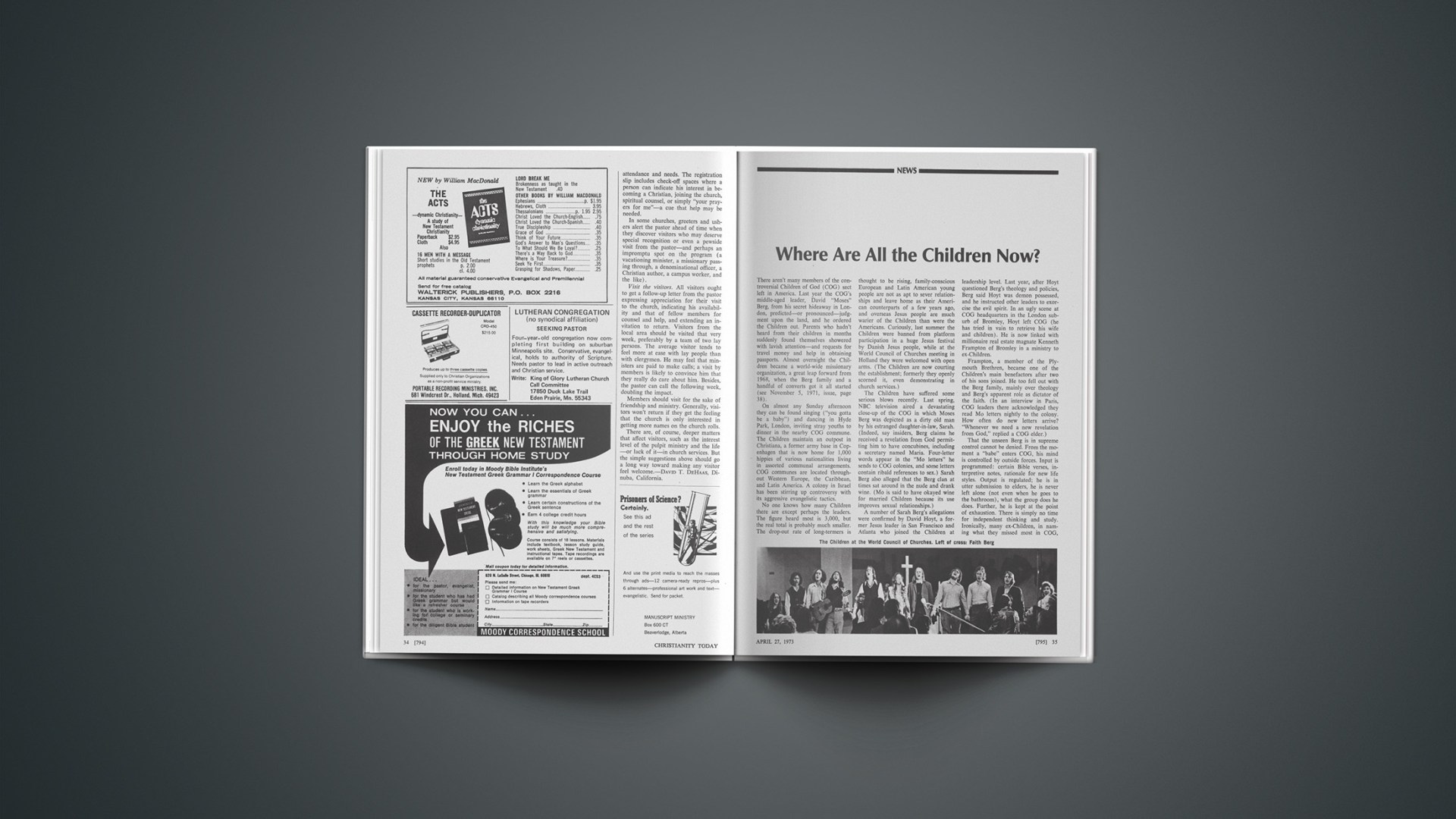
Apple PodcastsDown ArrowDown ArrowDown Arrowarrow_left_altLeft ArrowLeft ArrowRight ArrowRight ArrowRight Arrowarrow_up_altUp ArrowUp ArrowAvailable at Amazoncaret-downCloseCloseEmailEmailExpandExpandExternalExternalFacebookfacebook-squareGiftGiftGooglegoogleGoogle KeephamburgerInstagraminstagram-squareLinkLinklinkedin-squareListenListenListenChristianity TodayCT Creative Studio Logologo_orgMegaphoneMenuMenupausePinterestPlayPlayPocketPodcastRSSRSSSaveSaveSaveSearchSearchsearchSpotifyStitcherTelegramTable of ContentsTable of Contentstwitter-squareWhatsAppXYouTubeYouTube