The Refiner’s Fire: Art: Sleeping Saviours and Apollonian Christs

The two centuries from 1700 to 1900 in America were marked by great religious activity. Denominations were being transplanted to America as Scotch Presbyterians, German Lutherans, English Methodists, Baptists, Episcopalians, and a host of other immigrants arrived with church traditions intact.

Joseph Smith founded the Mormon church, one of America’s indigenous religions, while Unitarianism was beginning its stealthy and surprisingly successful attack on Protestant orthodoxy. Roman Catholicism grew quickly through the surge of Continental emigration, and there were riots and intemperate press attacks on the newly arriving “papists.”

George Whitefield, Charles G. Finney, and Dwight L. Moody were among the great preachers who brought new vitality to American Christianity. Revivalism spread rapidly.

Midway in this period the American early missionary enterprise began. In the early 1800s Baptists, Presbyterians, Methodists, and Episcopalians founded missionary boards.

During these two centuries Christians were instrumental in founding the American Bible Society, the American Sunday School Union, the American Tract Society, the Women’s Christian Temperance Union, and the Abolitionist movement.

Slavery was a heated question, and white Christians lined up on both sides while black Christians poured out their frustrations in spirituals like “Deep River.”

And as the period drew to a close, fundamentalist William Jennings Bryan won the Democratic nomination for the presidency on the strength of his “Cross of Gold” speech.

Curiously, this religious hurly-burly is not reflected by the religious fine art of the period—if the collection put together under the auspices of the Graduate Theological Union at Berkeley is representative.

The exhibit, which had a recent stand at the Smithsonian Institution’s National Collection of Fine Arts in Washington, D. C., is the brainchild of Jane Dillenberger, the union’s associate professor of theology and the arts.

We might have hoped the artists would leave us a record of religious profession and practice that would help us better to stand in the brogans of our spiritual forebears. Something to help us feel the frenzy that sometimes characterized the revival meetings—some Daumier-like insights into the inconsistencies between profession and practice that characterize every age of the Church.

And how refreshing it would have been to find the collection something that would strengthen the faith of the twentieth-century viewer.

Instead, we are presented with an exhibit of biblical scenes that tell us little of the religion of that period and that generally fail to speak across the age gap.

The most striking pieces in the collection are the works of Robert Loftin Newman (1827–1912), Henry Ossawa Tanner (1859–1937), and Edward Hicks (1780–1849).

Madonna and Child in a Landscape and The Good Samaritan, two small oils, are Newman’s best works. Both have a dim-lit, nebulous quality reminiscent of the paintings of Albert Ryder, yet they are more life-like than some of the more photographic representations in the exhibit. In Madonna a real woman holds a real child who gestures in typical childlike abandon.

Newman heightens the contrasts in the story of the Good Samaritan by making the injured man young and the Samaritan old. The old man leans over the prone figure of the victim apparently holding a cloth to one of his wounds while his donkey hovers disinterestedly in the background. Newman has drawn attention to the act by making the cloth the only white element in a murky twilight scene. He effectively conveys that this is an act of great compassion.

Sadly, the painter of these two moving paintings died an apparent suicide in New York in 1912, an unknown pauper.

Henry Tanner, a fourth-generation American of Negro extraction, offers an annunciation scene in which a frightened and puzzled young Jewish girl dressed in an oversized gown sits on the side of a ragged bed. The viewer, too, is puzzled, and afraid of such reality.

The exhibit includes three paintings from the charming Peaceable Kingdom series of Edward Hicks. In each, Hicks, a devout Quaker, shows the Quaker fathers landing on the shore of a peaceable kingdom inhabited by nonferocious leopards and lions fraternizing with placid sheep and cattle—a land governed by small children.

Hicks thought the art of painting was of little importance, “one of those trifling, insignificant arts which has never been of substantial advantage to mankind.” C. S. Lewis reflects this same thought when he says, “I think we can still believe culture to be innocent after we have read the New Testament; I cannot see that we are encouraged to think it important.”

Perhaps because art is in the right perspective, Hicks’s peaceable kingdom, like the kingdom of Narnia, is an inviting place.

Thomas Eakins, whose Crucifixion is cited in the notes on the exhibit as the most important American crucifixion painting, presents an unmarked Christ peacefully asleep on the cross.

America’s first professional sculptor, Horatio Greenough, is represented by three competent but uninspired works. His bust of Christ shows a heroic Apollo with well brushed locks and neatly trimmed beard.

Naturally, most of the work in the exhibit seems dated. No modern viewer is likely to respond to Washington Allston’s slick, stagey Prophet Jeremiah Dictating to his Scribe Baruch as a contemporary commentator did: “I wish I felt at liberty to tell Mr. Allston how grateful I am to him for having shown me one of the prophets of old, and for having sent me away a more thoughtful and religious man.” The melodramatic, theatrical look vaguely embarrasses the modern viewer.

The failure of most of these works to speak to the viewer today should remind us of how culturally conditioned we are and how restrained our judgment of Christians in other times and places should be.
What Lutherans Think and Do

What Lutherans Think And Do

A Study of Generations: Report of a Two-Year Study of 5,000 Lutherans Between the Ages of 15–65: Their Beliefs, Values, Attitudes, Behavior, by Merton P. Strommen, et al. (Augsburg, 1972, 411 pp., $12.50), is reviewed by Erling Jorstad, professor of history, St. Olaf College, Northfield, Minnesota.

This book is a major breakthrough for an informed understanding of Christianity in contemporary America. It is the result of a 740-question survey conducted in 1970 among 4,745 Lutherans throughout the United States on every conceivable phase of their “religious life.” Both laity and clergy were represented, and equal weight was given to the various age groups (hence the title, “A Study of Generations”), and to the three largest Lutheran bodies, the Lutheran Church in America, the Lutheran Church-Missouri Synod, and the American Lutheran Church. For the first time we have an astoundingly broad and deep insight into the values, beliefs, attitudes, and behavior of this religious family, which in its three largest bodies has some six million American church members. No other denomination has made so comprehensive a study.

The work was financed by a Lutheran insurance company, and the principal research was planned and executed by four scholars trained in behavioral science and opinion research; three of them are also Lutheran clergymen. They were aided by several dozen consultants and advisors. The work offers specialists in this field a valuable case study of model scholarship Using sophisticated research techniques. Any subsequent denominational study of such scope will have to come to terms with its precise methodology, explained both in professional jargon for the expert and in general terms for the average reader.

On another level, the book shows that such research can help destroy old stereotypes that Lutherans and non-Lutherans may have held about themselves—such as clannishness, and wide doctrinal differences among the alleged “conservative,” “moderate,” and “progressive” factions of the three bodies. The evidence simply shows that these and some other conceptions are not so. At the same time, other general impressions are now substantiated by the data: Lutherans do tend to be more Republican than Democratic, more white than blue collar, and more willing to base their interpretation of Christianity on the traditional Lutheran law-gospel dichotomy than are members of other mainline Protestant groups.

The candor and forthrightness of the questions and the willingness of the research team to publish all the answers suggests that denominations are now willing to expose their own shortcomings in public rather than trying to keep a slickly devised camouflage over that which is embarrassing. The survey reports on the incidence among Lutherans of seeing X-rated movies, engaging in deviant sexual practices, and using narcotics. In the study “Biblical ignorance,” 32 per cent said Deuteronomy was an Old Testament prophet.

In a masterful chapter, this reviewer’s favorite, the authors capture the essence of “Lutheran piety” and lay bare its essential teachings and practices. Surely, similar studies of the indigenous nature of other denominations would be of equally great value. The researchers also put to rest the older claim by some behavioral scientists operating in opinion research that Christians are more anti-Semitic than are non-Christians in America.

Readers of this magazine would be especially interested in the summaries of the questions on “Liberalism-Fundamentalism,” “Individual Christian Responsibility” and “Church Involvement in Social Issues” as well as questions and answers on glossolalia, pre-millennialism, the substitutionary atonement and related doctrines. The results, which will surprise many, are of great value in documenting now precisely what a very wide section of Lutherans really do believe and practice. Such knowledge can only help improve communication in this year of special concern for evangelism as Key 73 embraces Christians of all denominations.

The four authors conclude with excellent advice for Christian educators, pastors, and theologians. They point to areas where a good deal more formal attention is needed to correct misinformation they uncovered on subjects like foreign missions and the dual nature of Jesus as God and man. They show beyond any reasonable doubt the existence of a generation gap, and they suggest what the future generation expects from its churches. Such information will be of great help not only to Lutherans but also, since this body shares socio-economic characteristics and many doctrinal loyalties with other Protestant bodies, to all those who seek to know with precision what those who count themselves Christians in this country really do believe.

IN THE JOURNALS

An irregularly appearing evangelical journal, Inter-View, seeks to provide a forum for developing Christian leadership with a global perspective. The latest issue (Fall, 1972) includes articles and dialogues from Korea, Switzerland, India, and Japan as well as the states. (Box 276, Houghton, N. Y. 14744; $2.50/copy.)

Book Briefs: April 13, 1973

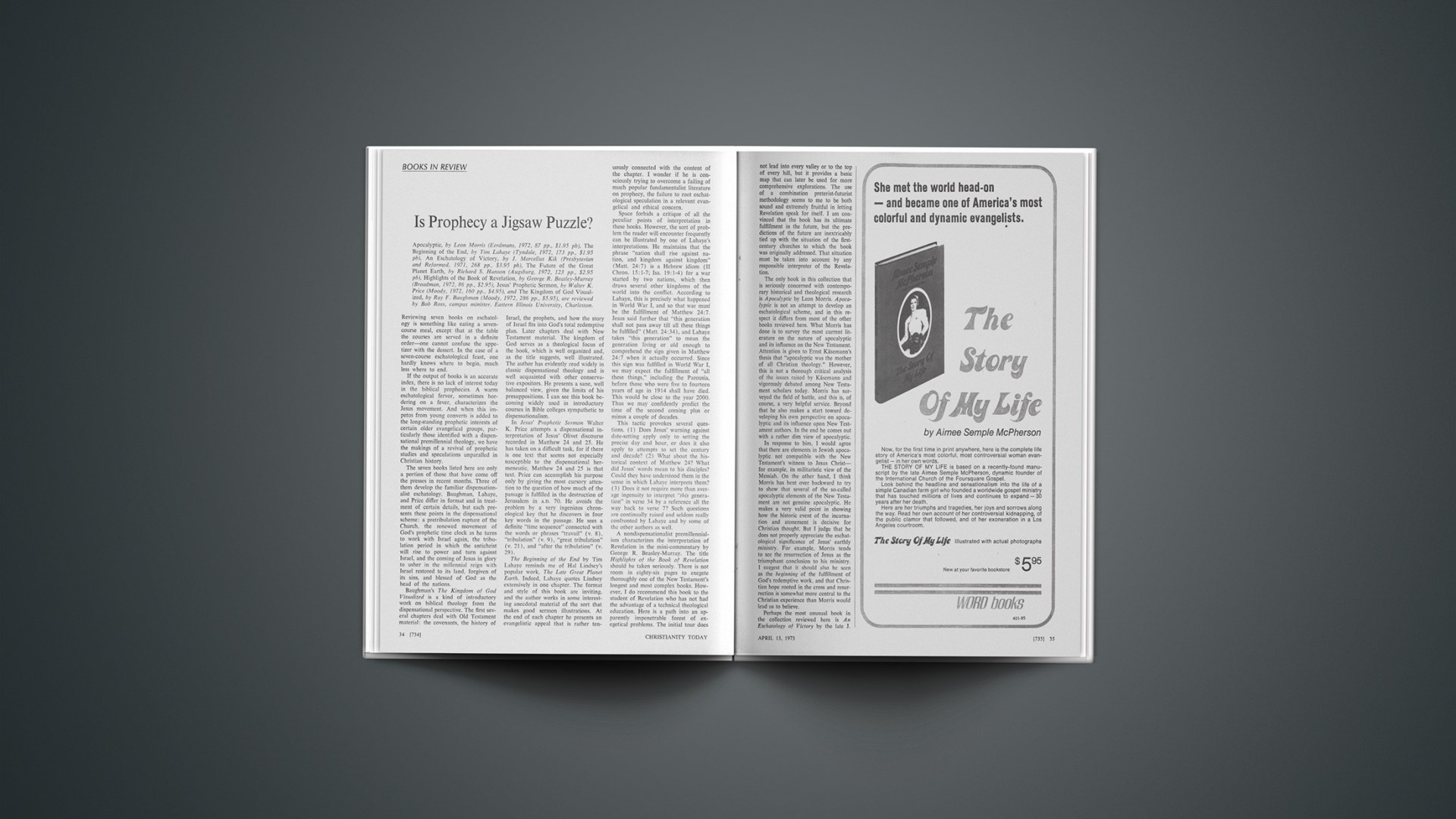
Apocalyptic, by Leon Morris (Eerdmans, 1972, 87 pp., $1.95 pb), The Beginning of the End, by Tim Lahaye (Tyndale, 1972, 173 pp., $1.95 pb), An Eschatology of Victory, by J. Marcellus Kik (Presbyterian and Reformed, 1971, 268 pp., $3.95 pb), The Future of the Great Planet Earth, by Richard S. Hanson (Augsburg, 1972, 123 pp., $2.95 pb), Highlights of the Book of Revelation, by George R. Beasley-Murray (Broadman, 1972, 86 pp., $2.95), Jesus’ Prophetic Sermon, by Walter K. Price (Moody, 1972, 160 pp., $4.95), and The Kingdom of God Visualized, by Ray F. Baughman (Moody, 1972, 286 pp., $5.95), are reviewed by Bob Ross, campus minister, Eastern Illinois University, Charleston.

Reviewing seven books on eschatology is something like eating a seven-course meal, except that at the table the courses are served in a definite order—one cannot confuse the appetizer with the dessert. In the case of a seven-course eschatological feast, one hardly knows where to begin, much less where to end.

If the output of books is an accurate index, there is no lack of interest today in the biblical prophecies. A warm eschatological fervor, sometimes bordering on a fever, characterizes the Jesus movement. And when this impetus from young converts is added to the long-standing prophetic interests of certain older evangelical groups, particularly those identified with a dispensational premillennial theology, we have the makings of a revival of prophetic studies and speculations unparalled in Christian history.

The seven books listed here are only a portion of those that have come off the presses in recent months. Three of them develop the familiar dispensationalist eschatology. Baughman, Lahaye, and Price differ in format and in treatment of certain details, but each presents these points in the dispensational scheme: a pretribulation rapture of the Church, the renewed movement of God’s prophetic time clock as he turns to work with Israel again, the tribulation period in which the antichrist will rise to power and turn against Israel, and the coming of Jesus in glory to usher in the millennial reign with Israel restored to its land, forgiven of its sins, and blessed of God as the head of the nations.

Baughman’s The Kingdom of God Visualized is a kind of introductory work on biblical theology from the dispensational perspective. The first several chapters deal with Old Testament material: the covenants, the history of Israel, the prophets, and how the story of Israel fits into God’s total redemptive plan. Later chapters deal with New Testament material. The kingdom of God serves as a theological focus of the book, which is well organized and, as the title suggests, well illustrated. The author has evidently read widely in classic dispensational theology and is well acquainted with other conservative expositors. He presents a sane, well balanced view, given the limits of his presuppositions. I can see this book becoming widely used in introductory courses in Bible colleges sympathetic to dispensationalism.

In Jesus’ Prophetic Sermon Walter K. Price attempts a dispensational interpretation of Jesus’ Olivet discourse recorded in Matthew 24 and 25. He has taken on a difficult task, for if there is one text that seems not especially susceptible to the dispensational hermeneutic, Matthew 24 and 25 is that text. Price can accomplish his purpose only by giving the most cursory attention to the question of how much of the passage is fulfilled in the destruction of Jerusalem in A.D. 70. He avoids the problem by a very ingenious chronological key that he discovers in four key words in the passage. He sees a definite “time sequence” connected with the words or phrases “travail” (v. 8), “tribulation” (v. 9), “great tribulation” (v. 21), and “after the tribulation” (v. 29).

The Beginning of the End by Tim Lahaye reminds me of Hal Lindsey’s popular work. The Late Great Planet Earth. Indeed, Lahaye quotes Lindsey extensively in one chapter. The format and style of this book are inviting, and the author works in some interesting anecdotal material of the sort that makes good sermon illustrations. At the end of each chapter he presents an evangelistic appeal that is rather tenuously connected with the content of the chapter. I wonder if he is consciously trying to overcome a failing of much popular fundamentalist literature on prophecy, the failure to root eschatological speculation in a relevant evangelical and ethical concern.

Space forbids a critique of all the peculiar points of interpretation in these books. However, the sort of problem the reader will encounter frequently can be illustrated by one of Lahaye’s interpretations. He maintains that the phrase “nation shall rise against nation, and kingdom against kingdom” (Matt. 24:7) is a Hebrew idiom (2 Chron. 15:1–7; Isa. 19:1–4) for a war started by two nations, which then draws several other kingdoms of the world into the conflict. According to Lahaye, this is precisely what happened in World War I, and so that war must be the fulfillment of Matthew 24:7. Jesus said further that “this generation shall not pass away till all these things be fulfilled” (Matt. 24:34), and Lahaye takes “this generation” to mean the generation living or old enough to comprehend the sign given in Matthew 24:7 when it actually occurred. Since this sign was fulfilled in World War I, we may expect the fulfillment of “all these things,” including the Parousia, before those who were five to fourteen years of age in 1914 shall have died. This would be close to the year 2000. Thus we may confidently predict the time of the second coming plus or minus a couple of decades.

This tactic provokes several questions. (1) Does Jesus’ warning against date-setting apply only to setting the precise day and hour, or does it also apply to attempts to set the century and decade? (2) What about the historical context of Matthew 24? What did Jesus’ words mean to his disciples? Could they have understood them in the sense in which Lahaye interprets them? (3) Does it not require more than average ingenuity to interpret “this generation” in verse 34 by a reference all the way back to verse 7? Such questions are continually raised and seldom really confronted by Lahaye and by some of the other authors as well.

A nondispensationalist premillennialism characterizes the interpretation of Revelation in the mini-commentary by George R. Beasley-Murray. The title Highlights of the Book of Revelation should be taken seriously. There is not room in eighty-six pages to exegete thoroughly one of the New Testament’s longest and most complex books. However, I do recommend this book to the student of Revelation who has not had the advantage of a technical theological education. Here is a path into an apparently impenetrable forest of exegetical problems. The initial tour does not lead into every valley or to the top of every hill, but it provides a basic map that can later be used for more comprehensive explorations. The use of a combination preterist-futurist methodology seems to me to be both sound and extremely fruitful in letting Revelation speak for itself. I am convinced that the book has its ultimate fulfillment in the future, but the predictions of the future are inextricably tied up with the situation of the first-century churches to which the book was originally addressed. That situation must be taken into account by any responsible interpreter of the Revelation.

The only book in this collection that is seriously concerned with contemporary historical and theological research is Apocalyptic by Leon Morris. Apocalyptic is not an attempt to develop an eschatological scheme, and in this respect it differs from most of the other books reviewed here. What Morris has done is to survey the most current literature on the nature of apocalyptic and its influence on the New Testament. Attention is given to Ernst Käsemann’s thesis that “apocalyptic was the mother of all Christian theology.” However, this is not a thorough critical analysis of the issues raised by Käsemann and vigorously debated among New Testament scholars today. Morris has surveyed the field of battle, and this is, of course, a very helpful service. Beyond that he also makes a start toward developing his own perspective on apocalyptic and its influence upon New Testament authors. In the end he comes out with a rather dim view of apocalyptic.

In response to him, I would agree that there are elements in Jewish apocalyptic not compatible with the New Testament’s witness to Jesus Christ—for example, its militaristic view of the Messiah. On the other hand, I think Morris has bent over backward to try to show that several of the so-called apocalyptic elements of the New Testament are not genuine apocalyptic. He makes a very valid point in showing how the historic event of the incarnation and atonement is decisive for Christian thought. But I judge that he does not properly appreciate the eschatological significance of Jesus’ earthly ministry. For example, Morris tends to see the resurrection of Jesus as the triumphant conclusion to his ministry. I suggest that it should also be seen as the beginning of the fulfillment of God’s redemptive work, and that Christian hope rooted in the cross and resurrection is somewhat more central to the Christian experience than Morris would lead us to believe.

Perhaps the most unusual book in the collection reviewed here is An Eschatology of Victory by the late J. Marcellus Kik, who has given us what is an infrequently observed theological creature, a postmillennial eschatology. His book is divided into three sections. In the first, on historic reformed eschatology, he outlines the spiritual lineage of post-millennialism. In the second part he provides an interpretation of Matthew 24 that is 180 degrees from Price’s (see above). Whereas Price and other dispensationalists tend to make most of Matthew 24 future to our own time, Kik sees most of it—including the language about the coming of the Son of Man (v. 30)—fulfilled in the Jewish War of A.D. 70. In the third section he exegetes Revelation 20 along postmillennial lines. Interestingly, he sees the vision of the New Jerusalem (Rev. 21, 22) as part of the present Messianic kingdom, not the “consummate kingdom” (to use his words) that will follow the Parousia and Last Judgment.

NEWLY PUBLISHED

Common Bible: The Revised Standard Version with the Apocrypha/Deuterocanonical Books (Collins, $7.95, $4.95 pb). By adding certain writings from the intertestamental period, which Protestants do not consider canonical, the publishers have secured Catholic and Orthodox endorsement for this expanded “Bible.”

Landing Rightside Up in TV and Film, by G. William Jones (Abingdon, 128 pp., $1.75 pb). Creative approach to learning how audio-visual technology ought to be used in churches.

Healing and Christianity, by Morton T. Kelsey (Harper & Row, 398 pp., $8.95). A comprehensive, readable study of the preaching and practice of healing, from ancient and Old Testament times and the striking ministry of Jesus through the history of the Christian Church to the present. Argues cogently for a holistic view of man and for the place of Christian healing, especially with regard to recent thought in psychology, philosophy, and medicine. Impressive bibliography.

Covenant and Hope, by Eric C. Rust (Word, 192 pp., $5.95). A Christ-centered interpretation of Old Testament prophecy in Amos, Hosea, Isaiah, Jeremiah, and Ezekiel, and discussion of how it relates to Christians today. Informative and biblically sound.

God’s “Bad Boys,” by Charles Emerson Boddie (Judson, 125 pp., $4.95). Biographical portraits that honor eight outstanding black Baptist preachers: R. Barbour, J. Boddie, E. Estell, V. Johns, M. King, Jr., J. McNeil, J. Rose, and M. Shepard.

Women Priests: Yes or No?, by Emily C. Hewitt and Suzanne R. Hiatt (Seabury, 128 pp., $2.95 pb), and Women and Jesus, by Alicia Craig Faxon (Pilgrim, 126 pp., $4.95). Two good, different approaches on a woman’s role in God’s Kingdom. The first surveys the problems of women’s ordination in the Episcopal Church and provides good background material for anyone interested in this conflict. The second reviews New Testament women. Perhaps we’ve overlooked most of the biblical evidence.

Marriage Encounter, by Antoinette Bosco (Abbey, 128 pp., $4.95). The story of a Roman Catholic-sponsored attempt, now furthered by Protestants and Jews as well, to help married couples understand and talk about the spiritual and physical dimensions of their relationship. Marriage Encounter, which originated in Spain, offers impressive improvements over more common group-therapy or encounter-group experiments.

Dust of Death, by Os Guinness (Inter-Varsity, 419 pp., $7.95, $4.95 pb) A comprehensive overview of the prevailing culture and countercultures, together with an advocacy of biblical Christianity as the only satisfactory course. In the tradition of Francis Schaeffer.

The Little White Book, by Johannes Facius, Johny Noer, and Ove Stage (Harold Shaw Publishers [Box 567, Wheaton, Illinois 60187], 79 pp., $.75 pb). A pocket-size booklet for young people that speaks about problems of drugs, free love, homosexuality, and the occult. A great tool for personal evangelism.

The Great Second Advent Movement, by J. N. Loughborough (Amo, 480 pp., $23). A history of Seventh-day Adventism, originally published in 1905, by one who was firmly committed to the denomination.

The Monastic Achievement, by George Zarnecki (McGraw-Hill, 144 pp., $5.95). An expansion of a chapter by the same author in The Flowering of the Middle Ages; combines a history of monasticism with a history of monastic art. Very readable and beautifully illustrated, but too brief to serve as other than an introduction.

The Wounded Healer: Ministry in Contemporary Society, by Henri J. M. Nouwen (Doubleday, 104 pp., $5.95). A priest-psychologist creates a new model for the ministry, a minister who uses his wounds as a source of healing in a “shared confession of our basic brokenness.” A good emphasis, but the author fails to balance it with God’s solution.

A Theology of Liberation, by Gustavo Gutierrez (Orbis, 323 pp., $7.95). Apparently assuming the “unity” of mankind in universal salvation, Gutierrez is able to take over Marx’s and Marcuse’s concept of liberation, eulogizing the poor and oppressed as God’s instruments to end poverty and oppression. Assumes that Marxists and Christians share a common vision and task; eloquent but logically and historically soft.

Religious Experience: Its Nature and Function in the Human Psyche, by Walter A. Clark et al. (Charles Thomas [301 E. Lawrence Ave., Springfield, Ill. 62703], 151 pp., $7.95). Stimulating essays from a symposium on psychology and religion, held under the auspices of Fuller Seminary. Clark, professor at Andover Newton, follows William James’s thesis on the possibility and variety of religious experience within each person. Maloney, Daane, and Tippet (all from Fuller) respond from the Christian world view, and Clark has the final word.

Mysticism: Its Meaning and Message, by Georgia Harkness (Abingdon, 192 pp., $5.50). A helpful, clearly written discussion of mysticism, including mysticism in the Bible, plus a historical overview from early and medieval mysticism to present manifestations. Good introduction to the subject.

God and Man in Contemporary Islamic Thought, edited by Charles Malik (Syracuse University, 214 pp., $10). Twelve scholarly addresses (eight in English) given at a symposium at the American University of Beirut by distinguished government officials and religious leaders and thinkers from both East and West.

A Harsh and Dreadful Love, by William D. Miller (Liveright, 370 pp., $9.95). The story of the Catholic Worker Movement begun in the 1930s by Dorothy Day and others committed to radical Christian social idealism and communal living. Stimulating.

Christian Mortalism from Tyndale to Milton, by Norman I. Burns (Harvard, 222 pp., n.p.). Scholarly, well-written introduction that should be of particular interest to literary historians. Good background material for the study of seventeenth-century writing.

Vatican, U.S.A., by Nino LoBello (Trident, 237 pp., $6.95). A journalist tries to uncover the financial assets of Catholicism in America, presenting his findings so as to shock.

The Formation of the Christian Bible, by Hans von Campenhausen (Fortress, 342 pp., $10.95). A detailed, lucid study of the historical and theological process by which the present bipartite canon was formed. Concentrates on the concepts of Scripture and canonicity from Jesus’ time through the first Christian centuries, rather than on the mechanical data of how the Bible was put together.

Essays in the Philosophy of Religion, by H. H. Price (Oxford, 125 pp., $7.75). A revision of lectures delivered at Oxford in 1971. Psychical-research approach to problems in the philosophy of religion, such as prayer and life after death. Ingenious, sometimes humorous, overpriced.

God and Man, by Archbishop Anthony Bloom (Newman, 125 pp., $3.95). Few theologians can match Bloom’s curriculum vitae: exiled from Russia, a physician, member of the French underground, converted to Christianity, and now an Eastern Orthodox archbishop. He gives us some solid thinking on apologetics, prayer, and discipleship centered in the doctrine of the Incarnation.

The Analogy of Experience, by John E. Smith (Harper & Row, 140 pp., $6.95). Princeton Seminary has come a long way when 1970’s Warfield Lectures can be devoted to a downgrading of creedal belief and propositional truth in favor of attempting to understand Christian faith by interpreting hard-to-verbalize personal and community experience. An impressive presentation, but one that leaves unanswered some of the basic questions about content and “true truth.”

Tradition For the Future, by Mirrit Ghali (Alden Press [Osney Mead, Oxford, England], 288 pp., $9). A remarkably original contribution to the theory of society and government, seen from a broadly Christian perspective, by an Egyptian.

Insight, Authority, and Power, by Peter Schouls (Wedge [229 College St., Toronto 2B, Ontario, Canada], 46 pp., $1.95 pb). A clearly reasoned, thoroughly biblical (or shall we say Dooyeweerdian?) approach to three interrelated concepts and their practical meaning for church, home, and school.

George MacDonald, by Richard H. Reis (Twayne, 161 pp., $5.50). Primarily a semi-critical survey of MacDonald’s fiction (fairy tales, fantasies, and “realistic” novels). Consideration is given to MacDonald’s life, major ideas, and—as C. S. Lewis defined it—his “mythopoeic imagination.”

The Mystery of Christ and the Apostolate, by F. X. Durrwell (Sheed and Ward, 180 pp., $7.50). Beginning with an only slightly qualified conviction that everyone is saved, Durrwell manages to give some helpful thoughts on the nature of Christ and the Church, from which he derives a less persuasive argument for the necessity of evangelism.

To Win the West, by John Schermerhom, Samuel Mills, and Daniel Smith (Arno, 161 pp., $10). Reprints of three reports originally written in 1814–15 on the religious condition of what was then “the West” (i.e., beyond the Alleghenies).

The Cross and the Cries of Human Need, by Robert Howard Clausen (Augsburg, 127 pp., $2.95 pb). Using excerpts from six modern plays, the author explains the meaning of Christ’s death and resurrection. Modern man’s nihilism is contrasted with Christ’s solidity.

Liberty of Conscience, by L. John Van Til (Craig, 192 pp., $3.95 pb). Traces the Puritan roots of liberty of conscience from Elizabethan times up to the writing of the First Amendment. A well-documented study on a timely topic.

In some ways this is to me the most fascinating, even disturbing, book of the lot. Having been raised on dispensationalist fare and trained to refute the amillennialist, I hardly know what to do with the postmillennialist. For the stimulation this book will provide to most of us, premill and amill alike, I recommend it. Of course, its optimism over the progress of the Gospel in this present age as a means of bringing Christ’s rule effectively to the entire world will probably not convince many of us. And at least for the premills it will seem to etherealize some very earthly Old Testament prophecies. Indeed, apart from the old argument about spiritual versus literal interpretations of the prophecies, there is a growing consensus that much of pietistic Protestantism has overlooked the holistic character of divine redemption. God loves and redeems man body, soul, and spirit. And Kik’s attempt to tell us that our concept of the millennial blessings is too materialist does not quite hit the target.

The Future of the Great Planet Earth by Richard S. Hanson is a reaction to—you guessed it—Lindsey’s The Late Great Planet Earth. Of all the books reviewed here, this one has the least to offer the evangelical reader—or any other kind of reader. (This is not to say that The Late Great Planet Earth is beyond criticism; I personally find it unreliable and offensive in several ways.). Hanson does make a few good points—for example, in showing how prophecy is much more than prediction of the future. However, he overreacts, and in downplaying the predictive element in prophecy he leaves the reader wondering whether the Bible tells him anything about God’s plans for the world. One might call this a diluted idealistic amillennialism. For example, about the most Hanson can tell us of the coming of God’s kingdom is that it “always comes.” And the fulfillment of prophecies like that of Gog and Magog (Ezek. 38, 39) has “always been with us and the war of the ages is quite likely being fought at all times.” So what else is new?

After finishing this seven-course prophetic meal, I am not sure whether I merely feel stuffed or am suffering from some indigestion. The experience provoked at least three serious questions. In the first place, I feel a concern that so much evangelical material published in this field is rather simplistic and unreflective. Each author has his own preconceived doctrinal stance and simply goes from that point. With the exception of Morris and to some extent Beasley-Murray, most of the authors reveal little acquaintance with recent studies that not only raise important eschatological issues, for example in the modern hope school, but also point the exegete to historical material that is extremely important to a responsible interpretation of the Bible. Despite constant reminders of the importance of a literal interpretation, often the author’s theological bias prevents him from letting the Bible speak for itself in terms of its own concerns expressed in its unique historical circumstances.

A second concern that some of this literature, particularly the dispensational sort, provokes is the use of prophecy to score hits on the bad guys—Russians, Chinese, Arabs, ecumenists, and moral reprobates—with very little in the way of a direct word to the conservative, Bible-believing Christian. Much of this literature smells of Pharisaism with occasional strong whiffs of nationalistic pride. The biblical prophetic critique spoke to the sins of the Gentile nations, to be sure. But the prophet as a man of God speaking within the covenant community was always concerned primarily about the spiritual life of the people within the covenant community.

I spoke recently with an Egyptian Christian who felt considerable agitation at the uncritical approval by Christians of Israel’s modern expansion. He believed that many of the developments since 1948 are indeed fulfillments of ancient prophecies, but he felt that American Christians were giving Israel a blank check morally speaking by viewing its political and military triumphs as a fulfillment of prophecy. It is clear that while a person or nation may fulfill a prophecy, if it does so without regard for the rights and needs of its neighbors it must answer to the God who hears the cries of the widow, the orphan—and the Arab refugee. Judas fulfilled prophecy and went to perdition doing so.

Finally, I have been forced to ask why we are having so much trouble coming up with a mutually agreeable interpretation of the last things. For example, among the books reviewed here there are at least two totally different interpretations of Matthew 24 and as many significant variations as there are commentators. When it comes to some doctrine like Christology or soteriology, evangelicals can produce a significant united front. But on eschatology we must surely be the laughing stock of unbelievers, at least those who read what we write on the subject.

There is, I believe, a fundamental methodological problem here that we have not confronted. To refer again to Matthew 24, which certainly causes as many problems as Revelation 20, we have all been proceeding on these two assumptions: (1) Jesus had a pretty clear idea about the course of future events, and (2) Matthew, or Mark or Luke, reports everything significant that Jesus taught on this subject. Are these assumptions self-evident? First, did Jesus have a clear vision of the entire future, including two thousand years of church history? Perhaps. But if he disclaimed knowledge of the day or the hour of the Parousia (Mark 13:32), it is not impossible to conclude that he may not have known other details. Second, do any of the evangelists give us any assurance that they are providing a comprehensive report of what Jesus taught? Indeed, do not the variations among the Synoptic Gospels warn us that none of them has it all, and that perhaps all of them together may have omitted extremely vital pieces of information, vital, that is, to a well developed eschatological scheme, although not vital to our spiritual life?

We have proceded on the assumption that God’s plans for the future are revealed in Scripture something like pieces of a giant prophetic jigsaw puzzle piled in a box. Our challenge is to sort out the pieces and put them together into a single picture with no spaces left open. If we come up with an arrangement that has an open space, we continue shuffling the pieces, perhaps surreptitiously dropping a few unwieldy ones on the floor and bending a corner here and there to get a fit.

But suppose we have only some of the pieces. Or suppose we have parts of the pieces to several different puzzles. That is, suppose that the variety of biblical material is expressive of different ways of depicting God’s plans for the future, much as different artists paint their own unique pictures of a single landscape.

At any rate, prophecy is not God’s crystal ball given to curious men. It is the proclamation of his sovereign, gracious will for all creation and his call to covenantal fidelity to the people who are called by his name and who are ready to follow him without knowing in advance where they are going. “Hope that is seen is not hope” (Rom. 8:24). The Church today needs prophecy more than ever, not only to berate the heathen or to satisfy idle curiosity but to stir up dissatisfaction with its own situation in Ur, Egypt, Babylon, or the suburbs of Chicago, and to fire up lukewarm hearts with a vital hope in God’s glorious future world, to be made known at the appearance of our Lord Jesus Christ.

The Watergate Wrangle

The Watergate Wrangle

Every administration is plagued by the misdeeds of some of its appointees to public office. Harry Truman felt the lash of scandal in the case of the deep freezes; Eisenhower was caught up in the scandal that sent Sherman Adams home in disgrace; Lyndon Johnson had the shadow of the Bobby Baker case hanging over his head. Now President Nixon is squeezed in the middle of the Watergate debacle. And debacle it is.

At stake are moral and ethical issues that cannot be overlooked. Citizens have a right to expect their government to act uprightly. When public figures breach the common canons of conduct, every citizen should be morally outraged. No stone should be left unturned to bring the culprits to justice.

We will accept at face value the claim of the President that he was not personally involved in the sordid Watergate affair. But now that he knows of its existence and is aware of the names of those who have already been tried and found guilty, and probably of others who have not yet been brought to justice, his duty is clear. It is Mr. Nixon’s solemn responsibility as President and as a Christian to see that the matter is thoroughly and fully investigated, that executive privilege is waived so that the facts can be uncovered, and that the full weight of the judicial processes is employed to guarantee that justice is done.

Mr. Nixon has one other responsibility. He should purge his administration of all who have been involved in this squalid affair. In this way people everywhere will know that his administration will not put up with this sort of thing, and even more, that he himself has taken a stand for ethical and moral principles that have suffered so greatly because of Watergate.

Any failure by Mr. Nixon to act and to act promptly can only lead to the conclusion that there is something he wishes to keep hidden, and justify the caustic comments of his severest critics. He owes it to his friends and supporters to clean the slate. As Shakespeare said, “Lilies that fester smell far worse than weeds.”

Bodily Exercise Profiteth

Although St. Paul disdained “bodily exercise” in the pursuit of spiritual gain (1 Tim. 4:8), recent weeks have brought some spectacular evidence that bodily exercise profiteth indeed in the financial realm. We have heard of two-million-dollar contracts in professional hockey and basketball and, most fantastic of all, of multi-million-dollar promotion deals showered on America’s maximum gold medalist from the blood-drenched 1972 Olympics.

Of course, million-dollar contracts are the exception. Even hundred-thousand-dollar ones do not come to everybody. What of the countless also-rans, from those who went to the Olympics but did not win, through the unsuccessful candidates at the trials, through the long list of all those who sweat and strain at one sport or another, right down to the noon-time joggers huffing and puffing around the Ellipse behind the White House? Bodily exercise brings them no great financial gain, and except for a few near the top, none of them is under any illusions about it. But apparently there is some satisfaction, and perhaps a measure of self-control, to be gained from “pummeling the body and subduing it,” as Paul puts it. In any case, every spring the pummeling and subduing takes on fresh enthusiasm.

Sex Rights And Wrongs

One major challenge now facing our society is that of giving each sex its due rights while at the same time affirming that men and women are not altogether interchangeable. The problem for women is not so much unequal laws as unequal treatment. Whether a constitutional amendment is the right kind of corrective is open to debate.

If “equal” means “same,” then we doubt that the proposed twenty-seventh amendment to the Constitution, the so-called Equal Rights Amendment now before the states for ratification, is adequate. It is, in a word, simplistic. It merely guarantees that “equality of rights under the law shall not be denied or abridged … on account of sex.”

Proponents of the ERA see it as a short-cut to achieving a higher social role for women. To be sure, it may give the feminist cause a temporary psychological boost. But even if three-fourths of the state legislatures (thirty-eight) ratify it, a whole new set of laws will have to be enacted, followed no doubt by extensive test litigation. Legislative and judicial processes to remedy existing injustices could be brought about without the liabilities of an overly simplistic constitutional amendment.

Given the current sex revolution, many aspects of which run contrary to Christian ethics, the proposed amendment deserves special scrutiny. Technically, its wording is so sweeping that it could be used to support homosexual marriage, for example, or to eliminate sexual differentiation of public lavatories, dressing rooms, and dormitories. This would, we feel, infringe upon Christian moral rights. Although supporters of the amendment argue that laws will not be nullified if they are based on unique characteristics of either sex—such as rape or childbirth—there is no guarantee in the wording that this will be so.

Churches are debating the role of women in ecclesiastical structures. The challenge here is to upgrade women’s roles consonant with scriptural principles (women have undeniably been discriminated against in the churches; see the editorial, “First at the Cradle, Last at the Cross,” March 16 issue, page 26). But if the ERA passes, the churches’ decisions will be made for them. Women might have the right to claim any position, biblical principles and church policies notwithstanding. This could open the door wide to nullification of the constitutional guarantee of freedom of religion (which would include the right of churches to deny ordination to women) and bring the government and the courts to a place where the historic doctrine of separation of church and state would no longer inhere. A seminary, for example, could be denied recognition for the GI bill unless it recruited women. A denomination could be denied any military chaplains unless it sponsored otherwise qualified women.

THE PROPOSED EQUAL RIGHTS AMENDMENT TO THE UNITED STATES CONSTITUTION

Section 1. Equality of rights under the law shall not be denied or abridged by the United States or by any State on account of sex.

Section 2. The Congress shall have the power to enforce, by appropriate legislation, the provisions of this article.

Section 3. This amendment shall take effect two years after the date of ratification.

The Apostle Peter’s admonition to husbands applies remarkably well in the contemporary scene. He told them to honor their wives because they are the weaker sex, and also, interestingly enough, because they are “heirs just as much as you to the gracious gift of life” (1 Pet. 3:7, New American Bible). You may want to read “weaker” as “different” in the secular context, but the principle will still remain. It affords women all they deserve as human beings, while at the same time recognizing distinction between the sexes.

Men are now subject to certain restrictions because they are men, and women because they are women. In the best interests of both, let’s keep it that way.

Christians And Political Bias

The increasing politicizing of the National and the World Council of Church was underscored again last month in their sponsoring a tour of the United States by thirteen third-world “churchmen.” The group represents an intensely partisan, anti-institutional viewpoint, and their thinking has had, in the words of an NCC spokesman, “a considerable impact upon Christian theology in their own countries and thus upon the World Council.” All are advocates of a “theology of liberation.”

What should continue to amaze the WCC-NCC constituency is that “liberation” is applied so selectively. Has either council ever offered any material support for Christians whose religious freedoms are curtailed in the Soviet Union, in consideration of the fact that a number of these belong to member churches of the World Council?

And was any word of concern expressed last month when the government of Afghanistan seized the only Christian church in the country, deported the pastor, and threatened to demolish the building (see March 30 issue, page 5l)?

Calling Some Men Somewhere

Discomfited by the increasing number of Jews who are accepting Jesus, and exasperated by what may look like a massive blitz to make America Christian, many Jews have reacted with indignation and dismay to Key 73 and its aim, “Calling our continent to Christ.” This reaction has produced a corresponding anxiety among Christians, including many of those participating in Key 73, who fear that the whole task of proclaiming Christ to the unconverted is in danger of getting bogged down in interfaith controversy.

In view of this, evangelist Billy Graham sought to clarify the purpose of Key 73: “to call all men to Christ without singling out any specific religious or ethnic group” (see March 16 issue, page 29). This is quite consistent with the statement made by Paul the Jew to the Gentile Athenians: “The times of ignorance God overlooked, but now he commands all men everywhere to repent” (Acts 17:30). Nominal Jews and adherents of other religions should not be singled out for evangelistic attention any more than nominal Christians should be exempted from it.

At the same time, certain nominally Christian groups, including, apparently, the Key 73 Task Force of the Southern California-Arizona Conference of the United Methodist Church, have rewritten the project’s mandate to apply only to “those of our Continent who are not actively related to any of the religious organizations in our society.” In a February 6 press release this task force tells us, “Any assumption that those of other religious traditions are without a meaningful faith is arrogant and presumptuous.”

It would seem neither arrogant nor presumptuous but simply a matter of drawing attention to the obvious to state that many adherents of all religious traditions in America “are without a meaningful faith.” Indeed, as these Methodists suggest—and their letter makes it more evident than perhaps they realize—“there are plenty of prospects for conversion” among those who are officially Christian. But are we to limit the call to Christ to those who are of some Christian tradition but whose faith is not “meaningful”—in other words, to those who have already been called but have not answered?

Believing Christians know that denominational or national ties with Christianity are meaningless as an indication of individual spiritual life. How ridiculous to suggest that traditional or ethnic ties with some other great religious tradition make a confrontation with the Gospel of Jesus Christ superfluous. On this level alone, the promise to abstain from appealing to those “of other religious traditions” is an absurdity.

But even where the adherent of a non-Christian religion is committed to his tradition and finds his faith subjectively meaningful, the Christian is still required to proclaim Christ to him. As Paul himself said, we are “under obligation both to Greeks and to barbarians, both to the wise and to the foolish … to the Jew first, and also to the Greek” (Rom. 1:14, 16).

To respect others’ rights to choose for themselves and come to different conclusions from ours is one thing. To suggest that we have no duty or no right to proclaim Christ to all people, but are to confine the call to “selected” nominal Christians, is quite another. It represents a complete misunderstanding of the nature of the Gospel, which is “the power of God unto salvation, to the Jew first, and also to the Greek.”

Apartheid Takes A Back Seat

South Africa underwent a new experience last month. Billy Graham made his first preaching appearance there, and the South Africans met the condition he has laid down for preaching in any country: that the people who come to hear him be seated as they please, whatever their racial background. The crowd of 45,000 that assembled at King’s Park Rugby Stadium in Durban was about half white and half non-white (news media had reported that day Graham’s announced opposition to the government’s apartheid policy).

Billy Graham has never participated in racial demonstrations, and some have criticized him for his reticence at this point. Unfortunately, many do not know that he has insisted on non-segregated audiences, and that in some of his meetings in the American South he, in an unheralded way, pioneered in this respect. Quietly and unobtrusively this Southern evangelist has succeeded in breaking down walls that churchmen more outspoken about civil rights have failed to crack.

Newsmen in Durban said the crowd at his first meeting was the largest multi-racial group ever assembled in South Africa. Never before? had there been integrated seating in that stadium. It was an event that proved to be a heartwarming answer to prayer as well as a tribute to Billy Graham’s integrity and perseverance. The most beautiful part, however, was that more than 3,300 walked forward to indicate decisions for Christ.

To The Pulling Down Of Strongholds

The siege at Wounded Knee in South Dakota is a grim reminder of the treatment the Indians received at the hands of those who settled the Americas. Probably few Americans would deny that the Indians have been abused. But history often is irreversible; it is impossible for the United States, as well as for Canada and the Latin American states, to give the land back to the Indians.

The incident did focus the attention of the nation on the Indians’ plight. The use of force was quite consistent with the revolutionary spirit prevalent in the world today. The Indian incident and the view of some Christians that force is a legitimate means of redressing grievances led us to reflect a bit on what the disciples of Jesus did about the oppression they experienced after Pentecost.

Jesus’ followers went everywhere, fearlessly preaching the Gospel. As a result they were often persecuted and prosecuted. In the early chapters of the Acts of the Apostles, the disciples suffered at the hands of the Jewish authorities. Stephen was stoned to death. Before that, Peter and John were brought before the Sanhedrin and commanded not to preach the Gospel; they told the Sanhedrin that they could not refrain from relating what they had seen and heard. Then the disciples were imprisoned on the initiative of the Sadducees, but God opened the iron gates. They preached, were seized again, and were finally set free.

After Stephen was stoned, the disciples left Jerusalem to go to Antioch and farther afield. Meanwhile Herod put Peter in prison, but God delivered him. In Macedonia (Acts 16) Paul and Silas were thrown in jail but released. At Thessalonica they had trouble with the police again. At Corinth the Jews brought Paul before Gallio without success. At Ephesus there was a riot at the theater where Paul was to preach. Later, as recounted by Luke in the Acts of the Apostles, Paul appeared before various tribunes and others, including Felix, Festus, and Agrippa.

The disciples engaged in no sabotage, seized no buildings, destroyed no property. Prosecuted and persecuted, having injustice heaped upon injustice, they bore it without complaint and without breaking the law. Luke the historian is very “careful to point out that the Christians were not enemies of the Empire: every time the missionaries were brought before Roman authorities they were absolved of all charges of sedition and insurrection” (Harper Study Bible, p. 1,625).

When Jewish dissidents used force against Roman oppression, Rome used greater force in response. The sack of Jerusalem in A.D. 70 by Titus and Vespasian was a response to sedition and insurrection. Roman oppression of the Jews under Trajan and Hadrian led to another insurrection in A.D. 132–135; Bar-Cochba and his forces were defeated, more than half a million Jews were slain, thousands were sold into slavery, and nearly all Palestine was laid waste.

But the disciples of Jesus took the road of peace. They recognized that the weapons of the Christian are not carnal but spiritual (2 Cor. 10:4). Although the Jews never succeeded in defeating Rome by force, the Christians accomplished it by peaceful means. For them, sedition and insurrection were not the answer to oppression.

Ideas

Who Can Believe the Resurrection?

For many a modern man, the Resurrection is incredible. What to the Christian is the central event of human history is to his secular counterpart the most controversial. To argue that a man—even one who claimed to be God manifest in human flesh—could rise from the grave runs sharply against the grain of widely accepted scientific principles.

Unfortunately, Christians often disdain those who are conscientiously skeptical of the biblical accounts of the Resurrection. Instead of brushing off the objections, Christians need to learn to handle them intelligently and lovingly, realizing that given the modern mind-set disbelief is understandable. Although such doubts are satanically inspired, the one who expressed the doubts is likely to be wholly unaware that his is a prejudiced view, gradually built up in him through the prevailing thought patterns. His mind has been shaped in such a way that he is naturally dubious of the possibility of a return from the dead.

In the non-Communist lands of the West, no one, of course, openly requires that we deny the Resurrection. The pressures are a lot more subtle, and over the long haul may be more effective. Communist governments subsidize propaganda that discounts biblical signs and wonders on the grounds that these are not scientifically explainable and must therefore be fiction. And a similar priority is assigned to scientific findings in the free world, though not so overtly. The conditioning process, in public education and in scholarly circles, operates under the guise of “objectivity.” Children are not taught to scoff at the Resurrection. But since this central event is simply ignored, the child most likely either concludes it must not be very important or assigns it some kind of optional reality in a religious realm severed from actual history. Literal acceptance becomes intellectually difficult. Although little can be done in the short haul to correct this societal bias, appreciating its existence enables the Christian to temper his criticism of the scoffer.

Biblical truth does not contradict true science. Indeed, because so much of the Bible is history, it shares with so-called scientific knowledge the standard of empirical verification. It does not regard sense data as ultimate, as many scientists do, but sees this information as a valid category in the determination of reality.

Sometimes Jesus is pictured as being angry at “doubting Thomas” for his prove-it demands. But actually Jesus honored those doubts: he allowed Thomas to resolve them as he wished, by looking at the print of the nails and placing his fingers on their mark.

If the demand for tangible evidence is extended to all of human experience, one ends up with relatively little that can be justified. The further science goes out on a philosophical limb, the more people are realizing this. The growing popularity of existentialism is a sign of man’s realization of the inadequacy of sense-data explanations. Sadly enough, existentialism is a greater threat to Christian truth than is empiricism; it has no biblical warrant whatever.

Existentialism allows for a resurrection in a sense, but only as each person validates it for himself. There is, in other words, no common reality worth talking about. The Bible becomes entirely subjective. As history it is reduced to a shambles. All of reality becomes “spiritualized,” and meaning is what each observer makes it.

Can anyone really take this approach seriously? For the answer, one need only note the popular fascination with the mysterious anthropologist Carlos Castaneda, who is emerging as the most unscientific scientist ever. His writings leave librarians puzzled as to whether to classify them fiction or non-fiction. Never mind, implies this existentialist author, there are different orders of truth.

Castaneda’s epistemology might almost be a joke, except that existentialist theologians toy with biblical truth in similar ways!

Evangelical Christianity insists upon common reality. Beginning with the Resurrection it invites empirical investigation and bids the inquirer to believe on the basis of the evidence. Five years ago CHRISTIANITY TODAY carried an essay on the Resurrection by one of the world’s leading lawyers, Dr. J. N. D. Anderson, who on the basis of the strictest standards of legal evidence argued for Christ’s conquest of death. This year, we invite inquirers to consult an impressive new work by Dr. Paul L. Maier, professor of ancient history at Western Michigan University. In the book, First Easter, Maier draws upon the latest research and, after sifting it by a professional historian’s methods, opts for the conclusion that there was indeed a “missing-body problem that Sunday morning.”

Jews Find the Messiah

A remarkable spiritual development is the growing number of Messianic Jews. Although many Jewish believers are high school and university teenagers, the number of adults is equally impressive. In Philadelphia alone, Jews who believe that Jesus of Nazareth is the Messiah of Old Testament promise—even now alive and accessible to his disciples—number between 200 and nearly 1,000, depending upon whether one speaks only of the inner city or of Greater Philadelphia.

The flock is multiplying in other parts of the nation also. On the East Coast and West Coast alike, some rabbis are distressed by synagogue-attending worshipers who insist that Jesus is Messiah. Some high school Bible-study groups are now attended by as many young Jews as Gentiles.

This phenomenon has evoked extreme, even reactionary statements by some Jewish spokesmen against evangelical Christians, including efforts to discredit Key 73 as anti-Semitic even before the nationwide evangelistic venture got underway. In a calculated attack, Rabbi Marc Tanenbaum, inter-religious-affairs director of the American Jewish Committee, scathed Key 73—a cooperative effort of 140 denominations and agencies—as an opening for anti-Semitic feeling, “an assault on the honor, dignity, and truth of Judaism.”

Reference to evangelicals in the same context with Hitler and anti-Semitism so shocked numbers of evangelical leaders that Jewish-evangelical understanding may have been impaired. Many evangelicals felt that a wolf-cry of anti-Semitism was being sounded forth in an effort to disarm and discredit legitimate evangelism; some felt that what the Jewish Defense League identifies as instances of anti-Semitism will henceforth be regarded with initial skepticism. The most negative reading was that while the JDL properly keeps alive the idea of the wickedness of anti-Semitism, piggybacking Key 73 to do so was opportunistic at a time when tensions abroad had eased, and that it ran the risk of defaming evangelicals.

But the issues were not that simple. Although evangelicals were disconcerted by propagandistic attacks they feared would not be quickly undone, many were grateful that Tanenbaum had made evangelical interest in Jewry a national issue. Tanenbaum counseled Christians to “cultivate your own garden before undermining a garden cultivated by others.” The fact is, however, that evangelical Christians wholly approve any JDL effort that would restore American Jewry to Judaism as a return to the Old Testament revelation. Many young Jews have become believers because they find no element of promise in Judaism apart from Messiah, and see the current emphasis on Jewish identity and uniqueness as a program of cultural renewal that eclipses central spiritual concerns. In the absence of vital family, cultural, and religious ties, many teenage Jews and Gentiles alike have drifted into drugs.

The charge by Jewish rabbis that conversions are destructive of Jewish heritage and culture (Messianic Jews are called meshumeds or traitors) prompts two comments. While it is true that some Jewish believers write off their own heritage and forsake the marks of Hebrew culture, including observance of Jewish holidays, most Jews who have found Messiah have also come to a new awareness of their own heritage. Where a severance occurs, it is sometimes unfortunately stimulated by Christian workers insensitive to Jewish traditions and unaware of how to approach Jews as Jews. In one Texas church, congregational leaders counseled a Jewish convert to give up both Jewish food and his Jewish accent!

JDL reaction to the erosion of Hebrew traditions is understandable. Problems faced by the rabbis are not eased, however, when Messianic Jews insist that their full belief in the Old Testament promises should ensure their ongoing affiliation with the temple. Unless the rabbis object to Jesus Christ, they cannot have it both ways—they cannot criticize Jewish believers for forsaking their heritage, and deplore them for staying with it.

No one can overlook the fact that the history of relations between Jews and Christians—this side of the Book of Acts, that is—still colors their interreligious dialogue. In The History ofthe Jews, Solomon Grayzel reminds us that church history as seen through Jewish eyes could be written in blood and punctuated by violence. However legitimate the distinction between Gentiles and nominal Christians on the one hand, and authentic Christians on the other, Christianity has paid a high price for the Crusades, pogroms, and Nazi atrocities; no Jew can be expected ever to forget these things.

Yet when Jewish spokesmen today imply that evangelical Christians are bent on coercing Jews into becoming Christians, they are so far wrong as to be comical. Rabbi Solomon S. Bernards resorted to an anti-evangelical journal (The Christian Century, Jan. 3, 1973) to proclaim that Key 73 promotes “a stifling, suppressive” climate, intrudes on the privacy of Jews, plans their “quick liquidation and extinction,” and shelters among its agencies a “crypto anti-Semitism.” Liberal Protestants given to syncretism and universalism, or uncommitted to the global mandate of the Great Commission, or promotive of political engagement as the essence of evangelism, may understandably join such a diatribe as a way of rationalizing their non-engagement in the requirement of the new birth (which Jesus initially addressed to a Hebrew rabbi).

Bernards associates Key 73 with Jews’ being “compelled to listen to sermons,” “forced to hold ‘debates,’ ” and “converted to Christianity under threat of death or expulation from the country,” and with “unmistakable attack” on Jews and Judaism. If there is anywhere a Jewish believer who has experienced any of this, the rabbi should adduce the facts. Otherwise he appears to be indulging in fantasy.

The fact is that many Jews are now voluntarily examining the New Testament, and harassment of them exists but does not at all proceed from Christian sources. Both Gentile Christians witnessing to Jews and Jewish believers have faced harassment and coercive pressures—threats, bombing of homes, and, in the case of young Messianic Jews, eviction from their homes.

High school and university students with a growing curiosity about Jesus and the New Testament find little if any of an anti-Semitic mentality among fellow students who want to be known as Christians by their love; they smile at bureaucratic complaints that Christians are coercing Jews to believe, and consider it academically untenable to seal off full discussion of Christ’s identity in advance. Jewish sectors in large American cities now often have a “hidden matzah” or its equivalent, a home where Jewish believers study the Bible and talk with Jews interested in the Messiah.

Bodily

When the wife of one of America’s most prominent men died a decade ago he found himself in deep distress, not only because of his bereavement but also because he had no sustaining Christian faith and no assurance or understanding about the future.

In desperation he went to one of America’s leading clergymen, a man who has preached and written on Christianity from the extreme liberal position for many decades.

What did he get? For an hour he heard a dissertation on why Christ’s resurrection was not a physical one, only “spiritual.” Needless to say he received neither comfort nor hope.

Through God’s overruling providence this man encountered another minister, strong in faith, warm with love, able to explain Christian truth with deep conviction. The bereaved man turned to the Bible and to the hope to be found there through faith in the risen Christ.

The Resurrection is a cardinal doctrine having to do with the person and work of Christ. It, along with the doctrine of the Cross, is an essential of the Christian faith. The Apostle Paul says in the beginning of First Corinthians 15, that great chapter on the Resurrection: “For I delivered to you as of first importance what I also received, that Christ died for our sins in accordance with the scriptures, that he was buried, that he was raised on the third day in accordance with the scriptures.”

In Romans 10:9 Paul gives the basis of salvation in these words: “If you confess with your lips that Jesus is Lord and believe in your heart that God raised him from the dead, you will be saved.”

To “spiritualize” the Resurrection is to say that it did not occur.

To “spiritualize” the Resurrection is to do violence to all the evidence, not only biblically but also historically.

To “spiritualize” the Resurrection is to deny statements of the Bible that are perfectly clear and cannot possibly lend themselves to any other than a literal interpretation.

In other words, to “spiritualize” the Resurrection is to rob Christ and his written Word of truthfulness and meaning.

To his troubled and doubting disciples our Lord said: “See my hands and my feet that it is I myself, handle me, and see; for a spirit hath not flesh and bones as you see that I have.” To give yet further convincing proof that his was a physical body that had arisen, he asked for food. Then we are told: “He took it and ate it before them.”

From a historical standpoint the Resurrection is one of the best attested of all events. The course of history was changed, the Gospel was now complete. Belief in the Resurrection, because of “many infallible proofs,” became the cornerstone of the disciples’ preaching. Again and again they bore testimony to the Resurrection in these words, “of which we are witnesses.”

Indirect proof of the actual Resurrection of Christ is found in the changed attitude of the apostles. Once fearful and scattered, these ordinary men, unlearned, lacking in personal influence, went out to face the Jewish and Roman leaders without fear, bearing testimony to the one they knew to be alive because they had seen and talked with him. And this knowledge made of these simple fishermen, and their likewise unremarkable associates, flaming evangels who went out to preach Christ crucified, dead, and risen, regardless of the cost.

Were these disciples deluded and misguided? Were they preaching about a dream, an apparition, a “spiritual” experience divorced from physical fact or actual observation? The evidence is so overwhelmingly against any spiritualization of their observations and subsequent actions that we must conclude that Christ rose from the dead with an actual body that could speak, walk, talk, eat, and be touched. Some have sought support for rejection of a physical Resurrection in Paul’s words in First Corinthians 15:37, “And what you sow is not the body which is to be.” However, the entire thrust of this chapter is to show the actual Resurrection of our Lord and our hope of eventual resurrection to be with him.

That the resurrection body of our Lord possessed qualities not noted during his earthly ministry appears evident. After the Resurrection he passed through locked doors and appeared and vanished at will. Furthermore, his disciples did not at first recognize him. These aspects of his resurrection body should make us realize how little we understand of what God has in store for us. But of this one thing we can be assured: Christ showed himself to his disciples—up to 500 of them at once—with a body that had physical characteristics of identification and action that were incontrovertible.

It is not necessary to argue that the body in which our Lord appeared to his disciples is the glorified body in which he will again appear, but the witness borne at his Ascension was “that same Jesus, which is taken up from you into heaven, shall so come in like manner as ye have seen him go into heaven.”

The Apostle Paul saw the risen Lord on the Damascus road. It was an overwhelming experience and he claims it as a seal of his apostleship: “Have I not seen the Lord?” he says to the Corinthian Christians. Later he speaks of the fact of the Resurrection and adds, “Whether then it was I or they, so we preach and so you believed.”

The Cross is the determinative point of man’s redemption from sin, while the Resurrection is the crowning and visible evidence of the efficacy of that redemption. One cannot “spiritualize” Christ’s death at Calvary as merely a loving example, nor can one “spiritualize” his Resurrection as an ethereal apparition by which credulous and frightened men were led to believe they had seen the Lord.

The physical Resurrection of the Lord is a glorious fact in which lies our own hope of glorified bodies with which we shall appear in his presence. “For since we believe that Jesus died and rose again, even so, through Jesus, God will bring with him those who have fallen asleep.… And the dead in Christ will rise first; then we who are alive, who are left, shall be caught up together with them in the clouds to meet the Lord in the air; and so we shall always be with the Lord” (1 Thess. 4:14–17).

How shall we react to this? “Therefore comfort one another with these words” (4:18).

L. NELSON BELL

Eutychus and His Kin: April 13, 1973

Later in the afternoon a noisy minor skirmish broke out between my wife and daughter over the eating of half a grapefruit. Think of what might have happened if it had been an avocado.

As I look at myself and the world around me I appreciate the restraint involved in the Old Testament law of retribution about an eye for an eye. It seems to me that our fallen human nature tends to require an eye, an arm, and half a leg for an injured eye.

We’ve managed with the help of the great deceiver to make considerable progress in turning what God meant to be a garden into a jungle. The task of Christians is to be a part of turning it back into a garden.

I can’t recommend my own example or that of many Christians, but I can recommend you follow the one who when he was reviled did not revile in return.

EUTYCHUS V

TOWARD BETTER SHAPE

I am glad to see the beginning of “The Refiner’s Fire” in CHRISTIANITY TODAY and especially like Miss Forbes’s fine review of Time to Run (March 16). The magazine desperately needs the kind of savior-faire [demonstrated in this review]. The problem is epitomized in some ways by the editor’s confession that Miss Forbes is the only person he knows who reads Milton for pleasure! If more people did, the church would be in better shape today. But this is not intended as a letter of complaint, but rather of congratulations and of hope.

ROLAND MUSHAT FRYE

Professor of English

University of Pennsylvania

Philadelphia, Pa.

I want to congratulate the magazine on its new feature, “The Refiner’s Fire.” I think it is a welcome addition to evangelical thinking. To be sure, I found some of the supercilious tone that I would anticipate in the film review, but quite frankly, I was pleased that it did not go overboard in this direction. I believe there is a solid place for this kind of coverage in an evangelical periodical, and the temptation would be to become haughty or supercilious to build up reader interest or to show a writer’s disdain of the evangelical hoi polloi. To CHRISTIANITY TODAY’s credit, this temptation was kept in harness by Cheryl Forbes and Bonnie Greene. It’s a solid improvement in the magazine.

WILLIAM F. WILLOUGHBY

Religious News Editor

Washington Star-Daily News

Washington, D. C.

I am happy to see CHRISTIANITY TODAY including a regular feature devoted to the arts, and I wish you the best of luck as you handle what I have always found to be a most treacherous subject.… What has destroyed the Graham projects, at least in part, is that they have tried to be too explicit. There is such a concern to convey an unequivocal Christian witness that the all-absorbing truthfulness one finds in many films is destroyed or should I say not created. I do not believe that films or other art media do a very good job of convincing people in a positive way. For instance, The Graduate didn’t support anything. But it very effectively attacked the establishment. They Shoot Horses, Don’t They? didn’t convince viewers to adopt a certain life style, but certainly discouraged them from adopting a “go-getter” attitude. The same with Blowup and many others. The greatest film-maker of them all, Ingmar Bergman, always leaves you guessing. All I’m saying is that Graham is trying something which other people aren’t trying. Maybe someone will succeed someday in coupling explicit indoctrination with believable drama. I hope Christians will be the first to learn how if anyone does.

TIMOTHY BELZ

Assistant Editor

The Presbyterian Journal

Asheville, N. C.

Congratulations on your new department: “The Refiner’s Fire.” It had always bothered me that CHRISTIANITY TODAY paid what I considered insufficient attention to the world God put us in.

Falls City, Nebr.

STEPHEN B. MILES

I have thoroughly enjoyed Miss Forbes’s movie and theater reviews which have appeared sporadically in the past.… I am especially pleased, therefore, to see that a section will henceforth be devoted to the creative arts.… I was, however, not satisfied with her review of Time to Run.… I agree that thematically the story is similar to other films produced by World Wide Pictures. World Wide Pictures seems to find its cinematic magnet in the family and the tensions existing between its members.… Time to Run exhibits more creative, effective editing than past World Wide films.… The editing is used to convey a mood, to set the stage, to convey a movement of time.… Time to Run, taken for what it is, is a highly successful, well done evangelistic film aimed at a non-Christian audience. But it is not a successful film in comparison with other movies directed at the secular audience which intend to convey some spiritual or moral point, such as … The Confessions of Tom Harris. Such movies intend to leave the audience thinking as it leaves the theater, to make sure they are not the same as when they came in, to affect their thoughts through visual and sound presentations.… That is where a refiner’s fire is needed. That is where Christian film-makers and artists must expose themselves for criticism and ridicule and acceptance and interaction with the audience.… I wish Miss Forbes much success with “The Refiner’s Fire”; I hope it can become an effective, incisive form of Christian criticism of the arts and the communications media.

Hatboro, Pa.

WILLIAM G. SHUSTER

“The Refiner’s Fire” had an inauspicious beginning. Cheryl Forbes’s review of Time to Run was insufferably superficial. She is guilty of the same stylized approach for which she indicts the film. Miss Forbes dwells on the trivial (mini-skirts, unbelievably clean-shaven). Her frame of reference for review is reminiscent of an era when these incidentals were favorite targets of hostile critics. Such a critical apparatus is passé. One big fat cliché.… She dismisses Fran Cole with a cynical “society mother” summation. Where in the film is this implied? (Even the maid is conspicuously lacking.) How can one review this film and fail to see the centrality of the “mother”—poignantly portrayed by Joan Winmill. She is the only prominent character who was vitally involved with all other prominent characters. Miss Forbes states that the parents didn’t become Christians.… Watch Fran Cole—the moments at the meeting in the park—the crisis in the church. Compare her demeanor—voice inflection—facial features—before and after, as she sits before the television. The change! It is apparent that indeed she has become a Christian.… The line Miss Forbes chooses as the best and most dramatic reflects her limited and narrow critical framework. What about these lines: “He’s the hound of heaven. He’ll know when you’ve stopped running.” “He won’t back you into a corner with no way out cause that’s not love.” The final line is classic in its simplicity: “I love you, Dad”.… Of course. Miss Forbes’s greatest weakness was her lack of recognition that the Holy Spirit uses God’s Word and if nothing else, indeed the message of the Gospel was unequivocally communicated.

Grantham, Pa.

EDWARD KUHLMAN

Kudos—as they say at Time—on the “Refiner’s Fire” section. A little culture doesn’t hurt anyone—even evangelicals. Keep stoking those flames.

JIM ADAMS

The Cincinnati Post and Times-Star

Cincinnati, Ohio

AUTHENTIC JUDGMENT?

Regarding your article “Demythologizing Indonesia’s Revival” (March 2). Praise the Lord, seven years after an outpouring of the Holy Spirit man is able to pass judgment on its authenticity. I can’t help wondering what those who have visited Indonesia would have found if they had visited Calvary seven years after Christ’s death upon the cross. Is it possible to “demythologize the Holy Spirit” … or the manifestations of the Holy Spirit?

(MRS.) JACQUELYN R. WOOSLEY

Bountiful, Utah

I must question the implication attributed to me that “little activity is now taking place” in Indonesian evangelism. I have no basis for determining the present activity in Timor or elsewhere in Indonesia and don’t recall intimating such during my conversation with Mr. Plowman. Although much of Western attention has turned from Indonesia in recent years—until the Englund report—from various sources I could conclude that a great deal of evangelistic activity persists. I do appreciate the delicate position Mr. Plowman placed himself in, in trying to comment on a controversial subject that demanded an airing, and commend him for his apparently broad research. I certainly agree with his concluding advice.

I feel strongly that readers of Mel Tari’s Like a Mighty Wind should keep in mind that he is commenting from a background of spiritism—while my Miracles in Indonesia represents a Westerner’s close-up look at the Indonesian revival.

Wheaton, Ill.

DON CRAWFORD

NO LONGER INADEQUATE

I applaud your lead editorial, “First at the Cradle, Last at the Cross” (March 16). That is the Christ Jesus I gave my life to—the one who loved me and promised me that he would enrich my life and by his grace make it count in his kingdom here on earth. The one I’ve seen in “structured Christianity” I could not believe in nor follow for I am considered innately inadequate. Bless you. I can hardly believe the beautiful things I am now reading and hearing from evangelical publications! Let us hear more.

ROBERTA GUNNER

Director of Education and Youth

House of Prayer Lutheran Church

Minneapolis, Minn.

“First at the Cradle, Last at the Cross,” [is an] incredible anomaly. CHRISTIANITY TODAY … has now dispensed with the entire exegetical question in less than one paragraph! It does not deal with the Pauline teaching about women in the church in a responsible manner.

Chapel Hill, N. C.

G. WRIGHT DOYLE

Many thanks for your excellent editorial, “First at the Cradle, Last at the Cross.” Our church has recently elected its first woman officer, and many of us have been learning that the Holy Spirit gives his gifts to women equally, and that it is our responsibility before God to see that each person’s gift has maximum use. I fervently hope that evangelicals all over the world will become increasingly free from cultural hangups which work against the full use of the gifts of the Spirit given to women. In this day when the work of Christ is so crucial, dare we do less?

FRITZ MAHLA

Shearer Presbyterian Church

Mooresville, N. C.

Songs of the People

“When we praise God we become aware of the unity which underlies our differences,” the compilers of an Episcopal hymnal said some years ago. The carols we sing at Christmas, for example, include the Roman Catholic “O Come, All Ye Faithful,” the Unitarian “It Came Upon the Midnight Clear,” the Episcopal “O Little Town of Bethlehem,” the Lutheran “All My Heart This Night Rejoices,” the Moravian “Angels From the Realms of Glory,” and the Congregational “Joy to the World.” The hymn compilers also noted that we are at one when we sing the Wesleyan “All Hail the Power of Jesus’ Name,” the Baptist “Blest Be the Tie That Binds,” and the Plymouth Brethren “O Lamb of God, Still Keep Me.”

Time wipes out the context in which hymns make their debut and they go on to assume a transcending purpose. Faber wrote “Faith of Our Fathers” as a prayer for the conversion of England to the See of Rome. “The Church’s One Foundation” was the expression of partisans at a time of controversy within the Church of England. Both hymns now belong to all Christians.

Perhaps in our badly divided world we need to recognize anew the reconciling power of hymnody. This Lenten season is a good time to start. While continuing to respect theological differences, we nonetheless stand to gain a great deal by making music together. Anyone who has had the thrilling experience of singing in a Billy Graham crusade choir, in which thousands of voices join in four-part harmony, knows that. There is a tremendous fellowship experience when we join hands in musical praise to God.

An Anglican clergyman, John Mullett, said in a recent treatise on the Psalms that music “has the power to heal, it has the power to calm. It has the power to seduce the beloved. It has the power to induce work. Music in the twentieth century has the power to unite the ‘one people’ of God.” He goes on to ask:

When we live in a world where racial hatred is threatening us with intercontinental hatred in the not too distant future, is the Church to stand aside and let this great vehicle of common humanity lie idly by? The Church must sing and shout in thundering unison. If you can do nothing else, “O clap your hands together, all ye people.… For God is the King of all the earth” (Ps. 47, 5. 1, 7) [One People, One Church, One Song].

Perhaps the best boost for Key 73 could come through a specially composed great piece of music in which everyone could share!

Canon Winfred Douglas in Church Music in History and Practice wisely notes that “it is a grave impoverishment of our culture that so many classify music as an amusement, and not as a collective voice of mankind that unites men on a higher level of spiritual sensitiveness than they could otherwise attain.” Many evangelicals say they were “blessed” by certain music when what they mean is that it gave them emotional gratification—the same kind that is available in cheap secular music. Douglas makes an eloquent case for music in worship:

Music is … essentially an utterance, an elemental utterance of the whole man. Its message is not primarily addressed either to the intellect or to the emotions, but to the complete personality of the listener; and that message, to be valid, must spring from the complete personalities of both composer and performer. In it, heart speaks directly to heart, mind to mind, life to life. To singer or to listener, the message becomes as his own voice speaking within, not only an external revelation of beauty but also the vital utterance of his own soul, so that he adores with the voice of Palestrina, prays with that of Bach, rejoices in the mighty tones of Beethoven, loves and suffers in the surging crescendoes of Wagner.

Not all religious songs are hymns. Augustine defined a hymn as a song embodying the praise of God. If a religious song does not contain explicit praise of God, it is not a hymn. Many songs with Christian themes (and often poor music) serve more to gratify man than to praise God. An example is “O That Will Be Glory For Me.”

Significant influences have been at work in church music since the turn of the century. The work of Ralph Vaughan Williams (the centenary of whose birth was celebrated last year) in revitalizing hymnody has been felt throughout the English-speaking world. As musical editor of The English Hymnal of 1906, he coupled fine folk tunes with old and new texts, restored many existing tunes to their original form, and reintroduced many plainsong hymns. He also contributed compositions of his own, which include the almost universally sung “Sine Nomine” to Bishop Walsham How’s text, “For All the Saints.”

In the 1940s, Benjamin Britten began to write a series of pieces for church use, including the cantata “Rejoice in the Lamb” (published by Boosey and Hawkes) to a poem by Christopher Smart, a joyful setting of “Psalm 100” (Oxford), and the opera “Noye’s Fludde” (Boosey and Hawkes), whose performance involves practically the whole church community in playing or singing simple tunes. A growing number of “mainstream” composers have been doing their share to promote lively music for churches of all sizes on both sides of the Atlantic. In the United States, Canon Winfred Douglas devoted many years to enriching the Episcopal liturgy by restoring the use of plainsong and upgrading hymnody. The noted composer Leo Sowerby wrote extensively for the Church and taught widely in workshops and seminars.

The Cambridge Hymnal, published by the Cambridge University Press in 1967, is perhaps the most representative example of the hymnody of mainstream musicians. Its “Index of Composers, Arrangers, Transcribers, and Sources of Music” is a Who’s Who of composers who have influenced the course of music—from Tallis, Byrd, Purcell, and Bach to Vaughan Williams, Benjamin Britten, Edmund Rubbra, Alan Ridout, and even Stravinsky!

About fifteen years ago in England, Father Geoffrey Beaumont wrote his “Twentieth Century Folk Mass,” a setting of the liturgy in “popular style.” His aim was to have his music speak to the young people in his parish who never darkened the door of the church. Father Beaumont’s setting unlocked a Pandora’s box; the result has been some of the most trite music ever created for the worship of God as well as some things of real excitement.

Out of this whole “pop movement” emerged the light music of Malcolm Williamson—a series of hymns, cantatas, canticles, and eucharistic settings in a popular idiom that he maintains are not for posterity but, like a paper cup, are to be used once and thrown away. Williamson is a soundly trained, serious composer, and his light music is a valuable touchstone for assessing the enormous output of this “folk-pop” religious music scene.

The United States has been no less active. Songbook for Saints and Sinners, a collection of seventy “now pieces” (published by Agape, a division of Hope Publishing Company), is a very good anthology of texts and music in the folk idiom. Under the editorship of Carlton Young, who wrote some of the tunes, are pieces by Richard Avery and Donald March, Peter Scholtes, Ray Repp, Sydney Carter, Kent Schneider, Ed Summerlin, Sister Germaine, and Daniel Moe. Recently Carlton Young and Agape issued another pop hymnal, The Genesis Songbook, which includes texts and music by such persons as Paul Simon, Bob Dylan, John Lennon, Pete Seeger, and Woody Guthrie.

The most recent and, to many people, the most puzzling phenomenon has been the use in some of the churches of avant-garde music, particularly electronic sound. Although electronic music has been a part of the musical scene for more than twenty-five years, its introduction into church is quite recent and has been spearheaded by the work of Richard Felciano, a young American composer whose compositions have added a new dimension to the experience of worship. Profoundly influenced by the writings of Teilhard de Chardin, Felciano has produced works for organ and electronic tape with such titles as “God of the Expanding Universe” and “I Make My Own Soul From All the Elements of the Earth,” and liturgical anthems such as “Signs” for Advent, “Sic Transit” for Easter, “Out of Sight” for Ascensiontide, “Pentecost Sunday,” and “Three-in-One-in-Three” for Trinity (“Pentecost Sunday” was published by World Library of Sacred Music, Cincinnati, Ohio; the others by E. C. Schirmer). Others have followed his lead, and there is a growing body of music, some of it quite simple from a technical point of view, capable of opening eyes and asking questions and functioning provocatively, in the best sense of the word. Felciano’s “Two Public Pieces” (E. C. Schirmer) for singers and electronic tape come quite close to classification as “congregational hymns.” The voice parts are technically simple, but the resulting “occasion” is capable of great impact.

There is no need for the music in any church to be dull or fixed in a rut, and there is nothing threatening about new trends in music. The limits to what may be achieved are dictated only by the resources in any parish and the imagination and daring of clergy and their musicians. Music of centuries ago is still very much with us; Bach was never more alive than he is today. Yet through their music, churches may be places where exciting things happen, where creative new ideas coexist with established custom. This is a great time to be singing a new song to the Lord, and more and more, singing together.

HOW DOES YOUR JUNGLE GROW?

Some days are like that. Everywhere you turn you run into arguments and hostility. It all began for me when I got up. Hostility oozed from my pores, even in that early hour. I felt like a friend who used to say, “I had to get up before breakfast this morning and it’s been all downhill from there.”

Predictably enough, when I was crossed on the job, right at the beginning of the day, I reacted explosively. Kicking over my chair, I departed in a huff—temporarily.

After working off some aggression by doing some errands I stopped by the donut store. Only one other customer was there so I settled down to improve my spirits over a cup of tea in silence.

Just then the door burst open and one of the store’s delivery truck drivers came in with a tray of baked goodies. He banged the tray down on the counter and grumbled, “He didn’t make them like he was supposed to.…”

The rest of his gripe was lost as the woman behind the counter snatched up the tray and began her own litany of complaints—rising to ever more shrill heights—as she went through the door to the kitchen.

Apparently a large number of items were on her agenda because the only words I heard clearly amidst the banging of trays were, “… and you didn’t have to try to get the damn car started.…”

Later when I arrived at home I was greeted with the intelligence that my young son in a fit of obstinacy had refused to play the autoharp in front of the rest of the class and had sat out the music period in the school office. Frankly, I’m on his side—autoharp solo indeed!

George M. Marsden is associate professor of history at Calvin College, Grand Rapids, Michigan. He has the Ph.D. (Yale University) and has written “The Evangelical Mind and the New School Presbyterian Experience.”

Stumbling over Syncretism

Persuasive presentations of syncretism are a major type of stumbling block on the road of evangelism today. The syncretist believes that every religion offers a legitimate way to God. One variety of syncretism that repeatedly appears on the religious scene finds the presence of the cosmic Christ in non-Christian religions. The “Christ reality,” as it is called, can be discerned among men even where the name of Jesus is not known. Jesus Christ cannot be contained in any one man-created religious form or struture; he moves into all forms of life and culture and offers himself as Master.

Some advocates of syncretism attack what they regard as “the parochialism of Christian theology,” specifically, Christianity’s doctrine of exclusive redemption. Such exclusivism must be abandoned, they insist. God has no favorites; he has manifested his presence in all cultures. One does not have to become a Christian to be acceptable to God. A favorite text of syncretists is Acts 10:34, “God shows no partiality, but in every nation any one who fears him and does what is right is acceptable to him.” This text does not support their view, however, when it is viewed in its context.

The way should be left open, says Troy Organ of Ohio University, for Jews, Muslims, Buddhists, Hindus, and others to cite their own formulas of redemption. “To deny grace in other religions is to deny that God has given witness of himself among all peoples” (“A Cosmological Christology,” The Christian Century, Nov. 3, 1971, p. 1, 295). Dr. Organ’s favored expression “cosmological Christology” posits the omnipresence of God’s redemptive love in the universe; accordingly, redemption has always and everywhere been a fact of our total environment. Advocates of cosmological Christology agree without hesitation that this concept denies the unique significance of the Cross and, more specifically, the importance of the experience of Christian faith for salvation.

Timothy Miller of the University of Kansas writes, “If we are to affirm a truly cosmological Christology … we should now openly question the validity of the missionary impulse in our time, for it is entirely possible that the proper era of the unrelenting call to ‘conversion’ is past” (“Cosmological Christianity and the Missionary Impulse,” The Christian Century, Jan. 12, 1972, p. 42). To think that Christianity is incomparably greater than any other religion or offers the only way of salvation is a blatant example of religio-cultural chauvinism; we can no longer engage in such proud provincialism, says Miller. In today’s pluralistic world, we must separate the concepts of redemption and salvation from the person of Jesus and from the Christian Church. We can present our Christian faith only as our own choice, as one among many possibilities. Other religions offer satisfying values, valid insights into ultimate truth, and supporting hope, and have their own validity. We must not be so proud as to think we are called to evangelize the world by preaching our Gospel to all nations in the hope of converting other peoples to the “Christian way.” Non-Christian religions may also be instruments of God to reveal his will and save his people, syncretists claim. To think otherwise, they say, is to be a part of the political and cultural imperialism of the West cloaked in the guise of missions.

The distinguished historian Arnold Toynbee comes down strong on the side of syncretism in his concern about the future unity of mankind. Christianity should try to free itself, he maintains, from its spirit of exclusiveness. It should find ways to work out a synthesis with other world religions to provide a wider spiritual base for a world civilization than any one religion is able to do.

To be sure, dialogue with members of other religions can be stimulating and helpful. We can learn much through friendly conversation with those whose religious convictions differ from ours. But to say they have their own way of salvation apart from the historic saving events of Christ’s death and resurrection is another matter.

Several World Council of Churches assemblies, such as those at Uppsala, Beirut, and Addis Ababa, have sought to explore common ground between Christianity and the non-Christian religions. As for Vatican II, even though it stated that there is no salvation apart from the Church and the Gospel, it left the door open to certain non-Christian religions by asserting that the Gospel is present and operative in, through, and despite the non-Christian elements.

Indeed, a new spirit of pluralism is strongly at work in the Roman Catholic Church. Prayers for non-Christians and unbelievers have been largely eliminated. There is a new respect and even esteem for the religious values and rich heritage found in Buddhism, Mohammedanism, Hinduism, and Confucianism, and great efforts have been made to achieve rapprochement with the Jews, who “remain most dear to God because of their fathers, for He does not repent of the gifts He makes nor of the calls he issues,” as one of the Vatican II documents states. According to the Vatican II declaration on non-Christians, the Catholic Church affirms that all peoples of the earth with their different religions constitute one community.

Generally, Catholics today no longer believe that members of other religions will go to hell unless they are converted. The missionary, according to Brother David Steindlrast of Graymoor, New York, should serve to help the Buddhist develop the “Christian dimension” of his faith and at the same time seek the Buddhist’s help in developing the “Buddhist dimension” of his own faith. Although Buddhism, Christianity, and Hinduism are each unique, the Graymoor brother feels, they are alike in their “key intuitions.” “If you have the key intuition of the Buddhist, you are also a Christian and a Hindu whether you know it or not” (Francis Kieda, “Roman Catholic Approach to Non-Christians,” Christian Heritage, Nov., 1971, p. 27). Relating this belief to the doctrine of the Trinity, Brother David explained, “We are going to the Buddhist to learn the theology of the Father. We are going to the Hindus to learn the theology of the Spirit. And we are bringing something of the Word [the theology of the Son]” (ibid.).

Many other examples of this type of syncretism could be cited, such as the experiences of the great Indian leader Professor Radhakrishnan, who maintains that he has been able to worship and preach in Christian churches, Muslim mosques, and Hindu temples without any sense of inconsistency. “Where is the inconsistency, if God is in every place and accessible to all those who seek him?”

Interfaith studies and dialogues between Christians and Jews have become frequent in recent years. Many churches have been developing a bad conscience over trying to convert the Jews. Long ago Reinhold Niebuhr said that the most Christian thing we could do was to recognize that the children of Israel had their own way of worship and approach to God and quit trying to change them to the Christian way.

For several years Southern Baptists have engaged in serious study and discussion with the Interreligious Affairs Department of the American Jewish Committee. In June, 1971, forty Southern Baptist and Jewish scholars met for three days at Hebrew Union College in Cincinnati to exchange insights into what it means to be the people of God together in a pluralistic world society. “You are my brothers,” said one of the Jewish professors to the Baptist participants, to which a Baptist pastor responded, “To my Jewish friend I want to say that your God is my God too” (James Adams, “Jew and Baptist Together,” CHRISTIANITY TODAY, July 16, 1971, p. 30).

Writing in a journal published by Baylor University, the Southern Baptist scholar A. Roy Eckhardt stated, “Let me affirm, with a number of convincedly Christian colleagues, opposition to any avowed effort on the part of the church to missionize the Jewish community as such.… For if the Jewish people are not already amongst the family of God, we who are Gentiles remain lost without hope” (“Toward an Authentic Jewish-Christian Relationship,” Journal of Church and State, Spring, 1971, p. 276). As Christians we must understand, Eckhardt said, that “the Jewish non-acceptance of Jesus as the Christ is an act of faithfulness to the God of the covenant, and not, as in the historic Christian polemic, an act of faithlessness.”

THREE PROPHETS: 3. AMOS

You dirty sheepherder!

How dare you

assault us with your verbiage,

hurl adjectives like garbage

at our coiffured heads!

We are the hope

of Israelite society,

making our homes

in the hilly

Samarian suburbs,

prodding our mates

to production,

gathering gold and glory

for our young.

“The poor,” you rant,

“you crush the poor and needy.”

We say, “Let the poor

crush themselves!

Impediments to progress,

our land exceeds in such.

Stomp them out!

We are God’s favored.”

Why do you throw

your countrified insults

at us?

“Cows,” you scream,

“fat cows of Bashan,”

jealous no doubt

for your own scrawny sheep.

Your metaphors wear the mood

of your meager background.

Be gone, pitiful prophet,

with your wild words

of meathooks and cattle.

God sees our sacrifices,

would not dare touch us.

We are His future.

We herald His kingdom

with wealth and wine for all.

Back to your mangers and mutton!

Your words are fare fit

for the fields you hail from

to our spangled ears.

and foreign

NANCY THOMAS

Applying the Pauline teaching in Romans 11 to the sphere of Jewish-Christian relations, Frank M. Cross, Jr., writes that the Church affirms the validity and eternity of the election and vocation of Israel. Christians are not to refer to Judaism “as ‘another religion,’ or as a false form of the biblical faith” (“A Christian Understanding of the Election of Israel,” Andover Newton Quarterly, March, 1968, p. 237).

The entire question of the validity of the Christian mission is under scrutiny within the Christian Church, and the effect of this upon evangelism is felt in evangelical as well as liberal circles. The mood of religious toleration inevitably affects our motivation in evangelism. We may begin to think that-to assert the uniqueness and absolute Lordship of Christ, the indispensability of his atoning death and resurrection, violates the spirit of intellectual and spiritual tolerance.

Fortunately, numerous competent scholars defend the validity, necessity, and uniqueness of the Christian mission in today’s pluralistic world. (See, for example, J. N. D. Anderson, Christianity and Comparative Religion; W. A. Visser’t Hooft, No Other Name; Lesslie Newbigin, The Finality of Christ; and D. Elton Trueblood, The Validity of the Christian Mission.) Christian evangelism, done in the spirit of Christ himself, who commanded us to be his witnesses in the world to the end of the age, does not violate the spirit of tolerance or the cultural heritage of peoples whose ethnic backgrounds differ widely from our own. What it does is meet all people as no other religion or philosophy does, in their most basic and urgent human needs. It is the only hope of salvation for lost mankind.

Christian witness-bearers must respect the views of others and be willing to listen patiently. They must face honestly the questions, challenges, doubts, and problems people have about the Christian faith. They must humbly recognize in other religions areas of common concern as well as points of difference. They must approach those of other faiths with discretion, recognizing that their beliefs have religious meaning to them and probably have had to generations before them. But they must also be soundly persuaded that Jesus Christ is the way, the truth, and the life and that no one comes to the Father but by him. Christians are called to announce this good news and seek through tact, wisdom, and love to win people to Christ, the only Saviour of the world.

The Christian who is firmly grounded in the truth of Christ’s Gospel and confident of his faith can go far in the direction of openness to other religions with the assurance that “when we have listened to the best that the other religions have to say, Christ opens up new dimensions of which they have no knowledge, and so, taking into himself everything good they have found, leads us beyond unto regions in which he alone is Lord” (Stephen Neill, “Syncretism and Missionary Philosophy Today,” Review and Expositor, Winter, 1971, p. 68). As we do so, Bishop Neill reminds us, we must make sure it is the pure truth and light of the Gospel to which we are witnessing, rather than any elements of merely human construction, such as cherished traditions or national, sectarian, or cultural accretions. “May it not be that, before we prepare to cast out the mote in our brother’s eye, we must become aware of the beam that is in our own eye, and learn to submit ourselves humbly to the cleansing judgment of God as our best preparation for going out to proclaim to others the glory of his only-begotten Son?”

George M. Marsden is associate professor of history at Calvin College, Grand Rapids, Michigan. He has the Ph.D. (Yale University) and has written “The Evangelical Mind and the New School Presbyterian Experience.”

Apple PodcastsDown ArrowDown ArrowDown Arrowarrow_left_altLeft ArrowLeft ArrowRight ArrowRight ArrowRight Arrowarrow_up_altUp ArrowUp ArrowAvailable at Amazoncaret-downCloseCloseEmailEmailExpandExpandExternalExternalFacebookfacebook-squareGiftGiftGooglegoogleGoogle KeephamburgerInstagraminstagram-squareLinkLinklinkedin-squareListenListenListenChristianity TodayCT Creative Studio Logologo_orgMegaphoneMenuMenupausePinterestPlayPlayPocketPodcastRSSRSSSaveSaveSaveSearchSearchsearchSpotifyStitcherTelegramTable of ContentsTable of Contentstwitter-squareWhatsAppXYouTubeYouTube