Editor’s Note …

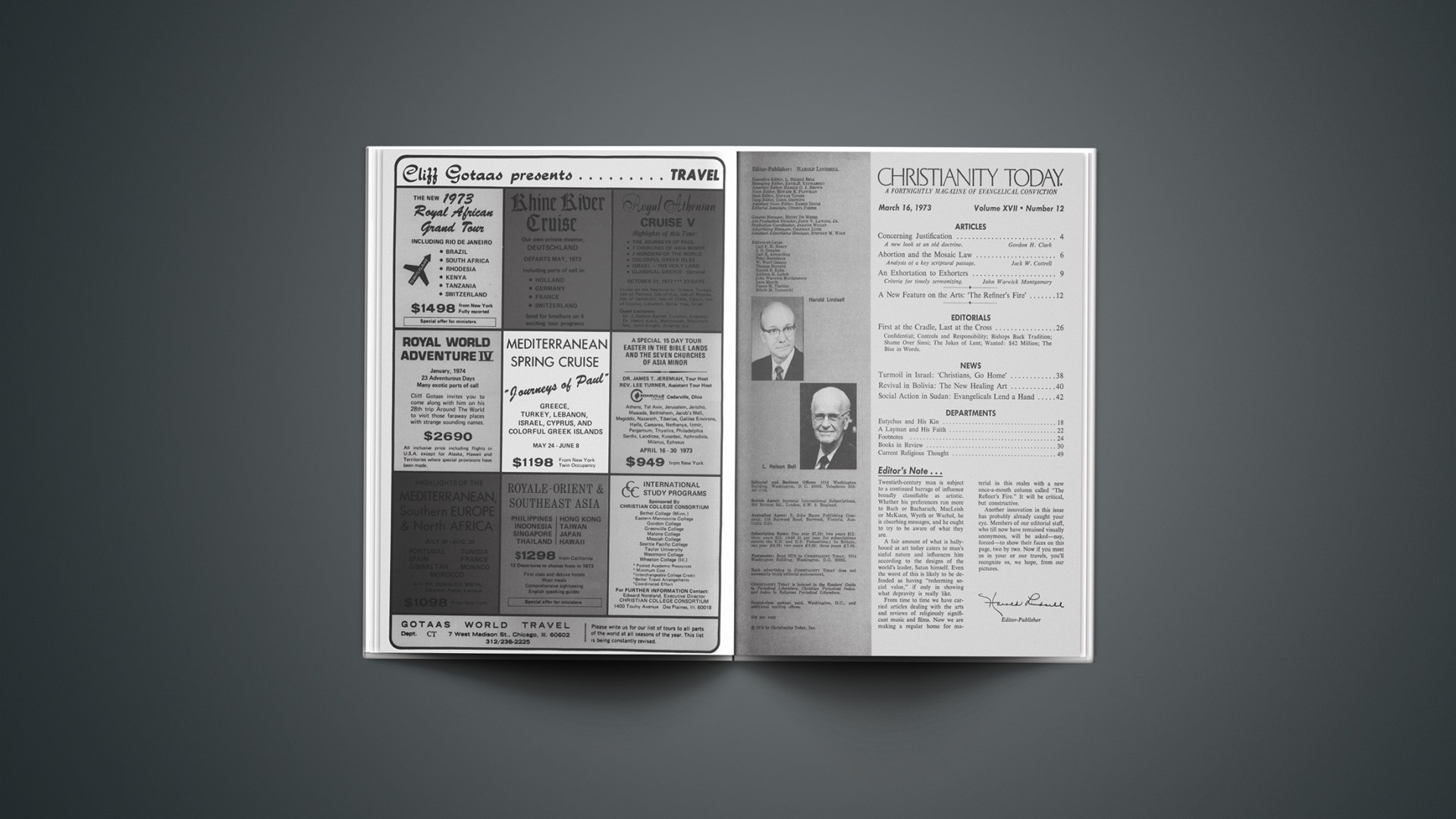
Twentieth-century man is subject to a continued barrage of influence broadly classifiable as artistic. Whether his preferences run more to Bach or Bacharach, MacLeish or McKuen, Wyeth or Warhol, he is absorbing messages, and he ought to try to be aware of what they are.

A fair amount of what is ballyhooed as art today caters to man’s sinful nature and influences him according to the designs of the world’s leader, Satan himself. Even the worst of this is likely to be defended as having “redeeming social value,” if only in showing what depravity is really like.

From time to time we have carried articles dealing with the arts and reviews of religiously significant music and films. Now we are making a regular home for material in this realm with a new once-a-month column called “The Refiner’s Fire.” It will be critical, but constructive.

Another innovation in this issue has probably already caught your eye. Members of our editorial staff, who till now have remained visually anonymous, will be asked—nay, forced—to show their faces on this page, two by two. Now if you meet us in your or our travels, you’ll recognize us, we hope, from our pictures.

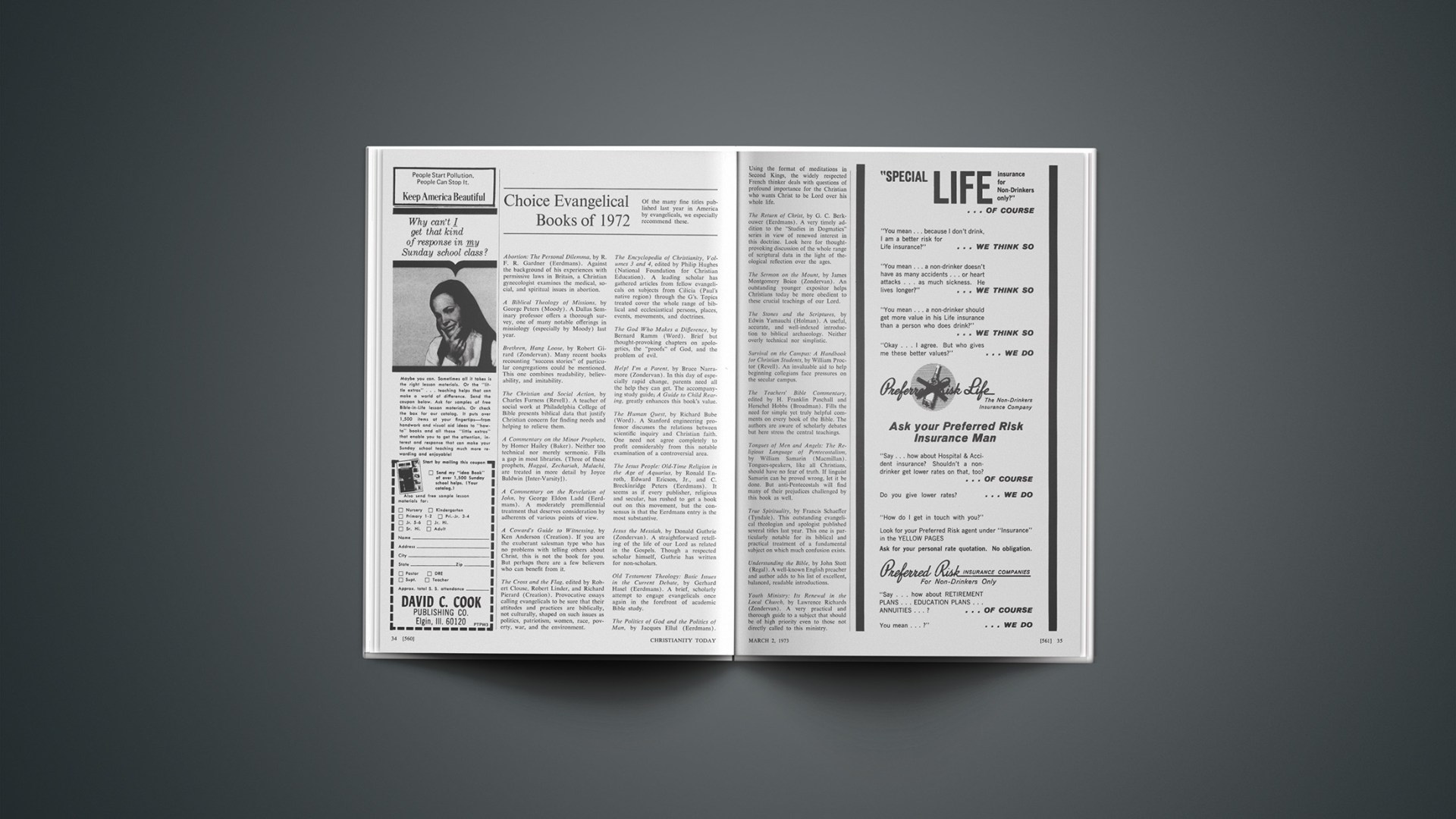
Choice Evangelical Books of 1972

Of the many fine titles published last year in America by evangelicals, we especially recommend these.

Abortion: The Personal Dilemma, by R. F. R. Gardner (Eerdmans). Against the background of his experiences with permissive laws in Britain, a Christian gynecologist examines the medical, social, and spiritual issues in abortion.

A Biblical Theology of Missions, by George Peters (Moody). A Dallas Seminary professor offers a thorough survey, one of many notable offerings in missiology (especially by Moody) last year.

Brethren, Hang Loose, by Robert Girard (Zondervan). Many recent books recounting “success stories” of particular congregations could be mentioned. This one combines readability, believability, and imitability.

The Christian and Social Action, by Charles Furness (Revell). A teacher of social work at Philadelphia College of Bible presents biblical data that justify Christian concern for finding needs and helping to relieve them.

A Commentary on the Minor Prophets, by Homer Hailey (Baker). Neither too technical nor merely sermonic. Fills a gap in most libraries. (Three of these prophets, Haggai, Zechariah, Malachi, are treated in more detail by Joyce Baldwin [Inter-Varsity]).

A Commentary on the Revelation of John, by George Eldon Ladd (Eerdmans). A moderately premillennial treatment that deserves consideration by adherents of various points of view.

A Coward’s Guide to Witnessing, by Ken Anderson (Creation). If you are the exuberant salesman type who has no problems with telling others about Christ, this is not the book for you. But perhaps there are a few believers who can benefit from it.

The Cross and the Flag, edited by Robert Clouse, Robert Linder, and Richard Pierard (Creation). Provocative essays calling evangelicals to be sure that their attitudes and practices are biblically, not culturally, shaped on such issues as politics, patriotism, women, race, poverty, war, and the environment.

The Encyclopedia of Christianity, Volumes 3 and 4, edited by Philip Hughes (National Foundation for Christian Education). A leading scholar has gathered articles from fellow evangelicals on subjects from Cilicia (Paul’s native region) through the G’s. Topics treated cover the whole range of biblical and ecclesiastical persons, places, events, movements, and doctrines.

The God Who Makes a Difference, by Bernard Ramm (Word). Brief but thought-provoking chapters on apologetics, the “proofs” of God, and the problem of evil.

Help! I’m a Parent, by Bruce Narramore (Zondervan). In this day of especially rapid change, parents need all the help they can get. The accompanying study guide, A Guide to Child Rearing, greatly enhances this book’s value.

The Human Quest, by Richard Bube (Word). A Stanford engineering professor discusses the relations between scientific inquiry and Christian faith. One need not agree completely to profit considerably from this notable examination of a controversial area.

The Jesus People: Old-Time Religion in the Age of Aquarius, by Ronald Enroth, Edward Ericson, Jr., and C. Breckinridge Peters (Eerdmans). It seems as if every publisher, religious and secular, has rushed to get a book out on this movement, but the consensus is that the Eerdmans entry is the most substantive.

Jesus the Messiah, by Donald Guthrie (Zondervan). A straightforward retelling of the life of our Lord as related in the Gospels. Though a respected scholar himself, Guthrie has written for non-scholars.

Old Testament Theology: Basic Issues in the Current Debate, by Gerhard Hasel (Eerdmans). A brief, scholarly attempt to engage evangelicals once again in the forefront of academic Bible study.

The Politics of God and the Politics of Man, by Jacques Ellul (Eerdmans). Using the format of meditations in Second Kings, the widely respected French thinker deals with questions of profound importance for the Christian who wants Christ to be Lord over his whole life.

The Return of Christ, by G. C. Berkouwer (Eerdmans). A very timely addition to the “Studies in Dogmatics” series in view of renewed interest in this doctrine. Look here for thought-provoking discussion of the whole range of scriptural data in the light of theological reflection over the ages.

The Sermon on the Mount, by James Montgomery Boice (Zondervan). An outstanding younger expositor helps Christians today be more obedient to these crucial teachings of our Lord.

The Stones and the Scriptures, by Edwin Yamauchi (Holman). A useful, accurate, and well-indexed introduction to biblical archaeology. Neither overly technical nor simplistic.

Survival on the Campus: A Handbook for Christian Students, by William Proctor (Revell). An invaluable aid to help beginning collegians face pressures on the secular campus.

The Teachers’ Bible Commentary, edited by H. Franklin Paschall and Herschel Hobbs (Broadman). Fills the need for simple yet truly helpful comments on every book of the Bible. The authors are aware of scholarly debates but here stress the central teachings.

Tongues of Men and Angels: The Religious Language of Pentecostalism, by William Samarin (Macmillan). Tongues-speakers, like all Christians, should have no fear of truth. If linguist Samarin can be proved wrong, let it be done. But anti-Pentecostals will find many of their prejudices challenged by this book as well.

True Spirituality, by Francis Schaeffer (Tyndale). This outstanding evangelical theologian and apologist published several titles last year. This one is particularly notable for its biblical and practical treatment of a fundamental subject on which much confusion exists.

Understanding the Bible, by John Stott (Regal). A well-known English preacher and author adds to his list of excellent, balanced, readable introductions.

Youth Ministry: Its Renewal in the Local Church, by Lawrence Richards (Zondervan). A very practical and thorough guide to a subject that should be of high priority even to those not directly called to this ministry.

Should Ministering Angels Minister?

A great deal has been said and written recently in England about the place of women in the church. Eight centuries ago things were different: it is said that when Bernard of Clairvaux was kneeling before a statue of the Virgin she opened her lips to speak, but he said: “Silence; it is not permitted to a woman to speak in the church.”

Nancy Hardesty points out that the American frontier knew many women preachers and missionaries, “but as the evangelical church became a respectable institution in middle-class suburbia, women … were often banned or at least commonly excluded from church governing boards.” Writing in a symposium (The Cross and the Flag, ed. Clouse, Linder, and Pierard) that deserves better than the sour review published in this journal, Miss Hardesty criticizes an attitude toward women ministers found among evangelical churchmen: “God doesn’t seem to be calling women to the ministry any more.” In Britain the initial call was delayed until this century, and even yet because of atmospheric disturbance it has not been clearly heard in some denominations.

In Scotland, the tireless prodding of Mary Lusk, an Edinburgh B.D., led in 1967 to an official Kirk report on the place of women in the church, in 1968 to a 42–17 vote in presbyteries in favor of women ministers, in 1969 to the first ordination, and in 1972 to the induction of the first woman parish minister. The United Free Church of Scotland and the Congregationalists have ordained women since 1929.

In England, the Presbyterian Church accepted the principle in 1921, but it was three decades before the first woman was ordained. The Baptist yearbook lists a dozen women ministers—in a separate section, after the men. Methodists have dithered about women in the ministry, seemed to have been on the point of decision twice, but from 1966 were inhibited because of the implications for the merger scheme (since rejected) with the Church of England.

The latter body has given the subject a good airing during the past six years after the church assembly discussed a report on Women and Holy Orders—and declined then to say that “there are no conclusive theological reasons why women should not be ordained to the priesthood.” A motion that women be considered for ordination on the same basis as men was overwhelmingly rejected by all three houses.

The 1968 (pan-Anglican) Lambeth Conference committee on the subject disagreed, but the conference itself stalled by requesting that provinces study the matter and report. In 1971 the Anglican Consultative Council at Limuru in Kenya found that not a single province had sent the results of its study. It did, however, advise by a 24–22 vote that if a bishop ordain women to the priesthood with the approval of his province the action would be acceptable to the council.

The bishop of Hong Kong did in fact that year ordain two women. A predecessor of his had ordained a woman in 1944, but this was regarded by Archbishop William Temple as an “uncanonical action” and she resigned for the sake of the harmony of the church. Grave doubts have been raised about the acceptance in other provinces of the latest two women priests from Hong Kong; one critic suggests strikingly that they could “be frozen in that diocese.”

In late 1971 the Council for Women’s Ministry in the Church (of England) urged by a very large majority that the church “should now take steps to enable women to be admitted to the Order of Priesthood.” In 1972 an official Church of England report, Ordination of Women to the Priesthood, warned that any attempt to isolate the matter from “the whole current debate on ministry” could be “disastrous.” In another section the report declares that the subject cannot be divorced from “the right context of the mission of Christ to the world.” (And Professor E. L. Mascall says it is inseparable from “the significance of sexual differentiation in the order of redemption as a whole.”) Eminently reasonable all this may sound, but there is no more effective way to blur issues than by continually broadening the background.

The report referred to, heavily weighted with quotations from Roman Catholic and Anglo-Catholic writers, sneaks in another roadblock or two. “Can a woman be ordained to the priesthood?” it asks. (“Can an archdeacon be saved?”) The report sees the danger: ordain women and you might have to consecrate them too. So reasons are advanced against this ghastly prospect. I quote: “The bishop is the father of his diocese, of both clergy and laity, but no woman can be a father.” Deprived of their “father figure,” moreover, women would leave the church. And predictably the report is not free from the tendency to contrast trouble-bringing women clergy with ideal male counterparts.

Some Anglicans complicate the situation yet further by always having an objection in reserve. Thus E. L. Mascall, in an essay “Women and the Priesthood of the Church,” insists first that this subject should be discussed “upon a strictly theological plane,” then immediately under “non-theological considerations” goes on to warn that the ordination of women “would put an additional and extremely serious obstacle in the way of future reunion with the Roman Catholic and Orthodox Churches … [which fact] should be a quite sufficient deterrent to anyone who does not identify Christianity … with Protestantism.” Does this mean that it would not matter if Anglo-Catholics lost the theological battle?

Mascall’s essay, otherwise a very cogent statement of the Anglo-Catholic position, is contained in the symposium Why Not? (ed. M. Bruce and G. E. Duffield, Marcham Manor Press), “written by scholars of the Catholic and Evangelical traditions, giving theological reasons why women should not be ordained to the priesthood.” Among conclusions drawn in the book are that the ordination of women is a historical novelty; that it is excluded by New Testament teaching; that its supporters read things into the text, not out of it, by selectivity and subjectivity; and that it is controverted by Catholics, Presbyterian, and evangelical theology.

This is a very able book that a serious student of the subject cannot ignore, but I found myself wondering about the accusation of “selectivity” against those who think differently, particularly when the symposium includes no writer who favors women ministers. Also, an appeal to make theology the norm is valid only from those who make a practice of it on other issues.

A letter in the Church of England Newspaper says: “To say there are Biblical grounds which make ordination of women impossible is to deny the findings of the Lambeth Conference.” Well, that is that; it is good to get one’s priorities right. I may be uncertain about the ordination of women, but it is perversely comforting to find that Anglicans are even more confused.

United for Separation

With twenty-five years of lawsuits, elections, lobbying, and propagandizing behind it, Americans United for Separation of Church and State (AU) is still not convinced that its message is getting through. At its silver anniversary celebration in St. Louis last month, the group’s first and only executive director, Glenn L. Archer, warned that AU plans to exercise “eternal vigilance” in the coming twenty-five years to keep church and state segregated.

Primary issues for group members are parochaid and prayer in public schools. In both they see religious liberty at stake. They want religiously minded people to run their own shop without government involvement or finances—a principle they believe is inherent in the first amendment to the Constitution.

Archer, a native of Kansas, joined the fledgling group shortly after its founding in 1947. He was then a lawyer and budding politician. Much of the St. Louis convention was a tribute to Archer’s efforts over the years; the tribute culminated in the presentation to him of a $6,500 Cadillac on the last night of the convention.

Now claiming support from nearly 90,000 members and 4,000 supporting churches, AU is a conglomerate of evangelicals, liberal Protestants, Christian Scientists, Seventh-day Adventists, atheists, and humanists, all united around the church-state separation cause, said a staff member. The organization works out of its own modern building in suburban Washington, D. C., a far cry from the early days when it had only $19 worth of furniture in a rented downtown garage.

Over the years, Archer said, the group has concentrated on legal activities: testing parochaid laws in court and forcing strict interpretations of the first amendment’s establishment-of-religion clause. A secondary effort of the group has been vast distribution of pamphlets and books and publicity-garnering on radio and television. AU’s programs, says Archer, “have definitely made an impact on the thought of the nation. The controversies which surrounded our activities have caused the American people to rethink what is good and bad regarding church-state separation.”

Gone, he said, are the days when AU (formerly Protestants and Other Americans United) was charged with being anti-Catholic, anti-religious, anti-American, and pro-Communist. “We no longer get the barrage of emotional slogans thrown at us the way we used to,” said Archer.

Delegates and staff members at the convention agreed the success of the organization is directly tied to Archer’s unwavering belief in the cause. Once tagged as a possible state supreme-court justice and even a possible successor to Alf Landon as governor of his home state, Archer gave up everything to take over the new group. “I went through my own dark Gethsemane” in a struggle over “my career and the cause,” Archer recalls. At the time he was dean of the law school at Washburn University.

In the years since, Archer has raised more than $12 million to fund the organization and fight its battles in the courts and at election time. In recent months, AU money and workers helped defeat proposed parochaid legislation in Maryland, Idaho, and Oregon. Later, AU won the right to fight removal of its tax-exempt status in court. (The IRS removed the exemption because AU used most of its $800,000 budget for lobbying—contrary to IRS rules. AU claims other, richer groups spend more but keep their exemption because lobbying money represents less of their budget, thus making the AU case discriminatory.)

Archer believes the Supreme Court has already made unambiguous decisions blocking direct federal aid to parochial schools. “The Court has said ‘no’ to taxation for religion … not ‘no’ maybe, but ‘no’ period.” He is angered now, however, by attempts to get around the court rulings by “indirect” methods, such as proposals for tax credits. (Under a tax-credit scheme, parents with children in parochial schools would be allowed to deduct certain tuition costs from their federal income taxes.) Said Archer: “The courts are going to shut that off too,” and AU will be there, briefs in hand, to help them.

Bishops For Disobedience

America’s Roman Catholic bishops have come out for civil disobedience. In a pastoral message last month they advised disobedience of “any civil law that may require abortion” and threatened excommunication of any of the faithful who “undergo or perform an abortion.” The civil-law part was directed primarily to medical personnel, said a spokesman. (Wisconsin is considering a law that could threaten the license of a doctor or nurse who refused to perform an abortion.) The recent Supreme Court pro-abortion decision, he said, places more pressure on women—especially the poor—to undergo abortion.

Humbard Bankrupt?

Rex Humbard’s Cathedral of Tomorrow in Akron, Ohio, was hit by two potentially crippling blows last month. In separate suits filed the same day, the Ohio state commerce department and the federal Securities and Exchange Commission (SEC) asked two courts to severely restrict the television preacher’s financial operations. Both allege that Humbard violated state and federal securities laws, and the SEC action in effect asks that the Cathedral be declared bankrupt.

The state was granted a temporary injunction freezing Humbard’s assets and prohibiting him from spending more than $1,000 without state approval. The SEC asked the court to put the Cathedral into the hands of a receiver.

Humbard has been under investigation by both bodies as a result of unregistered securities sales in several states (see February 2 issue, page 39). Both suits charge that the Cathedral and its “lay ministers” (unlicensed securities salesmen) used “schemes and artifices to defraud.” Specifically, the SEC complained, prospective investors were never told of the Cathedral’s deteriorating financial condition. (The SEC said that the Cathedral sustained a $7.3 million loss in the eighteen months ending December 31, 1972, during which time securities sales amounted to $8.2 million, and that liabilities exceeded assets by $4.2 million at the end of the year.) Hearings on the SEC suit were scheduled for early March in Cleveland.

The state’s injunction, granted in a county court, stops Humbard from selling securities, disposing of assets, soliciting donations, borrowing money, mortgaging properties, or giving salary raises to Cathedral employees.

Humbard declined to comment on the case because, said Cathedral lawyer Bruce Bower, “statements create more confusion.” However, he added, the Cathedral expects the issues to be resolved “to the satisfaction of the state and the SEC” within a short time.

Ohio officials said they filed the suit in frustration over the failure of negotiations with Humbard to provide a fund for repaying securities holders who want refunds. They said Humbard was vague and wouldn’t answer direct questions. The suit will force Humbard to answer those questions in court.

Outstanding

After Pastor Larry Rohrman of First Baptist Church, Jackson, Mississippi, was named one of the nation’s “ten outstanding young men” by the U. S. Junior Chamber of Congress, two groups of blacks were denied entrance to the church’s worship services. The church said it is open to all but “demonstrators and publicity-seekers.” Black mayor Charles Evers of nearby Fayette called on the Jaycees to revoke their move, accusing Rohrman of racism.

Key 73’S Empty Hat

While many Key 73 officials are optimistic about the year-long evangelism program, they are also gloomy about the present financial state. “Financially, we’re in a bad way—a real bad way,” says Executive Director Ted Raedeke. Under the Key 73 set-up, operational budgets are covered by contributions from participating denominations and organizations while the programming budget is met by outside donations. As it is, only $100,000 of the $150,000 operations budget was met last year. “Some groups have not yet paid a cent towards Key 73,” Raedeke complains.

Although it has engaged a fund-raising firm to get money for continent-wide projects such as television specials and films, the executive committee has declined to plan further programs. “Faith in Action,” seen on more than 600 television stations last Christmas, cost almost $70,000 and was nearly canceled for lack of funds. Some bills are still unpaid.

The committee gave tentative approval to putting the Key 73 name behind an upcoming Pat Boone TV special but hedged on any definite financial commitment. The Boone show, “Come Together,” was to be taped this month with an audience-cast of 19,000 in California. In the meantime, said Raedeke, the main thrust of Key 73 is in the hands of the local church and—as finances now stand—will get little or no further nation-wide exposure.

Churches In Court

The latest tug-of-war between a defecting congregation and denominational authorities involves the Tabb Street Presbyterian Church in Petersburg, Virginia. Hanover Presbytery filed suit to prevent members who voted to withdraw from the parent church body from keeping the property. The presbytery wants a court ruling to nullify the withdrawal action taken last summer by the congregation in an 87–26 vote.

Two Southern Presbyterian churches in Hopewell, Virginia, and another in Hampton have also been severing denominational ties. Both Hopewell congregations have tried to go “through channels,” and the presbytery has been sympathetic to their withdrawal requests. The Hampton church, like Tabb Street, simply asserted its independence, and civil litigation ensued.

In Illinois, an appeals court overturned a lower-court ruling that what is now Forest Park Bible Church in suburban Chicago must return its property to the United Presbyterian denomination. The Presbyterian congregation was dissolved in 1968, and dissident members carried on as an independent church.

Best-Sellers: Bible And Bird

The Living Bible, a paraphrase by Kenneth Taylor of Tyndale House, topped the nation’s non-fiction bestseller list last year, according to a report about hardbacks in Publishers Weekly. More than 750,000 copies of Doubleday’s edition were sold to secular outlets, and Tyndale House sales of the $9.95 hardback edition reached the five-million-copy level. (Company spokesmen say that Doubleday hit the one-million mark this month, and that Tyndale has ten million copies of the Bible, including paper editions, in print.) Harper and Row’s four-year-old I’m O.K., You’re O.K. by Thomas Harris was second, with sales of 531,000 in 1972.

In fiction, three religiously oriented books made the top ten. First place went to two-year-old Jonathan Livingston Seagull (1.8 million copies sold), a positive-think book in which author Richard Bach—of Christian Science background—speaks through a bird’s beak (see editorial December 22, 1972, issue, page 23). The Word by Irving Wallace placed fifth with sales of 123,000 copies. The recently published Two From Galilee, a love story about Joseph and Mary by Marjorie Holmes (see editorial, February 2 issue, page 25), made eighth place with sales of 93,000 for Revell in the last three months of the year. (The figures don’t include book-club and direct-mail sales.)

Prayer Request

Alberta’s opposition Social Credit party will again be led by an evangelical, maintaining a tradition dating back almost forty years. The new leader is Werner Schmidt, 41, academic vice-president of Lethbridge Community College. Schmidt, a member of the Mennonite Brethren, succeeds retiring Harry Strom, an active member of the Evangelical Free Church. Strom inherited the premiership of Alberta in 1968 when Ernest Manning stepped down after twenty-five years in the post. Strom’s government was defeated by the Progressive Conservative party in 1971.

The Social Credit party first came to power in Alberta in 1935 under the leadership of William “Bible Bill” Aberhart, a Baptist who was well known for his evangelical radio broadcasts. Aberhart stayed in power until his death in 1943. Manning then took over both the premiership and the broadcasts, known as the “Back to the Bible Hour” (not to be confused with a U. S. broadcast with the same name). Manning, also a Baptist, is now a senator.

Schmidt has been widely quoted as saying that faith in himself, the party, and the wisdom of God will help him march Social Credit back to a role as “the people’s government.” He says his religious beliefs come from “studying the Bible and accepting what that book teaches.” In his acceptance speech upon being elected party leader, Schmidt said: “For all of you who understand what it means to pray and for all of you who know how to pray, I have two requests. First, I would ask you to help me pray for the wisdom that we so desperately need and secondly, would you help me pray to be a humble man.”

WALLY KROEKER

Dutch Windfall

More than 250,000 people swarmed over Holland recently, canvassing the homes of Dutch church members—both Protestant and Roman Catholic—for donations to missionary and relief projects not included in normal denominational or local budgets. Goal: 1 per cent of a family’s annual income. Just past midnight on collection night, the organizers announced on national television that Dutch Christians had given over 52 million guilders (nearly $18 million) and more was coming in. Final results were still being tabulated last month, but it appears the fund drive overshot its 50-million-guilder goal by about $1 million.

At the request of Dutch missionary organizations, overseas churches had listed programs and projects they wanted to set up. The intent was to discover and delete white-imposed projects that third-world churches did not want or need; this would strengthen the national churches. Indonesian churches alone asked for over $10 million, a figure that was finally cut by two-thirds. In the end, 744 projects were accepted for the total cost of 50 million guilders.

At least one-third of this money will be used for missionary projects in which proclamation of the Gospel is the central aim. The rest of the money will be used for inter-church aid, construction of schools, hospitals, and agricultural centers, and support of mass-media projects and social-justice causes. Some of the money was earmarked for projects to increase communion among people of different races, cultures, and ideologies.

The gigantic fund drive was originally planned by the Protestant churches, but then the Roman Catholic Church asked to be included. The synods of the Protestant churches agreed. Only a few hyper-Calvinistic groups backed out over Catholic participation; such groups as the Baptists and the Evangelical Free Church gave full cooperation.

The organizing committee sent fifteen newspaper reporters, about ten radio journalists, and three television teams to Asia, Africa, and Latin America to talk to church leaders and members there. Their assignment was to find out why the requested money was needed. The visits resulted in many articles and broadcasts. Only one planned television program had to be canceled: when a TV team entered Indonesia, the Muslim-dominated ministry of religious affairs refused a working permit, apparently because of concern over the support that would be generated for the Christians.

Despite the cost of the news tours and of hiring at least eight persons to work on the campaign for a year, total expenses are not expected to exceed 7 per cent.

The theme of the fund drive was “Come across the bridge,” an idiom that can be translated “Loosen your purse strings.” In this connection, the most publicized remark of the fund drive came from a woman who knocked on a door and was offered five guilders (less than two dollars). She said: “Sir, I haven’t come for a tip. I asked you for an offering. Keep your money.”

Perhaps the most remarkable aspect of the drive was that Protestants and Roman Catholics were able to cooperate without getting into fights over theology—or money.

JAN J. VAN CAPELLEVEEN

Sailing, Sailing … Zap!

Chartered Caribbean cruises often are swinging affairs. But a recent one aboard the Norwegian M.S. Starward was “very unusual” and “very quiet,” according to Captain Kjell Anker, the ship’s master. During the two-week cruise, the ship’s casino was locked. Heaped around its silent slot machines were boxes of religious books, cassettes, and records, which sold like hot cakes whenever they were brought out by a representative of Augsburg Publishing House. The ship’s bars were open on a restricted schedule, but business was so slow fewer than half the regular number of bartenders were needed.

In the ship’s Venus Lounge, songs like “Amazing Grace” and “Blessed Assurance” poured forth, and dancer Marge Champion, half of the famous dancing team of Gower and Marge Champion, gave rhythmic interpretations of “The Lord’s Prayer” and Scripture readings at a contemporary worship service. Theologians, religiously oriented psychologists, and other scholars lectured as the ship sailed on. In the traditional “crazy hat and costume masquerade,” participants dressed as biblical characters or wore costumes reflecting modern theological jargon.

The occasion for all this was an interdenominational “Seminar on Sea” (SOS), billed as a cruise that also provided a program of Christian renewal and continuing education. The seminar theme, “The Adventure of Being Human,” was planned by a non-profit board headed by a Scottsdale, Arizona, Lutheran pastor, Conrad S. Braaten, Sr., who had nurtured the idea of a ship seminar for several years. It was subsidized by the ship’s operators and the Lutheran Brotherhood insurance society. The latter gave seminar scholarships of $300 each to 100 pastors.

The 534 participants, faculty, and staffers came from thirty-nine states, Canada, and Guyana. About half were Lutherans, though a dozen denominations were represented. Two Lutheran bishops and one Roman Catholic bishop were among the 140 clergymen in the group. The faculty included Bruce Larson, a Presbyterian minister and president of Faith At Work, Columbia, Maryland, as dean; Episcopal clergyman Reuel Howe, director of the Institute for Advanced Pastoral Studies, Bloomfield Hills, Michigan; author-psychologist Keith Miller, an Episcopal layman; and Lutheran theologian Alvin N. Rogness, president of Luther Seminary, St. Paul, Minnesota. Topics ranged from personal faith, sex, family life, and new forms of worship to death, ecology, and “Caribbean Colonization and Development.”

In a workshop on “Devotions and Sensory Awareness,” participants learned from Howe how to use their bodies to show affection: practicing a kind of Christian sensitivity, they massaged each other’s backs and feet while praying for their partners. To the beat of an orchestra in one of the evening “happenings,” participants snapped their fingers, tapped their feet, and clapped their hands “to feel the driving beat of praise.” There was handholding during prayer, hugging, and recitation in unison of an unusual benediction, “May the Holy Spirit zap you until you tingle with joy!”

At the beginning of the cruise, each passenger obtained a “soulmate” or “buddy”—a person he sought out as an opposite to his kind of personality revealed on a chart he had prepared. Each pair then joined three other pairs to become a group of eight that met daily to discuss the morning lecture at the “Big Family Hour.” The object of the group dynamics that each group practiced was to help each individual, through self-analysis, become “a freer” and “a more whole person” and to relate better to other persons and to God.

Daily calisthenics were offered on the ship’s deck. Asta Bertils Nelson, once prima ballerina of Scandinavia, led the “slim and trim” classes for the women, while Steve Myra, former linebacker and kicker for the Baltimore Colts, conducted exercises for men. Many swam in the ship’s two pools, and some joined in the evening dancing.

The Starward called at six Caribbean ports. Itineraries included visits to churches, seminaries, universities, as well as general sightseeing, shopping, and swimming. In Kingston, two Lutheran dentists in the seminar filled in for a volunteer Jamaican dentist at an Episcopal-sponsored dental clinic in a housing settlement for the poor, pulling a dozen teeth of waiting patients.

The passengers were welcomed to Port of Spain by a steel band and attended Sunday services in four local churches. At the Roman Catholic cathedral, most of the Protestants attending found the service so congenial they responded to the invitation to receive Communion. Later, the local Roman Catholic archbishop and three Protestant religious leaders of Trinidad and Tobago, which some regard as the most ecumenically advanced nation in the world, took part in a panel discussion and led a service on the ship.

As the cruise neared its end, passengers shared in an Agape love feast—each feeding small pieces of bread to others in the seminar whom they wanted to thank or with whom they wanted to be reconciled. Passengers stood at a closing session and told how they had been helped by the seminar. A Presbyterian minister from Missouri said he and his wife joined the seminar because their marriage was in jeopardy. “Our marriage is now healed,” he said. A Roman Catholic priest-psychologist from Chicago said the seminar had been “an extremely rich and broadening experience” for him and the bishop he accompanied. “We feel much closer to more people,” he said.

Some of the pietists aboard were unhappy over the dancing, the drinking, and the language used by several lecturers. But for the most part, a good time was had by all—for $800 complete.

WILLMAR L. THORKELSON

Religion In Transit

The American Baptist home-mission unit paid $20,000 to the Wisconsin Evangelical Lutheran Synod (WELS) on behalf of Denver’s predominantly black Church of the Good Shepherd, which had stopped payments on the building it purchased from WELS. The church in lengthy litigation has contended the property “belongs to God.”

The U. S. Supreme Court let stand a lower-court ruling that denies use of peyote to New Mexico’s 400-member Church of the Awakening. An Arizona court meanwhile reversed the conviction of a California couple who used the drug in a ceremony of the Native American Church, which got congressional approval for use of peyote in 1965.

Sunday-school materials stereotype women as passive, subservient, morally weak, and dependent upon men, reports a joint committee that studied curricula of the Disciples of Christ, Episcopal, Reformed Church in America, Southern Presbyterian, and United Church of Christ denominations. What’s worse, most of the authors are women, says the committee.

In a poll, thousands of members of the Associated Gospel Churches in Canada declared by a 90 per cent majority their opposition to the abolition of capital punishment, currently under review by the government.

Lack of capital is blamed for the failure of the Christian Inquirer, published more or less monthly for over a year in Toronto. The sixteen-page tabloid will be taken over by International Christian Communications, a non-profit corporation.

The Society for Animal Rights has launched a lawsuit challenging constitutional protection of Jewish ritual animal slaughter. The group plus eight individuals contend the Humane Slaughter Act of 1958 violates the first amendment by providing protection for the dietary preferences of one religious group. Meanwhile, the American Jewish Congress has said it will fight the lawsuit in federal court.

The Plan of Union, five years in the making, was presented last month to the executive bodies of the Anglican, United, and Disciples of Christ denominations in Canada. Years of discussion, modifications, and voting must yet take place before the merger affecting four million persons can take place.

A New York Times story says Libya lent American Black Muslims $3 million interest-free last year but refused, under pressure from other Arab states and Arab students in the United States (they don’t think Elijah Muhammad is a prophet of Allah), a request for a second loan.

Leaders of a movement to defeat Lutheran Church-Missouri Synod president J. A. O. Preus for re-election claim there is enough opposition strength to vote in radio preacher Oswald C. J. Hoffmann instead. Meanwhile, the board of Concordia Seminary in Springfield, Illinois, endorsed the contested doctrinal guidelines Preus laid down to Concordia Seminary in St. Louis.

Bethel College and Seminary dedicated its new $21 million campus in suburban St. Paul, Minnesota.

Among the thirty new cardinals nominated by Pope Paul VI were three American archbishops: Humberto S. Medeiros of Boston, Timothy Manning of Los Angeles, and Luis Aponte Martinez, the first Puerto Rican cardinal in Catholic history.

The Catholic protest-letters campaign over comedy episodes about abortion and vasectomy on TV’s “Maude” led at least four of the show’s sponsors to withdraw, but CBS says it had no trouble finding new sponsors. Meanwhile, the Leadership Foundation (4808 Cleveland Park Station, Washington, D. C. 20008), a citizens’ monitoring group, is enlisting volunteers to keep an eye on TV morals.

Personalia

Pastor Wilbert L. McLeod of the Ebenezer Baptist Church in Saskatoon, where the western Canada revival flowered into international attention in 1971, has resigned to engage in full-time revival ministry.

Jose Gonzales, 33, a Presbyterian layman who is an executive of a Mexico electronics firm, is the new presidentelect of the Latin America Mission-related Community of Latin American Evangelical Ministries (COLAEM). And Nicaraguan clergyman Rafael Baltodano, 55, will be COLAEM general secretary, succeeding W. Dayton Roberts.

Information officer O. Joe Olson of the Church of the Nazarene was dismissed “without a written or vocal reason” after briefing a newsman on the outbreak of tongues among Nazarenes, whose official church policy is anti-tongues.

F. Roy Coad, prominent Bible teacher and author in Plymouth Brethren circles, is the new editor of the British-based Brethren magazine, The Harvester.

World Scene

The World Council of Churches sent nine tons of medicines and medical supplies by plane to Hanoi.

The Gospel Missionary Union has put out an urgent call for teachers, translators, and literature workers to help with a revival going on among Quechua Indians in the Andean highlands of Ecuador. For seventy years the Quechuas made little response to missionary contact. Now there are sixteen churches and a score of unorganized groups with only seven ordained Quechuas to serve them.

A cumulative attendance total of more than 100,000 and 3,200 first-time decisions for Christ were registered at evangelist Luis Palau’s four Guatemala crusades. In addition, he did simultaneous live talk shows over the nation’s three TV networks.

The conversion of Muslims continues in Nigeria’s Islamic heartland, reports Sudan Interior Mission. Former Muslims in a number of villages now meet in their own churches.

DEATHS

WILLIAM P. BARNDS, 68, Episcopal bishop of Dallas; in Fort Worth, of a heart attack.

PAUL P. FRYHLING, 61, pastor of First Covenant Church, Minneapolis, vice-president of the Evangelical Covenant Church of America, and chairman of the 1969 U. S. Congress on Evangelism; in Minneapolis, of a heart attack.

WILLIAM JONES, 71, editor for twenty-five years of American Sunday School Union publications; in Wayne, Pennsylvania.

DONALD B. MARSH, 69, Anglican Church of Canada bishop of the Arctic, a 2.7-million-square-mile diocese that includes as members, among others, 80 per cent of the Arctic’s 12,000 Eskimos; in London, England.

PAUL MYERS, 76, better known as “First Mate Bob” on the “Haven of Rest” broadcast he founded in 1934; in Tustin, California, of the London flu.

STEPHEN TROVEN NAGBE, 39, appointed in 1965 as youngest bishop in the United Methodist Church and first indigenous bishop of the 23,000 Methodists in Liberia; in Monrovia, Liberia, after a long illness.

EWALD PERSCHEL, 66, general manager of the evangelical German publishing house Brunnen Verlag, Giessen, and a director of the St. Chrischona Mission; in Basel, Switzerland, of cancer.

J. MANNING POTTS, 77, retired editor of The Upper Room, a devotional guide; in Tampa, Florida, of a heart attack.

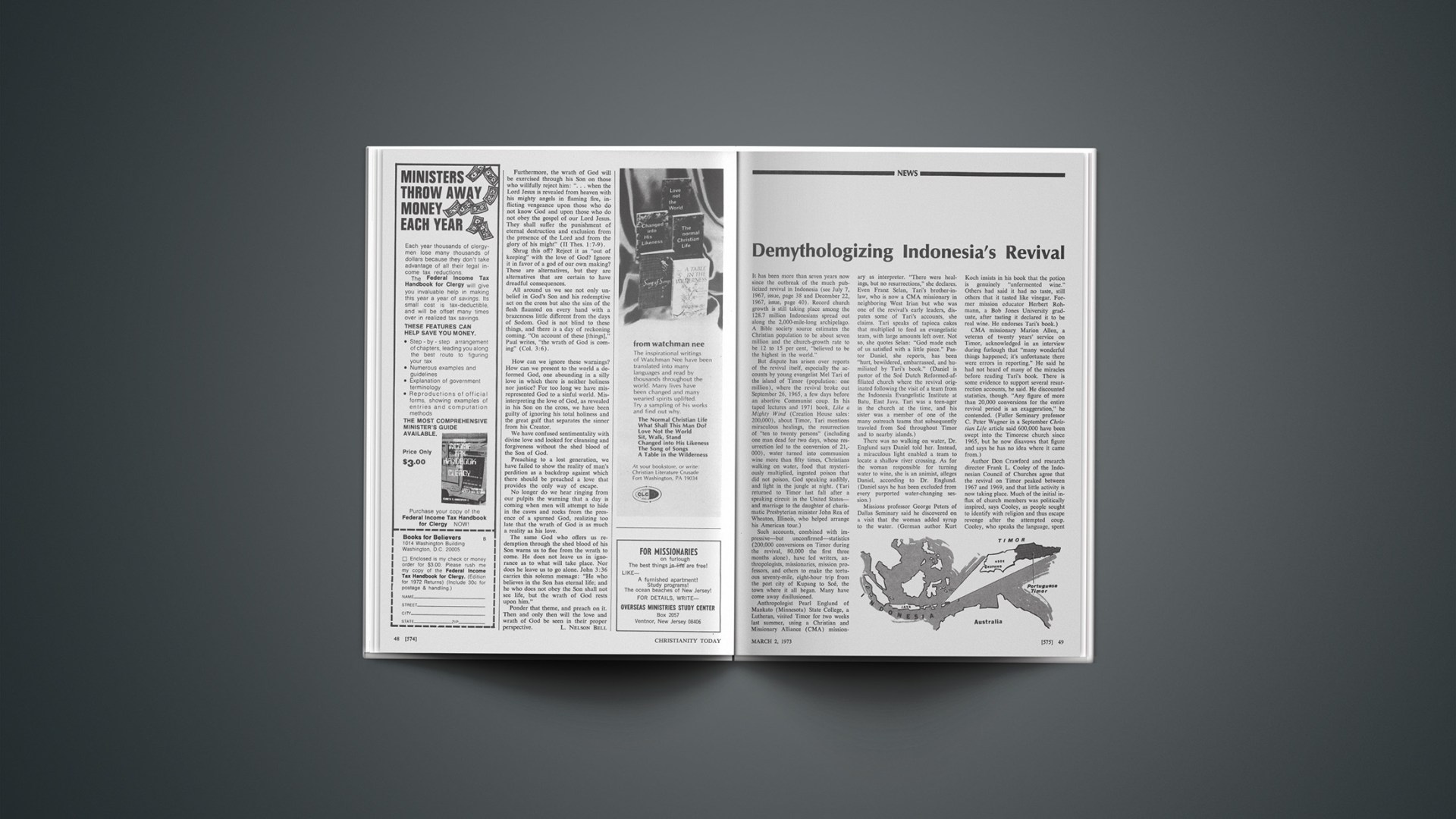
Demythologizing Indonesia’s Revival

It has been more than seven years now since the outbreak of the much publicized revival in Indonesia (see July 7, 1967, issue, page 38 and December 22, 1967, issue, page 40). Record church growth is still taking place among the 128.7 million Indonesians spread out along the 2,000-mile-long archipelago. A Bible society source estimates the Christian population to be about seven million and the church-growth rate to be 12 to 15 per cent, “believed to be the highest in the world.”

But dispute has arisen over reports of the revival itself, especially the accounts by young evangelist Mel Tari of the island of Timor (population: one million), where the revival broke out September 26, 1965, a few days before an abortive Communist coup. In his taped lectures and 1971 book, Like a Mighty Wind (Creation House sales: 200,000), about Timor, Tari mentions miraculous healings, the resurrection of “ten to twenty persons” (including one man dead for two days, whose resurrection led to the conversion of 21,000), water turned into communion wine more than fifty times, Christians walking on water, food that mysteriously multiplied, ingested poison that did not poison, God speaking audibly, and light in the jungle at night. (Tari returned to Timor last fall after a speaking circuit in the United States—and marriage to the daughter of charismatic Presbyterian minister John Rea of Wheaton, Illinois, who helped arrange his American tour.)

Such accounts, combined with impressive—but unconfirmed—statistics (200,000 conversions on Timor during the revival, 80,000 the first three months alone), have led writers, anthropologists, missionaries, mission professors, and others to make the tortuous seventy-mile, eight-hour trip from the port city of Kupang to Soé, the town where it all began. Many have come away disillusioned.

Anthropologist Pearl Englund of Mankato (Minnesota) State College, a Lutheran, visited Timor for two weeks last summer, using a Christian and Missionary Alliance (CMA) missionary as interpreter. “There were healings, but no resurrections,” she declares. Even Franz Selan, Tari’s brother-in-law, who is now a CMA missionary in neighboring West Irian but who was one of the revival’s early leaders, disputes some of Tari’s accounts, she claims. Tari speaks of tapioca cakes that multiplied to feed an evangelistic team, with large amounts left over. Not so, she quotes Selan: “God made each of us satisfied with a little piece.” Pastor Daniel, she reports, has been “hurt, bewildered, embarrassed, and humiliated by Tari’s book.” (Daniel is pastor of the Soé Dutch Reformed-affiliated church where the revival originated following the visit of a team from the Indonesia Evangelistic Institute at Batu, East Java. Tari was a teen-ager in the church at the time, and his sister was a member of one of the many outreach teams that subsequently traveled from Soé throughout Timor and to nearby islands.)

There was no walking on water, Dr. Englund says Daniel told her. Instead, a miraculous light enabled a team to locate a shallow river crossing. As for the woman responsible for turning water to wine, she is an animist, alleges Daniel, according to Dr. Englund. (Daniel says he has been excluded from every purported water-changing session.)

Missions professor George Peters of Dallas Seminary said he discovered on a visit that the woman added syrup to the water. (German author Kurt Koch insists in his book that the potion is genuinely “unfermented wine.” Others had said it had no taste, still others that it tasted like vinegar. Former mission educator Herbert Rohmann, a Bob Jones University graduate, after tasting it declared it to be real wine. He endorses Tari’s book.)

CMA missionary Marion Allen, a veteran of twenty years’ service on Timor, acknowledged in an interview during furlough that “many wonderful things happened; it’s unfortunate there were errors in reporting.” He said he had not heard of many of the miracles before reading Tari’s book. There is some evidence to support several resurrection accounts, he said. He discounted statistics, though. “Any figure of more than 20,000 conversions for the entire revival period is an exaggeration,” he contended. (Fuller Seminary professor C. Peter Wagner in a September Christian Life article said 600,000 have been swept into the Timorese church since 1965, but he now disavows that figure and says he has no idea where it came from.)

Author Don Crawford and research director Frank L. Cooley of the Indonesian Council of Churches agree that the revival on Timor peaked between 1967 and 1969, and that little activity is now taking place. Much of the initial influx of church members was politically inspired, says Cooley, as people sought to identify with religion and thus escape revenge after the attempted coup. Cooley, who speaks the language, spent six weeks in research on Timor last year and found that the spiritual movement has left the Timor Evangelical Church badly divided, with one segment paying allegiance to the Batu group. A number of revival-team members have fallen before fleshly temptations, he asserts in his findings, and have been discredited by the church. As for the miracles Tari mentions: “Information given me regarding certain specific cases makes it impossible for me to believe they actually took place as reported,” says Cooley. Nevertheless, he adds, the movement brought renewal to some churches. (Peters, who points out that the 1965 revival was the third this century for Timor, claims there are fewer Timorese church members today than in 1967.)

World Vision’s Stanley Mooneyham recently took issue with Tari in print, pointing out “spiritual dangers” and cautioning against sign-seeking.

Rea, Tari’s father-in-law, and Creation House’s Cliff Dudley are convinced Tari is telling the truth, and they question the motives of critics who do not share Tari’s charismatic faith.

That something spiritually significant happened on Timor is undeniable. The details may, however, never be known, because of the difficulty of discerning between actual miracle and myth, in which truth has become embedded over the years. Tari may have the best counsel: “I have told you many things about miracles. But don’t put too much emphasis on [them]. Instead, put your eyes on Jesus.”

ONE VOTE SHORT

The California Board of Education came within one vote last month of reversing itself and placing creationism in the state’s science textbooks after all. The vote was 5–2 for it, but six votes are needed for action by the ten-member board. Board member David Hubbard, Fuller Seminary president, again voted against the move, citing the lack of time to make the necessary textbook revisions. At its previous meeting the board decreed that evolution must be clearly tagged as theory, not fact (see January 5 issue, page 48).

Pows: With God’S Help

Millions of Americans listened as Air Force information officer Richard Abel, a Conservative Baptist, closed the first press conference held after American prisoners of war from North Viet Nam landed at Clark Air Force Base in the Philippines. Abel chose the quote of “a senior officer” aboard one plane as a “good note” on which to end the briefing: “I couldn’t have made it if it wasn’t for Jesus Christ, and being able to look up and see him in some of the trying times.”

Abel wasn’t simply seizing an opportunity to witness to the world, insists a colleague: “he was accurately reflecting the spirit of the men.”

The senior officer alluded to may have been Colonel Robinson Risner, 48, a fighter pilot shot down in 1966. Risner, who made that well publicized telephone call of thanks to President Nixon on behalf of the POWs, is a member of an Oklahoma City area Assembly of God church. He helped to organize religious services at the “Hanoi Hilton” prison camp. The men chose George McNight, a black Methodist, as Hanoi Hilton’s unofficial chaplain. (McNight was not in the first batch of prisoners released.) A spiritual movement swept through the ranks as, in the words of one POW, “everything else was stripped from us, and we were left with only our faith in God.”

Was it only a case of foxhole religion? Not so, according to a military source at Clark in a telephone interview. He said he found that many of the POWs had come back with a “deep sense of gratitude to God” and were reserving time for personal devotions. Asked if God had helped him, one officer replied: “Not merely helped; I could not have made it without him.” Some of the men said God had miraculously answered prayers while they were being tortured by North Vietnamese officials. Common descriptions: “God numbed the pain,” “God provided relief,” “He enabled me to go on when I couldn’t endure any longer on my own.” The Christians ministered to one another and to their fellow POWs, and a number of men prayed to receive Christ during the ordeal, said the source.

When they arrived at Clark, some of the POWs were wearing hand-made crosses around their necks. “God bless you,” they repeated over and over. The phrase had become a standard form of hail and farewell in the spiritual movement at the Hanoi Hilton.

EDWARD E. PLOWMAN

Preserving The Cause

The Episcopal Diocese of Washington, D. C., adopted a resolution calling for ordination of women to the priesthood. If approval is voted by the Episcopal Church this year, it will cause schism, predicts the conservative American Church Union element within the denomination, and to that end the ACU is reportedly drafting plans to assure a “continuing” Episcopal Church.

The Wrath of God

The height, depth, and breadth of God’s love can never be fully described, nor can it be understood this side of eternity.

The wideness of God’s mercy is beyond man’s comprehension. For this reason we often try to squeeze him into the distorted and limited mold of human understanding.

The grace of God is man’s only hope. Made operative by faith, it is the means of our salvation. But for this attribute of God, man’s state would be hopeless. Day by day we are its recipients, and by it God’s love is shed abroad in our hearts.

But that is not the total picture and some have erred in stressing only God’s love, mercy, and grace, creating a concept that is distorted and incomplete. God is not a beneficent Santa Claus, an ever-present genie, a tolerant father in whose favor we rightfully bask and on whom we have the inherent claim to the good things of life.

Can we ever understand the love of God apart from the context of his holy anger? Can we understand the Cross until we know something of God’s capacity for wrath? Can we grasp the meaning of sin apart from the absolute holiness of God?

Part of the problem may stem from our concept of anger and wrath. The wrath of man is of the flesh, his anger only too often caused by some personal affront. Out of anger man may proceed to sins of speech or action. Aside from those occasions when regenerate man is roused to righteous indignation, anger is usually sin and leads to many things that harm man and dishonor God.

The wrath of God is a holy wrath, a consuming reaction against evil, the nature and extent of which no man can understand. Here we are confronted by the inscrutable fact of divine holiness and by the depth of the implications of sin. It is not as man hates that God hates; rather, it is the revulsion of a righteousness that is altogether perfect against sin.

To express either the holiness or the wrath of God adequately in human terms is impossible, but to recognize their validity is within the scope of all men.

When the writer of the Epistle to the Hebrews states, “It is a fearful thing to fall into the hands of the living God” (Heb. 10:31), we should face this terrifying affirmation. When he says, “Our God is a consuming fire” (Heb. 12:29), we should recognize God’s capacity for a holy and consuming wrath.

No man has proclaimed the love and mercy of God more than the Apostle Paul. Shall not these words then give us pause? “Do you not know that Gqd’s kindness is meant to lead you to repentance? But by your hard and impenitent heart you are storing up wrath for yourself on the day of wrath when God’s righteous judgment will be revealed” (Rom. 2:4, 5).

But Paul goes on to set the love and wrath of God in perspective. In Romans 5:9 we read, “Since, therefore, we are now justified by his blood, much more shall we be saved by him from the wrath of God.”

The wrath of God must be seen in the light of man’s sinfulness and in the total picture of that sin, for which full atonement has been made. Romans 1:18 says, “For the wrath of God is revealed from heaven against all ungodliness and wickedness of men who by their wickedness suppress the truth.”

In this same vein we read in Hebrews 10:28, 29 these solemn words: “A man who has violated the law of Moses dies without mercy at the testimony of two or three witnesses. How much worse punishment do you think will be deserved by the man who has spumed the Son of God, and profaned [made light of] the blood of the covenant by which he was sanctified, and outraged the Spirit of grace?”

That the coming wrath may be avoided rings through the theme of redemption, for we are admonished to “wait for his Son from heaven, … raised from the dead, Jesus who delivers us from the wrath to come” (1 Thess. 1:10).

That the wrath of God hangs over impenitent sinners is likewise evident. “Let no one deceive you with empty words,” Paul says, “for it is because of these things [man’s blatant sins] that the wrath of God comes upon the sons of disobedience” (Eph. 5:6).

Furthermore, the wrath of God will be exercised through his Son on those who willfully reject him: “… when the Lord Jesus is revealed from heaven with his mighty angels in flaming fire, inflicting vengeance upon those who do not know God and upon those who do not obey the gospel of our Lord Jesus. They shall suffer the punishment of eternal destruction and exclusion from the presence of the Lord and from the glory of his might” (2 Thes. 1:7–9).

Shrug this off? Reject it as “out of keeping” with the love of God? Ignore it in favor of a god of our own making? These are alternatives, but they are alternatives that are certain to have dreadful consequences.

All around us we see not only unbelief in God’s Son and his redemptive act on the cross but also the sins of the flesh flaunted on every hand with a brazenness little different from the days of Sodom. God is not blind to these things, and there is a day of reckoning coming. “On account of these [things],” Paul writes, “the wrath of God is coming” (Col. 3:6).

How can we ignore these warnings? How can we present to the world a deformed God, one abounding in a silly love in which there is neither holiness nor justice? For too long we have misrepresented God to a sinful world. Misinterpreting the love of God, as revealed in his Son on the cross, we have been guilty of ignoring his total holiness and the great gulf that separates the sinner from his Creator.

We have confused sentimentality with divine love and looked for cleansing and forgiveness without the shed blood of the Son of God.

Preaching to a lost generation, we have failed to show the reality of man’s perdition as a backdrop against which there should be preached a love that provides the only way of escape.

No longer do we hear ringing from our pulpits the warning that a day is coming when men will attempt to hide in the caves and rocks from the presence of a spurned God, realizing too late that the wrath of God is as much a reality as his love.

The same God who offers us redemption through the shed blood of his Son warns us to flee from the wrath to come. He does not leave us in ignorance as to what will take place. Nor does he leave us to go alone. John 3:36 carries this solemn message: “He who believes in the Son has eternal life; and he who does not obey the Son shall not see life, but the wrath of God rests upon him.”

Ponder that theme, and preach on it. Then and only then will the love and wrath of God be seen in their proper perspective.

Eutychus and His Kin: March 2, 1973

Something New, Something Old

In this issue of CHRISTIANITY TODAY the editors are calling to your attention umpteen thousand new significant books. So as a sort of antidote I’m calling to your attention one old significant book.

Don’t be scared by the title: Orthodoxy. It has a certain thundering quality that doesn’t really characterize the book.

Orthodoxy was written about 1909 by the magnificent G. K. Chesterton. It is the story of Chesterton’s discovery and embracing of Christianity—“not an ecclesiastical treatise but a sort of slovenly autobiography,” he says. The book is a joke on himself, he points out, as

… the man who with the utmost daring discovered what had been discovered before. If there is an element of farce in what follows, the farce is at my own expense; for this book recounts my elephantine adventures in pursuit of the obvious.… I am the fool of this story and no rebel shall hurl me from my throne.

Chesterton offers brilliant insights in a pithy way that makes Orthodoxy a priceless quotation source. These will give you some of the flavor and scope of the book.

On the mischief of misplaced virtues:

But what we suffer from today is humility in the wrong place. Modesty has moved from the organ of ambition. Modesty has settled upon the organ of conviction; where it was never meant to be. A man was meant to be doubtful about himself, but undoubting about the truth; this has been exactly reversed.… We are on the road to producing a race of men too mentally modest to believe the multiplication table.

On rebels and rebellion:

The Jacobin could tell you not only the system he would rebel against, but (what was more important) the system he would not rebel against, the system he would trust. But the new rebel is a sceptic, and will not entirely trust anything.… By rebelling against everything he has lost the right to rebel against anything.

On legends and history:

It is quite easy to see why a legend is treated, and ought to be treated, more respectfully than a book of history. The legend is generally made by the majority of people in the village, who are sane. The book is generally written by the one man in the village who is mad.

On democracy and tradition:

Democracy tells us not to neglect a good man’s opinion, even if he is our groom; tradition asks us not to neglect a good man’s opinion, even if he is our father.

On purpose in nature:

So one elephant having a trunk was odd; but all elephants having a trunk looked like a plot.

On naturalism and supernaturalism:

If it comes to human testimony there is a choking cataract of human testimony in favor of the supernatural. If you reject it, you can only mean one of two things. You reject the peasant’s story because the man is a peasant or because the story is a ghost story.… It is we Christians who accept all the evidence—it is you rationalists who refuse actual evidence being constrained to do so by your creed.

And through all the book one senses the presence of the “tremendous figure who fills the Gospels,” who “towers … above all the thinkers who ever thought themselves tall.”

Long out of print, Orthodoxy is scheduled to be reprinted in March by Image Books, a division of Doubleday and Company. Blessings on their heads.

There you have it. It’s my one old book against their umpteen thousand. Your priority is clear.

EUTYCHUS V

SPATIAL ENCOURAGEMENT

I wish to express to you my deep appreciation for the Key 73 articles in the January 19 issue. They are well written, positive, constructive, practical, and encouraging. The amount of space you have given to Key 73 is indeed very generous. I think it helps to underscore the importance of this great evangelism movement for Christ.

LOUIS C. MEYER

Chairman

Key 73 Metropolitan Planning Group

New York, N. Y.

The renewal is on! Praise God—1973 is already becoming a year of great spiritual awakening! We have many exciting Key 73 projects city-wide in Great Falls, and our local congregation is buzzing with renewed spiritual excitement. Weekly witnessing teams of lay people sharing Jesus Christ and more than 100 enrolled in adult education of Bible study and small-group discussions add to the spiritual enthusiasm. As a pastor, I am most grateful for the special Key 73 articles.

INGOLF B. KRONSTAD

Faith Lutheran Church

Great Falls, Mont.

In God’s sovereign timing of things, the nation’s flags will be flying at half-mast for the first two months of 1973. In God’s timing it was also permitted that Key 73 is only now being launched across the country. What an excellent time for the Church to speak to the heart of a nation and call its people to search their souls and turn unto the Lord. By removing two of our beloved leaders in so short a span of time, is not the Lord giving America another opportunity to look unto him?

Translation

WM. CAREY MOORE

Editor

Wycliffe Bible Translators

Santa Ana, Calif.

To correct a possible misimpression, I appreciated Ralph D. Winter’s Key 73 article very much on “Existing Churches: Ends or Means?,” but I don’t think that Jews for Jesus are a good case in point. We are very likely to join churches. Of our core group in Corte Madera, California, three-fourths are church members.

Our real problem is to maintain our Jewishness while becoming members of the church. We feel that we have an apostolic example. The early Jewish-Christians were certainly members of the existing church, but they also felt that they were part of the Jewish community and attended Jewish worship in the synagogue and in the temple. We feel we have something to give to the church in our own Jewishness. We refuse to consider ourselves separate either from the body of Christ or from Jewish communities. We are truly part of both.

Corte Madera, Calif.

MOISHE ROSEN

EASY, SWEET SIREN

When Reo M. Christenson states that “Hitler was staunchly opposed by many churchmen” (“The Church and Public Policy,” Jan. 5), is he not slanting history a bit to his bias? Hitler’s theme of the superiority of the northern white man was a sweet siren to most Protestants. The Catholics, with a broader racial constituency, endeavored to make an advantageous deal with Hitler. With Mussolini they succeeded.… Change for the better is difficult. Most of Christenson’s article would lead us to forget and drop the difficult confrontation with the problems of society. Again the sweet siren of easy Christianity.

How many churchmen would have followed Jesus into Samaria, lived with the common people, denounced the orthodox and liberals (Pharisees and Sadducees), or dared to call Herod “that fox”? How many would be the suffering servant, daily fatigued by the crowds demanding to be healed, fed, and taught?

At least two-thirds of all Americans claim church affiliation. If this majority were to inject social justice or just plain honesty into government, most any system would work, especially democracy. But the churches cannot do that—they themselves are corrupt.

Elkhart, Ind.

CLAUS H. GEISEL

Since I have written occasionally in times past when I have been disappointed or in disagreement with articles you have published, I am pleased this time to write you of my great appreciation for “The Church and Public Policy.” It expresses my personal view very well, and furthermore it represents equally well the historic and predominant attitude of the Mennonite Church. Needless to say, I was particularly gratified to read Mr. Christenson’s forthright testimony against war.… I hardly expected to find an article like this in your pages.

I read also with much interest the lengthy interview article by B. P. Dotsenko. I note that you say in an editorial note that Dr. Dotsenko “belongs to a Mennonite church.” Undoubtedly readers will be confused by his clearly nonpacifist views. It would have been more accurate had you said that Dr. Dotsenko belongs to a Mennonite Brethren church.… Needless to say also, I noted the differences of judgment between Dr. Dotsenko and my own article in Eternity on Bible smuggling, not to mention also Edward Plowman’s report in the same issue. There is certainly room for such differences of opinion, but I do hope it is a service to the Christian readership to attempt to document and illustrate the issues to be weighed.

GERALD C. STUDER

Scottdale Mennonite Church

Scottdale, Pa.

WELL DONE

Thank you indeed for Letha Scanzoni’s “The Feminists and the Bible” (Feb. 2). How exhausting it is as a Christian woman to know that in following Him one automatically encounters the displeasure of men who also say they live to do His will. Accepting this disapproval “in advance” does seem one way of carrying on—the difficulty being, however, wanting all the while for their fellowship now, without giving up hope of hearing one day His “Well done.” Thank you for this start toward peace in the seventies!

ROBERTA GUNNER

Director of Education and Youth

House of Prayer Lutheran Church

Minneapolis, Minn.

WITNESSING TOURISTS

In “Deep in the Heart of Eastern Europe” (Jan. 5) you indicated that many groups involved in “Bible-smuggling” discourage tourists from taking Bibles [into Iron Curtain countries]. Our experience shows that within careful limitations, tourists carrying Bibles are one more effective manner of sharing God’s Word with believers in Russia and other Communist lands.

L. JOE BASS

President

Underground Evangelism International

Los Angeles, Calif.

ALL THERE IS

You do me a grave injustice in your issue of November 24 (“Behind the Battle Lines: Missouri Synod’s Troubled Campus”).… If my response seems late, let me quickly add that Kenya, where I am now serving as visiting lecturer at the University of Nairobi, is a “fur piece.” Copy gets here some two months after publication date.

[There is] a statement about surviving the Cleveland Convention of 1962. In point of fact, that question never came up. It certainly was farthest from my mind. The issue was, “What is the best course of action to take in a situation that had become totally irrational?” I know of no resolution which came before the convention calling for my removal from the faculty.1The removel resolution is number 319 of the 1962 LCMS proceedings.—ED. That is sheer fabrication.… In the rest of the article [you are] certainly careless about truth or incredibly superficial in research. As late as September 20, 1972, students were coming to my office to provide information on doctrinal aberrations which disturbed them right then and there in the classrooms.

Professor Klein is quoted as saying that “forty-five faculty people stand together.” But the full reason is not given. They stand together because they were politically compromised on April 16, 1970, to the extent that they could not possibly act on their own conviction now. Only a handful of men stood up on that day to resist one of the most outrageous totalitarian tactics ever perpetrated in the history of Lutheranism. Your story said nothing of this.… [You] quote Professor Klein as expressing an interest in confessional loyalty. That is, indeed, a new development. Four men in systematics who know something of what this involves deny that there is this interest. Did [you] ask?

Five of us have opposed the course taken by the administration of Concordia Seminary for the simple reason that we want no part in the political corruption which prevails there and in the fraud that is being perpetrated on our Synod. That’s really all there is to it.

MARTIN H. SCHARLEMANN

Professor of New Testament Interpretation

Concordia Seminary

St. Louis, Mo.

*The removel resolution is number 319 of the 1962 LCMS proceedings.—ED.

Money, Markets, and Missionaries

Money, Markets, And Missionaries

The United States dollar has been officially devalued twice in fifteen months (it has also been devalued de facto, by the actions of other countries, an additional three times within the past three years). The problem is simple. With the highest wage scales in the world, America finds its products are being squeezed out of world markets—and even out of the American home market—by goods of comparable quality produced by other nations more cheaply. In consequence, we have a rapidly increasing excess of imports over exports to aggravate the one-way outflow of dollars caused by military and other foreign aid, in both public and voluntary sectors.

Mr. Nixon chose (if he really had a choice) to devalue the dollar by increasing the official price of gold. This will presumably have little effect on our internal economy, but it will theoretically make imported goods more expensive here and American goods cheaper overseas, thus improving our competitive position in world markets. As the London-based Financial Times points out, devaluation came despite improvements in America’s internal economic situation, proving once again that there are economic realities operating on a world-wide scale that even the strongest nations cannot disregard.

The immediate consequences of the dollar’s shrinkage will be felt by those traveling and living abroad, and perhaps most painfully by American missionaries, whose resources, never great, have thus been significantly curtailed by a stroke of the pen. We urge all churches and missionary agencies, and of course the givers who support them, to act promptly to bring the purchasing power of their missionaries’ allowance back up to the pre-devaluation level. In practical terms, this means we must increase our dollar giving to equal the value lost through devaluation—that is, by approximately 10 per cent.

What Price Abortion?

The basic issue in the abortion controversy is when the fetus is to be regarded as a human being, for it is axiomatic that the rights of all human beings to life must be protected. Yet an astonishingly high number of those who have commented on the Supreme Court’s January 22 decision refused to address themselves to that issue. Indeed, the court’s majority opinion itself showed confusion at this point by saying, “We need not resolve the difficult question of when life begins.” (See also “Abortion and the Court,” an editorial in the February 16 issue of CHRISTIANITY TODAY.) Can it be that the seven justices concurring in the decision actually do not realize that by evading the question they in effect give their answer, namely, that life does not begin until, at the earliest, six months after conception?

Many arguments on abortion assume that the fetus is not a human being but give no grounds for this questionable assumption. Typical of these was the baffling news analysis by W. Barry Garrett, Washington bureau chief of Baptist Press. “Religious liberty, human equality and justice are advanced by the Supreme Court abortion decision,” he wrote. Advanced for whom? Certainly not the fetus! To say this is to reject without consideration the fundamental issue of its humanity and the rights that would derive therefrom. Why the silence about liberty, equality, and justice for the fetus? The fact that minority religious groups (e.g., Roman Catholics, Mormons) oppose abortion does not make easy abortion a triumph for “religious liberty.” To say so is not analysis but sophistry.

Amnesty, Forgiveness, And Mercy

Little is said about the most honorable among all those who opposed the Viet Nam War, namely, those who stood up to the government, refused to obey its summons, and went to jail. When amnesty is being considered, such people ought to be honored for their integrity; certainly they should not have to bear a criminal record for standing up for their convictions and taking the consequences instead of fleeing.

The time to decide that one is a conscientious objector is before entering the service. In the case of a serviceman who believes it morally impossible to carry out a particular mission and faces the music, there is no dishonor. But the serviceman who flees to another country and asks asylum, only to seek to return home when the fighting is over, is in a different category. Such persons could be given a chance to convince competent and reasonable judges that their action was motivated by a moral necessity strong enough to override their sworn obligations and to dispense them from the more honorable course of refusing to obey and taking the consequences. To suggest that the armed services might follow a counsel of mercy in some cases would not invalidate the general principle that desertion is a crime deserving punishment and dishonor.

Christianity Today Reprints

Copies of “Tests For the Tongues Movement” by Harold Lindsell” (December 8, 1972) and “From Communism to Christianity” with B. P. Dotsenko (January 5, 1973) are available postage-paid at 10c each in quantities of fewer than 100 and each for 100 or more. Order from Reprints, Christianity Today, 1014 Washington Building, Washington, D.C. 20005.

Many churchmen, prominent among them United Church of Christ president Robert Moss, want total and unconditional amnesty for deserters and draft-evaders. Dr. Moss is in error when he attributes earnest motives of conscience to all evaders; often their motives are mixed. Months or years after the fact it is virtually impossible to establish what a particular evader’s true motivation may have been. Thus a general policy for all evaders, not a board or commission to examine each man’s motives, is needed. Any exile who wishes to renounce his country and make his home elsewhere will have no difficulty doing so; nor should he experience any problems if he later wishes to return as a Swedish or Canadian citizen. But what Dr. Moss wants is action that will in effect admit that we do not know “whether those who waged war or those who refused to participate were right.” Truly, we cannot judge the conscience of either soldiers or evaders. But all Christians, except for pacifists, teach that the individual is not called upon to answer for the justice of a war: that decision must be made by the rulers. The men who carried out the rulers’ decision to wage this war were objectively blameless, and even if historians subsequently decide that the rulers were in the wrong, no blame will attach to the individual soldiers. What the deserters did—to the extent that they did not intend to go into permanent exile—was objectively wrong.

President Nixon has said that amnesty means “forgiveness,” and that no forgiveness is possible: those who fled must “pay the penalty” if they wish to return. Perhaps the Vice-President should have advised him that amnesty in fact means not forgiveness but forgetting (from the Greek amnesia). It is hard to forget what the evaders have done, and impossible to do so without insulting those who heeded the call to arms and dishonoring the memory of those who died. But, contrary to what the President seemed to imply, forgiveness is possible. Christian moral teaching—and sound psychological insight as well—holds that there is little (for the Christian, nothing) that cannot be forgiven, provided the offender admits his guilt and makes restitution or pays the penalty. Restitution and punishment are not inconsistent with forgiveness, although they are inconsistent with amnesty.

To those who are willing to make restitution, we feel that a more reasonable and conciliatory opportunity of alternate service should be given than the jail term that the President seems to presuppose. In the other cases, it would seem impossible to offer “forgetfulness.”

The state, for its part, should recognize that ten years of undeclared war fought under mysterious conditions and for by no means fully convincing reasons have placed countless young men in a situation of great moral ambiguity. Therefore it should be willing to practice a good measure of mercy—as the President suggested before the November election that he would do—rather than impose the full penalties of the law in a position in which its own moral rectitude is not beyond question.

A Book For All Christians

More and more, the differences that separate Christians are revealing themselves within rather than between the major branches of Christendom—Protestant, Catholic, and Orthodox. Internal differences between Protestant and Protestant, for instance, are assuming greater importance than the historical differences that have separated Protestants from Catholics and Orthodox. In view of this, we welcome the new ecumenical edition of the Revised Standard Version of the Bible, to be published in the United States April 2. Used by Protestants, Catholics, and Orthodox who believe the Bible is God’s unique revelation to man, it will foster understanding among those who truly seek to respond to that revelation in obedience. It may also strengthen the bonds of fellowship among true believers, whatever their ecclesiastical tradition and upbringing, as well as encourage interdenominational Bible-study groups.

The term “Common Bible” (which appears on the cover of the new edition but not on the title page) should be used with discretion. The volume contains the Apocrypha and the deutero-canonical books and passages, all 223 pages of which are placed between the Old and New Testaments. Evangelicals do not consider these texts to be canonical. This is not strictly speaking a common Bible, therefore, since Protestants cannot accept it in toto.

David Lawrence

Besides being one of the world’s great journalists, David Lawrence had the distinctive among well-known news analysts of speaking often from an explicitly Judeo-Christian framework. He strongly believed that spiritual principles should be brought to bear on contemporary issues. In one of the last columns he wrote before his death last month at the age of eighty-four, Lawrence talked about how people in government gather for weekly prayer meetings, and he went on to suggest that if this was legal perhaps students in public schools could hold similar gatherings. He himself attended the Senate prayer breakfast group for many years and was in fact the only non-senator who did so regularly.

Lawrence was a member of a Reform Jewish congregation in Washington, but he was more unabashedly supportive of Christian ideals than many who say they are Christians. He said in a 1945 editorial:

There seems, curiously enough, … a tendency to apologize for Christianity or at least to narrow its scope so that it shall not apply to everyday controversies.… Christianity is not an easy philosophy to practice if one’s mind is closed to its tenets. It is a philosophy often inconvenient and perhaps even annoying to those who prefer the “might-makes-right” or “wealth-makes-right” doctrines of autocracy. There are in America plenty of little Hitlers who dominate the social and economic life of our communities. The paradox they inadvertently express every day is: “I am a Christian but—I am not a Christian.”

The founding editors of CHRISTIANITY TODAY held Lawrence in special esteem because of the advice he gave them prior to the start of this enterprise. They recall a meeting with him in which he called in two of his top managers at U. S. News and World Report and conveyed sound counsel. Without doubt, his advice helped CHRISTIANITY TODAY get started on the right track.

The Pistol Proscription

The January 30 robbery and shooting of Senator John C. Stennis in front of his house was not an unusual type of crime; in 1971, the most recent year for which complete figures are available, there were 3,972 incidents of aggravated assault in the city of Washington and approximately 364,000 in the nation as a whole. But because the victim was an aged, revered, and distinguished member of the United States Senate, the incident has once again focused national and especially congressional attention on the general problem of crime and on the particular issue of firearms abuse and gun control. In this case, as in 25.1 per cent of the incidents nationwide, a firearm was used (in most of those cases, the firearm was presumably a pistol). There were 275 murders in 1971 in Washington, and approximately 17,630 nationwide; pistols were used in approximately 51 per cent of the nation’s reported murders.

Following the assault on Stennis, a number of voices, led by that of the President himself, called for federal legislation banning cheap and easy-to-get pistols, somewhat imprecisely called “Saturday night specials” (apparently the cheapest new pistol available in Washington area stores costs from fifty to sixty dollars). Senator Birch Bayh (D.-Ind.) put a new gun-control bill, aimed at Saturday-night specials, through the Senate in August, 1972. The loosely drawn bill, which would have also banned a variety of expensive sporting handguns, was not voted in the House and so fell. Now Representative John D. Dingell (D.-Mich.) has proposed a more precisely worded bill in the House, one that would prohibit the manufacture and sale of cheaply fabricated pistols, explicitly defined as to composition and melting point of the metal used.

CHRISTIANITY TODAY has already gone on record in favor of more effective gun-control legislation, specifically for a uniform nation-wide licensing procedure for gun owners and users, but one that—unlike New York’s Sullivan Act—would permit the law-abiding citizen to own weapons. Beyond this we would only caution against enacting broad prohibitive or restrictive legislation without giving sufficient thought to its long-range consequences for individual freedom.

Flies In The Ointment

Musk oil, a perfume as old as Cleopatra, has been reissued to aid in the quest for seductive sexuality. Advertisers claim it changes scent with each wearer, and gullible consumers, not realizing that all perfume has that characteristic, make supplies short. Nor do consumers realize that many perfumes—the more expensive ones—contain genuine musk, a secretion of the musk deer, which is related to human sex hormones and considered highly provocative. The musk-oil ads lead consumers to suppose that musk is exotically related to Polynesian flowers, rather than an animal’s sexual secretions: an odd twist by marketers who promote the perfume as the ultimate in physically alluring scents. Ecclesiastes reminds us that true motives will reveal themselves: “Dead flies make the perfumer’s ointment give off an evil odor; so a little folly outweighs wisdom and honor.”

Not Even In Israel

The military officials of an occupying power are seldom popular among the subjugated population. When Jewish elders approached Jesus on behalf of a Roman centurion whose slave was deathly ill (Luke 7:1–10; also Matthew 8:5–10), they told him only, “He is worthy to have you do this for him, for he loves our nation, and he built us our synagogue.” From this, the inference is often made that the centurion was a Jewish proselyte or at least a “God-fearer.” Even if he was neither, he seems to have known a great deal about the Jews and their religion.

In fact, it would seem that the centurion (perhaps because of his worldly experience) had a broader vision and was able to understand Jesus and his power in a way that most first-century Jews did not. They recognized Jesus’ evident power to heal, but they could not put it in the larger perspective. The woman with the chronic hemorrhage touched the hem of his robe. And the Jewish elders also asked Jesus to go to the centurion’s house. But they did not recognize the universal implications of such power, and so it remained for this foreign oppressor to see them. The centurion apparently realized, at least subconsciously, that if Jesus could heal at all, it was because of the power of God, and if healing was a matter of the power of God; then it could hardly be limited by the distance of a walk. The centurion was used to promptly executing orders given by a human lord in the far-off imperial capital; he knew what human authority was, and he could surmise that divine authority could not be less powerful. In both Matthew and Luke, then, an unwelcome stranger in the land of the Jews is among the very first to recognize the universal implications of the appearance of the Jews’ longed-for-Messiah.

And thus it often happens, even today, that people who are strangers or at least relative newcomers to the “household of faith” are quicker to see the implications of Christian belief and to act on them than are the “native born.” What was the attitude of the Jewish elders on hearing the centurion’s remarkable expression of absolute confidence in Jesus? Or the Lord’s embarrassing comment to them, “Not even in Israel—traditionally a folk which took God’s power and promise seriously—have I found such faith” (Luke 7:9)? Were they resentful, or did they recognize—as Peter did in an encounter with another centurion—that the old faithful may have something to learn from new arrivals on the scene of faith? A novice in faith may err in the direction of conceit, but when he does not, he can often bring the “old hands” more wisdom than they expect.

Ideas

The Creative Christian

Our culture assigns a high value to what it terms creativity, and rightly so. We all like to be considered creative, and it is not merely a matter of status or aesthetic consciousness: the world feels it needs creativity if it is to progress.

Primarily we have thought of creativity in connection with art. But more and more the concept is spilling over into other areas of our lives, primarily because it is thought to open the door to problem-solving. Educators, businessmen, and scientists are demanding creativity. Likewise, religious enterprises are coming under increasing pressure to break out of old molds. James Bertsche, in a recent article on missions in the Mennonite, predicts that creativity could be a key word for carrying out the divine imperative for witness and discipleship in the 1970s. “We are being challenged to innovation,” he says.

Many young churchmen these days lament that creativity is often stifled in the work of God. Why are we afraid to try new approaches? So what if “we have always done it this way”? The frequency with which such questions are being asked suggests that the idea of creativity needs some attention in the Christian community, at both the leadership and the grass-roots level.

Human beings tend to think and act in established patterns. It is as if we were programmed with a limited number of alternatives as answers to problems; no matter how new or complex a situation may be, we are likely to respond with the same old words and ideas. We are often like mocking birds, always echoing someone else’s song, fearful of going out on a limb with a tune of our own.

What do we really mean in calling for creativity? In a sense, we cannot be really creative, for God alone creates; man discovers. On the other hand, as Edith Schaeffer points out in Hidden Art, man does have creative ability, because he is made in the image of the Creator.

God specifically imparts gifts and talents, and these vary widely from one person to the next. In Exodus 31, for example, we see explicitly how artistry and craftsmanship were given to Bezalel, an architect who helped to construct the tabernacle. God said, “I have filled him with divine spirit, making him skillful and ingenious, expert in every craft, and a master of design.”

But man can choose to do either that for which he has been best fitted or something else. And the gift of creativity is marred by sin; it can be neglected or misused. Simply “doing our own thing” is not necessarily the best we can do, because men are basically evil. Man left to himself will breed destruction. The ecological crisis is evidence enough of that.

The Christian should ever keep in mind that the two great works of God are creation and redemption, and should view creativity in the context of seeking to restore fellowship between man and God. There is an infinite world of potential activity here.

One pitfall for the would-be creative person is confusing creativity with novelty, insisting on trying something new simply for newness’ sake. The Edsel, not to mention the Tucker, the Kaiser, and the Frazer, were “creative,” and they have gone down in business history as symbols of how not to do it.

Another point to remember is that one does not necessarily start from scratch in being creative. Some of man’s greatest achievements have been merely slight variations on old themes. Creativity does not require casting aside well-recognized frameworks or scoffing at time-honored principles; rather, it builds upon these.

Perhaps the most important consideration of all is that creativity is not an end in itself. The process of creativity must be guided by purpose and effect. Man should live not for himself but for God, and his mind, heart, and strength should therefore be dedicated to advancing God’s will. The Christian’s goal is not so much Christian creativity as creative Christianity.

The beautiful part of this is that historically the most creative human beings have been those who expressed themselves in the Christian context. Augustine, Michelangelo, Rembrandt, and Bunyan, for example, were servants of God way ahead of their times and not hemmed in by themselves. They had at their disposal, as we do, the infinite resources of the Creator God.

Education and Renewal

From several dozen possible titles I have made difficult but necessary value choices on the basis of practicality, thoroughness, and incisiveness. Some helpful books have had to pass unmentioned.

SURVEYS Only two titles merit attention in this broad category. Despite their theology, both demand the ear of evangelical church leaders. Iris Cully’s latest work is entitled Change, Conflict, and Self-Determination (Westminster) and is an extension of efforts begun in an earlier book, The Dynamics of Christian Education. A descriptive subtitle might read, “How to carry out a person-centered ministry in an era of future shock.” Pilgrim has released A Colloquy On Christian Education, edited by John Westerhoff III, which is somewhat less cohesive and lucid than the Cully book.

YOUTH The most significant entry in this column is Larry Richards’s Youth Ministry (Zondervan). Some readers will swallow hard at the twenty plus references to his own books, but Richards builds a strong case for a renewal motif to fit the rapidly changing youth culture of the seventies. Pastors will appreciate Stuart Briscoe’s efforts to bring both sides together in Where Was the Church When the Youth Exploded? (Zondervan), the title of which is much more threatening than the content.

Church ministry to retarded children received a boost from two titles in 1972: Successful Ministry to the Retarded by Towns and Groff (Moody), a practical and well-documented treatment true to its title, and, the new releases in the John Knox “Exploring Life” series.

ADULTS Looking at adult education we find Jerold Apps reviewing learning processes in How to Improve Adult Education in Your Church (Augsburg). Two books grapple with the problems of advancing age: Dorothy Fritz in Growing Old Is a Family Affair (John Knox) and Alfons Deeker in Growing Old and How to Cope With It (Paulist).

TEACHING/LEARNING PROCESS During 1972 Regal completed its eight-volume set of Ways to Help Them Learn and Ways to Plan and Organize Your Sunday School for each of four age groups. Every Sunday school should own and circulate the set.

Two books familiar to all Christian educators have been reissued by Moody with revisions and new titles. Roy Zuck’s Spirit Power in Your Teaching is now more digestible for lay readers, and Gene Getz’s Audio Visual Media in Christian Education has been updated. These volumes are the best available in the areas they cover.

CONGREGATIONS The concern for renewal has brought forth dozens of “biographies” of evangelical congregations in recent years. Generally these congregations are evidence that “institutional” churches can be very lively. The books are full of suggestions on how other congregations too can be renewed. Representatives of this kind of book are Brethren, Hang Loose by Robert Girard (Zondervan), on Our Heritage Wesleyan Church, Scottsdale, Arizona; Body Life by Ray Stedman (Regal) on Peninsula Bible Church, Palo Alto, California; Renew My Church by David Haney (Zondervan), on Heritage Baptist Church, Annapolis, Maryland; Full Circle by David Mains (Word), on Circle (Evangelical Free) Church, Chicago; The Reproducers by Chuck Smith (Regal), on Calvary Chapel, Costa Mesa, California; and The Kennedy Explosion by E. Russell Chandler (David C. Cook), on Coral Ridge Presbyterian Church, Fort Lauderdale, Florida.

Two other titles merit attention. Marlin Jeschke fills a gap with his treatment of church discipline entitled Discipling the Brother (Herald), and Wayne Rood writes On Nurturing Christians (Abingdon), an appeal for vital church education. The only 1972 volume on preaching worth mentioning is Dan Baumann’s An Introduction to Contemporary Preaching (Baker).

SCHOOLS Two books give us insight into facets of Christian education where very little has been written. Bruce Lockerbie defends Christian secondary education in The Way They Should Go (Oxford), and three Wheaton College professors, Mayers, Richards, and Webber, collaborate on Reshaping Christian Higher Education (Zondervan). Liberal-arts colleges rather than Bible colleges and seminaries are in view.

George M. Marsden is associate professor of history at Calvin College, Grand Rapids, Michigan. He has the Ph.D. (Yale University) and has written “The Evangelical Mind and the New School Presbyterian Experience.”

Apple PodcastsDown ArrowDown ArrowDown Arrowarrow_left_altLeft ArrowLeft ArrowRight ArrowRight ArrowRight Arrowarrow_up_altUp ArrowUp ArrowAvailable at Amazoncaret-downCloseCloseEmailEmailExpandExpandExternalExternalFacebookfacebook-squareGiftGiftGooglegoogleGoogle KeephamburgerInstagraminstagram-squareLinkLinklinkedin-squareListenListenListenChristianity TodayCT Creative Studio Logologo_orgMegaphoneMenuMenupausePinterestPlayPlayPocketPodcastRSSRSSSaveSaveSaveSearchSearchsearchSpotifyStitcherTelegramTable of ContentsTable of Contentstwitter-squareWhatsAppXYouTubeYouTube