Saved from Capitalism

While the Commission on World Mission and Evangelism of the World Council of Churches was in Bangkok debating the meaning of “Salvation Today” (see February 2 issue, page 37), the World Student Christian Federation (WSCF) quadrennial assembly in Addis Ababa, Ethiopia, had no doubt about the answer: salvation today is the creation of a socialist society.

In unanimously approving a resolution to make “liberation” the theme for the coming quadrennium, the delegates declared:

The liberation struggle is one which is to be found in all our societies. Although it has various forms—for example, the struggle against sexism and racism—we suggest that these are all inter-related in the common class struggle against capitalism and its psychological consequences.

The ten-day meeting, the WSCF’s twenty-sixth, drew fifty-five delegates from member movements around the world, and about one hundred alternates, staffers, and observers. The 78-year-old organization has participants in more than eighty nations. Founded by John R. Mott, it was originally Protestant but now includes Eastern Orthodox and some Roman Catholic student groups.

Reports from each of the six regions (North America, Latin America, Europe, Middle East, Africa, and Asia) gave analyses of the political realities in the regions and of the role of the various Student Christian Movement organizations in those political contexts. In general, that role appeared to be expressing solidarity with “anti-imperialist revolutionary liberation movements.” The question of “Christianity identity” in this role—how the Christian movement is distinguishable from other groups on the left—was raised but never clearly settled.

Bible study, core of traditional WSCF activity, was reported as part of their programs by the African and Asian groups, but appeared to be a controversial matter in the other regions, and was not part of the assembly agenda.

In rapping U. S. policy in Indochina, the assembly affirmed its “solidarity with the heroic struggle of the freedom fighters in Viet Nam, not least the students of the Democratic Republic of Viet Nam, the Provisional Revolutionary Government, and South Vietnam.” Other statements called for independence for Puerto Rico, expressed solidarity with the Palestinian liberation movement, opposed French colonialism and nuclear tests in the Pacific, and endorsed black liberation movements in white-controlled areas of Africa.

In its final hours, the assembly elected Feliciano Carino of the Philippines as general secretary, the top WSCF staff post. He replaces Risto Lehtonen of Finland. Carino has been the Student Christian Movement secretary in the Philippines and in recent years was on the staff of Commission on Ecumenical Mission and Relations (COEMAR) of the United Presbyterian Church. He is completing his doctorate at Princeton Seminary.

The assembly in a close vote elected Dr. Mercy Oduyoye of Ghana as chairman, replacing Princeton professor Richard Shaull. Dr. Oduyoye studied theology and history at Accra and took her doctorate at Cambridge. She has been head of the youth department of the Methodist Church of Ghana and a staff member of the WCC and of the All Africa Conference of Churches. Her nomination was contested ostensibly because of her absence (she was a delegate to the Bangkok consultation), but the opposition was led by European and Latin American delegates who wanted the chairmanship to go to a person more sympathetic to a “radical Marxist-Christian” stance.

Outgoing general secretary Lehtonen had observed in his report:

I believe we have now to wrestle much more seriously than in the past quadrennium with questions of the explicit witness to Christ, the meaning of the Gospel, and the significance and role of the Christian community, “the ecclesia.” We have lived through a period of concerted emphasis upon the implicit Christ present anonymously in the world, upon the work of God outside the church, especially in political upheavals. With the desire to discern the signs of God’s presence in the world and with the intention to become identified with it, we have been tempted to neglect his unique intervention in Jesus Christ and to fail to let it become the decisive factor in our own personal lives and in the lives of our movement. We have now to recognize that our work in the Federation at all levels is a response to God’s call in Jesus Christ and therefore part of the witness and service of the wider church.

But his words seemed to fall on deaf ears.

Calmer Now

The tone is somewhat calmer, but the American Jewish Committee (AJC) is still upset over Key 73 evangelism efforts. Last month the AJC again asked Key 73 leaders to “respect the convictions and feelings of Jews,” but it avoided inflammatory charges that Key 73 will lead to a new era of anti-Semitism, as has been suggested in the past.

The AJC also asked Key 73 leaders to disavow intentions to proselytize the Jewish community and to avoid implications that Christianity and America “are synonymous.” The statement, approved by the organization’s board of directors, complained that missionary approaches to Jews present Judaism as an incomplete or obsolete religion that has been replaced by Christianity. “Such a view is offensive to the dignity and honor of the Jewish people,” said the AJC statement. It also acknowledged “the inherent right of all religious communities to propagate their faith in our pluralist society.”

Carpenters’ Children

Not since 1904, when the founder of the Zionist movement, Dr. Theodore Herzel, met with Pope Pius X, had there been a Jewish-Catholic encounter of such consequence. On Monday, January 15, Israeli Premier Golda Meir met for an hour with Pope Paul VI at the Vatican. The meaning and tone of the meeting became a matter of considerable dispute.

Arab and Communist sources saw the meeting as a Jewish bid for additional Catholic support and argued that Mrs. Meir’s mission had failed. Conservative Catholic spokesmen were also eager to give the impression that the meeting did not represent any changes in Vatican policy.

Jewish leaders, on the other hand, generally saw the visit as a sign of increasing Vatican recognition of Israeli causes. For one thing, they would like the Vatican to abandon its support of the internationalization of Jerusalem. Perhaps out of deference to millions of Arab Catholics, the Vatican has never extended diplomatic recognition to Israel, though relations have been increasingly cordial in recent years. Some Jews, however, are opposed to such rapprochement. Among them are Mrs. Meir’s political opponents in Israel, who characterized her visit to the Vatican as a “violation of dignity of the state.” They demanded a discussion in the Knesset (parliament).

The most candid description of what went on in the papal apartment came from Mrs. Meir herself in an interview published several days later by the Tel Aviv newspaper Maariv: “I didn’t like the opening at all. The Pope said to me at the outset that he found it hard to understand how the Jewish people, which should be merciful, behave so fiercely in its own country.”

She was quoted as having replied: “Your holiness, do you know what my earliest memory is? A pogrom in Kiev. When we were merciful and when we had no homeland and when we were weak, we were led to the gas chambers.”

According to the interview, the pope and the premier had an eye-to-eye showdown. “His eyes bored deep into me,” she said, “and I looked back with an open, strong, honest gaze, and I decided I would not lower my eyes under any circumstances. And I didn’t.” She also described a colorful prelude to the meeting: “Before we went to the audience I said to our people, ‘Listen, what’s going on here? Me, the daughter of Moshe Meibovitz, the carpenter, going to meet the Pope of the Catholics?’ So one of our people said to me, ‘Just a moment, Golda, carpentry is a very respectable profession around here.’ ”

Religion In Transit

Drug-related deaths continue to climb. They reached 1,350 in 1972 in New York City, a record high, according to official sources. The figure is 1,000 higher than in 1960 and an increase of 100 over 1971.

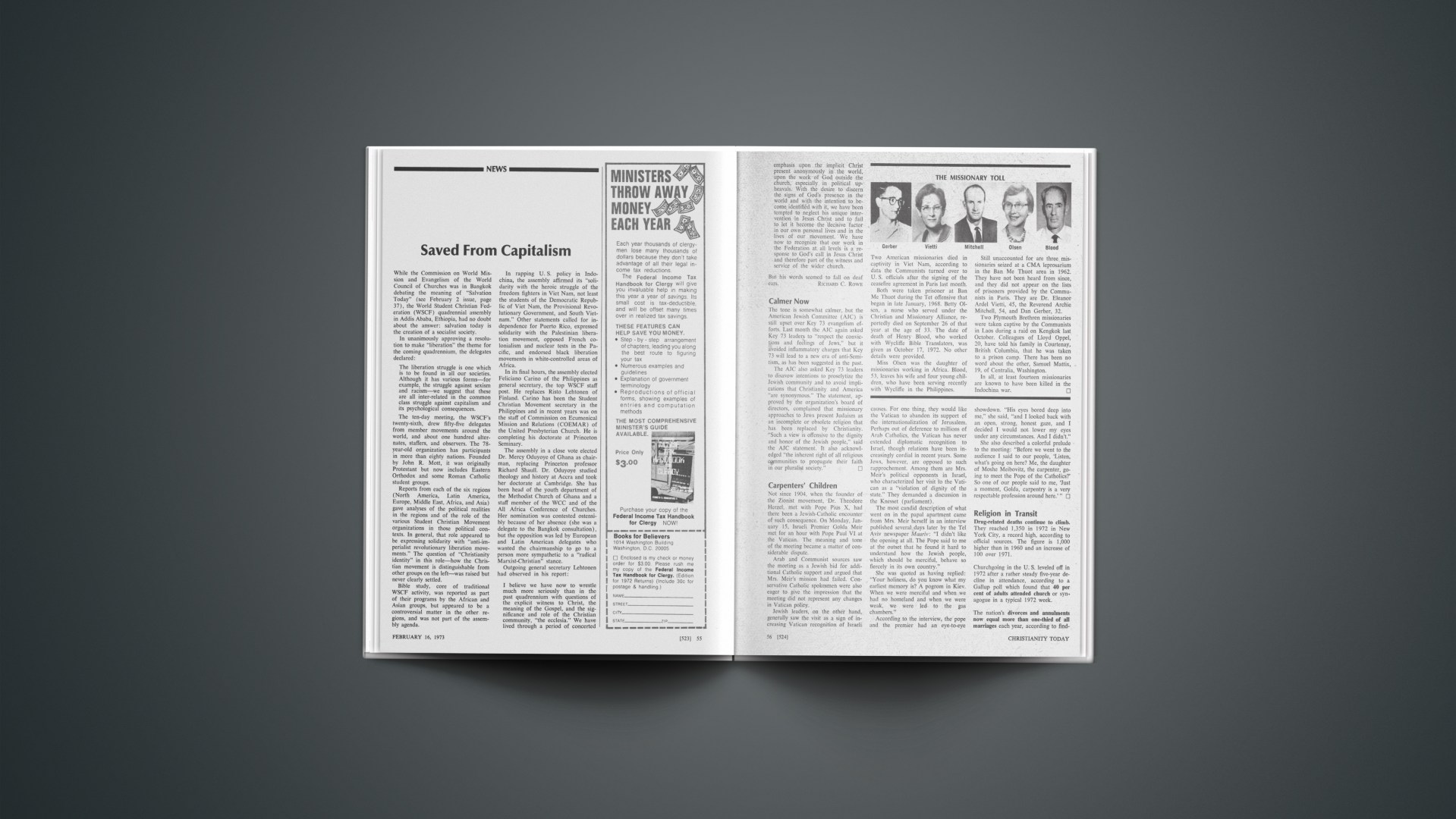
THE MISSIONARY TOLL

Two American missionaries died in captivity in Viet Nam, according to data the Communists turned over to U. S. officials after the signing of the ceasefire agreement in Paris last month.

Both were taken prisoner at Ban Me Thuot during the Tet offensive that began in late January, 1968. Betty Olsen, a nurse who served under the Christian and Missionary Alliance, reportedly died on September 26 of that year at the age of 33. The date of death of Henry Blood, who worked with Wycliffe Bible Translators, was given as October 17, 1972. No other details were provided.

Miss Olsen was the daughter of missionaries working in Africa. Blood, 53, leaves his wife and four young children, who have been serving recently with Wycliffe in the Philippines.

Still unaccounted for are three missionaries seized at a CMA leprosarium in the Ban Me Thuot area in 1962. They have not been heard from since, and they did not appear on the lists of prisoners provided by the Communists in Paris. They are Dr. Eleanor Ardel Vietti, 45, the Reverend Archie Mitchell, 54, and Dan Gerber, 32.

Two Plymouth Brethren missionaries were taken captive by the Communists in Laos during a raid on Kengkok last October. Colleagues of Lloyd Oppel, 20, have told his family in Courtenay, British Columbia, that he was taken to a prison camp. There has been no word about the other, Samuel Mattix, 19, of Centralia, Washington.

In all, at least fourteen missionaries are known to have been killed in the Indochina war.

Churchgoing in the U. S. leveled off in 1972 after a rather steady five-year decline in attendance, according to a Gallup poll which found that 40 per cent of adults attended church or synagogue in a typical 1972 week.

The nation’s divorces and annulments now equal more than one-third of all marriages each year, according to findings of the Department of Health, Education, and Welfare. Last year 2,196,000 couples got married; 768,000 got divorced. Last year there were 8.7 million children under eighteen in fatherless homes, says the HEW report.

Personalia

Pastor Stephen F. Olford of Calvary Baptist Church, New York City, has resigned after nearly fourteen years to become “minister at large” of Encounter Ministries, a radio and video project.

United Methodist minister Jim Coppedge of Eugene, Oregon, was fined $32 for shoplifting. He says he took the items as a protest action after failing to get the district attorney to act on a consumer complaint.

California State College science dean Robert Fischer and Stanford professor Richard Bube, both past presidents of the evangelically aligned American Scientific Affiliation, were named to the committee to edit evolutionary “dogma” from the state’s science texts. Other members are Fuller Seminary professor David Hubbard, Seventh-day Adventist physician John Ford, and schools administrator Clarence L. Hall, all members of the state’s board of education.

Historian W. Roland Foster will succeed Bishop Stephen F. Bayne as chief administrator of the Episcopal General Seminary in New York. A story by New York Times religion editor Edward B. Fiske says the school’s current deficit is $175,000 (it has a $14 million endowment). There are a dozen Episcopal seminaries with about 900 enrolled; many leaders see consolidation ahead.

United Church of Christ minister William R. Johnson, the first self-identified homosexual ordained by a major denomination, was appointed executive director of the San Francisco-based Council on Religion and the Homosexual.

Radical Episcopal priest Richard York of the Berkeley Free Church has been forbidden by Bishop C. Kilmer Myers from giving any more sacraments “until further notice.” The ban came after York presided at the marriage of anti-war personalities Jane Fonda, a divorcee, and Tom Hayden. Episcopal law dictates that divorced persons must have a bishop’s permission to remarry. Miss Fonda did not.

A Churches of Christ in Christian Union minister, Thomas H. Hermiz, will become executive director of the Christian Holiness Association, succeeding O. Dale Emery.

World Scene

Twenty-seven doctors in Holland admitted practicing euthanasia after two others, a husband and wife, were brought to trial for giving the wife’s mother a lethal dose of tranquilizer. The pair said the woman was incurably ill and “her suffering had become intolerable.”

Soviet police forced an Associated Press photographer to destroy his film after he took pictures of Tricia Nixon Cox and her husband visiting a cathedral in Leningrad.

Professor Yigal Yadin of the Hebrew University in Jerusalem theorizes in a new book that the early Christians based many of their beliefs on a contrived theology held only temporarily by the Essenes, the people of Dead Sea Scrolls fame. Yadin’s work is about the Temple Scroll, found in 1967.

Bishop Wenceslao Bahamonde, head of the 3,000-member Methodist Church of Peru, says the top priorities for his people are evangelism, a revitalized youth ministry, and an urban social program. He says many young people in his land are now involved in Bible study groups.

President Idi Amin of Uganda announced that all schools, churches, and mosques that belonged to the deported non-citizen Asians and British will be turned over to the respective national church bodies.

The thirty members of the Ghana Church Union Committee, representing Ghana’s seven major Protestant churches (Anglican, Evangelical Presbyterian, Presbyterian, Methodist, African Methodist Episcopal, Mennonite, and Evangelical Lutheran), have approved a plan for merger. Target date: 1976.

Rhodesia’s first “native” African Roman Catholic bishop, Patrick Chakaipa, 40, a tribal-language scholar, was consecrated before 20,000 in Salisbury.

Independent Pentecostal missionary Arnold Butler of San Jose, California, and his family have been deported by Israel, allegedly for inability to support themselves and for endangering the peace. Butler was arrested and fined $100 for causing an uproar when he handed out New Testaments at the Wailing Wall on Yom Kippur.

The World Council of Churches says it has sold all its holdings (market value: about $1.5 million) in 650 companies in the United States, Britain, Holland, and Switzerland that have investments in South Africa. These stocks are said to represent nearly 40 per cent of the WCC’s holdings. Banks will be boycotted next. Meanwhile, the WCC granted another $200,000 to black-liberation movements in Africa through its Program to Combat Racism.

Concern is mounting for the well-being of missionaries and other Christian workers in the southern Indian state of Andhra Pradesh, scene of violent clashes over government policy in which dozens have been killed and hundreds injured.

Jordan has asked the Soviet Union to end Soviet Jewish emigration to “occupied Palestine” because the migration “constitutes a great danger to the Palestinian issue.”

Western radio broadcasts, many of them with religious themes, were attacked in an article in the Soviet trade-union newspaper as “purposeful propaganda of militant anti-Communists striving to undermine socialism from within.” It mentioned broadcasts of Trans World Radio, Far East Broadcasting Company, and other mission stations in addition to those of government-backed agencies.

Bishop Lesslie Newbigin of the Church of South India says the church ought to give up its constitutional rights to run its educational institutions without government control so that action can be taken against cases of malpractice and corruption that crop up. If not, the government will take over, he warned.

Two Catholic priests in custody in Mozambique for more than a year were to stand trial before a military tribunal for alleged anti-Portuguese activities (they claimed Portuguese soldiers in the northern war zone had committed atrocities). Meanwhile, United Presbyterian executive William P. Thompson, head of the World Alliance of Reformed Churches, appealed for U. S. State Department intervention on behalf of the many other national church leaders and members detained there.
The Times Are Ripe

The Times Are Ripe

While the “western Canadian revival” was surging through evangelical churches last year, Canadian mainstream denominations were quietly experiencing a new awareness of evangelism. That opinion came from Mariano Di Gangi during a recent interview. He is past president of the Evangelical

Fellowship of Canada, and one of six designated evangelists in the Presbyterian Church in Canada.

One reason for the increased interest in evangelism is the “proliferation of small neighborhood Bible-study groups” in Canada during the past year or two, Di Gangi suggested. He said the most vigorous groups have generally not been directly related to local congregations, but their participants have usually been from Anglican, Presbyterian, and United churches.

Citing Don Mills, a Toronto suburb, as an example of a community where Bible studies have sprung up, Di Gangi noted that people in the “gospel churches” have generally not been involved. One reason why, he suggested, is the “openness” of the groups. “People there generally wear makeup, smoke, or show signs of affluence not present in usual evangelical circles,” he said, and such trappings make “gospel church” people uncomfortable.

A second factor in the increasing mainstream interest in evangelism is the greater denominational use of preaching missions—complete with appeals to commitment, said Di Gangi. He cited his own denomination as an example: in 1971 the Canadian Presbyterian General Assembly appointed six denominational evangelists. All six are receiving more and more congregational requests for various types of services, he said. And most of the major denominations in Canada also have evangelically oriented subgroups that are growing in influence.

A third factor, said Di Gangi, is the “fascination of many ministers with the Coral Ridge program.” He said many Canadian ministers go to James Kennedy’s Presbyterian church in Coral Ridge, Florida, to study the growth program of that church. While not all attempt to practice what they learn there, some of those who try it find it works, even in the more staid Canadian scene.

The number of young evangelical ministers within mainstream churches is growing too, he said, and many of the younger men are “not content with mere orthodoxy”; with them it is a case of “evangelize or die.”

While hesitant to appear critical of the western Canada revival and its results, Di Gangi said that evangelism within the mainstream churches could in the long run be as effective as revival, or perhaps more effective, “provided it is sustained by the unfolding of biblical truth.” And he suggested that people in the purely evangelical traditions could learn much about hymnology from their mainstream counterparts. Di Gangi said much of evangelical hymnology is basically “nature worship based on experience and worship of the ‘God of nature’ and containing little of the facts of redemption.”

All things considered, the times seem ripe in Canada for Key 73’s evangelistic thrust.

LLOYD MACKEY

Roman Catholics:Keyed Up For Key 73

They have no national coordination at present and participation is purely on a parish-by-parish, diocese-by-diocese basis, but Roman Catholics are getting involved in Key 73. So far, participation has extended into forty dioceses in the United States and several in Canada.

Most Catholics, while agreeing on the evangelism aim of Key 73, prefer to look on the program as a chance to renew their own church. Monsignor Joseph Baker, Key 73 coordinator for all four dioceses in Missouri, said Key “is primarily an opportunity for spiritual renewal in the Roman Catholic Church. We need to preach the Gospel to ourselves.” Following the inner-renewal emphasis, he said, the church would then involve itself in outreach.

All four Missouri dioceses—St. Louis, Kansas City-St. Joseph, Jefferson City, and Springfield-Cape Girardeau—are involved in the program. Among other dioceses participating are Los Angeles; Dubuque, Iowa; Albany, New York; Philadelphia; Orlando, Florida; Toledo, Cincinnati, and Columbus, Ohio; and Salt Lake City, Utah.

High church officials supporting Key 73 include Cardinal Joseph Carberry of St. Louis, who officiated at a special Key 73 prayer service at the St. Louis Cathedral last November. Cardinal Carberry and other Missouri bishops plugged Key 73 in a pastoral letter distributed and read to their churches the same month. The letter called for church renewal through the mass, other sacraments, personal prayer, family and group prayer, the rosary, and Scripture reading. Said Carberry: “In order to carry out the goals of Key 73, programs will be developed on the parish level.… Let us make the year 1973 a year of renewal and faith with Christ as our center and source.”

Missouri Catholics will conduct a state-wide ecumenical census of religious affiliation as one of their major Key 73 efforts, Baker said. The census, slated for March, will be done parish by parish in cooperation with area Protestant churches. Baker said the census should show each denomination where its members are and also show members that the churches are interested in them.

In Los Angeles, Archbishop Timothy Manning appealed to California Catholics to participate in Key 73 by making “a fresh and intense effort to reflect Christ in our daily lives.” He said any local participation would take place “within the framework and context of our own Catholic teachings and traditions.” (Denominations and organizations participating in Key 73 are free to work within their own denominational beliefs.)

Other dioceses and parishes are using such Key 73 material as the Congregational Resource Book to plan their programs. Some parishes will distribute New Testament portions in cooperation with Protestant denominations.

Missouri coordinator Baker said many Catholics are not as well prepared for Key 73 as other groups “because the church was not officially invited to join Key 73 until early last year.” (The national Catholic bishops’ conference agreed last spring to allow bishops to decide the extent of participation on a local basis, but refrained from a complete endorsement of the program.) Baker believes all dioceses in the United States would have participated completely “if there had been enough time to study it properly.”

Not all Catholics agree with Key 73, however. Charles Angell, a priest and editor of the noted Roman Catholic publication The Lamp, takes issue with Bishop Joseph L. Hogan of Rochester, New York, who has said no doctrinal compromise is involved in Catholic participation. “With all due respect, bishop, I wonder,” said Angell in an editorial. He warned that Key 73 might “lull us into some kind of ‘my country right or wrong’ nostalgic jag” and added that Key 73 may unlock the lid of a Pandora’s box.

Angell also notes recent Jewish complaints that Key 73 may be a cover for anti-Semitism (see story, page 56, and December 22, 1971 issue, page 37). “I share in [Rabbi Marc Tanenbaum’s] concern that this effort at proclaiming the Gospel might somehow imply that only Christians are real Americans,” he said.

BARRIE DOYLE

Alcoholism:A Matter Of Genetics?

Evidence that children of alcoholics may be born with genetic damage that produces a tendency toward alcoholism has been reported by Dr. George Winokur of the University of Iowa School of Medicine. He and two associates studied the children of alcoholic parents who were raised in homes where one or both parents were alcoholic and compared them with those removed from such an environment and raised in homes where alcohol was not present. The psychiatrists discovered that 48 per cent of the children of alcoholics raised in alcoholic homes themselves became addicted to liquor upon reaching adulthood. But they also found that 50 per cent of the children of alcoholics raised in non-alcoholic homes fell victim to the disease.

Surprised by this finding that home environment did not seem to be as significant a factor as had been thought, they checked it by studying children of non-alcoholic parents who were raised in homes where alcoholism was present. They found that only 14 per cent had become alcoholics as adults. The rate for those raised in non-alcoholic homes is said to be 8 per cent.

Other studies, says Dr. Winokur, strongly indicate some kind of hereditary factor is present, raising serious questions about the long-standing belief that a bad home environment is a principal factor in alcoholism.

GLENN EVERETT

Muslim Rivalry

A mass slaying in Washington, D. C., last month suggests that tensions among some Muslim groups in North America may be approaching the “holy war” stage. Two adults and two youngsters were shot to death and three other children were drowned in a large stone house that headquartered an orthodox Islamic community.

The leader of the group, Hamaas Abdul Khaalis, charges that Black Muslims were responsible for the killing. He said his daughter, who was wounded in the shooting, told him the crimes were committed by men who identified themselves as Black Muslims and said they were acting in retaliation for a recent doctrinal challenge advanced by Hamaas.

Mainstream Islam regards the Black Muslims as heretical. Hamaas said he had written letters to Black Muslim leaders denouncing their beliefs and charging that they were not true followers of Islam. Black Muslim leaders denied that they had anything to do with the slayings.

Police speculated that there has also been some connection between the Washington killings and a forty-seven-hour siege in a Brooklyn sporting-goods store involving four men professing to be Sunni Muslims. No immediate link was discovered, however. The siege, in which a policeman was killed, followed an abortive robbery attempt. Some informed sources think the intruders wanted to steal arms with which to carry on the Muslim feud.

The father of another woman wounded in the Washington massacre is Presbyterian clergyman Reginald Hawkins of Charlotte, North Carolina, who ran unsuccessfully for governor in 1971. He said that his home had been robbed the week before and that four guns were among the items taken.

The victimized Washington group are Hanafi Muslims and are regarded as part of the predominant Sunni strain in Islam.

Black Muslims are not recognized by any major Islamic school, but they claim to be an authentic body. Their origin goes back to 1931 and a Southern silk-peddler named W. D. Ford. Soon after, the leadership was taken over by the man who still reigns supreme, Elijah Muhammad, 75, who has made Chicago his headquarters. He is the son of a Georgia Baptist minister.

Black Muslims operated in relative obscurity until Americans of African ancestry began developing a much more intense racial consciousness in the early sixties. Now there are many thousands of highly-disciplined followers.

The movement has been increasingly plagued by internal dissent. There have been sporadic outbreaks of fatal violence and some significant splits, the most marked being that of the late Malcolm X. The tension with mainstream Islam had not been apparent until recently.

Hamaas is now calling on other Islamic groups to help overthrow the Black Muslims, who call themselves officially the Nation of Islam. “True believers in Islam do not murder children and women and old senile people,” he said. “They hate us because we are color blind.”

Hamaas has also been critical of the boxer Muhammad Ali and the singer Joe Tex for contributing large sums to the Black Muslims. He said they “are spreading this poison that only the white man is the devil.”

Perhaps the best known disciple of the Hanafi Muslims is Kareem Abdul-Jabbar, the seven-foot two-inch professional basketball great formerly known as Lew Alcindor, who purchased the group’s Washington home. The building is located along Sixteenth Street, which has long been the capital’s main thoroughfare of big, prestigious churches and temples.

God On The Bench

A Christian law school? Well, not quite. But the new International School of Law (ISL) in Washington, D. C., was founded to “provide a quality legal education based on the principles of the Judeo-Christian ethic.” And its founder, its administrators, and most of its faculty members are Christians. While personal faith—or the lack of it—does not figure in admission policy, “character” does, and prospective students are informed of the school’s dedication to the ideal “law above the law”—God’s absolutes.

ISL was founded last fall by John Brabner-Smith, 69, a nationally reputed man of the law who spends much of his spare time traveling with lay witness teams. While teaching at Northwestern University in the thirties he became involved in prosecution of the Capone gang. Then, as an assistant to the chairman of the U. S. Senate Judiciary Committee, he authored the bills that gave the Federal Bureau of Investigation much of its present-day bite in the realm of crime (the Lindbergh Act, the Machine Gun Act, and others), but he now regrets the resulting concentration of power in one man. Later, he helped to start the Federal Housing Administration and drafted most of its regulations.

Brabner-Smith is a member of the National Presbyterian Church in the nation’s capital (aptly enough, he wrote the church’s by-laws), but attends only infrequently because of his lay witness activities and involvement with a house-church movement (more than 100 persons were baptized on his farm near Leesburg, Virginia, last year). The son of a Methodist minister, Brabner-Smith says he discovered only recently what it means to be a true Christian.

The jurist insists that America’s system of jurisprudence and its great law schools were founded on theology, traceable back to Princeton’s early days, but that the law has gradually cut itself loose from these moorings and is now adrift in murky waters where little or nothing is absolute.

For his chief administrative officer, Brabner-Smith chose Daniel Smith, 28, a law graduate of the University of Virginia who was fresh out of the Marine Corps. Smith had law teaching experience but was contemplating enrollment in an evangelical seminary.

The school has twenty-four full-time and six part-time students its first year, says Smith, with 125 applications in for next fall. Classes are held in rented quarters that used to be the home of former Chief Justice Edward Douglas White of the U. S. Supreme Court; ISL has negotiations under way for its own property. Also in the works is accreditation. The biggest hassle is over library requirements. (“We have the most outstanding law libraries of the land within steps of our door,” he says, “but they want us to build our own.”)

While Brabner-Smith is of the “old” school philosophically, he’s a liberal on academic policy. He believes that character, native ability, and other personal qualities are more important than good grades for sizing up prospective students. Many of the country’s most successful lawyers were not even “B” students, he asserts, adding, “There is just no correlation between grades and ability.”

The past two decades have seen some major shifts in the law. It all seems to bear out the concluding lines of an Encyclopedia Britannica article: “The history of jurisprudence has shown that the theories of law are mainly a reflection of the trends and requirements of each age. A theory to satisfy the needs of the present has still to be evolved.” For Brabner-Smith and his associates, the need is not for a new theory but rather for a return to the foundations.

EDWARD E. PLOWMAN

BATTLE STATIONS

The American Jewish Congress (AJC) hoisted battle flags last month and sailed into a fight with the U. S. Navy over Key 73. The AJC, which has declared war on the evangelism project (see December 22, 1971, issue, page 37), fired a broadside at a memorandum circulated among the chaplains by the Navy chief of chaplains, Rear Admiral F. L. Garrett, a United Methodist.

The memorandum, sent in October but only recently surfaced, urges chaplains to play “a strong role” in the year-long Key 73 program. Garrett called on chaplains to study Key 73 materials and commended the program as worthy of support “unless there should be denominational reasons for preventing your participating.”

Maneuvering in the wake behind Garrett, the AJC fired off a missile to Navy secretary John H. Chaffee. In it Rabbi Yaakov Rosenberg complained that the Garrett letter contradicts the function of a chaplaincy corps, which, he said, “is to supply the spiritual needs of those American citizens serving in the armed forces.” The memo, he claims, converts the chaplaincy from “a role of service to one of advocacy,” and amounts to government support for a missionary activity.

Unperturbed by the attack on his flank Garrett unleashed a salvo of his own. “The Chief of Chaplains is charged with the support of religious programming that crosses the entire spectrum of religious life in America,” he answered in a prepared statement. “Support of Key 73 flows from the same obligation as does his support of Passover observances and other religious emphases of Jewish personnel.” Since Key 73 involves the majority of Protestants and Roman Catholics, participation in Key 73 by Navy chaplains is within their ministries, he concluded.

Evangelical Broadcasters: Discriminatingly Different

Despite recent rulings that some Christian broadcasters see as a threat to their continued operation, relations between the Federal Communications Commission (FCC) and the National Religious Broadcasters (NRB) are warm, if at times guarded. At last month’s thirtieth annual NRB convention in Washington, D. C., FCC commissioners and division chiefs were out in force, prompting FCC chairman Dean Burch to quip that the NRB had succeeded in getting all seven commissioners together where he had failed.

The underlying topic of discussion—though it rarely surfaced during public sessions—was the FCC ruling against Kings Garden, Incorporated, operator of two Christian radio stations in Edmonds, Washington. A prospective news announcer refused to answer questions about his beliefs on a job application form, claiming job discrimination based on religion. This precipitated an FCC investigation. The commission agreed and told Kings Garden to drop all such questions. Commissioners refused to discuss the issue because the case is still pending before courts and its own rules body.

GETTING THE WORLD’S EAR

Evangelical broadcasting is growing by leaps and bounds, according to figures compiled by the National Religious Broadcasters, an evangelical organization. NRB executive secretary Ben Armstrong said the group now has 515 members, an estimated 70 per cent of the religious broadcasting market. In 1967, he said, NRB had 107 members.

Christian radio stations, which in 1967 were being formed at a rate of one per month, are now appearing at the rate of one per week in the United States. Similarly, from a single Christian television station five years ago, the field has grown to twenty-four across the nation with thirteen more under negotiation.

Armstrong said that six facilities broadcast daily to countries behind the Iron Curtain, and that “no place on earth is now inaccessible to the Gospel.”

(Kings Garden contended that the 1968 Civil Rights Act exempted religious organizations from strictures against religious discrimination in hiring provided the jobs were concerned with religious activity. The commission rejected that argument, claiming the act has no jurisdiction in FCC territory. Kings Garden is appealing again and asking for a rule change to bring the FCC in line with the act.)

Station owners and operators at the convention heard FCC complaints division chief William Ray outline the case. He said that on the advice of FCC attorneys, however, he was “not prepared to discuss the pros and cons of the issue.” Discussion continued among private groups, but public debate, stymied by the FCC, was closed.

Although some station owners worried about the rule, NRB executive secretary Ben Armstrong said Kings Garden was an “isolated case.” NRB studies showed Kings Garden was the only station asking such questions on job applications. “The question was the precipitating factor,” said Armstrong. “I don’t think other stations will be affected.”

Nevertheless, said Armstrong, the NRB wants discussions with the commission on the matter. “We want to examine the interpretation of the rules. The [NRB] board feels the category of religious exemption under present FCC rules is very broad. Kings Garden says they are very narrow. We want an interpretation and we want the commission to act quickly.” If Kings Garden is correct, only announcers involved in a preaching category could be hired on the basis of their faith; all other jobs would be open. The NRB interpretation encompasses all jobs pertaining to production.

Some station owners are angry with Kings Garden for figuring the issue. They’re afraid the boat-rocking will cause the FCC to tighten religious broadcasting even further. Twenty owners are already planning a spring meeting to discuss the issue. “I can’t see how you can have gospel programming with non-believers acting as announcers,” said Wayne Paradise, a station owner in Auburn, Indiana. “Listeners know if the announcer is dedicated, whether it be to country and western music, rock and roll, or religion.” His stations, AM and FM, are not completely gospel programming, he said, “so I do have some unsaved people on staff.” None, however, is in an “on-air” gospel programming position, he said.

During the four-day convention, speakers ranged from success-oriented businessman W. Clement Stone of Chicago to evangelist Billy Graham. The theme of the convention was “Calling the Continent to Christ,” borrowed from Key 73. Dr. Ted Raedeke, executive director of Key 73, discussed the evangelism effort with delegates. NRB is a cooperating Key 73 body and has arranged space at its Madison, New Jersey, headquarters for a Key 73 mass-media office. (A Key 73 television special distributed by the office was seen on 667 North American stations—a potential 75 million viewers, according to Key 73 officials.)

NRB delegates were also confronted with the race issue in minority programming and hiring. NRB press secretary J. Morgan Hodges, a black minister in Washington, D. C., who was once a CBS newscaster, led a black panel that criticized stations for discriminatory hiring and failure to provide programming acceptable to black audiences. Armstrong agreed programming leaves a lot to be desired.

Internationally, NRB has been asked to participate in a world broadcasters’ organization, said Armstrong. World Evangelical Fellowship secretary Clyde Taylor wants to revive a defunct department of radio and television, Armstrong added, and NRB and European broadcasters are studying a framework for such an organization. (Meanwhile, Canadians attending the convention met to discuss formation of a similar organization in Canada.)

Broadcasters also discussed recent trends in gospel programming, including a turn to shorter, capsule programs in place of the traditional half-hour music-sermon format.

Abortion Decision: A Death Blow?

“Who shall be next?” asked horrified Cardinal Patrick O’Boyle, referring to the sweeping Supreme Court decision that allows a woman in consultation with her doctor to opt for abortion within the first three months of pregnancy (see lead editorial, page 32). If we can “sacrifice innocent human life” through abortion, O’Boyle and other critics reasoned, it will be just a short step to sacrificing the elderly and infirm. (The Supreme Court decision overturned restrictive abortion laws in thirty-one states, as well as “liberalized” laws in fifteen other states.)

The Supreme Court’s decision brought, as expected, immediate response from the nation’s Roman Catholic leaders. Cardinal John Krol, president of the United States Catholic bishops’ conference, condemned the ruling as “bad logic and bad law,” adding that it “drastically diminishes the Constitutional guarantee of right to life and in doing so sets in motion developments which are terrifying to contemplate.” New York’s Cardinal Terence Cooke also voiced his protest: “Whatever their legal rationale, seven men have made a tragic utilitarian judgment regarding who shall live and who shall die.”

Catholic hospitals across the country are gearing up for a fight against what they consider “abortion on demand.” In some rural areas, such as Billings, Montana, the only hospital in the vicinity with maternity facilities is Catholic. Other hospitals, however, are preparing to perform abortions; some estimate the figure will be as high as 1.6 million annually.

Congressional response also came quickly. Representative Lawrence J. Hogan, a Roman Catholic, introduced a resolution proposing a constitutional amendment guaranteeing the right to life. Section two of the proposed article would also prevent euthanasia from becoming law.

Hogan in a press conference acknowledged that chances for passage of his resolution are “pretty slim.” But “there is no more important issue” around today, insisted the congressman. When asked if the press had unfairly represented the abortion opposition as solely Catholic, Hogan said that much anti-abortion activity comes from Protestant ranks. In Maryland, he said, a Baptist minister is heading the fight, and in Minnesota the anti-abortion leaders are Lutheran. He added that Orthodox Jews are also strongly against abortion. Reform Jews, however, seem to favor abortion. A spokesman for the commission on Interfaith Activities, Rabbi Balfour Brickner, has criticized the Catholic Church and other critics of abortion.

Protestant leaders seem divided on the issue. While the Baptist minister in Maryland opposes abortion, W. A. Criswell, former president of the Southern Baptist Convention and pastor of the First Baptist Church of Dallas, seemed satisfied with the high court’s ruling. “I have always felt that it was only after a child was born and had life separate from its mother that it became an individual person, and it has always, therefore, seemed to me that what is best for the mother and for the future should be allowed.”

THE RIGHT TO DIE

As the Supreme Court’s abortion ruling boiled into national debate last month, an issue concerning the other end of life began to simmer on the back burner. It all began when the American Hospital Association sent a “patient’s bill of rights” to its 7,000 member hospitals. The rights included the opportunity to choose death by rejecting treatment.

A few days later, the New York Medical Society released a statement affirming a patient’s “right to die” with dignity—at the discretion of relatives and with the doctor’s approval—when death is biologically inevitable. Then Vatican Radio issued a blistering denunciation of the NYMS statement, using such terminology as “strange … absurd … cold … the right to murder.”

Another Southern Baptist, attorney Linda N. Coffee, who represented the plaintiff in the Texas case that resulted in the high court’s decision, said; “The Supreme Court decision does not absolve anyone of individual moral or religious responsibility.” Legally, she said, she agrees with the ruling. However, “from my personal perspective as a Christian, it would tear me up to have to make a decision on abortion except in the early stages. And I would have to have a compelling reason even then.” She emphasized that the court judgment does not require a doctor to perform an abortion when asked. The 30-year-old member of Park Cities Baptist Church in Dallas believes that “legal personhood is separate entirely from a moral or religious view of personhood.”

Two Protestant theologians, Albert C. Outler of Southern Methodist University and J. Robert Nelson of Boston University School of Theology, disapprove of the decision. The two men, both Methodists, disagree with their denomination’s official position, which is strongly pro-abortion.

John C. Bennett, president-emeritus of Union Seminary in New York, applauded the judgment as “a landmark in relation to women’s rights.” Agreeing with him, Howard Moody, pastor of New York’s Judson Memorial Church, added: “The Supreme Court may have saved the ecumenical movement, avoiding an all-out conflict between Catholics and Protestants on abortion.” Moody may be right in a sense: the ruling may promote cooperation to fight abortion.

E. Stanley Jones

E. Stanley Jones, Methodism’s best-known missionary and evangelist, died last month in India, the country to which he had devoted his life. He was 89.

Jones had suffered a stroke a little more than a year ago but was making a remarkable comeback (see January 19 issue, page 40). He died at the Clara Swain Hospital in Bareilly.

After graduating from Asbury College, Jones began his ministry as a thorough-going evangelical, as evidenced by his classic volume The Christ of the Indian Road. He subsequently shifted ground but never to the extent that he was at home or in agreement with the radically liberal theology that characterized so many in his denomination. He was noted for his establishment of Christian ashrams (religious retreats) in India, and the movement even spread to the United States.

Jones turned down opportunities to become a bishop and in 1928 actually refused the office after being elected. He wrote twenty-nine books, the last of which is yet to be published.

For several years Jones stumped America on behalf of a plan for church union he originated, patterning it after the U. S. federal and state governments. It envisioned a single church body with local self-government. The idea never materialized.

Just before World War II Jones served as an informal intermediary in an effort to head off war between the United States and Japan. Jones felt that a cable he urged Roosevelt to send to the Japanese emperor might have averted the conflict had it been delivered on time.

HAROLD LINDSELL

The Evangelical Connection?

Federal agents ignored labels warning that four film cannisters contained unexposed film and should not be opened, and opened them anyway. Inside was forty-four pounds of semi-processed opium (street value when refined into heroin: $2.5 million). The film cans arrived in New York last month from Thailand by surface mail bearing mailing labels of The Evangelical Alliance Mission (TEAM) of Carol Stream, Illinois. They were addressed to Chicago film editor Ted Norcutt, 34, who does work for TEAM and a number of other evangelical organizations.

Norcutt was arrested, pleaded not guilty, and is free on $20,000 bail. A hearing is scheduled this month, at which time charges may be dropped (if the government fails to get more than circumstantial evidence connecting Norcutt to the dope) or he will be bound over to a grand jury for possible indictment. Norcutt insists he is innocent and wonders if someone in Southeast Asia is trying to discredit evangelical enterprises.

TEAM officials are at a loss to know how anyone in Thailand got their mailing labels (TEAM has no work there), an outdated version at that. Investigators questioned several missionaries and film producers who were in Thailand about the time the opium was mailed. One couple was working on a movie for Compassion, the Chicago-based child-care organization. The pair had worked on earlier TEAM assignments. Mission leaders, however, say they are confident none of their people are involved, but nevertheless are doing some checking of their own.

The question remains: Who put the drug shipment in the film cans and why?

JACK HOUSTON

Sweden: Religion And Rights

Over three years ago the Swedish government’s ministry of education took over religious instruction in all Swedish schools. The old curriculum, drawn up by the state Church of Sweden to present its own doctrine, was replaced with “objective teaching about religion,” which many parents felt to be indoctrination in agnosticism. Protestants were not allowed to withdraw their children from the obligatory instruction under any circumstances, and Roman Catholics and Jews, who were theoretically permitted to do so, found it impossible in practice, because the state had created a new “integrated” curriculum in which religion was no longer taught separately but became part of history, geography, and the like.

For three and a half years an independent Evangelical Lutheran congregation, St. Martins (Stockholm), has been fighting for the right of parents to keep their children out of the “objective” classes. When all else failed, the dissenters brought their case before the Commission on Human Rights of the Council of Europe. In an apparent effort to forestall an embarrassing condemnation by the commission, the Swedish government has now conceded that children belonging to the (non-state) Evangelical Lutheran Church of Sweden will no longer be obliged to attend the “objective” classes in religion.

The government’s ruling states that whenever parents demand it, the “integrated” teaching must be disentangled, and the teaching on religion made into a separate subject, so that dissenting children may skip it and attend voluntary religion classes taught by non-government teachers. The ruling again makes it possible for Roman Catholics and Jews to evade the state-imposed instruction.

Although not directly affected by the ruling, members of the state church (90 per cent of the population) benefit indirectly: the government has been forced to concede that it cannot use its own standards of “objectivity” as an excuse for imposing its own religious teachings on children whose parents object to it.

Because the case was already under consideration before the European commission, the concessions made by Sweden will be registered by the commission and become part of the European standards of human rights, and therefore in theory be applicable in all member states. This is a setback for radical education officials in West Germany’s Social Democratic government, who wanted to impose mandatory “objective” teaching on religion—Swedish style—in that country too.

SHUT UP FOR JESUS

A furor is raging at the University of Nebraska. Officials there forbade a Campus Crusade wrestling team from giving testimonies during an appearance. Many students, professors, and even a few newspapers asked why other groups were free to promote homosexuality, radical politics, and the like while Christians were muzzled. The Omaha World-Herald lampooned the school’s action in an editorial entitled “Sit Down, Shut Up For Jesus.”

The school is now forging a policy regarding religious activities on campus.

Spanish Bishops Call For Reform

The Roman Catholic bishops in Spain are now on record as favoring a significant new measure of religious liberty. Last month the eighty-three churchmen voted approval by a large majority of a forty-eight-page policy statement that advocates the loosening of centuries-old ties between church and state. They were quoted as saying that “the important thing is to guarantee effectively to all citizens religious liberty in their personal, family, and social lives.”

What practical effect the document will have and how much time will elapse before there is any implementation is not at all clear. The text was not immediately made public, though a number of copies leaked out. Official publication, it was explained, has been held up so that the document could first be presented to the Vatican and to “high authorities of the state.”

Evangelicals are hoping that the rhetoric will soon be translated into a firm policy that will ease restrictions against evangelism. A CHRISTIANITY TODAY correspondent in Spain reported that among incidents in recent weeks were these:

In Malaga a Protestant soldier was put in jail for not attending Catholic mass. In Cartagena some duly authorized meetings could not be advertised. Various publications were suppressed because censors thought they represented opposition to Catholic doctrines. In Huelva a permit for building an evangelical residence was denied. In Madrid Catholic squads wrote insults on the walls of Protestant churches. In Barcelona a Protestant magazine and other publications were penalized and forbidden. Radio programs have been canceled. The Ministry of Justice exercised “administrative silence” in response to applications by Protestant churches for legal recognition.

The document adopted by the bishops (after months of controversy) calls for revision of the 1953 concordat that regulates relations between the Vatican and the Spanish government. Specifically, it calls for an end to the right of the government to share in the process of naming bishops to Spanish sees, the withdrawal of members of the hierarchy from government posts, and an end to special legal privileges enjoyed by priests. It approves the right of “prophetic denunciation” of social, political, and economic wrongs. But it asks that the state continue financial aid for schools, hospitals, and other social-service institutions operated by the church.

The vote on the document showed fifty-nine bishops in favor of it, twenty against, and four abstentions. The balloting was conducted by mail.

Political and religious conservatives in Spain had spoken vehemently against the policy statement. One prominent official lamented that some bishops had “forgotten” what the Franco government had done for Catholicism in Spain. He recalled that during the Spanish Republic, which Franco overthrew in the 1936–39 civil war, the Communists murdered thirteen bishops and nearly 8,000 priests, monks, and nuns, and razed countless monasteries, convents, and churches. Franco, he added, had saved Spain from atheistic Communism and had “served God by serving his church” in subsequent years—that is, by spending the equivalent of $4.7 billion on church buildings and schools.

Biblical Proliferation

An “ecumenical edition” of the Revised Standard Version of the Bible was published in Britain last month and will make its debut in the United States April 2. The cover bears the title “Common Bible.” Inside are the RSV Old Testament, the apocrypha-deuterocanonical books, and an altered RSV New Testament. And thanks to Wycliffe Bible Translators and the American Bible Society, the 6,000 members of the Hopi Indian tribe now have the complete New Testament in their own language. The first copies were delivered at a dedication service last month in Polacca, Arizona.

The Minister’s Workshop: Doorway to the Press

Key 73 is a continent-wide campaign to proclaim the Gospel to the masses. One of the prime channels to the masses is the press. And since the Key 73 strategy is that each local church do its own thing to communicate the Gospel, blessed is the congregation (and pastor) that can harness the press for effective outreach. It can be done. Writers Shirley T. Angle, Barrie Doyle, and Edward E. Plowman offer some suggestions as to how.

If non-believers were to form their opinion of Christianity from stories about the church and Christian life printed in your local newspaper, what would they think? Does the weekend “church page” give an accurate, interesting, and compelling picture of what Christianity is all about?

If not, what can you do about it, short of spending years in journalism classes and on a newspaper beat to become a crack reporter yourself?

First, acquire some basic knowledge of the press in general and your local newspaper(s) in particular. Large city dailies may have one or more persons working full time as religion writers. Priority is given to stories of interest to a wide audience. Competition for space is fierce, and so the threshold of story significance is higher at the big metropolitan paper than at the suburban weekly. The latter may ungrudgingly run a notice about a guest speaker’s appearance at your church, but chances are slimmer at a big metro daily. (Better buy an ad instead.)

Church conferences, evangelism campaigns, and sermon topics are not usually “high-threshold” news. But if the church runs a “meals on wheels” program for the elderly, a community hotline for people in trouble, or a food-distribution project in a ghetto, almost any editor would spot the makings of a good story. Besides, the Church stands for a selfless message and Saviour, and this is what should come through in the newspaper, whether the stories are about people or events. Regrettably, much church publicity today projects an image of self-centeredness.

In contrast to the last decade, evangelism is news nowadays. Virtually every religion editor is aware of Key 73 and is on the lookout for local angles, especially the really newsworthy ones involving cooperative and community-wide outreach.

Not every paper, though, has a religion editor. For the average religious news-handler, religion is only one of his areas of responsibility (and perhaps not his most interesting!). He may not be plugged into the church scene, and he may know little about Key 73.

This leads to the second admonition: be understanding in your dealings with the news-writer. Any news story turned in by an untrained person is likely to be rewritten. This should be seen not as an insult but as a matter of policy. Supply the facts. Answer questions straight-forwardly. Observe deadlines: get the story in early enough, arrange appointments at less rushed times. Be sympathetic if space priorities crowd your story off the page. Don’t try to force an unwanted story on the news person.

Unfortunately, some ministers—including some evangelical ones—have been poor personal witnesses in relations with the press, spoiling the climate for others. A survey of fifty-six religion editors by Canadian minister-journalist Leslie K. Tarr shows animosity in clergy-press relations. The editors spoke of unfriendliness and negative attitudes toward the press, poisonpen letters, a tendency to be evasive and sometimes even untruthful about facts, and carelessness with deadlines. Some sample comments:

Too many clergy feel that the church page is a propaganda sheet.

As a group the clergy seem to know less about effective communication than any other group.

Evangelicals and Catholics are the hardest to deal with even though their respective viewpoints are covered. I have found only a handful of evangelical types who were really pleasant and cooperative, yet I try to bend over backwards to present their case as they want it presented.

Perhaps some of the comments represent a bias on the part of editors, but that is all the more reason for ministers to exercise the spirit of Christ in their dealings with the press.If you haven’t done so yet, arrange to meet, at his convenience, the person who handles religious news. Find out what kind of stories he’s looking for. Inquire about deadlines. Provide leads to stories of general interest, even outside your own church. Tell him of any persons in your congregation who might make interesting features. (What they do doesn’t have to be religious; it’s what they are in what they do that counts.)

Offer to explain Key 73—its history, aims, and scope. (Make sure you have enough facts yourself, first. Write to Key 73, 418 Olive Street, St. Louis, Missouri 63102, for full information.) Brief him on what is happening locally under Key 73 impetus. Provide names, addresses, and telephone numbers. Double-check for correct spelling of names.

Thereafter, keep him informed about what’s happening. Put him on the right mailing lists. Invite him to important meetings. If he doesn’t provide as much coverage as you think he should, love him anyway and keep the peace. (Never go over a newsman’s head to his boss. Instead, at the same time you send a release on important stories to the religion reporter, send one to the “city editor.” This should budge any news person who is balking because of personal prejudice.)

But basic knowledge and amiable relations aren’t enough to gain you news coverage. You must also do something worth reporting. No public-relations program can cover an inactive, selfish, or irrelevant church scene. This applies to both the local congregation and the wider fellowship, denominational or interdenominational.

This point needs to be discussed in the various ministers’ meetings. Outreach through the press should be a consideration in planning certain events. In fact, the weekend church page itself (and the image it projects) ought to be on the agenda for at least one meeting of the local ministerial alliance. Remind the brethren of news priorities (examples of love and compassion toward others by members of the Christian community, examples of changed lives and Christian dedication, taking a stand for Christ in the presence of secular forces, significant acts of the organized church at work in the world—such as Key 73.) If one does not already exist, perhaps a committee could be appointed to deal strictly with media outreach, drawing on the gifts and skills of members in the congregations.

Key 73 offers a prime opportunity for churches to do something newsworthy in evangelism. The doors to the press may never again be so open. Enter!

The Message

Because the heart of Christian missions, whether at home or abroad, is its message, it is inevitable that Satan will do everything possible to divert, distort, dilute, and deny that message, and in its place substitute anything that omits the Cross and the Resurrection.

Christian missions have ever been in a state of crisis because of opposition, ignorance, and indifference. There is always the wall of opposing forces, different and yet the same, forces that are totally opposed to the claims of Christ. The Apostle Paul confronted these forces on every hand. Many times there must have been those who looked on him and his work as a failure. Judging by worldly standards, his efforts must have seemed weak and pitiful in the face of established religions, cultures, and national alignments.

The things of God, eternal in their implications, are seen only with insight he gives. When the Church ignores the power and work of the Holy Spirit, it is always possible for the world to belittle its missionary efforts.

We may also err in looking for outward permanence as a token of evangelizing success. Dare we say that because today there probably are no more than 200 professing Christians in one area of Paul’s endeavors—the part of present-day Turkey where the “Seven Churches” of Revelation were located—his work was a failure?

Or dare we say that Christianity has failed because the simplicity of the early Church has been followed by accretions of ecclesiastical pretentions, shifting of emphasis from message to organization, and failures in every generation to follow faithfully the Great Commission?

Today world missions are in crisis while at the same time emerging churches in many lands bear active testimony to the power of the Gospel. The major point of crisis is not missionary methods and policies, as important as these always are, but the nature of the message being preached, taught, and lived.

Methods become meaningless without the basic message. Policies contribute to confusion unless based on a clear understanding and faithful proclaiming of the message itself.

It is always necessary to distinguish between corollaries to and developments proceeding from the gospel message, and the content of that message; between the fruits inherent in Christianity, and those rooted in Christian doctrine itself. To confuse the fruits of Christianity with the roots from which these fruits proceed is a grave error. The essential Christian message must at all times be kept in view as we face changing conditions, meet new diversions, and appropriate new methods of proclaiming the message itself.

For missionary endeavor to remain static in a changing world would be tragic. For changes in method, policies, and approach to bring about a change in the message itself would be more than tragic; it would be fatal.

The Apostle Paul was certainly the greatest missionary of the first Christian century. Fortunately for each succeeding generation, not only are the accounts of his missionary journeys preserved but through his letters to the young churches we know the message he preached, a message on which rested the power and blessing of the Holy Spirit.

In his letter to the Corinthian church Paul gives a thumbnail sketch of the heart of that message: “Moreover, brethren, I declare unto you the gospel which I preached unto you, which also ye have received, and wherein ye stand; by which also ye are saved, if you keep in memory what I preached unto you, unless ye have believed in vain. For I delivered unto you first of all that which I also received, how that Christ died for our sins according to the scriptures; and that he was buried, and that he rose again the third day according to the scriptures” (1 Cor. 15:1–4).

In this short space Paul affirms man’s need of salvation, Christ’s death for sinners, his burial and resurrection—all in accord with the Old Testament plan and prediction.

Paul’s message reveals his abiding conviction about the uniqueness and exclusiveness of Christ and his claims. He did not doubt that Jesus is the way, the truth, and the life, and that man’s only access to God is through his Son. He did not question Peter’s assertion that there is no other way of salvation other than in the name of Jesus Christ.

In every generation there have been “other gospels” that deny the unique Person and Work of Christ, and this generation is no exception. Probably outstanding among the various types of divergence from the Christian message today is the siren voice of universalism, so appealing and at the same time so deadening.

When what is proclaimed is not centered on the assertion that those who believe in the Son have everlasting life while those who reject him shall not see life but experience the wrath of God, then the heart of the Christian message has been removed.

Wherever the lost condition of the sinner is reduced to mere ignorance of the fact that he is saved, the whole thrust of preaching is changed. Paul never made that mistake; salvation was on a “whosoever” basis, but it was attained by faith and in no other way. Dealing with the Philippian jailer, Paul did not use nondirective counseling, or warn him to take care because he was confronted with an emotional crisis. To the jailer’s question about the means of salvation the answer was direct: “Believe on the Lord Jesus Christ, and thou shalt be saved” (Acts 16:31).

Furthermore, Paul held up both the integrity of the Old Testament record and its authority to the early Christian Church. The Berean Christians were “more honorable” because by the Scripture they evaluated the preaching they heard to see whether its message was true.

Humanitarianism, social progress, physical healing, educational advance, and new techniques have their definite place in Christian missions, but whether these serve the body and mind alone depends on the message behind them.

The preaching of the Cross is still foolishness to the world in general, but an occupied Cross and an empty Tomb are central to the Christian message.

Eutychus and His Kin: February 16, 1973

The Case Of The Clammy Hand

The other night my children were yuk-king it up about the night of Dad’s hand under the bed. Although none of them were yet alive when it happened, the story has become a part of our family folklore.

It all began when one of my seminary professors asked my wife and me to occupy his house during his vacation. Our duty was largely just to watch the house, which was located on a remote road used mostly as the local lovers’ lane.

I usually find it hard to sleep in a strange place, and my difficulty was increased by the circulation in that arm.

We knew of the reputation of the road but not what it would mean practically. The house was situated so that the lights of every car coming down the road flashed into the master bedroom.

I usually find it hard to sleep in a strange place, and my difficulty was increased by the continual flashing of auto headlights.

Finally, I put my arm over my eyes to block out the lights and dropped into an uneasy sleep. Unknowingly, I also cut off the circulation in that arm.

Since there was no night stand on my side of the bed, I had put my glasses on the floor just under the bed. In the wee hours of the morning some sound woke me. I sat up, causing my now feelingless arm to dangle over the edge of the bed, and as I groggily reached for my glasses I encountered my own now cold and clammy hand.

With a shudder of horror I jumped to a standing position in the middle of the bed and shouted, “There’s a hand under the bed!”

At that my wife bolted out of bed and began groping along the wall for the light switch. I joined her in the frantic search. Neither of us could remember where it was located.

Suddenly a thought came to me: “Why am I using only one hand?” Even before I found the light switch, the awful truth had dawned on me, and I knew of the years of total recall my wife would have of that night.

The moral of this story—all my stories have morals—is that when a member of the body loses contact with the head from whom the whole body is joined and knit together, no end of mischief can result.

EUTYCHUS V

ACCEPTING INSIGHTS

I am very happy and grateful for the article “A Biblical View of the Novel” by Rolland N. Hein (Jan. 5). I often feel somewhat guilty when reading a novel, not because of the quality of the novel, but because I wonder if I should be spending that time reading the Bible or other Bible-related literature. Dr. Hein’s article points out that the Bible is a book of human experience and illumination. When we can read novels that help us evaluate human experience and that give us illumination, we can be of better service and closer to our fellow man. I was especially interested in a statement in the next to last paragraph, “An unbelieving novelist … generally takes the hard questions of meaning more intensely than his Christian counterpart.” In reading this article, I believe I will be able to enjoy good novels by accepting them for the insight and expression of human qualities and failings, and by applying the Bible to these new insights.

(MRS.) ELAINE D. HOGAN

Plattsmouth, Nebr.

NO DAGGERS

I am grateful for the basically fair National Council of Churches General Assembly account given by David Kucharsky in the January 5 issue. An irenic spirit came through to me—one in which an honest desire to identify with the hopes and aspirations of the churches that make up the National Council was discernible. Our thanks to Mr. Kucharsky. It is only as a real desire to love and understand other Christians is given us by the Holy Spirit that victories in unity and evangelism can come to the Church. So often the dagger sheathed in silk is sensed in Christian journals of variant theological positions.

Many of us of communions in the National Council yearn for closer fellowship with Christians who are not part of this cooperative mission body. Too long the warped images of each other have held sway rather than honest attempts to pray with one another and for one another, and, in trust, listen to one another. We pray that the following phrase of the NCC preamble will become reality: “Relying on the transforming power of the Holy Spirit, the council works to bring churches into a life-giving fellowship and into common witness, study and action to the glory of God and in service to all creation.”

ROBERT W. KOENIG

Executive Director

Church Federation of Greater

Indianapolis Indianapolis, Ind.

The report does not in any way convey either the content or the spirit of that Assembly. Kucharsky’s emphasis on conflict is so out of balance that it is dishonest. There was in fact a difference of opinion about the appearance of Imamu Amiri Baraka (Leroi Jones), but it never surfaced on the floor, and his appearance and speech were received with little open reaction or response of either a negative or positive nature. To devote nearly half of his “report” to one hour of a four-day intensive program is hardly objective reporting. Why did he choose to leave out the stimulating morning spent in discussion and strategy planning on evangelism and renewal, highlighted by a dialogue between David Hubbard and Colin Williams? Why did he leave out the fact that the emphasis was on the demands of the Gospel, not on the presence of conflict? Would it have done disservice to Kucharsky’s apparently prejudiced categorizations to quote Edwin Espy in his report: “Unity for the sake of unity is not the pressing agenda. Unity for the sake of mission is the wave of the future”?

I attended this assembly as an observer with no ties whatever to the NCC. I had (and still have) no axes to grind. How strange that my observations of the NCC assembly should be so different from Kucharsky’s. Other evangelicals to whom I talk had similar feelings that here was a deep concern for mission and for doing God’s bidding.

The Reverend ARNOLD R. BOLIN

Benton Harbor, Mich.

NOT RECOGNIZABLE

It was a shocking experience to me, a believing and conservative Christian, to see my work The Other Dimension, in your book review of December 8, 1972, referred to as “not recognizably Christian” and myself as “another Catholic author who, with Bultmann’s demythologizing of the New Testament for his guide, has begun his pilgrimage to the contentless mysticism of the East.” This last statement was supported by the observation that “the last third of the book is devoted to texts out of the East.”

The observation is false and the statement slanderous. Anyone who opens the book can see that in the last third (187 pages) only 16 pages deal with “texts out of the East,” and they do so in a very critical way (cf. pp. 505, 506). My own conservative position is stated right at the start (pp. 2, 3), my Christian experience and ignorance of the East on page 8, my basic rejection of Bultmann on pages 273 and 274. The very purpose of my work was to oppose radicalism and specifically the innovations of secularists, theologians of hope, and demythologizers. Several reviewers have pointed out my conservatism (among others, America, April 15, 1972; The Critic, May–June 1972; New Catholic World [qualified]). Your reviewer may have missed all those points (he admits that the book was “wearisome” to his flesh and that he “plodded” through it), but this ignorance does not justify him in questioning my Christian orthodoxy. It is the reviewer’s privilege to judge a book on his own terms but not to make false accusations against the writer’s faith.

LOUIS DUPRÉ

Professor

Georgetown University

Washington, D. C.

QUOTATION-WRESTING

Your editorial “Britain Into Europe” (Jan. 19) wrests a quotation from Churchill completely out of context; attributes to Tennyson a phrase of Kipling’s; and declares that Britain’s entry into the EEC has unified Europe without adding that it has divided Britain. St. Andrews, Fife

J. D. DOUGLAS

Scotland

FALSE OPERATION

Thank you and Harold B. Kuhn for his incisive, perceptive review of R. S. Alley’s Revolt Against the Faithful (Current Religious Thought, Jan. 5), demonstrating conclusively how the “critical-historical method” of biblical interpretation, basically operating with false presuppositions and goals, makes both the Scriptures untrue and its Gospel uncertain.

PAUL M. FREIBURGER

Trinity Lutheran Church

Billings, Mont.

FINEST WITNESS

We have just received our January 5 issue of your fine magazine and have read the first article by B. P. Dotsenko “From Communism to Christianity” … It is the finest witness for Christianity that we have read.

MARGARET AND DUANE OGDEN

Denver, Colo.

What an outstanding witness for Christ and his cause!… I believe that every young person should read this article, particularly many of our teenagers who have been brainwashed by the Communist propaganda. Dr. Dotsenko “tells it like it really is” behind the iron curtain. He very aptly explodes the propaganda that the people have religious freedom, in Russia.

HARRY E. HASSLINGER

College Park, Md.

I am inexpressibly grateful for “From Communism to Christianity” by B. P. Dotsenko.

CARLTON CAMPBELL

Wilton, Conn.

Thank you for the very informative article, “From Communism to Christianity.”

THE REVEREND CHARLES MCCALLUM, JR.

New Castle, Ind.

I would like to thank CHRISTIANITY TODAY for printing the interview with Dr. B. P. Dotsenko. Since I was arrested and interrogated for two days by Russian police in the Ukraine last year for the “severe” crime of smuggling “subversive literature” (fifteen Russian New Testaments), I can in some small way sympathize with Dr. Dotsenko. However, I would like to take exception with Dr. Dotsenko’s statement in reference to President Nixon’s trip to Moscow.… It is my opinion that President Nixon’s visit to the Baptist church in Moscow did great disservice to our Christian brothers and sisters who live under the terror of Communism. Our President’s attendance at that puppet church gave the West the impression that, indeed, there is religious freedom under Communism. Dr. Dotsenko had already commented in the interview that the churches which are open in key cities in Russia are open primarily as propaganda showcases to the Christians of the West. Certainly, our President furthered this propaganda, and I do not think the American people can be proud of that.

SAM SHROPSHIRE

Director

Christian Action Fellowship

Young Harris, Ga.

The January 5 issue of CHRISTIANITY TODAY contained the very best in Christianity today.… I was thrilled to read “From Communism to Christianity” and the news story “Deep in the Heart of Eastern Europe.” These items made me remember the wonderful spiritual experiences that I had with many Russian Christians after World War II in West Germany when I had just become a born-again Christian.

ERIC JUNGBAUER

Stevenson Methodist Church

Stevenson, Wash.

I was fascinated to read the lead article in the January 5 issue. Certainly it was refreshing to read of one man’s testimony and his reasons for belief in Jesus Christ. But another reason stands out for me at this time. I teach English in a high school, and currently in one of my classes we are studying Orwell’s book, Animal Farm. The Dotsenko discussion of Communist theory and practice served beautifully in explaining the satire of Orwell’s novel.

DANIEL W. GEHMAN

Oxford, Mich.

The exclusive interview was a brilliant and motivating article. However, I was disappointed with his statement that God “cannot be treated as the cause of all causes.…” I personally think that if causality is to be established at all, it must be established on the principle that it is only events—events being occurrences which have a beginning—which need and demand an adequate cause. Since God’s being has no beginning, he would not be an event and therefore would not need a cause to account for his existence, he himself being the first cause.

JACK PRICE

El Monte, Calif.

I applaud your very fine interview with the ex-Soviet scientist. This type of factual eyewitness reporting is priceless in separating truth from fiction. I wish you would make reprints of this article available for distribution throughout our congregations and Sunday schools. Can you be persuaded to do it?

REV. DR. IGOR B. BENSEN

Raleigh, N. C.

• We have. Reprints are available—ED.

STRANGE DESIGNS

In letters I am never lyrical;

Too much vers libre has wrought the miracle!

It’s time the poets who stirred this fuss Should listen to long-suffering us.

Rob Frost compared the free-verse set To tennis-players without a net.

“Free verse” says great bard Robert Graves,

“Is heresy.” And that depraves!

It’s often just some common prose

That’s staggered-out in jagged rows.

The formula is quickly noted;

If followed well you may be quoted.

A fractured phrase can make three lines,

A splintered sentence, strange designs;

Lest these too readily make sense,

Transpose the verbs and split the tense.

For bold transitions be elliptic;

This helps to make the meaning cryptic.

Be sparing of your punctuation

To multiply the obfuscation.

Eschew the rhyme, dispense with meter—

Cacophony is beat and neater;

To further set our minds ajar

Make all your metaphors bizarre.

Absurdity’s become the Thing—

Get with it, poets, and really swing!

You’ll always find some artsy-smarties

Applauding at the poetry-parties.

And we who won’t—we’re just unschooled.

We kid you not, you are self-fooled!

Dear Ed, to boost your magazine

Let fewer free-verse pomes be seen.

Of heresy we’ve had enough;

Let’s have more less-pretentious stuff.

How to achieve this consummation?

Give Poetry-Ed a long vacation;

For parting words, a wishful promise:

Three Shantihs by the great Saint Thomas.

MARTI MCCARTNEY

Glen Ellyn, Ill.

FAIR ATTEMPT

In a recent letter to CHRISTIANITY TODAY, (Jan. 5) a Reverend O. T. McRee accuses your journal’s reporting of the controversy in the Missouri Synod of being prejudicial, one-sided, and poorly informed. As one more conversant with what is happening in the Missouri Synod I wish to say that your reporting has been honest, fair, and remarkably well-informed.

However, I am sorry that you published (no doubt out of the same attempt to be fair) the unfortunate letter of Mr. McRee. For he not only misrepresents facts but in doing so maligns the president of the Missouri Synod. If certain individuals and publications favored Dr. J. A. O. Preus for president of the Missouri Synod prior to the 1969 convention and made this fact known, there is nothing sinister or wrong about that; nor is President Preus in any way responsible for it. President Preus shows in his letter to your journal that he is not “indignant” over new election procedures for president of the Missouri Synod, as McRee asserts. McRee’s further implication that President Preus’s motives as a candidate for president of the Missouri Synod are less noble than Dr. Oswald Hoffmann’s is judgmental, cruel, and false.

ROBERT P. PREUS

Concordia Seminary

St. Louis, Mo.

It is clear that McRee is prejudiced, one-sided, and poorly informed, as his intemperate letter to you indicates. Either he has a brand-new gift of the Holy Spirit, omniscience, or he is Dr. J. A. O. Preus’s confessor. Whichever it is, we would like to know his sources of enlightenment concerning Dr. Preus’s election to the presidency of the Lutheran Church-Missouri Synod in 1969, and the coming election in July, 1973, together with the candidacy of Dr. Oswald Hoffmann. Could it be that the real source for his allegations is Lutheran Forum, or Info, or another of the liberal-oriented publications?

WALTER A. ANDERSON

Trinity Lutheran Church

Bend, Ore.

SEEKING TO DESTROY?

Ironically, the shortcoming of John H. White’s review of The Wilderness Revolt [which I co-authored], The Roman Siege of Jerusalem, and Jesus and the Politics of Violence (Books in Review, Nov. 24) is precisely that which characterizes the studies of George Edwards and S. G. F. Brandon which he criticized.… In seeking to defend the orthodox portrayal of the pacific Christ, both your reviewer and Edwards seek to destroy the nationalistic portrayal of Jesus found in Brandon. Greatest offense is taken at Brandon’s presumed connection of Jesus with the revolutionary “politics of violence.”

Edwards, Brandon, and White in CHRISTIANITY TODAY fail to fully appreciate the possibility of Jesus being part of an active and militant but nonviolent revolutionary nationalistic movement. All three works are typified by an artificially imposed dichotomy between a “pacifist” (in this case the pacific Christ) and nationalistic revolutionaries.… It is a shame that discussion of Jesus … fails to take into account the possibility of a nonviolent revolution which embraces both the notion of the self-determination and liberation of all peoples, and the concept of the sanctity of all human life. If indeed “the only consistently Christian way is the way of nonviolence,” as White asserts in his review, such a conviction need not seek its defense or justification in an apolitical Jesus. Nonviolence and revolution are not mutually exclusive!

R. SCOTT KENNEDY

Goleta, Calif.

HAMMERS NEEDED

“Science Joins Religion in Ranks of Prejudice,” (Dec. 22) Arlie J. Hoover either overlooked or purposely omitted, except by implication, a point which I think should have been hammered home. He said that the evolutionary hypothesis of origins has some explanatory value for the facts that we do have. What he should have gone on to emphasize is that for any theory or hypothesis the facts themselves explain nothing; they are interpreted. And it is the interpretation which either supports or fails to support the hypothesis. Facts as such are twice removed from supporting any hypothesis; they must first be interpreted and secondly formulated in an explanation of support.

NORMAN R. COPPIN

Calgary, Alberta

BETWEEN NEWS AND VIEWS

Your otherwise commendable and to-the-point lead editorial in the January 5 issue (“Evolution: Theory or Dogma”) is flawed by the inaccuracy of the first sentence, which contradicts [my] news story in the same issue (“Those Evolving Textbooks”).

The California State Board of Education did not rule that the creationist view of the origin of life must be presented alongside the evolutionary one when life sciences are taught in California schools. The news story takes pains to point out, as did responsible stories in the daily press the day after the December 14 decision in Sacramento, that the bid to insert creationism alongside evolutionism failed.

To be sure, there may be further attempts to mandate creationism, but what form these will take and whether they will succeed will not be known until future meetings.

May I suggest a more careful correlation between news and views, so that your readers will be led to conclusions based on facts?

E. RUSSELL CHANDLER

Sonora, Calif.

Lyndon Baines Johnson

Lyndon Baines Johnson

It is hard to escape the conclusion that Lyndon B. Johnson deserves some low marks for his term of office. He campaigned for the presidency in 1964 as the peace candidate and won a monumental victory, then promptly set about doing the opposite of what he had led the people to think he would do. No doubt hard realities that faced him offered some justification for a change of mind. And he probably got poor advice from an American military with little knowledge of and no experience in guerrilla warfare. The fact remains that he had the ultimate responsibility, and that he used poor judgment in committing as much of this nation’s resources as he did to the conflict in Viet Nam.

A big question also hovers over the tall stack of social legislation he was able to push through Congress. We applaud the part that secured long overdue civil rights for blacks. And perhaps some of the money programs can be counted a plus for the nation. But coming as these did in conjunction with unprecedented arms spending, the result was greater inflation, and the people who suffered the most were those who were poor to begin with. High-salaried defense contractors and corrupt administrators of hastily set-up social-service contracts came out best of all.

Johnson was known for relatively regular church attendance and his association with certain religious leaders. Yet he was also an exceptionally profane speaker. One radical anti-war columnist who has had little respect for Johnson found some common ground in that both “knew how to make obscenity a tool of eloquence.” That fact notwithstanding, he was a good family man.

And it must be remembered that few presidents have occupied the oval office in stormier weather. Some presidents faced graver crises, but at least they had a united citizenry. Johnson was ushered into office by a tragedy; he was forced out by another tragedy; and in between there was almost constant tumult. It is a tribute to the man that he could bear up under such pressure.

Dr. George Davis of National City Christian Church recalls Johnson as a man of prayer with whom he knelt. Davis says prayer came very naturally to Johnson, that he did not simply resort to it in desperation. Johnson’s interest in spiritual things grew out of an experience he had at a revival meeting at the age of eleven.

Johnson often said that it is not hard to do right, but it is hard to know what is right. This again underscores the unusually difficult circumstances under which the thirty-sixth president was called to serve. His marks may be lower than those of other presidents, but the grading standards were vastly more demanding.

The President Asks For Our Prayers

While one does not expect definitive pronouncements in inaugural addresses, the newly elected President does, presumably, try to set some sort of tone or give some kind of direction to the nation in this speech. President Nixon in his second inaugural rightly acknowledged that “we shall answer to God” for our actions, and he commendably asked for our prayers that he “may have God’s help in making decisions that are right for America.” We would hasten to add that the Congress and the judiciary, co-equal branches with the executive (believe it or not), should also have divine guidance. Moreover, we hope decisions that are seen as right for America will not be wrong for any of the other nations with which we share this fragile spaceship earth.

We especially commend the President’s attempt to stir the people “to ensure better education, better health, better housing, better transportation, a cleaner environment—to restore respect for law, to make our communities more livable—to ensure the God-given right of every American to full and equal opportunity.” These are not utopian or millennial goals, nor do they unrealistically or irresponsibly from a fiscal viewpoint specify how much “better.” The only qualifier—and a very significant one—is that every American is to have “full and equal opportunity” to benefit from these improvements.

Of course it goes without saying that material betterment is of no everlasting value. It pales in comparison to the gift of eternal life. Nevertheless it is important, as Christians recognize when they do not voluntarily give away so much of their material wealth that they are left at subsistence level. The only Christians who have the right to dismiss the temporal concerns of others are those who have shown by their own levels of consumption that “money doesn’t matter.”

There is, however, a theme of the second inaugural over which we have reservations. It concerns pride. Three times in a row the president began statements with the call, “Let us be proud.…” He asserts that “America’s record in this century has been unparalleled … for its responsibility, for its generosity, for its creativity and for its progress.” Yet the God whom we know through Christ repeatedly censures human pride and self-praise. From Genesis to Revelation, pride is portrayed as the downfall of men and angels.

Paul reaffirms the Old Testament teaching, “Let him who boasts, boast of the Lord” (1 Cor. 1:31). If citizens of other nations want to praise Americans, let them do so. But we feel it is as inappropriate for a group (whether as small as a congregation or as large as a nation) to brag of itself as it is for an individual.

Admittedly, the President was reacting to those who have been, in his view, overly censorious of the country and its record at home and role abroad, and of the generation that currently directs the country’s affairs. But the way to respond to what one thinks is false criticism is not to go to the other extreme of bragging.

Many nations, besides God’s unique nation of Israel, are mentioned in Scripture. So far as we know, none of them, especially not Israel, is ever told by God to be proud or to boast of itself. Moreover, nations, like individuals, are not told to compare themselves with others for the purpose of saying “we’re better.” Indeed, they are warned against this all too human practice. The fact is that “none is righteous, no, not one … no one does good, not even one” (Rom. 3:10, 12). The people of this land, and of every other, stand under the judgment of God. Even those who will be spared eternal wrath will escape not because of their own merits but because of the merits of Christ. Our nation should be less concerned with bragging over any good it has done and more concerned about the bad done and the good left undone.

All Christians should honor the President’s requests for prayer, but one of our chief prayers should be that all of us, individually and collectively, be truly humble and leave no place for pride or boasting. Only as people humbly recognize how far they are from true righteousness is there hope for them accepting the righteousness that comes from God through faith in Christ.

Aborting ‘Maude’

First “Maude” devotes two titillating half-hour shows to the ribald joke of middle-age pregnancy and the boon of abortion. This supposedly proves that TV has come of age and can at last handle adult topics with sophistication. Then, to the surprise and horror of CBS, an anti-abortion group called the Long Island Coalition for Life protests, pickets, and demands equal time on the network.

It is certainly a knotty problem for CBS or the FCC or the courts to determine whether jokes (dirty or otherwise) demand answers. So much of TV is slanted to an ethical, social, or political point of view that it is virtually impossible to provide equal time to every group quarrelling with an issue overtly or covertly presented. The Holy Name Union, however, makes a good point in insisting that abortion is clearly a controversial issue and that “Maude” represented only one side. The argument may win the case.

The Christian viewer must be concerned with the issue behind the legal technicalities, the appropriate sources of laughter and entertainment. Although many modern films and shows have grown out of a macabre kind of apocalyptic laughter—when we reach the end of our sympathy and break into a kind of hysteria—“Maude” presented no such unbearable tension. On the first show, the laughs derived from her sex life and her abhorrence at the prospect of an enlarged belly. She went on to worry about the ludicrousness of motherhood for her. But the final decision grew out of her husband’s disinterest in progeny. Although some serious problems about dangers to her health and to the baby were broached, they were quickly covered by the larger concerns of convenience, appearance, and preference. Maude and her husband decided on the abortion with no apparent pangs of conscience, no concern for the death of the unborn child, no psychological or physiological after-effects.

So life goes its brittle, sterile way in that vast wasteland of TV. The Richmond News Leader suggested a course of action for the concerned viewer: “Switch channels, and abort ‘Maude.’ ”

Threescore Years And Twelve?

Among many groups wanting to gain recognition as churches and thus benefit from tax exemption is one in Chautauqua County, New York, that proclaims a bizarre doctrine: human beings should voluntarily commit suicide on reaching the age of seventy-two; in case of non-compliance, death should be “imposed” at 144.

Most proponents of euthanasia begin by asserting the individual’s right to decide when he wishes to be put out of his misery, but then go on to define, for the “borderline” case, the right of his family or other “competent authorities” to make the decision for him. And the Chautauqua County society’s doctrine fits in pretty well with the emerging world pattern that stresses “voluntary” compliance with “guidelines,” with enforcement “imposed” only in case one fails to volunteer. An interesting aspect of the proposed guidelines is the gap of seventy-two years between voluntary suicide and “imposed” death.

At the present time, of course, the threat of imposing death at age 144 rings hollow, for except for the long-lived inhabitants of Soviet Georgia, it threatens virtually no one. So if these or similar supposedly religious “guidelines” ever were made official government policy, it is likely that the seventy-two-year gap would be severely narrowed—probably in the direction of the lower limit.

If we take seventy-two as a not unlikely cat-off point and apply it to history, we see that it would not only have deprived the Hebrews of Moses as the leader of the Exodus but the church of Anna and Simeon as witnesses to the arrival of the Messiah. We would lose many who are still valiant for the truth in our own day, such as Corrie Ten Boom, L. Nelson Bell, and Cornelius Van Til. West Germany would have had no Konrad Adenauer to guide its reemergence from the ashes of the Nazi holocaust, nor Israel a Golda Meir to steer a precarious course today.

Rejecting suicide and euthanasia on biblical grounds, we cannot entertain seventy-two or any other age as a guideline for voluntary or mandatory imposition of death. But the suggestion of a definite date serves one purpose at any rate: it reveals the impossibility of choosing a “guideline” neither so high as to be meaningless nor so low as to deprive mankind of some of its most valuable servants.

Who Cares About Church Machinery?

Several major American denominations are now overhauling their internal structures. Part of the reason for these reorganizations is undoubtedly the need for more streamlined operation with better coordination and more efficient flow of communication. The financial pinch that a number of big church bodies have experienced in recent years is also a factor: tightening up will save lots of money, especially if it gets rid of overlap. Good management practices have been getting increasing attention from church leaders.

A word of caution also is needed. Are the reorganizers giving the constituency a good accounting of the changes? Is a conscientious effort being made to make the changes understood? And is the rank and file trying to be sensitive to, for example, the distribution of power?

Sometimes laymen think that organizational issues are over their heads and they avoid involvement. Sometimes they are indifferent simply because charts and job descriptions are seldom interesting—who wants to bother? But taking the path of least resistance is irresponsible. The people in the pews must speak up when crucial organizational changes are being made. Such changes very likely entail theological presuppositions that will yield theological consequences.

Ideas

The Viet Nam Pact

The agreement that brought an end to United States involvement in the war in Viet Nam leaves many unanswered and perhaps unanswerable questions with which historians will wrestle for years to come.

The most compelling question is whether the United States should ever have gotten embroiled in the war at all either for moral or for purely pragmatic considerations. Fervent supporters of either the morality or the immorality of the U. S. role are the least able to answer this difficult question. Objective, dispassionate appraisal is needed.

This leads to the second question: What about the role of President Nixon in bringing the war to an end? When President Johnson defeated Barry Goldwater for the presidency he proceeded to do in Viet Nam what he promised he would not do: he sought the military solution advocated by Goldwater, whose views the voters supposedly repudiated. Nixon did not start the war, nor did he extend it; he inherited it and promised to end it. For four years Nixon-haters have accused him of not wanting to end the war. Now he has fulfilled his pledge. Whether he could have done it sooner, and if so under what terms, is another unanswered question. Now other tests lie before him, having to do with Rhodesia, South Africa, Mozambique, Latin America, Greece, the Near East, and the nations behind the iron curtain.

Nixon chose to follow his own course of action, which had the approval of the electorate last fall when McGovern was decisively defeated. It is not unreasonable to suppose that Hanoi chose to wait out the election returns, for McGovern would have given them all they wanted. In this sense the election year guaranteed the continuance of the war unless Nixon yielded to McGovern’s viewpoint. He did not. And the war dragged on.

Nixon’s decision to renew the bombing brought waves of protest. Hanoi did return to the negotiating table, though no one can say for sure what part the bombing played. In the settlement, nobody was the victor; all four parties made concessions. The lasting value of the agreement remains to be seen. Both Nixon and Kissinger warily declined to claim any finality or certitude for the agreement. They know as we all know that the worth of this piece of paper depends entirely upon the integrity of the signatories.

To suppose that the Communists of North Viet Nam will faithfully fulfill the terms of the ceasefire any longer than it suits their purposes to do so would be very naïve. Indeed, there was military activity in South Viet Nam after the ceasefire became effective. The ceasefire, in our judgment, will be temporary; the struggle for control of all of Viet Nam is by no means over. But the United States will be out of it, its solders will have come home, and the POWs will have returned. The United States will have an agreement it can live with even as it searches its soul to settle the issues of guilt and the role of a great power in a divided world. But will America have learned these important lessons: that great nations have power limitations; that no nation can police the world, or make it safe against Communism; and that no country should resort to war unless its necessity and justification can be made plain and understandable to its people?

Some of us are convinced that the prayers of God’s people had something to do with the cessation of hostilities—even if the answer took longer than we hoped for. We thank God that this frustrating and unhappy episode has come to an end. Now we need to pray for the healing of the wounds among the people of the United States as it looks toward the bicentenary of its birth as a nation.

Ideas

Abortion and the Court

In its Roe decision, the Supreme Court has clearly decided for paganism.

Writing to Christians in Rome about the spiritual condition of the pagan world, Paul diagnosed it in this way: “Although they knew God, they did not honor him as God or give thanks to him, but they became futile in their thinking, and their senseless minds were darkened. Claiming to be wise, they became fools.… Since they did not see fit to acknowledge God, God gave them up to a base mind and to improper conduct” (Rom. 1:21, 22, 28). Not only the thinking but often the laws of men, and even the decisions of religious councils, can conflict with the laws of God. That is why Peter and John, called before the Sanhedrin, declared that they must obey God rather than men (Acts 4:19).

In a sweeping decision January 22, the United States Supreme Court overthrew the abortion statutes of Texas, indeed, of all the states that protect the right of an unborn infant to life before, at the earliest, the seventh month of pregnancy. The Court explicitly allows states to create some safeguards for unborn infants regarded as “viable,” but in view of the present decision, it appears doubtful that unborn infants now enjoy any protection prior to the instant of birth anywhere in the United States. Until new state laws acceptable to the Court are passed—at best a long-drawn-out process—it would appear impossible to punish abortions performed at any stage.

This decision runs counter not merely to the moral teachings of Christianity through the ages but also to the moral sense of the American people, as expressed in the now vacated abortion laws of almost all states, including 1972 laws in Massachusetts, New York, and Pennsylvania, and recently clearly reaffirmed by state-wide referendums in two states (Michigan and North Dakota). We would not normally expect the Court to consider the teachings of Christianity and paganism before rendering a decision on the constitutionality of a law, but in this case it has chosen to do so, and the results are enlightening: it has clearly decided for paganism, and against Christianity, and this in disregard even of democratic sentiment, which in this case appears to follow Christian tradition and to reject permissive abortion legislation.

The Court notes that “ancient religion” did not bar abortion (Roe et al. v. Wade, No. 70–18 [1973], VI, 1); by “ancient religion,” it clearly means paganism, since Judaism and Christianity did bar abortion). It rejects the “apparent rigidity” of the Hippocratic Oath (“I will give no deadly medicine to anyone if asked, nor suggest any such counsel; and in like manner I will not give to a woman a pessary to produce abortion”) on the grounds that it did not really represent the consensus of pagan thinking, though pagan in origin, but owed its universal acceptance to popularity resulting from “the emerging teachings of Christianity” (ibid., VI, 2). To these, the High Court unambiguously prefers “ancient religion,” that is, the common paganism of the pre-Christian Roman Empire. Against the official teaching of the Roman Catholic Church that the “life begins at conception” (curious language on the part of the Court, for no one denies that the fetus is human, or that it is alive: the Court apparently means personal life), the Court presents “new embryological data that purport to indicate that conception is a ‘process’ over time, rather than an event, and … new medical techniques such as menstrual extractions, the ‘morning-after’ pill, implantation of embryos, artificial insemination, and even artificial wombs” (ibid., IX, B). It is hard to understand how the contention that conception is a “process” of at most a few days’ duration is relevant to the possible rights of the fetus at three or six months, and even harder to comprehend the logic that holds that “new medical techniques” for destroying or preserving the embryo “pose problems” for the view that it was alive before being subjected to those techniques.

Pleading “the established medical fact” that “until the end of the first trimester, mortality in abortion [of course the reference is to maternal mortality—fetal mortality is 100 per cent] is less than that in normal childbirth [nine maternal deaths per 100,000 abortions vs. twenty-five per 100,000 live births, a differential of 0.016 per cent, of course not counting the 100,000 fetal mortalities]” (ibid., X), the Court decreed that a state may not regulate abortion at all during the first three months, and during the second, only to protect the health of the mother. After “viability,” defined as “about six months,” when the fetus “presumably has the capability of meaningful life outside the mother’s womb,” then, “if the State is interested in protecting fetal life … it may go so far [emphasis added: since abortion is 100 per cent fatal to the fetus, it is hard to see the value of “protection” that goes less far] as to proscribe abortion during that period, except when it is necessary to preserve the life or health of the mother” (ibid.). Since health is explicitly defined to include “mental health,” a very flexible concept, this concession to the protection of the fetus from seven to nine months will, in practice, mean little.

The Court based its abortion decision on the right of privacy, and that without empirical or logical justification. “This right of privacy … is broad enough to encompass a woman’s decision whether or not to terminate her pregnancy,” Justice Blackmun wrote in delivering the opinion of the Court. But the right of privacy is not absolute, and, much more important, no abortion decision can ever be by any stretch of the imagination a purely private matter. The fetus, if not a full-fledged human being, is at least a being owing his existence as much to father as to mother, and is therefore an individual distinct from both. Curiously, fathers are scarcely mentioned in the fifty-one-page majority opinion! The decision would appear to contradict itself when it insists that the “private” abortion decision must be made in conjunction with a physician and/or in line with some kind of medical judgment.

In his concurring opinion, Chief Justice Burger fatuously comments, “I do not read the Court’s holding today as having the sweeping consequences attributed to it by the dissenting justices [White and Rehnquist].” The New York state tally stood in 1971 at a ratio of 927 abortions for 1,000 live births; now that abortion has become allowable nationwide, the ratio will presumably change, but the experience of nations with easy abortion suggests that it may very well remain as high as one abortion for every two live births, or even higher. What would the Chief Justice consider sweeping? Mandatory abortion for all those falling into a certain class? Infanticide? Mass extermination of undesirables? Make no mistake: the logic of the high court could be used with like—in some cases with greater—force to justify infanticide for unwanted or undesirable infants; the expression, “capability of meaningful life” could cover a multitude of evils and will, unless this development is stopped now.

In his dissent, Justice White sums up the situation and the Court’s action:

The common claim before us is that for any one of such reasons [he cites convenience, family planning, economics, dislike of children, the embarrassment of illegitimacy, and others], or for no reason at all, and without asserting or claiming any threat to life or health, any woman is entitled to an abortion at her request if she is able to find a medical doctor willing to undertake the procedure. The Court for the most part sustains this position: during the period prior to the time the fetus becomes viable, the Constitution of the United States values the convenience, whim or caprice of the putative mother more than the life or potential life of the fetus.…

In arriving at this position, the majority of the Supreme Court has explicity rejected Christian moral teaching and approved the attitude of what it calls “ancient religion” and the standards of pagan Greek and Roman law, which, as the Court notes in self-justification, afforded little protection to the unborn” (ibid., VI, 1). It is not necessary to read between the lines for the spiritual significance of this decision, for the Court has made it crystal clear.

In view of this, Justice Rehnquist’s dissenting observation that the Court is engaging in “judicial legislation” may seem almost insignificant. Nevertheless, we must ask what remains of the democratic process and the principle of local initiative when not only long-standing older laws but the most recent state laws and even the will of the people expressed in state-wide referendums are swept from the board in a single Court ruling, when the people and their representatives are prohibited forever—or at least until the Constitution is amended—from implementing a higher regard for the life of the unborn than that exhibited by seven supreme judges.

Having previously seen fit to ban the formal, admittedly superficial, and possibly hypocritical acknowledgment of God that used to take place in public-school prayers and Bible readings, the Court has now repudiated the Old Testament’s standards on capital punishment as cruel and without utility, and has rejected the almost universal consensus of Christian moral teachers through the centuries on abortion. Its latest decision reveals a callous utilitarianism about children in the womb that harmonizes little with the extreme delicacy of its conscience regarding the imposition of capital punishment.

Christians can be grateful that the court has not yet made the “right” to abortion an obligation. It is still possible for us to consult the will of God in this matter rather than the laws of the state. The present decision makes it abundantly clear that we are obliged to seek his will and not to be guided only by public law. We should recognize the accumulating evidence that public policy is beginning to display what Paul called “a base mind and improper conduct,” and for similar reasons. Will the time come when this nation “under God” is distinguishable from those that are aggressively atheistic only by our currently greater material affluence? Christians should accustom themselves to the thought that the American state no longer supports, in any meaningful sense, the laws of God, and prepare themselves spiritually for the prospect that it may one day formally repudiate them and turn against those who seek to live by them.

Apple PodcastsDown ArrowDown ArrowDown Arrowarrow_left_altLeft ArrowLeft ArrowRight ArrowRight ArrowRight Arrowarrow_up_altUp ArrowUp ArrowAvailable at Amazoncaret-downCloseCloseEmailEmailExpandExpandExternalExternalFacebookfacebook-squareGiftGiftGooglegoogleGoogle KeephamburgerInstagraminstagram-squareLinkLinklinkedin-squareListenListenListenChristianity TodayCT Creative Studio Logologo_orgMegaphoneMenuMenupausePinterestPlayPlayPocketPodcastRSSRSSSaveSaveSaveSearchSearchsearchSpotifyStitcherTelegramTable of ContentsTable of Contentstwitter-squareWhatsAppXYouTubeYouTube