Biblical Theology

Horace D. Hummel began a review of The Interpreter’s One-Volume Commentary on the Bible by saying, “ ‘Biblical Theology’ is dead, and IOVC is its witness.” Thus he brought to a focus a tendency that has been apparent for some time. There has been a steady move away from “biblical theology,” and it may be of value to examine the process.

But first we should notice that the term “biblical theology” is not self-explanatory and in fact has been understood in more ways than one. James Barr distinguishes three usages. The first sees it as “a descriptive discipline, belonging definitely within the biblical sciences along with language, history, literary criticism and so on.” He cites Eichrodt as an exponent of this type of biblical theology. The second type is “a kind of dogmatics,” one that “lays a heavy emphasis on the Bible and takes it as the basic of the only source of authority.” The third lies between the other two. “It is ‘expounding the Bible as the Word of God.’ ” In this it “tries to be descriptive-authoritative at the same time.” It is biblical theology in this last sense and possibly also the second with which Hummel seems concerned. The first is surely unexceptionable.

Biblical theology has not been dominant for very long. At the turn of the century liberalism was at its height. The Bible was not overlooked. But it was a source of ideas and opinions, a starting point for discussion rather than an authoritative guide. Karl Barth was more responsible than anyone else for turning theology into new channels. His tremendous insistence on the truth that God has spoken turned theology back to the Bible. Barth could say,

At bottom, the Church is in the world only with a book in its hands … and if we are asked, what have you to say? we can only answer, Here something has been said and what is said we want to hear.

This approach made a tremendous impact, helped as it was by the aftermath of World War I. People were realizing, after the wartime demonstration of evil on the grand scale, that liberalism’s view of man was too shallow. Man, far from being perfectible, was capable of abysmal depths of evil. He needed a Saviour, not an opportunity to rise to better things. Barth’s profound thinking and massive learning, coming at this particular time, forced men back to revealed religion.

The result was a flowering of biblical studies. Everywhere scholars began taking the message of the Bible seriously. I recall a conference at Cambridge, England, twenty years and more ago at which one speaker said, to applause, “Of course we are all biblical theologians nowadays.” And the extent to which liberalism had been abandoned was shown in the genuine amusement that followed another speaker’s claim that he was “an unrepentant liberal.”

In this atmosphere, evangelicals and scholars who espoused critical orthodoxy found themselves engaged in much the same kind of studies. The Bible was the center of study as it had not been in the preceding period. There was a real possibility of getting together in a quest for a fuller understanding of the message of that book.

But there was a difference as well as a resemblance. Critical scholars studied the Bible closely, but they did not regard it as authoritative in the same way as evangelicals did. For some purposes this was not important, and there were areas in which a measure of unity appeared. But for other purposes it was very significant. This difference is now receiving emphasis.

By common agreement it is the influence of Bultmann that is largely responsible for the new situation. At first his essay on demythologization did not receive widespread attention. It could be understood in more ways than one. It was possible to see it as basically a call to recognize that the world of the New Testament was different from ours, and that we must translate the Bible message into the categories of our day if it is to remain meaningful. In one way or another this call has gone out throughout the history of the Christian Church, and the translation to which it calls is the never-ending task of the interpreter of the Christian message.

But it was also possible to take Bultmann’s thesis in a more radical way. It could be seen as demanding not only a translation of the Bible’s message but also a reinterpretation of it. The expositor then accepts what he sees as true and right but rejects what he regards as incompatible with modern thought. It soon became clear that Bultmann himself was striving for this more radical approach, and it is the one that most of his disciples have followed.

This more radical approach to the Bible has been making steady headway. Even when they are writing about the message of the Bible, theologians are more and more using something other than the Bible as their ultimate standard. Books about the Bible continue to pour from the presses, but in most of them the attitude is different from that common in the period leading up to World War II. Men are less ready than they were to make their aim the “expounding of the Bible as the Word of God.”

That is what Horace D. Hummel’s quip is about. The prevailing mood in biblical studies, he implies, is opposed to the view that if the message of the Bible is spelled out in terms that men of our day can understand it will be found to have both relevance and importance. The trend is toward analysis rather than synthesis. Parts of the Bible are seen as valuable, other parts as erroneous.

It would not be easy to dispute this assessment of the current theological situation. If “biblical theology” is not dead, at least it is far from being as lively as it once was.

This does not mean that the Bible is not being studied by a great many scholars who wholeheartedly accept its message. There are many such, both among the evangelicals and elsewhere. Exponents of the evangelical approach are probably as numerous and as scholarly as they ever have been. There is no danger that the form of biblical theology they favor will be lost.

But theologians in general are far from endorsing their position, and the gap is getting wider. There is a greater tendency to emphasize currents of fashionable secular thought, a philosophical approach, or the like. The Bible is not seen as the final authority. In this situation it is important that evangelicals do well the task of interpreting the Bible to men of today. If Hummel is right, others will be increasingly disinclined to do so.
Freeway Exit

Freeway Exit

Publication of a new youth Sunday-school paper in tabloid form has stirred up storm waves at Scripture Press headquarters in Wheaton, Illinois. The new take-home paper, Freeway, supplants Teen Power Life, Scripture Press’s traditional handout paper. According to the publishing house, some churches have dumped all Scripture Press materials as a result of the change while others expressed concern.

“Things have been uptight,” conceded Power Life and Freeway editor James R. Adair. “Some of the more conservative churches apparently think Freeway is a hippie paper.” The new paper was first distributed in early December after more than a year’s research. Scripture Press marketing officials say their material is distributed primarily through dealers, and so no accurate information on how many churches have dropped the company is available “except for the ten or twelve who have written us directly.”

The company calls the controversy a “transgenerational gap”—a gap between those who buy the paper and those who read it.”

Scripture Press denies the paper is an imitation “underground” publication. “Much of the content is the same as it always was,” said Adair. Most articles are personality sketches. Now that format and style have been updated, say company spokesmen, it’s “a paper kids can take to their peer group and not just use to keep awake during a weak 11 o’clock sermon.”

BARRIE DOYLE

Christian-Watching

Few Jewish collegians have been converted in the Jesus revolution. And Protestant Sunday-school materials still show Judaism in a negative light.

These are the findings of separate Jewish studies of Christianity and Judaism. In the first, a B’nai B’rith survey of eight major colleges suggests that Jewish fears of Christian proselytism are unfounded. The survey finds five or fewer Jewish followers of Jesus on most campuses, while a few have as many as twenty-five or thirty. The appeal of such groups as Campus Crusade for Christ and other evangelical organizations remains a “limited phenomenon,” it contends. In all, there are 400,000 Jewish young people in college, and only a “negligible percentage” have responded to evangelistic appeals, it summarized.

The Sunday-school curriculum study, a joint project of the American Jewish Committee and the National Conference of Christians and Jews, states that texts and lesson plans “still tend to draw an unjustifiably negative picture of Jews and Judaism.” Certain key themes are still presented in ways likely to foster hostility against Jews and their religion, it charges.

The materials of ten denominational and two independent publishers were studied. These included the Assemblies of God, National Baptist Convention of America, Southern Baptist Convention, United Methodist Church, United Church of Christ, David C. Cook, and Scripture Press.

Perking For Judaism

Jewish leaders, concerned about the inroads of the Jews for Jesus movement among their young people, have organized a “Jews for Judaism” group. And in New York’s Greenwich Village, Bet Kafe, the first Jewish coffeehouse designed to reach “unaffiliated” Jewish youth, has been perking since February. It is staked by the American Jewish Congress.

A Fresh Interpretation

For years Seventh-day Adventists have insisted on strict separation of church and state. Their publications have editorialized against federal aid to religious bodies. But the denomination has now drawn up new guidelines whereby SDA schools can apply for government aid, provided that a church-drafted statement accompany the application. The statement makes it clear that the schools are “inextricably bound up with the total purpose of the church” and that the government must keep hands off SDA policy in granting funds. Limits are set on how much can be accepted. And there must be the “avoidance of anything that would smack of establishment of religion on the part of government.”

The guidelines represent not a change in traditional SDA philosophy but rather “a fresh interpretation of the church’s attitude toward acceptance of public aid” in line with changing views of the nation’s courts, said an SDA source.

Religion In Transit

Interest in all forms of religion is thriving on secular college campuses. Philadelphia-area universities report expanded religion departments to meet the demand. More than 1,000 University of Minnesota students petitioned for a department of Jewish studies. A University of Wisconsin professor who teaches an occult course cites increasing campus interest in witchcraft, spirit messages from the dead, astrology, and palm-reading.

Because of more than $6 million in mortgages and rising deficits, evangelist Rex Humbard’s Cathedral of Tomorrow organization was ordered to stop selling securities in several states. Reportedly, Humbard is far behind in payments to many of the hundreds of TV stations that air his weekly programs.

A federal court in Ohio declared unconstitutional an Ohio law providing tax credits to parents of non-public school students. Catholics say they will appeal to the U. S. Supreme Court.

Sports Illustrated ranked the Oral Roberts University basketball team as the nation’s number-four team in pre-season ratings. SI’s tongue-in-cheek comment: “Oral Roberts has recruited everybody but Marjoe, is big, strong, fast, quick, and, of course, without sin.” Not quite. A series of losses knocked ORU right out of the ratings.

Quebec is the first province in Canada to make income tax payments compulsory for members of religious orders, but with the ruling—and deductions from pay checks—come health and pension benefits.

Even the Jesus people are active in Key 73. One of the big events planned is Jesus 73, a three-day East Coast happening set for a big farm near Lancaster, Pennsylvania, in August and expected to attract up to 50,000. Many name speakers and musicians have confirmed.

The COCU draft Plan of Union was used for structuring the merger of Presbyterian and United Methodist churches in Kingston, Pennsylvania. From now on the 1,400-member parish will be known as Church of Christ Uniting.

The Pennsylvania legislature revised the state’s criminal code. Among the deletions: the law prohibiting adultery and fornication.

The First Baptist church of Philadelphia celebrated its 275th anniversary this month. It was founded in 1698; in 1707, the Philadelphia Baptist Association, the oldest Baptist administrative unit in the nation, was organized in the church.

Another inner-city church has thrown in the towel: Central Presbyterian in Washington, D.C., where President Woodrow Wilson worshiped. The church had only four pastors in its 104 years, reached a high of more than 600 members, but lost in the exodus to the suburbs. In its last days, attendance had dwindled to seventy-five.

Personalia

Minneapolis Star religion writer Willmar L. Thorkelson says former World Council of Churches head Eugene Carson Blake has agreed to run for moderator of the General Assembly of the United Presbyterian Church. The first official candidate for that post is Carl G. Howie, 52, a mildly evangelical Detroit clergyman who back in 1960 arranged for Blake to preach the famous COCU sermon in San Francisco’s Grace Cathedral.

Dean William H. Lazareth, 44, of the Lutheran Seminary in Philadelphia, is directing a committee to develop new “theological affirmations” for the Lutheran Church in America. He has been outspoken in his attacks against the theological guidelines laid down by Missouri Synod president J. A. O. Preus—a barometer, perhaps, of the future of the Lutheran unity cause.

American Lutheran Church vice-president David Preus, 50, a Minneapolis pastor, has assumed interium duties of the ALC presidency in the absence of the seriously ill Kent S. Knutson. He is a cousin of Missouri’s J. A. O. Preus.

Medical missionaries Titus M. Johnson and L. Arden Almquist on the staff of the Paul Carlson Medical Center in Zaire were decorated by the government with Zaire’s highest medal of honor for their “distinguished service to the nation.”

Pastor Louis H. Evans, Jr., of the La Jolla, California, Presbyterian Church has been called as senior minister to the National Presbyterian Church in the nation’s capital, to succeed the retired Edward L. R. Elson, chaplain of the U. S. Senate.

In place of his New Year’s sermon on December 31, pastor Ernest T. Campbell of New York City’s Riverside Church read an open letter, calling on evangelist Billy Graham—a fellow alumnus of sorts of Bob Jones University—to speak out on “social righteousness.” He asked Graham to reply to a telegram in which Presbyterian minister Henry W. Anderson, chairman of the Chicago Key 73 campaign, called on the evangelist to urge President Nixon to stop the Indochina bombing.

Episcopal bishop Wilburn C. Campbell of West Virginia resigned from the committee that oversees funding of anti-poverty programs by the Episcopal Church. When the denomination’s Executive Council called for an investigation into his charges that the committee acts irresponsibly and that some members are hostile to the church, Presiding Bishop John E. Hines—who speaks favorably of the committee—insisted on handling the inquiry himself.

For the fourth year in a row, evangelist Billy Graham snagged second place behind President Richard Nixon in the Gallup poll of what man Americans admire most. Pope Paul VI landed in eighth place, as last year. Evangelist Oral Roberts and Catholic bishop Fulton J. Sheen made the honorable-mention list.

World Scene

The Portuguese government in Mozambique released thirty-seven Presbyterians who had been imprisoned six months. Two leaders were found hanged in their cells. They had been jailed on suspicion of support of a liberation movement.

White missionaries and clergymen in Rhodesia must obtain government permission in order to live or even travel in non-white areas, part of a new legislative package that apparently reinforces apartheid policies.

The Soviet Union failed in its efforts to prevent the United Nations from deciding to draft a statement later this year on the elimination of religious intolerance.

Missionaries report outbreaks of revival in several cities in Chile, with the majority of churches in Santiago having services every night. It all started with a recent youth convention in Rancagua.

A parliamentary commission in Egypt investigating disturbances between Christians and Muslims has recommended that ways be found to implement constitutional guarantees of freedom of worship. Meanwhile, the 1,000-seat Cairo Evangelistic Center, an Assemblies of God church, is nearing completion in the capital.

Mexico’s Catholic bishops gave qualified support to a government birth control program.

That revival among Korean servicemen is still going strong. Sources say that there are an average of 3,500 baptisms monthly.

The Orissa High Court in India nullified a state law barring “involuntary” conversions to Christianity. The act’s definition of force and fraud was so broad it extended even to verbal references to spiritual reward and punishment.

Israel’s press chief Dinhas Lapid told a party of touring evangelical editors that Israeli young people today are the first generation in 1,900 years holding practically no prejudice toward Jesus of Nazareth. There has not been a corresponding change in attitude toward Jews by American church people, he chided.

Dwight L. Baker, a Southern Baptist missionary to Israel serving temporarily in Iran, reports that sixteen persons have organized a Baptist church in Teheran—Iran’s first Baptist church.

According to nuclear expert Daniel Yakir of Israel, Israeli scientists have developed a process for extracting uranium nuclear fuel from phosphate rocks in the Negev around Mount Sinai.

Anglican dean E. L. King of Capetown, South Africa, issued a strong denunciation of the Jesus movement, claiming converts were too sure about salvation and heaven while lacking in social concern.

DEATHS

OSCAR A. BENSON, 81, Lutheran clergyman who served as president of the Augustana Lutheran Church 1951 to 1959 and was active in the merger that led to the founding of the Lutheran Church in America; in Chicago.

PAUL NEFF GARBER, 73, retired bishop of the United Methodist Church and general secretary of the World Methodist Council.

ABRAHAM JOSHUA HESCHEL, 65, renowned Jewish theologian, author, and civil-rights spokesman; in New York City.

SAMUEL E. KIDD, 58, executive director of the Michigan Council of Churches and former president of the largest Lutheran Church in America synod, the Eastern Pennsylvania Synod; in Lansing, Michigan, of a heart attack.

JOHN A. PINCKNEY, 67, Episcopal bishop of Upper South Carolina diocease; in Columbia, South Carolina, of a heart attack.

‘Tom Harris’: Seeking Celluloid Credibility

“There’s a funny thing happening in the film industry. Film makers—not the businessmen, but the people on the artistic side of creating film—suddenly have a tremendous feeling of responsibility and morality to the viewing public,” says actor-producer-script writer Don Murray, who filled all those functions in a new release to be distributed by the American Baptist Convention-related Gateway Films. The Confessions of Tom Harris tells the true story of this mobster’s conversion to Christ through the silent witness of Pat Jennings, the girl he raped, and eventually married.

Murray, a member of the Church of the Brethren, turns down more jobs than he takes. “Most films are deplorable in their lack of social consciousness or human responsibility,” he explains. He refuses to work on films dealing with the occult, for example (he recently turned down a TV movie contract for that reason). As a Christian Murray wants to produce films that edify as well as entertain. And that’s why he made The Confessions of Tom Harris. Harris had, says Murray, “a Christ-centered conversion”: “we want to get that across to those people trapped in conflicts of violence or in exploitation of others.” As Harris, a good friend of Murray’s, explains it, the makers of Confessions want to reach for Christ those “out in left field.” (The movie is actually a remake of Murray’s Childish Things, which never got beyond its Beverly Hills premiere. Despite fairly favorable reviews, the leading distributors rejected it. Their stock comment: “Too religious.” Curiously, some Christian critics meanwhile deemed it weak in communicating the Gospel.)

Unfortunately, it’s difficult to balance edification with entertainment, and in the past edification usually came out the winner. Too many Christian films are mere excuses for the final sermon—and from the first frame we know that the heavy is heading for conversion. The “too pat” format is resolved by using the real-life story of Tom Harris. But the viewer still must remind himself that this film is not fiction.

We see Tom get dishonorably discharged from the army, rape Pat within sight of her unsuspecting father, who is busy with a group of alcoholics (he is a Christian who runs a ranch for ex-winos), turn amateur boxer and mob “enforcer,” and finally accept Christ in a mystical jail-cell experience. The film is light on symbolism and heavy on realism. The boxing sequences are unusually bloody and violent for a Christian film—but compared to The French Connection the scenes seem quite tame.

The film’s focus falls on three scenes; the first, the rape scene, is handled impressionistically. A whirling merry-go-round (one of the few images in the film, and a striking one) is superimposed on the landscape of surf and sand (the rape takes place under a wharf). Pat’s screams fade into the wail of the sunlit seagulls.

Harris’s final pre-conversion night of depravity with a girl named Angelique (a highly significant name and another reason why the viewer finds it difficult to realize the story is true) falls in the thematic middle of the film. Angelique, nude (the camera is discreetly out of focus when filming below the neck), leafs through a book of Renaissance paintings of the crucifixion. Tracing Christ’s crown of thorns with her finger, she says to Harris, “He must have been a nice man.”

The last symbolic sequence comes after his conversion. His fight—with himself, with God, and with others—is ended. Bloody and bruised from the boxing ring Harris stands under the shower; he is baptized by the running water into a new life.

Murray thinks he maintains a balance between his two objectives. And Harris says he proved it recently when he showed it to “minor versions” of himself in an Atlanta, Georgia, jail. The prisoners responded enthusiastically to the film (they could have seen Patton instead but chose Confessions), reported Murray. After its conclusion—the movie runs ninety minutes—the inmates questioned Harris about his conversion, obviously interested in Jesus Christ.

While the film is professionally made, the acting convincing, and the photography stirring and imaginative, Murray knows he still has some problems to overcome. “There is a great resistance among theater owners, critics, and business men to the Christian theme,” explained Murray. He cited an example: a major film critic in the Los Angeles area who refused to review The Cross and the Switchblade, (also written and largely directed by Murray) gave as his reason, “My parents are Southern Baptists, devout church people—and I hate my parents and Christianity.” Such antipathy is hard to overcome, though it can be done, Murray says. What it takes is time and money.

The film is being previewed by theater owners in city after city. “Once they see the film, we have no trouble booking it into theaters. But we can’t spend more money promoting it than we’ll make at the box office,” Murray explained.

He has also had problems with Christians who refuse to support certain Christian films. One film distributor refused to pick up the contract for Confessions because it didn’t portray “his brand of Christianity,” said Murray. And, because of the more suggestive aspects of the film, Murray may have trouble getting some Christians to support him at the box office. “But you can’t show a man’s change without showing some of his debauchery,” concludes Murray, “and I think we did that without being offensive.”

Some Christians believe in what Murray’s doing. The film cost just under $500,000 to make and was financed by a group of Christian dairy farmers in California’s San Gabriel Valley. Gateway Films, founded by the American Baptist Convention but now a separate company (though there are some American Baptists on its board), is handling distribution. Gateway also distributes The Cross and the Switchblade and The Late Liz, the only films made by the bankrupt Dick Ross and Associates firm. The proceeds from those two films go to a law firm in California handling the receivership for the now defunct film company.

The Confessions of Tom Harris succeeds where The Cross and the Switchblade, a box-office success, fails. The latter film falls apart in its final segment through poor use of actors and script, an unbelievable human situation, and dishonest manipulation of the original true-life story material. The Gospel somehow fails to survive that final scene. Confessions on the other hand forthrightly proclaims the Gospel without sacrificing artistic or professional integrity.

What more could be wanted for a Christian film, other than an audience?

‘Psyching’ Shiloh

‘Psyching’ Shiloh

A two-year study of nearly 250 youthful Christians living in an Oregon commune revealed that virtually all of them have successfully kicked drugs, alcohol, tobacco, and pre-marital sex in creating a new life for themselves based on a “fundamentalist-style Christian fellowship.”

This is the report of a research team of social psychologists that appeared in last month’s Psychology Today magazine. The trio: Dr. Mary White Harder, 27, Kearney (Nebraska) State College (during the study she was with the University of Nevada); Dr. James T. Richardson, 30, University of Nevada; and Robert B. Simmonds, 27, graduate student at Nevada.

Their intensive study was of a group they identify as Christ Commune. They said they did not disclose the location of the commune out of respect for members’ privacy. It is operated by a four-year-old group that has established thirty-five other Christian communes (total membership; about 800) in localities around the nation, they said. (The main commune of the several they visited is Shiloh House, near Eugene, Oregon. An outgrowth of the youth ministry of Calvary Chapel near Costa Mesa, California, it is headed by elder Jim Higgins.)

“They’re young, tireless, devout, dogmatic, evangelical, and terribly earnest,” says the report. The researchers were critical of certain aspects of alleged sexism (women have no decision-making positions in the leadership structure; girls wear maxi-dresses because it is the female’s responsibility to avoid sexually charged situations) and political non-involvement (“the only way to change society is to change men’s hearts”).

The commune is damaging in that it fails to prepare a person to re-enter society, said Dr. Harder in an interview. But overall, she said, the team was favorably impressed and even drawn to the young people by their love and freedom from tension. The team lived and worked with the youths two summers and was constantly on the receiving end of a low-pressured convincing witness. One of the researchers was almost converted, and two of them wept when it came time to leave last year, said Dr. Harder, but all survived with their unbelief in Christianity intact. She acknowledged that it is probably the Shiloh people’s faith “that makes them attractive to us,” but nevertheless wants no part of it herself. She declined to elaborate. The researchers plan to return this summer.

Courtship practices intrigued team members. Courtship is encouraged, but strictly regulated, they wrote. Outward display is limited to hand-holding. Those wanting to be married must be engaged for at least six months, and for three of these months one of the partners must live in another commune. Afterward, one of the pastors (he has counseled the couple earlier on sex relations and family responsibilities) performs the ceremony.

The team found that the young men in the commune have become good farmers. The Shiloh Christians are becoming self-sufficient but meanwhile receive some government commodities and free medical attention. At Shiloh, the day begins at 4:30 a.m. and lasts at least until 11 p.m. To their surprise, the investigators found a drop-out rate of only 10 per cent. Occasionally, courts remand juvenile delinquents to the commune’s custody.

It all leads the researchers to conclude that Shiloh and the Jesus people “will be around for a long time.”

GLENN EVERETT and EDWARD E. PLOWMAN

Bookrack Evangelism

The Bookrack Evangelism program of the Mennonite Board of Missions continues to pay. More than 20,000 religious paperbacks have been sold at the Washington, D. C., National Airport alone, and in excess of 2,000 have moved from racks in the Pentagon in the last six months.

EXPLO ’74

Explo ’74, a cousin of Campus Crusade for Christ’s Explo ’72 in Dallas, is expected to draw more than 300,000 to Seoul, Korea, in August, 1974. Campus Crusade founder Bill Bright called Korea the “most logical place” for the evangelism training conference because there are more Christian leaders in South Korea than in any other country outside the United States.

Preliminary plans call for attending delegates to fan out across Asia for witnessing periods ranging from one to six months. Other plans are being laid for a team of 100,000 volunteers, tentatively called the Great Commission Peace Corps, to witness in countries around the world.

Attendance projections for Explo ’74 suggest at least 300,000 may attend from Korea and another 20–30,000 from other parts of the world.

Plymouth Brethren: Called to Be True Believers

“Don’t just drift into what you do, but be sure you are called into whatever it is,” Inter-Varsity’s Paul Little challenged the 1,300 Plymouth Brethren young people who attended a holiday missions congress at Wheaton College. The congress was sponsored by Literature Crusades, an organization founded in 1960 and headed by Kevin Dyer. The agency works within the framework, but not under the control, of the Plymouth Brethren, who have about 60,000 full communicants in 1,100 congregations in North America.

As one astute observer put it, Literature Crusades is “an organization within a non-organization.” Like other Brethren agencies, it has no official standing, since there is no central governing body for the Brethren. (Their fellowship is strictly voluntary; even the designation “Plymouth Brethren” is only a nickname.)

Beginning with a scholarly address by Wheaton College president Hudson Armerding, formerly with the Brethren himself, the congress centered on commitment to the Word of God as the guiding standard in the Christian’s life. Armerding told the young Brethren at Congress III (so called because it was the third triennial congress of its kind), “We are now at a place in history in which trust in the validity of Scripture is an ultimate.” He entreated the conferees to cling to their “heritage in the Holy Scriptures.”

The delegates, one-third of them Canadians, came from forty-five states and provinces. Their “heritage” began in the British Isles in the mid-1820s. Since that time the Brethren have tried to cling to what they understand to be the guiding principles established for the Church in the New Testament. They do not see denominationalism envisioned in the Scriptures, and therefore it is censored, or at least not praised. The name “Brethren” was derived from their most common reference to one another. Outsiders tagged them “Plymouth” after the location of one of the earliest and largest English congregations.

The Brethren arose in a situation in which almost everyone was nominally related to some denomination, and in which the walls dividing members of the established churches and those in the various dissenting churches were comparatively high. The Brethren intended to provide a means of fellowship open to all true believers, based not upon distinctive doctrines but upon recognition of the common life in Christ. Christian unity was to be exhibited by weekly observance of the Lord’s Supper. The much-debated question of who held valid ministerial credentials was side-stepped by a radical application of the historic Protestant doctrine of the priesthood of all believers.

Through the energies of many men, notably John Nelson Darby and George Müller (of orphanage fame), the movement soon became worldwide. The Brethren, despite their intentions, came to be more or less like other denominations (except for the lack of a central organization). They even had divisions (starting with the basic one in 1848) over what seem like minor issues to outsiders, chiefly involving the degree of autonomy of each “assembly” (as the Brethren usually term their congregations.)

The strongly congregational side, known as “Open” Brethren, were the participants in the Wheaton missions congress. They are now much larger and more widespread than all the various groups of “Exclusives” (each of which has an unofficial but strong sense of connectionalism) combined. The “Opens” on the whole are cooperative with other evangelicals and, in view of their staunch congregationalism, have more latitude of belief and practice than most evangelical denominations. As Paul Little mentioned, “I’m with the Brethren because they’ll have me as I am.”

Missions has traditionally been a strong emphasis of the Open Brethren. There are now approximately 1,300 Brethren missionaries (including some 500 from North America) in about sixty foreign countries. They minister and are supported as individuals rather than through central agencies. However, service committees exist in each sending country to help with government relations, forwarding funds, and publishing magazines. Christian Missions in Many Lands is a common name used by such committees, including the one in the United States.

Most of the Open Brethren have proved to be quite flexible in adopting new ways to proclaim the message of salvation. Dyer found this true when he started Literature Crusades, which offers short-term service for young people. His idea was revolutionary to those who knew missions only as a lifetime call. The agency has helped add scores of workers to the career missionary force. The congress was intended to promote missions generally rather than just recruit for Literature Crusades, said Dyer.

His latest venture is a new, less formal assembly at the Prospect Heights, Illinois, headquarters of Literature Crusade. It is an attempt to recapture the intense fellowship of the New Testament believers as practiced by the earliest Brethren. It seems innovative only to those unfamiliar with the past.

The Brethren are not without their problems. Argentina missionary David Sommerville said, “We Brethren today are paying lip service to the Word but are not practicing it.” Little, the son of a prominent Brethren family, declared, “Forty years ago the average Brethren stood out among evangelicals as someone who really knew Scripture. That’s not the case today.” Dyer said that congregations are stagnating and that individuals must start new ventures to regain the life found in deep study and practice of the Word of God.

Will the Brethren die out? Dyer replied, “Our basic principles are right.… Our practices have deteriorated.” It is interesting to note, however, that often groups that meet in a similar manner are known as Brethren assemblies even though they may not affiliate with the Brethren or think of themselves as such.

Then, too, signs of life are to be noted the world over—signs such as the proportionately large missionary outflow of the group, the strength of the Christian Church in Communist-dominated lands in which nineteenth-century Plymouth Brethren missionaries left a lasting imprint, and the influence of the Jesus people, who hunger for fellowship and worship like that of the New Testament church.

Perhaps, as Sommerville said, “Brethrenism as so-called Brethrenism may die out … but the groups that practice the New Testament principles will not.… But Congress III seemed a sign of health rather than moribundity, for as one conferee phrased it, “the focus here has been that each person be committed to Jesus Christ and the Word.”

PATRICIA BALSAM and JANET JOHNSON

The Church in Burma: Survival and Growth

When nearly all the missionaries were ordered out of Burma in 1966, many observers feared the worst. But the church in Burma is very much alive and is growing—evidence, perhaps, that the early missions efforts provided a solid base for the church to carry on with its own leadership. (The only Western missionaries left in the country today are a few Catholic priests and nuns; they will not be allowed to return or be replaced if they leave.)

It was 1813 when Adoniram Judson first reached Burma to begin his work under the American Baptist Foreign Mission Society, and five years later he baptized the first converts. Today the Baptists are the largest Christian group in the country. Christians in Burma (including Roman Catholics) constitute about 3 per cent of the country’s estimated 30 million population. In addition to the Baptists, there are significant groups in the Anglican and Methodist communions. Presbyterian, Church of Christ, Seventh-day Adventist, and Pentecostal groups are rather small but active.

Judson’s best response came from the tribespeople in the northern section of Burma. As a result, the greatest concentration of Christians today is among those tribes that ring the northern and eastern perimeter of the country—the Kachins, Karens, and Shans. Probably fewer than 15 per cent of the country’s Christians are among the Burmese, who are the country’s ethnic majority, live in the lowlands, and are principally Buddhist.

Ten years ago General U Ne Win ushered in a socialist government and isolationist policies after wresting control from then Premier U Nu. Since that time the country has deteriorated steadily on the economic front. Rice and teak exports have dwindled. Warring insurgents control nearly half the land area. Because of these and other factors, inflation has hurt Burma—and the churches—badly. Small churches have a difficult time paying a full-time pastor. Some pool their funds to hire one man to work on a circuit basis.

All the denominationally supported general-education schools were nationalized in the mid-sixties. However, the Bible schools and seminaries are still open, and more than forty Bible schools hold classes. The Burma Divinity School, just outside the capital of Rangoon, grants the Th.B. and B.R.E.

The churches suffer other hardships. There are tight travel restrictions. Meetings in homes are virtually banned. Since the government’s seizure of the schools, pastors find it almost impossible to arrange for a location large enough for a national pastors’ conference. In fact, Christian Council leaders have given up and now break down conferences into 100 or fewer just to fit into the limited facilities available.

Agencies in the West continue to help the church in Burma, mostly through financial aid. The American Baptists and several other denominational groups are helping. World Vision has provided for pastors’ conferences while the Chicago-based Compassion organization has recently begun a program of assistance to widows and other needy persons within the church.

As in some of the eastern European countries, Burma’s socialist government provides some unusual benefits for the churches. For example, a grant of approximately $5,000 per year comes to the Burma Christian Council (a tiny amount compared to the estimated funds given various Buddhist organizations in the country). Also, Christian leaders are given free transportation throughout the country when they travel by train and inland launches.

While Burma does not claim to embrace Communism, there are heavy influences and trends in that direction. Two main streams of Communism flow within government circles—the “red flag” movement that sides with Russia, and the “white flag” section that favors Red China. It is widely acknowledged that many tribesmen in the northern border regions have been—and are being—trained in guerrilla warfare in China. As is typical of Communist countries, the party membership in Burma constitutes a small percentage of the total population. There are approximately 78,000 members, 250,000 on probationary status, and perhaps 600,000 supporters. Thus the party can lay claim to a constituency about the same size as the Christian community.

For years Burma was practically sealed off from the outside world. Nowadays, a seven-day visa allows tourists to visit five or six areas of the country. Christian churches in Rangoon and other major cities are easily accessible and generally in good repair. Burmese church leaders and members give a warm welcome to visitors from the West, encouraging visits to the churches (visits in local homes are sometimes awkward because of regulations).

In interviews, Burmese church leaders said Christians are more aggressive than ever. Street meetings are still carried on, and Bible distribution is taking place. Radio scripts are produced in the country and shipped to Bangkok for production and later airing on Far East Broadcasting Company transmitters from Manilla. The Burma Christian Council provides assistance to local congregations in agriculture and animal husbandry. Christian youth hostels are being developed in major parts of the country to provide housing for young people coming into the cities for education. Leaders see these hostels both as a center for Christian fellowship and as an evangelistic base.

Those ousted missionaries needn’t have worried so much.

PHILLIP BUTLER

TOP STORIES

The staff of Religious News Service (RNS) in New York and a poll of the Religion Newswriters Association (RNA) differed on what was the top religious news story in 1972. RNS said it was the “widespread quest for personal spiritual experience,” as evidenced by an upsurge in evangelism, the growth of the charismatic movement, Explo 72, and the buildup for Key 73 with Catholic participation. The conflict in the Lutheran Church-Missouri Synod, involving especially President J. A. O. Preus and Concordia Seminary head John Tietjen, received top billing in a poll of the RNA, whose members write for secular newspapers.

Other top stories listed by RNS: the religious involvement in politics, the abortion controversy, and the Viet Nam War. RNA gave second place to the “struggle of women in the church” and third to the United Presbyterian Church’s withdrawal from COCU. RNA also placed Key 73, parochial school aid, the Jesus movement, and campus evangelism high on its list.

Anguish In The Andes

“When we ran out of food, we thought of Jesus, and how at the last supper he divided his body and blood to all the apostles. Then we understood we had to do the same,” explained Alfredo Delgado at a press conference. He is one of sixteen Uruguayan rugby players who survived for ten weeks high in Chile’s Andes Mountains after their plane crashed. The men, all Roman Catholics, lived on the snow-refrigerated flesh of other team members and passengers who perished in the crash.

When rescuers first arrived on the scene, the anguished survivors refused to divulge details, although several said they’d done something “unspeakable.”

Later, a survivor explained, “We had enormous faith. When we got really low in spirits we said our rosary together, and we were overcome with such strong faith that it bubbled up inside us.” Not all had such strong faith, however. One husky man who survived the crash was reported as saying he could not morally accept the idea of eating human flesh. He died of starvation.

Catholic moral theologians largely have agreed that the flesh-eating was justifiable. Gino Concetti, who often writes for the Vatican’s L’Osservatore Romano, asserted that “if the facts took place as narrated by the survivors, even from the theological and ethical point of view the action cannot be branded as cannibalism.” Two theologians at St. Joseph’s Seminary in New York concluded, “A person is permitted to eat dead human flesh if there is no feasible alternative for survival.” The theologians apparently have approved the survivors’ belief that “what we did was really Christian. We went right back to the very source of Christianity.”

Sad Homecoming

Sergei Kourdakov, 22, the converted Russian sailor who jumped ship off western Canada in 1971 (see January 5 issue, page 44), often told friends that Communist agents were out to kill him. But in the end he was a victim of his own hand—and apparent foolishness—while reportedly playing a version of Russian roulette.

Kourdakov was a familiar figure on the church testimony circuit ever since his conversion in a Toronto Pentecostal church soon after Canada granted him refuge. Crowds thronged to hear him tell how as a Soviet naval cadet he had led goon squads on behalf of the secret police to break up Christian meetings and beat believers. Last September he signed a one-year contract to represent Underground Evangelism (U. E.), a Bible-smuggling organization in Southern California. The contract involved mostly speaking engagements and royalties from a forthcoming book on his life.

At year’s end, U. E. arranged for Kourdakov to spend a few days at a resort cabin in the San Bernardino mountains east of Los Angeles, ostensibly to work on papers petitioning for U. S. citizenship. He was there on New Year’s Eve in the company of a seventeen-year-old girl, a member of a family who had housed him during speaking engagements at a Glendale church. The girl told investigators that while they were watching television, Kourdakov partially emptied a .38 caliber pistol, playfully put it to his head, and said nothing would happen if he pulled the trigger. But the gun, which he had borrowed weeks earlier from the girl’s father, went off.

Early reports of the incident were unclear, giving rise to rumors that Kourdakov had committed suicide. The Toronto Star, in a front-page story, included an interview with Marta Wyszowska, 19, a student at George Brown College who had dated Kourdakov several times. She claimed a recent letter from the youth indicated he was sorry he got “into this [evangelism] business” and that death was the only way out. He was deeply disturbed lately, she said, and could not sleep without sedatives. She also alleged that Kourdakov told her he didn’t believe in God. “The twenty-one years living in Russia is too much to make you change,” she commented.

U. E. head L. Joe Bass, suggesting that Miss Wyszowska’s remarks were part of a plot to discredit Kourdakov, said that the co-ed is a campus radical whom the Soviet youth had tried in vain to convert. In interviews, some of Kourdakov’s American friends portrayed him as a fun-loving person who was devoted to Christ, knew the faith, and enjoyed his work. Several pastors said they saw no signs that he was distressed or had trouble with sleep.

Kourdakov lived recently with a Christian community in Washington, D. C. While he was there, a congressional staffer took him to visit a Russian-speaking Orthodox congregation. It was love at first sight—and sound—on both sides. This month the members donated a burial plot in a nearby cemetery and gathered for a sad homecoming.

EDWARD E. PLOWMAN

MERCY FOR MANAGUA

Everyone in the missionary community escaped serious injury in the pre-Christmas earthquake that struck Managua, Nicaragua, according to initial reports. An unconfirmed report says that only one national pastor was among the thousands of persons who perished in the city that was once home to 300,000. The death toll among church members and workers may never be known. All of the churches in the central region of the city were demolished. These include the six churches that are related to the American Baptist Churches, five churches affiliated with the Central American Mission, and several Pentecostal and Seventh-day Adventist churches. Their congregations were dispersed to outlying refugee centers and elsewhere throughout the land, perhaps never to reassemble intact.

The Seventh-day Adventist mission headquarters was badly damaged, the buildings housing the Baptist seminary were seriously damaged, and the American Baptist hospital was said to be 80 per cent destroyed. Miraculously, all of the hospital’s patients were safely evacuated before the building collapsed. The Central American Mission’s residence facility and Bible institute near the edge of town suffered only light damage, and mission personnel promptly transformed it into a temporary refugee center, a source said.

Government, church, and other agencies around the world responded almost immediately with a massive relief effort, supervised by the Nicaraguan government. Catholic Relief Services already had hundreds of tons of food on hand in an undamaged warehouse in Managua, and shipped in thousands of tons of additional food, clothing and other supplies. Church World Service, relief arm of the National Council of Churches, sent goods valued at $500,000. Medical Assistance Programs of Wheaton, Illinois, rushed in $400,000 worth of vaccines. Many church agencies dispatched representatives to survey needs.

Catholics and Protestants in Nicaragua formed Comidados Volontarios, an ecumenical coordinating committee for voluntary relief agencies. Seventeen denominations and groups organized the Evangelical Committee for Earthquake Victims to help channel aid, led by prominent Baptist lay missionary Gustavo Parajon.

Compared to monumental U. S. government and Catholic donations, some church aid is a case of the widow’s mite: small but significant. The American Baptists dug into reserves for $5,000; their relief fund had been depleted by other aid projects. Everett Graffam of the National Association of Evangelicals World Relief Commission borrowed $7,000 to split between the Central American Mission, the Assemblies of God, and Baptist International Missions; he hopes to raise $50,000 more for the “early stages” of the crisis. Southern Baptists have no work in Nicaragua but earmarked $5,000 with promises of more.

World Vision’s W. Stanley Mooneyham, who traveled to Managua with $15,000 from U. S. and Canadian contributors and $10,000 from The Evangelical Alliance Relief Fund of England, said immediate needs were being well met by government aid. Evangelical assistance will now focus on long-term needs of refugee care, resettlement, and rebuilding, he said.

Relatively few were injured in the quake, thus many doctors and nurses who volunteered their services were told to remain home. Meanwhile, church and mission agencies are lining up other volunteers to help local believers rebuild their facilities when time and place are determined.

Death At The Bridge

The holiday week between Christmas and New Year’s Day is a favorite for church youth outings. That’s why the Southern Baptist conference center at Glorietta, New Mexico, was booked solid months in advance and the young people of Woodlawn Baptist Church in Austin, Texas, had to settle for a resort near Glorietta instead. They never got there.

Traveling at night along a two-lane stretch of U. S. Route 60 near Fort Sumner, New Mexico, the two school-type buses carrying the teen-agers and adult sponsors suddenly came upon a narrow bridge at the same time a loaded cattle truck approached from the opposite direction. The lead bus got through, but the truck jackknifed across the highway in an apparent panic-stop attempt, and in the next instant the second bus slammed into it.

Up ahead, driver John Roberts saw the other bus’s lights “flash and go out” in his rear-view mirror. Youth minister Ron Killough hurried back to investigate. Roberts told the others in his bus, “You’re going to see something you’ve probably never seen before in your life. If you can’t stand to see your brothers and sisters mangled and possibly killed, don’t get off the bus. Just pray.”

Fourteen youths and five adults died in the wreckage. Fourteen others were injured, some seriously. The dead included the wife and daughter of the 1,500-member church’s minister of education, along with driver Jerry Estes and his wife, newcomers from San Antonio who had agreed only a short time earlier to help out on the ski retreat. Their son, 18, was hurt.

Baptists in nearby Clovis helped to look after the group’s survivors until air transportation home was arranged. A mass funeral service later at the Austin Municipal Auditorium was attended by 5,000, including former President Lyndon B. Johnson and his wife.

Meanwhile, it looks like New Mexico authorities will finally replace that narrow bridge, scene of a number of earlier accidents.

BACK ON HIS FEET

The doctors said he would never walk again, but E. Stanley Jones, 89, the venerable Methodist missionary-author (he served for fifty years as a missionary in India), is on his feet again. He suffered a crippling stroke a year ago and spent five months in a Boston hospital. Using a cassette recorder, he worked his way back to normalcy of speech and even began to “write” a book on tape. But the paralysis persisted.

At his request, his son-in-law—Methodist bishop James K. Mathews of the Washington, D. C., area—took him to the Himalayas in India for further recuperation. When Jones asked his family and friends to pray that he might walk, they mounted a round-the-clock prayer vigil. Mathews fitted braces and walking devices, enabling Jones to take a few assisted steps each day. After reading Acts chapter three one day, Jones insisted that he be awakened daily with the summons, “In the name of Jesus of Nazareth, rise up and walk.”

On Columbus Day, Jones wrote to Mathews, saying, “I walked 1,492 steps today.” He has even been preaching on occasion lately. “I haven’t had a blue moment yet,” he wrote recently. Reader’s Digest will soon publish an account of the healing miracle he experienced. The title of the book he started in that Boston hospital: The Divine Yes.

Big Sister Is Watching

America’s television networks and stations had better watch out, because a large new group of amateur monitors is watching them, with an eye to fading out violence, vulgarity, crime, and sex. Emergence of the group, known as Leadership Foundation, comes at a time when video morals are more permissive than ever, accompanied by frequent profanity on the audio track.

Protestant, Catholic, and Jewish women’s leaders who addressed a kickoff luncheon attended by 750 in Washington, D. C., last month left no doubt that they intend to exert the strongest possible pressure on television officials and sponsors to clean up their formats. The speakers included Mrs. Ted Dienert, twenty-two-year-old daughter of evangelist Billy Graham; Mrs. George Romney (“we are going to be active, not passive, in fighting for … decent television shows”); Federal Maritime Commission chairman Helen D. Bentley (“let’s turn television around and make it a force for good rather than evil”); black attorney Ruth E. Hankins (“we are not going to bow down before the great god Baal of television”); and Mrs. Pat Boone.

“Actresses come to me with tears in their eyes, saying they simply cannot accept the scripts that are being offered them,” said Mrs. Boone. “They do not want to waste their dramatic talents on the vulgar, indecent shows that producers insist are demanded by today’s television and motion picture audiences. Let’s back up the decent people in show business by demonstrating that there is a demand for something better.”

Two sobering warnings came from U. S. Surgeon General J. L. Steinfeld: a study found that the most “violence-drenched” programs were the cartoons specifically designed for late-afternoon and early-Saturday viewing by children, and that children spend 80 per cent of their viewing time watching programs designed for adult audiences.

“What they see on those programs gives them their first concept of adult life,” said Steinfeld. “We feel there is a definite impact on youthful psychology in constantly seeing violence as a natural daily event of adult life, a frequent solution to all sorts of problem situations.” TV never shows the real consequences of death, he added.

Veteran radio and TV talk-show personality Martha Rountree was elected president of the new group. She and her associates are already distributing millions of little forms that can sit atop TV sets. By filling in the blanks, viewers can list the program’s name, its sponsor, and the time and station on which it was shown, and state their specific objections to its content. Copies of the form can then be sent to the offending stations, sponsors, and—through the organization’s Washington office—to the Federal Communications Commission (FCC). (Viewers are also encouraged to send in forms praising good programs and listing the commendable elements.)

The women can conceivably wield considerable clout. While producers may not care about what some viewers think, sponsors couldn’t care more. And the mere mention of the FCC is enough to set off tremors in many TV management offices. Indeed, FCC commissioner Robert E. Lee urged the women to speak up (“the loudest squeak gets the oil”), both to broadcasters and to the FCC. “We,” he assured them, “will listen.”

GLENN EVERETT

Sharing The Pews—And Bills

A historic agreement signed recently in Toronto provides for joint use of a worship center by Roman Catholics and Presbyterians. A $300,000 building will be constructed in the growing Flemingdon Park area of Don Mills, a Toronto suburb. The area is a melting pot for scores of nationalities. Both the Roman Catholics and the Presbyterians have used makeshift facilities for several years.

The two churches will split the expenses. The congregations will share the physical facilities, and each “will have the right to keep its congregational life and program separate.” The agreement provides that “sharing may be undertaken as a result of voluntary arrangements.” It was signed by Archbishop Philip Pocock of Toronto, moderator Homer McAvoy of the Presbytery of East Toronto, and other church leaders.

Pickets paraded in front of the building when the inter-church agreement was signed. They carried placards and distributed leaflets calling upon Presbyterians to repent and separate themselves from the Roman Catholic Church. The leaflets bore the imprint of Toronto’s sole Bible Presbyterian Church, pastored by H. F. MacEwen.

DECOURCY H. RAYNER

The Rabbis Speak Out

The war of words over evangelism and the Jew is heating up. Rabbi Nissam Wernick of Dallas, Texas, accused Texas Methodist Reporter editor Spurgeon Dunnam of declaring “spiritual war upon the Jew.” Dunnam had editorialized against Jewish criticism of Key 73 (see December 8 issue, pages 29 and 45, and December 22 issue, page 37) in his newspaper’s December 22 issue. He charged that Jewish critics were in essence asking Christians to negate their faith by calling on them not to fulfill the commission to preach to all the world, and insisting that they “lay off” evangelism.

Wernick said in a letter to the Reporter that Dunnam’s editorial was another “attempt to convert the Jew.”

Meanwhile, acting on suggestions that Jews look inward, Rabbi Charles Sheer, chaplain at Columbia University in New York, called for increased education programs for Jewish students on college campuses. He told a conference that Jews were “overreacting” to evangelism plans.

Taking a similar stance was United Synagogue Youth, an Orthodox organization representing 25,000 students. At its twenty-second convention in Boston delegates approved counter-evangelism plans under the slogan: “Meet the missionary at your door with an understanding and knowledge of our own unique Jewish identity.” A sixty-four page pamphlet, similarly titled, was distributed among delegates. It outlines steps to “answer the enticements of the missionary in terms of what Judaism offers, not what it rejects.” Rabbi Paul Freedman, national director of the youth commission of the United Synagogue of America (publishers of the pamphlet), cautioned the delegates against calling evangelism and its proponents “anti-Semitic.” Evangelism is a campaign of proselytization while “ours is a counter-campaign campaign against proselytization,” he said.

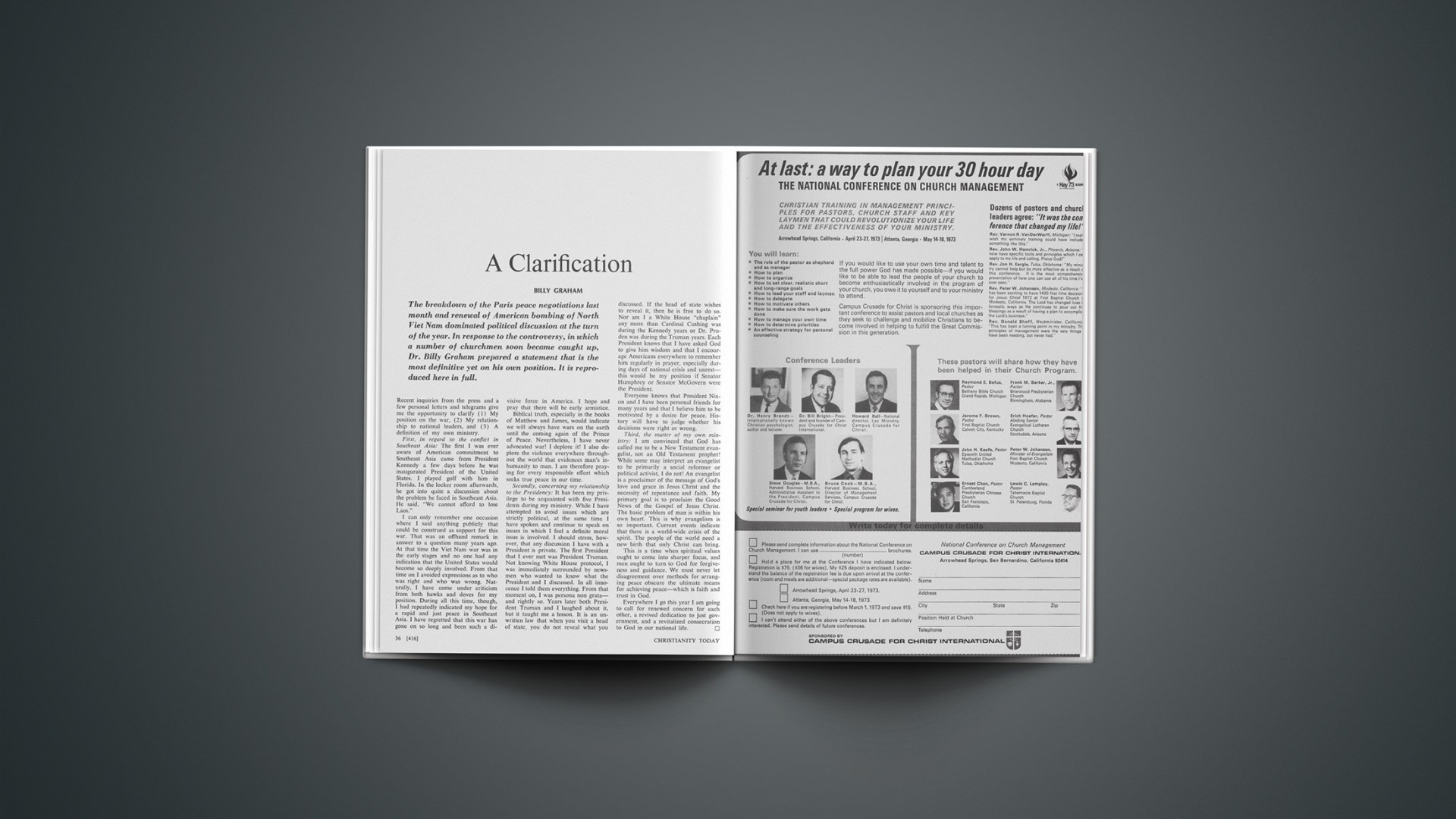
A Clarification

The breakdown of the Paris peace negotiations last month and renewal of American bombing of North Viet Nam dominated political discussion at the turn of the year. In response to the controversy, in which a number of churchmen soon became caught up, Dr. Billy Graham prepared a statement that is the most definitive yet on his own position. It is reproduced here in full.

Recent inquiries from the press and a few personal letters and telegrams give me the opportunity to clarify (1) My position on the war, (2) My relationship to national leaders, and (3) A definition of my own ministry.

First, in regard to the conflict in Southeast Asia: The first I was ever aware of American commitment to Southeast Asia came from President Kennedy a few days before he was inaugurated President of the United States. I played golf with him in Florida. In the locker room afterwards, he got into quite a discussion about the problem he faced in Southeast Asia. He said, “We cannot afford to lose Laos.”

I can only remember one occasion where I said anything publicly that could be construed as support for this war. That was an offhand remark in answer to a question many years ago. At that time the Viet Nam war was in the early stages and no one had any indication that the United States would become so deeply involved. From that time on I avoided expressions as to who was right and who was wrong. Naturally, I have come under criticism from both hawks and doves for my position. During all this time, though, I had repeatedly indicated my hope for a rapid and just peace in Southeast Asia. I have regretted that this war has gone on so long and been such a divisive force in America. I hope and pray that there will be early armistice.

Biblical truth, especially in the books of Matthew and James, would indicate we will always have wars on the earth until the coming again of the Prince of Peace. Nevertheless, I have never advocated war! I deplore it! I also deplore the violence everywhere throughout the world that evidences man’s inhumanity to man. I am therefore praying for every responsible effort which seeks true peace in our time.

Secondly, concerning my relationship to the Presidency: It has been my privilege to be acquainted with five Presidents during my ministry. While I have attempted to avoid issues which are strictly political, at the same time I have spoken and continue to speak on issues in which I feel a definite moral issue is involved. I should stress, however, that any discussion I have with a President is private. The first President that I ever met was President Truman. Not knowing White House protocol, I was immediately surrounded by newsmen who wanted to know what the President and I discussed. In all innocence I told them everything. From that moment on, I was persona non grata—and rightly so. Years later both President Truman and I laughed about it, but it taught me a lesson. It is an unwritten law that when you visit a head of state, you do not reveal what you discussed. If the head of state wishes to reveal it, then he is free to do so. Nor am I a White House “chaplain” any more than Cardinal Cushing was during the Kennedy years or Dr. Pruden was during the Truman years. Each President knows that I have asked God to give him wisdom and that I encourage Americans everywhere to remember him regularly in prayer, especially during days of national crisis and unrest—this would be my position if Senator Humphrey or Senator McGovern were the President.

Everyone knows that President Nixon and I have been personal friends for many years and that I believe him to be motivated by a desire for peace. History will have to judge whether his decisions were right or wrong.

Third, the matter of my own ministry: I am convinced that God has called me to be a New Testament evangelist, not an Old Testament prophet! While some may interpret an evangelist to be primarily a social reformer or political activist, I do not! An evangelist is a proclaimer of the message of God’s love and grace in Jesus Christ and the necessity of repentance and faith. My primary goal is to proclaim the Good News of the Gospel of Jesus Christ. The basic problem of man is within his own heart. This is why evangelism is so important. Current events indicate that there is a world-wide crisis of the spirit. The people of the world need a new birth that only Christ can bring.

This is a time when spiritual values ought to come into sharper focus, and men ought to turn to God for forgiveness and guidance. We must never let disagreement over methods for arranging peace obscure the ultimate means for achieving peace—which is faith and trust in God.

Everywhere I go this year I am going to call for renewed concern for each other, a revived dedication to just government, and a revitalized consecration to God in our national life.

George M. Marsden is associate professor of history at Calvin College, Grand Rapids, Michigan. He has the Ph.D. (Yale University) and has written “The Evangelical Mind and the New School Presbyterian Experience.”

Harmony or Conflict?

The Human Quest: A New Look at Science and Christian Faith, by Richard H. Bube (Word, 1971, 262 pp., $5.95), and Journey Away From God, by Robert P. Benedict (Revell, 1972, 189 pp., $4.95), are reviewed by Wendell McBurney, coordinator for school science, Indiana University, Bloomington.

Both of these authors are evangelical Christians interested in the interaction of Christianity and science, but at this point their philosophies diverge. Bube really tries (and successfully, in my opinion) to portray science and Christianity as totally compatible and even complementary. He accomplishes this by leading the reader through a series of very thoughtful evaluations of each sphere—evaluations lacking the negative belligerence shown by some representatives of either Christianity or science when speaking of the other.

Benedict presents Christianity and science in continual confrontation; the traditional points of contact usually appear as though each were an abrasive interface. Supported by an occasionally antagonistic style, this approach continues to the last page, where Benedict states, “Science and Scriptures really are at odds, really are in conflict, really do confront each other, whenever one trespasses the grounds of the other. It is really a lie to say that they do not.…” Benedict does, however, quickly applaud harmony whenever he finds science in support of Scripture.

Bube’s approach is carefully reasoned. At times, he comes on as an articulate philosopher. Benedict establishes his well-organized position through quotations of many scientists and a variety of Scripture translations, yet he denounces reason. More than once he says that “reason is the greatest enemy that faith has.”

Bube understands science. It is refreshing to read what a Christian who knows what he is talking about has to say about the methodologies and limitations of science. Benedict, on the other hand, refers to science as “this quizzical pastime,” and accuses it of being built “on shifting sand” because of its continuing need to revise existing theories when new data invalidate the old. This unfortunate misinterpretation of the dynamics of science becomes one basis upon which Benedict portrays science as a field of questionable integrity.

The Human Quest serves as an excellent defense against those who delight in “putting science down” on the rather absurd opinion that it is only for atheists. Bube’s insight into the nature of science and his skill at precise definition come quickly to the rescue. Sharp ground rules are easily established by such statements as, “Supernatural descriptions or explanations are ruled out of science by definition, not because of the lack of faith by scientists.”

The Human Quest is exciting reading. It becomes an adventure into forbidden territory with such bold assertions as, “Evolution is not a contradiction of the second law of thermodynamics”—a frequently used argument of the anti-evolutionist. Bube quickly proposes the invalidity of this classic argument by clarifying a common misinterpretation of the second law, and concludes that although evolution may be improbable, it does not violate the laws of thermodynamics.

The book offers an intriguing mixture of philosophy and educational psychology. Bube proposes that events and phenomena can be described at different levels of understanding and that to exclude any one level is to prevent a complete description. Thus the way is paved for scriptural and scientific descriptions to contribute to man’s total understanding of a given event or phenomenon. This proposal appears compatible with views expressed by contemporary learning theorists.

Bube, who is a physical scientist, attempts to relate true Christian faith to real science and all that science implies, including such topics as universal origins, the consistency of classical physics, the uncertainty of quantum mechanics, evolutionary theory, population control, environmental maintenance, racism, anti-intellectualism, and science as a service to man. Generally he stays well within his areas of strength, but he does seem to go beyond the original intent of the book by bringing in economics, violence, war, and situational ethics as areas for discussion. He thinks it is the Christian’s responsibility to be involved in social decision-making.

Although some may be disturbed by Bube’s view of man’s soul, his opinions on euthanasia and abortion, the room he leaves for the general theory of evolution, his occasional willingness to accept a non-literal interpretation of scientific matters in Scripture, and his tendency to avoid extremes, all Christians will agree to his most basic assumption: “God did create the earth” and continues to be in control.

Journey Away From God, also written by a physical scientist, attempts to invalidate the general theory of evolution by well-developed yet common arguments. The main weakness of the book is Benedict’s implication that science and evolution are synonymous and his resultant denouncement of both. In my judgment, the ultimate irony is Benedict’s use of a quotation by Bube to assist in establishing this end.

A Matter Of Prayer

Pray: A Study of Distinctive Christian Praying, by Charles Whiston (Eerdmans, 1972, 154 pp., $2.95 pb), is reviewed by Paul Fromer, author and Bible teacher.

Most of us have expectantly picked up a book on the Christian life only to find that it consisted of a recital of the author’s experiences with a Scripture verse tucked in here and there to sanctify the whole. Such books are perhaps better marked off by the gallon than by the chapter: Gallon 1, “My Life of Sin”; Gallon 2, “Peace and Joy in Christ”; Gallon 3, “You Too Can Get What I Have.”

Whiston has avoided this approach in his superb book on prayer. As the basis for prayer he offers some theological comments about God’s nature; then he considers forms of prayer and the uses of prayer.

Back in the sixties many seminaries were teaching their students to preach, counsel, and study, but not to pray; and so the Lilly Endowment sponsored an extensive project to remedy that matter and put Whiston in charge. (He is professor emeritus of systematic theology at Berkeley’s Church Divinity School of the Pacific [Episcopal].) He found that laymen weren’t praying because the clergy weren’t, and the clergy weren’t because their professors in seminary hadn’t known how either.

Whiston found about fifty seminary teachers who wanted to learn to pray and then to teach their students to pray. Because the book grows out of the attempts of people to learn to pray, it is practical; because it was formed in seminary surroundings, it has a theological base as well; and the practical and theological are held in balance. Whiston not only proposes prayers for specific occasions but also discusses what our general view of God should be and how this can affect our praying.

The central idea in the first of the book’s three main divisions is that praying must focus on God, not man. Jesus, so often represented today as a “man for others,” was first “a man for God.” Though this God is transcendent, Whiston spurns as foolish the Honest to God type of attempt to make God abstract and treat space-time representations as hindrances. God calls us to come; only then do we come. Whiston sees prayer to be as much a gift of God as forgiveness is.

Further, our access to the Holy God is always mediated by Jesus Christ, a view the author sets in sharp contrast to the humanistic teaching that over-glorifies man and taints much present theological writing with skepticism and doubt. Prayer must be rooted in Christology. Man is to respond to God, living a theocentric, not egocentric, life; and Jesus is the model. This view counters the current preoccupation with “God in man,” which slights God’s transcendence.

This affects our answer to the question whether prayer should be spontaneous or regular. Can we give God our attention only when we feel like it, and still maintain the view that he is high and lifted up? Perhaps instead of asking, “Do I feel like praying?,” Whiston suggests, one might ask, “Does Christ want me to come to him in prayer?” Praying thus becomes an essential duty.

Having laid a foundation for praying, Whiston turns to some of the forms of prayer, such as intercession, confession, thanksgiving. He emphasizes again that the example Christ left us is one of personhood free from all egocentricity. After conversion we need to surrender daily to Christ.

Those who equate “action” with the picket line only are asked, Is not intercessory prayer itself action? Does not something objective occur “out there” when we pray, as well as something interior? Prayer is not just autosuggestion.

In the chapter on thanksgiving, perhaps the most profound point is that without our asking, God gives us three holy gifts for which we should thank him, because they help to turn our hearts toward him: (1) loneliness, (2) shame, guilt, and judgment, and (3) pain.

We live in a kingdom of means, so adoration of God for his own sake comes hard to us. We need therefore to pray for the gift of adoration. Use of the Bible is crucial here, but Whiston also recommends devotional classics (e.g., Augustine, Francis, Fenelon).

Finally, Whiston turns to the relation of prayer to everyday living. He suggests that we take the Lord’s Prayer and rewrite it for specific situations. Even if we see that discipline in prayer is important, the author says, we probably want it to be self-discipline. We say, says Whiston, “ ‘I will discipline myself by myself.’ Thus we seek to retain the very sovereignty that Christ means us to surrender.” But God can discipline us, and in fact is calling us to ask him to do so. In his grace he will make our wills his own.

Several reservations about this book must be mentioned. First, the Bible could be given a more central place. Second, the author’s acceptance of Genesis and other passages as mythical may help the reader who is prone to reject both the history and its point, but may also have the effect on the reader of undermining the reliability of Scripture, and thus compromising God’s authority over the life of the one learning to pray. Further, the eschatological note of Pauline praying does not seem emphatic enough. Only two references to Revelation 21 (the holy city) touch on this important biblical concept.

In the author’s study of confession, the thrust is disproportionately on the Christian’s need to confess the sins of his society, rather than on confession of his own sins. And in the section on thanksgiving, the pre-eminence of the works of God is neglected. Surprisingly, Whiston confines intercession pretty much to prayer for the world, scarcely mentioning prayer for the conversion of non-Christians. And he does little with the Pauline emphasis on the content of prayer for Christians.

Finally, the book says little about the Holy Spirit’s relation to prayer, though in Scripture and present Christian thought the Spirit has a vital role.

But these reservations pale before the contributions of the author in calling us back to an appreciation of God’s transcendence, of Christ’s centrality in prayer, and of discipline in prayer life. This book is worth careful study. In the areas of its strengths, it is probably one of this decade’s best books on prayer.

NEWLY PUBLISHED

Essential Books For Christian Ministry, by Southwestern Baptist Theological Seminary (Fleming Library [Box 220002E, Fort Worth, Tex. 76122], 129 pp., $2.50 pb). A briefly annotated listing by topics of more than 1,200 books. For ministers and lay leaders generally, not specialists. Well worth the price.

Basic Bible Studies, by Francis Schaeffer (Tyndale, 86 pp., $.95 pb). Twenty-five groupings of Bible passages with brief remarks on each. Designed only as an aid to studying the Bible itself in order to gain a systematic overview of its teaching. Highly recommended.

Come! Live! Die!, by George Verwer (Tyndale, 96 pp., $.95 pb). A brief discussion of the differences between a Christian and a Christian living under the Lordship of Christ; suggests basic steps of commitment toward the latter state.

Who’d Stay a Missionary?, by Helen Morgan (Christian Literature Crusade, 77 pp., $.95 pb). Entertainingly helpful not only to missionaries but also to those who want a better “feel” for missionaries’ problems.

The Reproducers, by Chuck Smith and Hugh Steven (Regal, 146 pp., $1.95 pb). One man’s investment in the Jesus movement. Pastor Chuck Smith tells about the revival in nationally publicized Calvary Chapel, Costa Mesa, California.

Church/Mission Tensions Today, edited by Peter Wagner (Moody, 238 pp., $4.95), Crucial Issues in Missions Tomorrow, edited by Donald McGavran (Moody, 272 pp., $4.95), and A Biblical Theology of Missions, by George Peters (Moody, 368 pp., $6.95). Three key additions to the growing body of literature on faithful and fruitful obedience to the Great Commission.

Occult America, by John Godwin (Doubleday, 314 pp., $7.95). A more than sympathetic, encyclopedic look at our age of occultist Aquarians. A good reference book, though, for those who want to be informed.

Morality: An Introduction to Ethics, by Bernard Williams (Harper & Row, 107 pp., $1.60 pb). A philosophical primer on some of the basic concepts of morality prevalent in society. Deals with relativism, subjectivism, amoralism, and so on in a simple and lucid way. Not definitive, but a good place to begin.

The God Who Makes a Difference, by Bernard L. Ramm (Word, 160 pp., $5.95). A concise yet comprehensive approach to apologetics by one of the small number of evangelical writers who venture to treat the subject systematically. Leans a bit toward rationalism of the Butler-Hodge type and neglects the presuppositionalist analyses of contemporary apologetes such as Schaeffer and Van Til.

To the Hebrews: Translation, Comment and Conclusions, by George Buchanan (Doubleday, 271 pp., $7). Latest addition to “The Anchor Bible.”

Manual For Accepted Missionary Candidates and Manual For Missionaries on Furlough, both by Marjorie Collins (William Carey Library [533 Hermosa St., S. Pasadena, Cal. 91030], 109 and 151 pp., $2.45 pb and $2.95 pb). Very practical guides that can be of invaluable assistance.

Tongues and the Holy Spirit, by Frank Pack (Biblical Research [774 E.N. 15th St., Abilene, Tex. 79601], 131 pp., n.p., pb), Tongues in Biblical Perspective, by Charles R. Smith (BMH [Box 544, Winona Lake, Ind. 46590], 141 pp., $2 pb), and Tongues, Healing, and You, by Don Hillis (Baker, 112 pp., $1 pb). The authors do not think “tongues” should be sought today. Written from Church of Christ, “Grace” Brethren, and general evangelical perspectives, respectively.

In Place of Sacraments, by Vernard Eller (Eerdmans, 144 pp., $2.95 pb). An attempt to recover the original New Testament meaning of the word we translate “sacraments.” Rejecting the authoritarian ritualism surrounding the Lord’s supper and baptism as practiced in the institutional church, Eller seeks to clarify the true significance of these sacraments. Institutionalism, watch out!

Grammatical Aids For Students of New Testament Greek, by Walter Mueller (Eerdmans, 86 pp., $2.45 pb). Supplements a regular grammar. Both for beginners and for those who want a refresher guide.

Mormonism and American Culture, edited by Marvin Hill and James Allen (Harper & Row, 189 pp., $2.95 pb). Eleven articles, nine previously appearing in scholarly journals, by both Mormon and non-Mormon writers. Of value to those who want to understand this growing religion and reach some of its adherents with the first-century Gospel.

Say It With Love, by Howard Hendricks (Victor [Wheaton, Ill. 60187], 143 pp., $1.45 pb). The popular professor of Christian education at Dallas Seminary offers an excellent study guide on “the art and joy of telling the Good News.”

The Ecclesiology of Watchman Nee and Witness Lee, by James Cheung (Christian Literature Crusade, 176 pp., $1.45 pb). An outstanding evaluation and critique of the rapidly growing, rather exclusive group of congregations known to outsiders as “The Little Flock.” Many who have profited from devotional writings of the late Mr. Nee are unaware of these aspects of his teachings.

Karl Barth, by David L. Mueller (172 pp., $4.95), Dietrich Bonhoeffer, by Dallas M. Roark (123 pp., $3.95), and Rudolf Bultmann, by Morris Ashcraft (141 pp., $3.95), all in Word’s “Makers of the Modern Theological Mind” series, edited by Bob E. Patterson. Appreciative analyses from an evangelical publisher of great figures of modern dialectical and existentialist theology. Mueller neglects to indicate the seriousness of Barth’s conflict with biblical Christianity at the point of the doctrine of Scripture: he does not mention Van Til among Barth’s critics. Roark’s study of Bonhoeffer fails to apprise the reader of Bonhoeffer’s ambivalence and ambiguity on issues that divide evangelicals from liberals. Ashcraft’s study of Bultmann is more perceptive, but concludes, erroneously or deceptively, that “Bultmann speaks as a man who has chosen authenticity—Christian faith.”

An Aquinas Reader, by Thomas Aquinas (Doubleday, 597 pp., $2.45 pb). A very useful selection of writings by one of the most important Christian thinkers. Arranged topically. Edited by Mary Clark.

Ms. Means Myself, by Gladys M. Hunt (Zondervan, 145 pp., $3.95, $1.95 pb). A warm, understanding treatment of the subject “Being a woman in an uneasy world,” by one who seems to know how to do it. Deals with definition and acceptance of self and role in terms of a close relation with the God who created and loves woman.

To Munich With Love, by Bob Owen (Chick [Box 662, Chico, Cal. 91710], 126 pp., $.95 pb). The exciting news story of Christian evangelism at the Olympics. Many photographs help to relay the impact of more than 2,000 young Christians.

A Textual Commentary on the Greek New Testament, by Bruce Metzger (American Bible Society [1865 Broadway, New York, N. Y. 10023], 775 pp., $2.80). An outstanding bargain. A well-bound guide, not to the meaning of the passage, but to the prior question: What were the original words (inspired by God)?

Black Sects and Cults, by Joseph R. Washington, Jr. (Doubleday, 176 pp., $5.95). Basic to any study of black religion. Places Baptists, Methodists, Pentecostals and other groups in historical perspective.

Where God Meets Man, by Gerhard O. Forde (Augsburg, 128 pp., $2.95 pb). An updating of Lutheran theology. Attempts to apply Luther’s down-to-earth approach to the Gospel to the needs and questions of the twentieth-century layman. Could be of help to those who want to see into the meanings of the traditions in more formal churches.

Death in the Middle Ages: Morality, Judgment and Remembrance, by T. S. R. Boase (McGraw-Hill, 144 pp., $5.95). Taken from The Flowering of the Middle Ages, with expanded chapters and more prints to produce a more complete treatment of the topic. Brings new awareness of the meaning and mystery of death, even for twentieth-century man.

6,000 Sermon Illustrations, by Elon Foster (Baker, 704 pp., $7.95). Reprint of a twenty-year-old treasure house of illustrations and quotations from the writings of noted preachers and religious leaders. Entries are practical and are easily found through a topical index.

Woman in a Man’s Church, by Arlene Swidler (Paulist Press, 111 pp., $1.25 pb). Mostly complaining. Very little insight into the real issues of being a total woman in the twentieth century.

Inside Scientology, by Robert Kaufman (Olympia, 279 pp., $6.95). An ex-member describes Scientology as he found it. The finding cost him $8,000 and a stay in a mental hospital.

A Book of Elements: Reflections on Middle-Class Days, by Michael Novak (Herder & Herder, 145 pp., $8.95). Mrs. Novak’s twisted, fibrous drawings reflect the banal neo-religiosity of her husband’s “thoughts.” He little reflects middle-class living as many of us know it.

The Pastoral Epistles, by Martin Dibelius and Hans Conzelmann (Fortress, 175 pp., $10). The 1955 updating of Dibelius’s 1931 commentary is now translated and beautifully produced as part of the new “Hermeneia” series.

Much More! by Jack K. Taylor (Broadman, 160 pp., $4.95). The sequel to the author’s popular Key to Triumphant Living, on how to lead a Spirit-filled life.

The Mediaeval Mystics of England, edited by Eric Colledge (Schribner, 309 pp., $2.95 pb). A convenient collection of mystical writings that have had a profound influence on the devotional life and theology of Christians in all communions.

It is Required of Stewards, by John M. McBain (Broadman, 128 pp., $1.50). Emphasizes stewardship as a function and obligation of the Christian’s whole life and being, directly proportional to his relation with God.

Readers Theatre Comes To Church, by Gordon C. Bennett (John Knox, 128 pp., $4.95 pb). A complete how-to manual on an informal drama medium increasingly pervading churches. Includes scripts of eleven well-known selections such as C. S. Lewis’s The Great Divorce (excerpt) and O. Henry’s The Gift of the Magi.

Amazing Saints, by Phil Saint (Logos, 211 pp., $2.50 pb). The story of the author’s journeys and mission as a chalk artist in Auca territory (where his brother Nate and four other missionaries had been martyred) and other parts of the world. Good insights into the disposition and needs of the not-so-happy savage who is supposedly blithely ignorant in the jungle.

The Messianic Secret, by William Wrede (Attic [Box 1156, Greenwood, S. C. 29646], 296 pp., $12.50). A belated English translation of the cunning but fanciful 1901 reconstruction of the life of Jesus that temporarily ended the long liberal “quest for the historical Jesus” about which Schweitzer wrote.

Three Essays, by Albrecht Ritschl (Fortress, 301 pp., $10.95). A useful introduction to an influential nineteenth-century theologian who sought to overcome the disintegrating effects of skeptical liberal theology by emphasizing the ethical-imperative and faith-community aspects of Christianity.

The Nine-to-Five Complex, by James Johnson (Zondervan, 178 pp., $4.95). Using a fictitious (but all too true-to-life) Christian bumper-sticker company as his “model,” the author shares very worthwhile reflections. The necessary relations of “ministry” and “business” are often strained, to the detriment of both spirituality and survival.

Classical Evangelical Essays in Old Testament Interpretation, edited by Walter Kaiser (Baker, 265 pp., $3.95 pb). Fourteen essays, mostly from the nineteenth and early twentieth centuries. Some are on approaches to whole books; most deal with specific, crucial passages or themes.

A Faith For Skeptics (originally entitled The Reality of God), by Louis Cassels (New Family Library, 127 pp., $.95 pb). An inexpensive reprint of a 1971 introduction to Christianity, by the religion editor for UPI. His three appendixes contain particularly helpful suggestions for further reading.

A Cappella Music in the Public Worship of the Church, by Everett Ferguson (Biblical Research [774 E. N. 15th St., Abilene, Tex. 79601], 98 pp., n.p., pb). Defense of one of the chief distinctives of the two-million strong Churches of Christ (non-instrumental).

Rock Music, by William J. Schafer (Augsburg, 128 pp., $2.95 pb). A fairly accurate survey of the history of rock. Schafer traces the influences on rock and gives some interesting insights into what this new and important art form means to young people.

The Earth Is the Lord’s?, by Joyce Blackburn (Word, 1972, 160 pp., $4.95). An offbeat, joy-of-creation-filled look at ecology. Practical as well as inspirational; gives detailed suggestions for Christians who want to do as well as read.

Hope and the Future of Man, edited by Ewert H. Cousins (Fortress, 148 pp., $3.95 pb). Selection of papers from the “Conference on Hope and the Future of Man,” held in New York in 1971. Process theology, Teilhardian philosophy, and the theology of hope are set forth in introductory essays and followed by responses and counter-responses. Major thinkers include J. Cobb, P. Hefner, C. Braaten, J. Moltmann, W. Pannenberg, and J. Metz. Good discussion of important schools of thought seriously concerned with the future.

Outlines of Theology, by A. A. Hodge (Zondervan, 678 pp., $9.95). Reprint of a classic work by the younger of the two great Hodges of Princeton. Dated language but excellent in organization and clarity.

Orthodoxy, Roman Catholicism and Anglicanism, by Methodios Fouyas (Oxford, 280 pp., $15.25). A detailed survey of the three major episcopally ruled, tradition-oriented communions, by an Orthodox archbishop. Shows little understanding of the evangelical element in Anglicanism; quite thorough on structural and liturgical questions.

Change, Conflict, and Self-Determination, by Iris V. Cully (Westminster, 191 pp., $5.95). An analysis of how teaching methods in the churches can be developed to cope with forces for change in our society.

Epitaphs For Eager Preachers, by J. D. Grey (Broadman, 126 pp., n.p.). Spicy, entertaining, and thought-provoking.

On Time and Being, by Martin Heidegger (Harper & Row, 84 pp., $4.95). Shifting emphasis from his earlier magnum opus, Being and Time, Heidegger struggles to think of time and being in a non-metaphysical way. Key to Heidegger’s mature thought.

Mummies, Men and Madness, by John J. Davis (BMH Books [Box 544, Winona Lake, Ind. 46590], $3 pb). For archaeology buffs. A look at the “art” of Egyptian mummification with some deductions made about Egyptian life at the time of the Pharoahs. Last chapter on “Mummification and the Bible” somewhat of an addendum. Interesting photos.

Search For Understanding, by Warren A. Quanbeck (Augsburg, 125 pp., $2.95 pb). Three of the important bi-lateral conversations between Lutherans and other denominations, held in an attempt to pull the churches together, to rediscover the scriptural idea of the unified Church. Deals with similarities as well as differences in theology and practices.

The Gathering of the Ungifted: Toward a Dialogue on Christian Identity, by John Meagher (Herder & Herder, 176 pp., $5.95). Written to Christians who have trouble mustering faith the size of a mustard seed. Supplies humanistic justifications for prevalent shortcomings.

Why Didn’t They Tell Me?, by E. M. and D. A. Blaiklock (Zondervan, 173 pp., $1.25 pb). The book’s claim—provocative answers to some of life’s great questions—is not an idle one. Especially helpful for teen-agers.

Shaken Foundations, by Peter Beyerhaus (Zondervan, 105 pp., $1.95 pb). Lectures on missions, including one that was published in CHRISTIANITY TODAY (July 7, 1972). Presents a clear case for a biblical theology of mission. Focuses on mission as men reaching out, with sensitivity, to other men. Worth reading.

Silhouettes: Women Behind Great Men, by Helen Kooiman (Word, 170 pp., $4.95). Inspirational portraits of sixteen wives and mothers of such men as Stephen Olford, Billy Graham, Bill Bright, and R. G. LeTourneau.

The Gospel in a Broken World, by John H. Snow (Pilgrim, 124 pp., $4.95). Christians have the task of bringing hope through Christ to a fragmented society. But the Gospel Snow writes of is itself broken. Most of the book is based on Teilhard’s ideas.

Search For the Sacred: The New Spiritual Quest, edited by Myron B. Bloy, Jr. (Seabury, 180 pp., $3.75 pb). A collection of essays with sociological roots dealing with the spiritual trend that is pervading our society. Approaches the topic from three perspectives: “Loss of Direction,” “Quest For Direction,” and “Confronting the Sacred Yes.” Worth reading.

The Role of Woman in the Church, by Wayne Mack (Mack Pub. Co. [110 State Rd., Media, Pa. 19063], 84 pp., $1.25 pb). An insensitive and mundane treatment of the subject. Shows little perception of and less true concern for women.

Mother Elizabeth, by Marguerite Tjader (Herder and Herder, 231 pp., $8.95). An inspiring biography that tells of the revitalization of the long dormant Order of St. Birgitta by a Swedish nun, Maria Elizabeth Hesselblad.

The Literature of the Jewish People in the Time of Jesus, by Emil Schürer (Schocken, 416 pp., $7.50, $4.50 pb). Reprint of part of Schürer’s well-known multi-volume work, The Jewish People in the Time of Jesus Christ (1886–90). Contains an introduction and supplementary bibliography by Nahum Glatzer.

De Spectaculis

De Spectaculis

The early Christian theologian and moralist Tertullian (circa 155–223) warned the Christians of his day against attending “spectacles,” specifically theatrical performances and gladiatorial combats. Both these spectacles frequently involved pagan ceremonies and worship; in addition, the theater was built on immorality and licentiousness, the combats on cruelty and blood lust.

If Tertullian were to return and visit late twentieth-century America, he might find that the theater—including the films—has become rather similar to what he remembered of the Roman stage, but of course he would find that the combats, gradually abolished after the conversion of the Emperor Constantine, have no counterpart in modern life. Or would he? We have no gladiators, and there is very little deliberate violence in our arenas. But we do have our “combats,” most notably pro football, which columnist Carl Rowan calls our nation’s “new religion,” and which reaches its climax with the January Super Bowl. An Atlanta Journal-Constitution writer commented last fall, “Empty pews dot the beautiful churches on Peachtree Street. There will be no empty seats at Atlanta Stadium.”

When Christians were present in the arenas of the Roman Empire, it was usually as victims for the wild beasts. The presence of Christians at modern-day spectacles is ordinarily much less painful. Yet modern spectacles, like those of Tertullian’s day, may represent a temptation and a danger for Christians. When a Green Bay minister can say of his city, “Everyone’s schedule—every family, every church—is determined by the playing schedule of the Green Bay Packers,” then something is wrong with our priorities. “Six days shalt thou labor,” said the Lord, and he did not add, “but the seventh is reserved for spectacles.”

Simon Says

Evangelical Christians like to think of themselves as not conformed to this world, but transformed (cf. Rom. 12:2). But on closer inspection, evangelicals, it seems, often do more or less what the rest of the world does, though usually later and less cleverly.

A case in point is the attitude of American religion toward the United States government. There was a time in the United States when almost everyone was so uncritically patriotic as to be virtually blind to all our own vices and equally oblivious of the virtues of others. And this attitude was exemplified by almost all segments of American religion, from the most conservative to the most liberal. Even Unitarians elevated not only “the neighborhood of Boston” but also the American way of life to the status of one of their rare articles of faith.

For a whole variety of reasons, in the last two decades religion has been turning more and more against government. We cannot go into the reasons here, but we suspect that the current religious frenzy for government-hating may be no easier to justify critically and rationally than the earlier phase of universal adulation. The liberal Protestants turned first. Now large numbers of Catholics have joined the chorus, and recently evangelicals have begun to chime in. Not only evangelical fringe groups but responsible conservative organs have begun to cry that the United States government exacts “worship” from Americans just as the Roman emperors and Nebuchadnezzar of Babylon did from their subjects.

We find the comparison a bit far-fetched, though we do not deny that there are some elements of similarity between modern America, imperial Rome, and Nebuchadnezzar’s Babylon. What interests us here is that in this, as in so many other things, we seem to have another example of evangelicals trotting breathlessly after the secular bandwagon, trying feverishly to leap aboard. CHRISTIANITY TODAY happens not to have leapt (yet), and we like to think it is because we are more critically alert and less conformist. No doubt evangelicals who are “in advance” of us will think we are even slower and less clever than they.

But perhaps at this point, where evangelical opinion is beginning to show a noticeable cleavage, we should all stop and ask ourselves where the transformation we profess ends and mere conformity to this world begins. On this and other issues, it should be our zeal to develop a truly biblical way of looking at the situation, not merely a second-hand edition of the world’s worn-out styles.

Britain Into Europe

When the British turned Winston Churchill out of office right after his greatest triumph, the Allied victory over Nazi Germany, the voters, whether they realized it or not, were deciding on what Churchill called “the liquidation of the British Empire.” Victorious Britain, like defeated Japan, was gradually reduced to its home islands.

Now that the glory of its overseas empire, in Tennyson’s unwittingly prophetic phrase, “is one with Nineveh and Tyre,” Britain has drawn the conclusions from its changed role in a changing world and—after many hesitations—has joined the European Common Market. Thus by peaceful means Europe has gained a degree of unity unparalleled since the days when it all was ruled by imperial Rome (the Roman Empire never included much of what is now Communist-controlled Europe). At many times throughout the Middle Ages, there were attempts to create a European unity on a Christian basis. More recently Napoleon and Hitler tried to unify the Continent by force; both attempts foundered on the opposition of Britain—and Russia.

Now Britain has joined the Continent. But a little late in the day, for the Christian self-consciousness that characterized statesmen such as Konrad Adenauer and Charles de Gaulle has become rare among Europe’s leaders. Rome ruled Europe by military power and administrative skill; in the Middle Ages, Europe sought a spiritual unity based on a common faith. After World War II, a European Defense Community was proposed but not realized. Now a large measure of unity has come with the Common Market, a unity that, as the name suggests, is based on trade.

The expanding Common Market, whether or not it is seen as having a clearly defined place in the biblical prophecies concerning the end of the age, is evidently destined to assume increasing prominence in world affairs. As its unity becomes ever more of a fact, it has the potential to become the greatest single concentration of economic, industrial, and intellectual energy in the world. By what spirit will it be guided? Of the major partners, France and Italy have strong and antagonistic Roman Catholic and humanistic heritages, whereas West Germany is divided on paper between Rome and the Reformation. Britain brings a different heritage—insular, Anglican and Presbyterian, and evangelical. But in reality all seem swayed more by materialism than by any spiritual tradition. Let us hope they bring their best strengths into a uniting Europe.

Responsibility Or Restraint

After prescribing the punishment for the crime of false witness, the Bible adds, “And the rest shall hear, and fear, and shall never again commit any such evil among you” (Deut. 19:20). The Bible’s basic approach to the problem of wrongdoing is one of accountability: a person is to be held responsible for his actions, and where evil has been done, the appropriate sentence is to be promptly carried out, for otherwise “the heart of the sons of men is fully set to do evil” (Eccles. 8:11).

Compared with the biblical pattern, modern American society shows a marked decline in the principle that an individual is responsible for his own actions. Not all crimes, it seems, are reported to the police; of those that are, only a small number end in the arrest of the criminal, and by no means are all arrested criminals, even though guilty, convicted, nor do all convicted criminals finally undergo punishment.

Where responsibility after the fact cannot or will not be required, then the fear of doing evil, of which Deuteronomy 19:20 speaks, vanishes. Then what is society’s solution? The alternative to responsibility for the wrongdoer is restraint for everyone.

A classic example is aircraft hijacking. Because the supposedly civilized nations of the world cannot agree to extradite a few score hijackers and let them answer for their misdeeds, all air travelers must submit to restraint—intensive personal searches and checking of luggage—and incidentally to the increased air fares created by all these security measures. Similarly, because it is extremely unusual in the United States (not in Europe) to hold people seriously to account for drunken driving, even when they have caused serious injury or death, the government plans to require that all cars be equipped with a complicated and expensive device to restrain the irresponsible drinker from taking the wheel. Of course, all automobile users will have to pay its cost, and perhaps people rushing an injured child to the doctor or otherwise understandably agitated may also find themselves “restrained.”

The shape of the future should be clear. Individual responsibility after the fact seems to be out. The result, as the Bible clearly warns, is that “the heart of the sons of men is fully set to do evil.”

General restraint may be a kind of solution, but is it preferable to responsibility? Or is it not rather a necessary step on the road to 1984?

Harry S. Truman

A minimum of religious ritual attended the funeral last month of Harry S. Truman, thirty-third president of the United States. It was as he had planned, and in keeping with his practice of keeping faith a relatively private affair. Ostensibly out of deference to the pluralism of our society, many persons who are in the limelight avoid taking any public religious stand.

Truman did say in his memoirs that upon reaching the oval office “I silently prayed to God that I could measure up to the task.” A few hours after taking the oath he told a group of reporters and pages, “Boys, if you ever pray, pray for me now.” Speaking to Congress for the first time he said, “At this moment I have in my heart a prayer. As I assume my heavy duties, I humbly pray to Almighty God in the words of Solomon, ‘Give, therefore, thy servant an understanding heart to judge thy people that I may discern between good and bad; for who is able to judge this thy so great a people?’ ”

Perhaps this prayerful spirit, coupled with his reluctance to articulate his Christian beliefs, grew out of the humility of the man. Truman seemed to be conscious of his limitations, though he seldom used them as an excuse to back away from a difficult situation if the responsibility to tackle it fell upon him. His decision to unleash nuclear power as a military weapon revealed a willingness to take an enormous risk when he felt it was necessary. His recall of General MacArthur showed he had the courage to restrain the military when the occasion demanded. To what extent his big decisions were the right ones is still a matter of conjecture: some analysts commend his strong stand against Communism, for example, while others lament that the most populous country fell to the Communists while he was President.

The only major religious controversy in which Truman was involved concerned his announced intention to send a full-fledged ambassador to the Vatican. He gave up the idea after a storm of dissent arose from Protestant American leaders. The incident produced some tension for a time between Truman and his pastor at the First Baptist Church in Washington, Dr. Edward W. Pruden. Pruden opposed appointment of a Vatican envoy, but he says that he believes Truman conscientiously felt the move would be helpful for gaining information about the Cold War and that the President was not motivated by any desire to gain favor with Catholic voters.

Pruden highly respects the memory of Truman. He recalls that Truman did not want to be catered to as a worshiper. Truman once wrote the clergyman saying that he should not feel inhibited in his preaching by the presence of the President in the service.

Keying 73 to Christ

Dr. Vergil Gerber shows how to change Key 73 from a noun to a verb in A Manual For Evangelism/Church Growth. This ninety-six-page workbook for local congregations is coming off the press late this month. It is a step-by-step guide for church outreach, with straightforward instruction on how to uncover problems and seek their solution. Copies are available from the publisher, William Carey Library, 533 Hermosa Street, South Pasadena, California 91030.

Mercy For Managua

For the third time in its relatively brief history, the Nicaraguan capital of Managua has been ravaged by an earthquake. Few people now living remember that first earthquake in 1885, but a number of Managua residents still recall the devastation of 1931. The December 23 earthquake was the worst, and was even more acute because it came on the heels of a drought that had ruined a number of crops.

It will be many months if not years before the city can get on its feet again. Many groups are sponsoring relief efforts (see News, page 39). Christians around the world, especially those who live in abundant surroundings, have an unusual opportunity to show love for their fellow men who are in desperate need.

Those Broken Resolutions

Surely one of the traits of wisdom is the ability to gauge one’s own potential. About this time of year, many of us become despairingly aware that we possess all too little of that ability. We have broken New Year’s resolutions because we aimed too high; we once again overestimated our possibilities. The Psalmist apparently sought a greater measure of the ability to know his own potential when he prayed, “So teach us to number our days, that we may apply our hearts unto wisdom.” He wanted to plan his schedule to intelligent advantage. That’s still our challenge, and it ought also to be our prayer. If our goals are too modest, we are programming waste. And if we venture beyond our depth, we invite frustration.

Apple PodcastsDown ArrowDown ArrowDown Arrowarrow_left_altLeft ArrowLeft ArrowRight ArrowRight ArrowRight Arrowarrow_up_altUp ArrowUp ArrowAvailable at Amazoncaret-downCloseCloseEmailEmailExpandExpandExternalExternalFacebookfacebook-squareGiftGiftGooglegoogleGoogle KeephamburgerInstagraminstagram-squareLinkLinklinkedin-squareListenListenListenChristianity TodayCT Creative Studio Logologo_orgMegaphoneMenuMenupausePinterestPlayPlayPocketPodcastRSSRSSSaveSaveSaveSearchSearchsearchSpotifyStitcherTelegramTable of ContentsTable of Contentstwitter-squareWhatsAppXYouTubeYouTube