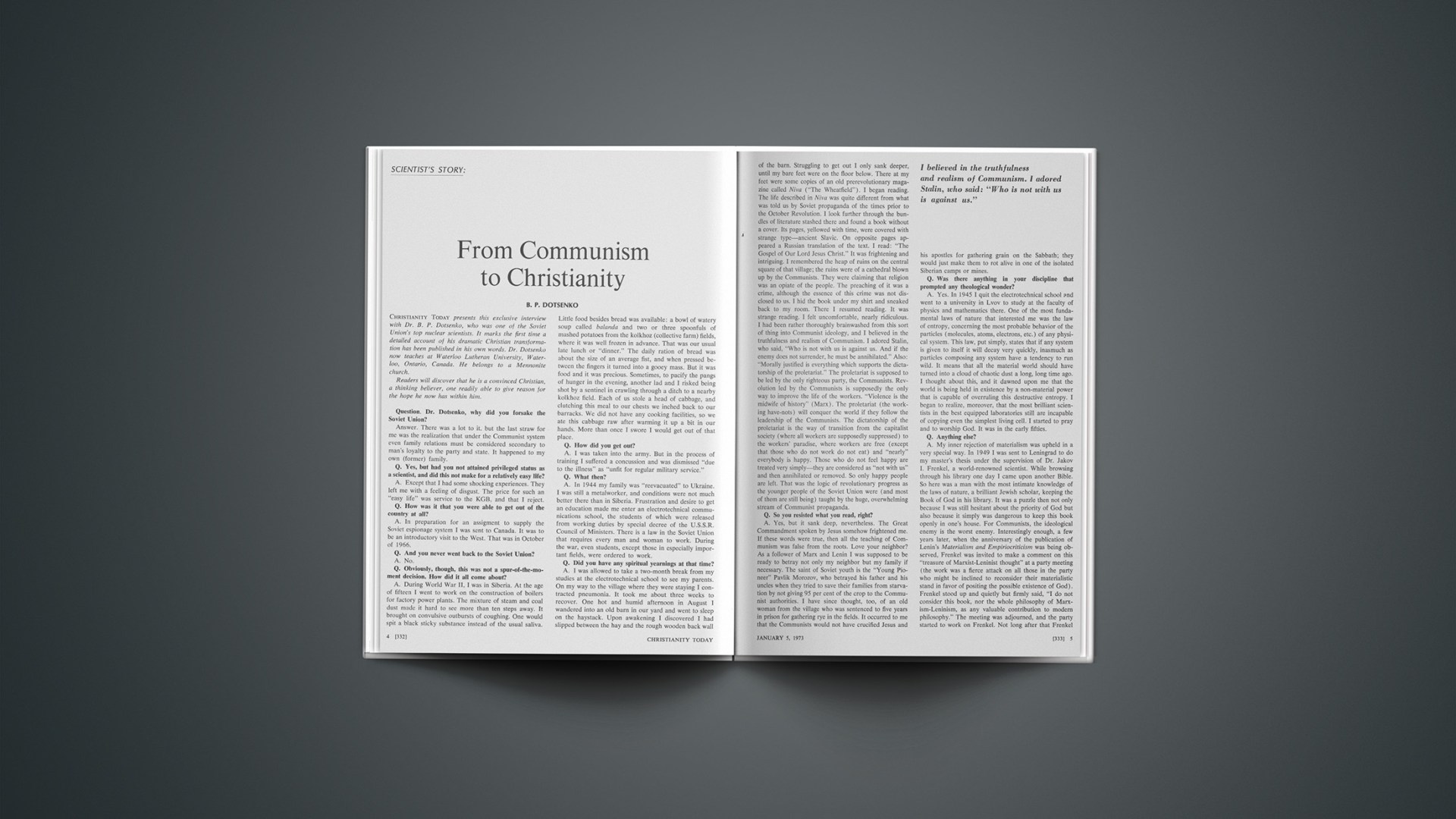
Scientist’s Story: From Communism to Christianity

Christianity Today presents this exclusive interview with Dr. B. P. Dotsenko, who was one of the Soviet Union’s top nuclear scientists. It marks the first time a detailed account of his dramatic Christian transformation has been published in his own words. Dr. Dotsenko now teaches at Waterloo Lutheran University, Waterloo, Ontario, Canada. He belongs to a Mennonite church.

Readers will discover that he is a convinced Christian, a thinking believer, one readily able to give reason for the hope he now has within him.

Question. Dr. Dotsenko, why did you forsake the Soviet Union?

Answer. There was a lot to it, but the last straw for me was the realization that under the Communist system even family relations must be considered secondary to man’s loyalty to the party and state. It happened to my own (former) family.

Q. Yes, but had you not attained privileged status as a scientist, and did this not make for a relatively easy life?

A. Except that I had some shocking experiences. They left me with a feeling of disgust. The price for such an “easy life” was service to the KGB, and that I reject.

Q. How was it that you were able to get out of the country at all?

A. In preparation for an assigment to supply the Soviet espionage system I was sent to Canada. It was to be an introductory visit to the West. That was in October of 1966.

Q. And you never went back to the Soviet Union?

A. No.

Q. Obviously, though, this was not a spur-of-the-moment decision. How did it all come about?

A. During World War II, I was in Siberia. At the age of fifteen I went to work on the construction of boilers for factory power plants. The mixture of steam and coal dust made it hard to see more than ten steps away. It brought on convulsive outbursts of coughing. One would spit a black sticky substance instead of the usual saliva.

Little food besides bread was available: a bowl of watery soup called balanda and two or three spoonfuls of mashed potatoes from the kolkhoz (collective farm) fields, where it was well frozen in advance. That was our usual late lunch or “dinner.” The daily ration of bread was about the size of an average fist, and when pressed between the fingers it turned into a gooey mass. But it was food and it was precious. Sometimes, to pacify the pangs of hunger in the evening, another lad and I risked being shot by a sentinel in crawling through a ditch to a nearby kolkhoz field. Each of us stole a head of cabbage, and clutching this meal to our chests we inched back to our barracks. We did not have any cooking facilities, so we ate this cabbage raw after warming it up a bit in our hands. More than once I swore I would get out of that place.

Q. How did you get out?

A. I was taken into the army. But in the process of training I suffered a concussion and was dismissed “due to the illness” as “unfit for regular military service.”

Q. What then?

A. In 1944 my family was “reevacuated” to Ukraine. I was still a metalworker, and conditions were not much better there than in Siberia. Frustration and desire to get an education made me enter an electrotechnical communications school, the students of which were released from working duties by special decree of the U.S.S.R. Council of Ministers. There is a law in the Soviet Union that requires every man and woman to work. During the war, even students, except those in especially important fields, were ordered to work.

Q. Did you have any spiritual yearnings at that time?

A. I was allowed to take a two-month break from my studies at the electrotechnical school to see my parents. On my way to the village where they were staying I contracted pneumonia. It took me about three weeks to recover. One hot and humid afternoon in August I wandered into an old barn in our yard and went to sleep on the haystack. Upon awakening I discovered I had slipped between the hay and the rough wooden back wall of the barn. Struggling to get out I only sank deeper, until my bare feet were on the floor below. There at my feet were some copies of an old prerevolutionary magazine called Niva (“The Wheatfield”). I began reading. The life described in Niva was quite different from what was told us by Soviet propaganda of the times prior to the October Revolution. I look further through the bundles of literature stashed there and found a book without a cover. Its pages, yellowed with time, were covered with strange type—ancient Slavic. On opposite pages appeared a Russian translation of the text. I read: “The Gospel of Our Lord Jesus Christ.” It was frightening and intriguing. I remembered the heap of ruins on the central square of that village; the ruins were of a cathedral blown up by the Communists. They were claiming that religion was an opiate of the people. The preaching of it was a crime, although the essence of this crime was not disclosed to us. I hid the book under my shirt and sneaked back to my room. There I resumed reading. It was strange reading. I felt uncomfortable, nearly ridiculous. I had been rather thoroughly brainwashed from this sort of thing into Communist ideology, and I believed in the truthfulness and realism of Communism. I adored Stalin, who said, “Who is not with us is against us. And if the enemy does not surrender, he must be annihilated.” Also: “Morally justified is everything which supports the dictatorship of the proletariat.” The proletariat is supposed to be led by the only righteous party, the Communists. Revolution led by the Communists is supposedly the only way to improve the life of the workers. “Violence is the midwife of history” (Marx). The proletariat (the working have-nots) will conquer the world if they follow the leadership of the Communists. The dictatorship of the proletariat is the way of transition from the capitalist society (where all workers are supposedly suppressed) to the workers’ paradise, where workers are free (except that those who do not work do not eat) and “nearly” everybody is happy. Those who do not feel happy are treated very simply—they are considered as “not with us” and then annihilated or removed. So only happy people are left. That was the logic of revolutionary progress as the younger people of the Soviet Union were (and most of them are still being) taught by the huge, overwhelming stream of Communist propaganda.

Q. So you resisted what you read, right?

A. Yes, but it sank deep, nevertheless. The Great Commandment spoken by Jesus somehow frightened me. If these words were true, then all the teaching of Communism was false from the roots. Love your neighbor? As a follower of Marx and Lenin I was supposed to be ready to betray not only my neighbor but my family if necessary. The saint of Soviet youth is the “Young Pioneer” Pavlik Morozov, who betrayed his father and his uncles when they tried to save their families from starvation by not giving 95 per cent of the crop to the Communist authorities. I have since thought, too, of an old woman from the village who was sentenced to five years in prison for gathering rye in the fields. It occurred to me that the Communists would not have crucified Jesus and his apostles for gathering grain on the Sabbath; they would just make them to rot alive in one of the isolated Siberian camps or mines.

Q. Was there anything in your discipline that prompted any theological wonder?

A. Yes. In 1945 I quit the electrotechnical school and went to a university in Lvov to study at the faculty of physics and mathematics there. One of the most fundamental laws of nature that interested me was the law of entropy, concerning the most probable behavior of the particles (molecules, atoms, electrons, etc.) of any physical system. This law, put simply, states that if any system is given to itself it will decay very quickly, inasmuch as particles composing any system have a tendency to run wild. It means that all the material world should have turned into a cloud of chaotic dust a long, long time ago. I thought about this, and it dawned upon me that the world is being held in existence by a non-material power that is capable of overruling this destructive entropy. I began to realize, moreover, that the most brilliant scientists in the best equipped laboratories still are incapable of copying even the simplest living cell. I started to pray and to worship God. It was in the early fifties.

Q. Anything else?

A. My inner rejection of materialism was upheld in a very special way. In 1949 I was sent to Leningrad to do my master’s thesis under the supervision of Dr. Jakov I. Frenkel, a world-renowned scientist. While browsing through his library one day I came upon another Bible. So here was a man with the most intimate knowledge of the laws of nature, a brilliant Jewish scholar, keeping the Book of God in his library. It was a puzzle then not only because I was still hesitant about the priority of God but also because it simply was dangerous to keep this book openly in one’s house. For Communists, the ideological enemy is the worst enemy. Interestingly enough, a few years later, when the anniversary of the publication of Lenin’s Materialism and Empiriocriticism was being observed, Frenkel was invited to make a comment on this “treasure of Marxist-Leninist thought” at a party meeting (the work was a fierce attack on all those in the party who might be inclined to reconsider their materialistic stand in favor of positing the possible existence of God). Frenkel stood up and quietly but firmly said, “I do not consider this book, nor the whole philosophy of Marxism-Leninism, as any valuable contribution to modern philosophy.” The meeting was adjourned, and the party started to work on Frenkel. Not long after that Frenkel was dead (of a heart attack, according to the official verdict).

Q. Was this the end of your education?

A. No. As one of the three best students upon graduation I was sent to the Moscow State University. In 1954 I obtained my Ph.D. in physical and mathematical sciences and was assigned to work in the Academy of Sciences of the U.S.S.R. on intercontinental and space rocket research. During this period my personal ideology was swinging further and further away from Communism. Two incidents played a key role.

Q. What happened?

A. Once while on vacation I witnessed the brutal beating of a sick old woman by the drunken chairman of a kolkhoz. Her only crime was that she had been unable to produce a doctor’s certificate for her inability to work (the doctor was a drinking partner of the chairman). The party chairman for that district was a friend of the chairman, so no one intervened.

Q. And the other experience?

A. It was while I was working on rocket research, which was top-secret activity, closely supervised by security agents. One of these people became very friendly and used to tell me stories and pass along gossip about the life in inner party circles. Once he mentioned that Lenin died of syphilis in a state of practical madness. Another time he told me that in the Soviet concentration camps during the Great Purge more than 12 million people were “eliminated.” A feeling of numbness and deep disgust overtook me.

Q. Your superiors apparently were impressed by your work, however.

A. Apparently. By this time I was married. In 1957 I was invited to work at the nuclear department at the Institute of Physics in Kiev. In the spring of 1958 a very polite and friendly major of the KGB (Committee of the State Security of the U.S.S.R.), M. I. Zapivokhin, approached me and asked me to “help” them in their work, reporting about most interesting ideas in science, especially in nuclear physics, and also about my colleagues. I am thankful to God that I managed not to betray anybody but was able to disclose for myself some disguised provocateurs from the KGB. Then came a proposal to send me abroad. But then I found that my father and my wife were reporting on me regularly to the KGB. I began to fear them. It was the psychological death of my family. I prayed: “My God, kill me or take me out of here.” In the fall of 1964 the strain became intolerable. I took an overdose of sleeping pills. When I regained consciousness in the hospital 1 remembered having said, “My Lord, thy will be done.” So death did not work. It was an answer and I decided to wait.

Q. And you got abroad eventually.

A. Yes. I was regarded as a successful scientist and was appointed head of the nuclear laboratory of the Kiev State University. In October, 1966, I was called to Moscow, to the Central Committee of the Soviet Communist party. I was told that I would be sent to Canada and after that to Vienna to the International Atomic Energy Agency. There, working as a senior member of the scientific staff, I was supposed to supply the Soviet espionage system with the most important information about the achievements in nuclear research throughout the world. Comrade Baskakov, one of the top men in the party, received me. Lifting up his finger to indicate a quotation from the highest source he said, “Boris Borisovich, we can reward your service very greatly, up to the Nobel Prize.” Two days later I was in Canada, at the University of Alberta. When I started to unpack my luggage in the room given to me I pulled out a drawer. There was a book, the Holy Bible, placed by the Gideons. My hands trembled when I took it. I applied for political asylum. The Soviets were furious. Although they failed to make the Canadian government expel me, they managed through their sympathizers to create such an atmosphere at the university that I felt it better to leave. I could not get a job at any other university, so I went to teach in a high school at Yellowknife in the Northwest Territories. Before going there I asked a minister in Edmonton to baptize me. I became a Christian.

Q. Actually, not many defect from the Soviet Union, and there have been relatively few disturbances against the government in the more than fifty years the Communists have been in power. What keeps people in Communist countries seemingly content with their lot?

A. The mark of Soviet society is to show outward absolute obedience and acceptance of all issued orders, all regulations, and all political and ideological statements. Penalties for violations are extremely severe. Khrushchev did not hesitate to order the shooting of hungry people—mainly workers and their families—in the early 1960s in Novocherkassk. The people had gone to the streets not for political change but with the demand, “If you want us to work, give us bread and meat! We cannot work eating liquid porridge and spoiled vegetables!” The demonstrators chased police with stones, and army units were called in. The workers put their wives and children in front of them. The soldiers refused to shoot. They were ordered away and court-martialed. Then specially trained units of the Bashkir cavalry were called in. These are Mongolian tribespeople who live on the lower Volga and in the South Urals and who are said to hate all white people. They shot more than 300 men, women, and children. Even the lower ranks of the party were taken aghast. But F. R. Kozlow, a party boss, said “We cannot tolerate such irregularities. We will repeat these actions of keeping peace in Soviet society if necessary.” Similar “irregularities” happened also in Sverdlovsk, in the Urals. Both cities were in a state of siege for two weeks, but the Western press was silent: from the outside the people were “seemingly content with their lot.” Kozlow’s colleagues continue to work on keeping people “content with their lot.” Maybe this is the reason for the very high consumption of vodka.

Q. As a scientist, Dr. Dotsenko, how do you confirm the validity of the Bible? How do you justify it as truth?

A. The Bible is the greatest book of faith, where the acts of God are recorded for believers. Faith does not need any justification. It is given to whom it is given. Those who do not see the light express doubts in its existence. It is rather frustrating to try to describe the light to the blind one who stubbornly expressed doubts in the existence of light on the grounds that it cannot be described in terms familiar to him. As to the factuality of the historical data, there are many excellent evidences. The final proof of the Bible will come with the return of our Lord and the establishment of his Kingdom. As for the present, the task of “justification” of the Bible can be formulated as carefully and rigorously analyzing all arguments against the Bible and showing that no one argument would be truly correct. I intend to undertake this task by an analysis of Bertrand Russell’s Why I Am Not a Christian. When I first read this work, it left me puzzled and nearly dismayed. Scrupulous examination of it, however, showed me that even such a prominent mind fails when trying to disprove the existence of God and his Word. Another side of the task of “proving” the Bible is to break the wall of cynical, atheistic, and egocentric propaganda that some self-assured “free thinkers” (who quite often deceive even themselves by false arguments) have created in trying to stop the teachings of God’s revelation. If such a wall is removed or at least cracked, the power of the truth stored in the Bible will inevitably attract many non-prejudiced people. And this would be the best justification yet of the Bible. Man has a feeling for the truth, unless he is biased and brainwashed. Correctly developed objective reason strengthens faith and clarifies it. Distorted reason sometimes kills it. The first drug-pusher was Satan, the enemy of truth and man. He managed to provoke man to be egocentric, and now he is trying to prevent man from knowing the truth recorded in the Bible—by using false arguments.

Q. You mentioned a work by Lord Russell. Which thinkers have influenced you the most?

A. I was impressed by the scientific writings of Einstein, Gibbs, Bohr, Heisenberg, Dirac, Schroedinger. Also by Wheeler, Wiener, Wigner, and Bethe. I enjoyed reading the works of Frenkel. In philosophy, I would mention initially the works of Lenin, Marx, and Engels, but these did not stand up to scrutiny. Then I would list Plato, Aquinas, Hobbs, Hegel, Spinoza, and (among Christians) C. S. Lewis and Francis Schaeffer. In general reading: Scott, Shakespeare, Stevenson, Homer, Milton, Dante, Longfellow, Cooper, Verne, Tolstoy, Lermontov, Paustovsky, Shevchenko (partly), Solzhenitsyn, and Jack London. I could mention many more but I am afraid of testing the patience of the reader.

Q. Assuming you believe God to be creator of the universe, do you mean by this only a personal way of looking at the universe or God’s causal relationship to the rest of reality?

A. Both. God, however, cannot be treated as the cause of all causes, because by the definition of general nature each cause must have its own cause. Each and every cause is a part of the universe as a whole. God is not a part of the universe. He keeps and controls all the universe and each party of it. Grossly oversimplifying, one could consider an analogy of the small particles of iron placed in a magnetic field. All movements of particles are controlled by this field, though the field itself does not become part of the system of particles and the particles preserve their “individuality.” Many other more sophisticated examples could be given, but of course even all of them could not give a complete description of the relation of God to this world simply because we can think only in terms of this world and God does not belong to this world, to “this” reality.

Q. Is there really a difference in the way in which Communist science and Western secular science contemplate nature?

A. Definitely—and a big one. So-called laws of dialectical materialism are constantly being pumped into the minds of Soviet scientists. Einstein’s theory of relativity was classified by Lenin as simply a description of the movement of material bodies with great velocity. Any other interpretation was considered unnecessary, and this hampered understanding of important laws of the universe. The suppression of genetic studies long after Stalin’s death is another good example of the influence of Communist philosophy on science. Many officially paid “philosophers” are keeping close watch over intellectual developments in Soviet science. They hold the power of manipulating the development of Soviet science and controlling the careers of scientists (especially the younger ones). Any deviation is quietly but efficiently twisted and eliminated.

Q. How about what you have seen of Western science?

A. The existence of agnostic or egocentric philosophical opinions among Western scientists leads to exaggeration of relativism in the interpretation of the phenomena under study. But this could be overcome by proper evaluation of the guiding laws of the universe. The great freedom of exploration should, if honestly done, lead sooner or later to proper understanding of the universe and to realizing that God keeps it all.

Q. How about the Soviet-Communist view of man? How does that differ from what you have found in the West?

A. Soviet Communists consider man a part of society that is under permanent and thorough control of the party through the government. The KGB and MVD and the Soviet military are the real holders of power. Everybody is required to be loyal to the state and party. No one has any right to change his work or his place of living without the permission of the authorities.

Q. How about the standards of morality? How do they differ?

A. Soviet morals are derived from the Marxist concepts of class society and class struggle. Everything that increases the power of Communism is morally justified. In the West, man is considered as basically a free individual who has a right to choose his own way of life, as long as it does not hurt other men. The basis of morality in the West is taken from Judeo-Christian belief and from the ideals developed gradually through the evolution of Greek, Roman, pre-Christian German, and other civilizations.

Q. What about anti-Semitism in the Soviet Union?

A. No question about it. At the time of Frenkel’s death a vicious anti-Semitic campaign had been launched by the party apparatus under Stalin. It was accompanied by a campaign against Ukrainian nationalists and, in science, a campaign against any appearance of bourgeois “idealism.” Stalin proclaimed cybernetics to be an “idealistic” invention. Now the Soviet Union, being about ten years behind in the development of computers, can testify about the “positive” influence of dialectical materialism upon science and industry. But don’t be alarmed, for the West has come to the rescue. Fear of Communism, which eats away the foundations of Western society, is not so great as the fear of losing profits. IBM and Honeywell are selling computers to the Communists. So are the British. At the same time, Soviet authorities impose quotas on the admission of Jews to universities in spite of the brilliant abilities of Jewish students, and impose a shameless tax on Jews who want to go to Israel, like the tax on slaves who wanted freedom. Ideologically, Soviets are the worst enemies of the state and people of Israel. Stalin was made secretary-general of the Russian Communist party after he wrote a special work in which he denied for the Jews the right to be called a nation and scorned Jewish religion and customs.

Q. What passages of Scripture mean the most to you?

A. John 1:1, Mark 12:29–31, Matthew 22:36–40, and in the Old Testament Genesis 1:1–2 and Exodus 20:1–17. Finally I would say Luke 23:42 and 43, for in these words there is all: hope, faith, love, anguish of suffering, and the light of eternal life of man and his Lord God.

Q. What is your view of truth and justice?

A. Truth is the word of God (John 17:17). Justice is the implementation of moral norms of behavior in relations between man and God and between people. This implementation includes forceful restoration of moral patterns of behavior (punishment) whenever such patterns are violated because of the spiritual imperfections of man.

Q. Is there any rationale for pacifism?

A. The idea of peace is very attractive to many people, and rightly so. But the priorities must be put forward clearly and definitely. Peace with whom? Peace at what price? What is more important, peace with the enemy of God or faithfulness to God? What is more important, from the Christian point of view, this earthly life or readiness to suffer in the fight for gaining eternal life? Jesus put it very clearly to his disciples, “Peace I leave with you, my peace I give unto you; not as the world giveth give I unto you.” Also, “Think not that I am come to send peace on earth: I came not to send peace but a sword.” From this follows very clearly that the true peace can be established only in the family of believers. An attempt to establish peace without first unifying people into this family means an attempt to establish peace with the enemies of God. It is against God’s will, because God does not want anything false and such peace would be definitely false. These enemies are led by the devil. Naturally, however, every Christian should strive for peace inside the Christian community and should forgive his personal enemies by loving them. We need to remember that the words of Jesus in Luke 22 are quite different from the Sermon on the Mount. In both instances he is talking to his disciples. In Luke 22 he says he had initially sent them without purse, scrip, and shoes, but now he is telling them, “He that hath no sword, let him sell his garment and buy one.” Prior to this he was there protecting them, but it is another thing when he is going to the cross. Now he will be guiding them only in a spiritual way, so that for their own protection they need to buy the sword. From this it follows that the Christian has a right and the duty, indeed, to protect himself and the people entrusted to him by God—using the sword, if necessary.

Q. How important is the question of verification of data? Of experience?

A. The basic method of learning and understanding is trial and error. Data are results of active and passive tests, experimentations in practical life, and initial observations (motivated contemplations). Abstract thinking (which is the gift of God) specifies causal relations between observed data. Knowledge of causal relations enables man to exercise control over the surrounding world. In the case of animals without abstract thinking (animals do possess some degree of concrete thinking in reflected images), there is instead a reflectory adaptation to the existing conditions (adaptation can be both passive and active). Verification of data is important for checking abstract conclusions. Accumulation of the knowledge of causal relations in man’s memory, and accumulation of conditional reflectory reactions on real and imaginary situations in the animal’s memory, are called experience. Both kinds of experience are of vital importance.

Q. How do the principles of logic and scientific thought relate to a person’s view of God?

A. Paraphrasing Francis Bacon, one may say that superficial and egocentric knowledge leads to atheism, while genuine, deep, and objective study leads to faith in God.

Q. How much religious liberty should there be in any given political control system? To what extent should Christians living in a Communist country obey its laws?

A. The Lord’s commandment was to render unto Caesar the things that are Caesar’s, and unto God the things that are God’s. Paul wrote, “Let every soul be subject to the higher powers. For there is no power but of God.” Therefore, true powers are of God. What is the property of true power? Paul answers: “For rulers are not a terror to good works but to the evil.” Those, then, who reject God and his supremacy cannot be called the true powers, because the best work is the work of serving God. God allows such false powers to operate to test our faithfulness to him, to check our worth for the eternal life. Christ himself in all his humility rejected the offer of the devil (who by Christ’s definition was the prince of this world): “If thou therefore wilt worship me, all shall be thine. And Jesus answered and said unto him, Get thee behind me, Satan: for it is written, Thou shalt worship the Lord thy God, and him only shalt thou serve.” Elsewhere, Christ called King Herod “that fox” when told that Herod could try to kill Christ before his mission was fulfilled. Conclusion: No true power has a right to intervene in the worship of God and Christ as it is prescribed in the Scriptures. Christians ought to obey all laws that do not make them turn away from worshipping and serving God and Christ. Christ also warned that one cannot serve both God and mammon (earthly temptations by money, also by lusts and by false power and fame). To accept the leadership of Communism is incompatible with the true service of God. It is like accepting the assertion that the thief is the lawful owner of the things he stole.

Q. Why does the atheist Soviet government allow any churches to remain open and hold services?

A. Despite all the efforts of Stalin and others to exterminate faith by force, Christianity and other religions have survived in the Soviet Union. All the people saw the patriotism of the believers during the war. But then Stalin and his successors decided to take control of the faithful by appointing specially trained and conditioned agents to key positions of the church—especially the Russian Orthodox Church, but also in others. These appointments were made in an indirect way, by allowing only those churches that suited the Communist government to function. Communist agents entered seminaries, were ordained as ministers, and started to preach blind obedience to the “ruling powers.” They were and are well versed in the Scriptures—as was Satan when he was trying to make Jesus obey him, not by the threat of torture but by offering him power. There is considerable literature on the subject showing the fate of believers who do not follow the way of blind obedience to godless powers. The existence of open churches allows the Communists to claim they respect freedom of opinion. In this way they brainwash people in the West and entice tourists. These, in fact, are allowed to see altogether not more than 5 to 7 per cent of the Soviet territory, and then only after asking to do so well in advance. Another important point: By developing relations between the churches in the Soviet Union and those abroad, the government creates another way of sending agents into the West.

Q. There seems to be some discernible Christian influence among intellectuals in the Soviet Union. How do you account for it? Does it stem from some identifiable common factor?

A. Many of the so-called intelligentsia of the Soviet Union are deeply disillusioned and cynical people who report on one another, and on everyone else about whom they are asked, to the KGB. By “many” I should say that the number of such people is probably not less than one-third of the total number of Soviet intellectuals. Others are just living from day to day, doing their job and waiting in lines for food, inexpensive clothes, and other goods. After such hunts, most of them are so tired that they do not think about anything but getting some rest, perhaps some entertainment (ideological films, vodka). But there is an intellectual minority that does not submit itself either to cynicism or to prostituting careerism, or to waiting in line for vodka. These are the ones who suffer because they seek truth and justice and find it in Christ. Many are silent. Some, if they work in professions that allow them to conceal their real feelings, could even be successful in their fields of activity. But quite often they resent such success. One of my former colleagues confessed to me once that he would rather be a simple worker than a successful theoretician. I knew what it meant to be a worker in that system, so I said nothing. Disillusionment with the ideology of materialistic Communism is that common factor in the life of Soviet intellectuals who are finding God.

Q. What can we do for Christians in the Soviet Union? What do you think of smuggling Bibles into Communist countries?

A. Do everything that your conscience, your courage, and your trust in God allow you to do. Shall we submit ourselves to this godless force or shall we follow the commandments of our Lord, “Feed my sheep”? I must confess that I admire Brother Andrew and his co-workers. I pray for them, that the Lord will continue to keep them under his protection and inspire them for their further service. This is the true spiritual battle, where people risk their lives and personal freedom for their brethren to bring them the Word of God.

Q. You mentioned a campaign against Ukrainian nationalists. Is there any religious element to Ukrainian nationalism?

A. I am not aware of any correlation.

Q. How is it that Arabs, militant Muslims, have gotten along with atheistic Communists?

A. I do not know. The Christian should be more acceptable to the Muslim than the atheist. Incidentally, however, I am certain God will protect his people in their Promised Land. His plans are now being worked out.

Q. How do you regard the scriptural admonition about praying for our enemies?

A. The true enemies of the Christian are those who are the enemies of God. All other people are his brothers and sisters in Christ. These he should love and forgive. Concerning the enemies of God, only one prayer is possible: that the Lord in his mercy will open their eyes and soften their hearts so that they will repent and accept Christ as their Lord and Saviour. For otherwise, if they sin against the Holy Spirit they are doomed by the verdict of our Lord (“He that shall blaspheme against the Holy Ghost hath never forgiveness, but is in danger of eternal damnation”).

Q. What do you think about the easing of tensions between the United States and Canada and the Soviet Union and China?

A. Easing of tensions between these countries is acceptable and can be welcomed as long as it is not accompanied by the weakening of the Western countries relative to the strength of the Communist counterparts. Peaceful discussions eventually lead to better understanding by all people as to where justice and truth are, ergo, to God and his Son. But as long as God permits the price of such agreement should not be that of submission to the enemy of God, not of giving the enemy the military and ideological victory.

Q. What did you think of President Nixon’s visits to the Communist countries?

A. It was a courageous and far-reaching step. By doing this he forcefully presented the good will of the American people to the world and to his counterparts. He took the lead in establishing the channels for a just peace, leaving behind the Communist leaders with their claims that they are the leaders in the “struggle for peace.” At the same time, Mr. Nixon did not compromise his ideological stand. He attended a service at the Baptist church in Moscow. The American people can be proud of having a President who combines in his person a deep political mind and initiative with clear and faithful service to God.

Q. Dr. Dotsenko, what has troubled you most about life in the West in the four years you have been here?

A. For one thing, I have been disturbed at the passive attitude of the majority of people to acts of violence on the part of relatively insignificant but vocal groups, and the violation by these groups of the most sacred moral, religious, and social norms and customs of Western society. These groups claim that, unless they are given what they insist upon, it would be the suppression of the “freedom of the individual.” But this disregards the fact that the most important condition for the really free society is the responsible behavior of each and every member of the society toward any other member and toward the society as a whole. If the society does not demand responsibility, then it openly invites totalitarian dictatorship, which brings an end to all individual freedom.

Q. What else?

A. I am also disturbed by the passive attitude toward the infiltration of materialistic ideas into the Western educational system. The quiet replacement of Christian norms in relations between people (especially in the areas of love and sex) leads to the debasement of human relations to levels lower than that of beasts (animals normally follow very strict regulations established by the Creator).

Q. Any other thoughts on this point?

A. A third observation I would make is about the tolerant, “pacifistic” attitude of so much of liberal society toward the Communists. People with true democratic and liberal attitudes ought to know that the liberty of a man is based on God’s gift to man, namely, the freedom of choice. The Communists have never renounced their ultimate goal, the establishment by all means of the ruthless, oppressive, and inhuman dictatorship of the party elite and their functionaries. They disguise it by the demands for the rule of the proletariat, but the hungry workers and their relatives who were shot in Novocherkassk ten years ago are better witnesses of the true Communist goals.

Q. How much of a danger is this ideology insofar as the West is concerned?

A. Probably the greatest menace facing the West today is the presence of a widespread network of Soviet Communist agents. This network was initiated by Lenin himself at the second meeting of his party in London in 1904. The Communists in their propaganda are calling those who actively oppose them “Fascists,” trying to conceal the fact that Hitler learned from Stalin how to run a dictatorship in its most ruthless and inhuman way. They also are not eager to admit that Stalin was made secretary general of the Russian Communist Party after he wrote a special work in which he denied for the Jews the right to be called a nation and expressed scorn of the Jewish religion and customs.

Q. What about poor people and those unable to find jobs in the West? Is it surprising that Communism should appeal to them?

A. They should remember that, for example, the normal salary of a janitor in the Soviet Union is about 70 or 80 dollars a month. The monthly salary of an average worker is around 160 to 180 dollars. The price of food is not high, but the supply is meager, and the price of other goods is relatively higher than in North America. An existence of “closed” (secret) stores for the privileged party, KGB, and military “elite” where everything is available in great selection and with grossly reduced prices is another evidence of deep and very “materialistic” corruption in the Soviet ruling system. General free medical care and low apartment rents do not mean much for the hungry stomach—not to mention that often three or four families must live in one apartment. Students and other “free thinkers” should remember that it is an official and strictly followed policy of the Communist apparatus to suppress by all means, including physical elimination, when possible, or incarceration in mental asylums, all those who are critical about even the most ridiculous (sometimes) statements made by the party “prophets.” Workers have to remember that they are the part of the living body of the whole society. If the society is torn apart, as Marxists aspire to do, the workers will suffer not less than anybody else. Under the Communist dictatorship everybody loses any chance to improve his life by his own choice.

Q. Summing up, to one who has experienced deeply both of the great ideological options open to twentieth-century man, just what difference does the resurrection of Jesus Christ make?

A. The main desires, anxieties, fears, and passions of man today are about his life, his health, his family, his food, his career. Basically these are not much different from the emotions of men of ancient Israel, Rome, or Greece, England, or Germany. They are very intimately related with one question: What will happen to me and to my dear ones in the future, the near future and the remote future? For the person who believes in the power of God to give life, the answer is that he shall live a much better life as a result of the Resurrection.…

Q. What is on your mind and heart that you would like, in conclusion, to share with the readers of “Christianity Today”?

A. My wish to them is the same as it is to myself. And that is, to learn the Truth and the ways of a just and reasonable, really human life as a child of the Most High God, who suffered and died for our sins in the person of Jesus Christ—his own expression. Keep the blessings of God protected. I am a witness that here in the West there is, compared to the rest of the world, great abundance in both the material and spiritual life. Reject loose, egocentric morals. Give full support to leaders who are working to protect and develop the ways of productive and free life in the framework of well-adjusted, time-tested laws. (And I would say here that I am very much in favor of the study of the Bible in schools for those who want it.) The most important part of life is creative work together with your Christian neighbors, following wise and responsible leaders, for a better life and freedom and a better chance (not handouts from a totalitarian state) for everyone, according to the commandments of our Lord—for the glory of God.

George M. Marsden is associate professor of history at Calvin College, Grand Rapids, Michigan. He has the Ph.D. (Yale University) and has written “The Evangelical Mind and the New School Presbyterian Experience.”

Editor’s Note …

We start the New Year featuring an interview in which a brilliant nuclear physicist, B. P. Dotsenko, relates his conversion, his expatriation from the Soviet Union, and his responses to questions posed by our managing editor, David Kucharsky. In our news section (see page 44) we examine the state of Christianity behind the Iron Curtain. News editor Plowman predicts that during the 70s great numbers of Communist youth will turn to Christ; dialectical materialism and “big brother” supervision have not filled the empty void in their hearts.

The new year brings several internal changes. Charles Wright, formerly our advertising manager, has left our staff. Having added the book clubs to our operation, we now need not only an advertising manager but also an assistant. As advertising manager, Coleman Luck will work primarily at the home base, concerning himself with the book clubs and with production and other aspects of the advertising that appears in the magazine. His assistant, Stephen Wike, will be on the road, visiting advertisers and selling space.

The next issue of CHRISTIANITY TODAY will feature Key 73, whose evangelistic thrust we hope will result in the conversion of many unbelievers this year.

Meanwhile, a happy new year to one and all.

How Not to Find the Ark

In 1970 AND 1971, Ark searchers faced a grim prospect owing to the political situation in eastern Turkey. Demonstrations by leftist students in Istanbul made waves that splashed against the Ankara government, and the government, in turn, pounded on key areas of potential dissent.

Mt. Ararat, the geographical and symbolic center of the native Kurdish population of ancient Armenia, constituted such a hot spot, for the Kurds in Russian Erivan, just across the Turkish border from Ararat, could well claim that Turkish Kurds deserved “liberation”—Russian-style—from Turkish “oppression.” So in 1970 the only Westerners permitted on Ararat were those who were willing to stick to an “orthodox” trail on the mountain’s southern face; Americans (because of negative Russian-American relations) were discouraged from doing even that, and only by special permission was I allowed on August 17 to conquer the summit. In 1971, the situation remained basically unchanged, but my son David and I were able to do some preliminary work on the crucial north face (the side of the mountain that overlooks the Russian border and where all Ark sightings have concentrated).

The middle of this summer (1972), however, brought a dramatic change in the permissions atmosphere. The south face—the route from Dogubayazit—was suddenly declared off-limits and the north face opened up!

Our own plans had been laid months before this shift in the political climate. On Thursday, May 25, David and I drove from Strasbourg, France, to Frankfurt, Germany, for a vital planning session with Dr. Lawrence B. Hewitt, physician, botanist, and head of the Archaeological Research Foundation expedition that in 1966 carried out the most detailed twentieth-century investigation of the geology and glaciology of Ararat.

Three days later we met again in London, in private session with a member of the Turkish presidential family. We were assured of clearances to work in the key area on the mountain, and we were informed that a certain American organization still soliciting funds for Ararat work would never be allowed back on the mountain, because of that organization’s activities in the Near East in 1970.

With assurance of government clearance at the top level, we carried out operations in August on the north face, eliminated the east side of the Ahora gorge as a possible resting place for the vessel, and obtained complete photographic coverage of the west side of the gorge in preparation for future systematic coverage of the area between the gorge and the site of Navarra’s 1955 find, above Lake Kop, of 5,000-year-old hand-tooled wood. Our expedition activities came off like clockwork, aided by the superlative management of Dr. Hewitt, the labors of Eryl Cummings, Gary Oliver, and my son, and the services of a translator and two gendarmes supplied by the Turkish government.

The only clouds across the exploratory horizon came from the presence of five well-meaning arkeologists who appeared as if by magic when the north-face restrictions were—as they put it—“providentially relaxed.” The possibility that their activities may herald a tidal wave of similar efforts leads me to some words of admonition, based upon their work and upon that of the American organization referred to earlier.

My advice is given negatively, in deference to the supposed death-wish of Ark searchers who really do not want to carry out a thorough search for fear it will prove them wrong—as in the case of the traveler in Bishop Blougram’s Apology who “saw the Ark a-top of Ararat;/But did not climb there since ‘twas getting late, / And robber bands infest the mountain’s foot.” In order not to find the Ark, robber bands are by no means necessary; the following techniques will certainly suffice!

1. Insult the Turkish government. One of the members of the highly publicized American organization that tried unsuccessfully to operate on Ararat in 1970 was so disturbed by the refusal of Ankara to provide his group with appropriate permissions that he castigated the Turkish government in comments to Greek journalists. As a result, this organization is permanently persona non grata in Turkey.

2. Obtain only local permissions to climb; don’t bother with red tape or the central government in Ankara. This procedure was followed by the five-man team that turned up this summer. Without clearance from Ankara, the group had no gendarme protection. The Kurds on the mountain enjoy a certain amount of bullying and pilfering in the absence of gendarmes, so the five found (a) their vehicle used for target practice, and (b) all their equipment stolen, including the very trousers worn by one of them.

3. Ignore the safety rules of mountaineering, and don’t clutter up your team with a physician. The five searchers this summer had no doctor with them (one of them had some kind of certificate in mountain first-aid). Leaving the first-aid man at camp, three of them (a civil-engineering graduate, a Bible-college graduate, and an industrialist with nine children back in the States) climbed to an extremely precarious position on the mountain, got caught in a lightning storm, stayed in the open, were struck by lightning and knocked out, and after partially recovering somehow made their way back to base camp. Had they been permanently injured or killed, the authorities would doubtless have stopped all exploratory work on Ararat for the indefinite future.

4. Rely on your spirituality. When questioned about the wisdom of such activities as the preceding (“shall we sin that grace may the more abound?”), the reply was that they were doing the Lord’s will, and were led by his Spirit. (The group has personal, though not official, connections with an extremely rightist, Americanist, fundamentalist college in southern California.) The leader of the group constantly talked about his “witnessing to the Turks and Kurds,” but I quickly discovered that his knowledge of their languages was so paltry that he could not give the simplest gospel presentation. When will we learn as evangelicals that the Gospel is not our “experience” or our “spirituality,” but the message of Scripture that must be conveyed in words? And when will we learn that our sanctification can never absolve us from using our heads?

If the Ark is ever to be found, it will require the consistent, long-term planning of a Cape Kennedy operation, not the perspective of a Boy Scout outing. Perhaps the Ark is no more significant than the cradle in which the Saviour lay on the first Christmas, but Luther saw fit to compare that cradle with the Scriptures. The quest for a scriptural artifact demands the clarity of heart of a relic-seeker and the clarity of mind of a scientific investigator.

The Minister’s Workshop: Tooling up for Key 73

Born in a suburban washington, D. C., hotel and nurtured in denominational and organizational offices across the continent, Key 73 passes this month from the hands of its organizers to the local churches. It is the local pastor working with his congregation who will either send Key 73 into orbit or leave it sitting on the launch pad.

Suggestions for local churches are contained in the Congregational Resource Book published by Key 73, available for $3 through Christian bookstores or the Key 73 office (418 Olive Street, St. Louis, Missouri 63102). But the book contains only suggestions and resources. There is no imperative that churches act on any of the ideas it contains, for Key 73—from top to bottom—is a do-it-yourself project with the sole overriding aim of evangelizing the continent. Within that context, pastors and laymen are free to contribute in the way that suits them best.

Many churches are already geared up for the first phase: “Calling our Continent to Repentance and Prayer.” During this phase congregations will be involved with noon prayer calls and a prime-time television special the weekend of January 6.

The noon prayer call is designed as a means for the lay Christian to extend his witness as well as support Key 73. From Christmas Day until the date of the TV special (the program is being placed on stations by local Key 73 committees, and times may vary) Christians are being asked to stop whatever they’re doing at noon each day and pray for Key 73 and the extension, by millions of people, of God’s Kingdom.

For local congregations the opportunities are unparalleled. Backed by heavy media advertising, local churches can declare themselves “prayer places” where Christians can gather each day. Pastors should urge their students and teachers to set up similar prayer times in school cafeterias or wherever they happen to be at noon. Businessmen should be encouraged to use offices for prayer with open invitations for fellow workers to join them. Nurses and doctors in hospitals, construction workers at their sites, salesmen in their stores—the possibilities are endless.

The prayer sessions need not be long and need not interrupt business, since they fall during the customary lunch hour. Some churches are sponsoring special prayer places in public facilities such as airline terminals to enable travelers to participate in the noon prayer calls. Literature on Key 73 will be available at each of the centers.

Key 73 organizers are hoping the noon prayer call will be signaled each day by the sound of church bells, car horns, sirens—anything to call attention to it. However, they agree the initiative for such efforts can come only from local congregations and their Key 73 committees.

The two-week period of official prayer calls ends the weekend of the television special (though organizers hope the prayer will not also end). Like the prayer calls, the TV special is intended for use by members of the congregation.

Individual Christians will be relied on to spread the effectiveness of the program. Designed for prime-time viewing, it is a thirty-minute color documentary outlining the changed lives of nine new Christians in Canada and the United States. Followup will depend on the local churches. Copies of the film are being made available by Key 73 so the program can be rerun at other times or shown to church or school audiences. Also, congregation members are urged to form “viewing parties” of neighbors to see the program and participate in Bible studies immediately after. As with most Bible-study groups, the size should average six or eight adults. Study guides based on the program’s content and tying in with biblical emphasis on evangelism are available from the Key 73 office.

Viewing parties can be of two types, say organizers: committed Christians or non-Christians. For the committed, the program provides opportunities to explore better ways of witnessing under the Key 73 umbrella, while it also presents a unique chance for Christians to evangelize neighbors and friends. By evening’s end, the first group—committed Christians—should have covered various methods of witnessing and its effects (as noticed in the film), while the second group, non-Christians, should have a clear understanding of the Gospel and the call to Christ.

Throughout the whole period, churches can use Wednesday- or Sunday-evening prayer services to share the Key 73 burden and use Sunday-evening evangelistic services for intensified presentation of the Gospel.

Formation of prayer cells can be continued and used to lead into the second phase of Key 73, emphasis on the Bible as the Word of God. Many churches already have active prayer and Bible-study cells operating in the congregation. All that’s needed is to convert operations to a Key 73 emphasis through the first two phases. Bible societies and distribution organizations are already assembling special resource materials for such groups. Phase two will concentrate on evangelistic Bible studies, and again the possibilities are endless; coffeehouse groups for youth, women’s home groups, married couple groups, Saturday-afternoon children’s groups, to name a few.

Along with the study groups, intensive Scripture distribution can be an effective way of reaching homes. (One of Key 73’s main aims is reaching every Canadian and American home with the message of Jesus Christ.) Churches, youth groups, or even individuals can participate a few nights a week. Groups like the World Home Bible League and the national Bible societies have already printed gospel portions for use by such groups. Not to be overlooked, of course, is the opportunity for high school or college students to work through campus clubs (such as Youth for Christ, Inter-Varsity, and Campus Crusade) in distributing Gospels or Testaments to fellow students.

Both phases lead to the third part of the Key 73 program, which centers on Easter and pledges to take the fact of the Resurrection to non-Christians. Much of the third phase will consist of direct evangelistic confrontations on streets, in homes, and on college campuses.

Whatever the plans and ideas, the critical time period has arrived. Unless local churches provide grass-roots support and evangelize in their own communities, Key 73 will be just another dream. It’s time now to do something.—BARRIE DOYLE, assistant news editor, CHRISTIANITY TODAY.

Sharing ideas across the continent is one way of keeping Key 73 alive in your church. If you have an idea you have found valuable, let us know. “The Minister’s Workshop” can be a sounding board for Key 73 projects and ideas throughout the year. Make yours one of them.—ED.

Jewish Furor over Key 73

Evangelicals are not the only group gearing up for Key 73. The Jewish community, led by the American Jewish Committee (AJC), is engaged in a crash program of “deepening” Jewish spiritual life to counter evangelism efforts next year. The AJC considers Key 73 an opening to anti-Semitic feeling because, said leaders, Key 73 suggests that Christianity is a substitute for Judaism. In fact, Key 73 “is an assault on the honor, dignity, and truth of Judaism,” said AJC interreligious-affairs director Rabbi Marc Tanenbaum.

AJC annoyance with Key 73 has increased steadily. Tanenbaum’s major complaint concerns the theological relation between Christianity and Judaism. “To suggest that Christianity—and a particular brand of Christianity at that—is a substitute for Judaism is wholly insensitive. That version of Christianity says Judaism is a footstool to stand on and then kick away. It’s a venomous attack.” Tanenbaum made similar charges against Campus Crusade’s Explo ’72 earlier this year and has expressed his Key 73 sentiments at various meetings around the country.

Last month at an interfaith colloquium at Southeastern Baptist Seminary in Wake Forest, North Carolina, Tanenbaum co-authored a resolution warning that religious pluralism was a basic feature of American civic religion but that civic religion often masked anti-Semitism (see December 8 issue, page 45). The statement repudiated proselytism of various religious groups and said mass-evangelism movements ignore the diversity of American religious life.

“I think Key 73’s logic of witnessing to everyone is inadequate in relation to Jewish theology,” said Tanenbaum. Christianity, like Islam, is a daughter faith of Judaism, he said, “but now the child turns around and says Judaism has no place in God’s plan of salvation. They’ve turned against the mother faith. To us, that’s apostasy.”

Tanenbaum believes Key 73 must immediately state that it has no intention of aiming specific evangelism at Jews. Also, he said, the program should treat Judaism differently “from non-biblical, non-monotheistic faiths.” And instead of worrying about converting non-Christians, Key 73 should aim at the “domestic heathens who are baptized and Christian in name only,” which, he added, would take evangelicals a lifetime to do. “Surely it’s logical to cultivate your own garden before undermining a garden cultivated by others.”

Dr. Theodore Raedeke, executive director of Key 73, said the program was no more aimed at Jews than at any other group on the continent. Tanenbaum’s charges, Raedeke said, might be inspired by the heavy losses of young Jews to Christianity and the Jesus movement in recent years. Nor did Raedeke accept the suggestion of not proselytizing the Jews. “When Christians witness in love there is no need to fear anti-Semitism,” said Raedeke. “Genuine Christians have never persecuted Jews. Persecution against the Jews in Germany only began when the country became nominally Christian.”

Tanenbaum says that confrontation over Key 73 could be a setback for Christian-Jewish cooperation. “It could lead to regression in our relationships and increasing polarization in our society.”

Much of his concern is that Jews for Jesus and the American Board of Missions to the Jews (ABMJ) will “ride the coat-tails” of Key 73, causing further disruption of Christian-Jewish relations. These groups are “particularly offensive” to Jews, Tanenbaum said. “Many of our more militant young people want to ‘get’ the Jews for Jesus in the streets. Feelings are strong.” (“Jews for Jesus” is the generic name for a broad movement of young Jews who have decided to follow Christ as “completed” or “fulfilled” Jews. The name is also used by a specific northern California group, led by Martin “Moishe” Rosen of the ABMJ.)

To prevent such groups from gaining a foothold among Jews, Tanenbaum wants Key 73 to issue statements divorcing the movement from the two groups and asserting that Jews be regarded as distinct from non-biblical people.

At the same time, AJC is circulating among its rabbis an eleven-page memo on the Jewish faith with emphasis on Jewish understanding of the New Testament, Jesus, the Messiah, Christianity, and immortality and resurrection. “We must deepen our understanding of our own faith to be ready for these [Key 73] people,” Tanenbaum said.

Similarly, a task force of Orthodox Jewish rabbis and scholars is visiting college campuses to emphasize the continuity and staying power of Judaism. The effort is acknowledged as an attempt to stop the flow of young Jews to the Jesus movement and is sponsored by the Rabbinical Council of America.

At the same time, the American Jewish Congress has launched a similar program to flood Jewish college students with essays, memoranda, and publications on Jewish religious, cultural, social, and political issues as part of an “ongoing stream” of information. The congress mailed a letter to supporters asking for names of students and calling for a $5 donation.

At the recent American Jewish Committee’s national executive council meeting in Hollywood, Florida, Tanenbaum and other speakers attacked evangelistic activity in public life. Dr. Eric Meyers, religion professor at Duke University, deplored “the use of public institutions” for evangelism. He cited growing youth activity in public high schools, campus athletics, pro-football circles, and public rallies for Christ.

He added that while few Jewish college students were “actually converted to Christianity,” evangelism activities created guilt feelings among students—feelings, he said, they can do without. He charged that students involved with Campus Crusade are undermining their own college experiences by making them merely “way stations in personal religious treks.”

There are fears that strong anti-Key 73 statements from Jewish sources may cause some liberal-minded leaders to take second looks at their denominations’ participation in the movement. “Smokescreen,” said Dr. Orlando Tibbetts, executive minister of the Connecticut American Baptists. “Some people are starting to use this as a rationalization for playing a game of chicken in terms of strong witness.” Tibbetts said that while there have been no such moves as yet, there are rumblings, even among some of his own ministers.

“Key 73 is not a threat to the Hebrew but a threat to the existence of the quasi-religious, happy pagan American who claims to be a Christian but isn’t,” he said. In fact, the largest field of evangelism is the Christian Church, he added.

While there is no place for anti-Semitism in Key 73, said Tibbetts, neither is there a place for “hiding our light under a bushel.”

Religion in Transit

A group of 100 students at Claremont Men’s College in Southern California petitioned for a professor in the religion department “who would regard the Bible as something more than another piece of literature.” They got one: Don Williams, a member of the pastoral staff at Hollywood Presbyterian Church, now teaches Paul’s Letters to a large class.

Another Asbury-type awakening has occurred, this time at Houghton College in New York. It was sparked during services conducted by evangelist Akbar Abdul-Haqq. The campus revival “escapes the full description of human words,” writes Houghton pastor Melvin H. Shoemaker.

Public opinion went against “Church of Canada” as the name for the church to come out of a proposed merger of the United Church of Canada, Anglican, and Disciples of Christ denominations, so the General Commission on Church Union in Canada is now trying for “Church of Christ in Canada.”

Catholics in Toronto say they will withdraw from the Miles for Millions charity program because another participant, Planned Parenthood, has come out for abortion on demand. Through their 166 schools, the Catholics have provided 35 per cent of the 70,000 marchers who annually raise more than $600,000 for aid programs in Canada and in developing countries.

About thirty nuns at the Sacred Heart Convent of the Dominican Sisters in Houston have applied for Old Age Assistance payments, say Texas authorities, who expect to approve monthly stipends of $130.

Several cadets at West Point swear they have seen a ghost in barracks room 4714. A plebe claims it turned on the shower once. The academy has emptied the room and placed it off limits. Chaplains and officers say they don’t know what to believe. They discount reports that it’s all a Navy prank.

After 308 years, the First Church (United Church of Christ) of Newton, Massachusetts, called it quits. It disbanded, gave its assets to a museum and church agencies, and sold its building to a Greek Evangelical church. Established in 1664, the church declined from a high of 1,200 members in 1952 to about 325 this year, three-fourths of them over fifty.

Catholic pastors in the archdiocese of Philadelphia have been urged to involve their parishes in Key 73, following the endorsement of Key 73 by John Cardinal Krol.

The San Francisco area Episcopal Diocese of California, in contrast to an adjoining diocese, overwhelmingly endorsed the ordination of women. By a close vote, the Philadelphia diocese voted to think about the issue another year. The issue is getting hotter on the denomination’s 1973 convention agenda.

Officials of the 275-year-old Trinity Episcopal Church in New York City are cracking down on peddlers pushing hard drugs in the churchyard. A while back, thirteen were arrested, most of them Wall Street office workers. They had ignored a sign posted outside the church warning against such evildoing.

The United Methodist Church’s Judicial Council, the denomination’s supreme court, ruled that a lay person cannot become a bishop. The council also invalidated some broad legislative powers delegated to the General Council on Ministries, which oversees the interim between sessions of the General Conference.

The fastest-growing church in the Miami Baptist Association is Glendale Baptist Church, a black church that claims 80 per cent of its 519 members are under forty, 150 of them teen-agers.

IFCO (Interreligious Foundation for Community Organization), the outgrowth of James Forman’s financial assault on the churches, has opened the Community Organization Training Institute (COTI) in the nation’s capital to provide study of the “liberation arts.” COTI will seek to involve minority seminarians in “what should be their most urgent and demanding mission—self-determination for their communities.” An intensive investigaton of IFCO by the Internal Revenue Service is meanwhile under way.

Fire killed nine elderly residents and injured more than thirty others in the Baptist Towers, a home for the aging in Atlanta sponsored by six Southern Baptist churches.

Theological guidelines issued last spring by Lutheran Church—Missouri Synod president J. A. O. Preus were upheldwithout dissent by the denomination’s twenty-three-member Commission on Theology and Church Relations.

Personalia

President Nixon dropped in for the Sunday-morning service late last month at New York’s 3,000-member Marble Collegiate Church, where he had worshiped when he lived in that city. Pastor Norman Vincent Peale’s sermon topic: “Enthusiasm Sweeps All Before It.” Meanwhile, evangelist Billy Graham told reporters Nixon will “be putting a lot more emphasis on moral and spiritual affairs” his next term because the President realizes that “the greatest problem we’re facing is moral permissiveness and decadence.”

President Kent S. Knutson, 48, of the 2.5-million-member American Lutheran Church was not expected to live, according to Mayo Clinic authorities early this month. He was stricken with an unusual disorder of the central nervous system following a trip to Indonesia and the Far East.

Congressman John Myers (R.-Ind.), an Episcopalian, was elected president of the Congressional Prayer Group.

Bishop Joseph L. Bernardin, 44, general secretary of the U. S. Catholic bishops’ conference and its action agency, the U. S. Catholic Conference, was named Archbishop of Cincinnati by Pope Paul. He is the youngest archbishop in the nation and one of the youngest in the world.

Vicar Timothy John Bavin, 37, of Brighton, England, will be the new Anglican dean of Johannesburg. He succeeds Gonville A. ffrench-Beytagh, who left South Africa after winning an appeal of his conviction of violating the country’s Terrorism Act.

Aaron Ruhumuriza, director of the Free Methodist Bible School in Rwanda, was elected president of the Protestant Council of Rwanda.

Progressive National Baptist Convention executive secretary S. S. Hodges was elected chairman of the North American Baptist Fellowship, which links the leaders of nine Baptist groups in Mexico, Canada, and the United States.

Episcopal bishop Robert F. Gibson, Jr., a former chairman of COCU, will retire from the bishopric in 1974.

Black staffer Charles S. Spivey of the World Council of Churches was to have been elected executive director of the ailing Church Federation of Greater Chicago last month, but a quorum was not present. The vote was postponed until this month.

Fuad Hadad, assistant headmaster of the Nazareth (Southern) Baptist Schools, was elected general secretary of the United Christian Council in Israel.

Remember that wild multi-finish Olympic basketball game between the United States and Russia? Doug Collins, an active member of the Benton, Illinois, First Baptist Church, was the player who dropped in the two foul shots that gave the United States a one-point victory in the “first” finish. And brothers Ben and John Peterson of the Evangelical Free Church of Comstock, Wisconsin, brought home gold and silver medals in wrestling.

Stated Clerk James A. Millard, Jr., chief executive of the 950,000-member Presbyterian Church in the U. S. (Southern), will hand in his resignation at the General Assembly’s meeting next June. He has served for fourteen years.

In one of his first pronouncements as the new general secretary of the World Council of Churches, Philip Potter urged President Nixon to end the Vietnamese war immediately.

Editor William H. Stephens of People magazine has been named editor of inspirational books for Broadman Press, the Southern Baptist publishing facility.

One of the many government officials asked to resign by President Nixon is outspoken Nixon critic Theodore Hesburgh, Catholic cleric and University of Notre Dame president. He chaired the U. S. Civil Rights Commission.

David Hyatt, a staffer with the National Conference of Christians and Jews, was named NCCJ president by the NCCJ board.

World Scene

The stone work of the famous twinspired cathedral in Cologne, Germany’s largest church and a chief monument of Gothic architecture in Europe, is decaying so rapidly from atmospheric pollution that the cathedral may soon be closed to the public.

Pandemonium broke out at the first meeting of the hierarchy of the Orthodox Church in Greece in nearly four years. Archbishop Ieronymos of Athens stormed out of the meeting after being hit by criticism from three metropolitans (bishops), then returned and engineered the ouster of one and censure of another. The issues were various trivia and speaking to the press.

An ecumenical French translation of the New Testament was published in Paris. More than 100 Protestant, Catholic, and Orthodox scholars worked on the project.

A Coptic Christian church was burned in a Cairo suburb in an apparent new outbreak of strife between Muslims and Copts. Months ago there were incidents in Alexandria when Muslim leaders charged that Copts were trying to proselytize Muslim young people. President Anwar el-Sadat blamed the disruption on “foreign elements,” possibly backed by the United States.

A world meeting of atheists was due to get under way December 22 in India, with American Madalyn Murray O’Hair presiding. Indian atheists have been promoting beef and pork parties to overcome religious taboos that, they claim, have kept the people ill-fed and disunited.

Uganda has ordered a special census for which more than 500 foreign missionaries must show up in person at prescribed locations. President Idi Amin cites security reasons and “Ugandazation of churches.”

The remains of a 2,000-year-old Herodian palace, complete with swimming pool, chariot race track, and guest house, were discovered around the hilltop Herodion overlooking Bethlehem, burial place of Herod the Great.

Israel is assembling examples of surviving wild life species on an 8,000-acre preserve in the Negev. Many of the 120 species mentioned in the Old Testament have disappeared, and others face imminent extinction.

Rhodesia reportedly has removed certain segregationist provisions from a 1970 law that required special registration for churches operating on a multiracial basis.

National Enquirer and the National Tattler, weekly tabloids, are running plenty of stories on religion, miraculous healings, the occult, psychic phenomena, mystics, and ghosts. Some are real scoops, some are fanciful yarns. A recent Enquirer “exclusive interview” with the Pope was based on a two-minute chat with the prelate and a conversation with a Vatican official. The Vatican disavowed the resulting article.

Protesting students at the Shanghai University Teachers’ College have won the right to read foreign books, including European and American literature of the last two centuries.

Until last month all major Chinese-English dictionaries had been produced by Western missionaries (the first was by British missionary Robert Morrison). Now a new innovative dictionary of modern usage is off the press; it’s by bilingual scholar Lin Yutang, 77, of Hong Kong, son of a Presbyterian minister.

Fuller Seminary professor C. Peter Wagner says the rate of growth for nominal Christianity around the world now exceeds the population growth rate.

British Army chaplain Gordon Rideout was cleared in a much publicized court-martial of indecently assaulting three ten-year-old school girls who belong to his choir. Defense sources claim the girls were miffed by the stern discipline of Rideout, who has three children of his own.

The World Council of Churches has appealed to member churches for $100,000 to help Papau, New Guinea, feed 120,000 starving tribespeople in the highlands, where drought, severe frosts, and fires have created havoc.

A Sudan Interior Mission release declares: “What may well be one of the greatest conversion movements in Africa’s history is taking place in the mountains of southwest Ethiopia. Thousands of people are coming to Christ. New churches are appearing everywhere.”

A Greek court ruled that Jehovah’s Witnesses is a “sect of the Christian faith” and has freedom of worship in Greece.

Bishop Chandu Ray says the Christian Church in Burma is on the march. New parish patterns are emerging. Laymen have a much greater say and share in worship and witness with young people “very much the driving force.”

Anglican rector Kenneth Bowler, 36, obtained authority to have his church licensed as a social club so he can set up a bar and serve drinks after services and at other church functions to further the parish’s social life. The church is located near Derby, England. Drinks will be served to members only.

DEATHS

THEODORE W. ANDERSON, 83, retired president of the Evangelical Covenant Church of America; in Chicago.

HENRY H. BROWN, 58, a bishop in the 30,000-member Bible Way Church; in Prince Frederick, Maryland.

THEODORE PARKER FERRIS, 63, nationally known preacher and author, and pastor of Boston’s Trinity (Episcopal) Church since 1942; in Boston, of cancer.

BETHEL H. FLEMING, 70, a Methodist physician who with her husband pioneered Christian medical mission work in Nepal when the kingdom first opened to an ecumenical mission in 1953; in Wenatchee, Washington.

PAUL M. HERRICK, 74, retired United Methodist bishop of Virginia who earlier was head of the Evangelical United Brethren’s mid-west area; in Dayton, Ohio, after a long illness.

EDWARD B. WILLINGHAM, 73, former pastor of the National Memorial Baptist Church in Washington, D.C., and general secretary of the American Baptist Foreign Mission Societies; in New York, of cancer.

God and Darwin in California

“At present the evolutionists own the system, and they’re crying because they may have to give it up. That’s the way it is. We’re not asking for our position to be the only position. We’re asking for 50 per cent of the education system back. At one time we owned it all,” explains San Diego, California, housewife Nell Segraves, who pioneered to get creationism considered in her state’s public schools.

Ten years ago Mrs. Segraves, a Baptist, and her neighbor Jean E. Sumrall, a Missouri Synod Lutheran, decided to do something about evolutionism, which was weakening Kelly Segraves’s faith. At that time he was a senior in a Costa Mesa high school. (Mrs. Sumrall’s children attended a private school.)

With the help of geneticist Walter E. Lammerts of Freedom, California, also a member of the Missouri Synod, they petitioned the California state school board in 1963 to get evolution taught as just a theory of man’s origin, rather than as fact. The board unanimously approved the request, stating, “Future state textbooks dealing with the subject of man’s origins should refer to Darwinian evolution as an important scientific theory or hypothesis … rather than as a permanent, unchanging truth.”

Three years later Mrs. Segraves went back to the school board with a request that textbooks teach creationism along with evolution as an equally viable theory. Her petition was denied, because new science textbooks were not under consideration. But in 1969, when the school board was proposing new criteria guidelines for science textbook publishers, Nell Segraves resubmitted her petition—and won.

The California State Curriculum Commission, which screens and evaluates textbooks under consideration, opposed juxtaposing creationism and evolution. But the school board disagreed. The original section in the guidelines dealing solely with evolution was replaced by two paragraphs taken from a statement submitted by engineer Vernon L. Grose from Conoga Park, who wrote a four-page modification after reading a Los Angeles Times editorial on the situation. The resulting “Science Framework for California Public Schools” states:

All scientific evidence to date concerning the origin of life implies at least a dualism or the necessity to use several theories to fully explain the relationship between established data points. This dualism is not unique to this field of study, but also is appropriate in other scientific disciplines such as the physics of light.

While the Bible and other philosophic treatises also mention creation, science has independently postulated the various theories of creation. Therefore, creation in scientific terms is not a religious or philosophic belief. Also note that creation and evolutionary theories are not necessarily mutual exclusives. Some of the scientific data (e.g., the regular absence of transitional forms) may be best explained by a creation theory, while other data (e.g., transmutation of species) substantiate a process of evolution.

Governor Reagan (who attends an evangelical church) later appointed Grose to the screening commission, a move that added impetus to the creationism movement.

Although several scientific associations have issued strong statements condemning the board’s determination to make textbooks conform to the “Framework,” the board has so far refused to back down. Even the National Academy of Sciences for the first time in its 100-year history has become involved—on the side of Darwin—in a state textbook controversy.

Out of the issue have come several organizations founded to fight for equal time for creationism in the public schools. The Creation Research Society in Freedom, California, begun by Lammerts in 1964, requires for full membership an M.A. or a Ph.D. in natural science, though associate members don’t need an advanced degree. All members must believe the Genesis account of creation.

Nell Segraves founded the San Diego-based, pan-denominational Creation Research Center in 1970 to prepare a series of supplemental texts that would teach creationism as well as evolution. Seventeen texts were ready by the deadline, September of 1971.

When the Curriculum Commission met last year for the initial screening, it found that only two textbooks met the “Framework” requirements, and neither of these was recommended by the commission, ostensibly because both lacked “quality.” So last month the commission held an open hearing in Sacramento for debate on the issue.

Creationists claimed that scientific evidence, particularly that found from the study of fossils, supports a creation theory. Evolutionists insisted that chemical and molecular studies of blood go beyond fossil examination and give evidence of transitional forms. The lack of such forms is a standard argument against Darwinian theory.

After scientists and clergy of both persuasions presented their evidence, the commission voted to include creationism along with Darwinism. The school board was expected to rubber-stamp approval.

Two problems remain: deciding who will teach the courses and determining which textbooks will be used. The board of education was to choose the books later this month. If a text that doesn’t meet the requirements is selected, the publisher must edit it. Mrs. Segraves doesn’t really care whether the Center’s texts are chosen. “That’s a secondary issue,” she explained. “Our primary concern is that the subject be taught in the public schools. If we do succeed in getting two-theory texts into the schools, it will revolutionize California’s education system, and have a far-reaching effect on the rest of the country—maybe even the world.”

Even with textbooks that present creationism, teachers may ignore it. The National Association of Biology Teachers is gathering a legal fund for those teachers who refuse to teach the new material. As one San Francisco science teacher put it, “We’ll never teach that damn thing.”

Thus the battle is far from finished—and in Florida, Kentucky, North Carolina, Ohio, New Mexico, Oregon, Virginia, and Illinois, creationists have just begun to fight.

Hassle Over Handel

“For unto us a child is born, unto us a son is given.” These words from one of the best known choruses of Handel’s Messiah are usually performed in high schools throughout the country during the Christmas season. But this year Handel has brought controversy to several school districts.

A federal suit filed in Newark by the American Civil Liberties Union of New Jersey requested a ban on Westfield High School’s annual Christmas pageant. The suit was filed on behalf of the Committee Against Religious Encroachment in Schools, a parents’ organization. Judge Frederick B. Lacey rejected a request by the ACLU for a restraining order against this year’s pageant (planned for December 20). He suggested that the Board of Education and the ACLU work out their differences privately. Superintendent of Schools Willard Law said early this month no solution had yet been reached. The Westfield pageant includes a chorus from Messiah, some Jewish songs, and a tableau illustrating great religious art. Law called the program “historical in nature.”

School superintendent Carl W. Hassell of Prince George’s County, Maryland, handed school officials strict guidelines against performing any music or drama that “promotes or gives approval to any particular religion.” The new guidelines were prompted by a visit from Isaac Frank, executive vice president of the Jewish Community Council of Greater Washington, Hassel told reporters. Hassel, however, received some backlash from his music directors, who thought they would be reduced to directing “nonsense songs.” Richard Blanchard, a musical director at an area high school, annually directs a complete performance of Handel’s Messiah, which spans Christ’s life and ends on an eschatological note.

After the area music directors protested strenuously, the Prince George’s County school officials reworded Hassel’s decree to permit Christmas carols and choral music “in the proper context, and in the proper setting, but not in terms of a religious service.” (Ironically, Hassel is an elder in an evangelical Presbyterian church.)

But while school boards and teachers discuss Christmas carols, large numbers of students are discussing the meaning of Christmas. Across the country more and more early-morning campus Bible studies are getting started. Before the buzzer signals classes to begin, high school students “praise the Lord,” as 18-year-old Harold Davis of Tampa put it. His group hoped to have 100 out for daily sessions before the Christmas break.

Although hymns and cards may be removed from holiday assemblies, an even greater witness seems to be building up in the schools on behalf of the Messiah Handel wrote about.

National Day of Prayer

Several students and faculty members at Harvard have launched a campaign to make January 3, the opening day of the ninety-third congress, a national day “of prayer, repentance, and renewal.” They cite an urgent need to pray for national leaders in these times of “moral and spiritual deterioration.” Tell your congressman of your spiritual concern, they urge.

Billy For Breakfast

When 8,500 realtors filed into the Honolulu International Center last month they weren’t looking over a hot piece of property. The property people were gathering for a professional-oriented prayer breakfast scheduled as a spiritual kickoff to the National Association of Real Estate Boards (NAREB) annual convention, which began two days later with 20,000 registered delegates.

Guest speaker for the event was evangelist Billy Graham, and the after-breakfast service was carried live by Hawaiian radio and television. Copies of the videotaped program on 16 mm film will be distributed to local real estate boards across the country.

The prayer breakfast originated last year with Allen Morris, a Miami realtor. The first breakfast, held at a Miami hotel and featuring singer Anita Bryant, attracted 1,200 realtors. Spurred by the success, Morris planned the Hawaiian breakfast and helped arrange similar programs for state and local real estate boards.

During the planning for Hawaii, Morris was told that the breakfast would be the biggest ever served in the islands and that there were not enough coffee urns in the state to furnish coffee for the expected 8,000. Delegates scattered in hotels throughout Honolulu were picked up by 125 buses and transported to the breakfast; some of them arrived nearly two hours ahead of Graham’s speech.

Morris hopes the experiences of the realtors will spur other professional organizations to hold prayer breakfasts “to give God a place in their convention programs.” Since the Miami breakfast, he said, similar programs have been held by the Mortgage Bankers of Florida, the National Association of Home Builders, the National Association of Real Estate Brokers, and the California Real Estate Association.

During the breakfasts, said Morris, laymen—local and national brokers and agents—perform all functions except that of the speaker. “They read the Bible, offer prayers and invocations,” he said. One of the prayers is a “realtors’ prayer” written by Morris that acknowledges God as creator of the land and continues:

Under all is the land. As realtors we are responsible for the use to which the land is put.… We ask His guidance in the way we use the land entrusted to us. Much is required from those to whom much is given. Much has been given to us as realtors.

The Hawaiian breakfast was the largest gathering of realtors in the profession’s history, said Morris; it outdrew even the general sessions of the convention.

JESUS MOVIES COMING

Some offbeat film versions of the Jesus story are expected to keep box offices busy in 1973. Universal Pictures is filming Jesus Christ Superstar in Israel for release in June. Columbia has been shooting Godspell against a contemporary New York background, aiming for release on Easter. An earlier date is set for The Rebel Jesus, a low-budget movie filmed in Tunisia with a cast of unknowns. Producer Larry Buchanan says it will be controversial. It theorizes that Jesus survived the cross, was rescued by a religious sect and nursed back to health by Mary Magdalene, then was pursued by the centurions and killed.

Comments Buchanan: “It is more the Christ of Albert Schweitzer, Father Cavanaugh, and Bishop Pike, as against the Christ of Billy Graham.”

Also on the editing tables: Jesus, produced and directed by singer Johnny Cash, a Pentecostal who hopes to communicate an authentic Jesus. It too was filmed in Israel.

CHRISTMAS CHEER

The Salvation Army’s 400-pound iron pot has turned to gold—and all because of a thief.

On Thanksgiving weekend the big red kettle that stood in front of Macy’s department store in New York for the past twenty years was stolen (moving it would require three men). The New York Daily News offered a $1,000 reward for its return. An artist and an unemployed professional fisherman who had found the pot in a parking lot and were using it as a chair brought it back when they saw its picture in the paper. In all, they planned to give more than half of the reward money to the Salvation Army.

Because of the publicity, the charity organization, which feeds and clothes more than 80,000 people in the metropolitan New York area, has received more telephone donations than usual and expects street donations to increase as well. Said the Army’s local commander. “Miracles are not things of the past.” Nor do pots of gold always appear at the end of rainbows.

The Peace of God in South Viet Nam

While politicians and military men search for more than just a paper peace in South Viet Nam, many of the country’s beleaguered inhabitants are finding it—in God.

It’s been a year now since Le Van Thien, a 21-year old student at the Christian and Missionary Alliance (CMA) Bible school in Nha Trang, sparked a revival that spread throughout the land (see May 26 issue, page 32). During the Christmas break, the 120 Bible school students fanned out to their home churches and towns, furthering the movement. In the ensuing months, nearly 100 churches reported widespread renewal among members, and there were thousands of conversions. (About 95 per cent of the Protestants in South Viet Nam belong to the 375 congregations of the Evangelical Church of Viet Nam, affiliated with the CMA. The CMA has worked in the region since 1911.)

Some missionaries say that a vast spiritual outpouring was already under way among the Stieng Montagnards in the hills above An Loc and among the Bru tribes in Quang Tri province to the north when the movement at Nha Trang began.

As the revival proceeded, there were numerous reports of miracles, especially healings. Some of these were confirmed by missionaries on the scene. (A CHRISTIANITY TODAY correspondent says that films and well-publicized reports of the Indonesian revival may have contributed to the emphasis on miracles.)

There were several accounts of persons being raised from the dead. In one, a fifteen-year-old Montagnard named Djhang of the village of Lac Thien died of heart disease in May. But he arose after pastor Y Tang and elders of the village church prayed over him. Afterward, he visited dozens of churches with the story of what he had heard and seen in heaven.

Conversion accounts abound. One of the best known is about a young man who passed a church on his way to carry out a robbery. He heard shouting and crying, went inside to investigate, and was converted.

“Thousands of tribal people are turning to Jesus,” reported visiting surgeon Raymond E. Benson of Billings, Montana.

Lowland Christians and highlanders confessed racist attitudes they held toward each other. “The spirit of brokenness and confession spread throughout the Montagnard believers,” said Overseas Crusade missionary John Newman.

Many church members confessed they had withheld tithes, a serious sin in Vietnamese minds, and made restitution. Regular giving picked up. In a not uncommon act, a disabled veteran gave his life savings to help rebuild a ruined church.

Multitudes of tribal people threw down their charms and repented from spiritism. President Doan Van Mieng of the Tin Lanh church says he was shocked to discover that a number of pastors’ sons had dabbled in spiritual magic.

With the spring invasion by North Vietnamese troops, bombings by the Americans, and counterattacks by government forces came death, deprivation, and dispersion. Many Christians, including pastors, were killed. In the village of Soc Be alone nearly 100 believers were killed, and several Christian young people were captured by the North Vietnamese. A number of churches were destroyed and several predominantly Christian villages were leveled.

Nevertheless, there were many stories of miraculous deliverance. Noted Stieng evangelist Dieu Huynh was severely wounded in the seventy-day siege of An Loc and narrowly escaped exploding shells in treatment centers. His fiancée and friends nursed him back to health, and on June 14 he stumbled into the office of CMA mission chairman Thomas H. Stebbins. “It was like seeing someone back from the dead,” exclaimed Stebbins.

An Loc was devastated, and Huynh and his church members lost everything. Today he is carrying on a ministry among 1,500 in Long Thanh, a resettlement area near An Loc, and hundreds are enrolled in his new believers’ classes.

Diana Read, a nurse from London serving with the United World Mission, tells of a North Vietnamese rocket that hit a Bato church filled with members praying for peace—and failed to explode. Another time, she says, moments after a pastor and some members fled from a bunker it was destroyed by a direct hit.

Despite the increased hazards, teams of young people went on with their evangelistic travels, braving bullets, bombs, and nighttime terrors of noman’s land, carrying the Gospel to village after village. Several insist that angels visibly walked with them.

The revival shows no signs of abating. Missionaries and church members are swamped with both relief and evangelism ministries. (More than 250,000 refugees came pouring into Da Nang in May alone.) In the last two months, say CMA officials, four new chapels were dedicated in Saigon, and two more are nearing completion. Three new chapels have been constructed in refugee centers, and new believers are meeting in temporary facilities in five other centers. All of the Bible schools have double the enrollment of last year—in spite of heavy draft calls.

At the turn of the year, 400 pastors and missionaries plan to gather in Dalat to reflect on the peace movement God has brought to their land.

Nagaland: Big Baptist Birthday

Until almost the last minute, it appeared that India would not permit evangelist Billy Graham to travel to Nagaland for a crusade scheduled as part of the centennial of Baptist work there. Guerrillas had attacked an army convoy days earlier, and Indian army officers disliked the prospects of huge crowds. When permission finally came, part of the Graham team was left stranded in Calcutta. Only Baptist Graham, associate evangelist-bodyguard T. W. Wilson, song leader Cliff Barrows, pianist Tedd Smith, black tenor Archie Dennis of Pittsburgh, and follow-up director Charles Riggs were allowed in. Associated Press reporter Myron L. Belkind accompanied them.

Kohima, the capital of Nagaland, normally has a population of 20,000. But 100,000 lined the streets to greet Graham’s motorcade. Many of them had hiked for days through dense forests. (About 350,000 of the state’s 520,000 inhabitants are Christians, mostly Baptists. Baptist missionary W. A. Clark of America, with the help of Christians from Assam, founded a church there in 1872. The Christian community experienced rapid growth. It is now totally under indigenous leadership.)

As many as 80,000 attended Bible studies conducted by Graham on two mornings, and more than 100,000 attended each of the three evening services, held on an athletic field. Nearly everybody stood up on the altar call the first night, a clear case of misunderstanding Graham’s invitation. But with more precise explanation the next two nights, the response was still huge.

Many of these people had arrived the preceding week to celebrate their one-hundredth birthday as Baptists. Baptist World Alliance president V. Carney Hargroves of Philadelphia was there. He said that more than 40,000 jammed into and around the huge thatched-roof structure that had been specially built for the occasion in the village of Impur. There were hours of singing and preaching.

A gap of several days occurred in the program when Graham’s associate evangelist, Akbar Abdul-Haqq, an Indian, canceled a scheduled preaching campaign, ostensibly because of the unpopularity of Indians in Nagaland.

Leaders of the underground movement that wants independence from India promised to observe a cease-fire during the celebration and crusade. But shots rang out in the distance as Graham prayed for the sick in a morning Bible study. Guerrillas had ambushed military forces three miles away. The evangelist appealed to the jittery crowd to remain calm, and only a few left.

Despite the heavy military presence and the occasional violence, Nagaland is known for its gentle, unselfish culture. “It’s beautiful to see,” says Tedd Smith. “Nobody has much, but everybody helps each other. It’s what Jesus was all about. I hope India keeps on keeping out the foreigners so it isn’t wrecked.”

A century ago, the fourteen tribes of Nagaland (it is situated in India’s northeast corner, along the borders of Burma and China) were animists, and some were even headhunters. But a Baptist missionary changed all that.

David Wilkerson: A Best-Seller in Brazil

Judging by the advance publicity, evangelist David Wilkerson’s sixteen-day crusade in Brazil was aimed at reaching the burgeoning drug population of the land. But most of the reported 250,000 who showed up to hear him in the seven cities visited were from the evangelical community, leading him to complain publicly about his lack of contact with non-Christians. Nevertheless, Wilkerson’s office later announced that 25,000 decisions had been recorded in the thirteen services where he spoke.

Several government officials, including the nation’s minister of education and the governors of the districts of São Paulo and Brasilia, met with Wilkerson to discuss the worsening drug problem among Brazil’s young people. The evangelist announced later that a Teen Challenge center will be established next year in Rio de Janeiro.

The crusade was billed as the first interdenominational youth campaign in Brazilian history. Representatives of most major denominations cooperated. Many Catholic priests urged their young people to attend the meetings, and the Catholic response was almost consistently favorable.

Seemingly, the least cooperation came from campaign organizers. There were delays, fouled communications, bad acoustics, and mixed-up schedules. And there was apparently little organized follow-up for those who signed decision cards. Some of the problems were probably traceable to a cultural gap between U. S. and Brazilian coordinators. Brazilians aren’t as organizationally oriented as Americans.

But despite the snags and confusion, the campaign over all was a big plus for the evangelical cause. Reporters swarmed Wilkerson in each of the cities and gave his meetings wide coverage. Manchete, the country’s leading magazine, interviewed him, and he appeared on the nation’s top-rated television show. (A Portuguese translation of Wilkerson’s book The Cross and the Switchblade is currently Brazil’s religious best-seller.) The evangelist pointed the newsmen to a spreading Jesus movement among Brazilian high schoolers and collegians.

A single service in Belem attracted more than 50,000, and in some meetings it was reported that as many as 15,000 were turned away. Assemblies of God missionary leader Reginald Hoover said that the crusade gave existing church youth groups new impetus. Some leaders even attributed an increase in confiscation of drugs and arrests of pushers to the conversion of many drug-users.

Those who attended the meeting in Campinas, an agricultural center near São Paulo, will long remember the altar call at that meeting. As is Wilkerson’s custom, he asked young people who walked forward on the invitation to throw their drugs, cigarettes, hypodermic needles, and the like on the platform. After an impressive shower and a prayer, he asked the group to smile forth their new joy in Christ.

Asked why he wasn’t smiling, a boy standing in the front said, “Because there’s not much in my life to smile about.” The boy had his head down, and Wilkerson instructed, “Look up.”

The youth lifted his head, then cried, “I can see! I can see! For the first time in my life I can see!”

But true to the campaign’s pattern, say American missionaries who were standing nearby, in the ensuing confusion no one knows quite what happened to the boy who was blind but now can see.

FAITH SAND PIDCOKE

On the Great Commission

As expected, Uruguayan Methodist Emilio E. Castro, 45, will succeed his old friend Philip A. Potter next month as director of the Commission on World Mission and Evangelism of the World Council of Churches. Earlier, Castro’s name had been in the hat along with Potter’s and two others for the job Potter eventually got, that of WCC general secretary.

Castro is president of the 2,000-member Evangelical Methodist Church of Uruguay, with headquarters in Montevideo. He also coordinates the Provisional Commission for Latin American Evangelical Unity (UNELAM). He previously headed the South American Association of Theological Schools and taught at the Mennonite Seminary in Montevideo. He has been an outspoken advocate of social reform and at times has tried to mediate between the government and Tupamaro guerillas. In 1970 he was arrested and detained briefly while the Tupamaros held U.S. advisor Claude L. Fly hostage.

With a world view akin to Potter’s, Castro will no doubt keep the WCC’s brand of evangelism tuned more to social activism than to theology or conversion of the individual. To him, liberation means more than salvation.

The NCC: Cary and Conflict

A forty-five-year-old official of the United Church of Christ, the Reverend W. Sterling Cary, was elected president this month of the National Council of Churches (NCC). He is the first black, the first representative of his denomination, and the youngest person ever to head the council.

Cary was chosen by the nominating committee of the ninth and last General Assembly of the NCC, which met in Dallas. He ran unopposed.

The opening of the five-day triennial assembly was marred by a dispute over one of the speakers, Imamu Amiri Baraka (Leroi Jones) of Newark, New Jersey. Fraternal delegates from the American Jewish Committee publicly challenged the propriety of Baraka’s place on the program. They charged that the noted black poet-playright “has become notorious for his anti-white racism and vicious anti-semitism.”

NCC executive R. H. Edwin Espy acknowledged the objections by saying that the topic of the assembly was conflict. “We built conflict into the agenda, and our purpose here is to learn to live with conflict as Christians.” He pointed to the meeting’s theme: “The demands of the Gospel in a world of conflict.”

NCC officials, prodded by religion columnist Lester Kinsolving, disclosed that Baraka was paid $1,500 plus expenses for his appearance.

Cary, who headed the planning committee for this month’s assembly, will preside over a restructure of the NCC during his three-year term. The new organization will combine the 275-member General Board and the much larger General Assembly into a single 347-member Governing Board that will meet twice a year.

Before signing on as associate minister of the Metropolitan and Suffolk Associations of the United Church of Christ in New York, Cary pastored churches in New York and Ohio. He is a graduate of Morehouse College and Union Seminary.

DAVID KUCHARSKY

CHRISTMAS IN ISRAEL

There will be no heavenly host to sound out the message of Christmas from Bethlehem this year, but there will be several orchestras and twenty choirs with about 1,500 singers on hand from the United States, Europe, and South Africa. As in previous years, a large contingent will attend a carol and Scripture service at the Shepherds’ Field on Christmas Eve, then move on to perform in Manger Square. The sights and sounds will be transmitted to the world by television.

This year the program will be extended to include performances in Jerusalem, Nazareth, and various settlements in Galilee. Choirs from Baylor University in Waco, Texas, and Southwestern Seminary in Fort Worth will unite with the Israel Protestant Community Choir in a performance of Handel’s Messiah in Nazareth on Christmas Eve. Orchestras traveling with the U. S. groups will join with members from the local Israel Philharmonic Orchestra to supply accompaniment.

This 300-voice combined choir will perform five times in Israel during the season, with astronaut-turned-evangelist lames B. Irwin as MC. Irwin will also show a short film of his moon walk during the Apollo 15 flight.

The choir, minus the Israeli singers, was scheduled to travel to Jordan for a televised performance before King Hussein on December 20.

DWIGHT L. BAKER

No Decisions

Nearly 12,000 registrants attended last month’s national missionary convention of the Christian Churches and Churches of Christ (instrumental). The meeting was held in two sections, one in Norfolk, Virginia, and the other in Phoenix, Arizona. Preaching, music, and mission reports highlighted the convention. (Such conventions are non-delegate in nature. No decisions binding upon the fellowship of the various independent supporting churches and missionaries were passed—or even considered. As a fellowship, the Christian Churches support more than 1,500 home and foreign missionaries.)

There were standing ovations at both sectional meetings for a missionary family who commuted between the two cities: J. Russell Morse, his wife, and his son, Eugene. The family has served for more than fifty years in China, Burma, and Southeast Asia, and thousands have reportedly come to Christ through their efforts. For physical reasons, the Morses were unable to leave Burma when missionaries were ordered out in 1966. They were taken by the Lisu tribe to the hills and finally to India, but they were refused entrance. For several years they pioneered a work in a virgin valley among the Lisus.

WESLEY PADDOCK

HOME FOR CHRISTMAS

Thousands of Asian refugees from Uganda will be home for Christmas—but not in their native country. Many are being resettled in Europe and North America. The U. S. government has permitted 1,200 to enter.

Churches are leading the way with housing and help. Last month a 32-year-old former bicycle-shop owner and his children landed at Kennedy International Airport. A New Rochelle, New York, Methodist pastor met the family and took them to his home, where they were given temporary shelter. His congregation provided food and clothing.

Examples like this are multiplying across the country. United Methodist Committee on Relief (UMCOR) executive James J. Thomas said that “calls began coming in from all over the country” after UMCOR made its appeal. “More sponsors came forward at first than there were refugees; several churches and two seminaries are on a stand-by list to receive the next arrivals,” he said. Other denominations are working with Church World Service to house the refugees. Christians this Christmas are reaching out to those for whom there was no room in Uganda.

Evangelical Politics

The Cross and the Flag, edited by Robert Clouse, Robert Linder, and Richard Pierard (Creation, 1972, 261 pp., $4.95, $2.95 pb), Back to Freedom and Dignity, by Francis Schaeffer (Inter-Varsity, 1972, 48 pp., $.95 pb), A Christian Political Option, by Bob Goudzwaard (Wedge [229 College St., Toronto 2b, Ontario], 1972, 66 pp., $2.75 pb) and Worship and Politics, by Albert Gedraitis (Wedge, 1972, 92 pp., $2.75 pb), are reviewed by Jon R. Kennedy, instructor in Christian communication, Center for Christian Studies, Stanford, California.

Biblical Christians show a growing awareness of the need for action on the political and social level that is scripturally based and faithful to the Law of God and the Spirit of Christ.

The fourteen essayists writing in these four volumes share a desire to see Christians occupy places of leadership in public life. All the authors agree that Christians have been too long identified with a middle-class status quo that is sometimes oppressive and indifferent to its neighbors wherever they are found in the world, and all believe that there is an imperative need for Christians to take action now to help relieve the world’s ills.

The eleven writers contributing to the Clouse-Linder-Pierard compendium speak out of a mainstream American evangelical tradition, drawing on church backgrounds that have emphasized the peace-making mission of Christians and the earlier social-work records of orthodox Protestantism. Francis Schaeffer’s critique of the trend toward doctrines of totalitarian biological control for the human race among humanistic scientists, and his call for Christian responses, flow out of his more conservative evangelical Presbyterian background and its political philosophy rooted in Calvinism and Samuel Rutherford’s concept of Law as King.

Both Goudzwaard, an economics professor at the Free University of Amsterdam and a former representative in the Dutch parliament, and Gedraitis, former research writer for Canada’s Christian Labour Association, speak from the perspective of the Dutch evangelical Christian political movement, which became the leading voice in Holland’s multi-party system at the turn of the century and has held a position of leadership ever since.

Writers in the Clouse-Linder-Pierard volume pay scant attention to the concept of an integrally Christian political philosophy based on the Gospel, however. Perhaps the major shortcoming of their work is a general ignorance of or indifference to what Christians of other nations and in other situations have worked out. Instead they offer the more limited role of “Christians in government” as the solution, the at least tacit suggestion being that individuals working within the system (Senator Mark Hatfield is frequently cited as the best example) can help keep the system honest and direct it away from serving its own needs selfishly and toward the needs of a larger neighborhood of humanity in accord with Christ’s teachings.

The book purports to expose the “all-too-frequent identification of evangelicalism with the interests, values and policies of [flagwaving] Americanism.” The impression is not hard to get, however, that the authors would be satisfied to identify evangelicalism with the equally-American-though-not-as-flagwaving tradition of political liberalism. Robert Linder, for example, in writing on “The Christian and Political Involvement in Today’s World,” names at least two professed Christians—conservatives Ronald Reagan and the late Mendel Rivers—on a list of persons of allegedly dubious character whom, he suggests, believers should work to replace with Christians! And Robert Clouse, in a valuable retracing of Christian historical positions on war and peace, mentions John R. Rice’s anti-Communist crusading as a position with which many evangelicals identify, and on the following page excommunicates them all by stating that the message of peace is “so consistently woven throughout [the New Testament] that a Christian ‘hawk’ is a contradiction in terms.”

The tone set by such examples of liberal chauvinism throughout the essays will do little to win over the evangelical conservatives whose position the writers seek to discredit. It also raises questions about the editors’ intentions. Are they willing to write off those fellow Christians with whom they differ as not worthy of engaging in the dialogue?, Do they have more in common with non-Christian liberals than with John R. Rice and the many fellow believers who occasionally, as Senator Hatfield writes in the preface, “rendered unto Caesar that which is God’s”? Are they willing to leave to Francis Schaeffer and Billy Graham the bridge-building between themselves and the fundamentalists they leave out by “advocating positions which fellow believers will call leftist” without attempting to first reconcile factions within their own household?

Graham is invoked eleven times throughout the volume, usually with quotations supporting calls for evangelical social involvement, though Lee Nash calls his social witness “inconsistent but growing.” Schaeffer is introduced as a “noted evangelical scholar” in Earl Reeves’s essay on “Evangelical Christianity and the Ecological Crisis.”

The book’s shortcomings are unfortunate because it deserves the hearing fundamentalists will deny it. The authors’ own lack of biblical authority for politics may be at fault; Thomas Howard suggests that because “all blueprints for society—feudal, communistic, republican, anarchic—invariably claim some ancient or divine warrant,” no political order is “derivable from Scripture.”

Strong chapters include Nancy Hardesty’s exegetical study of “Women and Evangelical Christianity,” an easy-reading argument for equality for women based on biblical texts. Paul Henry’s history of the New Left and call to repentant social action are dispassionate and of value to any study of the past decade in American politics. Lee Nash traces the history of social concern among evangelicals and attempts to identify their points of departure from combining faith with works. And the discussion of “Christian Attitudes Toward Israel” by George Giacumakis, Jr., works out some of the “extremely perplexing” aspects of a situation about which many Christians hold strong feelings.

Francis Schaeffer’s brief treatise on B. F. Skinner’s Beyond Freedom and Dignity and its scientism can be seen as a bridge leading to growing awareness among evangelicals. It speaks of an almost conspiratorial movement backed by prominent scientists throughout the world that would deprive individuals of all freedom, all choice, reaching eventually down to the “scientific selection” of their personality traits and IQs.

Although Schaeffer’s discussion is not intended as a political essay, the implications of what he says about totalitarianism and the biblical principles regarding choice of good and evil, right and wrong, and the outworking of God’s providence in history, are obvious. Schaeffer suggests no crusade against the Skinners, nor does he offer an alternative program in social psychology. He is satisfied with making Christians aware of the threat posed by chemical and environmental conditioning of the kind predicted in A Clockwork Orange. But his message has its power as political philosophy—its call of Christians “back to freedom and dignity” is what he is counting on to defuse what he calls “the biological bomb.”

As an American missionary to Europe, Schaeffer has developed an appreciation for the heritage of Dutch evangelical thought and action shared by few Americans. In a recent interview with New Reformation, he spoke of the Dutch Christian experience in politics. The formation of “the Christian political party under Abraham Kuyper in Holland was led of the Lord,” he said, “for a specific situation. But to say that the principles of an anti-revolutionary policy would indicate the formation of a Christian political party in every place in the world … [would] kill the work of the Holy Spirit.”

It is just this point that Bob Goudzwaard, one of the leading young representatives of the Anti-Revolutionary Party Kuyper led to prominence, addresses in A Christian Political Option.

In the first place, he points out, Christian politics is dependent not on “derived principles” of Scripture but on “the gospel’s own presence and living activity in the political sphere.… Evangelical politics does not rest on our active reaching out to God’s Word, but on the active reaching out of God’s Word to us and to the whole world.” In the second place, “whether or not a Christian political party is indeed the most effective instrument depends … on times and circumstances.”

Over against the hesitation of the authors in The Cross and the Flag to seek or claim biblical authority for political theory and social action, Goudzwaard declares:

While we may not superficially rid ourselves of the problems … posed, there is the undeniable fact that the gospel proclaims itself as a Word for the world; as a Word which affects and desires to redeem all our cultural activities. Therefore it is simply impossible to … deny the relevance of this Christianity to political life. To put it differently: even if we aren’t concerned with the gospel in politics the gospel is concerned about our political activities [p. 3].

Goudzwaard’s Christian Political Option is not a blueprint for reproducing the Dutch multi-party system in other countries. Rather, it is a careful discussion, with specific illustrations, of some of the problems that must be worked out before Christians can begin to function, as a unified community undivided by liberal-conservative factions, in or under any government in today’s world.

Albert Gedraitis’s Worship and Politics comes as a companion study to Goudzwaard’s Christian Political Option, being a studied exegesis of what the author calls the political teachings of Jesus and Paul. Specifically, Gedraitis gives political interpretations of Christ’s statement, “My kingdom is not of this world,” and the political implications he finds in the Lord’s Prayer and the “render unto Caesar” passages in the Synoptic Gospels.

“The Kingdom of Christ is indeed not of this world of brokenness, sin, and cursing,” Gedraitis writes:

The Kingdom of Christ is the world of love, peace, blessedness which is a totally creational possibility but must be struggled for in the power of His resurrection against the powers of darkness.… Among other things … God became man in order to re-establish the possibility of political work which would manifest now the full blessedness to come in the public-legal order when it is totally restored to its task before His Face [p. 21].

We cannot escape the political significance of the Lord’s Prayer in Jesus’ ministry. Even without the petition for the coming of the Kingdom, it cut into the established ways of government.… Jesus was teaching His disciples to change their political perceptions through prayer. And such a change of perceptions is always preliminary to any far-reaching political change.

Gedraitis finds the prayer speaking to the problem of poverty (“give us this day our daily bread”) and the illegitimate use of power (“deliver us from evil”).

“Give to Caesar what is his, and give to God what is His” can have no other meaning than that we are to give to God all our lives, our service, our communal impact on the course of history. We are to give God alone the governmental-political outcome of our earthly pilgrimage, pointing it, too, to the coming of His Kingdom [p. 19].

Unlike the other volumes discussed, Gedraitis’s is mainly a survey of texts throughout the whole New Testament for political doctrine. His treatment of

Romans 11–13 alone covers thirty-five pages. The work is not characterized by the presumptuousness of some of the writers mentioned above, but is a careful attempt to convince the skeptical that Christian political action is not only possible but mandatory, on no less authority than Scripture.

The work suffers mainly from the author’s use of philosophical and academic jargon. Many of his meanings will be obscure to those not steeped in the writings of others in Gedraitis’s Toronto-based Christian social movement. On the other hand, his strength is his flair for reducing extremely complex philosophical concepts to fairly simple substance.

Together the four volumes offer Christians concerned about working out their lives in political contexts great nurture and encouragement. All the authors can learn from one another. And the whole of Christ’s body, as it comes alive to the need for greater social works and witness, can contribute to that learning by getting involved with them as students of God’s Word, commited to Christ’s Lordship over all and in all. Yes, even politics.

Wit And Wisdom For Singles

Your Half of the Apple: God and the Single Girl, by Gini Andrews (Zondervan, 1972, 159 pp., $3.95), is reviewed by Jeanne Willet, production coordinator, CHRISTIANITY TODAY.

Christian girls who tire of reading the usual religious fare on singleness will welcome Gini Andrews’s practical, perceptive advice. She keeps a jump ahead of the cynical reader by cleverly using a question-answer format and punctuating realistic, common-sense suggestions with a large measure of wit. Single for many years, she is now a widow and is associated with L’Abri Fellowship.

Mrs. Andrews recognizes “the struggle to find balance between God’s utter sufficiency in our lives and the need He has created in us for our own kind.” With only occasional sermonizing she emphasizes the necessity of a love relationship with God: “… no other relationship can ever completely fill all our needs all the time.” The Christian single should work within this framework and develop the whole person now to be prepared for a single or married life.

Readily acknowledging that “aloneness” brings its share of problems, the author affirms that this was the state Christ chose. And she reminds the reader of the loss of individuality and personal freedom that accompanies marriage.

In addition to examining attitudes, Mrs. Andrews looks at the practical aspects of a successful single life and makes positive suggestions both for those who will eventually marry and for those who won’t. She urges her readers to develop talents, exercise creative abilities, and work on appearance. Above all, she suggests, love others and be available with an open door and an open ear. This will leave little time for nurturing bitterness and self-pity.

An example of ideal womanhood is the woman of Proverbs 31. “Ruby” was tasteful, creative, and industrious. She helped the poor, was a skillful businesswoman, and a good craftsman. Although she was married and a mother, most of her virtues can be assimilated by contemporary singles.

Can a girl really find happiness and fulfillment without marrying? Gini Andrews’s accomplishments as a teacher, counselor, and concert pianist qualify her to answer with a hearty “yes!”

NEWLY PUBLISHED

The Great Reversal: Evangelism Versus Social Concern, by David O. Moberg (Holman, 194 pp., $5.95). Statements such as “Trophies for Christ are sought in somewhat the same way a big-game hunter in Africa stalks his exotic prey” will enrage many evangelicals. But Moberg brings balance and perspective to the evangelism-vs.-social-action debate and shows how evangelicals have changed since the days of Wilberforce and Shaftesbury. Every concerned evangelical ought to own, read, and lend this book.

River of Life, by James S. Stewart (Abingdon, 160 pp., $3.50). Luminous interpretive studies of single verses or groups of related verses. Good reading for meditation—and decision.

The City, by George Sweeting (Moody, 128 pp., $2.95). A collection of sermons by the president of Moody Bible Institute. Wide-ranging, with devotional rather than expository appeal.

Gleanings From Elisha, by Arthur Pink (Moody, 254 pp., $5.95). Chiefly a study of seventeen of the prophet’s miracles. The author, a widely traveled Britisher, died in 1952.

A New Breed of Clergy, by Charles Prestwood (Eerdmans, 108 pp., $1.95 pb). A somewhat prosaic apologia for the new style in (more or less liberal) clergy by a Methodist preacher turned professor of sociology. Incidentally but significantly portrays the development of the theologically emaciated, socially active “new breed” as the logical consequence of the take-over of most churches by optimistic, evolutionary humanism after the 1920s.

New Encyclopedia of Philosophy, by J. Grooten and G. Steenbergen (Philosophical Library, 468 pp., $20). Concise volume covering major terms, ideas, and thinkers in the history of philosophy. Translated from the Dutch. Handy but too brief.

Lamentations, by Delbert R. Hillers (Doubleday, 1972, 116 pp., $6). The latest in the “Anchor Bible” series of new translations with introduction and notes.

History of Israelite Religion, by Georg Fohrer (Abingdon, 1972, 416 pp., $10.95). An English translation of a German original from 1968. Fohrer has not only revised and updated Gustav Hoelscher’s important work on Israelite religion but has added a major contribution of his own.

Sealed Orders, by Agnes Sanford (Logos, 313 pp., $5.95). An often mystical autobiography telling of a healing ministry and life as a minister’s wife.

Toward a New Earth: Apocalypse in the American Novel, by John R. May (Notre Dame, 254 pp., $8.75). Presents a thoroughly supported case for the revelational in fiction, using such authors as Hawthorne, Melville, Faulkner, and Vonnegut. In tracing this dark vision in our novels, May also proves that fiction can and does present theological issues to the general public.

A Reader’s Greek-English Lexicon of the New Testament, by Sakae Kubo (Andrews University [Berrien Springs, Mich.], 284 pp., n.p.). Another time-saving device that will help the inexperienced student of New Testament Greek improve his reading skill. Arranges vocabulary in the order in which the words occur in the New Testament, according to chapter and verse.

How to Face Your Fears, by David Hubbard (Holman, 140 pp., $3.95). The president of Fuller Seminary draws on his counseling experience and biblical resources to help readers face the nagging fears they may suffer in daily life. Readable and incisive.

The Christian and Warfare, by Jacob J. Enz (Herald, 95 pp., $1.95 pb). A reexamination of the Old Testament’s teachings on war by a professor from the Mennonite pacifism tradition. Adds few new insights.

Essays on Nature and Grace, by Joseph Sittler (Fortress, 134 pp., $4.95). Subtle theological essays, rich in insights and allusions from a variety of sources, written against the backdrop of the modem interest in ecology, by a liberal Lutheran. More indebted to modern theology and literature than to biblical teaching.

Old Testament Theology: Basic Issues in the Current Debate, by Gerhard Hasel (Eerdmans, 1972, 103 pp., $1.95 pb). A comprehensive survey (with a European flavor) of current Old Testament theologies, and a proposal for a “new” approach (though it is difficult to see wherein it is new). Outlines questions evangelicals must begin asking.

The Forgotten Americans, by Frank Armbruster with Doris Yokelson (Arlington House, 454 pp., $9.95). Two staff members of the Hudson Institute have prepared a highly useful compendium and analysis of statistical studies and opinion polls in the United States over the last two decades. In view of the impact that a single poll or survey can have, even though alone it may give a very distorted view, this overview can be of great value to anyone wanting to see how beliefs and opinions are developing in the United States.

The Change Agent, by Lyle E. Schaller (Abingdon, 207 pp., $2.95 pb). Advocating a systematic and anticipatory approach to planned social change, this author discusses styles and tactics of innovative leadership. He does not discuss changing individuals or personal growth, a crucial omission to any comprehensive strategy for leadership.

Semantics in Biblical Research, by John F. A. Sawyer (S.C.M., 1972, 146 pp., £ 2.25). An attempt to isolate and solve the practical semantic problems that arise in biblical research, illustrated by special treatment of Hebrew words for “salvation.”

The Touch of God, by Charles R. Meyer (Alba House [Staten Island, N.Y. 10314], 156 pp., $4.50). An easy-to-understand examination of the widespread human phenomenon of religious experience as a lead-in to Christian faith; unfortunately the presentation of Christian doctrine is vague, amounting to little more than Otto’s sense of the holy with some Christian terminology thrown in.

An Index to the Bauer-Arndt-Gingrich Greek Lexicon, by John R. Alsop (Zondervan, 489 pp., $4.95 pb). The computer is used to help the student of the Greek New Testament use the standard lexicon. All the words discussed in Bauer-Arndt-Gingrich are listed in the order in which they appear in the New Testament, and references are given to the appropriate page and section. The result is a useful, time-saving tool.

The Calvinistic Concept of Culture, by Henry R. Van Til (Baker, reprint 1972, 245 pp., $3.45 pb). A significant statement of the Calvinistic position on what is still a hotly debated question, the relation between Christianity and culture.

Trousered Apes, by Duncan Williams (Arlington House, 169 pp., $6.95). An analysis of contemporary literature and art. The author concludes that in matters of taste as well as of ethics it is very hard to get along without faith in God.

Brief Introduction to the New Testament, by Andrew W. Miller (Warner, 143 pp., $.95 pb). A helpful introduction for the layman; recommended as a textbook for a youth or adult Bible class.

The Journalist’s Prayer Book, edited by Alfred P. Klausler and John DeMott (Augsburg, 112 pp., $2.50 pb). Creative insight into the problems and needs of those involved in one aspect of the art of writing. The prayers provide encouragement for journalists not yet seasoned in the career.

The Structure of Biblical Authority, by Meredith G. Kline (Eerdmans, 183 pp., 1972, $2.95 pb). In an important series of articles reprinted largely from the Westminster Theological Journal, Professor Kline applies his current covenant research (see earlier work on Deuteronomy) to the question of how the canon was formulated.

Christopher Marlowe’s Tragic Vision: A Study in Damnation, by Charles G. Masinton (Ohio University, 168 pp., $8). Approaches the study from both a theological and a literary perspective. Masinton gives finely perceived insights into Marlowe’s drama, as well as refreshing the reader’s understanding of evil and its inevitable end. A well written, well supported piece of literary criticism.

The Remnant: The History and Theology of the Remnant Idea From Genesis to Isaiah, by Gerhard F. Hasel (Andrews University [Berrien Springs, Mich.], 1972, 460 pp., $6.90, $4.90 pb). A Vanderbilt dissertation that presents, in an informed and conservative manner, vital studies of the remnant theme, particularly as found in the books of Genesis, First Kings, Amos, and Isaiah.

A Translator’s Handbook on the Gospel of Luke, by J. Reiling and J. L. Swellengrebel (American Bible Society, 798 pp., $4). Although prepared primarily for missionary translators, this will be of help to all serious students of the New Testament, and of immense value to those with only an elementary knowledge of Greek.

Twentieth Century Faith, by Margaret Mead (Harper & Row, 172 pp., $6.95). In this addition to a multi-author series on religious perspectives, Mead proposes a common planetary faith in which medicine, science, ethics, and religion are fused in a global life-support system. She argues that the religious impulse can best be implemented through the use of scientific and technological progress.

The Rabbinic Traditions About the Pharisees Before A.D. 70, by Jacob Neusner (E. J. Brill [Leiden, Netherlands], three volumes, 419 pp., 353 pp., 427 pp., 88 guilders each). An indispensable collection of materials for the study of the Jewish milieu of early Christianity. Should be in every seminary or Bible-school library.

The Natural Depth in Man, by Wilson Van Dusen (Harper & Row, 197 pp., $5.95). A clinical psychologist explores the fascinating inner world of man, drawing heavily on the life and work of eighteenth-century psychologist/mystic Emanuel Swedenborg.

Hospital Chaplain, by Kenneth R. Mitchell (Westminster, 128 pp., $4.95). A personal little book that explores and explains an important, often overlooked Christian service.

How Come, God?, by David M. Howard (Holman, 117 pp., $3.95). The missions director of Inter-Varsity reflects on the Book of Job from his own experience with suffering and death. He writes in clear, personal terms, but don’t expect extensive grappling with the issues.

Christian Revolution For Church Renewal, by Robert C. Linthicum (Westminster, 173 pp., $3.25 pb). A practical guide to reorganizing the local church for effectiveness in a changing urban situation. Realistic and useful about method, but does not deal with the distinctives of evangelical proclamation, belief, and life.

Christ, Faith, and History, edited by S. W. Sykes and J. P. Clayton (Cambridge, 303 pp., $14.95). A mixed collection of essays that, with honorable exceptions, are more noteworthy for know-it-all pomposity like that of J. A. T. Robinson than for unpretentious Christian scholarship like C. F. D. Moule’s.

Time of Need, by William Barrett (Harper & Row, 401 pp., $10). This compelling work takes an eclectic look at the twentieth century through the eyes of its artists and concludes that nihilism and humanism both fail as viable attitudes. Into the resulting vacuum, defined as “time of need,” steps technology. Will it succeed?

Liberation Ethics, by John M. Swomley (Macmillan, 243 pp., $6.95). A political scientist proposes to free men by changing societal systems. Displays a basic misunderstanding of man’s nature.

Walking Toward Your Fear, by H. C. Brown, Jr. (Broadman, 156 pp., $4.95). To surmount problems and crises, the author recommends God’s help and the will to face reality.

The Only Freedom, by Barry Wood (Westminster, 188 pp., $5.95). It is curious to see the publishing arm of the United Presbyterian Church issuing an attractively written, somewhat superficial call to a Hindu-style pantheism. The reality of the individual and God is denied, and this denial is presented as “the only freedom.”

The Jesus Touch, by Richard Hogue (Broadman, 108 pp., $1.75 pb). A “successful” evangelist answers the question, “How do I win people to Christ?” Hogue’s answer: “The Holy Spirit plus the personal life style … plus methods equals total personal witness.”

The Rediscovery of Apocalyptic, by Klaus Koch (S.C.M., 1972, 157 pp., £2.25). Koch defines apocalyptic, discusses the recent writings on the subject from America, Britain, and Germany, and concludes that most work in the field suffers from an inadequate historical methodology. The challenge is particularly directed to followers of gospel critics Kasemann and Pannenberg.

Men Who Build Churches, by Harold Bosley (Abingdon, 158 pp., $2.95 pb). Using Paul as the standard for church building, this author lists the qualities needed for effective church leadership today. In enthusiastic terms, he calls for a contemporary response to the expectations of the early Church.

Prayers and Thoughts From World Religions, by Sid G. Hedges (John Knox, 18 1 pp., $4.95). The author, a proponent of universalism, collects “insights,” all (apparently) equally true and valid, from various religions. Southern Presbyterians once again have published a distinctively non-Christian book.

The Compelling Indwelling, by James H. Jauncey (Moody, 127 pp., $1.95 pb). A freshly written and helpful interpretation of John 15. Includes questions for study and discussion.

Witness to the Faith: Cardinal Newman on the Teaching Authority of the Church, by Gary Lease (Duquesne, 158 pp., n.p.). A good, well-researched survey that should provide a solid basis for any future study of New man’s theology.

Crisis of Moral Authority, by Don Cupitt (Westminster, 160 pp., $5.95). In his concern to purge the Christian tradition of its moral authority, this author leaves us with an essentially unorthodox theology.

True Resurrection, by H. A. Williams (Holt, Rinehart, Winston, 182 pp., $6.95). The author tells how he thinks resurrection pervades every aspect of his life. Draws highly on Eastern Orthodoxy.

The Groundwork of Christian Ethics, by N. H. G. Robinson (Eerdmans, 336 pp., $7.95). A comprehensive treatment of normative Christian ethics, using Kant as a starting point. Scholarly exposition of natural morality.

The Christian Church as Social Process, by Norman Pittenger (Westminster, 131 pp., $2.75 pb). This collection of observations on the current social and religious scene interspersed with insights and nostrums culled from various contemporary figures is presented as the application of process theology to ecclesiology.

I Think I Can, I Think …

‘I Think I Can, I Think …’

“To begin with, you’ve got to understand that a seagull is an unlimited idea of freedom, an image of the Great Gull, and your whole body, from wingtip to wingtip, is nothing more than your thought itself,” instructs Fletcher Gull, paraphrasing one of the great sons of the Great Gull, Jonathan L. Seagull. And that sentence summarizes the philosophy of Jonathan Livingston Seagull.

Richard Bach’s allegory-parable combines Mary Baker Eddy’s philosophy (Bach is a member of the Church of Christ, Scientist) with Emersonian transcendentalism under the guise of a children’s story. But unlike the fine Christian storytellers such as George MacDonald or J. R. R. Tolkien, Bach fails to consider that to gain a great good—in this case perfect freedom through perfect flying—we often experience great loss. He perceives only one form of reality and ignores the complexity of life’s multiple realities. And he does not understand or acknowledge God’s absolutes.

Jonathan Seagull, Outcast, flies alone above the Far Cliffs, disgraced because of his desire to fly. But he is disgraced only in the eyes of the flock. Banishment proves good and easy for him; he learns quickly and soon flies to a higher world. There, relying on his own intellect and physical skill—with a few wise words from a guru-like gull—Jon progresses even more rapidly. Soon he flies back in time and space to his old flock to teach others the truths of flight and freedom.

Bach in interviews has said that Jon sacrifices in returning to teach, but in the book he explains that the superseagull is “born to teach.” There is no real sacrifice, for in Jonathan’s world all worlds and all times are equal.

The narrator tells us there are no limits; we build our own heavens. Chiang, the Elder, says, “No, Jonathan, there is no such place. Heaven is not a place, and it is not a time. Heaven is being perfect.” Even illness and death are mere illusions, products of the mind. When crippled Maynard Gull wants to fly, Jonathan says, “You have the freedom to be yourself, your true self, here and now, and nothing can stand in your way.” And Maynard flies. He uses the same reasoning when Fletcher smashes into a cliff: “What you did manage to do was to change your level of consciousness rather abruptly.” Fletcher reappears, alive.

Jon in returning as the glorified gull—and in being rejected as demonic by his native land—has obvious Christ-like overtones (but then, American authors from Melville to Faulkner have created such Christ-figures). The meaning of Bach’s allegory, however, is not found in such interpretations. Neither is Jonathan Livingston Seagull a commentary on the Gospel of John (see William L. Hendricks’s heavyhanded put-on, “ ‘Jonathan Livingston Seagull’: Check Your Literary I.Q.,” The Christian Century, November 22 issue, page 1,186). Bach has written a multi-level, updated version of “The Little Engine That Could.” The story charms in places, but it lacks the intellectual, tragic vision of sin that leads men to question—and understand—their purpose and God’s.

Driving Christ Out Of Christmas

In Prince George’s County, Maryland, the board of education, at the request of persons offended by Christian festivals, issued directives forbidding songs or pageants with a religious or Christian content at Christmastime. After some controversy, the decision was reformulated so that carols and other music inspired by religious beliefs may still be presented. In Westfield, New Jersey, the American Civil Liberties Union, acting on behalf of the Committee Against Religious Encroachment in Schools (CARES), is attempting to ban the traditional high school Christmas pageant. Its argument is based on the First Amendment, of course, and holds that the language intended to prevent the federal government from establishing a state church means all material with any religious association whatsoever must be rigorously banned from public institutions and facilities.

We are not so naïve as to suppose that Christmas carols and pageants win people to the cause of Christ. Therefore we are not particularly determined to maintain them. But we detect a persecuting, almost malicious spirit in the zeal of the ACLU and other groups to purge our culture of all religious associations—which, our culture being what it is, means primarily Christian associations. It is in fact impossible to purge education, culture, or any other significant aspect of man’s mental and spiritual life of all religious associations.

The principle of tolerance for minority religious sentiment has long been established in the public schools, and rightly so. Is it too much to expect, from groups purportedly trying to protect minorities from the indoctrinating “pressure” of voluntary pageantry and festivities with religious overtones, some tolerance for the culture and traditions of the majority, even when, like all cultures and traditions, these have strong religious associations? Or will they not be satisfied until they have purged from public recognition every trace of our majority cultural heritage?

Intellectual and cultural tyranny exercised by a majority is unjust; exercised by a minority, it is absurd. The vestiges of Christian tradition may be distasteful to many, but what probably would rush in to fill a cultural vacuum could be more than merely distasteful. When Christian teaching became widely derided as “myth” in Germany, for example, “the Myth of the Twentieth Century” (Alfred Rosenberg’s term for the Nazi world view) swept in to take its place.

If the ACLU attempted to prevent a minority group, such as the blacks, the Jews, the Puerto Ricans, the Irish, or the Poles, from expressing any of its distinctive traditions in the public schools, it would be courting disaster. Cannot a certain tolerance be exhibited toward those few memories of Christian belief and life that are still cherished by the majority of our citizens?

For ourselves as Christians we can only say: If a festival must be purged of all Christian associations in order to be acceptable to certain people of tender spiritual sensitivities, then have no festival. Without the Christian associations, Christmas becomes meaningless, even insulting to us. If Christ is to be driven from Christmas, then let us abolish Christmas altogether (after all, “Christmas,” i.e., Christ-Mass, is an irredeemably religious term). Let us have no pageants, no ceremonies,—and no Christmas shopping. A commercialized Christmas season during which Christ is incidentally remembered in songs and pageants is shabby enough; with Christ banned, it becomes a feast of Mammon. After all, if sensitive souls who do not believe in Christ cannot tolerate public mention of his name in song or story, we who do believe in him must find what remains after the zealots’ purge revolting and obnoxious. If there is to be no mention of Christ, except in churches, then let there be no Christmas season anywhere else either.

Twisted Logic

On November 7 the voters of Michigan and North Dakota decisively rejected proposals to legalize abortion on demand. Little more than a week later, the Pennsylvania legislature passed a bill (subsequently vetoed by Governor Shapp) banning abortion except where necessary to save the life of the mother. It is clear that public and legislative opinion is running against acceptance of abortion as an admissible way of preventing the birth of an unwanted child. CHRISTIANITY TODAY had a staff member in Michigan during the last two days before the abortion referendum. In the prelude and aftermath of the vote, several things became clear.

Both pro- and anti-abortion forces in Michigan recognized that the drastic shift in voter opinion from 3:2 in favor of abortion on demand in September to 2:1 against it when the ballots were cast is explained by the fact that in September a large number of the voters really did not understand what was at stake in the referendum. The use of medical terminology, such as “fetuses,” “procedures,” and “embryos,” kept most of those polled from visualizing just what an abortion always involves: the violent destruction of what is admittedly human life, whether it weighs only an ounce or several pounds.

The pro-abortion forces were honest enough to concede that this is in fact what abortion does, but contended that other concerns could override the right of the developing human embryo to life, and that a woman and her physician should be able to decide on them. The majority of voters disagreed.

The tactics of the pro-abortionists were less honorable when they attempted to play on residual anti-Catholic and anti-clerical sentiment by evoking, in effect, the specter of a “papist plot.” Another distressing tactic of the pro forces was the constantly repeated charge that strict abortion laws represent the determination of men to prevent women from deciding responsibly about their own bodies. Generally overlooked was the fact that—except in cases of forcible rape—the problem would not arise if the women involved decided responsibly about their bodies before the unwanted child was conceived.

By contrast, an encouraging feature of the discussion in Michigan was the conviction expressed by anti-abortion spokesmen, both before and after their election victory, that they could not be satisfied with having closed the door to easy abortion but must now attempt to offer real, practical help in the social, educational, moral, and spiritual problems that lead to and result from unwanted pregnancies. If abortion on demand is a morally unacceptable way of preventing the birth of an unwanted child, it is also morally unacceptable to pretend that such a pregnancy cannot cause real hardship and unhappiness. Other countries have better laws than ours to protect the unwed mother and her child; many make the child’s father equally responsible with its mother for its care and upbringing, whether or not he is her husband. It is at this point that equality between the sexes should be assured, i.e., by extending full responsibility to both partners, not by permitting the mother to be just as irresponsible toward the conceived child as the father often is.

Among the astonishing aspects of the whole discussion is the fact that many church leaders, by supporting abortion on demand, are in effect trying to persuade the rank and file of church members to abandon historic Christian moral teaching. One of the things that distinguished Christian (and Jewish) practice from that of the pagans in the Graeco-Roman world was the refusal to commit infanticide and abortion. It seems that today the churches themselves, or at least many of them, are working to bring the laws of society back into conformity with pre-Christian paganism, against the wishes—now clear—of the majority of church members.

Even more astonishing than the fact that major church bodies support such a development is the reasoning sometimes used to justify it. The same arguments could be used to rationalize almost anything—cannibalism, for example. For instance, a Lutheran Church in America organ editorializes:

The church [LCA] did not say that the termination of pregnancy should be done on a wholesale basis, but carefully pointed out that the “fetus is the organic beginning of human life,” and “the termination of its development is always a serious matter”.… The law should permit us to exercise our beliefs without criminal penalties. Abortion—like religion—is a decision state law should leave to individuals [Michigan Synod News, September, 1972].

Try This Variation:

The church did not say that cannibalism should be done on a wholesale basis, but carefully pointed out that the “body is the organic vehicle of human life” and “cooking and eating it is always a serious matter.” … The law should permit us to exercise our beliefs without criminal penalties. Cannibalism—like abortion and religion—is a decision state laws should leave to individuals.

There are some things about which the Church must say more than merely that they are “serious matters” calling for “responsible decisions.” American Christians have often wondered how so many German churchmen, in the days of Hitler, could tolerate or even excuse his policy of wholesale slaughter. Apparently that kind of twisted ecclesiastical logic is not confined to Germany.

Shutting Satan Out

James says: “Resist the devil, and he will flee from you” (4:7). There is increased interest today in the devil, and it is a matter not of resisting but of consorting with and even worshiping this malign majesty.

C. S. Lewis observed that there are two common errors to be avoided in demonology: one is to deny the existence of Satan and the other is to have an inordinate interest in him. A few years ago it was popular, and in some places it still is, to deny Satan’s existence; now it is popular to seek contact with Satan and build churches dedicated to him. Recently Pope Paul lashed out against this trend and affirmed what every Bible student knows, that Satan is the prince of this world, and that his major work is to defy Christ and to seek to undermine what he has done.

Scripture tells us that the role of the believer in relation to Satan is to resist him. He goes about as a roaring lion seeking whom he may devour. Therefore believers are not to be so curious about Satan that they become unwholesomely involved with him. It was Jeremy Taylor who said: “You may let the wolf into your house by opening the door to see if he is outside.” We are to resist Satan, but we should not open the door with curiosity just to see whether he is there. He will then enter the door we have opened and engage us in a struggle we need never face if only we keep the door shut tight.

Apple PodcastsDown ArrowDown ArrowDown Arrowarrow_left_altLeft ArrowLeft ArrowRight ArrowRight ArrowRight Arrowarrow_up_altUp ArrowUp ArrowAvailable at Amazoncaret-downCloseCloseEmailEmailExpandExpandExternalExternalFacebookfacebook-squareGiftGiftGooglegoogleGoogle KeephamburgerInstagraminstagram-squareLinkLinklinkedin-squareListenListenListenChristianity TodayCT Creative Studio Logologo_orgMegaphoneMenuMenupausePinterestPlayPlayPocketPodcastRSSRSSSaveSaveSaveSearchSearchsearchSpotifyStitcherTelegramTable of ContentsTable of Contentstwitter-squareWhatsAppXYouTubeYouTube