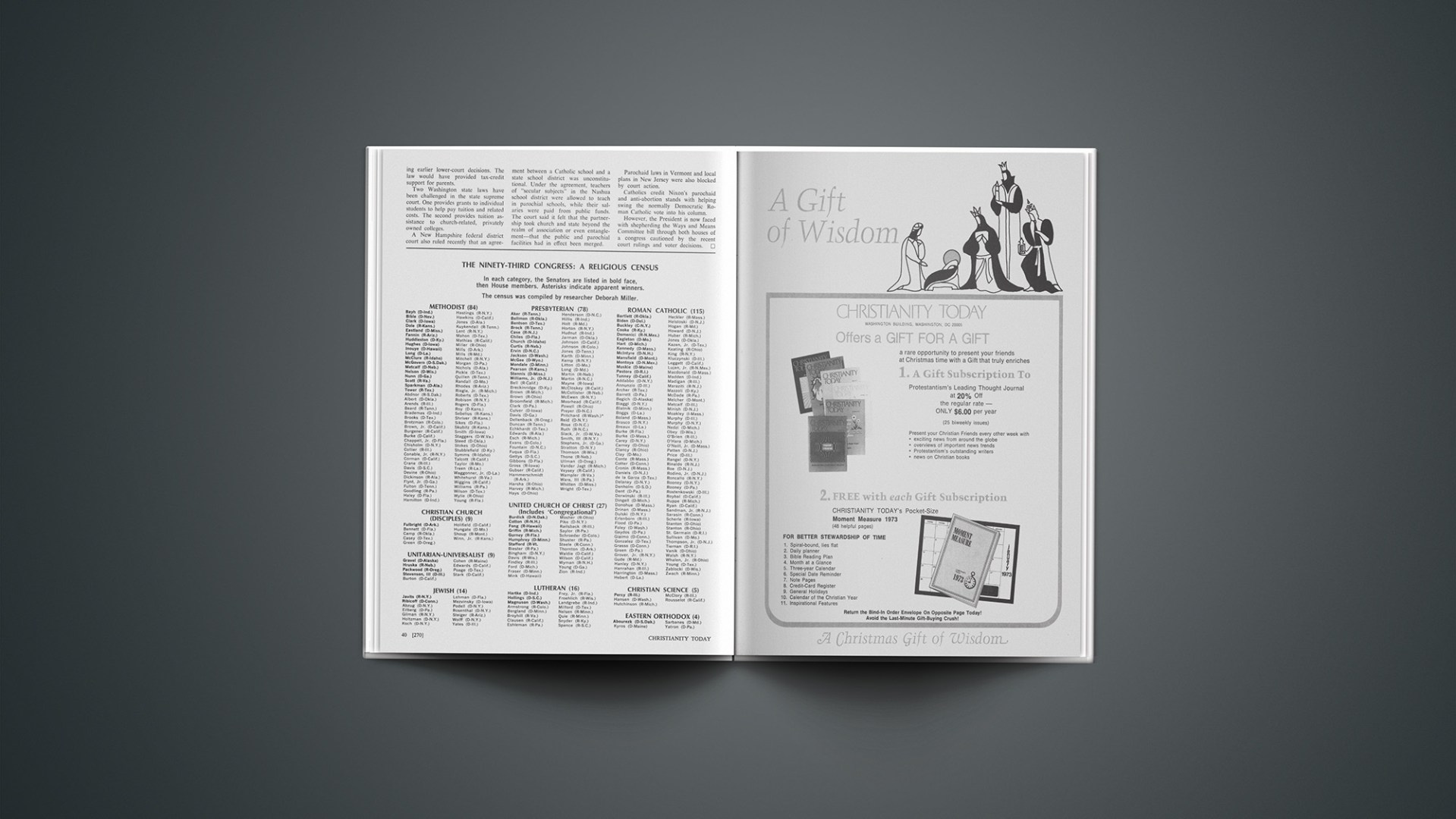
The Ninety-Third Congress: A Religious Census

In each category, the Senators are listed in bold face, then House members. Asterisks indicate apparent winners.

The census was compiled by researcher Deborah Miller.

METHODIST (84)

Bayh (D-Ind.)

Bible (D-Nev.)

Clark (D-lowa)

Dole (R-Kans.)

Eastland (D-Miss.)

Fannin (R-Ariz.)

Huddleston (D-Ky.)

Hughes (D-Iowa)

Inouye (D-Hawaii)

Long (D-La.)

McClure (R-Idaho)

McGovern (D-S. Dak.)

Metcalf (D-Neb.)

Nelson (D-Wis.)

Nunn (D-Ga.)

Scott (R-Va.)

Sparkman (D-Ala.)

Tower (R-Tex.)

Abdnor (R-S. Dak.)

Albert (D-Okla.)

Arends (R-III.)

Beard (R-Tenn.)

Brademas (D-Ind.)

Brooks (D-Tex.)

Brotzman (R-Colo.)

Brown, Jr. (D-Calif.)

Burgener (R-Calif.)

Burke (D-Calif.)

Chappell, Jr. (D-Fla.)

Chisholm (D-N.Y.)

Collier (R-III.)

Conable, Jr. (R-N.Y.)

Corman (D-Calif.)

Crane (R-III.)

Davis (D-S.C.)

Devine (R-Ohio)

Dickinson (R-Ala.)

Flynt, Jr. (D-Ga.)

Fulton (D-Tenn.)

Goodling (R-Pa.)

Haley (D-Fla.)

Hamilton (D-Ind.)

Hastings (R-N.Y.)

Hawkins (D-Calif.)

Jones (D-Ala.)

Kuykendall (R-Tenn.)

Lent (R-N.Y.)

Mahon (D-Tex.)

Mathias (R-Calif.)

Miller (R-Ohio)

Mills (D-Ark.)

Mills (R-Md.)

Mitchell (R-N.Y.)

Morgan (D-Pa.)

Nichols (D-Ala.)

Pickle (D-Tex.)

Quillen (R-Tenn.)

Randall (D-Mo.)

Rhodes (R-Ariz.)

Riegle, Jr. (R-Mich.)

Roberts (D-Tex.)

Robison (R-N.Y.)

Rogers (D-Fla.)

Roy (D-Kans.)

Sebelius (R-Kans.)

Shriver (R-Kans.)

Sikes (D-Fla.)

Skubitz (R-Kans.)

Smith (D-Iowa)

Staggers (D-W.Va.)

Steed (D-Okla.)

Stokes (D-Ohio)

Stubblefield (D-Ky.)

Symms (R-Idaho)

Talcott (R-Calif.)

Taylor (R-Mo.)

Treen (R-La.)

Waggonner, Jr. (D-La.)

Whitehurst (R-Va.)

Wiggins (R-Calif.)

Williams (R-Pa.)

Wilson (D-Tex.)

Wylie (R-Ohio)

Young (R-Fla.)

CHRISTIAN CHURCH (DISCIPLES) (9)

Fulbright (D-Ark.)

Bennett (D-Fla.)

Camp (R-Okla.)

Casey (D-Tex.)

Green (D-Oreg.)

Holifield (D-Calif.)

Hungate (D-Mo.)

Shoup (R-Mont.)

Winn, Jr. (R-Kans.)

UNITARIAN-UNIVERSALIST (9)

Gravel (D-Alaska)

Hruska (R-Neb.)

Packwood (R-Oreg.)

Stevenson, III (D-III.)

Burton (D-Calif.)

Cohen (R-Maine)

Edwards (D-Calif.)

Poage (D-Tex.)

Stark (D-Calif.)

JEWISH (14)

Javits (R-N.Y.)

Ribicoff (D-Conn.)

Abzug (D-N.Y.)

Eilberg (D-Pa.)

Gilman (R-N.Y.)

Holtzman (D-N.Y.)

Koch (D-N.Y.)

Lehman (D-Fla.)

Mezvinsky (D-Iowa)

Podell (D-N.Y.)

Rosenthal (D-N.Y.)

Steiger (R-Ariz.)

Wolff (D-N.Y.)

Yates (D-III.)

PRESBYTERIAN (78)

Aker (R-Tenn.)

Bellmon (R-Okla.)

Bentson (D-Tex.)

Brock (R-Tenn.)

Case (R-N.J.)

Chiles (D-Fla.)

Church (D-Idaho)

Curtis (R-Neb.)

Ervin (D-N.C.)

Jackson (D-Wash.)

McGee (D-Wyo.)

Mondale (D-Minn.)

Pearson (R-Kans.)

Stennis (D-Miss.)

Williams, Jr. (D-N.J.)

Bell (R-Calif.)

Breckinridge (D-Ky.)

Brown (R-Mich.)

Brown (R-Ohio)

Broomfield (R-Mich.)

Clark (D-Pa.)

Culver (D-Iowa)

Davis (D-Ga.)

Dellenback (R-Oreg.)

Duncan (R-Tenn.)

Echkhardt (D-Tex.)

Edwards (R-Ala.)

Esch (R-Mich.)

Evans (D-Colo.)

Fountain (D-N.C.)

Fuqua (D-Fla.)

Gettys (D-S.C.)

Gibbons (D-Fla.)

Gross (R-Iowa)

Gubser (R-Calif.)

Hammerschmidt (R-Ark.)

Harsha (R-Ohio)

Harvey (R-Mich.)

Hays (D-Ohio)

Henderson (D-N.C.)

Hillis (R-Ind.)

Holt (R-Md.)

Horton (R-N.Y.)

Hudnut (R-Ind.)

Jarman (D-Okla.)

Johnson (D-Calif.)

Johnson (R-Colo.)

Jones (D-Tenn.)

Karth (D-Minn.)

Kemp (R-N.Y.)

Litton (D-Mo.)

Long (D-Md.)

Martin (R-Neb.)

Martin (R-N.C.)

Mayne (R-Iowa)

McCloskey (R-Calif.)

McCollister (R-Neb.)

McEwen (R-N.Y.)

Moorhead (R-Calif.)

Powell (R-Ohio)

Preyer (D-N.C.)

Pritchard (R-Wash.)*

Reid (D-N.Y.)

Rose (D-N.C.)

Ruth (R-N.C.)

Slack, Jr. (D-W.Va.)

Smith, III (R-N.Y.)

Stephens, Jr. (D-Ga.)

Stratton (D-N.Y.)

Thomson (R-Wis.)

Thone (R-Neb.)

Ullman (D-Oreg.)

Vander Jagt (R-Mich.)

Veysey (R-Calif.)

Wampler (R-Va.)

Ware, III (R-Pa.)

Whitten (D-Miss.)

Wright (D-Tex.)

UNITED CHURCH OF CHRIST (27) (Includes ‘Congregational’)

Burdick (D-N.Dak.)

Cotton (R-N.H.)

Fong (R-Hawaii)

Griffin (R-Mich.)

Gurney (R-Fla.)

Humphrey (D-Minn.)

Stafford (R-Vt.)

Biester (R-Pa.)

Bingham (D-N.Y.)

Davis (R-Wis.)

Findley (R-III.)

Ford (D-Mich.)

Fraser (D-Minn.)

Mink (D-Hawaii)

Mosher (R-Ohio)

Pike (D-N.Y.)

Railsback (R-III.)

Saylor (R-Pa.)

Schroeder (D-Colo.)

Shuster (R-Pa.)

Steele (R-Conn.)

Thornton (D-Ark.)

Waldie (D-Calif.)

Wilson (D-Calif.)

Wyman (R-N.H.)

Young (D-Ga.)

Zion (R-Ind.)

LUTHERAN (16)

Hartke (D-Ind.)

Hollings (D-S.C.)

Magnuson (D-Wash.)

Armstrong (R-Colo.)

Bergland (D-Minn.)

Broyhill (R-Va.)

Clausen (R-Calif.)

Eshleman (R-Pa.)

Frey, Jr. (R-Fla.)

Froehlich (R-Wis.)

Landgrebe (R-Ind.)

Milford (D-Tex.)

Nelsen (R-Minn.)

Quie (R-Minn.)

Snyder (R-Ky.)

Spence (R-S.C.)

ROMAN CATHOLIC (115)

Bartlett (R-Okla.)

Biden (D-Del.)

Buckley (C-N.Y.)

Cooke (R-Ky.)

Domenici (R-N.Mex.)

Eagleton (D-Mo.)

Hart (D-Mich.)

Kennedy (D-Mass.)

McIntyre (D-N.H.)

Mansfield (D-Mont.)

Montoya (D-N.Mex.)

Muskie (D-Maine)

Pastore (D-R.I.)

Tunney (D-Calif.)

Addabbo (D-N.Y.)

Annunzio (D-III.)

Archer (R-Tex.)

Barrett (D-Pa.)

Begich (D-Alaska)

Biaggi (D-N.Y.)

Blatnik (D-Minn.)

Boggs (D-La.)

Boland (D-Mass.)

Brasco (D-N.Y.)

Breaux (D-La.)

Burke (R-Fla.)

Burke (D-Mass.)

Carey (D-N.Y.)

Carney (D-Ohio)

Clancy (R-Ohio)

Clay (D-Mo.)

Conte (R-Mass.)

Cotter (D-Conn.)

Cronin (R-Mass.)

Daniels (D-N.J.)

de la Garza (D-Tex.)

Delaney (D-N.Y.)

Denholm (D-S.D.)

Dent (D-Pa.)

Derwinski (R-III.)

Dingell (D-Mich.)

Donohue (D-Mass.)

Drinan (D-Mass.)

Dulski (D-N.Y.)

Erlenborn (R-III.)

Flood (D-Pa.)

Foley (D-Wash.)

Gaydos (D-Pa.)

Giaimo (D-Conn.)

Gonzalez (D-Tex.)

Grasso (D-Conn.)

Green (D-Pa.)

Grover, Jr. (R-N.Y.)

Gude (R-Md.)

Hanley (D-N.Y.)

Hanrahan (R-III.)

Harrington (D-Mass.)

Hebert (D-La.)

Heckler (R-Mass.)

Helstoski (D-N.J.)

Hogan (R-Md.)

Howard (D-N.J.)

Huber (R-Mich.)

Jones (D-Okla.)

Kazen, Jr. (D-Tex.)

Keating (R-Ohio)

King (R-N.Y.)

Kluczynski (D-III.)

Leggett (D-Calif.)

Lujan, Jr. (R-N. Mex.)

Macdonald (D-Mass.)

Madden (D-Ind.)

Madigan (R-III.)

Maraziti (R-N.J.)

Mazzoli (D-Ky.)

McDade (R-Pa.)

Melcher (D-Mont.)

Metcalf (D-III.)

Minish (D-N.J.)

Moakley (I-Mass.)

Murphy (D-III.)

Murphy (D-N.Y.)

Nedzi (D-Mich.)

Obey (D-Wis.)

O’Brien (R-III.)

O’Hara (D-Mich.)

O’Neill, Jr. (D-Mass.)

Patten (D-N.J.)

Price (D-III.)

Rangel (D-N.Y.)

Rinaldo (R-N.J.)

Roe (D-N.J.)

Rodino, Jr. (D-N.J.)

Roncallo (R-N.Y.)

Rooney (D-N.Y.)

Rooney (D-Pa.)

Rostenkowski (D-III.)

Roybal (D-Calif.)

Ruppe (R-Mich.)

Ryan (D-Calif.)

Sandman, Jr. (R-N.J.)

Sarasin (R-Conn.)

Scherle (R-Iowa)

Stanton (D-Ohio)

Stanton (R-Ohio)

St. Germain (D-R.I.)

Sullivan (D-Mo.)

Thompson, Jr. (D-N.J.)

Tiernan (D-R.I.)

Vanik (D-Ohio)

Walsh (R-N.Y.)

Whalen, Jr. (R-Ohio)

Young (D-Tex.)

Zablocki (D-Wis.)

Zwach (R-Minn.)

CHRISTIANSCIENCE (5)

Percy (R-III.)

Hansen (D-Wash.)

Hutchinson (R-Mich.)

McClory (R-III.)

Rousselot (R-Calif.)

EASTERN ORTHODOX (4)

Abourezk (D-S. Dak.)

Kyros (D-Maine)

Sarbanes (D-Md.)

Yatron (D-Pa.)

EPISCOPAL (66)

Beall, Jr. (R-Md.)

Brooke (R-Mass.)

Byrd, Jr. (I-Va.)

Dominick (R-Colo.)

Goldwater (R-Ariz.)

Hansen (R-Wyo.)

Haskell (D-Colo.)

Hathaway (D-Maine)

Mathias (R-Md.)

Pell (D-R.I.)

Proxmire (D-Wis.)

Roth (R-Del.)

Saxbe (R-Ohio)

Scott (R-Pa.)

Stevens (R-Alaska)

Symington (D-Mo.)

Taft, Jr. (R-Ohio)

Weicker, Jr. (R-Conn.)

Adams (D-Wash.)

Alexander (D-Ark.)

Anderson (D-Calif.)

Andrews (R-N.Dak.)

Ashley (D-Ohio)

Aspin (D-Wis.)

Blackburn (R-Ga.)

Bolling (D-Mo.)

Butler (R-Va.)

Byron (D-Md.)

Coughlin (R-Pa.)

Daniel, Jr. (R-Va.)

Downing (D-Va.)

DuPont, IV (R-Del.)

Fish, Jr. (R-N.Y.)

Flowers (D-Ala.)

Ford (R-Mich.)

Frelinghuysen (R-N.J.)

Goldwater, Jr. (R-Calif.)

Hechler (D-W.Va.)

Heinz, III (R-Pa.)

Hosmer (R-Calif.)

Ketchum (R-Calif.)

Mailliard (R-Calif.)

Matsunaga (D-Hawaii)

McFall (D-Calif.)

McKinney (R-Conn.)

Meed (D-Wash.)

Mitchell (D-Md.)

Montgomery (D-Miss.)

Moorhead (D-Pa.)

Myers (R-Ind.)

Parris (R-Va.)

Peyser (R-N.Y.)

Rees (D-Calif.)

Regula (R-Ohio)

Reuss (D-Wis.)

Satterfield, III (D-Va.)

Schneebeli (R-Pa.)

Steiger (R-Wis.)

Stuckey, Jr. (D-Ga.)

Symington (D-Mo.)

Towell (R-Nev.)

Van Deerlin (D-Calif.)

White (D-Tex.)

Widnall (R-N.J.)

Wyatt (R-Oreg.)

Wydler (R-N.Y.)

BAPTIST (55)

Byrd (D-W.Va)

Hatfield (R-Oreg.)

Helms (R-N.C.)

Johnston (D-La.)

McClellan (D-Ark.)

Randolph (D-W.Va.)

Talmadge (D-Ga.)

Thurmond (R-S.C.)

Andrews (D-N.C.)

Ashbrook (R-Ohio)

Bafalis (R-Fla.)

Bevill (D-Ala.)

Bowen (D-Miss.)

Brinkley (D-Ga.)

Broyhill (R-N.C.)

Buchanan (R-Ala.)

Burlison (D-Mo.)

Carter (R-Ky.)

Cochran (R-Miss.)

Collins (D-III.)

Collins (R-Tex.)

Conyers, Jr. (D-Mich.)

Daniel (D-Va.)

Diggs (D-Mich.)

Dorn (D-S.C.)

Fauntroy (D-D.C.)

Ginn (D-Ga.)

Gray (D-III.)

Gunter (D-Fla.)

Hunt (R-N.J.)

Ichord (D-Mo.)

Jones (D-N.C.)

Jordan (D-Tex.)

Landrum (D-Ga.)

Long (D-La.)

Lott (R-Miss.)

Mann (D-S.C.)

Mathis (D-Ga.)

McSpadden (D-Okla.)

Mollohan (D-W.Va.)

Natcher (D-Ky.)

Nix (D-Pa.)

Passman (D-La.)

Patman (D-Tex.)

Pepper (D-Fla.)

Perkins (D-Ky.)

Price (R-Tex.)

Rarick (D-La.)

Runnels (D-N.Mex.)

Shipley (D-III.)

Steelman (R-Tex.)

Taylor (D-N.C.)

Teague (D-Tex.)

Wilson (R-Calif.)

Young (R-S.C.)

‘PROTESTANT’ (19)

Aiken (R-Vt.)

Cranston (D-Calif.)

Badillo (D-N.Y.)

Chamberlain (R-Mich.)

Cleveland (R-N.H.)

Danielson (D-Calif.)

Dellums (D-Calif.)

Fascell (D-Fla.)

Griffiths (D-Mich.)

Hicks (D-Wash.)

Hinshaw (R-Calif.)

Mallary (R-Vt.)

Minshall (R-Ohio)

Moss (D-Calif.)

Roncalio (D-Wyo.)

Seiberling, Jr. (D-Ohio)

Studds (D-Mass.)

Teague (R-Calif.)

Young (R-III.)

OTHERS (14)

Schwenkfelder

Schweiker (R-Pa.)

Bible Church

Conlan (R-Ariz.)

Seventh-day Adventist

Pettis (R-Calif.)

Evangelical Free (2)

Anderson (R-III.)

Cederberg (R-Mich.)

Apostolic Christian

Michel (R-III.)

United Brethren in Christ

Roush (D-Ind.)

Christian and Missionary Alliance

Mizell (R-N.C.)

Churches of God in North America

Guyer (R-Ohio)

Evangelical Covenant

Johnson (R-Pa.)

‘None’

Frenzel (R-Minn.)

Kastenmeier

(D-Wis.)

McCormack

(D-Wash.)

Vigorito (D-Pa.)

LATTER-DAY SAINTS (10)

Bennett (R-Utah)

Cannon (D-Nev.)

Moss (D-Utah)

Young (R-N.Dak.)

Clawson (R-Calif.)

Hanna (D-Calif.)

Hansen (R-ldaho)

McKay (D-Utah)

Owens (D-Utah)

Udall (D-Ariz.)

CHURCHES OF CHRIST (7)

Allen (D-Ala.)

Baker (R-Tenn.)

Burleson (D-Tex.)

Evins (D-Tenn.)

Fisher (D-Tex.)

Latta (R-Ohio)

Sisk (D-Calif.)

SOCIETY OF FRIENDS (4)

Bray (R-Ind.)

Dennis (R-Ind.)

Forsythe (R-N.J.)

Robinson (R-Va.)

GOVERNORS

Roman Catholic (12)

Burns (D-Hawaii)

Cahill (R-N.J.)

Eagan (D-Alaska)

Edwards (D-La.)

Gilligan (D-Ohio)

Judge (D-Mont.)

Kneip (D-S.D.)

Lucey (D-Wis.)

Meskill (R-Conn.)

Noel (D-R.I.)

O’Callaghan (D-Nev.)

Salmon (D-Vt.)

Episcopal (5)

Briscoe (D-Tex.)

Exon (D-Nebr.)

Hathaway (R-Wyo.)

McCall (R-Oreg.)

Williams (R-Ariz.)

Jewish (2)

Mandel (D-Md.)

Shapp (D-Pa.)

Lutheran (3)

Andrus (D-ldaho)

Bowen (R-Ind.)

Link (D-N.D.)

United Church of Christ (3)

Evans (R-Wash.)

Love (R-Colo.)

Milliken (R-Mich.)

Latter-Day Saints (1)

Rampton (D-Utah)

Methodist (6)

Bumpers (D-Ark.)

Dunn (R-Tenn.)

Moore, Jr. (R-W.Va.)

Tribbitt (D-Del.)

Walker (D-III.)

Wallace (D-Ala.)

Presbyterian (7)

Askew (D-Fla.)

Bond (R-Mo.)

Docking (D-Kans.)

Hall (D-Okla.)

Holshouser (R-N.C.)

Holton (R-Va.)

West (D-S.C.)

Baptist (5)

Carter (D-Ga.)

Ford (D-Ky.)

Rockefeller (R-N.Y.)

Thomson (R-N.H.)

Waller (D-Miss.)

‘Protestant’ (3)

Anderson (D-Minn.)

Curtis (D-Me.)

King (D-N.Mex.)

Christian Church (Disciples) (2)

Ray (R-lowa)

Reagan (R-Calif.)

Unitarian-Universalist (1)

Sargent (R-Mass.)
Uncertain Pilgrim

Some years ago in the Bangkok YMCA restaurant a couple who were deep in conversation passed my table on their way out. I caught only one sentence, spoken by the man in Antipodean English. “It was inhabited,” he said slowly, “by a rather disreputable brand of angel.” Nothing else, just those words as he and his companion walked out of my life, leaving an almost unbearable curiosity about the context of that remarkable statement.

I had all but forgotten the incident, but it was recalled unexpectedly this year when I renewed acquaintance with Malcolm Muggeridge’s Jesus Rediscovered (Doubleday, 1969). In the foreword the author employs the familiar device of appearing to repudiate criticism by simply reporting it. “Old enemies,” he writes, “dwell on the obscenity of aging lechers that lash out resentfully at sensual pleasures they can no longer enjoy.” (Mr. Muggeridge, it should be said, is a great national thumper of the pornographic legions in Britain.)

Had I at last, then, encountered a representative of the angelic disreputable? Muggeridge’s career has been, in the language of genteel euphemism, “colorful.” He makes no secret of it, and from his repetition of the fact in sundry places and divers manners may not feel totally crushed by memory of a wild and wayward past. That no one will deny how impressively equipped he is for a telling sermon on the Prodigal Son is now further confirmed by publication of the first volume of his biography: Chronicles of Wasted Years: The Green Stick (Collins).

He was born seventy years ago in Croydon, near London. His father was an enthusiastic socialist who was latterly a member of parliament. Malcolm graduated at Cambridge, taught in Egypt and India, reported for the Manchester Guardian, married into the first family of Fabianism, sought utopia by flight to Moscow only to be disillusioned and to see fading the dream of the kingdom of heaven on earth (“one always … underestimates the staying power of human folly”).

It soon becomes apparent that he likes John’s Gospel, Paul’s Epistles, Augustine, Francis, Bunyan, Blake, Pascal, Kierkegaard, Tolstoy, Dostoevsky, Bonhoeffer, and Simone Weil. While it may be unkind to suggest that such a list is possible only through a certain selectivity, particularly in approaching the Pauline Epistles, one might learn more about Muggeridge by gathering together his dislikes—and by noting that none of them is older than the latter half of the nineteenth century. They include Freud, D. H. Lawrence, Bertrand Russell, Churchill, Picasso, Martin Luther King, Christiaan Barnard, the former bishop of Woolwich, Eleanor Roosevelt, Women’s Lib, family planning—and “moderate men of all shades of opinion.”

Institutional Christianity also Muggeridge detests, with its “unspeakable clergymen twanging electric guitars” and its total doctrinal confusion. Rome has surrendered to the forces of scientific materialism at the very time they were about to withdraw in disarray. Mixed-up leaders of the Protestant establishment are “drivelling away their lives in pursuit of a phantom kingdom of heaven on earth.”

As for the ecumenical movement, Muggeridge once told a friend of mine, it provoked a vivid childhood memory of “about twenty people reeling out of the pub door. They all had their arms round each other’s shoulders, because if they didn’t they would fall down.” On the same occasion he suggested that revival was more likely to happen in Russia than in America, “where the terrific emphasis on materialism has become absolutely grafted onto the Christian churches.” Over and over in both books mentioned above he reiterates Paul: “To be carnally minded is death, to be spiritually minded is life and peace.”

The Great Society is and always was a myth. The world abounds in ramshackle status quos. The human race today is united not by the Internationale but by Thomas Cook and the American Express, with tourism a more dynamic force than revolution. Yet elsewhere we find Muggeridge too pessimistic to be a travel agent: “Wherever the Americans are they create Communism, and wherever the Communists are they create anti-Communists.”

For all his own world-rejecting, Muggeridge is indifferent to many orthodox Christian doctrines such as the Virgin Birth, the Trinity, and the Resurrection. “Did You live and die and rise from the dead as they say? Who knows, or, for that matter, cares?” Having breezily acquitted himself of responsibility by admitting he is a “theological ignoramus” (a ploy used by C. S. Lewis to serve a better end), he lets go on theological themes with that astounding dogmatism usually found only in agnostics. And uncertain whether he is indeed a Christian, he is unfettered by Christian restraint in sneering, mocking, and pointedly pitying all those who disagree with him, whether Christians or not. But didn’t one of the Pauline Epistles he professes to admire exhort to salt-seasoned speech and wise conduct toward outsiders?

This is not to say that his barbs are always misdirected or undeserved, as his wicked eye exposes our pretensions and even our appalling jargon. Many a rueful smile will greet his mention of a Methodist minister’s public prayer about one of his listeners who had fractured a limb: “Lord, we offer unto thee Miss Ogilvie’s leg.…”

The one consistent thread Muggeridge finds running through the whole of his life is that he has always been a stranger in this world, which is a mere staging post on the journey home. “The only ultimate disaster that can befall us,” he says, “is to feel ourselves at home here on earth.” Altogether, his writings and addresses are a bewildering hotchpotch. They will provoke to thought, but chiefly they will entertain. No one can touch Muggeridge’s brilliance in tearing down the tinsel walls of Vanity Fair and exposing the tricks of the trade.

But to do that and little more is to fall prey to that petrifying cynicism not uncommonly found in professional escorters of words into print. When (to paraphrase Muggeridge) the motley is taken off, make-up washed away, studio lights extinguished, sound effects silenced, cameras put to sleep—what then? The haunting conviction of homelessness leading to pursuit of a “still small voice” whose origin is ill defined and whose message is uncertain? Is this really all?

Meanwhile Mr. Muggeridge gamely makes the best of it. No British religious TV discussion is complete without that arrogant drawl as he clobbers the spirit of the present age. He prides himself on being a loner, nobody’s man. Perhaps that is the key to his constant repetition of sentences like “God comes padding after me like a Hound of Heaven.” A little less Francis Thompson and a little more study of John’s Gospel, professedly his favorite, would bring that pursuit to a happy conclusion.

Key 73 Launch: Christmas Plus One

The recent Key 73 meeting in St. Louis, Missouri, was like opening a gift-wrapped record under the Christmas tree: most people had a good idea of what was in it but few knew how good it would be. For the first public presentation of the continental Key 73 program, the central committee invited a veritable who’s who of evangelical Protestantdom to sample the goods of others and to present their own. Bishops, presidents, elders, and assorted leaders—all representing a participating denomination or organization—followed on each other’s heels telling the nearly 200 gathered what their groups were doing to make Key a success.

“It’s beginning to jell now,” said Key 73 executive director Ted Raedeke. “It’s getting to the point now where denominations feel they can no longer ignore Key 73.” With nearly 150 groups already in, Raedeke’s remarks were underscored by the presence of Roman Catholic nuns and priests and two rabbis, all seeking information.

The emphasis at the St. Louis meeting was primarily on the dual first phase of the program: a “launch” television special and a two-week long noon call to prayer.

The TV special is slated for stations around the country on Saturday, January 6, with follow-up home Bible studies immediately after the program. Entitled “Faith in Action,” the thirty-minute documentary follows the experiences of nine new Christian families in both Canada and the United States. Phase One coordinator Ron Kerr, a United Methodist minister, said the program will emphasize the “breadth and scope” of Key 73. Church families are being urged meanwhile to organize “viewing parties,” inviting neighbors in to have coffee and refreshments, watch the program together, and then participate in Bible study.

Kicking off the entire Key 73 program will be the noon prayer calls. Conceived and coordinated by Prayer-a-gram founder Bob Yawberg of Fort Wayne, Indiana, the call will begin with opening ceremonies in four cities—Washington, Fort Wayne, Albuquerque, and Los Angeles—and be followed by daily prayer in homes, schools, offices, and churches each day at noon for the two-week period starting the day after Christmas. “We hope they’ll blow their horns in the streets, we hope churches will ring their bells, and we hope cities and towns will sound their sirens—to remind people to pray for Key 73,” he said.

Although each denomination and local group is free to participate in any way it chooses, the national organizations make suggestions available in congregational resource books. Raedeke said he also hoped participants would draw fresh ideas from the reports received at the St. Louis conclave.

In preparation for the year-long thrust, several denominations have already started evangelism seminars and training sessions for their clergy and laity. In Chicago, General Conference Mennonites were presented with the Key 73 goals and were trained to help local congregations meet the goals that leaders hope will take the church beyond Key 73. The conference’s Commission on Home Missions has signed a contract with Worldwide Evangelism-in-Depth to conduct similar training seminars across the country.

Already, Philadelphia churches have launched Key 73 in their area with ceremonies in the signing room of Independence Hall. Five leaders, representing the cooperating churches in Philadelphia, signed a statement of support of every effort “at every level of human experience to call our continent to Christ.”

In Canada, churches are gearing up after a late start. The Pentecostal Assemblies of Canada (largest Pentecostal body in the country) called all provincial evangelism directors to Toronto last month for a Key 73 planning session. Other churches and organizations are still in early planning stages.

The Christmas gift may be unwrapped now, but how good it is can’t be fully determined until after Christmas 1973.

Opposition ’73

Not everybody is happy about Key 73 and its avowed purpose of calling the North American continent to Christ. Jews and separation-minded fundamentalists alike are speaking out against the project.

Bob Jones University chancellor Bob Jones, Jr., says it is Satanic because theological liberals are involved along with the evangelicals. Sword of the Lord publisher John R. Rice doesn’t believe the gospel truth can be communicated under such circumstances. (Both Jones and Rice are separatists. This year Jones split with Rice because the latter has fellowship with the venerable Robert G. Lee who in turn has fellowship with the Southern Baptist Convention, an abomination to Jones.)

Evangelist Jack Wyrtzen, upon learning that the National Religious Broadcasters agency was cooperating with Key 73, resigned from the NRB Board of Directors because he did “not want to be associated in any way with this kind of compromise.”

Jewish leaders meanwhile are circulating an eleven-page memo outlining countermeasures against evangelism. They say Key 73 is offensive.

Pneuma ’72

Can the far-flung charismatic movement, whose adherents range from Catholics to classic Pentecostalists, come up with a common theology of the Holy Spirit?

That was a major concern for exploration as nearly 200 conferees assembled last month in Oklahoma City for the second annual meeting of the Society for Pentecostal Studies (SPS). Participants included old-line Pentecostal scholars as well as Catholics, Orthodox, and mainstream Protestant charismatics, along with a number of non-Pentecostal evangelical observers. In order to subject the SPS to a critique from outsiders, speakers from the evangelical right and the ecumenical left were brought in.

While there was an apparent unity in the Spirit during discussions of the “Pneuma ’72” theme, there was an equally apparent confusion in understanding the Spirit’s work in any uniform way. Catholic scholar Donald Gelpi of Loyola University in New Orleans and Orthodox priest Athanasios Emmert of Huntington, West Virginia, evaluated the charismatic experience as a valid outworking of that which is inherent in the sacrament piety of both Catholic and Orthodox churches. But no serious effort was made to reconcile their views with evangelical, neo-Pentecostal, or old-line Pentecostal statements.

Theologian William G. MacDonald of Gordon College, an Assemblies of God minister, identified the movement as riding on an “experience-certified theology” that brings together the objectivity of the revealed Word and the visible manifestation of the Spirit’s presence in the believer’s life. Presbyterian J. Rodman Williams, formerly of Austin (Texas) Seminary and now president of Melodyland Schools of Anaheim in Southern California, proposed a Pentecostal restatement to speak to both sacramentalist and evangelical theologies while moving on to a more adequate expression of its own.

In the presence of this apparent inability to get it all together, non-Pentecostal theologian Clark Pinnock of Trinity Evangelical Divinity School made perhaps the most useful suggestions for bridging the gaps between the various theological models that seek to explain the charismatic experience. He rejected as both empirically and exegetically unsound the Warfield view that the gifts of the Spirit ceased after the apostolic age. He then tendered a twofold compromise: that tongues be considered an acceptable though not normative gift, and that the manifestation of the gifts—including glossolalia—be considered an actualization of or a witness to the fullness of the Spirit given in regeneration, rather than as a “second blessing.”

The compromise, requiring both tongues and non-tongues advocates to yield somewhat in their current thinking, attempts to harmonize that which is empirically real with traditional evangelical theology. It runs counter, however, to old-line Pentecostal belief that the indispensable initial sign of Spirit baptism is glossolalia. Beyond that, even Pinnock suggested nothing to bridge the gap with the sacramentalist charismatics.

Vinson Synan of Emmanuel College in Franklin Springs, Georgia, was elected president of the SPS, which claims about 200 members in thirty countries. He predicted that the SPS papers will be the basis of charismatic study in the churches throughout the next decade.

JOHN E. WAGNER

Charisma ’72

Probably the chief issue in the Scandinavian church scene these days is the phenomenal spread of the charismatic movement. In October, more than 10,000 persons took part in Charisma ’72, a five-day ecumenical event in Stockholm viewed by many church authorities as highly significant. The conference’s steering committee consisted of Church of Sweden (Lutheran), Methodist, Baptist, Pentecostal, Salvation Army, Congregational, Evangelical Lutheran Fatherland Foundation, and Catholic representatives. One of the organizers, Bishop Helge Fosseus, a former missionary in South Africa and Lutheran World Federation (LWF) mission leader, was interviewed by an LWF official:

Has the Church of Sweden been influenced to any great extent by the charismatic movement? Not everywhere, but in the larger cities and in the youth movement the influence is obvious. In Stockholm there are about 100 Jesus groups, and in many parishes prayer groups meet regularly. These groups are active in many ways, but do not follow any pattern. They do not pay much attention to confession and denomination. Members of the same group often come from different denominations. In the same way, dogmatic differences are ignored, the unity in the Spirit of God being the only criterion of the fellowship between members. The groups voice their missionary calling in an evangelistic approach to anybody within reach, and do not tend to split from their parishes but rather to help inspire new life.

Are there any factors that could explain the appearance of the charismatic movement? Some complain that the spiritual sources of the old established churches are running dry and that abstract theology and Christian patterns of behavior do not inspire the young generation of today. Others are of the opinion that secularization has produced young men and women who have completely lost contact with the church. When they hear the Gospel preached and, without any prejudice, experiment with Christianity, and find that it works—that God is a reality and that the Holy Spirit is not just an idea but a function that works—they get overjoyed and happy and receive the spiritual gifts just as they were received in the early Church. Worship is characterized by new joy and happy expression of their new experiences of spiritual realities.

What future influence on the Church of Sweden can be expected? In connection with the proposed revision of the relationship between church and state, the charismatic movement may find an opening to some influence. Whether this will have a lasting influence no one knows. But the young people who are brought into contact with the church through the charismatic groups indeed produce a necessary rejuvenation in the congregations. It can also be expected that forms of worship will have to be accommodated more to the spontaneous way of the young charismatic groups—at least to make room for more active participation of lay members.

Religion In Transit

Judge Andrew J. Doyle, a church-going Methodist, stirred Nashville, Tennessee, with tongue-in-cheek instructions to police that no one—including preachers—be exempted from obeying Sunday blue laws. It was an apparent attempt to show the impossibility of enforcing the laws, but Sabbath enthusiasts around the nation sent their congratulations. Several concerned souls pleaded with him not to persecute the churches.

Finishing touches are being applied to a thirty-story steeple tower, said to be the tallest church tower in America, at D. James Kennedy’s 2,500-member Coral Ridge Presbyterian Church in Fort Lauderdale, Florida. It is part of a $6 million complex.

The Washington Post has moved its “Saturday church page” to Friday to better accommodate Seventh-day Adventist, Jewish, and other sabbath groups.

The forty-two member Executive Council of the United Church of Christ placed a one-year limit on the activities and “employment commitments” of the denomination’s social-action agency in apparent rebuke for controversial actions taken without consulting the council.

“Christmas Is,” an animated television special produced by the Lutheran Church-Missouri Synod, will be televised around the world this month. Last year 439 stations in various countries carried the program.

San Francisco registers 532 abortions for every 1,000 live births, triple the state rate, according to a University of California medical study. Three-fourths of the gynecologists and obstetricians surveyed said they favor abortion upon request by the patient and approval by the doctor, a stand affirmed by NCC president Cynthia Wedel last month.

The Vatican has warned potential givers to beware of a group raising funds for the Holy Land. It said Foundation of the Holy Land, Inc., collects money under false pretenses.

An Ontario Mennonite nursing home will not have to pay municipal taxes under a Supreme Court of Canada decision. As a result many other denominationally run homes are loosed from local tax rolls.

Canada’s largest evangelical church, Peoples Church, Toronto, begins color telecasting its morning service over one of the most influential stations in Canada next month. The program—produced by CFTO-TV staff with church equipment—will be syndicated throughout Canada and the United States, including sixty-two cable outlets. Last year the 3,000-member church raised more than $500,000 in support of its 410 missionaries. The TV expenses will be above that figure.

A week-long sit-in at the offices of New York City’s Council of Churches ended when the NCC agreed to set up a thirty-member task force on racism. Half the membership will be chosen by the demonstrators.

Internal Revenue Service officials have taken no action against a Rochester, New York, Catholic church that refuses to pay federal excise taxes on phone bills as a protest against the Viet Nam war. Meanwhile, phone service to the church continues.

Nuns and religious-order members in the United States are now eligible for Social Security benefits under a recently passed law.

Two moon rocks brought to earth by Apollo 16 are more than four billion years old, say Cal Tech scientists.

A “messianic figure” will soon appear

and “bring the people together under one God,” prophetess Jeane Dixon asserts in a recent book.

Gateway Films, a subsidiary of the American Baptist Convention, has released The Late Liz and continues to book The Cross and the Switchblade. Immediate goal: to square accounts of the bankrupt Dick Ross Associates, the original producer and distributor.

Personalia

Astronaut-turned-evangelist James B. Irwin in a visit to South Viet Nam gave president Nguyen Van Thieu a Bible and a Vietnamese flag that had been taken to the moon.

Charges lodged against Lutheran campus chaplain Gerald Pederson four years ago during unrest and violence at San Francisco State College were finally dropped a few weeks ago.

Methodist missionary official Harry O. Morton is the new general secretary of the twenty-year-old British Council of Churches; Archbishop Michael Ramsey of Canterbury will serve another five-year term as president.

Eastern Baptist Seminary professor Carl F. H. Henry, former editor of CHRISTIANITY TODAY, was reelected president of the Institute for Advanced Christian Studies. The IACS recently granted $10,000 to Wycliffe Bible Translators scholar Robert E. Longacre, who is preparing a “universal catalog of human thought implicit in the world’s languages.”

Pastor Kyung Chik Han of the 14,761-member Young Nak Presbyterian Church in Seoul, said to be the largest Presbyterian congregation in the world, has joined the World Vision staff as a minister-at-large. He and twenty-seven other refugees from North Korea started the Seoul church in 1945. It has helped to establish nearly 100 other churches since then.

Pittsburgh Seminary professor Markus Barth leaves this month for Basel University in Switzerland, where his famous father, the late Karl Barth, taught. He will fill the chair once held by New Testament scholar Oscar Cullmann.

The Cuban-born Anselmo Carral, 47, will move from his campus chaplaincy post in Panama to Guatemala, where he will replace Episcopal bishop William C. Frey. Frey was expelled from the country when he signed a petition addressed to the government. Carral, who will also direct Episcopal work in Honduras, was named at the recent meeting of Episcopal bishops in New Orleans after the Guatemalan church failed in eighteen ballots and twenty-one hours of deliberation to make a selection.

Former Tennessee state senator C. Brinkley Morton has decided to return to law practice after ten years as rector of St. Luke’s Episcopal Church in Memphis, the state’s largest Episcopal church.

After thirty-five years, Reformed Episcopal Seminary church-history professor Howard D. Higgins has retired from teaching but stays on the job as presiding bishop of the Reformed Episcopal Church.

Herbert O. Muenstermann, a United Church of Christ minister, was named executive director of the board that runs the pioneering 1,100-bed Vellore Christian Medical College and Hospital in India.

World Scene

An unidentified group of “concerned U. S. missionaries in Chile” sent a twenty-page open letter to American churches commending the Chilean socialist government and calling for a U. S. hands-off policy. The missionaries say they are in a unique position to participate “in the struggle to create a new and just society.”

A Japanese Buddhist sect dedicated a huge new temple at the foot of Mount Fiji. The sect’s officials say it is the largest religious structure in the world.

A Lutheran World Federation survey shows that Lutheran churches around the world now have 73.5 million members.

The island of Patmos is now a national historical monument, by decree of the Greek government.

A church cold war is heating up in Israel. A mission of the Russian Orthodox Church Outside of Russia has filed a lawsuit to gain church property in Jaffa that has been controlled by the Moscow Patriarchate since 1948.

Mormons say they now have about 35,000 members in New Zealand—more than the Methodists.

The worsening rift between the Dutch Catholic hierarchy and the Vatican, though “serious,” will not lead to a break with Rome, insists the secretary to the Dutch Bishops Conference. The Dutch want more democracy, liturgical reform, and greater emphasis on the Bible.

More than 10,000 Catholics of North Vietnamese origin—the majority of them young people—demonstrated in Saigon against the draft peace agreement between U. S. presidential envoy Henry A. Kissinger and North Viet Nam.

Pastor Robert L. Wise and members of his Lakeside United Methodist Church in Oklahoma City spearheaded the first Lay Witness Mission to Mexico at the invitation of Mexican Methodist bishop Alejandro Ruiz. Mexican nationals are now spreading the Lay Witness movement in their land.

South Africa distributed more Bibles (551,104) than any country except the United States (720,791), show 1971 United Bible Societies figures. The government subsidizes the bulk of the cost of each Bible purchased by Bantu and other non-white children.

Missionaries, by finding markets for goods, setting up schools, and spreading a life-changing faith, are thereby helping to blunt attempts by Communists to woo primitive tribesmen in northern Thailand, says American Baptist missionary Paul W. Lewis.

Good-Bye, Cocu

Good-Bye, Cocu

The United Presbyterian Church has disengaged from COCU on schedule, having paid its ten-month contribution of $19,500. The Synods of New York and Wisconsin along with a number of presbyteries have petitioned next year’s General Assembly to reconsider membership. But Moderator C. Willard Heckel isn’t enthused about COCU (“my Episcopalian relatives love bishops; I don’t”), and he doubts whether many other leaders are.

Meanwhile, the Massachusetts Conference of the United Church of Christ asked the UCC’s Executive Council to reexamine its “negative” reaction to COCU’s Plan of Union.

PRAYERS AND A GOOD TOE

When Don Cockroft, punter and place-kicker of the Cleveland Browns, missed a field goal in a crucial game recently he did a most natural thing for him—he prayed. One minute and fifty seconds later, with time running out, his prayers were answered and he got a second chance. This time he made good the kick to give his team a two-point victory over Pittsburgh in the last seconds of the game.

Cockroft, a Nazarene and an active member of the Fellowship of Christian Athletes, told interviewers later that he prayed because the game and possibly a division championship hinged on his kick. A teammate called the jubilant locker-room scene afterward “cardiac heaven.”

One victim of the Cockroft kick was fellow FCA member Terry Bradshaw, quarterback of the losing Steelers.

Vanguard: Editing Out The Pope

Early last month a new Presbyterian church, conceived last September (see October 13 issue, page 46), began the birth process at historic Tabb Street Church in Petersburg, Virginia.

The seventy delegates and official “visiting brethren” installed Todd Allen, pastor of Eastern Heights Presbyterian Church in Savannah, Georgia, as moderator of the new presbytery. They also began work on a constitution and by-laws. The new denomination will adhere to a mildly edited Westminster Confession of 1789 (deletions: identifying the Pope as Anti-Christ, and a ban against marriage between a widower and his sister-in-law) and the Presbyterian Book of Church Order.

The presbytery is the result of years of liberal-conservative haggling in the Presbyterian Church in the U. S. (Southern). Several Presbyterian congregations have recently severed ties with the denomination (see November 24 issue, page 41). Although not all of them have joined the new presbytery (as of last month’s meeting Vanguard had only six congregations), Allen estimates that perhaps one to four thousand more Southern Presbyterian congregations may withdraw to join Vanguard.

Southern Presbyterian moderator L. Nelson Bell is afraid he’s right. But even so, Bell predicts a short, bleak future for Vanguard. “Judging by the past history of splinter movements in the church, it is very likely that this group will split up,” he said.

Afoul Of The Law

In separate incidents, two preachers collided with the repressive politics of countries they were visiting, and they have some lumps to show for it.

A Czechoslovak court sentenced Pentecostal minister David Hathaway of Yorkshire, England, to two years in prison on charges of attempted subversion. He was arrested at the border in June while heading a tour group. Border guards discovered Bibles and Christian literature in the storage compartment of the group’s bus. Authorities said the literature had anti-state content. Hathaway denied knowing that the contraband was aboard, but officials replied that as tour leader he was responsible. A charge that he imported Bibles illegally into Czechoslovakia was dropped.

American street evangelist Arthur Blessitt and followers were beaten and arrested by riot police in Madrid. Blessitt, on a cross-toting witness trek across Spain, was preaching to a crowd of about 1,000 in a downtown plaza when police ordered the meeting shut down on grounds it was an unlawful assembly. Blessitt balked, insisting on rights of free speech. The police, clubs swinging, dispersed the crowd. (Most, including a number of Youth With a Mission team members, fled to a nearby church to pray.) Blessitt, a local evangelical pastor, and several others were carted off to jail. Within an hour, the American consul and Catholic authorities secured their release. The bruised but determined Blessitt went back to finish his sermon—inside the church.

Bolt From The Blue

The Swamp United Church of Christ in Ephrata, Pennsylvania, recently celebrated the appearance of a strange lightning bolt 180 years ago. According to Evangelical Press news service, it seems that when circuit-riding preacher John Waldschmidt died in 1786, his wife became a demented deaf mute. During a church service six years later, lightning struck the cemetery outside. Upon investigation, say church records, the shocked congregation discovered that the bolt had split Waldschmidt’s tombstone in two—and that the widow was healed the same instant.

Chicago’s Ecumenical Institute: Plumbing the Abyss

Writing in Come recently, Mrs. Matsu Crawford, a retired Southern Presbyterian missionary, attacked Chicago’s Ecumenical Institute as “a revolutionary center with a religious front.” In September, a Christian Century article charged it with promulgating “a new and inflexible fundamentalism in liberal guise.” Conservatives and liberals alike are asking, What is the Ecumenical Institute and what does it do?

The institute was founded in 1954 in Evanston, Illinois, following the Second Assembly of the World Council of Churches there. Intended as a place where scholars of various denominations could pursue “ecumenical studies,” it opened its doors in 1958 under the direction of German theologian Walter Leibrecht, who had been Paul Tillich’s assistant at Harvard. Noted theological personalities like the late Episcopal scholar Theodore O. Wedel and Swedish Lutheran Anders Nygren, author of the well-known Eros and Agape, came to the institute as “ecumenical scholars.”

But by mid-1961, according to former E.I. board member Richard Philbrick, religion editor of the Chicago Tribune, it was becoming obvious that there was not enough money available from foundations or churches to support the institute’s program. Leibrecht resigned, and in late 1961 the institute vacated its Evanston headquarters, the former Mormon Stake House.

Next, the Church Federation of Greater Chicago took the E.I. under its wings and moved it to the old campus of Bethany Seminary in a deteriorating area of Chicago’s west side. The Reverend Joseph Wesley Matthews, then 51, an Asbury College alumnus and former professor of ethics at Perkins School of Theology, became director. The emphasis was shifted from research in the libraries of suburban Evanston to activism in the buildings and streets of an urban ghetto, and its goal became the creation of “new structures and dynamics for local congregations on the west side of Chicago.” Matthews brought with him the philosophy, the tactics, and many of the workers from his experimental Faith and Life community in Austin, Texas.

The transformed Ecumenical Institute—like the Evanston WCC assembly that inspired it—now draws heavily on the theology of Paul Tillich, Reinhold and H. Richard Niebuhr, Rudolph Bultmann, and Dietrich Bonhoeffer. But while the leadership of the WCC has moved steadily toward “secular theology” and the Marxist-influenced “theology of revolution,” the E.I. follows Tillich in stressing the spiritual rather than the material and the importance of personal decision and commitment (“engagement”). It uses existentialist theological language as a psychological tool in what is otherwise a very orthodox setting of Bible reading, traditional liturgies, and even occasional revival hymns.

The institute’s own personnel, according to senior staff member Philip Townley (also a Methodist and an Asbury graduate), constitute a kind of religious “third order.” They live in a disciplined community, but unlike the “first and second” orders (monks and nuns), they can be married and live in families. They do not take formal vows, but they pledge themselves to poverty, chastity (within marriage), and obedience. The obedience is not to a single superior, as in many Catholic orders, but to the “community,” and expresses itself in the regular performance of menial tasks (sweeping the floor) by each member, and by the principle of “accountability.” In September, about 350 members moved into the eight-story Kemper Building in north Chicago. Smaller communities are scattered across the country. The order is divided into “congregations,” “ecclesiolas,” and “teams,” and members are called “sojourners” (one month or less), “interns” (one year), “fellows,” “colleagues,” and “confreres,” depending on age and the length of time for which they sign up. Every morning at breakfast the leaders of each ecclesiola or team “assume responsibility for its members” and report on their presence and performance of institute assignments.

The institute schedules a long day, from the “office” (morning service) at 5:30 A.M. right through to 10 P.M. or later. This holds true even in the forty-four-hour weekend conferences organized by E.I. members for local congregations. The Century article called the practice “a deliberate attempt to push everyone to the point of passive fatigue.” Leaders seek to saturate minds with the ideas and symbols that the institute values. Spiritual and social problems are analyzed in detail, as are programs for dealing with them.

The E.I. organizes churches into “galaxies” of four. There were twenty galaxies (eighty churches) in the program in January, 1971, and 144 churches in January, 1972; now there are 188 (including Catholic as well as Protestant), and 204 predicted by next month. According to local church organizer Sarah Buss, the E.I. has identified thirty-six major tactical principles and 9,000 individual tactics (e.g., organizing pre-schools, credit unions, home care centers) that churches and church members can use to restructure society. The basic goal is not to change the system but to change the way it works.

Some outside observers, especially those who fear the E.I. may be “taking over” the local church, stress its plans for “structural reformulation,” but Mrs. Buss emphasized that this is only the second of three major thrusts and that without the first and third (conceptual reeducation and spiritual remotivation) it would fall flat.

But spiritual remotivation alone is not enough, she pointed out, as it tends to play down the local church, which is the key to the recovery of community: “We’ve been fanatical at the point of recovering the depth dimension of the church in terms of the Spirit wisdom.” When asked about the source of this “remotivation” and “Spirit wisdom,” staffers stressed the Bible, particularly the Psalms and the Gospels, and the need for the disciplined planning of time, even in individual homes, so that evenings, for example, can be focused on spiritual concerns and not regularly wasted in front of the TV.

The quest for “Spirit wisdom” uses not only the Bible and the terminology of existentialist theologians like Tillich but also romantic, folk, “pop,” and even patriotic songs rewritten in existentialistic language to express institute concerns. Thus “Stout-Hearted Men” becomes: “Constantly conscious of dreadful awareness / I plumb the abyss evermore.” And “Blue Danube” becomes: “My life is transformed, now wonder-filled / No more shall I live as once I lived / The other world here in this world / Is the world that all shall see.”

Although the sources of the institute’s financial support include foundation and government grants, about one-fourth of the members work full-time on a rotating basis at paying jobs and turn their salaries over to the institute for the current support of all the rest. There seems to be no hostility toward capitalism or enthusiasm for Marxist or New Left theories—Marxist determinism being contrary to the E.I.’s emphasis on personal decision.

The institute is often called “revolutionary,” but its basic inspiration comes from the Christian classics, not Marxism, and its view of social transformation is closer to the perfectionist and post-millennial traditions in Christianity than to political theories.

But as was true of the “neo-orthodox pietism” that characterized the WCC’s “faith and order” wing (and that has now been sidelined at the WCC in favor of politicized “church and society” programs), the E.I. does not come through clearly about the fundamental presuppositions of the “Spirit wisdom” it is trying to help the churches recover: Is it basically biblical, with some existentialist language, or vice versa?

Parochaid: Looking for a Loophole

Most attention in the recent election centered on the presidential, congressional, and state races, but voters in many states were presented with referendums on other issues: abortion, legalization of marijuana, and parochaid (see preceding story).

For voters in at least three states, parochaid—public tax support for private, church-related schools—was a question, and the answer was a resounding no. Maryland, Oregon, and Idaho voters rejected all ballot proposals that dealt directly or indirectly with the issue. Other states, meanwhile, have parochaid pending at various court levels, while several have had parochaid plans tested and rejected by the U. S. Supreme Court.

Despite the seeming rejection of parochaid, its supporters are as encouraged by the election results as its opponents. They point to the overwhelming reelection of President Nixon, who took a strong stand in support of parochaid during the campaign. But opponents, including Americans United for Separation of Church and State, a Protestant lobbying group, call the state results proof that voters are rejecting all forms of parochaid and are calling for maintenance of church-state separation.

In Maryland, a proposed state law to use a complicated voucher (tax credit) plan to divert $12 million annually to parochial and private schools was rejected by a 61,000-vote margin. Leading newspapers, union officials, state politicians, and other groups led the fight to get the proposal accepted. Opposing was the Maryland Committee for Public Education and Religious Liberty (PEARL) and a coalition of educational, religious, and civic groups. Under the plan, parents earning under $12,000 a year and sending children to parochial or private schools would receive “tuition grants” ranging from $75 to $200 per student.

In Oregon and Idaho, the ballot dealt less directly with parochaid. A plan to amend Oregon’s constitution to conform to the federal constitution’s “establishment of religion” clause was rejected by 60 per cent of the voters. The amendment’s supporters claim the public was never made aware that the change was meant simply to be a constitutional guarantee of freedom of religion, a guarantee already provided in the federal document. At present the state’s clause says no public money can be used for benefits to non-public schools. The change would have read: “The legislative assembly will make no law respecting the establishment of religion or prohibiting the free exercise thereof.…” Opponents feared the change would open the door for taxfunded benefits to flow to the private schools as now allowed under the federal clause. In Idaho, voters turned down similar constitutional changes that would have allowed tax-supported busing of non-public school students.

In New York, a state that has been the scene of a long parochaid struggle, a straw poll by the New York Daily News on election eve showed seventy per cent of state voters approving either direct aid or tax-credit aid for church-related schools. The poll, which carried no official weight, showed 32 per cent favoring direct subsidies and another 38 per cent favoring the less direct tax-credit-for-tuition system. (A tax-credit proposal was presented to Congress last month by the House Ways and Means Committee.) Under this system—favored by President Nixon and Senator George McGovern—parents would receive tax credits of up to $200 per child for tuition paid to any private nonprofit elementary or secondary school.

A New York parochaid law enacted by the state two years ago has already been ruled unconstitutional by a federal court, though the U. S. Supreme Court agreed last month to review the decision. Under the controversial plan, non-public schools were given money to cover costs of maintaining attendance records, administering state regents’ examinations, and conducting other services required of all schools by the state education authority. The schools received $28 million in 1970 and $14 million in 1971 before payments were cut off by the court action, initiated by the New York PEARL committee.

A second state proposal—this time providing tax-credit support—was approved by a lower federal court recently. PEARL filed an appeal to the Supreme Court last month.

THE POLITICS OF BIRTH

Prominent Church of England clergyman Henry Cooper of London told his denomination’s General Synod that he will resign from the priesthood if women are ordained as priests. He dropped his remark during a general debate requiring no decision, but one in which a majority of participants showed they were for eventual ordination of women.

The ministry is God’s gift to the Church, declared Cooper, and he certainly chose no women. Besides, chimed in lay delegate O. H. W. Clark, God chose to be born a man.

Missouri’s anti-parochaid law was upheld by the Supreme Court last April when it approved a lower-court ruling that barred state aid for religious purposes and institutions. A group of Roman Catholic parents with children in parochial schools had challenged the law, claiming that state denial of tax funds to them abridges their right to free exercise of their religion.

Illinois’s three parochaid laws faced court tests earlier this year. Two were approved by a circuit court while the judge “regrettably” denied the third. The two approved measures gave approximately $25 million to non-public schools for the purchase of textbooks, auxiliary services, and innovative educational programs. The third—a $4.5 million measure providing assistance to children of low-income parents—failed to pass one of three Supreme Court tests for aid and was rejected. Appeals on all three are expected. (The test that the third law failed is whether the law works for the advancement of religion, something the court says cannot be done.)

Pennsylvania has seen several parochaid laws knocked down by court rulings. The latest—a plan to pay parents $75 for each elementary and $150 for each secondary school student in non-public schools—is stalled while awaiting a Supreme Court ruling. Meanwhile, Governor Milton J. Shapp wants the state legislature to rewrite a parochial school bus bill so that federal revenue-sharing funds can be used to provide free transportation to parochial students. They are currently transported on public school buses if they live on established routes. The new funding would give parochial students the same free transportation service that public school students receive.

Ohio’s parochaid law was also rejected by the Supreme Court, upholding earlier lower-court decisions. The law would have provided tax-credit support for parents.

Two Washington state laws have been challenged in the state supreme court. One provides grants to individual students to help pay tuition and related costs. The second provides tuition assistance to church-related, privately owned colleges.

A New Hampshire federal district court also ruled recently that an agreement between a Catholic school and a state school district was unconstitutional. Under the agreement, teachers of “secular subjects” in the Nashua school district were allowed to teach in parochial schools, while their salaries were paid from public funds. The court said it felt that the partnership took church and state beyond the realm of association or even entanglement—that the public and parochial facilities had in effect been merged.

Parochaid laws in Vermont and local plans in New Jersey were also blocked by court action.

Catholics credit Nixon’s parochaid and anti-abortion stands with helping swing the normally Democratic Roman Catholic vote into his column.

However, the President is now faced with shepherding the Ways and Means Committee bill through both houses of a congress cautioned by the recent court rulings and voter decisions.

The Election’s Religious Issues: What Happened at the Polls

A reassertion of traditional values seemed the most conspicuous trend in last month’s elections. President Nixon, the centrist candidate, was reelected by a record margin. Referendums in several states on moral and religious issues such as abortions showed an inclination to resist major change.

CHRISTIANITY TODAY’s census of the next congress (see page 40) shows that the religious mix remains almost the same as 1970 (see December 4, 1970, issue, page 33). In the most notable shifts, Baptists and Disciples picked up four seats each, and Presbyterians have five seats fewer. Catholics gained four governorships.

The President had considerably more support from Catholics this year than he had in 1968. The New York Post, basing its figures on an NBC study of 1,500 precincts and CBS interviews with 15,000 voters, said that 56 per cent of Catholics who voted cast their ballots for the Nixon-Agnew ticket. George Fine Research, in a survey for CBS, placed the percentage at 53.

According to the Gallup Poll, for the past twenty years a majority of American Catholics have voted for the Democratic presidential nominee. Four years ago, only 33 per cent of Catholics voted for Nixon.

The Jewish vote in the President’s column was estimated at between 32 and 34 per cent, almost twice the total he is believed to have had in 1968.

Perhaps more important than the voters’ choice of candidates was their expression of opinion in referendums. In North Dakota, a proposal to liberalize the state’s abortion law was defeated three to one. In Michigan, a similar plan lost by a vote of nearly two to one. Until a week before the election, Michigan polls had been predicting that the measure would pass.

Current North Dakota laws allow abortions only when the life of a mother is endangered. The referendum asked the voters whether they would favor a change to allow abortions for any reason up to the twentieth week of pregnancy. Although Catholics spearheaded the opposition, a number of key Lutherans and Baptists urged rejection also. “Right to Life” leaders in the state say they will now urge the state to create “crisis pregnancy” services in all major communities to give women a positive alternative to abortion.

Some observers feel that the vote in the two states reflects an “abortion backlash” caused by the liberalizing of abortion laws in a number of states in recent years. In Pennsylvania, the state legislature has just passed a bill outlawing all abortions except where a pregnancy seems to spell death for the mother.

Church-state issues were hotly contested at the ballot boxes in several states. In Maryland, a referendum on a bill offering tuition reimbursements to parents of non-public school students was narrowly rejected. A final tabulation showed that 523,156 voted against the referendum and 462,294 voted for it. The outcome was seen as unusually significant because of Maryland’s traditionally conservative Catholic strength. Both Nixon and his unsuccessful opponent, George McGovern, were on record as favoring some kind of parochaid (see next story).

Oregon voters turned down a proposal to amend the state’s constitution that could have benefited proponents of aid to non-public schools. In Idaho, voters rejected the use of school buses to transport students to Catholic schools. In New Mexico, voters approved nearly two to one an amendment to the state constitution that will put church property used for commercial purposes on the property tax rolls.

California had the biggest collection of religious and moral issues to vote on. As Monsignor Francis J. Maurovich put it, they “made the state ballot look something like a catechism.” Californians called for restoration of the death sentence by a vote of two to one. They rejected a measure on busing to achieve racial balance, a plan to legalize marijuana, and an anti-pornography measure, the latter presumably because of overkill provisions.

Two more clergymen were elected to Congress, and the three who were already members got sent back. The Reverend William H. Hudnut III, a Republican who is on leave as pastor of the 2,500-member Second Presbyterian Church of Indianapolis, defeated a Democratic incumbent in Indiana’s realigned eleventh congressional district. Hudnut is regarded a theological liberal and a political conservative. He was solidly behind Nixon.

Democrat Andrew Young, formerly a top aide to the late Martin Luther King, Jr., got a Georgia seat in the House vacated by a Republican who ran unsuccessfully for the U. S. Senate. Young, a United Church of Christ clergyman, becomes one of the first two blacks sent to Congress from the South since Reconstruction. The other is Miss Barbara Jordan of Houston, also a Democrat, who will represent the newly aligned inner-city nineteenth district of Texas. The 36-year-old Miss Jordan is a graduate of the Boston University Law School and the daughter of a Baptist minister.

Reelected to Congress were two Baptist clergymen, Delegate Walter Fauntroy of the District of Columbia, a Democrat, and Republican John Buchanan of Alabama, plus a Jesuit priest, Robert Drinan, of Massachusetts, former dean of the Boston College Law School. Drinan beat back the challenge of 31-year-old state representative Martin A. Linsky, who is Jewish. The Republican Linsky had charged during the campaign that the kind of dovishness advocated by Drinan would jeopardize Israel.

At least four clergy candidates lost. The Reverend Philip Hansen, a Lutheran and a Republican, was defeated by the incumbent U. S. senator from Minnesota, Walter Mondale. The Reverend James Wall, new editor of the Christian Century (see story, page 44) and a Democrat, lost to the incumbent in a heavily Republican district in Illinois. Pastor Darrel Berg of Trinity Methodist Church in Lincoln, Nebraska, and the Reverend Robert J. Cornell, a Catholic professor at St. Norbert College, De Pere, Wisconsin, also were unsuccessful in bids for the U. S. House of Representatives.

The Gospel in Germany

Many neo-protestant ecumenists see the Church’s task as restructuring historical institutions into the Kingdom of God through socio-political revolution. This historicized eschatology replaces the central evangelical task of persuading sinners to accept forgiveness of sins and eternal life through the Risen Christ.

Snippets of Dietrich Bonhoeffer’s prison letters are often quoted out of context to establish that revolutionary activist as a champion of radical secularism. In setting forth their alternatives to supernatural theism, Jürgen Moltmann and Wolfhart Pannenberg import time into the nature of God, and deny the universal validity of New Testament doctrines. As a result, their emphasis that Jesus’ resurrection illuminates the eschatological goal of history readily accommodates a political view of the Church’s task in the world. Still newer types of dogmatics adjust historic Christian theism to a camouflaged atheistic humanism; biblical motifs survive only with an altered meaning, and these theologians celebrate the death of God by affirming man’s ability to fashion his own ideal society.

Myriads of young clergymen now herald Marxism as a norm of twentieth-century social ethics. They ignore the lean evangelical fragments that survive in recent mediating views. Many seminarians no longer connect the future or the present with the Bible or with Jesus. They are aware of how modernists, dialectical theologians, existentialists, and others manipulate the texts to maintain the “Christian authenticity” of their positions. Neo-Protestant theologians have made the Scriptures a rubber mask for their speculations. Now hundreds seeking ministerial careers have abandoned the conviction that the Christian Church exists on an apostolic base for divine purposes exhibited in Jesus Christ. They insist instead that the Church must change its own structures in order to get wholly involved in social revolution. Many politically oriented seminarians plan to use the traditional churches as instruments for smashing sociological and ecclesiastical structures.

Peter Beyerhaus, professor and director of the Institute of Missiology and Ecumencial Theology at Tubingen University, notes that the Reformation motif sola scriptura is yielding to the contemporary theme sola structura. Beyerhaus should know. Radical Marxist divinity students at Tübingen hold a “regeneration” party whenever another seminarian is converted from Christ to Marx. These revolutionaries propagandize for the addition of more radical professors to the faculty.

One estimate finds eighty active leftists among the 600 seminarians at Tübingen. Sixty others are strongly evangelical, while the remaining 460 divide about equally into those who consider the Church’s task primarily social change and those who are unsure of their theological commitments and Christianity’s mission in the world.

The 1968 WCC Assembly in Uppsala gave little assurance that ecumenical Christianity sees clearly the difference between humanization and redemption. In an ecumenical atmosphere pervaded by theological pluralism, both evangelicals and secularists strive to register their views as official. But ecumenical programs, personnel, and publications handicap the evangelical witness.

Because of the sorry state of theological education and the direful consequences for the churches, German evangelical theologians launched the new Confessional Movement (Bekenntnisbewegung “Kein anderes Evangelium”). Its first goal is theological renewal within the traditional churches; alternative structures are not to be seriously considered unless the inside attempt fails. In some church jurisdictions, evangelical leadership has already been achieved. The most significant development was the unified theological witness led by Walter Künneth of Erlangen that issued the “Frankfurt Declaration of the Fundamental Crisis of Christian Mission.”

The Frankfurt Declaration boldly and clearly analyzes the crisis in Christian mission. It locates the central problem not in changed historical circumstances or in outworn structures but in modern speculative assumptions that undermine the Christian message and task and betray the lost multitudes for whom Christ’s Gospel is intended. Over against the politically oriented mission theology of the WCC’s evangelism division, the Frankfurt Declaration gives a precise analysis of disquieting doctrinal deviation—more precise than American evangelicals produced in their Wheaton Declaration. The Frankfurt Declaration reaffirms the evangelical theological basis, content, and goal that stimulated cooperative missionary effort until its ecumenical derailment in this century.

Significantly, the declaration was issued by the theologically oriented Confessional Movement, and not by evangelicals solely interested in mass evangelism. Bultmann and other neo-Protestant dogmaticians have been making embarrassing inroads among pietistic students whose evangelistic zeal was unmatched by theological learning. After the Frankfurt Declaration there emerged the Conference of Confessing Fellowships in the Evangelical Church in Germany, a confederation of groups interested in theological renewal and apologetics as indispensable to evangelical witness.

Evangelicals in Germany face obstacles to large-scale cooperation similar to those in England and the United States, and the ecumenical alternative prospers through evangelical fragmentation. Whereas the Bekenntnisbeweguns is largely oriented to “state church” issues, the Evangelical Alliance is largely free-church oriented. Some ecumenical leaders have recently made noteworthy overtures to Baptist and Methodist groups whose leaders work to tie their churches fully to the ecumenical movement.

Samuel Külling of the Free Academy in Basel is pessimistic about possibilities of renewal within any ecumenical framework. The confessional movement considers this verdict premature, and hopes for across-all-lines evangelical cooperation. Its leaders concede that the ecumenical hierarchy may fast be approaching the uncomfortable options of accepting evangelical renewal or persecuting evangelicals. In a show of evangelical unity, the German Conference of Evangelical Missions in February approved the Frankfurt Declaration side by side with the Wheaton Declaration.

There are multiplying signs of widening evangelical interest in theological learning alongside evangelistic engagement. In Tübingen, Bengel House, an evangelical center, houses thirty divinity students pursuing serious theological and evangelistic work. Basel’s Free Academy offers course work at university level. Evangelical vision now reaches beyond evangelism crusades to publication of a confessional journal such as this writer encouraged a decade ago in conversations projecting Christentum Heute as a German arm of CHRISTIANITY TODAY.

Eutychus and His Kin: December 8, 1972

The Divine Right Of County Commissioners

In politics I have an affinity for lost causes. If they’re not lost when I join them, they quickly gain that status afterwards.

A few years ago I agreed to help a friend in his bid for the mayor’s chair. I threw myself into the job of publicist with my creative best. We came in a distant third in a field of three.

Using that experience as a springboard I next moved into county politics as publicity manager for another friend, who was running for county commissioner. I helped prepare snappy newspaper ads, radio commercials, and outdoor posters. We were beaten—soundly.

A further example of my ability to pick losers: every single candidate I voted for on November 7 lost.

Even though I wasn’t directly involved in any campaign this time, some of the defeats were hard to take. Particularly hard on me was the loss suffered by my candidate for chairman of the county commissioners.

In many ways the quality of life in our locality is determined more by who sits on the county commission than by who sits in the White House. Our new chairman, Mrs. Lasalle, is a typical fuzzy-headed idealist.

All this brings me to the latest lost cause I’m espousing: the Divine Right of county commissioners. The egalitarian spirit prevailing in the Western world since the French and American revolutions makes that doctrine as archaic as a thirteen-star flag.

The divine right of rulers has always been more popular with rulers than with the ruled. In its crudest form it held that the king was responsible only to God and therefore could do no wrong—that is, he could do nothing for which he could be called to account by anyone else.

However, what I mean by the divine right of county commissioners is that all government is instituted by God and that no governor comes to power apart from God’s knowledge and concurrence. All rulers are the vice-regents of Christ for the promotion of public good and will have to answer to him.

That’s why God reminded his people in the days of Moses that “you shall not revile God, nor curse a ruler of your people.”

It’s also why Peter could write, “Be subject for the Lord’s sake to every human institution, whether it be the emperor as supreme, or to governors sent by him to punish those who do wrong and to praise those who do right.… Fear God. Honor the emperor.”

For that reason I shall honor Mrs. Lasalle, support her when she’s right, humbly oppose her when she’s wrong, and pray for her in every case.

Oh yes, this principle also extends downward to such positions as President and prime minister.

EUTYCHUS V

GREAT RUSTLING

Just finished reading “A Rustling in the Leaves” (News, Oct. 13) and thought it was great.

E. A. PATCHEN

Executive Secretary

National Educators Fellowship

South Pasadena, Calif.

As a missionary who has served many years in France and will return to the field in a few months, I was quite interested in the article by E. E. Plowman. I realize that one cannot make a comprehensive study and report on Europe by a quick trip. There are a couple of things in which I am disappointed.

1. It gives an almost overall opinion by saying that “other groups talk privately about the need to develop a strategy for working in and through the Catholic Church.” He should have talked with those using the New Testament method of church planting and he would have found out that many oppose such a strategy. Several have asked me as past field-chairman what we did. I simply have to reply that Mr. Plowman’s study was not comprehensive. We do not practice this method.

2. Also, I was disappointed that those involved in church planting were omitted. TEAM is a leader in France in this ministry. Also our “Jeuness Ardente” youth ministry in France. Too bad!

However, it was refreshing to see Europe presented as a great field for evangelism.

I. “PETE” PETERSON

The Evangelical Alliance Mission

Wheaton, Ill.

Plowman’s report on what the Lord is doing in Europe was stimulating and colorful. I am in no position to compare notes re the Continent; but as for England, and in particular Cambridge, his report is tinged with certain inaccuracies. It seems to me that he is reporting not so much what God is doing through his people, but what God is doing through his young people of charismatic persuasion; and the two are not synonymous.

I have no desire to demean fellow believers who encourage a charismatic emphasis; I am happy if God is working, regardless of the persons he chooses as means. But to read Plowman’s report, one would gather that the Lord is choosing to do nothing through local churches, or the mushrooming “reformed evangelical” movement, or people over the age of twenty-five. In point of fact, God is working through people from the broadest spectrum. Here in Cambridge, of the six most active, spiritual, and growing churches, only one is neo-charismatic, and all of them, while numbering scores of young people, are also well represented by older believers.

There is a small cloud, about the size of a man’s hand. Perhaps God in his grace will give us the showers of blessing for which many of us pray. But please, in your reporting, do not confine God to the young and to the charismatic movement.

Emmanuel College

D. A. CARSON

Cambridge, England

FILTERING LUTHERANISM

Re your frequent editorializing on the current debate in the Lutheran Church-Missouri Synod (both on your editorial and “news” pages), I would remind your readers that the evaluation they are receiving is coming through a non-Lutheran filter. If many within the Lutheran Church are still unclear on the genius of Lutheranism, it could hardly be expected to find many outside Lutheranism who could evaluate it fairly.

As a fifteen-year graduate of Concordia Seminary, St. Louis, I have seen a change in the stance of that institution. It has moved consistently away from a Biblicism that treats the Bible as an encyclopedia of religious facts to an ever stronger Gospel-oriented and Christocentric approach to Scriptures. As a Lutheran, I can only rejoice and be glad!

KEN FRERKING

Campus Pastor

Campus Lutheran Church

Columbia, Mo.

STUDYING RELIGION?

Thank you for your recent editorial (Oct. 13) “Religious Studies on Campus.” I am considering whether or not my calling leads to graduate school, and it is helpful to have the opinion of an evangelical who keeps track of the national situation.

DALE A. SCHNEIDER

Old Saybrook, Conn.

QUALIFYING THE QUARTERBACKS

Please have at least token courtesy to Canada by considering it part of planet Earth even if not suitably Americanized. Your November 10 editorial on Jackie Robinson wrongly states: “When he died last month, there were still … no black quarterbacks in professional football.” Chuck Ealey is black and played quarterback last year for the University of Toledo; this year he plays QB for the Hamilton Tiger-Cats here in Ontario. Maybe he does receive only $30,000 a season, but it’s still professional football. And he wasn’t the first: Sandy Stephens, a Heisman Trophy winner QB, played QB for the Montreal Alouettes in the early sixties for a similar salary.

Please use the qualifying adjective “American” in your descriptions in the future—or endeavor to learn the facts. Toronto, Ont.

DON GREENWOOD

PAWS AND TYRANTS

In your editorial of October 13, “On Leaving It to Hanoi,” it is obvious that you are (either deliberately or through gross ignorance) distorting both the positions of Senator McGovern and the history of U. S. involvement in Indochina for the purpose of showing agreement with and editorial endorsement of the policies of Richard Nixon.

I am not even going to attempt to show where your knowledge of either Senator McGovern’s stated policies or current history is defective; if you don’t know already, then you must be either hopelessly slow learners or willing propagandists for Mr. Nixon. What I am going to try is to draw your attention to the connection (which you probably are unaware of) between this editorial and one in the same issue entitled “Greece: Cornelius Still Awaits Peter.” You see, what you fail to comprehend is that in mindlessly echoing the propaganda and lies of Mr. Nixon you are aiding him in his program of support for the dictatorial and totalitarian regime of South Viet Nam and for the dictatorial and totalitarian regime of Greece.

While Mr. Nixon’s right hand grasps warmly the friendly paws of Communist China and Russia, his left hand is busy setting up petty military tyrants to keep their states from going red. Meanwhile, though you applaud the efforts of Nixon’s flunky in Saigon to keep the people of Viet Nam from imposing their will on him, you start complaining when Nixon’s flunky in Athens (former C.I.A. agent, former S.S. agent) starts putting our brother evangelicals in prison for evangelizing or passing out Bibles. Feels different when it gets close to home, doesn’t it? Well it’s going to get a lot closer to home unless we wake up to the growing web of deceit and tyranny the Washington regime is weaving around the world.

BOYD MARSHALL HOLLIDAY

Durham, N. C.

I’m glad that you criticized the Palestinian gunfighters and their North Vietnamese supporters, but it saddens me a little that you did not extend your criticism to the Israelis and us Americans, who also kill non-combatants for political reasons.… “On Leaving It To Hanoi” could have been a Christian outcry against the killing of non-combatants for political ends instead of the partisan statement that it was. The implication that we Christians value Israeli lives higher than those of Arabs or North Vietnamese is a poor witness to a good portion of the world’s population.

Whitestone, N. Y.

CHARLES E. LEHMAN

COUNTERING PABLUM

I was sorry to read the opinion expressed by the writer of “Too Much Dry Cereal?” (Eutychus and His Kin, Sept. 29). I hasten to reassure you that I subscribe to your nourishing (and to me, appetizing) magazine in preference to several others offering Christian pablum. I appreciate especially J. D. Douglas, John Warwick Montgomery, and the “professionalism” in lengthy articles, especially in fields of art and literature.

My only suggestions would be to replace the “What If …” cartoon with almost anything and to invite Eutychus IV to return in place of V. Henryville, Pa.

PAULINE FOX

LANGUAGE STUDY

I wrote a poem today, inspired by the review of Tongues of Men and Angels (Oct. 13):

Really and truly, dear brother linguistic,

Does it not seem a little bit odd

That you’d try to discern language patterns

Of a language that’s given by God?

With all due respect to degrees you have earned,

The things of the Spirit are just not so discerned!

FURMAN MILLER

Athens, Ala.

Athens College

MUSICAL CONTRASTS

Wayne Pederson’s “New-Songs and Joyful Noise—In Our Church?” (Oct. 27) in which he likens understanding “musical language to a spoken language” is good as far as it goes. I am sure that he would agree that there is a step more, i.e., a bilingual or multilingual person gets much greater enjoyment in living generally than one who speaks only his native tongue. Accordingly, one who knows both modern and classic forms in music is much better equipped to enjoy a wider range of stimuli than one who knows only the one or the other. The editorial in the same issue, “Music For God’s Glory,” points to some of this “old” music which for youth to miss would be such a tragedy. The current vogue of Afro-oriented music will pass away, but that which has endured through the centuries will still live for centuries to come.

Salisbury, Mo.

JAMES A. ADAMS

Pederson certainly makes a point to the over-thirty generation. But a word or two of caution about the current church music:

1. Does it meet the injunction, “God is greatly to be feared in the assembly of the saints, and to be had in reverence of all them that are about him” (Ps. 89:7)?

2. Is it possible that the world’s music—rock, etc.—has won a temporary victory? “Love not the world, neither the things that are in the world. If any man love the world, the love of the Father is not in him” (1 John 2:15).

3. Are fads necessary to attract people, young or otherwise? “Let that therefore abide in you, which ye have heard from the beginning” (1 John 2:24).

Franklin, Tenn.

J. A. GUNN

UNSPOKEN BEATITUDE

Thanks for the “What If …” cartoons. Please don’t let some of our somber friends kill this off. One of the aspects of Christ’s life that we often ignore is the certainty that he had a sense of humor. Somehow, I just can’t picture so many people being attracted to him if he was always serious and humorless. We need to balance our serious view of sin and salvation with an appreciation and enjoyment of the funny things in life. One of the unspoken beatitudes must have been, “Blessed is the man who can laugh at himself and others, for he shall live a balanced life.…” Keep it up, please, for we don’t want to be overrun by sacred cows.

G. P. ALEXANDER

Riverview Baptist Church

Great Falls, Mont.

A NEW REFERENCE

Your column “Two times Two” (Eutychus and His Kin, Sept. 29) again poses the old conflict between works and faith in a new reference. The child learns mathematics by himself—it is his own production, his own thing. It is part of the school “works.” But the lessons of the Christian life are “learned” differently—if they are learned at all. Nicodemus knew the rules, but he was missing the Christian life. Jesus gave him the answer: Ye must be born again (John 3:7).… The Christian life is not a set of rules, but we like to make it that way, and thus we fail. The only way the Christian life can be made pat is by and through and with Christ.

Fort Myers, Fla.

CLARENCE H. SCHILT

Corpus Christianum?

Corpus Christianum?

What may be the nation’s largest and most significant evangelistic effort of the twentieth century, Key 73, has become the target of intense criticism by the American Jewish Committee and by Rabbi Marc Tanenbaum, its director of interreligious affairs.

At a colloquium on “Civil Religion in America,” co-sponsored by the American Jewish Committee and Southeastern Baptist Theological Seminary, a resolution was adopted that the American Jewish Committee leaders said “marks the first time that a Southern Baptist group joined in a resolution repudiating proselytism of other groups, including Jews.” A careful reading of the resolution does not seem to bear out this evaluation. It is clear that the American Jewish Committee is deeply concerned with the impact Key 73 might have on the Jewish community as the Gospel of Jesus Christ is carried to Jews in 1973.

We can dismiss as wishful thinking any announced aim by uninformed Key 73 participants of making the United States a Christian nation. It never has been a Christian nation and it very probably never will be. No one takes seriously the idea of a “Corpus Christianum.” Nor should we hesitate to pronounce judgment upon the concept of civil religion in America; if there were such a thing, it would turn out to be a Frankenstein monster that no devout Bible believer would want any part of.

The real source of concern for the American Jewish Committee is its fear that Key 73 may succeed in wooing Jews to the Christian faith, not simply to a civil religion, and this it intends to prevent if at all possible. This is quite understandable, and in the open marketplace Jews have every right to do this. The American Jewish Committee, however, is dead wrong if it thinks evangelical Christians hold that “Judaism [is] a complete faith not requiring ‘fulfillment’ by Christianity.” Evangelicals believe strongly that the Jew Jesus is the Messiah prophesied in the Old Testament Scriptures. They believe that the Messiah many Jews look for to enter Jerusalem’s closed gate has already come and that they must share this good news with everyone they meet, including Jews.

The implication that to proselytize among Jews is to be anti-Semitic is far from the truth. Nobody is about to coerce any Jew into accepting Christ as Saviour, and nobody is going to rob Jews of their civil rights in a pluralistic society. Above all, no evangelical can take the New Testament seriously and be anti-Semitic.

The great problem for the Jewish community is that substantial numbers of Jews are turning to Christ and that Key 73 may accelerate the trend. But in a free society that guarantees religious liberty, this is a normal risk that all religions must assume. There is nothing to prevent Jews from proselytizing among Protestants and Catholics. Nor are Jews to be thought of as a special category in Key 73 strategy, which has for its basic aim the presentation of Jesus Christ as Saviour to all who do not know him. This includes atheists, agnostics, and adherents to the large variety of sects in America as well as Jews, for whom Christians feel great concern, seeing them as the chosen people of God to whom was imparted the Old Testament revelation and through whose Davidic line the Messiah came.

The Vd Epidemic

The high cost of permissiveness in American society is well documented by Public Health Service statistics that show more reported cases of gonorrhea than of all other infectious diseases combined! And there are undoubtedly many unreported cases also. The grim figures show an epidemic of venereal disease far more serious than most people realize.

In the first nine months of 1972, physicians reported more than 573,000 new cases of gonorrhea. No other infectious disease even approaches this total. During the same period there were only 115,000 reported cases of chicken pox, the only major childhood disease for which there is still no mass-administered preventive vaccine. Even infectious hepatitis, which has been spreading rapidly in recent years through drug addicts’ use of dirty hypodermic needles, has a far lower total—about 42,000 reported cases through September.

Despite intensive public educational programs, the VD epidemic shows no sign of letting up. The 573,000 cases this years compare with 503,000 for the same period in 1971; we appear to be on the way to a rate of 2,000 new cases every day! The incidence of syphilis also continues to rise: last year about 18,000 cases were reported in the first nine months, and this year the figure was approaching 20,000.

Although gonorrhea can be cured by modem antibiotics, it frequently leaves permanent scars in the male urethra and the female vagina. It is a leading cause of sterility, both male and female. Physicians emphasize that there is virtually only one way of contracting venereal disease, through sexual intercourse with an infected person. The epidemic is therefore a reflection of increasing promiscuity (and a good argument for natural law). There is reason to think the disease is no longer spread mainly by prostitutes and their customers but is more and more common among sophisticated “swingers,” both male and female, married and unmarried.

The modern obsession with sexual gratification directly violates scriptural principles. Those who give way to it are ill inclined to take into account the price in mental and physical anguish that is more and more likely to be required of them. Literally millions of marriages are being affected. The inevitable result, if promiscuity continues to increase, will be an even higher divorce rate and many more alienated children.

Imagine: this is going on in what is supposedly the most enlightened and most affluent society in all of human history.

Back Under Fire

Violent protest erupted on the American scene again last month. After many months of welcome quiet came news of renewed campus disorder. Students at Southern University in Louisiana, complaining about allegedly poor living conditions and high costs, kept demonstrating angrily until there was a major confrontation. Two students were killed. Although the circumstances are unclear, the incident appears to have been a needless tragedy.

In Washington, meanwhile, a group of militant Indians assembled to air grievances against the government. They took over the beautifully situated Bureau of Indian Affairs building along Constitution Avenue and eventually left its interior a shambles. The specific outcome of their “negotiations” with government officials was not made clear. What was very apparent was that the Indians left rather quickly upon receipt of some $66,000 in cash from the government.

These new outbreaks show the increasing difficulty that even the most responsible authorities have in dealing with dissidents with causes. What it seems to come down to is that the protesters who manage to make the greatest nuisances of themselves are the ones who get their way, or else there is bloodshed. They may or may not represent the most legitimate causes.

There are, of course, many causes that are worthy of attention and injustices that need to be corrected. Indeed, that is part of the problem. There are so many that one has to be somewhat arbitrary about which he chooses to pay heed to—unless that decision is made for him through some public medium.

The Reality Of Demons

That the present widespread renewal and extension of commitment to Jesus Christ should be accompanied by a resurgence of occultism is not surprising. Over the centuries, including the period of our Lord’s earthly ministry, there has been a close correlation between increased spiritual activity Godward and Satanward. In this self-proclaimed enlightened age, many people think the idea of demons is passé. But at the same time, the lure of the occult or of witchcraft, or the potentially dangerous aspects of the psychic, has ensnared many others. Often entrapment begins with what was thought to be harmless curiosity.

In a recent speech, said to be his first devoted entirely to the devil, Pope Paul properly calls attention to the need for awareness of Satan and his legions. Our “A Layman and His Faith” column this issue is devoted to demons (p. 26), and we review several books dealing with the occult (p. 19). Some of the books are written by advocates of false religion and must be consulted with care. To ignore the revival of the occult is to leave oneself or those to whom one ministers more vulnerable. But to become too absorbed in the “study” of it is likewise perilous.

Many Christians in the charismatic movement are insulted by the comparison often made between their spiritual experiences and parallel phenomena in non-Christian religions. Yet these believers need to be especially aware of the wiles of the devil in infiltration and counterfeiting.

While clearly indicating the superiority of God, the Bible attributes reality and personality in similar terms to God, the holy angels, Satan, and the demons. It is therefore not surprising that the theological tendency which a century and a half ago began by denying the personality of Satan should in our own time culminate in a denial of the personality of God! In the great spiritual warfare, all men are witting or unwitting participants. Our loyalty and reverence is to the triune God. But his—and our—adversary must not be ignored, mocked, or allowed to trick us. Knowledge of God and fellowship with him are preeminent; but let us not neglect to know and beware the enemy and his wiles.

Faith And Order Make A Comeback

During the early postwar years, ecumenical enthusiasm ran high. Neo-orthodoxy, which many of its adherents prefer to call “biblical theology,” was still the dominant influence in Protestant circles and was even getting a hearing among Roman Catholics. It brought a renewed interest in great doctrinal themes such as revelation, the Atonement, grace, the sovereignty of God, resurrection, and judgment, although—as one of its representatives pointed out—the recovery of biblical language did not imply a recovery of biblical content, inasmuch as neo-orthodoxy did not break free of the anti-supernaturalist world-view of liberalism (Langdon B. Gilkey, “The Travail of Biblical Language,” in Journal of Religion, 1961). The interest in form combined with a certain ambivalence about content also characterized the ecumenical movement in its early days. Protestants developed a romantic fascination with liturgy, the monastic life, spiritual discipline, church structure, and religious symbolism.

Observers of the World Council of Churches during its early years predicted that it would develop into a kind of super-church with a highly developed liturgy and organization, but with considerable ambiguity about the objective validity of what the liturgy, especially the creeds, specifically proclaim. All these things were the province of the “Faith and Order” sector of the WCC.

As things turned out, however, after 1966 “Faith and Order” was rudely pushed into the background by the increasingly political orientation of the World Council, which began to concentrate more and more on its “Church and Society” wing. However, although the zeal for faith and order prominent at the WCC’s Second Assembly at Evanston in 1954 was submerged, it was not destroyed. Recently it has come to the surface again in news being made by the Ecumenical Institute, which has spread from Chicago to scores of local churches (see News, page 46). This organization, though not directly related to either the WCC or its Evanston Assembly, has perpetuated some of the concern for “transcendence,” “depth,” and “spiritual life” that marked the theological mood of those years.

Evangelicals ought to be aware of the institute, because for over a decade it has been working hard in areas long neglected by the WCC establishment but still very important to man in his quest for spiritual realities. All that work has produced some remarkable studies, principles, techniques, and results, a number of which could prove very valuable to evangelicals—or, if misapplied and misdirected, quite dangerous.

It would be a mistake to see in the “revolutionary” zeal of the Ecumenical Institute an attempt to implement the “revolutionary” (i.e., political, secularistic) theology of the Church and Society movement. It is far more complex than that, and represents an appeal to man’s spiritual side, which official WCC theology virtually ignores. We do not need to ask whether the Ecumenical Institute represents something important; it does. What we need to find out is whether its theology is biblical, interpreted with the aid of existentialist theological language, or whether it is existentialism seeking expression in biblical language.

Lunar Christianity

A colony on the moon in this generation?

That’s what two scientists from the University of Houston have in mind. “NASA has funded studies of a twelve-man lunar surface base for the late 1980s,” they told the International Astronautical Federation Congress in Vienna earlier this fall. “This paper deals with concepts for expanding this lunar surface base to a more permanent colony of about 180 persons.”

Presumably such a colony would include men, women, and even children—with “normal” family life. Dr. John R. Howell and Dr. C. J. Huang also seem to be thinking of cultural possibilities in their paper. “Consider the possibility of creating or performing a ballet in one-sixth gravity,” they say. The paper goes on to discuss the technical problems and possibilities, and the whole idea appears to be very feasible.

One goal would be to try to make the lunar colony as independent of earth as possible, to minimize the amount of materials that would have to be transported 240,000 miles. The Houston scientists are trying to determine whether food could be produced on the moon. One suggestion, they say, was “to raise edible mushrooms using metabolic wastes as a growth medium during the fourteen-earth-day lunar night. Calculations showed that adequate nutrition required an intake of seventy-five pounds of mushrooms per day per person. The idea was abandoned.”

This kind of talk prompts us to begin to think a lot more seriously about what the ramifications are for Christians who are serious about what the Bible requires of them. What kind of claim ought they to stake on the moon? Is there a new kind of experience they ought to be planning for? Could it possibly hold promise for resolving some of the difficulties faced by the Church here on earth? It is too late not to be considering the spiritual implications of the lunar frontier.

How To Be Angry

Anger is often categorically listed as a sin in the Scriptures, yet at the same time it is repeatedly ascribed to God. In English we partly conceal this by speaking of the “wrath” of God, but there is no corresponding distinction in the original languages of Scripture. Can you think of any other vices in men that are virtures in God?

Actually, a close reading of the Bible shows that it is not man’s anger (or wrath or indignation) as such that is censured, but the universal tendency to abuse it. God’s anger is righteous. Ours should be, too.

Paul and James give two helpful guidelines to the proper expression of anger. In writing to the Ephesians, Paul actually tells us to “be angry” (5:26), but he quickly adds that we should do this in such a way that we “do not sin.” This can be done if we “do not let the sun go down” on our anger. That is, the expression of anger should not be delayed, stored up for some future outburst, turned into a grudge. Anger is sinful when it is postponed or maintained beyond appropriate boundaries. (One must distinguish between God’s present wrath, which rests upon unbelievers [see, for example, John 3:36], and the punishment for sin, which has been mercifully postponed.)

James adds to this insight. He tells us that we are to “be quick to hear, slow to speak, slow to anger” (1:19). If he meant that we were never to be angry, then he would also be saying we should never speak. Rather, James recognizes that we are often too quick to fly off the handle. We haven’t been good listeners or observers; we don’t know all the relevant facts. Just as delayed, anger is sin, so is hasty anger.

Consider these guidelines. Indifference in the face of iniquity is sin. If in the presence of wrong we do not have feelings that can be called anger, we are not godly. But these feelings, if they are righteous, must be neither too quick nor too slow. It’s not easy, and when we err we must be quick to confess to God and to the person we have sinned against. But we can err also if we attempt to avoid the problem by never getting angry at anything.

Apple PodcastsDown ArrowDown ArrowDown Arrowarrow_left_altLeft ArrowLeft ArrowRight ArrowRight ArrowRight Arrowarrow_up_altUp ArrowUp ArrowAvailable at Amazoncaret-downCloseCloseEmailEmailExpandExpandExternalExternalFacebookfacebook-squareGiftGiftGooglegoogleGoogle KeephamburgerInstagraminstagram-squareLinkLinklinkedin-squareListenListenListenChristianity TodayCT Creative Studio Logologo_orgMegaphoneMenuMenupausePinterestPlayPlayPocketPodcastRSSRSSSaveSaveSaveSearchSearchsearchSpotifyStitcherTelegramTable of ContentsTable of Contentstwitter-squareWhatsAppXYouTubeYouTube