Conservative Baptists: From Conflict to Caution

High on historic Burial Hill overlooking the harbor at Plymouth, Massachusetts, stands a marker in tribute to pioneer Baptist missionary Adoniram Judson. Although he is not buried there, some of his descendants are, and his father was pastor of a Congregational church in town. Moreover, it was in Plymouth that Judson underwent a traumatic experience that turned him from agnosticism to full Christian commitment.

After seminary Judson prodded the Congregationalists to set up a foreign missions board, but en route to India as a missionary himself in 1812 he switched to Baptist belief and became the first Baptist foreign missionary from America. Two years later he helped to organize the American Baptist Foreign Mission Society (ABFMS).

Feuds, the Civil War, and other factors over the years since then have fractured the Baptists into more than two dozen groups. These range from the huge Southern Baptist Convention to the eighty-church Separate Baptists in Christ and smaller groups, with the 1.5-million-member American Baptist Convention claiming Judson’s birthright (the ABFMS is an ABC unit). But the rifts run deeper: the average Baptist church vehemently insists on its autonomy, so that cooperation and even fellowship with sister churches is often difficult if not impossible.

The Conservative Baptists are a case in point. They have three autonomous agencies: the Conservative Baptist Foreign Mission Society (CBFMS); the Conservative Baptist Home Mission Society (CBHMS), and the Conservative Baptist Association of America (CBA). The CBFMS was organized within the Northern (now American) Baptist Convention in 1943 by conservatives protesting alleged theological liberalism in the ABFMS. Three years later the conservative faction walked out of the NBC after losing a bitter fight over the liberalism issue, and in 1947 they formed the CBA, cutting ties with the NBC. Next came the CBHMS.

This year’s annual meeting of the three groups was held in the shadow of the Judson marker at Plymouth. It was the CBA’s twenty-fifth anniversary, (the CBA received support last year from 1,100 churches) but the 1,200 messengers (delegates) and visitors showed little jubilance. Their mood and actions were in line with a cautious conservatism borne out of conflict in their own recent history. (A few years ago a self-styled “hard core” used the CBA platform to crusade for adoption of extreme separatist and dispensational viewpoints as official policy. That faction finally exited, and it has split several times since then. The latest uproar involves the resignation of most of the faculty from San Francisco Baptist Seminary, formerly Conservative Baptist. Teachers reportedly clashed with administrators Arno and Archer Weniger over policy. Many students say they will not return.)

Thus the messengers passed no resolutions on major issues (“we can’t speak for the churches”), decided against consolidation of their three bodies (“too much power in too few hands”), and quietly went about housekeeping. To appease the separatists in their midst, the CBs will stay out of Key 73. However, the messengers went along with a recommendation that they engage in special evangelistic endeavors in 1973, amounting to de facto participation in Key 73.

The reports indicated the CBs were in good health. The CBFMS had about 500 career missionaries on the field working in 1,000 overseas churches with 41,500 members. It had received $3.9 million from 1,800 churches to stake the work.

The two Conservative Baptist seminaries reported growth. Western Baptist Seminary in Portland has grown from thirty students in 1959 to about 300 today, with a full-time faculty of twenty-three. Conservative Baptist Seminary at Denver, less doctrinally bound than Western (which requires belief in the pre-tribulation rapture of the church), reported an annual growth rate of 10 per cent.

CBA executive director Russell Shive insists that despite the mix of rigid fundamentalism and moderate conservatism in the ranks the CB scene is peaceful, and the job of world evangelism and church planning is being accomplished—cooperatively.

Yet with no internal power to discipline as a united body, the CBs are all but powerless to deal with the seeds of destruction. Many executives fully expect, for instance, that dissident CBA Michigan state executive Harry Love soon will lead his flock to other pastures.

Would Adoniram Judson have understood?

A Developing Denomination

The Congregational Christian Church’s annual meeting held in Green Bay, Wisconsin, voted to approve a $1.1 million fund-raising campaign, more than $500,000 of which is pegged for increased development of new churches. The 335-congregation church adopted a budget of $228,775, added sixteen new churches to the membership roll, and elected Erwin A. Britton to be its moderator. Eight hundred delegates made the meeting the largest ever held by the church since the denomination was founded in 1955.

Tax Bite

The Internal Revenue Service has been looking into the political activities of some churches and their organizations to make sure “no substantial part”—usually meaning 5 per cent or more—of tax-exempt funds is used for political activity.

In recent months, the IRS examined the books of the National Council of Churches but reportedly found that while the council is politically involved, the cash contribution to such activities is less than “substantial” and does not jeopardize the council’s tax-exempt status.

The IRS also asked to see the books of the American Baptist Home Missions Societies, but Executive Secretary James A. Christison refused the request. He considers it an unconstitutional intrusion by government into church affairs.

Shortly after Beacon Press published the Pentagon Papers, FBI agents armed with a grand jury subpoena began investigating the press’s parent body, the Unitarian-Universalist Association. After a public outcry, the investigation was dropped.

NCC governmental relations director Dean M. Kelley is said to have obtained fifteen pages of documentation of such investigations. The NCC’s General Board, claiming that churches have the right to engage in political comment, has condemned the tax probes as a device to thwart church activism.

Decision And Appeal

A Greek superior court has upheld the conviction of journalist George Constantinidis, a Greek evangelical, on charges of proselytism (see June 9 issue, page 47) but suspended his five-month prison sentence. Constantinidis was convicted in May. An appeal will be filed with the Supreme Court challenging the constitutionality of the proselytism law.

Papal Guessing Game

Rumors continue to circulate that Pope Paul VI will announce his resignation at the Eucharistic Congress scheduled for September. The Pope will celebrate his seventy-fifth birthday September 26, and he previously set 75 as the retirement age for Catholic hierarchy.

Only the pontiff really knows how well founded the rumors are, but high prelates are talking about a successor to Peter’s chair. Secretary of State Jean Cardinal Villot appears to be the Pope’s personal choice and is considered front-runner. Conservatives are converging on Italian Pericle Cardinal Felici, and progressive forces presently seem to back the archbishop of Utrecht, Holland, Bernard Cardinal Jan Alfrink.

Polemics concerning election of the pope began five or six years ago when Cardinal Pellegrino, the progressive archbishop of Turin, requested that a representative body of bishops be included in conclave proceedings. (The College of Cardinals elects the pope.) Last May conservative Giuseppe Cardinal Siri attacked demands that conclave rules be radically reformed. Leo Cardinal Suenens wants the entire Synod of Bishops allowed to cast ballots in the election of a pope. Although conclave reforms have long been considered—even by Paul VI—no officials have confirmed that reform is in the wind.

One thing is certain: the deadly struggle between conservatives and progressives that has torn Catholicism since Vatican Council II would take on even more earnestness should either the retirement or reform rumors prove true.

ROYAL L. PECK

Holy War In Canada

A. C. Forrest, editor of Canada’s United Church Observer and a persistent critic of Israeli treatment of Arab refugees, has been slapped with a libel suit by B’nai B’rith of Canada. Forrest is named in the action because of a recent article, “How Zionists Manipulate Your News,” by John Nicholls Booth. Also named in the suit were the United Church of Canada’s publishing house and the church’s General Council.

But earlier, in a little noticed move, Forrest himself had launched a libel suit against B’nai B’rith for allowing publication of what he called inflammatory and libelous statements against him.

The Jewish-United Church feud heated up again when the church’s theological school, St. Andrew’s College in Saskatoon, granted an honorary doctor of divinity degree to Jewish theologian Emil L. Fackenheim, apparently in a move to extend the olive branch. (Many United Church members have been troubled by Forrest’s outspokenness.)

Fackenheim, a philosophy professor at the University of Toronto, seized the opportunity to blast both Forrest and the church for alleged anti-Jewish bias. He said that by allowing Forrest to continue his remarks and by remaining quiet on the issue, the church appeared “monolithically anti-Jewish” in the eyes of the Jewish community. He added that he was accepting the degree only because he regarded it as a repudiation of the magazine’s policy.

Forrest retorted that the college was probably embarrassed by Fackenheim’s interpretation. The church’s executive committee two days later denied the anti-Semitism charges, while a district conference of the church mildly reprimanded Forrest. It all figures to be a hot issue at this month’s bi-annual meeting of the General Council in Saskatoon.

LESLIE K. TARR

Unhistoric Judgment

“No justice for Jesus” headlined the Jerusalem Post after Israel’s Supreme Court refused to issue a declaratory judgment that Jesus did not receive a fair trial. The application for the judgment was submitted by attorney Yitzhak David in the name of David Biton, both of Eilat. In it, the lawyer stated that Jesus was “brought to trial because of hatred and because he was illegitimate and could not have had a fair trial. Since the Supreme Court [judges] are the heirs today of the Sanhedrin which tried Jesus … it is incumbent on [them] to undo the injustice done to Jesus.” Presumably, David wanted to erase the stigma of Israel’s complicity in the trial and death of Jesus.

The justices replied that it is accepted among historians that the Roman commissioner—not the Sanhedrin—judged Jesus. They asked David whether he thought a statement attributing an injustice to the Sanhedrin would add respect to the Jewish nation.

The attorney, insisting that the Supreme Court nevertheless is the heir of the legal institutions in Israel 2,000 years ago and thus should issue the judgment, then asked the judges to rule that the Roman court which tried Jesus gave him an unfair trial. The court rejected the application. Apart from the fact that the applicant has no personal interest in it, it deals with a historic, not legal, issue, the bench stated.

DWIGHT L. BAKER

Bloodbath In Burundi

The systematic killing of actual and potential leaders in the central African nation of Burundi (see June 23 issue, page 38) persists, and the consequences are especially grave for Protestantism. Over four-fifths of the population are Hutu, and for centuries the Hutu have been subservient to the Tutsi. In late April a few Hutu staged a short-lived coup; the Tutsi have since then been eliminating educated Hutu and their children. Both ethnic groups are predominantly Catholic, and about a dozen Hutu priests were slain. Two of the country’s five bishops are Hutu and were still alive at last report.

All Protestant denominations, like the country as a whole, are predominantly Hutu. Since they had only a small role in the economy and the government, many talented Hutu exercised leadership in the church. But now, because of their education rather than their religion, the leadership of the eight Protestant denominations has suffered a staggering blow.

For example, the Baptists have apparently lost all but one or two of the fourteen members of their executive board. The Free Methodists reportedly have suffered as greatly. The Anglicans probably had the highest proportion of Tutsi members, but their presence did not prevent the loss of at least one-third of the Anglican pastors and numerous evangelists. The interdenominational radio station, Cordac, has been banned, along with private radio communications. Missionaries have not been attacked but are severely restricted in their movements. No end to the turmoil is in sight.

Nacc: Hedging On Unity

Key 73? Yes. Jesus people? Right on. Miracles? Go slow. Tongues? No.

These were the answers that seemed to surface at assembly meetings, small groups, workshops, and rap sessions during the four-day North American Christian Convention (NACC) in Cincinnati. The gathering was the largest in the NACC’s forty-five-year history. About 30,000 from more than 6,000 churches attended the final service.

The convention is sponsored by members of the Christian Churches and the Churches of Christ (instrumental) and some of the conservative elements in the Christian Church (Disciples of Christ). All are spiritual descendants of Alexander W. Campbell and Barton W. Stone; they frequently refer to themselves as the “restoration movement.” The NACC tackles thorny issues but avoids passing resolutions and policy statements. Each congregation is fiercely independent, and even the “preaching minister” never attempts to speak for anyone but himself.

Afternoon topics seemed to reflect increasing concern over the charismatic movement’s entry into some NACC churches. Speaker after speaker questioned the value of the charismatic experience or else put it down outright. But one speaker hedged a bit, suggesting that the Pentecostal quest is a reaction to the “aridity and sterility of many modern churches.”

Two young California ministers agreed that the Jesus movement may be the Church’s wave of the future. The movement cuts across racial and socio-economic lines as the NACC does not, declared one of them before the nearly all-white audience.

Interest in Key 73 ran high, and many seemed eager to link up with others in the national outreach campaign, a significant pulse-reading in light of a rather provincial past. Key 73 national committeeman Paul Benjamin of Lincoln Christian Seminary in Illinois won fervent applause with his impassioned plea: “It is time we stopped talking about how good we are, how right we are, and how wrong everybody else is, and talk about how wonderful Jesus Christ is.”

But unity continues to elude the Christians at their own level. Representatives of the three factions in the Campbellian tradition sat as a panel and candidly appraised their differences, with Church of Christ (non-instrumental) minister David Bobo of Indianapolis admitting: “We have perhaps been the most isolationistic and exclusive branch of the restoration movement.” Pastor Calvin Phillips of a Christian Church in Hammond, Indiana, may have best expressed the frustration sensed by his fellow panelists and many NACCers. He observed that while in theory “agencies and conventions” are not a barrier to unity they can be “terrible irritants.”

JAMES L. ADAMS

Church Clash In Columbia

A disputed $75,000 United Presbyterian Church (UPCUSA) grant to a controversial social-action group in Colombia was within guidelines for such grants, a special UPCUSA study committee has reported. The grant, made a year ago by a UPCUSA mission unit, was criticized in widely publicized letters froms the Presbytery of the South in Colombia. The Synod of Colombia—highest Presbyterian judicatory in the land—joined in the complaint.

The presbytery charged that the Bogotá grantee, the Social Research and Action Circle (ROSCA), was Marxist-oriented. What’s more, the grant not only was used for questionable political purposes but contravened an agreement that all aid from the American church would be funneled to the Colombian church, the infuriated Colombians claimed.

ROSCA’s literature describes it as a support agency for peasant organizations, Indian civil-rights groups, and city labor unions. The group also received a $45,000 grant from the World Council of Churches.

The special committee, chaired by Connecticut pastor W. Stewart MacColl, said no prior consultation with the Colombians was needed under the guidelines in force a year ago. It did, however, agree that such consultation is necessary. The committee said the grant to ROSCA was not fully understood by the Colombian church and urged the Colombians to discuss future Colombian-American church relations with an ecumenical missions committee of the American body.

The report said that ROSCA was apparently fulfilling the aims of the proposal that garnered the grant and that committee members were “impressed with the sincerity and dedication” of the organization’s leaders. The latter include two ordained Presbyterian ministers and a layman. The committee rejected the Marxist charges. ROSCA was licensed by the Colombian government as an aid agency and is supported by other Protestant groups in the country, it pointed out.

There was no immediate reaction from Colombian church leaders.

Religion In Transit

The Chapel of Faith Baptist Church in Los Angeles is a virtual tourist mecca as people travel for many miles to see a strange cross-shaped light beam in one of the church windows. Some claim it has healed them. The cross first appeared about a year ago; pastor Roy Williams says that although he is still mystified he is happy for the attendance increase.

As part of a two-year probation term imposed for burglary conviction, Edward Klein, 20, of Los Banos, California, must take part in an Assemblies of God-related Teen Challenge center. Superior Court Judge George Murry suspended six months in jail if Klein stays in the program, one of Teen Challenge’s forty-eight rehabilitation centers in the nation.

The Academy of Religion and Mental Health, founded in 1954, and the American Foundation of Religion and Psychiatry, dating from 1937, will merge to become the Institute of Religion and Health.

Decision, the Billy Graham Evangelistic Association slick tabloid, is past the 4.5-million circulation mark and is projected to reach 5.2 million this fall.

Personalia

Rutgers University professor Samuel D. Proctor, a black clergyman who has served as dean of the University of Wisconsin, president of two black colleges, and associate general secretary of the National Council of Churches, was elected from among four candidates as pastor of Harlem’s 6,000-member Abyssinian Baptist Church. He succeeds the late Adam Clayton Powell, Jr.

Earle E. Cairns of Wheaton College and Edwin M. Yamauchi of Miami (Ohio) University were elected president and vice-president respectively of the scholarly Conference on Faith and History.

Dr. Herschel H. Hobbs, 64, former president of the Southern Baptist Convention, announced his retirement from the ministry. He has been pastor of the First Baptist Church, Oklahoma City, since 1949.

Presiding Episcopal bishop John E. Hines said his denomination’s decision not to participate in Key 73 was “purely financial—we don’t have the funds for the required contribution.” But, he said, church officials are in favor of the evangelism project and are encouraging organizations outside the church to participate.

Father James E. Groppi, the 41-year-old Milwaukee activist priest who has been arrested fifteen times, has resigned his Catholic parish post and applied to enter a Washington, D. C., law school.

Deaths

SVEN H. NJAA, 101, oldest clergyman in the American Lutheran Church (he retired from the active ministry at age 99); in Northwood, North Dakota.

JOHN GRACE, 70, retired commissioner and national chief secretary of the Salvation Army, the Army’s second-highest post in this country; in Philadelphia.

World Scene

British Methodists may be forced to sell some of their historic archives to American institutions in order to preserve John Wesley’s chapel, built in London in 1777. Included in the envisioned $650,000 deal are letters and original busts of the Wesleys and other Wesleyana.

A three-day conference of Buddhists, Hindus, Catholics, and other Christians in India called on all religions to join a fight against atheism but nearly ended in a brawl itself. Hindus and Catholics clashed when Catholics insisted on their “natural right” to convert.

The Czechoslovak Communist newspaper branded Western reports of religious persecution in Czechoslovakia a “conscious and evil lie.” Meanwhile, a pastor of the Evangelical Church of Czech Brethren (Presbyterian) went on trial for handing out leaflets about voting rights. And British Pentecostal minister David Hathaway was jailed for smuggling Bibles and other religious literature into the country.

Beginning next month, Italy’s government-run television network will grant Protestants and Jews fifteen minutes weekly of non-prime time to air their views, breaking a Catholic monopoly of the medium.

Of 1,620 mostly freshman students surveyed at Tohoku University in Japan by Japanese Navigators, 31 per cent wanted to hear an explanation of Christianity and 44 per cent expressed an interest in Bible study.

Roman Catholics in India vow they will fight “with arms, if necessary,” the Kerala state government’s decision to “control” church-related colleges, says Bishop Joseph Kundukulam. He recently led a march of 100,000 in protest after the state ordered private schools not to charge higher fees than state schools.

Degrees Disputed

Investigations by several newspapers have resulted in charges that a tiny, unaccredited Canadian Bible college is merely a degree mill for doctorate-hungry students. The New York Times discovered several degree-holders from Philathea College in London, Ontario, holding high academic positions and teaching emotionally disturbed persons in New York City.

The college, already under investigation by the Ontario Department of University Affairs for overstepping its charter, grants doctorates in philosophy. Under the Ontario charter it is allowed to grant only licentiates in theology. College president Benjamin Eckardt, self-styled “bishop” of Ontario under the Free Protestant Episcopal Church, calls the charges, first raised by articles in the London Free Press, “a bunch of nonsense.” Nevertheless, he admits, the furor has forced him to drop the doctoral program, which he claims leads to a doctorate in religious education and is within the scope of his charter.

The Times quotes New York State Psychological Association director Morton Schillinger as calling the Philathea degrees a “serious professional and ethical hazard.” One degree-holder was the founder of a Long Island school for gifted children while another was director of a city-financed drug program.

Eckardt claims the association should have checked out the degrees. If it had, he says, it would have found out that the doctorate was theological in nature and not psychological. If former students are using the degrees to qualify for positions in non-religious areas, they are doing so without college authority, he said in an interview.

Eckardt claims he is a Church of Christ minister as well as a Free Protestant Episcopal Church bishop. The latter group is not listed in the Yearbook of American Churches, and officials in both the National Council of Churches and the Episcopal Church say they’ve never heard of it.

According to Chicago Today, the church was founded in the 1860s. Its present head is Bishop-Primate Charles Dennis Boltwood, 80, an Englishman who also has interests in a string of unaccredited Bible colleges and seminaries in Britain under the general name of St. Andrew’s. The American leader is a Lutheran layman. Albert Fuge of New York City, an ex-Army colonel whose title is “bishop-primate-designate.” According to the newspaper. Fuge claims his powers as bishop-primate in his “authoritarian, fundamentalist” church are superior to those of the pope in the Catholic Church. The church has perhaps a dozen congregations scattered from black ghetto areas on Long Island to white communities in the South and in Canada.

George Kerr, minister of university affairs in Ontario, told the provincial legislature that Philathea was treated as a “joke” in academic circles in the London area and vowed its charter would be revoked if it has misrepresented its degree in any way.

Philathea’s reach also extends into Indiana, where Gordon DaCosta, president of Indiana Northern University—another unaccredited college claiming thirty to forty students on its Gas City campus—has a string of honorary degrees, some of them from Philathea. DaCosta identifies himself as archbishop of Indiana in the Free Protestant Episcopal Church. The Chicago newspaper questioned the links between DaCosta and Philathea, suggesting that the university (its “campus” consists of one administration building, a barn, some outbuildings, and a few trailers) was set up for personal profit, with the Philathea connections providing an academic veneer. (Eckardt in turn has an honorary INU degree.)

Philathea, claiming 200 students, charges $600 for courses leading to a bachelor of religious education and $1200 for doctorates. All students, Eckardt says, work hard for their degrees and must write and defend a thesis before one is conferred. “We don’t sell degrees,” he bristles. “We are not a degree mill.” Doctoral candidates must have a master’s degree from an accredited college before they can be admitted to Philathea, he says.

Meanwhile, a mail-fraud scheme involving two Orthodox Jewish rabbis and a ficticious New Jersey university was broken up by postal authorities in New York City. Rabbis Bernard Fuchs, 22, and Gershon Tannenbaum, 23, pleaded guilty to mailing brochures and soliciting fees for the phony Marlowe University. Postal authorities estimate the pair defrauded prospective students of nearly $200,000. Many of those who were bilked are overseas students who answered Marlowe ads in American magazines. Maximum sentence on the charge is a five-year prison term and $1000 in fines.

The brochures claimed Marlowe offered courses similar to those of regular universities that could be completed in months by mail. Respondents were told to send a $100 deposit with the application and another $300 to $400 when they completed a thesis. Apparently the pair never handed out any degrees.

The Spreading Flame

Follow-up of converts in a recent Cambodian revival has been hampered by communications problems. Newspaper ads announcing post-crusade rallies failed to get the expected results, and many converts gave less-than-exact addresses, according to crusade officials.

The Phnom Penh crusade, led by World Vision’s Dr. Stanley Mooneyham, resulted in a total attendance of 10,000 and 2,000 altar-call responses—potentially tripling the Protestant community in less than a week (see May 26 issue, page 32).

American missionaries on the scene say correspondence courses have nevertheless been sent out to more than 1,000 people who made crusade responses and whose addresses are known. Despite the lack of success in contacting many of the new converts, the missionaries claim the crusade and its revival spirit marked a significant turning point in the history of Christian work in the Asian country.

Missionaries in Viet Nam report that despite war revival continues to spread in the central highlands, and in the Philippines missionaries say national revival may be on its way there.

The Lutheran Generation

A Study of Generations, published by Augsburg, complements—but doesn’t explain—the membership report released by the Lutheran Council in the U.S.A. The Augsburg report is “the best piece of religious research ever done,” according to a Catholic religion researcher.

The 416-page volume surveys a cross-section of Lutherans from the three largest Lutheran bodies: the Lutheran Church in America, the American Lutheran Church, and the Lutheran Church-Missouri Synod. The research team, headed by Dr. Merton P. Strommen of Minneapolis, found that a majority of Lutherans believe in the biblical miracles, in life after death, and in a personal devil.

The study differentiated between the two in five “works-oriented” Lutherans who are tied to “religious legalism” and the three in five “Gospel-oriented” Lutherans who “reflect an awareness of a personal God who cares for them in Jesus Christ.” The latter hold fewer social prejudices than their more law-bound brothers.

Significantly, Lutheran union received strong support: 71 per cent in the LCA, 70 per cent in the ALC, and 62 per cent in the LCMS. The only thing the study didn’t cover is why Lutheran membership is on the decline.

The Lutheran Council reports that for the third consecutive year overall Lutheran membership dropped. The LCMS, however, gained nearly 9,000 members, partly through merger with the Synod of Evangelical Lutheran Churches. The LCA and ALC denominations lost three million and 21,000 members respectively. The ultra-conservative 383,000-member Wisconsin Evangelical Lutheran Synod was the only other group to increase.

Good For The Heart

Church-going is not only good for your soul—it’s also apparently good for your health. A study of male residents of western Maryland found that frequent attendance at church—any church—was associated with a much lower death rate from heart attacks and hardening of the arteries.

The study, conducted by Dr. George W. Comstock of the Johns Hopkins School of Public Health, was presented at a scientific symposium recently. Comstock found that those who attended services infrequently had nearly twice as many heart attacks as those who attended every Sunday. He called the results “most surprising.” But, said he, the number of variables for white middle-aged males dying of heart attacks is so great that it is almost impossible to interpret results.

An earlier study of Seventh-day Adventists in California showed similar results among the men, who neither smoke nor drink, eat less meat than others, and use coffee and tea sparingly. According to the survey, Adventist men live an average of six years longer than non-SDAers while the women survive an extra five years.

GLENN D. EVERETT

A Low Blow

A young Mormon missionary from America working in Thailand created one of the worst international incidents in recent memory there after a photo of him perched atop a Buddha statue was published in Thai newspapers.

Joseph K. Wall, 20, was jailed with fellow missionary Kimball J. Larson on charges of “desecration and sacrilege.” Larson snapped away as Wall draped his feet over Buddha’s face. A young Thai photo developer, incensed by what he saw on the film, sent print copies and letters of protests about the “foreign dogs” to Thai newspapers.

The predominantly Buddhist Thais are normally known for their religious tolerance. But they were outraged over Wall’s “ultimate insult” to the national faith: his “low feet” had touched Buddha’s “high head.”

After a waitress at Nakorn Sawan identified Wall as the offender in the photo, protesters in a caravan of 100 taxis snaked back and forth through the provincial capital seeking him—intending to lynch him. But the police reached him and Larson first.

Amid the rising outcry nationally, foreign-missions personnel scurried to press conferences to dissociate themselves from Wall and the Mormons. Diplomats and others in the foreign community poured out their apologies to suddenly hostile neighbors. Mormon leader Paul Morris explained to reporters that Wall’s act was not intended as an insult. Mission executives voiced fears that the incident would provoke a governmental guilt-by-association move that would harm their work. (Government pressure against Christian publishers continued for years after the publication of a Jesuit book attacking Buddhism.)

Wall and three other missionaries ran a Sunday school and taught English in Nakorn Sawan (Mormons have been active in Thailand for nearly a decade). Wall and Larson are now serving a six-month sentence, and they face possible deportation, but they could have been jailed for years.

BILL BRAY

Constantinople Compromise

“I confess to fear in accepting this burden, but I pray that the Holy Ghost will support me.” With these words Metropolitan Demetrios, 58, became the 269th archbishop of Constantinople and titular leader of world orthodoxy, succeeding Athenagoras I, who died ten days before. Demetrios had become an archbishop of two tiny Turkish islands only five months earlier.

Demetrios I vowed to continue the Athenagoras tradition, advancing toward Christian reunion “in the spirit of pan-orthodox unity.” Pope Paul sent two top envoys to Istanbul for the enthronement of Demetrios; the pontiff declared in a cable that “you will always find the Bishop of Rome desirous of continuing to progress toward the day … when our refound unity will be sealed.”

Observers say that Demetrios, a compromise candidate (he has been uninvolved in political issues), was first choice of the powerful Metropolitan Meliton of Chalcedon in Turkey, who was rejected by Turkey as a candidate for the high office “for political reasons.” Meliton presumably will serve as the new archbishop’s close advisor.

A news release of the Greek Orthodox Archdiocese of North and South America complained that the Turkish government “presumed … to take the authority to determine who is acceptable or unacceptable to become the next Ecumenical Patriarch of World Orthodox Christianity.” The office is chosen by the fifteen-member holy synod, but the Turkish government has the right to veto the synod’s choice.

The same communique explained why Archbishop Iakovos of New York (both he and Meliton were considered prime candidates for patriarch) was denied entrance into Turkey for Athenagoras’s funeral. Iakovos, outspoken in his criticism of religious discrimination in Turkey, was declared persona non grata.

Return To Sudan?

The Sudanese government has told evangelical mission officials that mission aid in rehabilitating the country after the bloody seventeen-year civil war there is most welcome. In light of Muslim ascendancy, many missionaries had all but written off their former field in the south as a closed door.

Dr. Kenneth Tracey, representing his own Sudan Interior Mission as well as Africa Inland Mission, Sudan United Mission, and Missionary Aviation Fellowship, has been commissioned by the four groups to seek ways to assist recovery efforts. Dr. Tracey headed up SIM relief efforts in Nigeria following the civil war there. Government officials told him the Sudanese welcomed such help.

Tracey reported that refugees are flocking back to the southern region of Sudan. Approximately 280,000 fled into Ethiopia, Uganda, and Zaire while another half million were displaced by the war and live a nomadic existence.

Urgent needs exist for reconstruction of hospitals, schools, leprosariums, and even entire towns, say government sources. Also needed are doctors, teachers, builders, engineers, agriculturalists, and supplies.

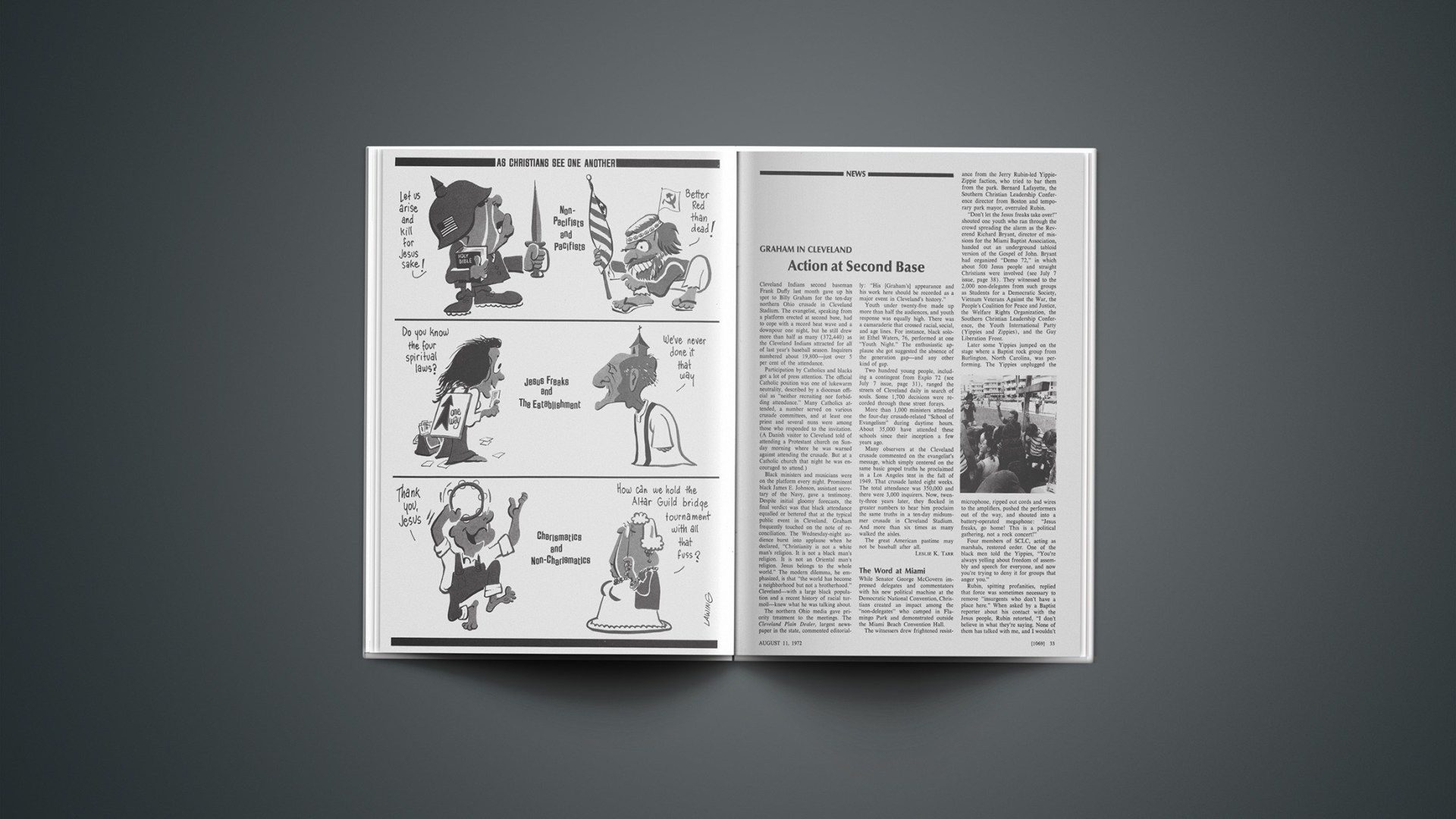
Graham in Cleveland: Action at Second Base

NEWS

Cleveland Indians second baseman Frank Duffy last month gave up his spot to Billy Graham for the ten-day northern Ohio crusade in Cleveland Stadium. The evangelist, speaking from a platform erected at second base, had to cope with a record heat wave and a downpour one night, but he still drew more than half as many (372,440) as the Cleveland Indians attracted for all of last year’s baseball season. Inquirers numbered about 19,800—just over 5 per cent of the attendance.

Participation by Catholics and blacks got a lot of press attention. The official Catholic position was one of lukewarm neutrality, described by a diocesan official as “neither recruiting nor forbidding attendance.” Many Catholics attended, a number served on various crusade committees, and at least one priest and several nuns were among those who responded to the invitation. (A Danish visitor to Cleveland told of attending a Protestant church on Sunday morning where he was warned against attending the crusade. But at a Catholic church that night he was encouraged to attend.)

Black ministers and musicians were on the platform every night. Prominent black James E. Johnson, assistant secretary of the Navy, gave a testimony. Despite initial gloomy forecasts, the final verdict was that black attendance equalled or bettered that at the typical public event in Cleveland. Graham frequently touched on the note of reconciliation. The Wednesday-night audience burst into applause when he declared, “Christianity is not a white man’s religion. It is not a black man’s religion. It is not an Oriental man’s religion. Jesus belongs to the whole world.” The modern dilemma, he emphasized, is that “the world has become a neighborhood but not a brotherhood.” Cleveland—with a large black population and a recent history of racial turmoil—knew what he was talking about.

The northern Ohio media gave priority treatment to the meetings. The Cleveland Plain Dealer, largest newspaper in the state, commented editorially: “His [Graham’s] appearance and his work here should be recorded as a major event in Cleveland’s history.”

Youth under twenty-five made up more than half the audiences, and youth response was equally high. There was a camaraderie that crossed racial, social, and age lines. For instance, black soloist Ethel Waters, 76, performed at one “Youth Night.” The enthusiastic applause she got suggested the absence of the generation gap—and any other kind of gap.

Two hundred young people, including a contingent from Explo 72 (see July 7 issue, page 31), ranged the streets of Cleveland daily in search of souls. Some 1,700 decisions were recorded through these street forays.

More than 1,000 ministers attended the four-day crusade-related “School of Evangelism” during daytime hours. About 35,000 have attended these schools since their inception a few years ago.

Many observers at the Cleveland crusade commented on the evangelist’s message, which simply centered on the same basic gospel truths he proclaimed in a Los Angeles tent in the fall of 1949. That crusade lasted eight weeks. The total attendance was 350,000 and there were 3,000 inquirers. Now, twenty-three years later, they flocked in greater numbers to hear him proclaim the same truths in a ten-day midsummer crusade in Cleveland Stadium. And more than six times as many walked the aisles.

The great American pastime may not be baseball after all.

The Word At Miami

While Senator George McGovern impressed delegates and commentators with his new political machine at the Democratic National Convention, Christians created an impact among the “non-delegates” who camped in Flamingo Park and demonstrated outside the Miami Beach Convention Hall.

The witnessers drew frightened resistance from the Jerry Rubin-led Yippie-Zippie faction, who tried to bar them from the park. Bernard Lafayette, the Southern Christian Leadership Conference director from Boston and temporary park mayor, overruled Rubin.

“Don’t let the Jesus freaks take over!” shouted one youth who ran through the crowd spreading the alarm as the Reverend Richard Bryant, director of missions for the Miami Baptist Association, handed out an underground tabloid version of the Gospel of John. Bryant had organized “Demo 72,” in which about 500 Jesus people and straight Christians were involved (see July 7 issue, page 38). They witnessed to the 2,000 non-delegates from such groups as Students for a Democratic Society, Vietnam Veterans Against the War, the People’s Coalition for Peace and Justice, the Welfare Rights Organization, the Southern Christian Leadership Conference, the Youth International Party (Yippies and Zippies), and the Gay Liberation Front.

Later some Yippies jumped on the stage where a Baptist rock group from Burlington, North Carolina, was performing. The Yippies unplugged the microphone, ripped out cords and wires to the amplifiers, pushed the performers out of the way, and shouted into a battery-operated megaphone: “Jesus freaks, go home! This is a political gathering, not a rock concert!”

Four members of SCLC, acting as marshals, restored order. One of the black men told the Yippies, “You’re always yelling about freedom of assembly and speech for everyone, and now you’re trying to deny it for groups that anger you.”

Rubin, spitting profanities, replied that force was sometimes necessary to remove “insurgents who don’t have a place here.” When asked by a Baptist reporter about his contact with the Jesus people, Rubin retorted, “I don’t believe in what they’re saying. None of them has talked with me, and I wouldn’t talk with them even if they tried. Jesus was a junkie. I don’t want to be bothered by … those … questions.”

Camping among the non-delegates were Jack Sparks, leader of the Christian World Liberation Front, and some followers from Berkeley, California. They helped feed other campers, distributing as many as 500 tunafish sandwiches and 3,500 doughnuts a day. Although they were not affiliated with Demo 72, the CWLFers also handed out contemporary Christian literature and talked with members of “the Chicago Seven” and Dr. Benjamin Spock, none of whom responded with any interest in the message of the Gospel. But, reported Sparks, as many as fifteen non-delegates a day made decisions for Christ as the result of the group’s witness. The CWLFers also sponsored “The People’s Church of Flamingo Park” and afternoon sing-alongs.

Sammy Tippitt, Leo Humphrey, and Bob Phillips, street preachers from Chicago, New Orleans, and Titusville, Florida, respectively, carried crosses at the demonstration areas as well as at the headquarters of each major presidential candidate. Tippitt and others managed to get onto the convention floor with words and posters. Humphrey led a prayer service for a Gay Liberation member who asked that the Christians help get “the devil of homosexuality” off his back. He then joined the Christians in giving out literature.

Two “straight” young people—Johnny Barber, 20-year-old business-administration student at Troy State University in Alabama, and Hank Erwin, 23-year-old ministerial student at Southeast Bible College in Birmingham—bicycled 860 miles in eighteen days to take part in the witnessing. They remarked about the apparent openness on the part of many of the youth delegates (particularly McGovern workers from San Francisco) and several of the more than 7,000 newsmen covering the convention.

Most of the radical demonstrators plan to be on hand for the Republican Convention later this month. The Christians plan to be there too.

ADON TAFT

The Candidates

Some oldtimers around Diamondlake Methodist Church in Illinois remember Democratic presidential candidate George McGovern. For one year McGovern served as student pastor of the small congregation, which grew from 133 to 170 under his leadership. Members of the congregation recall that he preached “good, noncontroversial” sermons, knew his congregation well, and took seriously his role of pastor, particularly visitation duties, fulfilling that role in his own way. Mrs. Vivienne Umbdenstock reminisces that McGovern baptized her and her five children in her living room, using a kitchen bowl as a baptismal font.

Although McGovern soon decided he wasn’t “temperamentally suited” for the pastorate, he said he had learned some valuable things, “like how to work with diverse people of all kinds in both happy and trying moments.”

The senator’s father, Joseph McGovern, who was a staunchly evangelical Wesleyan Methodist preacher (he built six churches), instilled in his son, in Eleanor McGovern’s words, “high ethical values.” But McGovern learned more than ethics from his pious father. The family held daily devotions, and McGovern owned his own Bible and could read it before he reached school age. On Sundays he attended Sunday school, worship service, an afternoon children’s service, and evening prayer meeting, and he never missed special revival services. McGovern still loves the Bible deeply and can recite many verses from memory, says biographer Robert Anson.

Shortly before his death in 1944, Joseph McGovern wrote to his son: “These are awful times in which we are living and you will need to let Christ have first place in your life and trust Him to help you to fit into all his blessed will for your life. Jesus said [in] John 15:15 ‘Without me you can do nothing.’ Read that chapter of St. John and think on those words. Read the 23 Psalm often, and meditate on it.”

Earlier, as a seminarian, McGovern said he embraced “the social gospel.” Although he holds no strong ties to any particular congregation today and doesn’t espouse his father’s evangelical Christianity, he is still active in United Methodist circles. The senator in 1968 was a United Methodist delegate to the Fourth Assembly of the World Council of Churches (Uppsala, Sweden). And in 1969 he was a national committee member of the first U. S. Congress on Evangelism, held in Minneapolis. (Evangelist Billy Graham and CHRISTIANITY TODAY’S Carl F. H. Henry—then editor and now editor-at-large—were leaders of that follow-up to the World Congress on Evangelism, held earlier in Berlin.) The late Robert Kennedy called McGovern “the most decent man in the senate.”

While no official press releases mention McGovern’s religious background, the senator does publicize the numerous religious leaders who have endorsed his candidacy. And, at pastors’ invitations, he has campaigned from pulpits in several churches (mostly black) during Sunday-morning worship services.

McGovern’s running mate, Senator Thomas F. Eagleton of Missouri, was raised in a devout Roman Catholic family. His father supported the church financially, but Eagleton received most of his spiritual training from his mother, reported Religious News Service. Although he never attended a Catholic school, he got private religious education from a priest who was a family friend.

Eagleton and his family attend Little Flower Church in Spring Hill, a Maryland suburb. When he was state attorney general “his religion was reflected mainly in the character and integrity of his administration rather than wearing his religion on his shirt-sleeves,” commented a former aide. In that respect, affirm McGovern associates, the two candidates are alike.

Free Will Baptists Sever Nae Link

Delegates to the annual meeting of the National Association of Free Will Baptists voted last month to leave the National Association of Evangelicals.

The Free Will Baptists had been NAE members for twenty-six years. As reasons for withdrawal, the resolution cited the principle of local autonomy, insufficient financial support for NAE, and the right of individual Free Will Baptists to belong to the NAE. It carried by a vote of 257 to 225.

The resolution was not critical of NAE, nor did it mention Key 73, thought to be a bone of contention. Eighteen of the NAE’s member denominations are Key 73 participants; the NAE itself has voted not to join.

The move from the NAE is the result of a growing separatist influence in the 200,000-member movement that began about fifteen years ago, says an insider. Free Will Baptists had previously been cooperating with other evangelical groups quite extensively, and two of their leaders, W. Stanley Mooneyham and Billy A. Melvin, had moved into key NAE posts. Melvin, former executive secretary of the Free Will Baptists, is now the NAE’s executive director.

Methodists As Stewards

Methodists don’t immerse, so the pollution of Lake Junaluska has no immediate ecclesiastical consequences. But delegates to the quadrennial Southeastern Jurisdictional Conference at their North Carolina assembly grounds were concerned about the lake anyway, because the conference owns it. A social-concerns committee reported: “This assembly has been a good steward of the banks and shores of Lake Junaluska, but we are poor stewards of the lake.” With that, delegates set aside $230,000 for dredging the lake and $200,000 for improving the sewage system. The lake has long been a favorite meeting place for Methodists in the Southeast. It is near Asheville.

The meeting at Junaluska was one of five jurisdictional conferences held last month, out of which came nineteen new bishops. Eleven are from the parish ministry, four from seminary posts, three from national denominational boards, and only one from regional administration. Two of the new leaders are black (a campaign to elect a black at Junaluska failed). There was a scattering of votes for women, and Methodism’s supreme court is being asked to decide whether a layman can be elected bishop. Also, the first Asian-American bishop in U.S. Methodist history was elected.

Here is a listing:

ATLANTA—Bishop William R. Cannon, transferred from Raleigh, N.C. BIRMINGHAM, ALA.—Carl Sanders, 60, pastor in Arlington, Va. BOSTON—Edward G. Carroll, 61, black pastor in Silver Spring, Md. CHICAGO—Bishop Paul Washburn, transferred from Minneapolis. COLUMBIA, S.C.—Edward L. Tullis, 55, pastor in Ashland, Ky. DALLAS—Bishop W. McFerrin Stowe, transferred from Topeka, Kans. DENVER—Melvin E. Wheatley, 57, pastor in Los Angeles. HARRISBURG, PA.—John B. Warman, 56, pastor in Pittsburgh area. INDIANAPOLIS—Bishop Ralph T. Alton, transferred from Madison, Wis. JACKSON, MISS.—Mack B. Stokes, 60, Asbury College graduate who has been associate dean at Candler School of Theology. LAKELAND, FLA.—Joel D. McDavid, 56, pastor in Mobile, Ala. LINCOLN, NEBR.—Don W. Holder, 66, president of St. Paul School of Theology. LITTLE ROCK, ARK.—Bishop Eugene Frank, transferred from St. Louis. LOS ANGELES—Bishop Charles Golden, transferred from San Francisco. LOUISVILLE, KY.—Frank L. Robertson, 55, pastor in Valdosta, Ga. MADISON, WIS.—Jesse R. DeWitt, 54, head of the section of church extension of the Board of Missions’ National Division. MINNEAPOLIS—Wayne K. Clymer, 54, president of Evangelical Theological Seminary, former Evangelical United Brethren school. NEW ORLEANS—Finis A. Crutchfield, 55, pastor in Tulsa, Okla. NEW YORK CITY—Bishop W. Ralph Ward, transferred from Syracuse. PHILADELPHIA—James Ault, dean at Drew University Theological Seminary. PORTLAND, ORE.—Jack M. Tuell, 48, pastor in Vancouver, Wash. RALEIGH, N.C.—Robert M. Blackburn, 52, pastor in Orlando, Fla. RICHMOND, VA.—Bishop W. Kenneth Goodson, transferred from Birmingham, Ala. ST. LOUIS—Robert E. Goodrich, 63, pastor in Dallas. SEATTLE—Wilbur W. Y. Choy, 54, superintendent of the Bay View district in Berkeley, the son of Chinese immigrants. SYRACUSE, N. Y.—Joseph H. Yeakel, 43, general secretary of the United Methodist Board of Evangelism. TOPEKA, KANS.—Ernest T. Dixon, 49, a black who has been assistant general secretary of the United Methodist Program Council. WASHINGTON, D. C.—Bishop James K. Mathews, transferred from Boston.

The Fortunes of Theology

Fifth in a Series

A crisis in theological credibility darkens the Western world; multitudes are baffled over what, if anything, they should believe about God.

This theological credibility gap differs from the widely denounced political credibility gap. Government officials are often charged with withholding information or manipulating the news; religious academics, however, are not often accused of malevolent secrecy or deliberate dishonesty. Few theologians are given either to anonymity or deceit.

The complaint against neo-Protestant theologians, rather, is that they simply don’t “tell it like it is.” Their religious reports are inconsistent and contradictory, if not incoherent. And if theologians and clergy who claim to be divinely updated experts cannot agree among themselves, surely the public cannot much be blamed for having high doubts about the Deity and about those who claim to fraternize with him.

If modern theologians kept their supposed revelational insights to themselves, that would be another matter. Then the continual revision and replacement of their views would create little problem for the public. But as it is, theology is increasingly tagged as an enterprise of creative speculation; its queen-for-a-day tenets have less endurance than many frankly tentative scientific hypotheses.

Neo-Protestant theologians hesitate to admit that they are simply playing peek-a-boo with divinity. Two generations of modern religious theory nevertheless bear out the blunt verdict that their rumors about God have no more solid basis in objective disclosure than Clifford Irving’s supposed conversations with the inaccessible and invisible Howard Hughes.

What makes the confusing theological reports—that the Deity is “in here” or “out there” or “up there” or “in depth” or “dead and gone”—a scandal is the fact that the Living God is truly accessible in his revelation. These neo-Protestant claims are intended to state the truth about God. But they so clearly contradict one another that if their proponents are not promulgating a literary hoax, they are at least profoundly mistaken. No claim is no more obviously fraudulent than that contemporary religionists convey the unadulterated truth about God. Their views cancel one another out.

Realizing this, a great many frustrated divinity students have taken a raincheck on theological commitments. For them to pursue a mod-theology for permanently valuable spiritual profit is about as rewarding, they feel, as for a squirrel to dig for nuts in Astroturf.

What neo-Protestant theologians as a class are saying about God is not only insufficient but inaccurate. At best, they proffer a mixture of truth, half-truth, and untruth—and no recent modern theologian has presented a solid criterion for distinguishing one from the other. The inevitable result is public distrust, even when these theologians happen to tell the truth about God. Their lack of theological concurrence has given rise to an adage: “When in doubt, speak as a theologian.”

This widespread uneasiness over the pontifications of contemporary theologians has been nurtured not only by their ambiguity and abstruseness but also by their promotion of a pluralistic dialogue that often denies historic evangelical Christianity a voice. Champions of a quasi-official ecumenical position screen and manage the news about God. Ecumenical biblicism wears thin the seventeenth chapter of John’s Gospel (“that they may be one”) but leaves comparatively untouched Jahweh’s message through Jeremiah: “You keep saying, This place is the temple of the LORD, the temple of the LORD, the temple of the LORD!’ This catchword of yours is a lie.… Do not run after other gods to your own ruin.… You run after other gods whom you have not known; then you come and stand before me in this house, which hears my name, and say, ‘We are safe’; safe, you think, to indulge in all these abominations” (Jer. 7:4 ff., NEB).

Among multitudes of Christians devoted to fulfilling the Great Commission, few complaints run deeper than that, in their unrivaled mass-media opportunities, ecumenists tend to obscure the singular truth of revealed religion and the good news of the Gospel. This dilution of historic Christian beliefs, whether in deference to modern theological alternatives or to socio-political activism, has nurtured widespread skepticism among the laity about the theological outlook of the institutional church. Ecumenical enthusiasm has been almost irreparably damaged among many laymen.

It is not that these laymen think the learned clergy are lacking in candor, or are given to fabrication and deception and to winning followers by pretense. Yet the ambivalence of many churchmen toward New Testament commitments has convinced numerous churchgoers that a cadre of contemporary religious leaders have acquired unwarranted influence, whereby they control religious information and, perhaps unintentionally, mislead the masses. Many lay leaders suspect that ecumenical bureaucrats have lost the sense of final truth.

The baffled multitudes have a right to know the truth about God. That truth is not nearly so inaccessible to the man in the street as theologians would have us believe. Nor is it dependent upon the ingenuity of modern-minded religious entrepreneurs. Any remarkably modern gospel is sure to be a false gospel. In earlier centuries, a powerful Catholic Church suppressed the Bible and shackled the people to the ecclesiastical hierarchy for their religious concepts. Neo-Protestant theologians suspend the Bible’s special meaning for modern man on their own cryptic “Key to the Scriptures.” In some places today Catholic leaders more energetically dispense the Scriptures (with the Apocrypha for excess measure) than do neo-Protestant radicals who are less sure of JHWH than JEPD.

Much of the new religious literature is greeted with such skepticism and suspicion that the religious book market is notably on the decline. The widespread loss of confidence and trust reflects a costly sacrifice of religious credibility. Now that God has been sensationally proclaimed to be dead, church members abreast of this information are not morbidly curious about the religious undertakers’ progress reports on the supposedly disintegrating corpse.

Indeed, the theologians of modernity are no longer widely viewed as the best source of information about God. While many radical clergymen have inherited what theology they have, or have had, from these theological mentors, there is a growing feeling among the masses that, if special information about God is available, neo-Protestant theologians are not the dispensers of it.

Eutychus and His Kin: August 11, 1972

WHO DO YOU THINK YOU ARE?

One of the stranger gifts God has given me is the ability to interpret dress patterns. In view of the fact that most pattern instructions are written in an obscure Polynesian dialect of pidgen English, that’s no mean gift.

The last time I was called on to display this talent was when my 12-year-old daughter decided she could no longer put off her home ec project, much as she hated the course. The assignment was to make a dress from a pattern of her choice.

At her request I had explained some of the intricacies of the diagram to her, and she was at the sewing machine working against the clock with mounting frustration. Suddenly she threw the dress down and exclaimed, “I don’t see why I have to take a dumb course like this anyhow!”

“Why did you?” I asked in typical fatherly ignorance.

“Daddy,” she replied in the patronizing tone she reserves for very small children and me, “it’s required.”

“Oh.” I responded brilliantly.

“But it’s dumb,” she continued. “Why do I need to spend all this time learning how to make a dress when I’ll probably never do it again? When I become a psychiatrist all my clothes will be tailor made!”

Frankly, I thought she had a point, and a glance at the partly finished dress confirmed it. But since we parents and teachers have to stick together in self-defense, I told her she’d better get back to work and stop complaining.

Then in my best counseling manner I went on to point out that even psychiatrists have to do things in their training that are not particularly fun but are necessary to reach their goal.

Although she wasn’t completely convinced, my speech helped a little, since this image of herself as a psychiatrist conditions all her activities. A home ec course has no meaning because she can’t relate it to her future as a psychiatrist. When she’s playing dolls she’s simply the psychiatrist-to-be enjoying fantasy.

She has already begun to answer that very important question: Who do you think you are?

I’m convinced that our answer to that question, our self-image, is crucial in finding meaning for our lives.

The Apostle John reminds Christians of the most important part of that answer: “My dear friends, we are now God’s children …”

TRIUMPHANT IN DEATH

Thank you for that timely and comforting article, “Death: No More Taboos,” by Cheryl A. Forbes (May 26). It was a joy to read this illuminating discussion of the “right to die with dignity,” and “a living will.” It is heartwarming indeed to see this all-important subject brought out in the open. As for myself, several years ago, I placed a “living will” among my important papers. At age eighty I felt the time had come to make my desires known legally. In my “living will” are these poignant words: “In the event I should become so critically ill that nothing but blood transfusions and intravenous feeding would prolong my life, please use neither—just let me die in peace, for that will be the triumphant moment for which I’ve lived these many years!” Hutchinson, Kans.

A PROPOSAL

Thank you for the excellent article by Frank C. Nelsen on “Evangelical Living and Learning Centers: A Proposal” in the May 26 issue. His recommendation consists of a most exciting concept and one which has practical merit.

Hopefully, the suggestion might be incorporated in the Institute for Advanced Christian Studies program and implemented on a campus such as the University of Pennsylvania, by Inter-Varsity Christian Fellowship at the University of Wisconsin, or by a joint effort of both organizations.

Pittsburgh, Pa.

As the pastor of a church close to a major university I have been exploring for some time the possibility of offering Bible-oriented courses to Christian students as a complement to the university’s curriculum. Currently we have the facilities and personnel but are still struggling with the problem of accreditation.

We differ markedly with Nelsen’s proposal, however, in two areas. The first of these is his insistence on perpetuating the concept in loco parentis.… The advisability of such a practice has been held in question for a long time, and most campus ministries are now recognizing the need for the college student to establish his independence and identity as an adult instead of depending on an institution to serve as his substitute parent.

Our second area is one of money. Is there an alternative to spending huge chunks of money in an enterprise such as this? We think there is. First of all, if we do not need to provide housing for students, classes such as proposed by Dr. Nelsen could be held in a variety of facilities. There are any number of churches, for instance, whose facilities stand vacant most of the week. Most universities have memorial unions where meeting facilities conducive to classroom use are available free of charge to campus groups. Additionally, on a growing number of campuses across the United States the Lord is locating a significant number of evangelical scholars who have academic and spiritual qualifications similar to Dr. Nelsen’s. We … have no reluctance to ask such men to serve on a limited basis, free of charge, using their unique gifts of the Holy Spirit to the spiritual enrichment of the lives of college people. All in all I think Dr. Nelsen is on the right track.

Bethany Baptist Church

Iowa City. Iowa

The article … describes what in fact has already been established by Regent College since 1970. We are on the campus of the University of British Columbia, Vancouver. We are training students for a one-year Diploma in Christian Studies, with plans for advanced degrees also. In 1971 some theological colleges followed our lead with similar offerings of one-year courses. It is precisely our vision to see similar evangelical centers established in other major universities throughout the world.

However, we differ from the proposals in two important respects. Firstly the proposal for undergraduate centers may conflict with university syllabi, since universities could reasonably object that students attending the centers may have conflicts of interests, timetables, and subject matter with the courses on the campus. We have felt it was wise to establish our center at the graduate level, so that students coming to us with the accreditation of their first degrees can be trained to view their faith more maturely.…

Secondly, we believe that to own property.… is an unnecessary expense.… Rental facilities on the campus are adequate, and much cheaper. Moreover, we believe the “ghetto” mentality of living in a “holy huddle” does not necessarily generate the wholesome, mature outlook that will prepare Christian young people to live in the world, though not of it. It is the faith and commitment of their teachers, not the “atmosphere,” that inspires them.…

It is, however, exciting to see the growing evidence of emphasis on evangelical scholarship, seeking to re-establish itself on our university campuses and in public life. This is what we need. Regent College

Principal

Vancouver, British Columbia

WEEKLY NECESSITY

“If I were the editor of CHRISTIANITY TODAY I would make it a weekly (Eutychus and His Kin, “If I Were Editor …,” July 7). Of course this would mean an increase in the subscription price, plus increases in personnel, etc. Maybe a poll should be taken of the readers to discover if there are enough readers who would pay the price of a weekly.

Minister of Music and Education

Bethel Baptist Church

Salem, Va.

‘IN ALL THINGS LOVE’

Your editorial “The Lord Is Coming Again!” (June 23) was superb. The realistic recognition of diversities of interpretation of the Christian conviction about the final redemption and judgment of God over our world through Jesus Christ is a good illustration of the apostolic advice “speaking the truth with love” (Eph. 4:15). I believe that some of the passionate insistence that Jesus is coming again according to a specified program and timetable is actually a sign of the inability to deal constructively with threats to a belief. The heat in some of our arguments is not always the product of the conviction fires of the Holy Spirit. It is sometimes a part of the oscillation of fever and chills resulting from the struggle with an insecure faith.

In the long struggle of Christians to live with both their convictions and their brothers I think one of the best guidelines we have been given has come from Rupertus Meldenius (A.D. 1627): “In faith unity, in opinions liberty, in all things love” (Schaff’s History of the Christian Church, vol. VII, Eerdmans, 1950, p. 650 f.). Surely on that day when many will gather from East and West and North and South to sit at table with our triumphant Lord Jesus both the passionately convicted and the dispassionately tolerant will find their truth and love made complete and pure.

First Christian Church

Cedar Falls, Iowa

SOUTHERN BAPTIST COMMENTS

In all my years of reading CHRISTIANITY TODAY I have found it to be a magazine which presented a conservative viewpoint concerning the inspiration of God’s word, and I have appreciated its attempts to maintain a conservative and what some would call a fundamental interpretation of the word.

However, your editorial entitled “Southern Baptist Watershed?” (June 23) is, it seems to me, redeemed from outright prejudice only by the addition of the question mark to the title. It is obvious that the writer of the editorial was in sympathy with the one who presented the motion to withdraw the commentaries and did not even consider the arguments against the withdrawing.

All Southern Baptist churches are independent churches and differ in their interpretations of the Scripture. It is true that some are liberal, some conservative, and some fundamental. But to consign all to the unhappy fate suggested in the last paragraph because of the decision in a convention reveals a very poor understanding of the nature of Southern Baptists.

Genesee District Baptist Assoc.

Flint, Mich.

Let me thank you for the excellent editorial. I wish this might be in tract form and put into the hands of all Southern Baptists. I assure you many have read it and will be greatly encouraged by it. I read several state Baptist periodicals and so far I have not seen one which takes your position.… I predict that there will be another effort at Portland, Oregon, to reverse this action. I also predict that if such action is not forthcoming, there will be a split in the SBC.

Keep up the good work!

Area Representative

Wycliffe Bible Translators

Washington, D. C.

As a Southern Baptist pastor having attended the Philadelphia meeting of the Southern Baptist Convention, I thoroughly disagree with your conclusions regarding the defeat of the motion to withdraw the “Broadman Bible Commentary.”

Citing the 1925 and 1963 adoption of “The Baptist Faith and Message” you conclude that this recent action “opens the floodgates to all kinds of serious theological errors.” You could not possibly be more wrong. The action merely confirms the long-standing Baptist conviction of the competency of the individual believer to interpret the Scriptures aided by the Holy Spirit.… What the action does is to avoid an “official orthodoxy” for Southern Baptists. The business of the convention does not include the prerogative of defining belief for the autonomous churches. While Baptists have throughout their history approved statements or confessions of faith they have never had the status of creeds and I pray they never will. Your conclusions smack of “creedal fundamentalism” which in my opinion are not shared by most Southern Baptists.

Cradock Baptist Church

Portsmouth. Va.

To those of us not familiar with Southern Baptist Convention procedure the report (“Southern Baptists Veto Book Recall”) was somewhat confusing. Please explain. You state: “Gwin W. Turner offered the motion to recall the entire commentary.… Bates ordered a standing vote, and the motion was adopted by a wide margin … This led to Turner’s unsuccessful move at the convention in Philadelphia.”

The North American Baptist General Conferences

Winnipeg, Manitoba

• Substitute “defeated” for “adopted” and sense is restored. Sorry for the confusion—ED.

SPECIOUS APPEAL

The review of Norman Macbeth’s book, Naturalistic Evolution (June 23), refers to the second law of thermodynamics as scientific evidence that “naturalistic evolution cannot be true.”

As discussed in a paper by J. A. Cramer, published in the March, 1971 Journal of the American Scientific Affiliation, “the idea that the general theory of evolution and the second law of thermodynamics are mutually contradictory is an error based on failure to recognize that the second law allows parts of the universe to decrease entropy (increase order) while requiring that the total amount of disorder in the universe must always increase. Thus the second law cannot be used against evolution.…” I am sure we would agree that benefits to biblical Christian theism are at best temporary, limited, and questionable when such a specious argument is used to refute an antagonistic philosophy.

Wauwatosa, Wis.

USING WOMAN

Edwin M. Yamauchi’s use of the woman issue to illustrate the problems of “Christianity and Cultural Differences” was quite apt. Unfortunately, however, he seems to have succumbed to the temptation he was warning against: making our own cultural ideas the norm for the New Testament or uncritically transposing first-century norms into the twentieth.

Most scholars will readily admit that First Timothy 2:11–15 is ambiguous, to say the least, in regard to woman’s role. To say as Yamauchi does that it “stresses woman’s pre-eminent role as a mother” is highly selective. If indeed the passage does teach that (the assertion is highly debatable), the rest of the New Testament does not support it.

While the Gospel does not downgrade motherhood, it nowhere teaches that this is to be woman’s only role or even the predominate one as Yamauchi suggests. Christ never taught that woman’s salvation was in childbearing (though in the Old Testament her hope, as did that of all Jews, rested in the birth of the coming Messiah). Rather woman’s salvation was accomplished once and for all in the death and resurrection of Jesus Christ. Her calling is to commit her life to him and to serve him—whether in marriage or celibacy, in rearing children or pursuing a career. To follow Yamauchi’s suggestions would be to deny full Christian personhood to all single women or barren wives.

Likewise the phrase “to usurp authority over the man” (v. 12) is a unique one, ambiguous in its meaning, and thus should not be used alone to establish any major teaching. Yamauchi would be on more solid ground if he took his stand on Galations 3:28 and stayed there. By labeling that passage “ideal” and declaring woman to be in “subordination to her husband” two paragraphs later, he has vitiated any equality. In a modern democracy where woman (as an outgrowth of New Testament teachings) is seen to be a full person in her own right, are we to impose a role on her which is left over from the days when women, like slaves, were considered the property of the “master”? After 1,800 years Christians managed to decide that the Bible no longer decreed that we must live in a slave-master culture. When are we going to apply the same kind of thinking to the woman issue?

And how can Yamauchi cling to woman’s subordination in marriage while blithely labeling as cultural the injunctions that she remain silent in church? Both positions could be argued equally well from New Testament evidence. Is this just another evidence that when it comes to the woman issue (as with many others) we pick and choose which scriptural paths we wish to follow? Just as modern society offers woman “a more equal public role with men,” so we have found (as the Bible tried to teach us, especially in Genesis and the Song of Songs) that a more equal marital role for women builds the strongest marriages. God created men and women to complement one another, not to dominate or submit to one another.

It’s about time evangelical scholars and laypeople stopped relying on personal prejudices and biblical proof texts and seriously looked at what the entire Bible teaches in regard to full Christian personhood.

Mundelein, Ill.

Apparently the key sentence to which Ms. Nancy Hardesty objects is my statement: “I believe that what Paul taught about a woman’s role as a mother and her subordination to her husband is still quite valid.” I did not mean, as Ms. Hardesty seems to have inferred, that “this is to be woman’s only role or even the predominate one,” nor would I deny “full Christian personhood to all single women or barren wives.”

I believe that Ms. Hardesty would agree with me that each Christian man or woman needs to seek God’s will individually as to marriage. He may very well call some to remain single (Matt. 19:10–12; 1 Cor. 7:27 ff.). I would deplore rushing into marriage simply because it seems to be the thing to do as I would deplore the tendency for some to avoid marriage because they do not desire the responsibility of raising a family. Nor should Christian mothers be beguiled by the literature of the women’s lib movement into despising the care of children as an oppressive burden instead of the glorious vocation from God that it is.

Where Ms. Hardesty may disagree is in the matter of a wife’s subordination to her husband, which, she believes, vitiates any equality. Her basic point is that “God created men and women to complement one another, not to dominate or submit to one another.”

There is a question of semantics here. I believe that it is possible for a wife to be subject to her husband without being inferior to him, to be obedient without being obsequious, and to be submissive without being passive. A wife should be able to complement her husband without being dominated by him.

The more substantive issue is whether or not the subordination of wives to their husbands in such passages as First Timothy 2:11–15; Ephesians 5:22–33; Colossians 3:18–25, and First Peter 3:1–8 is an intrinsic, transcultural duty or a conventional, cultural pattern.

An indication that this is not simply a cultural pattern (although the degree of the dominant patriarchal authority in biblical times was culturally informed) is the appeal in these passages to the pattern of the primeval marriage of the first man and woman in Genesis: Genesis 1 and 2 cited in First Timothy 2:13, 14 and Genesis 2:24 cited in Ephesians 5:31.

But as E. O. James, commenting on the subordination of wives to their husbands in Christian marriage, points out:

The obedience demanded of the wife, however, was based on the underlying theological conceptions in which human relationships were interpreted in terms of God’s relationship with man. Thus, for the Christian obedience was the supreme virtue valuable for its own sake when freely given not from weakness but from strength, as exemplified in the perfect self-oblation of Christ wherein was manifested the highest expression of love. It was only when it was deprived of its theological foundations in a secularized society that it lost its spiritual significance and degenerated into a degrading act of submission involving a loss of personal freedom—a derogation from personality rather than a means of attaining the subsistence of the spiritual self by way of love [Marriage and Society, 1952, p. 99].

Oxford, Ohio

‘PUN-FUN’

Edward E. Plowman should be congratulated, no doubt, for restraining himself from having some pun-fun with his mention in “Explo ’72: ‘Godstock’ in Big D” (July 7) that Campus Crusade director Bill Bright “… got the idea for Explo.…” That would undoubtedly make it a “Bright idea”—or, as some critics might put it, a “bright idea” (or even a “Bright bright idea”).

Washington, D. C.

UNNATURAL?

As a Christian, and as a homosexual preparing for the ministry, I am greatly disturbed by your editorial on the “gains” made by homosexuals (“Gay Ground-Gaining,” June 23). How unfortunate that a magazine which has been, in the past, noted for its high sense of compassion and understanding toward the plight of the homosexual—and especially the Christian homosexual—should resort to such silly and naïve editorializing. However good your intentions might have been, you helped immeasurably to continue some sad misconceptions and myths about homosexuals—namely, that we are a sad lot of child molesters with little or no sense of values, and that, like the forty-nine-year-old father mentioned in your editorial, we are, for the most part, degenerates of the lowest kind. You do us and yourself a grave dishonor. Your statement, “We do not condemn the homosexual, but we do oppose the practice of homosexuality as contrary to God’s commands,” does little to erase the senseless and certainly untrue picture which the rest of your editorial conjures up in the mind.

I am a Christian, a homosexual, and a Baptist, and I do not find anything grotesque, unnatural, and sinful about loving a man and having sexual relations with him. What I do find unnatural, grotesque, and sinful is silly, trite, and inconsiderate editorials perpetuating old myths and making life impossible for those who already find life difficult.

New Orleans, La.

Ideas

Sport: Are We Overdoing It?

Americans are spending approximately $105 billion this year on leisure. That’s almost double the 1965 figure. This financial outlay for leisure, noted U. S. News and World Report, is more than our national defense costs for this year, more than the total of our corporate profits, and more than the overall value of the country’s exports. Despite the burdens of taxes and inflation, experts suggest that providing goods and services for spare-time activities is a growth operation with few parallels.

We get power equipment to do much of our work. Then we must look for other activities to fill up the time we have saved and burn off the energy we have conserved. Often what we turn to are sports activities, either as spectators or as participants. Sport is nudging its way into an ever more dominant role in our culture. Many newspapers devote between 20 and 30 per cent of their hard news space to coverage of athletic events.

As worship on weekends is displaced by worship of weekends, a big loser is the environment. Many of our leisure-time activities require much more of our already scarce power and add to our already abundant pollution.

Sports and recreation of all kinds also raise particular questions for the Christian, who has stewardship obligations. Can we find biblical guidelines to justify our vast leisure-time outlay? Why have we so long avoided the scrutiny the new pattern demands in view of the acute physical and spiritual needs in so many parts of the world? Underdeveloped countries must wonder how a supposedly Christian nation can put so much money into play. Surely such a staggering sum demands more open debate.

“When we think about sport,” Dr. David Wee says, “we often forget to ask the most important question that we should ask about all of our human activities: What is its effect upon the quality of the human experience? Or what is its effect upon the human spirit?” Dr. Wee, a Lutheran clergyman-scholar and all-American runner, was on the right track in his article in Event and the Christian Athlete. But we submit that even more profound questions are involved. How does sport measure up to God’s requirements? How can it affect our relationship with him? It is easy enough to make a case for sport from a human perspective, but to do so in terms of divine demands is something else.

Occasionally sports offer promise on the international scene: most people agree that table tennis was instrumental in bringing a welcome thaw in American-Chinese relations. More often, however, sports arouse tension, hostility, and violence. Hardly an Olympics goes by without some political incident. Hitler used the 1936 games to deceive the world as to what he was up to in Nazi Germany.

Sport today also is being misused to numb our concern for truth and justice. Many persons become engrossed in it as an easy means of evading responsibility, of getting their minds off more important things they know they should be doing. This is true even within churches, thousands of which field softball teams but neglect evangelism and the building up of believers. They assume that having a team is fine so long as they avoid Sunday play.

Evangelicals who love sports like to appeal to the numerous allusions to athletics in the New Testament. Close examination reveals that none of these bestows any kind of divine blessing upon sport. Paul very likely used references to runners and games because they aided communication with Greeks. In his address on Mars Hill he used the Athenians’ altar to the unknown god in a similar way.

Sport was not part of the Hebrew tradition. It was eventually introduced as part of the influence from the Greek lower classes. Roman leaders used sports to pacify people and keep them in line.

Yet there is not adequate reason to condemn sport per se. It does serve to relieve aggression and to occupy the attention of some people who might otherwise be doing things that are a lot worse. Moreover, there is certainly an extent to which athletics are good therapy even for the Christian who thinks himself well-adjusted. Everyone needs and should have relaxation and diversion, and Paul does say that “physical exercise has some value in it,” adding, “spiritual exercise is valuable in every way, for it promises life both for now and for the future” (1 Tim. 4:8, TEV).

What we need to do is to lift the lid of silence that has covered sport, as if this particular human activity were beyond discussion. An adequate apologetic, if there is one, must be brought forth.

To be sure, thorough examination of athletics may pose a threat to our life styles. But the alternative is to rationalize our position simply from experience so that we are little more than puppets of our times.

Part of our preoccupation with sport results from a snowball effect—it is so much with us that it tends to build on itself. Another reason is that for most games a minimum of skill is required to watch or even play, and so vast numbers can readily involve themselves.

But among the various activities we can relax with, athletics are low on the scale of demonstrable religious significance. We need to apply biblical principles more forcefully to our use of leisure.

Sport is sometimes the path of least resistance. As the distinguished Yale scholar Paul Weiss wrote in his recent book Sport: A Philosophical Inquiry, “Young men find it easier to master their bodies than to be truly noble, monumental, pious, or wise.” Older men gazing for long hours at the tube take an even easier way out. The threat is that we will get carried away with sport and other leisure-time activities. We need to justify the extent of our involvement in the light of eternity’s values.

India And Pakistan At Twenty-Five

On August 15, 1947, the British formally relinquished control of the Indian subcontinent, where they had begun to establish themselves early in the 1600s and which they had formally ruled since 1858. British imperialism created one country, India, out of a multitude of principalities and territories with different languages, cultural heritages, and religions. The end of British rule came before the major source of religious tension, the Muslim fear of domination by the more numerous group, the Hindus, could be resolved. Thus two new nations were born, India and Pakistan. But Pakistan was divided into two wings, separated by hundreds of miles of Indian territory and by major ethnic and cultural differences, although one in their Muslim heritage. In 1971 civil war split Pakistan and resulted in the establishment of the new republic of Bangladesh.

Transition from imperial subjugation to responsible self-rule has thus been difficult and bloody for Pakistan and by no means easy for India. The second most populous nation in the world, India has now struggled for twenty-five years to solve its immense human problems without resorting to tyranny, mass coercion, and one-party thought control. Those who have spent time in India must testify to the depth of the Indian commitment to intellectual and personal freedom and to parliamentary democracy in a situation that could easily have driven a government to the use of compulsion.

As India and Pakistan start their second quarter-century of independence and the new nation of Bangladesh starts its second year, we wish them well in their struggle for human dignity and freedom and economic viability. We wish for them also an increasing appreciation for Jesus Christ, for in him alone is there a sufficient answer to man’s longings.

The Featherbedding Fireman

Most people under thirty missed the thrill of seeing a puffing steam locomotive, so the term “fireman” may need a bit of explanation. The steam engine had two men in the cab, the engineer, who was at the controls, and the fireman, whose job was mainly to shovel coal from the tender so as to keep the boiler producing steam. When diesel and electric locomotives came along, railroad executives said firemen were no longer needed on freight trains and tried to get rid of them. The rail unions objected, contending that the “firemen” acted as valuable lookouts.

The dispute became the longest labor-management conflict in American history; it dragged out over thirty-five years and was not settled until last month. Interestingly enough, the end came not in the midst of one of the many strikes and negotiation crises brought on by the dispute but quietly, calmly, and unexpectedly. Labor agreed to a long-term plan of attrition of firemen, an admission that there had been featherbedding. Management made its big concession in allowing a number of years for the phaseout.

The fact that on both labor and management sides new men got the negotiating responsibility this year suggests that personalities may have played a part in the settlement. This serves to remind us that we never get away from the human element. We congratulate those who found a way out of this impasse, and we echo the hope expressed by Secretary of Labor James D. Hodgson that “this presages a new era of collective bargaining.”

Advertising Pornography

We think pornography, like much advertising, creates or inflames desires that often are contrary to God’s explicit revelation. Obedience to God’s will is, of course, ultimately an inward matter. Moreover, sexual sins are not the only ones that matter. We don’t urge that ads for fine clothes or cars or food be forbidden or even voluntarily refused because they encourage coveting and excessive self-indulgence. But without minimizing the seriousness of these materialistic sins in the sight of God, we do suggest that advertisements for pornographic movies and books be treated separately and be voluntarily refused by our nation’s press.

While the goods and services offered in other ads can serve legitimate needs and offer wholesome pleasures, we see no comparable redeeming values in pornographic materials. Not only is pornography against the law of God; even from a humanistic perspective, it is degrading and exploitative. If people want to debase themselves, God does not stop them. But journalistic media that claim to represent an honorable profession should be willing to pass up the advertising income from pornography. Most people would expect the press to refuse ads for clothing made from furs or hides taken from endangered species and usually acquired by poaching. Similarly, many are calling for rejection of ads for products made by willful violators of pollution laws. The definition of pollution might well be expanded to include the debasing of God-given sex as well as the fouling of God-given nature.

Christians should make their views on advertising known to the editors of their local newspapers. Possibly a paper’s own editorial stands on pornography and related moral issues can be used to urge a reasonable consistency between the editorial and business sides of the same enterprise.

Pity The Controversial Theologian

Pity the unfortunate former Anglican bishop of Woolwich, now dean of Trinity College, Cambridge (England), John A. T. Robinson. Early in his career he wrote a number of essays and monographs, liberal in perspective, on New Testament subjects. Although these were generally agreed to show a respectable level of scholarly competence, they did not gain him that elusive prize of fame.

National and then international celebrity came quickly, however, when as a modest suffragan bishop Robinson took up the cause of Lady Chatterley’s Lover and said that, far from being considered pornography, the novel ought to be looked on as a description of a form of “holy communion.” Only a Jesuit general or the Pope himself would have reaped a richer reward in notoriety for such an opinion. Honest to God (1963), a little book that enjoyed first-rate pre-publication exposure on BBC television and in a national newspaper, made the suave bishop a kind of swami for falling-away Christians all over the English-speaking world. His subsequent writings were the toast of the intellectual religious cocktail circuit, but they never quite matched Honest to God in sensational value.

Now Robinson’s fertile mind has once again seized upon a subject that will stir up, for the moment at least, some outcry and attention among those not yet cloyed by such antics from ecclesiastics: he now advocates lowering the age of consent for sexual relations to fourteen.

As to the merits of his proposal, made to the Methodist Conference at Nottingham, we can only observe that it is consistent with a modern trend: law should forbid nothing that is not a clear and present danger to our civilized society, such as certain forms of murder and all forms of failure to pay taxes. As to its demerits, we can note that it abandons one of the last vestiges of the ancient (and biblical) conviction that the civil law should encourage good behavior and aid in character formation, not merely punish the most obnoxious crimes.

We know that Robinson is in a difficult situation. To remain in the limelight he must necessarily increase the outrageousness of his proposals with each passing year. Yet there is always the danger that if he strays much further from his supposedly Christian heritage, he will no longer be able to speak as a churchman but only as a late twentieth-century secular man—and where would the sensation be then?

Why Make It Complicated?

Occasionally readers write in to complain about theologians (and Christian magazines) who seem determined to replace the simplicity of the Gospel with the complications of theology. We don’t deny that sometimes we—or some of our writers—may take a paragraph to make badly a point that could have been made well in one sentence. This is an occupational disease of theologians—perhaps rather akin to that of the doctor who, you suspect, gives your ailment a Latin name because you would find his bill too high if he diagnosed you in plain English. We recognize this temptation, fight it, and still occasionally succumb to it.

But even when we successfully resist the temptation, when we haven’t brought in any unnecessary rhetoric or bombast, there are things in theology—as in medicine and in every other discipline—that just cannot be simplified and made easy to swallow but may nevertheless be vitally important for us.

Although the Gospel is simple, attacks on it can be very subtle. They can pose as “refinements,” “clarifications,” “explanations.” Almost every case of heresy, apostasy, or plain loss of faith begins with a plausible clarification or criticism of the Gospel. Since the Gospel is often inadequately presented, plenty of the criticism may in fact be justified. But we know that mere “commitment,” even enthusiastic commitment, is not immune to the constant wearing-down effect of repeated criticisms and questions for which adequate answers are not forthcoming.

Individuals and occasionally whole movements that began full of zeal for the Lord have stagnated or have even been ruined when their zeal was unmatched by knowledge of the Bible and of theology. Every heresy begins plausibly, and if you do not know anything about the old heresies, there is a good chance that you will fall into them.

As Peter Beyerhaus wrote in our July 7 issue, there was a tremendous burst of Christian enthusiasm in Germany immediately after World War II. People were converted, studied the Scriptures, had the joy of the Lord in their hearts. But no one made a serious attempt to refute the skepticism and anti-supernaturalism that underlies modernist theology. Young students went to Bultmann and his disciples and, while listening to his theology, kept on praying and attending Bible studies. After all, Bultmann himself, like many of the theological radicals, comes from a “pietist” background and is emotionally attached to such devotions. But the rationalism and skepticism won out in many cases. Warmth and zeal, unsupported by sound doctrine taught on the same level as the modernists’ skepticism, were not enough.

“We wrestle not,” wrote Paul, “against flesh and blood, but against … spiritual wickedness in high places” (Eph. 6:12). False teaching is one of the effects of the “spiritual wickedness” he had in mind, and wrestling is not an easy sport. When we do our intellectual wrestling clumsily, boringly, or unimaginatively, we owe our readers an apology. But then the best response is not to criticize but to do it better. Learning sound theology is one aspect of spiritual wrestling, and it is not optional. It’s a requirement.

Blessing The Weapons—Of The Other Side

Most Christians admit that a just war can exist, and thus under appropriate circumstances they defend the right and even the obligation of citizens, including Christians, to go to war. This does not mean they support the “bless the weapons” attitude whereby the clergy and other noncombatants have been expected to encourage their own nation’s armed forces in every action and in any war.

In time of armed conflict, outspoken pacifists, even those with the purest of intentions, often have a hard time, for they appear to be aiding the enemy and harming their own country. During the last few decades most Americans—including non-pacifist Christians—have learned to respect the personal integrity of pacifists and war resisters, even when their actions seem to run counter to the “national interest.”

Recently, however, some who parade as apostles of peace have been saying and doing strange things. When North Viet Nam launched its massive military invasion of the South in May and the United States reacted by mining and bombing the North, the statements of some anti-war spokesmen seemed to reveal, not merely a desire for peace, but the wish for total victory for the other side. We find it particularly hard to see what good could have come out of Jane Fonda’s visit last month to Hanoi, where she encouraged the Communists and urged American soldiers to defect. When people like Bob Hope visit American forces in the South, they are criticized for “supporting militarism” and “prolonging the war.”

We can respect pacifism and those with whom we differ on how peace can be achieved; but it is a strange kind of pacifism that wants to silence the weapons on one side—in the case at hand, our own—while blessing and encouraging the fighters on the other. In fact, there is a word for this, and it is not pacifism.

The Forgotten Commandment

When is the last time your congregation disciplined one of its members? If you are of the (we suspect) minority who can remember the practice of formal church discipline, then we ask, What was the procedure? And what was the result? Chances are that many New Testament passages on discipline were violated.

Over the centuries church discipline has so often been done wrongly—in both intention and method—that for the past century there has been increasing neglect of it. This neglect is not only in congregations where the Gospel is no longer regularly proclaimed. To be sure, in almost every denominational family small groups continue to practice discipline, but they serve more as an example of what it should not be like and contribute to the overreaction that avoids it altogether. We also recognize that modern metropolitan anonymity makes discipline more difficult to enforce than it is in traditional “face-to-face” society where everybody knows everybody.

What are we to do, if we would be true to the Scriptures? “The answer to bad church discipline is good church discipline, not no church discipline.” So says Marlin Jeschke, author of perhaps the only book-length treatment to be published in English in the past fifty years. In Discipling the Brother (Herald Press [Scottdale, Pa.], 200 pp., $2.95 pb), Jeschke basically discusses Matthew 18:15–18: “If your brother sins against you, go and tell him.… If he does not listen, take one or two others along with you.… If he refuses to listen to you, tell it to the church; and if he refuses to listen even to the church, let him be to you as a Gentile.…”

This is the forgotten commandment in much of modern evangelicalism. We are embarrassed by the whole penitential development of the Roman system, and by the excesses of our Baptist, Mennonite, Puritan, Wesleyan, and other ancestors. In keeping with the individualism of our society, we more or less expect self-discipline to take the place of corporate responsibility for one another. Because some people delight in finding faults, seemingly for the sheer joy of being able to excommunicate as many people as possible, we go to the other extreme and ignore the positive role that genuine concern for one another was intended to have by our Lord and his apostles. At times we base our passivity on our reluctance to presume to be holier than others. Jeschke discusses all these excuses in the light of Scripture and church history.

There are books galore on being a disciple oneself, and on getting congregations to enlarge as much as possible. They have their place. But try to make room in your reading for Jeschke’s thorough, well-researched, compassionate treatment of the need and the way “to place the doctrine of church discipline once more in the context of gospel proclamation and to liberate Matthew 18:15–18 from the legalistic interpretation it has suffered since medieval times.”

Does Your Cistern Leak?

Effective christian witness springs from Spirit-filled wells, not from broken cisterns; from a divinely given revelation accepted by faith and acted on in obedience, not simply from accumulated human wisdom or erudite reasoning.

Israel had forsaken God, and the word of the Lord came to Jeremiah saying that they “went after worthlessness, and became worthless … for my people have committed two evils: they have forsaken me, the fountain of living waters, and hewed out cisterns for themselves, broken cisterns, that can hold no water” (Jer. 2:5, 13). Let us beware today lest what should be a stream of living water proceeding from a Spirit-filled life prove instead to be the parched ground surrounding a broken cistern!

In his infinite wisdom God has placed Christians in the world to witness to his saving power. Neither the Christian nor the Church is the agent of redemption; rather, both are witnesses to God’s redemptive act in Christ.

Therefore the Christian and the Church are the channels of the Gospel, the instruments of witness, the repositories of truth to be passed on to others. They are likened in the Scriptures to wells of living water and streams of blessing.

What then can transform a cistern of spiritual life and witness into a broken repository of nothingness? Certainly three things: unbelief, neglect, and disobedience.

Unbelief stretches back into the dim shadows of antiquity. “Yea, hath God said?” was the root of man’s downfall in the Garden and continues to blight classrooms and pulpits today.

“Thus says the LORD of hosts: … To whom shall I speak and give warning, that they may hear? Behold, their ears are closed, they cannot listen; behold, the word of the LORD is to them an object of scorn, they take no pleasure in it” (Jer. 6:9, 10). These words spoken through Jeremiah can be applied today!

Jeremiah speaks to us again: “The wise men shall be put to shame, they shall be dismayed and taken; lo, they have rejected the word of the LORD, and what wisdom is in them?” (Jer. 8:9).

Do we not need to hear and heed these words of that prophet: “Thus says the LORD of hosts: Do not listen to the words of the prophets who prophesy to you, filling you with vain hopes; they speak visions of their own minds, not from the mouth of the LORD. They say continually to those who despise the word of the LORD, ‘It shall be well with you’; and to everyone who stubbornly follows his own heart, they say, ‘No evil shall come upon you’ ” (Jer. 23:16).

God’s word is not to be trifled with: “Can a man hide himself in secret places so that I cannot see him? says the LORD.… Let him who has my word speak my word faithfully” (Jer. 23:24, 28).

Do we long for power as we live and as we witness? Then let us pray to be delivered from unbelief, accepting the Holy Scriptures at face value: “Is not my word like fire, says the LORD, like a hammer which breaks the rock in pieces?” (Jer. 23:29).

The sin of unbelief empties the cistern through the crack it has created. Following the cunning devices of men who deny the Bible may feed our ego and titillate our pride, but it means that the cistern of power is broken, and only the dregs of a sandy futility remain.

Neglect. The first cousin of unbelief is spiritual indifference, a state in which a person pays scant heed to God’s truth and blithely goes his own disinterested way.

The writer of the Epistle to the Hebrews tells of God’s revelation of his truth through the prophets and then through his Son. He depicts the Son as the One who “reflects the glory of God and bears the very stamp of his nature, upholding the universe by his word of power” (Heb. 1:3). Then he exclaims, “Therefore we must pay the closer attention to what we have heard, lest we drift away from it. For if the message declared by angels was valid and every transgression or disobedience received a just retribution, how shall we escape if we neglect such a great salvation?” (Heb. 2:1–3).

Neglect and indifference are just as deadly in their effect as open unbelief. We who know the truth—what are we doing about it for ourselves? For others? God holds us responsible for the truth he has imparted, and neglect in no way invalidates that responsibility.

Disobedience also takes its deadly toll. The cistern of spiritual power is broken by disobedience, a turning aside from the divine command in favor of one’s own preferences. Strange that we acknowledge the validity of a military command and the necessity of obeying it while we regard lightly the divine command and make its execution optional! I know gifted men who once appeared destined to become mighty channels of blessing, only to have the cistern of spiritual power cracked to its very bottom by the sin of disobedience.

Christianity is, thank God. a positive religion; one can mar its witness by emphasizing the negative. But Christianity is also a religion of “Thou shalt nots,” and woe to him who disregards these warning signs on life’s road!

The zealous Paul had great advantages of learning, citizenship, and social standing. But the risen Christ on the Damascus road gave him a commission that ultimately involved giving up all he had counted dear. To Agrippa Paul rightly said: “I was not disobedient to the heavenly vision” (Acts 26:19).

Suppose Paul had been disobedient. Suppose he had counted the cost of discipleship and found it too great to pay. What a tragedy for his age and for succeeding generations! The cistern of his spiritual power would have been broken from top to bottom by disobedience.

Have we been disobedient to the heavenly vision? Has disobedience marred God’s plan for our lives? Are we living right now with no more spiritual power than a broken cistern has water?

Unbelief, neglect, and disobedience shatter the cistern of life, but the cracks often begin with such supposedly “minor” sins as pride, selfishness, temper, jealousy, impurity.

Let any Christian, any minister of the Gospel, ask himself about his greatest need. An honest answer for many will be “spiritual power.” The cistern has been broken, but we hate to admit it. The water of spiritual power has drained away, and we try to get along with the sands of futile human endeavor.

“He who believes in me, as the scripture has said. ‘Out of his heart shall flow rivers of living water’ ” (John 7:38).

Book Briefs: August 11, 1972

Unity Of The Jesus Movement

It’s Happening With Youth, by Janice M. Corbett and C. E. Johnson (Harper & Row, 1972, 176 pp., $4.95), The Jesus People, by Ronald Enroth, Edward E. Ericson, and C. B. Peters (Eerdmans, 1972, 249 pp., $5.95, $2.95 pb), Berkeley Journal, by Clay Ford (Harper & Row, 1972, 109 pp., $4.95), Spaced Out and Gathered In, by Jerry Halliday (Revell, 1972, 126 pp., $.95 pb), The Jesus People Speak Out, compiled by Ruben Ortega (D. C. Cook and Pyramid, 1972, 128 pp., $.95 pb), The Far-Out Saints of the Jesus Communes, by Hiley W. Ward (Association, 1972, 190 pp., $5.95), and Call to the Streets, by Don Williams (Augsburg, 1972, 96 pp., $2.50 pb), are reviewed by Erling Jorstad, professor of history, St. Olaf College, Northfield, Minnesota.

The Jesus People is easily the most satisfactory interpretation now in print. From their base at Westmont College, the three authors spent much time and effort interviewing and observing a wide variety of young Jesus people. Their resulting book is careful, judicious, and clarifying in most details. The first half is a narrative account of the best known groups, to which is added fascinating detail on some hitherto little known bodies. The authors have also answered many of the questions about the internal wranglings of the Children of God. They add fresh information on Calvary Chapel, the Hollywood Free Paper, and other points.

The second half is an unusually close examination of the theological teachings of this the teen-age phase of today’s revival movement. The authors sharply criticize the participants for the lack of carefully thought out principles of biblical interpretation, especially in the areas of eschatology and ethics. They also fault their staunchly anti-social, anti-intellectual, anti-historical, and anti-cultural attitudes. The authors present only limited discussion of two other major parts of the Jesus revival, the socially minded collegiate evangelicals and the Catholic Pentecostals.

The book sorely needs a bibliography and footnotes but has a good index. For some reason, the historical background doesn’t appear until the twelfth of the thirteen chapters.

Those who want a more personal account are urged to read new autobiographical accounts by youth ministers, Don Williams’s Call to the Streets and Clay Ford’s Berkeley Journal. Williams tells his story by presenting sketches of five teen-agers with whom he worked. These are well written and thoughtful; the reader feels personal identification with Williams’s ministry. Ford spent the summer of 1970 in Berkeley and here offers his diary of the experimental ministry he led. It is fascinating throughout. The flexible format gives him freedom to explain the movement in several ways: as daily events, from personal observations, and from reflective analysis. Each category adds depth and variety. Both these books would make excellent reading for older teenagers.

Another autobiography, this from a former drug-user now converted to the revival, Jerry Halliday, is entitled Spaced Out and Gathered In. This is less successful; it tries too hard, it seems to me, to be cool and turned on. Jargon abounds, but careful analysis is missing.

Two other new books concentrate on the teen-age phase of the movement. Hiley Ward adds more information to the collective side with a study called The Far-Out Saints of the Jesus Communes. This is an accurate account of the successes and the failures of communal experiments. Another variation is a compilation of brief but forceful opinions by Jesus kids on a variety of subjects, edited by Ruben Ortega as The Jesus People Speak Out. With his staff from Collegiate Encounter for Christ, he interviewed dozens of teenagers across the country. They sound off, in three-or four-sentence statements, on conversion, drugs, sex, parents, tongues, and other topics. Their opinions are offered with no editorial evaluation.

The new question raised by all this information—where is the Jesus movement going?—is answered in part by It’s Happening With Youth, an absorbing report on new experimental youth ministries by Corbett and Johnson. After a general introduction on the need for bolder outreach, the authors present seventeen studies of imaginative church-based programs that offer help to young people who have gotten involved in drugs, crime, and other serious problems. The authors show why some programs succeeded and others failed, and offer concrete proposals to parish ministers.

Besides the spiritual activity among the Jesus people, two other areas of revival are now prominent. The Catholic “charismatic renewal” movement continues to grow, and impressive new life, strength, and social outreach are evident among groups of collegiate evangelicals such as Inter-Varsity Christian Fellowship and Campus Crusade for Christ. Comparing these three movements with earlier revivals, we detect both continuity and change. As with older revivals, today’s is based on the verbally inspired, inerrant Bible. It accepts the efficacy of instant conversion, and holds to a firm pre-millennial eschatology.

But the three-headed revival of our day also shows important changes from the revivals of the past. It has not thrust forth a unifying figure, such as Whitefield or Finney. It includes Protestant, Catholic, and Jew. Its participants celebrate group interaction, communal sharing of property, and spontaneous expression rather than following the cultural patterns inherent in the older revivalism. And today’s converts seem less enthusiastic than those of the past for joining older church bodies.

Cohesion can be found in three themes or principles. First, the teen-age Jesus people, Catholic charismatics, and evangelical students are united in their dedication to the teachings, ministry, and redemptive life of Jesus. They find in him the authority, direction, and love they consider completely adequate for their lives. No other person, institution, set of doctrines, or body of wisdom so completely commands their loyalty.

Second, unity emerges out of willingness to give up former loyalties for the sake of a full social expression of the new birth. This leads the teen-ager to break his drug habit and turn to fulltime evangelism. This helps the collegiate evangelical break with his past tradition about social involvement and leads him into service in the ghetto or wherever else human need is found. It leads the Catholic charismatic to a new understanding of the Bible, a new love for warm, communal worship, and a new confidence that without ecclesiastical support he is experiencing God in himself through the baptism in the Holy Spirit.

Third, the Jesus movement is united by the joyous enthusiasm of its participants for sharing, worshiping, and growing together. They are sharing the new birth in communes, group witnessing, and group Bible study. They submerge their individual preferences into the redemptive power of their chosen community.

The movement clearly is moving into a new phase, one that will mean closer association with established congregations. The Jesus people and those in the establishment bear the responsibility of sharing their resources with one another and with non-believers. There need not be any real line of demarcation between those inside and outside the movement so long as both strive honestly to learn what it means to let Jesus make all things new.

Neutrality Negated

Jesus, by Eduard Schweizer (John Knox, 1971, 200 pp., $7.95), is reviewed by F. F. Bruce, professor of biblical criticism and exegesis, University of Manchester, England.

This work, translated by David E. Green from the German Jesus Christus (1968), is not a life of Jesus along conventional lines, but rather a study of the various perspectives on Jesus that come to expression throughout the New Testament. Professor Schweizer wrote the work in 1966 during a visit to Japan, “when,” he says, “besides the text of the New Testament, I had at my disposal considerable leisure but not much literature.” In these circumstances especially one would expect to find ample evidence of Professor Schweizer’s distinctive approaches to the New Testament, and our expectation is fulfilled.

He does not believe, for example, that one can approach Jesus as a completely dispassionate historian. The historian who would give an accurate and adequate account of (say) an important battle must understand what it was all about, but he does not need to take sides; indeed, if he takes sides, he may unconsciously give an unbalanced report. But “towards Jesus one cannot remain neutral … for his summons is such that whoever seeks to remain neutral has already rejected him.” This is in line with the fact that our sources for the story of Jesus are witnesses, not simply informants:

A newsreel with sound from Jerusalem, depicting the crucifixion of Jesus, could have provided us with many historical details; but it could not have told us what actually happened there, whether we were witnessing the execution of a harmless fanatic or an ambitious nationalist, or whether God himself was giving us his final word. Only a witness, whom we can believe or not, can tell us this [p. 7].

Here, of course, Schweizer writes as a theologian, not as a historian. A historian might regard himself as competent to make a pronouncement on the significance of Jesus in world history without considering the question whether or not in him God was giving any word at all—indeed, he would probably hold that such a question lay right outside the historian’s province. And there might be substantial value in the assessment of such a historian, but it would not answer the questions about Jesus that are raised by the New Testament. These are the questions to which Schweizer draws our attention, and he does so as one who, having weighed them for himself, has made the same positive commitment as Mark and Paul and John. In other words, he too writes as a witness.

Five main New Testament perspectives on Jesus are discussed, beginning with “Jesus: The Man Who Fits No Formula”—the author would have earned our gratitude for this chapter heading alone if for nothing else. Many of his contemporaries found him disconcerting for this very reason: they could not fit him into any of their pigeon-holes. His self-designation “The Son of Man” is relevant here: it had no fixed meaning in the minds of his contemporaries, and we ourselves must determine what it meant on his lips not by establishing its antecedents but by studying his own usage. As for his teaching and his practice, “on behalf of all of us, he defended the position that even literal fulfillment of the commandments does not result in doing God’s will, that his will demands much more of us and for this very reason gives us a much larger area of freedom, in which we can breathe and live and rejoice.” To live in the enjoyment of such freedom is “to live by the principle of love,” and what this means is shown in one after another of the parables.

Passing from the Jesus of the Gospels, we are brought to “Jesus, who will soon return” (the advent hope, the “irruption of the eschaton,” meant that God had become immediate, no longer confined to the distant past of sacred history or the distant future of popular apocalypticism—the positive elements in Christian apocalyptic, with its “absolute focus” in the person of the living Christ, are well brought out.) In this context attention is also paid to the judicial force of “sentences of holy law” in the New Testament church. In these the authority of the Son of Man was still active, and their enforcement was left to the judgment of God.

The chapter entitled “The Heavenly Jesus” deals with the various aspects of the Lordship of Christ as they find progressive expression in the New Testament documents. Paul, it is pointed out, takes hymns that celebrate Jesus’ sovereignty over the cosmos and his receiving worship from principalities and powers and transfers their emphasis to his Lordship over the Church and the humble service its members ought to render one to another. If, in Colossians, Jesus is “the Lord who fills the world through the missionary work of the disciples,” this is a thought that is not foreign to the mind of the historical Jesus, although it is with Paul’s ministry that it makes its decisive breakthrough.

“Jesus, Crucified For the World” is the title of the chapter that considers, among other things, his death for us and our life in him. “The Earthly Jesus” traces the growth of the gospel tradition from the earliest days to the appearance of our written Gospels; part of this chapter is devoted to an interesting exercise in redaction criticism. The final chapter, headed “Innovations With the Dawn of Church History,” deals with the later parts of the New Testament and the dangers that had to be guarded against, such as the danger of an official church maintaining ancient traditions (which a one-sided insistence on Luke’s perspective might have encouraged) or that of a withdrawal from the world (which might have been the result of a one-sided emphasis on the Johannine approach). We are shown how these dangers were overcome and the various approaches of the apostolic age preserved in the post-Pauline and post-Johannine community.

In such an individual study as this there are bound to be many viewpoints and statements that readers will question or even reject. Some of these are minor and incidental: I cannot see, for example, how such passages as First Corinthians 16:15 ff. make the appointment of church elders impossible; my own understanding of those verses is almost the exact opposite of Dr. Schweizer’s. For all the weight of Wrede’s argument, I am not persuaded that the messianic secret in Mark is a “fiction”; it is much more likely to correspond to a real situation in the historical ministry. And it is disquieting at this time of day to read of “those who nailed him [Jesus] to the cross because they found blasphemy in his parables”; his theological opponents did indeed find blasphemy in the parables from time to time, but those who were responsible for his crucifixion were moved by other considerations than the meaning of the parables.

And so one might go on; but the main impression left at the end of a study of this work is one of grateful admiration. Here is a fresh and lively introduction to New Testament Christology by a Christian scholar whose approach is marked throughout by sympathetic insight into the New Testament message. No New Testament student could fail to derive a great deal of help from what he says.

Newly Published

Searchlight on Bible Words, compiled by James C. Hefley (Zondervan, 198 pp., $4.95). Besides showing the difficulties of translation work, the examples shed light on the meaning of some major Christian concepts and doctrines. For those interested in applied linguistics, or for those who want to deepen their understanding of Scripture, this is a book to read.

Of Wise Men and Fools, by David Edman (Doubleday, 229 pp., $5.95). A fresh look at Gideon, Solomon, Jezebel, Judas, Barnabas, and five other Bible personalities. Can be helpful in making them seem more real. Also serves as a model for biographical preaching.

The Doctrine of the Word of God, by Thomas A. Thomas (Presbyterian and Reformed, 114 pp., $2.50 pb), The Bible: God’s Word, by Tenis Van Klooten (Baker, 231 pp., $2.95 pb), and The Authority of the Bible, by Donald G. Miller (Eerdmans, 139 pp., $2.25 pb). Thomas concisely presents the doctrine of the authority and infallibility of the Bible. From the same perspective, that of historic Protestant orthodoxy, Van Klooten examines the doctrine in some detail, attempting to make the meaning and implications of infallibility clear and to answer many of the objections of its detractors; his work is a valuable study guide. Miller, by contrast, surveys some of the problems he has encountered in defending biblical authority, and casts some valuable light on perplexing questions, but he deals more with the psychological than the theological side of authority and does not expressly defend infallibility.

Religion May Be Hazardous to Your Health, by Eli S. Chesen (Wyden [750 3rd Ave., New York, N.Y. 10017], 145 pp., $4.95). A psychiatrist who finds it “difficult to imagine a God who listens to me or an afterlife that waits for me,” thinks that a sane, comforting religion is fine but that orthodoxies are dangerous. Indeed, some are, but the author does not distinguish between human and revealed religion.

Theological Dictionary of the New Testament: Volume Eight, edited by Gerhard Friedrich (Eerdmans, 620 pp., $18.50). With forty-one articles on words and word groups beginning with tau and upsilon, this standard work is nearing completion.

Evangelism Alert: A Strategy For the Seventies, edited by Gilbert Kirby (World Wide [27 Camden Road, London NW1 9LN, England], 283 pp., £1.80). The messages and reports of the European Congress on Evangelism, Amsterdam, 1971. For all institutional theological libraries.

Discipling the Brother, by Marlin Jeschke (Herald Press [Scottdale, Pa. 15683], 200 pp., $2.95 pb). See editorial, page 25.

Lectures in Systematic Theology, by Robert L. Dabney (Zondervan, 903 pp., $12.95). The outstanding Southern Presbyterian theologian of the last century deserves to stand alongside the better-known giants of the Princeton school. This work offers a wealth of valuable homiletic material.

The Far-Out Saints of the Jesus Communes, by Hiley Ward (Association, 192 pp., $5.95). Responsible journalistic look at a variety of Jesus communes. Ward considers such topics as sex, the occult, doctrine, and money. Fascinating reading, but highlights the unusual.

How Dependable Is the Bible?, by Raymond Surburg (Lippincott, 204 pp., $5.95). An Old Testament professor at Concordia Seminary, Springfield, looks at various forms of literary criticism of both testaments, section by section. He does in compressed form what standard Old and New Testament introductions do with more depth.

Being a Disciple, by Temp Sparkman (Broadman, 94 pp., $1.75 pb). A good book to help teen-agers realize what it means to follow Christ.

The Love Command in the New Testament, by Victor Paul Furnish (Abingdon, 240 pp., $6.95). A careful and competent exegetical discussion of a central New Testament concept. Clears up many misunderstandings and remedies much harm caused by over-simplification and over-generalization. Critical questions are handled conservatively in this detailed but easy-to-read work.

Ecological Renewal, by Paul E. Lutz and H. Paul Santmire (Fortress, 153 pp., $3.95 pb). An open-faced sandwich: H. Paul Santmire’s theological reflections, compounded from Norman O. Brown, James H. Cone, and Teilhard de Chardin, slapped onto Paul E. Lutz’s straightforward but spiritually insensitive biologist’s wrap-up of the ecological crisis.

Logical Analysis and Contemporary Theism, edited by John Donnelly (Fordham, 337 pp., $12.50). A major challenge by several philosophers who are also Christian theists to the attempt of logical analysts to discredit all religious language and doctrine. Also provides much helpful material on philosophical questions in religion from a generally Christian perspective.

The Sensitive Woman, by Sandra S. Chandler (Compass Press [Box 173-C, Pasadena, Ca. 91104], 1972, 116 pp., $1.25 pb). Structurally parallel to The Sensuous Woman by “J.” The wife of the former news editor of CHRISTIANITY TODAY combines the secular and spiritual in a refreshing approach to developing sensitivity. She gives guidelines to increase awareness of the needs, drives, and desires in oneself and hence toward others. Hopefully it will have as big an impact in the Church as The Sensuous Woman did in the world.

Anahaptism: A Social History, 1525–1618, by Claus-Peter Clasen (Cornell University, 523 pp., $17.50). An excellent, painstaking study of the surviving documents that focuses on the Anabaptists’ complex relations to the larger society rather than their faith. (The Netherlands, where Menno Simons predominated, and north Germany, including the short-lived kingdom of Münster, are outside the regional bounds of the study.)

Grace Grows Best in Winter: Help For Those Who Must Suffer, by Margaret Clarkson (Zondervan, 205 pp., $3.95). Those who read this will find themselves richer for it.

Priests in the United States: Reflections on a Survey, by Andrew M. Greeley (Doubleday, 213 pp., $5.95). A clear-headed sociological analysis of the situation of Roman Catholic priests in the country, banishing the stereotype of the priest as unhappy and frustrated, and making it appear that the current decline in candidates reflects in part something other than a deep-seated malaise.

Evangelism Now, edited by Ralph Turnbull (Baker, 112 pp., $1.95 pb). Essays by ten leaders on various aspects and formats of evangelism, such as theology, essence, biblical basis, radio, crusades, congregations, and literature. Helpful.

Things to Come: Thinking About the 70’s and 80’s, by Herman Kahn and B. Bruce-Briggs (Macmillan, 262 pp., $6.95). A sober projection that, though entirely lacking in an evangelical dimension, is a valuable antidote to some of the utopian fancies currently being peddled as “theology of the future.” Not flattering to the integrity of the theological radicals of our day.

Northern Ireland: A Report on the Conflict, by the London Sunday Times Insight Team (Random House, 316 pp., $7.95). Journalistic look at the problems; a good addition to the other volumes on the subject.

Hope For Your Church, by Harold Fickett, Jr. (Regal, 159 pp., $3.95). Another in the recent surge of books on huge congregations (this one is First Baptist of Van Nuys, a part of Los Angeles). Includes principles by which any Bible-believing congregation can grow.

Your Half of the Apple: God and the Single Girl, by Gini Andrews (Zondervan, 159 pp., $3.95), How to Spark a Marriage When the Kids Leave Home, by Frank A. Kostyu (Pilgrim Press, 128 pp., $4.95), and Risk and Chance in Marriage, by Bernard Harnik (Word, 179 pp., $4.95). Three fine books. The first, on single life, is the best treatment yet on the subject. Kostyu takes a light-hearted but serious look at a problem faced by our older readers. And Harnik’s book should be read by young and older adults, married and single alike.

Samuel Seabury, 1729–1796: A Study in the High Church Tradition, by Bruce E. Steiner (Ohio University, 508 pp., $13.50). A carefully documented study of one of the principal shapers of American Episcopalianism.

Strangers at the Door, by Marcus Bach (Abingdon, 189 pp., $3.95), The New Religions, by Jacob Needleman (Pocket Books, 240 pp., $1.25 pb), and Strange Sects and Cults, by Egon Larsen (Hart [719 Broadway, New York, N.Y. 10003], 245 pp., $5.95). Bach gives a sanguine view of resurging variations in America of Hinduism, Buddhism, and lesser Asian faiths, wishing that Christianity would give more of a welcome to them. Needleman, in an inexpensive revision of his 1970 book, covers the same ground with even less concern for relating the newcomers to Christianity. Larson takes us on a round-the-world tour of what he depicts as a religious zoo, taking special delight in the bizarre. Included in his itinerary are Amish, Rosicrucians, Soka Gakkai, Dukhobors, Thugs, and numerous others. None of these books is definitive, but they do illustrate how religious many supposedly “secular” contemporary men are.

A Place to Belong, by Robert A. Williams (Zondervan, 175 pp., $3.95). Won’t replace Paul Tournier’s A Place for You, but is a good beginner for laymen who are unacquainted with the more sophisticated volume.

Successful Ministry to the Retarded, by Elmer L. Towns and Roberta L. Groff (Moody, 144 pp., $2.25 pb). An introduction to a subject that Christian educators often ignore.

Search For Silence, by Elizabeth O’Connor (Word, 186 pp., $4.95). Practical exercises to help people accept themselves as God does and then learn what God wants them to do. Somewhat in the mystical-meditative tradition of Christianity.

The Blessed Hope in the Thessalonian Epistles, by William Thomas (Sundby Publications [1609 Barrington Ave., Los Angeles, Cal. 90025], 47 pp., $.50 pb). Those who believe Christ’s return will be in one stage rather than two will welcome this irenic, exegetical study.

Youth: The Hope of the Harvest, by Edmund J. Elbert (Sheed and Ward, 244 pp., $6.95). Although he writes from a hollow humanist perspective (“The meaning of our existence as persons, then, is ultimately a call to an active participation in the great enterprise of human life which is the work of world construction”), the author, a priest, does provide a good overview of this generation. It’s unfortunate that he doesn’t see that a commitment to Christ as Lord isn’t opposed to humanism.

Tomorrow’s Child, by Rubem Alves (Harper & Row, 210 pp., $6.95). A strangely confused testimony against the present and in favor of the future. Combines Marxist sociology with a religiously tinged hope, warranted more by its own rhetoric than by any evidence presented.

Power to Dissolve: Lawyers and Marriages in the Courts of the Roman Curia, by John T. Noonan, Jr. (Harvard, 489 pp., $15). An amazingly interesting study of a highly technical question, the history of papal annulment of marriages. Beginning in 1653, the author omits the cause célèbre of Henry VIII, but he makes up for it with amusing descriptions and historical anecdotes.

Theological Dynamics, by Seward Hiltner (Abingdon, 224 pp., $5.75). Essays on relating important theological concepts such as grace, sin, and church, to life and experience understood psychologically. Stronger on psychological insights than on theology.

The Cosmological Argument: A Reassessment, by Bruce R. Reichenbach (Charles C. Thomas [301 E. Lawrence Ave., Springfield, Ill. 62703], 150 pp., $8.75). A cautiously positive reevaluation of one of the strongest traditional arguments for the existence of God and an attempt to rescue it from Immanuel Kant’s attacks. The author hopes that through elimination of some of the attacks of reason on faith, “the ground has been prepared for the planting of reasoned belief.”

Hebrew Union College Annual, Volume XLII, edited by Samuel Sandmel (Hebrew Union College—Jewish Institute of Religion, 301 pp., $10). A well-known annual publication of articles on biblical and Judaic studies. Of special interest to CHRISTIANITY TODAY readers is a ninety-six-page bibliography of everything published on any archaeological site in the Holy Land.

Coming to a Theology of Beauty, by William D. Dean (Westminster, 207 pp., $3.50). Nicely written speculations by a former assistant of Paul Tillich’s, written without any more authoritative foundation than the antecedent broodings of Whitehead, Cox, Todrank, et al.

You and Yours, by Ellen McKay Trimmer (Moody, 224 pp., $3.95). Sensitively discusses the problems of maturation as well as the need for Christians to be aware of and involved in contemporary culture.

Gibeon and Israel: The Role of Gibeon and the Gibeonites in the Political and Religious History of Early Israel, by Joseph Blenkinsopp (Cambridge, 152 pp., $11.50). All that is known on the subject, in a technical monograph originally written for a Ph.D. at Oxford.

Contemporary Critiques of Religion, by Kai Nielsen (Herder and Herder, 163 pp., $6.95), Oppositions of Religious Doctrines, by William A. Christian (Herder and Herder, 129 pp., $6.95), Problems of Religious Knowledge, by Terence Penelhum (Herder and Herder, 186 pp., $7.95), and Philosophy of Religion: The Historic Approaches, by M. J. Charlesworth (Herder and Herder, 216 pp., $8.95). Under the editorship of a fallen-away evangelical, John Hick, the once stalwartly Roman Catholic house of Herder and Herder has begun an ambitious series of handbooks in the philosophy of religion. Charlesworth gives an informative and useful treatment from an historical perspective, offering much valuable information in readable form, and reaching conclusions that are basically favorable to revealed, biblical religion. Penelhum examines attempts to offer evidence for faith, and comes to the conclusion that when one starts from nontheistic premises, compelling evidence is unavailable. Christian offers an extremely technical study of the mechanics involved in doctrinal disagreement. Nielsen, an atheistic philosopher, sharply and maliciously attacks religious faith as neither reasonable nor justified.

The Unfolding of the Person, by David G. Cernic (Christopher, 169 pp., $6.95). A detailed, technical study of an important American philosopher of interest chiefly to the specialist in philosophy.

The Stones and the Scriptures, by Edwin Yamauchi (Lippincott, 207 pp., $5.95). Excellent overview of archaeological discoveries and their relationship to ancient Israel and the early Church. Suitable for both the beginner and, because of the notes, the advanced student. Five indexes make it a useful reference tool.

Commentary on Romans, by William Plumer (Kregel, 646 pp., $8.95), and Commentary on First Peter, by Robert Leighton (Kregel, 511 pp., $8.95). Reprints of works by a nineteenth-century American Presbyterian and seventeenth-century Scottish Episcopalian.

Body Life, by Ray Stedman (Regal, 149 pp., $.95 pb). Emphasizes the need for each Christian to use cooperatively the spiritual gifts entrusted to him in the context of genuine fellowship. The author’s congregation in Palo Alto is mentioned at the end as a place where “body life” has actually worked.

Makers of Modern Thought: Freud, by Michael Hare Duke, Gandhi, by H. J. N. Horsburgh, and Bertrand Russell, by David R. Bell (Judson, approx. 60 pp. each, $1.50 each). Laudatory biographical studies issued by a Christian press of noted opponents of Christianity. Bishop Duke’s study of Freud is not lacking in critical insight, but Horsburgh’s effusive Gandhi does not deal with his pantheism and specifically anti-Christian polemics, while Bell presents Bertrand Russell so uncritically that the reader will hardly detect in the portrait one of the most arrogant and inveterate foes of Christian faith in our century. The series as a whole is sadly lacking in discernment and Christian perspective; one must wonder at the publisher’s purpose in producing it.

Power Ideas For a Happy Family, by Robert Schuller (Revell, 128 pp., $3.95). Simply presented with plenty of slogans and jokes, but the ideas have potential to provoke profound reflection that could improve some families’ lives.

Morality For Moderns, by Marc Oraison (Doubleday, 117 pp., $4.95). Random observations by a Catholic psychiatrist. The Christian substance in them is meager.

Ellen G. White: Prophet of Destiny, by Rene Noorbergen (Keats [212 Elm St., New Canaan, Conn. 06840], 241 pp., $6.95). Mrs. White (1827–1915) was a remarkable woman who came to be recognized as the principal figure in Seventh-day Adventism. This is a popularly written, admiring biography by the man who collaborated with Jeane Dixon in her auto-biography.

Two Ways

Sayings of Mao, of Jesus, edited by Dick Hillis (Regal, 1972, 127 pp., $1.25 pb), is reviewed by Norman Cook, Asia area director, Overseas Crusades, Palo Alto, California.

Dick Hillis is aware of the growing Mao cult and the spread of the Jesus movement, and also of the fact that hundreds of idealistic students have no real knowledge of the teachings of either Mao or Jesus. In this book he invites the thoughtful reader to consider and compare these teachings. The reader will discover that he cannot embrace simultaneously the doctrines of these two revolutionaries. The quotations, standing on opposite pages in sharp contrast, reveal that both leaders call for uncompromising allegiance. The reader must choose between the most deified man in modern times and the One who spoke with quiet authority nearly two thousand years ago.

The young person standing at the crossroads should examine these Sayings. And the adult who may pride himself on his knowledge of Jesus should take this opportunity to learn what Mao is teaching our youth.

The Candy-Coated Gospel

Looking around at the efforts of evangelical Christians to preach the Gospel today, one might be struck with the almost heretical thought that maybe, just maybe, what passes for the Gospel of Christ in the twentieth century is not an exact reproduction of the original article. Perhaps somewhere along the line something has been lost. What with “pack the pew night,” “transportation Sunday” (the one who gets to church in the oddest way wins a prize), big-name athletes and movie stars appearing at the local church to give their testimonies, and other novelties, one may suspect that evangelical churches have begun to let gimmicks and glamour overshadow the Gospel.

We think of the early Church as the ideal example of church power and normalcy. Somehow those early believers turned the world upside down in a very few years without resorting to the use of gimmicks.

Why do our churches produce so little in lasting results? Why have we so little power? I want to suggest one thing that seems to me to be a great part of the problem: the dearth of the preaching of God’s law from our pulpits.

At this point many will decide that I have been reading too many Puritan classics and spending too much time in the damp basement of Calvinism. But the fact remains that the Gospel being preached in many churches today is a candy-coated Gospel. “Three easy steps to salvation” seems to be the order of the day. To hear many pastors and evangelists preach, you are not sure whether they are offering a crucified and risen Lord or a no-down-payment, twelve-easy-installments way to heaven. Evangelical preaching seems to have been influenced by the shallow, neon society in which we live. We make it easy to become a Christian; after all, we might lose converts and church members if we preached too many “thou shalts” and “thou shalt nots.”

After the rich young ruler in Mark 10:17–21 asks how he can gain eternal life, Jesus says:

Thou knowest the commandments, Do not commit adultery, Do not kill, Do not steal, Do not bear false witness, Defraud not, Honor thy father and mother. And he answered and said unto him, Master, all these have I observed from my youth. Then Jesus beholding him loved him, and said unto him, One thing thou lackest: go thy way, sell whatsoever thou hast, and give to the poor, and shou shalt have treasure in heaven; and come, take up the cross, and follow me.

And of course we know the rest: “he was sad at that saying, and went away grieved; for he had great possessions.”

Rumors Of Light

I’d never thought

this city could be

so filld with rumors

of light

& sitting now where

the sun’s warmth

reaches / I feel the dust

walk & cling

to my borders

“the field is the world”

the edges of the plot

fenced with stars

& deep space

the paths thru

the midst

starred with stones enough

to shake Goliath down

rattle his armor

from the broad palm

a fan of seed spreads

on the wind

borne into the corners

of the dusty field

the enemy crows circle

& scramble

their lightless wings

even now fleeing

the sun’s sure blaze

that quickens

the greening & heavenward

seed

EUGENE WARREN

Note that Jesus didn’t make a general statement about the sinfulness of all men as a first step to leading this young man to faith. The young ruler didn’t think he had sinned. Most men don’t really believe they are sinners, at least not bad enough for God to keep them out of heaven. Our Lord didn’t just condemn sin in general; he condemned it in the particular. The rich young man was an idolator. He loved money more than he loved God. Jesus’ implication was clear and convicting.

Christ used the law in dealing with sinners. Why do we shy away from it? We go on our way singing, “Free from the law, O blessed condition,” forgetting that without the law there is no basis for identifying sin: “By the law is the knowledge of sin” (Rom. 3:20). Without this divine yardstick, men have no way to measure their lives against God’s righteous demands. No wonder sinners are bored by our proclamation, and we make very little impact on the world. It is when we get down to particulars that sinners begin to get restless and look for the nearest exit.

As an Episcopal priest, I am called upon to instruct potential church members in the tenets of the faith in confirmation classes. I have had people threaten not to return to the class because as we studied the commandments they felt God was getting too personal in saying “thou shalt” or “thou shalt not.” When we get down to particulars, men quickly see that they are sinners in need of divine grace.

In Today’s Gospel—Authentic or Synthetic, Walter J. Chantry says:

Normal evangelical practice is swiftly to run to the cross of Christ. But the cross means nothing apart from the law. Our Lord’s wretched suffering must be tragic and senseless in the eyes of any who have no reverent esteem for the perfect commandments. On the cross Jesus was satisfying the just demands of the law against sinners. If sinners are unaware of the decalogue’s requirements for themselves, they will see no personal significance in Christ’s broken body and shed blood.… Christ was set forth to be a propitiation (Rom. 3:25), i.e., the substitutionary object of God’s wrath poured out against a violated law [Banner of Truth Trust, 1970, p. 37].

Not until the law is applied in the condemnation of particular sins will sinners flee to Christ for mercy. The woman at the well must have had the seventh commandment applied to her condition. Paul confesses that the law was the schoolmaster that brought him to Christ: “I had not known sin but by the law” (Rom. 7:7). When we have been wounded by the law, then the oil of the Gospel can be poured on our diseased souls.

It’s time to do away with the gimmicks and tricks. Let’s quit trying to attract men to Christ by giving them a candy-coated Gospel, and let us restore the law to its rightful place in the preaching of salvation by grace through faith. To do this will take us a big step toward reproducing the original article.

M. Dean Stephens is vicar of St. Philip’s American Episcopal Church in Wilmington, North Carolina. He received the A.B. degree from Bob Jones University.

Apple PodcastsDown ArrowDown ArrowDown Arrowarrow_left_altLeft ArrowLeft ArrowRight ArrowRight ArrowRight Arrowarrow_up_altUp ArrowUp ArrowAvailable at Amazoncaret-downCloseCloseEmailEmailExpandExpandExternalExternalFacebookfacebook-squareGiftGiftGooglegoogleGoogle KeephamburgerInstagraminstagram-squareLinkLinklinkedin-squareListenListenListenChristianity TodayCT Creative Studio Logologo_orgMegaphoneMenuMenupausePinterestPlayPlayPocketPodcastRSSRSSSaveSaveSaveSearchSearchsearchSpotifyStitcherTelegramTable of ContentsTable of Contentstwitter-squareWhatsAppXYouTubeYouTube