Book Briefs: March 31, 1972

The Human Echo

Imagination and the Spirit, edited by Charles A. Huttar (Eerdmans, 1971, 496 pp., $9.95), is reviewed by Nancy M. Tischler, professor of English, Pennsylvania State University, Middletown, and president of the Conference on Christianity and Literature.

This festschrift for Clyde Kilby near his seventieth birthday is an impressive tribute to an outstanding teacher, thorough scholar, and devoted Christian. As one would expect, the contributors are largely Kilby’s colleagues and students. They provide delightful insights into the teaching methods and the enthusiasms of this man who has found his calling teaching English literature to several generations of Wheaton students. The selections indicate Kilby’s scope and special interests. Except for an opening section on aesthetics and a final one on pedagogy and on Kilby himself, the book deals with literary criticism.

The philosophical debate on the relation between Christianity and literature in the opening section is quite appropriate. Kilby was one of the founders of the Conference on Christianity and Literature and served as its first president. His concern for beauty and for religion resulted in his drafting of a Christian aesthetic that was published in 1961 as Christianity and Aesthetics. Thomas Howard’s contribution to Imagination and the Spirit, “Mimesis and Incarnation,” explores the theological implications of aesthetic form and states. “The Christian vision affirms the significance of the mimetic act. It does so because it sees here the human echo of activity connate with the origin of things, and because its own understanding of the world is one that involves the notion of the Incarnate Word.” Chad Walsh, in a delightful foreword, delves even further into this parallel between the word and the Word, the creative writer and the Creator of writers. He insists, as does Arthur Holmes, that the aesthetic experience liberates the imagination and opens people to new experiences and transformed sensibility.

The literary subject matter of the collection is quite varied, dealing with Anglo-American authors from Chaucer to O’Connor. The range in tone is also remarkably wide—some are folksy and personal, some scholarly and heavily documented. The contributors also vary in their critical methodology—some impassively cite the facts, some passionately join the conflict. They in fact display some of that multitude of aesthetic approaches available to the Christian critic of literature. Some deal with Christian authors, some with Christian ideas, some use a metaphysical point of view for criticizing pagan materials. For example, David Jeffrey’s scholarly piece on the Middle English lyric shows the “salutary effect of mendicant methodology on standard New Testament theology.” Charles Huttar, the editor, explores with considerable insight and relevance to the modern the identity crisis that Milton and his Samson undergo. Robert Siegel precisely explicates the good and evil (serpent and dove) imagery of “Christabel.” Calvin Linton acts as literary historian and prophet in chronicling the recent classical revival and predicting its future.

The section on C. S. Lewis and the Oxford mythmakers will be, for most readers, the most exciting part of the collection, largely because it is the fullest. Paying tribute to Kilby’s own zeal and scholarly work on this contemporary Christian author, the writers explore Lewis’s literary and personal background, his associates, his conversion experiences, and his use of myth. Walter Hooper, who served as secretary to Lewis, has a long and informative discussion of the use Lewis made of fairy tales that enriches the reader’s appreciation of Lewis’s fiction. An especially delightful article is Corbin Carnall’s exploration of Eros as a means of grace, an article that brings new insight into Scriptures on love as well as explaining some of Lewis’s fresh ideas.

In short, the volume is too full of stimulating ideas to describe adequately in a review. Many of the writers are well known to readers of CHRISTIANITY TODAY. They represent a kind of triumph for Kilby, who in forming the Wheaton Writers’ Conference and in his writing and teaching has striven to unite his evangelical Christianity with scholarly and creative excellence. Although few readers will want to follow every scholarly argument in the 496 pages of this rich collection, most will be gratified to discover here a combination of Christian vocation and literary scholarship.

Comparing Commentaries

The Interpreter’s One-Volume Commentary on the Bible, edited by Charles M. Laymon (Abingdon, 1971, 1,386 pp., $17.50), is reviewed by Carl E. Armerding and W. Ward Gasque, who teach biblical studies at Regent College, Vancouver, British Columbia.

Recent years have seen the appearance of several new or newly revised one-volume Bible commentaries. Evangelicals will naturally compare this new addition to the field with last year’s revision of The New Bible Commentary, though it is more of a competitor of the revised Peake’s Commentary (1962) and the Jerome Biblical Commentary (1968). A comparison of the four works may prove helpful.

All these recent one-volume commentaries are prepared chiefly by university or seminary professors. Theologically. The Interpreter’s One-Volume Commentary represents a broader spectrum of churchmanship (includes several Roman Catholics and at least two Jews, but no conservative evangelicals) than the other works and hence less uniformity of viewpoint. The dominant nationality is American (like JBC but unlike NBC and Peake’s), with a sprinkling of English and Canadian authors.

Following in the tradition of the other Interpreter’s volumes, the IOVC is attractive in layout and typography. It is alone among the four commentaries here considered in integrating with the text a large number of well-chosen illustrations, mostly photographs supplied by H. G. May. This will certainly enhance its value to scholars and general Bible students alike. IOVC is slightly longer than NBC and Peake’s, but shorter than JBC; like JBC it includes commentaries on the Apocrypha as well as the canonical books.

The commentary is based on both the Revised Standard Version and the New English Bible, providing helpful comparisons where these translations differ. Additional features include a good index of Scripture and subject and the best collection of maps to be found among these four commentaries (drawn from H. G. May’s Oxford Bible Atlas). Perhaps the most disappointing feature of the work is the bibliographical material, which tends to include only the very basic English-language books that are in regular use among middle-of-the-road Protestants and which are extremely dated (contrast the more extensive and much more up-to-date bibliographies of JBC).

The most valuable feature of IOVC is the inclusion of many more introductory articles than are found in the other works, even including several written with the ordinary church-school teacher in mind. Critically and theologically, the articles are dominated by a moderate criticism that generally eschews the extremes of some German critics on the one hand and traditional literalism on the other. The articles fall into six categories: (1) Biblical Interpretation, (2) Geographical and Historical Setting, (3) The Making of the Literature, (4) The Religion of the Bible, (5) Text, Canon, and Translation, and (6) The Bible and Life.

According to the preface, IOVC has been written for “ministers, lay and nonprofessional persons engaged in studying or teaching in the church school, college students, and those who are unequipped to follow the more specialized discussions of biblical matters, but who desire a thoroughly valid and perceptive guide in interpreting the Bible.” This is the general aim of each of the commentaries under discussion. How successful has it been fulfilled?

For sheer technical scholarship, IOVC is hardly the equal of JBC or Peake’s, though one doubts that JBC has been or will be of much use to the “educated layman”—whether Roman Catholic or Protestant. IOVC meets the needs of the educated church-school teacher or lay Bible student much more directly than does either JBC or Peake’s; however, it presupposes an audience that is open to a more critically oriented scholarship than most laymen actually are. The NBC, by contrast, is certainly a layman’s commentary and, because of its more definitely faith-oriented approach, will be found more acceptable to the general Christian public.

Among areas covered in IOVC’s introductory articles (forty-five in all) are the history of biblical interpretation, the importance of the historical background for the interpretation of the Bible, the theological study of the Bible, the unity of the two Testaments, “The Word of God” (admonishes the student to read his Bible prayerfully, expectantly, obediently, within the context of the church, and under the lordship of Jesus Christ), the environment and people of the Old Testament world, Old Testament history, archaeology, and the importance of the Dead Sea Scrolls. Other topics covered are the literary forms of the Old Testament, non-canonical Jewish and early Christian literature, the relations among the Gospels, and the letters of Paul.

In discussing the languages of the Bible, K. Grobel admits that the civilizations surrounding Israel were writing long before the time of the Exodus, but he nevertheless concludes it is improbable that Israel (because of its rural character) ever wrote any of its own traditions prior to the age of David and Solomon. L. Silberman breaks new ground for a Christian commentary by his Jewish approach to the subject of the canon, denying that Jews were interested in the question in the way Christians have heretofore represented it. The much-discussed “Council of Jamnia” is reduced quite properly to a rather loosely structured discussion of rabbinic scholars around A.D. 85. There is a rather long but very helpful study of biblical manuscript transmission that will do much to help the reader who has not studied Hebrew and Greek to understand the reasons for textual variants. Two essays offer the general reader the story of the translation of the Bible into ancient and modern languages.

In an attempt to relate the Bible to contemporary life and culture, there are essays on the biblical influence on literature, art, and social life since Roman times (a section that could have been greatly expanded with profit), on the Bible and preaching, on teaching the Bible to children, and on teaching it to adults.

All in all, the general essays are very good, though much of the material they contain would be found in a good Bible dictionary. The commentaries are more difficult to evaluate. No one would question the competence of the scholars involved, nor the general adequacy of their treatment of the material (given the limitations of space, purpose, and point of view). However, the real question is whether the commentary proper is better than other one-volume works designed for the general Bible student. And the answer is: probably not.

It is impossible to do full justice to commentaries on all the Old and New Testament books and the Apocrypha in a brief review. What follows attempts to be simply representative.

In his commentary on Genesis, J. H. Marks tends to avoid extremes of criticism and exegesis, a fact that is particularly appreciated in contrast to the corresponding commentary in Peake’s, where S. H. Hooke’s “myth and ritual” concern dominates the discussion. It is surprising to find that Marks does not see creation ex nihilo in the so-called P theology, and one might wish for a more adequate discussion of problem passages such as Genesis 4:6, 7 (cf. NBC and JBC).

N. K. Gottwald affirms origins for Deuteronomy that are “older than the reform of Josiah” but certainly not as old as the time of Moses. The new element in 622 B.C. is understood as the tying of the “D” traditions to the single sanctuary in Jerusalem (see NBC for a more conservative view).

First and Second Kings by J. W. Wevers offers good discussion of the sources named by the author(s) as well as the various points of view represented by traditional criticism. A very helpful explanation of the temple is included, supplemented by illustrative material, though many will not follow him in his conclusion that Solomon’s prayer of dedication represents a post-exilic viewpoint. The commentary on the Chronicles by C. T. Fritsch is very brief, though discussion of content and purpose is adequate.

H. Anderson’s treatment of Job will be found especially helpful to the preacher; indeed, this is one commentary that truly fulfills the general aim of the entire volume. Anderson questions prevailing views that relegate the epilogue of Job to a later writer, arguing on both theological and literary grounds that the book must be seen as a unity. One feels the force of his conclusion that “among Old Testament books this is perhaps most of all a book for our time.”

L. E. Toombs presents a thorough and eminently readable introduction to the literary types in the Psalms, though he seems too facile in affirming, in company with many recent writers, a New Year festival in Israel as the basis for certain enthronement psalms. His comments on the text are both practical and illuminating; particularly useful are the form-critical analyses and the titles given to each psalm.

The commentary by P. R. Ackroyd on Isaiah is disappointing in its failure to discuss items related to the Christian understanding of the messianic hope in the Old Testament. In his discussion of 7:14 there is no mention of the New Testament use of the passage, nor reference to the problem of ’almah (virgin or young woman?). Again, in chapter 53 we look in vain for a more detailed discussion of Christian interpretations, nor are we happy with Ackroyd’s attempt to emend or retranslate the “odd” reference to the Servant’s being with a rich man in his death, though no textual problem is involved.

To move on to the New Testament, the commentary by M. H. Shepherd, Jr., on the Fourth Gospel is probably the best on the Gospels found in these commentaries, though his conclusions are not necessarily representative. In fact, his work illustrates the relative independence of critical opinion among many of the American contributors to the New Testament section, a characteristic that is probably both a vice and a virtue.

W. Baird on Luke and Acts gives an extremely one-sided approach to the subject, often stating as fact what is, at best, hypothesis (such as Conzelmann’s conception of Lucan theology).

E. C. Blackman writes an admirable commentary on Romans that is a model of scholarship written with the general reader in view—would to God all the contributors had this gift! The commentaries on the Corinthian letters by J. L. Price and on First and Second Peter and Jude by C. H. Thompson will also tend to enlighten rather than confuse the layman.

V. P. Furnish is original and often stimulating in his comments on Galatians, Ephesians (non-Pauline, ca.A.D. 90), and Philemon—if not always convincing. W. A. Quanbeck on Hebrews and S. Gilmour on Revelation explain difficult portions of the New Testament in a manner that will appeal to many preachers and church-school teachers.

As a whole, the IOVC is disappointing. The general articles and selected illustrations of the Bible are its most useful features, and these will be of value to all students of the Bible. The commentaries, however, with notable exceptions, do not come up to the standards of scholarship found in JBC and Peake’s, nor are they likely to appeal to the layman in the manner of the more conservative NBC. The IOVC will undoubtedly have a large circulation because of its association with the well-known Interpreter’s Bible and Interpreter’s Dictionary of the Bible, but we hope librarians and students will not consider it an adequate substitute for the JBC, Peake’s, or the NBC.

The Middle Way

First and Second Corinthians, edited by F. F. Bruce (Oliphants, 1971, 262 pp., £3.50), is reviewed by E. Earle Ellis, professor of biblical studies, New Brunswick Theological Seminary.

Fourteen volumes of the New Century Bible, based on the RSV text, have now been published. They offer pastors and students a via media between the more technical commentary and the layman’s commentary of the Tyndale or Clarendon Bible variety. Professor Bruce’s valuable addition to the NCB exemplifies the careful and judicious scholarship for which he is known. He has not hesitated to refer to the Greek text to clarify (or to criticize) an RSV rendering and, on occasion, to treat a particular problem in considerable detail. At the same time, he has maintained a flowing and readable style that captures and holds the reader’s interest. This volume of the series no longer gives space to printing the biblical text. Even so, the commentary is disappointingly brief in many passages. (Only 100 pages are devoted to the whole of Second Corinthians!).

On theological matters Bruce, following Dodd, sees a development in Paul’s eschatology between First Corinthians 15 and Second Corinthians 5. His exposition of the former passage is particularly good, as is his treatment of Paul’s teaching on marriage (1 Cor. 7) and on food offered to idols (1 Cor. 8). In concluding that for Paul demons are “impersonal forces” (1 Cor. 10:20), however, he may have allowed a philosophical abstraction to obscure the realism of Paul’s thought. (A discussion here of the relation of the daimonia to Satan and to the “principalities and powers” would have been helpful.)

Much critical discussion in recent years has focused upon the occasion and sequence of the Corinthian letters and the identity of opponents. Bruce offers a brief but valuable critique of Bornkamm’s division of Second Corinthians into five letters and an instructive discussion of the theory identifying Second Corinthians 10–13 with a portion of the “letter of tears” (2 Cor. 2:3 f.). With considerable justification, he concludes that Second Corinthians 10–13 is, instead, a subsequent letter that has been appended to Second Corinthians 1–9.

The discussion of Paul’s opponents is less satisfactory. Is it really sufficient to identify their primary offense as opposition to Paul’s authority? Or is their deprecation of his authority only an entrée for more basically objectionable teachings? Only on the latter assumption, apparently, can one explain the difference in the Apostle’s attitude here and in, say, Philippians 1:15–18. The opponents are “Hebraioi” (2 Cor. 11:22) and probably are a part of the ritually strict group in Acts 6:1, who elsewhere are termed “the circumcision party” (Acts 11:2; Titus 1:10). Whether they belong to the Judaizing wing that appears in Galatians and Philippians (3:2) or (more probably) to the gnosticizing—i.e., syncretizing—wing that appears in the Pastorals is difficult to determine. But it is this general context and not opposition to Paul’s authority that discloses the deeper issue between the Apostle and his opponents and the reason for his vehement words against them.

A Great Divorce

The Social Passion: Religion and Social Reform in Canada 1914–28, by Richard Allen (University of Toronto Press, 1971, 385 pp., $9.50), is reviewed by Leslie K. Tarr, administrator, Central Baptist Seminary, Toronto.

Protestant ministers have played a decisive role in Canadian political life, especially in western Canada. Yet to be written, however, is a book tracing that involvement and its divergent expression in the socialist and Social Credit movements.

Richard Allen, who is professor of history at the University of Saskatchewan, focuses rather on the fifteen years prior to the Great Depression. His book is not a biographical study of the individual participants. Rather, in his own words, it’s “a study of the history of ideas especially with reference to the conjunction of the movements of religion and social reform in Canada in the years 1914 to 1928.”

Allen makes those years come alive. And exciting years they were! They housed the 1919 Winnipeg General Strike, the emergence and decline of the Labor Church movement, the seedbed of the Canadian socialist movement that has emerged as the New Democratic Party, the drive for church union that led to the United Church of Canada, and the changing fortunes of the temperance movement.

In searching for a theological basis for churchmen’s social concern. Allen finds it in Methodist and (to a lesser extent) Presbyterian evangelicalism. He sees it growing out of the emphasis on divine forgiveness followed by holy living.

The eventual divorce of social concern and evangelical theology must be regarded as a tragedy still affecting evangelicalism to this day. One can detect in this book the defensive mentality that led to that separation. Most evangelical leaders failed to distinguish between legitimate social concern and the liberal theology of those who frequently pinpointed the issues. It became the old case of evangelicals reacting rather than acting in the social arena. Consequently most references to evangelicals in this excellent book roused little sense of pride in this evangelical.

Liberal partisans, however, will find only slightly more comfort in this volume, which chronicles the disillusionment of the social activists with the church establishment even then in the hands of the liberals.

In The Journals

Admirers of F. F. Bruce will welcome the tribute to him published as number 22 of the Journal of the Christian Brethren Research Fellowship. Brief articles on Bruce as scholar, teacher, friend, and church leader are followed by a twenty-seven-page bibliography of his writings supplementing the one in the Eerdmans festschrift for him, Apostolic History and the Gospel. (Available for $.60 from Regent College, 5990 Iona, Vancouver 8, B.C., Canada. Some sixteen other papers in the CBRF series are also available; ask for a list.)

Some evangelicals believe God wants Christians to form political parties (or something similar) to promote lawful change of our present way of government. For their viewpoints see The Christian Patriot (The Christian Government Movement, 804 Penn Ave., Pittsburgh, Pa. 15221; 11 issues for $1/yr.) and Politikon (National Association for Christian Political Action, Box 185, Sioux Center, Iowa 51250; 8 issues for $1/yr.).

Newly Published

True Spirituality, by Francis Schaeffer (Tyndale, 180 pp., $3.95, $1.95 pb). Thirteen lectures foundational to the ministry of L’Abri and available on tape since 1964. They originated in the author’s reevaluation of his own Christian life in the early fifties after many years as a minister. See editorial, page 25.

The Jesus People, by Ronald Enroth, Edward Ericson, Jr., and Breckinridge Peters (Eerdmans, 249 pp., $5.95, $2.95 pb). Two Westmont professors and a recent graduate combine to produce the best long, comprehensive description and assessment of the variegated Jesus movement. Well illustrated.

A Psychologist Looks at Life, by Gary R. Collins (Key [Box 991, Wheaton, Ill. 60187], 167 pp., $1.95 pb). An excellent look at anxiety, anger, pride, loneliness, phoniness, rigidity, and a half-dozen other traits. Deserves wide circulation.

The Spiritual Crisis of the Gilded Age, by Paul A. Carter (Northern Illinois University, 295 pp., $8.50). The generation of 1865–95 saw the permanent division of American Protestantism into what we now call its ecumenical and evangelical sides. The earlier Unitarian revolt had been contained; the later fundamentalist controversies only revealed publicly what had happened in the “Gilded Age.” Carter sympathetically focuses on the liberal side of the split in a well-documented, well-written study.

The Black Church in the United States, by William Banks (Moody, 160 pp., $2.25 pb). The first half briefly surveys 1619–1953. The second offers one black evangelical’s perspectives on the contemporary scene. He disapproves of segregation and feelings of racial superiority, whether black or white. Bigoted whites will feel he’s too “uppity,” but many blacks will feel he is too easy on their historic oppressors.

Justification, by Markus Barth (Eerdmans, 90 pp., $1.95 pb). Karl Barth’s son offers interesting if complex insights into the spiritual meaning of justification, based on the analogy with legal thinking and a five-day poetic framework patterned after the seven days of Creation.

Abelard and Heloise, by D. W. Robertson, Jr. (Dial, 238 pp., $7.95). An attempt to set the record straight (and to show how it got crooked) on probably the most romanticized of medieval “romances.” Very readable. Reveals not only the theology of the times but views of love subsequently.

“And the Two Shall Become One Flesh,” by J. Paul Sampley (Cambridge, 177 pp., $14.50). A detailed and unusually expensive analysis of Ephesians 5:21–23 that accepts Käsemann’s views that the epistle is “a mosaic of traditional formulations.” Does present helpful material on personal relations within the family and on Christ’s relation to the Church.

The Heart of the Old Testament, by Ronald Youngblood (Baker, 108 pp., $2.95 pb). A competent evangelical looks briefly at nine major themes, including sovereignty, covenant, sacrifice, and redemption. Highly recommended as an introduction.

God and Caesar, edited by Robert Linder (Conference on Faith and History [Dept. of History, Indiana State, Terre Haute, Ind. 47809] $1.95 pb). Eight essays by evangelical historians on such topics as “Anabaptists as Subversives,” “Christian Faith and Loyalty to the State,” and “Protestant Church in Nazi Germany.”

False Presence of the Kingdom, by Jacques Ellul (Seabury, 211 pp., $4.95). A long-delayed translation of a 1963 French work, False Presence is Jacques Ellul’s repudiation of those who take the “Christian presence” idea to mean only work in the world and social action without any specific, verbal proclamation of Christ, and who praise materialistic reformers and revolutionaries as God’s agents without recognizing their enmity toward God and his people.

A Second Touch, by Keith Miller (Word, 156 pp., $1.25 pb). Inexpensive edition of a book highly recommended for devotional reading.

A History of Conservative Baptists, by Bruce Shelley (Conservative Baptist Press [Box 66, Wheaton, Ill. 60187], 140 pp., $2.50 pb). An extensive rewrite and enlargement of an earlier book. Shelley is fair to the various positions, while making his own clear, in the controversies leading up to the separation of the movement from other northern and western Baptists, both evangelical and not, in the forties, and the subsequent severe internal struggles of the movement, which persisted through the mid-sixties.

On the Other Side: Love, Sex, Marriage, by Wes Mullings (Vantage, 60 pp., $2.95). A young, black evangelist applies biblical norms to practical problems he has found among those to whom he ministers.

1972 Catholic Almanac, edited by Felician Foy (Our Sunday Visitor [Huntington, Ind. 46750] 704 pp., $7.50, $3.95 pb). Standard reference on American Catholicism; formerly published by St. Anthony’s Guild and Doubleday.

Christ and Counter-Christ, by Carl E. Braaten (Fortress, 152 pp., $3.50 pb). A stimulating book, full of incisive criticism of contemporary Christian and secular follies, and offering illuminating insights into the problem of making Christian doctrines mean something real. Nevertheless it is marked by a rejection of historic biblical Christianity and biblical authority, an uncritical devotion to a number of errant guides such as Paul Tillich and Ernst Käsemann, and a parrot-like reiteration of certain apprehensions of the New Left.

The Human Quest, by Richard H. Bube (Word, 262 pp., $5.95). A new, determined, and capable effort to clear up old misunderstandings between the sciences and Christian faith. Seeks to be at once irenic and obedient to biblical revelation.

The Validity of the Christian Mission, by Elton Trueblood (Harper & Row, 113 pp., $2.95). Dr. Trueblood says in his preface, “In my earlier years it did not occur to me that I might write a book on the Christian mission.” But, he continues, last year he “saw that the idea of mission, far from being something peripheral or incidental to the Christian faith, is actually the factor which brings the entire Christian cause into focus.” His book is a strong statement for the necessity of missions.

Selections from E. Stanley Jones, compiled by Eunice Jones Mathews and James Mathews (Abingdon, 255 pp., $4.95). Over 500 excerpts from sixteen of Jones’s twenty-six books, topically arranged.

The American Religious Experience, by Frederick Sontag and John K. Roth (Harper & Row, 401 pp., $10.95). Two philosophers review American theology in its colonial, romantic, and pragmatic antecedents and its more recent neo-orthodox, process, death-of-God, and black expressions as a prelude to reflection on the future of theology.

Twentieth-Century Theology in the Making, three volumes, edited by Jaroslav Pelikan (Harper & Row, 416 pp. each, n.p., pb). The standard German encyclopedia of religion is Die Religion in Geschichte und Gegenwart, currently in its third edition (1956–62). This very useful set collects in translation articles from the second edition (1927–32), which are often the best summary statements of their views by the leading academic theologians. The nearly ninety articles (on twenty-eight topics) include Bultmann on Paul, Brunner on grace, Tillich on myth, and Söderblom on reunion movements.

An Introduction to the Psychology of Religion, by Robert H. Thouless (Cambridge, 152 pp., $7.50, $2.75 pb). The author’s own second revision of his 1923 work is a model of clarity and modesty; he carefully avoids any suggestion that psychology can explain religious belief and judge its truth. He considers social, natural, emotional, intellectual, and other factors involved in religious behavior, as well as psychotherapy and ESP. His own religious position is expressed, but he is unfair to no one.

Tolerance and Truth in Religion, by Gustav Mensching (University of Alabama, 207 pp., $7). Evangelicals, being everywhere a minority, naturally (unless inconsistent) are staunch advocates of religious tolerance, but not because they believe other religions have equal claims to truth, as Mensching seems to say in this stimulating global survey.

Ideas

Ecology—Dying to Live Again

How can we “get a handle” on the environmental crisis? Where is the best place to begin to resolve our massive ecological problems? What is the most effective action that the average Christian can take right now?

Never before has the human race been more pressed to curb pollution. The energy that sustains us is in increasingly short supply, and only at the expense of environment can more be produced. Energy and environment are on a collision course, says William D. Ruckelshaus, head of the U. S. Environmental Protection Agency, “because all available fuels we have in vast quantities to produce the energy we need have an environmental negative” (current issue, Ecology Today).

What this means is that unless there is a drastic reversal of present trends, it is only a question of time until pollution becomes a major factor in our mortality rate. A new study, The Limits to Growth (Potomac Associates), based upon a computer study at Massachusetts Institute of Technology, predicts complete social collapse within 100 years unless population and production are curtailed. The study uses a mathematical model of relationships between the factors upon which humanity depends to show that the end may be in sight. The experts say we need to establish a “global equilibrium.” This, they say, will require “a Copernican revolution of the mind,” the will for which has yet to be generated.

Unfortunately, many people still do not even grasp the gravity of the problem. A number of scholars scoff at the MIT study. Others question whether computers can be trusted when it comes to such dire predictions. Sometimes random samplings are more convincing—like the one that showed that the Potomac River, which produces drinking water for the nation’s capital, contains such a high percentage of coliform organisms that one cup is equivalent to half a gram of human feces.

Christians have the responsibility not only of doing much to make the public aware of how bad things are but also of showing that exploitation of resources is sinful. We must admit that even we who claim to love God have been poor stewards of his creation. Our demands, our abuses, and our neglect and indifference have contributed to today’s ecological problems.

We who believe in original sin can more readily acknowledge our guilt than others. Moderns have come to recognize the fact of evil, but they are reluctant to pinpoint it. The tendency is to depersonalize the problem-solving process, to ascribe evils not to individuals but to a system, such as capitalism or Christianity. Or to a principle such as ignorance or misunderstanding. Or simply to “defects” that further research and understanding will correct. This approach leads people to place an inordinate emphasis on how much can be achieved through collective regulation. Our politicians are given orders on which they cannot possibly deliver. The complexities are so great that no one can be sure which restrictions deserve the most priority, or even which should be established. The current debate over phosphates is a case in point. There is no convincing argument as to what should be outlawed.

To be sure, some corporate measures are necessary, and a conference on the human environment scheduled for Stockholm later this year may help to clear the way for them. But these measures need to be built upon greater awareness of our sinful bent. Our biggest pollution problem is the selfish attitude of human beings, and this is where combat should begin. We first need the will and the determination to see that God’s green earth is preserved. This was in effect what the MIT study said when it cited “two missing ingredients,” namely “a realistic long-term goal that can guide mankind to the equilibrium society and the human will to achieve that goal.”

What is particularly lacking is individual initiative. Some months ago Chrysler sent its dealers a supply of 15,000 kits that when installed on cars would significantly reduce emissions. A company official reported that although the devices cost only about $20 each, only about fifty had been sold and 13,000 had been sent back by the dealers.

Until relatively recent times, the main problem of the human race was survival in the face of untamed nature that threatened on every hand. This problem has been licked, but the very instruments that made possible the taming of nature are now a threat to human existence. The latter jam looks far worse than the first.

Human nature probably always needs a challenge. In earlier centuries man’s struggle for survival served to work off aggression. People might have killed one another off had they not been forced to work together in order to exist. Similarly, the environmental crisis may in God’s grace be used by his Spirit to restrain evil in the world.

Surely we need to mobilize all available human power to achieve an ecological turnabout. The more we squander on selfish pursuits, the more trouble we will bring on ourselves. That is why, in short, our task is to reclaim the human will.

Individual and collective sacrifice is at the heart of the matter. There are undoubtedly many parallels in nature itself worth considering, especially in spring, when the landscape comes alive. The bristlecone pine, believed to be the oldest known living thing, is a case in point. Experts put the age of specimens growing in the White Mountains of east-central California at 4,000 years. And they say that trees owe their great age in part to their ability to allow some of the tree to die so that a small part may live on in equilibrium with its harsh environment. Human beings may yet be obliged to take a cue from the bristlecone pines by getting along with less and taking fewer liberties.

Christ himself showed this principle in his death and Resurrection. He had the will to sacrifice himself so that we could live. That sacrifice was made once for all, but God’s creatures must show a similar spirit if what we call cultural progress is going to be possible. In order to live we may have to be willing to die.

This sacrifice may eventually be legislated, through trial and error and amid the prolonged turmoil that accompanies every major restriction of human activity. The Christian community could be the catalyst in the process. Even better, it could make at least some of the process unnecessary, by undertaking to educate its own constituency about its stewardship responsibility toward the environmental resources God has entrusted to us. What an example the churches could be in creating a new will in men! This might sound like a utopian dream, were it not that in the past Christianity has been the greatest motivating force the world has ever known.

Church In The Looking Glass

The first book designed specifically to prepare the Christian community for Key 73 is not what you might expect. Who in the World?, published by Eerdmans, is not a manual on evangelistic method or a spirited plea to get busy. It is rather a collection of papers that seek to “hold up the mirror of the Bible to the church.” The papers grew out of a conference called by the Christian Reformed Home Missions Board in a bold effort to determine whether today’s Church is like the New Testament Church. The reader is left with the challenge of deciding what therapy might be necessary.

The editors of the volume, Clifford Christians, Earl J. Schipper, and Wesley Smedes, are right in seeing collective re-examination as a prerequisite to hoped-for spiritual awakening in 1973. Most commentators on revival note that the evangelistic phase is always preceded by Christians’ getting their personal relationships with God straightened out. That is indeed the place to start. Equally necessary, however, is the conscientious evaluation of how current Christian togetherness stacks up in the light of God’s word.

The Wisdom Of The Wise

In one of his debates with Pharisees and scribes, Jesus called his opponents hypocrites and hurled against them the words of Isaiah: “This people honors me with their lips, but their heart is far from me” (Matt. 15:7, 8; Isa. 29:13). If we turn to the context in Isaiah, we read the consequences of hypocritical, merely traditional reverence for God:

“Therefore, behold, I will once again deal marvelously with this people, wondrously marvelous; and the wisdom of their wise men shall perish, and the discernment of their discerning men shall be concealed.”

Failure to be sincere in the spiritual realm has consequences in the temporal world of affairs: wise men make stupid decisions, counselors give bad counsel, even the supposedly prudent are unable to discern what is taking place under their very noses.

The late President Eisenhower was one of the more outspokenly religious men to occupy the White House. Under his influence, a number of symbolic gestures honoring God were made: the words “under God” were introduced into the Pledge of Allegiance, and the motto “In God We Trust,” which previously appeared only on coins, was added to United States banknotes as well. President Kennedy also was regarded as a religious man, and frequently took counsel with leaders of his own and other churches. Without casting aspersions on the sincerity of either of these men in his personal faith, we may legitimately wonder whether the increasing official prominence given to God did not cover a mass of religious indifference and moral hypocrisy at various levels of government, as well as of public and private life.

It was President Kennedy who so clearly and hopefully turned to the intellectual elite to fill his appointive offices and to guide the destinies of the nation. Yet the history of American foreign and domestic policies continued to be a melancholy record of misunderstood altruism, bungling Machiavellianism, and apparently abysmal ignorance of or indifference to the legitimate aspirations and feelings of both allies and rivals. Whatever we think about whether the United States should have become involved in Viet Nam, any historian would have a very hard time indeed finding another example in history of a great nation that has so consistently and irremediably bungled a military operation for so long a time. Whatever goals we had in Viet Nam, legitimate or not, it is hard to imagine a worse way to achieve them—unless we think our goals were to destroy America’s honor and reputation abroad and to poison her civic life at home.

Countless other examples could be cited from foreign as well as domestic policy to show that the warning that “the wisdom of their wise men shall perish” has been fulfilled. Even simple problems seem insoluble, and the most ambitious and well-planned projects produce disillusionment and failure. Faced with failure abroad, as in Viet Nam, we tend to cry, “Withdraw!” Faced with it at home, we urge, “Spend more!” Practical proposals these are, perhaps wise and even necessary ones. But the greater question remains: Can we trust our own wisdom, either individually or collectively, when the heart is far from God?

The answer the Bible gives is clearly no, and the answer of history, as we are living it daily, is equally clearly no. It is well to deal wisely with problems, but it is better to remember that the Lord demands something more of us as a people than mere hypocritical gestures in his direction: to do justice, to love kindness, and to walk humbly with him (Mic. 6:8). Otherwise our wisest men will search in vain for solutions, and will remain unable to discern good from evil.

The Nae At Thirty

Thirty years after its founding in St. Louis, the National Association of Evangelicals is returning to the same city for its annual meeting April 11–13. The NAE began in wartime, in part out of response to the pressure theological liberals were bringing upon government to inhibit evangelical chaplains, radio programs, and missionaries. Over the years other cooperative agencies have emerged to deal with such matters as Sunday schools, grade schools, overseas relief, and public affairs. The NAE has made an important contribution toward maintaining the religious freedom we have in this country and increasing fellowship and effectiveness among evangelicals.

Yet only a glance backward should be indulged, because there is still so much to be done to promote needed cooperation. The NAE was the first significant group to draw together Christians of the Mennonite movement, the holiness movement, the Pentecostal movement which had emerged in large part from it (not without strain), and the fundamentalist movement, which, as the term was then used, applied almost solely to those of baptistic and Calvinistic background, many of whom had become premillennial. But many evangelicals from these traditions still are unrelated to the NAE, and only beginnings have been made in attracting brethren from Lutheranism and the Restoration movement (Christian Churches and Churches of Christ). Black and other minority-group evangelicals are also lamentably underrepresented.

Some major trans-denominational enterprises of the past thirty years that could have been arms of NAE are not. These include major city-wide televised evangelistic crusades, campus Christian fellowships, and associations of Bible colleges, periodicals, theologians, and Christians in the professions. One wonders why NAE involvement in the U. S. Congress on Evangelism and in planning for the forthcoming Key 73 was not greater.

As the NAE begins its fourth decade, the level of evangelical cooperation is certainly higher than it was thirty years ago. But if we are able to cooperate as much as we do, then what valid excuse is there for not cooperating still more? May the NAE, under God, serve an even greater role in the years ahead in leading the way to full obedience to our Lord’s command to manifest a unity that the unbelieving world can see.

Talent On Our Hands

The vast number of idle retirees in our midst must be counted an appalling waste of a major resource. Many persons among the 20 million classed as “aged” have great talent and knowledge. Yet they have been forced into retirement, a good many with little more to do than simply wait for death. While national productivity slips and social problems pile up, these people who have much help to offer are obliged to sit on the sidelines.

The Service Corps of Retired Executives, a government agency, is trying to tap the potential present among older people. It sets up contacts between proven managers who are willing to share their knowledge and operators of small businesses and service organizations who need advice. There are SCORE chapters in 169 communities.

This kind of voluntarism, with the government serving as catalyst instead of reagent in the social process, needs to be encouraged.

Talking About God

During the last several years, a number of books have been published dealing with the possibility of knowledge of God, and especially with the question whether religious language, “God talk,” means anything. Analytic philosophers, the descendants of logical positivists, have been telling us for several decades that religious language really tells us, not about God, but only about ourselves. Obviously, where this argument is accepted, it leaves the professional theologian with nothing to say. So it is not surprising that several theologians have recently applied themselves to answering this challenge.

Half a dozen books that have crossed our desk in the last few weeks endeavor to show that the analytic philosophers have overstated their case. Painstaking and complex arguments are brought forward to show that we cannot totally exclude, on the basis of logic alone, the possibility of saying meaningful things about God, simply because he is so different from the other topics of our conversation. So far so good. It is often helpful to have a learned work to cast into the teeth of a smug skeptic when he tells us that analytic philosophy entirely justifies his position and guarantees him against any unpleasant surprises in the hereafter.

But when we ask these authors, “If we can talk about God, then what can you tell us about him?,” most of these works turn out to be very disappointing. With one or two notable exceptions, the writers sedulously avoid discussing the historic Christian conviction that God himself has spoken truly and authoritatively in the Holy Scriptures. If the Bible does contain propositional, objective truth, then—since the Bible is clearly in human language—it seems a bit foolish to go on arguing indefinitely about whether human language can possibly be so used, instead of listening to what the Bible says.

Some of our philosophical and theological writers may object, fearing that if they begin seriously to discuss the idea that we have in Scripture true and meaningful human language about God, they will be banished to the fringe of academic respectability. Very well, then, let them keep silent about it. But let them choose another topic for their earnest lucubrations. For what could be sillier than to write a volume to prove in theory that it is possible to talk about God, and then to close one’s eyes to the fact?

Is Experience The Best Teacher?

“Try it, you’ll like it,” says the adman. One of the most overrated products to be found on the philosophical market today is experience. Opinion-makers package it alluringly and tout its priority in the quest for maturity. And the hard sell for experience is by no means limited to seltzer and cigars. Public-school policies in North America seem to be reflecting more zeal than ever for the old Deweyan thesis that education begins with experience.

We disagree that experience is invariably the best teacher. Experience can be deceptive or illuminating; there are no built-in criteria for its validity. Experience must be judged by better authority, which for the Christian means divinely revealed truth.

Even in the Church, emphasis on experience appears to be making a theologically unhealthy comeback. God forbid that we should lapse back into the obscurantist mentality in which authentic spirituality is equated with being charged up emotionally.

Spiritual “highs” have their place in the life of the believer. But they should be regarded as the by-product of obedience—and not an invariable by-product. The Church is not just for kicks. It has a very sober life-and-death mission.

True Spirituality

Christians waste a lot of time and energy trying to find some magic key that will open the door to a happily-ever-after life of full obedience to God. There is no such key. Nor is there such a door!

The present aspect of salvation, called sanctification in theological parlance, is in one sense unlike the past aspect, justification. When we received the Lord Jesus Christ as our Saviour, we were eternally justified, having been born again spiritually into the family of God. We do not have to be repeatedly born again any more than we have to be repeatedly born naturally.

Sanctification is different. It is not attained in this “once for all” manner. It is like the life we live once we are naturally born. We have to live moment by moment. We have to breathe, eat, and sleep repeatedly. We do not waste time trying to find some key to eating that will enable us to get all we need for a lifetime by taking some pill at a particular moment.

For many there is, to be sure, a time in their spiritual pilgrimage when they first come to see the biblical teaching on true spirituality, and this can often have effects like a second conversion—but only because they thereafter, moment by moment, live more or less in accordance with what the Bible says.

What does it say? A good summation is Colossians 2:6, “As you have therefore received Christ Jesus the Lord, so walk in him.” In this sense sanctification is like justification: it is receiving by faith what God has for us and what he wants to do through us because of his grace. We are not saved by grace only to be turned loose to live the Christian life as best we can. Nor is there some experience or person besides Christ to whom we are to turn (the next verse emphasizes that we are to be rooted and built up in Christ). And true spirituality, as verse 6 says, is a walk. No matter how hard we try, we can walk in our natural lives only one step at a time; so it is for our spiritual lives.

What we have said is essentially the point of Francis Schaeffer’s latest book, True Spirituality (Tyndale, 180 pp., $3.95, $1.95 pb), which we highly commend. Schaeffer does not teach anything that has not been said before. But he does communicate biblical doctrine, especially as found in Paul’s letters, in a fresh way. He speaks to the intellectual climate confronting college students and graduates today, and many of his illustrations and terms will seem strange to those unfamiliar with this climate.

Unlike many writers on this subject, Schaeffer does not imply that we can be perfect even for one moment. He is well aware of the discouragement that misguided exhorters can engender in the one who is sensitive to the pervasiveness and depth of his sin.

Unfortunately, as is common to this kind of book, Schaeffer does not go beyond the general precepts to those specific principles that we desperately need to guide us in everyday decisions. We hope such a book follows, for today’s Christians surely need all the sound guidance they can get on how true spirituality translates into proper attitudes and behavior on such matters as school busing in America, nominally religious war in Ireland, bombing in Southeast Asia, turmoil in the Middle East, and materialism everywhere. In the last analysis no spirituality is truly biblical until it affects us in both the routine and the controversial aspects of day-by-day living.

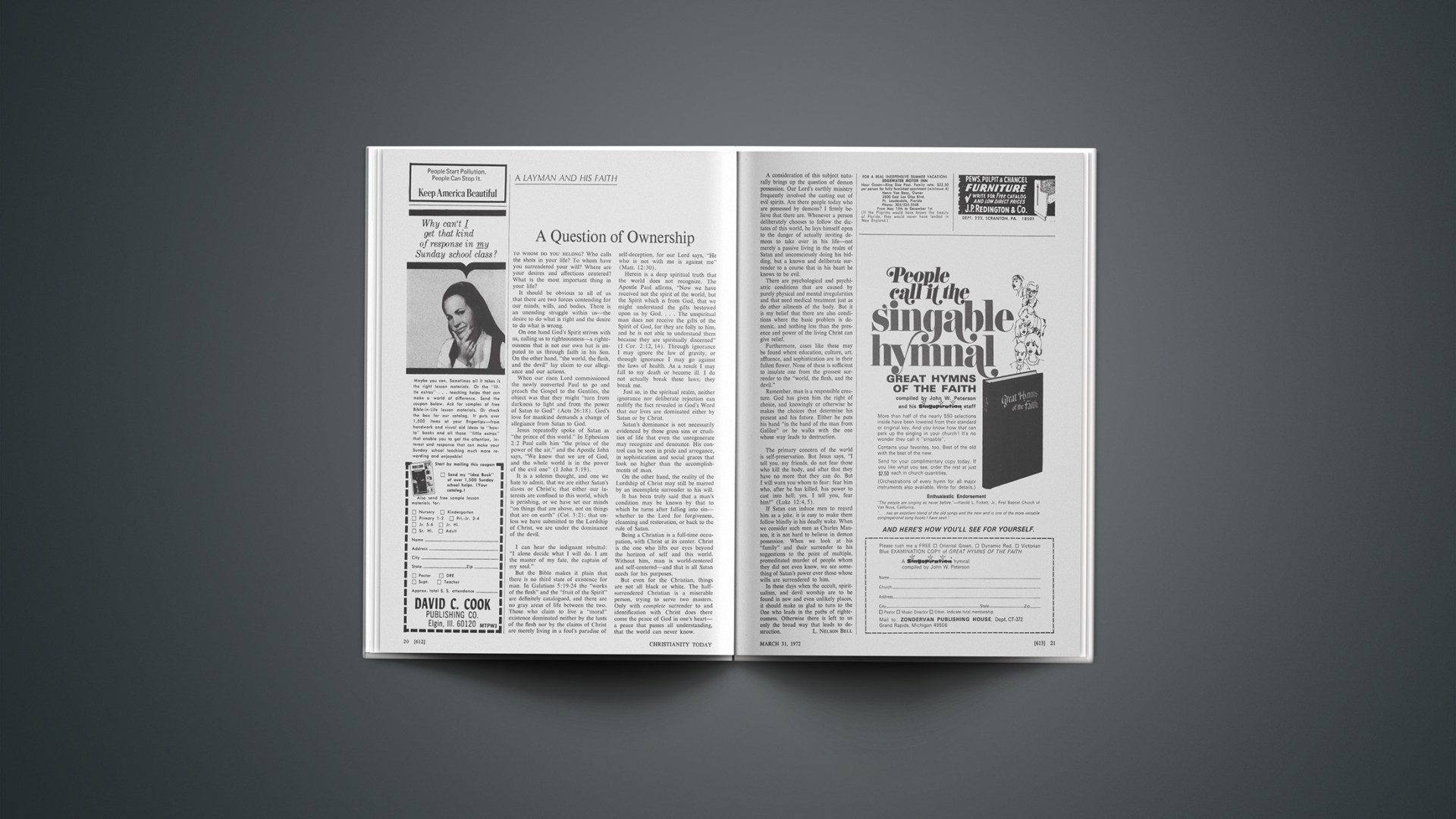
A Question of Ownership

To whom do you belong? Who calls the shots in your life? To whom have you surrendered your will? Where are your desires and affections centered? What is the most important thing in your life?

It should be obvious to all of us that there are two forces contending for our minds, wills, and bodies. There is an unending struggle within us—the desire to do what is right and the desire to do what is wrong.

On one hand God’s Spirit strives with us, calling us to righteousness—a righteousness that is not our own but is imputed to us through faith in his Son. On the other hand, “the world, the flesh, and the devil” lay claim to our allegiance and our actions.

When our risen Lord commissioned the newly converted Paul to go and preach the Gospel to the Gentiles, the object was that they might “turn from darkness to light and from the power of Satan to God” (Acts 26:18). God’s love for mankind demands a change of allegiance from Satan to God.

Jesus repeatedly spoke of Satan as “the prince of this world.” In Ephesians 2:2 Paul calls him “the prince of the power of the air,” and the Apostle John says, “We know that we are of God, and the whole world is in the power of the evil one” (1 John 5:19).

It is a solemn thought, and one we hate to admit, that we are either Satan’s slaves or Christ’s; that either our interests are confined to this world, which is perishing, or we have set our minds “on things that are above, not on things that are on earth” (Col. 3:2); that unless we have submitted to the Lordship of Christ, we are under the dominance of the devil.

I can hear the indignant rebuttal: “I alone decide what I will do. I am the master of my fate, the captain of my soul.”

But the Bible makes it plain that there is no third state of existence for man. In Galatians 5:19–24 the “works of the flesh” and the “fruit of the Spirit” are definitely catalogued, and there are no gray areas of life between the two. Those who claim to live a “moral” existence dominated neither by the lusts of the flesh nor by the claims of Christ are merely living in a fool’s paradise of self-deception, for our Lord says, “He who is not with me is against me” (Matt. 12:30).

Herein is a deep spiritual truth that the world does not recognize. The Apostle Paul affirms, “Now we have received not the spirit of the world, but the Spirit which is from God, that we might understand the gifts bestowed upon us by God.… The unspiritual man does not receive the gifts of the Spirit of God, for they are folly to him, and he is not able to understand them because they are spiritually discerned” (1 Cor. 2:12, 14). Through ignorance I may ignore the law of gravity, or through ignorance I may go against the laws of health. As a result I may fall to my death or become ill. I do not actually break these laws; they break me.

Just so, in the spiritual realm, neither ignorance nor deliberate rejection can nullify the fact revealed in God’s Word that our lives are dominated either by Satan or by Christ.

Satan’s dominance is not necessarily evidenced by those gross sins or crudities of life that even the unregenerate may recognize and denounce. His control can be seen in pride and arrogance, in sophistication and social graces that look no higher than the accomplishments of man.

On the other hand, the reality of the Lordship of Christ may still be marred by an incomplete surrender to his will.

It has been truly said that a man’s condition may be known by that to which he turns after falling into sin—whether to the Lord for forgiveness, cleansing and restoration, or back to the rule of Satan.

Being a Christian is a full-time occupation, with Christ at its center. Christ is the one who lifts our eyes beyond the horizon of self and this world. Without him, man is world-centered and self-centered—and that is all Satan needs for his purposes.

But even for the Christian, things are not all black or white. The half-surrendered Christian is a miserable person, trying to serve two masters. Only with complete surrender to and identification with Christ does there come the peace of God in one’s heart—a peace that passes all understanding, that the world can never know.

A consideration of this subject naturally brings up the question of demon possession. Our Lord’s earthly ministry frequently involved the casting out of evil spirits. Are there people today who are possessed by demons? I firmly believe that there are. Whenever a person deliberately chooses to follow the dictates of this world, he lays himself open to the danger of actually inviting demons to take over in his life—not merely a passive living in the realm of Satan and unconsciously doing his bidding, but a known and deliberate surrender to a course that in his heart he knows to be evil.

There are psychological and psychiatric conditions that are caused by purely physical and mental irregularities and that need medical treatment just as do other ailments of the body. But it is my belief that there are also conditions where the basic problem is demonic, and nothing less than the presence and power of the living Christ can give relief.

Furthermore, cases like these may be found where education, culture, art, affluence, and sophistication are in their fullest flower. None of these is sufficient to insulate one from the grossest surrender to the “world, the flesh, and the devil.”

Remember, man is a responsible creature. God has given him the right of choice, and knowingly or otherwise he makes the choices that determine his present and his future. Either he puts his hand “in the hand of the man from Galilee” or he walks with the one whose way leads to destruction.

The primary concern of the world is self-preservation. But Jesus says, “I tell you, my friends, do not fear those who kill the body, and after that they have no more that they can do. But I will warn you whom to fear: fear him who, after he has killed, has power to cast into hell; yes. I tell you, fear him!” (Luke 12:4, 5).

If Satan can induce men to regard him as a joke, it is easy to make them follow blindly in his deadly wake. When we consider such men as Charles Manson, it is not hard to believe in demon possession. When we look at his “family” and their surrender to his suggestions to the point of multiple, premeditated murder of people whom they did not even know, we see something of Satan’s power over those whose wills are surrendered to him.

In these days when the occult, spiritualism, and devil worship are to be found in new and even unlikely places, it should make us glad to turn to the One who leads in the paths of righteousness. Otherwise there is left to us only the broad way that leads to destruction.

Eutychus and His Kin: March 31, 1972

POLITICAL SCIENCE REVISITED

“Dad, what are taxes?”

It was my eight-year-old speaking. I’m continually amazed at the topics they broach in the third grade these days. However, I felt I could field this one splendidly.

“Taxes,” I answered confidently, “is the name for the money we give to the government …”

“Who is the government?”

“You know, the President and our senators and the governor—those who make our laws and run our country.”

“That’s what I thought. What do they do with the money?”

“Well, some of it is used to pay the President and the others. Some of it is used to build new highways and schools and to pay teachers—things like that.”

“Do you pay taxes?”

“You’d better believe it!” I responded with feeling.

“Do you pay the President’s salary?”

“Well, part of it.”

There was a thoughtful pause while this information was worked over.

“Is that why you give your money—so we can pay the President and things?”

“Well, sort of,” I hedged.

“How do you know how much to give?”

“Oh, the government tells you how much to give.”

“What if it’s more than you make?”

“They don’t do that. You tell the government how much you make and they tell you how much you have to give.”

He frowned as his normal eight-year-old independence began to surface. “If they told me how much to give, I wouldn’t do it. What would they do if you didn’t give?”

“They’d put you in jail.”

Eyes wide now. “Can they do that? Can they really put you in jail?”

“Yes, indeed. There are lots of people in jail right now for not paying their taxes.”

“I’d go to another country!”

“Well, that’s all right, but if you want to live in this country you have to help support it.”

Another thoughtful pause.

“Is that why people give—because they don’t want to go to jail?”

“Yes, I guess a lot do …”

“Is that why you give—so you won’t go to jail?”

“Well, that’s not all. God tells us to obey the government in things like this.”

“Where did he say that?”

“In the Bible. I’ll show it to you later.”

“If they couldn’t put you in jail, would you still give?”

“Probably not …”

“You mean you do what God says because they’d put you in jail if you didn’t?”

“Well …”

“Wow!”

STRIKING A BALANCE

Let me express my appreciation for the excellent and well balanced article by Richard Lovelace (“The Seminary as a Source of Renewal,” Jan. 21); he certainly marshalled well the continuing debate which is often heard in lay circles of the problem of balancing learning with piety. That the two must be brought together in synthesis and wholeness in the life of the educator is without question. His article merits reading and discussion on the part of any Christian educator.

One small point to be made: it seems to me that there’s a bit of a half-truth in his statement, “It is too much to expect that all seminary teachers are called to be pastors.” Though he indicates that he has in mind for the most part the concept of pastor in terms of a resident parish ministry along with or prior to his seminary teaching responsibilities, nevertheless the union of the office “pastor-teacher” in Ephesians 4:11 suggests a dual responsibility of one office. Hence, it may well be urged that all seminary professors worthy of their calling evidence a pastoral concern both for their students as well as their lecture material. Fortunately, from my own perspective, it was my privilege to attend Gordon Seminary in the 1950s to discover that this blending of concerns was evidenced by many of the faculty there.

Eastern Regional Director

Christian Medical Society

Havertown, Pa.

AN IVORY EDIFICE

Nolan Harmon’s article, “Church and State—A Relation in Equity” (Feb. 4), is a strange edifice erected upon a foundation of fundamental errors.

He is correct in pointing out that application of the church-state separation principle is not always easy. But to use these difficulties as justification for abandoning principle is quite the same as saying that we should abandon democracy, Christianity, and Judaism because the great ideals of the Declaration of Independence, the Bill of Rights, and the Judeo-Christian ethic have never been fully lived up to. Harmon seems to be saying that since we cannot be angels, then we must and should be devils. This is absurd.

Since the First Amendment was adopted and the states planted the separation principle in their constitutions, we have steadily moved toward full compliance with the principle, with murmuring only from those who have never understood or appreciated the great improvements Americans have made over Old World ways of dealing with religious freedom. Who … today could really oppose compliance with ideals expressed by the Supreme Court in the 1947 Everson and subsequent rulings?

The “Establishment of Religion” clause of the First Amendment means at least this: Neither a state nor the Federal Government can set up a church. Neither can pass laws which aid one religion, aid all religions, or prefer one religion over another. Neither can force nor influence a person to go to or remain away from church against his will, or force him to profess a belief or disbelief in any religion. No person can be punished for entertaining or professing religious beliefs or disbeliefs, for church attendance or non-attendance. No tax, in any amount, large or small, can be levied to support any religious activities or institutions, whatever they may be called, or whatever form they may adopt to teach or practice religion. Neither a state nor the Federal Government can, openly or secretly, participate in the affairs of any religious organizations or groups, and vice versa. In the words of Jefferson, the clause against establishment of religion by law was intended to erect a “wall of separation between Church and State.”

Harmon’s equation of public-school religious neutrality with atheism is preposterous. The courts, common sense, and the nature of our pluralistic society all require that our public schools be respectfully neutral with regard to the rich variety of religious views and traditions represented by our children and teachers. This neutrality is a respectful neutrality and certainly allows individual children the free exercise of whatever religion they have, and it allows the schools to teach, neutrally and objectively, about religion in social studies, language-arts courses, and elsewhere in the curriculum. Atheism cannot possibly be equated with a wholesome and democratic neutrality, as any perceptive teacher or clergyman has no difficulty in recognizing. Ivory-tower theologians would do well to maintain a closer contact with the real world.

Beltsville, Md.

Turn back the clock a few centuries. In many countries of the Old World the Catholic Church had put the most, if not all, into the life of the nation. The majority asserted its “rights.” Christianity, as defined by the church in power, must not be shaken or disturbed by any heretical teaching. There were no minority rights or even privileges.

Those who sought freedom in the wilderness world brought with them—sad to say—the same antipathy towards anything heretical. Roger Williams found refuge from the Puritan “refugees” with the Indians of Rhode Island. Each colony had its majorities and minorities. Intolerance was the heritage deeply engraved in the conscience of the freedom-loving colonials. It must have been the hand of God which directed the framers of our Constitution to erect the wall of separation between church and state.

If that wall is so twisted as to become serpentine (of or like a serpent) what assurance do we have that equity would prevail in judicial decisions? The very fact that many of the Supreme Court decisions have been on a 5–4 basis shows how men may differ in their judgment. With no restraining rule, or even a serpentine rule, to guide, equity would be ministered according to the thinking of the judge. Who would say that the judges of early New England did not consider themselves equitable in their decisions, or that the judges in the Inquisition did not have a clear conscience? What of a modern state such as Syria where a Mohammedan majority makes no concessions to a minority religion?

Yucaipa, Calif.

There is one primary difference between church and state. The church gets all of its resources, ultimately, by voluntary means. The government, in contrast, takes all of its resources by force. The first gains its growth money in love, or perhaps fear of future alternatives, but the latter takes what it wants without recourse of its victims, breeding hate and economic destruction.

Government is merely a bad substitute for church. It takes over when men refuse to abide by moral structures, and then it cannot be stopped, because it uses force to take its resources. It grows until the church must fade, because there are not enough resources for both. It grows until it destroys the economy on which it fastens, and both die, and are replaced, again and again. Government essentially is evil, and from evil root no good can grow. But evil men within it refuse to admit that stricture, so long as, hiding behind the bodies of the children, the old, the poor, the sick, and weary, they can aggrandize their own positions by pretending to help those in need, after they are first rewarded heavily by themselves for their services.

Plantation, Fla

For me, the article only served to add further confusion to a subject on which many people in this country, particularly those in public office, need more enlightenment. He seems quite willing to dispense with “Thomas Jefferson’s strict wall of separation between religion and government” on the premise that it “is more of a constitutional abstraction than a political reality.” The fact that such a position could be honestly taken by a former bishop of the Methodist Church came, to me, as quite a shock.

The “wall of separation” has served us well for nearly two centuries, for under its protection we have enjoyed a degree of religious liberty beyond that found in almost any other country. Moreover, under its influence, all of our churches have flourished, including the Roman Catholic Church, which has for nearly a century been trying to tear that wall down. The Roman church has actually grown and prospered much more in this country than in any of the several countries, in both the Old and New Worlds, in which it has enjoyed the privileged status of establishment.

The reason why we are having church-state problems today is that, in recent years, we have allowed the “wall” to be partially chipped away; and we shall never really solve them until, first, the “wall” is restored to serve its intended purpose, and secondly, our elected public servants learn to honor it. Poll after poll and referendum after referendum have established the incontrovertible fact that the large majority of the American people want church and state to remain completely separate, in full agreement with the intent of the framers of the First Amendment to the Constitution, and in agreement with the many decisions handed down over the years by our state and federal supreme courts.…

The framers of the Constitution, well aware of the evils of clericism prevalent in many other countries, gave us a unique and workable constitution that, among other things, guarantees to every citizen full and complete religious liberty. Under its protection, we have the right to live under a system of government that disallows entanglement between the functions of state and those of any and all churches; we have the right to worship, or not to worship, as we please; and, last but not least, we have the right not to be taxed to support the activities of any or all religious groups. Our religious liberty is our most precious freedom; and so it was disheartening, to say the least, to learn that a prominent Methodist Church leader is unwilling to protect the “wall of separation” that makes it all possible.

Wading River, N. Y.

FOIBLES AND ERRORS

Concerning Dr. Wirt’s unspecified complaints against unnamed church magazines (“A New Note in Christian Journalism,” Feb. 4): If “playing up the foibles of church people” is a sin, I assume the Holy Spirit erred grievously when he inspired, for example, the account of David’s murderous dalliance with Bathsheba in Second Samuel 11.

Time-Life News Service

New York, N. Y.

JUDICIOUS SERIES

I should like to add my congratulations to the many [Dr. Armerding] must already have received upon the “Bibliography for Christians” that [has been appearing] in CHRISTIANITY TODAY. It is a most timely, helpful, and judicious compilation.… There is just one omission I have noted that draws from its overall comprehensiveness: in citing works on Esther (Jan. 21, 1972, issue), the author has overlooked our Anchor Bible translation of Esther (April, 1971) by Dr. Carey A. Moore.… Again, let me thank you for an otherwise most profitable series of articles.

Editor, Anchor Bible

Doubleday and Company, Inc.

New York, N. Y.

CATCHING THE SPIRIT

Thank you for the strong, positive statement you gave with regard to the American Baptist Convention and especially with regard to the nomination of Robert C. Campbell for the post of general secretary (News, “Baptists, More or Less,” Feb. 18). You have correctly caught the spirit of encouragement that is among us now. Thank you for saying so.

Executive Director

Division of Communication

American Baptist Convention

Valley Forge, Pa.

PACIFIST OR PASSIVIST?

I wish to call your attention to an error in your February 18 issue. In the caption under the cartoon ((“What If …,” Eutychus and His Kin) you have misspelled one word. The word you spell “pacifist” should be spelled “passivist.”

A pacifist is an active peace-maker, opposing war and violence. Your magazine reaches enough people that you should be better informed and give better information. You should know what the American Friends and the Fellowship of Reconciliation are doing, nationally and internationally. They are pacifists, active peace-makers. You don’t make peace with guns.

I don’t believe you would knowingly distort the ideal of Christian pacifism. You know what Jesus said about the peace-makers.

St. Louis, Mo.

AN EVANGELICAL CHECKLIST?

I asked our … son how he enjoyed the Christmas subscription to CHRISTIANITY TODAY which we had sent him. His response took me by surprise, but it shouldn’t have. He had reacted negatively as I had to your editorial “Nixon, China, and Religious Freedom” (Feb. 4) and marveled at the naïveté of your editorial wish that Nixon would consider the most basic and profitable item on his agenda to be a discussion of religious liberty in China, and even Russia, where the Chinese Communists have minimal influence today!

We both noted that you also urged our President to share with Mao and Chou the fact that young people in the West “who only months ago had been looking to other secular messiahs are now turning their eyes to Jesus.” Do you actually imagine that the ruler of one of the kingdoms of the world would say that to another leader? You even advise our President to urge Mao and Chou to “recognize that it is only a matter of time until Christianity rises again in China—with or without their help—if it is not already doing so!!” (The exclamation points are mine.)

It is the duty of informed, concerned Christians to pray, work, and give that God in his perfect sovereign plan will build his Church and promote his Kingdom in the great “Middle Kingdom,” the land of China. But helpful hints to President Nixon as though he were God’s emissary only serve to make my favorite Christian periodical sound ludicrous.

If you are expecting our government to espouse the furthering of the spread of the Good News, please note what a national news magazine with a twenty-two page spread on the China trip reports—almost with embarrassment: “And, fanciful as it sounds, harassed U. S. officials admit that some missionaries have been inquiring about the chances of reopening their outposts on the mainland.” God’s work can be wrought in high government circles because God is God, not because your usually fine magazine tries to arm our President with a little evangelical checklist.

(Mrs.) VIRGINIA MALWITZ

Union, N. J.

MISSED OPPORTUNITY?

I wonder what would have happened if you had personally shown the drunk the way to gate 20 (Eutychus and His Kin, “Plane Talk,” Mar. 3)! Maybe you could have put a tract in his pocket, or even have been so radical to try to reason with him about Christ. The irony of your article is that even in print you failed to see your opportunity.

Deerfield, Ill.

A Christian Perspective on Encounter Groups

One prominent feature of the progressive culture of turned-on America is the rapidly achieved popularity of sensitivity-training and encounter groups. Group leaders, some well trained, others bearing a diploma from a six-week “intensive” course, have only to announce the time and place of a group meeting, and people come. In San Diego, for example, two weekend encounter groups attracted 1,400 people with a minimum of advertising. Some come to groups to find out who they really are; others come because they are starving for human fellowship; still others come out of curiosity or in hopes of having an experience they can talk about at the next cocktail party.

In my clinical experience, I have seen a number of persons whose behavior warrants the diagnosis “Group Addiction.” When one group ends, these people begin a frantic search for another. Without their weekly group “fix” they feel scared, defenseless, unable to face their daily responsibilities. One noted psychologist has encouraged this dependence on groups by saying that, since the family is no longer meeting the need for a primary social frame of reference, people should turn to intensive group experience as a perfectly appropriate and lifelong substitute. Probably only a small minority of participants in sensitivity groups are afflicted with group addiction. The number of persons who are turning to groups in an effort to find more meaning in life and to experience personal growth and fulfillment is large and is steadily increasing.

Claims for the benevolent effects of honest encounter in an intensive group setting sometimes give evidence of almost fanatical zeal. Psychologist Carl Rogers, called by some the dean of the encounter-group movement, sees groups as perhaps the most significant and salutary cultural development in recent years. According to Rogers, encounter groups have unprecedented potential not only for aiding personal growth but also for successfully tackling problems of race relations, administration-student conflicts in education, labor-management disputes, and negotiations between rival countries.

An increasing number of theologians have added their voices to the panegyric. Groups, they say, offer persons an effective vehicle for self-discovery and for the achievement of wholeness. In supporting sensitivity groups, these theologians insist on the supreme importance of candid encounter and the healthful effects on the personality of open communication and freedom of behavior.

Some evangelical Christians are hungry for the sense of aliveness and interpersonal intimacy that characterizes many well run encounter groups. They are bothered by what appears to them to be an irrelevant routineness in many traditional church forms that often forestalls emotionally close relationships; by the repressive attitude toward innovation among church leaders; by the loveless “sit in your pew and wait till they come to you” approach to evangelism that many church members accept.

Because people tend to jump on whatever bandwagon is currently passing through and because Christians and non-Christians alike are often asking groups to provide what Christianity purports to offer (meaning in life, reality, fellowship), Christians would do well to develop informed opinions about encounter groups. In an attempt to provide a basis for this, I will sketch some of the theoretical and procedural aspects of encounter groups and will then look at the phenomenon from what I believe to be a biblical perspective.

The encounter-group movement has its strongest philosophical underpinnings in humanism. Since in humanistic thought man is viewed as basically self-sufficient and able to create utopian conditions without divine assistance, problems with individuals and with society are traced not to a basic flaw in man but to the denial, distortion, or inhibition of what is truly human. To put it in admittedly oversimplified terms, encounter-group proponents believe that the great need today is for man to become aware of the full range of internal experience and then to free himself of all artificial restraints that limit his expression and development of what he finds within. When a person is freed from a restricted awareness and from stifling inhibitions, he will develop increased feelings of personal worth and fulfillment.

The proposed means of accomplishing these worthy goals vary considerably, depending upon the orientation of the group’s “facilitator” (a term preferred to “leader”; the facilitator’s role is not to add anything to the group but to bring out what is already there, within its members). Rogerian styled facilitators will assume a distinctly non-aggressive role, attempting simply to relate to each group member in an empathic and non-possessively liking sort of way. In the resultant atmosphere of freedom and unconditioned acceptance, it is hoped, previously submerged feelings will find at least verbal expression. As these feelings become assimilated into conscious awareness, the individual develops a sense of personal integration and greater self-worth.

Groups run according to the Esalen model make regular use of Gestalt therapy techniques (sometimes called games), many of which were originated by the late Fritz Perls. For example, “games of dialogue” may be used in which a person suffering from inner conflict is asked to develop a dialogue between the two warring components within himself; the aim is to try to bring them together. “May I feed you a sentence” is a game in which the therapist, after requesting “May I feed you a sentence?,” proposes what he believes to be the message a group member is implying. The member is then asked to try it on for size by saying it to several people. The number of games is limited only by the therapist’s ingenuity. Any directed behavior whose goal is the more complete experiencing of the immediate present may be considered a Gestalt therapy game. Gestalt therapists attribute many symptoms of maladjustment (e.g., anxiety, depression, withdrawal) to the failure to be fully in touch with one’s real self at any given moment.

Some conservative Christians are prone to dismiss any activity with non-Christian roots, such as encounter groups, as worldly, and to expend great energy in condemning and avoiding it. At the other extreme, disenchanted younger Christians may uncritically accept the opportunity these groups seem to offer to put some emotional zing into their Christian lives. A more balanced, biblical perspective is needed.

Paul, especially in Romans 7, shows a painful sensitivity to the forces operating within him. It seems he did not deceive himself about the reality of his own sinful nature and its many subtle manifestations. In the eighth chapter of John, the Lord pointedly rebuked the accusers of the adulterous woman for not admitting into conscious awareness the reality of their moral condition. The lesson seems to be that conviction of sin by the Holy Spirit—or, in modern terms, a full awareness of internal moral reality—is a necessary prerequisite for the operation of grace for believer and non-believer alike. Notice that the teaching of Scripture is perfectly consistent with the primary tenet of humanistically based sensitivity training: don’t deny anything that is true about yourself.

Difficulties with encounter-group philosophy and procedure arise with the question of what to do with these newly admitted truths about oneself. Suppose, for example, that a young Christian man recognizes in himself strong sexual desires toward a specific girl. Three basic strategies for dealing with this recognized portion of internal reality may be identified. The first might be called the “stick your head in the sand” approach. In response to the guilt he feels for having these thoughts, the sexually alive young man may pretend he is sexually dead: “I don’t really want to have sex with her. After all, I am a Christian.” This approach clearly involves the distortion of something true. God is a God of reality. Pretense and denial can never be consistent with Christianity. (In passing, I might mention that the absence of open discussion of sexual matters in Christian churches and families sometimes conveys the message that one is not to think about such things if he wants to maintain his Christian profession. Denial of reality is thereby encouraged. This can lead to unnecessary difficulties with sexual adjustment in marriage.)

A second possibility is the “do your own thing” strategy that might be advocated in encounter groups with humanistic leanings. The proponent of this view might say to the young man: Recognize your sexual desires, and, since no morality exists external to yourself and the social situation in which you find yourself, express your desires within broad, flexible limits of social acceptability. The general message conveyed is that one’s feelings are real (with neither intrinsic rightness nor intrinsic wrongness) and are a worthwhile part of a worthwhile person; therefore they merit expression.

From a biblical perspective, the critical lack in such an approach is the absence of absolute guides for moral conduct. Armed with the belief that whatever is real about a person is good, members of the encounter group may relentlessly focus attention on the reality of a person’s feelings without concern for the morality of their expression. Desires and feelings that may, from a biblical perspective, derive from a sinful nature are reinforced and nourished by continued attention. Their expression in behavior consequently becomes more probable.

The third method available to the sexually aroused young man strikes me as most consonant with biblical teaching, common sense, and sound psychology: Be fully aware of the existence of sexual desires, but, by an act of choice, conform to the limits within which scriptural morality permits expression. In other words, the healthiest resolution would be the attitude, “Yes, I’m really turned on by her. I will neither deny the existence of these feelings nor dwell upon them. But, because I believe God’s standards are guides for an effective and fulfilling life, through the power and help of the Holy Spirit I will consciously and deliberately suppress the expression of these desires (in either reality or fantasy) until their expression conforms to God’s standards.”

Psychological and spiritual disorder has at least two very different causes: (1) the absence of self-control (consistently following the lead of one’s impulses without regard for moral limits) and (2) the absence of self-awareness (pretending, sometimes from piety, other times from a sense of guilt, that some real desire or feeling does not exist). To the degree that sensitivity-training experiences increase self-awareness, I endorse them. To the degree that they implicitly or explicitly nourish what needs to be fully acknowledged but also controlled, I reject and avoid them.

Lawrence J. Crabb, Jr., is director of the Psychological Counseling Center and assistant professor in the psychology department at Florida Atlantic University, Boca Raton. He has the Ph.D. from the University of Illinois.

The Irrelevance of Relevance

Some words are used less to convey thought than to induce an emotional attitude. I am not speaking about the emotional freight that all words carry and that is properly exploited by every competent speaker or writer. I am referring to the misuse of words in order to trigger what literary critics call a “stock response.”

Robert Louis Stevenson once remarked, somewhat cynically, “Man is a creature who lives not upon bread alone, but principally by catchwords.” A dictionary definition of catchword is: “A temporarily popular, often meaningless, phrase in politics, etc.” I would define it myself as a means of catching the intelligence and holding it captive in a net of prejudice. Once a catchword has ceased to be popular, we are all eager to ridicule it. Today we refer contemptuously to the cant of politicians who appeal to motherhood and the flag in order to conceal their lack of principles. Yet, while a word or phrase remains popular, we challenge it at our peril. Relevance is such a word.

Relevance has become to a large extent today’s criterion of value. It certainly outranks goodness. If someone says, “This seems good to me,” someone else will almost certainly say, “Yes, perhaps. But is it relevant?” No longer is it enough to prove worth unless relevance also can be claimed; and, by the same token, if relevance is granted, then the notion of worth is not even taken into account. In the university, subjects are not estimated on the basis of their promoting intellectual agility or enlarging the cultural horizons. More and more, the criterion is whether they can be made to seem relevant, and therefore immediately attractive. The shibboleth of relevance has also come to dominate the realm of religious discussion. And that is my concern in this essay.

I

Since sacred scriptures are widely judged to be irrelevant, I shall draw my text from a self-proclaimed secular source. The following statement comes from the preface to Gustave H. Todrank’s book The Secular Search for a New Christ (Westminster, 1969):

Traditional Christianity is largely irrelevant to the current world situation. For any religion to become and remain a vital force in the lives of a new generation it must be remodeled from time to time. This is especially important in times of rapid and basic social change. Ours are such times, and Christianity has not kept pace.

I have chosen this passage simply because I happened just recently to open the book it introduces. I am sure you have heard the same sentiments, expressed in almost identical terms, dozens (if not hundreds) of times. I know that I have.

Ours is a time of rapid social change, so all the champions of relevance assure us. Perhaps. Yet, very evidently, it is also a time of monotonous repetition of clusters of catchwords, as though the contemporary mind were afraid of encountering a new idea but must be comforted by settling within a narrow circle of familiar cliches. Consider how the title The Secular Search for a New Christ echoes so many others in recent years. To quote three titles only: Gregor Smith’s Secular Christianity appeared in 1966, W. R. Miller’s The New Christianity in 1967, and John J. Vincent The Secular Christ in 1968. This was also the period in which the so-called New Quest for the Historical Jesus was much to the fore. Thus the words making up the title of Todrank’s book are all current catchwords. And any combination of these words would add up to the same thing. Instead of The Secular Search for a New Christ we could substitute The New Search for a Secular Christ, or The Search for a New Secular Christ, or The New Secular Search for a Christ.

The dictionary reminds us that a catchword may well be meaningless. It would seem, at any rate, that confidence in repeating it is usually in inverse proportion to careful consideration of its meaning. A short time back there was a conference at Notre Dame University to discuss the impact of secularity upon religion today. Disagreement about the meaning to be attached to the word secularity was so great that one learned gentleman said the debate had taught him one thing: that he would never use the word again, since it was so fraught with ambiguity. Well, my subject is the meaning of the word relevance. And I shall argue in a similar direction, though I hope to reach not altogether so sweeping a conclusion as to rule out the use of this word entirely.

The word is ambiguous, of course. Confronted by the opening sentence of my chosen text, we might read it in varying ways. “Traditional Christianity is largely irrelevant to the current world situation.” We might mean by that that the two simply move in different dimensions, and so cannot meet. This would be a plain statement of fact, as when Paul Tillich affirms that, in his opinion, theology and philosophy cannot fight because they have no common basis. Or we might mean that the current world situation is a situation of blindness and ignorance of truth. This we might express when, upon hearing that a man on an LSD trip has walked out a seventh-floor window and fallen to his death, we remark, “Of course, laws of the external world would be irrelevant to anyone in his state.”

However, in the given context, although ambiguity exists, no ambiguity is intended. We can be sure that the writer means to tell us that the current world situation is such that everything must relate to it, directly and positively. And, because traditional Christianity does not show any such relation, it must be wiped off the slate of things that count.

Now, religiously minded persons who have not surrendered all belief in traditional Christianity (or in Judaism, which is equally charged with irrelevance) feel such a charge to be slanted and unfair. Their most usual reaction, however, is to protest, “Oh, but it really is relevant to the world situation, relevant at the very deepest level.” Or perhaps those who wish to be thoroughly honest and objective may suggest, “Well, it may have been largely irrelevant in the past. But that was because it was not really true to itself, and we must work to see that religious faith becomes a very relevant factor in today’s world.”

Both these reactions have some justification. Yet, tactically, they are very weak as a counterattack. The first is easily met by the retort, “What you call relevance on a deep level is precisely what the contemporary world knows to be irrelevance.” And the second brings the reply, “So long as you are tied to the past, to traditional and outmoded concepts, you can never be open to the present and the future. Only a clean break with tradition and a new beginning can bring you into a position of relevance.”

My personal belief is that it is impossible to argue about religious faith on the basis of relevance. We must, instead, insist upon the irrelevance of relevance and argue upon the basis of truth and truth claims. Here I am speaking as one who, as it happens, is deeply committed to the Judeo-Christian tradition (though, I hope, in a flexible and fair-minded way). But I am speaking also as someone who dislikes shoddy thinking and slogan-mongering, whether it be advanced by the orthodox or the heterodox, by the committed or the uncommitted.

Ii

Relevance, I submit, is irrelevant if we wish to make any positive and meaningful statement. For in the world we live in, nothing can be finally irrelevant. To deny this would be to contradict ourselves. Suppose we make the statement that X is irrelevant. This statement must be itself relevant. Yet we cannot make it without mentioning X. Then X too is proven relevant. You will see that this argument is simply a variant of Augustine’s argument against universal skepticism. Anything whatsoever that is—in any sense—is relevant to everything else that is. Thus simply to speak of relevance is to say nothing more than that we are speaking about something in connection with something else, which is the condition of all speech. For speech to be informative we must assert why we believe X to stand in a certain relation to Y. That is, we must make a truth claim.

Theoretically, everything is relevant to everything else. This truth is illustrated in the old saying that one cannot move a single pebble on the beach without affecting the entire universe. But in practical life we recognize degrees of relevance and irrelevance. The hunter picks out those small indications in the total landscape through which he moves, indications that are relevant to his following the track of his quarry. The historian examines historical documents and selects items that are relevant to the subject of his research. Such activities show, in Aristotelian terms, the use of practical reason.

In the arena of practical reason, the judge of what is relevant and what irrelevant is the man of practical wisdom, and his judgment is relative to his field of specialization. Thus the historian’s knowledge of what is relevant in his field will not serve him if he goes hunting. So relevance can never be established a priori. In some areas, in courtroom procedure, for instance, rules for determining relevance can be laid down. Yet, even here, there can be no finality. Fans of Perry Mason know very well that it is exactly the question that Hamilton Burger objects to as “immaterial, irrelevant, and incompetent” that secures the final triumph of justice.

I have entitled this essay “The Irrelevance of Relevance,” since my argument is that an undefined appeal to relevance says nothing at all. I might equally well have chosen the title “The Relevance of Irrelevance” in order to bring out the other side of the paradox. For, indeed, man has achieved nearly every advance in his knowledge by bringing into relation things apparently unrelated: that is, showing the irrelevant to be relevant.

The history of science is packed with examples of the relevance of the irrelevant. Sir Isaac Newton discovered the relevance of the fall of an apple to the orbits of the planets. Samuel Pepys records, of Charles II’s visit to the Royal Society, that “his majesty laughed mightily” on learning that the members of the Society had done nothing since its founding except to attempt to weigh air. However, the merry monarch did not have the last laugh, since this apparently absurdly irrelevant activity was to revolutionize our world. It is because preconceived ideas of relevance are fatal to the progress of knowledge that Einstein said the most valuable asset for a scientist was imagination.

Today, because we live in a technological society made possible by scientific research, scientists are no longer scoffed at. Their work is very widely considered, without question, to be the touchstone of relevance. But poetry is mostly considered a luxury, irrelevantly decorative. Nevertheless, the poets are the shapers of our language; and language, in the last resort, controls the direction of our ideas. Poetic images bring together widely separated ranges of experience into an imaginative unity. Where poetry is neglected, our imaginations atrophy and our vision of the universe becomes narrow and poor.

As I see it, the popularity of the catchword relevance today is a symptom of such impoverishment. And I believe it to have contributed more than a little to the increase among us of polarized opinion—and so of violence. After all it is not a great step, psychologically, from judging another man’s beliefs irrelevant to thinking his continued existence unnecessary. Asserting for ourselves the unqualified right to decide what is relevant—assuming that there can be no argument about it—indicates a failure in imagination. And it indicates an even greater failure in imaginative sympathy. For it is to deny to others the right to live within the same universe with us, unless they think precisely the same as we do.

Not every appeal to relevance, of course, invokes the full logic of its presuppositions. Yet to dismiss anyone’s belief as irrelevant, especially without specifying very precisely the criterion used to determine relevance, is to enter the dangerous territory of arbitrary pronouncement. And the territory is no less dangerous if it is entered chiefly because a lot of other people have gone there first and it seems to be the “in” place. The road to hell is said to be paved with good intentions. The same road is also worn smooth by the feet of sheep, each sheep following the one in front of it. The fact that we are urged to seek relevance rather than truth makes conformity a virtue, since the bogey of irrelevance that is waved in our faces is clearly the balloon of social unpopularity inflated. How terrible a fate to be left behind while the rest of the crowd streams by! Who would be so bold, when placed in such a predicament, as to ask where everyone is actually going, or why?

More than a hundred years ago Søren Kierkegaard warned that the age of the crowd was upon us. In such an age, said Kierkegaard, people would not think of deciding for themselves. They would follow the advice given to children going off to a party: “Look and see what the others are doing, and behave like them.” Kierkegaard did not foresee that men could carry out the process quite easily by spreading around the catchword relevance. He did see that the authority that man in the crowd would be willing to obey would be the abstract coercion arising from the crowd itself.

With these thoughts on relevance in mind, I return to my text. Let me quote it again:

Traditional Christianity is largely irrelevant to the current world situation. For any religion to become and remain a vital force in the lives of a new generation it must be remodeled from time to time. This is especially important in times of rapid and basic social change. Ours are such times, and Christianity has not kept pace.

When this writer says that religion has to be “remodeled,” he uses an image derived from engineering, and familiar to us particularly in connection with the automobile industry. He seems to assume that religion follows the pattern of industrial production. It must keep pace with the market and meet the demand of consumers, who will certainly demand the latest model off the assembly line.

This seems to be a naïve assumption. If we look at today’s scene, the fastest-growing and most pervasive religious phenomenon is probably the cult of astrology. This cult makes no attempt to “keep pace” with the contemporary world but retains a fully traditional—indeed archaic—form. And the same may be said of other popular cults: divination, Tarot-pack fortune-telling, Krishna devotion, witchcraft, and the search for spiritual liberation through drugs. (The last named certainly uses new drugs made available by modern science as well as very ancient ones, but its basic character comes down from early times unchanged.)

In fact, the rapid spread of such cults is largely to be explained by the fact that they are “irrelevant” to “the current world situation.” Disillusionment over the values promoted by our mass society created by technological know-how, with its incessant demand for change and its faith in material progress, has led people to turn back to the spiritual resources of pre-industrial societies. In the period when the scientific attitude was proving its ability to transform the world, religion seemed to be increasingly ineffective, as all religious beliefs were under attack for being obscurantist and superstitious. Now we are seeing the revival of practically every type of superstition among those who have grown up outside any religious tradition.

Those who have kept more or less within the living tradition of Judeo-Christian faith do not give us so clear a picture. This is natural enough, since they have been more exposed to cultural conditioning. The churches and synagogues to which they belong have had to come to terms, over a long period, with the prevailing culture and its values. Yet, as far as I can gather, it is the liberal congregations that have been most affected by the so-called crisis of faith, and the conservative ones that have retained the greatest attraction for the young.

The large number of theological movements succeeding one another during the past ten years or so is an indication of a desperate search for the illusory goal of relevance. We have seen the New Theology connected with the names of Bishop Robinson and Bishop Pike, the Death of God Theology, the Theology of the New Hermeneutic, Secular Theology, the Theology of Hope, the Theology of Revolution, and now the Theology of Futurology. (Futurology, the latest theological “fad,” seems to me just as implausible as astrology and not nearly so colorful.) Each of these movements has made a bid for popularity by attempting to prove itself “relevant” to the contemporary world. It has done so by catching hold of some aspect of modern life that it thought expressed the contemporary consciousness and offering a religious option exactly fitting this.

Does modern man wish to be free from tradition and to value only what is the creation of the moment? Then the New Theology will be relevant! Does modern man say that God is unbelievable, an outmoded relic of the past? Religious Atheism says so too! Are philosophers talking about Hermeneutic? The New Hermeneutic can cap that! Do Marxists predict a glorious future of freedom under socialism? The Theology of Hope has no other theme! Is there resentment against the establishment and disenchantment with political liberalism? Jesus was the first revolutionary … or perhaps it was Moses! Anyway, real religion is certainly radical religion! If modern man is secular man, then religion is secular too—making us impatient to give our all to the Secular City. Or if there are signs that people are turning to the inner life of the mind, then religion will teach them to celebrate life and to rejoice in the glory of being truly human!

Each of these movements promises to be more relevant to the hour than its non-religious rivals. Unfortunately, theology is always bringing forward its suggestions just a little late; the caravan of modernity has already moved on to another destination. The person whose sole desire is to be in the fashion set by someone else is destined always to look old-fashioned. He puts on discarded clothes.

Iii

The concern of faith is with truth—the divine truth that lies beyond all passing fashions. If a faith is rooted in truth it is eternally relevant, and it does not need to prove itself relevant to the current situation; viewpoints concerning the current situation have to show themselves to be relevant to it. An untrue faith is not only irrelevant—it is misleading, injurious, blasphemous, damnable.

The present preoccupation with environmental pollution threatens to become a fad, like so many other causes that have been taken up in recent years. It has already become so, insofar as it has been put under the rubric of relevance. Politicians, commentators, teachers, preachers, and other persons who address the public today must do one thing to prove their relevance: they must go through the ritual of denouncing pollution with the same vehemence with which, in the fifties, Senator Joseph McCarthy denounced Communism. There are even churchmen who have identified the fight against pollution with the Kingdom of God—trying, once again, the futile old tactic of attempting to prove religion relevant by walking behind the world and picking up any slogan it happens to drop. (The children of light, Jesus might have said, are considerably slower on the uptake than the children of darkness. They specialize in prophecy-the-day-after-it-happens.)

Nevertheless, anti-pollution has one virtue as a cause, even though it can degenerate into a catchword. Pollution is an objective fact that stands as evidence that it is not what we happen to imagine to be relevant that counts. It is truth that counts. It is what actually is, and our coming to make our world what it is today shows how reality breaks in, finally, as judgment upon our indifference to truth.

The unchecked growth of pollution over the past two hundred years is a striking example of the evil fruit borne on the tree of the Cult of Relevance. When the industrial revolution was beginning, those who objected to the ugliness of the new towns and the rape of the countryside were laughed at, or reviled as enemies of progress. Their objections were considered completely irrelevant in face of the current world situation, a situation in which wealth was increasing and affluence and leisure seemed a future certainty for every one. Now we are seeing the cost of imagining that what we call irrelevant can be put aside for ever. This neglected chicken has come home to roost with a vengeance.

Well, consciousness of how the threat of extinction through pollution has come upon us will not bring us to faith. Yet it may bring us to a little humility, which is the soil in which faith grows. The fact that pollution is not a sudden calamity, that it has a history, and that we have been nurturing it ourselves for a long time, unaware of what we were doing—all this should help us to understand a number of things. First, of course, that most of our pronouncements about relevance are likely to be ludicrously far off the mark. Second, that we have to renounce the stupid prejudice about the past being over and done with, so that only the contemporary can be relevant. Third, then, that the assumption that everything in the world follows the pattern of consumer products is unimaginative nonsense. Ideas do not grow old in the way in which household gadgets do; the latest philosophy is not, like the latest detergent, the most effective. Fourth (coming back as it were to the first point), that wisdom was not born with us and will not die with us. It is fine and well to talk about taking up our responsibility as members of humanity and vowing to bring in the human day. Yet it is perhaps more necessary for us to remind ourselves that we are dust—glorious dust, perhaps, but dust—lest our boasts of today cause those who come after us to turn and curse us.

A short time ago a book of essays came out entitled The God I Want. This seems to me to be the quintessence of the cult of relevance, revealing its idolatrous core. Faith starts, at the very least, from the wish to discover The God I Must Acknowledge, Since He Is. Common sense can lead us to recognize the irrelevance of relevance. But grace alone, the kindness of the God who is faithful and true, can lead us out of our narrow prejudices and self-induced fancies into the largeness of the truth that comes from Him.

Kenneth Hamilton is professor of systematic theology at the University of Winnipeg. This essay was delivered in March, 1971, in the Joseph S. Atha Memorial Lectureship at Country Club Christian Church, Kansas City.

If a Man Die

Millennia ago a pain-strapped farmer in the Middle East put a monumental question: “If a man die, shall he live again?” The last half of that question triggers controversy among men, not the first half; for unquestionably a man will die. The silence of mankind’s fallen millions proves it. Marshalling his ingenuity to outmaneuver death, dreaming of some scientific breakthrough that will make him immortal, man keeps on dying.

Occasionally a magazine article deals with how death is managed in America. But almost inevitably the writer discusses only what the survivors do about the dead; he says nothing about how the dying manage. Dying is a very personal matter. When the President of the United States was assassinated a few years ago, the news of his death was heard in all the corners of the earth. Yet thousands knew nothing of his passing, for these thousands were busy with their own dying.

“Is not death the great adventure still?” asked James Elroy Flecker. The great adventure, indeed, and a very serious one. Men may at times speak flippantly of death, but they do not do so in its presence. Everywhere on earth solemnity still marks the appearance of man’s final foe. And the burial of a fellow man fires in us the realization of the limited boundaries of our earthly existence.

Yet, despite the universality and inevitability of death, it is rarely a conversation piece. We shrink from meditation on what Herman Hagedorn called “the quiet shutting, one by one, of doors.” Death is not a desirable topic for politicians, and we’d prefer to have our preachers avoid dwelling on it in sermons. Even doctors, who live with death and whose business is to stay men’s dying, are not chatty on the subject. Still we never can efface death from our thinking. Often when we pause from our frenetic goings-on and are alone, the “last enemy” scratches at our consciousness. Edna St. Vincent Millay said, “This I do, being mad/Gather my baubles about me/Sit in circle of toys, and all the time/Death is beating the door in.” Whatever diversion we may employ, over and over we become aware of that beating on the door. And again and again the Scriptures warn us to prepare for it.

“If a man die, shall he live again?” This momentous question was asked ages before it received an authentic answer. The answer came in from a Man who was en route to his own ugly death on a gallow-beam! He had not come to meet death with philosophy or theology, or even with faith or hope. He would meet it in person and break the ancient enemy’s grip on mankind by the awesome business of dying and living again! Should he succeed in that mission unprecedented, then all who believed in him could have a passage to eternal aliveness. “Because I live,” the Man said, “you shall live also.”

A quotation from the April 6, 1970, issue of Newsweek might make impressive pulpit material for Easter 1972:

U.S. physicians rarely face up to the enigma of death; neither, for that matter, do most theologians. Their typical American tendency to substitute morality for metaphysics betrays a profound loss of theological nerve—a deeper denial of that hope in God that has always fired the radical religious imagination. “It was not the morality of the Sermon on the Mount which enabled Christianity to conquer Roman paganism” observed Germany’s maverick Marxist philosopher, Ernst Bloch, “but the belief that Jesus had been raised from the dead.” In an age when Roman senators vied to see who could get the most blood of a steer on their togas—thinking this would prevent death—Christianity was in competition for eternal life, not for morality [p. 88A].

However insistently the instruments in the New Testament symphony sing of ethics, it is the Resurrection trumpet that rings highest and clearest. No sermon or sermon-fragment reported by the chroniclers of the early Church is without that trumpet. For those first believers, if Christ could be kept entombed, Christianity could be locked up with him. Nothing mattered if Christ had not outwitted death—nothing! They kept saying, “Christ died.” But they had to say more than that, or the great dream was ended. Either the grave won or Christ won; and if the grave won, all men were yet in their sins and the Church was a pitiable institution! But if Christ won, then men could not only walk in newness of life but live forever. Everything depended on whether the bastion of death stood or fell. Those believers kept singing up and down the world that the bastion had given way: Jesus was “declared Son of God by a mighty act in that he rose from the dead” (Rom. 1:4, NEB).

Christ spoke as had no other man. He cured incurables, hushed hurricanes, fed multitudes with a handful of bread; but it was when he cracked the fortress of death that he “led captivity captive” and gave incomparable hope to grave-bound mankind. The Christian sign is the naked Cross; but without the empty tomb standing over against it, the Cross, in a redemptive sense, is powerless. So are the birth in a cattle-cave, the Message on the Mount, the miracles, and the sacraments. The Apostle Paul insisted that if Christ had not put death down, Christians “of all men are the most miserable.”

But the Apostle’s word rose to an exultant shout: Christ had conquered the enemy, death. He had turned that dead-end street into a freeway to eternal life. Ages after the Apostle’s time, Christians cried, “Christ is risen!” And Christians who heard that cry answered, “Christ is risen indeed!”

May we this Easter, from our hearts, echo that cry. May we walk as men who hear the jangling of keys that open cosmic doors, and live as those who hear a Voice saying, “Don’t be afraid! I am the first and the last. I am the living one! I was dead, but look, I am alive for ever and ever. I have the authority over death and the world of the dead” (Rev. 1:17–19, Good News for Modern Man). May we take Easter out to a dying world!

Quickening

Dead trees draw life

when the days expand and the sun

fulfills its promise, oft delayed

by the clutch of ice.

Clotted, gnarled, knotted twigs

on the trees sense sap and the death

of death. They stretch, begin

to puff green on the end.

Men sing new songs

of a Life laid down for rebirth

when Easter is the Spring

and the branch is Christ.

MARK NOLL

Lon Woodrum is an evangelist in the United Methodist Church and a writer. He lives in Hastings, Michigan. He has written nearly threescore books and 2,000 articles.

Resurrection Quartet

Wikimedia Commons

There was one resurrection; there are four narratives of it. Matthew, Mark, Luke, and John tell the story, each in his own way. Each narrative is distinct and has its own character. When the four accounts are absorbed into the imagination, they develop rich melodies, harmonies, counterpoint. The four voices become a resurrection quartet.

Yet many people never hear the music. The reason, I think, is that the apologetic style for years has been to “harmonize” the four resurrection stories. But it never turns out to be harmonization. Instead of listening to their distinctive bass, tenor, alto, and soprano voices, we have tried to make the evangelists sing the same tune. Differences and variations in the resurrection narratives are denied, affirmed, doubted, and “interpreted.”

There is a better way. Since we have the four accounts that supplement one another, we can be encouraged to celebrate each one as it is, and to magnify the features that make it distinct from the others. Instead of melting them down into an ingot of doctrine, we can burnish the features that individualize them.

When we do that, our imagination expands, and the resurrection acquires the sharp features and hard surfaces of real life. Through the artistry of the four evangelists, the particularity and detail of local history, the kind we ourselves live in, becomes vivid.

I

The eye-catching sentence in Matthew’s narrative is, “There was a great earthquake; for an angel of the Lord descended from heaven and came and rolled back the stone and sat upon it” (28:2). That is a detail no one else includes. What it tells us is that the resurrection is earthshaking. Matthew reports the resurrection event as something like the explosion of a bomb that throws out waves of energy. The earthquake becomes an image used to dramatize the historical impact of Christ raised from the dead.

The detail alerts us to consequences. When we hear that an earthquake has occurred, we want to know how it affected the community. We are curious about the lives lost and the lives saved, about the acts of selfishness and heroism. Matthew’s earthquake detail gets us interested in what happens. As the waves of resurrection energy spread, what will be the results? How will men respond?

As the earthquake-impact of the resurrection moves into human history, Matthew notes six responses: “the guards trembled and became like dead men” (28:4); the women “departed quickly from the tomb with fear and great joy, and ran to tell his disciples” (v. 8); the women “came up and took hold of his feet and worshiped him” (v. 9); the elders bribed the soldiers and told them to “tell people, ‘His disciples came by night and stole him away while we were asleep’ ” (v. 13); the soldiers “took the money and did as they were directed” (v. 15); the eleven “when they saw him, they worshiped him; but some doubted” (v. 17).

These responses range across a spectrum that includes terror, lying, bribery, reverent fear, doubt, great joy, and worship. Not one of them is trivial. The resurrection did not produce the same thing in everyone present, but no one was unaffected by it. It made a profound impact on everyone in the vicinity.

Matthew gives about equal space to each response. Yet he holds up one above the others: worship. The women in verse 9 and the eleven in verse 17 respond by worshiping. The lying and bribery responses of the elders and soldiers are sandwiched between these and provide a contrast that sets them off even more clearly. Worship, says Matthew, is the most appropriate response that can be made to the resurrection.

Matthew’s words support his perspective. Imperatives are response-demanding words, and Matthew uses a lot of them. When a man has a command addressed to him, he has to do something, either positively or negatively. Matthew’s choice of words shows how the waves of resurrection energy moved through the interstices of human response: “do not be afraid” (28:5); “come, see the place where he lay” (v. 6); “go quickly and tell his disciples” (v. 7); “do not be afraid” (v. 10); “go and tell my brethren” (v. 10); “tell people” (v. 13); “go therefore and make disciples” (v. 19).

No event in history rivals the resurrection in its impact on the human will. The way a person responds to it is the most characteristic and significant response he will ever make. With great skill Matthew makes us see that as he constructs his story around the earthquake-impact of Jesus’ resurrection.

Ii

Mark’s Gospel is a rapid-fire narration of what Jesus said and did as he gave “his life as a ransom for many” (10:45). Mark scraps all the preliminaries (for instance, he does not describe Jesus’ birth) and in a breathless, hurried journey involves us in the action. “Straightway” and “immediately” are characteristic words in English translations. Caught up in the action, we are eager to find what happens next.

Mark carries this style into chapter sixteen—his account of the resurrection. Three women come to the tomb and find it empty. An angel tells them that Jesus is risen and gives them instructions on what they are to do. Mark then gives us one of his most dramatic scenes: “They went out and fled from the tomb; for trembling and astonishment had come upon them; and they said nothing to anyone, for they were afraid” (16:8).

That isn’t quite what I would expect as a response to the resurrection. I want to know what comes next. How will the story end?

The experience of the women who come to the tomb, grieving deeply, and expecting to carry out the burial amenities, is the material Mark uses to tell the resurrection story. Their simple devotion is interrupted by two surprises: the stone is rolled away from the tomb, and the tomb is empty. In that surprised condition they receive an angelic message. The message has four simple statements of fact: Jesus is risen; he is not there; the tomb is empty; he is going on ahead to Galilee. Then it has two commands: do not be amazed; go, tell his disciples and Peter. Finally, there is a promise: you will see him. A foundation of fact supports a double command that is motivated by a single promise. Subjectively, surprise prevails; objectively, the divine message predominates. The combination produces the pivotal experience: “They went out and fled from the tomb; for trembling and astonishment had come upon them; and they said nothing to anyone, for they were afraid.”

Psychologically, that is a situation that simply must be resolved. There is an overwhelming personal necessity to complete the story. Mark draws us into the center of the action and lets us feel for ourselves the emotion that accompanies the sudden realization that Jesus was actually risen from the dead. It is impossible to look at it analytically or objectively. The story needs to be completed. Our participation is evoked.

Yet the oldest Greek manuscripts stop just at that point, at verse 8. Whether Mark deliberately stopped there or whether the ending of the original manuscript scroll became frayed through constant usage and simply wore off, nobody at this point knows. What everyone does know, though, is that no one, ancient or modern, is satisfied with the ending (or lack of ending). The vacuum has to be filled. An ending must be supplied. The manuscript history of Mark’s Gospel shows repeated attempts to “finish” the story.

This everywhere observable attempt to supply an ending to Mark’s resurrection narrative shows how well he told his story and how pivotal verse 8 is. The resurrection is not complete until it is concluded in personal history. When a person realizes that Christ is risen, he may experience fear, joy, doubt. But these reactions in relation to the facts, commands, and promise of the divine word must be incorporated in a personal conclusion. The resurrection requires a conclusion that only personal participation can supply.

Iii

In addition to the story of the women at the empty tomb on Easter morning (the story common to the other accounts), Luke tells two rather long stories about the risen Christ’s appearance: first to two men at Emmaus on Easter afternoon and evening, and then to all the disciples in Jerusalem that night.

These two stories are vehicles for gathering together material that will expand our understanding of the resurrection. Luke’s account prevents us from reducing the resurrection to an isolated event, however earth-shaking, or to a personal experience, however intense. He weaves its meaning into the fabric of what has gone before and what will follow. He sees all history to that point leading up to this event, and all future history flowing from it.

Luke’s method is to lace the stories with references to the ancient Scriptures and the recent past. Two men at Emmaus are “talking with each other all about these things that had happened” (24:14); when Jesus meets them, they rehearse the life and ministry of Jesus of Nazareth (vv. 19–24); Jesus offers an exposition relating Scripture (the past) and resurrection (v. 27); the two men recognize the relation between the past and the resurrection (v. 32); meeting with the eleven, Jesus refers them to “everything written about me in the law of Moses and the prophets and the psalms” (v. 44); the resurrection is rooted in past prophecy: “thus it is written …” (v. 46); the concluding verses (vv. 47–53) project the resurrection event into the future where there will be repentance, forgiveness of sins, witness, the coming promise of power, great joy, and continuous praise.

Luke tells the resurrection story in a way that connects man’s past experience to the resurrection. Human history is a single story that has the resurrection as its theme and climax.

Luke’s account of the resurrection is the longest of the four. He includes more material and expands it more thoroughly than the other gospel writers. He wants us to understand the resurrection. He develops his material in a manner designed to expand our imagination so it can take in the immense scope of the resurrection. The resurrection, in other words, is comprehensive. It takes the scattered pieces of man’s historical-religious-cultural life and puts them all together.

Iv

The resurrection of Jesus is not easy to believe in. There are a lot of tricksters in the world and a lot of fakes. How do we know that the resurrection was not a hoax? There have, after all, been plenty of religious hoaxes in the world. Resurrection is a common theme in ancient religion. What evidence do we have that the resurrection of Jesus wasn’t just one among many?

John’s account of the resurrection is written to provide convincing evidence for dealing with these very legitimate questions. John’s story is designed to persuade: “These are written that you may believe that Jesus is the Christ” (20:31). “Believe,” in John’s lexicon, is a union of intellectual comprehension and life commitment. His purpose is to place before us information that will clear away honest doubts and impel us to commitment. In telling of the resurrection John takes special pains to emphasize the credibility of the resurrection by bringing out details that show its historical reality.

In verses 1–10 Peter and John, told by Mary that the tomb is empty, run to see for themselves. What they see causes them to believe. The arrangement of linen cloths and napkin provided the kind of visible evidence that was convincing to those first observers: “Then the other disciple, who reached the tomb first, also went in, and he saw and believed” (20:8).

In verses 11–18, Mary, weeping outside the tomb, has a conversation with Jesus. At first she doesn’t recognize the One to whom she is talking, but identifying the risen Christ when he speaks her name, she turns and sees his tangible form. Note what she says to the others: “I have seen the Lord.”

In verses 19–23, the disciples are huddled in fear on the evening of the resurrection. Jesus appears to them. He reassures them of his resurrection reality by showing them the crucifixion marks in his hands and side. “Then the disciples were glad when they saw the Lord.”

In verses 24–29 the disciples are again together, this time with Thomas, who had not believed the report the others gave. Jesus makes another appearance, offering himself in tangible form: “Put your finger here, and see my hands; and put out your hand, and place it in my side …” (v. 27).

The senses of seeing, hearing, and touching are represented in the four stories John gives us. In each story people moved from a state where they lacked belief to one where they believed on the basis of first-hand evidence. The stories provide a framework in which people can move through doubt and skepticism. Thanks to John, there is plenty of room in the Christian community for people to ask questions and express doubts.

John doesn’t shout at us that we have to believe, no matter what. He knows that the best belief includes an intelligent, searching mind. He doesn’t want man to believe blindly; he wants him to believe on the basis of good evidence. His Gospel is full of “signs” (we might almost call them “evidences”)—events in Jesus’ life that provide self-authenticating data that he is God’s Son, the Saviour of the world.

Eugene H. Peterson is pastor of Christ Our King United Presbyterian Church in Bel Air, Md. He has the B.A. from Seattle Pacific College, the S.T.B. from New York Seminary, and the M.A. from Johns Hopkins University.

Editor’s Note from March 31, 1972

I spent some of the early days of this month at Huntington College in Indiana, where I was with students and members of the community for spiritual emphasis week. It was thrilling during these days to talk to students who love Jesus Christ and are eager to serve and proclaim him. And it was challenging as well as disappointing to observe others who seem indifferent to the claims of Christ. It is a test of faith to believe that the seed planted in unbelieving hearts can find fertile ground and one day blossom into belief.

At Eastertime, it is refreshing to remember that as the brown earth brings forth new life, so the resurrected Lord died and rose again to give us glorious new life in him. This life is ours through the Holy Spirit, who seals us, dwells in us, and fills us with his power, purity, and perception. Good Friday speaks of death; Easter speaks of life, abundant life that is ours in Christ.

We hope our readers took note of the essay contest announced in our March 17 issue. The topics are important, the rewards sizable. We’ll be gratified if readers give our judges a hard time by flooding us with good entries.

Happy Easter!

Abortion Problems in Britain

Since britain’s abortion act Came into operation four years ago there has been growing uneasiness about its results. Last year’s total of 126,774 abortions shows a 57 per cent increase over that of 1970. One of the biggest category increases came among girls under sixteen.

During the past month three newspaper items have caught my eye—none considered sensational enough to make the front page. I summarize and give them without comment. (1) The pregnancy advisory service in Birmingham (Britain’s second largest city) plans to run on alternate days a coach service to its nursing home on the south coast for women who are to have abortions. The organization claims to offer a “door-to-door service.” (2) Roman Catholic gynecologists seeking senior hospital posts are said to have been rejected by selection boards because of their religious views. Some have been advised to change their specialty or emigrate if they want to advance. (3) Some Christian nurses object to taking part in abortion and wish to “contract out.” A larger number find the work “distasteful.” A nursing sister writes that in many cases abortion produces a fetus of considerable maturity that is then kept in a refrigerator to await collection for research purposes (“a sickening sight … confronting you each time you needed to open the door”). A committee is currently investigating this angle.

At last there has appeared a comprehensive study from a Christian doctor who seeks to tackle the subject in all its complexity: Abortion: The Personal Dilemma (Paternoster, Eerdmans). The author, R. F. R. Gardner, had previously contributed to CHRISTIANITY TODAY (May 22, 1970) an essay on “Christian Choices in a Liberal Abortion Climate.” Graduate of Edinburgh’s famed medical school, with experience as a medical missionary and in government service in Africa, Rex Gardner is an ordained Presbyterian minister who now serves as consultant obstetrician and gynecologist in a northern England group of hospitals. His 288-page volume is not a theological treatise; even less is it a clinical textbook. Here are words born out of real, poignant situations in which medical skill and pastoral heart combine to wrestle with agonizing case histories.

Gardner stresses the distinction between abortion and cessation of pregnancy. The gynecologist thinks not just of the latter but of the former:

Of the act. It is a lonely operation. Although dilation of the cervix, the neck of the womb, is an operation he performs many times a week, on this occasion it will be different. He takes that first dilator and is tinglingly aware that he is about to seal the fate of a fetus, that he is about to alter history. In other operations the cervix will dilate up readily, but in this operation it will fight, grip the end of the dilator and force it back into his hand. And then at last he will win, and as he does he will wonder who has lost.

Illustration is given of irreconcilable differences among doctors, with one eminent authority suggesting that the Abortion Act contributes toward raising the quality of human life, another not unsympathetic admitting that “therapeutic abortion … is associated to some extent with human denigration,” and a third cautioning that “it is only a short step from disposable babies to disposable people.”

The Abortion Act permits termination of a pregnancy if its continuance “would involve risk to the life of the pregnant woman, or of injury to the physical or mental health of the pregnant woman or any existing children of her family, greater than if the pregnancy were terminated.” The words I have italicized invite widely different interpretations, and this is a bedeviling feature of the Act. In their eagerness to get the bill through parliament the sponsors evidently did not seek or did not listen to professional advice, and this is reflected in wording so loose that the president of the Royal College of Obstetricians and Gynecologists said, “It is quite clear that what this Act really means largely depends upon what you want it to mean.” This, comments Gardner, might lead on to the argument of a psychiatrist: “Even our own figures in this country … suggest that it is at least twice as dangerous to have a perfectly normal pregnancy as it is to have what I might call a perfectly normal abortion.”

Gardner notes that the Act includes a “Conscience Clause” under which medical staff can opt out of any treatment to which they have a conscientious objection, except for treatment necessary to save the life of, or prevent grave injury to, the pregnant woman. The book then deals at some length with the new difficulties the Act has raised for the medical profession—a section that should cause some humbling reaction among the laity.

In discussing the inevitability of Christian involvement, Gardner sees four strands in the Church’s mission: the worth of the individual for whom Christ died; the recognition that helping people involves the whole of their situation; the duty to press for social righteousness; and the biblical warning that the God who demands righteousness will return.

From the prohibition by the early and medieval Church, Gardner goes on to detail how abortion is now regarded by each of Britain’s major denominations. And he questions whether theological conservatives deserve the oft-heard accusation of a hard and negative attitude far from the compassion of Christ.

Other chapters deal with Old and New Testament guidance; the spiritual status of the fetus; and the role of the Christian, whether he be doctor, patient, or advisor. The Christian doctor, Gardner concludes, has no slick answer; he must weigh all the factors of each case, remembering that the Christian is called to do God’s will, to be compassionate.

The remainder of the book offers data toward making such a judgment. These include numerous case histories (some of them almost unbearably moving) concerned with the diseased mother, socio-economic factors, illegitimate pregnancy, the pregnant student, the malformed fetus, the mental, physical, and spiritual results of abortion—and the future when abortion is refused.

Conscious as I am of the inadequacy and superficiality of these introductory comments, I warmly commend the book to readers of this journal. Perhaps its subject is one on which we cannot feel profoundly so long as we regard it merely as an intellectual or even an ethical exercise. One harrowing experience where someone known to us is concerned would bring us to the heart of the matter.

But so too will this book. It may get a frigid reception from cozy suburbanity where jolting new dimensions are unappreciated, but with courage and candor and knowledge Rex Gardner has told us what we ought to hear, and shown how in this unlikely area lie whole new challenges and opportunities for Christian mission.

J. D. DOUGLAS

Apple PodcastsDown ArrowDown ArrowDown Arrowarrow_left_altLeft ArrowLeft ArrowRight ArrowRight ArrowRight Arrowarrow_up_altUp ArrowUp ArrowAvailable at Amazoncaret-downCloseCloseEmailEmailExpandExpandExternalExternalFacebookfacebook-squareGiftGiftGooglegoogleGoogle KeephamburgerInstagraminstagram-squareLinkLinklinkedin-squareListenListenListenChristianity TodayCT Creative Studio Logologo_orgMegaphoneMenuMenupausePinterestPlayPlayPocketPodcastRSSRSSSaveSaveSaveSearchSearchsearchSpotifyStitcherTelegramTable of ContentsTable of Contentstwitter-squareWhatsAppXYouTubeYouTube