The Church at War? Investments Investigated

NEWS

Although America’s leading Protestant denominations have officially condemned their country’s involvement in the Viet Nam war, a number of them continue to benefit from the financial profit that the war produces for companies with defense contracts.

Boards and agencies of ten Protestant churches hold more than $200 million worth of securities in twenty-nine of the top sixty prime military contractors doing business with the Defense Department, according to a survey made public last month. These investments were described as earning more than $6 million for the churches during 1970.

The survey was conducted by the Corporate Information Center of the National Council of Churches. The center was set up last year with a view to applying financial pressures to secure social goals.

The study turned up the fact that even the NCC is guilty of “complicity” in the so-called military-industrial complex. The NCC was found to hold $332,000 worth of securities in five military contractor firms.

Frank White, center director, said the report was not intended to reveal hypocrisy or to suggest that the church groups divest themselves of the questionable stock holdings. “Generally,” he said, “the reason that investment ethics has not kept pace with policy is quite simple—no one has thought much about it.” White added that it was more a matter of being “unconscious” of the ethical problem than of holding an “unconscionable” attitude.

Last year, the center published a seventy-eight-page primer on economic involvement for people seeking to keep abreast of the “social profiles” of major American corporations. The latest publication, which focuses upon the arms issue, is the thirty-one-page “Church Investments. Technological Warfare, and the Military-Industrial Complex.” (It was explained to the Soviet people in a state radio network report from Moscow.) The center also began recently issuing a six-page monthly publication entitled “The Corporate Examiner.” It purportedly contains “information on how churches, foundations, universities, mutual funds, brokerage houses, and the business world are dealing with corporate responsibility questions.”

White is a former businessman himself; he had twelve years in oil and an automotive dealership before enrolling at Yale. He ended up with a B. D. but chose not to be ordained. His first work with the NCC involved experimental ministries.

White concedes he is dealing with intricate ethical problems. He says that he is not against the military per se, and that there is a certain amount of ambiguity built into the report: “Our report only recommends that the churches begin to look seriously at their military holdings.” The problem, he admits, seems hopelessly complicated because millions of church people derive their livelihood—and support their churches—as employees of companies with defense contracts.

Reminded that Defense Secretary Melvin Laird is a devout United Presbyterian* and presumably contributes to his denomination, and therefore to the NCC as well, White replied. “I’d love to talk to him.”

What the center is aiming at White intimated, is not a clean black-and-white division but a greater awareness on the part of church, government, and industry of the vastness of the investment in the Viet Nam war. He maintains that this huge amount is totally out of line when compared with domestic needs, and that a complete reordering of priorities is a necessity.

White said he could not get data on Roman Catholic involvement in the arms industry. Requests sent to Catholic dioceses were ignored.

Economic sensitivity is not new to American church officials. For a long time denominational investors made it a point to stay clear of companies that produced alcoholic beverages or processed tobacco. Never before, however, have churches debated whether to try to influence corporate policies by buying stock. It is still a moot question, but many churchmen are now pushing this procedure. Again, however, ecclesiastical bureaucrats seem to forget that the “they” who supposedly are at odds with the churches’ ethical stands are actually part of the churches.

The NCC center proposes to concern itself not only with the military factor but also with treatment of the environment, policies of hiring or excluding minorities, responsible use of natural resources, and foreign investments.

White said most public reaction to the disclosure of the center’s military report was favorable. Several officials of the denominations involved issued protest statements, however. Dr. A. Dale Fiers, chief executive officer of the Christian Church (Disciples of Christ), asked:

“If those industries are to be condemned because of contracting with the government for military equipment and materiel, is there not complicity in making investments in U. S. Treasury bonds, in paying taxes, or even in maintaining the franchise of citizenship in the biggest party to the contracts, namely the government itself?”

Round Three In Miami

The nickel in the parking meter is not the same as the nickel in the offering plate, even if both nickels go to support missionaries.

That’s the view the City of Miami is taking as it plans to hand the Central Baptist Church a big tax bill on a controversial parking lot owned and used by the church but also used by the public for a price (see January 7 issue, page 42).

The city is interpreting a January ruling by the U. S. Supreme Court to mean that the parking lot is taxable. The church thinks otherwise. The case may be the pivotal legal battle in determining the extent to which American churches must pay real-estate taxes on income-producing property.

Actually, what the court said was that a new law adopted by the Florida legislature in 1971 stripped the case against the church of its “character as a present, live controversy.”

The downtown church has enjoyed a tax-free status for its parking lot, which can accommodate 290 cars and adjoins the sanctuary. Church members and staff are given free space during the week while downtown office workers pay as much as $9 a month to rent space. Anyone can park free on Sundays.

Church records show that about $2,100 a month profit is made on the parking lot, which actually uses attendants rather than parking meters. The money goes to the world-wide missionary efforts of the church, established in 1896.

The city first tried to tax the lot, then valued at $150,000, in 1965. The state supreme court ruled that the commercial use was “reasonably incidental to the primary use of the church property as a whole for church or religious purposes,” and therefore the lot was exempt from taxation.

But the American Civil Liberties Union claimed such an exemption violated the First Amendment by aiding one religion and inhibiting others. The ACLU filed a class suit in 1969 in the name of Mrs. Florence Diffenderfer (now Wills), an ACLU attorney, and Nishuan Paul, an atheist retiree who has fought unsuccessfully to ban the annual display of a lighted cross on the Dade County Courthouse.

The district court ruled for the church, but the ACLU appealed to the U. S. Supreme Court, which ruled 6–1 that the question is now moot.

Florida’s new law narrows the grounds for religious exemption. Church properties formally had to be totally commercial before they were taxed. Now they need be only “predominantly” commercial. “Predominantly” has not been clearly defined.

“As far as we’re concerned, Central Baptist does not rate an exemption,” said Joe Creech, supervisor of the exemption division of the tax office of Dade County, which collects taxes for the City of Miami. “We’re going to send them a bill.”

The parking lot was last assessed in 1968 at $231,690, and the tax bill was then $6,000. Creech indicated that this year’s assessment would be “considerably higher.” Tax rates also have risen by 25 per cent.

There also is the possibility that an effort will be made to collect back taxes. In all, the total could be somewhere near $50,000.

However, Herbert Sawyer, attorney for the church, thinks the parking lot still is exempt under the conditions stipulated in the 1968 Florida supreme court ruling. He said he would file suit if the exemption is revoked, thus beginning a third round of litigation.

ADON TAFT

Anti-War ‘Witness’

Resolutions urging withholding of certain tax payments, sanctions against military-contracting industries, support of peace candidates, and sanctuary for draft resisters were passed by delegates to a four-day “Ecumenical Witness” held in Kansas City.

The conference, initiated by the General Board of the National Council of Churches and sponsored by 137 Protestant, Catholic, Orthodox, and Jewish leaders, brought together 600 representatives of forty-six denominations and other religious groups. They included seven Catholic bishops and forty foreign delegates from ten countries. The purpose was “to consider the moral crimes arising from the Indochina war.”

Not surprisingly, in view of past opposition to U. S. involvement on the part of most delegates, there was almost complete accord on major issues. Some snags were hit, however. No agreement was reached on whether complete U. S. withdrawal should be unconditional or contingent upon prior negotiations, and the conference also refused to pass a resolution that said “all war is unjust and immoral.”

Two special-interest resolutions were presented. Blacks, who were few in attendance even though three blacks were featured speakers, prepared a resolution urging delegates to view the war as an extension of racism at home. And the Viet Nam Veterans Against the War pressed for sanctuary for conscientious objectors. Both motions were approved.

Distress came to the participants with the disclosure that ten of the largest denominations hold securities worth $200 million in twenty-nine military contractors (see story, page 28). “I can’t imagine Jesus Christ holding stock in Pontius Pilate’s army,” said Mrs. Marian W. Edelman, who represented the Southern Christian Leadership Conference and who was the first black woman admitted to the Mississippi bar.

But the conference did more than merely recite the problems.

Delegates decreed that individuals should “withhold payment of telephone excise taxes and part of their federal income taxes,” boycott products produced by firms that manufacture military hardware, refuse to work in war industries, support peace candidates.

Denominations were urged to withdraw all military chaplains from Indochina and withdraw investments from war-supporting industries, placing them instead in black-owned businesses and legal-defense firms. Denominations were also asked to finance draft counseling.

Congress was asked to cut off all military funds early this year, abolish the draft, ratify the Geneva Convention on genocide, and grant amnesty to all those accused of offenses related to the war.

And the Soviet Union and China were urged to “cease military aid to the North Vietnamese in order that all the peoples of Indochina may indeed determine their own future without outside military support.”

JAMES TINNEY

Students Seek Answer: What Can One Man Do?

Lots of students go to Washington, D. C., to demonstrate, others to sightsee. But last month several contingents of evangelical collegians arrived in Washington to study—and work—on Capitol Hill.

Although academic intern programs in the nation’s capital aren’t new, until recently the only program for evangelical colleges was the National Association of Evangelicals’ annual four-day weekend. From that, three schools have developed programs of their own.

Calvin College sent twenty students headed by Dr. Paul Henry (son of CHRISTIANITY TODAY editor-at-large Carl F. H. Henry) to Washington. During the day the students worked in government offices; at night they met in seminars, earning one credit. Huntington College’s twenty-five students, who also earned one credit, conducted interviews of top government officials. The year-old course sponsored by Evangel College, an Assemblies of God school, was a more structured three-credit work-study program.

The Evangel project was led by Dr. Alex Karmarkovic, associate professor of political science. Each of the twelve students presented an oral report and submitted a final paper. Most of them were political-science majors; several were pre-law.

Norm Scott, 33-year-old Evangel senior assigned to Senator Stuart Symington’s office, engaged in research, condensing reports and compiling information on the coming election for the Democratic steering committee. The program, though only three weeks long, “helps break down the monolith myth about the government,” Scott commented. “These are real people with real desks making real decisions. It’s easier now to come up with an answer to the question, What can one man do?”

The students from Huntington College, affiliated with the United Brethren in Christ, handled this problem from a different angle. Program head Jack Barlow said he designed the interview series as an introduction to political science. The students, whose majors range from history to business to speech, analyzed the decision-making process on an individual basis. Twenty-year-old Paul Cherry said his Washington experience “impressed me with the need for evangelicals to become sensitive to and involved in politics.”

Dr. Henry, who once worked for Congressman John Anderson, said he has felt such a need for a long time. Calvin’s new curriculum schedule made this year’s trip possible. Through his contacts on the Hill, Henry placed all his students in congressmen’s offices.

Sidney Nemeyer, a physics major at Calvin, worked with the House Republican Conference’s research task force on energy resources. Most of Calvin’s students, however, like many from Evangel, were assigned the less glamorous tasks of sorting mail, filing, or typing. Some students from both schools expressed dissatisfaction over their menial jobs.

The programs were financed differently. Eleven of Calvin’s twenty students had paying jobs, with the salaries placed in a communal expense fund. Each student also contributed $60.

Huntington’s program cost each student $160, but the school granted a percentage refund on room and board for the time spent in Washington.

Each student from Evangel paid about $80 of his expenses, with the school supplying the rest. Last year the course cost the college $15,000 for twelve students.

According to Dr. Henry, no secular colleges or universities have sent larger groups of interns to Capitol Hill. As more Christian colleges switch to the four-one-four calendar year, the possibilities for these pioneer programs will increase, say directors.

Now that 18-year-olds can vote and students are taking an active role in government and elections, evangelical colleges need to develop these possibilities. As Paul Cherry put it, “The Church must wake up to the need for responsible social action. These programs are a big step in that direction.”

CHERYL A. FORBES

Playboys, Come Home

Not all of Playboy’s readers are playboys at heart. A full-page ad in the January eastern regional edition invited readers to “come home” to the Catholic priesthood. The response has been very good, says Father Joseph Lupo, who placed the ad for his dwindling Order of the Most Holy Trinity (down to fewer than 100 priests and trainees).

His Maryland-based order, also known as the Trinitarians and dating from 1198 in Italy, had spent thousands of dollars advertising for recruits in big city newspapers, national news magazines, and religious publications, but with sparse results. So he decided to “go where the men are” (he estimates that 80 per cent of the nation’s male collegians read Playboy).

The ad depicts two young men deep in thought walking along a beach, with the words: “You are already a Trinitarian. You who have love to give and the courage to offer it, you are already a Trinitarian. Come work with your brothers. Come home.”

Beacon Presses For Privacy

Last month the Unitarian-Universalist Association filed suit in Boston against the Justice Department for alleged violation of freedom of religion in connection with a grand jury subpoena of its financial records.

Beacon Press, the non-profit publishing wing of the UUA, issued a four-volume edition of the Pentagon Papers from information supplied by Senator Mike Gravel (D.-Alaska), but the UUA insisted on a “hands off” policy for its own papers. Last October FBI agents began investigating the association’s records, kept at the New England Merchants Bank in Boston. A district court refused to hear the suit.

Baptist Squabble

Dr. Charles Stanley, pastor of Georgia’s largest church, the 5,000-member First Baptist Church of Atlanta, is suffering from a sore jaw—and the church is suffering from a split.

Last October Stanley, former associate pastor, was named pastor by congregational vote over the objections of both the deacons and the pulpit committee. Last month thirty-six of the sixty active deacons resigned, citing Stanley’s “inordinate passion for political power.” The deacons claimed in a prayer meeting a week before their resignation that the pastor “bypassed the board of deacons and the administration, finance, personnel and education committees” in making appointments. At this same prayer meeting, one of the debaters slugged Stanley in the jaw.

Stanley insists that before he became pastor the church was “a country club.” He says he wants to change its direction to evangelism. But, Stanley concluded, “some people don’t like that approach.”

A Questionable Expense

The National Association of Laity, an unofficial group of Roman Catholic laymen, last month issued an 111-page report charging more than seventy-five dioceses with publishing misleading fiscal statements.

Compiled by forty volunteers who spent a year on the project, the NAL report accused Catholic bishops of spending more than $6 million a year lobbying for tax support of Catholic schools, an “ethically unjustifiable” expenditure.

Russell Shaw, director of the U. S. Catholic Conference’s information office and spokesman for the Catholic bishops, called the figure “widely inflated” and said no one knows the precise amount.
The Supreme Question

Among the strangest of all phenomena is this, that life’s most important question is rarely asked. Even among the unregenerate, it would seem that circumstances should make them stop and ask themselves the question. But that there should be comparative silence in the Christian Church on so important a matter is a staggering enigma!

The question is: “Where will you spend eternity?”

In view of the fact that the Church has the answer, why do we so rarely hear this question asked us from the pulpit?

We are confronted with the inevitability of death, with its visible effect all around us—in the slowly moving funeral processions, in the newspaper obituary notices, in the stories of violence or the slow toll of disease recounted for us daily. Why, then, is the question of questions so infrequently heard?

Is it because the query is foolish? Only to those whose hearts are insensitive to the eternal.

Trivial? Only to those who live in a realm little removed from the lower animals.

Unimportant? Only to those who fail to understand man and his need of God’s redeeming love.

Rejected as lacking relevance? Yes, but only by those who have believed “another gospel,” who ignore the clear teachings of Holy Scripture, and who have envisioned for themselves and for others a man-made device to bridge the chasm that Abraham spoke of in our Lord’s parable: “Beside all this, between us and you there is a great gulf fixed: so that they which would pass from hence to you cannot; neither can they pass to us, that would come from thence.”

Let us suppose that from every pulpit in America there should come a message on the same day, “Where Will You Spend Eternity?” What a shock might result, what consternation in some minds, what searching for the answer on the part of many!

The calendar of every denomination is filled with different “days.” Almost every Sunday commemorates some anniversary, the stressing of a particular cause, even the glorification and undergirding of some secular movements.

What would happen if in many sermons during the year the all-important question was raised, even if only by inference?

Some years ago I had the first of two coronary episodes. It was an experience for which I am deeply thankful. Confronted then (and constantly since) with the most important of all questions, I knew where I would spend eternity, and I knew who had made this possible.

When one is face to face with the reality and inevitability of death, things should assume their proper perspective, for it is this world that distorts and the next that brings this life and eternity into focus. Here we are confronted with the vital versus the trivial, the spirit versus the flesh, the things that are unseen versus the tawdry things that are seen.

Again it may be asked why, in view of the eternal import of this matter, so little is ever said about it. Even more amazing is the somber fact that within the Christian Church the overwhelming emphasis is on secondary things, on programs that can never be properly implemented until participants have met the issue of the eternal.

One of the most familiar passages in the New Testament is our Lord’s parable of the Prodigal. Suppose that in the case of the Prodigal Son the emphasis had been on renovating the “far country,” on disinfecting and perfuming the swine, on providing a banquet for the wayward boy, or on making him comfortable and happy where he was?

That is what today’s church often tries to do. Rather than working to bring the sinner back to his Heavenly Father through faith in the Lord Jesus Christ, we spend much time trying to make him comfortable and happy in a dying world order—yes, and in trying to make him act like a Christian.

This unfortunate situation is the result of ignorance, unbelief, neglect, or personal timidity. Why should we hesitate to ask an unsaved friend or acquaintance: “Where will you spend eternity?” Perhaps we hesitate because we ourselves have a lingering uncertainty about it.

Once the question is settled, all other things begin to fall into their rightful place. The fear of death is no longer with us. Christ becomes a living reality, and we can look forward with joy to being in his presence. Prayer becomes a matter of supreme practicality, a form of spiritual respiration that diffuses into our hearts the oxygen of divine companionship. The Bible becomes a living Book to us that speaks to our hearts and minds and makes us sensitive to God’s love, will, and purpose.

In addition, those persons with whom we come in daily contact realize that we have a hope from which nothing can separate us. Paul’s affirmation becomes a living reality, and we know all things are working together for our good because we love God and are his.

One of the most pitiful sights I ever saw was an old man, on the verge of death, studying and gloating over a long list of stocks and bonds that he owned and commenting gleefully on their increase in value since he had first purchased them.

“How much did he leave?” is a question we frequently hear. There is only one answer—“All”—but still we are tempted to evaluate men by their wealth and remember them by their achievements.

The Christian approach is as different as death from life. Christ came to give eternal life to all who believe in him. Even success in a good cause is secondary. Some of our Lord’s disciples returned from a missionary journey gloating over the fact that evil spirits were subject to them through his name. To the exuberant disciples our Lord replied: “Notwithstanding in this rejoice not, that the spirits are subject unto you; but rather rejoice, because your names are written in heaven.”

A Christian should not set his mind on eternity to the point that he forgets or ignores his earthly duties. But the gateway to Christianity is the narrow door of faith in the Son of God, and the vital question is never answered rightly until we know him whom to know is life eternal.

Who Are the Evangelicals?

Defining an “evangelical” is becoming no less difficult in America than defining a Jew in Israel. Americans have traditionally used the term in a more specific sense than many Europeans, for whom it early served to commend Reformation Christianity for its call to personal faith in contrast with the Romish emphasis on sacraments. Protestant churches thus became widely known as evangelical.

But many European “evangelical” churches compromised the ancient creeds and historical doctrinal affirmations of Christianity as modernistic theology—influenced by Kant, Hegel, Schleiermacher, Ritschl, and Troeltsch—captured the fancy of Protestant intellectuals. A generation ago in England the “liberal evangelicals” emerged with one foot insecurely in each of the rival options. More recently, Karl Barth, who anathematized modernism as heresy, used the title Evangelical Theology: An Introduction for an exposition of his own dialectical neo-orthodox alternative.

Ecumenical syncretists, eager for a world church whose unity they sought in social activism rather than in creedal consensus, chafed under what they considered an artificial American correlation of Christianity with the term evangelical. Some ecumenists popularized the designation conservative evangelical to depict the outlook of evangelist Billy Graham, the positions taken by CHRISTIANITY TODAY, and the stance of agencies like the Evangelical Foreign Missions Association or the National Association of Evangelicals. This label spared such enterprises the odious overtones that modernistic polemicists had attached to the term fundamentalism, while it enabled ecumenists in their other associations to retain the term evangelical for those whose doctrinal loyalties lay elsewhere.

The term conservative evangelical was minted after earlier efforts by some ecumenists to chide American evangelicals for having supposedly misappropriated a venerable religious term for partisan and factious purposes. This maneuver was remarkable for several reasons. In the thirties, before the emergence of the National Association of Evangelicals, the Federal Council of Churches was so predominantly non-evangelical in its theological sympathies that the term evangelical was hardly one it sought for itself. Moreover, the theological commitments and evangelistic emphases of the rising American evangelical movements were anticipated in Germany and England by evangelical alliances with similar concerns.

In contrast to the modernist versions of Christianity, or to liberal religion, the evangelicals emphasized their alignment with doctrinal positions recovered by the Protestant Reformers and their devotion to an authentic biblical faith. Theological syncretists who accused Bible-believing Christians of deforming the term evangelical seemed to be rewriting church history on modernistic presuppositions.

Evangelical has several notable advantages over fundamentalist as a description of New Testament commitments. Fundamentalism has been stigmatized by its modernistic foes until not even the devil would envy the label, and the mood and mentality of some fundamentalist polemicists has helped to fasten the caricature on the movement. In its beginnings early in this century, the fundamentalist vanguard emerged to challenge the Christian legitimacy of Protestant liberalism. The fivefold fundamentalist test swiftly exposed the semantic subtlety and evasiveness of many modernists; for example, “virgin birth” was more precise than “supernatural origin,” and “bodily resurrection” less ambiguous than “life after death.”

Although the fundamentalist credo served such polemical purposes well, when these distinctives became almost the sole provender of some pulpits, the laity became theologically undernourished. To the forefront of pulpit proclamation fundamentalists increasingly elevated emphases that, though they are significant in the total context of Christian faith, do not stand in the forefront of apostolic preaching. Here one thinks not only of the virgin birth but also of biblical inerrancy—themes that stress the how more than the what and why of the Incarnation and of the inspiration of the Word of God. The point is not that the New Testament lacks all basis for these emphases; indeed, the very first Gospel opens with a birth narrative. Nevertheless these emphases are not conspicuous in apostolic proclamation. Indeed, where dispensationalism left its mark upon fundamentalist circles, the millennium also gained kerygmatic prominence.

It may be said, of course, that the Bible has its insistent fundamentals no less than its central evangel; the kerygma is broadly identifiable as what the Bible teaches, and apostolic doctrine supplies its authoritative orientation. Yet the term evangelical has a firm basis in the language of the New Testament, and in his earliest writings the Apostle Paul succinctly states the core of “the evangel.” If Christian commentators have long regarded Romans 3:21–26 as the gist of the Gospel, in view of the noteworthy declaration of Christ’s propitiatory death for sinners, they have also emphasized that the Apostle in First Corinthians 15:3 and 4 transmits to his readers as the essence of the Christian evangel what he identifies as the earliest missionary preaching voiced in the Christian churches: “I delivered to you as of first importance what I also received, that Christ died for our sins in accordance with the Scriptures, that he was buried, that he was raised on the third day in accordance with the Scriptures.…”

There can hardly be any doubt about what Paul here considers central and indispensable to the evangel, and to authentic evangelical faith. He expressly states three considerations: first, the death of Jesus of Nazareth in the place of sinners; second, the bodily resurrection (on the third day) of the slain and buried Jesus; and finally, the teaching of the sacred Scriptures.

The most striking aspect of the Apostle’s declaration lies not in the uncompromising centrality he accords the resurrection of the Crucified One—decisively important as this historical development is—but rather in his twofold emphasis on the authoritative Scriptures. Repetitiously he affirms that the events of the crucifixion-resurrection weekend are to be biblically comprehended; he twice invokes the Scriptures to frame the single mention of Jesus’ substitutionary death for sinners and of his bodily resurrection.

In line with this New Testament representation, evangelical Christianity is distinguishable by its forefront proclamation of good news—forgiveness and new spiritual life available to sinners solely on the ground of Jesus’ death and resurrection—and distinguishable beyond that by the scripturally based and biblically controlled character of its message. Evangelical Christianity is properly suspicious of every effort to reconstruct the heritage of Christian faith that gives low visibility to the authority of Scripture. Its unabashed epistemic emphasis falls on what the Bible says. [To be continued.]

CARL F. H. HENRY

Ideas

Nixon, China, and Religious Freedom

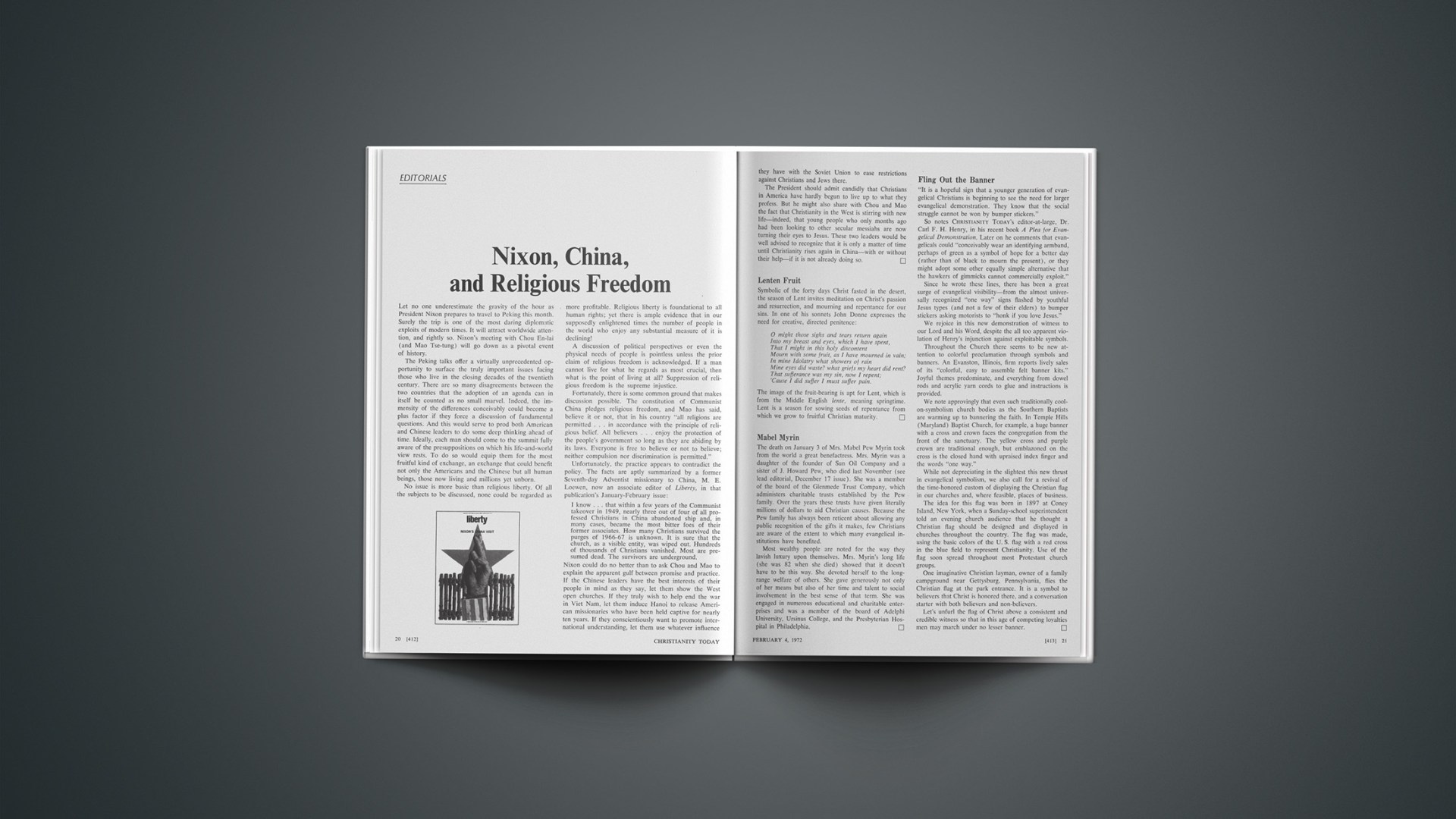
Let no one underestimate the gravity of the hour as President Nixon prepares to travel to Peking this month. Surely the trip is one of the most daring diplomatic exploits of modern times. It will attract worldwide attention, and rightly so. Nixon’s meeting with Chou En-lai (and Mao Tse-tung) will go down as a pivotal event of history.

The Peking talks offer a virtually unprecedented opportunity to surface the truly important issues facing those who live in the closing decades of the twentieth century. There are so many disagreements between the two countries that the adoption of an agenda can in itself be counted as no small marvel. Indeed, the immensity of the differences conceivably could become a plus factor if they force a discussion of fundamental questions. And this would serve to prod both American and Chinese leaders to do some deep thinking ahead of time. Ideally, each man should come to the summit fully aware of the presuppositions on which his life-and-world view rests. To do so would equip them for the most fruitful kind of exchange, an exchange that could benefit not only the Americans and the Chinese but all human beings, those now living and millions yet unborn.

No issue is more basic than religious liberty. Of all the subjects to be discussed, none could be regarded as more profitable. Religious liberty is foundational to all human rights; yet there is ample evidence that in our supposedly enlightened times the number of people in the world who enjoy any substantial measure of it is declining!

A discussion of political perspectives or even the physical needs of people is pointless unless the prior claim of religious freedom is acknowledged. If a man cannot live for what he regards as most crucial, then what is the point of living at all? Suppression of religious freedom is the supreme injustice.

Fortunately, there is some common ground that makes discussion possible. The constitution of Communist China pledges religious freedom, and Mao has said, believe it or not, that in his country “all religions are permitted … in accordance with the principle of religious belief. All believers … enjoy the protection of the people’s government so long as they are abiding by its laws. Everyone is free to believe or not to believe; neither compulsion nor discrimination is permitted.”

Unfortunately, the practice appears to contradict the policy. The facts are aptly summarized by a former Seventh-day Adventist missionary to China, M. E. Loewen, now an associate editor of Liberty, in that publication’s January–February issue:

I know … that within a few years of the Communist takeover in 1949, nearly three out of four of all professed Christians in China abandoned ship and, in many cases, became the most bitter foes of their former associates. How many Christians survived the purges of 1966–67 is unknown. It is sure that the church, as a visible entity, was wiped out. Hundreds of thousands of Christians vanished. Most are presumed dead. The survivors are underground.

Nixon could do no better than to ask Chou and Mao to explain the apparent gulf between promise and practice. If the Chinese leaders have the best interests of their people in mind as they say, let them show the West open churches. If they truly wish to help end the war in Viet Nam, let them induce Hanoi to release American missionaries who have been held captive for nearly ten years. If they conscientiously want to promote international understanding, let them use whatever influence they have with the Soviet Union to ease restrictions against Christians and Jews there.

The President should admit candidly that Christians in America have hardly begun to live up to what they profess. But he might also share with Chou and Mao the fact that Christianity in the West is stirring with new life—indeed, that young people who only months ago had been looking to other secular messiahs are now turning their eyes to Jesus. These two leaders would be well advised to recognize that it is only a matter of time until Christianity rises again in China—with or without their help—if it is not already doing so.

Lenten Fruit

Symbolic of the forty days Christ fasted in the desert, the season of Lent invites meditation on Christ’s passion and resurrection, and mourning and repentance for our sins. In one of his sonnets John Donne expresses the need for creative, directed penitence:

O might those sighs and tears return again

Into my breast and eyes, which I have spent,

That I might in this holy discontent

Mourn with some fruit, as I have mourned in vain;

In mine Idolatry what showers of rain

Mine eyes did waste? what griefs my heart did rent?

That sufferance was my sin, now I repent;

’Cause I did suffer I must suffer pain.

The image of the fruit-bearing is apt for Lent, which is from the Middle English lente, meaning springtime. Lent is a season for sowing seeds of repentance from which we grow to fruitful Christian maturity.

Mabel Myrin

The death on January 3 of Mrs. Mabel Pew Myrin took from the world a great benefactress. Mrs. Myrin was a daughter of the founder of Sun Oil Company and a sister of J. Howard Pew, who died last November (see lead editorial, December 17 issue). She was a member of the board of the Glenmede Trust Company, which administers charitable trusts established by the Pew family. Over the years these trusts have given literally millions of dollars to aid Christian causes. Because the Pew family has always been reticent about allowing any public recognition of the gifts it makes, few Christians are aware of the extent to which many evangelical institutions have benefited.

Most wealthy people are noted for the way they lavish luxury upon themselves. Mrs. Myrin’s long life (she was 82 when she died) showed that it doesn’t have to be this way. She devoted herself to the long-range welfare of others. She gave generously not only of her means but also of her time and talent to social involvement in the best sense of that term. She was engaged in numerous educational and charitable enterprises and was a member of the board of Adelphi University, Ursinus College, and the Presbyterian Hospital in Philadelphia.

Fling Out The Banner

“It is a hopeful sign that a younger generation of evangelical Christians is beginning to see the need for larger evangelical demonstration. They know that the social struggle cannot be won by bumper stickers.”

So notes CHRISTIANITY TODAY’S editor-at-large, Dr. Carl F. H. Henry, in his recent book A Plea for Evangelical Demonstration. Later on he comments that evangelicals could “conceivably wear an identifying armband, perhaps of green as a symbol of hope for a better day (rather than of black to mourn the present), or they might adopt some other equally simple alternative that the hawkers of gimmicks cannot commercially exploit.”

Since he wrote these lines, there has been a great surge of evangelical visibility—from the almost universally recognized “one way” signs flashed by youthful Jesus types (and not a few of their elders) to bumper stickers asking motorists to “honk if you love Jesus.”

We rejoice in this new demonstration of witness to our Lord and his Word, despite the all too apparent violation of Henry’s injunction against exploitable symbols.

Throughout the Church there seems to be new attention to colorful proclamation through symbols and banners. An Evanston, Illinois, firm reports lively sales of its “colorful, easy to assemble felt banner kits.” Joyful themes predominate, and everything from dowel rods and acrylic yarn cords to glue and instructions is provided.

We note approvingly that even such traditionally cool-on-symbolism church bodies as the Southern Baptists are warming up to bannering the faith. In Temple Hills (Maryland) Baptist Church, for example, a huge banner with a cross and crown faces the congregation from the front of the sanctuary. The yellow cross and purple crown are traditional enough, but emblazoned on the cross is the closed hand with upraised index finger and the words “one way.”

While not depreciating in the slightest this new thrust in evangelical symbolism, we also call for a revival of the time-honored custom of displaying the Christian flag in our churches and, where feasible, places of business.

The idea for this flag was born in 1897 at Coney Island, New York, when a Sunday-school superintendent told an evening church audience that he thought a Christian flag should be designed and displayed in churches throughout the country. The flag was made, using the basic colors of the U. S. flag with a red cross in the blue field to represent Christianity. Use of the flag soon spread throughout most Protestant church groups.

One imaginative Christian layman, owner of a family campground near Gettysburg, Pennsylvania, flies the Christian flag at the park entrance. It is a symbol to believers that Christ is honored there, and a conversation starter with both believers and non-believers.

Let’s unfurl the flag of Christ above a consistent and credible witness so that in this age of competing loyalties men may march under no lesser banner.

Principles And Prejudices

When United States District Court judge Robert B. Merhige, Jr. ruled that the predominantly black school district of Richmond, Virginia, must be consolidated with the schools of the two surrounding counties to achieve a 70:30 ratio of white children to black throughout the three jurisdictions, he did more than deal a blow to those parents who have found sanctuary for their prejudices in the largely white suburbs. He also vindicated one principle in the moral sphere and subverted two in the areas of education and government.

The suburban exodus from the central cities has not been motivated solely by a hatred of apartment-dwelling or a love of commuting. It also involves a conscious or unconscious attempt to escape the problems and responsibilities facing the urban centers. Judge Merhige’s decision, if upheld, will mean that suburban Richmond parents may be able to escape big-city problems for themselves, but that they no longer can isolate their children from them. If this forces the affluent suburbdwellers to consider the city’s problems their own, it will be a vital step toward getting those problems solved.

This moral gain, however, may turn out to have been bought at a very high price in the quality of education available throughout the Richmond metropolitan area. Unless one is willing to adopt the racist position that predominantly black schools are necessarily inferior no matter what their facilities and resources, one has to admit that merely changing the racial mix in all the schools will not necessarily improve any of them. The decision reasons that the middle-class suburbanites will improve the motivation and interest of the disadvantaged urban blacks; but given man’s fallen nature and the present state of permissiveness in education, it is not impossible that the badly motivated urban pupils will win out over the suburban ones, thus spreading urban discontent rather than traditional suburban values.

Although Judge Merhige voluminously supports his view that the equal-protection clause of the Fourteenth Amendment requires bussing, we cannot overlook the fact that the framers of the Amendment never envisaged such elaborate directives coming from their simple prohibition. The proper place for dealing with such problems is in the legislatures, both state and national; but because the law-makers shy away from their responsibility when faced with such a hot issue, federal judges are forced to resort to law-making in an attempt to remedy the growing crisis. If there is any future for our form of constitutional democracy, it surely does not lie in such legislative abdication of responsibility. Judge Merhige’s decision is at best only a stop-gap expedient, for the problem must finally be faced and resolved both in individual hearts and in the halls of Congress. □

From Servant To Advocate

Major Catholic charities may soon take on a new political role. A detailed plan for restructure of the National Conference of Catholic Charities was unveiled in Washington last month. If it is approved, the conference, which claims to be the nation’s largest private charitable agency, will become the social-action arm of the Roman Catholic Church in America. A prime function will be to lobby in behalf of poor and oppressed Americans.

The question raised by the plan is whether a church hierarchy ought to be trying to tell the government what to do. The helplessly poor need and deserve a strong voice on Capitol Hill as well as in statehouses and city halls. But even more important is the need for the American citizenry in general to develop a greater concern for the underprivileged. This entails an educational process and in many cases a spiritual revelation, and it is here that the Church ought to become involved.

So much thinking today focuses on the hope that our social problems would dissolve if only we could apply the needed leverage upon government. But thank God in the United States the government is still of the people, and if the people have the will the government will have the will. In fact, we would probably find that if the Church were properly sensitized, the problems would be cared for to a large measure at the grass roots without recourse to the government.

A Short-Lived ‘Concept’

A promising attempt to serve the nation’s Sunday-school teachers and others involved in Christian education has regrettably been shelved after only a three-month trial.

The National Sunday School Association was founded in 1945 and serves more than seventy evangelical denominations and countless congregations. A year after it began, NSSA became an affiliate of the National Association of Evangelicals, but it has its own headquarters building and constituency. Last September with a big fanfare NSSA launched a new periodical, Concept. The subtitle described its purpose: “Bringing a new horizon to Christian education in the Sunday school.”

Financial considerations are thought to have led the NSSA board to suspend publication with the November issue. This is too bad, for it is far more costly for the many denominational and independent publishing houses to attempt to provide on their own the kind of information Concept contained. Understandably, each publisher wants to bring certain slants and helps to the users of its particular materials. But many articles, reviews, and suggestions are of value regardless of the curriculum used.

Is it too much to suggest that Sunday-school publishers divert some of the money they now spend to produce general teaching aids to NSSA so that it can take Concept off the shelf? Perhaps Concept could be mailed out along with each publisher’s supplement.

We hope something will be done to provide Sunday-school teachers with a monthly periodical of general interest and helpfulness.

Book Briefs: February 4, 1972

New Wind Rising

Theology of the Liberating Word, edited by Frederick Herzog (Abingdon, 1971, 123 pp., paperback, $2.75), is reviewed by Donald G. Bloesch, professor of theology, Dubuque Theological Seminary, Dubuque, Iowa.

In this book, dedicated to the memory of Karl Barth, one American and several German theologians concern themselves with the possibility and desirability of a renewed theology of the Word of God. All the contributors except one, Hans-Dieter Bastian, point to the need for a theology of the biblical Word that will be related to the cultural and political situations of modern man.

Frederick Herzog of Duke University warns of a “new church conflict” resulting from the accommodation of American Christianity to modern, secular culture. Those who feel constrained to call theology back to its biblical moorings will find themselves increasingly at odds with American culture-religion, manifested in both radical-liberal theology and popular fundamentalism. Herzog even includes black theology as a form of “culture-accommodation,” since it makes the experience of a particular people and not divine revelation the criterion for truth and authority. He contends that in the new church conflict we should move from the Church as comforter and challenger to the Church as liberator. Only on the basis of the proclamation and acceptance of the liberating Word of God will man find the freedom and motivation to participate in the social struggle against political and economic oppression.

Although seeing truth as basically the event of God in action, Eberhard Jüngel of Tübingen University also sees the rightful place for propositional truth that participates in the claimed “truth as event.” At the same time, because true propositions always tend to overshadow truth as event they are constantly in danger of becoming untrue.

Hans-Joachim Kraus of the University of Göttingen reminds us that the Old Testament “stands in contrast to its religious environment, not just in ‘detail,’ but in its entire structure.” He goes on to maintain that the message of the prophets of Israel has “to be understood under new presuppositions and conditions.”

Hans Conzelmann, also from Göttingen University, affirms that the essential point of orientation for the proclamation of the Church is not “modern man” but “the sinner to whom God persistently reaches out.” Like Karl Barth he contends that the preacher should not seek “points of contact in feelings of sinfulness, cosmic threats, or other anxieties.” Instead our task is to make known the Word of God, which alone is able to penetrate the cultural situation in which men find themselves.

This book calling for the christianization of a secularized church is a heartening sign that a new wind is beginning to blow in theological circles, that the dominance of secular-radical theology may be nearing an end. In this rediscovery of the Word of God, however, we must beware of the danger of allying the biblical message with a political theology of liberation. Although Christ promises to liberate the captives, the full dimensions of this liberation will not be realized until the final consummation. But this, of course, does not dispense men and women who have been inwardly liberated from sin from the obligation to seek a more just society, and every gain in the struggle for social justice should be viewed as an anticipation of the righteousness of the kingdom that is still to come.

Alienated Theology

The Future of Philosophical Theology, edited by Robert A. Evans (Westminster, 1971, 190 pp., $6.95), is reviewed by William W. Wells, assistant professor of philosophy and religion, University of Hawaii, Hilo.

In April of 1970 a Consultation on the Future of Philosophical Theology was held at McCormick Seminary. This book contains papers given at the consultation by Schubert Ogden, David Burrell, Van Harvey, and Heinrich Ott, an introductory essay by the editor, and a report by Donald Mathers on the discussion of the four main papers by various consultation participants. The book is fairly technical and will be of interest primarily to those concerned with the relation between philosophy and theology. Despite the title of the book, three of the four essays center on the problem of understanding the nature of philosophical theology, rather than its future.

Ogden presents four theses that together elucidate “The Task of Philosophical Theology.” He begins by suggesting that we must recognize the priority of faith in human existence, “faith” in his terms being something in men that has certain parallels to Santayana’s “animal faith.” Philosophy, then, is “the fully reflective understanding of the basic existential faith which is constitutive of human existence.” “Philosophical theology” is seen as the effort to understand this “faith” so as to answer the question of the reality of God; and this understanding provides the possibility of and the basis for a specifically Christian theology. Ogden, then, sees philosophical theology in terms of traditional metaphysics.

Burrell, in contrast, sees no hope in this direction; philosophical theology is for him a kind of “conceptual therapy.” It is more like a grammar than a distinct tradition that might stand over against other traditions. Theology does not propose a picture of God any more than a grammar offers sentences. Theology is more like a set of skills that will allow one to evaluate pictures that have been proposed. The theologian’s skills, then, are more like those of the literary critic than those of the scientist. And, as in literary criticism, the canons of criticism are easier for the writer to display in use than to articulate.

Ott begins his essay by rejecting as untenable what he calls “the salvation-historical theology of revelation.” To explain why this theology has become untenable is not the primary task of systematic theology; rather theology must orient itself to and speak to this prevailing state of understanding. Theology, according to Ott, must articulate itself as philosophical theology. Faith must begin with the terms of the philosopher, show that this framework cannot accommodate faith, and only then begin to recast the terms taken from the philosopher for its own use. “What the revelation of God is, what really takes place in it, and what it means must be expressed in terms of the human intellectual life.… Instead of telling stories about God and man, theology must reflect upon how the event of the divine revelation works itself out among men.”

The essay by Van Harvey provides an interesting contrast with the other three. Where Ogden, Burrell, and Ott try to deal with the relation between philosophy and theology, Harvey describes the plight of the “alienated theologian.” As he points out, there have always been theologians in the Church who rejected one belief or another while remaining loyal to the basic message of Christianity. In recent years, however, the Church has had men who denied the very basis of Christianity—proponents of “Christian atheism,” for example—but who were and are not able to come to the point of severing their connection with Christianity. He finds the source of this problem in the morality of belief that developed out of the eighteenth century. The alienated theologian can no longer believe without—as he sees it—sacrificing his intellectual honesty. Yet this same theologian acknowledges a longing to be convinced about the truth of teachings that seem to him unwarranted. As the final discussion shows. Harvey was not convinced by the other three essays and remained “alienated.” This situation is sufficient justification, if more is needed, for the continuing work of evangelical theologians in philosophical theology.

For the pastor of a typical congregation or for the layman, other books will fill more immediate needs. On the other hand, this book may be important for the pastor who is constantly dealing with university students and for all those with an ongoing interest in the relation between philosophy and theology.

Exegeting An Exegete

Calvin’s New Testament Commentaries, by T. H. L. Parker (Eerdmans, 1971, 208 pp., $7.95), is reviewed by Paul Garnet, assistant professor of theological studies, Loyola College, Montreal, Quebec.

This book is the product of long research into the theological presuppositions and technical methods of the Reformation’s leading exegete. That it is a pleasure to read is appropriate, since Calvin’s first love among his writings was the commentaries. It is based on a study of all the New Testament commentaries, including the 1540 edition of Romans, which, except for its preface, is unavailable to the general public.

Calvin’s commentaries are valued today for two reasons: for the light they shed on Scripture, and for the light they shed on Calvin and his times. That they are still prized for the former reason points to the historical stature of the man and to the continuing desirability of studying him in the context of his own age. The century-old Pringle edition of the commentaries is being reissued in six volumes, and a contemporary Torrance edition in many volumes is also in progress for the New Testament only.

Calvin emerges from Dr. Parker’s investigation as an exegete who felt no need to go beyond the meaning of his author. “If the expositor reveals the mind of the writer, he is revealing the mind of the Spirit.” What need is there for any hermeneutic beyond this? Moreover, Calvin was an independent thinker and even engaged in some textual criticism. His Latin translation of the New Testament text, prefacing the various sections of the commentaries, is a worthy piece of scholarship itself.

May this book inspire twentieth-century heirs of Calvin to strive for similar levels of excellence.

Newly Published

Creative Bible Study, by Lawrence O. Richards (Zondervan, 215 pp., $4.95). Superbly written and highly practical, without a dull page. Suggestions for both individual and small-group study.

Hidden Art, by Edith Schaeffer (Tyndale, 214 pp., $3.95). A delightful volume filled with practical and creative ideas for bringing beauty (and fulfillment) into all aspects of living.

Colossians and Philemon, by Eduard Lohse (Fortress, 233 pp., $10). The first volume in the open-ended “Hermeneia” commentary series is a translation from a 1968 work by the then New Testament professor at Gottingen (now bishop of the Evangelical Church of Hanover). A major work for scholars and studious Bible teachers.

Insight, by Robert J. Little (Moody, 223 pp., $4.95). The radio pastor for the Moody Bible Institute stations answers 317 questions using the Bible in a sensible way.

The Gospel Sound: Good News and Bad Times, by Tony Heilbut (Simon and Schuster, 350 pp., $7.95). Don’t look here for any white gospel singers: the author feels that only blacks are authentic. Strangely missing are the Southland Jubilee Singers, who were ubiquitous on Southern radio for many years. Worth reading only if old-timey blues-gospel wailing is your thing.

Let Me Explain, by Pierre Teilhard de Chardin (Harper & Row, 189 pp., paperback, $2.45). For those who have wondered where to begin in reading Teilhard, this book is the answer. Jean-Pierre De-moulin has selected representative and understandable portions from the voluminous and often complex writings of the late influential Jesuit religious thinker.

The Paradox of Pain, by A. E. Wilder Smith (Harold Shaw, 132 pp., paperback, $1.95). Even in suffering, love can bring meaning to life. With this in mind, the author tries to justify the existence of pain. His reasoning, on the popular level, makes sense.

Theological Crossings, edited by Alan Geyer and Dean Peerman (Eerdmans, 155 pp., paperback, $2.95). The fourteen essays on “How I Changed My Mind Between 1968 and 1970” published in the Christian Century are now available in book form. Fascinating reading.

How to Follow Jesus (Broadman, 142 pp., $4.50) and The Cosmic Drama (Word, 212 pp., $5.95), both by Herschel H. Hobbs. Brief but suggestive commentaries on Hebrews and Revelation, respectively, by a leading Baptist pastor.

Hope for Tomorrow, by Hazel B. Goddard (Tyndale, 150 pp., $3.95). People suffering from loneliness, emotional turmoil, or despair will be stirred by this book written by a professional counselor.

Narrative Poems, by C. S. Lewis (Harcourt Brace Jovanovich, 178 pp., $5.95). Lewis’s legion of admirers will warmly welcome this edition of his four known extended poems, only one of which was previously published.

Prophecy in the Making, edited by Carl F. H. Henry (Creation House, 394 pp., $5.95). Twenty-two messages to the Jerusalem Conference on Biblical Prophecy in 1971 by such men as W. A. Criswell, Edmund Clowney, John Stott, Tom Skinner, and John Walvoord.

The Minister’s Filing System, by Paul Gericke (New Orleans Baptist Theological Seminar [3939 Gentilly, New Orleans, La. 70126], 48 pp., paperback, $1). A helpful guide for those willing to devote some, but not excessive, effort.

Process Theology, edited by Ewert H. Cousins (Newman, 376 pp., paperback, $4.95). A collection of previously published basic writings by some seventeen participants in a major movement in contemporary academic theology. A good way to find out about it.

The Call, by Oral Roberts (Doubleday, 216 pp., $4.95), Miracles in My Life, by Rex Humbard (Revell, 125 pp., $3.95), and High Adventure, by George Otis (Revell, 192 pp., $4.95). Three exuberant autobiographies by the well-known preachers and a millionaire industrialist who is a close friend of Pat Boone.

Eutychus and His Kin: February 4, 1972

WHY PHILADELPHIA?

Would you like to put Philadelphia

Up tight one night?

The ring-around-a-rosy in the middle

of the night.

Yes, we all should do the Ring-

Around-a-Rosy Rag.

—ARLO GUTHRIE

I spent a week in Philadelphia one day.

Have you heard about the contest that offered a week in Philadelphia as first prize? Second prize was two weeks in Philadelphia.

Over the years Philadelphia has suffered a reputation as the uptight capital of joylessness. I’ve done a good fifteen minutes of research into this and have discovered the reason. Philly’s reputation as Dullsville stems directly from its reputation for morality, which probably results from its Quaker origins.

H. L. Mencken once sniffed that Philadelphia was the most Pecksniffian city in America (Pecksniffian: “hypocritically affecting high moral principles”). Its morality, real or pretended, obviously makes the city a dull place.

We’ve all seen the fun and spontaneity of a group stifled by the unexpected intrusion of moralistic precepts. As Robert Burns put it:

Morality, thou deadly bane,

Thy tens o’ thousands thou

hast slain.

We need the follies and foibles of human nature to add spice to life. All you have to do to prove this to yourself is to answer a few questions.

Who is more interesting and appealing, Mickey Mouse or Donald Duck? Donald, of course, because his ill-tempered, irascible, profane manner witnesses to a humanity that we share. The guileless Mickey Mouse has given his name to all that is jejune.

Or to put it another way, would you rather be stranded on a desert isle with Cotton Mather, that austere epitome of moral rectitude who would no doubt be a fountain of edifying instruction, or with Chaucer, whose bawdy sense of humor would fill the days with riotous laughter? Not much of a choice, is it?

A cartoon in some magazine showed Diogenes, lamp in hand, confiding to a friend, “I found an honest man. He was a terrible bore.” Perfection is a terrible burden to bear in another person.

However, just for the record, it should be stated that twelve men mostly good and true testify that they actually met a perfect man and that he was anything but joyless and dull. Where do you suppose Philadelphia went wrong?

ORCHIDS UNDERCUT

Orchids to J. Kenneth Grider for his strong article, “Christmas Method, Christmas Meaning” (Dec. 3).

However, this solid and commanding statement of the Virgin Birth of Christ is undercut by his reference to Karl Barth.

When Barth, along with others, says that all Christians are “virgin born,” the unique birth of Christ loses its uniqueness. When Barth holds that the Virgin Birth merely points to the Incarnation, or that it is connected with the Incarnation as a sign is to the thing signified, then God is no longer the “With Us God.”

Christmas gave us Immanuel, but under Barth’s dialectic he has vanished. There is no room for Incarnation in the inns of neo-orthodoxy.

Calvary Orthodox Presbyterian Church

Sonora, Calif.

RING THE (WARNING) BELLS

Anent your December 17 article ‘ “Revival in Canada”: “The generation gap never had a chance”—glory, hallelujah! “Love prevailed”—absolutely wonderful! “Denominational barriers dissolved”—could be equally praiseworthy. “Doctrinal differences were ignored”—here warning bells should be ringing. Repeatedly in the past, revivals that promised rich blessing eventuated in robbing the churches of their faithfulness and hence of their strength just by this Satanic device of ignoring doctrine.

Doctrinal differences exist only because there is both true doctrine and false doctrine. To ignore such differences, attractive though it is and commendable as it may seem, is to ignore truth. The church is called upon to be the pillar and ground of the truth. Salvation is of the truth (John 8:32; 14:6); sanctification is by truth (John 17:17).

Orthodox Presbyterian Church

Westfield, N. J.

CONVERSANT, CONVICTED, CORRECTED

Thanks for doing an excellent job in putting together the news item, “High School Scene: What Prayer Amendment?” (Dec. 3). It is evident that you are conversant with the contemporary scene and getting out where the action is. I commend you for it.

You’ve put me under conviction. I wish with all my heart that we did have 17,000 Campus Life clubs in as many high schools. That and more is our goal in the days ahead, but the goal has not been achieved to date. The more accurate figure would be clubs in approximately 2,000 schools.

President

Youth for Christ International

Wheaton, Ill.

• And Young Life has 450 staffers reaching 75,000 youths through 900 clubs, rather than the figures stated.—ED.

SOUTHERN BAPTIST SPEARHEAD

The news story, “Turning On to Jeshua” (Dec. 17), includes the statement, “Most mainline denominations have now quietly closed their Jewish evangelism offices.”

This statement is not true about Southern Baptists.… The Reverend William B. Mitchell has spearheaded efforts for Jewish evangelism among Southern Baptists for more than fifteen years. These efforts have been intensified recently.

Secretary

Department of Interfaith Witness

Southern Baptist Convention

Atlanta, Ga.

FROM COVER TO COVER

Hurrah for your December 17 issue! “C. S. Lewis on the Meaning of Christmas” by Ken Futch was wonderful. I wish I could send that out in Christmas-card form.… It would make an ideal Christmas message to read at Christmas gatherings. Eutychus was unusually good also. Many thanks for your magazine. I’m a layman, but read every issue from cover to cover.

MRS. WILLIAM ALFORD

Elkhorn, Nebr.

A NOT SO CURIOUS REPLY?

Not so curious, perhaps, is Mr. Harrelson’s reply to my article on the Thirty-Nine Articles (Eutychus and His Kin, Dec. 17); it is easier to impugn a writer than to enter into serious discussion of what he writes.

Professor of Church History and Historical Theology

Fuller Theological Seminary

Pasadena, Calif.

TIMELY TREATISE

The article on Herbert W. Armstrong by Joseph Martin Hopkins (Dec. 17) was timely and needed.

Salt Lake City, Utah

The article caused me some serious concern. I do not wish to question the integrity of Mr. Hopkins, but I do wish to challenge his scholarship and sense of propriety. As a Seventh-day Adventist Christian I hold firmly to all the cardinal doctrines of Christianity as presented in the Bible. Most emphatically I believe in salvation by grace through faith in Jesus and believe in the eternal pre-existence, virgin birth, sinless life, atoning death, bodily resurrection on the first day of the week, ascension, and return of Christ.

Two doctrines listed by brother Hopkins as “deviant” may be “deviant” from his theology but not from the Scriptures or the historical Christian position; the seventh-day Sabbath and non-immortality. However, this did not disturb me so much as the subtle way in which he classed Seventh-day Adventists as a cult. His references to them in connection with Armstrong, Mormons, and Jehovah’s Witnesses is guilt by association. I feel this was totally unfair and not worthy of the best ability of this man. Perhaps his knowledge of Seventh-day Adventists could be broadened by getting his information first hand from church leaders in good standing.

Associate Chaplain

New England Memorial Hospital

Stoneham, Mass.

In his criticism of Herbert Armstrong and the Radio Church of God Hopkins includes the immortality of the soul as one of “Christianity’s classic doctrines.” Apparently Hopkins has never squarely faced Oscar Cullmann and the “radical difference between the Christian expectation of the resurrection of the dead and the Greek belief in the immortality of the soul.”

Cullmann further states:

The fact that later Christianity effected a link between the two beliefs and that today the ordinary Christian simply confuses them has not persuaded me to be silent about what I, in common with most exegetes, regard as true; and all the more so, since the link established between the expectation of the “resurrection of the dead” and the belief in the “immortality of the soul” is not in fact a link at all but renunciation of one in favor of the other [Immortality of the Soul or Resurrection of the Dead?].

To put the record straight, immortality of the soul is one of Plato’s classic doctrines. The opposite view—the resurrection—is Paul’s view. The two are irreconcilable.

Book Editor

Pacific Press Publishing Association

Mountain View, Calif.

Jesus I know, Paul I know, Herbert Armstrong I know—but who are you?

First Church of the Two Testaments

Dallas, Tex.

MISPLACED PROFESSOR

I appreciate your reference (“Conscience: Good or Bad Guide?,” Jan. 7) to my editorial on authority and conscience in the fall issue of the Journal of Ecumenical Studies.

Your editorial correctly states that I am an associate editor of the Journal, but incorrectly describes me as a Catholic. I am actually a Baptist minister presently serving on the faculty of a Catholic school, namely Villanova University, where I offer courses in ecumenism and Protestant theology. From 1957 to 1968 I was a member of the faculty of Eastern Baptist Theological Seminary, Philadelphia, where Dr. Carl F. H. Henry, well known to readers of CHRISTIANITY TODAY, now teaches.

Villanova University

Villanova, Pa.

LACKING TRANSFORMATION

I was pleased to see that you are beginning to cover the ground of the myriad of books coming out about the Jesus-people movement (Books in Review, “Getting It All Together,” Jan. 7).… I think that he misses the point completely on The House of Acts. Those of us who live in the locale have an advantage over the reviewer. To me The House of Acts is a story of a conventional minister with conventional Baptist attitudes who finds the need of changing his own life and his own ministry to meet the need of these converted hippies. I think the transformation in his attitudes is apparent in the reading of this book. One thing which is often overlooked is that the Jesus-people movement began with the conversion of Ted Wise, Danny Sands, and the hundreds of other young people that they were able to point toward Christ.

Beth Sar Shalom Hebrew Christian Fellowship

Corte Madera, Calif.

MERELY THE MODERATOR

Carl F. H. Henry’s reflections on “The Christian Work Ethic” (Footnotes, Jan. 7) arising from his attendance and participation at the recent annual meeting of the Conference on Faith and History stands in need of correction on one matter. Ralph A. Carey of Spring Arbor College, Michigan, not I, delivered the very lucid analysis of the Horatio Alger myth, to which Dr. Henry refers. I merely moderated the session at which Carey read his paper, a session which Dr. Henry attended.

Professor of General Education

San Jose Bible College

San Jose, Calif.

Psalms through Malachi

A BIBLIOGRAPHY FOR CHRISTIANS: PART 6

This is the concluding half of a survey of notable books on the Old Testament. The first half, which was published in the last issue, dealt with Genesis through Job.

HEBREW POETRY An inexpensive introduction to the forms of Hebrew poetry is T. H. Robinson’s The Poetry of the Old Testament (Duckworth, 1947). For even more available summaries of the subject, one should not overlook a good Bible dictionary (Gottwald’s article in the Interpreter’s Dictionary of the Bible is excellent). Those with scholarly interests in the subject—and money for expensive books—will welcome reprint editions of Bishop R. Lowth’s classic Lectures on the Sacred Poetry of the Hebrews and G. B. Gray’s The Forms of Hebrew Poetry (KTAV). Finally, an excellent scholarly introduction to Hebrew poetry in the literary context of both Homeric and Old English parallels is given in W. Whallon’s Formula, Character, and Context (Harvard, 1969).

A good short introduction to Hebrew Wisdom Literature is contained in the AB volume on Proverbs-Ecclesiastes by R. B. Y. Scott, while W. McKane gives more extensive coverage on the wisdom of the Ancient Near East in his commentary on Proverbs (OTL, 1970). James Wood, Wisdom Literature: An Introduction (Duckworth, 1967) provides a good survey of the subject and is aimed at the non-specialist. Of special interest to evangelicals is an article by D. A. Hubbard in The Tyndale Bulletin for 1966; Hubbard gives an overview of the subject and suggests some areas for further study in the coming years.

PSALMS Other parts of Scripture speak to us; the Psalms speak for us. Capturing this devotional theme are the older commentaries of men like J. A. Alexander (currently in print by Zondervan) and C. H. Spurgeon (The Treasury of David, two volumes, Associated Publishers and Authors), and the more recent volumes by W. G. Scroggie (Pickering and Inglis, four volumes, 1948–51) and H. C. Leupold (Wartburg, 1959), though the modern reader will certainly want to supplement these works with contemporary material. For a wealth of philological detail (with special reference to Ugaritic backgrounds) there is nothing to match M. Dahood’s recently completed work in the AB (three volumes, 1966–70). Hebrew words are given in transliteration, but some knowledge of the language will greatly facilitate one’s use of this set. Those seeking a decidedly evangelical scholarly commentary will still resort, however, to E. W. Hengstenberg’s Commentary on Psalms (Clark, 1876).

Most modern commentaries have built heavily on the pioneering work of H. Gunkel and S. Mowinckel in discerning various forms within the Psalms and discovering the Sitz im Leben connected with each. A useful summary of this work, together with its author’s own commentary, is the theological treatise of A. Weiser in the OTL (translation 1962). Two first-rate but non-technical introductions to the Psalms are C. Westermann, ThePraise of God in the Psalms (John Knox, 1965), and C. F. Barth, Introduction to the Psalms (Blackwell, 1966).

Many a short book has been written on an individual psalm. An exemplary devotional treatment is D. M. Lloyd-Jones’s Faith on Trial: Studies in Psalm 73 (Inter-Varsity, 1965), while the best of the more technical studies is represented by the work of R. Sorg, Ecumenic Psalm 87 (Fifield, Wisc: King of Martyrs Priory, 1969).

PROVERBS For solid philological help on Proverbs save your money and buy W. McKane’s new contribution in the OTL (1970). Considerably less ambitious with regard to both exegetical and form-critical research, but superbly readable and useful, is D. Kidner’s introductory volume in the TCOT series (1964); this is certainly the best book for the beginner. An intermediate tool, including both Proverbs and Ecclesiastes, is the AB offering by R. B. Y. Scott (1965).

ECCLESIASTES A convincing interpretative argument for taking the book as a unity is given by Rabbi R. Gordis in Koheleth: The Man and His World (Jewish Theological Seminary, 1955). Add to this R. B. Y. Scott’s volume in AB (see Proverbs listing) and the older work of G. A. Barton (ICC, 1908) and you have the major works that are readily available.

SONG OF SOLOMON So many of the books on the Song of Solomon suffer from typological excesses. For an introduction to various ways of handling this enigmatic poem consult the essay “The Interpretation of the Song of Songs” in The Servant of the Lord and Other Essays (1952) by H. H. Rowley. An older work of continuing value is A. Harper’s volume in CB (1902); R. Gordis’s The Song of Songs (Jewish Theological Seminary, 1954) offers a good guide from a modern Jewish point of view.

THE PROPHETS Much has changed in scholarly conclusions regarding prophetism over the last thirty-five years, and one wishing to follow the debate might well begin with O. Eissfeldt’s essay on the subject in The Old Testament and Modern Study (ed. H. H. Rowley, Oxford, 1951). The classical nineteenth-century position that saw a wide divergence between prophetic religion (early) and priestly religion (post-exilic) has now been largely abandoned, and the whole question of the whence and why of the growth of prophecy is still in flux. A modern study taking account of material from the ancient Near East is W. F. Albright’s Samuel and the Beginnings of the Prophetic Movement (Hebrew Union College, 1961), though not all will agree with his distinctions between Samuel and the Elide priesthood.

No up-to-date conservative introduction to prophecy is available, though E. J. Young’s My Servants the Prophets (Eerdmans, 1952) is still valuable. A vivid contemporary treatment of the role of the prophet (though far too facile in its handling of complex critical questions) is given in S. H. Blank’s Jewish “adult education” handbook, Understanding the Prophets (Union of American Hebrew Congregations, 1969). Prophecy in Ancient Israel by J. Lindblom (Fortress, 1962) is a very technical work that will be of interest to scholars but of little appeal to the novice. More theological depth together with considerable commentary, but only on those prophets who flourished in the Northern Kingdom, is found in H. L. Ellison’s The Prophets of Israel (Eerdmans, 1969), an introduction every evangelical should know. Finally, for a brief and balanced introduction and background for each of the canonical prophets, consult the same author’s Men Spake From God (Eerdmans, 1952).

One of the greatest needs of the day is for a comprehensive treatment of the subject of prophecy that is as ambitious in scope as the older work of P. Fairbairn, The Interpretation of Prophecy (Banner of Truth, 1856; reprint 1964), by one who is committed to the authority of the Bible and thoroughly at home in the world of contemporary biblical scholarship. Perhaps the volume by E. J. Young mentioned above will have to do for the present. Christ in Prophecy by P. Heinisch (Liturgical Press, 1956) is similar to Young in its devout approach and will prove helpful to many (though the author deals primarily with passages that are Messianic in the strict sense of the word), but it does not fill the bill entirely.

ISAIAH Questions of authorship and source analysis are dealt with in any standard introduction. Traditionally conservative views are amply covered in the works of E. J. Young: Studies in Isaiah (Eerdmans, 1954) and Who Wrote Isaiah? (Eerdmans, 1958). A three-volume commentary by the same author in the NICOT series (1965–71) provides historical-grammatical exegesis in the best tradition of the Reformers (with all Hebrew terms transliterated for English-speaking readers), but it fails to interact with contemporary scholarship to the extent it might. Other major series are incomplete. ICC (1912) by G. B. Gray continues only through chapter 27. The OTL for chapters 40–66 by C. Westermann (1969) is a valuable form-critical and theological study; material on the earlier chapters of Isaiah is still wanting. AB likewise offers only the latter portion in a volume by the Catholic scholar J. L. McKenzie (1968). Neither of the preceding matches, however, C. R. North’s The Second Isaiah (Oxford, 1964) for discussion of the Hebrew text of chapters 40–55.

For more conservatively oriented, devotional commentaries, the older work of J. A. Alexander (1846, Zondervan), the succinct volume by the British expositor W. E. Vine (Zondervan, 1946), and the recent, though yet incomplete, work of H. C. Leupold (Baker, 1968) may be used with profit.

JEREMIAH A comprehensive and conservative philological tool for minister or layman is the first volume in a Lutheran Church-Missouri Synod commentary by T. Laetsch (1952). Critical interaction is almost totally lacking in this work; for that and a wealth of historical and theological material, John Bright’s commentary in the AB (1965) is the book to consult.

LAMENTATIONS Laetsch (see “Jeremiah”) also covers Lamentations. Other than this there is only N. K. Gottwald’s Studies in the Book of Lamentations (Allenson, 1962), which has a wealth of material.

EZEKIEL The student of this prophet is now offered meaty fare. For the best in-depth treatment, wait for the English translation of W. Zimmerli’s monumental German work; it will come in Fortress’s new “Hermeneia” series. Of nearly equal value is the OTL volume by W. Eichrodt (translation 1970). Recent works by conservatives, notably the TCOT (1969) by J. B. Taylor and The Prophecy of Ezekiel (Moody, 1969), by C. L. Feinberg, round out the feast. The latter is a dispensational study by an able Semitist, while the former is the best short, all-purpose book on the subject.

DANIEL There have probably been more books written on the prophecy of Daniel in recent years than on any other part of the Old Testament. Not all are of equal value, of course. Still the basis of any thorough textual study is J. A. Montgomery’s valuable commentary in the ICC (1927), though much helpful material of a similar kind is to be found in A Critical and Exegetical Commentary on the Book of Daniel (Oxford, 1929) by R. H. Charles. Among modern interpretative commentators, N. W. Porteous (OTL, 1965) reflects whatever consensus there is among non-conservatives. In The Prophecy of Daniel (Eerdmans, 1949) E. J. Young argues from an evangelical amillennial position. A new book by J. F. Walvoord, Daniel, the Key to Prophetic Revelation (Moody, 1971), offers a dispensational alternative to Young. For a premillennialism with some variation from Walvoord, R. D. Culver’s commentary Daniel and the Latter Days (Moody, 1964) is a good starting point. For critical discussion one should use the standard introductions, supplemented by works of R. D. Wilson (especially Studies in the Book of Daniel, Putnam, 1917), H. H. Rowley (especially Darius the Mede and the Four World Empires, Univ. of Wales, 1959), J. C. Whitcomb, Jr., Darius the Mede (Eerdmans, 1959), and D. J. Wiseman et al., Notes on Some Problems in the Book of Daniel (Tyndale Press, 1965).

MINOR PROPHETSICC volumes are complete for all the Minor Prophets. Amos and Hosea are covered by W. R. Harper (1905); J. M. P. Smith, W. H. Ward, and J. A. Bewer treat Micah, Zephaniah, Nahum, Habakkuk, Obadiah, and Joel (1912); and finally H. G. Mitchell, J. M. P. Smith, and J. A. Bewer comment on Haggai, Zechariah, Malachi, and Jonah (1911). Among conservative commentaries, the work of Th. Laetsch, The Minor Prophets (Concordia, 1956) offers help on structure and text, while the older (1860–77) work of E. B. Pusey, The Minor Prophets With a Commentary, recently reprinted (Baker 1950), is still helpful. A contemporary devotional treatment of Obadiah, Jonah, Habakkuk, and Haggai comes from the pen of F. E. Gaebelein in Four Minor Prophets (Moody, 1970), offering a model for application of prophetic truth to today’s problems.

Studies of individual books are not wanting, either, especially for such favorites as Hosea and Amos. On Hosea there is now J. L. Mays’s valuable book in OTL (1969), which enunciates theological themes; comparable in scope is the earlier work of J. M. Ward, Hosea: A Theological Commentary (Harper & Row, 1966). Finally, a short series of lessons with a value out of all proportion to its simple format is D. A. Hubbard’s With Bands of Love (Eerdmans, 1968).

For Amos the ICC may also be supplemented with the OTL contribution of J. L. Mays (1969). Equal to the standard of ICC for philological material is the work of R. S. Cripps, A Critical and Exegetical Commentary on the Book of Amos (second edition, Allenson, 1955).

A short but useful book on Obadiah comes from J. D. W. Watts, Obadiah: A Critical Exegetical Commentary (Eerdmans, 1970); of a different order but devotionally useful is the pamphlet by D. M. Lloyd-Jones on the message of Habakkuk entitled From Fear to Faith (Inter-Varsity, 1953). For Zechariah there is little recent material; M. F. Unger’s 1963 commentary (Zondervan) concentrates on Messianic prophecies but does not offer all that is needed for an independent study of the material.

SUMMARY It is by now apparent that contemporary Old Testament commentaries of quality are conspicuous by their rarity. Evangelicals will welcome the appearance of each new volume of AB and OTL, and look with keen anticipation for the appearance of the Fortress “Hermeneia” series, but special note should be made also of the quality and regularity of the forthcoming volumes of the NICOT. Apart from this there is no major effort combining scholarly discussion of textual and critical matters with a conservative commitment to Scripture. For many, the TCOT will meet a real need; but despite its unquestioned value, its brevity demands some greater effort from those who claim to find in the Old Testament the Word of God written. Herein lies one great task of the evangelical scholarly community in the days ahead.

Bride/Body/Temple

acanthus leaf,

architrave, triglyph

& metope,

ingots of light,

sheets of sun,

glass soaked with

light.

Tympanum,

recessed doorway lined

with stone saints

Ionic,

Doric,

Corinthian, the pillars,

pilasters, porticoes,

entablatures

& broken pediments

basilica

of claspt hands,

baptistry

of welldeep eyes

in which the world’s

immersed

nave

& transept,

chapels clustered,

narthex balancing

apse

the cross made

a space to hold

his body assembled,

to hold, o mystery,

the Bride

of the Word in joy

EUGENE WARREN

A New Note in Christian Journalism

When Chicago policemen were seen on television “messaging” various members of the press with nightsticks during the 1968 Democratic National Convention, cheers went up all over North America. Subsequent polls revealed that an astonishing credibility gap had opened between the journalistic fraternity and the readers. The pollsters learned that Chicago was looked upon by the “silent majority” as an occasion when the media people were “taking it” instead of “dishing it out,” and that many felt they had it coming.

I do not wish to enter the argument. Since I believe in original sin, I consider newspaper people to be positionally guilty like all the rest of us. Have we not all come short of the glory of God? But the hostility toward the press that was evident at Chicago has raised a more specific question: Is there something vocationally wrong with the way present-day journalists are carrying out their job? Speaking as one who has been in the game since 1928, when I joined the Daily Californian staff at Berkeley, I think there may be.

Many of the trends of present-day newspaper writing are exciting. I like the color, the improved layout, the variety, the use of polls, the openness, the humor, the brilliant interpretative reporting. Also, Jesus Christ is getting a much better press from today’s journalists than he did from me when I was an agnostic young city editor in the thirties. There are improvements and embellishments; but there are also dangers in the new journalism. What I fear most of all is the rapid spread of “tongue in cheek” reporting. This departure from traditional journalism has a smart, contemporary sound as it reflects the bitterness of the left-wing political stance. It is more and more in evidence in our metropolitan newspapers and syndicated columns, as well as on all the major networks.

Despite the iconoclastic tradition of Ambrose Bierce, H. L. Mencken, Ring Lardner, and Westbrook Pegler, I do not feel that such journalism is native to the American scene. Perhaps some doctoral candidate should investigate whether the sour note did not enter U. S. journalism from Britain by way of Canada. A cynical tone has characterized many of the larger English newspapers for years. Today the Canadian and American press have been penetrated to a greater or lesser degree by the jaded disillusionment of the tired liberal. Various wars and assassinations in recent years have hastened the spread of the malaise. I sympathize with it, but I don’t like it, and I know of no way to counter it in the secular press.

My greater concern is for the Christian press. I find that this unhealthy spirit is creeping into Christian journalistic writing and is spreading. Perhaps it is a sign of the times, and we cannot expect our baptized reporters to write in a vacuum. Yet I feel that as Christian journalists we have a responsibility to the Lord Jesus Christ, and while it may not make us into angels, it ought to keep us from cranking out acerbic and disagreeable prose. Rancor is not one of the gifts of the Holy Spirit.

To illustrate: if we can’t write a constructive report of a church activity, perhaps we shouldn’t write about it at all. Many things are wrong with the church, but I am not sure we ought to be continually harping on them. Imagine the Psalmist spending all his time complaining that the Temple had no central heating, and the incense polluted the atmosphere, and the marble slabs were hard on his knees. How could he ever have turned out the 100th Psalm—or the 150th? Suppose Luke had filled his codex with reports of the things Paul “failed to touch on” in his sermons in Asia Minor. I doubt if we would be reading the Book of Acts for devotions today.

Let us journalists not become so zealous in our commitment to what we like to call our “honesty” and “impartiality” that we turn into the devil’s secret weapon. I am for truth in journalism even when it hurts. I believe in straightforward reporting that glorifies God and honors the Lord Jesus Christ. But Christian news need not involve playing up the foibles of church people, or drawing caricatures with obvious relish, or indulging in rumor-mongering, or dredging up old church failures that are now irrelevant. God will one day bring to light everything that is hidden, but we are not God. Although exposing sin is necessary and right, we should always remember that when dealing with individuals we should do it as Christ did it, with gentleness and compassion, and with their best interests in mind.

In his Confessions Augustine writes of hearing a voice that said to him, “I am the food of real men. Grow up and feed on me.” It isn’t enough for the Christian communicator to say, “I tell it the way it is.” We must remember that our pens are dipped in the blood of Christ. We need his wisdom as well as our own knowledge and information. Furthermore, the Christian reporter is, by virtue of his commitment, a Christian evangelist. The Lord can take even our dangling clauses and our parentheses and use them to bring men to himself.

Sherwood E. Wirt, editor of “Decision” magazine, holds the B.A. (University of California), B.D. (Pacific School of Religion), and Ph.D. (Edinburgh University).

Toward an Evangelical Renaissance

Two recent experiences have moved me to crystallize some fresh thoughts on the subject of evangelism and the Christian realities that are at its core. One was reading the remarkable booklet by Richard S. Armstrong entitled The Oak Lane Story.

The second was my participation in two small groups of concerned evangelicals that in 1967 and ’68 met near Key Bridge, which connects Washington, D. C., with the Virginia side of the Potomac. Those meetings were held under the leadership of Dr. Carl Henry. Evangelist Billy Graham played a dynamic part in the first gathering, as did his associate Leighton Ford in the second. Grateful remembrance of the spirit, concern, and vision of those encounters has stirred the reflections on an evangelical renaissance to which I now give expression.

It becomes increasingly clear that the chief need of contemporary Christianity and of society in general in this confused and revolutionary time is an evangelical renaissance. By that I mean a rediscovery of the Evangel, the Gospel, in its full dimension of light and power, together with the elevation of the Gospel to the status that belongs to the Gospel of Christ in the thought, life, and activity of all persons and organizations that bear the name “Christian.” This renaissance, which is long overdue, is the primary requirement of the world Christian community, from the local congregation to the Church universal. It is equally the basic need of the global community of man.

If an evangelical renaissance is to become a reality and not merely an idea or aspiration, this fact must be remembered and stressed: the Gospel, the Christian “Good News,” is inseparably related to Jesus Christ, to his identity as a person, to the work he accomplished, and to his continuing living presence and companionship on the road of life.

It is a moving fact that the personality of Christ is currently becoming the focus of attention in an unusual manner and in most unexpected circles. This is so in the secular as well as the religious order. There is on the march today a many-sided “Jesus Movement,” an intensified quest for the Christian message. In this context a statement phrased several decades ago in the environs of Jerusalem by a group of Christians from around the world has resounding significance. At the close of a meeting on the Mount of Olives during Easter week, 1928, those Christians said: “Our message is Jesus Christ. He is the revelation of what God is and of what man through him may become.”

Christianity is Christ. The Bible is a book about Christ. Devotion to Christ, the God-man, crucified and risen, is the central passion of true Christian living. In Christ, God’s concern for man becomes manifest. Through Christ the transformation of man, the creation of new men and women, can be accomplished. The evangelical goal is a redeemed humanity. Let this truth be remembered and reemphasized, and its contemporary relevance shown. The Church’s abiding task, its timeless imperative through the ages, is to give luminous and dynamic expression to the Gospel. This demands that the Church be sensitive to the human situation in each successive period of history and to the need to make the Gospel’s changeless essence meaningful in a changing world.

If this is to be achieved, evangelism must be given fresh significance and vitality. It must not confine itself to communicating the Gospel; it must apply the Gospel to all of life. Individual Christians and the Christian community as a whole have the crucial responsibility of confronting people everywhere, in a discreet but decisive way, with the reality of Christ, and of facing the varied problems of human society in the light and power of Christ. Let the Church be the Church. Let the Church be its true self, which it can be only if it takes evangelism seriously, committing itself to the task of evangelization.

The most succinct and meaningful description I know of what evangelistic effort involves is this: “To evangelize is so to present Christ Jesus in the power of the Holy Spirit, that men shall come to put their trust in God through him, to accept him as their Saviour, and serve him as their King in the fellowship of his Church.” This statement, first issued by a group of Anglicans some decades ago, merits study in this new age, especially in view of the Church’s growing concern about its evangelistic role.

In the past few years a mood has emerged, a movement has gotten under way that augurs the advent of an evangelical renaissance. Here are facts to be pondered that illumine the horizon of tomorrow.

1. Feeling has begun to play a most decisive role in thinking and activity today, very especially in the world of youth. Words written three centuries ago by the French philosopher-scientist Blaise Pascal, one of the profoundest Christian thinkers of all time, have taken on fresh significance. Said Pascal, “The heart has its reasons which reason does not know.” The heart—that is, a sensitivity to spiritual ultimates that kindles enthusiasm for a cause or idea—is becoming more and more manifest in the present generation of young people. This is true both inside and outside the Church. Crusaders are appearing who embarrass the generation of their fathers.

2. It is a striking fact that the reality of Jesus Christ as a living Presence is central in the experience and ideas of these new crusaders. Hundreds of thousands of young people of very diversified church background participate in the “Jesus Movement.” They are related to a wide variety of evangelical groups that are making an increasingly significant contribution to evangelism. The concern for evangelism in official church circles (a concern that, happily, is growing) must take this new phenomenon very seriously, learn from it, and bring about meaningful contact with those involved in it. Leading newspapers and magazines in the United States have given much attention to the “Jesus Movement,” and one thing they have stressed is how richly human those youths become who have experienced spiritual rebirth.

3. This radical change in outlook and character that multitudes of people are experiencing in this country and in other countries of the world is being paralleled by colossal growth in the Christian community. This is particularly true in Latin American and African countries, and in such lands as Korea and Indonesia.

4. The force that appears to be making the greatest contribution to the current Christian revival around the globe is Pentecostalism. This movement, which began several decades ago, and which in its early years was very sectarian in character, is now becoming ecumenical in the deepest sense. A neo-Pentecostalism has lately appeared that includes many thousands of Roman Catholics. The Roman Catholic Church today is giving new status to the Bible, to the Gospel, to the living Christ, and to Christian fellowship across ecclesiastical boundaries. A new era of the Spirit has begun. The charismatic experience moves Christians far beyond glossolalia. It creates a comradeship in Christ and makes manifest, through the power of the Spirit, that what really matters in world Christianity is not the pursuit of organizational oneness but cooperative effort, Christian companionship in making the Gospel real in its full dimension, in quest of the Kingdom of God.

There is light on the horizon. An evangelical renaissance is becoming visible along the Christian highway from the frontiers of the sects to the high places of the Roman Catholic communion. This appears to be one of the most strategic moments in the Church’s history.

John A. Mackay was president of Princeton Seminary for twenty-three years. He previously was a missionary in Peru, and he is an authority on Hispanic thought. He has been president of the World Presbyterian Alliance and moderator of the United Presbyterian General Assembly.

Church and State—A Relation in Equity

As the Supreme Court continues to hand down decisions in the area of church-state separation, it seems that the separation long acclaimed as fundamental American policy is more of a constitutional abstraction than a practical reality. This development is due not to any juristic wavering on the part of the courts but to the nature of the two powers involved. Up till the present, efforts to resolve the relation of church to state in American life have been based on the assumption that a definite line can be drawn between the two. Yet not only past and present history but also certain recent decisions of the Supreme Court make clear the impossibility of maintaining Thomas Jefferson’s strict “wall of separation” between religion and government in the increasingly complex and coordinated landscape of modern life.

For instance, the Supreme Court recently held it is unconstitutional for a state to provide financial assistance to parochial schools, even if the aid is applied only to the teaching of secular subjects. But at the same time the Court declared in a parallel decision that it is constitutional to finance the construction of facilities at a parochial school as long as the facilities are not used for worship or religious instruction. Previously the Court declared it constitutional for a state to provide money for children’s lunches at private schools, as well as to furnish public bus money to take pupils to parochial schools. While these unusual rights are given to the children in parochial schools, a child in a public school may not on school property meet with any minister or rabbi for a bit of religious instruction—that has been declared unconstitutional!

As someone has suggested, the wall of separation that Thomas Jefferson insisted should be erected between church and state is becoming more and more a serpentine wall, like the S curved brick walls that Jefferson put on the University of Virginia campus. The increasing difficulty of drawing a firm line between the things that are Caesar’s and those that are God’s is forcing the Court today to meander along a winding path in these matters.

“Absolute” separationists in both church and state seem to want to overlook the depth of state-church involvement we have. The Constitution recognizes Common Law as the law to be administered in the nation’s courts, and that Common Law, which has grown and developed through at least 1,500 years of English Christendom, is shot through with all sorts of regulations and processes based directly on the Christian religion. “Christianity is part of the law of the land” ruled Chancellor Kent of New York in People v. Ruggles well over a hundred years ago as he sustained a sentence in a case of blasphemy. “We are a Christian nation,” declared the Supreme Court not very many years ago, “according to one another the equal right of religious freedom, and acknowledging with reverence the duty of obedience to the will of God.”

The First Amendment to the Constitution was intended only for the newly created Congress, and not for the several states creating that Congress. “Congress shall make no law respecting an establishment of religion, nor preventing the free exercise thereof.” This forbade a national church but did not touch the state church then existing in Connecticut (which lasted until 1817) or that in Massachusetts (until 1833). It was the adoption of the Fourteenth Amendment after the Civil War—which has not a word to say regarding religion—that gave the Supreme Court, so that Court itself held, the right to put down an “impregnable” wall amid the religio-civic complexities of every state and community.

Nevertheless, wall or no wall, that there is a deep Christian involvement in our nation is made clear in ways often cited: Presidents take the oath of office upon the Bible. “So help me God” is a part of courtroom oaths. God is mentioned in our national anthem and pledge of allegiance. “In God We Trust” is stamped on our coins. “Sundays excepted” is a notable phrase in the Constitution. Thanksgiving and Christmas are official holidays. Chaplains are provided at public expense for the Congress, legislatures, armed forces, government prisons, and the like. Attendance at church services is required at the military and naval academies. The Supreme Court is opened with the cry, “God save the United States and this honorable court.”

The famous Mormon cases of the 1870s brought from the Supreme Court a crucial decision. The Mormons pleaded that polygamy was a religious tenet with them and that the Constitution of the United States protected everyone in the “free exercise” of his religion. Here was a clear-cut issue upon which the Supreme Court took a clear-cut stand, and a definite Christian one. It ruled that when religious liberty is pleaded at the bar of a United States Court, the standard of judgment “shall be the standard of accepted Christian conduct,” and that religious practices outraging this standard “will be uprooted by the law”:

It was never intended that the first Amendment should be invoked … against … the punishment of acts inimical to the peace, good order and morals of society. Suppose that one believed that human sacrifices were a necessary part of religious worship, would it be seriously contended that the civil government under which one lived could not prevent a sacrifice? Or if a wife believed it to be her duty to burn herself on the funeral pyre of her dead husband, would it be beyond the power of the civil government to prevent her carrying her belief into practice?… Government could exist in name only under such circumstances [Reynolds v. U.S., 98 U.S. 145, 1878].

So stood the general attitude of the courts until there came in 1948 the McCollum case. This had to do with allowing children to attend classes for religious instructions in a school during school hours. Mrs. McCollum, an atheist, said her child was subjected to embarrassment and ridicule because he did not go with the others, and sued to prevent the use of school time and school property for religious instruction. Eventually the Supreme Court upheld her contention. Justice Black, speaking for the majority, said: “The First Amendment has erected a wall between Church and State which must be kept impregnable.” And where was the “standard of accepted Christian conduct” decreed by the 1879 court?

Some years later came the decision against allowing prayer in the schools. Many Americans felt that these decisions ran counter to the background and ethos of what had been declared to be a Christian nation. The recently proposed constitutional amendment to allow prayer in schools, while it was not well drawn and was opposed by many church and secular groups, did receive a majority of the votes of the House of Representatives—indicating a widespread feeling that relief of some sort is needed.

These later decisions have been epochal not so much in emphasizing the old wall-of-separation theory as in directing where that wall is to be. In my opinion, Christianity has been boxed in by these decisions and atheism allowed to have the whole outdoors. Atheism is a religion itself, powerfully adhered to; and to rule for no-religion in the public schools or in the state at large is to establish anti-religion by legal fiat. Neutrality is not possible here. In the attempt to be on neither side, the Court has allied itself with a system of belief that is as firm as Christianity or Judaism, and antithetical to both. Congress may make no law establishing a religion, but the courts may do so, it seems, by establishing no-religion as the formal faith of the nation.

Both church and state should face up to the fact that they never have been, and cannot now be, separated in the life of the ordinary man to the extent that the framers of the First Amendment thought possible. Indeed, the Supreme Court itself in the McCollum case stated: “The First Amendment does not say that in every and all respects there shall be a separation of Church and State.” It certainly does not, and those churchmen who say they want a church totally free of government are unrealistic. What of the policeman who guards the church neighborhood, the deed that secures the church property in the courthouse, the laws protecting public worship, the very coins that go into the collection plate—or shall every church be a miniscule Vatican City? Church and state are not separate in American life. At a thousand points man’s religious loyalty crosses the lines of his social and political destiny. For almost two centuries we have indeed preserved a curious and praiseworthy equilibrium between our governmental and ecclesiastical machinery in the United States, but there has never been a clear-cut separation of the two so that the one had no concern in the affairs of the other.

What seems to be called for is a frank acknowledgment that while church and state are and must be organically distinct, they are inextricably locked together in a mutual commonweal. To recognize this condition is to go far toward suggesting the procedure that must be followed. For there are many other instances in life where there are divided loyalties, entangled communal rights, and “conflicts of interest,” and to meet such situations Anglo-Saxon jurisprudence long ago worked out a vast system known as equity. By its rules and processes, equity endeavors to determine the just rights of the parties involved in each case. It is not possible in this brief article to explain fully how “proceedings in equity” differ from “proceedings in law,” but broadly speaking it may be said that courts of equity attempt to remedy situations where strict application of the letter of the law would work unfairly. There is sometimes a harshness about the law when it is rigidly applied that our English forebears saw long ago could make for injustice rather than justice. So eventually there arose chancery courts, or courts of equity, with the judge becoming “chancellor” and determining what is fair to both parties.

As an illustration of entangled rights, think of the equity a city has in a public franchise, such as a bus line, water works, or airport. These concerns, though privately owned, are “public” utilities. Their operation is of vital concern to the city itself. Just what the equity is in each instance is difficult to determine. When the question is before a chancellor, every aspect of the particular case must be considered.

So it should be in working toward an equitable adjustment between any church or religious group and the American state. The exact amount of interest a nation has in its churches, or in an individual church, is an indeterminate matter, just as is the “interest” a church has in the wellbeing of its overarching state. The whole relationship is one to be debated in specific application, but not to be denied in its larger implications. The church has an equity in the state and the state has an equity in the church, or to put it in common parlance, each has a stake in the other.

This equitable viewpoint, while it will determine nothing with finality and will frankly open the way for more “serpentining,” will at the same time give a better background for the cooperation that must prevail. Equity would seem to allow those churches that have put the most into the life of the nation to feel they rightly have a greater share in the nation than others. Christianity certainly has a far greater equity in the United States than has atheism, for instance.

And frankly, unless we can get our courts to rule in equity, I do not see how we can keep the wall of separation from constricting the religious forces of the land more and more. Suppose a Mrs. McCollum sues to get “In God We Trust” off our coins, or to do away with all chaplains in Congress, the legislatures, and the armed forces on the ground that she is taxed to pay for religion in government? How could this move be blocked if the hard, exact law the Court uttered in the McCollum case is to be applied “absolutely” again? But if we are allowed to plead in equity under the compass of the Christian ethos as that has always influenced this nation, I can see the justices—who have supreme power “both in Law and Equity,” as the Constitution says—affirming as did their predecessors: “We are a Christian nation,” and “the standards of accepted Christian conduct must be upheld.”

How, it may be asked, may small minorities and individual rights be protected under such a system? Equity is a vigilant champion at precisely that point. “He that would have equity must do equity” is a fundamental maxim that every chancellor insists upon. In other words, if you come to plead your cause in a court of equity, your own hands must be clean. Every majority must plead in fairness in order to ask for fairness.

But the majority has its rights. In deciding that when the standards of religious liberty were appealed to, these must be the standards of “accepted Christian conduct,” the Supreme Court did no violence to Mormon elders in Utah comparable to what it would have done had it ruled against generations of men and women whose Christian ethics would never permit them to accept polygamy, and who had, moreover, spent their lives carving this nation out of a wilderness.

What future decisions equity may call for in the church-state imbroglio, as ever-increasing complexities arise, cannot be known. I would like to feel, however, that the august justices will act as chancellors and decide future cases in a spirit of balanced justice rather than legal rigidity. If this means more serpentining, so be it.

Nolan B. Harmon, a retired bishop in the United Methodist Church, is visiting professor of practical theology at Candler School of Theology, Emory University, and editor of the “Encyclopedia of World Methodism.” He is the author of six books, including “The Famous Case of Myra Clark Gaines,” which taught him about equity.

Apple PodcastsDown ArrowDown ArrowDown Arrowarrow_left_altLeft ArrowLeft ArrowRight ArrowRight ArrowRight Arrowarrow_up_altUp ArrowUp ArrowAvailable at Amazoncaret-downCloseCloseEmailEmailExpandExpandExternalExternalFacebookfacebook-squareGiftGiftGooglegoogleGoogle KeephamburgerInstagraminstagram-squareLinkLinklinkedin-squareListenListenListenChristianity TodayCT Creative Studio Logologo_orgMegaphoneMenuMenupausePinterestPlayPlayPocketPodcastRSSRSSSaveSaveSaveSearchSearchsearchSpotifyStitcherTelegramTable of ContentsTable of Contentstwitter-squareWhatsAppXYouTubeYouTube